1
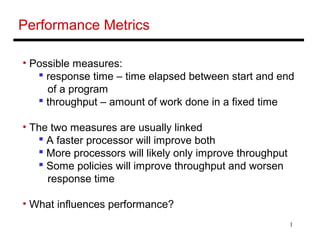
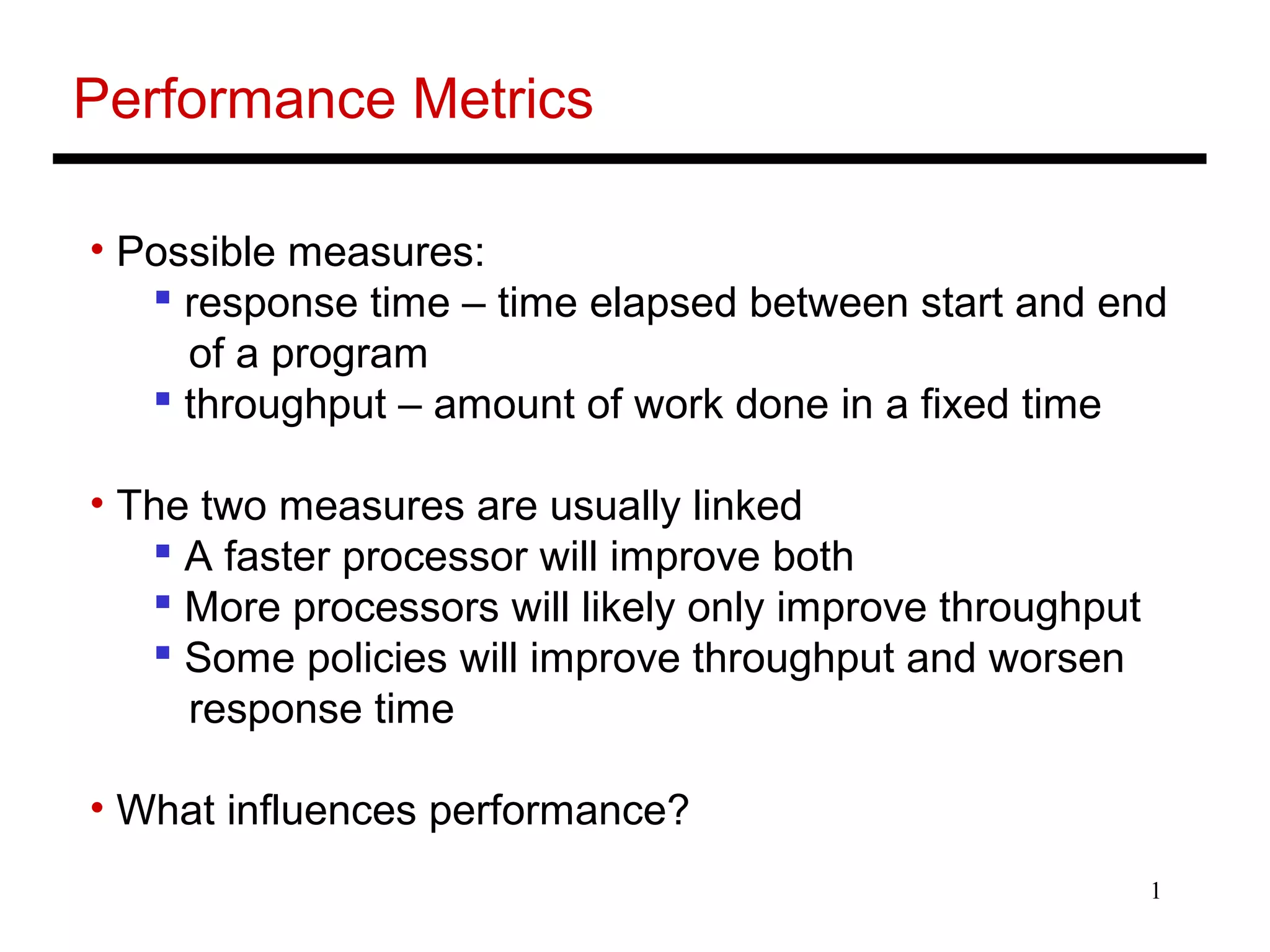
Performance Metrics
• Possible measures:
 response time – time elapsed between start and end
of a program
 throughput – amount of work done in a fixed time
• The two measures are usually linked
 A faster processor will improve both
 More processors will likely only improve throughput
 Some policies will improve throughput and worsen
response time
• What influences performance?
2
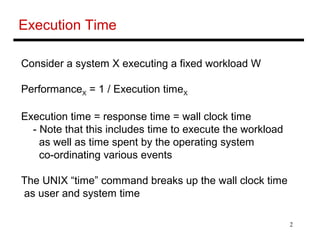
Execution Time
Consider a system X executing a fixed workload W
PerformanceX = 1 / Execution timeX
Execution time = response time = wall clock time
- Note that this includes time to execute the workload
as well as time spent by the operating system
co-ordinating various events
The UNIX “time” command breaks up the wall clock time
as user and system time
3
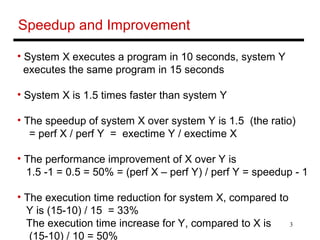
Speedup and Improvement
• System X executes a program in 10 seconds, system Y
executes the same program in 15 seconds
• System X is 1.5 times faster than system Y
• The speedup of system X over system Y is 1.5 (the ratio)
= perf X / perf Y = exectime Y / exectime X
• The performance improvement of X over Y is
1.5 -1 = 0.5 = 50% = (perf X – perf Y) / perf Y = speedup - 1
• The execution time reduction for system X, compared to
Y is (15-10) / 15 = 33%
The execution time increase for Y, compared to X is
(15-10) / 10 = 50%
4
A Primer on Clocks and Cycles
5
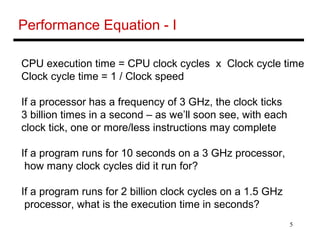
Performance Equation - I
CPU execution time = CPU clock cycles x Clock cycle time
Clock cycle time = 1 / Clock speed
If a processor has a frequency of 3 GHz, the clock ticks
3 billion times in a second – as we’ll soon see, with each
clock tick, one or more/less instructions may complete
If a program runs for 10 seconds on a 3 GHz processor,
how many clock cycles did it run for?
If a program runs for 2 billion clock cycles on a 1.5 GHz
processor, what is the execution time in seconds?
6
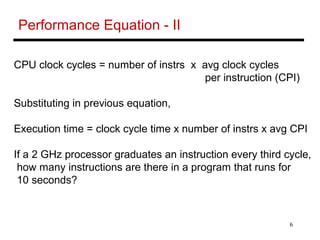
Performance Equation - II
CPU clock cycles = number of instrs x avg clock cycles
per instruction (CPI)
Substituting in previous equation,
Execution time = clock cycle time x number of instrs x avg CPI
If a 2 GHz processor graduates an instruction every third cycle,
how many instructions are there in a program that runs for
10 seconds?
7
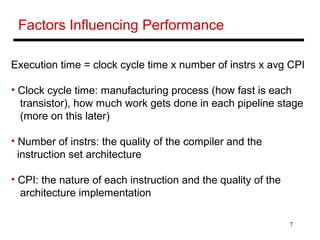
Factors Influencing Performance
Execution time = clock cycle time x number of instrs x avg CPI
• Clock cycle time: manufacturing process (how fast is each
transistor), how much work gets done in each pipeline stage
(more on this later)
• Number of instrs: the quality of the compiler and the
instruction set architecture
• CPI: the nature of each instruction and the quality of the
architecture implementation
8
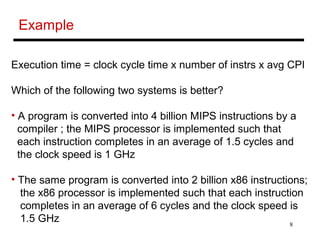
Example
Execution time = clock cycle time x number of instrs x avg CPI
Which of the following two systems is better?
• A program is converted into 4 billion MIPS instructions by a
compiler ; the MIPS processor is implemented such that
each instruction completes in an average of 1.5 cycles and
the clock speed is 1 GHz
• The same program is converted into 2 billion x86 instructions;
the x86 processor is implemented such that each instruction
completes in an average of 6 cycles and the clock speed is
1.5 GHz
9
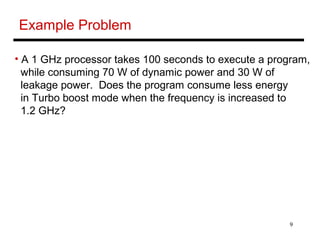
Example Problem
• A 1 GHz processor takes 100 seconds to execute a program,
while consuming 70 W of dynamic power and 30 W of
leakage power. Does the program consume less energy
in Turbo boost mode when the frequency is increased to
1.2 GHz?
10
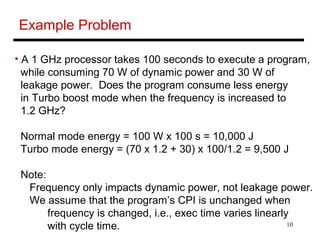
Example Problem
• A 1 GHz processor takes 100 seconds to execute a program,
while consuming 70 W of dynamic power and 30 W of
leakage power. Does the program consume less energy
in Turbo boost mode when the frequency is increased to
1.2 GHz?
Normal mode energy = 100 W x 100 s = 10,000 J
Turbo mode energy = (70 x 1.2 + 30) x 100/1.2 = 9,500 J
Note:
Frequency only impacts dynamic power, not leakage power.
We assume that the program’s CPI is unchanged when
frequency is changed, i.e., exec time varies linearly
with cycle time.

COMPUTER ARCHITECTURE BASIC CONCEPT

  • 1.
    1 Performance Metrics • Possiblemeasures:  response time – time elapsed between start and end of a program  throughput – amount of work done in a fixed time • The two measures are usually linked  A faster processor will improve both  More processors will likely only improve throughput  Some policies will improve throughput and worsen response time • What influences performance?
  • 2.
    2 Execution Time Consider asystem X executing a fixed workload W PerformanceX = 1 / Execution timeX Execution time = response time = wall clock time - Note that this includes time to execute the workload as well as time spent by the operating system co-ordinating various events The UNIX “time” command breaks up the wall clock time as user and system time
  • 3.
    3 Speedup and Improvement •System X executes a program in 10 seconds, system Y executes the same program in 15 seconds • System X is 1.5 times faster than system Y • The speedup of system X over system Y is 1.5 (the ratio) = perf X / perf Y = exectime Y / exectime X • The performance improvement of X over Y is 1.5 -1 = 0.5 = 50% = (perf X – perf Y) / perf Y = speedup - 1 • The execution time reduction for system X, compared to Y is (15-10) / 15 = 33% The execution time increase for Y, compared to X is (15-10) / 10 = 50%
  • 4.
    4 A Primer onClocks and Cycles
  • 5.
    5 Performance Equation -I CPU execution time = CPU clock cycles x Clock cycle time Clock cycle time = 1 / Clock speed If a processor has a frequency of 3 GHz, the clock ticks 3 billion times in a second – as we’ll soon see, with each clock tick, one or more/less instructions may complete If a program runs for 10 seconds on a 3 GHz processor, how many clock cycles did it run for? If a program runs for 2 billion clock cycles on a 1.5 GHz processor, what is the execution time in seconds?
  • 6.
    6 Performance Equation -II CPU clock cycles = number of instrs x avg clock cycles per instruction (CPI) Substituting in previous equation, Execution time = clock cycle time x number of instrs x avg CPI If a 2 GHz processor graduates an instruction every third cycle, how many instructions are there in a program that runs for 10 seconds?
  • 7.
    7 Factors Influencing Performance Executiontime = clock cycle time x number of instrs x avg CPI • Clock cycle time: manufacturing process (how fast is each transistor), how much work gets done in each pipeline stage (more on this later) • Number of instrs: the quality of the compiler and the instruction set architecture • CPI: the nature of each instruction and the quality of the architecture implementation
  • 8.
    8 Example Execution time =clock cycle time x number of instrs x avg CPI Which of the following two systems is better? • A program is converted into 4 billion MIPS instructions by a compiler ; the MIPS processor is implemented such that each instruction completes in an average of 1.5 cycles and the clock speed is 1 GHz • The same program is converted into 2 billion x86 instructions; the x86 processor is implemented such that each instruction completes in an average of 6 cycles and the clock speed is 1.5 GHz
  • 9.
    9 Example Problem • A1 GHz processor takes 100 seconds to execute a program, while consuming 70 W of dynamic power and 30 W of leakage power. Does the program consume less energy in Turbo boost mode when the frequency is increased to 1.2 GHz?
  • 10.
    10 Example Problem • A1 GHz processor takes 100 seconds to execute a program, while consuming 70 W of dynamic power and 30 W of leakage power. Does the program consume less energy in Turbo boost mode when the frequency is increased to 1.2 GHz? Normal mode energy = 100 W x 100 s = 10,000 J Turbo mode energy = (70 x 1.2 + 30) x 100/1.2 = 9,500 J Note: Frequency only impacts dynamic power, not leakage power. We assume that the program’s CPI is unchanged when frequency is changed, i.e., exec time varies linearly with cycle time.