Database System Concepts, 6th
Ed.
©Silberschatz, Korth and Sudarshan
See www.db-book.com for conditions on re-use
Chapter 2: Intro to RelationalChapter 2: Intro to Relational
ModelModel
©Silberschatz, Korth and Sudarshan2.2Database System Concepts - 6th
Edition
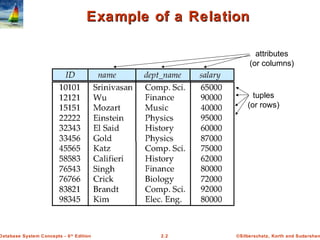
Example of a RelationExample of a Relation
attributes
(or columns)
tuples
(or rows)
©Silberschatz, Korth and Sudarshan2.3Database System Concepts - 6th
Edition
Attribute TypesAttribute Types
The set of allowed values for each attribute is called the domain
of the attribute
Attribute values are (normally) required to be atomic; that is,
indivisible
The special value null is a member of every domain. Indicated
that the value is “unknown”
The null value causes complications in the definition of many
operations
©Silberschatz, Korth and Sudarshan2.4Database System Concepts - 6th
Edition
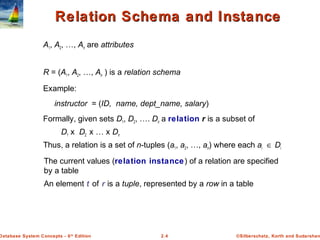
Relation Schema and InstanceRelation Schema and Instance
A1, A2, …, An are attributes
R = (A1, A2, …, An ) is a relation schema
Example:
instructor = (ID, name, dept_name, salary)
Formally, given sets D1, D2, …. Dn a relation r is a subset of
D1 x D2 x … x Dn
Thus, a relation is a set of n-tuples (a1, a2, …, an) where each ai ∈ Di
The current values (relation instance) of a relation are specified
by a table
An element t of r is a tuple, represented by a row in a table
©Silberschatz, Korth and Sudarshan2.5Database System Concepts - 6th
Edition
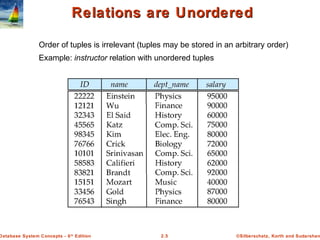
Relations are UnorderedRelations are Unordered
Order of tuples is irrelevant (tuples may be stored in an arbitrary order)
Example: instructor relation with unordered tuples
©Silberschatz, Korth and Sudarshan2.6Database System Concepts - 6th
Edition
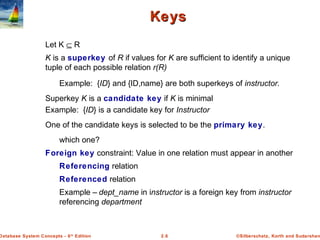
KeysKeys
Let K ⊆ R
K is a superkey of R if values for K are sufficient to identify a unique
tuple of each possible relation r(R)
Example: {ID} and {ID,name} are both superkeys of instructor.
Superkey K is a candidate key if K is minimal
Example: {ID} is a candidate key for Instructor
One of the candidate keys is selected to be the primary key.
which one?
Foreign key constraint: Value in one relation must appear in another
Referencing relation
Referenced relation
Example – dept_name in instructor is a foreign key from instructor
referencing department
©Silberschatz, Korth and Sudarshan2.7Database System Concepts - 6th
Edition
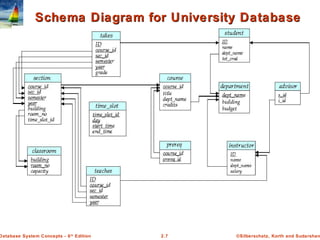
Schema Diagram for University DatabaseSchema Diagram for University Database
©Silberschatz, Korth and Sudarshan2.8Database System Concepts - 6th
Edition
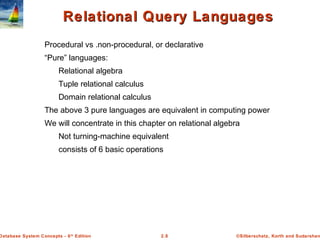
Relational Query LanguagesRelational Query Languages
Procedural vs .non-procedural, or declarative
“Pure” languages:
Relational algebra
Tuple relational calculus
Domain relational calculus
The above 3 pure languages are equivalent in computing power
We will concentrate in this chapter on relational algebra
Not turning-machine equivalent
consists of 6 basic operations
©Silberschatz, Korth and Sudarshan2.9Database System Concepts - 6th
Edition
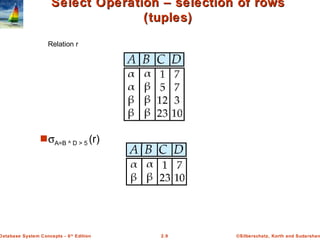
Select Operation – selection of rowsSelect Operation – selection of rows
(tuples)(tuples)
Relation r
σA=B ^ D > 5 (r)
©Silberschatz, Korth and Sudarshan2.10Database System Concepts - 6th
Edition
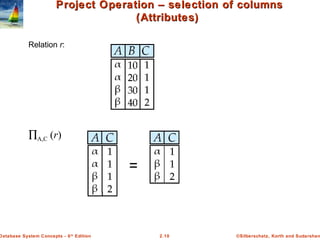
Project Operation – selection of columnsProject Operation – selection of columns
(Attributes)(Attributes)
Relation r:
∏A,C (r)
©Silberschatz, Korth and Sudarshan2.11Database System Concepts - 6th
Edition
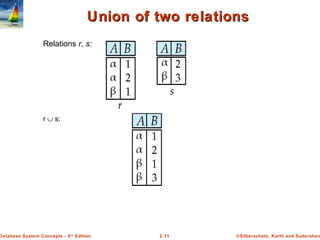
Union of two relationsUnion of two relations
Relations r, s:
r ∪ s:
©Silberschatz, Korth and Sudarshan2.12Database System Concepts - 6th
Edition
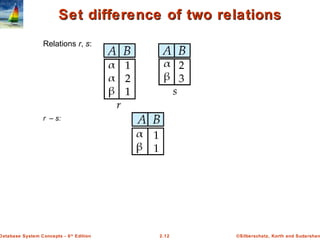
Set difference of two relationsSet difference of two relations
Relations r, s:
r – s:
©Silberschatz, Korth and Sudarshan2.13Database System Concepts - 6th
Edition
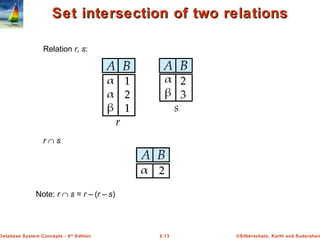
Set intersection of two relationsSet intersection of two relations
Relation r, s:
r ∩ s
Note: r ∩ s = r – (r – s)
©Silberschatz, Korth and Sudarshan2.14Database System Concepts - 6th
Edition
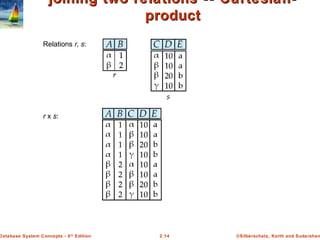
joining two relations -- Cartesian-joining two relations -- Cartesian-
productproduct
Relations r, s:
r x s:
©Silberschatz, Korth and Sudarshan2.15Database System Concepts - 6th
Edition
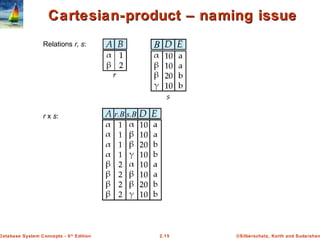
Cartesian-product – naming issueCartesian-product – naming issue
Relations r, s:
r x s: s.B
B
r.B
©Silberschatz, Korth and Sudarshan2.16Database System Concepts - 6th
Edition
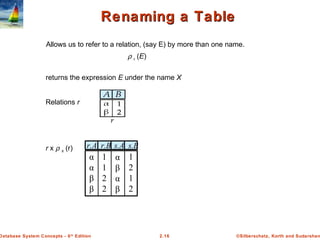
Renaming a TableRenaming a Table
Allows us to refer to a relation, (say E) by more than one name.
ρ x (E)
returns the expression E under the name X
Relations r
r x ρ s (r)
α
α
β
β
1
1
2
2
α
β
α
β
1
2
1
2
r.A r.B s.A s.B
©Silberschatz, Korth and Sudarshan2.17Database System Concepts - 6th
Edition
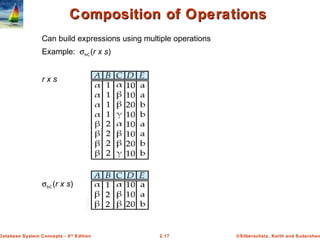
Composition of OperationsComposition of Operations
Can build expressions using multiple operations
Example: σA=C (r x s)
r x s
σA=C (r x s)
©Silberschatz, Korth and Sudarshan2.18Database System Concepts - 6th
Edition
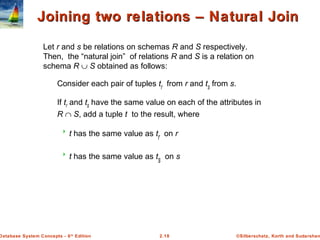
Joining two relations – Natural JoinJoining two relations – Natural Join
Let r and s be relations on schemas R and S respectively.
Then, the “natural join” of relations R and S is a relation on
schema R ∪ S obtained as follows:
Consider each pair of tuples tr from r and ts from s.
If tr and ts have the same value on each of the attributes in
R ∩ S, add a tuple t to the result, where
 t has the same value as tr on r
 t has the same value as ts on s
©Silberschatz, Korth and Sudarshan2.19Database System Concepts - 6th
Edition
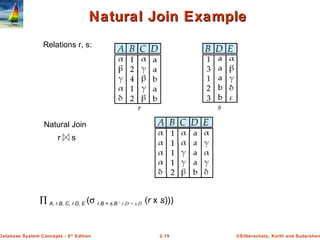
Natural Join ExampleNatural Join Example
Relations r, s:
Natural Join
r s
∏ A, r.B, C, r.D, E (σ r.B = s.B r.D = s.D˄ (r x s)))
©Silberschatz, Korth and Sudarshan2.20Database System Concepts - 6th
Edition
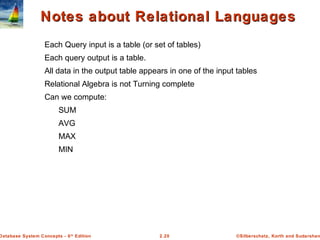
Notes about Relational LanguagesNotes about Relational Languages
Each Query input is a table (or set of tables)
Each query output is a table.
All data in the output table appears in one of the input tables
Relational Algebra is not Turning complete
Can we compute:
SUM
AVG
MAX
MIN
©Silberschatz, Korth and Sudarshan2.21Database System Concepts - 6th
Edition
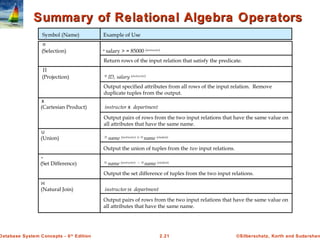
Summary of Relational Algebra OperatorsSummary of Relational Algebra Operators
Symbol (Name) Example of Use
(Selection) σ
salary > = 85000 (instructor)
σ
Return rows of the input relation that satisfy the predicate.
Π
(Projection) Π
ID, salary (instructor)
Output specified attributes from all rows of the input relation. Remove
duplicate tuples from the output.
x
(Cartesian Product) instructor x department
Output pairs of rows from the two input relations that have the same value on
all attributes that have the same name.
∪
(Union) Π
name (instructor) ∪ Π
name (student)
Output the union of tuples from the two input relations.
(Natural Join) instructor ⋈ department
Output pairs of rows from the two input relations that have the same value on
all attributes that have the same name.
⋈
-
(Set Difference) Π
name (instructor) -- Π
name (student)
Output the set difference of tuples from the two input relations.
Database System Concepts, 6th
Ed.
©Silberschatz, Korth and Sudarshan
See www.db-book.com for conditions on re-use
End of Chapter 2End of Chapter 2

DBMS _Relational model

  • 1.
    Database System Concepts,6th Ed. ©Silberschatz, Korth and Sudarshan See www.db-book.com for conditions on re-use Chapter 2: Intro to RelationalChapter 2: Intro to Relational ModelModel
  • 2.
    ©Silberschatz, Korth andSudarshan2.2Database System Concepts - 6th Edition Example of a RelationExample of a Relation attributes (or columns) tuples (or rows)
  • 3.
    ©Silberschatz, Korth andSudarshan2.3Database System Concepts - 6th Edition Attribute TypesAttribute Types The set of allowed values for each attribute is called the domain of the attribute Attribute values are (normally) required to be atomic; that is, indivisible The special value null is a member of every domain. Indicated that the value is “unknown” The null value causes complications in the definition of many operations
  • 4.
    ©Silberschatz, Korth andSudarshan2.4Database System Concepts - 6th Edition Relation Schema and InstanceRelation Schema and Instance A1, A2, …, An are attributes R = (A1, A2, …, An ) is a relation schema Example: instructor = (ID, name, dept_name, salary) Formally, given sets D1, D2, …. Dn a relation r is a subset of D1 x D2 x … x Dn Thus, a relation is a set of n-tuples (a1, a2, …, an) where each ai ∈ Di The current values (relation instance) of a relation are specified by a table An element t of r is a tuple, represented by a row in a table
  • 5.
    ©Silberschatz, Korth andSudarshan2.5Database System Concepts - 6th Edition Relations are UnorderedRelations are Unordered Order of tuples is irrelevant (tuples may be stored in an arbitrary order) Example: instructor relation with unordered tuples
  • 6.
    ©Silberschatz, Korth andSudarshan2.6Database System Concepts - 6th Edition KeysKeys Let K ⊆ R K is a superkey of R if values for K are sufficient to identify a unique tuple of each possible relation r(R) Example: {ID} and {ID,name} are both superkeys of instructor. Superkey K is a candidate key if K is minimal Example: {ID} is a candidate key for Instructor One of the candidate keys is selected to be the primary key. which one? Foreign key constraint: Value in one relation must appear in another Referencing relation Referenced relation Example – dept_name in instructor is a foreign key from instructor referencing department
  • 7.
    ©Silberschatz, Korth andSudarshan2.7Database System Concepts - 6th Edition Schema Diagram for University DatabaseSchema Diagram for University Database
  • 8.
    ©Silberschatz, Korth andSudarshan2.8Database System Concepts - 6th Edition Relational Query LanguagesRelational Query Languages Procedural vs .non-procedural, or declarative “Pure” languages: Relational algebra Tuple relational calculus Domain relational calculus The above 3 pure languages are equivalent in computing power We will concentrate in this chapter on relational algebra Not turning-machine equivalent consists of 6 basic operations
  • 9.
    ©Silberschatz, Korth andSudarshan2.9Database System Concepts - 6th Edition Select Operation – selection of rowsSelect Operation – selection of rows (tuples)(tuples) Relation r σA=B ^ D > 5 (r)
  • 10.
    ©Silberschatz, Korth andSudarshan2.10Database System Concepts - 6th Edition Project Operation – selection of columnsProject Operation – selection of columns (Attributes)(Attributes) Relation r: ∏A,C (r)
  • 11.
    ©Silberschatz, Korth andSudarshan2.11Database System Concepts - 6th Edition Union of two relationsUnion of two relations Relations r, s: r ∪ s:
  • 12.
    ©Silberschatz, Korth andSudarshan2.12Database System Concepts - 6th Edition Set difference of two relationsSet difference of two relations Relations r, s: r – s:
  • 13.
    ©Silberschatz, Korth andSudarshan2.13Database System Concepts - 6th Edition Set intersection of two relationsSet intersection of two relations Relation r, s: r ∩ s Note: r ∩ s = r – (r – s)
  • 14.
    ©Silberschatz, Korth andSudarshan2.14Database System Concepts - 6th Edition joining two relations -- Cartesian-joining two relations -- Cartesian- productproduct Relations r, s: r x s:
  • 15.
    ©Silberschatz, Korth andSudarshan2.15Database System Concepts - 6th Edition Cartesian-product – naming issueCartesian-product – naming issue Relations r, s: r x s: s.B B r.B
  • 16.
    ©Silberschatz, Korth andSudarshan2.16Database System Concepts - 6th Edition Renaming a TableRenaming a Table Allows us to refer to a relation, (say E) by more than one name. ρ x (E) returns the expression E under the name X Relations r r x ρ s (r) α α β β 1 1 2 2 α β α β 1 2 1 2 r.A r.B s.A s.B
  • 17.
    ©Silberschatz, Korth andSudarshan2.17Database System Concepts - 6th Edition Composition of OperationsComposition of Operations Can build expressions using multiple operations Example: σA=C (r x s) r x s σA=C (r x s)
  • 18.
    ©Silberschatz, Korth andSudarshan2.18Database System Concepts - 6th Edition Joining two relations – Natural JoinJoining two relations – Natural Join Let r and s be relations on schemas R and S respectively. Then, the “natural join” of relations R and S is a relation on schema R ∪ S obtained as follows: Consider each pair of tuples tr from r and ts from s. If tr and ts have the same value on each of the attributes in R ∩ S, add a tuple t to the result, where  t has the same value as tr on r  t has the same value as ts on s
  • 19.
    ©Silberschatz, Korth andSudarshan2.19Database System Concepts - 6th Edition Natural Join ExampleNatural Join Example Relations r, s: Natural Join r s ∏ A, r.B, C, r.D, E (σ r.B = s.B r.D = s.D˄ (r x s)))
  • 20.
    ©Silberschatz, Korth andSudarshan2.20Database System Concepts - 6th Edition Notes about Relational LanguagesNotes about Relational Languages Each Query input is a table (or set of tables) Each query output is a table. All data in the output table appears in one of the input tables Relational Algebra is not Turning complete Can we compute: SUM AVG MAX MIN
  • 21.
    ©Silberschatz, Korth andSudarshan2.21Database System Concepts - 6th Edition Summary of Relational Algebra OperatorsSummary of Relational Algebra Operators Symbol (Name) Example of Use (Selection) σ salary > = 85000 (instructor) σ Return rows of the input relation that satisfy the predicate. Π (Projection) Π ID, salary (instructor) Output specified attributes from all rows of the input relation. Remove duplicate tuples from the output. x (Cartesian Product) instructor x department Output pairs of rows from the two input relations that have the same value on all attributes that have the same name. ∪ (Union) Π name (instructor) ∪ Π name (student) Output the union of tuples from the two input relations. (Natural Join) instructor ⋈ department Output pairs of rows from the two input relations that have the same value on all attributes that have the same name. ⋈ - (Set Difference) Π name (instructor) -- Π name (student) Output the set difference of tuples from the two input relations.
  • 22.
    Database System Concepts,6th Ed. ©Silberschatz, Korth and Sudarshan See www.db-book.com for conditions on re-use End of Chapter 2End of Chapter 2