Presntation on:
Computer
Presented By:
Saransh Arora
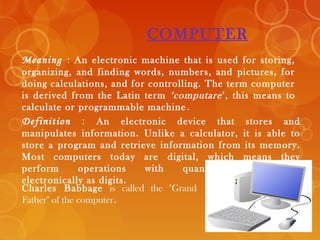
Meaning : An electronic machine that is used for storing,
organizing, and finding words, numbers, and pictures, for
doing calculations, and for controlling. The term computer
is derived from the Latin term ‘computare’, this means to
calculate or programmable machine.
Charles Babbage is called the "Grand
Father" of the computer.
COMPUTER
Definition : An electronic device that stores and
manipulates information. Unlike a calculator, it is able to
store a program and retrieve information from its memory.
Most computers today are digital, which means they
perform operations with quantities represented
electronically as digits.
PARTS OF COMPUTER
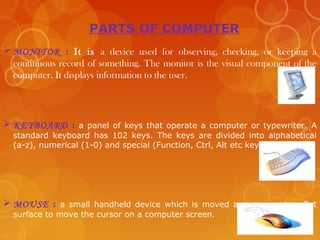
 MONITOR : It is a device used for observing, checking, or keeping a
continuous record of something. The monitor is the visual component of the
computer. It displays information to the user.
 KEYBOARD : a panel of keys that operate a computer or typewriter. A
standard keyboard has 102 keys. The keys are divided into alphabetical
(a-z), numerical (1-0) and special (Function, Ctrl, Alt etc keys).
 MOUSE : a small handheld device which is moved across a mat or flat
surface to move the cursor on a computer screen.
CENTRAL PROCESSING UNIT (CPU) : The central processing
unit (CPU) is the brain of your computer. It handles all the instructions
you give your computer, and the faster it does this, the better. Learn
about how a CPU processes instructions and how computer engineers
are continuously coming up with ways to make it go faster.
: The speakers are the audio component of the
computer.
 SPEAKER
 PRINTER : The printer is used to develop a hard copy or paper copy of a
document or picture. The  printer connects to the computer and requires the
use of its own power cord.
 COMACT DISC : This device is used for storage. Some CDs hold information
to be loaded into a  computer. Some are used to hold information from the
computer. It depends on what  type of CD it is.
Uses of computer
Business-Today, in global markets. Many business activities are performed very
quickly and efficiently and paperwork is also reduced by using computers.
Education- Computers are used in teaching and research. The students can
solve different kinds of problems quickly and efficiently and can also collect
different information on the Internet.
Banks-They are used in banks for record keeping and maintaining accounts of
customers. Most of the banks provide the facility of ATMs.
Entertainment-People can also watch movies, listen music, and play games on
the computer. Many computer games and other entertainment materials of
different
Medical-Nearly every area of the medical field uses computers. They are also
used for patient monitoring and diagnosis purposes.
Uses of computer
Advantages of Computer
 Increases speed of computing and processing information in any other way.
 Computers can store large volumes of information without occupying too
much space.
 Computer processing eliminates the human errors of computing and
information
 This reduces the work load of capturing same information multiple times
for different purposes.
 The work of entering and editing information is made mush more easy and
simple by software that offer many powerful user friendly features for
performing these tasks.
 Computer now offer sophisticated and powerful software for representing
information in rich formats with visual and video facilities.
 Computers combined with communication technology offer very fast speed
and rich communication facility at low cost.
 Computers, with all these features are now used for automating all kinds of
equipments and processes.
Disadvantage of Computers
These equipments are costly as compared to manual processing equipments
like pen and pencil. Also technological complexity of these equipment makes it
more difficult to learn and maintain these equipments.
Use of computers require additional infrastructure, such as power supply and
software back up. This increases the chances of problems due to failure of
infrastructure.
Failures of computer system can be more serious and difficult to correct. For
example, one scratch on a hard disk can make the complete data on the disk
inaccessible.
Computers generally reduces the errors of processing. However if there is an
error in input data, it can result in major blunders in the processing which the
computer system is unable to detect. In manual systems the chances of such
blunders passing undetected and corrected is much less.
CONTROL PANEL
Definition- The Control Panel is a part of the Microsoft Windows
graphical user interface which allows users to view and manipulate basic
system settings and controls via applets, such as adding hardware, adding and
removing software, controlling user accounts, and changing accessibility
options. Additional applets can be provided by third party software.
 The Control Panel has two views, Classic View and Category View, and it is
possible to switch between these through an option that appears on either the left
side or top of the window.
 There are many advantages to using web hosting control panels to manage
website which include:
•    Automation
•    Installation
•    Affordability
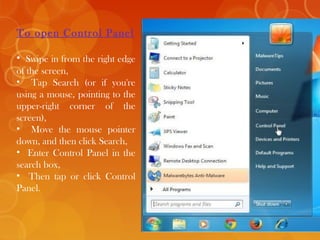
To open Control Panel
• Swipe in from the right edge
of the screen,
• Tap Search (or if you're
using a mouse, pointing to the
upper-right corner of the
screen),
• Move the mouse pointer
down, and then click Search,
• Enter Control Panel in the
search box,
• Then tap or click Control
Panel.
Classic view of control panel
 Security and system
• Review computer status
• Save backup copies and files with file history
• Back up and restore (window 7)
• File and fix problems
 Network and internet
• To view network status and tasks
• Choose homegroup and sharing options
 Hardware and sound
• View device and printers
• Add a device
Components of Control Panel
 User account
• Change account type
 Appearance and personlization
• Change the theme, adjust screen resolution
 Clock, language and region
• Add a language
• Change input methods
• Change date, time and number of formats
 Ease of access
• Let windows suggest settings,
• Opitimize visual display
 Programs
• Uninstall a program
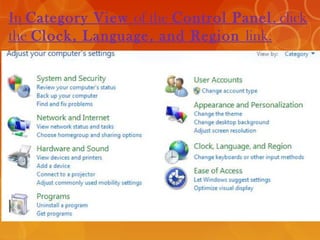
In Category View of the Control Panel, click
the Clock, Language, and Region link.
The Clock, Language, and Region window
will display
CONTROL PANEL
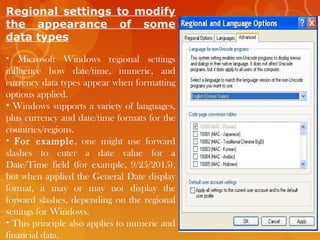
Regional settings to modify
the appearance of some
data types
• Microsoft Windows regional settings
influence how date/time, numeric, and
currency data types appear when formatting
options applied.
• Windows supports a variety of languages,
plus currency and date/time formats for the
countries/regions.
• For example, one might use forward
slashes to enter a date value for a
Date/Time field (for example, 9/25/2015),
but when applied the General Date display
format, it may or may not display the
forward slashes, depending on the regional
settings for Windows.
• This principle also applies to numeric and
financial data.
Change the regional settings
  
1.Click the Start button , and then click Control Panel.
2.Click Clock, Language, and Region, and then click
Regional and Language Options.
The Regional and Language Options dialog box appears.
1.On the Formats tab, under Current format, click
Customize this format.The Customize Regional Options
dialog box appears.
•Click the tab that contains the settings that you want to
modify, and make your changes. For example, to change
part or all of a number format, click the Numbers tab and
change the setting that you want.
• Computer uses the date and time for a number operations. It uses
them to set the creation and modification dates for files and to stamp the
date and time of e-mails.
• The clock is displayed in the menu bar and if clicked on the time one
will be shown that date.
• One have many ways to customize the way clock looks and behaves.
Once opened the Date & Time Control Panel you will be
presented with this window where one can format both the date and
time, set your time zone and daylight savings time.
• Set the AM/PM if using the 12 hour format
Date & Time Control
Panel
Change in Date & Time
Change Date
Click the Date and Time link.
The Date and Time dialog box will appear (see illustration next
page left).
Click the Change Date and Time button.
Change Time Zone
To change the Time Zone, click the Change Time Zone
button.
The Time Zone Settings window will display (see illustration
next page right).
Use the list to select a time zone.
Click the OK button.
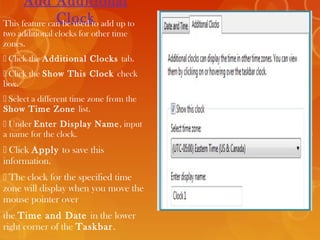
Add Additional
ClockThis feature can be used to add up to
two additional clocks for other time
zones.
 Click the Additional Clocks tab.
 Click the Show This Clock check
box.
 Select a different time zone from the
Show Time Zone list.
 Under Enter Display Name, input
a name for the clock.
 Click Apply to save this
information.
 The clock for the specified time
zone will display when you move the
mouse pointer over
the Time and Date in the lower
right corner of the Taskbar.
Dates, Times & Currency Settings in Windows
•Open the Control Panel
and go to "Clock,
Language, and Region".
•There, look for Region.
Beneath it, find a link that
says "Change the date,
time, or number formats".
• Click or tap on it.
1.Move the mouse pointer to the upper-right
corner of the screen to access the Charm Bar, then
move the pointer down and click Search
2.In the search box enter "language", then select
Region and Language Settings from the search
results
3.Click Add a language
4.Choose the language that you want to add
How to change keyboard language in
Windows
Switch between different input languages
If you've added more than one language to your PC you
can switch between different input languages by using one
of the following methods:
Method 1: Click the language abbreviation button on the
taskbar (bottom right corner of your screen, next to the
clock) and then click the input method you want to switch
to
Method 2: Press and hold the Windows logo key and
then press the Spacebar repeatedly
Computer
Computer

Computer

  • 1.
  • 2.
    Meaning : Anelectronic machine that is used for storing, organizing, and finding words, numbers, and pictures, for doing calculations, and for controlling. The term computer is derived from the Latin term ‘computare’, this means to calculate or programmable machine. Charles Babbage is called the "Grand Father" of the computer. COMPUTER Definition : An electronic device that stores and manipulates information. Unlike a calculator, it is able to store a program and retrieve information from its memory. Most computers today are digital, which means they perform operations with quantities represented electronically as digits.
  • 3.
    PARTS OF COMPUTER MONITOR : It is a device used for observing, checking, or keeping a continuous record of something. The monitor is the visual component of the computer. It displays information to the user.  KEYBOARD : a panel of keys that operate a computer or typewriter. A standard keyboard has 102 keys. The keys are divided into alphabetical (a-z), numerical (1-0) and special (Function, Ctrl, Alt etc keys).  MOUSE : a small handheld device which is moved across a mat or flat surface to move the cursor on a computer screen.
  • 4.
    CENTRAL PROCESSING UNIT(CPU) : The central processing unit (CPU) is the brain of your computer. It handles all the instructions you give your computer, and the faster it does this, the better. Learn about how a CPU processes instructions and how computer engineers are continuously coming up with ways to make it go faster. : The speakers are the audio component of the computer.  SPEAKER
  • 5.
     PRINTER :The printer is used to develop a hard copy or paper copy of a document or picture. The  printer connects to the computer and requires the use of its own power cord.  COMACT DISC : This device is used for storage. Some CDs hold information to be loaded into a  computer. Some are used to hold information from the computer. It depends on what  type of CD it is.
  • 6.
    Uses of computer Business-Today,in global markets. Many business activities are performed very quickly and efficiently and paperwork is also reduced by using computers. Education- Computers are used in teaching and research. The students can solve different kinds of problems quickly and efficiently and can also collect different information on the Internet. Banks-They are used in banks for record keeping and maintaining accounts of customers. Most of the banks provide the facility of ATMs. Entertainment-People can also watch movies, listen music, and play games on the computer. Many computer games and other entertainment materials of different Medical-Nearly every area of the medical field uses computers. They are also used for patient monitoring and diagnosis purposes.
  • 7.
  • 8.
    Advantages of Computer Increases speed of computing and processing information in any other way.  Computers can store large volumes of information without occupying too much space.  Computer processing eliminates the human errors of computing and information  This reduces the work load of capturing same information multiple times for different purposes.  The work of entering and editing information is made mush more easy and simple by software that offer many powerful user friendly features for performing these tasks.  Computer now offer sophisticated and powerful software for representing information in rich formats with visual and video facilities.  Computers combined with communication technology offer very fast speed and rich communication facility at low cost.  Computers, with all these features are now used for automating all kinds of equipments and processes.
  • 9.
    Disadvantage of Computers Theseequipments are costly as compared to manual processing equipments like pen and pencil. Also technological complexity of these equipment makes it more difficult to learn and maintain these equipments. Use of computers require additional infrastructure, such as power supply and software back up. This increases the chances of problems due to failure of infrastructure. Failures of computer system can be more serious and difficult to correct. For example, one scratch on a hard disk can make the complete data on the disk inaccessible. Computers generally reduces the errors of processing. However if there is an error in input data, it can result in major blunders in the processing which the computer system is unable to detect. In manual systems the chances of such blunders passing undetected and corrected is much less.
  • 10.
    CONTROL PANEL Definition- TheControl Panel is a part of the Microsoft Windows graphical user interface which allows users to view and manipulate basic system settings and controls via applets, such as adding hardware, adding and removing software, controlling user accounts, and changing accessibility options. Additional applets can be provided by third party software.  The Control Panel has two views, Classic View and Category View, and it is possible to switch between these through an option that appears on either the left side or top of the window.  There are many advantages to using web hosting control panels to manage website which include: •    Automation •    Installation •    Affordability
  • 11.
    To open ControlPanel • Swipe in from the right edge of the screen, • Tap Search (or if you're using a mouse, pointing to the upper-right corner of the screen), • Move the mouse pointer down, and then click Search, • Enter Control Panel in the search box, • Then tap or click Control Panel.
  • 12.
    Classic view ofcontrol panel
  • 13.
     Security andsystem • Review computer status • Save backup copies and files with file history • Back up and restore (window 7) • File and fix problems  Network and internet • To view network status and tasks • Choose homegroup and sharing options  Hardware and sound • View device and printers • Add a device Components of Control Panel
  • 14.
     User account •Change account type  Appearance and personlization • Change the theme, adjust screen resolution  Clock, language and region • Add a language • Change input methods • Change date, time and number of formats  Ease of access • Let windows suggest settings, • Opitimize visual display  Programs • Uninstall a program
  • 15.
    In Category Viewof the Control Panel, click the Clock, Language, and Region link.
  • 16.
    The Clock, Language,and Region window will display CONTROL PANEL
  • 17.
    Regional settings tomodify the appearance of some data types • Microsoft Windows regional settings influence how date/time, numeric, and currency data types appear when formatting options applied. • Windows supports a variety of languages, plus currency and date/time formats for the countries/regions. • For example, one might use forward slashes to enter a date value for a Date/Time field (for example, 9/25/2015), but when applied the General Date display format, it may or may not display the forward slashes, depending on the regional settings for Windows. • This principle also applies to numeric and financial data.
  • 18.
    Change the regionalsettings    1.Click the Start button , and then click Control Panel. 2.Click Clock, Language, and Region, and then click Regional and Language Options. The Regional and Language Options dialog box appears. 1.On the Formats tab, under Current format, click Customize this format.The Customize Regional Options dialog box appears. •Click the tab that contains the settings that you want to modify, and make your changes. For example, to change part or all of a number format, click the Numbers tab and change the setting that you want.
  • 20.
    • Computer usesthe date and time for a number operations. It uses them to set the creation and modification dates for files and to stamp the date and time of e-mails. • The clock is displayed in the menu bar and if clicked on the time one will be shown that date. • One have many ways to customize the way clock looks and behaves. Once opened the Date & Time Control Panel you will be presented with this window where one can format both the date and time, set your time zone and daylight savings time. • Set the AM/PM if using the 12 hour format Date & Time Control Panel
  • 21.
    Change in Date& Time Change Date Click the Date and Time link. The Date and Time dialog box will appear (see illustration next page left). Click the Change Date and Time button. Change Time Zone To change the Time Zone, click the Change Time Zone button. The Time Zone Settings window will display (see illustration next page right). Use the list to select a time zone. Click the OK button.
  • 23.
    Add Additional ClockThis featurecan be used to add up to two additional clocks for other time zones.  Click the Additional Clocks tab.  Click the Show This Clock check box.  Select a different time zone from the Show Time Zone list.  Under Enter Display Name, input a name for the clock.  Click Apply to save this information.  The clock for the specified time zone will display when you move the mouse pointer over the Time and Date in the lower right corner of the Taskbar.
  • 24.
    Dates, Times &Currency Settings in Windows •Open the Control Panel and go to "Clock, Language, and Region". •There, look for Region. Beneath it, find a link that says "Change the date, time, or number formats". • Click or tap on it.
  • 25.
    1.Move the mousepointer to the upper-right corner of the screen to access the Charm Bar, then move the pointer down and click Search 2.In the search box enter "language", then select Region and Language Settings from the search results 3.Click Add a language 4.Choose the language that you want to add How to change keyboard language in Windows
  • 26.
    Switch between differentinput languages If you've added more than one language to your PC you can switch between different input languages by using one of the following methods: Method 1: Click the language abbreviation button on the taskbar (bottom right corner of your screen, next to the clock) and then click the input method you want to switch to Method 2: Press and hold the Windows logo key and then press the Spacebar repeatedly