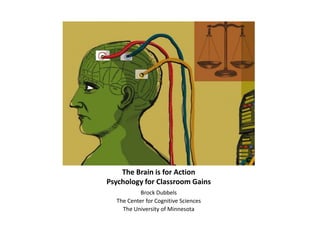

The Brain is for Action
Psychology for Classroom Gains
           Brock Dubbels
  The Center for Cognitive Sciences
    The University of Minnesota
Comprehension
What is it?
It must be guided with socio-cognitive experience.
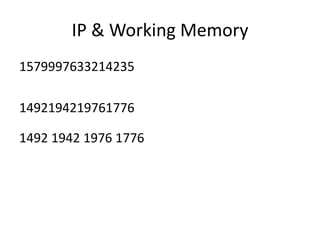
IP & Working Memory
1579997633214235

1492194219761776

1492 1942 1976 1776
Clapping
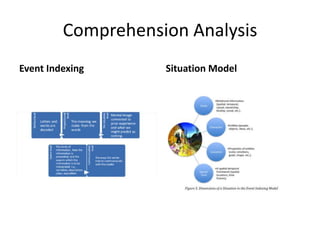
Comprehension Analysis
Event Indexing      Situation Model
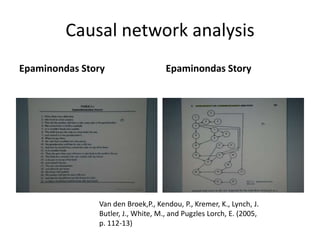
Causal network analysis
Epaminondas Story                   Epaminondas Story


               Van den Broek,P., Kendou, P., Kremer, K., Lynch, J.
               Butler, J., White, M., and Pugzles Lorch, E. (2005,
               p. 112-13)
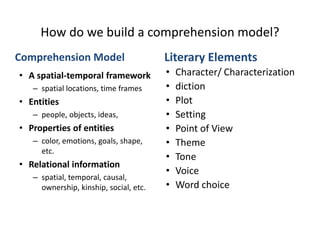
How do we build a comprehension model?
Comprehension Model                     Literary Elements
• A spatial-temporal framework          •   Character/ Characterization
   – spatial locations, time frames     •   diction
• Entities                              •   Plot
   – people, objects, ideas,            •   Setting
• Properties of entities                •   Point of View
   – color, emotions, goals, shape,     •   Theme
     etc.
                                        •   Tone
• Relational information
                                        •   Voice
   – spatial, temporal, causal,
     ownership, kinship, social, etc.   •   Word choice
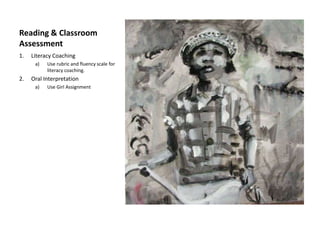
Reading & Classroom
Assessment
1.   Literacy Coaching
      a)   Use rubric and fluency scale for
           literacy coaching.
2.   Oral Interpretation
      a)   Use Girl Assignment
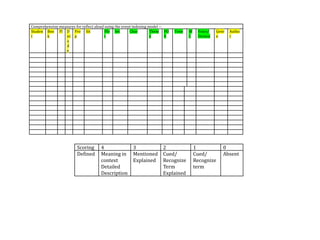
Comprehension measures for reflect aloud using the event indexing model --
Studen Boo Fl D Pro Sit                  Plo Set       Char        Them PO     Tone   W    Voice/    Genr   Autho
t      k         ec p                    t                         e       V          C    Diction   e      r
                 o
                 d
                 e


                         Scoring      4                 3               2                 1             0
                         Defined      Meaning in        Mentioned       Cued/             Cued/         Absent
                                      context           Explained       Recognize         Recognize
                                      Detailed                          Term              term
                                      Description                       Explained
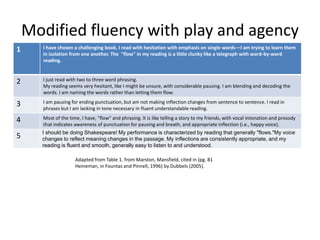
Modified fluency with play and agency
1     I have chosen a challenging book. I read with hesitation with emphasis on single words—I am trying to learn them
      in isolation from one another. The "flow" in my reading is a little clunky like a telegraph with word-by-word
      reading.


2     I just read with two to three word phrasing.
      My reading seems very hesitant, like I might be unsure, with considerable pausing. I am blending and decoding the
      words. I am naming the words rather than letting them flow.

3     I am pausing for ending punctuation, but am not making inflection changes from sentence to sentence. I read in
      phrases but I am lacking in tone necessary in fluent understandable reading.

4     Most of the time, I have, "flow" and phrasing. It is like telling a story to my friends, with vocal intonation and prosody
      that indicates awareness of punctuation for pausing and breath, and appropriate inflection (i.e., happy voice).
      I should be doing Shakespeare! My performance is characterized by reading that generally "flows."My voice
5     changes to reflect meaning changes in the passage. My inflections are consistently appropriate, and my
      reading is fluent and smooth, generally easy to listen to and understood.

                     Adapted from Table 1. from Marston, Mansfield, cited in (pg. 81
                     Heineman, in Fountas and Pinnell, 1996) by Dubbels (2005).
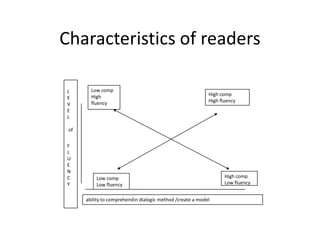
Characteristics of readers

 L      Low comp
        High                                                High comp
 E
        fluency                                             High fluency
 V
 E
 L

 of


 F
 L
 U
 E
 N
 C        Low comp                                                 High comp
 Y        Low fluency                                              Low fluency


      ability to comprehendin dialogic method /create a model
40                       38
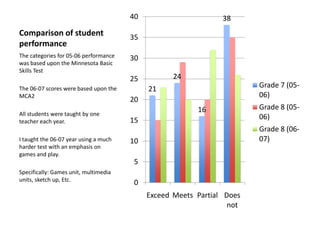
Comparison of student                  35
performance
The categories for 05-06 performance   30
was based upon the Minnesota Basic
Skills Test
                                       25          24
The 06-07 scores were based upon the        21                          Grade 7 (05-
MCA2                                                                    06)
                                       20
                                                         16             Grade 8 (05-
All students were taught by one
                                       15                               06)
teacher each year.
                                                                        Grade 8 (06-
I taught the 06-07 year using a much   10                               07)
harder test with an emphasis on
games and play.
                                       5
Specifically: Games unit, multimedia
units, sketch up, Etc.
                                       0
                                            Exceed Meets Partial Does
                                                                  not
Research Questions
• Will a video game that emphasizes sensorimotor
  experience provide greater recall and problem
  solving as compared to viewing a video, or
  reading a printed text?
• Will performance in the reading condition
  improve if it follows the game or the viewing
  condition?
• How does the identification of causation predict
  building a mental representation and problem
  solving?
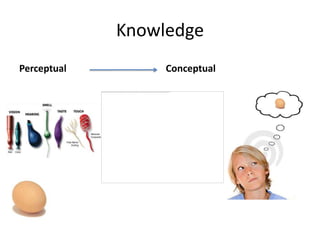
Knowledge
Perceptual        Conceptual
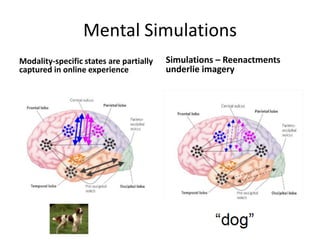
Mental Simulations
Modality-specific states are partially   Simulations – Reenactments
captured in online experience            underlie imagery
Texts and Multimodal Narratives

INSTRUCTION AND PURPOSE
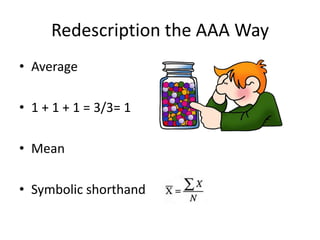
Redescription the AAA Way
• Average

• 1 + 1 + 1 = 3/3= 1

• Mean

• Symbolic shorthand
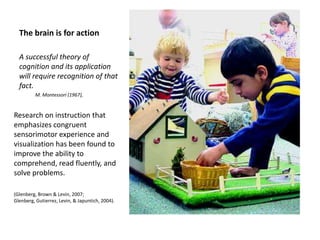
The brain is for action

  A successful theory of
  cognition and its application
  will require recognition of that
  fact.
         M. Montessori (1967),


Research on instruction that
emphasizes congruent
sensorimotor experience and
visualization has been found to
improve the ability to
comprehend, read fluently, and
solve problems.

(Glenberg, Brown & Levin, 2007;
Glenberg, Gutierrez, Levin, & Japuntich, 2004).
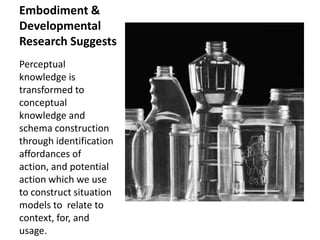
Embodiment &
Developmental
Research Suggests
Perceptual
knowledge is
transformed to
conceptual
knowledge and
schema construction
through identification
affordances of
action, and potential
action which we use
to construct situation
models to relate to
context, for, and
usage.
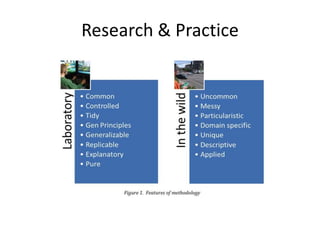
Research & Practice

Comprehension and Literacy

  • 1.
    The Brain isfor Action Psychology for Classroom Gains Brock Dubbels The Center for Cognitive Sciences The University of Minnesota
  • 2.
    Comprehension What is it? Itmust be guided with socio-cognitive experience.
  • 3.
    IP & WorkingMemory 1579997633214235 1492194219761776 1492 1942 1976 1776
  • 4.
  • 5.
  • 6.
    Causal network analysis EpaminondasStory Epaminondas Story Van den Broek,P., Kendou, P., Kremer, K., Lynch, J. Butler, J., White, M., and Pugzles Lorch, E. (2005, p. 112-13)
  • 7.
    How do webuild a comprehension model? Comprehension Model Literary Elements • A spatial-temporal framework • Character/ Characterization – spatial locations, time frames • diction • Entities • Plot – people, objects, ideas, • Setting • Properties of entities • Point of View – color, emotions, goals, shape, • Theme etc. • Tone • Relational information • Voice – spatial, temporal, causal, ownership, kinship, social, etc. • Word choice
  • 8.
    Reading & Classroom Assessment 1. Literacy Coaching a) Use rubric and fluency scale for literacy coaching. 2. Oral Interpretation a) Use Girl Assignment
  • 9.
    Comprehension measures forreflect aloud using the event indexing model -- Studen Boo Fl D Pro Sit Plo Set Char Them PO Tone W Voice/ Genr Autho t k ec p t e V C Diction e r o d e Scoring 4 3 2 1 0 Defined Meaning in Mentioned Cued/ Cued/ Absent context Explained Recognize Recognize Detailed Term term Description Explained
  • 10.
    Modified fluency withplay and agency 1 I have chosen a challenging book. I read with hesitation with emphasis on single words—I am trying to learn them in isolation from one another. The "flow" in my reading is a little clunky like a telegraph with word-by-word reading. 2 I just read with two to three word phrasing. My reading seems very hesitant, like I might be unsure, with considerable pausing. I am blending and decoding the words. I am naming the words rather than letting them flow. 3 I am pausing for ending punctuation, but am not making inflection changes from sentence to sentence. I read in phrases but I am lacking in tone necessary in fluent understandable reading. 4 Most of the time, I have, "flow" and phrasing. It is like telling a story to my friends, with vocal intonation and prosody that indicates awareness of punctuation for pausing and breath, and appropriate inflection (i.e., happy voice). I should be doing Shakespeare! My performance is characterized by reading that generally "flows."My voice 5 changes to reflect meaning changes in the passage. My inflections are consistently appropriate, and my reading is fluent and smooth, generally easy to listen to and understood. Adapted from Table 1. from Marston, Mansfield, cited in (pg. 81 Heineman, in Fountas and Pinnell, 1996) by Dubbels (2005).
  • 12.
    Characteristics of readers L Low comp High High comp E fluency High fluency V E L of F L U E N C Low comp High comp Y Low fluency Low fluency ability to comprehendin dialogic method /create a model
  • 13.
    40 38 Comparison of student 35 performance The categories for 05-06 performance 30 was based upon the Minnesota Basic Skills Test 25 24 The 06-07 scores were based upon the 21 Grade 7 (05- MCA2 06) 20 16 Grade 8 (05- All students were taught by one 15 06) teacher each year. Grade 8 (06- I taught the 06-07 year using a much 10 07) harder test with an emphasis on games and play. 5 Specifically: Games unit, multimedia units, sketch up, Etc. 0 Exceed Meets Partial Does not
  • 14.
    Research Questions • Willa video game that emphasizes sensorimotor experience provide greater recall and problem solving as compared to viewing a video, or reading a printed text? • Will performance in the reading condition improve if it follows the game or the viewing condition? • How does the identification of causation predict building a mental representation and problem solving?
  • 15.
  • 16.
    Mental Simulations Modality-specific statesare partially Simulations – Reenactments captured in online experience underlie imagery
  • 17.
    Texts and MultimodalNarratives INSTRUCTION AND PURPOSE
  • 18.
    Redescription the AAAWay • Average • 1 + 1 + 1 = 3/3= 1 • Mean • Symbolic shorthand
  • 19.
    The brain isfor action A successful theory of cognition and its application will require recognition of that fact. M. Montessori (1967), Research on instruction that emphasizes congruent sensorimotor experience and visualization has been found to improve the ability to comprehend, read fluently, and solve problems. (Glenberg, Brown & Levin, 2007; Glenberg, Gutierrez, Levin, & Japuntich, 2004).
  • 20.
    Embodiment & Developmental Research Suggests Perceptual knowledgeis transformed to conceptual knowledge and schema construction through identification affordances of action, and potential action which we use to construct situation models to relate to context, for, and usage.
  • 21.

Editor's Notes

  • #8 It was important to connect what I was learning in discourse processing in psycholinguistics to what I was doing in the classroom, as well as for the state standardized tests. I was given permission by my principal to attend the Minnesota DoE workgroup on the new Minnesota Comprehensive Assessment. My work on the test made me wonder about the way we were preparing for tests and the DoE’s expectation that if teachers teach to the standards, this would translate into better test scores. I was very troubled by this disconnection in expectation about practice, as well as the principles for the test design; such as lexile scores and Bloom’s taxonomy. The apparent lack of validity was troubling.Rather than asking any more questions, I decided that I would integrate what I was learning about reading comprehension in my graduate courses and see how they worked to drive instruction.
  • #10 I did this because I was simply frustrated with what I was being told by my TAPP mentors and the “reading specialist”. That I needed to understand Bloom’s Taxonomy and Lexile scores. This did not add up. I was invited by the DoE to work on the panels for the MCA2, and my principal was generous enough to let me participate. It was here that I was told that teaching the standards would prepare the students, but their brochure for teachers was basically lost in translation.
  • #11 What I wanted to do was to have a transfer of power. I modified the fluency rubric my district used for CBM– content based measures. My approach was an attempt to coach comprehension and strategic reading by emphasizing the event indexing model.
  • #12 Rather than doing what was always done, I created a curriculum that emphasized linguistic comprehension.In 2005-06, I was recognized for doing interesting things with games in the classroom. This TV report was one of the many media outlets that did stories on my middle school students and their study of video games as narratives. What I did in this unit on games was to emphasize linguistic comprehension and then leverage it with print literacy.
  • #20 The technology is in the way that we design instruction. The use of games is not enough. They need to have thoughtful integration into learning abstractions and concept development.Montessori instruction acknowledges this with early childhood education. But many children from poverty do not get this experience. They are immediately put into a process that begins with memorization of the alphabet with the addition of phonics instruction, rhyming, sight words, blending, etc. These are important, but what if the child does not have the experience in the world?