
DEPTH OF FIELD


Understanding proper balance of space and
angle at which you position your subject can
help create certain artistic effects when
taking photographs.



To create a photograph, it is not enough to
just take a picture of a scene or a subject the composition of an image determines the
expressiveness and sometimes helps tell the
story behind your photographs.
It gives that important first impression that
draws the audience to look closer into the
details of your pictures.
 There is no definitive rule about how to
compose your pictures. The effect varies on
different scenes, on different conditions and
on different subjects. There are however
some factors that are important to
understand and some rules that may be used
as a guide to help you create that desired
perfect composition.

Learning these rules and knowing the
different factors that affect the composition of
a picture will not guarantee that all your
photographs will be a hit but it will give you
more options and an improved sense of how
to creatively capture an image rather than
just point flat and center your subject
(although even that too will work just fine).
 This section will discuss about Depth of
Field, the effects of distance and Zooming,
Rule of Thirds. Remember, these are just
guides, so learn them but don't be afraid to
break them.

DEPTH OF FIELD
Depth of Field refers to the range of distance
from the camera at which the objects will
appear to be in acceptable focus.
 Anything outside this range will start to
appear blurred. An extreme case where the
DOF is very small is in Macro Photography
such as in the picture of a piece of cloth
shown here.
 In the middle portion of the picture there is an
area where the cloth is very sharply focused
while the images away from this point and
those that are closer appear blurred.

In reality, the lens can only focus precisely on
one particular distance, objects that are too near
or too far from this distance will be out of focus
but the degree of blurring as you go farther
away is gradual.
 A small depth of field is useful for portraits
where the subject is placed within the focused
range while the background is rendered blurred.
 This gives more emphasis on the subject and a
dramatic distortion on the background.
Landscape pictures on the other hand will
benefit more with a large depth of field as you
would need all the objects within the scene to
be as clear as possible.

Depth of Field is influenced basically by two
factors, the distance of the subject to the
camera, and the aperture opening. The
farther the subject is from the camera the
bigger the depth of field becomes.
 The nearer you are to the subject on the
other hand makes the depth of field smaller.
This is one difficulty usually encountered in
macro photography as the subjects are
usually very near the camera that the depth
of field are often measured in millimeters and
focusing becomes very difficult.



A larger aperture opening (lower value)
reduces the depth of field while a smaller
opening (higher value) increases the depth of
field. Although the effect of the aperture value
to the depth of field is not so dramatic but the
results can be quite significant.
RULE OF THIRD


One of the most popular 'rules' in photography
is the Rule Of Thirds. It is also popular amongst
artists. It works like this:
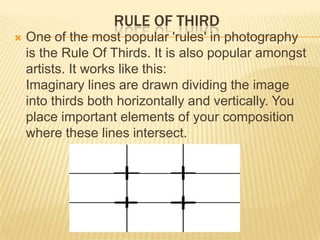
Imaginary lines are drawn dividing the image
into thirds both horizontally and vertically. You
place important elements of your composition
where these lines intersect.


The theory is that if you place points of interest
in the intersections or along the lines that your
photo becomes more balanced and will enable a
viewer of the image to interact with it more
naturally. Studies have shown that when viewing
images that people’s eyes usually go to one of
the intersection points most naturally rather than
the center of the shot – using the rule of thirds
works with this natural way of viewing an image
rather than working against it.
Depth of field

Depth of field

  • 1.
  • 2.
     Understanding proper balanceof space and angle at which you position your subject can help create certain artistic effects when taking photographs.  To create a photograph, it is not enough to just take a picture of a scene or a subject the composition of an image determines the expressiveness and sometimes helps tell the story behind your photographs.
  • 3.
    It gives thatimportant first impression that draws the audience to look closer into the details of your pictures.  There is no definitive rule about how to compose your pictures. The effect varies on different scenes, on different conditions and on different subjects. There are however some factors that are important to understand and some rules that may be used as a guide to help you create that desired perfect composition. 
  • 4.
    Learning these rulesand knowing the different factors that affect the composition of a picture will not guarantee that all your photographs will be a hit but it will give you more options and an improved sense of how to creatively capture an image rather than just point flat and center your subject (although even that too will work just fine).  This section will discuss about Depth of Field, the effects of distance and Zooming, Rule of Thirds. Remember, these are just guides, so learn them but don't be afraid to break them. 
  • 5.
    DEPTH OF FIELD Depthof Field refers to the range of distance from the camera at which the objects will appear to be in acceptable focus.  Anything outside this range will start to appear blurred. An extreme case where the DOF is very small is in Macro Photography such as in the picture of a piece of cloth shown here.  In the middle portion of the picture there is an area where the cloth is very sharply focused while the images away from this point and those that are closer appear blurred. 
  • 6.
    In reality, thelens can only focus precisely on one particular distance, objects that are too near or too far from this distance will be out of focus but the degree of blurring as you go farther away is gradual.  A small depth of field is useful for portraits where the subject is placed within the focused range while the background is rendered blurred.  This gives more emphasis on the subject and a dramatic distortion on the background. Landscape pictures on the other hand will benefit more with a large depth of field as you would need all the objects within the scene to be as clear as possible. 
  • 7.
    Depth of Fieldis influenced basically by two factors, the distance of the subject to the camera, and the aperture opening. The farther the subject is from the camera the bigger the depth of field becomes.  The nearer you are to the subject on the other hand makes the depth of field smaller. This is one difficulty usually encountered in macro photography as the subjects are usually very near the camera that the depth of field are often measured in millimeters and focusing becomes very difficult. 
  • 8.
     A larger apertureopening (lower value) reduces the depth of field while a smaller opening (higher value) increases the depth of field. Although the effect of the aperture value to the depth of field is not so dramatic but the results can be quite significant.
  • 10.
    RULE OF THIRD  Oneof the most popular 'rules' in photography is the Rule Of Thirds. It is also popular amongst artists. It works like this: Imaginary lines are drawn dividing the image into thirds both horizontally and vertically. You place important elements of your composition where these lines intersect.
  • 11.
     The theory isthat if you place points of interest in the intersections or along the lines that your photo becomes more balanced and will enable a viewer of the image to interact with it more naturally. Studies have shown that when viewing images that people’s eyes usually go to one of the intersection points most naturally rather than the center of the shot – using the rule of thirds works with this natural way of viewing an image rather than working against it.