Learning with Games
Nelson Zagalo, Universidade Aveiro
EduGaming - Aprender com jogos eletrónicos (Erasmus +)
Figueira da Foz, 15 may 2019
Interactive components offer great appeal to both students
and educators as they allow experimentation, which leads
to learning by doing.
Porquê jogos?
Problem of Educational Games
(Wattanasoontorn, et al., 2013)
Breach of creative contract.
What are Games Made of?
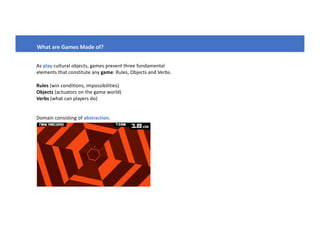
As play cultural objects, games present three fundamental
elements that constitute any game: Rules, Objects and Verbs.
Rules (win conditions, impossibilities)
Objects (actuators on the game world)
Verbs (what can players do)
Domain consisting of abstraction.
What are Games Made of?
As narrative cultural objects, they present 3 fundamental elements that constitute
any story: World, Characters and Conflicts.
World (spaces, regions, cities, streets, rivers, and houses)
Characters (protagonists, secondary and artifacts)
Conflicts (Relations between Characters and Spaces)
Domain consisting of meaning.
What are Games Made of?
As cultural objects of simulation, they present 3 fundamental elements
that constitute any interaction: Manipulation, Navigation and Participation.
Manipulation (can act on objects)
Navigation (can act on space)
Participation (can act on events)
Domain consisting of doing.
What do they allow to do?
Taxonomy
(GNS Theory, 1999; Lindsley, 2003; Zagalo, 2009).
Management
Resolution
Building
O que permitem fazer?
Construction of
worlds
Explore
Improvise
Create
Problem
Solving
Overcome
Compete
Solve
Management of
conflicts
Choices
Dilemmas
Empathize
Learning Impacts
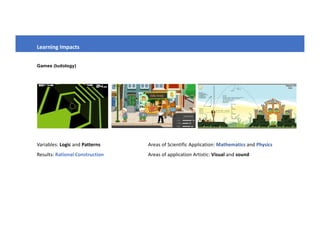
Games (ludology)
Learning Impacts
Variables: Logic and Patterns
Results: Rational Construction
Areas of Scientific Application: Mathematics and Physics
Areas of application Artistic: Visual and sound
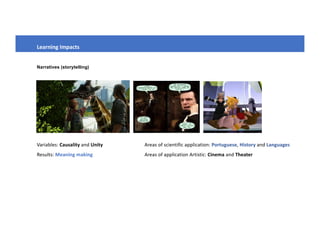
Narratives (storytelling)
Learning Impacts
Variables: Causality and Unity
Results: Meaning making
Areas of scientific application: Portuguese, History and Languages
Areas of application Artistic: Cinema and Theater
Simulators (real substitution)
Learning Impacts
Variables: Freedom and Control
Results: Conceptual Modeling
Areas of scientific application: Biology, Geography, Chemistry
Areas of application Artistic: Design and Architecture
Motivation to Play
Videogames function as simulators of reality learning, and can operate in any
domain of human knowledge.
Motivation to Play
We are highly curious animals, true learning machines.
Motivation to Play
No. Just as young people do not like to play all the games, they will not like a
discipline any more just because it happens through a game.
Is then enough to transform school matter in games?
Nelson Zagalo, DigiMedia / UA
http://nelsonzagalo.googlepages.com
Learning with Games
Agrupamento Escolas Zona Urbana da Figueira da Foz
ESCOLA EB 2º E 3º CICLOS DR. JOÃO DE BARROS

Learning with Games

  • 1.
    Learning with Games NelsonZagalo, Universidade Aveiro EduGaming - Aprender com jogos eletrónicos (Erasmus +) Figueira da Foz, 15 may 2019
  • 2.
    Interactive components offergreat appeal to both students and educators as they allow experimentation, which leads to learning by doing. Porquê jogos?
  • 3.
    Problem of EducationalGames (Wattanasoontorn, et al., 2013) Breach of creative contract.
  • 4.
  • 5.
    What are GamesMade of? As play cultural objects, games present three fundamental elements that constitute any game: Rules, Objects and Verbs. Rules (win conditions, impossibilities) Objects (actuators on the game world) Verbs (what can players do) Domain consisting of abstraction.
  • 6.
    What are GamesMade of? As narrative cultural objects, they present 3 fundamental elements that constitute any story: World, Characters and Conflicts. World (spaces, regions, cities, streets, rivers, and houses) Characters (protagonists, secondary and artifacts) Conflicts (Relations between Characters and Spaces) Domain consisting of meaning.
  • 7.
    What are GamesMade of? As cultural objects of simulation, they present 3 fundamental elements that constitute any interaction: Manipulation, Navigation and Participation. Manipulation (can act on objects) Navigation (can act on space) Participation (can act on events) Domain consisting of doing.
  • 8.
    What do theyallow to do?
  • 9.
    Taxonomy (GNS Theory, 1999;Lindsley, 2003; Zagalo, 2009). Management Resolution Building
  • 10.
    O que permitemfazer? Construction of worlds Explore Improvise Create Problem Solving Overcome Compete Solve Management of conflicts Choices Dilemmas Empathize
  • 11.
  • 12.
    Games (ludology) Learning Impacts Variables:Logic and Patterns Results: Rational Construction Areas of Scientific Application: Mathematics and Physics Areas of application Artistic: Visual and sound
  • 13.
    Narratives (storytelling) Learning Impacts Variables:Causality and Unity Results: Meaning making Areas of scientific application: Portuguese, History and Languages Areas of application Artistic: Cinema and Theater
  • 14.
    Simulators (real substitution) LearningImpacts Variables: Freedom and Control Results: Conceptual Modeling Areas of scientific application: Biology, Geography, Chemistry Areas of application Artistic: Design and Architecture
  • 15.
  • 16.
    Videogames function assimulators of reality learning, and can operate in any domain of human knowledge. Motivation to Play
  • 17.
    We are highlycurious animals, true learning machines. Motivation to Play No. Just as young people do not like to play all the games, they will not like a discipline any more just because it happens through a game. Is then enough to transform school matter in games?
  • 18.
    Nelson Zagalo, DigiMedia/ UA http://nelsonzagalo.googlepages.com Learning with Games Agrupamento Escolas Zona Urbana da Figueira da Foz ESCOLA EB 2º E 3º CICLOS DR. JOÃO DE BARROS