Pre-project
Software Quality
Components
Anita Wulansari, S.Kom, M.Kom
0.
Preface
2
Rules
Class will be held as scheduled. Changes will be informed in
advance.
Permission to be absent must be informed to the lecturer before
class with supplementary documents.
Pretest and posttest will be held for every week. No extra time or
replacement pretest & posttest.
Final grade composition:
Pretest & posttest : 10%
Assignment : 10%
Final exam : 30%
3
References
Software Quality Assurance: From Theory to
Implementation (2004) by Daniel Galin published by
Pearson Education Limited
The Future of Software Quality Assurance (2019)
published by Springer
4
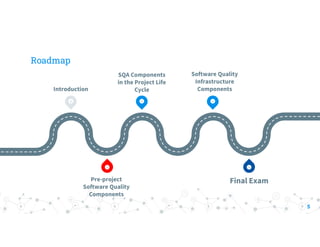
Roadmap
5
1 3 4
5
2
Introduction
SQA Components
in the Project Life
Cycle
Software Quality
Infrastructure
Components
Pre-project
Software Quality
Components
Final Exam
1.
Part Overview
6
Components of software quality assurance system overview
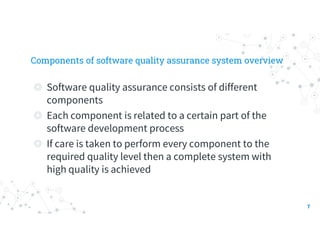
Software quality assurance consists of different
components
Each component is related to a certain part of the
software development process
If care is taken to perform every component to the
required quality level then a complete system with
high quality is achieved
7
Components of software quality assurance system overview
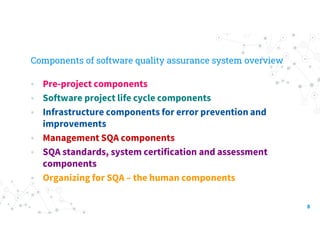
• Pre-project components
• Software project life cycle components
• Infrastructure components for error prevention and
improvements
• Management SQA components
• SQA standards, system certification and assessment
components
• Organizing for SQA – the human components
8
Pre-project SQA Components
The SQA components belonging here are meant to
improve the preparatory steps taken prior to initiating
work on the project itself
There are two components in pre-project stage:
Contract reviews: Reviewing the contract prior to
final agreement
Development and quality plans: Preparation of
plans before the actual work is performed
9
2.
Pre-project SQA:
Contract Review
10
Contract review
Several situations can lead a software company to sign a
contract with a customer
Participation in a tender.
Submission of a proposal according to the customer’s
RFP.(Request For Proposal)
Receipt of an order from a company’s customer.
Receipt of an internal request or order from another
department in the organization.
11
Contract review
Software may be developed within the framework of a
contract negotiated with a customer or in response to
an internal order originating in another department.
Contract review activities must include a detailed
examination of the project proposal draft and the
contract drafts.
12
Proposal draft review objectives
Customer requirements have been clarified and
documented
Alternative approaches for carrying out the project
have been examined
Formal aspects of the relationship between the
customer and the software firm have been specified
Identification of development risks
13
Proposal draft review objectives
Adequate estimation of project resources and
timetable
Examination of the company’s capacity with respect
to the project
Examination of the customer’s capacity to meet his
commitments
Definition of partner and subcontractor participation
Definition and protection of proprietary rights
14
Contract draft review objectives
The three contract draft review objectives that make sure the
following activities have been satisfactorily carried out:
No unclarified issues remain in the contract draft
All understandings reached subsequent to the proposal are
correctly documented.
No “new” changes, additions, or omissions have entered
the contract draft.
15
Factors affecting the extent of a contract review
Project magnitude
Project technical complexity
Degree of staff acquaintance with and experience in
the project area
Project organizational complexity
16
Contract review
Contract review activities include:
Clarification of the customer’s requirements
Review of the project’s schedule and resource requirement
estimates
Evaluation of the professional staff’s capacity to carry out
the proposed project
Evaluation of the customer’s capacity to fulfill his
obligations
Evaluation of development risks.
17
Contract review
As contract reviews may impose a substantial workload and
additional pressures on the proposal team, thought should be
given to when it may be appropriate to abstain from
conducting a contract review. Such situations may occur with
small-scale projects, or small- to medium-scale cost-plus
projects.
Contract review procedures should therefore define those
types of projects for which a contract review is not obligatory.
For other defined types of “simple” projects, it is
recommended that authority be given to a senior manager to
make the decision as to whether to perform the review.
18
Contract review
Contract review is an important software quality
component because it ensures that we understand and
agree on all project details. It eliminates any disagreement
that might happen between the project parties.
Contract review is the software quality element that
reduces the probability of such undesirable situations.
Contract review is a requirement by the ISO 9001 standard
and ISO 9000-3 Guidelines
19
3.
Pre-project SQA:
Development &
Quality Plans
20
Overview
Once a software development contract has been
signed or a commitment made to undertake an
internal project for the benefit of another department
of the organization, a plan is prepared of the project
(“development plan”) and its integrated quality
assurance activities (“quality plan”)
21
The main issues treated in the project development plan
Schedules (What are tasks and how much time is
required)
Required manpower and hardware resources
Risk evaluations
Organizational issues: team members, subcontractors
and partnerships
Project methodology, development tools, etc.
Software reuse plans.
22
The elements comprising a development plan
Project products, specifying “deliverables”, software
product and training tasks
Project interfaces, such as software interface,
hardware interface also cooperation and coordination
links.
Project methodology and development tools
Software development standards and procedures
The mapping of the development process, specifying
inputs, outputs and specifics activities planned.
23
The elements comprising a development plan
Project milestones
Project staff organization, comprises organizational
structure, professional requirements, number of team
members and their identities.
Development risks, for example technological gaps,
staff shortages, interdependence of organizational
elements.
Control methods
Project cost estimation
24
Software quality plan
A quality plan sets out (within a particular project) the
desired product qualities and how these are assessed and
define the most significant quality attributes
It should define the quality assessment process.
Software quality plan is a document that describes the
quality activities of a software project that should be
implemented to ensure that the results of the work
performed will satisfy the users and achieve the required
quality.
25
Software quality plan
Usually a software quality plan includes:
Quality goals, expressed in the appropriate
measurable terms
Criteria for starting and ending each project stage
Lists of reviews, tests, and other scheduled verification
and validation activities.
26
Development and quality plans for small projects
Advantages of “planned” small projects:
A more comprehensive and thorough understanding of the
task is attained.
Greater responsibility for meeting obligations can be
assigned.
Easier for management and customers to share control of
the project and to identify unexpected delays early on.
Better understandings with respect to the requirements
and timetable can be reached between the developer and
the customer.
27
Recommended elements of development and quality
plans for small projects
The development plan:
Project products, indicating “deliverables”
Project benchmarks
Development risks
Estimates of project costs
The quality plan:
Quality goals
28
Development plans and quality plans for internal projects
Internal projects are those projects intended for use by
other departments in the organization or by the entire
organization, as well as those projects dealing with
software package development for the software market.
Common to all these project types is the fact that no
external body participates as customer in their
development. Internal projects can be of medium or large
scale.
Yet even in these cases, there is a tendency to avoid
preparation of adequate development and quality plans.
29
Advantages of plan preparation for software development
departments
Avoiding budget overruns. This is of special importance
where the profit center system is applied.
Avoiding damage to other projects caused by delays in
release of professionals occupied in an internal project.
Avoiding loss of market status, especially regarding the
firm’s reputation, caused by delayed completion of
external projects triggered by late completion of internal
projects.
30
Advantages of plan preparation for internal customers
Smaller deviations from planned completion dates and
smaller budget overruns.
Better control over the development process, including
earlier identification of possible delays that enables the
search for and resolution of their causes.
Fewer internal delay damages.
31
Advantages of plan preparation for organization
Reduced risk of market loss (i.e., opportunity window) due
to late arrival of the product.
Reduced risk of being sued for late supply of products;
hence, reduced penalties for non-compliance with contract
demands.
Reduced risk of impairing the firm’s reputation as a reliable
software developer.
Reduced risk of requesting a budget supplement.
32
“
Quality is never an accident. It is
always the result of intelligent
effort
~John Ruskin~
33
Thanks!
Any questions?
34

Pre-Project Software Quality Assurance Components.pdf

  • 1.
  • 2.
  • 3.
    Rules Class will beheld as scheduled. Changes will be informed in advance. Permission to be absent must be informed to the lecturer before class with supplementary documents. Pretest and posttest will be held for every week. No extra time or replacement pretest & posttest. Final grade composition: Pretest & posttest : 10% Assignment : 10% Final exam : 30% 3
  • 4.
    References Software Quality Assurance:From Theory to Implementation (2004) by Daniel Galin published by Pearson Education Limited The Future of Software Quality Assurance (2019) published by Springer 4
  • 5.
    Roadmap 5 1 3 4 5 2 Introduction SQAComponents in the Project Life Cycle Software Quality Infrastructure Components Pre-project Software Quality Components Final Exam
  • 6.
  • 7.
    Components of softwarequality assurance system overview Software quality assurance consists of different components Each component is related to a certain part of the software development process If care is taken to perform every component to the required quality level then a complete system with high quality is achieved 7
  • 8.
    Components of softwarequality assurance system overview • Pre-project components • Software project life cycle components • Infrastructure components for error prevention and improvements • Management SQA components • SQA standards, system certification and assessment components • Organizing for SQA – the human components 8
  • 9.
    Pre-project SQA Components TheSQA components belonging here are meant to improve the preparatory steps taken prior to initiating work on the project itself There are two components in pre-project stage: Contract reviews: Reviewing the contract prior to final agreement Development and quality plans: Preparation of plans before the actual work is performed 9
  • 10.
  • 11.
    Contract review Several situationscan lead a software company to sign a contract with a customer Participation in a tender. Submission of a proposal according to the customer’s RFP.(Request For Proposal) Receipt of an order from a company’s customer. Receipt of an internal request or order from another department in the organization. 11
  • 12.
    Contract review Software maybe developed within the framework of a contract negotiated with a customer or in response to an internal order originating in another department. Contract review activities must include a detailed examination of the project proposal draft and the contract drafts. 12
  • 13.
    Proposal draft reviewobjectives Customer requirements have been clarified and documented Alternative approaches for carrying out the project have been examined Formal aspects of the relationship between the customer and the software firm have been specified Identification of development risks 13
  • 14.
    Proposal draft reviewobjectives Adequate estimation of project resources and timetable Examination of the company’s capacity with respect to the project Examination of the customer’s capacity to meet his commitments Definition of partner and subcontractor participation Definition and protection of proprietary rights 14
  • 15.
    Contract draft reviewobjectives The three contract draft review objectives that make sure the following activities have been satisfactorily carried out: No unclarified issues remain in the contract draft All understandings reached subsequent to the proposal are correctly documented. No “new” changes, additions, or omissions have entered the contract draft. 15
  • 16.
    Factors affecting theextent of a contract review Project magnitude Project technical complexity Degree of staff acquaintance with and experience in the project area Project organizational complexity 16
  • 17.
    Contract review Contract reviewactivities include: Clarification of the customer’s requirements Review of the project’s schedule and resource requirement estimates Evaluation of the professional staff’s capacity to carry out the proposed project Evaluation of the customer’s capacity to fulfill his obligations Evaluation of development risks. 17
  • 18.
    Contract review As contractreviews may impose a substantial workload and additional pressures on the proposal team, thought should be given to when it may be appropriate to abstain from conducting a contract review. Such situations may occur with small-scale projects, or small- to medium-scale cost-plus projects. Contract review procedures should therefore define those types of projects for which a contract review is not obligatory. For other defined types of “simple” projects, it is recommended that authority be given to a senior manager to make the decision as to whether to perform the review. 18
  • 19.
    Contract review Contract reviewis an important software quality component because it ensures that we understand and agree on all project details. It eliminates any disagreement that might happen between the project parties. Contract review is the software quality element that reduces the probability of such undesirable situations. Contract review is a requirement by the ISO 9001 standard and ISO 9000-3 Guidelines 19
  • 20.
  • 21.
    Overview Once a softwaredevelopment contract has been signed or a commitment made to undertake an internal project for the benefit of another department of the organization, a plan is prepared of the project (“development plan”) and its integrated quality assurance activities (“quality plan”) 21
  • 22.
    The main issuestreated in the project development plan Schedules (What are tasks and how much time is required) Required manpower and hardware resources Risk evaluations Organizational issues: team members, subcontractors and partnerships Project methodology, development tools, etc. Software reuse plans. 22
  • 23.
    The elements comprisinga development plan Project products, specifying “deliverables”, software product and training tasks Project interfaces, such as software interface, hardware interface also cooperation and coordination links. Project methodology and development tools Software development standards and procedures The mapping of the development process, specifying inputs, outputs and specifics activities planned. 23
  • 24.
    The elements comprisinga development plan Project milestones Project staff organization, comprises organizational structure, professional requirements, number of team members and their identities. Development risks, for example technological gaps, staff shortages, interdependence of organizational elements. Control methods Project cost estimation 24
  • 25.
    Software quality plan Aquality plan sets out (within a particular project) the desired product qualities and how these are assessed and define the most significant quality attributes It should define the quality assessment process. Software quality plan is a document that describes the quality activities of a software project that should be implemented to ensure that the results of the work performed will satisfy the users and achieve the required quality. 25
  • 26.
    Software quality plan Usuallya software quality plan includes: Quality goals, expressed in the appropriate measurable terms Criteria for starting and ending each project stage Lists of reviews, tests, and other scheduled verification and validation activities. 26
  • 27.
    Development and qualityplans for small projects Advantages of “planned” small projects: A more comprehensive and thorough understanding of the task is attained. Greater responsibility for meeting obligations can be assigned. Easier for management and customers to share control of the project and to identify unexpected delays early on. Better understandings with respect to the requirements and timetable can be reached between the developer and the customer. 27
  • 28.
    Recommended elements ofdevelopment and quality plans for small projects The development plan: Project products, indicating “deliverables” Project benchmarks Development risks Estimates of project costs The quality plan: Quality goals 28
  • 29.
    Development plans andquality plans for internal projects Internal projects are those projects intended for use by other departments in the organization or by the entire organization, as well as those projects dealing with software package development for the software market. Common to all these project types is the fact that no external body participates as customer in their development. Internal projects can be of medium or large scale. Yet even in these cases, there is a tendency to avoid preparation of adequate development and quality plans. 29
  • 30.
    Advantages of planpreparation for software development departments Avoiding budget overruns. This is of special importance where the profit center system is applied. Avoiding damage to other projects caused by delays in release of professionals occupied in an internal project. Avoiding loss of market status, especially regarding the firm’s reputation, caused by delayed completion of external projects triggered by late completion of internal projects. 30
  • 31.
    Advantages of planpreparation for internal customers Smaller deviations from planned completion dates and smaller budget overruns. Better control over the development process, including earlier identification of possible delays that enables the search for and resolution of their causes. Fewer internal delay damages. 31
  • 32.
    Advantages of planpreparation for organization Reduced risk of market loss (i.e., opportunity window) due to late arrival of the product. Reduced risk of being sued for late supply of products; hence, reduced penalties for non-compliance with contract demands. Reduced risk of impairing the firm’s reputation as a reliable software developer. Reduced risk of requesting a budget supplement. 32
  • 33.
    “ Quality is neveran accident. It is always the result of intelligent effort ~John Ruskin~ 33
  • 34.