*
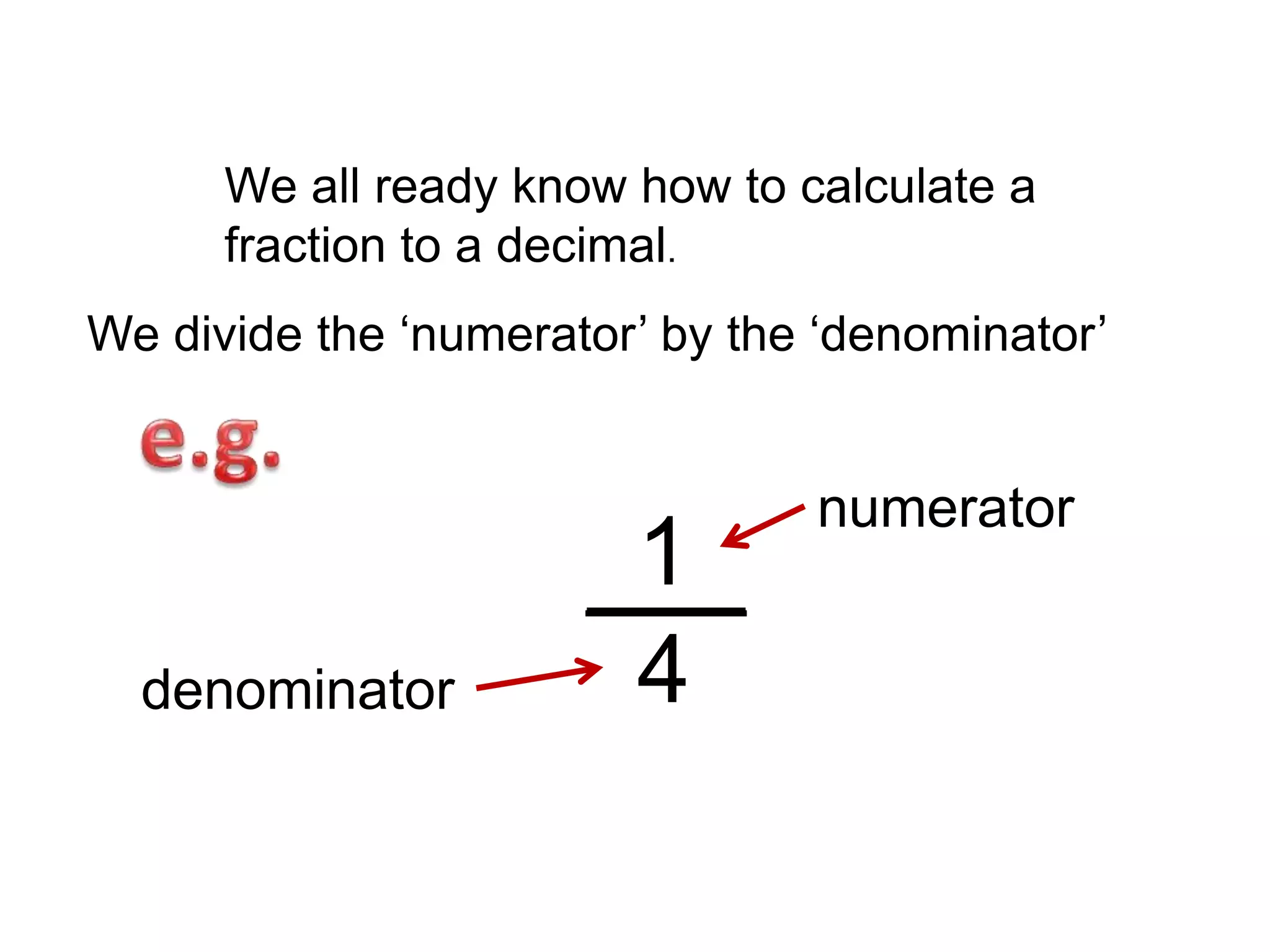
We all ready know how to calculate a
fraction to a decimal.
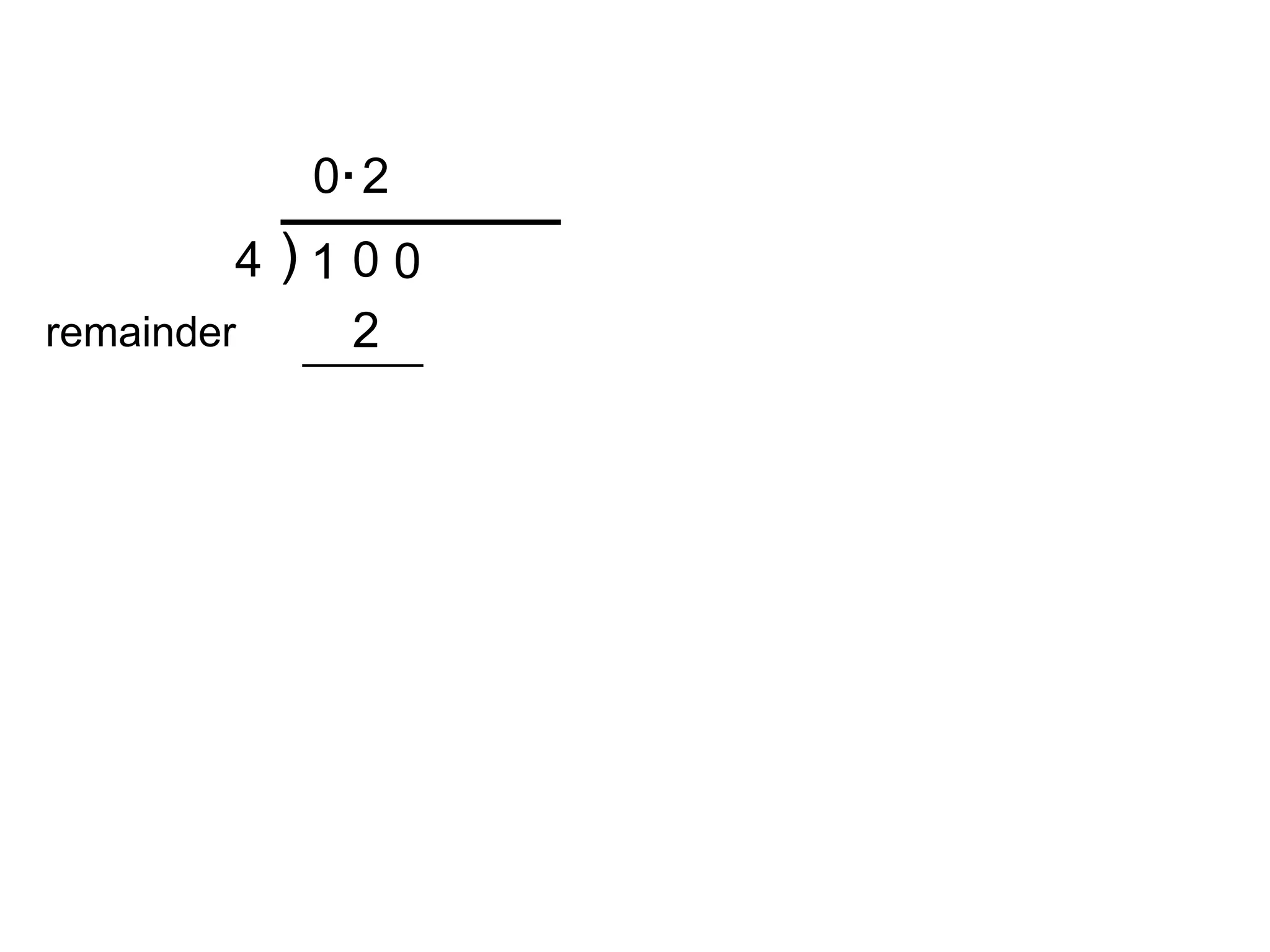
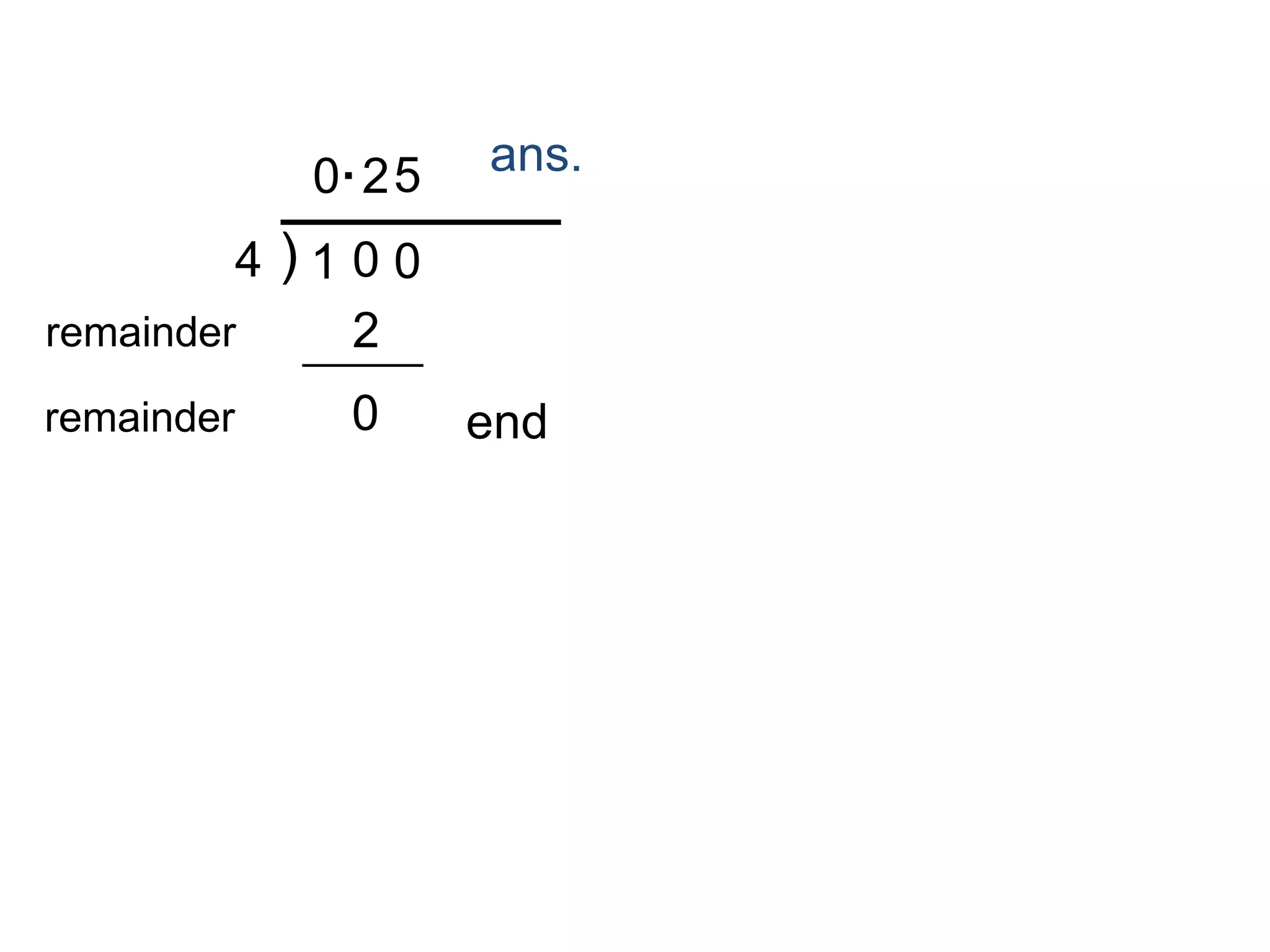
We divide the ‘numerator’ by the ‘denominator’
___
4
numerator
denominator
1
4 ) 1
0·
0
2
2
remainder
0
4 ) 1
0·
0
2
2
remainder
0
5
remainder 0 end
ans.
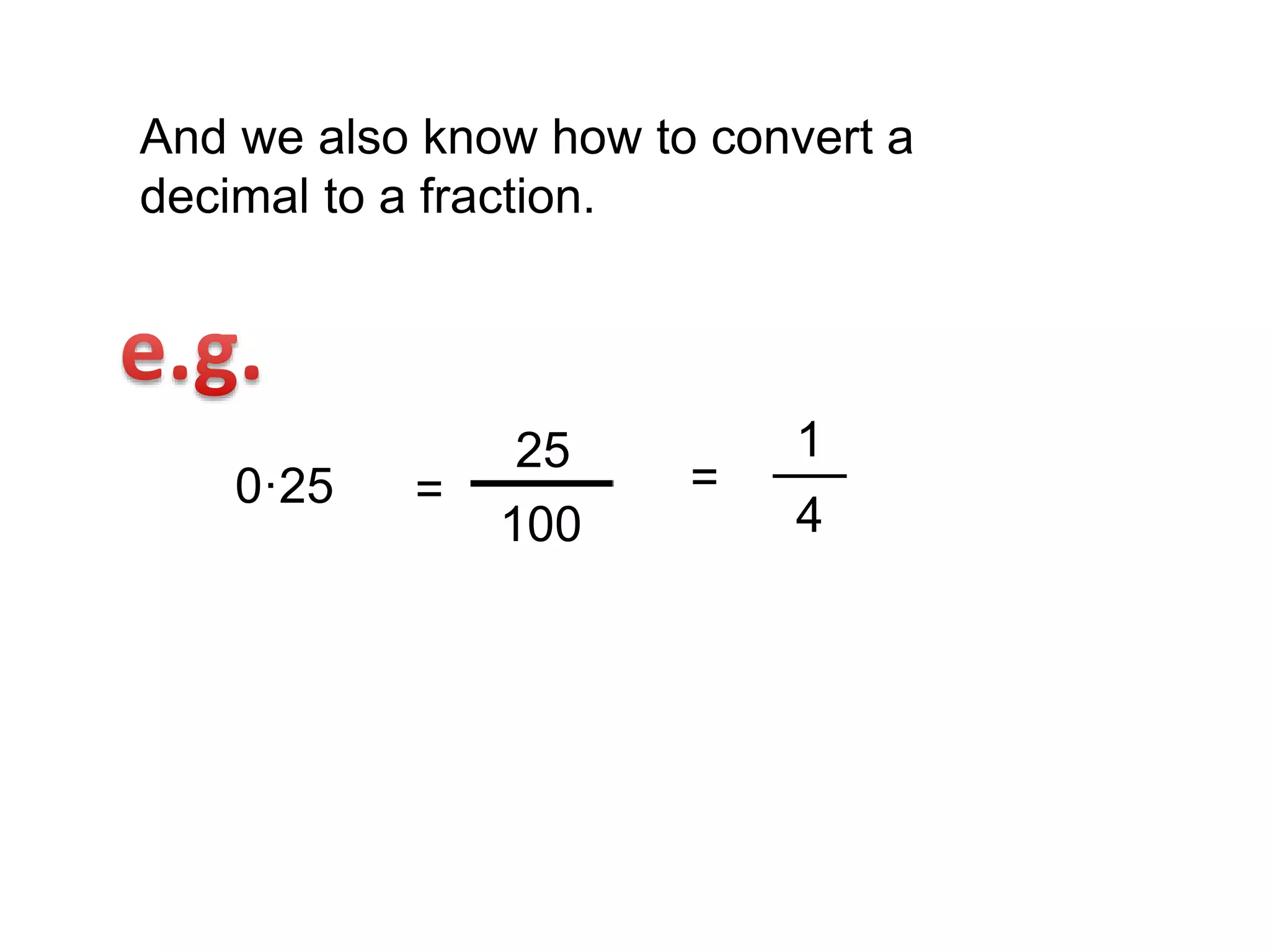
And we also know how to convert a
decimal to a fraction.
0·25 =
25
100
=
1
4
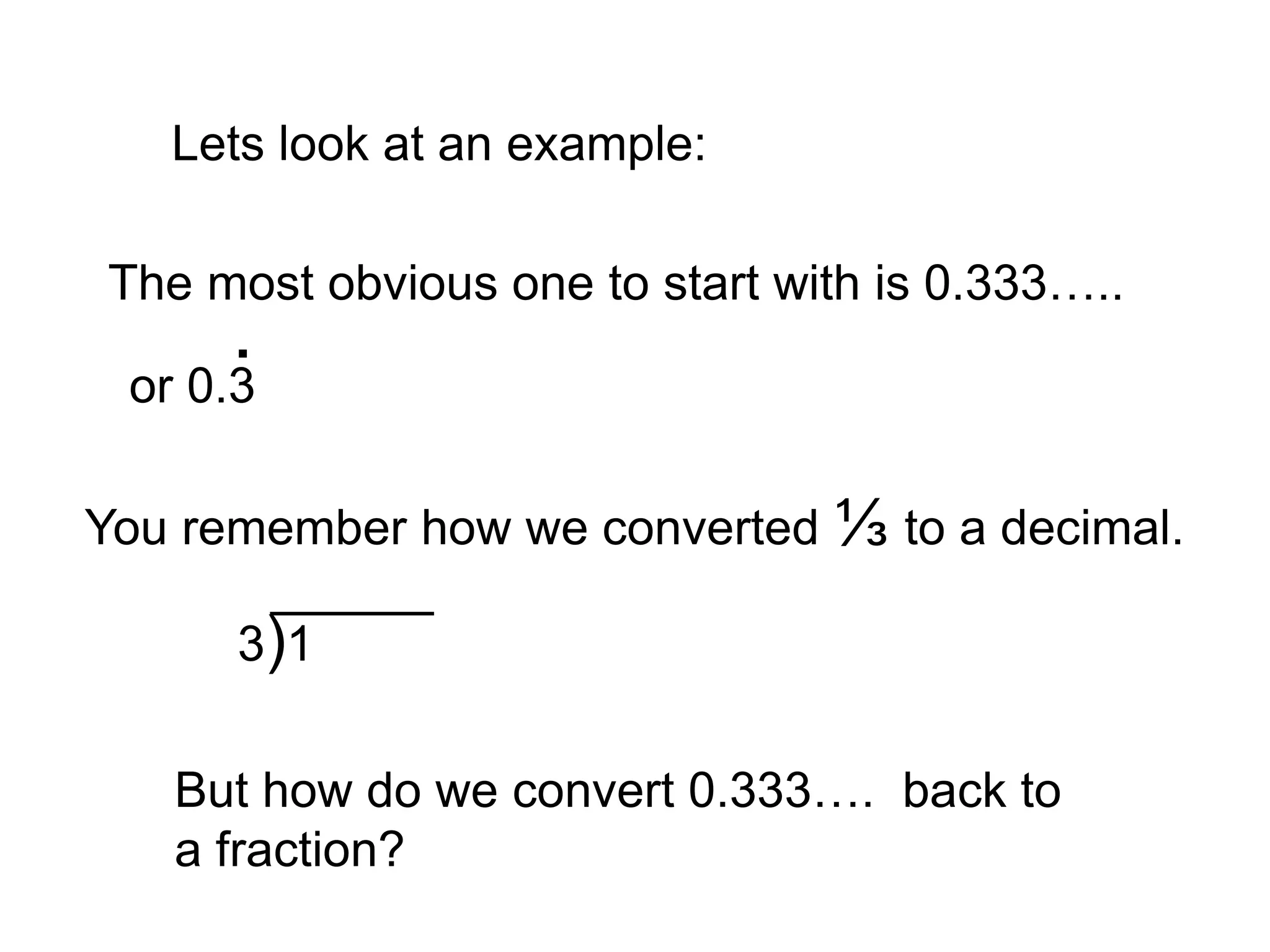
Lets look at an example:
The most obvious one to start with is 0.333…..
or 0.3
.
You remember how we converted ⅓ to a decimal.
3)1
But how do we convert 0.333…. back to
a fraction?
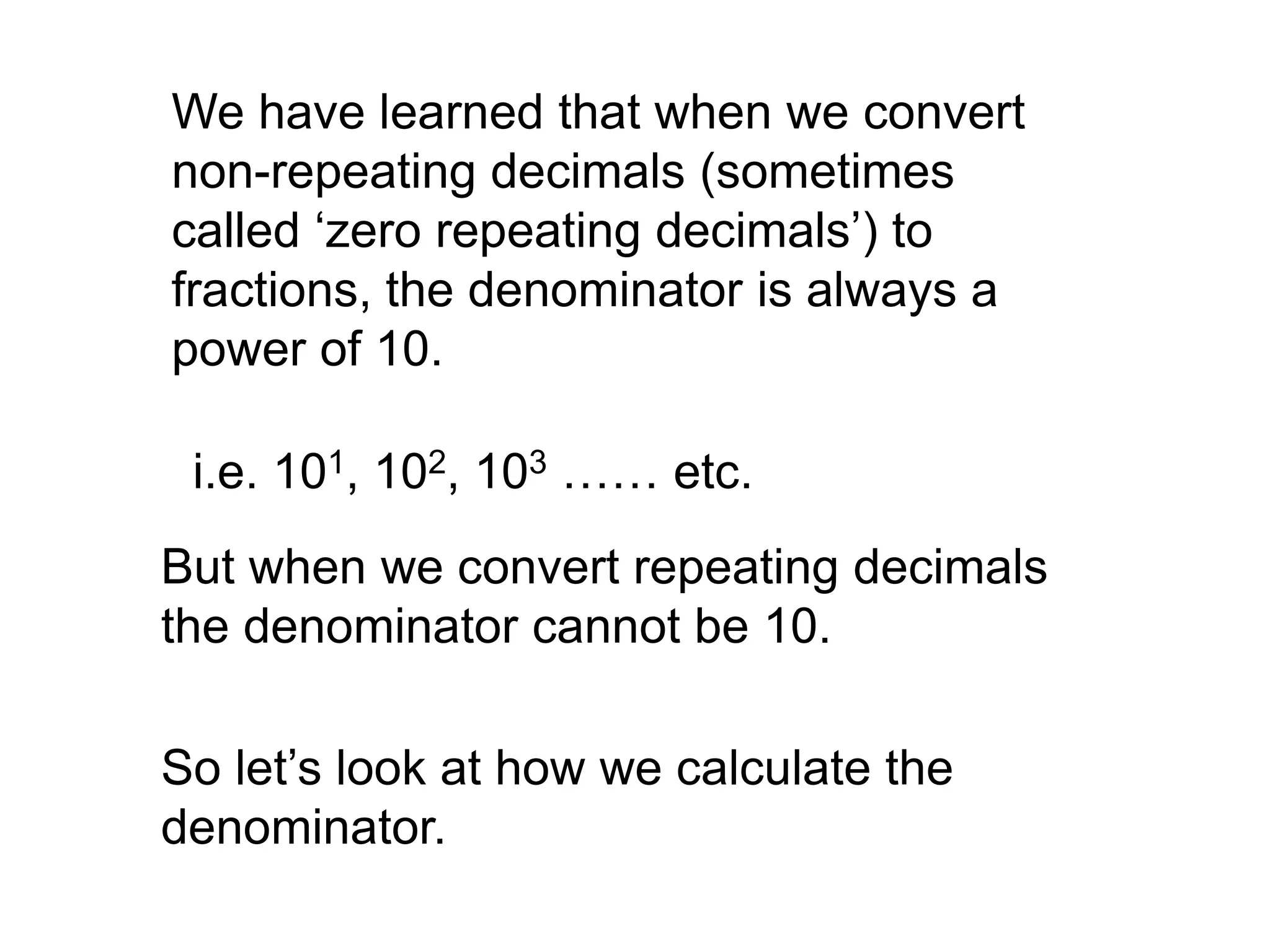
We have learned that when we convert
non-repeating decimals (sometimes
called ‘zero repeating decimals’) to
fractions, the denominator is always a
power of 10.
i.e. 101, 102, 103 …… etc.
But when we convert repeating decimals
the denominator cannot be 10.
So let’s look at how we calculate the
denominator.
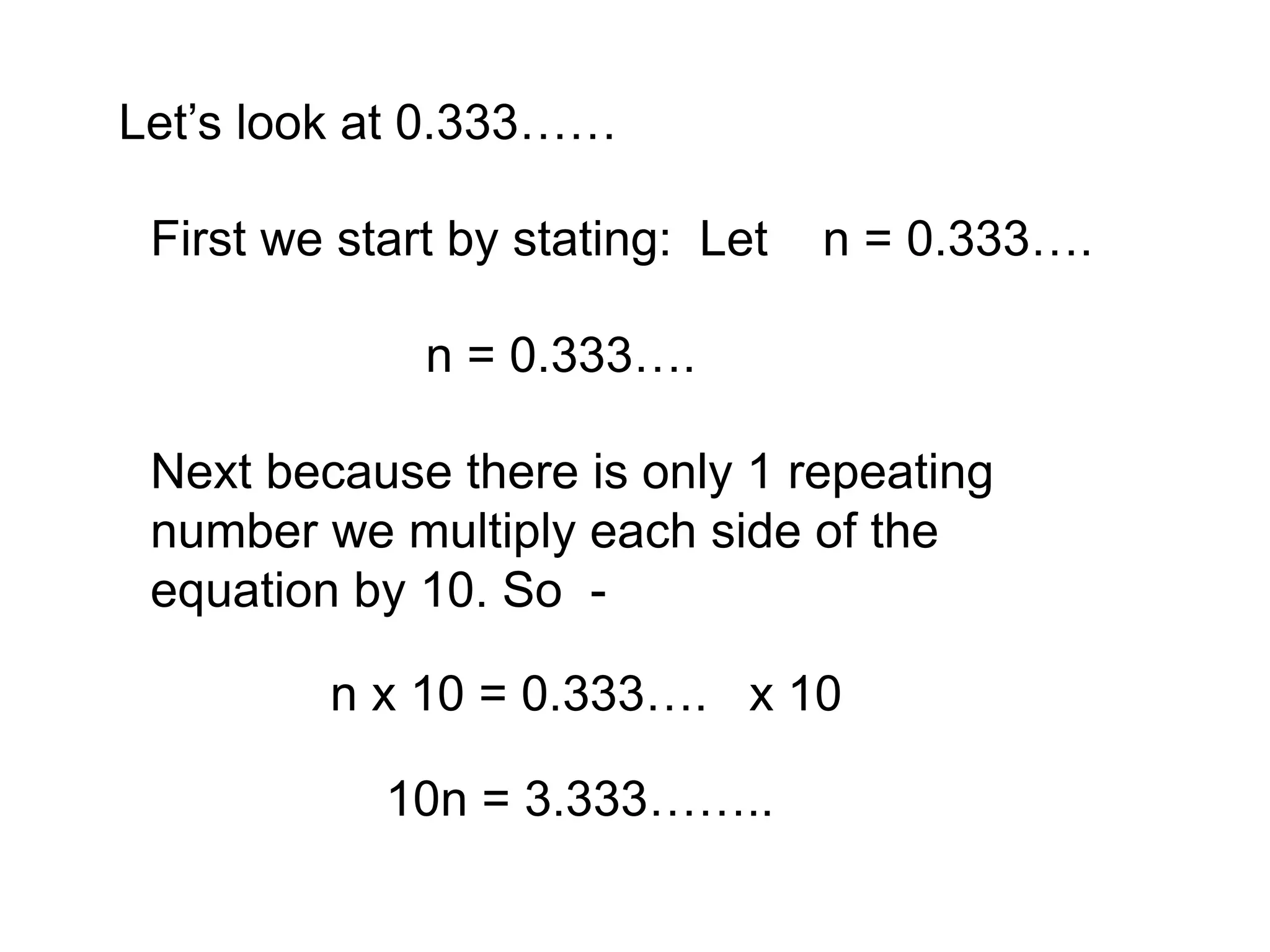
Let’s look at 0.333……
First we start by stating: Let n = 0.333….
n = 0.333….
Next because there is only 1 repeating
number we multiply each side of the
equation by 10. So -
10n = 3.333……..
n x 10 = 0.333…. x 10
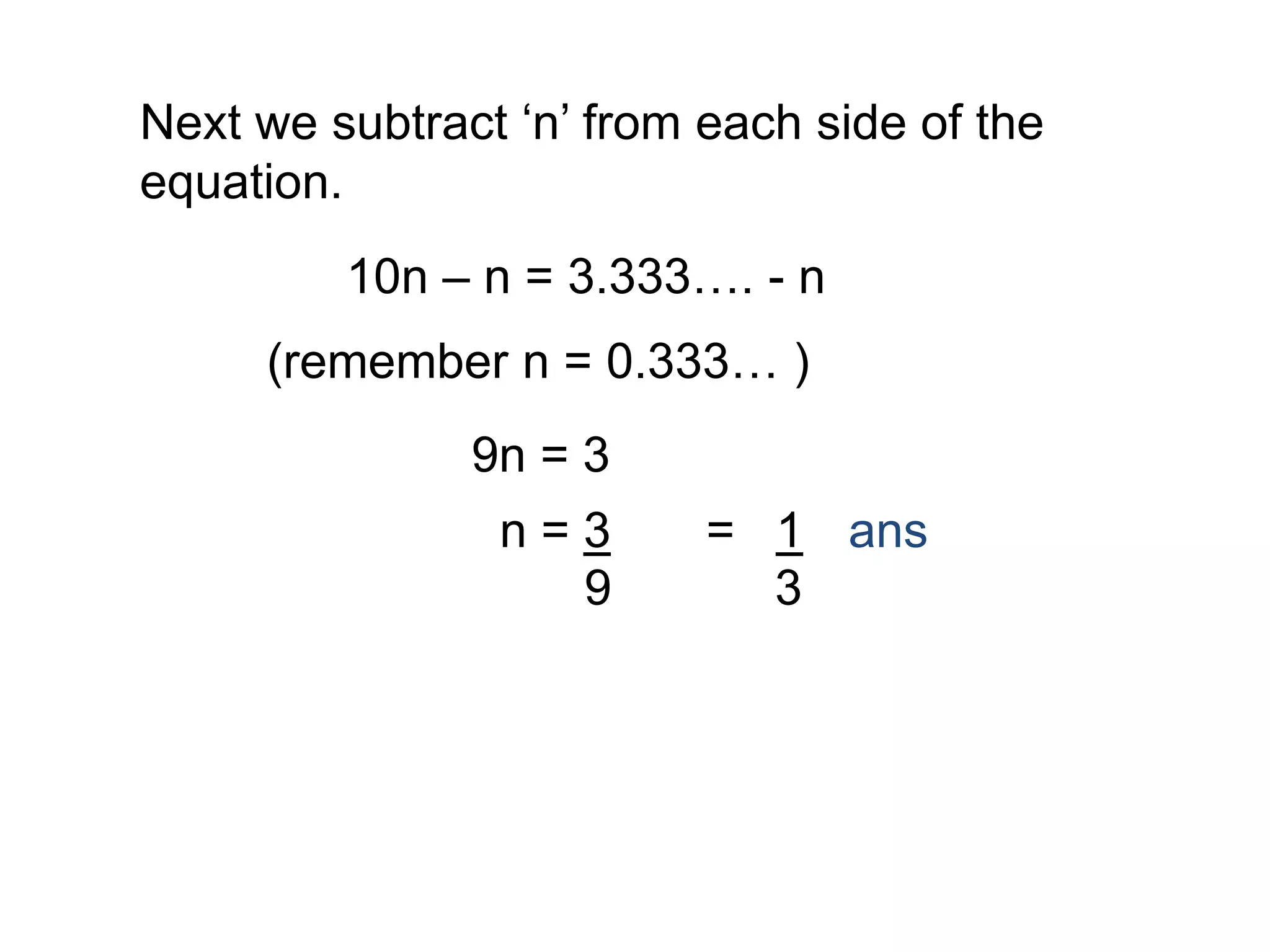
Next we subtract ‘n’ from each side of the
equation.
10n – n = 3.333…. - n
(remember n = 0.333… )
9n = 3
n = 3
9
= 1
3
ans
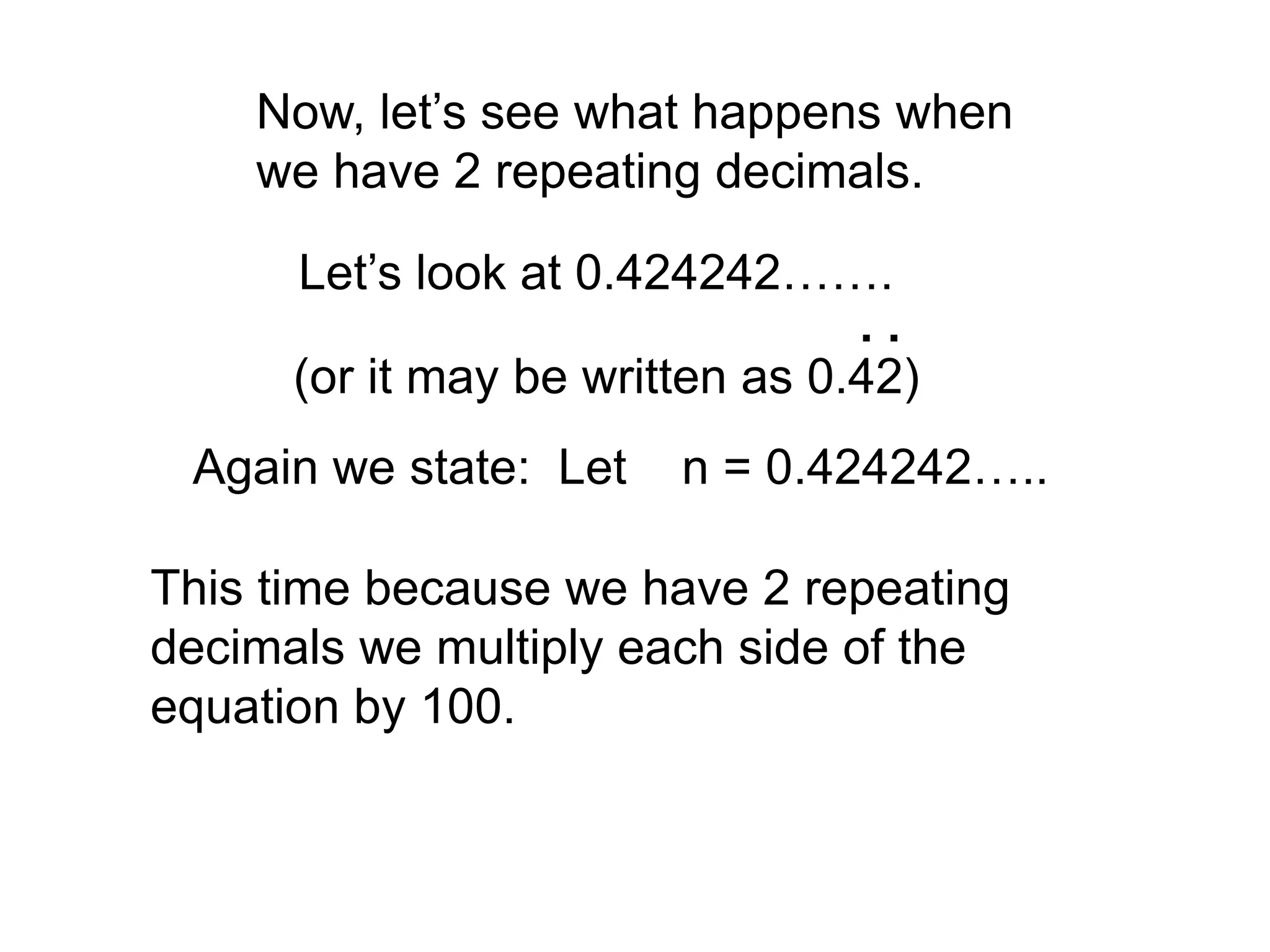
Now, let’s see what happens when
we have 2 repeating decimals.
Let’s look at 0.424242…….
(or it may be written as 0.42)
. .
Again we state: Let n = 0.424242…..
This time because we have 2 repeating
decimals we multiply each side of the
equation by 100.
n x 100 = 0.424242…… x 100
So we have:
100n = 42.424242…..
As before we now subtract ‘n’ from each
side of the equation.
100n – n = 42.424242…. - n
(remember n = 0.424242… )
99n = 42
n = 42
99
= 14
33
ans
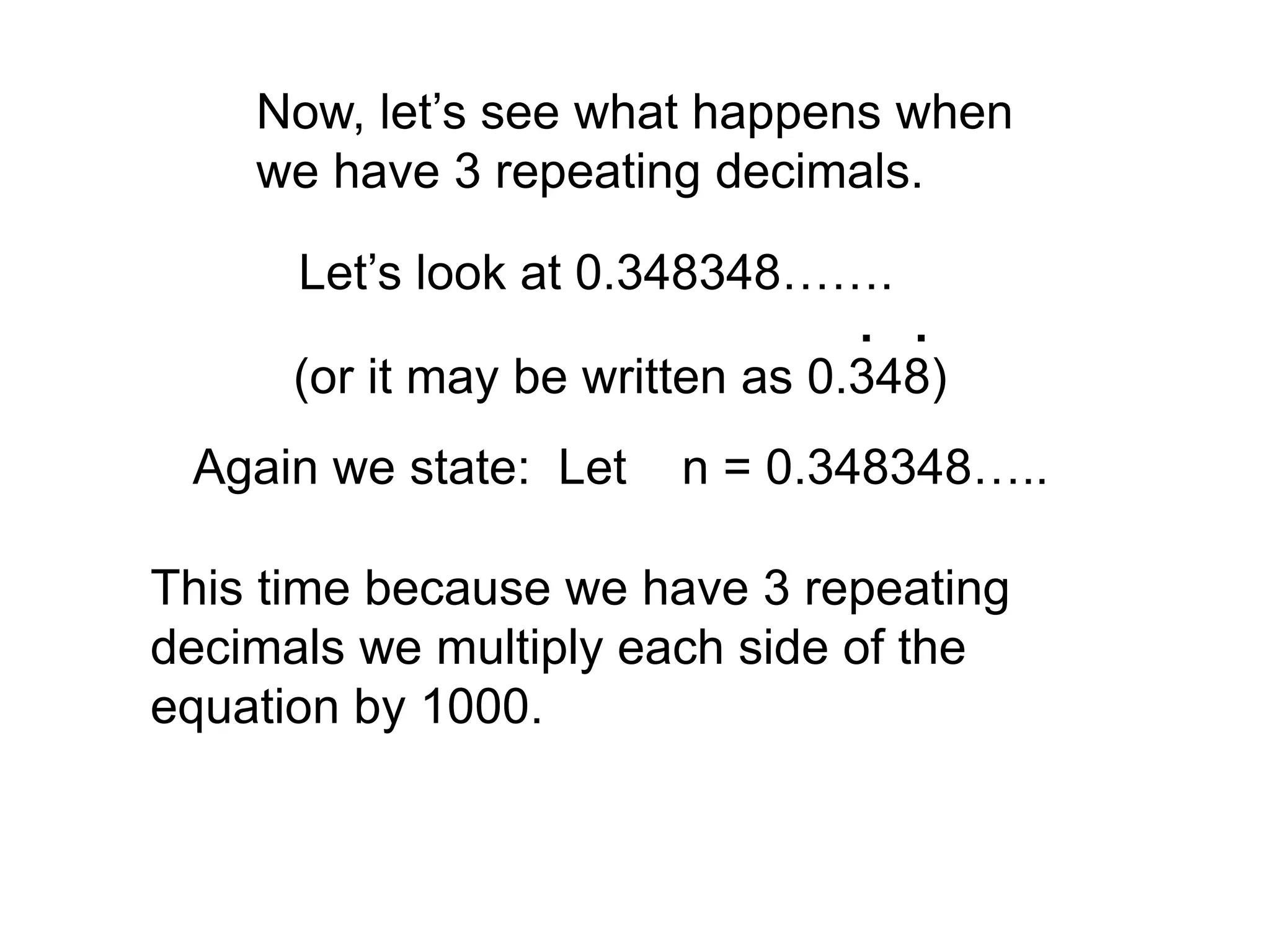
Now, let’s see what happens when
we have 3 repeating decimals.
Let’s look at 0.348348…….
(or it may be written as 0.348)
. .
Again we state: Let n = 0.348348…..
This time because we have 3 repeating
decimals we multiply each side of the
equation by 1000.
n x 1000 = 0.348348… x 1000
So we have:
1000n = 348.348348…..
As before we now subtract ‘n’ from each
side of the equation.
1000n – n = 348.348348…. - n
(remember: n = 0.348348… )
999n = 348
n = 348
999
= 116
333
ans
Repeating decimal to fraction 1

Repeating decimal to fraction 1

  • 1.
  • 2.
    We all readyknow how to calculate a fraction to a decimal. We divide the ‘numerator’ by the ‘denominator’ ___ 4 numerator denominator 1
  • 3.
  • 4.
  • 5.
    And we alsoknow how to convert a decimal to a fraction. 0·25 = 25 100 = 1 4
  • 7.
    Lets look atan example: The most obvious one to start with is 0.333….. or 0.3 . You remember how we converted ⅓ to a decimal. 3)1 But how do we convert 0.333…. back to a fraction?
  • 8.
    We have learnedthat when we convert non-repeating decimals (sometimes called ‘zero repeating decimals’) to fractions, the denominator is always a power of 10. i.e. 101, 102, 103 …… etc. But when we convert repeating decimals the denominator cannot be 10. So let’s look at how we calculate the denominator.
  • 9.
    Let’s look at0.333…… First we start by stating: Let n = 0.333…. n = 0.333…. Next because there is only 1 repeating number we multiply each side of the equation by 10. So - 10n = 3.333…….. n x 10 = 0.333…. x 10
  • 10.
    Next we subtract‘n’ from each side of the equation. 10n – n = 3.333…. - n (remember n = 0.333… ) 9n = 3 n = 3 9 = 1 3 ans
  • 11.
    Now, let’s seewhat happens when we have 2 repeating decimals. Let’s look at 0.424242……. (or it may be written as 0.42) . . Again we state: Let n = 0.424242….. This time because we have 2 repeating decimals we multiply each side of the equation by 100.
  • 12.
    n x 100= 0.424242…… x 100 So we have: 100n = 42.424242….. As before we now subtract ‘n’ from each side of the equation. 100n – n = 42.424242…. - n (remember n = 0.424242… ) 99n = 42 n = 42 99 = 14 33 ans
  • 13.
    Now, let’s seewhat happens when we have 3 repeating decimals. Let’s look at 0.348348……. (or it may be written as 0.348) . . Again we state: Let n = 0.348348….. This time because we have 3 repeating decimals we multiply each side of the equation by 1000.
  • 14.
    n x 1000= 0.348348… x 1000 So we have: 1000n = 348.348348….. As before we now subtract ‘n’ from each side of the equation. 1000n – n = 348.348348…. - n (remember: n = 0.348348… ) 999n = 348 n = 348 999 = 116 333 ans