14 - 1
©2006 Prentice Hall Business Publishing, Auditing 11/e, Arens/Beasley/Elder
Audit of the Sales and
Collection Cycle:
Tests of Controls and
Substantive Tests of
Transactions
Chapter 14
14 - 2
©2006 Prentice Hall Business Publishing, Auditing 11/e, Arens/Beasley/Elder
Learning Objective 1
Identify the accounts and the
classes of transactions in the
sales and collection cycle.
14 - 3
©2006 Prentice Hall Business Publishing, Auditing 11/e, Arens/Beasley/Elder
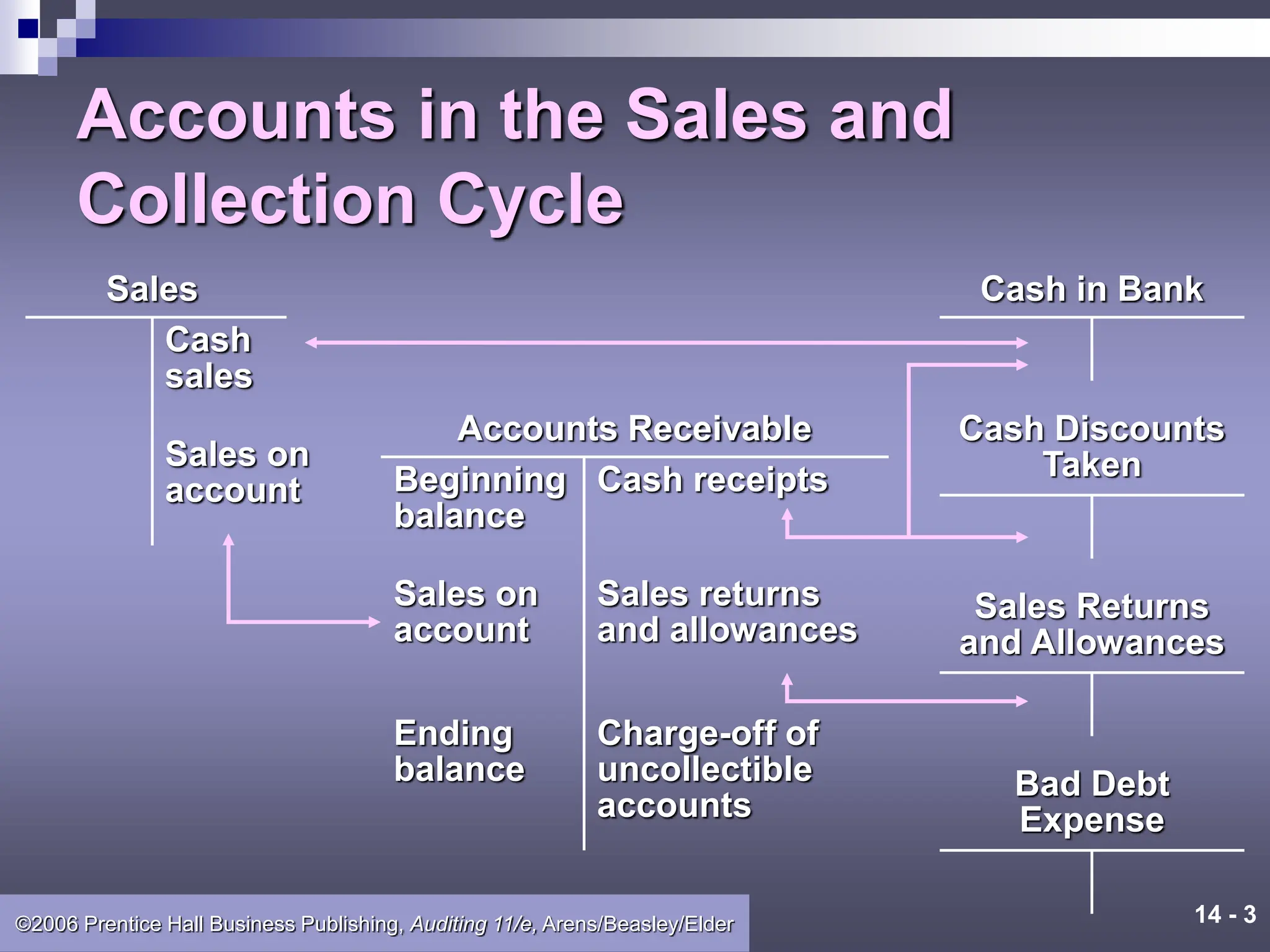
Accounts in the Sales and
Collection Cycle
Sales
Cash
sales
Sales on
account
Accounts Receivable
Cash receipts
Sales returns
and allowances
Charge-off of
uncollectible
accounts
Beginning
balance
Sales on
account
Ending
balance
Cash in Bank
Cash Discounts
Taken
Bad Debt
Expense
Sales Returns
and Allowances
14 - 4
©2006 Prentice Hall Business Publishing, Auditing 11/e, Arens/Beasley/Elder
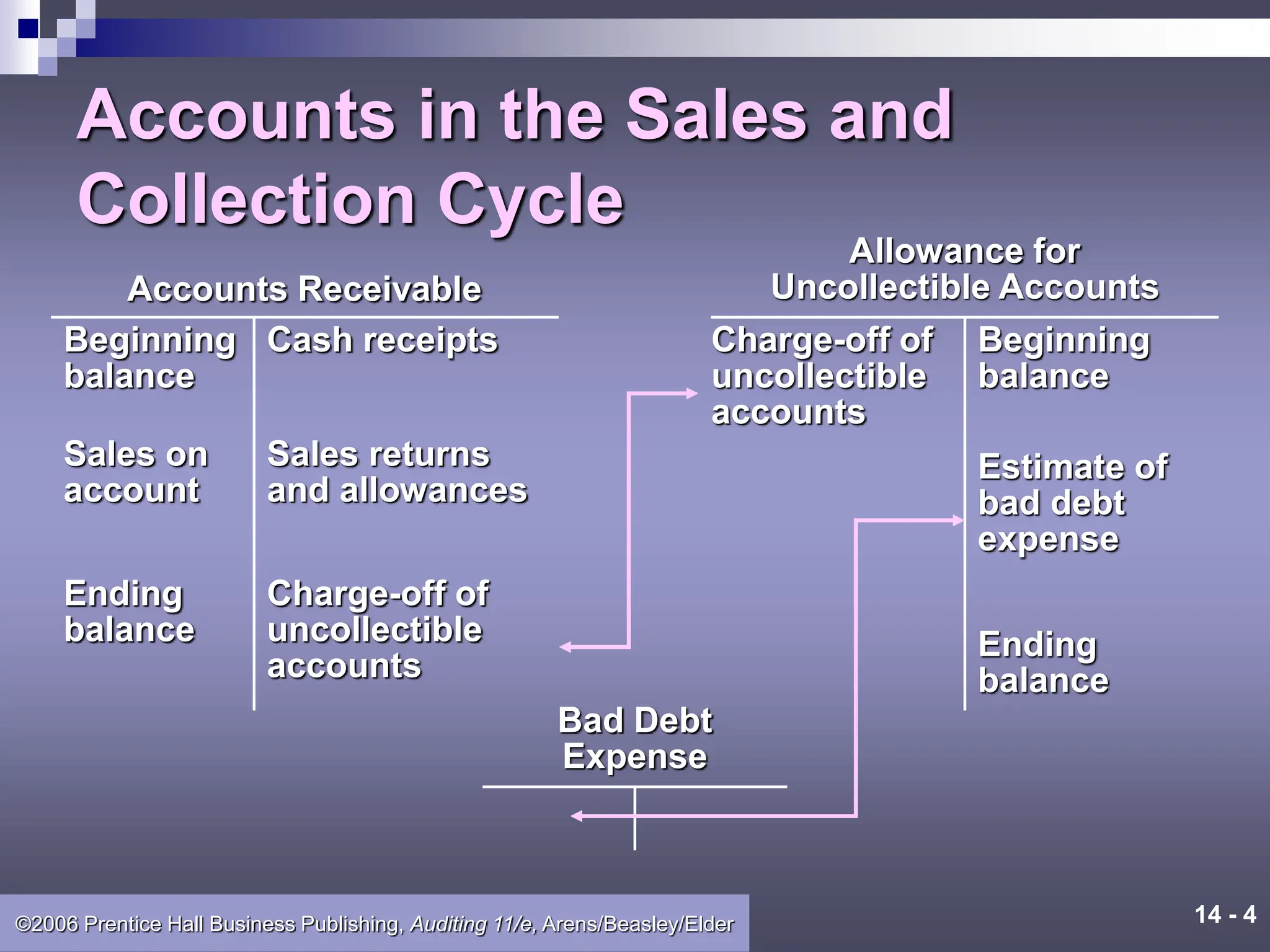
Accounts in the Sales and
Collection Cycle
Accounts Receivable
Cash receipts
Sales returns
and allowances
Charge-off of
uncollectible
accounts
Beginning
balance
Sales on
account
Ending
balance
Allowance for
Uncollectible Accounts
Charge-off of
uncollectible
accounts
Beginning
balance
Estimate of
bad debt
expense
Ending
balance
Bad Debt
Expense
14 - 5
©2006 Prentice Hall Business Publishing, Auditing 11/e, Arens/Beasley/Elder
Learning Objective 2
Describe the business functions
and the related documents and
records in the sales and
collection cycle.
14 - 6
©2006 Prentice Hall Business Publishing, Auditing 11/e, Arens/Beasley/Elder
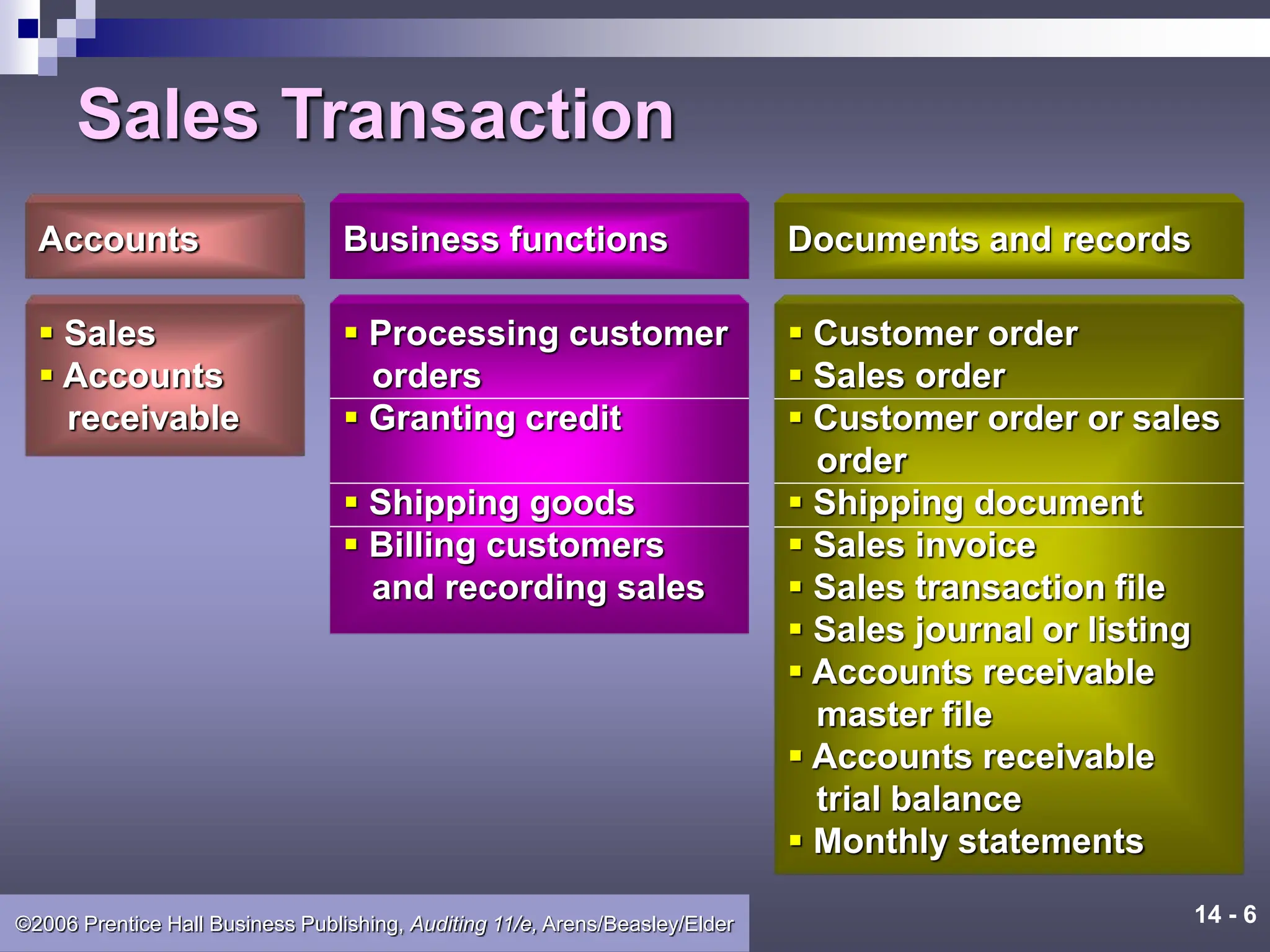
Sales Transaction
Accounts
 Sales
 Accounts
receivable
Business functions
 Processing customer
orders
 Granting credit
 Shipping goods
 Billing customers
and recording sales
Documents and records
 Customer order
 Sales order
 Customer order or sales
order
 Shipping document
 Sales invoice
 Sales transaction file
 Sales journal or listing
 Accounts receivable
master file
 Accounts receivable
trial balance
 Monthly statements
14 - 7
©2006 Prentice Hall Business Publishing, Auditing 11/e, Arens/Beasley/Elder
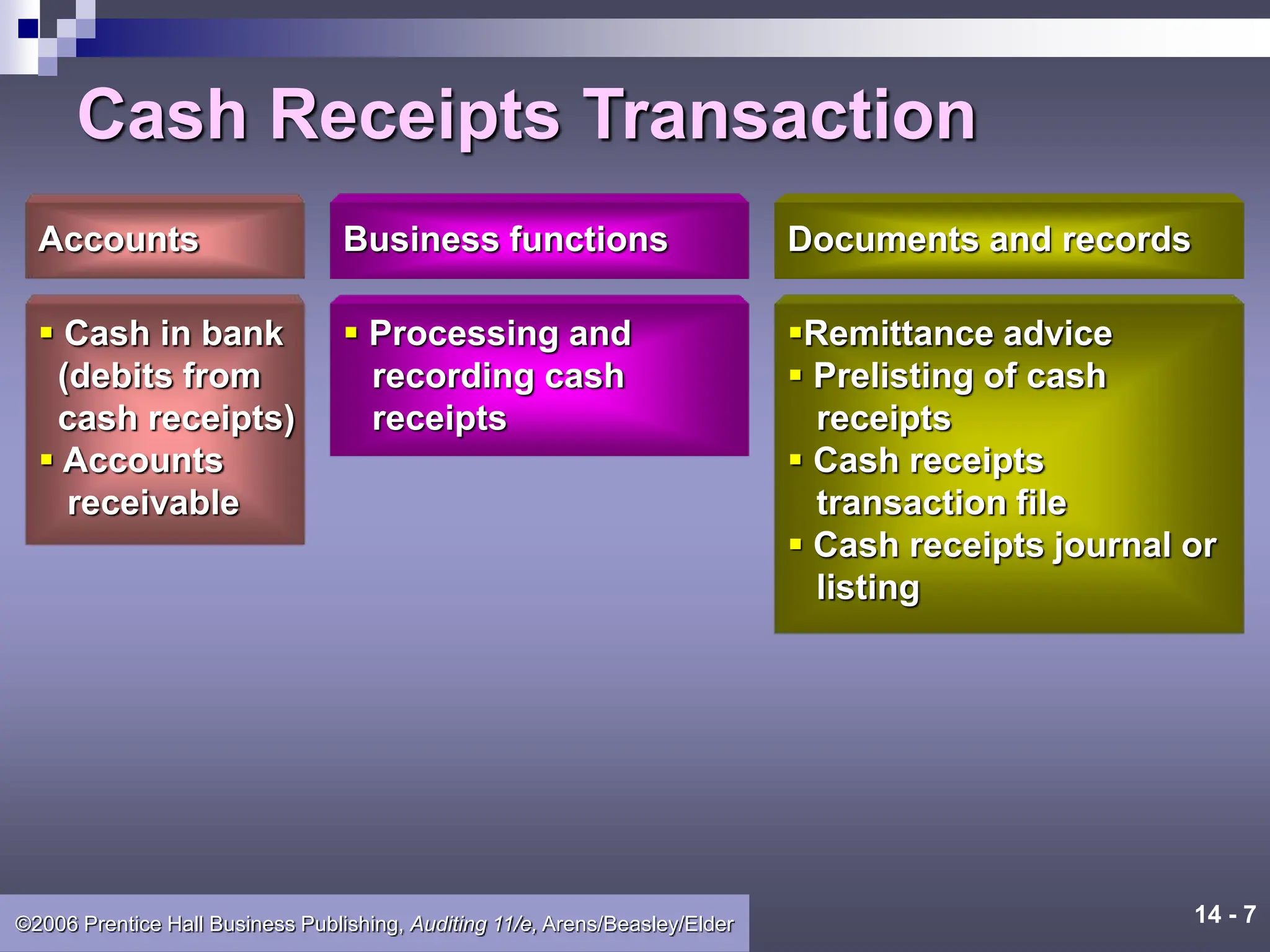
Cash Receipts Transaction
Accounts
 Cash in bank
(debits from
cash receipts)
 Accounts
receivable
Business functions
 Processing and
recording cash
receipts
Documents and records
Remittance advice
 Prelisting of cash
receipts
 Cash receipts
transaction file
 Cash receipts journal or
listing
14 - 8
©2006 Prentice Hall Business Publishing, Auditing 11/e, Arens/Beasley/Elder
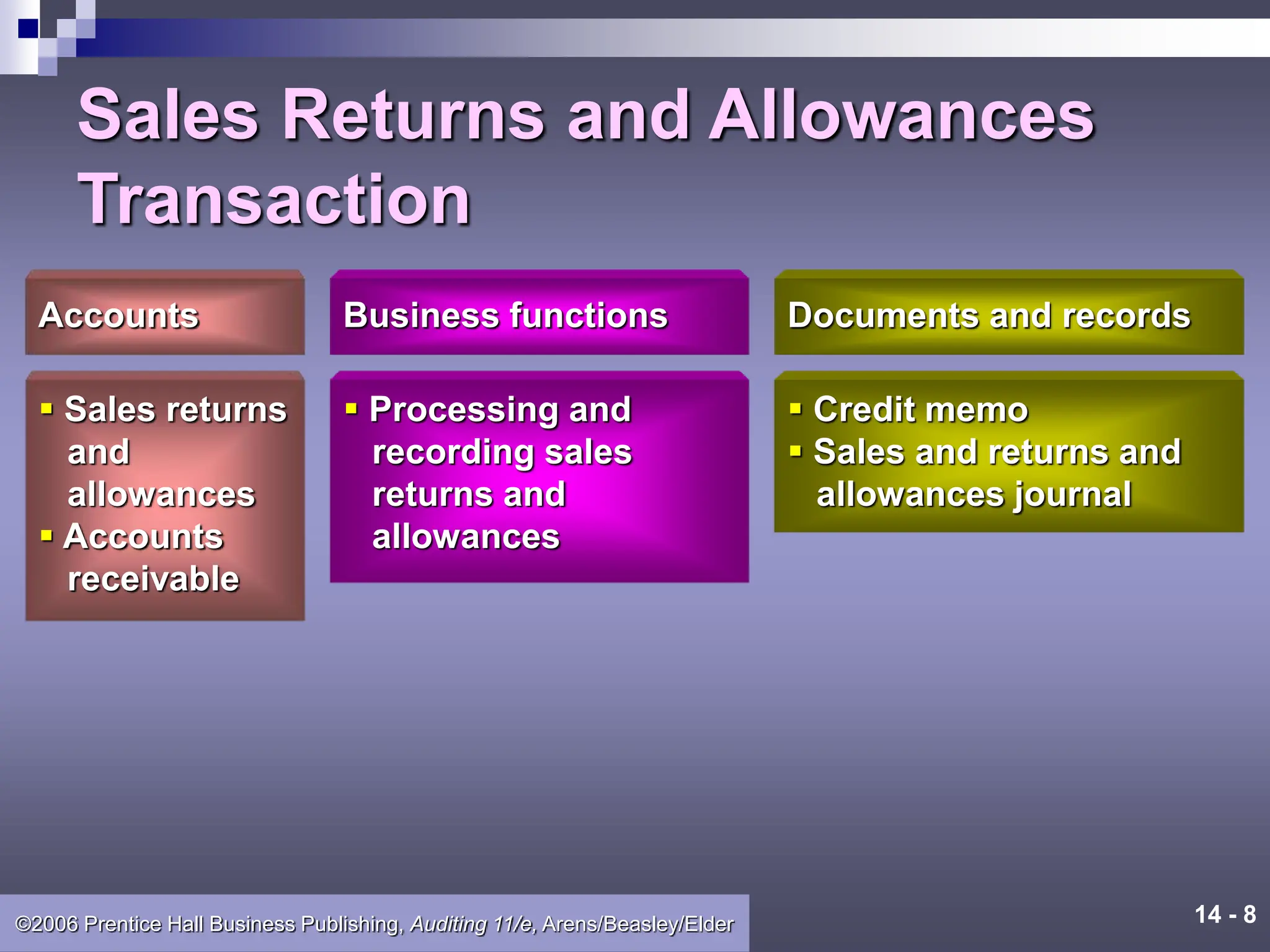
Sales Returns and Allowances
Transaction
Accounts
 Sales returns
and
allowances
 Accounts
receivable
Business functions
 Processing and
recording sales
returns and
allowances
Documents and records
 Credit memo
 Sales and returns and
allowances journal
14 - 9
©2006 Prentice Hall Business Publishing, Auditing 11/e, Arens/Beasley/Elder
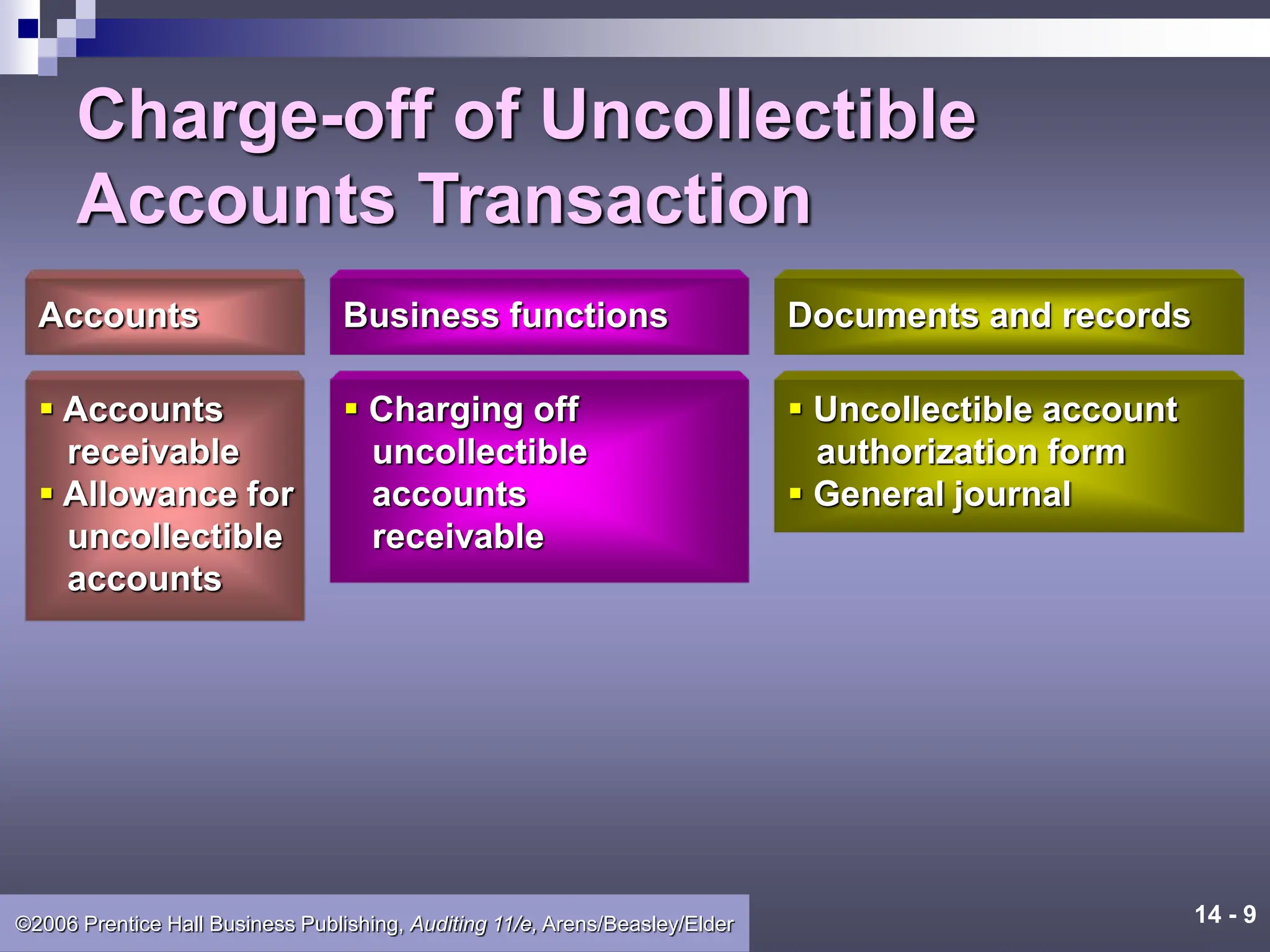
Charge-off of Uncollectible
Accounts Transaction
Accounts
 Accounts
receivable
 Allowance for
uncollectible
accounts
Business functions
 Charging off
uncollectible
accounts
receivable
Documents and records
 Uncollectible account
authorization form
 General journal
14 - 10
©2006 Prentice Hall Business Publishing, Auditing 11/e, Arens/Beasley/Elder
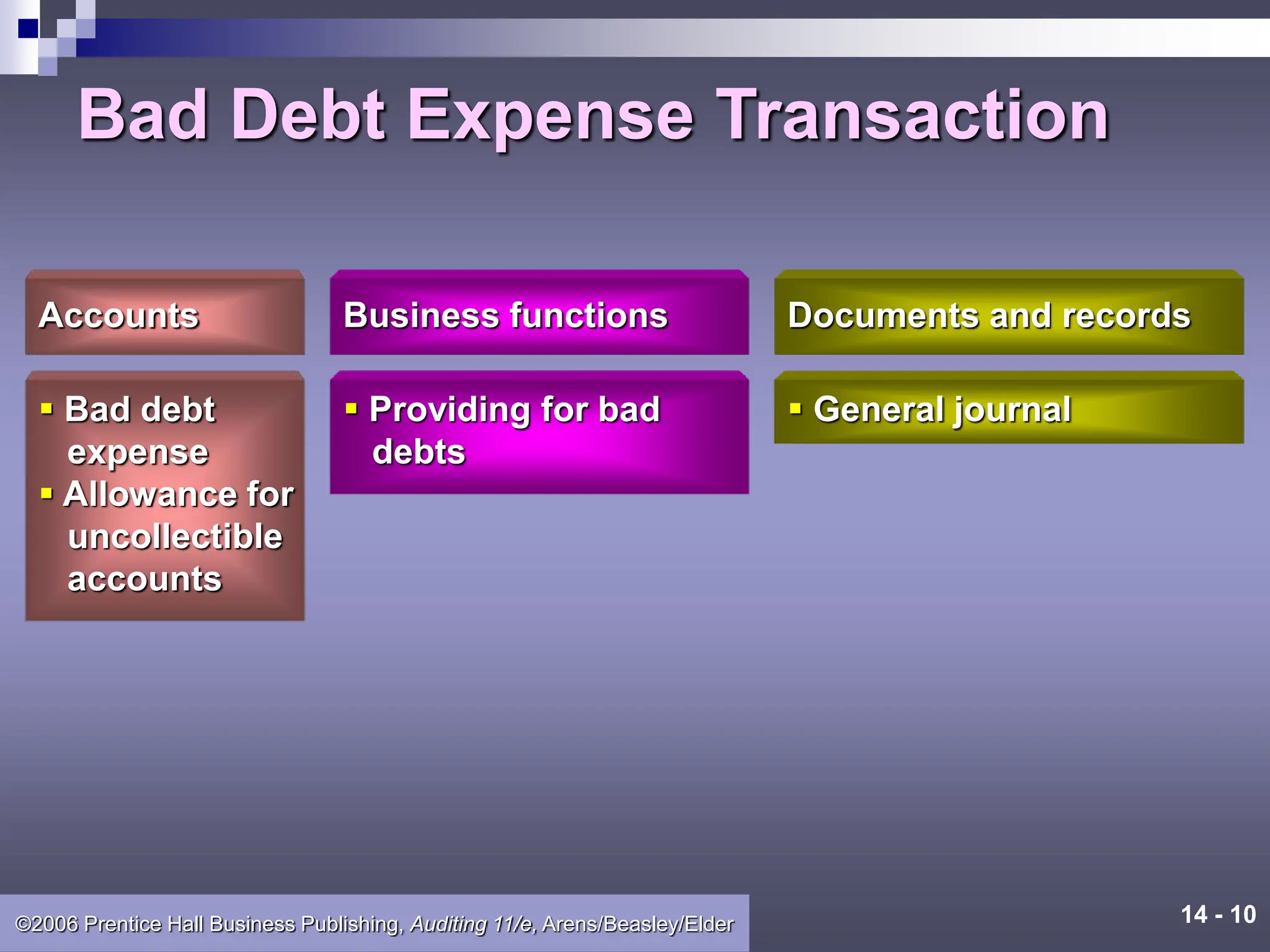
Bad Debt Expense Transaction
Accounts
 Bad debt
expense
 Allowance for
uncollectible
accounts
Business functions
 Providing for bad
debts
Documents and records
 General journal
14 - 11
©2006 Prentice Hall Business Publishing, Auditing 11/e, Arens/Beasley/Elder
Processing Customer Orders
Customer Order:
A request for merchandise by a customer
Sales Order:
A document describing the goods ordered
by a customer
14 - 12
©2006 Prentice Hall Business Publishing, Auditing 11/e, Arens/Beasley/Elder
Granting Credit
Before goods are shipped, a properly
authorized person must approve credit
to the customer for sales on account.
14 - 13
©2006 Prentice Hall Business Publishing, Auditing 11/e, Arens/Beasley/Elder
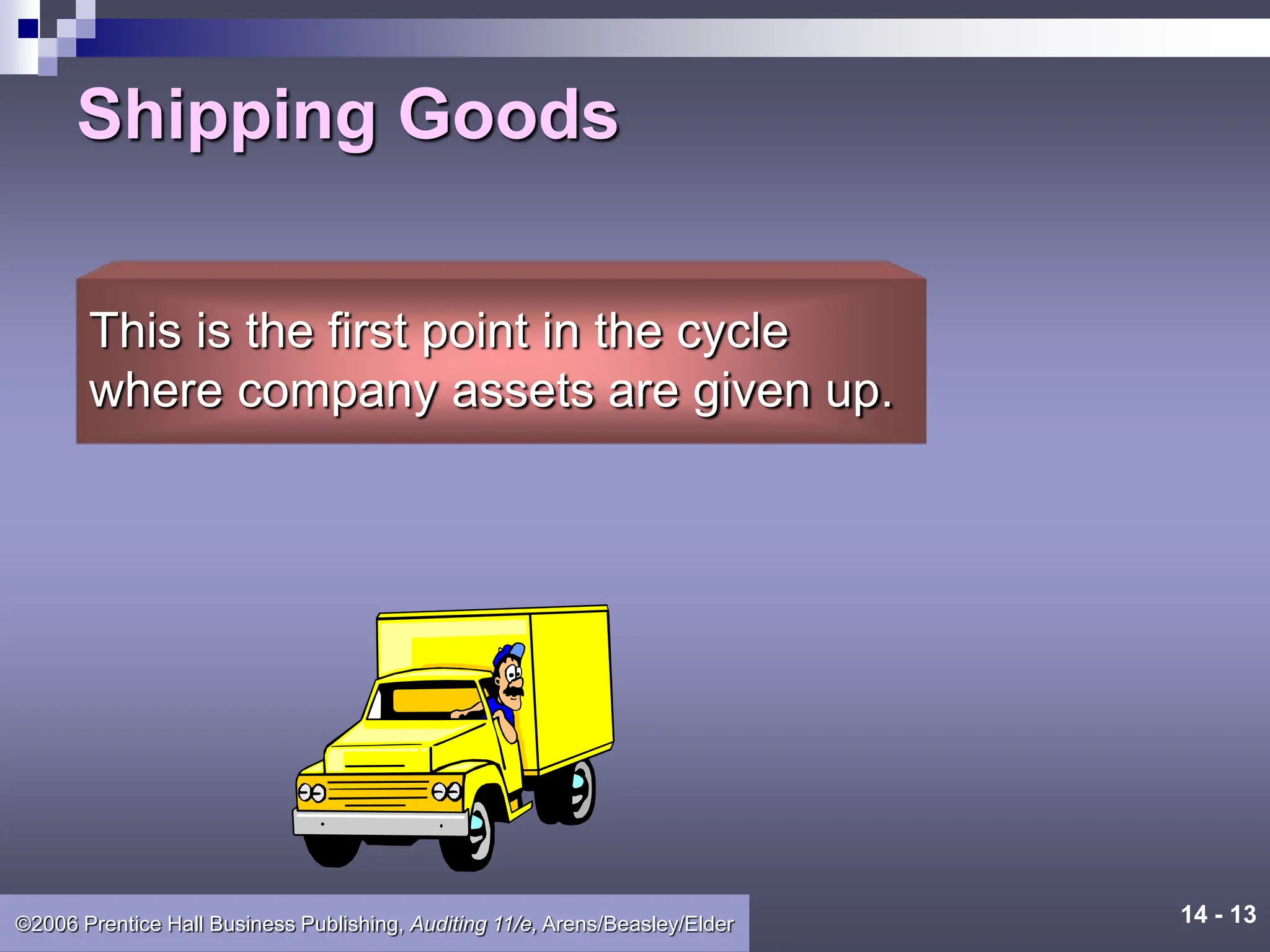
Shipping Goods
This is the first point in the cycle
where company assets are given up.
14 - 14
©2006 Prentice Hall Business Publishing, Auditing 11/e, Arens/Beasley/Elder
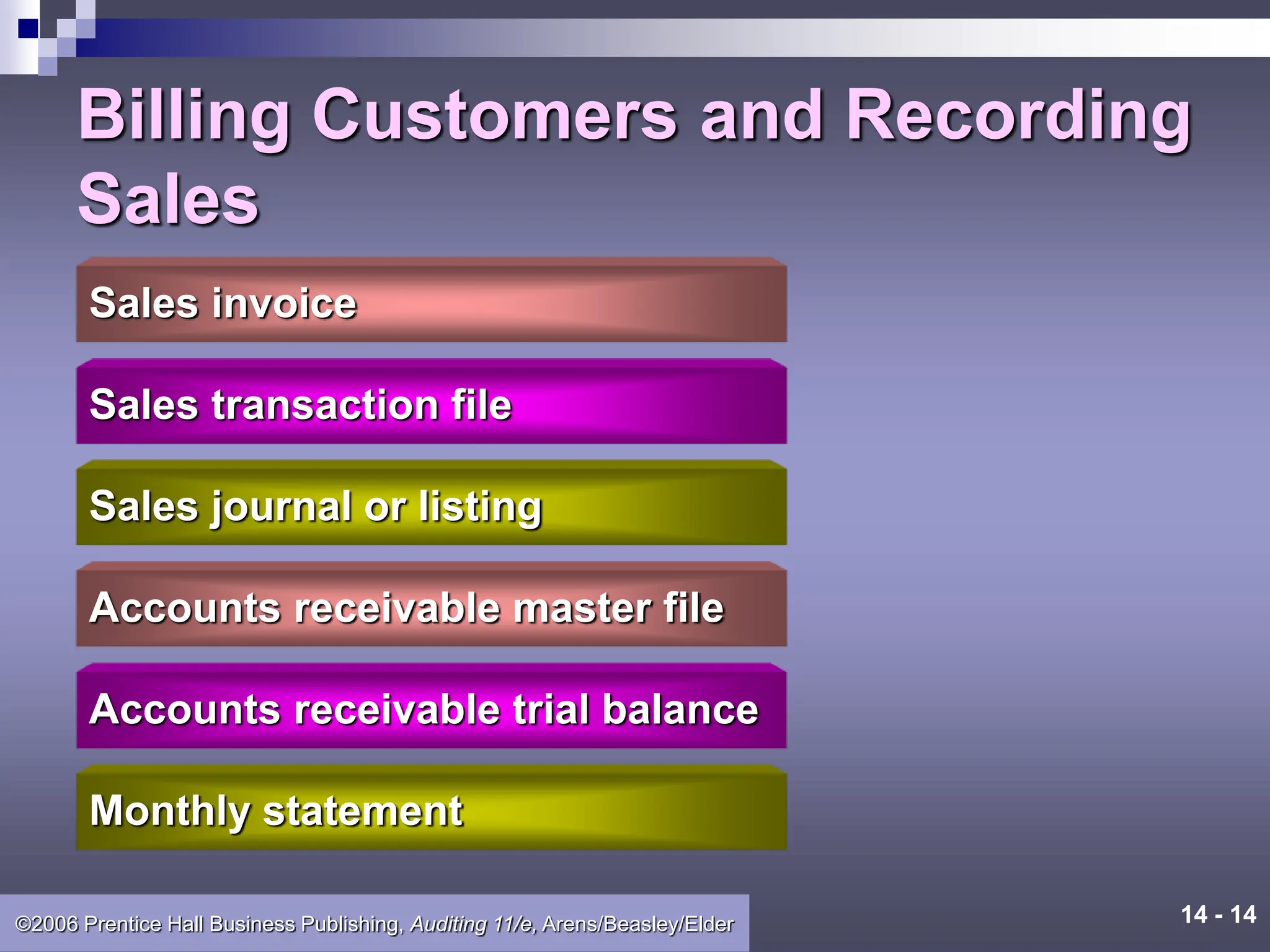
Billing Customers and Recording
Sales
Sales invoice
Sales transaction file
Sales journal or listing
Accounts receivable master file
Accounts receivable trial balance
Monthly statement
14 - 15
©2006 Prentice Hall Business Publishing, Auditing 11/e, Arens/Beasley/Elder
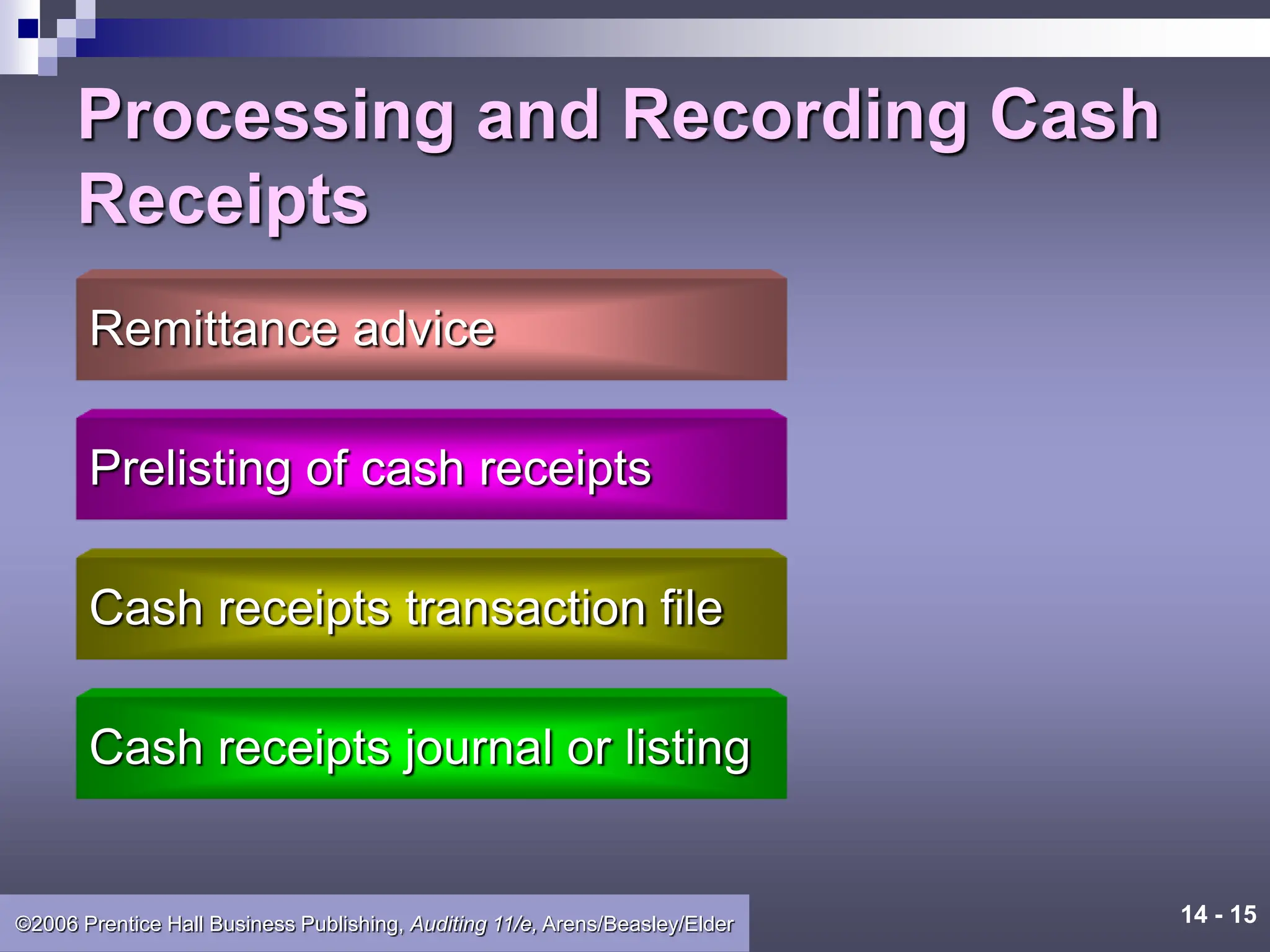
Processing and Recording Cash
Receipts
Remittance advice
Prelisting of cash receipts
Cash receipts transaction file
Cash receipts journal or listing
14 - 16
©2006 Prentice Hall Business Publishing, Auditing 11/e, Arens/Beasley/Elder
Processing and Recording Sales
Returns and Allowances
Credit memo
Sales returns and allowances journal
14 - 17
©2006 Prentice Hall Business Publishing, Auditing 11/e, Arens/Beasley/Elder
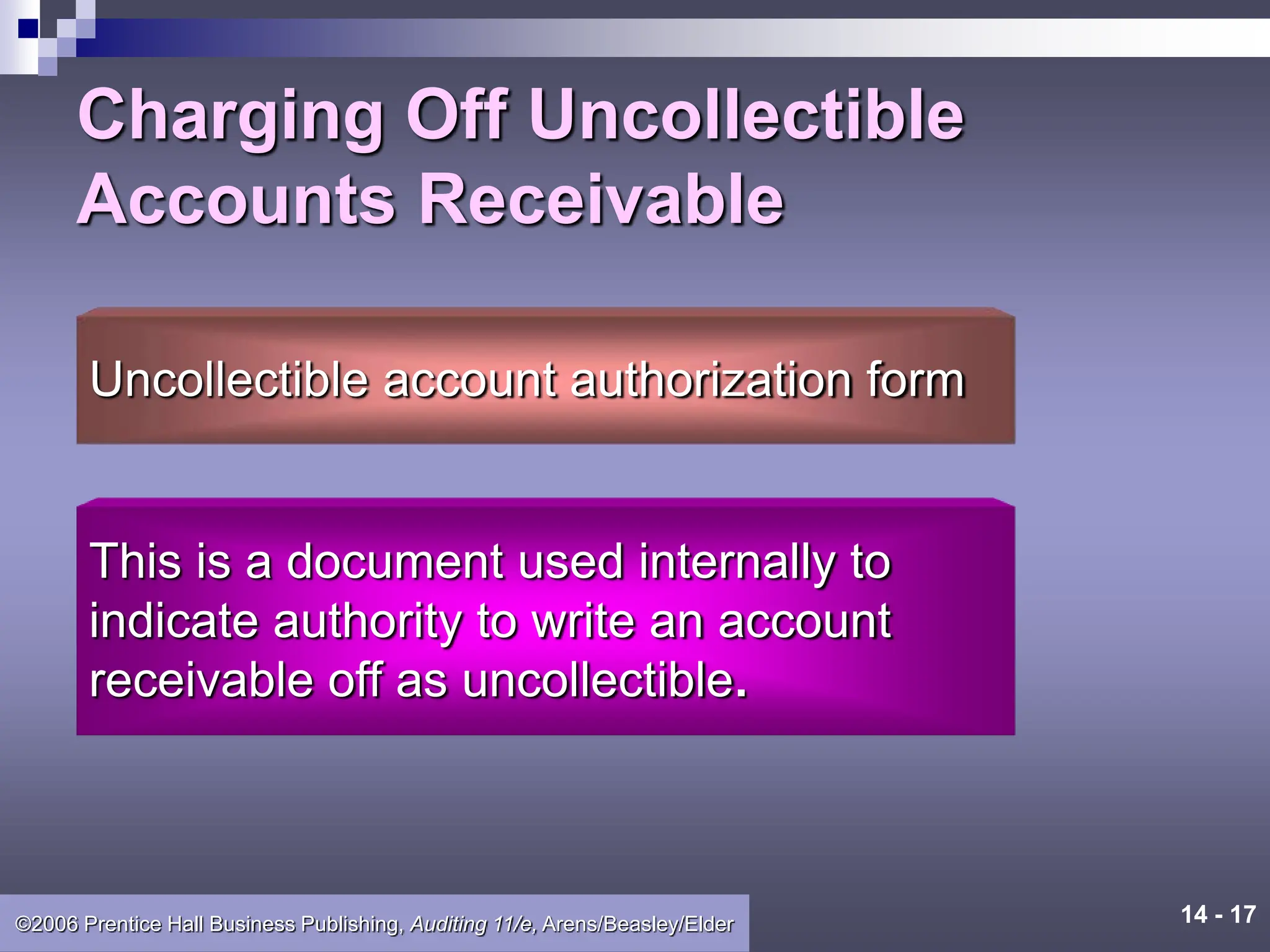
Charging Off Uncollectible
Accounts Receivable
Uncollectible account authorization form
This is a document used internally to
indicate authority to write an account
receivable off as uncollectible.
14 - 18
©2006 Prentice Hall Business Publishing, Auditing 11/e, Arens/Beasley/Elder
Providing for Bad Debts
This provision represents a residual,
resulting from management’s
end-of-period adjustment of the
allowance for uncollectible accounts.
14 - 19
©2006 Prentice Hall Business Publishing, Auditing 11/e, Arens/Beasley/Elder
Learning Objective 3
Understand how e-commerce
activities affect the sales
and collection cycle.
14 - 20
©2006 Prentice Hall Business Publishing, Auditing 11/e, Arens/Beasley/Elder
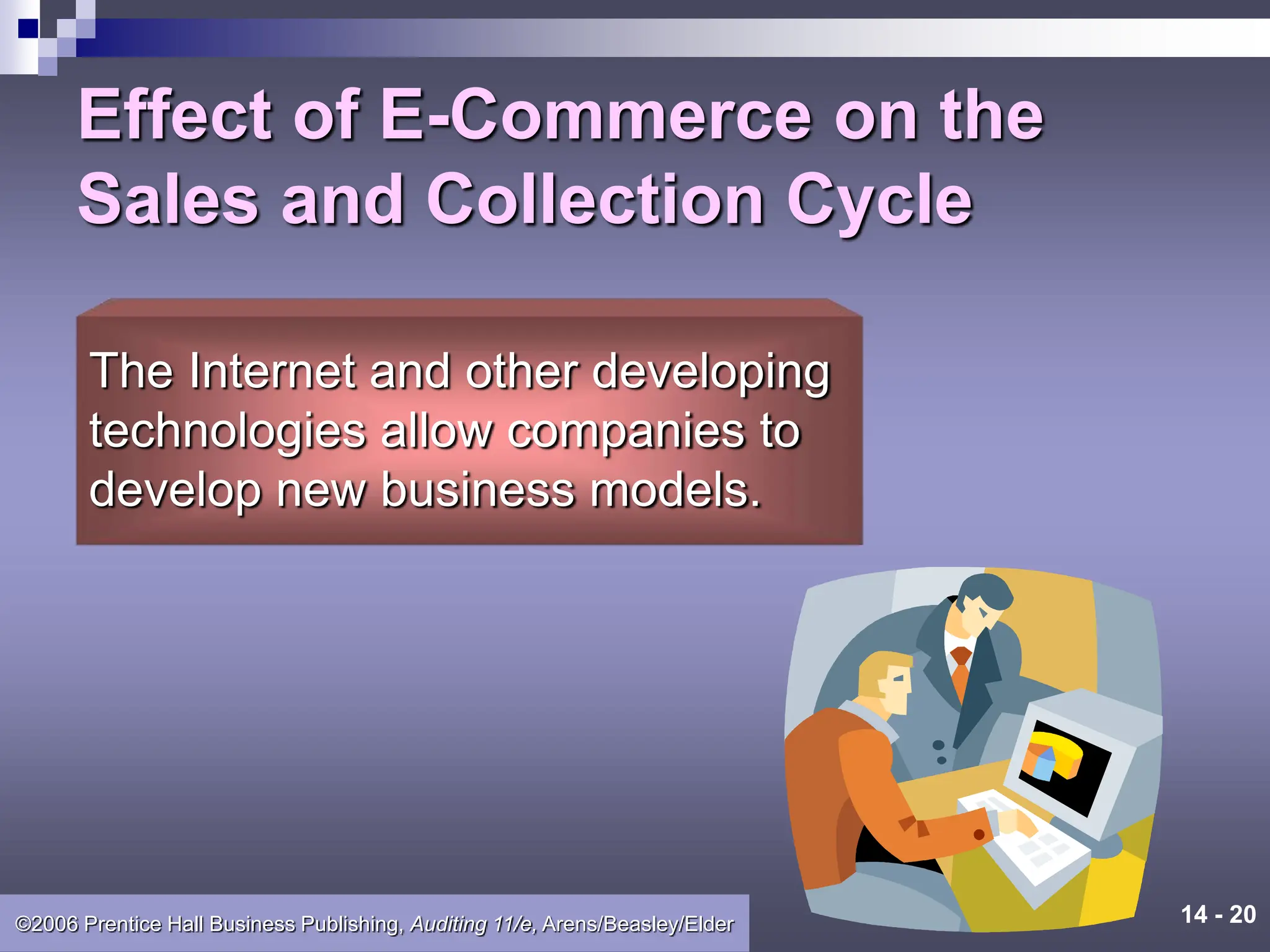
Effect of E-Commerce on the
Sales and Collection Cycle
The Internet and other developing
technologies allow companies to
develop new business models.
14 - 21
©2006 Prentice Hall Business Publishing, Auditing 11/e, Arens/Beasley/Elder
Effect of E-Commerce on the
Sales and Collection Cycle
Business-to-business (B2B)
Business-to-consumer (B2C)
Management’s assertions for sales and
collection activities remain the same.
14 - 22
©2006 Prentice Hall Business Publishing, Auditing 11/e, Arens/Beasley/Elder
Effect of E-Commerce on the
Sales and Collection Cycle
Auditors should obtain an understanding
of the design and operation of key internal
controls over e-commerce revenues.
Evidence for e-commerce activities is
likely to be in electronic form.
14 - 23
©2006 Prentice Hall Business Publishing, Auditing 11/e, Arens/Beasley/Elder
Learning Objective 4
Understand internal control,
and design and perform tests
of controls and substantive
tests of transactions for sales.
14 - 24
©2006 Prentice Hall Business Publishing, Auditing 11/e, Arens/Beasley/Elder
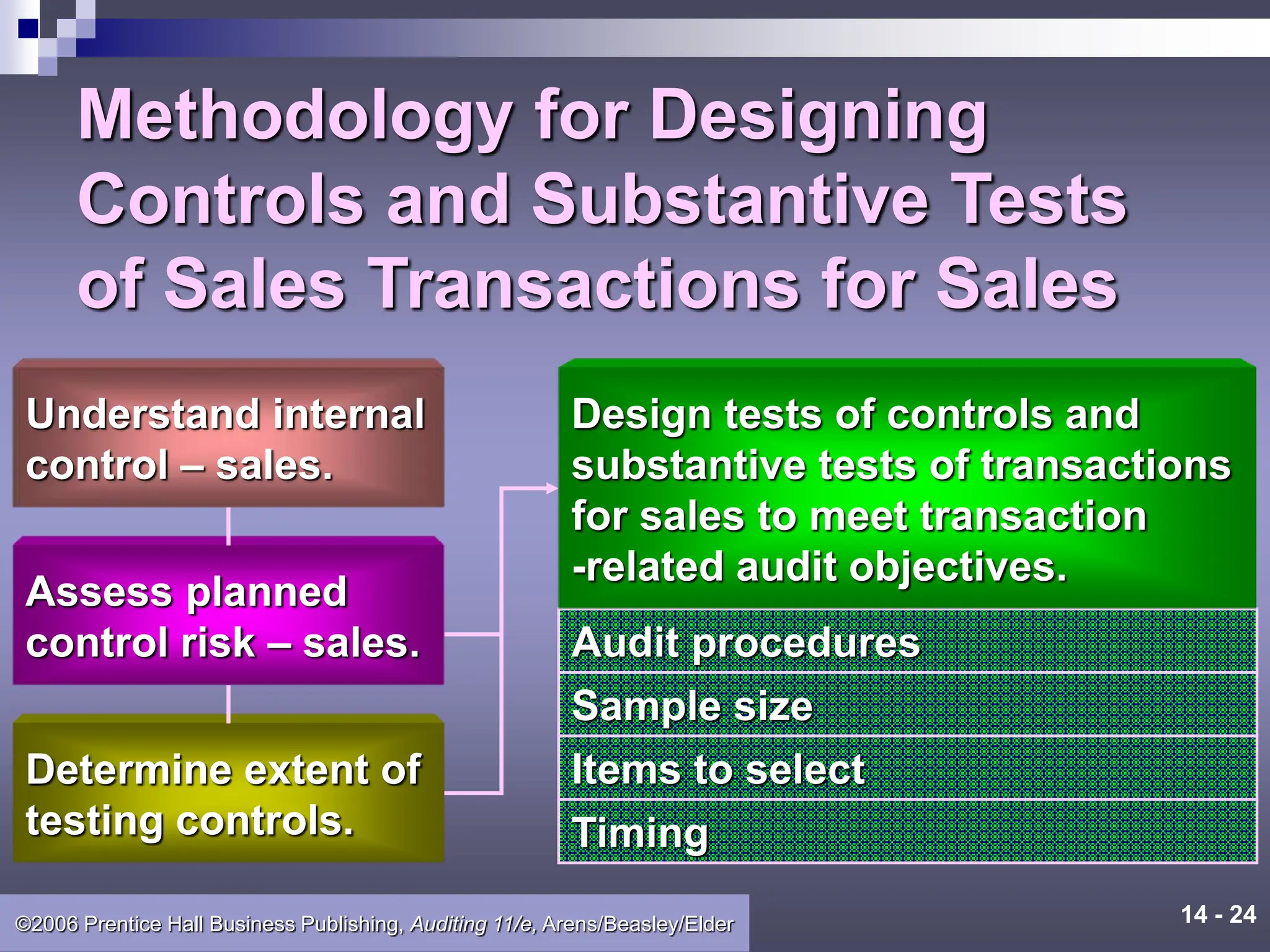
Methodology for Designing
Controls and Substantive Tests
of Sales Transactions for Sales
Understand internal
control – sales.
Audit procedures
Sample size
Items to select
Timing
Assess planned
control risk – sales.
Determine extent of
testing controls.
Design tests of controls and
substantive tests of transactions
for sales to meet transaction
-related audit objectives.
14 - 25
©2006 Prentice Hall Business Publishing, Auditing 11/e, Arens/Beasley/Elder
Understand Internal Control –
Sales
Study the client’s flowcharts, prepare
an internal control questionnaire, and
perform walk-through tests of sales.
14 - 26
©2006 Prentice Hall Business Publishing, Auditing 11/e, Arens/Beasley/Elder
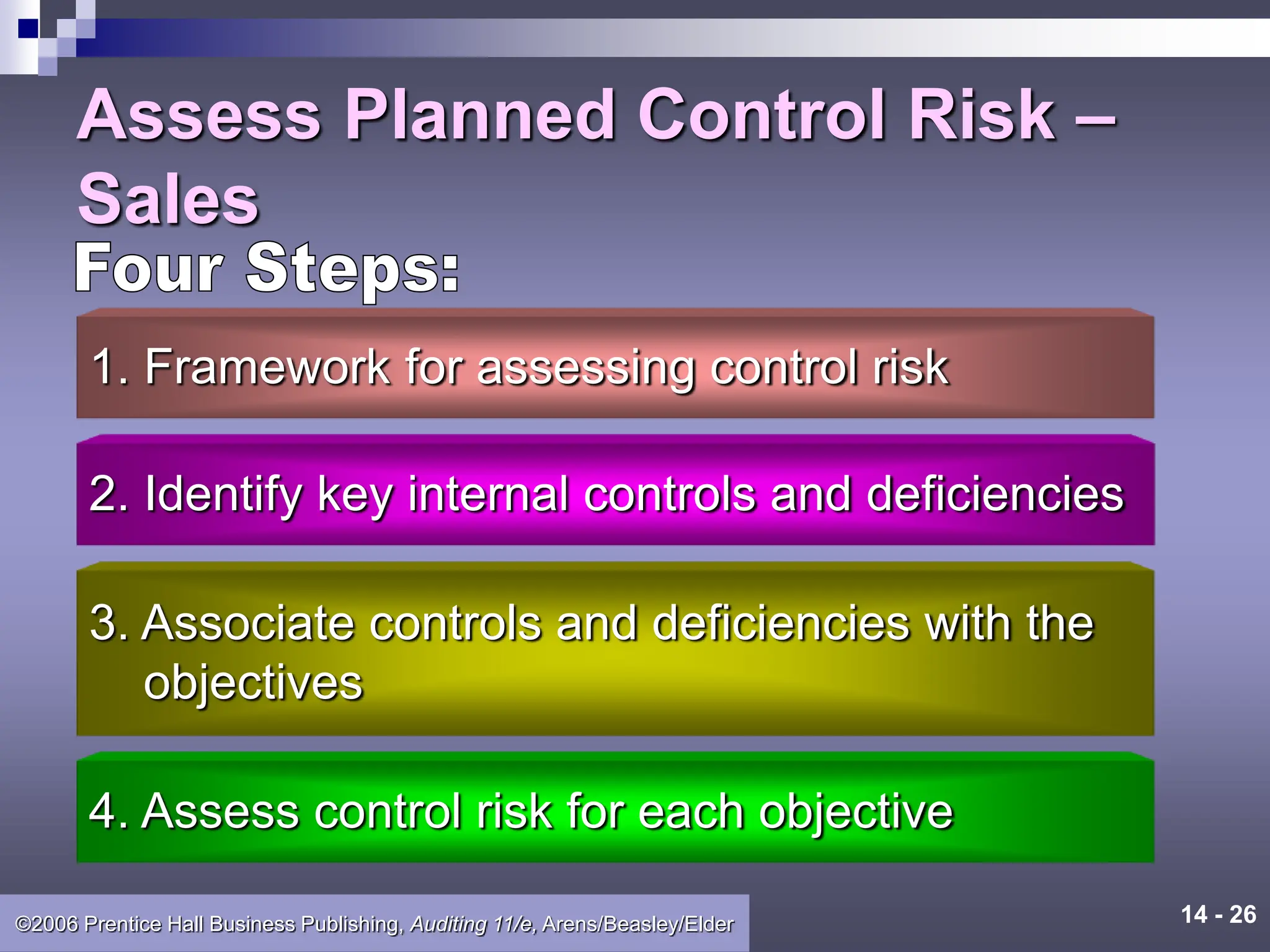
Assess Planned Control Risk –
Sales
1. Framework for assessing control risk
2. Identify key internal controls and deficiencies
3. Associate controls and deficiencies with the
objectives
4. Assess control risk for each objective
14 - 27
©2006 Prentice Hall Business Publishing, Auditing 11/e, Arens/Beasley/Elder
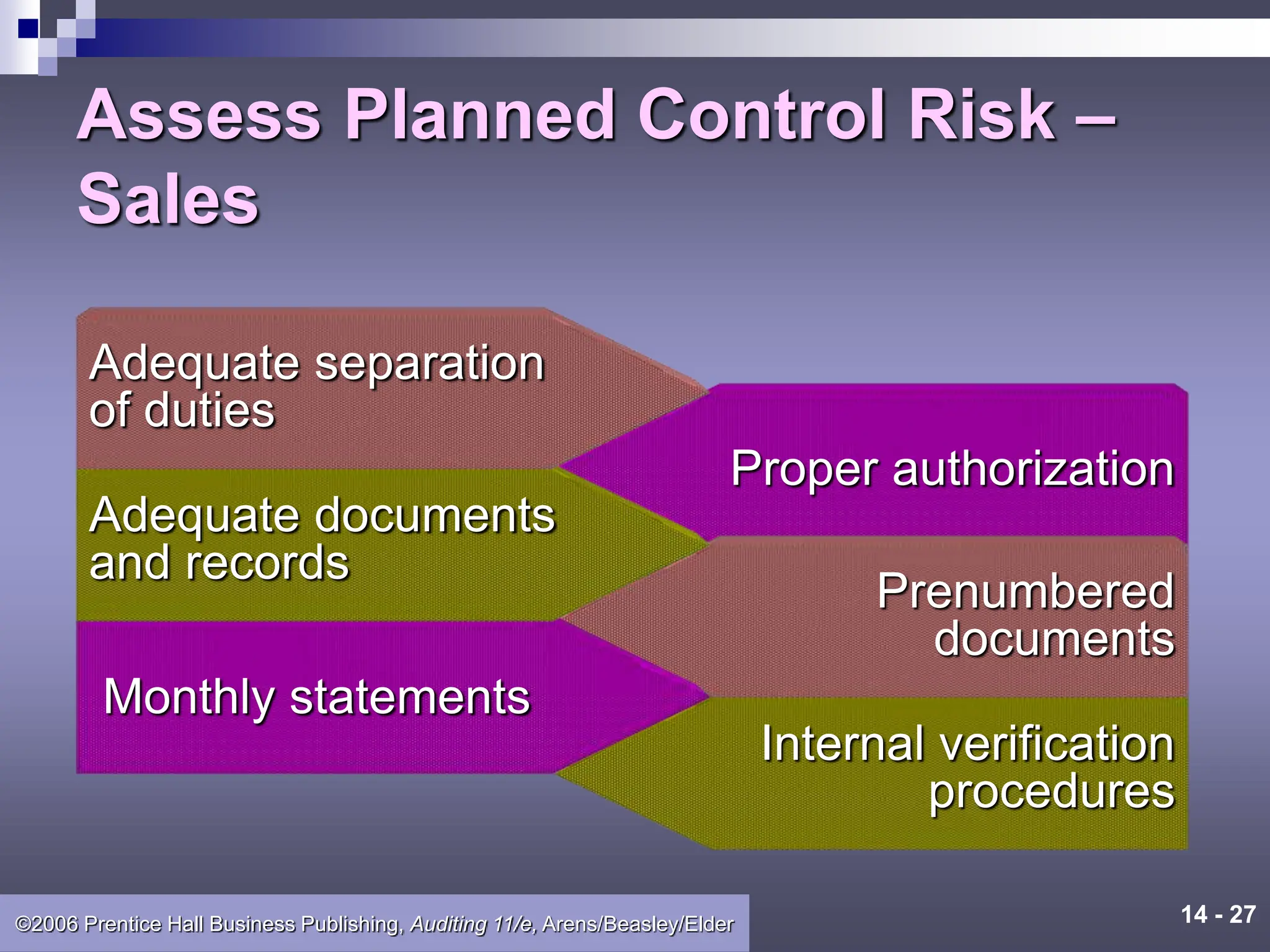
Proper authorization
Assess Planned Control Risk –
Sales
Internal verification
procedures
Prenumbered
documents
Monthly statements
Adequate documents
and records
Adequate separation
of duties
14 - 28
©2006 Prentice Hall Business Publishing, Auditing 11/e, Arens/Beasley/Elder
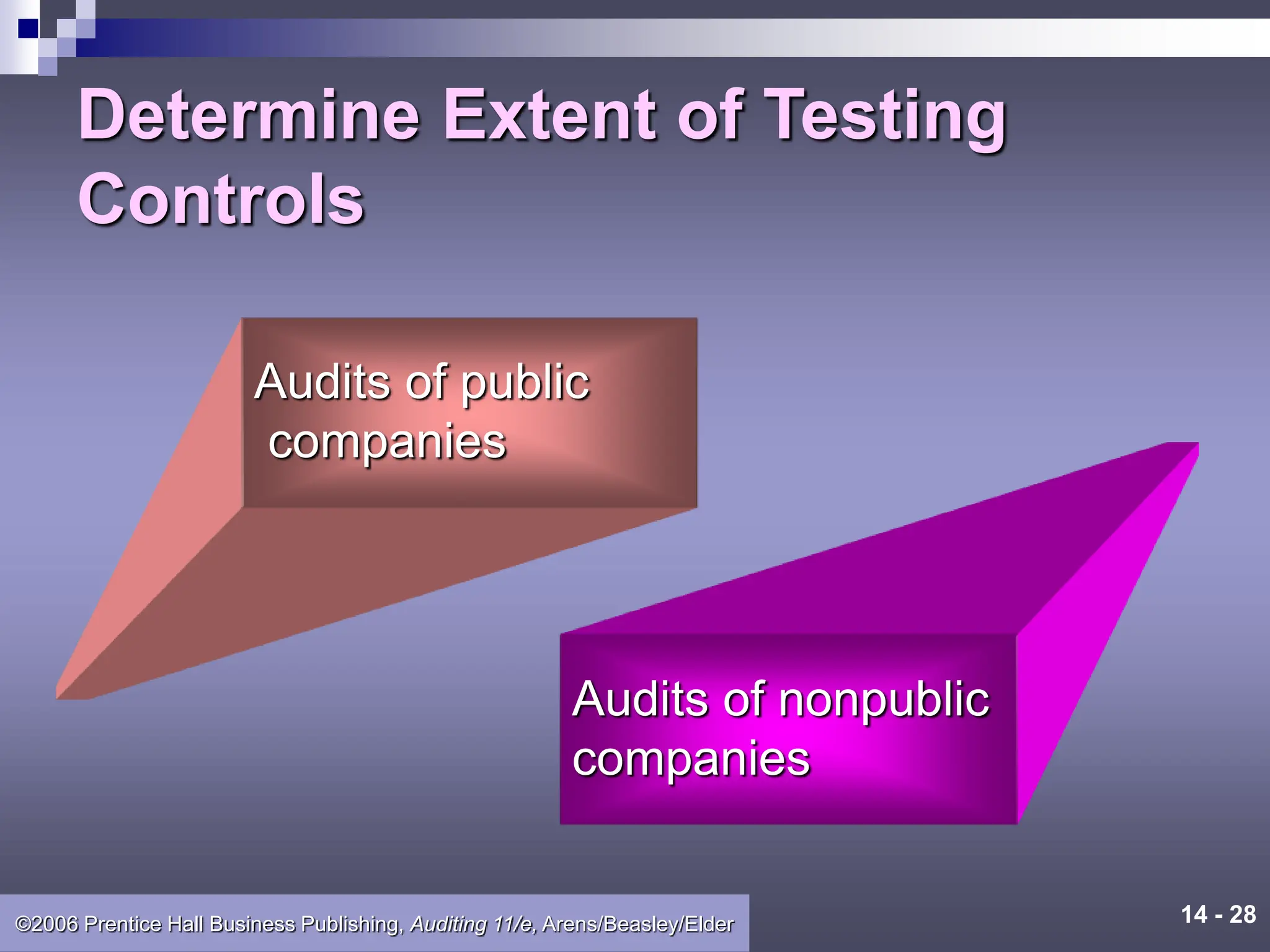
Determine Extent of Testing
Controls
Audits of public
companies
Audits of nonpublic
companies
14 - 29
©2006 Prentice Hall Business Publishing, Auditing 11/e, Arens/Beasley/Elder
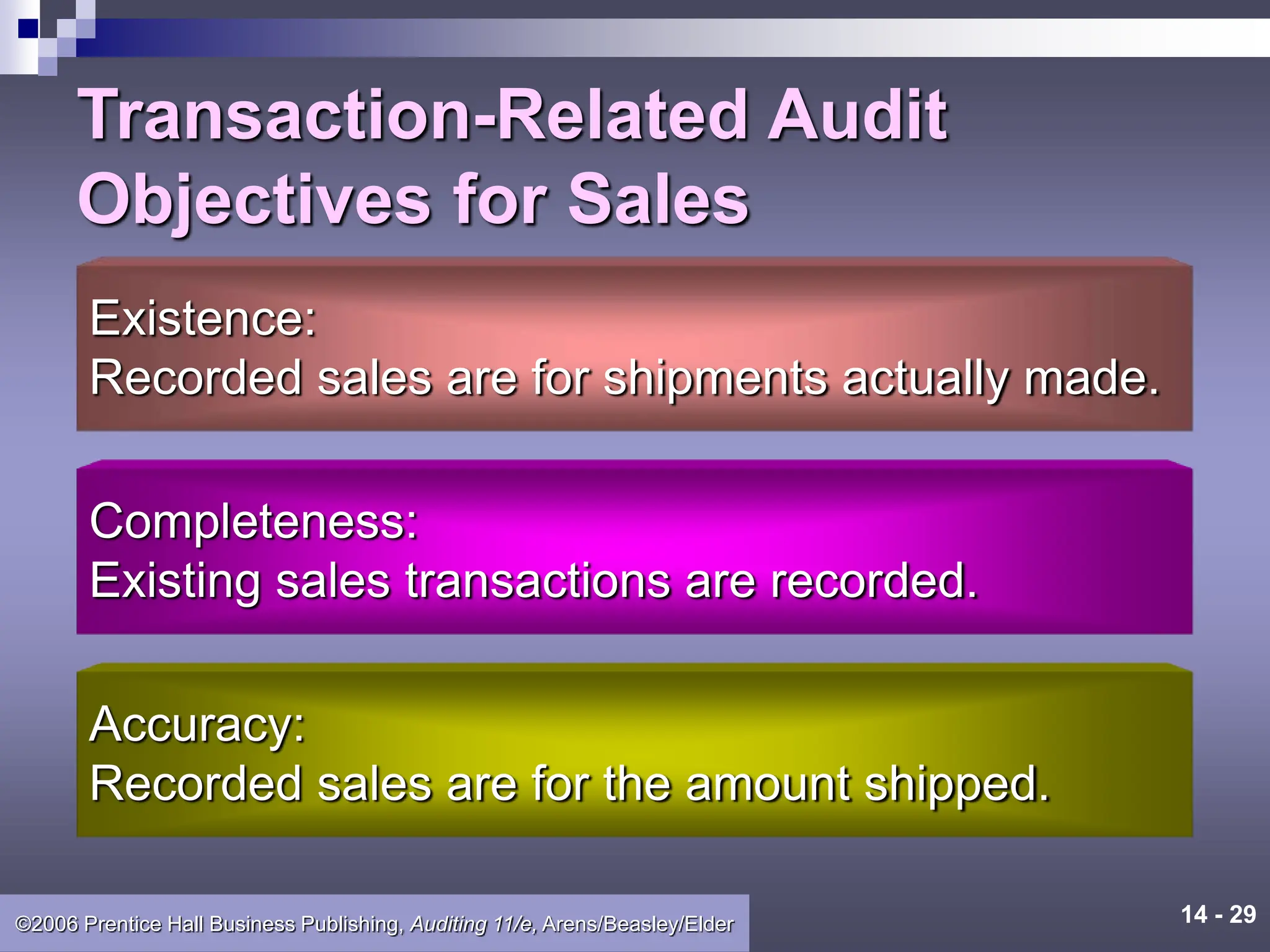
Transaction-Related Audit
Objectives for Sales
Existence:
Recorded sales are for shipments actually made.
Accuracy:
Recorded sales are for the amount shipped.
Completeness:
Existing sales transactions are recorded.
14 - 30
©2006 Prentice Hall Business Publishing, Auditing 11/e, Arens/Beasley/Elder
Transaction-Related Audit
Objectives for Sales
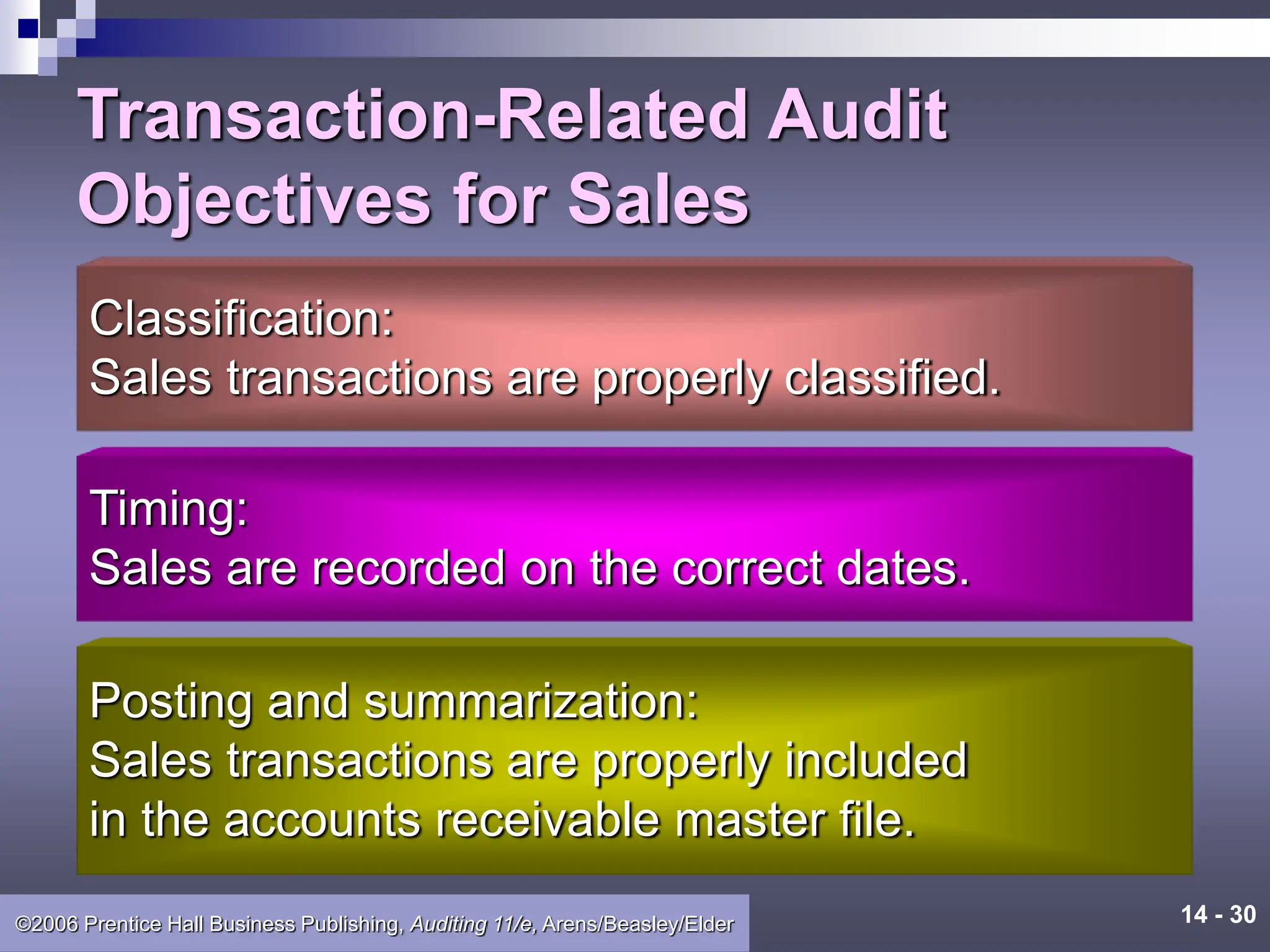
Classification:
Sales transactions are properly classified.
Timing:
Sales are recorded on the correct dates.
Posting and summarization:
Sales transactions are properly included
in the accounts receivable master file.
14 - 31
©2006 Prentice Hall Business Publishing, Auditing 11/e, Arens/Beasley/Elder
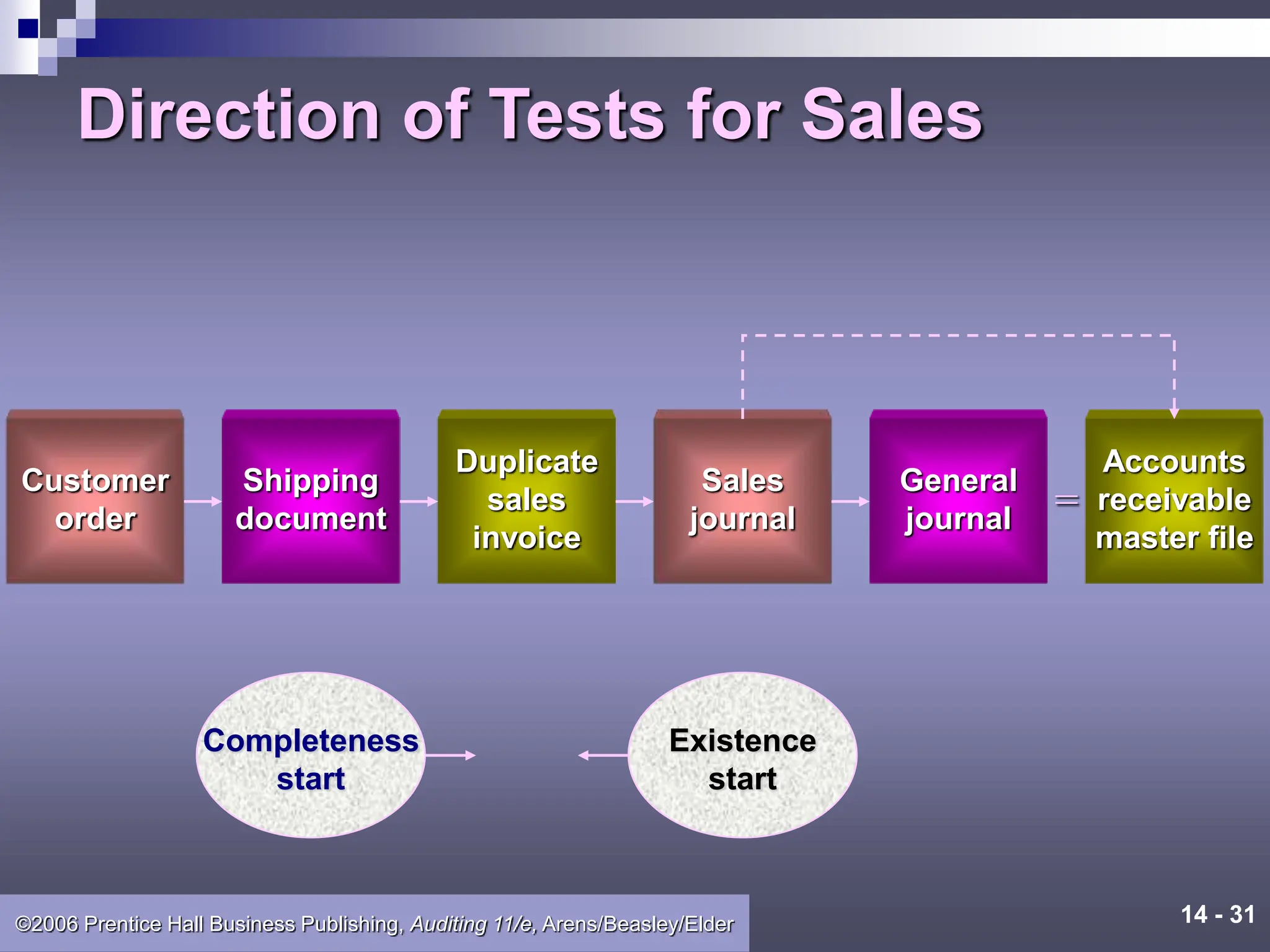
Direction of Tests for Sales
Completeness
start
Existence
start
Customer
order
Shipping
document
Duplicate
sales
invoice
Sales
journal
General
journal
Accounts
receivable
master file
=
14 - 32
©2006 Prentice Hall Business Publishing, Auditing 11/e, Arens/Beasley/Elder
Summary of Methodology for
Sales
Transaction-related audit objectives (Column 1)
Key existing controls (Column 2)
Tests of control (Column 3)
Deficiencies (Column 4)
Substantive tests of transactions (Column 5)
14 - 33
©2006 Prentice Hall Business Publishing, Auditing 11/e, Arens/Beasley/Elder
Learning Objective 5
Apply the methodology for
controls over sales transactions
to controls over sales returns
and allowances.
14 - 34
©2006 Prentice Hall Business Publishing, Auditing 11/e, Arens/Beasley/Elder
Sales Returns and Allowances
The transaction-related audit objectives and
client’s methods of controlling misstatements
are essentially the same for processing credit
memos as those described for sales.
14 - 35
©2006 Prentice Hall Business Publishing, Auditing 11/e, Arens/Beasley/Elder
Sales Returns and Allowances
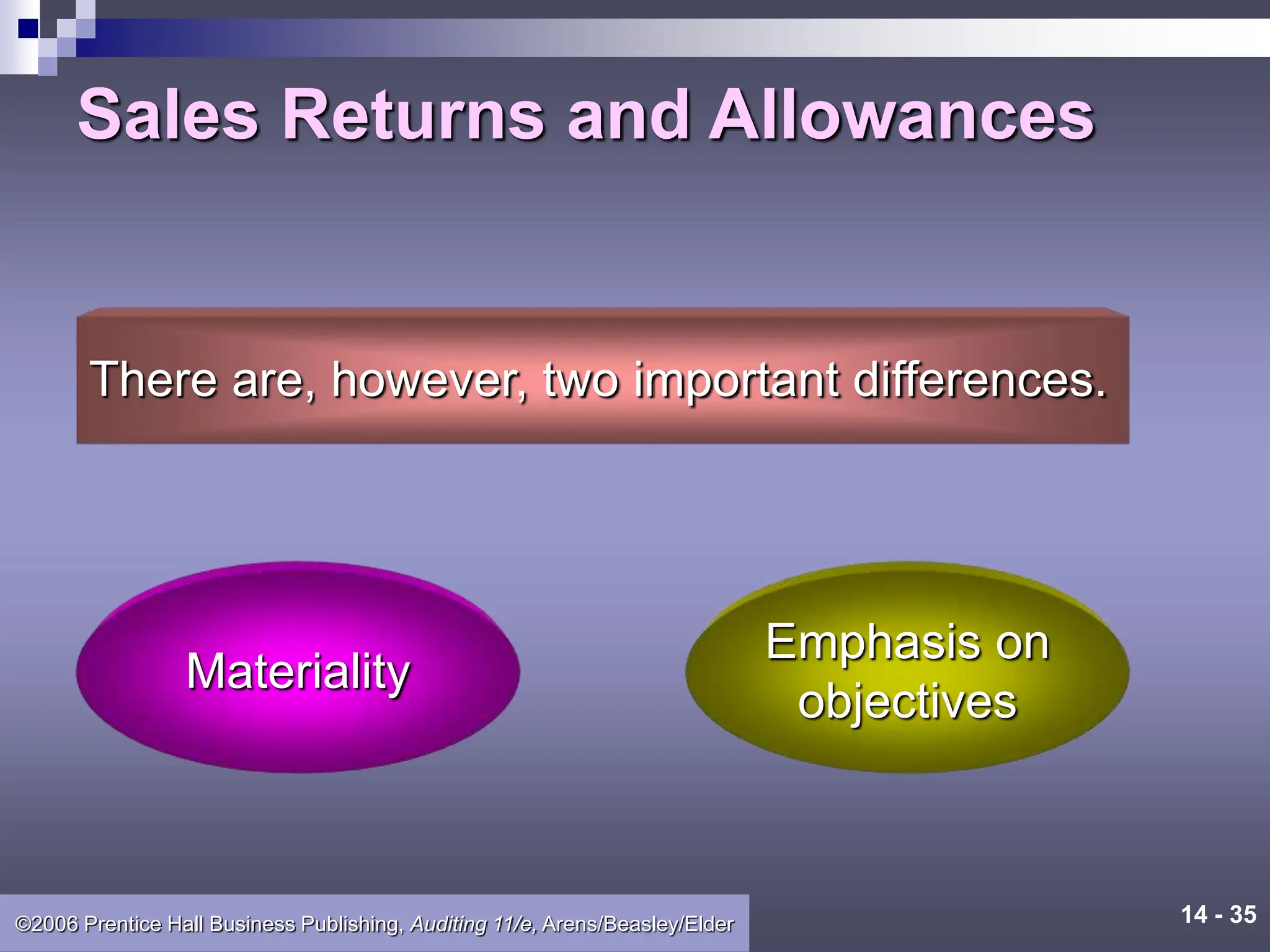
There are, however, two important differences.
Materiality
Emphasis on
objectives
14 - 36
©2006 Prentice Hall Business Publishing, Auditing 11/e, Arens/Beasley/Elder
Learning Objective 6
Understand internal control, and
design and perform tests of
controls and substantive tests
of transactions for cash receipts.
14 - 37
©2006 Prentice Hall Business Publishing, Auditing 11/e, Arens/Beasley/Elder
Tests of Controls and Substantive
Tests of Transactions for Cash
Receipts
 Determine whether cash received was recorded.
 Prepare proof of cash receipts.
 Test to discover lapping of accounts receivable.
14 - 38
©2006 Prentice Hall Business Publishing, Auditing 11/e, Arens/Beasley/Elder
Learning Objective 7
Apply the methodology for
controls over the sales and
collection cycle to write-offs
of uncollectible accounts
receivable.
14 - 39
©2006 Prentice Hall Business Publishing, Auditing 11/e, Arens/Beasley/Elder
Audit Tests for Uncollectible
Accounts
Existence of recorded write-offs is the most
important transaction-related audit objective.
What is a major concern in testing accounts
charged off as uncollectible?
– covering up a defalcation by charging off
accounts receivable that have been collected
14 - 40
©2006 Prentice Hall Business Publishing, Auditing 11/e, Arens/Beasley/Elder
Additional Internal Controls Over
Account Balances
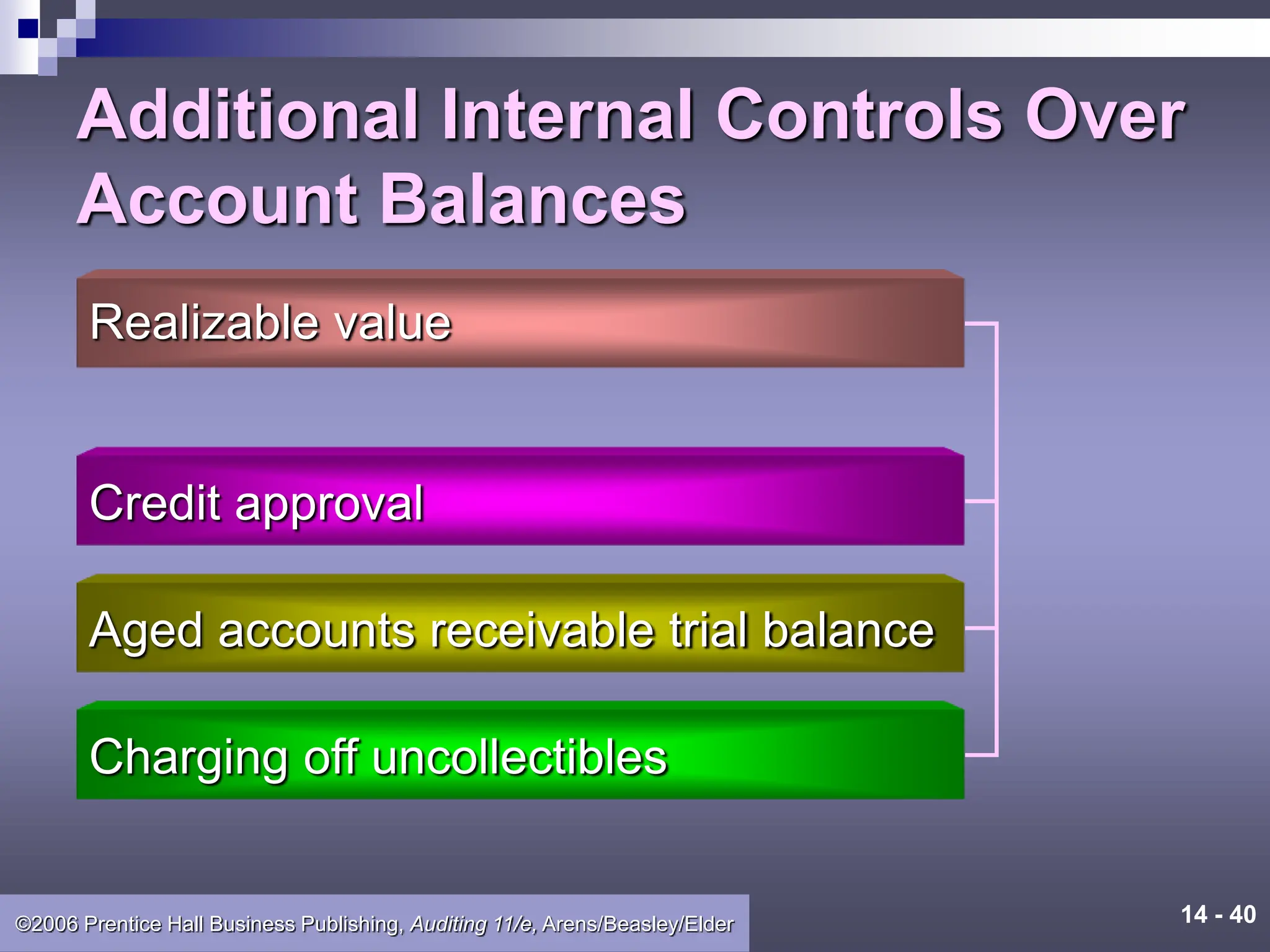
Realizable value
Credit approval
Aged accounts receivable trial balance
Charging off uncollectibles
14 - 41
©2006 Prentice Hall Business Publishing, Auditing 11/e, Arens/Beasley/Elder
Additional Internal Controls Over
Account Balances
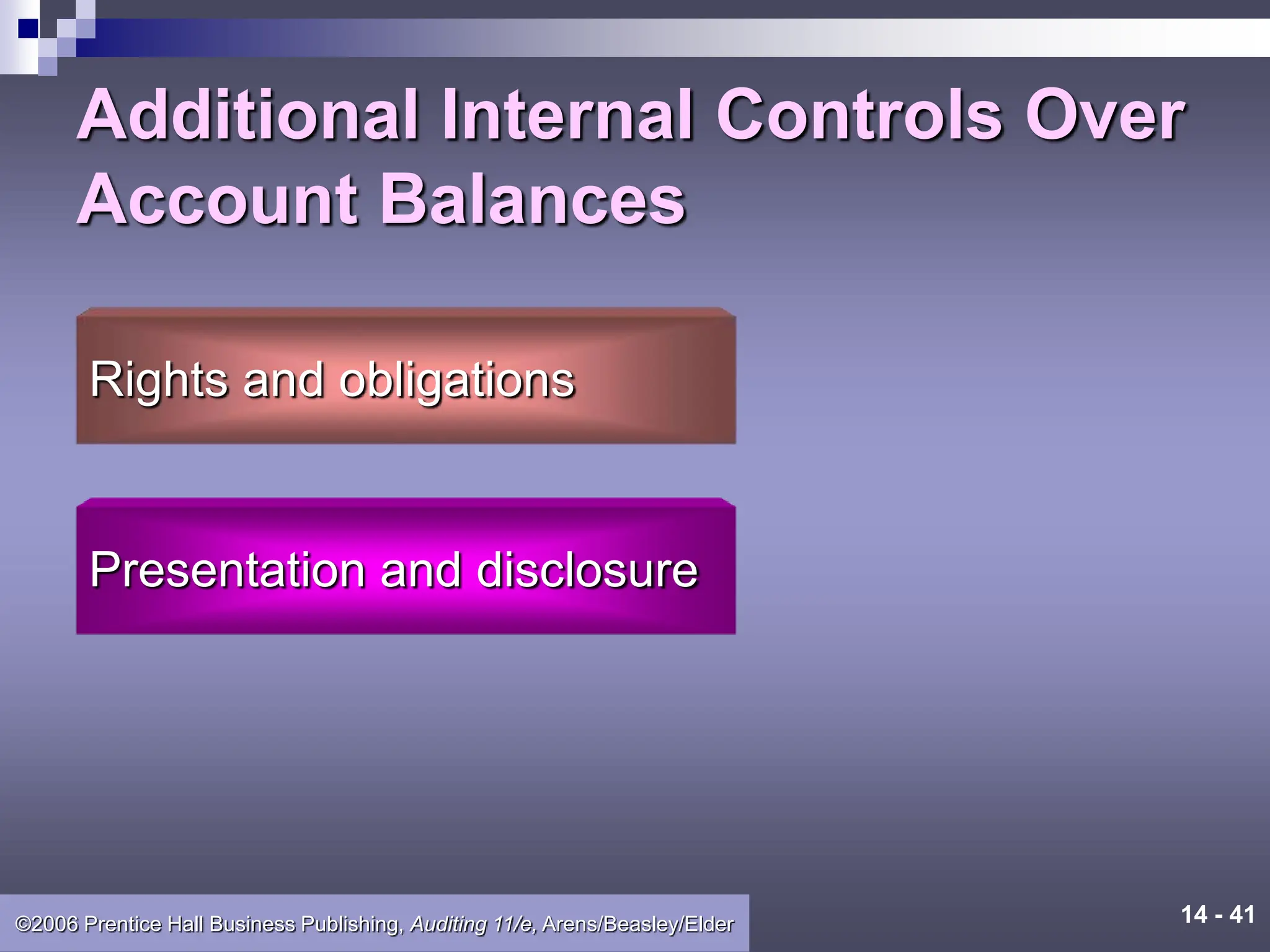
Rights and obligations
Presentation and disclosure
14 - 42
©2006 Prentice Hall Business Publishing, Auditing 11/e, Arens/Beasley/Elder
Effect of Results of Controls and
Substantive Tests of Transactions
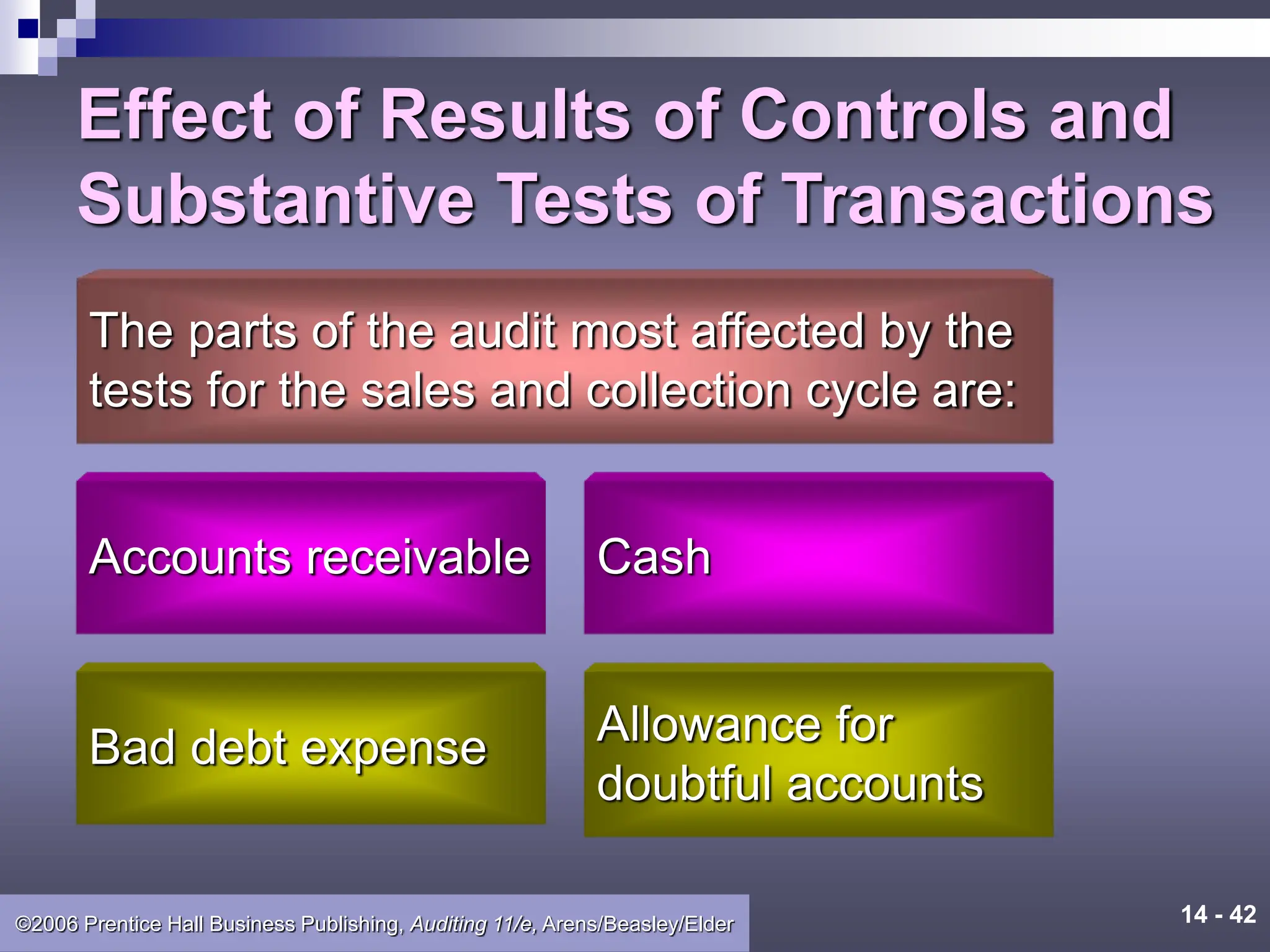
The parts of the audit most affected by the
tests for the sales and collection cycle are:
Accounts receivable
Bad debt expense
Cash
Allowance for
doubtful accounts
14 - 43
©2006 Prentice Hall Business Publishing, Auditing 11/e, Arens/Beasley/Elder
Types of Audit Tests for the Sales
and Collection Cycle
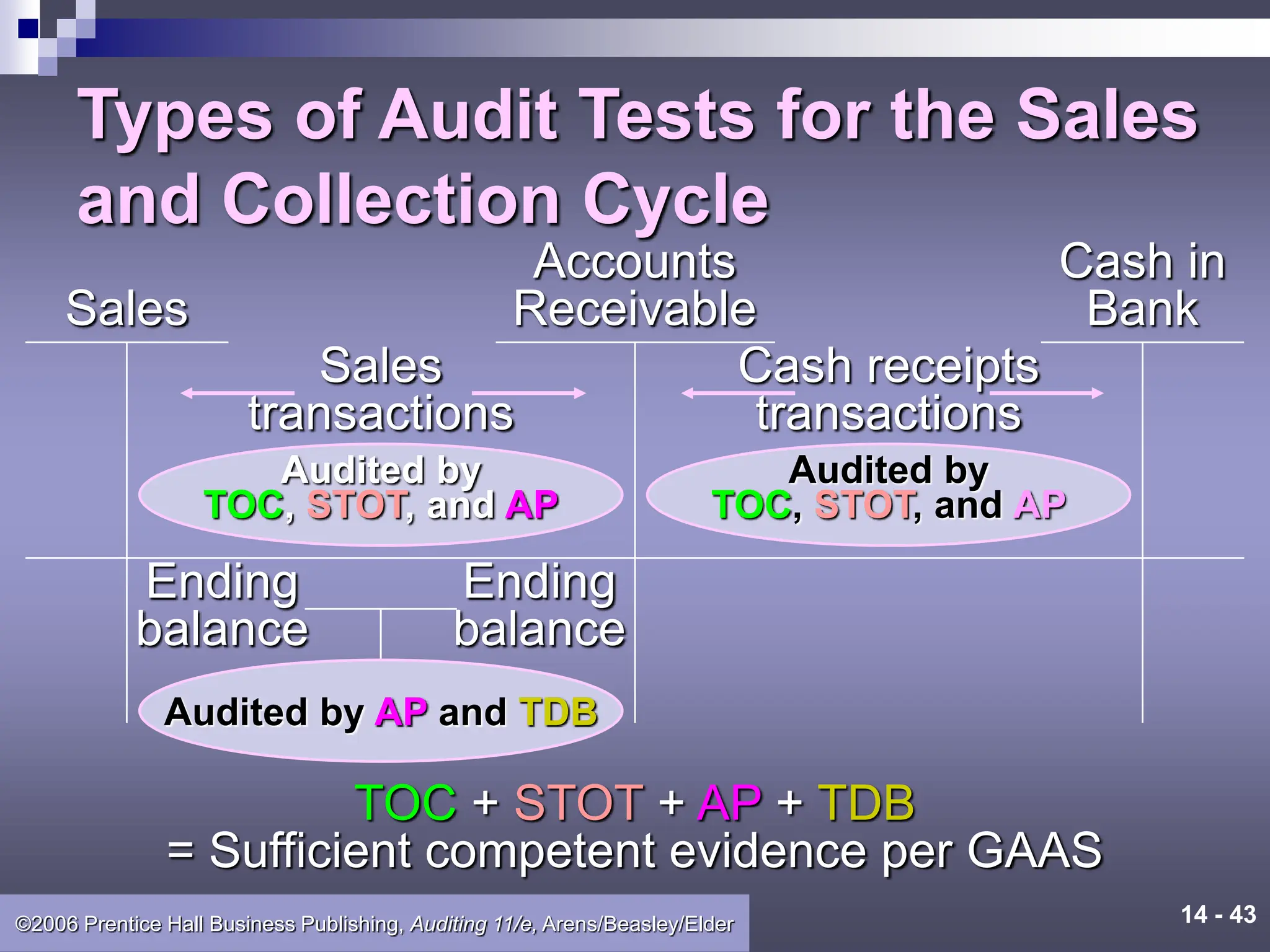
Sales
Accounts
Receivable
Cash in
Bank
Sales
transactions
Cash receipts
transactions
Ending
balance
Ending
balance
TOC + STOT + AP + TDB
= Sufficient competent evidence per GAAS
Audited by
TOC, STOT, and AP
Audited by AP and TDB
Audited by
TOC, STOT, and AP
14 - 44
©2006 Prentice Hall Business Publishing, Auditing 11/e, Arens/Beasley/Elder
End of Chapter 14

Chapter 14 Audit of the Sales and Collection Cycle.ppt

  • 1.
    14 - 1 ©2006Prentice Hall Business Publishing, Auditing 11/e, Arens/Beasley/Elder Audit of the Sales and Collection Cycle: Tests of Controls and Substantive Tests of Transactions Chapter 14
  • 2.
    14 - 2 ©2006Prentice Hall Business Publishing, Auditing 11/e, Arens/Beasley/Elder Learning Objective 1 Identify the accounts and the classes of transactions in the sales and collection cycle.
  • 3.
    14 - 3 ©2006Prentice Hall Business Publishing, Auditing 11/e, Arens/Beasley/Elder Accounts in the Sales and Collection Cycle Sales Cash sales Sales on account Accounts Receivable Cash receipts Sales returns and allowances Charge-off of uncollectible accounts Beginning balance Sales on account Ending balance Cash in Bank Cash Discounts Taken Bad Debt Expense Sales Returns and Allowances
  • 4.
    14 - 4 ©2006Prentice Hall Business Publishing, Auditing 11/e, Arens/Beasley/Elder Accounts in the Sales and Collection Cycle Accounts Receivable Cash receipts Sales returns and allowances Charge-off of uncollectible accounts Beginning balance Sales on account Ending balance Allowance for Uncollectible Accounts Charge-off of uncollectible accounts Beginning balance Estimate of bad debt expense Ending balance Bad Debt Expense
  • 5.
    14 - 5 ©2006Prentice Hall Business Publishing, Auditing 11/e, Arens/Beasley/Elder Learning Objective 2 Describe the business functions and the related documents and records in the sales and collection cycle.
  • 6.
    14 - 6 ©2006Prentice Hall Business Publishing, Auditing 11/e, Arens/Beasley/Elder Sales Transaction Accounts  Sales  Accounts receivable Business functions  Processing customer orders  Granting credit  Shipping goods  Billing customers and recording sales Documents and records  Customer order  Sales order  Customer order or sales order  Shipping document  Sales invoice  Sales transaction file  Sales journal or listing  Accounts receivable master file  Accounts receivable trial balance  Monthly statements
  • 7.
    14 - 7 ©2006Prentice Hall Business Publishing, Auditing 11/e, Arens/Beasley/Elder Cash Receipts Transaction Accounts  Cash in bank (debits from cash receipts)  Accounts receivable Business functions  Processing and recording cash receipts Documents and records Remittance advice  Prelisting of cash receipts  Cash receipts transaction file  Cash receipts journal or listing
  • 8.
    14 - 8 ©2006Prentice Hall Business Publishing, Auditing 11/e, Arens/Beasley/Elder Sales Returns and Allowances Transaction Accounts  Sales returns and allowances  Accounts receivable Business functions  Processing and recording sales returns and allowances Documents and records  Credit memo  Sales and returns and allowances journal
  • 9.
    14 - 9 ©2006Prentice Hall Business Publishing, Auditing 11/e, Arens/Beasley/Elder Charge-off of Uncollectible Accounts Transaction Accounts  Accounts receivable  Allowance for uncollectible accounts Business functions  Charging off uncollectible accounts receivable Documents and records  Uncollectible account authorization form  General journal
  • 10.
    14 - 10 ©2006Prentice Hall Business Publishing, Auditing 11/e, Arens/Beasley/Elder Bad Debt Expense Transaction Accounts  Bad debt expense  Allowance for uncollectible accounts Business functions  Providing for bad debts Documents and records  General journal
  • 11.
    14 - 11 ©2006Prentice Hall Business Publishing, Auditing 11/e, Arens/Beasley/Elder Processing Customer Orders Customer Order: A request for merchandise by a customer Sales Order: A document describing the goods ordered by a customer
  • 12.
    14 - 12 ©2006Prentice Hall Business Publishing, Auditing 11/e, Arens/Beasley/Elder Granting Credit Before goods are shipped, a properly authorized person must approve credit to the customer for sales on account.
  • 13.
    14 - 13 ©2006Prentice Hall Business Publishing, Auditing 11/e, Arens/Beasley/Elder Shipping Goods This is the first point in the cycle where company assets are given up.
  • 14.
    14 - 14 ©2006Prentice Hall Business Publishing, Auditing 11/e, Arens/Beasley/Elder Billing Customers and Recording Sales Sales invoice Sales transaction file Sales journal or listing Accounts receivable master file Accounts receivable trial balance Monthly statement
  • 15.
    14 - 15 ©2006Prentice Hall Business Publishing, Auditing 11/e, Arens/Beasley/Elder Processing and Recording Cash Receipts Remittance advice Prelisting of cash receipts Cash receipts transaction file Cash receipts journal or listing
  • 16.
    14 - 16 ©2006Prentice Hall Business Publishing, Auditing 11/e, Arens/Beasley/Elder Processing and Recording Sales Returns and Allowances Credit memo Sales returns and allowances journal
  • 17.
    14 - 17 ©2006Prentice Hall Business Publishing, Auditing 11/e, Arens/Beasley/Elder Charging Off Uncollectible Accounts Receivable Uncollectible account authorization form This is a document used internally to indicate authority to write an account receivable off as uncollectible.
  • 18.
    14 - 18 ©2006Prentice Hall Business Publishing, Auditing 11/e, Arens/Beasley/Elder Providing for Bad Debts This provision represents a residual, resulting from management’s end-of-period adjustment of the allowance for uncollectible accounts.
  • 19.
    14 - 19 ©2006Prentice Hall Business Publishing, Auditing 11/e, Arens/Beasley/Elder Learning Objective 3 Understand how e-commerce activities affect the sales and collection cycle.
  • 20.
    14 - 20 ©2006Prentice Hall Business Publishing, Auditing 11/e, Arens/Beasley/Elder Effect of E-Commerce on the Sales and Collection Cycle The Internet and other developing technologies allow companies to develop new business models.
  • 21.
    14 - 21 ©2006Prentice Hall Business Publishing, Auditing 11/e, Arens/Beasley/Elder Effect of E-Commerce on the Sales and Collection Cycle Business-to-business (B2B) Business-to-consumer (B2C) Management’s assertions for sales and collection activities remain the same.
  • 22.
    14 - 22 ©2006Prentice Hall Business Publishing, Auditing 11/e, Arens/Beasley/Elder Effect of E-Commerce on the Sales and Collection Cycle Auditors should obtain an understanding of the design and operation of key internal controls over e-commerce revenues. Evidence for e-commerce activities is likely to be in electronic form.
  • 23.
    14 - 23 ©2006Prentice Hall Business Publishing, Auditing 11/e, Arens/Beasley/Elder Learning Objective 4 Understand internal control, and design and perform tests of controls and substantive tests of transactions for sales.
  • 24.
    14 - 24 ©2006Prentice Hall Business Publishing, Auditing 11/e, Arens/Beasley/Elder Methodology for Designing Controls and Substantive Tests of Sales Transactions for Sales Understand internal control – sales. Audit procedures Sample size Items to select Timing Assess planned control risk – sales. Determine extent of testing controls. Design tests of controls and substantive tests of transactions for sales to meet transaction -related audit objectives.
  • 25.
    14 - 25 ©2006Prentice Hall Business Publishing, Auditing 11/e, Arens/Beasley/Elder Understand Internal Control – Sales Study the client’s flowcharts, prepare an internal control questionnaire, and perform walk-through tests of sales.
  • 26.
    14 - 26 ©2006Prentice Hall Business Publishing, Auditing 11/e, Arens/Beasley/Elder Assess Planned Control Risk – Sales 1. Framework for assessing control risk 2. Identify key internal controls and deficiencies 3. Associate controls and deficiencies with the objectives 4. Assess control risk for each objective
  • 27.
    14 - 27 ©2006Prentice Hall Business Publishing, Auditing 11/e, Arens/Beasley/Elder Proper authorization Assess Planned Control Risk – Sales Internal verification procedures Prenumbered documents Monthly statements Adequate documents and records Adequate separation of duties
  • 28.
    14 - 28 ©2006Prentice Hall Business Publishing, Auditing 11/e, Arens/Beasley/Elder Determine Extent of Testing Controls Audits of public companies Audits of nonpublic companies
  • 29.
    14 - 29 ©2006Prentice Hall Business Publishing, Auditing 11/e, Arens/Beasley/Elder Transaction-Related Audit Objectives for Sales Existence: Recorded sales are for shipments actually made. Accuracy: Recorded sales are for the amount shipped. Completeness: Existing sales transactions are recorded.
  • 30.
    14 - 30 ©2006Prentice Hall Business Publishing, Auditing 11/e, Arens/Beasley/Elder Transaction-Related Audit Objectives for Sales Classification: Sales transactions are properly classified. Timing: Sales are recorded on the correct dates. Posting and summarization: Sales transactions are properly included in the accounts receivable master file.
  • 31.
    14 - 31 ©2006Prentice Hall Business Publishing, Auditing 11/e, Arens/Beasley/Elder Direction of Tests for Sales Completeness start Existence start Customer order Shipping document Duplicate sales invoice Sales journal General journal Accounts receivable master file =
  • 32.
    14 - 32 ©2006Prentice Hall Business Publishing, Auditing 11/e, Arens/Beasley/Elder Summary of Methodology for Sales Transaction-related audit objectives (Column 1) Key existing controls (Column 2) Tests of control (Column 3) Deficiencies (Column 4) Substantive tests of transactions (Column 5)
  • 33.
    14 - 33 ©2006Prentice Hall Business Publishing, Auditing 11/e, Arens/Beasley/Elder Learning Objective 5 Apply the methodology for controls over sales transactions to controls over sales returns and allowances.
  • 34.
    14 - 34 ©2006Prentice Hall Business Publishing, Auditing 11/e, Arens/Beasley/Elder Sales Returns and Allowances The transaction-related audit objectives and client’s methods of controlling misstatements are essentially the same for processing credit memos as those described for sales.
  • 35.
    14 - 35 ©2006Prentice Hall Business Publishing, Auditing 11/e, Arens/Beasley/Elder Sales Returns and Allowances There are, however, two important differences. Materiality Emphasis on objectives
  • 36.
    14 - 36 ©2006Prentice Hall Business Publishing, Auditing 11/e, Arens/Beasley/Elder Learning Objective 6 Understand internal control, and design and perform tests of controls and substantive tests of transactions for cash receipts.
  • 37.
    14 - 37 ©2006Prentice Hall Business Publishing, Auditing 11/e, Arens/Beasley/Elder Tests of Controls and Substantive Tests of Transactions for Cash Receipts  Determine whether cash received was recorded.  Prepare proof of cash receipts.  Test to discover lapping of accounts receivable.
  • 38.
    14 - 38 ©2006Prentice Hall Business Publishing, Auditing 11/e, Arens/Beasley/Elder Learning Objective 7 Apply the methodology for controls over the sales and collection cycle to write-offs of uncollectible accounts receivable.
  • 39.
    14 - 39 ©2006Prentice Hall Business Publishing, Auditing 11/e, Arens/Beasley/Elder Audit Tests for Uncollectible Accounts Existence of recorded write-offs is the most important transaction-related audit objective. What is a major concern in testing accounts charged off as uncollectible? – covering up a defalcation by charging off accounts receivable that have been collected
  • 40.
    14 - 40 ©2006Prentice Hall Business Publishing, Auditing 11/e, Arens/Beasley/Elder Additional Internal Controls Over Account Balances Realizable value Credit approval Aged accounts receivable trial balance Charging off uncollectibles
  • 41.
    14 - 41 ©2006Prentice Hall Business Publishing, Auditing 11/e, Arens/Beasley/Elder Additional Internal Controls Over Account Balances Rights and obligations Presentation and disclosure
  • 42.
    14 - 42 ©2006Prentice Hall Business Publishing, Auditing 11/e, Arens/Beasley/Elder Effect of Results of Controls and Substantive Tests of Transactions The parts of the audit most affected by the tests for the sales and collection cycle are: Accounts receivable Bad debt expense Cash Allowance for doubtful accounts
  • 43.
    14 - 43 ©2006Prentice Hall Business Publishing, Auditing 11/e, Arens/Beasley/Elder Types of Audit Tests for the Sales and Collection Cycle Sales Accounts Receivable Cash in Bank Sales transactions Cash receipts transactions Ending balance Ending balance TOC + STOT + AP + TDB = Sufficient competent evidence per GAAS Audited by TOC, STOT, and AP Audited by AP and TDB Audited by TOC, STOT, and AP
  • 44.
    14 - 44 ©2006Prentice Hall Business Publishing, Auditing 11/e, Arens/Beasley/Elder End of Chapter 14