Copyright © 2019 Pearson Canada Inc.
18-1
Chapter 18
Completing the Audit
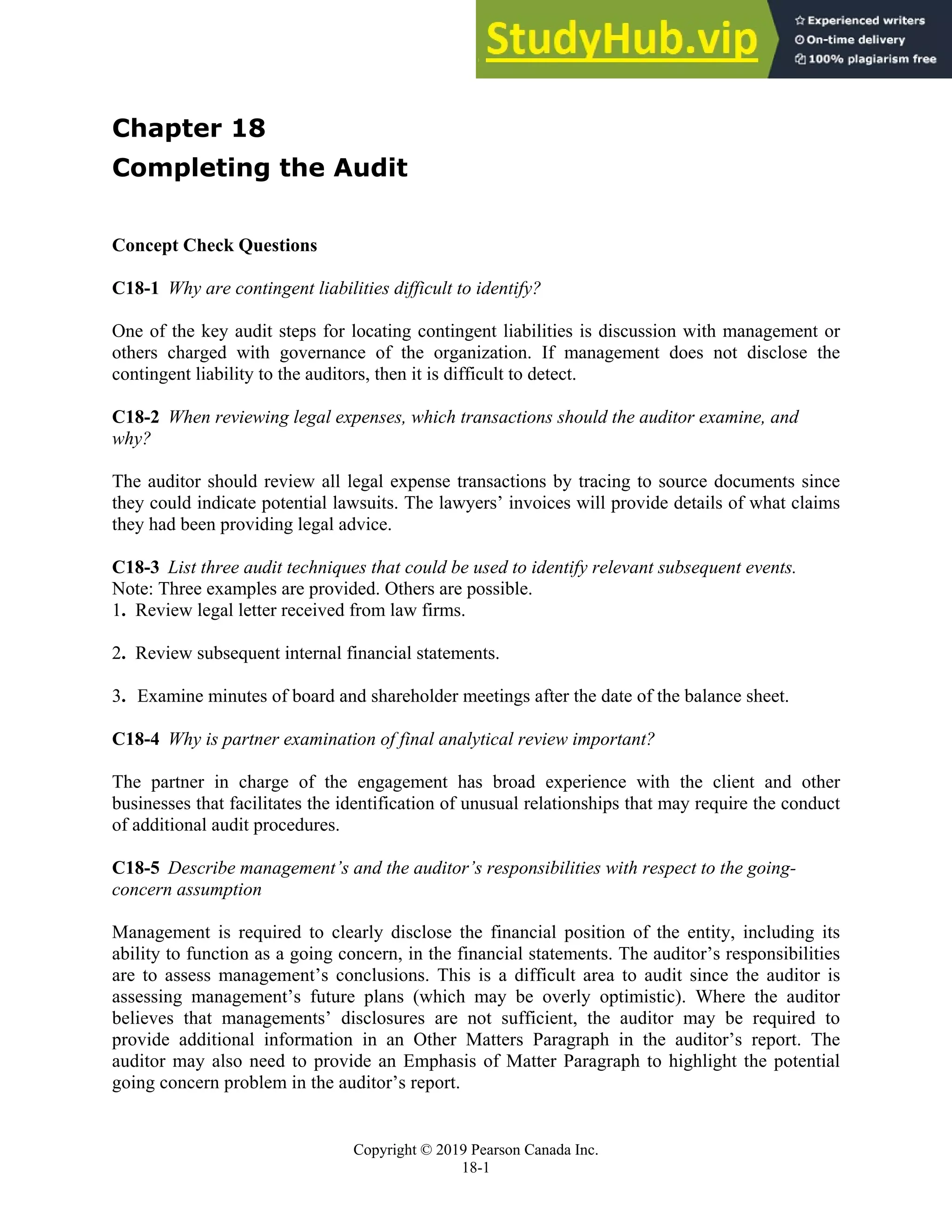
Concept Check Questions
C18-1 Why are contingent liabilities difficult to identify?
One of the key audit steps for locating contingent liabilities is discussion with management or
others charged with governance of the organization. If management does not disclose the
contingent liability to the auditors, then it is difficult to detect.
C18-2 When reviewing legal expenses, which transactions should the auditor examine, and
why?
The auditor should review all legal expense transactions by tracing to source documents since
they could indicate potential lawsuits. The lawyers’ invoices will provide details of what claims
they had been providing legal advice.
C18-3 List three audit techniques that could be used to identify relevant subsequent events.
Note: Three examples are provided. Others are possible.
1. Review legal letter received from law firms.
2. Review subsequent internal financial statements.
3. Examine minutes of board and shareholder meetings after the date of the balance sheet.
C18-4 Why is partner examination of final analytical review important?
The partner in charge of the engagement has broad experience with the client and other
businesses that facilitates the identification of unusual relationships that may require the conduct
of additional audit procedures.
C18-5 Describe management’s and the auditor’s responsibilities with respect to the going-
concern assumption
Management is required to clearly disclose the financial position of the entity, including its
ability to function as a going concern, in the financial statements. The auditor’s responsibilities
are to assess management’s conclusions. This is a difficult area to audit since the auditor is
assessing management’s future plans (which may be overly optimistic). Where the auditor
believes that managements’ disclosures are not sufficient, the auditor may be required to
provide additional information in an Other Matters Paragraph in the auditor’s report. The
auditor may also need to provide an Emphasis of Matter Paragraph to highlight the potential
going concern problem in the auditor’s report.
Instructor’s Solutions Manual for Auditing, Fourteenth Canadian Edition
Copyright © 2019 Pearson Canada Inc.
18-2
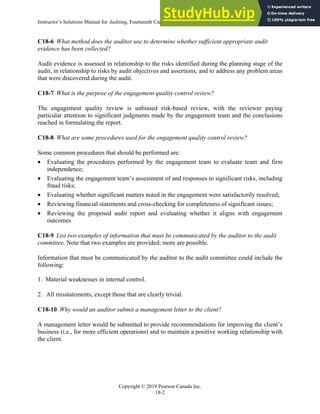
C18-6 What method does the auditor use to determine whether sufficient appropriate audit
evidence has been collected?
Audit evidence is assessed in relationship to the risks identified during the planning stage of the
audit, in relationship to risks by audit objectives and assertions, and to address any problem areas
that were discovered during the audit.
C18-7 What is the purpose of the engagement quality control review?
The engagement quality review is unbiased risk-based review, with the reviewer paying
particular attention to significant judgments made by the engagement team and the conclusions
reached in formulating the report.
C18-8 What are some procedures used for the engagement quality control review?
Some common procedures that should be performed are:
 Evaluating the procedures performed by the engagement team to evaluate team and firm
independence;
 Evaluating the engagement team’s assessment of and responses to significant risks, including
fraud risks;
 Evaluating whether significant matters noted in the engagement were satisfactorily resolved;
 Reviewing financial statements and cross-checking for completeness of significant issues;
 Reviewing the proposed audit report and evaluating whether it aligns with engagement
outcomes
C18-9 List two examples of information that must be communicated by the auditor to the audit
committee. Note that two examples are provided; more are possible.
Information that must be communicated by the auditor to the audit committee could include the
following:
1. Material weaknesses in internal control.
2. All misstatements, except those that are clearly trivial.
C18-10 Why would an auditor submit a management letter to the client?
A management letter would be submitted to provide recommendations for improving the client’s
business (i.e., for more efficient operations) and to maintain a positive working relationship with
the client.
Chapter 18: Completing the Audit
Copyright © 2019 Pearson Canada Inc.
18-3
Review Questions
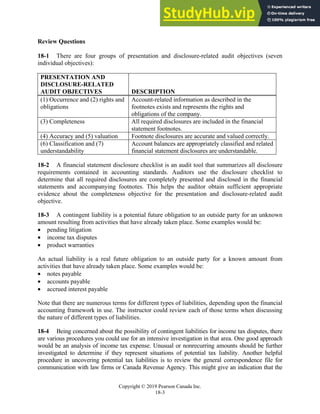
18-1 There are four groups of presentation and disclosure-related audit objectives (seven
individual objectives):
PRESENTATION AND
DISCLOSURE-RELATED
AUDIT OBJECTIVES DESCRIPTION
(1) Occurrence and (2) rights and
obligations
Account-related information as described in the
footnotes exists and represents the rights and
obligations of the company.
(3) Completeness All required disclosures are included in the financial
statement footnotes.
(4) Accuracy and (5) valuation Footnote disclosures are accurate and valued correctly.
(6) Classification and (7)
understandability
Account balances are appropriately classified and related
financial statement disclosures are understandable.
18-2 A financial statement disclosure checklist is an audit tool that summarizes all disclosure
requirements contained in accounting standards. Auditors use the disclosure checklist to
determine that all required disclosures are completely presented and disclosed in the financial
statements and accompanying footnotes. This helps the auditor obtain sufficient appropriate
evidence about the completeness objective for the presentation and disclosure-related audit
objective.
18-3 A contingent liability is a potential future obligation to an outside party for an unknown
amount resulting from activities that have already taken place. Some examples would be:
 pending litigation
 income tax disputes
 product warranties
An actual liability is a real future obligation to an outside party for a known amount from
activities that have already taken place. Some examples would be:
 notes payable
 accounts payable
 accrued interest payable
Note that there are numerous terms for different types of liabilities, depending upon the financial
accounting framework in use. The instructor could review each of those terms when discussing
the nature of different types of liabilities.
18-4 Being concerned about the possibility of contingent liabilities for income tax disputes, there
are various procedures you could use for an intensive investigation in that area. One good approach
would be an analysis of income tax expense. Unusual or nonrecurring amounts should be further
investigated to determine if they represent situations of potential tax liability. Another helpful
procedure in uncovering potential tax liabilities is to review the general correspondence file for
communication with law firms or Canada Revenue Agency. This might give an indication that the
Instructor’s Solutions Manual for Auditing, Fourteenth Canadian Edition
Copyright © 2019 Pearson Canada Inc.
18-4
potential for a liability exists even though no actual litigation has ensued. Finally, an examination of
Canada Revenue Agency reports from prior years may provide the most obvious indication of
disputed tax matters.
18-5 The analysis of legal expense is an essential part of every audit engagement because it
may give indication of contingent liabilities that may become actual liabilities in the future and
require disclosure in the current financial statements. Since any single contingency could be
material, it is important to verify all legal transactions, even though the amount may be small.
After the analysis of legal expense is completed, the law firms to whom payment was made
should be considered for letters of confirmation for contingencies (communications with law
firms/ lawyer’s letters).
18-6 Pyson should determine the materiality of the lawsuits by requesting from Merrill’s lawyers
an assessment of the legal situations and the probable liabilities involved. In addition, Pyson may
have his own legal counsel assess the situations. Proper disclosure in the financial statements will
depend on the lawyers’ evaluations of the probable liabilities involved. If the evaluations indicate
highly probable, material amounts, disclosure will be necessary in the form of a footnote, assuming
the amount of the probable material loss cannot be reasonably estimated. If the client refuses to
make adequate disclosure of the contingencies, a qualified or adverse opinion may be necessary.
18-7 If a law firm refused to provide the auditor with information about material existing
lawsuits or likely material possible (unasserted) claims, the audit opinion would have to be
modified to reflect the lack of available evidence. This is required by the CICA Assurance
Handbook, and has the effect of requiring management to give its law firms permission to
provide contingent liability information to auditors and to encourage law firms to cooperate with
auditors in obtaining information about contingencies.
18-8
1. Subsequent events requiring adjustment: those that have a direct effect on the financial
statements. Examples: (i) the declaration of bankruptcy due to the deteriorating financial
condition of a customer with a large outstanding accounts receivable balance and (ii) the
settlement of a litigation for an amount different from the amount recorded in the books.
2. Subsequent events requiring disclosure: those that have no direct effect on the financial
statements. Examples: (i) the decline in market value of securities held for temporary
investment or resale, (ii) the issuance of bonds or equity securities, and (iii) the declaration of
bankruptcy by a customer (with a large outstanding accounts receivable balance) who was
inadequately insured and lost everything due to a fire subsequent to the auditor’s report date.
18-9 The auditor would be interested in a client’s future commitments to purchase raw materials
to ensure that this information is properly disclosed in the financial statements. The commitment
may be of interest to an investor as it is compared to the future price movements of the material. A
future commitment to purchase raw material may result in the client paying more or less than the
market price at a future time. In the former case, it may be appropriate for the client to recognize a
loss in the current year rather than when the raw material is actually purchased.
Chapter 18: Completing the Audit
Copyright © 2019 Pearson Canada Inc.
18-5
18-10 The major considerations the auditor should take into account in determining how
extensive the subsequent events review should be are:
 the financial strengths and stability of earnings
 the effectiveness of the company’s internal control
 the number and significance of the adjustments proposed by the auditor
 the length of time between the balance sheet date and the completion of the audit
 changes in key personnel
18-11 The accumulation of audit evidence is crucial to the auditor in determining whether the
financial statements are stated in accordance with an acceptable financial reporting framework,
applied on a basis consistent with the preceding year. The evaluation of the adequacy of the
disclosures in financial statements is made to assure that the account balances on the trial balance
are properly aggregated and disclosed on the financial statements.
Three examples where adequate disclosure could depend heavily upon the accumulation of
evidence are:
 the disclosure of declines in inventory values below cost
 the separation of current and non-current receivables
 the disclosure of contingent liabilities of whose existence, the auditor has not been informed
Three examples where audit evidence does not normally significantly affect the adequacy of the
disclosure are:
 deciding whether a disposal of equipment should be recorded as an extraordinary item
 the disclosure of an acquisition as a pooling of interests or a purchase
 the disclosure of contingencies of whose existence the auditor was informed by the client
18-12 This statement implies that the auditor should consider, as part of his or her audit
procedures, if there is a serious risk of the company being unable to realize assets and discharge
liabilities in the normal course of business for the foreseeable future.
A number of conditions that may cast doubt on the ability of the enterprise to continue as a going
concern such as:
 recurring operating losses
 serious deficiencies in operating capital
 an inability to obtain financing sufficient for continued operations
 an inability to comply with terms of existing loan agreements
 the possibility of an adverse outcome of one or more contingencies
 insufficient funds to meet liabilities
 a plan to significantly curtail or liquidate operations
 external factors that could force an otherwise solvent enterprise to cease operations
Based on the auditor’s assessment of these factors, the auditor must determine if the accounting
treatment, presentation, and disclosure by the entity is appropriate. If so, no reservation is
required.
Instructor’s Solutions Manual for Auditing, Fourteenth Canadian Edition
Copyright © 2019 Pearson Canada Inc.
18-6
18-13 A management representation letter is a letter from management that documents
management’s most important oral representations during the audit.
A management letter is one directed to the client to inform him or her of certain
recommendations about the business that the public accountant believes would be beneficial to
the client.
Five items that might be included in a management representation letter are:
 existence or non-existence of litigation
 evaluation of inventory stock as obsolete
 the adequacy of the disclosure of actual liabilities
 existence or non-existence of unused letters of credit
 the recognition that the auditor is not primarily responsible for the detection of fraud
Five items that might be included in a management letter are:
 recommendation to switch inventory valuation methods
 recommendation to institute a formal security system
 recommendation to prepare more timely bank reconciliations
 recommendation to segregate duties in a particular area
 recommendation to have certain types of transactions authorized by specific individuals
18-14 A regular working paper review is the one that is done by someone who is
knowledgeable about the client and the unique circumstances in the audit. An independent
review is one done by a completely independent person who has had no experience on the
engagement. The purpose is to have a competent professional from within the firm who has not
been biased by the ongoing relationship between the regular auditors and the client, perform an
independent review.
Two examples of important potential findings in a regular review are:
 incorrect computations
 inadequate scope
Three examples of important potential findings in an independent review are:
 a number of small amount adjustments waived that should be accumulated into a real
adjustment.
 too narrow and biased a scope in a particular area.
 inadequate disclosure of contingencies.
Chapter 18: Completing the Audit
Copyright © 2019 Pearson Canada Inc.
18-7
18-15 CAS 260 par 14 to 17 itemizes requirements to report.
In addition to the required communications to those charged with governance required by
auditing standards, in the U.S., the Sarbanes-Oxley Act expands these communications
requirements by also requiring public company auditors to timely report the following items to
the audit committee:
 All critical accounting policies and practices to be used.
 All alternative treatments of financial information within generally accepted accounting
principles that have been discussed with management, ramifications of the use of such
alternative disclosures and treatments, and the treatment preferred by the auditor.
 Other material written communications between the auditor and management, such as any
management letter or schedule of unadjusted differences.
As the audit of the public company is completed, the auditor should determine that the audit
committee is informed about the initial selection of and changes in significant accounting
policies or their application during the current audit period. When changes have occurred, the
auditor should inform the committee of the reasons for the change. The auditor should also
communicate information about methods used to account for significant unusual transactions and
the effect of significant accounting policies in controversial or emerging areas.
Multiple Choice Questions
18-16 (1)
18-17 (2)
18-18 (3)
18-19 (3)
18-20
Subsequent Event 1 – Defective chemicals
a. The following are audit procedures that the auditor should consider to corroborate the event
and to make the conclusion as to the appropriate financial statement treatment:
 Review quality control reports to assess whether this event was the only case of defective
inventory as there could potentially be other inventory that requires writing down.
 Inquire of management and quality control if any other instances of defective inventory
 Inspect supporting documentation (such as cost data or production records) to verify that the
chemicals were produced prior to October 31st
to ensure that a write-down is necessary.
 Inquire management as to how they determined the scrap value of $100 000.
 Agree the scrap value amount to supporting documentation.
Instructor’s Solutions Manual for Auditing, Fourteenth Canadian Edition
Copyright © 2019 Pearson Canada Inc.
18-8
b) (1) – when taken with the other unadjusted amounts, net income is materially overstated by
$300,000 ($250 000 + 50 000) – which is greater than $280,000.
Subsequent Event 2
c) The following are audit procedures that the auditor should consider to corroborate the event
and to make the conclusion as to the appropriate financial statement treatment:
 Obtain a schedule of the damaged property, plant and equipment and agree to the net book
value in the PPE subledger.
 Obtain an inventory listing to determine the amount of inventory stored at the time – further
amounts may need to be disclosed in the financial statements.
 Given that the inventory stored was chemicals, inquire if there are necessary site clean-up
costs and, if so, obtain management’s estimate of those costs.
 If there are site clean-up costs, agree management’s estimate to supporting documentation
 Obtain client representation letter regarding estimated costs as well as whether in compliance
with applicable regulations.
 Ask management about insurance coverage and inspect insurance documentation (such as
policies, any correspondence regarding the recent fire).
d) (2) – the impact is material; however, the event happened after year-end. Therefore, note
disclosure is required with no adjustment to the financial statements.
Discussion Questions and Problems
18-21
a. Contingent liabilities are potential future obligations for an unknown amount arising from
activities that have already taken place. A commitment is an agreement to commit the firm to
a set of fixed conditions in the future, regardless of what happens to profits or the economy
as a whole.
Knowledge of both contingencies and commitments is extremely important to users of
financial statements because they represent the encumbrance of potentially material amounts
of resources during future periods, and thus affect the future cash flows available to creditors
and investors. Because of this, generally accepted accounting principles require that material
contingencies and commitments be disclosed. The auditor has an obligation to discover the
existence of such items to assure that they are properly disclosed in order to have complied
with generally accepted auditing standards.
b. Kathy’s tests of controls and substantive tests of transactions related to payments of notes
payable and related interest expense would provide her information about scheduled debt
payments and related interest rate terms, which are required footnote disclosure related items.
Similarly, substantive tests of transactions would reveal additions and retirements of notes
payable, which both affect notes payable disclosures. Tests of details of balances, such as
notes payable confirmations, would provide sufficient appropriate evidence about the
existence of ending balances and related notes payable terms, such as interest rates and
required collateral.
Chapter 18: Completing the Audit
Copyright © 2019 Pearson Canada Inc.
18-9
c. Three useful audit procedures for uncovering contingencies that Kathy Choi would likely
perform in the normal conduct of the audit, even if she had no responsibility for uncovering
contingencies, are:
 Review Canada Revenue Agency reports of income tax settlements.
 Review minutes of meetings of board of directors and shareholders.
 Confirm used and unused balance of lines of credit and other similar loans and liabilities.
d. Three other procedures Kathy Choi is likely to perform specifically for the purpose of
identifying undisclosed contingencies are:
 Make inquiries of management.
 Analyze legal expenses for indication of contingent liabilities.
 Confirm existence and status of litigation and other potential contingent liabilities with
law firms.
18-22
a. Audit procedures to learn about these items would be as follows:
Apply to all three items:
 Discuss existence and nature of possible contingent liabilities with management. In this
connection obtain appropriate written representations.
 Review the minutes of directors’ and shareholders’ meetings for indication of lawsuits or
other contingencies.
 Analyze legal expense for period under audit and review invoices and statements of legal
counsel for indications of contingent liabilities.
 Obtain confirmation from all major law firms performing legal services for the client as
to the status of pending litigation or other contingent liabilities.
Additional procedures for individual items:
1. Guarantee of interest payments
 Discuss, specifically, any related party transactions with management. Include in
representations.
 Review financial statements of affiliate, and where related party transactions are
apparent, make direct inquiries of affiliate management, and perhaps even examine
records of affiliate if necessary.
2. Lawsuit
 Inquiry of management
 Review of all legal invoices paid or payable during the year
 Legal letter sent to all law firms used by the company
3. Dividend using common shares
 Confirm details of share transactions with registrar and transfer agent.
 Review records for unusual journal entries subsequent to year end.
Instructor’s Solutions Manual for Auditing, Fourteenth Canadian Edition
Copyright © 2019 Pearson Canada Inc.
18-10
b. Nature of adjusting entries or disclosure, if any, would be as follows:
1. Guarantee of interest payments
If payment by Chen is uncertain, the $137,000 interest liability for the period June 2
through December 1, 2018, could be reflected in the Marco Corporation’s accounting
records by the following entry:
Interest Payments for Chen Corp. $137,000
Accrued Interest Payable: Chen Bonds $137,000
The debit entry should be included as other assets. Collection is uncertain and the Marco
Corporation may not have a right against the Chen Corp. until all interest payments have
been met and the bonds retired. If this treatment is followed, the balance sheet should be
footnoted to the effect that the Marco Corporation is contingently liable for future interest
payments on Chen Corp. bonds in the amount of $2,220 000.
If the interest has been paid by the time the audit is completed, or if for other reasons it
seems certain that the payment will be made by Chen on January 15, no entry should be
made by Marco. In this circumstance a footnote disclosing the contingent liability of
$2,337,000 and the facts as to the $135,000 should be included with the statements.
2. Lawsuit
The lawsuit should be described in a footnote to the balance sheet. In view of the court
decision, retained earnings may be restricted for $4 000 000, the amount of the first court
decision. Also, in view of the court decision any reasonable estimate of the amount the
company expects to pay as a result of the suit might be used in lieu of the $40,000. A
current liability will be set up as soon as a final decision is rendered or if an agreement as
to damages is reached. If liability is admitted to by Marco, and only the amount is in
dispute, a liability can be set up for the amount admitted to by the company with a
corresponding charge to expense or shown as an extraordinary item if the amount is
material.
3. Dividend declared using common shares
The declaration of such a dividend does not create a liability that affects the aggregate net
worth in any way. The distribution of the dividend will cause a reduction in retained
earnings and an increase in capital stock. No entry is necessary, but an indication of the
action taken, and that such a transfer will subsequently be made, should be shown as a
footnote or as a memorandum to Retained Earnings and Common Stock in the balance
sheet.
Chapter 18: Completing the Audit
Copyright © 2019 Pearson Canada Inc.
18-11
18-23
a. In this situation, Little need only send confirmation requests to those law firms who are involved
with legal matters directly affecting the financial statements. The confirmations should be sent
reasonably near to the completion of the field work, but the follow-up on non-responses and
unsatisfactory responses should not be deferred until the last day of field work. He should have
examined the letter when it was returned and performed follow-up work at that time.
Furthermore, the standard legal letter would have asked about the lawsuit if the client had
informed the auditor of its existence.
b. Regarding the third confirmation, it is necessary to have a conference with the law firm,
client, and auditor to determine the nature and significance of the lawsuit.
It would be a serious violation of due care to ignore the information in the law firm’s letter. In
rare circumstances, a denial of opinion is necessary if the information cannot be obtained.
The auditor would also be required to follow up on the first confirmation.
Since the second confirmation is from a law firm that only does patent registration (i.e., they
do not handle lawsuits), no further follow up is required. The auditor may use this
information when conducting the audit of intangible assets.
18-24
a. This would be a scope limitation. The auditor is not being given access to all of the
information necessary to audit the client’s financial statements.
b. The auditor has to ensure that the proper disclosure is made in the notes to the financial
statements, not in the audit report.
OR
If information provided to the auditor by the second law firm showed that the claim is very
likely, then the amount should be accrued by the client and the accrual of the contingent
liability should be disclosed in the notes to the financial statements.
18-25
a. Auditing standards (CAS 570) require the auditor to evaluate whether there is substantial
doubt about a client’s ability to continue as a going concern for at least one year beyond the
balance sheet date. Auditors make this evaluation during the planning phase, but also update
their assessment throughout the audit using information obtained from analytical procedures,
discussions with management, their knowledge of the client’s business, and other information
that comes to light during the audit.
b. The auditor is required to consider whether the client is able to continue as a going concern
for at least one year beyond the balance sheet date.
Instructor’s Solutions Manual for Auditing, Fourteenth Canadian Edition
Copyright © 2019 Pearson Canada Inc.
18-12
c. For the audit of MakingNewFriends.com, the relevant information includes the fact that
MakingNewFriends.com has had difficulty establishing a loyal client base and generating
advertising revenues. This suggests the company may continue to have difficulty generating
revenues over the next 12 months. The recurring operating losses and decline in working capital
also suggest financial difficulties and a possible inability to remain a viable going concern.
Callie Peters will also consider management’s plan to obtain debt financing as a means to fund
operations for the next year, although they have not yet secured such financing. In addition,
Callie will consider management’s plan to increase advertising revenues by 20%. The additional
information that Callie would consider includes any other plans by management to generate
revenue or other financing for the coming year, knowledge of industry trends and possibly
analyst forecasts related to this market segment, and performance of competitors.
d. The auditor is required to evaluate the feasibility of management achieving their plans. For
example, the auditor may discuss with the bank the likelihood of the company obtaining
financing. The auditor will also assess market conditions and the feasibility of
MakingNewFriends.com being able to achieve an increase in advertising revenues of 20% by
considering the factors discussed in part c.
18-26
a.
Description of
Possible
Misstatement
Circumstances of
Occurrence
Amount of over (under) misstatement in the
financial statements
Assets Liabilities Pre-Tax
Income
Equity
1. Non-accrual of
bonus
Factual – client
recording error
(125,000) $125,000
2 Did not record sale
of assets
Factual – client
recording error
(25,000)
60,000
(25,000)
3 Inadequate
allowance for
doubtful accounts
Judgmental – based
upon auditor’s review
of aging of AR
44,000 (44,000)
4 Inappropriate
capitalization of
repairs and
maintenance
Factual –
inappropriate
capitalization
52,000 52,000
5 Incorrect
classification of
expenses
Factual – no impact
on Income (however
impacts gross margin)
6 Did not record
purchase of new
equipment and related
long-term note
Factual – no amount
provided
Total (17,000) (125,000) 108,000
Chapter 18: Completing the Audit
Copyright © 2019 Pearson Canada Inc.
18-13
b. The net effect of the adjustments to the balance sheet and income statement are material to
the financial statements. Pretax income would be overstated by $108,000, which is in excess
of the income statement materiality, as a result of these items if they are not properly
reflected in the accounting records. Note, the problem fails to provide information about the
dollar amounts involved in Item 6. Most likely the nature of that item consists of a large
dollar amount, which would need to be reflected in the financial statements given the impact
it would have on noncurrent assets and noncurrent liabilities.
18-27 a. CAS 450 identifies three types of misstatements:
1. Factual misstatements are misstatements about which there is no doubt.
2. Judgmental misstatements are differences arising from the judgments of
management concerning accounting estimates that the auditor considers
unreasonable or the selection or application of accounting policies that the
auditor considers inappropriate.
3. Projected misstatements are the auditor's best estimate of misstatements in
populations, involving the projection of misstatements identified in audit
samples to the entire population from which the samples were drawn.
Guidance on the determination of projected misstatements and evaluation of
the results is included in CAS 530, Audit Sampling.
Evidence that a misstatement is not an isolated occurrence and other
misstatements may exist include situations when the auditor identifies that a
misstatement arose from a breakdown in internal control or from inappropriate
assumptions or valuation methods that have been widely applied by the entity.
b. The error falls within the category of judgmental misstatement. The Auditor
General and the Government of Ontario are clearly disputing the application of
an accounting policy.
c. CAS 450 indicates the auditor should determine whether uncorrected misstatements
are material, individually or in the aggregate. In making this determination, the
auditor should consider:
 the size and nature of the misstatements, both in relation to particular
classes of transactions, account balances, or disclosures and the financial
statements as a whole, and the particular circumstances of their occurrence,
and
 the effect of uncorrected misstatements related to prior periods on the
relevant classes of transactions, account balances, or disclosures and the
financial statements as a whole.
 CAS 450, states that the auditor’s consideration of misstatement may
take into account
 the aggregate effect of uncorrected misstatements;
Instructor’s Solutions Manual for Auditing, Fourteenth Canadian Edition
Copyright © 2019 Pearson Canada Inc.
18-14
 whether the materiality level or levels for particular classes of transactions,
account balances or disclosures, if any, have been exceeded;
 The evaluation of the effect of uncorrected misstatements on key ratios or
trends, and compliance with legal, regulatory and contractual requirements
(for example, debt covenants).
d. Given the significance of the balanced budget to the users (bond holders and the
general public) of the financial statements, it looks like the Auditor General was
considering the impact on the accumulated deficit.
18-28
a. It is desirable to have a letter of representation in spite of the accumulated audit evidence to
impress upon management its responsibility for the representations in the financial
statements and to formally document the responses from the client to inquiries about various
aspects of the audit.
b. The letter of representation is not very useful as audit evidence since it is a written statement
from a non-independent source. In effect, the client who is being audited makes certain
representations related to the audit of himself or herself.
c. Several other types of information commonly included in a letter of representation are:
 The company has proper title to all of its assets.
 All outstanding loans to officers of the company have been identified.
 All transactions for the year have been conducted at arm’s length.
 That financial statements are presented in accordance with the financial reporting
framework used by the company.
 All related party transactions are disclosed.
 Completeness and availability of financial records, minutes of board meetings, and other
pertinent documents.
18-29
a. Per CAS 720, section 3.12 (c), other information is financial or non-financial information
(other than financial statements and the auditor's report thereon) included in an entity's
annual report.
b. Some examples of other information that form part of the annual report include:
o Management report, management commentary, or operating and financial review or
similar reports by those charged with governance (for example, a directors' report).
o Chairman's statement.
o Corporate governance statement
o Internal control and risk assessment reports.
o Appendix 1 of the Section provides specific examples of amounts and items that
would be included in other information
Chapter 18: Completing the Audit
Copyright © 2019 Pearson Canada Inc.
18-15
c. CAS 720 A.26 explains that the auditor does not need to examine all amounts and items.
CAS 720 A.28 provides examples of some procedures that auditors may perform to assess
other information:
 For information that is intended to be the same as information in the financial statements,
comparing the information to the financial statements.
 For information intended to convey the same meaning as disclosures in the financial
statements, comparing the words used and considering the significance of differences in
wording used and whether such differences imply different meanings.
 Obtain a reconciliation between an amount within the other information and the financial
statements from management and:
o Compare items in the reconciliation to the financial statements and the other
information; and
o Check whether the calculations within the reconciliation are arithmetically accurate.
d. Some of the procedures could be performed by junior auditors, for instance those that involve
tracing the information to the financial statements, as well as testing the reconciliations.
However, evaluation of the more qualitative information may require a more experienced
auditor. Also, consideration of the other information in the context of understanding the
entity as well as the judgment involved in determining if there is a material inconsistency or
material misstatement would require an experienced auditor with considerable knowledge of
the client.
e. If the auditor found inconsistencies between the other information and the financial
statements, the auditor will first need to determine if it is a material inconsistency. The
auditor would first request management to provide support for the basis of management's
statements in the other information. Based on management's further information or
explanations, the auditor may be satisfied that the other information is not materially
misstated. CAS 720 A.44 explains that if the auditor is not satisfied, then the auditor will
request that management correct it as well as inform those in charge of governance. The
auditor may take into account whether the rationale given by management and those charged
with governance for not making the correction raises doubt about the integrity or honesty of
management or those charged with governance, such as when the auditor suspects an
intention to mislead. The auditor may also consider it appropriate to seek legal advice. In
some cases, the auditor may be required by law, regulation, or other professional standards to
communicate the matter to a regulator or relevant professional body.
8-30
a. The practice of reviewing the working papers of subordinates on a continuing basis rather
than when the audit is completed, is a good one because it enables Melania Tsipras to refine
her audit based on the information provided from the working papers that are reviewed. In
addition, since many areas of the audit relate to each other, reviewing the working papers on
a continuing basis gives the auditor a more integrated picture of the company’s operations. It
is also an excellent practice from a supervision point of view.
Instructor’s Solutions Manual for Auditing, Fourteenth Canadian Edition
Copyright © 2019 Pearson Canada Inc.
18-16
b. It is acceptable for Melania to prepare the financial statements provided she has assured herself
that she has obtained sufficient audit evidence to warrant their fair presentation and that all
information was provided by management. If any changes are required (such as relocation
entries or complex financial statement note) these need to be approved by management. This is
a common practice on many audits because the public accountant has greater expertise in
financial statement presentation than the client.
c. By not having a review of the working papers by another partner in the firm there is no check
against any bias and unintentional error that may exist on the part of the auditor. Except for
some degree of independence and technical competence, Adams is in much the same position
of the typical controller. An independent review is essential in this case.
d.
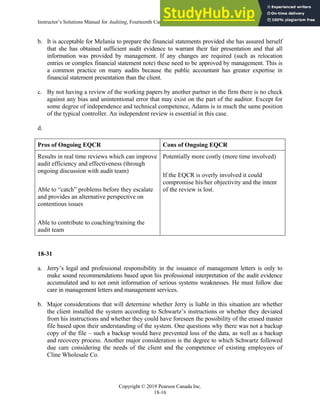
Pros of Ongoing EQCR Cons of Ongoing EQCR
Results in real time reviews which can improve
audit efficiency and effectiveness (through
ongoing discussion with audit team)
Able to “catch” problems before they escalate
and provides an alternative perspective on
contentious issues
Able to contribute to coaching/training the
audit team
Potentially more costly (more time involved)
If the EQCR is overly involved it could
compromise his/her objectivity and the intent
of the review is lost.
18-31
a. Jerry’s legal and professional responsibility in the issuance of management letters is only to
make sound recommendations based upon his professional interpretation of the audit evidence
accumulated and to not omit information of serious systems weaknesses. He must follow due
care in management letters and management services.
b. Major considerations that will determine whether Jerry is liable in this situation are whether
the client installed the system according to Schwartz’s instructions or whether they deviated
from his instructions and whether they could have foreseen the possibility of the erased master
file based upon their understanding of the system. One questions why there was not a backup
copy of the file – such a backup would have prevented loss of the data, as well as a backup
and recovery process. Another major consideration is the degree to which Schwartz followed
due care considering the needs of the client and the competence of existing employees of
Cline Wholesale Co.
Chapter 18: Completing the Audit
Copyright © 2019 Pearson Canada Inc.
18-17
c. It is not clear from the situation whether Schwartz actually designed systems of control for
the client. If he did, then he may no longer be independent of the client, due to a familiarity
threat (auditing his own work). Also, did the client consider alternative systems? If Jerry
helped the client implement the system, without advising them to prepare backup and
recovery procedures, then he may not have been competent in the conduct of his work.
If the client is a public company client, then Jerry has violated the rules of conduct. If the client
is a privately held company, then Jerry has not violated the rules of professional conduct, but
there may be some issues of competence.
Professional Problems and Cases
18-32 Using the Ethical Decision Framework
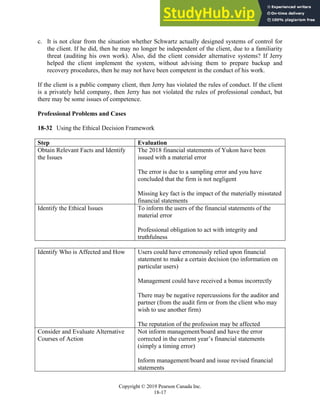
Step Evaluation
Obtain Relevant Facts and Identify
the Issues
The 2018 financial statements of Yukon have been
issued with a material error
The error is due to a sampling error and you have
concluded that the firm is not negligent
Missing key fact is the impact of the materially misstated
financial statements
Identify the Ethical Issues To inform the users of the financial statements of the
material error
Professional obligation to act with integrity and
truthfulness
Identify Who is Affected and How Users could have erroneously relied upon financial
statement to make a certain decision (no information on
particular users)
Management could have received a bonus incorrectly
There may be negative repercussions for the auditor and
partner (from the audit firm or from the client who may
wish to use another firm)
The reputation of the profession may be affected
Consider and Evaluate Alternative
Courses of Action
Not inform management/board and have the error
corrected in the current year’s financial statements
(simply a timing error)
Inform management/board and issue revised financial
statements
Instructor’s Solutions Manual for Auditing, Fourteenth Canadian Edition
Copyright © 2019 Pearson Canada Inc.
18-18
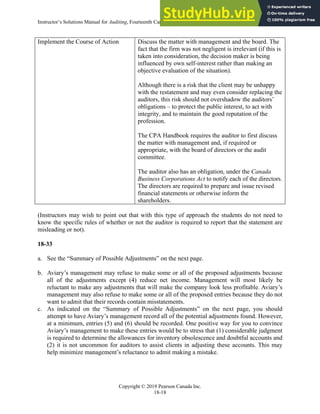
Implement the Course of Action Discuss the matter with management and the board. The
fact that the firm was not negligent is irrelevant (if this is
taken into consideration, the decision maker is being
influenced by own self-interest rather than making an
objective evaluation of the situation).
Although there is a risk that the client may be unhappy
with the restatement and may even consider replacing the
auditors, this risk should not overshadow the auditors’
obligations – to protect the public interest, to act with
integrity, and to maintain the good reputation of the
profession.
The CPA Handbook requires the auditor to first discuss
the matter with management and, if required or
appropriate, with the board of directors or the audit
committee.
The auditor also has an obligation, under the Canada
Business Corporations Act to notify each of the directors.
The directors are required to prepare and issue revised
financial statements or otherwise inform the
shareholders.
(Instructors may wish to point out that with this type of approach the students do not need to
know the specific rules of whether or not the auditor is required to report that the statement are
misleading or not).
18-33
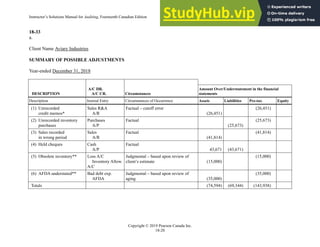
a. See the “Summary of Possible Adjustments” on the next page.
b. Aviary’s management may refuse to make some or all of the proposed adjustments because
all of the adjustments except (4) reduce net income. Management will most likely be
reluctant to make any adjustments that will make the company look less profitable. Aviary’s
management may also refuse to make some or all of the proposed entries because they do not
want to admit that their records contain misstatements.
c. As indicated on the “Summary of Possible Adjustments” on the next page, you should
attempt to have Aviary’s management record all of the potential adjustments found. However,
at a minimum, entries (5) and (6) should be recorded. One positive way for you to convince
Aviary’s management to make these entries would be to stress that (1) considerable judgment
is required to determine the allowances for inventory obsolescence and doubtful accounts and
(2) it is not uncommon for auditors to assist clients in adjusting these accounts. This may
help minimize management’s reluctance to admit making a mistake.
Chapter 18: Completing the Audit
Copyright © 2019 Pearson Canada Inc.
18-19
You should also stress that it would be wise to adjust the allowance accounts in a year with
substantial net income. The allowance accounts will most likely increase in future years,
especially if entries (5) and (6) are not made in the current year. Since management cannot be
sure that the company will generate substantial net income in future years, it would be best to
adjust the allowance accounts in the current year and avoid a substantial reduction to net
income in a future year that is not as profitable as the current year.
d. Your responsibility related to unadjusted misstatements that management has determined are
immaterial individually and in the aggregate is to determine for yourself whether the
combined effect of these unadjusted misstatements are material for the audit (this is the
essence of professional judgment which is objective). The combined effect of the unadjusted
misstatements must be compared to overall materiality. Assuming that the remaining
unadjusted misstatements are well below your materiality threshold, you do not need to
qualify your audit opinion. You should have the client include a summary of this audit
schedule in the management representation letter, along with management’s representation
that the uncorrected misstatements are immaterial.
Instructor’s Solutions Manual for Auditing, Fourteenth Canadian Edition
Copyright © 2019 Pearson Canada Inc.
18-20
18-33
a.
Client Name Aviary Industries
SUMMARY OF POSSIBLE ADJUSTMENTS
Year-ended December 31, 2018
DESCRIPTION
A/C DR.
A/C CR. Circumstances
Amount Over/Understatement in the financial
statements
Description Journal Entry Circumstances of Occurrence Assets Liabilities Pre-tax Equity
(1) Unrecorded
credit memos*
Sales R&A
A/R
Factual – cutoff error
(26,451)
(26,451)
(2) Unrecorded inventory
purchases
Purchases
A/P
Factual
(25,673)
(25,673)
(3) Sales recorded
in wrong period
Sales
A/R
Factual
(41,814)
(41,814)
(4) Held cheques Cash
A/P
Factual
43,671 (43,671)
(5) Obsolete inventory** Loss A/C
Inventory Allow.
A/C
Judgmental – based upon review of
client’s estimate (15,000)
(15,000)
(6) AFDA understated** Bad debt exp.
AFDA
Judgmental – based upon review of
aging (35,000)
(35,000)
Totals (74,594) (69,344) (143,938)
Chapter 18: Completing the Audit
Copyright © 2019 Pearson Canada Inc.
18-21
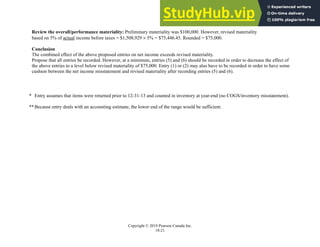
Review the overall/performance materiality: Preliminary materiality was $100,000. However, revised materiality
based on 5% of actual income before taxes = $1,508,929  5% = $75,446.45. Rounded = $75,000.
Conclusion
The combined effect of the above proposed entries on net income exceeds revised materiality.
Propose that all entries be recorded. However, at a minimum, entries (5) and (6) should be recorded in order to decrease the effect of
the above entries to a level below revised materiality of $75,000. Entry (1) or (2) may also have to be recorded in order to have some
cushion between the net income misstatement and revised materiality after recording entries (5) and (6).
* Entry assumes that items were returned prior to 12-31-13 and counted in inventory at year-end (no COGS/inventory misstatement).
**Because entry deals with an accounting estimate, the lower end of the range would be sufficient.
Instructor’s Solutions Manual for Auditing, Fourteenth Canadian Edition
Copyright © 2019 Pearson Canada Inc.
18-22
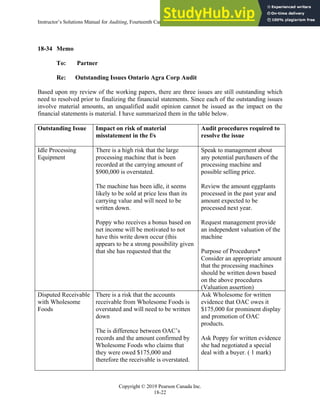
18-34 Memo
To: Partner
Re: Outstanding Issues Ontario Agra Corp Audit
Based upon my review of the working papers, there are three issues are still outstanding which
need to resolved prior to finalizing the financial statements. Since each of the outstanding issues
involve material amounts, an unqualified audit opinion cannot be issued as the impact on the
financial statements is material. I have summarized them in the table below.
Outstanding Issue Impact on risk of material
misstatement in the f/s
Audit procedures required to
resolve the issue
Idle Processing
Equipment
There is a high risk that the large
processing machine that is been
recorded at the carrying amount of
$900,000 is overstated.
The machine has been idle, it seems
likely to be sold at price less than its
carrying value and will need to be
written down.
Poppy who receives a bonus based on
net income will be motivated to not
have this write down occur (this
appears to be a strong possibility given
that she has requested that the
Speak to management about
any potential purchasers of the
processing machine and
possible selling price.
Review the amount eggplants
processed in the past year and
amount expected to be
processed next year.
Request management provide
an independent valuation of the
machine
Purpose of Procedures*
Consider an appropriate amount
that the processing machines
should be written down based
on the above procedures
(Valuation assertion)
Disputed Receivable
with Wholesome
Foods
There is a risk that the accounts
receivable from Wholesome Foods is
overstated and will need to be written
down
The is difference between OAC’s
records and the amount confirmed by
Wholesome Foods who claims that
they were owed $175,000 and
therefore the receivable is overstated.
Ask Wholesome for written
evidence that OAC owes it
$175,000 for prominent display
and promotion of OAC
products.
Ask Poppy for written evidence
she had negotiated a special
deal with a buyer. ( 1 mark)
Chapter 18: Completing the Audit
Copyright © 2019 Pearson Canada Inc.
18-23
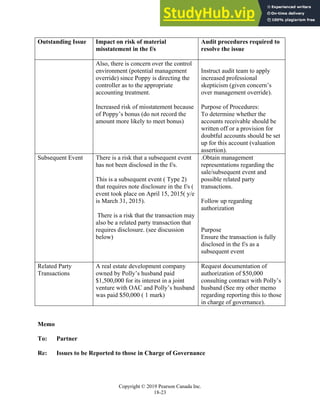
Outstanding Issue Impact on risk of material
misstatement in the f/s
Audit procedures required to
resolve the issue
Also, there is concern over the control
environment (potential management
override) since Poppy is directing the
controller as to the appropriate
accounting treatment.
Increased risk of misstatement because
of Poppy’s bonus (do not record the
amount more likely to meet bonus)
Instruct audit team to apply
increased professional
skepticism (given concern’s
over management override).
Purpose of Procedures:
To determine whether the
accounts receivable should be
written off or a provision for
doubtful accounts should be set
up for this account (valuation
assertion).
Subsequent Event There is a risk that a subsequent event
has not been disclosed in the f/s.
This is a subsequent event ( Type 2)
that requires note disclosure in the f/s (
event took place on April 15, 2015( y/e
is March 31, 2015).
There is a risk that the transaction may
also be a related party transaction that
requires disclosure. (see discussion
below)
.Obtain management
representations regarding the
sale/subsequent event and
possible related party
transactions.
Follow up regarding
authorization
Purpose
Ensure the transaction is fully
disclosed in the f/s as a
subsequent event
Related Party
Transactions
A real estate development company
owned by Polly’s husband paid
$1,500,000 for its interest in a joint
venture with OAC and Polly’s husband
was paid $50,000 ( 1 mark)
Request documentation of
authorization of $50,000
consulting contract with Polly’s
husband (See my other memo
regarding reporting this to those
in charge of governance).
Memo
To: Partner
Re: Issues to be Reported to those in Charge of Governance
Instructor’s Solutions Manual for Auditing, Fourteenth Canadian Edition
Copyright © 2019 Pearson Canada Inc.
18-24
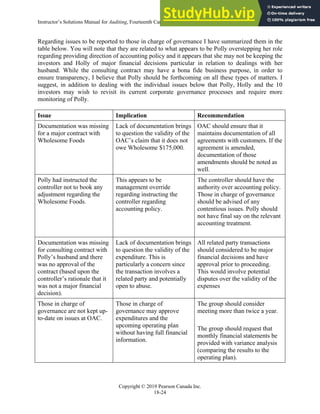
Regarding issues to be reported to those in charge of governance I have summarized them in the
table below. You will note that they are related to what appears to be Polly overstepping her role
regarding providing direction of accounting policy and it appears that she may not be keeping the
investors and Holly of major financial decisions particular in relation to dealings with her
husband. While the consulting contract may have a bona fide business purpose, in order to
ensure transparency, I believe that Polly should be forthcoming on all these types of matters. I
suggest, in addition to dealing with the individual issues below that Polly, Holly and the 10
investors may wish to revisit its current corporate governance processes and require more
monitoring of Polly.
Issue Implication Recommendation
Documentation was missing
for a major contract with
Wholesome Foods
Lack of documentation brings
to question the validity of the
OAC’s claim that it does not
owe Wholesome $175,000.
OAC should ensure that it
maintains documentation of all
agreements with customers. If the
agreement is amended,
documentation of those
amendments should be noted as
well.
Polly had instructed the
controller not to book any
adjustment regarding the
Wholesome Foods.
This appears to be
management override
regarding instructing the
controller regarding
accounting policy.
The controller should have the
authority over accounting policy.
Those in charge of governance
should be advised of any
contentious issues. Polly should
not have final say on the relevant
accounting treatment.
Documentation was missing
for consulting contract with
Polly’s husband and there
was no approval of the
contract (based upon the
controller’s rationale that it
was not a major financial
decision).
Lack of documentation brings
to question the validity of the
expenditure. This is
particularly a concern since
the transaction involves a
related party and potentially
open to abuse.
All related party transactions
should considered to be major
financial decisions and have
approval prior to proceeding.
This would involve potential
disputes over the validity of the
expenses
Those in charge of
governance are not kept up-
to-date on issues at OAC.
Those in charge of
governance may approve
expenditures and the
upcoming operating plan
without having full financial
information.
The group should consider
meeting more than twice a year.
The group should request that
monthly financial statements be
provided with variance analysis
(comparing the results to the
operating plan).
Chapter 18: Completing the Audit
Copyright © 2019 Pearson Canada Inc.
18-25
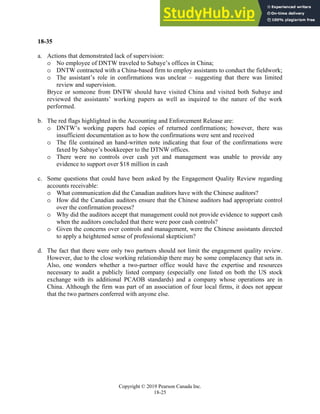
18-35
a. Actions that demonstrated lack of supervision:
o No employee of DNTW traveled to Subaye’s offices in China;
o DNTW contracted with a China-based firm to employ assistants to conduct the fieldwork;
o The assistant’s role in confirmations was unclear – suggesting that there was limited
review and supervision.
Bryce or someone from DNTW should have visited China and visited both Subaye and
reviewed the assistants’ working papers as well as inquired to the nature of the work
performed.
b. The red flags highlighted in the Accounting and Enforcement Release are:
o DNTW’s working papers had copies of returned confirmations; however, there was
insufficient documentation as to how the confirmations were sent and received
o The file contained an hand-written note indicating that four of the confirmations were
faxed by Sabaye’s bookkeeper to the DTNW offices.
o There were no controls over cash yet and management was unable to provide any
evidence to support over $18 million in cash
c. Some questions that could have been asked by the Engagement Quality Review regarding
accounts receivable:
o What communication did the Canadian auditors have with the Chinese auditors?
o How did the Canadian auditors ensure that the Chinese auditors had appropriate control
over the confirmation process?
o Why did the auditors accept that management could not provide evidence to support cash
when the auditors concluded that there were poor cash controls?
o Given the concerns over controls and management, were the Chinese assistants directed
to apply a heightened sense of professional skepticism?
d. The fact that there were only two partners should not limit the engagement quality review.
However, due to the close working relationship there may be some complacency that sets in.
Also, one wonders whether a two-partner office would have the expertise and resources
necessary to audit a publicly listed company (especially one listed on both the US stock
exchange with its additional PCAOB standards) and a company whose operations are in
China. Although the firm was part of an association of four local firms, it does not appear
that the two partners conferred with anyone else.

Arens Auditing 14Ce Ism C18.Pdf

  • 1.
    Copyright © 2019Pearson Canada Inc. 18-1 Chapter 18 Completing the Audit Concept Check Questions C18-1 Why are contingent liabilities difficult to identify? One of the key audit steps for locating contingent liabilities is discussion with management or others charged with governance of the organization. If management does not disclose the contingent liability to the auditors, then it is difficult to detect. C18-2 When reviewing legal expenses, which transactions should the auditor examine, and why? The auditor should review all legal expense transactions by tracing to source documents since they could indicate potential lawsuits. The lawyers’ invoices will provide details of what claims they had been providing legal advice. C18-3 List three audit techniques that could be used to identify relevant subsequent events. Note: Three examples are provided. Others are possible. 1. Review legal letter received from law firms. 2. Review subsequent internal financial statements. 3. Examine minutes of board and shareholder meetings after the date of the balance sheet. C18-4 Why is partner examination of final analytical review important? The partner in charge of the engagement has broad experience with the client and other businesses that facilitates the identification of unusual relationships that may require the conduct of additional audit procedures. C18-5 Describe management’s and the auditor’s responsibilities with respect to the going- concern assumption Management is required to clearly disclose the financial position of the entity, including its ability to function as a going concern, in the financial statements. The auditor’s responsibilities are to assess management’s conclusions. This is a difficult area to audit since the auditor is assessing management’s future plans (which may be overly optimistic). Where the auditor believes that managements’ disclosures are not sufficient, the auditor may be required to provide additional information in an Other Matters Paragraph in the auditor’s report. The auditor may also need to provide an Emphasis of Matter Paragraph to highlight the potential going concern problem in the auditor’s report.
  • 2.
    Instructor’s Solutions Manualfor Auditing, Fourteenth Canadian Edition Copyright © 2019 Pearson Canada Inc. 18-2 C18-6 What method does the auditor use to determine whether sufficient appropriate audit evidence has been collected? Audit evidence is assessed in relationship to the risks identified during the planning stage of the audit, in relationship to risks by audit objectives and assertions, and to address any problem areas that were discovered during the audit. C18-7 What is the purpose of the engagement quality control review? The engagement quality review is unbiased risk-based review, with the reviewer paying particular attention to significant judgments made by the engagement team and the conclusions reached in formulating the report. C18-8 What are some procedures used for the engagement quality control review? Some common procedures that should be performed are:  Evaluating the procedures performed by the engagement team to evaluate team and firm independence;  Evaluating the engagement team’s assessment of and responses to significant risks, including fraud risks;  Evaluating whether significant matters noted in the engagement were satisfactorily resolved;  Reviewing financial statements and cross-checking for completeness of significant issues;  Reviewing the proposed audit report and evaluating whether it aligns with engagement outcomes C18-9 List two examples of information that must be communicated by the auditor to the audit committee. Note that two examples are provided; more are possible. Information that must be communicated by the auditor to the audit committee could include the following: 1. Material weaknesses in internal control. 2. All misstatements, except those that are clearly trivial. C18-10 Why would an auditor submit a management letter to the client? A management letter would be submitted to provide recommendations for improving the client’s business (i.e., for more efficient operations) and to maintain a positive working relationship with the client.
  • 3.
    Chapter 18: Completingthe Audit Copyright © 2019 Pearson Canada Inc. 18-3 Review Questions 18-1 There are four groups of presentation and disclosure-related audit objectives (seven individual objectives): PRESENTATION AND DISCLOSURE-RELATED AUDIT OBJECTIVES DESCRIPTION (1) Occurrence and (2) rights and obligations Account-related information as described in the footnotes exists and represents the rights and obligations of the company. (3) Completeness All required disclosures are included in the financial statement footnotes. (4) Accuracy and (5) valuation Footnote disclosures are accurate and valued correctly. (6) Classification and (7) understandability Account balances are appropriately classified and related financial statement disclosures are understandable. 18-2 A financial statement disclosure checklist is an audit tool that summarizes all disclosure requirements contained in accounting standards. Auditors use the disclosure checklist to determine that all required disclosures are completely presented and disclosed in the financial statements and accompanying footnotes. This helps the auditor obtain sufficient appropriate evidence about the completeness objective for the presentation and disclosure-related audit objective. 18-3 A contingent liability is a potential future obligation to an outside party for an unknown amount resulting from activities that have already taken place. Some examples would be:  pending litigation  income tax disputes  product warranties An actual liability is a real future obligation to an outside party for a known amount from activities that have already taken place. Some examples would be:  notes payable  accounts payable  accrued interest payable Note that there are numerous terms for different types of liabilities, depending upon the financial accounting framework in use. The instructor could review each of those terms when discussing the nature of different types of liabilities. 18-4 Being concerned about the possibility of contingent liabilities for income tax disputes, there are various procedures you could use for an intensive investigation in that area. One good approach would be an analysis of income tax expense. Unusual or nonrecurring amounts should be further investigated to determine if they represent situations of potential tax liability. Another helpful procedure in uncovering potential tax liabilities is to review the general correspondence file for communication with law firms or Canada Revenue Agency. This might give an indication that the
  • 4.
    Instructor’s Solutions Manualfor Auditing, Fourteenth Canadian Edition Copyright © 2019 Pearson Canada Inc. 18-4 potential for a liability exists even though no actual litigation has ensued. Finally, an examination of Canada Revenue Agency reports from prior years may provide the most obvious indication of disputed tax matters. 18-5 The analysis of legal expense is an essential part of every audit engagement because it may give indication of contingent liabilities that may become actual liabilities in the future and require disclosure in the current financial statements. Since any single contingency could be material, it is important to verify all legal transactions, even though the amount may be small. After the analysis of legal expense is completed, the law firms to whom payment was made should be considered for letters of confirmation for contingencies (communications with law firms/ lawyer’s letters). 18-6 Pyson should determine the materiality of the lawsuits by requesting from Merrill’s lawyers an assessment of the legal situations and the probable liabilities involved. In addition, Pyson may have his own legal counsel assess the situations. Proper disclosure in the financial statements will depend on the lawyers’ evaluations of the probable liabilities involved. If the evaluations indicate highly probable, material amounts, disclosure will be necessary in the form of a footnote, assuming the amount of the probable material loss cannot be reasonably estimated. If the client refuses to make adequate disclosure of the contingencies, a qualified or adverse opinion may be necessary. 18-7 If a law firm refused to provide the auditor with information about material existing lawsuits or likely material possible (unasserted) claims, the audit opinion would have to be modified to reflect the lack of available evidence. This is required by the CICA Assurance Handbook, and has the effect of requiring management to give its law firms permission to provide contingent liability information to auditors and to encourage law firms to cooperate with auditors in obtaining information about contingencies. 18-8 1. Subsequent events requiring adjustment: those that have a direct effect on the financial statements. Examples: (i) the declaration of bankruptcy due to the deteriorating financial condition of a customer with a large outstanding accounts receivable balance and (ii) the settlement of a litigation for an amount different from the amount recorded in the books. 2. Subsequent events requiring disclosure: those that have no direct effect on the financial statements. Examples: (i) the decline in market value of securities held for temporary investment or resale, (ii) the issuance of bonds or equity securities, and (iii) the declaration of bankruptcy by a customer (with a large outstanding accounts receivable balance) who was inadequately insured and lost everything due to a fire subsequent to the auditor’s report date. 18-9 The auditor would be interested in a client’s future commitments to purchase raw materials to ensure that this information is properly disclosed in the financial statements. The commitment may be of interest to an investor as it is compared to the future price movements of the material. A future commitment to purchase raw material may result in the client paying more or less than the market price at a future time. In the former case, it may be appropriate for the client to recognize a loss in the current year rather than when the raw material is actually purchased.
  • 5.
    Chapter 18: Completingthe Audit Copyright © 2019 Pearson Canada Inc. 18-5 18-10 The major considerations the auditor should take into account in determining how extensive the subsequent events review should be are:  the financial strengths and stability of earnings  the effectiveness of the company’s internal control  the number and significance of the adjustments proposed by the auditor  the length of time between the balance sheet date and the completion of the audit  changes in key personnel 18-11 The accumulation of audit evidence is crucial to the auditor in determining whether the financial statements are stated in accordance with an acceptable financial reporting framework, applied on a basis consistent with the preceding year. The evaluation of the adequacy of the disclosures in financial statements is made to assure that the account balances on the trial balance are properly aggregated and disclosed on the financial statements. Three examples where adequate disclosure could depend heavily upon the accumulation of evidence are:  the disclosure of declines in inventory values below cost  the separation of current and non-current receivables  the disclosure of contingent liabilities of whose existence, the auditor has not been informed Three examples where audit evidence does not normally significantly affect the adequacy of the disclosure are:  deciding whether a disposal of equipment should be recorded as an extraordinary item  the disclosure of an acquisition as a pooling of interests or a purchase  the disclosure of contingencies of whose existence the auditor was informed by the client 18-12 This statement implies that the auditor should consider, as part of his or her audit procedures, if there is a serious risk of the company being unable to realize assets and discharge liabilities in the normal course of business for the foreseeable future. A number of conditions that may cast doubt on the ability of the enterprise to continue as a going concern such as:  recurring operating losses  serious deficiencies in operating capital  an inability to obtain financing sufficient for continued operations  an inability to comply with terms of existing loan agreements  the possibility of an adverse outcome of one or more contingencies  insufficient funds to meet liabilities  a plan to significantly curtail or liquidate operations  external factors that could force an otherwise solvent enterprise to cease operations Based on the auditor’s assessment of these factors, the auditor must determine if the accounting treatment, presentation, and disclosure by the entity is appropriate. If so, no reservation is required.
  • 6.
    Instructor’s Solutions Manualfor Auditing, Fourteenth Canadian Edition Copyright © 2019 Pearson Canada Inc. 18-6 18-13 A management representation letter is a letter from management that documents management’s most important oral representations during the audit. A management letter is one directed to the client to inform him or her of certain recommendations about the business that the public accountant believes would be beneficial to the client. Five items that might be included in a management representation letter are:  existence or non-existence of litigation  evaluation of inventory stock as obsolete  the adequacy of the disclosure of actual liabilities  existence or non-existence of unused letters of credit  the recognition that the auditor is not primarily responsible for the detection of fraud Five items that might be included in a management letter are:  recommendation to switch inventory valuation methods  recommendation to institute a formal security system  recommendation to prepare more timely bank reconciliations  recommendation to segregate duties in a particular area  recommendation to have certain types of transactions authorized by specific individuals 18-14 A regular working paper review is the one that is done by someone who is knowledgeable about the client and the unique circumstances in the audit. An independent review is one done by a completely independent person who has had no experience on the engagement. The purpose is to have a competent professional from within the firm who has not been biased by the ongoing relationship between the regular auditors and the client, perform an independent review. Two examples of important potential findings in a regular review are:  incorrect computations  inadequate scope Three examples of important potential findings in an independent review are:  a number of small amount adjustments waived that should be accumulated into a real adjustment.  too narrow and biased a scope in a particular area.  inadequate disclosure of contingencies.
  • 7.
    Chapter 18: Completingthe Audit Copyright © 2019 Pearson Canada Inc. 18-7 18-15 CAS 260 par 14 to 17 itemizes requirements to report. In addition to the required communications to those charged with governance required by auditing standards, in the U.S., the Sarbanes-Oxley Act expands these communications requirements by also requiring public company auditors to timely report the following items to the audit committee:  All critical accounting policies and practices to be used.  All alternative treatments of financial information within generally accepted accounting principles that have been discussed with management, ramifications of the use of such alternative disclosures and treatments, and the treatment preferred by the auditor.  Other material written communications between the auditor and management, such as any management letter or schedule of unadjusted differences. As the audit of the public company is completed, the auditor should determine that the audit committee is informed about the initial selection of and changes in significant accounting policies or their application during the current audit period. When changes have occurred, the auditor should inform the committee of the reasons for the change. The auditor should also communicate information about methods used to account for significant unusual transactions and the effect of significant accounting policies in controversial or emerging areas. Multiple Choice Questions 18-16 (1) 18-17 (2) 18-18 (3) 18-19 (3) 18-20 Subsequent Event 1 – Defective chemicals a. The following are audit procedures that the auditor should consider to corroborate the event and to make the conclusion as to the appropriate financial statement treatment:  Review quality control reports to assess whether this event was the only case of defective inventory as there could potentially be other inventory that requires writing down.  Inquire of management and quality control if any other instances of defective inventory  Inspect supporting documentation (such as cost data or production records) to verify that the chemicals were produced prior to October 31st to ensure that a write-down is necessary.  Inquire management as to how they determined the scrap value of $100 000.  Agree the scrap value amount to supporting documentation.
  • 8.
    Instructor’s Solutions Manualfor Auditing, Fourteenth Canadian Edition Copyright © 2019 Pearson Canada Inc. 18-8 b) (1) – when taken with the other unadjusted amounts, net income is materially overstated by $300,000 ($250 000 + 50 000) – which is greater than $280,000. Subsequent Event 2 c) The following are audit procedures that the auditor should consider to corroborate the event and to make the conclusion as to the appropriate financial statement treatment:  Obtain a schedule of the damaged property, plant and equipment and agree to the net book value in the PPE subledger.  Obtain an inventory listing to determine the amount of inventory stored at the time – further amounts may need to be disclosed in the financial statements.  Given that the inventory stored was chemicals, inquire if there are necessary site clean-up costs and, if so, obtain management’s estimate of those costs.  If there are site clean-up costs, agree management’s estimate to supporting documentation  Obtain client representation letter regarding estimated costs as well as whether in compliance with applicable regulations.  Ask management about insurance coverage and inspect insurance documentation (such as policies, any correspondence regarding the recent fire). d) (2) – the impact is material; however, the event happened after year-end. Therefore, note disclosure is required with no adjustment to the financial statements. Discussion Questions and Problems 18-21 a. Contingent liabilities are potential future obligations for an unknown amount arising from activities that have already taken place. A commitment is an agreement to commit the firm to a set of fixed conditions in the future, regardless of what happens to profits or the economy as a whole. Knowledge of both contingencies and commitments is extremely important to users of financial statements because they represent the encumbrance of potentially material amounts of resources during future periods, and thus affect the future cash flows available to creditors and investors. Because of this, generally accepted accounting principles require that material contingencies and commitments be disclosed. The auditor has an obligation to discover the existence of such items to assure that they are properly disclosed in order to have complied with generally accepted auditing standards. b. Kathy’s tests of controls and substantive tests of transactions related to payments of notes payable and related interest expense would provide her information about scheduled debt payments and related interest rate terms, which are required footnote disclosure related items. Similarly, substantive tests of transactions would reveal additions and retirements of notes payable, which both affect notes payable disclosures. Tests of details of balances, such as notes payable confirmations, would provide sufficient appropriate evidence about the existence of ending balances and related notes payable terms, such as interest rates and required collateral.
  • 9.
    Chapter 18: Completingthe Audit Copyright © 2019 Pearson Canada Inc. 18-9 c. Three useful audit procedures for uncovering contingencies that Kathy Choi would likely perform in the normal conduct of the audit, even if she had no responsibility for uncovering contingencies, are:  Review Canada Revenue Agency reports of income tax settlements.  Review minutes of meetings of board of directors and shareholders.  Confirm used and unused balance of lines of credit and other similar loans and liabilities. d. Three other procedures Kathy Choi is likely to perform specifically for the purpose of identifying undisclosed contingencies are:  Make inquiries of management.  Analyze legal expenses for indication of contingent liabilities.  Confirm existence and status of litigation and other potential contingent liabilities with law firms. 18-22 a. Audit procedures to learn about these items would be as follows: Apply to all three items:  Discuss existence and nature of possible contingent liabilities with management. In this connection obtain appropriate written representations.  Review the minutes of directors’ and shareholders’ meetings for indication of lawsuits or other contingencies.  Analyze legal expense for period under audit and review invoices and statements of legal counsel for indications of contingent liabilities.  Obtain confirmation from all major law firms performing legal services for the client as to the status of pending litigation or other contingent liabilities. Additional procedures for individual items: 1. Guarantee of interest payments  Discuss, specifically, any related party transactions with management. Include in representations.  Review financial statements of affiliate, and where related party transactions are apparent, make direct inquiries of affiliate management, and perhaps even examine records of affiliate if necessary. 2. Lawsuit  Inquiry of management  Review of all legal invoices paid or payable during the year  Legal letter sent to all law firms used by the company 3. Dividend using common shares  Confirm details of share transactions with registrar and transfer agent.  Review records for unusual journal entries subsequent to year end.
  • 10.
    Instructor’s Solutions Manualfor Auditing, Fourteenth Canadian Edition Copyright © 2019 Pearson Canada Inc. 18-10 b. Nature of adjusting entries or disclosure, if any, would be as follows: 1. Guarantee of interest payments If payment by Chen is uncertain, the $137,000 interest liability for the period June 2 through December 1, 2018, could be reflected in the Marco Corporation’s accounting records by the following entry: Interest Payments for Chen Corp. $137,000 Accrued Interest Payable: Chen Bonds $137,000 The debit entry should be included as other assets. Collection is uncertain and the Marco Corporation may not have a right against the Chen Corp. until all interest payments have been met and the bonds retired. If this treatment is followed, the balance sheet should be footnoted to the effect that the Marco Corporation is contingently liable for future interest payments on Chen Corp. bonds in the amount of $2,220 000. If the interest has been paid by the time the audit is completed, or if for other reasons it seems certain that the payment will be made by Chen on January 15, no entry should be made by Marco. In this circumstance a footnote disclosing the contingent liability of $2,337,000 and the facts as to the $135,000 should be included with the statements. 2. Lawsuit The lawsuit should be described in a footnote to the balance sheet. In view of the court decision, retained earnings may be restricted for $4 000 000, the amount of the first court decision. Also, in view of the court decision any reasonable estimate of the amount the company expects to pay as a result of the suit might be used in lieu of the $40,000. A current liability will be set up as soon as a final decision is rendered or if an agreement as to damages is reached. If liability is admitted to by Marco, and only the amount is in dispute, a liability can be set up for the amount admitted to by the company with a corresponding charge to expense or shown as an extraordinary item if the amount is material. 3. Dividend declared using common shares The declaration of such a dividend does not create a liability that affects the aggregate net worth in any way. The distribution of the dividend will cause a reduction in retained earnings and an increase in capital stock. No entry is necessary, but an indication of the action taken, and that such a transfer will subsequently be made, should be shown as a footnote or as a memorandum to Retained Earnings and Common Stock in the balance sheet.
  • 11.
    Chapter 18: Completingthe Audit Copyright © 2019 Pearson Canada Inc. 18-11 18-23 a. In this situation, Little need only send confirmation requests to those law firms who are involved with legal matters directly affecting the financial statements. The confirmations should be sent reasonably near to the completion of the field work, but the follow-up on non-responses and unsatisfactory responses should not be deferred until the last day of field work. He should have examined the letter when it was returned and performed follow-up work at that time. Furthermore, the standard legal letter would have asked about the lawsuit if the client had informed the auditor of its existence. b. Regarding the third confirmation, it is necessary to have a conference with the law firm, client, and auditor to determine the nature and significance of the lawsuit. It would be a serious violation of due care to ignore the information in the law firm’s letter. In rare circumstances, a denial of opinion is necessary if the information cannot be obtained. The auditor would also be required to follow up on the first confirmation. Since the second confirmation is from a law firm that only does patent registration (i.e., they do not handle lawsuits), no further follow up is required. The auditor may use this information when conducting the audit of intangible assets. 18-24 a. This would be a scope limitation. The auditor is not being given access to all of the information necessary to audit the client’s financial statements. b. The auditor has to ensure that the proper disclosure is made in the notes to the financial statements, not in the audit report. OR If information provided to the auditor by the second law firm showed that the claim is very likely, then the amount should be accrued by the client and the accrual of the contingent liability should be disclosed in the notes to the financial statements. 18-25 a. Auditing standards (CAS 570) require the auditor to evaluate whether there is substantial doubt about a client’s ability to continue as a going concern for at least one year beyond the balance sheet date. Auditors make this evaluation during the planning phase, but also update their assessment throughout the audit using information obtained from analytical procedures, discussions with management, their knowledge of the client’s business, and other information that comes to light during the audit. b. The auditor is required to consider whether the client is able to continue as a going concern for at least one year beyond the balance sheet date.
  • 12.
    Instructor’s Solutions Manualfor Auditing, Fourteenth Canadian Edition Copyright © 2019 Pearson Canada Inc. 18-12 c. For the audit of MakingNewFriends.com, the relevant information includes the fact that MakingNewFriends.com has had difficulty establishing a loyal client base and generating advertising revenues. This suggests the company may continue to have difficulty generating revenues over the next 12 months. The recurring operating losses and decline in working capital also suggest financial difficulties and a possible inability to remain a viable going concern. Callie Peters will also consider management’s plan to obtain debt financing as a means to fund operations for the next year, although they have not yet secured such financing. In addition, Callie will consider management’s plan to increase advertising revenues by 20%. The additional information that Callie would consider includes any other plans by management to generate revenue or other financing for the coming year, knowledge of industry trends and possibly analyst forecasts related to this market segment, and performance of competitors. d. The auditor is required to evaluate the feasibility of management achieving their plans. For example, the auditor may discuss with the bank the likelihood of the company obtaining financing. The auditor will also assess market conditions and the feasibility of MakingNewFriends.com being able to achieve an increase in advertising revenues of 20% by considering the factors discussed in part c. 18-26 a. Description of Possible Misstatement Circumstances of Occurrence Amount of over (under) misstatement in the financial statements Assets Liabilities Pre-Tax Income Equity 1. Non-accrual of bonus Factual – client recording error (125,000) $125,000 2 Did not record sale of assets Factual – client recording error (25,000) 60,000 (25,000) 3 Inadequate allowance for doubtful accounts Judgmental – based upon auditor’s review of aging of AR 44,000 (44,000) 4 Inappropriate capitalization of repairs and maintenance Factual – inappropriate capitalization 52,000 52,000 5 Incorrect classification of expenses Factual – no impact on Income (however impacts gross margin) 6 Did not record purchase of new equipment and related long-term note Factual – no amount provided Total (17,000) (125,000) 108,000
  • 13.
    Chapter 18: Completingthe Audit Copyright © 2019 Pearson Canada Inc. 18-13 b. The net effect of the adjustments to the balance sheet and income statement are material to the financial statements. Pretax income would be overstated by $108,000, which is in excess of the income statement materiality, as a result of these items if they are not properly reflected in the accounting records. Note, the problem fails to provide information about the dollar amounts involved in Item 6. Most likely the nature of that item consists of a large dollar amount, which would need to be reflected in the financial statements given the impact it would have on noncurrent assets and noncurrent liabilities. 18-27 a. CAS 450 identifies three types of misstatements: 1. Factual misstatements are misstatements about which there is no doubt. 2. Judgmental misstatements are differences arising from the judgments of management concerning accounting estimates that the auditor considers unreasonable or the selection or application of accounting policies that the auditor considers inappropriate. 3. Projected misstatements are the auditor's best estimate of misstatements in populations, involving the projection of misstatements identified in audit samples to the entire population from which the samples were drawn. Guidance on the determination of projected misstatements and evaluation of the results is included in CAS 530, Audit Sampling. Evidence that a misstatement is not an isolated occurrence and other misstatements may exist include situations when the auditor identifies that a misstatement arose from a breakdown in internal control or from inappropriate assumptions or valuation methods that have been widely applied by the entity. b. The error falls within the category of judgmental misstatement. The Auditor General and the Government of Ontario are clearly disputing the application of an accounting policy. c. CAS 450 indicates the auditor should determine whether uncorrected misstatements are material, individually or in the aggregate. In making this determination, the auditor should consider:  the size and nature of the misstatements, both in relation to particular classes of transactions, account balances, or disclosures and the financial statements as a whole, and the particular circumstances of their occurrence, and  the effect of uncorrected misstatements related to prior periods on the relevant classes of transactions, account balances, or disclosures and the financial statements as a whole.  CAS 450, states that the auditor’s consideration of misstatement may take into account  the aggregate effect of uncorrected misstatements;
  • 14.
    Instructor’s Solutions Manualfor Auditing, Fourteenth Canadian Edition Copyright © 2019 Pearson Canada Inc. 18-14  whether the materiality level or levels for particular classes of transactions, account balances or disclosures, if any, have been exceeded;  The evaluation of the effect of uncorrected misstatements on key ratios or trends, and compliance with legal, regulatory and contractual requirements (for example, debt covenants). d. Given the significance of the balanced budget to the users (bond holders and the general public) of the financial statements, it looks like the Auditor General was considering the impact on the accumulated deficit. 18-28 a. It is desirable to have a letter of representation in spite of the accumulated audit evidence to impress upon management its responsibility for the representations in the financial statements and to formally document the responses from the client to inquiries about various aspects of the audit. b. The letter of representation is not very useful as audit evidence since it is a written statement from a non-independent source. In effect, the client who is being audited makes certain representations related to the audit of himself or herself. c. Several other types of information commonly included in a letter of representation are:  The company has proper title to all of its assets.  All outstanding loans to officers of the company have been identified.  All transactions for the year have been conducted at arm’s length.  That financial statements are presented in accordance with the financial reporting framework used by the company.  All related party transactions are disclosed.  Completeness and availability of financial records, minutes of board meetings, and other pertinent documents. 18-29 a. Per CAS 720, section 3.12 (c), other information is financial or non-financial information (other than financial statements and the auditor's report thereon) included in an entity's annual report. b. Some examples of other information that form part of the annual report include: o Management report, management commentary, or operating and financial review or similar reports by those charged with governance (for example, a directors' report). o Chairman's statement. o Corporate governance statement o Internal control and risk assessment reports. o Appendix 1 of the Section provides specific examples of amounts and items that would be included in other information
  • 15.
    Chapter 18: Completingthe Audit Copyright © 2019 Pearson Canada Inc. 18-15 c. CAS 720 A.26 explains that the auditor does not need to examine all amounts and items. CAS 720 A.28 provides examples of some procedures that auditors may perform to assess other information:  For information that is intended to be the same as information in the financial statements, comparing the information to the financial statements.  For information intended to convey the same meaning as disclosures in the financial statements, comparing the words used and considering the significance of differences in wording used and whether such differences imply different meanings.  Obtain a reconciliation between an amount within the other information and the financial statements from management and: o Compare items in the reconciliation to the financial statements and the other information; and o Check whether the calculations within the reconciliation are arithmetically accurate. d. Some of the procedures could be performed by junior auditors, for instance those that involve tracing the information to the financial statements, as well as testing the reconciliations. However, evaluation of the more qualitative information may require a more experienced auditor. Also, consideration of the other information in the context of understanding the entity as well as the judgment involved in determining if there is a material inconsistency or material misstatement would require an experienced auditor with considerable knowledge of the client. e. If the auditor found inconsistencies between the other information and the financial statements, the auditor will first need to determine if it is a material inconsistency. The auditor would first request management to provide support for the basis of management's statements in the other information. Based on management's further information or explanations, the auditor may be satisfied that the other information is not materially misstated. CAS 720 A.44 explains that if the auditor is not satisfied, then the auditor will request that management correct it as well as inform those in charge of governance. The auditor may take into account whether the rationale given by management and those charged with governance for not making the correction raises doubt about the integrity or honesty of management or those charged with governance, such as when the auditor suspects an intention to mislead. The auditor may also consider it appropriate to seek legal advice. In some cases, the auditor may be required by law, regulation, or other professional standards to communicate the matter to a regulator or relevant professional body. 8-30 a. The practice of reviewing the working papers of subordinates on a continuing basis rather than when the audit is completed, is a good one because it enables Melania Tsipras to refine her audit based on the information provided from the working papers that are reviewed. In addition, since many areas of the audit relate to each other, reviewing the working papers on a continuing basis gives the auditor a more integrated picture of the company’s operations. It is also an excellent practice from a supervision point of view.
  • 16.
    Instructor’s Solutions Manualfor Auditing, Fourteenth Canadian Edition Copyright © 2019 Pearson Canada Inc. 18-16 b. It is acceptable for Melania to prepare the financial statements provided she has assured herself that she has obtained sufficient audit evidence to warrant their fair presentation and that all information was provided by management. If any changes are required (such as relocation entries or complex financial statement note) these need to be approved by management. This is a common practice on many audits because the public accountant has greater expertise in financial statement presentation than the client. c. By not having a review of the working papers by another partner in the firm there is no check against any bias and unintentional error that may exist on the part of the auditor. Except for some degree of independence and technical competence, Adams is in much the same position of the typical controller. An independent review is essential in this case. d. Pros of Ongoing EQCR Cons of Ongoing EQCR Results in real time reviews which can improve audit efficiency and effectiveness (through ongoing discussion with audit team) Able to “catch” problems before they escalate and provides an alternative perspective on contentious issues Able to contribute to coaching/training the audit team Potentially more costly (more time involved) If the EQCR is overly involved it could compromise his/her objectivity and the intent of the review is lost. 18-31 a. Jerry’s legal and professional responsibility in the issuance of management letters is only to make sound recommendations based upon his professional interpretation of the audit evidence accumulated and to not omit information of serious systems weaknesses. He must follow due care in management letters and management services. b. Major considerations that will determine whether Jerry is liable in this situation are whether the client installed the system according to Schwartz’s instructions or whether they deviated from his instructions and whether they could have foreseen the possibility of the erased master file based upon their understanding of the system. One questions why there was not a backup copy of the file – such a backup would have prevented loss of the data, as well as a backup and recovery process. Another major consideration is the degree to which Schwartz followed due care considering the needs of the client and the competence of existing employees of Cline Wholesale Co.
  • 17.
    Chapter 18: Completingthe Audit Copyright © 2019 Pearson Canada Inc. 18-17 c. It is not clear from the situation whether Schwartz actually designed systems of control for the client. If he did, then he may no longer be independent of the client, due to a familiarity threat (auditing his own work). Also, did the client consider alternative systems? If Jerry helped the client implement the system, without advising them to prepare backup and recovery procedures, then he may not have been competent in the conduct of his work. If the client is a public company client, then Jerry has violated the rules of conduct. If the client is a privately held company, then Jerry has not violated the rules of professional conduct, but there may be some issues of competence. Professional Problems and Cases 18-32 Using the Ethical Decision Framework Step Evaluation Obtain Relevant Facts and Identify the Issues The 2018 financial statements of Yukon have been issued with a material error The error is due to a sampling error and you have concluded that the firm is not negligent Missing key fact is the impact of the materially misstated financial statements Identify the Ethical Issues To inform the users of the financial statements of the material error Professional obligation to act with integrity and truthfulness Identify Who is Affected and How Users could have erroneously relied upon financial statement to make a certain decision (no information on particular users) Management could have received a bonus incorrectly There may be negative repercussions for the auditor and partner (from the audit firm or from the client who may wish to use another firm) The reputation of the profession may be affected Consider and Evaluate Alternative Courses of Action Not inform management/board and have the error corrected in the current year’s financial statements (simply a timing error) Inform management/board and issue revised financial statements
  • 18.
    Instructor’s Solutions Manualfor Auditing, Fourteenth Canadian Edition Copyright © 2019 Pearson Canada Inc. 18-18 Implement the Course of Action Discuss the matter with management and the board. The fact that the firm was not negligent is irrelevant (if this is taken into consideration, the decision maker is being influenced by own self-interest rather than making an objective evaluation of the situation). Although there is a risk that the client may be unhappy with the restatement and may even consider replacing the auditors, this risk should not overshadow the auditors’ obligations – to protect the public interest, to act with integrity, and to maintain the good reputation of the profession. The CPA Handbook requires the auditor to first discuss the matter with management and, if required or appropriate, with the board of directors or the audit committee. The auditor also has an obligation, under the Canada Business Corporations Act to notify each of the directors. The directors are required to prepare and issue revised financial statements or otherwise inform the shareholders. (Instructors may wish to point out that with this type of approach the students do not need to know the specific rules of whether or not the auditor is required to report that the statement are misleading or not). 18-33 a. See the “Summary of Possible Adjustments” on the next page. b. Aviary’s management may refuse to make some or all of the proposed adjustments because all of the adjustments except (4) reduce net income. Management will most likely be reluctant to make any adjustments that will make the company look less profitable. Aviary’s management may also refuse to make some or all of the proposed entries because they do not want to admit that their records contain misstatements. c. As indicated on the “Summary of Possible Adjustments” on the next page, you should attempt to have Aviary’s management record all of the potential adjustments found. However, at a minimum, entries (5) and (6) should be recorded. One positive way for you to convince Aviary’s management to make these entries would be to stress that (1) considerable judgment is required to determine the allowances for inventory obsolescence and doubtful accounts and (2) it is not uncommon for auditors to assist clients in adjusting these accounts. This may help minimize management’s reluctance to admit making a mistake.
  • 19.
    Chapter 18: Completingthe Audit Copyright © 2019 Pearson Canada Inc. 18-19 You should also stress that it would be wise to adjust the allowance accounts in a year with substantial net income. The allowance accounts will most likely increase in future years, especially if entries (5) and (6) are not made in the current year. Since management cannot be sure that the company will generate substantial net income in future years, it would be best to adjust the allowance accounts in the current year and avoid a substantial reduction to net income in a future year that is not as profitable as the current year. d. Your responsibility related to unadjusted misstatements that management has determined are immaterial individually and in the aggregate is to determine for yourself whether the combined effect of these unadjusted misstatements are material for the audit (this is the essence of professional judgment which is objective). The combined effect of the unadjusted misstatements must be compared to overall materiality. Assuming that the remaining unadjusted misstatements are well below your materiality threshold, you do not need to qualify your audit opinion. You should have the client include a summary of this audit schedule in the management representation letter, along with management’s representation that the uncorrected misstatements are immaterial.
  • 20.
    Instructor’s Solutions Manualfor Auditing, Fourteenth Canadian Edition Copyright © 2019 Pearson Canada Inc. 18-20 18-33 a. Client Name Aviary Industries SUMMARY OF POSSIBLE ADJUSTMENTS Year-ended December 31, 2018 DESCRIPTION A/C DR. A/C CR. Circumstances Amount Over/Understatement in the financial statements Description Journal Entry Circumstances of Occurrence Assets Liabilities Pre-tax Equity (1) Unrecorded credit memos* Sales R&A A/R Factual – cutoff error (26,451) (26,451) (2) Unrecorded inventory purchases Purchases A/P Factual (25,673) (25,673) (3) Sales recorded in wrong period Sales A/R Factual (41,814) (41,814) (4) Held cheques Cash A/P Factual 43,671 (43,671) (5) Obsolete inventory** Loss A/C Inventory Allow. A/C Judgmental – based upon review of client’s estimate (15,000) (15,000) (6) AFDA understated** Bad debt exp. AFDA Judgmental – based upon review of aging (35,000) (35,000) Totals (74,594) (69,344) (143,938)
  • 21.
    Chapter 18: Completingthe Audit Copyright © 2019 Pearson Canada Inc. 18-21 Review the overall/performance materiality: Preliminary materiality was $100,000. However, revised materiality based on 5% of actual income before taxes = $1,508,929  5% = $75,446.45. Rounded = $75,000. Conclusion The combined effect of the above proposed entries on net income exceeds revised materiality. Propose that all entries be recorded. However, at a minimum, entries (5) and (6) should be recorded in order to decrease the effect of the above entries to a level below revised materiality of $75,000. Entry (1) or (2) may also have to be recorded in order to have some cushion between the net income misstatement and revised materiality after recording entries (5) and (6). * Entry assumes that items were returned prior to 12-31-13 and counted in inventory at year-end (no COGS/inventory misstatement). **Because entry deals with an accounting estimate, the lower end of the range would be sufficient.
  • 22.
    Instructor’s Solutions Manualfor Auditing, Fourteenth Canadian Edition Copyright © 2019 Pearson Canada Inc. 18-22 18-34 Memo To: Partner Re: Outstanding Issues Ontario Agra Corp Audit Based upon my review of the working papers, there are three issues are still outstanding which need to resolved prior to finalizing the financial statements. Since each of the outstanding issues involve material amounts, an unqualified audit opinion cannot be issued as the impact on the financial statements is material. I have summarized them in the table below. Outstanding Issue Impact on risk of material misstatement in the f/s Audit procedures required to resolve the issue Idle Processing Equipment There is a high risk that the large processing machine that is been recorded at the carrying amount of $900,000 is overstated. The machine has been idle, it seems likely to be sold at price less than its carrying value and will need to be written down. Poppy who receives a bonus based on net income will be motivated to not have this write down occur (this appears to be a strong possibility given that she has requested that the Speak to management about any potential purchasers of the processing machine and possible selling price. Review the amount eggplants processed in the past year and amount expected to be processed next year. Request management provide an independent valuation of the machine Purpose of Procedures* Consider an appropriate amount that the processing machines should be written down based on the above procedures (Valuation assertion) Disputed Receivable with Wholesome Foods There is a risk that the accounts receivable from Wholesome Foods is overstated and will need to be written down The is difference between OAC’s records and the amount confirmed by Wholesome Foods who claims that they were owed $175,000 and therefore the receivable is overstated. Ask Wholesome for written evidence that OAC owes it $175,000 for prominent display and promotion of OAC products. Ask Poppy for written evidence she had negotiated a special deal with a buyer. ( 1 mark)
  • 23.
    Chapter 18: Completingthe Audit Copyright © 2019 Pearson Canada Inc. 18-23 Outstanding Issue Impact on risk of material misstatement in the f/s Audit procedures required to resolve the issue Also, there is concern over the control environment (potential management override) since Poppy is directing the controller as to the appropriate accounting treatment. Increased risk of misstatement because of Poppy’s bonus (do not record the amount more likely to meet bonus) Instruct audit team to apply increased professional skepticism (given concern’s over management override). Purpose of Procedures: To determine whether the accounts receivable should be written off or a provision for doubtful accounts should be set up for this account (valuation assertion). Subsequent Event There is a risk that a subsequent event has not been disclosed in the f/s. This is a subsequent event ( Type 2) that requires note disclosure in the f/s ( event took place on April 15, 2015( y/e is March 31, 2015). There is a risk that the transaction may also be a related party transaction that requires disclosure. (see discussion below) .Obtain management representations regarding the sale/subsequent event and possible related party transactions. Follow up regarding authorization Purpose Ensure the transaction is fully disclosed in the f/s as a subsequent event Related Party Transactions A real estate development company owned by Polly’s husband paid $1,500,000 for its interest in a joint venture with OAC and Polly’s husband was paid $50,000 ( 1 mark) Request documentation of authorization of $50,000 consulting contract with Polly’s husband (See my other memo regarding reporting this to those in charge of governance). Memo To: Partner Re: Issues to be Reported to those in Charge of Governance
  • 24.
    Instructor’s Solutions Manualfor Auditing, Fourteenth Canadian Edition Copyright © 2019 Pearson Canada Inc. 18-24 Regarding issues to be reported to those in charge of governance I have summarized them in the table below. You will note that they are related to what appears to be Polly overstepping her role regarding providing direction of accounting policy and it appears that she may not be keeping the investors and Holly of major financial decisions particular in relation to dealings with her husband. While the consulting contract may have a bona fide business purpose, in order to ensure transparency, I believe that Polly should be forthcoming on all these types of matters. I suggest, in addition to dealing with the individual issues below that Polly, Holly and the 10 investors may wish to revisit its current corporate governance processes and require more monitoring of Polly. Issue Implication Recommendation Documentation was missing for a major contract with Wholesome Foods Lack of documentation brings to question the validity of the OAC’s claim that it does not owe Wholesome $175,000. OAC should ensure that it maintains documentation of all agreements with customers. If the agreement is amended, documentation of those amendments should be noted as well. Polly had instructed the controller not to book any adjustment regarding the Wholesome Foods. This appears to be management override regarding instructing the controller regarding accounting policy. The controller should have the authority over accounting policy. Those in charge of governance should be advised of any contentious issues. Polly should not have final say on the relevant accounting treatment. Documentation was missing for consulting contract with Polly’s husband and there was no approval of the contract (based upon the controller’s rationale that it was not a major financial decision). Lack of documentation brings to question the validity of the expenditure. This is particularly a concern since the transaction involves a related party and potentially open to abuse. All related party transactions should considered to be major financial decisions and have approval prior to proceeding. This would involve potential disputes over the validity of the expenses Those in charge of governance are not kept up- to-date on issues at OAC. Those in charge of governance may approve expenditures and the upcoming operating plan without having full financial information. The group should consider meeting more than twice a year. The group should request that monthly financial statements be provided with variance analysis (comparing the results to the operating plan).
  • 25.
    Chapter 18: Completingthe Audit Copyright © 2019 Pearson Canada Inc. 18-25 18-35 a. Actions that demonstrated lack of supervision: o No employee of DNTW traveled to Subaye’s offices in China; o DNTW contracted with a China-based firm to employ assistants to conduct the fieldwork; o The assistant’s role in confirmations was unclear – suggesting that there was limited review and supervision. Bryce or someone from DNTW should have visited China and visited both Subaye and reviewed the assistants’ working papers as well as inquired to the nature of the work performed. b. The red flags highlighted in the Accounting and Enforcement Release are: o DNTW’s working papers had copies of returned confirmations; however, there was insufficient documentation as to how the confirmations were sent and received o The file contained an hand-written note indicating that four of the confirmations were faxed by Sabaye’s bookkeeper to the DTNW offices. o There were no controls over cash yet and management was unable to provide any evidence to support over $18 million in cash c. Some questions that could have been asked by the Engagement Quality Review regarding accounts receivable: o What communication did the Canadian auditors have with the Chinese auditors? o How did the Canadian auditors ensure that the Chinese auditors had appropriate control over the confirmation process? o Why did the auditors accept that management could not provide evidence to support cash when the auditors concluded that there were poor cash controls? o Given the concerns over controls and management, were the Chinese assistants directed to apply a heightened sense of professional skepticism? d. The fact that there were only two partners should not limit the engagement quality review. However, due to the close working relationship there may be some complacency that sets in. Also, one wonders whether a two-partner office would have the expertise and resources necessary to audit a publicly listed company (especially one listed on both the US stock exchange with its additional PCAOB standards) and a company whose operations are in China. Although the firm was part of an association of four local firms, it does not appear that the two partners conferred with anyone else.