
Complaint Handling
By DanielleWade
By the end of this training session you will be able to:
• Identify a business receives complaints
• Note what to expect from customers when they make complaints
• Identify how to handle customer complaints
• Learn strategies to redeem yourself when you/the company has failed in providing the
level of expected service
• What is a complaint?
• Why do customers complain?
• Complaint strategies
• How to handle a complaint
• Ideal complaints procedure
What is a complaint?
An expression of dissatisfaction or
concerns made to a company,
related to its product or services.
Why do customers complain?
• Their expectations have not been met
• To release their frustration
• To help improve the service
Most common complaints
Inaccurate information/ lack of adequate
information
Poor customer service
Overpricing
Delays
System errors
Website/App not user friendly
HiddenT&C’s
WHY DO CUSTOMERS COMPLAIN?
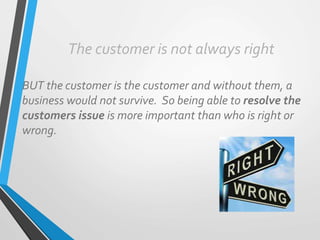
The customer is not always right
BUT the customer is the customer and without them, a
business would not survive. So being able to resolve the
customers issue is more important than who is right or
wrong.
Complaint
Strategies
If a customer complains they are giving you a chance to
retain their business rather than going straight to a
competitor.
A complaint gives us the opportunity to
• Build trust
• Build long term relationships (if we have handled the complaint
correctly in the past they will use the service again as they will
believe that we care about their issues and we welcome their
feedback)
• Highlight any internal service issues/failures
How to handle a customer
complaint
How to handle complaints
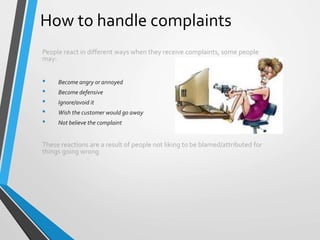
People react in different ways when they receive complaints, some people
may:
• Become angry or annoyed
• Become defensive
• Ignore/avoid it
• Wish the customer would go away
• Not believe the complaint
These reactions are a result of people not liking to be blamed/attributed for
things going wrong
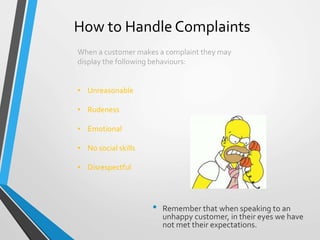
How to Handle Complaints
• Remember that when speaking to an
unhappy customer, in their eyes we have
not met their expectations.
When a customer makes a complaint they may
display the following behaviours:
• Unreasonable
• Rudeness
• Emotional
• No social skills
• Disrespectful
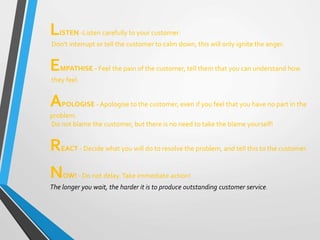
LISTEN -Listen carefully to your customer.
Don't interrupt or tell the customer to calm down, this will only ignite the anger.
EMPATHISE - Feel the pain of the customer, tell them that you can understand how
they feel.
APOLOGISE - Apologise to the customer, even if you feel that you have no part in the
problem.
Do not blame the customer, but there is no need to take the blame yourself!
REACT - Decide what you will do to resolve the problem, and tell this to the customer.
NOW! - Do not delay.Take immediate action!
The longer you wait, the harder it is to produce outstanding customer service.
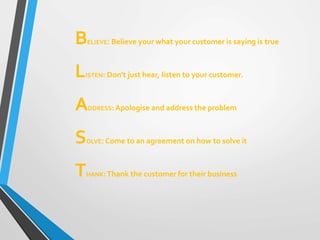
BELIEVE: Believe your what your customer is saying is true
LISTEN: Don't just hear, listen to your customer.
ADDRESS:Apologise and address the problem
SOLVE: Come to an agreement on how to solve it
THANK:Thank the customer for their business
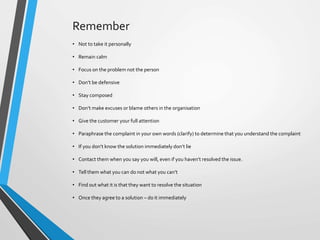
Remember
• Not to take it personally
• Remain calm
• Focus on the problem not the person
• Don’t be defensive
• Stay composed
• Don’t make excuses or blame others in the organisation
• Give the customer your full attention
• Paraphrase the complaint in your own words (clarify) to determine that you understand the complaint
• If you don’t know the solution immediately don’t lie
• Contact them when you say you will, even if you haven’t resolved the issue.
• Tell them what you can do not what you can’t
• Find out what it is that they want to resolve the situation
• Once they agree to a solution – do it immediately
So always remember BLAST or LEARN
Complaint Procedure
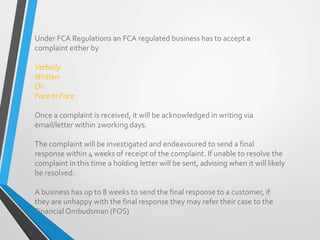
Under FCA Regulations an FCA regulated business has to accept a
complaint either by
Verbally
Written
Or
Face to Face
Once a complaint is received, it will be acknowledged in writing via
email/letter within 2working days.
The complaint will be investigated and endeavoured to send a final
response within 4 weeks of receipt of the complaint. If unable to resolve the
complaint in this time a holding letter will be sent, advising when it will likely
be resolved.
A business has up to 8 weeks to send the final response to a customer, if
they are unhappy with the final response they may refer their case to the
Financial Ombudsman (FOS)

Complaint Handling Training Presentation

  • 1.
  • 2.
    By the endof this training session you will be able to: • Identify a business receives complaints • Note what to expect from customers when they make complaints • Identify how to handle customer complaints • Learn strategies to redeem yourself when you/the company has failed in providing the level of expected service
  • 3.
    • What isa complaint? • Why do customers complain? • Complaint strategies • How to handle a complaint • Ideal complaints procedure
  • 4.
    What is acomplaint?
  • 5.
    What is acomplaint? An expression of dissatisfaction or concerns made to a company, related to its product or services.
  • 6.
  • 7.
    Why do customerscomplain? • Their expectations have not been met • To release their frustration • To help improve the service
  • 8.
    Most common complaints Inaccurateinformation/ lack of adequate information Poor customer service Overpricing Delays System errors Website/App not user friendly HiddenT&C’s WHY DO CUSTOMERS COMPLAIN?
  • 9.
    The customer isnot always right BUT the customer is the customer and without them, a business would not survive. So being able to resolve the customers issue is more important than who is right or wrong.
  • 10.
  • 11.
    If a customercomplains they are giving you a chance to retain their business rather than going straight to a competitor. A complaint gives us the opportunity to • Build trust • Build long term relationships (if we have handled the complaint correctly in the past they will use the service again as they will believe that we care about their issues and we welcome their feedback) • Highlight any internal service issues/failures
  • 12.
    How to handlea customer complaint
  • 13.
    How to handlecomplaints People react in different ways when they receive complaints, some people may: • Become angry or annoyed • Become defensive • Ignore/avoid it • Wish the customer would go away • Not believe the complaint These reactions are a result of people not liking to be blamed/attributed for things going wrong
  • 14.
    How to HandleComplaints • Remember that when speaking to an unhappy customer, in their eyes we have not met their expectations. When a customer makes a complaint they may display the following behaviours: • Unreasonable • Rudeness • Emotional • No social skills • Disrespectful
  • 15.
    LISTEN -Listen carefullyto your customer. Don't interrupt or tell the customer to calm down, this will only ignite the anger. EMPATHISE - Feel the pain of the customer, tell them that you can understand how they feel. APOLOGISE - Apologise to the customer, even if you feel that you have no part in the problem. Do not blame the customer, but there is no need to take the blame yourself! REACT - Decide what you will do to resolve the problem, and tell this to the customer. NOW! - Do not delay.Take immediate action! The longer you wait, the harder it is to produce outstanding customer service.
  • 16.
    BELIEVE: Believe yourwhat your customer is saying is true LISTEN: Don't just hear, listen to your customer. ADDRESS:Apologise and address the problem SOLVE: Come to an agreement on how to solve it THANK:Thank the customer for their business
  • 17.
    Remember • Not totake it personally • Remain calm • Focus on the problem not the person • Don’t be defensive • Stay composed • Don’t make excuses or blame others in the organisation • Give the customer your full attention • Paraphrase the complaint in your own words (clarify) to determine that you understand the complaint • If you don’t know the solution immediately don’t lie • Contact them when you say you will, even if you haven’t resolved the issue. • Tell them what you can do not what you can’t • Find out what it is that they want to resolve the situation • Once they agree to a solution – do it immediately
  • 18.
    So always rememberBLAST or LEARN
  • 19.
  • 20.
    Under FCA Regulationsan FCA regulated business has to accept a complaint either by Verbally Written Or Face to Face Once a complaint is received, it will be acknowledged in writing via email/letter within 2working days. The complaint will be investigated and endeavoured to send a final response within 4 weeks of receipt of the complaint. If unable to resolve the complaint in this time a holding letter will be sent, advising when it will likely be resolved. A business has up to 8 weeks to send the final response to a customer, if they are unhappy with the final response they may refer their case to the Financial Ombudsman (FOS)