HANDLING CUSTOMER
COMPLAINTS
 At the end of this training session, you will be able to:
 Identify reasons why a complaint is a gift from the
customer to the service provider
 Note what to expect from customers when they make
complaints
 Identify how to handle customer complaints
 Learn strategies to redeem yourself when you have
failed in providing the customer the level of expected
service
OBJECTIVES
 What is a Complaint?
 Identifying A Complaint As A Gift
 Steps For Handling Customer Complaints
 Service Recovery Process
 Handling Difficult Customers
CONTENT
What is a Complaint?
SESSION 1
What is a Complaint?
 “An expression of dissatisfaction made to an
organization, related to its products or services,
or the complaints-handling process itself, where
a response or resolution is explicitly or implicitly
expected”
5
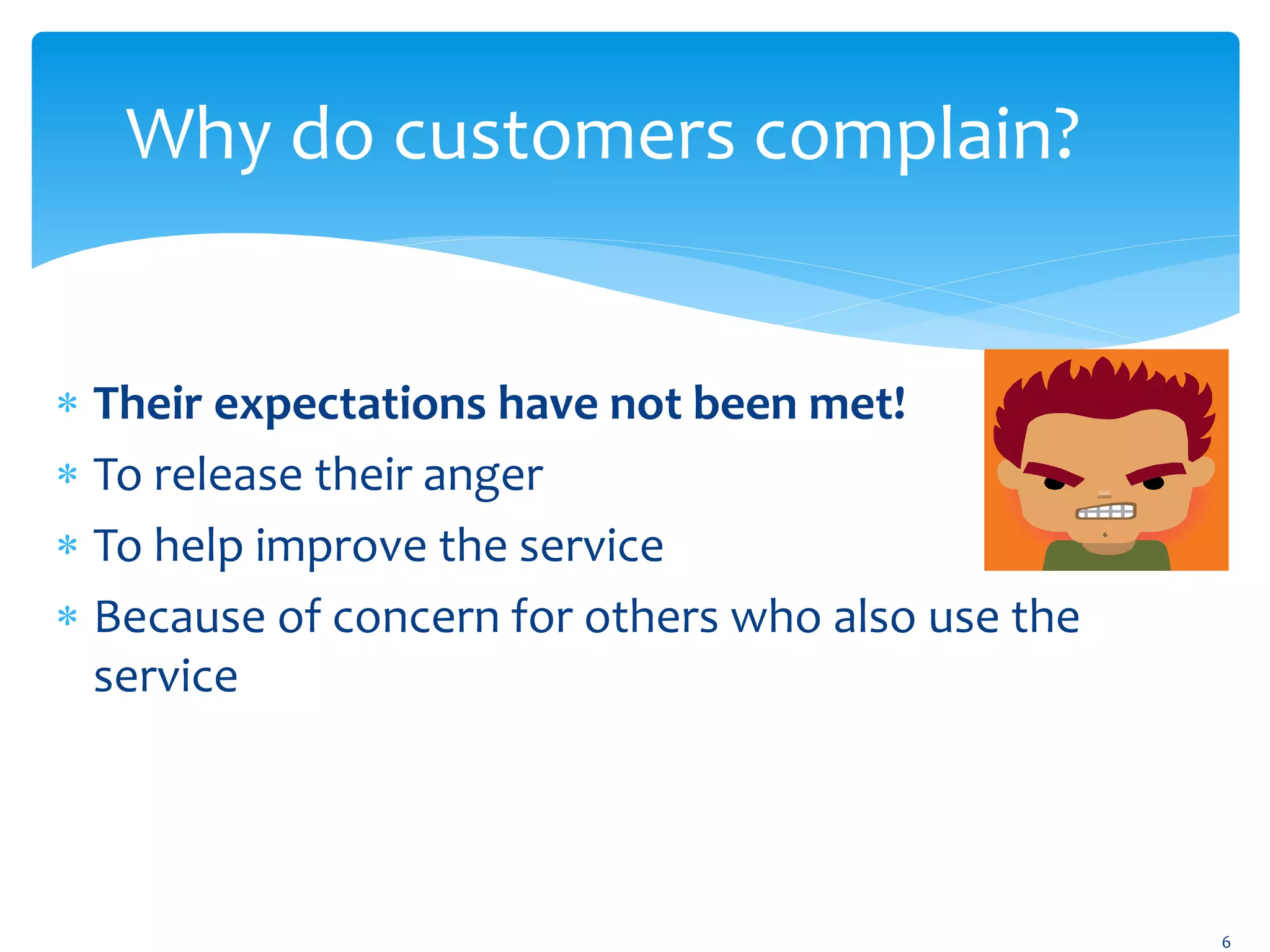
Why do customers complain?
 Their expectations have not been met!
 To release their anger
 To help improve the service
 Because of concern for others who also use the
service
6
 What proportion of unhappy customers complain?
 Generally 9% to 37% of unhappy customers make complaints
to the firms.
 The rest never bother to complain
 Why don’t unhappy customers complain?
 They think it is not worth the time or effort.
 They further think that no one would be concerned about
their problem or solve it.
 They do not know where to go or what to do.
Why do customers complain?
Each happy customer will tell at least six other people
Most common complaints...
 Wrong information
 Poor customer service attitude
 Overpricing
 Lack of adequate information
 Delays
 Unresponsiveness of service
providers
 ….
 ……
 The customer is always the customer and this means simply
that solving the problem is often more important than who
is right.
 If you can solve their problem without blaming yourself or
others,
 you will reduce stress,
 everyone will feel better and
 you will be on your way to attaining CUSTOMER
SATISFACTION
The customer is not always right
but...
Identifying a Complaint as a Gift
SESSION 2
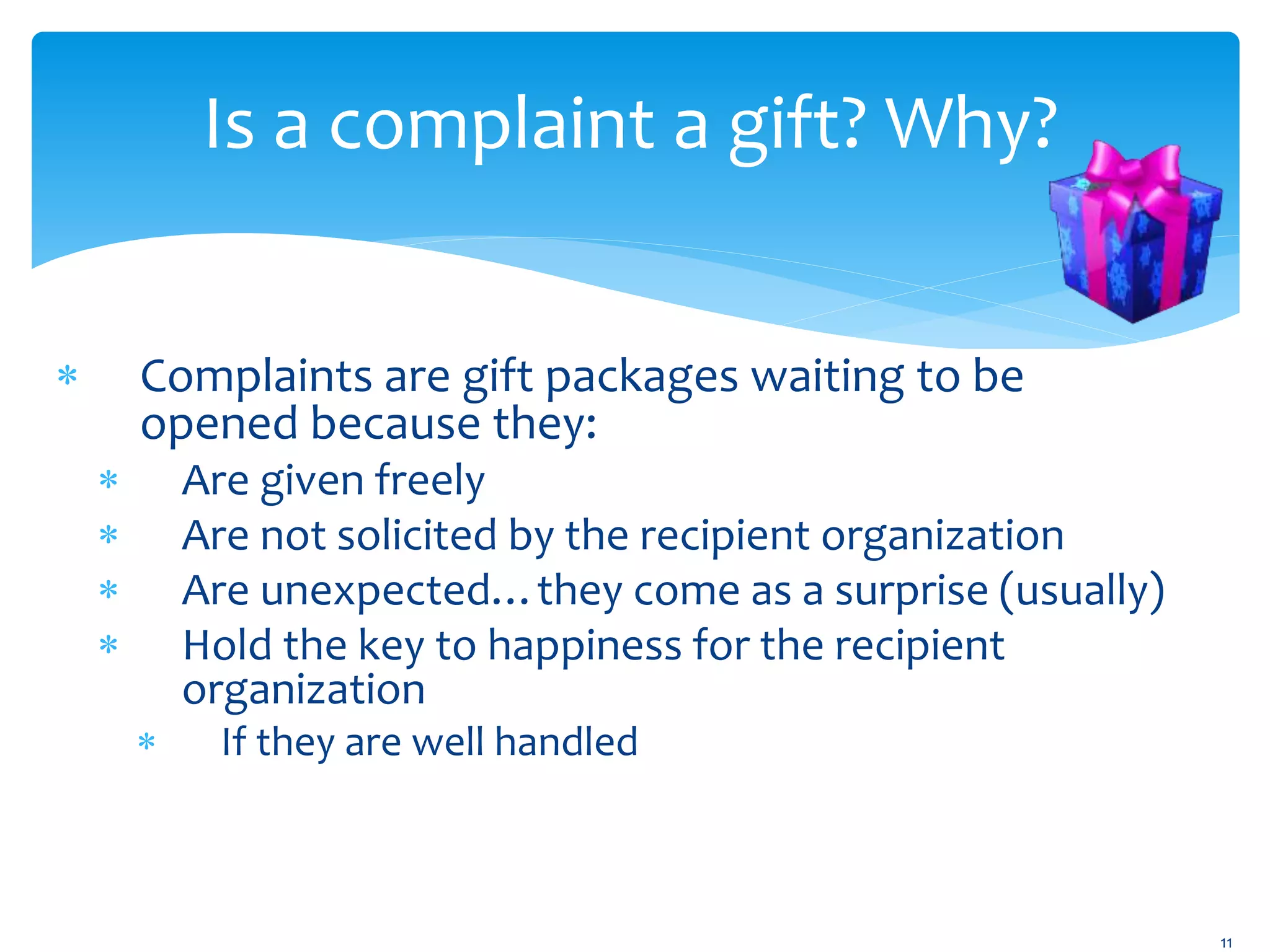
Is a complaint a gift? Why?
 Complaints are gift packages waiting to be
opened because they:
 Are given freely
 Are not solicited by the recipient organization
 Are unexpected…they come as a surprise (usually)
 Hold the key to happiness for the recipient
organization
 If they are well handled
11
Is a complaint a gift? Why?
 A complaint gives you:
 Free direct communication from the customer about
service failures, competitors offerings etc. without the
added cost of conducting a survey
 Readily available market research: they define what
customers want
12
 A complaint gives you the opportunity to:
 Increase customer trust
 Build long term relationships-
 customers will use your services again if they believe
complaints are welcomed and addressed
 Rectify service failures
 Engage customers as advocates
Is a complaint a gift? Why?
If a customer is complaining, you are being given a
chance to retain that customer
14
The customer’s needs when they
complain
 The customer has 2 separate needs when complaining-
 needs relating to the complaint
 needs as individuals and
 Example 1
 Complaint – the product is not working as expected
 Underlying message – I don’t understand the new technology, I need help
 Example 2
 Complaint- I was disappointed with the service during my last visit
 Underlying message – I am testing the value you place on my loyalty to your
business
15
The customer’s needs when they
complain
 Needs relating to the complaint
 To have their concern dealt with quickly, fairly and properly
 To be given what they have been denied and perhaps an apology
 To have action taken to rectify a problem or address a concern-
 a resultant process change
 Needs as individuals
 To be heard
 To be understood
 To be respected
16
When the customer’s need is
met…
 Who is your advocate???
 A person who publicly supports or
recommends you
 Someone who speaks, or argues in your
favor
17
You automatically Engage your Customer
as your Advocate!
Steps for Handling Customer
Complaints
SESSION 3
How to Handle Customer Complaints
 How do you react to customer complaints about the way
you do your work?
 Especially when you think you are doing your best???
 People react to customer complaints in different ways…
 Some
 Ignore complaints
 Become defensive
 Become angry or annoyed
 Are concerned about the loss of trade or the damage to their
professional reputation
19
 For others, it is
 A hindrance
 They just wish the customer would go away! Or
 They do not believe some or all of what the customer
is complaining about.
 These reactions are as a result of blame being
attributed to us or our organization.
How to Handle Customer Complaints
How to Handle Customer
Complaints
 In making complaints, some customers portray the following
characteristics
 Lack of gracious social skills to communicate properly
 Nervousness
 Harshness
 Very Emotional
 Lack understanding of you or your organization’s limitations
 Rudeness
 Unreasonableness
 We need to learn to expect such behaviour and remember
however that a complaint is evidence that, in the customer’s
view, we have not met their expectations.
21
How to Handle Customer
Complaints
 Listen
 Repeat
 Apologise
 Acknowledge
 Explain action
 Thank
 Follow up
 Remember not to take it
personally
 Remain calm
 Focus on the problem
and not person
 Turn unhappy people into
happy customers
 Address customers by name
 All communication should be in the first person.
 Use “I am sorry” not “we”
 Don’t make excuses or blame others in your organization
 Give the customer your full attention and establish eye
contact
 Paraphrase their complaint in your own words to
determine whether you have correctly understood the
situation.
How to Handle Customer Complaints
 If you don’t know the answer to their problem, don’t
lie.
 Call back when you say you will, even if for some
reason, you haven’t been able to obtain a satisfactory
answer by then
 Make the customer part of the solution
 not part of the problem
How to Handle Customer Complaints
 Don’t be defensive
 Be composed at all times
 Don’t take criticisms personally
 Offer an apology even if the disservice is not your fault
 Show empathy by using such phrases as: “I can understand
how you feel”, “I appreciate what you’re saying.”
How to handle customer complaints
 Tell them what you can do…not what you can’t do
 Find out what it will take to turn their dissatisfaction into
satisfaction
 If they agree to that solution, act quickly before they
change their mind
 Follow up
 And remember: You can never win an argument with a
customer
How to Handle Customer Complaints
Steps for handling complaints
Acknowledge
receipt of the
complaint
It is important that you acknowledge the receipt of all complaints,
verbal or written. Preferably allocate a complaint reference number
and provide the customer with a contact point for further
correspondence.
Accurately record
complaint
information and
make it accessible
Make sure that your recorded version of the complaint matches exactly
what the customer said. Also make sure that the complaint record is
accessible by any branch of the organization that the customer may
contact.
Attach
timeframes for
resolution of
complaint
The company should attempt to resolve complaints on first contact,
but if this is not possible, then a complaint should be finalized within a
specific number of days eg. 30 days.
At the organization’s level, there is the need for a complaint handling system which
will involve the following steps as a minimum:
Steps for handling complaints
Customers must
be informed
about any delays
in resolving a
complaint
As soon as you realizes that they are unable to resolve a
complaint within the given timeframe, contact the customer,
and inform advising him/ her of the delay and set a new timeline
Make staff aware
of complaint
handling
procedures
The complaint handling procedures should be known to all
employees and be part of regular training
Inform Customers
Of Complaint
Handling
Procedures
Posting your complaint handling procedures on your office
premises is a good way to inform customers. Also these
procedures may be incorporated in the organisation’s brochure
 HOW?
 THROUGH
 Surveys,
 focus groups,
 mystery shopping
 One complaint statistically represents 24 similar ones
Find out what your customers really
think…
Strategies for Service Recovery
SESSION 4
 Service recovery is how you remedy a failed service
encounter with a customer. In other words,
 pull a customer from hell to heaven in the shortest
possible time.
 It involves:
 apologizing,
 solving the problem,
 compensating the customer with something of value
What is service recovery
 95% of customers who have a complaint that was
handled efficiently and promptly will not only
continue to do business but will become even
more loyal (Wharton Business School)
 So how do you make amends or appease the
customer?
 Through
 product replacements,
 good will gifts,
 free of charge services, etc…
Service recovery
Some important statistics
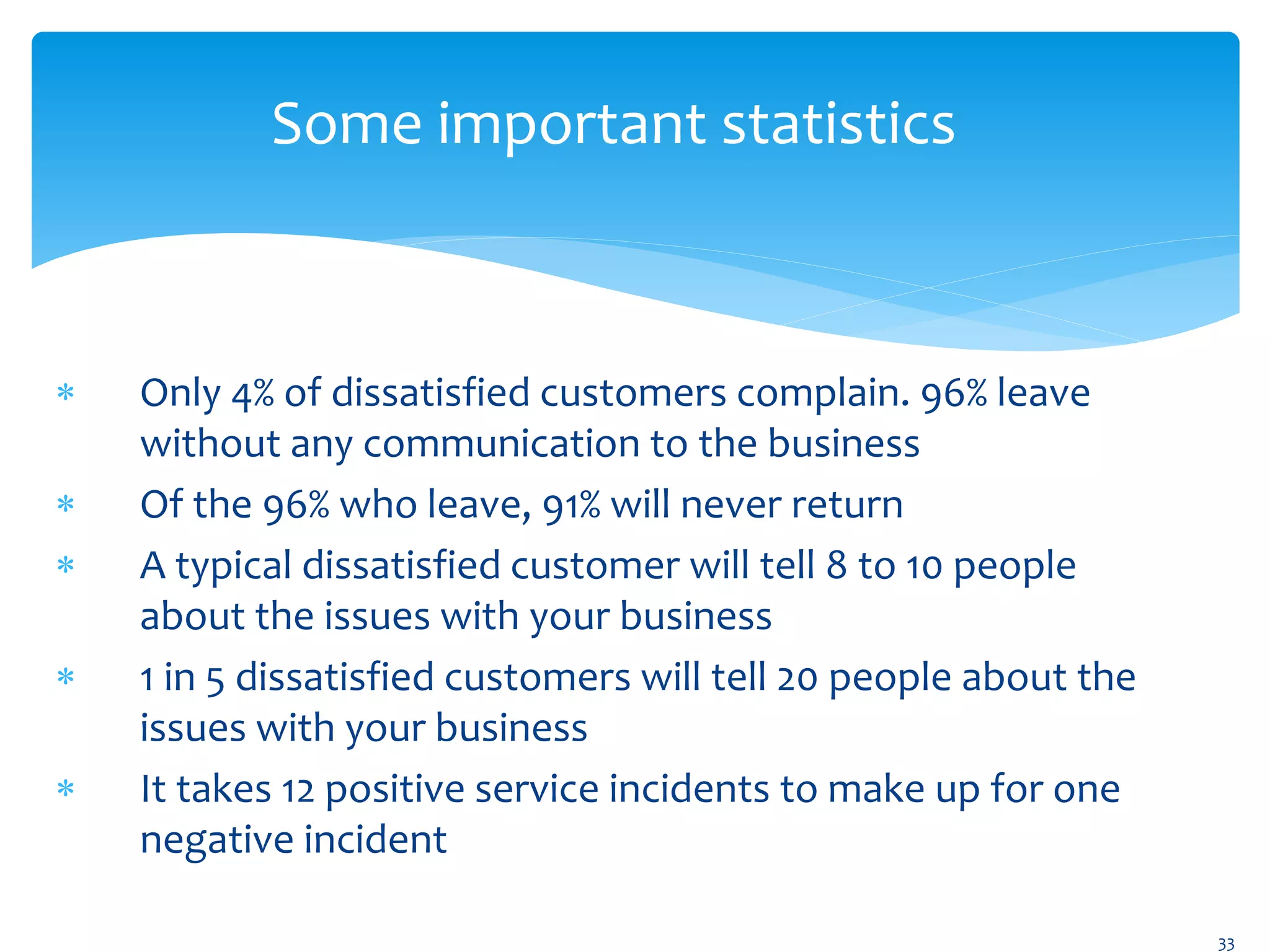
 Only 4% of dissatisfied customers complain. 96% leave
without any communication to the business
 Of the 96% who leave, 91% will never return
 A typical dissatisfied customer will tell 8 to 10 people
about the issues with your business
 1 in 5 dissatisfied customers will tell 20 people about the
issues with your business
 It takes 12 positive service incidents to make up for one
negative incident
33
Some important statistics
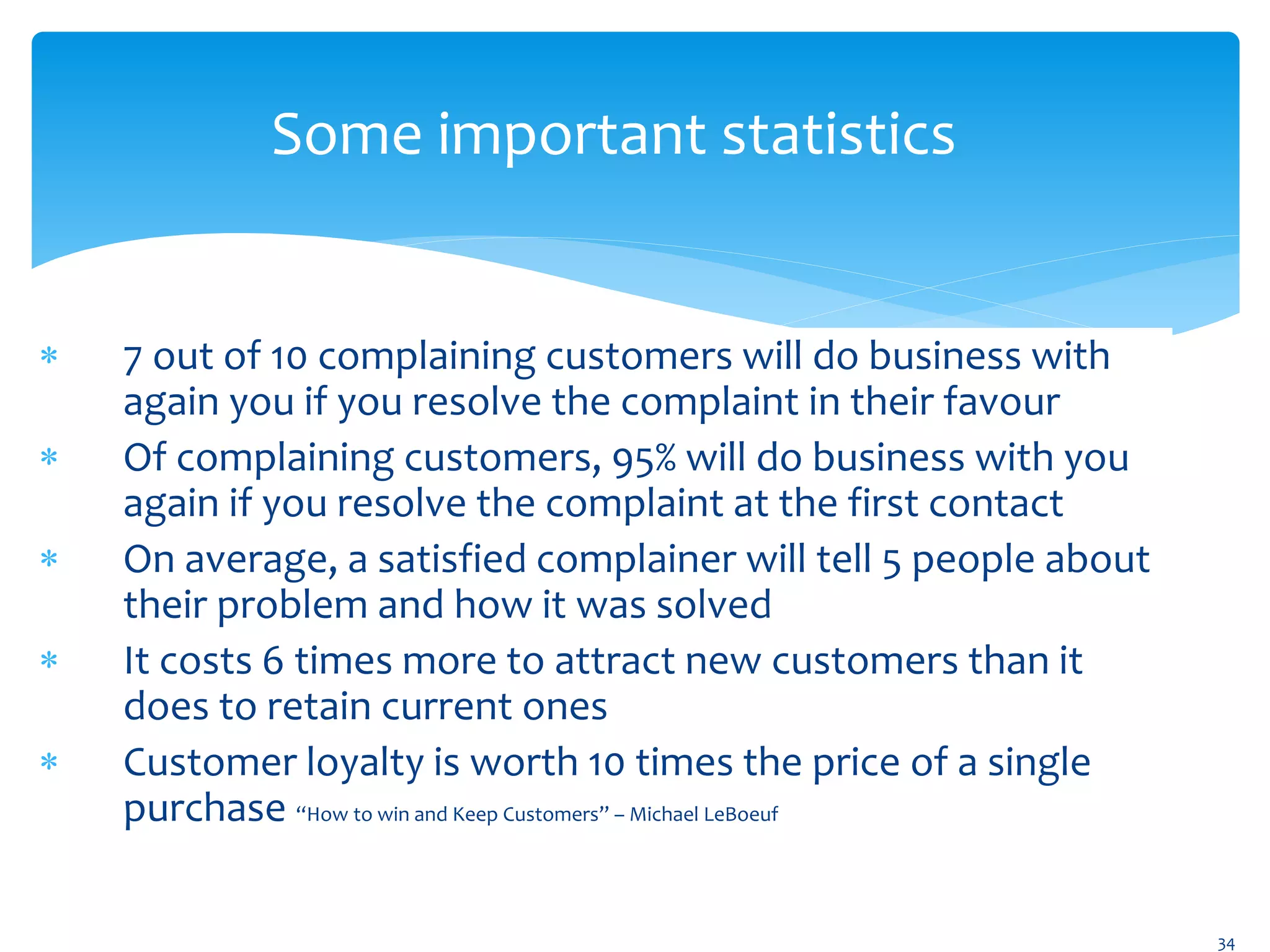
 7 out of 10 complaining customers will do business with
again you if you resolve the complaint in their favour
 Of complaining customers, 95% will do business with you
again if you resolve the complaint at the first contact
 On average, a satisfied complainer will tell 5 people about
their problem and how it was solved
 It costs 6 times more to attract new customers than it
does to retain current ones
 Customer loyalty is worth 10 times the price of a single
purchase “How to win and Keep Customers” – Michael LeBoeuf
34
Handling Difficult Customers
SESSION 5
 Who is a difficult customer?
How do you handle such people?
Handling Difficult Customers
Types of Difficult Customers
 Angry
 Nasty
 Demanding
 Critical
 Non-stop Talker
 Indecisive
 Sarcastic
 Argumentative
Why Are They Difficult?
 They are often expressing
a need but chose an
appropriate and impolite
way to communicate this
need
 They are difficult for their
own reasons –
 not because of you
Common Reasons For Being Difficult
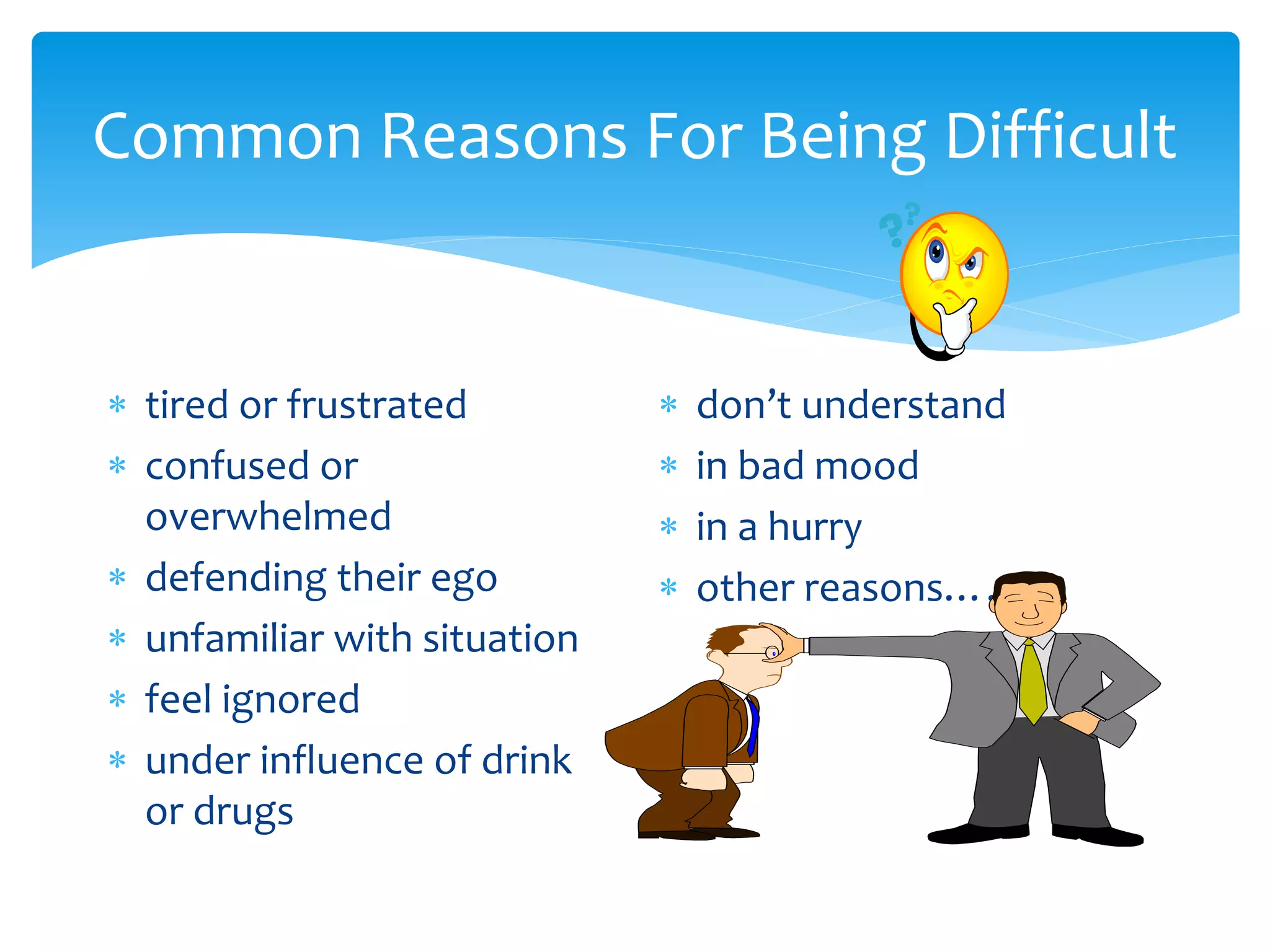
 tired or frustrated
 confused or
overwhelmed
 defending their ego
 unfamiliar with situation
 feel ignored
 under influence of drink
or drugs
 don’t understand
 in bad mood
 in a hurry
 other reasons…..
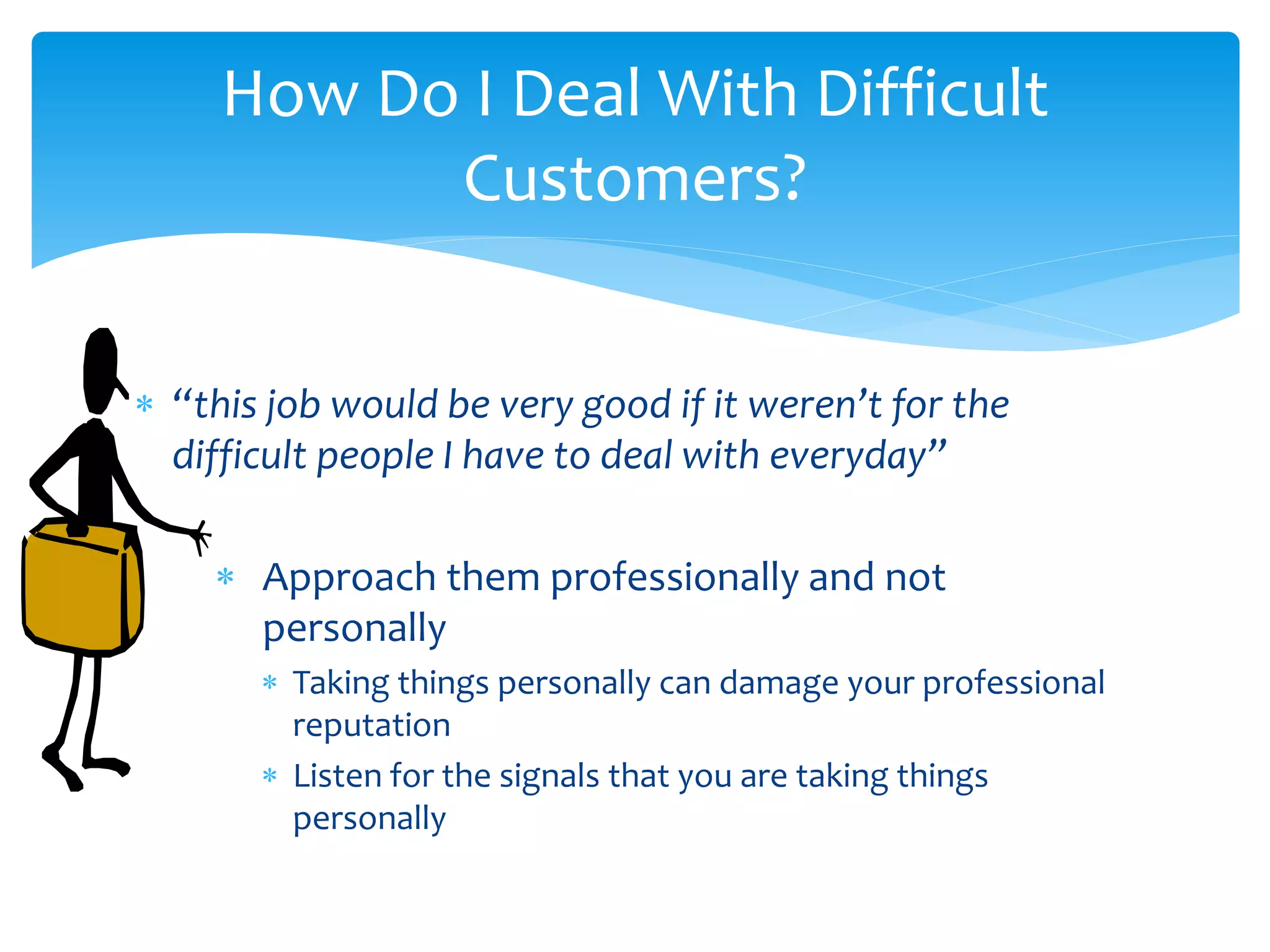
 “this job would be very good if it weren’t for the
difficult people I have to deal with everyday”
 Approach them professionally and not
personally
 Taking things personally can damage your professional
reputation
 Listen for the signals that you are taking things
personally
How Do I Deal With Difficult
Customers?
 Check you customer service attitude
 Attitude is the key to success
 Attitude is your mental position on facts - or more simply,
the way you view things
How Do I Deal With Difficult
Customers?
How Do I Deal With Difficult
Customers?
 Five points about
attitude:
 your attitude towards
customers influences
your behaviour. You
cannot always
camouflage how you feel
 your attitude determines
the level of job
satisfaction
 your attitude affects
everyone who comes in
contact with you
 tone and body language
reflect your attitude
 your attitude is not fixed.
The attitude you choose
to display is up to YOU
How Do I Deal With Difficult
Customers?
 Remind yourself!
 This is my job and I’m
going to do it
professionally
 If it were not for these
customers I would not
have a job
 Every time I solve a
problem I will feel better
 Reinforce this by saying…
 “I like the job, not
because it’s easy, not
because there are no
difficult people, not
because there are no
frustrations but because
people are part of any job
and I can make things
easier by taking things
professionally
 Be positive
 Take things professionally and not personally
 Aim for customer satisfaction, not just service
 Solve problems without blaming yourself or others
 Remember attitudes are caught, not taught
Summary

Handling Customer Complaints

  • 1.
  • 2.
     At theend of this training session, you will be able to:  Identify reasons why a complaint is a gift from the customer to the service provider  Note what to expect from customers when they make complaints  Identify how to handle customer complaints  Learn strategies to redeem yourself when you have failed in providing the customer the level of expected service OBJECTIVES
  • 3.
     What isa Complaint?  Identifying A Complaint As A Gift  Steps For Handling Customer Complaints  Service Recovery Process  Handling Difficult Customers CONTENT
  • 4.
    What is aComplaint? SESSION 1
  • 5.
    What is aComplaint?  “An expression of dissatisfaction made to an organization, related to its products or services, or the complaints-handling process itself, where a response or resolution is explicitly or implicitly expected” 5
  • 6.
    Why do customerscomplain?  Their expectations have not been met!  To release their anger  To help improve the service  Because of concern for others who also use the service 6
  • 7.
     What proportionof unhappy customers complain?  Generally 9% to 37% of unhappy customers make complaints to the firms.  The rest never bother to complain  Why don’t unhappy customers complain?  They think it is not worth the time or effort.  They further think that no one would be concerned about their problem or solve it.  They do not know where to go or what to do. Why do customers complain? Each happy customer will tell at least six other people
  • 8.
    Most common complaints... Wrong information  Poor customer service attitude  Overpricing  Lack of adequate information  Delays  Unresponsiveness of service providers  ….  ……
  • 9.
     The customeris always the customer and this means simply that solving the problem is often more important than who is right.  If you can solve their problem without blaming yourself or others,  you will reduce stress,  everyone will feel better and  you will be on your way to attaining CUSTOMER SATISFACTION The customer is not always right but...
  • 10.
    Identifying a Complaintas a Gift SESSION 2
  • 11.
    Is a complainta gift? Why?  Complaints are gift packages waiting to be opened because they:  Are given freely  Are not solicited by the recipient organization  Are unexpected…they come as a surprise (usually)  Hold the key to happiness for the recipient organization  If they are well handled 11
  • 12.
    Is a complainta gift? Why?  A complaint gives you:  Free direct communication from the customer about service failures, competitors offerings etc. without the added cost of conducting a survey  Readily available market research: they define what customers want 12
  • 13.
     A complaintgives you the opportunity to:  Increase customer trust  Build long term relationships-  customers will use your services again if they believe complaints are welcomed and addressed  Rectify service failures  Engage customers as advocates Is a complaint a gift? Why?
  • 14.
    Is a complainta gift? Why? If a customer is complaining, you are being given a chance to retain that customer 14
  • 15.
    The customer’s needswhen they complain  The customer has 2 separate needs when complaining-  needs relating to the complaint  needs as individuals and  Example 1  Complaint – the product is not working as expected  Underlying message – I don’t understand the new technology, I need help  Example 2  Complaint- I was disappointed with the service during my last visit  Underlying message – I am testing the value you place on my loyalty to your business 15
  • 16.
    The customer’s needswhen they complain  Needs relating to the complaint  To have their concern dealt with quickly, fairly and properly  To be given what they have been denied and perhaps an apology  To have action taken to rectify a problem or address a concern-  a resultant process change  Needs as individuals  To be heard  To be understood  To be respected 16
  • 17.
    When the customer’sneed is met…  Who is your advocate???  A person who publicly supports or recommends you  Someone who speaks, or argues in your favor 17 You automatically Engage your Customer as your Advocate!
  • 18.
    Steps for HandlingCustomer Complaints SESSION 3
  • 19.
    How to HandleCustomer Complaints  How do you react to customer complaints about the way you do your work?  Especially when you think you are doing your best???  People react to customer complaints in different ways…  Some  Ignore complaints  Become defensive  Become angry or annoyed  Are concerned about the loss of trade or the damage to their professional reputation 19
  • 20.
     For others,it is  A hindrance  They just wish the customer would go away! Or  They do not believe some or all of what the customer is complaining about.  These reactions are as a result of blame being attributed to us or our organization. How to Handle Customer Complaints
  • 21.
    How to HandleCustomer Complaints  In making complaints, some customers portray the following characteristics  Lack of gracious social skills to communicate properly  Nervousness  Harshness  Very Emotional  Lack understanding of you or your organization’s limitations  Rudeness  Unreasonableness  We need to learn to expect such behaviour and remember however that a complaint is evidence that, in the customer’s view, we have not met their expectations. 21
  • 22.
    How to HandleCustomer Complaints  Listen  Repeat  Apologise  Acknowledge  Explain action  Thank  Follow up  Remember not to take it personally  Remain calm  Focus on the problem and not person  Turn unhappy people into happy customers
  • 23.
     Address customersby name  All communication should be in the first person.  Use “I am sorry” not “we”  Don’t make excuses or blame others in your organization  Give the customer your full attention and establish eye contact  Paraphrase their complaint in your own words to determine whether you have correctly understood the situation. How to Handle Customer Complaints
  • 24.
     If youdon’t know the answer to their problem, don’t lie.  Call back when you say you will, even if for some reason, you haven’t been able to obtain a satisfactory answer by then  Make the customer part of the solution  not part of the problem How to Handle Customer Complaints
  • 25.
     Don’t bedefensive  Be composed at all times  Don’t take criticisms personally  Offer an apology even if the disservice is not your fault  Show empathy by using such phrases as: “I can understand how you feel”, “I appreciate what you’re saying.” How to handle customer complaints
  • 26.
     Tell themwhat you can do…not what you can’t do  Find out what it will take to turn their dissatisfaction into satisfaction  If they agree to that solution, act quickly before they change their mind  Follow up  And remember: You can never win an argument with a customer How to Handle Customer Complaints
  • 27.
    Steps for handlingcomplaints Acknowledge receipt of the complaint It is important that you acknowledge the receipt of all complaints, verbal or written. Preferably allocate a complaint reference number and provide the customer with a contact point for further correspondence. Accurately record complaint information and make it accessible Make sure that your recorded version of the complaint matches exactly what the customer said. Also make sure that the complaint record is accessible by any branch of the organization that the customer may contact. Attach timeframes for resolution of complaint The company should attempt to resolve complaints on first contact, but if this is not possible, then a complaint should be finalized within a specific number of days eg. 30 days. At the organization’s level, there is the need for a complaint handling system which will involve the following steps as a minimum:
  • 28.
    Steps for handlingcomplaints Customers must be informed about any delays in resolving a complaint As soon as you realizes that they are unable to resolve a complaint within the given timeframe, contact the customer, and inform advising him/ her of the delay and set a new timeline Make staff aware of complaint handling procedures The complaint handling procedures should be known to all employees and be part of regular training Inform Customers Of Complaint Handling Procedures Posting your complaint handling procedures on your office premises is a good way to inform customers. Also these procedures may be incorporated in the organisation’s brochure
  • 29.
     HOW?  THROUGH Surveys,  focus groups,  mystery shopping  One complaint statistically represents 24 similar ones Find out what your customers really think…
  • 30.
    Strategies for ServiceRecovery SESSION 4
  • 31.
     Service recoveryis how you remedy a failed service encounter with a customer. In other words,  pull a customer from hell to heaven in the shortest possible time.  It involves:  apologizing,  solving the problem,  compensating the customer with something of value What is service recovery
  • 32.
     95% ofcustomers who have a complaint that was handled efficiently and promptly will not only continue to do business but will become even more loyal (Wharton Business School)  So how do you make amends or appease the customer?  Through  product replacements,  good will gifts,  free of charge services, etc… Service recovery
  • 33.
    Some important statistics Only 4% of dissatisfied customers complain. 96% leave without any communication to the business  Of the 96% who leave, 91% will never return  A typical dissatisfied customer will tell 8 to 10 people about the issues with your business  1 in 5 dissatisfied customers will tell 20 people about the issues with your business  It takes 12 positive service incidents to make up for one negative incident 33
  • 34.
    Some important statistics 7 out of 10 complaining customers will do business with again you if you resolve the complaint in their favour  Of complaining customers, 95% will do business with you again if you resolve the complaint at the first contact  On average, a satisfied complainer will tell 5 people about their problem and how it was solved  It costs 6 times more to attract new customers than it does to retain current ones  Customer loyalty is worth 10 times the price of a single purchase “How to win and Keep Customers” – Michael LeBoeuf 34
  • 35.
  • 36.
     Who isa difficult customer? How do you handle such people? Handling Difficult Customers
  • 37.
    Types of DifficultCustomers  Angry  Nasty  Demanding  Critical  Non-stop Talker  Indecisive  Sarcastic  Argumentative
  • 38.
    Why Are TheyDifficult?  They are often expressing a need but chose an appropriate and impolite way to communicate this need  They are difficult for their own reasons –  not because of you
  • 39.
    Common Reasons ForBeing Difficult  tired or frustrated  confused or overwhelmed  defending their ego  unfamiliar with situation  feel ignored  under influence of drink or drugs  don’t understand  in bad mood  in a hurry  other reasons…..
  • 40.
     “this jobwould be very good if it weren’t for the difficult people I have to deal with everyday”  Approach them professionally and not personally  Taking things personally can damage your professional reputation  Listen for the signals that you are taking things personally How Do I Deal With Difficult Customers?
  • 41.
     Check youcustomer service attitude  Attitude is the key to success  Attitude is your mental position on facts - or more simply, the way you view things How Do I Deal With Difficult Customers?
  • 42.
    How Do IDeal With Difficult Customers?  Five points about attitude:  your attitude towards customers influences your behaviour. You cannot always camouflage how you feel  your attitude determines the level of job satisfaction  your attitude affects everyone who comes in contact with you  tone and body language reflect your attitude  your attitude is not fixed. The attitude you choose to display is up to YOU
  • 43.
    How Do IDeal With Difficult Customers?  Remind yourself!  This is my job and I’m going to do it professionally  If it were not for these customers I would not have a job  Every time I solve a problem I will feel better  Reinforce this by saying…  “I like the job, not because it’s easy, not because there are no difficult people, not because there are no frustrations but because people are part of any job and I can make things easier by taking things professionally
  • 44.
     Be positive Take things professionally and not personally  Aim for customer satisfaction, not just service  Solve problems without blaming yourself or others  Remember attitudes are caught, not taught Summary