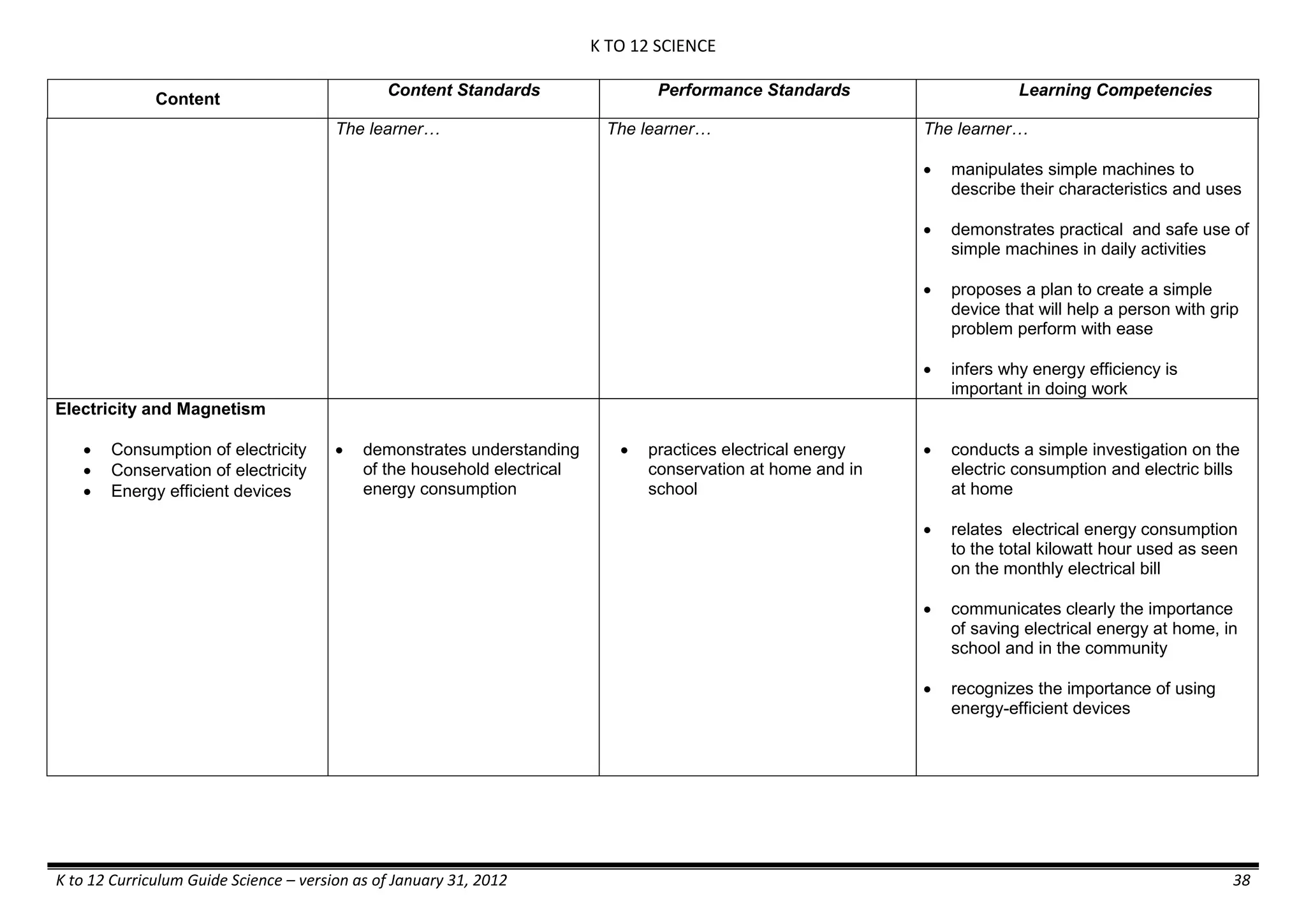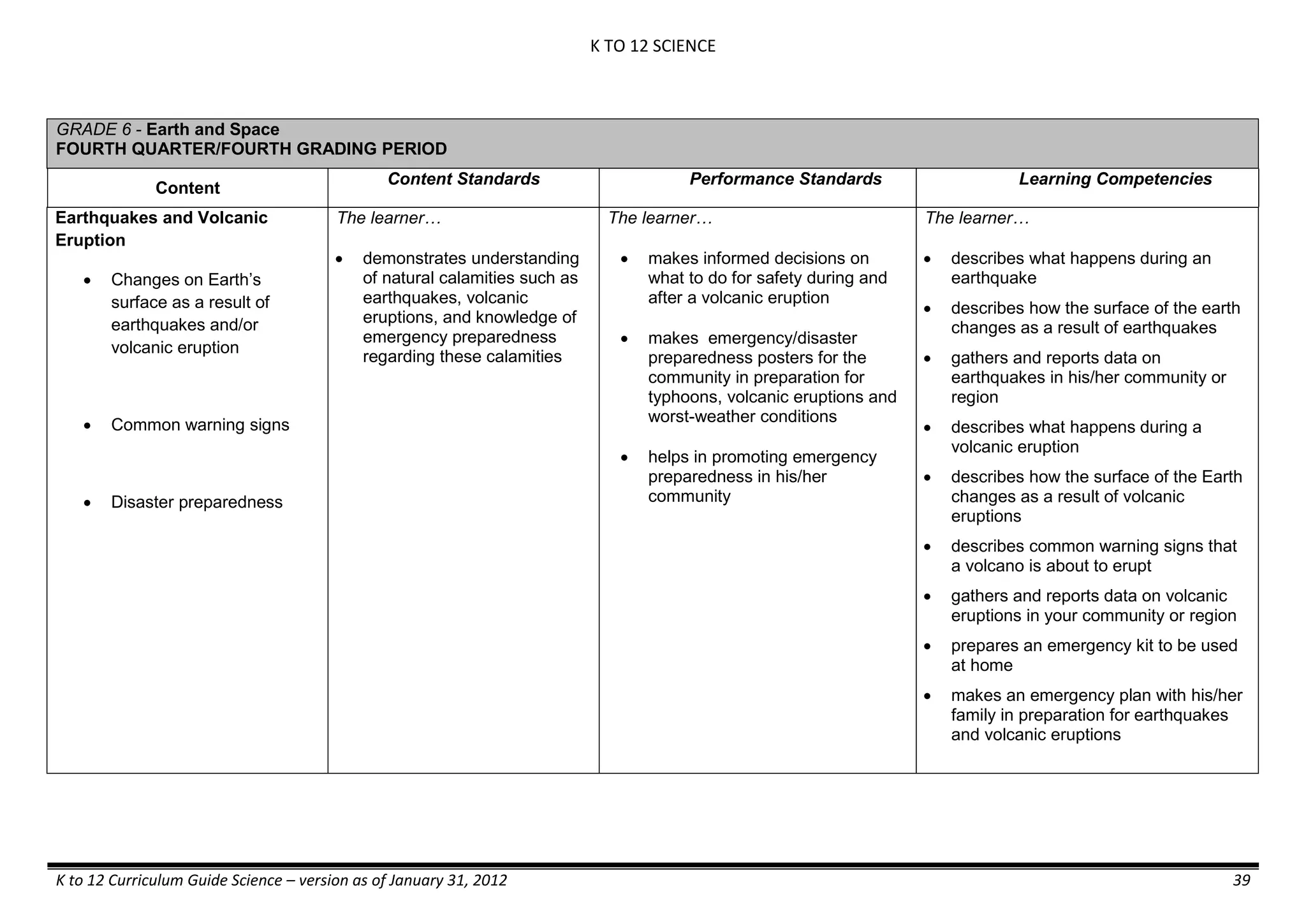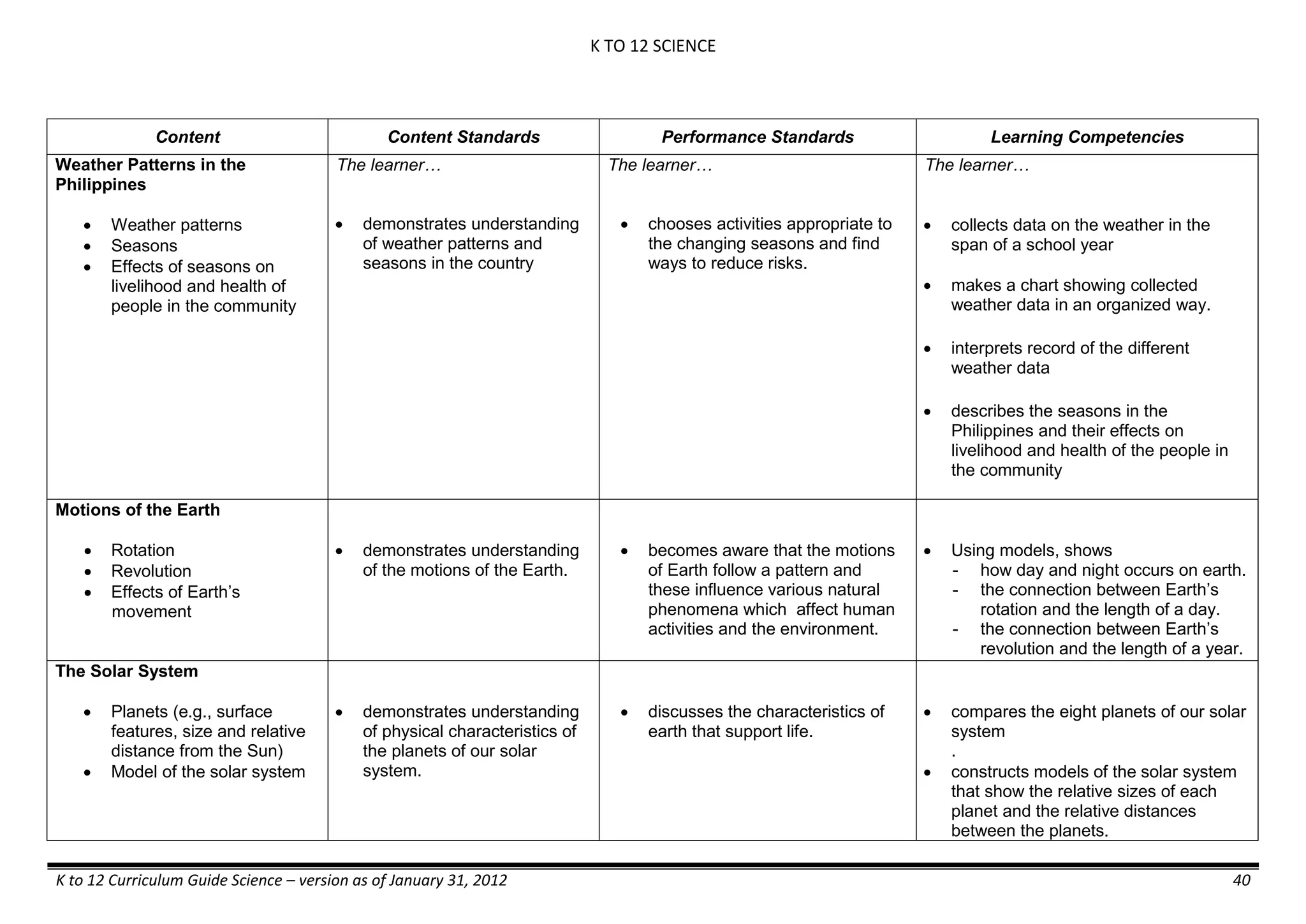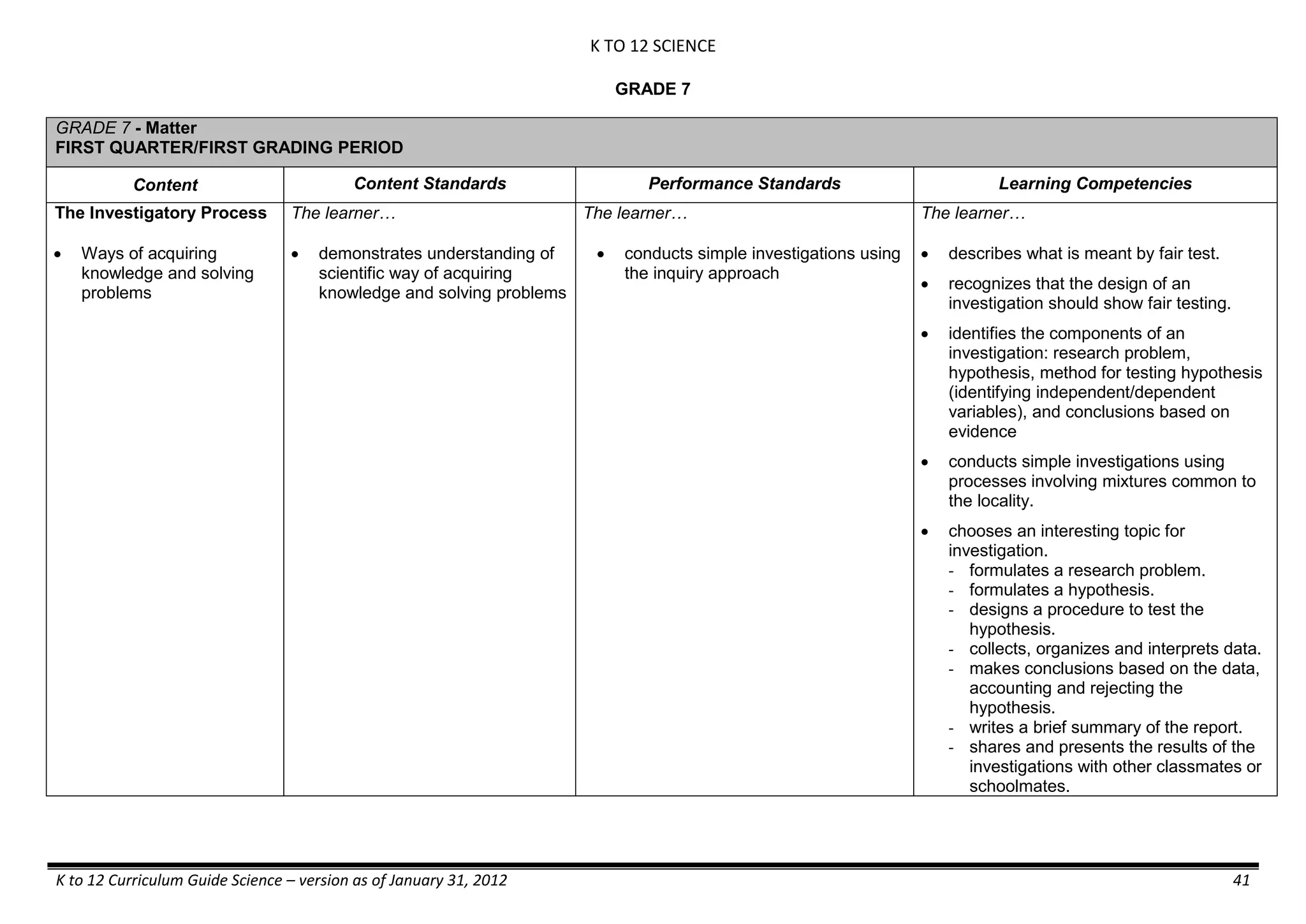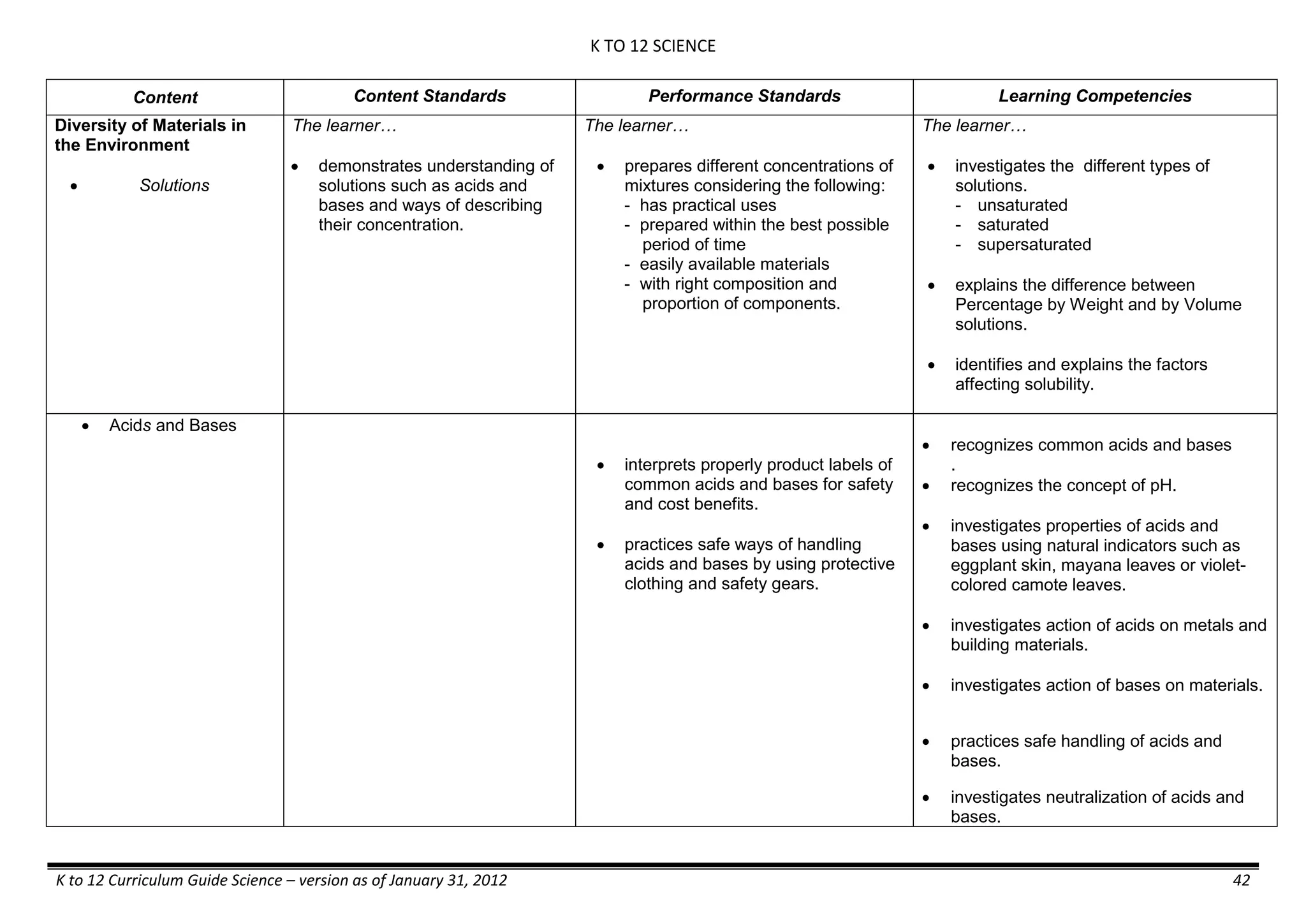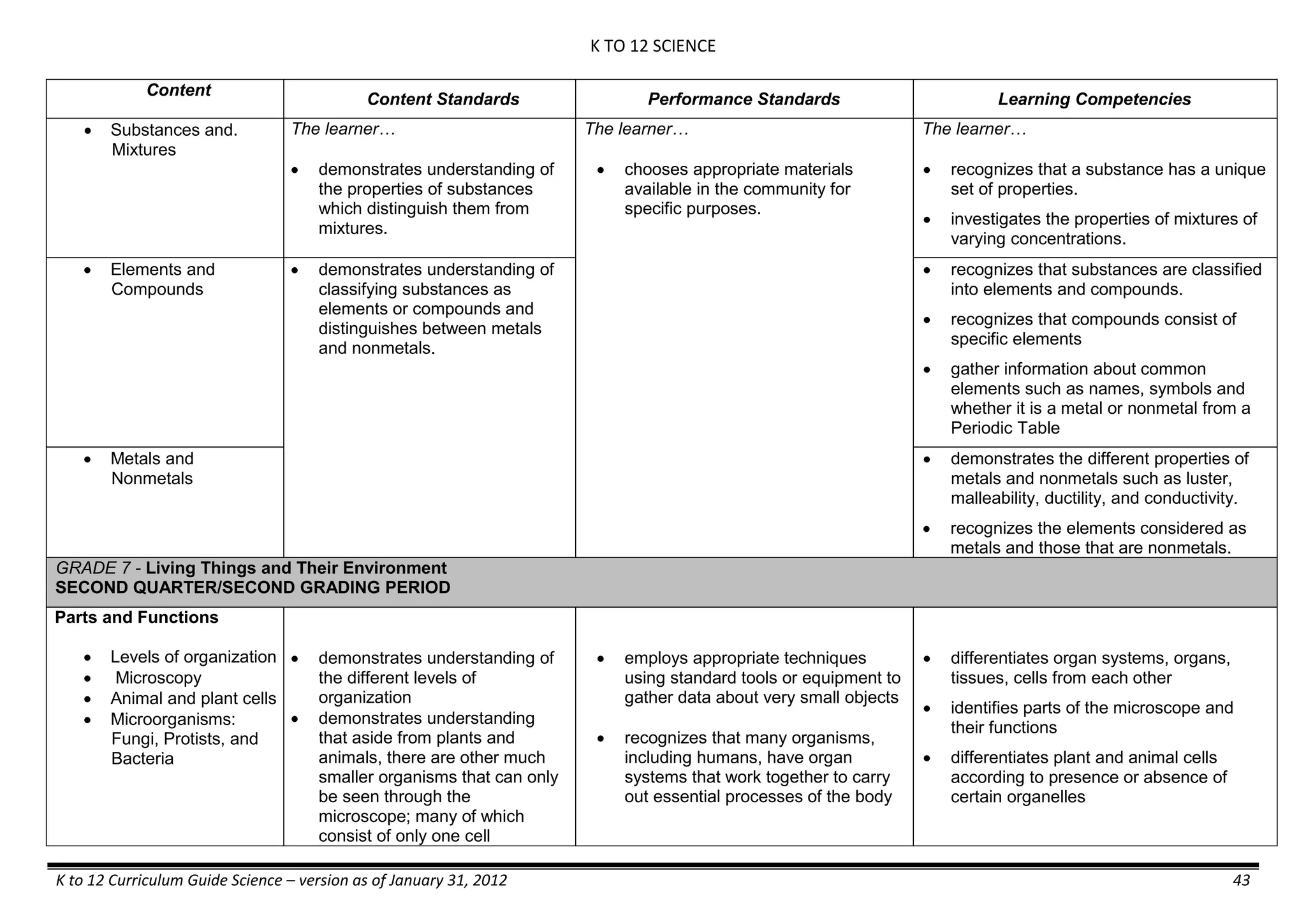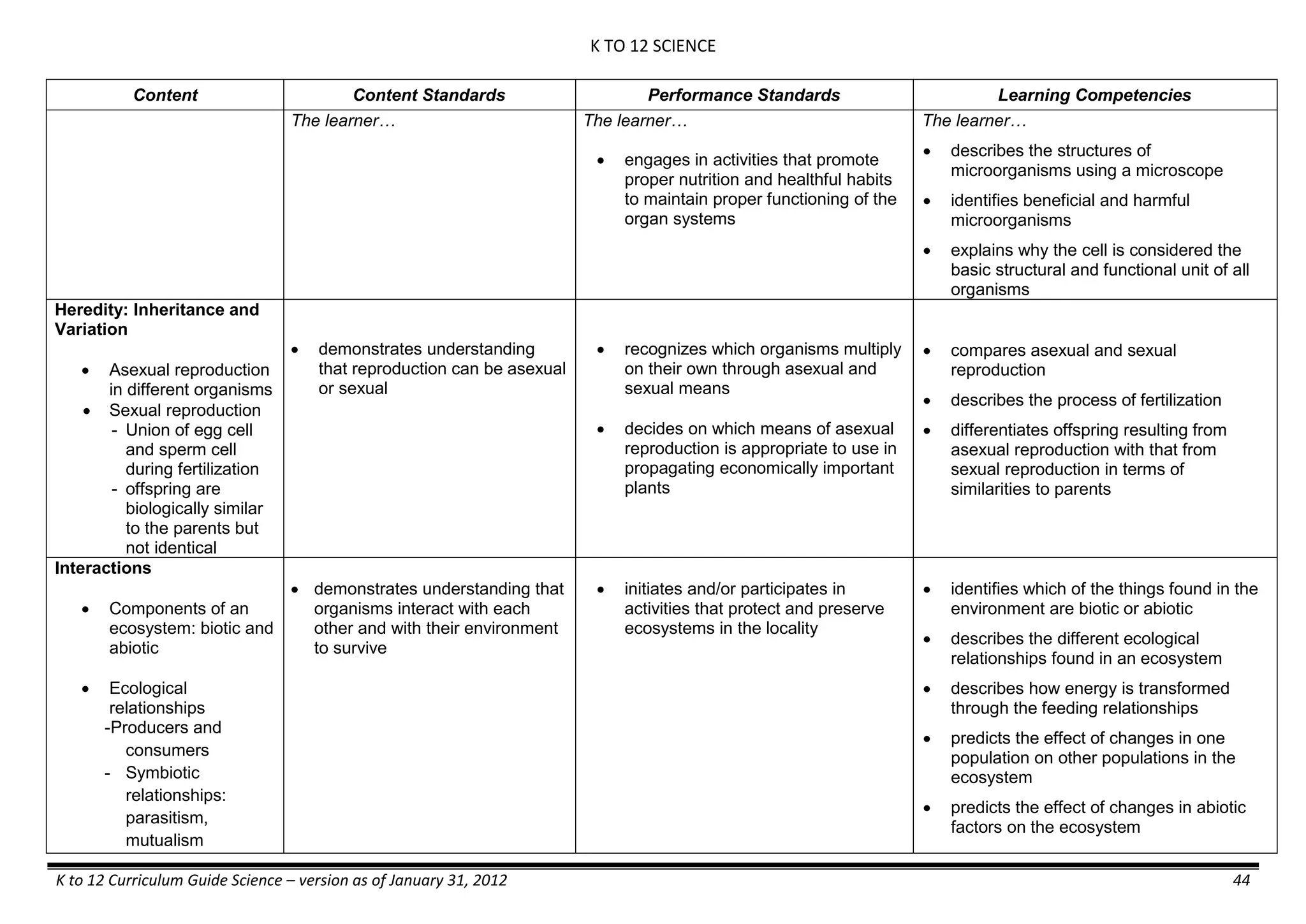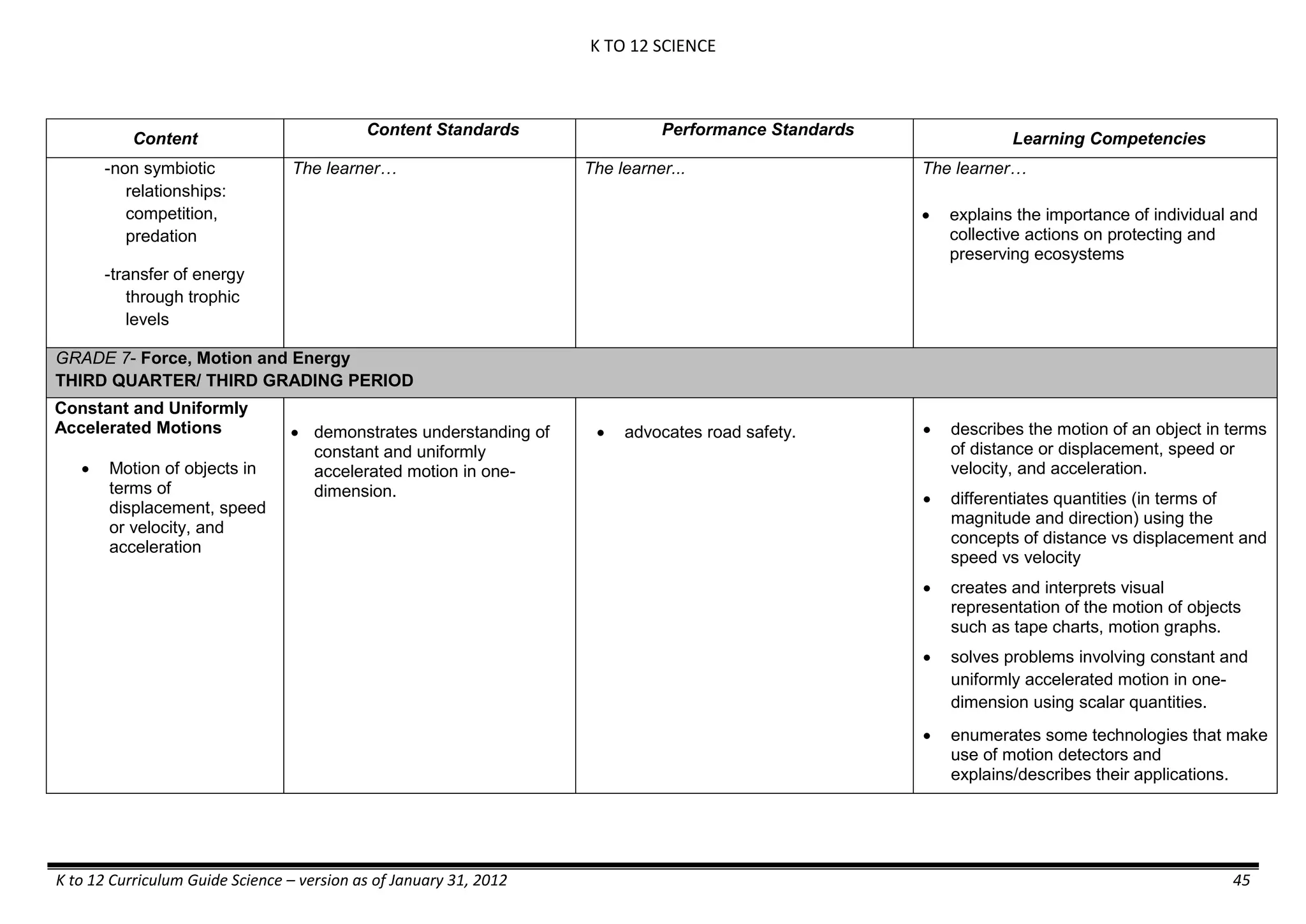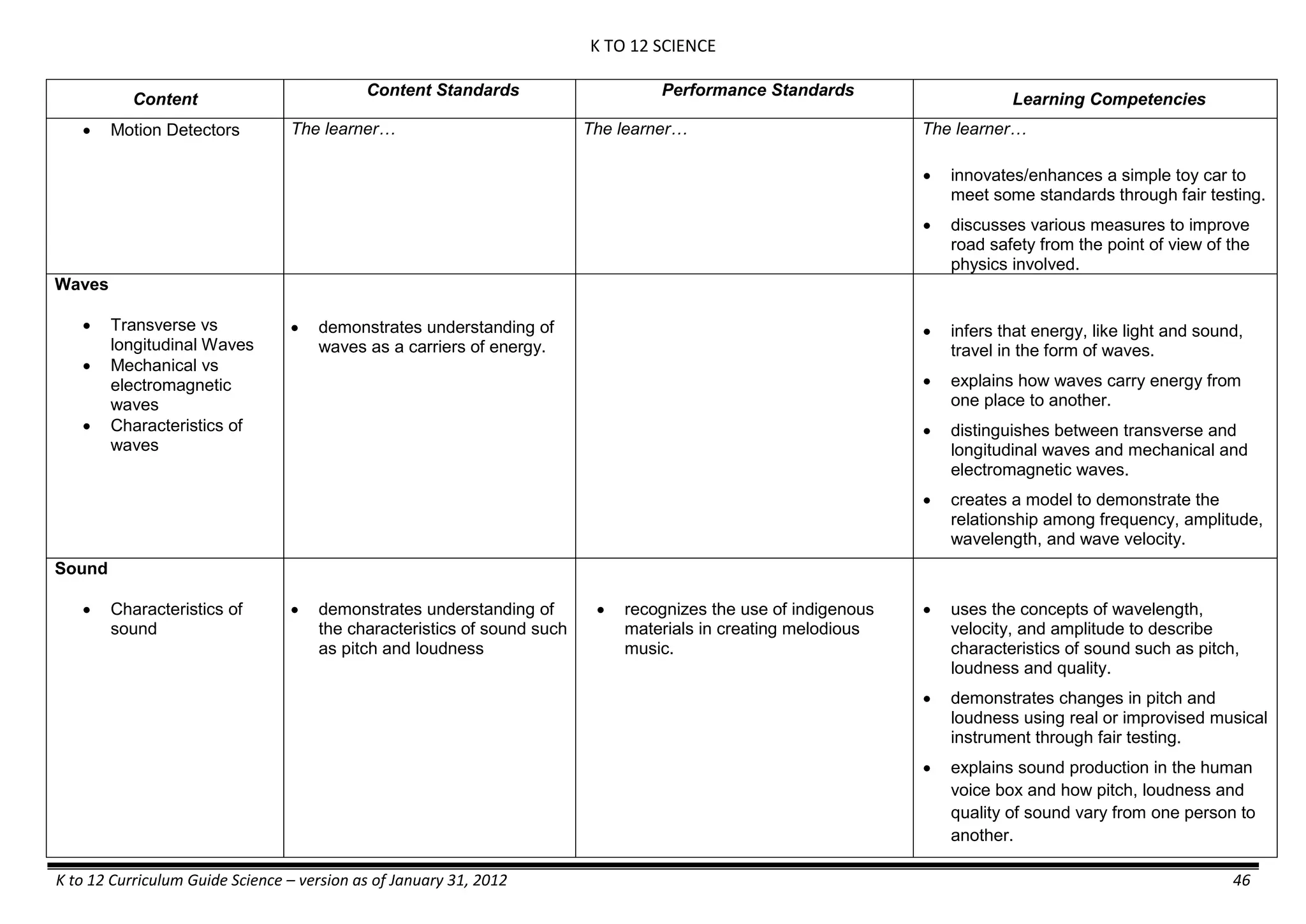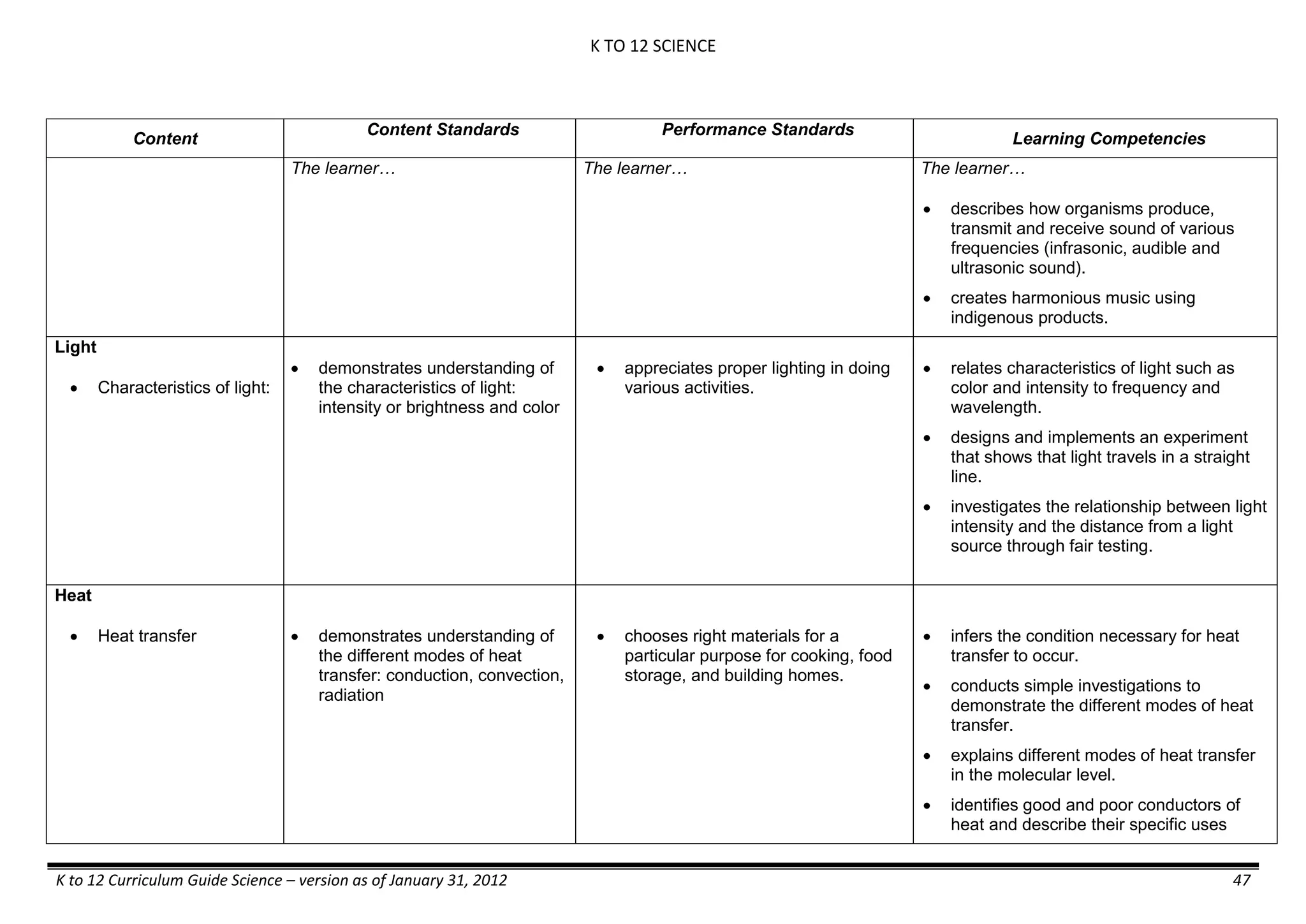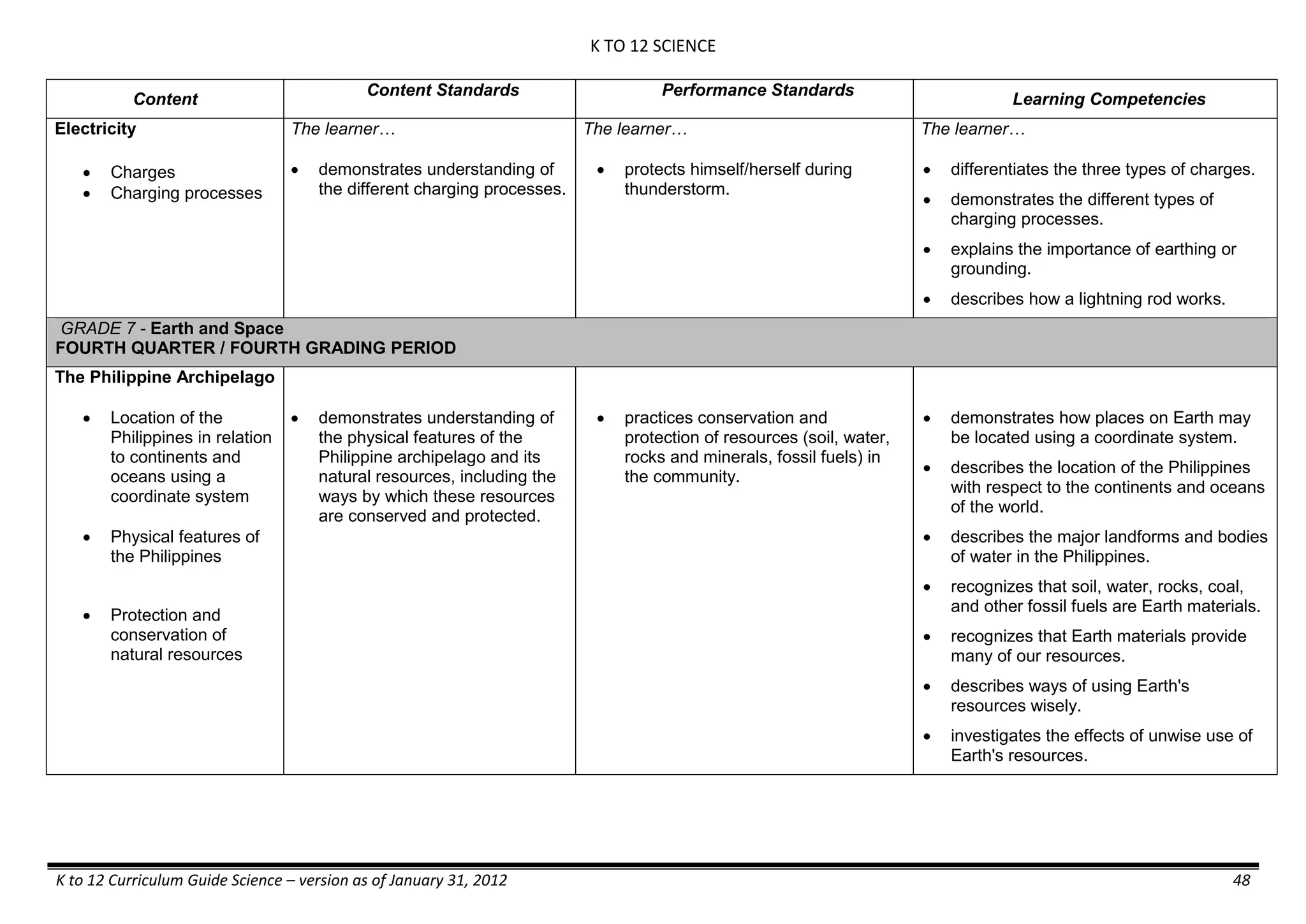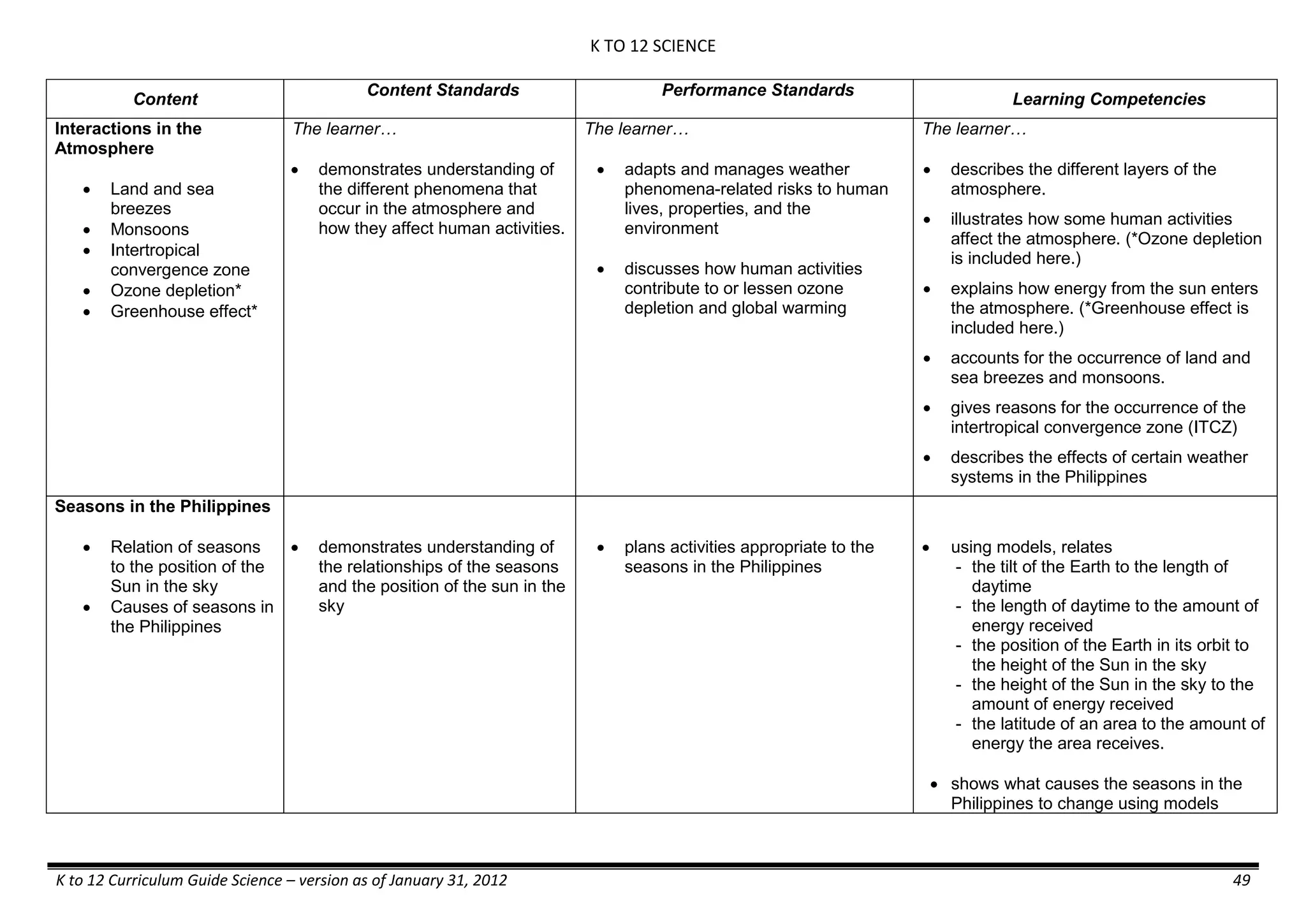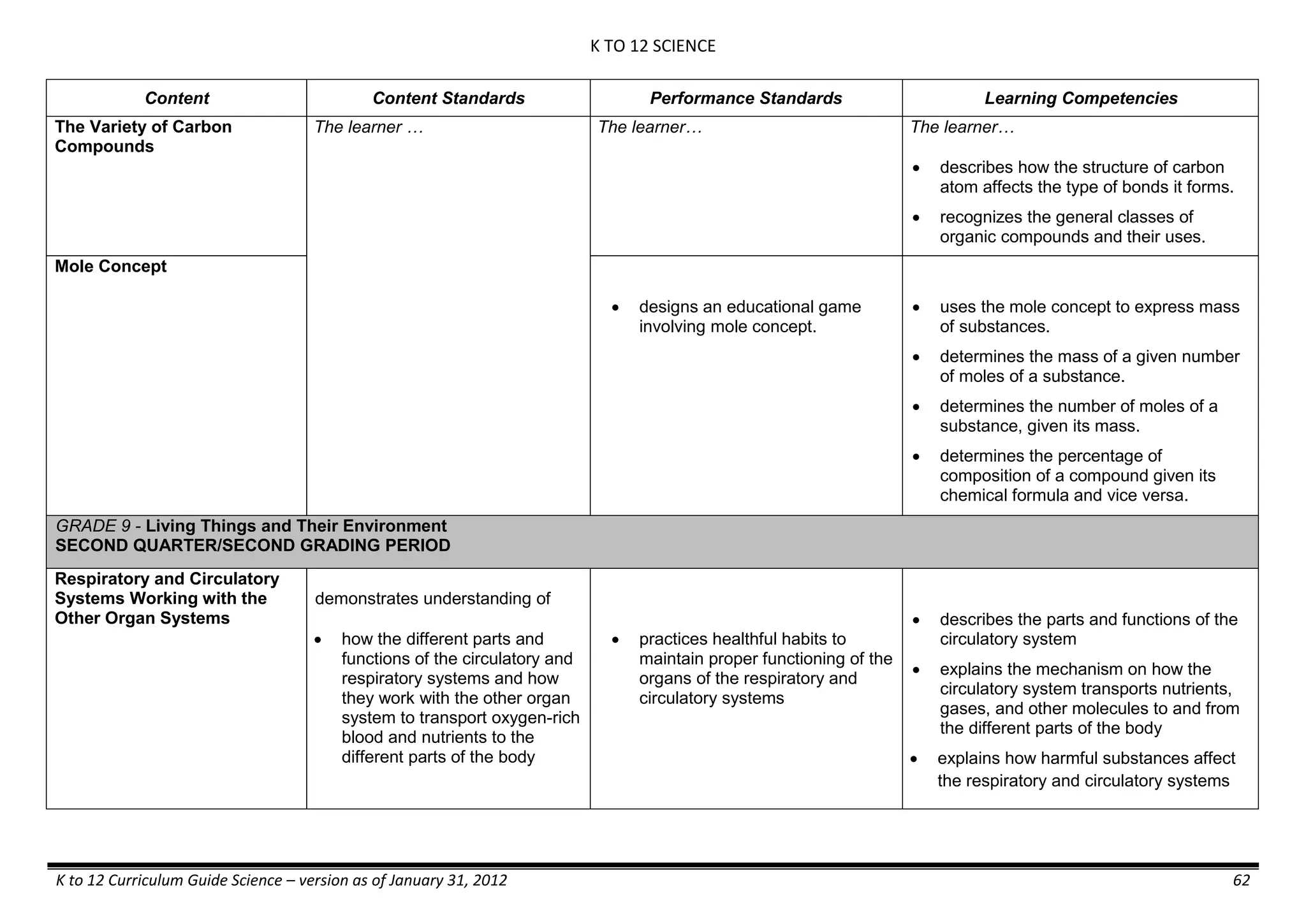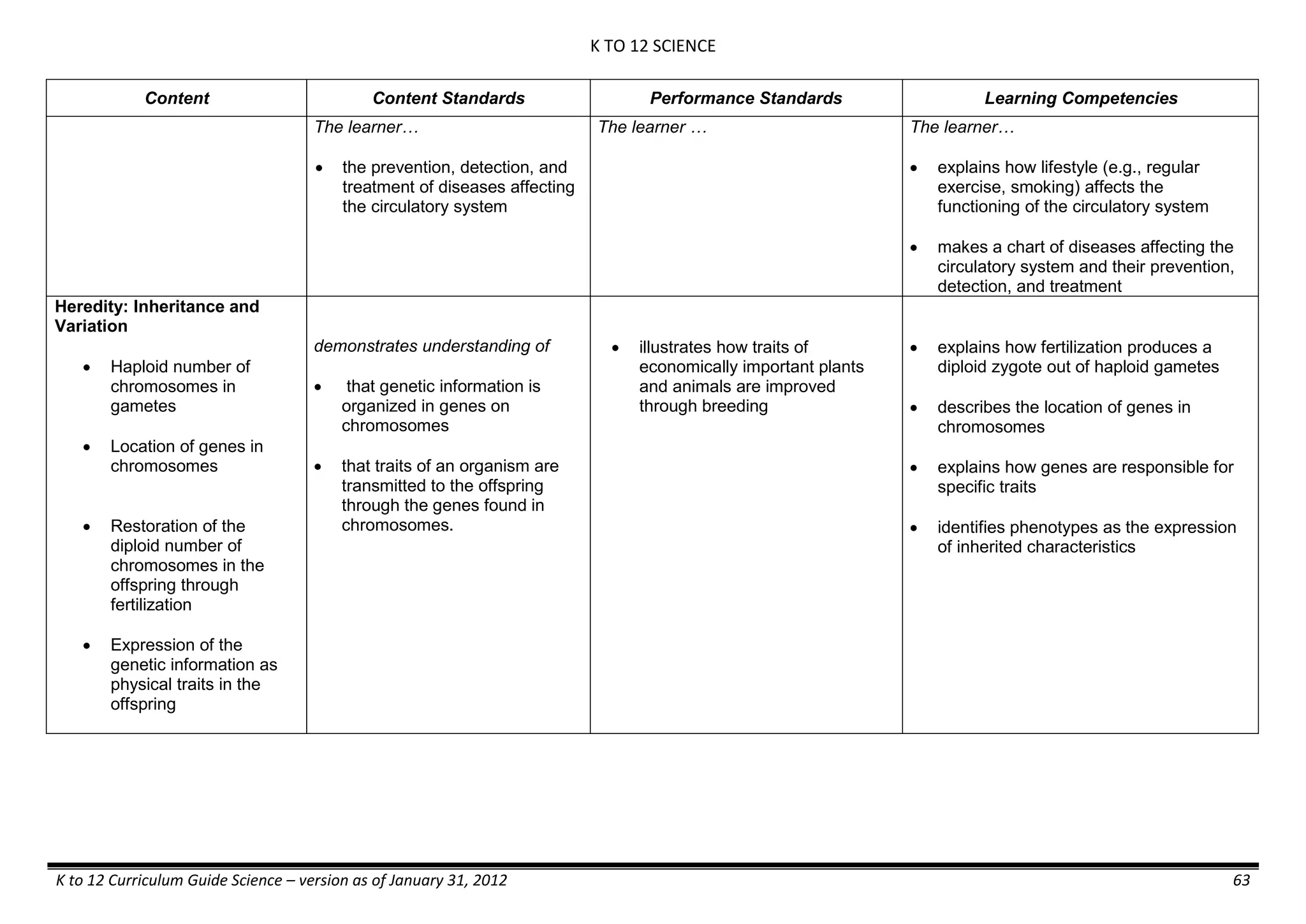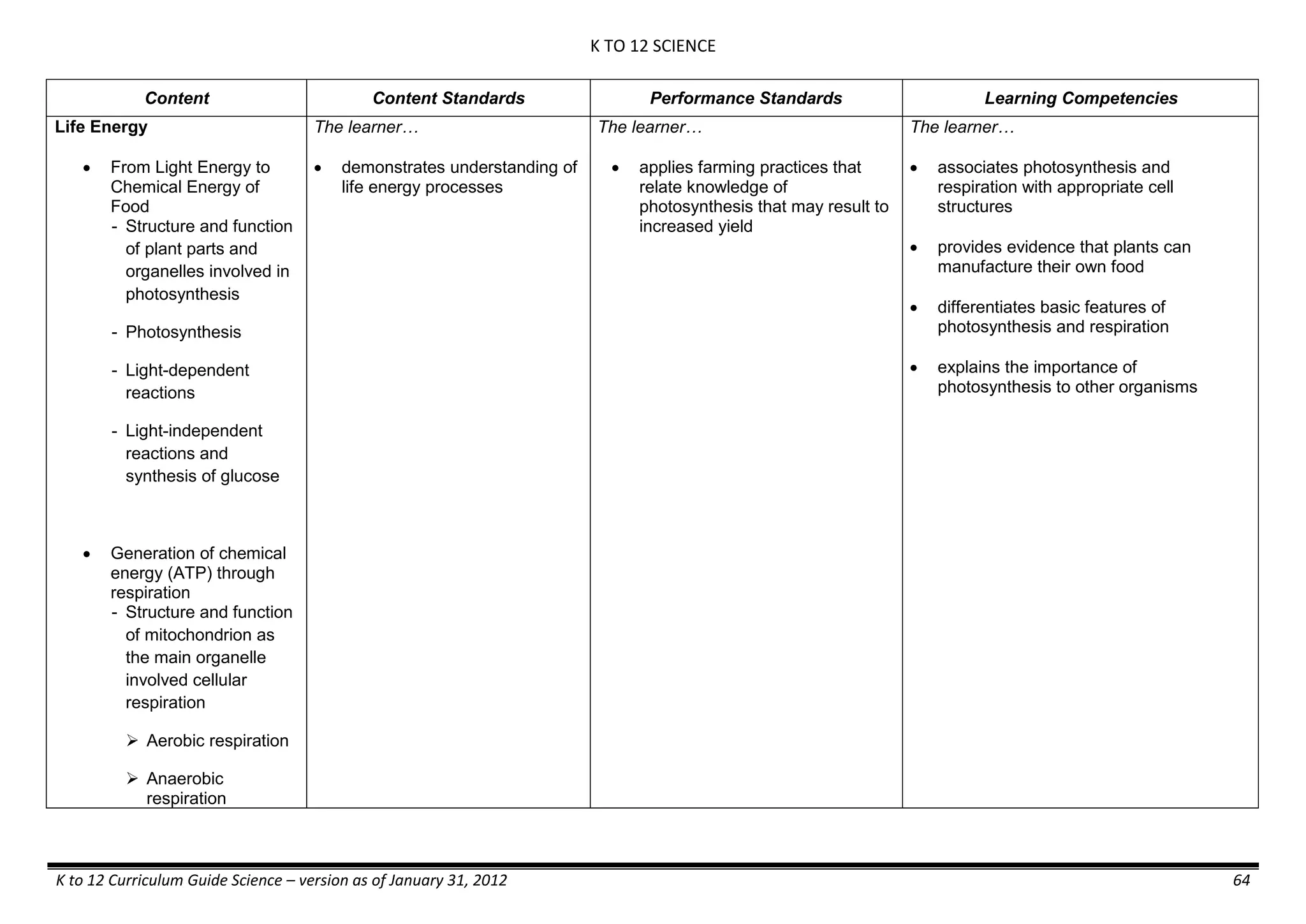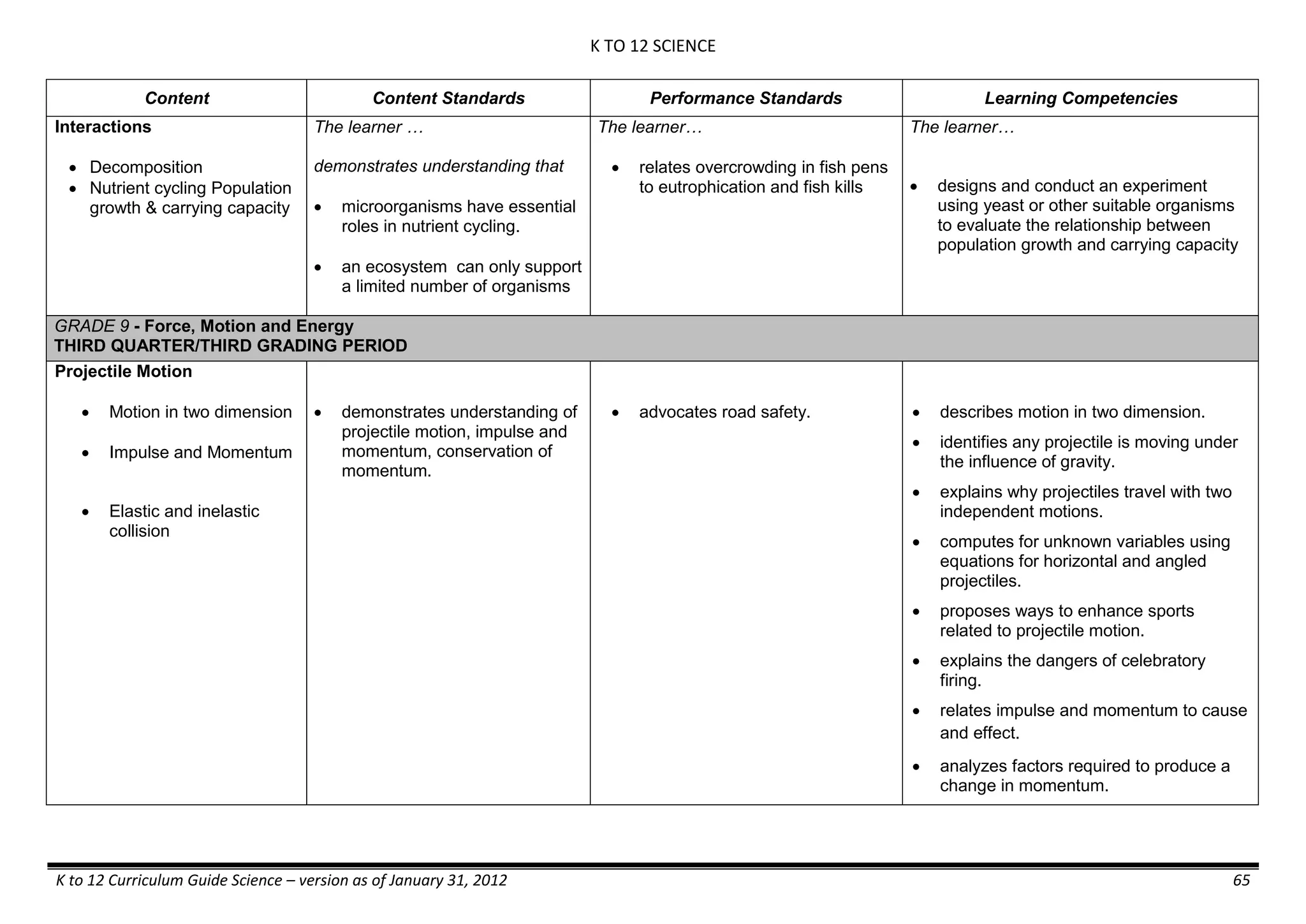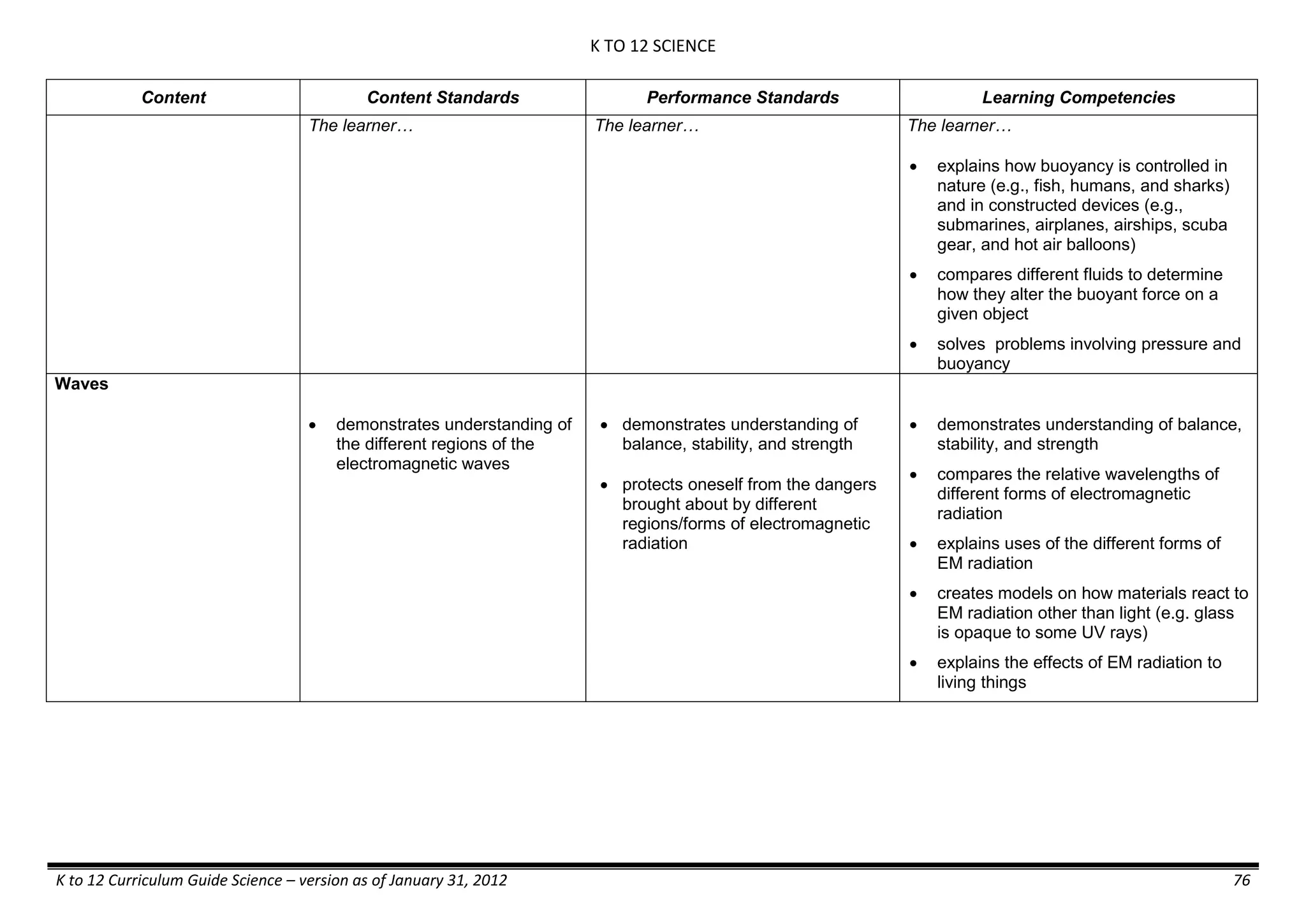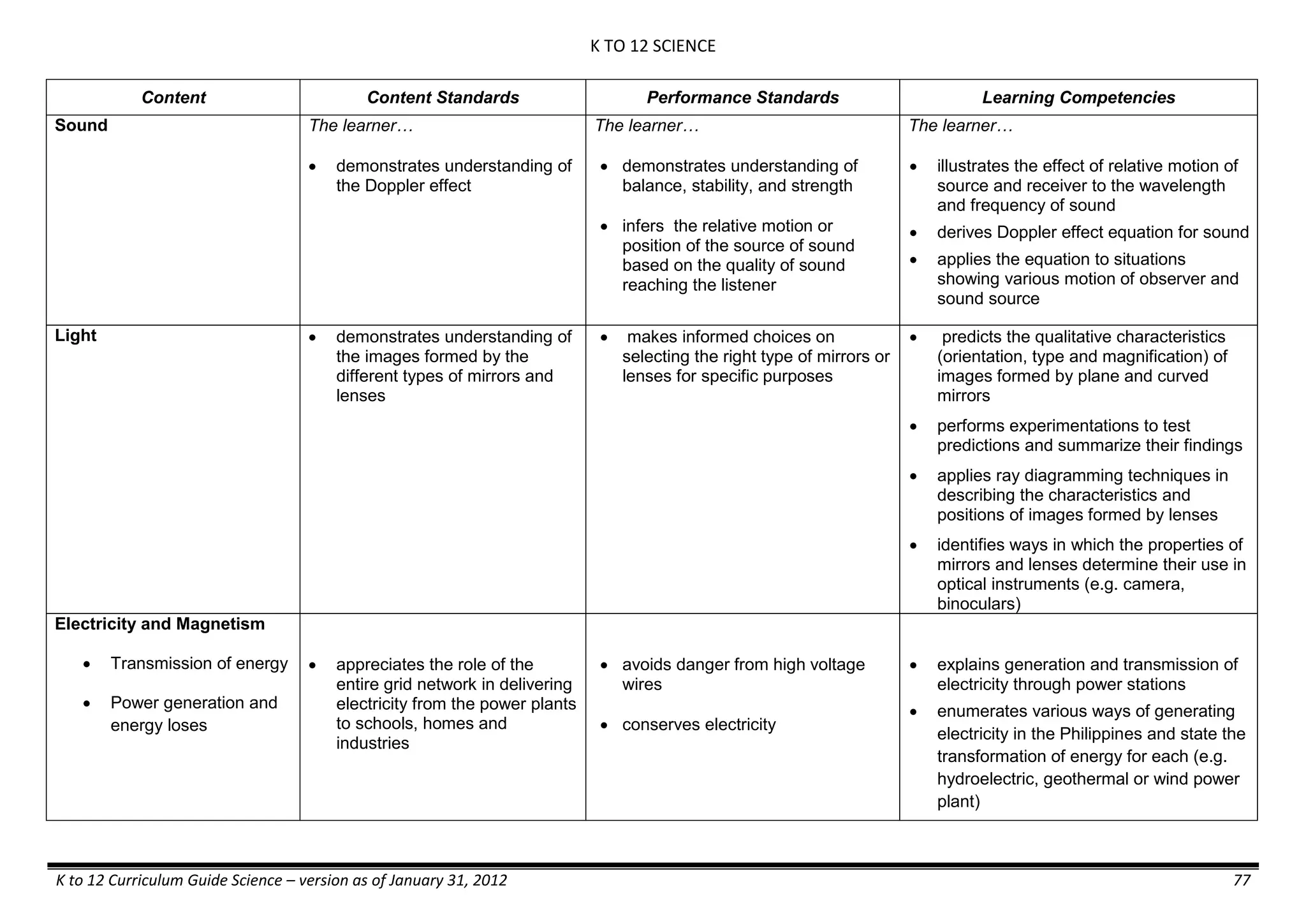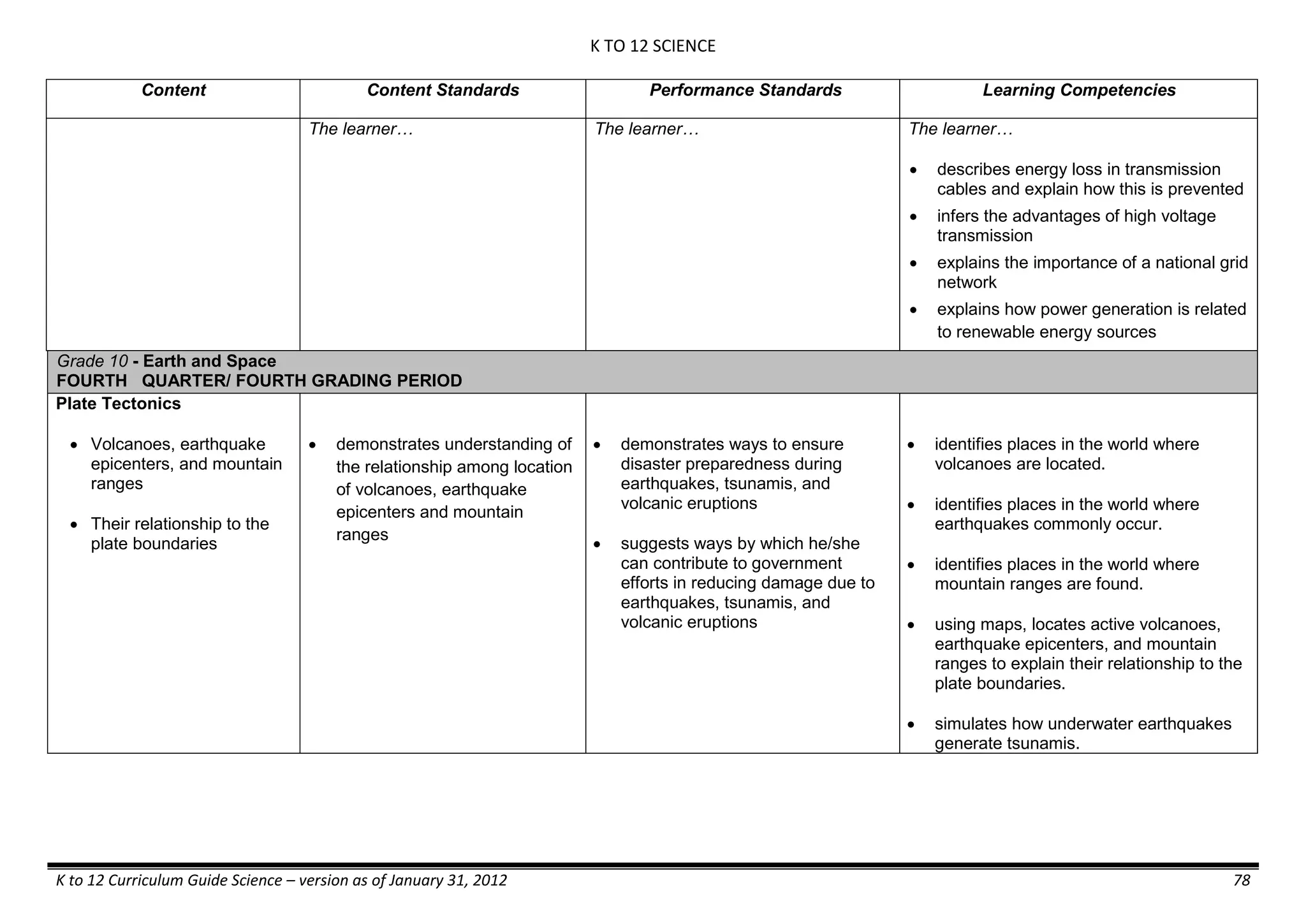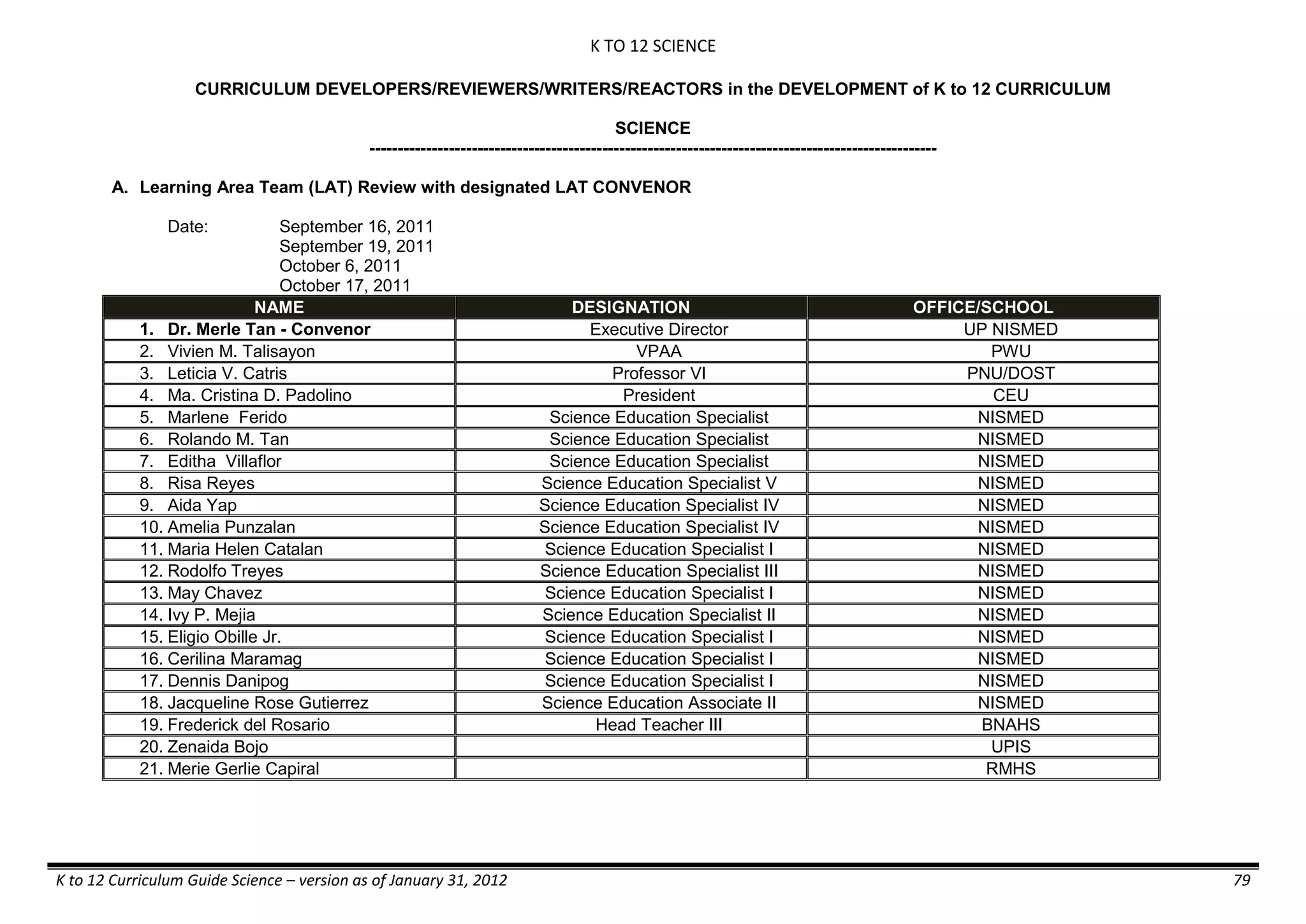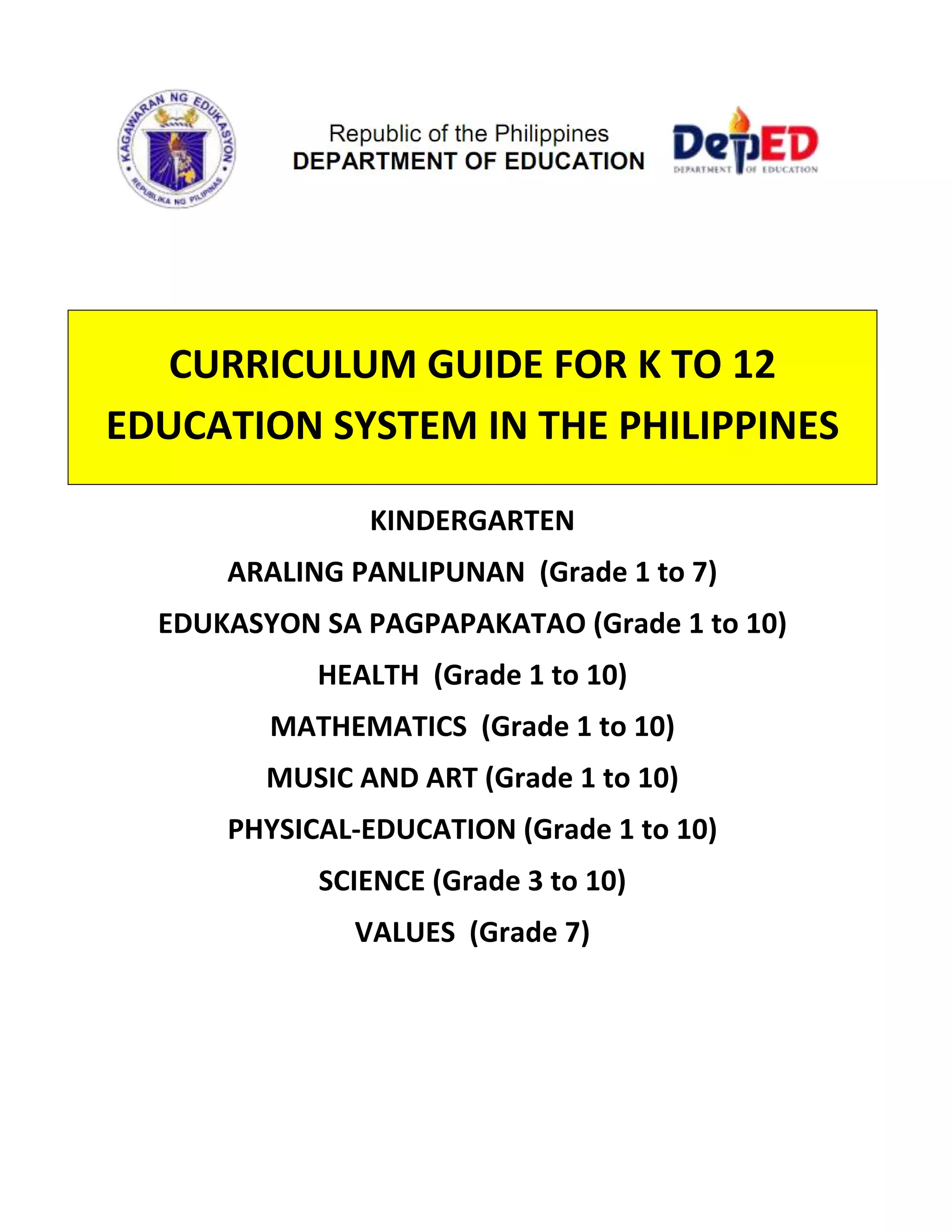
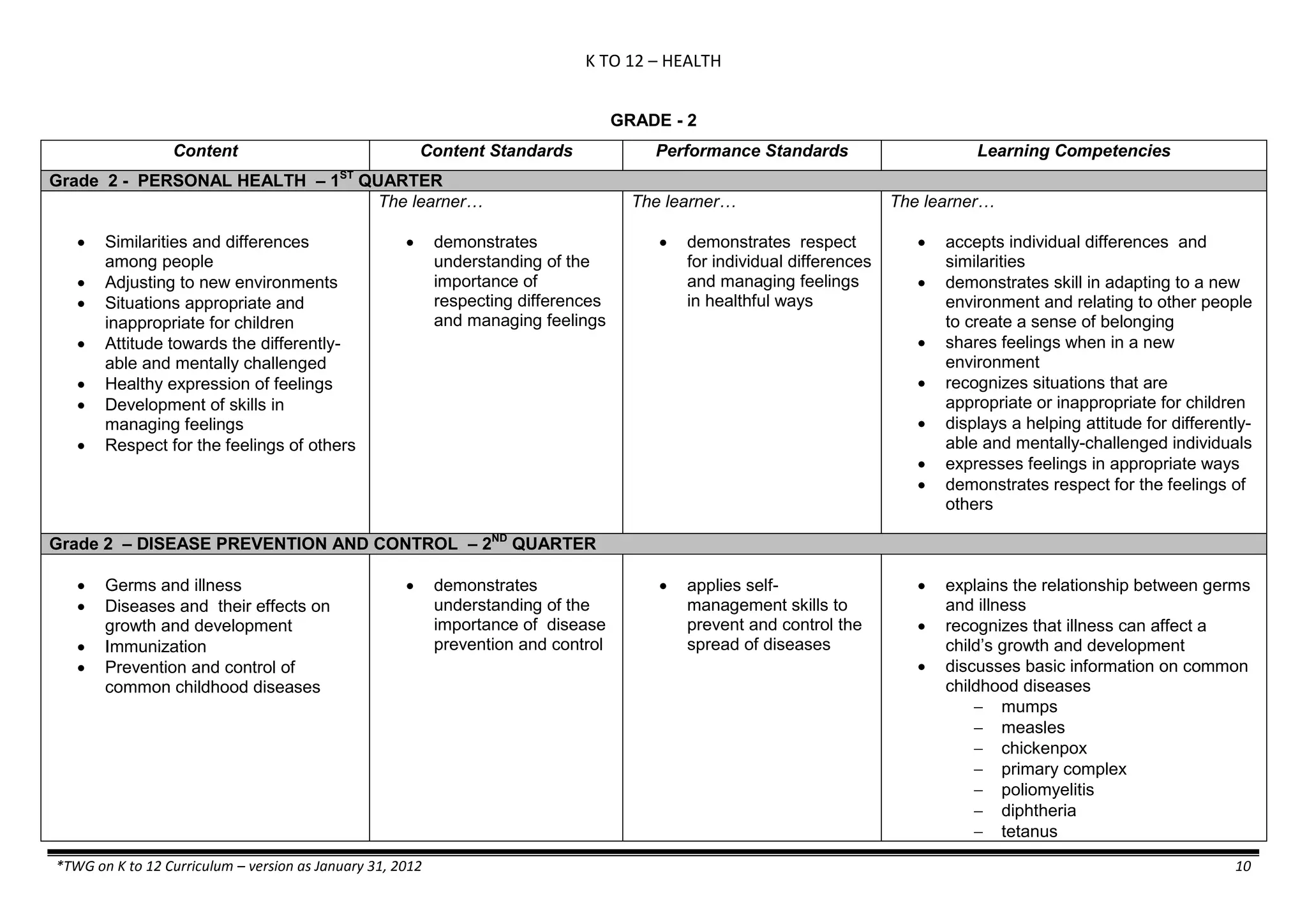
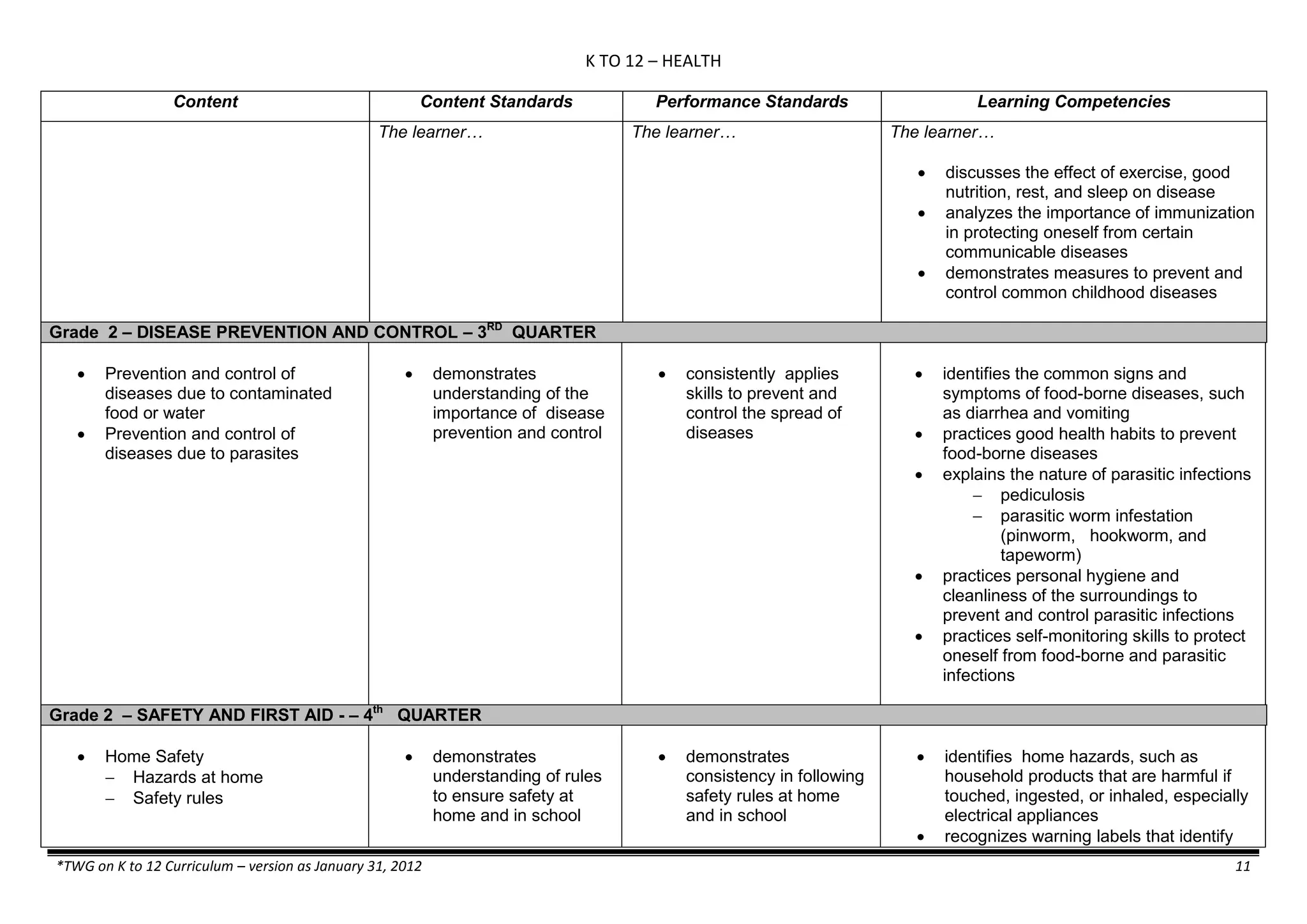
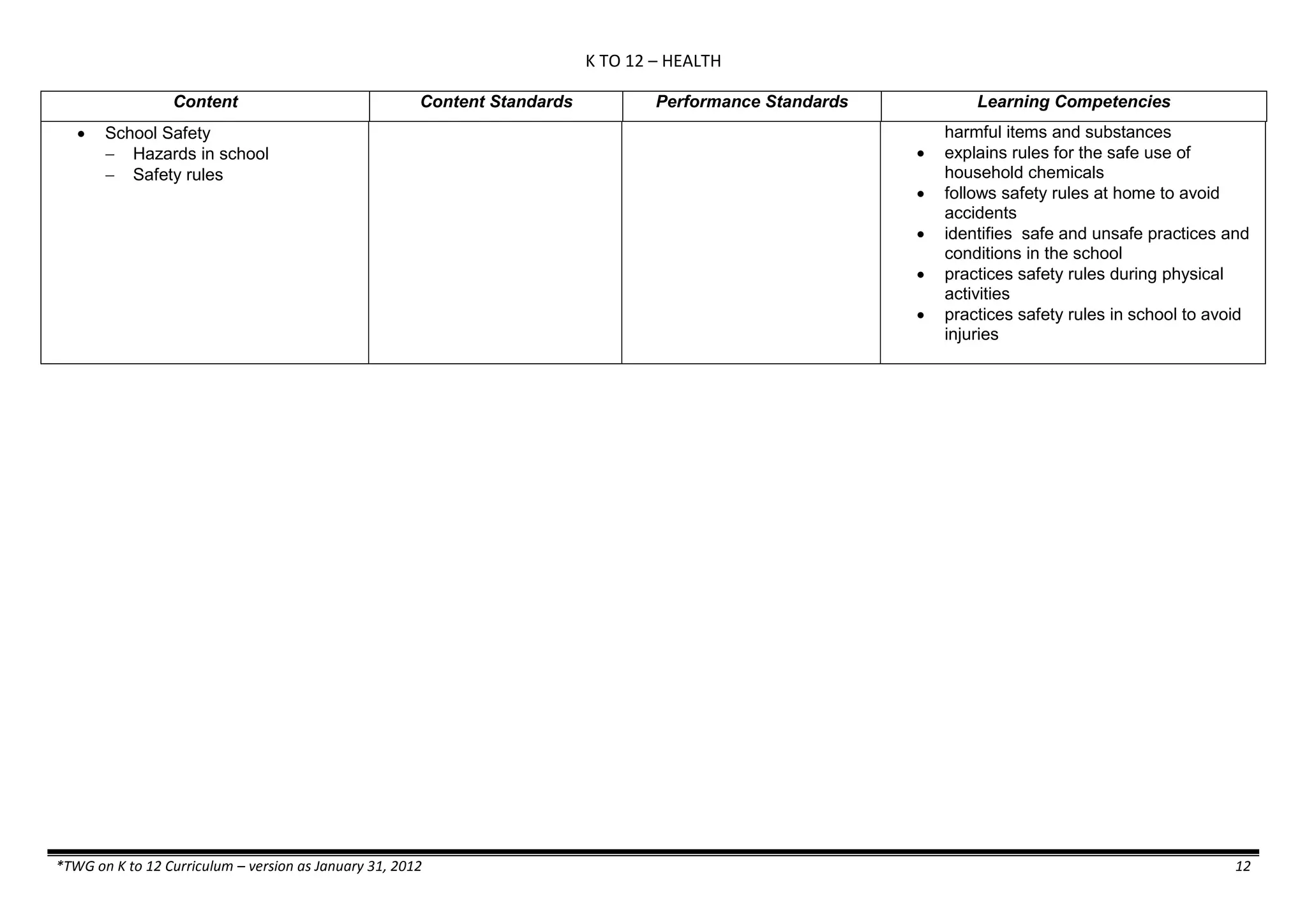
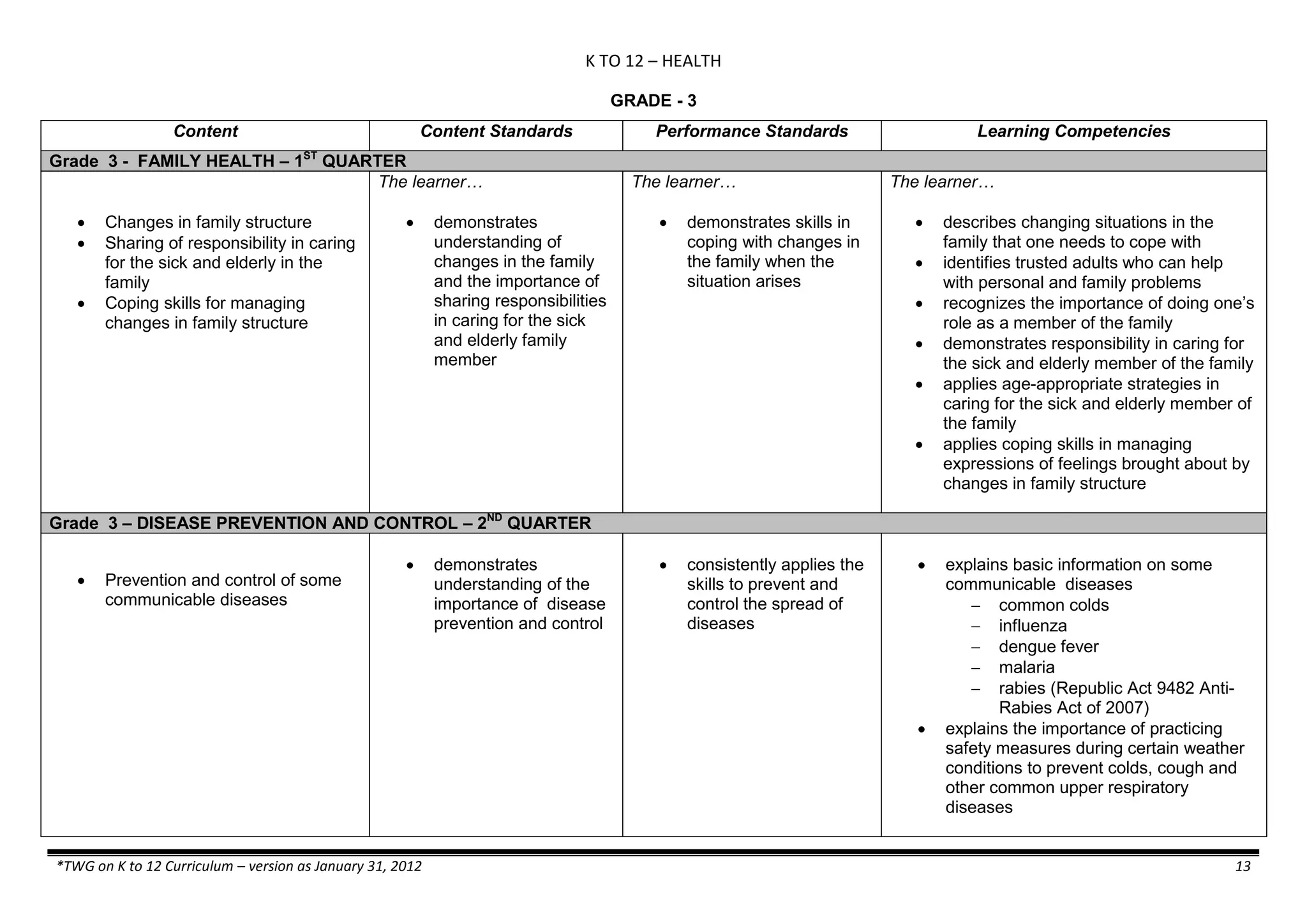
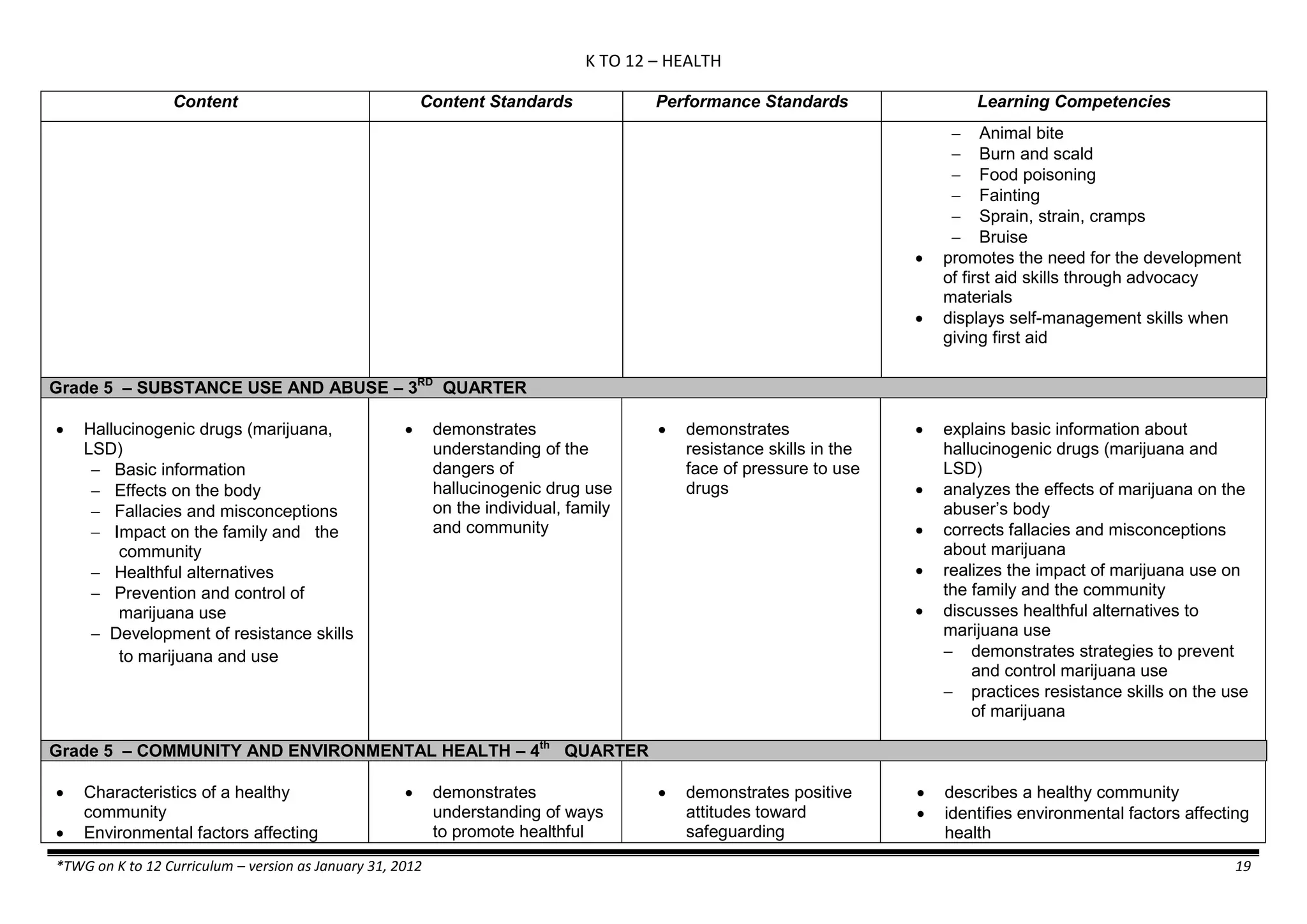
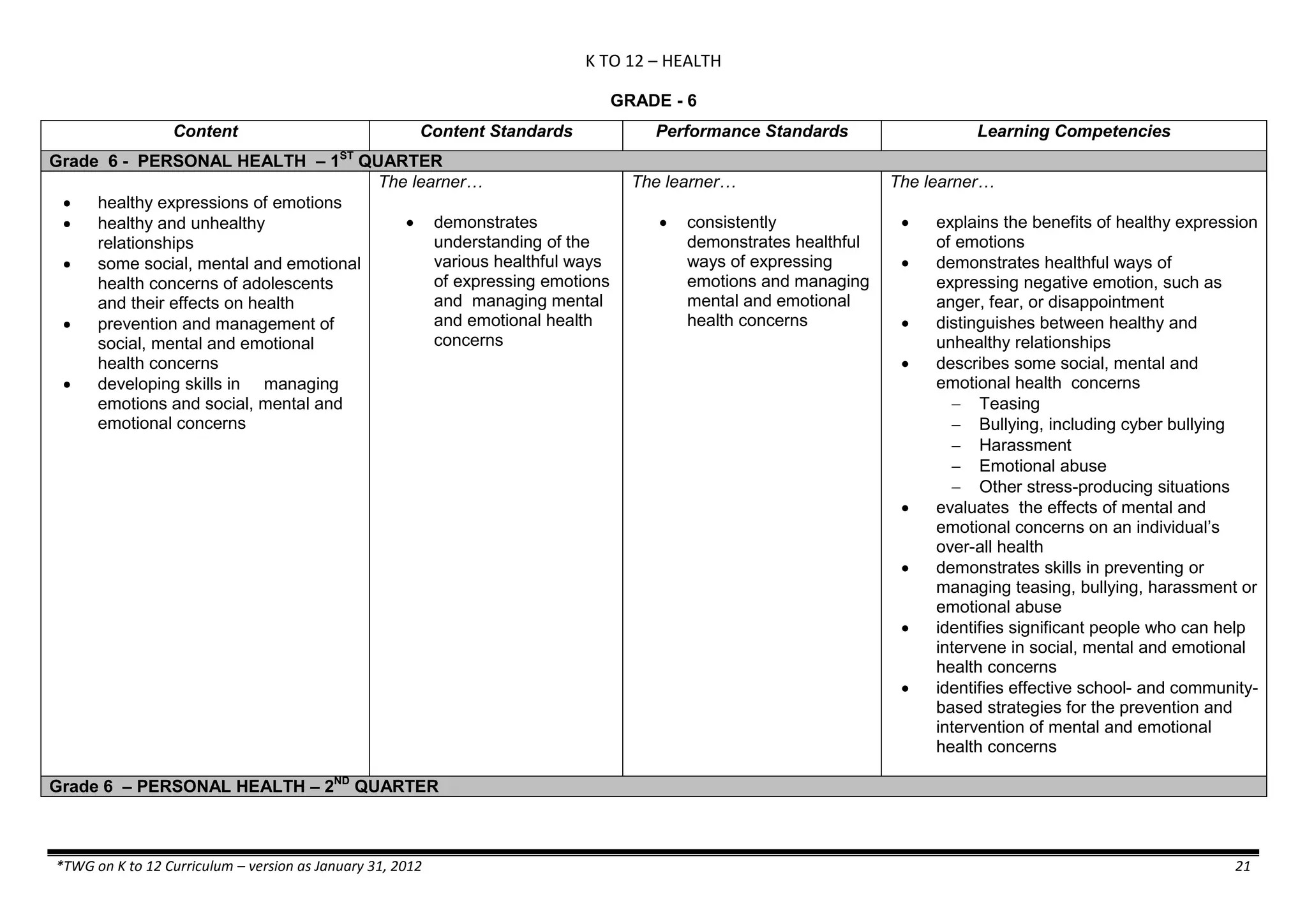
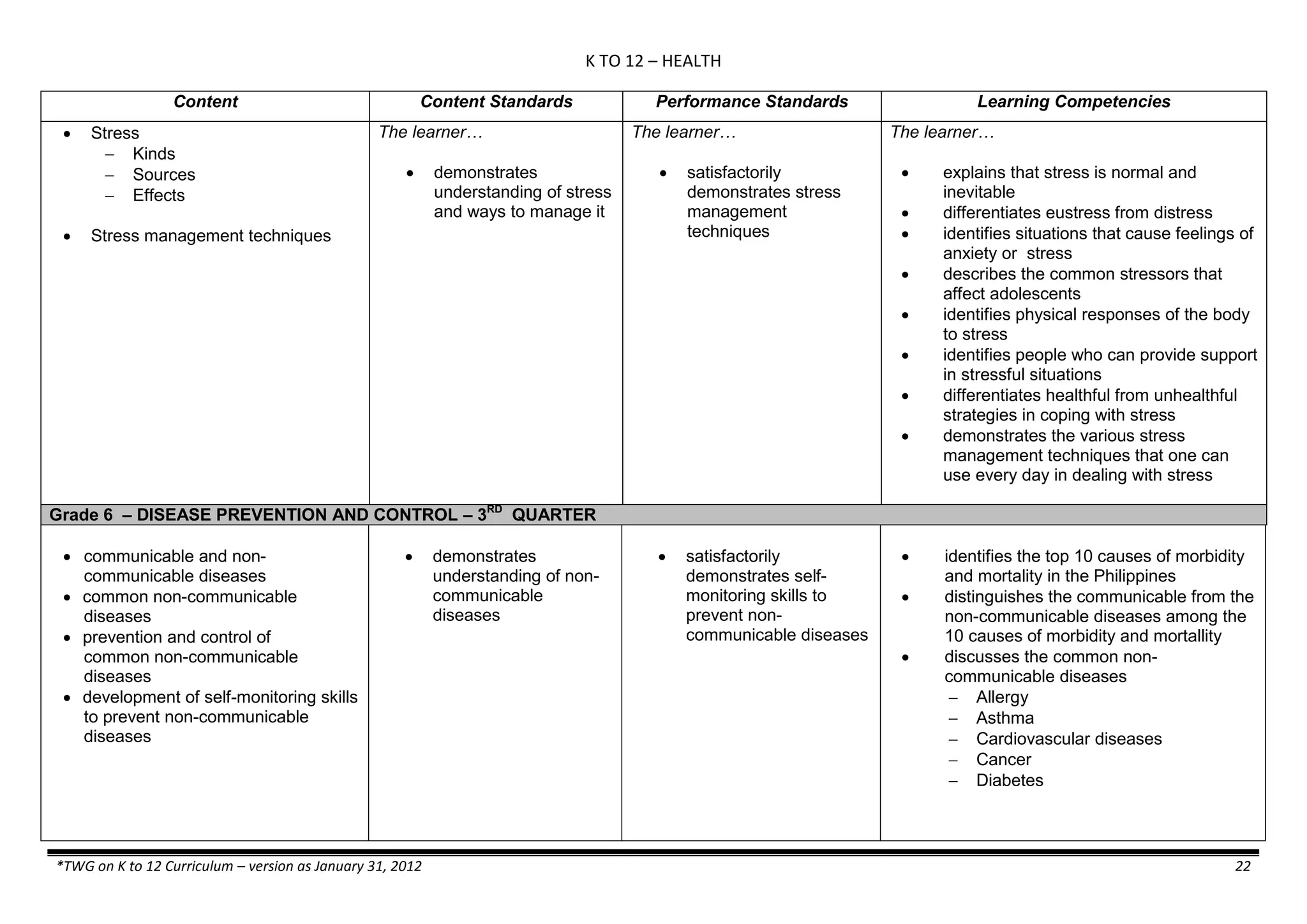
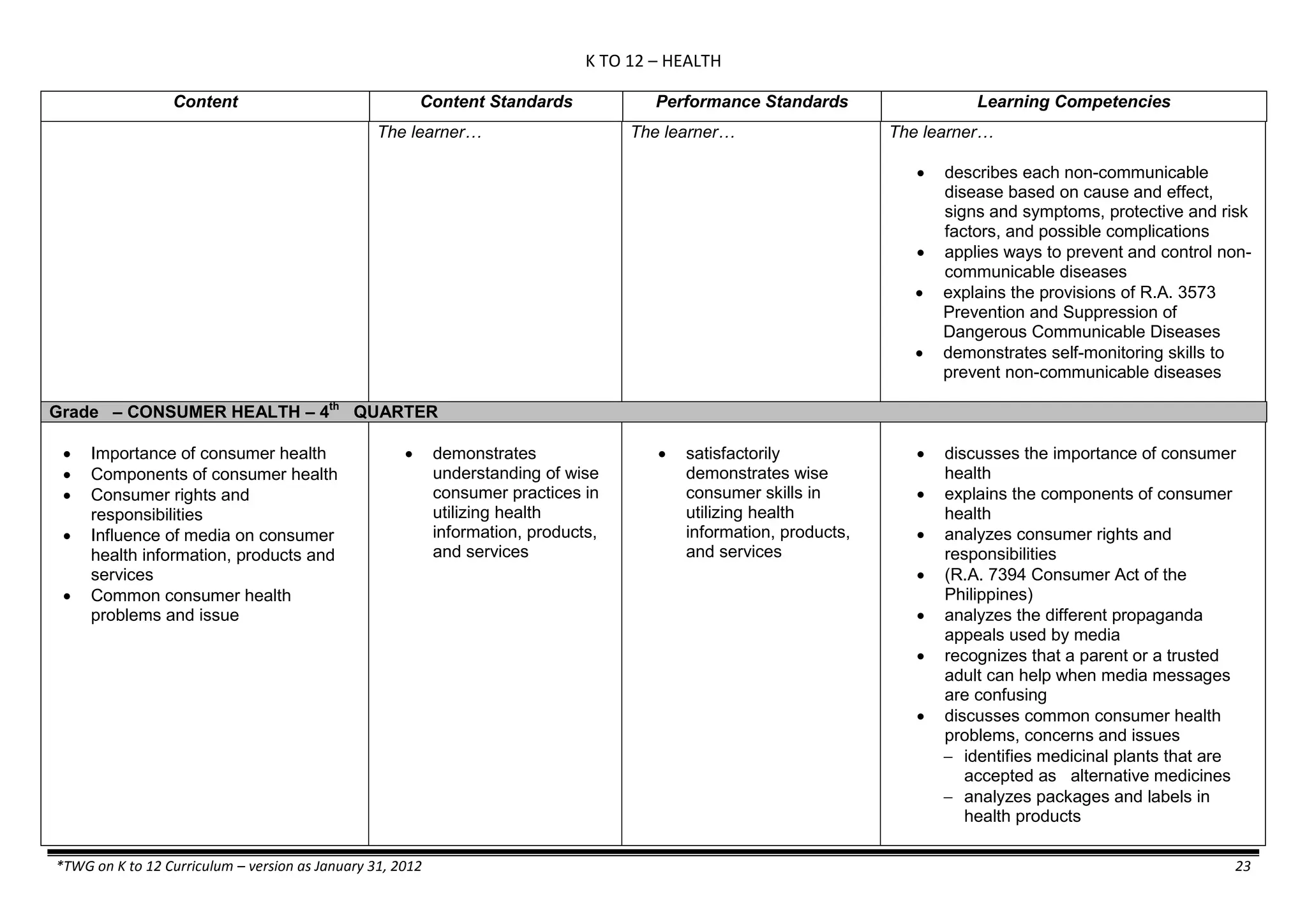
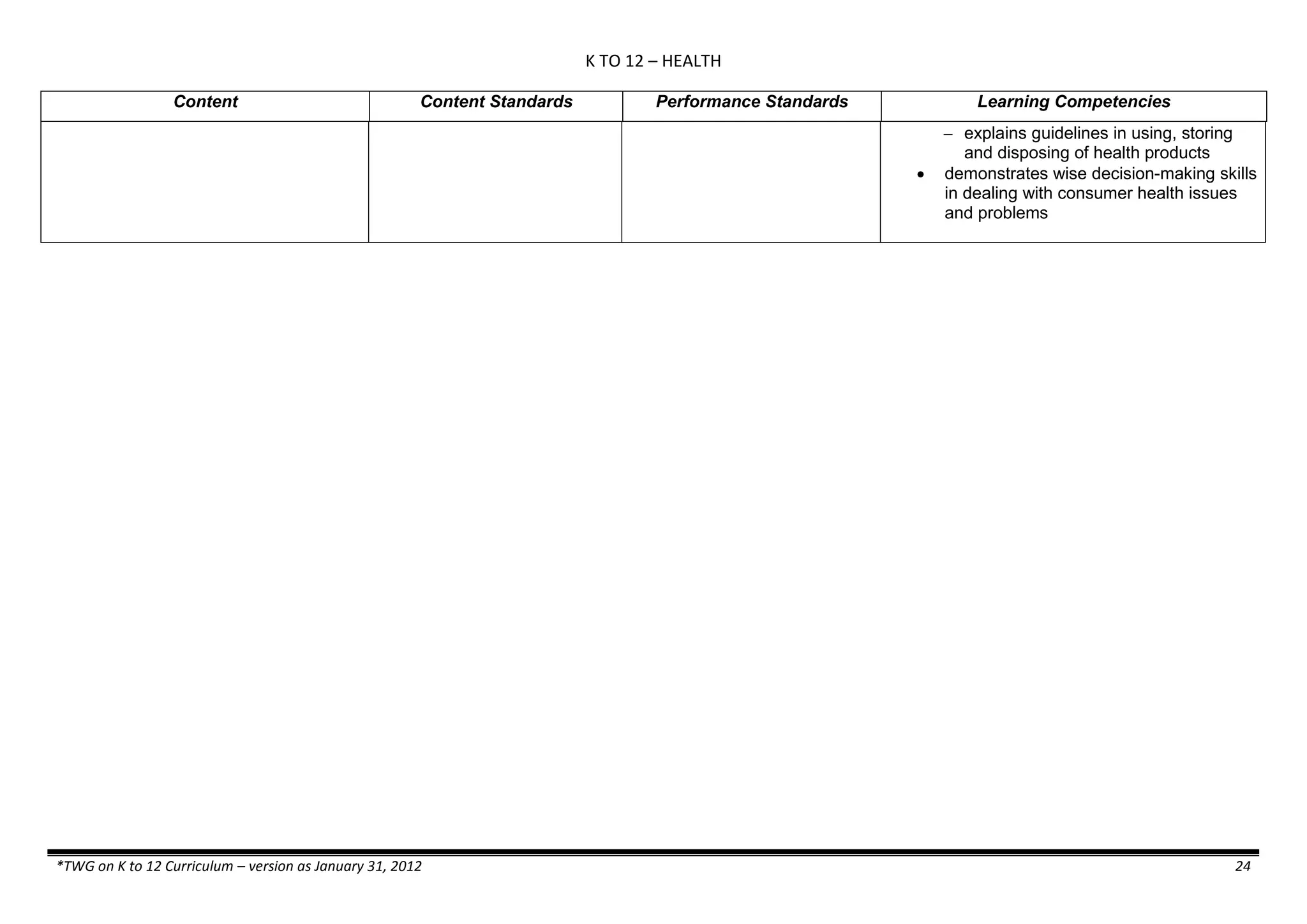
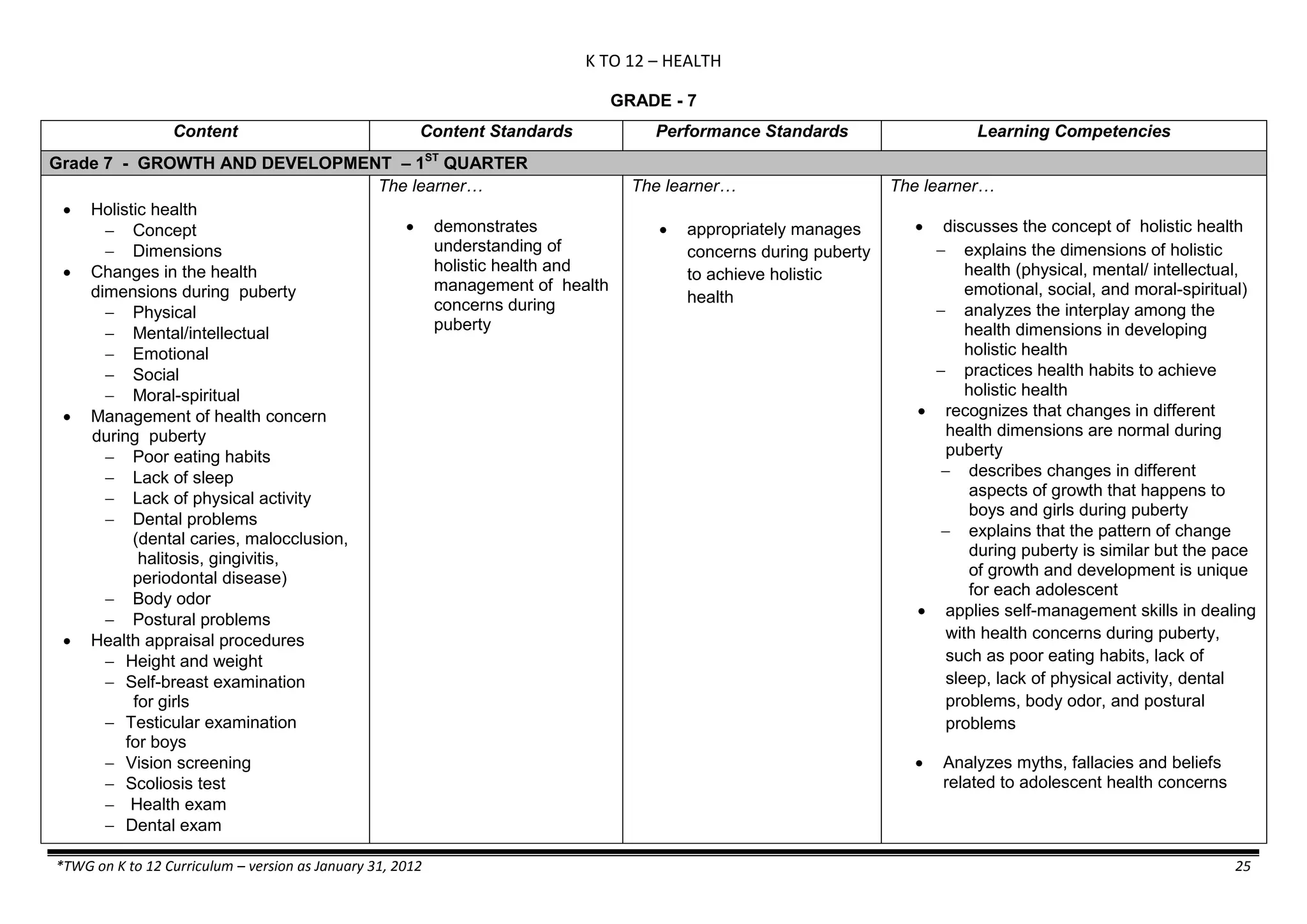
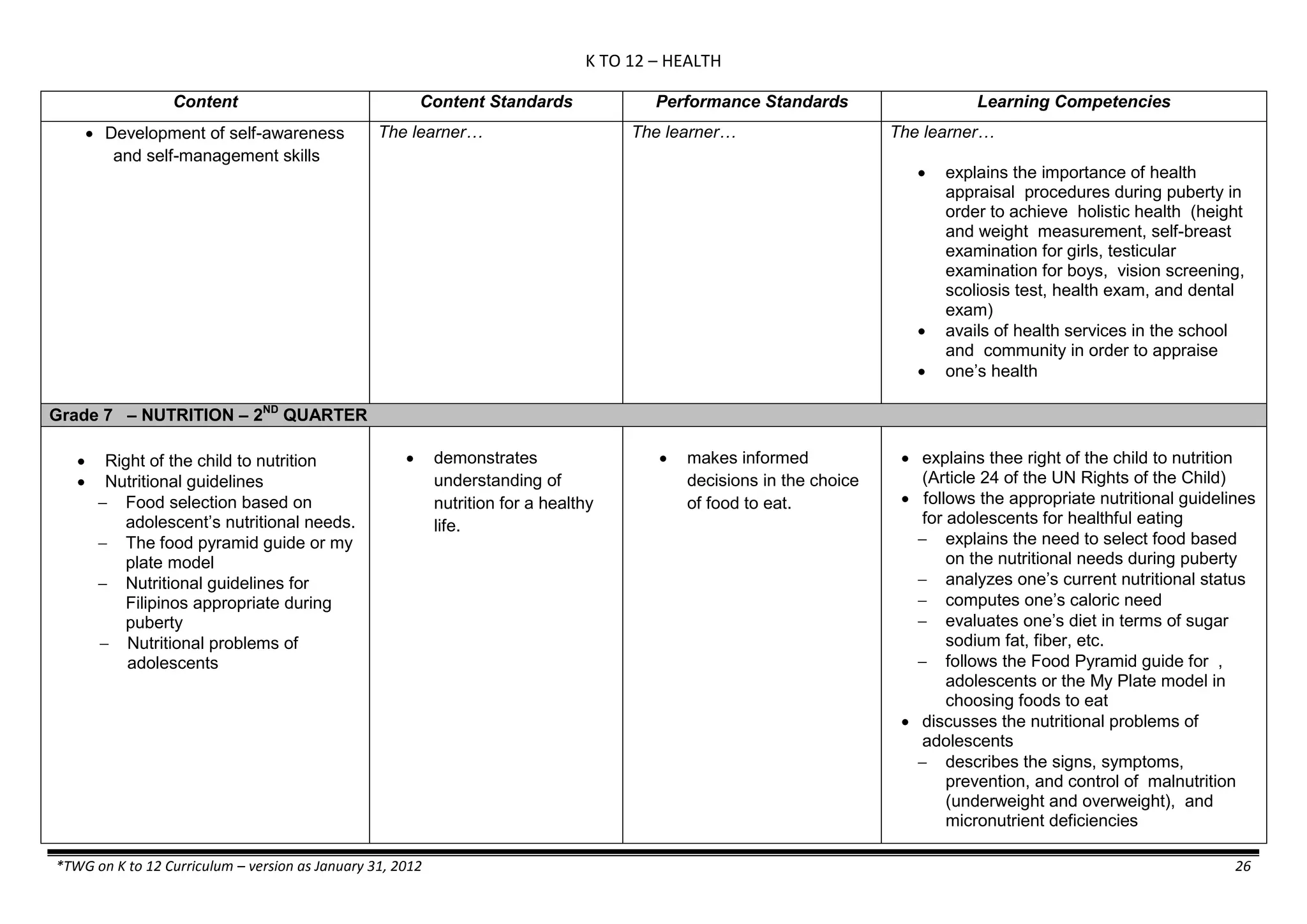
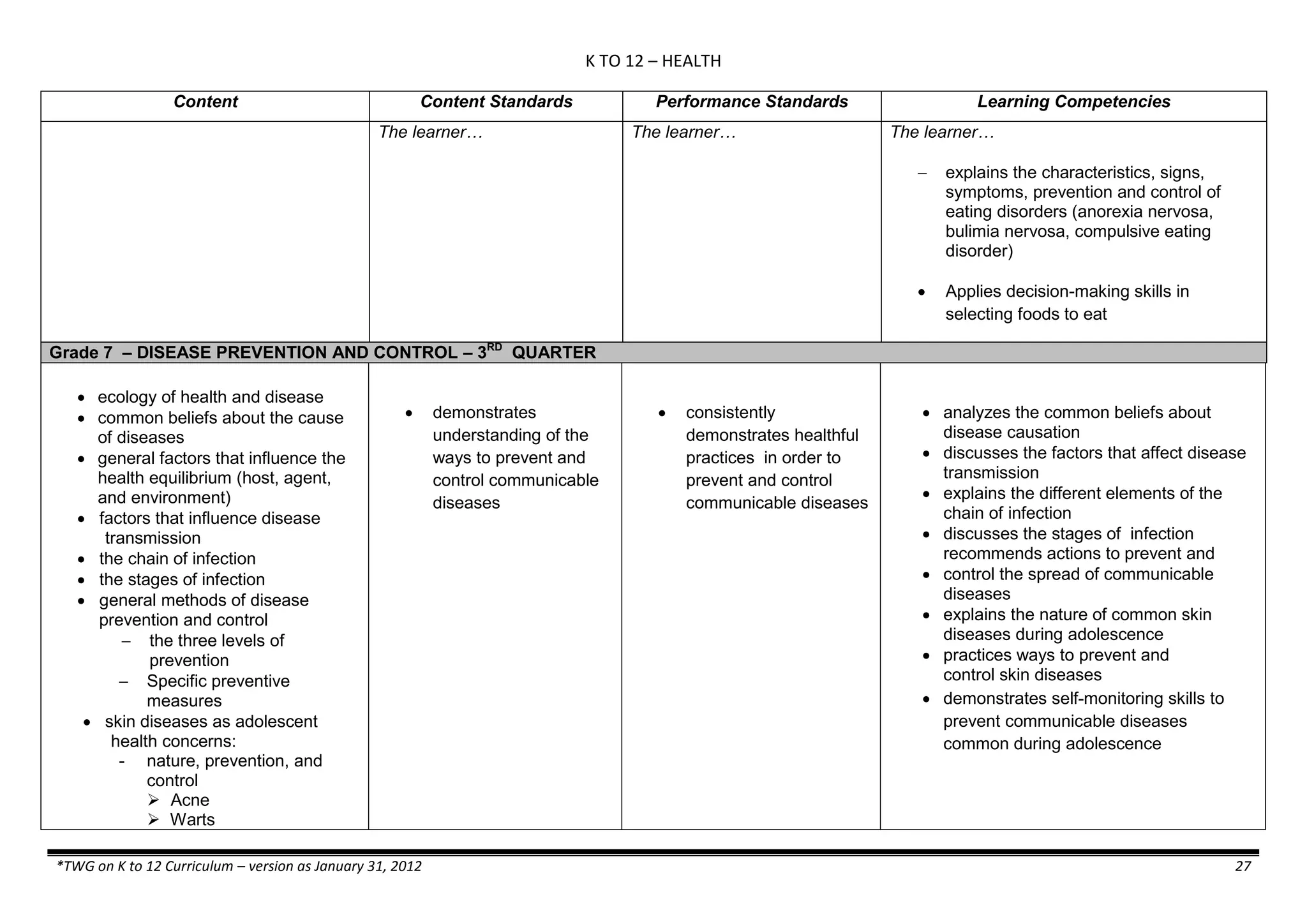
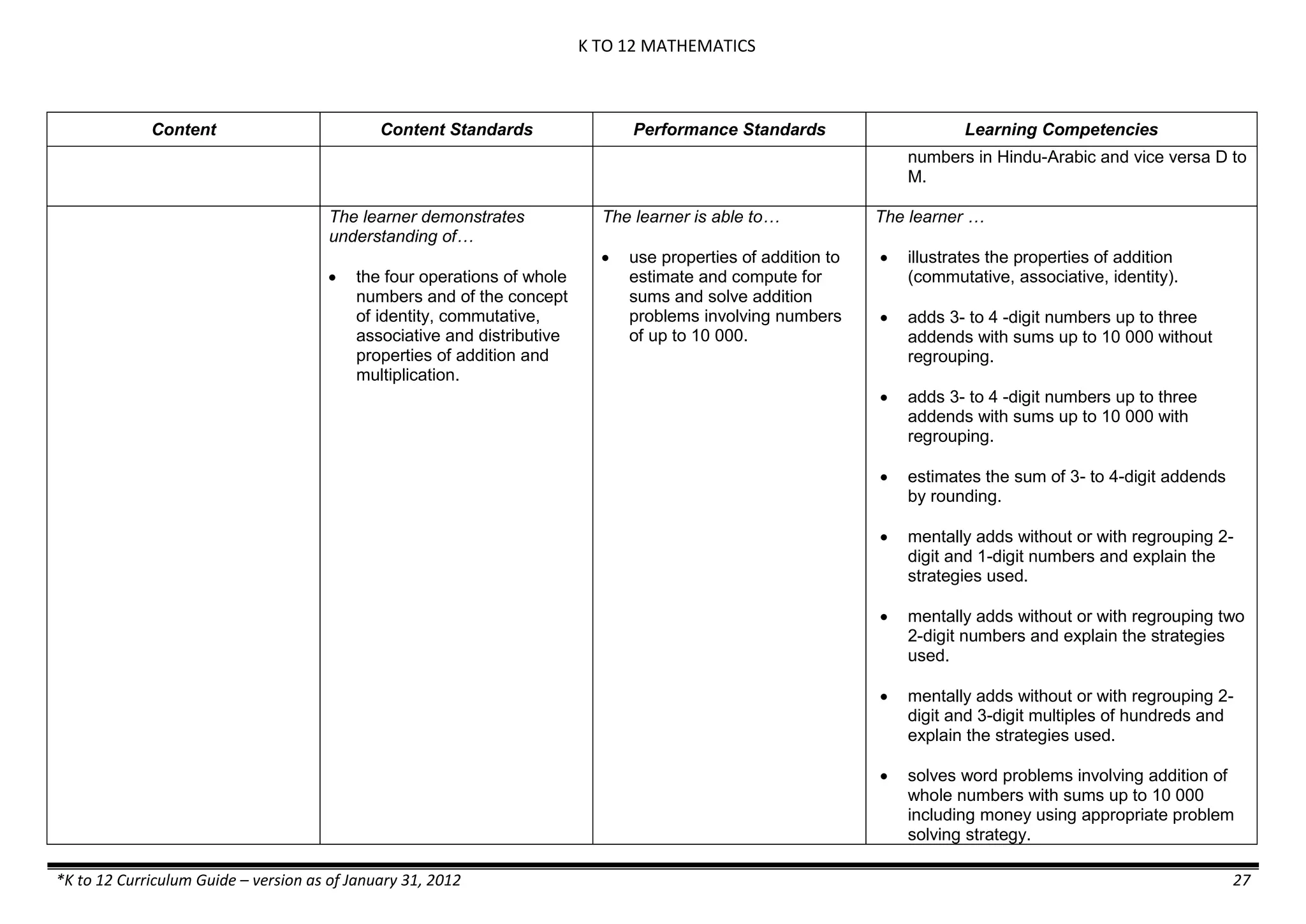
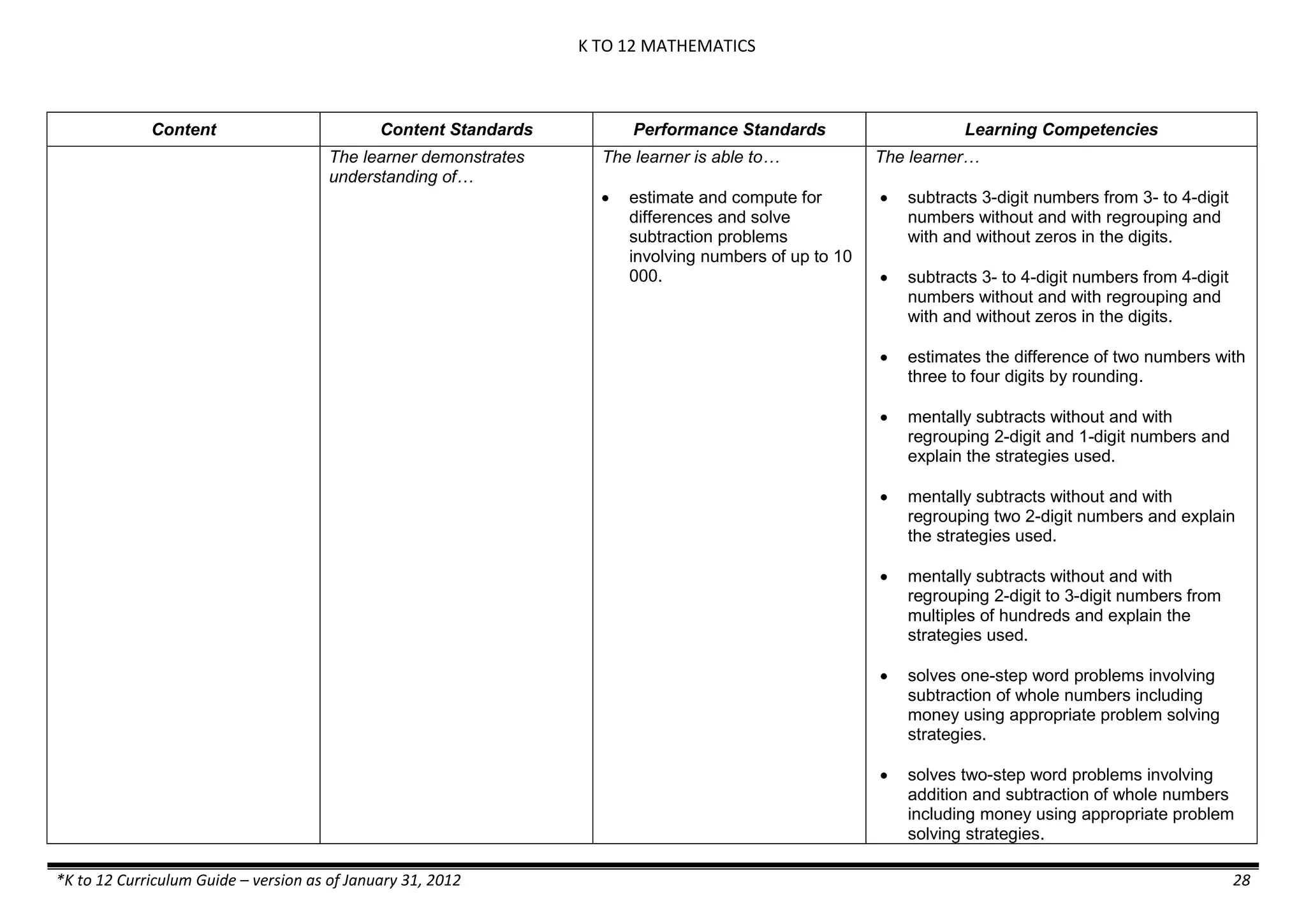
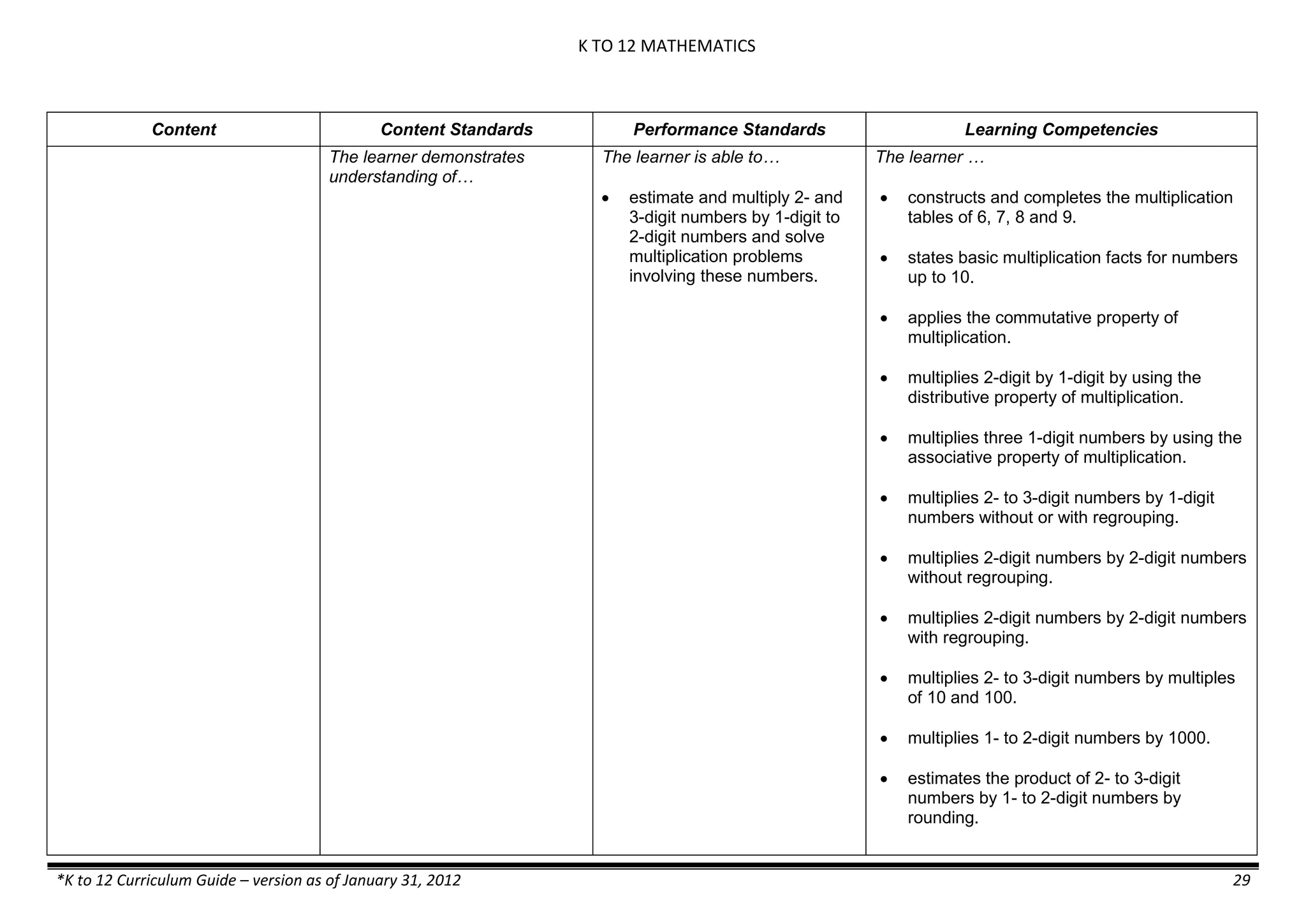
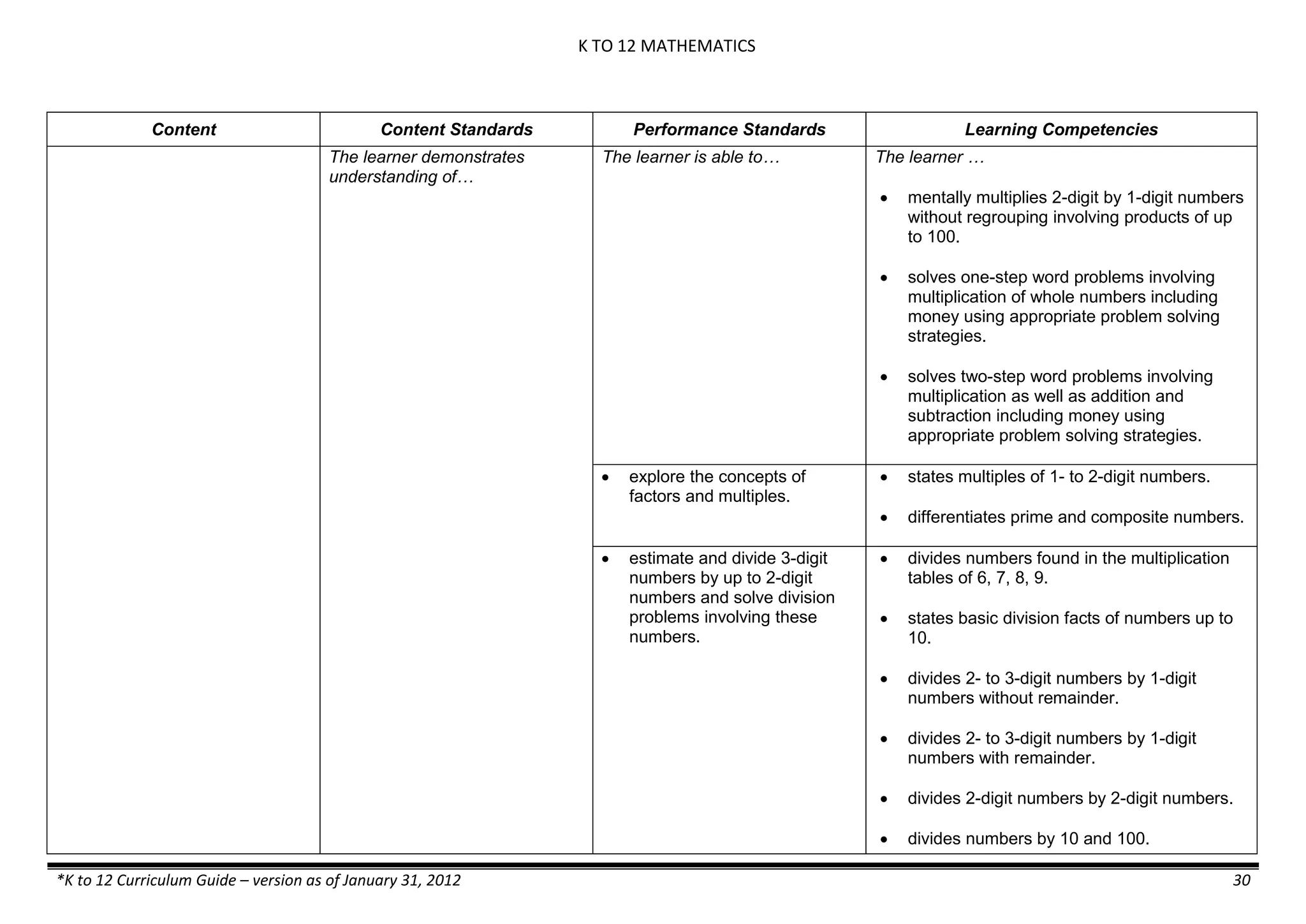
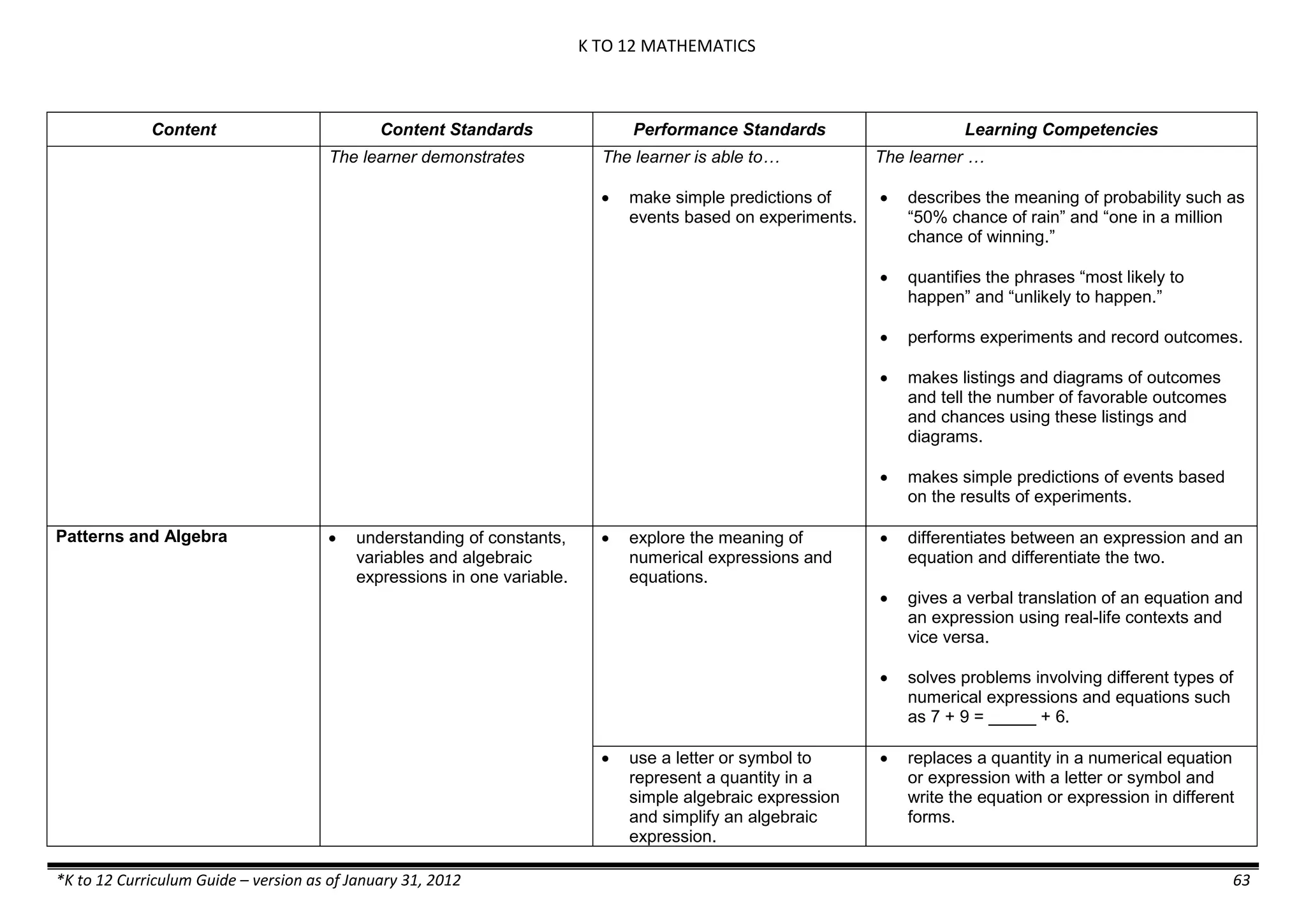
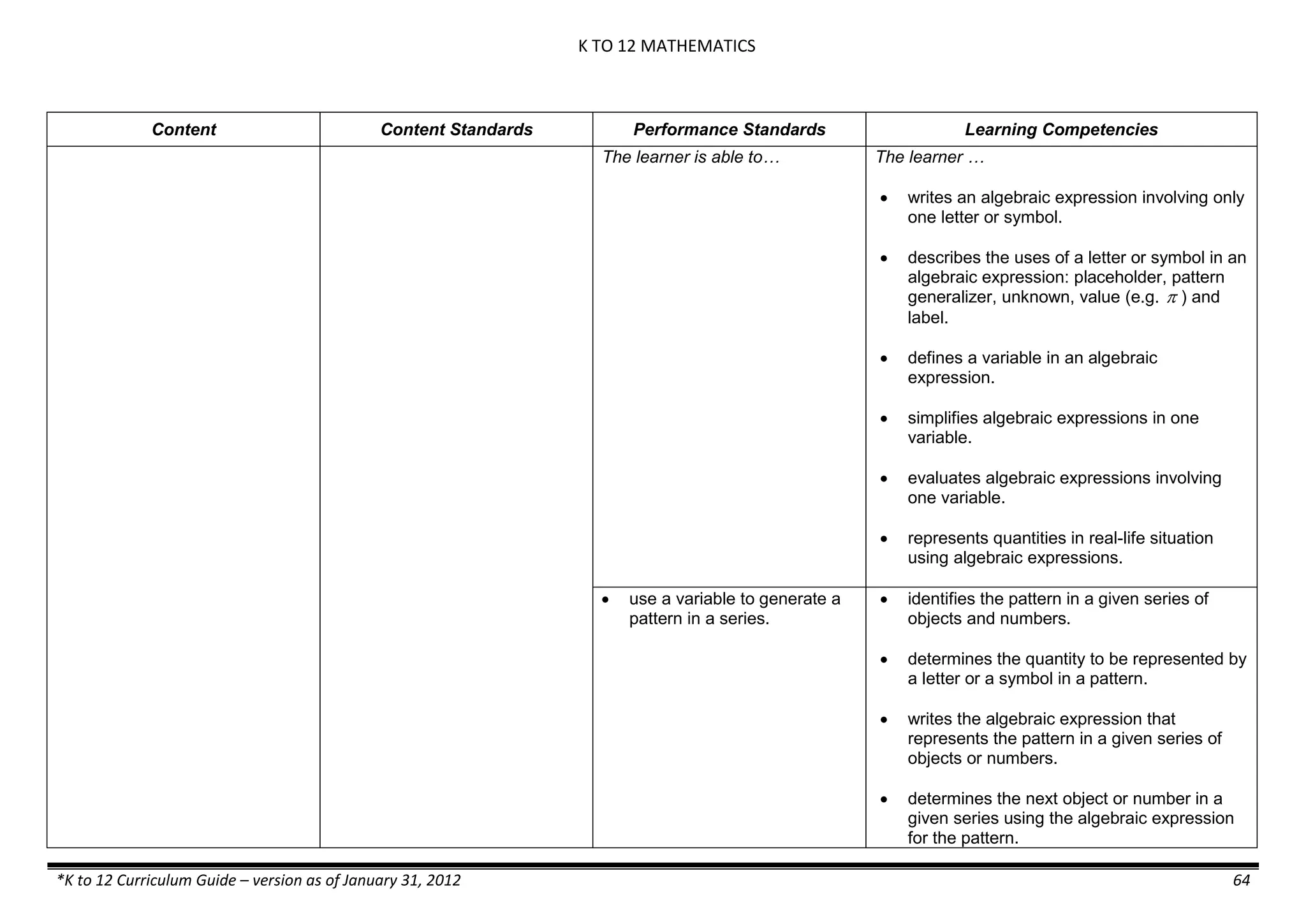
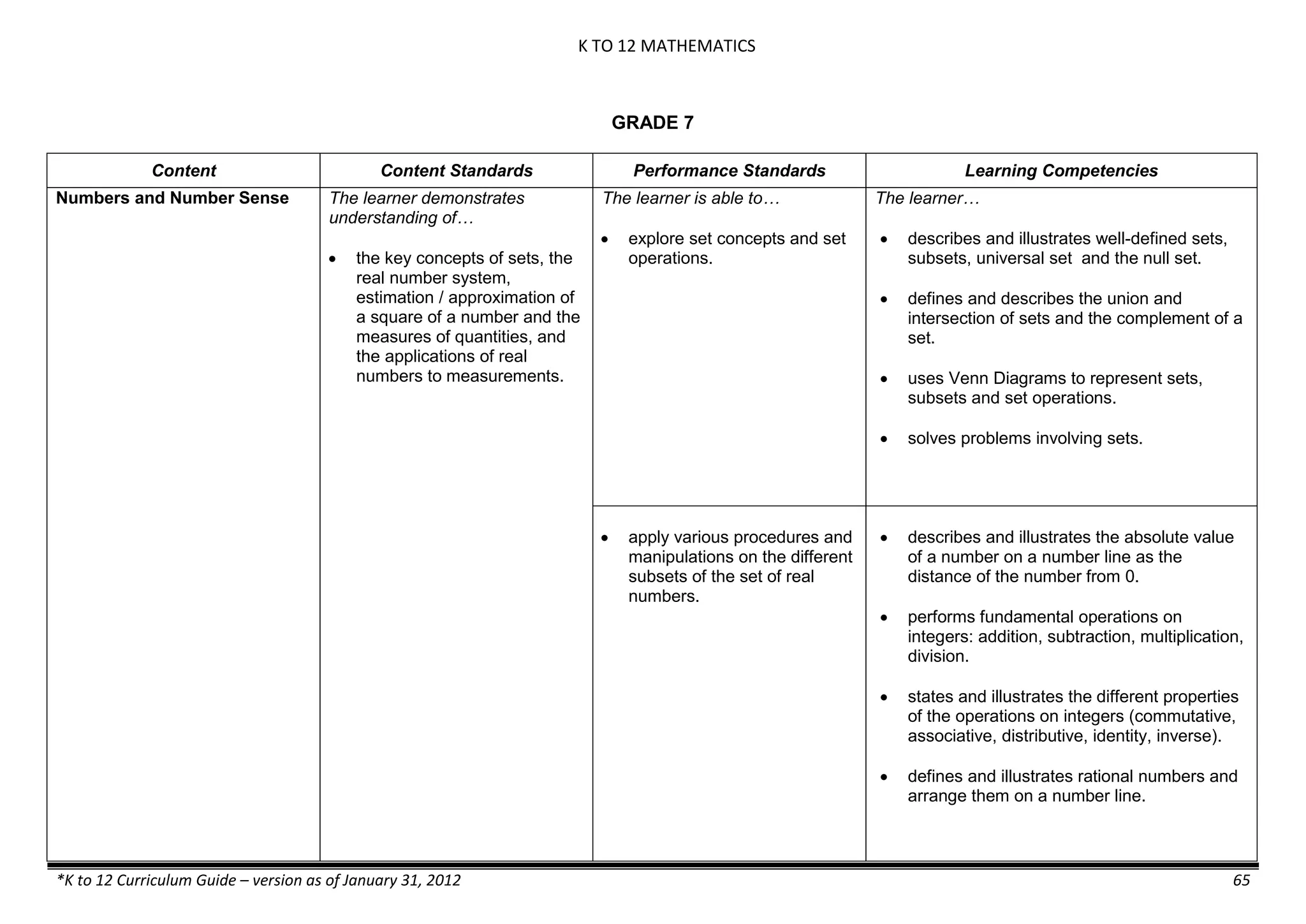
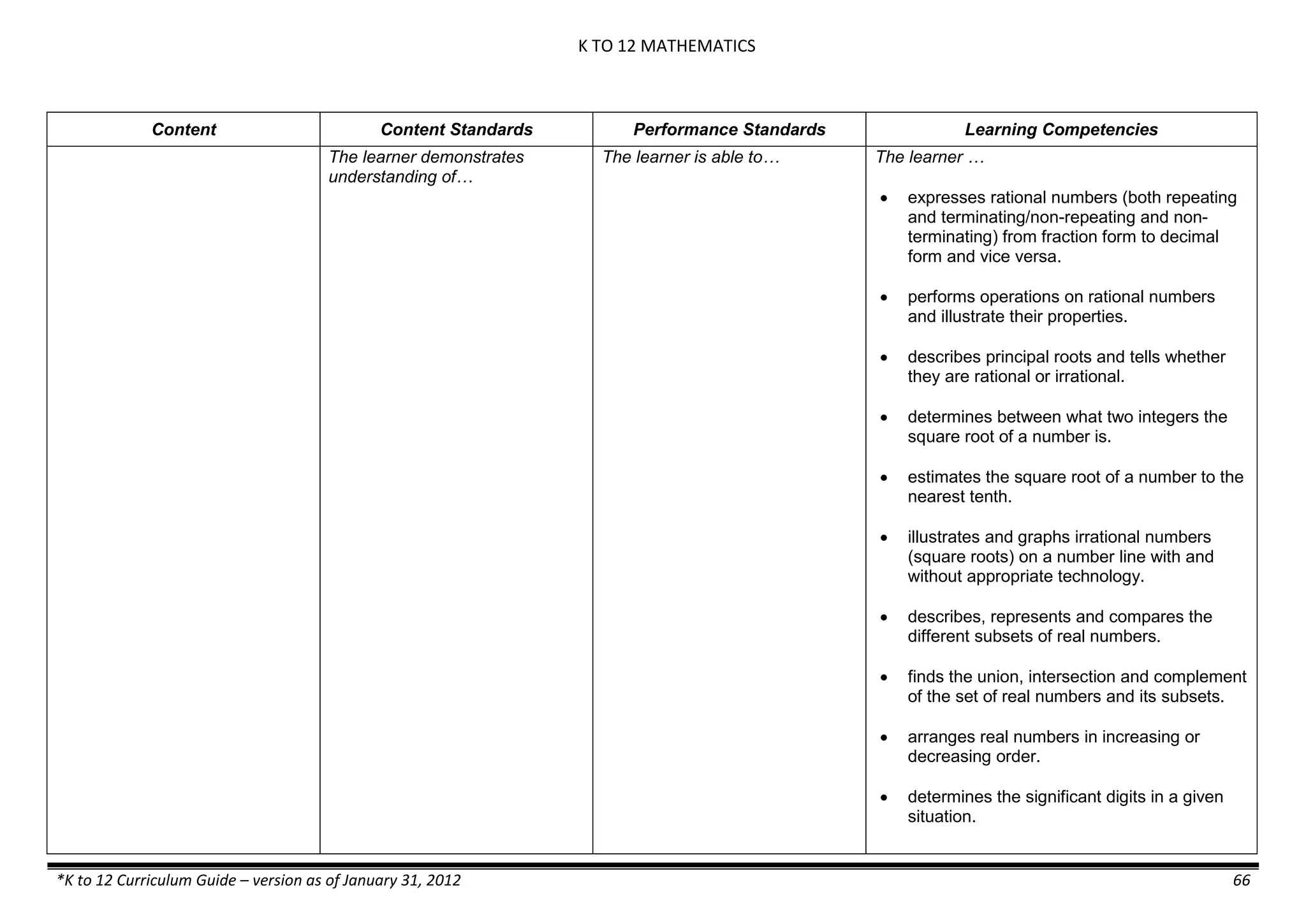
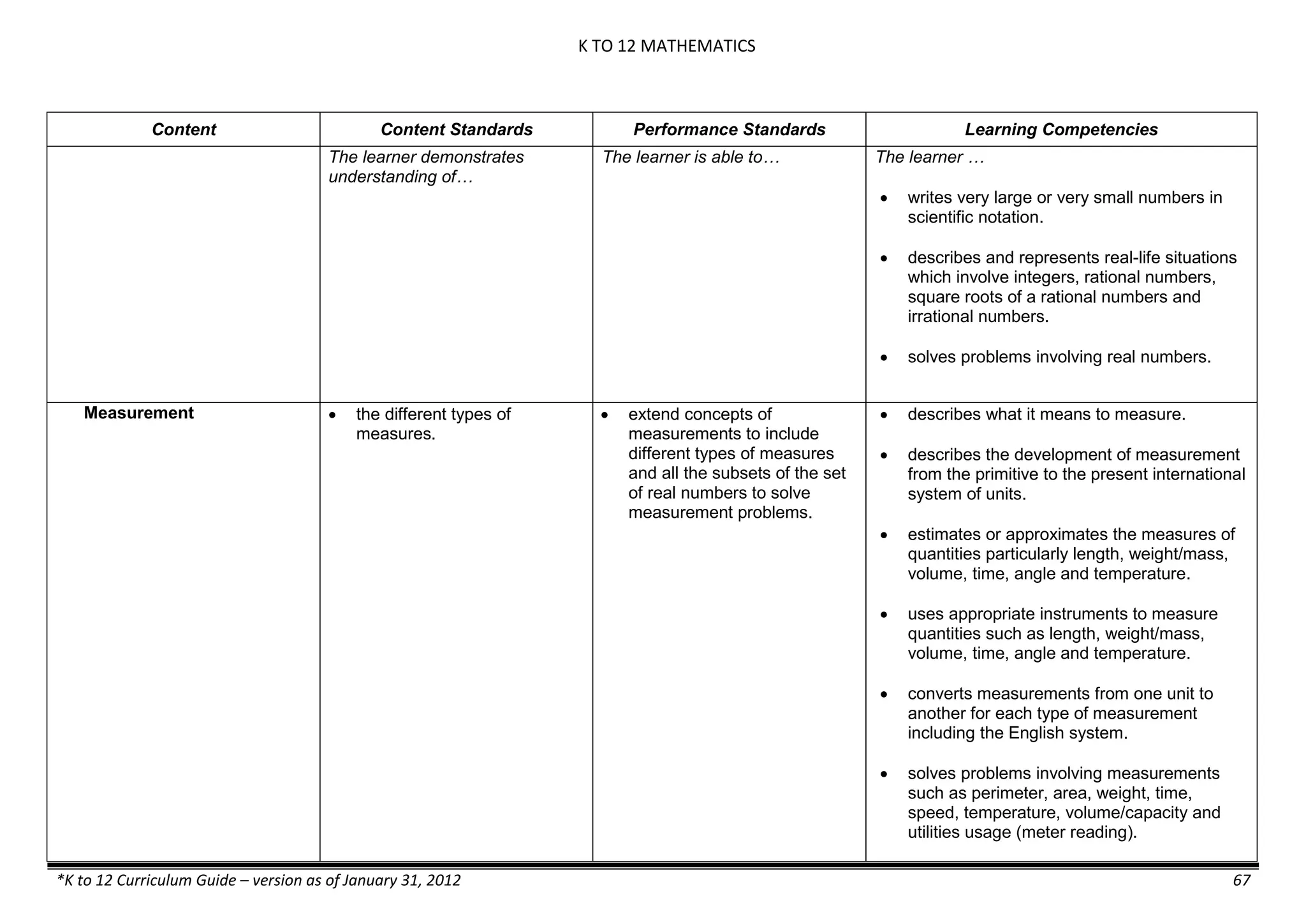
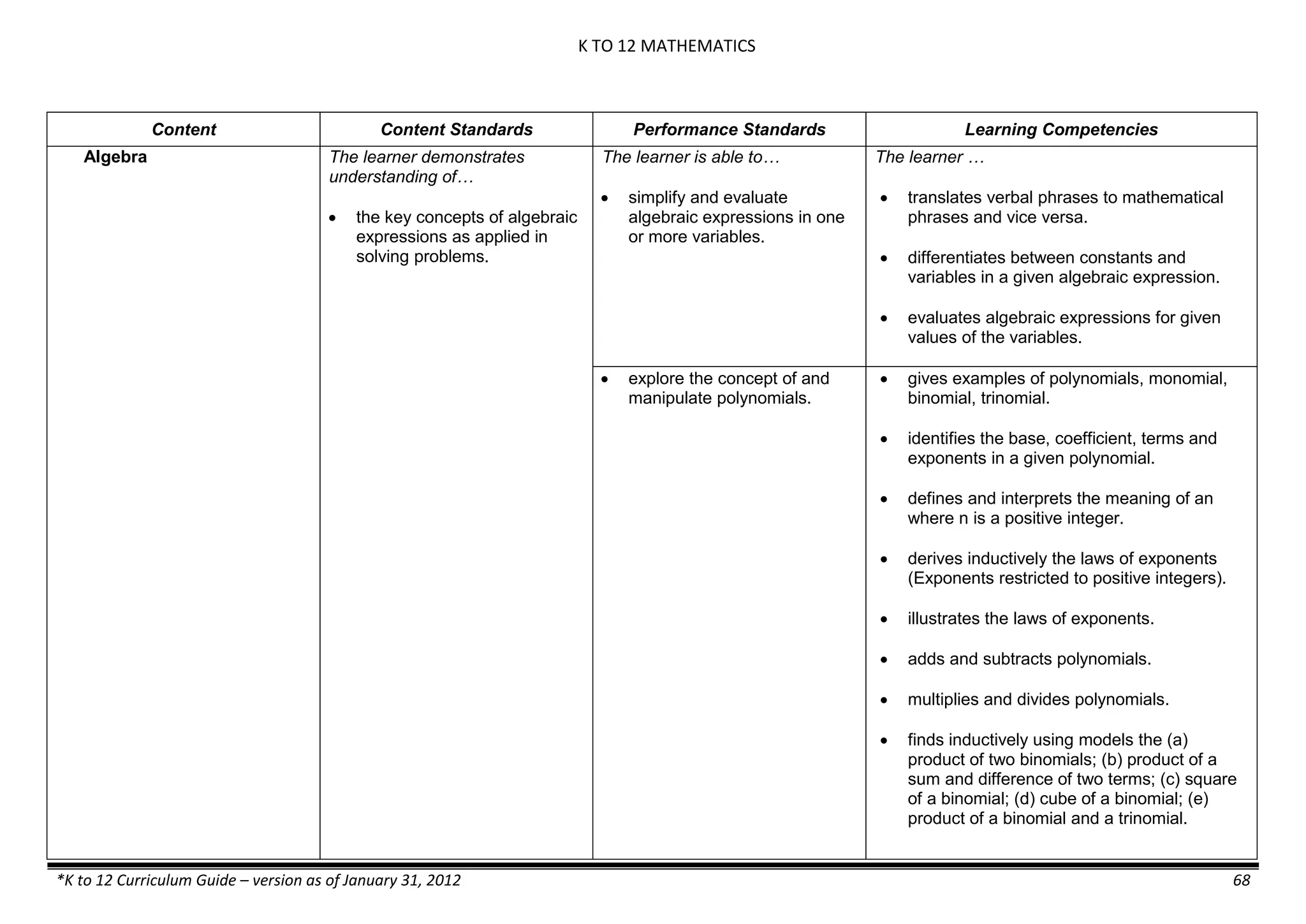
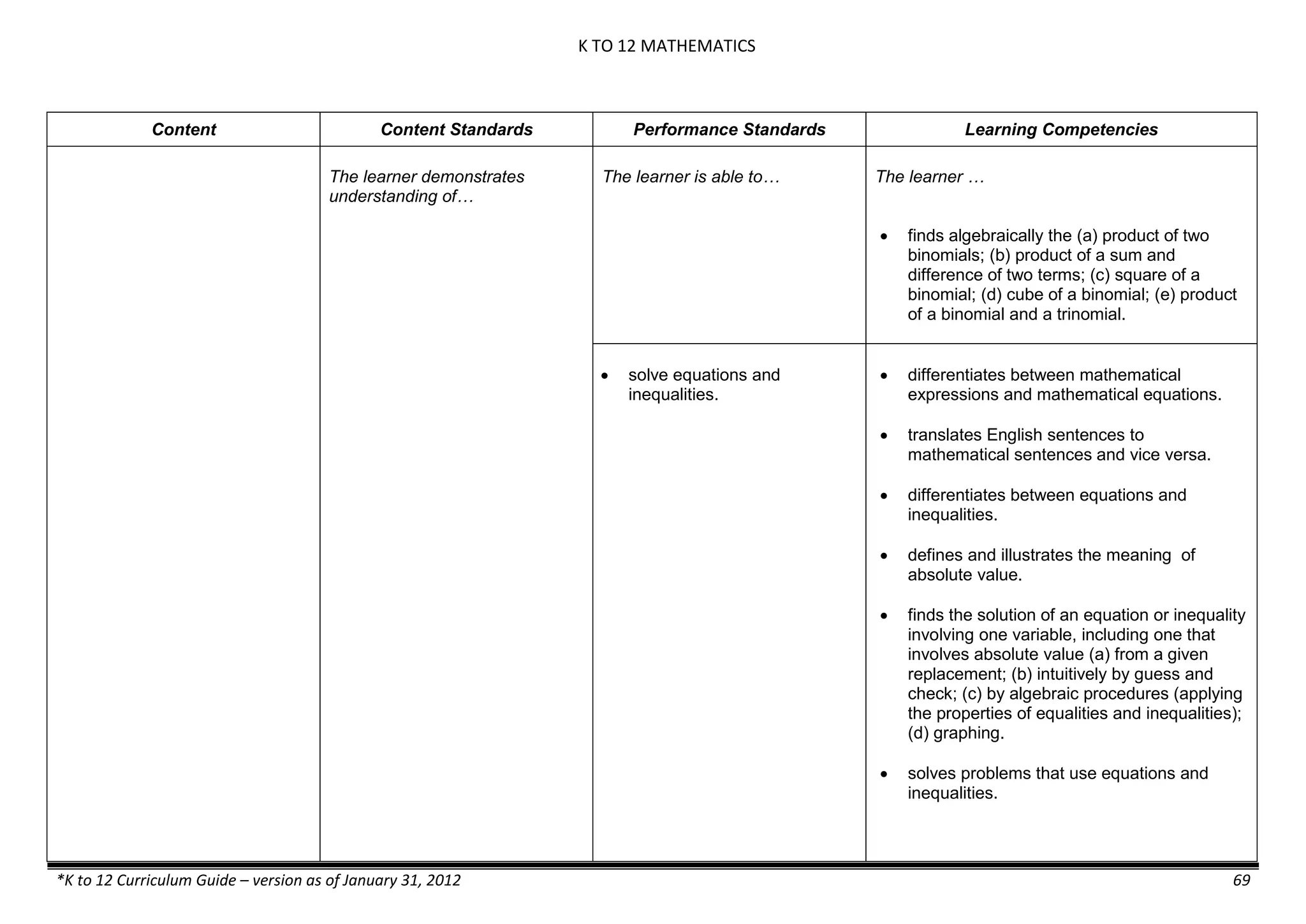
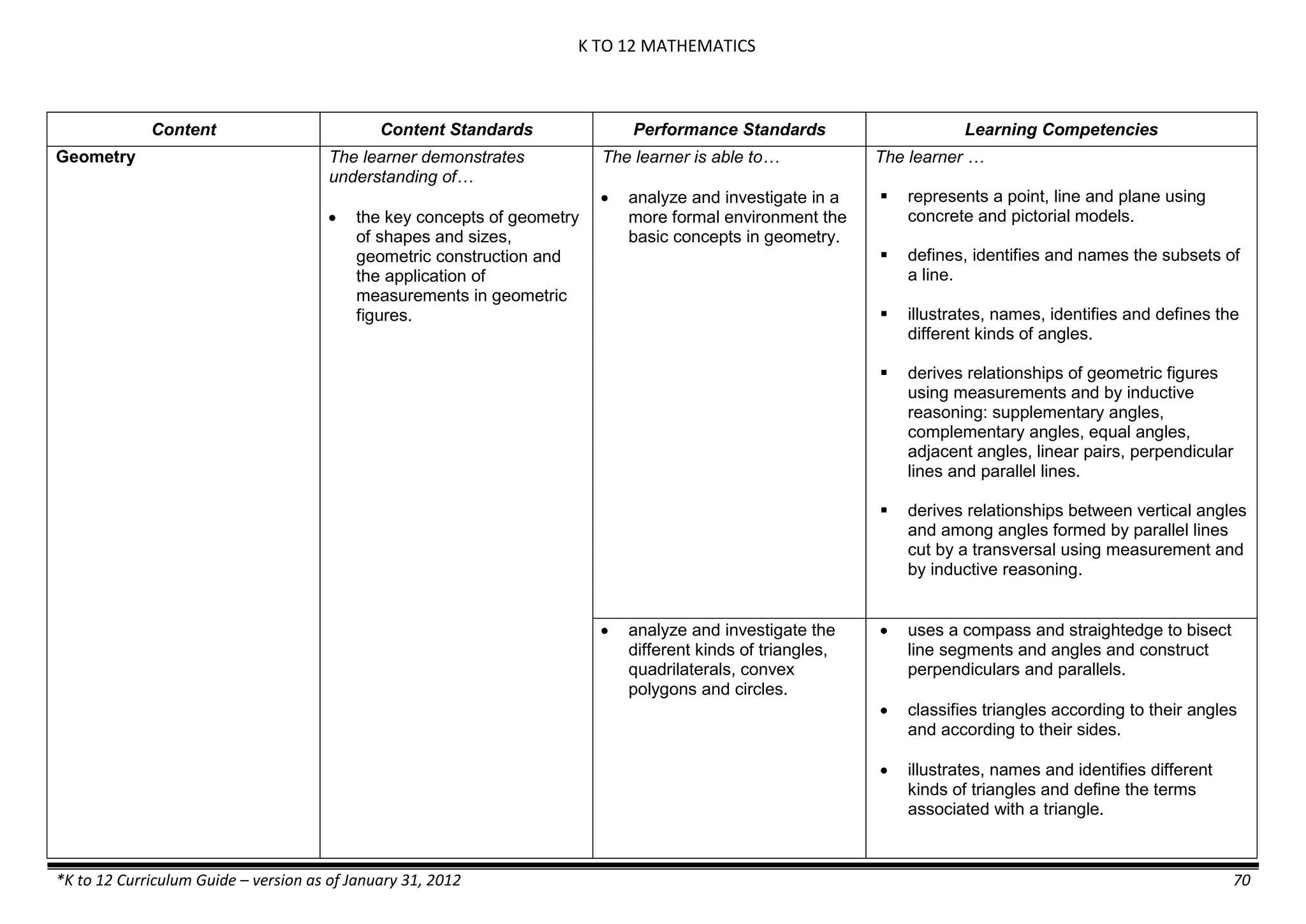
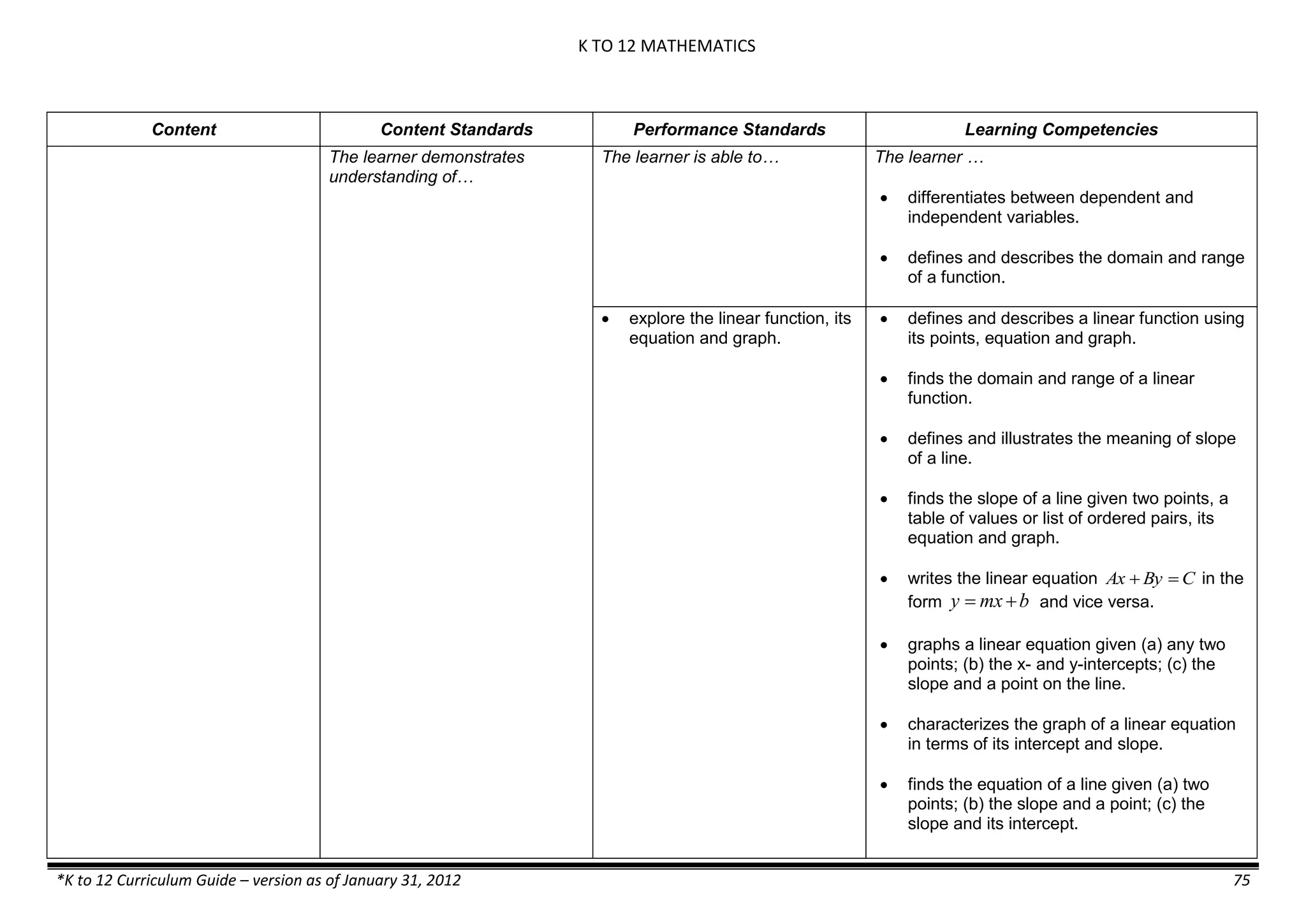
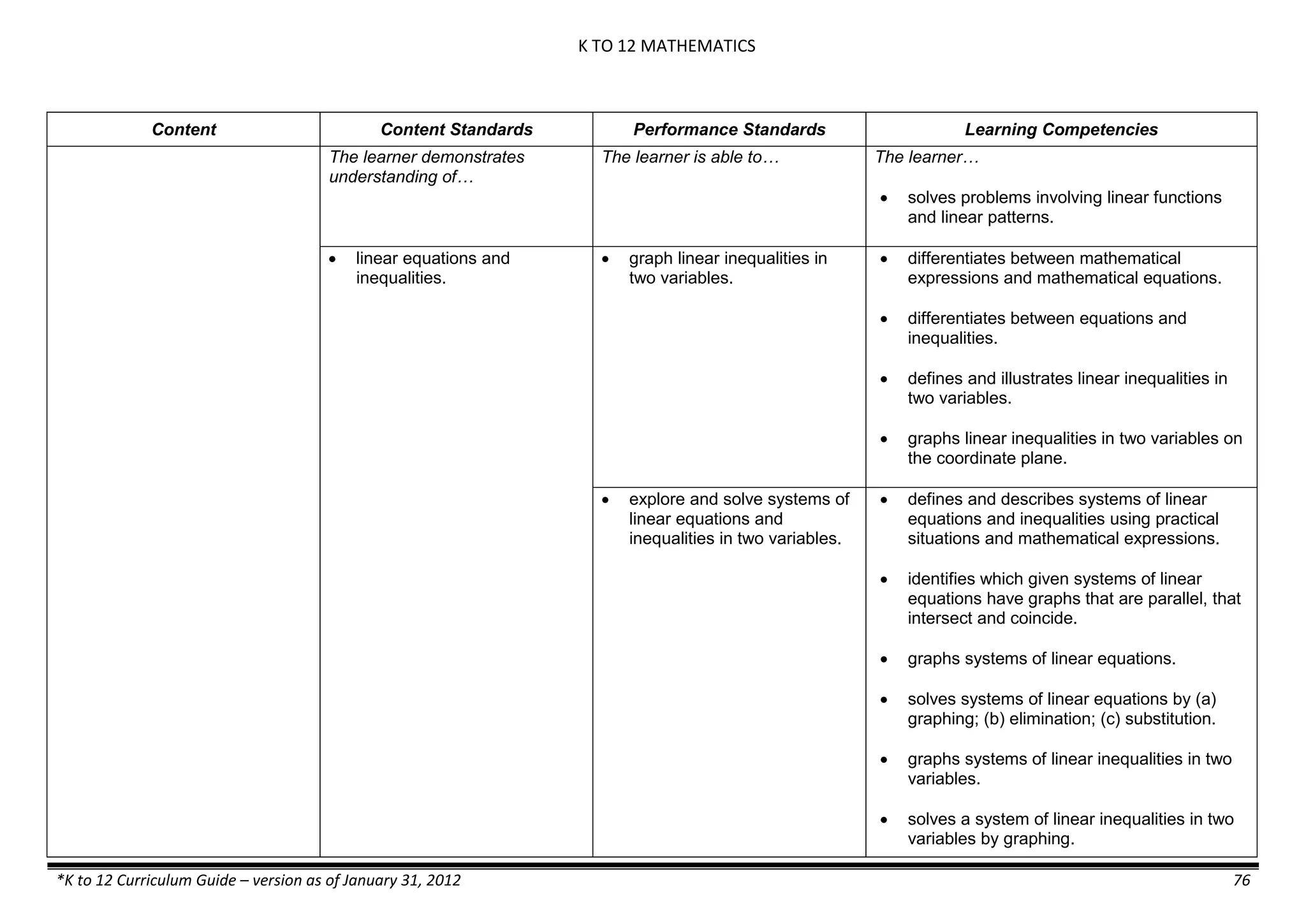
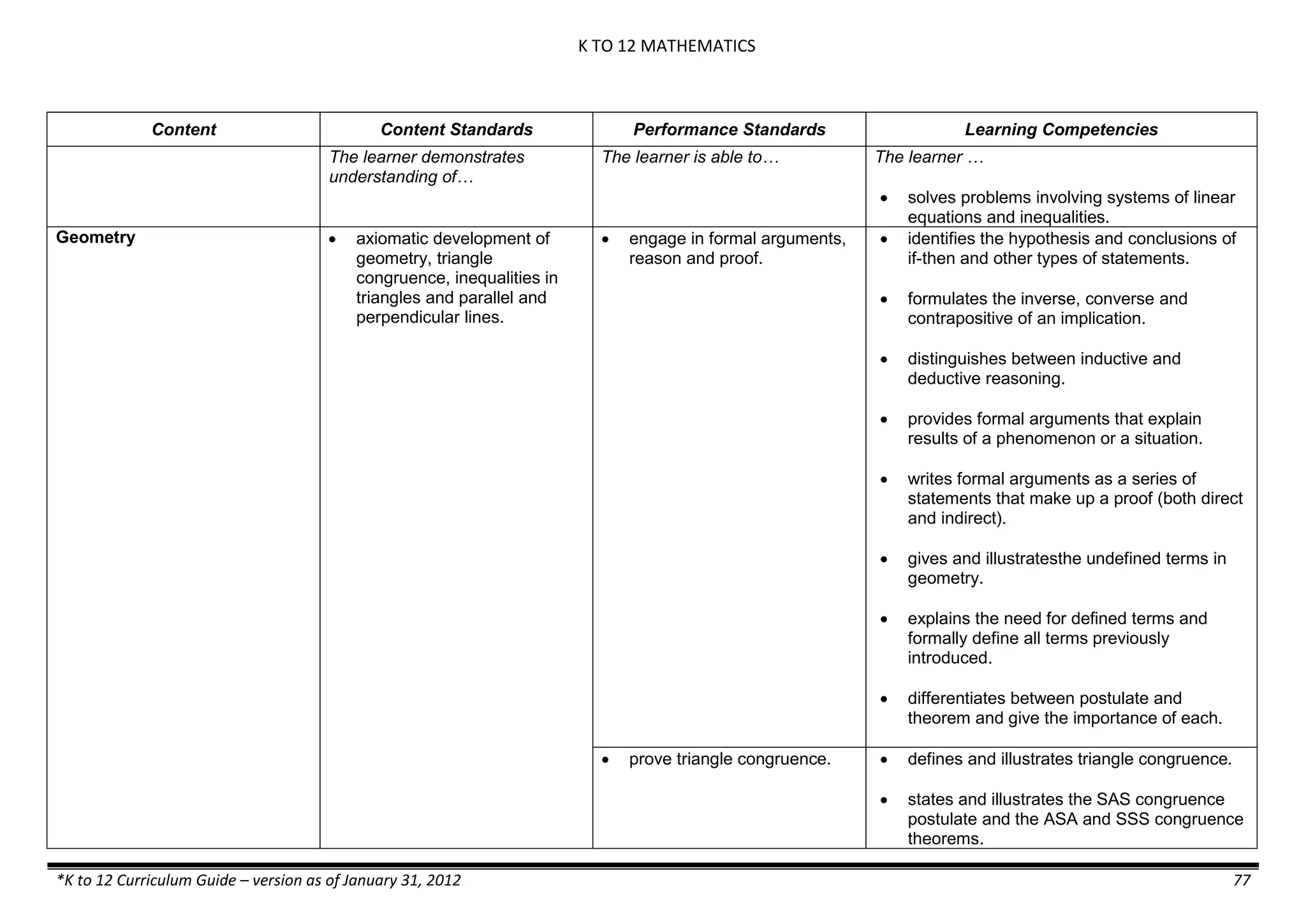
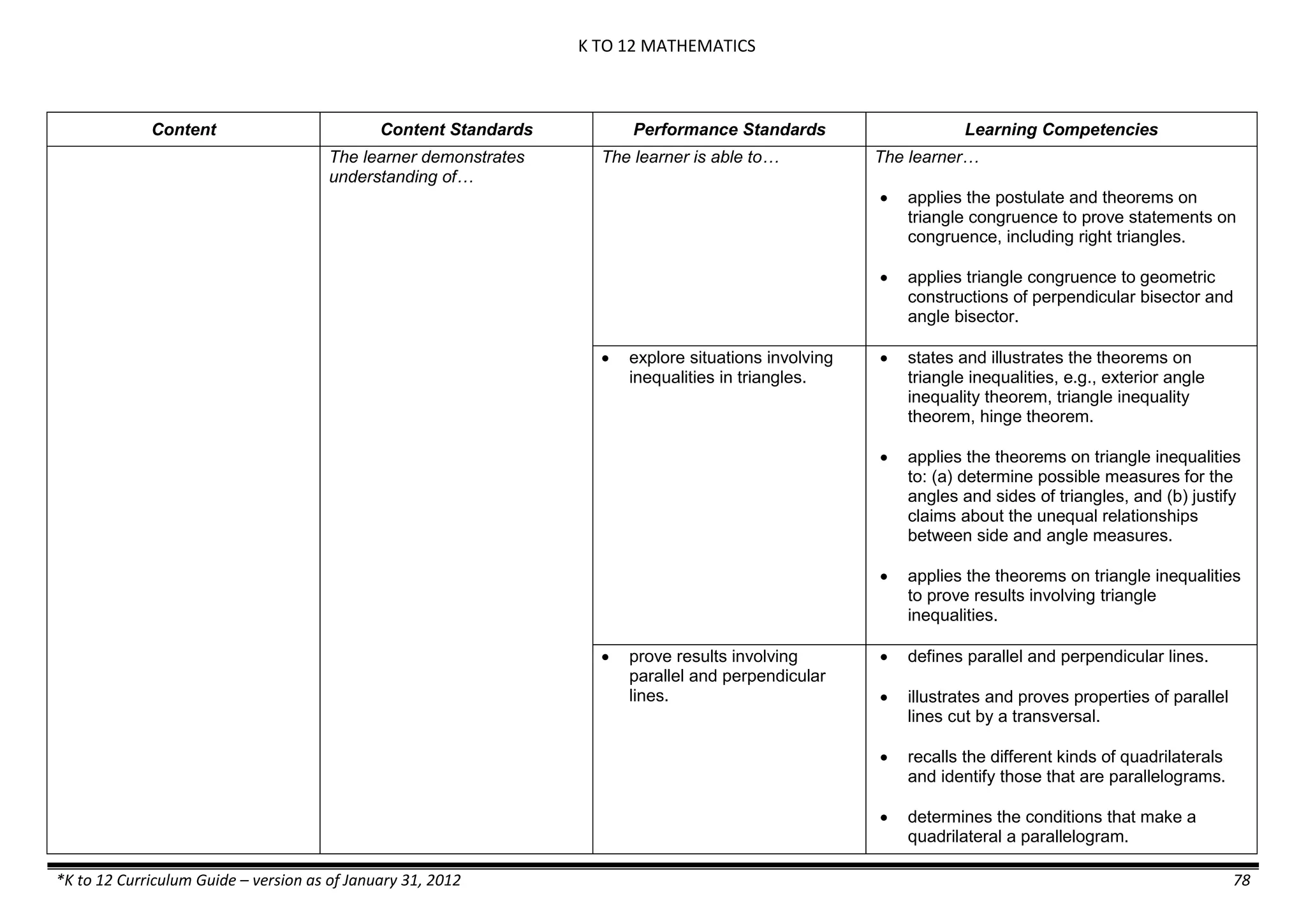
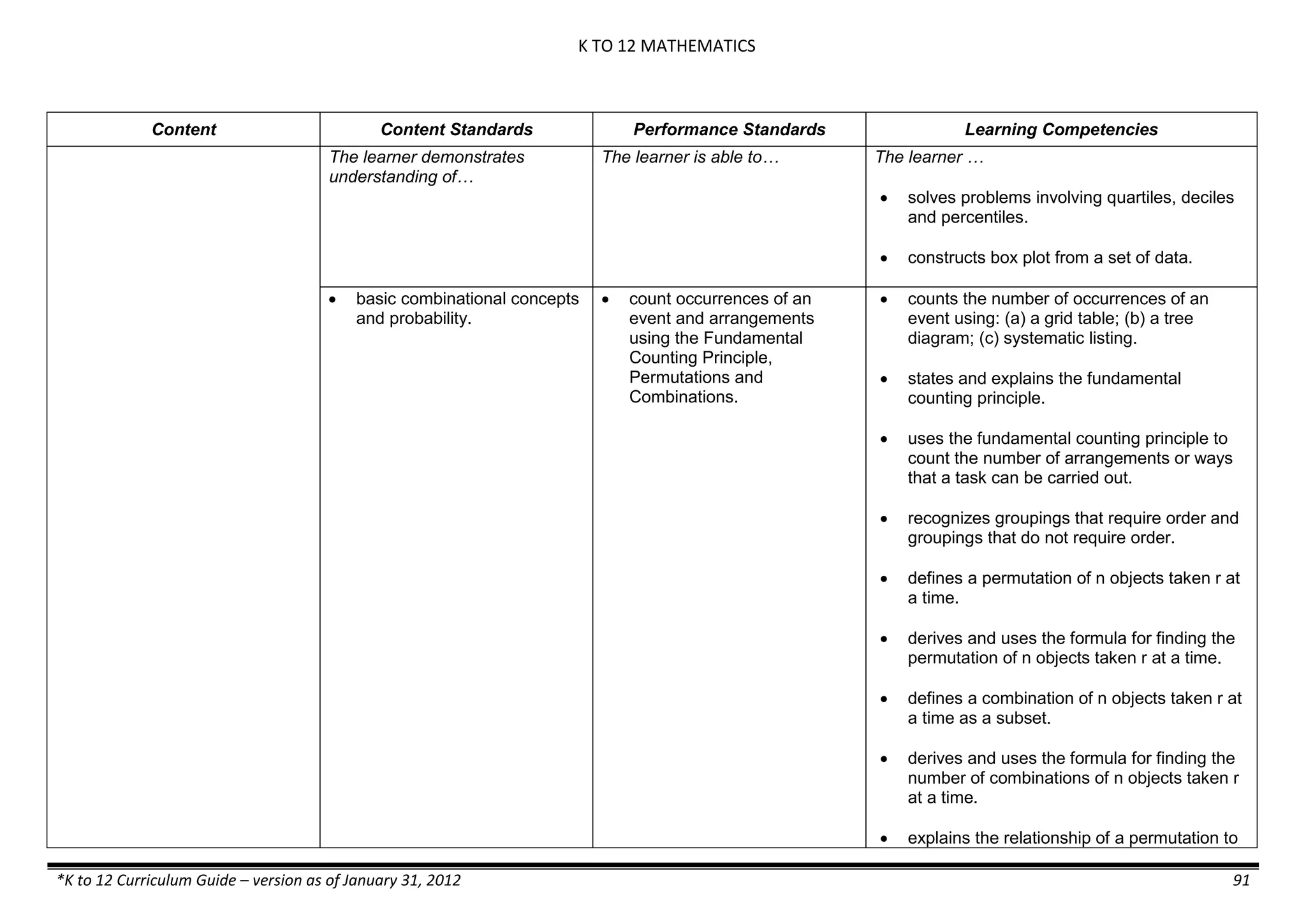
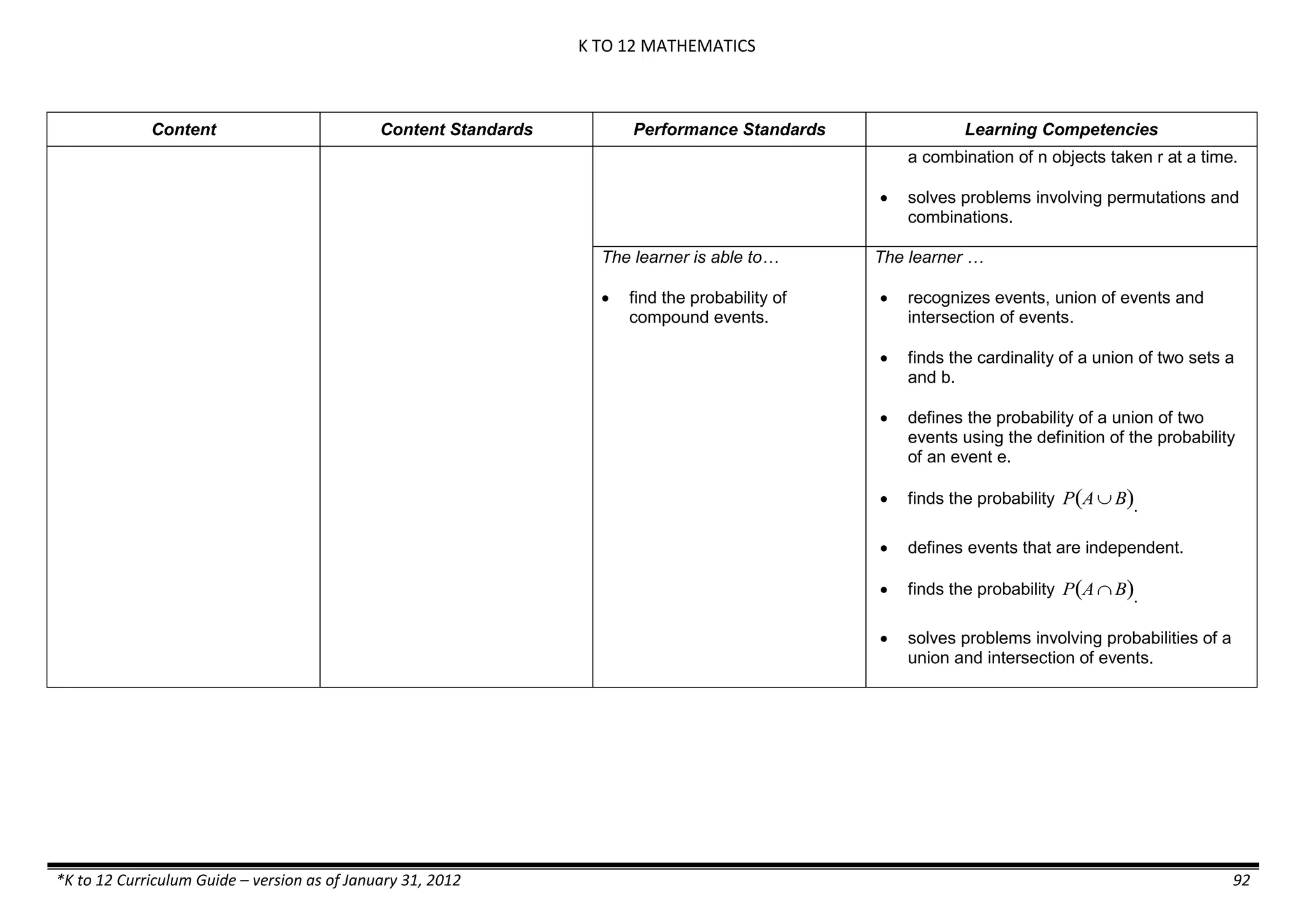
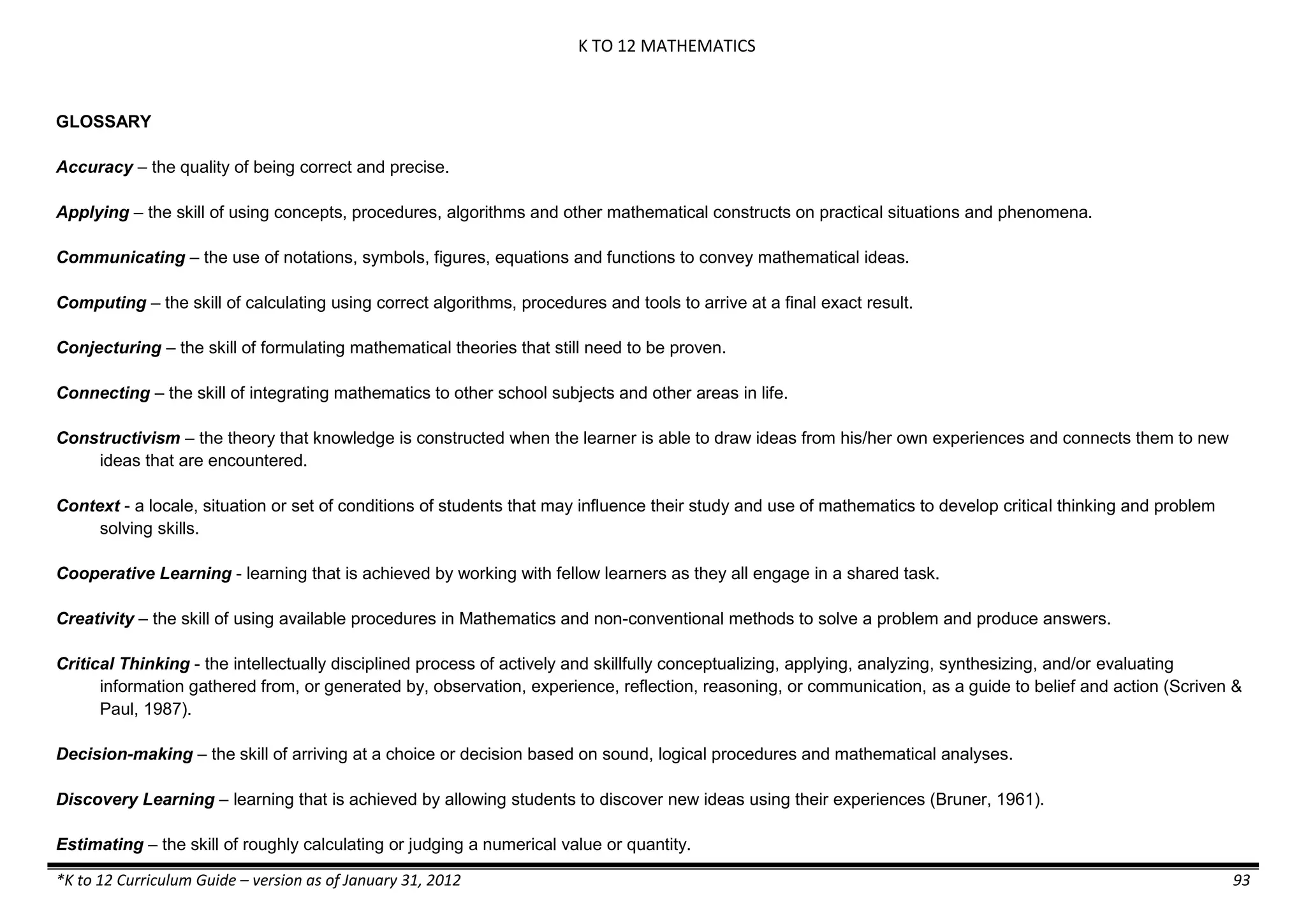
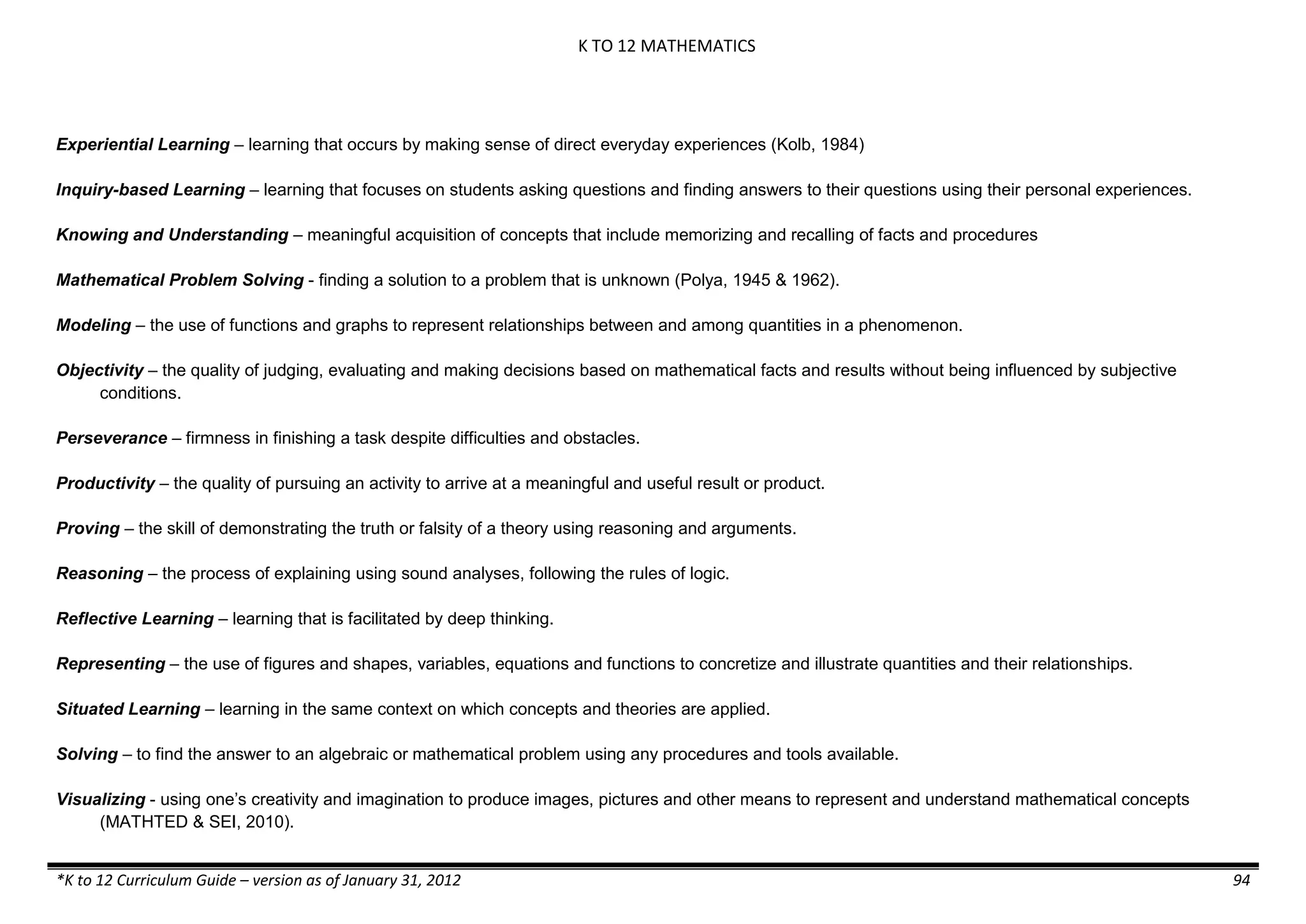
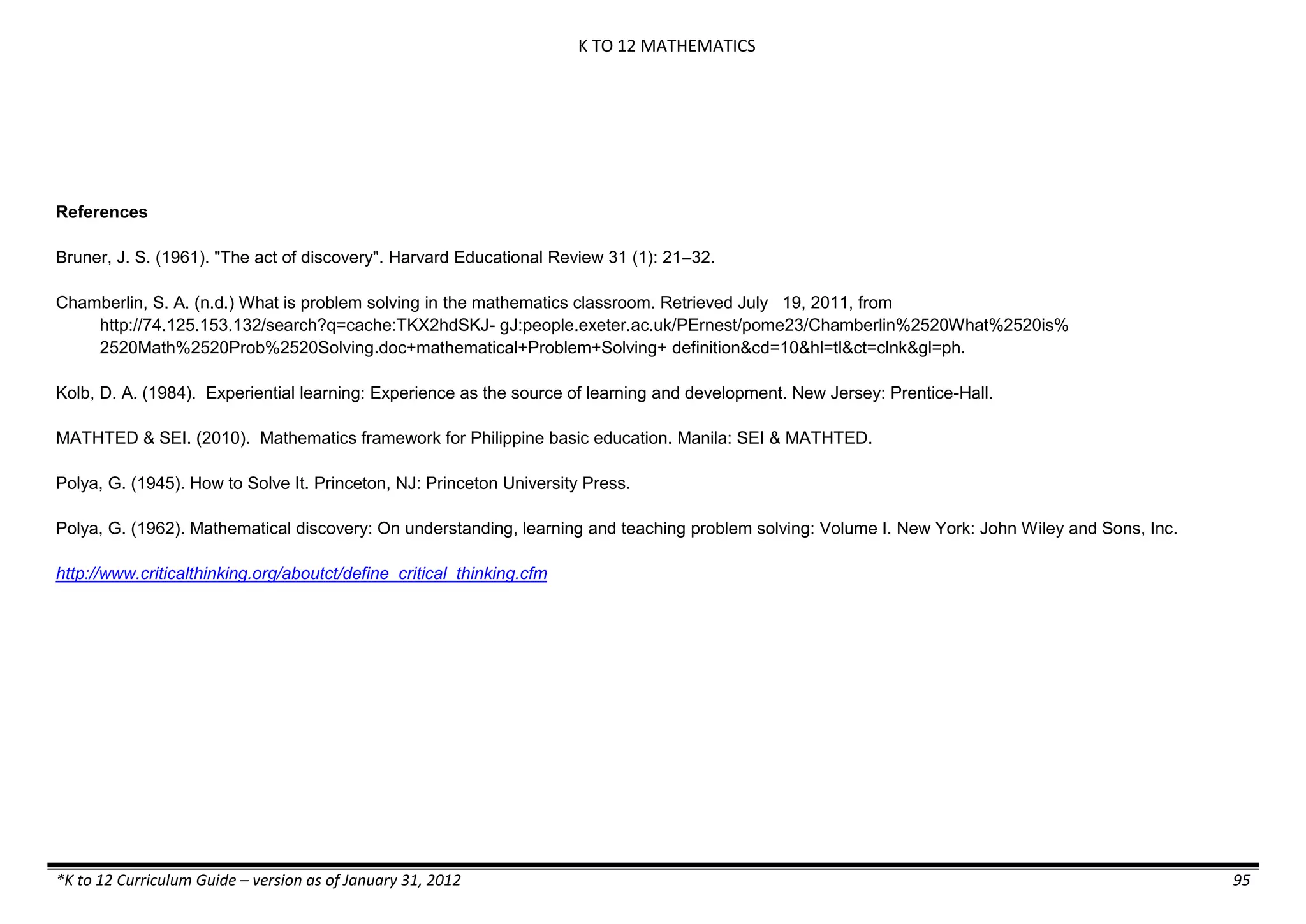
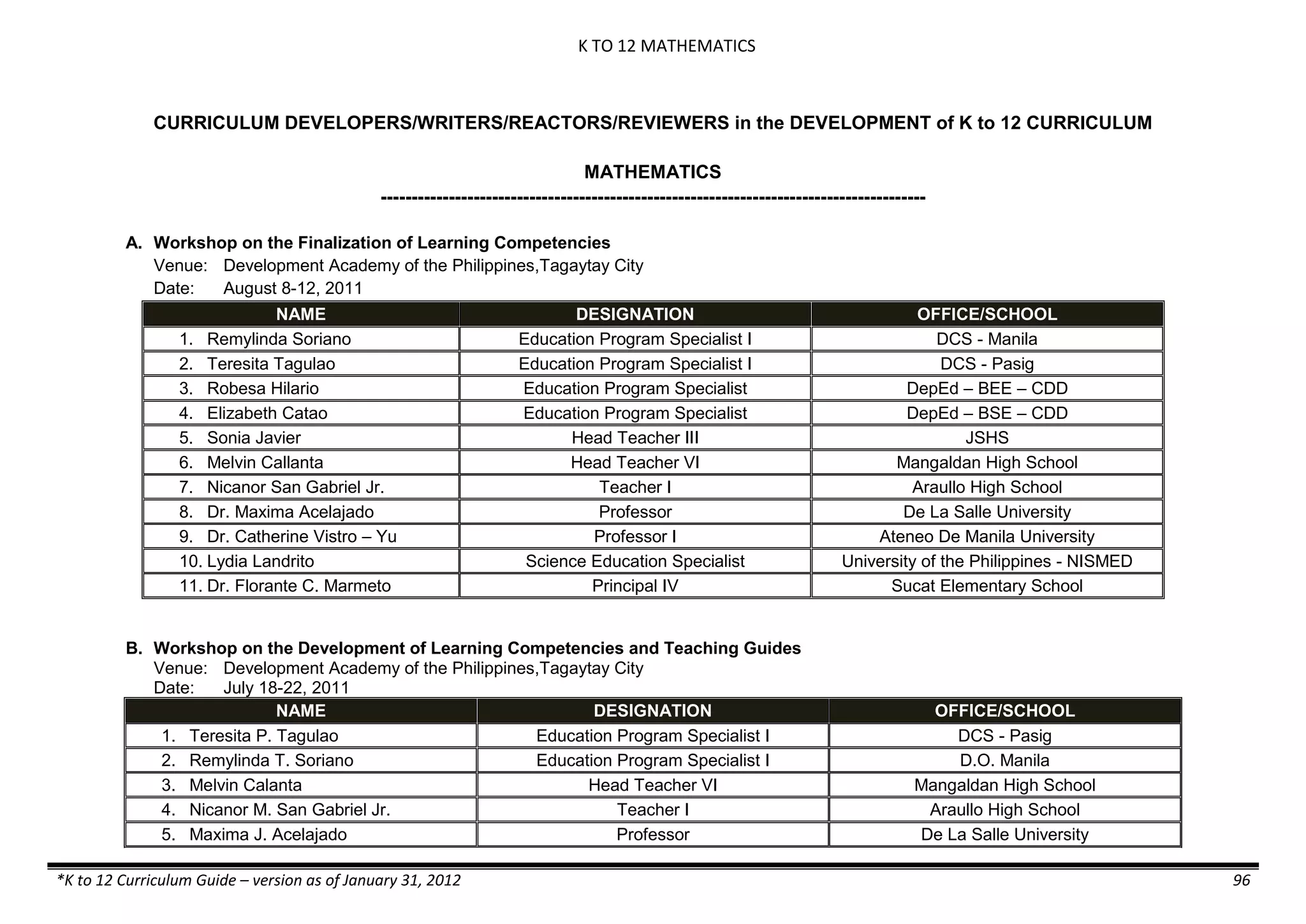
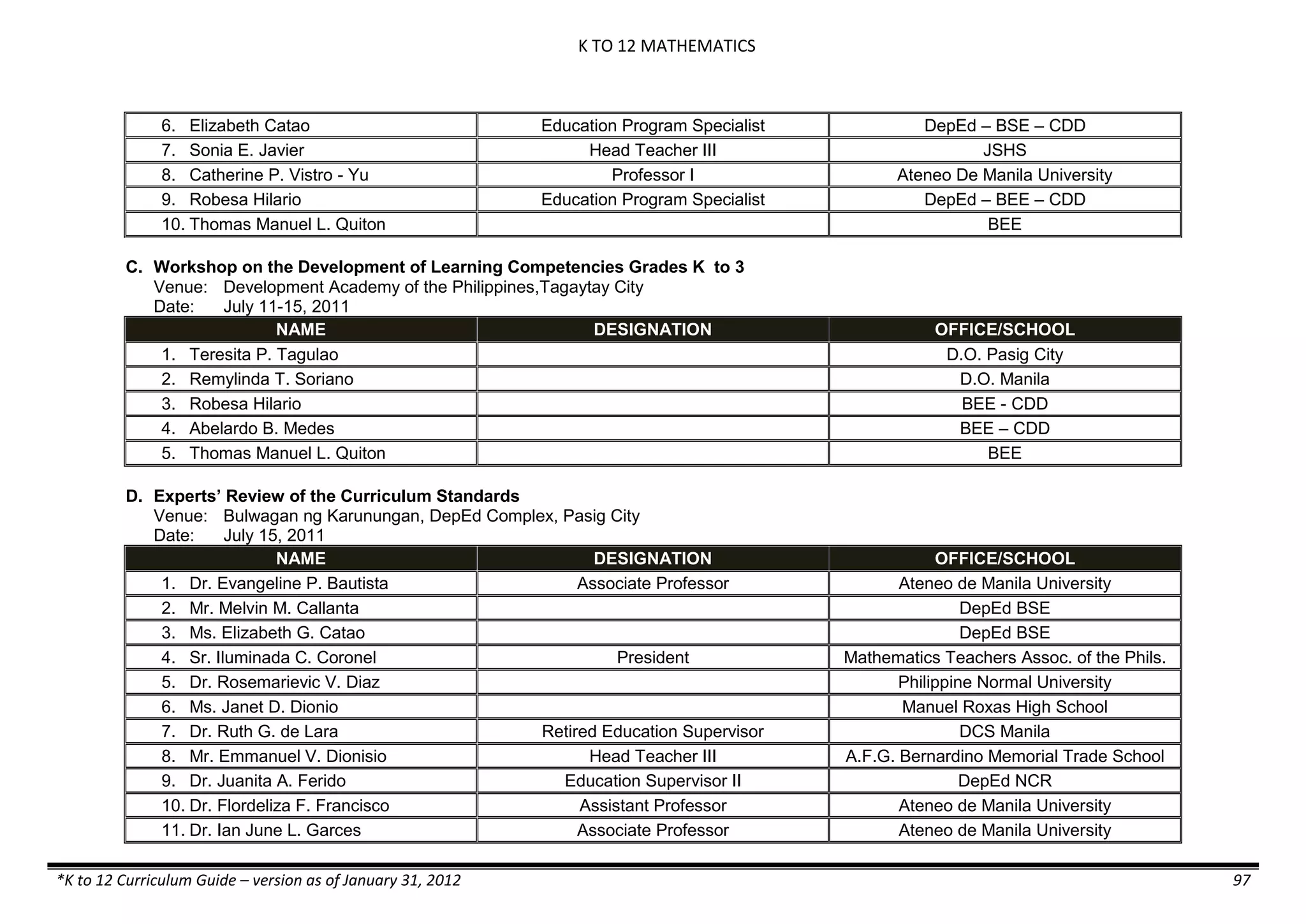
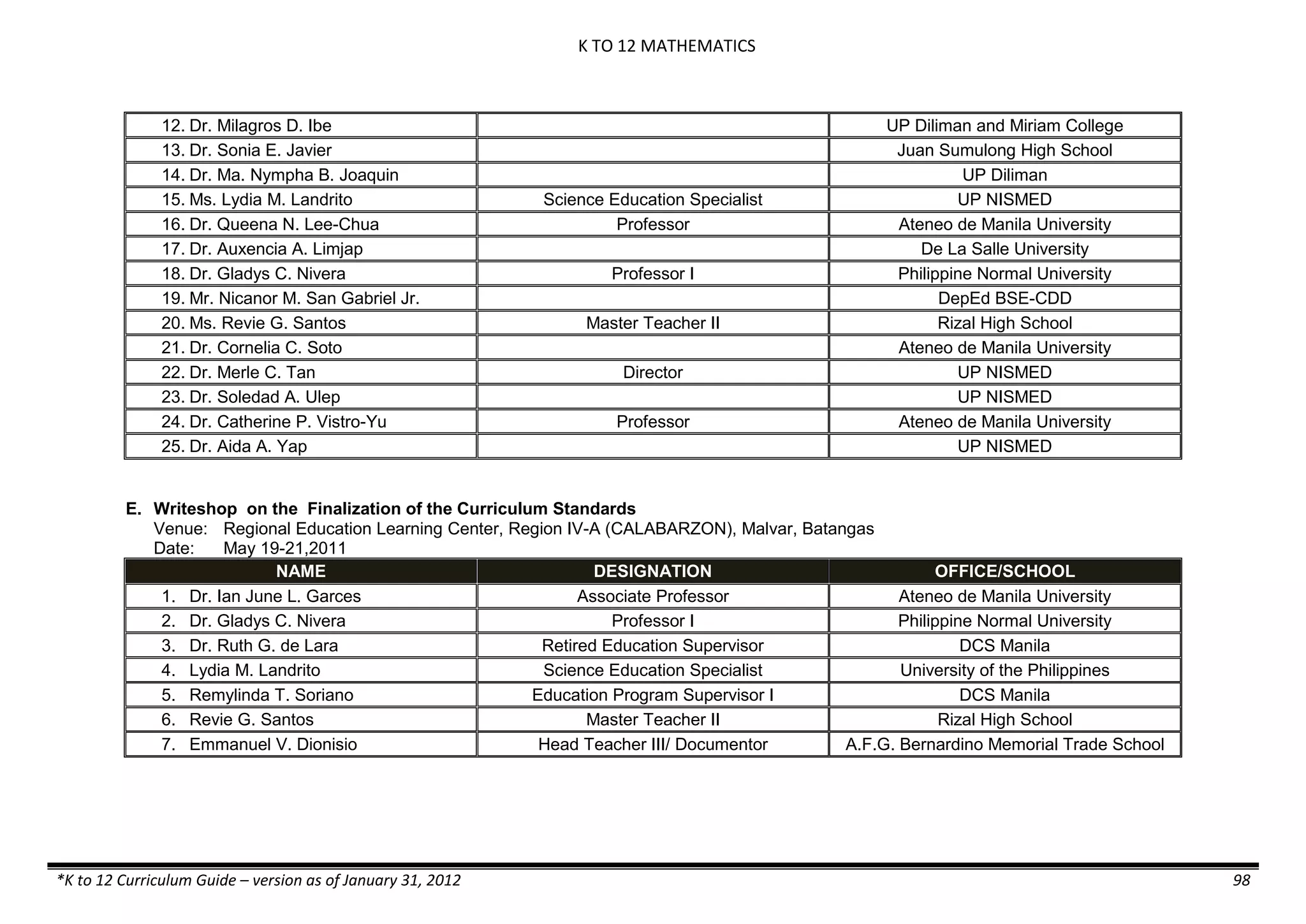
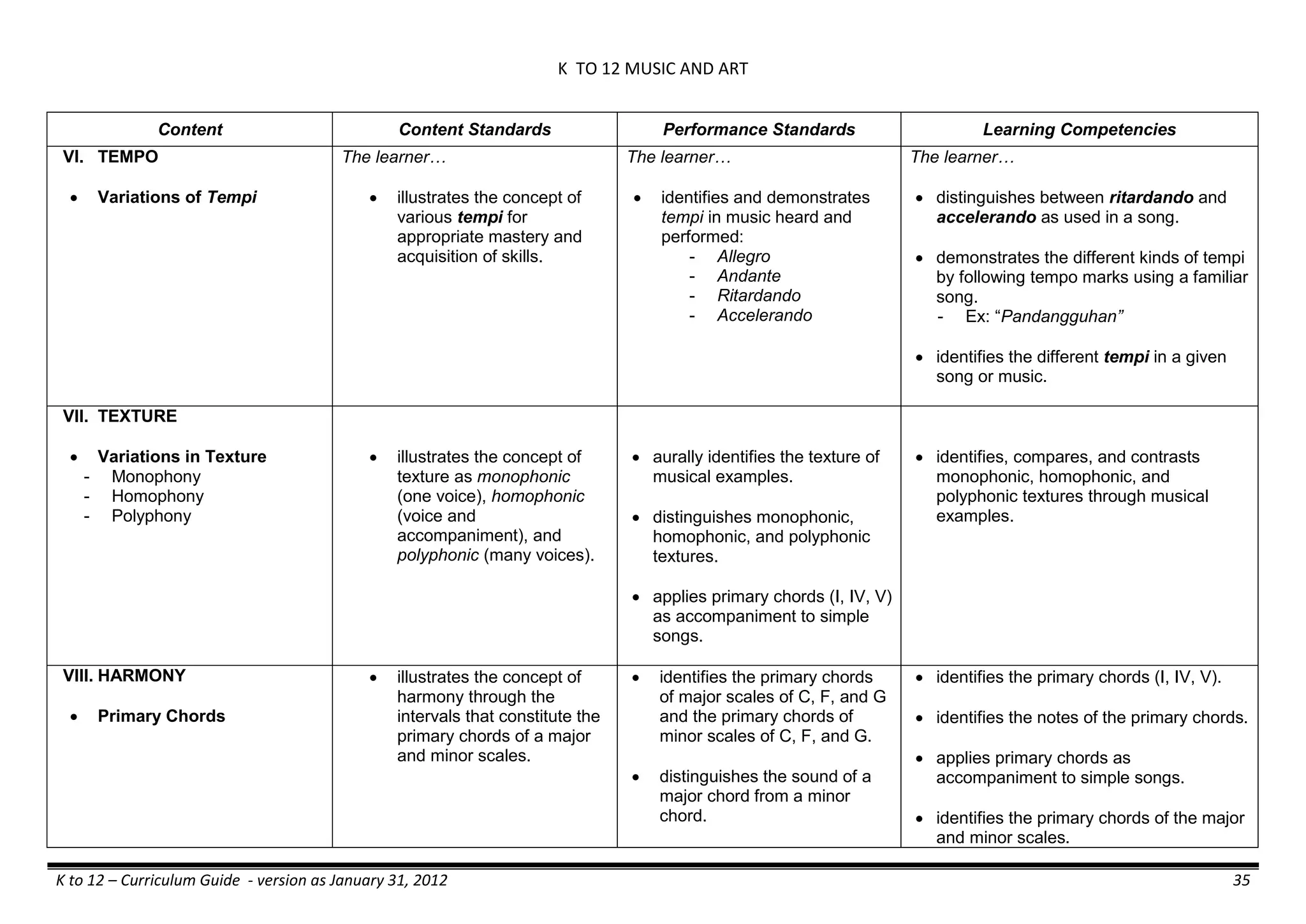
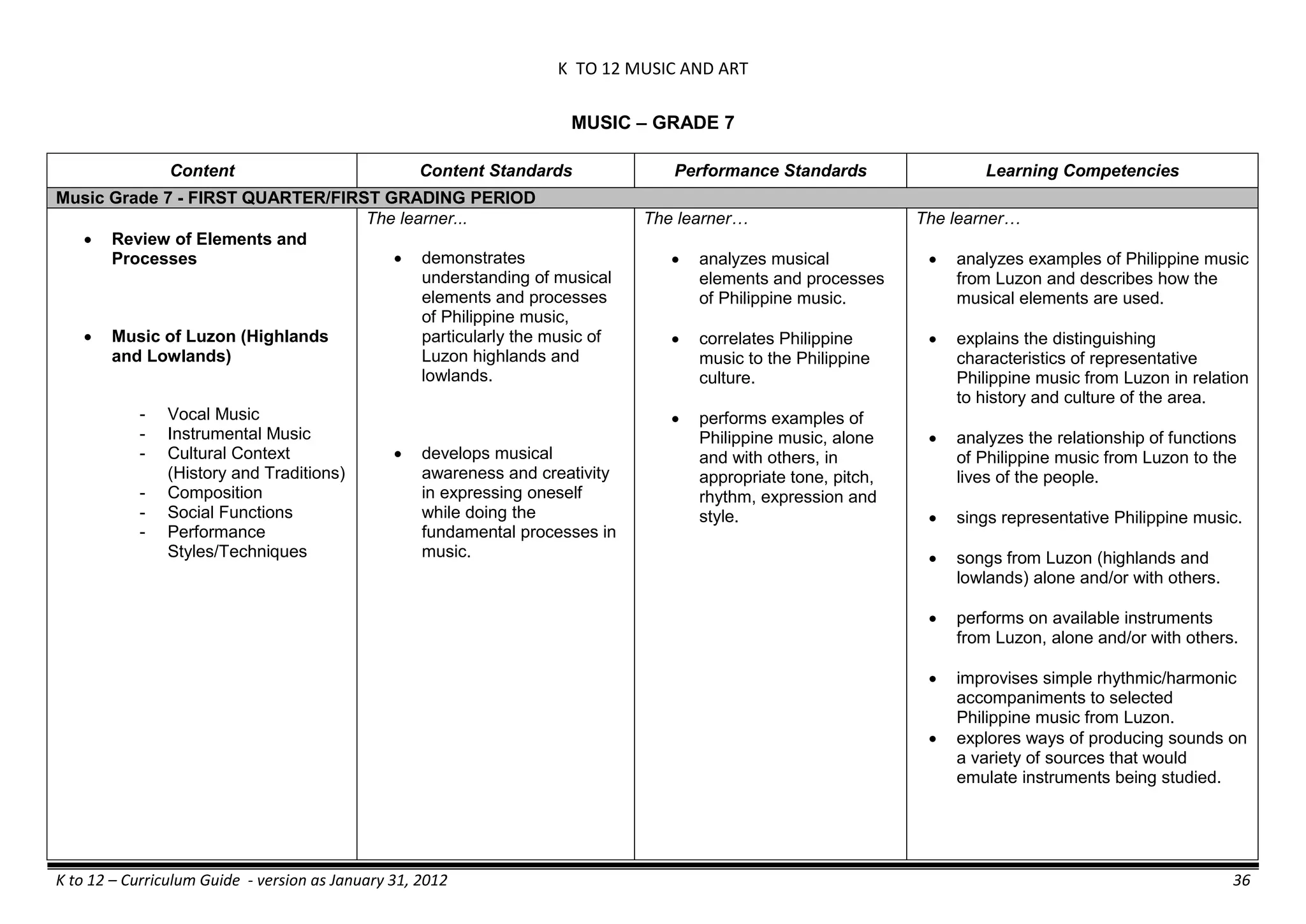
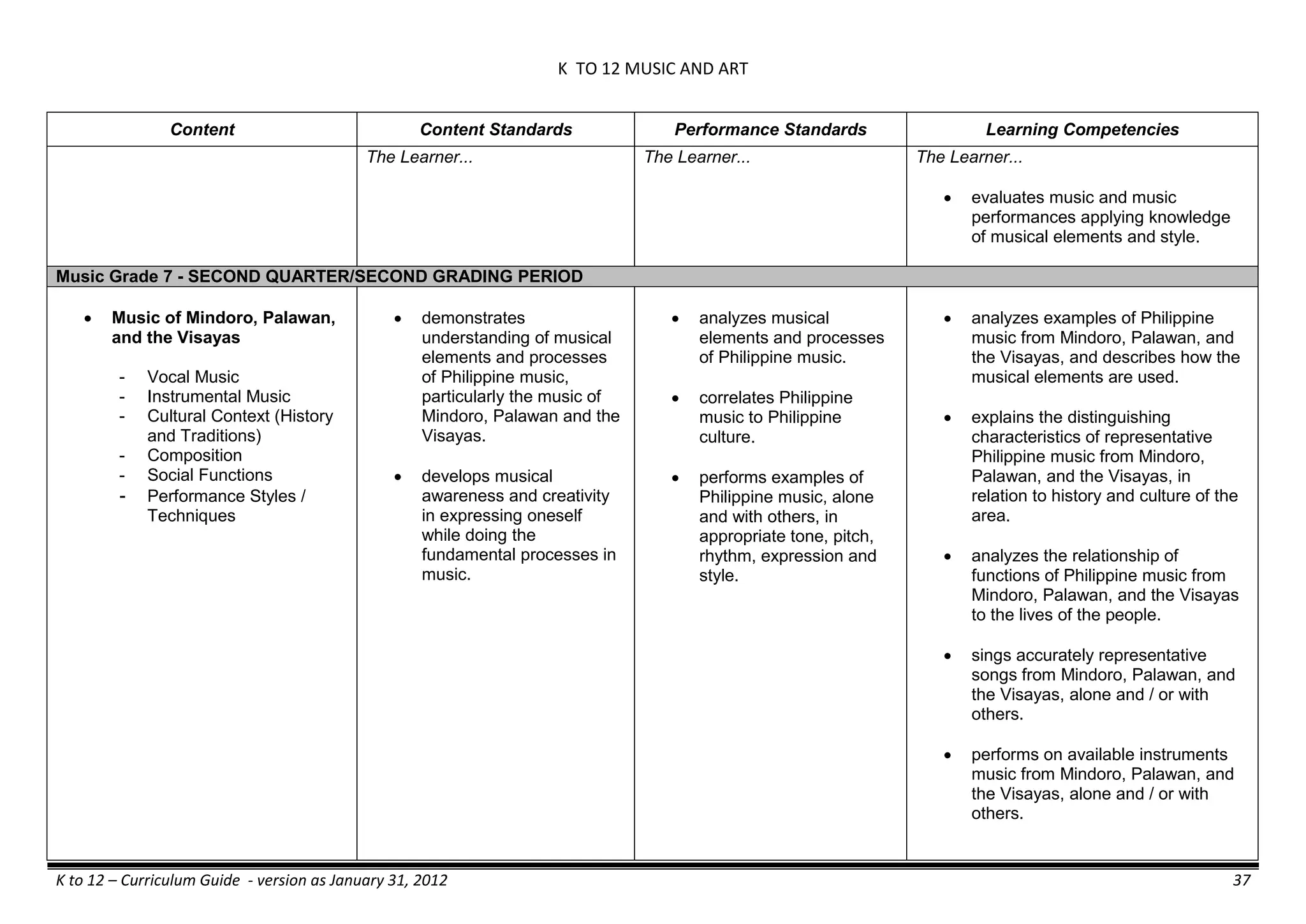
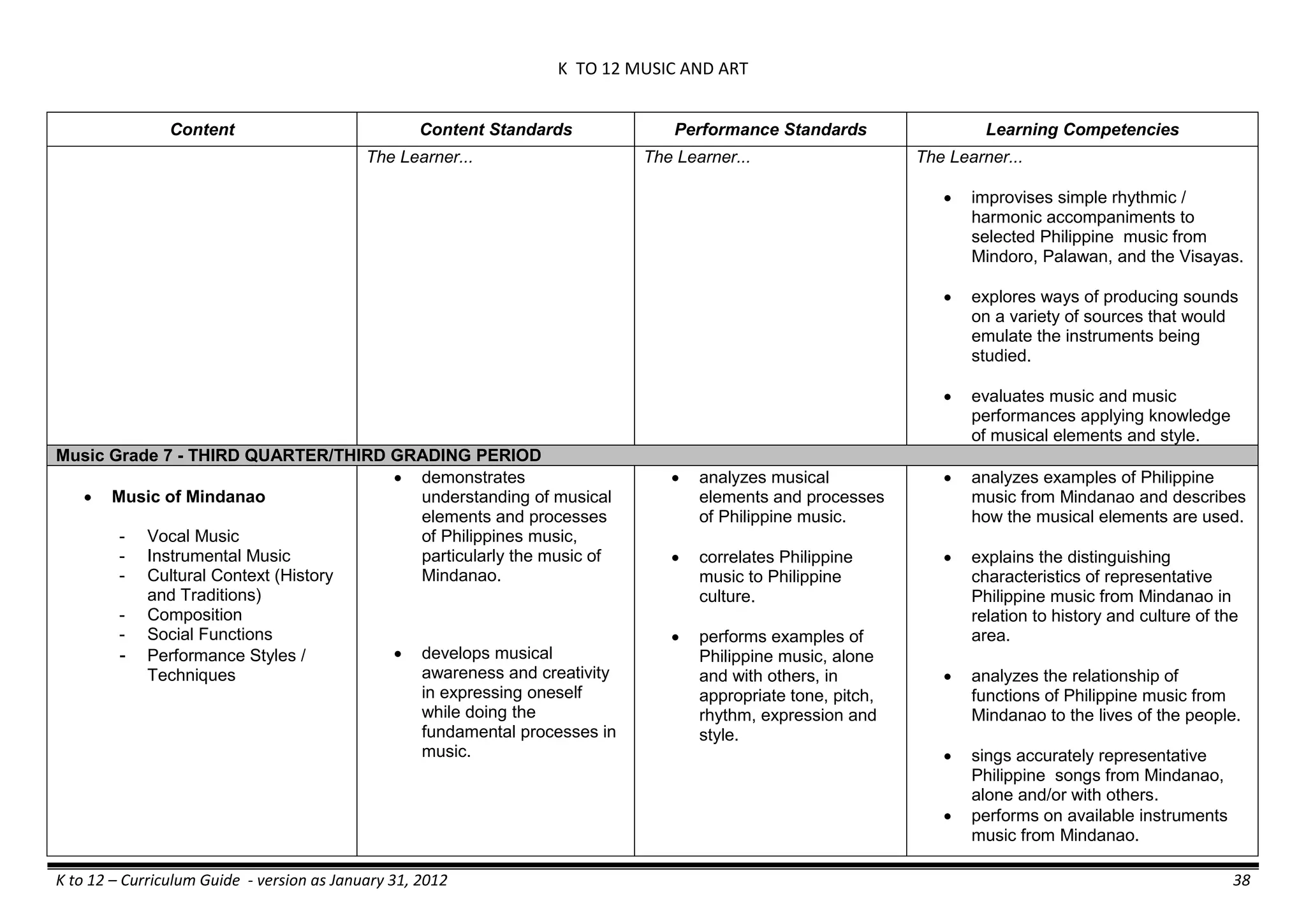
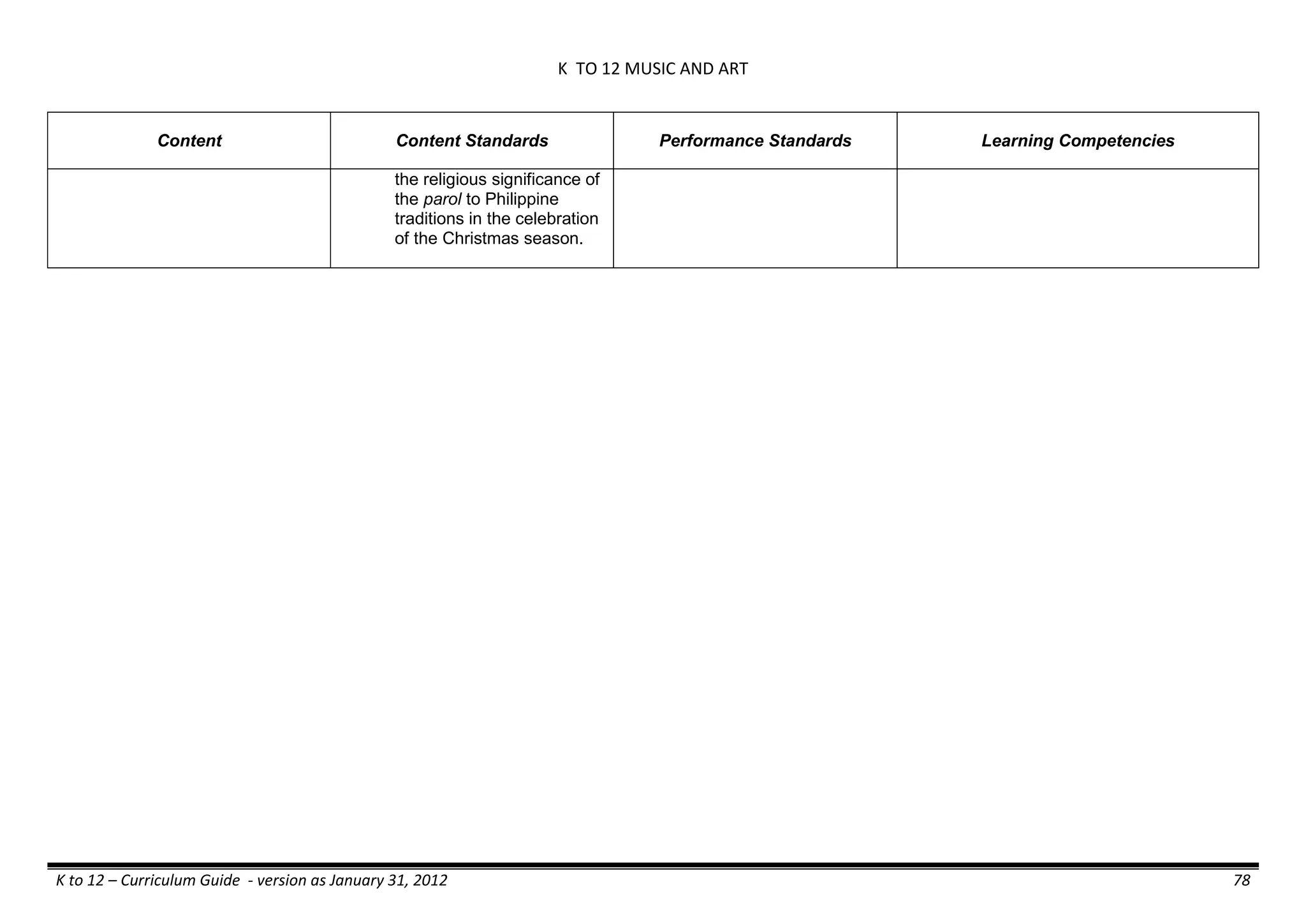
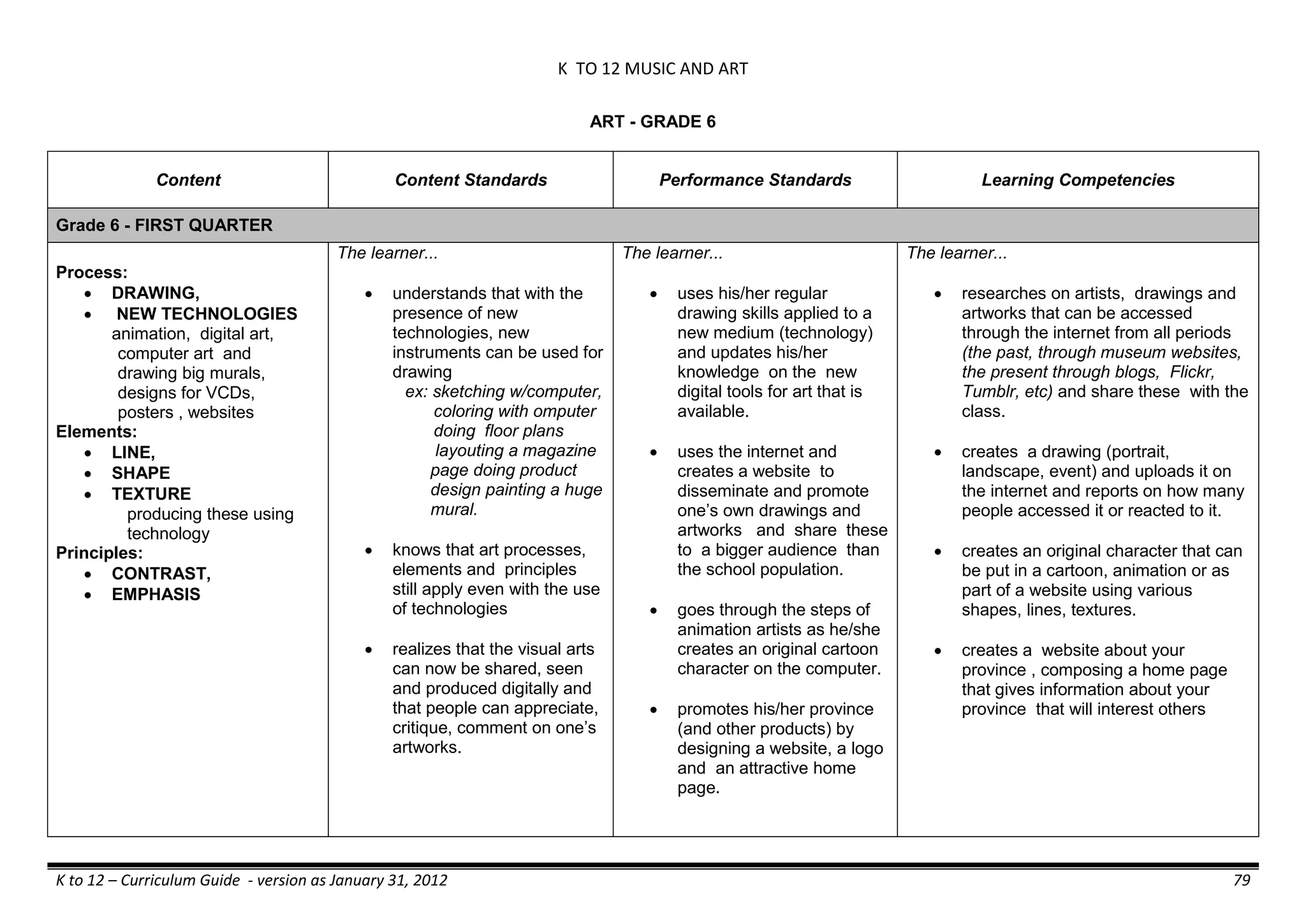
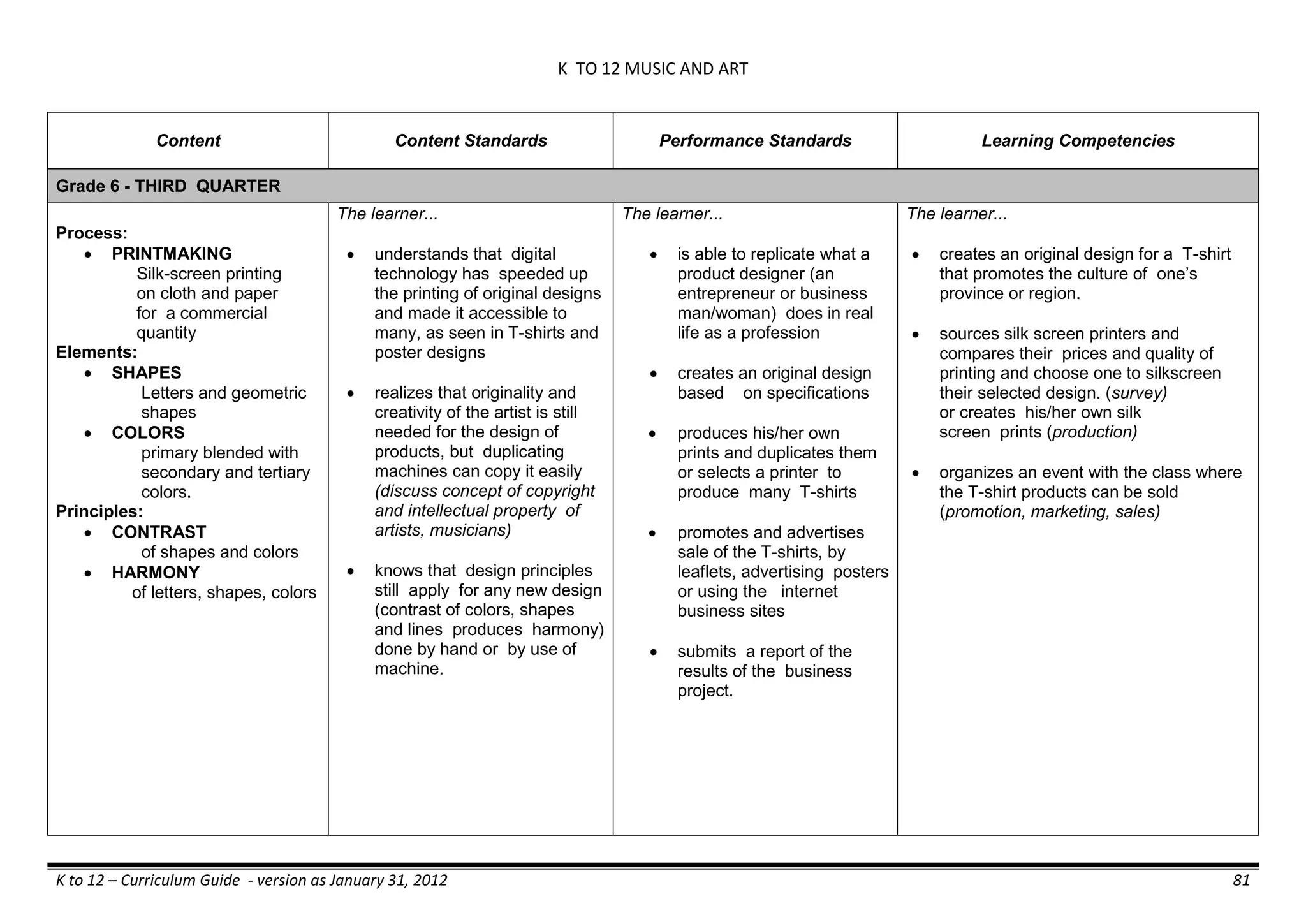
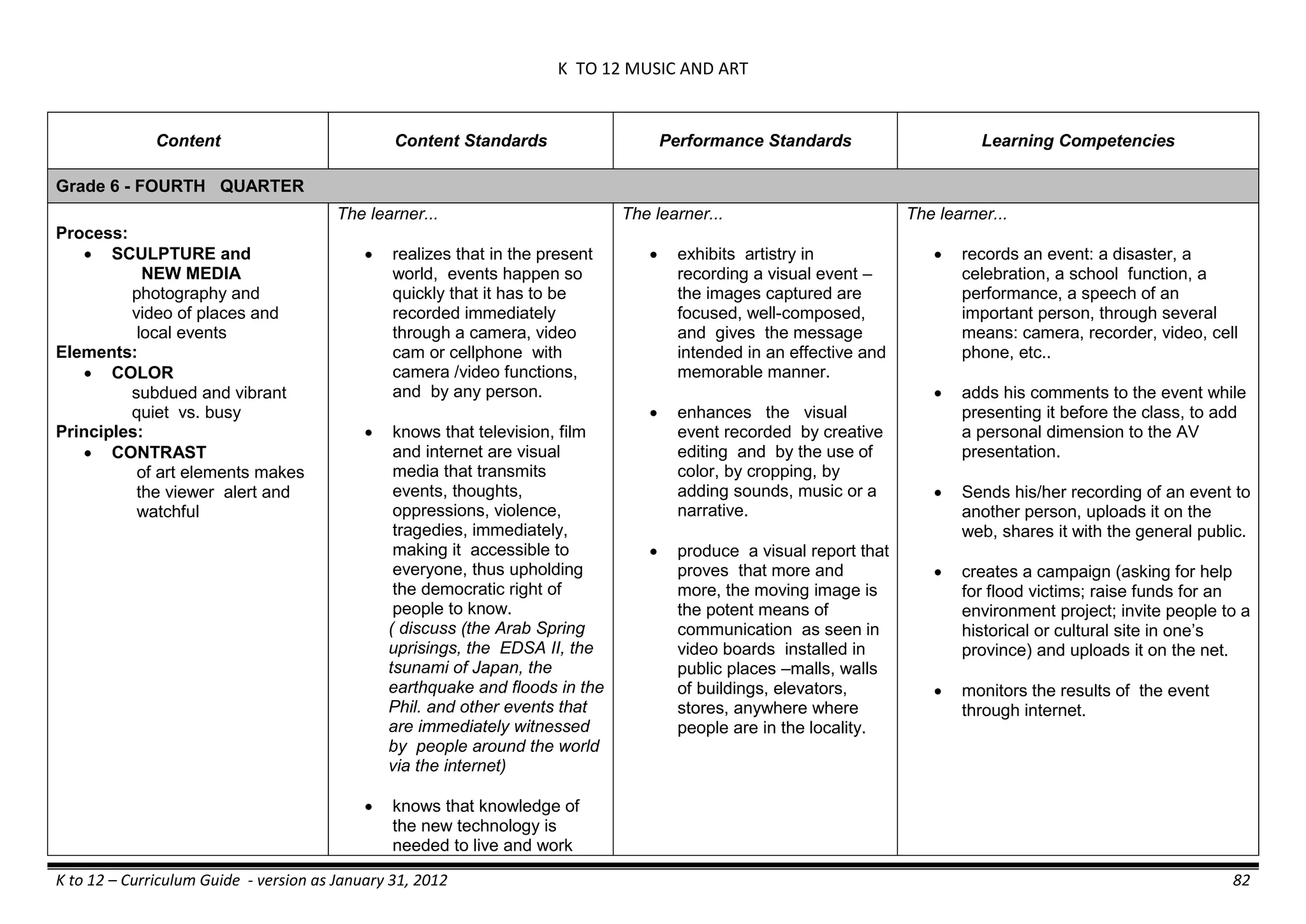
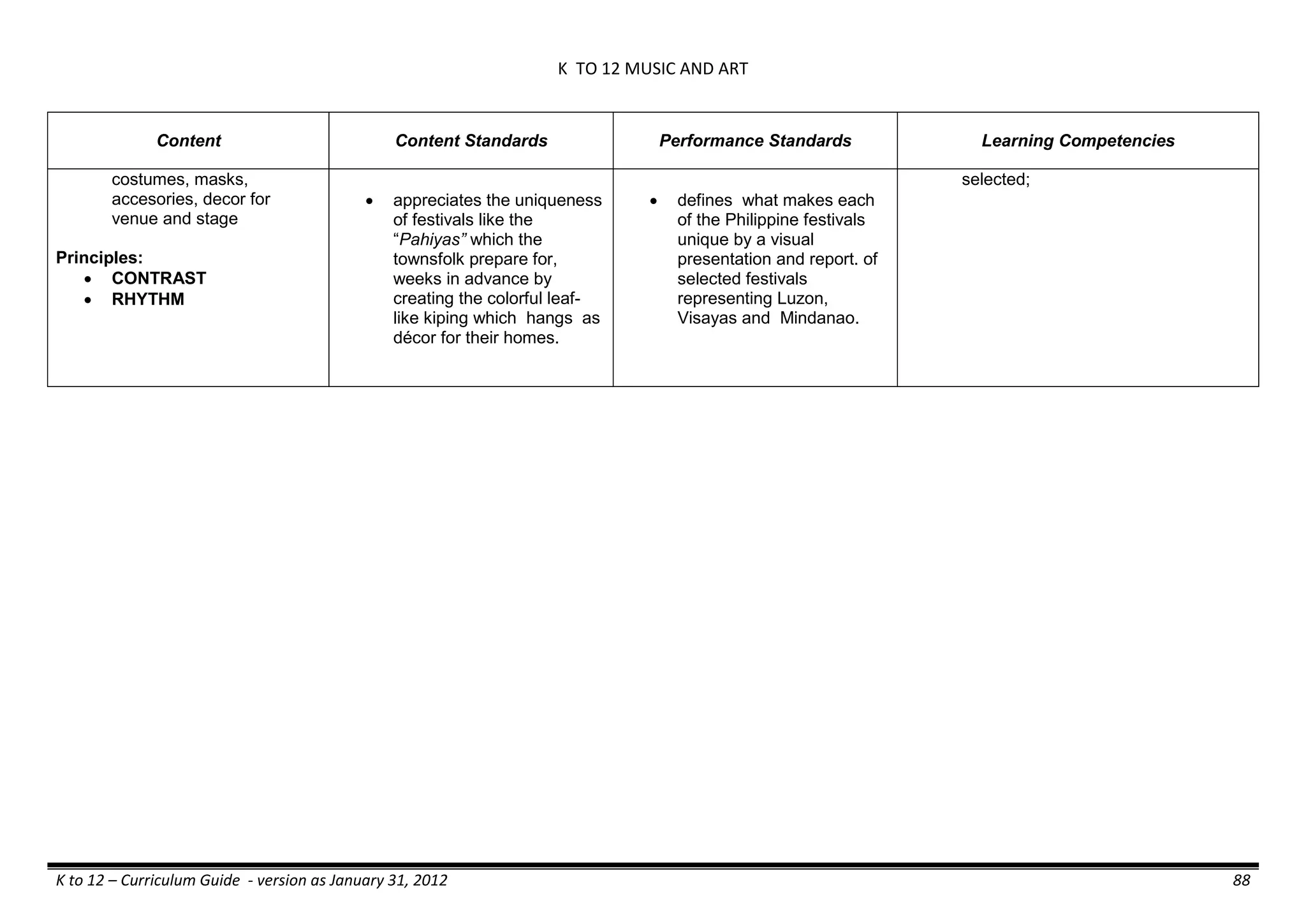
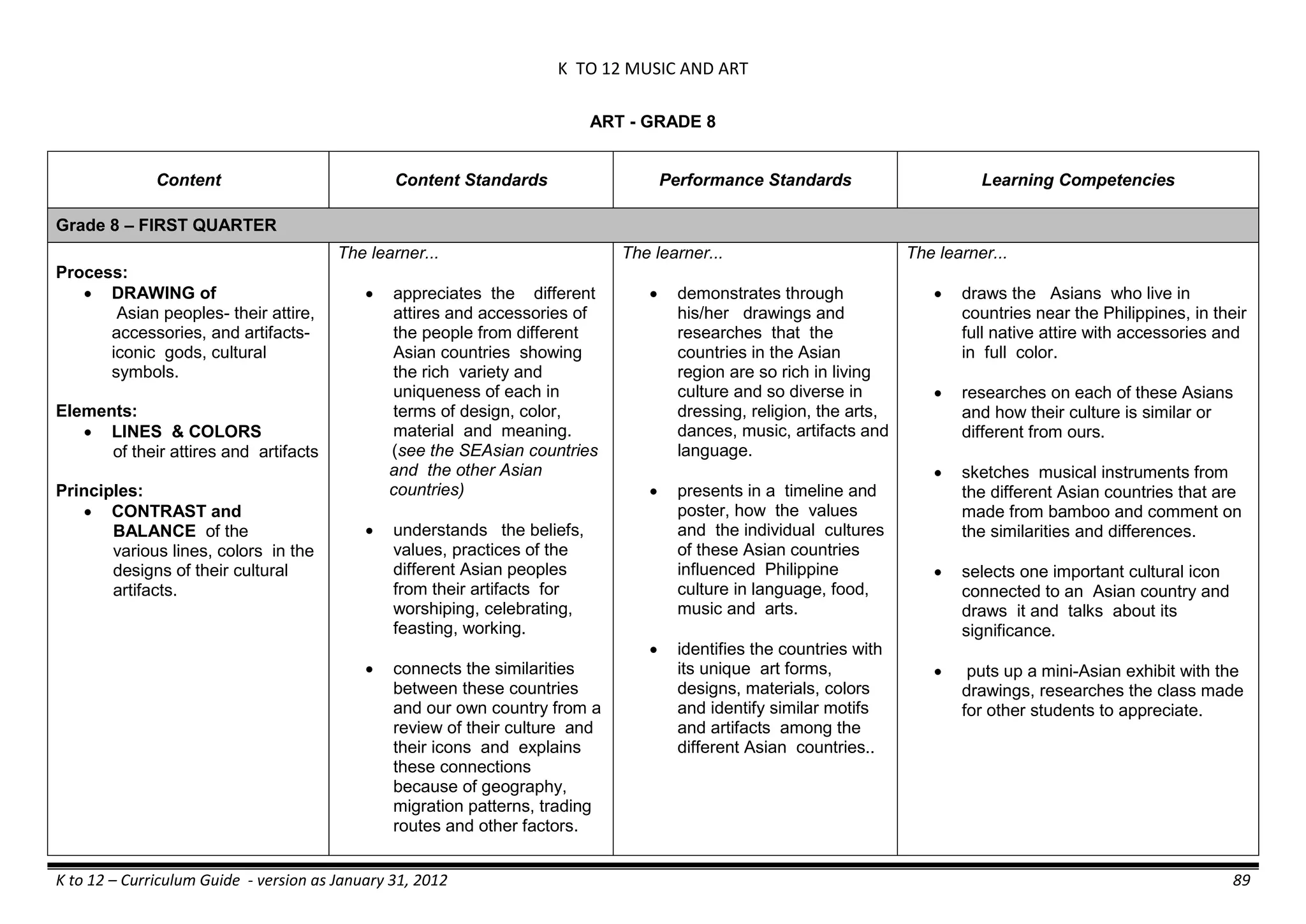
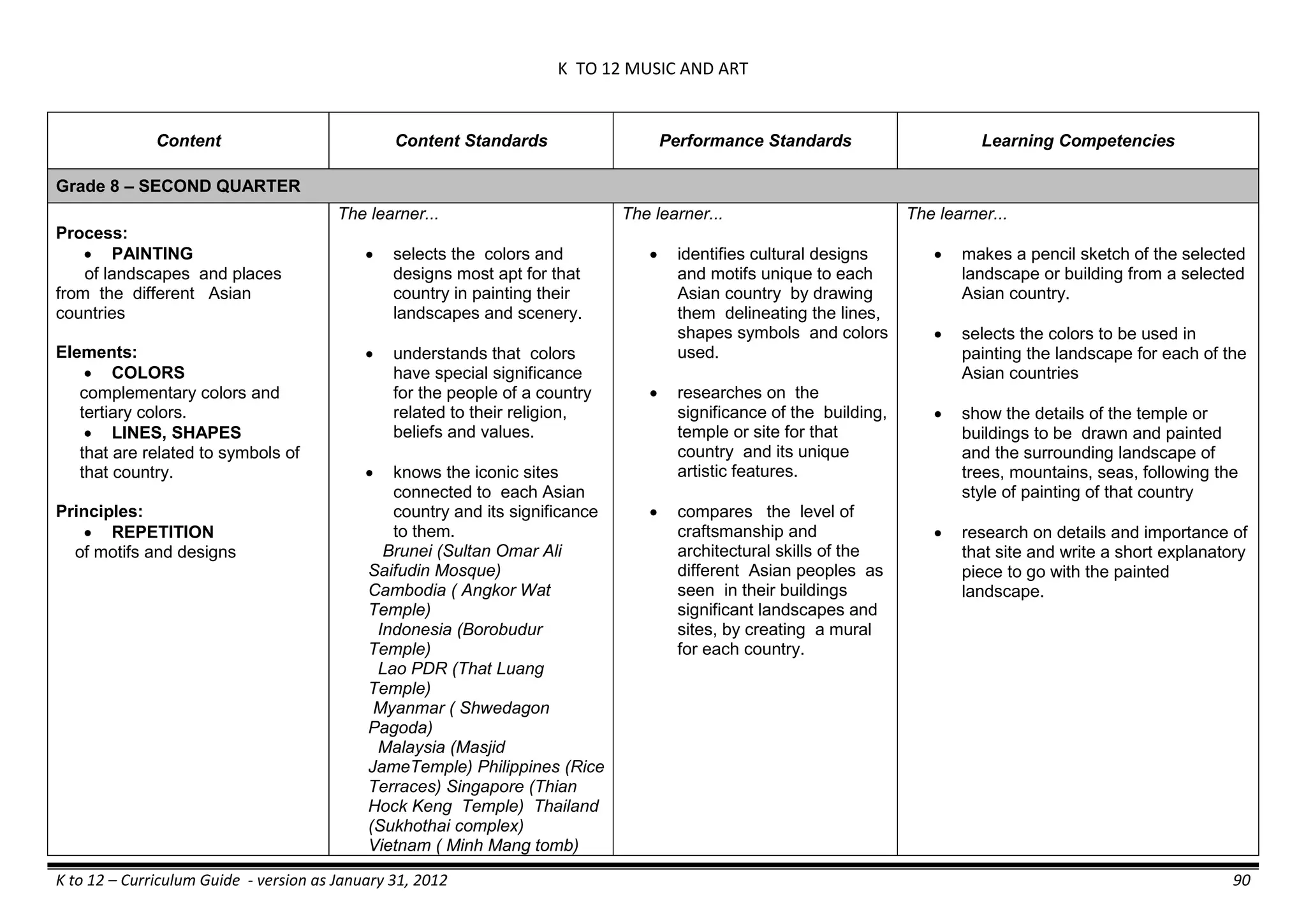
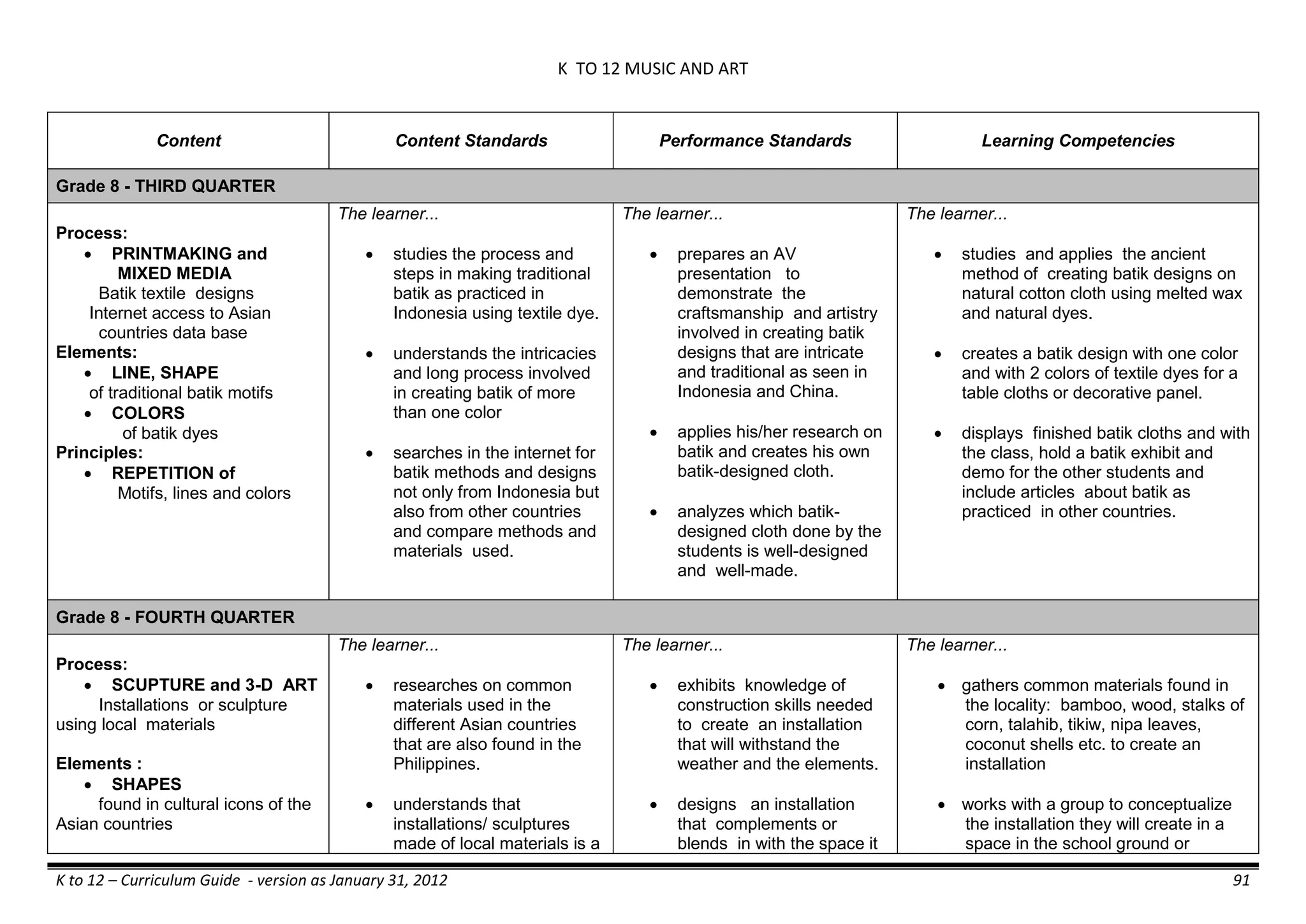
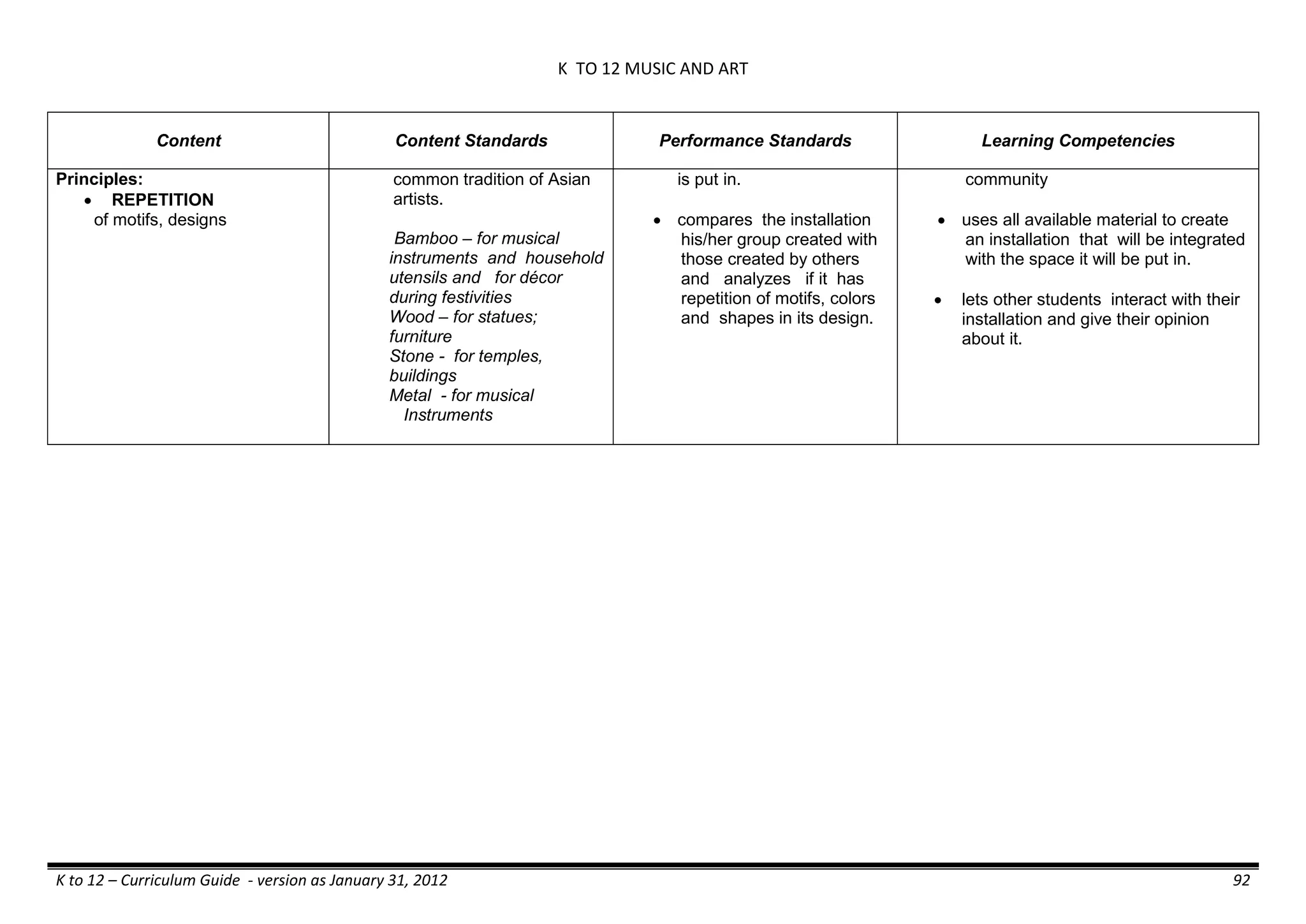
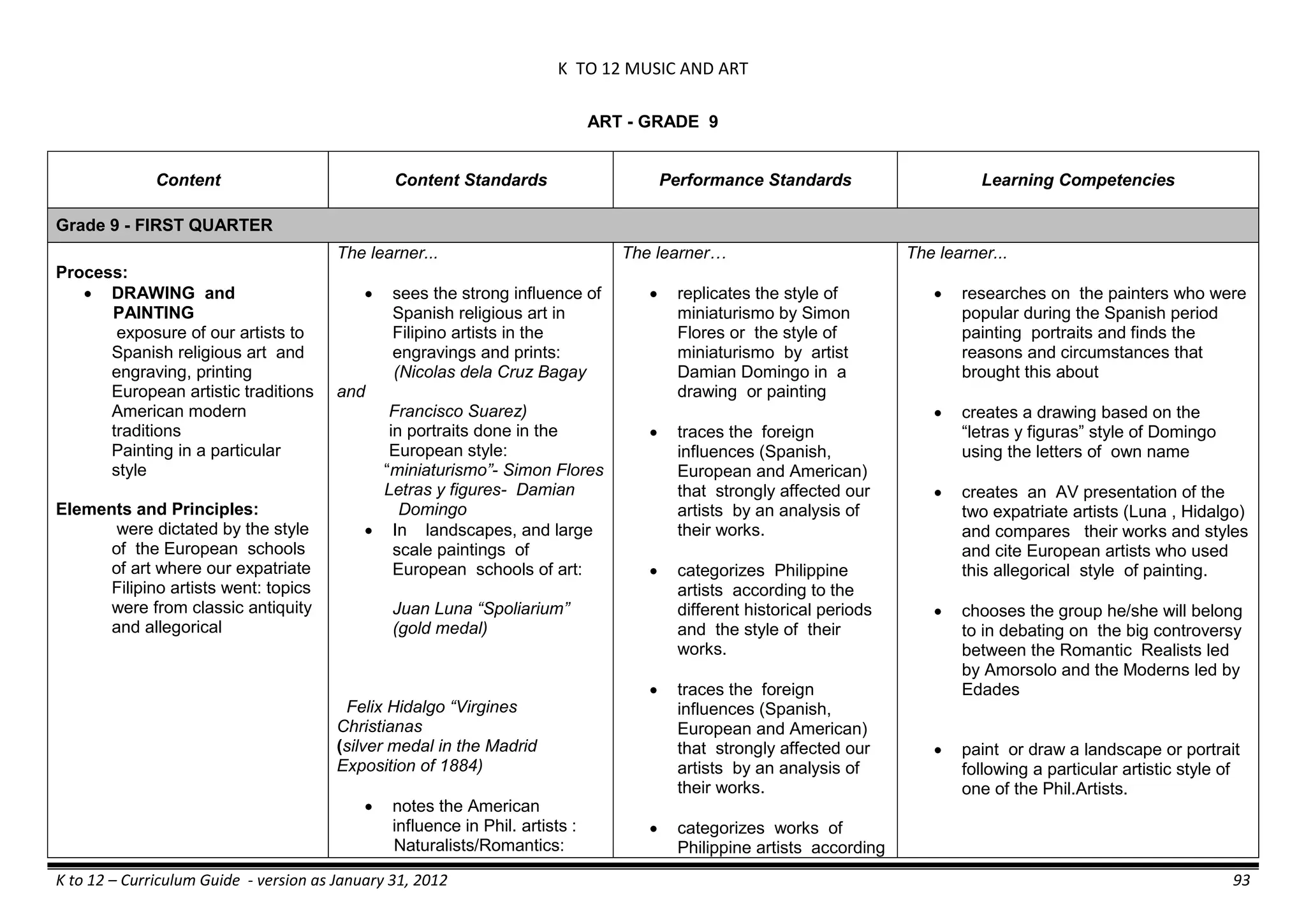
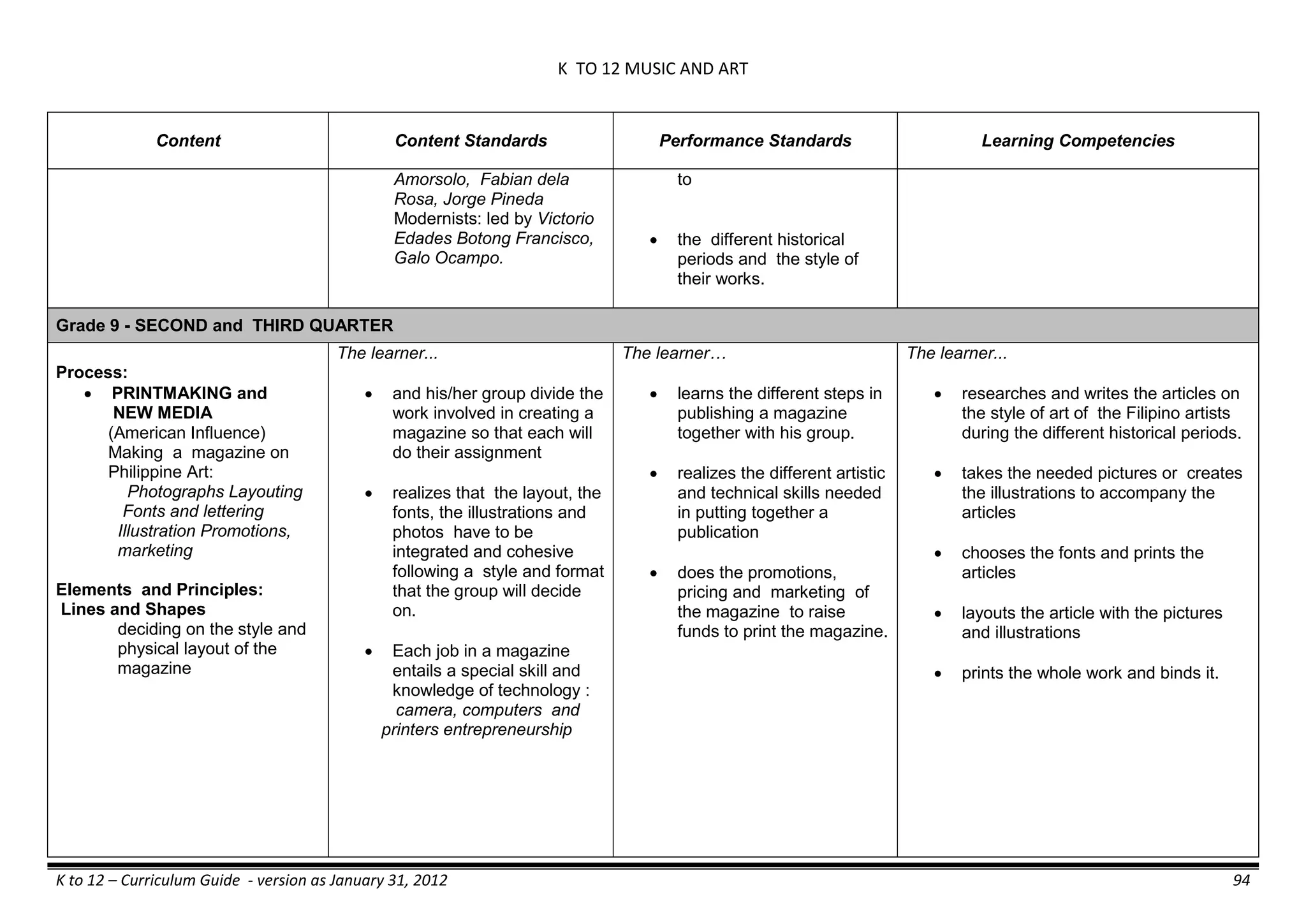
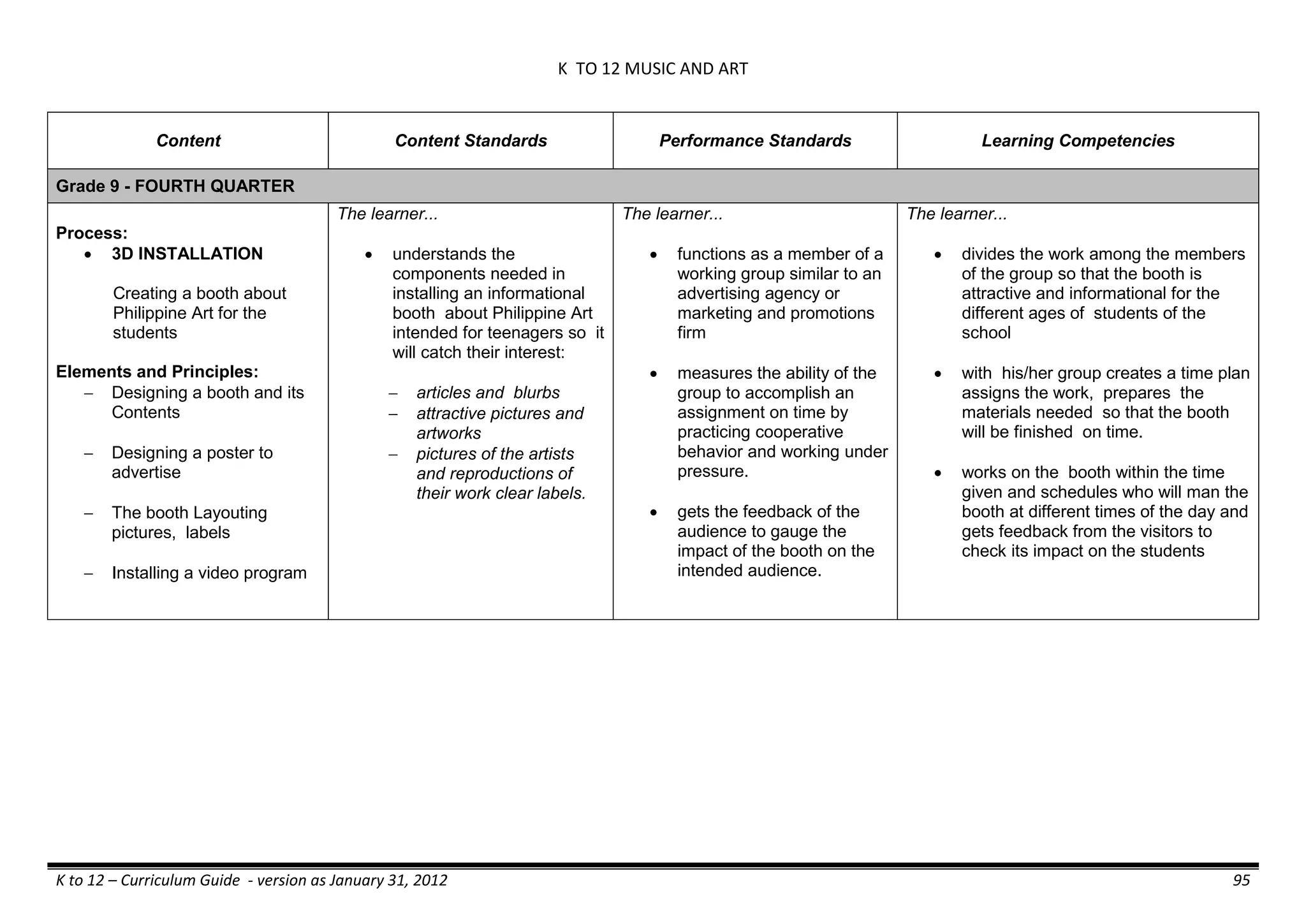
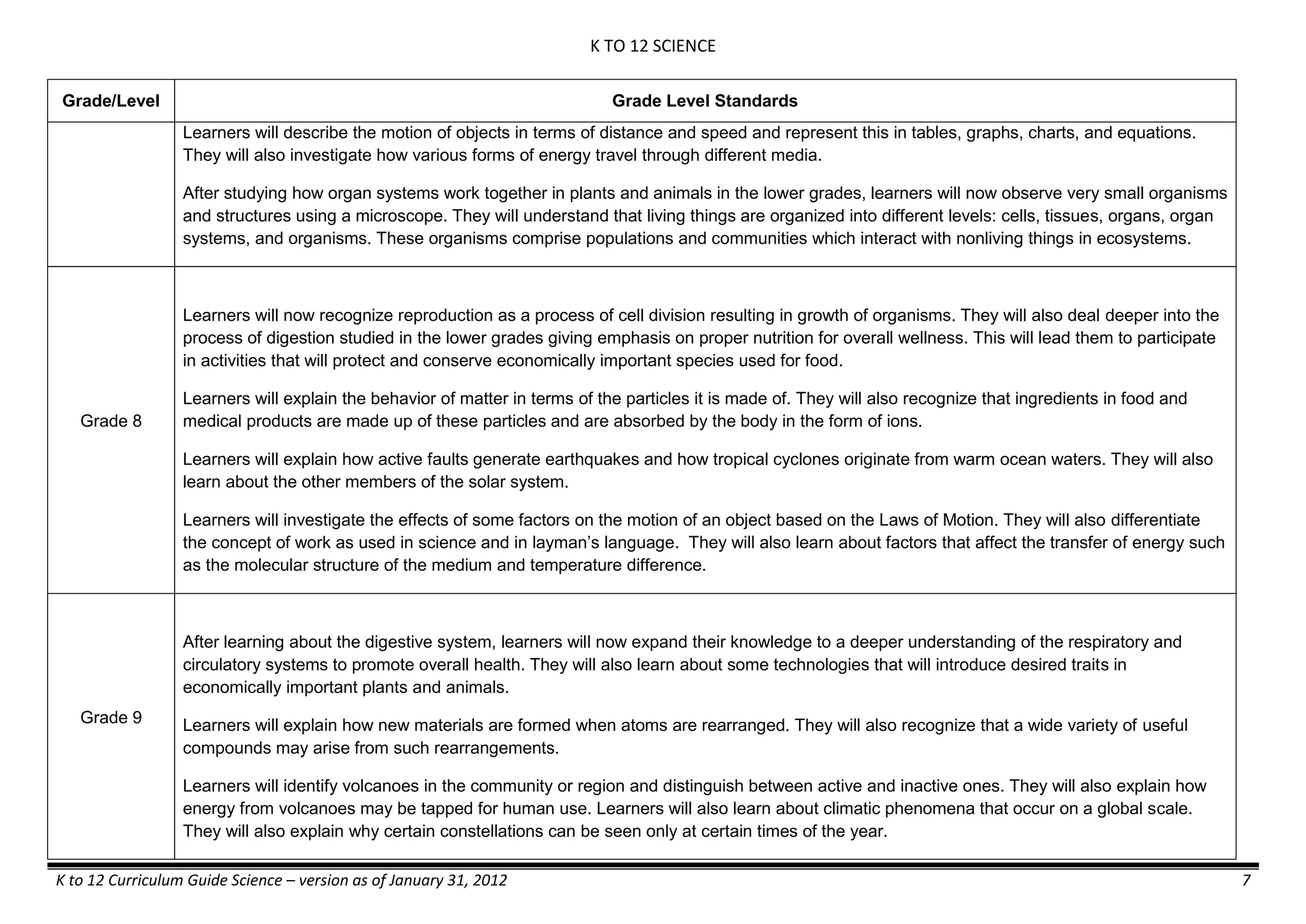
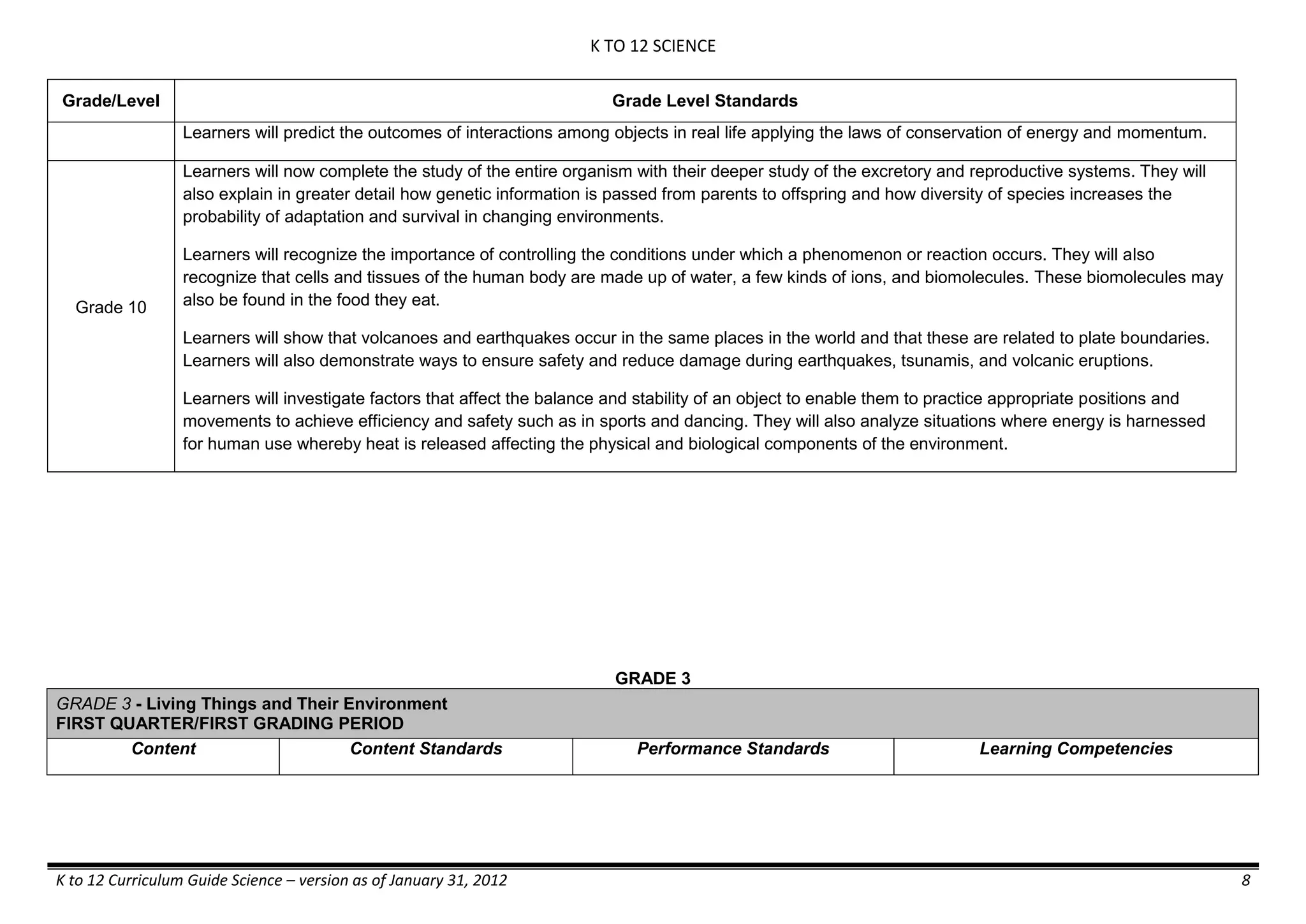
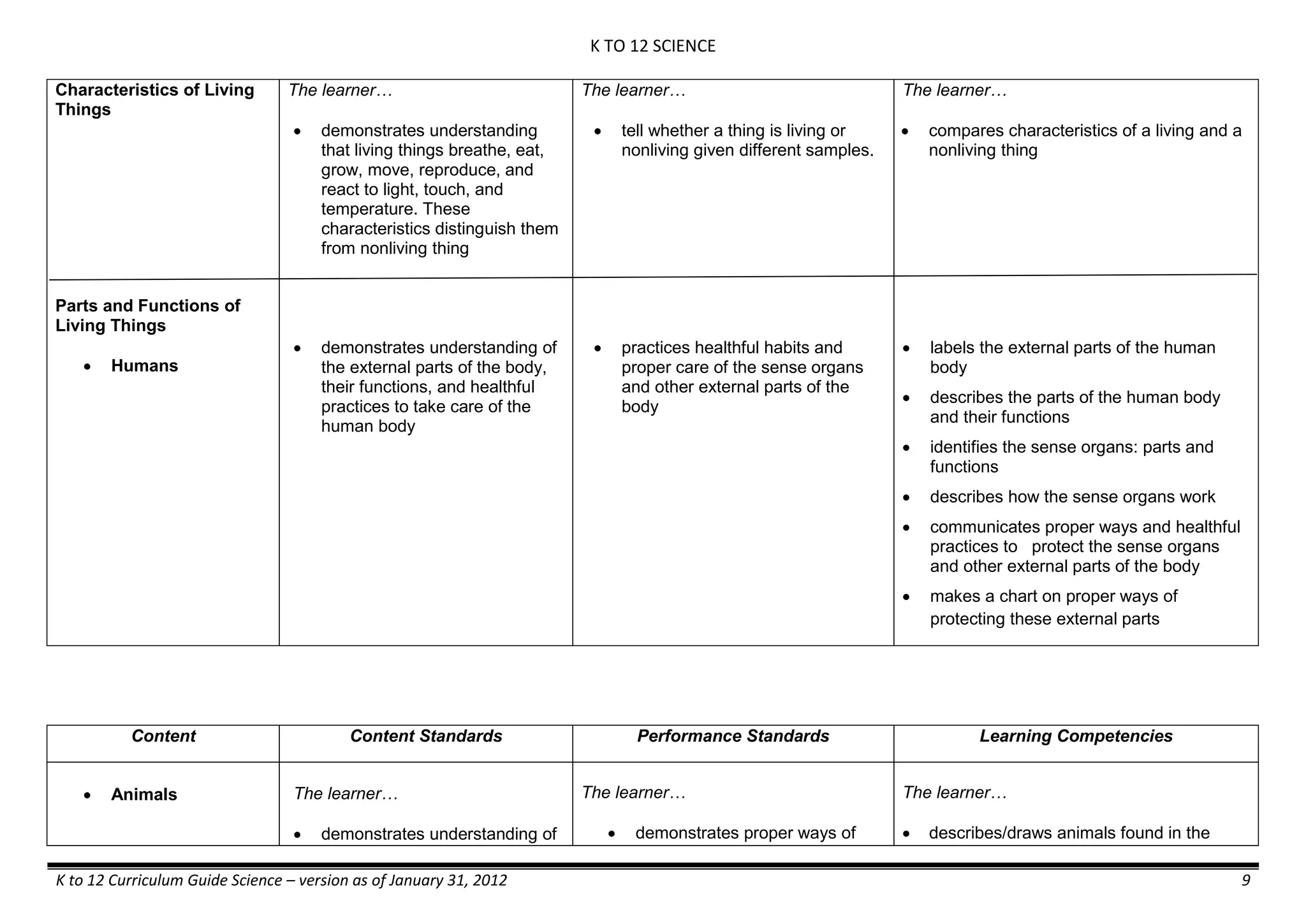
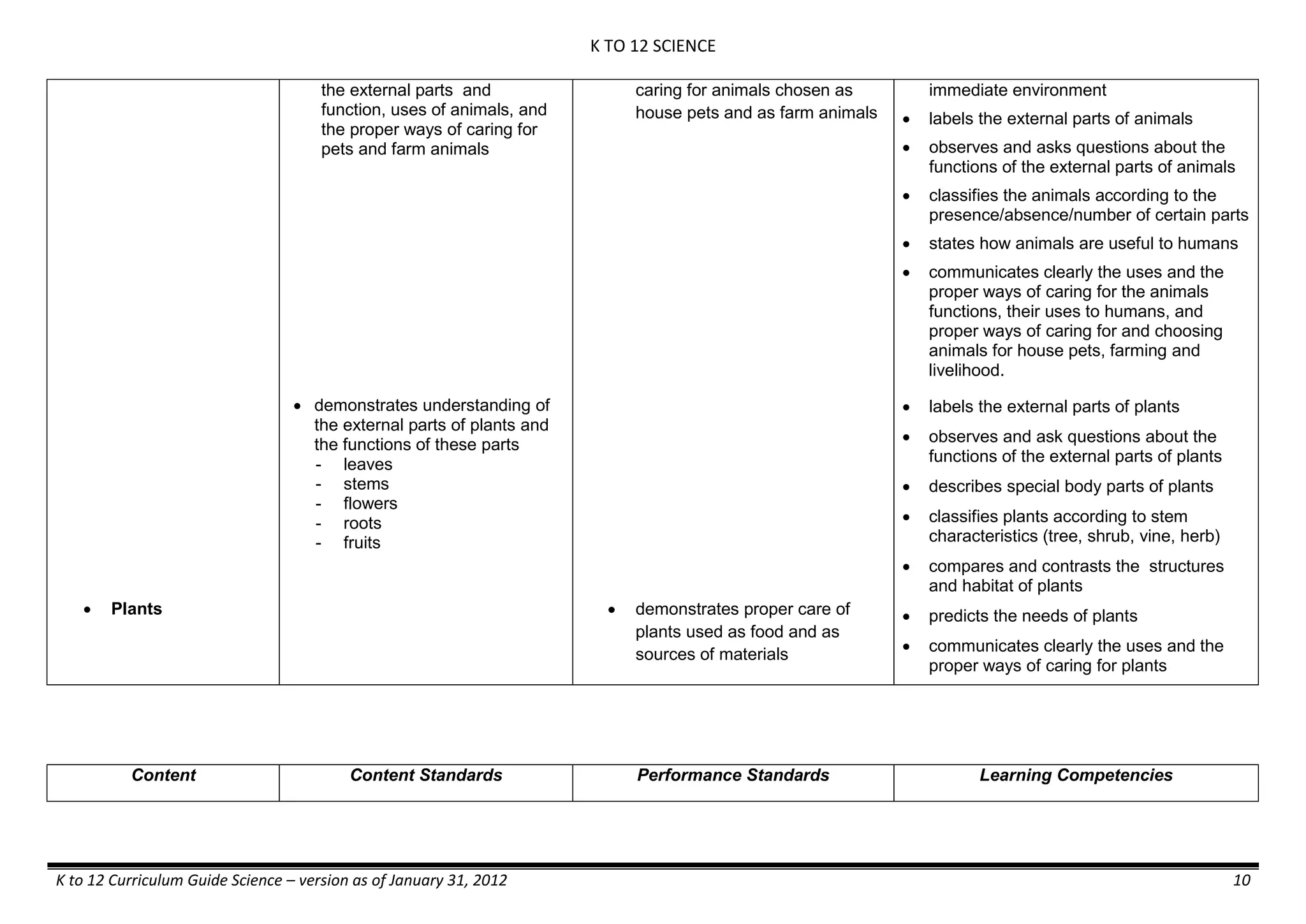
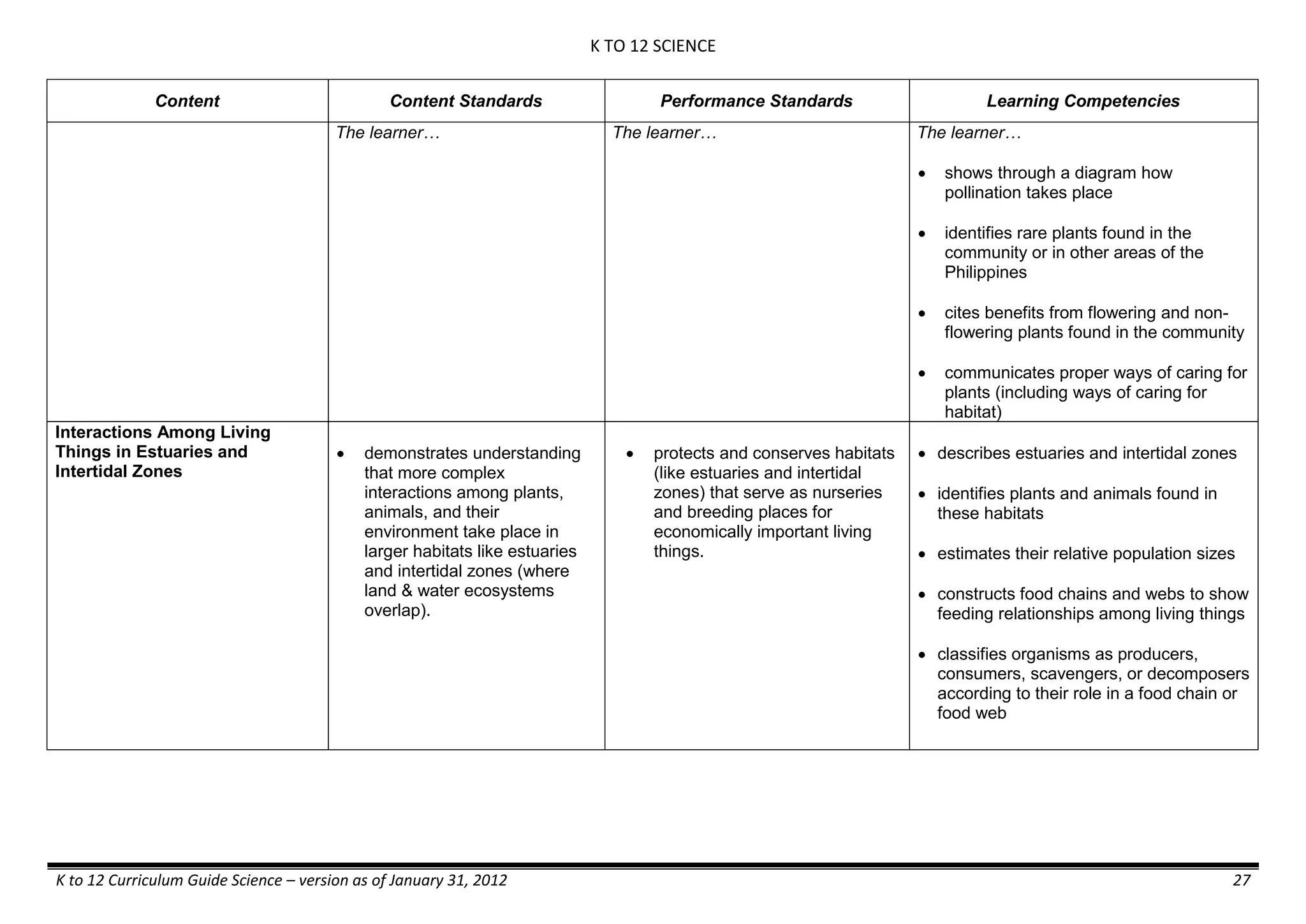
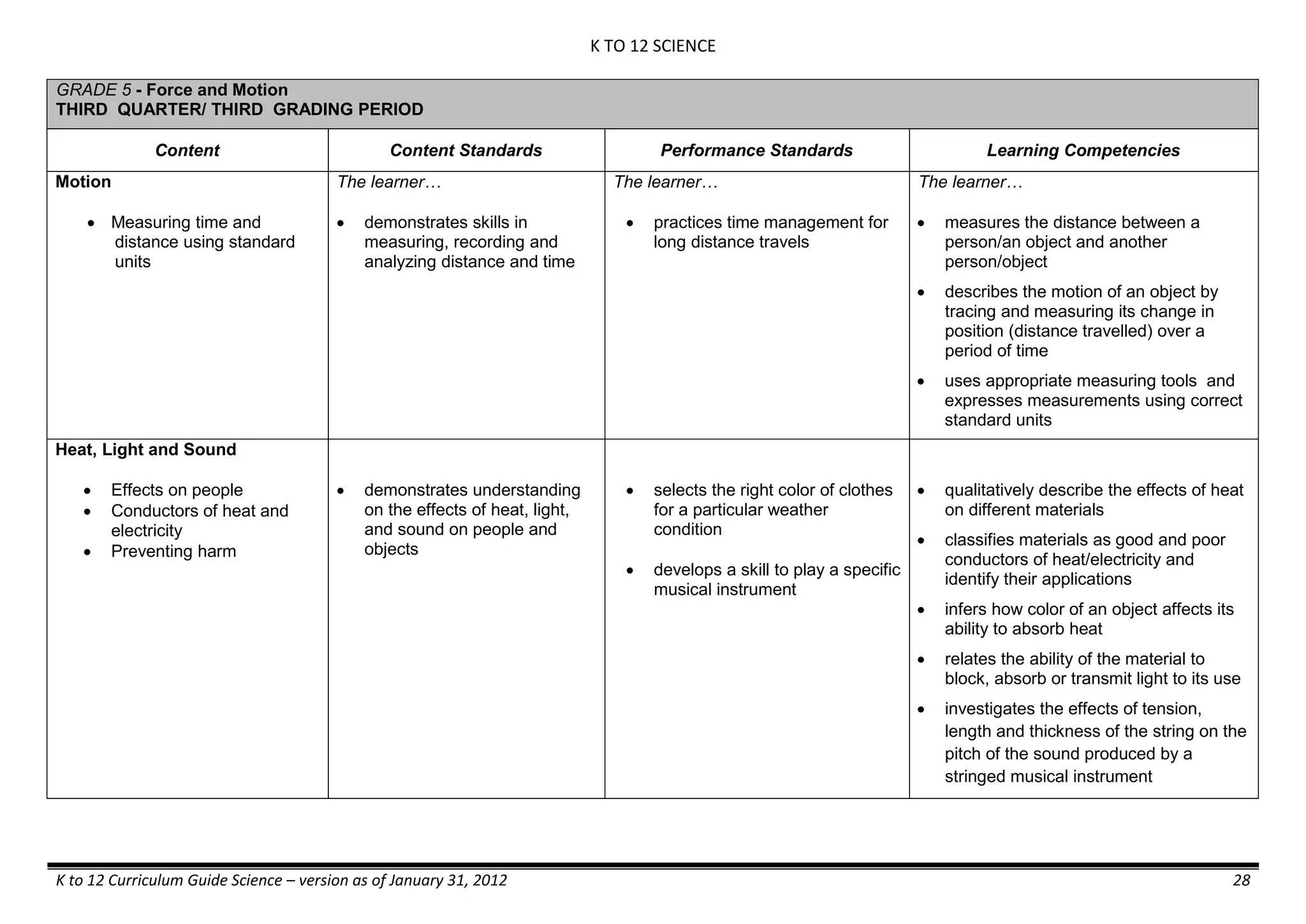
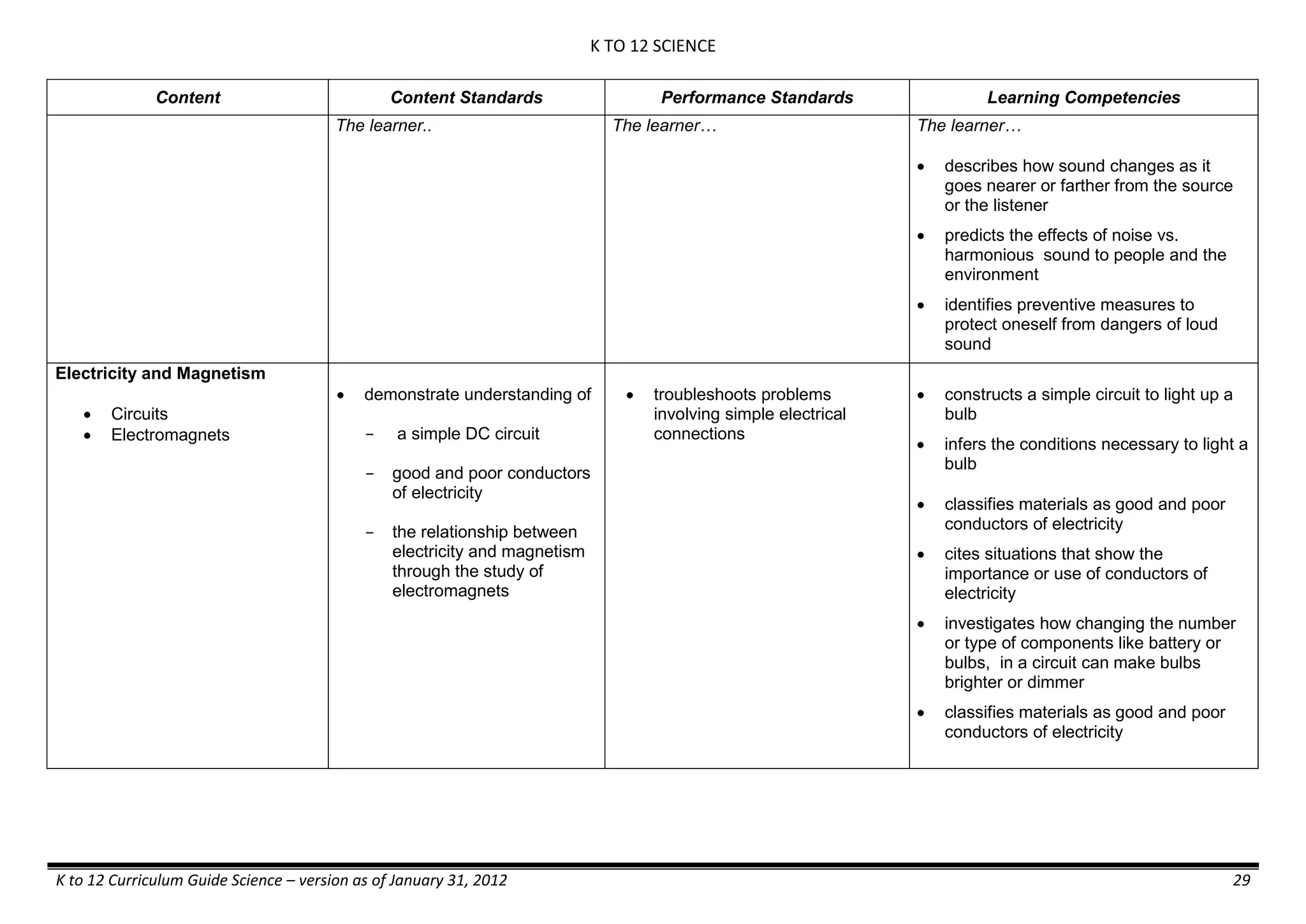
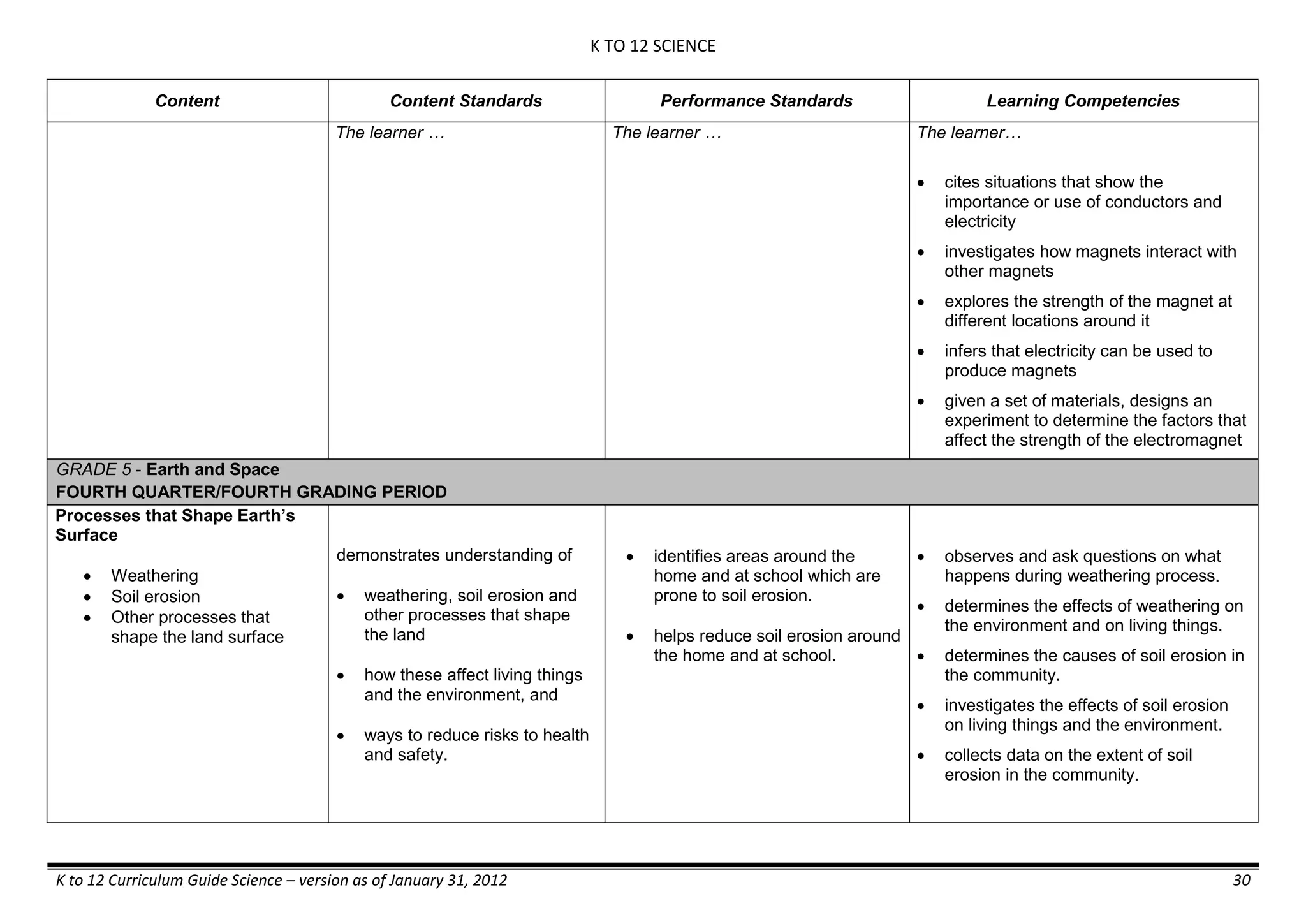
CURRICULUM GUIDE FOR K TO 12 
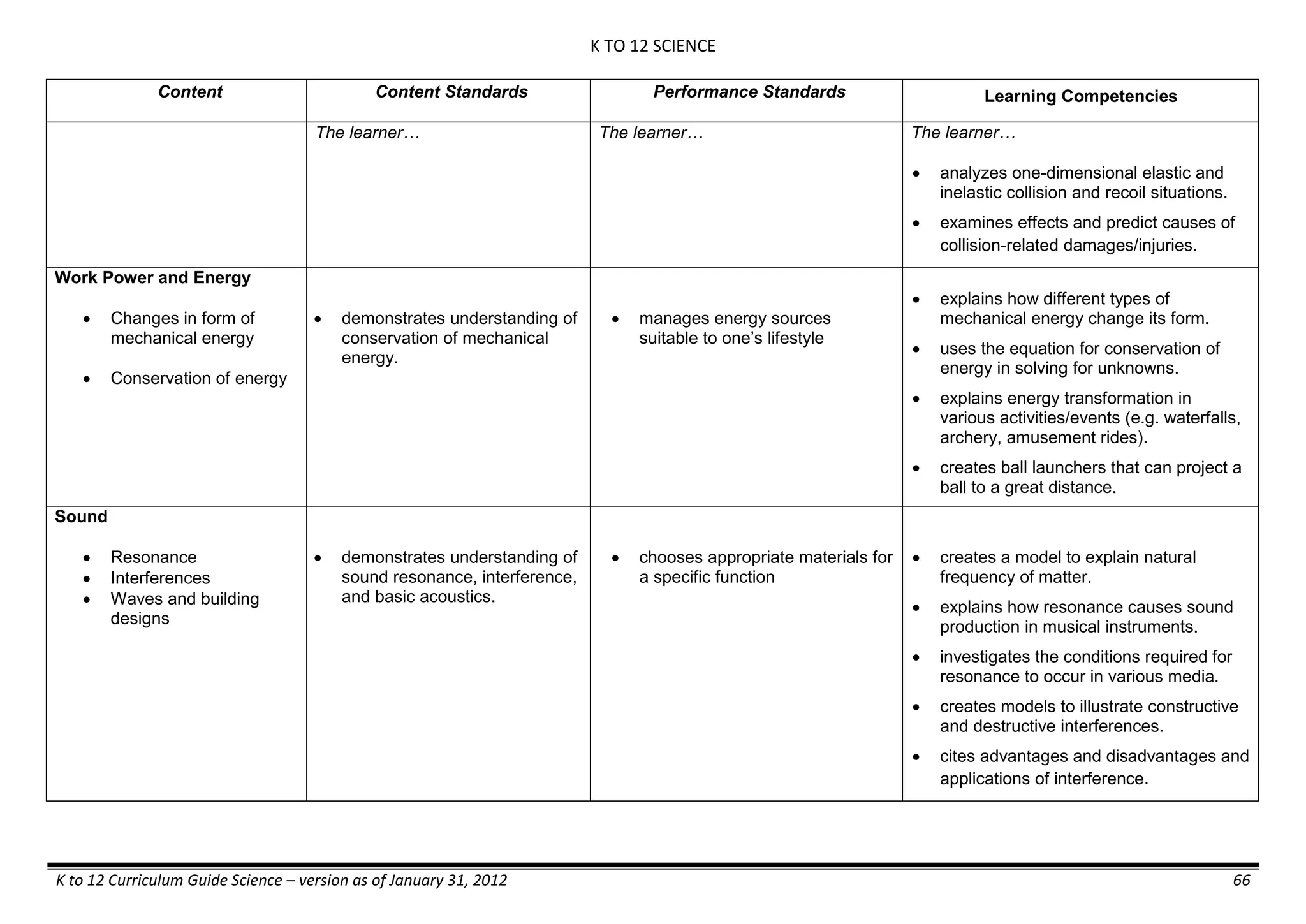
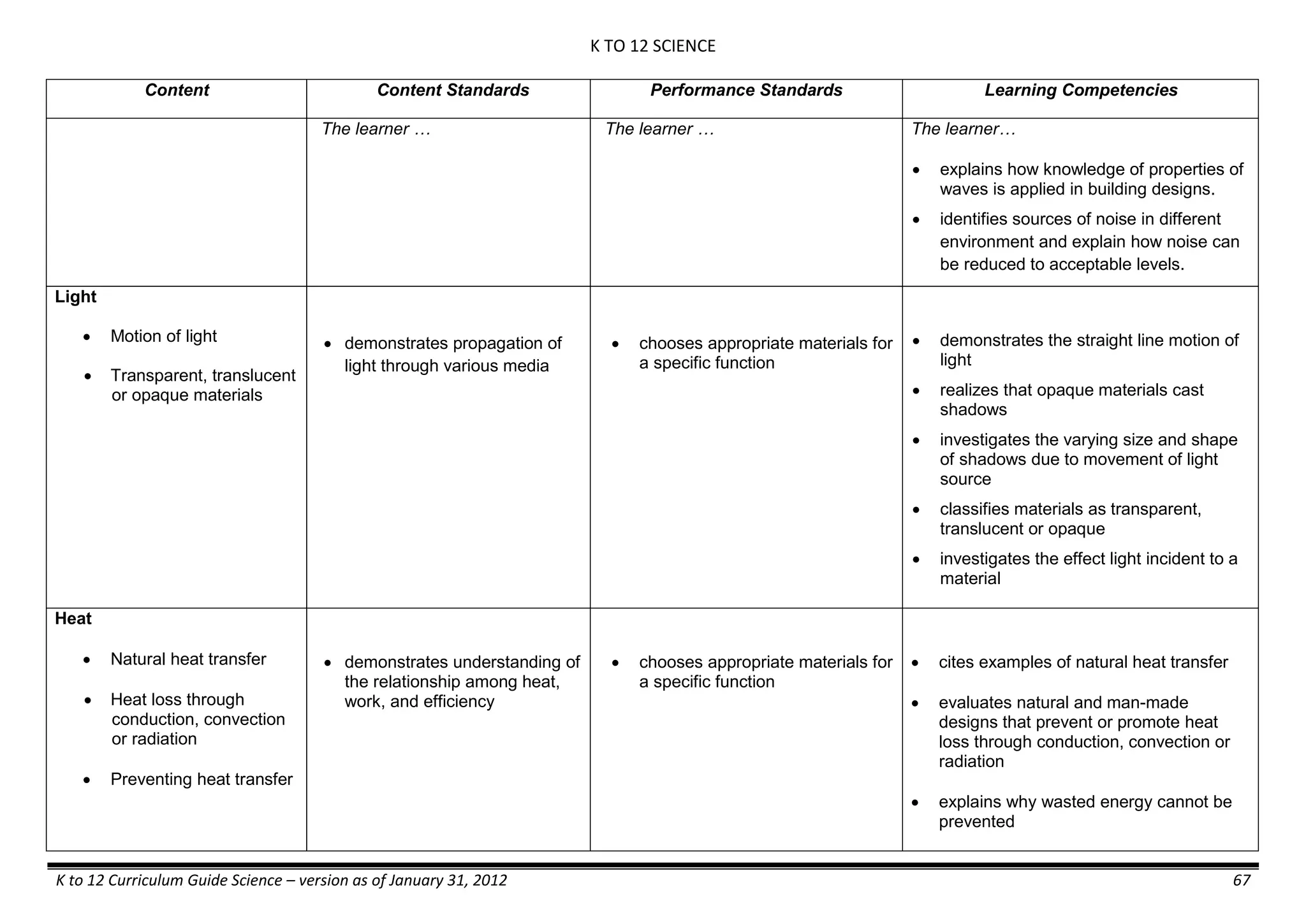
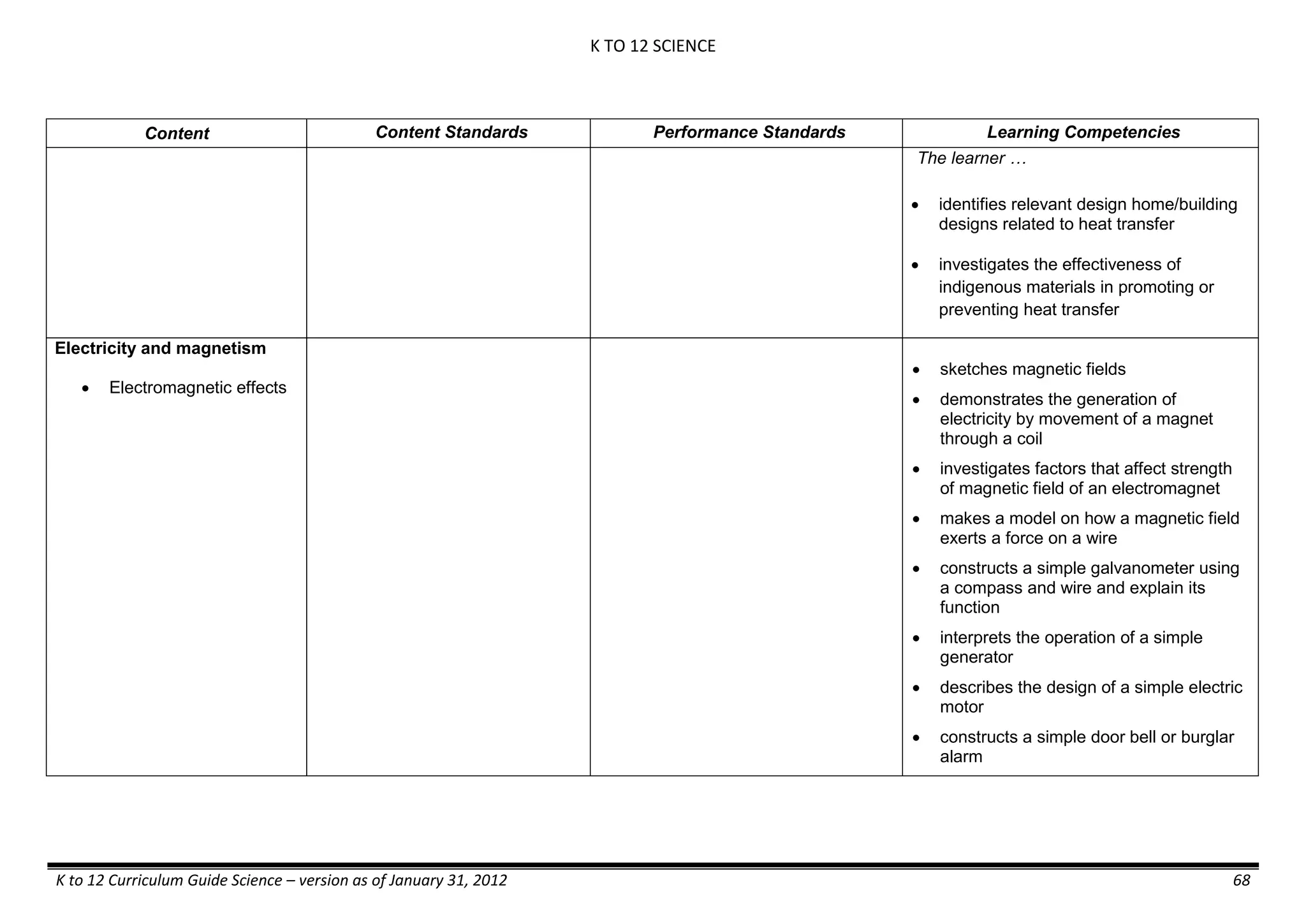
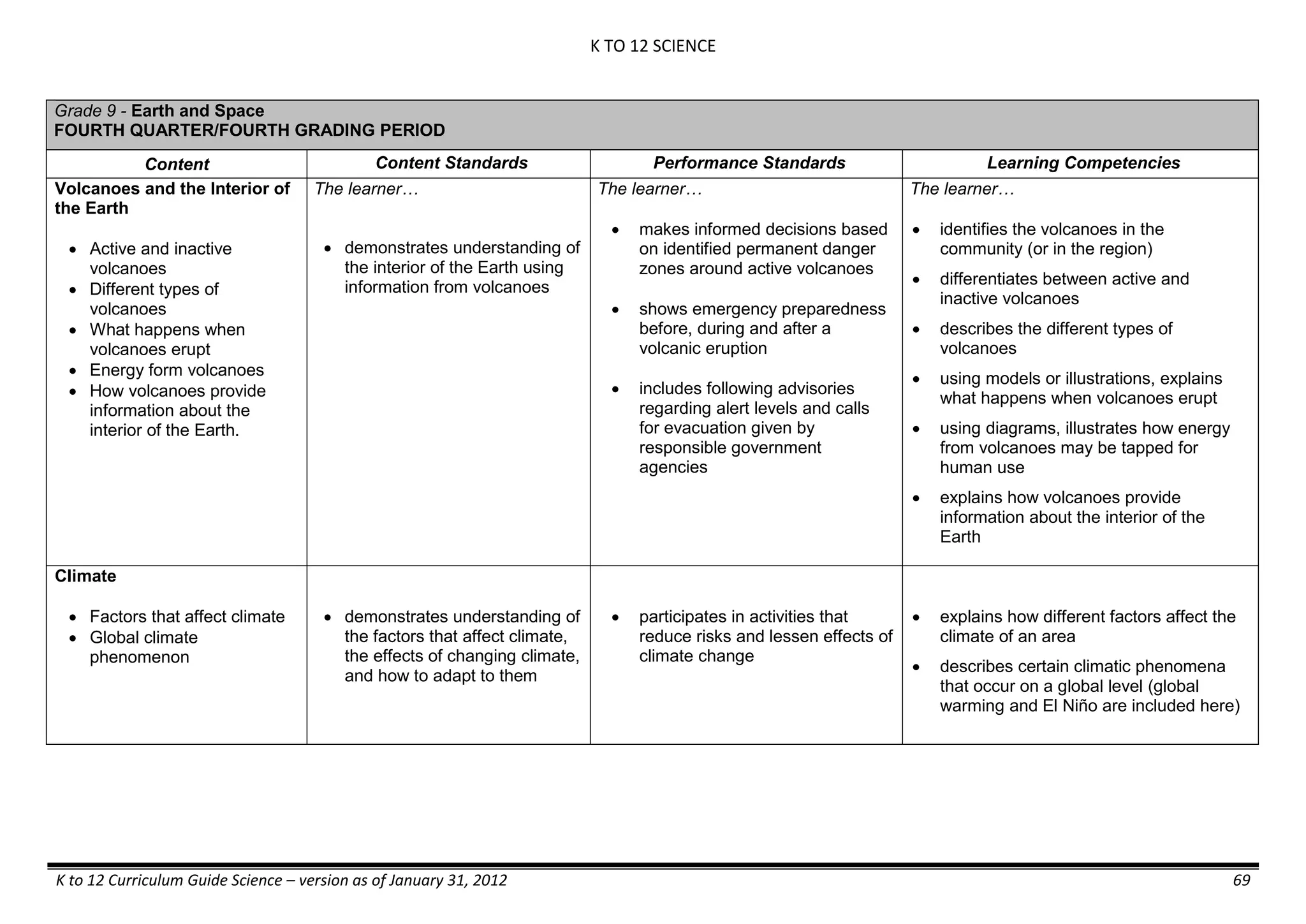
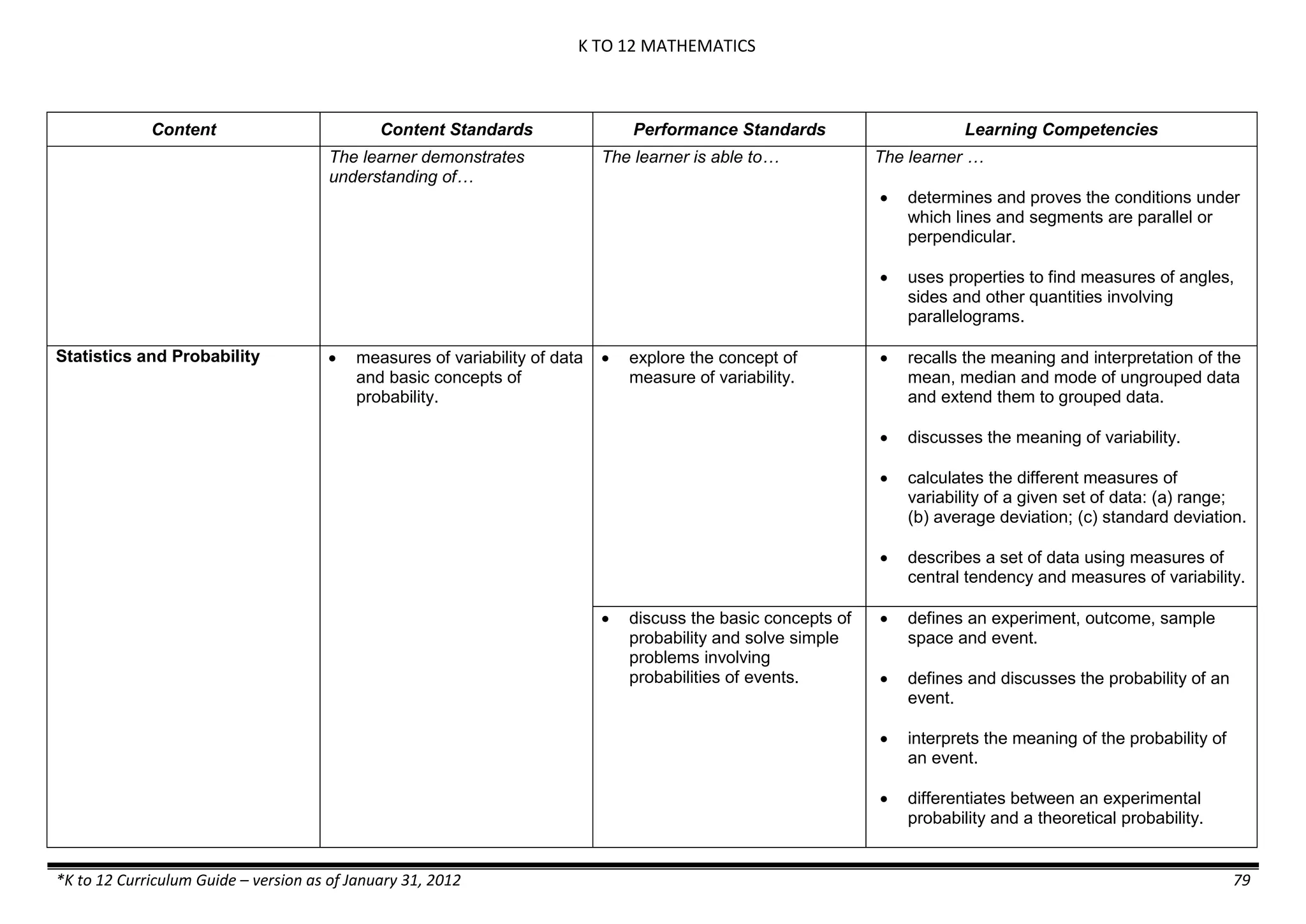
EDUCATION SYSTEM IN THE PHILIPPINES 
 
KINDERGARTEN 
ARALING PANLIPUNAN  (Grade 1 to 7) 
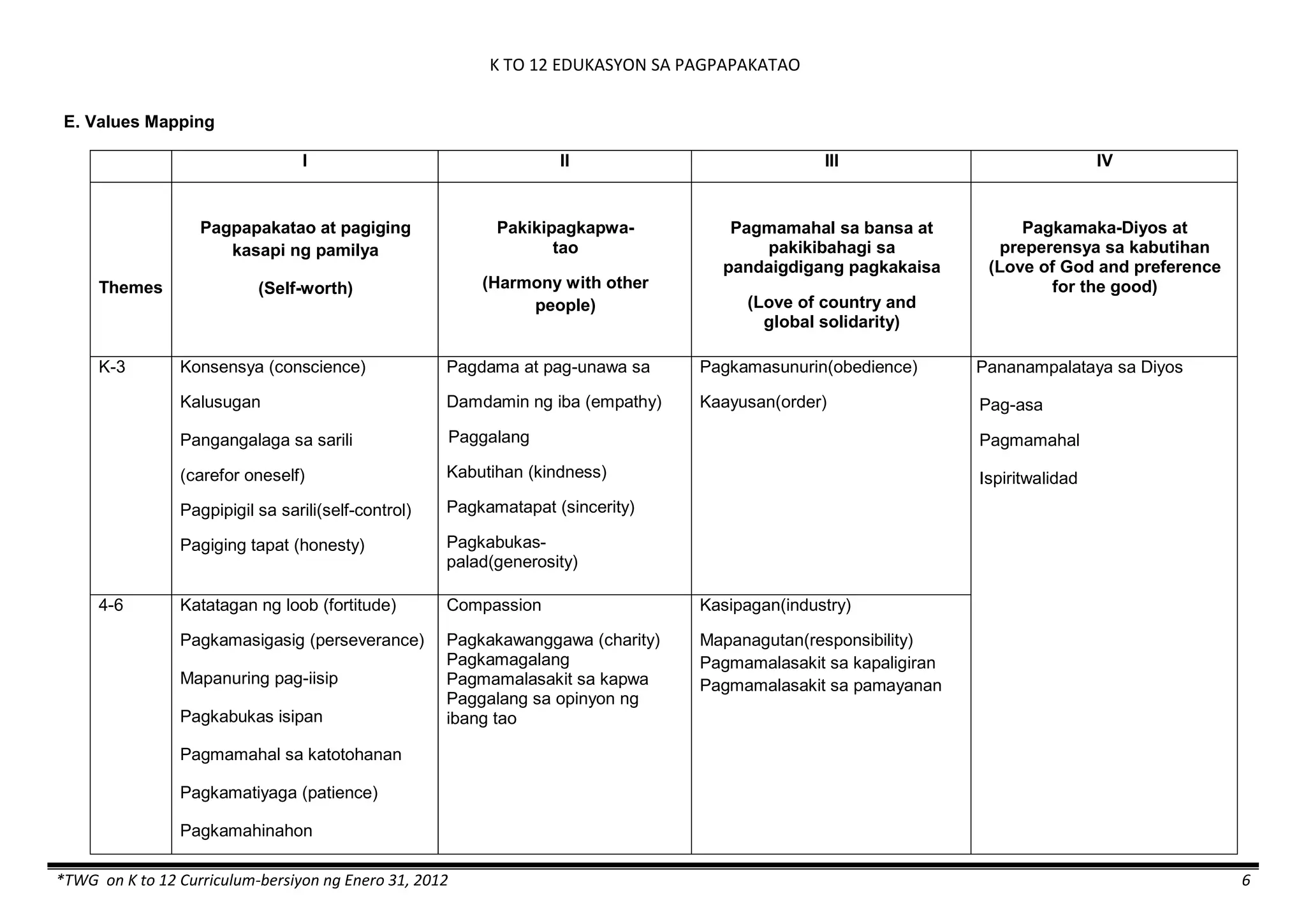
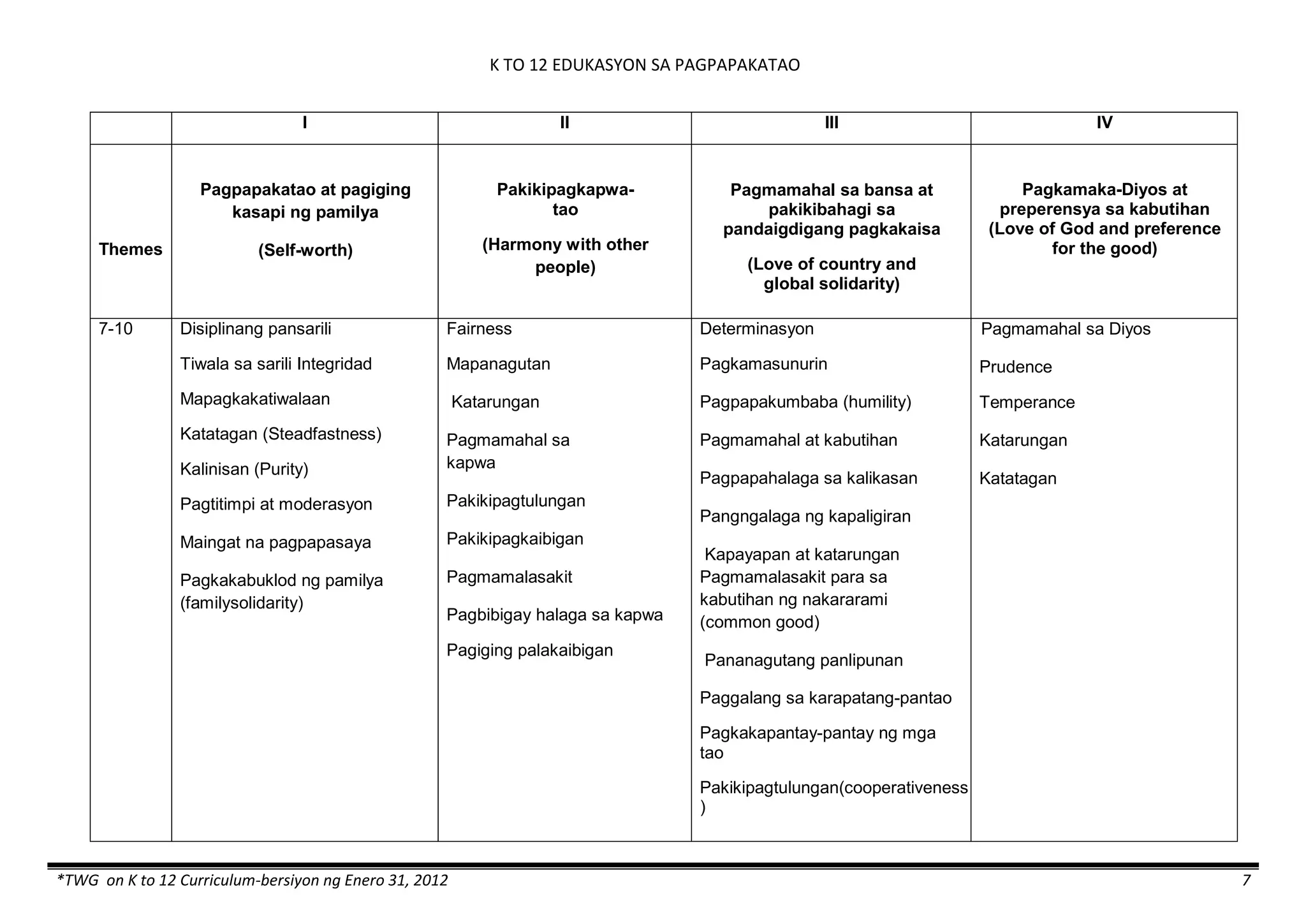
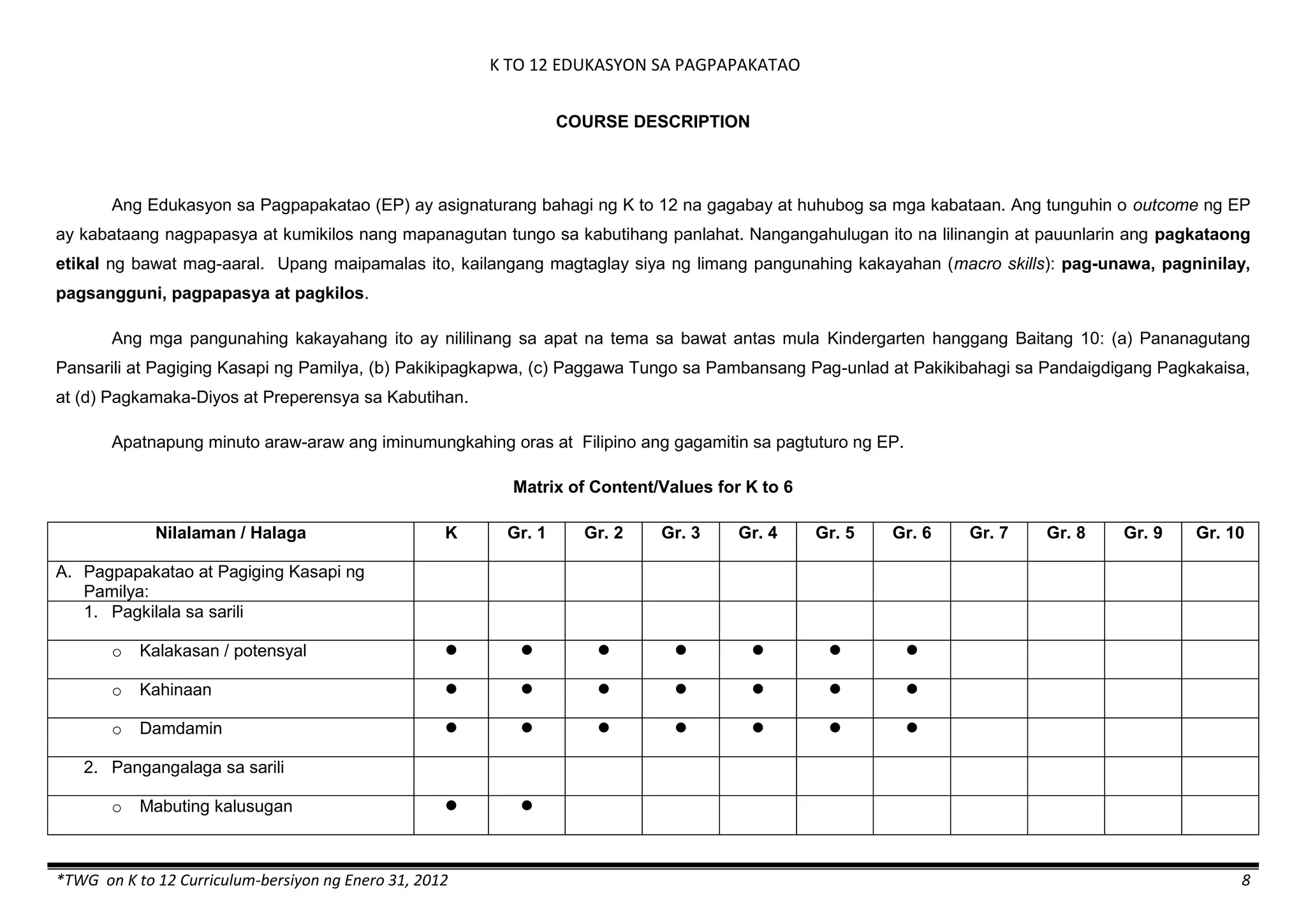
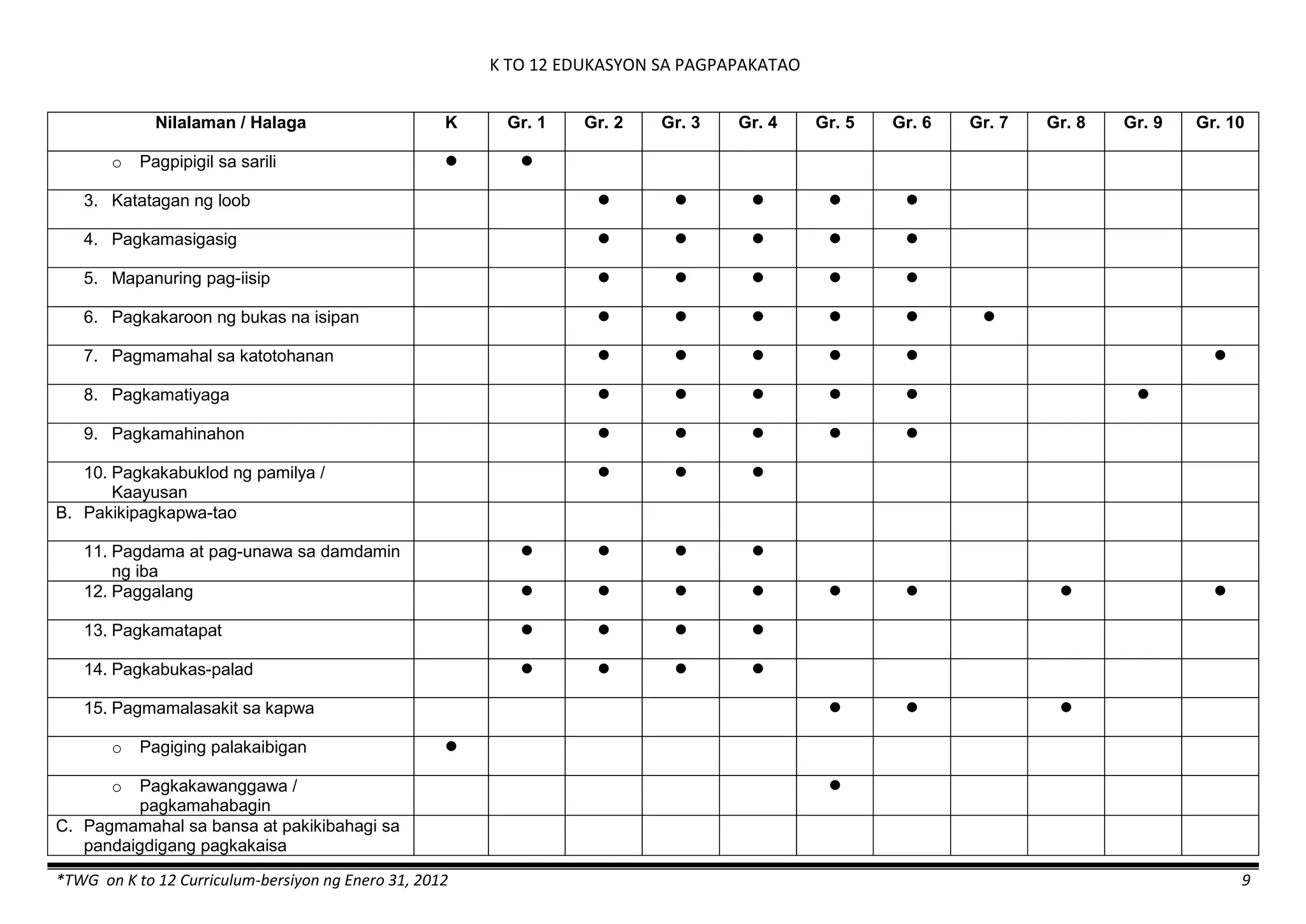
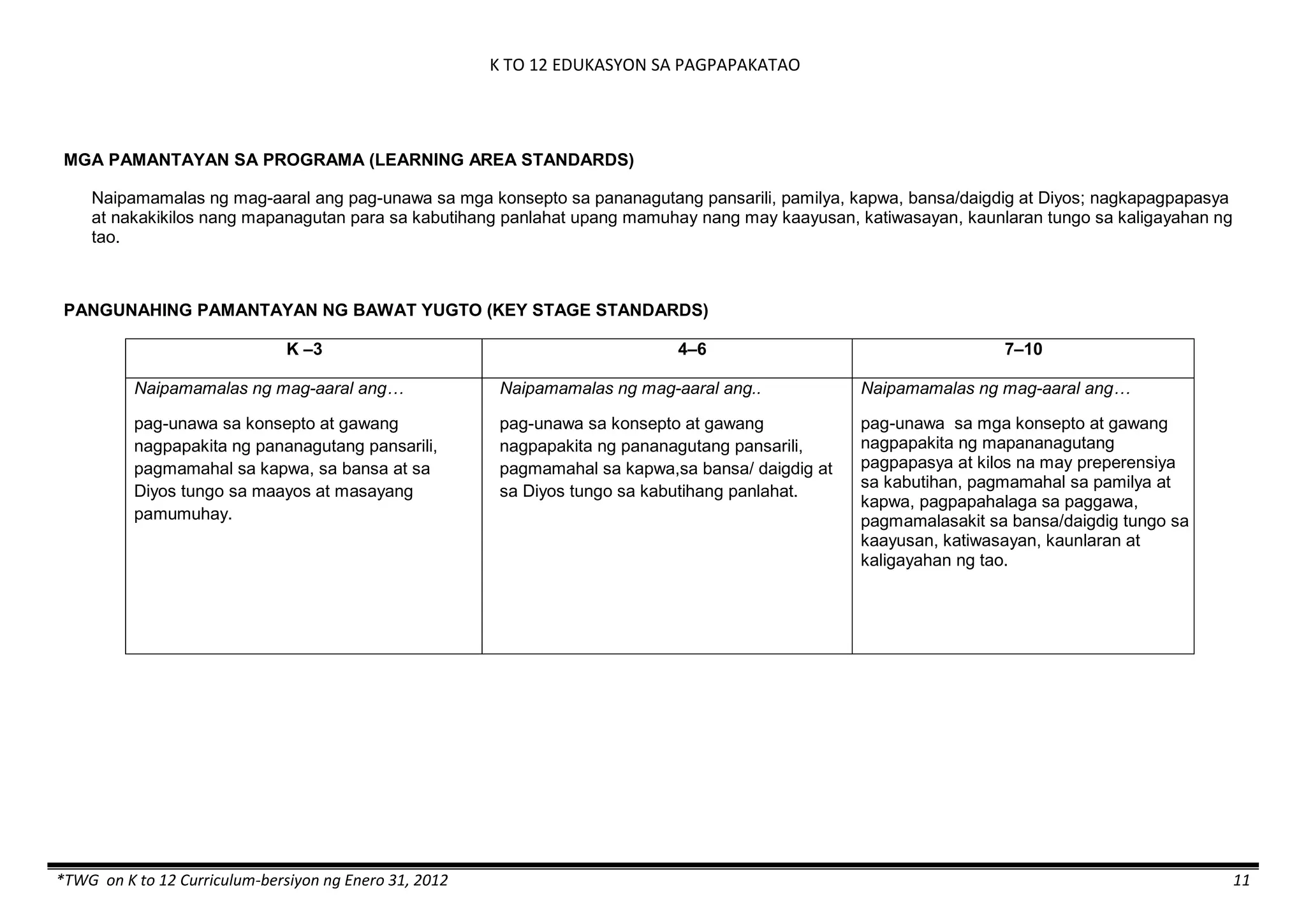
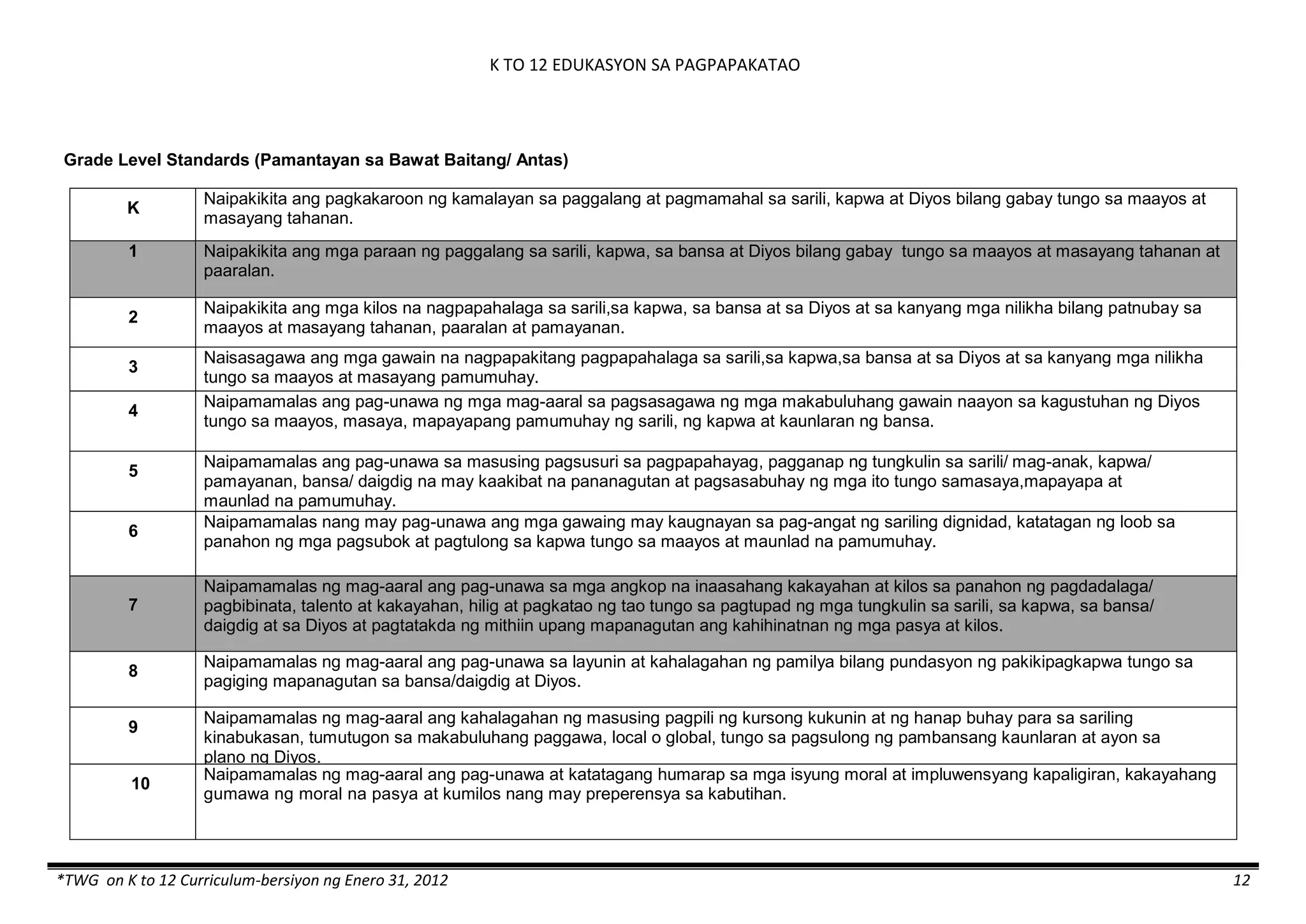
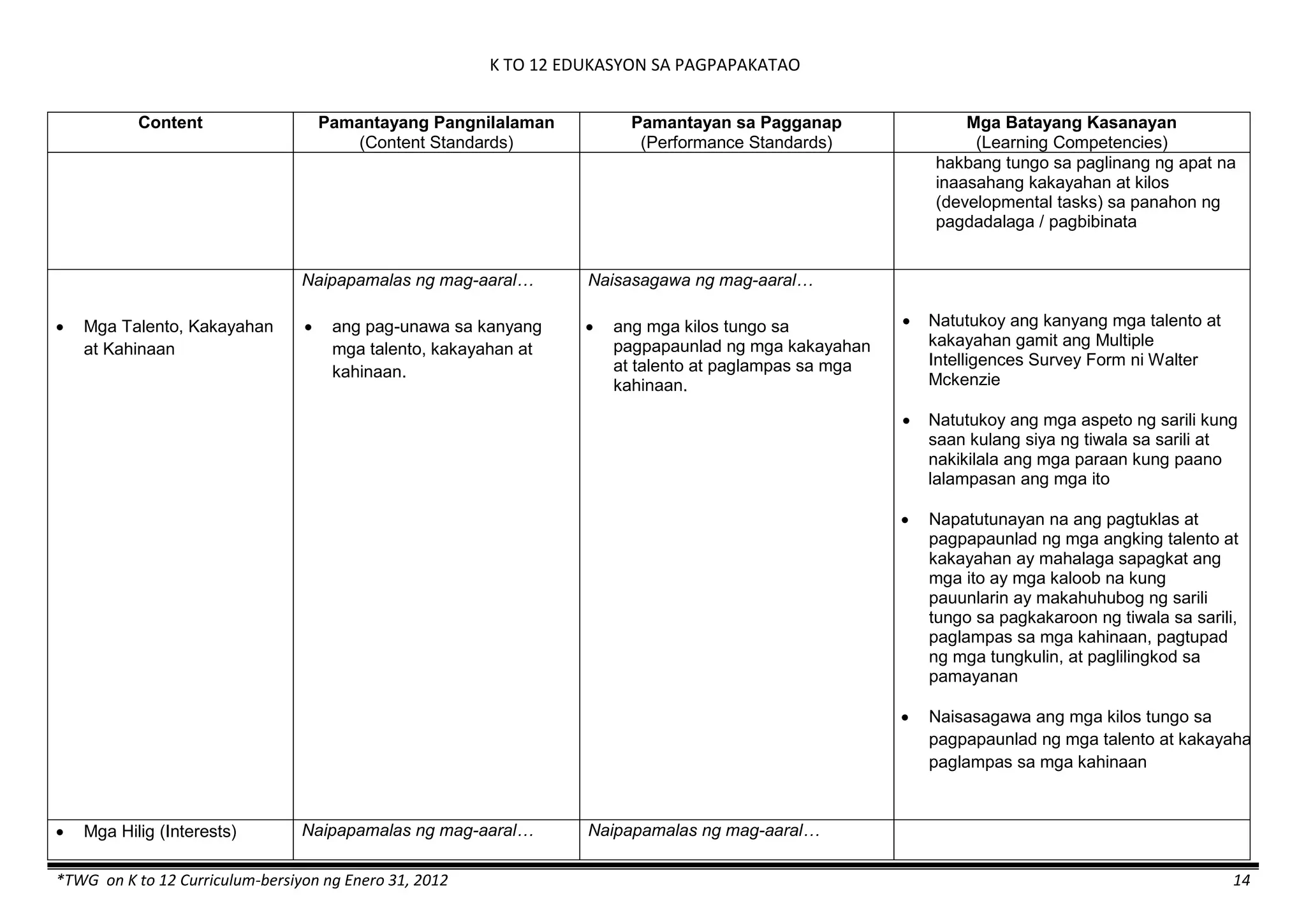
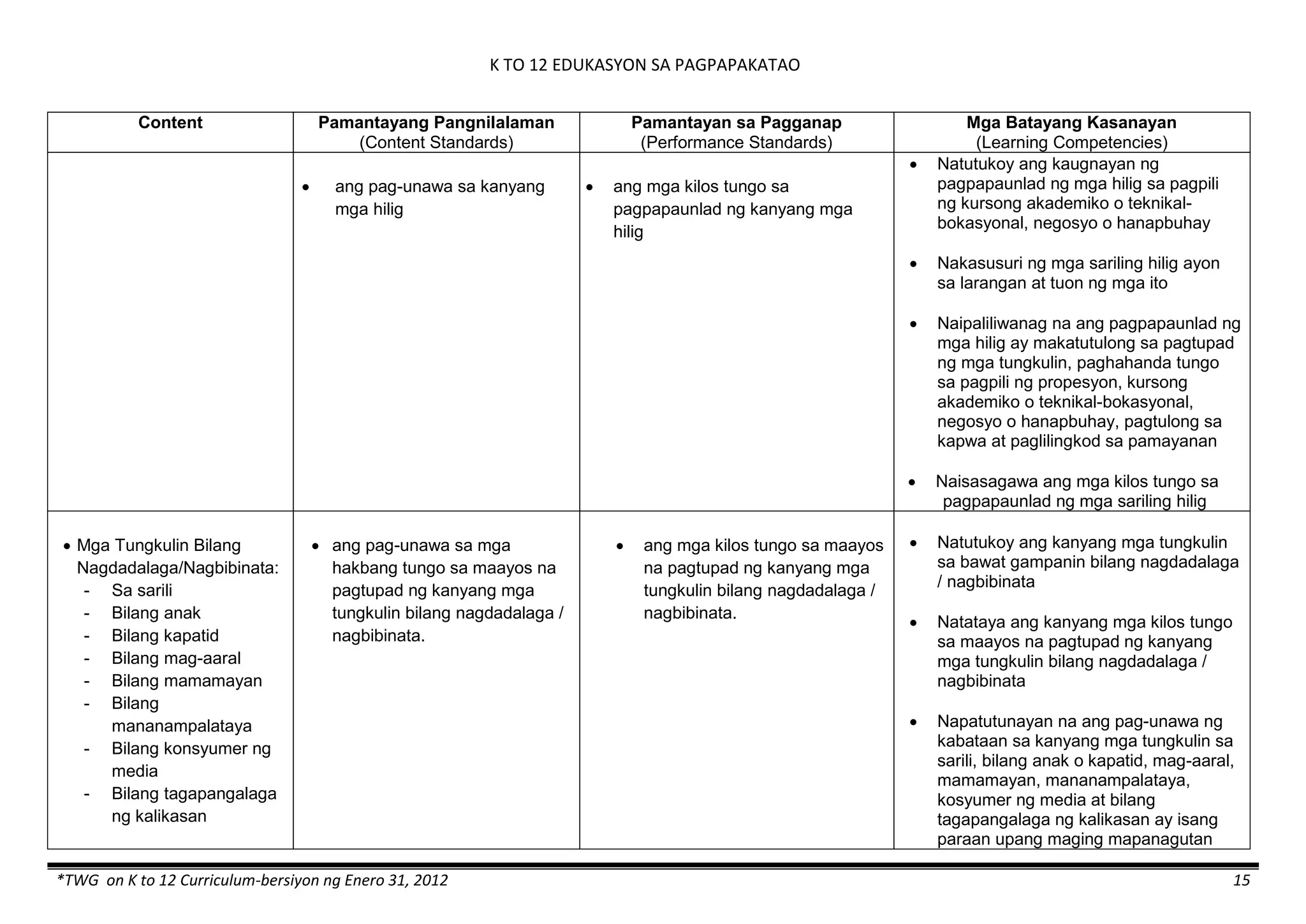
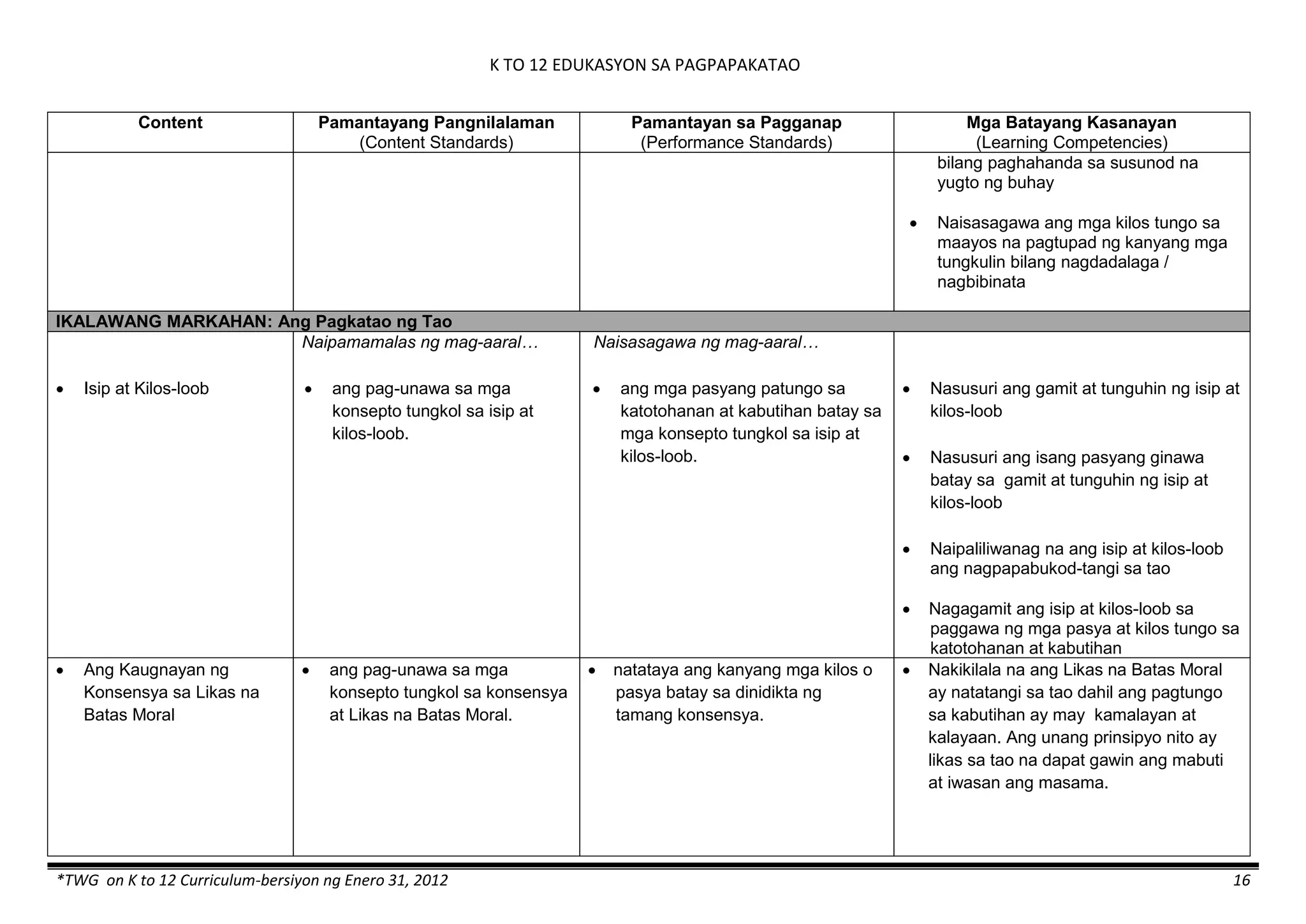
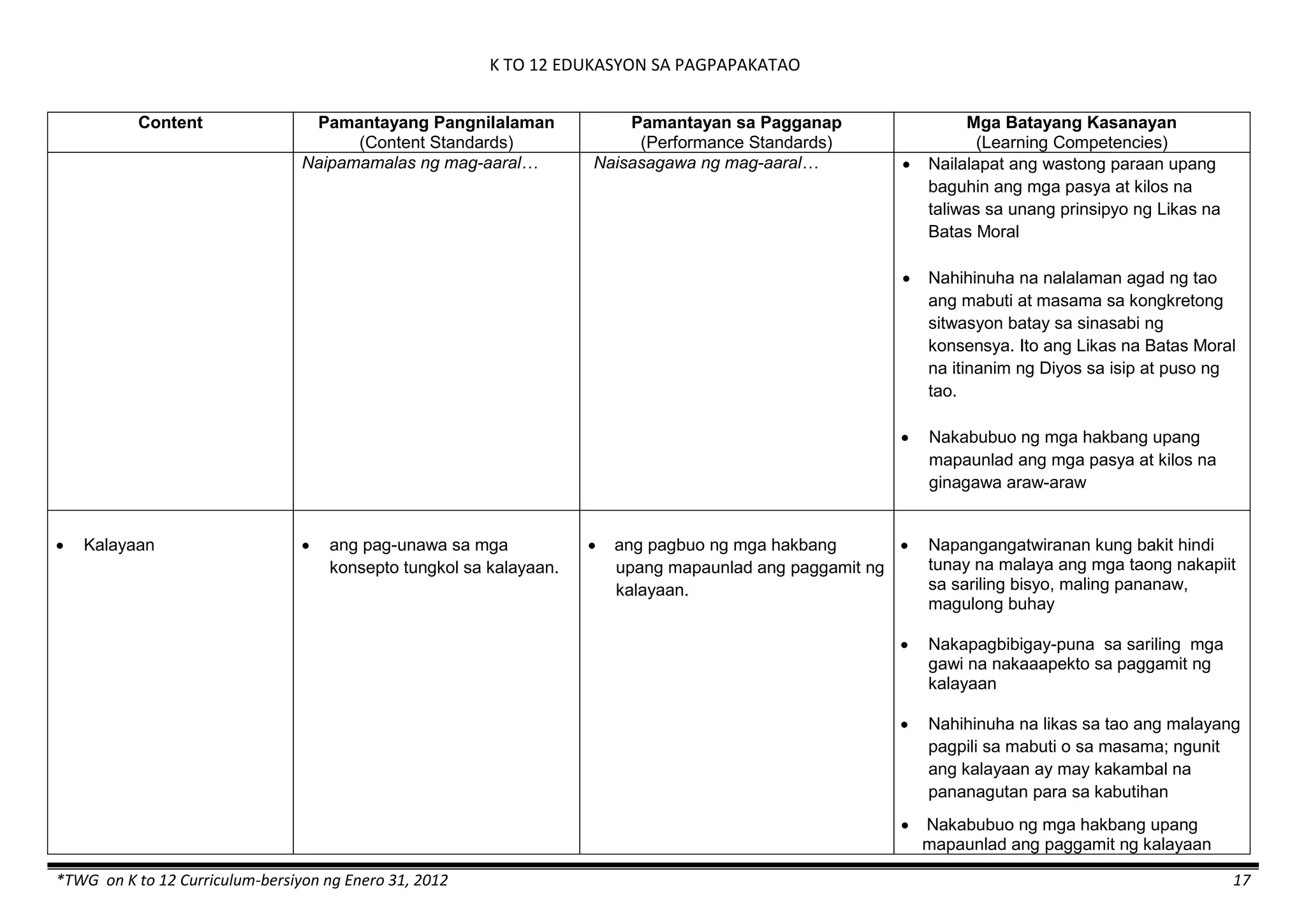
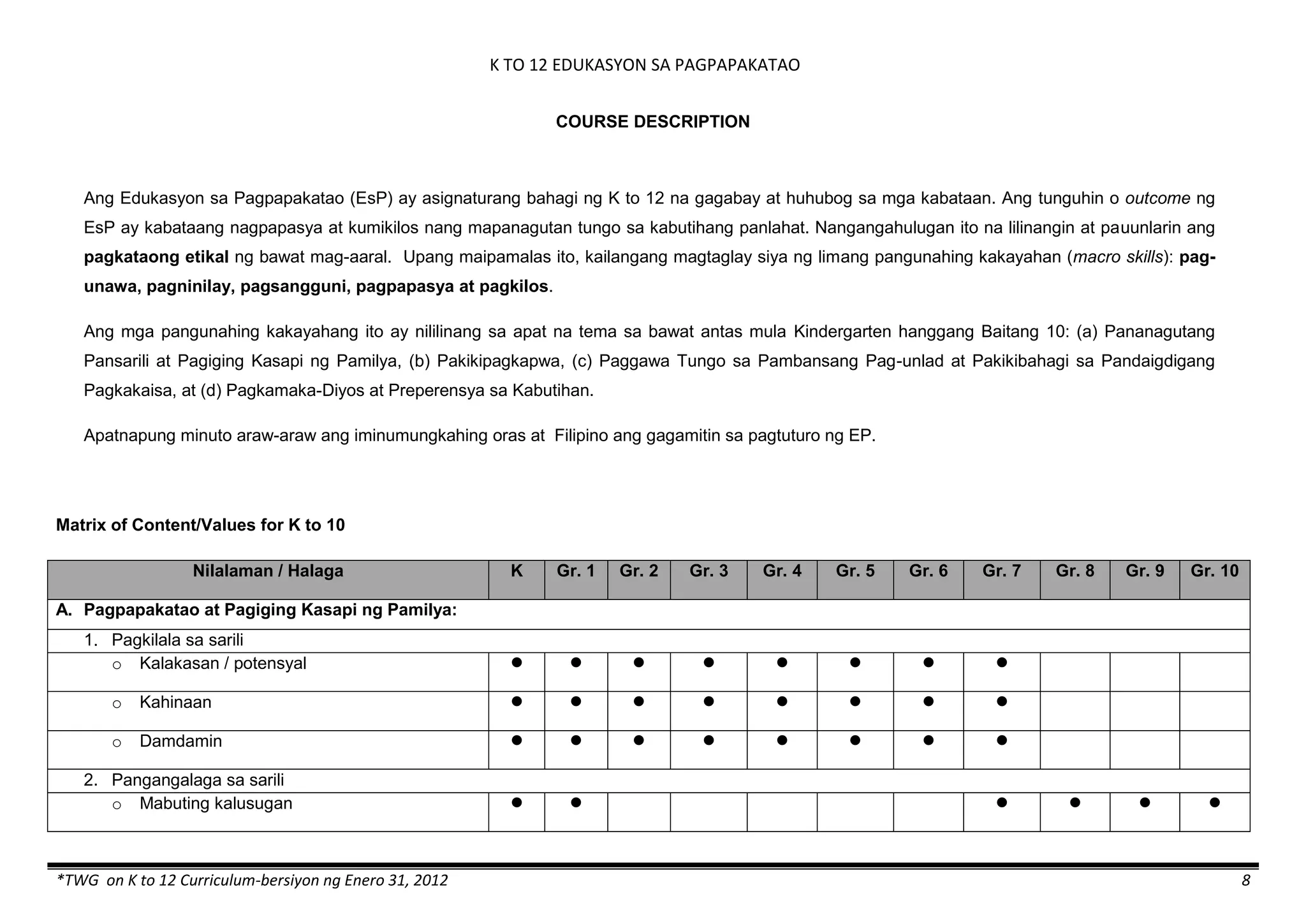
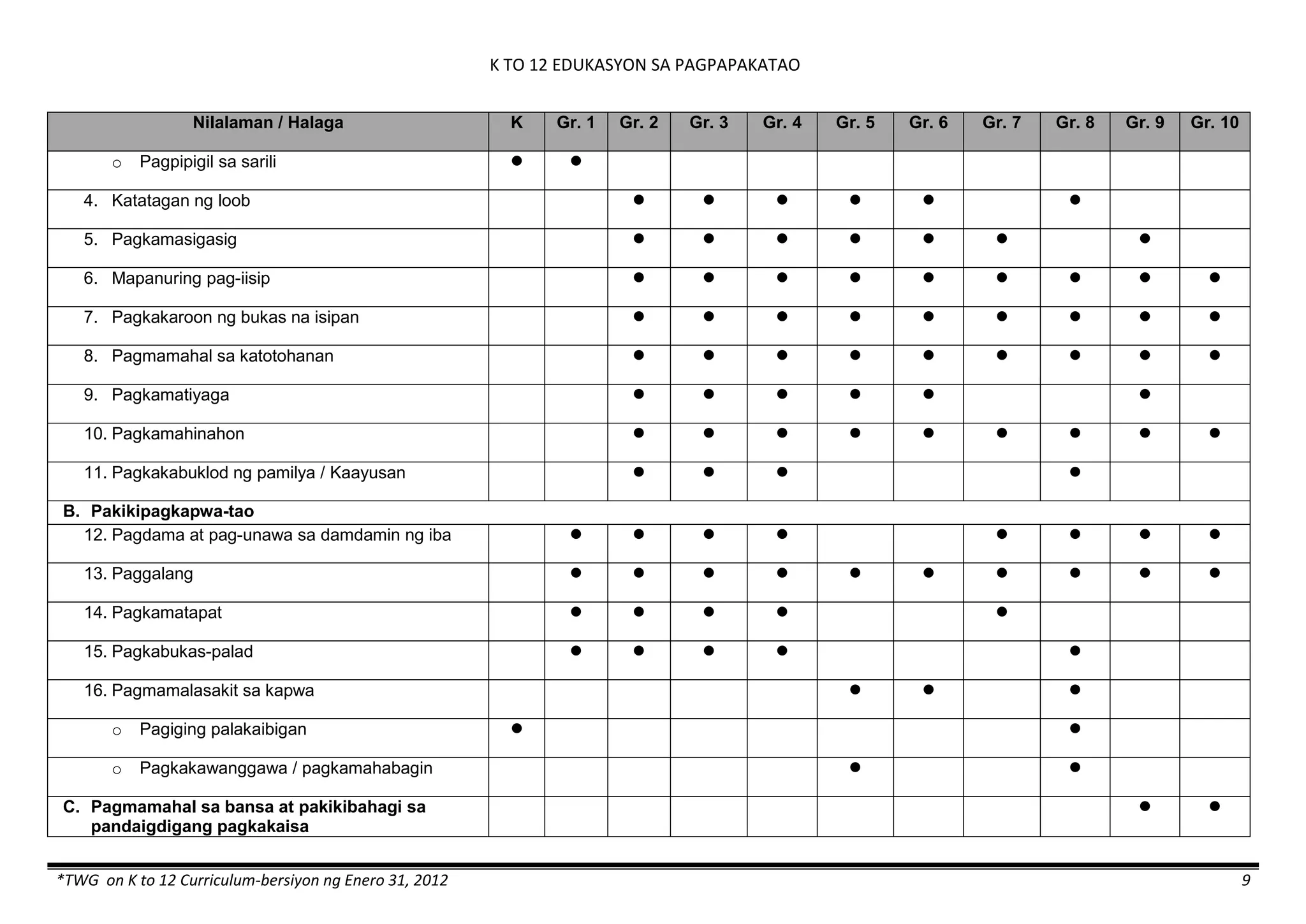
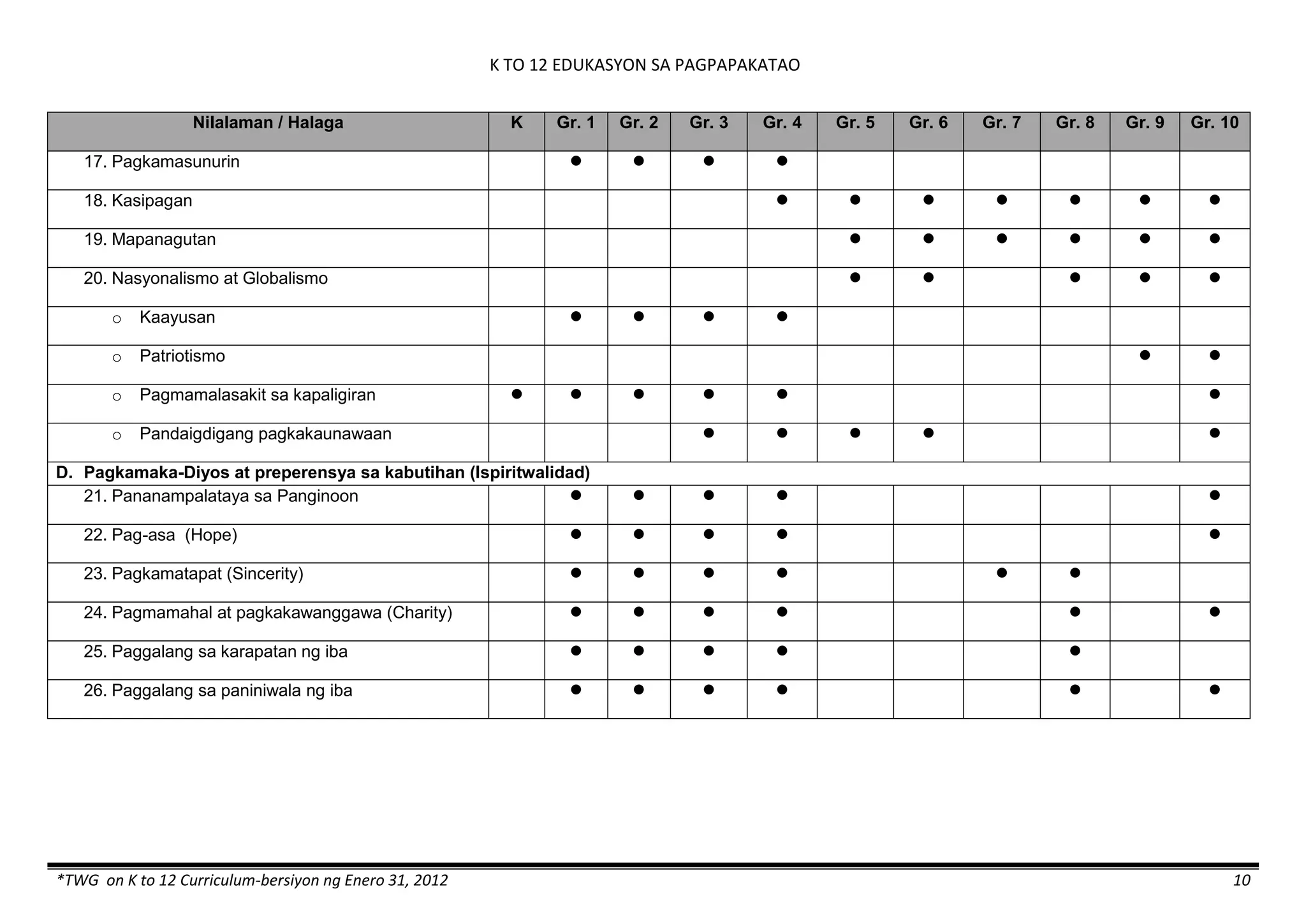
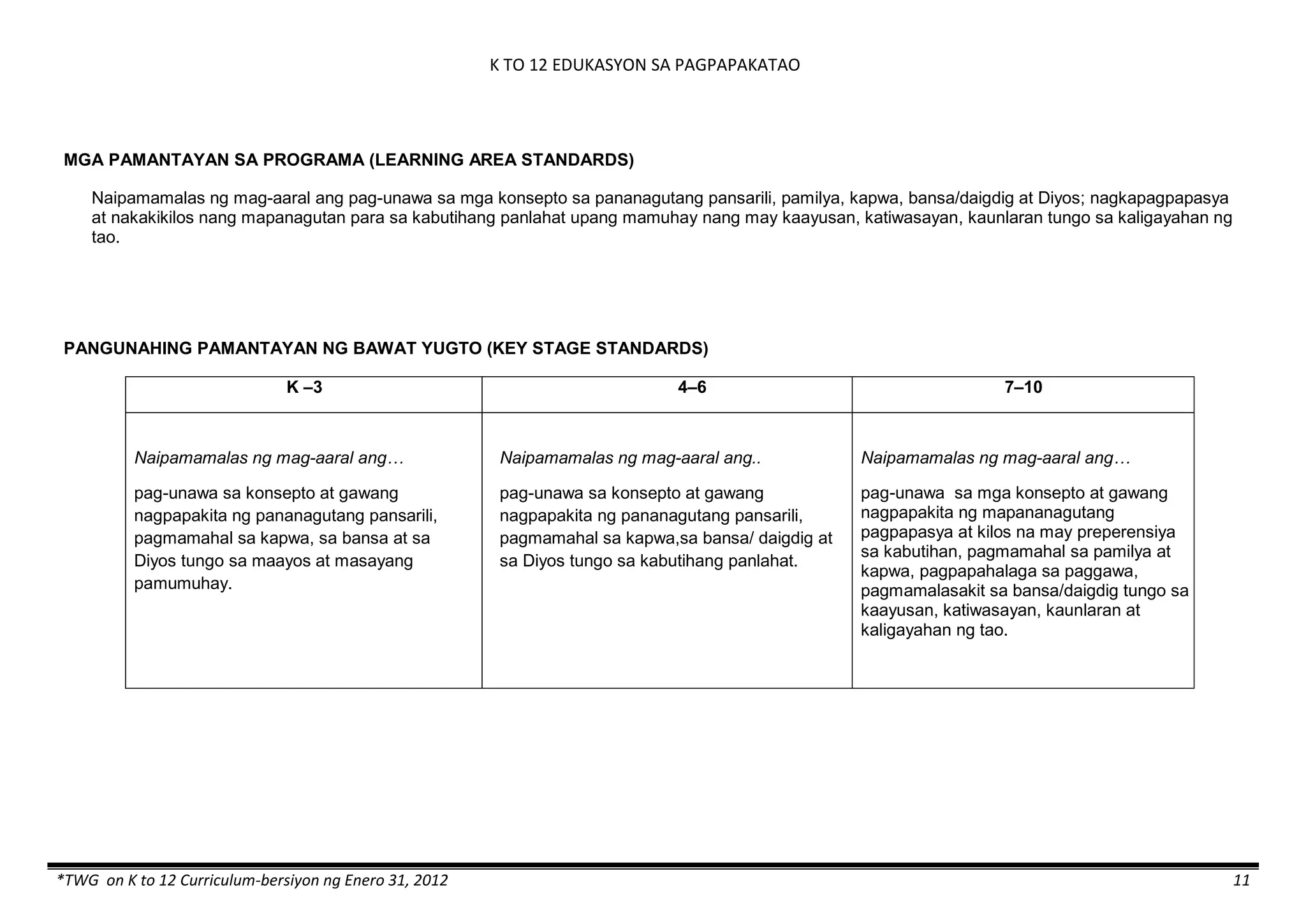
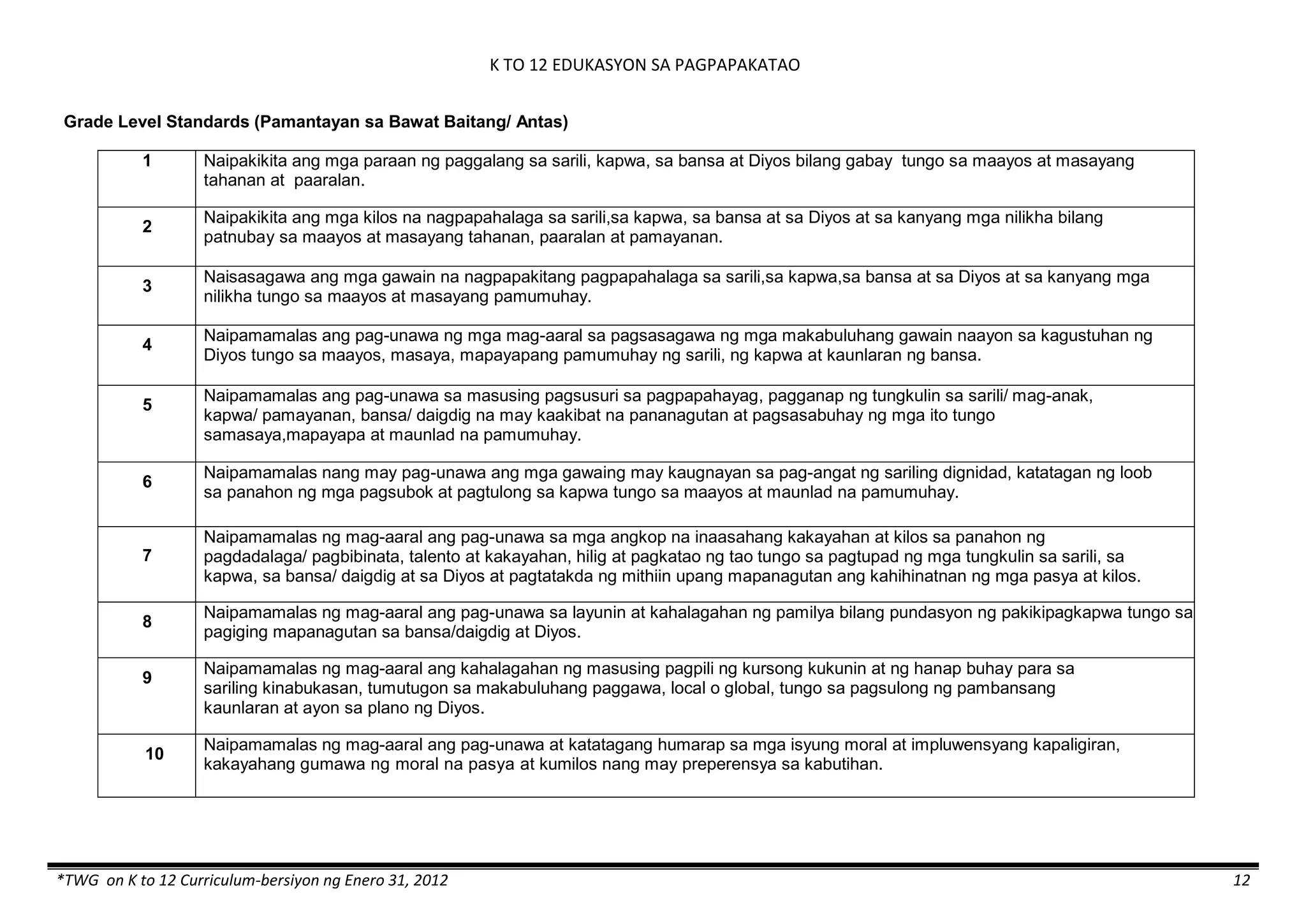
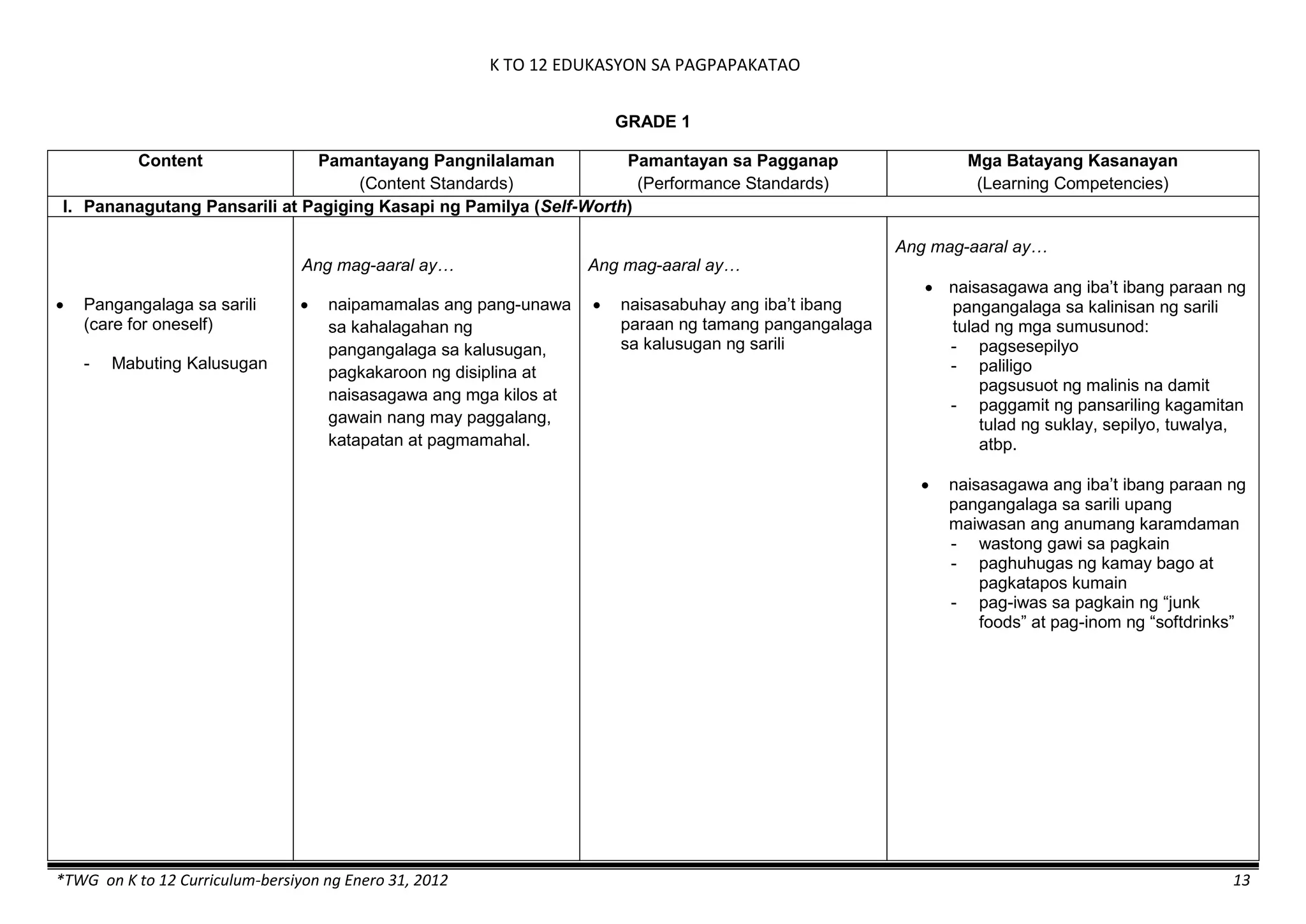
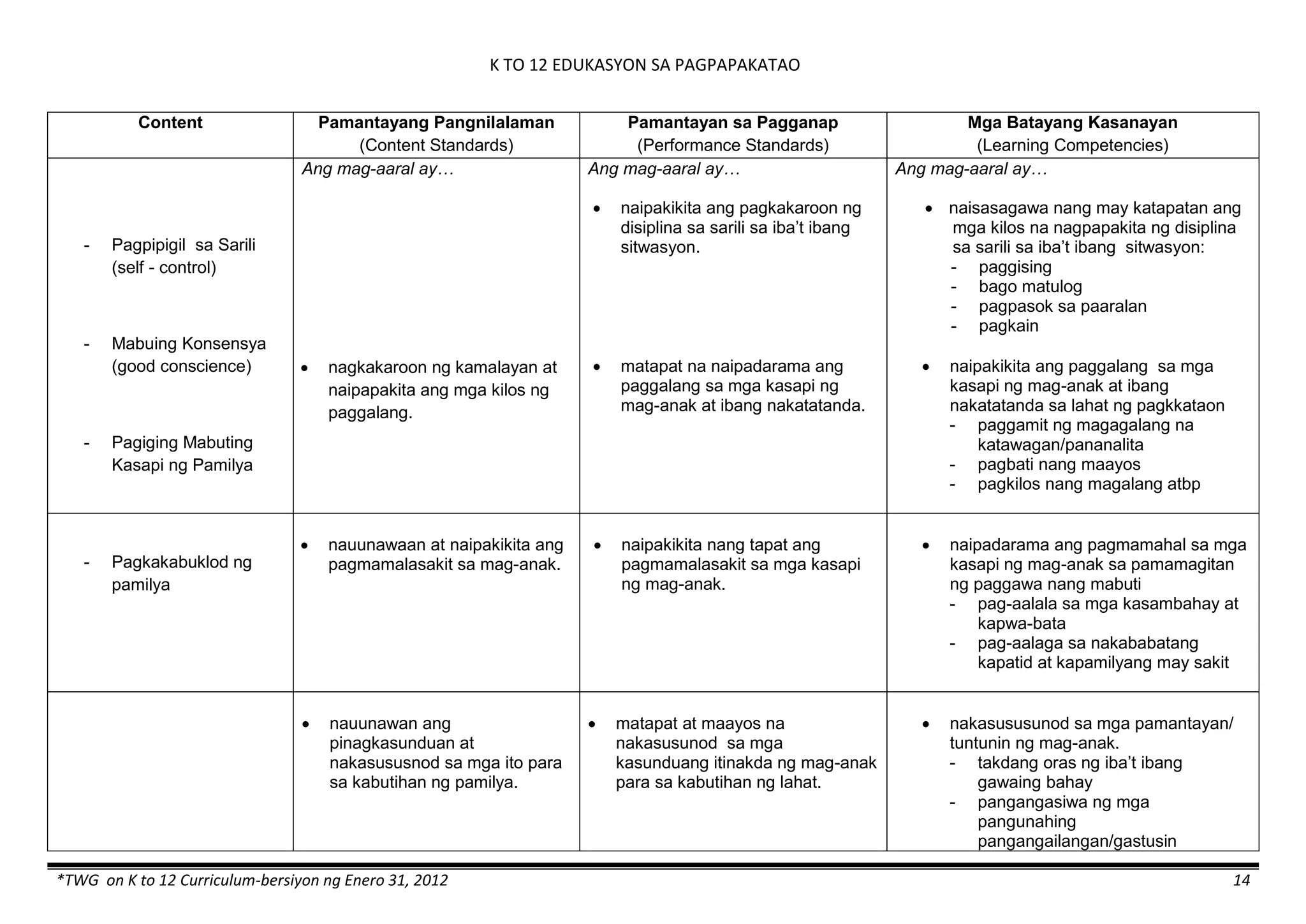
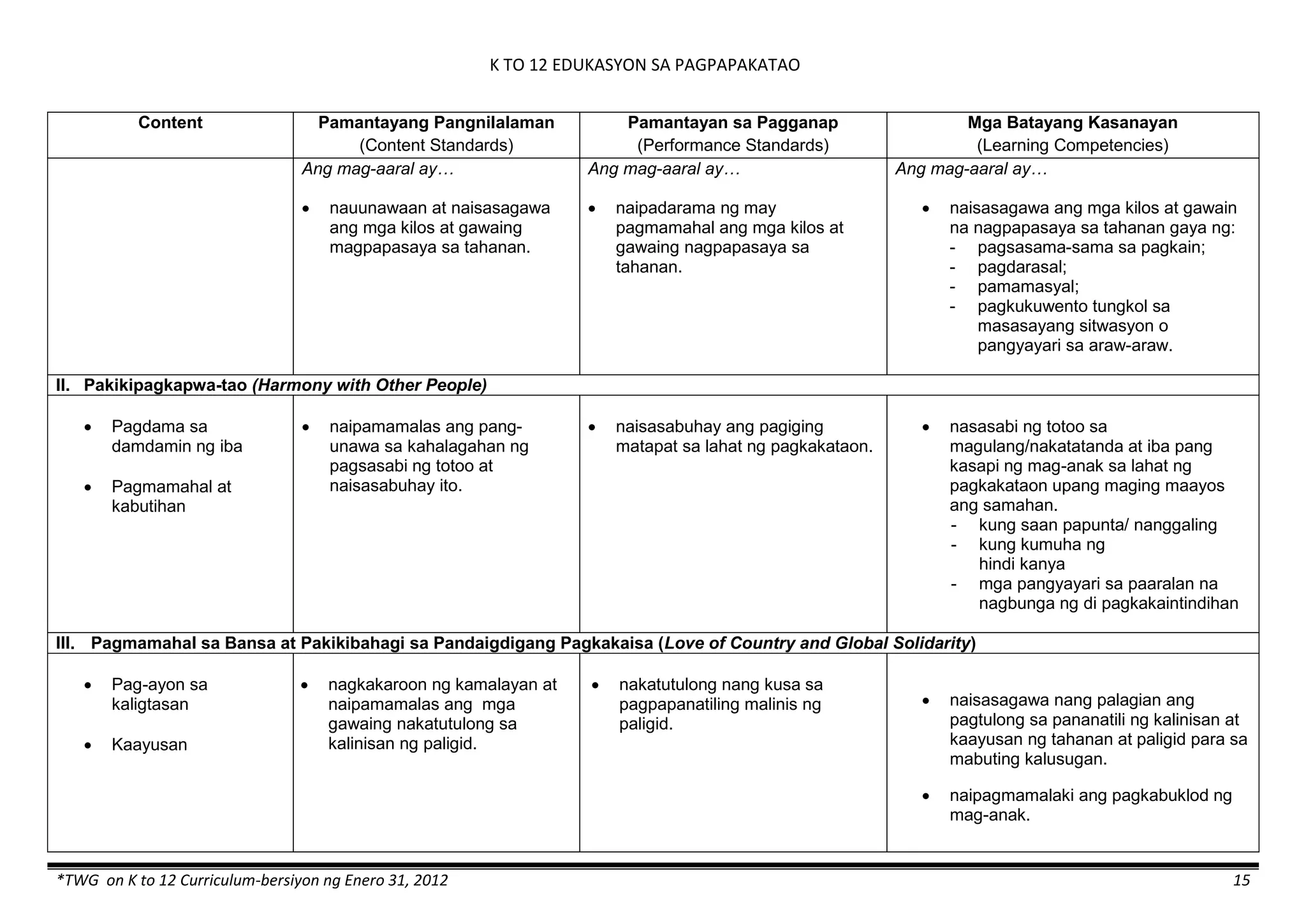
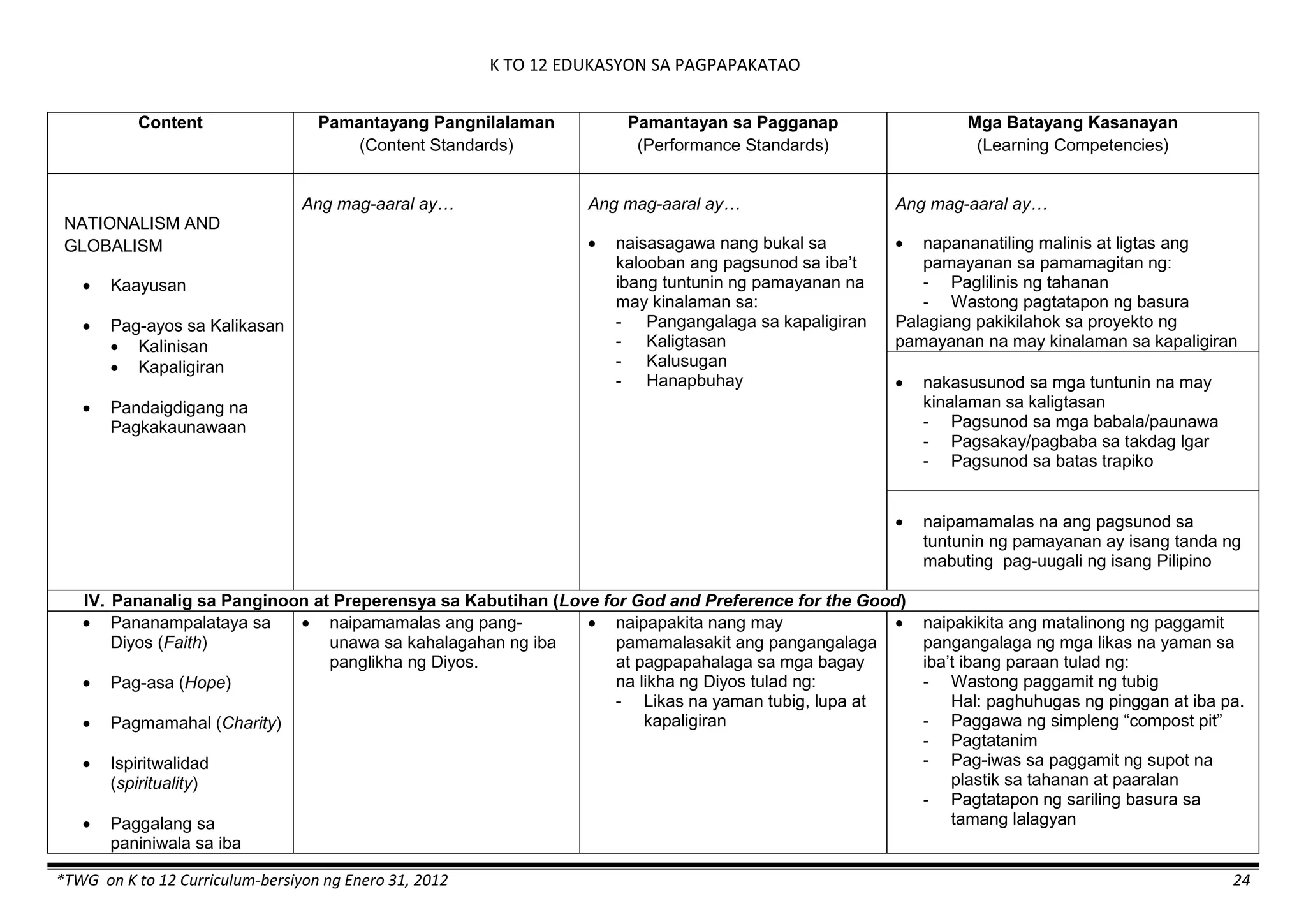
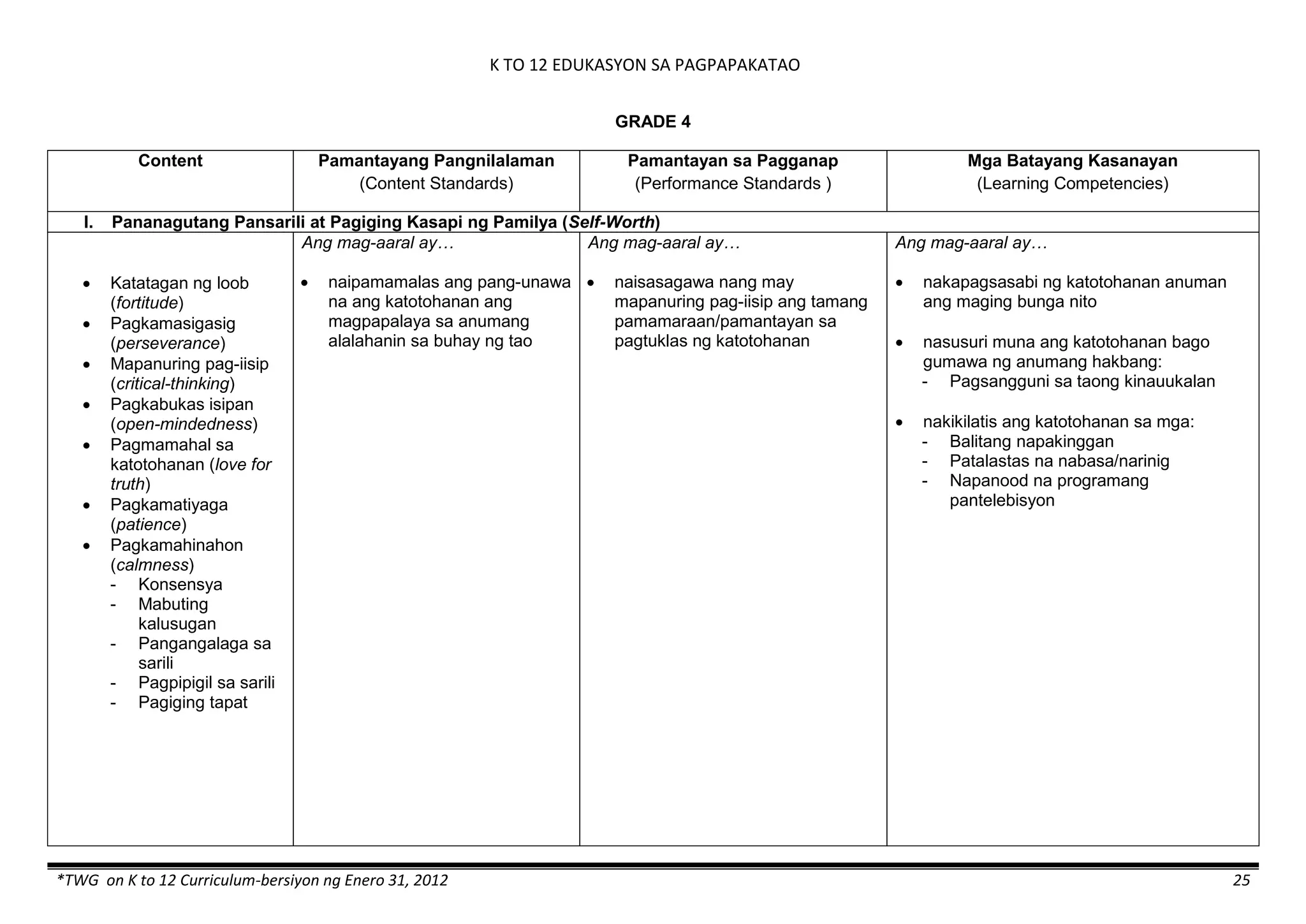
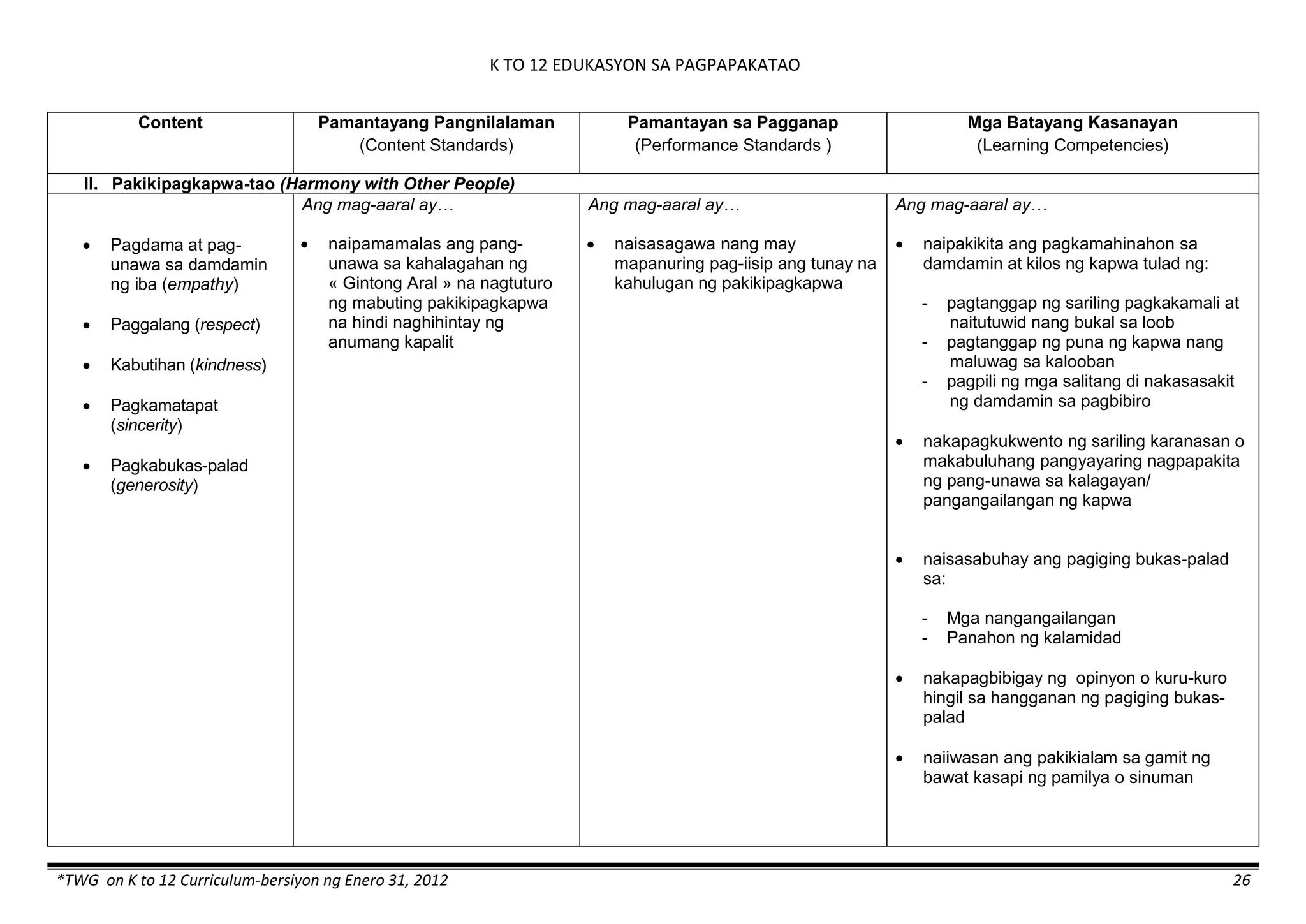
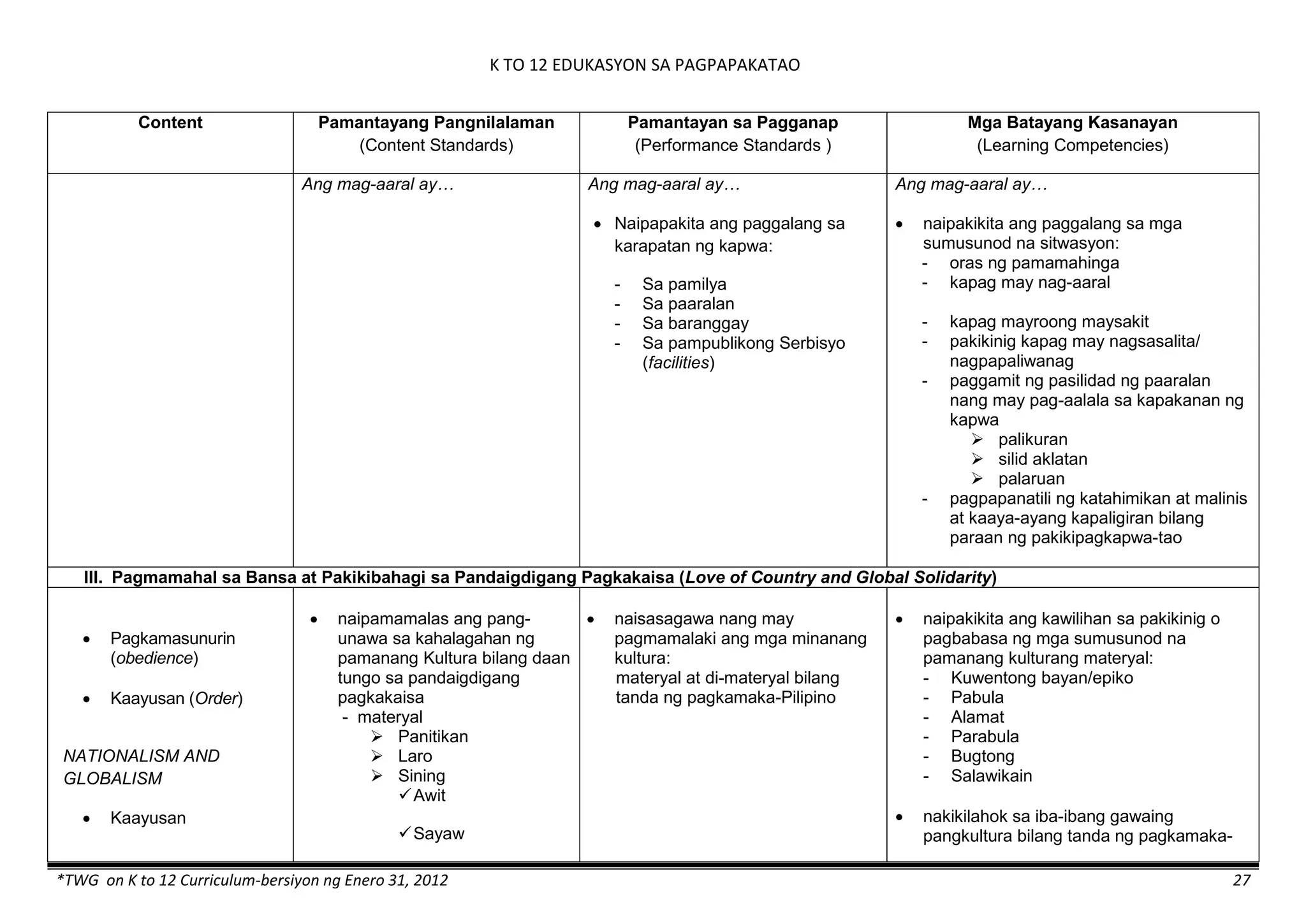
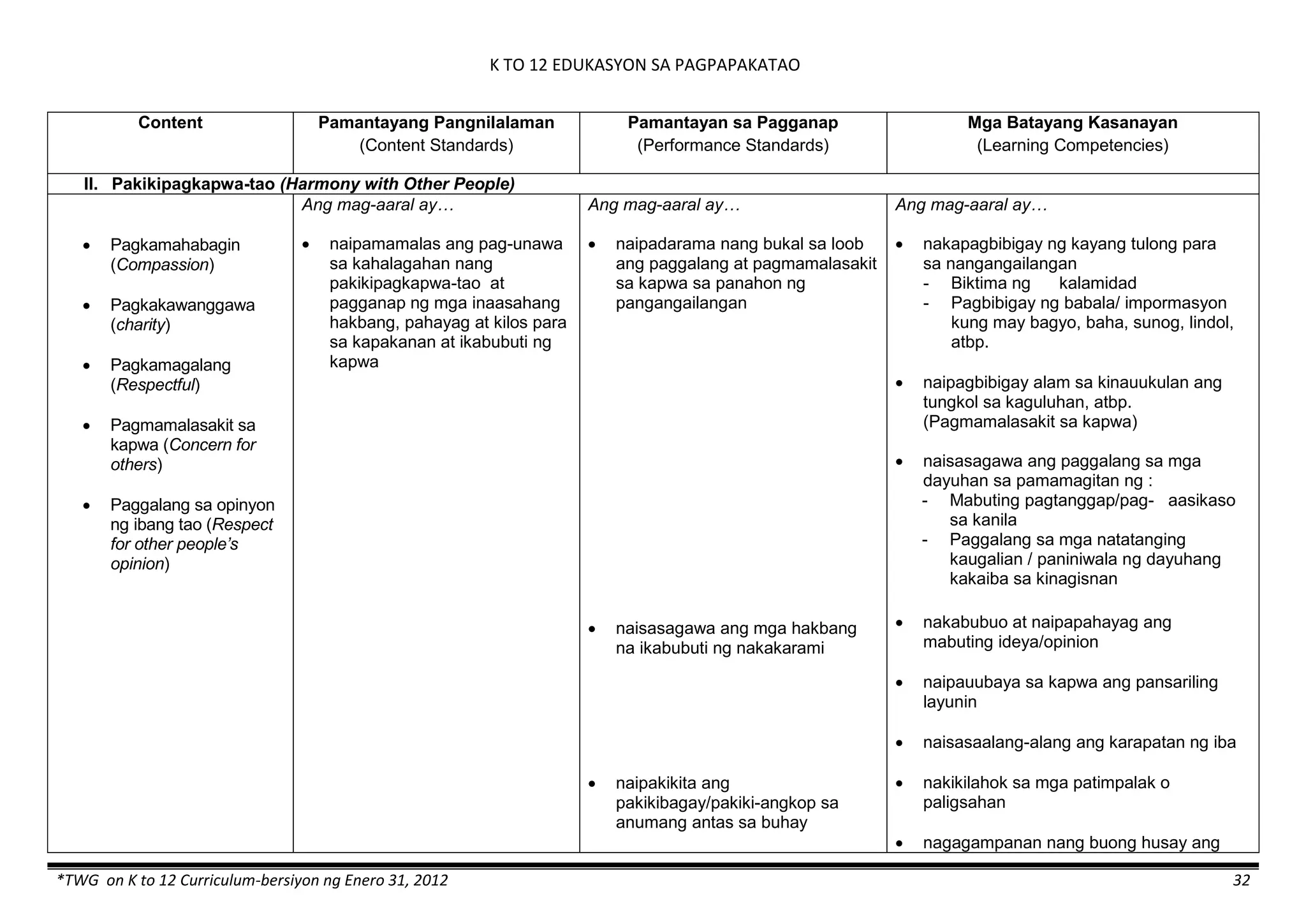
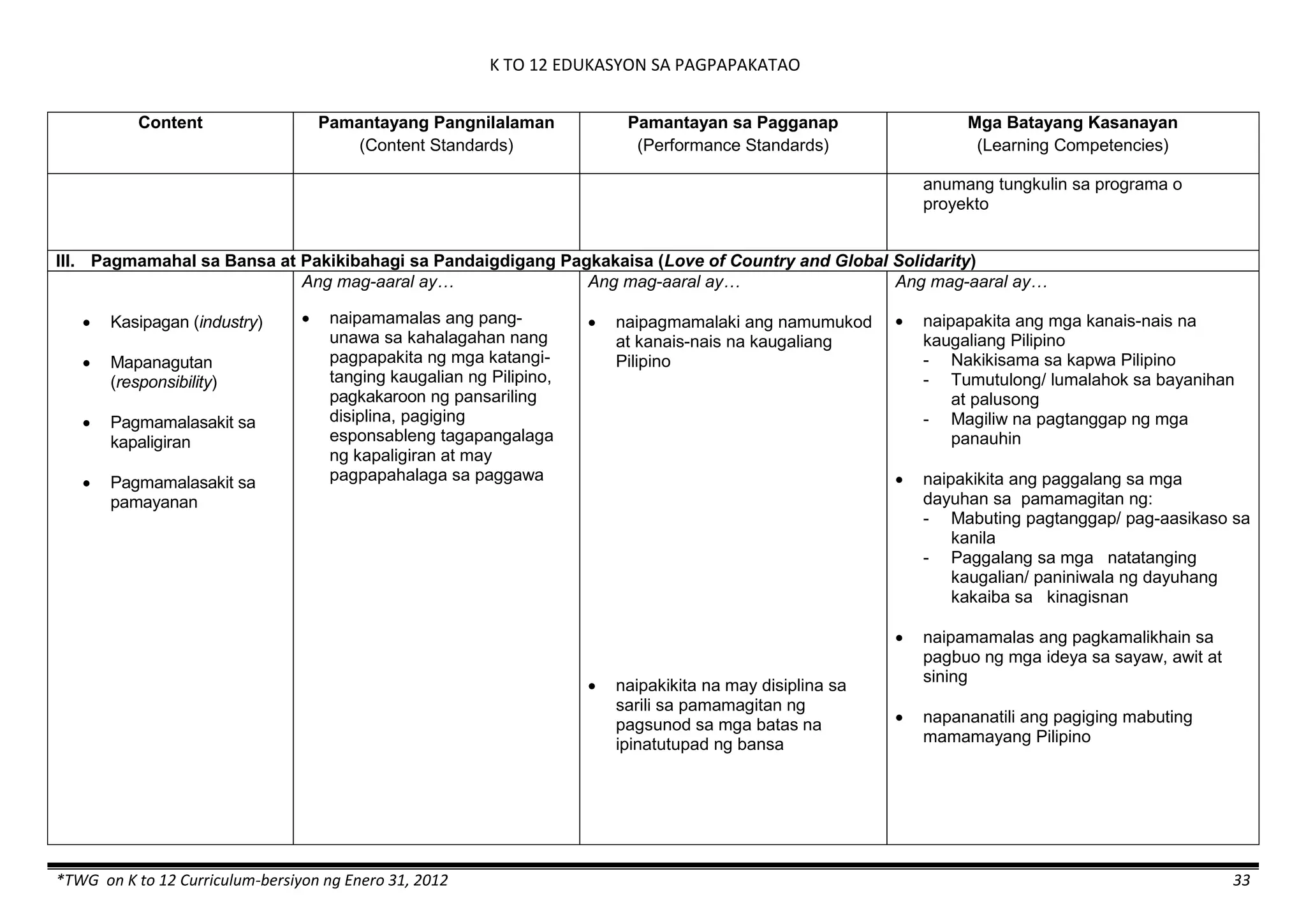
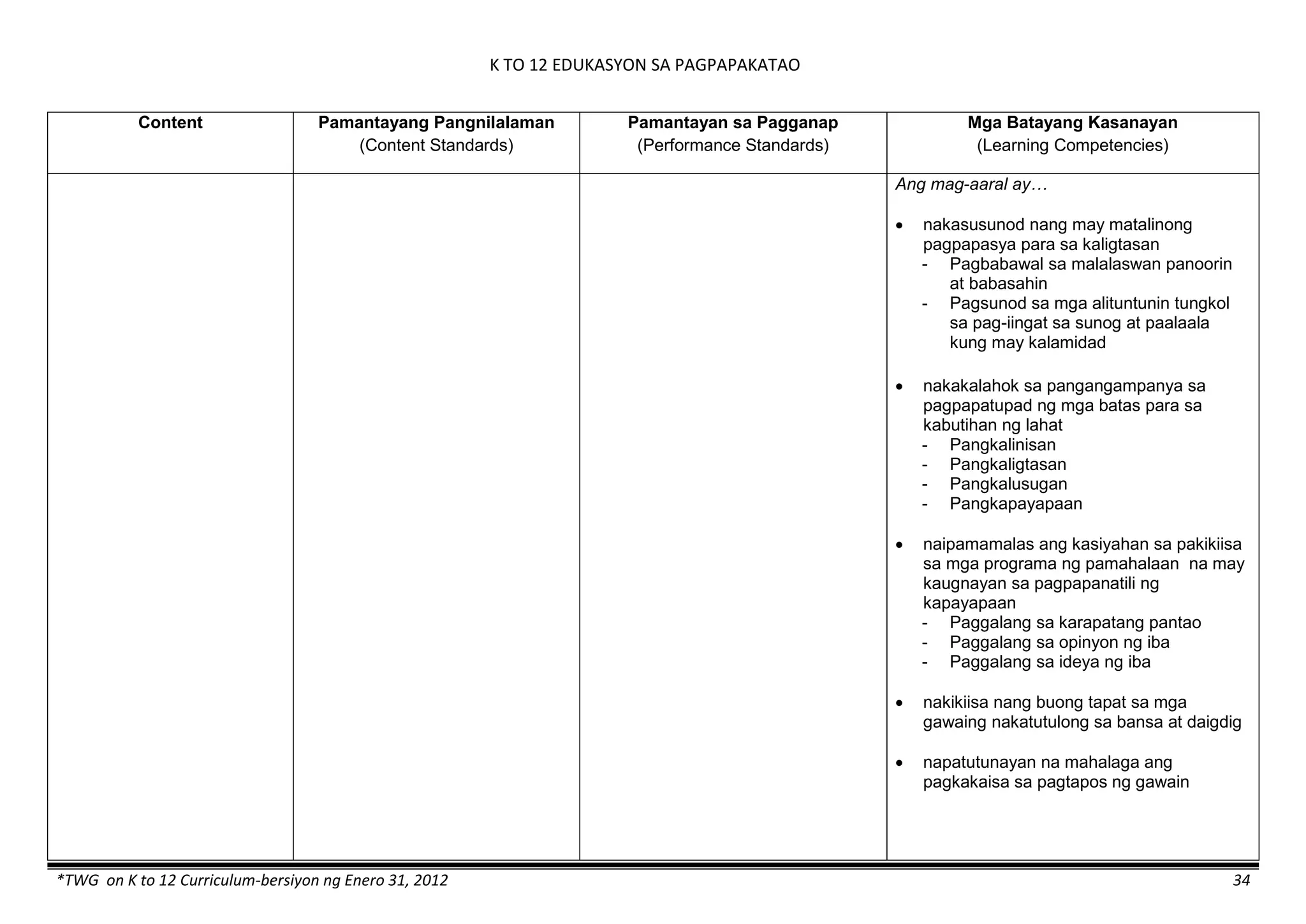
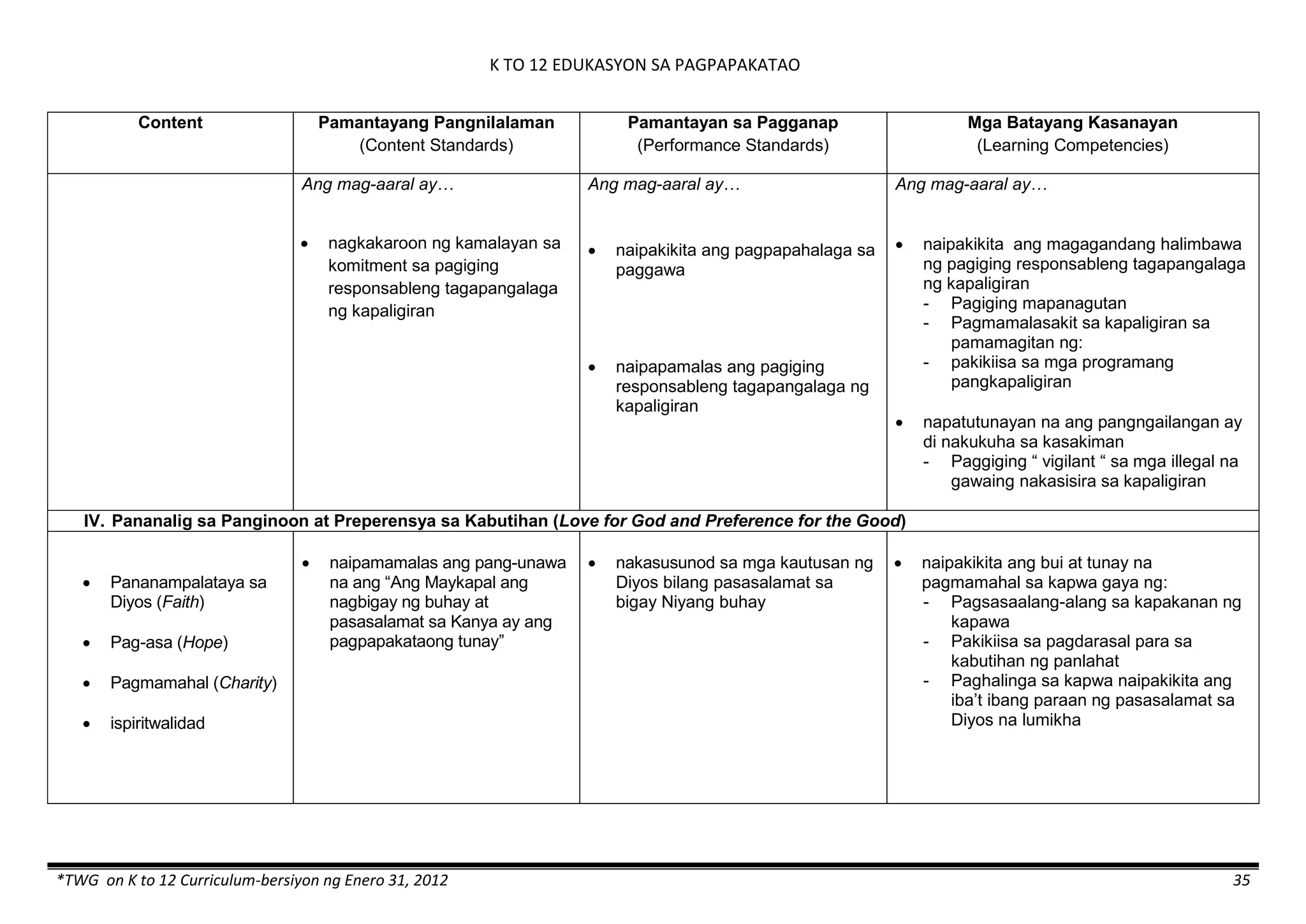
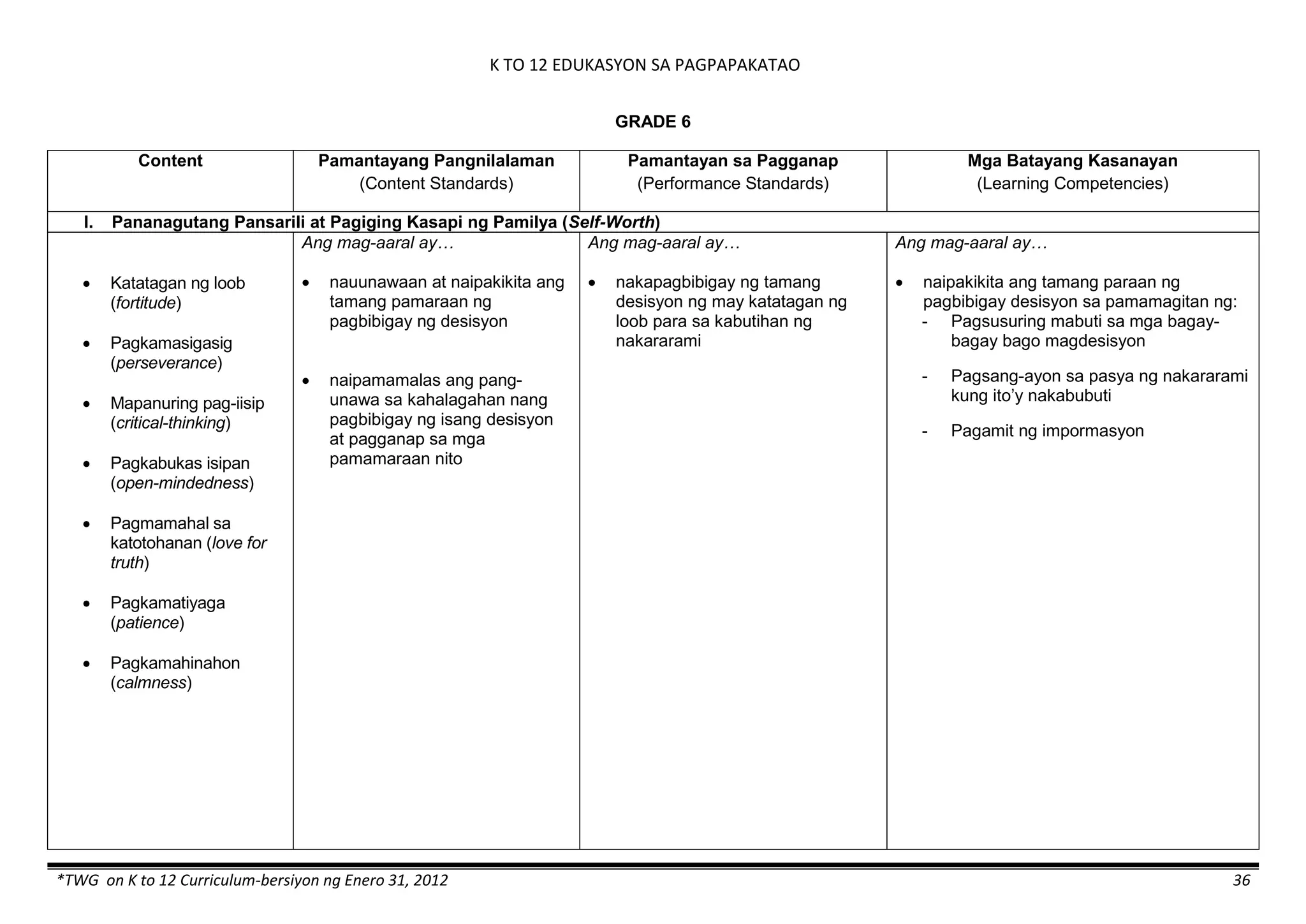
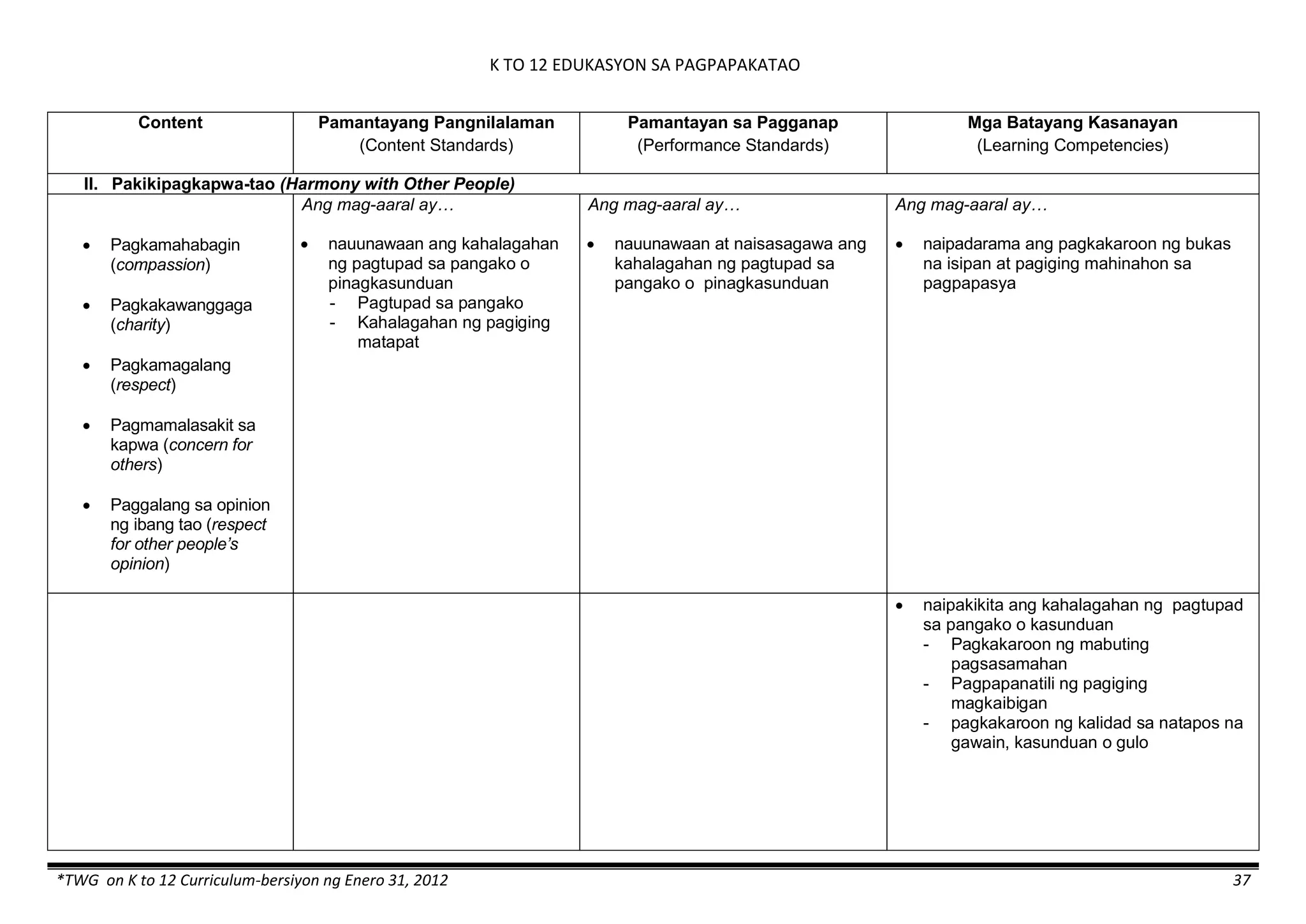
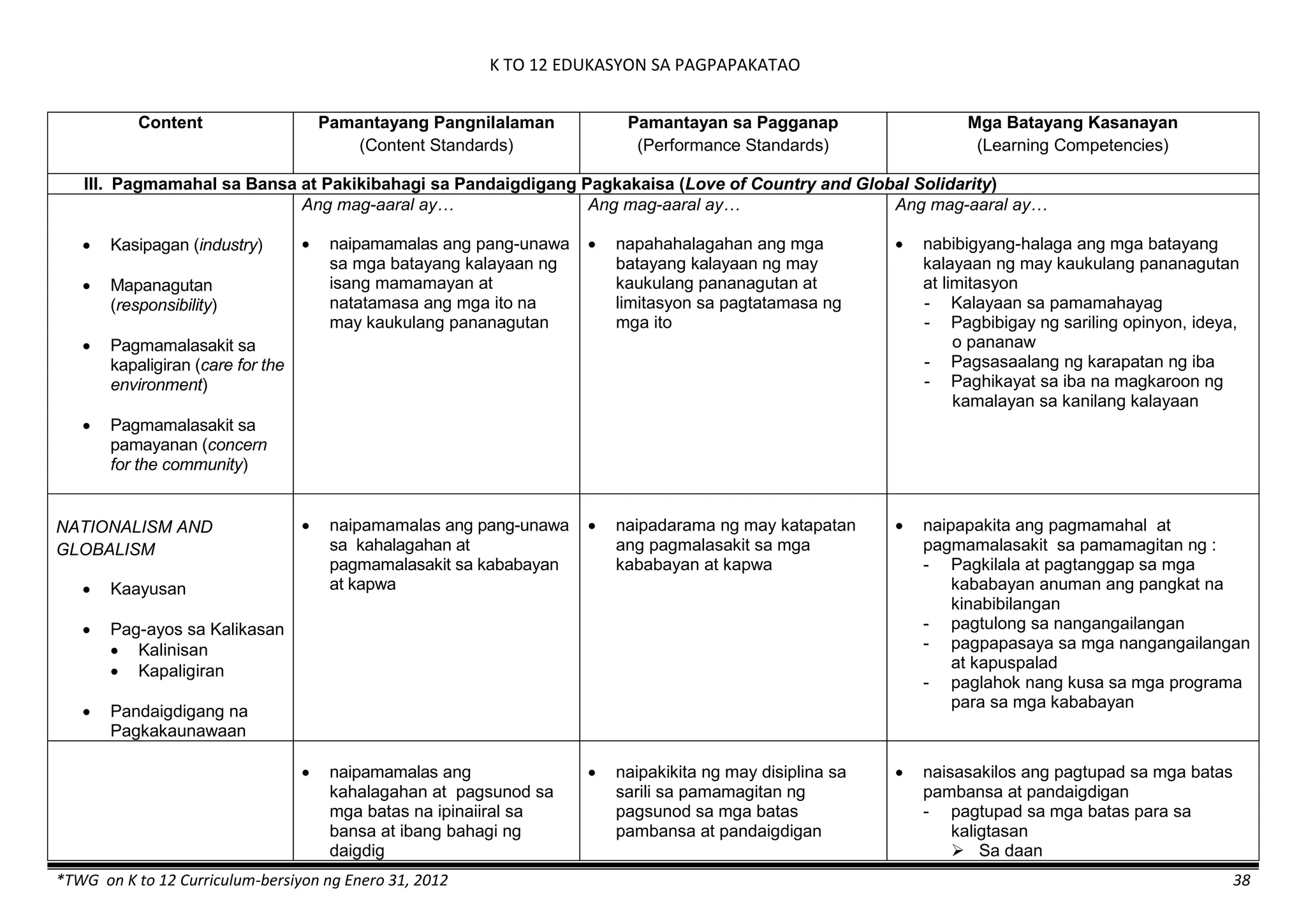
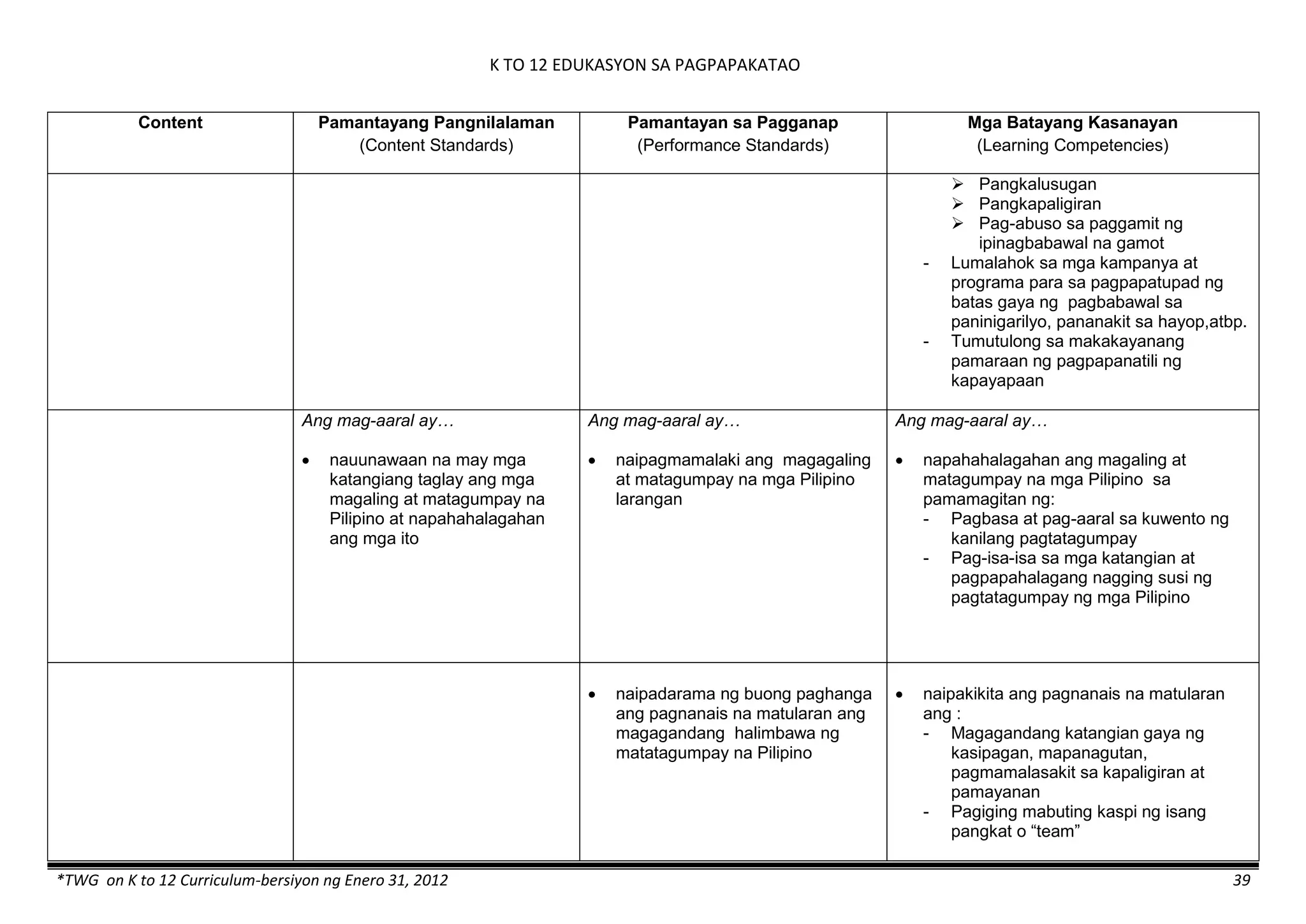
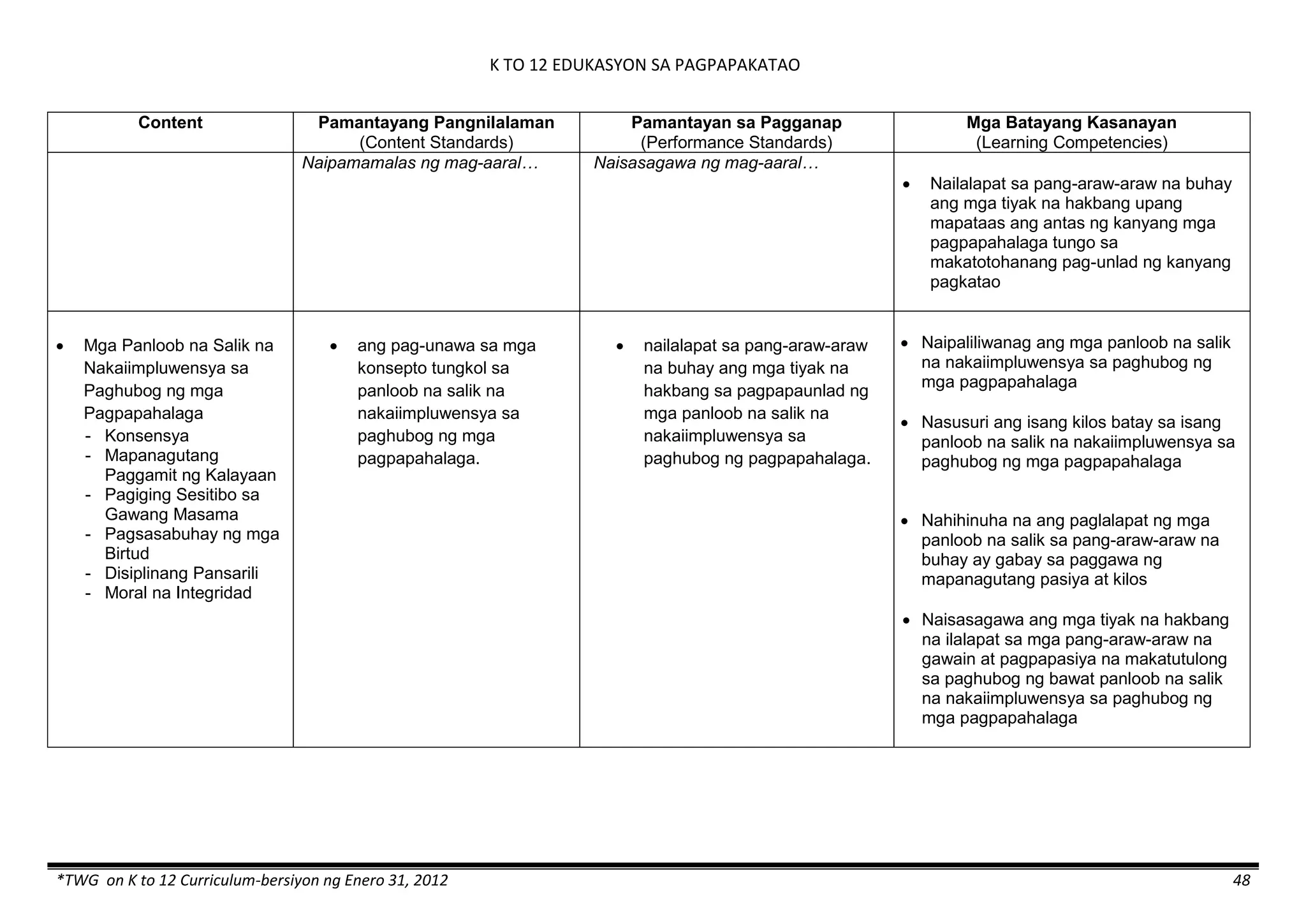
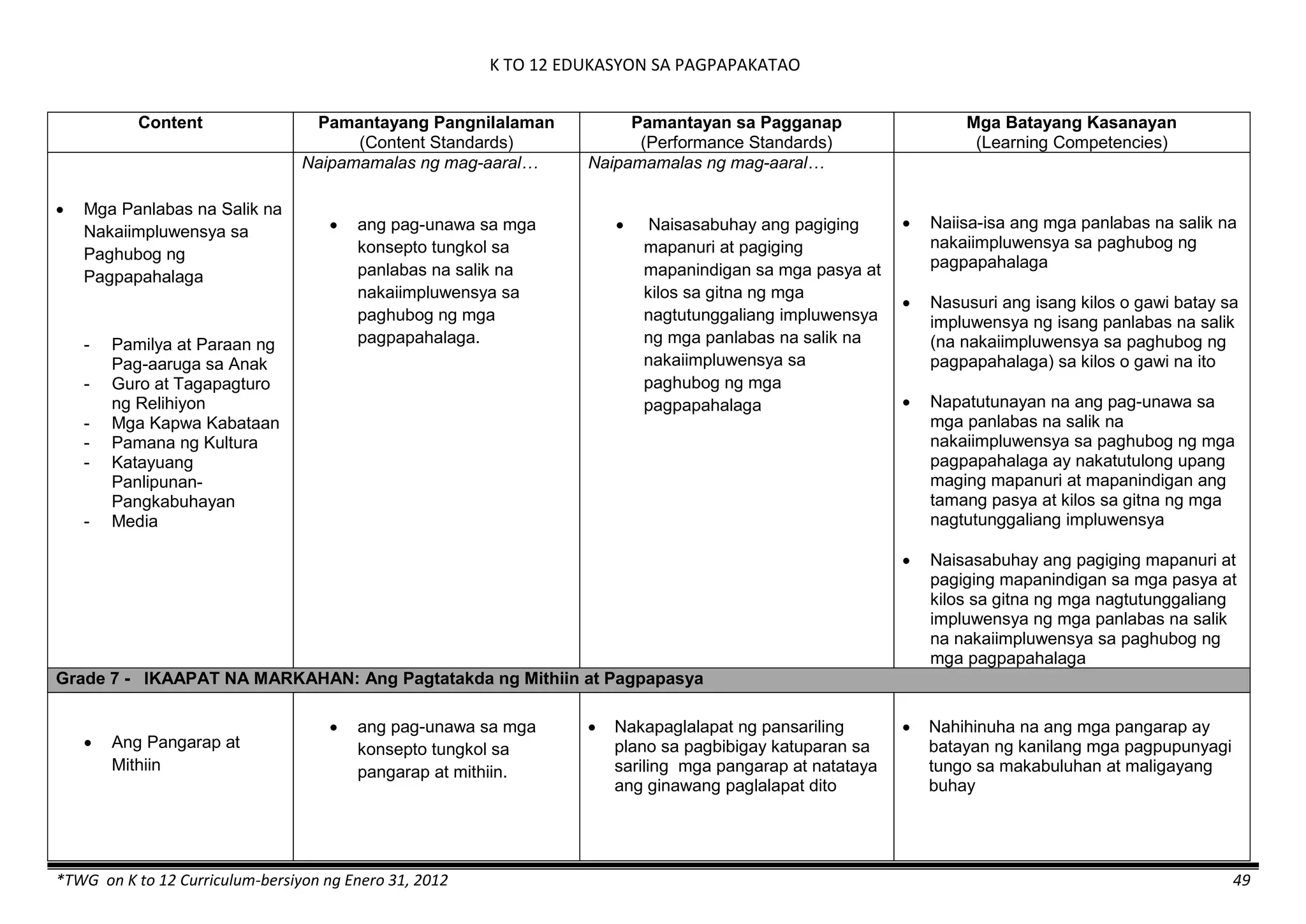
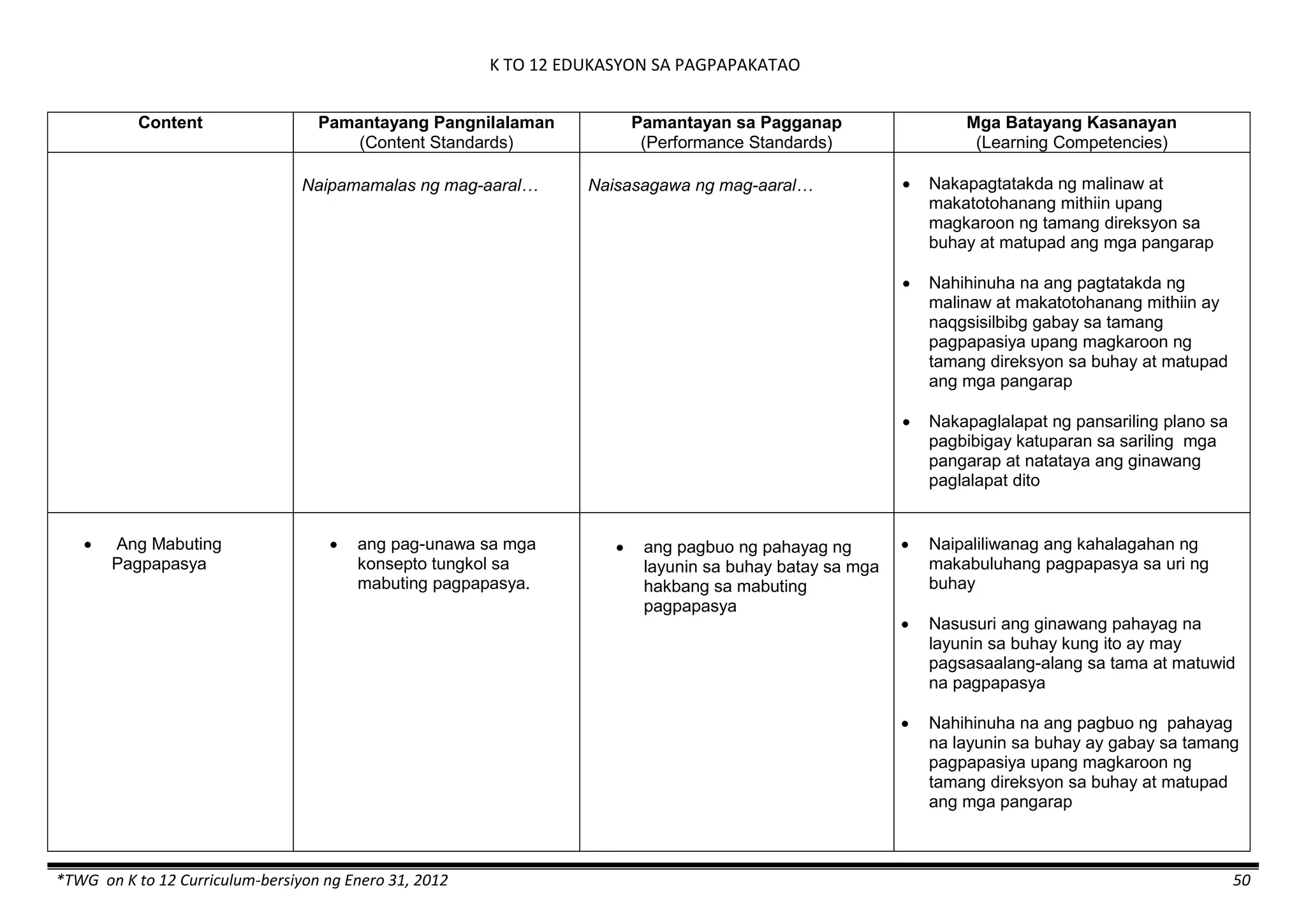
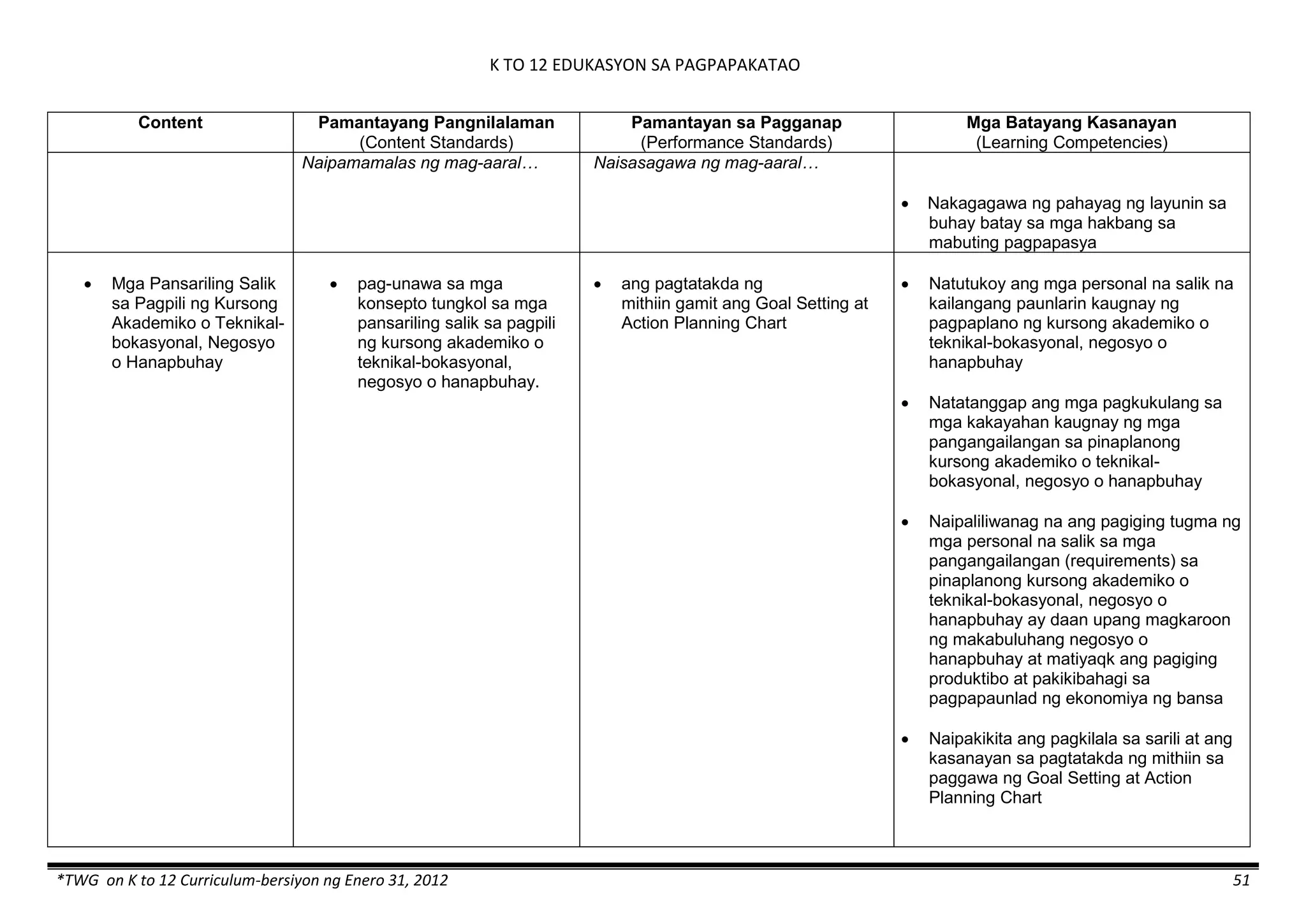
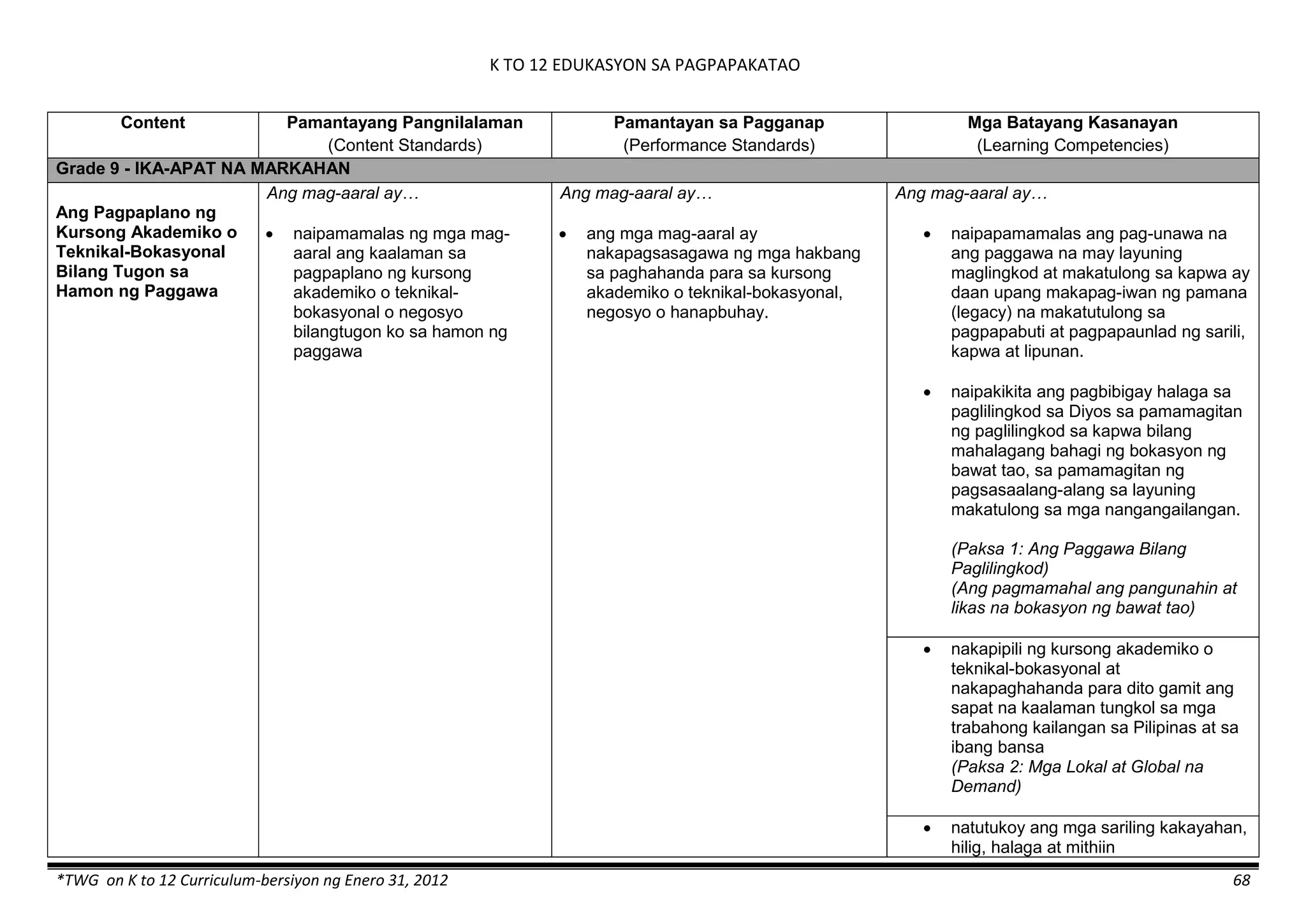
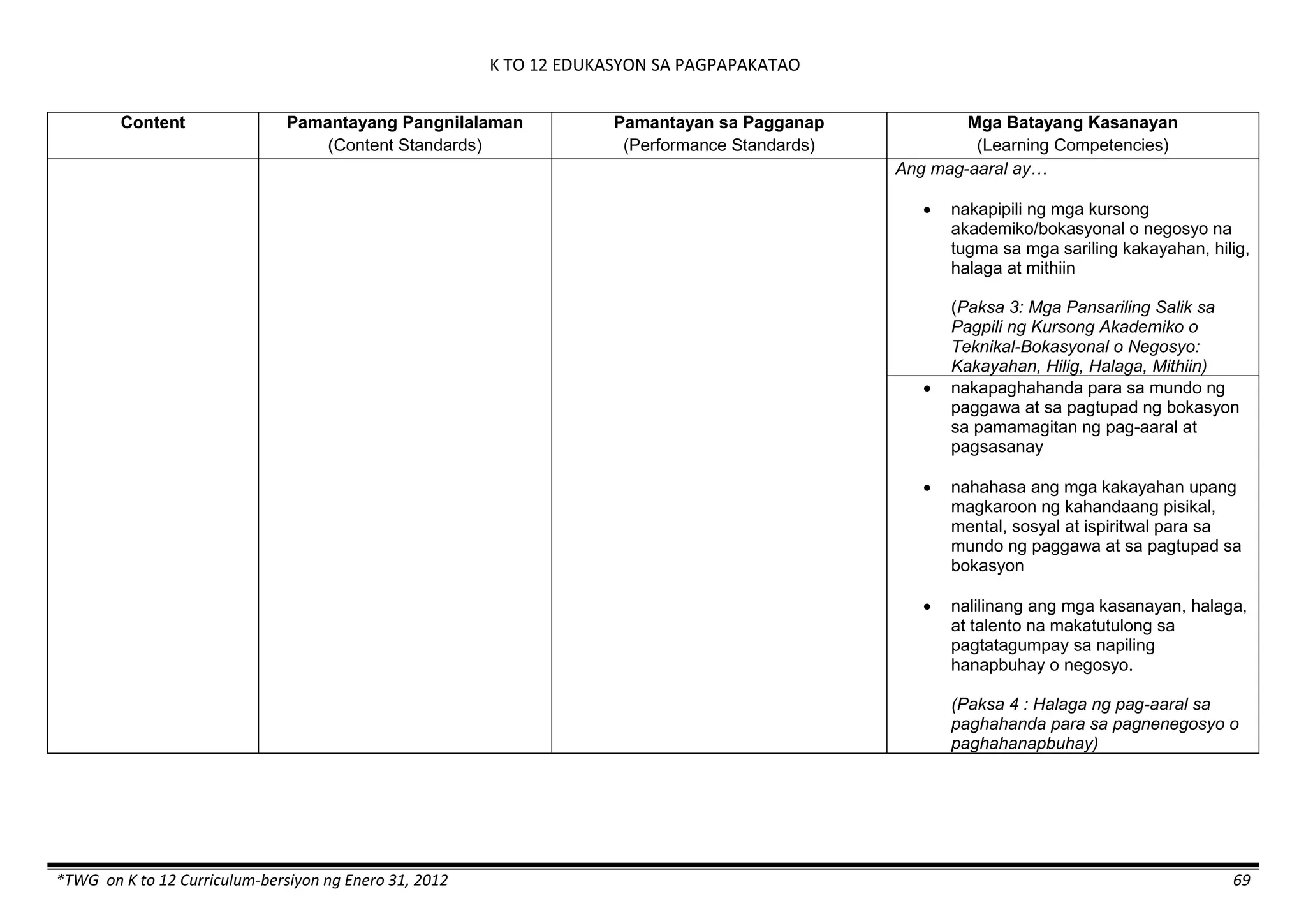
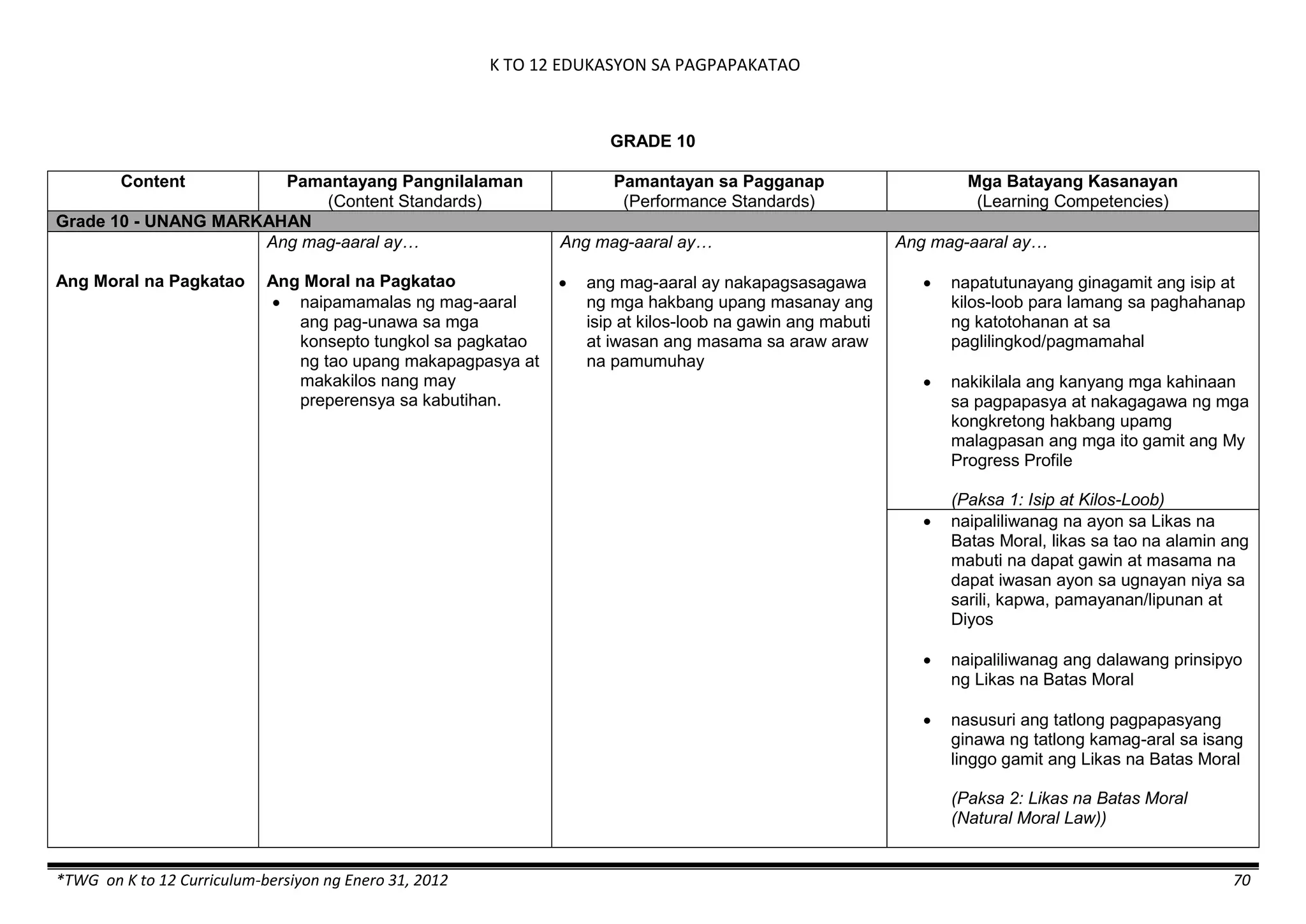
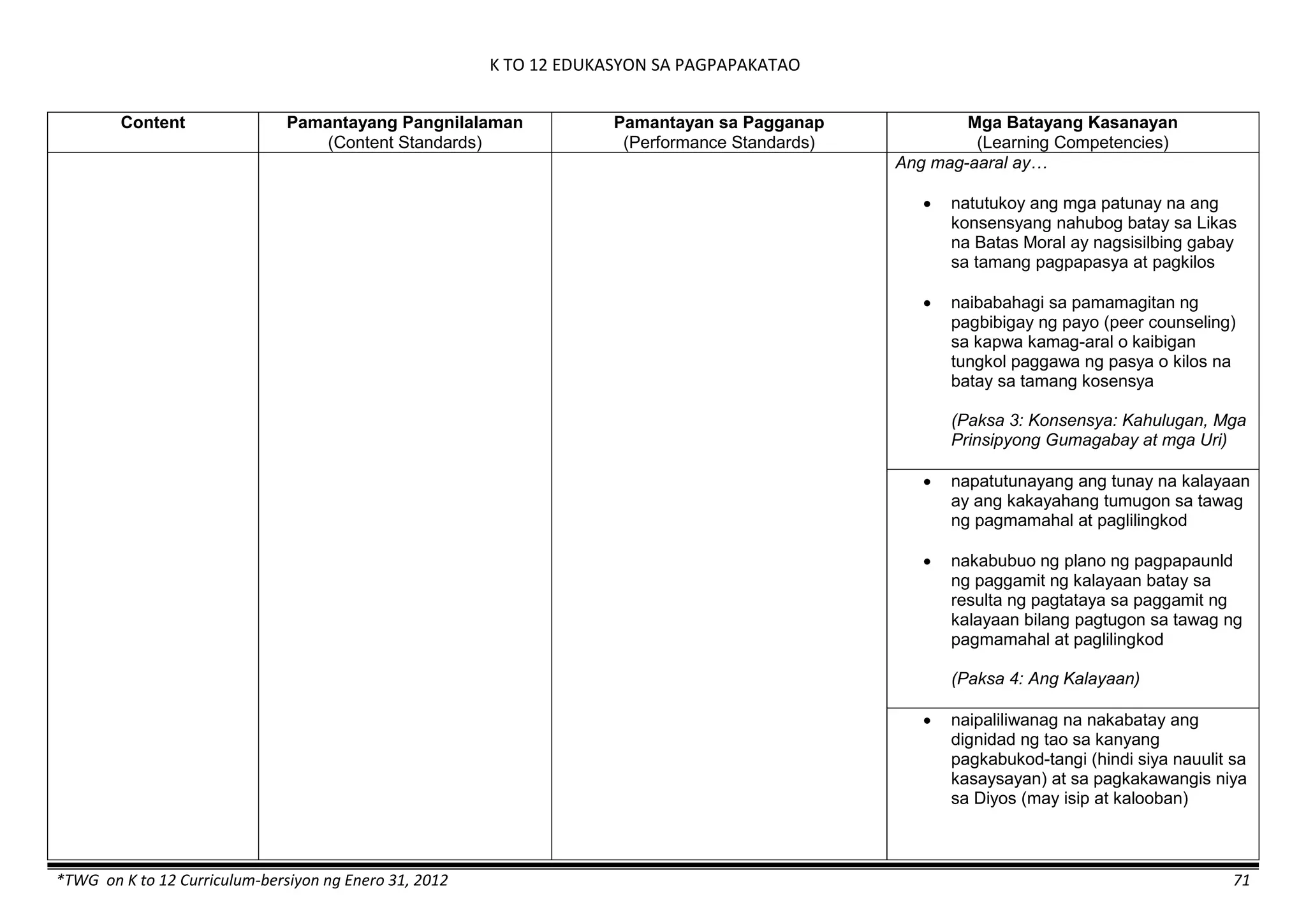
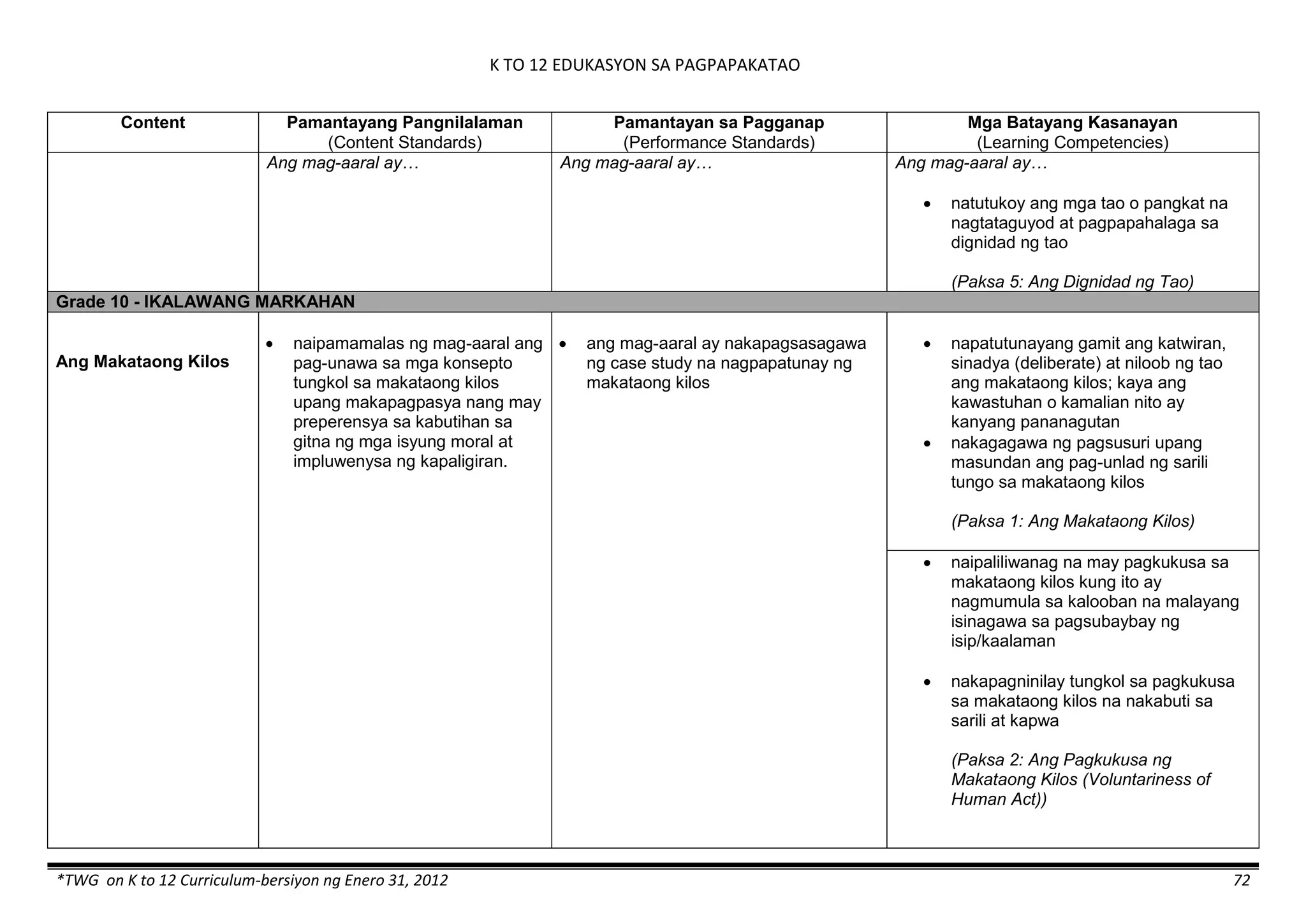
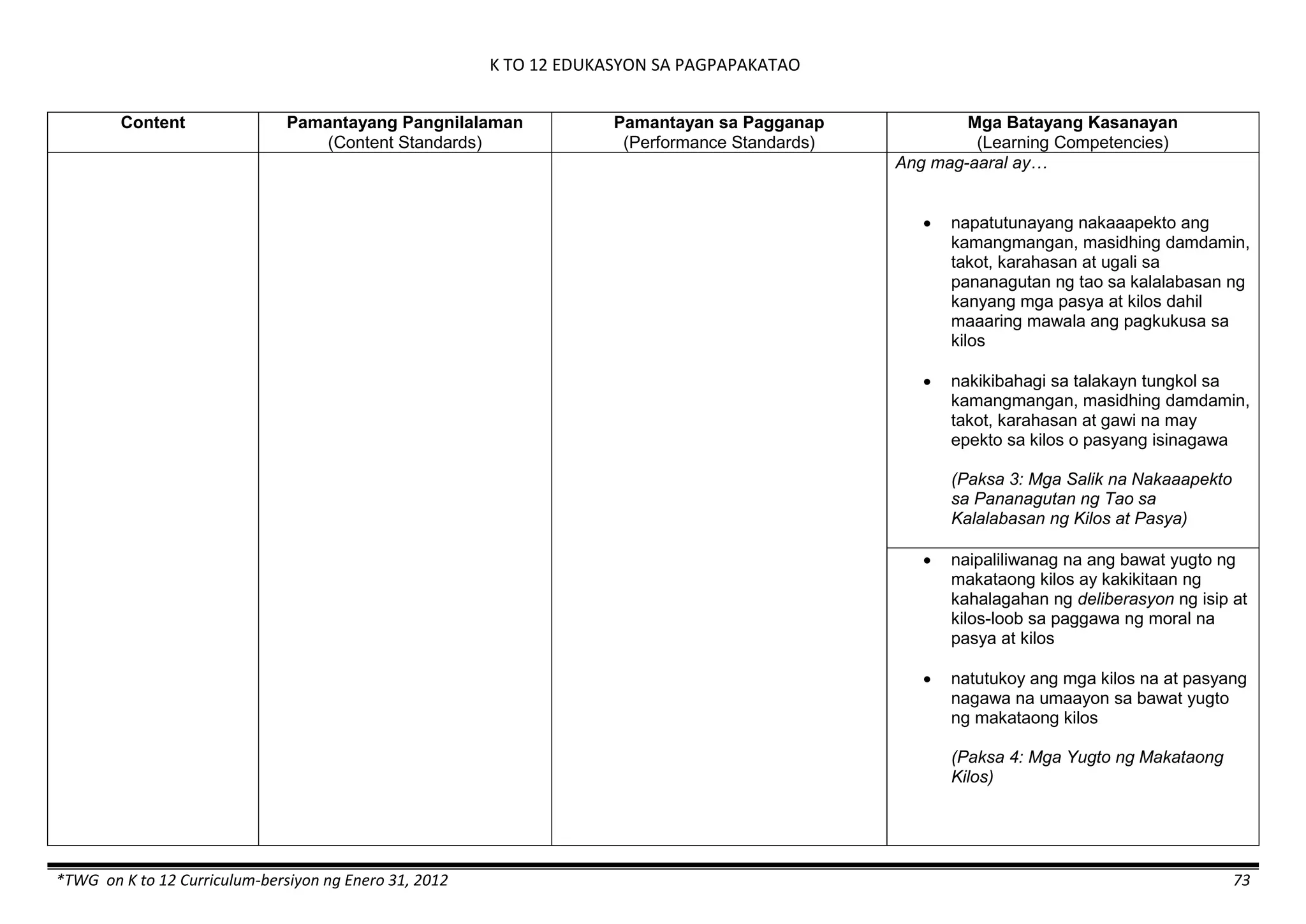
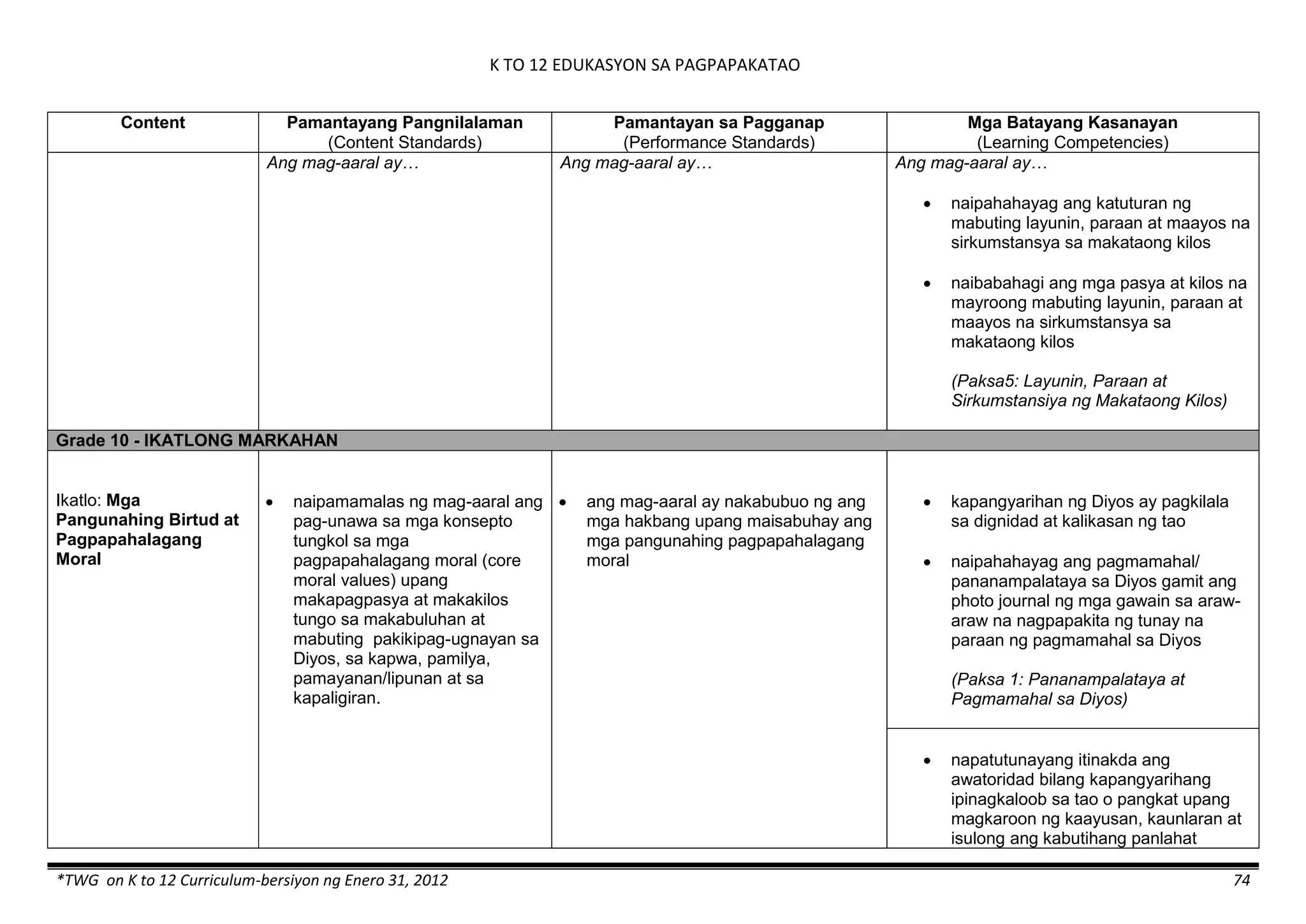
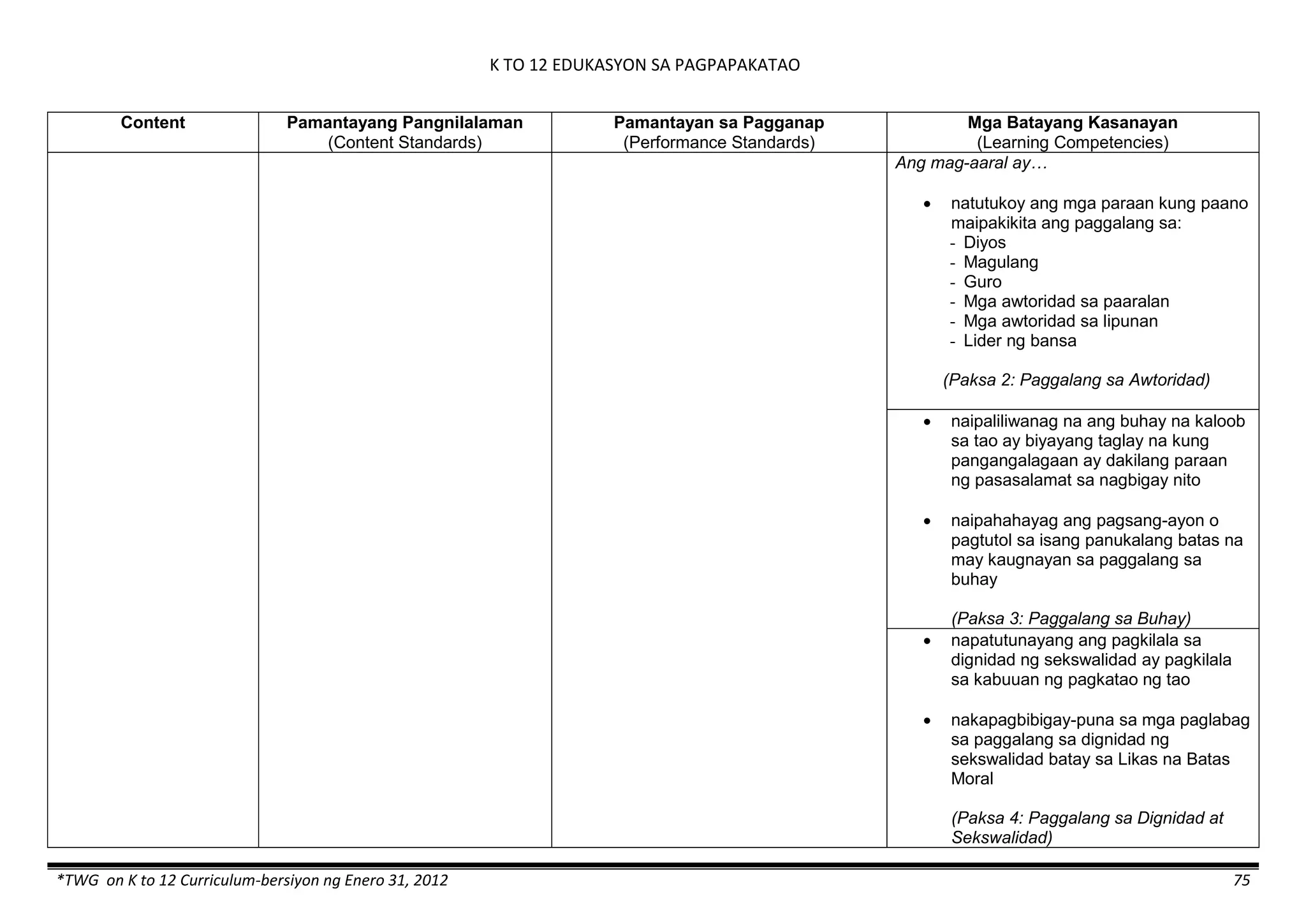
EDUKASYON SA PAGPAPAKATAO (Grade 1 to 10) 
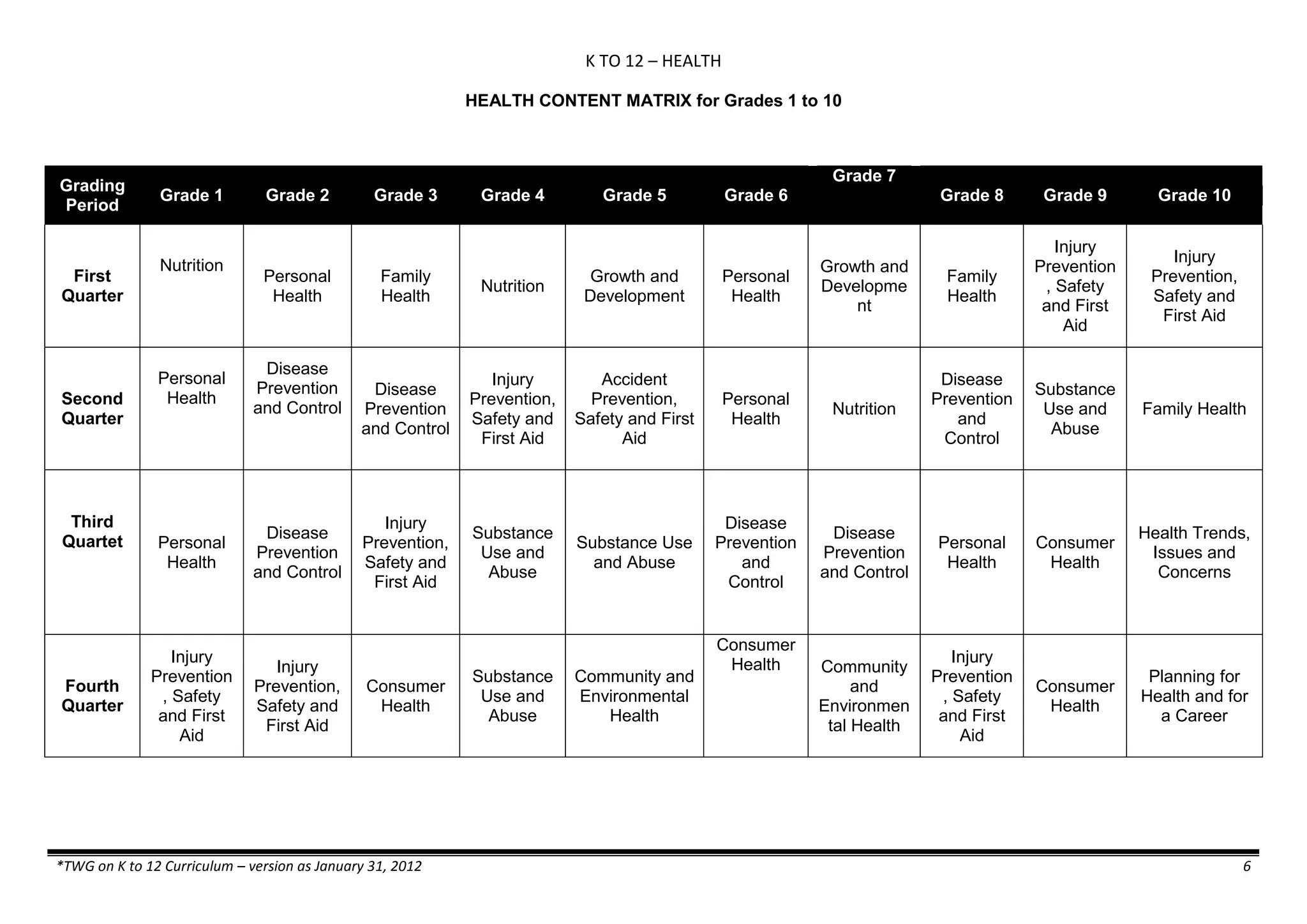
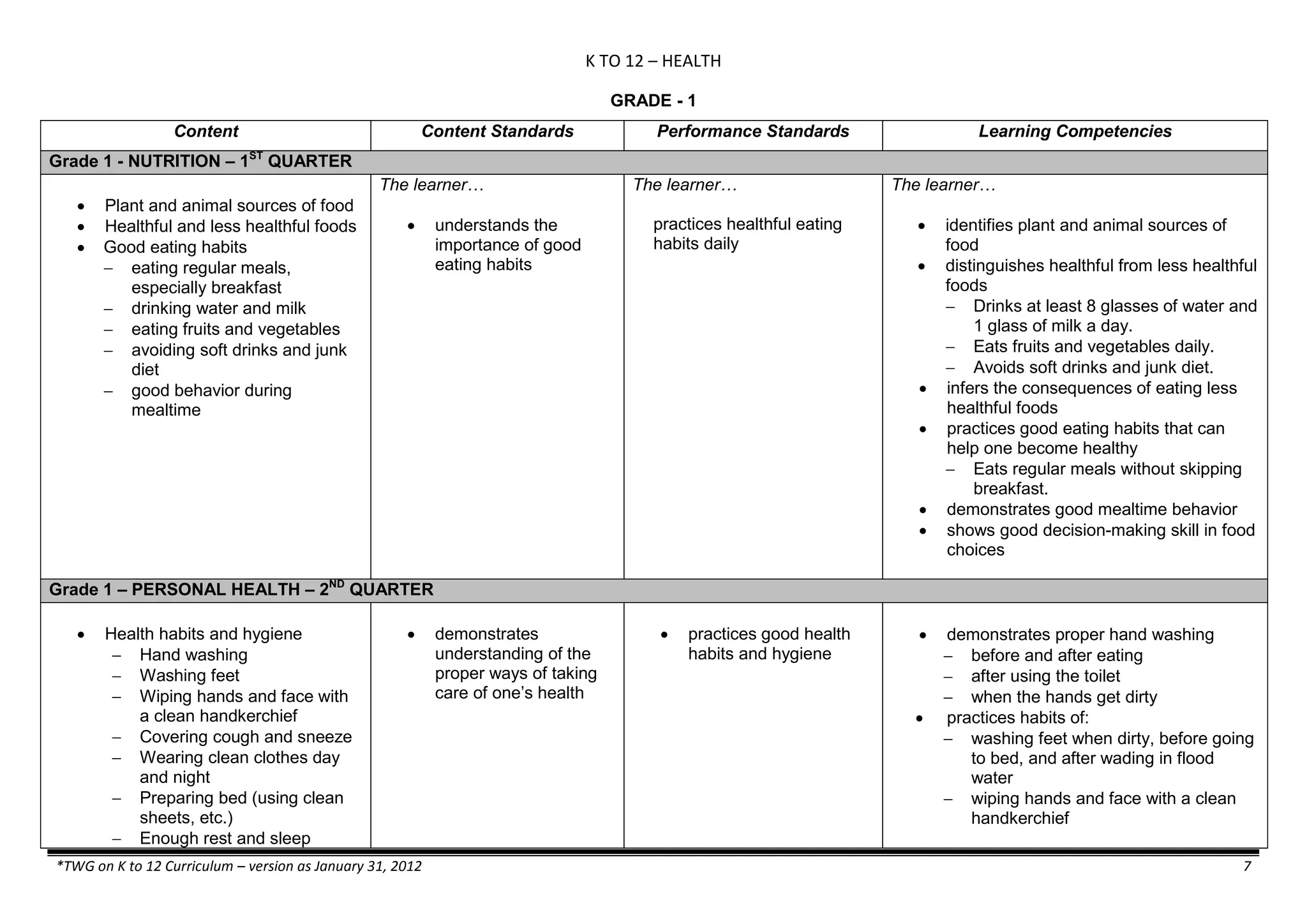
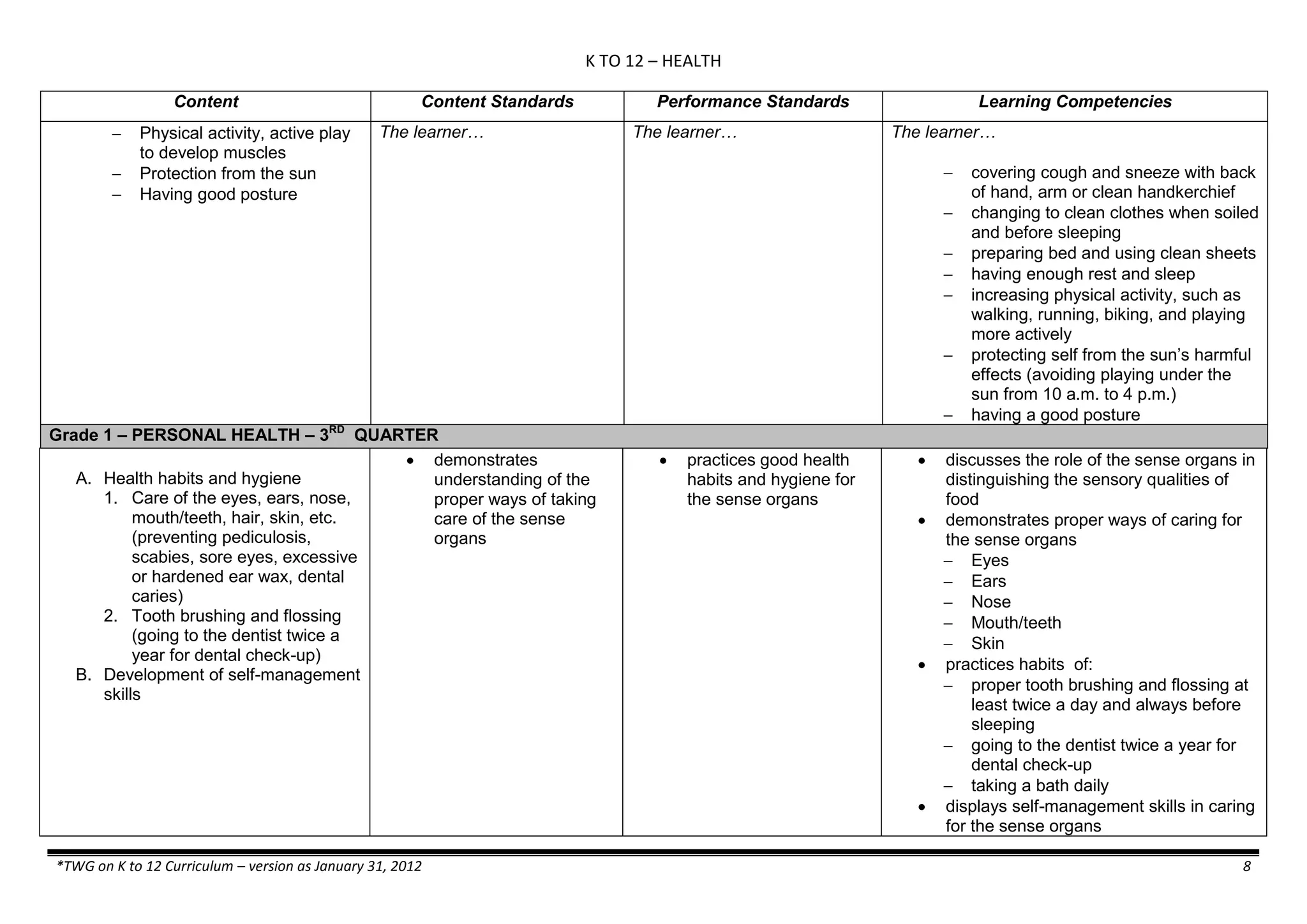
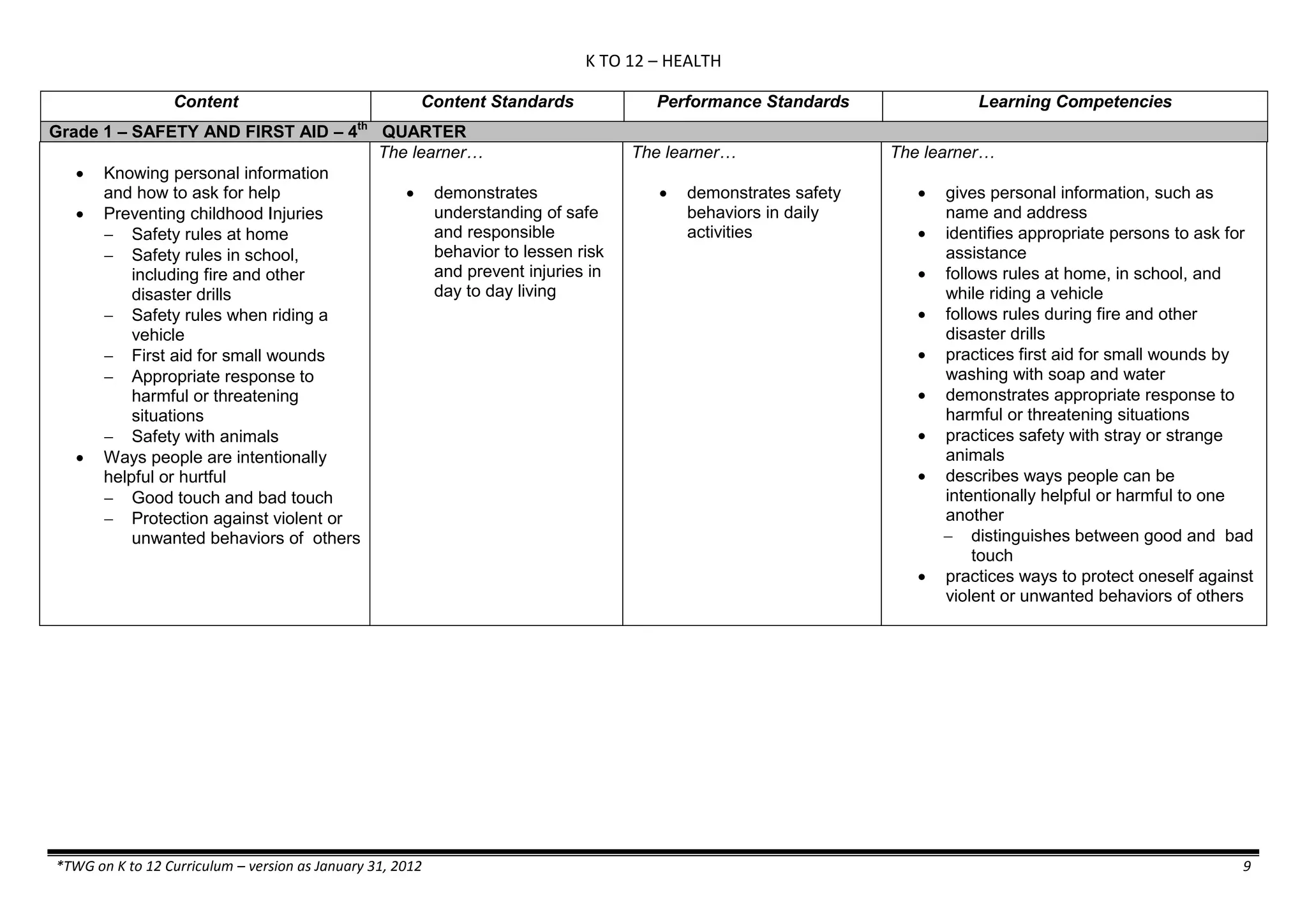
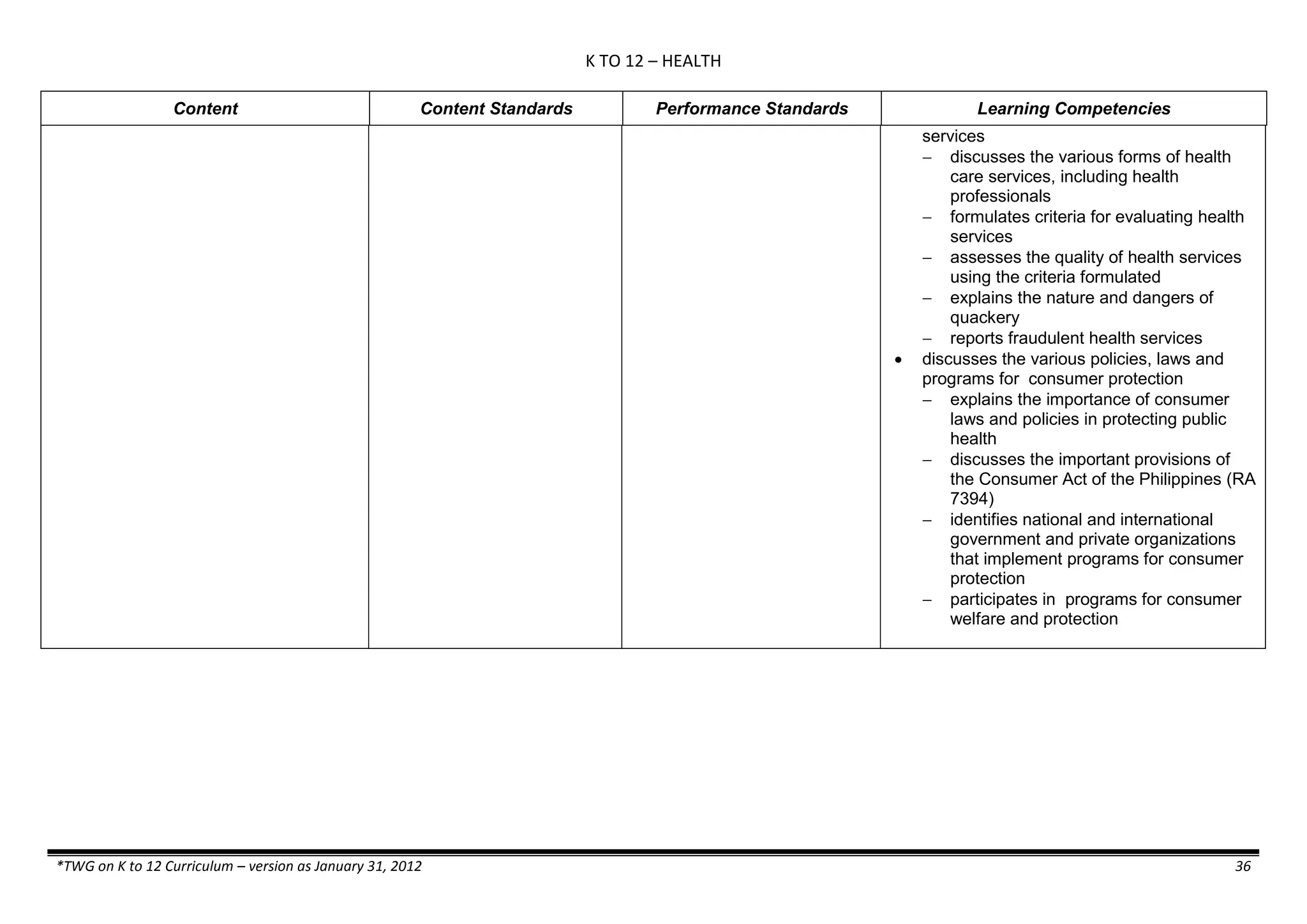
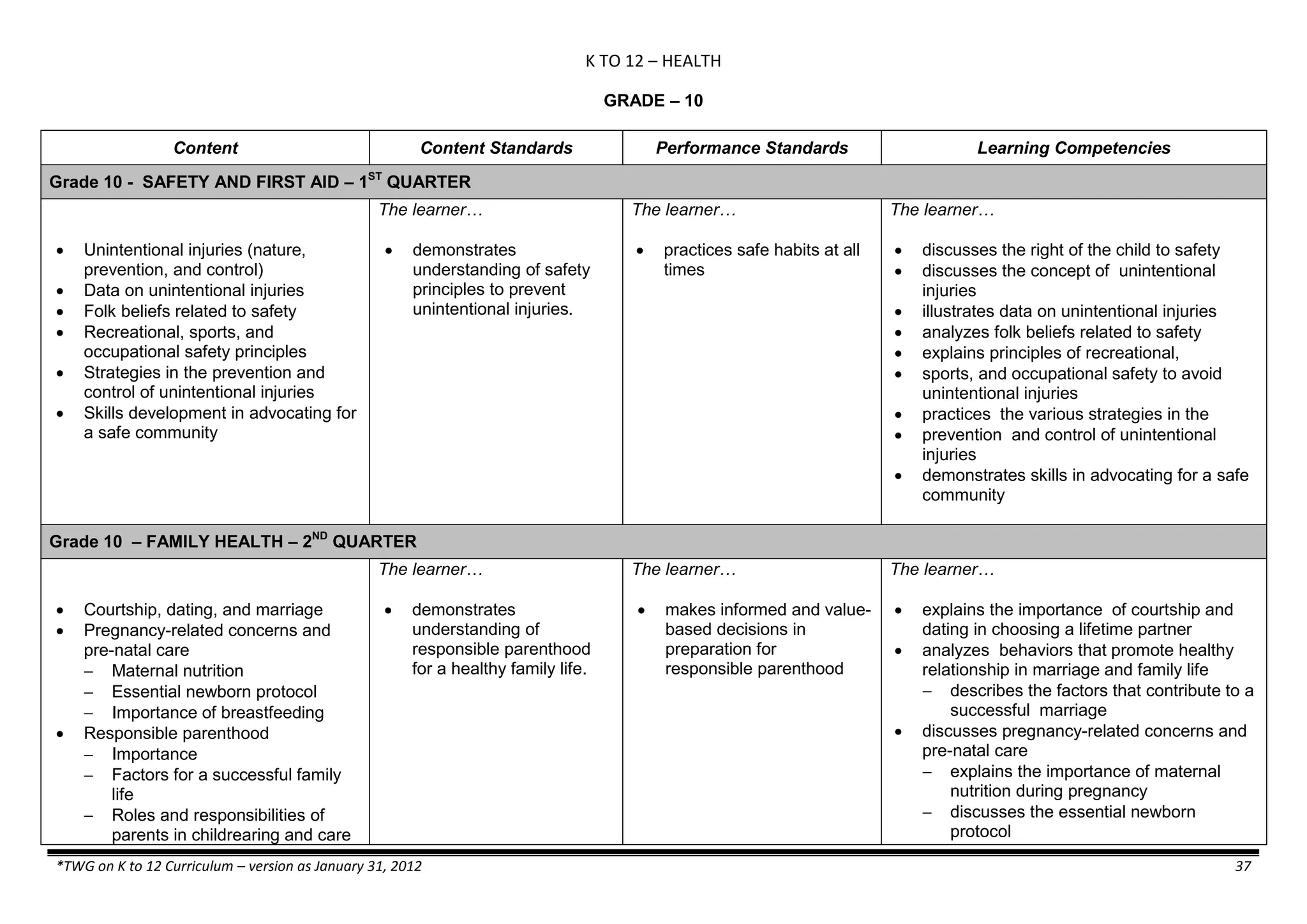
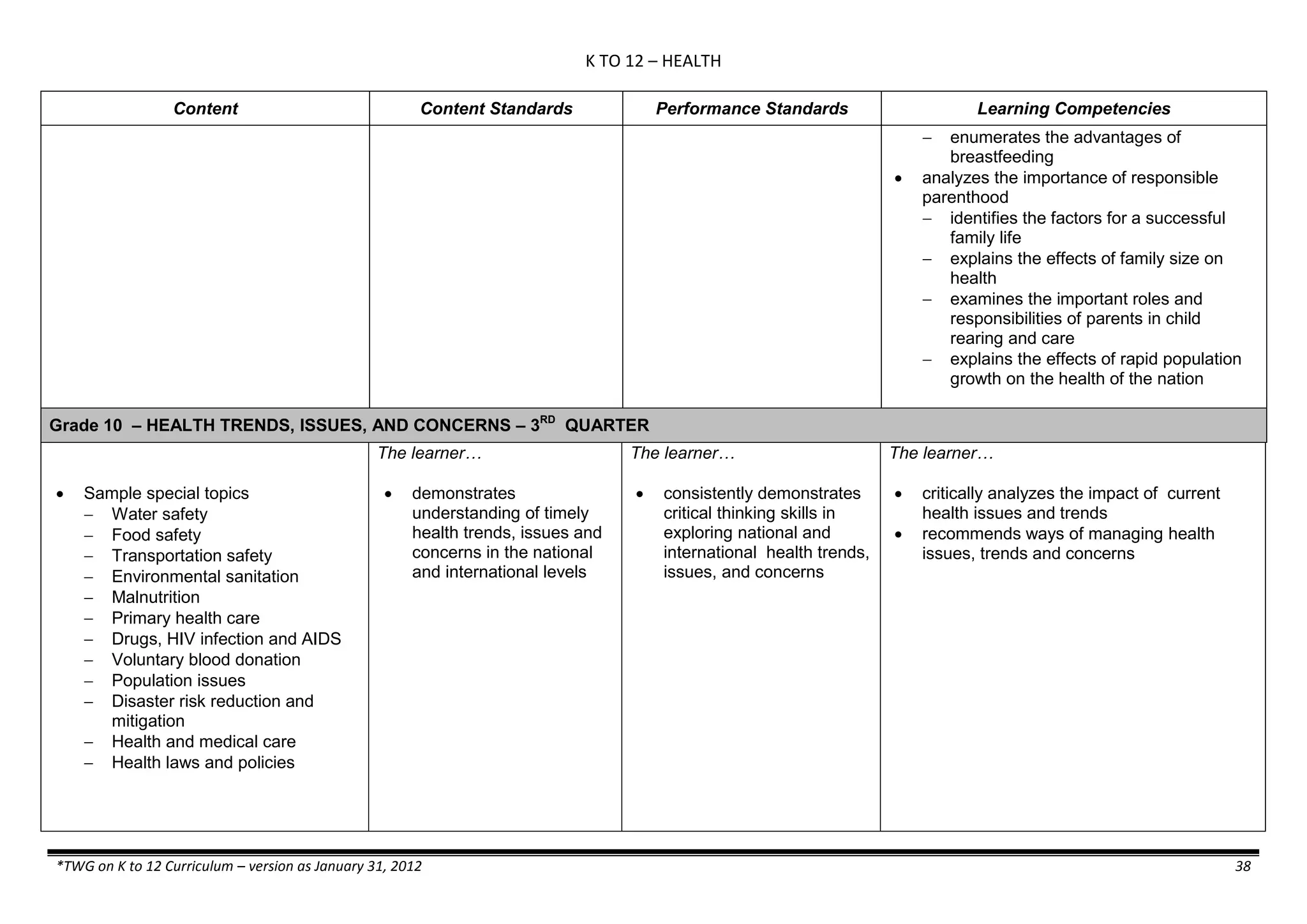
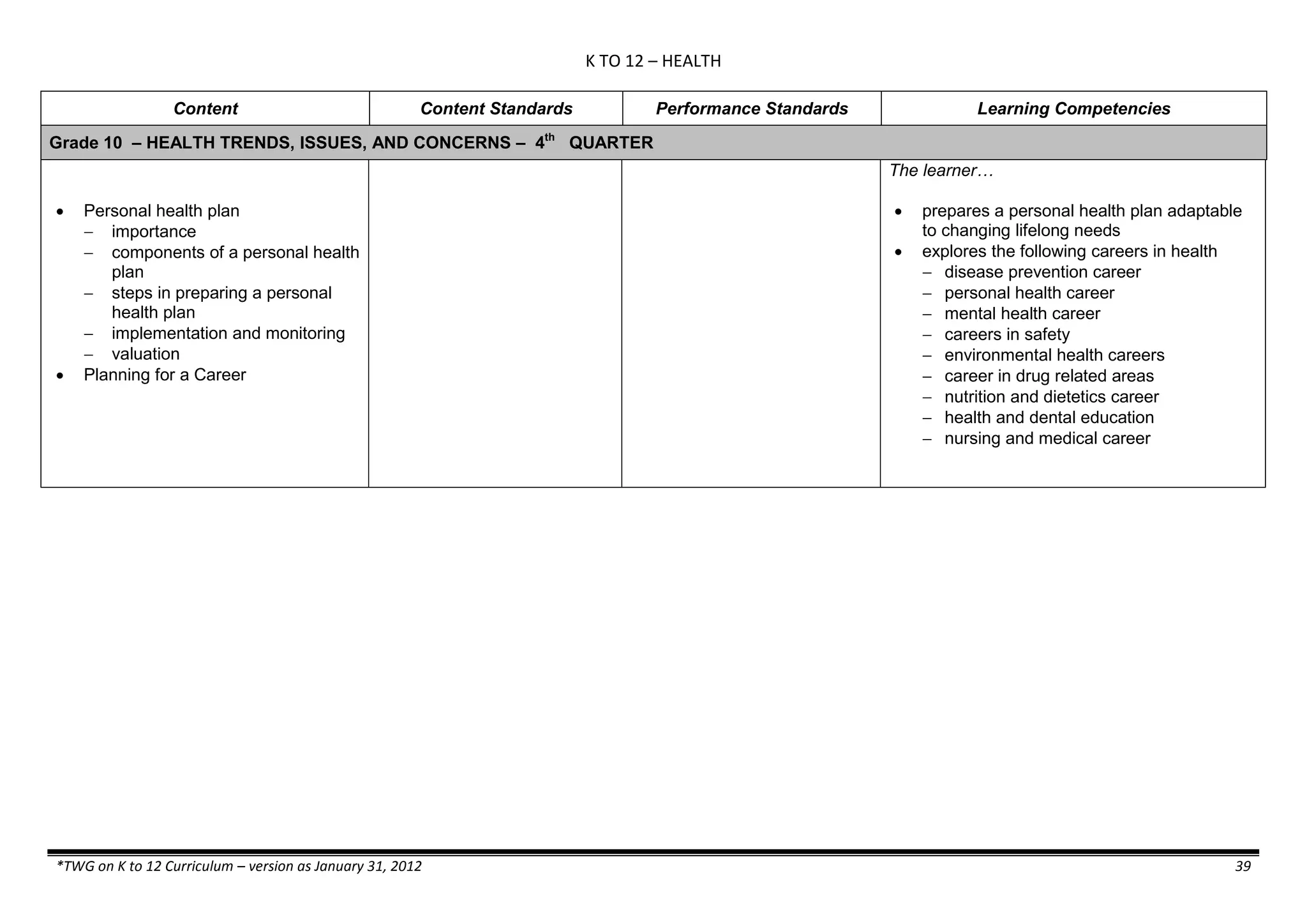
HEALTH  (Grade 1 to 10) 
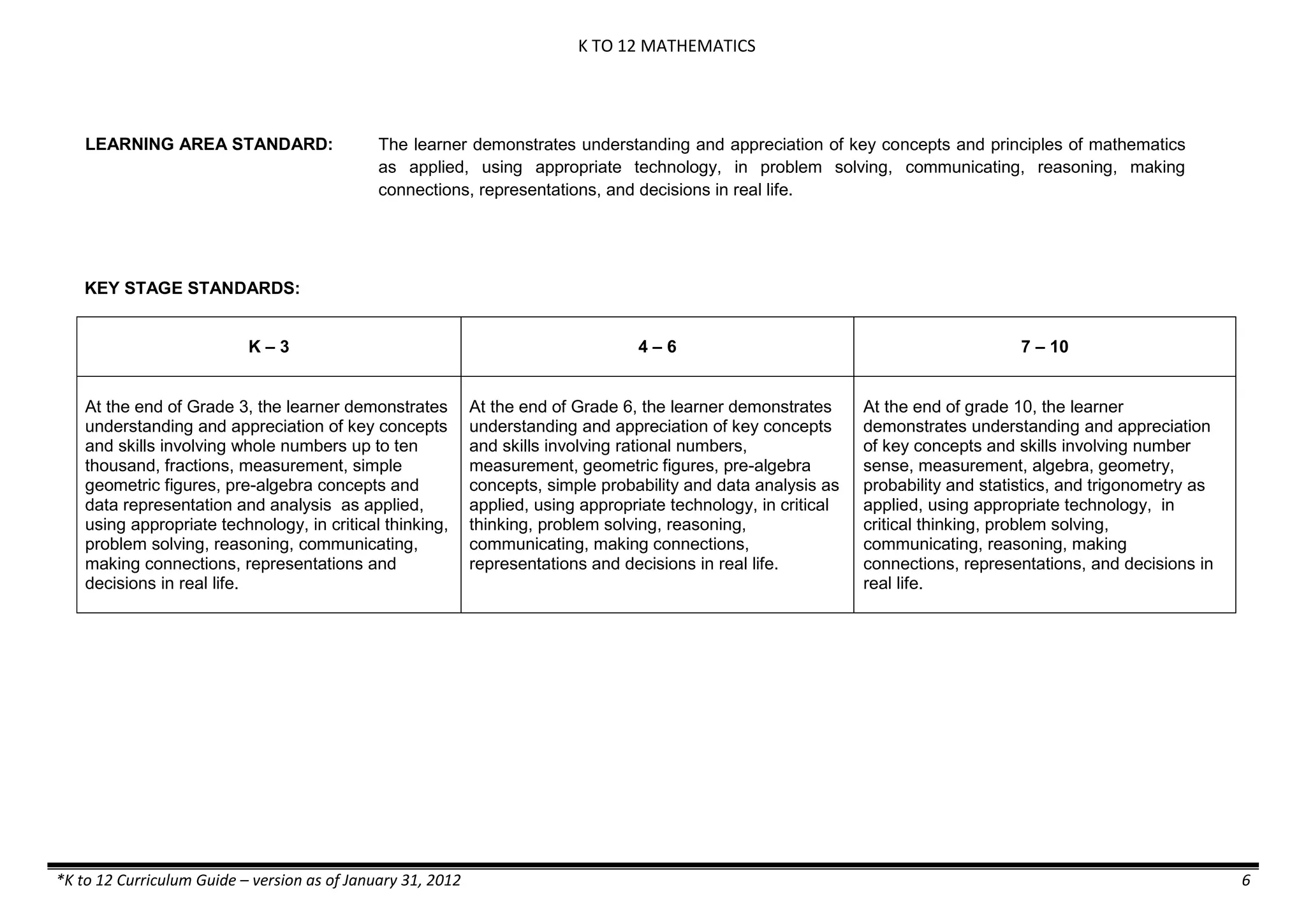
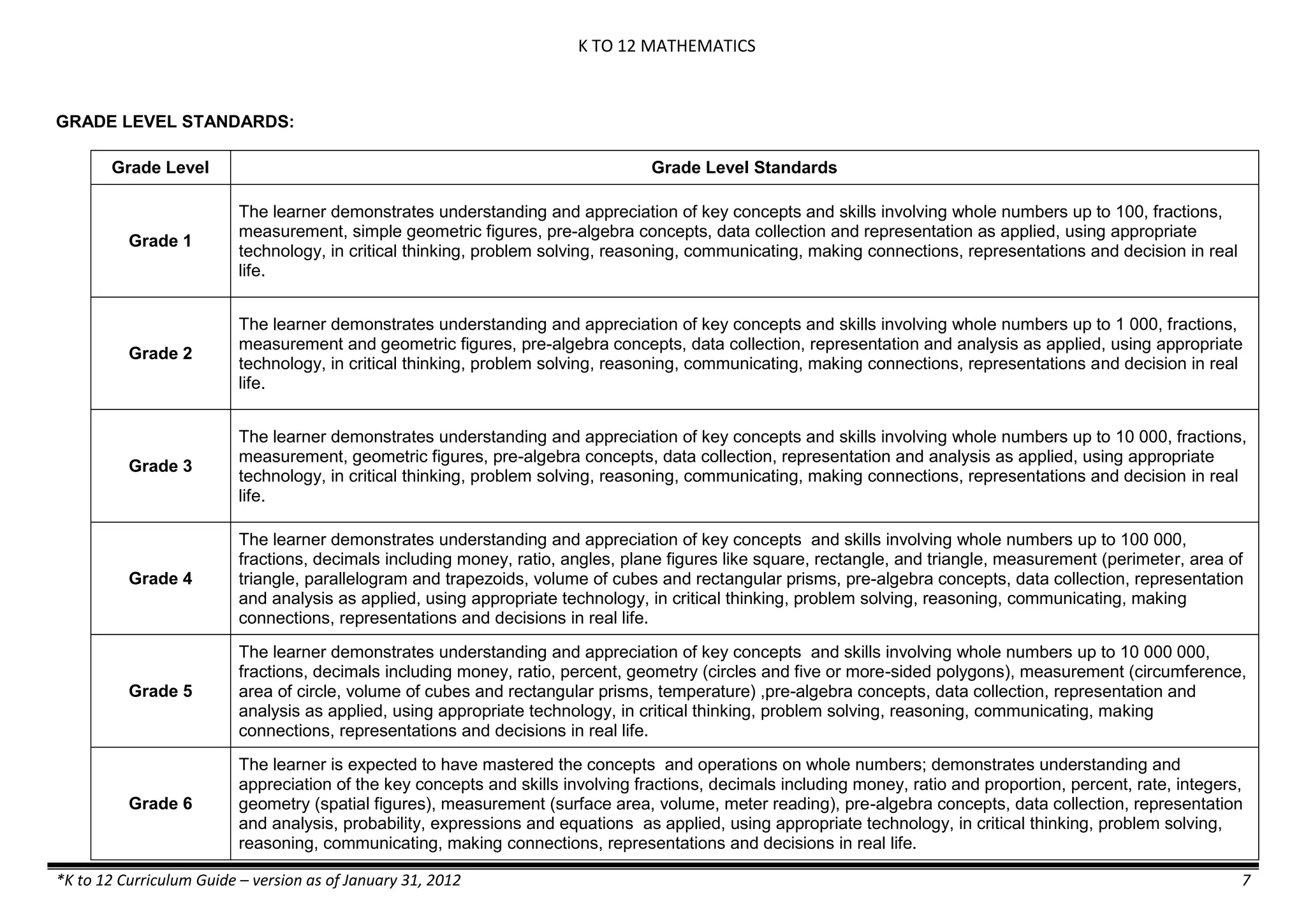
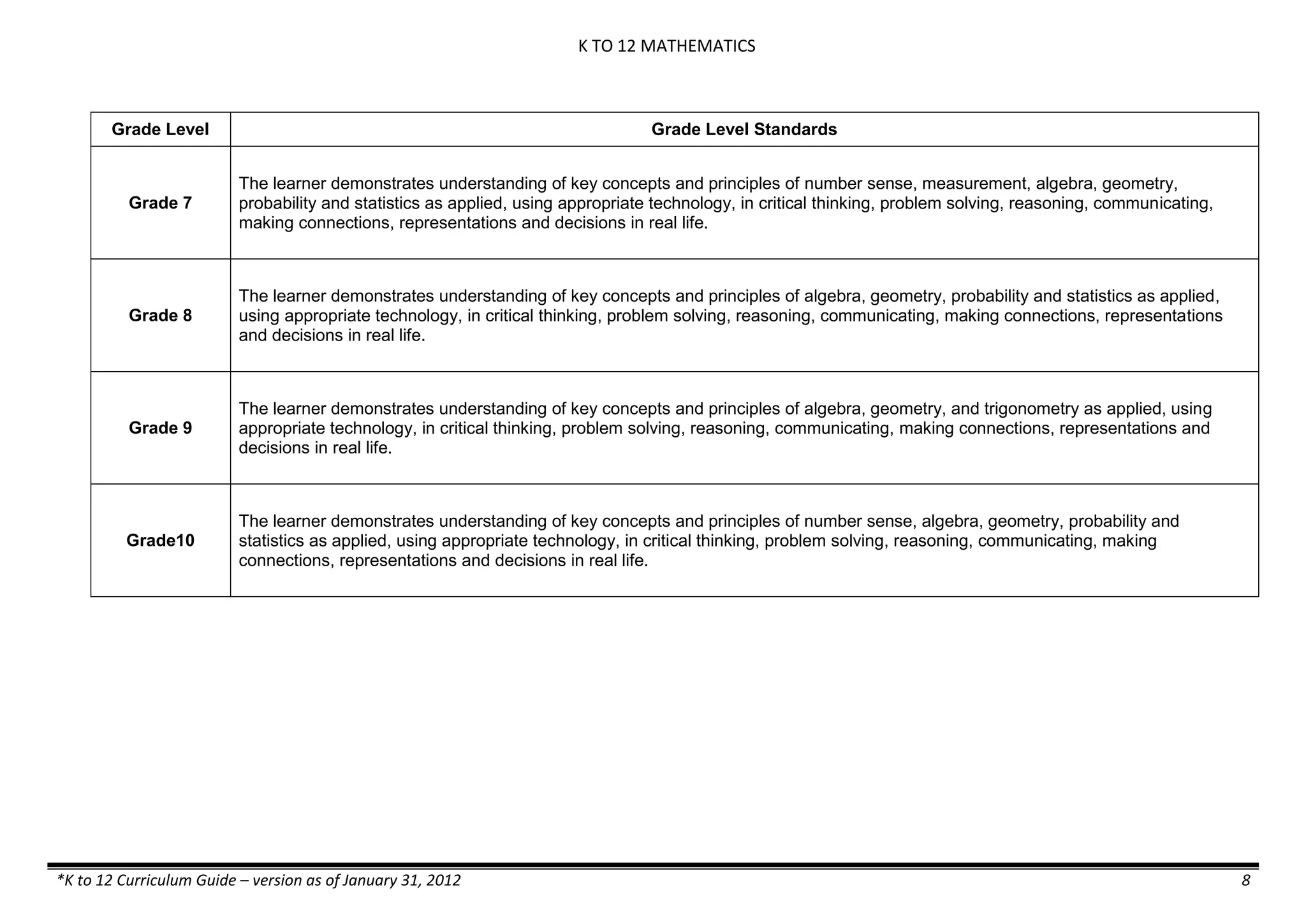
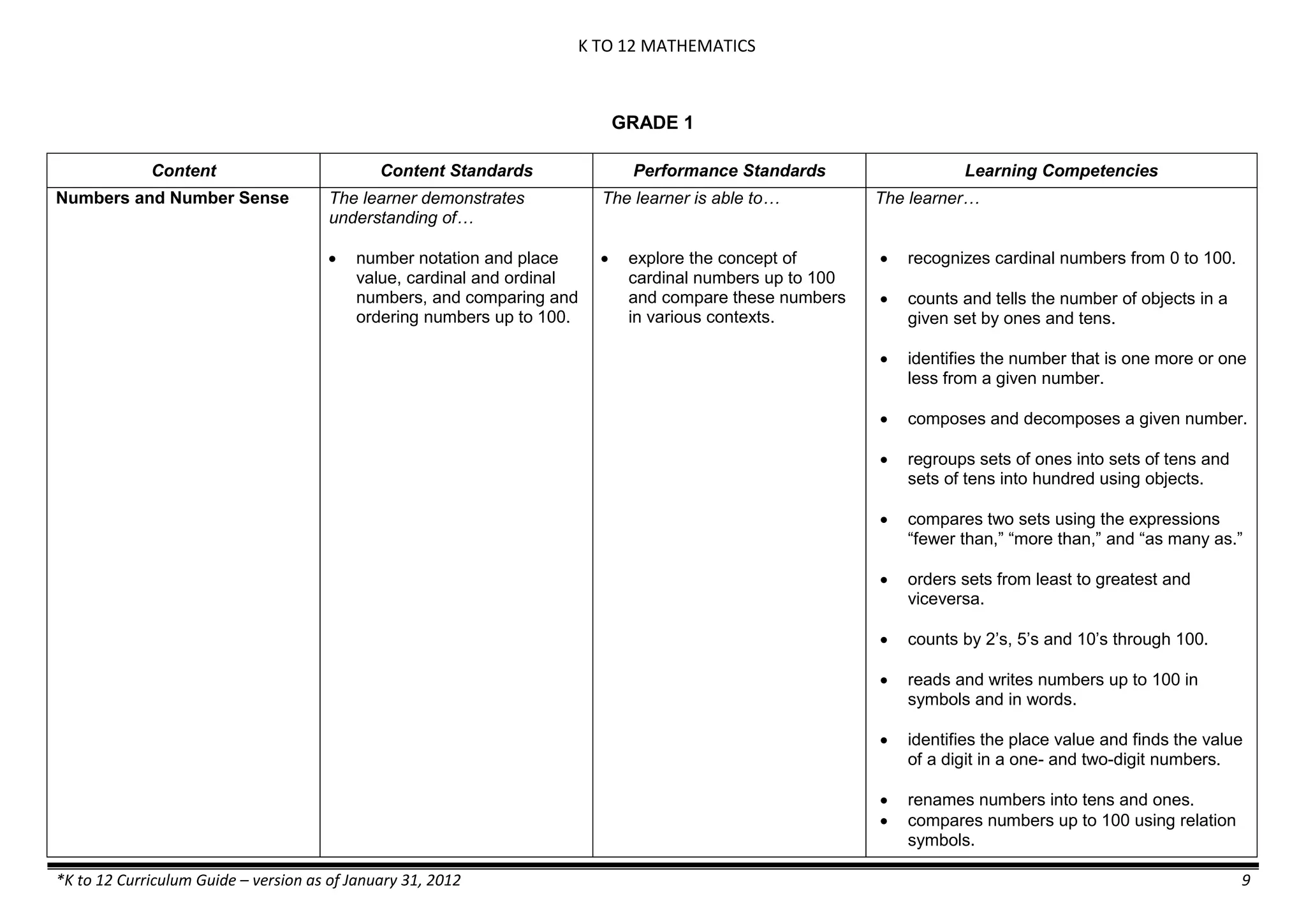
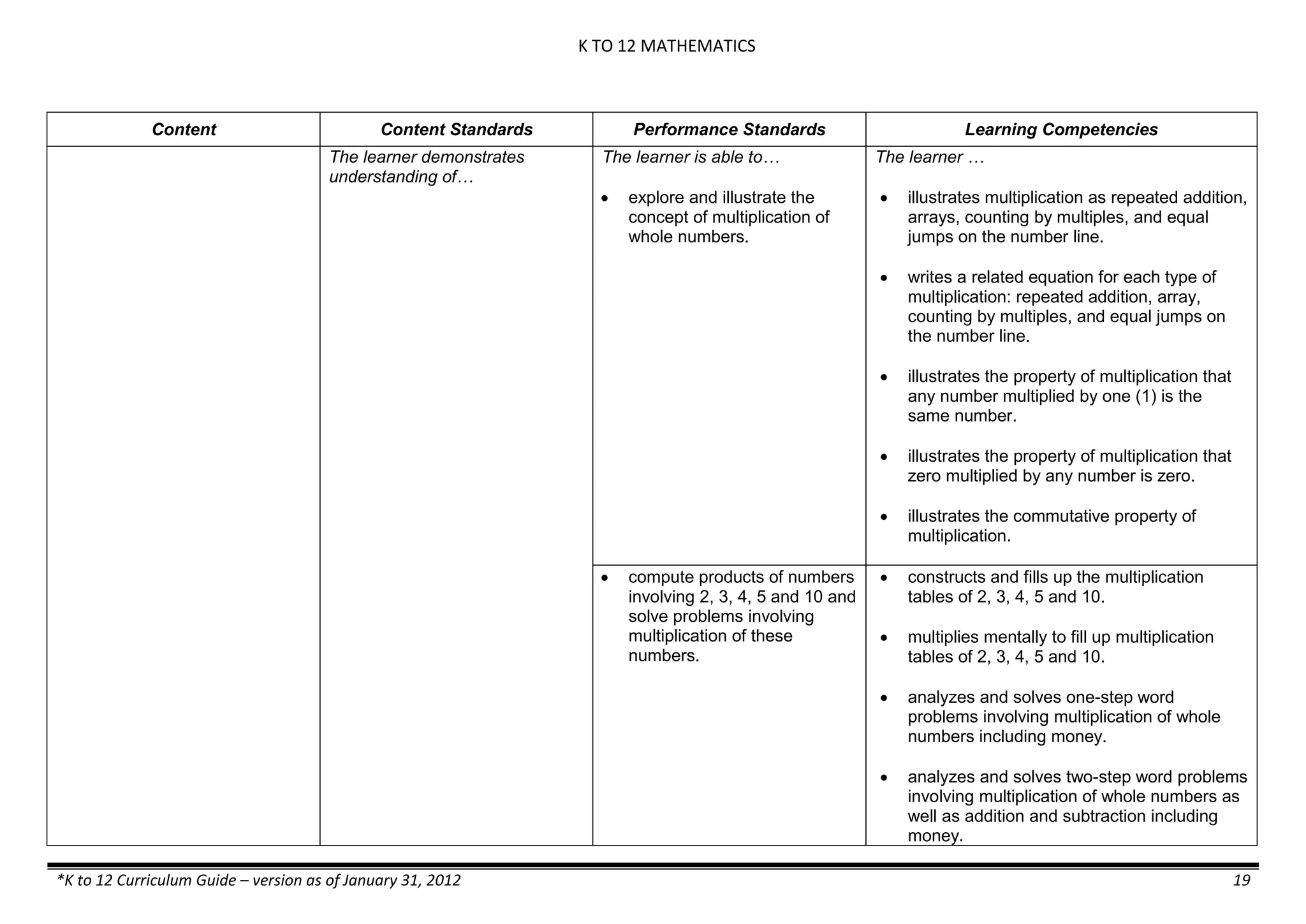
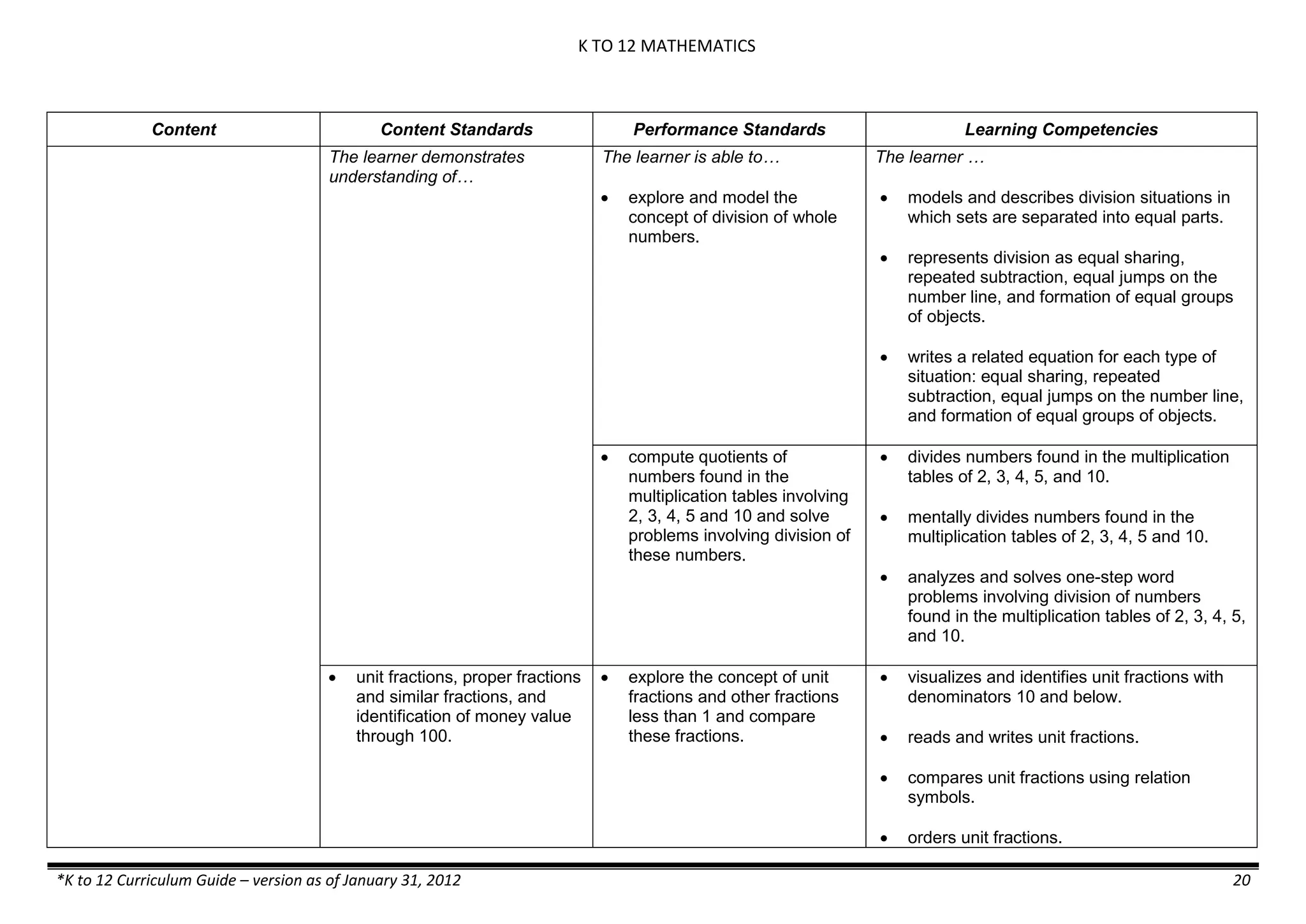
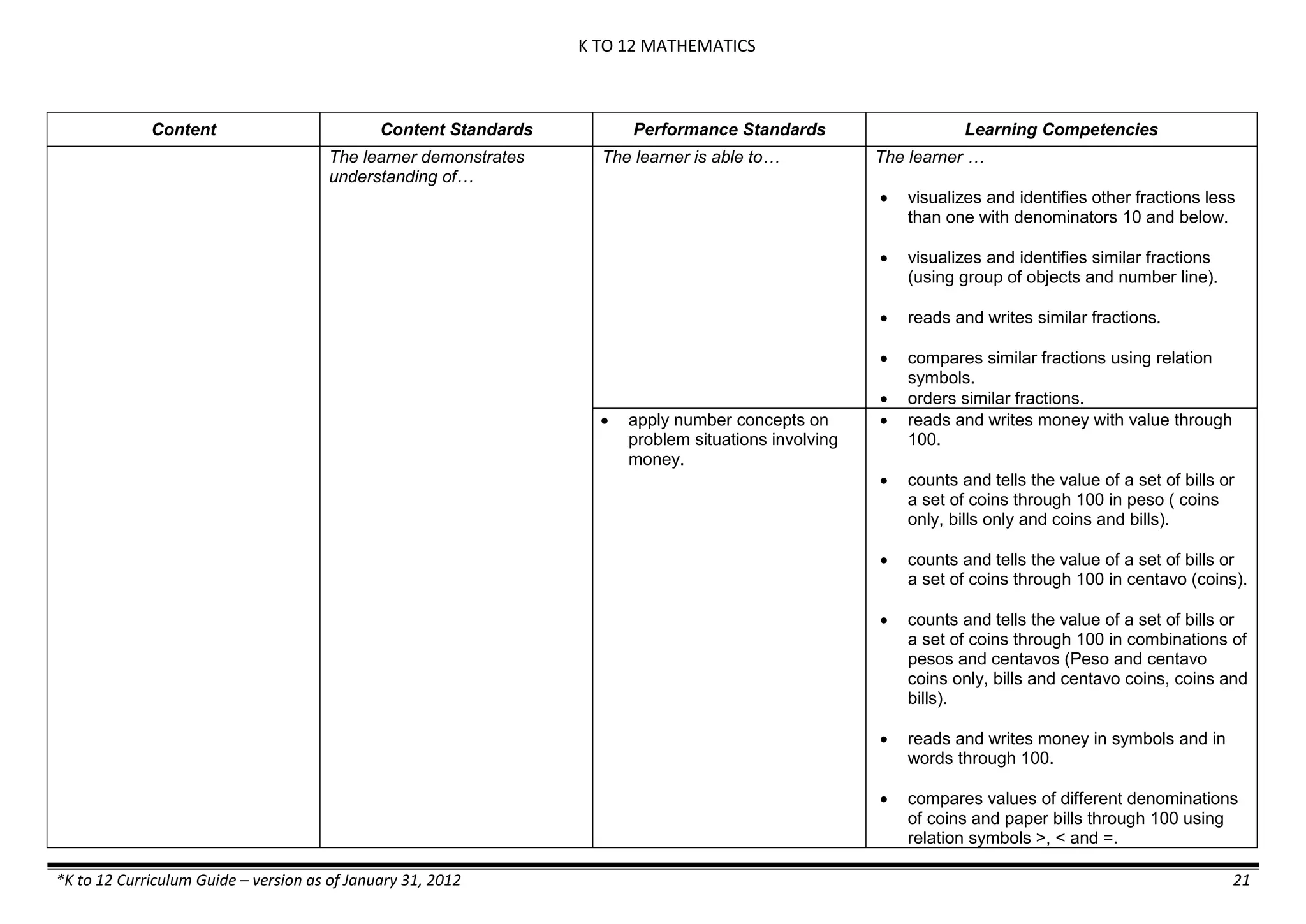
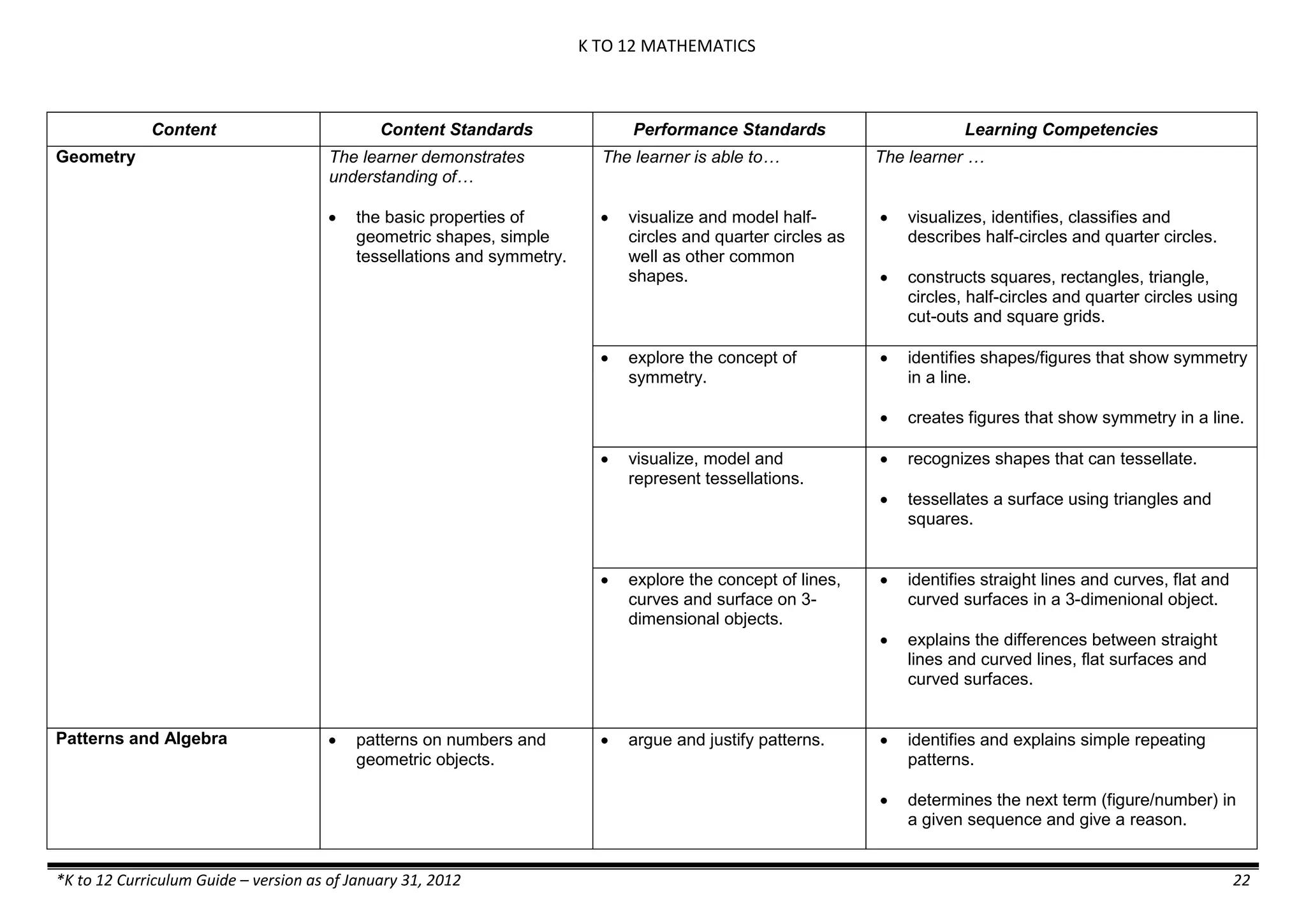
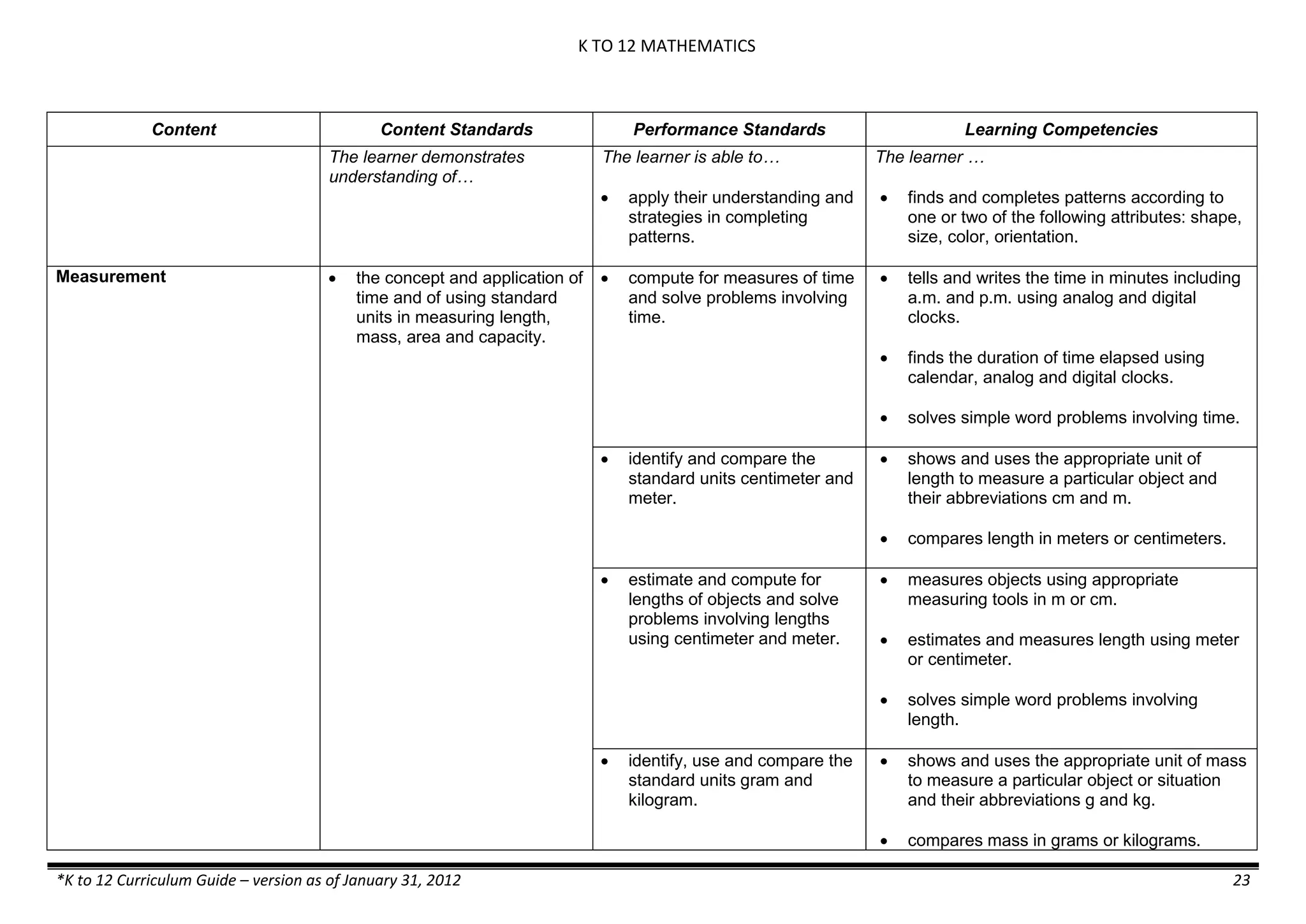
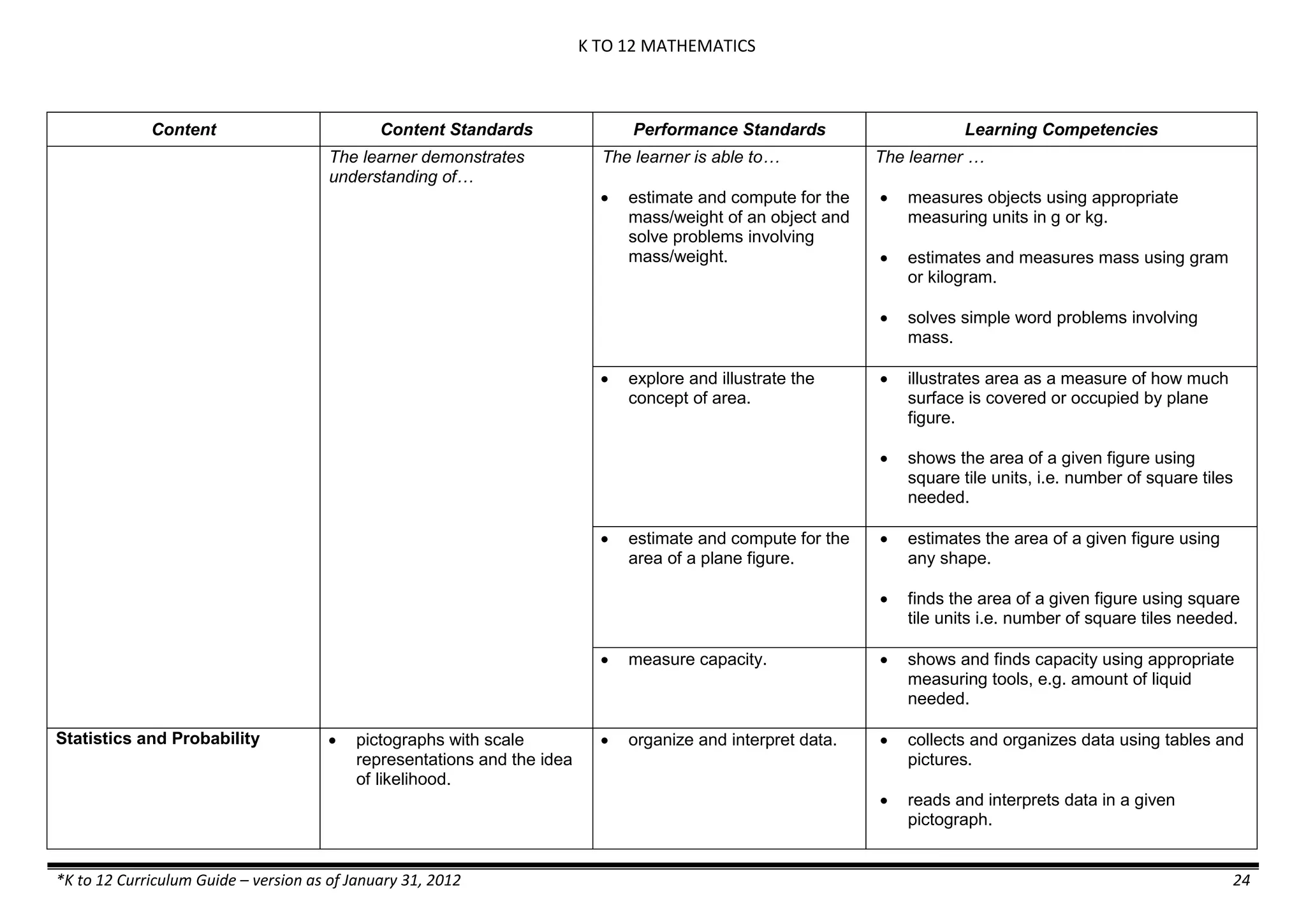
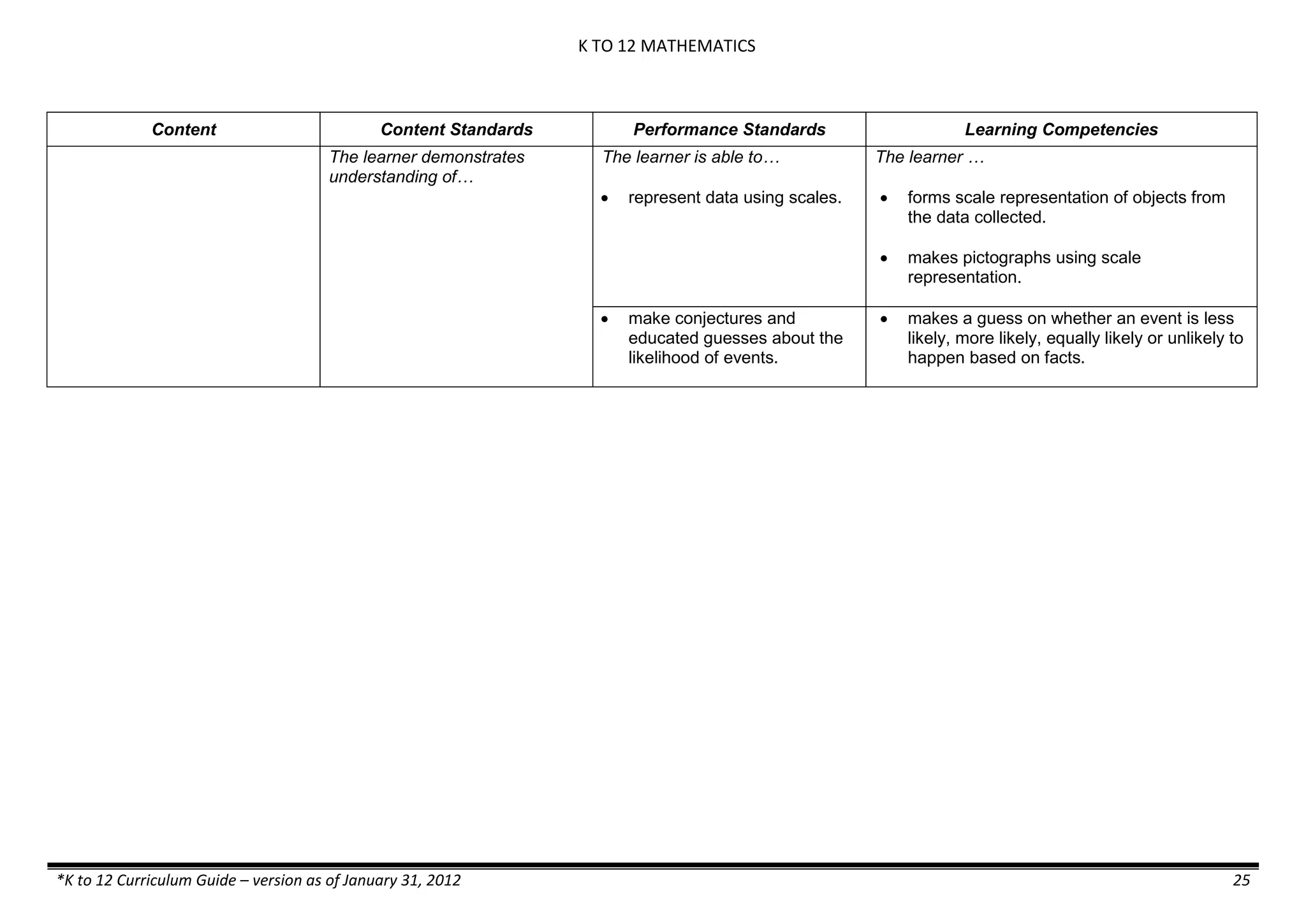
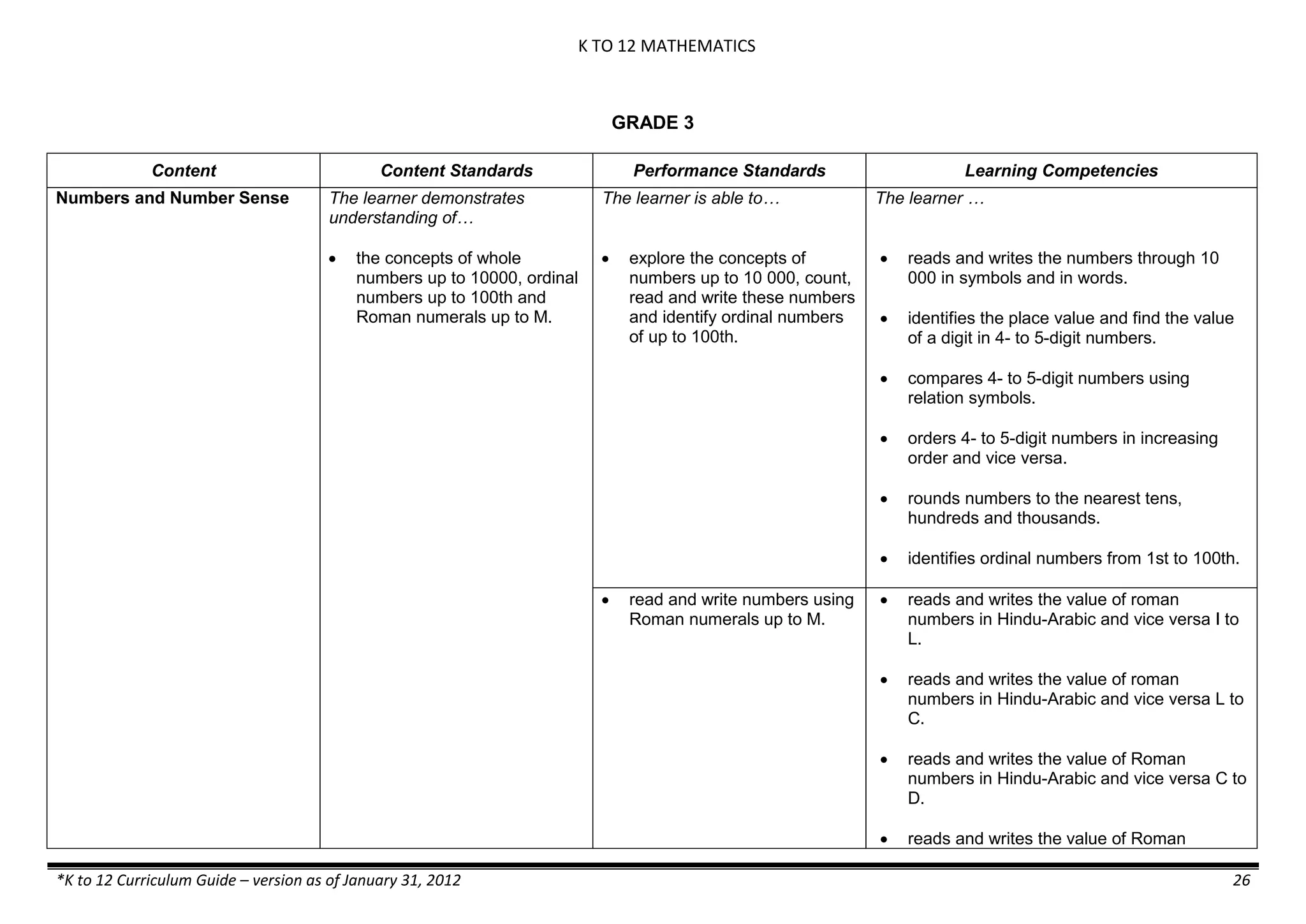
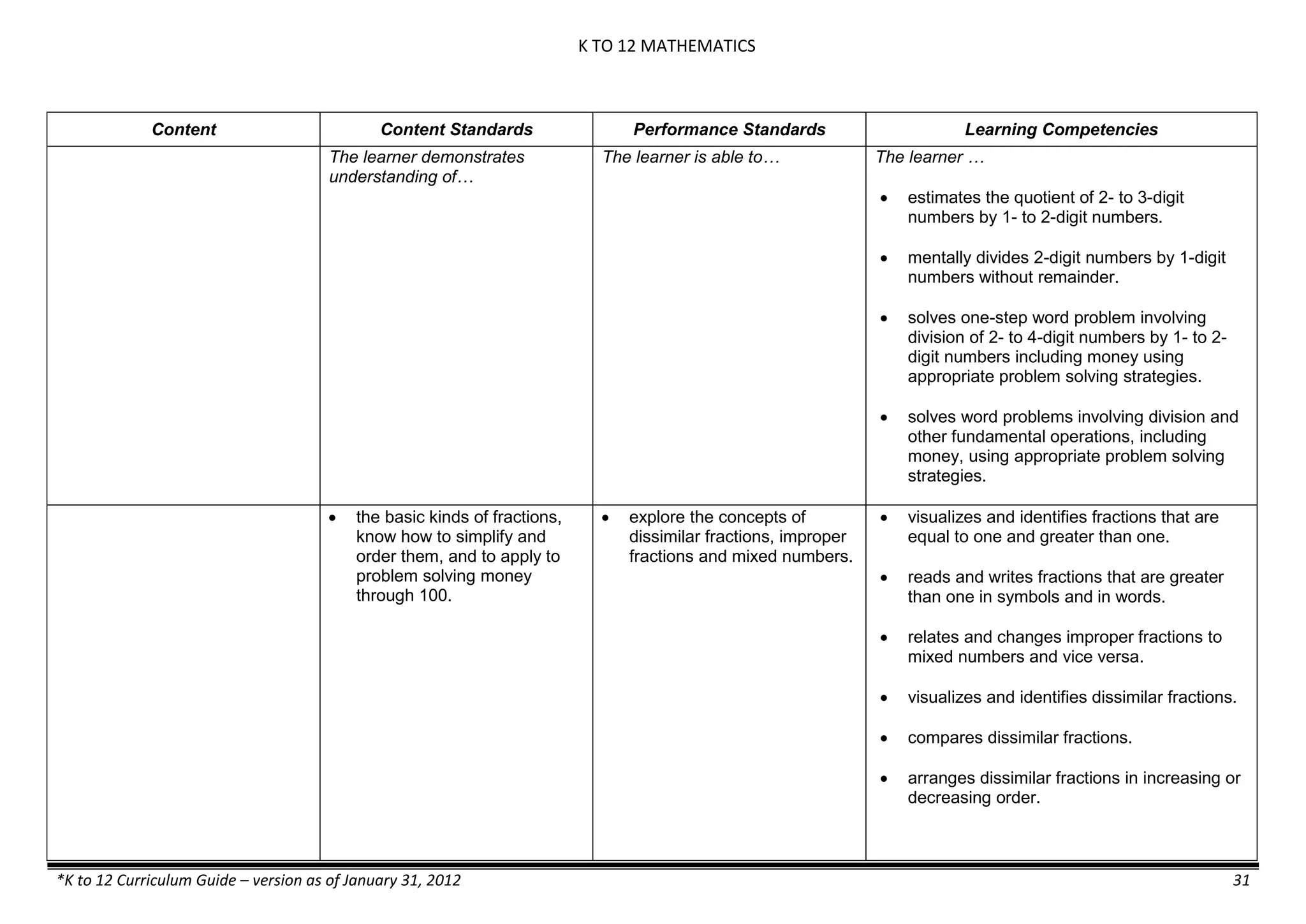
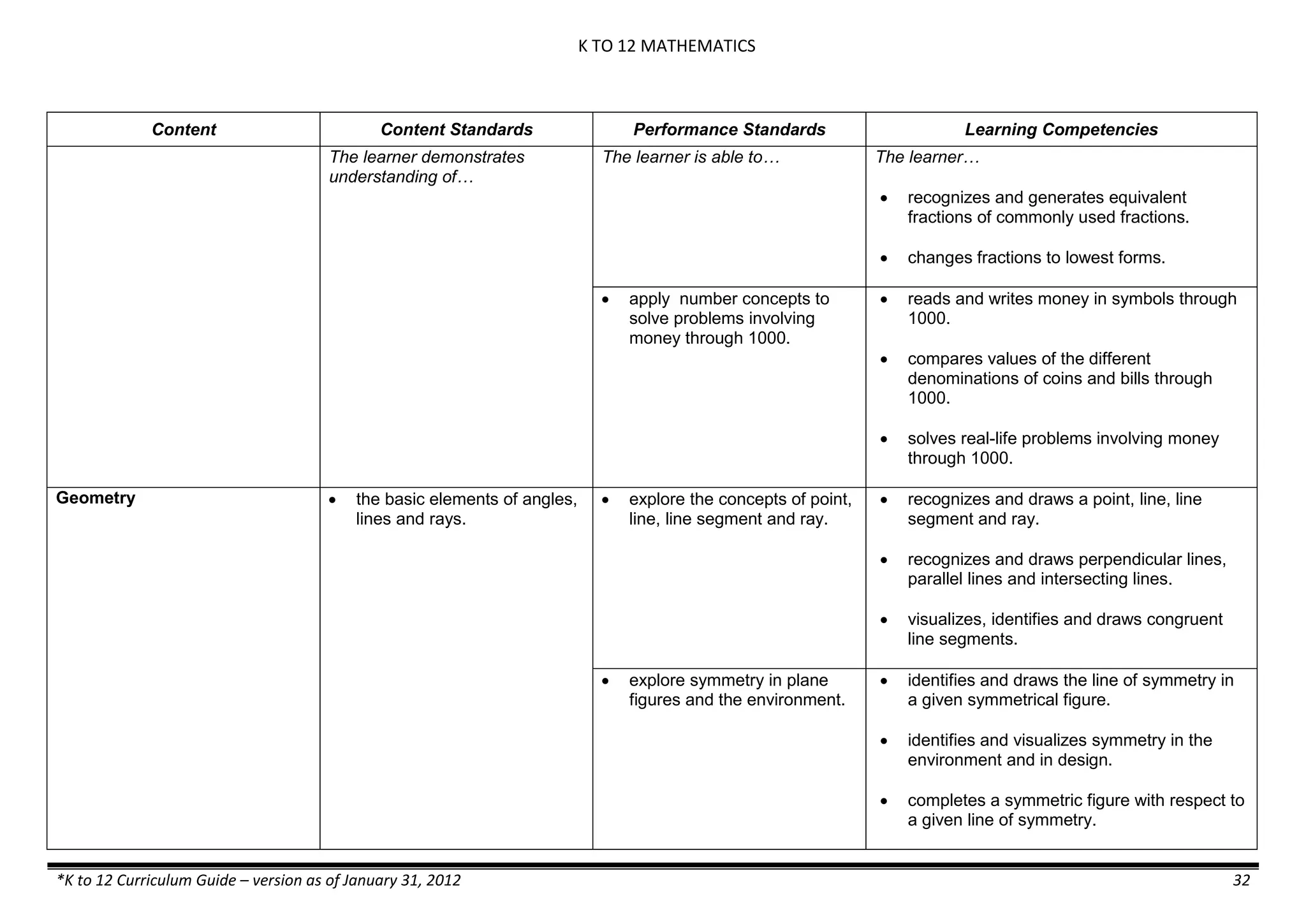
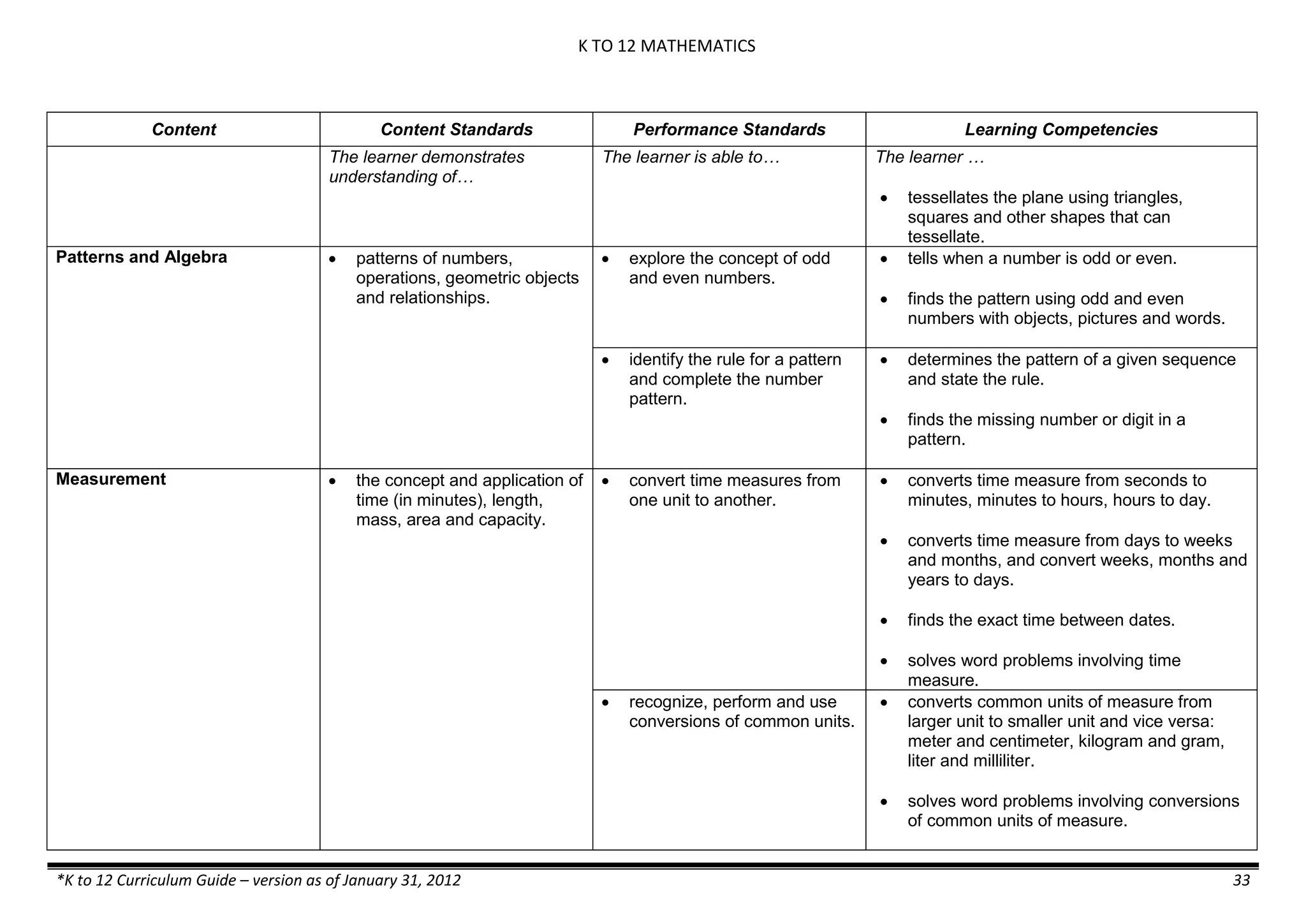
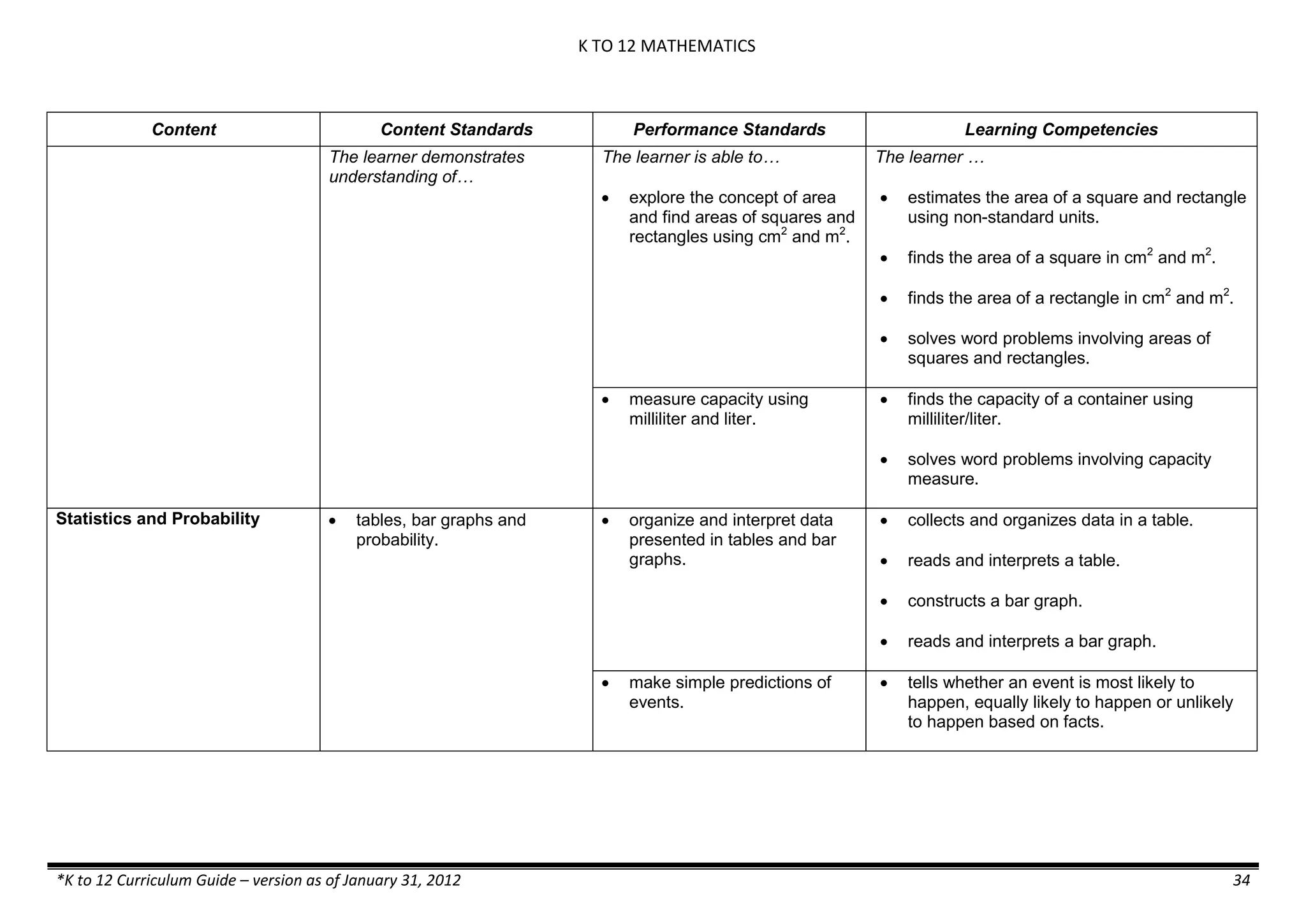
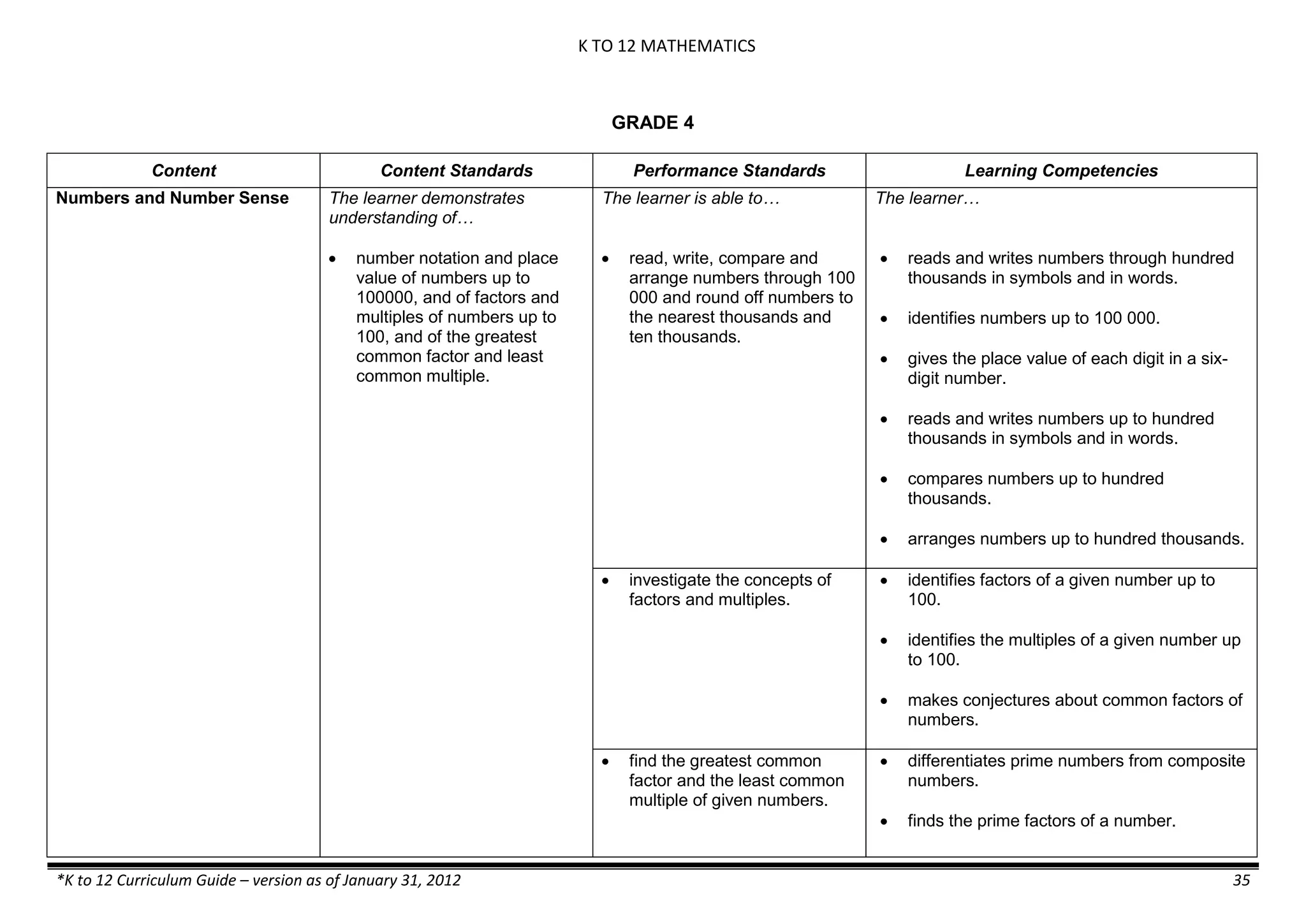
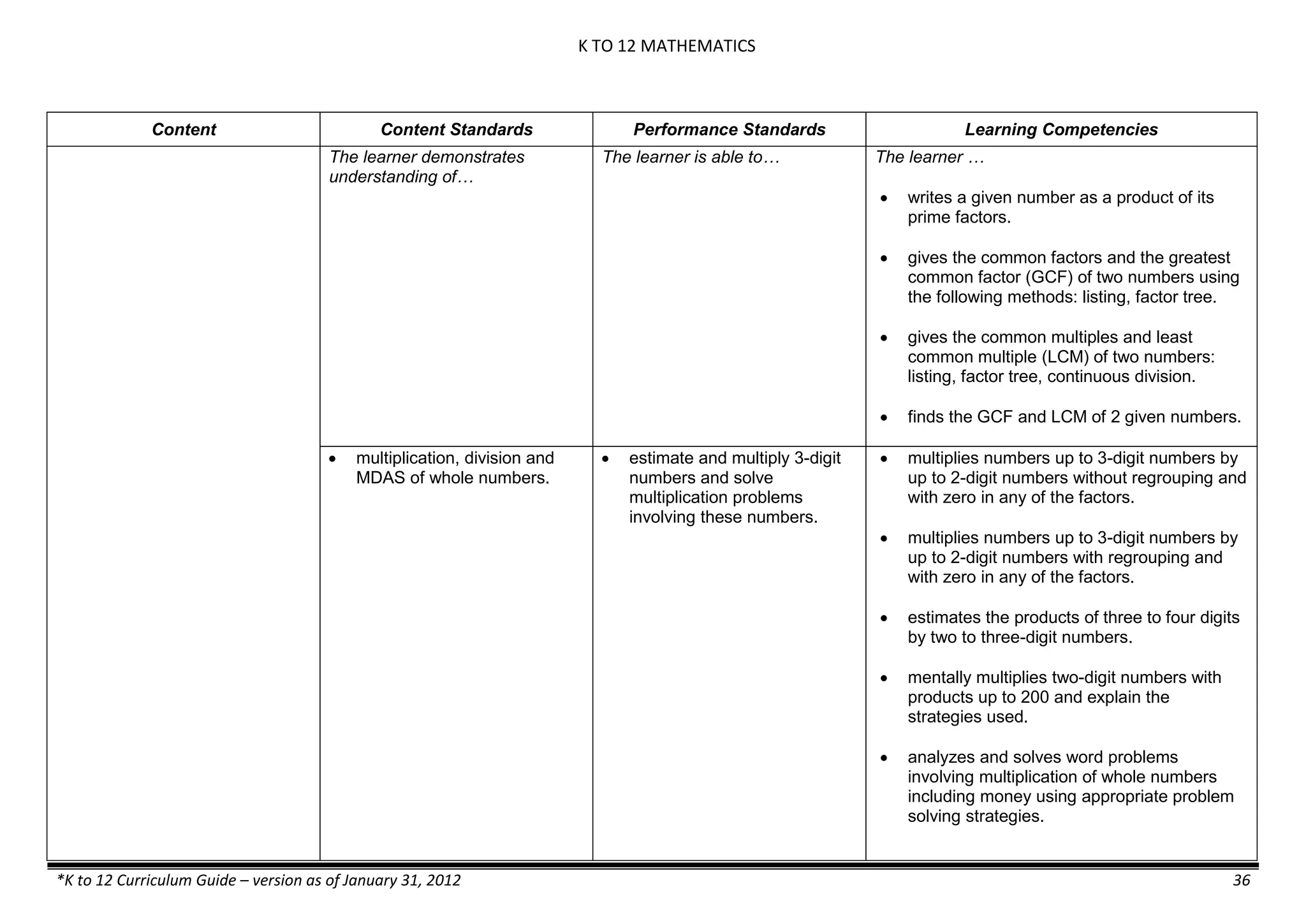
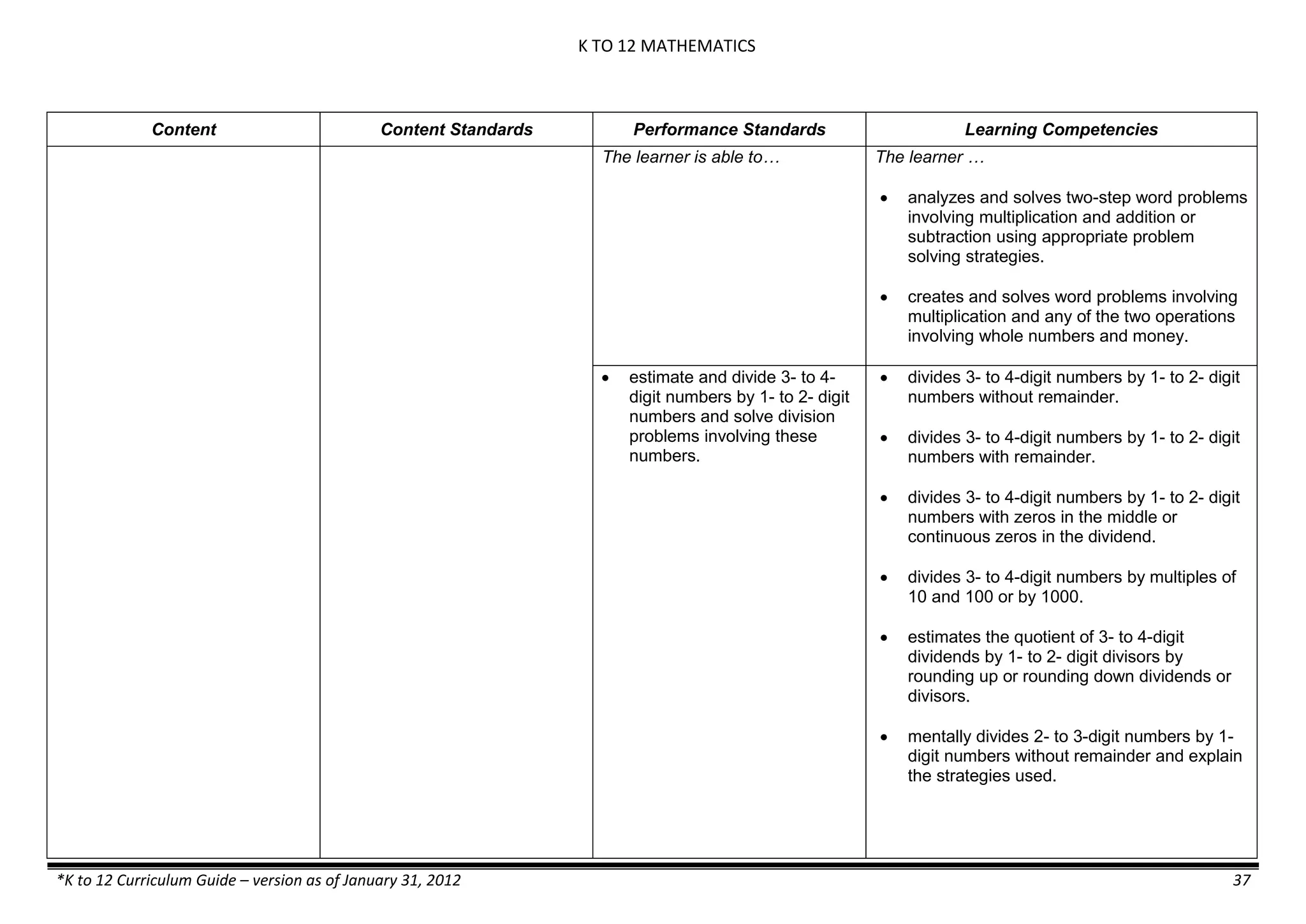
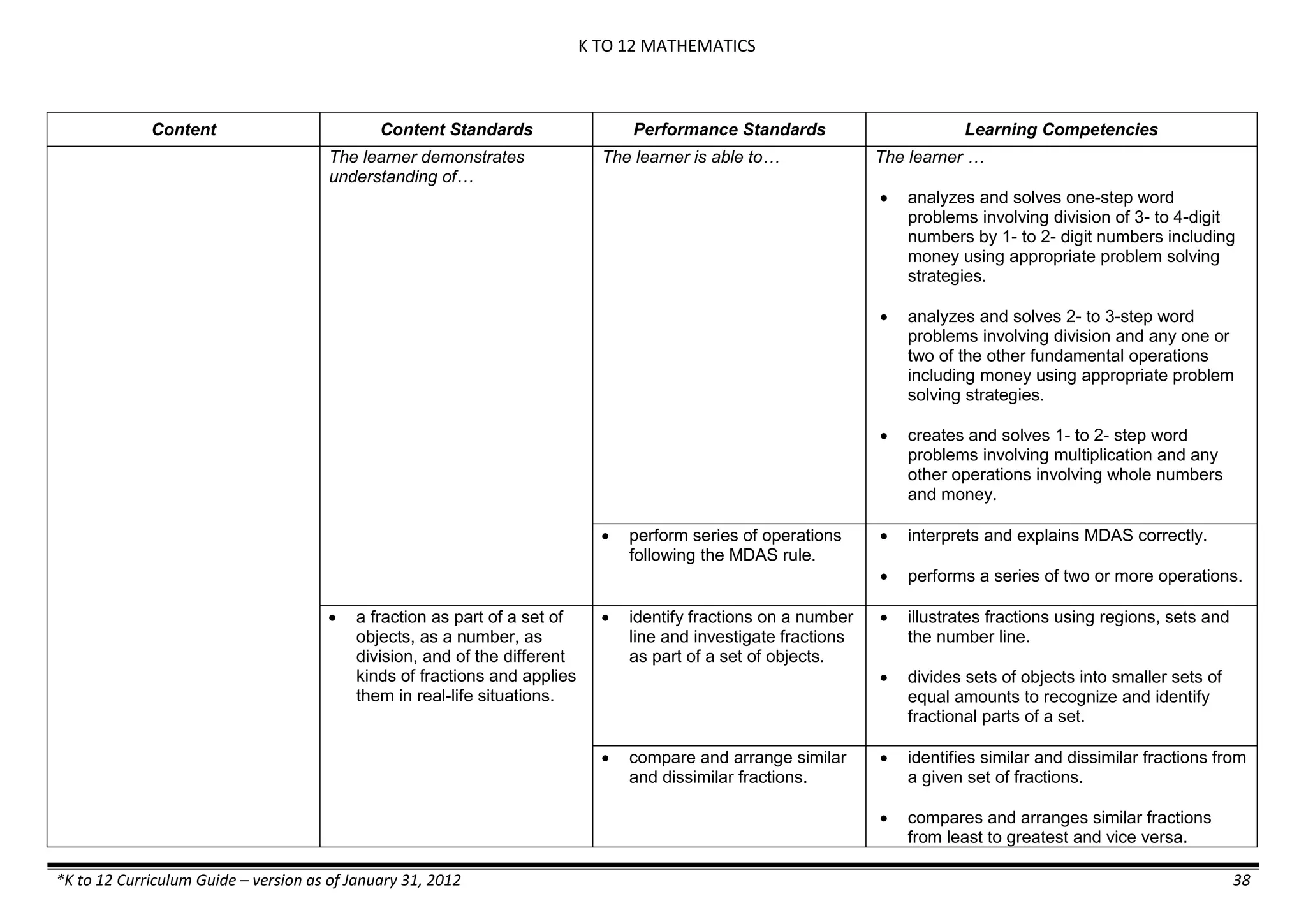
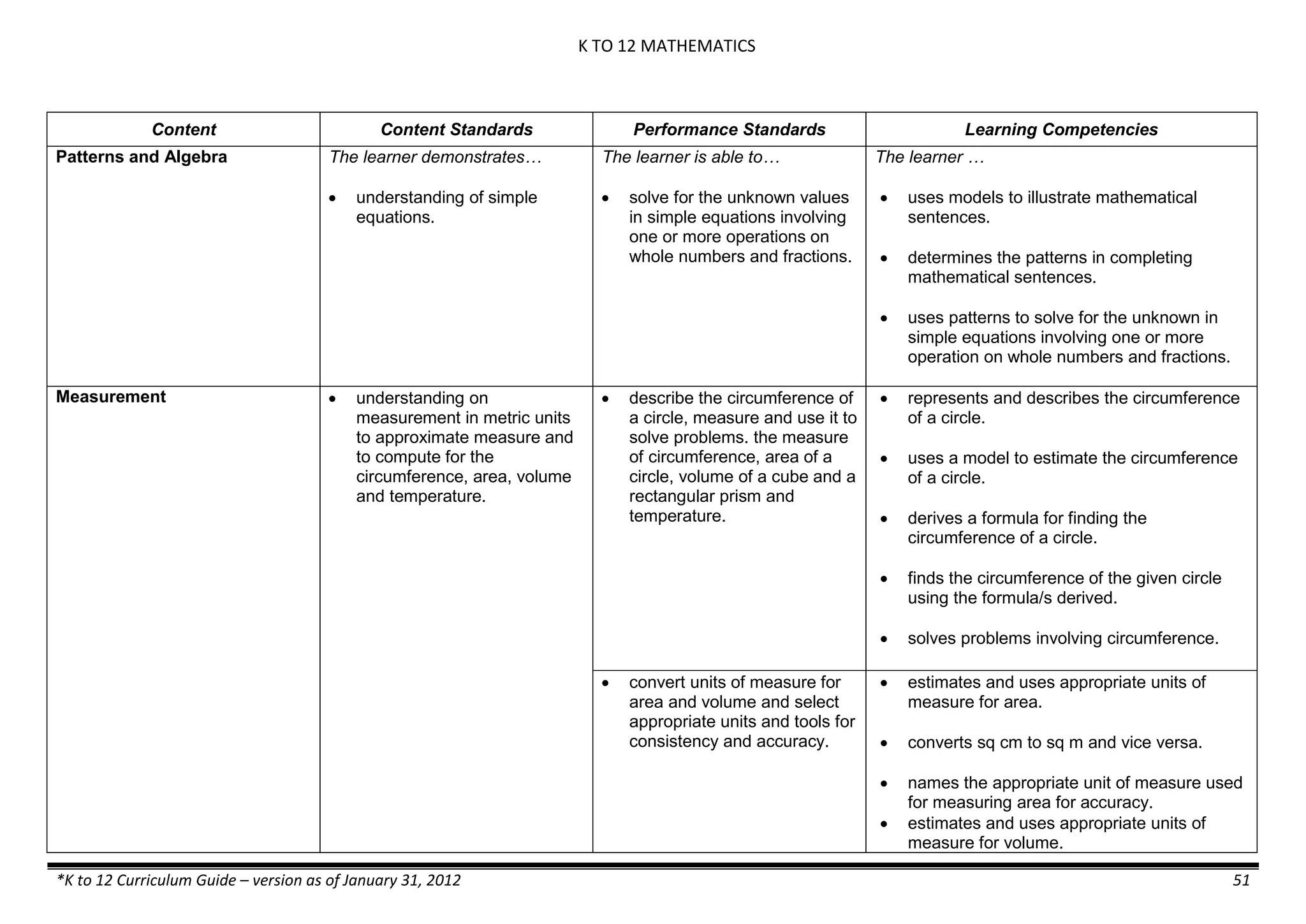
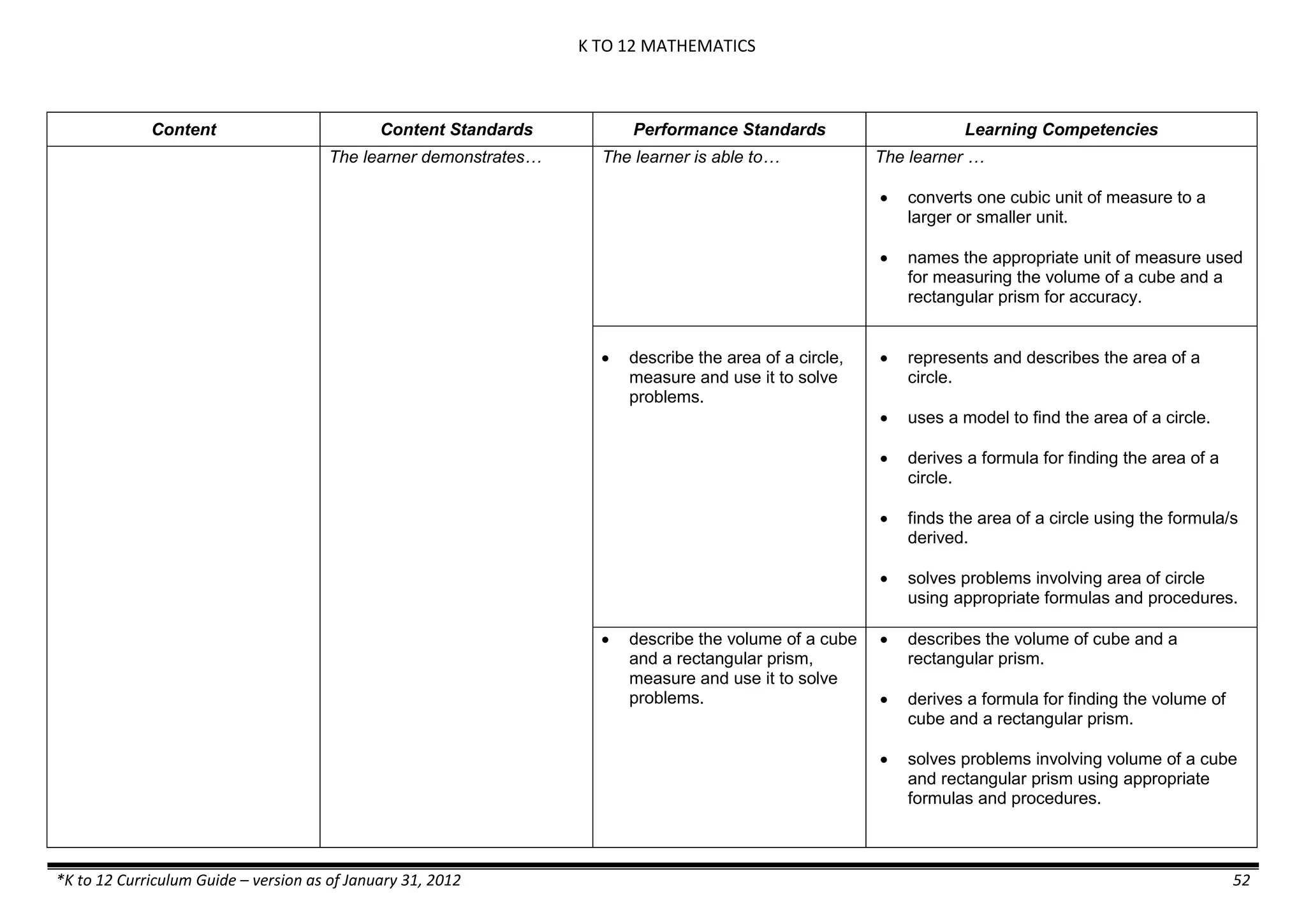
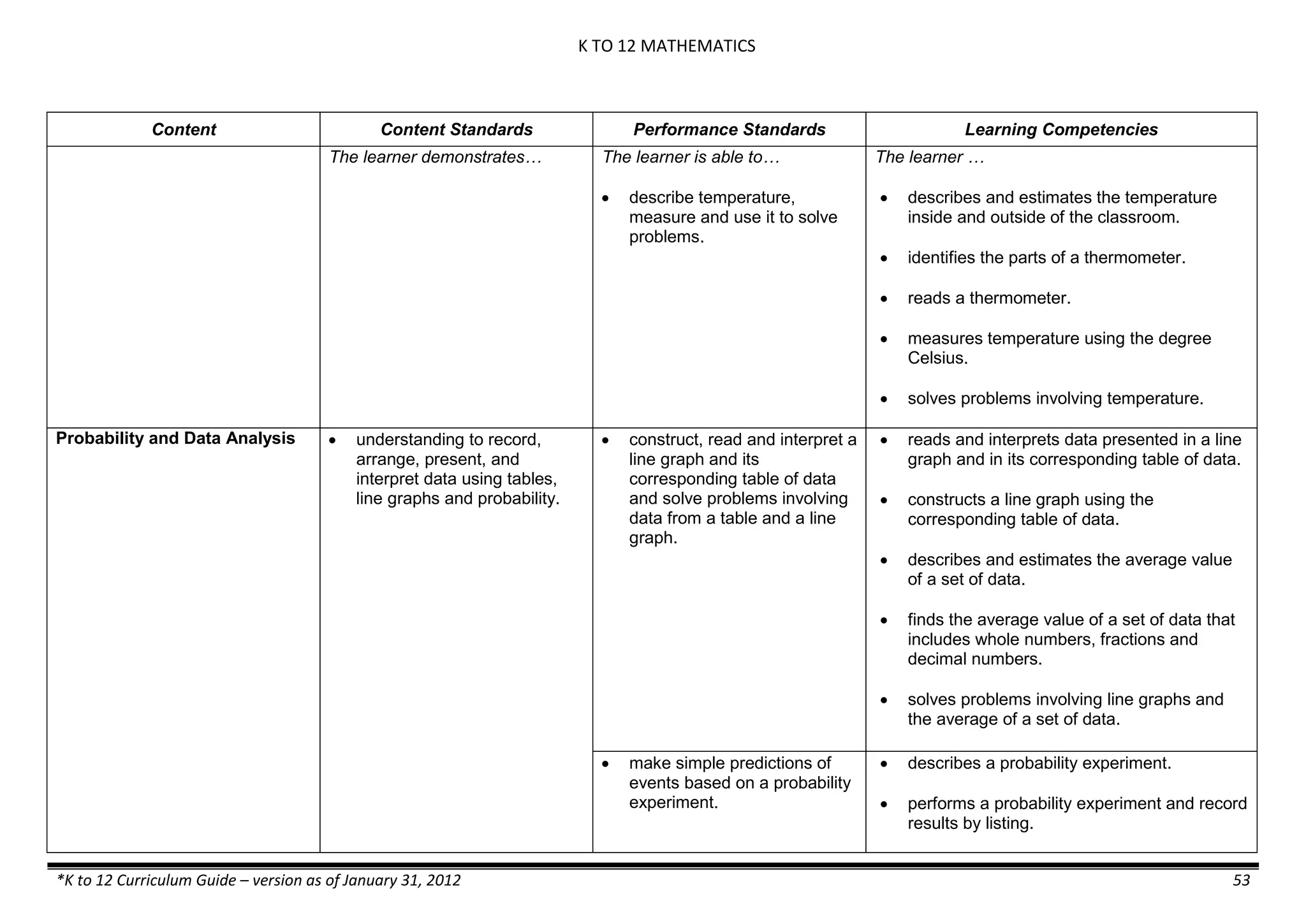
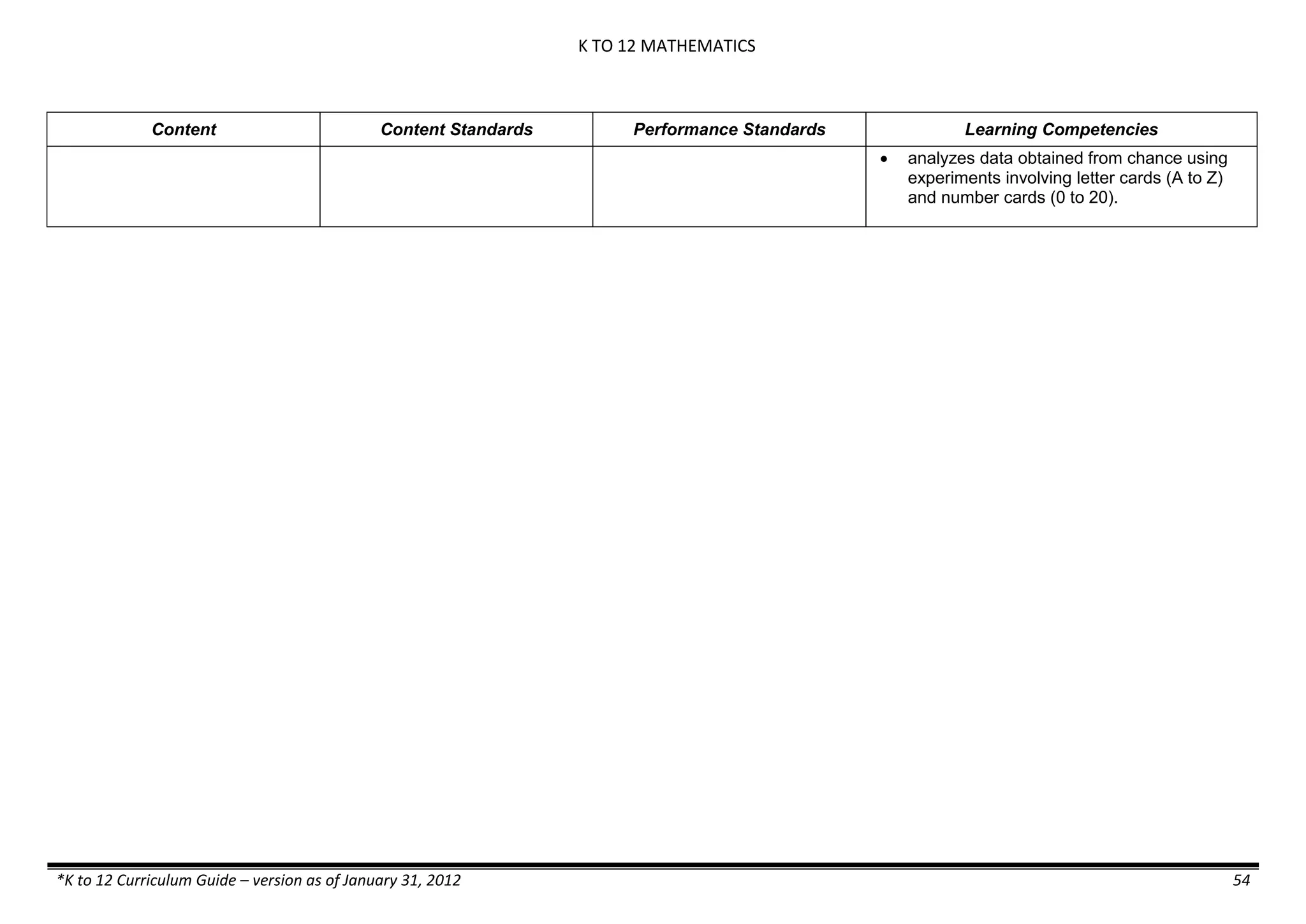
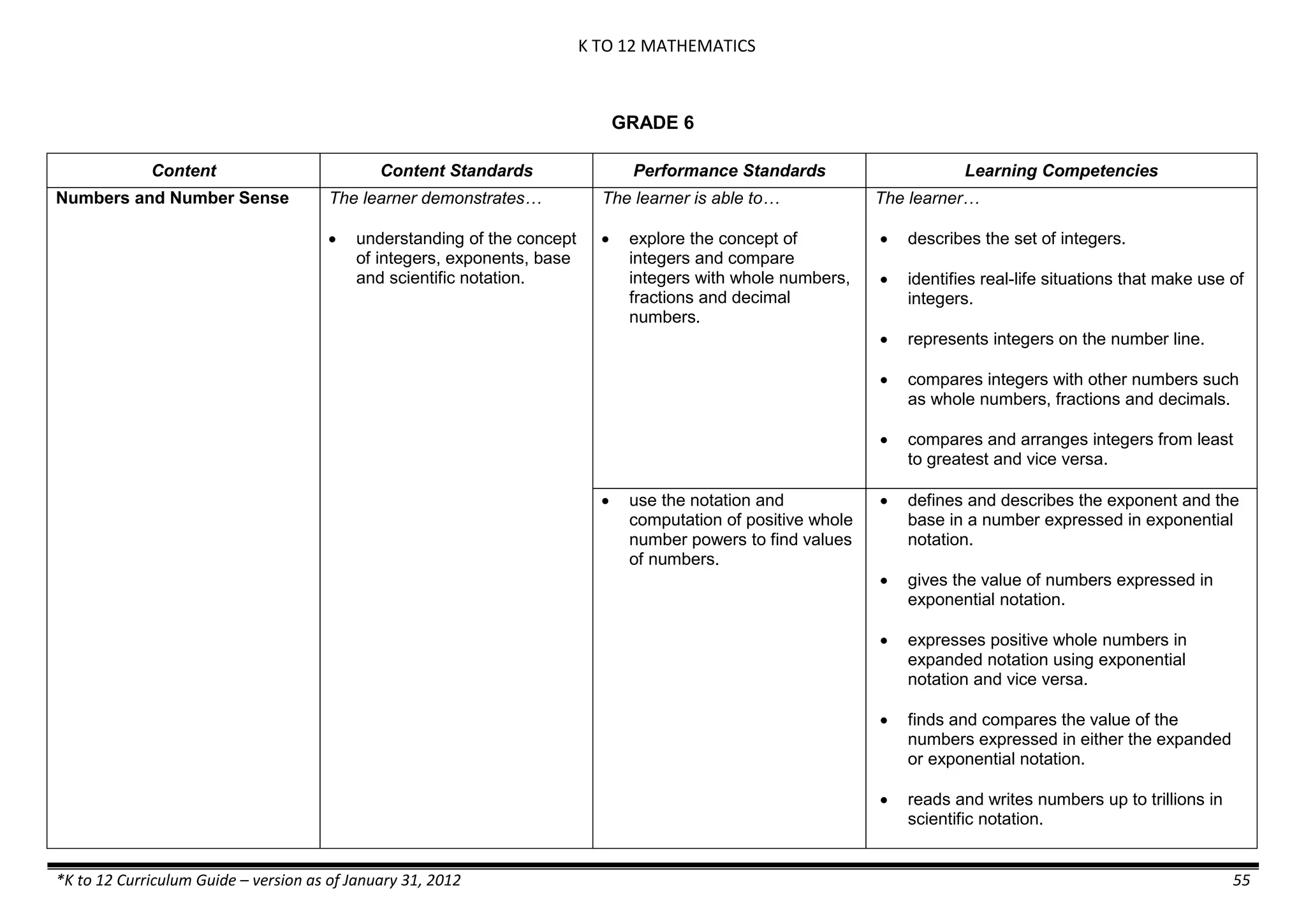
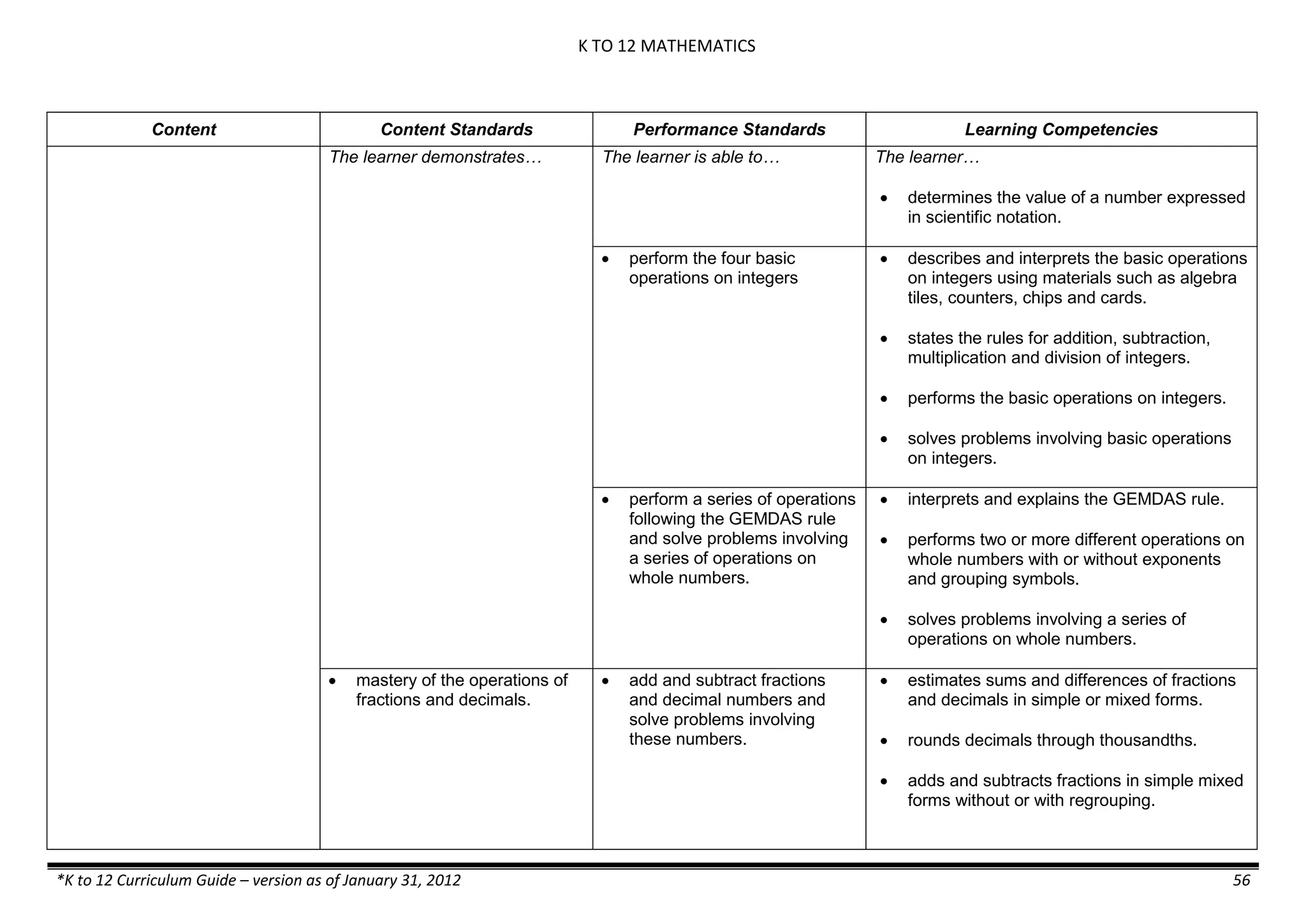
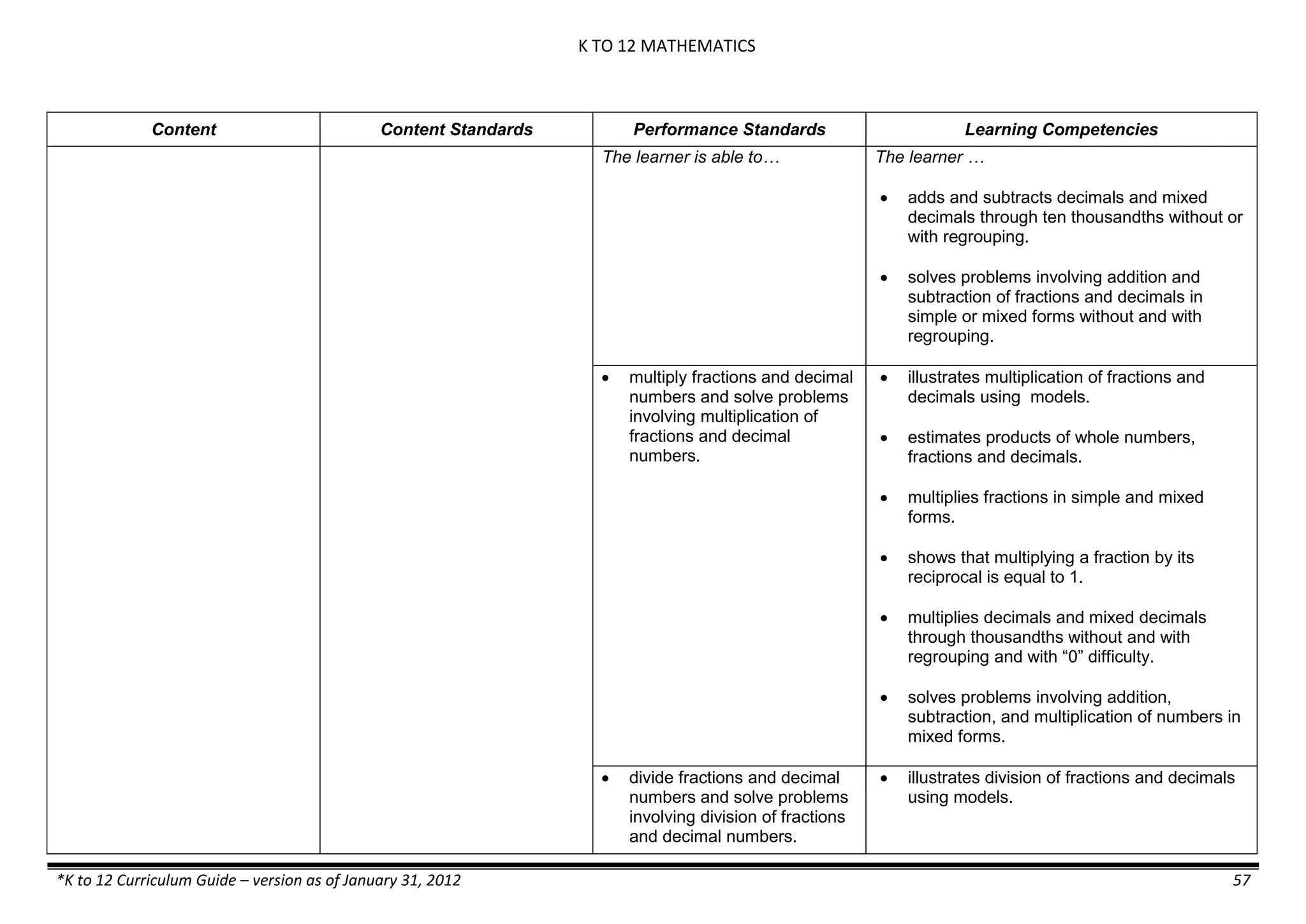
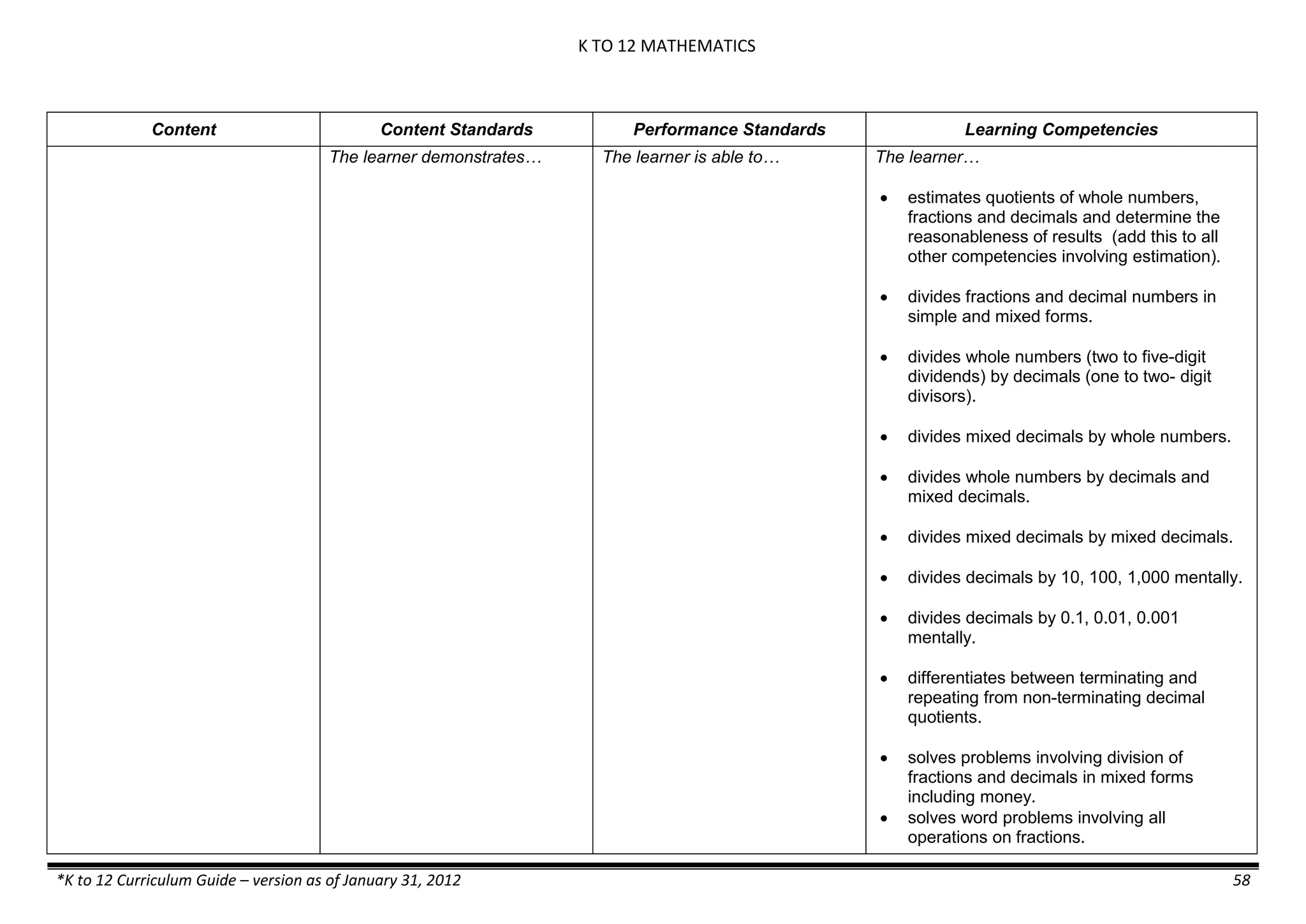
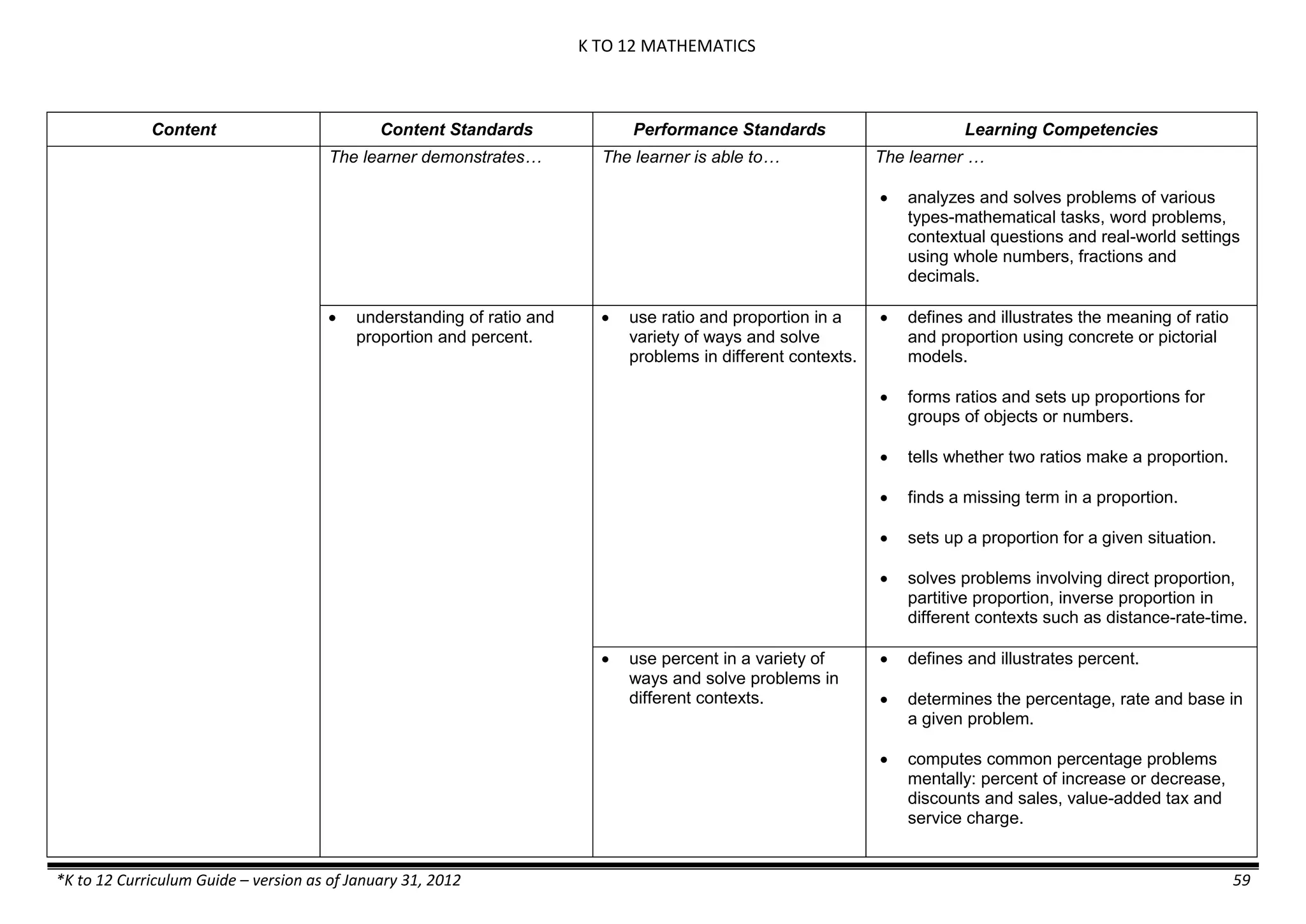
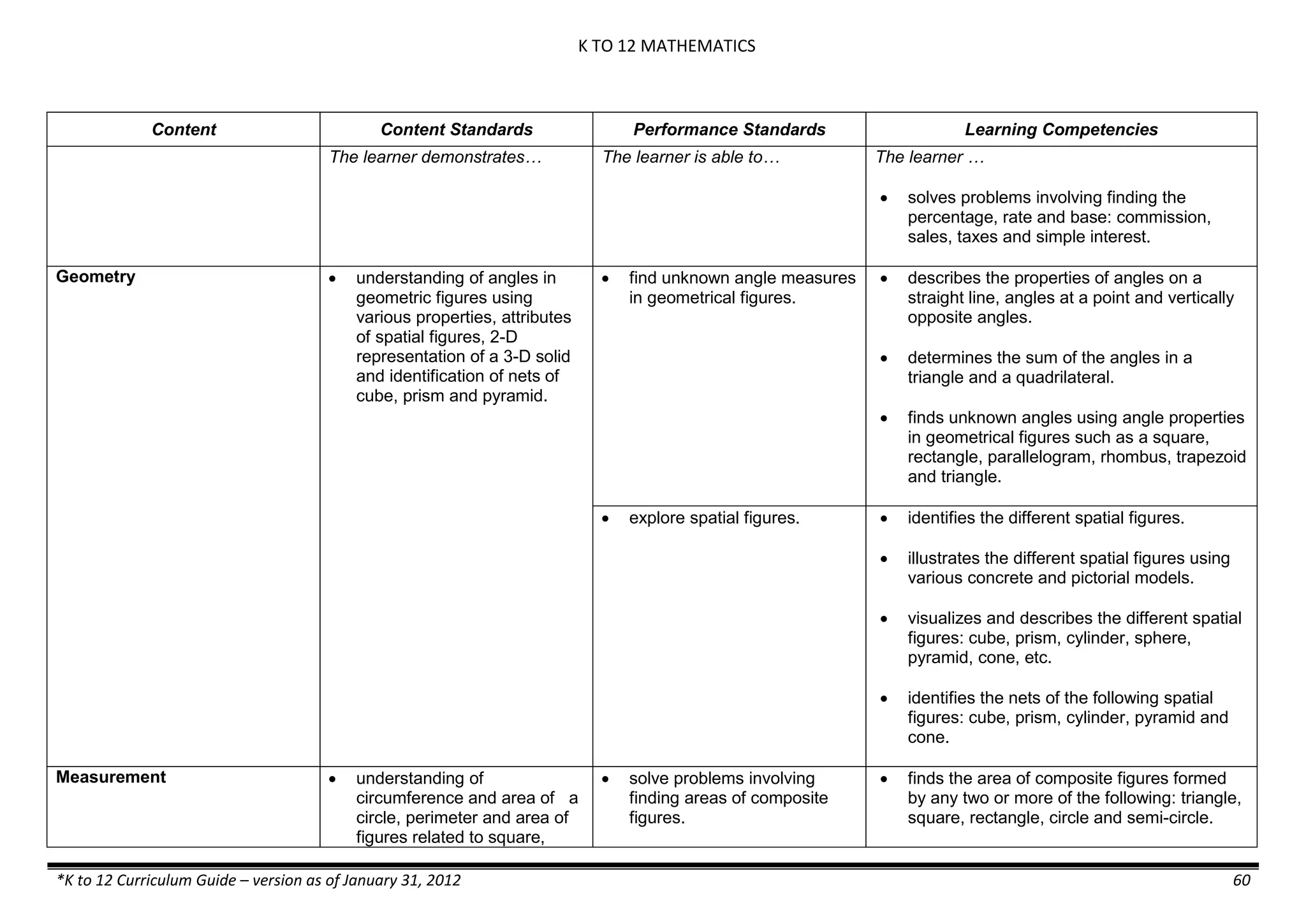
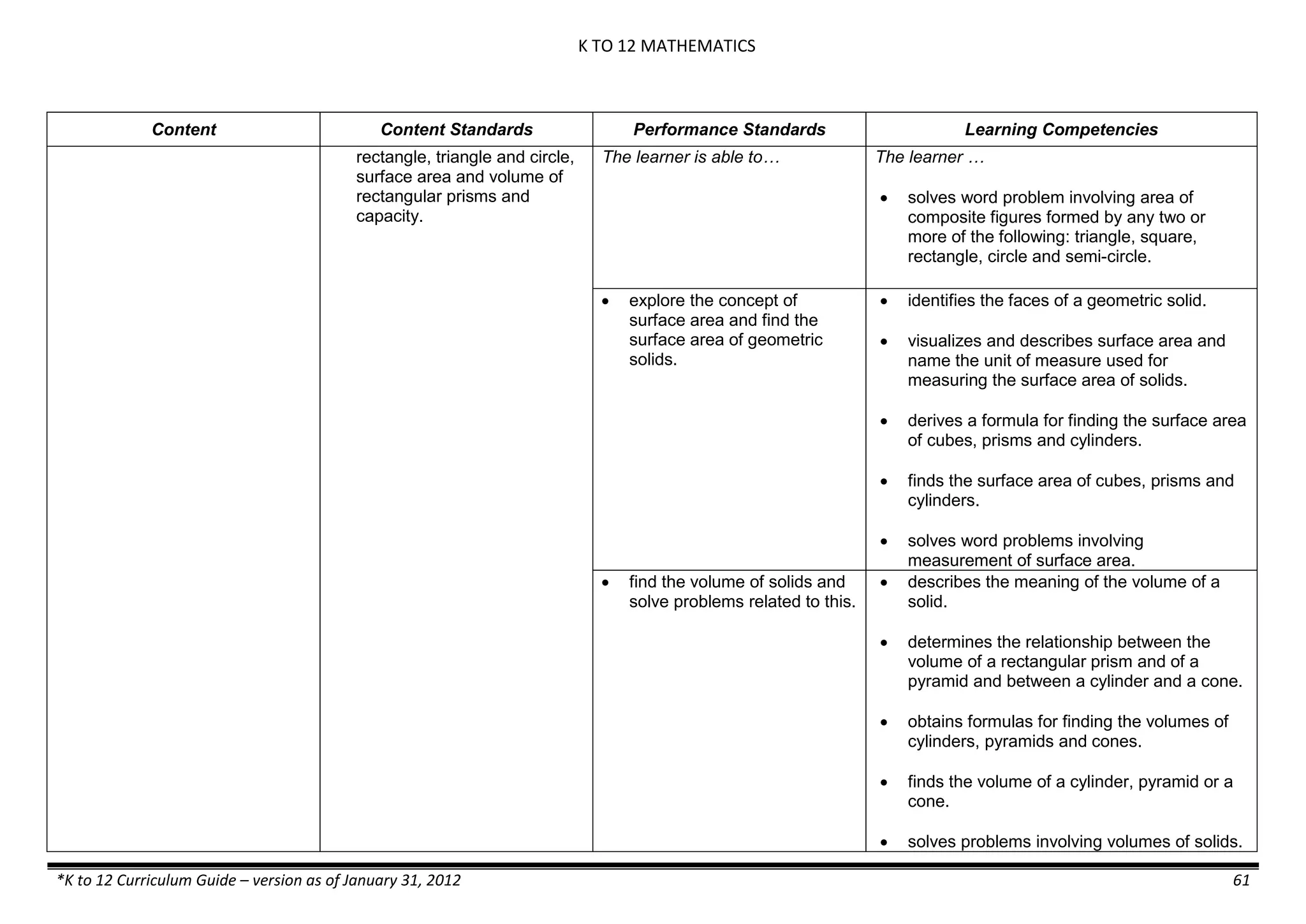
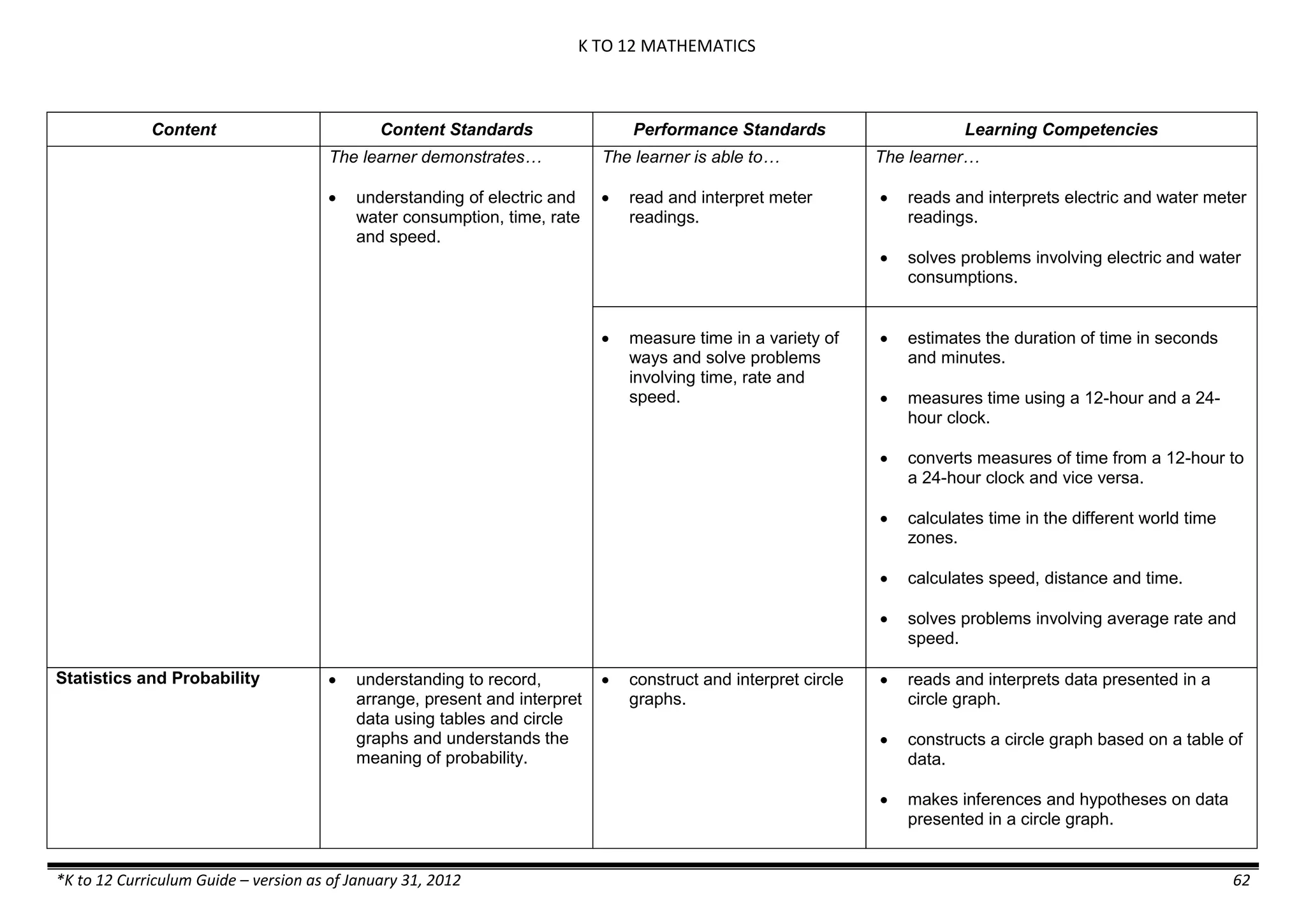
MATHEMATICS  (Grade 1 to 10) 
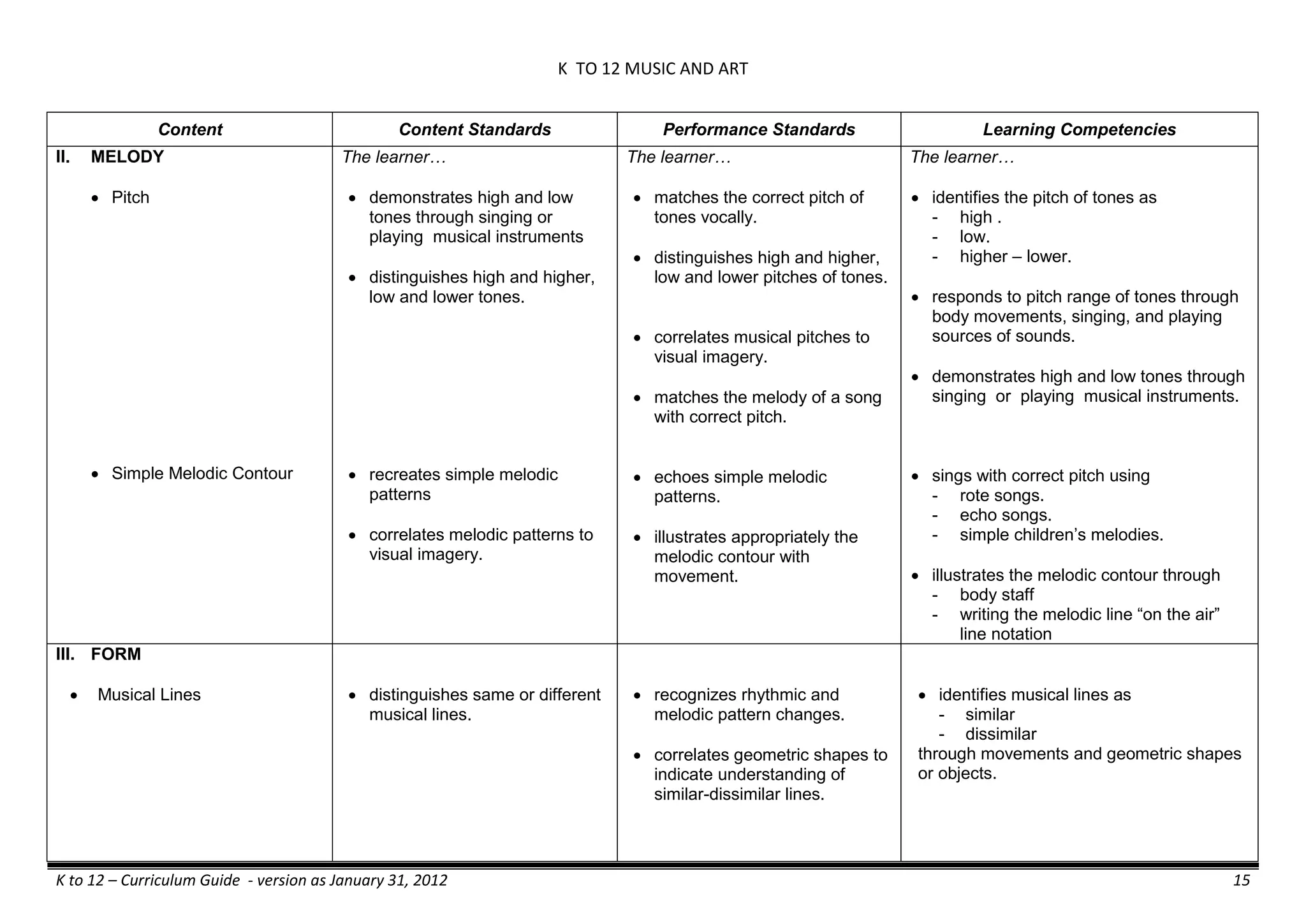
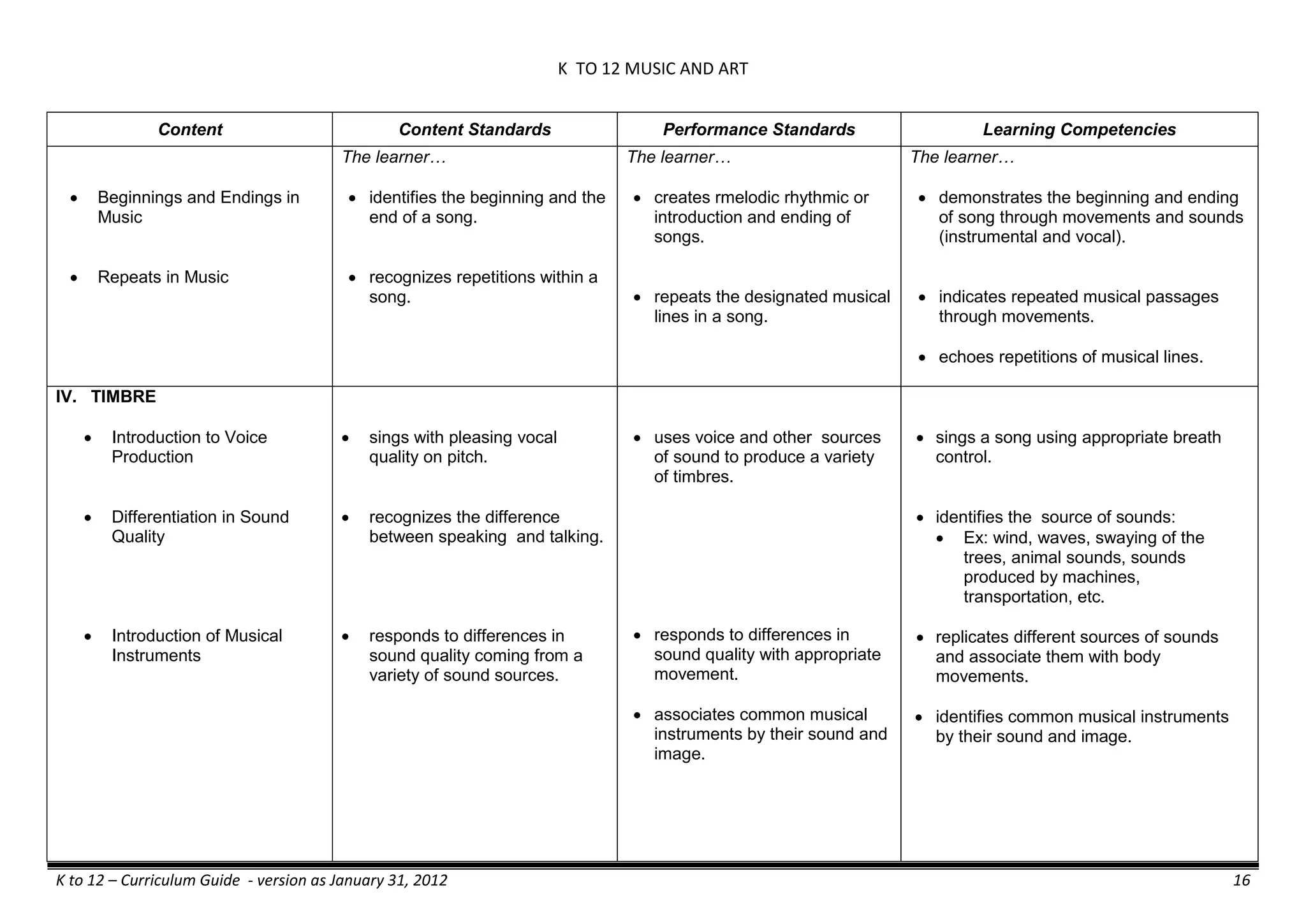
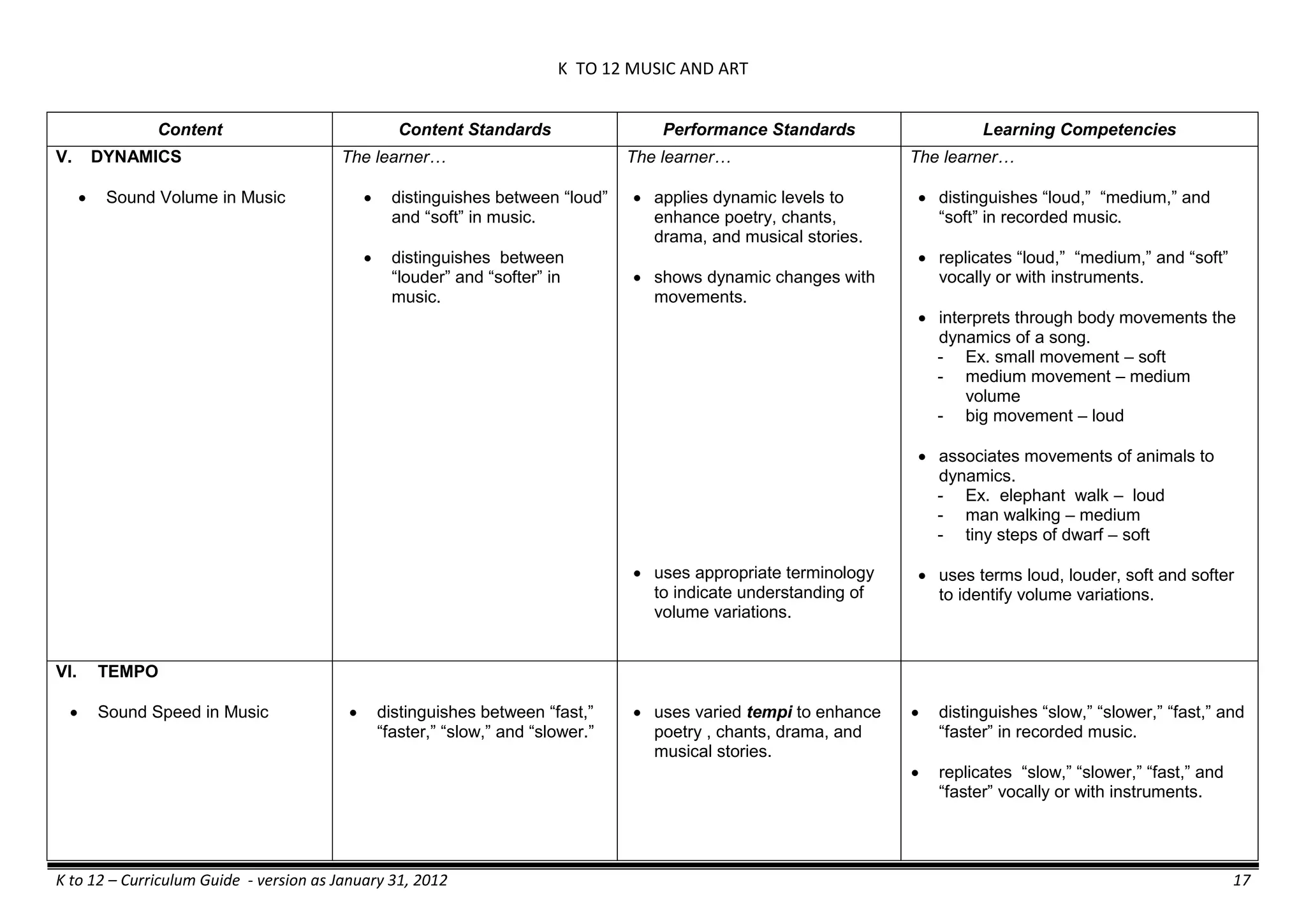
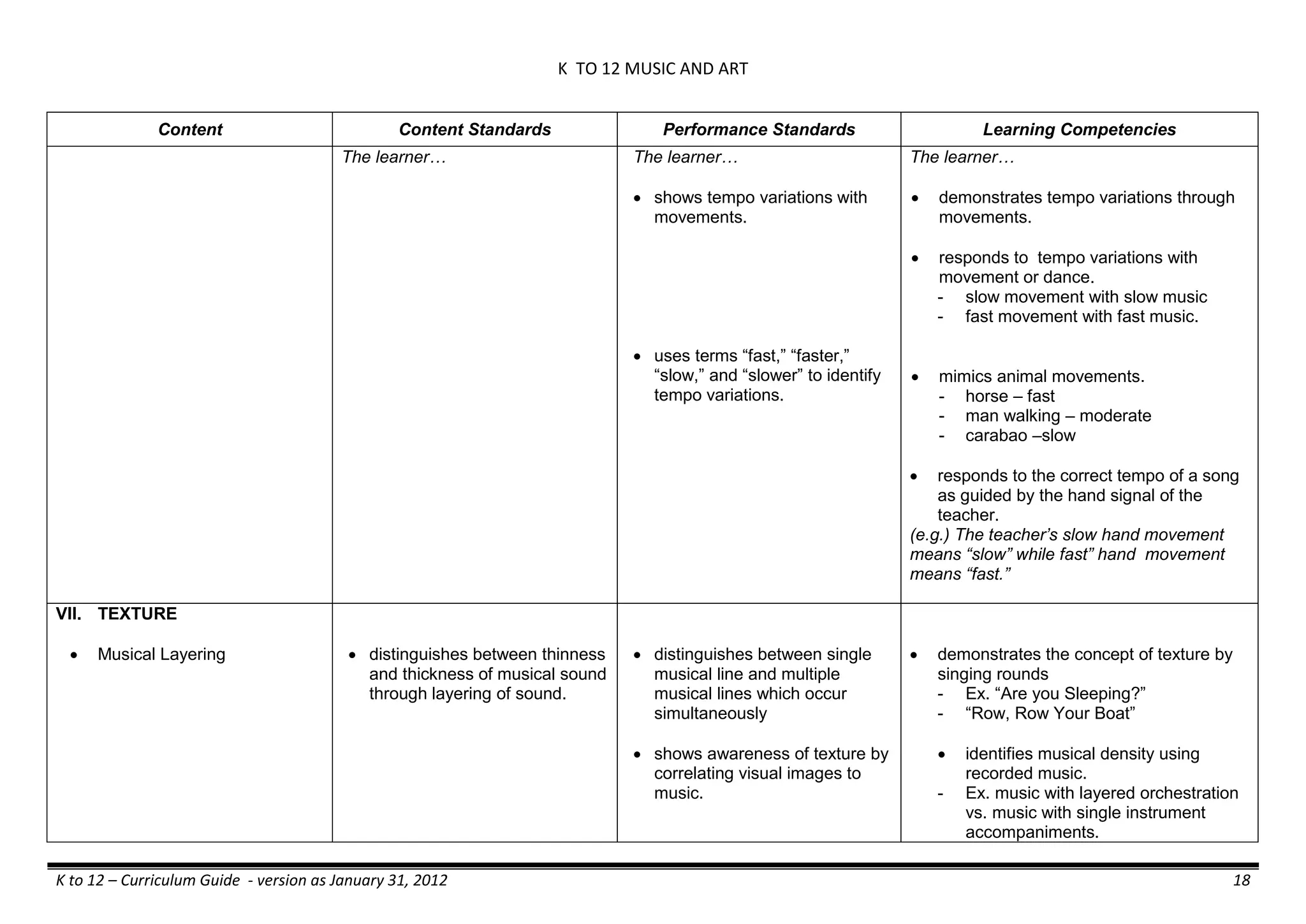
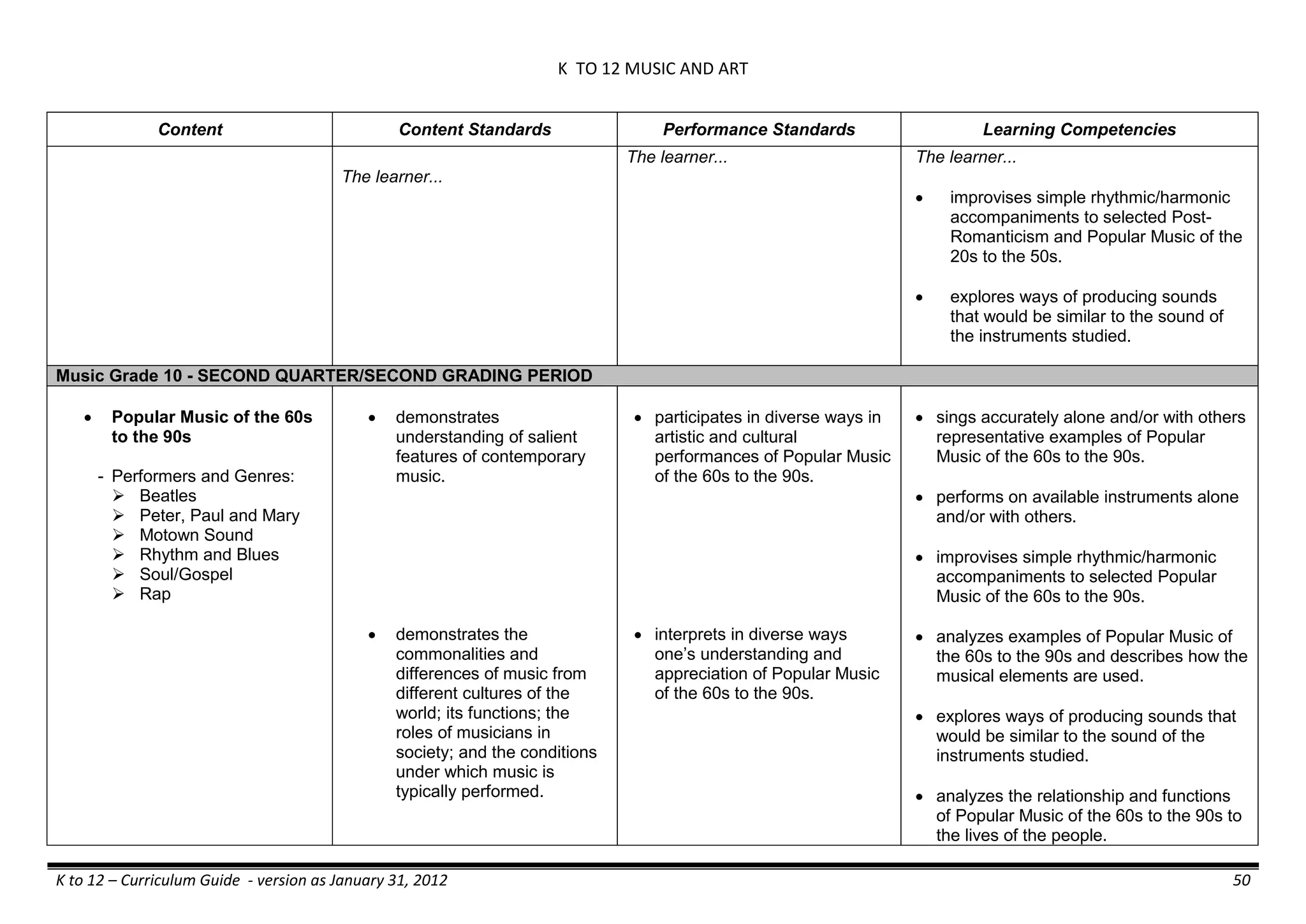
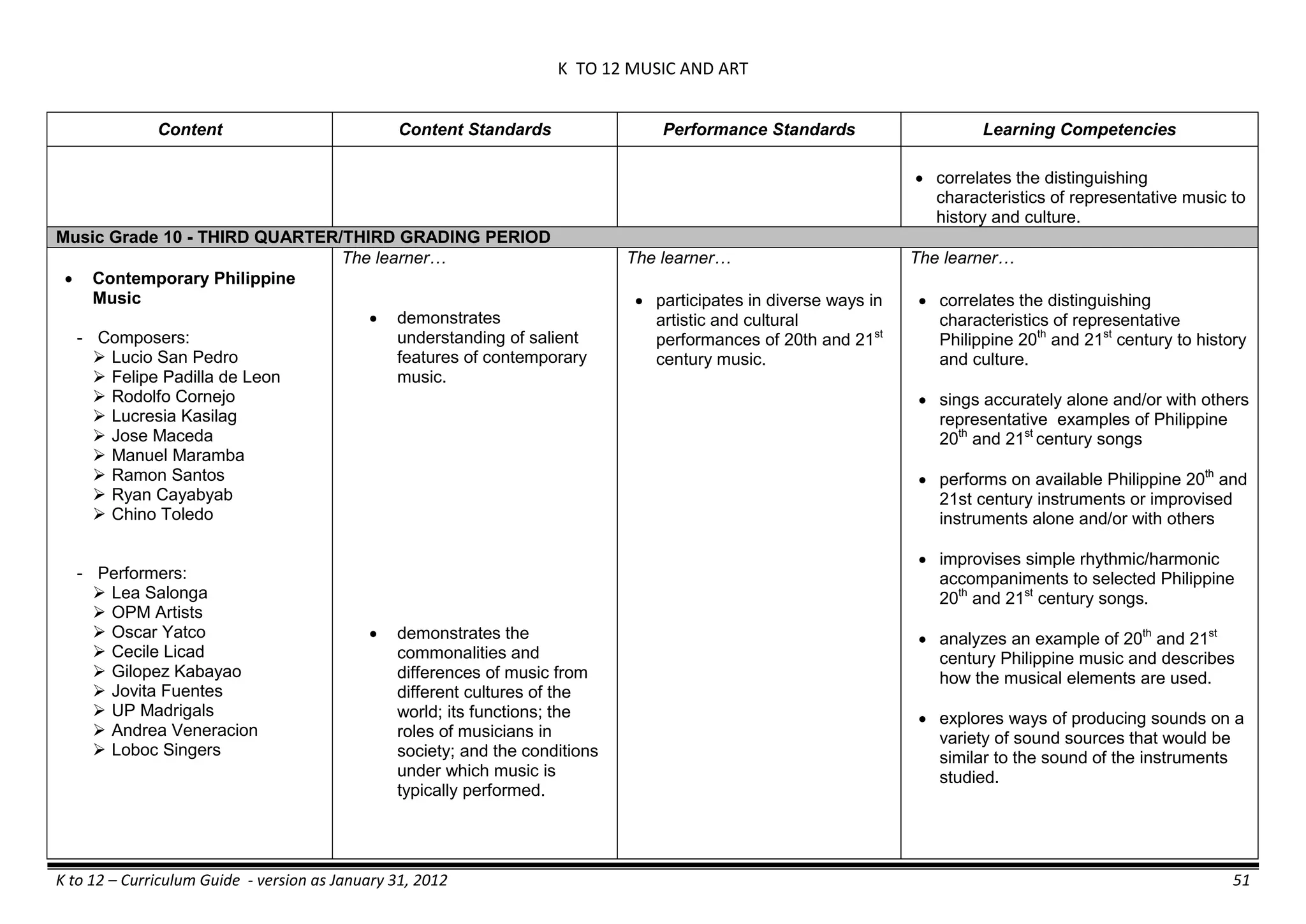
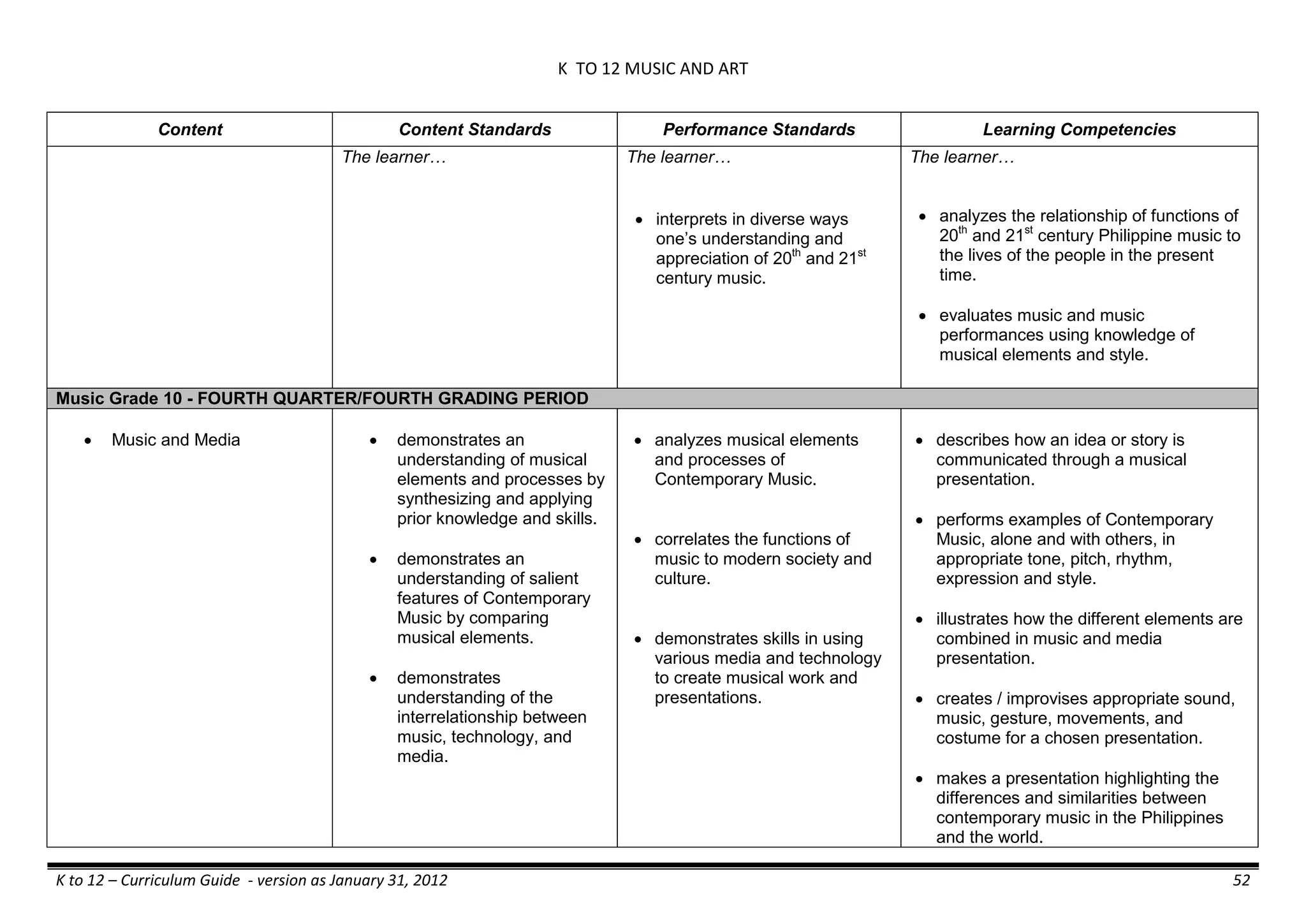
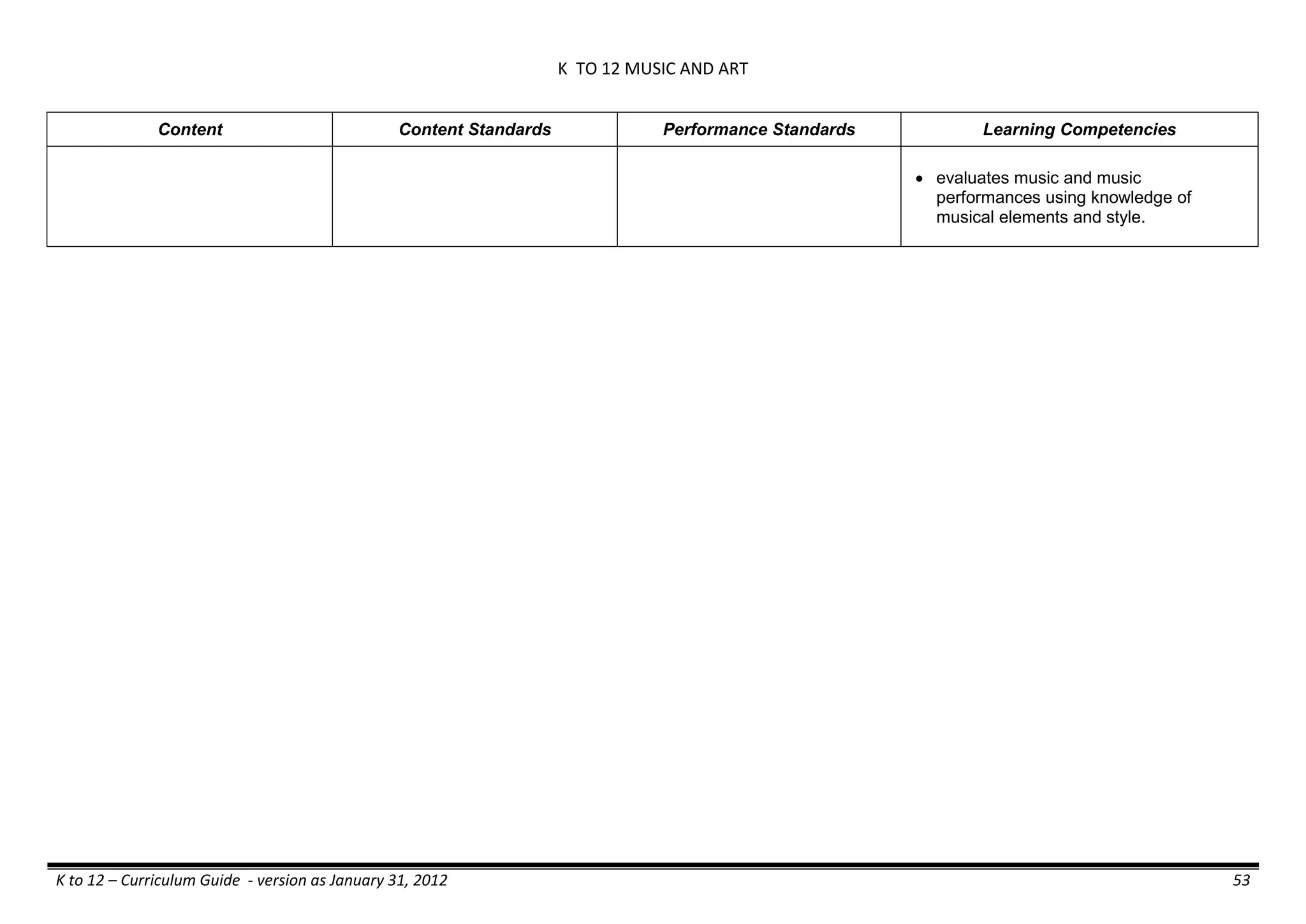
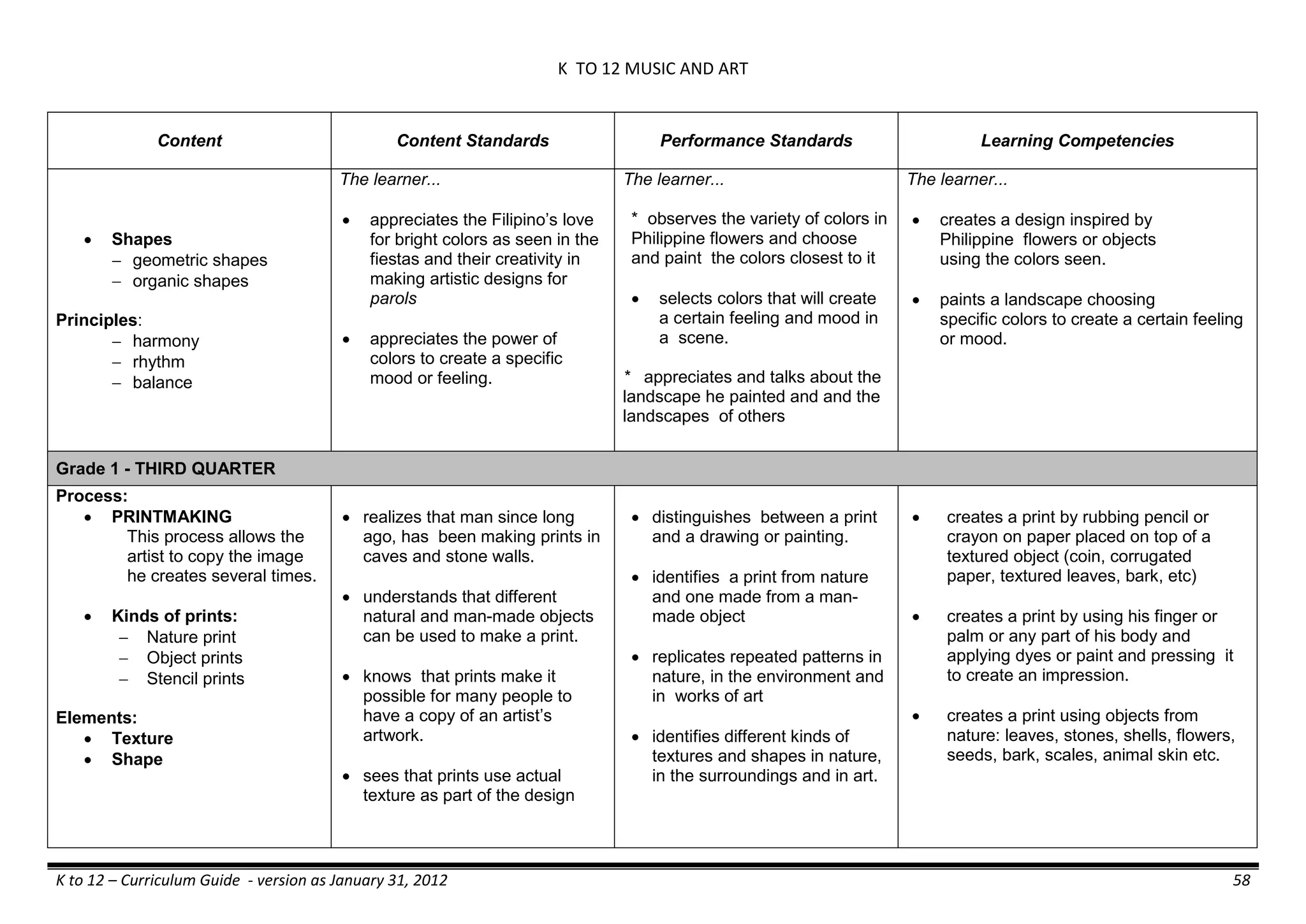
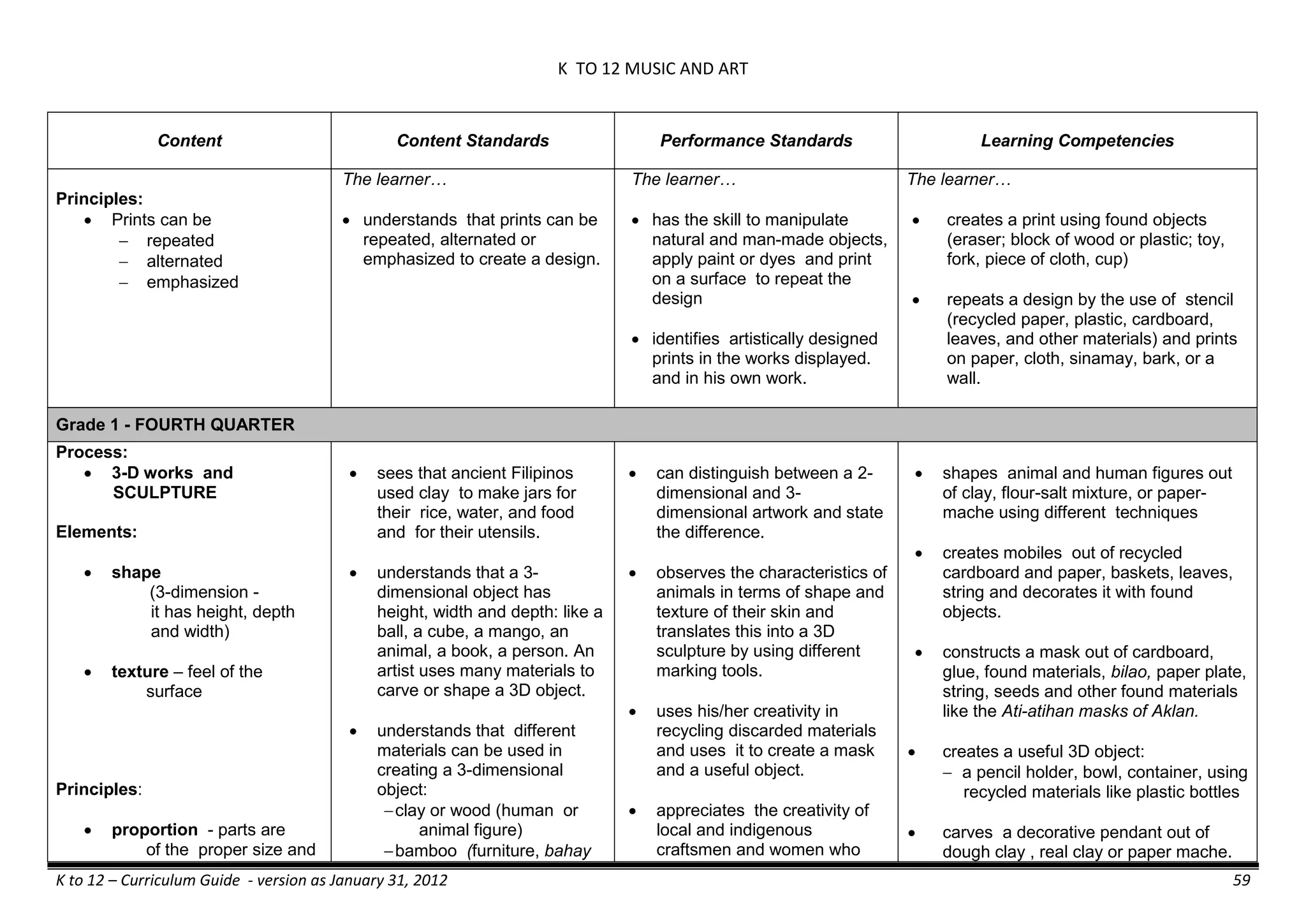
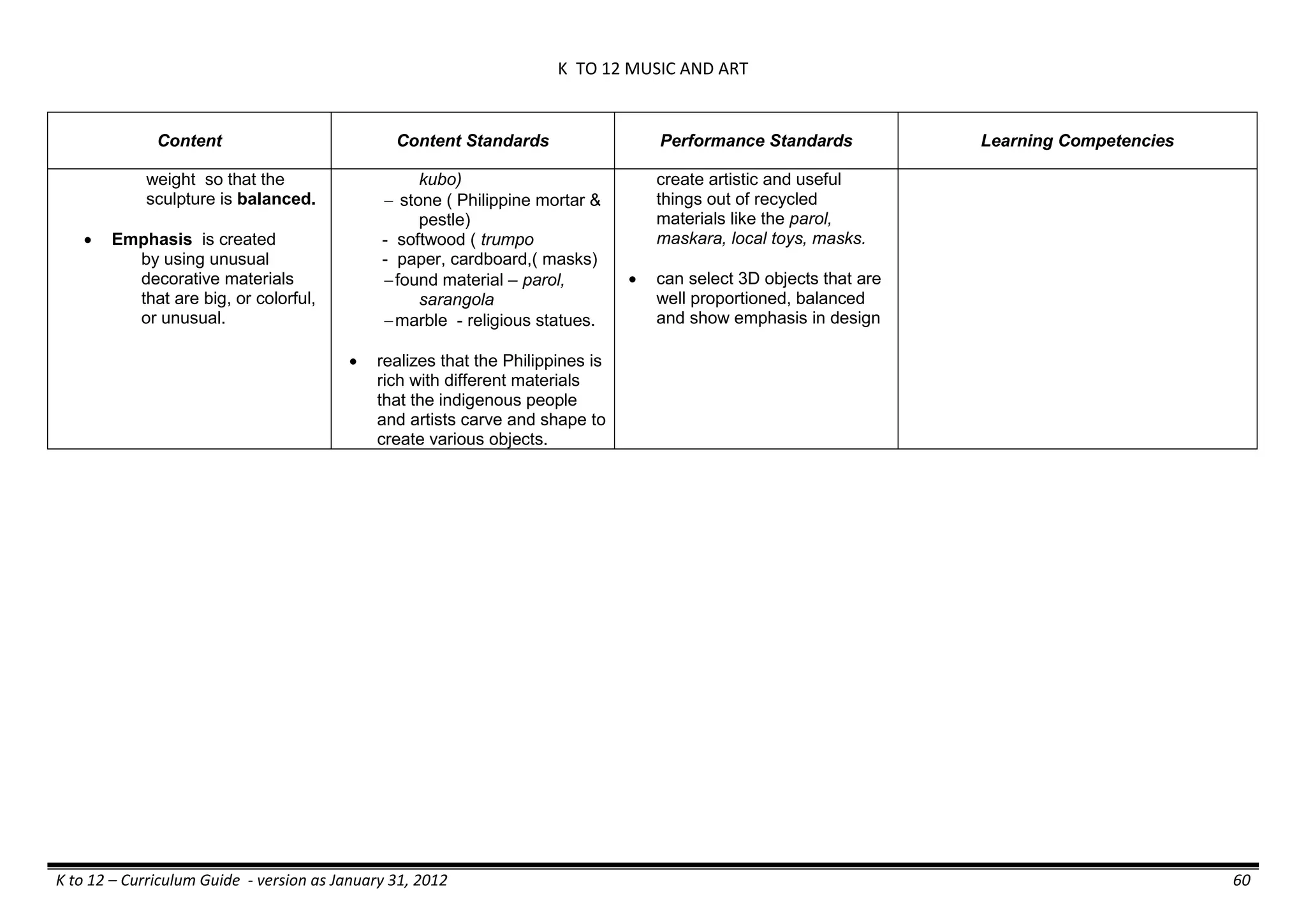
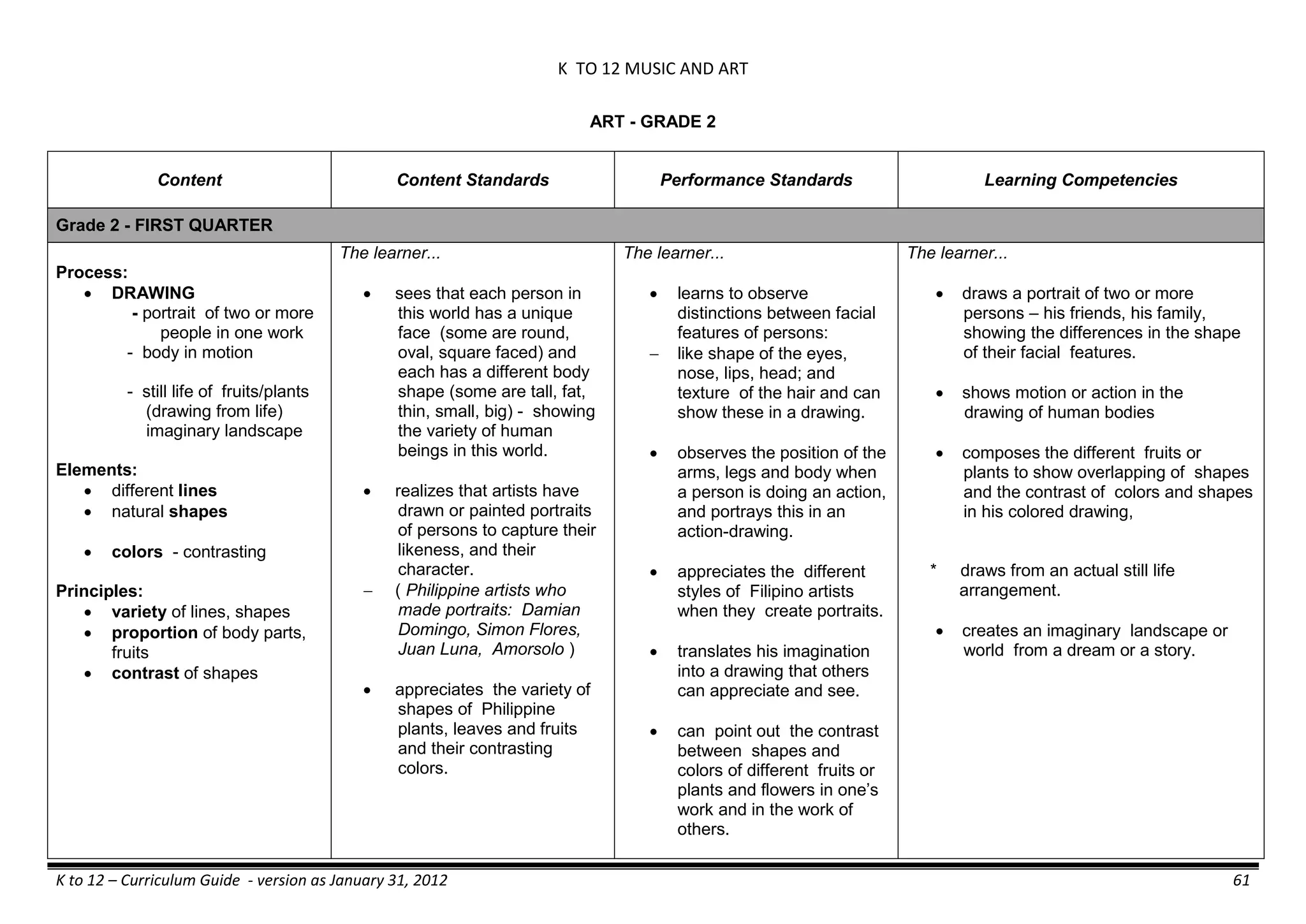
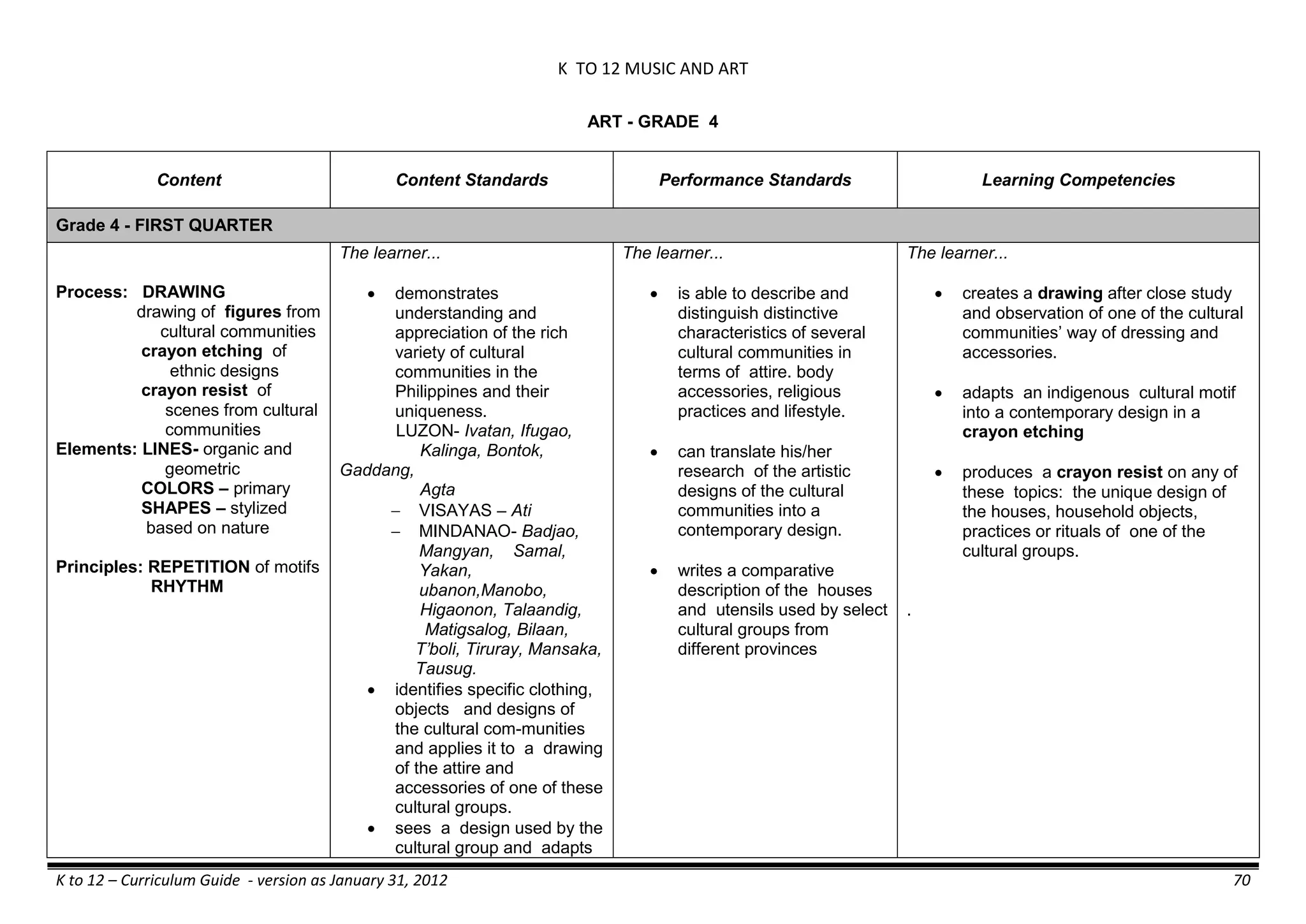
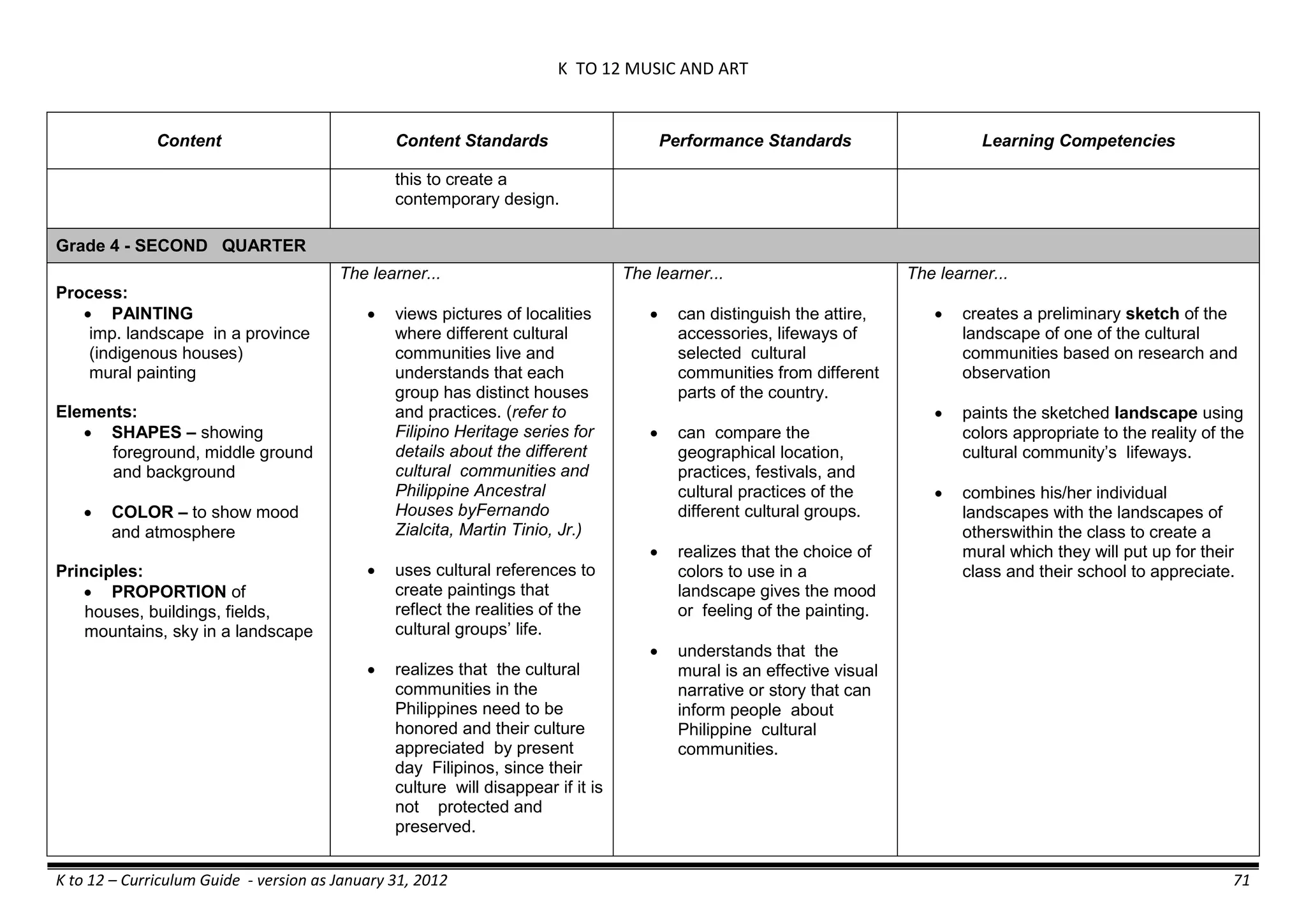
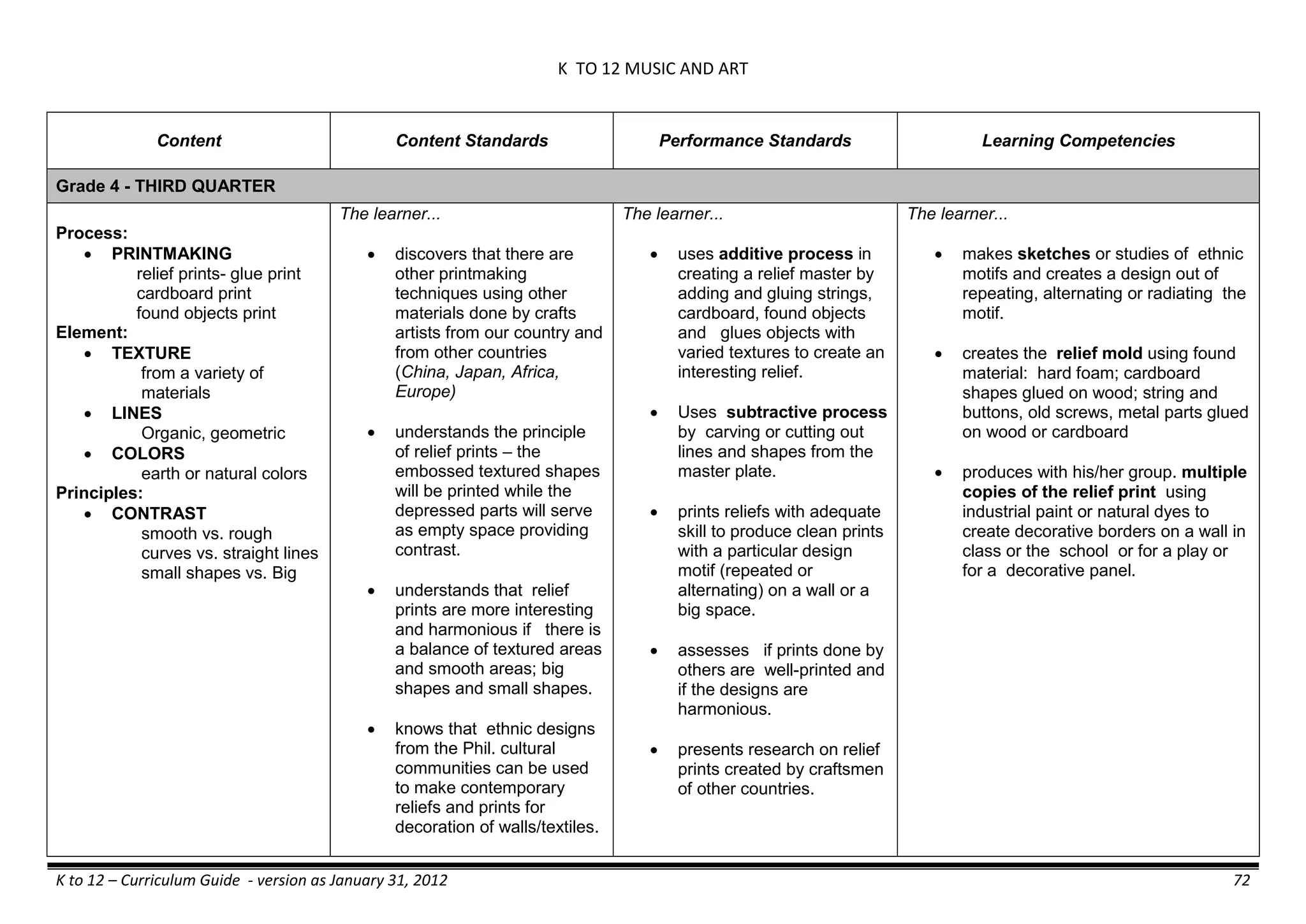
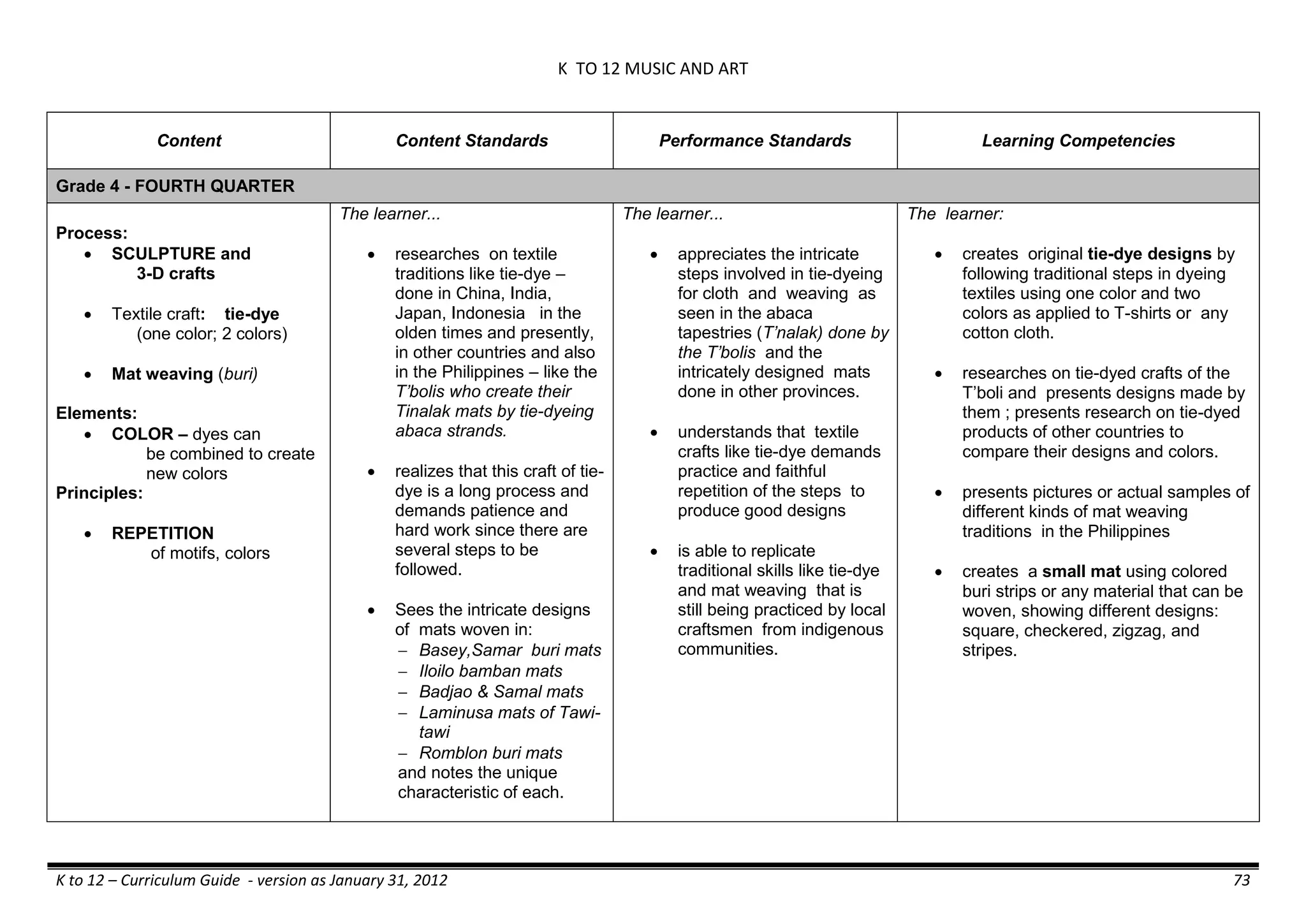
MUSIC AND ART (Grade 1 to 10) 
PHYSICAL‐EDUCATION (Grade 1 to 10) 
SCIENCE (Grade 3 to 10) 
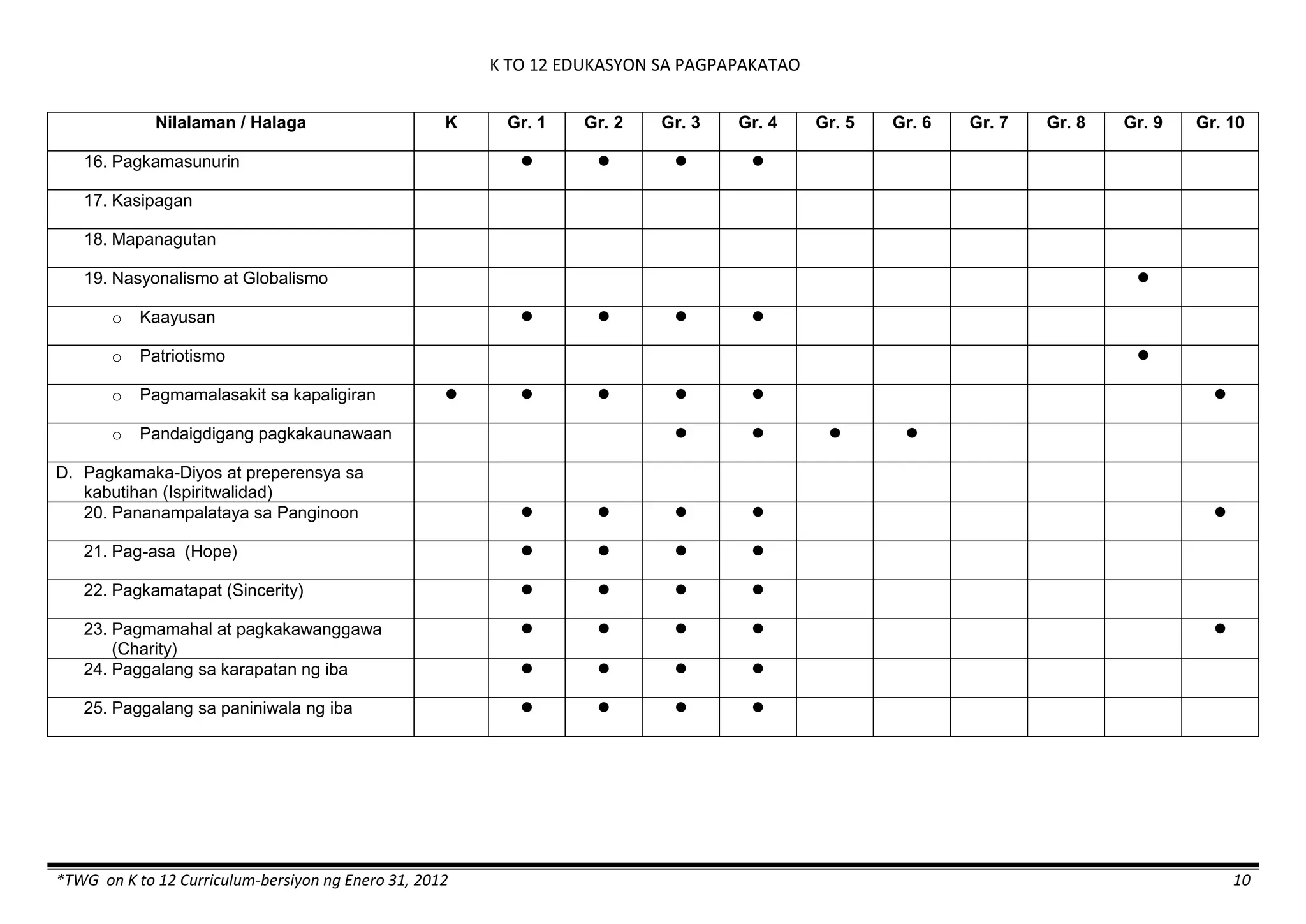
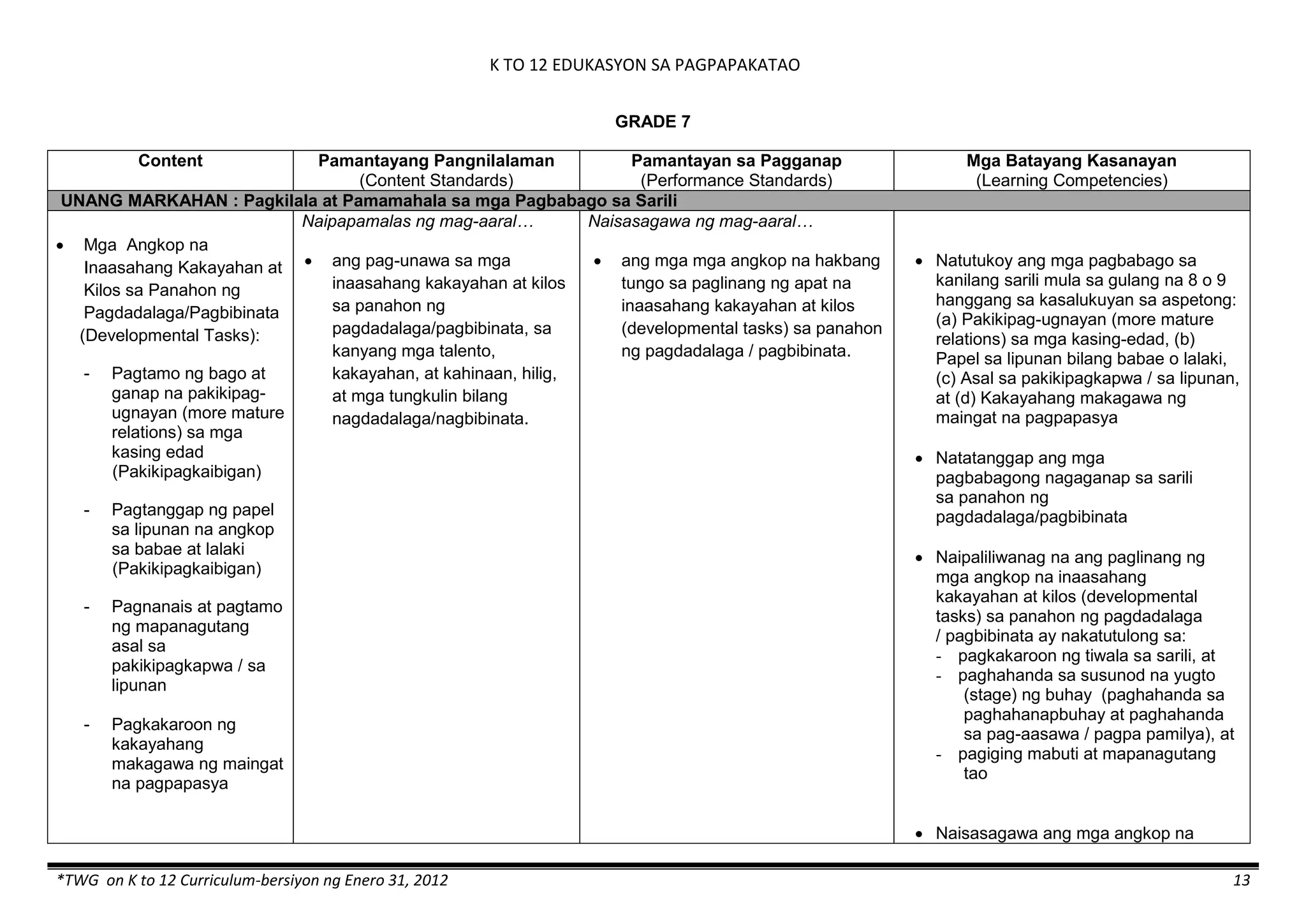
VALUES  (Grade 7) 
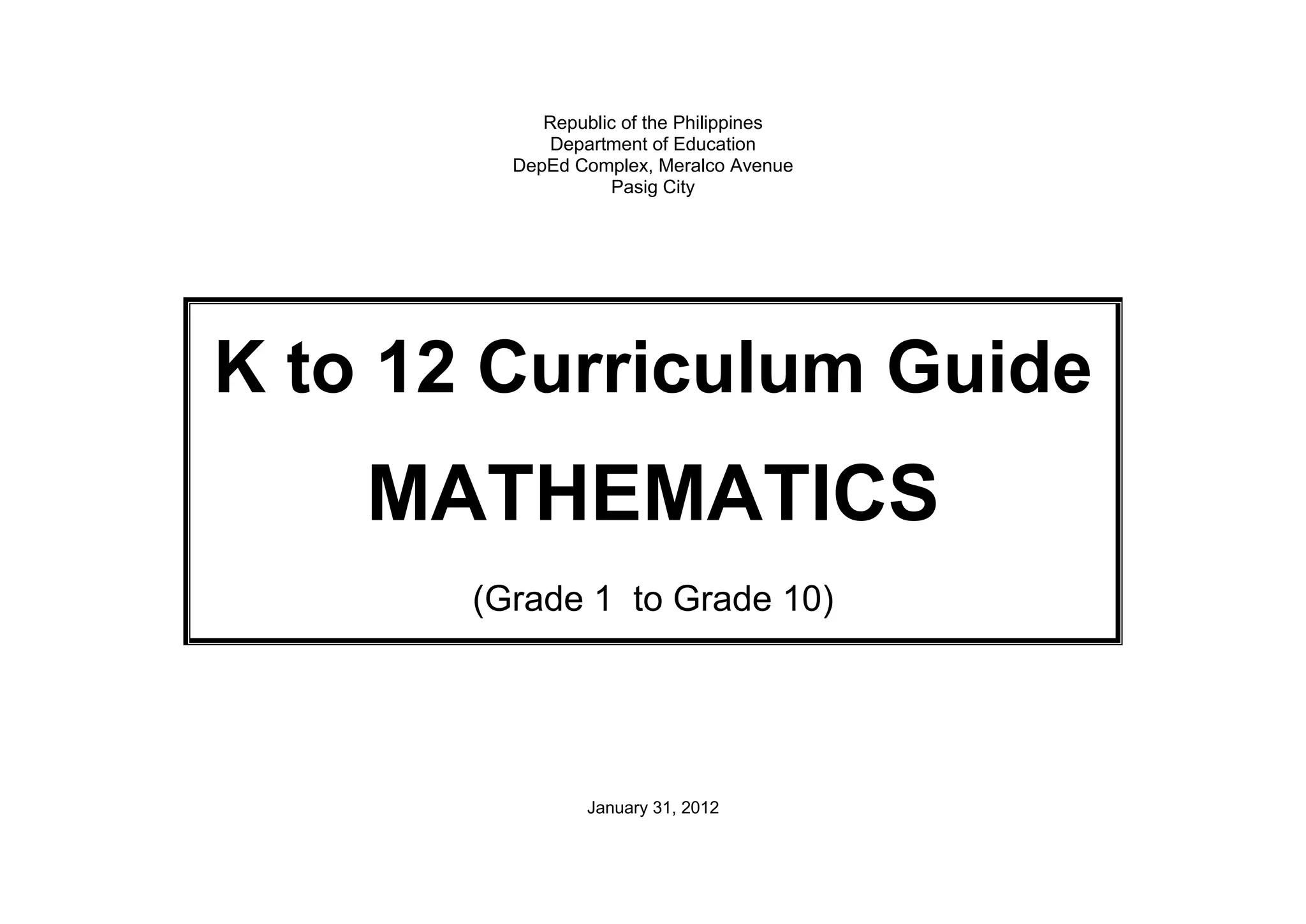
Republic of the Philippines
Department of Education
DepEd Complex, Meralco Avenue
Pasig City
K to 12 Curriculum Guide
KINDERGARTEN
January 31, 2012
K TO 12 – KINDERGARTEN
K to 12 Curriculum Guide - Kindergarten – version as of January 31, 2012 1
I. INTRODUCTION
“The first years of life are important because what happens in early childhood can matter in a lifetime.”
(Harvard, 2009)
The Department of Education (DepEd) having been a strong advocate of early childhood education has implemented various programs for preschoolers for
decades now. The Department further strengthens this through the inclusion of kindergarten in the K to 12 basic education curriculum in the country.
DepEd believes Kindergarten is a transition stage between informal literacy and formal literacy (grade 1-12). This is the period of greatest growth and
development, when the brain develops most rapidly, almost at its fullest. It is a period when walking, talking, self- esteem, vision of the world and moral
foundations are established. Children at this stage should be immersed with activities, games, and plays to naturally acquire the skills/competencies
appropriate for their holistic development as emergent literates and be ready for formal school.
According to National Association for the Education of Young Children (NAEYC) kindergarten is a critical year where children’s experiences nurture
positive approaches to learning and prepare children for the more rigorous academic expectations of the primary grades (NAEYC, 2009). Therefore,
kindergarten teachers should guide the learners using an engaging and creative curriculum that is developmentally appropriate.
Republic ACT 10157 also known as the Kindergarten Education Act which was signed into law by President Benigno Aquino III on Jan. 20 makes
kindergarten “the first stage of compulsory and mandatory formal education.” For public schools, the kindergarten education program will be free of tuition and
other school fees. With the Kindergarten Education Act, the kindergarten education program will be comprised of one year of preschool education for
children aged five and above. The act also pushes for the conceptualization and development of a regular training program for kindergarten teachers to
ensure that teaching styles, methodologies and approaches are always in line with modern trends in and issues on education.
K TO 12 – KINDERGARTEN
K to 12 Curriculum Guide - Kindergarten – version as of January 31, 2012 2
II. FRAMEWORK
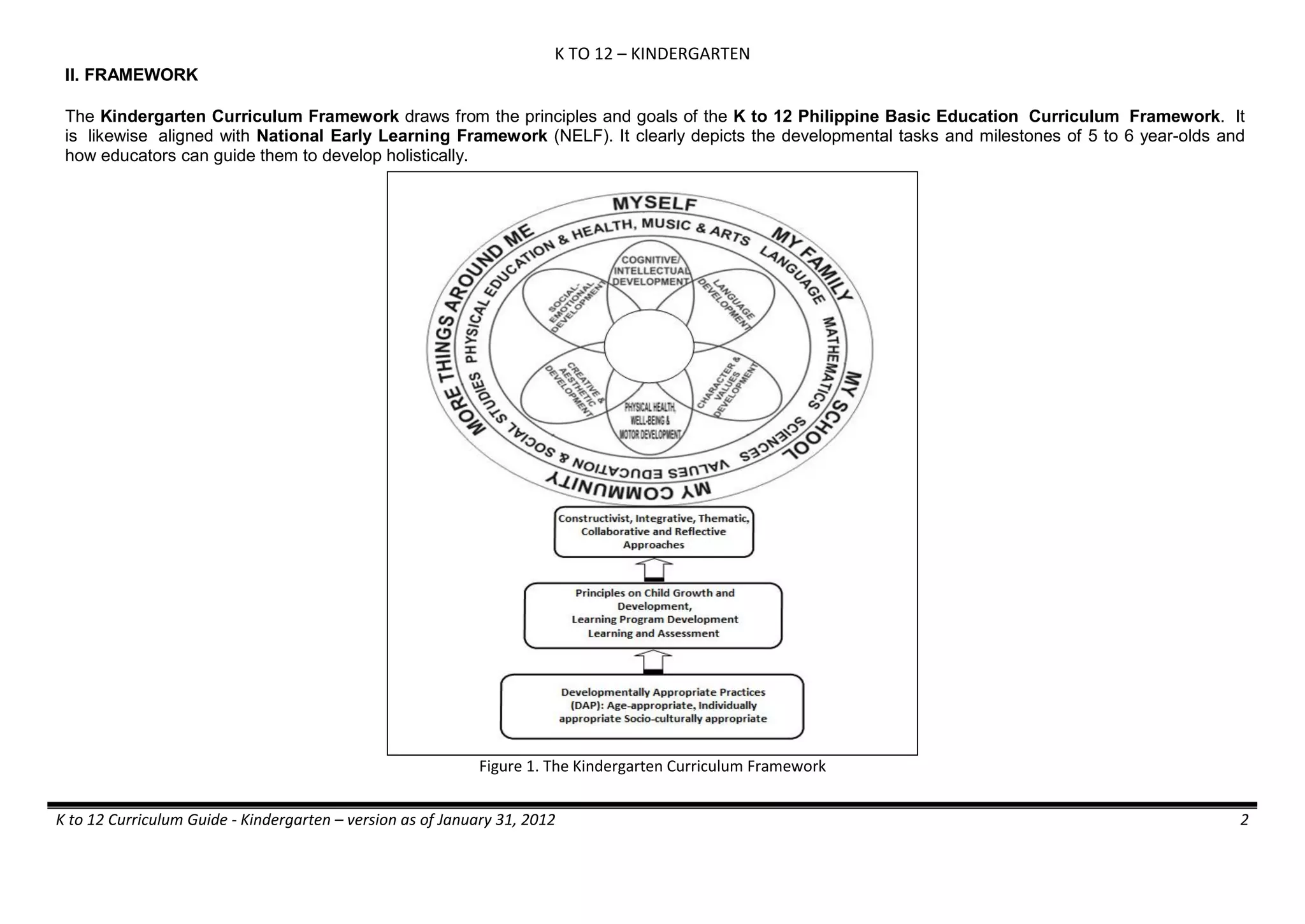
The Kindergarten Curriculum Framework draws from the principles and goals of the K to 12 Philippine Basic Education Curriculum Framework. It
is likewise aligned with National Early Learning Framework (NELF). It clearly depicts the developmental tasks and milestones of 5 to 6 year-olds and
how educators can guide them to develop holistically.
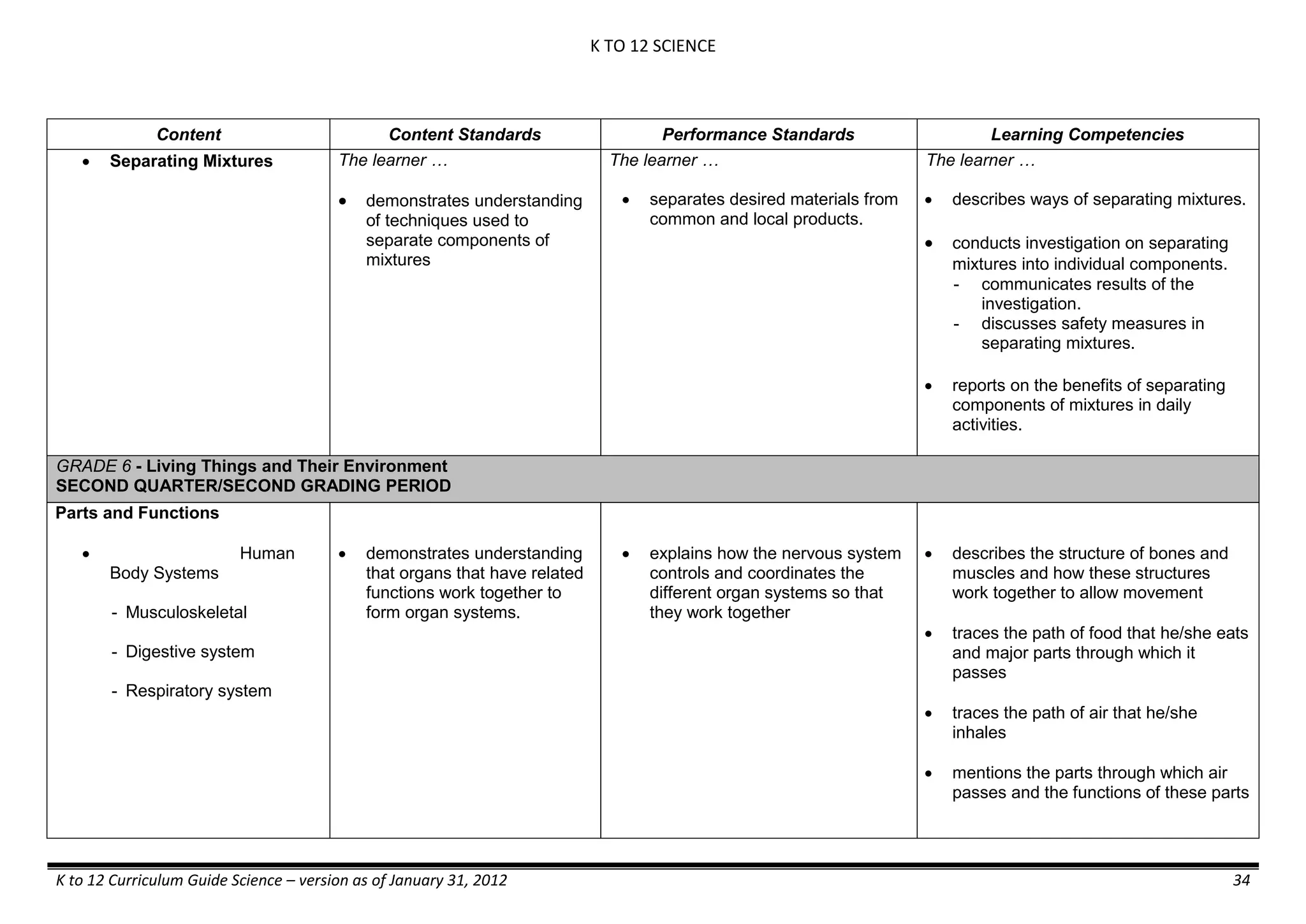
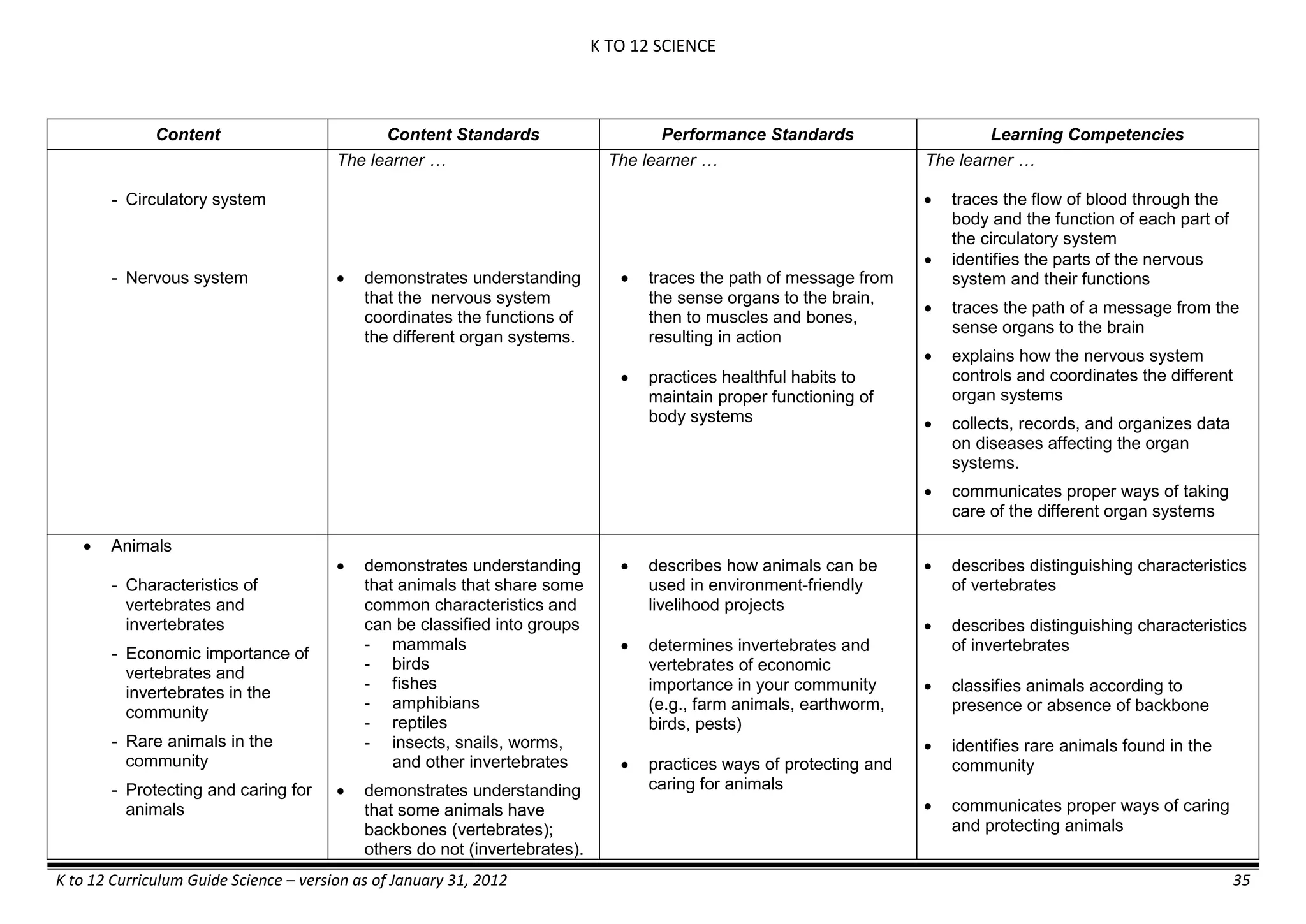
Figure 1. The Kindergarten Curriculum Framework
K TO 12 – KINDERGARTEN
K to 12 Curriculum Guide - Kindergarten – version as of January 31, 2012 3
The framework is composed of two parts. The rectangular figures show the teaching-learning theoretical bases, beginning with the comprehensive
Developmentally Appropriate Practices (DAP), then moving up to the principles and leading to the approaches. The circle consists of three main
components, (1) Developmental Domains, (2) Learning Areas, and the (3) Curricular Themes. At the center is the Filipino child who is envisioned to be
functionally literate and holistically developed.
A. PRINCIPLES
A developmentally appropriate curriculum is one that is age-appropriate, individually appropriate and socio-culturally appropriate ( NAEYC,
2009) This Kindergarten framework considers the developmental benchmarks of Filipino five-year-olds, recommends the use of strategies that
address needs and interests of the learners, and uses the mother tongue as medium of instruction.
Kindergarteners are constantly developing in the different domains (cognitive, language, physical, creative and aesthetic, socio-emotional, and
values and character). The National Early Learning Framework (NELF), formulated by the Early Childhood Care and Development Council, views the
Filipino Child as the most important asset of the nation. NELF furthers its view of the Filipino Child as…
…as a human being who loves God, parents, and country; is proud to be a Filipino; honors the customs , traditions and good values
of the people, knows his/her basic rights; respects other cultures and is able to live in peace and harmony with all.
Thus beginning at an early age the child must be cared for and given all the opportunities to address current developmental needs and prepare
him/her for lifelong learning. Kindergarten classrooms, therefore, should multi-level because kindergarteners will differ in their development in each domain.
The following are situations that a kindergarten teacher should put to mind.
1. every classroom is a multi-level classroom
2. every teacher is a multi-level facilitator
3. every learner is unique
4. every learner has particular intelligence or intelligences
5. every learner has his/her own learning styles
6. every learner has his/her own particular needs
a. cognitive
b. physical
c. socio-emotional
K TO 12 – KINDERGARTEN
K to 12 Curriculum Guide - Kindergarten – version as of January 31, 2012 4
7. every learner has his/her own particular wants and interests
8. every learning has a right to develop uniquely from the others
This framework upholds the sixteen (16) general principles of the NELF as guides on (1) child growth and development (2)
learning program development and (3) learning assessment development:
1. ON CHILD GROWTH AND DEVELOPMENT
The following are the general guiding principles on child growth and development:
1. Every child is unique. Growth and development varies from child to child of which the first six years of life are most vital. He/she has an
innate desire to learn and is best done through meaningful and real experiences.
2. Every aspect of growth and development is interrelated and interdependent. The child needs to be nurtured in a good and caring
environment that enhances healthy and dependable relationships with other children and most significant adults.
3. The learning and development of every child involves a series of complex and dynamic processes that are best attended to in a more
positive and responsive manner.
4. The child must be encouraged to aspire beyond one’s own level of achievements and to practice newly acquired competencies.
5. Every child is a thinking, moving, feeling and interactive human being able to actively participate in the learning and development of self in the
context of one’s family and community including cultural and religious beliefs.
2. ON LEARNING PROGRAM DEVELOPMENT
The following are the general guiding principles on learning program development:
6. The learning program is child centered. It promotes the holistic way by which young children grow and develop; and recognizes the role of
families and communities to support the child through various stages of growth and development.
K TO 12 – KINDERGARTEN
K to 12 Curriculum Guide - Kindergarten – version as of January 31, 2012 5
7. The learning program is appropriate for developing the domains of development identified in the NELF; and must sustain interest in active
learning of all young children including those with special abilities, are marginalized and/or at
risk.
8. The learning program is implemented by way of diverse learning activities that may be enhanced with technologies such as interactive radio
and audio/video clips for learning areas.
9. The use of learning materials and other resources that are locally developed and/or locally available is encouraged.
10. The mother tongue shall be used as the child’s language of learning in the early years and shall be recognized as a bridge language of
learning.
3. ON LEARNING ASSESSMENT
The following are the general guiding principles on learning assessment development:
11. Assessment is done to monitor learning, know where the child and inform parents of the child’s progress.
12. Assessment is essential to identifying the child’s total developmental needs and does not determine academic achievement.
13. Assessment is best conducted on a regular basis so that a timely response may be made to improve learning areas.
14. The results of the assessment of learning of a child shall be kept strictly confidential
15. Ratings should be qualitative/descriptive and not only numerical.
16. The family and community may be informed of the general outcomes of learning in the early years so as to encourage further cooperation and
partnerships
The framework espouses teaching-learning approaches that are constructivist, integrative, thematic, collaborative, inquiry-based and
reflective, in order to be aligned with Developmentally Appropriate Practices, NELF and K to 12 Framework.
K TO 12 – KINDERGARTEN
K to 12 Curriculum Guide - Kindergarten – version as of January 31, 2012 6
B. Component 1: The Developmental Domains and Benchmarks/Expectations
Component 1 : shows the developmental domains represented by the six interlocked ellipses. They are arranged to form a flower in order to emphasize
Erikson’s epigenetic principle. This principle states that development happens through a gradual unfolding. The child is seen as being
in the process of blossoming, a little like a rose bud, that should not be hurried, lest it loses its chance to fully develop.
These domains are the developmental tasks or milestones that kindergarteners are expected to attain. These includes: (1) Physical Health, Well-being and
Motor Development, (2) Social-Emotional Development, (3) Character and Values Development (4) Cognitive/ Intellectual Development (5) Language
Development, and (6) Creative and Aesthetic Development.
The following are the six domains.
1. Physical Health, Well-being and Motor Development refers to a child’s physical growth, health and safety, and the development of skills
related to the use of large and small muscle groups.
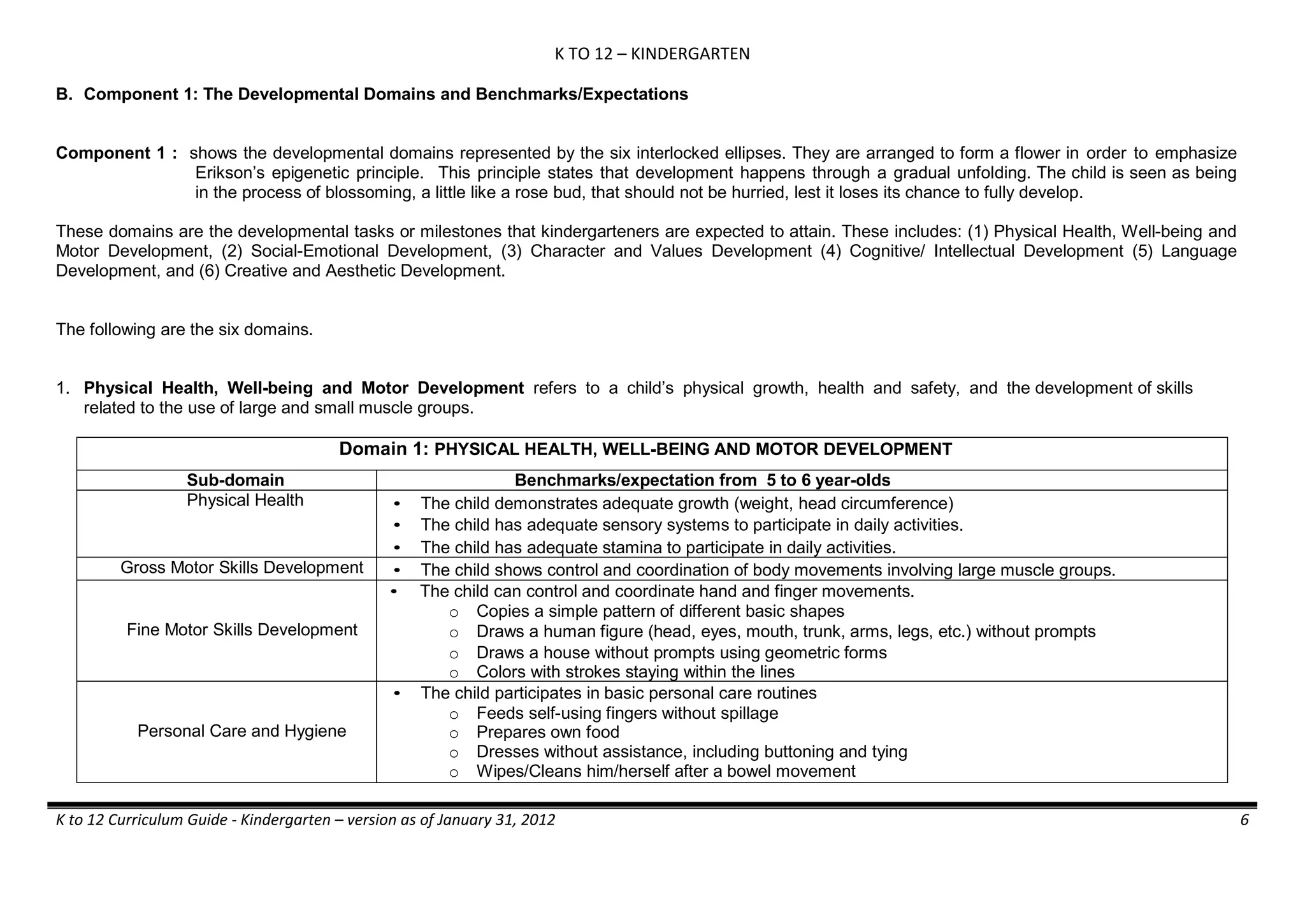
Domain 1: PHYSICAL HEALTH, WELL-BEING AND MOTOR DEVELOPMENT
Sub-domain Benchmarks/expectation from 5 to 6 year-olds
Physical Health • The child demonstrates adequate growth (weight, head circumference)
• The child has adequate sensory systems to participate in daily activities.
• The child has adequate stamina to participate in daily activities.
Gross Motor Skills Development • The child shows control and coordination of body movements involving large muscle groups.
Fine Motor Skills Development
• The child can control and coordinate hand and finger movements.
o Copies a simple pattern of different basic shapes
o Draws a human figure (head, eyes, mouth, trunk, arms, legs, etc.) without prompts
o Draws a house without prompts using geometric forms
o Colors with strokes staying within the lines
Personal Care and Hygiene
• The child participates in basic personal care routines
o Feeds self-using fingers without spillage
o Prepares own food
o Dresses without assistance, including buttoning and tying
o Wipes/Cleans him/herself after a bowel movement
K TO 12 – KINDERGARTEN
K to 12 Curriculum Guide - Kindergarten – version as of January 31, 2012 7
o Brushes teeth after meals without having to be told
o Washes and dries face independently without having to be told
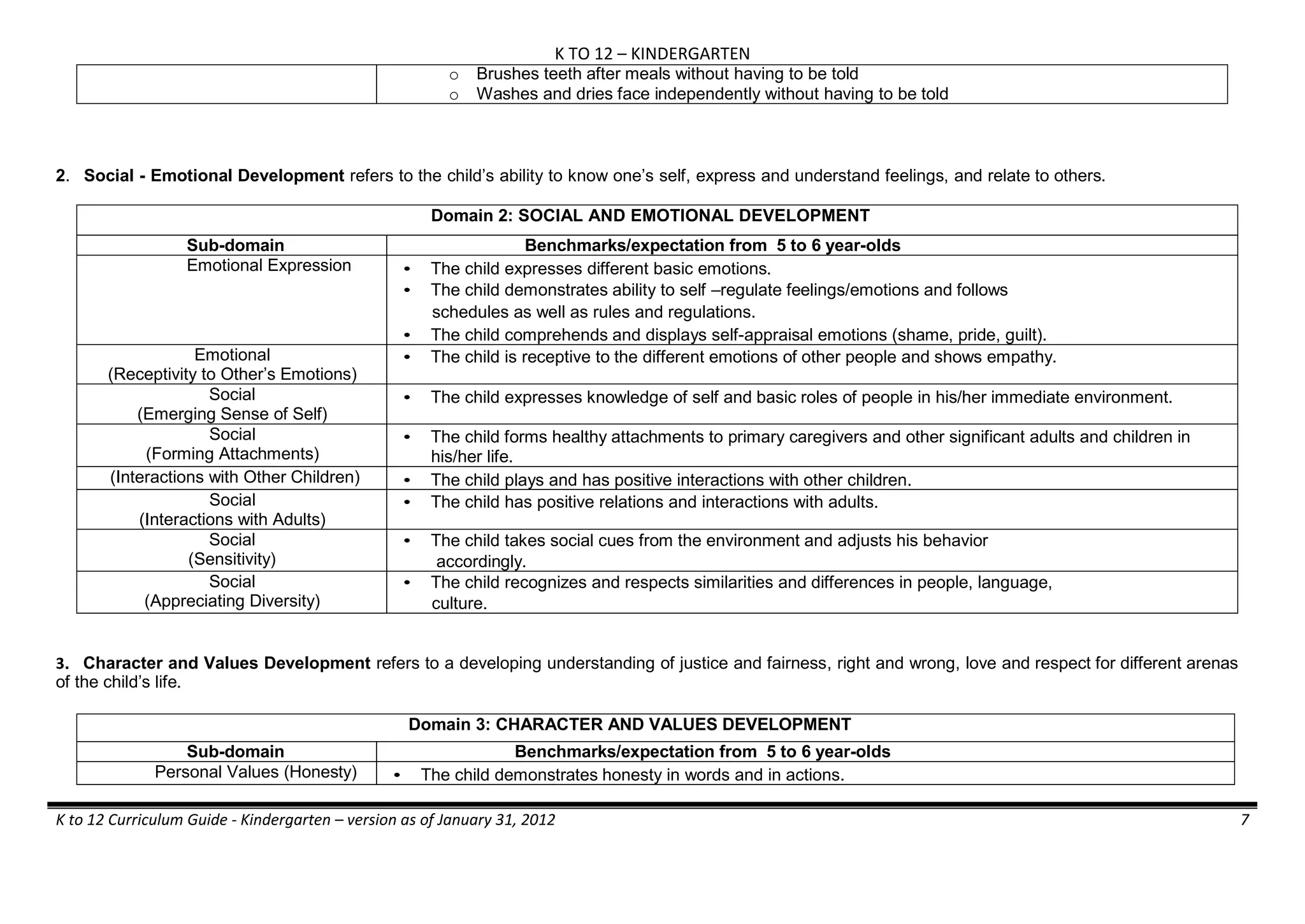
2. Social - Emotional Development refers to the child’s ability to know one’s self, express and understand feelings, and relate to others.
Domain 2: SOCIAL AND EMOTIONAL DEVELOPMENT
Sub-domain Benchmarks/expectation from 5 to 6 year-olds
Emotional Expression • The child expresses different basic emotions.
• The child demonstrates ability to self –regulate feelings/emotions and follows
schedules as well as rules and regulations.
• The child comprehends and displays self-appraisal emotions (shame, pride, guilt).
Emotional
(Receptivity to Other’s Emotions)
• The child is receptive to the different emotions of other people and shows empathy.
Social
(Emerging Sense of Self)
• The child expresses knowledge of self and basic roles of people in his/her immediate environment.
Social
(Forming Attachments)
• The child forms healthy attachments to primary caregivers and other significant adults and children in
his/her life.
(Interactions with Other Children) • The child plays and has positive interactions with other children.
Social
(Interactions with Adults)
• The child has positive relations and interactions with adults.
Social
(Sensitivity)
• The child takes social cues from the environment and adjusts his behavior
accordingly.
Social
(Appreciating Diversity)
• The child recognizes and respects similarities and differences in people, language,
culture.
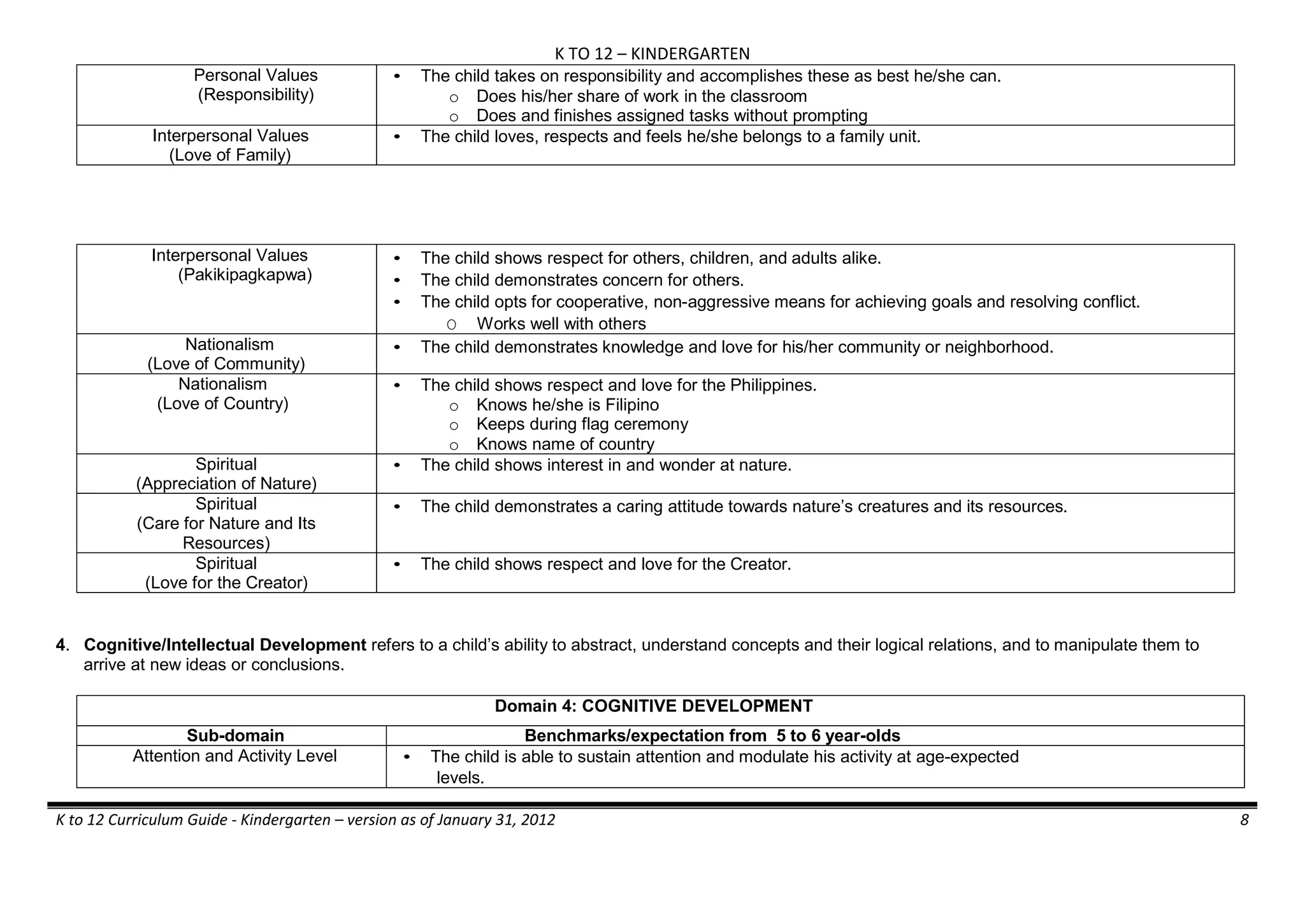
3. Character and Values Development refers to a developing understanding of justice and fairness, right and wrong, love and respect for different arenas
of the child’s life.
Domain 3: CHARACTER AND VALUES DEVELOPMENT
Sub-domain Benchmarks/expectation from 5 to 6 year-olds
Personal Values (Honesty) • The child demonstrates honesty in words and in actions.
K TO 12 – KINDERGARTEN
K to 12 Curriculum Guide - Kindergarten – version as of January 31, 2012 8
Personal Values
(Responsibility)
• The child takes on responsibility and accomplishes these as best he/she can.
o Does his/her share of work in the classroom
o Does and finishes assigned tasks without prompting
Interpersonal Values
(Love of Family)
• The child loves, respects and feels he/she belongs to a family unit.
Interpersonal Values
(Pakikipagkapwa)
• The child shows respect for others, children, and adults alike.
• The child demonstrates concern for others.
• The child opts for cooperative, non-aggressive means for achieving goals and resolving conflict.
O Works well with others
Nationalism
(Love of Community)
• The child demonstrates knowledge and love for his/her community or neighborhood.
Nationalism
(Love of Country)
• The child shows respect and love for the Philippines.
o Knows he/she is Filipino
o Keeps during flag ceremony
o Knows name of country
Spiritual
(Appreciation of Nature)
• The child shows interest in and wonder at nature.
Spiritual
(Care for Nature and Its
Resources)
• The child demonstrates a caring attitude towards nature’s creatures and its resources.
Spiritual
(Love for the Creator)
• The child shows respect and love for the Creator.
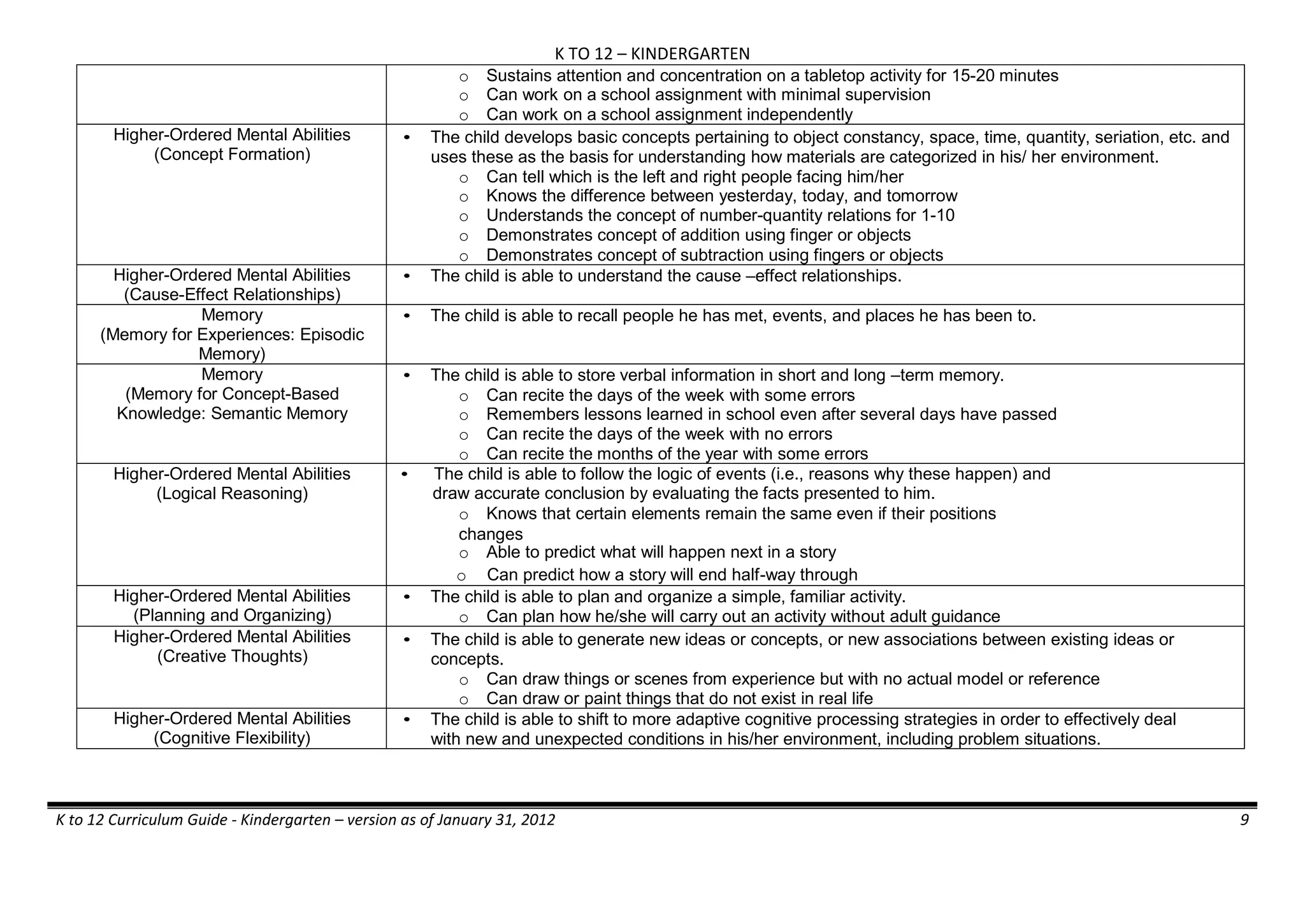
4. Cognitive/Intellectual Development refers to a child’s ability to abstract, understand concepts and their logical relations, and to manipulate them to
arrive at new ideas or conclusions.
Domain 4: COGNITIVE DEVELOPMENT
Sub-domain Benchmarks/expectation from 5 to 6 year-olds
Attention and Activity Level • The child is able to sustain attention and modulate his activity at age-expected
levels.
K TO 12 – KINDERGARTEN
K to 12 Curriculum Guide - Kindergarten – version as of January 31, 2012 9
o Sustains attention and concentration on a tabletop activity for 15-20 minutes
o Can work on a school assignment with minimal supervision
o Can work on a school assignment independently
Higher-Ordered Mental Abilities
(Concept Formation)
• The child develops basic concepts pertaining to object constancy, space, time, quantity, seriation, etc. and
uses these as the basis for understanding how materials are categorized in his/ her environment.
o Can tell which is the left and right people facing him/her
o Knows the difference between yesterday, today, and tomorrow
o Understands the concept of number-quantity relations for 1-10
o Demonstrates concept of addition using finger or objects
o Demonstrates concept of subtraction using fingers or objects
Higher-Ordered Mental Abilities
(Cause-Effect Relationships)
• The child is able to understand the cause –effect relationships.
Memory
(Memory for Experiences: Episodic
Memory)
• The child is able to recall people he has met, events, and places he has been to.
Memory
(Memory for Concept-Based
Knowledge: Semantic Memory
• The child is able to store verbal information in short and long –term memory.
o Can recite the days of the week with some errors
o Remembers lessons learned in school even after several days have passed
o Can recite the days of the week with no errors
o Can recite the months of the year with some errors
Higher-Ordered Mental Abilities
(Logical Reasoning)
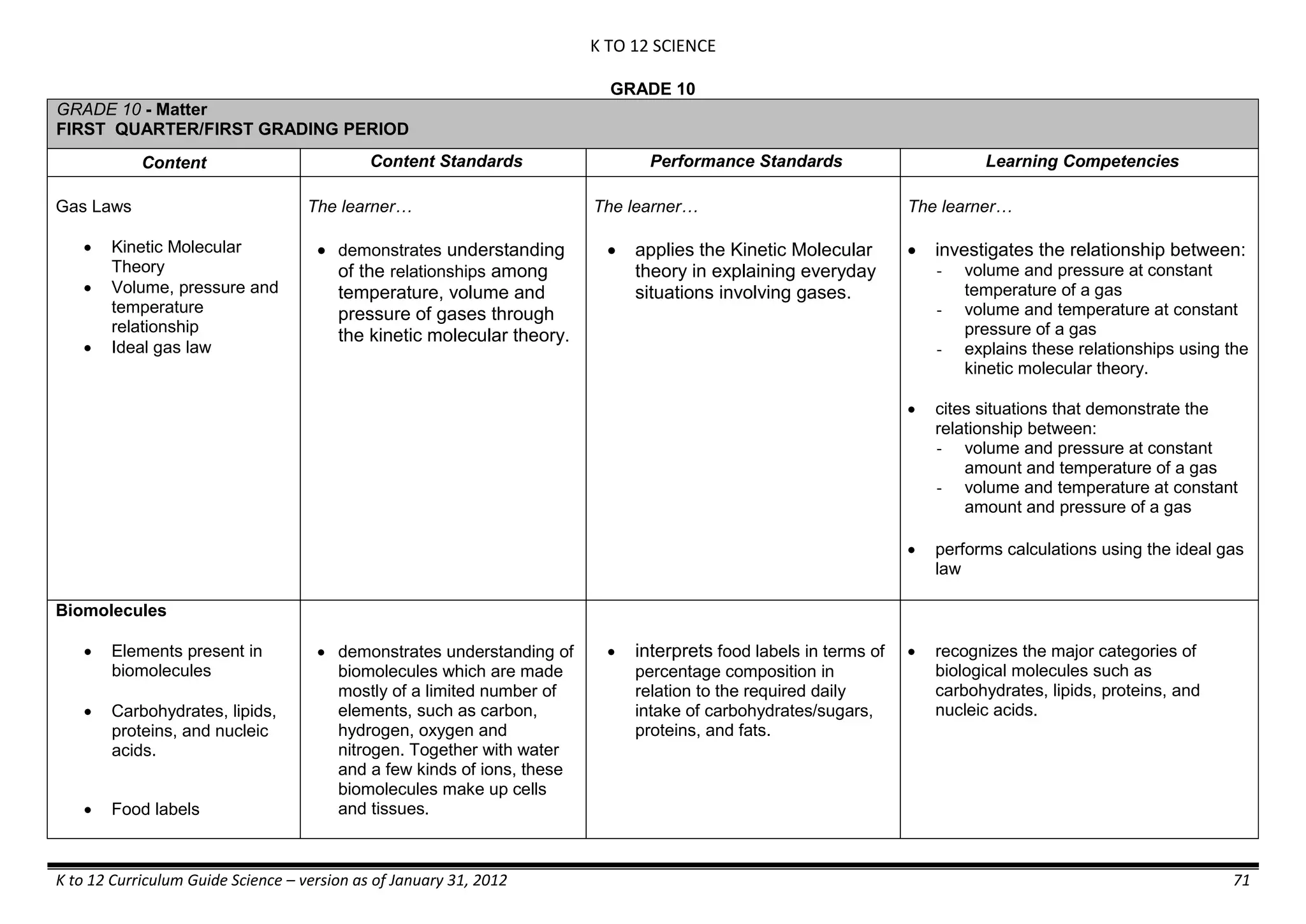
• The child is able to follow the logic of events (i.e., reasons why these happen) and
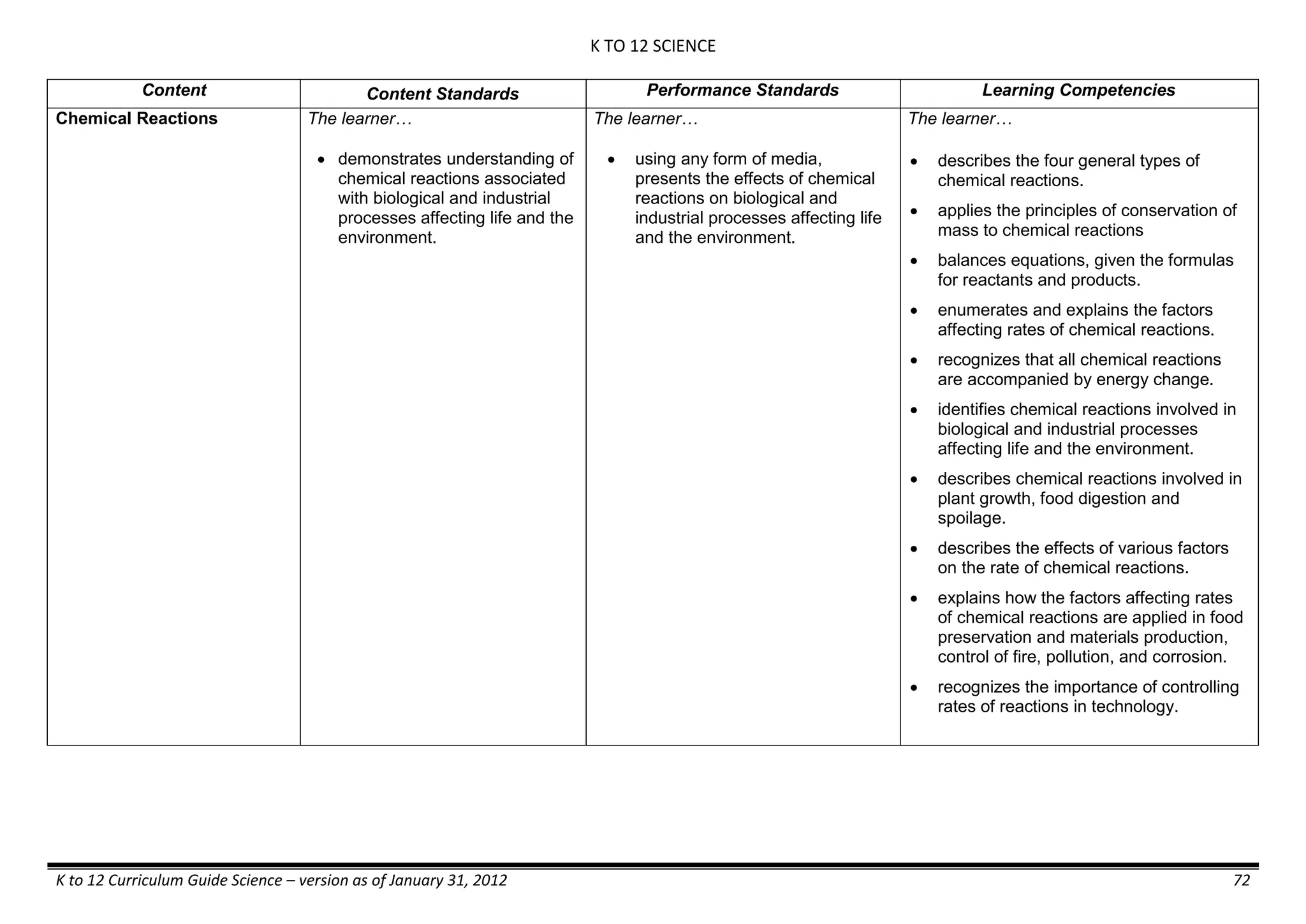
draw accurate conclusion by evaluating the facts presented to him.
o Knows that certain elements remain the same even if their positions
changes
o Able to predict what will happen next in a story
o Can predict how a story will end half-way through
Higher-Ordered Mental Abilities
(Planning and Organizing)
• The child is able to plan and organize a simple, familiar activity.
o Can plan how he/she will carry out an activity without adult guidance
Higher-Ordered Mental Abilities
(Creative Thoughts)
• The child is able to generate new ideas or concepts, or new associations between existing ideas or
concepts.
o Can draw things or scenes from experience but with no actual model or reference
o Can draw or paint things that do not exist in real life
Higher-Ordered Mental Abilities
(Cognitive Flexibility)
• The child is able to shift to more adaptive cognitive processing strategies in order to effectively deal
with new and unexpected conditions in his/her environment, including problem situations.
K TO 12 – KINDERGARTEN
K to 12 Curriculum Guide - Kindergarten – version as of January 31, 2012 10
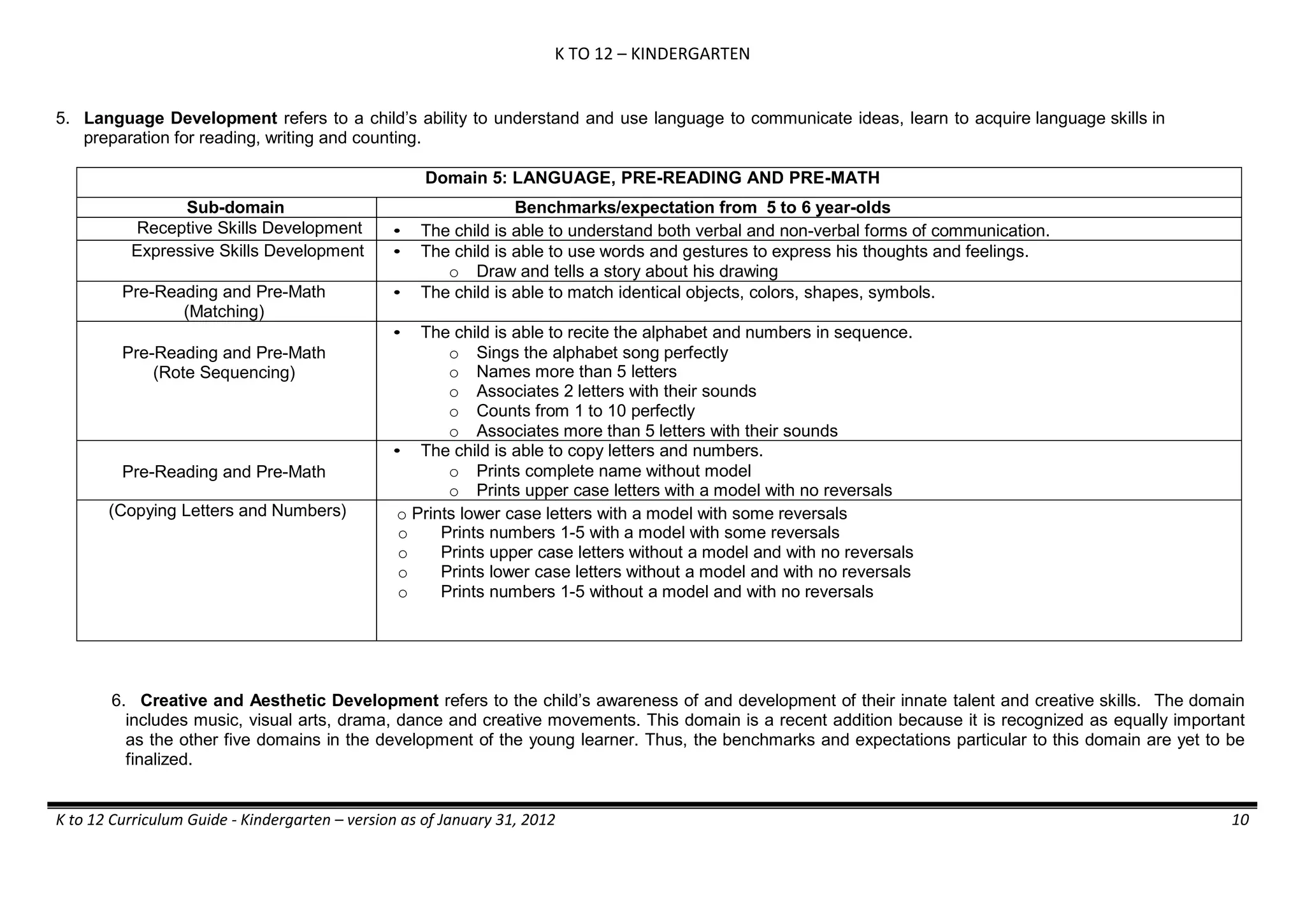
5. Language Development refers to a child’s ability to understand and use language to communicate ideas, learn to acquire language skills in
preparation for reading, writing and counting.
Domain 5: LANGUAGE, PRE-READING AND PRE-MATH
Sub-domain Benchmarks/expectation from 5 to 6 year-olds
Receptive Skills Development • The child is able to understand both verbal and non-verbal forms of communication.
Expressive Skills Development • The child is able to use words and gestures to express his thoughts and feelings.
o Draw and tells a story about his drawing
Pre-Reading and Pre-Math
(Matching)
• The child is able to match identical objects, colors, shapes, symbols.
Pre-Reading and Pre-Math
(Rote Sequencing)
• The child is able to recite the alphabet and numbers in sequence.
o Sings the alphabet song perfectly
o Names more than 5 letters
o Associates 2 letters with their sounds
o Counts from 1 to 10 perfectly
o Associates more than 5 letters with their sounds
Pre-Reading and Pre-Math
• The child is able to copy letters and numbers.
o Prints complete name without model
o Prints upper case letters with a model with no reversals
(Copying Letters and Numbers) o Prints lower case letters with a model with some reversals
o Prints numbers 1-5 with a model with some reversals
o Prints upper case letters without a model and with no reversals
o Prints lower case letters without a model and with no reversals
o Prints numbers 1-5 without a model and with no reversals
6. Creative and Aesthetic Development refers to the child’s awareness of and development of their innate talent and creative skills. The domain
includes music, visual arts, drama, dance and creative movements. This domain is a recent addition because it is recognized as equally important
as the other five domains in the development of the young learner. Thus, the benchmarks and expectations particular to this domain are yet to be
finalized.
K TO 12 – KINDERGARTEN
K to 12 Curriculum Guide - Kindergarten – version as of January 31, 2012 11
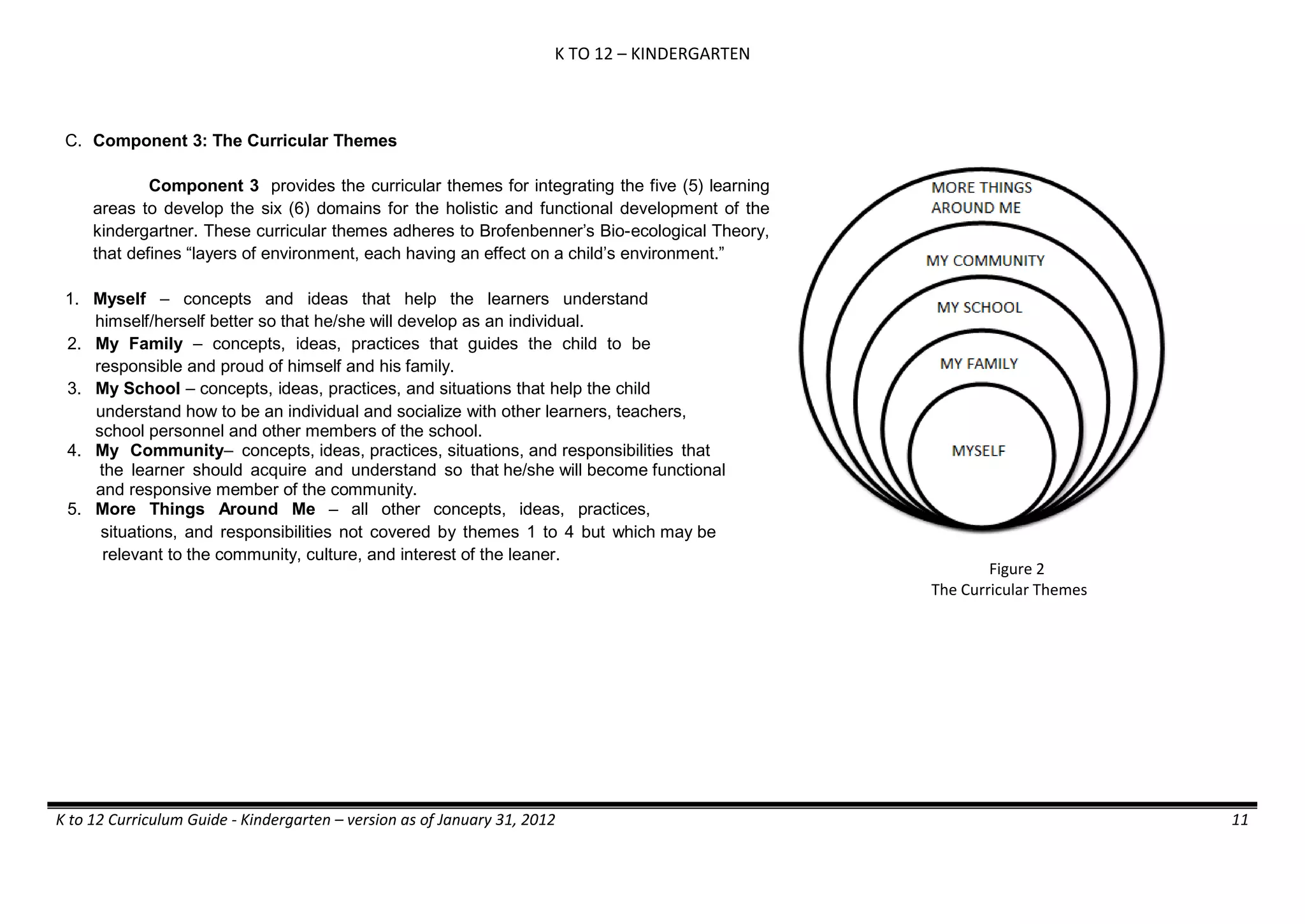
C. Component 3: The Curricular Themes
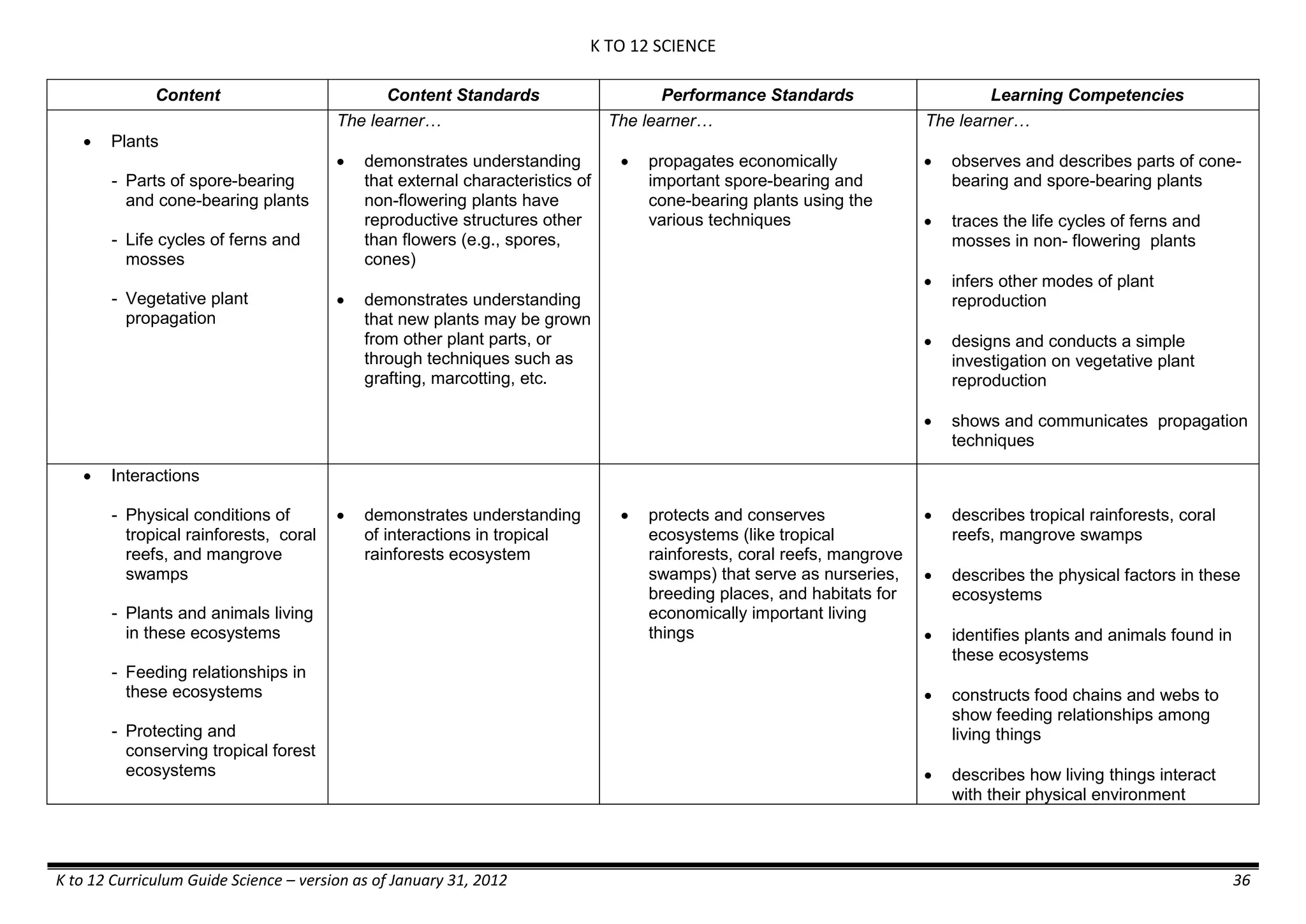
Component 3 provides the curricular themes for integrating the five (5) learning
areas to develop the six (6) domains for the holistic and functional development of the
kindergartner. These curricular themes adheres to Brofenbenner’s Bio-ecological Theory,
that defines “layers of environment, each having an effect on a child’s environment.”
1. Myself – concepts and ideas that help the learners understand
himself/herself better so that he/she will develop as an individual.
2. My Family – concepts, ideas, practices that guides the child to be
responsible and proud of himself and his family.
3. My School – concepts, ideas, practices, and situations that help the child
understand how to be an individual and socialize with other learners, teachers,
school personnel and other members of the school.
4. My Community– concepts, ideas, practices, situations, and responsibilities that
the learner should acquire and understand so that he/she will become functional
and responsive member of the community.
5. More Things Around Me – all other concepts, ideas, practices,
situations, and responsibilities not covered by themes 1 to 4 but which may be
relevant to the community, culture, and interest of the leaner.
Figure 2
The Curricular Themes
K TO 12 – KINDERGARTEN
K to 12 Curriculum Guide - Kindergarten – version as of January 31, 2012 12
III. OVERALL GOAL AND OUTCOMES
A. Overall Goal: Five-year old Filipino children will be prepared for life.
B. Outcomes:
By the end of the KINDERGARTEN year, we will have children who are:
effective communicators in their mother tongues;
healthy and physically active;
respectful, honest, God-loving;
proud of themselves, their family, culture, heritage and country;
creative and appreciative of the arts, and caring of the environment;
inquisitive, enthusiastic and engaged learners.
K TO 12 – KINDERGARTEN
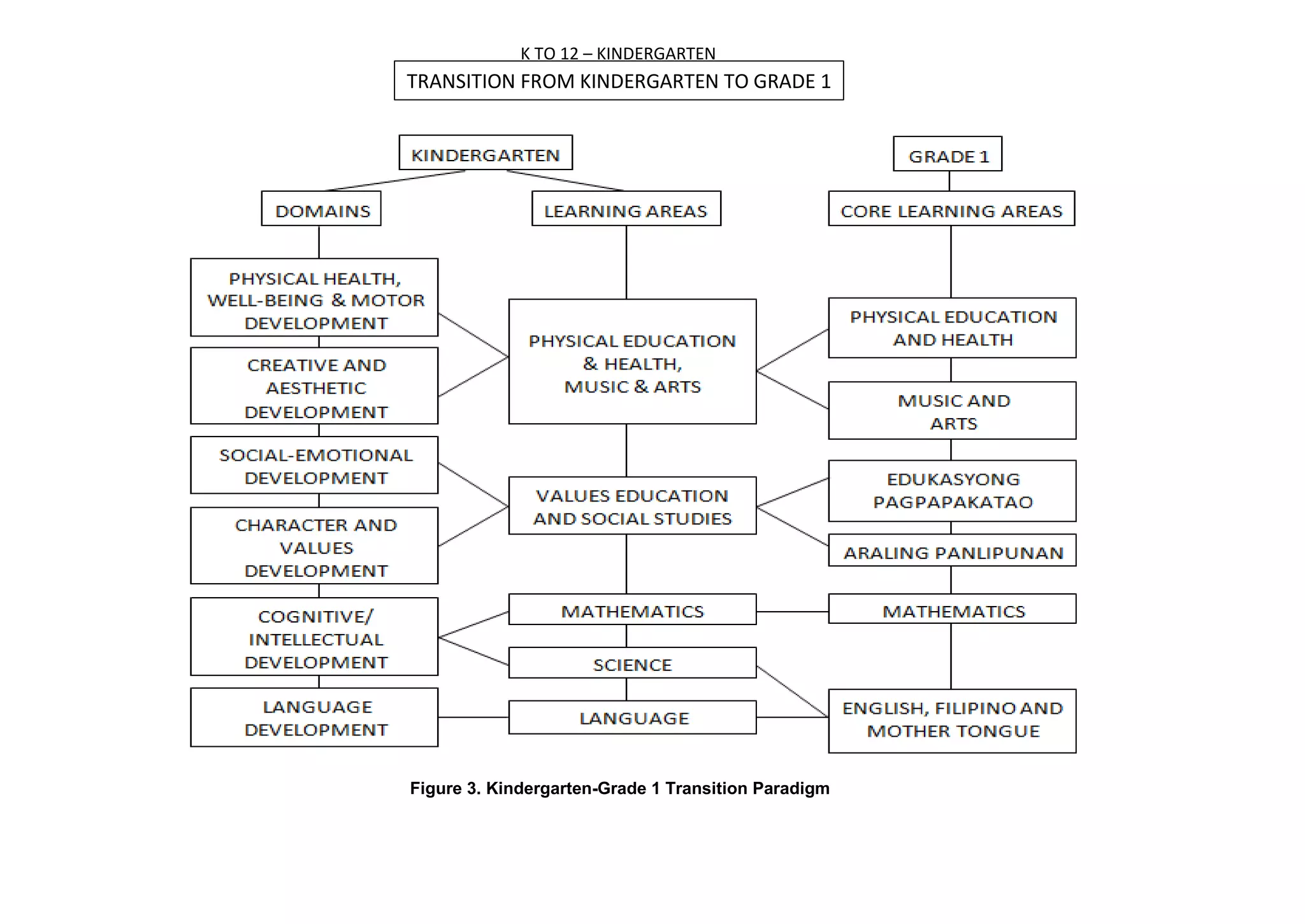
TRANSITION FROM KINDERGARTEN TO GRADE 1
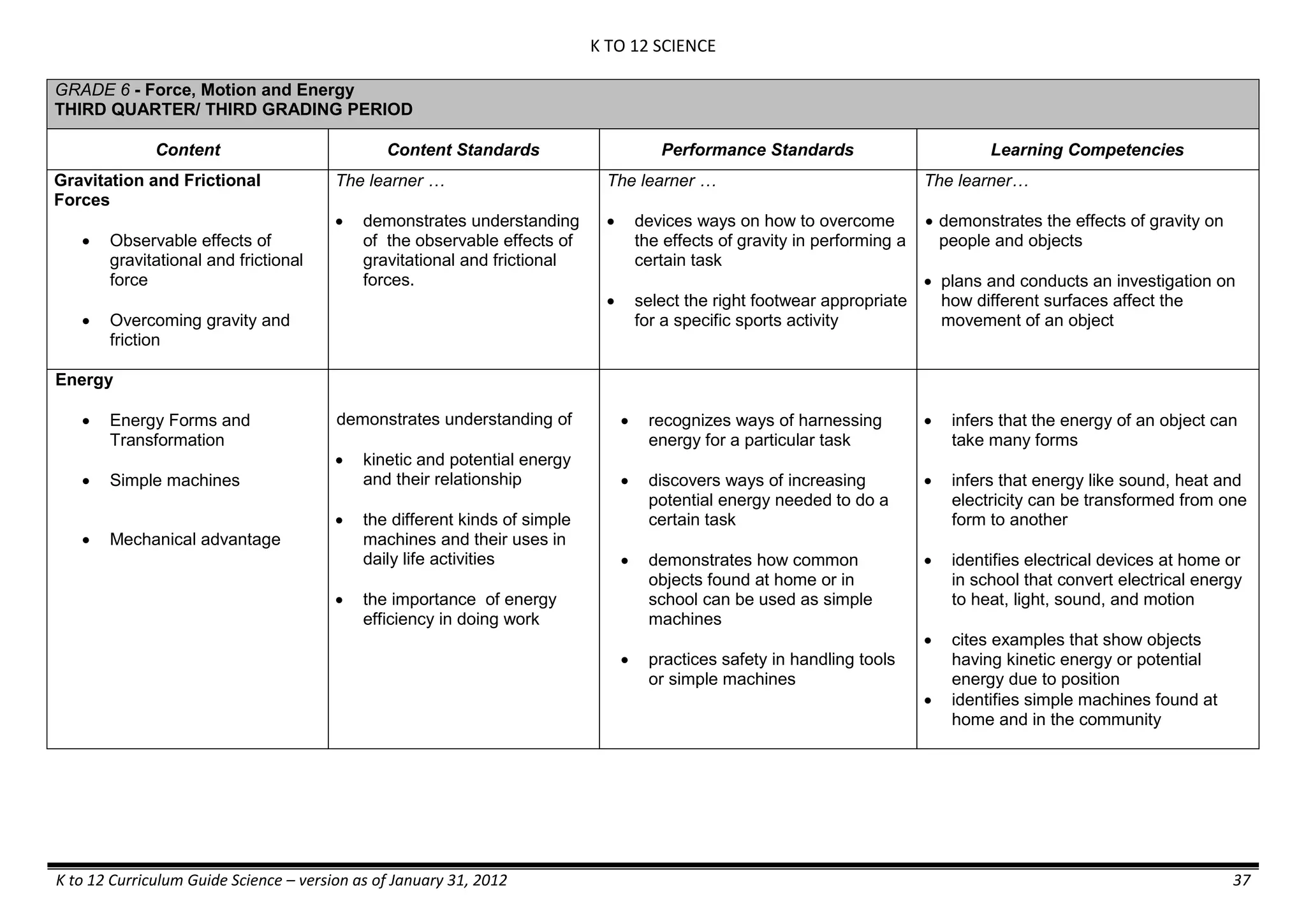
Figure 3. Kindergarten-Grade 1 Transition Paradigm
Transition Paradigm
Kindergarten Education generally addresses the different developmental domains of the 5-year olds. But, as mentioned earlier, the domains are amorphous
or do not have shape; hence
learning areas are identified.
The learning areas transition the domain-based curriculum of kindergarten to the content-based curriculum of grade 1 to 12. This design allows for a
smooth transition from Kindergarten to grade 1 thereby making it seamless.
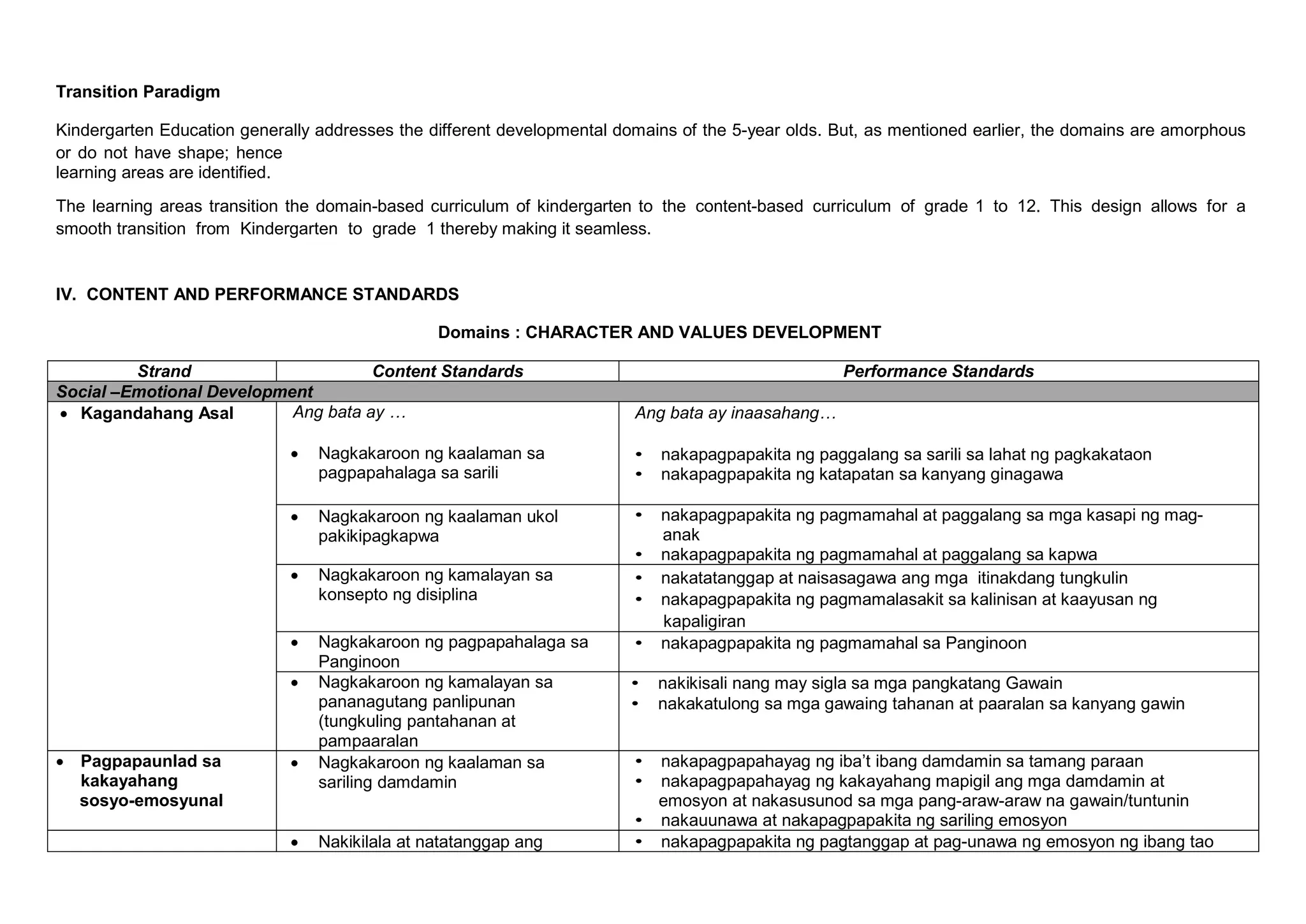
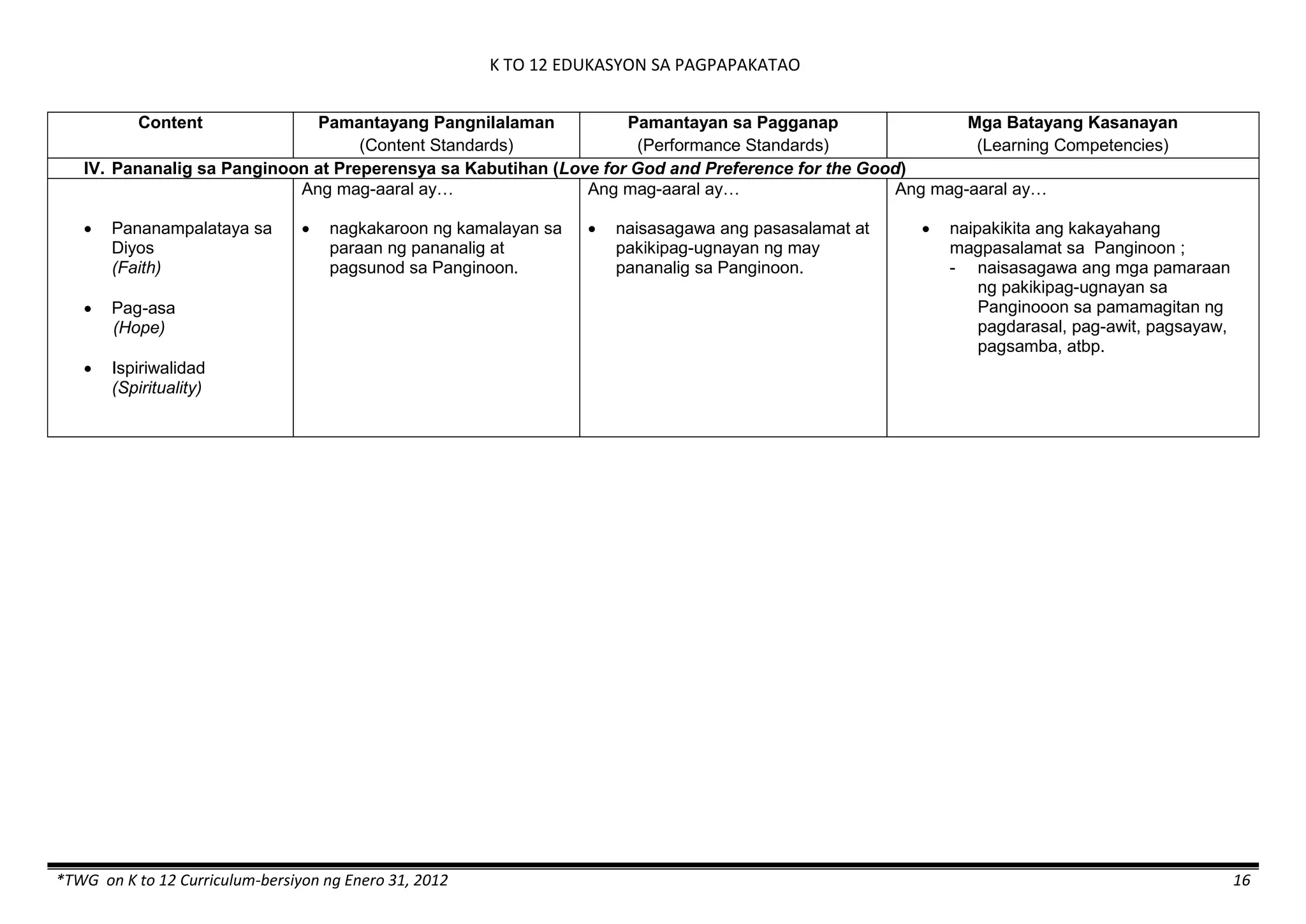
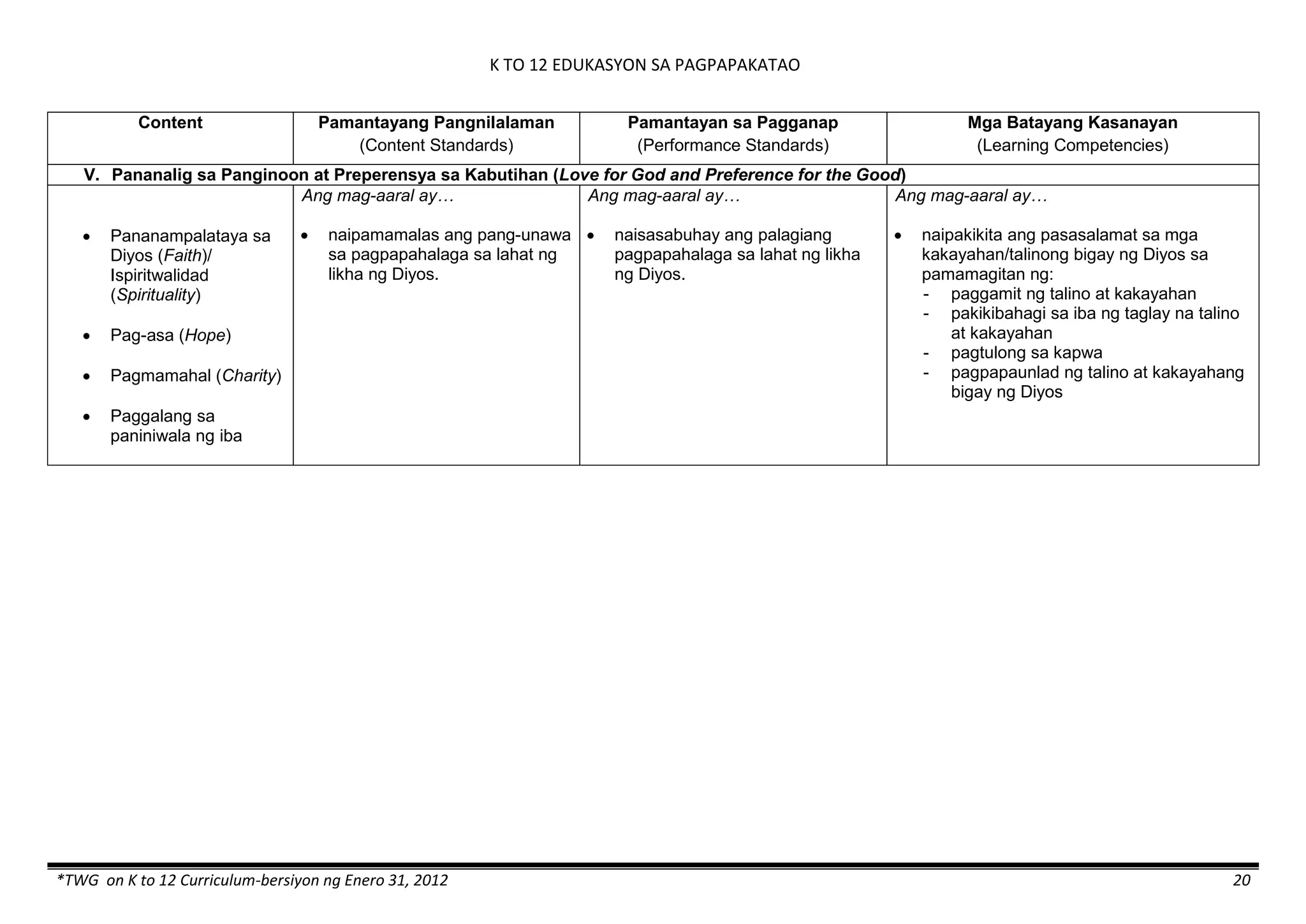
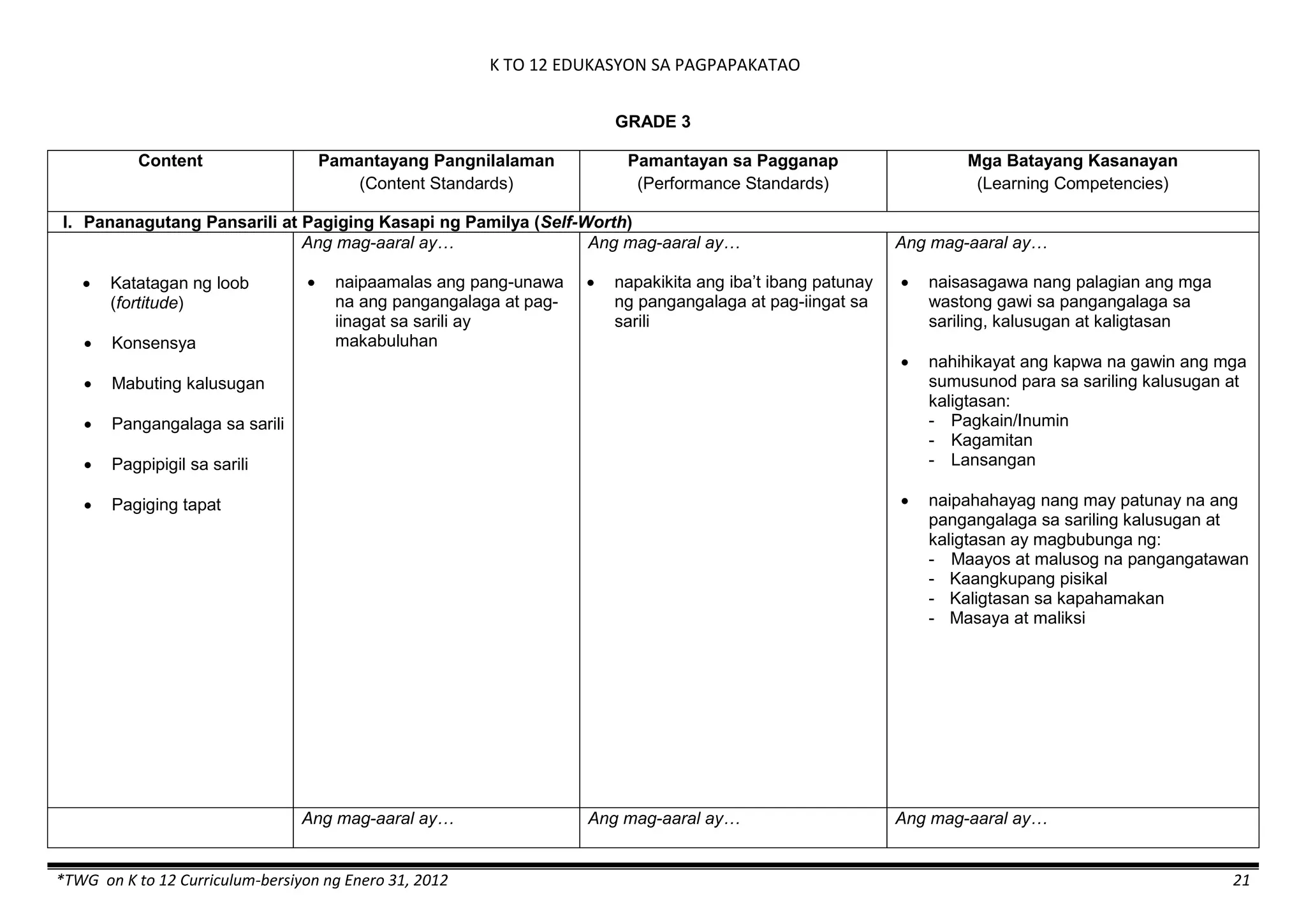
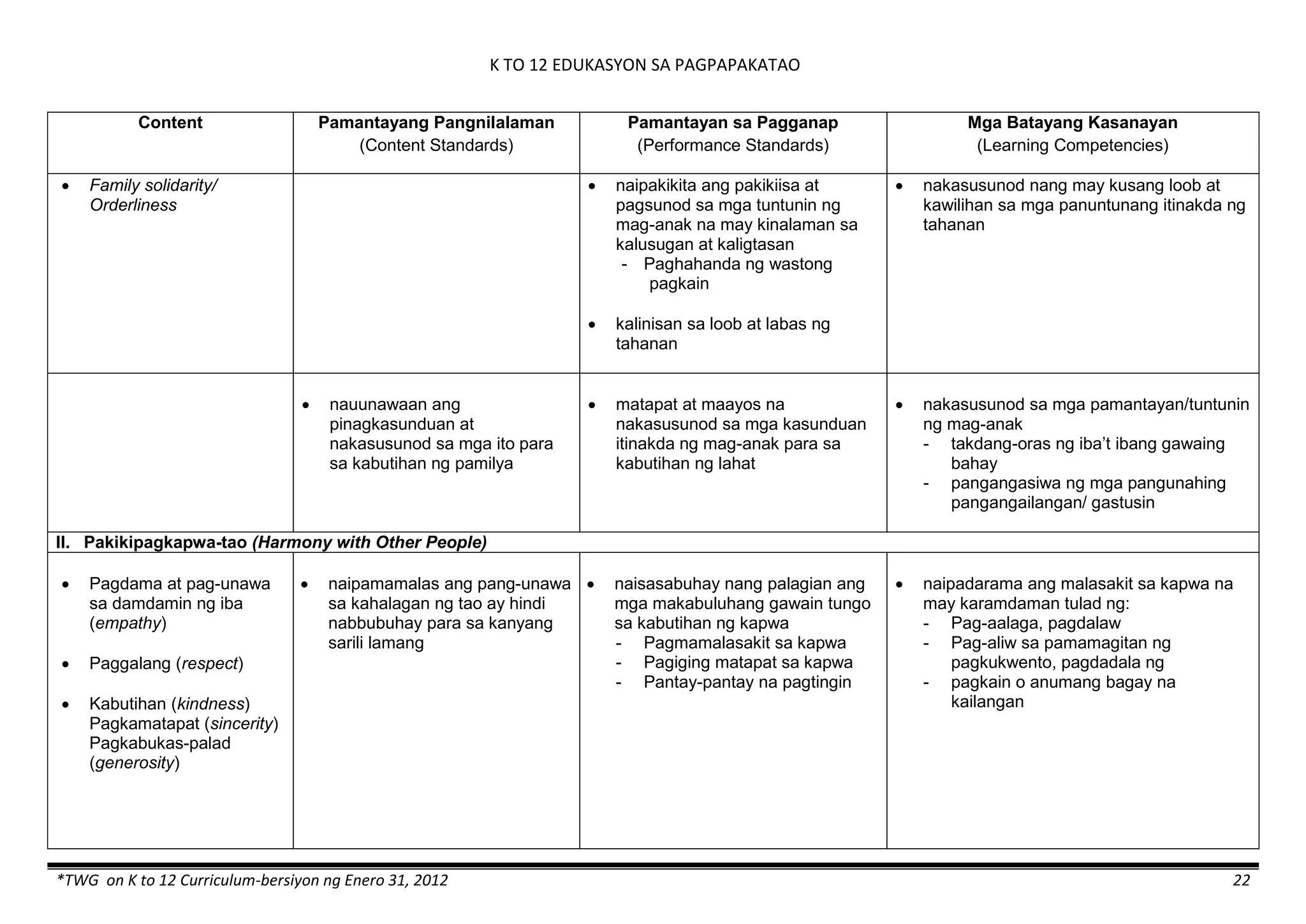
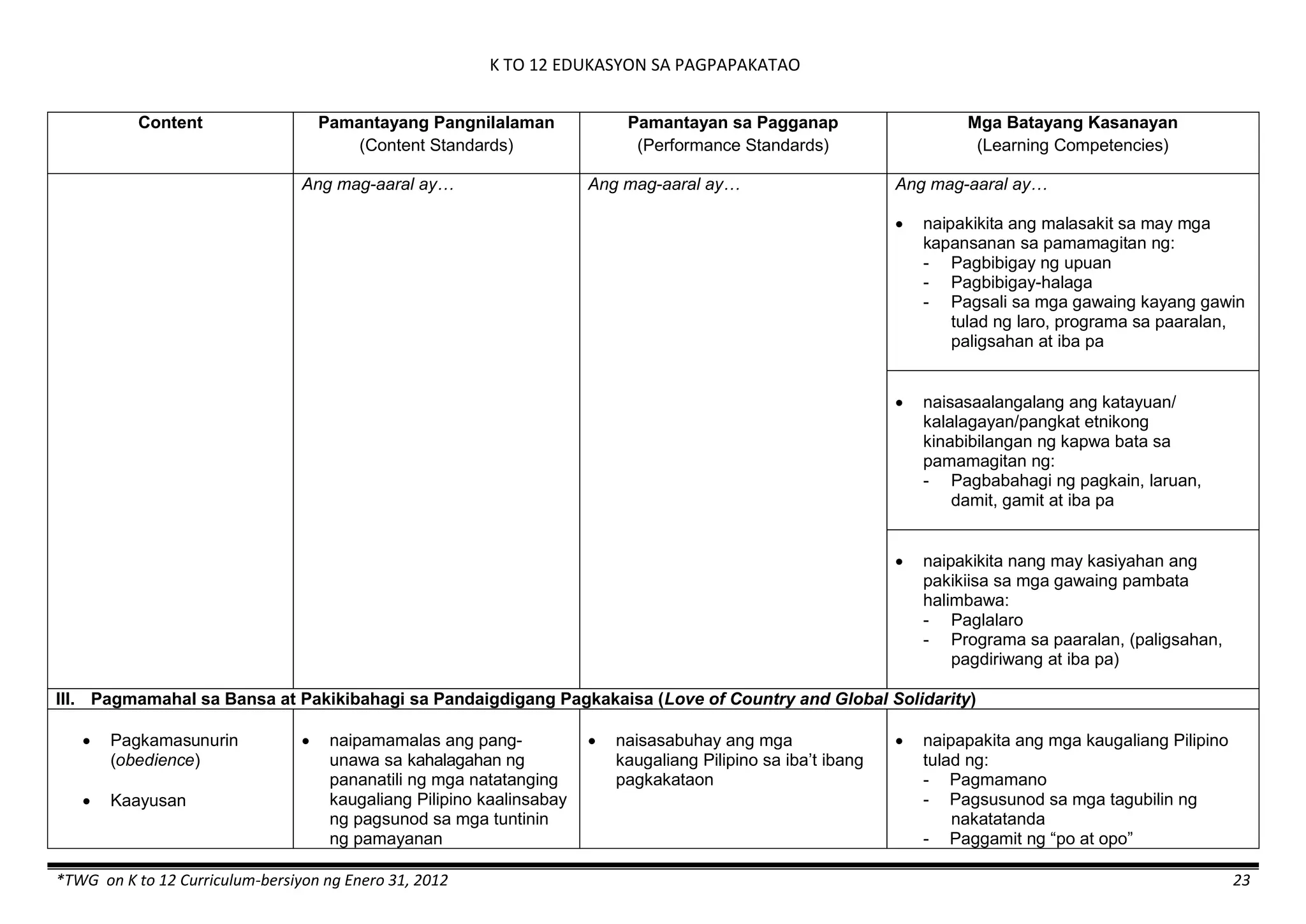
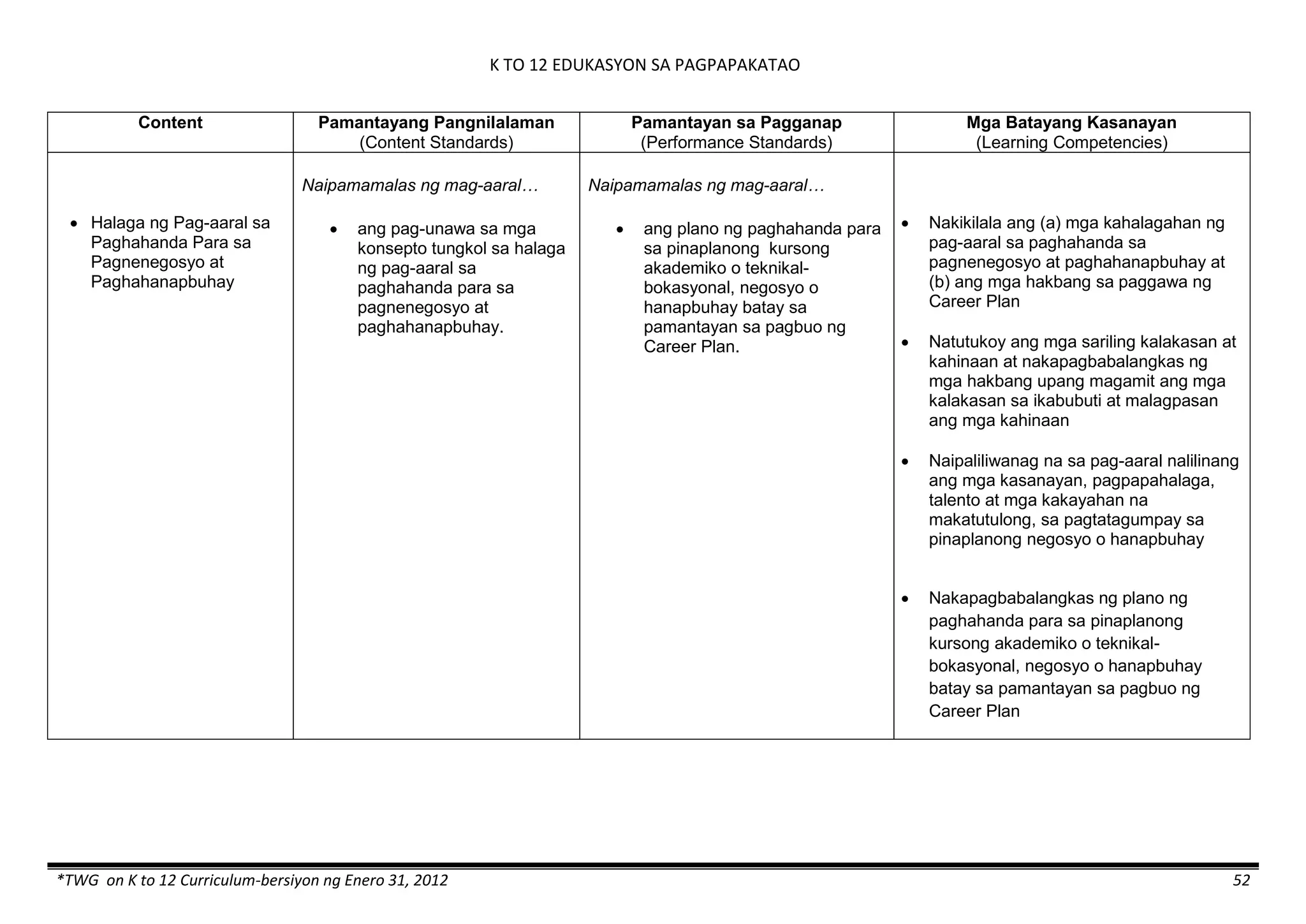
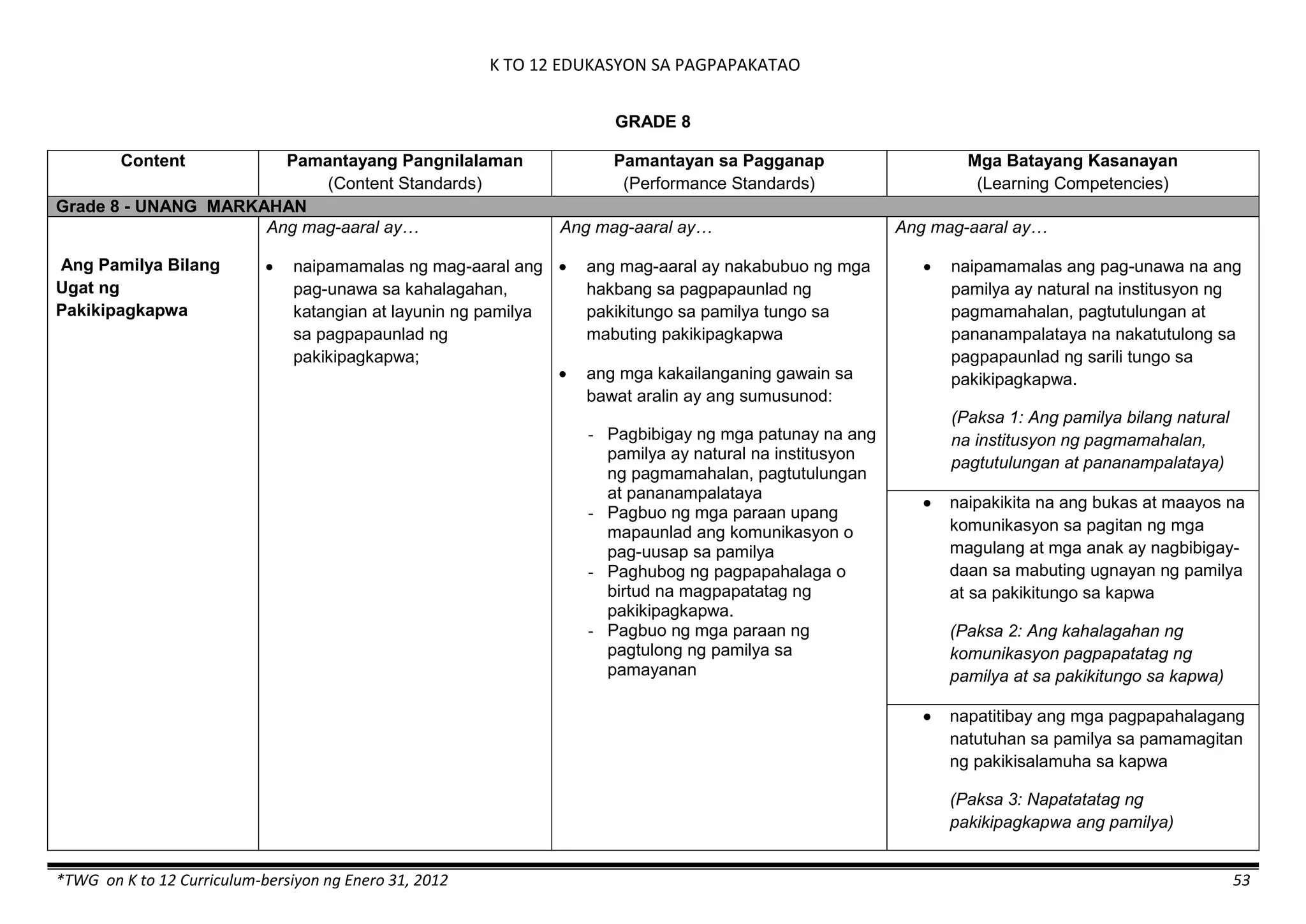
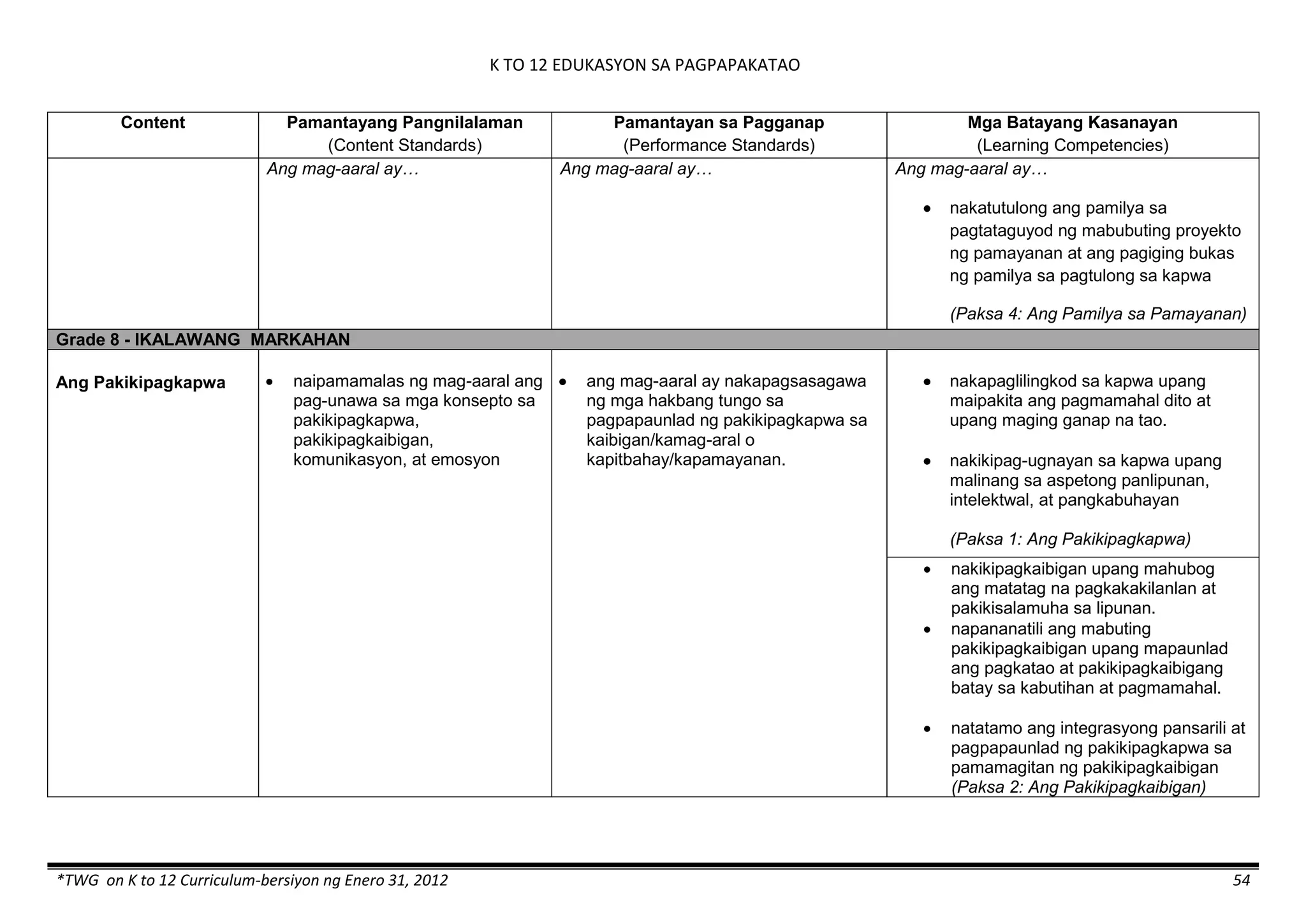
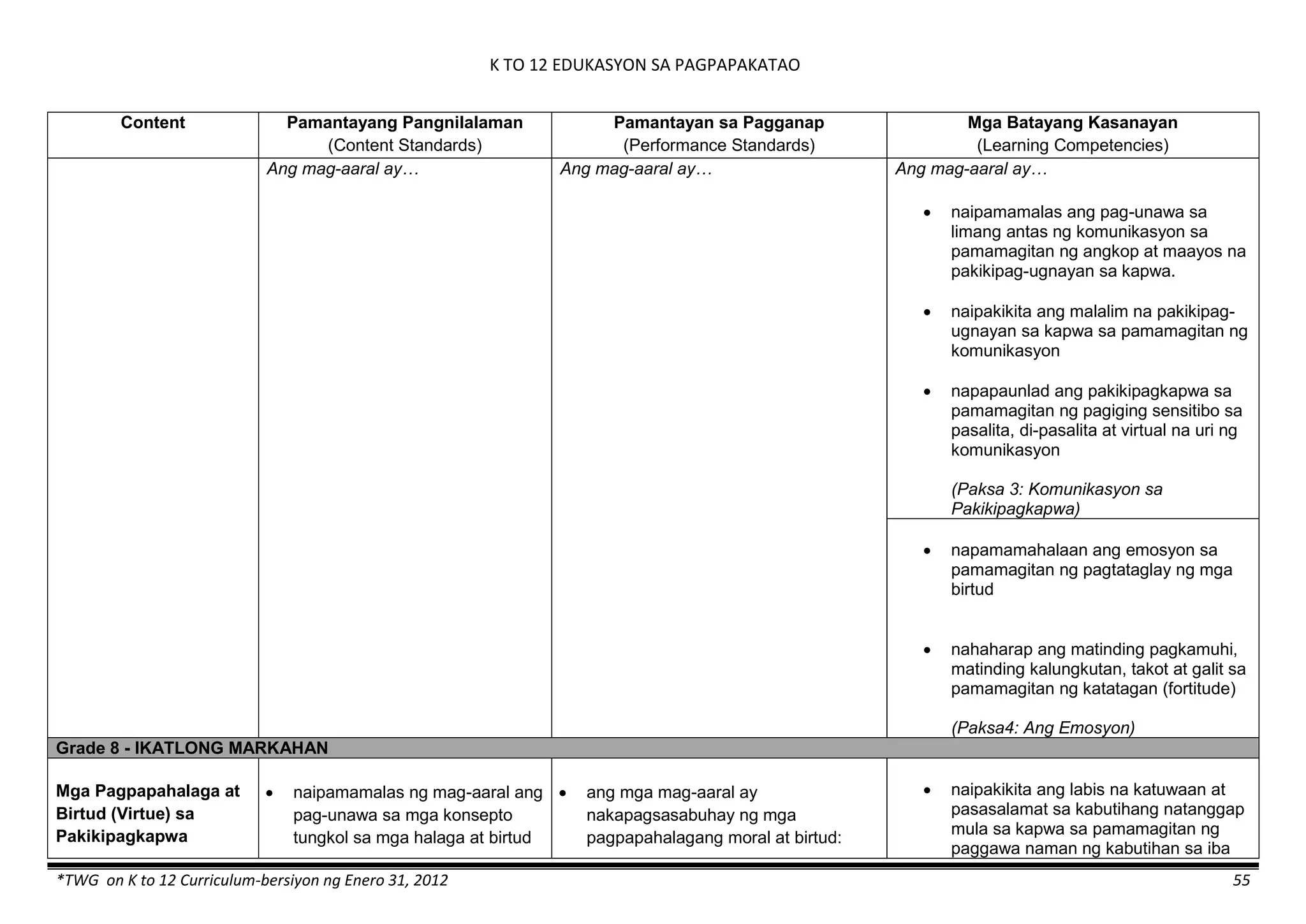
IV. CONTENT AND PERFORMANCE STANDARDS
Domains : CHARACTER AND VALUES DEVELOPMENT
Strand Content Standards Performance Standards
Social –Emotional Development
 Kagandahang Asal Ang bata ay …
 Nagkakaroon ng kaalaman sa
pagpapahalaga sa sarili
Ang bata ay inaasahang…
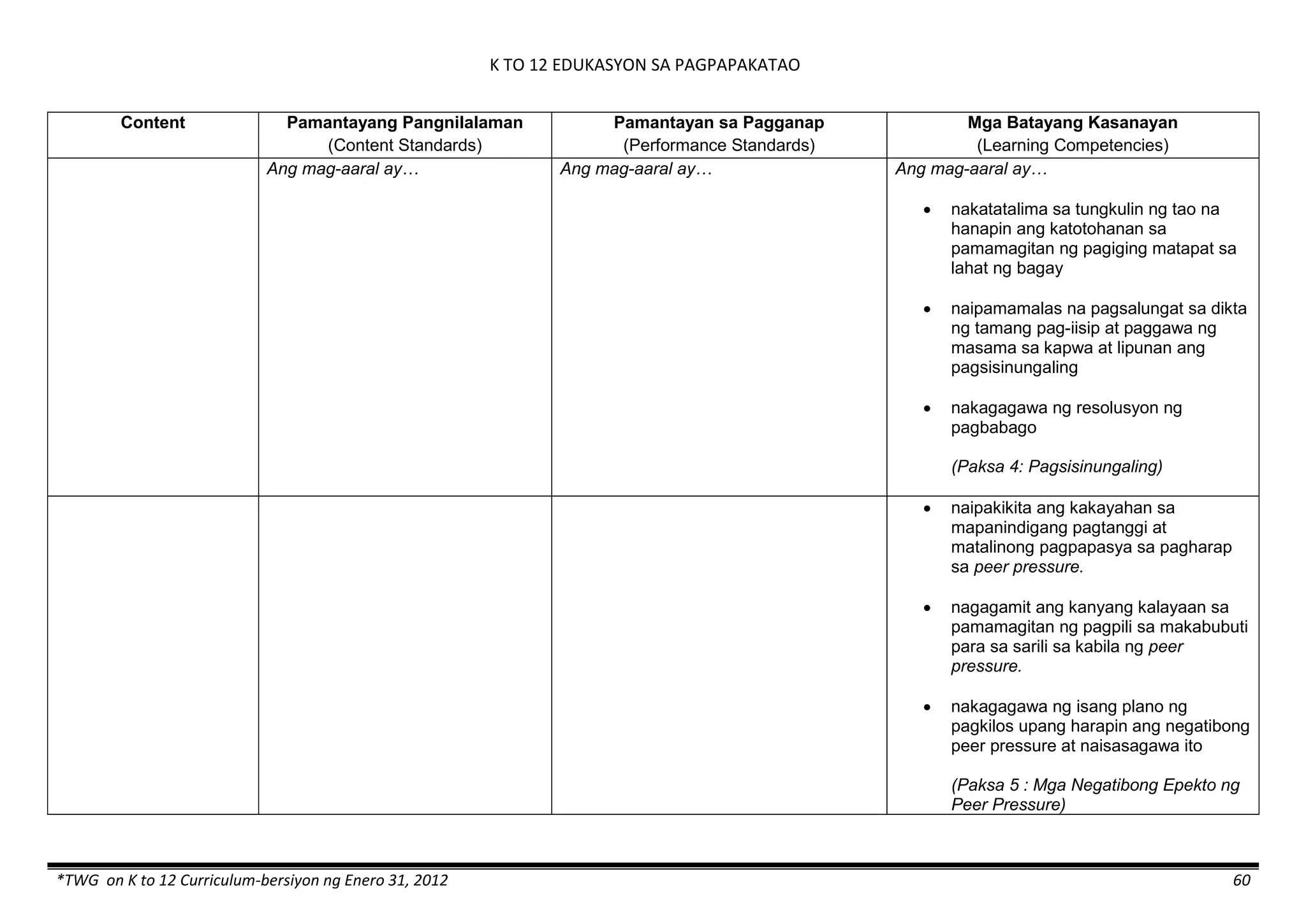
• nakapagpapakita ng paggalang sa sarili sa lahat ng pagkakataon
• nakapagpapakita ng katapatan sa kanyang ginagawa
 Nagkakaroon ng kaalaman ukol
pakikipagkapwa
• nakapagpapakita ng pagmamahal at paggalang sa mga kasapi ng mag-
anak
• nakapagpapakita ng pagmamahal at paggalang sa kapwa
 Nagkakaroon ng kamalayan sa
konsepto ng disiplina
• nakatatanggap at naisasagawa ang mga itinakdang tungkulin
• nakapagpapakita ng pagmamalasakit sa kalinisan at kaayusan ng
kapaligiran
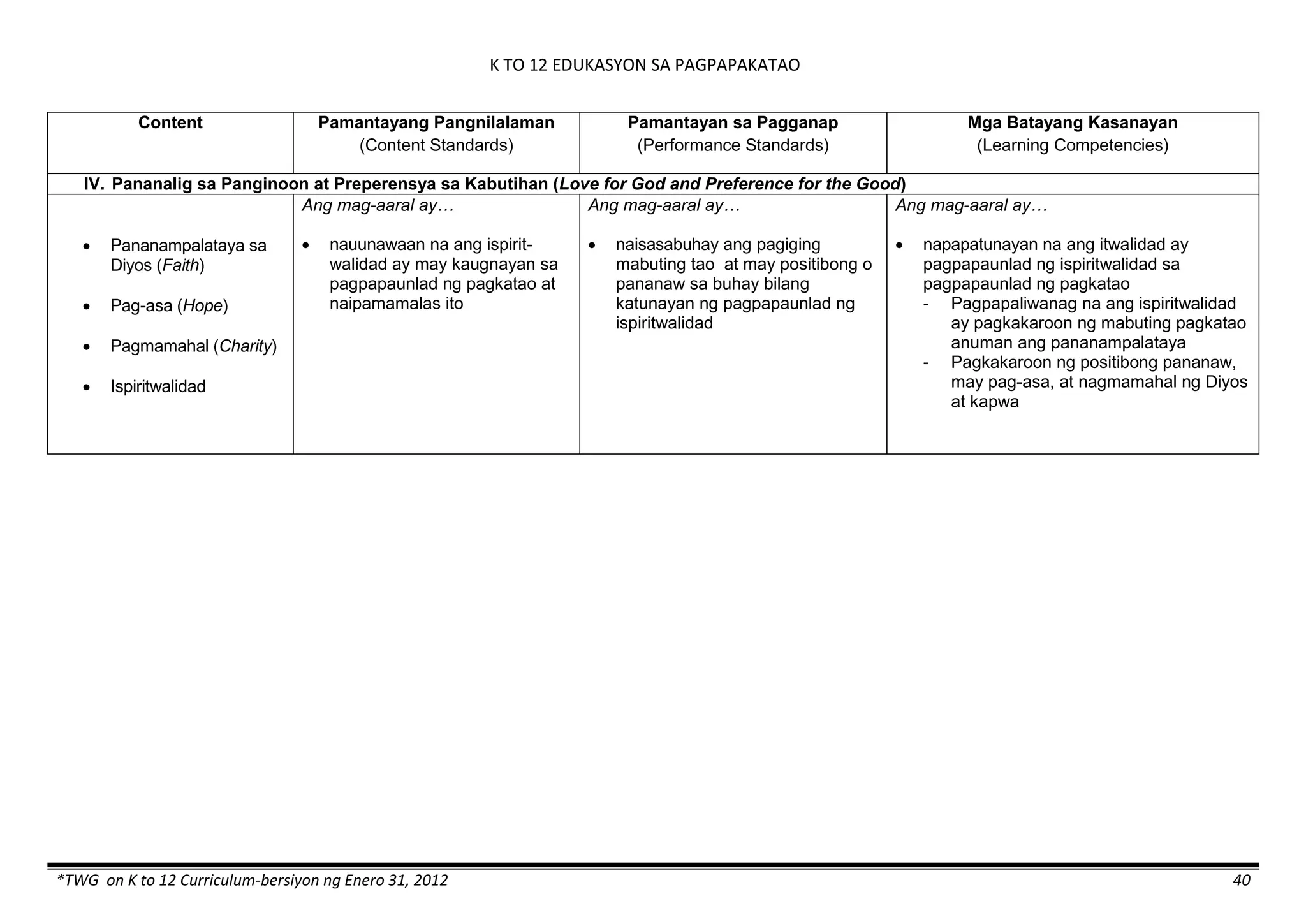
 Nagkakaroon ng pagpapahalaga sa
Panginoon
• nakapagpapakita ng pagmamahal sa Panginoon
 Nagkakaroon ng kamalayan sa
pananagutang panlipunan
(tungkuling pantahanan at
pampaaralan
• nakikisali nang may sigla sa mga pangkatang Gawain
• nakakatulong sa mga gawaing tahanan at paaralan sa kanyang gawin
 Pagpapaunlad sa
kakayahang
sosyo-emosyunal
 Nagkakaroon ng kaalaman sa
sariling damdamin
• nakapagpapahayag ng iba’t ibang damdamin sa tamang paraan
• nakapagpapahayag ng kakayahang mapigil ang mga damdamin at
emosyon at nakasusunod sa mga pang-araw-araw na gawain/tuntunin
• nakauunawa at nakapagpapakita ng sariling emosyon
 Nakikilala at natatanggap ang • nakapagpapakita ng pagtanggap at pag-unawa ng emosyon ng ibang tao
K TO 12 - KINDERGARTEN
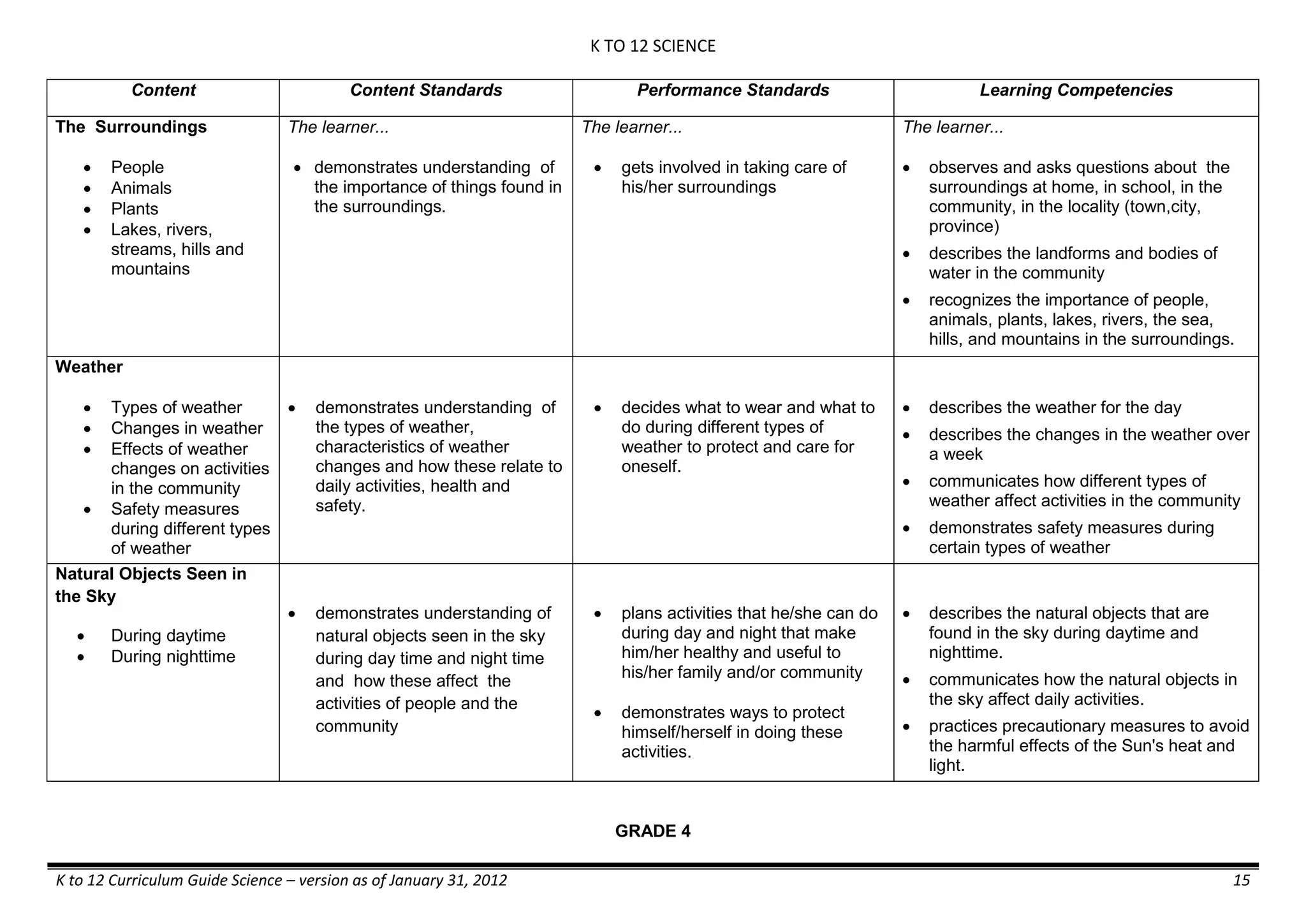
K to 12 Curriculum Guide Science – version as of January 31, 2012 15
emosyon ng ibang tao at nakapagpapahiwatig ng pagdamay sa damdamin ng iba (empathy)
• naipahihiwatig ang akma at katanggap-tangap na reaksiyon sa damdamin
ng iba
• naisasaalang-alang and damdamin ng iba at nakikisali sa kasiyahan
/nakikiramay sa kalungkutan ng iba
 Nagkakaroon ng mabuting
pakikipag-ugnayan sa kapwa at
nakatatanda
• nakapagsisimula ng laro
• naipadadama at naipakikita ang pagmamahal sa mga nakatatanda at
mga bata
• nakikisalamuha sa mga kilalang nakatatanda sa pamamagitan
pakikipag-usap at pakikipaglaro
 Nagkakaroon ng kamalayan ukol sa
pagkakaiba ng tao
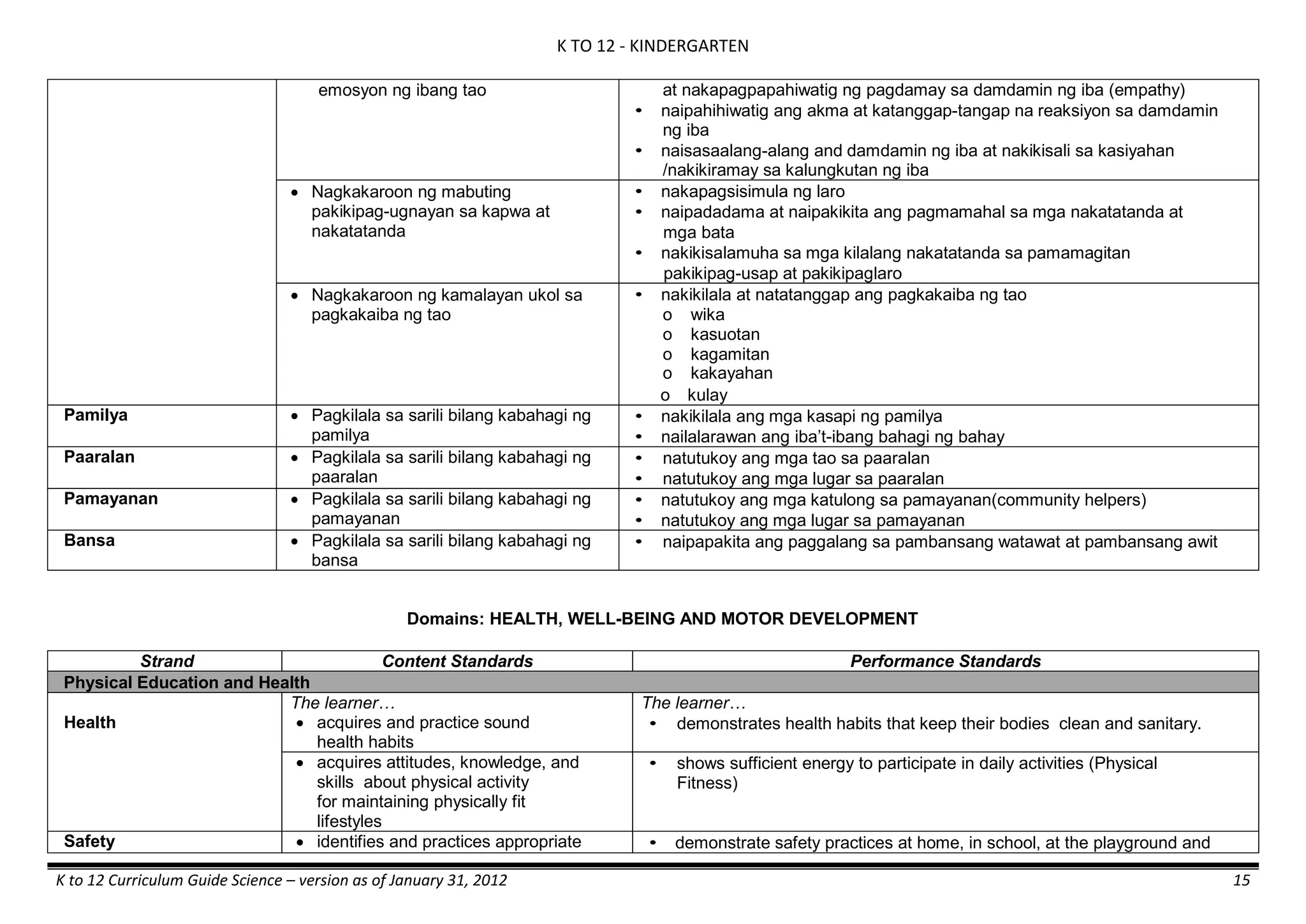
• nakikilala at natatanggap ang pagkakaiba ng tao
o wika
o kasuotan
o kagamitan
o kakayahan
o kulay
Pamilya  Pagkilala sa sarili bilang kabahagi ng
pamilya
• nakikilala ang mga kasapi ng pamilya
• nailalarawan ang iba’t-ibang bahagi ng bahay
Paaralan  Pagkilala sa sarili bilang kabahagi ng
paaralan
• natutukoy ang mga tao sa paaralan
• natutukoy ang mga lugar sa paaralan
Pamayanan  Pagkilala sa sarili bilang kabahagi ng
pamayanan
• natutukoy ang mga katulong sa pamayanan(community helpers)
• natutukoy ang mga lugar sa pamayanan
Bansa  Pagkilala sa sarili bilang kabahagi ng
bansa
• naipapakita ang paggalang sa pambansang watawat at pambansang awit
Domains: HEALTH, WELL-BEING AND MOTOR DEVELOPMENT
Strand Content Standards Performance Standards
Physical Education and Health
Health
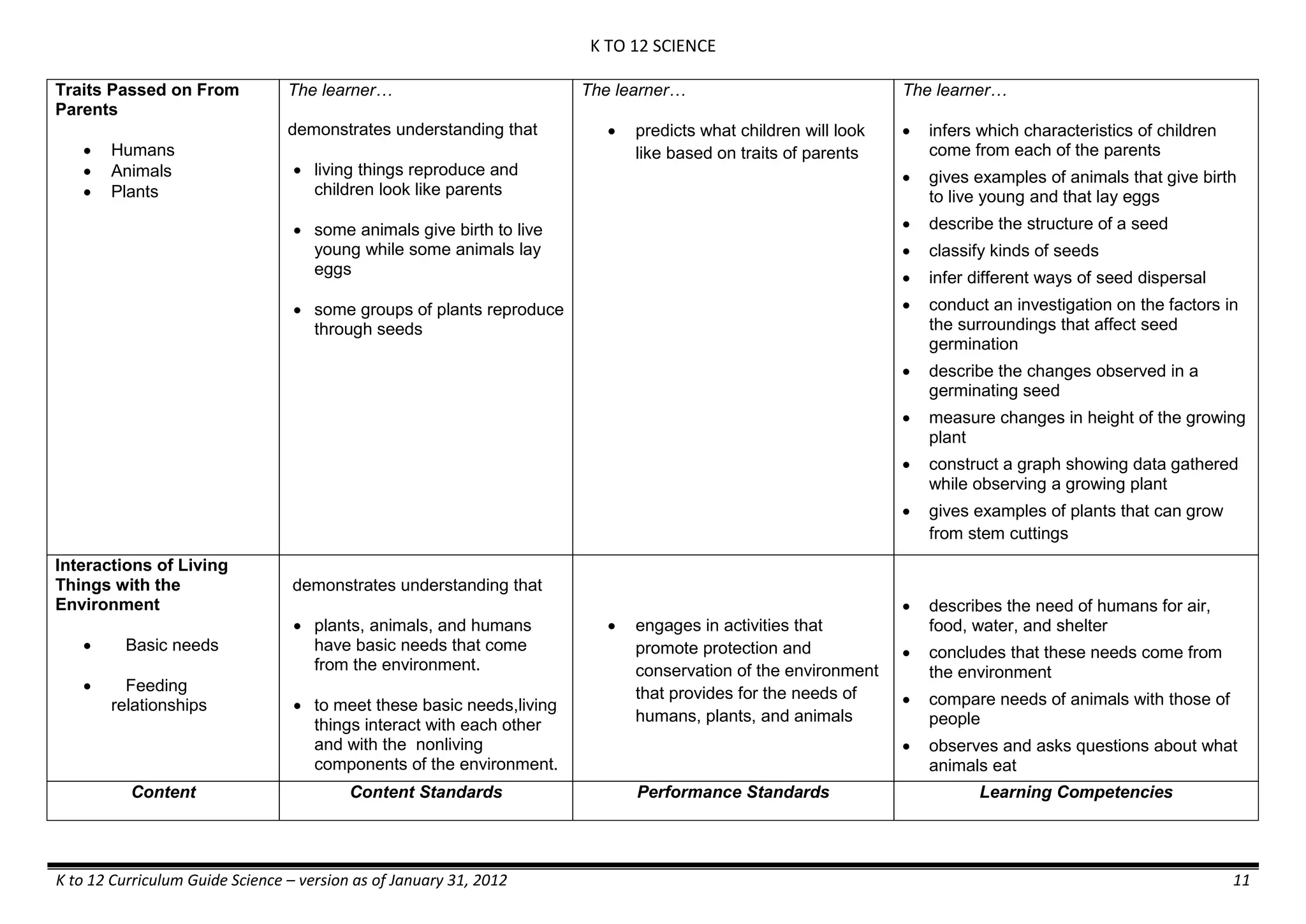
The learner…
 acquires and practice sound
health habits
The learner…
• demonstrates health habits that keep their bodies clean and sanitary.
 acquires attitudes, knowledge, and
skills about physical activity
for maintaining physically fit
lifestyles
• shows sufficient energy to participate in daily activities (Physical
Fitness)
Safety  identifies and practices appropriate • demonstrate safety practices at home, in school, at the playground and
K TO 12 - KINDERGARTEN
K to 12 Curriculum Guide Science – version as of January 31, 2012 16
safety procedures the neighborhood.
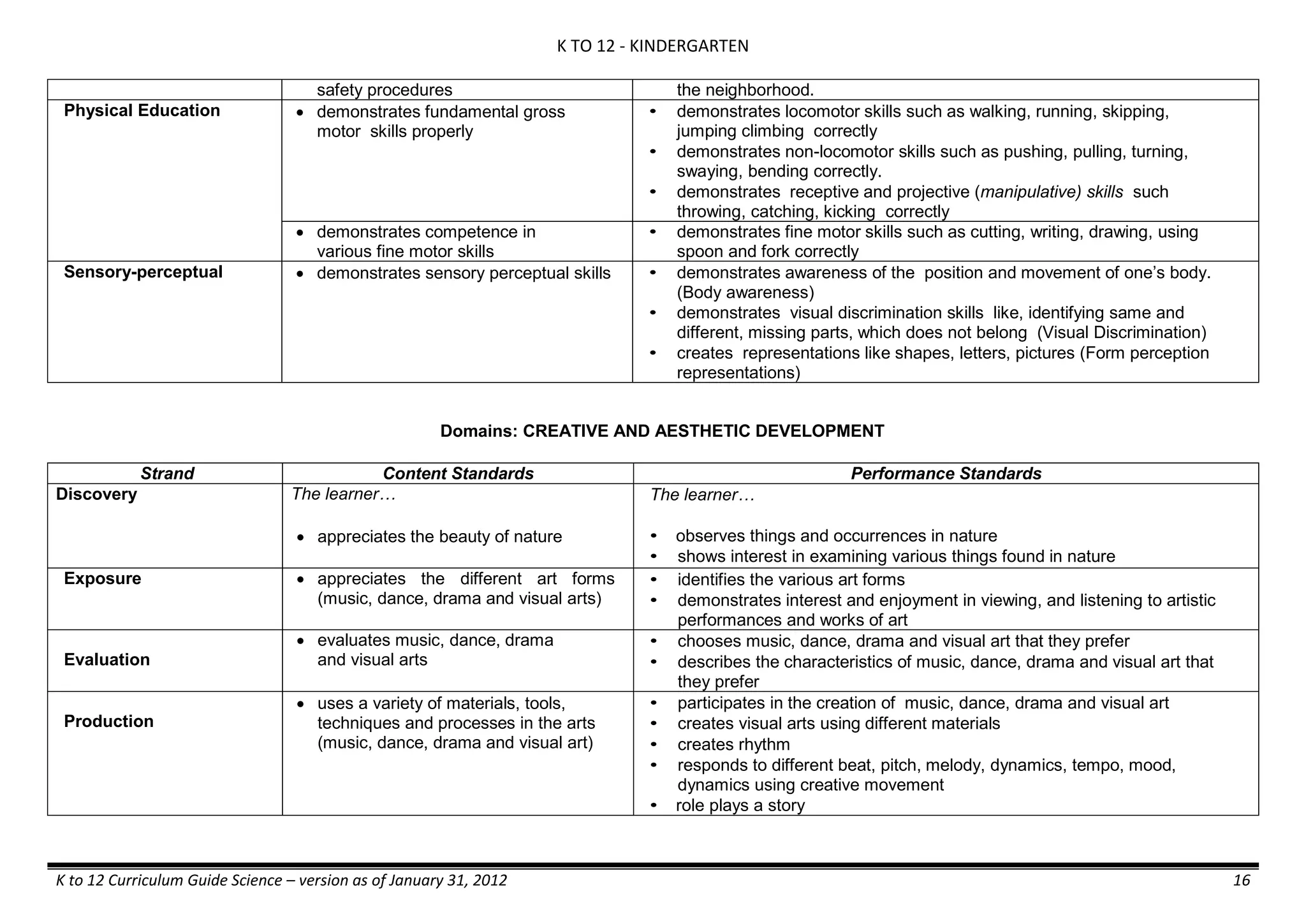
Physical Education  demonstrates fundamental gross
motor skills properly
• demonstrates locomotor skills such as walking, running, skipping,
jumping climbing correctly
• demonstrates non-locomotor skills such as pushing, pulling, turning,
swaying, bending correctly.
• demonstrates receptive and projective (manipulative) skills such
throwing, catching, kicking correctly
 demonstrates competence in
various fine motor skills
• demonstrates fine motor skills such as cutting, writing, drawing, using
spoon and fork correctly
Sensory-perceptual  demonstrates sensory perceptual skills • demonstrates awareness of the position and movement of one’s body.
(Body awareness)
• demonstrates visual discrimination skills like, identifying same and
different, missing parts, which does not belong (Visual Discrimination)
• creates representations like shapes, letters, pictures (Form perception
representations)
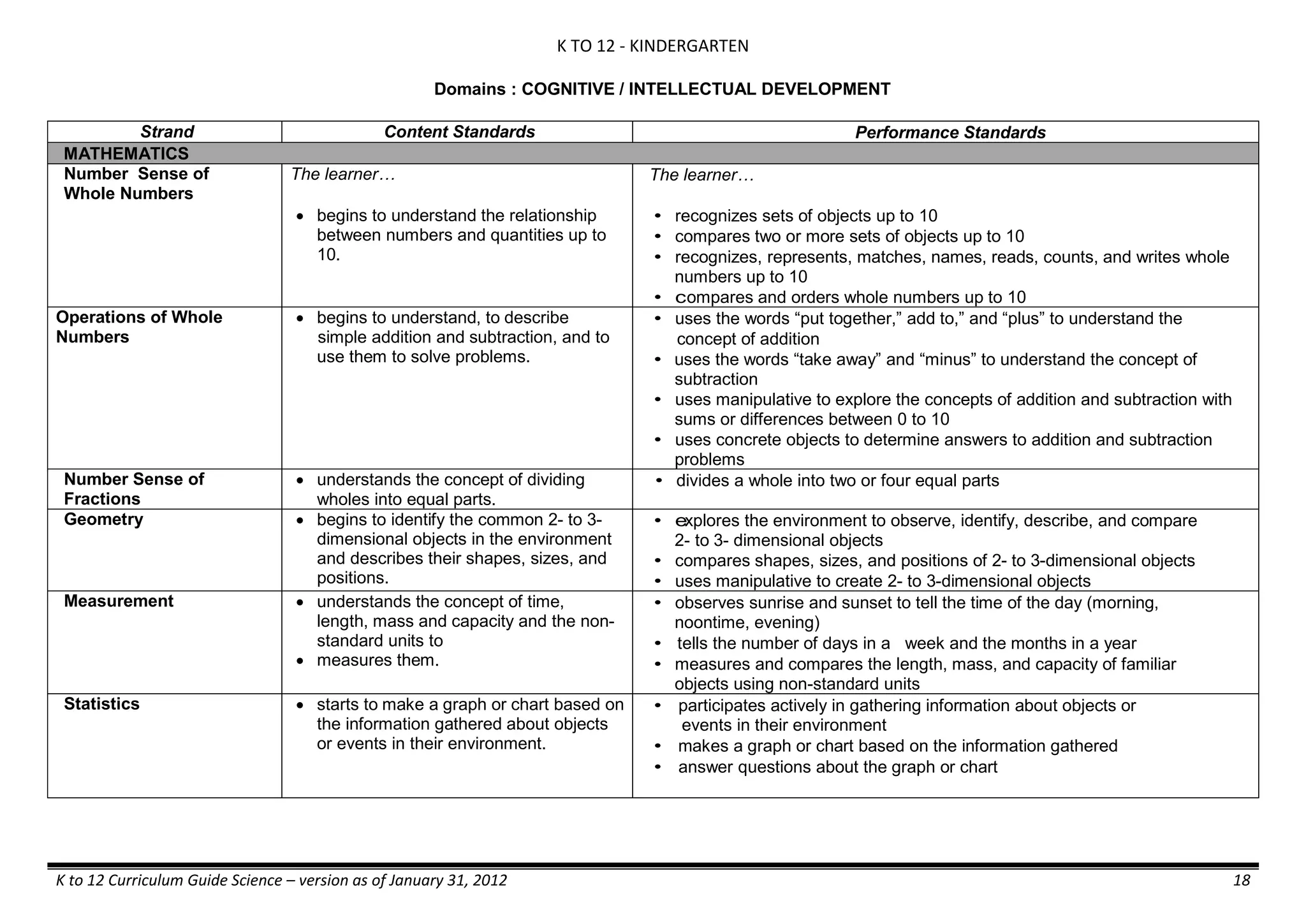
Domains: CREATIVE AND AESTHETIC DEVELOPMENT
Strand Content Standards Performance Standards
Discovery The learner…
 appreciates the beauty of nature
The learner…
• observes things and occurrences in nature
• shows interest in examining various things found in nature
Exposure  appreciates the different art forms
(music, dance, drama and visual arts)
• identifies the various art forms
• demonstrates interest and enjoyment in viewing, and listening to artistic
performances and works of art
Evaluation
 evaluates music, dance, drama
and visual arts
• chooses music, dance, drama and visual art that they prefer
• describes the characteristics of music, dance, drama and visual art that
they prefer
Production
 uses a variety of materials, tools,
techniques and processes in the arts
(music, dance, drama and visual art)
• participates in the creation of music, dance, drama and visual art
• creates visual arts using different materials
• creates rhythm
• responds to different beat, pitch, melody, dynamics, tempo, mood,
dynamics using creative movement
• role plays a story
K TO 12 - KINDERGARTEN
K to 12 Curriculum Guide Science – version as of January 31, 2012 17
Domains : LANGUAGES DEVELOPMENT
Strand Content Standards Performance Standards
Listening and
Viewing
The learner…
 discriminates sounds
The learner…
• distinguishes different types of sounds
 listens for directions • follows simple directions
 listens to stories • comprehends simple and familiar stories
Speaking
 expresses oneself • increases his/her vocabulary for describing things and expressing
ones feelings
 asks and answers questions • answers and responds to questions accordingly
 shares information • increases his/her vocabulary in sharing information
 tells stories • narrates simple and familiar stories
 gives directions • gives simple directions
Reading  analyzes meaning sounds (Phonemic
Awareness)
• Identifies and distinguishes sounds
• distinguishes vowel and consonant sounds
• blends and segments words
• matches letters to their sounds (and vice versa)
 decodes words • recognizes and names all uppercase and lowercase letters of the
alphabet.
• decodes basic sight words
• identifies common words
 demonstrates book knowledge and print
awareness
• understands that printed materials provide information
• reads using correct directionality
• reads using proper intonation
 comprehends simple texts • analyzes and comprehends simple narrative
• analyzes and comprehends simple information/factual texts
Writing  writes using the correct mechanics • writes words and phrases using a mix of invented and conventional
spelling
• writes words and phrases using manuscript form
 writes narrative and informational/ factual
texts
• composes own stories with a clear beginning, middle and end
• composes own stories using pictures
• composes informational/factual texts using own words
• composes information/factual texts using illustrations
K TO 12 - KINDERGARTEN
K to 12 Curriculum Guide Science – version as of January 31, 2012 18
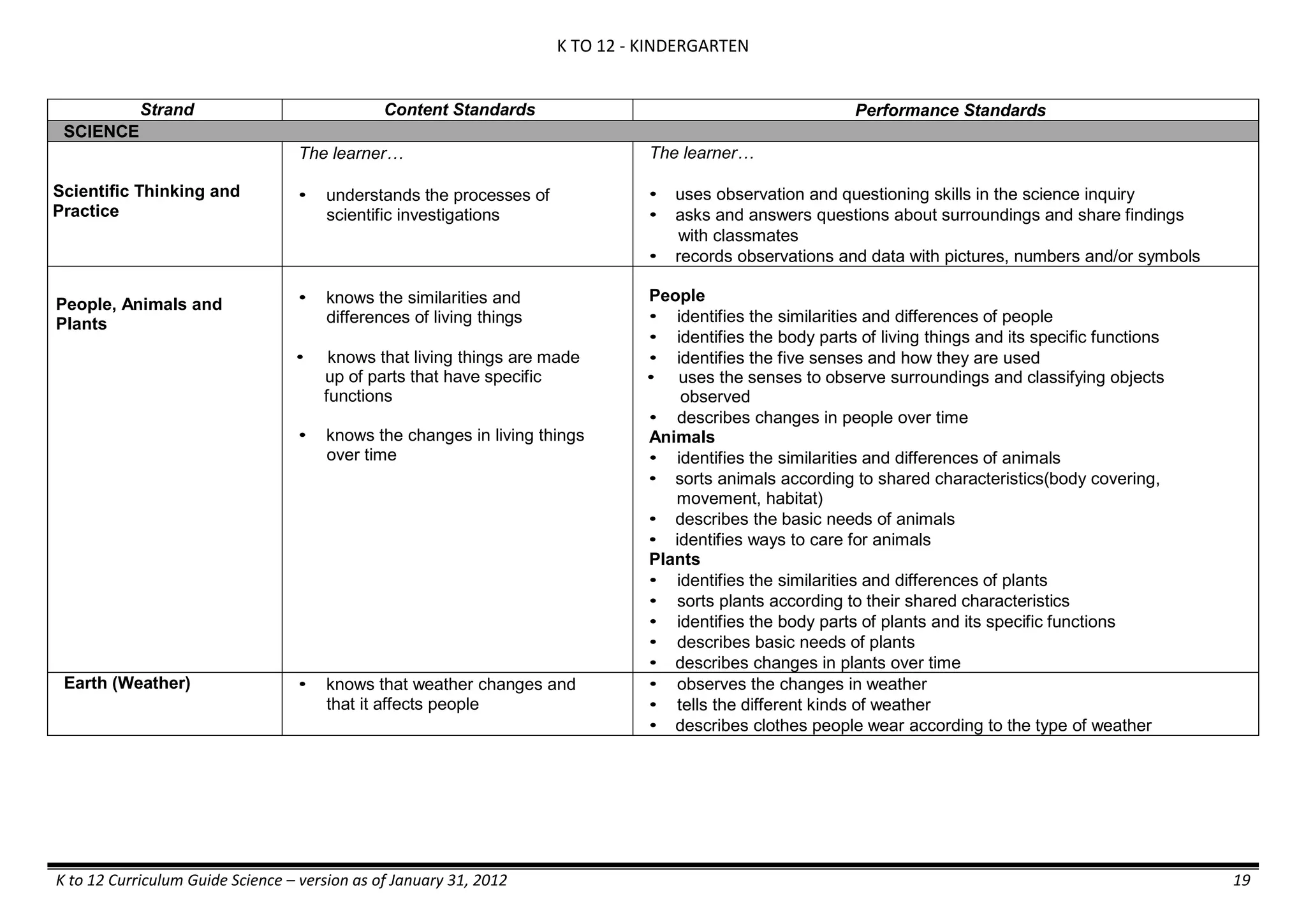
Domains : COGNITIVE / INTELLECTUAL DEVELOPMENT
Strand Content Standards Performance Standards
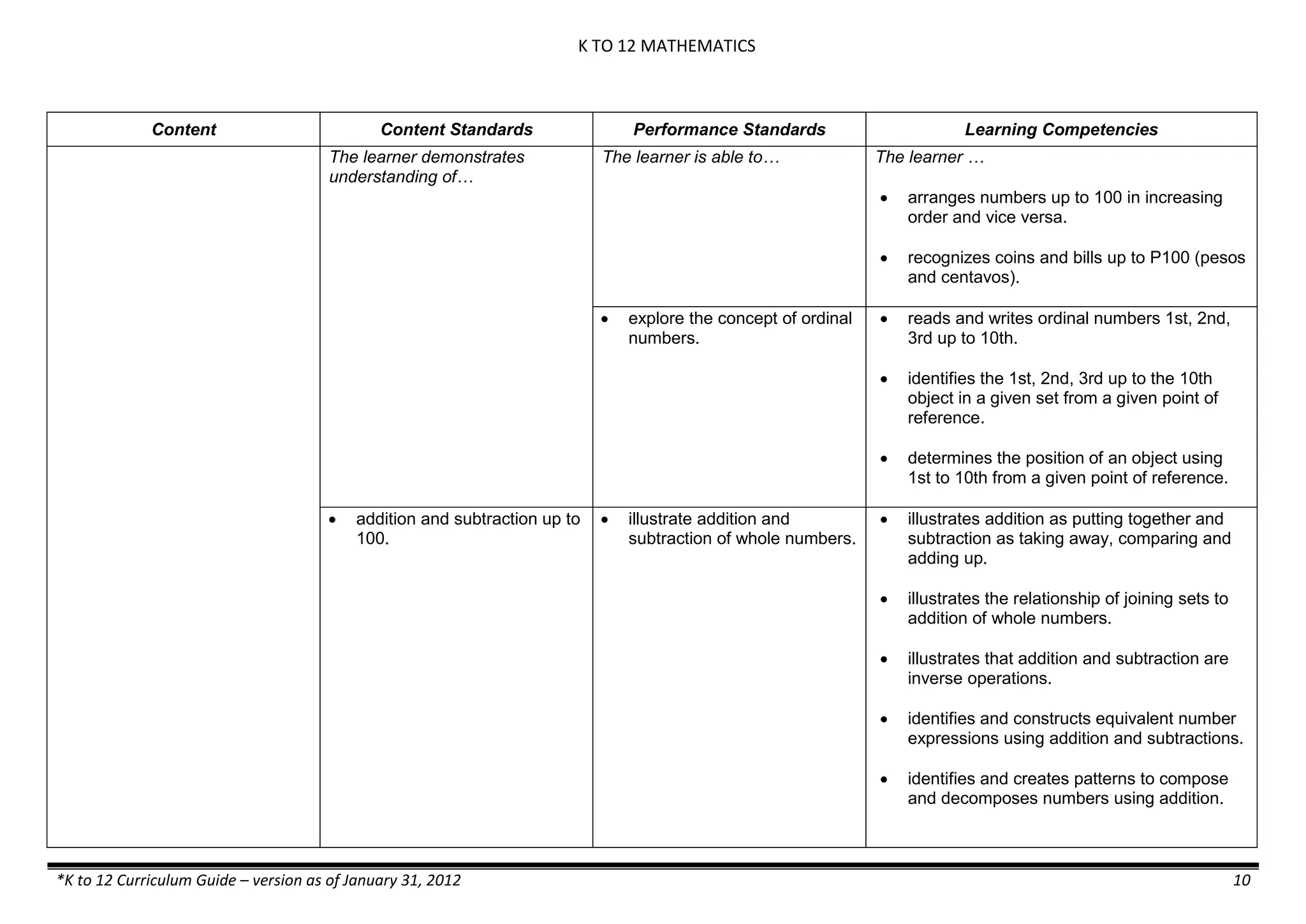
MATHEMATICS
Number Sense of
Whole Numbers
The learner…
 begins to understand the relationship
between numbers and quantities up to
10.
The learner…
• recognizes sets of objects up to 10
• compares two or more sets of objects up to 10
• recognizes, represents, matches, names, reads, counts, and writes whole
numbers up to 10
• compares and orders whole numbers up to 10
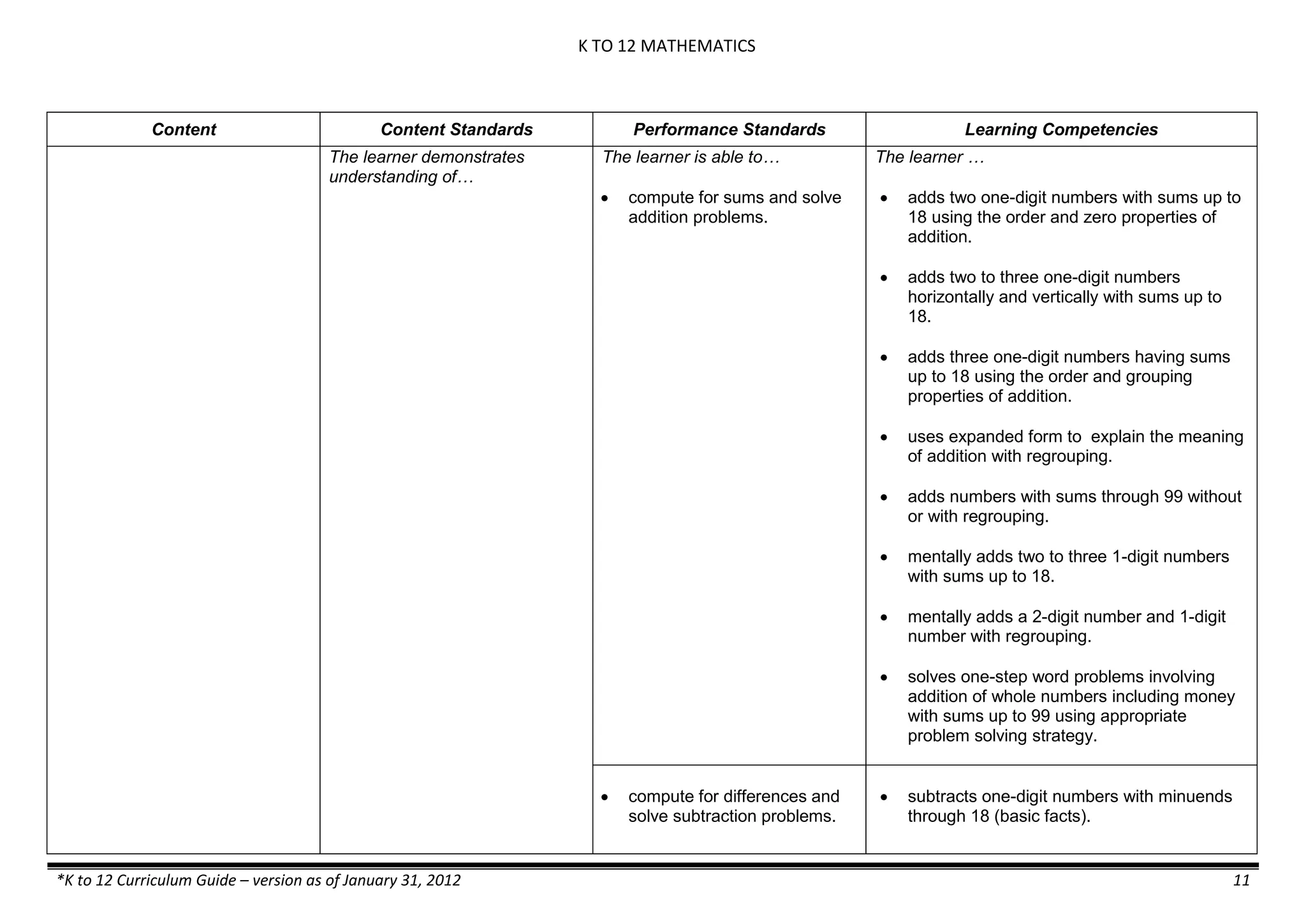
Operations of Whole
Numbers
 begins to understand, to describe
simple addition and subtraction, and to
use them to solve problems.
• uses the words “put together,” add to,” and “plus” to understand the
concept of addition
• uses the words “take away” and “minus” to understand the concept of
subtraction
• uses manipulative to explore the concepts of addition and subtraction with
sums or differences between 0 to 10
• uses concrete objects to determine answers to addition and subtraction
problems
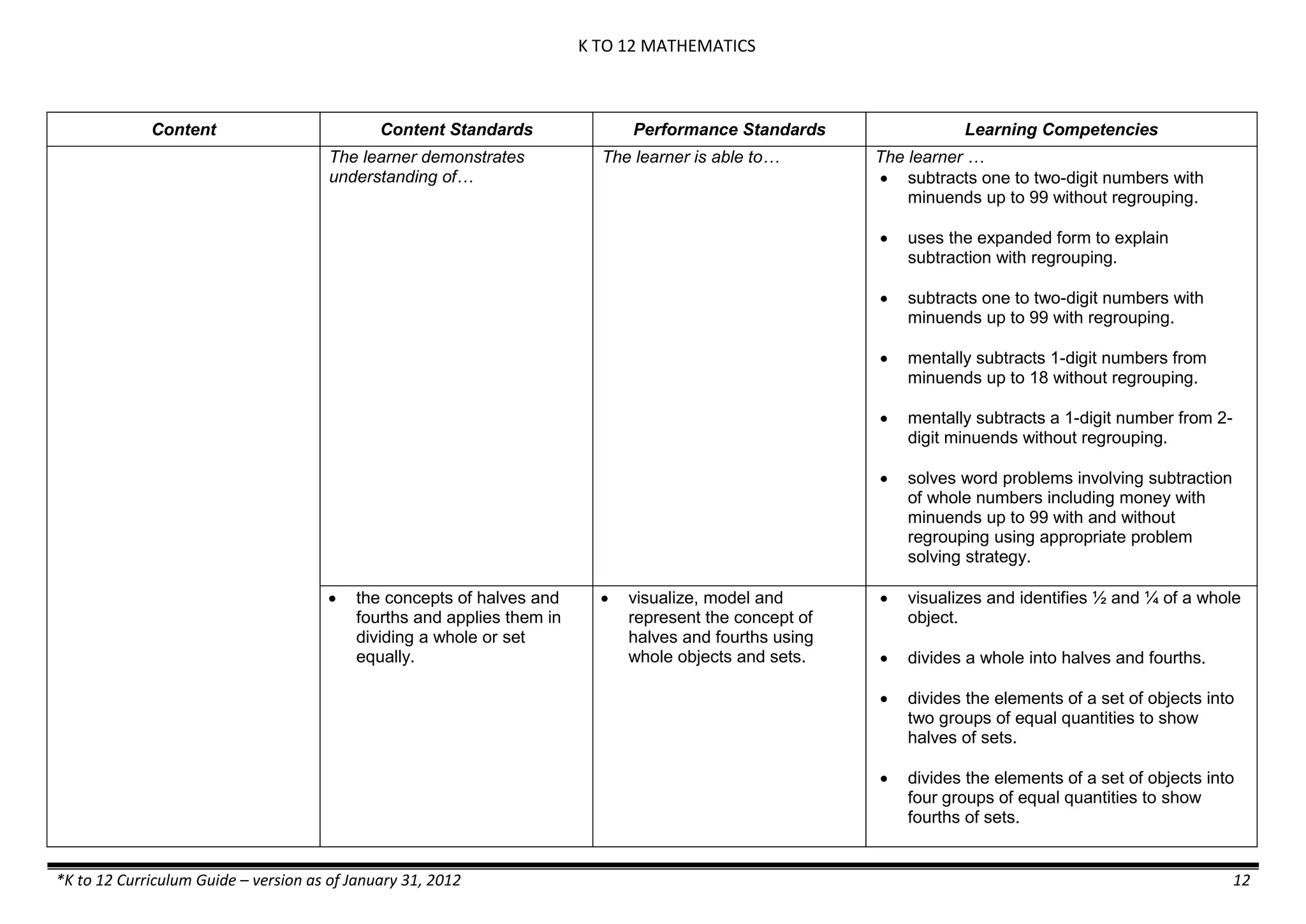
Number Sense of
Fractions
 understands the concept of dividing
wholes into equal parts.
• divides a whole into two or four equal parts
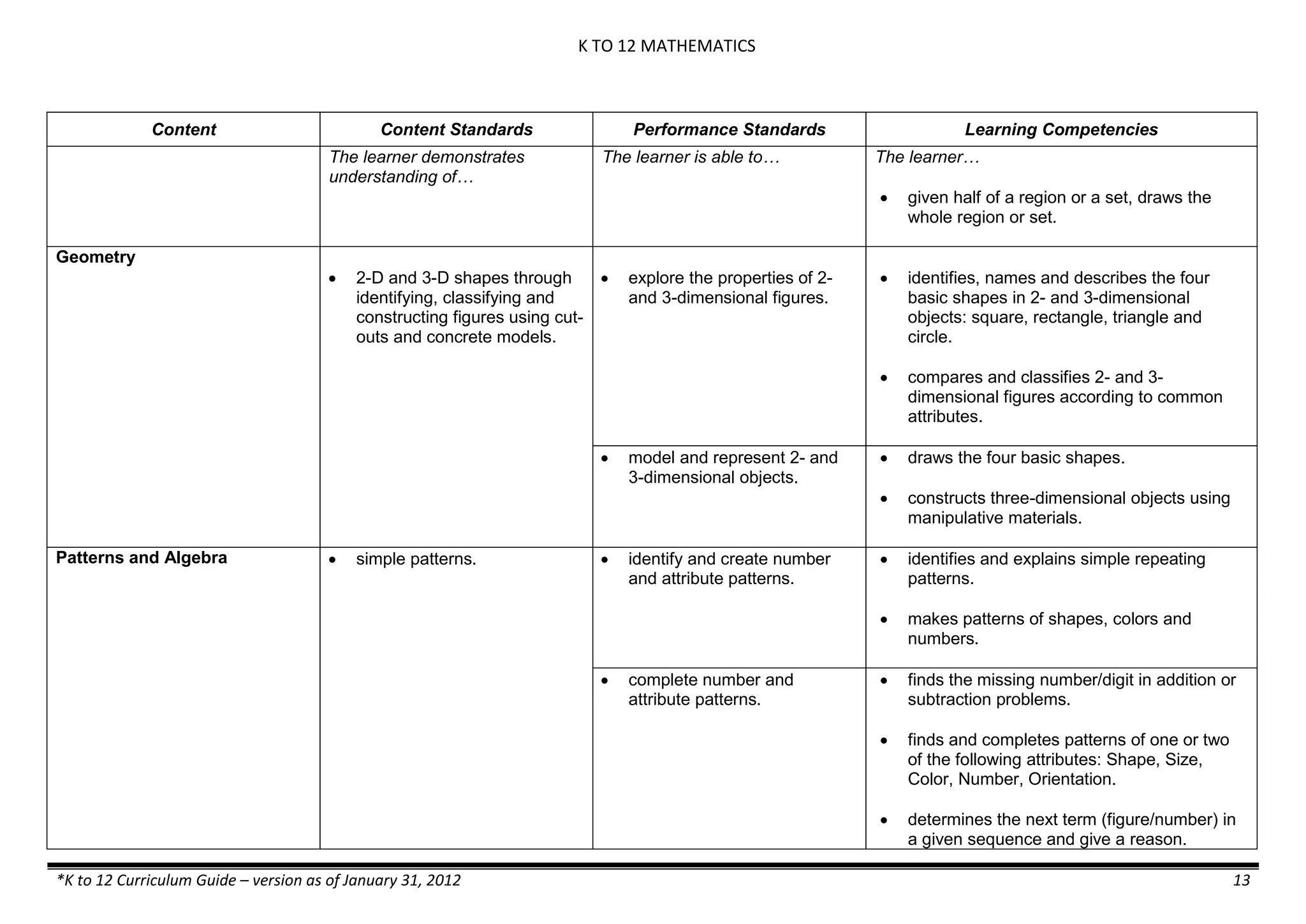
Geometry  begins to identify the common 2- to 3-
dimensional objects in the environment
and describes their shapes, sizes, and
positions.
• explores the environment to observe, identify, describe, and compare
2- to 3- dimensional objects
• compares shapes, sizes, and positions of 2- to 3-dimensional objects
• uses manipulative to create 2- to 3-dimensional objects
Measurement  understands the concept of time,
length, mass and capacity and the non-
standard units to
 measures them.
• observes sunrise and sunset to tell the time of the day (morning,
noontime, evening)
• tells the number of days in a week and the months in a year
• measures and compares the length, mass, and capacity of familiar
objects using non-standard units
Statistics  starts to make a graph or chart based on
the information gathered about objects
or events in their environment.
• participates actively in gathering information about objects or
events in their environment
• makes a graph or chart based on the information gathered
• answer questions about the graph or chart
K TO 12 - KINDERGARTEN
K to 12 Curriculum Guide Science – version as of January 31, 2012 19
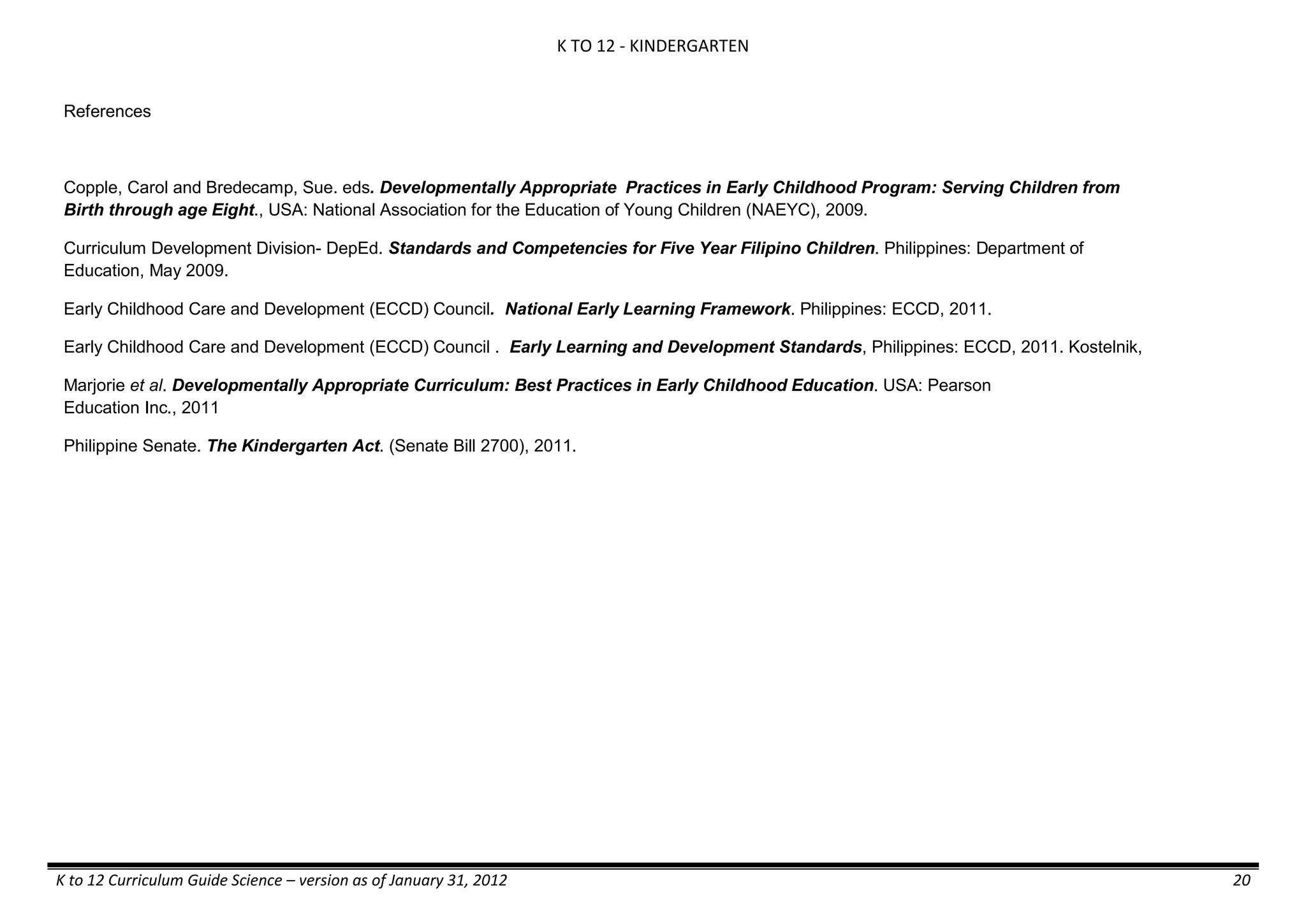
Strand Content Standards Performance Standards
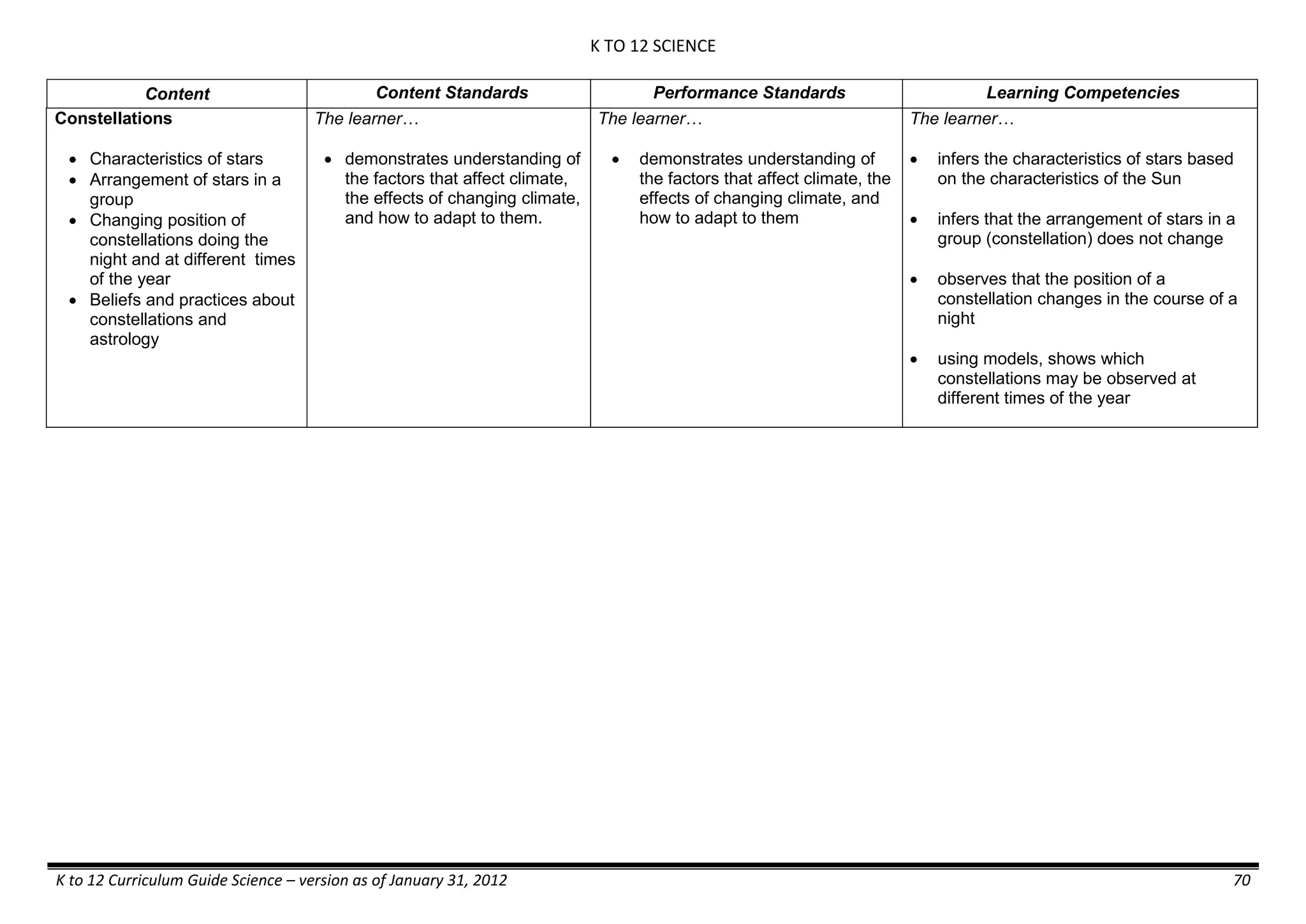
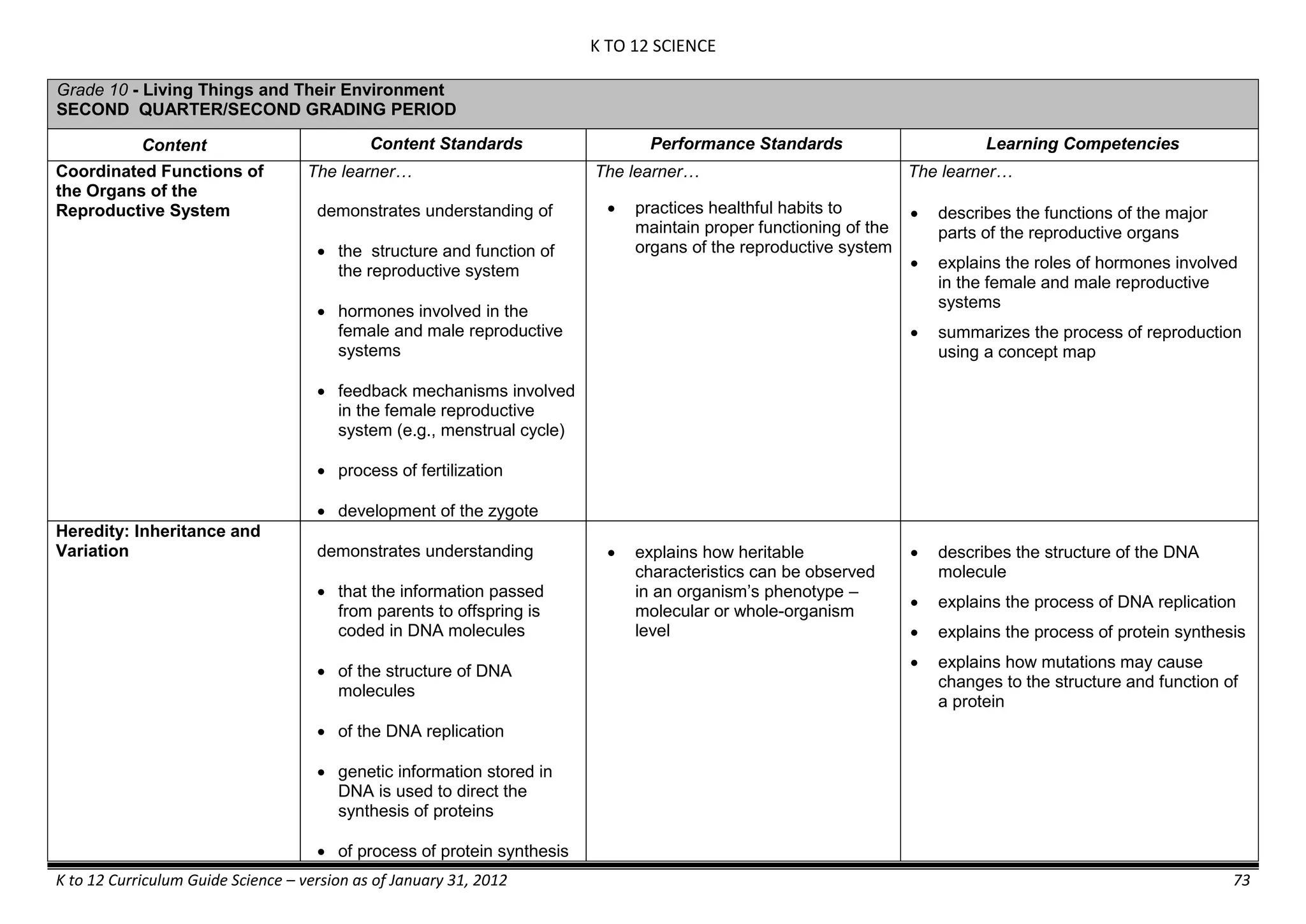
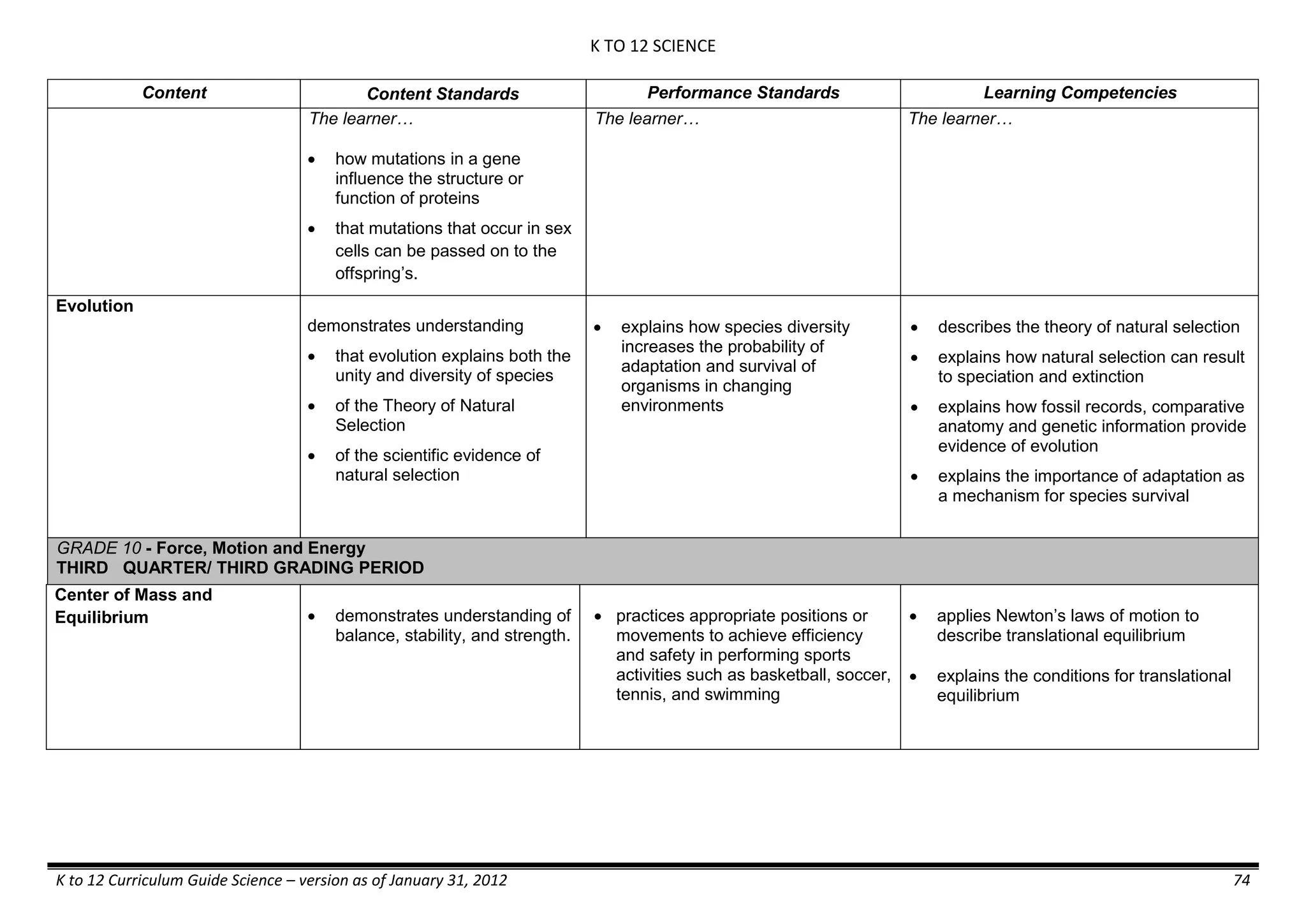
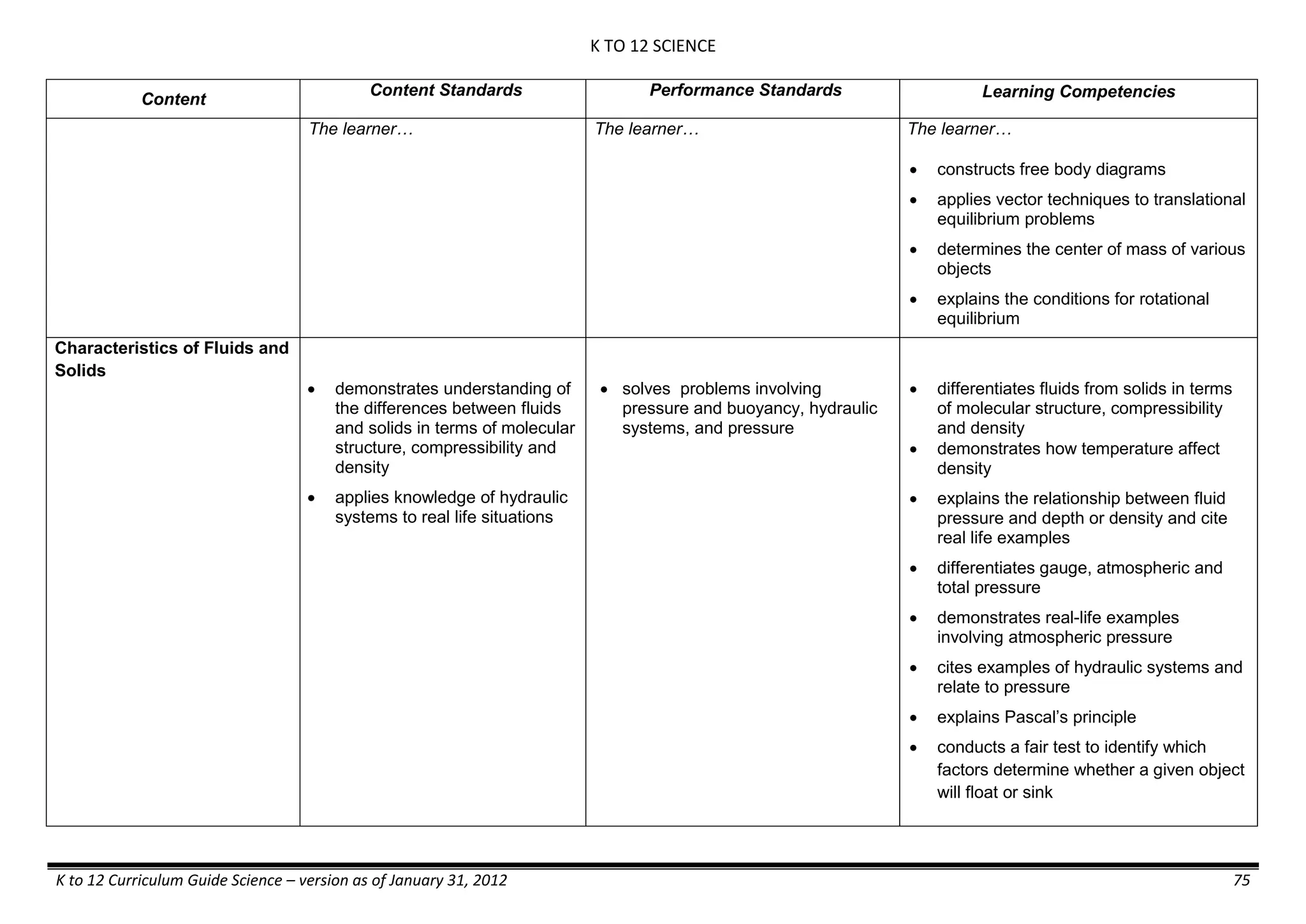
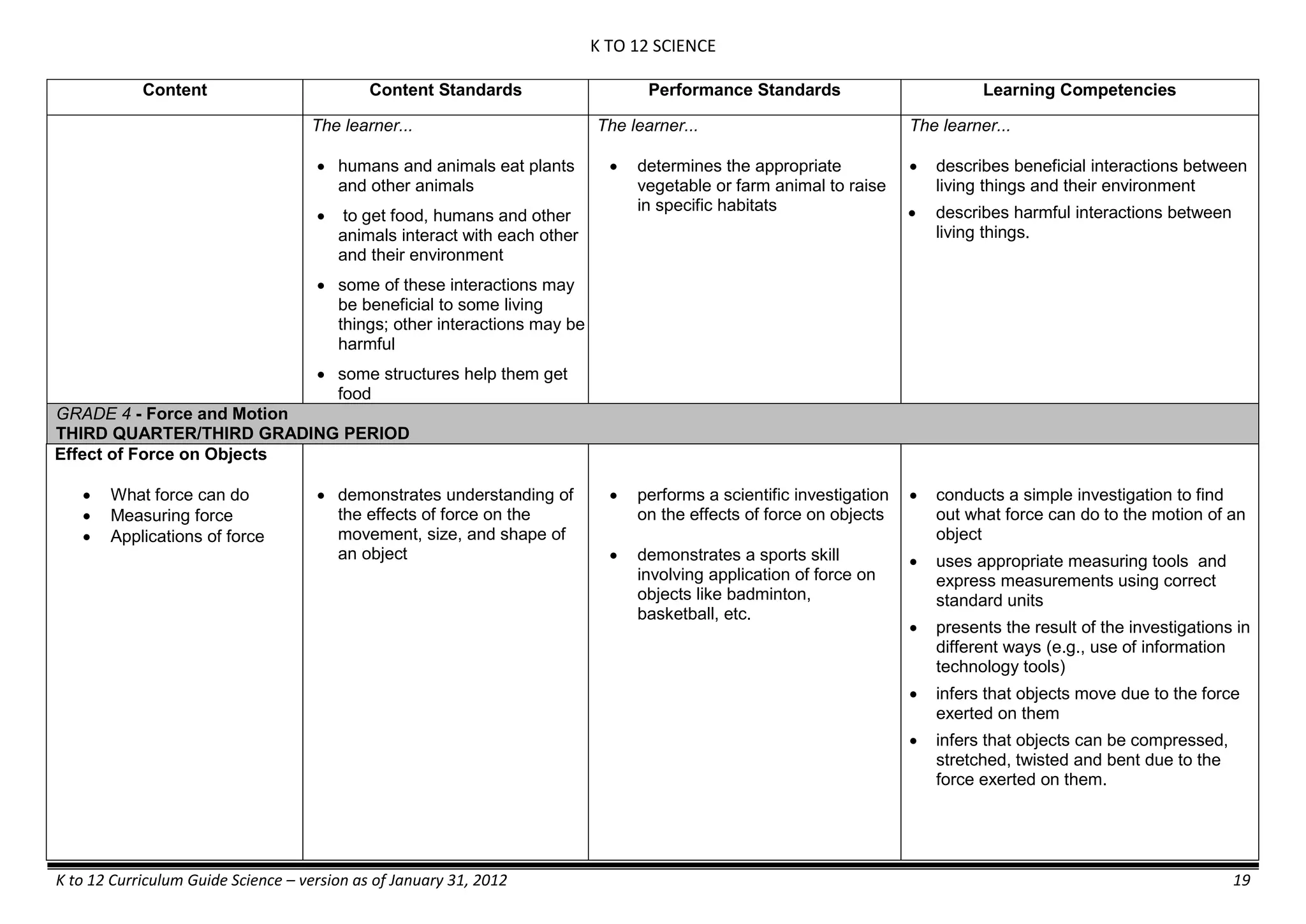
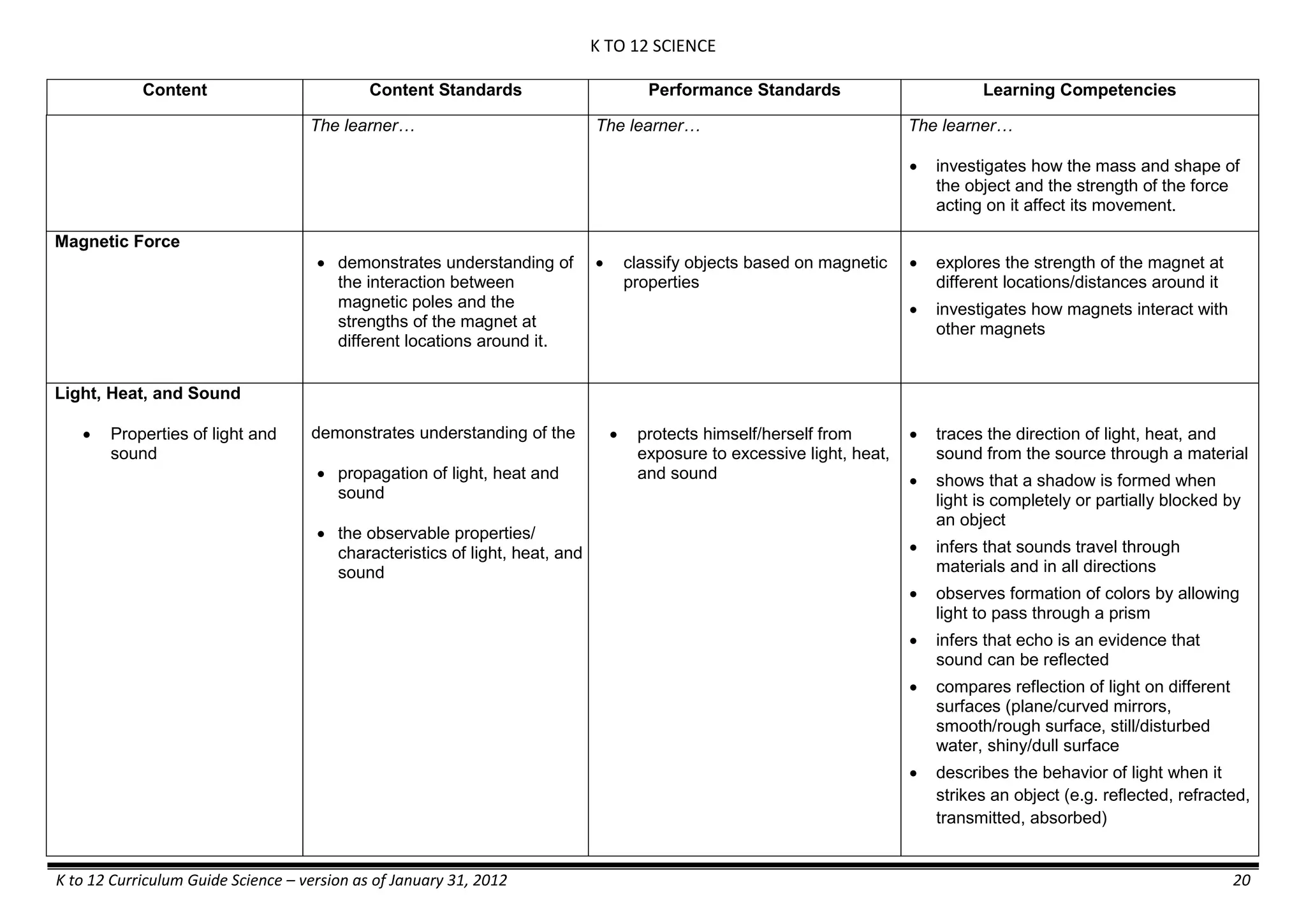
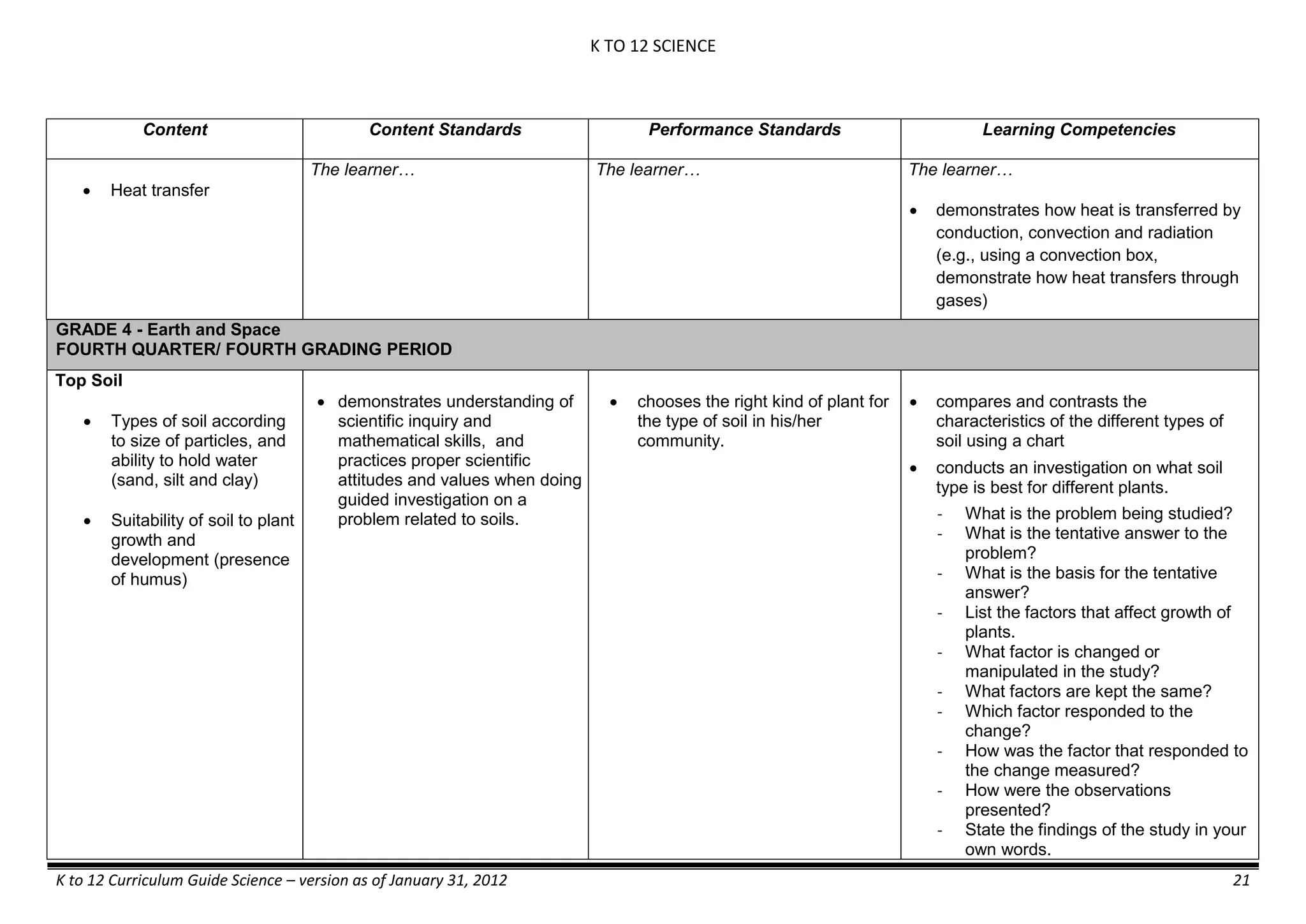
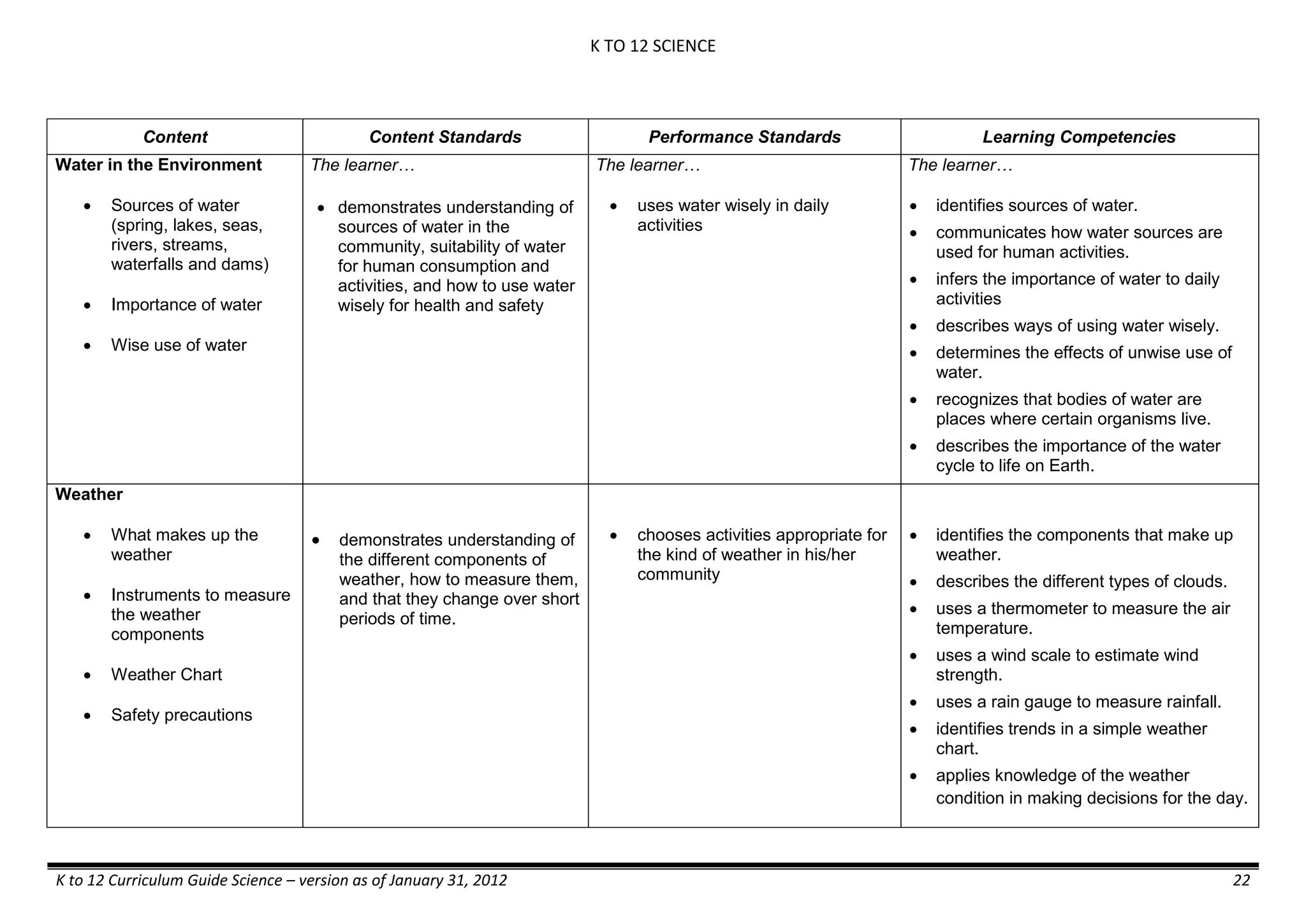
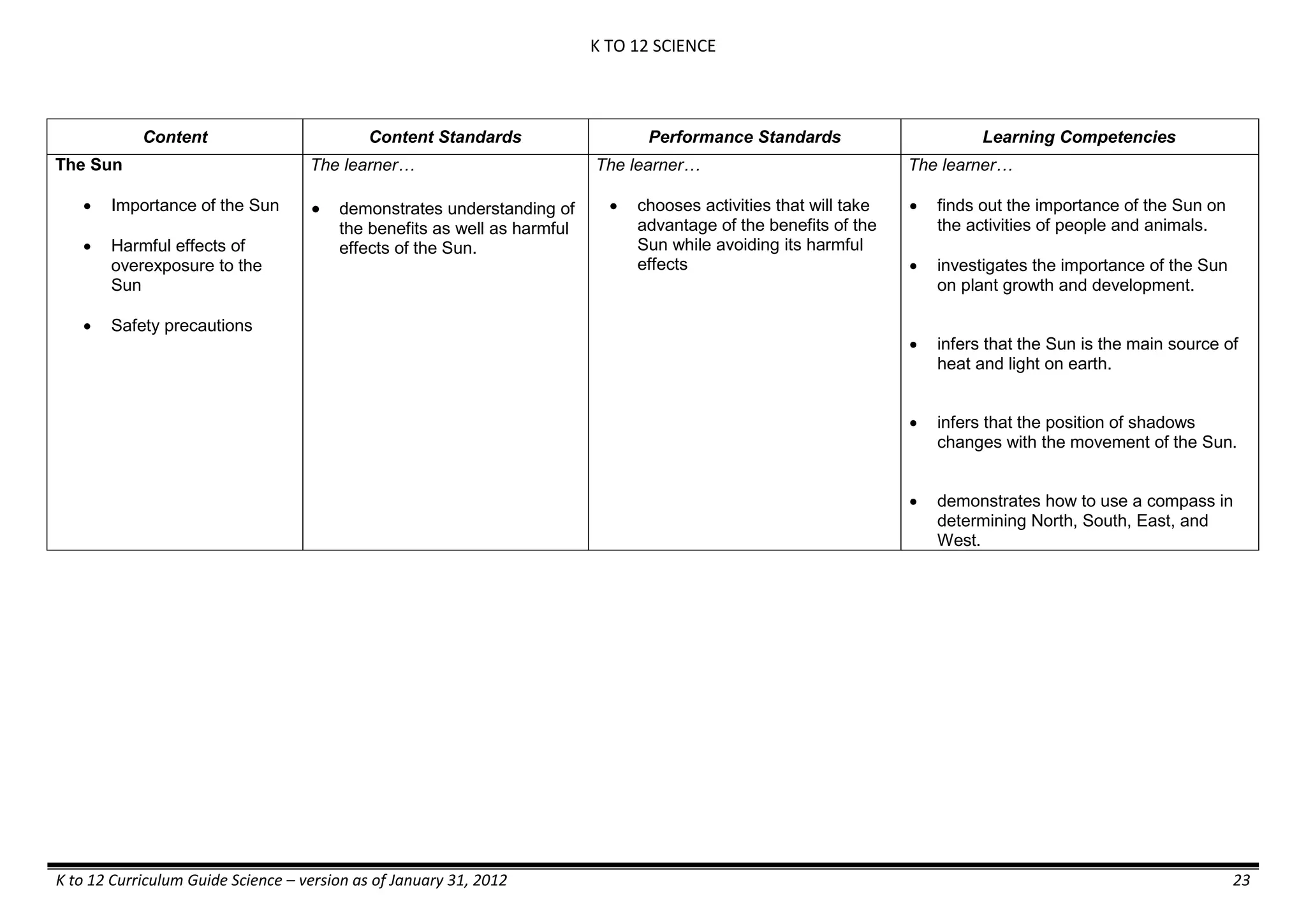
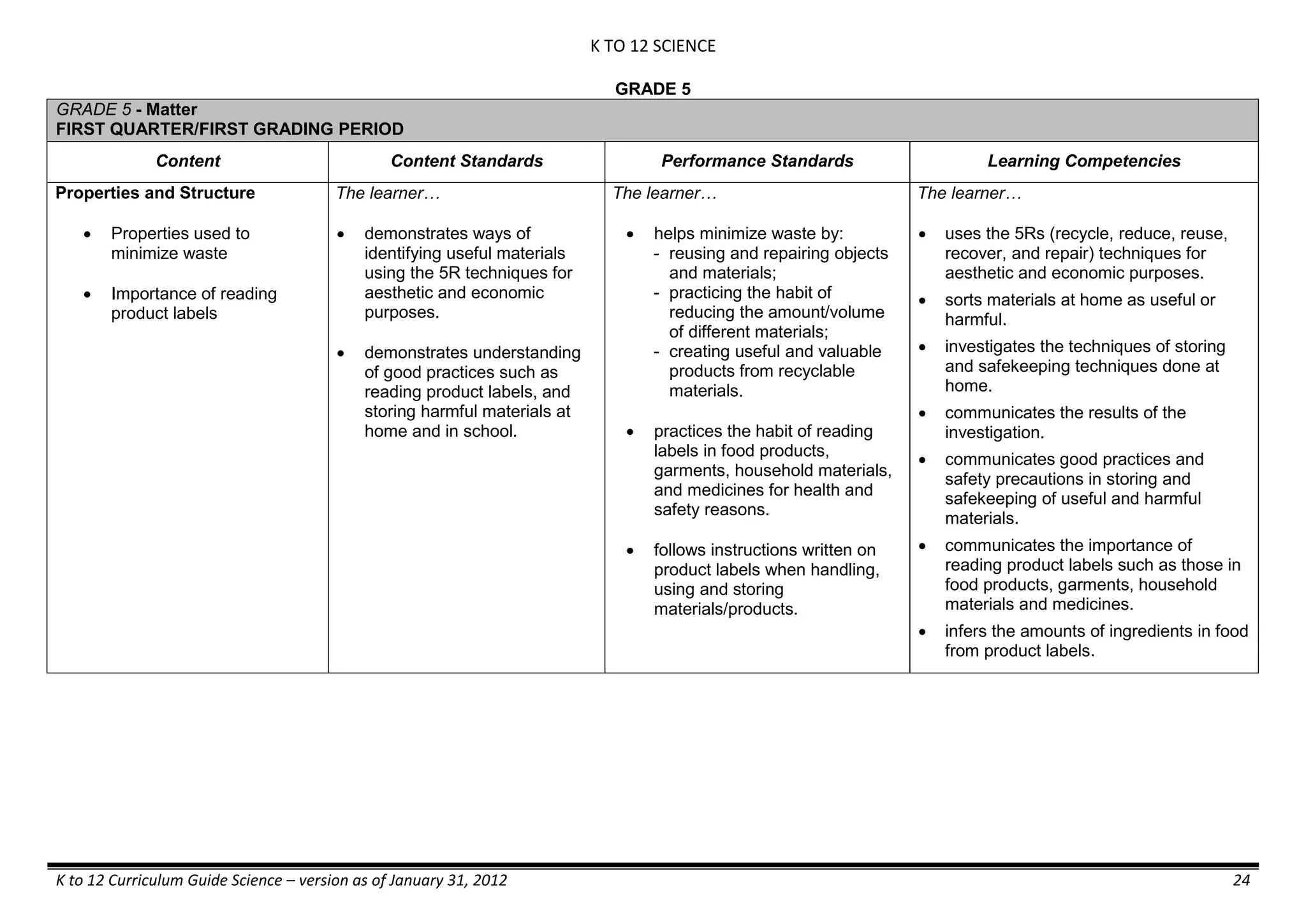
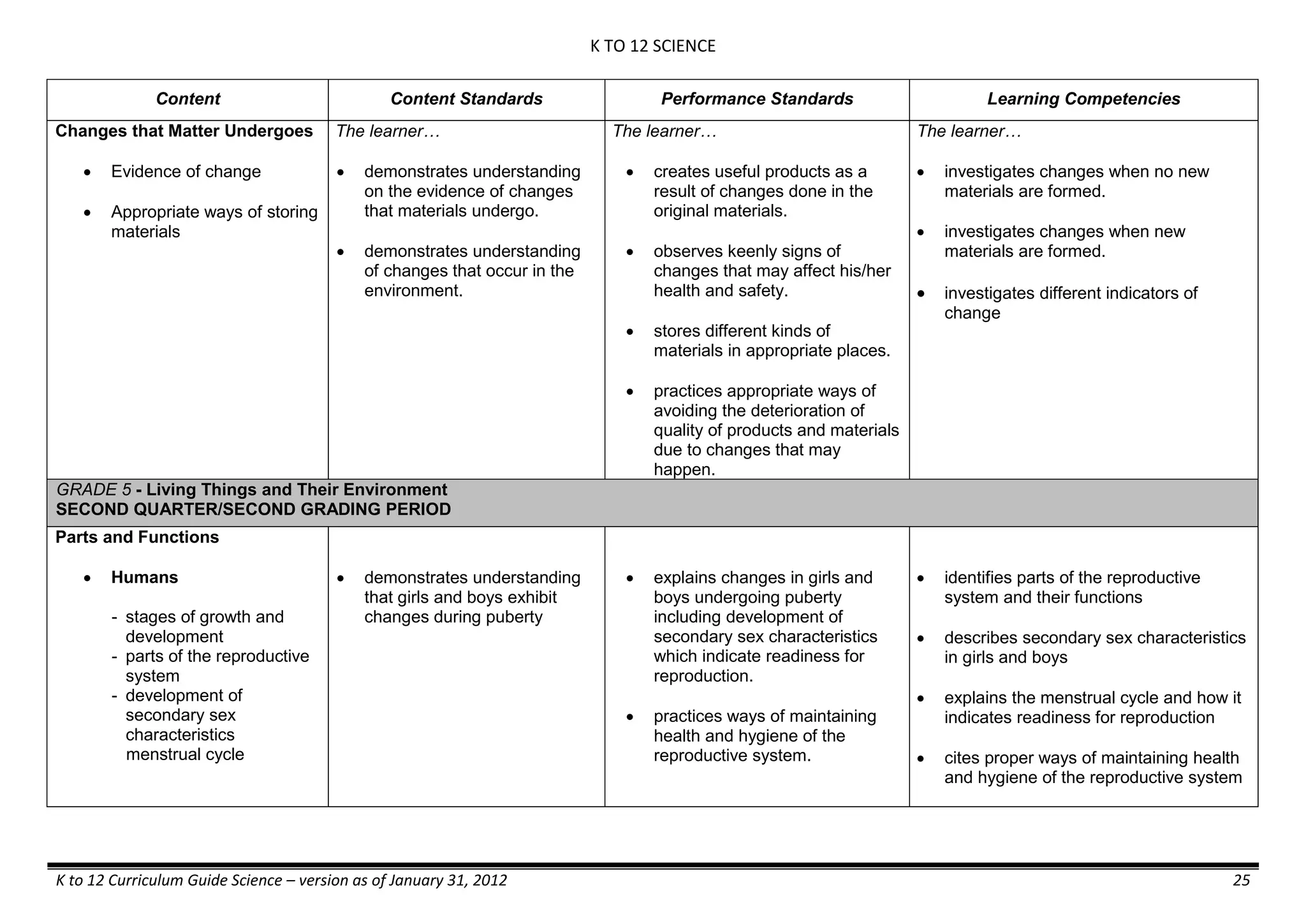
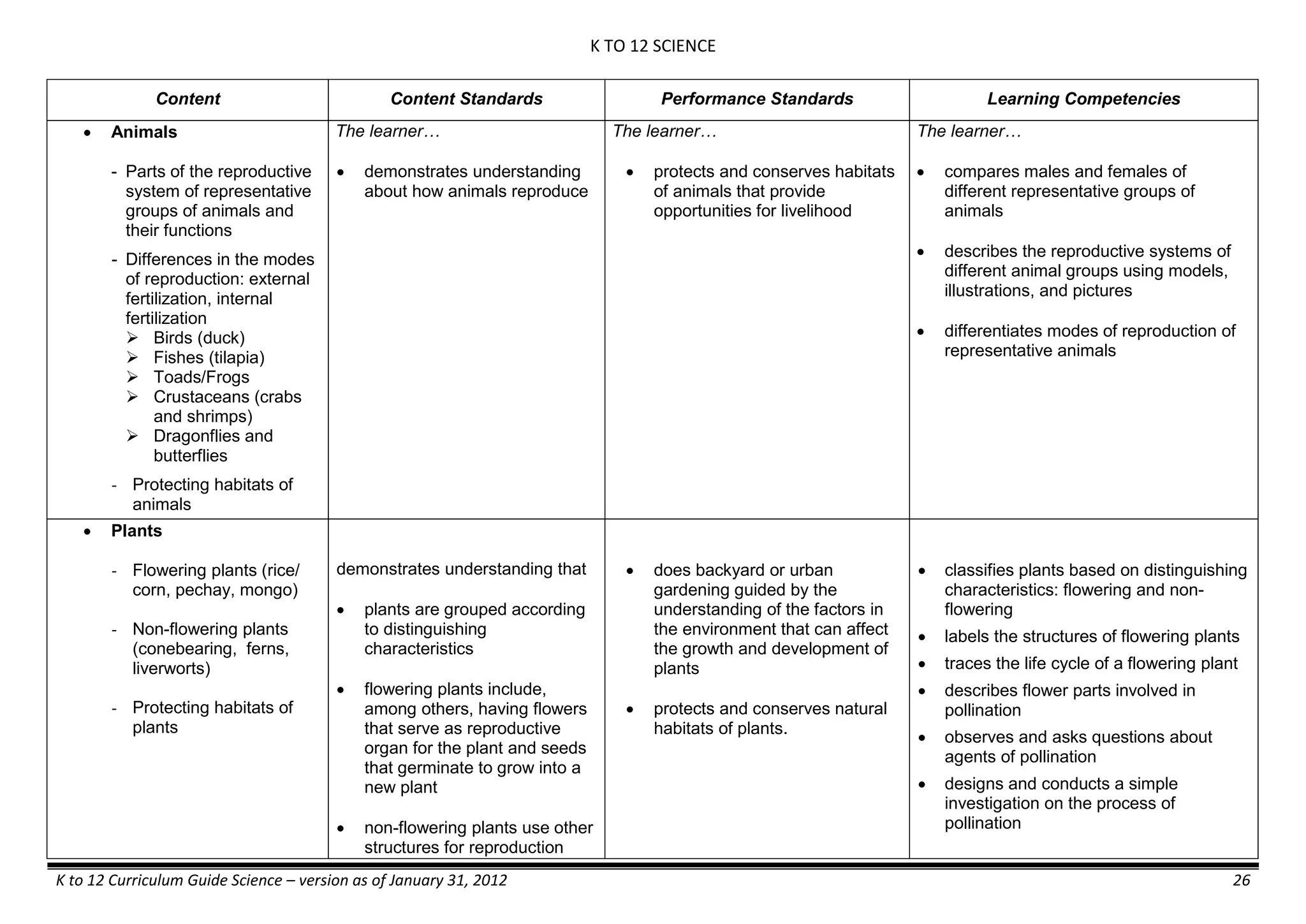
SCIENCE
Scientific Thinking and
Practice
The learner…
• understands the processes of
scientific investigations
The learner…
• uses observation and questioning skills in the science inquiry
• asks and answers questions about surroundings and share findings
with classmates
• records observations and data with pictures, numbers and/or symbols
People, Animals and
Plants
• knows the similarities and
differences of living things
• knows that living things are made
up of parts that have specific
functions
• knows the changes in living things
over time
People
• identifies the similarities and differences of people
• identifies the body parts of living things and its specific functions
• identifies the five senses and how they are used
• uses the senses to observe surroundings and classifying objects
observed
• describes changes in people over time
Animals
• identifies the similarities and differences of animals
• sorts animals according to shared characteristics(body covering,
movement, habitat)
• describes the basic needs of animals
• identifies ways to care for animals
Plants
• identifies the similarities and differences of plants
• sorts plants according to their shared characteristics
• identifies the body parts of plants and its specific functions
• describes basic needs of plants
• describes changes in plants over time
Earth (Weather) • knows that weather changes and
that it affects people
• observes the changes in weather
• tells the different kinds of weather
• describes clothes people wear according to the type of weather
K TO 12 - KINDERGARTEN
K to 12 Curriculum Guide Science – version as of January 31, 2012 20
References
Copple, Carol and Bredecamp, Sue. eds. Developmentally Appropriate Practices in Early Childhood Program: Serving Children from
Birth through age Eight., USA: National Association for the Education of Young Children (NAEYC), 2009.
Curriculum Development Division- DepEd. Standards and Competencies for Five Year Filipino Children. Philippines: Department of
Education, May 2009.
Early Childhood Care and Development (ECCD) Council. National Early Learning Framework. Philippines: ECCD, 2011.
Early Childhood Care and Development (ECCD) Council . Early Learning and Development Standards, Philippines: ECCD, 2011. Kostelnik,
Marjorie et al. Developmentally Appropriate Curriculum: Best Practices in Early Childhood Education. USA: Pearson
Education Inc., 2011
Philippine Senate. The Kindergarten Act. (Senate Bill 2700), 2011.
K TO 12 - KINDERGARTEN
K to 12 Curriculum Guide Science – version as of January 31, 2012 21
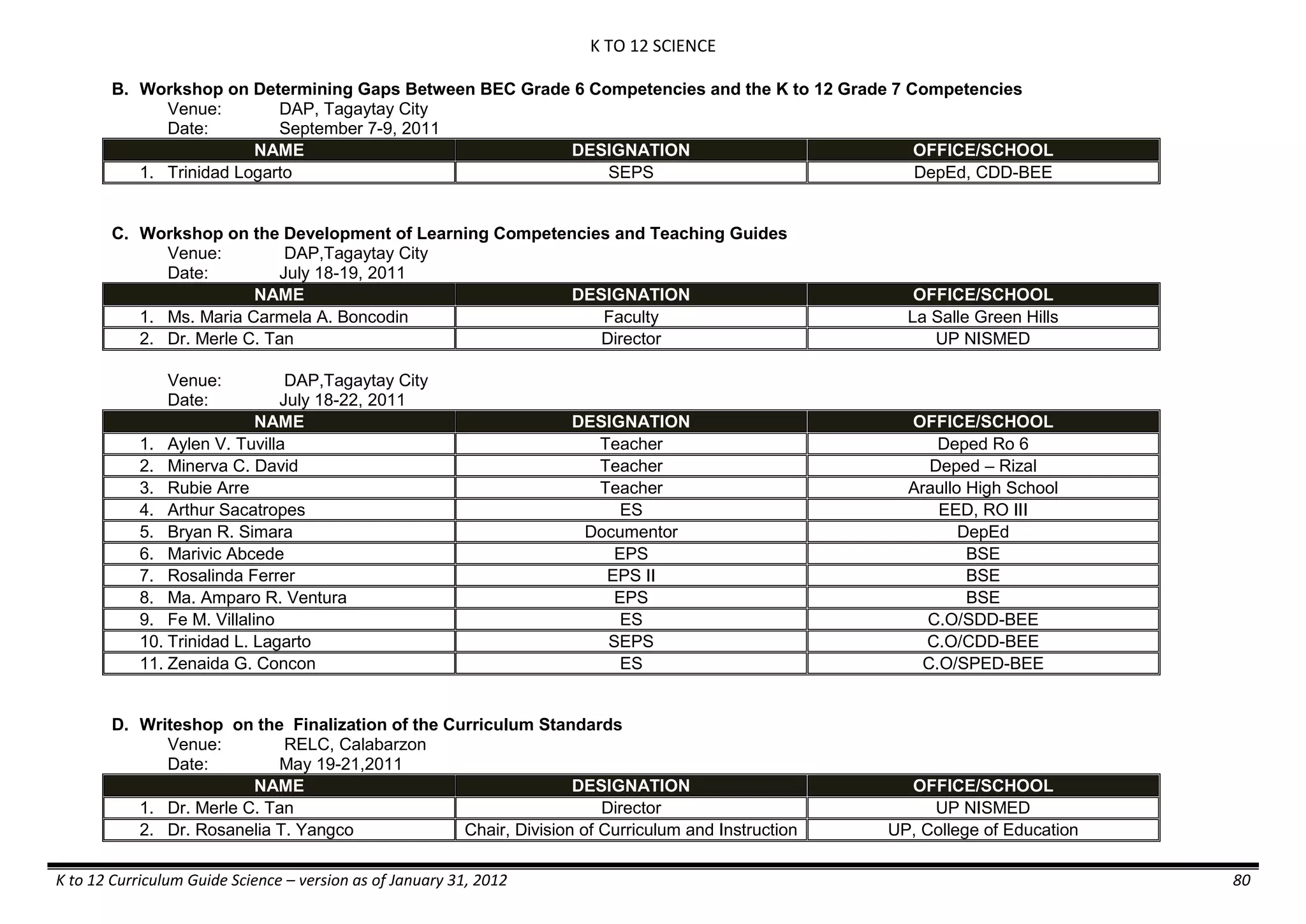
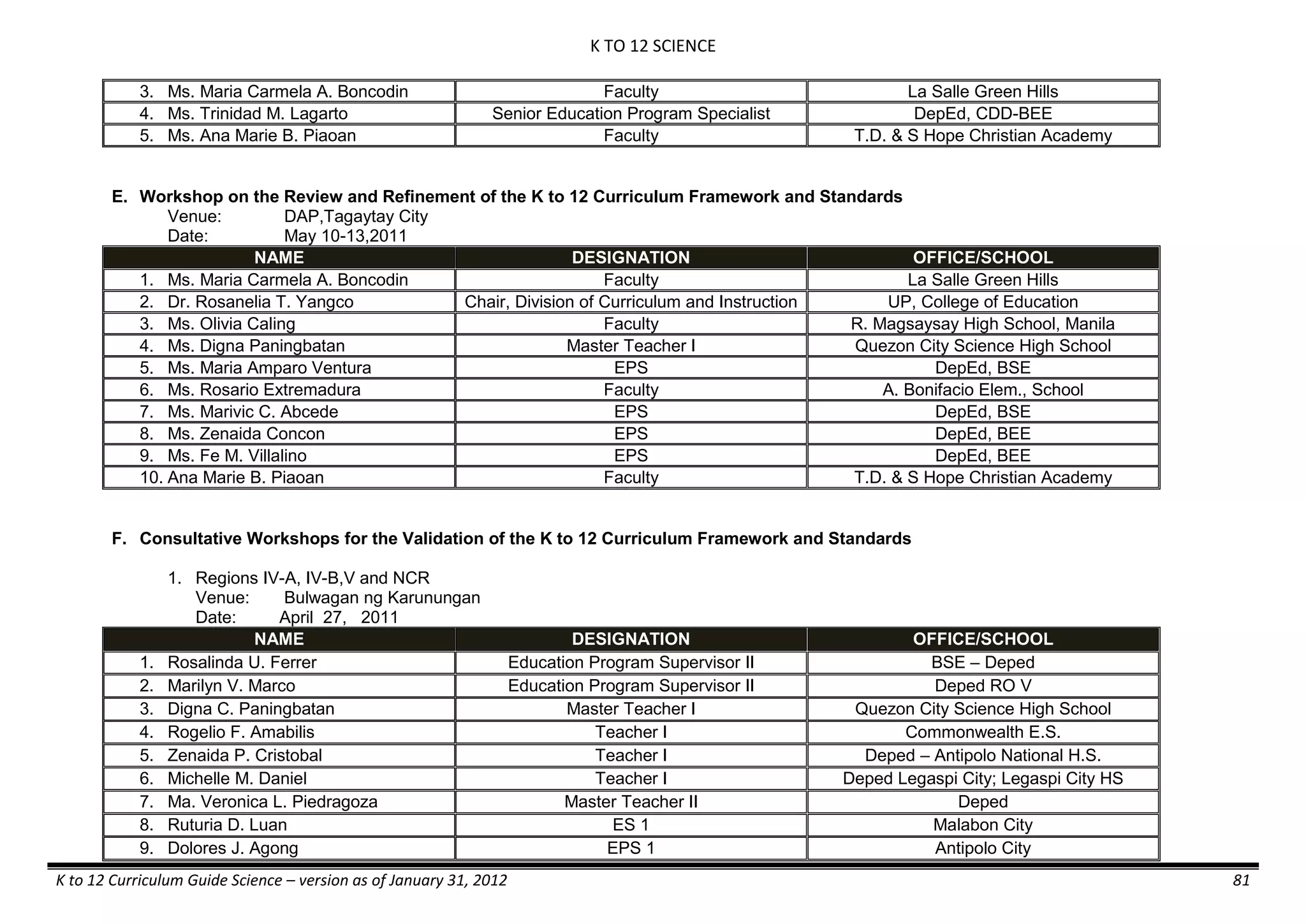
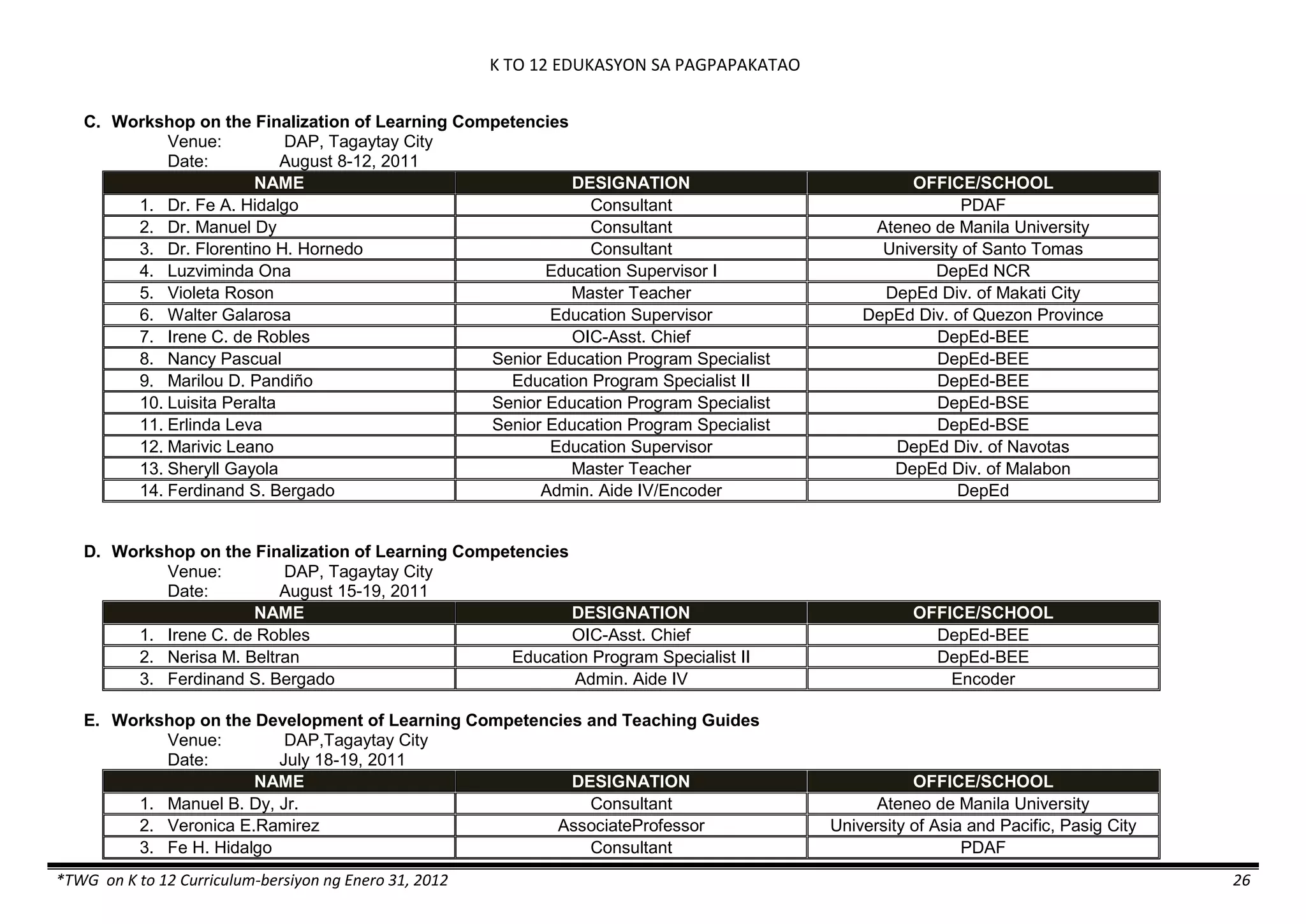
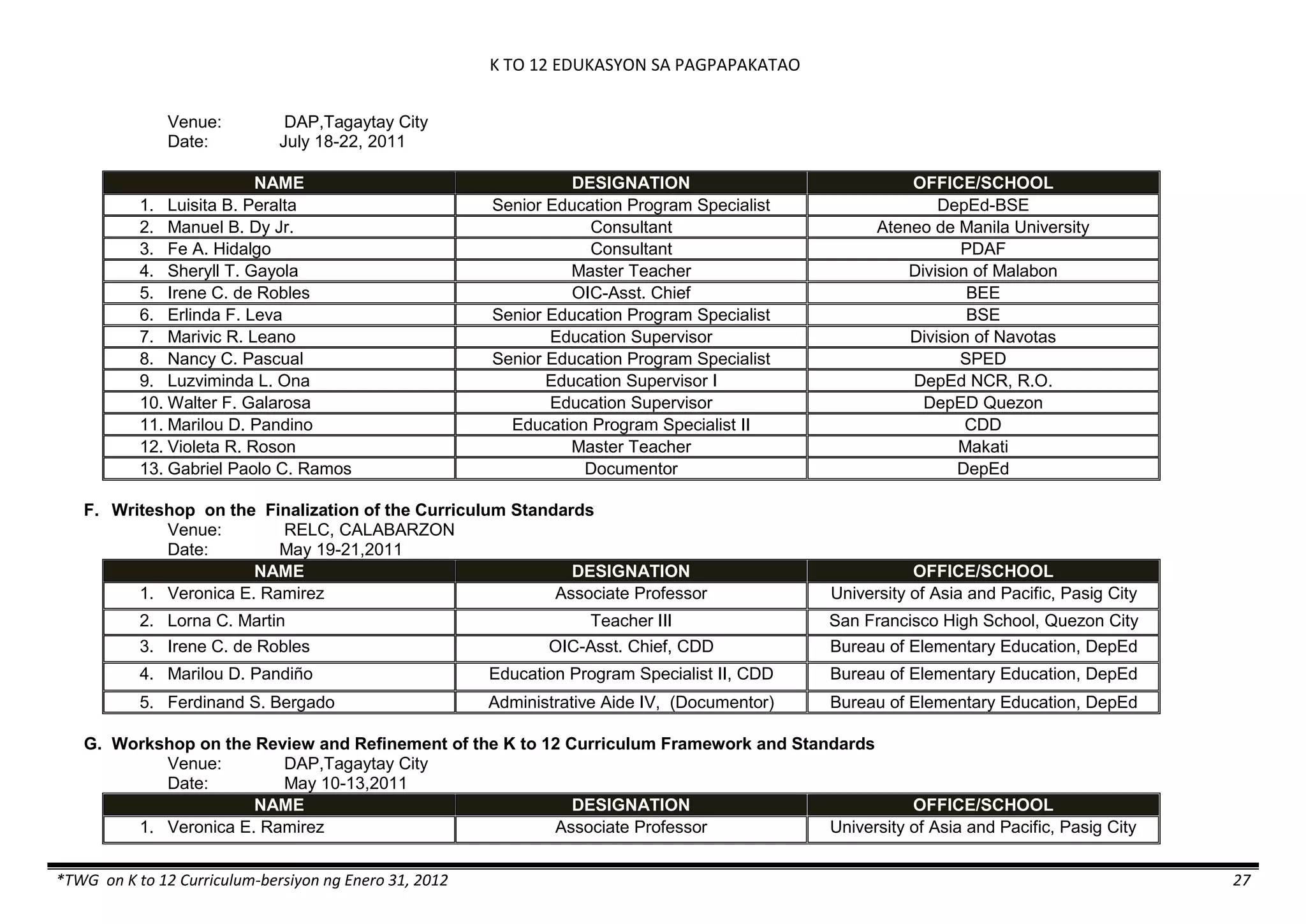
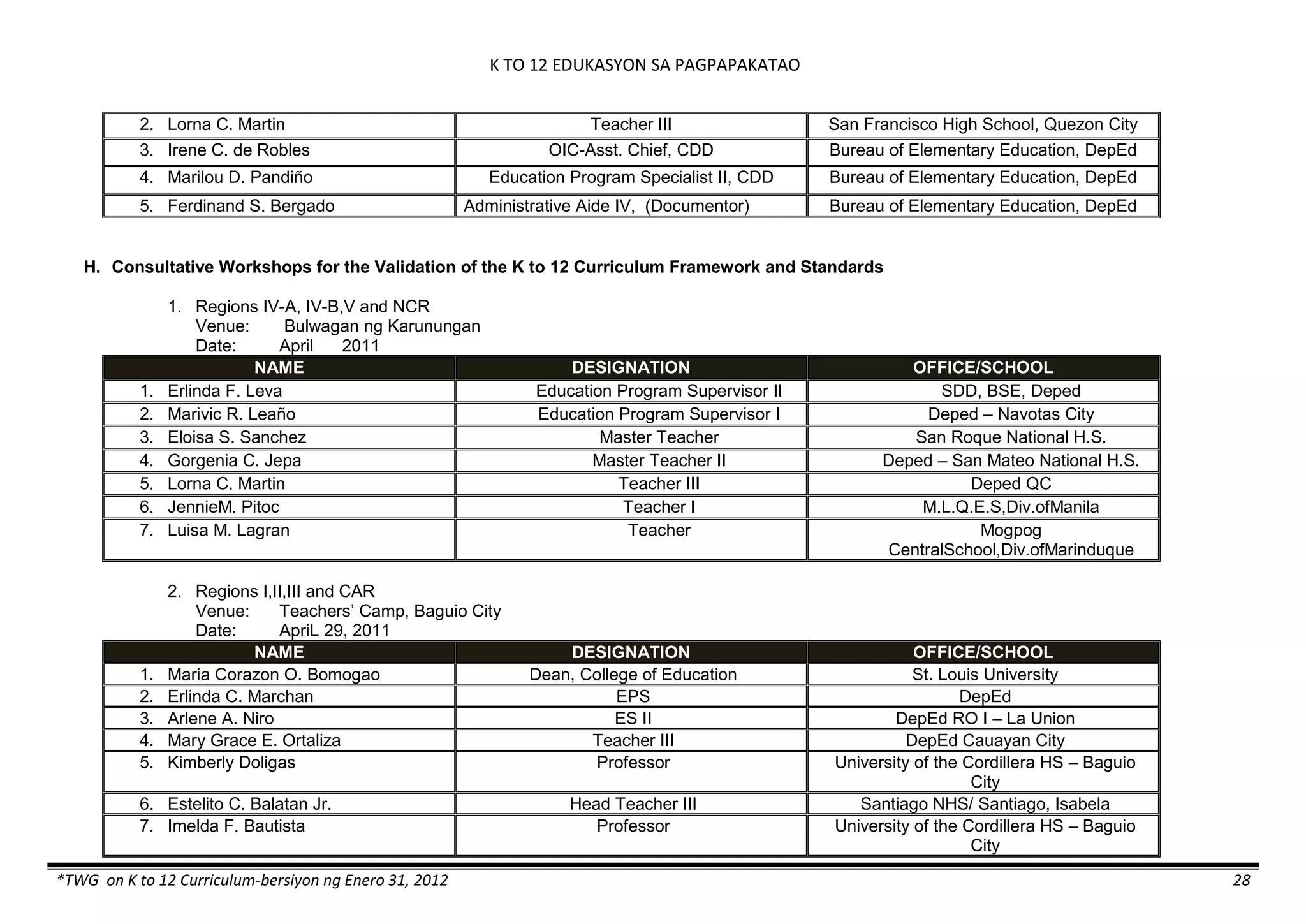
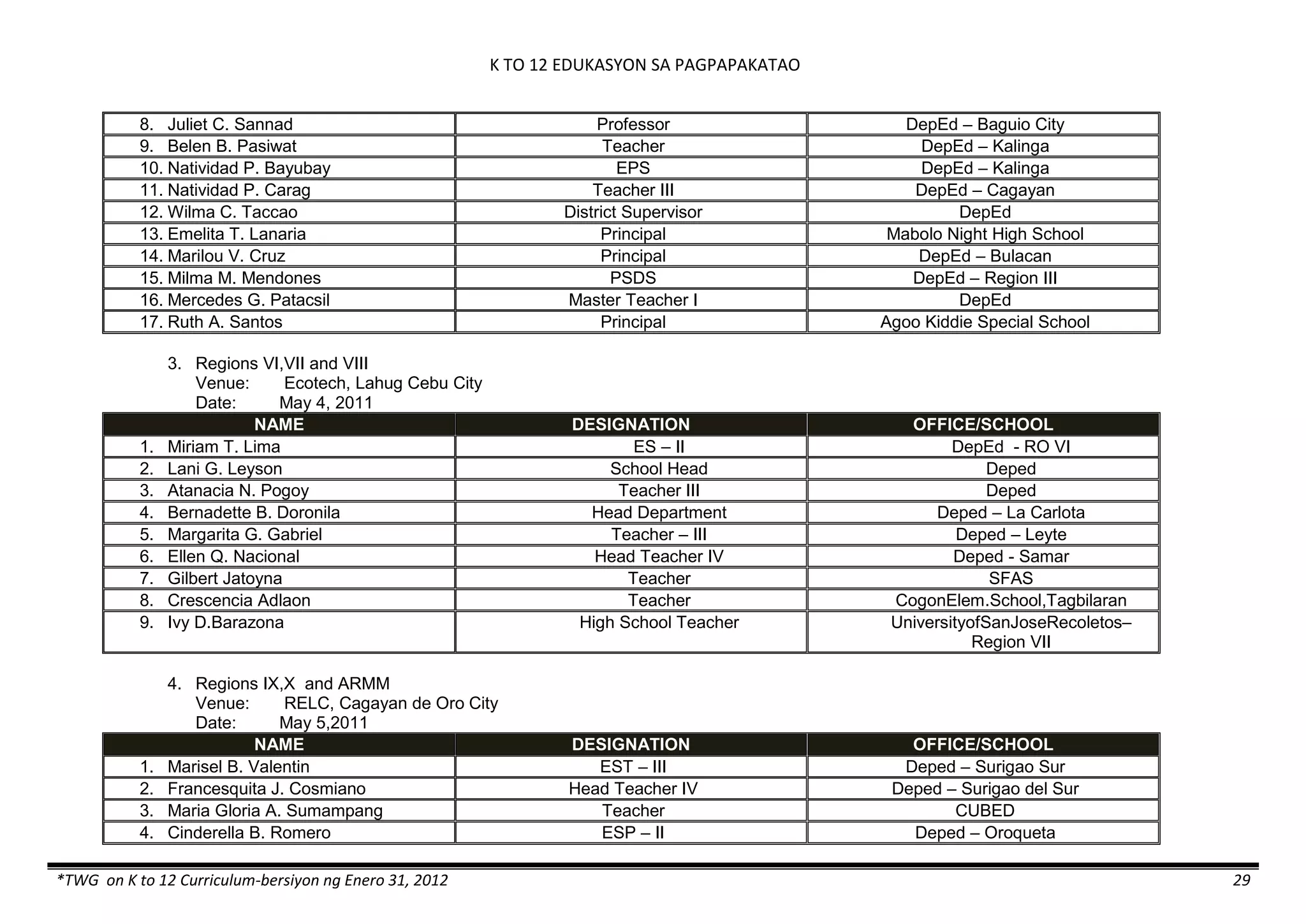
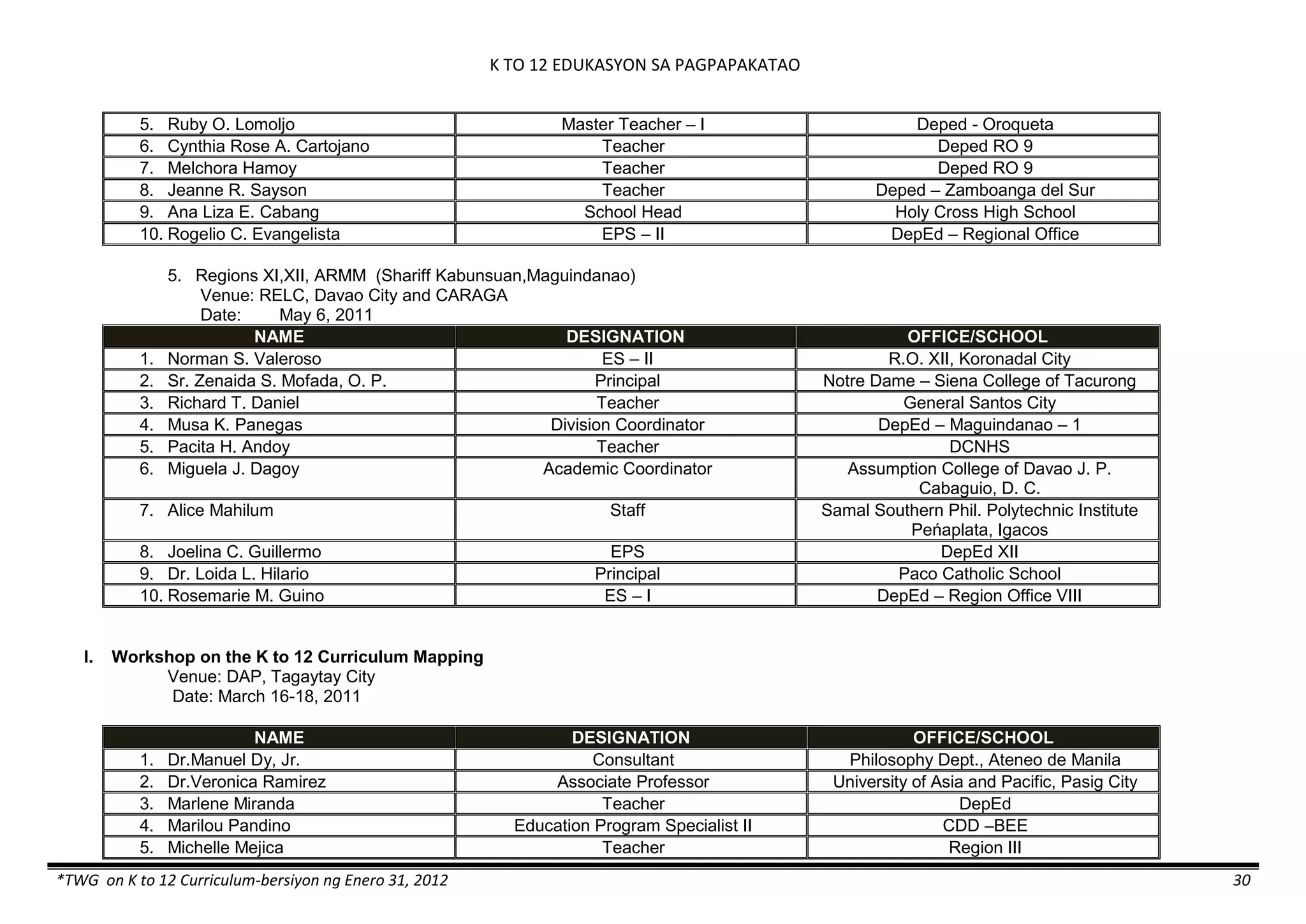
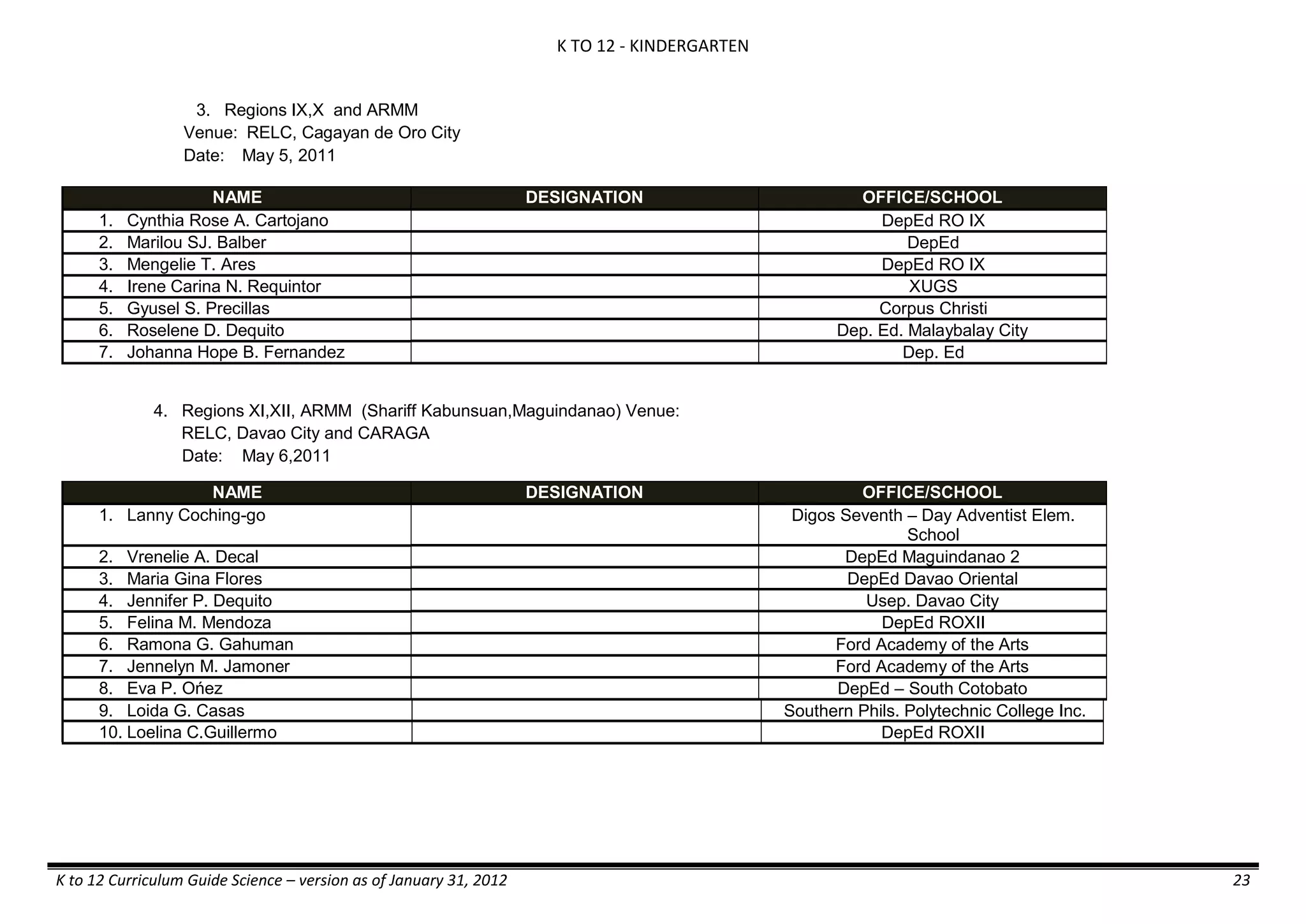
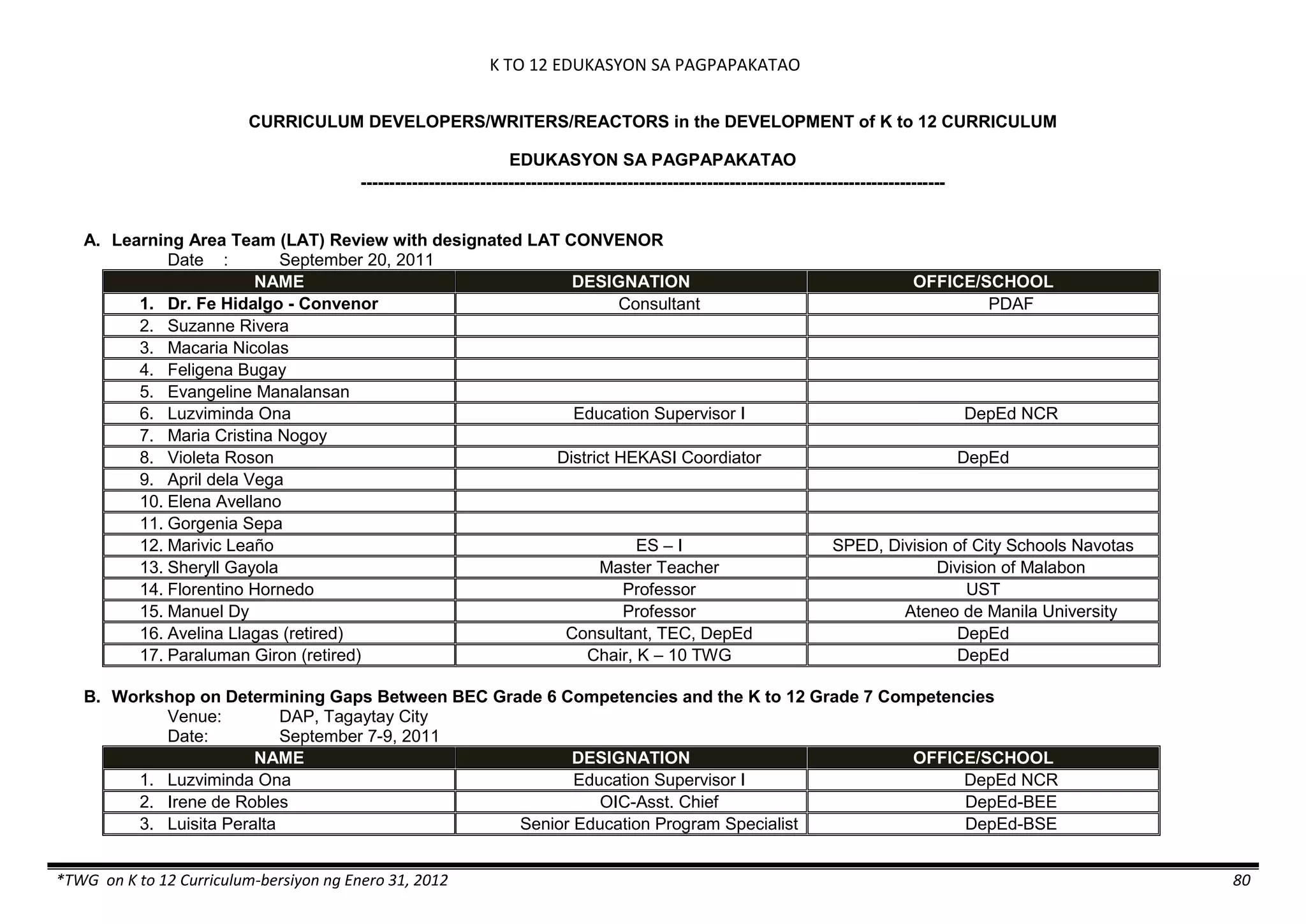
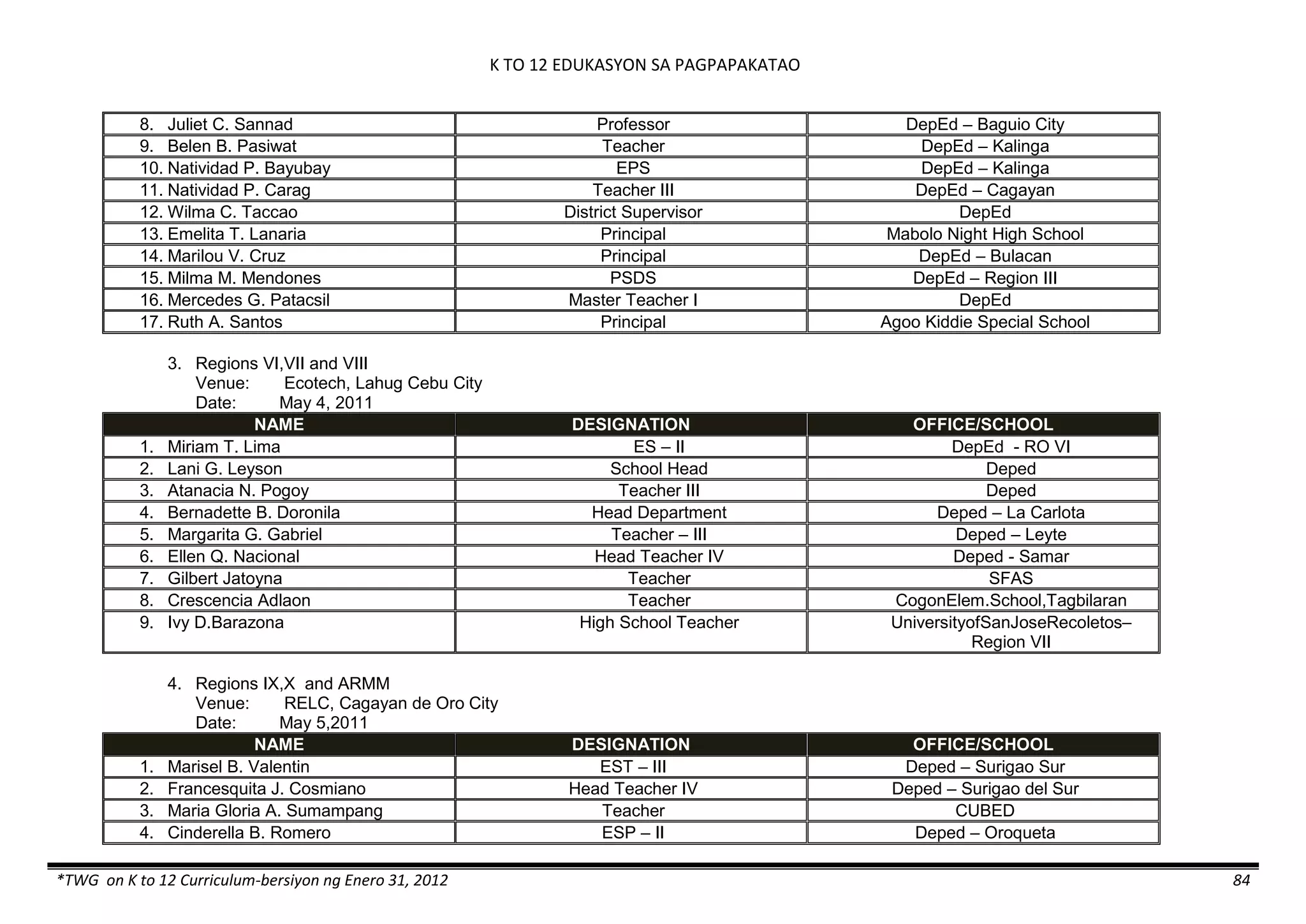
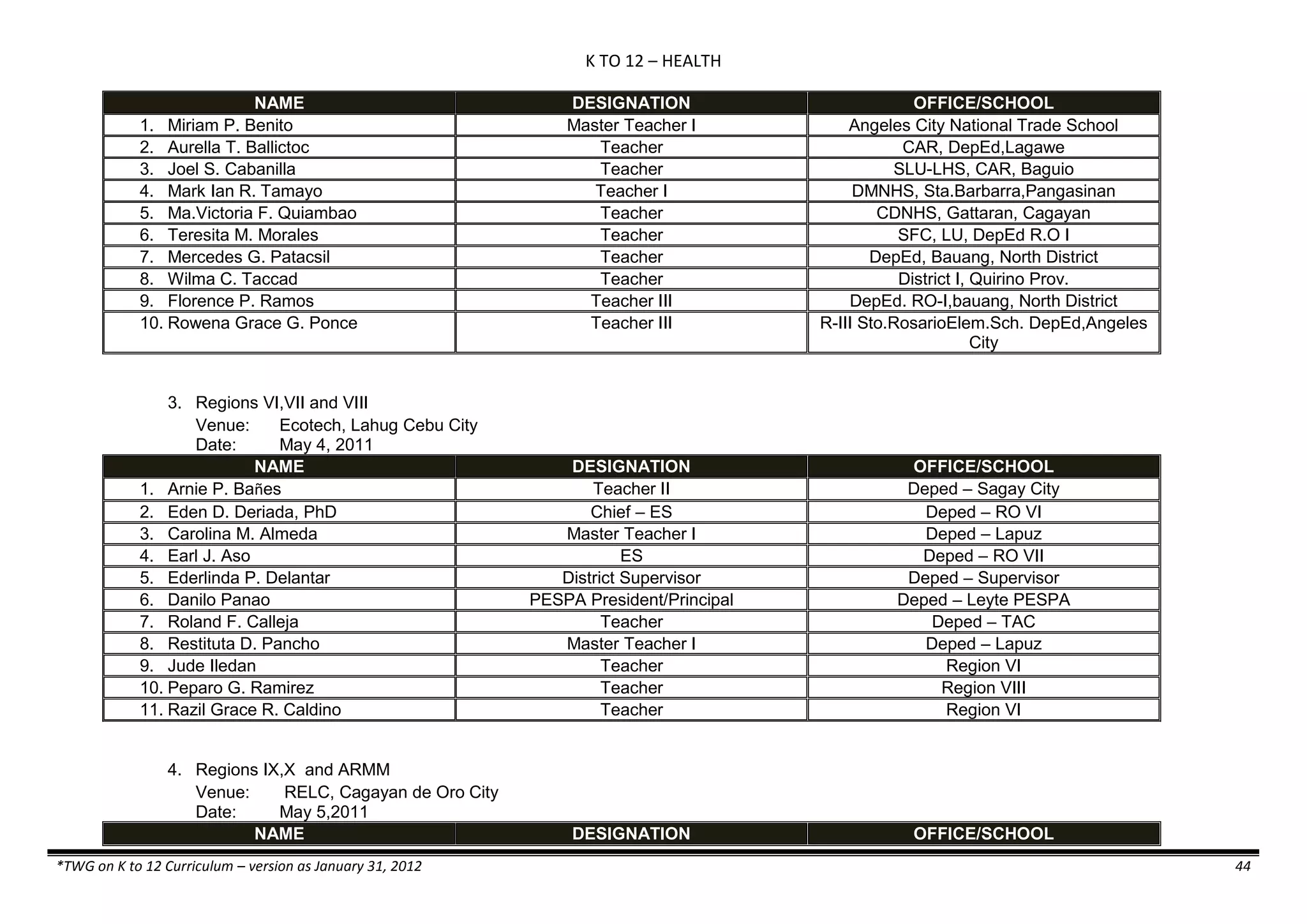
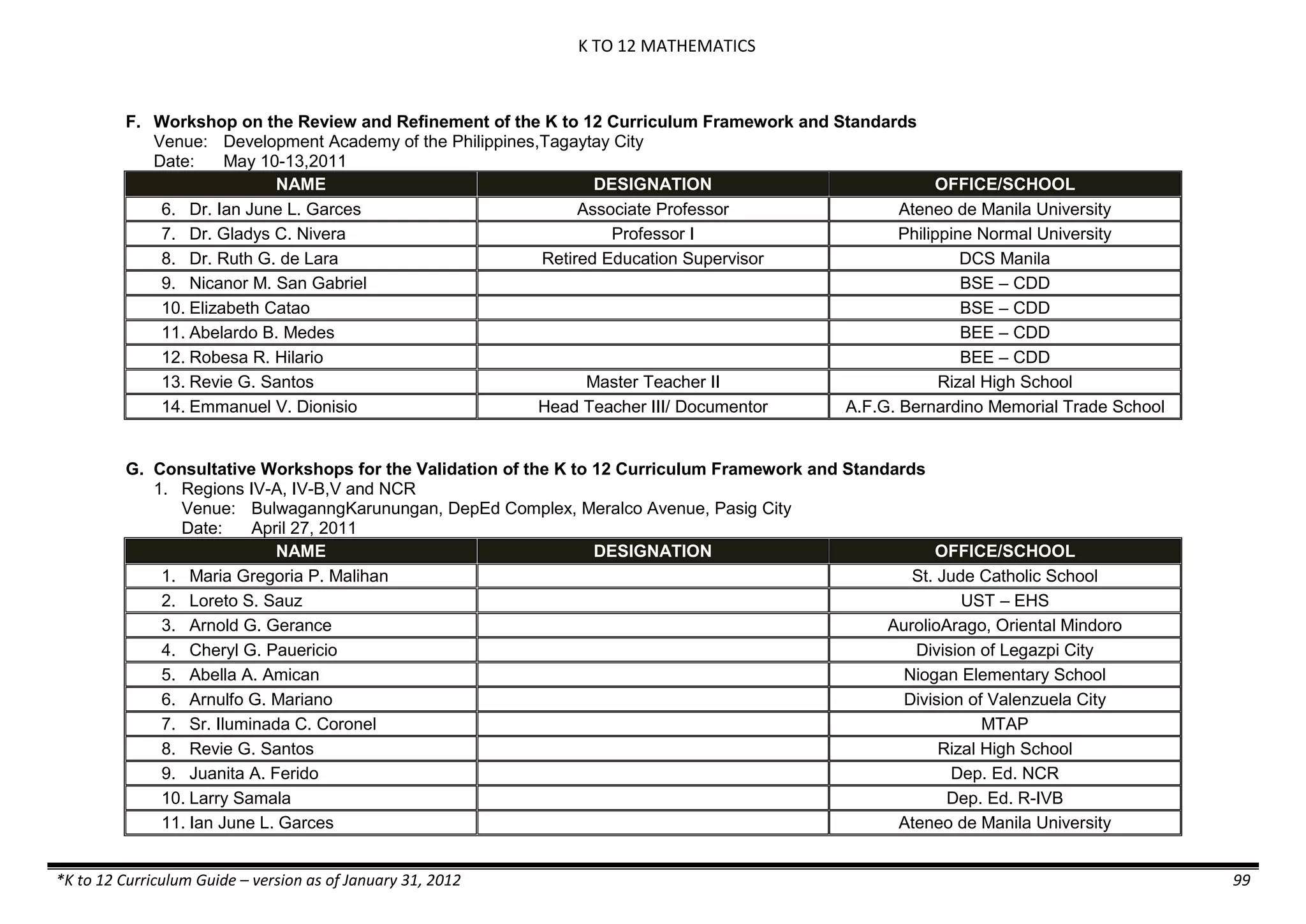
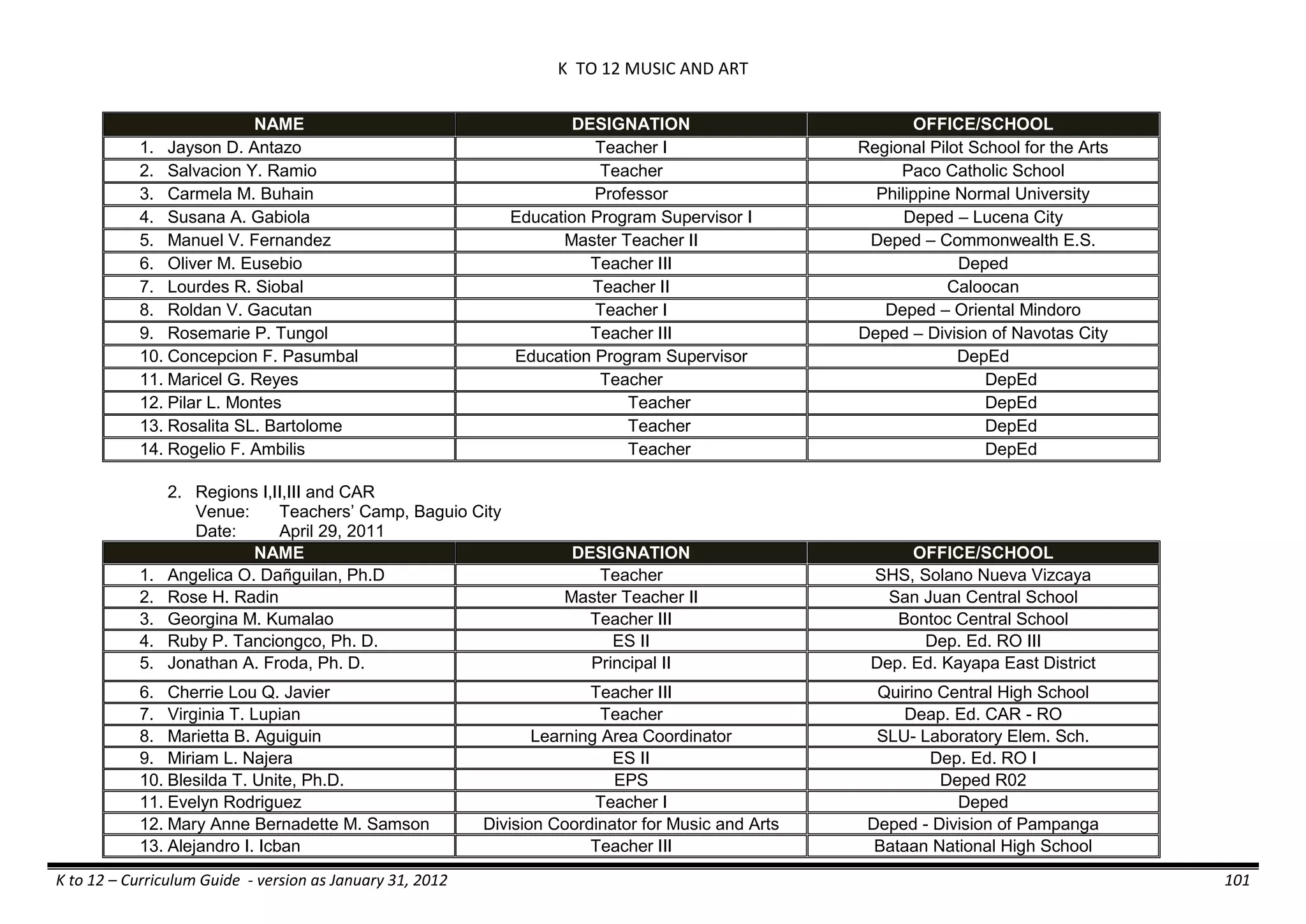
CURRICULUM DEVELOPERS/WRITERS/REACTORS in the DEVELOPMENT of K to 12 CURRICULUM
KINDERGARTEN
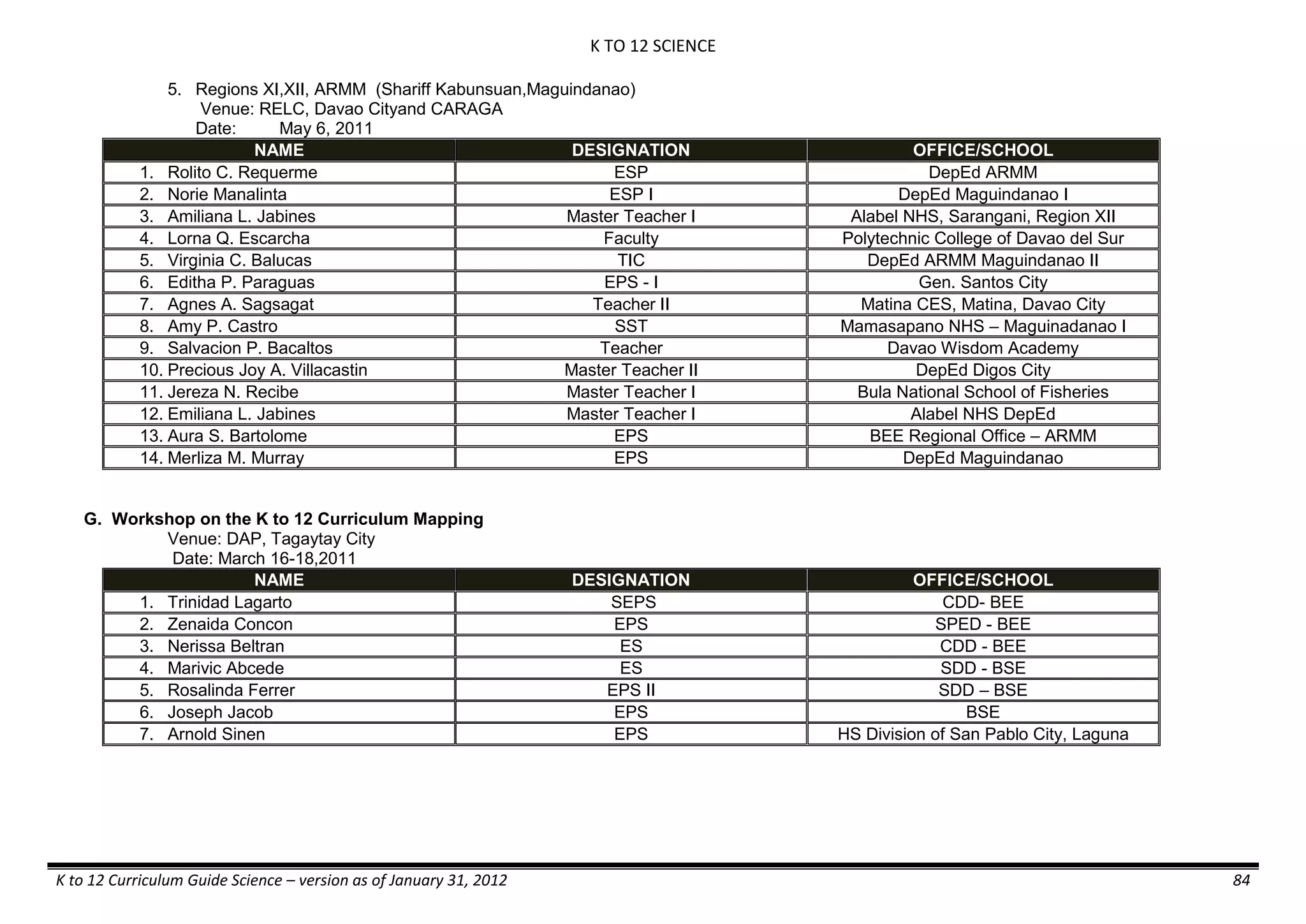
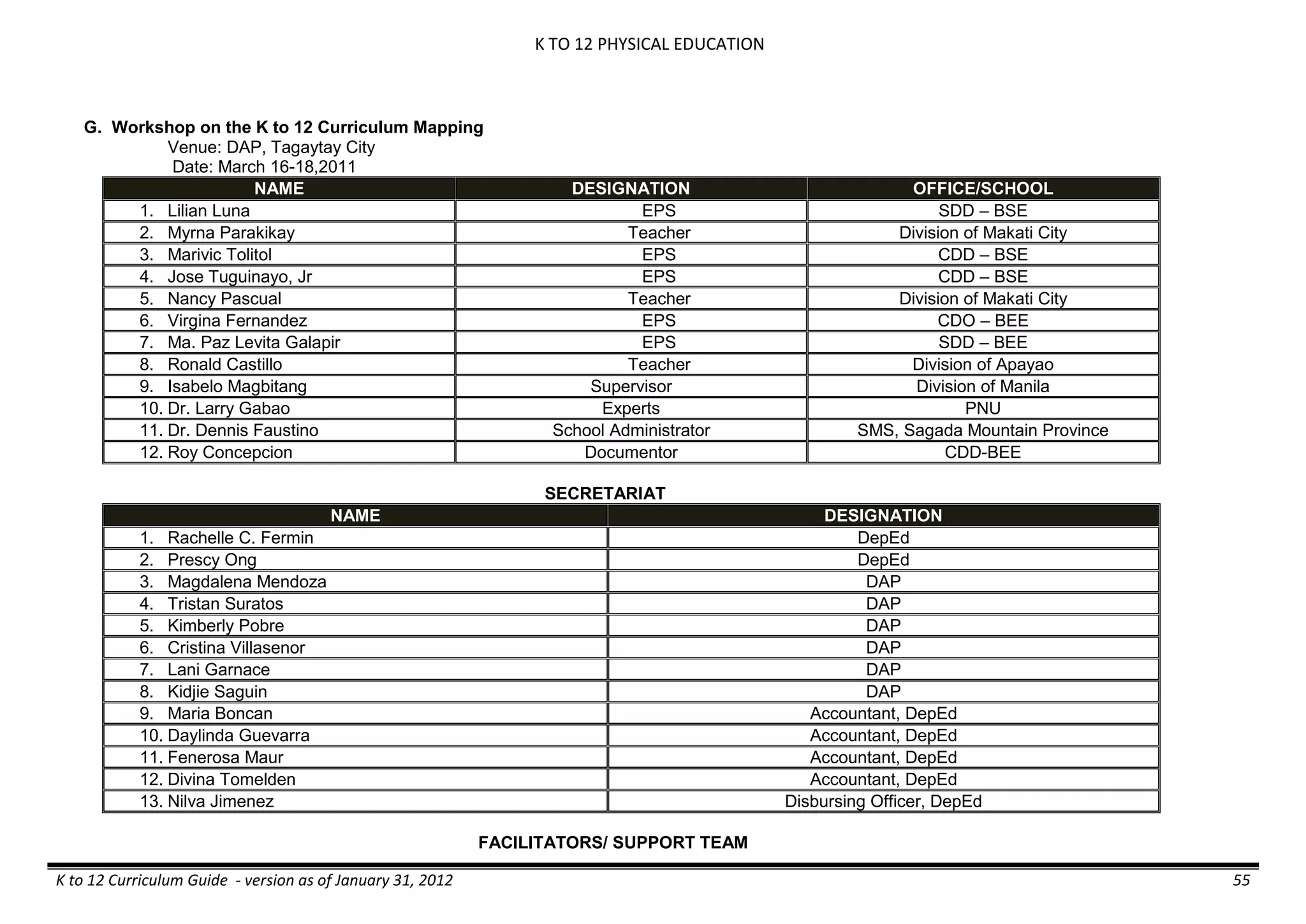
A. Writeshop on the Finalization of the Curriculum Standards
Venue: RELC, Calabarzon
Date: May 19-21,2011
NAME DESIGNATION OFFICE/SCHOOL
1. Dr. Maria Rita Dacanay Lucas Head, Education Program Centro Escolar University
2. Nerisa Marquez Beltran Education Program Specialist DepEd, Central Office
3. Roderick Motril Aguirre Consultant Region 8, DepEd/PNU
CESS/Benedictine Institute of Learning
4. Dante D. Vermon, Jr. Encoder/Teacher I A. F. G. Bernardino Memorial Trade School
B. Workshop on the Review and Refinement of the K to 12 Curriculum Framework and Standards
Venue: DAP,Tagaytay City
Date: May 10-13,2011
NAME DESIGNATION OFFICE/SCHOOL
1. Dr. Maria Rita Dacanay Lucas Head, Education Program Centro Escolar University
2. Nerisa Marquez Beltran Education Program Specialist DepEd, Central Office
3. Roderick Motril Aguirre Consultant Region 8, DepEd/PNU
CESS/Benedictine Institute of Learning
4. Dante D. Vermon, Jr. Encoder/Teacher I A. F. G. Bernardino Memorial Trade School
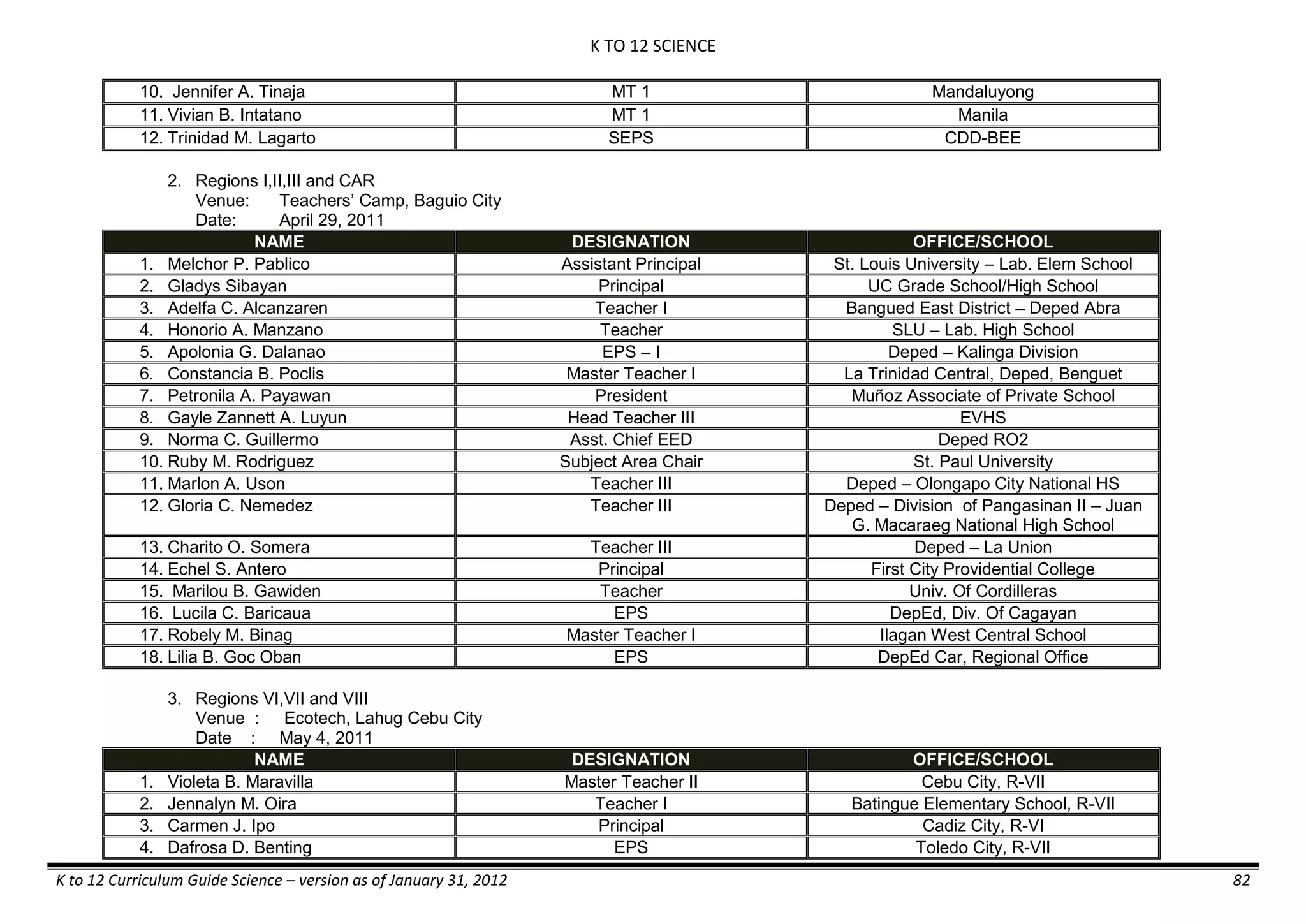
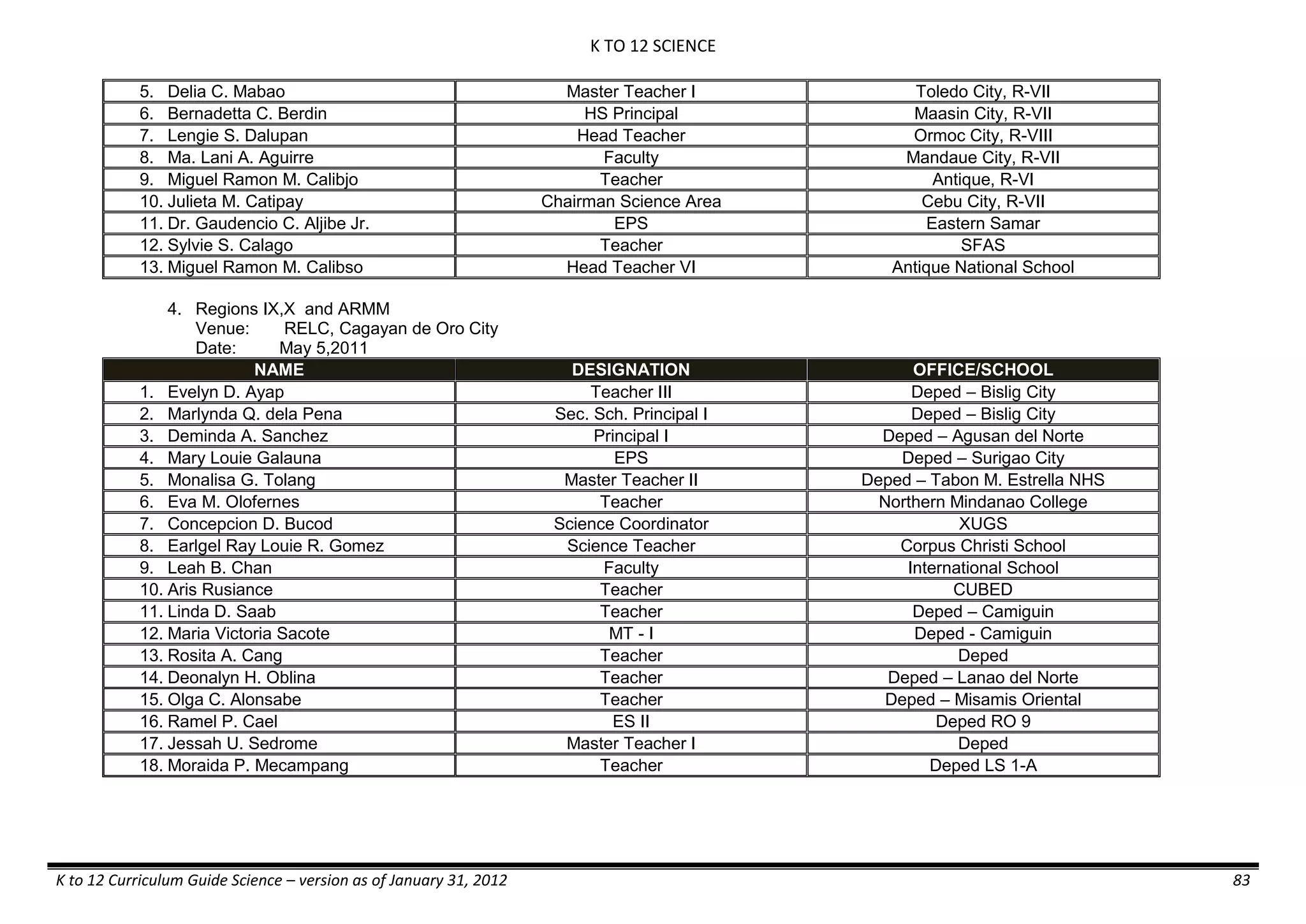
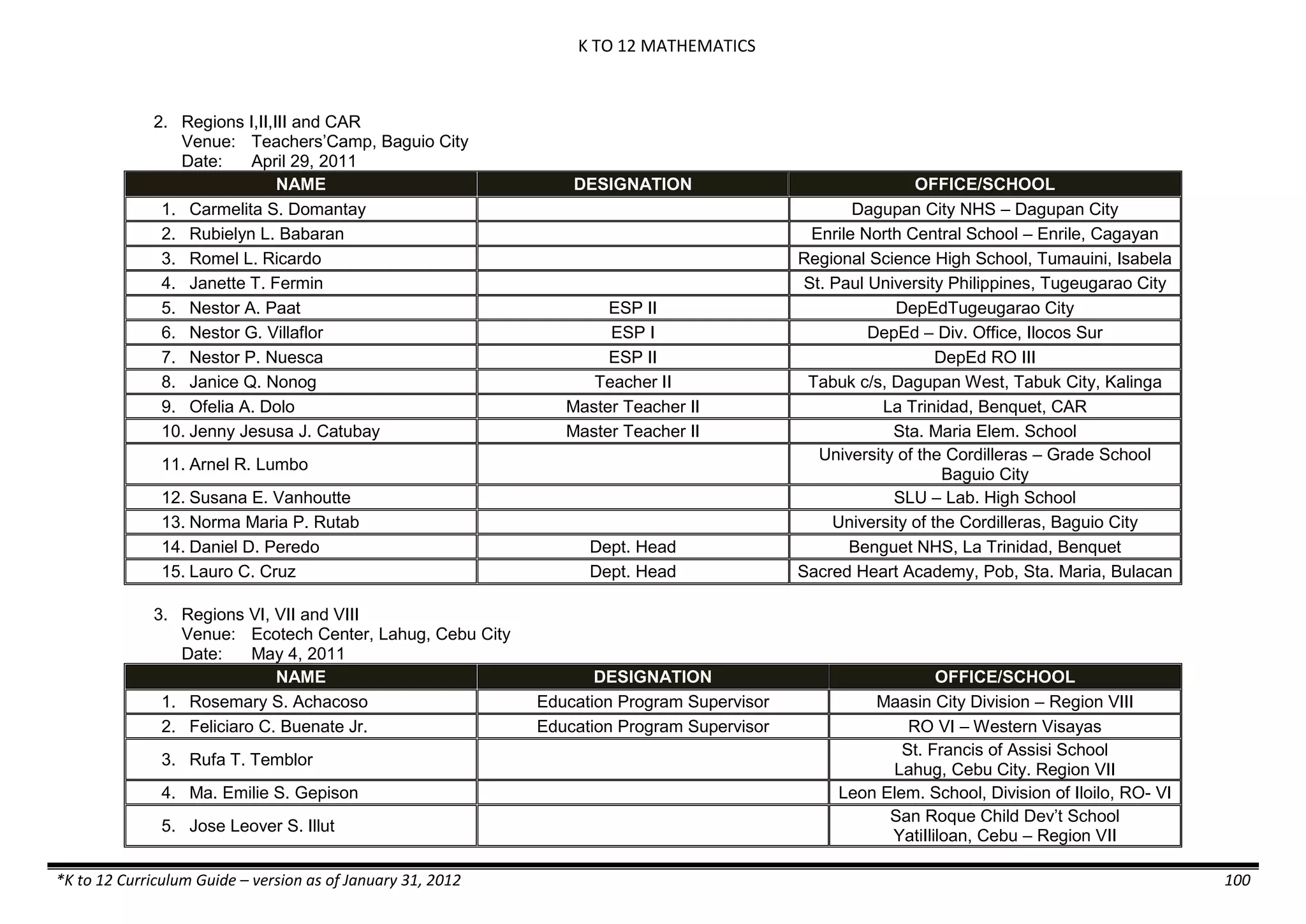
C. Consultative Workshops for the Validation of the K to 12 Curriculum Framework and Standards
K TO 12 - KINDERGARTEN
K to 12 Curriculum Guide Science – version as of January 31, 2012 22
1. Regions I,II,III and CAR
Venue: Teachers’ Camp, Baguio City
Date: April 29, 2011
NAME DESIGNATION OFFICE/SCHOOL
1. Barbara Elena M. Lagos Saint Louis University
2. Jesusa L. Aguinaldo Ugac E/S Tug. City, Cagayan
3. Mageline O. Canceran Barabac Este, Balaoan, La Union
4. Mary Jane L. Wayang UB Laboratory Elem. School Baguio City
5. Daisy C. Mamaradlo Casilagan, San Juan, La Union
6. Echel S. Antero First City Providential College, SJDM, Bul.
7. Anel Martin S. Antero First City Providential College, SJDM, Bul.
8. Elizabeth Teotico - Aseaten Tarlac Montessori School
9. Plorwa C. Orillen Tarlac Montessori School
10. Norma C. Guillermo Region II
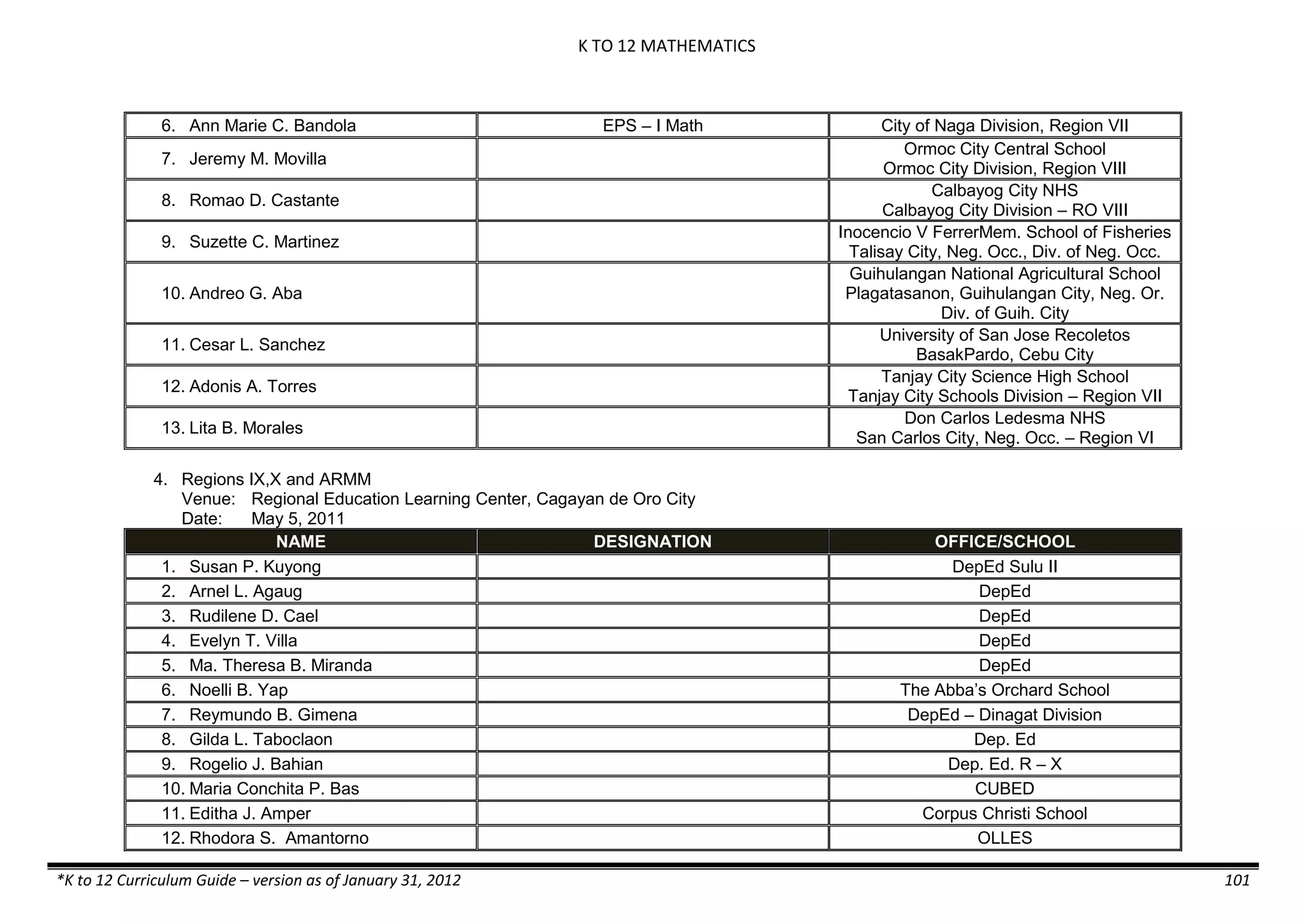
2. Regions VI,VII and VIII
Venue: Ecotech, Lahug Cebu City
Date: May 4, 2011
NAME DESIGNATION OFFICE/SCHOOL
1. Sr. Lea A. Galvan FDNSC
2. Ms. Maria Frenchie VI A. Regino
3. Ms. Cheeryl A. Apas
4. Mrs. Raquel M. Jabal
5. Mrs. Joyce Endoso
6. Ms. Marietta Baldo
7. Maria Alma C. Tibon Region VIII – Southern Leyte Division
8. Crisanta L. Orais Region VIII, Maasin City Division
9. Michelle F. delos Santos DepEd Cebu City
10. Josephine D. Abadia Region VII
K TO 12 - KINDERGARTEN
K to 12 Curriculum Guide Science – version as of January 31, 2012 23
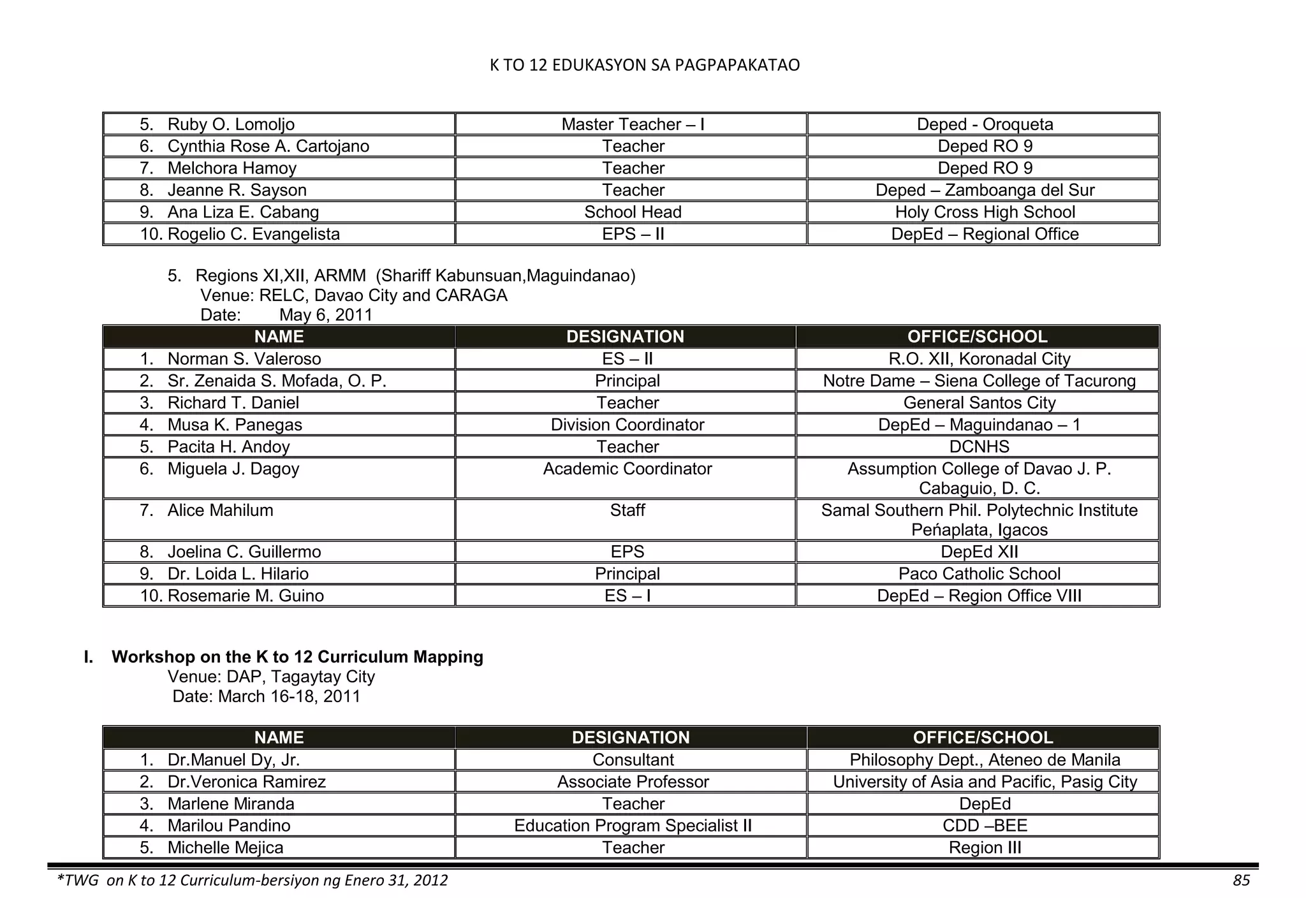
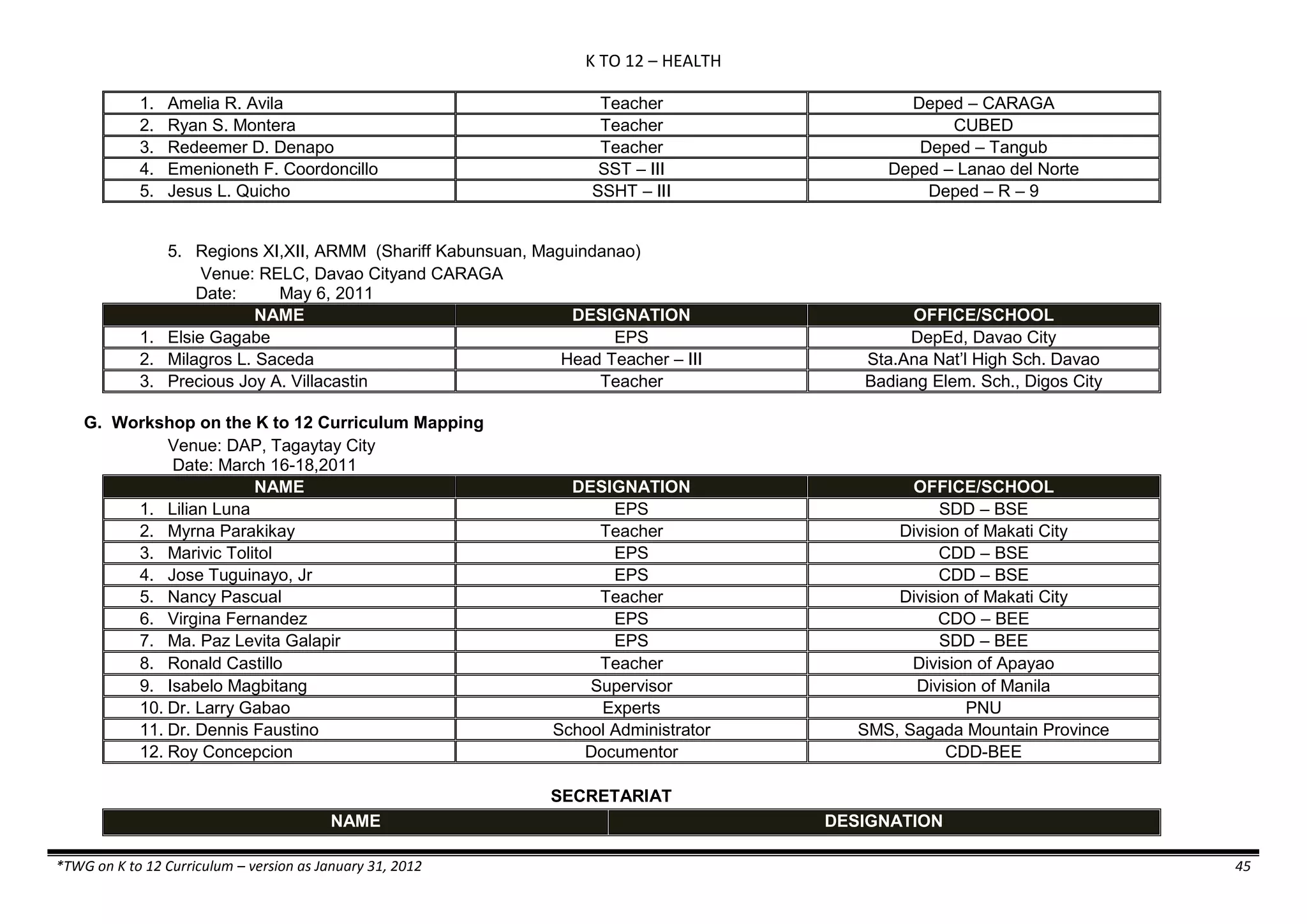
3. Regions IX,X and ARMM
Venue: RELC, Cagayan de Oro City
Date: May 5, 2011
NAME DESIGNATION OFFICE/SCHOOL
1. Cynthia Rose A. Cartojano DepEd RO IX
2. Marilou SJ. Balber DepEd
3. Mengelie T. Ares DepEd RO IX
4. Irene Carina N. Requintor XUGS
5. Gyusel S. Precillas Corpus Christi
6. Roselene D. Dequito Dep. Ed. Malaybalay City
7. Johanna Hope B. Fernandez Dep. Ed
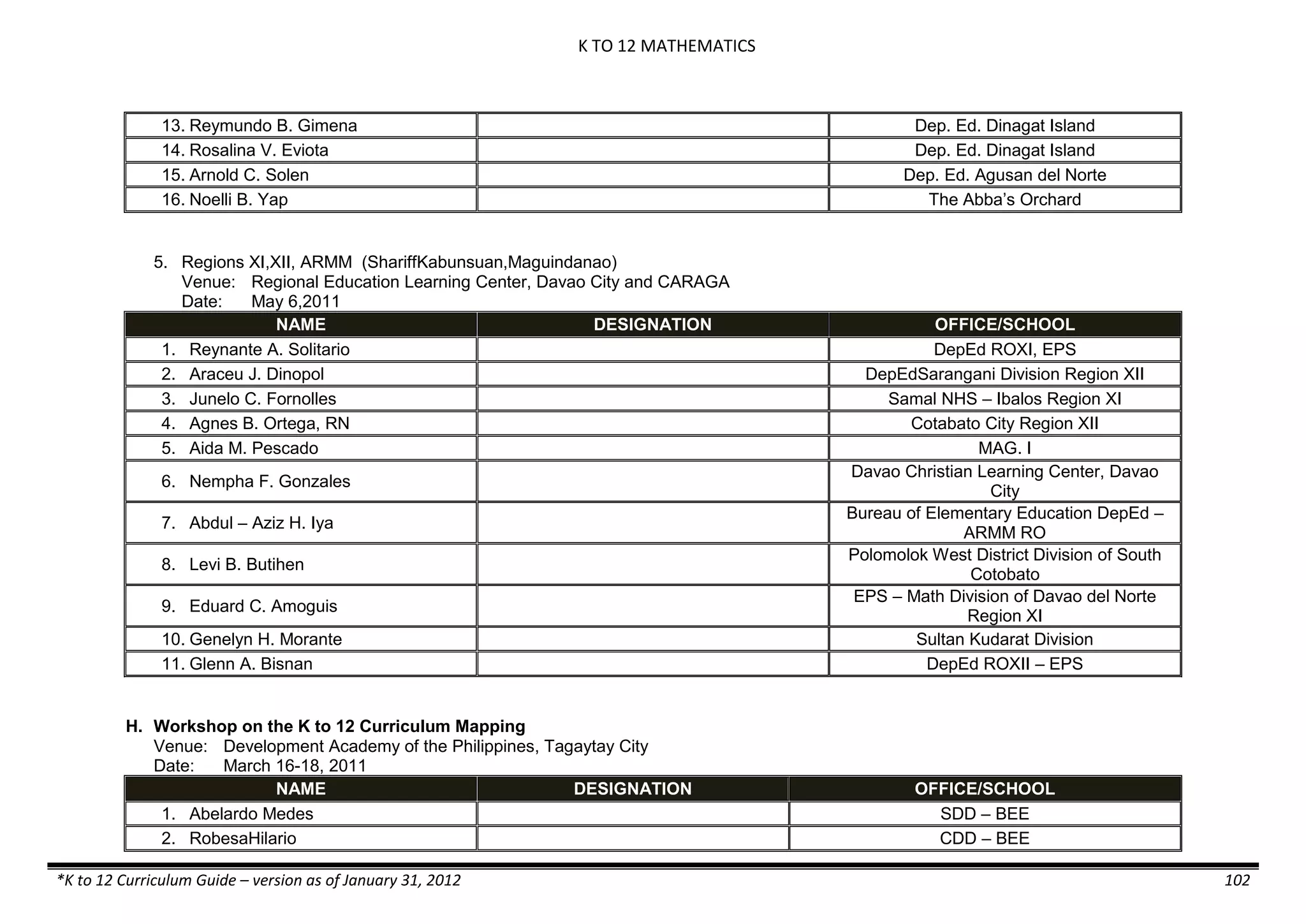
4. Regions XI,XII, ARMM (Shariff Kabunsuan,Maguindanao) Venue:
RELC, Davao City and CARAGA
Date: May 6,2011
NAME DESIGNATION OFFICE/SCHOOL
1. Lanny Coching-go Digos Seventh – Day Adventist Elem.
School
2. Vrenelie A. Decal DepEd Maguindanao 2
3. Maria Gina Flores DepEd Davao Oriental
4. Jennifer P. Dequito Usep. Davao City
5. Felina M. Mendoza DepEd ROXII
6. Ramona G. Gahuman Ford Academy of the Arts
7. Jennelyn M. Jamoner Ford Academy of the Arts
8. Eva P. Ońez DepEd – South Cotobato
9. Loida G. Casas Southern Phils. Polytechnic College Inc.
10. Loelina C.Guillermo DepEd ROXII
K TO 12 - KINDERGARTEN
K to 12 Curriculum Guide Science – version as of January 31, 2012 24
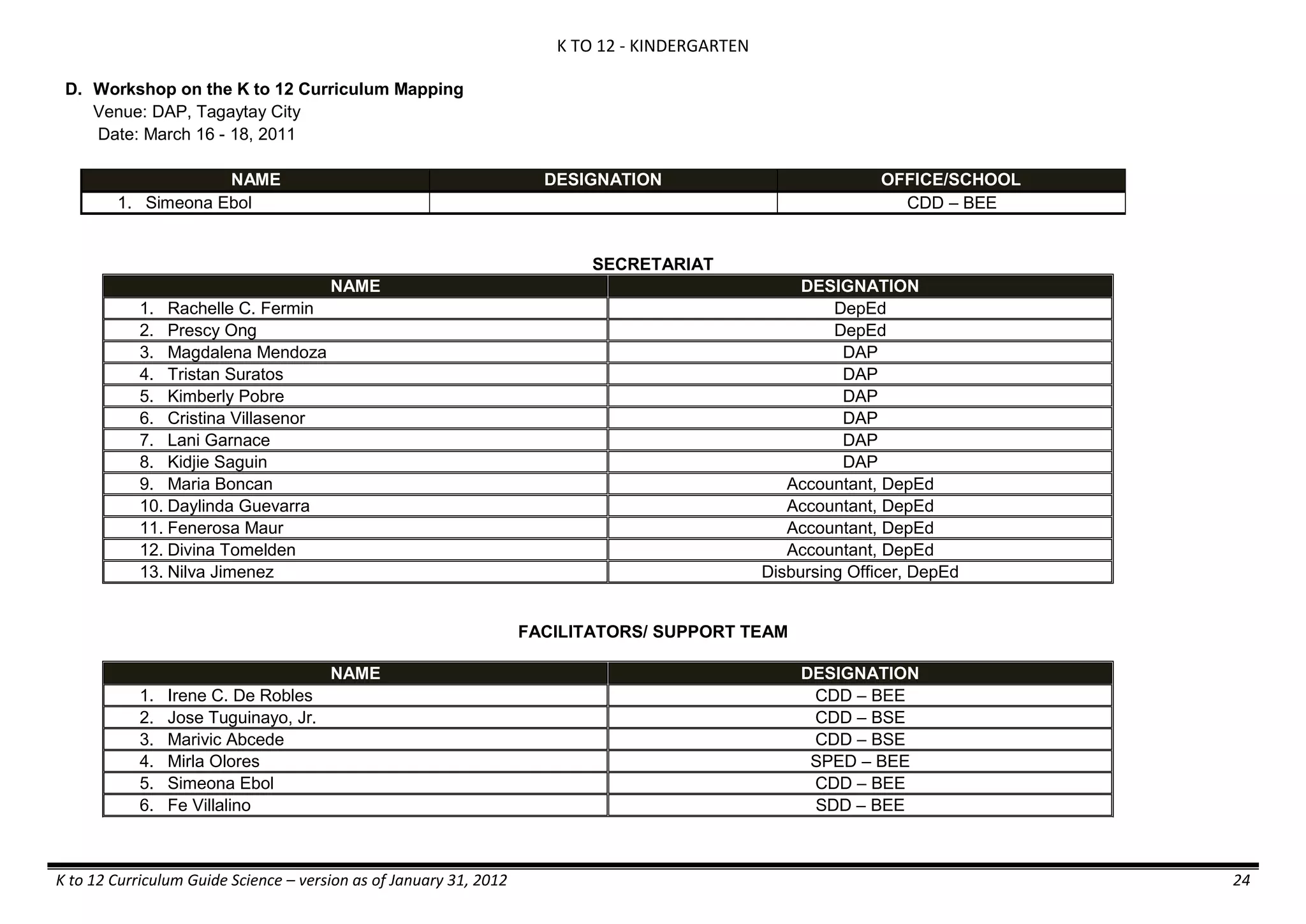
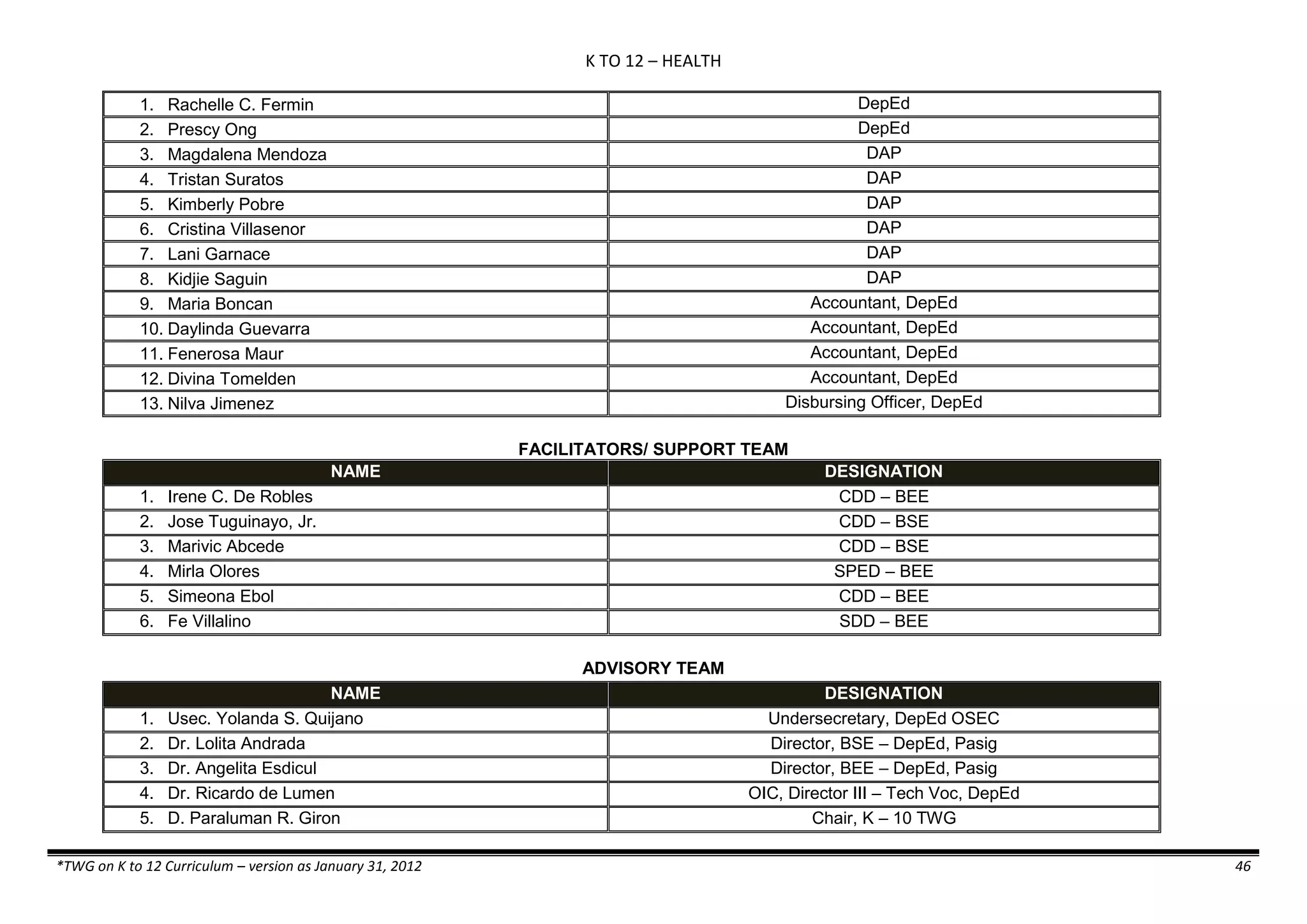
D. Workshop on the K to 12 Curriculum Mapping
Venue: DAP, Tagaytay City
Date: March 16 - 18, 2011
NAME DESIGNATION OFFICE/SCHOOL
1. Simeona Ebol CDD – BEE
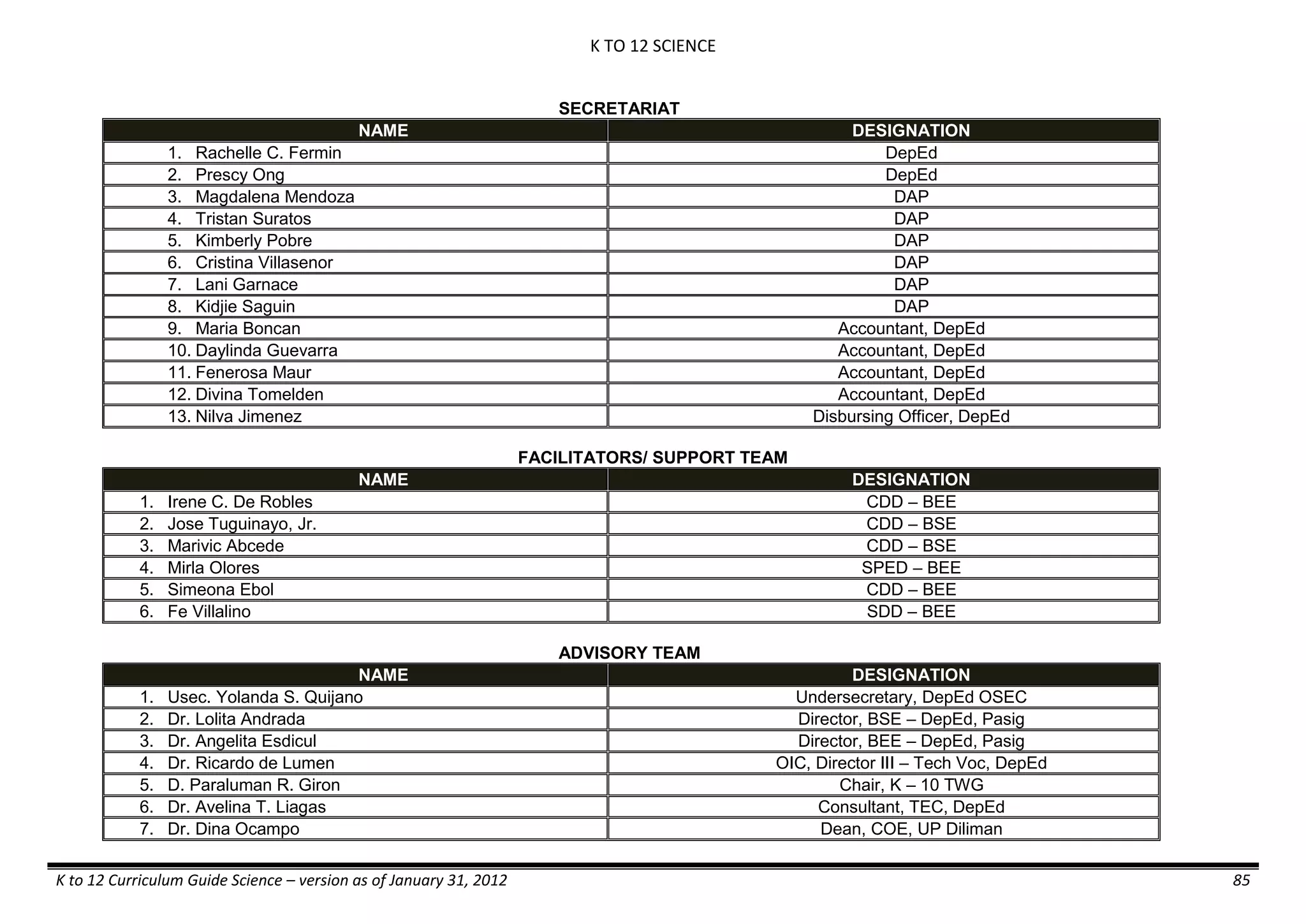
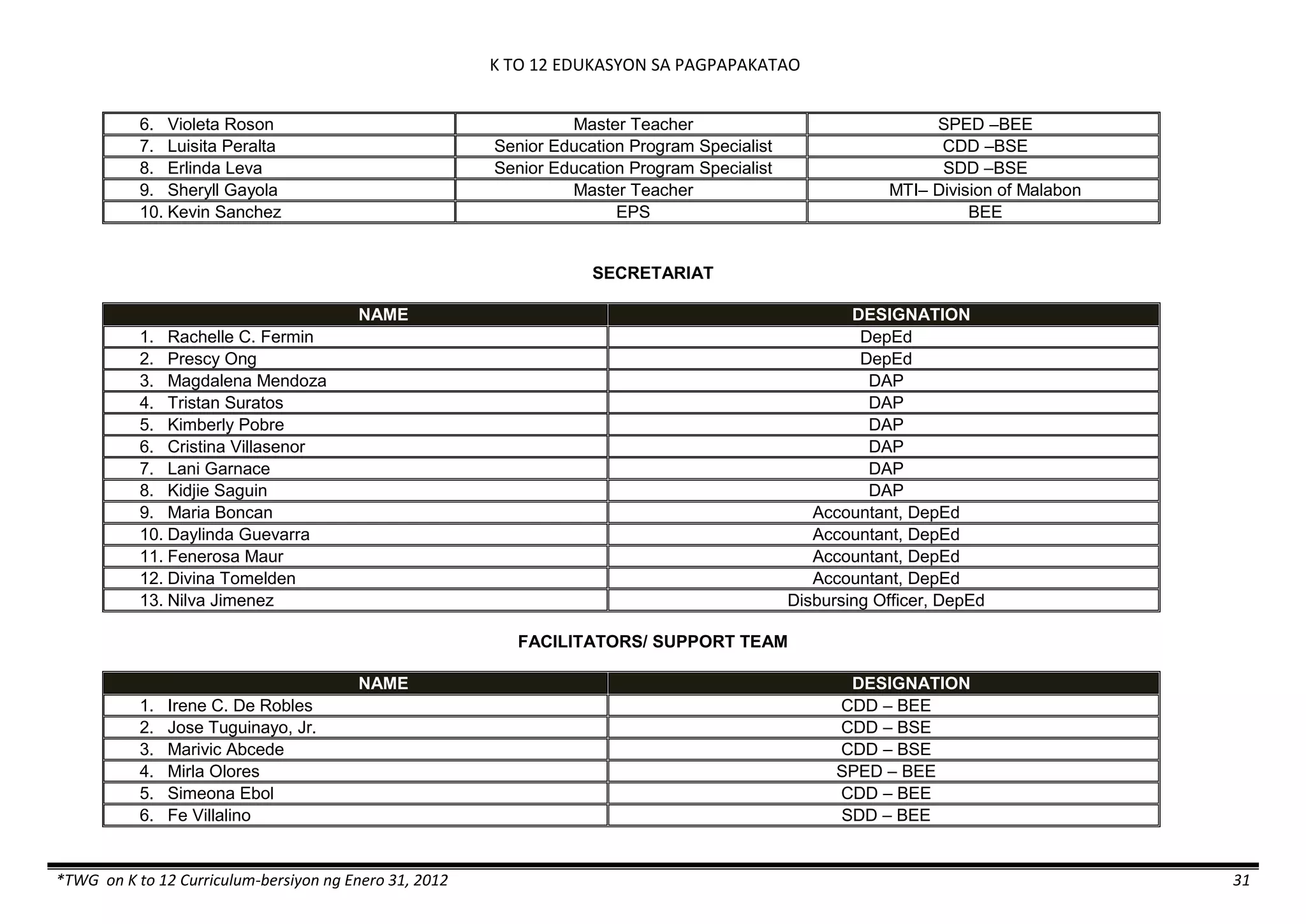
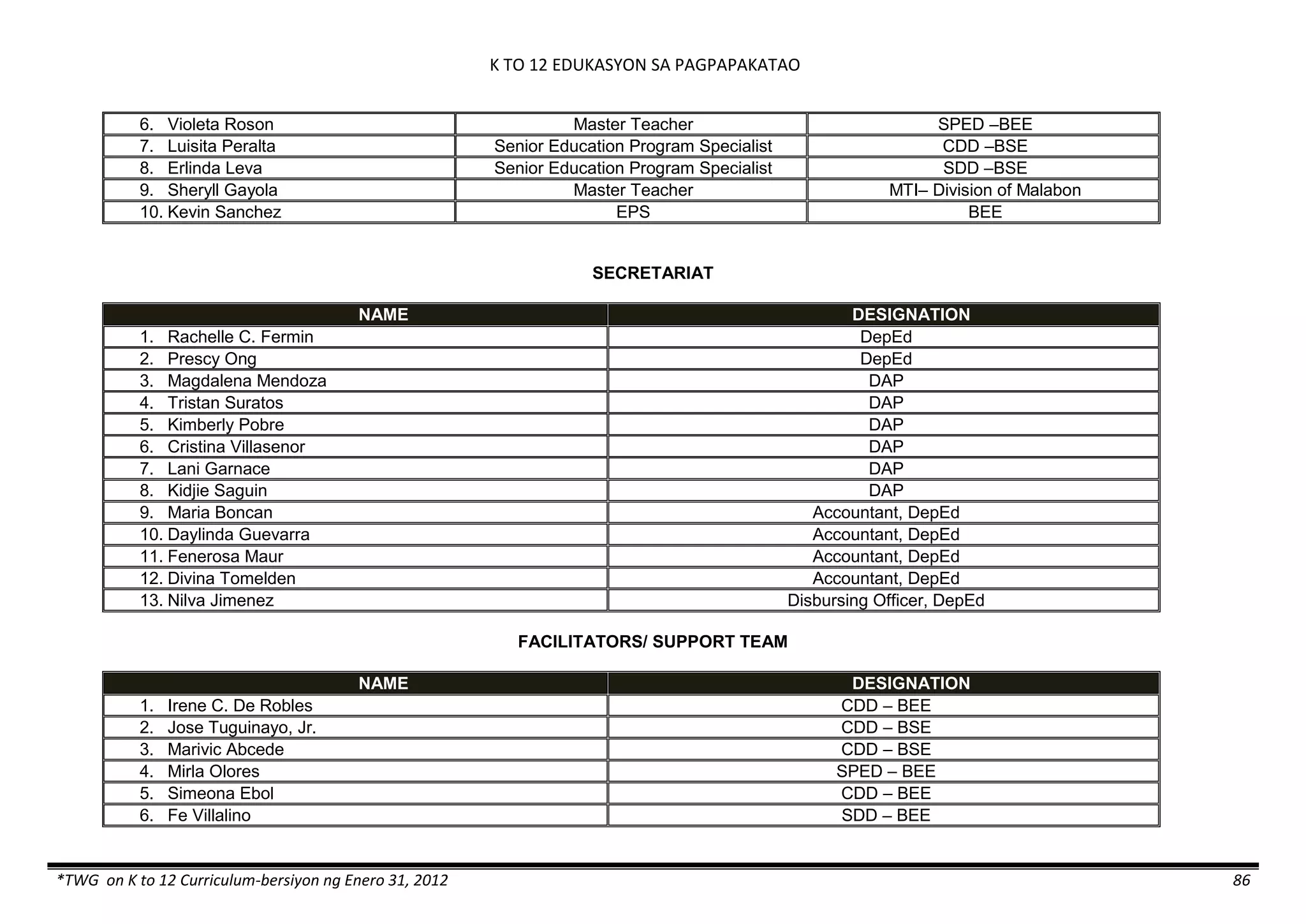
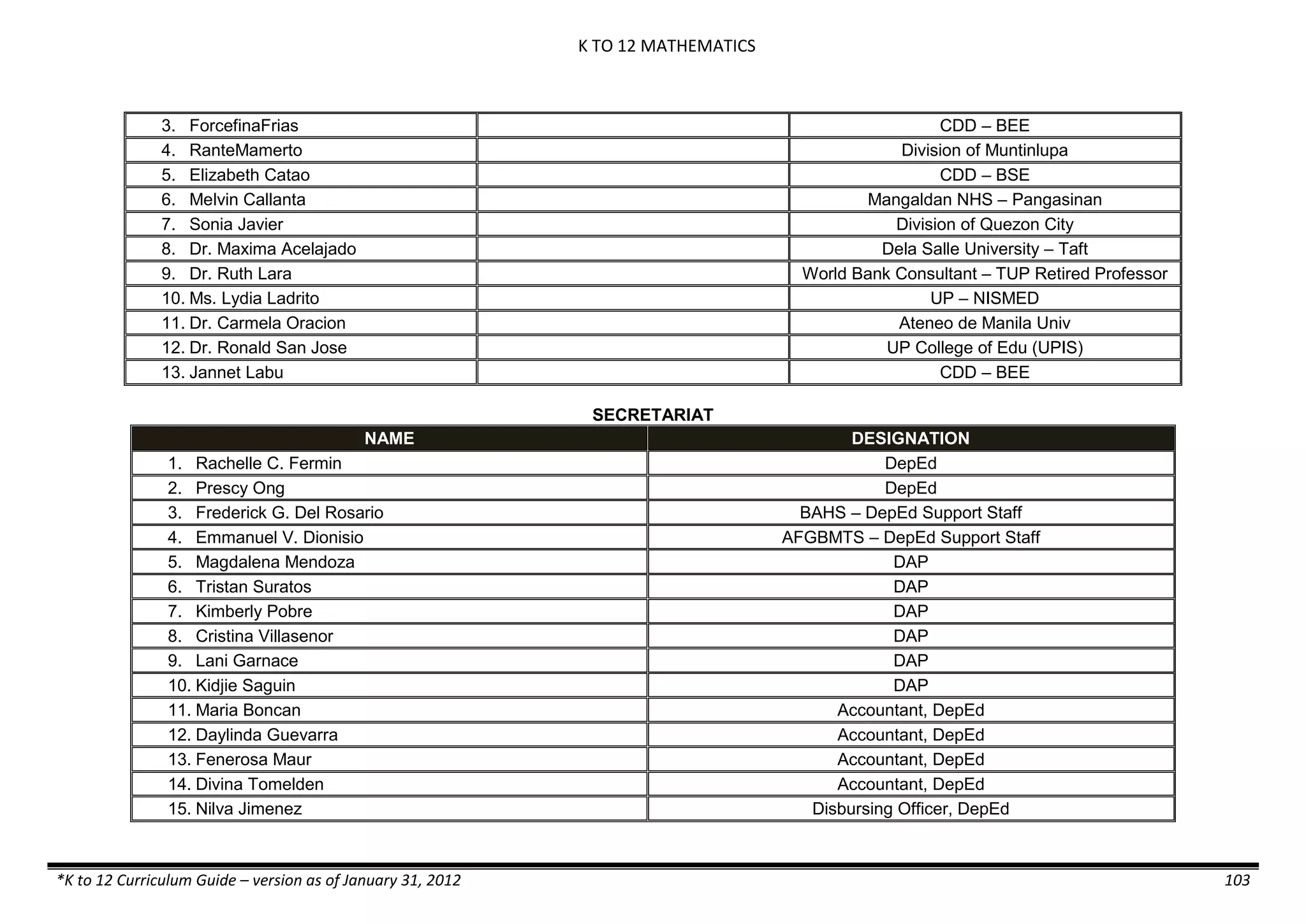
SECRETARIAT
NAME DESIGNATION
1. Rachelle C. Fermin DepEd
2. Prescy Ong DepEd
3. Magdalena Mendoza DAP
4. Tristan Suratos DAP
5. Kimberly Pobre DAP
6. Cristina Villasenor DAP
7. Lani Garnace DAP
8. Kidjie Saguin DAP
9. Maria Boncan Accountant, DepEd
10. Daylinda Guevarra Accountant, DepEd
11. Fenerosa Maur Accountant, DepEd
12. Divina Tomelden Accountant, DepEd
13. Nilva Jimenez Disbursing Officer, DepEd
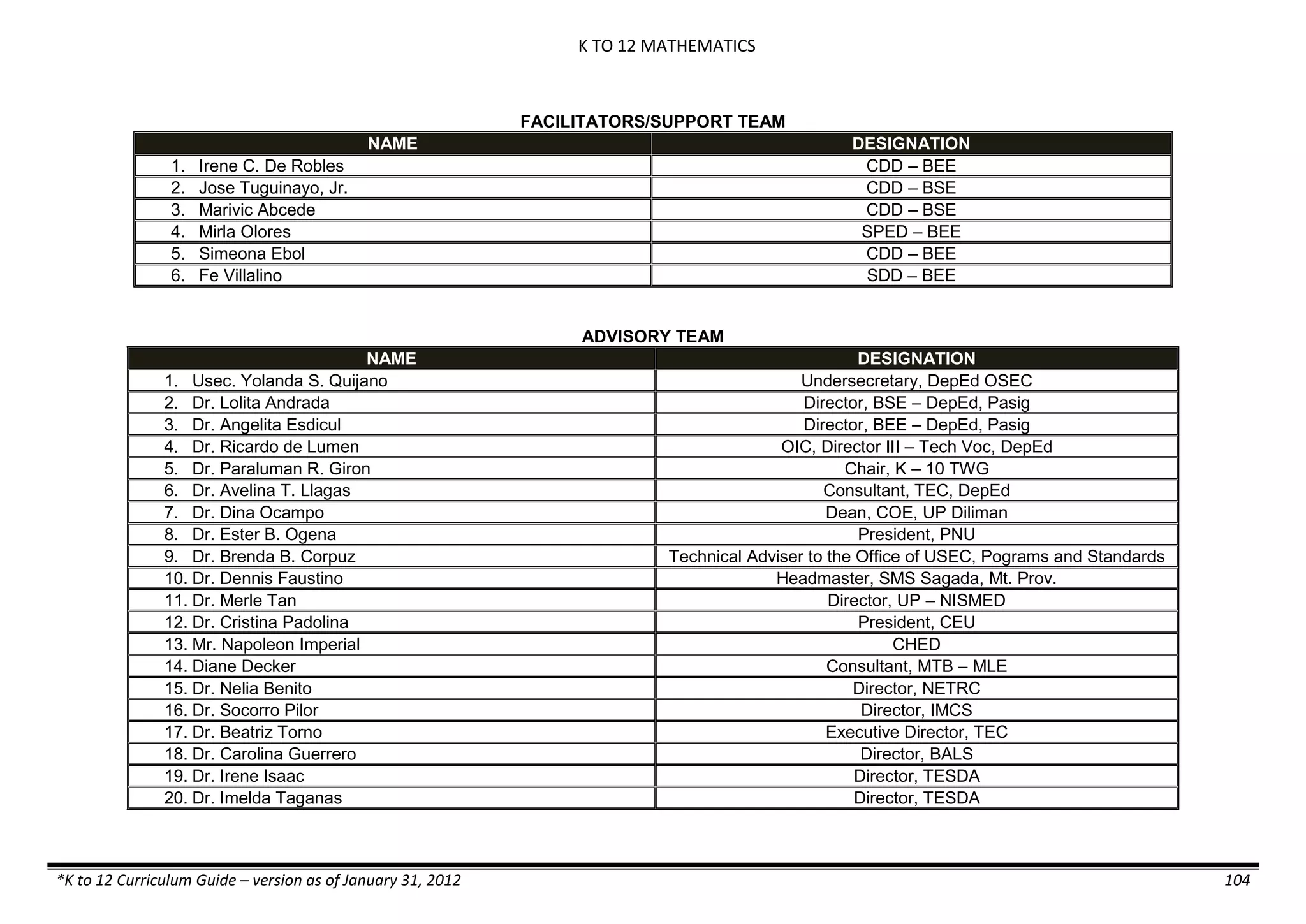
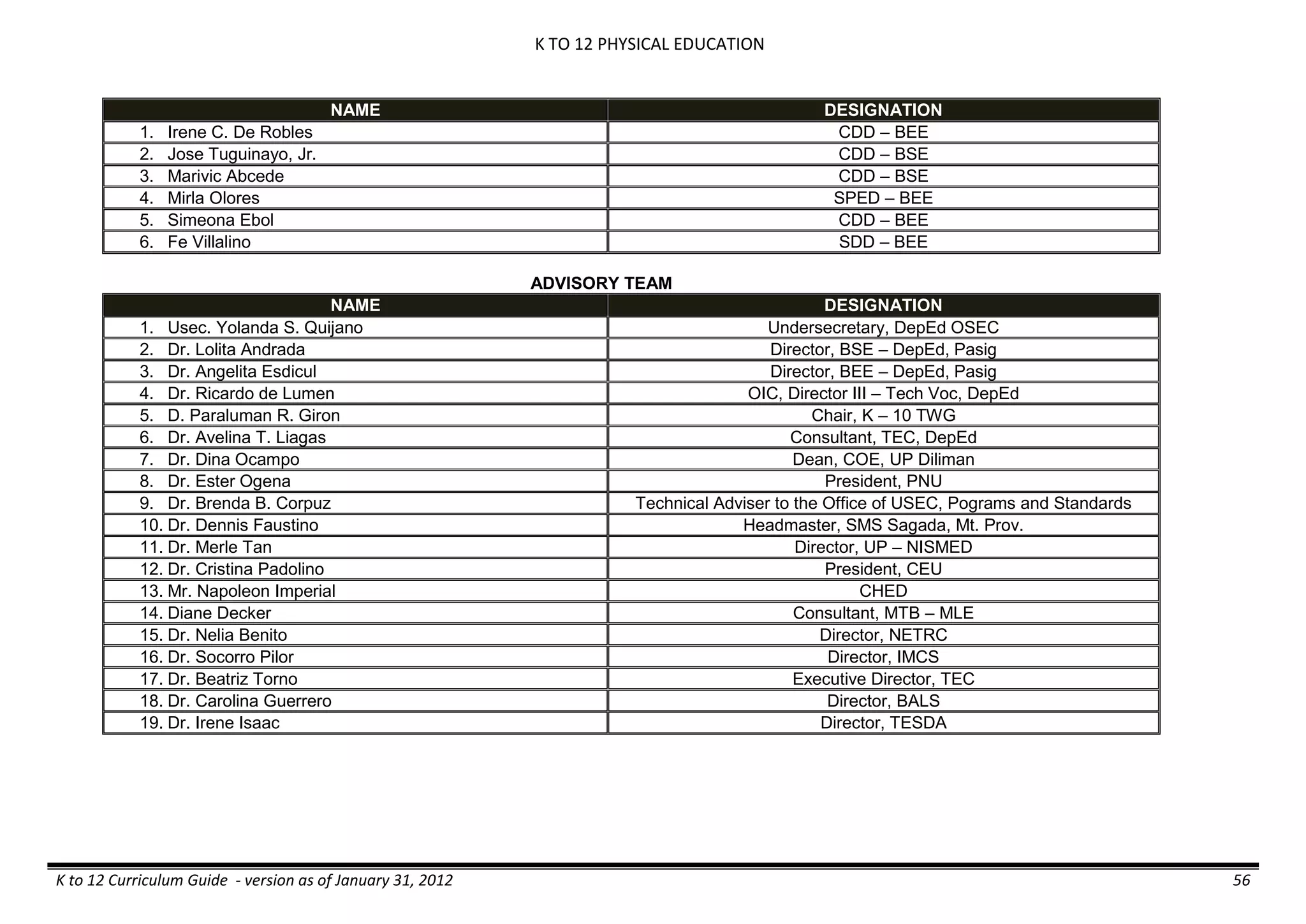
FACILITATORS/ SUPPORT TEAM
NAME DESIGNATION
1. Irene C. De Robles CDD – BEE
2. Jose Tuguinayo, Jr. CDD – BSE
3. Marivic Abcede CDD – BSE
4. Mirla Olores SPED – BEE
5. Simeona Ebol CDD – BEE
6. Fe Villalino SDD – BEE
K TO 12 - KINDERGARTEN
K to 12 Curriculum Guide Science – version as of January 31, 2012 25
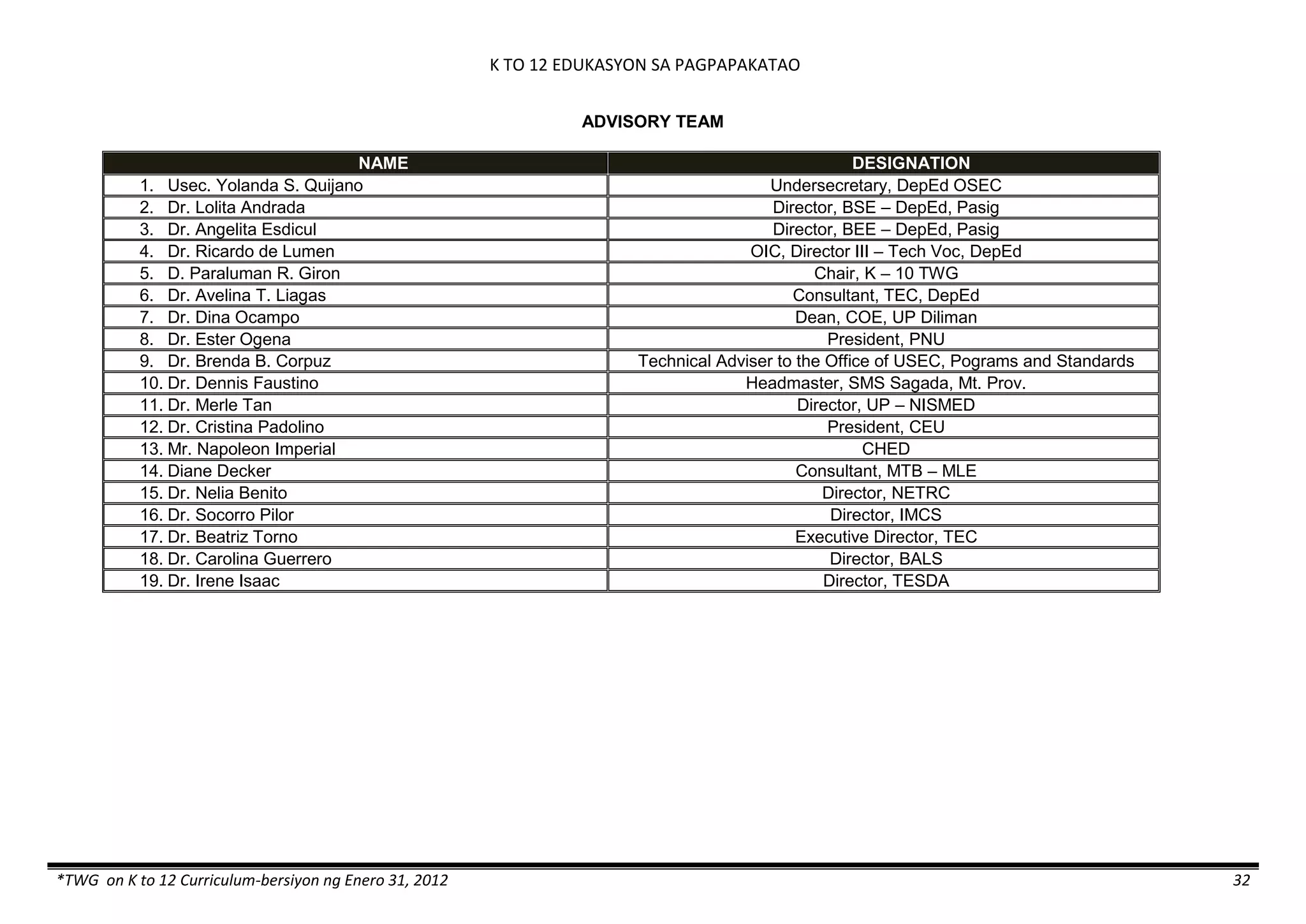
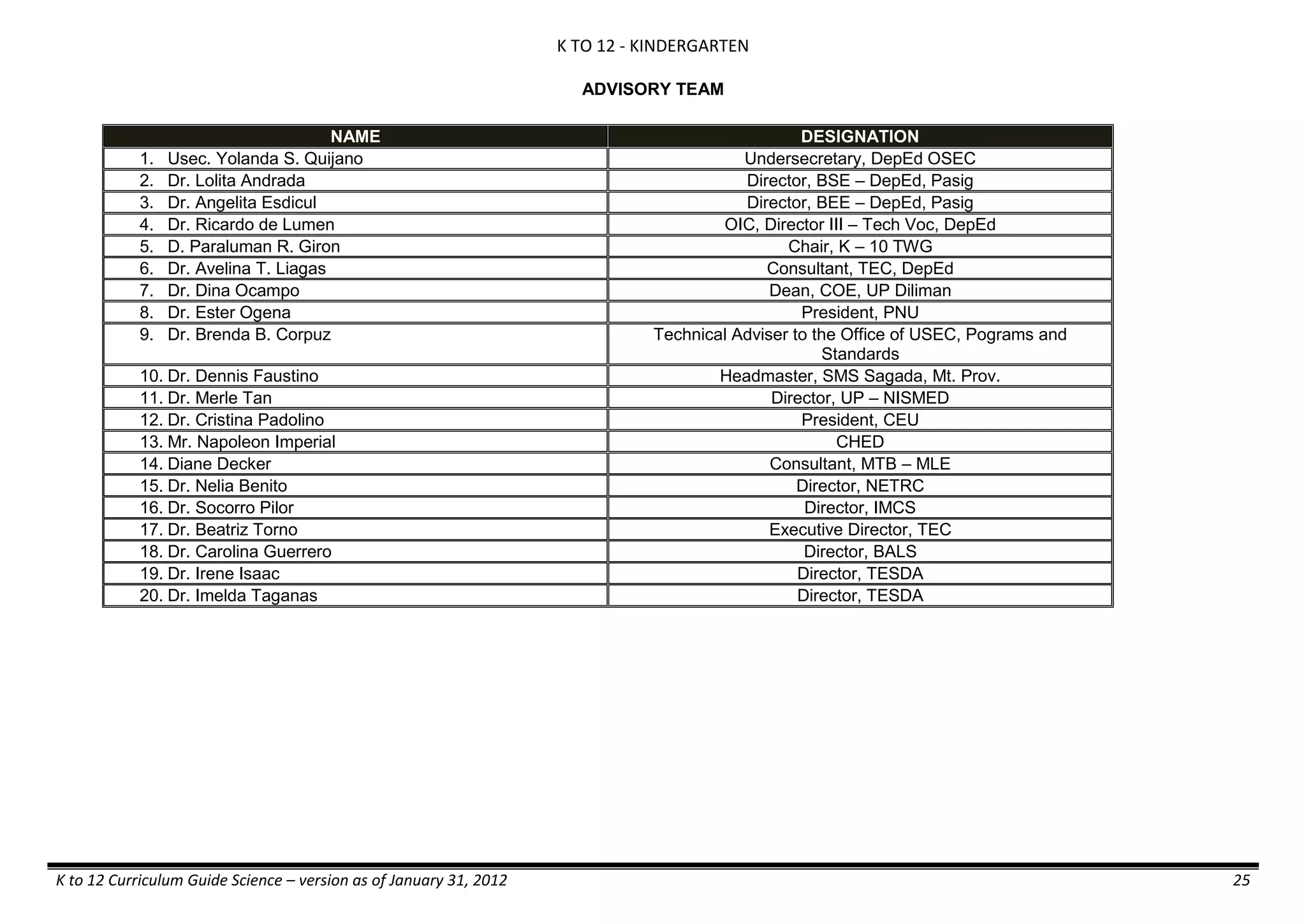
ADVISORY TEAM
NAME DESIGNATION
1. Usec. Yolanda S. Quijano Undersecretary, DepEd OSEC
2. Dr. Lolita Andrada Director, BSE – DepEd, Pasig
3. Dr. Angelita Esdicul Director, BEE – DepEd, Pasig
4. Dr. Ricardo de Lumen OIC, Director III – Tech Voc, DepEd
5. D. Paraluman R. Giron Chair, K – 10 TWG
6. Dr. Avelina T. Liagas Consultant, TEC, DepEd
7. Dr. Dina Ocampo Dean, COE, UP Diliman
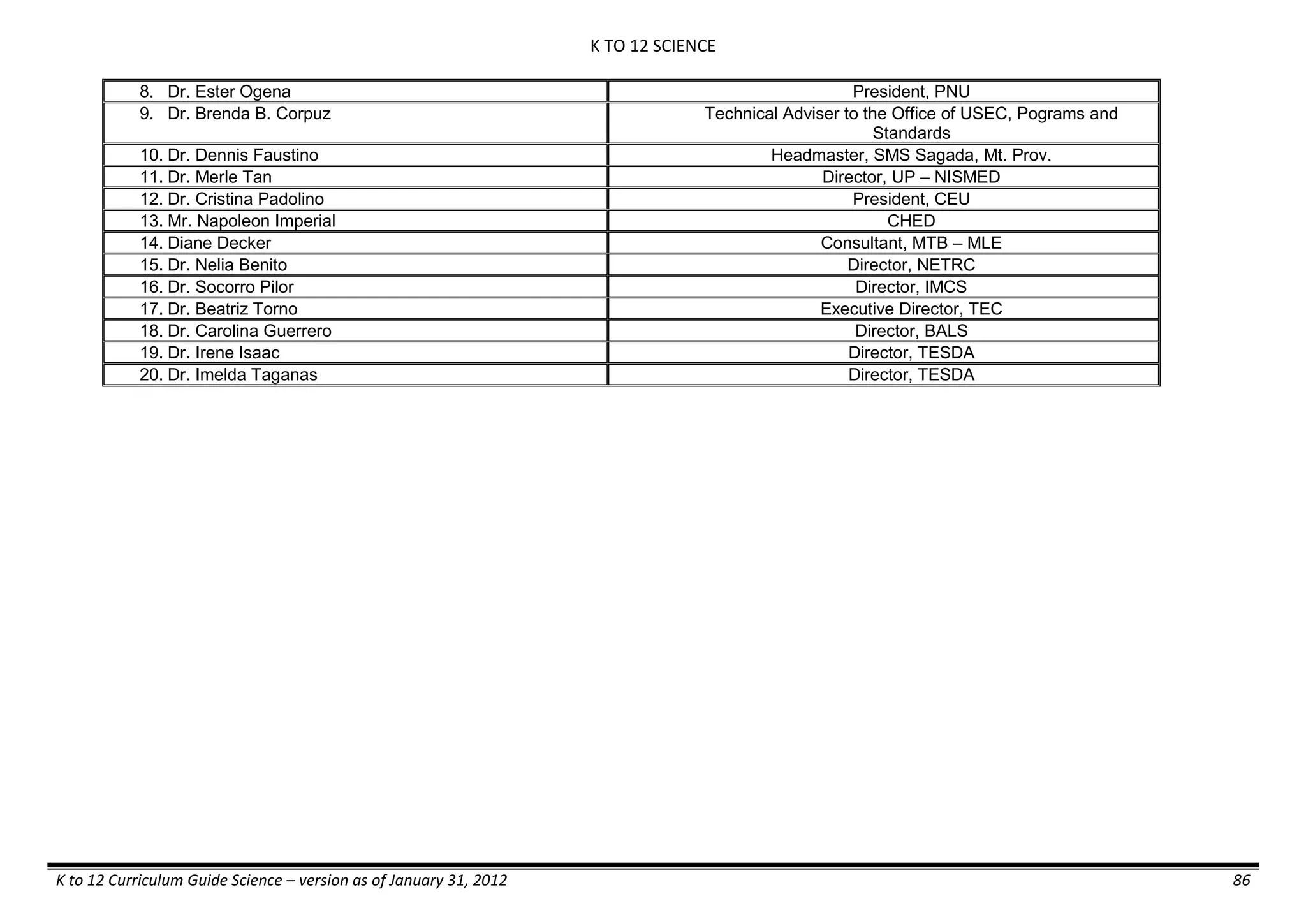
8. Dr. Ester Ogena President, PNU
9. Dr. Brenda B. Corpuz Technical Adviser to the Office of USEC, Pograms and
Standards
10. Dr. Dennis Faustino Headmaster, SMS Sagada, Mt. Prov.
11. Dr. Merle Tan Director, UP – NISMED
12. Dr. Cristina Padolino President, CEU
13. Mr. Napoleon Imperial CHED
14. Diane Decker Consultant, MTB – MLE
15. Dr. Nelia Benito Director, NETRC
16. Dr. Socorro Pilor Director, IMCS
17. Dr. Beatriz Torno Executive Director, TEC
18. Dr. Carolina Guerrero Director, BALS
19. Dr. Irene Isaac Director, TESDA
20. Dr. Imelda Taganas Director, TESDA
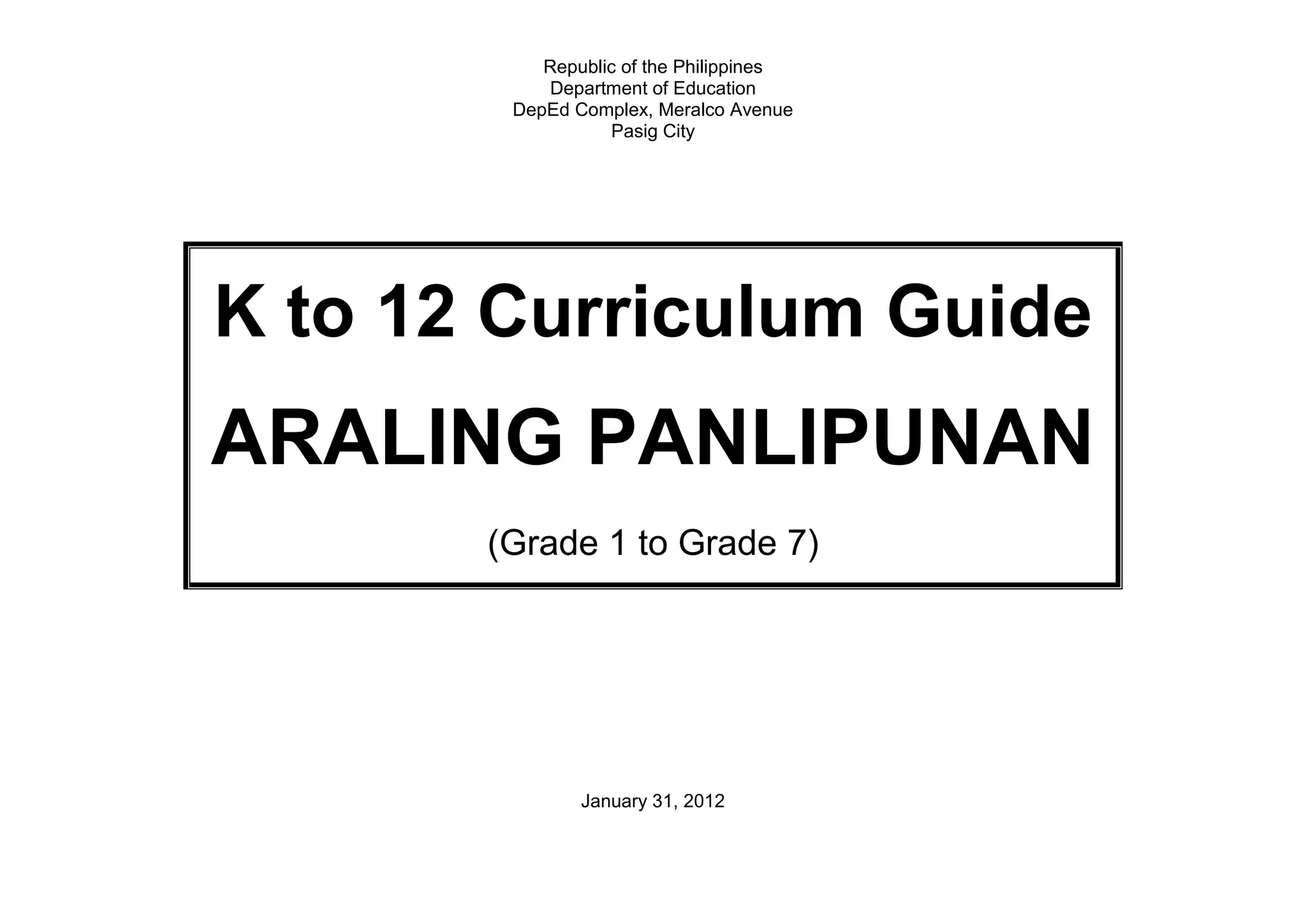
Republic of the Philippines
Department of Education
DepEd Complex, Meralco Avenue
Pasig City
K to 12 Curriculum Guide
ARALING PANLIPUNAN
(Grade 1 to Grade 7)
January 31, 2012
K TO 12 ARALING PANLIPUNAN
*Dr. Maria Serena Diokno, LAT Convenor – version as of January 31, 2012 2
CONCEPTUAL FRAMEWORK
Figure 1. The Conceptual Framework of Araling Panlipunan
K TO 12 ARALING PANLIPUNAN
*Dr. Maria Serena Diokno, LAT Convenor – version as of January 31, 2012 3
I. LEARNING AREA STANDARD
Naipamamalas ang pag-unawa sa mga konsepto at pag-aaral ng mga tao at grupo, komunidad at lipunan kung paano sila namuhay at
namumuhay, ang kanilang ugnayan at interaksyon sa kapaligiran at sa isa’t isa, at ang kanilang mga paniniwala at kultura upang makabuo ng
pagkakakilanlan bilang Pilipino, tao at miyembro ng bansa at mundo; maunawaan ang sariling lipunan gamit ang mga kasanayan sa
pananaliksik, pagsisiyasat, mapanuring pag-iisip, matalinong pagpapasya, pagkamalikhain, pakikipagkapwa, likas-kayang paggamit ng
pinagkukunang-yaman at pakikipagtalastasan tungo sa isang mapanuri, mapagmuni, responsable, produktibo, makakalikasan, makatao at
makabansa na may pambansa at pandaigdigang pananaw at pagpapahalaga sa mga usapin sa lipunan sa nakaraan at kasalukuyan tungo sa
pagpanday ng kinabukasan.
II. Pangunahing Pamantayan ng Bawat Yugto (Key Stage Standards):
K – 3 4 – 6 7 – 10 11 – 12
Naipamamalas ang panimulang pag-
unawa at pagpapahalaga sa sarili,
pamilya, paaralan at komunidad at
mga batayang konseptong
pagpapatuloy at pagbabago,
distansya at direksyon tungo sa
pagbuo ng kamalayan tungkol sa
sarili at kapaligiran bilang kasapi ng
isang lipunan na may karapatan at
pananagutan sa sarili, sa kapwa at
sa kapaligiran.
Naipamamalas ang batayang pag-
unawa sa mga pangunahing
konseptong heograpiya at ang
aplikasyon ng mga ito sa iba’t ibang
pamayanan sa Pilipinas at
kasaysayan ng bansa; at ang
pagpapahalagang pansibiko tungo
sa paghubog ng mamamayang
mapanuri, mapagmuni, responsible,
produktibo, makakalikasan, makatao
at makabansa
.
Naipamamalas ang malalim na
pag-unawa sa kasaysayan, kultura
at aspetong panlipunan, pang-
ekonomiya, pampulitika sa
Pilipinas, sa rehiyon ng Asya at sa
mundo, ang ugnayan sa rehiyon at
daigdig at ang batayang
konseptong ekonomiks at
aplikasyon nito sa buhay gamit ang
mga kasanayang napapaloob sa
kakayahan ng pagsisiyasat,
mapanuring pag-iisip at matalinong
pagpapasya
Naipamamalas ang malawak at
integratibong pag-unawa sa mga
hamon, isyu at tugon sa
kontemporaryong lipunang Pilipino,
Asyano at pandaigdig batay sa
masusing pagsasaliksik at
mabisang paghayag ng resulta ng
pagsasaliksik tungo sa pagbuo ng
solusyon o tugon upang marating
ang isang makatarungan,
mapayapa, makakalikasan at
makataong lipunan at mundo.
K TO 12 ARALING PANLIPUNAN
*Dr. Maria Serena Diokno, LAT Convenor – version as of January 31, 2012 4
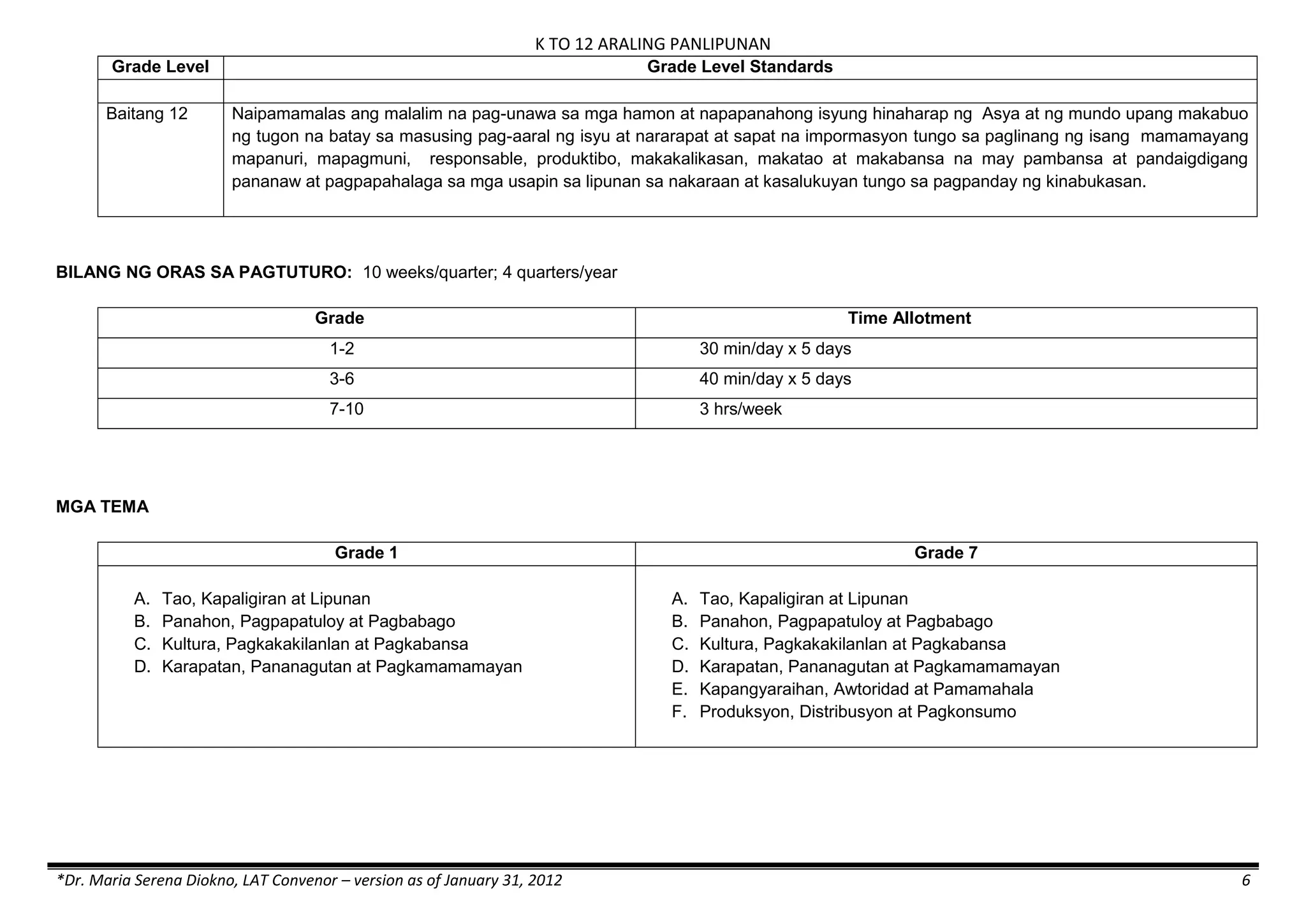
III. GRADE LEVEL STANDARD:
Grade Level Grade Level Standards
Kindergarten Naipamamalas ang pag-unawa sa kaalaman tungkol sa sarili at mga gawain ng tao sa kanyang kapaligiran at pagpapaunlad ng
kakayahang sosyo-emosyunal at positibong pakikipag-ugnay at pakikisalamuha sa tahanan, paaralan at pamayanan
Baitang 1 Naipamamalas ang kamalayan bilang batang Pilipino at kasapi ng pamilya at paaralan at pag-unawa sa batayang konseptong
pagpapatuloy at pagbabago, distansya at direksyon at ang pagpapahalaga sa kapaligiran ng tahanan at paaralan tungo sa paglinang
ng isang mamamayang mapanuri, mapagmuni, responsable, produktibo, makakalikasan, makatao at makabansa na may pambansa
at pandaigdigang pananaw at pagpapahalaga sa mga usapin sa lipunan sa nakaraan at kasalukuyan tungo sa pagpanday ng
kinabukasan.
Baitang 2 Naipamamalas ang pagkilala, pag-unawa at pagpapahalaga sa kinabibilangang komunidad ngayon at sa nakaraan gamit ang mga
konseptong pagpapatuloy at pagbabago, pagkakasunod-sunod ng mga pangyayari, mga simpleng konseptong heograpikal tulad ng
lokasyon tungo sa isang mapanuri, mapagmuni, responsable, produktibo, makakalikasan, makatao at makabansa na may pambansa
at pandaigdigang pananaw at pagpapahalaga sa mga usapin sa lipunan sa nakaraan at kasalukuyan tungo sa pagpanday ng
kinabukasan.
Baitang 3 Naipamamalas ang pag-unawa sa kasaysayan ng sariling lalawigan at rehiyon kasama ang aspetong pangkultura , pampulitika,
panlipunan at produksyon at distribusyon ng lokal na produkto gamit ang mga natutunang konsepto at pamamaraan sa mga naunang
baitang para sa mas malalim na pag-unawa ng impormasyon at pagkakakilanlan bilang Pilipino at mamamayan ng Pilipinas tungo sa
paglinang ng isang mamamayang mapanuri, mapagmuni, responsable, produktibo, makakalikasan, makatao at makabansa na may
pambansa at pandaigdigang pananaw at pagpapahalaga sa mga usapin sa lipunan sa nakaraan at kasalukuyan tungo sa pagpanday
ng kinabukasan.
Baitang 4 Naipamamalas ang pag-unawa sa batayang konseptong pangheograpiya at ang aplikasyon nito sa iba’t ibang pamayanan ng
Pilipinas katulad ng mga komunidad sa itaas at ibaba, sa tabi ng dagat at ilog, at iba pa, ang ugnayan ng tao, lipunan at kalikasan at
ang epekto ng ugnayang ito sa pamayanan at kapaligiran tungo sa paglinang ng isang mamamayang mapanuri, mapagmuni,
responsable, produktibo, makakalikasan, makatao at makabansa na may pambansa at pandaigdigang pananaw at pagpapahalaga sa
mga usapin sa lipunan sa nakaraan at kasalukuyan tungo sa pagpanday ng kinabukasan.
Baitang 5 Naipamamalas ang pag-unawa at pagpapahalaga sa kasaysayan ng Pilipinas mula sa pagkabuo ng kapuluan at mga sinaunang
lipunan hanggang sa simula ng ika-20 siglo gamit ang batayang konseptong katulad ng kahalagahang pangkasaysayan (historial
significance), pagpapatuloy at pagbabago, ugnayang sanhi at epekto tungo sa paglinang ng isang mamamayang mapanuri,
mapagmuni, responsable, produktibo, makakalikasan, makatao at makabansa na may pambansa at pandaigdigang pananaw at
K TO 12 ARALING PANLIPUNAN
*Dr. Maria Serena Diokno, LAT Convenor – version as of January 31, 2012 5
Grade Level Grade Level Standards
pagpapahalaga sa mga usapin sa lipunan sa nakaraan at kasalukuyan tungo sa pagpanday ng kinabukasan.
Baitang 6 Naipamamalas ang patuloy na pag-unawa at pagpapahalaga sa kasaysayan ng Pilipinas mula sa ika-20 siglo hanggang sa
kasalukuyan tungo sa pagbuo ng tiyak na pagkakakilanlan bilang Pilipino at mamamayan ng Pilipinas tungo sa paglinang ng isang
mamamayang mapanuri, mapagmuni, responsable, produktibo, makakalikasan, makatao at makabansa na may pambansa at
pandaigdigang pananaw at pagpapahalaga sa mga usapin sa lipunan sa nakaraan at kasalukuyan tungo sa pagpanday ng
kinabukasan.
Baitang 7 Naipamamalas ang malalim na pag-unawa sa kasaysayan ng Pilipinas batay sa pagsusuri ng sipi ng nakasulat, pasalita awdyo-
biswal at kombinasyon ng mga ito, mula sa sa iba’t-ibang panahon, tungo sa paglinang ng isang mamamayang mapanuri,
mapagmuni, responsable, produktibo, makakalikasan, makatao at makabansa na may pambansa at pandaigdigang pananaw at
pagpapahalaga sa mga usapin sa lipunan sa nakaraan at kasalukuyan tungo sa pagpanday ng kinabukasan.
Baitang 8 Naipamamalas ang malalim na pag-unawa at pagpapahalaga ng heograpiya, kasaysayan, kultura, lipunan, pamahalaan, ekonomiya,
at ugnayan ng mga bansa sa rehiyong Asya tungo sa paggalang at pagpapahalaga ng mga pagkakatulad at pagkakaiba sa rehiyon at
sa papel ng Pilipinas sa Asya t ungo sa paglinang ng isang mamamayang mapanuri, mapagmuni, responsable, produktibo,
makakalikasan, makatao at makabansa na may pambansa at pandaigdigang pananaw at pagpapahalaga sa mga usapin sa lipunan
sa nakaraan at kasalukuyan tungo sa pagpanday ng kinabukasan.
Baitang 9 Naipamamalas ang malalim na pag-unawa sa iba’t-ibang aspeto ng kasaysayan ng mundo, tungo sa pag-unawa, paggalang at
pagpapahalaga ng mga pagkakatulad at pagkakaiba sa daiddig at sa pagbuo ng pandaigdigang pananaw tungkol sa lugar at papel ng
Pilipinas sa mundo, tungo sa paglinang ng isang mamamayang mapanuri, mapagmuni, responsable, produktibo, makakalikasan,
makatao at makabansa na may pambansa at pandaigdigang pananaw at pagpapahalaga sa mga usapin sa lipunan sa nakaraan at
kasalukuyan tungo sa pagpanday ng kinabukasan.
Baitang 10 Naipamamalas ang malalim na pag-unawa sa batayang konseptong ekonomiks at ang aplikasyon ng mga ito sa sariling buhay at sa
bansa, gamit ang pamamaraang matematikal tungo sa paglinang ng isang mamamayang mapanuri, mapagmuni, responsable,
produktibo, makakalikasan, makatao at makabansa na may pambansa at pandaigdigang pananaw at pagpapahalaga sa mga usapin
sa lipunan sa nakaraan at kasalukuyan tungo sa pagpanday ng kinabukasan.
Baitang 11 Naipamamalas ang malalim na pag-unawa sa mga hamon at napapanahong isyung hinaharap ng Pilipinas upang makabuo ng tugon
na batay sa masusing pag-aaral ng isyu at nararapat at sapat na impormasyon tungo sa paglinang ng isang mamamayang mapanuri,
mapagmuni, responsable, produktibo, makakalikasan, makatao at makabansa na may pambansa at pandaigdigang pananaw at
pagpapahalaga sa mga usapin sa lipunan sa nakaraan at kasalukuyan tungo sa pagpanday ng kinabukasan.
K TO 12 ARALING PANLIPUNAN
*Dr. Maria Serena Diokno, LAT Convenor – version as of January 31, 2012 6
Grade Level Grade Level Standards
Baitang 12 Naipamamalas ang malalim na pag-unawa sa mga hamon at napapanahong isyung hinaharap ng Asya at ng mundo upang makabuo
ng tugon na batay sa masusing pag-aaral ng isyu at nararapat at sapat na impormasyon tungo sa paglinang ng isang mamamayang
mapanuri, mapagmuni, responsable, produktibo, makakalikasan, makatao at makabansa na may pambansa at pandaigdigang
pananaw at pagpapahalaga sa mga usapin sa lipunan sa nakaraan at kasalukuyan tungo sa pagpanday ng kinabukasan.
BILANG NG ORAS SA PAGTUTURO: 10 weeks/quarter; 4 quarters/year
Grade Time Allotment
1-2 30 min/day x 5 days
3-6 40 min/day x 5 days
7-10 3 hrs/week
MGA TEMA
Grade 1 Grade 7
A. Tao, Kapaligiran at Lipunan
B. Panahon, Pagpapatuloy at Pagbabago
C. Kultura, Pagkakakilanlan at Pagkabansa
D. Karapatan, Pananagutan at Pagkamamamayan
A. Tao, Kapaligiran at Lipunan
B. Panahon, Pagpapatuloy at Pagbabago
C. Kultura, Pagkakakilanlan at Pagkabansa
D. Karapatan, Pananagutan at Pagkamamamayan
E. Kapangyaraihan, Awtoridad at Pamamahala
F. Produksyon, Distribusyon at Pagkonsumo
K TO 12 ARALING PANLIPUNAN
*Dr. Maria Serena Diokno, LAT Convenor – version as of January 31, 2012 7
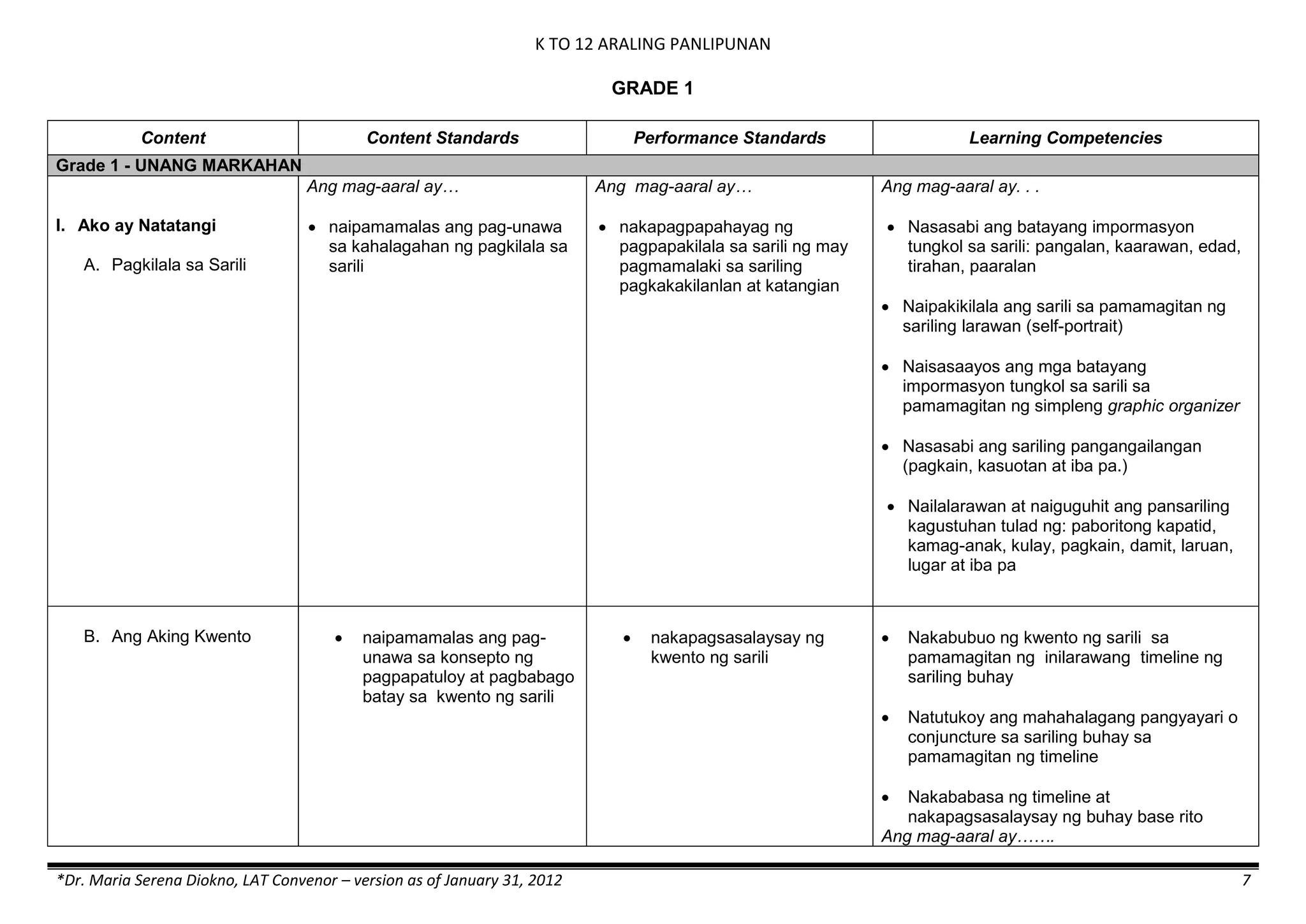
GRADE 1
Content Content Standards Performance Standards Learning Competencies
Grade 1 - UNANG MARKAHAN
I. Ako ay Natatangi
A. Pagkilala sa Sarili
Ang mag-aaral ay…
 naipamamalas ang pag-unawa
sa kahalagahan ng pagkilala sa
sarili
Ang mag-aaral ay…
 nakapagpapahayag ng
pagpapakilala sa sarili ng may
pagmamalaki sa sariling
pagkakakilanlan at katangian
Ang mag-aaral ay. . .
 Nasasabi ang batayang impormasyon
tungkol sa sarili: pangalan, kaarawan, edad,
tirahan, paaralan
 Naipakikilala ang sarili sa pamamagitan ng
sariling larawan (self-portrait)
 Naisasaayos ang mga batayang
impormasyon tungkol sa sarili sa
pamamagitan ng simpleng graphic organizer
 Nasasabi ang sariling pangangailangan
(pagkain, kasuotan at iba pa.)
 Nailalarawan at naiguguhit ang pansariling
kagustuhan tulad ng: paboritong kapatid,
kamag-anak, kulay, pagkain, damit, laruan,
lugar at iba pa
B. Ang Aking Kwento  naipamamalas ang pag-
unawa sa konsepto ng
pagpapatuloy at pagbabago
batay sa kwento ng sarili
 nakapagsasalaysay ng
kwento ng sarili
 Nakabubuo ng kwento ng sarili sa
pamamagitan ng inilarawang timeline ng
sariling buhay
 Natutukoy ang mahahalagang pangyayari o
conjuncture sa sariling buhay sa
pamamagitan ng timeline
 Nakababasa ng timeline at
nakapagsasalaysay ng buhay base rito
Ang mag-aaral ay…….
K TO 12 ARALING PANLIPUNAN
*Dr. Maria Serena Diokno, LAT Convenor – version as of January 31, 2012 8
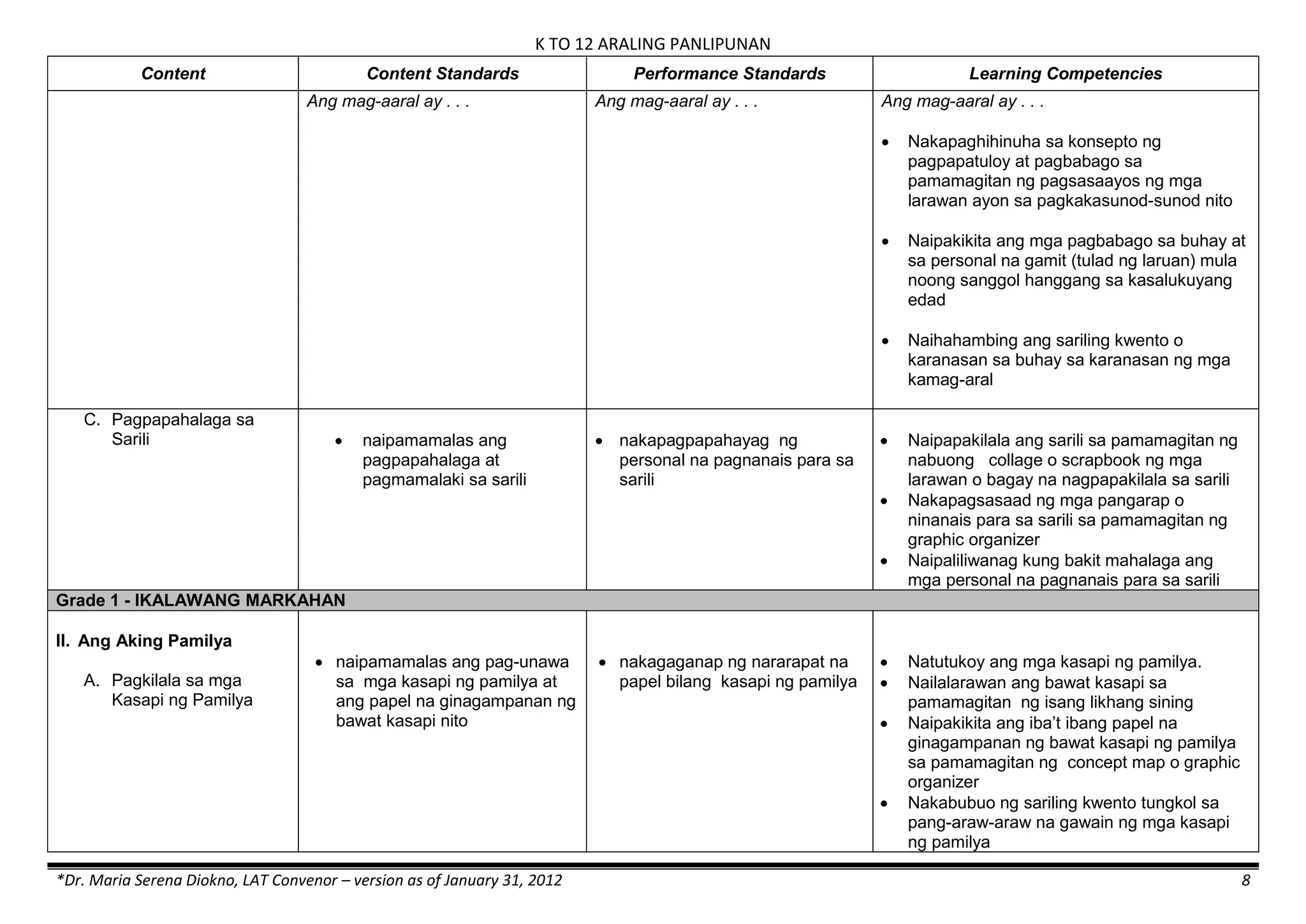
Content Content Standards Performance Standards Learning Competencies
Ang mag-aaral ay . . . Ang mag-aaral ay . . . Ang mag-aaral ay . . .
 Nakapaghihinuha sa konsepto ng
pagpapatuloy at pagbabago sa
pamamagitan ng pagsasaayos ng mga
larawan ayon sa pagkakasunod-sunod nito
 Naipakikita ang mga pagbabago sa buhay at
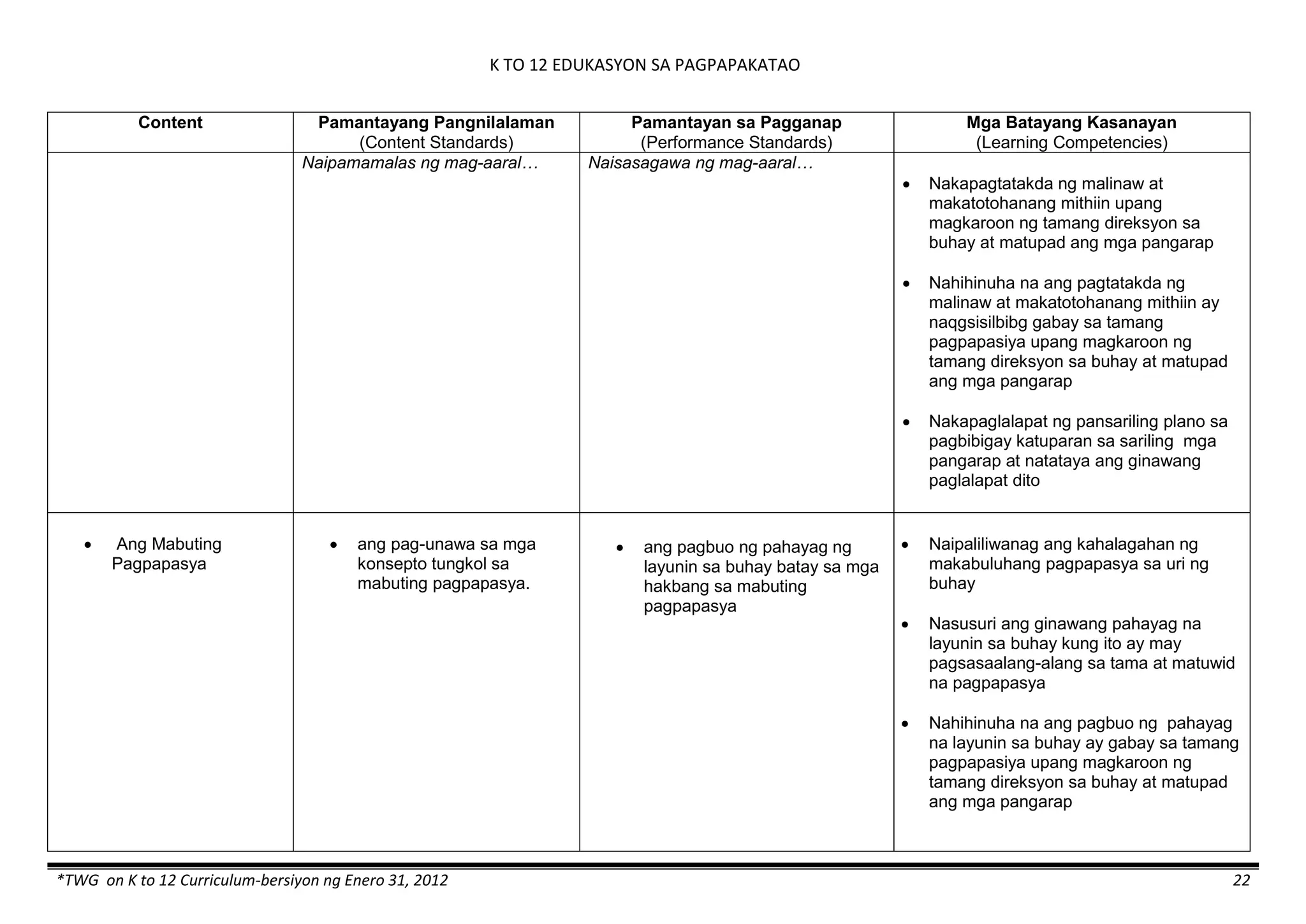
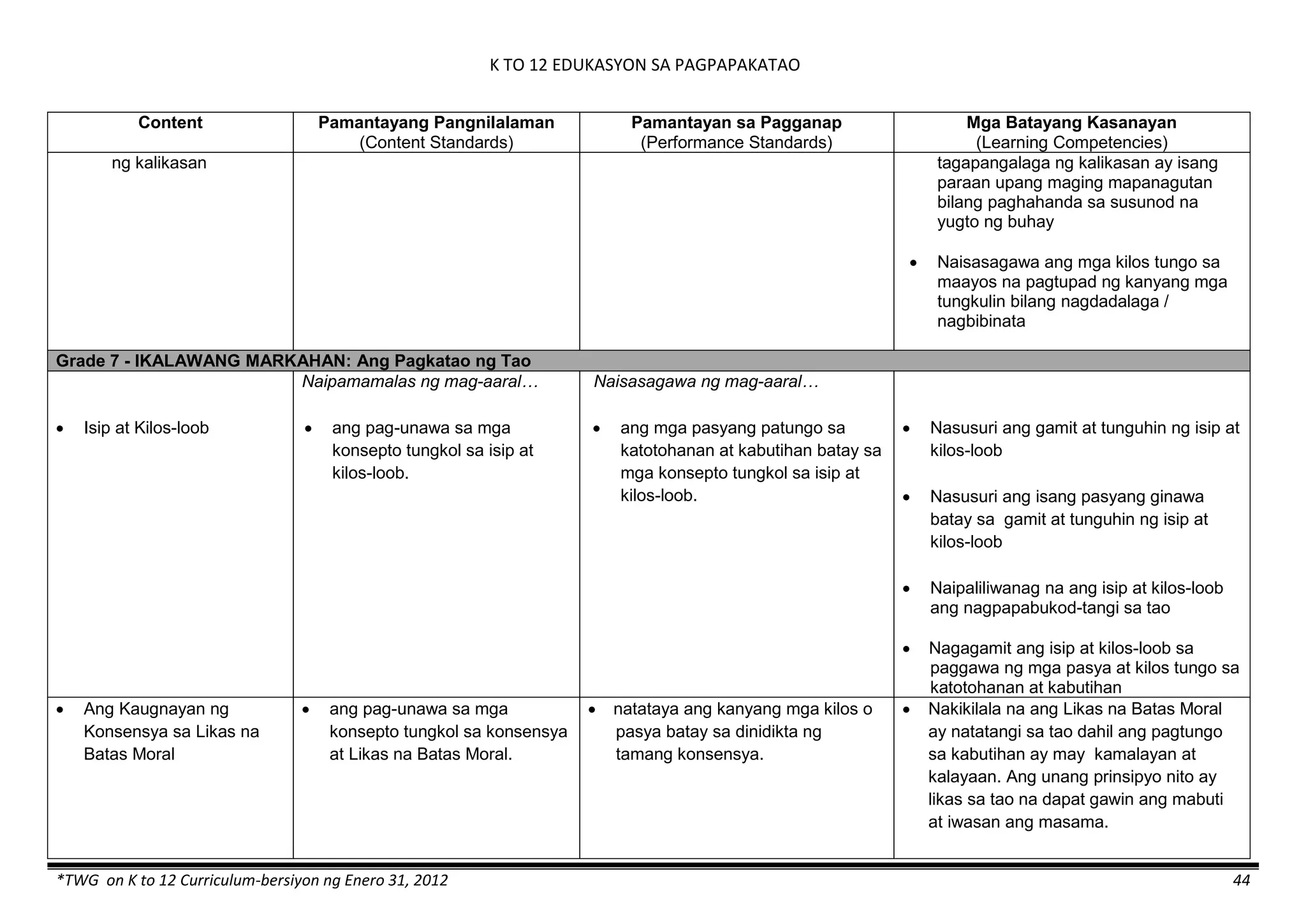
sa personal na gamit (tulad ng laruan) mula
noong sanggol hanggang sa kasalukuyang
edad
 Naihahambing ang sariling kwento o
karanasan sa buhay sa karanasan ng mga
kamag-aral
C. Pagpapahalaga sa
Sarili  naipamamalas ang
pagpapahalaga at
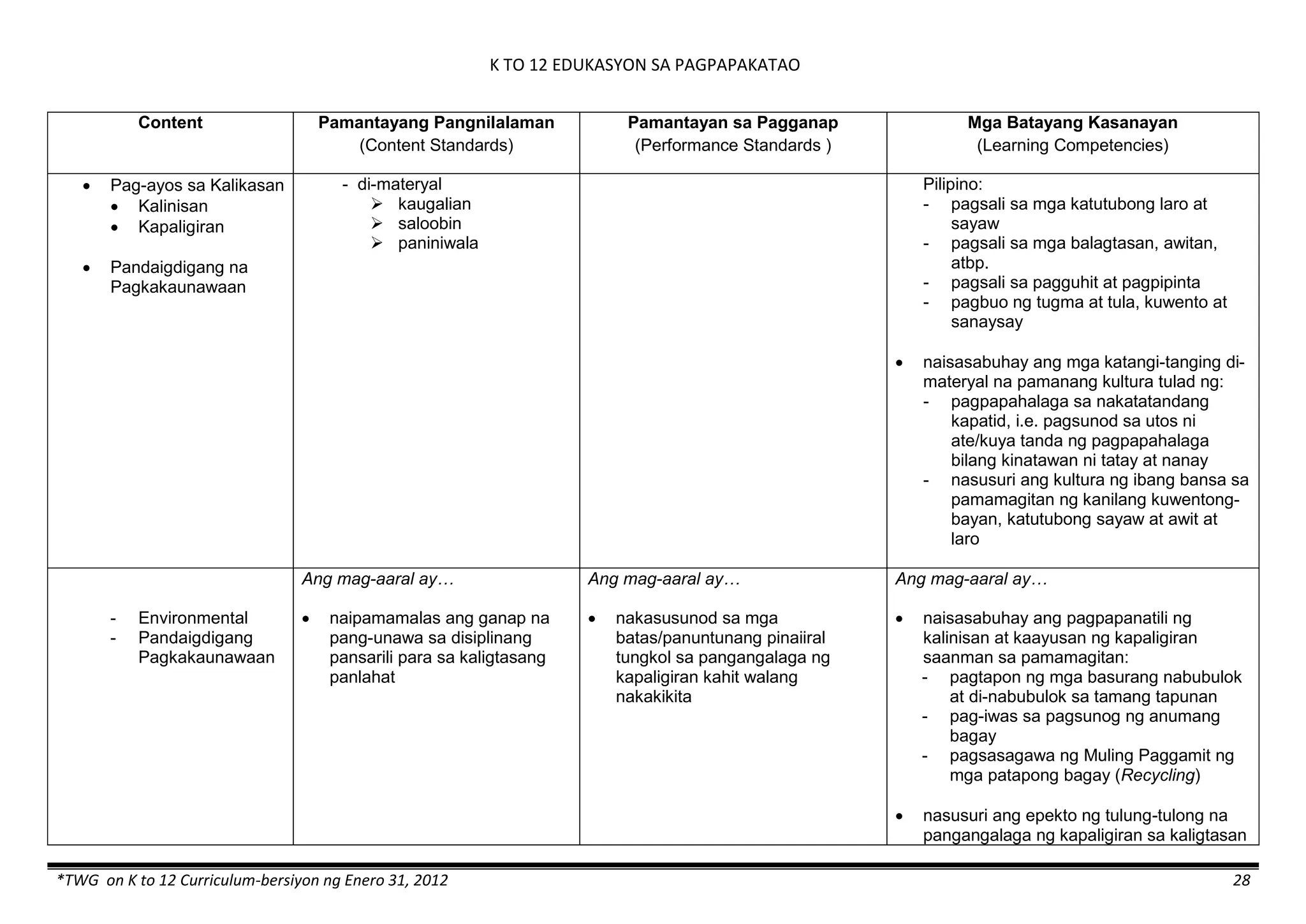
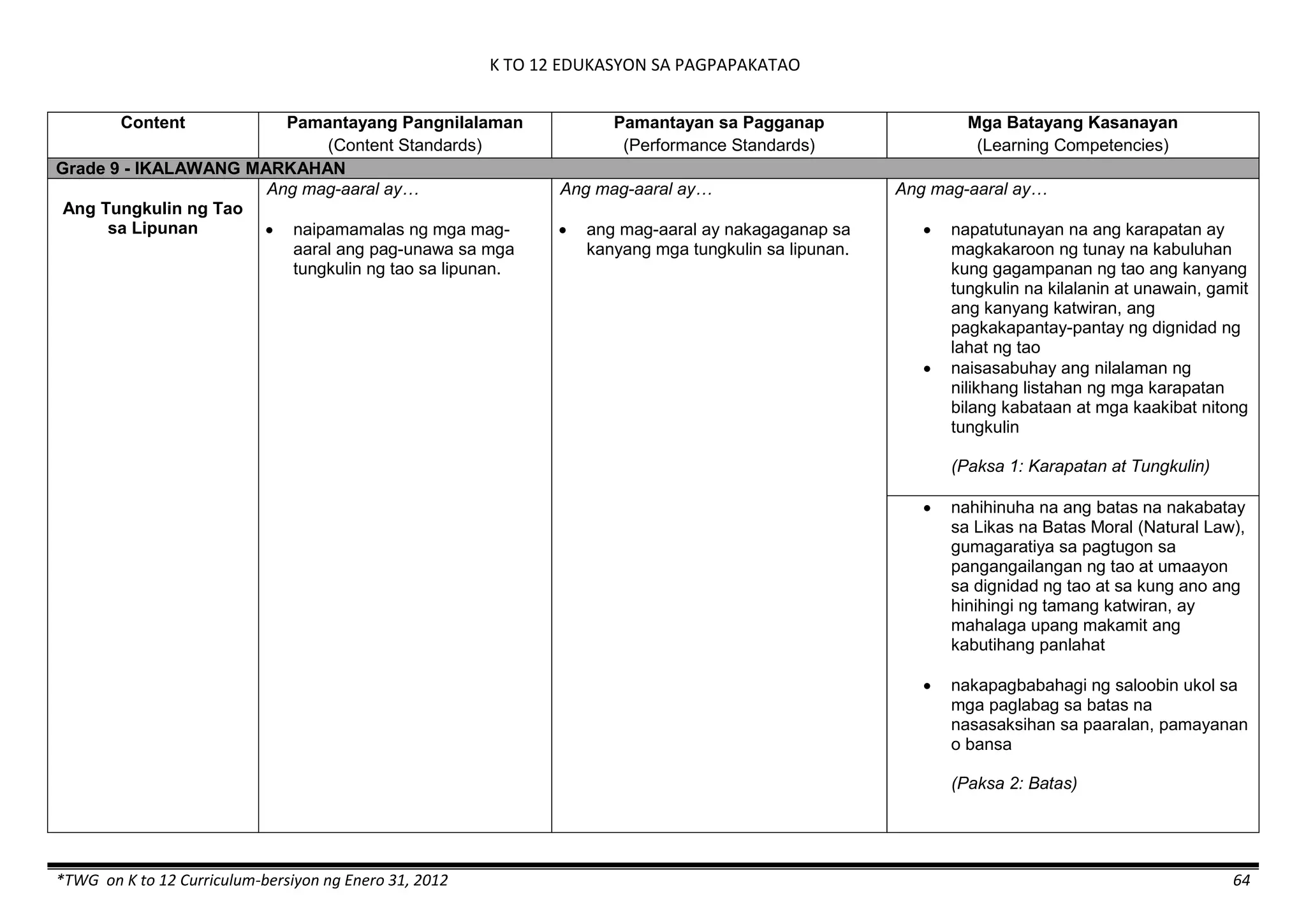
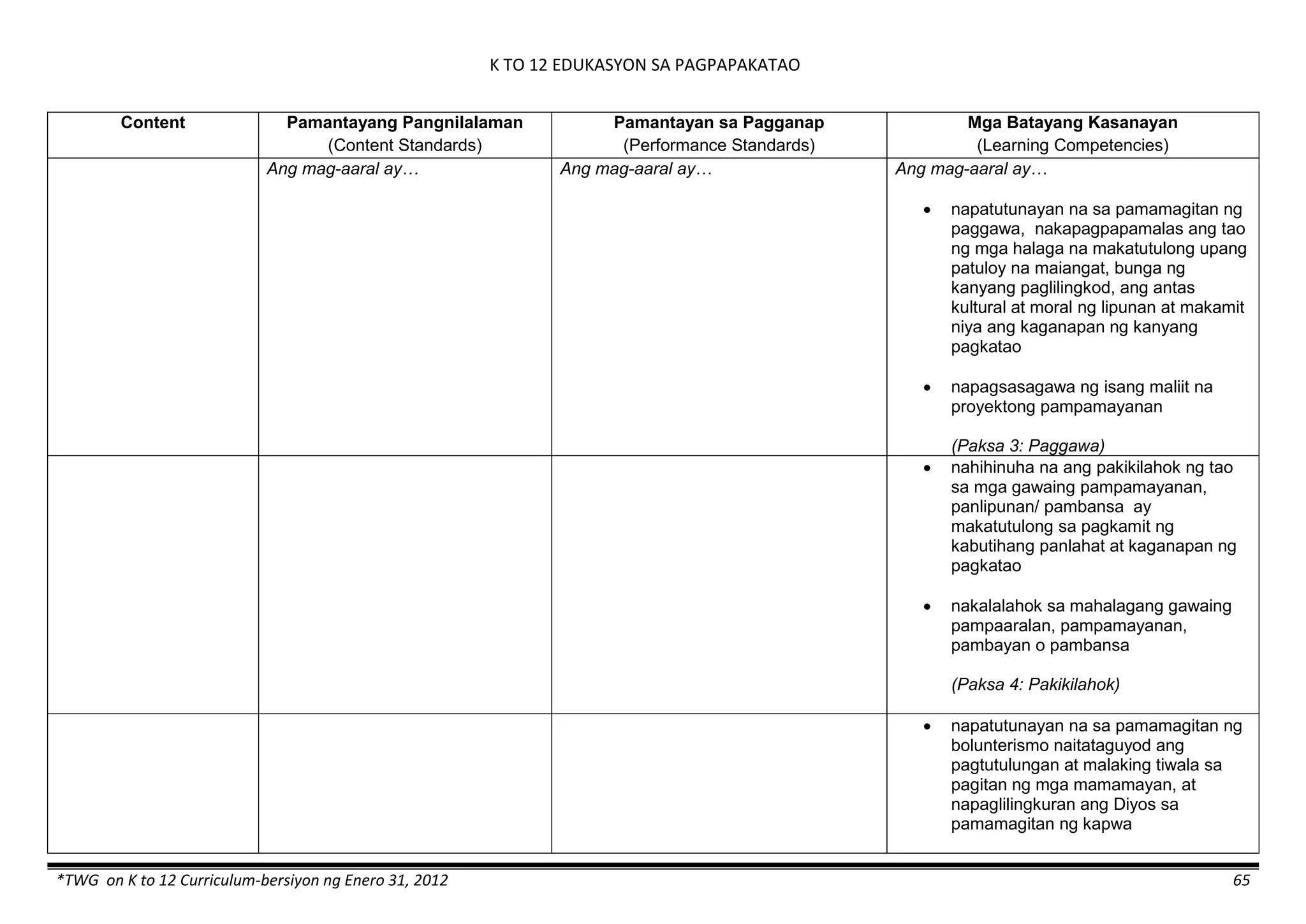
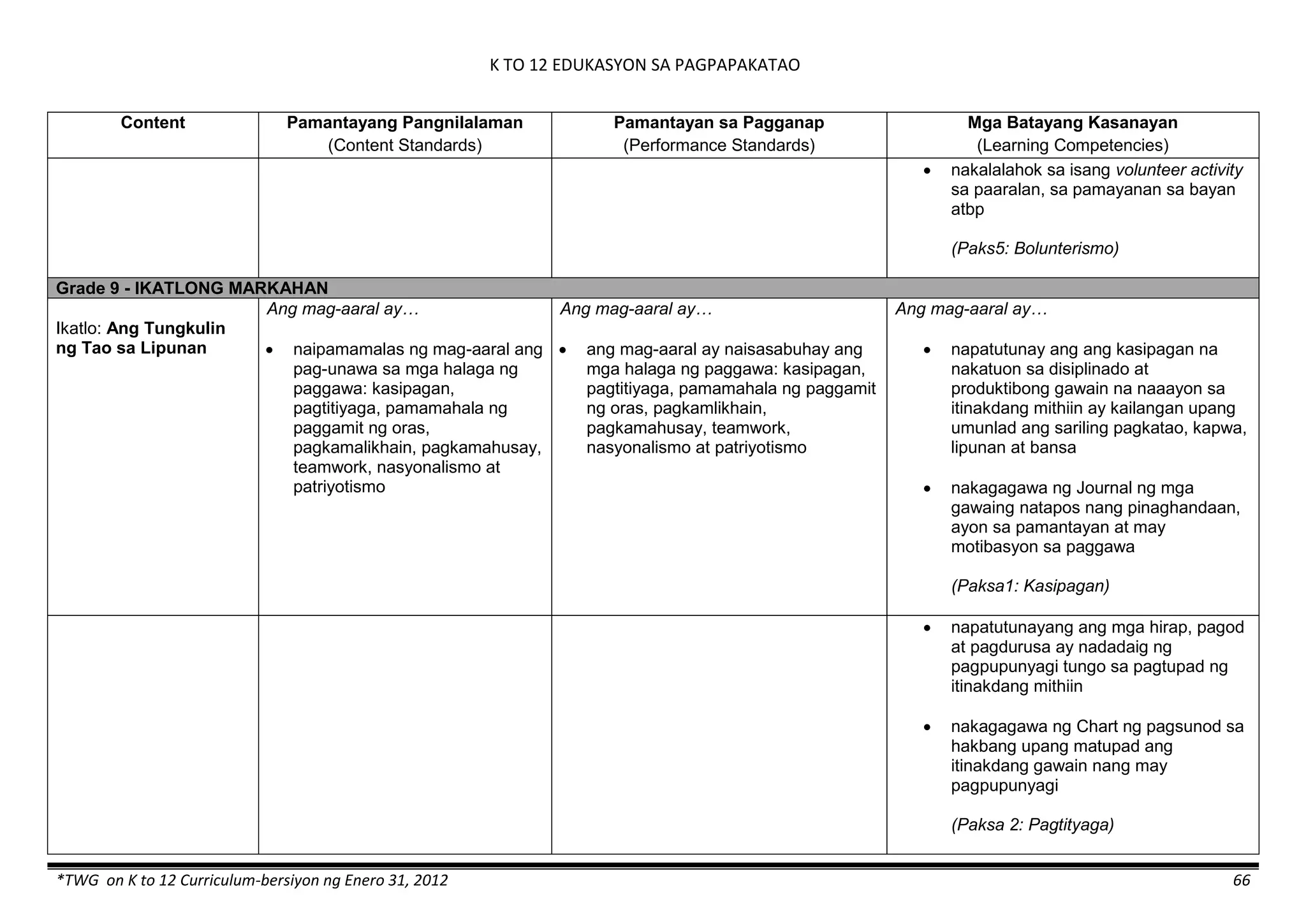
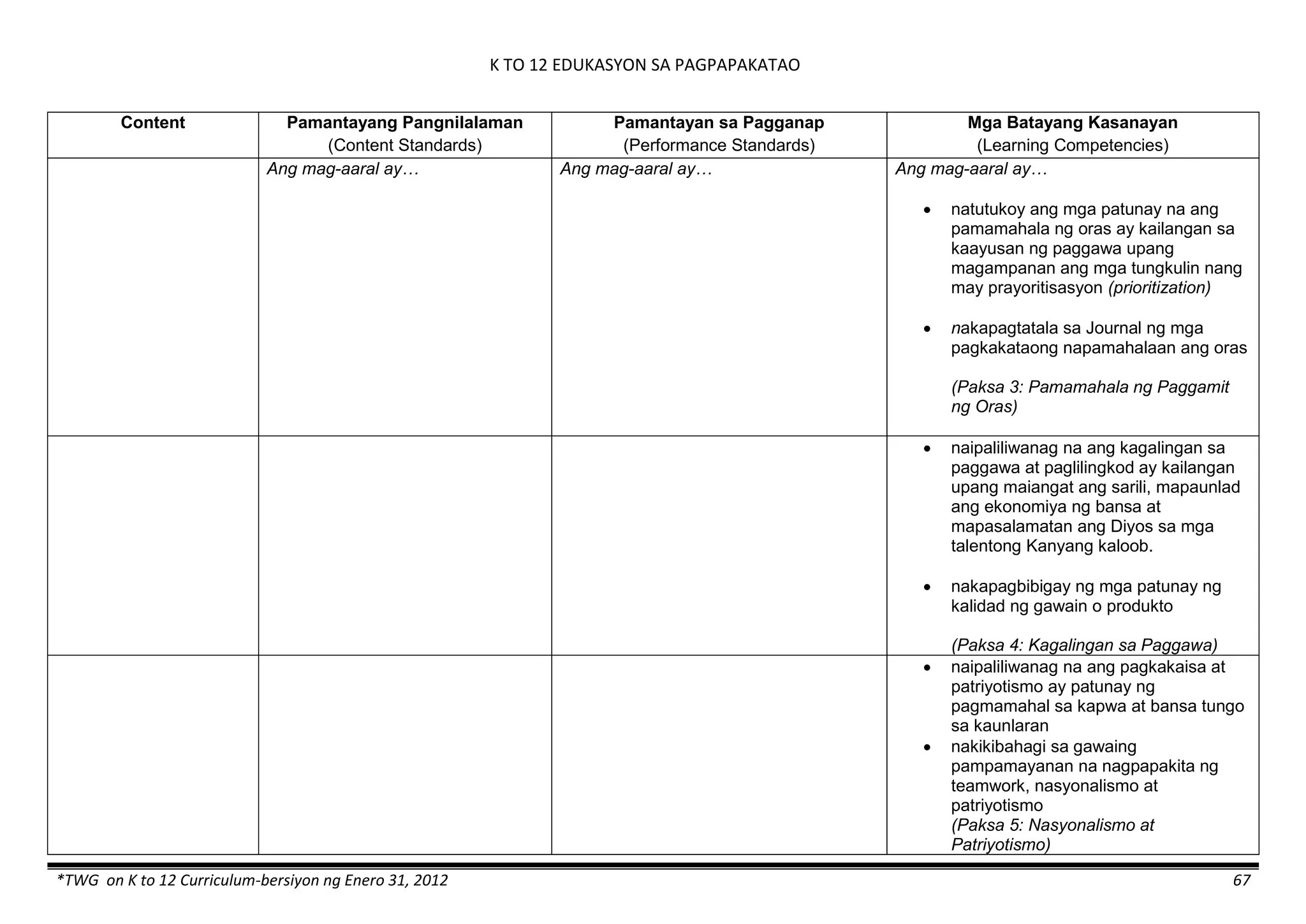
pagmamalaki sa sarili
 nakapagpapahayag ng
personal na pagnanais para sa
sarili
 Naipapakilala ang sarili sa pamamagitan ng
nabuong collage o scrapbook ng mga
larawan o bagay na nagpapakilala sa sarili
 Nakapagsasaad ng mga pangarap o
ninanais para sa sarili sa pamamagitan ng
graphic organizer
 Naipaliliwanag kung bakit mahalaga ang
mga personal na pagnanais para sa sarili
Grade 1 - IKALAWANG MARKAHAN
II. Ang Aking Pamilya
A. Pagkilala sa mga
Kasapi ng Pamilya
 naipamamalas ang pag-unawa
sa mga kasapi ng pamilya at
ang papel na ginagampanan ng
bawat kasapi nito
 nakagaganap ng nararapat na
papel bilang kasapi ng pamilya
 Natutukoy ang mga kasapi ng pamilya.
 Nailalarawan ang bawat kasapi sa
pamamagitan ng isang likhang sining
 Naipakikita ang iba’t ibang papel na
ginagampanan ng bawat kasapi ng pamilya
sa pamamagitan ng concept map o graphic
organizer
 Nakabubuo ng sariling kwento tungkol sa
pang-araw-araw na gawain ng mga kasapi
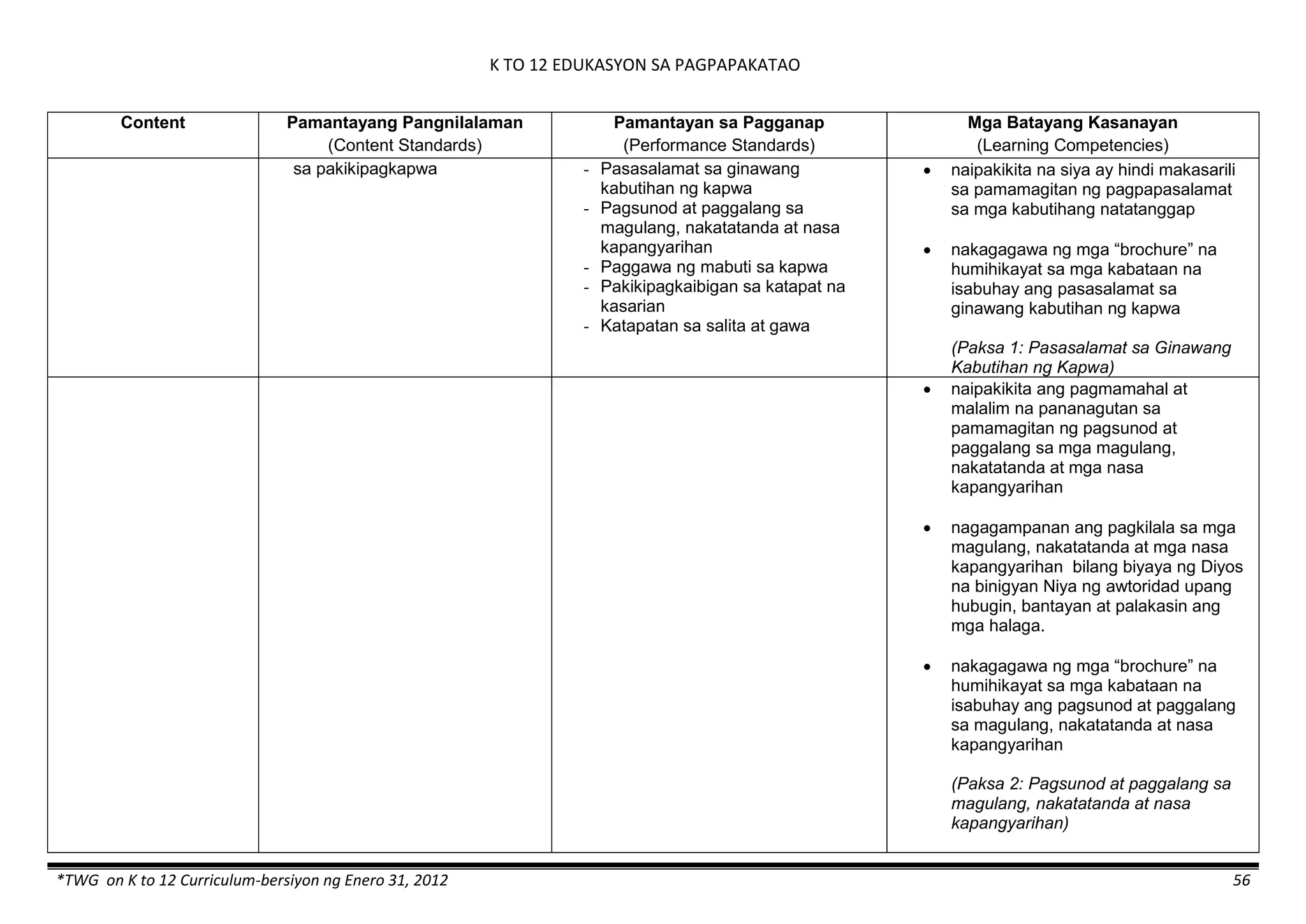
ng pamilya
K TO 12 ARALING PANLIPUNAN
*Dr. Maria Serena Diokno, LAT Convenor – version as of January 31, 2012 9
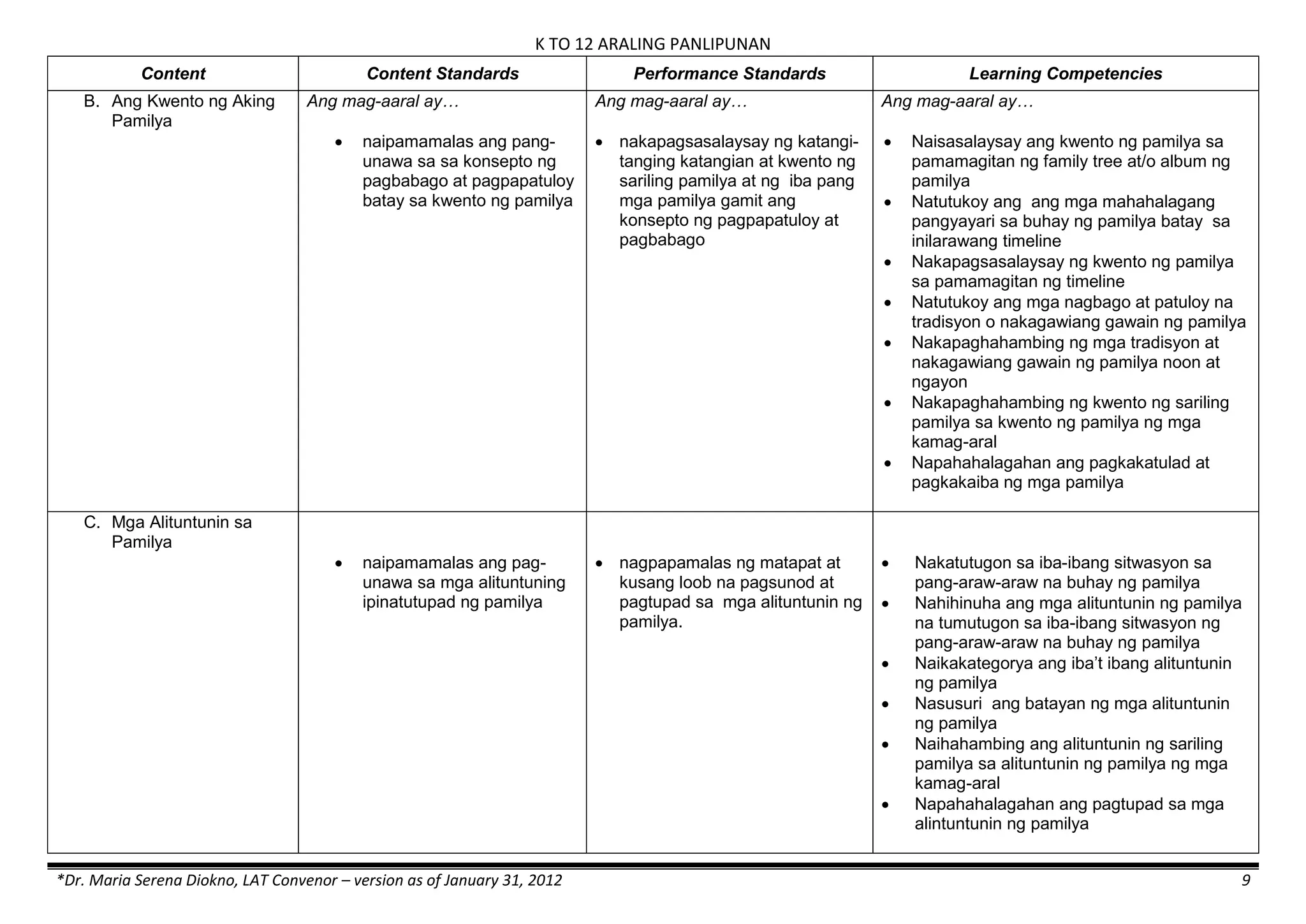
Content Content Standards Performance Standards Learning Competencies
B. Ang Kwento ng Aking
Pamilya
Ang mag-aaral ay…
 naipamamalas ang pang-
unawa sa sa konsepto ng
pagbabago at pagpapatuloy
batay sa kwento ng pamilya
Ang mag-aaral ay…
 nakapagsasalaysay ng katangi-
tanging katangian at kwento ng
sariling pamilya at ng iba pang
mga pamilya gamit ang
konsepto ng pagpapatuloy at
pagbabago
Ang mag-aaral ay…
 Naisasalaysay ang kwento ng pamilya sa
pamamagitan ng family tree at/o album ng
pamilya
 Natutukoy ang ang mga mahahalagang
pangyayari sa buhay ng pamilya batay sa
inilarawang timeline
 Nakapagsasalaysay ng kwento ng pamilya
sa pamamagitan ng timeline
 Natutukoy ang mga nagbago at patuloy na
tradisyon o nakagawiang gawain ng pamilya
 Nakapaghahambing ng mga tradisyon at
nakagawiang gawain ng pamilya noon at
ngayon
 Nakapaghahambing ng kwento ng sariling
pamilya sa kwento ng pamilya ng mga
kamag-aral
 Napahahalagahan ang pagkakatulad at
pagkakaiba ng mga pamilya
C. Mga Alituntunin sa
Pamilya
 naipamamalas ang pag-
unawa sa mga alituntuning
ipinatutupad ng pamilya
 nagpapamalas ng matapat at
kusang loob na pagsunod at
pagtupad sa mga alituntunin ng
pamilya.
 Nakatutugon sa iba-ibang sitwasyon sa
pang-araw-araw na buhay ng pamilya
 Nahihinuha ang mga alituntunin ng pamilya
na tumutugon sa iba-ibang sitwasyon ng
pang-araw-araw na buhay ng pamilya
 Naikakategorya ang iba’t ibang alituntunin
ng pamilya
 Nasusuri ang batayan ng mga alituntunin
ng pamilya
 Naihahambing ang alituntunin ng sariling
pamilya sa alituntunin ng pamilya ng mga
kamag-aral
 Napahahalagahan ang pagtupad sa mga
alintuntunin ng pamilya
K TO 12 ARALING PANLIPUNAN
*Dr. Maria Serena Diokno, LAT Convenor – version as of January 31, 2012 10
Content Content Standards Performance Standards Learning Competencies
D. Pagpapahalaga sa
Pamilya
Ang mag-aaral ay…….
 naipamamalas ang pag-
unawa sa pagpapahalaga
ng sariling pamilya at ng
ibang mga pamilya
Ang mag-aaral ay….
 nakalalahok sa mga gawain na
nagpapamalas sa mga
pagpapahalaga ng sariling
pamilya at ugnayan ng sariling
pamilya sa ibang pamilya.
Ang mag-aaral ay…..
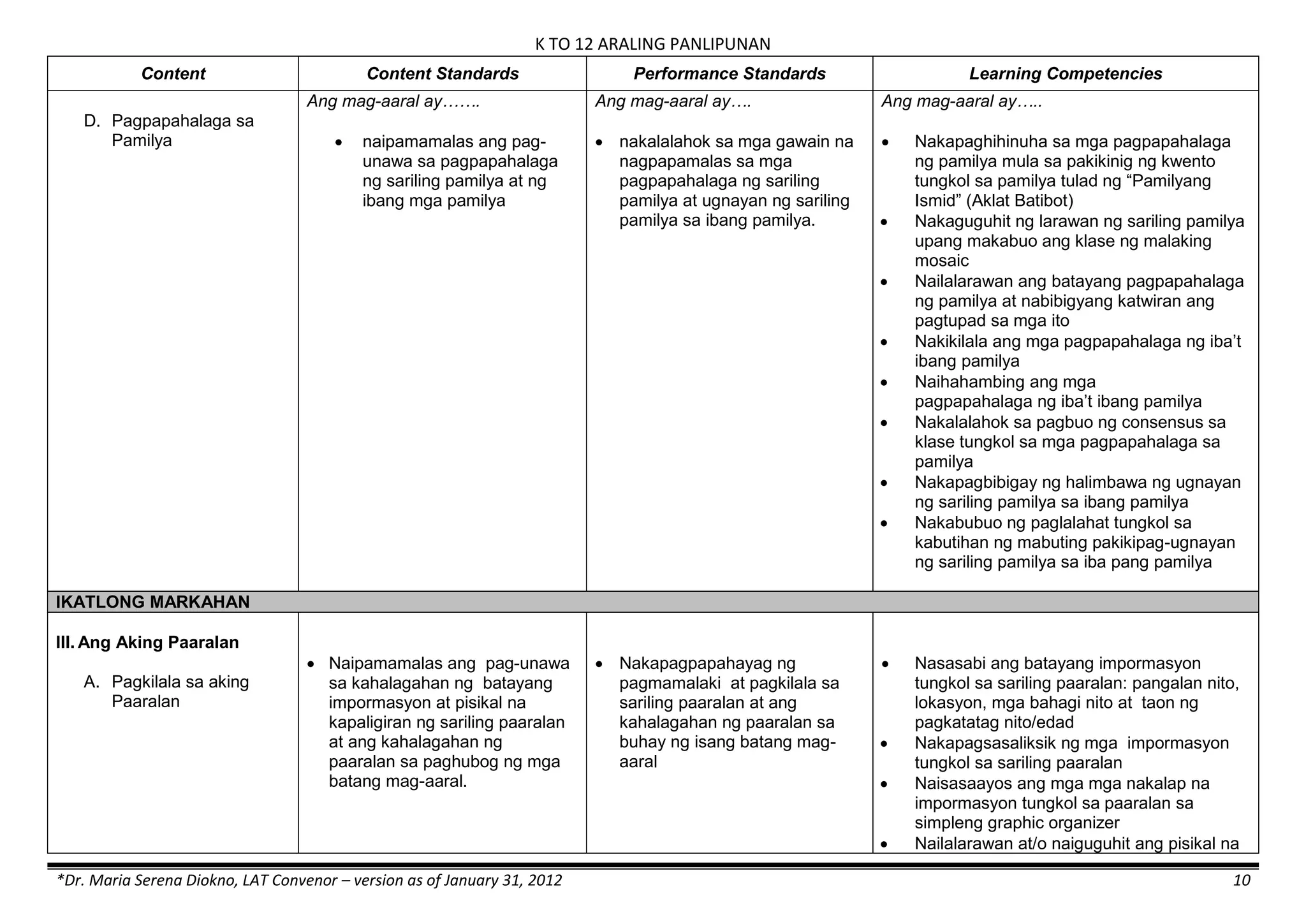
 Nakapaghihinuha sa mga pagpapahalaga
ng pamilya mula sa pakikinig ng kwento
tungkol sa pamilya tulad ng ―Pamilyang
Ismid‖ (Aklat Batibot)
 Nakaguguhit ng larawan ng sariling pamilya
upang makabuo ang klase ng malaking
mosaic
 Nailalarawan ang batayang pagpapahalaga
ng pamilya at nabibigyang katwiran ang
pagtupad sa mga ito
 Nakikilala ang mga pagpapahalaga ng iba’t
ibang pamilya
 Naihahambing ang mga
pagpapahalaga ng iba’t ibang pamilya
 Nakalalahok sa pagbuo ng consensus sa
klase tungkol sa mga pagpapahalaga sa
pamilya
 Nakapagbibigay ng halimbawa ng ugnayan
ng sariling pamilya sa ibang pamilya
 Nakabubuo ng paglalahat tungkol sa
kabutihan ng mabuting pakikipag-ugnayan
ng sariling pamilya sa iba pang pamilya
IKATLONG MARKAHAN
III. Ang Aking Paaralan
A. Pagkilala sa aking
Paaralan
 Naipamamalas ang pag-unawa
sa kahalagahan ng batayang
impormasyon at pisikal na
kapaligiran ng sariling paaralan
at ang kahalagahan ng
paaralan sa paghubog ng mga
batang mag-aaral.
 Nakapagpapahayag ng
pagmamalaki at pagkilala sa
sariling paaralan at ang
kahalagahan ng paaralan sa
buhay ng isang batang mag-
aaral
 Nasasabi ang batayang impormasyon
tungkol sa sariling paaralan: pangalan nito,
lokasyon, mga bahagi nito at taon ng
pagkatatag nito/edad
 Nakapagsasaliksik ng mga impormasyon
tungkol sa sariling paaralan
 Naisasaayos ang mga mga nakalap na
impormasyon tungkol sa paaralan sa
simpleng graphic organizer
 Nailalarawan at/o naiguguhit ang pisikal na
K TO 12 ARALING PANLIPUNAN
*Dr. Maria Serena Diokno, LAT Convenor – version as of January 31, 2012 11
Content Content Standards Performance Standards Learning Competencies
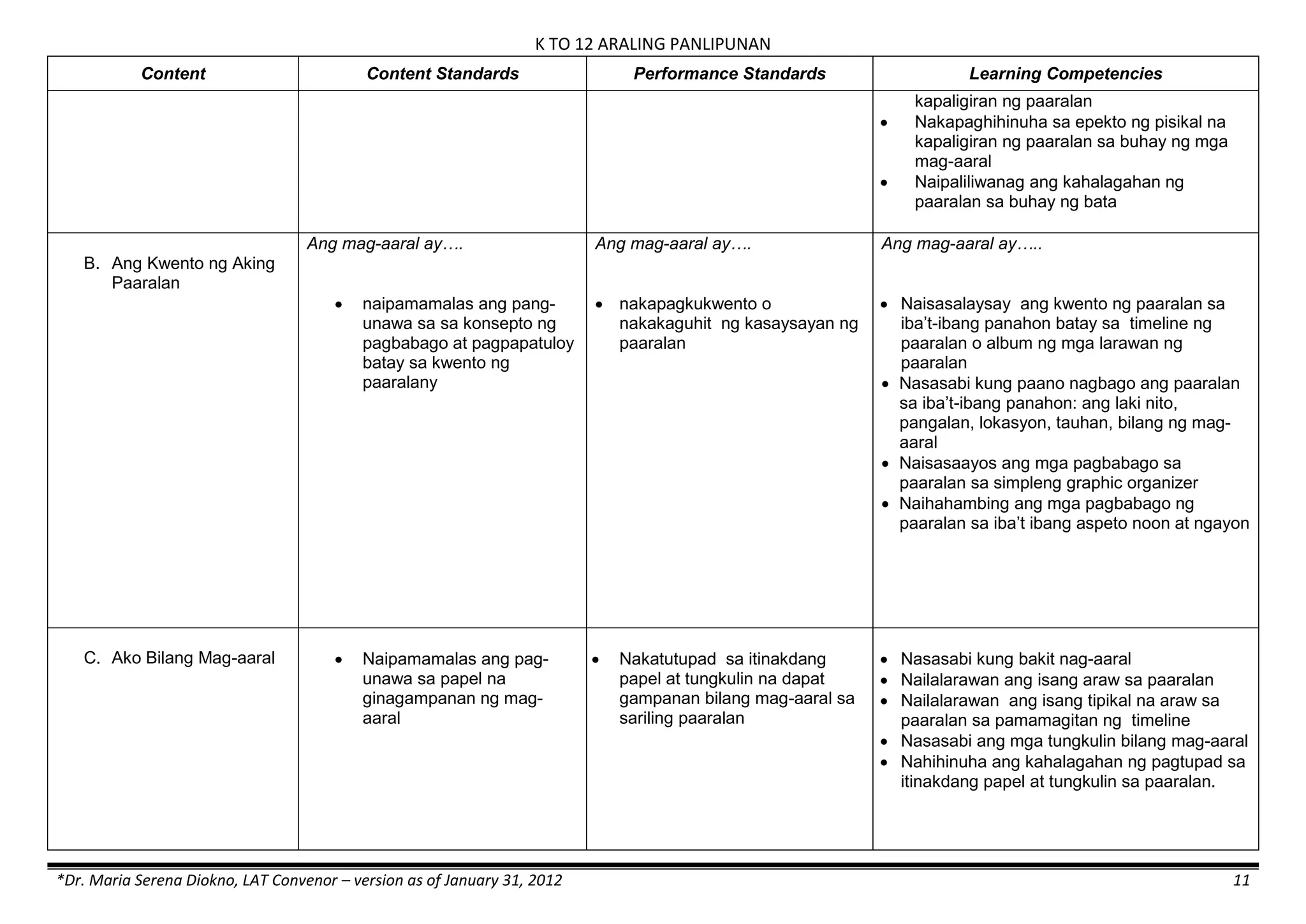
kapaligiran ng paaralan
 Nakapaghihinuha sa epekto ng pisikal na
kapaligiran ng paaralan sa buhay ng mga
mag-aaral
 Naipaliliwanag ang kahalagahan ng
paaralan sa buhay ng bata
B. Ang Kwento ng Aking
Paaralan
Ang mag-aaral ay….
 naipamamalas ang pang-
unawa sa sa konsepto ng
pagbabago at pagpapatuloy
batay sa kwento ng
paaralany
Ang mag-aaral ay….
 nakapagkukwento o
nakakaguhit ng kasaysayan ng
paaralan
Ang mag-aaral ay…..
 Naisasalaysay ang kwento ng paaralan sa
iba’t-ibang panahon batay sa timeline ng
paaralan o album ng mga larawan ng
paaralan
 Nasasabi kung paano nagbago ang paaralan
sa iba’t-ibang panahon: ang laki nito,
pangalan, lokasyon, tauhan, bilang ng mag-
aaral
 Naisasaayos ang mga pagbabago sa
paaralan sa simpleng graphic organizer
 Naihahambing ang mga pagbabago ng
paaralan sa iba’t ibang aspeto noon at ngayon
C. Ako Bilang Mag-aaral  Naipamamalas ang pag-
unawa sa papel na
ginagampanan ng mag-
aaral
 Nakatutupad sa itinakdang
papel at tungkulin na dapat
gampanan bilang mag-aaral sa
sariling paaralan
 Nasasabi kung bakit nag-aaral
 Nailalarawan ang isang araw sa paaralan
 Nailalarawan ang isang tipikal na araw sa
paaralan sa pamamagitan ng timeline
 Nasasabi ang mga tungkulin bilang mag-aaral
 Nahihinuha ang kahalagahan ng pagtupad sa
itinakdang papel at tungkulin sa paaralan.
K TO 12 ARALING PANLIPUNAN
*Dr. Maria Serena Diokno, LAT Convenor – version as of January 31, 2012 12
Content Content Standards Performance Standards Learning Competencies
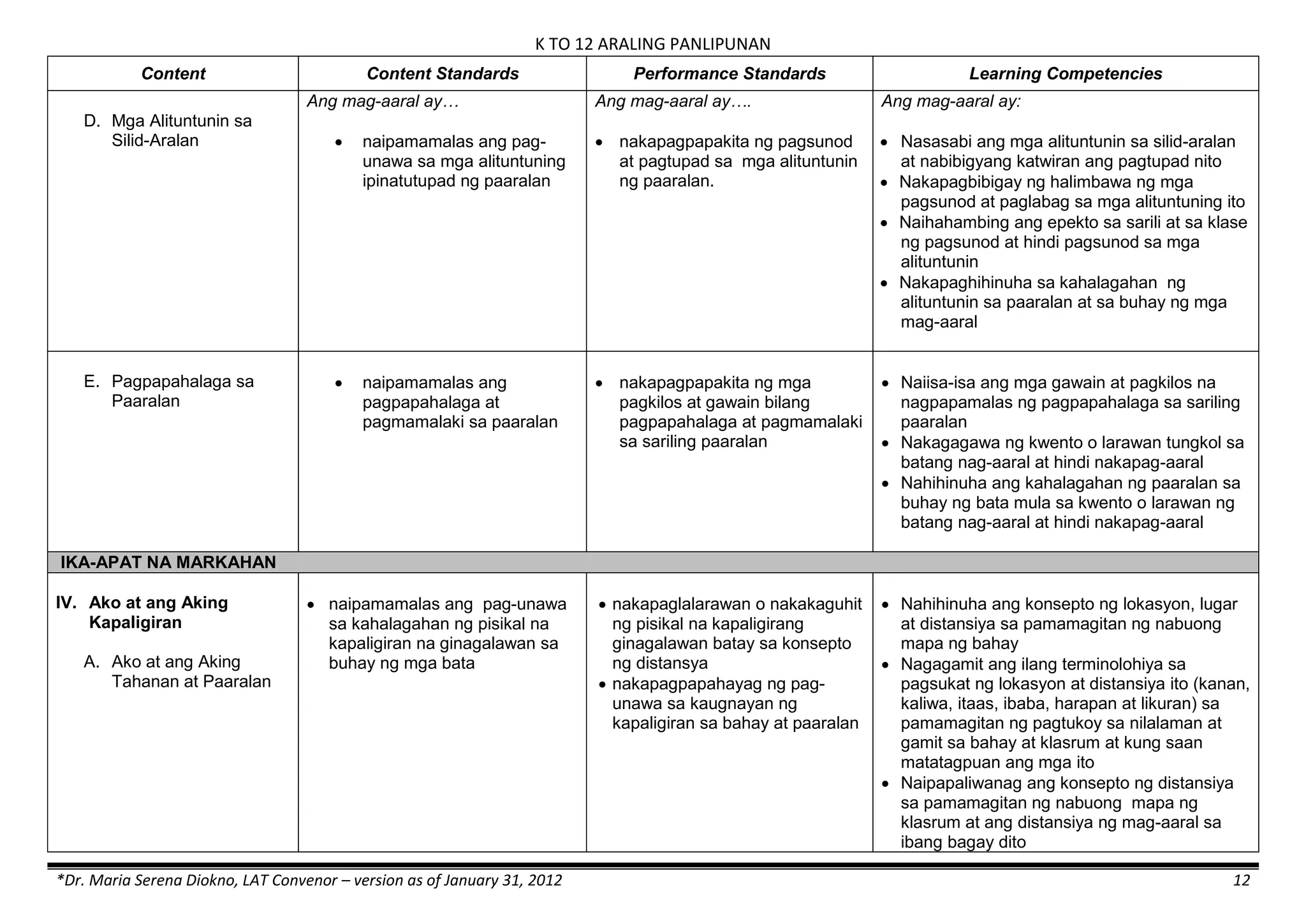
D. Mga Alituntunin sa
Silid-Aralan
Ang mag-aaral ay…
 naipamamalas ang pag-
unawa sa mga alituntuning
ipinatutupad ng paaralan
Ang mag-aaral ay….
 nakapagpapakita ng pagsunod
at pagtupad sa mga alituntunin
ng paaralan.
Ang mag-aaral ay:
 Nasasabi ang mga alituntunin sa silid-aralan
at nabibigyang katwiran ang pagtupad nito
 Nakapagbibigay ng halimbawa ng mga
pagsunod at paglabag sa mga alituntuning ito
 Naihahambing ang epekto sa sarili at sa klase
ng pagsunod at hindi pagsunod sa mga
alituntunin
 Nakapaghihinuha sa kahalagahan ng
alituntunin sa paaralan at sa buhay ng mga
mag-aaral
E. Pagpapahalaga sa
Paaralan
 naipamamalas ang
pagpapahalaga at
pagmamalaki sa paaralan
 nakapagpapakita ng mga
pagkilos at gawain bilang
pagpapahalaga at pagmamalaki
sa sariling paaralan
 Naiisa-isa ang mga gawain at pagkilos na
nagpapamalas ng pagpapahalaga sa sariling
paaralan
 Nakagagawa ng kwento o larawan tungkol sa
batang nag-aaral at hindi nakapag-aaral
 Nahihinuha ang kahalagahan ng paaralan sa
buhay ng bata mula sa kwento o larawan ng
batang nag-aaral at hindi nakapag-aaral
IKA-APAT NA MARKAHAN
IV. Ako at ang Aking
Kapaligiran
A. Ako at ang Aking
Tahanan at Paaralan
 naipamamalas ang pag-unawa
sa kahalagahan ng pisikal na
kapaligiran na ginagalawan sa
buhay ng mga bata
 nakapaglalarawan o nakakaguhit
ng pisikal na kapaligirang
ginagalawan batay sa konsepto
ng distansya
 nakapagpapahayag ng pag-
unawa sa kaugnayan ng
kapaligiran sa bahay at paaralan
 Nahihinuha ang konsepto ng lokasyon, lugar
at distansiya sa pamamagitan ng nabuong
mapa ng bahay
 Nagagamit ang ilang terminolohiya sa
pagsukat ng lokasyon at distansiya ito (kanan,
kaliwa, itaas, ibaba, harapan at likuran) sa
pamamagitan ng pagtukoy sa nilalaman at
gamit sa bahay at klasrum at kung saan
matatagpuan ang mga ito
 Naipapaliwanag ang konsepto ng distansiya
sa pamamagitan ng nabuong mapa ng
klasrum at ang distansiya ng mag-aaral sa
ibang bagay dito
K TO 12 ARALING PANLIPUNAN
*Dr. Maria Serena Diokno, LAT Convenor – version as of January 31, 2012 13
Content Content Standards Performance Standards Learning Competencies
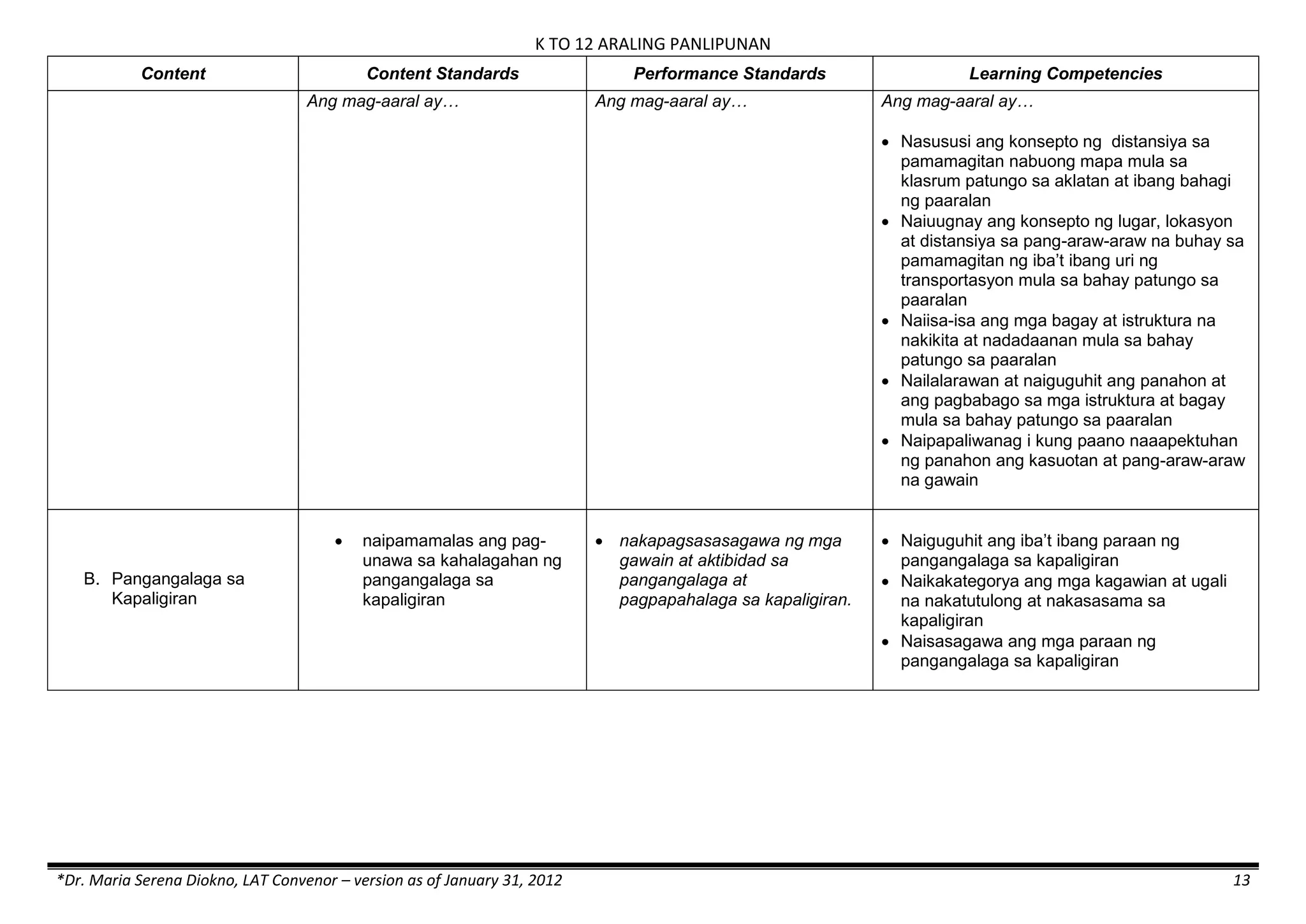
Ang mag-aaral ay… Ang mag-aaral ay… Ang mag-aaral ay…
 Nasususi ang konsepto ng distansiya sa
pamamagitan nabuong mapa mula sa
klasrum patungo sa aklatan at ibang bahagi
ng paaralan
 Naiuugnay ang konsepto ng lugar, lokasyon
at distansiya sa pang-araw-araw na buhay sa
pamamagitan ng iba’t ibang uri ng
transportasyon mula sa bahay patungo sa
paaralan
 Naiisa-isa ang mga bagay at istruktura na
nakikita at nadadaanan mula sa bahay
patungo sa paaralan
 Nailalarawan at naiguguhit ang panahon at
ang pagbabago sa mga istruktura at bagay
mula sa bahay patungo sa paaralan
 Naipapaliwanag i kung paano naaapektuhan
ng panahon ang kasuotan at pang-araw-araw
na gawain
B. Pangangalaga sa
Kapaligiran
 naipamamalas ang pag-
unawa sa kahalagahan ng
pangangalaga sa
kapaligiran
 nakapagsasasagawa ng mga
gawain at aktibidad sa
pangangalaga at
pagpapahalaga sa kapaligiran.
 Naiguguhit ang iba’t ibang paraan ng
pangangalaga sa kapaligiran
 Naikakategorya ang mga kagawian at ugali
na nakatutulong at nakasasama sa
kapaligiran
 Naisasagawa ang mga paraan ng
pangangalaga sa kapaligiran
K TO 12 ARALING PANLIPUNAN
*Dr. Maria Serena Diokno, LAT Convenor – version as of January 31, 2012 14
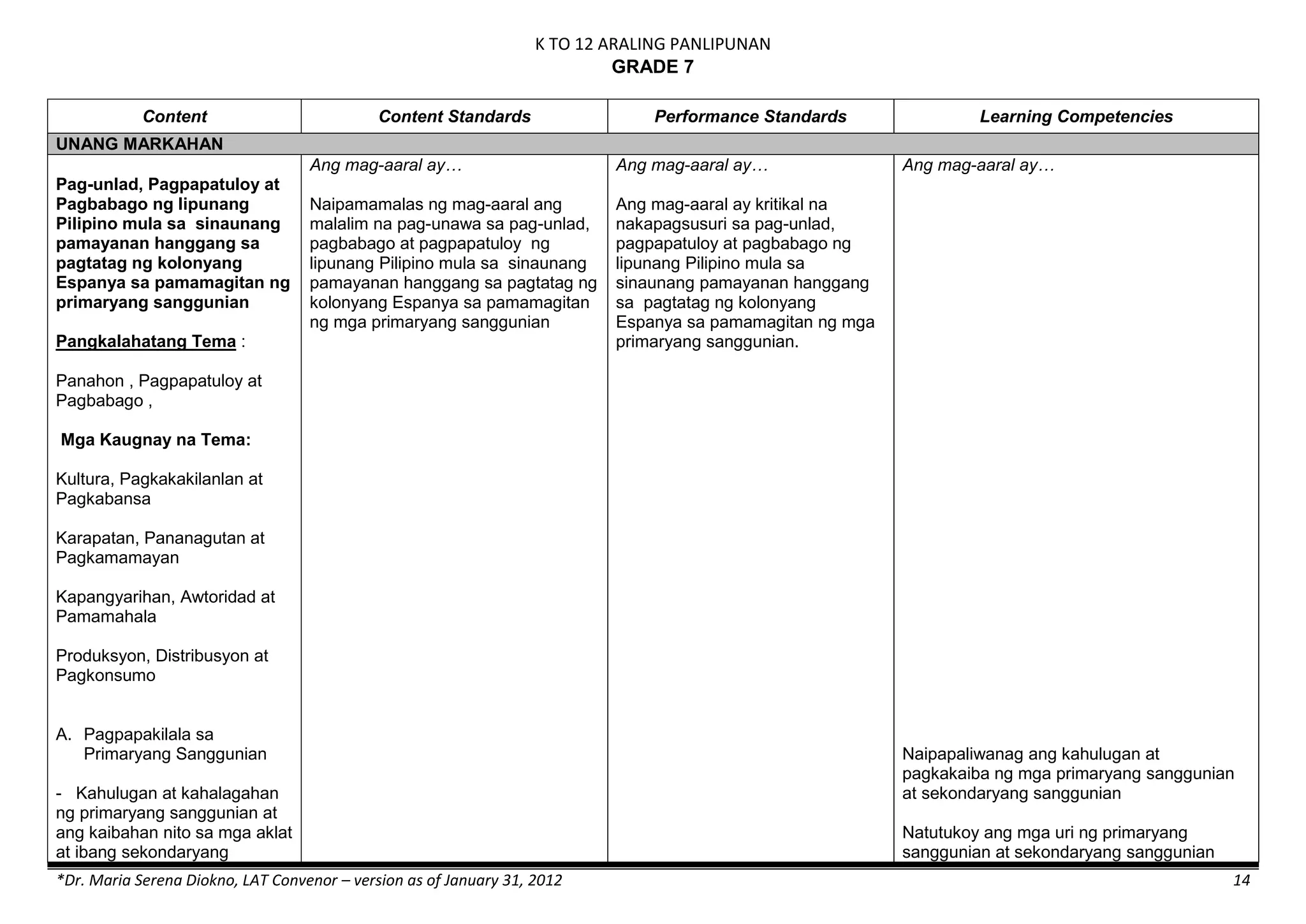
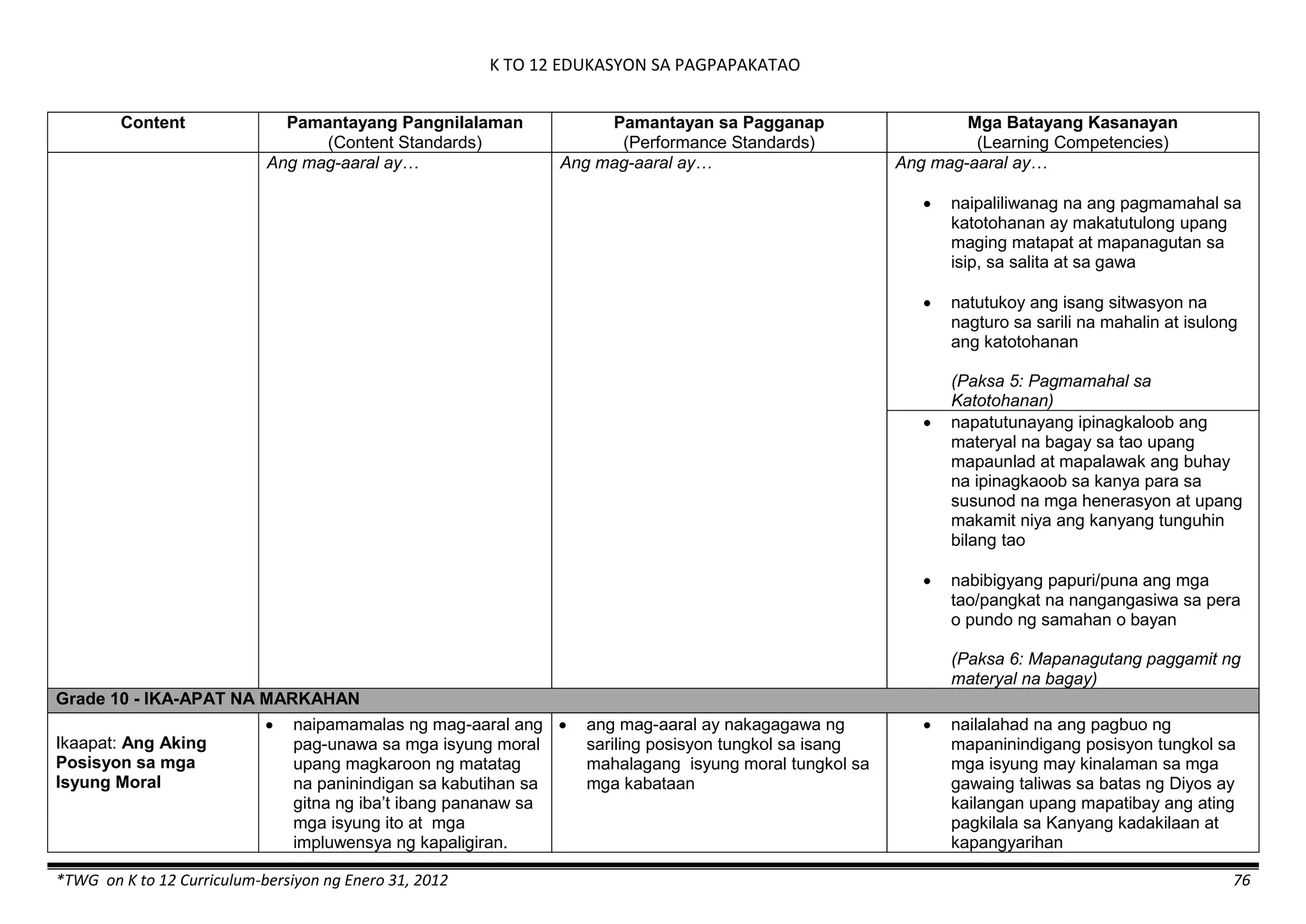
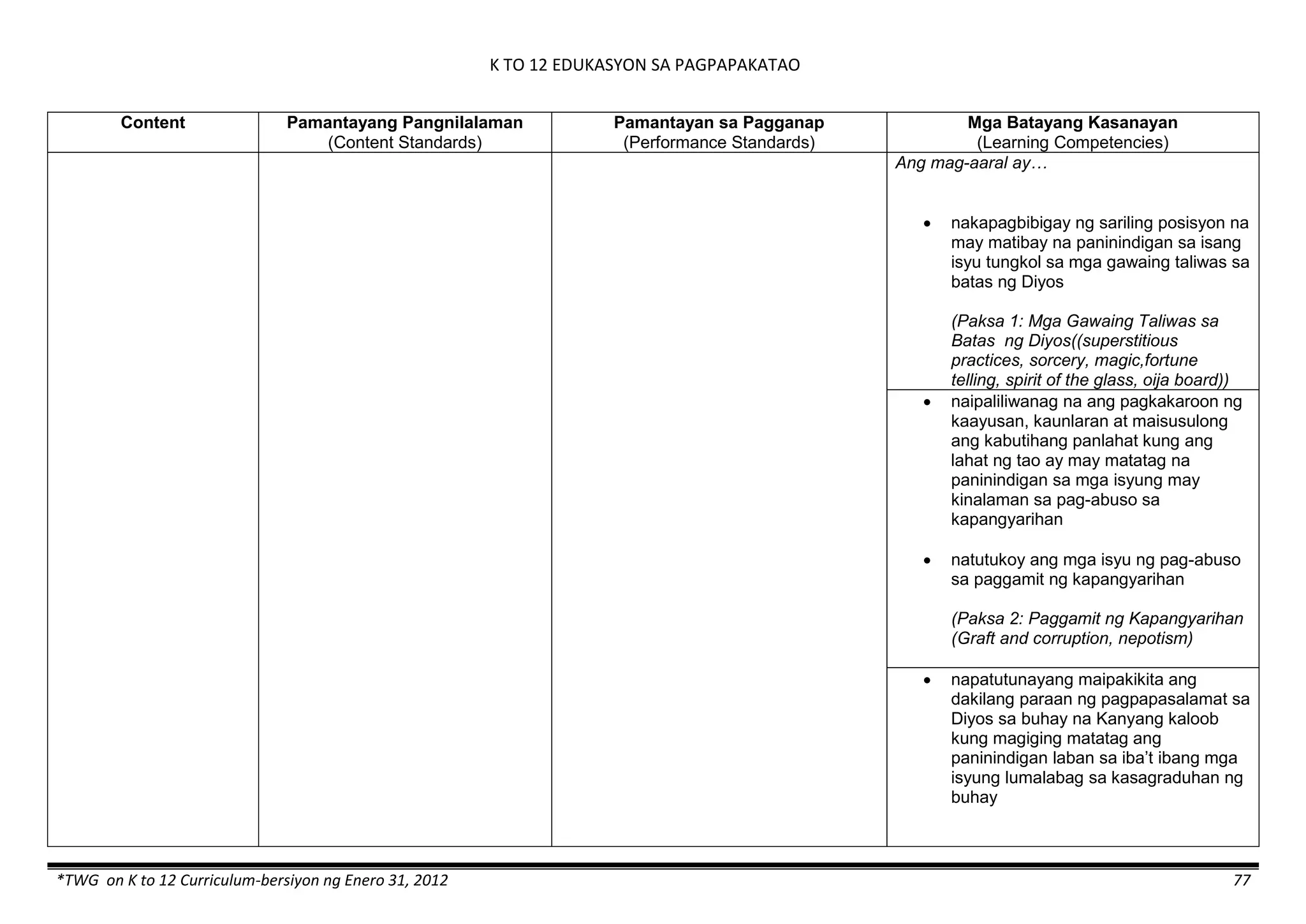
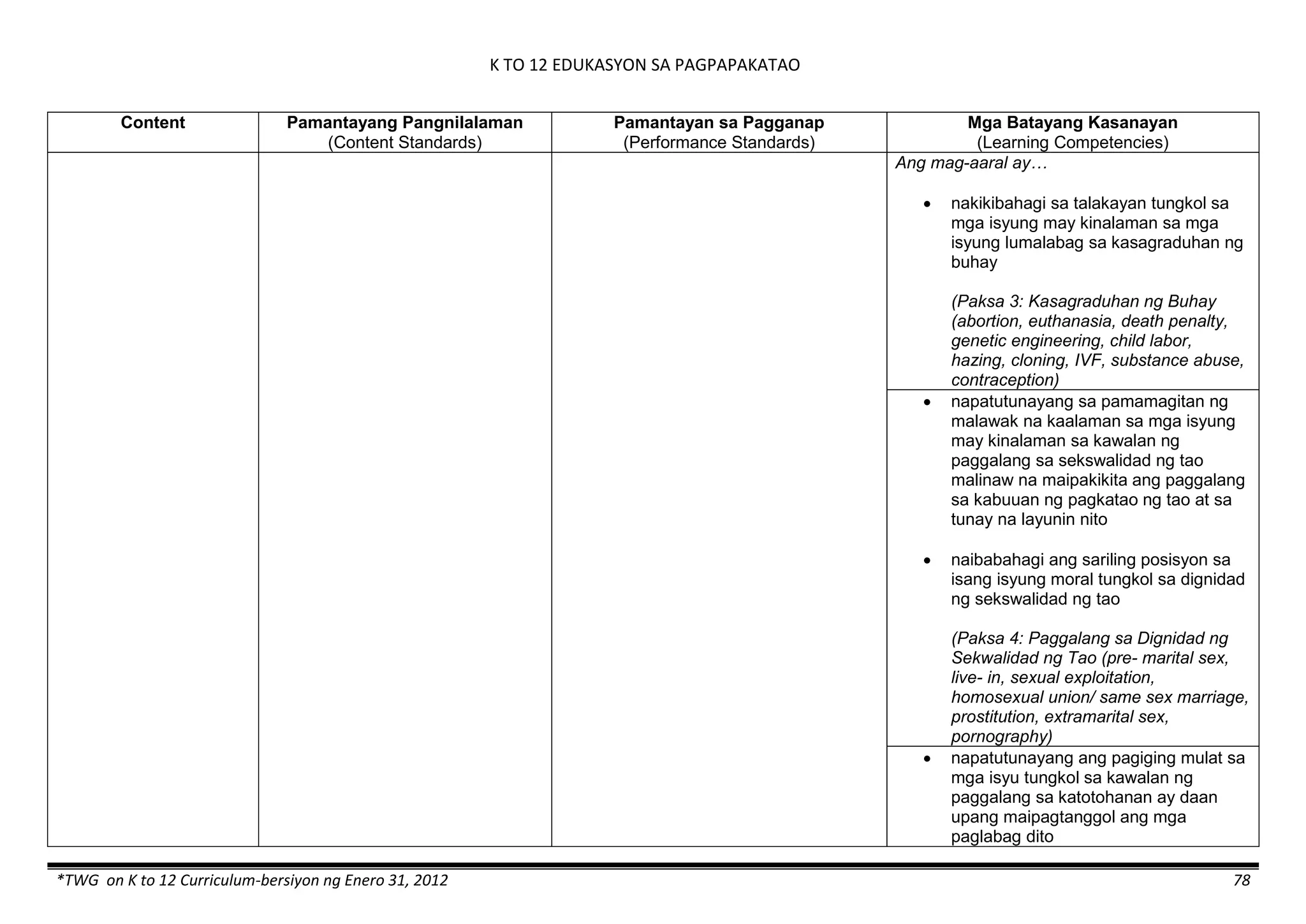
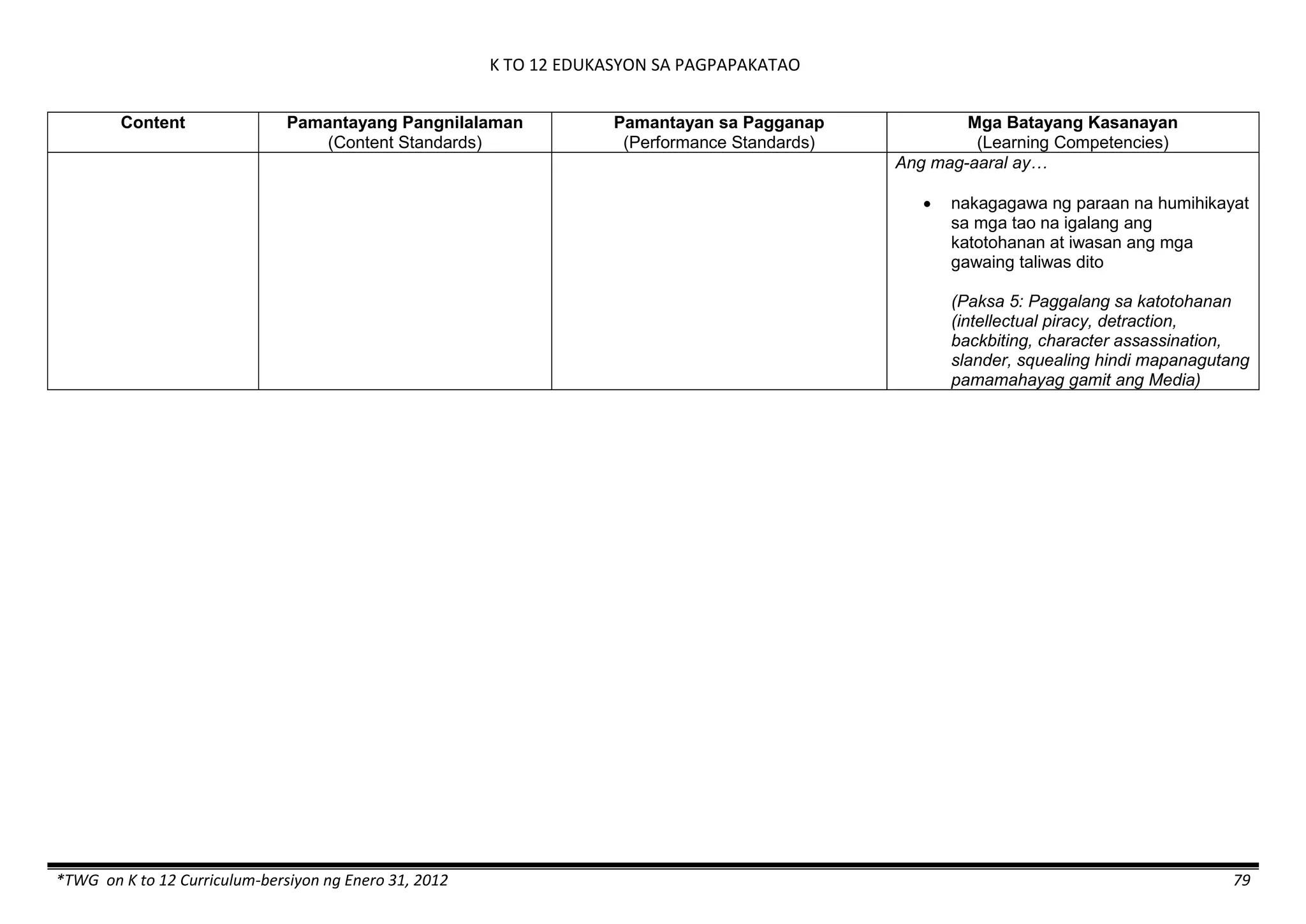
GRADE 7
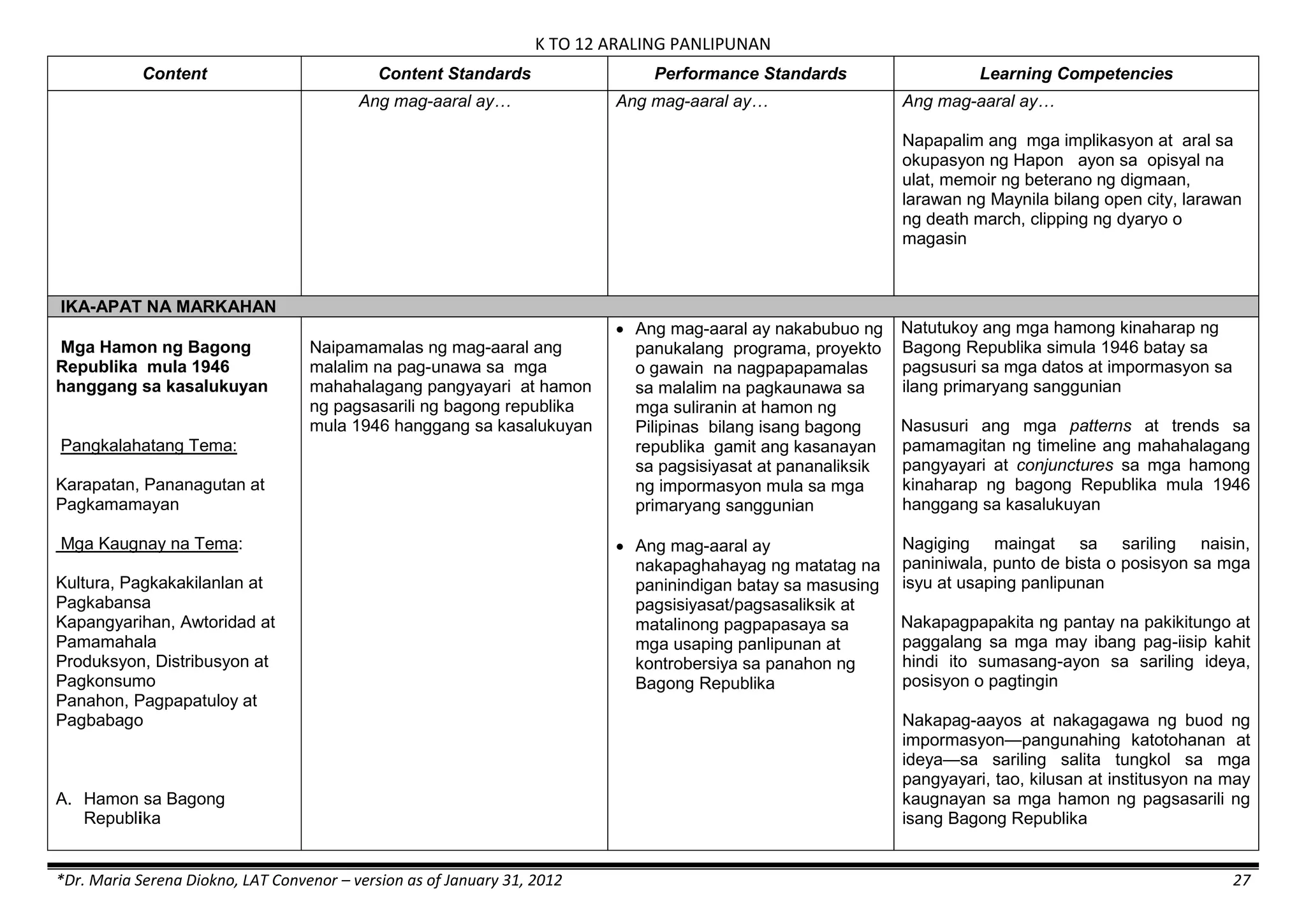
Content Content Standards Performance Standards Learning Competencies
UNANG MARKAHAN
Pag-unlad, Pagpapatuloy at
Pagbabago ng lipunang
Pilipino mula sa sinaunang
pamayanan hanggang sa
pagtatag ng kolonyang
Espanya sa pamamagitan ng
primaryang sanggunian
Pangkalahatang Tema :
Panahon , Pagpapatuloy at
Pagbabago ,
Mga Kaugnay na Tema:
Kultura, Pagkakakilanlan at
Pagkabansa
Karapatan, Pananagutan at
Pagkamamayan
Kapangyarihan, Awtoridad at
Pamamahala
Produksyon, Distribusyon at
Pagkonsumo
A. Pagpapakilala sa
Primaryang Sanggunian
- Kahulugan at kahalagahan
ng primaryang sanggunian at
ang kaibahan nito sa mga aklat
at ibang sekondaryang
Ang mag-aaral ay…
Naipamamalas ng mag-aaral ang
malalim na pag-unawa sa pag-unlad,
pagbabago at pagpapatuloy ng
lipunang Pilipino mula sa sinaunang
pamayanan hanggang sa pagtatag ng
kolonyang Espanya sa pamamagitan
ng mga primaryang sanggunian
Ang mag-aaral ay…
Ang mag-aaral ay kritikal na
nakapagsusuri sa pag-unlad,
pagpapatuloy at pagbabago ng
lipunang Pilipino mula sa
sinaunang pamayanan hanggang
sa pagtatag ng kolonyang
Espanya sa pamamagitan ng mga
primaryang sanggunian.
Ang mag-aaral ay…
Naipapaliwanag ang kahulugan at
pagkakaiba ng mga primaryang sanggunian
at sekondaryang sanggunian
Natutukoy ang mga uri ng primaryang
sanggunian at sekondaryang sanggunian
K TO 12 ARALING PANLIPUNAN
*Dr. Maria Serena Diokno, LAT Convenor – version as of January 31, 2012 15
Content Content Standards Performance Standards Learning Competencies
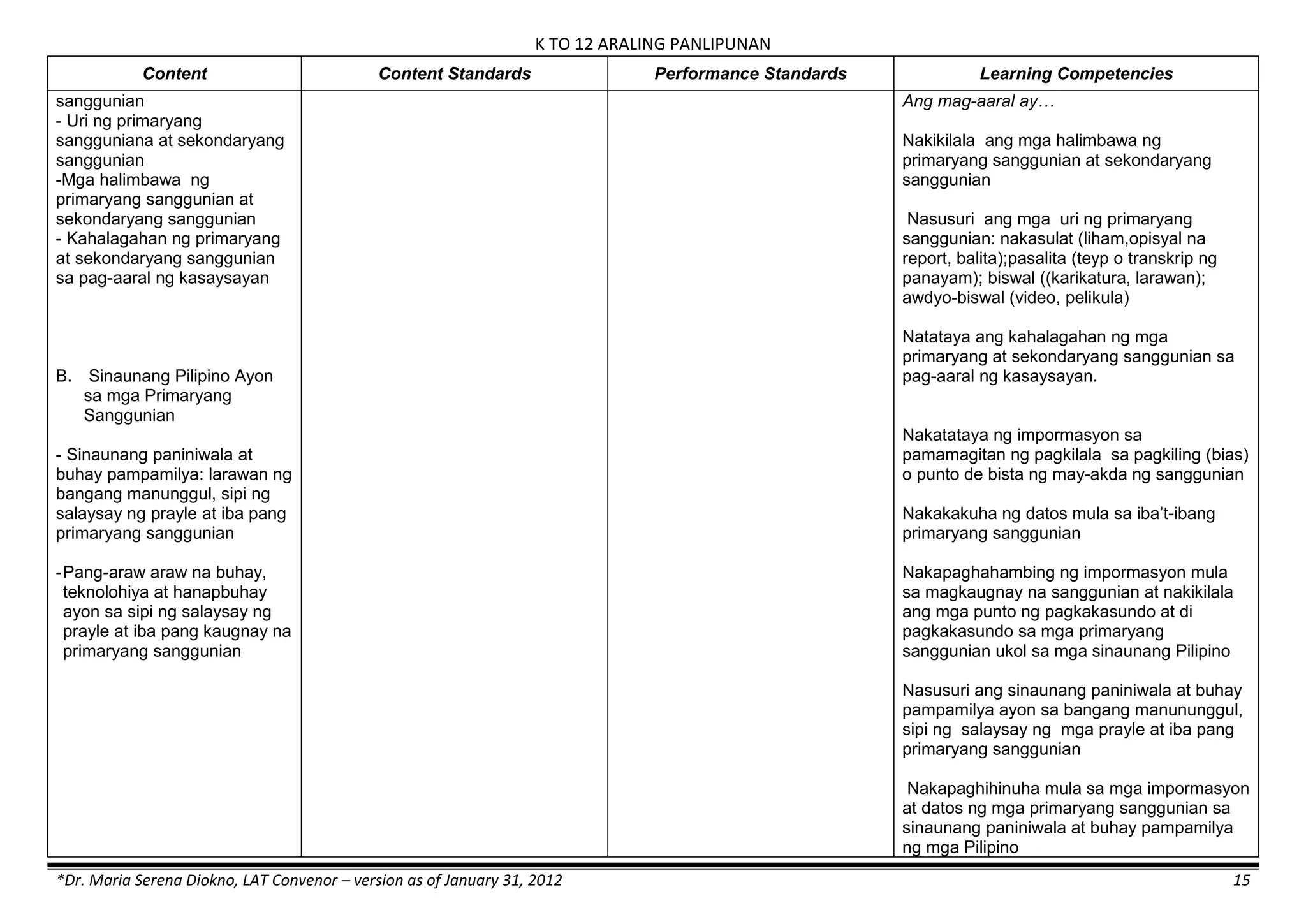
sanggunian
- Uri ng primaryang
sangguniana at sekondaryang
sanggunian
-Mga halimbawa ng
primaryang sanggunian at
sekondaryang sanggunian
- Kahalagahan ng primaryang
at sekondaryang sanggunian
sa pag-aaral ng kasaysayan
B. Sinaunang Pilipino Ayon
sa mga Primaryang
Sanggunian
- Sinaunang paniniwala at
buhay pampamilya: larawan ng
bangang manunggul, sipi ng
salaysay ng prayle at iba pang
primaryang sanggunian
-Pang-araw araw na buhay,
teknolohiya at hanapbuhay
ayon sa sipi ng salaysay ng
prayle at iba pang kaugnay na
primaryang sanggunian
Ang mag-aaral ay…
Nakikilala ang mga halimbawa ng
primaryang sanggunian at sekondaryang
sanggunian
Nasusuri ang mga uri ng primaryang
sanggunian: nakasulat (liham,opisyal na
report, balita);pasalita (teyp o transkrip ng
panayam); biswal ((karikatura, larawan);
awdyo-biswal (video, pelikula)
Natataya ang kahalagahan ng mga
primaryang at sekondaryang sanggunian sa
pag-aaral ng kasaysayan.
Nakatataya ng impormasyon sa
pamamagitan ng pagkilala sa pagkiling (bias)
o punto de bista ng may-akda ng sanggunian
Nakakakuha ng datos mula sa iba’t-ibang
primaryang sanggunian
Nakapaghahambing ng impormasyon mula
sa magkaugnay na sanggunian at nakikilala
ang mga punto ng pagkakasundo at di
pagkakasundo sa mga primaryang
sanggunian ukol sa mga sinaunang Pilipino
Nasusuri ang sinaunang paniniwala at buhay
pampamilya ayon sa bangang manununggul,
sipi ng salaysay ng mga prayle at iba pang
primaryang sanggunian
Nakapaghihinuha mula sa mga impormasyon
at datos ng mga primaryang sanggunian sa
sinaunang paniniwala at buhay pampamilya
ng mga Pilipino
K TO 12 ARALING PANLIPUNAN
*Dr. Maria Serena Diokno, LAT Convenor – version as of January 31, 2012 16
Content Content Standards Performance Standards Learning Competencies
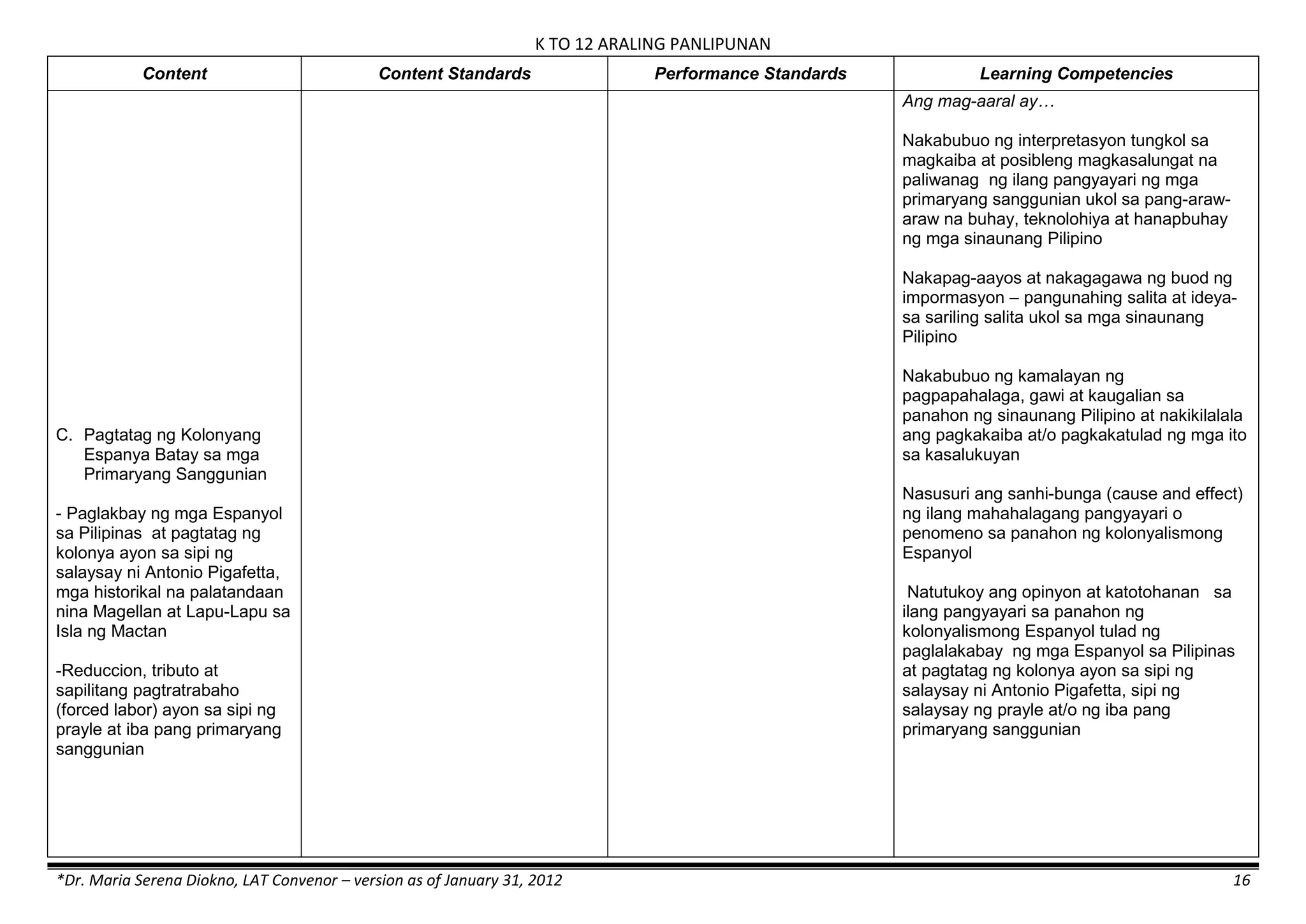
C. Pagtatag ng Kolonyang
Espanya Batay sa mga
Primaryang Sanggunian
- Paglakbay ng mga Espanyol
sa Pilipinas at pagtatag ng
kolonya ayon sa sipi ng
salaysay ni Antonio Pigafetta,
mga historikal na palatandaan
nina Magellan at Lapu-Lapu sa
Isla ng Mactan
-Reduccion, tributo at
sapilitang pagtratrabaho
(forced labor) ayon sa sipi ng
prayle at iba pang primaryang
sanggunian
Ang mag-aaral ay…
Nakabubuo ng interpretasyon tungkol sa
magkaiba at posibleng magkasalungat na
paliwanag ng ilang pangyayari ng mga
primaryang sanggunian ukol sa pang-araw-
araw na buhay, teknolohiya at hanapbuhay
ng mga sinaunang Pilipino
Nakapag-aayos at nakagagawa ng buod ng
impormasyon – pangunahing salita at ideya-
sa sariling salita ukol sa mga sinaunang
Pilipino
Nakabubuo ng kamalayan ng
pagpapahalaga, gawi at kaugalian sa
panahon ng sinaunang Pilipino at nakikilalala
ang pagkakaiba at/o pagkakatulad ng mga ito
sa kasalukuyan
Nasusuri ang sanhi-bunga (cause and effect)
ng ilang mahahalagang pangyayari o
penomeno sa panahon ng kolonyalismong
Espanyol
Natutukoy ang opinyon at katotohanan sa
ilang pangyayari sa panahon ng
kolonyalismong Espanyol tulad ng
paglalakabay ng mga Espanyol sa Pilipinas
at pagtatag ng kolonya ayon sa sipi ng
salaysay ni Antonio Pigafetta, sipi ng
salaysay ng prayle at/o ng iba pang
primaryang sanggunian
K TO 12 ARALING PANLIPUNAN
*Dr. Maria Serena Diokno, LAT Convenor – version as of January 31, 2012 17
Content Content Standards Performance Standards Learning Competencies
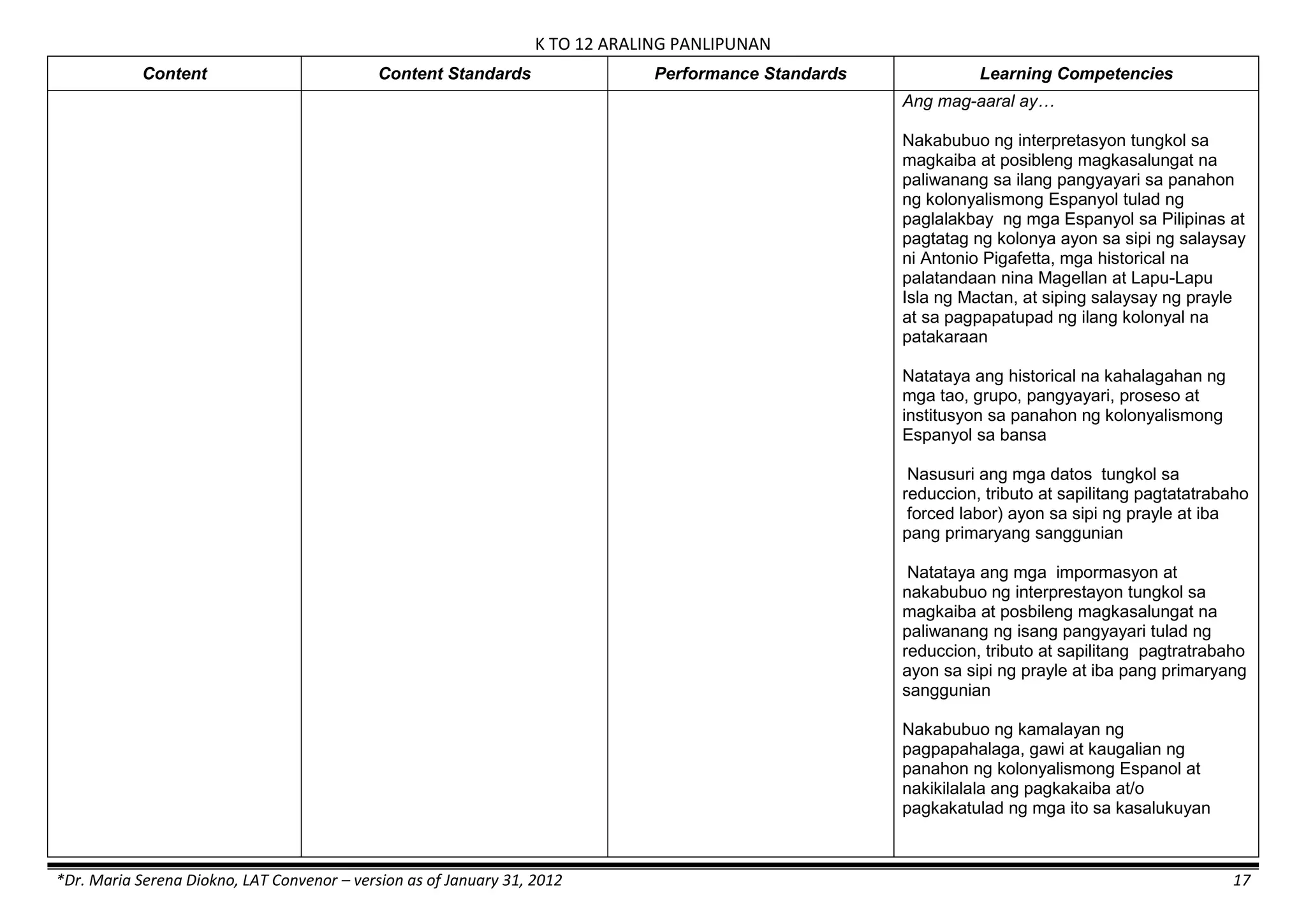
Ang mag-aaral ay…
Nakabubuo ng interpretasyon tungkol sa
magkaiba at posibleng magkasalungat na
paliwanang sa ilang pangyayari sa panahon
ng kolonyalismong Espanyol tulad ng
paglalakbay ng mga Espanyol sa Pilipinas at
pagtatag ng kolonya ayon sa sipi ng salaysay
ni Antonio Pigafetta, mga historical na
palatandaan nina Magellan at Lapu-Lapu
Isla ng Mactan, at siping salaysay ng prayle
at sa pagpapatupad ng ilang kolonyal na
patakaraan
Natataya ang historical na kahalagahan ng
mga tao, grupo, pangyayari, proseso at
institusyon sa panahon ng kolonyalismong
Espanyol sa bansa
Nasusuri ang mga datos tungkol sa
reduccion, tributo at sapilitang pagtatatrabaho
forced labor) ayon sa sipi ng prayle at iba
pang primaryang sanggunian
Natataya ang mga impormasyon at
nakabubuo ng interprestayon tungkol sa
magkaiba at posbileng magkasalungat na
paliwanang ng isang pangyayari tulad ng
reduccion, tributo at sapilitang pagtratrabaho
ayon sa sipi ng prayle at iba pang primaryang
sanggunian
Nakabubuo ng kamalayan ng
pagpapahalaga, gawi at kaugalian ng
panahon ng kolonyalismong Espanol at
nakikilalala ang pagkakaiba at/o
pagkakatulad ng mga ito sa kasalukuyan
K TO 12 ARALING PANLIPUNAN
*Dr. Maria Serena Diokno, LAT Convenor – version as of January 31, 2012 18
Content Content Standards Performance Standards Learning Competencies
IKALAWANG MARKAHAN
Pagbubuo ng Bansang
Pilipinas
Pangkalahatang Tema:
Kultura, Pagkakakilanlan at
Pagkabansa
Mga Kaugnay na Tema:
Karapatan, Pananagutan at
Pagkamamayan,
Kapangyarihan , Awtoridad at
Pamamahala
Produksyon, Distribusyon at
Pagkonsumo
Panahon Pagpapatuloy at
Pagbabago
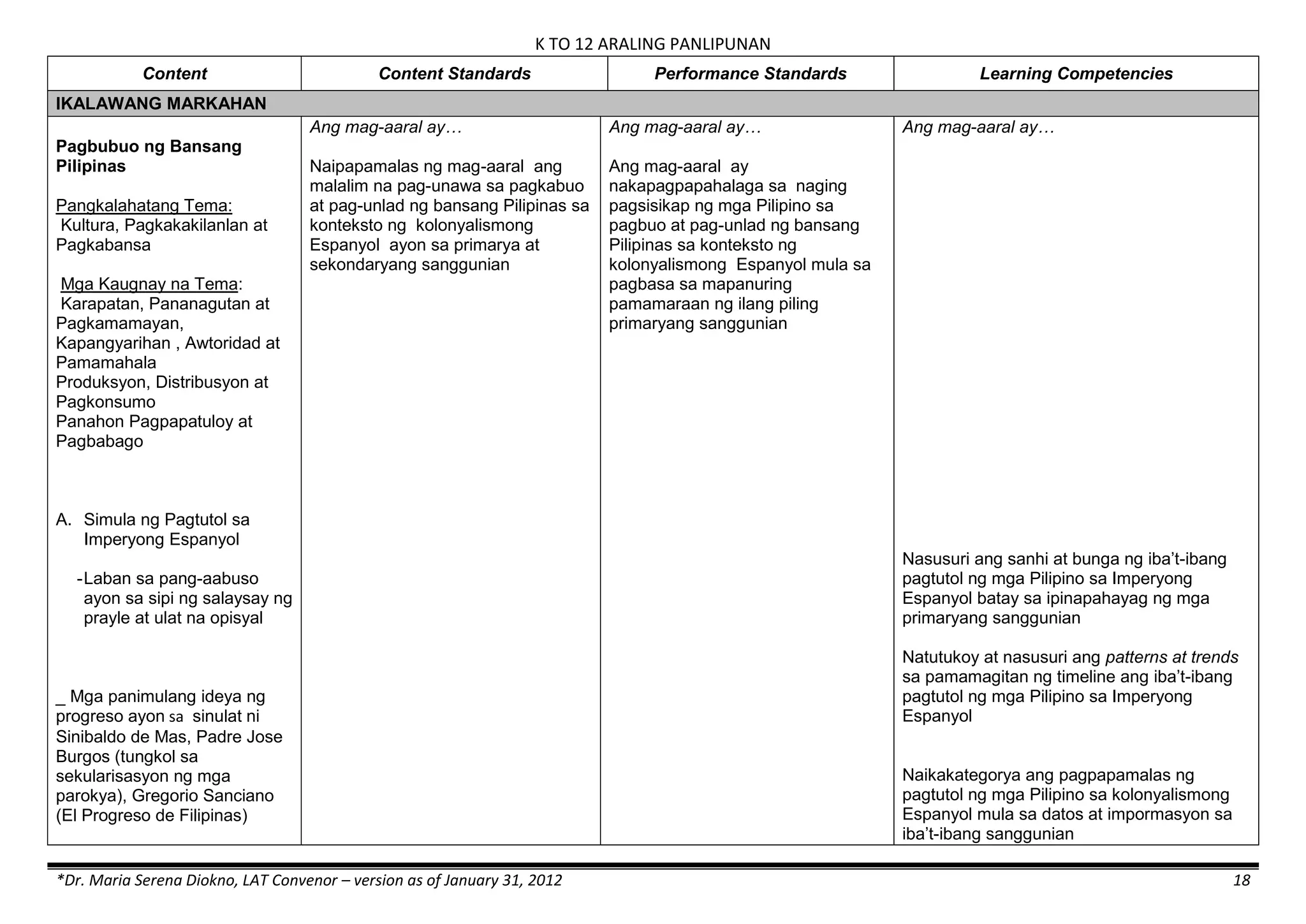
A. Simula ng Pagtutol sa
Imperyong Espanyol
-Laban sa pang-aabuso
ayon sa sipi ng salaysay ng
prayle at ulat na opisyal
_ Mga panimulang ideya ng
progreso ayon sa sinulat ni
Sinibaldo de Mas, Padre Jose
Burgos (tungkol sa
sekularisasyon ng mga
parokya), Gregorio Sanciano
(El Progreso de Filipinas)
Ang mag-aaral ay…
Naipapamalas ng mag-aaral ang
malalim na pag-unawa sa pagkabuo
at pag-unlad ng bansang Pilipinas sa
konteksto ng kolonyalismong
Espanyol ayon sa primarya at
sekondaryang sanggunian
Ang mag-aaral ay…
Ang mag-aaral ay
nakapagpapahalaga sa naging
pagsisikap ng mga Pilipino sa
pagbuo at pag-unlad ng bansang
Pilipinas sa konteksto ng
kolonyalismong Espanyol mula sa
pagbasa sa mapanuring
pamamaraan ng ilang piling
primaryang sanggunian
Ang mag-aaral ay…
Nasusuri ang sanhi at bunga ng iba’t-ibang
pagtutol ng mga Pilipino sa Imperyong
Espanyol batay sa ipinapahayag ng mga
primaryang sanggunian
Natutukoy at nasusuri ang patterns at trends
sa pamamagitan ng timeline ang iba’t-ibang
pagtutol ng mga Pilipino sa Imperyong
Espanyol
Naikakategorya ang pagpapamalas ng
pagtutol ng mga Pilipino sa kolonyalismong
Espanyol mula sa datos at impormasyon sa
iba’t-ibang sanggunian
K TO 12 ARALING PANLIPUNAN
*Dr. Maria Serena Diokno, LAT Convenor – version as of January 31, 2012 19
Content Content Standards Performance Standards Learning Competencies
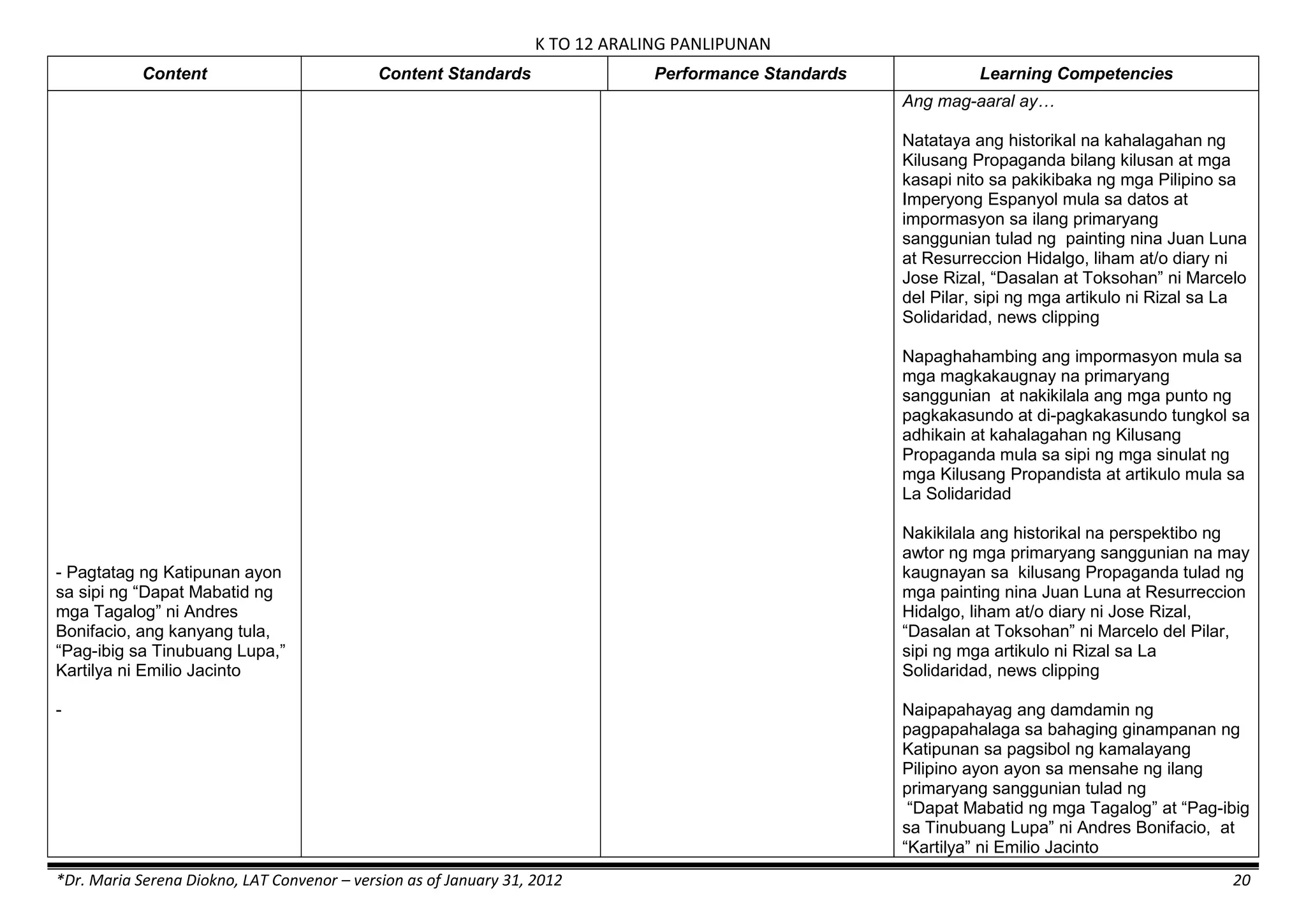
B. Pagsibol ng Kamalayang
Pilipino
- Kilusang Propaganda ayon
sa mga painting nina Juan
Luna at Resurreccion Hidalgo,
liham at/o diary ni Jose Rizal,
―Dasalan at Toksohan‖ ni
Marcelo del Pilar, sipi ng mga
artikulo ni Rizal sa La
Solidaridad, news clipping
Ang mag-aaral ay…
Nasusuri ang iba’t-ibang paglaban ng mga
Pilipino sa pang-aabuso ayon sa sipi ng
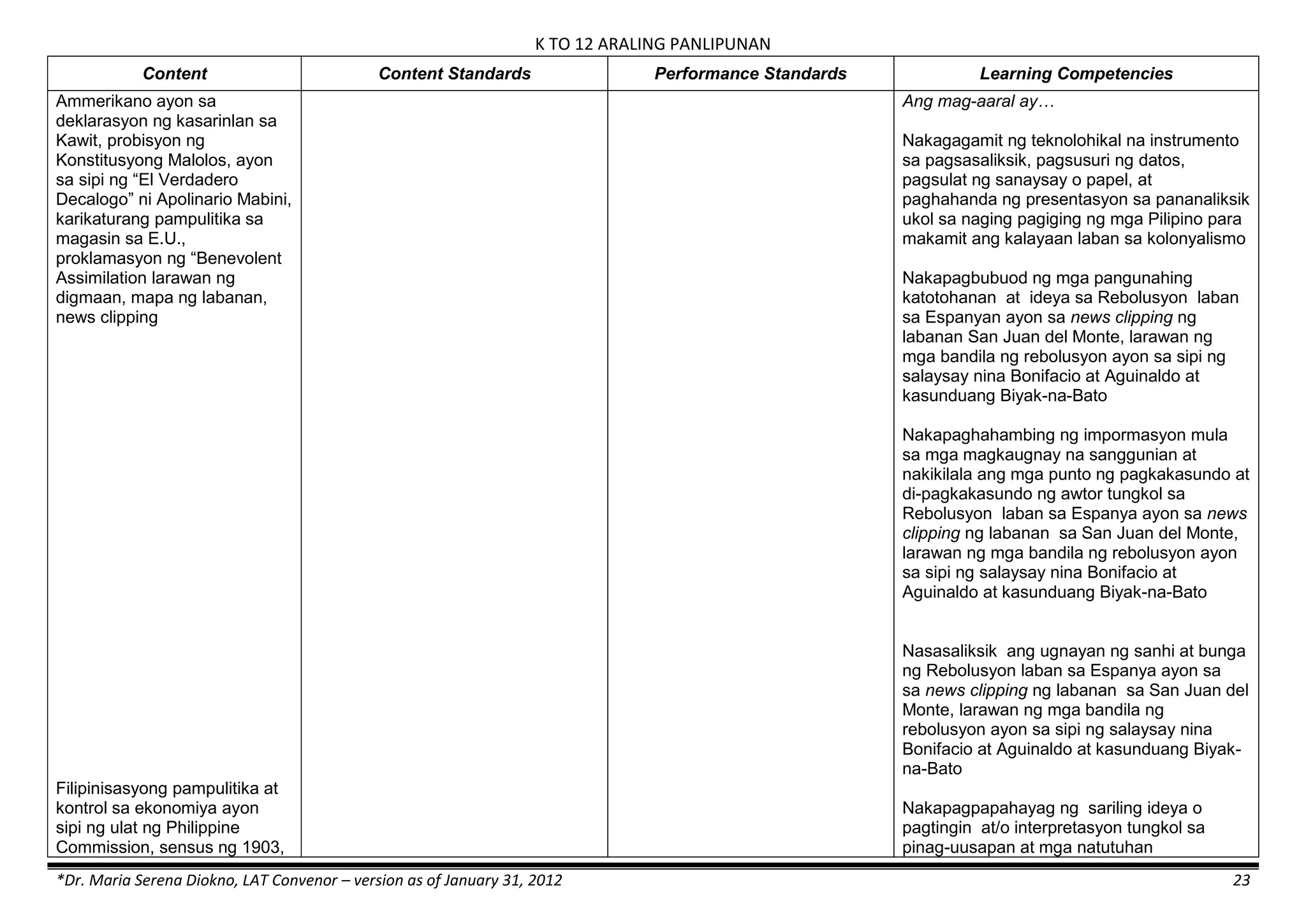
salaysay ng prayle at ulat opisyal
Natataya ang historikal na perspektibo sa
naging paglaban ng mga Pilipino sa pang-
aabuso ayon sa salaysay ng prayle at ulat na
opisyal.
Nakapaghihinuha sa adhikain ng mga
Pilipino sa paglaban sa kolonyalismo mula sa
mga panimulang ideya ng progreso ayon sa
sinulat ni Sinibaldo de Mas, Padre Jose
Burgos (tungkol sa sekularisasyon ng mga
parokya), Gregorio Sanciano (El Progreso de
Filipinas)
Nakabubuo ng interpretasyon tungkol sa
magkaiba at posibleng magkasalungat na
paliwanag sa panimulang ideya ng progreso
ng mga Pilipino batay sa paghahambing sa
sipi ng mga sinulat nina Sinibaldo de Mas,
Padre Jose Burgos (tungkol sa
sekularisasyon ng mga parokya), Gregorio
Sanciano (El Progreso de Filipinas)
Nahihinuha mula sa mga datos at
impormasyon sa mga primaryang
sanggunian ang mga pangyayari na nakapag-
ambag at/o nakahadlang sa pagsibol ng
kamalayang Pilipino
K TO 12 ARALING PANLIPUNAN
*Dr. Maria Serena Diokno, LAT Convenor – version as of January 31, 2012 20
Content Content Standards Performance Standards Learning Competencies
- Pagtatag ng Katipunan ayon
sa sipi ng ―Dapat Mabatid ng
mga Tagalog‖ ni Andres
Bonifacio, ang kanyang tula,
―Pag-ibig sa Tinubuang Lupa,‖
Kartilya ni Emilio Jacinto
-
Ang mag-aaral ay…
Natataya ang historikal na kahalagahan ng
Kilusang Propaganda bilang kilusan at mga
kasapi nito sa pakikibaka ng mga Pilipino sa
Imperyong Espanyol mula sa datos at
impormasyon sa ilang primaryang
sanggunian tulad ng painting nina Juan Luna
at Resurreccion Hidalgo, liham at/o diary ni
Jose Rizal, ―Dasalan at Toksohan‖ ni Marcelo
del Pilar, sipi ng mga artikulo ni Rizal sa La
Solidaridad, news clipping
Napaghahambing ang impormasyon mula sa
mga magkakaugnay na primaryang
sanggunian at nakikilala ang mga punto ng
pagkakasundo at di-pagkakasundo tungkol sa
adhikain at kahalagahan ng Kilusang
Propaganda mula sa sipi ng mga sinulat ng
mga Kilusang Propandista at artikulo mula sa
La Solidaridad
Nakikilala ang historikal na perspektibo ng
awtor ng mga primaryang sanggunian na may
kaugnayan sa kilusang Propaganda tulad ng
mga painting nina Juan Luna at Resurreccion
Hidalgo, liham at/o diary ni Jose Rizal,
―Dasalan at Toksohan‖ ni Marcelo del Pilar,
sipi ng mga artikulo ni Rizal sa La
Solidaridad, news clipping
Naipapahayag ang damdamin ng
pagpapahalaga sa bahaging ginampanan ng
Katipunan sa pagsibol ng kamalayang
Pilipino ayon ayon sa mensahe ng ilang
primaryang sanggunian tulad ng
―Dapat Mabatid ng mga Tagalog‖ at ―Pag-ibig
sa Tinubuang Lupa‖ ni Andres Bonifacio, at
―Kartilya‖ ni Emilio Jacinto
K TO 12 ARALING PANLIPUNAN
*Dr. Maria Serena Diokno, LAT Convenor – version as of January 31, 2012 21
Content Content Standards Performance Standards Learning Competencies
Ang mag-aaral ay…
Nakabubuo ng interpretasyon tungkol sa
magkaiba at posibleng magkasalungat na
paliwanag tungkol pagkakatatag at iba pang
usapin sa Katipunan mula sa mga datos at
impormasyon sa mga primaryang sanggunian
Nakapag-aayos at nakagagawa ng buod ng
impormasyon sa sariling salita ng mga
pangunahing katotohanan at ideya tungkol sa
Katipunan sa konteksto ng pakikibaka ng
mga Pilipino sa kolonyalismong Espanyol
mula sa pagsusuri sa mga primaryang
sanggunian tulad ng sipi ng ―Dapat Mabatid
ng mga Tagalog‖ ni Andres Bonifacio, ang
kanyang tula, ―Pag-ibig sa Tinubuang Lupa,‖
Kartilya ni Emilio Jacinto
IKATLONG MARKAHAN
Ang Pagkakamit ng
Kalayaan at Kasarinlan laban
sa Kolonyalismong
Espanyol, Amerikano at
Hapon
Pangkalahatang Tema:
Kapangyariahan, Awtoridad at
Pamamahala
Mga Kaugnay na Tema:
Kultura, Pagkakakilanlan at
Pagkabansa
Karapatan, Pananagutan at
Pagkamamamayan
Produksyon, Distribusyon at
Pagkonsumo
Naipapamalas ng mag-aral ang
malalim na pag-unawa sa
mahahalagang pangyayari at naging
tugon ng mga Pilipino sa pagkamit ng
kalayaan at kasarinlan laban sa
kolonyalismong Espanyol, Amerikano
at Hapon
Ang mag-aaral ay
nakapagsasaliksik gamit ang
kasanayan sa pagsusuri at pagbuo
ng interpretasyon ng impormasyon
mula sa primaryang sanggunian
sa mahahalagang pangyayari at
naging tugon ng mga Pilipino sa
pagkamit ng kalayaan at kasarinlan
laban sa kolonyalismong Espanyol,
Amerikano at Hapon
K TO 12 ARALING PANLIPUNAN
*Dr. Maria Serena Diokno, LAT Convenor – version as of January 31, 2012 22
Content Content Standards Performance Standards Learning Competencies
Panahon , Pagpapatuloy at
Pagbabago
A. Pakikibaka para sa
Kalayaan
-Rebolusyon laban sa
Espanya: news clipping ng
labanan sa San Juan del
Monte, larawan ng mga
bandila ng rebolusyon ayon sa
sipi ng salaysay nina Bonifacio
at Aguinaldo at kasunduang
Biyak-na-Bato
B. Ang Imperyong Amerikano
hanggang Ikalawang
Digmaang Pandaidig
Digmaang Pilipino-
Ang mag-aaral ay…
Nasusuri ang mga hugpungang pangyayari
(conjunctures) sa pamamagitan ng timeline
ang mga mahahalagang pangyayari sa
pakikibaka ng mga Pilipino para makamit ang
kalayaan at kasarinlan laban sa
kolonyalismong Espanyol, Amerikano at
Hapon
Natataya ang historikal na kahalagahan sa
mga tao, grupo, pangyayari, proseso o
kilusan at institusyon sa naging pagkakamit
ng mga Pilipino ng kalayaan at kasarinlan sa
ilalim ng kolonyalismong Espanyol,
Amerikano at Hapon batay sa pagsusuri sa
mga primaryang sanggunian
Natutukoy ang mga salik at pangyayari na
nakatulong at nakahadlang sa pagkakamit ng
mga Pilipino ng kalayaan at kasarinlan sa
ilalim ng kolonyalismong Espanyol,
Amerikano at Hapon mula sa pagsusuri ng
mga datos at impormasyon ng mga
primaryang sanggunian
Nakasasagot ng tanong batay sa angkop at
sapat na ebidensiya sa ilang pangyayari na
may kaugnayan sa pagkakamit ng kalayaan
ng mga Pilipino laban sa kolonyalismong
Espanyol, Amerikano at Hapon
Nakapag-aayos ng resulta ng pagsasaliksik
partikular ng mga datos at impormasyon sa
lohikal na paraan
K TO 12 ARALING PANLIPUNAN
*Dr. Maria Serena Diokno, LAT Convenor – version as of January 31, 2012 23
Content Content Standards Performance Standards Learning Competencies
Ammerikano ayon sa
deklarasyon ng kasarinlan sa
Kawit, probisyon ng
Konstitusyong Malolos, ayon
sa sipi ng ―El Verdadero
Decalogo‖ ni Apolinario Mabini,
karikaturang pampulitika sa
magasin sa E.U.,
proklamasyon ng ―Benevolent
Assimilation larawan ng
digmaan, mapa ng labanan,
news clipping
Filipinisasyong pampulitika at
kontrol sa ekonomiya ayon
sipi ng ulat ng Philippine
Commission, sensus ng 1903,
Ang mag-aaral ay…
Nakagagamit ng teknolohikal na instrumento
sa pagsasaliksik, pagsusuri ng datos,
pagsulat ng sanaysay o papel, at
paghahanda ng presentasyon sa pananaliksik
ukol sa naging pagiging ng mga Pilipino para
makamit ang kalayaan laban sa kolonyalismo
Nakapagbubuod ng mga pangunahing
katotohanan at ideya sa Rebolusyon laban
sa Espanyan ayon sa news clipping ng
labanan San Juan del Monte, larawan ng
mga bandila ng rebolusyon ayon sa sipi ng
salaysay nina Bonifacio at Aguinaldo at
kasunduang Biyak-na-Bato
Nakapaghahambing ng impormasyon mula
sa mga magkaugnay na sanggunian at
nakikilala ang mga punto ng pagkakasundo at
di-pagkakasundo ng awtor tungkol sa
Rebolusyon laban sa Espanya ayon sa news
clipping ng labanan sa San Juan del Monte,
larawan ng mga bandila ng rebolusyon ayon
sa sipi ng salaysay nina Bonifacio at
Aguinaldo at kasunduang Biyak-na-Bato
Nasasaliksik ang ugnayan ng sanhi at bunga
ng Rebolusyon laban sa Espanya ayon sa
sa news clipping ng labanan sa San Juan del
Monte, larawan ng mga bandila ng
rebolusyon ayon sa sipi ng salaysay nina
Bonifacio at Aguinaldo at kasunduang Biyak-
na-Bato
Nakapagpapahayag ng sariling ideya o
pagtingin at/o interpretasyon tungkol sa
pinag-uusapan at mga natutuhan
K TO 12 ARALING PANLIPUNAN
*Dr. Maria Serena Diokno, LAT Convenor – version as of January 31, 2012 24
Content Content Standards Performance Standards Learning Competencies
larawan ng 1904 St. Louis Fair,
Jones Law, news clipping,
Bates Treaty, Payne-Aldrich
Act
Limitasyon sa paghayag ng
nasyonalismong Pilipino ayon
sa Brigandage Act,
Reconcentration Act, news
clipping, sipi ng ―Aves de
Rapiña,‖ sipi ng talumpati ni
Manuel Quezon, probisyon ng
Konstitusyon ng 1935
Ang mag-aaral ay…
Rebolusyong Pilipino batay sa impormasyon
ng ilang primaryang sanggunian tulad ng
deklarasyon ng kasarinlan sa Kawit,
probisyon ng Konstitusyong Malolos, at sipi
ng ―El Verdadero Decalogo‖ ni Apolinario
Mabini
Nasusuri ang mga pagkaka-ugnay-ugnay ng
ng sari-saring datos ng Digmaang Pilipino-
Amerikano ayon sa deklarasyon ng
kasarinlan sa Kawit, probisyon ng
Konstitusyong Malolos, ayon sa sipi ng ―El
Verdadero Decalogo‖ ni Apolinario Mabini,
karikaturang pampulitika sa magasin sa E.U.,
proklamasyon ng ―Benevolent Assimilation
larawan ng digmaan, mapa ng labanan, news
clipping
Nakabubuo ng konklusyon base sa
interpretasyon ng impormasyon sa
Digmaang Pilipino-Amerikano ayon sa
deklarasyon ng kasarinlan sa Kawit,
probisyon ng Konstitusyong Malolos, ayon sa
sipi ng ―El Verdadero Decalogo‖ ni Apolinario
Mabini, karikaturang pampulitika sa magasin
sa E.U., proklamasyon ng ―Benevolent
Assimilation larawan ng digmaan, mapa ng
labanan, news clipping
Natataya ang kahalagahang historikal sa
pagkakamit ng mga Pilipino ng kalayaan ng
mga ebidensiya sa Filipinisasyong
pampulitika at kontrol sa ekonomiya ayon
sipi ng ulat ng Philippine Commission, sensus
ng 1903, larawan ng 1904 St. Louis Fair,
K TO 12 ARALING PANLIPUNAN
*Dr. Maria Serena Diokno, LAT Convenor – version as of January 31, 2012 25
Content Content Standards Performance Standards Learning Competencies
Okupasyong Hapon ayon sa
opisyal na ulat, memoir ng
beterano ng digmaan, larawan
ng Maynila bilang open city,
larawan ng death march,
clipping ng dyaryo o magasin
Jones Law, news clipping, Bates Treaty,
Payne-Aldrich Acta ayon sa sipi ng ulat ng
Philippine Commission, sensus ng 1903,
larawan ng 1904 St. Louis Fair, Jones Law,
news clipping, Bates Treaty, Payne-Aldrich
Act
Nakapipili ng mga makatotohanan at
mahahalagang ebidensiya sa Filipinisasyong
pampulitika at kontrol sa ekonomiya upang
mataya ang historikal na impluwensiya nito
sa Imperyo ng Amerikano ayon sa sipi ng
ulat ng Philippine Commission, sensus ng
1903, larawan ng 1904 St. Louis Fair, Jones
Law, news clipping, Bates Treaty, Payne-
Aldrich Act
Nasusuri sa malinaw at maayos na paraan
ang sariling kaisipan tungkol sa kaganapan o
isyung pinagaaraalan na pinagtitibay ng
nararapat na datos sa Filipinisasyong
pampulitika at kontrol sa ekonomiya ayon
sipi ng ulat ng Philippine Commission, sensus
ng 1903, larawan ng 1904 St. Louis Fair,
Jones Law, news clipping, Bates Treaty,
Payne-Aldrich Act
Nakabubuo ng interpretasyon tungkol sa mga
magkapareho o magkaibang paliwanag sa
limitasyon sa paghayag ng nasyonalismong
Pilipino ayon impormasyon ng ilang
primaryang sanggunian tungkol sa
Brigandage Act, Reconcentration Act, news
clipping, sipi ng ―Aves de Rapiña,‖ sipi ng
talumpati ni Manuel Quezon, probisyon ng
Konstitusyon ng 1935
K TO 12 ARALING PANLIPUNAN
*Dr. Maria Serena Diokno, LAT Convenor – version as of January 31, 2012 26
Content Content Standards Performance Standards Learning Competencies
Ang mag-aaral ay…
Nakapaghahambing ng impormasyon mula
sa mga magkaugnay na sanggunian at
nakikilala ang mga punto ng pagkakasundo at
di pagkakasundo batay sa pagsusuri ng mga
primaryang sanggunian sa ilang pangyayari
tungkol sa limitasyon sa paghayag ng
nasyonalismong Pilipino ayon sa Brigandage
Act, Reconcentration Act, news clipping, sipi
ng ―Aves de Rapiña,‖ sipi ng talumpati ni
Manuel Quezon, probisyon ng Konstitusyon
ng 1935.
Nakapag-aayos at nakagagawa ng buod ng
impormasyon sa sariling salita ng mga
pangunahing katotohanan at ideya sa ilang
pangyayari batay sa datos o ebidensiya sa
ilang pangyayari sa pagkakamit ng kalayaan
sa ilalim ng kolonyalismong Amerikano
Nakatutuklas ng mga kaisipan at
makatotohanang ebidensya sa okupasyong
Hapon mula sa mga opisyal na ulat, memoir
ng beterano ng digmaan, larawan ng Maynila
bilang open city, larawan ng Death March,
clipping ng dyaryo o magasin
Nakapagbubunyag ng mga historikal na
kamalian sa okupasyon ng Hapon ayon sa
opisyal na ulat, memoir ng beterano ng
digmaan, larawan ng Maynila bilang open
city, larawan ng death march, clipping ng
dyaryo o magasin
K TO 12 ARALING PANLIPUNAN
*Dr. Maria Serena Diokno, LAT Convenor – version as of January 31, 2012 27
Content Content Standards Performance Standards Learning Competencies
Ang mag-aaral ay… Ang mag-aaral ay… Ang mag-aaral ay…
Napapalim ang mga implikasyon at aral sa
okupasyon ng Hapon ayon sa opisyal na
ulat, memoir ng beterano ng digmaan,
larawan ng Maynila bilang open city, larawan
ng death march, clipping ng dyaryo o
magasin
IKA-APAT NA MARKAHAN
Mga Hamon ng Bagong
Republika mula 1946
hanggang sa kasalukuyan
Pangkalahatang Tema:
Karapatan, Pananagutan at
Pagkamamayan
Mga Kaugnay na Tema:
Kultura, Pagkakakilanlan at
Pagkabansa
Kapangyarihan, Awtoridad at
Pamamahala
Produksyon, Distribusyon at
Pagkonsumo
Panahon, Pagpapatuloy at
Pagbabago
A. Hamon sa Bagong
Republika
Naipamamalas ng mag-aaral ang
malalim na pag-unawa sa mga
mahahalagang pangyayari at hamon
ng pagsasarili ng bagong republika
mula 1946 hanggang sa kasalukuyan
 Ang mag-aaral ay nakabubuo ng
panukalang programa, proyekto
o gawain na nagpapapamalas
sa malalim na pagkaunawa sa
mga suliranin at hamon ng
Pilipinas bilang isang bagong
republika gamit ang kasanayan
sa pagsisiyasat at pananaliksik
ng impormasyon mula sa mga
primaryang sanggunian
 Ang mag-aaral ay
nakapaghahayag ng matatag na
paninindigan batay sa masusing
pagsisiyasat/pagsasaliksik at
matalinong pagpapasaya sa
mga usaping panlipunan at
kontrobersiya sa panahon ng
Bagong Republika
Natutukoy ang mga hamong kinaharap ng
Bagong Republika simula 1946 batay sa
pagsusuri sa mga datos at impormasyon sa
ilang primaryang sanggunian
Nasusuri ang mga patterns at trends sa
pamamagitan ng timeline ang mahahalagang
pangyayari at conjunctures sa mga hamong
kinaharap ng bagong Republika mula 1946
hanggang sa kasalukuyan
Nagiging maingat sa sariling naisin,
paniniwala, punto de bista o posisyon sa mga
isyu at usaping panlipunan
Nakapagpapakita ng pantay na pakikitungo at
paggalang sa mga may ibang pag-iisip kahit
hindi ito sumasang-ayon sa sariling ideya,
posisyon o pagtingin
Nakapag-aayos at nakagagawa ng buod ng
impormasyon—pangunahing katotohanan at
ideya—sa sariling salita tungkol sa mga
pangyayari, tao, kilusan at institusyon na may
kaugnayan sa mga hamon ng pagsasarili ng
isang Bagong Republika
K TO 12 ARALING PANLIPUNAN
*Dr. Maria Serena Diokno, LAT Convenor – version as of January 31, 2012 28
Content Content Standards Performance Standards Learning Competencies
Kahulugan ng kasarinlan ayon
larawan ng 100 peso bill na
nagpapakita ng pag-angat ng
bandilang Pilipinas at pagbaba
ng bandilang E.U., Philippine
Rehabilitation Act, parity at
Kasunduang Base Militar
-Mga problema sa lupa ayon
sa sipi ng memoir ni Luis
Taruc, dyaryo at opisyal na
ulat
- Kamalayan at pag-unawa sa
nasyonalismong Pilipino ayon
sa patakarang Filipino First,
mga batas na nag-aalaga ng
ekonomiya at industriya ng
bansa, sipi ng talumpati ni
Recto, pagbuo ng kamalayang
Moro
Ang mag-aaral ay… Ang mag-aaral ay… Ang mag-aaral ay…
Nakapagbibigay ng historikal na kahalagahan
sa mga tao, grupo, pangyayari, proseso o
kilusan at institusyon sa panahon ng Bagong
Republika mula 1946 hanggang sa
kasalukuyan batay sa ipinapahayag ng mga
primaryang sanggunian
Nakabubuo ng interpretasyon tungkol sa
magkaiba at posibleng magkasalungat na
paliwanag ng isang pangyayari sa panahon
ng Bagong Republika mula 1946 hanggang
sa kasalukuyan
Nakapagpapakita ng pantay na pakikitungo at
paggalang sa mga may ibang pag-iisip o
ideya tungkol sa kahulugan ng
kalayaan/kasarinlan ayon sa larawan ng 100
peso bill na nagpapakita ng pag-angat ng
bandilang Pilipinas at pagbaba ng bandilang
E.U., Philippine Rehabilitation Act, parity at
Kasunduang Base Militar
Nakapaghahambing ng impormasyon mula
sa mga magkaugnay na sanggunian at
nakikilala ang mga punto ng pagkakasundo at
di pagkakasundo sa ilang usapin na may
kaugnayan sa mga hamon ng pagsasarili
ayon ipinapahayag ng ilang di-panatay na
kasunduan tulad ng Philippine Rehabilitation
Act, parity rights at Kasunduang Base Militar
K TO 12 ARALING PANLIPUNAN
*Dr. Maria Serena Diokno, LAT Convenor – version as of January 31, 2012 29
Content Content Standards Performance Standards Learning Competencies
B. Batas Militar at Pagsikap
tungo sa Pagbabago
- Batas military ayon sa
Proklamasyon 1081, ibang
mga utos ng pamahalaan, awit
na ―Bayan Ko,‖ manifesto ng
oposisyon sa batas militar,
larawan ng EDSA 1986
Ang mag-aaral ay…
Nakatataya ng impormasyon sa
pamamagitan ng pagkilala sa bias o punto de
bista ng awtor sa ilang usaping panlipunan
tulad ng problema sa lupa ayon sa memoir ni
Luis Taruc at iba pang primaryang
sanggunian
Nakabubuo ng paghihinuha sa
nasyonalismong nalinang ng mga Pilipino
batay sa pagsusuri ng ilang primaryang
sanggunian tulad ng patakarang Filipino First,
mga batas na nag-aalaga ng ekonomiya at
industriya ng bansa, sipi ng talumpati ni
Recto, at pagbuo ng kamalayang Moro
Nakabubuo ng konklusyon base sa
interpretasyon ng impormasyon sa
nasyonalismong Pilipino ayon sa patakarang
Filipino First, mga batas na nag-aalaga ng
ekonomiya at industriya ng bansa, sipi ng
talumpati ni Recto, pagbuo ng kamalayang
Moro
Nakapag-uugnay-ugnay ng mga historikal
na ebidensya sa mga kaisipan sa batas
militar ayon sa Proklamasyon 1081, ibang
mga utos ng pamahalaan, awit na ―Bayan
Ko,‖ manifesto ng oposisyon sa batas militar,
larawan ng EDSA 1986
Nakabubuo ng interpretasyon tungkol sa
magkaiba at posibleng magkasalungat na
paliwanag tungkol sa Batas Militar batay sa
pagsusuri sa mga primaryang sanggunian na
may kaugnayan sa naturang pangyayari.
K TO 12 ARALING PANLIPUNAN
*Dr. Maria Serena Diokno, LAT Convenor – version as of January 31, 2012 30
Content Content Standards Performance Standards Learning Competencies
Pagbabago sa ilalim ng
demokrasy ayon sa sipi ng
Konstitusyon ng 1987, sensus,
sipi ng Comprehensive
Agrarian Reform na batas,
istatistiko tungkol sa mga OFW
Ang mag-aaral ay…
Napapahalagahan ang mga aral na
pangkasaysan ng Batas Militar ayon sa
Proklamasyon 1081, ibang mga utos ng
pamahalaan, awit na ―Bayan Ko,‖ manifesto
ng oposisyon sa batas militar, larawan ng
EDSA 1986
Nakabubuo ng kamalayan sa mga
pagpapahalaga, gawi at kaugalian ng
panahon at nakikilala ang pagkakaiba at/o
pagkakatulad ng mga iyon sa kasalukuyan
batay sa mga datos at impormasyon tulad ng
ng sipi ng Konstitusyon ng 1987, sensus, sipi
ng Comprehensive Agrarian Reform na
batas, istatistiko tungkol sa mga OFW
Nakapaghahambing ng impormasyon mula
sa mga magkaugnay na sanggunian at
nakikilala ang mga punto ng pagkakasundo at
di pagkakasundo ilang usaping panlipunan
matapos ang pagbabalik ng demokrasya
noong 1986 hanggang sa kasalukuyan
Naisasaalang-alang ang historikal na
perspektibo ng awtor ng primaryang
sanggunian sa pagbuo ng pansariling
interpretasyon, kongklusyon at paninindigan
sa isang pangyayari o isyung
pangkasaysayan.
Nagagamit ang kasanayan sa pagtukoy sa
sanhi at bunga, fact o opinion, at pagkiling ng
awtor ng sanggunian sa pagbuo ng sariling
ideya o pagtingin tungkol sa pinag-uusapan
at mga natutunan mula sa sanggunian
K TO 12 ARALING PANLIPUNAN
*Dr. Maria Serena Diokno, LAT Convenor – version as of January 31, 2012 31
Content Content Standards Performance Standards Learning Competencies
Ang mag-aaral ay…
Nakapaghahambing ng sariling kaisipan sa
kaisipan ng awtor/manlilikha at naipaliliwanag
kung saan at bakit sumasang-ayon o hindi
ang dalawang kaisipan
Nakabubuo ng konglusyon batay sa
interpretasyon ng impormasyon mula sa ilang
sanggunian tulad ng sipi ng
Konstitusyon ng 1987, sensus, sipi ng
Comprehensive Agrarian Reform na batas,
istatistiko tungkol sa mga OFW
Republika ng Pilipinas
Kagawaran ng Edukasyon
DepEd Complex, Meralco Avenue
Lungsod ng Pasig
Gabay sa Kurikulum ng
K to 12
Edukasyon sa Pagpapakatao
(Unang Baitang at Ika-10 Baitang)
Enero 31, 2012
K TO 12 EDUKASYON SA PAGPAPAKATAO
*TWG on K to 12 Curriculum-bersiyon ng Enero 31, 2012 2
ANG BATAYANG KONSEPTWAL NG EDUKASYON SA PAGPAPAKATAO
Ang tunguhin o outcome ng pag-aaral sa batayang edukasyon ay ang panlahatang pag–unlad taglay ang mga kasanayan sa ika–dalawampu’t isang siglo.
Taglay ito ng isang mag-aaral kung mayroon siyang mga kakayahang pangkaalaman, pandamdamin at asal na magbibigay sa kanya ng kakayahan upang:
 mamuhay at magtrabaho
 linangin ang kanyang mga potensiyal
 gumawa ng mga pasyang mapanuri at batay sa impormasyon, at
 kumilos nang epektibo sa lipunan at pamayanan sa konteksto ng sandaigdigan upang mapabuti ang uri ng pamumuhay niya at ng kanyang lipunan
(Literacy Coordinating Council, Setyembre 1997).
Ang kahulugan at ang limang palatandaan nito ay batay sa Apat na Batayan (Pillar) ng Edukasyon at ang konsepto ng UNESCO tungkol sa mga
panghabangbuhay na kakayahan (life skills) na binuo ng International Commission on Education para sa ika-21 siglo. Ang limang palatandaan nito ay ang
mga sumusunod: (a) may kakayahang makipagtalastasan, (b) nag-iisip nang mapanuri at may kakayahang lumutas ng suliranin, (c) ginagamit ang mga likas
na yaman nang mapanagutan para sa susunod na salinlahi at (d) produktibo, napauunlad ang sarili at ang pakikipagkapwa, at (e) may malawak na pananaw
sa daigdig.
Sa Edukasyon sa Pagpapakatao (EsP), ang palatandaan o batayang kakayahan ng functional literacy ay nagpapasya at kumikilos nang mapanagutan tungo
sa kabutihang panlahat. Ibig sabihin, nilalayon ng EsP na linangin at paunlarin ang pagkataong etikal ng mag-aaral. Ang EsP ay naglalayong gabayan ang
mag-aaral na mahanap / matagpuan ang kabuluhan ng kanyang buhay, ang papel niya sa lipunang Pilipino upang makibahagi siya sa pagtatayo ng
pamayanang pinaiiral ang katotohanan, kalayaan, katarungan at pagmamahal. Upang maipamalas ito, kailangang taglay niya ang limang pangunahing
kakayahan (macro skills)*: pag-unawa, pagninilay, pagsangguni, pagpapasya at pagkilos.
 Pag-unawa. Mahalagang maipamalas niya ang kakayahang mahinuha ang mga konsepto at prinsipyong nagbibigay-paliwanag sa sariling karanasan,
mga sitwasyong namasid, sinuri at pinagnilayan gamit ang obhektibong pamantayan ng moral na pamumuhay.
 Pagninilay. Sa gitna ng mabilis na daloy ng impormasyon at ingay ng kapaligiran, kailangang mag-ukol ng panahon ang mag-aaral sa maingat at
malalim na pag-iisip sa mga sitwasyong namasid at mga konseptong natutuhan tungkol sa moral na pamumuhay.
 Pagsangguni. Kailangang humihingi siya ng payo o gabay sa mga taong may higit na kaalaman o kasanayan sa moral na pamumuhay at marunong
magsala (weigh) ng mga impormasyong mula sa iba’t ibang uri ng media batay sa obhektibong pamantayan ng moral na pamumuhay.
K TO 12 EDUKASYON SA PAGPAPAKATAO
*TWG on K to 12 Curriculum-bersiyon ng Enero 31, 2012 3
 Pagpapasya. Kailangang matuto siyang bumuo ng sariling posisyon, paniniwala, paninindigan o kilos na isasagawa batay sa obhektibong
pamantayan ng moral na pamumuhay.
 Pagkilos. Mahalagang mailapat niya ang konsepto o prinsipyong nahinuha mula sa mga konkretong sitwasyon ng buhay at maipakita ang kahandaang
isabuhay ang mga mabuting ugali (virtues) na natutuhan batay sa obhektibong pamantayan ng moral na pamumuhay.
Ang mga pangunahing kakayahang ito ay nililinang sa apat na tema sa bawat taon sa paraang expanding spiral mula Kindergarten hanggang Grade 12. Ang
apat na temang ito ay (a) Pananagutang Pansarili at Pagiging Kasapi ng Pamilya , (b) Pakikipagkapwa at Katatagan ng Pamilya, (c) Paggawa Tungo sa
Pambansang Pag-unlad at Pakikibahagi sa Pandaigdigang Pagkakaisa, at (d) Pagkamaka-Diyos at Preperensya sa Kabutihan. Pitong pangunahing
pagpapahalaga (core values) ang nililinang sa mga temang ito: Kalusugan at Pakikiisa sa Kalikasan, Katotohanan at Paggalang, Pagmamahal at Kabutihan,
Ispiritwalidad, Kapayapaan at Katarungan, Likas-kayang Pag-unlad, Pagkamaka-Pilipino at Pakikibahagi sa Pambansang Pagkakaisa (Values Education for
the Filipino: 1997 Revised Version of the DECS Values Education Program, ph. 10-11).
Ang Pilosopiya at mga Teoryang Batayan ng Pagtuturo-Pagkatuto
Ang Batayang Konseptwal ng Edukasyon sa Pagpapakatao ay batay sa pilosopiyang Personalismo tungkol sa pagkatao ng tao at sa Virtue Ethics. Ayon sa
pilosopiya ng Personalismo, ang ating mga ugnayan ay nakaugat lagi sa pagpapakatao. Nililikha natin ang ating pagpapakatao sa ating pakikipagkapwa. Sa
Virtue Ethics naman, sinasabing ang isang mabuting tao ay nagsasabuhay ng mga virtue o mabuting gawi (habits) at umiiwas sa mga bisyo o masamang
gawi. Samakatwid, ang nagpapabuti sa tao ay ang pagtataglay at ang pagsasabuhay ng mga mabuting gawi.
Sa kanyang murang edad na 6 hanggang 12 taon, maaaring hindi pa lubos na maunawaan ng isang bata ang kanyang pagkatao bilang tao ayon sa
paliwanag ng pilosopiyang Personalismo. Ngunit maaari siyang sanayin sa mga virtue at pagpapahalaga upang siya’y lumaking isang mabuting tao. Sa mga
edad na ito, mauunawaan niya na siya ay dapat na magpakabuti hindi lamang sapagkat ito ang inaasahan sa kanya ng lipunan kundi dahil siya ay tao - may
dignidad at likas ang pagiging mabuti. May dignidad ang tao dahil siya ay bukod-tangi at may ugnayan sa kanyang kapwa, sa Diyos, at kalikasan.
Ang iba pang teorya na nagpapaliwanag kung paano natututo ang mag-aaral sa EP ay ang Interaktibong Teorya ng Pagkatuto ni Albert Bandura, Experiential
Learning ni David Kolb, Constructivism at Teorya ng Career Development ni Ginzberg, et. al. at Super.
Ang mga pagkatuto tulad ng pagkakaroon ng mabuting ugali at bagong impormasyon ay maaaring makuha sa pagmamasid sa ibang tao ayon sa paliwanag
ng Interaktibong Teorya ng Pagkatuto (Social Learning Theory) ni Albert Bandura. Ayon din sa teoryang ito, mahalaga ang mga iniisip ng tao sa kanyang
pagkatuto at ang mga pagkatuto ay hindi nangangahulugang magbubunga ng pagbabago sa kilos.
Ang mga karanasan din ang pinagkukunan ng mga pagkatuto ayon kay David Kolb at sa Teorya ng Pagkatuto ng Constructivism. Ayon sa Teorya ng
Experiential Learning ni Kolb, ang mga nasa edad (adults) ay natututo sa pamamagitan ng kanilang pagninilay sa kanilang mga karanasan, pagbuo ng mga
K TO 12 EDUKASYON SA PAGPAPAKATAO
*TWG on K to 12 Curriculum-bersiyon ng Enero 31, 2012 4
konklusyon o insight mula sa mga ito, at paglalapat ng mga ito sa angkop na mga sitwasyon ng buhay. Sinusuportahan ang pananaw ni Kolb ng Teorya ng
Pagkatuto ng Constructivism. Ayon sa teoryang ito, nagkakaroon ng pagkatuto ang tao at gumagawa ng kabuluhan (meaning) batay sa kanyang mga
karanasan. Naipamamalas ito sa pagtuturo sa pamamagitan ng pagbibigay ng tuon sa mag-aaral. Nagkakaroon siya ng mga bagong pagkatuto gamit ang
mga tanong ng guro at ng kanyang malikhaing paraan.
Nailalapat ang mga pagkatuto sa paggawa ng mga pasya lalo na sa kukuning kurso o propesyon. Ayon sa Teorya ng Career Development nina Ginzberg, e.
al. at Super, dumadaan sa iba’t ibang yugto ang pagpapasya ng bata ukol sa kurso o propesyon batay sa kanyang pagtingin sa sarili (self-concept), saloobin
(attitude) at mga pagpapahalaga. Tinatanggap o tinatanggihan niya ang isang kurso o trabaho batay sa obserbasyon niya (halimbawa, mga kilos ng kanyang
magulang batay sa propesyon nito) at kanyang tinuturing na mahalaga (halimbawa, malaking sweldo o paglilingkod sa lipunan).
Mga Disiplina ng Edukasyon sa Pagpapakatao(EsP)
Ang nilalaman at istraktura ng Edukasyon sa Pagpapakatao ay nakaankla sa dalawang disiplina: Ethics at Career Guidance. Ang Etika ay ang siyensya ng
moralidad ng kilos ng tao. Ang Career Guidance ay ang paggabay sa mag-aaral na magpasya ng kursong akademiko o teknikal-bokasyonal na tugma sa
kanyang mga talento, kakayahan at aptitude at mga trabahong kailangan ng industriya.
Mga Dulog sa Pagtuturo
Ang mga pangunahing dulog na gagamitin sa pagtuturo ng mga konsepto ay ang pagpapasyang etikal (ethical decision making sa pamamagitan ng pagsusuri
ng suliranin o isyu), ang Panlipunan–Pandamdaming Pagkatuto (Social-Emotional Learning), at pagpaplano ng kursong akademiko o teknikal-bokasyonal.
Ang paggawa ng pagpapasyang etikal o moral ay ang pagbuo ng pasya na may preperensya sa kabutihan at magpapatingkad o maglilinang ng pagkatao ng
tao. Ito ay proseso na kinapapalooban ng (a) pag-alam sa mga detalye ng sitwasyon at (b) maingat na pagsasaalang-alang ng mga moral na pagpapahalaga
na mahalaga sa isang sitwasyon. Mahalaga rin dito ang pagiging sensitibo sa mga aspetong moral ng mga sitwasyon sa pang-araw-araw na buhay at ang
kamalayan sa mga tao o pangkat na maaapektuhan ng pasya.
Ang Panlipunan–Pandamdaming Pagkatuto (Social-Emotional Learning) ay ang pagkakaroon ng mga kakayahang kailangan sa pagkilala at pamamahala ng
sarili, paglinang ng pagmamalasakit sa kapwa, paggawa ng mapanagutang pasya, pakikipag-ugnayan, at pagharap nang epektibo sa mga mapanghamong
sitwasyon. Ito ay paraan ng paglinang ng mga kakayahan ng mag-aaral upang magtagumpay sa mga gawain sa buhay. May limang uri ang mga kakayahang
ito: Kamalayang Pansarili, Pamamahala ng Sarili, Kamalayang Panlipunan, Pamamahala ng Pakikipag-ugnayan at Mapanagutang Pagpapasya.
K TO 12 EDUKASYON SA PAGPAPAKATAO
*TWG on K to 12 Curriculum-bersiyon ng Enero 31, 2012 5
Figure 1. Ang Batayang Konseptwal ng Edukasyon sa Pagpapakatao
K TO 12 EDUKASYON SA PAGPAPAKATAO
*TWG on K to 12 Curriculum-bersiyon ng Enero 31, 2012 6
E. Values Mapping
I II III IV
Tema
Pagpapakatao at pagiging
kasapi ng pamilya
(Self-worth)
Pakikipagkapwa-tao
(Harmony with other people)
Pagmamahal sa bansa at
pakikibahagi sa
pandaigdigang pagkakaisa
(Love of country and
global solidarity)
Pagkamaka-Diyos at
preperensya sa kabutihan
(Love of God and
preference for the good)
K-3  Konsensya (conscience)
 Kalusugan
 Pangangalaga sa sarili
(carefor oneself)
 Pagpipigil sa sarili
(self-control)
 Pagiging tapat (honesty)
 Pagdama at pag-unawa sa
 Damdamin ng iba
(empathy)
 Paggalang
 Kabutihan (kindness)
 Pagkamatapat (sincerity)
 Pagkabukas-palad
(generosity)
 Pagkamasunurin(obedience)
 Kaayusan(order)
 Pananampalataya sa Diyos
 Pag-asa
 Pagmamahal
 Ispiritwalidad
4-6  Katatagan ng loob (fortitude)
 Pagkamasigasig
(perseverance)
 Mapanuring pag-iisip
 Pagkabukas isipan
 Pagmamahal sa
katotohanan
 Pagkamatiyaga (patience)
 Pagkamahinahon
 Compassion
 Pagkakawanggawa (charity)
 Pagkamagalang
 Pagmamalasakit sa kapwa
 Paggalang sa opinyon ng
ibang tao
 Kasipagan(industry)
 Mapanagutan(responsibility)
 Pagmamalasakit sa
kapaligiran
 Pagmamalasakit sa
pamayanan
K TO 12 EDUKASYON SA PAGPAPAKATAO
*TWG on K to 12 Curriculum-bersiyon ng Enero 31, 2012 7
I II III IV
Tema
Pagpapakatao at pagiging
kasapi ng pamilya
(Self-worth)
Pakikipagkapwa-tao
(Harmony with other people)
Pagmamahal sa bansa at
pakikibahagi sa
pandaigdigang pagkakaisa
(Love of country and
global solidarity)
Pagkamaka-Diyos at
preperensya sa kabutihan
(Love of God and
preference for the good)
7-10  Disiplinang pansarili
 Tiwala sa sarili
Integridad
 Mapagkakatiwalaan
 Katatagan
(Steadfastness)
 Kalinisan (Purity)
 Pagtitimpi at
moderasyon
 Maingat na
pagpapasaya
 Pagkakabuklod ng
pamilya
(familysolidarity)
 Fairness
 Mapanagutan
 Katarungan
 Pagmamahal sa
kapwa
 Pakikipagtulungan
 Pakikipagkaibigan
 Pagmamalasakit
 Pagbibigay halaga sa kapwa
 Pagiging palakaibigan
 Determinasyon
 Pagkamasunurin
 Pagpapakumbaba
(humility)
 Pagmamahal at kabutihan
 Pagpapahalaga sa
kalikasan
 Pangngalaga ng
kapaligiran
 Kapayapan at katarungan
Pagmamalasakit para sa
kabutihan ng nakararami
(common good)
 Pananagutang panlipunan
 Paggalang sa karapatang-
pantao
 Pagkakapantay-pantay ng
mga tao
 Pakikipagtulungan
(cooperativeness)
 Pagmamahal sa Diyos
 Prudence
 Temperance
 Katarungan
 Katatagan
K TO 12 EDUKASYON SA PAGPAPAKATAO
*TWG on K to 12 Curriculum-bersiyon ng Enero 31, 2012 8
COURSE DESCRIPTION
Ang Edukasyon sa Pagpapakatao (EsP) ay asignaturang bahagi ng K to 12 na gagabay at huhubog sa mga kabataan. Ang tunguhin o outcome ng
EsP ay kabataang nagpapasya at kumikilos nang mapanagutan tungo sa kabutihang panlahat. Nangangahulugan ito na lilinangin at pauunlarin ang
pagkataong etikal ng bawat mag-aaral. Upang maipamalas ito, kailangang magtaglay siya ng limang pangunahing kakayahan (macro skills): pag-
unawa, pagninilay, pagsangguni, pagpapasya at pagkilos.
Ang mga pangunahing kakayahang ito ay nililinang sa apat na tema sa bawat antas mula Kindergarten hanggang Baitang 10: (a) Pananagutang
Pansarili at Pagiging Kasapi ng Pamilya, (b) Pakikipagkapwa, (c) Paggawa Tungo sa Pambansang Pag-unlad at Pakikibahagi sa Pandaigdigang
Pagkakaisa, at (d) Pagkamaka-Diyos at Preperensya sa Kabutihan.
Apatnapung minuto araw-araw ang iminumungkahing oras at Filipino ang gagamitin sa pagtuturo ng EP.
Matrix of Content/Values for K to 10
Nilalaman / Halaga K Gr. 1 Gr. 2 Gr. 3 Gr. 4 Gr. 5 Gr. 6 Gr. 7 Gr. 8 Gr. 9 Gr. 10
A. Pagpapakatao at Pagiging Kasapi ng Pamilya:
1. Pagkilala sa sarili
o Kalakasan / potensyal        
o Kahinaan        
o Damdamin        
2. Pangangalaga sa sarili
o Mabuting kalusugan      
K TO 12 EDUKASYON SA PAGPAPAKATAO
*TWG on K to 12 Curriculum-bersiyon ng Enero 31, 2012 9
Nilalaman / Halaga K Gr. 1 Gr. 2 Gr. 3 Gr. 4 Gr. 5 Gr. 6 Gr. 7 Gr. 8 Gr. 9 Gr. 10
o Pagpipigil sa sarili  
4. Katatagan ng loob      
5. Pagkamasigasig       
6. Mapanuring pag-iisip         
7. Pagkakaroon ng bukas na isipan         
8. Pagmamahal sa katotohanan         
9. Pagkamatiyaga      
10. Pagkamahinahon         
11. Pagkakabuklod ng pamilya / Kaayusan    
B. Pakikipagkapwa-tao
12. Pagdama at pag-unawa sa damdamin ng iba        
13. Paggalang          
14. Pagkamatapat     
15. Pagkabukas-palad     
16. Pagmamalasakit sa kapwa   
o Pagiging palakaibigan  
o Pagkakawanggawa / pagkamahabagin  
C. Pagmamahal sa bansa at pakikibahagi sa
pandaigdigang pagkakaisa
 
K TO 12 EDUKASYON SA PAGPAPAKATAO
*TWG on K to 12 Curriculum-bersiyon ng Enero 31, 2012 10
Nilalaman / Halaga K Gr. 1 Gr. 2 Gr. 3 Gr. 4 Gr. 5 Gr. 6 Gr. 7 Gr. 8 Gr. 9 Gr. 10
17. Pagkamasunurin    
18. Kasipagan       
19. Mapanagutan      
20. Nasyonalismo at Globalismo     
o Kaayusan    
o Patriotismo  
o Pagmamalasakit sa kapaligiran      
o Pandaigdigang pagkakaunawaan     
D. Pagkamaka-Diyos at preperensya sa kabutihan (Ispiritwalidad)
21. Pananampalataya sa Panginoon     
22. Pag-asa (Hope)     
23. Pagkamatapat (Sincerity)      
24. Pagmamahal at pagkakawanggawa (Charity)      
25. Paggalang sa karapatan ng iba     
26. Paggalang sa paniniwala ng iba      
K TO 12 EDUKASYON SA PAGPAPAKATAO
*TWG on K to 12 Curriculum-bersiyon ng Enero 31, 2012 11
MGA PAMANTAYAN SA PROGRAMA (LEARNING AREA STANDARDS)
Naipamamalas ng mag-aaral ang pag-unawa sa mga konsepto sa pananagutang pansarili, pamilya, kapwa, bansa/daigdig at Diyos; nagkapagpapasya
at nakakikilos nang mapanagutan para sa kabutihang panlahat upang mamuhay nang may kaayusan, katiwasayan, kaunlaran tungo sa kaligayahan ng
tao.
PANGUNAHING PAMANTAYAN NG BAWAT YUGTO (KEY STAGE STANDARDS)
K –3

4–6 7–10
Naipamamalas ng mag-aaral ang…
pag-unawa sa konsepto at gawang
nagpapakita ng pananagutang pansarili,
pagmamahal sa kapwa, sa bansa at sa
Diyos tungo sa maayos at masayang
pamumuhay.
Naipamamalas ng mag-aaral ang..
pag-unawa sa konsepto at gawang
nagpapakita ng pananagutang pansarili,
pagmamahal sa kapwa,sa bansa/ daigdig at
sa Diyos tungo sa kabutihang panlahat.
Naipamamalas ng mag-aaral ang…
pag-unawa sa mga konsepto at gawang
nagpapakita ng mapananagutang
pagpapasya at kilos na may preperensiya
sa kabutihan, pagmamahal sa pamilya at
kapwa, pagpapahalaga sa paggawa,
pagmamalasakit sa bansa/daigdig tungo sa
kaayusan, katiwasayan, kaunlaran at
kaligayahan ng tao.
K TO 12 EDUKASYON SA PAGPAPAKATAO
*TWG on K to 12 Curriculum-bersiyon ng Enero 31, 2012 12
Grade Level Standards (Pamantayan sa Bawat Baitang/ Antas)
1 Naipakikita ang mga paraan ng paggalang sa sarili, kapwa, sa bansa at Diyos bilang gabay tungo sa maayos at masayang
tahanan at paaralan.
2
Naipakikita ang mga kilos na nagpapahalaga sa sarili,sa kapwa, sa bansa at sa Diyos at sa kanyang mga nilikha bilang
patnubay sa maayos at masayang tahanan, paaralan at pamayanan.
3
Naisasagawa ang mga gawain na nagpapakitang pagpapahalaga sa sarili,sa kapwa,sa bansa at sa Diyos at sa kanyang mga
nilikha tungo sa maayos at masayang pamumuhay.
4
Naipamamalas ang pag-unawa ng mga mag-aaral sa pagsasagawa ng mga makabuluhang gawain naayon sa kagustuhan ng
Diyos tungo sa maayos, masaya, mapayapang pamumuhay ng sarili, ng kapwa at kaunlaran ng bansa.
5
Naipamamalas ang pag-unawa sa masusing pagsusuri sa pagpapahayag, pagganap ng tungkulin sa sarili/ mag-anak,
kapwa/ pamayanan, bansa/ daigdig na may kaakibat na pananagutan at pagsasabuhay ng mga ito tungo
samasaya,mapayapa at maunlad na pamumuhay.
6
Naipamamalas nang may pag-unawa ang mga gawaing may kaugnayan sa pag-angat ng sariling dignidad, katatagan ng loob
sa panahon ng mga pagsubok at pagtulong sa kapwa tungo sa maayos at maunlad na pamumuhay.
7
Naipamamalas ng mag-aaral ang pag-unawa sa mga angkop na inaasahang kakayahan at kilos sa panahon ng
pagdadalaga/ pagbibinata, talento at kakayahan, hilig at pagkatao ng tao tungo sa pagtupad ng mga tungkulin sa sarili, sa
kapwa, sa bansa/ daigdig at sa Diyos at pagtatakda ng mithiin upang mapanagutan ang kahihinatnan ng mga pasya at kilos.
8
Naipamamalas ng mag-aaral ang pag-unawa sa layunin at kahalagahan ng pamilya bilang pundasyon ng pakikipagkapwa tungo sa
pagiging mapanagutan sa bansa/daigdig at Diyos.
9
Naipamamalas ng mag-aaral ang kahalagahan ng masusing pagpili ng kursong kukunin at ng hanap buhay para sa
sariling kinabukasan, tumutugon sa makabuluhang paggawa, local o global, tungo sa pagsulong ng pambansang
kaunlaran at ayon sa plano ng Diyos.
10
Naipamamalas ng mag-aaral ang pag-unawa at katatagang humarap sa mga isyung moral at impluwensyang kapaligiran,
kakayahang gumawa ng moral na pasya at kumilos nang may preperensya sa kabutihan.
K TO 12 EDUKASYON SA PAGPAPAKATAO
*TWG on K to 12 Curriculum-bersiyon ng Enero 31, 2012 13
GRADE 1
Content Pamantayang Pangnilalaman
(Content Standards)
Pamantayan sa Pagganap
(Performance Standards)
Mga Batayang Kasanayan
(Learning Competencies)
I. Pananagutang Pansarili at Pagiging Kasapi ng Pamilya (Self-Worth)
 Pangangalaga sa sarili
(care for oneself)
- Mabuting Kalusugan
Ang mag-aaral ay…
 naipamamalas ang pang-unawa
sa kahalagahan ng
pangangalaga sa kalusugan,
pagkakaroon ng disiplina at
naisasagawa ang mga kilos at
gawain nang may paggalang,
katapatan at pagmamahal.
Ang mag-aaral ay…
 naisasabuhay ang iba’t ibang
paraan ng tamang pangangalaga
sa kalusugan ng sarili
Ang mag-aaral ay…
 naisasagawa ang iba’t ibang paraan ng
pangangalaga sa kalinisan ng sarili
tulad ng mga sumusunod:
- pagsesepilyo
- paliligo
pagsusuot ng malinis na damit
- paggamit ng pansariling kagamitan
tulad ng suklay, sepilyo, tuwalya,
atbp.
 naisasagawa ang iba’t ibang paraan ng
pangangalaga sa sarili upang
maiwasan ang anumang karamdaman
- wastong gawi sa pagkain
- paghuhugas ng kamay bago at
pagkatapos kumain
- pag-iwas sa pagkain ng “junk
foods” at pag-inom ng “softdrinks”
K TO 12 EDUKASYON SA PAGPAPAKATAO
*TWG on K to 12 Curriculum-bersiyon ng Enero 31, 2012 14
Content Pamantayang Pangnilalaman
(Content Standards)
Pamantayan sa Pagganap
(Performance Standards)
Mga Batayang Kasanayan
(Learning Competencies)
- Pagpipigil sa Sarili
(self - control)
- Mabuing Konsensya
(good conscience)
- Pagiging Mabuting
Kasapi ng Pamilya
Ang mag-aaral ay…
 nagkakaroon ng kamalayan at
naipapakita ang mga kilos ng
paggalang.
Ang mag-aaral ay…
 naipakikita ang pagkakaroon ng
disiplina sa sarili sa iba’t ibang
sitwasyon.
 matapat na naipadarama ang
paggalang sa mga kasapi ng
mag-anak at ibang nakatatanda.
Ang mag-aaral ay…
 naisasagawa nang may katapatan ang
mga kilos na nagpapakita ng disiplina
sa sarili sa iba’t ibang sitwasyon:
- paggising
- bago matulog
- pagpasok sa paaralan
- pagkain
 naipakikita ang paggalang sa mga
kasapi ng mag-anak at ibang
nakatatanda sa lahat ng pagkkataon
- paggamit ng magagalang na
katawagan/pananalita
- pagbati nang maayos
- pagkilos nang magalang atbp
- Pagkakabuklod ng
pamilya
 nauunawaan at naipakikita ang
pagmamalasakit sa mag-anak.
 naipakikita nang tapat ang
pagmamalasakit sa mga kasapi
ng mag-anak.
 naipadarama ang pagmamahal sa mga
kasapi ng mag-anak sa pamamagitan
ng paggawa nang mabuti
- pag-aalala sa mga kasambahay at
kapwa-bata
- pag-aalaga sa nakababatang
kapatid at kapamilyang may sakit
 nauunawan ang
pinagkasunduan at
nakasususnod sa mga ito para
sa kabutihan ng pamilya.
 matapat at maayos na
nakasusunod sa mga
kasunduang itinakda ng mag-anak
para sa kabutihan ng lahat.
 nakasususunod sa mga pamantayan/
tuntunin ng mag-anak.
- takdang oras ng iba’t ibang
gawaing bahay
- pangangasiwa ng mga
pangunahing
pangangailangan/gastusin
K TO 12 EDUKASYON SA PAGPAPAKATAO
*TWG on K to 12 Curriculum-bersiyon ng Enero 31, 2012 15
Content Pamantayang Pangnilalaman
(Content Standards)
Pamantayan sa Pagganap
(Performance Standards)
Mga Batayang Kasanayan
(Learning Competencies)
Ang mag-aaral ay…
 nauunawaan at naisasagawa
ang mga kilos at gawaing
magpapasaya sa tahanan.
Ang mag-aaral ay…
 naipadarama ng may
pagmamahal ang mga kilos at
gawaing nagpapasaya sa
tahanan.
Ang mag-aaral ay…
 naisasagawa ang mga kilos at gawain
na nagpapasaya sa tahanan gaya ng:
- pagsasama-sama sa pagkain;
- pagdarasal;
- pamamasyal;
- pagkukuwento tungkol sa
masasayang sitwasyon o
pangyayari sa araw-araw.
II. Pakikipagkapwa-tao (Harmony with Other People)
 Pagdama sa
damdamin ng iba
 Pagmamahal at
kabutihan
 naipamamalas ang pang-
unawa sa kahalagahan ng
pagsasabi ng totoo at
naisasabuhay ito.
 naisasabuhay ang pagiging
matapat sa lahat ng pagkakataon.
 nasasabi ng totoo sa
magulang/nakatatanda at iba pang
kasapi ng mag-anak sa lahat ng
pagkakataon upang maging maayos
ang samahan.
- kung saan papunta/ nanggaling
- kung kumuha ng
hindi kanya
- mga pangyayari sa paaralan na
nagbunga ng di pagkakaintindihan
III. Pagmamahal sa Bansa at Pakikibahagi sa Pandaigdigang Pagkakaisa (Love of Country and Global Solidarity)
 Pag-ayon sa
kaligtasan
 Kaayusan
 nagkakaroon ng kamalayan at
naipamamalas ang mga
gawaing nakatutulong sa
kalinisan ng paligid.
 nakatutulong nang kusa sa
pagpapanatiling malinis ng
paligid.
 naisasagawa nang palagian ang
pagtulong sa pananatili ng kalinisan at
kaayusan ng tahanan at paligid para sa
mabuting kalusugan.
 naipagmamalaki ang pagkabuklod ng
mag-anak.
K TO 12 EDUKASYON SA PAGPAPAKATAO
*TWG on K to 12 Curriculum-bersiyon ng Enero 31, 2012 16
Content Pamantayang Pangnilalaman
(Content Standards)
Pamantayan sa Pagganap
(Performance Standards)
Mga Batayang Kasanayan
(Learning Competencies)
IV. Pananalig sa Panginoon at Preperensya sa Kabutihan (Love for God and Preference for the Good)
 Pananampalataya sa
Diyos
(Faith)
 Pag-asa
(Hope)
 Ispiriwalidad
(Spirituality)
Ang mag-aaral ay…
 nagkakaroon ng kamalayan sa
paraan ng pananalig at
pagsunod sa Panginoon.
Ang mag-aaral ay…
 naisasagawa ang pasasalamat at
pakikipag-ugnayan ng may
pananalig sa Panginoon.
Ang mag-aaral ay…
 naipakikita ang kakayahang
magpasalamat sa Panginoon ;
- naisasagawa ang mga pamaraan
ng pakikipag-ugnayan sa
Panginooon sa pamamagitan ng
pagdarasal, pag-awit, pagsayaw,
pagsamba, atbp.
K TO 12 EDUKASYON SA PAGPAPAKATAO
*TWG on K to 12 Curriculum-bersiyon ng Enero 31, 2012 17
GRADE 2
Content Pamantayang Pangnilalaman
(Content Standards)
Pamantayan sa Pagganap
(Performance Standards)
Mga Batayang Kasanayan
(Learning Competencies)
I. Pananagutang Pansarili at Pagiging Kasapi ng Pamilya (Self-Worth)
 Pagkilala at
Pangangalaga sa
Sarili
- Pagpipigil sa Sarili
- Pagkamarapat
- Mabuting
Kalusugan
Ang mag-aaral ay…
 naipamamalas ang pang-unawa
sa kahalagahan ng pagkilala sa
sariling kakayahan tungo sa
pagkakaisa ng buong mag-
anak.
Ang mag-aaral ay…
 naipakikita ang kakayahan ng may
tiwala sa sarili.
Ang mag-aaral ay…
 nasusuri ang sariling:
- gusto
- interes
- kakayahan
- kahinaan
- damdamin/ emosyon
- at iba pa
 naisasakilos ang sariling kakayahan sa
pamamagitan ng:
- pakikipagtalastasan
- pag-awit
- pagguhit
- at iba pa
 naipapadama ang pagtanggap ng sariling
kahinaan sa pamamagitan ng:
- pagkakaroon ng tiwala sa sarili
- paggawa ng makakaya anuman ang
kapansanan
at iba pa
K TO 12 EDUKASYON SA PAGPAPAKATAO
*TWG on K to 12 Curriculum-bersiyon ng Enero 31, 2012 18
Content Pamantayang Pangnilalaman
(Content Standards)
Pamantayan sa Pagganap
(Performance Standards)
Mga Batayang Kasanayan
(Learning Competencies)
- Family Solidarity
Ang mag-aaral ay… Ang mag-aaral ay…
 Naipakikita ang palagiang
pagsunod sa mga tuntunin ng
mag-anak sa tahanan.
Ang mag-aaral ay…
 Nakasusunod sa mga tuntunin at
pamantayan na itinakda ng mag-anak
tulad ng:
- wastong paraan ng pagliligpit ng gamit
sa tahanan
- wastong paraan ng paggamit ng
palikuran
- palagiang pagtulong sa pagpapanatili
ng kaliisan at kaayusan ng tahanan
- wastong paraan at gawi bago at
pagkatapos kumain
 nauunawaan at naisasagawa
ang mga kilos at gawaing
magpapasaya sa tahanan
 naipadama nang may
pagmamahal ang mga kilos at
gawaing nagpapasaya sa
tahanan
 naisasagawa ang mga kilos at gawain na
nagpapasaya sa tahanan gaya ng:
- pagsasama-sama sa pagkain
- pagdarasal
- pamamasyal
- pagkukuwento tungkol sa masasayang
sitwasyon o pangyayari sa araw-araw
II. Pakikipagkapwa-tao (Harmony with Other People)
 Pagdama at pag-
unawa sa
damdamin ng iba
(empathy)
 Paggalang
(respect)
 Kabutihan
(kindness)
 Pagkamatapat
(sincerity)
 naipamamalas ang pang-
unawa sa kahalagahan ng
pagiging sensitibo sa
damdamin at
pangangailangan ng
kapwa.
 naipakikita ang wasto at tapat
na pakikitungo at
pakikisalamuha sa kapwa.
 naipakikita ang pagiging magiliw at
palakaibigan ng may pagtitiwala sa
mga sumusunod:
- kapitbahay
- kamag-anak
- kamag-aral
- panauhin/bisita
- bagong kakilala
- taga ibang lugar
K TO 12 EDUKASYON SA PAGPAPAKATAO
*TWG on K to 12 Curriculum-bersiyon ng Enero 31, 2012 19
Content Pamantayang Pangnilalaman
(Content Standards)
Pamantayan sa Pagganap
(Performance Standards)
Mga Batayang Kasanayan
(Learning Competencies)
 Pagkabukas-palad
(generosity)
Ang mag-aaral ay… Ang mag-aaral ay… Ang mag-aaral ay…
 naipakikita ang paggalang sa kapwa
bata at pamunuan ng paaralan
 nailalagay ang sarili sa kalagayan ng
kapwa tulad ng:
- antas ng kabuhayan
- pinagmulan
- pagkakaroon ng kapansanan
III. Pagmamahal sa Bansa at Pakikibahagi sa Pandaigdigang Pagkakaisa (Love of Country and Global Solidarity)
 Pagkamasunurin
(obedience)
 Kaayusan
(Orderliness)
 Paggalang sa
karapatang pantao
(Respect for human
rights)
 naipamamalas ang pagkakaroon
ng kamalayan sa karapatang
pantao ng mga bata sa
pangangalaga sa kapaligiran ng
pamayanan.
 naipakikita ng buong pagmamalaki
ang pagiging mulat sa karapatan na
maaring tamasahin.
 natutukoy ang mga karapatang maaring
ibigay ng mag-anak.
 naipahahayag ang kasiyahan sa mga
karapatang tinatamasa.
 naibabahagi sa pamamagitan ng kwento
ang pasasalamat sa tinatamasang
karapatan.
IV. Nationalismo at Globalismo
 Kaayusan
 Pag-ayos sa Kalikasan
- Kalinisan
- Kapaligiran
 Pandaigdigang na
Pagkakaunawaan
 naisasagawa ang mga
pangangalaga sa kapaligiran na
kayang gawin sa iba’t ibang
paraan.
 naisasagawa ang wastong paraan ng
pagtatapon ng basura at iba pa.
K TO 12 EDUKASYON SA PAGPAPAKATAO
*TWG on K to 12 Curriculum-bersiyon ng Enero 31, 2012 20
Content Pamantayang Pangnilalaman
(Content Standards)
Pamantayan sa Pagganap
(Performance Standards)
Mga Batayang Kasanayan
(Learning Competencies)
V. Pananalig sa Panginoon at Preperensya sa Kabutihan (Love for God and Preference for the Good)
 Pananampalataya sa
Diyos (Faith)/
Ispiritwalidad
(Spirituality)
 Pag-asa (Hope)
 Pagmamahal (Charity)
 Paggalang sa
paniniwala ng iba
Ang mag-aaral ay…
 naipamamalas ang pang-unawa
sa pagpapahalaga sa lahat ng
likha ng Diyos.
Ang mag-aaral ay…
 naisasabuhay ang palagiang
pagpapahalaga sa lahat ng likha
ng Diyos.
Ang mag-aaral ay…
 naipakikita ang pasasalamat sa mga
kakayahan/talinong bigay ng Diyos sa
pamamagitan ng:
- paggamit ng talino at kakayahan
- pakikibahagi sa iba ng taglay na talino
at kakayahan
- pagtulong sa kapwa
- pagpapaunlad ng talino at kakayahang
bigay ng Diyos
K TO 12 EDUKASYON SA PAGPAPAKATAO
*TWG on K to 12 Curriculum-bersiyon ng Enero 31, 2012 21
GRADE 3
Content Pamantayang Pangnilalaman
(Content Standards)
Pamantayan sa Pagganap
(Performance Standards)
Mga Batayang Kasanayan
(Learning Competencies)
I. Pananagutang Pansarili at Pagiging Kasapi ng Pamilya (Self-Worth)
 Katatagan ng loob
(fortitude)
 Konsensya
 Mabuting kalusugan
 Pangangalaga sa sarili
 Pagpipigil sa sarili
 Pagiging tapat
Ang mag-aaral ay…
 naipaamalas ang pang-unawa
na ang pangangalaga at pag-
iinagat sa sarili ay
makabuluhan
Ang mag-aaral ay…
 napakikita ang iba’t ibang patunay
ng pangangalaga at pag-iingat sa
sarili
Ang mag-aaral ay…
 naisasagawa nang palagian ang mga
wastong gawi sa pangangalaga sa
sariling, kalusugan at kaligtasan
 nahihikayat ang kapwa na gawin ang mga
sumusunod para sa sariling kalusugan at
kaligtasan:
- Pagkain/Inumin
- Kagamitan
- Lansangan
 naipahahayag nang may patunay na ang
pangangalaga sa sariling kalusugan at
kaligtasan ay magbubunga ng:
- Maayos at malusog na pangangatawan
- Kaangkupang pisikal
- Kaligtasan sa kapahamakan
- Masaya at maliksi
Ang mag-aaral ay… Ang mag-aaral ay… Ang mag-aaral ay…
K TO 12 EDUKASYON SA PAGPAPAKATAO
*TWG on K to 12 Curriculum-bersiyon ng Enero 31, 2012 22
Content Pamantayang Pangnilalaman
(Content Standards)
Pamantayan sa Pagganap
(Performance Standards)
Mga Batayang Kasanayan
(Learning Competencies)
 Family solidarity/
Orderliness
 naipakikita ang pakikiisa at
pagsunod sa mga tuntunin ng
mag-anak na may kinalaman sa
kalusugan at kaligtasan
- Paghahanda ng wastong
pagkain
 kalinisan sa loob at labas ng
tahanan
 nakasusunod nang may kusang loob at
kawilihan sa mga panuntunang itinakda ng
tahanan
 nauunawaan ang
pinagkasunduan at
nakasusunod sa mga ito para
sa kabutihan ng pamilya
 matapat at maayos na
nakasusunod sa mga kasunduan
itinakda ng mag-anak para sa
kabutihan ng lahat
 nakasusunod sa mga pamantayan/tuntunin
ng mag-anak
- takdang-oras ng iba’t ibang gawaing
bahay
- pangangasiwa ng mga pangunahing
pangangailangan/ gastusin
II. Pakikipagkapwa-tao (Harmony with Other People)
 Pagdama at pag-unawa
sa damdamin ng iba
(empathy)
 Paggalang (respect)
 Kabutihan (kindness)
Pagkamatapat (sincerity)
Pagkabukas-palad
(generosity)
 naipamamalas ang pang-unawa
sa kahalagan ng tao ay hindi
nabbubuhay para sa kanyang
sarili lamang
 naisasabuhay nang palagian ang
mga makabuluhang gawain tungo
sa kabutihan ng kapwa
- Pagmamalasakit sa kapwa
- Pagiging matapat sa kapwa
- Pantay-pantay na pagtingin
 naipadarama ang malasakit sa kapwa na
may karamdaman tulad ng:
- Pag-aalaga, pagdalaw
- Pag-aliw sa pamamagitan ng
pagkukwento, pagdadala ng
- pagkain o anumang bagay na
kailangan
K TO 12 EDUKASYON SA PAGPAPAKATAO
*TWG on K to 12 Curriculum-bersiyon ng Enero 31, 2012 23
Content Pamantayang Pangnilalaman
(Content Standards)
Pamantayan sa Pagganap
(Performance Standards)
Mga Batayang Kasanayan
(Learning Competencies)
Ang mag-aaral ay… Ang mag-aaral ay… Ang mag-aaral ay…
 naipakikita ang malasakit sa may mga
kapansanan sa pamamagitan ng:
- Pagbibigay ng upuan
- Pagbibigay-halaga
- Pagsali sa mga gawaing kayang gawin
tulad ng laro, programa sa paaralan,
paligsahan at iba pa
 naisasaalangalang ang katayuan/
kalalagayan/pangkat etnikong
kinabibilangan ng kapwa bata sa
pamamagitan ng:
- Pagbabahagi ng pagkain, laruan,
damit, gamit at iba pa
 naipakikita nang may kasiyahan ang
pakikiisa sa mga gawaing pambata
halimbawa:
- Paglalaro
- Programa sa paaralan, (paligsahan,
pagdiriwang at iba pa)
III. Pagmamahal sa Bansa at Pakikibahagi sa Pandaigdigang Pagkakaisa (Love of Country and Global Solidarity)
 Pagkamasunurin
(obedience)
 Kaayusan
 naipamamalas ang pang-
unawa sa kahalagahan ng
pananatili ng mga natatanging
kaugaliang Pilipino kaalinsabay
ng pagsunod sa mga tuntinin
ng pamayanan
 naisasabuhay ang mga
kaugaliang Pilipino sa iba’t ibang
pagkakataon
 naipapakita ang mga kaugaliang Pilipino
tulad ng:
- Pagmamano
- Pagsusunod sa mga tagubilin ng
nakatatanda
- Paggamit ng “po at opo”
K TO 12 EDUKASYON SA PAGPAPAKATAO
*TWG on K to 12 Curriculum-bersiyon ng Enero 31, 2012 24
Content Pamantayang Pangnilalaman
(Content Standards)
Pamantayan sa Pagganap
(Performance Standards)
Mga Batayang Kasanayan
(Learning Competencies)
NATIONALISM AND
GLOBALISM
 Kaayusan
 Pag-ayos sa Kalikasan
 Kalinisan
 Kapaligiran
 Pandaigdigang na
Pagkakaunawaan
Ang mag-aaral ay… Ang mag-aaral ay…
 naisasagawa nang bukal sa
kalooban ang pagsunod sa iba’t
ibang tuntunin ng pamayanan na
may kinalaman sa:
- Pangangalaga sa kapaligiran
- Kaligtasan
- Kalusugan
- Hanapbuhay
Ang mag-aaral ay…
 napananatiling malinis at ligtas ang
pamayanan sa pamamagitan ng:
- Paglilinis ng tahanan
- Wastong pagtatapon ng basura
Palagiang pakikilahok sa proyekto ng
pamayanan na may kinalaman sa kapaligiran
 nakasusunod sa mga tuntunin na may
kinalaman sa kaligtasan
- Pagsunod sa mga babala/paunawa
- Pagsakay/pagbaba sa takdag lgar
- Pagsunod sa batas trapiko
 naipamamalas na ang pagsunod sa
tuntunin ng pamayanan ay isang tanda ng
mabuting pag-uugali ng isang Pilipino
IV. Pananalig sa Panginoon at Preperensya sa Kabutihan (Love for God and Preference for the Good)
 Pananampalataya sa
Diyos (Faith)
 Pag-asa (Hope)
 Pagmamahal (Charity)
 Ispiritwalidad
(spirituality)
 Paggalang sa
paniniwala sa iba
 naipamamalas ang pang-
unawa sa kahalagahan ng iba
panglikha ng Diyos.
 naipapakita nang may
pamamalasakit ang pangangalaga
at pagpapahalaga sa mga bagay
na likha ng Diyos tulad ng:
- Likas na yaman tubig, lupa at
kapaligiran
 naipakikita ang matalinong ng paggamit
pangangalaga ng mga likas na yaman sa
iba’t ibang paraan tulad ng:
- Wastong paggamit ng tubig
Hal: paghuhugas ng pinggan at iba pa.
- Paggawa ng simpleng “compost pit”
- Pagtatanim
- Pag-iwas sa paggamit ng supot na
plastik sa tahanan at paaralan
- Pagtatapon ng sariling basura sa
tamang lalagyan
K TO 12 EDUKASYON SA PAGPAPAKATAO
*TWG on K to 12 Curriculum-bersiyon ng Enero 31, 2012 25
GRADE 4
Content Pamantayang Pangnilalaman
(Content Standards)
Pamantayan sa Pagganap
(Performance Standards )
Mga Batayang Kasanayan
(Learning Competencies)
I. Pananagutang Pansarili at Pagiging Kasapi ng Pamilya (Self-Worth)
 Katatagan ng loob
(fortitude)
 Pagkamasigasig
(perseverance)
 Mapanuring pag-iisip
(critical-thinking)
 Pagkabukas isipan
(open-mindedness)
 Pagmamahal sa
katotohanan (love for
truth)
 Pagkamatiyaga
(patience)
 Pagkamahinahon
(calmness)
- Konsensya
- Mabuting
kalusugan
- Pangangalaga sa
sarili
- Pagpipigil sa sarili
- Pagiging tapat
Ang mag-aaral ay…
 naipamamalas ang pang-unawa
na ang katotohanan ang
magpapalaya sa anumang
alalahanin sa buhay ng tao
Ang mag-aaral ay…
 naisasagawa nang may
mapanuring pag-iisip ang tamang
pamamaraan/pamantayan sa
pagtuklas ng katotohanan
Ang mag-aaral ay…
 nakapagsasabi ng katotohanan anuman
ang maging bunga nito
 nasusuri muna ang katotohanan bago
gumawa ng anumang hakbang:
- Pagsangguni sa taong kinauukalan
 nakikilatis ang katotohanan sa mga:
- Balitang napakinggan
- Patalastas na nabasa/narinig
- Napanood na programang
pantelebisyon
K TO 12 EDUKASYON SA PAGPAPAKATAO
*TWG on K to 12 Curriculum-bersiyon ng Enero 31, 2012 26
Content Pamantayang Pangnilalaman
(Content Standards)
Pamantayan sa Pagganap
(Performance Standards )
Mga Batayang Kasanayan
(Learning Competencies)
II. Pakikipagkapwa-tao (Harmony with Other People)
 Pagdama at pag-
unawa sa damdamin
ng iba (empathy)
 Paggalang (respect)
 Kabutihan (kindness)
 Pagkamatapat
(sincerity)
 Pagkabukas-palad
(generosity)
Ang mag-aaral ay…
 naipamamalas ang pang-
unawa sa kahalagahan ng
« Gintong Aral » na nagtuturo
ng mabuting pakikipagkapwa
na hindi naghihintay ng
anumang kapalit
Ang mag-aaral ay…
 naisasagawa nang may
mapanuring pag-iisip ang tunay na
kahulugan ng pakikipagkapwa
Ang mag-aaral ay…
 naipakikita ang pagkamahinahon sa
damdamin at kilos ng kapwa tulad ng:
- pagtanggap ng sariling pagkakamali at
naitutuwid nang bukal sa loob
- pagtanggap ng puna ng kapwa nang
maluwag sa kalooban
- pagpili ng mga salitang di nakasasakit
ng damdamin sa pagbibiro
 nakapagkukwento ng sariling karanasan o
makabuluhang pangyayaring nagpapakita
ng pang-unawa sa kalagayan/
pangangailangan ng kapwa
 naisasabuhay ang pagiging bukas-palad
sa:
- Mga nangangailangan
- Panahon ng kalamidad
 nakapagbibigay ng opinyon o kuru-kuro
hingil sa hangganan ng pagiging bukas-
palad
 naiiwasan ang pakikialam sa gamit ng
bawat kasapi ng pamilya o sinuman
K TO 12 EDUKASYON SA PAGPAPAKATAO
*TWG on K to 12 Curriculum-bersiyon ng Enero 31, 2012 27
Content Pamantayang Pangnilalaman
(Content Standards)
Pamantayan sa Pagganap
(Performance Standards )
Mga Batayang Kasanayan
(Learning Competencies)
Ang mag-aaral ay… Ang mag-aaral ay…
 Naipapakita ang paggalang sa
karapatan ng kapwa:
- Sa pamilya
- Sa paaralan
- Sa baranggay
- Sa pampublikong Serbisyo
(facilities)
Ang mag-aaral ay…
 naipakikita ang paggalang sa mga
sumusunod na sitwasyon:
- oras ng pamamahinga
- kapag may nag-aaral
- kapag mayroong maysakit
- pakikinig kapag may nagsasalita/
nagpapaliwanag
- paggamit ng pasilidad ng paaralan
nang may pag-aalala sa kapakanan ng
kapwa
 palikuran
 silid aklatan
 palaruan
- pagpapanatili ng katahimikan at malinis
at kaaya-ayang kapaligiran bilang
paraan ng pakikipagkapwa-tao
III. Pagmamahal sa Bansa at Pakikibahagi sa Pandaigdigang Pagkakaisa (Love of Country and Global Solidarity)
 Pagkamasunurin
(obedience)
 Kaayusan (Order)
NATIONALISM AND
GLOBALISM
 Kaayusan
 naipamamalas ang pang-
unawa sa kahalagahan ng
pamanang Kultura bilang daan
tungo sa pandaigdigang
pagkakaisa
- materyal
 Panitikan
 Laro
 Sining
Awit
Sayaw
 naisasagawa nang may
pagmamalaki ang mga minanang
kultura:
materyal at di-materyal bilang
tanda ng pagkamaka-Pilipino
 naipakikita ang kawilihan sa pakikinig o
pagbabasa ng mga sumusunod na
pamanang kulturang materyal:
- Kuwentong bayan/epiko
- Pabula
- Alamat
- Parabula
- Bugtong
- Salawikain
 nakikilahok sa iba-ibang gawaing
pangkultura bilang tanda ng pagkamaka-
K TO 12 EDUKASYON SA PAGPAPAKATAO
*TWG on K to 12 Curriculum-bersiyon ng Enero 31, 2012 28
Content Pamantayang Pangnilalaman
(Content Standards)
Pamantayan sa Pagganap
(Performance Standards )
Mga Batayang Kasanayan
(Learning Competencies)
 Pag-ayos sa Kalikasan
 Kalinisan
 Kapaligiran
 Pandaigdigang na
Pagkakaunawaan
- di-materyal
 kaugalian
 saloobin
 paniniwala
Pilipino:
- pagsali sa mga katutubong laro at
sayaw
- pagsali sa mga balagtasan, awitan,
atbp.
- pagsali sa pagguhit at pagpipinta
- pagbuo ng tugma at tula, kuwento at
sanaysay
 naisasabuhay ang mga katangi-tanging di-
materyal na pamanang kultura tulad ng:
- pagpapahalaga sa nakatatandang
kapatid, i.e. pagsunod sa utos ni
ate/kuya tanda ng pagpapahalaga
bilang kinatawan ni tatay at nanay
- nasusuri ang kultura ng ibang bansa sa
pamamagitan ng kanilang kuwentong-
bayan, katutubong sayaw at awit at
laro
- Environmental
- Pandaigdigang
Pagkakaunawaan
Ang mag-aaral ay…
 naipamamalas ang ganap na
pang-unawa sa disiplinang
pansarili para sa kaligtasang
panlahat
Ang mag-aaral ay…
 nakasusunod sa mga
batas/panuntunang pinaiiral
tungkol sa pangangalaga ng
kapaligiran kahit walang
nakakikita
Ang mag-aaral ay…
 naisasabuhay ang pagpapanatili ng
kalinisan at kaayusan ng kapaligiran
saanman sa pamamagitan:
- pagtapon ng mga basurang nabubulok
at di-nabubulok sa tamang tapunan
- pag-iwas sa pagsunog ng anumang
bagay
- pagsasagawa ng Muling Paggamit ng
mga patapong bagay (Recycling)
 nasusuri ang epekto ng tulung-tulong na
pangangalaga ng kapaligiran sa kaligtasan
K TO 12 EDUKASYON SA PAGPAPAKATAO
*TWG on K to 12 Curriculum-bersiyon ng Enero 31, 2012 29
Content Pamantayang Pangnilalaman
(Content Standards)
Pamantayan sa Pagganap
(Performance Standards )
Mga Batayang Kasanayan
(Learning Competencies)
ng daigdig
IV. Pananalig sa Panginoon at Preperensya sa Kabutihan (Love for God and Preference for the Good)
 Pananampalataya sa
Diyos (Faith)
 Pag-asa (Hope)
 Pagmamahal (Charity)
 Ispiritwalidad
(spirituality)
 Paggalang sa
paniniwala sa iba
Ang mag-aaral ay…
 naipapamalas ang pang-unawa
na ang pananampalataya sa
Diyos ay naipakikita sa
pamamagitan ng pagmamahal
sa kanilang mga likha
- Tao
- Hayop
- Halaan
Ang mag-aaral ay…
 naipadarama ang tunay na
pananampalataya sa Diyos ay
naipakikita sa pamamagitan ng
pagmamahal sa kanilang mga
likha
Ang mag-aaral ay…
 napahahalagahan ang lahat ng mga bagay
na may buhay
Sarili
- pag-iwas sa pakikipag-usap sa taong
di-kilala
- pag-iwas sa pagkakaroon ng sakit
Hayop
- pagkalinga sa mga hayop na ligaw
Halaman
- pangangalaga sa mga halaman gaya
ng:
 pag-aayos ng mga natumbang
halaman
 paglalagay ng mga lupa sa paso
 pagbubungkal sa paligid ng tanim
na halaman
K TO 12 EDUKASYON SA PAGPAPAKATAO
*TWG on K to 12 Curriculum-bersiyon ng Enero 31, 2012 30
GRADE 5
Content Pamantayang Pangnilalaman
(Content Standards)
Pamantayan sa Pagganap
(Performance Standards)
Mga Batayang Kasanayan
(Learning Competencies)
I. Pananagutang Pansarili at Pagiging Kasapi ng Pamilya (Self-Worth)
 Katatagan ng loob
(fortitude)
 Pagkamasigasig
(perseverance)
 Mapanuring pag-iisip
(critical-thinking)
 Pagkabukas isipan
(open- mindedness)
 Pagmamahal sa
katotohanan (love for
truth)
 Pagkamatiyaga
(patience)
 Pagkamahinahon
(calmness)
Ang mag-aaral ay…
 naipamamalas ang pag-unawa
sa kahalagahan ng
pagkakaroon ng mapanuring
pag-iisip sa pagpapahayag at
pagganap ng anumang gawain
na may kinalaman sa sarili at sa
pamilyang kinabibilangan
Ang mag-aaral ay…
 naisasabuhay ang tamang pag-
uugali sa pagpapahayag at
pagganap ng anumang gawain
Ang mag-aaral ay…
 naipakikita ang kawilihan at positibong
saloobin sa pag-aaral
- pakikinig
- pakikilahok sa pangkatang gawain
- pakikipag-talakayan
- pagtatanong
- paggawa ng proyekto
- paggawa ng takdang aralin
- pagtuturo sa iba
 naipakikita ang pagkawili sa pagbabasa/
pagsuri ng mga aklat at magasin
- Nagbabasa ng diyaryo araw-araw
- Nakikinig /nanonood sa telebisyon sa
mga “Update” o bagong kaalaman
 nakagagawa ng isang pasya ayon
sa dikta ng isip at loobin na kung
ano ang dapat
 Nasusuri ang mabuti at di-mabuting
maidudulot sa sarili at miyembro ng
pamilya ng anumang babasahin,
napapakinggan at napapanood
- Dyaryo
- Magasin
- Radyo
- Telebisyon
K TO 12 EDUKASYON SA PAGPAPAKATAO
*TWG on K to 12 Curriculum-bersiyon ng Enero 31, 2012 31
Content Pamantayang Pangnilalaman
(Content Standards)
Pamantayan sa Pagganap
(Performance Standards)
Mga Batayang Kasanayan
(Learning Competencies)
- Internet
Ang mag-aaral ay… Ang mag-aaral ay…
 naisasagawa ang mga
inaasahang kilos at pahayag
tungo sa kabutihan at katotohanan
Ang mag-aaral ay…
 naipapahayag nang may katapatan ang
sariling opinyon/ideya at saloobin tungkol
sa mga sitwasyong may kinalaman sa sarili
at pamilyang kinabibilangan
Hal. Suliranin sa paaralan at pamilya
 naipapahayag ang katotohanan kahit
masakit sa kalooban gaya ng:
- Pagkuha ng pag-aari ng iba
- Pangongopya sa oras ng pagsusulit
- Pagsisinungaling sa sinumang
miyembro ng pamilya, atbp.
 nahihinuha na ang pagsasabi nang tapat
ay susi ng pagsasama nang maluwag at
magdudulot ng kabutihan gaya ng:
- Pagkakasundo
- Mabuting samahan
 naipakikita ang matapat na paggawa sa
mga proyektong pampaaralan
 nahihikayat ang iba na maging matapat sa
lahat ng uri ng paggawa
 napatutunayan na mahalaga ang
pagkakaisa sa pagtapos ng Gawain
K TO 12 EDUKASYON SA PAGPAPAKATAO
*TWG on K to 12 Curriculum-bersiyon ng Enero 31, 2012 32
Content Pamantayang Pangnilalaman
(Content Standards)
Pamantayan sa Pagganap
(Performance Standards)
Mga Batayang Kasanayan
(Learning Competencies)
II. Pakikipagkapwa-tao (Harmony with Other People)
 Pagkamahabagin
(Compassion)
 Pagkakawanggawa
(charity)
 Pagkamagalang
(Respectful)
 Pagmamalasakit sa
kapwa (Concern for
others)
 Paggalang sa opinyon
ng ibang tao (Respect
for other people’s
opinion)
Ang mag-aaral ay…
 naipamamalas ang pag-unawa
sa kahalagahan nang
pakikipagkapwa-tao at
pagganap ng mga inaasahang
hakbang, pahayag at kilos para
sa kapakanan at ikabubuti ng
kapwa
Ang mag-aaral ay…
 naipadarama nang bukal sa loob
ang paggalang at pagmamalasakit
sa kapwa sa panahon ng
pangangailangan
 naisasagawa ang mga hakbang
na ikabubuti ng nakakarami
 naipakikita ang
pakikibagay/pakiki-angkop sa
anumang antas sa buhay
Ang mag-aaral ay…
 nakapagbibigay ng kayang tulong para
sa nangangailangan
- Biktima ng kalamidad
- Pagbibigay ng babala/ impormasyon
kung may bagyo, baha, sunog, lindol,
atbp.
 naipagbibigay alam sa kinauukulan ang
tungkol sa kaguluhan, atbp.
(Pagmamalasakit sa kapwa)
 naisasagawa ang paggalang sa mga
dayuhan sa pamamagitan ng :
- Mabuting pagtanggap/pag- aasikaso
sa kanila
- Paggalang sa mga natatanging
kaugalian / paniniwala ng dayuhang
kakaiba sa kinagisnan
 nakabubuo at naipapahayag ang
mabuting ideya/opinion
 naipauubaya sa kapwa ang pansariling
layunin
 naisasaalang-alang ang karapatan ng iba
 nakikilahok sa mga patimpalak o
paligsahan
 nagagampanan nang buong husay ang
K TO 12 EDUKASYON SA PAGPAPAKATAO
*TWG on K to 12 Curriculum-bersiyon ng Enero 31, 2012 33
Content Pamantayang Pangnilalaman
(Content Standards)
Pamantayan sa Pagganap
(Performance Standards)
Mga Batayang Kasanayan
(Learning Competencies)
anumang tungkulin sa programa o
proyekto
III. Pagmamahal sa Bansa at Pakikibahagi sa Pandaigdigang Pagkakaisa (Love of Country and Global Solidarity)
 Kasipagan (industry)
 Mapanagutan
(responsibility)
 Pagmamalasakit sa
kapaligiran
 Pagmamalasakit sa
pamayanan
Ang mag-aaral ay…
 naipamamalas ang pang-
unawa sa kahalagahan nang
pagpapakita ng mga katangi-
tanging kaugalian ng Pilipino,
pagkakaroon ng pansariling
disiplina, pagiging
esponsableng tagapangalaga
ng kapaligiran at may
pagpapahalaga sa paggawa
Ang mag-aaral ay…
 naipagmamalaki ang namumukod
at kanais-nais na kaugaliang
Pilipino
 naipakikita na may disiplina sa
sarili sa pamamagitan ng
pagsunod sa mga batas na
ipinatutupad ng bansa
Ang mag-aaral ay…
 naipapakita ang mga kanais-nais na
kaugaliang Pilipino
- Nakikisama sa kapwa Pilipino
- Tumutulong/ lumalahok sa bayanihan
at palusong
- Magiliw na pagtanggap ng mga
panauhin
 naipakikita ang paggalang sa mga
dayuhan sa pamamagitan ng:
- Mabuting pagtanggap/ pag-aasikaso sa
kanila
- Paggalang sa mga natatanging
kaugalian/ paniniwala ng dayuhang
kakaiba sa kinagisnan
 naipamamalas ang pagkamalikhain sa
pagbuo ng mga ideya sa sayaw, awit at
sining
 napananatili ang pagiging mabuting
mamamayang Pilipino
K TO 12 EDUKASYON SA PAGPAPAKATAO
*TWG on K to 12 Curriculum-bersiyon ng Enero 31, 2012 34
Content Pamantayang Pangnilalaman
(Content Standards)
Pamantayan sa Pagganap
(Performance Standards)
Mga Batayang Kasanayan
(Learning Competencies)
Ang mag-aaral ay…
 nakasusunod nang may matalinong
pagpapasya para sa kaligtasan
- Pagbabawal sa malalaswan panoorin
at babasahin
- Pagsunod sa mga alituntunin tungkol
sa pag-iingat sa sunog at paalaala
kung may kalamidad
 nakakalahok sa pangangampanya sa
pagpapatupad ng mga batas para sa
kabutihan ng lahat
- Pangkalinisan
- Pangkaligtasan
- Pangkalusugan
- Pangkapayapaan
 naipamamalas ang kasiyahan sa pakikiisa
sa mga programa ng pamahalaan na may
kaugnayan sa pagpapanatili ng
kapayapaan
- Paggalang sa karapatang pantao
- Paggalang sa opinyon ng iba
- Paggalang sa ideya ng iba
 nakikiisa nang buong tapat sa mga
gawaing nakatutulong sa bansa at daigdig
 napatutunayan na mahalaga ang
pagkakaisa sa pagtapos ng gawain
K TO 12 EDUKASYON SA PAGPAPAKATAO
*TWG on K to 12 Curriculum-bersiyon ng Enero 31, 2012 35
Content Pamantayang Pangnilalaman
(Content Standards)
Pamantayan sa Pagganap
(Performance Standards)
Mga Batayang Kasanayan
(Learning Competencies)
Ang mag-aaral ay…
 nagkakaroon ng kamalayan sa
komitment sa pagiging
responsableng tagapangalaga
ng kapaligiran
Ang mag-aaral ay…
 naipakikita ang pagpapahalaga sa
paggawa
 naipapamalas ang pagiging
responsableng tagapangalaga ng
kapaligiran
Ang mag-aaral ay…
 naipakikita ang magagandang halimbawa
ng pagiging responsableng tagapangalaga
ng kapaligiran
- Pagiging mapanagutan
- Pagmamalasakit sa kapaligiran sa
pamamagitan ng:
- pakikiisa sa mga programang
pangkapaligiran
 napatutunayan na ang pangngailangan ay
di nakukuha sa kasakiman
- Paggiging “ vigilant “ sa mga illegal na
gawaing nakasisira sa kapaligiran
IV. Pananalig sa Panginoon at Preperensya sa Kabutihan (Love for God and Preference for the Good)
 Pananampalataya sa
Diyos (Faith)
 Pag-asa (Hope)
 Pagmamahal (Charity)
 ispiritwalidad
 naipamamalas ang pang-unawa
na ang “Ang Maykapal ang
nagbigay ng buhay at
pasasalamat sa Kanya ay ang
pagpapakataong tunay”
 nakasusunod sa mga kautusan ng
Diyos bilang pasasalamat sa
bigay Niyang buhay
 naipakikita ang bui at tunay na
pagmamahal sa kapwa gaya ng:
- Pagsasaalang-alang sa kapakanan ng
kapawa
- Pakikiisa sa pagdarasal para sa
kabutihan ng panlahat
- Paghalinga sa kapwa naipakikita ang
iba’t ibang paraan ng pasasalamat sa
Diyos na lumikha
K TO 12 EDUKASYON SA PAGPAPAKATAO
*TWG on K to 12 Curriculum-bersiyon ng Enero 31, 2012 36
GRADE 6
Content Pamantayang Pangnilalaman
(Content Standards)
Pamantayan sa Pagganap
(Performance Standards)
Mga Batayang Kasanayan
(Learning Competencies)
I. Pananagutang Pansarili at Pagiging Kasapi ng Pamilya (Self-Worth)
 Katatagan ng loob
(fortitude)
 Pagkamasigasig
(perseverance)
 Mapanuring pag-iisip
(critical-thinking)
 Pagkabukas isipan
(open-mindedness)
 Pagmamahal sa
katotohanan (love for
truth)
 Pagkamatiyaga
(patience)
 Pagkamahinahon
(calmness)
Ang mag-aaral ay…
 nauunawaan at naipakikita ang
tamang pamaraan ng
pagbibigay ng desisyon
 naipamamalas ang pang-
unawa sa kahalagahan nang
pagbibigay ng isang desisyon
at pagganap sa mga
pamamaraan nito
Ang mag-aaral ay…
 nakapagbibigay ng tamang
desisyon ng may katatagan ng
loob para sa kabutihan ng
nakararami
Ang mag-aaral ay…
 naipakikita ang tamang paraan ng
pagbibigay desisyon sa pamamagitan ng:
- Pagsusuring mabuti sa mga bagay-
bagay bago magdesisyon
- Pagsang-ayon sa pasya ng nakararami
kung ito’y nakabubuti
- Pagamit ng impormasyon
K TO 12 EDUKASYON SA PAGPAPAKATAO
*TWG on K to 12 Curriculum-bersiyon ng Enero 31, 2012 37
Content Pamantayang Pangnilalaman
(Content Standards)
Pamantayan sa Pagganap
(Performance Standards)
Mga Batayang Kasanayan
(Learning Competencies)
II. Pakikipagkapwa-tao (Harmony with Other People)
 Pagkamahabagin
(compassion)
 Pagkakawanggaga
(charity)
 Pagkamagalang
(respect)
 Pagmamalasakit sa
kapwa (concern for
others)
 Paggalang sa opinion
ng ibang tao (respect
for other people’s
opinion)
Ang mag-aaral ay…
 nauunawaan ang kahalagahan
ng pagtupad sa pangako o
pinagkasunduan
- Pagtupad sa pangako
- Kahalagahan ng pagiging
matapat
Ang mag-aaral ay…
 nauunawaan at naisasagawa ang
kahalagahan ng pagtupad sa
pangako o pinagkasunduan
Ang mag-aaral ay…
 naipadarama ang pagkakaroon ng bukas
na isipan at pagiging mahinahon sa
pagpapasya
 naipakikita ang kahalagahan ng pagtupad
sa pangako o kasunduan
- Pagkakaroon ng mabuting
pagsasamahan
- Pagpapanatili ng pagiging
magkaibigan
- pagkakaroon ng kalidad sa natapos na
gawain, kasunduan o gulo
K TO 12 EDUKASYON SA PAGPAPAKATAO
*TWG on K to 12 Curriculum-bersiyon ng Enero 31, 2012 38
Content Pamantayang Pangnilalaman
(Content Standards)
Pamantayan sa Pagganap
(Performance Standards)
Mga Batayang Kasanayan
(Learning Competencies)
III. Pagmamahal sa Bansa at Pakikibahagi sa Pandaigdigang Pagkakaisa (Love of Country and Global Solidarity)
 Kasipagan (industry)
 Mapanagutan
(responsibility)
 Pagmamalasakit sa
kapaligiran (care for the
environment)
 Pagmamalasakit sa
pamayanan (concern
for the community)
Ang mag-aaral ay…
 naipamamalas ang pang-unawa
sa mga batayang kalayaan ng
isang mamamayan at
natatamasa ang mga ito na
may kaukulang pananagutan
Ang mag-aaral ay…
 napahahalagahan ang mga
batayang kalayaan ng may
kaukulang pananagutan at
limitasyon sa pagtatamasa ng
mga ito
Ang mag-aaral ay…
 nabibigyang-halaga ang mga batayang
kalayaan ng may kaukulang pananagutan
at limitasyon
- Kalayaan sa pamamahayag
- Pagbibigay ng sariling opinyon, ideya,
o pananaw
- Pagsasaalang ng karapatan ng iba
- Paghikayat sa iba na magkaroon ng
kamalayan sa kanilang kalayaan
NATIONALISM AND
GLOBALISM
 Kaayusan
 Pag-ayos sa Kalikasan
 Kalinisan
 Kapaligiran
 Pandaigdigang na
Pagkakaunawaan
 naipamamalas ang pang-unawa
sa kahalagahan at
pagmamalasakit sa kababayan
at kapwa
 naipadarama ng may katapatan
ang pagmalasakit sa mga
kababayan at kapwa
 naipapakita ang pagmamahal at
pagmamalasakit sa pamamagitan ng :
- Pagkilala at pagtanggap sa mga
kababayan anuman ang pangkat na
kinabibilangan
- pagtulong sa nangangailangan
- pagpapasaya sa mga nangangailangan
at kapuspalad
- paglahok nang kusa sa mga programa
para sa mga kababayan
 naipamamalas ang
kahalagahan at pagsunod sa
mga batas na ipinaiiral sa
bansa at ibang bahagi ng
daigdig
 naipakikita ng may disiplina sa
sarili sa pamamagitan ng
pagsunod sa mga batas
pambansa at pandaigdigan
 naisasakilos ang pagtupad sa mga batas
pambansa at pandaigdigan
- pagtupad sa mga batas para sa
kaligtasan
 Sa daan
K TO 12 EDUKASYON SA PAGPAPAKATAO
*TWG on K to 12 Curriculum-bersiyon ng Enero 31, 2012 39
Content Pamantayang Pangnilalaman
(Content Standards)
Pamantayan sa Pagganap
(Performance Standards)
Mga Batayang Kasanayan
(Learning Competencies)
 Pangkalusugan
 Pangkapaligiran
 Pag-abuso sa paggamit ng
ipinagbabawal na gamot
- Lumalahok sa mga kampanya at
programa para sa pagpapatupad ng
batas gaya ng pagbabawal sa
paninigarilyo, pananakit sa hayop,atbp.
- Tumutulong sa makakayanang
pamaraan ng pagpapanatili ng
kapayapaan
Ang mag-aaral ay…
 nauunawaan na may mga
katangiang taglay ang mga
magaling at matagumpay na
Pilipino at napahahalagahan
ang mga ito
Ang mag-aaral ay…
 naipagmamalaki ang magagaling
at matagumpay na mga Pilipino
larangan
Ang mag-aaral ay…
 napahahalagahan ang magaling at
matagumpay na mga Pilipino sa
pamamagitan ng:
- Pagbasa at pag-aaral sa kuwento ng
kanilang pagtatagumpay
- Pag-isa-isa sa mga katangian at
pagpapahalagang nagging susi ng
pagtatagumpay ng mga Pilipino
 naipadarama ng buong paghanga
ang pagnanais na matularan ang
magagandang halimbawa ng
matatagumpay na Pilipino
 naipakikita ang pagnanais na matularan
ang :
- Magagandang katangian gaya ng
kasipagan, mapanagutan,
pagmamalasakit sa kapaligiran at
pamayanan
- Pagiging mabuting kaspi ng isang
pangkat o “team”
K TO 12 EDUKASYON SA PAGPAPAKATAO
*TWG on K to 12 Curriculum-bersiyon ng Enero 31, 2012 40
Content Pamantayang Pangnilalaman
(Content Standards)
Pamantayan sa Pagganap
(Performance Standards)
Mga Batayang Kasanayan
(Learning Competencies)
IV. Pananalig sa Panginoon at Preperensya sa Kabutihan (Love for God and Preference for the Good)
 Pananampalataya sa
Diyos (Faith)
 Pag-asa (Hope)
 Pagmamahal (Charity)
 Ispiritwalidad
Ang mag-aaral ay…
 nauunawaan na ang ispirit-
walidad ay may kaugnayan sa
pagpapaunlad ng pagkatao at
naipamamalas ito
Ang mag-aaral ay…
 naisasabuhay ang pagiging
mabuting tao at may positibong o
pananaw sa buhay bilang
katunayan ng pagpapaunlad ng
ispiritwalidad
Ang mag-aaral ay…
 napapatunayan na ang itwalidad ay
pagpapaunlad ng ispiritwalidad sa
pagpapaunlad ng pagkatao
- Pagpapaliwanag na ang ispiritwalidad
ay pagkakaroon ng mabuting pagkatao
anuman ang pananampalataya
- Pagkakaroon ng positibong pananaw,
may pag-asa, at nagmamahal ng Diyos
at kapwa
K TO 12 EDUKASYON SA PAGPAPAKATAO
*TWG on K to 12 Curriculum-bersiyon ng Enero 31, 2012 41
GRADE 7
Content Pamantayang Pangnilalaman
(Content Standards)
Pamantayan sa Pagganap
(Performance Standards)
Mga Batayang Kasanayan
(Learning Competencies)
Grade 7 - UNANG MARKAHAN : Pagkilala at Pamamahala sa mga Pagbabago sa Sarili
 Mga Angkop na
Inaasahang Kakayahan at
Kilos sa Panahon ng
Pagdadalaga/Pagbibinata
(Developmental Tasks):
- Pagtamo ng bago at
ganap na pakikipag-
ugnayan (more mature
relations) sa mga
kasing edad
(Pakikipagkaibigan)
- Pagtanggap ng papel
sa lipunan na angkop
sa babae at lalaki
(Pakikipagkaibigan)
- Pagnanais at pagtamo
ng mapanagutang
asal sa
pakikipagkapwa / sa
lipunan
- Pagkakaroon ng
kakayahang
makagawa ng maingat
na pagpapasya
Naipapamalas ng mag-aaral…
 ang pag-unawa sa mga
inaasahang kakayahan at kilos
sa panahon ng
pagdadalaga/pagbibinata, sa
kanyang mga talento,
kakayahan, at kahinaan, hilig,
at mga tungkulin bilang
nagdadalaga/nagbibinata.
Naisasagawa ng mag-aaral…
 ang mga mga angkop na hakbang
tungo sa paglinang ng apat na
inaasahang kakayahan at kilos
(developmental tasks) sa panahon
ng pagdadalaga / pagbibinata.
 Natutukoy ang mga pagbabago sa
kanilang sarili mula sa gulang na 8 o 9
hanggang sa kasalukuyan sa aspetong:
(a) Pakikipag-ugnayan (more mature
relations) sa mga kasing-edad, (b)
Papel sa lipunan bilang babae o lalaki,
(c) Asal sa pakikipagkapwa / sa lipunan,
at (d) Kakayahang makagawa ng
maingat na pagpapasya
 Natatanggap ang mga
pagbabagong nagaganap sa sarili
sa panahon ng
pagdadalaga/pagbibinata
 Naipaliliwanag na ang paglinang ng
mga angkop na inaasahang
kakayahan at kilos (developmental
tasks) sa panahon ng pagdadalaga
/ pagbibinata ay nakatutulong sa:
- pagkakaroon ng tiwala sa sarili, at
- paghahanda sa susunod na yugto
(stage) ng buhay (paghahanda sa
paghahanapbuhay at paghahanda
sa pag-aasawa / pagpa pamilya), at
- pagiging mabuti at mapanagutang
tao
K TO 12 EDUKASYON SA PAGPAPAKATAO
*TWG on K to 12 Curriculum-bersiyon ng Enero 31, 2012 42
Content Pamantayang Pangnilalaman
(Content Standards)
Pamantayan sa Pagganap
(Performance Standards)
Mga Batayang Kasanayan
(Learning Competencies)
 Naisasagawa ang mga angkop na
hakbang tungo sa paglinang ng apat na
inaasahang kakayahan at kilos
(developmental tasks) sa panahon ng
pagdadalaga / pagbibinata
 Mga Talento, Kakayahan
at Kahinaan
Naipapamalas ng mag-aaral…
 ang pag-unawa sa kanyang
mga talento, kakayahan at
kahinaan.
Naisasagawa ng mag-aaral…
 ang mga kilos tungo sa
pagpapaunlad ng mga kakayahan
at talento at paglampas sa mga
kahinaan.
 Natutukoy ang kanyang mga talento at
kakayahan gamit ang Multiple
Intelligences Survey Form ni Walter
Mckenzie
 Natutukoy ang mga aspeto ng sarili kung
saan kulang siya ng tiwala sa sarili at
nakikilala ang mga paraan kung paano
lalampasan ang mga ito
 Napatutunayan na ang pagtuklas at
pagpapaunlad ng mga angking talento at
kakayahan ay mahalaga sapagkat ang
mga ito ay mga kaloob na kung
pauunlarin ay makahuhubog ng sarili
tungo sa pagkakaroon ng tiwala sa sarili,
paglampas sa mga kahinaan, pagtupad
ng mga tungkulin, at paglilingkod sa
pamayanan
 Naisasagawa ang mga kilos tungo sa
pagpapaunlad ng mga talento at kakayahan at
paglampas sa mga kahinaan
K TO 12 EDUKASYON SA PAGPAPAKATAO
*TWG on K to 12 Curriculum-bersiyon ng Enero 31, 2012 43
Content Pamantayang Pangnilalaman
(Content Standards)
Pamantayan sa Pagganap
(Performance Standards)
Mga Batayang Kasanayan
(Learning Competencies)
 Mga Hilig (Interests) Naipapamalas ng mag-aaral…
 ang pag-unawa sa kanyang
mga hilig
Naipapamalas ng mag-aaral…
 ang mga kilos tungo sa
pagpapaunlad ng kanyang mga
hilig
 Natutukoy ang kaugnayan ng
pagpapaunlad ng mga hilig sa pagpili
ng kursong akademiko o teknikal-
bokasyonal, negosyo o hanapbuhay
 Nakasusuri ng mga sariling hilig ayon
sa larangan at tuon ng mga ito
 Naipaliliwanag na ang pagpapaunlad ng
mga hilig ay makatutulong sa pagtupad
ng mga tungkulin, paghahanda tungo
sa pagpili ng propesyon, kursong
akademiko o teknikal-bokasyonal,
negosyo o hanapbuhay, pagtulong sa
kapwa at paglilingkod sa pamayanan
 Naisasagawa ang mga kilos tungo sa
pagpapaunlad ng mga sariling hilig
 Mga Tungkulin Bilang
Nagdadalaga/Nagbibinata:
- Sa sarili
- Bilang anak
- Bilang kapatid
- Bilang mag-aaral
- Bilang mamamayan
- Bilang
mananampalataya
- Bilang konsyumer ng
media
- Bilang tagapangalaga
 ang pag-unawa sa mga
hakbang tungo sa maayos na
pagtupad ng kanyang mga
tungkulin bilang nagdadalaga /
nagbibinata.
 ang mga kilos tungo sa maayos
na pagtupad ng kanyang mga
tungkulin bilang nagdadalaga /
nagbibinata.
 Natutukoy ang kanyang mga tungkulin
sa bawat gampanin bilang nagdadalaga
/ nagbibinata
 Natataya ang kanyang mga kilos tungo
sa maayos na pagtupad ng kanyang
mga tungkulin bilang nagdadalaga /
nagbibinata
 Napatutunayan na ang pag-unawa ng
kabataan sa kanyang mga tungkulin sa
sarili, bilang anak o kapatid, mag-aaral,
mamamayan, mananampalataya,
kosyumer ng media at bilang
K TO 12 EDUKASYON SA PAGPAPAKATAO
*TWG on K to 12 Curriculum-bersiyon ng Enero 31, 2012 44
Content Pamantayang Pangnilalaman
(Content Standards)
Pamantayan sa Pagganap
(Performance Standards)
Mga Batayang Kasanayan
(Learning Competencies)
ng kalikasan tagapangalaga ng kalikasan ay isang
paraan upang maging mapanagutan
bilang paghahanda sa susunod na
yugto ng buhay
 Naisasagawa ang mga kilos tungo sa
maayos na pagtupad ng kanyang mga
tungkulin bilang nagdadalaga /
nagbibinata
Grade 7 - IKALAWANG MARKAHAN: Ang Pagkatao ng Tao
 Isip at Kilos-loob
Naipamamalas ng mag-aaral…
 ang pag-unawa sa mga
konsepto tungkol sa isip at
kilos-loob.
Naisasagawa ng mag-aaral…
 ang mga pasyang patungo sa
katotohanan at kabutihan batay sa
mga konsepto tungkol sa isip at
kilos-loob.
 Nasusuri ang gamit at tunguhin ng isip at
kilos-loob
 Nasusuri ang isang pasyang ginawa
batay sa gamit at tunguhin ng isip at
kilos-loob
 Naipaliliwanag na ang isip at kilos-loob
ang nagpapabukod-tangi sa tao
 Nagagamit ang isip at kilos-loob sa
paggawa ng mga pasya at kilos tungo sa
katotohanan at kabutihan
 Ang Kaugnayan ng
Konsensya sa Likas na
Batas Moral
 ang pag-unawa sa mga
konsepto tungkol sa konsensya
at Likas na Batas Moral.
 natataya ang kanyang mga kilos o
pasya batay sa dinidikta ng
tamang konsensya.
 Nakikilala na ang Likas na Batas Moral
ay natatangi sa tao dahil ang pagtungo
sa kabutihan ay may kamalayan at
kalayaan. Ang unang prinsipyo nito ay
likas sa tao na dapat gawin ang mabuti
at iwasan ang masama.
K TO 12 EDUKASYON SA PAGPAPAKATAO
*TWG on K to 12 Curriculum-bersiyon ng Enero 31, 2012 45
Content Pamantayang Pangnilalaman
(Content Standards)
Pamantayan sa Pagganap
(Performance Standards)
Mga Batayang Kasanayan
(Learning Competencies)
Naipamamalas ng mag-aaral… Naisasagawa ng mag-aaral…  Nailalapat ang wastong paraan upang
baguhin ang mga pasya at kilos na
taliwas sa unang prinsipyo ng Likas na
Batas Moral
 Nahihinuha na nalalaman agad ng tao
ang mabuti at masama sa kongkretong
sitwasyon batay sa sinasabi ng
konsensya. Ito ang Likas na Batas Moral
na itinanim ng Diyos sa isip at puso ng
tao.
 Nakabubuo ng mga hakbang upang
mapaunlad ang mga pasya at kilos na
ginagawa araw-araw
 Kalayaan
 ang pag-unawa sa mga
konsepto tungkol sa kalayaan.
 ang pagbuo ng mga hakbang
upang mapaunlad ang paggamit ng
kalayaan.
 Napangangatwiranan kung bakit hindi
tunay na malaya ang mga taong nakapiit
sa sariling bisyo, maling pananaw,
magulong buhay
 Nakapagbibigay-puna sa sariling mga
gawi na nakaaapekto sa paggamit ng
kalayaan
 Nahihinuha na likas sa tao ang malayang
pagpili sa mabuti o sa masama; ngunit
ang kalayaan ay may kakambal na
pananagutan para sa kabutihan
 Nakabubuo ng mga hakbang upang
mapaunlad ang paggamit ng kalayaan
K TO 12 EDUKASYON SA PAGPAPAKATAO
*TWG on K to 12 Curriculum-bersiyon ng Enero 31, 2012 46
Content Pamantayang Pangnilalaman
(Content Standards)
Pamantayan sa Pagganap
(Performance Standards)
Mga Batayang Kasanayan
(Learning Competencies)
 Dignidad ng tao
Naipamamalas ng mag-aaral…
 ang pag-unawa sa mga
konsepto tungkol sa dignidad
ng tao.
Naisasagawa ng mag-aaral…
 Nakagagawa ng konkretong paraan
upang ipakita ang paggalang at
pagmamalasakit sa mga taong
kulang ng oportunidad sa buhay.
 Napatutunayan na ang bawat tao ay may
dignidad anoman ang kanyang
kalagayang panlipunan, kulay, lahi,
edukasyon, relihiyon at iba pa
 Nakabubuo ng mga paraan upang
mahalin ang sarili at kapwa na may
pagpapahalaga sa dignidad ng tao
 Napatutunayan na ang (a) paggalang sa
dignidad ng tao ay ang nagsisilbing daan
upang mahalin ang kapwa tulad ng
pagmamahal sa sarili at (b) ang
paggalang sa dignidad ng tao ay
nagmumula sa pagiging pantay at
magkapareho nilang tao
 Naisasagawa ang pagtulong sa
kapamilya, kaibigan o kakilala na iangat
ang pagpapahalaga sa kanilang sarili
K TO 12 EDUKASYON SA PAGPAPAKATAO
*TWG on K to 12 Curriculum-bersiyon ng Enero 31, 2012 47
Content Pamantayang Pangnilalaman
(Content Standards)
Pamantayan sa Pagganap
(Performance Standards)
Mga Batayang Kasanayan
(Learning Competencies)
Grade 7 - IKATLONG MARKAHAN: Ang Pagpapahalaga at Birtud
 Kaugnayan ng
Pagpapahalaga at Birtud
Naipamamalas ng mag-aaral…
 ang pag-unawa sa mga
konsepto tungkol sa
pagpapahalaga at birtud.
Naisasagawa ng mag-aaral…
 Naillalapat sa pang-araw-araw na
buhay ang mga tiyak na hakbang
sa pagsasabuhay ng mga birtud.
 Naipaliliwanag ang pagkakaiba at
pagkakaugnay ng birtud at
pagpapahalaga
 Nakikilala (a) ang mga birtud at
pagpapahalaga na isasabuhay at (b) ang
mga tiyak na kilos na ilalapat sa
pagsasabuhay ng mga birtud at
pagpapahalaga
 Napatutunayan na ang paulit-ulit na
pagsasabuhay ng mga mabuting gawi
batay sa mga moral na pagpapahalaga
ay patungo sa paghubog ng mga birtud
(acquired virtues)
 Nailalapat sa pang-araw-araw na buhay
ang mga tiyak na hakbang sa
pagsasabuhay ng mga birtud
 Hirarkiya ng
Pagpapahalaga
 ang pag-unawa sa mga
konsepto tungkol sa hirarkiya
ng pagpapahalaga.
 Nailalapat ng mag-aaral sa
pang-araw-araw na buhay ang
mga tiyak na hakbang upang
mapataas ang antas ng mga
pagpapahalaga tungo sa
makatotohanang pag-unlad ng
pagkatao.
 Natutukoy ang iba’t ibang antas ng
pagpapahalaga at ang mga halimbawa
nito
 Nakagagawa ng sariling hagdan ng
pagpapahalaga batay sa Hirarkiya ng
mga Pagpapahalaga ni Max Scheler
 Naipaliliwanag na ang pinili nating uri ng
pagpapahalaga mula sa hirarkiya ng
mga pagpapahalaga ay gabay sa
makatotohanang pag-unlad ng ating
pagkatao
K TO 12 EDUKASYON SA PAGPAPAKATAO
*TWG on K to 12 Curriculum-bersiyon ng Enero 31, 2012 48
Content Pamantayang Pangnilalaman
(Content Standards)
Pamantayan sa Pagganap
(Performance Standards)
Mga Batayang Kasanayan
(Learning Competencies)
Naipamamalas ng mag-aaral… Naisasagawa ng mag-aaral…
 Nailalapat sa pang-araw-araw na buhay
ang mga tiyak na hakbang upang
mapataas ang antas ng kanyang mga
pagpapahalaga tungo sa
makatotohanang pag-unlad ng kanyang
pagkatao
 Mga Panloob na Salik na
Nakaiimpluwensya sa
Paghubog ng mga
Pagpapahalaga
- Konsensya
- Mapanagutang
Paggamit ng Kalayaan
- Pagiging Sesitibo sa
Gawang Masama
- Pagsasabuhay ng mga
Birtud
- Disiplinang Pansarili
- Moral na Integridad
 ang pag-unawa sa mga
konsepto tungkol sa
panloob na salik na
nakaiimpluwensya sa
paghubog ng mga
pagpapahalaga.
 nailalapat sa pang-araw-araw
na buhay ang mga tiyak na
hakbang sa pagpapaunlad ng
mga panloob na salik na
nakaiimpluwensya sa
paghubog ng pagpapahalaga.
 Naipaliliwanag ang mga panloob na salik
na nakaiimpluwensya sa paghubog ng
mga pagpapahalaga
 Nasusuri ang isang kilos batay sa isang
panloob na salik na nakaiimpluwensya sa
paghubog ng mga pagpapahalaga
 Nahihinuha na ang paglalapat ng mga
panloob na salik sa pang-araw-araw na
buhay ay gabay sa paggawa ng
mapanagutang pasiya at kilos
 Naisasagawa ang mga tiyak na hakbang
na ilalapat sa mga pang-araw-araw na
gawain at pagpapasiya na makatutulong
sa paghubog ng bawat panloob na salik
na nakaiimpluwensya sa paghubog ng
mga pagpapahalaga
K TO 12 EDUKASYON SA PAGPAPAKATAO
*TWG on K to 12 Curriculum-bersiyon ng Enero 31, 2012 49
Content Pamantayang Pangnilalaman
(Content Standards)
Pamantayan sa Pagganap
(Performance Standards)
Mga Batayang Kasanayan
(Learning Competencies)
 Mga Panlabas na Salik na
Nakaiimpluwensya sa
Paghubog ng
Pagpapahalaga
- Pamilya at Paraan ng
Pag-aaruga sa Anak
- Guro at Tagapagturo
ng Relihiyon
- Mga Kapwa Kabataan
- Pamana ng Kultura
- Katayuang
Panlipunan-
Pangkabuhayan
- Media
Naipamamalas ng mag-aaral…
 ang pag-unawa sa mga
konsepto tungkol sa
panlabas na salik na
nakaiimpluwensya sa
paghubog ng mga
pagpapahalaga.
Naipamamalas ng mag-aaral…
 Naisasabuhay ang pagiging
mapanuri at pagiging
mapanindigan sa mga pasya at
kilos sa gitna ng mga
nagtutunggaliang impluwensya
ng mga panlabas na salik na
nakaiimpluwensya sa
paghubog ng mga
pagpapahalaga
 Naiisa-isa ang mga panlabas na salik na
nakaiimpluwensya sa paghubog ng
pagpapahalaga
 Nasusuri ang isang kilos o gawi batay sa
impluwensya ng isang panlabas na salik
(na nakaiimpluwensya sa paghubog ng
pagpapahalaga) sa kilos o gawi na ito
 Napatutunayan na ang pag-unawa sa
mga panlabas na salik na
nakaiimpluwensya sa paghubog ng mga
pagpapahalaga ay nakatutulong upang
maging mapanuri at mapanindigan ang
tamang pasya at kilos sa gitna ng mga
nagtutunggaliang impluwensya
 Naisasabuhay ang pagiging mapanuri at
pagiging mapanindigan sa mga pasya at
kilos sa gitna ng mga nagtutunggaliang
impluwensya ng mga panlabas na salik
na nakaiimpluwensya sa paghubog ng
mga pagpapahalaga
Grade 7 - IKAAPAT NA MARKAHAN: Ang Pagtatakda ng Mithiin at Pagpapasya
 Ang Pangarap at
Mithiin
 ang pag-unawa sa mga
konsepto tungkol sa
pangarap at mithiin.
 Nakapaglalapat ng pansariling
plano sa pagbibigay katuparan sa
sariling mga pangarap at natataya
ang ginawang paglalapat dito
 Nahihinuha na ang mga pangarap ay
batayan ng kanilang mga pagpupunyagi
tungo sa makabuluhan at maligayang
buhay
K TO 12 EDUKASYON SA PAGPAPAKATAO
*TWG on K to 12 Curriculum-bersiyon ng Enero 31, 2012 50
Content Pamantayang Pangnilalaman
(Content Standards)
Pamantayan sa Pagganap
(Performance Standards)
Mga Batayang Kasanayan
(Learning Competencies)
Naipamamalas ng mag-aaral… Naisasagawa ng mag-aaral…  Nakapagtatakda ng malinaw at
makatotohanang mithiin upang
magkaroon ng tamang direksyon sa
buhay at matupad ang mga pangarap
 Nahihinuha na ang pagtatakda ng
malinaw at makatotohanang mithiin ay
naqgsisilbibg gabay sa tamang
pagpapasiya upang magkaroon ng
tamang direksyon sa buhay at matupad
ang mga pangarap
 Nakapaglalapat ng pansariling plano sa
pagbibigay katuparan sa sariling mga
pangarap at natataya ang ginawang
paglalapat dito
 Ang Mabuting
Pagpapasya
 ang pag-unawa sa mga
konsepto tungkol sa
mabuting pagpapasya.
 ang pagbuo ng pahayag ng
layunin sa buhay batay sa mga
hakbang sa mabuting
pagpapasya
 Naipaliliwanag ang kahalagahan ng
makabuluhang pagpapasya sa uri ng
buhay
 Nasusuri ang ginawang pahayag na
layunin sa buhay kung ito ay may
pagsasaalang-alang sa tama at matuwid
na pagpapasya
 Nahihinuha na ang pagbuo ng pahayag
na layunin sa buhay ay gabay sa tamang
pagpapasiya upang magkaroon ng
tamang direksyon sa buhay at matupad
ang mga pangarap
K TO 12 EDUKASYON SA PAGPAPAKATAO
*TWG on K to 12 Curriculum-bersiyon ng Enero 31, 2012 51
Content Pamantayang Pangnilalaman
(Content Standards)
Pamantayan sa Pagganap
(Performance Standards)
Mga Batayang Kasanayan
(Learning Competencies)
Naipamamalas ng mag-aaral… Naisasagawa ng mag-aaral…
 Nakagagawa ng pahayag ng layunin sa
buhay batay sa mga hakbang sa
mabuting pagpapasya
 Mga Pansariling Salik
sa Pagpili ng Kursong
Akademiko o Teknikal-
bokasyonal, Negosyo
o Hanapbuhay
 pag-unawa sa mga
konsepto tungkol sa mga
pansariling salik sa pagpili
ng kursong akademiko o
teknikal-bokasyonal,
negosyo o hanapbuhay.
 ang pagtatakda ng
mithiin gamit ang Goal Setting at
Action Planning Chart
 Natutukoy ang mga personal na salik na
kailangang paunlarin kaugnay ng
pagpaplano ng kursong akademiko o
teknikal-bokasyonal, negosyo o
hanapbuhay
 Natatanggap ang mga pagkukulang sa
mga kakayahan kaugnay ng mga
pangangailangan sa pinaplanong
kursong akademiko o teknikal-
bokasyonal, negosyo o hanapbuhay
 Naipaliliwanag na ang pagiging tugma ng
mga personal na salik sa mga
pangangailangan (requirements) sa
pinaplanong kursong akademiko o
teknikal-bokasyonal, negosyo o
hanapbuhay ay daan upang magkaroon
ng makabuluhang negosyo o
hanapbuhay at matiyaqk ang pagiging
produktibo at pakikibahagi sa
pagpapaunlad ng ekonomiya ng bansa
 Naipakikita ang pagkilala sa sarili at ang
kasanayan sa pagtatakda ng mithiin sa
paggawa ng Goal Setting at Action
Planning Chart
K TO 12 EDUKASYON SA PAGPAPAKATAO
*TWG on K to 12 Curriculum-bersiyon ng Enero 31, 2012 52
Content Pamantayang Pangnilalaman
(Content Standards)
Pamantayan sa Pagganap
(Performance Standards)
Mga Batayang Kasanayan
(Learning Competencies)
 Halaga ng Pag-aaral sa
Paghahanda Para sa
Pagnenegosyo at
Paghahanapbuhay
Naipamamalas ng mag-aaral…
 ang pag-unawa sa mga
konsepto tungkol sa halaga
ng pag-aaral sa
paghahanda para sa
pagnenegosyo at
paghahanapbuhay.
Naipamamalas ng mag-aaral…
 ang plano ng paghahanda para
sa pinaplanong kursong
akademiko o teknikal-
bokasyonal, negosyo o
hanapbuhay batay sa
pamantayan sa pagbuo ng
Career Plan.
 Nakikilala ang (a) mga kahalagahan ng
pag-aaral sa paghahanda sa
pagnenegosyo at paghahanapbuhay at
(b) ang mga hakbang sa paggawa ng
Career Plan
 Natutukoy ang mga sariling kalakasan at
kahinaan at nakapagbabalangkas ng
mga hakbang upang magamit ang mga
kalakasan sa ikabubuti at malagpasan
ang mga kahinaan
 Naipaliliwanag na sa pag-aaral nalilinang
ang mga kasanayan, pagpapahalaga,
talento at mga kakayahan na
makatutulong, sa pagtatagumpay sa
pinaplanong negosyo o hanapbuhay
 Nakapagbabalangkas ng plano ng
paghahanda para sa pinaplanong
kursong akademiko o teknikal-
bokasyonal, negosyo o hanapbuhay
batay sa pamantayan sa pagbuo ng
Career Plan
K TO 12 EDUKASYON SA PAGPAPAKATAO
*TWG on K to 12 Curriculum-bersiyon ng Enero 31, 2012 53
GRADE 8
Content Pamantayang Pangnilalaman
(Content Standards)
Pamantayan sa Pagganap
(Performance Standards)
Mga Batayang Kasanayan
(Learning Competencies)
Grade 8 - UNANG MARKAHAN
Ang Pamilya Bilang
Ugat ng
Pakikipagkapwa
Ang mag-aaral ay…
 naipamamalas ng mag-aaral ang
pag-unawa sa kahalagahan,
katangian at layunin ng pamilya
sa pagpapaunlad ng
pakikipagkapwa;
Ang mag-aaral ay…
 ang mag-aaral ay nakabubuo ng mga
hakbang sa pagpapaunlad ng
pakikitungo sa pamilya tungo sa
mabuting pakikipagkapwa
 ang mga kakailanganing gawain sa
bawat aralin ay ang sumusunod:
- Pagbibigay ng mga patunay na ang
pamilya ay natural na institusyon
ng pagmamahalan, pagtutulungan
at pananampalataya
- Pagbuo ng mga paraan upang
mapaunlad ang komunikasyon o
pag-uusap sa pamilya
- Paghubog ng pagpapahalaga o
birtud na magpapatatag ng
pakikipagkapwa.
- Pagbuo ng mga paraan ng
pagtulong ng pamilya sa
pamayanan
Ang mag-aaral ay…
 naipamamalas ang pag-unawa na ang
pamilya ay natural na institusyon ng
pagmamahalan, pagtutulungan at
pananampalataya na nakatutulong sa
pagpapaunlad ng sarili tungo sa
pakikipagkapwa.
(Paksa 1: Ang pamilya bilang natural
na institusyon ng pagmamahalan,
pagtutulungan at pananampalataya)
 naipakikita na ang bukas at maayos na
komunikasyon sa pagitan ng mga
magulang at mga anak ay nagbibigay-
daan sa mabuting ugnayan ng pamilya
at sa pakikitungo sa kapwa
(Paksa 2: Ang kahalagahan ng
komunikasyon pagpapatatag ng
pamilya at sa pakikitungo sa kapwa)
 napatitibay ang mga pagpapahalagang
natutuhan sa pamilya sa pamamagitan
ng pakikisalamuha sa kapwa
(Paksa 3: Napatatatag ng
pakikipagkapwa ang pamilya)
K TO 12 EDUKASYON SA PAGPAPAKATAO
*TWG on K to 12 Curriculum-bersiyon ng Enero 31, 2012 54
Content Pamantayang Pangnilalaman
(Content Standards)
Pamantayan sa Pagganap
(Performance Standards)
Mga Batayang Kasanayan
(Learning Competencies)
Ang mag-aaral ay… Ang mag-aaral ay… Ang mag-aaral ay…
 nakatutulong ang pamilya sa
pagtataguyod ng mabubuting proyekto
ng pamayanan at ang pagiging bukas
ng pamilya sa pagtulong sa kapwa
(Paksa 4: Ang Pamilya sa Pamayanan)
Grade 8 - IKALAWANG MARKAHAN
Ang Pakikipagkapwa  naipamamalas ng mag-aaral ang
pag-unawa sa mga konsepto sa
pakikipagkapwa,
pakikipagkaibigan,
komunikasyon, at emosyon
 ang mag-aaral ay nakapagsasagawa
ng mga hakbang tungo sa
pagpapaunlad ng pakikipagkapwa sa
kaibigan/kamag-aral o
kapitbahay/kapamayanan.
 nakapaglilingkod sa kapwa upang
maipakita ang pagmamahal dito at
upang maging ganap na tao.
 nakikipag-ugnayan sa kapwa upang
malinang sa aspetong panlipunan,
intelektwal, at pangkabuhayan
(Paksa 1: Ang Pakikipagkapwa)
 nakikipagkaibigan upang mahubog
ang matatag na pagkakakilanlan at
pakikisalamuha sa lipunan.
 napananatili ang mabuting
pakikipagkaibigan upang mapaunlad
ang pagkatao at pakikipagkaibigang
batay sa kabutihan at pagmamahal.
 natatamo ang integrasyong pansarili at
pagpapaunlad ng pakikipagkapwa sa
pamamagitan ng pakikipagkaibigan
(Paksa 2: Ang Pakikipagkaibigan)
K TO 12 EDUKASYON SA PAGPAPAKATAO
*TWG on K to 12 Curriculum-bersiyon ng Enero 31, 2012 55
Content Pamantayang Pangnilalaman
(Content Standards)
Pamantayan sa Pagganap
(Performance Standards)
Mga Batayang Kasanayan
(Learning Competencies)
Ang mag-aaral ay… Ang mag-aaral ay… Ang mag-aaral ay…
 naipamamalas ang pag-unawa sa
limang antas ng komunikasyon sa
pamamagitan ng angkop at maayos na
pakikipag-ugnayan sa kapwa.
 naipakikita ang malalim na pakikipag-
ugnayan sa kapwa sa pamamagitan ng
komunikasyon
 napapaunlad ang pakikipagkapwa sa
pamamagitan ng pagiging sensitibo sa
pasalita, di-pasalita at virtual na uri ng
komunikasyon
(Paksa 3: Komunikasyon sa
Pakikipagkapwa)
 napamamahalaan ang emosyon sa
pamamagitan ng pagtataglay ng mga
birtud
 nahaharap ang matinding pagkamuhi,
matinding kalungkutan, takot at galit sa
pamamagitan ng katatagan (fortitude)
(Paksa4: Ang Emosyon)
Grade 8 - IKATLONG MARKAHAN
Mga Pagpapahalaga at
Birtud (Virtue) sa
Pakikipagkapwa
 naipamamalas ng mag-aaral ang
pag-unawa sa mga konsepto
tungkol sa mga halaga at birtud
 ang mga mag-aaral ay
nakapagsasabuhay ng mga
pagpapahalagang moral at birtud:
 naipakikita ang labis na katuwaan at
pasasalamat sa kabutihang natanggap
mula sa kapwa sa pamamagitan ng
paggawa naman ng kabutihan sa iba
K TO 12 EDUKASYON SA PAGPAPAKATAO
*TWG on K to 12 Curriculum-bersiyon ng Enero 31, 2012 56
Content Pamantayang Pangnilalaman
(Content Standards)
Pamantayan sa Pagganap
(Performance Standards)
Mga Batayang Kasanayan
(Learning Competencies)
sa pakikipagkapwa - Pasasalamat sa ginawang
kabutihan ng kapwa
- Pagsunod at paggalang sa
magulang, nakatatanda at nasa
kapangyarihan
- Paggawa ng mabuti sa kapwa
- Pakikipagkaibigan sa katapat na
kasarian
- Katapatan sa salita at gawa
 naipakikita na siya ay hindi makasarili
sa pamamagitan ng pagpapasalamat
sa mga kabutihang natatanggap
 nakagagawa ng mga “brochure” na
humihikayat sa mga kabataan na
isabuhay ang pasasalamat sa
ginawang kabutihan ng kapwa
(Paksa 1: Pasasalamat sa Ginawang
Kabutihan ng Kapwa)
 naipakikita ang pagmamahal at
malalim na pananagutan sa
pamamagitan ng pagsunod at
paggalang sa mga magulang,
nakatatanda at mga nasa
kapangyarihan
 nagagampanan ang pagkilala sa mga
magulang, nakatatanda at mga nasa
kapangyarihan bilang biyaya ng Diyos
na binigyan Niya ng awtoridad upang
hubugin, bantayan at palakasin ang
mga halaga.
 nakagagawa ng mga “brochure” na
humihikayat sa mga kabataan na
isabuhay ang pagsunod at paggalang
sa magulang, nakatatanda at nasa
kapangyarihan
(Paksa 2: Pagsunod at paggalang sa
magulang, nakatatanda at nasa
kapangyarihan)
K TO 12 EDUKASYON SA PAGPAPAKATAO
*TWG on K to 12 Curriculum-bersiyon ng Enero 31, 2012 57
Content Pamantayang Pangnilalaman
(Content Standards)
Pamantayan sa Pagganap
(Performance Standards)
Mga Batayang Kasanayan
(Learning Competencies)
Ang mag-aaral ay… Ang mag-aaral ay… Ang mag-aaral ay…
 nakagagawa ng kabutihan sa kapwa
na puno ng pagmamahal at tumutugon
sa kagustuhan ng Diyos na maglingkod
sa kapwa na hindi naghihintay ng
anomang kapalit o kabayaran kahit pa
ito ay nangangahulugan ng
pagsasakripisyo para sa kapakanan ng
iba.
 nagagawang kaaya-aya ang buhay
para sa kapwa at nakapagbigay ng
inspirasyon upang tularan ng iba sa
pamamagitan ng paggawa ng mabuti
sa kapwa
 nakagagawa ng mga “brochure” na
humihikayat sa mga kabataan na
isabuhay ang paggawa ng mabuti sa
kapwa
(Paksa 3: Paggawa ng Kabutihan sa
Kapwa)
 nagagamit ang maingat na
pagpapasya (Prudensya) sa kanyang
pakikipagkaibigan sa katapat na
kasarian.
 nakagagawa ng mga “brochure” na
humihikayat sa mga kabataan na
isabuhay ang pakikipag-kaibigan sa
katapat na kasarian
K TO 12 EDUKASYON SA PAGPAPAKATAO
*TWG on K to 12 Curriculum-bersiyon ng Enero 31, 2012 58
Content Pamantayang Pangnilalaman
(Content Standards)
Pamantayan sa Pagganap
(Performance Standards)
Mga Batayang Kasanayan
(Learning Competencies)
(Paksa 4: Pakikipagkaibigan sa
Katapat na Kasarian)
Ang mag-aaral ay… Ang mag-aaral ay… Ang mag-aaral ay…
 naibibigay sa kapwa ang nararapat
(justice) para sa kanya sa
pamamagitan ng pagiging tapat ditto
 napatutunayan ang pagkakaroon ng
komitment sa katotohanan at
mabuti/matatag na konsensya sa
pamamagitan ng pagiging tapat sa
salita at sa gawa
 nakagagawa ng mga “brochure” na
humihikayat sa mga kabataan na
isabuhay ang katapatan sa salita at sa
gawa
 (Paksa 5: Katapatan sa Salita at Gawa)
Grade 8 - IKA-APAT NA MARKAHAN
Mga Isyu sa
Pakikipagkapwa
 naipamamalas ng mag-aaral ang
pag-unawa sa mga isyu at
suliraning kaugnay ng
pakikipagkapwa:
- Kawalan ng Galang sa
Magulang, Nakatatanda at
Mga Nasa Kapangyarihan
- Karahasan, Paghihiganti at
Pagkamuhi
- Mga Maling Pananaw
 ang mga mag-aaral ay nakahaharap
sa mga isyu kaugnay ng
pakikipagkapwa gamit ang mga
pagpapahalaga at birtud.
 naipakikita ng mag-aaral ang pagsunod
sa golden rule - mahalin ang kanyang
kapwa tulad ng kanyang sarili o “gawin
sa kapwa ang mga bagay na nais
nyang gawin sa kanya – sa
pamamagitan ng pag-iwas sa mga
gawaing marahas at makakapanakit sa
kapwa.
 nakagagawa ng plano ng pagkilos
upang tugunan ang isyu sa karahasan
K TO 12 EDUKASYON SA PAGPAPAKATAO
*TWG on K to 12 Curriculum-bersiyon ng Enero 31, 2012 59
Content Pamantayang Pangnilalaman
(Content Standards)
Pamantayan sa Pagganap
(Performance Standards)
Mga Batayang Kasanayan
(Learning Competencies)
Kaugnay ng Sekswalidad
- Pagsisinungaling
- Mga Negatibong Epekto ng
˝Peer Pressure˝
sa paaralan at naisasagawa ito
(Paksa 1: Karahanasan, Pagkamuhi at
Paghihiganti)
Ang mag-aaral ay… Ang mag-aaral ay… Ang mag-aaral ay…
 naisasabuhay ang malusog na
pananaw sa sekswalidad sa
pamamagitan ng di-pagtangkilik sa
pornograpiya
 naipakikita ang paggalang sa dignidad
ng kapwa sa pamamagitan ng
pagkakaroon ng tunay at malalim na
pakikipag-uganayan sa katapat na
kasarian at pagkilala na ang
pakikipagtalik ay dapat na ginagawa
lamang sa loob ng kasal
 nakapagsasagawa ng isang
information campaign tungkol sa mga
pinsalang dulot ng mga maling
pananaw sa sekswalidad sa
pamamagitan ng pamamahagi ng mga
babasahin sa mga kapwa mag-aaral
(Paksa 3 : Mga Maling Pananaw
Kaugnay ng Sekswalidad )
K TO 12 EDUKASYON SA PAGPAPAKATAO
*TWG on K to 12 Curriculum-bersiyon ng Enero 31, 2012 60
Content Pamantayang Pangnilalaman
(Content Standards)
Pamantayan sa Pagganap
(Performance Standards)
Mga Batayang Kasanayan
(Learning Competencies)
Ang mag-aaral ay… Ang mag-aaral ay… Ang mag-aaral ay…
 nakatatalima sa tungkulin ng tao na
hanapin ang katotohanan sa
pamamagitan ng pagiging matapat sa
lahat ng bagay
 naipamamalas na pagsalungat sa dikta
ng tamang pag-iisip at paggawa ng
masama sa kapwa at lipunan ang
pagsisinungaling
 nakagagawa ng resolusyon ng
pagbabago
(Paksa 4: Pagsisinungaling)
 naipakikita ang kakayahan sa
mapanindigang pagtanggi at
matalinong pagpapasya sa pagharap
sa peer pressure.
 nagagamit ang kanyang kalayaan sa
pamamagitan ng pagpili sa makabubuti
para sa sarili sa kabila ng peer
pressure.
 nakagagawa ng isang plano ng
pagkilos upang harapin ang negatibong
peer pressure at naisasagawa ito
(Paksa 5 : Mga Negatibong Epekto ng
Peer Pressure)
K TO 12 EDUKASYON SA PAGPAPAKATAO
*TWG on K to 12 Curriculum-bersiyon ng Enero 31, 2012 61
GRADE 9
Content Pamantayang Pangnilalaman
(Content Standards)
Pamantayan sa Pagganap
(Performance Standards)
Mga Batayang Kasanayan
(Learning Competencies)
Grade 9 - UNANG MARKAHAN
Ang Papel ng Lipunan
sa Tao
Ang mag-aaral ay…
 naipamamalas ng mag-aaral ang
pag-unawa sa papel ng lipunan
sa pag-unlad ng tao.
Ang mag-aaral ay…
 ang mag-aaral ay nakapagbibigay-
papuri o puna sa mga ginagawa ng
lipunan sa tao batay sa pag-unlad ng
mga ito sa buhay moral.
Ang mag-aaral ay…
 napatutunayan na ang pagsisikap ng
bawat tao na makamit at mapanatili
ang kabutihang panlahat sa
pamamagitan ng pagsasasabuhay at
pagpapalaganap ng mga moral na
halaga ay ang puwersang
magpapatatag sa lipunan (Paksa 1.
Layunin ng Lipunan: Kabutihang
Panlahat)
 nakapagsusuri ng mga halimbawa ng
pagsasaalang-alang at di
pagsasaalang-alang sa kabutihang
panlahat sa pamilya, paaralan,
pamayanan o lipunan (Paksa 1.
Layunin ng Lipunan: Kabutihang
Panlahat)
 nakapagsasagawa ng panukala na
makatutulong sa pagkamit at
pagpapanatili ng kabutihang panlahat
na mailalapat sa pamilya, paaralan,
pamayanan o lipunan
 (Paksa 1. Layunin ng Lipunan:
Kabutihang Panlahat)
K TO 12 EDUKASYON SA PAGPAPAKATAO
*TWG on K to 12 Curriculum-bersiyon ng Enero 31, 2012 62
Content Pamantayang Pangnilalaman
(Content Standards)
Pamantayan sa Pagganap
(Performance Standards)
Mga Batayang Kasanayan
(Learning Competencies)
Ang mag-aaral ay…
 napatutunayan na kung umiiral ang
Principle of Subsidiarity, mapananatili
ang pagkukusa, kalayaan at
pananagutan ng pamayanan o pangkat
na nasa mababang antas at
maisasaalang-alang ang dignidad ng
bawat kasapi ng pamayanan (Paksa 2.
Prinsipyo ng Subsidiarity)
 nakapagtataya o nakapaghuhusga
kung ang Principle of Subsidiarity ay
umiiral o nilalabag sa pamilya,
baranggay, pamayanan, lipunan/bansa
gamit ang case study
(Paksa 2. Prinsipyo ng Subsidiarity
 napangangatwiranan na kailangan ang
pakikibahagi ng bawat tao sa mga
pagsisikap na mapabuti ang uri ng
pamumuhay sa lipunan/bansa, lalo na
sa paglampas sa kahirapan, sa kabila
ng pagkakaiba ng pananaw, sapagkat
ito ang paraan upang ibalik ang mga
biyayang tinanggap sa lipunan (bilang
bunga ng mga pag-unlad at pamana
nito
(Paksa 3 :Prinsipyo ng Pagkakaisa o
Principle of Solidarity)
 nakapagsusuri ng mga pagsunod o
paglabag sa Prinsipyo ng Pagkakaisa
sa pamilya, paaralan, pamayanan o
K TO 12 EDUKASYON SA PAGPAPAKATAO
*TWG on K to 12 Curriculum-bersiyon ng Enero 31, 2012 63
Content Pamantayang Pangnilalaman
(Content Standards)
Pamantayan sa Pagganap
(Performance Standards)
Mga Batayang Kasanayan
(Learning Competencies)
lipunan (Paksa 3 :Prinsipyo ng
Pagkakaisa o Principle of Solidarity)
Ang mag-aaral ay… Ang mag-aaral ay… Ang mag-aaral ay…
 nahihinuha na ang mga institusyon ng
lipunan ay itinalaga upang makibahagi
sa pagkamit ng kabutihang panlahat,
ngunit ang pinakamahalagang tunguhin
ng mga ito ay ang pag-unlad ng tao sa
buhay moral (Paksa 4. Mga Gawain ng mga
Institusyon ng Lipunan
- Pamilya
- Paaralan
- Simbahan
- Pamahalaan
- Media)
 nakapagsusuri gamit ang interview,
participant observation o immersion, o
case study ang bawat institusyon ng
lipunan batay sa :
- kung nagagampanan nito ang
itinakdang tungkulin at
- kung napauunlad nito ang
buhay moral ng tao (Paksa 4. Mga
Gawain ng mga Institusyon ng
Lipunan
 Pamilya
 Paaralan
 Simbahan
 d. Pamahalaan
K TO 12 EDUKASYON SA PAGPAPAKATAO
*TWG on K to 12 Curriculum-bersiyon ng Enero 31, 2012 64
Content Pamantayang Pangnilalaman
(Content Standards)
Pamantayan sa Pagganap
(Performance Standards)
Mga Batayang Kasanayan
(Learning Competencies)
Grade 9 - IKALAWANG MARKAHAN
Ang Tungkulin ng Tao
sa Lipunan
Ang mag-aaral ay…
 naipamamalas ng mga mag-
aaral ang pag-unawa sa mga
tungkulin ng tao sa lipunan.
Ang mag-aaral ay…
 ang mag-aaral ay nakagaganap sa
kanyang mga tungkulin sa lipunan.
Ang mag-aaral ay…
 napatutunayan na ang karapatan ay
magkakaroon ng tunay na kabuluhan
kung gagampanan ng tao ang kanyang
tungkulin na kilalanin at unawain, gamit
ang kanyang katwiran, ang
pagkakapantay-pantay ng dignidad ng
lahat ng tao
 naisasabuhay ang nilalaman ng
nilikhang listahan ng mga karapatan
bilang kabataan at mga kaakibat nitong
tungkulin
(Paksa 1: Karapatan at Tungkulin)
 nahihinuha na ang batas na nakabatay
sa Likas na Batas Moral (Natural Law),
gumagaratiya sa pagtugon sa
pangangailangan ng tao at umaayon
sa dignidad ng tao at sa kung ano ang
hinihingi ng tamang katwiran, ay
mahalaga upang makamit ang
kabutihang panlahat
 nakapagbabahagi ng saloobin ukol sa
mga paglabag sa batas na
nasasaksihan sa paaralan, pamayanan
o bansa
(Paksa 2: Batas)
K TO 12 EDUKASYON SA PAGPAPAKATAO
*TWG on K to 12 Curriculum-bersiyon ng Enero 31, 2012 65
Content Pamantayang Pangnilalaman
(Content Standards)
Pamantayan sa Pagganap
(Performance Standards)
Mga Batayang Kasanayan
(Learning Competencies)
Ang mag-aaral ay… Ang mag-aaral ay… Ang mag-aaral ay…
 napatutunayan na sa pamamagitan ng
paggawa, nakapagpapamalas ang tao
ng mga halaga na makatutulong upang
patuloy na maiangat, bunga ng
kanyang paglilingkod, ang antas
kultural at moral ng lipunan at makamit
niya ang kaganapan ng kanyang
pagkatao
 napagsasagawa ng isang maliit na
proyektong pampamayanan
(Paksa 3: Paggawa)
 nahihinuha na ang pakikilahok ng tao
sa mga gawaing pampamayanan,
panlipunan/ pambansa ay
makatutulong sa pagkamit ng
kabutihang panlahat at kaganapan ng
pagkatao
 nakalalahok sa mahalagang gawaing
pampaaralan, pampamayanan,
pambayan o pambansa
(Paksa 4: Pakikilahok)
 napatutunayan na sa pamamagitan ng
bolunterismo naitataguyod ang
pagtutulungan at malaking tiwala sa
pagitan ng mga mamamayan, at
napaglilingkuran ang Diyos sa
pamamagitan ng kapwa
K TO 12 EDUKASYON SA PAGPAPAKATAO
*TWG on K to 12 Curriculum-bersiyon ng Enero 31, 2012 66
Content Pamantayang Pangnilalaman
(Content Standards)
Pamantayan sa Pagganap
(Performance Standards)
Mga Batayang Kasanayan
(Learning Competencies)
 nakalalahok sa isang volunteer activity
sa paaralan, sa pamayanan sa bayan
atbp
(Paks5: Bolunterismo)
Grade 9 - IKATLONG MARKAHAN
Ikatlo: Ang Tungkulin
ng Tao sa Lipunan
Ang mag-aaral ay…
 naipamamalas ng mag-aaral ang
pag-unawa sa mga halaga ng
paggawa: kasipagan,
pagtitiyaga, pamamahala ng
paggamit ng oras,
pagkamalikhain, pagkamahusay,
teamwork, nasyonalismo at
patriyotismo
Ang mag-aaral ay…
 ang mag-aaral ay naisasabuhay ang
mga halaga ng paggawa: kasipagan,
pagtitiyaga, pamamahala ng paggamit
ng oras, pagkamlikhain,
pagkamahusay, teamwork,
nasyonalismo at patriyotismo
Ang mag-aaral ay…
 napatutunay ang ang kasipagan na
nakatuon sa disiplinado at
produktibong gawain na naaayon sa
itinakdang mithiin ay kailangan upang
umunlad ang sariling pagkatao, kapwa,
lipunan at bansa
 nakagagawa ng Journal ng mga
gawaing natapos nang pinaghandaan,
ayon sa pamantayan at may
motibasyon sa paggawa
(Paksa1: Kasipagan)
 napatutunayang ang mga hirap, pagod
at pagdurusa ay nadadaig ng
pagpupunyagi tungo sa pagtupad ng
itinakdang mithiin
 nakagagawa ng Chart ng pagsunod sa
hakbang upang matupad ang
itinakdang gawain nang may
pagpupunyagi
(Paksa 2: Pagtityaga)
K TO 12 EDUKASYON SA PAGPAPAKATAO
*TWG on K to 12 Curriculum-bersiyon ng Enero 31, 2012 67
Content Pamantayang Pangnilalaman
(Content Standards)
Pamantayan sa Pagganap
(Performance Standards)
Mga Batayang Kasanayan
(Learning Competencies)
Ang mag-aaral ay… Ang mag-aaral ay… Ang mag-aaral ay…
 natutukoy ang mga patunay na ang
pamamahala ng oras ay kailangan sa
kaayusan ng paggawa upang
magampanan ang mga tungkulin nang
may prayoritisasyon (prioritization)
 nakapagtatala sa Journal ng mga
pagkakataong napamahalaan ang oras
(Paksa 3: Pamamahala ng Paggamit
ng Oras)
 naipaliliwanag na ang kagalingan sa
paggawa at paglilingkod ay kailangan
upang maiangat ang sarili, mapaunlad
ang ekonomiya ng bansa at
mapasalamatan ang Diyos sa mga
talentong Kanyang kaloob.
 nakapagbibigay ng mga patunay ng
kalidad ng gawain o produkto
(Paksa 4: Kagalingan sa Paggawa)
 naipaliliwanag na ang pagkakaisa at
patriyotismo ay patunay ng
pagmamahal sa kapwa at bansa tungo
sa kaunlaran
 nakikibahagi sa gawaing
pampamayanan na nagpapakita ng
teamwork, nasyonalismo at
patriyotismo
(Paksa 5: Nasyonalismo at
Patriyotismo)
K TO 12 EDUKASYON SA PAGPAPAKATAO
*TWG on K to 12 Curriculum-bersiyon ng Enero 31, 2012 68
Content Pamantayang Pangnilalaman
(Content Standards)
Pamantayan sa Pagganap
(Performance Standards)
Mga Batayang Kasanayan
(Learning Competencies)
Grade 9 - IKA-APAT NA MARKAHAN
Ang Pagpaplano ng
Kursong Akademiko o
Teknikal-Bokasyonal
Bilang Tugon sa
Hamon ng Paggawa
Ang mag-aaral ay…
 naipamamalas ng mga mag-
aaral ang kaalaman sa
pagpaplano ng kursong
akademiko o teknikal-
bokasyonal o negosyo
bilangtugon ko sa hamon ng
paggawa
Ang mag-aaral ay…
 ang mga mag-aaral ay
nakapagsasagawa ng mga hakbang
sa paghahanda para sa kursong
akademiko o teknikal-bokasyonal,
negosyo o hanapbuhay.
Ang mag-aaral ay…
 naipapamamalas ang pag-unawa na
ang paggawa na may layuning
maglingkod at makatulong sa kapwa ay
daan upang makapag-iwan ng pamana
(legacy) na makatutulong sa
pagpapabuti at pagpapaunlad ng sarili,
kapwa at lipunan.
 naipakikita ang pagbibigay halaga sa
paglilingkod sa Diyos sa pamamagitan
ng paglilingkod sa kapwa bilang
mahalagang bahagi ng bokasyon ng
bawat tao, sa pamamagitan ng
pagsasaalang-alang sa layuning
makatulong sa mga nangangailangan.
(Paksa 1: Ang Paggawa Bilang
Paglilingkod)
(Ang pagmamahal ang pangunahin at
likas na bokasyon ng bawat tao)
 nakapipili ng kursong akademiko o
teknikal-bokasyonal at
nakapaghahanda para dito gamit ang
sapat na kaalaman tungkol sa mga
trabahong kailangan sa Pilipinas at sa
ibang bansa
(Paksa 2: Mga Lokal at Global na
Demand)
 natutukoy ang mga sariling kakayahan,
hilig, halaga at mithiin
K TO 12 EDUKASYON SA PAGPAPAKATAO
*TWG on K to 12 Curriculum-bersiyon ng Enero 31, 2012 69
Content Pamantayang Pangnilalaman
(Content Standards)
Pamantayan sa Pagganap
(Performance Standards)
Mga Batayang Kasanayan
(Learning Competencies)
Ang mag-aaral ay…
 nakapipili ng mga kursong
akademiko/bokasyonal o negosyo na
tugma sa mga sariling kakayahan, hilig,
halaga at mithiin
(Paksa 3: Mga Pansariling Salik sa
Pagpili ng Kursong Akademiko o
Teknikal-Bokasyonal o Negosyo:
Kakayahan, Hilig, Halaga, Mithiin)
 nakapaghahanda para sa mundo ng
paggawa at sa pagtupad ng bokasyon
sa pamamagitan ng pag-aaral at
pagsasanay
 nahahasa ang mga kakayahan upang
magkaroon ng kahandaang pisikal,
mental, sosyal at ispiritwal para sa
mundo ng paggawa at sa pagtupad sa
bokasyon
 nalilinang ang mga kasanayan, halaga,
at talento na makatutulong sa
pagtatagumpay sa napiling
hanapbuhay o negosyo.
(Paksa 4 : Halaga ng pag-aaral sa
paghahanda para sa pagnenegosyo o
paghahanapbuhay)
K TO 12 EDUKASYON SA PAGPAPAKATAO
*TWG on K to 12 Curriculum-bersiyon ng Enero 31, 2012 70
GRADE 10
Content Pamantayang Pangnilalaman
(Content Standards)
Pamantayan sa Pagganap
(Performance Standards)
Mga Batayang Kasanayan
(Learning Competencies)
Grade 10 - UNANG MARKAHAN
Ang Moral na Pagkatao
Ang mag-aaral ay…
Ang Moral na Pagkatao
 naipamamalas ng mag-aaral
ang pag-unawa sa mga
konsepto tungkol sa pagkatao
ng tao upang makapagpasya at
makakilos nang may
preperensya sa kabutihan.
Ang mag-aaral ay…
 ang mag-aaral ay nakapagsasagawa
ng mga hakbang upang masanay ang
isip at kilos-loob na gawin ang mabuti
at iwasan ang masama sa araw araw
na pamumuhay
Ang mag-aaral ay…
 napatutunayang ginagamit ang isip at
kilos-loob para lamang sa paghahanap
ng katotohanan at sa
paglilingkod/pagmamahal
 nakikilala ang kanyang mga kahinaan
sa pagpapasya at nakagagawa ng mga
kongkretong hakbang upamg
malagpasan ang mga ito gamit ang My
Progress Profile
(Paksa 1: Isip at Kilos-Loob)
 naipaliliwanag na ayon sa Likas na
Batas Moral, likas sa tao na alamin ang
mabuti na dapat gawin at masama na
dapat iwasan ayon sa ugnayan niya sa
sarili, kapwa, pamayanan/lipunan at
Diyos
 naipaliliwanag ang dalawang prinsipyo
ng Likas na Batas Moral
 nasusuri ang tatlong pagpapasyang
ginawa ng tatlong kamag-aral sa isang
linggo gamit ang Likas na Batas Moral
(Paksa 2: Likas na Batas Moral
(Natural Moral Law))
K TO 12 EDUKASYON SA PAGPAPAKATAO
*TWG on K to 12 Curriculum-bersiyon ng Enero 31, 2012 71
Content Pamantayang Pangnilalaman
(Content Standards)
Pamantayan sa Pagganap
(Performance Standards)
Mga Batayang Kasanayan
(Learning Competencies)
Ang mag-aaral ay…
 natutukoy ang mga patunay na ang
konsensyang nahubog batay sa Likas
na Batas Moral ay nagsisilbing gabay
sa tamang pagpapasya at pagkilos
 naibabahagi sa pamamagitan ng
pagbibigay ng payo (peer counseling)
sa kapwa kamag-aral o kaibigan
tungkol paggawa ng pasya o kilos na
batay sa tamang kosensya
(Paksa 3: Konsensya: Kahulugan, Mga
Prinsipyong Gumagabay at mga Uri)
 napatutunayang ang tunay na kalayaan
ay ang kakayahang tumugon sa tawag
ng pagmamahal at paglilingkod
 nakabubuo ng plano ng pagpapaunld
ng paggamit ng kalayaan batay sa
resulta ng pagtataya sa paggamit ng
kalayaan bilang pagtugon sa tawag ng
pagmamahal at paglilingkod
(Paksa 4: Ang Kalayaan)
 naipaliliwanag na nakabatay ang
dignidad ng tao sa kanyang
pagkabukod-tangi (hindi siya nauulit sa
kasaysayan) at sa pagkakawangis niya
sa Diyos (may isip at kalooban)
K TO 12 EDUKASYON SA PAGPAPAKATAO
*TWG on K to 12 Curriculum-bersiyon ng Enero 31, 2012 72
Content Pamantayang Pangnilalaman
(Content Standards)
Pamantayan sa Pagganap
(Performance Standards)
Mga Batayang Kasanayan
(Learning Competencies)
Ang mag-aaral ay… Ang mag-aaral ay… Ang mag-aaral ay…
 natutukoy ang mga tao o pangkat na
nagtataguyod at pagpapahalaga sa
dignidad ng tao
(Paksa 5: Ang Dignidad ng Tao)
Grade 10 - IKALAWANG MARKAHAN
Ang Makataong Kilos
 naipamamalas ng mag-aaral ang
pag-unawa sa mga konsepto
tungkol sa makataong kilos
upang makapagpasya nang may
preperensya sa kabutihan sa
gitna ng mga isyung moral at
impluwenysa ng kapaligiran.
 ang mag-aaral ay nakapagsasagawa
ng case study na nagpapatunay ng
makataong kilos
 napatutunayang gamit ang katwiran,
sinadya (deliberate) at niloob ng tao
ang makataong kilos; kaya ang
kawastuhan o kamalian nito ay
kanyang pananagutan
 nakagagawa ng pagsusuri upang
masundan ang pag-unlad ng sarili
tungo sa makataong kilos
(Paksa 1: Ang Makataong Kilos)
 naipaliliwanag na may pagkukusa sa
makataong kilos kung ito ay
nagmumula sa kalooban na malayang
isinagawa sa pagsubaybay ng
isip/kaalaman
 nakapagninilay tungkol sa pagkukusa
sa makataong kilos na nakabuti sa
sarili at kapwa
(Paksa 2: Ang Pagkukusa ng
Makataong Kilos (Voluntariness of
Human Act))
K TO 12 EDUKASYON SA PAGPAPAKATAO
*TWG on K to 12 Curriculum-bersiyon ng Enero 31, 2012 73
Content Pamantayang Pangnilalaman
(Content Standards)
Pamantayan sa Pagganap
(Performance Standards)
Mga Batayang Kasanayan
(Learning Competencies)
Ang mag-aaral ay…
 napatutunayang nakaaapekto ang
kamangmangan, masidhing damdamin,
takot, karahasan at ugali sa
pananagutan ng tao sa kalalabasan ng
kanyang mga pasya at kilos dahil
maaaring mawala ang pagkukusa sa
kilos
 nakikibahagi sa talakayn tungkol sa
kamangmangan, masidhing damdamin,
takot, karahasan at gawi na may
epekto sa kilos o pasyang isinagawa
(Paksa 3: Mga Salik na Nakaaapekto
sa Pananagutan ng Tao sa
Kalalabasan ng Kilos at Pasya)
 naipaliliwanag na ang bawat yugto ng
makataong kilos ay kakikitaan ng
kahalagahan ng deliberasyon ng isip at
kilos-loob sa paggawa ng moral na
pasya at kilos
 natutukoy ang mga kilos na at pasyang
nagawa na umaayon sa bawat yugto
ng makataong kilos
(Paksa 4: Mga Yugto ng Makataong
Kilos)
K TO 12 EDUKASYON SA PAGPAPAKATAO
*TWG on K to 12 Curriculum-bersiyon ng Enero 31, 2012 74
Content Pamantayang Pangnilalaman
(Content Standards)
Pamantayan sa Pagganap
(Performance Standards)
Mga Batayang Kasanayan
(Learning Competencies)
Ang mag-aaral ay… Ang mag-aaral ay… Ang mag-aaral ay…
 naipahahayag ang katuturan ng
mabuting layunin, paraan at maayos na
sirkumstansya sa makataong kilos
 naibabahagi ang mga pasya at kilos na
mayroong mabuting layunin, paraan at
maayos na sirkumstansya sa
makataong kilos
(Paksa5: Layunin, Paraan at
Sirkumstansiya ng Makataong Kilos)
Grade 10 - IKATLONG MARKAHAN
Ikatlo: Mga
Pangunahing Birtud at
Pagpapahalagang
Moral
 naipamamalas ng mag-aaral ang
pag-unawa sa mga konsepto
tungkol sa mga
pagpapahalagang moral (core
moral values) upang
makapagpasya at makakilos
tungo sa makabuluhan at
mabuting pakikipag-ugnayan sa
Diyos, sa kapwa, pamilya,
pamayanan/lipunan at sa
kapaligiran.
 ang mag-aaral ay nakabubuo ng ang
mga hakbang upang maisabuhay ang
mga pangunahing pagpapahalagang
moral
 kapangyarihan ng Diyos ay pagkilala
sa dignidad at kalikasan ng tao
 naipahahayag ang pagmamahal/
pananampalataya sa Diyos gamit ang
photo journal ng mga gawain sa araw-
araw na nagpapakita ng tunay na
paraan ng pagmamahal sa Diyos
(Paksa 1: Pananampalataya at
Pagmamahal sa Diyos)
 napatutunayang itinakda ang
awatoridad bilang kapangyarihang
ipinagkaloob sa tao o pangkat upang
magkaroon ng kaayusan, kaunlaran at
isulong ang kabutihang panlahat
K TO 12 EDUKASYON SA PAGPAPAKATAO
*TWG on K to 12 Curriculum-bersiyon ng Enero 31, 2012 75
Content Pamantayang Pangnilalaman
(Content Standards)
Pamantayan sa Pagganap
(Performance Standards)
Mga Batayang Kasanayan
(Learning Competencies)
Ang mag-aaral ay…
 natutukoy ang mga paraan kung paano
maipakikita ang paggalang sa:
- Diyos
- Magulang
- Guro
- Mga awtoridad sa paaralan
- Mga awtoridad sa lipunan
- Lider ng bansa
(Paksa 2: Paggalang sa Awtoridad)
 naipaliliwanag na ang buhay na kaloob
sa tao ay biyayang taglay na kung
pangangalagaan ay dakilang paraan
ng pasasalamat sa nagbigay nito
 naipahahayag ang pagsang-ayon o
pagtutol sa isang panukalang batas na
may kaugnayan sa paggalang sa
buhay
(Paksa 3: Paggalang sa Buhay)
 napatutunayang ang pagkilala sa
dignidad ng sekswalidad ay pagkilala
sa kabuuan ng pagkatao ng tao
 nakapagbibigay-puna sa mga paglabag
sa paggalang sa dignidad ng
sekswalidad batay sa Likas na Batas
Moral
(Paksa 4: Paggalang sa Dignidad at
Sekswalidad)
K TO 12 EDUKASYON SA PAGPAPAKATAO
*TWG on K to 12 Curriculum-bersiyon ng Enero 31, 2012 76
Content Pamantayang Pangnilalaman
(Content Standards)
Pamantayan sa Pagganap
(Performance Standards)
Mga Batayang Kasanayan
(Learning Competencies)
Ang mag-aaral ay… Ang mag-aaral ay… Ang mag-aaral ay…
 naipaliliwanag na ang pagmamahal sa
katotohanan ay makatutulong upang
maging matapat at mapanagutan sa
isip, sa salita at sa gawa
 natutukoy ang isang sitwasyon na
nagturo sa sarili na mahalin at isulong
ang katotohanan
(Paksa 5: Pagmamahal sa
Katotohanan)
 napatutunayang ipinagkaloob ang
materyal na bagay sa tao upang
mapaunlad at mapalawak ang buhay
na ipinagkaoob sa kanya para sa
susunod na mga henerasyon at upang
makamit niya ang kanyang tunguhin
bilang tao
 nabibigyang papuri/puna ang mga
tao/pangkat na nangangasiwa sa pera
o pundo ng samahan o bayan
(Paksa 6: Mapanagutang paggamit ng
materyal na bagay)
Grade 10 - IKA-APAT NA MARKAHAN
Ikaapat: Ang Aking
Posisyon sa mga
Isyung Moral
 naipamamalas ng mag-aaral ang
pag-unawa sa mga isyung moral
upang magkaroon ng matatag
na paninindigan sa kabutihan sa
gitna ng iba’t ibang pananaw sa
mga isyung ito at mga
impluwensya ng kapaligiran.
 ang mag-aaral ay nakagagawa ng
sariling posisyon tungkol sa isang
mahalagang isyung moral tungkol sa
mga kabataan
 nailalahad na ang pagbuo ng
mapaninindigang posisyon tungkol sa
mga isyung may kinalaman sa mga
gawaing taliwas sa batas ng Diyos ay
kailangan upang mapatibay ang ating
pagkilala sa Kanyang kadakilaan at
kapangyarihan
K TO 12 EDUKASYON SA PAGPAPAKATAO
*TWG on K to 12 Curriculum-bersiyon ng Enero 31, 2012 77
Content Pamantayang Pangnilalaman
(Content Standards)
Pamantayan sa Pagganap
(Performance Standards)
Mga Batayang Kasanayan
(Learning Competencies)
Ang mag-aaral ay…
 nakapagbibigay ng sariling posisyon na
may matibay na paninindigan sa isang
isyu tungkol sa mga gawaing taliwas sa
batas ng Diyos
(Paksa 1: Mga Gawaing Taliwas sa
Batas ng Diyos((superstitious
practices, sorcery, magic,fortune
telling, spirit of the glass, oija board))
 naipaliliwanag na ang pagkakaroon ng
kaayusan, kaunlaran at maisusulong
ang kabutihang panlahat kung ang
lahat ng tao ay may matatag na
paninindigan sa mga isyung may
kinalaman sa pag-abuso sa
kapangyarihan
 natutukoy ang mga isyu ng pag-abuso
sa paggamit ng kapangyarihan
(Paksa 2: Paggamit ng Kapangyarihan
(Graft and corruption, nepotism)
 napatutunayang maipakikita ang
dakilang paraan ng pagpapasalamat sa
Diyos sa buhay na Kanyang kaloob
kung magiging matatag ang
paninindigan laban sa iba’t ibang mga
isyung lumalabag sa kasagraduhan ng
buhay
K TO 12 EDUKASYON SA PAGPAPAKATAO
*TWG on K to 12 Curriculum-bersiyon ng Enero 31, 2012 78
Content Pamantayang Pangnilalaman
(Content Standards)
Pamantayan sa Pagganap
(Performance Standards)
Mga Batayang Kasanayan
(Learning Competencies)
Ang mag-aaral ay…
 nakikibahagi sa talakayan tungkol sa
mga isyung may kinalaman sa mga
isyung lumalabag sa kasagraduhan ng
buhay
(Paksa 3: Kasagraduhan ng Buhay
(abortion, euthanasia, death penalty,
genetic engineering, child labor,
hazing, cloning, IVF, substance abuse,
contraception)
 napatutunayang sa pamamagitan ng
malawak na kaalaman sa mga isyung
may kinalaman sa kawalan ng
paggalang sa sekswalidad ng tao
malinaw na maipakikita ang paggalang
sa kabuuan ng pagkatao ng tao at sa
tunay na layunin nito
 naibabahagi ang sariling posisyon sa
isang isyung moral tungkol sa dignidad
ng sekswalidad ng tao
(Paksa 4: Paggalang sa Dignidad ng
Sekwalidad ng Tao (pre- marital sex,
live- in, sexual exploitation,
homosexual union/ same sex marriage,
prostitution, extramarital sex,
pornography)
 napatutunayang ang pagiging mulat sa
mga isyu tungkol sa kawalan ng
paggalang sa katotohanan ay daan
upang maipagtanggol ang mga
paglabag dito
K TO 12 EDUKASYON SA PAGPAPAKATAO
*TWG on K to 12 Curriculum-bersiyon ng Enero 31, 2012 79
Content Pamantayang Pangnilalaman
(Content Standards)
Pamantayan sa Pagganap
(Performance Standards)
Mga Batayang Kasanayan
(Learning Competencies)
Ang mag-aaral ay…
 nakagagawa ng paraan na humihikayat
sa mga tao na igalang ang
katotohanan at iwasan ang mga
gawaing taliwas dito
(Paksa 5: Paggalang sa katotohanan
(intellectual piracy, detraction,
backbiting, character assassination,
slander, squealing hindi mapanagutang
pamamahayag gamit ang Media)
K TO 12 EDUKASYON SA PAGPAPAKATAO
*TWG on K to 12 Curriculum-bersiyon ng Enero 31, 2012 80
CURRICULUM DEVELOPERS/WRITERS/REACTORS in the DEVELOPMENT of K to 12 CURRICULUM
EDUKASYON SA PAGPAPAKATAO
-------------------------------------------------------------------------------------------------------
A. Learning Area Team (LAT) Review with designated LAT CONVENOR
Date : September 20, 2011
NAME DESIGNATION OFFICE/SCHOOL
1. Dr. Fe Hidalgo - Convenor Consultant PDAF
2. Suzanne Rivera
3. Macaria Nicolas
4. Feligena Bugay
5. Evangeline Manalansan
6. Luzviminda Ona Education Supervisor I DepEd NCR
7. Maria Cristina Nogoy
8. Violeta Roson District HEKASI Coordiator DepEd
9. April dela Vega
10. Elena Avellano
11. Gorgenia Sepa
12. Marivic Leaño ES – I SPED, Division of City Schools Navotas
13. Sheryll Gayola Master Teacher Division of Malabon
14. Florentino Hornedo Professor UST
15. Manuel Dy Professor Ateneo de Manila University
16. Avelina Llagas (retired) Consultant, TEC, DepEd DepEd
17. Paraluman Giron (retired) Chair, K – 10 TWG DepEd
B. Workshop on Determining Gaps Between BEC Grade 6 Competencies and the K to 12 Grade 7 Competencies
Venue: DAP, Tagaytay City
Date: September 7-9, 2011
NAME DESIGNATION OFFICE/SCHOOL
1. Luzviminda Ona Education Supervisor I DepEd NCR
2. Irene de Robles OIC-Asst. Chief DepEd-BEE
3. Luisita Peralta Senior Education Program Specialist DepEd-BSE
K TO 12 EDUKASYON SA PAGPAPAKATAO
*TWG on K to 12 Curriculum-bersiyon ng Enero 31, 2012 81
C. Workshop on the Finalization of Learning Competencies
Venue: DAP, Tagaytay City
Date: August 8-12, 2011
NAME DESIGNATION OFFICE/SCHOOL
1. Dr. Fe A. Hidalgo Consultant PDAF
2. Dr. Manuel Dy Consultant Ateneo de Manila University
3. Dr. Florentino H. Hornedo Consultant University of Santo Tomas
4. Luzviminda Ona Education Supervisor I DepEd NCR
5. Violeta Roson Master Teacher DepEd Div. of Makati City
6. Walter Galarosa Education Supervisor DepEd Div. of Quezon Province
7. Irene C. de Robles OIC-Asst. Chief DepEd-BEE
8. Nancy Pascual Senior Education Program Specialist DepEd-BEE
9. Marilou D. Pandiño Education Program Specialist II DepEd-BEE
10. Luisita Peralta Senior Education Program Specialist DepEd-BSE
11. Erlinda Leva Senior Education Program Specialist DepEd-BSE
12. Marivic Leano Education Supervisor DepEd Div. of Navotas
13. Sheryll Gayola Master Teacher DepEd Div. of Malabon
14. Ferdinand S. Bergado Admin. Aide IV/Encoder DepEd
D. Workshop on the Finalization of Learning Competencies
Venue: DAP, Tagaytay City
Date: August 15-19, 2011
NAME DESIGNATION OFFICE/SCHOOL
1. Irene C. de Robles OIC-Asst. Chief DepEd-BEE
2. Nerisa M. Beltran Education Program Specialist II DepEd-BEE
3. Ferdinand S. Bergado Admin. Aide IV Encoder
E. Workshop on the Development of Learning Competencies and Teaching Guides
Venue: DAP,Tagaytay City
Date: July 18-19, 2011
NAME DESIGNATION OFFICE/SCHOOL
1. Manuel B. Dy, Jr. Consultant Ateneo de Manila University
2. Veronica E.Ramirez AssociateProfessor University of Asia and Pacific, Pasig City
3. Fe H. Hidalgo Consultant PDAF
K TO 12 EDUKASYON SA PAGPAPAKATAO
*TWG on K to 12 Curriculum-bersiyon ng Enero 31, 2012 82
Venue: DAP,Tagaytay City
Date: July 18-22, 2011
NAME DESIGNATION OFFICE/SCHOOL
1. Luisita B. Peralta Senior Education Program Specialist DepEd-BSE
2. Manuel B. Dy Jr. Consultant Ateneo de Manila University
3. Fe A. Hidalgo Consultant PDAF
4. Sheryll T. Gayola Master Teacher Division of Malabon
5. Irene C. de Robles OIC-Asst. Chief BEE
6. Erlinda F. Leva Senior Education Program Specialist BSE
7. Marivic R. Leano Education Supervisor Division of Navotas
8. Nancy C. Pascual Senior Education Program Specialist SPED
9. Luzviminda L. Ona Education Supervisor I DepEd NCR, R.O.
10. Walter F. Galarosa Education Supervisor DepED Quezon
11. Marilou D. Pandino Education Program Specialist II CDD
12. Violeta R. Roson Master Teacher Makati
13. Gabriel Paolo C. Ramos Documentor DepEd
F. Writeshop on the Finalization of the Curriculum Standards
Venue: RELC, CALABARZON
Date: May 19-21,2011
NAME DESIGNATION OFFICE/SCHOOL
1. Veronica E. Ramirez Associate Professor University of Asia and Pacific, Pasig City
2. Lorna C. Martin Teacher III San Francisco High School, Quezon City
3. Irene C. de Robles OIC-Asst. Chief, CDD Bureau of Elementary Education, DepEd
4. Marilou D. Pandiño Education Program Specialist II, CDD Bureau of Elementary Education, DepEd
5. Ferdinand S. Bergado Administrative Aide IV, (Documentor) Bureau of Elementary Education, DepEd
G. Workshop on the Review and Refinement of the K to 12 Curriculum Framework and Standards
Venue: DAP,Tagaytay City
Date: May 10-13,2011
NAME DESIGNATION OFFICE/SCHOOL
1. Veronica E. Ramirez Associate Professor University of Asia and Pacific, Pasig City
K TO 12 EDUKASYON SA PAGPAPAKATAO
*TWG on K to 12 Curriculum-bersiyon ng Enero 31, 2012 83
2. Lorna C. Martin Teacher III San Francisco High School, Quezon City
3. Irene C. de Robles OIC-Asst. Chief, CDD Bureau of Elementary Education, DepEd
4. Marilou D. Pandiño Education Program Specialist II, CDD Bureau of Elementary Education, DepEd
5. Ferdinand S. Bergado Administrative Aide IV, (Documentor) Bureau of Elementary Education, DepEd
H. Consultative Workshops for the Validation of the K to 12 Curriculum Framework and Standards
1. Regions IV-A, IV-B,V and NCR
Venue: Bulwagan ng Karunungan
Date: April 2011
NAME DESIGNATION OFFICE/SCHOOL
1. Erlinda F. Leva Education Program Supervisor II SDD, BSE, Deped
2. Marivic R. Leaño Education Program Supervisor I Deped – Navotas City
3. Eloisa S. Sanchez Master Teacher San Roque National H.S.
4. Gorgenia C. Jepa Master Teacher II Deped – San Mateo National H.S.
5. Lorna C. Martin Teacher III Deped QC
6. JennieM. Pitoc Teacher I M.L.Q.E.S,Div.ofManila
7. Luisa M. Lagran Teacher Mogpog
CentralSchool,Div.ofMarinduque
2. Regions I,II,III and CAR
Venue: Teachers’ Camp, Baguio City
Date: ApriL 29, 2011
NAME DESIGNATION OFFICE/SCHOOL
1. Maria Corazon O. Bomogao Dean, College of Education St. Louis University
2. Erlinda C. Marchan EPS DepEd
3. Arlene A. Niro ES II DepEd RO I – La Union
4. Mary Grace E. Ortaliza Teacher III DepEd Cauayan City
5. Kimberly Doligas Professor University of the Cordillera HS – Baguio
City
6. Estelito C. Balatan Jr. Head Teacher III Santiago NHS/ Santiago, Isabela
7. Imelda F. Bautista Professor University of the Cordillera HS – Baguio
City
K TO 12 EDUKASYON SA PAGPAPAKATAO
*TWG on K to 12 Curriculum-bersiyon ng Enero 31, 2012 84
8. Juliet C. Sannad Professor DepEd – Baguio City
9. Belen B. Pasiwat Teacher DepEd – Kalinga
10. Natividad P. Bayubay EPS DepEd – Kalinga
11. Natividad P. Carag Teacher III DepEd – Cagayan
12. Wilma C. Taccao District Supervisor DepEd
13. Emelita T. Lanaria Principal Mabolo Night High School
14. Marilou V. Cruz Principal DepEd – Bulacan
15. Milma M. Mendones PSDS DepEd – Region III
16. Mercedes G. Patacsil Master Teacher I DepEd
17. Ruth A. Santos Principal Agoo Kiddie Special School
3. Regions VI,VII and VIII
Venue: Ecotech, Lahug Cebu City
Date: May 4, 2011
NAME DESIGNATION OFFICE/SCHOOL
1. Miriam T. Lima ES – II DepEd - RO VI
2. Lani G. Leyson School Head Deped
3. Atanacia N. Pogoy Teacher III Deped
4. Bernadette B. Doronila Head Department Deped – La Carlota
5. Margarita G. Gabriel Teacher – III Deped – Leyte
6. Ellen Q. Nacional Head Teacher IV Deped - Samar
7. Gilbert Jatoyna Teacher SFAS
8. Crescencia Adlaon Teacher CogonElem.School,Tagbilaran
9. Ivy D.Barazona High School Teacher UniversityofSanJoseRecoletos–
Region VII
4. Regions IX,X and ARMM
Venue: RELC, Cagayan de Oro City
Date: May 5,2011
NAME DESIGNATION OFFICE/SCHOOL
1. Marisel B. Valentin EST – III Deped – Surigao Sur
2. Francesquita J. Cosmiano Head Teacher IV Deped – Surigao del Sur
3. Maria Gloria A. Sumampang Teacher CUBED
4. Cinderella B. Romero ESP – II Deped – Oroqueta
K TO 12 EDUKASYON SA PAGPAPAKATAO
*TWG on K to 12 Curriculum-bersiyon ng Enero 31, 2012 85
5. Ruby O. Lomoljo Master Teacher – I Deped - Oroqueta
6. Cynthia Rose A. Cartojano Teacher Deped RO 9
7. Melchora Hamoy Teacher Deped RO 9
8. Jeanne R. Sayson Teacher Deped – Zamboanga del Sur
9. Ana Liza E. Cabang School Head Holy Cross High School
10. Rogelio C. Evangelista EPS – II DepEd – Regional Office
5. Regions XI,XII, ARMM (Shariff Kabunsuan,Maguindanao)
Venue: RELC, Davao City and CARAGA
Date: May 6, 2011
NAME DESIGNATION OFFICE/SCHOOL
1. Norman S. Valeroso ES – II R.O. XII, Koronadal City
2. Sr. Zenaida S. Mofada, O. P. Principal Notre Dame – Siena College of Tacurong
3. Richard T. Daniel Teacher General Santos City
4. Musa K. Panegas Division Coordinator DepEd – Maguindanao – 1
5. Pacita H. Andoy Teacher DCNHS
6. Miguela J. Dagoy Academic Coordinator Assumption College of Davao J. P.
Cabaguio, D. C.
7. Alice Mahilum Staff Samal Southern Phil. Polytechnic Institute
Peńaplata, Igacos
8. Joelina C. Guillermo EPS DepEd XII
9. Dr. Loida L. Hilario Principal Paco Catholic School
10. Rosemarie M. Guino ES – I DepEd – Region Office VIII
I. Workshop on the K to 12 Curriculum Mapping
Venue: DAP, Tagaytay City
Date: March 16-18, 2011
NAME DESIGNATION OFFICE/SCHOOL
1. Dr.Manuel Dy, Jr. Consultant Philosophy Dept., Ateneo de Manila
2. Dr.Veronica Ramirez Associate Professor University of Asia and Pacific, Pasig City
3. Marlene Miranda Teacher DepEd
4. Marilou Pandino Education Program Specialist II CDD –BEE
5. Michelle Mejica Teacher Region III
K TO 12 EDUKASYON SA PAGPAPAKATAO
*TWG on K to 12 Curriculum-bersiyon ng Enero 31, 2012 86
6. Violeta Roson Master Teacher SPED –BEE
7. Luisita Peralta Senior Education Program Specialist CDD –BSE
8. Erlinda Leva Senior Education Program Specialist SDD –BSE
9. Sheryll Gayola Master Teacher MTI– Division of Malabon
10. Kevin Sanchez EPS BEE
SECRETARIAT
NAME DESIGNATION
1. Rachelle C. Fermin DepEd
2. Prescy Ong DepEd
3. Magdalena Mendoza DAP
4. Tristan Suratos DAP
5. Kimberly Pobre DAP
6. Cristina Villasenor DAP
7. Lani Garnace DAP
8. Kidjie Saguin DAP
9. Maria Boncan Accountant, DepEd
10. Daylinda Guevarra Accountant, DepEd
11. Fenerosa Maur Accountant, DepEd
12. Divina Tomelden Accountant, DepEd
13. Nilva Jimenez Disbursing Officer, DepEd
FACILITATORS/ SUPPORT TEAM
NAME DESIGNATION
1. Irene C. De Robles CDD – BEE
2. Jose Tuguinayo, Jr. CDD – BSE
3. Marivic Abcede CDD – BSE
4. Mirla Olores SPED – BEE
5. Simeona Ebol CDD – BEE
6. Fe Villalino SDD – BEE
K TO 12 EDUKASYON SA PAGPAPAKATAO
*TWG on K to 12 Curriculum-bersiyon ng Enero 31, 2012 87
ADVISORY TEAM
NAME DESIGNATION
1. Usec. Yolanda S. Quijano Undersecretary, DepEd OSEC
2. Dr. Lolita Andrada Director, BSE – DepEd, Pasig
3. Dr. Angelita Esdicul Director, BEE – DepEd, Pasig
4. Dr. Ricardo de Lumen OIC, Director III – Tech Voc, DepEd
5. D. Paraluman R. Giron Chair, K – 10 TWG
6. Dr. Avelina T. Liagas Consultant, TEC, DepEd
7. Dr. Dina Ocampo Dean, COE, UP Diliman
8. Dr. Ester Ogena President, PNU
9. Dr. Brenda B. Corpuz Technical Adviser to the Office of USEC, Pograms and Standards
10. Dr. Dennis Faustino Headmaster, SMS Sagada, Mt. Prov.
11. Dr. Merle Tan Director, UP – NISMED
12. Dr. Cristina Padolino President, CEU
13. Mr. Napoleon Imperial CHED
14. Diane Decker Consultant, MTB – MLE
15. Dr. Nelia Benito Director, NETRC
16. Dr. Socorro Pilor Director, IMCS
17. Dr. Beatriz Torno Executive Director, TEC
18. Dr. Carolina Guerrero Director, BALS
19. Dr. Irene Isaac Director, TESDA
Republic of the Philippines
Department of Education
DepEd Complex, Meralco Avenue
Pasig City
January 31, 2012
K to 12 Curriculum Guide
HEALTH
(Grade 1 to Grade 10)
K TO 12 – HEALTH
*TWG on K to 12 Curriculum – version as January 31, 2012 2
CONCEPTUAL FRAMEWORK
With the K to 12 Health curriculum, a learner should be able to achieve, sustain and promote lifelong and wellness. The program’s rich and
challenging learning experiences promote the development of the macro skills of practicing desirable health habits.
Health Education from Kindergarten to Grade 10 focuses on the physical, mental, emotional, social, moral and spiritual dimensions of holistic health
and enables the learners to acquire essential knowledge, attitudes, and skills necessary to promote good nutrition, prevent and control diseases and
substance misuse and abuse, reduce health-related risk behaviors to prevent and control injuries with the end in view of maintaining and improving
personal, family, community, and environmental health.
In order to facilitate the development of macro skills, the teacher is encouraged to use appropriate learner-centered teaching approaches, such as
experiential/contextual learning; problem-based action learning; differentiated instruction; health skills–based education with life skills and value-based
strategies... This is not to exclude teacher-centered pedagogical strategies, which are likewise applied, but to a lesser extent. Each learner-centered
strategy is anchored on educational theories developed by theorists, expanded by other educators and validated by practitioners.
K TO 12 – HEALTH
*TWG on K to 12 Curriculum – version as January 31, 2012 3
Conceptual Framework of Health Education
K TO 12 – HEALTH
*TWG on K to 12 Curriculum – version as January 31, 2012 4
KEY STAGE STANDARDS:
K – 3 4 – 6 7 – 10
The learner demonstrates understanding
and observance of healthy practices to
achieve wellness.
The learner demonstrates understanding of
how changes as s/he grows and develops
impact on healthy practices to help achieve
and sustain the desired level of health.
The learner demonstrates understanding of key
concepts of health in achieving, sustaining and
promoting wellness for quality life for the individual,
the family and the larger community.
LEARNING AREA STANDARD: The learner demonstrates understanding key concepts of health and fitness in achieving, promoting and
sustaining wellness for quality life.
K TO 12 – HEALTH
*TWG on K to 12 Curriculum – version as January 31, 2012 5
GRADE LEVEL STANDARDS:
Grade Level Grade Level Standards
Grade 1
The learner demonstrates understanding of essential concepts related to nutrition, personal health, and safety to enhance health and
well-being.
Grade 2
The learner demonstrates understanding of personal health; disease prevention and control; and injury prevention, safety and first aid
to achieve optimum health.
Grade 3
The learner demonstrates understanding of family health; disease prevention and control; injury prevention, safety and first aid; and
consumer health to achieve optimum health and well-being.
Grade 4
The learner demonstrates understanding of nutrition; injury prevention, safety and first aid; and substance use and abuse to achieve
optimum health.
Grade 5
The learner demonstrates understanding of the nature of growth and development; accident prevention, safety and first aid;
substance use and abuse; and community and environmental concerns on health.
Grade 6
The learner demonstrates understanding of personal health, disease prevention and control; and consumer health to achieve the
desired level of health.
Grade 7
The learner demonstrates understanding of growth and development, nutrition, disease prevention and control, and community and
environmental health and their impact on the individual’s health and well-being...
Grade 8
The learner demonstrates understanding of family health; disease prevention and control; personal health; and injury prevention,
safety and first aid to develop and promote wellness for quality life.
Grade 9
The learner demonstrates understanding of injury prevention, safety and first aid; substance use and abuse, and the promotion of
consumer health to achieve wellness in life.
Grade 10
The learner demonstrates understanding of injury prevention, safety and first aid; family health; health trends, issues and concerns;,
the development of a health plan and exploration of careers in health to promote wellness for quality life.
K TO 12 – HEALTH
*TWG on K to 12 Curriculum – version as January 31, 2012 6
HEALTH CONTENT MATRIX for Grades 1 to 10
Grading
Period
Grade 1 Grade 2 Grade 3 Grade 4 Grade 5 Grade 6
Grade 7
Grade 8 Grade 9 Grade 10
First
Quarter
Nutrition
Personal
Health
Family
Health
Nutrition
Growth and
Development
Personal
Health
Growth and
Developme
nt
Family
Health
Injury
Prevention
, Safety
and First
Aid
Injury
Prevention,
Safety and
First Aid
Second
Quarter
Personal
Health
Disease
Prevention
and Control
Disease
Prevention
and Control
Injury
Prevention,
Safety and
First Aid
Accident
Prevention,
Safety and First
Aid
Personal
Health
Nutrition
Disease
Prevention
and
Control
Substance
Use and
Abuse
Family Health
Third
Quartet Personal
Health
Disease
Prevention
and Control
Injury
Prevention,
Safety and
First Aid
Substance
Use and
Abuse
Substance Use
and Abuse
Disease
Prevention
and
Control
Disease
Prevention
and Control
Personal
Health
Consumer
Health
Health Trends,
Issues and
Concerns
Fourth
Quarter
Injury
Prevention
, Safety
and First
Aid
Injury
Prevention,
Safety and
First Aid
Consumer
Health
Substance
Use and
Abuse
Community and
Environmental
Health
Consumer
Health Community
and
Environmen
tal Health
Injury
Prevention
, Safety
and First
Aid
Consumer
Health
Planning for
Health and for
a Career
K TO 12 – HEALTH
*TWG on K to 12 Curriculum – version as January 31, 2012 7
GRADE - 1
Content Content Standards Performance Standards Learning Competencies
Grade 1 - NUTRITION – 1ST
QUARTER
 Plant and animal sources of food
 Healthful and less healthful foods
 Good eating habits
 eating regular meals,
especially breakfast
 drinking water and milk
 eating fruits and vegetables
 avoiding soft drinks and junk
diet
 good behavior during
mealtime
The learner…
 understands the
importance of good
eating habits
The learner…
practices healthful eating
habits daily
The learner…
 identifies plant and animal sources of
food
 distinguishes healthful from less healthful
foods
 Drinks at least 8 glasses of water and
1 glass of milk a day.
 Eats fruits and vegetables daily.
 Avoids soft drinks and junk diet.
 infers the consequences of eating less
healthful foods
 practices good eating habits that can
help one become healthy
 Eats regular meals without skipping
breakfast.
 demonstrates good mealtime behavior
 shows good decision-making skill in food
choices
Grade 1 – PERSONAL HEALTH – 2ND
QUARTER
 Health habits and hygiene
 Hand washing
 Washing feet
 Wiping hands and face with
a clean handkerchief
 Covering cough and sneeze
 Wearing clean clothes day
and night
 Preparing bed (using clean
sheets, etc.)
 Enough rest and sleep
 demonstrates
understanding of the
proper ways of taking
care of one’s health
 practices good health
habits and hygiene
 demonstrates proper hand washing
 before and after eating
 after using the toilet
 when the hands get dirty
 practices habits of:
 washing feet when dirty, before going
to bed, and after wading in flood
water
 wiping hands and face with a clean
handkerchief
K TO 12 – HEALTH
*TWG on K to 12 Curriculum – version as January 31, 2012 8
Content Content Standards Performance Standards Learning Competencies
 Physical activity, active play
to develop muscles
 Protection from the sun
 Having good posture
The learner… The learner… The learner…
 covering cough and sneeze with back
of hand, arm or clean handkerchief
 changing to clean clothes when soiled
and before sleeping
 preparing bed and using clean sheets
 having enough rest and sleep
 increasing physical activity, such as
walking, running, biking, and playing
more actively
 protecting self from the sun’s harmful
effects (avoiding playing under the
sun from 10 a.m. to 4 p.m.)
 having a good posture
Grade 1 – PERSONAL HEALTH – 3RD
QUARTER
A. Health habits and hygiene
1. Care of the eyes, ears, nose,
mouth/teeth, hair, skin, etc.
(preventing pediculosis,
scabies, sore eyes, excessive
or hardened ear wax, dental
caries)
2. Tooth brushing and flossing
(going to the dentist twice a
year for dental check-up)
B. Development of self-management
skills
 demonstrates
understanding of the
proper ways of taking
care of the sense
organs
 practices good health
habits and hygiene for
the sense organs
 discusses the role of the sense organs in
distinguishing the sensory qualities of
food
 demonstrates proper ways of caring for
the sense organs
 Eyes
 Ears
 Nose
 Mouth/teeth
 Skin
 practices habits of:
 proper tooth brushing and flossing at
least twice a day and always before
sleeping
 going to the dentist twice a year for
dental check-up
 taking a bath daily
 displays self-management skills in caring
for the sense organs
K TO 12 – HEALTH
*TWG on K to 12 Curriculum – version as January 31, 2012 9
Content Content Standards Performance Standards Learning Competencies
Grade 1 – SAFETY AND FIRST AID – 4th
QUARTER
 Knowing personal information
and how to ask for help
 Preventing childhood Injuries
 Safety rules at home
 Safety rules in school,
including fire and other
disaster drills
 Safety rules when riding a
vehicle
 First aid for small wounds
 Appropriate response to
harmful or threatening
situations
 Safety with animals
 Ways people are intentionally
helpful or hurtful
 Good touch and bad touch
 Protection against violent or
unwanted behaviors of others
The learner…
 demonstrates
understanding of safe
and responsible
behavior to lessen risk
and prevent injuries in
day to day living
The learner…
 demonstrates safety
behaviors in daily
activities
The learner…
 gives personal information, such as
name and address
 identifies appropriate persons to ask for
assistance
 follows rules at home, in school, and
while riding a vehicle
 follows rules during fire and other
disaster drills
 practices first aid for small wounds by
washing with soap and water
 demonstrates appropriate response to
harmful or threatening situations
 practices safety with stray or strange
animals
 describes ways people can be
intentionally helpful or harmful to one
another
 distinguishes between good and bad
touch
 practices ways to protect oneself against
violent or unwanted behaviors of others
K TO 12 – HEALTH
*TWG on K to 12 Curriculum – version as January 31, 2012 10
GRADE - 2
Content Content Standards Performance Standards Learning Competencies
Grade 2 - PERSONAL HEALTH – 1ST
QUARTER
 Similarities and differences
among people
 Adjusting to new environments
 Situations appropriate and
inappropriate for children
 Attitude towards the differently-
able and mentally challenged
 Healthy expression of feelings
 Development of skills in
managing feelings
 Respect for the feelings of others
The learner…
 demonstrates
understanding of the
importance of
respecting differences
and managing feelings
The learner…
 demonstrates respect
for individual differences
and managing feelings
in healthful ways
The learner…
 accepts individual differences and
similarities
 demonstrates skill in adapting to a new
environment and relating to other people
to create a sense of belonging
 shares feelings when in a new
environment
 recognizes situations that are
appropriate or inappropriate for children
 displays a helping attitude for differently-
able and mentally-challenged individuals
 expresses feelings in appropriate ways
 demonstrates respect for the feelings of
others
Grade 2 – DISEASE PREVENTION AND CONTROL – 2ND
QUARTER
 Germs and illness
 Diseases and their effects on
growth and development
 Immunization
 Prevention and control of
common childhood diseases
 demonstrates
understanding of the
importance of disease
prevention and control
 applies self-
management skills to
prevent and control the
spread of diseases
 explains the relationship between germs
and illness
 recognizes that illness can affect a
child’s growth and development
 discusses basic information on common
childhood diseases
 mumps
 measles
 chickenpox
 primary complex
 poliomyelitis
 diphtheria
 tetanus
K TO 12 – HEALTH
*TWG on K to 12 Curriculum – version as January 31, 2012 11
Content Content Standards Performance Standards Learning Competencies
The learner… The learner… The learner…
 discusses the effect of exercise, good
nutrition, rest, and sleep on disease
 analyzes the importance of immunization
in protecting oneself from certain
communicable diseases
 demonstrates measures to prevent and
control common childhood diseases
Grade 2 – DISEASE PREVENTION AND CONTROL – 3RD
QUARTER
 Prevention and control of
diseases due to contaminated
food or water
 Prevention and control of
diseases due to parasites
 demonstrates
understanding of the
importance of disease
prevention and control
 consistently applies
skills to prevent and
control the spread of
diseases
 identifies the common signs and
symptoms of food-borne diseases, such
as diarrhea and vomiting
 practices good health habits to prevent
food-borne diseases
 explains the nature of parasitic infections
 pediculosis
 parasitic worm infestation
(pinworm, hookworm, and
tapeworm)
 practices personal hygiene and
cleanliness of the surroundings to
prevent and control parasitic infections
 practices self-monitoring skills to protect
oneself from food-borne and parasitic
infections
Grade 2 – SAFETY AND FIRST AID - – 4th
QUARTER
 Home Safety
 Hazards at home
 Safety rules
 demonstrates
understanding of rules
to ensure safety at
home and in school
 demonstrates
consistency in following
safety rules at home
and in school
 identifies home hazards, such as
household products that are harmful if
touched, ingested, or inhaled, especially
electrical appliances
 recognizes warning labels that identify
K TO 12 – HEALTH
*TWG on K to 12 Curriculum – version as January 31, 2012 12
Content Content Standards Performance Standards Learning Competencies
 School Safety
 Hazards in school
 Safety rules
harmful items and substances
 explains rules for the safe use of
household chemicals
 follows safety rules at home to avoid
accidents
 identifies safe and unsafe practices and
conditions in the school
 practices safety rules during physical
activities
 practices safety rules in school to avoid
injuries
K TO 12 – HEALTH
*TWG on K to 12 Curriculum – version as January 31, 2012 13
GRADE - 3
Content Content Standards Performance Standards Learning Competencies
Grade 3 - FAMILY HEALTH – 1ST
QUARTER
 Changes in family structure
 Sharing of responsibility in caring
for the sick and elderly in the
family
 Coping skills for managing
changes in family structure
The learner…
 demonstrates
understanding of
changes in the family
and the importance of
sharing responsibilities
in caring for the sick
and elderly family
member
The learner…
 demonstrates skills in
coping with changes in
the family when the
situation arises
The learner…
 describes changing situations in the
family that one needs to cope with
 identifies trusted adults who can help
with personal and family problems
 recognizes the importance of doing one’s
role as a member of the family
 demonstrates responsibility in caring for
the sick and elderly member of the family
 applies age-appropriate strategies in
caring for the sick and elderly member of
the family
 applies coping skills in managing
expressions of feelings brought about by
changes in family structure
Grade 3 – DISEASE PREVENTION AND CONTROL – 2ND
QUARTER
 Prevention and control of some
communicable diseases
 demonstrates
understanding of the
importance of disease
prevention and control
 consistently applies the
skills to prevent and
control the spread of
diseases
 explains basic information on some
communicable diseases
 common colds
 influenza
 dengue fever
 malaria
 rabies (Republic Act 9482 Anti-
Rabies Act of 2007)
 explains the importance of practicing
safety measures during certain weather
conditions to prevent colds, cough and
other common upper respiratory
diseases
K TO 12 – HEALTH
*TWG on K to 12 Curriculum – version as January 31, 2012 14
Content Content Standards Performance Standards Learning Competencies
Grade 3 – SAFETY AND FIRST AID – 3RD
QUARTER
 Road safety
 Road safety principles
 Pedestrian safety
 Traffic rules and regulations
 Development of self-
management skills for road
safety
 Community safety
 Hazards in the community
 Safety guidelines
The learner…
 demonstrates
understanding of safe
pedestrian behaviors
The learner…
 demonstrates
consistency in practicing
safe pedestrian
behaviors
The learner…
 analyzes the importance of traffic rules
and regulations
 explains basic road safety principles
 discusses basic traffic rules and
regulations
 describes dangerous, destructive, and
disturbing road situations that need to be
reported to authority
 displays self-management skills for road
safety, such as not crossing the street
without adult supervision
 identifies hazards in the community
 follows safety rules to avoid accidents in
the community
 recommends corrective action to avoid
community accidents
 promotes safety practices in the
community
Grade 3 – CONSUMER HEALTH – 4th
QUARTER
 Characteristics of a wise
consumer
 Analyzing health information
 Factors that affect choice of
health products
 Influence of media in the choice
of health products
 demonstrates
understanding of
factors that affect the
choice of health
information and
products
 demonstrates critical
thinking skills as a wise
consumer
 describes a wise consumer
 evaluates health information based on its
source (reliable adult, government
agency, media, internet, advertisement,
product symbol or label)
 analyzes folk beliefs on health
 discusses the influence of family
practices, values, and emotions in
choosing health products
K TO 12 – HEALTH
*TWG on K to 12 Curriculum – version as January 31, 2012 15
GRADE - 4
Content Content Standards Performance Standards Learning Competencies
Grade 4 - NUTRITION – 1ST
QUARTER
 Good nutrition and health
 Essential nutrients
 Nutrients that provide energy
 Nutrients that promote growth
and body-building
 Nutrients that regulate body
functions
 Guides in eating a balanced meal
 Food pyramid for Filipino children/
The Plate Model
 Development of decision-making
skills in food choices
 Reliable sources of nutrition info
The learner…
 demonstrates
understanding of the
relationship between
good nutrition and
health
The learner…
 demonstrates good
decision-making skills in
choosing foods to eat in
every meal
The learner…
 analyzes the relationship between good
nutrition and health
 identifies the essential nutrients that
support body systems
 discusses the important functions of each
nutrient (provides energy, promotes
growth and body-building, and regulates
body functions)
 suggests that the Food Pyramid guide for
children or the plate model be
considered in meal preparation
 displays good decision-making skills in
choosing foods to eat
Grade 4 – SAFETY AND FIRST AID – 2ND
QUARTER
 Safety guidelines during disasters
and other emergency situations
 Typhoon
 Flood
 Volcanic eruption
 Landslide
 Earthquake
 Tsunami
 Fire
 Safety Guidelines during special
occasions
 demonstrates
understanding of the
safety guidelines during
disasters and other
emergency situations
 displays safety
behaviors and
appropriate response in
time of disaster or
emergency situations
 recognizes disasters or emergency
situations
 demonstrates proper response before,
during, and after a disaster or an
emergency situation
 Typhoon
 Flood
 Landslide
 Volcanic eruption
 Earthquake
 Tsunami
 Fire
K TO 12 – HEALTH
*TWG on K to 12 Curriculum – version as January 31, 2012 16
Content Content Standards Performance Standards Learning Competencies
The learner… The learner… The learner…
 describes appropriate safety measures
to be done on special occasions, such as
refraining from using firecrackers when
celebrating the New Year
Grade 4 – SUBSTANCE USE AND ABUSE – 3RD
QUARTER
 Medicine use and misuse
 Prescription and non-
prescription medicines
 Reliable and unreliable
sources of medicines
 Dangers of medicine
misuse
 Caffeine
 Basic information
 Sources
 Effects on the body
 Reasons for taking
beverages with caffeine
 Media techniques in
promoting caffeine use
 demonstrates basic
knowledge about
medicines
 demonstrates
resistance skills in the
face of pressure to
misuse medicine and
take caffeine
 differentiates prescription from non-
prescription medicines
 distinguishes between medicine use and
misuse
 describes the potential dangers
associated with medicine misuse,
especially of over-the-counter drugs
 distinguishes between reliable and
unreliable sources of medicines
 discusses basic information about
caffeine
 identifies products with caffeine
 describes the effects of caffeine on the
body
 analyzes media techniques in promoting
products with caffeine
 discuss reasons why people take
beverages with caffeine
Grade 4 – SUBSTANCE USE AND ABUSE – 4th
QUARTER
K TO 12 – HEALTH
*TWG on K to 12 Curriculum – version as January 31, 2012 17
Content Content Standards Performance Standards Learning Competencies
 Gateway drugs (tobacco, alcohol
and chemical inhalants)
 1. Basic information about
gateway drugs
 Reasons for use and abuse
 Effects on the body
 Myths and misconceptions
about gateway drugs
 Impact on the family and
society
 Policies and laws related to
gateway drugs
 Developing resistance skills
to tobacco, alcohol, and
chemical inhalant abuse
The learner…
 demonstrates
understanding of the
dangers of cigarettes,
alcohol and chemical
inhalants on the
individual, family, and
community
The learner…
 demonstrates
resistance skills in the
face of pressure to use
gateway drugs
The learner…
 discusses basic information about
gateway drugs (cigarette, alcohol, and
chemical inhalants)
 analyzes reasons why people choose to
use or not to use gateway drugs
 describes the short and long-term
effects of gateway drugs on the body
 corrects myths and misconceptions
about gateway drugs
 analyzes the impact on the family and
community of abusing gateway drugs
 discusses the health benefits of
abstaining from gateway drugs
 explains school policies and laws related
to the sale and use of gateway drugs
(RA 9211-Tobacco Regulation Act of
2003)
 practices resistance skills on the use of
gateway drugs
K TO 12 – HEALTH
*TWG on K to 12 Curriculum – version as January 31, 2012 18
GRADE - 5
Content Content Standards Performance Standards Learning Competencies
Grade 5 - GROWTH AND DEVELOPMENT
– 1ST
QUARTER
 Physical changes during puberty
 Myths and misconceptions
related to physical changes
during puberty
 Management of puberty-
related physical problems
 D. Personal health care
during puberty
The learner…
 demonstrates
understanding of the
various physical
changes during puberty
The learner…
 demonstrates positive
attitudes and behavior
towards physical
changes during puberty
The learner…
 explains that physical changes during
puberty can vary considerably and still
be normal
 describes the physical changes
experienced by boys and girls during
puberty
 corrects myths and misconceptions
about pubertal changes, such as those
related to menstruation, pre-menstrual
syndrome, nocturnal emission, and
others
 identifies ways of managing puberty-
related problems, such as body odor and
pimples
 discusses common disorders of the
reproductive system
 practices personal hygiene and good
grooming to stay healthy during puberty
(showering, using deodorant, using
sanitary napkins, etc.)
Grade 5 – SAFETY AND FIRST AID – 2ND
QUARTER
 Nature and objectives of
first aid
 Basic first aid principles
 Basic first aid for common injuries
or conditions
 Development of self-
management skills when
administering first aid
 demonstrates
understanding of basic
first aid procedures for
common injuries
 demonstrates
appropriate first aid
procedures for common
injuries
 explains the nature and objectives of first
aid
 explains basic first aid principles
 demonstrates appropriate first aid for
common injuries or conditions
 Wound (open and closed)
 Nosebleed
 Insect bite
K TO 12 – HEALTH
*TWG on K to 12 Curriculum – version as January 31, 2012 19
Content Content Standards Performance Standards Learning Competencies
 Animal bite
 Burn and scald
 Food poisoning
 Fainting
 Sprain, strain, cramps
 Bruise
 promotes the need for the development
of first aid skills through advocacy
materials
 displays self-management skills when
giving first aid
Grade 5 – SUBSTANCE USE AND ABUSE – 3RD
QUARTER
 Hallucinogenic drugs (marijuana,
LSD)
 Basic information
 Effects on the body
 Fallacies and misconceptions
 Impact on the family and the
community
 Healthful alternatives
 Prevention and control of
marijuana use
 Development of resistance skills
to marijuana and use
 demonstrates
understanding of the
dangers of
hallucinogenic drug use
on the individual, family
and community
 demonstrates
resistance skills in the
face of pressure to use
drugs
 explains basic information about
hallucinogenic drugs (marijuana and
LSD)
 analyzes the effects of marijuana on the
abuser’s body
 corrects fallacies and misconceptions
about marijuana
 realizes the impact of marijuana use on
the family and the community
 discusses healthful alternatives to
marijuana use
 demonstrates strategies to prevent
and control marijuana use
 practices resistance skills on the use
of marijuana
Grade 5 – COMMUNITY AND ENVIRONMENTAL HEALTH – 4th
QUARTER
 Characteristics of a healthy
community
 Environmental factors affecting
 demonstrates
understanding of ways
to promote healthful
 demonstrates positive
attitudes toward
safeguarding
 describes a healthy community
 identifies environmental factors affecting
health
K TO 12 – HEALTH
*TWG on K to 12 Curriculum – version as January 31, 2012 20
Content Content Standards Performance Standards Learning Competencies
health
 Common health problems in the
community
 Community resources
 Maintaining a clean and orderly
community
practices for a healthy
community
community health  discusses common health problems in
the community
 Refuse disposal
 Food sanitation
 Breeding places of pests and
rodents, etc.
 Identifies community resources that may
be tapped to address a variety of
community health needs
 Primary health care in the
community
 Health promotion
 Participates in activities to keep the
home, school and community clean and
orderly
K TO 12 – HEALTH
*TWG on K to 12 Curriculum – version as January 31, 2012 21
GRADE - 6
Content Content Standards Performance Standards Learning Competencies
Grade 6 - PERSONAL HEALTH – 1ST
QUARTER
 healthy expressions of emotions
 healthy and unhealthy
relationships
 some social, mental and emotional
health concerns of adolescents
and their effects on health
 prevention and management of
social, mental and emotional
health concerns
 developing skills in managing
emotions and social, mental and
emotional concerns
The learner…
 demonstrates
understanding of the
various healthful ways
of expressing emotions
and managing mental
and emotional health
concerns
The learner…
 consistently
demonstrates healthful
ways of expressing
emotions and managing
mental and emotional
health concerns
The learner…
 explains the benefits of healthy expression
of emotions
 demonstrates healthful ways of
expressing negative emotion, such as
anger, fear, or disappointment
 distinguishes between healthy and
unhealthy relationships
 describes some social, mental and
emotional health concerns
 Teasing
 Bullying, including cyber bullying
 Harassment
 Emotional abuse
 Other stress-producing situations
 evaluates the effects of mental and
emotional concerns on an individual’s
over-all health
 demonstrates skills in preventing or
managing teasing, bullying, harassment or
emotional abuse
 identifies significant people who can help
intervene in social, mental and emotional
health concerns
 identifies effective school- and community-
based strategies for the prevention and
intervention of mental and emotional
health concerns
Grade 6 – PERSONAL HEALTH – 2ND
QUARTER
K TO 12 – HEALTH
*TWG on K to 12 Curriculum – version as January 31, 2012 22
Content Content Standards Performance Standards Learning Competencies
 Stress
 Kinds
 Sources
 Effects
 Stress management techniques
The learner…
 demonstrates
understanding of stress
and ways to manage it
The learner…
 satisfactorily
demonstrates stress
management
techniques
The learner…
 explains that stress is normal and
inevitable
 differentiates eustress from distress
 identifies situations that cause feelings of
anxiety or stress
 describes the common stressors that
affect adolescents
 identifies physical responses of the body
to stress
 identifies people who can provide support
in stressful situations
 differentiates healthful from unhealthful
strategies in coping with stress
 demonstrates the various stress
management techniques that one can
use every day in dealing with stress
Grade 6 – DISEASE PREVENTION AND CONTROL – 3RD
QUARTER
 communicable and non-
communicable diseases
 common non-communicable
diseases
 prevention and control of
common non-communicable
diseases
 development of self-monitoring skills
to prevent non-communicable
diseases
 demonstrates
understanding of non-
communicable
diseases
 satisfactorily
demonstrates self-
monitoring skills to
prevent non-
communicable diseases
 identifies the top 10 causes of morbidity
and mortality in the Philippines
 distinguishes the communicable from the
non-communicable diseases among the
10 causes of morbidity and mortallity
 discusses the common non-
communicable diseases
 Allergy
 Asthma
 Cardiovascular diseases
 Cancer
 Diabetes
K TO 12 – HEALTH
*TWG on K to 12 Curriculum – version as January 31, 2012 23
Content Content Standards Performance Standards Learning Competencies
The learner… The learner… The learner…
 describes each non-communicable
disease based on cause and effect,
signs and symptoms, protective and risk
factors, and possible complications
 applies ways to prevent and control non-
communicable diseases
 explains the provisions of R.A. 3573
Prevention and Suppression of
Dangerous Communicable Diseases
 demonstrates self-monitoring skills to
prevent non-communicable diseases
Grade – CONSUMER HEALTH – 4th
QUARTER
 Importance of consumer health
 Components of consumer health
 Consumer rights and
responsibilities
 Influence of media on consumer
health information, products and
services
 Common consumer health
problems and issue
 demonstrates
understanding of wise
consumer practices in
utilizing health
information, products,
and services
 satisfactorily
demonstrates wise
consumer skills in
utilizing health
information, products,
and services
 discusses the importance of consumer
health
 explains the components of consumer
health
 analyzes consumer rights and
responsibilities
 (R.A. 7394 Consumer Act of the
Philippines)
 analyzes the different propaganda
appeals used by media
 recognizes that a parent or a trusted
adult can help when media messages
are confusing
 discusses common consumer health
problems, concerns and issues
 identifies medicinal plants that are
accepted as alternative medicines
 analyzes packages and labels in
health products
K TO 12 – HEALTH
*TWG on K to 12 Curriculum – version as January 31, 2012 24
Content Content Standards Performance Standards Learning Competencies
 explains guidelines in using, storing
and disposing of health products
 demonstrates wise decision-making skills
in dealing with consumer health issues
and problems
K TO 12 – HEALTH
*TWG on K to 12 Curriculum – version as January 31, 2012 25
GRADE - 7
Content Content Standards Performance Standards Learning Competencies
Grade 7 - GROWTH AND DEVELOPMENT – 1ST
QUARTER
 Holistic health
 Concept
 Dimensions
 Changes in the health
dimensions during puberty
 Physical
 Mental/intellectual
 Emotional
 Social
 Moral-spiritual
 Management of health concern
during puberty
 Poor eating habits
 Lack of sleep
 Lack of physical activity
 Dental problems
(dental caries, malocclusion,
halitosis, gingivitis,
periodontal disease)
 Body odor
 Postural problems
 Health appraisal procedures
 Height and weight
 Self-breast examination
for girls
 Testicular examination
for boys
 Vision screening
 Scoliosis test
 Health exam
 Dental exam
The learner…
 demonstrates
understanding of
holistic health and
management of health
concerns during
puberty
The learner…
 appropriately manages
concerns during puberty
to achieve holistic
health
The learner…
 discusses the concept of holistic health
 explains the dimensions of holistic
health (physical, mental/ intellectual,
emotional, social, and moral-spiritual)
 analyzes the interplay among the
health dimensions in developing
holistic health
 practices health habits to achieve
holistic health
 recognizes that changes in different
health dimensions are normal during
puberty
 describes changes in different
aspects of growth that happens to
boys and girls during puberty
 explains that the pattern of change
during puberty is similar but the pace
of growth and development is unique
for each adolescent
 applies self-management skills in dealing
with health concerns during puberty,
such as poor eating habits, lack of
sleep, lack of physical activity, dental
problems, body odor, and postural
problems
 Analyzes myths, fallacies and beliefs
related to adolescent health concerns
K TO 12 – HEALTH
*TWG on K to 12 Curriculum – version as January 31, 2012 26
Content Content Standards Performance Standards Learning Competencies
 Development of self-awareness
and self-management skills
The learner… The learner… The learner…
 explains the importance of health
appraisal procedures during puberty in
order to achieve holistic health (height
and weight measurement, self-breast
examination for girls, testicular
examination for boys, vision screening,
scoliosis test, health exam, and dental
exam)
 avails of health services in the school
and community in order to appraise
 one’s health
Grade 7 – NUTRITION – 2ND
QUARTER
 Right of the child to nutrition
 Nutritional guidelines
 Food selection based on
adolescent’s nutritional needs.
 The food pyramid guide or my
plate model
 Nutritional guidelines for
Filipinos appropriate during
puberty
 Nutritional problems of
adolescents
 demonstrates
understanding of
nutrition for a healthy
life.
 makes informed
decisions in the choice
of food to eat.
 explains thee right of the child to nutrition
(Article 24 of the UN Rights of the Child)
 follows the appropriate nutritional guidelines
for adolescents for healthful eating
 explains the need to select food based
on the nutritional needs during puberty
 analyzes one’s current nutritional status
 computes one’s caloric need
 evaluates one’s diet in terms of sugar
sodium fat, fiber, etc.
 follows the Food Pyramid guide for ,
adolescents or the My Plate model in
choosing foods to eat
 discusses the nutritional problems of
adolescents
 describes the signs, symptoms,
prevention, and control of malnutrition
(underweight and overweight), and
micronutrient deficiencies
K TO 12 – HEALTH
*TWG on K to 12 Curriculum – version as January 31, 2012 27
Content Content Standards Performance Standards Learning Competencies
The learner… The learner… The learner…
 explains the characteristics, signs,
symptoms, prevention and control of
eating disorders (anorexia nervosa,
bulimia nervosa, compulsive eating
disorder)
 Applies decision-making skills in
selecting foods to eat
Grade 7 – DISEASE PREVENTION AND CONTROL – 3RD
QUARTER
 ecology of health and disease
 common beliefs about the cause
of diseases
 general factors that influence the
health equilibrium (host, agent,
and environment)
 factors that influence disease
transmission
 the chain of infection
 the stages of infection
 general methods of disease
prevention and control
 the three levels of
prevention
 Specific preventive
measures
 skin diseases as adolescent
health concerns:
- nature, prevention, and
control
 Acne
 Warts
 demonstrates
understanding of the
ways to prevent and
control communicable
diseases
 consistently
demonstrates healthful
practices in order to
prevent and control
communicable diseases
 analyzes the common beliefs about
disease causation
 discusses the factors that affect disease
transmission
 explains the different elements of the
chain of infection
 discusses the stages of infection
recommends actions to prevent and
 control the spread of communicable
diseases
 explains the nature of common skin
diseases during adolescence
 practices ways to prevent and
control skin diseases
 demonstrates self-monitoring skills to
prevent communicable diseases
common during adolescence
K TO 12 – HEALTH
*TWG on K to 12 Curriculum – version as January 31, 2012 28
Content Content Standards Performance Standards Learning Competencies
 Tinea (ringworm, jock
itch, athlete’s foot)
 Development of self- monitoring
skills
Grade 7 – COMMUNITY AND ENVIRONMENTAL HEALTH – 4th
QUARTER
 community and environmental
health issues and their impact on
people’s health
 Pollution
 Pests and rodents
 etc.
 utilization of community
resources to address community
health problems
 prevention and management of
common community and
environmental health issues
The learner…
 demonstrates
understanding of
environmental health to
attain community
wellness
The learner…
 consistently
demonstrates healthful
practices to prevent and
control common
community and
environmental health
problems
The learner…
 conducts a survey of the pressing
environmental problems in the
community
 water supply
 food supply
 disease control
 sanitation and beautification
 peace and order
 health and medical care
 moral and spiritual
 recreational program
 drug abuse prevention and control
 pollution
 pests and rodents
 community disaster preparedness
 critically analyzes the impact of
community and environmental issues
and problems on people’s health
 locates, evaluates and uses community
health resources to help solve
community health problems
 Community recycling
 Community resources and policies
 Health education and promotion
 Strict implementation of environmental
laws (R.A. 0512 Environmental
Awareness)
K TO 12 – HEALTH
*TWG on K to 12 Curriculum – version as January 31, 2012 29
GRADE - 8
Content Content Standards Performance Standards Learning Competencies
Grade 8 - FAMILY HEALTH – 1ST
QUARTER
 gender and human sexuality
 dimensions of human sexuality
 Factors affecting attitudes and
practices on sexuality
 Importance of sexuality for
family health
 issues and Problems in Sexuality
 sexually transmitted infections (with
emphasis on HIV and AIDS)
 Nature, prevention, and control
 Policies and laws (RA 8504 and
RA 7719)
 development of decision-making
skills in managing sexuality-related
issues
The learner…
 demonstrates
understanding of human
sexuality to achieve a
healthy personality.
The learner…
 appropriately manages
sexuality-related issues
through responsible and
informed decisions.
The learner…
 discusses sexuality as an important
component of one’s personality
 explains the dimensions of human
sexuality
 analyzes the factors that affect one’s
attitudes and practices related to
sexuality
 assesses personal health attitudes that
may influence sexual behavior
 relates the importance of sexuality to
family health
 describes teen-age concerns, e.g., boy-girl
relationship and their effects on holistic
health
 discusses the signs, symptoms, and effects
of sexually transmitted infections (STIs),
such as Human Immunodeficiency Virus
(HIV) infection and Acquired Immune
Deficiency Syndrome (AIDS)
 enumerates steps in the prevention and
control of STIs
 analyzes why abstinence is the most
effective method for the prevention of
HIV and AIDS and other STIs
 follows government policies in the
prevention and control of HIV and AIDS
(RA 8504 or Philippine AIDS Prevention
and Control Act)
K TO 12 – HEALTH
*TWG on K to 12 Curriculum – version as January 31, 2012 30
Content Content Standards Performance Standards Learning Competencies
 explains other government efforts in
ensuring a clean blood supply to prevent
issues and problems related to sexuality
(RA 7719 or Blood Services Act of 1994)
 applies decision-making skills in managing
sexuality-related issues
Grade 8 – DISEASE PREVENTION AND CONTROL – 2ND
QUARTER
 nature, prevention, and control of
common communicable diseases
 nature, prevention, and control of
emerging and re-emerging
diseases
 programs and policies on diseases
development of self-monitoring skill
 agencies and referral procedures for
communicable and chronic disease
prevention and control
The learner…
 demonstrates
understanding of
communicable disease
prevention and control
The learner…
 consistently demonstrates
personal responsibility and
healthful practices in the
prevention and control of
communicable diseases
The learner…
 discusses the nature, prevention and control
of common communicable diseases
(mortality and morbidity)
 analyzes the nature of emerging and re-
emerging diseases
 leptospirosis
 Severe Acute Respiratory Syndrome
(SARS)
 Meningococcemia
 Foot and Mouth Disease
 Avian influenza
 Influenza AH1N1
 analyzes programs and policies to prevent
and control communicable diseases
 demonstrates advocacy skills in the
prevention and control of common
communicable and emerging diseases
K TO 12 – HEALTH
*TWG on K to 12 Curriculum – version as January 31, 2012 31
Content Content Standards Performance Standards Learning Competencies
Grade 8 – PERSONAL HEALTH – 3RD
QUARTER
 mental and emotional health
 Characteristics of a mental and
emotionally healthy individual
 factors that affect the promotion
of good mental and emotional
health
 Influence of friends
 healthy and unhealthy relationships
 Aging and death
 Coping skills in managing loss
and grief
 Common mental disorders (Types,
signs and symptoms, prevention
and professional care)
 Development of skills in managing
feelings (with emphasis on anger
management)
The learner…
 demonstrates
understanding of mental
and emotional health as a
component of holistic
health
The learner…
 consistently demonstrates
skills that promote mental
and emotional health
The learner…
 describes a mentally and emotionally
healthy individual
 explains the factors that affect the
promotion of good mental and emotional
health
 recognizes the importance of preparing for
old age and death
 demonstrates coping skills in managing
loss and grief
 discusses the types, signs, symptoms,
prevention, and professional care in
managing common mental disorders
 practices skills in managing feelings
K TO 12 – HEALTH
*TWG on K to 12 Curriculum – version as January 31, 2012 32
Content Content Standards Performance Standards Learning Competencies
Grade 8 – SAFETY AND FIRST AID – 4th
QUARTER
 Concept of intentional injuries
(nature and types)
 Data on intentional injuries
 Risk and protective factors in
intentional injuries
 Prevention and control of intentional
injuries
The learner…
 demonstrates
understanding of the
concepts and principles of
safety education in the
prevention of intentional
injuries
The learner…
 consistently demonstrates
resilience, vigilance and
proactive behavior to
prevent intentional injuries.
The learner…
 discusses the concept of intentional
injuries
 differentiates intentional from
unintentional injuries
 explains why people hurt themselves
and others
 describes the types of intentional
injuries (suicide, domestic violence,
gang and youth violence, illegal
fraternity-related violence, kidnaping
and abduction, terroristic acts, sexual
victimization and other forms of sexual
abuse)
 interprets available data on intentional
injuries
 analyzes the risk and protective factors
related to intentional injuries
 demonstrates ways to prevent and control
intentional injuries
 preventing self-harm
 promoting a culture of nonviolence
through healthful behaviors
 reporting cases of violence to proper
authorities
 seeking help from trusted individuals
and health professionals
K TO 12 – HEALTH
*TWG on K to 12 Curriculum – version as January 31, 2012 33
GRADE – 9
Content Content Standards Performance Standards Learning Competencies
Grade 9 - SAFETY AND FIRST AID – 1ST
QUARTER
 Characteristics of a good first aider
 First aid for common unintentional
injuries
 Bandaging techniques
 Dressing, carrying and transporting
the victim
The learner…
 demonstrates
understanding of basic
first aid principles
The learner…
 demonstrates first aid
procedures with accuracy.
The learner…
 describes the characteristics of a good first
aider
 demonstrates proper first aid procedures for
common unintentional injuries
 musculoskeletal injuries
 heat emergencies
 control of bleeding
 poisoning
 choking
 fracture, etc.
 demonstrates appropriate bandaging
techniques for unintentional injuries
 demonstrates proper techniques in carrying
and transporting the victim of unintentional
injuries
Grade 9 – SUBSTANCE USE AND ABUSE – 2ND
QUARTER
 Drug scenario in the Philippines
 Factors that influence substance
use and abuse
 Classification of drugs
 According to effects on the body
(stimulant, depressant, narcotic,
and hallucinogen)
 Legal classification
 Harmful effects of substance abuse
 Short-term and long-term
The learner…
 demonstrates
understanding of
substance abuse
prevention strategies
The learner…
 shares responsibility with
community members
through participation in
community efforts to
prevent and control
substance abuse.
The learner…
 describes the drug scenario in the
Philippines
 identifies the factors that influence
substance use and abuse
 discusses protective and risk factors in
substance use and abuse
 evaluates media influence on substance
use and abuse
 assesses reasons for the use and non-
use of substances
K TO 12 – HEALTH
*TWG on K to 12 Curriculum – version as January 31, 2012 34
Content Content Standards Performance Standards Learning Competencies
 Effects on individual, the family,
school, and the community)
 Prevention and control of substance
abuse
 Alternatives to drug use
 Rules and laws
 Community efforts
 Agencies and organizations
 Local resources, services, and
support groups available for
substance abuse treatment and
control
 analyzes the classification of drugs of abuse
(according to effects on the body and
according to law)
 discusses the harmful effects of the misuse
and abuse of substances on the individual,
family, school, and community
 describes the relationship between
substance abuse and other risky
behaviors
 discusses the harmful short- and long-
term effects of substance abuse
 explains the health, socio-cultural,
psychological, legal, and economic
dimensions of substance abuse
 discusses strategies in the prevention and
control of substance abuse
 applies resistance skills in situations
related to substance abuse
 enumerates healthful alternatives to
substance abuse
 follows school rules and government
laws related to substance abuse (RA
9165 Comprehensive Dangerous Drugs
Act of 2002)
 participates in community efforts to
prevent and control substance abuse
 enumerates local agencies and
organizations that support the promotion
of a drug-resilient Philippines
K TO 12 – HEALTH
*TWG on K to 12 Curriculum – version as January 31, 2012 35
Content Content Standards Performance Standards Learning Competencies
Grade 9 – CONSUMER HEALTH – 3RD
QUARTER
 Common health issues and
problems related to consumer
health information
 Consumer rights and responsibilities
in utilizing health information
 Criteria for evaluating health
information
The learner…
 demonstrates
understanding of the
concepts and principles of
consumer health
information
The learner…
 Consistently makes
informed decisions on the
use of health information
The learner…
 discusses common in consumer health
problems and issues related to health
information
 applies consumer rights and responsibilities
in utilizing health information
 demonstrates critical thinking skills in
evaluating the reliability of health
information
 formulates criteria for evaluating health
information
 assesses the reliability of health
information using the criteria formulated
 evaluates propaganda techniques used
in advertisements
Grade 9 – CONSUMER HEALTH – 4th
QUARTER
 Evaluating health products
 Trademark and branding
 Evaluating health services
 Laws and policies for consumer
protection (with emphasis on RA
7394)
 Programs and services for
consumer welfare and protection
 demonstrates
understanding of the
concepts and principles of
consumer health
 consistently makes
informed decisions on the
use of health products and
services
 practices ways of critically evaluating health
products
 formulates criteria for evaluating health
products
 assesses the quality of health products
using the criteria formulated, especially
health fads
 reports defective products to authorities
 reports selling of fake products
 informs/advises others that patronizing
fake products is illegal
 distinguishes branding from trademark
explains the concept and functions of
trademark
 practices ways of critically evaluating health
K TO 12 – HEALTH
*TWG on K to 12 Curriculum – version as January 31, 2012 36
Content Content Standards Performance Standards Learning Competencies
services
 discusses the various forms of health
care services, including health
professionals
 formulates criteria for evaluating health
services
 assesses the quality of health services
using the criteria formulated
 explains the nature and dangers of
quackery
 reports fraudulent health services
 discusses the various policies, laws and
programs for consumer protection
 explains the importance of consumer
laws and policies in protecting public
health
 discusses the important provisions of
the Consumer Act of the Philippines (RA
7394)
 identifies national and international
government and private organizations
that implement programs for consumer
protection
 participates in programs for consumer
welfare and protection
K TO 12 – HEALTH
*TWG on K to 12 Curriculum – version as January 31, 2012 37
GRADE – 10
Content Content Standards Performance Standards Learning Competencies
Grade 10 - SAFETY AND FIRST AID – 1ST
QUARTER
 Unintentional injuries (nature,
prevention, and control)
 Data on unintentional injuries
 Folk beliefs related to safety
 Recreational, sports, and
occupational safety principles
 Strategies in the prevention and
control of unintentional injuries
 Skills development in advocating for
a safe community
The learner…
 demonstrates
understanding of safety
principles to prevent
unintentional injuries.
The learner…
 practices safe habits at all
times
The learner…
 discusses the right of the child to safety
 discusses the concept of unintentional
injuries
 illustrates data on unintentional injuries
 analyzes folk beliefs related to safety
 explains principles of recreational,
 sports, and occupational safety to avoid
unintentional injuries
 practices the various strategies in the
 prevention and control of unintentional
injuries
 demonstrates skills in advocating for a safe
community
Grade 10 – FAMILY HEALTH – 2ND
QUARTER
 Courtship, dating, and marriage
 Pregnancy-related concerns and
pre-natal care
 Maternal nutrition
 Essential newborn protocol
 Importance of breastfeeding
 Responsible parenthood
 Importance
 Factors for a successful family
life
 Roles and responsibilities of
parents in childrearing and care
The learner…
 demonstrates
understanding of
responsible parenthood
for a healthy family life.
The learner…
 makes informed and value-
based decisions in
preparation for
responsible parenthood
The learner…
 explains the importance of courtship and
dating in choosing a lifetime partner
 analyzes behaviors that promote healthy
relationship in marriage and family life
 describes the factors that contribute to a
successful marriage
 discusses pregnancy-related concerns and
pre-natal care
 explains the importance of maternal
nutrition during pregnancy
 discusses the essential newborn
protocol
K TO 12 – HEALTH
*TWG on K to 12 Curriculum – version as January 31, 2012 38
Content Content Standards Performance Standards Learning Competencies
 enumerates the advantages of
breastfeeding
 analyzes the importance of responsible
parenthood
 identifies the factors for a successful
family life
 explains the effects of family size on
health
 examines the important roles and
responsibilities of parents in child
rearing and care
 explains the effects of rapid population
growth on the health of the nation
Grade 10 – HEALTH TRENDS, ISSUES, AND CONCERNS – 3RD
QUARTER
 Sample special topics
 Water safety
 Food safety
 Transportation safety
 Environmental sanitation
 Malnutrition
 Primary health care
 Drugs, HIV infection and AIDS
 Voluntary blood donation
 Population issues
 Disaster risk reduction and
mitigation
 Health and medical care
 Health laws and policies
The learner…
 demonstrates
understanding of timely
health trends, issues and
concerns in the national
and international levels
The learner…
 consistently demonstrates
critical thinking skills in
exploring national and
international health trends,
issues, and concerns
The learner…
 critically analyzes the impact of current
health issues and trends
 recommends ways of managing health
issues, trends and concerns
K TO 12 – HEALTH
*TWG on K to 12 Curriculum – version as January 31, 2012 39
Content Content Standards Performance Standards Learning Competencies
Grade 10 – HEALTH TRENDS, ISSUES, AND CONCERNS – 4th
QUARTER
 Personal health plan
 importance
 components of a personal health
plan
 steps in preparing a personal
health plan
 implementation and monitoring
 valuation
 Planning for a Career
The learner…
 prepares a personal health plan adaptable
to changing lifelong needs
 explores the following careers in health
 disease prevention career
 personal health career
 mental health career
 careers in safety
 environmental health careers
 career in drug related areas
 nutrition and dietetics career
 health and dental education
 nursing and medical career
K TO 12 – HEALTH
*TWG on K to 12 Curriculum – version as January 31, 2012 40
GLOSSARY
Health Areas
Accident Prevention, Safety and First Aid: Causes, cost, and prevention of accidents and injuries at home, in the school and in the community and in the
performance of different activities, through promotion of safe environments, safety programs, procedures and services, including first aid education.
Community and Environmental Health: Situates the learner as an integral part of his/her community and the environment, with responsibility to help
protect the environment, supported by individual and community actions and legislation to promote a standard of health, hygiene and safety in food and
water supply, waste management, pollution control, noxious animal control, and the delivery of primary health care.
Consumer health: Application of consumer skills in the wise evaluation, selection and use of health information, products, and services.
Family Health: The human life cycle related to the personal interactions within the family that nurtures the individual and that provides a home environment
that enhances his/her growth as a person and the development of ideals, values and standards of behavior regarding sexuality and responsible parenthood
Growth and Development: Developmental milestones in adolescence with emphasis on attention to personal health and the development of self-
management skills to cope with life’s changes
Nutrition: Recognition of the nutrients children and adolescents need, analysis of the quality and quantity of their food intake, and development of proper
eating habits to meet physiological, psychological and social needs, including diseases and disorders that arise from improper eating habits
Personal health: Development and daily practice of health behaviors that promote physical, mental, social, emotional, and spiritual health and prevention
and management of personal health problems
Prevention of diseases and disorders. Prevention and control of communicable and non-communicable diseases and disorders through the development of
health habits and practices and health programs supported by legislation and provision of health services in the school and the community
Substance Use and Abuse: The use and abuse of substances: their identification; causes; effects on the person, the family, society and the nation; prevention;
and control
K TO 12 – HEALTH
*TWG on K to 12 Curriculum – version as January 31, 2012 41
CURRICULUM DEVELOPERS/WRITERS/REACTORS in the DEVELOPMENT of K to 12 CURRICULUM
HEALTH
A. Learning Area Team (LAT) Review with designated LAT CONVENOR
Date: September 29, 2011
October 11, 2011
October 24, 2011
November 2, 2011
November 8, 2011
November 16, 2011
December 17, 2011
NAME DESIGNATION OFFICE/SCHOOL
1. Evelina Vicencio - CONVENOR Dean, U.E, College of Education University of the East, Manila
2. Francis Grace Duka-Pante Professor, College of Education University of the Philippines
3. Edna Nito DOH
4. Grace Reyes-Sumayo
Head – Health Education and PE
Department
UPIS
5. Maria Lourdes Pacaldo Faculty, Health Education UE
6. Josefina Tuazon Dean/ Professor UP – Manila
7. Salve Favila Head, Physical Education Department Philippine Normal University, Manila
8. Margaret Moreno Professor UE
9. Emmanuel Dionisio Head Teacher III AFGBMTS
10. Jerry Ymson Head Teacher VI PCNHS-Baguio
11. Jennifer Quinto Education Supervisor Div – CSJM
12. Robelyn Osena Div – CSJM
13. Alejandro Jose Div –Taytay
14. Minerva David Principal Elementary School Unit I, Taytay Rizal
15. Veneracion Ramilo Div-Tanauan
16. Socorro Aguilar Div-Tanauan
17. Nila Pinon Div-Rizal
18. Pacita Lungcay RO-4A
K TO 12 – HEALTH
*TWG on K to 12 Curriculum – version as January 31, 2012 42
B. Workshop on Determining Gaps Between BEC Grade 6 Competencies and the K to 12 Grade 7 Competencies
Venue: DAP, Tagaytay City
Date: September 7-9, 2011
NAME DESIGNATION OFFICE/SCHOOL
1. Minerva David Principal Elementary School Unit I, Taytay, Rizal
2. Neri Beltran EPS II BEE - CDD
C. Workshop on the Development of Learning Competencies and Teaching Guides
Venue: DAP,Tagaytay City
Date: July 18-22, 2011
NAME DESIGNATION OFFICE/SCHOOL
1. Dr. Evelina M. Vicencio Dean, College of Education University of the East
2. Ms. Francis Garce H. Duka-Pante Professor, College of Education University of the Philippines
3. Ms. Angelina A. Mojica Head, Health Department Lakandula High School,
Manila
4. Ms. Gilda C. Berte Assistant Chief, EED DepEd, Caraga,
R.O.
5. Ms. Minerva C. David Principal Elementary School Unit I,
Taytay, Rizal
6. Ms. Jenny Quinto Education Supervisor Division of CSJDM
7. Ms. Nerisa M. Beltran EPS II DepEd Central Office
BEE - CDD
8. Michael P. Beltran Documentor DepEd
9. Eugenio B. Penala Chief, EED DepEd, RO 9
10. Emerson B. Sabadlab Teacher I DepEdParañaque
11. Salve A. Favila Head, PE Department PNU PNU
12. Noemi M. Bellosillo Chief, PESS DepED NCR
13. Melinda B. Masaganda ESI (Ret.) DepED Manila
14. JervyYmson HT – VI DepEd Baguio
15. Romeo M. Mina DepEd, BSE DepEd, Central Office
D. Writeshop on the Finalization of the Curriculum Standards
Venue: RELC, Calabarzon
K TO 12 – HEALTH
*TWG on K to 12 Curriculum – version as January 31, 2012 43
Date: May 19-21,2011
NAME DESIGNATION OFFICE/SCHOOL
1. Dr. Salve A. Favila Head, Physical Education Department Philippine Normal University, Manila
2. Dr. Ma.Lourdes H. Pacaldo Faculty, Health Education University of the East, Manila
3. Emerson O. Sabadlab MAPEH Teacher I Masville National High School
4. Michael P. Beltran Documentor DepEd
E. Workshop on the Review and Refinement of the K to 12 Curriculum Framework and Standards
Venue: DAP,Tagaytay City
Date: May 10-13,2011
NAME DESIGNATION OFFICE/SCHOOL
1. Dr. Evelina M. Vicencio Dean, U.E, College of Education University of the East, Manila
2. Dr. Salve A. Favila Head, Physical Education Department Philippine Normal University, Manila
3. Dr. Jose Taguinayo Jr OIC Chief BSE DepEd, Central Office
4. Romeo Mina DepEd, BSE DepEd, Central Office
5. Michael P. Beltran Documentor DepEd
F. Consultative Workshops for the Validation of the K to 12 Curriculum Framework and Standards
1. Regions IV-A, IV-B,V and NCR
Venue: BulwaganngKarunungan
Date: April 27, 2011
NAME DESIGNATION OFFICE/SCHOOL
1. Dr. Salve A. Favila Head, Physical Education Department Philippine Normal University, Manila
2. Jonee Orosco - Avende Teacher I Deped – Daraga National High School –
Albay
3. Maricel G. Reyes Teacher I Deped – Lucena
4. Conrado S. Contreras Master Teacher II LakanDula High School, Deped Manila
5. Julie R. Galanggalang Teacher Deped Oriental Mindoro
2. Regions I,II,III and CAR
Venue: Teachers’ Camp, Baguio City
Date: April 29, 2011
K TO 12 – HEALTH
*TWG on K to 12 Curriculum – version as January 31, 2012 44
NAME DESIGNATION OFFICE/SCHOOL
1. Miriam P. Benito Master Teacher I Angeles City National Trade School
2. Aurella T. Ballictoc Teacher CAR, DepEd,Lagawe
3. Joel S. Cabanilla Teacher SLU-LHS, CAR, Baguio
4. Mark Ian R. Tamayo Teacher I DMNHS, Sta.Barbarra,Pangasinan
5. Ma.Victoria F. Quiambao Teacher CDNHS, Gattaran, Cagayan
6. Teresita M. Morales Teacher SFC, LU, DepEd R.O I
7. Mercedes G. Patacsil Teacher DepEd, Bauang, North District
8. Wilma C. Taccad Teacher District I, Quirino Prov.
9. Florence P. Ramos Teacher III DepEd. RO-I,bauang, North District
10. Rowena Grace G. Ponce Teacher III R-III Sto.RosarioElem.Sch. DepEd,Angeles
City
3. Regions VI,VII and VIII
Venue: Ecotech, Lahug Cebu City
Date: May 4, 2011
NAME DESIGNATION OFFICE/SCHOOL
1. Arnie P. Bañes Teacher II Deped – Sagay City
2. Eden D. Deriada, PhD Chief – ES Deped – RO VI
3. Carolina M. Almeda Master Teacher I Deped – Lapuz
4. Earl J. Aso ES Deped – RO VII
5. Ederlinda P. Delantar District Supervisor Deped – Supervisor
6. Danilo Panao PESPA President/Principal Deped – Leyte PESPA
7. Roland F. Calleja Teacher Deped – TAC
8. Restituta D. Pancho Master Teacher I Deped – Lapuz
9. Jude Iledan Teacher Region VI
10. Peparo G. Ramirez Teacher Region VIII
11. Razil Grace R. Caldino Teacher Region VI
4. Regions IX,X and ARMM
Venue: RELC, Cagayan de Oro City
Date: May 5,2011
NAME DESIGNATION OFFICE/SCHOOL
K TO 12 – HEALTH
*TWG on K to 12 Curriculum – version as January 31, 2012 45
1. Amelia R. Avila Teacher Deped – CARAGA
2. Ryan S. Montera Teacher CUBED
3. Redeemer D. Denapo Teacher Deped – Tangub
4. Emenioneth F. Coordoncillo SST – III Deped – Lanao del Norte
5. Jesus L. Quicho SSHT – III Deped – R – 9
5. Regions XI,XII, ARMM (Shariff Kabunsuan, Maguindanao)
Venue: RELC, Davao Cityand CARAGA
Date: May 6, 2011
NAME DESIGNATION OFFICE/SCHOOL
1. Elsie Gagabe EPS DepEd, Davao City
2. Milagros L. Saceda Head Teacher – III Sta.Ana Nat’l High Sch. Davao
3. Precious Joy A. Villacastin Teacher Badiang Elem. Sch., Digos City
G. Workshop on the K to 12 Curriculum Mapping
Venue: DAP, Tagaytay City
Date: March 16-18,2011
NAME DESIGNATION OFFICE/SCHOOL
1. Lilian Luna EPS SDD – BSE
2. Myrna Parakikay Teacher Division of Makati City
3. Marivic Tolitol EPS CDD – BSE
4. Jose Tuguinayo, Jr EPS CDD – BSE
5. Nancy Pascual Teacher Division of Makati City
6. Virgina Fernandez EPS CDO – BEE
7. Ma. Paz Levita Galapir EPS SDD – BEE
8. Ronald Castillo Teacher Division of Apayao
9. Isabelo Magbitang Supervisor Division of Manila
10. Dr. Larry Gabao Experts PNU
11. Dr. Dennis Faustino School Administrator SMS, Sagada Mountain Province
12. Roy Concepcion Documentor CDD-BEE
SECRETARIAT
NAME DESIGNATION
K TO 12 – HEALTH
*TWG on K to 12 Curriculum – version as January 31, 2012 46
1. Rachelle C. Fermin DepEd
2. Prescy Ong DepEd
3. Magdalena Mendoza DAP
4. Tristan Suratos DAP
5. Kimberly Pobre DAP
6. Cristina Villasenor DAP
7. Lani Garnace DAP
8. Kidjie Saguin DAP
9. Maria Boncan Accountant, DepEd
10. Daylinda Guevarra Accountant, DepEd
11. Fenerosa Maur Accountant, DepEd
12. Divina Tomelden Accountant, DepEd
13. Nilva Jimenez Disbursing Officer, DepEd
FACILITATORS/ SUPPORT TEAM
NAME DESIGNATION
1. Irene C. De Robles CDD – BEE
2. Jose Tuguinayo, Jr. CDD – BSE
3. Marivic Abcede CDD – BSE
4. Mirla Olores SPED – BEE
5. Simeona Ebol CDD – BEE
6. Fe Villalino SDD – BEE
ADVISORY TEAM
NAME DESIGNATION
1. Usec. Yolanda S. Quijano Undersecretary, DepEd OSEC
2. Dr. Lolita Andrada Director, BSE – DepEd, Pasig
3. Dr. Angelita Esdicul Director, BEE – DepEd, Pasig
4. Dr. Ricardo de Lumen OIC, Director III – Tech Voc, DepEd
5. D. Paraluman R. Giron Chair, K – 10 TWG
K TO 12 – HEALTH
*TWG on K to 12 Curriculum – version as January 31, 2012 47
6. Dr. Avelina T. Liagas Consultant, TEC, DepEd
7. Dr. Dina Ocampo Dean, COE, UP Diliman
8. Dr. Ester Ogena President, PNU
9. Dr. Brenda B. Corpuz Technical Adviser to the Office of USEC, Pograms and Standards
10. Dr. Dennis Faustino Headmaster, SMS Sagada, Mt. Prov.
11. Dr. Merle Tan Director, UP – NISMED
12. Dr. Cristina Padolino President, CEU
13. Mr. Napoleon Imperial CHED
14. Diane Decker Consultant, MTB – MLE
15. Dr. Nelia Benito Director, NETRC
16. Dr. Socorro Pilor Director, IMCS
17. Dr. Beatriz Torno Executive Director, TEC
18. Dr. Carolina Guerrero Director, BALS
19. Dr. Irene Isaac Director, TESDA
Republic of the Philippines
Department of Education
DepEd Complex, Meralco Avenue
Pasig City
K to 12 Curriculum Guide
MATHEMATICS
(Grade 1 to Grade 10)
January 31, 2012
K TO 12 MATHEMATICS
*K to 12 Curriculum Guide – version as of January 31, 2012 2
CONCEPTUAL FRAMEWORK
Mathematics is one subject that pervades life at any age, in any circumstance. Thus, its value goes beyond the classroom and the school.
Mathematics as a school subject, therefore, must be learned comprehensively and with much depth.
The twin goals of mathematics in the basic education levels, K-10 are Critical Thinking and Problem Solving. We adopt the definition of critical thinking
by Scriven and Paul (1987):
Critical thinking is the intellectually disciplined process of actively and skillfully conceptualizing, applying, analyzing, synthesizing, and/or evaluating
information gathered from, or generated by, observation, experience, reflection, reasoning, or communication, as a guide to belief and action.
On the other hand, we define Problem Solving in mathematics using Polya’s (1945 & 1962) definition:
Mathematical problem solving is finding a way around a difficulty, around an obstacle, and finding a solution to a problem that is unknown.
These two goals are to be achieved with an organized and rigorous curriculum content, a well-defined set of high-level skills and processes, desirable
values and attitudes, and appropriate tools, recognizing as well the different contexts of Filipino learners.
There are five content areas in the curriculum, as adopted from the framework prepared by MATHTED & SEI (2010): Numbers and Number Sense,
Measurement, Geometry, Patterns and Algebra, and Probability and Statistics.
The specific skills and processes to be developed are: Knowing and Understanding; Estimating, Computing and Solving; Visualizing and Modelling;
Representing and Communicating; Conjecturing, Reasoning, Proving and Decision-making, and: Applying and Connecting.
The following values and attitudes are to be honed as well: Accuracy, Creativity, Objectivity, Perseverance, and Productivity.
We recognize that the use of appropriate tools is needed in teaching mathematics. These include: manipulative objects, measuring devices,
calculators and computers, Smartphones and tablet PCs, and the Internet.
We define context as a locale, situation or set of conditions of Filipino learners that may influence their study and use of mathematics to develop critical
thinking and problem solving skills. Contexts refer to beliefs, environment, language and culture that include traditions and practices, and learner’s prior
knowledge and experiences.
K TO 12 MATHEMATICS
*K to 12 Curriculum Guide – version as of January 31, 2012 3
The framework is supported by the following underlying learning principles and theories: Experiential and Situated Learning, Reflective Learning,
Constructivism, Cooperative Learning and Discovery and Inquiry-based Learning. The mathematics curriculum is grounded in these theories.
Experiential learning as advocated by David Kolb is learning that occurs by making sense of direct everyday experiences. Experiential learning theory
defines learning as "the process whereby knowledge is created through the transformation of experience. Knowledge results from the combination of grasping
and transforming experience" (Kolb, 1984, p. 41). Situated learning, theorized by Lave and Wenger, is learning in the same context on which concepts and
theories are applied.
Reflective learning refers to learning that is facilitated by reflective thinking. It is not enough that learners encounter real-life situations. Deeper learning
occurs when learners are able to think about their experiences and process these allowing them the opportunity to make sense and meaning of their
experiences.
Constructivism is the theory that argues that knowledge is constructed when the learner is able to draw ideas from his own experiences and connects
them to new ideas that are encountered.
Cooperative Learning puts premium on active learning achieved by working with fellow learners as they all engage in a shared task.
The mathematics curriculum allows for students to learn by asking relevant questions and discovering new ideas. Discovery and Inquiry-based
learning (Bruner, 1961) support the idea that students learn when they make use of personal experiences to discover facts, relationships and concepts.
K TO 12 MATHEMATICS
*K to 12 Curriculum Guide – version as of January 31, 2012 4
Figure 1. The Conceptual Framework of Mathematics Education
K TO 12 MATHEMATICS
*K to 12 Curriculum Guide – version as of January 31, 2012 5
BRIEF COURSE DESCRIPTION
Mathematics from K-10 is a skills subject. By itself, it is all about quantities, shapes and figures, functions, logic and reasoning. Mathematics is also a
tool of science and a language complete with its own notations and symbols and “grammar” rules, with which concepts and ideas are effectively expressed.
The contents of mathematics include Numbers and Number Sense, Measurement, Geometry, Patterns & Algebra and Statistics and Probability.
Numbers and Number Sense as a strand includes concepts of numbers, properties, operations, estimation and their applications.
Measurement as a strand includes the use of numbers and measures to describe, understand and compare mathematical and concrete objects. It
focuses on attributes such as length, mass and weight, capacity, time, money and temperature among others, as well as applications involving perimeter,
area, surface area, volume and angle measure.
Geometry as a strand includes properties of two- and three-dimensional figures and their relationships, spatial visualization, reasoning and geometric
modeling and proofs.
Patterns and Algebra as a strand studies patterns, relationships and changes among shapes and quantities and includes the use of algebraic
notations and symbols, equations and most importantly, functions, to represent and analyze relationships.
Statistics and Probability as a strand is all about developing skills in collecting and organizing data using charts, tables and graphs, understanding,
analyzing and interpreting data, dealing with uncertainty and making predictions and outcomes.
The K to 10 Mathematics Curriculum provides a solid foundation for Mathematics at Grades 11 to 12. More importantly, it provides necessary
concepts and life skills needed by Filipino learners as they proceed to the next stage in their life as learners and as citizens of our beloved country, the
Philippines.
K TO 12 MATHEMATICS
*K to 12 Curriculum Guide – version as of January 31, 2012 6
LEARNING AREA STANDARD: The learner demonstrates understanding and appreciation of key concepts and principles of mathematics
as applied, using appropriate technology, in problem solving, communicating, reasoning, making
connections, representations, and decisions in real life.
KEY STAGE STANDARDS:
K – 3 4 – 6 7 – 10
At the end of Grade 3, the learner demonstrates
understanding and appreciation of key concepts
and skills involving whole numbers up to ten
thousand, fractions, measurement, simple
geometric figures, pre-algebra concepts and
data representation and analysis as applied,
using appropriate technology, in critical thinking,
problem solving, reasoning, communicating,
making connections, representations and
decisions in real life.
At the end of Grade 6, the learner demonstrates
understanding and appreciation of key concepts
and skills involving rational numbers,
measurement, geometric figures, pre-algebra
concepts, simple probability and data analysis as
applied, using appropriate technology, in critical
thinking, problem solving, reasoning,
communicating, making connections,
representations and decisions in real life.
At the end of grade 10, the learner
demonstrates understanding and appreciation
of key concepts and skills involving number
sense, measurement, algebra, geometry,
probability and statistics, and trigonometry as
applied, using appropriate technology, in
critical thinking, problem solving,
communicating, reasoning, making
connections, representations, and decisions in
real life.
K TO 12 MATHEMATICS
*K to 12 Curriculum Guide – version as of January 31, 2012 7
GRADE LEVEL STANDARDS:
Grade Level Grade Level Standards
Grade 1
The learner demonstrates understanding and appreciation of key concepts and skills involving whole numbers up to 100, fractions,
measurement, simple geometric figures, pre-algebra concepts, data collection and representation as applied, using appropriate
technology, in critical thinking, problem solving, reasoning, communicating, making connections, representations and decision in real
life.
Grade 2
The learner demonstrates understanding and appreciation of key concepts and skills involving whole numbers up to 1 000, fractions,
measurement and geometric figures, pre-algebra concepts, data collection, representation and analysis as applied, using appropriate
technology, in critical thinking, problem solving, reasoning, communicating, making connections, representations and decision in real
life.
Grade 3
The learner demonstrates understanding and appreciation of key concepts and skills involving whole numbers up to 10 000, fractions,
measurement, geometric figures, pre-algebra concepts, data collection, representation and analysis as applied, using appropriate
technology, in critical thinking, problem solving, reasoning, communicating, making connections, representations and decision in real
life.
Grade 4
The learner demonstrates understanding and appreciation of key concepts and skills involving whole numbers up to 100 000,
fractions, decimals including money, ratio, angles, plane figures like square, rectangle, and triangle, measurement (perimeter, area of
triangle, parallelogram and trapezoids, volume of cubes and rectangular prisms, pre-algebra concepts, data collection, representation
and analysis as applied, using appropriate technology, in critical thinking, problem solving, reasoning, communicating, making
connections, representations and decisions in real life.
Grade 5
The learner demonstrates understanding and appreciation of key concepts and skills involving whole numbers up to 10 000 000,
fractions, decimals including money, ratio, percent, geometry (circles and five or more-sided polygons), measurement (circumference,
area of circle, volume of cubes and rectangular prisms, temperature) ,pre-algebra concepts, data collection, representation and
analysis as applied, using appropriate technology, in critical thinking, problem solving, reasoning, communicating, making
connections, representations and decisions in real life.
Grade 6
The learner is expected to have mastered the concepts and operations on whole numbers; demonstrates understanding and
appreciation of the key concepts and skills involving fractions, decimals including money, ratio and proportion, percent, rate, integers,
geometry (spatial figures), measurement (surface area, volume, meter reading), pre-algebra concepts, data collection, representation
and analysis, probability, expressions and equations as applied, using appropriate technology, in critical thinking, problem solving,
reasoning, communicating, making connections, representations and decisions in real life.
K TO 12 MATHEMATICS
*K to 12 Curriculum Guide – version as of January 31, 2012 8
Grade Level Grade Level Standards
Grade 7
The learner demonstrates understanding of key concepts and principles of number sense, measurement, algebra, geometry,
probability and statistics as applied, using appropriate technology, in critical thinking, problem solving, reasoning, communicating,
making connections, representations and decisions in real life.
Grade 8
The learner demonstrates understanding of key concepts and principles of algebra, geometry, probability and statistics as applied,
using appropriate technology, in critical thinking, problem solving, reasoning, communicating, making connections, representations
and decisions in real life.
Grade 9
The learner demonstrates understanding of key concepts and principles of algebra, geometry, and trigonometry as applied, using
appropriate technology, in critical thinking, problem solving, reasoning, communicating, making connections, representations and
decisions in real life.
Grade10
The learner demonstrates understanding of key concepts and principles of number sense, algebra, geometry, probability and
statistics as applied, using appropriate technology, in critical thinking, problem solving, reasoning, communicating, making
connections, representations and decisions in real life.
K TO 12 MATHEMATICS
*K to 12 Curriculum Guide – version as of January 31, 2012 9
GRADE 1
Content Content Standards Performance Standards Learning Competencies
Numbers and Number Sense The learner demonstrates
understanding of…
 number notation and place
value, cardinal and ordinal
numbers, and comparing and
ordering numbers up to 100.
The learner is able to…
 explore the concept of
cardinal numbers up to 100
and compare these numbers
in various contexts.
The learner…
 recognizes cardinal numbers from 0 to 100.
 counts and tells the number of objects in a
given set by ones and tens.
 identifies the number that is one more or one
less from a given number.
 composes and decomposes a given number.
 regroups sets of ones into sets of tens and
sets of tens into hundred using objects.
 compares two sets using the expressions
“fewer than,” “more than,” and “as many as.”
 orders sets from least to greatest and
viceversa.
 counts by 2’s, 5’s and 10’s through 100.
 reads and writes numbers up to 100 in
symbols and in words.
 identifies the place value and finds the value
of a digit in a one- and two-digit numbers.
 renames numbers into tens and ones.
 compares numbers up to 100 using relation
symbols.
K TO 12 MATHEMATICS
*K to 12 Curriculum Guide – version as of January 31, 2012 10
Content Content Standards Performance Standards Learning Competencies
The learner demonstrates
understanding of…
The learner is able to… The learner …
 arranges numbers up to 100 in increasing
order and vice versa.
 recognizes coins and bills up to P100 (pesos
and centavos).
 explore the concept of ordinal
numbers.
 reads and writes ordinal numbers 1st, 2nd,
3rd up to 10th.
 identifies the 1st, 2nd, 3rd up to the 10th
object in a given set from a given point of
reference.
 determines the position of an object using
1st to 10th from a given point of reference.
 addition and subtraction up to
100.
 illustrate addition and
subtraction of whole numbers.
 illustrates addition as putting together and
subtraction as taking away, comparing and
adding up.
 illustrates the relationship of joining sets to
addition of whole numbers.
 illustrates that addition and subtraction are
inverse operations.
 identifies and constructs equivalent number
expressions using addition and subtractions.
 identifies and creates patterns to compose
and decomposes numbers using addition.
K TO 12 MATHEMATICS
*K to 12 Curriculum Guide – version as of January 31, 2012 11
Content Content Standards Performance Standards Learning Competencies
The learner demonstrates
understanding of…
The learner is able to…
 compute for sums and solve
addition problems.
The learner …
 adds two one-digit numbers with sums up to
18 using the order and zero properties of
addition.
 adds two to three one-digit numbers
horizontally and vertically with sums up to
18.
 adds three one-digit numbers having sums
up to 18 using the order and grouping
properties of addition.
 uses expanded form to explain the meaning
of addition with regrouping.
 adds numbers with sums through 99 without
or with regrouping.
 mentally adds two to three 1-digit numbers
with sums up to 18.
 mentally adds a 2-digit number and 1-digit
number with regrouping.
 solves one-step word problems involving
addition of whole numbers including money
with sums up to 99 using appropriate
problem solving strategy.
 compute for differences and
solve subtraction problems.
 subtracts one-digit numbers with minuends
through 18 (basic facts).
K TO 12 MATHEMATICS
*K to 12 Curriculum Guide – version as of January 31, 2012 12
Content Content Standards Performance Standards Learning Competencies
The learner demonstrates
understanding of…
The learner is able to… The learner …
 subtracts one to two-digit numbers with
minuends up to 99 without regrouping.
 uses the expanded form to explain
subtraction with regrouping.
 subtracts one to two-digit numbers with
minuends up to 99 with regrouping.
 mentally subtracts 1-digit numbers from
minuends up to 18 without regrouping.
 mentally subtracts a 1-digit number from 2-
digit minuends without regrouping.
 solves word problems involving subtraction
of whole numbers including money with
minuends up to 99 with and without
regrouping using appropriate problem
solving strategy.
 the concepts of halves and
fourths and applies them in
dividing a whole or set
equally.
 visualize, model and
represent the concept of
halves and fourths using
whole objects and sets.
 visualizes and identifies ½ and ¼ of a whole
object.
 divides a whole into halves and fourths.
 divides the elements of a set of objects into
two groups of equal quantities to show
halves of sets.
 divides the elements of a set of objects into
four groups of equal quantities to show
fourths of sets.
K TO 12 MATHEMATICS
*K to 12 Curriculum Guide – version as of January 31, 2012 13
Content Content Standards Performance Standards Learning Competencies
The learner demonstrates
understanding of…
The learner is able to… The learner…
 given half of a region or a set, draws the
whole region or set.
Geometry
 2-D and 3-D shapes through
identifying, classifying and
constructing figures using cut-
outs and concrete models.
 explore the properties of 2-
and 3-dimensional figures.
 identifies, names and describes the four
basic shapes in 2- and 3-dimensional
objects: square, rectangle, triangle and
circle.
 compares and classifies 2- and 3-
dimensional figures according to common
attributes.
 model and represent 2- and
3-dimensional objects.
 draws the four basic shapes.
 constructs three-dimensional objects using
manipulative materials.
Patterns and Algebra  simple patterns.  identify and create number
and attribute patterns.
 identifies and explains simple repeating
patterns.
 makes patterns of shapes, colors and
numbers.
 complete number and
attribute patterns.
 finds the missing number/digit in addition or
subtraction problems.
 finds and completes patterns of one or two
of the following attributes: Shape, Size,
Color, Number, Orientation.
 determines the next term (figure/number) in
a given sequence and give a reason.
K TO 12 MATHEMATICS
*K to 12 Curriculum Guide – version as of January 31, 2012 14
Content Content Standards Performance Standards Learning Competencies
Measurement The learner demonstrates
understanding of…
 the concepts of time and
measures and compares
objects using direct
comparison and non-standard
units of length, mass and
capacity.
The learner is able to…
 give different measures of
time.
The learner …
 names and tells the number of days in a
week; months in a year in the right order.
 uses a calendar to determine a day or
month.
 tells the time by an hour, half-hour and
quarter-hour.
 estimate and compute for
measurements of length,
mass and capacity.
 compares objects using the comparative
words: Short, shorter, shortest; Long, longer,
longest; Tall, taller, tallest; High, higher,
highest; Heavy, heavier, heaviest; Light,
lighter, lightest.
 estimates and measures length using non-
standard units of linear measures.
 estimates and measures mass using non-
standard units of mass/weight measures.
 shows and finds capacity using non-
standard unit.
Statistics and Probability  organizing, representing and
comparing data using
pictographs without scale
representations and
probability, and explores
games and activities.
 organize and interpret data.  collects and organizes data using tallies and
tables.
 represents data using pictographs without
using a scale.
 reads and interprets a pictograph.
K TO 12 MATHEMATICS
*K to 12 Curriculum Guide – version as of January 31, 2012 15
Content Content Standards Performance Standards Learning Competencies
The learner is able to…
 make conjectures about
games and activities.
The learner …
 identifies cause and effect relationships.
 predicts and records outcome of
experiments and chance games.
K TO 12 MATHEMATICS
*K to 12 Curriculum Guide – version as of January 31, 2012 16
GRADE 2
Content Content Standards Performance Standards Learning Competencies
Numbers and Number Sense The learner demonstrates
understanding of…
 the relationships between
numbers and place value of
whole numbers up to 1000
and of ordinal numbers up to
20th.
The learner is able to…
 explore the concepts of
numbers up to 1000, read
and write these numbers.
The learner…
 visualizes and identifies numbers from 101
through 1000.
 associates numbers with sets having 101 up
to 500 objects and give the number of
objects.
 associates numbers with sets having 501 up
to 1000 objects and give the number of
objects.
 counts and groups objects in ones, tens, and
hundreds.
 reads and writes numbers from 101 through
1000 in symbols and in words.
 counts numbers by 10s, 50s and 100s.
 reads and writes numbers through 1000 in
symbols and in words.
 gives the place value of each digit in a three-
digit number.
 writes three-digit numbers in expanded form.
 compares numbers using >, < and =.
 orders numbers up to 1000 from least to
greatest and vice versa.
K TO 12 MATHEMATICS
*K to 12 Curriculum Guide – version as of January 31, 2012 17
Content Content Standards Performance Standards Learning Competencies
The learner demonstrates
understanding of…
The learner is able to…
 identify ordinal numbers
through 20th.
The learner …
 visualizes and identifies the 1st through the
20th object of a given set from a given point
of reference.
 reads and writes ordinal numbers from 1st
through the 20th.
 identifies and uses the pattern of naming
ordinal numbers from 1st to the 20th.
 the concept of the four
operations of whole numbers
and the identity and zero
properties of multiplication.
 compute sums and solve
addition problems involving
numbers of up to 1000.
 adds numbers with sums up to 1000 without
and with regrouping: 2 digit and 3-digit.
 adds numbers with sums up to 1000 without
and with regrouping: 3 digit and 3-digit.
 uses the following properties of addition in
computing for sums of up to 1000:
zero/identity property of addition,
commutative property of addition,
associative property of addition.
 mentally adds 1- to 2-digit numbers with
sums up to 50.
 mentally adds 3-digit numbers by ones (up
to 9).
 mentally adds 3-digit numbers by tens
(multiples of 10 up to 90).
 mentally adds 3-digit numbers by hundreds
(multiples of 100 up to 900).
K TO 12 MATHEMATICS
*K to 12 Curriculum Guide – version as of January 31, 2012 18
Content Content Standards Performance Standards Learning Competencies
The learner demonstrates
understanding of…
The learner is able to… The learner …
 analyzes and solves word problems
involving addition of whole numbers
including money with sums up to 1000
without and with regrouping.
 compute differences and
solve subtraction problems
involving numbers of up to
1000.
 subtracts 2- to 3-digit numbers with
minuends up to 999 without and with
regrouping.
 mentally subtracts 1-digit numbers from 1 to
2-digit numbers with minuends up to 50.
 mentally subtracts 3-digit by ones without
regrouping.
 mentally subtracts 3-digit by tens without
regrouping.
 mentally subtracts 3-digit by hundreds
without regrouping.
 analyzes and solves one-step word
problems involving subtraction of whole
numbers including money with minuends up
to1000 without and with regrouping.
 compute for sums and
differences and solve
problems involving both
addition and subtraction of
numbers.
 performs order of operations involving
addition and subtraction of small numbers.
 solves two-step word problems involving
addition and subtraction of 2- to 3-digit
numbers including money using appropriate
procedures.
K TO 12 MATHEMATICS
*K to 12 Curriculum Guide – version as of January 31, 2012 19
Content Content Standards Performance Standards Learning Competencies
The learner demonstrates
understanding of…
The learner is able to…
 explore and illustrate the
concept of multiplication of
whole numbers.
The learner …
 illustrates multiplication as repeated addition,
arrays, counting by multiples, and equal
jumps on the number line.
 writes a related equation for each type of
multiplication: repeated addition, array,
counting by multiples, and equal jumps on
the number line.
 illustrates the property of multiplication that
any number multiplied by one (1) is the
same number.
 illustrates the property of multiplication that
zero multiplied by any number is zero.
 illustrates the commutative property of
multiplication.
 compute products of numbers
involving 2, 3, 4, 5 and 10 and
solve problems involving
multiplication of these
numbers.
 constructs and fills up the multiplication
tables of 2, 3, 4, 5 and 10.
 multiplies mentally to fill up multiplication
tables of 2, 3, 4, 5 and 10.
 analyzes and solves one-step word
problems involving multiplication of whole
numbers including money.
 analyzes and solves two-step word problems
involving multiplication of whole numbers as
well as addition and subtraction including
money.
K TO 12 MATHEMATICS
*K to 12 Curriculum Guide – version as of January 31, 2012 20
Content Content Standards Performance Standards Learning Competencies
The learner demonstrates
understanding of…
The learner is able to…
 explore and model the
concept of division of whole
numbers.
The learner …
 models and describes division situations in
which sets are separated into equal parts.
 represents division as equal sharing,
repeated subtraction, equal jumps on the
number line, and formation of equal groups
of objects.
 writes a related equation for each type of
situation: equal sharing, repeated
subtraction, equal jumps on the number line,
and formation of equal groups of objects.
 compute quotients of
numbers found in the
multiplication tables involving
2, 3, 4, 5 and 10 and solve
problems involving division of
these numbers.
 divides numbers found in the multiplication
tables of 2, 3, 4, 5, and 10.
 mentally divides numbers found in the
multiplication tables of 2, 3, 4, 5 and 10.
 analyzes and solves one-step word
problems involving division of numbers
found in the multiplication tables of 2, 3, 4, 5,
and 10.
 unit fractions, proper fractions
and similar fractions, and
identification of money value
through 100.
 explore the concept of unit
fractions and other fractions
less than 1 and compare
these fractions.
 visualizes and identifies unit fractions with
denominators 10 and below.
 reads and writes unit fractions.
 compares unit fractions using relation
symbols.
 orders unit fractions.
K TO 12 MATHEMATICS
*K to 12 Curriculum Guide – version as of January 31, 2012 21
Content Content Standards Performance Standards Learning Competencies
The learner demonstrates
understanding of…
The learner is able to… The learner …
 visualizes and identifies other fractions less
than one with denominators 10 and below.
 visualizes and identifies similar fractions
(using group of objects and number line).
 reads and writes similar fractions.
 compares similar fractions using relation
symbols.
 orders similar fractions.
 apply number concepts on
problem situations involving
money.
 reads and writes money with value through
100.
 counts and tells the value of a set of bills or
a set of coins through 100 in peso ( coins
only, bills only and coins and bills).
 counts and tells the value of a set of bills or
a set of coins through 100 in centavo (coins).
 counts and tells the value of a set of bills or
a set of coins through 100 in combinations of
pesos and centavos (Peso and centavo
coins only, bills and centavo coins, coins and
bills).
 reads and writes money in symbols and in
words through 100.
 compares values of different denominations
of coins and paper bills through 100 using
relation symbols >, < and =.
K TO 12 MATHEMATICS
*K to 12 Curriculum Guide – version as of January 31, 2012 22
Content Content Standards Performance Standards Learning Competencies
Geometry The learner demonstrates
understanding of…
 the basic properties of
geometric shapes, simple
tessellations and symmetry.
The learner is able to…
 visualize and model half-
circles and quarter circles as
well as other common
shapes.
The learner …
 visualizes, identifies, classifies and
describes half-circles and quarter circles.
 constructs squares, rectangles, triangle,
circles, half-circles and quarter circles using
cut-outs and square grids.
 explore the concept of
symmetry.
 identifies shapes/figures that show symmetry
in a line.
 creates figures that show symmetry in a line.
 visualize, model and
represent tessellations.
 recognizes shapes that can tessellate.
 tessellates a surface using triangles and
squares.
 explore the concept of lines,
curves and surface on 3-
dimensional objects.
 identifies straight lines and curves, flat and
curved surfaces in a 3-dimenional object.
 explains the differences between straight
lines and curved lines, flat surfaces and
curved surfaces.
Patterns and Algebra  patterns on numbers and
geometric objects.
 argue and justify patterns.  identifies and explains simple repeating
patterns.
 determines the next term (figure/number) in
a given sequence and give a reason.
K TO 12 MATHEMATICS
*K to 12 Curriculum Guide – version as of January 31, 2012 23
Content Content Standards Performance Standards Learning Competencies
The learner demonstrates
understanding of…
The learner is able to…
 apply their understanding and
strategies in completing
patterns.
The learner …
 finds and completes patterns according to
one or two of the following attributes: shape,
size, color, orientation.
Measurement  the concept and application of
time and of using standard
units in measuring length,
mass, area and capacity.
 compute for measures of time
and solve problems involving
time.
 tells and writes the time in minutes including
a.m. and p.m. using analog and digital
clocks.
 finds the duration of time elapsed using
calendar, analog and digital clocks.
 solves simple word problems involving time.
 identify and compare the
standard units centimeter and
meter.
 shows and uses the appropriate unit of
length to measure a particular object and
their abbreviations cm and m.
 compares length in meters or centimeters.
 estimate and compute for
lengths of objects and solve
problems involving lengths
using centimeter and meter.
 measures objects using appropriate
measuring tools in m or cm.
 estimates and measures length using meter
or centimeter.
 solves simple word problems involving
length.
 identify, use and compare the
standard units gram and
kilogram.
 shows and uses the appropriate unit of mass
to measure a particular object or situation
and their abbreviations g and kg.
 compares mass in grams or kilograms.
K TO 12 MATHEMATICS
*K to 12 Curriculum Guide – version as of January 31, 2012 24
Content Content Standards Performance Standards Learning Competencies
The learner demonstrates
understanding of…
The learner is able to…
 estimate and compute for the
mass/weight of an object and
solve problems involving
mass/weight.
The learner …
 measures objects using appropriate
measuring units in g or kg.
 estimates and measures mass using gram
or kilogram.
 solves simple word problems involving
mass.
 explore and illustrate the
concept of area.
 illustrates area as a measure of how much
surface is covered or occupied by plane
figure.
 shows the area of a given figure using
square tile units, i.e. number of square tiles
needed.
 estimate and compute for the
area of a plane figure.
 estimates the area of a given figure using
any shape.
 finds the area of a given figure using square
tile units i.e. number of square tiles needed.
 measure capacity.  shows and finds capacity using appropriate
measuring tools, e.g. amount of liquid
needed.
Statistics and Probability  pictographs with scale
representations and the idea
of likelihood.
 organize and interpret data.  collects and organizes data using tables and
pictures.
 reads and interprets data in a given
pictograph.
K TO 12 MATHEMATICS
*K to 12 Curriculum Guide – version as of January 31, 2012 25
Content Content Standards Performance Standards Learning Competencies
The learner demonstrates
understanding of…
The learner is able to…
 represent data using scales.
The learner …
 forms scale representation of objects from
the data collected.
 makes pictographs using scale
representation.
 make conjectures and
educated guesses about the
likelihood of events.
 makes a guess on whether an event is less
likely, more likely, equally likely or unlikely to
happen based on facts.
K TO 12 MATHEMATICS
*K to 12 Curriculum Guide – version as of January 31, 2012 26
GRADE 3
Content Content Standards Performance Standards Learning Competencies
Numbers and Number Sense The learner demonstrates
understanding of…
 the concepts of whole
numbers up to 10000, ordinal
numbers up to 100th and
Roman numerals up to M.
The learner is able to…
 explore the concepts of
numbers up to 10 000, count,
read and write these numbers
and identify ordinal numbers
of up to 100th.
The learner …
 reads and writes the numbers through 10
000 in symbols and in words.
 identifies the place value and find the value
of a digit in 4- to 5-digit numbers.
 compares 4- to 5-digit numbers using
relation symbols.
 orders 4- to 5-digit numbers in increasing
order and vice versa.
 rounds numbers to the nearest tens,
hundreds and thousands.
 identifies ordinal numbers from 1st to 100th.
 read and write numbers using
Roman numerals up to M.
 reads and writes the value of roman
numbers in Hindu-Arabic and vice versa I to
L.
 reads and writes the value of roman
numbers in Hindu-Arabic and vice versa L to
C.
 reads and writes the value of Roman
numbers in Hindu-Arabic and vice versa C to
D.
 reads and writes the value of Roman
K TO 12 MATHEMATICS
*K to 12 Curriculum Guide – version as of January 31, 2012 27
Content Content Standards Performance Standards Learning Competencies
numbers in Hindu-Arabic and vice versa D to
M.
The learner demonstrates
understanding of…
 the four operations of whole
numbers and of the concept
of identity, commutative,
associative and distributive
properties of addition and
multiplication.
The learner is able to…
 use properties of addition to
estimate and compute for
sums and solve addition
problems involving numbers
of up to 10 000.
The learner …
 illustrates the properties of addition
(commutative, associative, identity).
 adds 3- to 4 -digit numbers up to three
addends with sums up to 10 000 without
regrouping.
 adds 3- to 4 -digit numbers up to three
addends with sums up to 10 000 with
regrouping.
 estimates the sum of 3- to 4-digit addends
by rounding.
 mentally adds without or with regrouping 2-
digit and 1-digit numbers and explain the
strategies used.
 mentally adds without or with regrouping two
2-digit numbers and explain the strategies
used.
 mentally adds without or with regrouping 2-
digit and 3-digit multiples of hundreds and
explain the strategies used.
 solves word problems involving addition of
whole numbers with sums up to 10 000
including money using appropriate problem
solving strategy.
K TO 12 MATHEMATICS
*K to 12 Curriculum Guide – version as of January 31, 2012 28
Content Content Standards Performance Standards Learning Competencies
The learner demonstrates
understanding of…
The learner is able to…
 estimate and compute for
differences and solve
subtraction problems
involving numbers of up to 10
000.
The learner…
 subtracts 3-digit numbers from 3- to 4-digit
numbers without and with regrouping and
with and without zeros in the digits.
 subtracts 3- to 4-digit numbers from 4-digit
numbers without and with regrouping and
with and without zeros in the digits.
 estimates the difference of two numbers with
three to four digits by rounding.
 mentally subtracts without and with
regrouping 2-digit and 1-digit numbers and
explain the strategies used.
 mentally subtracts without and with
regrouping two 2-digit numbers and explain
the strategies used.
 mentally subtracts without and with
regrouping 2-digit to 3-digit numbers from
multiples of hundreds and explain the
strategies used.
 solves one-step word problems involving
subtraction of whole numbers including
money using appropriate problem solving
strategies.
 solves two-step word problems involving
addition and subtraction of whole numbers
including money using appropriate problem
solving strategies.
K TO 12 MATHEMATICS
*K to 12 Curriculum Guide – version as of January 31, 2012 29
Content Content Standards Performance Standards Learning Competencies
The learner demonstrates
understanding of…
The learner is able to…
 estimate and multiply 2- and
3-digit numbers by 1-digit to
2-digit numbers and solve
multiplication problems
involving these numbers.
The learner …
 constructs and completes the multiplication
tables of 6, 7, 8 and 9.
 states basic multiplication facts for numbers
up to 10.
 applies the commutative property of
multiplication.
 multiplies 2-digit by 1-digit by using the
distributive property of multiplication.
 multiplies three 1-digit numbers by using the
associative property of multiplication.
 multiplies 2- to 3-digit numbers by 1-digit
numbers without or with regrouping.
 multiplies 2-digit numbers by 2-digit numbers
without regrouping.
 multiplies 2-digit numbers by 2-digit numbers
with regrouping.
 multiplies 2- to 3-digit numbers by multiples
of 10 and 100.
 multiplies 1- to 2-digit numbers by 1000.
 estimates the product of 2- to 3-digit
numbers by 1- to 2-digit numbers by
rounding.
K TO 12 MATHEMATICS
*K to 12 Curriculum Guide – version as of January 31, 2012 30
Content Content Standards Performance Standards Learning Competencies
The learner demonstrates
understanding of…
The learner is able to… The learner …
 mentally multiplies 2-digit by 1-digit numbers
without regrouping involving products of up
to 100.
 solves one-step word problems involving
multiplication of whole numbers including
money using appropriate problem solving
strategies.
 solves two-step word problems involving
multiplication as well as addition and
subtraction including money using
appropriate problem solving strategies.
 explore the concepts of
factors and multiples.
 states multiples of 1- to 2-digit numbers.
 differentiates prime and composite numbers.
 estimate and divide 3-digit
numbers by up to 2-digit
numbers and solve division
problems involving these
numbers.
 divides numbers found in the multiplication
tables of 6, 7, 8, 9.
 states basic division facts of numbers up to
10.
 divides 2- to 3-digit numbers by 1-digit
numbers without remainder.
 divides 2- to 3-digit numbers by 1-digit
numbers with remainder.
 divides 2-digit numbers by 2-digit numbers.
 divides numbers by 10 and 100.
K TO 12 MATHEMATICS
*K to 12 Curriculum Guide – version as of January 31, 2012 31
Content Content Standards Performance Standards Learning Competencies
The learner demonstrates
understanding of…
The learner is able to… The learner …
 estimates the quotient of 2- to 3-digit
numbers by 1- to 2-digit numbers.
 mentally divides 2-digit numbers by 1-digit
numbers without remainder.
 solves one-step word problem involving
division of 2- to 4-digit numbers by 1- to 2-
digit numbers including money using
appropriate problem solving strategies.
 solves word problems involving division and
other fundamental operations, including
money, using appropriate problem solving
strategies.
 the basic kinds of fractions,
know how to simplify and
order them, and to apply to
problem solving money
through 100.
 explore the concepts of
dissimilar fractions, improper
fractions and mixed numbers.
 visualizes and identifies fractions that are
equal to one and greater than one.
 reads and writes fractions that are greater
than one in symbols and in words.
 relates and changes improper fractions to
mixed numbers and vice versa.
 visualizes and identifies dissimilar fractions.
 compares dissimilar fractions.
 arranges dissimilar fractions in increasing or
decreasing order.
K TO 12 MATHEMATICS
*K to 12 Curriculum Guide – version as of January 31, 2012 32
Content Content Standards Performance Standards Learning Competencies
The learner demonstrates
understanding of…
The learner is able to… The learner…
 recognizes and generates equivalent
fractions of commonly used fractions.
 changes fractions to lowest forms.
 apply number concepts to
solve problems involving
money through 1000.
 reads and writes money in symbols through
1000.
 compares values of the different
denominations of coins and bills through
1000.
 solves real-life problems involving money
through 1000.
Geometry  the basic elements of angles,
lines and rays.
 explore the concepts of point,
line, line segment and ray.
 recognizes and draws a point, line, line
segment and ray.
 recognizes and draws perpendicular lines,
parallel lines and intersecting lines.
 visualizes, identifies and draws congruent
line segments.
 explore symmetry in plane
figures and the environment.
 identifies and draws the line of symmetry in
a given symmetrical figure.
 identifies and visualizes symmetry in the
environment and in design.
 completes a symmetric figure with respect to
a given line of symmetry.
K TO 12 MATHEMATICS
*K to 12 Curriculum Guide – version as of January 31, 2012 33
Content Content Standards Performance Standards Learning Competencies
The learner demonstrates
understanding of…
The learner is able to… The learner …
 tessellates the plane using triangles,
squares and other shapes that can
tessellate.
Patterns and Algebra  patterns of numbers,
operations, geometric objects
and relationships.
 explore the concept of odd
and even numbers.
 tells when a number is odd or even.
 finds the pattern using odd and even
numbers with objects, pictures and words.
 identify the rule for a pattern
and complete the number
pattern.
 determines the pattern of a given sequence
and state the rule.
 finds the missing number or digit in a
pattern.
Measurement  the concept and application of
time (in minutes), length,
mass, area and capacity.
 convert time measures from
one unit to another.
 converts time measure from seconds to
minutes, minutes to hours, hours to day.
 converts time measure from days to weeks
and months, and convert weeks, months and
years to days.
 finds the exact time between dates.
 solves word problems involving time
measure.
 recognize, perform and use
conversions of common units.
 converts common units of measure from
larger unit to smaller unit and vice versa:
meter and centimeter, kilogram and gram,
liter and milliliter.
 solves word problems involving conversions
of common units of measure.
K TO 12 MATHEMATICS
*K to 12 Curriculum Guide – version as of January 31, 2012 34
Content Content Standards Performance Standards Learning Competencies
The learner demonstrates
understanding of…
The learner is able to…
 explore the concept of area
and find areas of squares and
rectangles using cm2
and m2
.
The learner …
 estimates the area of a square and rectangle
using non-standard units.
 finds the area of a square in cm2
and m2
.
 finds the area of a rectangle in cm2
and m2
.
 solves word problems involving areas of
squares and rectangles.
 measure capacity using
milliliter and liter.
 finds the capacity of a container using
milliliter/liter.
 solves word problems involving capacity
measure.
Statistics and Probability  tables, bar graphs and
probability.
 organize and interpret data
presented in tables and bar
graphs.
 collects and organizes data in a table.
 reads and interprets a table.
 constructs a bar graph.
 reads and interprets a bar graph.
 make simple predictions of
events.
 tells whether an event is most likely to
happen, equally likely to happen or unlikely
to happen based on facts.
K TO 12 MATHEMATICS
*K to 12 Curriculum Guide – version as of January 31, 2012 35
GRADE 4
Content Content Standards Performance Standards Learning Competencies
Numbers and Number Sense The learner demonstrates
understanding of…
 number notation and place
value of numbers up to
100000, and of factors and
multiples of numbers up to
100, and of the greatest
common factor and least
common multiple.
The learner is able to…
 read, write, compare and
arrange numbers through 100
000 and round off numbers to
the nearest thousands and
ten thousands.
The learner…
 reads and writes numbers through hundred
thousands in symbols and in words.
 identifies numbers up to 100 000.
 gives the place value of each digit in a six-
digit number.
 reads and writes numbers up to hundred
thousands in symbols and in words.
 compares numbers up to hundred
thousands.
 arranges numbers up to hundred thousands.
 investigate the concepts of
factors and multiples.
 identifies factors of a given number up to
100.
 identifies the multiples of a given number up
to 100.
 makes conjectures about common factors of
numbers.
 find the greatest common
factor and the least common
multiple of given numbers.
 differentiates prime numbers from composite
numbers.
 finds the prime factors of a number.
K TO 12 MATHEMATICS
*K to 12 Curriculum Guide – version as of January 31, 2012 36
Content Content Standards Performance Standards Learning Competencies
The learner demonstrates
understanding of…
The learner is able to… The learner …
 writes a given number as a product of its
prime factors.
 gives the common factors and the greatest
common factor (GCF) of two numbers using
the following methods: listing, factor tree.
 gives the common multiples and least
common multiple (LCM) of two numbers:
listing, factor tree, continuous division.
 finds the GCF and LCM of 2 given numbers.
 multiplication, division and
MDAS of whole numbers.
 estimate and multiply 3-digit
numbers and solve
multiplication problems
involving these numbers.
 multiplies numbers up to 3-digit numbers by
up to 2-digit numbers without regrouping and
with zero in any of the factors.
 multiplies numbers up to 3-digit numbers by
up to 2-digit numbers with regrouping and
with zero in any of the factors.
 estimates the products of three to four digits
by two to three-digit numbers.
 mentally multiplies two-digit numbers with
products up to 200 and explain the
strategies used.
 analyzes and solves word problems
involving multiplication of whole numbers
including money using appropriate problem
solving strategies.
K TO 12 MATHEMATICS
*K to 12 Curriculum Guide – version as of January 31, 2012 37
Content Content Standards Performance Standards Learning Competencies
The learner is able to… The learner …
 analyzes and solves two-step word problems
involving multiplication and addition or
subtraction using appropriate problem
solving strategies.
 creates and solves word problems involving
multiplication and any of the two operations
involving whole numbers and money.
 estimate and divide 3- to 4-
digit numbers by 1- to 2- digit
numbers and solve division
problems involving these
numbers.
 divides 3- to 4-digit numbers by 1- to 2- digit
numbers without remainder.
 divides 3- to 4-digit numbers by 1- to 2- digit
numbers with remainder.
 divides 3- to 4-digit numbers by 1- to 2- digit
numbers with zeros in the middle or
continuous zeros in the dividend.
 divides 3- to 4-digit numbers by multiples of
10 and 100 or by 1000.
 estimates the quotient of 3- to 4-digit
dividends by 1- to 2- digit divisors by
rounding up or rounding down dividends or
divisors.
 mentally divides 2- to 3-digit numbers by 1-
digit numbers without remainder and explain
the strategies used.
K TO 12 MATHEMATICS
*K to 12 Curriculum Guide – version as of January 31, 2012 38
Content Content Standards Performance Standards Learning Competencies
The learner demonstrates
understanding of…
The learner is able to… The learner …
 analyzes and solves one-step word
problems involving division of 3- to 4-digit
numbers by 1- to 2- digit numbers including
money using appropriate problem solving
strategies.
 analyzes and solves 2- to 3-step word
problems involving division and any one or
two of the other fundamental operations
including money using appropriate problem
solving strategies.
 creates and solves 1- to 2- step word
problems involving multiplication and any
other operations involving whole numbers
and money.
 perform series of operations
following the MDAS rule.
 interprets and explains MDAS correctly.
 performs a series of two or more operations.
 a fraction as part of a set of
objects, as a number, as
division, and of the different
kinds of fractions and applies
them in real-life situations.
 identify fractions on a number
line and investigate fractions
as part of a set of objects.
 illustrates fractions using regions, sets and
the number line.
 divides sets of objects into smaller sets of
equal amounts to recognize and identify
fractional parts of a set.
 compare and arrange similar
and dissimilar fractions.
 identifies similar and dissimilar fractions from
a given set of fractions.
 compares and arranges similar fractions
from least to greatest and vice versa.
K TO 12 MATHEMATICS
*K to 12 Curriculum Guide – version as of January 31, 2012 39
Content Content Standards Performance Standards Learning Competencies
The learner demonstrates
understanding of…
The learner is able to… The learner …
 compares and arranges dissimilar fractions
from least to greatest and vice versa.
 convert improper fractions to
mixed numbers and vice
versa.
 identifies proper fraction/ improper
fraction/mixed numbers from a given set of
fractions including those with denominators
of 10 and 100.
 changes improper fraction to mixed numbers
and vice versa.
 converts one (1) to a fraction and vice versa.
 operation of fractions.  add and subtract fractions
and solve problems involving
addition and subtraction of
fractions.
 visualizes and adds similar fractions.
 visualizes and subtracts similar fractions.
 visualizes and subtracts a fraction from a
whole number.
 adds and subtracts dissimilar fractions.
 solves word problems involving addition and
subtraction of fractions using appropriate
problem solving strategies.
Geometry  parallel and perpendicular
lines, measures of angles,
symmetry, plane figures up to
4 sides, and 2-D
representation of a 3-D solid.
 investigate the concepts of
parallel and perpendicular
lines and angles.
 describes and illustrates different angles
(right, acute and obtuse) using models.
 draws perpendicular and parallel lines using
a ruler and set squares.
K TO 12 MATHEMATICS
*K to 12 Curriculum Guide – version as of January 31, 2012 40
Content Content Standards Performance Standards Learning Competencies
The learner demonstrates
understanding of…
The learner is able to… The learner is able to…
 identifies parts of an angle and name angles
using notation such as ABC , x , and 2
in plane figures.
 draws a given angle using a protractor.
 describes and illustrates parallel and
perpendicular lines.
 identifies parallel and perpendicular lines
and use these terms to describe geometric
figures.
 describe various plane figures
up to four sides and discuss
their properties.
 uses concrete objects/ models to
explore/describe plane figures according to
their attributes/properties of triangles and
quadrilaterals.
 identifies and describes the different kinds of
triangles: acute, right, obtuse, scalene,
isosceles, equilateral, equiangular.
 identifies and describes the different kinds of
quadrilaterals: square, rectangle,
parallelogram, trapezoid, rhombus.
 explore symmetry in plane
figures and the environment.
 identifies and visualizes symmetry in the
environment and in design.
 completes a symmetric figure with respect to
a given line of symmetry.
K TO 12 MATHEMATICS
*K to 12 Curriculum Guide – version as of January 31, 2012 41
Content Content Standards Performance Standards Learning Competencies
The learner demonstrates
understanding of…
The learner is able to…
 explore different geometric
solids.
The learner is able to…
 visualizes and describes geometric solids.
 makes models of different geometric solids:
cube, prism, cylinder.
Patterns and Algebra  patterns and number
sentences.
 describe the rule in a pattern
in order to complete the
pattern.
 searches for a pattern given a set of objects
or figures.
 determines the next object or term or figure
from a given pattern.
 complete number sentences.  finds the missing value in a number
sentence involving one of the four
operations of whole numbers.
Measurement  measures of perimeter and
area of squares, rectangles,
triangles, parallelograms and
trapezoids, and their related
figures, and volume of
rectangular prism.
 find the perimeter of a plane
figure and solve problems
involving perimeter.
 describes and illustrates the perimeter of a
given figure.
 finds the perimeter of triangles, squares,
rectangles, parallelograms and trapezoids.
 solves word problems involving perimeter of
squares and rectangles, triangles,
parallelograms and trapezoids.
 find the area of a plane figure
and solve problems involving
area.
 estimates the area of an irregular plane
figure made up of squares and rectangles
using non-standard units.
 derives inductively the formulas for the area
of squares and rectangles.
K TO 12 MATHEMATICS
*K to 12 Curriculum Guide – version as of January 31, 2012 42
Content Content Standards Performance Standards Learning Competencies
The learner demonstrates
understanding of…
The learner is able to… The learner is able to…
 finds the area of a figure made up of squares
and rectangles using cm2
and m2
.
 estimates the area of triangles,
parallelograms and trapezoids using non-
standard units.
 derives inductively the formulas for the area
of triangles, parallelograms and trapezoids.
 finds the area of triangles, parallelograms
and trapezoids using cm2
and m2
.
 solves word problems involving the area of a
figure made up of squares and rectangles.
 solves word problems involving the area of a
triangle, parallelogram and trapezoid.
 explore the concept of volume
of a solid and solve problems
involving the volume of a
solid.
 visualizes and builds rectangular prisms
using unit cubes.
 derives inductively the formula for the
volume of rectangular prisms.
 finds the volume of a rectangular prism using
cubic units.
 solves word problems involving the volume
of a rectangular prism.
K TO 12 MATHEMATICS
*K to 12 Curriculum Guide – version as of January 31, 2012 43
Content Content Standards Performance Standards Learning Competencies
Statistics and Probability The learner demonstrates
understanding of…
 tables, bar graphs and
probability.
The learner is able to…
 solve problems involving data
presented in bar graphs and
tables.
The learner is able to…
 organizes data in tables.
 constructs bar graphs and organize data
using bar graphs.
 reads and interprets data presented in tables
and bar graphs.
 solves problems using data presented in bar
graphs and tables.
 make simple predictions of
events based on data
records.
 gathers and records favorable outcomes
from an activity with different results (e.g.,
rolling a die, drawing a card, tossing coins,
etc.).
 analyzes the chance of a result using
spinners.
K TO 12 MATHEMATICS
*K to 12 Curriculum Guide – version as of January 31, 2012 44
GRADE 5
Content Content Standards Performance Standards Learning Competencies
Numbers and Number Sense The learner demonstrates…
 understanding of number
notation and place value of
numbers up to 10 million and
of some number theory
concepts.
The learner is able to…
 read and write large whole
numbers and round off whole
numbers to the nearest
thousands and millions.
The learner…
 visualizes and represents whole numbers up
to 10 000 000.
 reads and writes whole numbers up to 10
000 000.
 rounds off whole numbers to the nearest
thousands and millions.
 find the greatest common
factor and the least common
multiple of given numbers.
 writes a given number as a product of its
prime factors.
 gives the common factors and the greatest
common factor (GCF) of two numbers using
the following methods: listing, factor tree,
continuous division.
 gives the common multiples and least
common multiple (LCM) of two numbers:
listing, factor tree, continuous division.
 finds the GCF and LCM of 2 given numbers.
 apply divisibility rules for 2, 3,
4, 5, 6, 8, 9, 10, 11 and 12 on
different contexts.
 uses divisibility rules for 2, 5 and 10 to find
common factors of numbers.
 uses divisibility rules for 3, 6 and 9 to find
common factors.
 uses divisibility rules for 4, 8, 11 and 12 to
find common factors.
K TO 12 MATHEMATICS
*K to 12 Curriculum Guide – version as of January 31, 2012 45
Content Content Standards Performance Standards Learning Competencies
The learner demonstrates… The learner is able to… The learner …
 solves problems involving factors, multiples
and divisibility rules for 2, 3, 4, 5, 6, 8, 9, 10,
11 and 12.
 mastery of concepts and
operations/series of
operations (PMDAS) of whole
numbers.
 simplify a series of operations
on whole numbers and solve
problems involving these.
 states, explains and interprets the PMDAS
or GMDAS rule.
 simplifies a series of operations on whole
numbers involving more than two operations
using the PMDAS or GMDAS rule.
 analyzes and solves problems involving
series of operations.
 the ability to perform the four
fundamental operations on
similar and dissimilar
fractions.
 perform the four fundamental
operations on fractions and
mixed numbers and solve
related problems.
 represents the four operations on dissimilar
fractions and mixed numbers using concrete
and pictorial models.
 estimates sums, differences, products and
quotients of fractions and mixed numbers.
 adds fractions and mixed numbers without
and with regrouping.
 subtracts fractions and mixed numbers
without and with regrouping.
 multiplies fractions and mixed numbers.
 finds a fractional part of a whole number or
of a fraction.
 mentally multiplies fractional units.
K TO 12 MATHEMATICS
*K to 12 Curriculum Guide – version as of January 31, 2012 46
Content Content Standards Performance Standards Learning Competencies
The learner demonstrates… The learner is able to… The learner …
 divides fractions and mixed numbers.
 simplifies fractions and mixed numbers to
their lowest terms.
 solves problems involving addition,
subtraction, multiplication and division of
fractions and mixed numbers using the
appropriate strategies.
 understanding of the concept
of decimals, and addition and
subtraction of decimals up to
hundredths.
 investigate the relationship
between fractions and
decimal numbers.
 uses models to illustrate fractions as division
of two numbers.
 visualizes decimal numbers using models
like blocks, grid, number line and money.
 visualizes decimal numbers using
models/pictures to show the relationship to
fractions.
 reads and writes common fractions in
decimal form through thousandths.
 renames decimal numbers to fractions with
denominators of 10, 100, 1000,10000.
 explore, know and
understand the concept and
value of a decimal number.
 gives the place value of each digit of a given
decimal through thousandths.
 reads and writes decimal numbers through
thousandths.
K TO 12 MATHEMATICS
*K to 12 Curriculum Guide – version as of January 31, 2012 47
Content Content Standards Performance Standards Learning Competencies
The learner demonstrates… The learner is able to… The learner …
 rounds decimals to the nearest tenths and
hundredths.
 compares and arranges decimal numbers
from least to greatest and vice versa.
 add and subtract decimal
numbers with values through
thousandths and solve
problems involving these.
 estimates the sum or difference of decimal
numbers.
 adds and subtracts decimals through
thousandths without and with regrouping.
 adds and subtracts mixed decimals without
and with regrouping.
 analyzes and solves word problems,
including money problems, involving addition
and subtraction of decimal numbers.
 multiply decimal numbers of
values up to the hundredths
and solve problems involving
these numbers.
 represents multiplication of decimal numbers
using pictorial models.
 estimates the products of decimal numbers.
 multiplies decimal numbers by multiples of
10 and 100.
 multiplies decimal numbers of values up to
hundredths.
 multiplies mixed decimals with tenths and
hundredths by whole numbers.
K TO 12 MATHEMATICS
*K to 12 Curriculum Guide – version as of January 31, 2012 48
Content Content Standards Performance Standards Learning Competencies
The learner demonstrates… The learner is able to… The learner …
 multiplies mixed decimals by mixed decimals
with tenths and hundredths.
 multiplies decimals mentally by 0.1, 0.01, 10
and 100.
 analyzes and solves word problems
involving multiplication of decimals including
money.
 divide decimal numbers of
values up to the hundredths
and solve problems involving
these numbers.
 represents division of decimal numbers
using pictorial models.
 estimates the quotients of decimal numbers.
 divides decimal numbers of values up to the
hundredths.
 divides decimal numbers by whole numbers.
 analyzes and solves problems of various
types using whole numbers, fractions and
decimals.
 understanding on the use of
ratio, proportion and percent.
 manipulate ratios and solve
problems involving ratios and
proportions
 visualizes the ratio of two given sets of
objects.
 expresses the ratio of two numbers using
either the colon (:) or a fraction.
 expresses one value as a fraction of another
given their ratio and vice versa.
K TO 12 MATHEMATICS
*K to 12 Curriculum Guide – version as of January 31, 2012 49
Content Content Standards Performance Standards Learning Competencies
The learner demonstrates… The learner is able to… The learner …
 finds how many times one value is as large
as another given their ratio and vice versa.
 identifies and writes equivalent ratios.
 expresses ratios in their simplest forms.
 finds the missing term in a pair of equivalent
ratios.
 defines and describes a proportion.
 recognizes when two quantities are in direct
proportion.
 solves problems involving ratio and direct
proportion.
 know and understand the
concept of percent and to
solve problems involving
percents.
 uses models to illustrate the concept of
percent and its relationship to fractions,
ratios and decimal numbers.
 gives the relationship among fractions, ratios
and percents, between percent and a
decimal number, among fractions, ratios,
decimal numbers and percents.
 defines the following: percentage, rate or
percent, base.
 identifies the base percentage and rate in a
problem.
K TO 12 MATHEMATICS
*K to 12 Curriculum Guide – version as of January 31, 2012 50
Content Content Standards Performance Standards Learning Competencies
 finds the percentage in a given problem.
 analyzes and solves problems involving
percents.
Geometry The learner demonstrates…
 understanding of polygons up
to 10 sides, congruence and
similarities of polygons and
circle and its parts.
The learner is able to…
 explore polygons with up to
10 sides.
The learner…
 describes, models and draws polygons.
 names polygons with 5 or more sides.
 describes and compares properties of
polygons.
 represents congruent polygons using
models.
 identifies and describes congruent polygons.
 represents similar polygons using models.
 identifies and describes similar polygons.
 finds the missing dimension in a pair of
similar polygons.
 explore circles.  visualizes and describes a circle.
 identifies and defines the terms related to a
circle.
 draws circles with different radii using a
compass.
K TO 12 MATHEMATICS
*K to 12 Curriculum Guide – version as of January 31, 2012 51
Content Content Standards Performance Standards Learning Competencies
Patterns and Algebra The learner demonstrates…
 understanding of simple
equations.
The learner is able to…
 solve for the unknown values
in simple equations involving
one or more operations on
whole numbers and fractions.
The learner …
 uses models to illustrate mathematical
sentences.
 determines the patterns in completing
mathematical sentences.
 uses patterns to solve for the unknown in
simple equations involving one or more
operation on whole numbers and fractions.
Measurement  understanding on
measurement in metric units
to approximate measure and
to compute for the
circumference, area, volume
and temperature.
 describe the circumference of
a circle, measure and use it to
solve problems. the measure
of circumference, area of a
circle, volume of a cube and a
rectangular prism and
temperature.
 represents and describes the circumference
of a circle.
 uses a model to estimate the circumference
of a circle.
 derives a formula for finding the
circumference of a circle.
 finds the circumference of the given circle
using the formula/s derived.
 solves problems involving circumference.
 convert units of measure for
area and volume and select
appropriate units and tools for
consistency and accuracy.
 estimates and uses appropriate units of
measure for area.
 converts sq cm to sq m and vice versa.
 names the appropriate unit of measure used
for measuring area for accuracy.
 estimates and uses appropriate units of
measure for volume.
K TO 12 MATHEMATICS
*K to 12 Curriculum Guide – version as of January 31, 2012 52
Content Content Standards Performance Standards Learning Competencies
The learner demonstrates… The learner is able to… The learner …
 converts one cubic unit of measure to a
larger or smaller unit.
 names the appropriate unit of measure used
for measuring the volume of a cube and a
rectangular prism for accuracy.
 describe the area of a circle,
measure and use it to solve
problems.
 represents and describes the area of a
circle.
 uses a model to find the area of a circle.
 derives a formula for finding the area of a
circle.
 finds the area of a circle using the formula/s
derived.
 solves problems involving area of circle
using appropriate formulas and procedures.
 describe the volume of a cube
and a rectangular prism,
measure and use it to solve
problems.
 describes the volume of cube and a
rectangular prism.
 derives a formula for finding the volume of
cube and a rectangular prism.
 solves problems involving volume of a cube
and rectangular prism using appropriate
formulas and procedures.
K TO 12 MATHEMATICS
*K to 12 Curriculum Guide – version as of January 31, 2012 53
Content Content Standards Performance Standards Learning Competencies
The learner demonstrates… The learner is able to…
 describe temperature,
measure and use it to solve
problems.
The learner …
 describes and estimates the temperature
inside and outside of the classroom.
 identifies the parts of a thermometer.
 reads a thermometer.
 measures temperature using the degree
Celsius.
 solves problems involving temperature.
Probability and Data Analysis  understanding to record,
arrange, present, and
interpret data using tables,
line graphs and probability.
 construct, read and interpret a
line graph and its
corresponding table of data
and solve problems involving
data from a table and a line
graph.
 reads and interprets data presented in a line
graph and in its corresponding table of data.
 constructs a line graph using the
corresponding table of data.
 describes and estimates the average value
of a set of data.
 finds the average value of a set of data that
includes whole numbers, fractions and
decimal numbers.
 solves problems involving line graphs and
the average of a set of data.
 make simple predictions of
events based on a probability
experiment.
 describes a probability experiment.
 performs a probability experiment and record
results by listing.
K TO 12 MATHEMATICS
*K to 12 Curriculum Guide – version as of January 31, 2012 54
Content Content Standards Performance Standards Learning Competencies
 analyzes data obtained from chance using
experiments involving letter cards (A to Z)
and number cards (0 to 20).
K TO 12 MATHEMATICS
*K to 12 Curriculum Guide – version as of January 31, 2012 55
GRADE 6
Content Content Standards Performance Standards Learning Competencies
Numbers and Number Sense The learner demonstrates…
 understanding of the concept
of integers, exponents, base
and scientific notation.
The learner is able to…
 explore the concept of
integers and compare
integers with whole numbers,
fractions and decimal
numbers.
The learner…
 describes the set of integers.
 identifies real-life situations that make use of
integers.
 represents integers on the number line.
 compares integers with other numbers such
as whole numbers, fractions and decimals.
 compares and arranges integers from least
to greatest and vice versa.
 use the notation and
computation of positive whole
number powers to find values
of numbers.
 defines and describes the exponent and the
base in a number expressed in exponential
notation.
 gives the value of numbers expressed in
exponential notation.
 expresses positive whole numbers in
expanded notation using exponential
notation and vice versa.
 finds and compares the value of the
numbers expressed in either the expanded
or exponential notation.
 reads and writes numbers up to trillions in
scientific notation.
K TO 12 MATHEMATICS
*K to 12 Curriculum Guide – version as of January 31, 2012 56
Content Content Standards Performance Standards Learning Competencies
The learner demonstrates… The learner is able to… The learner…
 determines the value of a number expressed
in scientific notation.
 perform the four basic
operations on integers
 describes and interprets the basic operations
on integers using materials such as algebra
tiles, counters, chips and cards.
 states the rules for addition, subtraction,
multiplication and division of integers.
 performs the basic operations on integers.
 solves problems involving basic operations
on integers.
 perform a series of operations
following the GEMDAS rule
and solve problems involving
a series of operations on
whole numbers.
 interprets and explains the GEMDAS rule.
 performs two or more different operations on
whole numbers with or without exponents
and grouping symbols.
 solves problems involving a series of
operations on whole numbers.
 mastery of the operations of
fractions and decimals.
 add and subtract fractions
and decimal numbers and
solve problems involving
these numbers.
 estimates sums and differences of fractions
and decimals in simple or mixed forms.
 rounds decimals through thousandths.
 adds and subtracts fractions in simple mixed
forms without or with regrouping.
K TO 12 MATHEMATICS
*K to 12 Curriculum Guide – version as of January 31, 2012 57
Content Content Standards Performance Standards Learning Competencies
The learner is able to… The learner …
 adds and subtracts decimals and mixed
decimals through ten thousandths without or
with regrouping.
 solves problems involving addition and
subtraction of fractions and decimals in
simple or mixed forms without and with
regrouping.
 multiply fractions and decimal
numbers and solve problems
involving multiplication of
fractions and decimal
numbers.
 illustrates multiplication of fractions and
decimals using models.
 estimates products of whole numbers,
fractions and decimals.
 multiplies fractions in simple and mixed
forms.
 shows that multiplying a fraction by its
reciprocal is equal to 1.
 multiplies decimals and mixed decimals
through thousandths without and with
regrouping and with “0” difficulty.
 solves problems involving addition,
subtraction, and multiplication of numbers in
mixed forms.
 divide fractions and decimal
numbers and solve problems
involving division of fractions
and decimal numbers.
 illustrates division of fractions and decimals
using models.
K TO 12 MATHEMATICS
*K to 12 Curriculum Guide – version as of January 31, 2012 58
Content Content Standards Performance Standards Learning Competencies
The learner demonstrates… The learner is able to… The learner…
 estimates quotients of whole numbers,
fractions and decimals and determine the
reasonableness of results (add this to all
other competencies involving estimation).
 divides fractions and decimal numbers in
simple and mixed forms.
 divides whole numbers (two to five-digit
dividends) by decimals (one to two- digit
divisors).
 divides mixed decimals by whole numbers.
 divides whole numbers by decimals and
mixed decimals.
 divides mixed decimals by mixed decimals.
 divides decimals by 10, 100, 1,000 mentally.
 divides decimals by 0.1, 0.01, 0.001
mentally.
 differentiates between terminating and
repeating from non-terminating decimal
quotients.
 solves problems involving division of
fractions and decimals in mixed forms
including money.
 solves word problems involving all
operations on fractions.
K TO 12 MATHEMATICS
*K to 12 Curriculum Guide – version as of January 31, 2012 59
Content Content Standards Performance Standards Learning Competencies
The learner demonstrates… The learner is able to… The learner …
 analyzes and solves problems of various
types-mathematical tasks, word problems,
contextual questions and real-world settings
using whole numbers, fractions and
decimals.
 understanding of ratio and
proportion and percent.
 use ratio and proportion in a
variety of ways and solve
problems in different contexts.
 defines and illustrates the meaning of ratio
and proportion using concrete or pictorial
models.
 forms ratios and sets up proportions for
groups of objects or numbers.
 tells whether two ratios make a proportion.
 finds a missing term in a proportion.
 sets up a proportion for a given situation.
 solves problems involving direct proportion,
partitive proportion, inverse proportion in
different contexts such as distance-rate-time.
 use percent in a variety of
ways and solve problems in
different contexts.
 defines and illustrates percent.
 determines the percentage, rate and base in
a given problem.
 computes common percentage problems
mentally: percent of increase or decrease,
discounts and sales, value-added tax and
service charge.
K TO 12 MATHEMATICS
*K to 12 Curriculum Guide – version as of January 31, 2012 60
Content Content Standards Performance Standards Learning Competencies
The learner demonstrates… The learner is able to… The learner …
 solves problems involving finding the
percentage, rate and base: commission,
sales, taxes and simple interest.
Geometry  understanding of angles in
geometric figures using
various properties, attributes
of spatial figures, 2-D
representation of a 3-D solid
and identification of nets of
cube, prism and pyramid.
 find unknown angle measures
in geometrical figures.
 describes the properties of angles on a
straight line, angles at a point and vertically
opposite angles.
 determines the sum of the angles in a
triangle and a quadrilateral.
 finds unknown angles using angle properties
in geometrical figures such as a square,
rectangle, parallelogram, rhombus, trapezoid
and triangle.
 explore spatial figures.  identifies the different spatial figures.
 illustrates the different spatial figures using
various concrete and pictorial models.
 visualizes and describes the different spatial
figures: cube, prism, cylinder, sphere,
pyramid, cone, etc.
 identifies the nets of the following spatial
figures: cube, prism, cylinder, pyramid and
cone.
Measurement  understanding of
circumference and area of a
circle, perimeter and area of
figures related to square,
 solve problems involving
finding areas of composite
figures.
 finds the area of composite figures formed
by any two or more of the following: triangle,
square, rectangle, circle and semi-circle.
K TO 12 MATHEMATICS
*K to 12 Curriculum Guide – version as of January 31, 2012 61
Content Content Standards Performance Standards Learning Competencies
rectangle, triangle and circle,
surface area and volume of
rectangular prisms and
capacity.
The learner is able to… The learner …
 solves word problem involving area of
composite figures formed by any two or
more of the following: triangle, square,
rectangle, circle and semi-circle.
 explore the concept of
surface area and find the
surface area of geometric
solids.
 identifies the faces of a geometric solid.
 visualizes and describes surface area and
name the unit of measure used for
measuring the surface area of solids.
 derives a formula for finding the surface area
of cubes, prisms and cylinders.
 finds the surface area of cubes, prisms and
cylinders.
 solves word problems involving
measurement of surface area.
 find the volume of solids and
solve problems related to this.
 describes the meaning of the volume of a
solid.
 determines the relationship between the
volume of a rectangular prism and of a
pyramid and between a cylinder and a cone.
 obtains formulas for finding the volumes of
cylinders, pyramids and cones.
 finds the volume of a cylinder, pyramid or a
cone.
 solves problems involving volumes of solids.
K TO 12 MATHEMATICS
*K to 12 Curriculum Guide – version as of January 31, 2012 62
Content Content Standards Performance Standards Learning Competencies
The learner demonstrates…
 understanding of electric and
water consumption, time, rate
and speed.
The learner is able to…
 read and interpret meter
readings.
The learner…
 reads and interprets electric and water meter
readings.
 solves problems involving electric and water
consumptions.
 measure time in a variety of
ways and solve problems
involving time, rate and
speed.
 estimates the duration of time in seconds
and minutes.
 measures time using a 12-hour and a 24-
hour clock.
 converts measures of time from a 12-hour to
a 24-hour clock and vice versa.
 calculates time in the different world time
zones.
 calculates speed, distance and time.
 solves problems involving average rate and
speed.
Statistics and Probability  understanding to record,
arrange, present and interpret
data using tables and circle
graphs and understands the
meaning of probability.
 construct and interpret circle
graphs.
 reads and interprets data presented in a
circle graph.
 constructs a circle graph based on a table of
data.
 makes inferences and hypotheses on data
presented in a circle graph.
K TO 12 MATHEMATICS
*K to 12 Curriculum Guide – version as of January 31, 2012 63
Content Content Standards Performance Standards Learning Competencies
The learner demonstrates The learner is able to…
 make simple predictions of
events based on experiments.
The learner …
 describes the meaning of probability such as
“50% chance of rain” and “one in a million
chance of winning.”
 quantifies the phrases “most likely to
happen” and “unlikely to happen.”
 performs experiments and record outcomes.
 makes listings and diagrams of outcomes
and tell the number of favorable outcomes
and chances using these listings and
diagrams.
 makes simple predictions of events based
on the results of experiments.
Patterns and Algebra  understanding of constants,
variables and algebraic
expressions in one variable.
 explore the meaning of
numerical expressions and
equations.
 differentiates between an expression and an
equation and differentiate the two.
 gives a verbal translation of an equation and
an expression using real-life contexts and
vice versa.
 solves problems involving different types of
numerical expressions and equations such
as 7 + 9 = _____ + 6.
 use a letter or symbol to
represent a quantity in a
simple algebraic expression
and simplify an algebraic
expression.
 replaces a quantity in a numerical equation
or expression with a letter or symbol and
write the equation or expression in different
forms.
K TO 12 MATHEMATICS
*K to 12 Curriculum Guide – version as of January 31, 2012 64
Content Content Standards Performance Standards Learning Competencies
The learner is able to… The learner …
 writes an algebraic expression involving only
one letter or symbol.
 describes the uses of a letter or symbol in an
algebraic expression: placeholder, pattern
generalizer, unknown, value (e.g.  ) and
label.
 defines a variable in an algebraic
expression.
 simplifies algebraic expressions in one
variable.
 evaluates algebraic expressions involving
one variable.
 represents quantities in real-life situation
using algebraic expressions.
 use a variable to generate a
pattern in a series.
 identifies the pattern in a given series of
objects and numbers.
 determines the quantity to be represented by
a letter or a symbol in a pattern.
 writes the algebraic expression that
represents the pattern in a given series of
objects or numbers.
 determines the next object or number in a
given series using the algebraic expression
for the pattern.
K TO 12 MATHEMATICS
*K to 12 Curriculum Guide – version as of January 31, 2012 65
GRADE 7
Content Content Standards Performance Standards Learning Competencies
Numbers and Number Sense The learner demonstrates
understanding of…
 the key concepts of sets, the
real number system,
estimation / approximation of
a square of a number and the
measures of quantities, and
the applications of real
numbers to measurements.
The learner is able to…
 explore set concepts and set
operations.
The learner…
 describes and illustrates well-defined sets,
subsets, universal set and the null set.
 defines and describes the union and
intersection of sets and the complement of a
set.
 uses Venn Diagrams to represent sets,
subsets and set operations.
 solves problems involving sets.
 apply various procedures and
manipulations on the different
subsets of the set of real
numbers.
 describes and illustrates the absolute value
of a number on a number line as the
distance of the number from 0.
 performs fundamental operations on
integers: addition, subtraction, multiplication,
division.
 states and illustrates the different properties
of the operations on integers (commutative,
associative, distributive, identity, inverse).
 defines and illustrates rational numbers and
arrange them on a number line.
K TO 12 MATHEMATICS
*K to 12 Curriculum Guide – version as of January 31, 2012 66
Content Content Standards Performance Standards Learning Competencies
The learner demonstrates
understanding of…
The learner is able to… The learner …
 expresses rational numbers (both repeating
and terminating/non-repeating and non-
terminating) from fraction form to decimal
form and vice versa.
 performs operations on rational numbers
and illustrate their properties.
 describes principal roots and tells whether
they are rational or irrational.
 determines between what two integers the
square root of a number is.
 estimates the square root of a number to the
nearest tenth.
 illustrates and graphs irrational numbers
(square roots) on a number line with and
without appropriate technology.
 describes, represents and compares the
different subsets of real numbers.
 finds the union, intersection and complement
of the set of real numbers and its subsets.
 arranges real numbers in increasing or
decreasing order.
 determines the significant digits in a given
situation.
K TO 12 MATHEMATICS
*K to 12 Curriculum Guide – version as of January 31, 2012 67
Content Content Standards Performance Standards Learning Competencies
The learner demonstrates
understanding of…
The learner is able to… The learner …
 writes very large or very small numbers in
scientific notation.
 describes and represents real-life situations
which involve integers, rational numbers,
square roots of a rational numbers and
irrational numbers.
 solves problems involving real numbers.
Measurement  the different types of
measures.
 extend concepts of
measurements to include
different types of measures
and all the subsets of the set
of real numbers to solve
measurement problems.
 describes what it means to measure.
 describes the development of measurement
from the primitive to the present international
system of units.
 estimates or approximates the measures of
quantities particularly length, weight/mass,
volume, time, angle and temperature.
 uses appropriate instruments to measure
quantities such as length, weight/mass,
volume, time, angle and temperature.
 converts measurements from one unit to
another for each type of measurement
including the English system.
 solves problems involving measurements
such as perimeter, area, weight, time,
speed, temperature, volume/capacity and
utilities usage (meter reading).
K TO 12 MATHEMATICS
*K to 12 Curriculum Guide – version as of January 31, 2012 68
Content Content Standards Performance Standards Learning Competencies
Algebra The learner demonstrates
understanding of…
 the key concepts of algebraic
expressions as applied in
solving problems.
The learner is able to…
 simplify and evaluate
algebraic expressions in one
or more variables.
The learner …
 translates verbal phrases to mathematical
phrases and vice versa.
 differentiates between constants and
variables in a given algebraic expression.
 evaluates algebraic expressions for given
values of the variables.
 explore the concept of and
manipulate polynomials.
 gives examples of polynomials, monomial,
binomial, trinomial.
 identifies the base, coefficient, terms and
exponents in a given polynomial.
 defines and interprets the meaning of an
where n is a positive integer.
 derives inductively the laws of exponents
(Exponents restricted to positive integers).
 illustrates the laws of exponents.
 adds and subtracts polynomials.
 multiplies and divides polynomials.
 finds inductively using models the (a)
product of two binomials; (b) product of a
sum and difference of two terms; (c) square
of a binomial; (d) cube of a binomial; (e)
product of a binomial and a trinomial.
K TO 12 MATHEMATICS
*K to 12 Curriculum Guide – version as of January 31, 2012 69
Content Content Standards Performance Standards Learning Competencies
The learner demonstrates
understanding of…
The learner is able to… The learner …
 finds algebraically the (a) product of two
binomials; (b) product of a sum and
difference of two terms; (c) square of a
binomial; (d) cube of a binomial; (e) product
of a binomial and a trinomial.
 solve equations and
inequalities.
 differentiates between mathematical
expressions and mathematical equations.
 translates English sentences to
mathematical sentences and vice versa.
 differentiates between equations and
inequalities.
 defines and illustrates the meaning of
absolute value.
 finds the solution of an equation or inequality
involving one variable, including one that
involves absolute value (a) from a given
replacement; (b) intuitively by guess and
check; (c) by algebraic procedures (applying
the properties of equalities and inequalities);
(d) graphing.
 solves problems that use equations and
inequalities.
K TO 12 MATHEMATICS
*K to 12 Curriculum Guide – version as of January 31, 2012 70
Content Content Standards Performance Standards Learning Competencies
Geometry The learner demonstrates
understanding of…
 the key concepts of geometry
of shapes and sizes,
geometric construction and
the application of
measurements in geometric
figures.
The learner is able to…
 analyze and investigate in a
more formal environment the
basic concepts in geometry.
The learner …
 represents a point, line and plane using
concrete and pictorial models.
 defines, identifies and names the subsets of
a line.
 illustrates, names, identifies and defines the
different kinds of angles.
 derives relationships of geometric figures
using measurements and by inductive
reasoning: supplementary angles,
complementary angles, equal angles,
adjacent angles, linear pairs, perpendicular
lines and parallel lines.
 derives relationships between vertical angles
and among angles formed by parallel lines
cut by a transversal using measurement and
by inductive reasoning.
 analyze and investigate the
different kinds of triangles,
quadrilaterals, convex
polygons and circles.
 uses a compass and straightedge to bisect
line segments and angles and construct
perpendiculars and parallels.
 classifies triangles according to their angles
and according to their sides.
 illustrates, names and identifies different
kinds of triangles and define the terms
associated with a triangle.
K TO 12 MATHEMATICS
*K to 12 Curriculum Guide – version as of January 31, 2012 71
Content Content Standards Performance Standards Learning Competencies
The learner demonstrates
understanding of…
The learner is able to… The learner …
 derives relationships among the sides and
angles of a triangle using measurement and
inductive reasoning.
 illustrates, names and identifies the different
kinds of quadrilaterals.
 derives relationships among the angles and
among the sides of a quadrilateral using
measurement and inductive reasoning.
 defines and illustrates convex polygons.
 derives the relationship of exterior and
interior angles of any convex polygon using
measurement and inductive reasoning.
 illustrates a circle and defines the terms
related to it: radius, diameter, center, arc and
central angle.
Statistics and Probability  the key concepts, uses and
importance of statistics and
probability, data
collection/gathering and the
different forms of data
representation.
 engage in statistical
investigations.
 explains the basic concepts, uses and
importance of Statistics.
 poses questions and problems that may be
answered using Statistics.
 collects or gathers statistical data and
organizes the data in a frequency table
according to some systematic
considerations.
K TO 12 MATHEMATICS
*K to 12 Curriculum Guide – version as of January 31, 2012 72
Content Content Standards Performance Standards Learning Competencies
The learner is able to… The learner …
 uses appropriate graphs to represent
organized data: pie chart, bar graph, line
graph and a histogram.
 finds the mean, median and mode of
statistical data.
 describes the data using information from
the mean, median and mode.
 analyzes, interprets accurately and draws
conclusions from graphic and tabular
presentations of statistical data.
K TO 12 MATHEMATICS
*K to 12 Curriculum Guide – version as of January 31, 2012 73
GRADE 8
Content Content Standards Performance Standards Learning Competencies
Algebra The learner demonstrates
understanding of…
 special products and factors
of polynomials and operations
rational expressions.
The learner is able to…
 recognize special products
and factor polynomials.
The learner…
 identifies polynomials which are special
products: polynomials with common
monomial factors, trinomials that are
products of two binomials, trinomials that are
squares of a binomial, and products of the
sum and difference of two terms (e.g.

x2
 y2
,

x3
 y3
).
 finds special products and factors of certain
polynomials: product of two binomials,
product of sum and difference of two terms,
square of a binomial, cube of a binomial, and
product of the special case of multiplying a
binomial and a trinomial.
 factors completely different types of
polynomials (polynomials with common
monomial factors, a difference of two
squares, sum and difference of two cubes,
perfect square trinomial, general trinomials)
using special formulas, grouping and other
techniques.
 solves problems involving polynomials and
their products and factors.
 perform operations on rational
expressions.
 defines and illustrates rational expressions.
 simplifies rational expressions.
K TO 12 MATHEMATICS
*K to 12 Curriculum Guide – version as of January 31, 2012 74
Content Content Standards Performance Standards Learning Competencies
The learner demonstrates
understanding of…
The learner is able to… The learner…
 multiplies and divides rational expressions.
 adds and subtracts rational expressions.
 simplifies complex fractions.
 solves problems involving rational
expressions.
 manipulate algebraic
expressions with integral
exponents.
 defines and interprets zero and negative
exponents.
 evaluates algebraic expressions involving
integral exponents.
 simplifies algebraic expressions involving
integral exponents.
 linear functions and their
graphs.
 explore the rectangular
coordinate system.
 describes the rectangular coordinate system
and its uses.
 defines and illustrates the coordinate axes,
the origin and a point on the coordinate
plane.
 describes and plots positions on the
coordinate plane using coordinate axes.
 explore the concept of a
relations and a function.
 defines and illustrates a relation and a
function.
 determines if a given relation is a function
using a table of ordered pairs, graphs and
equations.
K TO 12 MATHEMATICS
*K to 12 Curriculum Guide – version as of January 31, 2012 75
Content Content Standards Performance Standards Learning Competencies
The learner demonstrates
understanding of…
The learner is able to… The learner …
 differentiates between dependent and
independent variables.
 defines and describes the domain and range
of a function.
 explore the linear function, its
equation and graph.
 defines and describes a linear function using
its points, equation and graph.
 finds the domain and range of a linear
function.
 defines and illustrates the meaning of slope
of a line.
 finds the slope of a line given two points, a
table of values or list of ordered pairs, its
equation and graph.
 writes the linear equation

Ax  By  C in the
form

y  mx b and vice versa.
 graphs a linear equation given (a) any two
points; (b) the x- and y-intercepts; (c) the
slope and a point on the line.
 characterizes the graph of a linear equation
in terms of its intercept and slope.
 finds the equation of a line given (a) two
points; (b) the slope and a point; (c) the
slope and its intercept.
K TO 12 MATHEMATICS
*K to 12 Curriculum Guide – version as of January 31, 2012 76
Content Content Standards Performance Standards Learning Competencies
The learner demonstrates
understanding of…
The learner is able to… The learner…
 solves problems involving linear functions
and linear patterns.
 linear equations and
inequalities.
 graph linear inequalities in
two variables.
 differentiates between mathematical
expressions and mathematical equations.
 differentiates between equations and
inequalities.
 defines and illustrates linear inequalities in
two variables.
 graphs linear inequalities in two variables on
the coordinate plane.
 explore and solve systems of
linear equations and
inequalities in two variables.
 defines and describes systems of linear
equations and inequalities using practical
situations and mathematical expressions.
 identifies which given systems of linear
equations have graphs that are parallel, that
intersect and coincide.
 graphs systems of linear equations.
 solves systems of linear equations by (a)
graphing; (b) elimination; (c) substitution.
 graphs systems of linear inequalities in two
variables.
 solves a system of linear inequalities in two
variables by graphing.
K TO 12 MATHEMATICS
*K to 12 Curriculum Guide – version as of January 31, 2012 77
Content Content Standards Performance Standards Learning Competencies
The learner demonstrates
understanding of…
The learner is able to… The learner …
 solves problems involving systems of linear
equations and inequalities.
Geometry  axiomatic development of
geometry, triangle
congruence, inequalities in
triangles and parallel and
perpendicular lines.
 engage in formal arguments,
reason and proof.
 identifies the hypothesis and conclusions of
if-then and other types of statements.
 formulates the inverse, converse and
contrapositive of an implication.
 distinguishes between inductive and
deductive reasoning.
 provides formal arguments that explain
results of a phenomenon or a situation.
 writes formal arguments as a series of
statements that make up a proof (both direct
and indirect).
 gives and illustratesthe undefined terms in
geometry.
 explains the need for defined terms and
formally define all terms previously
introduced.
 differentiates between postulate and
theorem and give the importance of each.
 prove triangle congruence.  defines and illustrates triangle congruence.
 states and illustrates the SAS congruence
postulate and the ASA and SSS congruence
theorems.
K TO 12 MATHEMATICS
*K to 12 Curriculum Guide – version as of January 31, 2012 78
Content Content Standards Performance Standards Learning Competencies
The learner demonstrates
understanding of…
The learner is able to… The learner…
 applies the postulate and theorems on
triangle congruence to prove statements on
congruence, including right triangles.
 applies triangle congruence to geometric
constructions of perpendicular bisector and
angle bisector.
 explore situations involving
inequalities in triangles.
 states and illustrates the theorems on
triangle inequalities, e.g., exterior angle
inequality theorem, triangle inequality
theorem, hinge theorem.
 applies the theorems on triangle inequalities
to: (a) determine possible measures for the
angles and sides of triangles, and (b) justify
claims about the unequal relationships
between side and angle measures.
 applies the theorems on triangle inequalities
to prove results involving triangle
inequalities.
 prove results involving
parallel and perpendicular
lines.
 defines parallel and perpendicular lines.
 illustrates and proves properties of parallel
lines cut by a transversal.
 recalls the different kinds of quadrilaterals
and identify those that are parallelograms.
 determines the conditions that make a
quadrilateral a parallelogram.
K TO 12 MATHEMATICS
*K to 12 Curriculum Guide – version as of January 31, 2012 79
Content Content Standards Performance Standards Learning Competencies
The learner demonstrates
understanding of…
The learner is able to… The learner …
 determines and proves the conditions under
which lines and segments are parallel or
perpendicular.
 uses properties to find measures of angles,
sides and other quantities involving
parallelograms.
Statistics and Probability  measures of variability of data
and basic concepts of
probability.
 explore the concept of
measure of variability.
 recalls the meaning and interpretation of the
mean, median and mode of ungrouped data
and extend them to grouped data.
 discusses the meaning of variability.
 calculates the different measures of
variability of a given set of data: (a) range;
(b) average deviation; (c) standard deviation.
 describes a set of data using measures of
central tendency and measures of variability.
 discuss the basic concepts of
probability and solve simple
problems involving
probabilities of events.
 defines an experiment, outcome, sample
space and event.
 defines and discusses the probability of an
event.
 interprets the meaning of the probability of
an event.
 differentiates between an experimental
probability and a theoretical probability.
K TO 12 MATHEMATICS
*K to 12 Curriculum Guide – version as of January 31, 2012 80
Content Content Standards Performance Standards Learning Competencies
 counts the number of occurrences of an
outcome in an experiment and organize
them using a table, tree diagram, systematic
listing and the fundamental counting
principle.
 solves simple problems involving
probabilities of events.
K TO 12 MATHEMATICS
*K to 12 Curriculum Guide – version as of January 31, 2012 81
GRADE 9
Content Content Standards Performance Standards Learning Competencies
Algebra The learner demonstrates
understanding of…
 quadratic functions and
equations, and variation.
The learner is able to…
 explore the concepts
involving a quadratic function
and its graph and solve
problems involving quadratic
functions and equations.
The learner…
 makes mathematical models to represent
real-life situations using quadratic functions.
 recognizes quadratic functions and quadratic
equations.
 differentiates between a quadratic function
and a quadratic equation.
 represents and describes a quadratic
function using its: (a) tables of values; (b)
graph; (c) equation.
 finds the domain and range of a quadratic
function.
 graphs quadratic functions and determines
or describes its: (a) intercepts; (b) zeroes; (c)
axis of symmetry; (d) maximum or minimum
point; (e) shape.
 writes the equation of a quadratic function
given: (a) a table of values; (b) graph; (c)
zeroes.
 transforms the quadratic function

y  ax2
bx cinto the form

y  a x  h 
2
 k.
K TO 12 MATHEMATICS
*K to 12 Curriculum Guide – version as of January 31, 2012 82
Content Content Standards Performance Standards Learning Competencies
The learner demonstrates
understanding of…
The learner is able to… The learner is able to…
 analyzes the effects of changing the values
of a, h and k in the equation

y  a x  h 
2
 kof a quadratic function on
its graph.
 solves quadratic equations by: (a) extracting
square roots; (b) factoring; (c) completing
the square; (d) the quadratic formula.
 characterizes the roots of a quadratic
equation using the discriminant.
 describes the relationship between the
coefficients and the roots of a quadratic
equation.
 solves equations transformable to quadratic
equations.
 solves problems involving quadratic
functions and quadratic equations.
 solve equations involving
rational expressions.
 recognizes equations that involve rational
expressions.
 solves equations involving rational
expressions.
 identifies and solves equations involving
rational expressions that are transformable
to quadratic equations.
K TO 12 MATHEMATICS
*K to 12 Curriculum Guide – version as of January 31, 2012 83
Content Content Standards Performance Standards Learning Competencies
The learner demonstrates
understanding of…
The learner is able to… The learner…
 solves problems that use equations involving
rational expressions, including those in real-
life situations.
 explore relationships of
quantities that involve
variation and solve problems
involving direct, indirect and
joint variation.
 recognizes relationships between two
quantities that involve the following
variations: (a) direct; (b) inverse; (c) joint; (d)
combination of any of these.
 translates statements that involve variations
to: (a) a table of values; (b) a mathematical
equation; (c) a graph and vice versa.
 identifies situations that involve quantities
that vary (a) directly; (b) inversely; (c) jointly;
(d) according to a combination of any of
these.
 solves problems involving variation.
 expressions with rational
exponents and involving
radicals.
 simplify expressions with
rational exponents and solve
problems involving them.
 applies the concepts and laws involving
positive integer exponents to zero, negative
and rational exponents.
 simplifies expressions with rational
exponents.
 solves problems involving expressions with
different exponents (integers and rational).
K TO 12 MATHEMATICS
*K to 12 Curriculum Guide – version as of January 31, 2012 84
Content Content Standards Performance Standards Learning Competencies
The learner demonstrates
understanding of…
The learner is able to…
 perform fundamental
operations on expressions
involving radicals and solve
problems involving
expressions and equations
with radicals.
The learner …
 recognizes expressions with radicals.
 relates expressions with fractional exponents
to expressions with radicals.
 writes expressions with rational exponent as
radicals and viceversa.
 states and proves the laws of radicals.
 simplifies expressions with radicals using the
laws of radicals.
 performs operations on expressions
involving radicals.
 solves equations involving expressions with
radicals.
 solves problems that involve equations with
radicals.
Geometry  triangle similarity and of
quadrilaterals.
 use the fundamental
theorems of proportionality.
 defines a proportion.
 states and applies the different properties of
proportion.
 applies the fundamental theorems of
proportionality to solve problems involving
proportions.
K TO 12 MATHEMATICS
*K to 12 Curriculum Guide – version as of January 31, 2012 85
Content Content Standards Performance Standards Learning Competencies
The learner demonstrates
understanding of…
The learner is able to…
 prove and use concepts on
triangle similarity, particularly
on similarity of right triangles
to solve problems.
The learner …
 states, illustrates and explains the conditions
for similarity of triangles.
 proves the theorems on triangle similarity:
(a) SAS similarity theorem; (b) SSS similarity
theorem; (c) AA similarity theorem; (d) right
triangle similarity theorem; (e) special right
triangle theorems; (f) others involving area
and perimeter ratios.
 states and proves the Pythagorean theorem.
 differentiates between triangle similarity and
triangle congruence and relate one to the
other.
 applies the theorems to show that given
triangles are similar.
 solves problems that involve: (a) triangle
similarity; (b) Pythagorean theorem; (c)
special right triangles.
 prove and use theorems
involving quadrilaterals.
 defines the different quadrilaterals.
 proves theorems on the properties of a
parallelogram.
 determines the conditions that make a
quadrilateral a parallelogram.
 proves theorems on the different kinds of
parallelogram (rectangle, rhombus, square).
K TO 12 MATHEMATICS
*K to 12 Curriculum Guide – version as of January 31, 2012 86
Content Content Standards Performance Standards Learning Competencies
The learner demonstrates
understanding of…
The learner is able to… The learner …
 proves theorems on trapezoids and kites.
 proves the midline and intercept theorems.
 uses properties to find measures of angles,
sides and other quantities involving
quadrilaterals.
Patterns and Algebra
(Trigonometry)
 the basic concepts of
trigonometry.
 explore the concept of
trigonometric ratios and use
these to solve problems on
angles of elevation and
depression and navigation.
 defines the six trigonometric ratios sine,
cosine, tangent, secant, cosecant and
cotangent.
 finds the trigonometric ratios of special
angles.
 describes and illustrates angles of elevation
and angles of depression.
 recognizes situations that involve angles of
elevation and depression.
 solves problems that involve angles of
elevation or depression.
 uses trigonometric ratios to solve problems
involving right triangles (e.g., navigation,
surveying).
K TO 12 MATHEMATICS
*K to 12 Curriculum Guide – version as of January 31, 2012 87
GRADE 10
Content Content Standards Performance Standards Learning Competencies
Patterns and Algebra The learner demonstrates
understanding of…
 sequences and polynomial
functions.
The learner is able to…
 generate an arithmetic and a
geometric sequence, find the
sums of the terms in the
sequence and solve problems
involving these sequences.
The learner…
 observes and generalizes a pattern.
 define and illustrate a sequence and some
types of sequences (e.g., harmonic,
Fibonacci).
 defines, illustrates and graphs an arithmetic
sequence.
 gives examples of an arithmetic sequence.
 finds the terms of an arithmetic sequence
including the general nth term of the
sequence.
 finds the sum of terms of a given arithmetic
sequence.
 defines, illustrates and graphs a geometric
sequence.
 gives examples of a geometric sequence.
 differentiates between a finite and an infinite
geometric sequence.
 differentiates between an arithmetic and a
geometric sequence.
K TO 12 MATHEMATICS
*K to 12 Curriculum Guide – version as of January 31, 2012 88
Content Content Standards Performance Standards Learning Competencies
The learner demonstrates
understanding of…
The learner is able to… The learner…
 finds the terms of a geometric sequence
including the general nth term of the
sequence.
 finds the sum of terms of a given geometric
sequence, both finite and infinite.
 solves problems involving sequences and
their sums.
 explore polynomial functions.  defines and describes polynomial functions.
 recognizes and gives examples of
polynomial functions.
 recognizes that linear and quadratic
functions are also polynomial functions.
 differentiates between polynomial functions
and polynomial expressions.
 recalls how to perform operations on
polynomial expressions.
 describes, illustrates and performs the
synthetic division process for dividing
polynomial expressions by a binomial.
 states the remainder theorem and provides a
proof of the theorem.
 states the factor theorem and provides a
proof of the theorem.
K TO 12 MATHEMATICS
*K to 12 Curriculum Guide – version as of January 31, 2012 89
Content Content Standards Performance Standards Learning Competencies
The learner demonstrates
understanding of…
The learner is able to… The learner …
 factors polynomial expressions using
synthetic division, the remainder theorem
and the factor theorem.
 finds the zeroes of polynomial functions.
 sketches graphs of polynomial functions.
 solves problems involving factors and zeroes
of polynomial functions.
Geometry  concepts of circles.  find parts of a circle and solve
problems involving the circle
and its parts.
 defines, identifies and illustrates the parts of
a circle: the center, radius, diameter, interior
and exterior, chord, arc, central angle,
inscribed angle.
 derives the relation among chords, arcs,
central angles and inscribed angles.
 states and proves the theorems relating
chords, arcs, central angles and inscribed
angles.
 defines secant and tangent lines and
segments, segment and sector of a circle.
 states and proves the theorems on secant
and tangent lines and segments.
 solves problems that involve parts of circles.
K TO 12 MATHEMATICS
*K to 12 Curriculum Guide – version as of January 31, 2012 90
Content Content Standards Performance Standards Learning Competencies
The learner demonstrates
understanding of…
The learner is able to…
 explore geometric figures on
the rectangular coordinate
plane.
The learner …
 derives the distance formula between two
points on the plane.
 applies the distance formula to derive and
prove some geometric properties.
 derives and states the center-radius form of
the equation of a circle.
 finds the center and radius of a circle given
its equation and vice versa.
 sketches the graph of a circle on the
coordinate plane.
 solves problems involving geometric figures
in the coordinate plane.
Statistics and Probability  measures of Position.  describe a set of data using
measures of position.
 defines and describes the following
measures of position: quartiles, deciles and
percentiles.
 explains and interprets quartiles, deciles and
percentiles.
 calculates specified percentiles (e.g. 90th
percentile) of a set of data.
 uses measures of position to describe a set
of data and infer some information about the
data.
K TO 12 MATHEMATICS
*K to 12 Curriculum Guide – version as of January 31, 2012 91
Content Content Standards Performance Standards Learning Competencies
The learner demonstrates
understanding of…
The learner is able to… The learner …
 solves problems involving quartiles, deciles
and percentiles.
 constructs box plot from a set of data.
 basic combinational concepts
and probability.
 count occurrences of an
event and arrangements
using the Fundamental
Counting Principle,
Permutations and
Combinations.
 counts the number of occurrences of an
event using: (a) a grid table; (b) a tree
diagram; (c) systematic listing.
 states and explains the fundamental
counting principle.
 uses the fundamental counting principle to
count the number of arrangements or ways
that a task can be carried out.
 recognizes groupings that require order and
groupings that do not require order.
 defines a permutation of n objects taken r at
a time.
 derives and uses the formula for finding the
permutation of n objects taken r at a time.
 defines a combination of n objects taken r at
a time as a subset.
 derives and uses the formula for finding the
number of combinations of n objects taken r
at a time.
 explains the relationship of a permutation to
K TO 12 MATHEMATICS
*K to 12 Curriculum Guide – version as of January 31, 2012 92
Content Content Standards Performance Standards Learning Competencies
a combination of n objects taken r at a time.
 solves problems involving permutations and
combinations.
The learner is able to…
 find the probability of
compound events.
The learner …
 recognizes events, union of events and
intersection of events.
 finds the cardinality of a union of two sets a
and b.
 defines the probability of a union of two
events using the definition of the probability
of an event e.
 finds the probability

P A  B .
 defines events that are independent.
 finds the probability

P A  B .
 solves problems involving probabilities of a
union and intersection of events.
K TO 12 MATHEMATICS
*K to 12 Curriculum Guide – version as of January 31, 2012 93
GLOSSARY
Accuracy – the quality of being correct and precise.
Applying – the skill of using concepts, procedures, algorithms and other mathematical constructs on practical situations and phenomena.
Communicating – the use of notations, symbols, figures, equations and functions to convey mathematical ideas.
Computing – the skill of calculating using correct algorithms, procedures and tools to arrive at a final exact result.
Conjecturing – the skill of formulating mathematical theories that still need to be proven.
Connecting – the skill of integrating mathematics to other school subjects and other areas in life.
Constructivism – the theory that knowledge is constructed when the learner is able to draw ideas from his/her own experiences and connects them to new
ideas that are encountered.
Context - a locale, situation or set of conditions of students that may influence their study and use of mathematics to develop critical thinking and problem
solving skills.
Cooperative Learning - learning that is achieved by working with fellow learners as they all engage in a shared task.
Creativity – the skill of using available procedures in Mathematics and non-conventional methods to solve a problem and produce answers.
Critical Thinking - the intellectually disciplined process of actively and skillfully conceptualizing, applying, analyzing, synthesizing, and/or evaluating
information gathered from, or generated by, observation, experience, reflection, reasoning, or communication, as a guide to belief and action (Scriven &
Paul, 1987).
Decision-making – the skill of arriving at a choice or decision based on sound, logical procedures and mathematical analyses.
Discovery Learning – learning that is achieved by allowing students to discover new ideas using their experiences (Bruner, 1961).
Estimating – the skill of roughly calculating or judging a numerical value or quantity.
K TO 12 MATHEMATICS
*K to 12 Curriculum Guide – version as of January 31, 2012 94
Experiential Learning – learning that occurs by making sense of direct everyday experiences (Kolb, 1984)
Inquiry-based Learning – learning that focuses on students asking questions and finding answers to their questions using their personal experiences.
Knowing and Understanding – meaningful acquisition of concepts that include memorizing and recalling of facts and procedures
Mathematical Problem Solving - finding a solution to a problem that is unknown (Polya, 1945 & 1962).
Modeling – the use of functions and graphs to represent relationships between and among quantities in a phenomenon.
Objectivity – the quality of judging, evaluating and making decisions based on mathematical facts and results without being influenced by subjective
conditions.
Perseverance – firmness in finishing a task despite difficulties and obstacles.
Productivity – the quality of pursuing an activity to arrive at a meaningful and useful result or product.
Proving – the skill of demonstrating the truth or falsity of a theory using reasoning and arguments.
Reasoning – the process of explaining using sound analyses, following the rules of logic.
Reflective Learning – learning that is facilitated by deep thinking.
Representing – the use of figures and shapes, variables, equations and functions to concretize and illustrate quantities and their relationships.
Situated Learning – learning in the same context on which concepts and theories are applied.
Solving – to find the answer to an algebraic or mathematical problem using any procedures and tools available.
Visualizing - using one’s creativity and imagination to produce images, pictures and other means to represent and understand mathematical concepts
(MATHTED & SEI, 2010).
K TO 12 MATHEMATICS
*K to 12 Curriculum Guide – version as of January 31, 2012 95
References
Bruner, J. S. (1961). "The act of discovery". Harvard Educational Review 31 (1): 21–32.
Chamberlin, S. A. (n.d.) What is problem solving in the mathematics classroom. Retrieved July 19, 2011, from
http://74.125.153.132/search?q=cache:TKX2hdSKJ- gJ:people.exeter.ac.uk/PErnest/pome23/Chamberlin%2520What%2520is%
2520Math%2520Prob%2520Solving.doc+mathematical+Problem+Solving+ definition&cd=10&hl=tl&ct=clnk&gl=ph.
Kolb, D. A. (1984). Experiential learning: Experience as the source of learning and development. New Jersey: Prentice-Hall.
MATHTED & SEI. (2010). Mathematics framework for Philippine basic education. Manila: SEI & MATHTED.
Polya, G. (1945). How to Solve It. Princeton, NJ: Princeton University Press.
Polya, G. (1962). Mathematical discovery: On understanding, learning and teaching problem solving: Volume I. New York: John Wiley and Sons, Inc.
http://www.criticalthinking.org/aboutct/define_critical_thinking.cfm
K TO 12 MATHEMATICS
*K to 12 Curriculum Guide – version as of January 31, 2012 96
CURRICULUM DEVELOPERS/WRITERS/REACTORS/REVIEWERS in the DEVELOPMENT of K to 12 CURRICULUM
MATHEMATICS
----------------------------------------------------------------------------------------
A. Workshop on the Finalization of Learning Competencies
Venue: Development Academy of the Philippines,Tagaytay City
Date: August 8-12, 2011
NAME DESIGNATION OFFICE/SCHOOL
1. Remylinda Soriano Education Program Specialist I DCS - Manila
2. Teresita Tagulao Education Program Specialist I DCS - Pasig
3. Robesa Hilario Education Program Specialist DepEd – BEE – CDD
4. Elizabeth Catao Education Program Specialist DepEd – BSE – CDD
5. Sonia Javier Head Teacher III JSHS
6. Melvin Callanta Head Teacher VI Mangaldan High School
7. Nicanor San Gabriel Jr. Teacher I Araullo High School
8. Dr. Maxima Acelajado Professor De La Salle University
9. Dr. Catherine Vistro – Yu Professor I Ateneo De Manila University
10. Lydia Landrito Science Education Specialist University of the Philippines - NISMED
11. Dr. Florante C. Marmeto Principal IV Sucat Elementary School
B. Workshop on the Development of Learning Competencies and Teaching Guides
Venue: Development Academy of the Philippines,Tagaytay City
Date: July 18-22, 2011
NAME DESIGNATION OFFICE/SCHOOL
1. Teresita P. Tagulao Education Program Specialist I DCS - Pasig
2. Remylinda T. Soriano Education Program Specialist I D.O. Manila
3. Melvin Calanta Head Teacher VI Mangaldan High School
4. Nicanor M. San Gabriel Jr. Teacher I Araullo High School
5. Maxima J. Acelajado Professor De La Salle University
K TO 12 MATHEMATICS
*K to 12 Curriculum Guide – version as of January 31, 2012 97
6. Elizabeth Catao Education Program Specialist DepEd – BSE – CDD
7. Sonia E. Javier Head Teacher III JSHS
8. Catherine P. Vistro - Yu Professor I Ateneo De Manila University
9. Robesa Hilario Education Program Specialist DepEd – BEE – CDD
10. Thomas Manuel L. Quiton BEE
C. Workshop on the Development of Learning Competencies Grades K to 3
Venue: Development Academy of the Philippines,Tagaytay City
Date: July 11-15, 2011
NAME DESIGNATION OFFICE/SCHOOL
1. Teresita P. Tagulao D.O. Pasig City
2. Remylinda T. Soriano D.O. Manila
3. Robesa Hilario BEE - CDD
4. Abelardo B. Medes BEE – CDD
5. Thomas Manuel L. Quiton BEE
D. Experts’ Review of the Curriculum Standards
Venue: Bulwagan ng Karunungan, DepEd Complex, Pasig City
Date: July 15, 2011
NAME DESIGNATION OFFICE/SCHOOL
1. Dr. Evangeline P. Bautista Associate Professor Ateneo de Manila University
2. Mr. Melvin M. Callanta DepEd BSE
3. Ms. Elizabeth G. Catao DepEd BSE
4. Sr. Iluminada C. Coronel President Mathematics Teachers Assoc. of the Phils.
5. Dr. Rosemarievic V. Diaz Philippine Normal University
6. Ms. Janet D. Dionio Manuel Roxas High School
7. Dr. Ruth G. de Lara Retired Education Supervisor DCS Manila
8. Mr. Emmanuel V. Dionisio Head Teacher III A.F.G. Bernardino Memorial Trade School
9. Dr. Juanita A. Ferido Education Supervisor II DepEd NCR
10. Dr. Flordeliza F. Francisco Assistant Professor Ateneo de Manila University
11. Dr. Ian June L. Garces Associate Professor Ateneo de Manila University
K TO 12 MATHEMATICS
*K to 12 Curriculum Guide – version as of January 31, 2012 98
12. Dr. Milagros D. Ibe UP Diliman and Miriam College
13. Dr. Sonia E. Javier Juan Sumulong High School
14. Dr. Ma. Nympha B. Joaquin UP Diliman
15. Ms. Lydia M. Landrito Science Education Specialist UP NISMED
16. Dr. Queena N. Lee-Chua Professor Ateneo de Manila University
17. Dr. Auxencia A. Limjap De La Salle University
18. Dr. Gladys C. Nivera Professor I Philippine Normal University
19. Mr. Nicanor M. San Gabriel Jr. DepEd BSE-CDD
20. Ms. Revie G. Santos Master Teacher II Rizal High School
21. Dr. Cornelia C. Soto Ateneo de Manila University
22. Dr. Merle C. Tan Director UP NISMED
23. Dr. Soledad A. Ulep UP NISMED
24. Dr. Catherine P. Vistro-Yu Professor Ateneo de Manila University
25. Dr. Aida A. Yap UP NISMED
E. Writeshop on the Finalization of the Curriculum Standards
Venue: Regional Education Learning Center, Region IV-A (CALABARZON), Malvar, Batangas
Date: May 19-21,2011
NAME DESIGNATION OFFICE/SCHOOL
1. Dr. Ian June L. Garces Associate Professor Ateneo de Manila University
2. Dr. Gladys C. Nivera Professor I Philippine Normal University
3. Dr. Ruth G. de Lara Retired Education Supervisor DCS Manila
4. Lydia M. Landrito Science Education Specialist University of the Philippines
5. Remylinda T. Soriano Education Program Supervisor I DCS Manila
6. Revie G. Santos Master Teacher II Rizal High School
7. Emmanuel V. Dionisio Head Teacher III/ Documentor A.F.G. Bernardino Memorial Trade School
K TO 12 MATHEMATICS
*K to 12 Curriculum Guide – version as of January 31, 2012 99
F. Workshop on the Review and Refinement of the K to 12 Curriculum Framework and Standards
Venue: Development Academy of the Philippines,Tagaytay City
Date: May 10-13,2011
NAME DESIGNATION OFFICE/SCHOOL
6. Dr. Ian June L. Garces Associate Professor Ateneo de Manila University
7. Dr. Gladys C. Nivera Professor I Philippine Normal University
8. Dr. Ruth G. de Lara Retired Education Supervisor DCS Manila
9. Nicanor M. San Gabriel BSE – CDD
10. Elizabeth Catao BSE – CDD
11. Abelardo B. Medes BEE – CDD
12. Robesa R. Hilario BEE – CDD
13. Revie G. Santos Master Teacher II Rizal High School
14. Emmanuel V. Dionisio Head Teacher III/ Documentor A.F.G. Bernardino Memorial Trade School
G. Consultative Workshops for the Validation of the K to 12 Curriculum Framework and Standards
1. Regions IV-A, IV-B,V and NCR
Venue: BulwaganngKarunungan, DepEd Complex, Meralco Avenue, Pasig City
Date: April 27, 2011
NAME DESIGNATION OFFICE/SCHOOL
1. Maria Gregoria P. Malihan St. Jude Catholic School
2. Loreto S. Sauz UST – EHS
3. Arnold G. Gerance AurolioArago, Oriental Mindoro
4. Cheryl G. Pauericio Division of Legazpi City
5. Abella A. Amican Niogan Elementary School
6. Arnulfo G. Mariano Division of Valenzuela City
7. Sr. Iluminada C. Coronel MTAP
8. Revie G. Santos Rizal High School
9. Juanita A. Ferido Dep. Ed. NCR
10. Larry Samala Dep. Ed. R-IVB
11. Ian June L. Garces Ateneo de Manila University
K TO 12 MATHEMATICS
*K to 12 Curriculum Guide – version as of January 31, 2012 100
2. Regions I,II,III and CAR
Venue: Teachers’Camp, Baguio City
Date: April 29, 2011
NAME DESIGNATION OFFICE/SCHOOL
1. Carmelita S. Domantay Dagupan City NHS – Dagupan City
2. Rubielyn L. Babaran Enrile North Central School – Enrile, Cagayan
3. Romel L. Ricardo Regional Science High School, Tumauini, Isabela
4. Janette T. Fermin St. Paul University Philippines, Tugeugarao City
5. Nestor A. Paat ESP II DepEdTugeugarao City
6. Nestor G. Villaflor ESP I DepEd – Div. Office, Ilocos Sur
7. Nestor P. Nuesca ESP II DepEd RO III
8. Janice Q. Nonog Teacher II Tabuk c/s, Dagupan West, Tabuk City, Kalinga
9. Ofelia A. Dolo Master Teacher II La Trinidad, Benquet, CAR
10. Jenny Jesusa J. Catubay Master Teacher II Sta. Maria Elem. School
11. Arnel R. Lumbo
University of the Cordilleras – Grade School
Baguio City
12. Susana E. Vanhoutte SLU – Lab. High School
13. Norma Maria P. Rutab University of the Cordilleras, Baguio City
14. Daniel D. Peredo Dept. Head Benguet NHS, La Trinidad, Benquet
15. Lauro C. Cruz Dept. Head Sacred Heart Academy, Pob, Sta. Maria, Bulacan
3. Regions VI, VII and VIII
Venue: Ecotech Center, Lahug, Cebu City
Date: May 4, 2011
NAME DESIGNATION OFFICE/SCHOOL
1. Rosemary S. Achacoso Education Program Supervisor Maasin City Division – Region VIII
2. Feliciaro C. Buenate Jr. Education Program Supervisor RO VI – Western Visayas
3. Rufa T. Temblor
St. Francis of Assisi School
Lahug, Cebu City. Region VII
4. Ma. Emilie S. Gepison Leon Elem. School, Division of Iloilo, RO- VI
5. Jose Leover S. Illut
San Roque Child Dev’t School
YatiIliloan, Cebu – Region VII
K TO 12 MATHEMATICS
*K to 12 Curriculum Guide – version as of January 31, 2012 101
6. Ann Marie C. Bandola EPS – I Math City of Naga Division, Region VII
7. Jeremy M. Movilla
Ormoc City Central School
Ormoc City Division, Region VIII
8. Romao D. Castante
Calbayog City NHS
Calbayog City Division – RO VIII
9. Suzette C. Martinez
Inocencio V FerrerMem. School of Fisheries
Talisay City, Neg. Occ., Div. of Neg. Occ.
10. Andreo G. Aba
Guihulangan National Agricultural School
Plagatasanon, Guihulangan City, Neg. Or.
Div. of Guih. City
11. Cesar L. Sanchez
University of San Jose Recoletos
BasakPardo, Cebu City
12. Adonis A. Torres
Tanjay City Science High School
Tanjay City Schools Division – Region VII
13. Lita B. Morales
Don Carlos Ledesma NHS
San Carlos City, Neg. Occ. – Region VI
4. Regions IX,X and ARMM
Venue: Regional Education Learning Center, Cagayan de Oro City
Date: May 5, 2011
NAME DESIGNATION OFFICE/SCHOOL
1. Susan P. Kuyong DepEd Sulu II
2. Arnel L. Agaug DepEd
3. Rudilene D. Cael DepEd
4. Evelyn T. Villa DepEd
5. Ma. Theresa B. Miranda DepEd
6. Noelli B. Yap The Abba’s Orchard School
7. Reymundo B. Gimena DepEd – Dinagat Division
8. Gilda L. Taboclaon Dep. Ed
9. Rogelio J. Bahian Dep. Ed. R – X
10. Maria Conchita P. Bas CUBED
11. Editha J. Amper Corpus Christi School
12. Rhodora S. Amantorno OLLES
K TO 12 MATHEMATICS
*K to 12 Curriculum Guide – version as of January 31, 2012 102
13. Reymundo B. Gimena Dep. Ed. Dinagat Island
14. Rosalina V. Eviota Dep. Ed. Dinagat Island
15. Arnold C. Solen Dep. Ed. Agusan del Norte
16. Noelli B. Yap The Abba’s Orchard
5. Regions XI,XII, ARMM (ShariffKabunsuan,Maguindanao)
Venue: Regional Education Learning Center, Davao City and CARAGA
Date: May 6,2011
NAME DESIGNATION OFFICE/SCHOOL
1. Reynante A. Solitario DepEd ROXI, EPS
2. Araceu J. Dinopol DepEdSarangani Division Region XII
3. Junelo C. Fornolles Samal NHS – Ibalos Region XI
4. Agnes B. Ortega, RN Cotabato City Region XII
5. Aida M. Pescado MAG. I
6. Nempha F. Gonzales
Davao Christian Learning Center, Davao
City
7. Abdul – Aziz H. Iya
Bureau of Elementary Education DepEd –
ARMM RO
8. Levi B. Butihen
Polomolok West District Division of South
Cotobato
9. Eduard C. Amoguis
EPS – Math Division of Davao del Norte
Region XI
10. Genelyn H. Morante Sultan Kudarat Division
11. Glenn A. Bisnan DepEd ROXII – EPS
H. Workshop on the K to 12 Curriculum Mapping
Venue: Development Academy of the Philippines, Tagaytay City
Date: March 16-18, 2011
NAME DESIGNATION OFFICE/SCHOOL
1. Abelardo Medes SDD – BEE
2. RobesaHilario CDD – BEE
K TO 12 MATHEMATICS
*K to 12 Curriculum Guide – version as of January 31, 2012 103
3. ForcefinaFrias CDD – BEE
4. RanteMamerto Division of Muntinlupa
5. Elizabeth Catao CDD – BSE
6. Melvin Callanta Mangaldan NHS – Pangasinan
7. Sonia Javier Division of Quezon City
8. Dr. Maxima Acelajado Dela Salle University – Taft
9. Dr. Ruth Lara World Bank Consultant – TUP Retired Professor
10. Ms. Lydia Ladrito UP – NISMED
11. Dr. Carmela Oracion Ateneo de Manila Univ
12. Dr. Ronald San Jose UP College of Edu (UPIS)
13. Jannet Labu CDD – BEE
SECRETARIAT
NAME DESIGNATION
1. Rachelle C. Fermin DepEd
2. Prescy Ong DepEd
3. Frederick G. Del Rosario BAHS – DepEd Support Staff
4. Emmanuel V. Dionisio AFGBMTS – DepEd Support Staff
5. Magdalena Mendoza DAP
6. Tristan Suratos DAP
7. Kimberly Pobre DAP
8. Cristina Villasenor DAP
9. Lani Garnace DAP
10. Kidjie Saguin DAP
11. Maria Boncan Accountant, DepEd
12. Daylinda Guevarra Accountant, DepEd
13. Fenerosa Maur Accountant, DepEd
14. Divina Tomelden Accountant, DepEd
15. Nilva Jimenez Disbursing Officer, DepEd
K TO 12 MATHEMATICS
*K to 12 Curriculum Guide – version as of January 31, 2012 104
FACILITATORS/SUPPORT TEAM
NAME DESIGNATION
1. Irene C. De Robles CDD – BEE
2. Jose Tuguinayo, Jr. CDD – BSE
3. Marivic Abcede CDD – BSE
4. Mirla Olores SPED – BEE
5. Simeona Ebol CDD – BEE
6. Fe Villalino SDD – BEE
ADVISORY TEAM
NAME DESIGNATION
1. Usec. Yolanda S. Quijano Undersecretary, DepEd OSEC
2. Dr. Lolita Andrada Director, BSE – DepEd, Pasig
3. Dr. Angelita Esdicul Director, BEE – DepEd, Pasig
4. Dr. Ricardo de Lumen OIC, Director III – Tech Voc, DepEd
5. Dr. Paraluman R. Giron Chair, K – 10 TWG
6. Dr. Avelina T. Llagas Consultant, TEC, DepEd
7. Dr. Dina Ocampo Dean, COE, UP Diliman
8. Dr. Ester B. Ogena President, PNU
9. Dr. Brenda B. Corpuz Technical Adviser to the Office of USEC, Pograms and Standards
10. Dr. Dennis Faustino Headmaster, SMS Sagada, Mt. Prov.
11. Dr. Merle Tan Director, UP – NISMED
12. Dr. Cristina Padolina President, CEU
13. Mr. Napoleon Imperial CHED
14. Diane Decker Consultant, MTB – MLE
15. Dr. Nelia Benito Director, NETRC
16. Dr. Socorro Pilor Director, IMCS
17. Dr. Beatriz Torno Executive Director, TEC
18. Dr. Carolina Guerrero Director, BALS
19. Dr. Irene Isaac Director, TESDA
20. Dr. Imelda Taganas Director, TESDA
Republic of the Philippines
Department of Education
DepEd Complex, Meralco Avenue
Pasig City
K to 12 Curriculum Guide
MUSIC and ART
( Grade 1 to Grade 10)
January 2012
K TO 12 MUSIC AND ART
K to 12 – Curriculum Guide - version as January 31, 2012 2
CONCEPTUAL FRAMEWORK
The Music and Art curricula focus on the learner as both the recipient and instructor of the knowledge, skills, and values necessary for artistic
expression and cultural literacy. The design of the curricula is student-centered, based on spiral progression of processes, concepts and skills and
grounded in performance-based learning. Thus, the learner is empowered, through active involvement and participation, to effectively correlate music and
art to the development of his/her own cultural identity and the expansion of his/her vision of the world.
As Music and Art are performance-based disciplines, effective learning occurs through active experience, participation, and performance, creative
expression, aesthetic valuation, critical response, and interpretation. The skills that are developed include reading/analyzing, listening/observing, performing,
(singing, using musical instruments, movement, acting, and playing, using different art materials, techniques and processes, responding, composing, and
creating. (See Figure 1 and Figure 2).
The philosophical foundations upon which standards and competencies are based include: A Process of Education by Jerome Bruner, Performance-
Based Learning by Cleve Miller, Aesthetic Education by Bennett Reimer, Multiple Intelligences by Howard Gardner, A Structure for Music Education by
Ronald Thomas, Gongs and Bamboo by Jose Maceda, Compendium on the Humanities: Musical Arts produced by the National Research Council of the
Philippines, Cultural Dictionary for Filipinos by Thelma Kintanar and Associates, Creative and Mental Growth by Viktor Lowenfeld and W. Lambert Brittain,
Discipline-Based Art Education by Elliot Eisner, Encyclopedia of Philippine Arts and Tuklas Sining, both produced by the Cultural Center of the Philippines.
K TO 12 MUSIC AND ART
K to 12 – Curriculum Guide - version as January 31, 2012 3
PHILOSOPHY AND RATIONALE FOR MUSIC EDUCATION
Music is both an aural and a temporal art. All its elements, when interwoven in the highest artistic order, are likened into a ―tapestry moving in time.‖
The global weavings of this ―tapestry‖ in historical and cultural contexts are diverse—having spurred a continued metamorphosis to include a full range of
purposes, functions, and identities, from the utilitarian to aesthetic.
However, the basic nature of music does not change. In his book A Structure for Music Education, Ronald Thomas articulates that the nature of music
is expressive, ongoing, and creative. Through a language and medium of its own, music conveys ideas and feelings in a way that addresses the human spirit,
and has great value in its communicative process. Music, being responsive in interpreting contemporary times, is a continuing art. Aaron Copland describes
this characteristic as a ―continuous state of becoming.‖ Like the other arts, music is a creative avenue for man’s individual quest for self- expression and
fulfillment.
On these basic characteristics are founded the rationale of music study. A keen sensitivity to environmental and musical sounds needs to be
developed. The student must learn to ―hear,‖ ―speak,‖ and ―think‖ in the medium of music. Simultaneously, growth and development in the skills that enable
the application of the learner’s knowledge should be encouraged, through active involvement in the various musical processes.
Drawing from the development of music pedagogy through the years, the K-10 Music Curriculum embodies the best practices advocated by the
SPIRAL, MULTI-CULTURAL, and INTEGRATIVE approaches in music education, as well as current philosophical thought about contemporary general
education. We envision that Music in the K-10 Program will effectively nurture and refine the learner’s artistic expression and cultural literacy, and celebrate
his/her national heritage, while it instills, within every individual Filipino learner, pride in his/her own cultural identity.
K TO 12 MUSIC AND ART
K to 12 – Curriculum Guide - version as January 31, 2012 4
PHILOSOPHY AND RATIONALE FOR ART EDUCATION
Art has been present since the beginning of civilization as it is an essential means for man to live and communicate with others. It has been used to
enhance man’s life and surroundings, to express his thoughts, dreams, and spiritual beliefs, and to share his own and his community’s aspirations,
celebrations, and events. Art records, reflects, and rearranges man’s life and existence.
Art is a visualization of a people’s history and uniqueness, a reflection of their creativity and accomplishments, and a visible expression of their distinct
way of thinking, communicating, reasoning, and worshiping. It is expressed in a unique symbol system that is visual, kinetic and tactile, . Howard Gardner,
an educator and psychologist, affirms that the arts develop the child’s “SPATIAL, INTRAPERSONAL, LINGUISTIC AND KINESTHETIC
INTELLIGENCES ” for the Arts develop a distinct way of seeing, thinking, communicating, and creating in a person. Furthermore, Art develops and
increases a person’s ability to apply creative and new solutions, for new problems in our world. Schools, therefore, need to develop the multiple
intelligences of a student through the arts. The K-12 Art and Music Curriculum seeks to address these needs of our students for the 21st
Century.
The 21st
Century is a different world: it is highly visual , with a proliferation of images seen not only in static media like magazines, books, paintings and
posters. Now images are kinetic and accessible in various media like television, outdoor advertisements, movies, cell phones, and new technologies like
ipads, ipods, DVD players, personal computers, and tablets. Artists create, upload and share via the Internet, images, sounds, texts, films, videos, pictures,
artworks and designs These are readily available and interactive, involving the viewer to react, comment and utilize these visuals through the Internet.
Teaching Art to students is one way for them to process and interpret the barrage of images and sounds, in a critical and intelligent manner.
The focus of the K-12 Art curriculum is PHILIPPINE ART, CULTURE and HERITAGE, appreciating the diversity of our local artists, our arts, crafts,
and indigenous materials to strengthen the student’s identity of being Filipino, before he/she is introduced to the art of other countries. The modules guide
educators and provide our students with art experiences, concepts, and processes that are presented in a SPIRAL PROGRESSION of difficulty and
depth from Kindergarten to Grade 12.
The approach is CHILD-CENTERED and HANDS-ON in creating art using locally available materials. It develops the student’s imagination and individual
expression, and his/her CRITICAL THINKING SKILLS through inquiry into the aesthetic qualities of his work, the work of others and of artists from the
Philippines and other parts of the world. It culminates in connecting art to other subject areas and provides exposure and apprenticeship to
professionals in various art-related fields so the student can discover and consider the different career opportunities in art.
K TO 12 MUSIC AND ART
K to 12 – Curriculum Guide - version as January 31, 2012 5
Figure 1. The Curriculum Framework of Music and Art Education
K TO 12 MUSIC AND ART
K to 12 – Curriculum Guide - version as January 31, 2012 6
Figure 2. Content of Music and Art per Grade Level
K TO 12 MUSIC AND ART
K to 12 – Curriculum Guide - version as January 31, 2012 7
Table 1. Basic Reference for Music and Art Content
Music Elements Arts Elements and Principles Music Processes Art Processes
 Rhythm
 Melody
 Form
 Timbre
 Dynamics
 Tempo
 Texture
 Harmony *
*No formal instruction in harmony
from K to 3
 Color
 Line
 Shape/Form
 Texture
 Rhythm
 Balance
 Repetition
* Contrast
 Emphasis
 Proportion
 Harmony/Unity
 Listening
 Reading
 Imitating (re-creating)
 Responding
 Creating
 Performing (including
Movement)
 Evaluating
 Analyzing critically
 Applying (transference)
 Seeing/Observing
 Reading
 Imitating (re-creating)
 Responding
 Creating (original works)
 Performing (different art
processes)
 Evaluating
 Analyzing critically
 Applying (transference)
K TO 12 MUSIC AND ART
K to 12 – Curriculum Guide - version as January 31, 2012 8
LEARNING AREA STANDARD: The learner demonstrates an understanding of basic concepts and processes in music and art through
appreciation, analysis and performance for his/her self-development, celebration of his/her Filipino cultural
identity and diversity, and expansion of his/her world vision.
KEY STAGE STANDARDS:
K – 3 4 – 6 7 – 10
The learner demonstrates understanding of
fundamental processes through
performing, creating, and responding,
aimed towards the development of
appreciation of music and art, and
acquisition of basic knowledge and skills.
The learner demonstrates understanding of
basic elements and concepts through
performing, creating, and responding, aimed
towards the development of appreciation of
music and art, and acquisition of basic
knowledge and skills.
The learner demonstrates understanding of
salient features of music and art of the
Philippines and the world, through
appreciation, analysis, and performance, for
self-development, the celebration of Filipino
cultural identity and diversity, and the
expansion of one’s world vision.
K TO 12 MUSIC AND ART
K to 12 – Curriculum Guide - version as January 31, 2012 9
GRADE LEVEL STANDARDS:
Grade Level Grade Level Standards
Grade 1
The learner demonstrates basic understanding of the fundamental processes in music and art, through performing, creating,
listening and observing, and responding.
Grade 2
The learner demonstrates basic and fundamental processes in music and art, through performing, creating, listening and
observing, and responding.
Grade 3
The learner has acquired the basic and fundamental processes through performing, creating, listening and observing, and
responding, towards the development of appreciation of music and art, and the acquisition of basic knowledge and skills.
Grade 4
Through the formal introduction of elements, the learner can identify the basic knowledge and skills in music and art,
towards self-development, the celebration of Filipino cultural identity and diversity, and the expansion of one’s world vision.
Grade 5
Through exploration, the learner demonstrates a deeper understanding of basic knowledge and skills in music and art,
towards self-development, the celebration of Filipino cultural identity and diversity, and expansion of one’s world vision.
Grade 6
Through application, the learner demonstrates understanding of the basic concepts of and processes in music and art,
towards self-development, the celebration of Filipino cultural identity and diversity, and the expansion of one’s world vision.
Grade 7
The learner demonstrates basic understanding of the fundamental processes in music and art through performing, creating,
listening and observing, and responding towards appreciation of the cultural richness of the different provinces in the
Philippines
Grade 8
The learner demonstrates understanding of salient features of Asian music and art, through appreciation, analysis, and
performance for self-development, the celebration of Filipino cultural identity and diversity, and the expansion of one’s world
vision.
Grade 9
The learner demonstrates understanding of salient features of Western music and art from different historical periods,
through appreciation, analysis, and performance for self-development, the celebration of Filipino cultural identity and
diversity, and the expansion of one’s world vision.
Grade10
The learner demonstrates understanding of salient features of contemporary music and art, through appreciation, analysis,
and performance, for self-development, the celebration of Filipino cultural identity and diversity, and the expansion of one’s
world vision.
K TO 12 MUSIC AND ART
K to 12 – Curriculum Guide - version as January 31, 2012 10
MUSIC
(Grade 1 to Grade 10)
K TO 12 MUSIC AND ART
K to 12 – Curriculum Guide - version as January 31, 2012 11
MUSIC – GRADE 1*
Content Content Standards Performance Standards Learning Competencies
I. RHYTHM
 What is sound? Distinction
between sound and silence
 Steady beats (ostinato)
 Simple rhythmic patterns
The learner…
 demonstrates basic
understanding of sound,
silence and rhythm.
 develops musical
awareness and creativity in
expressing himself/herself
while doing the
fundamental processes in
music.
The learner...
 identifies the difference
between sound and silence
accurately.
The learner...
 associates icons with sound and
silence within a rhythmic pattern.
 maintains a steady beat
when chanting, walking,
tapping, clapping and
playing musical instruments.
 performs claps, taps, chants, walks,
and plays musical instruments in
response to sound with the correct
rhythm
- In groupings of 2s.
- In groupings of 3s.
- In groupings of 4s.
 performs echo clapping.
 plays simple ostinato
patterns on classroom
instruments and other sound
sources .
 creates simple ostinato patterns in
groupings of 2s, 3s, and 4s through
body movements.
 plays simple ostinato patterns on
classroom instruments or other
sound sources
Ex. Sticks, drums, triangle, nails,
coconut shells, bamboo, empty
boxes, etc.
II. MELODY  demonstrates
undertsanding of pitch and
simple melodic patterns.
 matches the correct pitch of
tones with other sound
sources.
 identifies the pitch of tone as
- high.
- low.
*
Every quarter/grading period includes the teaching of the 7 elements of Music (from Rhythm to Texture) following the expanded spiral progression approach.
K TO 12 MUSIC AND ART
K to 12 – Curriculum Guide - version as January 31, 2012 12
Content Content Standards Performance Standards Learning Competencies
 Pitch
 Simple machines
patterns
The Learner... The Learner... The Learner...
 responds to high and low tones
through body movements, singing,
and playing other sources of sounds.
 matches the melody of a
song with correct pitch
vocally .
 sings in pitch.
- Rote singing
 Greeting songs
 Counting songs
- Echo singing
III. FORM
 Musical lines
 Beginnings and endings
in Music
 demonstrates
understanding of the basic
concepts of musical lines,
beginnings and endings is
music, and repeats in
music.
 shows recognition of pattern
changes with body
movement.
 associates geometric
shapes to indicate
understanding of same-
different patterns.
 identifies musical lines as
- Similar or
- Dissimilar
- through movements and
geometric shapes or objects.
IV. TIMBRE
 Sound Quality
 Distinction between
singing and talking
 demonstrates
understanding of the basic
concepts of timbre.
 uses voice and other
sources of sound to produce
a variety of timbres.
 responds to differences in
sound quality with
appropriate movement.
 identifies the source of sounds
- Wind, wave, swaying of the
trees, animal sounds, sounds
produced by machines,
transportation, through body
movements.
V. DYNAMICS  demonstrates
understanding of the basic
concepts of dynamics.
 uses dynamic levels to
enhance poetry , chants,
drama, and musical stories.
 interprets througn body movements
the dynamics of a song.
Ex.
- Small movement –soft
- Big movement - loud
K TO 12 MUSIC AND ART
K to 12 – Curriculum Guide - version as January 31, 2012 13
Content Content Standards Performance Standards Learning Competencies
 Sound volume
 Distinction between
loudness and softness
in Music
The Learner... The Learner...
 shows dynamic changes
with movements.
 uses terms ―loud‖ and ―soft‖
to identify volume changes.
The Learner...
 associates dynamics with the
movements of animals.
- Elephant walk – loud
- Tiny steps of dwarf – soft
VI. TEMPO
 Sound Speed
 Distinction between
fastness and slowness
in Music
 demonstrates
understanding of the bsic
concepts of tempo.
 uses varied tempo to
enhance poetry , chants,
drama, and musical stories.
 correlates tempo changes
with movements.
 uses terms ―fast‖ and ―slow‖
to identify tempo changes.
 demonstrates the concept of tempo
through movement.
 responds to varied tempo with
movement or dance.
- Slow movement with slow
music
- Fast movement with fast
music
 mimics animal movements.
- Horse –fast
- Carabao –slow
VII. TEXTURE
 Sound Quality
 Distinction between
―thin‖ and ―thick‖ in
Music
 demonstrates
understanding of the basic
concepts and texture.
 distinguishes between single
musical line and multiple
musical lines which occur
simultaneously.
 show awareness of texture
by using visual images.
 demonstrates the concept of texture
by singing two-part round.
Examples:
- Are you Sleeping
- Row Your Boat
K TO 12 MUSIC AND ART
K to 12 – Curriculum Guide - version as January 31, 2012 14
MUSIC – GRADE 2
Content Content Standards Performance Standards Learning Competencies
I. RHYTHM
 Sound and silence
 Steady beats (ostinato)
 Simple Rhythmic Patterns
The learner…
 distinguishes between sound
and silence.
 demonstrates understanding of
steady beats.
 demonstrates understanding of
rhythmic patterns.
The learner…
 identifies the difference
between sound and silence.
 maintains a steady beat when
chanting, walking, tapping,
clapping and playing musical
instruments.
 plays simple ostinato patterns
on classroom instruments and
other sound sources.
The learner…
 associates visual images with sound and
silence within a rhythmic pattern.
 claps, taps, chants, walks, and plays
musical instruments in response to
sound with the correct rhythm
- in groups of 2s.
- in groups of 3s.
- in groups of 4s.
 imitates and replicates a simple series of
rhythmic sounds (i.e. ―echo clapping‖).
 creates simple ostinato patterns in
groupings of 2s, 3s, and 4s through body
movements.
 plays simple ostinato patterns on
classroom instruments or other sound
sources.
- Ex. Sticks, drums, triangle, nails,
coconut shells, bamboo, empty
boxes, etc.
K TO 12 MUSIC AND ART
K to 12 – Curriculum Guide - version as January 31, 2012 15
Content Content Standards Performance Standards Learning Competencies
II. MELODY
 Pitch
 Simple Melodic Contour
The learner…
 demonstrates high and low
tones through singing or
playing musical instruments
 distinguishes high and higher,
low and lower tones.
 recreates simple melodic
patterns
 correlates melodic patterns to
visual imagery.
The learner…
 matches the correct pitch of
tones vocally.
 distinguishes high and higher,
low and lower pitches of tones.
 correlates musical pitches to
visual imagery.
 matches the melody of a song
with correct pitch.
 echoes simple melodic
patterns.
 illustrates appropriately the
melodic contour with
movement.
The learner…
 identifies the pitch of tones as
- high .
- low.
- higher – lower.
 responds to pitch range of tones through
body movements, singing, and playing
sources of sounds.
 demonstrates high and low tones through
singing or playing musical instruments.
 sings with correct pitch using
- rote songs.
- echo songs.
- simple children’s melodies.
 illustrates the melodic contour through
- body staff
- writing the melodic line ―on the air‖
line notation
III. FORM
 Musical Lines  distinguishes same or different
musical lines.
 recognizes rhythmic and
melodic pattern changes.
 correlates geometric shapes to
indicate understanding of
similar-dissimilar lines.
 identifies musical lines as
- similar
- dissimilar
through movements and geometric shapes
or objects.
K TO 12 MUSIC AND ART
K to 12 – Curriculum Guide - version as January 31, 2012 16
Content Content Standards Performance Standards Learning Competencies
 Beginnings and Endings in
Music
 Repeats in Music
The learner…
 identifies the beginning and the
end of a song.
 recognizes repetitions within a
song.
The learner…
 creates rmelodic rhythmic or
introduction and ending of
songs.
 repeats the designated musical
lines in a song.
The learner…
 demonstrates the beginning and ending
of song through movements and sounds
(instrumental and vocal).
 indicates repeated musical passages
through movements.
 echoes repetitions of musical lines.
IV. TIMBRE
 Introduction to Voice
Production
 Differentiation in Sound
Quality
 Introduction of Musical
Instruments
 sings with pleasing vocal
quality on pitch.
 recognizes the difference
between speaking and talking.
 responds to differences in
sound quality coming from a
variety of sound sources.
 uses voice and other sources
of sound to produce a variety
of timbres.
 responds to differences in
sound quality with appropriate
movement.
 associates common musical
instruments by their sound and
image.
 sings a song using appropriate breath
control.
 identifies the source of sounds:
 Ex: wind, waves, swaying of the
trees, animal sounds, sounds
produced by machines,
transportation, etc.
 replicates different sources of sounds
and associate them with body
movements.
 identifies common musical instruments
by their sound and image.
K TO 12 MUSIC AND ART
K to 12 – Curriculum Guide - version as January 31, 2012 17
Content Content Standards Performance Standards Learning Competencies
V. DYNAMICS
 Sound Volume in Music
The learner…
 distinguishes between ―loud‖
and ―soft‖ in music.
 distinguishes between
―louder‖ and ―softer‖ in
music.
The learner…
 applies dynamic levels to
enhance poetry, chants,
drama, and musical stories.
 shows dynamic changes with
movements.
 uses appropriate terminology
to indicate understanding of
volume variations.
The learner…
 distinguishes ―loud,‖ ―medium,‖ and
―soft‖ in recorded music.
 replicates ―loud,‖ ―medium,‖ and ―soft‖
vocally or with instruments.
 interprets through body movements the
dynamics of a song.
- Ex. small movement – soft
- medium movement – medium
volume
- big movement – loud
 associates movements of animals to
dynamics.
- Ex. elephant walk – loud
- man walking – medium
- tiny steps of dwarf – soft
 uses terms loud, louder, soft and softer
to identify volume variations.
VI. TEMPO
 Sound Speed in Music  distinguishes between ―fast,‖
―faster,‖ ―slow,‖ and ―slower.‖
 uses varied tempi to enhance
poetry , chants, drama, and
musical stories.
 distinguishes ―slow,‖ ―slower,‖ ―fast,‖ and
―faster‖ in recorded music.
 replicates ―slow,‖ ―slower,‖ ―fast,‖ and
―faster‖ vocally or with instruments.
K TO 12 MUSIC AND ART
K to 12 – Curriculum Guide - version as January 31, 2012 18
Content Content Standards Performance Standards Learning Competencies
The learner… The learner…
 shows tempo variations with
movements.
 uses terms ―fast,‖ ―faster,‖
―slow,‖ and ―slower‖ to identify
tempo variations.
The learner…
 demonstrates tempo variations through
movements.
 responds to tempo variations with
movement or dance.
- slow movement with slow music
- fast movement with fast music.
 mimics animal movements.
- horse – fast
- man walking – moderate
- carabao –slow
 responds to the correct tempo of a song
as guided by the hand signal of the
teacher.
(e.g.) The teacher’s slow hand movement
means “slow” while fast” hand movement
means “fast.”
VII. TEXTURE
 Musical Layering  distinguishes between thinness
and thickness of musical sound
through layering of sound.
 distinguishes between single
musical line and multiple
musical lines which occur
simultaneously
 shows awareness of texture by
correlating visual images to
music.
 demonstrates the concept of texture by
singing rounds
- Ex. ―Are you Sleeping?‖
- ―Row, Row Your Boat‖
 identifies musical density using
recorded music.
- Ex. music with layered orchestration
vs. music with single instrument
accompaniments.
K TO 12 MUSIC AND ART
K to 12 – Curriculum Guide - version as January 31, 2012 19
MUSIC – GRADE 3
Content Content Standards Performance Standards Learning Competencies
I. RHYTHM
 Sound and silence
 Steady beats (ostinato)
 Simple Rhythmic Patterns
The learner...
 distinguishes between
sound and silence.
 demonstrates
understanding of steady
beats.
 demonstrates
understanding of rhythmic
patterns.
The learner...
 identifies the difference
between sound and silence.
 maintains a steady beat when
chanting, walking, tapping,
clapping and playing musical
instruments.
 plays simple ostinato patterns
on classroom instruments and
other sound sources.
The learner...
 associates icons with sound and silence
within a rhythmic pattern.
 claps, taps, chants, walks, and plays
musical instruments in response to
sound with the correct rhythm.
- in groupings of 2s, 3s, and 4s
- echo clapping
- marching
- dancing the waltz
 singing Rhythm and Action Songs.
 creates simple ostinato patterns in
groupings of 2s, 3s, and 4s through body
movements.
 plays simple ostinato patterns on
classroom instruments or other sound
sources.
 creates ostinato patterns in different
meters using combination of different
sound sources.
K TO 12 MUSIC AND ART
K to 12 – Curriculum Guide - version as January 31, 2012 20
Content Content Standards Performance Standards Learning Competencies
II. MELODY
 Pitch
 Melodic Lines
 Melodic Patterns and
Contour
The learner...
 distinguishes low, medium,
high tones.
 demonstrates high. medium
and low tones while singing
or playing musical
instruments .
 recreates simple melodic
patterns.
The learner...
 matches the correct pitch of
tones vocally or with an
instrument.
 matches the melody of a song
in correct pitch vocally.
The learner...
 identifies the pitch of a tone as:
- high – higher
- moderately high – higher
- moderately low - lower
- low - lower
 correlates movement to pitch variations.
 sings entire simple songs in pitch:
- Favorite Children’s Songs
 Ex. ―Do –Re- Mi‖
 ―What Can We Do Today‖
- Folksongs
 Ex. ―Manang Biday‖
 ―Paruparong Bukid‖
 ―Atin Cu Pung Singsing‖
III. FORM
 Musical Lines  distinguishes same, similar,
or different musical lines
 recognizes pattern changes.
 distinguishes between similar
patterns, different patterns, and
same patterns.
 identifies musical lines as
- similar
- same
- different
through movements and geometric shapes
or objects.
K TO 12 MUSIC AND ART
K to 12 – Curriculum Guide - version as January 31, 2012 21
Content Content Standards Performance Standards Learning Competencies
 Musical Beginning, Middle,
and End
 Music Repeats
The learner...
 identifies the beginning,
middle, and the end of a
song
 recognizes repetitions
within a song.
The learner...
 identifies the beginning and
ending of a song.
 recognizes the repetitions in a
song by singing the repeated
parts independently.
The learner...
 confidently renders a song giving
appropriate emphasis on the beginning
and on the end.
 performs repetitions of musical lines
independently.
IV. TIMBRE
 Voice Production Techniques
 Differentiation in Sound
Quality
 Introduction of Musical
Instruments
 sings with pleasing vocal
quality on pitch.
 recognizes the difference
between speaking and
talking.
 recognizes differences in
sound quality coming from
a variety of sound sources.
 applies vocal techniques to
produce a pleasing vocal
quality:
- using head tones
- employing proper breathing
- using the diaphragm
 compares the use of the voice
in speaking and in singing.
 uses the voice and other
sources of sound to produce a
variety of timbres.
 responds to differences in
sound quality with appropriate
movement.
 sings with pleasing vocal quality
- using head tones
- employing proper breathing
- using the diaphragm
 identifies and compares the voices of :
- classmates as they sing or talk
- selected popular singers in
recordings.
 recognizes musical instruments through
sound.
K TO 12 MUSIC AND ART
K to 12 – Curriculum Guide - version as January 31, 2012 22
Content Content Standards Performance Standards Learning Competencies
V. DYNAMICS
 Sound Volume in Music
 Conducting and Dynamics
The learner...
The learner distinguishes
between ―loud‖ ―medium‖ and
―soft‖ in music.
The learner responds to
conducting symbols indicating
variances in dynamics.
The learner...
 distinguishes among a range of
dynamics.
 correlates movement to
changes and variations in
dynamics.
 uses terms ―loud,‖ ―medium,‖
and ―soft‖ (louder, softer) to
identify volume changes and
variations.
The learner...
 uses varied dynamics to enhance poetry,
chants, drama, songs and musical
stories.
 sing songs with dynamics following the
hand signal of the teacher for ‖loud‖ and
―soft.‖
- Ex. Teacher’s palm down means
“soft” and palm up means “loud.”
- Hands moving farther from each
other means sound becomes louder.
 interprets the dynamics of a song
through body movements.
- Ex: small movement –soft
- big movement – loud
 associates dynamics to the movements
of animals.
- Ex: elephant walking – loud
- mice scurrying – soft
VI. TEMPO
 Sound Speed in Music  distinguishes between
―fast‖ ―moderate‖ and ―slow‖
in music.
 distinguishes among a range of
tempi.
 uses tempo levels to enhance poetry,
chants, drama, and musical stories.
 sings songs with designated tempi.
- Ex. Lullabye – slow
- Joyful songs – fast
K TO 12 MUSIC AND ART
K to 12 – Curriculum Guide - version as January 31, 2012 23
Content Content Standards Performance Standards Learning Competencies
 Conducting and Tempo
The learner...
 responds to conducting
symbols indicating
variances in tempo.
The learner...
 correlates movement to
changes and variations in
tempo.
 uses terms ―fast,‖ ―moderate,‖
and ―slow‖ (―faster,‖ ―slower‖
etc.) to identify tempo changes
and variations.
The learner...
 responds with movement to tempo
changes.
(i.e. doing locomotor and non-locomotor
movements to a variety of tempi in
recorded music.
 sing songs following the hand signals of
the teacher to indicate tempo and
variations.
 mimics animal movements according to
speed.
- horse –fast
- carabao –slow
- turtle –slow
- rabbit –fast
- dog-fast
VII. TEXTURE
 Musical Layering  distinguishes between
thinness and thickness of
musical sound through
layering of sound.
 distinguishes between single
musical lines and multiple
musical lines which occur
simultaneously.
 demonstrates the concept of texture by
singing two-part rounds.
- Ex. ―Are you Sleeping?‖
- ―Row, Row Your Boat‖
 demonstrates the concept of texture by
singing partner songs.
- Ex. ―Leron, Leron Sinta‖
- ―Pamulinawen‖
- ―Little Indians‖
- ―He’s Got the Whole World in His
Hands‖
K TO 12 MUSIC AND ART
K to 12 – Curriculum Guide - version as January 31, 2012 24
MUSIC – GRADE 4
Content Content Standards Performance Standards Learning Competencies
I. RHYTHM
 Musical Symbols and
Concepts:
- Notes and rests
- Meters
- Rhythmic Patterns
- Simple Time Signatures
The learner...
 recognizes the musical
symbols and demonstrates
understanding of concepts
pertaining to rhythm.
The learner...
 organizes notes and rests
according to simple meters.
 creates rhythmic patterns in
simple time signatures.
 creates a simple one- measure
ostinato pattern.
 responds to metric pulses of
music heard with appropriate
conducting patterns.
The learner...
 identifies different notes ( , , , ) and
rests ( , , , ).
 identifies accented and unaccented
pulses.
 places the accent (>) on the notes of
recorded music.
 uses the bar line to indicate groupings of
beats in , , .
 demonstrates rhythmic patterns by
clapping.
 demonstrates the essence of the time
signatures , , .
II. MELODY
 Musical Symbols and
Concepts:
- Intervals
- Scales
- Melodic Contours
- Patterns of successive
pitches of a C Major scale
recognizes the musical symbols
and demonstrates understanding
of concepts pertaining to melody.
 identifies successive sounding
of two pitches.
 aurally and visually recognizes
examples of melodic intervals.
 identifies the pitch names of
lines and spaces in the treble
staff.
 identifies the pitch name of each line
and space of the G-clef staff.
F
D
B
G
E
K TO 12 MUSIC AND ART
K to 12 – Curriculum Guide - version as January 31, 2012 25
Content Content Standards Performance Standards Learning Competencies
 identifies the pitch names of
the C Major scale.
 identifies melodic contours.
 performs and analyzes melodic
movement and range.
 creates simple melodies.
E
C
A
F
 identifies the pitch names of notes on
the ledger lines and spaces below the
G-clef staff (middle C and D).
 identifies the stepwise / skipwise
movements of notes.
 identifies the melodic movement as
- no movement
- upward stepwise
- downward stepwise
- upward skipwise
- downward skipwise.
 performs melodic intervals in the correct
pitch.
 identifies the highest and lowest notes
in a given piece and determines the
range.
 performs his/her own created melody.
K TO 12 MUSIC AND ART
K to 12 – Curriculum Guide - version as January 31, 2012 26
Content Content Standards Performance Standards Learning Competencies
III. FORM
 Musical Phrases
The learner...
 demonstrates
understanding of musical
phrasing and phrases.
The learner...
 demonstrates understanding of
similar and contrasting musical
phrases.
The learner...
 identifies, performs, and analyzes similar
and contrasting musical phrases.
IV. TIMBRE
 Sound density in vocal and
instrumental sounds
 demonstrates
understanding of variations
of sound density in music
(lightness and heaviness)
as applied to vocal and
instrumental music.
 distinguishes vocal and
instrumental sounds.
 actively participates in a group
performance to demonstrate
different vocal and instrumental
sounds.
 identifies as vocal or instrumental a
recording of the following:
 solo
 duet
 trio
 ensemble
 aurally and visually identifies different
instruments.
 participates actively in group singing and
ensemble playing.
V. DYNAMICS
 Volume of musical sound  recognizes the musical
symbols and demonstrates
understanding of concepts
pertaining to volume in
music.
 uses appropriate musical
terminology to indicate
variations in dynamics.
 identifies and applies forte and piano to
designate loudness and softness in a
musical example.
K TO 12 MUSIC AND ART
K to 12 – Curriculum Guide - version as January 31, 2012 27
Content Content Standards Performance Standards Learning Competencies
VI. TEMPO
 Speed of musical sound
The learner...
 recognizes the musical
symbols and demonstrates
understanding of concepts
pertaining to speed in
music.
The learner...
 uses appropriate musical
terminology to indicate
variations in tempo.
The learner...
 identifies and applies largo (slow) and
presto (fast) to designate speed in a
musical example.
VII. TEXTURE
 Densities of musical sound  recognizes the musical
symbols and demonstrates
understanding of concepts
pertaining to texture in
music.
 aurally and visually recognizes
examples of horizontal 2-part
vocal or instrumental texture.
 aurally Identifies the texture of a music
example.
 performs two-part rounds and partner
songs with others.
 aurally and visually identifies an ostinato
or descant in a musical example.
VIII. HARMONY
 Simultaneous sounding of
two tones/pitches
 recognizes the musical
symbols and demonstrates
understanding of harmonic
intervals.
 aurally and visually recognizes
examples of harmonic intervals.
 identifies and applies harmonic interval
(2 pitches) in a musical example.
 creates and performs examples of
harmonic interval (2 pitches) with others.
K TO 12 MUSIC AND ART
K to 12 – Curriculum Guide - version as January 31, 2012 28
MUSIC – GRADE 5
Content Content Standards Performance Standards Learning Competencies
I. RHYTHM
Musical Symbols and
Concepts:
 Notes and rests
 Meters
 Rhythmic Patterns
 Simple Time Signatures
The learner…
 recognizes the musical
symbols and demonstrates
understanding of concepts
pertaining to rhythm.
The learner…
 organizes notes and rests in
simple meters.
 recognizes rhythmic patterns
using quarter, half note, dotted
half, dotted quarter and eighth
notes in simple time signatures.
 responds to metric pulses of
music heard with appropriate
conducting patterns.
The learner…
 visually and aurally identifies the kinds of
notes in a song , , . , . , , ,
,
 accurately identifies the duration of notes
and rests.
 creates different rhythmic patterns using
notes and rests of different time
signatures( , , ).
 performs with a conductor.
II. MELODY
Musical Symbols and
Concepts:
 Accidentals
 F-Clef
 Intervals
 Scales
 Melodic Contours
 recognizes the musical
symbols and demonstrates
understanding of concepts
pertaining to melody.
 identifies the accidentals that
raise and lower pitch (sharps
and flats).
 identifies the accidental that
restores the initial pitch (♮).
 aurally and visually identifies the
symbols for sharp (#), flat (b) and
natural (♮ ) .
 aurally and visually identifies the pitch
names of each line and space on the F
Clef.
K TO 12 MUSIC AND ART
K to 12 – Curriculum Guide - version as January 31, 2012 29
Content Content Standards Performance Standards Learning Competencies
The learner… The learner…
 identifies the pitch names of
lines and spaces in the bass
staff or F Clef.
 identifies melodic contours.
 demontrates and analyzes
melodic movement and range.
 creates simple melodies
The learner…
 identifies the notes of the intervals –
primes, 2nds, 3rds, 4ths, 5ths, and
octaves in the C Major Scale.
 identifies the melodic contour of a
musical example
 identifies the melodic movement of a
musical example.
 determines the range of a musical
example.
 performs his/her own created simple
melody.
III. FORM
 Melodic
 Rhythmic
 demonstrates
understanding of musical
phrasing and phrases.
 identifies, demonstrates, and
analyzes melodic and rhythmic
phrases.
 compares musical phrases.
 determines if the melodic phrase and
rhythmic phrases are:
- same
- similar
- contrasting
K TO 12 MUSIC AND ART
K to 12 – Curriculum Guide - version as January 31, 2012 30
Content Content Standards Performance Standards Learning Competencies
IV. TIMBRE
 Vocal and Instrumental
Sounds
The learner...
 demonstrates
understanding of variations
of sound density in music
(lightness and heaviness)
as applied to vocal and
instrumental music.
The learner...
 distinguishes vocal and
instrumental sounds.
 participates in a group
performance to demonstrate
different vocal and instrumental
sounds.
 creates a variety of sounds
emanating from the enviroment
using available sound sources.
The learner...
 identifies the following vocal timbres:
 soprano
 alto
 tenor
 bass
 describes the characteristics of each
type of voice.
 aurally and visually identifies different
instruments in:
 rondalla
 drum and lyre band
 bamboo group/ensemble (angklung)
 other local indigenous ensembles
 actively participates in ensemble,
singing, and playing.
 performs a variety of created nature
sounds using available sound sources.
V. DYNAMICS
 Variations of Volume in
musical sound
 recognizes the musical
symbols and demonstrates
understanding of concepts
pertaining to volume in
music.
 uses appropriate musical
terminology to indicate
variations in dynamics
especifically:
- piano (p),
- mezzo piano (mp)
- forte (f)
- mezzo forte (mf)
- crescendo and
 identifies and applies the following
dynamics to musical selections:
- piano (p),
- mezzo piano (mp)
- forte (f)
- mezzo forte (mf)
- crescendo and decrescendo
K TO 12 MUSIC AND ART
K to 12 – Curriculum Guide - version as January 31, 2012 31
Content Content Standards Performance Standards Learning Competencies
decrescendo
VI. TEMPO
 Variations of Speed in
musical sound
The learner…
 recognizes the musical
symbols and demonstrates
understanding of concepts
pertaining to speed in
music.
The learner…
 uses appropriate musical
terminology to indicate
variations in tempo:
- allegro
- moderato
- andante
- vivace
- ritardando
- accelerando
The learner…
 identifies and applies the following tempi:
- allegro
- moderato
- andante
- vivace
- ritardando
- accelerando
VII. TEXTURE
 Densities of musical sound  recognizes the musical
symbols and demonstrates
understanding of concepts
pertaining to texture in
music.
 aurally and visually recognizes
examples of horizontal 3-part
vocal or instrumental texture.
 aurally Identifies the texture of a musical
example.
 performs 3-part rounds and partner
songs with others.
VIII. HARMONY
 Introduction of the Major
Triad
 recognizes the musical
symbols and demonstrates
understanding of harmonic
intervals.
 identifies the intervals of major
triads:
- C major
- F major
- G major
 illustrates through a vocal or instrumental
ensemble the following major triads:
- C major
- F major
- G major
K TO 12 MUSIC AND ART
K to 12 – Curriculum Guide - version as January 31, 2012 32
MUSIC – GRADE 6
Content Content Standards Performance Standards Learning Competencies
I. RHYTHM
Musical Symbols and
Concepts:
 Notes and rests
 Meters
 Rhythmic Patterns
 Time Signatures
 Conducting
The learner…
 illustrates the concept of
rhythm by applying notes
and rests, rhythmic patterns,
and time signatures for
appropriate mastery and
acquisition of skills.
The learner…
 creates rhythmic patterns using
quarter, eighth and sixteenth
notes and rests, in , , and
6/8 time signatures.
 responds to beats in music
heard with appropriate
conducting patterns of , ,
and 6/8.
The learner…
 identifies the notes / rests used in a
particular song, , , ●, ●
 differentiates between , , 6/8 time
signatures.
 demonstrates the conducting patterns of
, , and 6/8 time signatures.
 creates rhythmic patterns in 6/8 time
signatures.
 identifies through conducting the
relationship of the 1st
and last measure in
an incomplete measure.
II. MELODY
 Intervals
 Major Scales
 Minor Scales
 illustrates the concept of
melody by using intervals
and major scales, for
appropriate mastery and
acquisition of skills.
 recognizes the pattern of
successive pitches in the
minor scale.
 reads notations of simple
songs based on the C Major, G
Major, and F Major scales.
 creates simple melodies based
on the notes of the C Major, G
Major, and F Major scales.
 demonstrates the ability to sing, read,
and write musical notations in the key of
C Major, G major, and F Major.
 performs self-composed melodies in C
Major, G major, and F Major.
 analyzes the melodic patterns found in
different songs in C Major, G major, and
F Major.
K TO 12 MUSIC AND ART
K to 12 – Curriculum Guide - version as January 31, 2012 33
Content Content Standards Performance Standards Learning Competencies
The learner… The learner…
 identifies the pitch names of
the scales of C minor, G
minor, and F minor.
 applies learned concepts of
melody and other elements to
composition and performance.
The learner…
 creates simple melodies in the relative
minor scales of C minor, G minor, and
F minor.
 sings and plays solo or with group songs
in C Major, G Major, and F Major.
III. FORM
 Structure of Musical Forms
 Musical Symbols
- Repeats of Musical
Phrases
- Return of Musical Phrases
- Ending of Musical Phrases
 demonstrates understanding of
the concept of form by applying
them to repeated, similar, and
contrasting melodic and
rhythmic musical phrases.
 recognizes and applies the
musical symbols indicated by
repeat marks and D.C., Dal
Segno, Al Fine, and D.C al
Fine.
 recognizes the design or
structure of simple musical
forms:
 unitary
 binary (AB)
 ternary (ABA)
 identifies simple musical forms.
 identifies and applies indicators
of repeated, return, and ending
of musical phrases.
 illustrates the concept of form
indicated by repeat marks and
D.C, Dal Segno. Al Fine and
D.C al Fine.
 identifies simple musical forms.
- unitary
- binary (AB)
- ternary (ABA)
 analyzes the musical forms of songs
sung.
 demonstrates the ability to use the
different repeat marks that are related to
form:
- Da Capo (D.C.)
- Dal Segno (D.S.)
- Al Fine (up to the end)
- D.C. at Fine (repeat from the
beginning until the word Fine)
- ║: :║
- ┌───┐┌───┐
- 2
(ending 1, ending 2)
K TO 12 MUSIC AND ART
K to 12 – Curriculum Guide - version as January 31, 2012 34
Content Content Standards Performance Standards Learning Competencies
IV. TIMBRE
 Introduction of Musical
Instruments
The learner…
 applies the concept of
timbre through recognizing
musical instruments aurally
and visually.
The learner…
 identifies visually and aurally
the instrumental sections of the
Western orchestra.
 distinguishes aurally the sound
of each section of the Western
orchestra.
 identifies aurally the sound of a
single instrument in any section
of the Western orchestra.
The learner…
 differentiates the characteristics of each
instrument in each section of the
orchestra.
 describes the characteristics of sound
quality of the different instruments of the
orchestra.
V. DYNAMICS
 Variations in dynamics
 applies a wide variety of
dynamic levels to
demonstrate understanding
of the concept of dynamics
 identifies and demonstrates
varied dynamic levels in music
heard and performed:
- piano (p)
- pianissimo (pp)
- mezzo piano (mp)
- forte (f)
- mezzo forte (mf)
- fortissimo (ff)
- crescendo
- decrescendo
 applies the proper dynamics markings:
- piano (p)
- pianissimo (pp)
- mezzo piano (mp)
- forte (f)
- mezzo forte (mf)
- fortissimo (ff)
- crescendo
- decrescendo
 shows appreciation for beauty of songs
properly sung with dynamics.
K TO 12 MUSIC AND ART
K to 12 – Curriculum Guide - version as January 31, 2012 35
Content Content Standards Performance Standards Learning Competencies
VI. TEMPO
 Variations of Tempi
The learner…
 illustrates the concept of
various tempi for
appropriate mastery and
acquisition of skills.
The learner…
 identifies and demonstrates
tempi in music heard and
performed:
- Allegro
- Andante
- Ritardando
- Accelerando
The learner…
 distinguishes between ritardando and
accelerando as used in a song.
 demonstrates the different kinds of tempi
by following tempo marks using a familiar
song.
- Ex: ―Pandangguhan”
 identifies the different tempi in a given
song or music.
VII. TEXTURE
 Variations in Texture
- Monophony
- Homophony
- Polyphony
 illustrates the concept of
texture as monophonic
(one voice), homophonic
(voice and
accompaniment), and
polyphonic (many voices).
 aurally identifies the texture of
musical examples.
 distinguishes monophonic,
homophonic, and polyphonic
textures.
 applies primary chords (I, IV, V)
as accompaniment to simple
songs.
 identifies, compares, and contrasts
monophonic, homophonic, and
polyphonic textures through musical
examples.
VIII. HARMONY
 Primary Chords
 illustrates the concept of
harmony through the
intervals that constitute the
primary chords of a major
and minor scales.
 identifies the primary chords
of major scales of C, F, and G
and the primary chords of
minor scales of C, F, and G.
 distinguishes the sound of a
major chord from a minor
chord.
 identifies the primary chords (I, IV, V).
 identifies the notes of the primary chords.
 applies primary chords as
accompaniment to simple songs.
 identifies the primary chords of the major
and minor scales.
K TO 12 MUSIC AND ART
K to 12 – Curriculum Guide - version as January 31, 2012 36
MUSIC – GRADE 7
Content Content Standards Performance Standards Learning Competencies
Music Grade 7 - FIRST QUARTER/FIRST GRADING PERIOD
 Review of Elements and
Processes
 Music of Luzon (Highlands
and Lowlands)
- Vocal Music
- Instrumental Music
- Cultural Context
(History and Traditions)
- Composition
- Social Functions
- Performance
Styles/Techniques
The learner...
 demonstrates
understanding of musical
elements and processes
of Philippine music,
particularly the music of
Luzon highlands and
lowlands.
 develops musical
awareness and creativity
in expressing oneself
while doing the
fundamental processes in
music.
The learner…
 analyzes musical
elements and processes
of Philippine music.
 correlates Philippine
music to the Philippine
culture.
 performs examples of
Philippine music, alone
and with others, in
appropriate tone, pitch,
rhythm, expression and
style.
The learner…
 analyzes examples of Philippine music
from Luzon and describes how the
musical elements are used.
 explains the distinguishing
characteristics of representative
Philippine music from Luzon in relation
to history and culture of the area.
 analyzes the relationship of functions
of Philippine music from Luzon to the
lives of the people.
 sings representative Philippine music.
 songs from Luzon (highlands and
lowlands) alone and/or with others.
 performs on available instruments
from Luzon, alone and/or with others.
 improvises simple rhythmic/harmonic
accompaniments to selected
Philippine music from Luzon.
 explores ways of producing sounds on
a variety of sources that would
emulate instruments being studied.
K TO 12 MUSIC AND ART
K to 12 – Curriculum Guide - version as January 31, 2012 37
Content Content Standards Performance Standards Learning Competencies
The Learner... The Learner... The Learner...
 evaluates music and music
performances applying knowledge
of musical elements and style.
Music Grade 7 - SECOND QUARTER/SECOND GRADING PERIOD
 Music of Mindoro, Palawan,
and the Visayas
- Vocal Music
- Instrumental Music
- Cultural Context (History
and Traditions)
- Composition
- Social Functions
- Performance Styles /
Techniques
 demonstrates
understanding of musical
elements and processes
of Philippine music,
particularly the music of
Mindoro, Palawan and the
Visayas.
 develops musical
awareness and creativity
in expressing oneself
while doing the
fundamental processes in
music.
 analyzes musical
elements and processes
of Philippine music.
 correlates Philippine
music to Philippine
culture.
 performs examples of
Philippine music, alone
and with others, in
appropriate tone, pitch,
rhythm, expression and
style.
 analyzes examples of Philippine
music from Mindoro, Palawan, and
the Visayas, and describes how the
musical elements are used.
 explains the distinguishing
characteristics of representative
Philippine music from Mindoro,
Palawan, and the Visayas, in
relation to history and culture of the
area.
 analyzes the relationship of
functions of Philippine music from
Mindoro, Palawan, and the Visayas
to the lives of the people.
 sings accurately representative
songs from Mindoro, Palawan, and
the Visayas, alone and / or with
others.
 performs on available instruments
music from Mindoro, Palawan, and
the Visayas, alone and / or with
others.
K TO 12 MUSIC AND ART
K to 12 – Curriculum Guide - version as January 31, 2012 38
Content Content Standards Performance Standards Learning Competencies
The Learner... The Learner... The Learner...
 improvises simple rhythmic /
harmonic accompaniments to
selected Philippine music from
Mindoro, Palawan, and the Visayas.
 explores ways of producing sounds
on a variety of sources that would
emulate the instruments being
studied.
 evaluates music and music
performances applying knowledge
of musical elements and style.
Music Grade 7 - THIRD QUARTER/THIRD GRADING PERIOD
 Music of Mindanao
- Vocal Music
- Instrumental Music
- Cultural Context (History
and Traditions)
- Composition
- Social Functions
- Performance Styles /
Techniques
 demonstrates
understanding of musical
elements and processes
of Philippines music,
particularly the music of
Mindanao.
 develops musical
awareness and creativity
in expressing oneself
while doing the
fundamental processes in
music.
 analyzes musical
elements and processes
of Philippine music.
 correlates Philippine
music to Philippine
culture.
 performs examples of
Philippine music, alone
and with others, in
appropriate tone, pitch,
rhythm, expression and
style.
 analyzes examples of Philippine
music from Mindanao and describes
how the musical elements are used.
 explains the distinguishing
characteristics of representative
Philippine music from Mindanao in
relation to history and culture of the
area.
 analyzes the relationship of
functions of Philippine music from
Mindanao to the lives of the people.
 sings accurately representative
Philippine songs from Mindanao,
alone and/or with others.
 performs on available instruments
music from Mindanao.
K TO 12 MUSIC AND ART
K to 12 – Curriculum Guide - version as January 31, 2012 39
Content Content Standards Performance Standards Learning Competencies
The Learner... The Learner... The Learner...
 improvises simple rhythmic /
harmonic accompaniments to
selected Philippine music from
Mindanao.
 explores ways of producing sounds
on a variety of sources that would
emulate the instruments being
studied.
 evaluates music and music
performances applying knowledge
of musical elements and style.
Music Grade 7 - FOURTH QUARTER/FOURTH GRADING PERIOD
 Representative
Compositions of the
Philippines
- Harana
- Balitaw
- Kundiman
- Nationalistic Songs
- Instrumental
 Prominent Filipino
Composers
- Nicanor Abelardo
- Francisco Santiago
- Francisco Buencamino,
Sr.
 demonstrates
understanding of
representative
compositions of the
Philippines and
appreciation of prominent
Filipino composers.
 analyzes musical
elements and processes
of Philippine music.
 correlates Philippine
music to Philippine
culture.
 recognizes the
contributions of the prime
exponents of Philippine
music .
 give values to Philippine
culture as a vehicle
towards national identity
and unity.
 describes how a specific idea or
story is communicated through
Philippine Traditional Musical
Forms.
 illustrates how the different elements
of music are combined in creating
Philippine Traditional Musical
Forms.
 creates / improvises appropriate
sound, music, gesture, movements,
and costume for a rendition of
particular Philippine Traditional
Musical Forms.
 researches and analyzes the lives,
works, and influences of early
K TO 12 MUSIC AND ART
K to 12 – Curriculum Guide - version as January 31, 2012 40
Content Content Standards Performance Standards Learning Competencies
- Antonio Molina
- Antonino Buenaventura
- Lucio San Pedro
- Rodolfo Cornejo
- Julian Felipe
- Juan Nakpil
- Lucrecia Kasilag
Filipino composers.
 performs examples of early
Philippine music, alone and with
others.
K TO 12 MUSIC AND ART
K to 12 – Curriculum Guide - version as January 31, 2012 41
MUSIC – GRADE 8
Content Content Standards Performance Standards Learning Competencies
Music Grade 8 - FIRST QUARTER/FIRST GRADING PERIOD
MUSIC OF ASIA
 Review of Elements and
Processes
 Music of Southeast Asia
Indonesia, Malaysia,
Singapore, Vietnam, Thailand,
Cambodia, Myanmar, Laos
- Elements of Music
- Vocal Music
- Instrumental Music
- Cultural Context (History
and Traditions)
- Composition
- Social Functions
- Performance Styles /
Techniques
The learner...
 demonstrates an
understanding of musical
elements and processes by
synthesizing and applying
prior knowledge and skills.
 demonstrates
understanding of salient
features of Southeast Asian
music by correlating
musical elements and
processes to our native
forms.
The learner...
 analyzes musical elements
and processes of Southeast
Asian Music.
 correlates music to the
Southeast Asian culture.
 performs examples of
Southeast Asian music, alone
and with others, in appropriate
tone, pitch, rhythm,
expression and style.
The learner...
 analyzes an example of folk music from
Southeast Asia, and describe how the
musical elements are used.
 ascribes the distinguishing
characteristics of representative folk
music from Southeast Asia to the history
and culture of the area.
 analyzes the relationship of functions of
music from Southeast Asia to the lives
of the people.
 sings representative folk songs from
Southeast Asia, alone and/or with
others.
 performs on available instruments from
Southeast Asia, alone and / or with
others.
 improvises simple rhythmic / harmonic
accompaniments to selected folk music
from Southeast Asia.
 explores ways of producing sounds on a
variety of sources that would emulate
instruments being studied.
K TO 12 MUSIC AND ART
K to 12 – Curriculum Guide - version as January 31, 2012 42
Content Content Standards Performance Standards Learning Competencies
 evaluates music and music
performances applying knowledge of
musical elements and style.
Music Grade 8 - SECOND QUARTER/SECOND GRADING PERIOD
 Review of Elements and
Processes
 Music of East Asia
China, Japan, Korea
- Elements of Music
- Vocal Music
- Instrumental Music
- Cultural Context (History
and Traditions)
- Composition
- Social Functions
- Performance Styles /
Techniques
The learner...
 demonstrates an
understanding of musical
elements and processes
by synthesizing and
applying prior knowledge
and skills.
 demonstrates
understanding of salient
features of East Asian
music by correlating
musical elements and
processes to our native
forms.
The learner...
 analyzes musical elements
and processes of East Asian
music.
 correlates music to East Asian
cultures.
 performs examples of East
Asian music, alone and with
others, in appropriate tone,
pitch, rhythm, expression and
style.
The learner...
 analyzes examples of folk music from
East Asia, and describe how the
musical elements are used.
 ascribes the distinguishing
characteristics of representative folk
music from East Asia to the history and
culture of the area.
 analyzes the relationship of functions of
music from East Asia to the lives of the
people.
 sings representative folk songs from
East Asia, alone and/or with others.
 performs on available instruments from
East Asia, alone and / or with others.
 improvises simple rhythmic / harmonic
accompaniments to selected folk music
from East Asia.
K TO 12 MUSIC AND ART
K to 12 – Curriculum Guide - version as January 31, 2012 43
Content Content Standards Performance Standards Learning Competencies
 explores ways of producing sounds on a
variety of sources that would emulate
instruments being studied.
 evaluates music and music
performances, applying knowledge of
musical elements and style.
Music Grade 8 - THIRD QUARTER/THIRD GRADING PERIOD
 Review of Elements and
Processes
 Music of Central Asia,
South Asia, and Near East
countries
India, Pakistan, Middle East,
Israel
- Elements of Music
- Vocal Music
- Instrumental Music
The learner...
 demonstrates an
understanding of musical
elements and processes by
synthesizing and applying prior
knowledge and skills.
 demonstrates understanding of
salient features of Central Asia,
South Asia, and Near East
countries music by correlating
musical elements and
processes to our native forms.
The learner...
 analyzes musical elements and
processes of Central Asian,
South Asian, and Near East
countries music.
 correlates music to the Central
Asian, South Asian, and Near
East countries culture.
 performs examples of Central
Asian, South Asian, and Near
East countries music, alone
and with others, in appropriate
tone, pitch, rhythm, expression
and style.
The learner...
 analyzes examples of folk music from
Central Asia, South Asia, and Near East
countries, and describe how the musical
elements are used.
 ascribes the distinguishing characteristics
of representative folk music from Central
Asia, South Asia, and Near East
countries to the history and culture of the
area.
 analyzes the relationship of functions of
music from Central Asia, South Asia, and
Near East countries to the lives of the
people.
 sings accurately representative folk
songs from Central Asia, South Asia, and
Near East countries, alone and/or with
others.
 performs on available instruments from
Central Asia, South Asia, and Near East
countries, alone and / or with others.
K TO 12 MUSIC AND ART
K to 12 – Curriculum Guide - version as January 31, 2012 44
Content Content Standards Performance Standards Learning Competencies
- Cultural Context (History
and Traditions)
- Composition
- Social Functions
- Performance Styles /
Techniques
 improvises simple rhythmic / harmonic
accompaniment to selected folk music
from Central Asia, South Asia, and Near
East countries.
 explores ways of producing sounds on a
variety of sources that would emulate
instruments being studied.
 evaluates music and music
performances, applying knowledge of
musical elements and style.
Music Grade 8 - FOURTH QUARTER/FOURTH GRADING PERIOD
 Asian Traditional Music and
Theater
- Sarsuela
- Kabuki
- Wayang Kulit
- Peking Opera
The learner...
 demonstrates
understanding of salient
features of Asian
Traditional Music and
Theater by correlating
musical elements and
processes to our native
forms.
The learner...
 analyzes musical elements and
processes of Asian Traditional
Music and Theater.
 correlates Asian Traditional
Music and Theater to Asian
cultures.
 performs examples of Asian
Traditional Music and Theater,
alone and with others, in
appropriate tone, pitch, rhythm,
expression and style.
The learner...
 describes how an idea or story is
communicated through Asian
musical and theatrical forms.
 illustrates how the different elements
of music contribute to creating the
dramatic action in Asian traditional
musical and theatrical forms.
 creates / improvises appropriate
sound, music, gesture, movements,
and costume for a rendition of a
chosen Asian traditional musical and
theatrical form.
K TO 12 MUSIC AND ART
K to 12 – Curriculum Guide - version as January 31, 2012 45
MUSIC – GRADE 9
Content Content Standards Performance Standards Learning Competencies
Music Grade 9 - FIRST QUARTER/FIRST GRADING PERIOD
 Music of the Renaissance
Period
- Composer
 Palestrina
 Music of the Baroque
Period
- Composers:
 Bach
 Handel
The learner...
 demonstrates understanding
of salient features of music
from different historical
periods.
 demonstrates the
commonalities and
differences of music from
different cultures of the
world; its functions; the roles
of musicians in society; and
the conditions under which
music is typically performed.
The learner...
 performs examples of music
from different periods of music
history, alone and with others,
in appropriate tone, pitch,
rhythm, expression and style.
 performs / participates in a
presentation of a creative
Impression (verbal/nonverbal)
on the different historical
periods.
The learner...
 sings accurately alone and/or with others
representative examples of songs of the
Renaissance and Baroque period.
 improvises simple rhythmic/harmonic
accompaniments to selected songs
 analyzes an example of music from the
Renaissance and Baroque and describe
how the musical elements are used.
 explores ways of producing sounds on a
variety of sound sources that would be
similar to the sound of the instrument
studied.
 analyzes the relationship of functions of
the music of the Renaissance and the
Baroque to the lives of the people in
those times.
 correlates the distinguishing
characteristics of representative music
from the Renaissance and the Baroque
in relation to history and culture.
 evaluates music and music
performances using knowledge of
musical elements and style.
K TO 12 MUSIC AND ART
K to 12 – Curriculum Guide - version as January 31, 2012 46
Content Content Standards Performance Standards Learning Competencies
Music Grade 9 - SECOND QUARTER/SECOND GRADING PERIOD
 Music of the Classical
Period
- Composers:
 Mozart
 Haydn
 Beethoven
The learner...
 demonstrates
understanding of salient
features of music from
different historical periods.
 demonstrates the
commonalities and
differences of music from
different cultures of the
world; its functions; the
roles of musicians in
society; and the conditions
under which music is
typically performed.
The learner...
 performs examples of music
from different periods of music
history, alone and with others,
in appropriate tone, pitch,
rhythm, expression and style.
 performs/ participates in a
presentation of a creative
Impression on the different
historical periods.
The learner...
 sings accurately alone and/or with others
representative examples of songs of the
Classical Period.
 improvises simple rhythmic/harmonic
accompaniments to selected songs.
 analyzes examples of music from the
Classical period and describes how the
musical elements are used.
 explores ways of producing sounds on a
variety of sound sources that would be
similar to the sound of the instrument
studied.
 analyzes the relationship of functions of
the music of the Classical Period to the
lives of the people in those times.
 correlates the distinguishing
characteristics of representative music
from the Classical Period in relation to
history and culture.
 evaluates music and music
performances using knowledge of
musical elements and style.
K TO 12 MUSIC AND ART
K to 12 – Curriculum Guide - version as January 31, 2012 47
Content Content Standards Performance Standards Learning Competencies
Music Grade 9 - THIRD QUARTER/THIRD GRADING PERIOD
 Music of the Romantic
Period
- Composers:
 Tchaikovsky
 Chopin
 Verdi
 Puccini
 Wagner
 Liszt
The learner...
 demonstrates
understanding of salient
features of music from
different historical periods.
 demonstrates the
commonalities and
differences of music from
different cultures of the
world; its functions; the
roles of musicians in
society; and the conditions
under which music is
typically performed.
The learner...
 performs examples of music
from the different periods alone
and with others, in appropriate
tone, pitch, rhythm, expression
and style.
 participates in a presentation of
a creative interpretation of the
different historical periods.
The learner...
 sings accurately alone and/or with others
representative examples of songs of the
Classical Period.
 improvises simple rhythmic/harmonic
accompaniments to selected songs.
 analyzes examples of music from the
Classical period and describes how the
musical elements are used.
 explores ways of producing sounds on a
variety of sound sources that would be
similar to the sound of the instrument
studied.
 analyzes the relationship of functions of
the music of the Classical Period to the
lives of the people in those times.
 correlates the distinguishing
characteristics of representative music
from the Classical Period to history and
culture.
 evaluates music and music
performances using knowledge of
musical elements and style.
K TO 12 MUSIC AND ART
K to 12 – Curriculum Guide - version as January 31, 2012 48
Content Content Standards Performance Standards Learning Competencies
Music Grade 9 - FOURTH QUARTER/FOURTH GRADING PERIOD
 Western and Eastern Music
Compared
The learner...
 demonstrates an
understanding of musical
elements and processes by
synthesizing and applying prior
knowledge and skills.
 demonstrates understanding of
salient features of Western
Music by comparing musical
elements and processes to
Asian Music.
The learner...
 analyzes common musical
elements and processes of
Western music.
 compares the functions of
music to Western and Asian
society and culture.
 performs examples of Western
and Asian music, alone and
with others, in appropriate tone,
pitch, rhythm, expression and
style.
The learner...
 describes how an idea or story is
communicated in Western society through
a musical presentation
 illustrates how the different elements are
combined in Western music.
 creates / improvises appropriate sound,
music, gesture, movements, and costume
for a particular presentation about a
chosen historical period.
 makes a presentation highlighting the
differences and similarities between
Western and Eastern Music.
K TO 12 MUSIC AND ART
K to 12 – Curriculum Guide - version as January 31, 2012 49
MUSIC – GRADE 10
Content Content Standards Performance Standards Learning Competencies
Music Grade 10 - FIRST QUARTER/FIRST GRADING PERIOD
 Music of the Post-
Romanticism Period
 Sound Sources
 Musical Systems
- Composers:
 Debussy
 Stravinsky
 Schoenberg
 Popular Music of the 20s to
the 50s
- Genres:
 Ragtime
 Big Band Sound
 Broadway Musical
 Jazz
 Rock and Roll
The learner...
 demonstrates understanding of
salient features of
contemporary music.
 demonstrates the
commonalities and differences
of music from different cultures
of the world; its functions; the
roles of musicians in society;
and the conditions under which
music is typically performed.
The learner…
 distinguishes characteristics of
representative music genres
and styles from a variety of
cultures and historical periods.
 interprets in diverse ways
one’s understanding and
appreciation of Post-
Romanticism and the Popular
Music of the 20s to the 50s.
 demonstrates, through a
presentation or performance,
the divergence of Post-
Romanticism music and the
popular mainstream music of
the 20s to the 50s.
The learner…
 correlates the distinguishing
characteristics of representative Post-
Romanticism and Popular Music of the
20s to the 50s to history and culture.
 analyzes examples of music from the
Post-Romanticism and Popular Music
of the 20s to the 50s, and describe how
the musical elements are used.
 analyzes the relationship and functions
of Post-Romanticism and Popular
Music of the 20s to the 50s, in the lives
of the people.
 sings alone and/or with others
representative examples of Post-
Romanticism and Popular Music of the
20s to the 50s.
 performs on available instruments,
alone and/or with others, examples of
music from the Post-Romanticism and
Popular Music of the 20s to the 50s,
K TO 12 MUSIC AND ART
K to 12 – Curriculum Guide - version as January 31, 2012 50
Content Content Standards Performance Standards Learning Competencies
The learner...
The learner... The learner...
 improvises simple rhythmic/harmonic
accompaniments to selected Post-
Romanticism and Popular Music of the
20s to the 50s.
 explores ways of producing sounds
that would be similar to the sound of
the instruments studied.
Music Grade 10 - SECOND QUARTER/SECOND GRADING PERIOD
 Popular Music of the 60s
to the 90s
- Performers and Genres:
 Beatles
 Peter, Paul and Mary
 Motown Sound
 Rhythm and Blues
 Soul/Gospel
 Rap
 demonstrates
understanding of salient
features of contemporary
music.
 demonstrates the
commonalities and
differences of music from
different cultures of the
world; its functions; the
roles of musicians in
society; and the conditions
under which music is
typically performed.
 participates in diverse ways in
artistic and cultural
performances of Popular Music
of the 60s to the 90s.
 interprets in diverse ways
one’s understanding and
appreciation of Popular Music
of the 60s to the 90s.
 sings accurately alone and/or with others
representative examples of Popular
Music of the 60s to the 90s.
 performs on available instruments alone
and/or with others.
 improvises simple rhythmic/harmonic
accompaniments to selected Popular
Music of the 60s to the 90s.
 analyzes examples of Popular Music of
the 60s to the 90s and describes how the
musical elements are used.
 explores ways of producing sounds that
would be similar to the sound of the
instruments studied.
 analyzes the relationship and functions
of Popular Music of the 60s to the 90s to
the lives of the people.
K TO 12 MUSIC AND ART
K to 12 – Curriculum Guide - version as January 31, 2012 51
Content Content Standards Performance Standards Learning Competencies
 correlates the distinguishing
characteristics of representative music to
history and culture.
Music Grade 10 - THIRD QUARTER/THIRD GRADING PERIOD
 Contemporary Philippine
Music
- Composers:
 Lucio San Pedro
 Felipe Padilla de Leon
 Rodolfo Cornejo
 Lucresia Kasilag
 Jose Maceda
 Manuel Maramba
 Ramon Santos
 Ryan Cayabyab
 Chino Toledo
- Performers:
 Lea Salonga
 OPM Artists
 Oscar Yatco
 Cecile Licad
 Gilopez Kabayao
 Jovita Fuentes
 UP Madrigals
 Andrea Veneracion
 Loboc Singers
The learner…
 demonstrates
understanding of salient
features of contemporary
music.
 demonstrates the
commonalities and
differences of music from
different cultures of the
world; its functions; the
roles of musicians in
society; and the conditions
under which music is
typically performed.
The learner…
 participates in diverse ways in
artistic and cultural
performances of 20th and 21st
century music.
The learner…
 correlates the distinguishing
characteristics of representative
Philippine 20th
and 21st
century to history
and culture.
 sings accurately alone and/or with others
representative examples of Philippine
20th
and 21st
century songs
 performs on available Philippine 20th
and
21st century instruments or improvised
instruments alone and/or with others
 improvises simple rhythmic/harmonic
accompaniments to selected Philippine
20th
and 21st
century songs.
 analyzes an example of 20th
and 21st
century Philippine music and describes
how the musical elements are used.
 explores ways of producing sounds on a
variety of sound sources that would be
similar to the sound of the instruments
studied.
K TO 12 MUSIC AND ART
K to 12 – Curriculum Guide - version as January 31, 2012 52
Content Content Standards Performance Standards Learning Competencies
The learner… The learner…
 interprets in diverse ways
one’s understanding and
appreciation of 20th
and 21st
century music.
The learner…
 analyzes the relationship of functions of
20th
and 21st
century Philippine music to
the lives of the people in the present
time.
 evaluates music and music
performances using knowledge of
musical elements and style.
Music Grade 10 - FOURTH QUARTER/FOURTH GRADING PERIOD
 Music and Media  demonstrates an
understanding of musical
elements and processes by
synthesizing and applying
prior knowledge and skills.
 demonstrates an
understanding of salient
features of Contemporary
Music by comparing
musical elements.
 demonstrates
understanding of the
interrelationship between
music, technology, and
media.
 analyzes musical elements
and processes of
Contemporary Music.
 correlates the functions of
music to modern society and
culture.
 demonstrates skills in using
various media and technology
to create musical work and
presentations.
 describes how an idea or story is
communicated through a musical
presentation.
 performs examples of Contemporary
Music, alone and with others, in
appropriate tone, pitch, rhythm,
expression and style.
 illustrates how the different elements are
combined in music and media
presentation.
 creates / improvises appropriate sound,
music, gesture, movements, and
costume for a chosen presentation.
 makes a presentation highlighting the
differences and similarities between
contemporary music in the Philippines
and the world.
K TO 12 MUSIC AND ART
K to 12 – Curriculum Guide - version as January 31, 2012 53
Content Content Standards Performance Standards Learning Competencies
 evaluates music and music
performances using knowledge of
musical elements and style.
K TO 12 MUSIC AND ART
K to 12 – Curriculum Guide - version as January 31, 2012 54
ART
(Grade 1 to Grade 10)
K TO 12 MUSIC AND ART
K to 12 – Curriculum Guide - version as January 31, 2012 55
CONTENT OF ART
THEMES OR TOPICS FOR THE DIFFERENT GRADE LEVELS: (relating to and enriching the topics in the other subjects of the student)
Kindergarten and Grade 1: Myself, my Family and School
Grade 2: My Neighborhood, My Community
Grade 3: My Province, My Region
Grade 4: Cultural Communities in the Philippines
Grade 5: History of the Philippines
Grade 6: The Philippines in the Present Times
Grade 7: The Three Island Groups in the Philippines: Luzon, Visayas and Mindanao
Grade 8: Our Asian Neighbors
Grade 9: The Western Countries
Grade 10: The Middle East, Africa, and the Americas
Grade 11: Contemporary Times and the New Media
Grade 12: Art Related Careers
DOMAINS OR DISCIPLINE AREAS IN TEACHING ART:
There are four main domains or disciplines in teaching art to insure that Art is CHILD-CENTERED, that it develops the student’s
HIGHER ORDER THINKING SKILLS, and that it strengthens his IDENTITY as a FILIPINO. All these disciplines are taught from K to 12
In a SPIRAL PROGRESSION APPROACH, beginning with very simple concepts, activities and values which gradually become more
complicated and multi-faceted through each grade level.
A. Creative Expression or Art Production : through Drawing, Painting, Printmaking, Sculpture,Crafts, and New Media
B. Artistic Perception or Art Appreciation: of the elements of Art (line, color, shape and texture)
of the principles of Art (repetition, contrast, rhythm, balance, emphasis, harmony,
proportion and unity)
C. Historical, Cultural Context or Art History: of the Philippines; Southeast Asia and Asia; Europe; the Americas, Middle East,
and Africa.
D. Artistic and Critical Analysis or Art Criticism: of one’s work and peers, Philippine artists, and art masterpieces from the world.
K TO 12 MUSIC AND ART
K to 12 – Curriculum Guide - version as January 31, 2012 56
ART - GRADE 1
Content Content Standards Performance Standards Learning Competencies
Grade 1 - FIRST QUARTER
Process:
 DRAWING
 portraits
 persons
 animals
 plants, flowers
 houses, furniture
Elements:
 shapes
 lines
 texture..
Principles:
 balance
 proportion
 variety
The learner…
 understands that ART is all
around and is created by
different people.
 understands that artists use
different tools and materials in
creating ART.
 sees that artists use different
lines, shapes and colors when
they draw natural or man-
made objects.
 demonstrates an
understanding that a drawing
can be realistic or imaginary;
useful and decorative.
 understands that drawings
can express one’s ideas
about oneself, one’s family
and neighborhood.
The learner…
 distinguishes and is able to
identify the different kinds of
drawings :
 portraits
 group portraits
 landscapes
 cityscapes
 on-the-spot drawings
of nature.
 uses different drawing tools –
pencil, crayons, piece of
charcoal , a stick on different
papers, sinamay, leaves, tree
bark, and other local materials
.to create his drawing.
 observes and sees the details
in a person’s face, in plants
and animals, in a view, to be
able to show its shape and
texture.
The learner…
 creates a portrait of himself and his
family which shows that the face has
balance and proportion .
 draws different animals – his pets, and
common animals found in the country
showing different shapes and textures.
 draws different kinds of plants, leaves
and flowers showing a variety of
shapes, lines and color.
 distinguishes and is able to identify the
different kinds of drawings :
 portraits
 group portraits
 landscapes
 cityscapes
 on-the-spot drawings of nature.
 uses different drawing tools – pencil,
crayons, piece of charcoal , a stick on
different papers, sinamay, leaves,
K TO 12 MUSIC AND ART
K to 12 – Curriculum Guide - version as January 31, 2012 57
Content Content Standards Performance Standards Learning Competencies
The learner… The learner…
 creates a view-finder to
help him/her select a
particular view to draw
The learner…
 tree bark, and other local materials .to
create his drawing.
 observes and sees the details in a
person’s face, in plants and animals, in a
view, to be able to show its shape and
texture.
* draws the selected view seen through the
view-finder
Grade 1 - SECOND QUARTER
Process:
 PAINTING
Creating colors from
natural material.
and from
man-made materials
Elements:
 Colors
 natural colors
 primary colors
 secondary colors
 knows that colors are seen in
the surroundings - in both
natural and man-made objects
 demonstrates understanding
that colors can come from
nature, like colored flowers,
seeds, barks. and it can also
be manufactured and bought
in a store.
 understands that colors have
names, and have groups and
can be produced by mixing two
or more colors.
 uses his creativity to create
paints from nature and found
materials, and brushes from
twigs, cloth and other
materials.
 creates a harmonious design
by using primary colors in
painting geometric shapes
arranged in a balanced
pattern.
 selects certain colors to paint
his design, to show a specific
feeling or mood.
 experiments on painting using different
painting tools and paints and produce
different colors.
 draws a design out of repeated abstract
and geometric shapes like in a parol
and paints it in primary and secondary
colors.
 paints a design based on the
Philippine jeepney or fiesta décor using
primary colors.
K TO 12 MUSIC AND ART
K to 12 – Curriculum Guide - version as January 31, 2012 58
Content Content Standards Performance Standards Learning Competencies
 Shapes
 geometric shapes
 organic shapes
Principles:
 harmony
 rhythm
 balance
The learner...
 appreciates the Filipino’s love
for bright colors as seen in the
fiestas and their creativity in
making artistic designs for
parols
 appreciates the power of
colors to create a specific
mood or feeling.
The learner...
* observes the variety of colors in
Philippine flowers and choose
and paint the colors closest to it
 selects colors that will create
a certain feeling and mood in
a scene.
* appreciates and talks about the
landscape he painted and and the
landscapes of others
The learner...
 creates a design inspired by
Philippine flowers or objects
using the colors seen.
 paints a landscape choosing
specific colors to create a certain feeling
or mood.
Grade 1 - THIRD QUARTER
Process:
 PRINTMAKING
This process allows the
artist to copy the image
he creates several times.
 Kinds of prints:
 Nature print
 Object prints
 Stencil prints
Elements:
 Texture
 Shape
 realizes that man since long
ago, has been making prints in
caves and stone walls.
 understands that different
natural and man-made objects
can be used to make a print.
 knows that prints make it
possible for many people to
have a copy of an artist’s
artwork.
 sees that prints use actual
texture as part of the design
 distinguishes between a print
and a drawing or painting.
 identifies a print from nature
and one made from a man-
made object
 replicates repeated patterns in
nature, in the environment and
in works of art
 identifies different kinds of
textures and shapes in nature,
in the surroundings and in art.
 creates a print by rubbing pencil or
crayon on paper placed on top of a
textured object (coin, corrugated
paper, textured leaves, bark, etc)
 creates a print by using his finger or
palm or any part of his body and
applying dyes or paint and pressing it
to create an impression.
 creates a print using objects from
nature: leaves, stones, shells, flowers,
seeds, bark, scales, animal skin etc.
K TO 12 MUSIC AND ART
K to 12 – Curriculum Guide - version as January 31, 2012 59
Content Content Standards Performance Standards Learning Competencies
Principles:
 Prints can be
 repeated
 alternated
 emphasized
The learner…
 understands that prints can be
repeated, alternated or
emphasized to create a design.
The learner…
 has the skill to manipulate
natural and man-made objects,
apply paint or dyes and print
on a surface to repeat the
design
 identifies artistically designed
prints in the works displayed.
and in his own work.
The learner…
 creates a print using found objects
(eraser; block of wood or plastic; toy,
fork, piece of cloth, cup)
 repeats a design by the use of stencil
(recycled paper, plastic, cardboard,
leaves, and other materials) and prints
on paper, cloth, sinamay, bark, or a
wall.
Grade 1 - FOURTH QUARTER
Process:
 3-D works and
SCULPTURE
Elements:
 shape
(3-dimension -
it has height, depth
and width)
 texture – feel of the
surface
Principles:
 proportion - parts are
of the proper size and
 sees that ancient Filipinos
used clay to make jars for
their rice, water, and food
and for their utensils.
 understands that a 3-
dimensional object has
height, width and depth: like a
ball, a cube, a mango, an
animal, a book, a person. An
artist uses many materials to
carve or shape a 3D object.
 understands that different
materials can be used in
creating a 3-dimensional
object:
clay or wood (human or
animal figure)
bamboo (furniture, bahay
 can distinguish between a 2-
dimensional and 3-
dimensional artwork and state
the difference.
 observes the characteristics of
animals in terms of shape and
texture of their skin and
translates this into a 3D
sculpture by using different
marking tools.
 uses his/her creativity in
recycling discarded materials
and uses it to create a mask
and a useful object.
 appreciates the creativity of
local and indigenous
craftsmen and women who
 shapes animal and human figures out
of clay, flour-salt mixture, or paper-
mache using different techniques
 creates mobiles out of recycled
cardboard and paper, baskets, leaves,
string and decorates it with found
objects.
 constructs a mask out of cardboard,
glue, found materials, bilao, paper plate,
string, seeds and other found materials
like the Ati-atihan masks of Aklan.
 creates a useful 3D object:
 a pencil holder, bowl, container, using
recycled materials like plastic bottles
 carves a decorative pendant out of
dough clay , real clay or paper mache.
K TO 12 MUSIC AND ART
K to 12 – Curriculum Guide - version as January 31, 2012 60
Content Content Standards Performance Standards Learning Competencies
weight so that the
sculpture is balanced.
 Emphasis is created
by using unusual
decorative materials
that are big, or colorful,
or unusual.
kubo)
 stone ( Philippine mortar &
pestle)
- softwood ( trumpo
- paper, cardboard,( masks)
found material – parol,
sarangola
marble - religious statues.
 realizes that the Philippines is
rich with different materials
that the indigenous people
and artists carve and shape to
create various objects.
create artistic and useful
things out of recycled
materials like the parol,
maskara, local toys, masks.
 can select 3D objects that are
well proportioned, balanced
and show emphasis in design
K TO 12 MUSIC AND ART
K to 12 – Curriculum Guide - version as January 31, 2012 61
ART - GRADE 2
Content Content Standards Performance Standards Learning Competencies
Grade 2 - FIRST QUARTER
Process:
 DRAWING
- portrait of two or more
people in one work
- body in motion
- still life of fruits/plants
(drawing from life)
imaginary landscape
Elements:
 different lines
 natural shapes
 colors - contrasting
Principles:
 variety of lines, shapes
 proportion of body parts,
fruits
 contrast of shapes
The learner...
 sees that each person in
this world has a unique
face (some are round,
oval, square faced) and
each has a different body
shape (some are tall, fat,
thin, small, big) - showing
the variety of human
beings in this world.
 realizes that artists have
drawn or painted portraits
of persons to capture their
likeness, and their
character.
 ( Philippine artists who
made portraits: Damian
Domingo, Simon Flores,
Juan Luna, Amorsolo )
 appreciates the variety of
shapes of Philippine
plants, leaves and fruits
and their contrasting
colors.
The learner...
 learns to observe
distinctions between facial
features of persons:
 like shape of the eyes,
nose, lips, head; and
texture of the hair and can
show these in a drawing.
 observes the position of the
arms, legs and body when
a person is doing an action,
and portrays this in an
action-drawing.
 appreciates the different
styles of Filipino artists
when they create portraits.
 translates his imagination
into a drawing that others
can appreciate and see.
 can point out the contrast
between shapes and
colors of different fruits or
plants and flowers in one’s
work and in the work of
others.
The learner...
 draws a portrait of two or more
persons – his friends, his family,
showing the differences in the shape
of their facial features.
 shows motion or action in the
drawing of human bodies
 composes the different fruits or
plants to show overlapping of shapes
and the contrast of colors and shapes
in his colored drawing,
* draws from an actual still life
arrangement.
 creates an imaginary landscape or
world from a dream or a story.
K TO 12 MUSIC AND ART
K to 12 – Curriculum Guide - version as January 31, 2012 62
Content Content Standards Performance Standards Learning Competencies
Grade 2 – SECOND QUARTER
Process:
 PAINTING
fishes and sea creatures
or wild forest animals
designs: lines, shapes
tricycles, jeepneys
Elements:
 colors – primary
secondary
 shapes – organic
geometric
 textures –spotted
furry
shiny, slimy
Principles:
 repetition
 contrast
 rhythm
The learner...
 notes the variety of the
shapes, designs on the
covering and skin of fishes
and sea creatures; colors
and shapes are repeated or
contrasted
 observes that local man-
made objects like tricycles
and jeepneys are painted
with a variety of lines,
shapes and designs that
make each one unique.
 generalizes that each
person can create his own
design by using two or
more kinds of lines, colors
and shapes and repeating
or contrasting them, so that
there is rhythm.
The learner...
 describes the lines, shapes
and textures seen in the
different sea or forest
animals using visual art
words.
 points out the contrasts in
the colors, , shapes,
textures between two or
more animals.
 can work harmoniously with
a group in painting a
design for a tricycle or
jeepney that shows unity
while using a variety of
lines, shapes and colors.
 displays control in the use
of painting tools and
materials to paint the
different line, shapes and
colors in his work or in a
work done with others
The learner...
 points out the unique shapes, colors,
texture and design of the skin covering
of different fishes and sea creatures
or of wild forest animals from pictures
or memory, and draws with pencil or
crayon these sea or forest animals in
their habitat showing their unique
shapes and features
 paints the drawing of animals to show
the variety of colors and textures
found in the skin covering of these
animals.
 with a group, draws the outline of a
tricycle or jeepney on a big paper,
and paints the design of lines and
shapes that show repetition, contrast
and rhythm,
K TO 12 MUSIC AND ART
K to 12 – Curriculum Guide - version as January 31, 2012 63
Content Content Standards Performance Standards Learning Competencies
Grade 2 - THIRD QUARTER
Process:
 PRINTMAKING
banana trunk prints
fern prints
eraser prints
found object prints
cut out designs
card making
Elements:
 shapes
 textures
 colors
Principles:
 repetition of motif
 contrast of motif & color
The learner...
 realizes that designs for
prints can be found in
many natural objects:
leaves, cut trunk of
banana stalks, shape of
twigs, grass, flat stones.
 sees that patterns created
by man usually repeat a
line, shape or color to
create a harmonious
design.
 observes that any object
that has a flat surface and
has a specific shape can
be painted and printed to
create a design ( an
eraser, sides of a popsicle
stick; a slice of kamote or
potato; corn cob)
 realizes that prints are
needed to multiply an
artist’s design and make it
available to many people.
The learner...
 shows facility in making a
clear print from natural and
manmade objects.
 Is able to create a
consistent pattern by
making two or three prints
that are repeated or
alternated in shape or
color.
 can print multiple copies of
his design so that he can
have several cards or
papers that can be
exchanged or given as gifts.
 carves a shape or letter on
an eraser or kamote which
can be painted and printed
several times.
The learner...
 experiments with natural objects
(leaves, twig, sliced vegetables,
banana stalks, bark of trees,etc.) by
dabbing dyes or paints on the surface
and presses this on paper or cloth,
sinamay and any other material to
create a print.
 collects man-made objects with a flat
surface and dab dyes or paint before
pressing it on paper or any cloth to
create a print.
 creates a print by repeating,
alternating or contrasting the color or
size or texture of the prints.
 creates prints for a card and makes
several copies or editions of the print
so the cards can be exchanged with
other people.
K TO 12 MUSIC AND ART
K to 12 – Curriculum Guide - version as January 31, 2012 64
Content Content Standards Performance Standards Learning Competencies
Grade 2 - FOURTH QUARTER
Process:
 SCULPTURE and
3-D CRAFTS
- box figure sculpture
- kites and boats
- paper mache animals
- clay figures
Elements:
 animal shapes
 geometric shapes
 texture
Principles:
 proportion
 balance
The learner...
 realizes that all man-made
objects and toys in this
world were created by
artists and craftsmen using
local or manufactured
materials.
 sees the artistry of different
local craftsmen in creating:
 taka, paper mache
horses and other
animals in Paete,
Laguna
 sarangola, or kites
made by artists
 banca, native boats
from Cavite, and
coastal towns.
 sees that 3-D human
figures can be made of
different materials:
 clay, wood, found
materials, recycled
objects, wire, metal,
bamboo.
The learner...
 is able to create a free-
standing balanced figure
made of boxes and found
material.
 discovers the traditional
way of making a sarangola,
which is an old iconic toy
of the Philippnes and can
make it fly.
 learns the steps in making
a paper mache animal
figure using an armature.
 demonstrates beginning
skill in the method of
creating 3-dimensional free
standing figures out of
different materials.
The learner...
 creates an imaginary robot or
creature using different sizes of
boxes, coils, wires, bottle caps and
other found material putting them
together with glue, wires, tape.
 constructs a native kite from thin
bamboo sticks, papel de japon glue
and string and tests its design
(proportion and balance) by flying it.
 molds an animal shape using paper
mache on wire or bamboo armature
or framework, showing the animal in
action.
 creates a clay human figure that is
balanced and can stand on its own.
K TO 12 MUSIC AND ART
K to 12 – Curriculum Guide - version as January 31, 2012 65
ART - GRADE 3
Content Content Standards Performance Standards Learning Competencies
Grade 3 - FIRST QUARTER
Process: DRAWING
people in the community
on-the-spot sketching of
plants, trees or
buildings
geometric line designs
Elements: lines can show
movement
texture is created by
using different lines
shape of natural
objects are free in
form or organic.
Principles: balance of size
contrast of texture
The learner…
 understands that figures
drawn small make them
appear far, while figures
drawn big appear near.
 understands that in a
landscape, what we draw
nearest us is the
foreground; the objects
behind the foreground are
in the middle ground, while
objects farthest away are in
the background, and by
doing this there is balance
 realizes that every single
leaf, flower branch in
nature has its own unique
texture
 appreciates that artists
create visual textures by
using a variety of lines and
colors.
The learner...
 varies the size of persons
in the drawing, to indicate
its distance from the
viewer.
 shows the illusion of space
in his drawing by drawing
the objects and persons in
different sizes
 shows a work of art based
on his/ her close
observation of natural
objects in his/ her
surrounding noting its
size, shape and texture
 composes an original
design using only two kinds
lines and contrasting its
type and size.
The learner...
 creates a pencil or pen drawing of a
scene in daily life, where people in the
community show their occupation by
the action they are doing,
 sketches and colors a view of their
neighborhood with houses and
buildings indicating the foreground,
middleground and the background by
the size of the objects.
 sketches on-the-spot outside or near
the school to draw a plant, flowers or a
tree showing the different textures
and shape of each part, using only a
pencil or black crayon or ballpen.
 creates a geometric design by
contrasting two kinds of lines in terms
of type or size.
K TO 12 MUSIC AND ART
K to 12 – Curriculum Guide - version as January 31, 2012 66
Content Content Standards Performance Standards Learning Competencies
Grade 3 - SECOND QUARTER
Process: PAINTING
fruits and plants (still life)
scene at a time of day
wild animal (close-up)
Elements: Color
mix colors to create tints,
shades and neutral
colors
Shape
animals have shapes
adapted to their needs.
Texture
is created by variety of
lines
Principles: Harmony
colors, shapes and lines
that complement each
other create harmony
and a mood of the
painting.
The learner...
 perceives how harmony is
created in an artwork
because of complementary
colors and shapes.
 realizes that new tints and
shades of colors can be
created by mixing two or
more colors.
 appreciates that nature is
so rich for no two animals
have the same shape, skin
covering and color
 sees that there is harmony
in nature as seen in the
color of landscapes at
different times of the day.
Ex: landscapes of
Felix Hidalgo
Fernando Amorsolo
Jonahmar Salvosa
Still lifes of
Araceli Dans
Jorge Pineda
Agustin Goy
The learner...
 sharpens his/her vision by
close observation of natural
objects like fruits, plants
and animals and noting its
color, shape and texture.
 applies his/her knowledge
of planes in a landscape
(foreground, middle ground
and background) in
painting a landscape.
 observes that several
Filipino artists have painted
landscapes in their own
particular style and can
identify what makes each
artist unique in his use of
colors to create harmony.
The learner...
 paints a still life by observing the
different shapes, color and texture of
fruits, drawing them overlapping and
choosing the right colors for each fruit.
 paints a landscape at a particular time
of the day and selects colors that
complement each other to create a
mood.
 observes the characteristics of a wild
animal by making several pencil
sketches, and painting it later, adding
the texture of its skin covering.
K TO 12 MUSIC AND ART
K to 12 – Curriculum Guide - version as January 31, 2012 67
Content Content Standards Performance Standards Learning Competencies
Grade 3 - THIRD QUARTER
Process:
 PRINTMAKING
(stencils)
T-shirt /cloth print
poster prints
duffel bag print
Elements:
 Shape
letter stencils
logo designs
abstract shapes
 Color
Complementary colors
Principles:
 Repetition
of letters and logos
and shapes
 Emphasis
of shapes by contrast
The learner...
 understands that a print
can be made from objects
from nature that prints
made by artists can be
realistic or abstract
 realizes that a print design
can be duplicated many
times by hand or by
machine and can be
shared with others.
 observes that a good print
design uses repetition of
shapes or lines and
emphasis through contrast
of shapes and lines
 understands that designers
who create special prints
for T-shirts, bags, and
other products are able to
earn a living from selling
their products.
 understands that
printmaking is an old
tradition done in ancient
civilizations: Mesapotamia,
Egypt, China, Japan and
The learner...
 exhibits basic skills in
making a design for a print
and producing several
clean copies of the print
 can design an attractive
logo or message about
the environment with
letters and abstract shapes
to be used for a print
 can manipulate a stencil
with adequate skill to
produce a clean print for a
message, slogan or logo
for a Tshirt, poster or bag.
 can produce at least 3
good copies of the print
using complementary
colors and contrasting
shapes.
The learner...
 writes a slogan or logo of a few
words about the environment or
related messages to be printed on T-
shirts, posters or banners or bags.
 creates and cuts a stencil from paper
or plastic sheets to be used for
multiple prints on cloth or hard paper.
 creates a print for a shirt, bag or a
poster using letter stencils or
abstract designs using his/her
selected message and prints several
copies.
.
K TO 12 MUSIC AND ART
K to 12 – Curriculum Guide - version as January 31, 2012 68
Content Content Standards Performance Standards Learning Competencies
India.
Grade 3 – FOURTH QUARTER
Process:
 SCULPTURE and
CRAFTS
puppets on a stick
imaginary masks
Elements:
 SHAPES ,
human and animals
 COLORS
primary,
secondary,
tertiary
 TEXTURES
visual and actual
Principles:
 Emphasis
by Variation of shapes
and texture
 CONTRAST
of colors
The learner...
 demonstrates knowledge of
different styles of puppets
made In the Philippines
(from Teatro Mulat and
Anino Theater). Puppetry
began in China and India
and was practiced in
Thailand, Indonesia,
Malaysia and Vietnam and
later in Europe.
 appreciates variations of
puppets in terms of
material, structure, shapes,
colors and intricacy of
textural details.
 understands that puppetry
was used to tell stories,
legends and myths, instill
values and to entertain
children and adults; and
that master puppeteers
were honored in their
country.
The learner...
 demonstrates basic skill in
constructing a puppet
made from a hard material
and stick, which can be
manipulated..
 demonstrates ability to
decorate the puppet using
designs that would give it a
specific and unique
character.
 is able to manipulate the
puppet to act out a
character in a story
together with other puppets
 is able to design a mask
that uses recycled
materials and natural
objects.
The learner...
 constructs a simple puppet based on a
character in a legend, myth or story
using recycled cardboard, bark of a
tree or any hard material and bamboo
stick or twig.
 applies designs of varied shapes and
colors on his/her puppet to show the
unique
character of the puppet.
 acts as puppeteer together with
others, in a performance of the story,
using the puppet he/she created.
 creates a mask or headdress that is
imaginary in design using found and
recycled material, inspired by local
festivals.
K TO 12 MUSIC AND ART
K to 12 – Curriculum Guide - version as January 31, 2012 69
Content Content Standards Performance Standards Learning Competencies
 Demonstrates
understanding that masks
of imaginary designs are
created during Phil.
festivals (Maskara Festival
and Ati-atihan ) and
religious rituals (Moriones)
K TO 12 MUSIC AND ART
K to 12 – Curriculum Guide - version as January 31, 2012 70
ART - GRADE 4
Content Content Standards Performance Standards Learning Competencies
Grade 4 - FIRST QUARTER
Process: DRAWING
drawing of figures from
cultural communities
crayon etching of
ethnic designs
crayon resist of
scenes from cultural
communities
Elements: LINES- organic and
geometric
COLORS – primary
SHAPES – stylized
based on nature
Principles: REPETITION of motifs
RHYTHM
The learner...
 demonstrates
understanding and
appreciation of the rich
variety of cultural
communities in the
Philippines and their
uniqueness.
LUZON- Ivatan, Ifugao,
Kalinga, Bontok,
Gaddang,
Agta
 VISAYAS – Ati
 MINDANAO- Badjao,
Mangyan, Samal,
Yakan,
ubanon,Manobo,
Higaonon, Talaandig,
Matigsalog, Bilaan,
T’boli, Tiruray, Mansaka,
Tausug.
 identifies specific clothing,
objects and designs of
the cultural com-munities
and applies it to a drawing
of the attire and
accessories of one of these
cultural groups.
 sees a design used by the
cultural group and adapts
The learner...
 is able to describe and
distinguish distinctive
characteristics of several
cultural communities in
terms of attire. body
accessories, religious
practices and lifestyle.
 can translate his/her
research of the artistic
designs of the cultural
communities into a
contemporary design.
 writes a comparative
description of the houses
and utensils used by select
cultural groups from
different provinces
The learner...
 creates a drawing after close study
and observation of one of the cultural
communities’ way of dressing and
accessories.
 adapts an indigenous cultural motif
into a contemporary design in a
crayon etching
 produces a crayon resist on any of
these topics: the unique design of
the houses, household objects,
practices or rituals of one of the
cultural groups.
.
K TO 12 MUSIC AND ART
K to 12 – Curriculum Guide - version as January 31, 2012 71
Content Content Standards Performance Standards Learning Competencies
this to create a
contemporary design.
Grade 4 - SECOND QUARTER
Process:
 PAINTING
imp. landscape in a province
(indigenous houses)
mural painting
Elements:
 SHAPES – showing
foreground, middle ground
and background
 COLOR – to show mood
and atmosphere
Principles:
 PROPORTION of
houses, buildings, fields,
mountains, sky in a landscape
The learner...
 views pictures of localities
where different cultural
communities live and
understands that each
group has distinct houses
and practices. (refer to
Filipino Heritage series for
details about the different
cultural communities and
Philippine Ancestral
Houses byFernando
Zialcita, Martin Tinio, Jr.)
 uses cultural references to
create paintings that
reflect the realities of the
cultural groups’ life.
 realizes that the cultural
communities in the
Philippines need to be
honored and their culture
appreciated by present
day Filipinos, since their
culture will disappear if it is
not protected and
preserved.
The learner...
 can distinguish the attire,
accessories, lifeways of
selected cultural
communities from different
parts of the country.
 can compare the
geographical location,
practices, festivals, and
cultural practices of the
different cultural groups.
 realizes that the choice of
colors to use in a
landscape gives the mood
or feeling of the painting.
 understands that the
mural is an effective visual
narrative or story that can
inform people about
Philippine cultural
communities.
The learner...
 creates a preliminary sketch of the
landscape of one of the cultural
communities based on research and
observation
 paints the sketched landscape using
colors appropriate to the reality of the
cultural community’s lifeways.
 combines his/her individual
landscapes with the landscapes of
otherswithin the class to create a
mural which they will put up for their
class and their school to appreciate.
K TO 12 MUSIC AND ART
K to 12 – Curriculum Guide - version as January 31, 2012 72
Content Content Standards Performance Standards Learning Competencies
Grade 4 - THIRD QUARTER
Process:
 PRINTMAKING
relief prints- glue print
cardboard print
found objects print
Element:
 TEXTURE
from a variety of
materials
 LINES
Organic, geometric
 COLORS
earth or natural colors
Principles:
 CONTRAST
smooth vs. rough
curves vs. straight lines
small shapes vs. Big
The learner...
 discovers that there are
other printmaking
techniques using other
materials done by crafts
artists from our country and
from other countries
(China, Japan, Africa,
Europe)
 understands the principle
of relief prints – the
embossed textured shapes
will be printed while the
depressed parts will serve
as empty space providing
contrast.
 understands that relief
prints are more interesting
and harmonious if there is
a balance of textured areas
and smooth areas; big
shapes and small shapes.
 knows that ethnic designs
from the Phil. cultural
communities can be used
to make contemporary
reliefs and prints for
decoration of walls/textiles.
The learner...
 uses additive process in
creating a relief master by
adding and gluing strings,
cardboard, found objects
and glues objects with
varied textures to create an
interesting relief.
 Uses subtractive process
by carving or cutting out
lines and shapes from the
master plate.
 prints reliefs with adequate
skill to produce clean prints
with a particular design
motif (repeated or
alternating) on a wall or a
big space.
 assesses if prints done by
others are well-printed and
if the designs are
harmonious.
 presents research on relief
prints created by craftsmen
of other countries.
The learner...
 makes sketches or studies of ethnic
motifs and creates a design out of
repeating, alternating or radiating the
motif.
 creates the relief mold using found
material: hard foam; cardboard
shapes glued on wood; string and
buttons, old screws, metal parts glued
on wood or cardboard
 produces with his/her group. multiple
copies of the relief print using
industrial paint or natural dyes to
create decorative borders on a wall in
class or the school or for a play or
for a decorative panel.
K TO 12 MUSIC AND ART
K to 12 – Curriculum Guide - version as January 31, 2012 73
Content Content Standards Performance Standards Learning Competencies
Grade 4 - FOURTH QUARTER
Process:
 SCULPTURE and
3-D crafts
 Textile craft: tie-dye
(one color; 2 colors)
 Mat weaving (buri)
Elements:
 COLOR – dyes can
be combined to create
new colors
Principles:
 REPETITION
of motifs, colors
The learner...
 researches on textile
traditions like tie-dye –
done in China, India,
Japan, Indonesia in the
olden times and presently,
in other countries and also
in the Philippines – like the
T’bolis who create their
Tinalak mats by tie-dyeing
abaca strands.
 realizes that this craft of tie-
dye is a long process and
demands patience and
hard work since there are
several steps to be
followed.
 Sees the intricate designs
of mats woven in:
 Basey,Samar buri mats
 Iloilo bamban mats
 Badjao & Samal mats
 Laminusa mats of Tawi-
tawi
 Romblon buri mats
and notes the unique
characteristic of each.
The learner...
 appreciates the intricate
steps involved in tie-dyeing
for cloth and weaving as
seen in the abaca
tapestries (T’nalak) done by
the T’bolis and the
intricately designed mats
done in other provinces.
 understands that textile
crafts like tie-dye demands
practice and faithful
repetition of the steps to
produce good designs
 is able to replicate
traditional skills like tie-dye
and mat weaving that is
still being practiced by local
craftsmen from indigenous
communities.
The learner:
 creates original tie-dye designs by
following traditional steps in dyeing
textiles using one color and two
colors as applied to T-shirts or any
cotton cloth.
 researches on tie-dyed crafts of the
T’boli and presents designs made by
them ; presents research on tie-dyed
products of other countries to
compare their designs and colors.
 presents pictures or actual samples of
different kinds of mat weaving
traditions in the Philippines
 creates a small mat using colored
buri strips or any material that can be
woven, showing different designs:
square, checkered, zigzag, and
stripes.
K TO 12 MUSIC AND ART
K to 12 – Curriculum Guide - version as January 31, 2012 74
ART - GRADE 5
Content Content Standards Performance Standards Learning Competencies
Grade 5 - FIRST QUARTER
Process:
 DRAWING
drawing from archeological
artifact
drawing Philippine houses
and buildings, churches
from different historical
periods (on-the-spot)
Elements:
 LINES – crosshatching
to simulate 3-dimensional
effect.
 SHAPES – geometric
3 dimension
Principles:
 RHYTHM – repeated
motifs
 BALANCE – symmetrical
and asymmetrical
The learner...
 understands that we are
influenced by events,
practices, the culture of
foreigners who have come
to our country by way of
trade (Chinese and other
Asians) or by way of
colonizing us (Spaniards,
Americans, Japanese)
 realizes that our being an
archipelago and being
strategically located has
made us part of a vibrant
trading tradition (Chinese
merchants, Galleon Trade,
Silk traders)
 sees from archeological
artifacts that the form of our
houses, our clothes,
language, lifestyle –
utensils, food, pottery,
furniture, etc.. are
influenced by foreigners
who have come to our
shores.
(manunggul jar, balanghai,
bahay na bato, kundiman,
The learner...
 is able to give the illusion of
depth and 3-dimensionality
by the use of cross-
hatching and shading in
drawings (old pottery,
boats, jars, musical
instruments)
 shows details of
architectural features of a
bahay kubo, a torogan, a
bahay na bato, simbahan,
carcel, etc) and is able to
name the significant parts.
 can talk and describe the
different artifacts and
architectural buildings
found in their locality and
in different parts of the
Philippines.
The learner...
 creates 3-dimensional drawings from
important archeological artifacts seen
in books and the museums (National
Museum and its branches in the Phil)
and in old buildings or churches in the
community.
 after looking around the community,
draws old houses, churches or
buildings on the spot, and creates a
mural with the drawings of the others
of their community.
 creates a mini-exhibit with labels on
Philippine artifacts and houses after
completing drawings with the whole
class.
K TO 12 MUSIC AND ART
K to 12 – Curriculum Guide - version as January 31, 2012 75
Content Content Standards Performance Standards Learning Competencies
Gabaldon schools,
vaudeville, Spanish –
inspired churches
Grade 5 - SECOND QUARTER
Process:
 PAINTING
landscapes of important
places in the community
(natural or man-made)
Elements:
 LINE
(one-point perspective
In landscape drawing)
 COLOR
Complementary
Principles:
 HARMONY
created through the
right proportion of parts
The learner...
 identifies important natural
and historical places in
their community that
tourists usually go to or
that has been designated
World Heritage Site, or
sites that local people
value.
(ex: rice terraces in
Banawe, Batad; Paoay
Church and Miag-ao
Church landscape of
Batane, Callao Caves in
Cagayan; old houses of
Taal, Batangas; the
torogan in Marawi)
 is able to name and point
out the architectural
features or natural features
of the place after
observation from pictures
or an actual visit to the
place.
 realizes that artists in all
periods, have painted
landscapes of beautiful or
The learner...
 trains his/her visual
perception by noting and
naming the significant
details in the place or
landscape to be able to
sketch it faithfully.
 chooses complementary
colors to produce a
harmonious painting of the
selected landscape or site.
 compares the work of two
artists/persons looking or
painting the same place
and compare the
difference in their ―style‖.
 appreciates the skill and
artistry of Philippine
painters and artists in
painting different
landscapes of the
Philippines and is able to
describe what makes each
artist unique.
The learner...
 draws on the spot sketches of the
significant natural or man-made
places in their community
 selects one of the sketches and
creates a preliminary drawing for a
painting of that particular landscape,
using complementary colors.
 utilizes one-point perspective to paint
the landscape, designating objects in
the foreground, middle ground and
background area to give depth to the
landscape
 selects complementary color in
painting to create a harmonious
landscape.
K TO 12 MUSIC AND ART
K to 12 – Curriculum Guide - version as January 31, 2012 76
Content Content Standards Performance Standards Learning Competencies
significant places in their
province or country and
they have their own styles
in painting.
(ex: Fabian dela Rosa;
Fernando Amorsolo,
Carlos Francisco, Vicente
Manansala,Jose Blanco,
Victor Edades,Juan
Arellano, Prudencio
Lamarroza, Manny
Baldemor)
Grade 5 - THIRD QUARTER
Process:
 PRINTMAKING
linoleum or rubber print
or wood print
of a Philippine
mythological creature
Elements:
 LINE
Thick, thin, jagged lines
 TEXTURE
ribbed, fluted, woven,
carved .
Principles:
 CONTRAST
The learner...
 explores a new printmaking
technique, using a sheet of
thin rubber (used for soles
of shoes) or linoleum or
any soft wood that can be
carved or gouged to create
dif. lines and textures
 designs a mythological
creature from reading
stories about them.
( Mariang Makiling, Bernardo
Carpio, dwende, capre, sirena,
Darna, diwata, Dalagang
Magayon, etc)
 appreciates the richness of
The learner...
 demonstrates beginning
skill in creating a lino,
rubber or wood print by
safe use of carving tools
and carving a variety of
indentations to create
textures and lines.
 is able to produce several
good editions of the same
print that are well-inked
and evenly printed.
 Is able to create variations
from the same print by
using
The learner...
 follows the step by step process of
creating a print :
 sketching the drawing
indicating areas to be carved out
and areas that will remain.
 carving the image on the rubber
or wood using sharp cutting
tools
 doing a preliminary rubbing
 finally inking the plate with
printing ink
 placing paper over it , rubbing the
K TO 12 MUSIC AND ART
K to 12 – Curriculum Guide - version as January 31, 2012 77
Content Content Standards Performance Standards Learning Competencies
of carved textured
areas, solid areas
of thick textured lines
and fine lines
the traditional Philippine
myths and legends from
the local community and
from different parts of the
country.
different colors of ink in
printing the master plate.
back of the paper to get the
impression of the print.
 repeating the process to get
several editions of the print.
 works with the class, to produce a
compilation of their prints to
create a book or calendar which
they can give as gifts, sell or
display in the walls of their school
Grade 5 - FOURTH QUARTER
Process:
 SCULPTURE AND
3-D CRAFTS
Constructing a PAROL
Elements:
 COLOR
primary colors
secondary colors
 SHAPE
Geometric shape
Organic shapes
Principles:
 REPETITION; colors,
Shapes
BALANCE – of the
Structure and shape
The learner...
 appreciates the many
variations in the geometric
design and materials of the
Philippine parol,
particularly the ones
coming from Pampanga.
 knows that unknown
craftsmen are behind the
artistry and design of the
award-winning parols,
which show creativity and
imagination in their use of
natural and geometric
shapes and colors and
local materials.
 understands the historical
connection to Mexico and
The learner...
 demonstrates fundamental
construction skills in
making a 3-dimensional
parol that is balanced, and
artistic with repeated
decorations and colors.
 shows knowledge of
design by his/her repetition
of colors and shapes in the
making of the parol.
 traces Philippine historical
roots to Mexico and Spain
as seen in our Christmas
decorations like the parol
with the belen.
The learner...
 is able to construct the framework of
the star-shaped parol out of thin
pliable bamboo sticks with ends tied
with string.
 uses different colors of the
transparent papel de japon to cover
the bamboo framework with glue and
overlap it with different shapes and
colors to create new designs
 adds decorative tassels and fringes
to make the parol move in the wind,
making it a colorful mobile with lights.
K TO 12 MUSIC AND ART
K to 12 – Curriculum Guide - version as January 31, 2012 78
Content Content Standards Performance Standards Learning Competencies
the religious significance of
the parol to Philippine
traditions in the celebration
of the Christmas season.
K TO 12 MUSIC AND ART
K to 12 – Curriculum Guide - version as January 31, 2012 79
ART - GRADE 6
Content Content Standards Performance Standards Learning Competencies
Grade 6 - FIRST QUARTER
Process:
 DRAWING,
 NEW TECHNOLOGIES
animation, digital art,
computer art and
drawing big murals,
designs for VCDs,
posters , websites
Elements:
 LINE,
 SHAPE
 TEXTURE
producing these using
technology
Principles:
 CONTRAST,
 EMPHASIS
The learner...
 understands that with the
presence of new
technologies, new
instruments can be used for
drawing
ex: sketching w/computer,
coloring with omputer
doing floor plans
layouting a magazine
page doing product
design painting a huge
mural.
 knows that art processes,
elements and principles
still apply even with the use
of technologies
 realizes that the visual arts
can now be shared, seen
and produced digitally and
that people can appreciate,
critique, comment on one’s
artworks.
The learner...
 uses his/her regular
drawing skills applied to a
new medium (technology)
and updates his/her
knowledge on the new
digital tools for art that is
available.
 uses the internet and
creates a website to
disseminate and promote
one’s own drawings and
artworks and share these
to a bigger audience than
the school population.
 goes through the steps of
animation artists as he/she
creates an original cartoon
character on the computer.
 promotes his/her province
(and other products) by
designing a website, a logo
and an attractive home
page.
The learner...
 researches on artists, drawings and
artworks that can be accessed
through the internet from all periods
(the past, through museum websites,
the present through blogs, Flickr,
Tumblr, etc) and share these with the
class.
 creates a drawing (portrait,
landscape, event) and uploads it on
the internet and reports on how many
people accessed it or reacted to it.
 creates an original character that can
be put in a cartoon, animation or as
part of a website using various
shapes, lines, textures.
 creates a website about your
province , composing a home page
that gives information about your
province that will interest others
K TO 12 MUSIC AND ART
K to 12 – Curriculum Guide - version as January 31, 2012 80
Content Content Standards Performance Standards Learning Competencies
Grade 6 - SECOND QUARTER
Process:
 PAINTING
mural on environment
product design
ex: attractive trash
cans
Elements:
 COLOR
primary, secondary
and neon colors
 CONTRAST
of lines, shapes
The learner...
 knows that a mural is an
effective way to give a
message about specific
ways to save the local
environment using words
and visuals to support the
message, and by using
bright and contrasting
colors and shapes.
 researches on design of
murals about the
environment as seen in the
internet, or in magazines,
T-shirts, on TV, etc..and
analyze its visual
composition.
 knows that well-designed
and attractive products
attract people to use it,
thus, a well designed trash
can would be used by
people.
The learner:
 works with a group
cooperatively to complete a
wall-size piece of painting
or mural that will attract the
viewer.
 writes a public message
that will attract and be
remembered by the people,
for them to think and act for
the environment;
 uses bright colors for the
letters of the message and
use meaningful images to
catch the eye of the
viewer.
 understands that utilitarian
products like a trash can,
needs to be well-designed
for people to be attracted to
use it. ―Form follows
function”
The learner:
 plans the composition and design of a
mural with a message about the
environment, together with a group.
 selects the site of the mural and with
the group, enlarge the design by
sketching and later painting it.
 chooses an unusually shaped
container to be a trash can and paints
it with attractive colors so the public
will immediately throw their trash
there.
K TO 12 MUSIC AND ART
K to 12 – Curriculum Guide - version as January 31, 2012 81
Content Content Standards Performance Standards Learning Competencies
Grade 6 - THIRD QUARTER
Process:
 PRINTMAKING
Silk-screen printing
on cloth and paper
for a commercial
quantity
Elements:
 SHAPES
Letters and geometric
shapes
 COLORS
primary blended with
secondary and tertiary
colors.
Principles:
 CONTRAST
of shapes and colors
 HARMONY
of letters, shapes, colors
The learner...
 understands that digital
technology has speeded up
the printing of original designs
and made it accessible to
many, as seen in T-shirts and
poster designs
 realizes that originality and
creativity of the artist is still
needed for the design of
products, but duplicating
machines can copy it easily
(discuss concept of copyright
and intellectual property of
artists, musicians)
 knows that design principles
still apply for any new design
(contrast of colors, shapes
and lines produces harmony)
done by hand or by use of
machine.
The learner...
 is able to replicate what a
product designer (an
entrepreneur or business
man/woman) does in real
life as a profession
 creates an original design
based on specifications
 produces his/her own
prints and duplicates them
or selects a printer to
produce many T-shirts
 promotes and advertises
sale of the T-shirts, by
leaflets, advertising posters
or using the internet
business sites
 submits a report of the
results of the business
project.
The learner...
 creates an original design for a T-shirt
that promotes the culture of one’s
province or region.
 sources silk screen printers and
compares their prices and quality of
printing and choose one to silkscreen
their selected design. (survey)
or creates his/her own silk
screen prints (production)
 organizes an event with the class where
the T-shirt products can be sold
(promotion, marketing, sales)
K TO 12 MUSIC AND ART
K to 12 – Curriculum Guide - version as January 31, 2012 82
Content Content Standards Performance Standards Learning Competencies
Grade 6 - FOURTH QUARTER
Process:
 SCULPTURE and
NEW MEDIA
photography and
video of places and
local events
Elements:
 COLOR
subdued and vibrant
quiet vs. busy
Principles:
 CONTRAST
of art elements makes
the viewer alert and
watchful
The learner...
 realizes that in the present
world, events happen so
quickly that it has to be
recorded immediately
through a camera, video
cam or cellphone with
camera /video functions,
and by any person.
 knows that television, film
and internet are visual
media that transmits
events, thoughts,
oppressions, violence,
tragedies, immediately,
making it accessible to
everyone, thus upholding
the democratic right of
people to know.
( discuss (the Arab Spring
uprisings, the EDSA II, the
tsunami of Japan, the
earthquake and floods in the
Phil. and other events that
are immediately witnessed
by people around the world
via the internet)
 knows that knowledge of
the new technology is
needed to live and work
The learner...
 exhibits artistry in
recording a visual event –
the images captured are
focused, well-composed,
and gives the message
intended in an effective and
memorable manner.
 enhances the visual
event recorded by creative
editing and by the use of
color, by cropping, by
adding sounds, music or a
narrative.
 produce a visual report that
proves that more and
more, the moving image is
the potent means of
communication as seen in
video boards installed in
public places –malls, walls
of buildings, elevators,
stores, anywhere where
people are in the locality.
The learner...
 records an event: a disaster, a
celebration, a school function, a
performance, a speech of an
important person, through several
means: camera, recorder, video, cell
phone, etc..
 adds his comments to the event while
presenting it before the class, to add
a personal dimension to the AV
presentation.
 Sends his/her recording of an event to
another person, uploads it on the
web, shares it with the general public.
 creates a campaign (asking for help
for flood victims; raise funds for an
environment project; invite people to a
historical or cultural site in one’s
province) and uploads it on the net.
 monitors the results of the event
through internet.
K TO 12 MUSIC AND ART
K to 12 – Curriculum Guide - version as January 31, 2012 83
Content Content Standards Performance Standards Learning Competencies
productively in the present
world.
K TO 12 MUSIC AND ART
K to 12 – Curriculum Guide - version as January 31, 2012 84
ART - GRADE 7
Content Content Standards Performance Standards Learning Competencies
Grade 7 - FIRST QUARTER
Process:
 DRAWING & PAINTING
Drawing and painting of
the folk art motifs, designs found
in artifacts of the cultural groups i
Luzon, Visayas, Mindanao
Elements:
 LINES
organic, curvilinear
geometric, linear
 COLORS
nature-based hues; dyes
primary colors
secondary, tertiary colors
Principles:
 REPETITION and
RHYTHM of colors,
shapes and lines.
The learner...
 appreciates the distinctive
designs, color schemes,
figures and objects coming
from the cultural
communities found in the
three island groups.
 Luzon: weaving – Abra,
kalinga, Vakul, pahiyas,
higantes, barong
 Visayas – hablon,
piyaya,
 Mindanao- kulintang,
malong, torogan
 sees the strong influence of
the Spanish (400 yrs) and
Americans (50 yrs)
colonizers on Phil. culture
and lifeways (houses,
churches, celebrations,
education, food, daily
utensils, clothing,
accessories
(paintings of churches and
plazas; pictures of cottages
at John Hay, Teachers
Camp; Vigan, Taal,
Batangas, Iloilo, Bacolod-
these places have bahay na
The learner...
 creates a AV presentation
with a group that compares
the distinct artistic designs
of artifacts coming from the
different cultural
communities from the three
island groups of the
Philippines and explains
what inspired or influenced
the design.
 writes a comparative visual
report on the influences of
the Spanish and the
Americans in the
architecture of the
Philippines, particularly in
the churches and the
houses around the plaza,
and the distinct features
found in it.
The learner...
 joins a group to do a research on the
culture of some indigenous
communities coming from one island
and creates an audio-visual
presentation (drawings, paintings) for
the class.
 joins a group to write a report on how
the Spaniards and the Americans
influenced the culture of the Filipinos,
 publishes the report with illustrations
in a class publication.
 recreates a typical Phil. plaza by
drawing/painting during the Spanish
times and make a mural of this.
K TO 12 MUSIC AND ART
K to 12 – Curriculum Guide - version as January 31, 2012 85
Content Content Standards Performance Standards Learning Competencies
bato.
Grade 7 - SECOND QUARTER
Process:
 PRINTMAKING and
NEW MEDIA
still pictures
- camera films
- videoclip
- videocam
- cellphones
- screen printing of design
-
Elements:
 SHAPES,
 COLORS
Film is a series of moving
scenes; color sets mood
Principles: CONTRAST
is created when opposites
are combined: quiet colors and
loud colors; slow action and
frantic movement.
The learner...
 realizes that still pictures,
film and moving images
have a visual language and
artistic elements different
from still drawings and
paintings
 understands that a story
can be told through a short
film with emphasis on
images, color and music or
sound, with dialogue not a
necessary component.
(Cinemalaya films; award
winning TV ads; other
awarded indie films by Ditsi
Casimiro, etc)
 can take pictures or record
an event using a cellphone
and other recording devices,
and these can be shared
with others immediately.
 knows that an original
design can be replicated
many times through the use
of a duplicating machine.
(Team Manila designs of
Phil. icons, maps, places
The learner...
 Is able to make a short
storyboard of the series of
shots he is going to film and
the kind of shots he will
take, to be able to tell his
story.
 can analyze short films,
video productions and
movies and appreciates
the development of the
narrative through different
shots employed, the use of
visual clues and the use of
color, music.
 can select well-composed
photos and analyze its
composition to show
balance, emphasis and
proportion of shapes and
lines.
The learner...
 narrates a short story, an event, a
celebration, a tragedy, using a
camera, cellphone or videocam to
record it and present the event.
 has to make quick decisions about
the angle of the shots, the kind of
shots (close-up, long-shot,
topshot,etc) and the composition of
the shots while he is in the process of
recording.
 shares the series of events he
recorded to tell his story and
presents it and allows his classmates
to critique his pictures or film.
 Is able to make a short storyboard of
the series of shots he is going to take
and kind of shots, to be able to tell his
story.
 can analyze short films, video
productions and movies and
appreciate the development of the
narrative through different shots, use
of visual clues and use of color,
music.
K TO 12 MUSIC AND ART
K to 12 – Curriculum Guide - version as January 31, 2012 86
Content Content Standards Performance Standards Learning Competencies
for shirts, bags,hats,;
Also Island Souvenirs
design for different
provinces)
Grade 7 - THIRD QUARTER
Process:
 SCULPTURE and
3D ASSEMBLAGE
Creation of:
 installation of nature
objects of Jun Yee
 assemblage of metal
parts to create a music
instrument by Lirio
 Metal scraps sculpture
of Ral Arogante
 Sack cloth, seeds,
shells, buttons Wall
hanging by Ching Abad
 Sculpture- bicycle parts
–Picasso

Putting up a Mini Museum
Elements:
 TEXTURE
of found and natural
objects
 SHAPE
The learner...
 knows that modern
sculptors and craftsmen
use any material in their
environment to create a 3D
work.
 sees that among
indigenous groups, it is
common to create musical
instruments, pots and
fishing and hunting
weapons, weave cloths,
construct houses,
according to their own
distinct. designs using local
materials.
Mt. Province –bamboo
based music instruments
and metal gongs,
Woven baskets for food,
rice.
Visayas – guitars, T’boli,-
molded bells, jewelry,
figurines.Tie-dye abaca
tapestry.Maranaos bronze
The learner...
 exhibits in his/her
assemblage that the
material is not important,
but the creativity and
imagination of the artist in
creating an artistic
assemblage
 reports that in indigenous
communities, constructing.,
carving, weaving and
creating what they need is
part of their lifestyle and
makes them self-sufficient.
 looks at his/her own
assemblage and those of
others and he can judge
which work is most
creative and at the same
time artistic.
The learner...
 gathers material from his surrounding
that is considered trash, and with a
group, recycles this material to be
part of an assemblage (plastic
bottles, caps; tetra packs, straws, tin
foil wrappers, etc..) which will be a
creative sculpture.
 collects pictures of, or actual 3D
artifacts from different parts of the
country and research on its source,
material, source of design, use, and
put up a mini- museum , where
each artifact is displayed and labeled
properly for students to appreciate.
K TO 12 MUSIC AND ART
K to 12 – Curriculum Guide - version as January 31, 2012 87
Content Content Standards Performance Standards Learning Competencies
organic and natural shapes
Principles:
 CONTRAST
 EMPHASIS
cast metal jars, gongs,
weapons.
 observes local craftsmen
as they carve or create
local crafts and note their
mastery of the design and
material, which was passed
on from generation to
generation.
Grade – 7 FOURTH QUARTER
Process:
 VISUAL ARTS IN
DRAMA & FESTIVALS
Baguio – Panagbenga
Lucban- Pahiyas
Bacolod- Maskara
Aklan – Ati-atihan
Davao –Kaamulan
Holy Week- Moriones,
SantaCruzan Pasyon
Zarzuela –Bulacan & Luzon
provinces
Moro-moro – different
provinces
Elements:
 COLOR
 TEXTURE
The learner...
 Identifies the unique
festivals, dramas,
celebrated all over the
country throughout the
year, and state the reason
for its celebration
 knows that the Filipino
people love a festival,
religious ritual or drama
where they are required to
wear special attires and
costumes that show
creativity and artistry
 since this is part of a street
or public performance.
where there is music and
dancing.
The learner...
 creates his/her own festival
attire with accessories
based on authentic
pictures of the festivals and
joins the drama group or
festival community to
celebrate the event.
 appreciates the innate
artistry of the townspeople
who join yearly in the
festivities enthusiastically
create an entirely new
costume,
accessories and décor every
year; create a photo-essay
about an outstanding local
actor in a festival or drama
The learner...
 designs with a group the visual
components of a school drama or
participates in a town fiesta to create:
the costumes or attire, mask,
headdresses, and accessories and
décor and venue and stage design
 reports on the history of the festival
and its evolution and describes how
the
townspeople participate and
contribute to its festivity and
gaiety.
 analyzes the uniqueness of the group
that was given recognition for its
performance to explain what
component contributed to their being
K TO 12 MUSIC AND ART
K to 12 – Curriculum Guide - version as January 31, 2012 88
Content Content Standards Performance Standards Learning Competencies
costumes, masks,
accesories, decor for
venue and stage
Principles:
 CONTRAST
 RHYTHM
 appreciates the uniqueness
of festivals like the
―Pahiyas” which the
townsfolk prepare for,
weeks in advance by
creating the colorful leaf-
like kiping which hangs as
décor for their homes.
 defines what makes each
of the Philippine festivals
unique by a visual
presentation and report. of
selected festivals
representing Luzon,
Visayas and Mindanao.
selected;
K TO 12 MUSIC AND ART
K to 12 – Curriculum Guide - version as January 31, 2012 89
ART - GRADE 8
Content Content Standards Performance Standards Learning Competencies
Grade 8 – FIRST QUARTER
Process:
 DRAWING of
Asian peoples- their attire,
accessories, and artifacts-
iconic gods, cultural
symbols.
Elements:
 LINES & COLORS
of their attires and artifacts
Principles:
 CONTRAST and
BALANCE of the
various lines, colors in the
designs of their cultural
artifacts.
The learner...
 appreciates the different
attires and accessories of
the people from different
Asian countries showing
the rich variety and
uniqueness of each in
terms of design, color,
material and meaning.
(see the SEAsian countries
and the other Asian
countries)
 understands the beliefs,
values, practices of the
different Asian peoples
from their artifacts for
worshiping, celebrating,
feasting, working.
 connects the similarities
between these countries
and our own country from a
review of their culture and
their icons and explains
these connections
because of geography,
migration patterns, trading
routes and other factors.
The learner...
 demonstrates through
his/her drawings and
researches that the
countries in the Asian
region are so rich in living
culture and so diverse in
dressing, religion, the arts,
dances, music, artifacts and
language.
 presents in a timeline and
poster, how the values
and the individual cultures
of these Asian countries
influenced Philippine
culture in language, food,
music and arts.
 identifies the countries with
its unique art forms,
designs, materials, colors
and identify similar motifs
and artifacts among the
different Asian countries..
The learner...
 draws the Asians who live in
countries near the Philippines, in their
full native attire with accessories and
in full color.
 researches on each of these Asians
and how their culture is similar or
different from ours.
 sketches musical instruments from
the different Asian countries that are
made from bamboo and comment on
the similarities and differences.
 selects one important cultural icon
connected to an Asian country and
draws it and talks about its
significance.
 puts up a mini-Asian exhibit with the
drawings, researches the class made
for other students to appreciate.
K TO 12 MUSIC AND ART
K to 12 – Curriculum Guide - version as January 31, 2012 90
Content Content Standards Performance Standards Learning Competencies
Grade 8 – SECOND QUARTER
Process:
 PAINTING
of landscapes and places
from the different Asian
countries
Elements:
 COLORS
complementary colors and
tertiary colors.
 LINES, SHAPES
that are related to symbols of
that country.
Principles:
 REPETITION
of motifs and designs
The learner...
 selects the colors and
designs most apt for that
country in painting their
landscapes and scenery.
 understands that colors
have special significance
for the people of a country
related to their religion,
beliefs and values.
 knows the iconic sites
connected to each Asian
country and its significance
to them.
Brunei (Sultan Omar Ali
Saifudin Mosque)
Cambodia ( Angkor Wat
Temple)
Indonesia (Borobudur
Temple)
Lao PDR (That Luang
Temple)
Myanmar ( Shwedagon
Pagoda)
Malaysia (Masjid
JameTemple) Philippines (Rice
Terraces) Singapore (Thian
Hock Keng Temple) Thailand
(Sukhothai complex)
Vietnam ( Minh Mang tomb)
The learner...
 identifies cultural designs
and motifs unique to each
Asian country by drawing
them delineating the lines,
shapes symbols and colors
used.
 researches on the
significance of the building,
temple or site for that
country and its unique
artistic features.
 compares the level of
craftsmanship and
architectural skills of the
different Asian peoples as
seen in their buildings
significant landscapes and
sites, by creating a mural
for each country.
The learner...
 makes a pencil sketch of the selected
landscape or building from a selected
Asian country.
 selects the colors to be used in
painting the landscape for each of the
Asian countries
 show the details of the temple or
buildings to be drawn and painted
and the surrounding landscape of
trees, mountains, seas, following the
style of painting of that country
 research on details and importance of
that site and write a short explanatory
piece to go with the painted
landscape.
K TO 12 MUSIC AND ART
K to 12 – Curriculum Guide - version as January 31, 2012 91
Content Content Standards Performance Standards Learning Competencies
Grade 8 - THIRD QUARTER
Process:
 PRINTMAKING and
MIXED MEDIA
Batik textile designs
Internet access to Asian
countries data base
Elements:
 LINE, SHAPE
of traditional batik motifs
 COLORS
of batik dyes
Principles:
 REPETITION of
Motifs, lines and colors
The learner...
 studies the process and
steps in making traditional
batik as practiced in
Indonesia using textile dye.
 understands the intricacies
and long process involved
in creating batik of more
than one color
 searches in the internet for
batik methods and designs
not only from Indonesia but
also from other countries
and compare methods and
materials used.
The learner...
 prepares an AV
presentation to
demonstrate the
craftsmanship and artistry
involved in creating batik
designs that are intricate
and traditional as seen in
Indonesia and China.
 applies his/her research on
batik and creates his own
batik-designed cloth.
 analyzes which batik-
designed cloth done by the
students is well-designed
and well-made.
The learner...
 studies and applies the ancient
method of creating batik designs on
natural cotton cloth using melted wax
and natural dyes.
 creates a batik design with one color
and with 2 colors of textile dyes for a
table cloths or decorative panel.
 displays finished batik cloths and with
the class, hold a batik exhibit and
demo for the other students and
include articles about batik as
practiced in other countries.
Grade 8 - FOURTH QUARTER
Process:
 SCUPTURE and 3-D ART
Installations or sculpture
using local materials
Elements :
 SHAPES
found in cultural icons of the
Asian countries
The learner...
 researches on common
materials used in the
different Asian countries
that are also found in the
Philippines.
 understands that
installations/ sculptures
made of local materials is a
The learner...
 exhibits knowledge of
construction skills needed
to create an installation
that will withstand the
weather and the elements.
 designs an installation
that complements or
blends in with the space it
The learner...
 gathers common materials found in
the locality: bamboo, wood, stalks of
corn, talahib, tikiw, nipa leaves,
coconut shells etc. to create an
installation
 works with a group to conceptualize
the installation they will create in a
space in the school ground or
K TO 12 MUSIC AND ART
K to 12 – Curriculum Guide - version as January 31, 2012 92
Content Content Standards Performance Standards Learning Competencies
Principles:
 REPETITION
of motifs, designs
common tradition of Asian
artists.
Bamboo – for musical
instruments and household
utensils and for décor
during festivities
Wood – for statues;
furniture
Stone - for temples,
buildings
Metal - for musical
Instruments
is put in.
 compares the installation
his/her group created with
those created by others
and analyzes if it has
repetition of motifs, colors
and shapes in its design.
community
 uses all available material to create
an installation that will be integrated
with the space it will be put in.
 lets other students interact with their
installation and give their opinion
about it.
K TO 12 MUSIC AND ART
K to 12 – Curriculum Guide - version as January 31, 2012 93
ART - GRADE 9
Content Content Standards Performance Standards Learning Competencies
Grade 9 - FIRST QUARTER
Process:
 DRAWING and
PAINTING
exposure of our artists to
Spanish religious art and
engraving, printing
European artistic traditions
American modern
traditions
Painting in a particular
style
Elements and Principles:
were dictated by the style
of the European schools
of art where our expatriate
Filipino artists went: topics
were from classic antiquity
and allegorical
The learner...
 sees the strong influence of
Spanish religious art in
Filipino artists in the
engravings and prints:
(Nicolas dela Cruz Bagay
and
Francisco Suarez)
in portraits done in the
European style:
―miniaturismo”- Simon Flores
Letras y figures- Damian
Domingo
 In landscapes, and large
scale paintings of
European schools of art:
Juan Luna “Spoliarium”
(gold medal)
Felix Hidalgo “Virgines
Christianas
(silver medal in the Madrid
Exposition of 1884)
 notes the American
influence in Phil. artists :
Naturalists/Romantics:
The learner…
 replicates the style of
miniaturismo by Simon
Flores or the style of
miniaturismo by artist
Damian Domingo in a
drawing or painting
 traces the foreign
influences (Spanish,
European and American)
that strongly affected our
artists by an analysis of
their works.
 categorizes Philippine
artists according to the
different historical periods
and the style of their
works.
 traces the foreign
influences (Spanish,
European and American)
that strongly affected our
artists by an analysis of
their works.
 categorizes works of
Philippine artists according
The learner...
 researches on the painters who were
popular during the Spanish period
painting portraits and finds the
reasons and circumstances that
brought this about
 creates a drawing based on the
―letras y figuras‖ style of Domingo
using the letters of own name
 creates an AV presentation of the
two expatriate artists (Luna , Hidalgo)
and compares their works and styles
and cite European artists who used
this allegorical style of painting.
 chooses the group he/she will belong
to in debating on the big controversy
between the Romantic Realists led
by Amorsolo and the Moderns led by
Edades
 paint or draw a landscape or portrait
following a particular artistic style of
one of the Phil.Artists.
K TO 12 MUSIC AND ART
K to 12 – Curriculum Guide - version as January 31, 2012 94
Content Content Standards Performance Standards Learning Competencies
Amorsolo, Fabian dela
Rosa, Jorge Pineda
Modernists: led by Victorio
Edades Botong Francisco,
Galo Ocampo.
to
 the different historical
periods and the style of
their works.
Grade 9 - SECOND and THIRD QUARTER
Process:
 PRINTMAKING and
NEW MEDIA
(American Influence)
Making a magazine on
Philippine Art:
Photographs Layouting
Fonts and lettering
Illustration Promotions,
marketing
Elements and Principles:
Lines and Shapes
deciding on the style and
physical layout of the
magazine
The learner...
 and his/her group divide the
work involved in creating a
magazine so that each will
do their assignment
 realizes that the layout, the
fonts, the illustrations and
photos have to be
integrated and cohesive
following a style and format
that the group will decide
on.
 Each job in a magazine
entails a special skill and
knowledge of technology :
camera, computers and
printers entrepreneurship
The learner…
 learns the different steps in
publishing a magazine
together with his group.
 realizes the different artistic
and technical skills needed
in putting together a
publication
 does the promotions,
pricing and marketing of
the magazine to raise
funds to print the magazine.
The learner...
 researches and writes the articles on
the style of art of the Filipino artists
during the different historical periods.
 takes the needed pictures or creates
the illustrations to accompany the
articles
 chooses the fonts and prints the
articles
 layouts the article with the pictures
and illustrations
 prints the whole work and binds it.
K TO 12 MUSIC AND ART
K to 12 – Curriculum Guide - version as January 31, 2012 95
Content Content Standards Performance Standards Learning Competencies
Grade 9 - FOURTH QUARTER
Process:
 3D INSTALLATION
Creating a booth about
Philippine Art for the
students
Elements and Principles:
 Designing a booth and its
Contents
 Designing a poster to
advertise
 The booth Layouting
pictures, labels
 Installing a video program
The learner...
 understands the
components needed in
installing an informational
booth about Philippine Art
intended for teenagers so it
will catch their interest:
 articles and blurbs
 attractive pictures and
artworks
 pictures of the artists
and reproductions of
their work clear labels.
The learner...
 functions as a member of a
working group similar to an
advertising agency or
marketing and promotions
firm
 measures the ability of the
group to accomplish an
assignment on time by
practicing cooperative
behavior and working under
pressure.
 gets the feedback of the
audience to gauge the
impact of the booth on the
intended audience.
The learner...
 divides the work among the members
of the group so that the booth is
attractive and informational for the
different ages of students of the
school
 with his/her group creates a time plan
assigns the work, prepares the
materials needed so that the booth
will be finished on time.
 works on the booth within the time
given and schedules who will man the
booth at different times of the day and
gets feedback from the visitors to
check its impact on the students
K TO 12 MUSIC AND ART
K to 12 – Curriculum Guide - version as January 31, 2012 96
ART - GRADE 10
Content Content Standards Performance Standards Learning Competencies
Grade 10 - FIRST and SECOND QUARTER
Process:
 PHOTOGRAPHY,
 FILM & ANIMATION
Parts and functions of the
Camera and videocam
Elements & Principles:
 composition of lines,
shapes, color
 composition of shots
 continuity of images
 color scheme
 background sound, music
 models
The learner...
 researches on the steps
and the equipment needed
for his selected process
 reads on the different well-
known artists for each of
these fields and if possible
conduct interviews
photographer:
George Tappan
John Chua
film: Brilliante Mendoza
Maryo delos Reyes
Ditsi Casimiro
Animation: Animation orgs.
The learner…
 understands the required
skills for each of these
different modern day art
professions by apprenticing
to a professional for a
period of time.
 exposes himself/herself to
the needs and
requirements of the job
and learns from the experts
 is able to complete a
portfolio of his/her works in
the selected art form
choosing a particular topic
related to the arts.
The learner...
 selects a topic or theme to explore the
basic elements in photography or film
or animation
 interviews artists in these
professions –photographer
film maker, animation artist
 applies what one has learned from
the interviews and lets the
professional comment on his works
 prepares a project plan for two
quarters on the selected art
profession and implements it with the
group.
 presents his/her photographs or
video films during a multi-media
exhibit and gets feedback from the
audience and viewers.
K TO 12 MUSIC AND ART
K to 12 – Curriculum Guide - version as January 31, 2012 97
Content Content Standards Performance Standards Learning Competencies
Grade 10 - THIRD and FOURTH QUARTER
Process:
 PRODUCT DESIGN
 Fashion designer
 Window display
designer
 Landscape designer
 Av Presentation
designer
 Furniture designer
 Accessories designer
 Book. Magazine
designer
Elements and Principles:
 Art – Line shape,
color and texture and the
different principles are
applied to their different works.
The learner...
 researches on the different
art careers and lists the
required skills (artistic and
technological) for the
career he selects
 interviews professionals
from the selected career
and gets advice on the
preparation needed for that
career.
 describes a well-know
designer in the field chosen
and creates a pictorial of
the works of that designer.
The learner...
 selects a particular design
profession and creates a
project plan of product
designs he/she will
produce.
 interviews a local product
designer and his/her
process of creating his/her
designs; inspirations for his
designs and his/her way of
making a living from his
designs
 simulates the tasks that the
product designer goes
through for the needed
preparation, production
and the promotion of his
works.
 reflects in writing and is
able to project if this is the
profession he can consider
later by the experiences he
has gone through
The learner...
 Prepares a project plan that includes
the selected art career he/she will
concentrate on.
Includes activities in the project
 assessment of skills
learner has possible
resources/artists
 to interview and spend
time with schedule of work
on additional skills to
acquire projected output
after two quarters
resources needed
 presents the work of 2 semesters in a
final exhibit where the products are
displayed and can be assessed and
later can be sold.
K TO 12 MUSIC AND ART
K to 12 – Curriculum Guide - version as January 31, 2012 98
CURRICULUM DEVELOPERS/WRITERS/REACTORS in the DEVELOPMENT of K to 12 CURRICULUM
MUSIC and ART
-------------------------------------------------------------------------------------------------------
A. Learning Area Team (LAT) Review with designated LAT CONVENOR
Date: September 20, 2011
NAME DESIGNATION OFFICE/SCHOOL
1. Dennis Faustino - Convenor
Headmaster Mary's School of Sagada and All Saints ES
of Bontoc
2. Alice Panares – Art Coordinator Commissioner NCAA
3. Maurica Borromeo-Music Coordinator Retired - Dean, UP College of Music UP College of Music Extension
4. Cecilia Tusing ES – I DepEd Division of Batangas
5. Rosendo Cacap ES Di
6. Myrna Parakikay Division Music Coordinator Division of Makati City
7. Alvenia Palu-ay SEPS CD - BEE
8. Jocelyn Guadalupe
9. Sr. Mary Placid Abejo (retired) Dean, College of Music St. Scholastica College
10. Paraluman Giron (retired) Chair, K – 10 TWG DepEd
B. Workshop on Determining Gaps Between BEC Grade 6 Competencies and the K to 12 Grade 7 Competencies
Venue: DAP, Tagaytay City
Date: September 7-9, 2011 (MUSIC)
NAME DESIGNATION OFFICE/SCHOOL
1. Elena T. Eustacio
2. Ma. Teresa Caringal
3. Ruthmabelel E. Reyes
Venue: DAP, Tagaytay City
Date: September 7-9, 2011 (ART)
NAME DESIGNATION OFFICE/SCHOOL
1. John Gepullano Division Art Coordinator DepEd
2. Virginia Fernandez EPS BEE, DepED
K TO 12 MUSIC AND ART
K to 12 – Curriculum Guide - version as January 31, 2012 99
C. Workshop on the Development of Learning Competencies and Teaching Guides
Venue: DAP,Tagaytay City (ARTS)
Date: July 18-19, 2011
NAME DESIGNATION OFFICE/SCHOOL
1. Virginia Fernandez EPS BEE, DepED
2. Adulfo S. Amit Teacher DepED Manila
3. Ansel Guillien G. Samson Teacher DepED Rizal
4. Cherry Joy P. Samoy Teacher DepED Olongapo
5. Juan G. Gepullano Division Art Coordinator DepEd
6. Amihan R. Fenis Teacher DepED Rizal
7. Veronica E. Ramirez Teacher DepEd
8. Teresita Gracia EPS BEE – DepED C.O.
Venue: DAP,Tagaytay City (MUSIC)
Date: July 18-19, 2011
NAME DESIGNATION OFFICE/SCHOOL
1. Ma. Chit Singayan EPS BEE – CDD
2. Dr. Dennis Faustino Headmaster, St. Mary's School of Sagada and All Saints
ES of Bontoc
3. Prof. Mauricia Borromeo Retired - Dean, UP College of Music UP College of Music Extension
4. Sr. Mary Placid Abejo Dean, College of Music St. Scholastica College
5. Ms. Lillian Luna EPS II DepEd – BSE
6. Concepcion F. Pasumbal Education Program Supervisor Division of Manila
7. Cecilia E Tusing ES – I Division of Batangas
8. Belinda R. Anido Teacher Division of Manila
9. Fe V. Enguerro EPS – II IV - Calabarzon
10. Jannet F. Labre Documentor DepEd
D. Writeshop on the Finalization of the Curriculum Standards
Venue: RELC, CALABARZON
Date: May 19-21,2011
NAME DESIGNATION OFFICE/SCHOOL
1. Dr. Dennis Faustino Headmaster, St. Mary's School of Sagada and All Saints
ES of Bontoc
K TO 12 MUSIC AND ART
K to 12 – Curriculum Guide - version as January 31, 2012 100
2. Prof. Mauricia Borromeo Retired - Dean, UP College of Music UP College of Music Extension
3. Sr. Mary Placid Abejo Dean, College of Music St. Scholastica College
4. Ms. Carmela Buhain Supervising Professor in MAPE Philippine Normal University
5. Ms. Virginia Tolentino Retired, former Department Head,
MAPE (DepEd Manila)
DepEd - Manila Div
6. Ms. Lillian Luna EPS II DepEd – BSE
7. Ms. Pilar Montes Teacher DepEd, Region IV MIMAROPA
8. Mr. Jayson Antazo Teacher I Regional Pilot School for the Arts
9. Ms. Rosalita Bartolome Master Teacher I M. Marcos Memorial High School
10. Crisostomo V. Velasco Jr. Teacher I/Documentor A. F. G. Bernardino Memorial Trade School
E. Workshop on the Review and Refinement of the K to 12 Curriculum Framework and Standards
Venue: DAP,Tagaytay City
Date: May 10-13,2011
NAME DESIGNATION OFFICE/SCHOOL
11. Dr. Dennis Faustino Headmaster, St. Mary's School of Sagada and All Saints
ES of Bontoc
12. Prof. Mauricia Borromeo Retired - Dean, UP College of Music UP College of Music Extension
13. Sr. Mary Placid Abejo Dean, College of Music St. Scholastica College
14. Ms. Carmela Buhain Supervising Professor in MAPE Philippine Normal University
15. Ms. Virginia Tolentino Retired, former Department Head,
MAPE (DepEd Manila)
DepEd - Manila Div
16. Ms. Lillian Luna EPS II DepEd – BSE
17. Ms. Pilar Montes Teacher DepEd, Region IV MIMAROPA
18. Mr. Jayson Antazo Teacher I Regional Pilot School for the Arts
19. Ms. Rosalita Bartolome Master Teacher I M. Marcos Memorial High School
20. Crisostomo V. Velasco Jr. Teacher I/Documentor A. F. G. Bernardino Memorial Trade School
F. Consultative Workshops for the Validation of the K to 12 Curriculum Framework and Standards
1. Regions IV-A, IV-B,V and NCR
Venue: Bulwagan ng Karunungan
Date: April 27, 2011
K TO 12 MUSIC AND ART
K to 12 – Curriculum Guide - version as January 31, 2012 101
NAME DESIGNATION OFFICE/SCHOOL
1. Jayson D. Antazo Teacher I Regional Pilot School for the Arts
2. Salvacion Y. Ramio Teacher Paco Catholic School
3. Carmela M. Buhain Professor Philippine Normal University
4. Susana A. Gabiola Education Program Supervisor I Deped – Lucena City
5. Manuel V. Fernandez Master Teacher II Deped – Commonwealth E.S.
6. Oliver M. Eusebio Teacher III Deped
7. Lourdes R. Siobal Teacher II Caloocan
8. Roldan V. Gacutan Teacher I Deped – Oriental Mindoro
9. Rosemarie P. Tungol Teacher III Deped – Division of Navotas City
10. Concepcion F. Pasumbal Education Program Supervisor DepEd
11. Maricel G. Reyes Teacher DepEd
12. Pilar L. Montes Teacher DepEd
13. Rosalita SL. Bartolome Teacher DepEd
14. Rogelio F. Ambilis Teacher DepEd
2. Regions I,II,III and CAR
Venue: Teachers’ Camp, Baguio City
Date: April 29, 2011
NAME DESIGNATION OFFICE/SCHOOL
1. Angelica O. Dañguilan, Ph.D Teacher SHS, Solano Nueva Vizcaya
2. Rose H. Radin Master Teacher II San Juan Central School
3. Georgina M. Kumalao Teacher III Bontoc Central School
4. Ruby P. Tanciongco, Ph. D. ES II Dep. Ed. RO III
5. Jonathan A. Froda, Ph. D. Principal II Dep. Ed. Kayapa East District
6. Cherrie Lou Q. Javier Teacher III Quirino Central High School
7. Virginia T. Lupian Teacher Deap. Ed. CAR - RO
8. Marietta B. Aguiguin Learning Area Coordinator SLU- Laboratory Elem. Sch.
9. Miriam L. Najera ES II Dep. Ed. RO I
10. Blesilda T. Unite, Ph.D. EPS Deped R02
11. Evelyn Rodriguez Teacher I Deped
12. Mary Anne Bernadette M. Samson Division Coordinator for Music and Arts Deped - Division of Pampanga
13. Alejandro I. Icban Teacher III Bataan National High School
K TO 12 MUSIC AND ART
K to 12 – Curriculum Guide - version as January 31, 2012 102
3. Regions VI,VII and VIII
Venue: Ecotech, Lahug Cebu City
Date: May 4, 2011
NAME DESIGNATION OFFICE/SCHOOL
1. Orlando G. Cezar Jr. PESS Coordinator Division of Bago City, R-IV
2. Nancy M. Dion ES-I MAPEH Samar Division, R-VIII
3. Alan U. Bana Teacher II/Division Music Coordinator Negros Oriental, R - VII
4. Cecilia Monica B. Arcenas Master Teacher I Division of Capiz, R-VI
5. Bebiano A. Tuayon Teacher III Negros Oriental, R – VII
6. Miriam P. Braganza EPS II R - VII
7. Liezl B. Ambaic MAPEH Coordinator USJ-R Cebu
8. Jude Iledar Teacher Deped 6
9. Razil Grace R. Caldino Teacher Deped RO 6
10. Peppard G. Ramirez Teacher Deped – Samar
11. Sr. Nory B. Espulgar SM School Head Sisters of Mary School
4. Regions IX,X and ARMM
Venue: RELC, Cagayan de Oro City
Date: May,2011
NAME DESIGNATION OFFICE/SCHOOL
1. Raul R. Cabatingan Teacher Deped – Agusan del Sur
2. Rayfrocina T. Abao EPS – I Deped – Agusan del Norte
3. Nimfa Naneto SST – III ASNAS
4. Deity Brenda L. Parada Master Teacher – I Deped – Surigao City
5. Mari Jean F. Sebastian Teacher – I Deped R 9
6. Norvina Tubongbanua ES – II Deped R 9
7. Ryan Montera Teacher CUBED
8. Emenioneth F. Coordoncillo Teacher Dep. Ed. Lanao del Norte
9. Amelia R. Avila Teacher Dep. Ed. CARAGA
10. Elizabeth A. Bautista EPS – II DepEd – Regional Office
5. Regions XI,XII, ARMM (Shariff Kabunsuan,Maguindanao)
Venue: RELC, Davao Cityand CARAGA
Date: May 6, 2011
K TO 12 MUSIC AND ART
K to 12 – Curriculum Guide - version as January 31, 2012 103
NAME DESIGNATION OFFICE/SCHOOL
1. Herman Aldous R. Bodikey Jr. EPS Davao del Sur
2. Felix Antecristo Teacher Davao del Sur
3. Esther E. Udtohan Teacher Panabo City
4. Merliza M. Murray Teacher Maguindanao I
5. Consuelo B. Tindoc ES – I Maguindanao II Division
6. Dr. Purificacion S. Yambao EPS DepEd – RO XI
7. Joy M. Rainos Teacher DepEd – Tagum National Trade School
Tagum City Division
8. Joenary D. Silao Teacher DepEd – Norala Central Elem. School
South Cotabato Division
9. Milagros L. Saceda Head Teacher III DepEd – Sta. Ana National High School
G. Workshop on the K to 12 Curriculum Mapping
Venue: DAP, Tagaytay City
Date: March 16-18,2011
NAME DESIGNATION OFFICE/SCHOOL
1. Lilian Luna EPS SDD – BSE
2. Myrna Parakikay Teacher Division of Makati City
3. Marivic Tolitol EPS CDD – BSE
4. Jose Tuguinayo, Jr EPS CDD – BSE
5. Nancy Pascual Teacher Division of Makati City
6. Virgina Fernandez EPS CDO – BEE
7. Ma. Paz Levita Galapir EPS SDD – BEE
8. Ronald Castillo Teacher Division of Apayao
9. Isabelo Magbitang Suervisor City School Supervisor, Manila
10. Alve Paluay Teacher Curriculum Specialist
11. Dr. Larry Gabao Professor PNU
12. Dr. Fernando Josef EPS BSE
13. Dr. Evelina Veronica Professor UE – College of Education
14. Roy Concepcion Documentor CDD – BEE
K TO 12 MUSIC AND ART
K to 12 – Curriculum Guide - version as January 31, 2012 104
SECRETARIAT
NAME DESIGNATION
1. Rachelle C. Fermin DepEd
2. Prescy Ong DepEd
3. Magdalena Mendoza DAP
4. Tristan Suratos DAP
5. Kimberly Pobre DAP
6. Cristina Villasenor DAP
7. Lani Garnace DAP
8. Kidjie Saguin DAP
9. Maria Boncan Accountant, DepEd
10. Daylinda Guevarra Accountant, DepEd
11. Fenerosa Maur Accountant, DepEd
12. Divina Tomelden Accountant, DepEd
13. Nilva Jimenez Disbursing Officer, DepEd
FACILITATORS/ SUPPORT TEAM
NAME DESIGNATION
1. Irene C. De Robles CDD – BEE
2. Jose Tuguinayo, Jr. CDD – BSE
3. Marivic Abcede CDD – BSE
4. Mirla Olores SPED – BEE
5. Simeona Ebol CDD – BEE
6. Fe Villalino SDD – BEE
ADVISORY TEAM
NAME DESIGNATION
1. Usec. Yolanda S. Quijano Undersecretary, DepEd OSEC
2. Dr. Lolita Andrada Director, BSE – DepEd, Pasig
3. Dr. Angelita Esdicul Director, BEE – DepEd, Pasig
4. Dr. Ricardo de Lumen OIC, Director III – Tech Voc, DepEd
5. D. Paraluman R. Giron Chair, K – 10 TWG
6. Dr. Avelina T. Liagas Consultant, TEC, DepEd
7. Dr. Dina Ocampo Dean, COE, UP Diliman
K TO 12 MUSIC AND ART
K to 12 – Curriculum Guide - version as January 31, 2012 105
8. Dr. Ester Ogena President, PNU
9. Dr. Brenda B. Corpuz Technical Adviser to the Office of USEC, Pograms and
Standards
10. Dr. Dennis Faustino Headmaster, SMS Sagada, Mt. Prov.
11. Dr. Merle Tan Director, UP – NISMED
12. Dr. Cristina Padolino President, CEU
13. Mr. Napoleon Imperial CHED
14. Diane Decker Consultant, MTB – MLE
15. Dr. Nelia Benito Director, NETRC
16. Dr. Socorro Pilor Director, IMCS
17. Dr. Beatriz Torno Executive Director, TEC
18. Dr. Carolina Guerrero Director, BALS
19. Dr. Irene Isaac Director, TESDA
20. Dr. Imelda Taganas Director, TESDA
Republic of the Philippines
Department of Education
DepEd Complex, Meralco Avenue
Pasig City
K to 12 Curriculum Guide
PHYSICAL EDUCATION
(Grade 1 to Grade 10)
January 31, 2012
K TO 12 PHYSICAL EDUCATION
K to 12 Curriculum Guide - version as of January 31, 2012 2
CONCEPTUAL FRAMEWORK
The Physical Education Curriculum under the K to 12 Basic Education Program is anchored on the tenet “Move to Learn, Learn to Move” with ultimate goal of
achieving lifelong fitness. The framework is bounded on the context of legal and philosophical underpinnings pursuant to Article IV Section 19 of the Philippine
Constitution which mandates that:
The State shall promote physical education and encourage sports programs, league competitions, and amateur sports, including training for international
competitions, to foster self-discipline, teamwork, and excellence for the development of a healthy and alert citizenry. All educational institutions shall
undertake regular sports activities throughout the country in cooperation with athletic clubs and other sectors.
This curriculum shall contribute to the development of fitness, health and wellness among school-age students as provided in the program’s rich and challenging
physical activity experiences. It shall promote the development of a participative and active body; learning to use the body in moving efficiently and effectively in a
given space, time, effort and assurance of quality movement. The desire for becoming a physically educated person, thus aid an individual in successfully selecting
and in participating in activities appropriate at various stages of life.
In order to facilitate the development of an active lifestyle, selected and appropriate activities are designed in line with the five strands of learning which include body
management, movement skills, games and sports, rhythms and dance and physical fitness.
Body Management includes body awareness, space awareness, qualities and relationships of movements and how these are used dynamically in various physical
activities.
Movement skills relate to the fundamental movement patterns and skills that form the basis of all physical activities.
Games and sports comprise simple, lead-up and indigenous games, that help in the acquisition of proper sporting techniques in preparation for greater or competitive
participation in selected sports and recreational activities.
Rhythms and dances include understanding and performance of rhythmical movement patterns; promotion of the appreciation of Philippine folk dance, indigenous
and traditional dance and other dance forms, and the proficiency in performing a diversity of dances as contributory activities to achieve fitness, health and wellness.
Physical fitness includes assessment through fitness testing, interpreting and recording; the design and implementation of appropriate programs that will develop and
maintain learners’ desired fitness levels.
Each strand is sequentially developed across grade levels. Activities are varied and age-appropriate to address the needs and interest of learners and shall provide
movement experiences that enhance the involvement of every learner in all physical activities for lifetime use.
K TO 12 PHYSICAL EDUCATION
K to 12 Curriculum Guide - version as of January 31, 2012 3
The integrated movement approach enables the learner to relate the movement context to the development of motor skills and other combined use in a variety of
activities. The approach shall enable the learner’s ability to apply these concepts to their performance in a variety of physical education activities in school and in the
community they belong. This approach emphasizes the identification of movement potential which are used as the means for transfer of learning and in
understanding the human activity.
This curriculum responds to the government’s thrust in achieving total participation and involvement of the whole learning environment via instructional support
(quality instruction), administrative support (facilities and equipment), public and private partnership (cooperative effort) and the home and community support
(parents and society).
K TO 12 PHYSICAL EDUCATION
K to 12 Curriculum Guide - version as of January 31, 2012 4
Figure 1. The Conceptual Framework of Physical Education
K TO 12 PHYSICAL EDUCATION
K to 12 Curriculum Guide - version as of January 31, 2012 5
Learning Area Standard
Key Stage Standards
Strands K – 3 4 – 6 7 – 10
The learner demonstrates
understanding of movement
concepts and skills in preparation for
active participation in various
physical activities.
The learner demonstrates
understanding of principles in
movement, fitness and health
for active participation in various
physical activities.
The learner demonstrates
understanding of integrating physical
activity behaviors in achieving a
healthy lifestyle.
Body Management
Movement Skills
Physical Fitness
Games and Sports
Rhythms and Dance
The learner demonstrates understanding of the concept of physical activities in achieving, sustaining, and promoting an active lifestyle for health,
lifelong fitness and wellness.
K TO 12 PHYSICAL EDUCATION
K to 12 Curriculum Guide - version as of January 31, 2012 6
GRADE LEVEL STANDARDS
Grade Level Grade Level Standards
Grade 1
The learner demonstrates understanding of the body and its parts, movement skills, locomotor and non-locomotor skills, basic games,
rhythmic and gymnastics skills for active participation in various physical activities.
Grade 2
Grade 3
Grade 4 The learner demonstrates understanding of the importance of acquiring mature patterns of movements as tools for active participation
in physical activities to achieve the desired level of fitness and health:
 Exercise
 Individual, dual, and team sports
 Dance
 Recreational activities
Grade 5
Grade 6
Grade 7
The learner demonstrates understanding of personal health and fitness in achieving individual wellness for a healthy lifestyle.
Grade 8
The learner demonstrates understanding of family health and fitness in sustaining family wellness for a healthy lifestyle.
Grade 9 The learner demonstrates understanding of environmental and community health and fitness in sustaining and promoting community
wellness for a healthy lifestyle.
Grade 10 The learner demonstrates understanding of global health and fitness in promoting global wellness for a healthy lifestyle.
K TO 12 PHYSICAL EDUCATION
K to 12 Curriculum Guide - version as of January 31, 2012 7
Table 1a – Scope and Sequence of Physical Education from Grades 1-4
Grade Level Strands Q1 Q2 Q3 Q4
GRADE 1
Body management
Body Awareness Space Awareness Qualities of Effort Relationships
Movement skills
Rhythms and dance Action Songs Singing Games,
Games and sports Simple Games, Chasing/Fleeing type games, Mimetics.
Physical fitness Participation in Enjoyable and challenging Physical Activities
GRADE 2
Body management
Body Shapes and Body
Actions
Locations, Directions,
Levels, Pathways and
Planes
Time, Force and Flow
Person, Objects, Music
and Environment
Movement skills Locomotor, Non- Locomotor and Manipulative Skills
Rhythms and dance Simple Folk Dance and Rhythmic Routines ( Ribbon, Hoop, Balls, etc.)
Games and sports Relays and Races
Physical fitness Posture and Body Mechanics
GRADE 3
Body management
Body Shapes and Body
Actions
Locations, Directions,
Levels, Pathways and
Planes
Time, Force and Flow
Person, Objects, Music
and Environment
Movement skills Locomotor, Non- Locomotor and Manipulative Skills
Rhythms and dance Simple Folk Dance and Rhythmic Routines ( Ribbon, Hoop, Balls, etc.)
Games and sports Lead-up and Organized games ( indigenous)
Physical fitness Corrective Exercises
GRADE 4
Body management
Physical fitness Fitness testing
Movement skills Self-testing activities
Games and sports Individual and dual
sports
Rhythms and dance Folk and creative
dances
K TO 12 PHYSICAL EDUCATION
K to 12 Curriculum Guide - version as of January 31, 2012 8
Table 1a – Scope and Sequence of Physical Education from Grades 5-7
Grade Level Strands Q1 Q2 Q3 Q4
GRADE 5
Body management
Physical fitness Fitness testing
Movement skills Basic principles of
exercise
Games and sports Team sports
Rhythms and dance Folk and creative
dances
GRADE 6
Body management
Physical fitness Fitness testing
Movement skills Exercise program
design
Games and sports Team sports
Rhythms and dance Folk and creative
dances
GRADE 7
Body management
Movement skills
Physical fitness Fitness components,
benefits and testing
Games and sports Individual sports
Games and sports Dual sports
Rhythms and dance Local and indigenous
dances
K TO 12 PHYSICAL EDUCATION
K to 12 Curriculum Guide - version as of January 31, 2012 9
Table 1d – Scope and Sequence of Physical Education from Grade 8-10
Grade Level Strands Q1 Q2 Q3 Q4
GRADE 8
Body management
Movement skills
Physical fitness Health-related fitness
components,
assessment and
related-activities
(Cardiovascular and
Muscular)
Games and sports Team sports
Games and sports Indoor recreational activities
Rhythms and dance Regional and national
folk dances with Asian
influence
GRADE 9
Body management
Movement skills
Games and sports Skill-related fitness
components,
assessment and
related-activities (sport-
specific)
Games and sports Team sports
Games and sports Outdoor recreational
activities
Rhythms and dance Social and ballroom
dances
GRADE 10
Body management
Movement skills
Physical fitness Lifelong fitness and
physical activity habits
Games and sports Sports leadership
Games and sports Recreational leadership
Rhythms and dance Other dance forms
(Hip-hop, Street Dance,
Festival, Contemporary,
etc.)
K TO 12 PHYSICAL EDUCATION
K to 12 Curriculum Guide - version as of January 31, 2012 10
GRADE - 1
Content Content Standards Performance Standards Learning Competencies
FIRST QUARTER /FIRST GRADING PERIOD
Body Management and
Movement Skills
Rhythms and Dance
Games and Sports
Physical Fitness
The learner . . .
 demonstrates understanding of
body awareness and movement
skills needed for participation in
physical activities.
 demonstrates understanding of
movement patterns through
action songs.
 demonstrates understanding of
movement activities through
mimetics.
 demonstrates understanding of
valuing one’s active participation
in various challenging activities.
The learner . . .
 performs movement experiences
accurately and efficiently by:
 Identifying and describing parts
of the body.
 Creating shapes through non-
locomotor movement.
 Balancing one, two, three, four,
five body parts.
 Transferring weight of body
parts.
 performs movement sequences
while singing.
 imitates accurately movements of
machine, animals, and nature
 develops values-oriented task in
engaging in a different challenging
activities.
The learner . . .
 identifies and describe parts of the body: the
head, shoulders, neck, back, chest, waist,
hips, arms, elbows, wrists, hands, fingers,
legs, knees, ankles, feet, and toes.
 creates shapes by using non-locomotor
movement .
 balances on one, two, three four and five
body parts.
 transfers weight of body parts.
Action Songs
 performs movements while singing.
Mimetics
 imitates mechanical, animal and nature
movements.
Physical Fitness
 enjoys his/her participation in the different
challenging activities.
K TO 12 PHYSICAL EDUCATION
K to 12 Curriculum Guide - version as of January 31, 2012 11
Content Content Standards Performance Standards Learning Competencies
SECOND QUARTER/ SECOND GRADING
Body Management and
Movement Skills
Rhythms and Dances
Games and Sports
Physical Fitness
The learner . . .
 demonstrates understanding of
space awareness and movement
skills needed for participation in
physical activities.
 demonstrates understanding of
movement patterns through
action songs.
 demonstrates understanding of
movement concepts used in
participating simple games.
 demonstrates understanding in
the different challenges,
successes, failures during
participation in physical activities.
The learner . . .
 performs movement experiences in
demonstrating space awareness
and movement skills efficiently and
accurately by:
 Moving within large group.
 Travelling in different pathways
 Identifying locomotors skills
 creates movement sequences while
singing
 performs simple games by:
 recognizing terms for moving in
relation to others
 participating in simple games
 shows evidence of acceptable
responses to challenges,
successes, and failures during
participation in physical activities.
The learner . . .
Space Awareness/ Movement Skills
 moves within a large group without
bumping into others or falling, while using
locomotor skills
 travels in straight, curved, and zigzag
pathways: high, medium and low levels.
 executes the locomotor skills of walk, run,
hop, jump and leap.
Action Songs
 creates movements while singing
Simple Games
 recognizes terms for moving in relation to
others (lead, follow, chase, flee and dodge).
 participates in simple games.
Physical Fitness
 demonstrates acceptable responses to
challenges, successes, and failures during
participation in physical activities.
K TO 12 PHYSICAL EDUCATION
K to 12 Curriculum Guide - version as of January 31, 2012 12
Content Content Standards Performance Standards Learning Competencies
THIRD QUARTER/ THIRD GRADING
Body Management and
Movement Skills
Rhythms and Dance
Games and Sports
Physical Fitness
The learner . . .
 demonstrates understanding of
qualities of effort and movement
skills needed in participation in
physical activities.
 demonstrates understanding of
task-oriented games while
singing.
 demonstrates understanding of
movement experiences in
participating in different games
with a partner and objects or
equipment.
 demonstrates understanding of
sharing and cooperation in
physical activities.
The learner . . .
 performs movement experiences
accurately and effectively by:
 demonstrating contrast between
slow and fast.
 demonstrating the difference
between heavy and light.
 demonstrating the difference
between free and bound.
 excellently performs task-oriented
games while singing.
 performs simple games with a
partner and objects or equipment.
 acts as a good team player in
physical activities.
The learner . . .
Qualities of effort/ Movement Skills
 demonstrates contrast between slow and
fast speeds while using locomotor skills.
 demonstrates the difference between heavy
and light while moving.
 demonstrates the difference between free
and bound.
Singing Games
 sings and performs task – oriented games
at the same time.
Simple Games
 participates in simple games with a partner
and objects or equipment.
Physical Fitness
 demonstrates the characteristics of sharing
and cooperation in physical activities.
K TO 12 PHYSICAL EDUCATION
K to 12 Curriculum Guide - version as of January 31, 2012 13
Content Content Standards Performance Standards Learning Competencies
FOURTH QUARTER/ FOURTH GRADING
Body Management and
Movement Skills
Rhythms and Dance
Games and Sports
Physical Fitness
The learner . . .
 demonstrates understanding of
relationships and movement
skills needed in participation in
physical activities.
 demonstrates understanding of
inventing oriented games while
singing.
 demonstrates understanding of
movement experiences in
participating in simple group
games.
 demonstrates understanding of
enjoyment in participation in
various challenging physical
activities.
The learner . . .
 performs movement experiences
accurately and effectively by:
 demonstrating the relationships
of under, over, behind, next to,
through, right, left, up, down,
forward, backward and in front
of by using the body and an
object.
 jump over a stationary object
several times in succession,
using forward-and-backward
and side-to-side movement
patterns.
 invents task-oriented games while
singing.
 participates in simple group games.
 shows enjoyment participating in
challenging physical activities.
The learner . . .
Relationships/ Movement Skills
 demonstrates the relationship of under,
over, behind, next to, through, right, left, up,
down, forward, backward and in front of by
using the body and an object.
 jumps over a stationary object several
times in succession, using forward- and-
back and side-to-side movement patterns.
Singing Games
 invents task-oriented singing games
Simple Games
 participates in simple group games
Physical Fitness
 enjoys one’s participation in physical
activities that are challenging.
K TO 12 PHYSICAL EDUCATION
K to 12 Curriculum Guide - version as of January 31, 2012 14
GRADE- 2
Content Content Standards Performance Standards Learning Competencies
FIRST QUARTER / FIRST GRADING
Body Shapes and Body
Actions
Movement skills
Simple folk dance and
rhythmic routines
Relays and races
Posture and Body
Mechanics
The learner . . .
 demonstrates understanding of
body shapes and body actions
needed in various movement
activities
 demonstrates understanding of
movement skills needed in
performing various physical
activities
 demonstrates understanding of
simple folk dance and rhythmic
routines
 demonstrates understanding of
the value of participation in relays
and races
 demonstrates understanding of
posture and body mechanics
The learner . . .
 demonstrates body shapes and
actions properly by balancing
himself/herself demonstrating
momentary stillness in symmetrical
and asymmetrical shapes using
body parts other than both feet as a
base of support
 performs movement skills
accurately by differentiating a jog
and a run, a hop and a jump, a
gallop and a slide
 demonstrates locomotor skills in
different rhythmical responses for
musicality
 performs locomotor skills by
responding to even and uneven
music
 participates in simple relays and
races such as territory or invasion
games
 engages in a simple
territory/invasion games; line, circle
and shuttle relays
 assesses personal body posture
and mechanics
 conducts assessment of body
posture
The learner . . .
Body Shapes and Body Actions
 demonstrates momentary stillness in
symmetrical and asymmetrical shapes
using body parts other than both feet as a
base of support
Movement skills
 differentiates a jog and a run, a hop and a
jump, a gallop and a slide
Simple folk dance and rhythmic routines
 demonstrates locomotor skills in response
to even and uneven music
Relays and races
 participates in simple territory/ invasion
games; line, circle and shuttle relays
Postures and Body Mechanics
 Assess body posture
K TO 12 PHYSICAL EDUCATION
K to 12 Curriculum Guide - version as of January 31, 2012 15
Content Content Standards Performance Standards Learning Competencies
SECOND QUARTER/ SECOND GRADING
Locations, Directions,
Levels, Pathways and
Planes
Movement skills
Simple folk dance and
rhythmic routines
Relays and races
Posture and Body
Mechanics
The learner . . .
 demonstrates understanding of
locations, directions, levels,
pathways and planes
 demonstrates understanding on
movement skills
 demonstrates understanding of
simple folk dance and rhythmic
routines
 demonstrates understanding of
playing with partner and group
 demonstrates understanding of
good posture and body
mechanics
The learner . . .
 demonstrates locomotor movements
following commands for directions,
levels, pathways and planes
 demonstrates jumping, skipping and
leaping skills
 performs series of movement
patterns using various movement
skills
 performs rhythmic activities with
partner and equipment
 performs simple folk and rhythmic
sequences using various
implements
 participates in relays and races with
partner and group
 engages actively in relays and races
with partner and in group.
 practices correct posture while
sitting, walking and standing
 performs accurately the proper
posture and body mechanics in
sitting, walking, and standing
The learner . . .
Locations, Directions, Levels, Pathways and
Planes
 hops consecutively on the right and on the
left foot.
 leaps sideward low and forward high
Movement skills
 jumps for distance, landing on both feet and
bending the hips, knees, and ankles to
reduce the impact of force
 skips and leaps, using proper form
Simple folk dance and rhythmic routines
 performs rhythmic sequences with a partner
using a ribbon, hoop, ball, etc.
Relays and races
 participates in partner and group relays
Posture and Body Mechanics
 practices correct posture while sitting,
walking and standing
K TO 12 PHYSICAL EDUCATION
K to 12 Curriculum Guide - version as of January 31, 2012 16
Content Content Standards Performance Standards Learning Competencies
THIRD QUARTER/THIRD GRADING PERIOD
Time, Force and Flow
Movement Skills
Simple Folk Dance and
Rhythmic routines
Relays and Races
Posture and Body
Mechanics
The learner . . .
 demonstrates understanding of
movement in relation to time,
force and flow
 demonstrates understanding of
movement skills in catching
movement
 demonstrates understanding of
throwing action or movement
 demonstrates understanding of
simple rhythmic routines
 demonstrates understanding of
the concept of play and
competition
 demonstrates understanding in
the practice of correct posture
The learner . . .
 describes the concept of moving
and changing speech, direction in
different situations
 shows how the element of time,
force, and flow can affect
movement to and away from one
another
 demonstrates correct position of the
hand and body while catching a ball
in different levels
 explains the throwing skills with
partner in stationary and dynamic
action
 performs correct skills in throwing
and catching a ball in various
movement forms.
 demonstrates simple dance mixes
with partner and group
 performs simple folk dance and
rhythmic routines by demonstrating
movement concepts in simple dance
and rhythmic routine
 participates in relays and races
 engages in a simple competition of
throw and catch relays and races
 exhibits correct posture in different
action such as pushing, picking and
pulling
The learner . . .
Time, Force and Flow
 describes how changing speed and
direction can allow one person to move
away from one another
Movement Skills
 demonstrates the correct hand position
when catching a ball above the head ,
below the waist, near the middle of the
body, and away from the body
 explains the difference between throwing to
a stationary partner and throwing to a
moving partner
Simple Folk Dance and Rhythmic routines
 applies movement concepts when alone
and with others in simple dance mixes e.g.
kamayan, alahoy, apat-apat
Relays and Races
 competes in throw and catch relays and
races
Posture and Body Mechanics
 practices correct posture while picking up
things and pulling and pushing objects.
K TO 12 PHYSICAL EDUCATION
K to 12 Curriculum Guide - version as of January 31, 2012 17
Content Content Standards Performance Standards Learning Competencies
FOURTH QUARTER/ FOURTH GRADING
Person, Objects, Music
and Environment
Movement skills
Simple folk dance and
rhythmic routines
Relays and races
Posture and body
mechanics
The learner . . .
 demonstrates understanding of
self- testing activities
 demonstrates understanding of
how to manage the body in
various movement activities
relating to person, objects,
music and environment
 demonstrates understanding of
underhand and overhead
throws
 demonstrates understanding of
movement skills employing
throw patterns and striking skills
 demonstrates understanding of
skills of striking
 demonstrates understanding of
simple folk dance
 demonstrates understanding of
relays and races
 demonstrates understanding on
how to tag and dodge in relays
and races activities
 demonstrates understanding of
posture check
 demonstrates understanding of
improving posture and related
activities
The learner . . .
 participates in self-testing activities
in simple rolls
 participates in dramatizing situations
such as matter conditions
 shows how the body is managed in
various movement activities
involving person, objects, music and
environment
 participates in the underhand and
overhand throwing skills
 executes properly various
movement skills showing throw
pattern and striking skills
 demonstrates striking skills correctly
 demonstrates folk dance skills in the
dance Alitaptap
 executes with enjoyment the simple
dance alitaptap
 participates in tagging and dodging
relays and races
 shows interest and enjoyment while
engaging in tagging and dodging
relays and races
 assesses himself/herself for correct
posture in different activities
 engages actively in activities that
improve his/her posture
The learner . . .
Person, Objects, Music and Environment
 participates in self-testing activities e.g.
Chinese get up, roll with a ball, beat a drum
or tambourines, dramatize weather
conditions
Movement skills
 identifies opportunities to use underhand
and overhand movement (throw patterns)
 identifies different opportunities to use
striking skills
Simple folk dance and rhythmic routines
 Perform the dance Alitaptap
Relays and races
 performs tagging and dodging relays and
races
Posture and body mechanics
 performs activities that improve posture e.g.
book relay, line walk
K TO 12 PHYSICAL EDUCATION
K to 12 Curriculum Guide - version as of January 31, 2012 18
GRADE - 3
Content Content Standards Performance Standards Learning Competencies
FIRST QUARTER / FIRST GRADING
Body Shapes and Body
Actions
Movement skills
Simple folk dance and
Rhythmic routines
Lead-up and Organized
Games
Corrective Exercises
for posture
The learner . . .
 demonstrates understanding of
body shapes and actions
 demonstrates understanding of
movement skills of the lower
extremities
 demonstrates understanding of
movement skills employing
kicking and foot dribbling in
various directions
 demonstrates understanding of
simple rhythmic routines
 demonstrates understanding of
rhythmic routines involving the
use of various implements e.g
balls, hoops, etc
 demonstrates understanding of
lead up and organized games
 demonstrates understanding on
how to play kickball
 demonstrates understanding of
corrective exercises to improve
posture
The learner . . .
 demonstrates balance skills in
different support
 performs balancing activities by
using a wider to a narrow base of
support
 demonstrates kicking skills and foot-
dribbling movement
 performs accurately the skills in
kicking and foot dribbling in various
directions
 demonstrates rhythmic activities
with implements such as balls or
hoops
 participates in lead up games such
as kick ball
 performs corrective exercises such
as conditioning and flexibility
exercises
 engages actively in various
conditioning and flexibility exercises
to improve posture
The learner . . .
Body Shapes and Body Actions
 balances himself/herself from a wider to a
narrow base of support
Movement skills
 kicks the ball to a stationary partner
 foot-dribbles continuously while traveling
and changing direction
Simple folk dance and Rhythmic routines
 performs rhythmic routines with implements
(balls or hoops)
Lead-up and Organized Games
 plays Kick Ball
Corrective Exercises for posture
 performs conditioning and flexibility
exercises
K TO 12 PHYSICAL EDUCATION
K to 12 Curriculum Guide - version as of January 31, 2012 19
Content Content Standards Performance Standards Learning Competencies
SECOND QUARTER/ SECOND GRADING
Locations, Directions,
Levels, Pathways and
Planes
Manipulative skills
Simple folk dance and
Rhythmic routines
Lead-up and Organized
Games
Corrective Exercises
The learner . . .
 demonstrates understanding of
locomotor movements in different
location, direction levels,
pathways and planes
 demonstrates understanding of
manipulative movement skills
 demonstrates understanding of
dribbling a ball around an
obstacles
 demonstrates understanding of
rhythmic routines with
implements
 demonstrates understanding of
rhythmic routines involving the
use of an implements (ropes or
sticks)
 demonstrates understanding of
low organized games and local
or indigenous games
 demonstrates understanding of
corrective exercises
The learner . . .
 demonstrates locomotor skills such
as gallop, skip, and slide
 executes correctly the gallop, skip,
and slide in a constantly changing
environment
 demonstrates manipulative activities
such as hand hand-dribbling in
different obstacles
 performs rhythmic activities with
ropes and sticks
 participates in local or indigenous
games such as Patintero etc.
 participates actively in playing
different local or indigenous games
 assesses self in different corrective
exercises
 executes properly the different
exercises for the neck, arm, and
shoulder
The learner . . .
Locations, Directions, Levels, Pathways and
Planes
 performs gallop, skip and slide in a
constantly changing environment
Manipulative skills
 hand-dribbles a ball continuously while
moving around obstacles
Simple folk dance and rhythmic routines
 performs rhythmic routines with implement
(ropes or sticks)
Lead-up and Organized Games
 plays a local or indigenous game e.g.
Patintero, Luksong tinik, Taguan, Tumbang
Preso
Corrective Exercises
 performs neck, arm and shoulder exercises
K TO 12 PHYSICAL EDUCATION
K to 12 Curriculum Guide - version as of January 31, 2012 20
Content Content Standards Performance Standards Learning Competencies
THIRD QUARTER/ THIRD GRADING
Time, Force and Flow
Manipulative skills
Simple folk dance and
Rhythmic routines
Lead-up and Organized
Games (Indigenous)
Corrective Exercises
The learner . . .
 demonstrates understanding of
moving the body according to
time, flow and force
 demonstrates understanding of
manipulative skills
 demonstrates understanding on
how to strike a ball using an
implement
 demonstrates understanding of
simple rhythmic activity
 demonstrates understanding of
lead-up games, indigenous
games and organized games
 demonstrates understanding of
corrective exercises
The learner . . .
 demonstrates ability to move in
different situation, ability to leap,
move arms and body parts to
describe light and heavy
movements
 performs various movement
activities showing time, force, and
flow by:
 changing one’s place
 leaping over obstacles
 shifting one’s arms in dance
describing light or gentle
 doing series of balancing
movements
 demonstrates movement with
implement such as batting a ball
 performs with accuracy the skills in
striking using an implement
 executes simple rhythmic activity
 engages actively in a dancing My
First Dance or Little Playmates
 plays indigenous and any local or
regional games
 shows enthusiasm in playing
indigenous games of various
regions
 performs trunk and leg exercises
 executes properly the different
exercises for the neck, arm, and
shoulder
The learner . . .
Time, Force and Flow
 changes his/her place as the situation
dictates
 leaps over obstacles
 shifts his/her arms in dance to describe light
or gentle
 series of movements to stopping with
balance maintained, then continuing to
another static movement
Manipulative Skills
 strikes a ball with an implement
Simple Folk Dance and Rhythmic routines
 performs creative dance e.g. My First
Dance, Little Playmates
Lead-up and Organized Games (Indigenous)
 plays indigenous games of various regions
Corrective Exercises
 performs trunk and leg exercises
K TO 12 PHYSICAL EDUCATION
K to 12 Curriculum Guide - version as of January 31, 2012 21
Content Content Standards Performance Standards Learning Competencies
FOURTH QUARTER/ FOURTH GRADING
Person, Objects, Music
and Environment
Movement skills
Simple folk dance and
rhythmic routines
Relays and races
Corrective Exercises
The learner . . .
 demonstrates understanding of
movement in relation to person,
objects, music and environment
 demonstrates understanding of
basic skills in sports
 demonstrates understanding of
simple folk dance
 demonstrates understanding of
relays and races
 demonstrates understanding of
corrective exercises
The learner . . .
 demonstrates rolling, throwing
movements in various situation
 demonstrates jumping skills with
balanced landing
 demonstrates simple skills in
volleyball such as volleying,
bouncing
 executes jump rope activities
 performs the dance Tiklos
 performs tagging and dodging in
relays and races
 assesses himself/herself through
body conditioning
The learner . . .
Person, Objects, Music and Environment
 Identifies the key elements for increasing
accuracy in rolling and throwing a ball
 rolls and throws a ball for accuracy toward a
target
 demonstrates soft and balanced landings
from different heights (e.g. floor, bench, low
beam, box, etc.)
Movement skills
 identifies key body positions used for
volleying a ball
 volleys and tosses a ball
 bounces a ball
 jump-ropes activities
Simple folk dance and rhythmic routines
 performs Tiklos
Relays and races
 performs tagging and dodging relays and
races
Corrective Exercises
 performs total body conditioning exercises
K TO 12 PHYSICAL EDUCATION
K to 12 Curriculum Guide - version as of January 31, 2012 22
GRADE – 4
Content Content Standards Performance Standards Learning Competencies
FIRST QUARTER / FIRST GRADING
Fitness Testing
The learner . . .
 demonstrates understanding of
physical fitness test
The learner . . .
 identifies fitness components for
appropriate exercises
 performs physical fitness test
(health-related fitness)
The learner . . .
 recognizes the fitness components
 identifies examples of appropriate exercise
or activity for each component
 performs health – related fitness tests
SECOND QUARTER/ SECOND GRADING
Self-Testing Activities  demonstrates understanding of
self testing activities
 performs exercises and activities to
enhance health- related fitness
 performs appropriate exercises or activities
to enhance health-related fitness
THIRD QUARTER/ THIRD GRADING
Folk and Creative
Dances
 demonstrates understanding of
folk and creative dance
 performs the folk dance Subli  perform the dance Subli
FOURTH QUARTER/ FOURTH GRADING
Individual and Dual
Sports  demonstrates understanding of
individual and dual sports
 participates in athletics, swimming,
combative sports and racket sports
engages in any of the following:
 athletics/swimming
 combative sport e.g. taekwondo, karate
 racket sports
K TO 12 PHYSICAL EDUCATION
K to 12 Curriculum Guide - version as of January 31, 2012 23
GRADE- 5
Content Content Standards Performance Standards Learning Competencies
FIRST QUARTER / FIRST GRADING
Fitness Testing
The learner . . .
 demonstrates understanding of
physical fitness test
The learner . . .
 identifies health related fitness
components with appropriate
exercises
 relates the importance of fitness in
sports and other activities
The learner . . .
 identifies and tests skill-related fitness
components
 relates the importance of skill related fitness
components to sports performance
SECOND QUARTER/ SECOND GRADING
Basic principles of
exercise
 demonstrates understanding of
basic principles in exercise and
activities
 performs appropriate physical
exercises
 explains the different exercise principles
 engages in sustained and intermittent
moderate to vigorous physical activities
THIRD QUARTER/ THIRD GRADING
Folk and Creative
Dances
 demonstrates understanding of
folk dance
 gracefully performs the folk dance
Cariñosa
 performs the dance Cariñosa
FOURTH QUARTER/ FOURTH GRADING
Team sports  demonstrates understanding of
team sports
 participates in sports activities Engage in any of the following:
 volleyball
 basketball
 softball/baseball
 football /futsal
 ultimate
K TO 12 PHYSICAL EDUCATION
K to 12 Curriculum Guide - version as of January 31, 2012 24
GRADE - 6
Content Content Standards Performance Standards Learning Competencies
FIRST QUARTER / FIRST GRADING
Fitness Testing
The learner . . .
 demonstrates understanding of
physical fitness test
The learner . . .
 identifies exercises appropriate for
health needs
 interprets fitness test results
The learner . . .
 determines exercise intensity through heart
rate
 interprets personal results of the fitness test
and identifies areas for improvement
SECOND QUARTER/ SECOND GRADING
Exercise Program
Design  demonstrates understanding of
program design
 designs personal exercise and
activities
 designs and implement an exercise
program based on the WHO Philippine
Guidelines for Physical Activity
THIRD QUARTER/ THIRD GRADING
Folk and Creative
Dances
 demonstrates understanding of
Philippine folk dance
 performs the folk dance Maglalatik
for boys and Itik-Itik for girls
 performs the dance Maglalatik (boys), Itik-
Itik (girls)
FOURTH QUARTER/ FOURTH GRADING
Team sports
 demonstrates understanding of
team sports
 performs and engages in different
team sports
Engage in any of the following:
 volleyball
 basketball
 softball/baseball
 football /futsal
 ultimate
K TO 12 PHYSICAL EDUCATION
K to 12 Curriculum Guide - version as of January 31, 2012 25
GRADE – 7
Content Content Standards Performance Standards Learning Competencies
FIRST QUARTER / FIRST GRADING
FITNESS
COMPONENTS,
BENEFITS AND
TESTING
Physical Fitness
 Concept and
Principle
 Test and
Assessment
 Supplemental
Activities
The learner . . .
 demonstrates understanding of
the concept and principles of
physical fitness to improve
oneself
The learner . . .
 designs and implements a
personalized exercise program to
improve and sustain the desired
level of fitness
The learner . . .
 recognizes and appreciates the importance
of physical fitness for himself/herself
 differentiates the physical fitness
components
 promotes the benefits of physical activity
e.g. (greater work capacity, performance
enhancement, healthy weight, prevention of
injuries, cardiovascular diseases and
diabetes for optimal health and fitness) for
optimal health
 selects and performs appropriate physical
fitness tests that will assess one’s fitness
level
 interprets physical fitness test results.
 selects and performs fitness activities that
will improve his/her fitness level
SECOND QUARTER/ SECOND GRADING
INDIVIDUAL SPORTS
(athletics/ swimming)
 demonstrates understanding of
the benefits that can be derived
from participating in individual
sports
 performs individual sports regularly
to achieve fitness
 describes the nature/background of
individual (athletics or swimming) sports
 explains the benefits derived from playing
individual sports
 exhibits self - direction by correcting
himself/herself and others (e.g. peers)
when playing individual sports
 executes proficiently the basic skills and
tactics of the sports.
 officiates practice and actual games by
applying knowledge of rules and regulations
of the sport.
K TO 12 PHYSICAL EDUCATION
K to 12 Curriculum Guide - version as of January 31, 2012 26
THIRD QUARTER/ THIRD GRADING
FOURTH QUARTER/ FOURTH GRADING
Content Content Standards Performance Standards Learning Competencies
DUAL SPORTS
(arnis/ badminton/ table
tennis/ tennis)
The learner . . .
 demonstrates understanding of
the benefits that can be derived
from participating in dual sports.
The learner . . .
 performs regularly in dual sports to
achieve fitness.
The learner . . .
 describes the nature/background of dual
(arnis and badminton/table tennis/ tennis)
sports.
 explains the benefits derived from playing
dual sports.
 exhibits self - direction by correcting
oneself and others (e.g. peers) when
playing dual sports.
 executes proficiently the basic skills and
tactics of the sports.
 officiates practice and actual games by
applying knowledge of rules and
regulations of the sport.
LOCAL AND INDIGENOUS
DANCES
 demonstrates understanding of
local and indigenous Philippine
dances that promote physical
fitness.
 performs skillfully local and indigenous
dances as physical activity that
promotes physical fitness.
 discusses the nature/background of local
and indigenous dances.
 explains significant benefits to health and
fitness when folk dancing.
 performs basic steps peculiar to each dance.
 executes rhythmic patterns of selected local
and indigenous dances through various
ways.
 describes costumes, props and accessories
of local and indigenous folk dances.
 interprets dance figures correctly following
the step by step instruction of the teacher.
 performs figures of the dance with grace,
form and sense of rhythm.
K TO 12 PHYSICAL EDUCATION
K to 12 Curriculum Guide - version as of January 31, 2012 27
GRADE – 8
Content Content Standards Performance Standards Learning Competencies
FIRST QUARTER / FIRST GRADING
FITNESS COMPONENTS,
BENEFITS AND TESTING
Physical Fitness
 Concept and
Principle
 Test
 Assessment
 Supplemental
Activities
The learner . . .
 demonstrates understanding
of the benefits that the family
can derived from health-
related fitness (HRF)
The learner . . .
 plans physical activities for the
members of the family to attain the
desired level of health-related fitness
The learner . . .
 identifies the physical activity habits of the
family in terms of health-related fitness
components
 assesses the family’s strengths and
weaknesses in the components of HRF
 performs exercises to enhance
cardiovascular and muscular fitness
 promotes cardiovascular and muscular
fitness activities to his/her family
SECOND QUARTER/ SECOND GRADING
Team Sports
(basketball/ volleyball/
softball/ baseball/ football/
futsal/ ultimate)
 demonstrates understanding
of the benefits that the family
can derive from participating
in team sports
 engages family members in team
sports to promote fitness, health and
wellness
 discusses the nature/background of team
sports
(basketball/volleyball/softball/baseball/footb
all/futsal/ulimate)
 explains the health and fitness benefits
derived from playing team sports
 acquires family values (e.g. fairness,
respect for authority) when participating in
team sports
 proficiently executes basic skills and tactics
in team sports
 interprets rules and regulations of team
sports
 engages in officiating team sports
K TO 12 PHYSICAL EDUCATION
K to 12 Curriculum Guide - version as of January 31, 2012 28
Content Content Standards Performance Standards Learning Competencies
THIRD QUARTER/ THIRD GRADING
Recreational Activities
(Indoor)
Indoor Recreational
activities
 Chess/domino/chin
ese checkers/
games of the
generals/monopoly/
scrabble/bingo/card
games
The learner . . .
 demonstrates understanding
of the benefits that the family
can derive from participating
in indoor recreational
activities
The learner . . .
 engages family members in indoor
recreational activities to promote
fitness, health and wellness
The learner . . .
 discusses the nature/background of indoor
recreational activities
(chess/domino/chinese checkers/games of
the generals/monopoly/
scrabble/bingo/card games)
 explains the health and fitness benefits
derived from playing recreational activities
 acquires family values (e.g. fairness,
respect for authority) when participating in
indoor recreational activities
 proficiently executes basic skills and tactics
in indoor recreational activities
 interprets rules and regulations of indoor
recreational activities
FOURTH QUARTER/ FOURTH GRADING
Local and Indigenous
Dances
 Binislakan/Sakuting
/ Sua-ko-
Sua/Pangalay
 demonstrates understanding of
regional and Philippine National
Dances to promote the fitness,
health and wellness of the
family
 performs skillfully regional and
Philippine National Dances to
promote fitness, health and wellness
in the family
 promotes folk dancing as a physical activity
within the family
 traces the origin/location of folk dance by
its costume/music
 executes rhythmic patterns of selected
regional and national dances with Asian
influence (Binislakan/Sakuting/ Sua-ko-
Sua/Pangalay)
 demonstrates mastery of basic steps in folk
dancing
 identifies the meaning of the gestures and
hand movements of folk dance identified
 interprets folk dance literature
 relates folk dancing to the enhancement of
one’s character through cultural education
K TO 12 PHYSICAL EDUCATION
K to 12 Curriculum Guide - version as of January 31, 2012 29
GRADE – 9
Content Content Standards Performance Standards Learning Competencies
FIRST QUARTER / FIRST GRADING
Skill-Related Fitness
Components
 SRF
 Athletic Training
The learner . . .
 demonstrates understanding
of skill-related fitness (SRF)
as critical to achieving the
fitness, health and wellness of
the community
The learner . . .
 takes part in promoting and
achieving community fitness, health
and wellness through surveys and
development of promotional
materials through SRF and athletic
training
The learner . . .
 classifies the physical activities of the
community in terms of skill-related fitness
components
 undertakes athletic training for
fitness(circuit, interval, plyometrics,
functional and core strenght, speed,
agility, and reactivity training)
SECOND QUARTER/ SECOND GRADING
Team Sports
(basketball/ volleyball/
softball/ baseball/ football/
futsal/ ultimate)
 demonstrates understanding of
team sports
 takes part in promoting and achieving
community fitness, health and
wellness through surveys and
development of promotional
materials through team sports
 discusses the nature/background of team
sports
(basketball/volleyball/softball/baseball/foot
ball/futsal/ultimate)
 explains the health and fitness benefits
derived from playing team sports
 assesses how the community values
participating in team sports; and adheres
to environmental ethics (e.g. Leave No
Trace Ethics)
 proficiently executes basic skills and
tactics in team sports
 interprets rules and regulations of team
sports
 engages in officiating team sports and
activities that preserve/maintain and
enhance the environment
K TO 12 PHYSICAL EDUCATION
K to 12 Curriculum Guide - version as of January 31, 2012 30
Content Content Standards Performance Standards Learning Competencies
THIRD QUARTER/ THIRD GRADING
Recreational Activities
(Outdoor)
 Outdoor
Recreational
Activities
The learner . . .
 demonstrates understanding of
recreational activities
The learner . . .
 takes part in promoting and
achieving community fitness, health
and wellness through surveys and
development of promotional
materials through recreational
activities
The learner . . .
 discusses the nature/background of
outdoor recreational activities (hiking/
mountaineering/
camping/biking/orienteering)
 explains the health and fitness benefits
derived from playing outdoor recreational
activities
 assesses how the community values
participating in safety principles in
outdoor recreational activities
 proficiently executes basic skills and
tactics in outdoor recreational activities
 interprets rules and regulations of outdoor
recreational activities
 engages in officiating outdoor activities
that preserve/maintain and enhance the
environment (e.g. tree planting, clean-
ups)
FOURTH QUARTER/ FOURTH GRADING
Social and Ballroom
Dances
 Social dance
 Ballroom dance
 demonstrates understanding of
the benefits that can be derived
from engaging in social dances
to promote community wellness
. .
 participates actively with members of
the community in performing and/or
patronizing social and ballroom
dances to promote physical activities
as a means to achieve lifelong
fitness, health and wellness among
the members of the community
 discusses the nature and background of
social and ballroom dances
 describes the benefits of social dancing in
the community
 demonstrates fundamentals of social and
ballroom dances
 creates other styles and combinations of
social dances for the community
 engages consistently in social and
ballroom dances with the community to
attain health and fitness
K TO 12 PHYSICAL EDUCATION
K to 12 Curriculum Guide - version as of January 31, 2012 31
GRADE - 10
Content Content Standards Performance Standards Learning Competencies
FIRST QUARTER / FIRST GRADING
Lifelong Fitness and
Physical Activity Habits
The learner . . .
 demonstrates understanding of
the value of lifelong fitness,
health and wellness as critical to
the welfare of the members of the
society
The learner . . .
 plans appropriate fitness activities
for the members of the society to
achieve lifelong fitness, health and
wellness
The learner . . .
 describes the value and importance of a
healthy lifestyle in attaining lifelong fitness
 designs and implements a lifelong fitness
program
 evaluates the physical activity habits of
the society
 engages consistently in lifelong fitness
activities to attain wellness
SECOND QUARTER/ SECOND GRADING
Sports Leadership  demonstrates understanding of
the benefits derived from
exercising sports leadership in
sports for the promotion of
lifelong fitness, health and
wellness among different sectors
of the society
 exercises sports leadership in order
to promote sports activities in the
society
 describes the value and importance of sports
leadership in promoting active lifestyles in
the society
 demonstrates the requisite qualities/traits of
a sports leader
 discusses principles of organizing sports
activities in the society
 organizes, implements and assesses sports
activities.
THIRD QUARTER/ THIRD GRADING
Recreational
Leadership
 demonstrates understanding of
the benefits derived from
exercising recreational activities
for the promotion of lifelong
fitness, health and wellness
among different sectors of the
society
 exercises recreational leadership in
order to promote sports activities in
the society
 describes the value and importance of
recreational leadership in promoting active
lifestyles in the society
 demonstrates the requisite qualities/traits
of a recreational leader
 discusses principles of organizing
recreational activities in the society
 organizes, implements and assesses
recreational activities.
K TO 12 PHYSICAL EDUCATION
K to 12 Curriculum Guide - version as of January 31, 2012 32
Content Content Standards Performance Standards Learning Competencies
FOURTH QUARTER/ FOURTH GRADING PERIOD
Other Dance Forms
(Hip-hop, Street Dance,
Festival Dance,
Contemporary etc.)
 demonstrates understanding of
the benefits that can be derived
from engaging in other dance
forms to achieve lifelong fitness
.
 participates actively with members
of the society in performing and/or
patronizing other dance forms to
promote physical activities as a
means to achieve lifelong fitness,
health and wellness among the
members of the society
 discusses the nature and background of
other dance forms
 identifies the benefits of participating in
other dance forms
 demonstrates fundamentals of other dance
forms
 creates other styles of other dance forms
 engages consistently in other dance forms
to appreciate worldwide trends and
improve one’s fitness and health
K TO 12 PHYSICAL EDUCATION
K to 12 Curriculum Guide - version as of January 31, 2012 33
Glossary
Abduction - movement of a limb away from the median axis of the body.
Academic - learning time (ALT-PE). The time a student is engaged with lesson content at an appropriate level of difficulty.
Accent - emphasis on a beat, usually, but not always, the first beat of the measure.
Accident - an unforeseen event occurring without the will or design of the person whose act causes it.
Activity - curriculum model. An activity-centered curriculum model in which teaching a variety of activities is the primary focus.
Adapted Physical Education - Developmentally appropriate activities for students with limitations who may not safely or successfully engage in unrestricted
participation in various activities of the general physical education program.
Adduction - movement of a limb toward the median axis of the body or closer together (similar parts such as fingers).
Advance - move forward, usually with walking steps.
Advanced Skills - skills used in sport applications.
Adventure Model - a curriculum model in which goals are focused on building self-esteem, cooperation, trust, challenge, and problem solving.
Aerobic Activity - light to vigorous intensity physical activity that requires more oxygen than sedentary behavior and thus promotes cardiovascular
fitness and other health benefits (e.g. jumping rope, biking, swimming, running; playing soccer, basketball, or volleyball).
Aerobic Efficiency - ability of the body to supply fuel and oxygen to the muscles.
Aerobic Exercise.- exercise performed in the absence of oxygen.
Affective Development.-the development of attitudes and values.
Agility - the ability to shift the body in different directions quickly and efficiently.
Agility Apparatus. -all types of indoor and outdoor climbing apparatus.
Anaerobic Activity. - intense physical activity that is short in duration and requires a breakdown of energy sources in the absence of sufficient oxygen.
energy sources are replenished as an individual recovers from the activity. Anaerobic activity (e.g., sprinting during running,
swimming, or biking) requires maximal performances during a brief period.
Anaerobic Exercise.- exercise performed in the absence of oxygen.
Apparatus Work. - the second part of a gymnastic lesson. Also, the second part of a Movement Education lesson, concerned with the application of
movement ideas to large and small apparatus.
Arch.- two dancers join inside hands and raise their arms.
Assessment. - process that enables teachers to evaluate a student’s performance, knowledge or achievement.
Asymmetry.- a position or movement characterized by the unevenness of opposite parts of the body.
Athletics. - structured participation in organized sports.
Atrophy. - a reduction in size.
Attack. - players who are designated as forward line players.
Attacking Team. - the team that has possession of the ball; also known as the offensive team.
Away. - the number of players who have been put out.
Back Court. -the half of the basketball court farthest from the offensive basket.
K TO 12 PHYSICAL EDUCATION
K to 12 Curriculum Guide - version as of January 31, 2012 34
Bag. - base.
Balance. - the ability to maintain a stationary position or to perform purposeful movements while resisting the force of gravity. Also, the ability to
hold the body in a fixed position.
Baseline. -The endline of a basketball court.
Bases Loaded. Runners on every base.
Base of Support. The space covered and the limbs utilized in supporting the body in any position.
Basic Skills - Skills that utilized either locomotor (e.g. walk, run, jump, skip, gallop) or manipulative (e.g. throw, catch, kick, strike) fundamental
movements.
Basket. circular goal located on the backboard.
Baton . A short, round stick passed between members of a relay team.
Beat . The constant, steady pulsation in a movement or musical accompaniment.
Blind Pass . A baton pass in pursuit relays in which the receiver is facing away from the baton as it is passed.
Block . One or two defensive players jump up at the same time as the spiker, with their hands raised and facing the oncoming ball.
Block Plan. A tentative calendar of objectives and activities developed for a unit.
Blocking . A legal method of stopping an opponent.
Boarding . Holding a player against the wall.
Body Awareness. Understanding of one’s own body potential for movement and a sensitivity to one’s physical being.
Body Composition . The relationship in percent of body fat to lean body tissue.
Body Mechanics. Efficient use of the body in maintaining good alignment and in performing daily tasks such as lifting, carrying, pushing, and pulling.
Bound Flow. Control or momentary restraint of movement in which the body may be stopped, such as in changing direction of pathway.
Box . The specific area marked and designated as the catcher’s area, the batter’s area, or the coach’s area.
Bunch Start. Crouch start; a starting position used in sprints in which the rear knee is placed next to the forward foot. The thumb and index fingers are
spread and parallel to the starting line.
Buzz . The weight is held on one foot while pushing with the other foot.
Calisthenics. Conditioning exercises designed to improve physical fitness.
Cardiac Output. The amount of blood pumped out of the heart each minute.
Cardiorespiratory Endurance. The maximal functional capacity of the heart and lungs to continue activity over a period of time.
Cardiovascular Fitness. A health-related component of physical fitness that relates to ability of the circulatory and respiratory systems to supply oxygen
during sustained physical activity.
Center. The middle position on the forward line, usually played by the tallest player on the team.
Center Of Gravity. The weight center of the body; the point around which the body weight is equally distributed.
Child Self-Evaluation. An evaluation technique in which the student determines when the criteria for a knowledge or skill taught in physical education have
been met.
Circuit Training. A training method in which a number of stations for conditioning different parts of the body or different components of fitness are set up and
the participants go to each station for a set period of time. Repeating one or more exercises as many times as possible within a time limit.
Classroom Games. Games, relays, and contests that can be played in the classroom.
Clean The Bases. Hit a home run, with one or more teammates on bases.
K TO 12 PHYSICAL EDUCATION
K to 12 Curriculum Guide - version as of January 31, 2012 35
Cleanup. The fourth, and usually the strongest, hitter in the batting order.
Clockwise. In the same direction as the hands of a clock.
Collecting. In soccer. The ability to receive a ball and get under control using body parts other than the hands.
Command. A teacher-centered approach to teaching in which the teacher presents the material to be learned directly to the students, who move to the
teacher’s command.
Competence. Sufficient ability to enjoy safe participation in an activity; the ability to perform and apply skills.
Competition. A contest between individuals or groups.
Complex Skills. Skills that combine two or more locomotor and/or manipulative fundamental movements.
Concept. The degree of meaning a person possesses about an experience.
Conflict Resolution. Skill developed to help individuals resolve disputes in a way in which there are no real winners and losers.
Content Area. The categories of skill students should possess as a result of instruction.
Contingency Contract. A technique in which the child is offered a reward for behaving in a particular manner: “If you will do this, then you may do that.”
Continuity. Movements following each other in succession.
Contra Dance. Dances done with partners facing in long rows of couples.
Cooperation. Working together to achieve a goal in which success depends on combined effort.
Cooperative Learning. A process in which children work together to determine the one answer to a learning activity.
Coordination. A skill-related component of physical fitness that relates to the ability to use the senses, such as sight and hearing, together with body parts in
performing motor tasks smoothly and accurately.
Corner. When the defending team causes the ball to go over the endline, the attacking team is awarded a free hit from the nearest corner of the field.
Corner Kick. A placekick awarded to the attacking team after the defending team has sent the ball over its own goal line.
Correlation. Relating the subject area to another.
Counterclockwise. In the opposite direction as the hands of a clock.
Cover. In softball, to move in position to make a play at a base by someone other than the usual base player.
Crease. The semicircular area around the goal area.
Creating. The highest level learning process that results in the creation or invention of movements unique to the individual or new to physical education.
Creative Dance. The expression of ideas and feelings through unstructured movement.
Creative Games. Games invented by children.
Creative Playground. A unique arrangement of outdoor apparatus.
Creativity. The degree of inventiveness of a movement.
Criterion-Referenced Tests. Measures of how a person performs; evaluation against qualitative standard, such as the evaluative criteria considered for the
motor skills in this text.
Critical Elements. Key points of emphasis or evaluative criteria emphasized in teaching the skills, strategies, and movement concepts in physical education.
Critical Thinking. Utilizing the higher thought processes of analysis, problem solving and evaluation.
Cumulative Record. A method of plotting a child’s performance (skill or physical fitness items) at the beginning and end of each year.
Curl. An action that flexes or bends the body or its parts.
Curriculum. The total experience within the physical education program that is provided for all children.
K TO 12 PHYSICAL EDUCATION
K to 12 Curriculum Guide - version as of January 31, 2012 36
Defensive Team (defense, defending team). The team that does not have possession of the ball.
Development. Changes caused by maturation that lead to more advanced use of particular mechanisms.
Developmental. The systematic and progressive acquisition of concepts and skills.
Developmental Physical Education. Physical education based on the physical, cognitive, social, and affective developmental status of children rather than
age or grade.
Developmentally Appropriate. Those aspects of teaching and learning that change with the age, experience and ability of the learner.
Diamond. The area inside the four bases.
Dink. A deception drop volley executed from a spiked position.
Direct Free Kick. A free kick from which a goal may be scored directly.
Direct Method. A teaching method in which the choice of the activity and how it is performed is entirely the teacher’s.
Direction. The six ways the body can move in space with different body surfaces leading: forward, backward, right, left, up, and down.
Directionality. An awareness of space outside the body involving knowledge of directions in relation to right and left, in and out, up and down.
Discipline. The process for assisting individuals to adjust to their environment; also, the result of failure to adhere to certain standards of behavior.
Distributed Practice. Practice over a period of time in which the time between the practice periods varies.
Dodge. A means of evading an oncoming tackler.
Double Dribble. In basketball, dribbling the ball, stopping, and beginning to dribble once again or contacting the ball with two hands at any time during
dribbling.
Double-Beat Jump. The rope jumper jumps as the rope passes under the feet and then again as the rope passes overhead.
Double-Elimination Tournament. A tournament that ensures the participation of each team or individual until all but one have lost two matches.
Double Play. A defensive play by the fielding team, resulting in two outs.
Down. A method of starting play after the ball has been stopped. In football, each team is given four downs to advance the ball ten yards.
Dribble. A means of advancing the ball or puck with a series of short taps.
Drive. Hit the ball from moderate to a long distance. Also, a quick dribbling movement toward the opponent’s basket.
Dual Activities. Cooperative and competitive activities between two children.
Duration Recording. Recording the amount of time during which an event occurred.
Dynamic Balance. Maintaining balance while moving.
Earned Run. A run scored as a result of an offensive play and not as a result of an error committed by the defensive team.
Educational game. A game with few rules, played by small or large groups, that is selected for the practice and use of previously learned motor skills and
movement concepts.
Endurance. The ability to continue a muscular effort or movement over a prolonged period of time.
Error. A mistake committed by the defensive team.
Evaluation. The act of making judgments about something.
Event Recording. Recording the number of times an event took place.
Exercise. Activities that are planned and structured, and that maintain or improve one or more of the components of physical fitness; leisure time physical
activity conducted with the intention of developing physical fitness.
K TO 12 PHYSICAL EDUCATION
K to 12 Curriculum Guide - version as of January 31, 2012 37
Exploration. A child-centered approach to teaching in which the teacher leads the children through a series of very general movement challenges designed
to help them learn about their own movement potential or the use of a particular piece of equipment. Many different responses are possible.
Extension. The act of straightening body parts.
Extraclass Program. A cooperative and competitive program between two or more schools.
Fair Ball. Any legally batted ball that is touch or lands in fair territory.
Fan. A player who misses the third strike.
Fast break. A situation in which the defensive team gains possession of the ball and move it into a scoring position before the opposing team can recover into
a defensive position.
Feedback. Information received while observing one’s own performance.
Feint. A deceptive movement to mislead an opponent.
Fielding. Gaining possession of the ball or puck.
Fine Motor Coordination. Movement involving limited movement of parts of the body in the performance of precise movements (e.g. writing, tying
shoelaces.).
Fitness. A state of well-being that allows people to perform daily activities with vigor, participate in a variety of physical activities, and reduce their risks for
health problems.
Fitness Model. A curriculum model in physical education that uses activity to enhance fitness.
Flexibility. The range of motion in a joint.
Flexion. The act of bending body parts.
Flick. A method of putting the ball or puck into the air.
Flight. The ability to propel the body in the air.
Float. An interval or period during a long run in which the runner has a relaxed stride, with no increase or decrease in speed.
Floor Exercise. A combination of stunts, tumbling skills, balances, dances, and locomotor and other movements in which the performer moves on a square
mat, using as much space as possible and travelling in several pathways.
Flow. The ability to combine movements smoothly.
Folk Dance. A traditional dance of the people handed down from one generation to the next.
Force. The degree of effort or tension involved in a movement.
Force Out. In softball, an out made by getting the ball to the base before the runner and tagging the base. If the player must run to the base the player may
be forced out.
Formative Evaluation. Evaluation to determine changing needs throughout the learning process.
Forward And Back. This figure may involve one or more dancers facing each other. Both advance four steps forward (or three steps and bow) and four steps
backward.
Foul. An illegal act, such as tripping or holding an opponent, which results in a direct free kick being awarded to the nonoffending team.
Foul Ball. A batted ball that settles outside the baseline or lands outside this extended line in the outfield.
Free Flow. A continuity of movement.
Free Hit. A hit awarded to the opposing team after a breach of the rules.
Free Throw. An unguarded shot taken from the free throw line. If successful, the shooting team scores one point.
Frequency. The number of days per week needed to improve fitness.
K TO 12 PHYSICAL EDUCATION
K to 12 Curriculum Guide - version as of January 31, 2012 38
Frontcourt. The part of the basketball court nearest each team’s goal.
Front Runner. A runner who performs best when ahead of opponents.
Fundamental Motor Skill. Locomotor, nonlocomotor, and manipulative skills that form the foundation upon which other skills will be learned; examples
include walking, running, skipping, pulling, pushing, throwing, and catching.
Gallop. A slide performed in a forward direction.
Games Of Low Organization. Such activities as relays, tag, and simple team games that involve one or more basic skills and a minimum of roles and playing
strategies.
General Space. The area that is available for movement, defined by imposed or natural boundaries.
General Supervision. Supervision provided by a teacher who is in the area of the activity.
Give And Go. An offensive strategy in which the passer draws an opponent, passes a square pass to a teammate, and then receives a return pass after
moving around the opposing player.
Gross-Motor Coordination. Performing skills involving large muscle groups.
Group Sampling. Recording at particular intervals throughout the lesson the number of individuals engaged in a particular activity.
Growth. Change in size.
Guided Discovery. A teaching style in which the teacher leads the children through a series of activities, narrowing their focus at each step of the way until
the one or a limited number of solutions to the movement challenges are reached.
Hash Running. A team race, with markers and hidden directions located along the route.
Heading. Playing the ball by striking it with the head.
Health-Related Physical Fitness. The ability to perform strenuous activity without excessive fatigue and to show evidence of the traits and capacities that
limit the risks of developing disease or disorders that limit a person’s functional capacity.
Heats. Preliminary track-and-field events to determine who will compete in the final events.
High Sticking. Raising the stick above shoulder level.
Hike. The movement of the ball from the center player to the quarterback.
Home. The original starting place of a dance.
Honor. Salute or bow to one’s partner or to other dancers.
Hop. A locomotor movement in which the performer takes off on one foot and lands on the same foot.
Hypertrophy. An increase in size of a muscle as a result of appropriate exercise.
Illegal Contact. Any contact of the ball in which it comes to a visible resting position.
Imagery. To use something from a person’s experience to convey an idea; i.e., light as a feather.
Improvisation. Created extemporaneously, without preplanning.
Indirect Free Kick. A free kick from which a goal may not be scored directly.
Indirect Method. A teaching method that allows the children to choose the activity, as well as how and what they will perform within the activity.
Individual Education Plan (IEP). A plan for long- and short-term goals, activities, and services to meet these goals; it is required for all disabled children.
Individual Games. Low-organization games played by one person with or without small equipment.
K TO 12 PHYSICAL EDUCATION
K to 12 Curriculum Guide - version as of January 31, 2012 39
Individualized Family Plan (IFSP). A plan developed for infants and toddlers with special needs, which includes the assessment of the child’s status, family
strengths, and needs and services to be given.
Individualized Learning. A system of teaching that adapts to each learner’s ability, needs, and interests.
Infield. The playing area within and immediately adjacent to the diamond.
Infringement. An illegal act, such as being offside, that results in an indirect kick being awarded to the nonoffending team.
Inning. A division of the game in which both teams play until each has three players out.
Inservice. Training provided for teachers on various aspects of schooling.
Instruction. The activities the teacher uses to move the class toward the lesson objectives.
Instructional Unit. The organization of material around a central activity or theme of instruction.
Integrated Movement Curriculum Model. Includes the study of human movement as an important aspect of each instructional unit.
Integration. Recognizing and teaching the mutual relationship among the subject matter in the schools.
Intensity. In music, the loudness and softness of an accompaniment; in fitness, the degree of vigor or the amount of effort expended during an activity.
Interpersonal Communication Skills. Verbal or non-verbal abilities that help to share feelings, thoughts and information with another person in a positive
manner.
Interpersonal Social Skills. Skills that enhance the ability to work and play together such as cooperation, fair play, sportsmanship, respect, loyalty, patience,
self-control and tolerance.
Interschool Athletics. Competition between schools in team and individual sports.
Intersensory Integration. The ability to use input from several sensory organs at the same time.
Interval Recording. An observation technique in which events are recorded at various time intervals.
Intramurals. Voluntary recreational activities conducted within the school setting for all children.
Intrasensory Discrimination. The ability to use various sensory stimuli from a single-sense organ.
Introductory Activity. The first part of a Movement Education lesson, which involves general warm-up and lasts approximately five minutes.
Isometric Exercise. Contraction of muscles involving a push, pull, or twist against an object that does not move.
Isotonic Exercise. Contraction of muscles that involves both shortening and lengthening the muscle fibers.
Jog. A slow, easy run.
Jump. A locomotor or movement in which the performer takes off on one or both feet and lands on two feet.
Jump Ball. A situation in which two opposing players simultaneously gain possession of the ball, and the referee tosses it up between the two players.
Jump Shot. A shot taken while the player has both feet off the floor.
Kickoff. a short kick taken by the center forward at the center of the field. The kickoff is used to start the game, at halftime, and after each goal is scored.
Kinesthetic. A sense of the location and place of body parts in body movements.
Kyphosis. A postural deviation characterized by an increased thoracic curve.
Ladder Tournament. A tournament arranged as the rungs of a ladder. Participants may challenge players on one or two rungs above their own position. The
winner assumes the higher rung. The individual or team at the top of the ladder at the end of the tournament is the winner.
Lap. One complete circuit around the track.
Lateral. A sideways pass of the ball.
K TO 12 PHYSICAL EDUCATION
K to 12 Curriculum Guide - version as of January 31, 2012 40
Lay-Up. A shot taken close to the backboard. The ball is released off one hand and gently placed over the rim or against the backboard to allow it to rebound
into the basket.
Lead-Up Game. A game with some of the skills, rules, and game elements of a team sport.
Lean Body Weight. The weight of the bones, muscles, and internal organs.
Leap. An extended running step in which the performer takes off on one foot, travel forward through the air, and lands on the opposite foot.
Learning. A change in behavior brought about as a result of practice.
Least Restrictive Environment. In physical education the environment in which a child can participate successfully and safely in as near a normal setting as
possible.
Legal Liability. Responsibility for the children in one’s care as obligated by the law.
Leisure Activity. Physical activity undertaken during discretionary time.
Lesson Plan. The day’s plan for meeting unit objectives, including objectives for the day, activities to meet objectives, points of emphasis, and organizational
strategies.
Level. High, medium, and low in relation to the standing position or the location of the body parts.
Liability. A violation of an obligation to perform a duty.
Lifestyle Activity. Physical activity typically performed on a routine basis (e.g. walking, climbing stairs, mowing or raking the yard), which is usually light to
moderate in intensity.
Limitation Method. A teaching method in which the choice of the activity or the way it is performed is limited by the teacher.
Linear Motion. A movement in which the body or an object as a whole moves in a straight line.
Line Of Gravity. An imaginary line that passes through the body from head to foot, passing through the center of gravity and dividing the body into two equal
parts from front to back and from side to side.
Line Of Scrimmage. In football, the imaginary line running the width of the field that marks the forward progress of the ball. Teams line up on their side of the
line to begin play.
Locomotor Movement. A movement through space from one place to another.
Locomotor Skills. Basic motor skills involving a change of position of the feet and/or a change of direction of the body.
Lordosis. A postural deviation characterized by an increased lumbar curve.
Low-Intensity Exercise. An exercise that gets the individual moving but does not increase the heart rate to a fitness-improving level or result in overheating
or other discomforts.
Low-Organized Games. Activities that are easy to play, have few and simple rules, require little or no equipment, and may be varied in many ways.
Mainstreaming. The placing of disabled persons in the least restrictive learning environment.
Management. Operations used to move the class through the lesson from one activity to the next.
Manipulative Skills. Skills developed when a person handles some kind of object including throwing, kicking, batting, catching, redirecting an object in flight
(such as volleyball) or continuous control of an object such as a hoop.
Marking. Being responsible for an opponent while playing defense.
Massed Practice. Practice periods scheduled close together.
Maturation. The general progress from one stage of development to a higher, more complex stage. Maturation occurs as a function of time and is
independent of experience.
K TO 12 PHYSICAL EDUCATION
K to 12 Curriculum Guide - version as of January 31, 2012 41
Mature Form. The basic movement that can be performed with ease, is smooth, efficient, repetitive and can be performed without thinking out each step of
the movement; the most efficient technique for the development of force production in a skill; usually associated with the highly skilled
performances; using the critical elements of a skill (e.g. step with the opposite foot when throwing).
Maximum Heart Rate. The maximum number of heartbeats attained per minute, depending on age and physical condition.
Maximum Oxygen Consumption (MaxVO2). The greatest amount of oxygen a human can consume at the tissue level.
Measure. Underlying beats grouped together by a unit, the number of which depends on the meter.
Medium Start. A start used in sprints in which the feet are a comfortable distance apart and the hand position is as in the bunch start.
Meter. The number of beats in a measure, such as 2/4, 3/4, 4/4, or 6/8. The upper number represents the number of beats to a measure, the lower number
the type of note to receive one beat.
Method. A general way of guiding and controlling the learning experiences of children.
Mixed Grip. In gymnastics, gripping a bar, with one hand assuming a regular grip, the other a reverse grip.
Modified Teaching Unit. A unit of instruction that emphasizes one type of activity and provides a minor focus on one or more other activities.
Mood. The character of an accompaniment that depicts feelings, such as sadness, gaiety, seriousness, or other emotions.
Motivation. The process of getting an individual to act in ways that satisfy a need or desire.
Motor Skills. Non-fitness abilities that improve with practice (learning) and relate to one’s ability to perform specific sports and other motor tasks.
Motor Skills Curriculum Model. Emphasizes the development of motor skills as its primary focus.
Movement Challenge. A movement problem posed that involves problem solving with a focus on the movement content.
Movement Concepts. The elements important in the study of human movement: body awareness, space, and qualities of movement, including force,
balance, time, and flow.
Movement Concepts And Principles. Relates to the cognitive information concerning the development of physical fitness and motor development and its
application in real life such as specificity in training and other principles of conditioning, application of force, center of gravity, and stress
management.
Movement Education. A child-centered approach to learning in physical education designed to help children develop greater understanding of themselves as
movers, the space in which to move, and the factors affecting efficient movement.
Movement Ideas. A movement concept related to one or more of the basic elements – qualities, body awareness, space awareness, and relationships.
Movement Model. Stresses the movement content as the only legitimate curriculum content; utilizes problem solving and other child-centered approaches for
the most part.
Movement Training. The second part of a Movement Education lesson, which is concerned with the development of movement themes and activities.
Multiple Teaching Unit. A unit of instruction that includes two or more activities.
Muscular Endurance. The ability of the muscles to sustain effort over time.
Muscular Strength. The amount of force a muscle can exert.
Net Recovery. A fair move to play the volleyball after it has been hit into the net by a teammate.
Neuromuscular Skills. Motor skills under the voluntary control of the brain.
Nonlocomotor Movement. A movement executed while the individual remains in one place.
Nonlocomotor Skills. Movements of the body performed from a relatively stable base.
K TO 12 PHYSICAL EDUCATION
K to 12 Curriculum Guide - version as of January 31, 2012 42
Norm-Referenced Tests. Measures of quantitative data that serve as a comparison with scores of other children of the same age and sex tested under like
conditions, such as the AAHPERD health-related physical fitness test norms.
Obstacle Course. An arrangement of small and large equipment designed to improve physical fitness and skill development.
Obstruction. When a player runs between an opponent and the ball.
Offense (Offensive Team). the team that has possession of the ball.
Off-Side. A player from either team moving across the line of scrimmage before the ball is centered.
One-On-One. A situation in which one offensive player tries to outmaneuver one defensive player.
Open. Partners stand side-by-side, with their inside hands joined. Girls stand to the boy’s right.
Opposite. The person or the couple directly across the square.
Ossification. The hardening of cartilaginous tissue into bone in the development process.
Out. The retirement of a batter after three strikes. Also, a base runner who is caught or forced out.
Outfield. The fair territory located beyond the infield.
Overload. A performance of an exercise or activity that requires the individual to exert more than a normal effort.
Pace. The rate of speed the runner sets for a particular distance run.
Parallel Play. The play of young children in which they participate alongside other children but do not depend on the others for success or for meeting their
play objective.
Passing Zone. An area on the track within which the baton must be passed.
Pathways. Lines of movement in space: straight, curved, or combinations of straight and curved.
Pattern. The arrangement of a series of movements in relation to shape, level, and pathway.
Penalty Kick. If a foul is committed by the defending team within the penalty area, the attacking team is given a direct free kick from the twelve-yard mark,
directly in front of the goal. All other players must be outside the penalty area until the kick is taken.
Perceiving. The initial phase of learning in which concepts and motor skills are introduced.
Perception. The ability to use information coming in through the sense organs to make judgments about the environment.
Perceptual-Motor Response. The process of perceiving a stimulus and translating it into a motor response.
Perceptual Motor Skills. Movement involving the interrelationships between the perceptual or sensory processes and motor activity including balance and
directionality.
Performance. A temporary occurrence or action.
Performance Indicator. The indices of quality that specify how competent a student must be to meet the standard.
Personal Space. The area around an individual that can be used while keeping one part of the body in a fixed position on the floor or apparatus; also known
as limited space.
Phrase. A group of measures that constitutes a musical thought.
Physical Activity. Physical movement involving the large skeletal muscles; a wide variety of activities that promote health and well-being; bodily movement
that is produced by the contraction of skeletal muscle and that substantially increases energy expenditure.
Physical Education. That aspect of education in the schools designed to develop skillful, fit, and knowledgeable movers through carefully planned and
conducted experiences.
Physical Fitness. The degree to which a person is physically able to function.
K TO 12 PHYSICAL EDUCATION
K to 12 Curriculum Guide - version as of January 31, 2012 43
Physically Gifted. Possessing a unique talent or ability in physical fitness.
Physically Handicapped. Suffering from a disease or physical disability.
Pinch Hitter. A substitute hitter.
Pivot. A method of changing pathways by rotating the body around one stationary foot, which remains in contact with the floor.
Play Day. An interschool event in which children from two or more schools play on the same team.
Pole Position. The inside, or curb, lane of the track.
Pop-Up. A high fly ball that lands in or near the infield.
Portfolio. A method of assessment in which samples of a student’s work and evaluations are collected and the results indicate pupil progress and
identification of present needs.
Post. The post player is normally a pivot player positioned near the key with his or her back toward the basket.
Posture. The relative alignment of the body segments.
Power. The ability of the body to apply a maximum muscular contraction with the quickest possible speed.
Practice. A teacher-centered teaching style that permits individual practice with teacher supervision.
Problem Solving. A teaching style whereby the teacher leads the children through a series of activities in which the children find an increasing number of
possible responses to a movement challenge.
Pronation. Rotation of the arm to bring the palm downward or backward.
Psychomotor. Motor activity stimulated by the higher brain centers.
Psychomotor Development. Area of learning involving the attainment of movement skills and competencies needed for a lifetime of activity.
Punt. A kick performed by dropping the ball and contacting it with the top of the foot before it touches the ground.
Pursuit Relay. A relay run on an oval in which each member runs a particular distance of the course.
Pyramid Tournament. Participants are arranged in a pyramid. Players challenge others in the level above. The winner assumes the higher position. At the
end of the tournament, the player or team at the top is the winner.
Qualitative Objective. A statement that identifies the behavior necessary for success, such as the way body parts are used in performing a motor skill.
Qualities. How the body can move. It is the ability to move quickly or slowly, the ability to perform light or heavy movements, and the flow with which one
movement is linked to another.
Qualities Of Movement. Factors affecting efficient movement, such as balance, force, time, and flow.
Quantitative Objective. A statement that measures the result of the behavior, such as the degree of success in a particular situation.
Quality Physical Education Programs. Those that are developmentally appropriate and provide a progressive, systematic curriculum.
Range. The relation of the body parts to each other or of the body to objects in space.
Rating Scale. An evaluative technique in which values are arranged on a continuum from high to low; on the basis of observation, children’s performance is
placed along the continuum.
RBM. Runs battled in by a player.
Reality Therapy. A technique used to help persons be responsible for their behavior by identifying undesirable behavior and the consequences of that
behavior and developing a plan to meet desired goals.
Reaction Time. A skill-related component of physical fitness that relates to the time elapsed between stimulation and the beginning of the reaction to it.
Rebound. A shot attempted at the basket that falls back into the court area.
K TO 12 PHYSICAL EDUCATION
K to 12 Curriculum Guide - version as of January 31, 2012 44
Reciprocal. A teaching style that uses peer teaching and feedback.
Refining. Those phrases of learning in which skills are mastered and concepts well understood; ends in habituation of motor skills.
Regular Grip. In gymnastics, gripping a bar with the fingers on top, the thumbs underneath, and the palms facing away from the performer.
Reinforcement. An event that increases the probability of a behavior occurring again.
Relationship. The position of the body in relation to the floor, apparatus, or other performers.
Relay Activities. Activities that involve a race between two or more participants or teams.
Retention. Degree to which learning is remembered over time.
Reverse Grip. In gymnastics, gripping a bar with the thumbs closest to the performer, the fingers behind the bar, and the palms facing the performer.
Reverse Stick. In field hockey, when the stick is rolled over to hit the ball toward the right.
Reverse Turn. A method of changing pathways from a stride position in which the body runs toward the rear foot as both feet remain in contact with the floor.
Rhythm/S. Involves motion that possesses regularity and a predictable pattern often involving music such as dance patterns and jumping rope.
Rhythmic. Performing a variety of body movements in time to a specific rhythmic accompaniment.
Rhythmic Pattern. A combination of notes, even and uneven in time, that constitutes a measure or a phrase.
Roll-In. when the opponent causes the ball to cross the sideline, a player on the nonoffending team is awarded a free roll-in at the point of infraction.
Rotary Motion. A movement that traces out an arc or circle around an axis or fixed point.
Rotation. The turning of a body part about its long axis.
Round Robin Tournament. A tournament in which each participant plays every other participant in the tournament, with the winner determined as the one
with the best winning record.
Rudimentary Application. Movements acquired during the first year of life concerning stability (control of head/neck/truck, sitting, standing), locomotion
(crawling, creeping, upright gait), and manipulation (reaching, grasping, releasing).
Run. A transfer of weight from one foot to the other, with a momentary loss of contact with the floor by both feet.
Safety. When a defensive player in possession of the ball is trapped behind his or her own goal line. The attacking team is awarded two points.
Safety Training. Teaching children to move and land safely and efficiently. In a broader context, it refers to the individual’s safety on or around apparatus and
to the individual’s concern for the safety of other participants.
Scoliosis. A postural deviation characterized by one or more lateral curvatures of the spine.
Scoop. A method of raising the ball into the air.
Scratch. A foul committed by stepping over the scratch line.
Scrimmage Line. The line on which each down begins. The defending team must remain behind this line until the ball has left the center’s hands.
Self-Analysis. An evaluation technique in which the teacher reflects on the lesson taught, focusing on particular aspects of the lesson the teacher wishes to
evaluate.
Self-Concept. Feelings an individual has about herself or himself.
Self-Esteem. The value placed on the perceptions of self.
Self-Image. The feeling and/or opinion a child has about himself or herself.
Self-Space. The are of space the body occupies and that space within the body’s natural extensions.
Sequence. A series of movements performed in succession.
Sequential. Following one movement pattern to the next in an orderly pattern.
Set Shot. A shot taken from a stationary position.
K TO 12 PHYSICAL EDUCATION
K to 12 Curriculum Guide - version as of January 31, 2012 45
Setup. This is normally the second hit by a team and is directed to a forward player, who then may attempt a spike or a volley over the net.
Shape. The image presented by the position of the body when travelling or stationary.
Shotgun. In football, receiving the ball from the center from a position in which the quarterback stands several yards behind the center.
Shuttle Relay. A relay run back and forth between two lines.
Side Out. A violation committed by the serving team.
Singing Games. Activities of young children in which children’s poems are put to music and imitative movements are used.
Single-Beat Jump. The rope jumper jumps only as the rope passes under the feet.
Single-Elimination Tournament. A tournament in which players are eliminated after one loss. A player or team winning all matches is the winner.
Skill Game. A game in which the primary purpose is the practice of a motor skill.
Skill-Related Physical Fitness. Consists of those components of physical fitness that have a relationship with enhanced performance in sports and motor
skills: agility, balance, coordination, power, speed and reaction time.
Skill Test. An evaluative technique used to evaluate motor skill performance that usually records a quantitative measure of skill performance.
Skinfold Caliper. An instrument for measuring percent of body fat.
Skip. A step-hop combination executed in an uneven rhythm alternating the lead foot.
Slide. A locomotor movement executed in uneven rhythm in which the performer steps to the side, closes the trailing foot to the lead foot, transfers the weight
back to the trailing foot, and repeats the action again.
Sociogram. A technique used to study the relationships within groups.
Solid Teaching Unit. An extensive period of instruction devoted exclusively to one type of activity.
Space. The area in which a movement takes place.
Space Awareness. Perception of where the body moves, including general and self space, directions, pathways, levels, and extensions.
Space Concepts. Movement concepts including self and general space, direction and pathways, level, and range.
Spatial Awareness. The ability to move the body or its parts in specific directions.
Specialized Movement Skill. Movement skills used specifically for structured sports and games, as opposed to skills fundamental to many sports (i.e. lay up
shot, volleyball spike, golf drive, tennis forehand); skills basic to a movement form (basketball chest pass, soccer dribble, fielding a softball with a
glove).
Specific Supervision. Supervision in which the teacher is working directly with the students.
Specificity Of Skill. The differential ability of an individual to acquire and perform physical skills and movement patterns.
Speed. The ability to perform successive movements of the same pattern in the shortest period of time.
Spike. A ball hit downward into the opponent’s court.
Spiral. A forward pass in which the football moves with a spiral action, with the point of the ball leading.
Sport. A general term for structured physical activities and athletics.
Sport Elitism. Preferential treatment of students who are skilled over those who are less skilled.
Sports Day. An interschool competitive event in which teams represent their own schools.
Sportslike Behavior. Conduct becoming a sportsperson, including respect for rules and authority, playing fair, working with others in a group effort, being a
good competitor, and accepting winning and losing in a socially acceptable manner.
Spotting. Giving physical assistance to a person performing a motor skill, especially in gymnastics where the possibility of injury is increased in the learning
phrase.
Sprint. A dash or short-distance race of 20 to 50 yards for elementary school children.
K TO 12 PHYSICAL EDUCATION
K to 12 Curriculum Guide - version as of January 31, 2012 46
Square. For couples, each forming one side of a square.
Square Dance. Dances of American origin executed in a four couple set.
Square Pass. In hockey or soccer, a pass parallel to the end line between two players; also called a flat pass.
Stance. The starting position of a football player.
Standard. The agreed upon level of accomplishment; what all students must know and be able to do as a result of instruction.
Star Or Wheel. Two or more dancers join right hands in the center of the set and walk forward or backward as directed.
Static Balance. Balance while stationary.
Station Work. A technique of organizing the class into small working units.
Steal. A player advances to another base after the ball leaves the pitcher’s hand and before the infield player can tag the advancing player with the ball.
Stimulus-Response Theory. Theory that learning consists of strengthening the connections (bonds) between the stimulus and response.
Strength. The amount of force a muscle or group of muscles can exert.
Stress Management. The ability to cope with stress as a normal part of life including the ability to identify situations and conditions that produce stress and
adopt healthy coping behaviors.
Stretch. Move the body or parts of it from a flexed to an extended position.
Stride. The distance between the right and left foot imprints on a track. The measurement is made from the toe of the back foot to the heel imprint of the lead
foot.
Strike Zone. In softball, the area between the batter’s armpits and the knees.
Stroke Volume. The amount of blood ejected into circulation with each contraction of the heart.
Summative Evaluation. A final evaluation conducted at the end of a unit or program.
Supination. Rotation of the forearm and hand so that the palm faces downward or upward.
Supplies. Materials that are expendable within one or two years.
Sway. A nonlocomotor movement characterized by a pendular movement with the axis below the moving part.
Swing. A nonlocomotor movement characterized by a pendular movement with the axis above the moving part.
Symmetry. In Movement Education, symmetry describes a movement or balance position in which both sides of the body would look identical if an imaginary
line were drawn through the middle of the body.
Tackle. A means of taking the ball or puck away from an opponent without personal contact.
Tactile. The sense of touch.
Task. A style of teaching in which learning objectives and activities are selected and organized by the teacher but in which students assume responsibility for
learning by selecting those objectives and activities on which they need to work.
Task Cards. A technique in which instructions or challenges are written on cards.
Teacher Observation. A technique used in the evaluation of students in which the teacher observes the extent to which certain objectives have been met
using checklists or rating scales to record observations.
Teaching Formation. A specific way of organizing the class such as line, circle, or shuttle patterns.
Teaching Style. Teaching methods and strategies for organizing and presenting learning experiences to children.
Team Sports. Includes games, sports and leisure pursuits that require the participation of one or more groups of individuals on teams such as basketball,
football and soccer.
Team Teaching. The organization of teachers and students into instructional groups that permits maximum utilization of staff abilities.
K TO 12 PHYSICAL EDUCATION
K to 12 Curriculum Guide - version as of January 31, 2012 47
Technique. Part of a method.
Tempo. The rate of speed from fast to slow.
Terminal Objectives. Statements of the intended final outcomes of the objectives of a unit.
Theme. A central movement idea.
Through Pass. In soccer or hockey, a pass parallel to the sideline in which the passer hits the ball straight ahead and the receiver moves forward past an
opposing player and cuts for the ball.
Throw-In. A two-hand overhead free throw awarded to the team that did not cause the ball to cross over the sideline.
Time. Duration: the length of fitness activity periods.
Time-Out. Removing a child from activity as a means of controlling inappropriate behavior.
Tort. A psychological or physical injury resulting from someone’s failure to meet their legal responsibility.
Touchback. When a defensive player intercepts the ball behind his or her own goal line and places it on the ground rather than attempting to run it out over
the goal line. One point is awarded to the attacking team.
Touchdown. When a member of the attacking team carries the ball over the goal line or a teammate catches a ball while in the end zone. The attacking team
is awarded six points.
Tournament. a method of organizing small and large groups for competition.
Transfer. The ability to apply what was learned in one situation to new situations.
Trapping. Stopping the ball using any part of the body except the hands.
Traveling. In basketball, while in possession of the ball, taking more than two steps before dribbling or passing.
Turn. A rotation of the body and loss of the initial fixed point of contact (e.g., turning in a full arc).
Twist. One part of the body is held in a fixed position on the floor or apparatus and the rest of the body is turned away from the fixed position (e.g., twisting
the trunk to the side and back).
Underlying Beat. The pulse beat; a steady, even beat found in any piece of music.
Unit Plan. A series of related learning experiences organized around a common theme.
Upfield Pass. In soccer or hockey, a pass on diagonal, passed at an angle in front of a player who is closer to the goal.
Varsovienne Position. The boy stands slightly behind to the left of his partner. While both are facing the same direction, the girl raises both hands to about
shoulder height and the boy joins his right hand with the girl’s right hand and his left hand with the girl’s left hand.
Varying. That phrase of learning in which the teacher alters the learning environment, resulting in the need to make adjustments in the use of motor skills and
concepts.
Vaulting. In gymnastics, a movement in which the performer passes over a piece of equipment.
Visual Pass. in track events, a pass of the baton in which the receiver watches the baton into the hand.
Volley. A type of kick in which the ball is contacted while it is in the air.
Walk. A rhythmic transfer of weight from one foot to the other. One foot is always in contact with the ground. Also, this occurs when four balls are called on
the batter, who advances to first base.
Weight. The degree of muscle tension involved in the production of a movement, or the maintenance of a static position involving tension.
K TO 12 PHYSICAL EDUCATION
K to 12 Curriculum Guide - version as of January 31, 2012 48
Wellness. A way of life purposely designed to enjoy the highest level of health and well-being possible, including nutrition, weight control, avoiding substance
abuse, being physically fit and leading an active life, controlling stress, developing good relationships with others, living with high values and
ethics, and attending somewhat to spirituality.
Wide. An action that moves the arm or legs away from the trunk.
Yoga Exercise. An ancient Indian system of exercise, which is performed slowly.
Zone Defense. A type of defense in which the defensive players are assigned specif
Bibliography
Alejandro, Reynaldo (1978). Philippine Dance. Vera-Reyes, Inc.
American Red Cross (1991). Life Saving and Water Safety. Blakiston Sons & Co. Philadelphia.
Aquino, Francisca R. Dances for All Occasions. National Book Store, Manila.
Aquino, Francisca R. (1978). Foreign Folk Dances. National Book Store, Manila.
Aquino, Francisca R. Philippine Folk Dances Vols. I, II, III, IV, V and VI. National Book Store, Manila.
Aquino, Gaudencio V. (2003). Effective Teaching, 3rd
ed.National Book Store, Manila.
Austin, G. (1994). Swimming for fitness. London A & C Blad Co.
Balajadia-Ducut, Ruth M. and Pangilinan, Diana B. 2006. Manual of Standards for Research. University of the Assumption Press.
Baum, Gartner T. (2000). Measurement for Evaluation in PE. Boston Houghter Mifflin.
Borich, Gary D. (2004). Effective Teaching Methods. 5th
ed. New Jersey: Pearson Education, Inc.
Bowe, Franl (1995). Birth to five; Early Childhood Special Education: New York: Delmar.
Brooks, G. (2000). Exercise Physiology. California Mayfield Publishing.
Brown, D. D. (2008). Dance and Choreography. New York: Mamiston Publishing.
Bucher, Charles A. (1989). Foundations of Physical Education and Sports 12th
edition. Mosby-Year Book, Inc.
Bucher & Krotee (1987). Management of PE and Sport. Missouri Mosby Books.
Bush, P. (2007). All you wanted know about swimming. New Delhi, New Down Press.
Butta, P. (2004). Strategies on Games, tricky and practice. University of Toronto Press.
Butler, R. J. (1996). Sports Psychology in Action. Butterworth Heinemann Ltd.
Byl, J. (2002). Co-Educational Recreational Games. New York Human Kinetics.
Capon, J. (1975). Perceptual motor development. Belmort Ca. Fearon Pittman.
Clarke, Mary Crisp Clement (1981). History of Dance. Obis Publishing, London.
Clement, Annie & Artman, Betty G. (1996).The Teaching of Physical Skills, WCB Brown & Benchwork.
Corbin, C. et. al. (2003). Concept on Fitness and Wellness. Mc Graw Hill Higher Education.
K TO 12 PHYSICAL EDUCATION
K to 12 Curriculum Guide - version as of January 31, 2012 49
Danny, S. and Swalley N. (2000). Simulation and games as transition change. John Hopkins University Press.
Dauer, Victor P. and Pangrazi, Robert P. (1989). Dynamic Physical Education for Children 9th
ed.New York: Macmillan Publishing Company.
Diñoso, Clarita P. (1982). Gymnastic Book. Quezon City Rex Bookstore.
Eisner, E. W. (1994). The Educational imagination, Our Design and Evaluation of School Program 3rd
edition, New York, Macmillan.
Ellington, H. and Gordon M. (1998). Using Games and Simulations in the Classroom. Jen University, U.K.
Fajardo, Libertad V. (1979). Visayan Folk Dances Vols. I. National Book Store, Manila.
Fajardo, Libertad V. See the World in Dances. National Book Store, Manila.
Francis, M. C. (2006). Principles of Classroom Management. New Jersey Eaglewood Cliffs, Prentice Hall.
Gabao, Larry A. (2007). Dance with Me, PNU Press, Manila.
Gallahue, D. and Ozmun, J. (2002). Understanding motor development 5th
edition Human Kinetics, New York.
Garrett, W. (2000). Exercise and Sport Science. Philadelphia USA.
Gogningco, Leonor O. (1980). Dances of the Emerald Isles. Ben. Lor Publishing, Quezon City.
Gootman, S. A. (2008). Classroom Management. New Jersey Eaglewood Cliffs, Prentice Hall.
Greenberg, Jerrold et. al. (1995). Physical Fitness and Wellness. USA Simon Schuster Co.
Hennessy, Betty F. (1996). Physical Education Source Book Human Kinetics Champaign Illinois.
Henson, M. (2001). Game Filipino Children Used to Play. Quezon City Rex Publishing.
Hinson, C. (1995). Fitness for children. Champaign Illinois Human Kinetics.
Hoeger, Sharon et. al. (2004). Principles and Labs for Fitness and Wellness. Wadsworth.
Hoeger, W. (2002). Fitness and wellness 5th
edition. Mayfield Publishing California.
Hutchinson, W. (1984). Customs of the World, Delhi India Reprint.
Jensen, Clayne R. (1977). Applied Kinesiology. Mc Graw Hill New York.
Johnson, Larry I. and Nelson, Jack K. (1986). Practical Measurement for Evaluation in Physical Education 4th
Ed., London.
Jonas, Gerald (1992). The Power of Dance Around the World. BBC Books UK.
Katz, Jane Ed. D. (1992). Updated, Swimming for total fitness Dolphine Book, New York.
Katz and Brunning (2003). Swimming for total Fitness. New York, Doubleday Dell Publishing.
Kinchner, G. (1992). Physical Education for Elementary School Children. W.C. Rrow Publishers.
Klein, Hans T. (2002). The Arts of Interactive Teaching with cases, simulations, games and methods. University of California Press.
Kogar, S. (2004). Step by step: A complete movement education curriculum. Champaign Illinois Human Kinetics.
Kraus, Richard et. al. (1991). History of Dance in Art and Education. Eaglewood Cliffs, New Jersey.
Kruger, H. (1992). Movement Evaluation in PE. WC Brow Publisher.
Lee, M. (1993). Coaching Children in Sport Principles and Practice. UK.
Lews, Rena et. al (1983). Teaching Special Students in the Mainstream, Columbus , Ohio: Bell & Howell.
Mc Cornick, B. (2008). Crossover. The new model of youth basketball. Washington D.C. USA
K TO 12 PHYSICAL EDUCATION
K to 12 Curriculum Guide - version as of January 31, 2012 50
Miller, David K. (2001). Measurement by the Physical Educator. McGraw-Hill, Virginia.
Morris, G. (1999). Changing Kids Games. Human Kinetics, New York.
National Association for Sports and Physical Education, 1995, WCB Mc Graw Hill Reston, Virginia.
Nichols, Beverly (1994). Moving and Learning. Von Heffman Press Mc Graw Hill, USA.
Nixon, John e. and Jewett, Ann (1980). Introduction to Physical Education. Saundess Publishing Philadelphia.
Ornstein, A. C. (1990). Strategies for effective teacher. New York, Collins Publisher.
Pangrazi, Robert P. and Darst, Paul W. (1985). Dynamic Physical Education Curriculum and Instruction for Secondary Students. Burgess Co. Minnesota.
Ratey, J. (2010). The revolutionary new science of Exercise and the Brain. New York.
Rosato, Frank (1990). Fitness and Wellness. West Publishing.
Rovan, M. (2001). Coaching youth basketball. Varomer Canada Human Kinetics.
Sayaw: Dances of Phil. Islands Phil. Folk Dance Society Volume 1-7, 2010. Cultural Center of the Philippines.
Shaller, H. (2009). The everything kids basketball 3rd
edition. NY USA Algebra Book.
Shapiro, S. B. (2008). Dance in the world of change. Sheridan Books USA.
Smith – Autard, Jacqueline (1992). Dance Composition. AJ Black Limited, London.
Smith – Autard, Jacqueline (1992). The Art of Dance in Education. AJ Black Limited, London.
Snow, Donatelle (1995). Wellness choices for health and fitness. Benjamin Cummings Publishing.
Sugar, S. (2005). Games that Boost Performance. London University Press.
Summers, Morris T. (1995). Sport Psychology. Theory and Application. Singapore John Wiley and Sons.
Thomer, D. (2005). Swimming Steps to success. New York, USA Human Kinetics.
Villarus, E. S. (2006). Treading though:45 years of Philippine dance. Quezon City, U.P. Press.
Waun, D. L. Sports Psychology. New Jersey: Prentice Hall Inc.
K TO 12 PHYSICAL EDUCATION
K to 12 Curriculum Guide - version as of January 31, 2012 51
CURRICULUM DEVELOPERS/WRITERS/REACTORS in the DEVELOPMENT of K to 12 CURRICULUM
PHYSICAL EDUCATION
-----------------------------------------------------------------------
A. Learning Area Team (LAT) Review with designated LAT CONVENOR
Date: September 23, 2011
NAME DESIGNATION OFFICE/SCHOOL
1. Larry Gabao Experts PNU
2. Paraluman Giron Chair, K – 10 TWG DepEd
3. Salve Favila Head, Physical Education Department Philippine Normal University, Manila
4. Lordinio Vergara
Director, Center for Sports
Development
PNU
5. Melinda Masaganda (Ret) Ret. ES I DepEd – Manila
6. Noemi Bellosillo Chief, PESS DepEd – NCR
7. Jennifer Quinto Education Supervisor Division of CSJDM
8. Fe Enguero
9. Oscar Yoshihiro Santelices
10. Rosendo Cacap EPS RO-CAR
11. Malon Palmiano
12. Buddy Arcangel
13. Medina Panganiban
14. Jocelyn Marcial
15. Rosa Olesco
16. Arlen dela Vega
17. Emerita Gozum
18. Esmeralda Rivera
19. Dafrosa Zagala
20. Celia Bondoc
21. Rex Ado
22. Angelita Abella
23. Nimfa Manalo
24. Isabelita Fernandez
K TO 12 PHYSICAL EDUCATION
K to 12 Curriculum Guide - version as of January 31, 2012 52
25. Victoria Altoveros
26. Arturo Rosaroso, Jr.
27. Leonardo Cargullo
B. Workshop on Determining Gaps Between BEC Grade 6 Competencies and the K to 12 Grade 7 Competencies
Venue: DAP, Tagaytay City
Date: September 7-9, 2011)
NAME DESIGNATION OFFICE/SCHOOL
1. Noemi Bellosillo Chief, PESS DepEd - NCR
2. Eldy U. Onas
C. Workshop on the Development of Learning Competencies and Teaching Guides
Venue: DAP,Tagaytay City
Date: July 18-19, 2011
NAME DESIGNATION OFFICE/SCHOOL
1. Dr.Evelina M. Vicencio Dean, College of Education University of the East, Manila
2. Ms. Francis Grace Duka-Pante Professor, College of Education UP College of Education
3. Dr.Salve A. Favila Head, Physical Education Department Philippine Normal University, Manila
D. Writeshop on the Finalization of the Curriculum Standards
Venue: RELC, Calabarzon
Date: May 19-21,2011
NAME DESIGNATION OFFICE/SCHOOL
1. Dr. Salve A. Favila Head, Physical Education Department Philippine Normal University, Manila
2. Dr. Ma.Lourdes H. Pacaldo Faculty, Health Education University of the East, Manila
3. Emerson O. Sabadlab MAPEH Teacher I Masville National High School
4. Michael P. Beltran Documentor DepEd
E. Workshop on the Review and Refinement of the K to 12 Curriculum Framework and Standards
Venue: DAP,Tagaytay City
Date: May 10-13,2011
NAME DESIGNATION OFFICE/SCHOOL
1. Dr. Evelina M. Vicencio Dean, U.E, College of Education University of the East, Manila
K TO 12 PHYSICAL EDUCATION
K to 12 Curriculum Guide - version as of January 31, 2012 53
2. Dr. Salve A. Favila Head, Physical Education Department Philippine Normal University, Manila
3. Dr. Jose Taguinayo Jr OIC Chief BSE DepEd, Central Office
4. Romeo Mina DepEd, BSE DepEd, Central Office
5. Michael P. Beltran Documentor DepEd
F. Consultative Workshops for the Validation of the K to 12 Curriculum Framework and Standards
1. Regions IV-A, IV-B,V and NCR
Venue: BulwaganngKarunungan
Date: April 27, 2011
NAME DESIGNATION OFFICE/SCHOOL
1. Dr. Salve A. Favila Head, Physical Education Department Philippine Normal University, Manila
2. Jonee Orosco - Avende Teacher I Deped – Daraga National High School –
Albay
3. Maricel G. Reyes Teacher I Deped – Lucena
4. Conrado S. Contreras Master Teacher II LakanDula High School, Deped Manila
5. Julie R. Galanggalang Teacher Deped Oriental Mindoro
2. Regions I,II,III and CAR
Venue: Teachers’ Camp, Baguio City
Date: April 29, 2011
NAME DESIGNATION OFFICE/SCHOOL
1. Miriam P. Benito Master Teacher I Angeles City National Trade School
2. Aurella T. Ballictoc Teacher CAR, DepEd,Lagawe
3. Joel S. Cabanilla Teacher SLU-LHS, CAR, Baguio
4. Mark Ian R. Tamayo Teacher I DMNHS, Sta.Barbarra,Pangasinan
5. Ma.Victoria F. Quiambao Teacher CDNHS, Gattaran, Cagayan
6. Teresita M. Morales Teacher SFC, LU, DepEd R.O I
7. Mercedes G. Patacsil Teacher DepEd, Bauang, North District
8. Wilma C. Taccad Teacher District I, Quirino Prov.
9. Florence P. Ramos Teacher III DepEd. RO-I,bauang, North District
10. Rowena Grace G. Ponce Teacher III R-III Sto.RosarioElem.Sch. DepEd,Angeles
City
K TO 12 PHYSICAL EDUCATION
K to 12 Curriculum Guide - version as of January 31, 2012 54
3. Regions VI,VII and VIII
Venue: Ecotech, Lahug Cebu City
Date: May 4, 2011
NAME DESIGNATION OFFICE/SCHOOL
1. Arnie P. Bañes Teacher II Deped – Sagay City
2. Eden D. Deriada, PhD Chief – ES Deped – RO VI
3. Carolina M. Almeda Master Teacher I Deped – Lapuz
4. Earl J. Aso ES Deped – RO VII
5. Ederlinda P. Delantar District Supervisor Deped – Supervisor
6. Danilo Panao PESPA President/Principal Deped – Leyte PESPA
7. Roland F. Calleja Teacher Deped – TAC
8. Restituta D. Pancho Master Teacher I Deped – Lapuz
9. Jude Iledan Teacher Region VI
10. Peparo G. Ramirez Teacher Region VIII
11. Razil Grace R. Caldino Teacher Region VI
4. Regions IX,X and ARMM
Venue: RELC, Cagayan de Oro City
Date: May 5,2011
NAME DESIGNATION OFFICE/SCHOOL
1. Amelia R. Avila Teacher Deped – CARAGA
2. Ryan S. Montera Teacher CUBED
3. Redeemer D. Denapo Teacher Deped – Tangub
4. Emenioneth F. Coordoncillo SST – III Deped – Lanao del Norte
5. Jesus L. Quicho SSHT – III Deped – R – 9
5. Regions XI,XII, ARMM (Shariff Kabunsuan, Maguindanao)
Venue: RELC, Davao Cityand CARAGA
Date: May 6, 2011
NAME DESIGNATION OFFICE/SCHOOL
1. Elsie Gagabe EPS DepEd, Davao City
2. Milagros L. Saceda Head Teacher – III Sta.Ana Nat’l High Sch. Davao
3. Precious Joy A. Villacastin Teacher Badiang Elem. Sch., Digos City
K TO 12 PHYSICAL EDUCATION
K to 12 Curriculum Guide - version as of January 31, 2012 55
G. Workshop on the K to 12 Curriculum Mapping
Venue: DAP, Tagaytay City
Date: March 16-18,2011
NAME DESIGNATION OFFICE/SCHOOL
1. Lilian Luna EPS SDD – BSE
2. Myrna Parakikay Teacher Division of Makati City
3. Marivic Tolitol EPS CDD – BSE
4. Jose Tuguinayo, Jr EPS CDD – BSE
5. Nancy Pascual Teacher Division of Makati City
6. Virgina Fernandez EPS CDO – BEE
7. Ma. Paz Levita Galapir EPS SDD – BEE
8. Ronald Castillo Teacher Division of Apayao
9. Isabelo Magbitang Supervisor Division of Manila
10. Dr. Larry Gabao Experts PNU
11. Dr. Dennis Faustino School Administrator SMS, Sagada Mountain Province
12. Roy Concepcion Documentor CDD-BEE
SECRETARIAT
NAME DESIGNATION
1. Rachelle C. Fermin DepEd
2. Prescy Ong DepEd
3. Magdalena Mendoza DAP
4. Tristan Suratos DAP
5. Kimberly Pobre DAP
6. Cristina Villasenor DAP
7. Lani Garnace DAP
8. Kidjie Saguin DAP
9. Maria Boncan Accountant, DepEd
10. Daylinda Guevarra Accountant, DepEd
11. Fenerosa Maur Accountant, DepEd
12. Divina Tomelden Accountant, DepEd
13. Nilva Jimenez Disbursing Officer, DepEd
FACILITATORS/ SUPPORT TEAM
K TO 12 PHYSICAL EDUCATION
K to 12 Curriculum Guide - version as of January 31, 2012 56
NAME DESIGNATION
1. Irene C. De Robles CDD – BEE
2. Jose Tuguinayo, Jr. CDD – BSE
3. Marivic Abcede CDD – BSE
4. Mirla Olores SPED – BEE
5. Simeona Ebol CDD – BEE
6. Fe Villalino SDD – BEE
ADVISORY TEAM
NAME DESIGNATION
1. Usec. Yolanda S. Quijano Undersecretary, DepEd OSEC
2. Dr. Lolita Andrada Director, BSE – DepEd, Pasig
3. Dr. Angelita Esdicul Director, BEE – DepEd, Pasig
4. Dr. Ricardo de Lumen OIC, Director III – Tech Voc, DepEd
5. D. Paraluman R. Giron Chair, K – 10 TWG
6. Dr. Avelina T. Liagas Consultant, TEC, DepEd
7. Dr. Dina Ocampo Dean, COE, UP Diliman
8. Dr. Ester Ogena President, PNU
9. Dr. Brenda B. Corpuz Technical Adviser to the Office of USEC, Pograms and Standards
10. Dr. Dennis Faustino Headmaster, SMS Sagada, Mt. Prov.
11. Dr. Merle Tan Director, UP – NISMED
12. Dr. Cristina Padolino President, CEU
13. Mr. Napoleon Imperial CHED
14. Diane Decker Consultant, MTB – MLE
15. Dr. Nelia Benito Director, NETRC
16. Dr. Socorro Pilor Director, IMCS
17. Dr. Beatriz Torno Executive Director, TEC
18. Dr. Carolina Guerrero Director, BALS
19. Dr. Irene Isaac Director, TESDA
Republic of the Philippines
Department of Education
DepEd Complex, Meralco Avenue
Pasig City
K to 12 Curriculum Guide
SCIENCE
(Grade 3 to Grade 10)
January 31, 2012
K TO 12 SCIENCE
K to 12 Curriculum Guide Science – version as of January 31, 2012 2
CONCEPTUAL FRAMEWORK
Science education aims to develop scientific literacy among students that will prepare them to be informed and participative citizens who are able to
make judgments and decisions regarding applications of scientific knowledge that may have social, health, or environmental impacts.
The science curriculum recognizes the place of science and technology in everyday human affairs. It integrates science and technology in the civic,
personal, social, economic, and the values and ethical aspects of life. The science curriculum promotes a strong link between science and technology,
including indigenous technology, keeping our country’s cultural uniqueness and peculiarities intact.
Whether or not students pursue careers that involve science and technology, the K to 12 science curriculum will provide students with a repertoire of
competencies important in the world of work and in a knowledge-based society. The K to 12 science curriculum envisions the development of scientifically,
technologically, and environmentally literate and productive members of society who manifest skills as a critical problem solvers, responsible stewards of
nature, innovative and creative citizens, informed decision makers, and effective communicators. This curriculum is designed around the three domains of
learning science: understanding and applying scientific knowledge in local setting as well as global, context whenever possible, performing scientific
processes and skills, and developing and demonstrating scientific attitudes and values. The acquisition of these domains is facilitated using the following
approaches: multi/interdisciplinary approach, science–technology society approach, contextual learning, problem/issue-based learning, and inquiry-based
approach. The approaches are based on sound educational pedagogy namely: constructivism, social cognition learning model, learning style theory, and
Gestalt psychology.
Science content and science processes are intertwined in the K to 12 curriculum. Without the content, learners will have difficulty utilizing science
process skills since these processes are best learned in context. Organizing the curriculum around situations and problems that challenge and arouse
students’ curiosity motivates them to learn and appreciate science as relevant and useful. Rather than relying solely on textbooks, varied hands-on, minds-on,
and hearts-on activities will be used to develop students’ interest and let them become active learners.
As a whole, the K to 12 science curriculum is learner-centered and inquiry-based, emphasizing the use of evidence in constructing explanations.
Concepts and skills in Life Sciences, Physics, Chemistry, and Earth Sciences are presented with increasing levels of complexity from one grade level to
another (spiral progression), thus paving the way to deeper understanding of a few concepts. These concepts and skills are integrated rather than discipline-
based, stressing the connections across science topics and other disciplines as well as applications of concepts and thinking skills to real life.
K TO 12 SCIENCE
K to 12 Curriculum Guide Science – version as of January 31, 2012 3
The Conceptual Framework of Science Education
Developing and
Demonstrating Scientific
Attitudes and Values
K TO 12 SCIENCE
K to 12 Curriculum Guide Science – version as of January 31, 2012 4
CORE LEARNING AREA STANDARD: (SCIENCE FOR THE ENTIRE K TO 12)
The learner demonstrates understanding of basic science concepts, applies science process skills, and exhibits scientific attitudes and values to
solve problems critically, innovate beneficial products, protect the environment and conserve resources, enhance the integrity and wellness of people,
and make informed and unbiased decisions about social issues that involve science and technology. This understanding will lead to learner’s
manifestation of respect for life and the environment, bearing in mind that Earth is our ONLY HOME.
KEY STAGE STANDARDS: (STANDARD FOR SCIENCE LEARNING AREA FOR K-3, 4-6, 7-10 AND 11-12)
K – 3 4 – 6 7 – 10 11-12
At the end of Grade 3, the
learners should have
acquired healthful habits
and developed curiosity
about self and their
environment using basic
process skills of observing,
communicating, comparing,
classifying, measuring,
inferring and predicting.
This curiosity will help
learners value science as
an important tool in helping
them continue to explore
their natural and physical
environment.
At the end of Grade 6, the learners
should have developed the essential
skills of scientific inquiry – designing
simple investigations, using
appropriate procedure, materials
and tools to gather evidence,
observing patterns, determining
relationships,drawing conclusions
based on evidence, and
communicating ideas in varied ways
to make meaning of the
observations and/or changes that
occur in the environment. The
content and skills learned will be
applied to maintain good health,
ensure the protection and
improvement of the environment,
and practice safety measures.
At the end of Grade 10, the learner
should have developed scientific,
technological and environmental literacy
so that they will not be isolated from the
society where they live, will not be
overwhelmed by change, and can make
rational choices on issues confronting
them. Having been exposed to scientific
investigations related to real-life, they
should recognize that the central feature
of an investigation is that if one variable is
changed (while controlling all others), the
effect of the change on another variable is
measured. The context of the
investigation can be problems at the local
or national level to allow them to
communicate with students in other parts
of the Philippines or even from other
countries using appropriate technology.
At the end of Grade 12, the learner
should have gained skills in
obtaining scientific and
technological information from
varied sources about global issues
that have impact on the country.
They should have acquired
attitudes that will allow them to
innovate and/or create products
useful to the community or country.
They should be able to process
information to get relevant data for
a problem at hand. In addition,
learners should have made plans
related to their interests and
expertise, considering the needs
of their community and the country
— to pursue either employment,
entrepreneurship, or higher
education.
K TO 12 SCIENCE
K to 12 Curriculum Guide Science – version as of January 31, 2012 5
Grade/Level Grade Level Standards
Grade 1
At the end of Grade 1, learners will use their senses to locate and describe the parts of their body and tell the shape, color, texture, taste,
and size of things around them. They will differentiate sounds produced by animals, vehicles cars, and musical instruments. They will
illustrate how things move. They will describe similarities and differences, given two things. They will use appropriate terms or vocabulary
to describe these features. They will collect, sort, count, draw, take things apart, or make something out of the things. They will practice
health habits (e.g., washing hands properly, choosing nutritious food) and help clean or pack away their toys. They will ask questions.
They will give simple answer/ descriptions to probing questions.
(Note: These competencies are developed in the learning areas of Mother Tongue, English, Health and Mathematics.)
Grade 2
At the end of Grade 2, learners will use their senses to describe more than two objects and using more than two properties. They can
sort things in different ways and give a reason for doing so. They will describe the kind of weather or certain events in the home or school
and express how these are affecting them. They will tell why some things around them are important. They will decide if what they do is
safe or dangerous. They will give suggestions on how to prevent accidents at home (not playing with matches or sharp objects). They will
switch off light when not in use or conserve water when taking a bath or brushing teeth. They will help take care of pets or of plants. They
will tell short stories about what they do, what they have seen, or what they feel.
(Note: These competencies are developed in the learning areas of Mother Tongue, English, Health and Mathematics.)
Grade 3
At the end of Grade 3, learners will describe the functions of the different parts of the body and things that make up their surroundings ---
rocks and soil, plants and animals, the Sun, Moon and stars. They will also learn that things may be solid, liquid or gas while others may
give off light, heat and sound. They will also observe changes in the conditions of their surroundings. These will lead learners to become
more curious about their surroundings, appreciate nature, and practice health and safety measures.
Grade 4
After investigating, learners will identify materials that do not decay and use this knowledge to help minimize waste at home, school, and
in the community. They will also investigate changes in the properties of materials when these are subjected to different conditions.
The learners will describe the internal parts of the body and their functions in order to practice ways to maintain good health. They will
classify plants and animals according to where they live and observe interactions among living things and their environment. They will infer
that plants and animals have traits that help them survive in their environment.
Learners will investigate which type of soil is best for certain plants and infer the importance of water in daily activities. They will learn
about what makes up weather and apply their knowledge of weather conditions in making decisions for the day. Learners will also infer the
importance of the Sun to life on Earth.
Learners will investigate the effects of push or pull on the size, shape, and movement of an object
K TO 12 SCIENCE
K to 12 Curriculum Guide Science – version as of January 31, 2012 6
Grade/Level Grade Level Standards
Grade 5
After investigating, learners will decide whether materials are safe and useful based on their properties. They will also infer that new
materials may form when there are changes in properties.
Learners will develop healthful and hygienic practices related to the reproductive system after describing changes that accompany
puberty. They will compare different modes of reproduction among plant and animal groups and conduct an investigation on pollination.
They will also make decisions about the preservation of estuaries and intertidal zones.
Learners will recognize that different materials react differently with heat, light, and sound. They will relate these abilities of materials to
their specific uses.
Learners will describe the changes that earth materials undergo. They will learn about the effects of typhoons and make emergency plans
with their families in preparation for typhoons. They will also observe patterns in the natural events by observing the appearance of the
Moon
Grade 6
Learners will understand how the different organ systems work together. They will classify plants based on reproductive structures and
animals based on the presence or lack of backbone. They will design and conduct an investigation on plant propagation. They will also
learn about larger ecosystems such as rainforests, coral reefs, and mangrove swamps.
Learners will recognize that when mixed together, materials do not form new ones thus these materials may be recovered using different
separation techniques. Learners will also prepare useful mixtures such as food, drinks and herbal medicines.
Learners will describe what happens during earthquakes and volcanic eruptions and demonstrate what to do when they occur. They will
infer that the weather follows a pattern in the course of a year. They will learn about the solar system, with emphasis on the motions of the
Earth as prerequisite to the study of seasons in another grade level.
Learners will infer that friction and gravity affect how people and objects move. They will also discover that heat, light, sound, electricity,
and motion studied earlier are forms of energy and these undergo transformation.
Grade 7
Learners will recognize the system of classification of matter through semi-guided investigations but emphasizing fair testing.
Learners will describe what makes up the Philippines as a whole and the resources found in the archipelago. They will explain the
occurrence of breezes, monsoons, and ITCZ and how these weather systems affect people. Using concepts in the previous grade,
learners will demonstrate why the seasons change and how eclipses occur.
K TO 12 SCIENCE
K to 12 Curriculum Guide Science – version as of January 31, 2012 7
Grade/Level Grade Level Standards
Learners will describe the motion of objects in terms of distance and speed and represent this in tables, graphs, charts, and equations.
They will also investigate how various forms of energy travel through different media.
After studying how organ systems work together in plants and animals in the lower grades, learners will now observe very small organisms
and structures using a microscope. They will understand that living things are organized into different levels: cells, tissues, organs, organ
systems, and organisms. These organisms comprise populations and communities which interact with nonliving things in ecosystems.
Grade 8
Learners will now recognize reproduction as a process of cell division resulting in growth of organisms. They will also deal deeper into the
process of digestion studied in the lower grades giving emphasis on proper nutrition for overall wellness. This will lead them to participate
in activities that will protect and conserve economically important species used for food.
Learners will explain the behavior of matter in terms of the particles it is made of. They will also recognize that ingredients in food and
medical products are made up of these particles and are absorbed by the body in the form of ions.
Learners will explain how active faults generate earthquakes and how tropical cyclones originate from warm ocean waters. They will also
learn about the other members of the solar system.
Learners will investigate the effects of some factors on the motion of an object based on the Laws of Motion. They will also differentiate
the concept of work as used in science and in layman’s language. They will also learn about factors that affect the transfer of energy such
as the molecular structure of the medium and temperature difference.
Grade 9
After learning about the digestive system, learners will now expand their knowledge to a deeper understanding of the respiratory and
circulatory systems to promote overall health. They will also learn about some technologies that will introduce desired traits in
economically important plants and animals.
Learners will explain how new materials are formed when atoms are rearranged. They will also recognize that a wide variety of useful
compounds may arise from such rearrangements.
Learners will identify volcanoes in the community or region and distinguish between active and inactive ones. They will also explain how
energy from volcanoes may be tapped for human use. Learners will also learn about climatic phenomena that occur on a global scale.
They will also explain why certain constellations can be seen only at certain times of the year.
K TO 12 SCIENCE
K to 12 Curriculum Guide Science – version as of January 31, 2012 8
Grade/Level Grade Level Standards
Learners will predict the outcomes of interactions among objects in real life applying the laws of conservation of energy and momentum.
Grade 10
Learners will now complete the study of the entire organism with their deeper study of the excretory and reproductive systems. They will
also explain in greater detail how genetic information is passed from parents to offspring and how diversity of species increases the
probability of adaptation and survival in changing environments.
Learners will recognize the importance of controlling the conditions under which a phenomenon or reaction occurs. They will also
recognize that cells and tissues of the human body are made up of water, a few kinds of ions, and biomolecules. These biomolecules may
also be found in the food they eat.
Learners will show that volcanoes and earthquakes occur in the same places in the world and that these are related to plate boundaries.
Learners will also demonstrate ways to ensure safety and reduce damage during earthquakes, tsunamis, and volcanic eruptions.
Learners will investigate factors that affect the balance and stability of an object to enable them to practice appropriate positions and
movements to achieve efficiency and safety such as in sports and dancing. They will also analyze situations where energy is harnessed
for human use whereby heat is released affecting the physical and biological components of the environment.
GRADE 3
GRADE 3 - Living Things and Their Environment
FIRST QUARTER/FIRST GRADING PERIOD
Content Content Standards Performance Standards Learning Competencies
K TO 12 SCIENCE
K to 12 Curriculum Guide Science – version as of January 31, 2012 9
Characteristics of Living
Things
Parts and Functions of
Living Things
 Humans
The learner…
 demonstrates understanding
that living things breathe, eat,
grow, move, reproduce, and
react to light, touch, and
temperature. These
characteristics distinguish them
from nonliving thing
 demonstrates understanding of
the external parts of the body,
their functions, and healthful
practices to take care of the
human body
The learner…
 tell whether a thing is living or
nonliving given different samples.
 practices healthful habits and
proper care of the sense organs
and other external parts of the
body
The learner…
 compares characteristics of a living and a
nonliving thing
 labels the external parts of the human
body
 describes the parts of the human body
and their functions
 identifies the sense organs: parts and
functions
 describes how the sense organs work
 communicates proper ways and healthful
practices to protect the sense organs
and other external parts of the body
 makes a chart on proper ways of
protecting these external parts
Content Content Standards Performance Standards Learning Competencies
 Animals The learner…
 demonstrates understanding of
The learner…
 demonstrates proper ways of
The learner…
 describes/draws animals found in the
K TO 12 SCIENCE
K to 12 Curriculum Guide Science – version as of January 31, 2012 10
 Plants
the external parts and
function, uses of animals, and
the proper ways of caring for
pets and farm animals
 demonstrates understanding of
the external parts of plants and
the functions of these parts
- leaves
- stems
- flowers
- roots
- fruits
caring for animals chosen as
house pets and as farm animals
 demonstrates proper care of
plants used as food and as
sources of materials
immediate environment
 labels the external parts of animals
 observes and asks questions about the
functions of the external parts of animals
 classifies the animals according to the
presence/absence/number of certain parts
 states how animals are useful to humans
 communicates clearly the uses and the
proper ways of caring for the animals
functions, their uses to humans, and
proper ways of caring for and choosing
animals for house pets, farming and
livelihood.
 labels the external parts of plants
 observes and ask questions about the
functions of the external parts of plants
 describes special body parts of plants
 classifies plants according to stem
characteristics (tree, shrub, vine, herb)
 compares and contrasts the structures
and habitat of plants
 predicts the needs of plants
 communicates clearly the uses and the
proper ways of caring for plants
Content Content Standards Performance Standards Learning Competencies
K TO 12 SCIENCE
K to 12 Curriculum Guide Science – version as of January 31, 2012 11
Traits Passed on From
Parents
 Humans
 Animals
 Plants
The learner…
demonstrates understanding that
 living things reproduce and
children look like parents
 some animals give birth to live
young while some animals lay
eggs
 some groups of plants reproduce
through seeds
The learner…
 predicts what children will look
like based on traits of parents
The learner…
 infers which characteristics of children
come from each of the parents
 gives examples of animals that give birth
to live young and that lay eggs
 describe the structure of a seed
 classify kinds of seeds
 infer different ways of seed dispersal
 conduct an investigation on the factors in
the surroundings that affect seed
germination
 describe the changes observed in a
germinating seed
 measure changes in height of the growing
plant
 construct a graph showing data gathered
while observing a growing plant
 gives examples of plants that can grow
from stem cuttings
Interactions of Living
Things with the
Environment
 Basic needs
 Feeding
relationships
demonstrates understanding that
 plants, animals, and humans
have basic needs that come
from the environment.
 to meet these basic needs,living
things interact with each other
and with the nonliving
components of the environment.
 engages in activities that
promote protection and
conservation of the environment
that provides for the needs of
humans, plants, and animals
 describes the need of humans for air,
food, water, and shelter
 concludes that these needs come from
the environment
 compare needs of animals with those of
people
 observes and asks questions about what
animals eat
Content Content Standards Performance Standards Learning Competencies
K TO 12 SCIENCE
K to 12 Curriculum Guide Science – version as of January 31, 2012 12
The learner… The learner… The learner…
 concludes that animals eat either plants,
animals or both
 observes and asks questions about where
animals live
 describes the needs of plants
 compare needs of plants with those of
animals and people
 observes and asks questions about food
of plants
GRADE 3 - Matter
SECOND QUARTER/SECOND GRADING PERIOD
Properties and Structure
 Characteristics of
solids, liquids &
gases
 demonstrates ways of sorting
materials and describing them
as solid, liquid or gas based on
properties such as having
definite shape and volume, and
ease of flow
 devises ways of changing the form
of a solid object to fit a desired
purpose
 recognizes that objects can exist as solid
(S), liquid (L) or gas (G).
 classifies objects as S, L, G.
 demonstrates that solids, liquids, and
gases have weight.
 demonstrates that solids, liquids and
gases occupy space.
 differentiates the properties of solids,
liquids and gases.
 recognizes that solids are made of
different kinds of materials.
 recognizes that liquids also consist of
different kinds of materials.
 investigates how different liquids flow
Content Content Standards Performance Standards Learning Competencies
K TO 12 SCIENCE
K to 12 Curriculum Guide Science – version as of January 31, 2012 13
Changes in Solids,
Liquids and Gases
The learner…
 demonstrates understanding of
the effect of temperature on
solids and liquids.
The learner…
 suggests ways of controlling
temperature that will prevent/allow
objects to change from solid to
liquid or vice versa.
The learner…
 investigates some materials that can exist
as a solid or a liquid depending on the
temperature.
GRADE 3 - Force and Motion
THIRD QUARTER/ THIRD GRADING PERIOD
Moving Objects
 Reference point
 Indicators of motion
 demonstrates understanding of
position of people and objects as
well as the factor that may cause
change in their position,
 provides accurate description of
one’s position/location with respect
to a reference points
 constructs a toy that can be
moved by winds, humans, water,
or magnets (example: pinwheel,
paper boat, toy car)
 describes the position of a person or an
object in relation to a reference point (e.g.,
chair, door, another person)
 infers occurrence of movement due to a
change in position
 compares and contrasts the movements
of objects
Sources and Uses of
Light, Heat, Sound, and
Electricity
demonstrates understanding that
 Light, heat and sound come from
different sources
 Some objects produce their own
light while others reflect light
from other sources
 practices safe and wise use of
light, heat, sound, and electricity in
daily life
 observes and asks questions about
sources of light, heat, sound, and
electricity
 identifies various sources of light/heat
based on pictures or actual sample of
objects
 identifies examples of natural and
artificial sources of light/heat
Content Content Standards Performance Standards Learning Competencies
K TO 12 SCIENCE
K to 12 Curriculum Guide Science – version as of January 31, 2012 14
The learner…
 Some objects (e.g., toys,
appliances) need electricity to
work
The learner…
 distinguishes between objects that
produce their own light and those that
reflect light from another source
 produces various sounds using available
materials
 improvises musical instruments (e.g.,
tambourine, musical bottles) using
indigenous materials
 identifies the sources by the quality of
sounds produced
 constructs a peephole to demonstrate that
light is needed to see objects
 identifies toys that are run by electricity or
battery
 identifies various uses of light, heat,
sound, electricity, and magnets (e.g., light
is needed to see objects, sound is needed
for communication)
 identifies things or appliances at home
and in school that needed electricity to
work
 practices safety procedures when
handling electrical appliances
 constructs toys that make use of magnets
 gives examples on the uses of magnets in
daily-life activities
 discusses safety precautions related to
the use of light/heat/sound/
electricity/magnets
GRADE 3 - Earth and Space
FOURTH QUARTER/FOURTH GRADING PERIOD
K TO 12 SCIENCE
K to 12 Curriculum Guide Science – version as of January 31, 2012 15
Content Content Standards Performance Standards Learning Competencies
The Surroundings
 People
 Animals
 Plants
 Lakes, rivers,
streams, hills and
mountains
The learner...
 demonstrates understanding of
the importance of things found in
the surroundings.
The learner...
 gets involved in taking care of
his/her surroundings
The learner...
 observes and asks questions about the
surroundings at home, in school, in the
community, in the locality (town,city,
province)
 describes the landforms and bodies of
water in the community
 recognizes the importance of people,
animals, plants, lakes, rivers, the sea,
hills, and mountains in the surroundings.
Weather
 Types of weather
 Changes in weather
 Effects of weather
changes on activities
in the community
 Safety measures
during different types
of weather
 demonstrates understanding of
the types of weather,
characteristics of weather
changes and how these relate to
daily activities, health and
safety.
 decides what to wear and what to
do during different types of
weather to protect and care for
oneself.
 describes the weather for the day
 describes the changes in the weather over
a week
 communicates how different types of
weather affect activities in the community
 demonstrates safety measures during
certain types of weather
Natural Objects Seen in
the Sky
 During daytime
 During nighttime
 demonstrates understanding of
natural objects seen in the sky
during day time and night time
and how these affect the
activities of people and the
community
 plans activities that he/she can do
during day and night that make
him/her healthy and useful to
his/her family and/or community
 demonstrates ways to protect
himself/herself in doing these
activities.
 describes the natural objects that are
found in the sky during daytime and
nighttime.
 communicates how the natural objects in
the sky affect daily activities.
 practices precautionary measures to avoid
the harmful effects of the Sun's heat and
light.
GRADE 4
K TO 12 SCIENCE
K to 12 Curriculum Guide Science – version as of January 31, 2012 16
GRADE 4 - Matter
FIRST QUARTER/FIRST GRADING PERIOD
Content Content Standards Performance Standards Learning Competencies
Properties and Structure
 Properties used to
group and store
materials
The learner…
 demonstrates methods of
grouping different materials
based on:
- ability to absorb water
- ability to float or sink;
- whether decaying or non-
decaying
 demonstrates understanding on
proper handling of waste
material, and proper storage
and safekeeping of
useful/harmful materials
 demonstrates methods of
grouping different materials that
can be recycled, reduced,
reused, recovered and repaired.
The learner…
 safely stores properly-labeled
materials based on their
properties
 segregates materials which may
be used/changed to make new
products.
The learner…
 groups materials to find out if these
- absorb water or not
- float or sink
- decay or not decay
 investigates the causes and effects of
decaying materials to health and safety.
- observes precautionary measures in
conducting the investigation.
- communicates the results of the
investigations.
 identifies unused, spare, unwanted,
leftover, trash materials at home, in
school and in the community.
 communicates the importance or benefits
of proper handling of waste materials.
Changes that Materials
Undergo
 Changes that are useful
 Changes that are
harmful
 demonstrates understanding of
different ways of how materials
can be changed and how
materials change when exposed
to certain conditions.
 practices ways that prevent
changes which may have harmful
effects on the immediate
environment and living
organisms.
 describes changes in materials when
they are bent, pressed, hammered and
cut
 explain how these changes are useful or
harmful.
 conducts investigation to show changes
in properties of materials when exposed
to certain conditions such as temperature
changes or when mixed with other
materials.
 identifies the uses and sources of water.
 describes the properties of water that
make it safe for drinking.
K TO 12 SCIENCE
K to 12 Curriculum Guide Science – version as of January 31, 2012 17
GRADE 4 - Living Things and Their Environment
SECOND QUARTER/SECOND GRADING PERIOD
Content Content Standards Performance Standards Learning Competencies
Parts and Functions
 Humans
-Major organs of the
body
-Caring for the major
organs
-Diseases that affect the
major
The learner…
 demonstrates understanding
that the brain, heart, lungs, liver,
stomach kidneys, uterus, bones,
and muscles are major internal
organs that keep the rest of the
body working properly.
The learner…
 practices healthful habits to
maintain proper functioning of the
major internal organs of the body
The learner…
 infers the functions of the major organs
based on experiences, readings, and
other references
 communicates clearly that the major
organs work together to make the body
function properly
 collects, records, and organizes data on
the causes and treatment of diseases of
the major organs
 makes a chart on the proper ways of
caring for the major organs of the body
 Animals
- Terrestrial
animals
- Aquatic animals
demonstrates understanding that
 some animals live on land,
others in water, others both on
land and on water.
 body parts of animals are suited
to where they live whether land
or water
 cares for and protects farm
animals for livelihood
 chooses which animals to raise in
a particular environment
 describes the different places where
animals live
 compares manner of movement of
animals that live in water with those that
live on land
 infers how structures help animals adapt
and survive in their particular
environment
 constructs a table on proper ways of
caring for animals
K TO 12 SCIENCE
K to 12 Curriculum Guide Science – version as of January 31, 2012 18
Content Content Standards Performance Standards Learning Competencies
 Plants
- Terrestrial plants
- Aquatic plants
The learner...
demonstrates understanding that
 many of the plants grow on land
while some plants live and grow
in water.
 body parts of plants help them
survive where they whether on
land or water
The learner...
 cares for terrestrial and aquatic
plants for livelihood
 chooses which plants to grow in
a particular environment
The learner...
 describes the different places where
terrestrial and aquatic plants grow
 identifies the specialized structures of
terrestrial and aquatic plants
 conducts simple investigation on the
growth of plants given varying
environmental conditions: light, water,
temperature, and soil type
 communicates proper ways of caring for
plants
Life Cycles
 Humans, Animals, and
Plants
demonstrates understanding that
 different organisms go through
different life cycles (e.g., human,
dog, mongo)
 offspring resemble their parents
but are not exactly the same
 some traits may be affected by
the environment (e.g., nutrition
affecting height and weight)
 gives examples of inherited traits
 determines how characteristics
may be affected by the
environment (e.g., how nutrition
affects height and weight)
 compares traits of offspring with those of
their parents
 infers which traits may have been
inherited from parents
 describes the effect of the environment
on certain traits
Interactions
 Beneficial interactions
 Harmful interactions
demonstrates understanding that
 plants use materials from the
environment to make their own
food.
 determines the specific
environmental conditions (e.g.,
shady, direct sunlight, moist, dry,
freshwater, marine) where certain
living things thrive best.
 determines the factors / environmental
conditions needed by living things to
survive.
 conducts simple investigations on the
needs of plants.
K TO 12 SCIENCE
K to 12 Curriculum Guide Science – version as of January 31, 2012 19
Content Content Standards Performance Standards Learning Competencies
The learner...
 humans and animals eat plants
and other animals
 to get food, humans and other
animals interact with each other
and their environment
 some of these interactions may
be beneficial to some living
things; other interactions may be
harmful
 some structures help them get
food
The learner...
 determines the appropriate
vegetable or farm animal to raise
in specific habitats
The learner...
 describes beneficial interactions between
living things and their environment
 describes harmful interactions between
living things.
GRADE 4 - Force and Motion
THIRD QUARTER/THIRD GRADING PERIOD
Effect of Force on Objects
 What force can do
 Measuring force
 Applications of force
 demonstrates understanding of
the effects of force on the
movement, size, and shape of
an object
 performs a scientific investigation
on the effects of force on objects
 demonstrates a sports skill
involving application of force on
objects like badminton,
basketball, etc.
 conducts a simple investigation to find
out what force can do to the motion of an
object
 uses appropriate measuring tools and
express measurements using correct
standard units
 presents the result of the investigations in
different ways (e.g., use of information
technology tools)
 infers that objects move due to the force
exerted on them
 infers that objects can be compressed,
stretched, twisted and bent due to the
force exerted on them.
K TO 12 SCIENCE
K to 12 Curriculum Guide Science – version as of January 31, 2012 20
Content Content Standards Performance Standards Learning Competencies
The learner… The learner… The learner…
 investigates how the mass and shape of
the object and the strength of the force
acting on it affect its movement.
Magnetic Force
 demonstrates understanding of
the interaction between
magnetic poles and the
strengths of the magnet at
different locations around it.
 classify objects based on magnetic
properties
 explores the strength of the magnet at
different locations/distances around it
 investigates how magnets interact with
other magnets
Light, Heat, and Sound
 Properties of light and
sound
demonstrates understanding of the
 propagation of light, heat and
sound
 the observable properties/
characteristics of light, heat, and
sound
 protects himself/herself from
exposure to excessive light, heat,
and sound
 traces the direction of light, heat, and
sound from the source through a material
 shows that a shadow is formed when
light is completely or partially blocked by
an object
 infers that sounds travel through
materials and in all directions
 observes formation of colors by allowing
light to pass through a prism
 infers that echo is an evidence that
sound can be reflected
 compares reflection of light on different
surfaces (plane/curved mirrors,
smooth/rough surface, still/disturbed
water, shiny/dull surface
 describes the behavior of light when it
strikes an object (e.g. reflected, refracted,
transmitted, absorbed)
K TO 12 SCIENCE
K to 12 Curriculum Guide Science – version as of January 31, 2012 21
Content Content Standards Performance Standards Learning Competencies
 Heat transfer
The learner… The learner… The learner…
 demonstrates how heat is transferred by
conduction, convection and radiation
(e.g., using a convection box,
demonstrate how heat transfers through
gases)
GRADE 4 - Earth and Space
FOURTH QUARTER/ FOURTH GRADING PERIOD
Top Soil
 Types of soil according
to size of particles, and
ability to hold water
(sand, silt and clay)
 Suitability of soil to plant
growth and
development (presence
of humus)
 demonstrates understanding of
scientific inquiry and
mathematical skills, and
practices proper scientific
attitudes and values when doing
guided investigation on a
problem related to soils.
 chooses the right kind of plant for
the type of soil in his/her
community.
 compares and contrasts the
characteristics of the different types of
soil using a chart
 conducts an investigation on what soil
type is best for different plants.
- What is the problem being studied?
- What is the tentative answer to the
problem?
- What is the basis for the tentative
answer?
- List the factors that affect growth of
plants.
- What factor is changed or
manipulated in the study?
- What factors are kept the same?
- Which factor responded to the
change?
- How was the factor that responded to
the change measured?
- How were the observations
presented?
- State the findings of the study in your
own words.
K TO 12 SCIENCE
K to 12 Curriculum Guide Science – version as of January 31, 2012 22
Content Content Standards Performance Standards Learning Competencies
Water in the Environment
 Sources of water
(spring, lakes, seas,
rivers, streams,
waterfalls and dams)
 Importance of water
 Wise use of water
The learner…
 demonstrates understanding of
sources of water in the
community, suitability of water
for human consumption and
activities, and how to use water
wisely for health and safety
The learner…
 uses water wisely in daily
activities
The learner…
 identifies sources of water.
 communicates how water sources are
used for human activities.
 infers the importance of water to daily
activities
 describes ways of using water wisely.
 determines the effects of unwise use of
water.
 recognizes that bodies of water are
places where certain organisms live.
 describes the importance of the water
cycle to life on Earth.
Weather
 What makes up the
weather
 Instruments to measure
the weather
components
 Weather Chart
 Safety precautions
 demonstrates understanding of
the different components of
weather, how to measure them,
and that they change over short
periods of time.
 chooses activities appropriate for
the kind of weather in his/her
community
 identifies the components that make up
weather.
 describes the different types of clouds.
 uses a thermometer to measure the air
temperature.
 uses a wind scale to estimate wind
strength.
 uses a rain gauge to measure rainfall.
 identifies trends in a simple weather
chart.
 applies knowledge of the weather
condition in making decisions for the day.
K TO 12 SCIENCE
K to 12 Curriculum Guide Science – version as of January 31, 2012 23
Content Content Standards Performance Standards Learning Competencies
The Sun
 Importance of the Sun
 Harmful effects of
overexposure to the
Sun
 Safety precautions
The learner…
 demonstrates understanding of
the benefits as well as harmful
effects of the Sun.
The learner…
 chooses activities that will take
advantage of the benefits of the
Sun while avoiding its harmful
effects
The learner…
 finds out the importance of the Sun on
the activities of people and animals.
 investigates the importance of the Sun
on plant growth and development.
 infers that the Sun is the main source of
heat and light on earth.
 infers that the position of shadows
changes with the movement of the Sun.
 demonstrates how to use a compass in
determining North, South, East, and
West.
K TO 12 SCIENCE
K to 12 Curriculum Guide Science – version as of January 31, 2012 24
GRADE 5
GRADE 5 - Matter
FIRST QUARTER/FIRST GRADING PERIOD
Content Content Standards Performance Standards Learning Competencies
Properties and Structure
 Properties used to
minimize waste
 Importance of reading
product labels
The learner…
 demonstrates ways of
identifying useful materials
using the 5R techniques for
aesthetic and economic
purposes.
 demonstrates understanding
of good practices such as
reading product labels, and
storing harmful materials at
home and in school.
The learner…
 helps minimize waste by:
- reusing and repairing objects
and materials;
- practicing the habit of
reducing the amount/volume
of different materials;
- creating useful and valuable
products from recyclable
materials.
 practices the habit of reading
labels in food products,
garments, household materials,
and medicines for health and
safety reasons.
 follows instructions written on
product labels when handling,
using and storing
materials/products.
The learner…
 uses the 5Rs (recycle, reduce, reuse,
recover, and repair) techniques for
aesthetic and economic purposes.
 sorts materials at home as useful or
harmful.
 investigates the techniques of storing
and safekeeping techniques done at
home.
 communicates the results of the
investigation.
 communicates good practices and
safety precautions in storing and
safekeeping of useful and harmful
materials.
 communicates the importance of
reading product labels such as those in
food products, garments, household
materials and medicines.
 infers the amounts of ingredients in food
from product labels.
K TO 12 SCIENCE
K to 12 Curriculum Guide Science – version as of January 31, 2012 25
Content Content Standards Performance Standards Learning Competencies
Changes that Matter Undergoes
 Evidence of change
 Appropriate ways of storing
materials
The learner…
 demonstrates understanding
on the evidence of changes
that materials undergo.
 demonstrates understanding
of changes that occur in the
environment.
The learner…
 creates useful products as a
result of changes done in the
original materials.
 observes keenly signs of
changes that may affect his/her
health and safety.
 stores different kinds of
materials in appropriate places.
 practices appropriate ways of
avoiding the deterioration of
quality of products and materials
due to changes that may
happen.
The learner…
 investigates changes when no new
materials are formed.
 investigates changes when new
materials are formed.
 investigates different indicators of
change
GRADE 5 - Living Things and Their Environment
SECOND QUARTER/SECOND GRADING PERIOD
Parts and Functions
 Humans
- stages of growth and
development
- parts of the reproductive
system
- development of
secondary sex
characteristics
menstrual cycle
 demonstrates understanding
that girls and boys exhibit
changes during puberty
 explains changes in girls and
boys undergoing puberty
including development of
secondary sex characteristics
which indicate readiness for
reproduction.
 practices ways of maintaining
health and hygiene of the
reproductive system.
 identifies parts of the reproductive
system and their functions
 describes secondary sex characteristics
in girls and boys
 explains the menstrual cycle and how it
indicates readiness for reproduction
 cites proper ways of maintaining health
and hygiene of the reproductive system
K TO 12 SCIENCE
K to 12 Curriculum Guide Science – version as of January 31, 2012 26
Content Content Standards Performance Standards Learning Competencies
 Animals
- Parts of the reproductive
system of representative
groups of animals and
their functions
- Differences in the modes
of reproduction: external
fertilization, internal
fertilization
 Birds (duck)
 Fishes (tilapia)
 Toads/Frogs
 Crustaceans (crabs
and shrimps)
 Dragonflies and
butterflies
- Protecting habitats of
animals
The learner…
 demonstrates understanding
about how animals reproduce
The learner…
 protects and conserves habitats
of animals that provide
opportunities for livelihood
The learner…
 compares males and females of
different representative groups of
animals
 describes the reproductive systems of
different animal groups using models,
illustrations, and pictures
 differentiates modes of reproduction of
representative animals
 Plants
- Flowering plants (rice/
corn, pechay, mongo)
- Non-flowering plants
(conebearing, ferns,
liverworts)
- Protecting habitats of
plants
demonstrates understanding that
 plants are grouped according
to distinguishing
characteristics
 flowering plants include,
among others, having flowers
that serve as reproductive
organ for the plant and seeds
that germinate to grow into a
new plant
 non-flowering plants use other
structures for reproduction
 does backyard or urban
gardening guided by the
understanding of the factors in
the environment that can affect
the growth and development of
plants
 protects and conserves natural
habitats of plants.
 classifies plants based on distinguishing
characteristics: flowering and non-
flowering
 labels the structures of flowering plants
 traces the life cycle of a flowering plant
 describes flower parts involved in
pollination
 observes and asks questions about
agents of pollination
 designs and conducts a simple
investigation on the process of
pollination
K TO 12 SCIENCE
K to 12 Curriculum Guide Science – version as of January 31, 2012 27
Content Content Standards Performance Standards Learning Competencies
The learner… The learner… The learner…
 shows through a diagram how
pollination takes place
 identifies rare plants found in the
community or in other areas of the
Philippines
 cites benefits from flowering and non-
flowering plants found in the community
 communicates proper ways of caring for
plants (including ways of caring for
habitat)
Interactions Among Living
Things in Estuaries and
Intertidal Zones
 demonstrates understanding
that more complex
interactions among plants,
animals, and their
environment take place in
larger habitats like estuaries
and intertidal zones (where
land & water ecosystems
overlap).
 protects and conserves habitats
(like estuaries and intertidal
zones) that serve as nurseries
and breeding places for
economically important living
things.
 describes estuaries and intertidal zones
 identifies plants and animals found in
these habitats
 estimates their relative population sizes
 constructs food chains and webs to show
feeding relationships among living things
 classifies organisms as producers,
consumers, scavengers, or decomposers
according to their role in a food chain or
food web
K TO 12 SCIENCE
K to 12 Curriculum Guide Science – version as of January 31, 2012 28
GRADE 5 - Force and Motion
THIRD QUARTER/ THIRD GRADING PERIOD
Content Content Standards Performance Standards Learning Competencies
Motion
 Measuring time and
distance using standard
units
The learner…
 demonstrates skills in
measuring, recording and
analyzing distance and time
The learner…
 practices time management for
long distance travels
The learner…
 measures the distance between a
person/an object and another
person/object
 describes the motion of an object by
tracing and measuring its change in
position (distance travelled) over a
period of time
 uses appropriate measuring tools and
expresses measurements using correct
standard units
Heat, Light and Sound
 Effects on people
 Conductors of heat and
electricity
 Preventing harm
 demonstrates understanding
on the effects of heat, light,
and sound on people and
objects
 selects the right color of clothes
for a particular weather
condition
 develops a skill to play a specific
musical instrument
 qualitatively describe the effects of heat
on different materials
 classifies materials as good and poor
conductors of heat/electricity and
identify their applications
 infers how color of an object affects its
ability to absorb heat
 relates the ability of the material to
block, absorb or transmit light to its use
 investigates the effects of tension,
length and thickness of the string on the
pitch of the sound produced by a
stringed musical instrument
K TO 12 SCIENCE
K to 12 Curriculum Guide Science – version as of January 31, 2012 29
Content Content Standards Performance Standards Learning Competencies
The learner.. The learner… The learner…
 describes how sound changes as it
goes nearer or farther from the source
or the listener
 predicts the effects of noise vs.
harmonious sound to people and the
environment
 identifies preventive measures to
protect oneself from dangers of loud
sound
Electricity and Magnetism
 Circuits
 Electromagnets
 demonstrate understanding of
- a simple DC circuit
- good and poor conductors
of electricity
- the relationship between
electricity and magnetism
through the study of
electromagnets
 troubleshoots problems
involving simple electrical
connections
 constructs a simple circuit to light up a
bulb
 infers the conditions necessary to light a
bulb
 classifies materials as good and poor
conductors of electricity
 cites situations that show the
importance or use of conductors of
electricity
 investigates how changing the number
or type of components like battery or
bulbs, in a circuit can make bulbs
brighter or dimmer
 classifies materials as good and poor
conductors of electricity
K TO 12 SCIENCE
K to 12 Curriculum Guide Science – version as of January 31, 2012 30
Content Content Standards Performance Standards Learning Competencies
The learner … The learner … The learner…
 cites situations that show the
importance or use of conductors and
electricity
 investigates how magnets interact with
other magnets
 explores the strength of the magnet at
different locations around it
 infers that electricity can be used to
produce magnets
 given a set of materials, designs an
experiment to determine the factors that
affect the strength of the electromagnet
GRADE 5 - Earth and Space
FOURTH QUARTER/FOURTH GRADING PERIOD
Processes that Shape Earth’s
Surface
 Weathering
 Soil erosion
 Other processes that
shape the land surface
demonstrates understanding of
 weathering, soil erosion and
other processes that shape
the land
 how these affect living things
and the environment, and
 ways to reduce risks to health
and safety.
 identifies areas around the
home and at school which are
prone to soil erosion.
 helps reduce soil erosion around
the home and at school.
 observes and ask questions on what
happens during weathering process.
 determines the effects of weathering on
the environment and on living things.
 determines the causes of soil erosion in
the community.
 investigates the effects of soil erosion
on living things and the environment.
 collects data on the extent of soil
erosion in the community.
K TO 12 SCIENCE
K to 12 Curriculum Guide Science – version as of January 31, 2012 31
Content Content Standards Performance Standards Learning Competencies
The learner… The learner… The learner…
 conducts a survey on community efforts
and practices that reduce soil erosion.
 designs a simple investigation to
prevent and/or reduce soil erosion.
 describes how running water shapes
the land surface.
Weather Disturbances
 Observations during a
typhoon or storm
 Development of typhoon
or storm
 Storm signals and the
Beaufort scale
 Weather instruments
 Changes in the
environment before,
during, and after a typhoon
demonstrates understanding of
 weather disturbances such as
storm and typhoons
 how to cope with, reduce, and
adapt to their effects
 shows emergency preparedness
before, during, and after a
typhoon.
 describes the effects of a typhoon on the
community.
 describes the changes in the weather
before, during and after a typhoon.
 determines wind direction using a wind
vane.
 relates the occurrence of a typhoon to
wind strength and rainfall
 explains the meaning of storm warning
signals.
 prepares an emergency kit to be used at
home.
 makes an emergency plan with your
family in preparation for typhoons.
K TO 12 SCIENCE
K to 12 Curriculum Guide Science – version as of January 31, 2012 32
Content Content Standards Performance Standards Learning Competencies
The Moon
 Changes and patterns in
the shape of the Moon
 Phases of the Moon and
length of a month
 Beliefs and practices
The learner…
 demonstrates understanding
of patterns in the changing
shape of the Moon and its
relation to the length of a
month
The learner…
 discusses whether or not beliefs
and practices about the phases
of the Moon have scientific
basis.
The learner…
 observes and records the changes in the
shape of the moon.
 identifies patterns in the changes in the
shape of the moon.
 finds the connection between the phases
of the moon and the length of a month
 conducts a survey on the beliefs and
practices of the community in relation to
the phases of the moon.
The Stars
 Patterns of stars
(constellation)
 demonstrates recognition of
the patterns in stars in the sky
and the information people
can derive from these patterns
 relates the constellations to the
different compass directions.
 compares the stars in terms of
brightness and color.
 identifies star patterns using a chart
K TO 12 SCIENCE
K to 12 Curriculum Guide Science – version as of January 31, 2012 33
GRADE 6
GRADE 6 - Matter
FIRST QUARTER/FIRST GRADING PERIOD
Content Content Standards Performance Standards Learning Competencies
Properties and Structure
 Mixtures and their
Characteristics
- Heterogeneous
mixtures
The learner…
 demonstrates understanding
of the forms [solid (S), liquid
(L), gas (G)], and
classification of mixtures
(solutions, colloids and
suspensions), and
The learner…
 prepares beneficial and useful
mixtures such as drinks, food, and
herbal medicines.
The learner…
 recognizes that mixtures are made of
different forms (S,L, and G) of
substances.
- liquid mixtures (S,L)
- liquid mixtures (S,L,G)
- solid mixtures
- gas mixtures
 demonstrates that some materials when
mixed together form homogeneous
(solutions) or heterogeneous
(suspensions) mixtures.
 communicates the uses of different
mixtures.
- Colloids  demonstrates the formation of colloids.
 classifies colloids.
 prepares useful colloids.
 explains how colloids are utilized in
technology.
 evaluates the importance of colloids to
daily life.
 describes the biological and
environmental impact of colloids like
aerosol sprays, hair gel, and smoke.
K TO 12 SCIENCE
K to 12 Curriculum Guide Science – version as of January 31, 2012 34
Content Content Standards Performance Standards Learning Competencies
 Separating Mixtures The learner …
 demonstrates understanding
of techniques used to
separate components of
mixtures
The learner …
 separates desired materials from
common and local products.
The learner …
 describes ways of separating mixtures.
 conducts investigation on separating
mixtures into individual components.
- communicates results of the
investigation.
- discusses safety measures in
separating mixtures.
 reports on the benefits of separating
components of mixtures in daily
activities.
GRADE 6 - Living Things and Their Environment
SECOND QUARTER/SECOND GRADING PERIOD
Parts and Functions
 Human
Body Systems
- Musculoskeletal
- Digestive system
- Respiratory system
 demonstrates understanding
that organs that have related
functions work together to
form organ systems.
 explains how the nervous system
controls and coordinates the
different organ systems so that
they work together
 describes the structure of bones and
muscles and how these structures
work together to allow movement
 traces the path of food that he/she eats
and major parts through which it
passes
 traces the path of air that he/she
inhales
 mentions the parts through which air
passes and the functions of these parts
K TO 12 SCIENCE
K to 12 Curriculum Guide Science – version as of January 31, 2012 35
Content Content Standards Performance Standards Learning Competencies
- Circulatory system
- Nervous system
The learner …
 demonstrates understanding
that the nervous system
coordinates the functions of
the different organ systems.
The learner …
 traces the path of message from
the sense organs to the brain,
then to muscles and bones,
resulting in action
 practices healthful habits to
maintain proper functioning of
body systems
The learner …
 traces the flow of blood through the
body and the function of each part of
the circulatory system
 identifies the parts of the nervous
system and their functions
 traces the path of a message from the
sense organs to the brain
 explains how the nervous system
controls and coordinates the different
organ systems
 collects, records, and organizes data
on diseases affecting the organ
systems.
 communicates proper ways of taking
care of the different organ systems
 Animals
- Characteristics of
vertebrates and
invertebrates
- Economic importance of
vertebrates and
invertebrates in the
community
- Rare animals in the
community
- Protecting and caring for
animals
 demonstrates understanding
that animals that share some
common characteristics and
can be classified into groups
- mammals
- birds
- fishes
- amphibians
- reptiles
- insects, snails, worms,
and other invertebrates
 demonstrates understanding
that some animals have
backbones (vertebrates);
others do not (invertebrates).
 describes how animals can be
used in environment-friendly
livelihood projects
 determines invertebrates and
vertebrates of economic
importance in your community
(e.g., farm animals, earthworm,
birds, pests)
 practices ways of protecting and
caring for animals
 describes distinguishing characteristics
of vertebrates
 describes distinguishing characteristics
of invertebrates
 classifies animals according to
presence or absence of backbone
 identifies rare animals found in the
community
 communicates proper ways of caring
and protecting animals
K TO 12 SCIENCE
K to 12 Curriculum Guide Science – version as of January 31, 2012 36
Content Content Standards Performance Standards Learning Competencies
 Plants
- Parts of spore-bearing
and cone-bearing plants
- Life cycles of ferns and
mosses
- Vegetative plant
propagation
The learner…
 demonstrates understanding
that external characteristics of
non-flowering plants have
reproductive structures other
than flowers (e.g., spores,
cones)
 demonstrates understanding
that new plants may be grown
from other plant parts, or
through techniques such as
grafting, marcotting, etc.
The learner…
 propagates economically
important spore-bearing and
cone-bearing plants using the
various techniques
The learner…
 observes and describes parts of cone-
bearing and spore-bearing plants
 traces the life cycles of ferns and
mosses in non- flowering plants
 infers other modes of plant
reproduction
 designs and conducts a simple
investigation on vegetative plant
reproduction
 shows and communicates propagation
techniques
 Interactions
- Physical conditions of
tropical rainforests, coral
reefs, and mangrove
swamps
- Plants and animals living
in these ecosystems
- Feeding relationships in
these ecosystems
- Protecting and
conserving tropical forest
ecosystems
 demonstrates understanding
of interactions in tropical
rainforests ecosystem
 protects and conserves
ecosystems (like tropical
rainforests, coral reefs, mangrove
swamps) that serve as nurseries,
breeding places, and habitats for
economically important living
things
 describes tropical rainforests, coral
reefs, mangrove swamps
 describes the physical factors in these
ecosystems
 identifies plants and animals found in
these ecosystems
 constructs food chains and webs to
show feeding relationships among
living things
 describes how living things interact
with their physical environment
K TO 12 SCIENCE
K to 12 Curriculum Guide Science – version as of January 31, 2012 37
GRADE 6 - Force, Motion and Energy
THIRD QUARTER/ THIRD GRADING PERIOD
Content Content Standards Performance Standards Learning Competencies
Gravitation and Frictional
Forces
 Observable effects of
gravitational and frictional
force
 Overcoming gravity and
friction
The learner …
 demonstrates understanding
of the observable effects of
gravitational and frictional
forces.
The learner …
 devices ways on how to overcome
the effects of gravity in performing a
certain task
 select the right footwear appropriate
for a specific sports activity
The learner…
 demonstrates the effects of gravity on
people and objects
 plans and conducts an investigation on
how different surfaces affect the
movement of an object
Energy
 Energy Forms and
Transformation
 Simple machines
 Mechanical advantage
demonstrates understanding of
 kinetic and potential energy
and their relationship
 the different kinds of simple
machines and their uses in
daily life activities
 the importance of energy
efficiency in doing work
 recognizes ways of harnessing
energy for a particular task
 discovers ways of increasing
potential energy needed to do a
certain task
 demonstrates how common
objects found at home or in
school can be used as simple
machines
 practices safety in handling tools
or simple machines
 infers that the energy of an object can
take many forms
 infers that energy like sound, heat and
electricity can be transformed from one
form to another
 identifies electrical devices at home or
in school that convert electrical energy
to heat, light, sound, and motion
 cites examples that show objects
having kinetic energy or potential
energy due to position
 identifies simple machines found at
home and in the community
K TO 12 SCIENCE
K to 12 Curriculum Guide Science – version as of January 31, 2012 38
Content
Content Standards Performance Standards Learning Competencies
The learner… The learner… The learner…
 manipulates simple machines to
describe their characteristics and uses
 demonstrates practical and safe use of
simple machines in daily activities
 proposes a plan to create a simple
device that will help a person with grip
problem perform with ease
 infers why energy efficiency is
important in doing work
Electricity and Magnetism
 Consumption of electricity
 Conservation of electricity
 Energy efficient devices
 demonstrates understanding
of the household electrical
energy consumption
 practices electrical energy
conservation at home and in
school
 conducts a simple investigation on the
electric consumption and electric bills
at home
 relates electrical energy consumption
to the total kilowatt hour used as seen
on the monthly electrical bill
 communicates clearly the importance
of saving electrical energy at home, in
school and in the community
 recognizes the importance of using
energy-efficient devices
K TO 12 SCIENCE
K to 12 Curriculum Guide Science – version as of January 31, 2012 39
GRADE 6 - Earth and Space
FOURTH QUARTER/FOURTH GRADING PERIOD
Content
Content Standards Performance Standards Learning Competencies
Earthquakes and Volcanic
Eruption
 Changes on Earth’s
surface as a result of
earthquakes and/or
volcanic eruption
 Common warning signs
 Disaster preparedness
The learner…
 demonstrates understanding
of natural calamities such as
earthquakes, volcanic
eruptions, and knowledge of
emergency preparedness
regarding these calamities
The learner…
 makes informed decisions on
what to do for safety during and
after a volcanic eruption
 makes emergency/disaster
preparedness posters for the
community in preparation for
typhoons, volcanic eruptions and
worst-weather conditions
 helps in promoting emergency
preparedness in his/her
community
The learner…
 describes what happens during an
earthquake
 describes how the surface of the earth
changes as a result of earthquakes
 gathers and reports data on
earthquakes in his/her community or
region
 describes what happens during a
volcanic eruption
 describes how the surface of the Earth
changes as a result of volcanic
eruptions
 describes common warning signs that
a volcano is about to erupt
 gathers and reports data on volcanic
eruptions in your community or region
 prepares an emergency kit to be used
at home
 makes an emergency plan with his/her
family in preparation for earthquakes
and volcanic eruptions
K TO 12 SCIENCE
K to 12 Curriculum Guide Science – version as of January 31, 2012 40
Content Content Standards Performance Standards Learning Competencies
Weather Patterns in the
Philippines
 Weather patterns
 Seasons
 Effects of seasons on
livelihood and health of
people in the community
The learner…
 demonstrates understanding
of weather patterns and
seasons in the country
The learner…
 chooses activities appropriate to
the changing seasons and find
ways to reduce risks.
The learner…
 collects data on the weather in the
span of a school year
 makes a chart showing collected
weather data in an organized way.
 interprets record of the different
weather data
 describes the seasons in the
Philippines and their effects on
livelihood and health of the people in
the community
Motions of the Earth
 Rotation
 Revolution
 Effects of Earth’s
movement
 demonstrates understanding
of the motions of the Earth.
 becomes aware that the motions
of Earth follow a pattern and
these influence various natural
phenomena which affect human
activities and the environment.
 Using models, shows
- how day and night occurs on earth.
- the connection between Earth’s
rotation and the length of a day.
- the connection between Earth’s
revolution and the length of a year.
The Solar System
 Planets (e.g., surface
features, size and relative
distance from the Sun)
 Model of the solar system
 demonstrates understanding
of physical characteristics of
the planets of our solar
system.
 discusses the characteristics of
earth that support life.
 compares the eight planets of our solar
system
.
 constructs models of the solar system
that show the relative sizes of each
planet and the relative distances
between the planets.
K TO 12 SCIENCE
K to 12 Curriculum Guide Science – version as of January 31, 2012 41
GRADE 7
GRADE 7 - Matter
FIRST QUARTER/FIRST GRADING PERIOD
Content Content Standards Performance Standards Learning Competencies
The Investigatory Process
 Ways of acquiring
knowledge and solving
problems
The learner…
 demonstrates understanding of
scientific way of acquiring
knowledge and solving problems
The learner…
 conducts simple investigations using
the inquiry approach
The learner…
 describes what is meant by fair test.
 recognizes that the design of an
investigation should show fair testing.
 identifies the components of an
investigation: research problem,
hypothesis, method for testing hypothesis
(identifying independent/dependent
variables), and conclusions based on
evidence
 conducts simple investigations using
processes involving mixtures common to
the locality.
 chooses an interesting topic for
investigation.
- formulates a research problem.
- formulates a hypothesis.
- designs a procedure to test the
hypothesis.
- collects, organizes and interprets data.
- makes conclusions based on the data,
accounting and rejecting the
hypothesis.
- writes a brief summary of the report.
- shares and presents the results of the
investigations with other classmates or
schoolmates.
K TO 12 SCIENCE
K to 12 Curriculum Guide Science – version as of January 31, 2012 42
Content Content Standards Performance Standards Learning Competencies
Diversity of Materials in
the Environment
 Solutions
The learner…
 demonstrates understanding of
solutions such as acids and
bases and ways of describing
their concentration.
The learner…
 prepares different concentrations of
mixtures considering the following:
- has practical uses
- prepared within the best possible
period of time
- easily available materials
- with right composition and
proportion of components.
The learner…
 investigates the different types of
solutions.
- unsaturated
- saturated
- supersaturated
 explains the difference between
Percentage by Weight and by Volume
solutions.
 identifies and explains the factors
affecting solubility.
 Acids and Bases
 interprets properly product labels of
common acids and bases for safety
and cost benefits.
 practices safe ways of handling
acids and bases by using protective
clothing and safety gears.
 recognizes common acids and bases
.
 recognizes the concept of pH.
 investigates properties of acids and
bases using natural indicators such as
eggplant skin, mayana leaves or violet-
colored camote leaves.
 investigates action of acids on metals and
building materials.
 investigates action of bases on materials.
 practices safe handling of acids and
bases.
 investigates neutralization of acids and
bases.
K TO 12 SCIENCE
K to 12 Curriculum Guide Science – version as of January 31, 2012 43
Content
Content Standards Performance Standards Learning Competencies
 Substances and.
Mixtures
The learner…
 demonstrates understanding of
the properties of substances
which distinguish them from
mixtures.
The learner…
 chooses appropriate materials
available in the community for
specific purposes.
The learner…
 recognizes that a substance has a unique
set of properties.
 investigates the properties of mixtures of
varying concentrations.
 Elements and
Compounds
 demonstrates understanding of
classifying substances as
elements or compounds and
distinguishes between metals
and nonmetals.
 recognizes that substances are classified
into elements and compounds.
 recognizes that compounds consist of
specific elements
 gather information about common
elements such as names, symbols and
whether it is a metal or nonmetal from a
Periodic Table
 Metals and
Nonmetals
 demonstrates the different properties of
metals and nonmetals such as luster,
malleability, ductility, and conductivity.
 recognizes the elements considered as
metals and those that are nonmetals.
GRADE 7 - Living Things and Their Environment
SECOND QUARTER/SECOND GRADING PERIOD
Parts and Functions
 Levels of organization
 Microscopy
 Animal and plant cells
 Microorganisms:
Fungi, Protists, and
Bacteria
 demonstrates understanding of
the different levels of
organization
 demonstrates understanding
that aside from plants and
animals, there are other much
smaller organisms that can only
be seen through the
microscope; many of which
consist of only one cell
 employs appropriate techniques
using standard tools or equipment to
gather data about very small objects
 recognizes that many organisms,
including humans, have organ
systems that work together to carry
out essential processes of the body
 differentiates organ systems, organs,
tissues, cells from each other
 identifies parts of the microscope and
their functions
 differentiates plant and animal cells
according to presence or absence of
certain organelles
K TO 12 SCIENCE
K to 12 Curriculum Guide Science – version as of January 31, 2012 44
Content Content Standards Performance Standards Learning Competencies
The learner… The learner…
 engages in activities that promote
proper nutrition and healthful habits
to maintain proper functioning of the
organ systems
The learner…
 describes the structures of
microorganisms using a microscope
 identifies beneficial and harmful
microorganisms
 explains why the cell is considered the
basic structural and functional unit of all
organisms
Heredity: Inheritance and
Variation
 Asexual reproduction
in different organisms
 Sexual reproduction
- Union of egg cell
and sperm cell
during fertilization
- offspring are
biologically similar
to the parents but
not identical
 demonstrates understanding
that reproduction can be asexual
or sexual
 recognizes which organisms multiply
on their own through asexual and
sexual means
 decides on which means of asexual
reproduction is appropriate to use in
propagating economically important
plants
 compares asexual and sexual
reproduction
 describes the process of fertilization
 differentiates offspring resulting from
asexual reproduction with that from
sexual reproduction in terms of
similarities to parents
Interactions
 Components of an
ecosystem: biotic and
abiotic
 Ecological
relationships
-Producers and
consumers
- Symbiotic
relationships:
parasitism,
mutualism
 demonstrates understanding that
organisms interact with each
other and with their environment
to survive
 initiates and/or participates in
activities that protect and preserve
ecosystems in the locality
 identifies which of the things found in the
environment are biotic or abiotic
 describes the different ecological
relationships found in an ecosystem
 describes how energy is transformed
through the feeding relationships
 predicts the effect of changes in one
population on other populations in the
ecosystem
 predicts the effect of changes in abiotic
factors on the ecosystem
K TO 12 SCIENCE
K to 12 Curriculum Guide Science – version as of January 31, 2012 45
Content
Content Standards Performance Standards
Learning Competencies
-non symbiotic
relationships:
competition,
predation
-transfer of energy
through trophic
levels
The learner… The learner... The learner…
 explains the importance of individual and
collective actions on protecting and
preserving ecosystems
GRADE 7- Force, Motion and Energy
THIRD QUARTER/ THIRD GRADING PERIOD
Constant and Uniformly
Accelerated Motions
 Motion of objects in
terms of
displacement, speed
or velocity, and
acceleration
 demonstrates understanding of
constant and uniformly
accelerated motion in one-
dimension.
 advocates road safety.  describes the motion of an object in terms
of distance or displacement, speed or
velocity, and acceleration.
 differentiates quantities (in terms of
magnitude and direction) using the
concepts of distance vs displacement and
speed vs velocity
 creates and interprets visual
representation of the motion of objects
such as tape charts, motion graphs.
 solves problems involving constant and
uniformly accelerated motion in one-
dimension using scalar quantities.
 enumerates some technologies that make
use of motion detectors and
explains/describes their applications.
K TO 12 SCIENCE
K to 12 Curriculum Guide Science – version as of January 31, 2012 46
Content
Content Standards Performance Standards
Learning Competencies
 Motion Detectors The learner… The learner… The learner…
 innovates/enhances a simple toy car to
meet some standards through fair testing.
 discusses various measures to improve
road safety from the point of view of the
physics involved.
Waves
 Transverse vs
longitudinal Waves
 Mechanical vs
electromagnetic
waves
 Characteristics of
waves
 demonstrates understanding of
waves as a carriers of energy.
 infers that energy, like light and sound,
travel in the form of waves.
 explains how waves carry energy from
one place to another.
 distinguishes between transverse and
longitudinal waves and mechanical and
electromagnetic waves.
 creates a model to demonstrate the
relationship among frequency, amplitude,
wavelength, and wave velocity.
Sound
 Characteristics of
sound
 demonstrates understanding of
the characteristics of sound such
as pitch and loudness
 recognizes the use of indigenous
materials in creating melodious
music.
 uses the concepts of wavelength,
velocity, and amplitude to describe
characteristics of sound such as pitch,
loudness and quality.
 demonstrates changes in pitch and
loudness using real or improvised musical
instrument through fair testing.
 explains sound production in the human
voice box and how pitch, loudness and
quality of sound vary from one person to
another.
K TO 12 SCIENCE
K to 12 Curriculum Guide Science – version as of January 31, 2012 47
Content
Content Standards Performance Standards
Learning Competencies
The learner… The learner… The learner…
 describes how organisms produce,
transmit and receive sound of various
frequencies (infrasonic, audible and
ultrasonic sound).
 creates harmonious music using
indigenous products.
Light
 Characteristics of light:
 demonstrates understanding of
the characteristics of light:
intensity or brightness and color
 appreciates proper lighting in doing
various activities.
 relates characteristics of light such as
color and intensity to frequency and
wavelength.
 designs and implements an experiment
that shows that light travels in a straight
line.
 investigates the relationship between light
intensity and the distance from a light
source through fair testing.
Heat
 Heat transfer  demonstrates understanding of
the different modes of heat
transfer: conduction, convection,
radiation
 chooses right materials for a
particular purpose for cooking, food
storage, and building homes.
 infers the condition necessary for heat
transfer to occur.
 conducts simple investigations to
demonstrate the different modes of heat
transfer.
 explains different modes of heat transfer
in the molecular level.
 identifies good and poor conductors of
heat and describe their specific uses
K TO 12 SCIENCE
K to 12 Curriculum Guide Science – version as of January 31, 2012 48
Content
Content Standards Performance Standards
Learning Competencies
Electricity
 Charges
 Charging processes
The learner…
 demonstrates understanding of
the different charging processes.
The learner…
 protects himself/herself during
thunderstorm.
The learner…
 differentiates the three types of charges.
 demonstrates the different types of
charging processes.
 explains the importance of earthing or
grounding.
 describes how a lightning rod works.
GRADE 7 - Earth and Space
FOURTH QUARTER / FOURTH GRADING PERIOD
The Philippine Archipelago
 Location of the
Philippines in relation
to continents and
oceans using a
coordinate system
 Physical features of
the Philippines
 Protection and
conservation of
natural resources
 demonstrates understanding of
the physical features of the
Philippine archipelago and its
natural resources, including the
ways by which these resources
are conserved and protected.
 practices conservation and
protection of resources (soil, water,
rocks and minerals, fossil fuels) in
the community.
 demonstrates how places on Earth may
be located using a coordinate system.
 describes the location of the Philippines
with respect to the continents and oceans
of the world.
 describes the major landforms and bodies
of water in the Philippines.
 recognizes that soil, water, rocks, coal,
and other fossil fuels are Earth materials.
 recognizes that Earth materials provide
many of our resources.
 describes ways of using Earth's
resources wisely.
 investigates the effects of unwise use of
Earth's resources.
K TO 12 SCIENCE
K to 12 Curriculum Guide Science – version as of January 31, 2012 49
Content
Content Standards Performance Standards
Learning Competencies
Interactions in the
Atmosphere
 Land and sea
breezes
 Monsoons
 Intertropical
convergence zone
 Ozone depletion*
 Greenhouse effect*
The learner…
 demonstrates understanding of
the different phenomena that
occur in the atmosphere and
how they affect human activities.
The learner…
 adapts and manages weather
phenomena-related risks to human
lives, properties, and the
environment
 discusses how human activities
contribute to or lessen ozone
depletion and global warming
The learner…
 describes the different layers of the
atmosphere.
 illustrates how some human activities
affect the atmosphere. (*Ozone depletion
is included here.)
 explains how energy from the sun enters
the atmosphere. (*Greenhouse effect is
included here.)
 accounts for the occurrence of land and
sea breezes and monsoons.
 gives reasons for the occurrence of the
intertropical convergence zone (ITCZ)
 describes the effects of certain weather
systems in the Philippines
Seasons in the Philippines
 Relation of seasons
to the position of the
Sun in the sky
 Causes of seasons in
the Philippines
 demonstrates understanding of
the relationships of the seasons
and the position of the sun in the
sky
 plans activities appropriate to the
seasons in the Philippines
 using models, relates
- the tilt of the Earth to the length of
daytime
- the length of daytime to the amount of
energy received
- the position of the Earth in its orbit to
the height of the Sun in the sky
- the height of the Sun in the sky to the
amount of energy received
- the latitude of an area to the amount of
energy the area receives.
 shows what causes the seasons in the
Philippines to change using models
K TO 12 SCIENCE
K to 12 Curriculum Guide Science – version as of January 31, 2012 50
Content
Content Standards Performance Standards
Learning Competencies
Eclipses
 Solar eclipse
 Lunar eclipse
The learner…
 demonstrates understanding of
the occurrence of eclipses.
The learner…
 discusses whether or not beliefs and
practices about eclipses have
scientific basis.
The learner…
 communicates how solar and lunar
eclipses occur.
 collects, records and reports data on the
beliefs and practices of the community in
relation to eclipses.
K TO 12 SCIENCE
K to 12 Curriculum Guide Science – version as of January 31, 2012 51
GRADE 8
GRADE 8 - Matter
FIRST QUARTER/ FIRST GRADING PERIOD
Content
Content Standards Performance Standards
Learning Competencies
Particulate Nature of
Matter
The learner…
 demonstrates understanding of
the particulate nature of matter,
explain the properties, physical
changes, and structure of
substances and mixtures.
The learner…
 makes a chart, poster, or
multimedia presentation of
elements, ions, and compounds
that are important to living
organisms
 presents creatively how water
behaves in its different states based
on the arrangement of its particles
(atoms and molecules)
The learner…
 infers the particulate nature of matter
from demonstration.
 explains the properties of solids,
liquids, and gases using the
particulate nature of matter.
 recognizes the different particles of
matter as atoms and molecules.
 uses the particulate nature of matter to
explain:
- melting
- freezing
- evaporation
- condensation
 explains physical changes in terms of
the arrangement and motion of atoms
and molecules.
 uses models to represent elements,
compounds, and mixtures.
 writes the names and symbols of the
first 20 elements.
K TO 12 SCIENCE
K to 12 Curriculum Guide Science – version as of January 31, 2012 52
Content
Content Standards Performance Standards
Learning Competencies
Atomic Structure
 Subatomic particles
 Formation of ions
 Formula of common
ions
The learner…
 demonstrates understanding of
the idea that the identity of a
substance is determined by its
atomic structure.
The learner…
 interprets food labels in terms of
amount of ions present in relation to
the required daily mineral intake.
The learner…
 names and describe the subatomic
particles.
 determines the number of protons,
neutrons, and electrons in an atom.
 recognizes that an element is
identified by the number of protons in
the nucleus.
 explains how ions are formed.
 determines the number of protons,
neutrons, and electrons.
 writes the formula of common ions.
Periodic Table of Elements
 Development of the
PT
 Arrangement of
elements
 Reactive and
nonreactive metals
 demonstrates understanding of
the periodic table as an
organizing tool to determine the
chemical properties of
elements. These chemical
properties of elements depend
on the outermost electrons in
the atom.
 demonstrates understanding of
grouping elements as highly
reactive metals, less reactive
metals, highly nonreactive
nonmetals and nonreactive
gases.
 traces the development of the periodic
table from observations based on
similarities in properties of elements.
 describes the arrangement of the
elements in the periodic table.
 gathers information about the
elements from the periodic table.
 uses the periodic table to predict the
chemical behavior of an element.
 describes and groups elements as:
- highly reactive metals
- less reactive metals
- highly reactive nonmetals
- nonreactive gases
K TO 12 SCIENCE
K to 12 Curriculum Guide Science – version as of January 31, 2012 53
Content
Content Standards Performance Standards
Learning Competencies
The learner… The learner… The learner…
 appreciates the importance of knowing
the properties of elements in:
- the human body
- technology
- environment
GRADE 8 - Living Things and their Environment
SECOND QUARTER/SECOND GRADING PERIOD
Structures and Functions: Focus
on the Digestive System
 Organs of the digestive
system
 Chemical changes in food
as it undergoes digestion
brought about by gastric
juices and digestive
enzymes
 Diseases resulting from
nutrient deficiency and
ingestion of harmful
substances
 Prevention, detection and
treatment of diseases of the
digestive system
 Contemporary health issues
that promote proper nutrition
and overall wellness
 demonstrates understanding
of the organs of the digestive
system involving ingestion,
absorption, assimilation and
excretion
 demonstrates understanding
of nutrients as raw materials
for energy, growth and
maintenance
 demonstrates understanding
of diseases that result from
nutrient deficiency and
ingestion of harmful
substances as well as
prevention and treatment,
including traditional and
alternative medications

 demonstrates understanding
of contemporary issues
related to health including
medical technologies
 engages in practices that
promote proper functioning of
the digestive system
 describes the coordinated functions of
the organs of the digestive system
 traces the path of food as it is being
digested
 explains how enzymes help in
digesting food
 explains how digested food is
absorbed through the villi and is
carried through the bloodstream to
the liver
 illustrates how diseases of the
digestive system are detected,
prevented, or treated
 reflects on healthful practices that
affect the digestive system
 discusses contemporary health issues
that promote proper nutrition and
overall wellness.
 researches on certain technologies
that are used to promote proper
functioning of the digestive system
K TO 12 SCIENCE
K to 12 Curriculum Guide Science – version as of January 31, 2012 54
Content
Content Standards Performance Standards
Learning Competencies
Heredity: Inheritance and
variation of Traits
 Organelles of the cell
involved in cell division
 Stages of mitosis
 Stages of meiosis
 Oogenesis
 Spermatogenesis
The learner…
 demonstrates understanding
that cells divide to produce
new cells.
The learner…
 explains the importance of
mitosis in the growth,
development, and repair of
somatic cells
 explains the importance of
variation in plant and animal
breeding
The learner…
 identifies organelles that are involved
in cell division
 describes and compares the
processes of mitosis and meiosis, and
their role in the cell division cycle
 compares the number of
chromosomes of the daughter cells
resulting from mitosis and meiosis
 differentiates oogenesis and
spermatogenesis
 explains the significance of meiosis in
maintaining the chromosome number
 describes how the union of egg and
sperm cells results to variation
Biodiversity
 Species diversity
 Hierarchical taxonomic
system of species
 Protection and conservation
of rare and economically
important species
 demonstrates understanding
of the concept of a species
as a reproductively distinct
group of organisms.
 demonstrates understanding
that species are further
classified into a hierarchical
taxonomic system (domain,
kingdom, phylum, class,
order, family, genus,
species)
 initiates and participates in
activities that protect and
conserve rare and
economically important species
 explains the concept of species as a
reproductively distinct group of
organisms
 classifies organisms using the
hierarchical taxonomic system
(domain, kingdom, phylum, class,
order, family, genus, species)based on
structure and function
 explains the advantage of high
biodiversity over low biodiversity
K TO 12 SCIENCE
K to 12 Curriculum Guide Science – version as of January 31, 2012 55
Content
Content Standards Performance Standards
Learning Competencies
Interactions
 Transformation of energy
 Biogeochemical cycles
- water cycle
- oxygen – carbon cycle
- nitrogen cycle
 Impact of human activities in
an ecosystem
The learner…
 demonstrates understanding
of the one way flow of
energy and the cycling of
materials in an ecosystem
The learner…
 makes informed decisions
regarding food choices based
on the trophic levels
The learner…
 describes the transfer of energy
through the trophic levels
 analyzes the roles of organisms in the
major biogeochemical cycles and
processes
 explains how materials cycle in an
ecosystem
 suggests ways to minimize human
impact on the environment
 describe changes caused by
organisms in their environment to
ensure survival, which may affect the
ecosystem
GRADE 8 - Force, Motion and Energy
THIRD QUARTER/THIRD GRADING PERIOD
Laws of Motion
 Law of Inertia
 Law of Acceleration
 Law of Interaction
 demonstrates understanding
of the Newton’s three laws of
motion: Law of Inertia, Law
of acceleration, and Law of
Interaction
 observes road safety as a
motorist or a pedestrian.
 investigates the relationship of the
amount of force applied and the mass
of the object to the amount of change
in the object’s motion
 infers that when a body exerts a force
on another an equal amount of force is
exerted back on it
 models passengers body response to
changes in motion
K TO 12 SCIENCE
K to 12 Curriculum Guide Science – version as of January 31, 2012 56
Content Content Standards Performance Standards Learning Competencies
The learner.. The learner.. The learner…
 develops a written plan and implement
a ―Newton’s Olympics‖
 observes and predict natural
phenomena governed by laws of
motion
 demonstrates the effects of friction on
a moving body
 constructs a bottle rocket that has the
greatest time of flight
 designs and implements an
experiment that will verify Newton’s
3rd law of motion
 relates the laws of motion to bodies in
uniform circular motion
 infers that circular motion requires the
application of constant force directed
toward the center of the circle
 identifies the manifestation of
centripetal force in real-life circular
motion
Work Power and Energy
 Layman’s definition of work
vs mechanical work
 Situations where work is
done and where work is not
done
 demonstrates understanding
of work using constant force,
power, gravitational potential
energy, kinetic energy, and
elastic potential energy
 maximizes the benefits of
energy while minimizing its
use of its sources
 differentiates layman’s definition of
work from mechanical work
 determining if work is present in a
given activity or not
 relates power, work and time
 computes for work done by a constant
force
K TO 12 SCIENCE
K to 12 Curriculum Guide Science – version as of January 31, 2012 57
Content Content Standards Performance Standards Learning Competencies
The learner.. The learner.. The learner..
 differentiates potential and kinetic
energy
 relates speed and position of object to
energy possessed
 investigates elastic constant of various
springs or rubber bands
 creates a mousetrap car that will travel
the greatest distance and speed
Sound
 demonstrates understanding
of the propagation of sound
through solid, liquid, and gas
 compares the speed of sound through
solids, liquids and gases
 infers how the molecular structure of a
material affect speed of sound moving
through it
 investigates the effect of temperature
to speed of sound through fair testing
Light
 demonstrates understanding
of some properties and
characteristics of visible light
 demonstrates care for eyes
 demonstrates the existence of the
color components of visible light using
a prism or diffraction grating
 infers that color is a manifestation of
visible light’s frequency or wavelength
 explains the hierarchy of colors in
relation to energy
 explains that red is bent the least and
violet is bent the most according to
their wavelengths or frequency
K TO 12 SCIENCE
K to 12 Curriculum Guide Science – version as of January 31, 2012 58
Content Content Standards Performance Standards Learning Competencies
Heat The learner..
 demonstrates understanding
of heat and temperature and
the effects of heat to a body
The learner..
 chooses appropriate materials
for a specific function
The learner..
 differentiates between heat and
temperature in the molecular level
 demonstrates why touching is not an
accurate way to measure temperature
 cites examples in real life and
industries that apply expansion of
materials (e.g. expansion slots of
bridges, wine commerce, tooth filling
materials)
 investigates the relationship between
amount of heat transferred to
temperature difference or heat
capacity or mass using fair testing
 explains the conditions necessary to
change the state of matter
 infers that change of state requires no
change in temperature
Electricity and Magnetism
 demonstrates understanding
of current- voltage-resistance
relationship, electric power,
electric energy, and home
circuitry
 practices safety in handling
electrical devices
 infers the relationship between current
and charge
 creates models or cites analogies for
electrical charge, current, voltage,
power and resistance
 differentiates voltage from current and
identify which causes physiological
effects
 explains the function of a resistor and
identify household examples
K TO 12 SCIENCE
K to 12 Curriculum Guide Science – version as of January 31, 2012 59
Content Content Standards Performance Standards Learning Competencies
The learner... The learner.. The learner…
 investigates the effect of using one or
two batteries to various ways of
connecting two light bulbs (series and
parallel connections)
 explains using series connection how
current though our body lessens with
protective boots and gloves
 explains the advantage of parallel
wiring in homes
 differentiates electrical power and
energy
 compares power rating and energy
consumption of various electrical
appliances
 discusses the dangers of overloading
anelectrical circuit
 explains why ground is zero potential
 explains the functions of circuit
breakers, fuses, earthing, double
insulation and other safety devices in
the home
GRADE 8 - Earth and Space
FOURTH QUARTER/FOURTH GRADING PERIOD
Earthquakes and Faults
 Active and inactive faults
 How movements along
faults generate earthquakes
 Earthquake focus and
epicenters
 demonstrates understanding
of the relationship between
faults and earthquakes.
 makes informed decisions
based on knowledge of the
location of active faults in the
community.
 describes what a fault is.
 using models or illustrations, explains
how movements along faults generate
earthquakes.
K TO 12 SCIENCE
K to 12 Curriculum Guide Science – version as of January 31, 2012 60
Content Content Standards Performance Standards Learning Competencies
 Intensity and Magnitude
 Earthquake preparedness
 How earthquake waves
provide information about
the interior of the Earth.
The learner… The learner..
 shows emergency
preparedness (includes
following advisories given by
responsible government
agencies) before, during and
after an earthquake
The learner..
 differentiates the epicenter of an
earthquake from its focus
 differentiates the intensity of an
earthquake from its magnitude
 Identifies faults in the community
 differentiates between active and
inactive faults
 explains how earthquake waves
provide information about the interior
of the earth
Understanding Typhoons
 How typhoons develop
 Why the Philippines is
prone to typhoons
 How landforms and bodies
of water affect typhoons
 Philippine Area of
Responsibility
 demonstrates understanding
of formation of typhoons.
 demonstrates precautionary
measures before, during, and
after a typhoon
 includes following advisories,
storm signals, and calls for
evacuation given by
responsible government
agencies
 participates in activities that
lessen the harmful effects of
typhoons
 explains how typhoons develop
 infers why the Philippines is prone to
typhoons
 explains how landforms and bodies of
water affect typhoons
 traces the path of typhoons that enter
the Philippine Area of Responsibility
(PAR) using a topographic map and
tracking data
Other Members of the Solar
System
 Comets
 Meteors
 Asteroids
 demonstrates understanding
of characteristics of meteors
and comets.
 discusses whether or not
beliefs and practices about
comets and meteors have
scientific basis.
 compares and contrasts comets,
meteors, and asteroids.
 predicts the appearance of comets
based on recorded data of previous
appearances.
 explains the regular occurrence of
meteor showers.
K TO 12 SCIENCE
K to 12 Curriculum Guide Science – version as of January 31, 2012 61
GRADE 9
GRADE 9 – Matter
FIRST QUARTER/ FIRST GRADING PERIOD
Content Content Standards Performance Standards Learning Competencies
Chemical Bonding
 Metallic Bonding
 Ionic and Covalent
Bonding
The learner…
demonstrates understanding of:
 the patterns observed in the
number of outermost electrons
of atoms, which are the ones
involved in chemical bonding
 interactions between
submicroscopic components of
different substances that lead
to atomic or molecular
rearrangements forming new
substances
 the concept that atoms and
molecules combine in definite
ratios to form larger structures
with a new set of properties
 the type of bond that carbon
forms explains the diversity of
carbon compounds
The learner…
 conducts a survey of organic and
inorganic compounds found in
natural resources of the
Philippines
 indicates the uses of these
compounds based on their
properties and present data in a
poster, chart, or multimedia
presentation
The learner…
 explains properties of metals in terms of
their structure
 recognizes different types of compounds
(ionic or covalent) from their properties
such as melting point, hardness, polarity,
and electrical and thermal conductivity
 recognizes different types of elements
that combine to form specific types of
compounds (combination of metals and
nonmetals)
 writes chemical formulas of ionic and
covalent compounds formed by the first
20 elements
 explains the formation of ionic
compounds and covalent compounds in
terms of ionization energy and electron
affinity
 infers trends in ionization energy and
electron affinity.
 explains chemical changes in terms of
the breaking of bonds and the
rearrangement of atoms to form new
substances
K TO 12 SCIENCE
K to 12 Curriculum Guide Science – version as of January 31, 2012 62
Content Content Standards Performance Standards Learning Competencies
The Variety of Carbon
Compounds
The learner … The learner… The learner…
 describes how the structure of carbon
atom affects the type of bonds it forms.
 recognizes the general classes of
organic compounds and their uses.
Mole Concept
 designs an educational game
involving mole concept.
 uses the mole concept to express mass
of substances.
 determines the mass of a given number
of moles of a substance.
 determines the number of moles of a
substance, given its mass.
 determines the percentage of
composition of a compound given its
chemical formula and vice versa.
GRADE 9 - Living Things and Their Environment
SECOND QUARTER/SECOND GRADING PERIOD
Respiratory and Circulatory
Systems Working with the
Other Organ Systems
demonstrates understanding of
 how the different parts and
functions of the circulatory and
respiratory systems and how
they work with the other organ
system to transport oxygen-rich
blood and nutrients to the
different parts of the body
 practices healthful habits to
maintain proper functioning of the
organs of the respiratory and
circulatory systems
 describes the parts and functions of the
circulatory system
 explains the mechanism on how the
circulatory system transports nutrients,
gases, and other molecules to and from
the different parts of the body
 explains how harmful substances affect
the respiratory and circulatory systems
K TO 12 SCIENCE
K to 12 Curriculum Guide Science – version as of January 31, 2012 63
Content Content Standards Performance Standards Learning Competencies
The learner…
 the prevention, detection, and
treatment of diseases affecting
the circulatory system
The learner … The learner…
 explains how lifestyle (e.g., regular
exercise, smoking) affects the
functioning of the circulatory system
 makes a chart of diseases affecting the
circulatory system and their prevention,
detection, and treatment
Heredity: Inheritance and
Variation
 Haploid number of
chromosomes in
gametes
 Location of genes in
chromosomes
 Restoration of the
diploid number of
chromosomes in the
offspring through
fertilization
 Expression of the
genetic information as
physical traits in the
offspring
demonstrates understanding of
 that genetic information is
organized in genes on
chromosomes
 that traits of an organism are
transmitted to the offspring
through the genes found in
chromosomes.
 illustrates how traits of
economically important plants
and animals are improved
through breeding
 explains how fertilization produces a
diploid zygote out of haploid gametes
 describes the location of genes in
chromosomes
 explains how genes are responsible for
specific traits
 identifies phenotypes as the expression
of inherited characteristics
K TO 12 SCIENCE
K to 12 Curriculum Guide Science – version as of January 31, 2012 64
Content Content Standards Performance Standards Learning Competencies
Life Energy
 From Light Energy to
Chemical Energy of
Food
- Structure and function
of plant parts and
organelles involved in
photosynthesis
- Photosynthesis
- Light-dependent
reactions
- Light-independent
reactions and
synthesis of glucose
 Generation of chemical
energy (ATP) through
respiration
- Structure and function
of mitochondrion as
the main organelle
involved cellular
respiration
 Aerobic respiration
 Anaerobic
respiration
The learner…
 demonstrates understanding of
life energy processes
The learner…
 applies farming practices that
relate knowledge of
photosynthesis that may result to
increased yield
The learner…
 associates photosynthesis and
respiration with appropriate cell
structures
 provides evidence that plants can
manufacture their own food
 differentiates basic features of
photosynthesis and respiration
 explains the importance of
photosynthesis to other organisms
K TO 12 SCIENCE
K to 12 Curriculum Guide Science – version as of January 31, 2012 65
Content Content Standards Performance Standards Learning Competencies
Interactions
 Decomposition
 Nutrient cycling Population
growth & carrying capacity
The learner …
demonstrates understanding that
 microorganisms have essential
roles in nutrient cycling.
 an ecosystem can only support
a limited number of organisms
The learner…
 relates overcrowding in fish pens
to eutrophication and fish kills
The learner…
 designs and conduct an experiment
using yeast or other suitable organisms
to evaluate the relationship between
population growth and carrying capacity
GRADE 9 - Force, Motion and Energy
THIRD QUARTER/THIRD GRADING PERIOD
Projectile Motion
 Motion in two dimension
 Impulse and Momentum
 Elastic and inelastic
collision
 demonstrates understanding of
projectile motion, impulse and
momentum, conservation of
momentum.
 advocates road safety.  describes motion in two dimension.
 identifies any projectile is moving under
the influence of gravity.
 explains why projectiles travel with two
independent motions.
 computes for unknown variables using
equations for horizontal and angled
projectiles.
 proposes ways to enhance sports
related to projectile motion.
 explains the dangers of celebratory
firing.
 relates impulse and momentum to cause
and effect.
 analyzes factors required to produce a
change in momentum.
K TO 12 SCIENCE
K to 12 Curriculum Guide Science – version as of January 31, 2012 66
Content Content Standards Performance Standards Learning Competencies
The learner… The learner… The learner…
 analyzes one-dimensional elastic and
inelastic collision and recoil situations.
 examines effects and predict causes of
collision-related damages/injuries.
Work Power and Energy
 Changes in form of
mechanical energy
 Conservation of energy
 demonstrates understanding of
conservation of mechanical
energy.
 manages energy sources
suitable to one’s lifestyle
 explains how different types of
mechanical energy change its form.
 uses the equation for conservation of
energy in solving for unknowns.
 explains energy transformation in
various activities/events (e.g. waterfalls,
archery, amusement rides).
 creates ball launchers that can project a
ball to a great distance.
Sound
 Resonance
 Interferences
 Waves and building
designs
 demonstrates understanding of
sound resonance, interference,
and basic acoustics.
 chooses appropriate materials for
a specific function
 creates a model to explain natural
frequency of matter.
 explains how resonance causes sound
production in musical instruments.
 investigates the conditions required for
resonance to occur in various media.
 creates models to illustrate constructive
and destructive interferences.
 cites advantages and disadvantages and
applications of interference.
K TO 12 SCIENCE
K to 12 Curriculum Guide Science – version as of January 31, 2012 67
Content Content Standards Performance Standards Learning Competencies
The learner … The learner … The learner…
 explains how knowledge of properties of
waves is applied in building designs.
 identifies sources of noise in different
environment and explain how noise can
be reduced to acceptable levels.
Light
 Motion of light
 Transparent, translucent
or opaque materials
 demonstrates propagation of
light through various media
 chooses appropriate materials for
a specific function
 demonstrates the straight line motion of
light
 realizes that opaque materials cast
shadows
 investigates the varying size and shape
of shadows due to movement of light
source
 classifies materials as transparent,
translucent or opaque
 investigates the effect light incident to a
material
Heat
 Natural heat transfer
 Heat loss through
conduction, convection
or radiation
 Preventing heat transfer
 demonstrates understanding of
the relationship among heat,
work, and efficiency
 chooses appropriate materials for
a specific function
 cites examples of natural heat transfer
 evaluates natural and man-made
designs that prevent or promote heat
loss through conduction, convection or
radiation
 explains why wasted energy cannot be
prevented
K TO 12 SCIENCE
K to 12 Curriculum Guide Science – version as of January 31, 2012 68
Content Content Standards Performance Standards Learning Competencies
The learner …
 identifies relevant design home/building
designs related to heat transfer
 investigates the effectiveness of
indigenous materials in promoting or
preventing heat transfer
Electricity and magnetism
 Electromagnetic effects
 sketches magnetic fields
 demonstrates the generation of
electricity by movement of a magnet
through a coil
 investigates factors that affect strength
of magnetic field of an electromagnet
 makes a model on how a magnetic field
exerts a force on a wire
 constructs a simple galvanometer using
a compass and wire and explain its
function
 interprets the operation of a simple
generator
 describes the design of a simple electric
motor
 constructs a simple door bell or burglar
alarm
K TO 12 SCIENCE
K to 12 Curriculum Guide Science – version as of January 31, 2012 69
Grade 9 - Earth and Space
FOURTH QUARTER/FOURTH GRADING PERIOD
Content Content Standards Performance Standards Learning Competencies
Volcanoes and the Interior of
the Earth
 Active and inactive
volcanoes
 Different types of
volcanoes
 What happens when
volcanoes erupt
 Energy form volcanoes
 How volcanoes provide
information about the
interior of the Earth.
The learner…
 demonstrates understanding of
the interior of the Earth using
information from volcanoes
The learner…
 makes informed decisions based
on identified permanent danger
zones around active volcanoes
 shows emergency preparedness
before, during and after a
volcanic eruption
 includes following advisories
regarding alert levels and calls
for evacuation given by
responsible government
agencies
The learner…
 identifies the volcanoes in the
community (or in the region)
 differentiates between active and
inactive volcanoes
 describes the different types of
volcanoes
 using models or illustrations, explains
what happens when volcanoes erupt
 using diagrams, illustrates how energy
from volcanoes may be tapped for
human use
 explains how volcanoes provide
information about the interior of the
Earth
Climate
 Factors that affect climate
 Global climate
phenomenon
 demonstrates understanding of
the factors that affect climate,
the effects of changing climate,
and how to adapt to them
 participates in activities that
reduce risks and lessen effects of
climate change
 explains how different factors affect the
climate of an area
 describes certain climatic phenomena
that occur on a global level (global
warming and El Niño are included here)
K TO 12 SCIENCE
K to 12 Curriculum Guide Science – version as of January 31, 2012 70
Content Content Standards Performance Standards Learning Competencies
Constellations
 Characteristics of stars
 Arrangement of stars in a
group
 Changing position of
constellations doing the
night and at different times
of the year
 Beliefs and practices about
constellations and
astrology
The learner…
 demonstrates understanding of
the factors that affect climate,
the effects of changing climate,
and how to adapt to them.
The learner…
 demonstrates understanding of
the factors that affect climate, the
effects of changing climate, and
how to adapt to them
The learner…
 infers the characteristics of stars based
on the characteristics of the Sun
 infers that the arrangement of stars in a
group (constellation) does not change
 observes that the position of a
constellation changes in the course of a
night
 using models, shows which
constellations may be observed at
different times of the year
K TO 12 SCIENCE
K to 12 Curriculum Guide Science – version as of January 31, 2012 71
GRADE 10
GRADE 10 - Matter
FIRST QUARTER/FIRST GRADING PERIOD
Content Content Standards Performance Standards Learning Competencies
Gas Laws
 Kinetic Molecular
Theory
 Volume, pressure and
temperature
relationship
 Ideal gas law
The learner…
 demonstrates understanding
of the relationships among
temperature, volume and
pressure of gases through
the kinetic molecular theory.
The learner…
 applies the Kinetic Molecular
theory in explaining everyday
situations involving gases.
The learner…
 investigates the relationship between:
- volume and pressure at constant
temperature of a gas
- volume and temperature at constant
pressure of a gas
- explains these relationships using the
kinetic molecular theory.
 cites situations that demonstrate the
relationship between:
- volume and pressure at constant
amount and temperature of a gas
- volume and temperature at constant
amount and pressure of a gas
 performs calculations using the ideal gas
law
Biomolecules
 Elements present in
biomolecules
 Carbohydrates, lipids,
proteins, and nucleic
acids.
 Food labels
 demonstrates understanding of
biomolecules which are made
mostly of a limited number of
elements, such as carbon,
hydrogen, oxygen and
nitrogen. Together with water
and a few kinds of ions, these
biomolecules make up cells
and tissues.
 interprets food labels in terms of
percentage composition in
relation to the required daily
intake of carbohydrates/sugars,
proteins, and fats.
 recognizes the major categories of
biological molecules such as
carbohydrates, lipids, proteins, and
nucleic acids.
K TO 12 SCIENCE
K to 12 Curriculum Guide Science – version as of January 31, 2012 72
Content Content Standards Performance Standards Learning Competencies
Chemical Reactions The learner…
 demonstrates understanding of
chemical reactions associated
with biological and industrial
processes affecting life and the
environment.
The learner…
 using any form of media,
presents the effects of chemical
reactions on biological and
industrial processes affecting life
and the environment.
The learner…
 describes the four general types of
chemical reactions.
 applies the principles of conservation of
mass to chemical reactions
 balances equations, given the formulas
for reactants and products.
 enumerates and explains the factors
affecting rates of chemical reactions.
 recognizes that all chemical reactions
are accompanied by energy change.
 identifies chemical reactions involved in
biological and industrial processes
affecting life and the environment.
 describes chemical reactions involved in
plant growth, food digestion and
spoilage.
 describes the effects of various factors
on the rate of chemical reactions.
 explains how the factors affecting rates
of chemical reactions are applied in food
preservation and materials production,
control of fire, pollution, and corrosion.
 recognizes the importance of controlling
rates of reactions in technology.
K TO 12 SCIENCE
K to 12 Curriculum Guide Science – version as of January 31, 2012 73
Grade 10 - Living Things and Their Environment
SECOND QUARTER/SECOND GRADING PERIOD
Content Content Standards Performance Standards Learning Competencies
Coordinated Functions of
the Organs of the
Reproductive System
The learner…
demonstrates understanding of
 the structure and function of
the reproductive system
 hormones involved in the
female and male reproductive
systems
 feedback mechanisms involved
in the female reproductive
system (e.g., menstrual cycle)
 process of fertilization
 development of the zygote
The learner…
 practices healthful habits to
maintain proper functioning of the
organs of the reproductive system
The learner…
 describes the functions of the major
parts of the reproductive organs
 explains the roles of hormones involved
in the female and male reproductive
systems
 summarizes the process of reproduction
using a concept map
Heredity: Inheritance and
Variation demonstrates understanding
 that the information passed
from parents to offspring is
coded in DNA molecules
 of the structure of DNA
molecules
 of the DNA replication
 genetic information stored in
DNA is used to direct the
synthesis of proteins
 of process of protein synthesis
 explains how heritable
characteristics can be observed
in an organism’s phenotype –
molecular or whole-organism
level
 describes the structure of the DNA
molecule
 explains the process of DNA replication
 explains the process of protein synthesis
 explains how mutations may cause
changes to the structure and function of
a protein
K TO 12 SCIENCE
K to 12 Curriculum Guide Science – version as of January 31, 2012 74
Content Content Standards Performance Standards Learning Competencies
The learner…
 how mutations in a gene
influence the structure or
function of proteins
 that mutations that occur in sex
cells can be passed on to the
offspring’s.
The learner… The learner…
Evolution
demonstrates understanding
 that evolution explains both the
unity and diversity of species
 of the Theory of Natural
Selection
 of the scientific evidence of
natural selection
 explains how species diversity
increases the probability of
adaptation and survival of
organisms in changing
environments
 describes the theory of natural selection
 explains how natural selection can result
to speciation and extinction
 explains how fossil records, comparative
anatomy and genetic information provide
evidence of evolution
 explains the importance of adaptation as
a mechanism for species survival
GRADE 10 - Force, Motion and Energy
THIRD QUARTER/ THIRD GRADING PERIOD
Center of Mass and
Equilibrium  demonstrates understanding of
balance, stability, and strength.
 practices appropriate positions or
movements to achieve efficiency
and safety in performing sports
activities such as basketball, soccer,
tennis, and swimming
 applies Newton’s laws of motion to
describe translational equilibrium
 explains the conditions for translational
equilibrium
K TO 12 SCIENCE
K to 12 Curriculum Guide Science – version as of January 31, 2012 75
Content
Content Standards Performance Standards Learning Competencies
The learner… The learner… The learner…
 constructs free body diagrams
 applies vector techniques to translational
equilibrium problems
 determines the center of mass of various
objects
 explains the conditions for rotational
equilibrium
Characteristics of Fluids and
Solids
 demonstrates understanding of
the differences between fluids
and solids in terms of molecular
structure, compressibility and
density
 applies knowledge of hydraulic
systems to real life situations
 solves problems involving
pressure and buoyancy, hydraulic
systems, and pressure
 differentiates fluids from solids in terms
of molecular structure, compressibility
and density
 demonstrates how temperature affect
density
 explains the relationship between fluid
pressure and depth or density and cite
real life examples
 differentiates gauge, atmospheric and
total pressure
 demonstrates real-life examples
involving atmospheric pressure
 cites examples of hydraulic systems and
relate to pressure
 explains Pascal’s principle
 conducts a fair test to identify which
factors determine whether a given object
will float or sink
K TO 12 SCIENCE
K to 12 Curriculum Guide Science – version as of January 31, 2012 76
Content Content Standards Performance Standards Learning Competencies
The learner… The learner… The learner…
 explains how buoyancy is controlled in
nature (e.g., fish, humans, and sharks)
and in constructed devices (e.g.,
submarines, airplanes, airships, scuba
gear, and hot air balloons)
 compares different fluids to determine
how they alter the buoyant force on a
given object
 solves problems involving pressure and
buoyancy
Waves
 demonstrates understanding of
the different regions of the
electromagnetic waves
 demonstrates understanding of
balance, stability, and strength
 protects oneself from the dangers
brought about by different
regions/forms of electromagnetic
radiation
 demonstrates understanding of balance,
stability, and strength
 compares the relative wavelengths of
different forms of electromagnetic
radiation
 explains uses of the different forms of
EM radiation
 creates models on how materials react to
EM radiation other than light (e.g. glass
is opaque to some UV rays)
 explains the effects of EM radiation to
living things
K TO 12 SCIENCE
K to 12 Curriculum Guide Science – version as of January 31, 2012 77
Content Content Standards Performance Standards Learning Competencies
Sound The learner…
 demonstrates understanding of
the Doppler effect
The learner…
 demonstrates understanding of
balance, stability, and strength
 infers the relative motion or
position of the source of sound
based on the quality of sound
reaching the listener
The learner…
 illustrates the effect of relative motion of
source and receiver to the wavelength
and frequency of sound
 derives Doppler effect equation for sound
 applies the equation to situations
showing various motion of observer and
sound source
Light  demonstrates understanding of
the images formed by the
different types of mirrors and
lenses
 makes informed choices on
selecting the right type of mirrors or
lenses for specific purposes
 predicts the qualitative characteristics
(orientation, type and magnification) of
images formed by plane and curved
mirrors
 performs experimentations to test
predictions and summarize their findings
 applies ray diagramming techniques in
describing the characteristics and
positions of images formed by lenses
 identifies ways in which the properties of
mirrors and lenses determine their use in
optical instruments (e.g. camera,
binoculars)
Electricity and Magnetism
 Transmission of energy
 Power generation and
energy loses
 appreciates the role of the
entire grid network in delivering
electricity from the power plants
to schools, homes and
industries
 avoids danger from high voltage
wires
 conserves electricity
 explains generation and transmission of
electricity through power stations
 enumerates various ways of generating
electricity in the Philippines and state the
transformation of energy for each (e.g.
hydroelectric, geothermal or wind power
plant)
K TO 12 SCIENCE
K to 12 Curriculum Guide Science – version as of January 31, 2012 78
Content Content Standards Performance Standards Learning Competencies
The learner… The learner… The learner…
 describes energy loss in transmission
cables and explain how this is prevented
 infers the advantages of high voltage
transmission
 explains the importance of a national grid
network
 explains how power generation is related
to renewable energy sources
Grade 10 - Earth and Space
FOURTH QUARTER/ FOURTH GRADING PERIOD
Plate Tectonics
 Volcanoes, earthquake
epicenters, and mountain
ranges
 Their relationship to the
plate boundaries
 demonstrates understanding of
the relationship among location
of volcanoes, earthquake
epicenters and mountain
ranges
 demonstrates ways to ensure
disaster preparedness during
earthquakes, tsunamis, and
volcanic eruptions
 suggests ways by which he/she
can contribute to government
efforts in reducing damage due to
earthquakes, tsunamis, and
volcanic eruptions
 identifies places in the world where
volcanoes are located.
 identifies places in the world where
earthquakes commonly occur.
 identifies places in the world where
mountain ranges are found.
 using maps, locates active volcanoes,
earthquake epicenters, and mountain
ranges to explain their relationship to the
plate boundaries.
 simulates how underwater earthquakes
generate tsunamis.
K TO 12 SCIENCE
K to 12 Curriculum Guide Science – version as of January 31, 2012 79
CURRICULUM DEVELOPERS/REVIEWERS/WRITERS/REACTORS in the DEVELOPMENT of K to 12 CURRICULUM
SCIENCE
----------------------------------------------------------------------------------------------------
A. Learning Area Team (LAT) Review with designated LAT CONVENOR
Date: September 16, 2011
September 19, 2011
October 6, 2011
October 17, 2011
NAME DESIGNATION OFFICE/SCHOOL
1. Dr. Merle Tan - Convenor Executive Director UP NISMED
2. Vivien M. Talisayon VPAA PWU
3. Leticia V. Catris Professor VI PNU/DOST
4. Ma. Cristina D. Padolino President CEU
5. Marlene Ferido Science Education Specialist NISMED
6. Rolando M. Tan Science Education Specialist NISMED
7. Editha Villaflor Science Education Specialist NISMED
8. Risa Reyes Science Education Specialist V NISMED
9. Aida Yap Science Education Specialist IV NISMED
10. Amelia Punzalan Science Education Specialist IV NISMED
11. Maria Helen Catalan Science Education Specialist I NISMED
12. Rodolfo Treyes Science Education Specialist III NISMED
13. May Chavez Science Education Specialist I NISMED
14. Ivy P. Mejia Science Education Specialist II NISMED
15. Eligio Obille Jr. Science Education Specialist I NISMED
16. Cerilina Maramag Science Education Specialist I NISMED
17. Dennis Danipog Science Education Specialist I NISMED
18. Jacqueline Rose Gutierrez Science Education Associate II NISMED
19. Frederick del Rosario Head Teacher III BNAHS
20. Zenaida Bojo UPIS
21. Merie Gerlie Capiral RMHS
K TO 12 SCIENCE
K to 12 Curriculum Guide Science – version as of January 31, 2012 80
B. Workshop on Determining Gaps Between BEC Grade 6 Competencies and the K to 12 Grade 7 Competencies
Venue: DAP, Tagaytay City
Date: September 7-9, 2011
NAME DESIGNATION OFFICE/SCHOOL
1. Trinidad Logarto SEPS DepEd, CDD-BEE
C. Workshop on the Development of Learning Competencies and Teaching Guides
Venue: DAP,Tagaytay City
Date: July 18-19, 2011
NAME DESIGNATION OFFICE/SCHOOL
1. Ms. Maria Carmela A. Boncodin Faculty La Salle Green Hills
2. Dr. Merle C. Tan Director UP NISMED
Venue: DAP,Tagaytay City
Date: July 18-22, 2011
NAME DESIGNATION OFFICE/SCHOOL
1. Aylen V. Tuvilla Teacher Deped Ro 6
2. Minerva C. David Teacher Deped – Rizal
3. Rubie Arre Teacher Araullo High School
4. Arthur Sacatropes ES EED, RO III
5. Bryan R. Simara Documentor DepEd
6. Marivic Abcede EPS BSE
7. Rosalinda Ferrer EPS II BSE
8. Ma. Amparo R. Ventura EPS BSE
9. Fe M. Villalino ES C.O/SDD-BEE
10. Trinidad L. Lagarto SEPS C.O/CDD-BEE
11. Zenaida G. Concon ES C.O/SPED-BEE
D. Writeshop on the Finalization of the Curriculum Standards
Venue: RELC, Calabarzon
Date: May 19-21,2011
NAME DESIGNATION OFFICE/SCHOOL
1. Dr. Merle C. Tan Director UP NISMED
2. Dr. Rosanelia T. Yangco Chair, Division of Curriculum and Instruction UP, College of Education
K TO 12 SCIENCE
K to 12 Curriculum Guide Science – version as of January 31, 2012 81
3. Ms. Maria Carmela A. Boncodin Faculty La Salle Green Hills
4. Ms. Trinidad M. Lagarto Senior Education Program Specialist DepEd, CDD-BEE
5. Ms. Ana Marie B. Piaoan Faculty T.D. & S Hope Christian Academy
E. Workshop on the Review and Refinement of the K to 12 Curriculum Framework and Standards
Venue: DAP,Tagaytay City
Date: May 10-13,2011
NAME DESIGNATION OFFICE/SCHOOL
1. Ms. Maria Carmela A. Boncodin Faculty La Salle Green Hills
2. Dr. Rosanelia T. Yangco Chair, Division of Curriculum and Instruction UP, College of Education
3. Ms. Olivia Caling Faculty R. Magsaysay High School, Manila
4. Ms. Digna Paningbatan Master Teacher I Quezon City Science High School
5. Ms. Maria Amparo Ventura EPS DepEd, BSE
6. Ms. Rosario Extremadura Faculty A. Bonifacio Elem., School
7. Ms. Marivic C. Abcede EPS DepEd, BSE
8. Ms. Zenaida Concon EPS DepEd, BEE
9. Ms. Fe M. Villalino EPS DepEd, BEE
10. Ana Marie B. Piaoan Faculty T.D. & S Hope Christian Academy
F. Consultative Workshops for the Validation of the K to 12 Curriculum Framework and Standards
1. Regions IV-A, IV-B,V and NCR
Venue: Bulwagan ng Karunungan
Date: April 27, 2011
NAME DESIGNATION OFFICE/SCHOOL
1. Rosalinda U. Ferrer Education Program Supervisor II BSE – Deped
2. Marilyn V. Marco Education Program Supervisor II Deped RO V
3. Digna C. Paningbatan Master Teacher I Quezon City Science High School
4. Rogelio F. Amabilis Teacher I Commonwealth E.S.
5. Zenaida P. Cristobal Teacher I Deped – Antipolo National H.S.
6. Michelle M. Daniel Teacher I Deped Legaspi City; Legaspi City HS
7. Ma. Veronica L. Piedragoza Master Teacher II Deped
8. Ruturia D. Luan ES 1 Malabon City
9. Dolores J. Agong EPS 1 Antipolo City
K TO 12 SCIENCE
K to 12 Curriculum Guide Science – version as of January 31, 2012 82
10. Jennifer A. Tinaja MT 1 Mandaluyong
11. Vivian B. Intatano MT 1 Manila
12. Trinidad M. Lagarto SEPS CDD-BEE
2. Regions I,II,III and CAR
Venue: Teachers’ Camp, Baguio City
Date: April 29, 2011
NAME DESIGNATION OFFICE/SCHOOL
1. Melchor P. Pablico Assistant Principal St. Louis University – Lab. Elem School
2. Gladys Sibayan Principal UC Grade School/High School
3. Adelfa C. Alcanzaren Teacher I Bangued East District – Deped Abra
4. Honorio A. Manzano Teacher SLU – Lab. High School
5. Apolonia G. Dalanao EPS – I Deped – Kalinga Division
6. Constancia B. Poclis Master Teacher I La Trinidad Central, Deped, Benguet
7. Petronila A. Payawan President Muñoz Associate of Private School
8. Gayle Zannett A. Luyun Head Teacher III EVHS
9. Norma C. Guillermo Asst. Chief EED Deped RO2
10. Ruby M. Rodriguez Subject Area Chair St. Paul University
11. Marlon A. Uson Teacher III Deped – Olongapo City National HS
12. Gloria C. Nemedez Teacher III Deped – Division of Pangasinan II – Juan
G. Macaraeg National High School
13. Charito O. Somera Teacher III Deped – La Union
14. Echel S. Antero Principal First City Providential College
15. Marilou B. Gawiden Teacher Univ. Of Cordilleras
16. Lucila C. Baricaua EPS DepEd, Div. Of Cagayan
17. Robely M. Binag Master Teacher I Ilagan West Central School
18. Lilia B. Goc Oban EPS DepEd Car, Regional Office
3. Regions VI,VII and VIII
Venue : Ecotech, Lahug Cebu City
Date : May 4, 2011
NAME DESIGNATION OFFICE/SCHOOL
1. Violeta B. Maravilla Master Teacher II Cebu City, R-VII
2. Jennalyn M. Oira Teacher I Batingue Elementary School, R-VII
3. Carmen J. Ipo Principal Cadiz City, R-VI
4. Dafrosa D. Benting EPS Toledo City, R-VII
K TO 12 SCIENCE
K to 12 Curriculum Guide Science – version as of January 31, 2012 83
5. Delia C. Mabao Master Teacher I Toledo City, R-VII
6. Bernadetta C. Berdin HS Principal Maasin City, R-VII
7. Lengie S. Dalupan Head Teacher Ormoc City, R-VIII
8. Ma. Lani A. Aguirre Faculty Mandaue City, R-VII
9. Miguel Ramon M. Calibjo Teacher Antique, R-VI
10. Julieta M. Catipay Chairman Science Area Cebu City, R-VII
11. Dr. Gaudencio C. Aljibe Jr. EPS Eastern Samar
12. Sylvie S. Calago Teacher SFAS
13. Miguel Ramon M. Calibso Head Teacher VI Antique National School
4. Regions IX,X and ARMM
Venue: RELC, Cagayan de Oro City
Date: May 5,2011
NAME DESIGNATION OFFICE/SCHOOL
1. Evelyn D. Ayap Teacher III Deped – Bislig City
2. Marlynda Q. dela Pena Sec. Sch. Principal I Deped – Bislig City
3. Deminda A. Sanchez Principal I Deped – Agusan del Norte
4. Mary Louie Galauna EPS Deped – Surigao City
5. Monalisa G. Tolang Master Teacher II Deped – Tabon M. Estrella NHS
6. Eva M. Olofernes Teacher Northern Mindanao College
7. Concepcion D. Bucod Science Coordinator XUGS
8. Earlgel Ray Louie R. Gomez Science Teacher Corpus Christi School
9. Leah B. Chan Faculty International School
10. Aris Rusiance Teacher CUBED
11. Linda D. Saab Teacher Deped – Camiguin
12. Maria Victoria Sacote MT - I Deped - Camiguin
13. Rosita A. Cang Teacher Deped
14. Deonalyn H. Oblina Teacher Deped – Lanao del Norte
15. Olga C. Alonsabe Teacher Deped – Misamis Oriental
16. Ramel P. Cael ES II Deped RO 9
17. Jessah U. Sedrome Master Teacher I Deped
18. Moraida P. Mecampang Teacher Deped LS 1-A
K TO 12 SCIENCE
K to 12 Curriculum Guide Science – version as of January 31, 2012 84
5. Regions XI,XII, ARMM (Shariff Kabunsuan,Maguindanao)
Venue: RELC, Davao Cityand CARAGA
Date: May 6, 2011
NAME DESIGNATION OFFICE/SCHOOL
1. Rolito C. Requerme ESP DepEd ARMM
2. Norie Manalinta ESP I DepEd Maguindanao I
3. Amiliana L. Jabines Master Teacher I Alabel NHS, Sarangani, Region XII
4. Lorna Q. Escarcha Faculty Polytechnic College of Davao del Sur
5. Virginia C. Balucas TIC DepEd ARMM Maguindanao II
6. Editha P. Paraguas EPS - I Gen. Santos City
7. Agnes A. Sagsagat Teacher II Matina CES, Matina, Davao City
8. Amy P. Castro SST Mamasapano NHS – Maguinadanao I
9. Salvacion P. Bacaltos Teacher Davao Wisdom Academy
10. Precious Joy A. Villacastin Master Teacher II DepEd Digos City
11. Jereza N. Recibe Master Teacher I Bula National School of Fisheries
12. Emiliana L. Jabines Master Teacher I Alabel NHS DepEd
13. Aura S. Bartolome EPS BEE Regional Office – ARMM
14. Merliza M. Murray EPS DepEd Maguindanao
G. Workshop on the K to 12 Curriculum Mapping
Venue: DAP, Tagaytay City
Date: March 16-18,2011
NAME DESIGNATION OFFICE/SCHOOL
1. Trinidad Lagarto SEPS CDD- BEE
2. Zenaida Concon EPS SPED - BEE
3. Nerissa Beltran ES CDD - BEE
4. Marivic Abcede ES SDD - BSE
5. Rosalinda Ferrer EPS II SDD – BSE
6. Joseph Jacob EPS BSE
7. Arnold Sinen EPS HS Division of San Pablo City, Laguna
K TO 12 SCIENCE
K to 12 Curriculum Guide Science – version as of January 31, 2012 85
SECRETARIAT
NAME DESIGNATION
1. Rachelle C. Fermin DepEd
2. Prescy Ong DepEd
3. Magdalena Mendoza DAP
4. Tristan Suratos DAP
5. Kimberly Pobre DAP
6. Cristina Villasenor DAP
7. Lani Garnace DAP
8. Kidjie Saguin DAP
9. Maria Boncan Accountant, DepEd
10. Daylinda Guevarra Accountant, DepEd
11. Fenerosa Maur Accountant, DepEd
12. Divina Tomelden Accountant, DepEd
13. Nilva Jimenez Disbursing Officer, DepEd
FACILITATORS/ SUPPORT TEAM
NAME DESIGNATION
1. Irene C. De Robles CDD – BEE
2. Jose Tuguinayo, Jr. CDD – BSE
3. Marivic Abcede CDD – BSE
4. Mirla Olores SPED – BEE
5. Simeona Ebol CDD – BEE
6. Fe Villalino SDD – BEE
ADVISORY TEAM
NAME DESIGNATION
1. Usec. Yolanda S. Quijano Undersecretary, DepEd OSEC
2. Dr. Lolita Andrada Director, BSE – DepEd, Pasig
3. Dr. Angelita Esdicul Director, BEE – DepEd, Pasig
4. Dr. Ricardo de Lumen OIC, Director III – Tech Voc, DepEd
5. D. Paraluman R. Giron Chair, K – 10 TWG
6. Dr. Avelina T. Liagas Consultant, TEC, DepEd
7. Dr. Dina Ocampo Dean, COE, UP Diliman
K TO 12 SCIENCE
K to 12 Curriculum Guide Science – version as of January 31, 2012 86
8. Dr. Ester Ogena President, PNU
9. Dr. Brenda B. Corpuz Technical Adviser to the Office of USEC, Pograms and
Standards
10. Dr. Dennis Faustino Headmaster, SMS Sagada, Mt. Prov.
11. Dr. Merle Tan Director, UP – NISMED
12. Dr. Cristina Padolino President, CEU
13. Mr. Napoleon Imperial CHED
14. Diane Decker Consultant, MTB – MLE
15. Dr. Nelia Benito Director, NETRC
16. Dr. Socorro Pilor Director, IMCS
17. Dr. Beatriz Torno Executive Director, TEC
18. Dr. Carolina Guerrero Director, BALS
19. Dr. Irene Isaac Director, TESDA
20. Dr. Imelda Taganas Director, TESDA
Republika ng Pilipinas
Kagawaran ng Edukasyon
DepEd Complex, Meralco Avenue
Lungsod ng Pasig
Gabay sa Kurikulum ng
K to 12
Edukasyon sa Pagpapakatao
Grades 7
Enero 31, 2012
K TO 12 EDUKASYON SA PAGPAPAKATAO
*TWG on K to 12 Curriculum-bersiyon ng Enero 31, 2012 2
ANG BATAYANG KONSEPTWAL NG EDUKASYON SA PAGPAPAKATAO
Ang tunguhin o outcome ng pag-aaral sa batayang edukasyon ay ang panlahatang pag–unlad taglay ang mga kasanayan sa ika–dalawampu’t isang siglo.
Taglay ito ng isang mag-aaral kung mayroon siyang mga kakayahang pangkaalaman, pandamdamin at asal na magbibigay sa kanya ng kakayahan upang:
 mamuhay at magtrabaho
 linangin ang kanyang mga potensiyal
 gumawa ng mga pasyang mapanuri at batay sa impormasyon, at
 kumilos nang epektibo sa lipunan at pamayanan sa konteksto ng sandaigdigan upang mapabuti ang uri ng pamumuhay niya at ng kanyang lipunan
(Literacy Coordinating Council, Setyembre 1997).
Ang kahulugan at ang limang palatandaan nito ay batay sa Apat na Batayan (Pillar) ng Edukasyon at ang konsepto ng UNESCO tungkol sa mga
panghabangbuhay na kakayahan (life skills) na binuo ng International Commission on Education para sa ika-21 siglo. Ang limang palatandaan nito ay ang
mga sumusunod: (a) may kakayahang makipagtalastasan, (b) nag-iisip nang mapanuri at may kakayahang lumutas ng suliranin, (c) ginagamit ang mga likas
na yaman nang mapanagutan para sa susunod na salinlahi at (d) produktibo, napauunlad ang sarili at ang pakikipagkapwa, at (e) may malawak na pananaw
sa daigdig.
Sa Edukasyon sa Pagpapakatao (EP), ang palatandaan o batayang kakayahan ng functional literacy ay nagpapasya at kumikilos nang mapanagutan tungo
sa kabutihang panlahat. Ibig sabihin, nilalayon ng EP na linangin at paunlarin ang pagkataong etikal ng mag-aaral. Ang EP ay naglalayong gabayan ang
mag-aaral na mahanap / matagpuan ang kabuluhan ng kanyang buhay, ang papel niya sa lipunang Pilipino upang makibahagi siya sa pagtatayo ng
pamayanang pinaiiral ang katotohanan, kalayaan, katarungan at pagmamahal. Upang maipamalas ito, kailangang taglay niya ang limang pangunahing
kakayahan (macro skills)*: pag-unawa, pagninilay, pagsangguni, pagpapasya at pagkilos.
 Pag-unawa. Mahalagang maipamalas niya ang kakayahang mahinuha ang mga konsepto at prinsipyong nagbibigay-paliwanag sa sariling karanasan,
mga sitwasyong namasid, sinuri at pinagnilayan gamit ang obhektibong pamantayan ng moral na pamumuhay.
 Pagninilay. Sa gitna ng mabilis na daloy ng impormasyon at ingay ng kapaligiran, kailangang mag-ukol ng panahon ang mag-aaral sa maingat at
malalim na pag-iisip sa mga sitwasyong namasid at mga konseptong natutuhan tungkol sa moral na pamumuhay.
 Pagsangguni. Kailangang humihingi siya ng payo o gabay sa mga taong may higit na kaalaman o kasanayan sa moral na pamumuhay at marunong
magsala (weigh) ng mga impormasyong mula sa iba’t ibang uri ng media batay sa obhektibong pamantayan ng moral na pamumuhay.
K TO 12 EDUKASYON SA PAGPAPAKATAO
*TWG on K to 12 Curriculum-bersiyon ng Enero 31, 2012 3
 Pagpapasya. Kailangang matuto siyang bumuo ng sariling posisyon, paniniwala, paninindigan o kilos na isasagawa batay sa obhektibong
pamantayan ng moral na pamumuhay.
 Pagkilos. Mahalagang mailapat niya ang konsepto o prinsipyong nahinuha mula sa mga konkretong sitwasyon ng buhay at maipakita ang kahandaang
isabuhay ang mga mabuting ugali (virtues) na natutuhan batay sa obhektibong pamantayan ng moral na pamumuhay.
Ang mga pangunahing kakayahang ito ay nililinang sa apat na tema sa bawat taon sa paraang expanding spiral mula Kindergarten hanggang Grade 12. Ang
apat na temang ito ay (a) Pananagutang Pansarili at Pagiging Kasapi ng Pamilya , (b) Pakikipagkapwa at Katatagan ng Pamilya, (c) Paggawa Tungo sa
Pambansang Pag-unlad at Pakikibahagi sa Pandaigdigang Pagkakaisa, at (d) Pagkamaka-Diyos at Preperensya sa Kabutihan. Pitong pangunahing
pagpapahalaga (core values) ang nililinang sa mga temang ito: Kalusugan at Pakikiisa sa Kalikasan, Katotohanan at Paggalang, Pagmamahal at Kabutihan,
Ispiritwalidad, Kapayapaan at Katarungan, Likas-kayang Pag-unlad, Pagkamaka-Pilipino at Pakikibahagi sa Pambansang Pagkakaisa (Values Education for
the Filipino: 1997 Revised Version of the DECS Values Education Program, ph. 10-11).
Ang Pilosopiya at mga Teoryang Batayan ng Pagtuturo-Pagkatuto
Ang Batayang Konseptwal ng Edukasyon sa Pagpapakatao ay batay sa pilosopiyang Personalismo tungkol sa pagkatao ng tao at sa Virtue Ethics. Ayon sa
pilosopiya ng Personalismo, ang ating mga ugnayan ay nakaugat lagi sa pagpapakatao. Nililikha natin ang ating pagpapakatao sa ating pakikipagkapwa. Sa
Virtue Ethics naman, sinasabing ang isang mabuting tao ay nagsasabuhay ng mga virtue o mabuting gawi (habits) at umiiwas sa mga bisyo o masamang
gawi. Samakatwid, ang nagpapabuti sa tao ay ang pagtataglay at ang pagsasabuhay ng mga mabuting gawi.
Sa kanyang murang edad na 6 hanggang 12 taon, maaaring hindi pa lubos na maunawaan ng isang bata ang kanyang pagkatao bilang tao ayon sa
paliwanag ng pilosopiyang Personalismo. Ngunit maaari siyang sanayin sa mga virtue at pagpapahalaga upang siya’y lumaking isang mabuting tao. Sa mga
edad na ito, mauunawaan niya na siya ay dapat na magpakabuti hindi lamang sapagkat ito ang inaasahan sa kanya ng lipunan kundi dahil siya ay tao - may
dignidad at likas ang pagiging mabuti. May dignidad ang tao dahil siya ay bukod-tangi at may ugnayan sa kanyang kapwa, sa Diyos, at kalikasan.
Ang iba pang teorya na nagpapaliwanag kung paano natututo ang mag-aaral sa EP ay ang Interaktibong Teorya ng Pagkatuto ni Albert Bandura, Experiential
Learning ni David Kolb, Constructivism at Teorya ng Career Development ni Ginzberg, et. al. at Super.
Ang mga pagkatuto tulad ng pagkakaroon ng mabuting ugali at bagong impormasyon ay maaaring makuha sa pagmamasid sa ibang tao ayon sa paliwanag
ng Interaktibong Teorya ng Pagkatuto (Social Learning Theory) ni Albert Bandura. Ayon din sa teoryang ito, mahalaga ang mga iniisip ng tao sa kanyang
pagkatuto at ang mga pagkatuto ay hindi nangangahulugang magbubunga ng pagbabago sa kilos.
Ang mga karanasan din ang pinagkukunan ng mga pagkatuto ayon kay David Kolb at sa Teorya ng Pagkatuto ng Constructivism. Ayon sa Teorya ng
Experiential Learning ni Kolb, ang mga nasa edad (adults) ay natututo sa pamamagitan ng kanilang pagninilay sa kanilang mga karanasan, pagbuo ng mga
K TO 12 EDUKASYON SA PAGPAPAKATAO
*TWG on K to 12 Curriculum-bersiyon ng Enero 31, 2012 4
konklusyon o insight mula sa mga ito, at paglalapat ng mga ito sa angkop na mga sitwasyon ng buhay. Sinusuportahan ang pananaw ni Kolb ng Teorya ng
Pagkatuto ng Constructivism. Ayon sa teoryang ito, nagkakaroon ng pagkatuto ang tao at gumagawa ng kabuluhan (meaning) batay sa kanyang mga
karanasan. Naipamamalas ito sa pagtuturo sa pamamagitan ng pagbibigay ng tuon sa mag-aaral. Nagkakaroon siya ng mga bagong pagkatuto gamit ang
mga tanong ng guro at ng kanyang malikhaing paraan.
Nailalapat ang mga pagkatuto sa paggawa ng mga pasya lalo na sa kukuning kurso o propesyon. Ayon sa Teorya ng Career Development nina Ginzberg, e.
al. at Super, dumadaan sa iba’t ibang yugto ang pagpapasya ng bata ukol sa kurso o propesyon batay sa kanyang pagtingin sa sarili (self-concept), saloobin
(attitude) at mga pagpapahalaga. Tinatanggap o tinatanggihan niya ang isang kurso o trabaho batay sa obserbasyon niya (halimbawa, mga kilos ng kanyang
magulang batay sa propesyon nito) at kanyang tinuturing na mahalaga (halimbawa, malaking sweldo o paglilingkod sa lipunan).
Mga Disiplina ng Edukasyon sa Pagpapakatao
Ang nilalaman at istraktura ng Edukasyon sa Pagpapakatao ay nakaankla sa dalawang disiplina: Ethics at Career Guidance. Ang Etika ay ang siyensya ng
moralidad ng kilos ng tao. Ang Career Guidance ay ang paggabay sa mag-aaral na magpasya ng kursong akademiko o teknikal-bokasyonal na tugma sa
kanyang mga talento, kakayahan at aptitude at mga trabahong kailangan ng industriya.
Mga Dulog sa Pagtuturo
Ang mga pangunahing dulog na gagamitin sa pagtuturo ng mga konsepto ay ang pagpapasyang etikal (ethical decision making sa pamamagitan ng pagsusuri
ng suliranin o isyu), ang Panlipunan–Pandamdaming Pagkatuto (Social-Emotional Learning), at pagpaplano ng kursong akademiko o teknikal-bokasyonal.
Ang paggawa ng pagpapasyang etikal o moral ay ang pagbuo ng pasya na may preperensya sa kabutihan at magpapatingkad o maglilinang ng pagkatao ng
tao. Ito ay proseso na kinapapalooban ng (a) pag-alam sa mga detalye ng sitwasyon at (b) maingat na pagsasaalang-alang ng mga moral na pagpapahalaga
na mahalaga sa isang sitwasyon. Mahalaga rin dito ang pagiging sensitibo sa mga aspetong moral ng mga sitwasyon sa pang-araw-araw na buhay at ang
kamalayan sa mga tao o pangkat na maaapektuhan ng pasya.
Ang Panlipunan–Pandamdaming Pagkatuto (Social-Emotional Learning) ay ang pagkakaroon ng mga kakayahang kailangan sa pagkilala at pamamahala ng
sarili, paglinang ng pagmamalasakit sa kapwa, paggawa ng mapanagutang pasya, pakikipag-ugnayan, at pagharap nang epektibo sa mga mapanghamong
sitwasyon. Ito ay paraan ng paglinang ng mga kakayahan ng mag-aaral upang magtagumpay sa mga gawain sa buhay. May limang uri ang mga kakayahang
ito: Kamalayang Pansarili, Pamamahala ng Sarili, Kamalayang Panlipunan, Pamamahala ng Pakikipag-ugnayan at Mapanagutang Pagpapasya.
K TO 12 EDUKASYON SA PAGPAPAKATAO
*TWG on K to 12 Curriculum-bersiyon ng Enero 31, 2012 5
Figure 1. Ang Batayang Konseptwal ng Edukasyon sa Pagpapakatao
K TO 12 EDUKASYON SA PAGPAPAKATAO
*TWG on K to 12 Curriculum-bersiyon ng Enero 31, 2012 6
E. Values Mapping
I II III IV
Themes
Pagpapakatao at pagiging
kasapi ng pamilya
(Self-worth)
Pakikipagkapwa-
tao
(Harmony with other
people)
Pagmamahal sa bansa at
pakikibahagi sa
pandaigdigang pagkakaisa
(Love of country and
global solidarity)
Pagkamaka-Diyos at
preperensya sa kabutihan
(Love of God and preference
for the good)
K-3 Konsensya (conscience)
Kalusugan
Pangangalaga sa sarili
(carefor oneself)
Pagpipigil sa sarili(self-control)
Pagiging tapat (honesty)
Pagdama at pag-unawa sa
Damdamin ng iba (empathy)
Paggalang
Kabutihan (kindness)
Pagkamatapat (sincerity)
Pagkabukas-
palad(generosity)
Pagkamasunurin(obedience)
Kaayusan(order)
Pananampalataya sa Diyos
Pag-asa
Pagmamahal
Ispiritwalidad
4-6 Katatagan ng loob (fortitude)
Pagkamasigasig (perseverance)
Mapanuring pag-iisip
Pagkabukas isipan
Pagmamahal sa katotohanan
Pagkamatiyaga (patience)
Pagkamahinahon
Compassion
Pagkakawanggawa (charity)
Pagkamagalang
Pagmamalasakit sa kapwa
Paggalang sa opinyon ng
ibang tao
Kasipagan(industry)
Mapanagutan(responsibility)
Pagmamalasakit sa kapaligiran
Pagmamalasakit sa pamayanan
K TO 12 EDUKASYON SA PAGPAPAKATAO
*TWG on K to 12 Curriculum-bersiyon ng Enero 31, 2012 7
I II III IV
Themes
Pagpapakatao at pagiging
kasapi ng pamilya
(Self-worth)
Pakikipagkapwa-
tao
(Harmony with other
people)
Pagmamahal sa bansa at
pakikibahagi sa
pandaigdigang pagkakaisa
(Love of country and
global solidarity)
Pagkamaka-Diyos at
preperensya sa kabutihan
(Love of God and preference
for the good)
7-10 Disiplinang pansarili
Tiwala sa sarili Integridad
Mapagkakatiwalaan
Katatagan (Steadfastness)
Kalinisan (Purity)
Pagtitimpi at moderasyon
Maingat na pagpapasaya
Pagkakabuklod ng pamilya
(familysolidarity)
Fairness
Mapanagutan
Katarungan
Pagmamahal sa
kapwa
Pakikipagtulungan
Pakikipagkaibigan
Pagmamalasakit
Pagbibigay halaga sa kapwa
Pagiging palakaibigan
Determinasyon
Pagkamasunurin
Pagpapakumbaba (humility)
Pagmamahal at kabutihan
Pagpapahalaga sa kalikasan
Pangngalaga ng kapaligiran
Kapayapan at katarungan
Pagmamalasakit para sa
kabutihan ng nakararami
(common good)
Pananagutang panlipunan
Paggalang sa karapatang-pantao
Pagkakapantay-pantay ng mga
tao
Pakikipagtulungan(cooperativeness
)
Pagmamahal sa Diyos
Prudence
Temperance
Katarungan
Katatagan
K TO 12 EDUKASYON SA PAGPAPAKATAO
*TWG on K to 12 Curriculum-bersiyon ng Enero 31, 2012 8
COURSE DESCRIPTION
Ang Edukasyon sa Pagpapakatao (EP) ay asignaturang bahagi ng K to 12 na gagabay at huhubog sa mga kabataan. Ang tunguhin o outcome ng EP
ay kabataang nagpapasya at kumikilos nang mapanagutan tungo sa kabutihang panlahat. Nangangahulugan ito na lilinangin at pauunlarin ang pagkataong
etikal ng bawat mag-aaral. Upang maipamalas ito, kailangang magtaglay siya ng limang pangunahing kakayahan (macro skills): pag-unawa, pagninilay,
pagsangguni, pagpapasya at pagkilos.
Ang mga pangunahing kakayahang ito ay nililinang sa apat na tema sa bawat antas mula Kindergarten hanggang Baitang 10: (a) Pananagutang
Pansarili at Pagiging Kasapi ng Pamilya, (b) Pakikipagkapwa, (c) Paggawa Tungo sa Pambansang Pag-unlad at Pakikibahagi sa Pandaigdigang Pagkakaisa,
at (d) Pagkamaka-Diyos at Preperensya sa Kabutihan.
Apatnapung minuto araw-araw ang iminumungkahing oras at Filipino ang gagamitin sa pagtuturo ng EP.
Matrix of Content/Values for K to 6
Nilalaman / Halaga K Gr. 1 Gr. 2 Gr. 3 Gr. 4 Gr. 5 Gr. 6 Gr. 7 Gr. 8 Gr. 9 Gr. 10
A. Pagpapakatao at Pagiging Kasapi ng
Pamilya:
1. Pagkilala sa sarili
o Kalakasan / potensyal       
o Kahinaan       
o Damdamin       
2. Pangangalaga sa sarili
o Mabuting kalusugan  
K TO 12 EDUKASYON SA PAGPAPAKATAO
*TWG on K to 12 Curriculum-bersiyon ng Enero 31, 2012 9
Nilalaman / Halaga K Gr. 1 Gr. 2 Gr. 3 Gr. 4 Gr. 5 Gr. 6 Gr. 7 Gr. 8 Gr. 9 Gr. 10
o Pagpipigil sa sarili  
3. Katatagan ng loob     
4. Pagkamasigasig     
5. Mapanuring pag-iisip     
6. Pagkakaroon ng bukas na isipan      
7. Pagmamahal sa katotohanan      
8. Pagkamatiyaga      
9. Pagkamahinahon     
10. Pagkakabuklod ng pamilya /
Kaayusan
  
B. Pakikipagkapwa-tao
11. Pagdama at pag-unawa sa damdamin
ng iba
   
12. Paggalang        
13. Pagkamatapat    
14. Pagkabukas-palad    
15. Pagmamalasakit sa kapwa   
o Pagiging palakaibigan 
o Pagkakawanggawa /
pagkamahabagin

C. Pagmamahal sa bansa at pakikibahagi sa
pandaigdigang pagkakaisa
K TO 12 EDUKASYON SA PAGPAPAKATAO
*TWG on K to 12 Curriculum-bersiyon ng Enero 31, 2012 10
Nilalaman / Halaga K Gr. 1 Gr. 2 Gr. 3 Gr. 4 Gr. 5 Gr. 6 Gr. 7 Gr. 8 Gr. 9 Gr. 10
16. Pagkamasunurin    
17. Kasipagan
18. Mapanagutan
19. Nasyonalismo at Globalismo 
o Kaayusan    
o Patriotismo 
o Pagmamalasakit sa kapaligiran      
o Pandaigdigang pagkakaunawaan    
D. Pagkamaka-Diyos at preperensya sa
kabutihan (Ispiritwalidad)
20. Pananampalataya sa Panginoon     
21. Pag-asa (Hope)    
22. Pagkamatapat (Sincerity)    
23. Pagmamahal at pagkakawanggawa
(Charity)
    
24. Paggalang sa karapatan ng iba    
25. Paggalang sa paniniwala ng iba    
K TO 12 EDUKASYON SA PAGPAPAKATAO
*TWG on K to 12 Curriculum-bersiyon ng Enero 31, 2012 11
MGA PAMANTAYAN SA PROGRAMA (LEARNING AREA STANDARDS)
Naipamamalas ng mag-aaral ang pag-unawa sa mga konsepto sa pananagutang pansarili, pamilya, kapwa, bansa/daigdig at Diyos; nagkapagpapasya
at nakakikilos nang mapanagutan para sa kabutihang panlahat upang mamuhay nang may kaayusan, katiwasayan, kaunlaran tungo sa kaligayahan ng
tao.
PANGUNAHING PAMANTAYAN NG BAWAT YUGTO (KEY STAGE STANDARDS)
K –3 4–6 7–10
Naipamamalas ng mag-aaral ang…
pag-unawa sa konsepto at gawang
nagpapakita ng pananagutang pansarili,
pagmamahal sa kapwa, sa bansa at sa
Diyos tungo sa maayos at masayang
pamumuhay.
Naipamamalas ng mag-aaral ang..
pag-unawa sa konsepto at gawang
nagpapakita ng pananagutang pansarili,
pagmamahal sa kapwa,sa bansa/ daigdig at
sa Diyos tungo sa kabutihang panlahat.
Naipamamalas ng mag-aaral ang…
pag-unawa sa mga konsepto at gawang
nagpapakita ng mapananagutang
pagpapasya at kilos na may preperensiya
sa kabutihan, pagmamahal sa pamilya at
kapwa, pagpapahalaga sa paggawa,
pagmamalasakit sa bansa/daigdig tungo sa
kaayusan, katiwasayan, kaunlaran at
kaligayahan ng tao.
K TO 12 EDUKASYON SA PAGPAPAKATAO
*TWG on K to 12 Curriculum-bersiyon ng Enero 31, 2012 12
Grade Level Standards (Pamantayan sa Bawat Baitang/ Antas)
K
Naipakikita ang pagkakaroon ng kamalayan sa paggalang at pagmamahal sa sarili, kapwa at Diyos bilang gabay tungo sa maayos at
masayang tahanan.
1 Naipakikita ang mga paraan ng paggalang sa sarili, kapwa, sa bansa at Diyos bilang gabay tungo sa maayos at masayang tahanan at
paaralan.
2
Naipakikita ang mga kilos na nagpapahalaga sa sarili,sa kapwa, sa bansa at sa Diyos at sa kanyang mga nilikha bilang patnubay sa
maayos at masayang tahanan, paaralan at pamayanan.
3
Naisasagawa ang mga gawain na nagpapakitang pagpapahalaga sa sarili,sa kapwa,sa bansa at sa Diyos at sa kanyang mga nilikha
tungo sa maayos at masayang pamumuhay.
4
Naipamamalas ang pag-unawa ng mga mag-aaral sa pagsasagawa ng mga makabuluhang gawain naayon sa kagustuhan ng Diyos
tungo sa maayos, masaya, mapayapang pamumuhay ng sarili, ng kapwa at kaunlaran ng bansa.
5
Naipamamalas ang pag-unawa sa masusing pagsusuri sa pagpapahayag, pagganap ng tungkulin sa sarili/ mag-anak, kapwa/
pamayanan, bansa/ daigdig na may kaakibat na pananagutan at pagsasabuhay ng mga ito tungo samasaya,mapayapa at
maunlad na pamumuhay.
6
Naipamamalas nang may pag-unawa ang mga gawaing may kaugnayan sa pag-angat ng sariling dignidad, katatagan ng loob sa
panahon ng mga pagsubok at pagtulong sa kapwa tungo sa maayos at maunlad na pamumuhay.
7
Naipamamalas ng mag-aaral ang pag-unawa sa mga angkop na inaasahang kakayahan at kilos sa panahon ng pagdadalaga/
pagbibinata, talento at kakayahan, hilig at pagkatao ng tao tungo sa pagtupad ng mga tungkulin sa sarili, sa kapwa, sa bansa/
daigdig at sa Diyos at pagtatakda ng mithiin upang mapanagutan ang kahihinatnan ng mga pasya at kilos.
8
Naipamamalas ng mag-aaral ang pag-unawa sa layunin at kahalagahan ng pamilya bilang pundasyon ng pakikipagkapwa tungo sa
pagiging mapanagutan sa bansa/daigdig at Diyos.
9
Naipamamalas ng mag-aaral ang kahalagahan ng masusing pagpili ng kursong kukunin at ng hanap buhay para sa sariling
kinabukasan, tumutugon sa makabuluhang paggawa, local o global, tungo sa pagsulong ng pambansang kaunlaran at ayon sa
plano ng Diyos.
10
Naipamamalas ng mag-aaral ang pag-unawa at katatagang humarap sa mga isyung moral at impluwensyang kapaligiran, kakayahang
gumawa ng moral na pasya at kumilos nang may preperensya sa kabutihan.
K TO 12 EDUKASYON SA PAGPAPAKATAO
*TWG on K to 12 Curriculum-bersiyon ng Enero 31, 2012 13
GRADE 7
Content Pamantayang Pangnilalaman
(Content Standards)
Pamantayan sa Pagganap
(Performance Standards)
Mga Batayang Kasanayan
(Learning Competencies)
UNANG MARKAHAN : Pagkilala at Pamamahala sa mga Pagbabago sa Sarili
 Mga Angkop na
Inaasahang Kakayahan at
Kilos sa Panahon ng
Pagdadalaga/Pagbibinata
(Developmental Tasks):
- Pagtamo ng bago at
ganap na pakikipag-
ugnayan (more mature
relations) sa mga
kasing edad
(Pakikipagkaibigan)
- Pagtanggap ng papel
sa lipunan na angkop
sa babae at lalaki
(Pakikipagkaibigan)
- Pagnanais at pagtamo
ng mapanagutang
asal sa
pakikipagkapwa / sa
lipunan
- Pagkakaroon ng
kakayahang
makagawa ng maingat
na pagpapasya
Naipapamalas ng mag-aaral…
 ang pag-unawa sa mga
inaasahang kakayahan at kilos
sa panahon ng
pagdadalaga/pagbibinata, sa
kanyang mga talento,
kakayahan, at kahinaan, hilig,
at mga tungkulin bilang
nagdadalaga/nagbibinata.
Naisasagawa ng mag-aaral…
 ang mga mga angkop na hakbang
tungo sa paglinang ng apat na
inaasahang kakayahan at kilos
(developmental tasks) sa panahon
ng pagdadalaga / pagbibinata.
 Natutukoy ang mga pagbabago sa
kanilang sarili mula sa gulang na 8 o 9
hanggang sa kasalukuyan sa aspetong:
(a) Pakikipag-ugnayan (more mature
relations) sa mga kasing-edad, (b)
Papel sa lipunan bilang babae o lalaki,
(c) Asal sa pakikipagkapwa / sa lipunan,
at (d) Kakayahang makagawa ng
maingat na pagpapasya
 Natatanggap ang mga
pagbabagong nagaganap sa sarili
sa panahon ng
pagdadalaga/pagbibinata
 Naipaliliwanag na ang paglinang ng
mga angkop na inaasahang
kakayahan at kilos (developmental
tasks) sa panahon ng pagdadalaga
/ pagbibinata ay nakatutulong sa:
- pagkakaroon ng tiwala sa sarili, at
- paghahanda sa susunod na yugto
(stage) ng buhay (paghahanda sa
paghahanapbuhay at paghahanda
sa pag-aasawa / pagpa pamilya), at
- pagiging mabuti at mapanagutang
tao
 Naisasagawa ang mga angkop na
K TO 12 EDUKASYON SA PAGPAPAKATAO
*TWG on K to 12 Curriculum-bersiyon ng Enero 31, 2012 14
Content Pamantayang Pangnilalaman
(Content Standards)
Pamantayan sa Pagganap
(Performance Standards)
Mga Batayang Kasanayan
(Learning Competencies)
hakbang tungo sa paglinang ng apat na
inaasahang kakayahan at kilos
(developmental tasks) sa panahon ng
pagdadalaga / pagbibinata
 Mga Talento, Kakayahan
at Kahinaan
Naipapamalas ng mag-aaral…
 ang pag-unawa sa kanyang
mga talento, kakayahan at
kahinaan.
Naisasagawa ng mag-aaral…
 ang mga kilos tungo sa
pagpapaunlad ng mga kakayahan
at talento at paglampas sa mga
kahinaan.
 Natutukoy ang kanyang mga talento at
kakayahan gamit ang Multiple
Intelligences Survey Form ni Walter
Mckenzie
 Natutukoy ang mga aspeto ng sarili kung
saan kulang siya ng tiwala sa sarili at
nakikilala ang mga paraan kung paano
lalampasan ang mga ito
 Napatutunayan na ang pagtuklas at
pagpapaunlad ng mga angking talento at
kakayahan ay mahalaga sapagkat ang
mga ito ay mga kaloob na kung
pauunlarin ay makahuhubog ng sarili
tungo sa pagkakaroon ng tiwala sa sarili,
paglampas sa mga kahinaan, pagtupad
ng mga tungkulin, at paglilingkod sa
pamayanan
 Naisasagawa ang mga kilos tungo sa
pagpapaunlad ng mga talento at kakayahan at
paglampas sa mga kahinaan
 Mga Hilig (Interests) Naipapamalas ng mag-aaral… Naipapamalas ng mag-aaral…
K TO 12 EDUKASYON SA PAGPAPAKATAO
*TWG on K to 12 Curriculum-bersiyon ng Enero 31, 2012 15
Content Pamantayang Pangnilalaman
(Content Standards)
Pamantayan sa Pagganap
(Performance Standards)
Mga Batayang Kasanayan
(Learning Competencies)
 ang pag-unawa sa kanyang
mga hilig
 ang mga kilos tungo sa
pagpapaunlad ng kanyang mga
hilig
 Natutukoy ang kaugnayan ng
pagpapaunlad ng mga hilig sa pagpili
ng kursong akademiko o teknikal-
bokasyonal, negosyo o hanapbuhay
 Nakasusuri ng mga sariling hilig ayon
sa larangan at tuon ng mga ito
 Naipaliliwanag na ang pagpapaunlad ng
mga hilig ay makatutulong sa pagtupad
ng mga tungkulin, paghahanda tungo
sa pagpili ng propesyon, kursong
akademiko o teknikal-bokasyonal,
negosyo o hanapbuhay, pagtulong sa
kapwa at paglilingkod sa pamayanan
 Naisasagawa ang mga kilos tungo sa
pagpapaunlad ng mga sariling hilig
 Mga Tungkulin Bilang
Nagdadalaga/Nagbibinata:
- Sa sarili
- Bilang anak
- Bilang kapatid
- Bilang mag-aaral
- Bilang mamamayan
- Bilang
mananampalataya
- Bilang konsyumer ng
media
- Bilang tagapangalaga
ng kalikasan
 ang pag-unawa sa mga
hakbang tungo sa maayos na
pagtupad ng kanyang mga
tungkulin bilang nagdadalaga /
nagbibinata.
 ang mga kilos tungo sa maayos
na pagtupad ng kanyang mga
tungkulin bilang nagdadalaga /
nagbibinata.
 Natutukoy ang kanyang mga tungkulin
sa bawat gampanin bilang nagdadalaga
/ nagbibinata
 Natataya ang kanyang mga kilos tungo
sa maayos na pagtupad ng kanyang
mga tungkulin bilang nagdadalaga /
nagbibinata
 Napatutunayan na ang pag-unawa ng
kabataan sa kanyang mga tungkulin sa
sarili, bilang anak o kapatid, mag-aaral,
mamamayan, mananampalataya,
kosyumer ng media at bilang
tagapangalaga ng kalikasan ay isang
paraan upang maging mapanagutan
K TO 12 EDUKASYON SA PAGPAPAKATAO
*TWG on K to 12 Curriculum-bersiyon ng Enero 31, 2012 16
Content Pamantayang Pangnilalaman
(Content Standards)
Pamantayan sa Pagganap
(Performance Standards)
Mga Batayang Kasanayan
(Learning Competencies)
bilang paghahanda sa susunod na
yugto ng buhay
 Naisasagawa ang mga kilos tungo sa
maayos na pagtupad ng kanyang mga
tungkulin bilang nagdadalaga /
nagbibinata
IKALAWANG MARKAHAN: Ang Pagkatao ng Tao
 Isip at Kilos-loob
Naipamamalas ng mag-aaral…
 ang pag-unawa sa mga
konsepto tungkol sa isip at
kilos-loob.
Naisasagawa ng mag-aaral…
 ang mga pasyang patungo sa
katotohanan at kabutihan batay sa
mga konsepto tungkol sa isip at
kilos-loob.
 Nasusuri ang gamit at tunguhin ng isip at
kilos-loob
 Nasusuri ang isang pasyang ginawa
batay sa gamit at tunguhin ng isip at
kilos-loob
 Naipaliliwanag na ang isip at kilos-loob
ang nagpapabukod-tangi sa tao
 Nagagamit ang isip at kilos-loob sa
paggawa ng mga pasya at kilos tungo sa
katotohanan at kabutihan
 Ang Kaugnayan ng
Konsensya sa Likas na
Batas Moral
 ang pag-unawa sa mga
konsepto tungkol sa konsensya
at Likas na Batas Moral.
 natataya ang kanyang mga kilos o
pasya batay sa dinidikta ng
tamang konsensya.
 Nakikilala na ang Likas na Batas Moral
ay natatangi sa tao dahil ang pagtungo
sa kabutihan ay may kamalayan at
kalayaan. Ang unang prinsipyo nito ay
likas sa tao na dapat gawin ang mabuti
at iwasan ang masama.
K TO 12 EDUKASYON SA PAGPAPAKATAO
*TWG on K to 12 Curriculum-bersiyon ng Enero 31, 2012 17
Content Pamantayang Pangnilalaman
(Content Standards)
Pamantayan sa Pagganap
(Performance Standards)
Mga Batayang Kasanayan
(Learning Competencies)
Naipamamalas ng mag-aaral… Naisasagawa ng mag-aaral…  Nailalapat ang wastong paraan upang
baguhin ang mga pasya at kilos na
taliwas sa unang prinsipyo ng Likas na
Batas Moral
 Nahihinuha na nalalaman agad ng tao
ang mabuti at masama sa kongkretong
sitwasyon batay sa sinasabi ng
konsensya. Ito ang Likas na Batas Moral
na itinanim ng Diyos sa isip at puso ng
tao.
 Nakabubuo ng mga hakbang upang
mapaunlad ang mga pasya at kilos na
ginagawa araw-araw
 Kalayaan  ang pag-unawa sa mga
konsepto tungkol sa kalayaan.
 ang pagbuo ng mga hakbang
upang mapaunlad ang paggamit ng
kalayaan.
 Napangangatwiranan kung bakit hindi
tunay na malaya ang mga taong nakapiit
sa sariling bisyo, maling pananaw,
magulong buhay
 Nakapagbibigay-puna sa sariling mga
gawi na nakaaapekto sa paggamit ng
kalayaan
 Nahihinuha na likas sa tao ang malayang
pagpili sa mabuti o sa masama; ngunit
ang kalayaan ay may kakambal na
pananagutan para sa kabutihan
 Nakabubuo ng mga hakbang upang
mapaunlad ang paggamit ng kalayaan
K TO 12 EDUKASYON SA PAGPAPAKATAO
*TWG on K to 12 Curriculum-bersiyon ng Enero 31, 2012 18
Content Pamantayang Pangnilalaman
(Content Standards)
Pamantayan sa Pagganap
(Performance Standards)
Mga Batayang Kasanayan
(Learning Competencies)
 Dignidad ng tao
Naipamamalas ng mag-aaral…
 ang pag-unawa sa mga
konsepto tungkol sa dignidad
ng tao.
Naisasagawa ng mag-aaral…
 Nakagagawa ng konkretong paraan
upang ipakita ang paggalang at
pagmamalasakit sa mga taong
kulang ng oportunidad sa buhay.
 Napatutunayan na ang bawat tao ay may
dignidad anoman ang kanyang
kalagayang panlipunan, kulay, lahi,
edukasyon, relihiyon at iba pa
 Nakabubuo ng mga paraan upang
mahalin ang sarili at kapwa na may
pagpapahalaga sa dignidad ng tao
 Napatutunayan na ang (a) paggalang sa
dignidad ng tao ay ang nagsisilbing daan
upang mahalin ang kapwa tulad ng
pagmamahal sa sarili at (b) ang
paggalang sa dignidad ng tao ay
nagmumula sa pagiging pantay at
magkapareho nilang tao
 Naisasagawa ang pagtulong sa
kapamilya, kaibigan o kakilala na iangat
ang pagpapahalaga sa kanilang sarili
K TO 12 EDUKASYON SA PAGPAPAKATAO
*TWG on K to 12 Curriculum-bersiyon ng Enero 31, 2012 19
Content Pamantayang Pangnilalaman
(Content Standards)
Pamantayan sa Pagganap
(Performance Standards)
Mga Batayang Kasanayan
(Learning Competencies)
IKATLONG MARKAHAN: Ang Pagpapahalaga at Birtud
 Kaugnayan ng
Pagpapahalaga at Birtud
Naipamamalas ng mag-aaral…
 ang pag-unawa sa mga
konsepto tungkol sa
pagpapahalaga at birtud.
Naisasagawa ng mag-aaral…
 Naillalapat sa pang-araw-araw na
buhay ang mga tiyak na hakbang
sa pagsasabuhay ng mga birtud.
 Naipaliliwanag ang pagkakaiba at
pagkakaugnay ng birtud at
pagpapahalaga
 Nakikilala (a) ang mga birtud at
pagpapahalaga na isasabuhay at (b) ang
mga tiyak na kilos na ilalapat sa
pagsasabuhay ng mga birtud at
pagpapahalaga
 Napatutunayan na ang paulit-ulit na
pagsasabuhay ng mga mabuting gawi
batay sa mga moral na pagpapahalaga
ay patungo sa paghubog ng mga birtud
(acquired virtues)
 Nailalapat sa pang-araw-araw na buhay
ang mga tiyak na hakbang sa
pagsasabuhay ng mga birtud
 Hirarkiya ng
Pagpapahalaga
 ang pag-unawa sa mga
konsepto tungkol sa hirarkiya
ng pagpapahalaga.
 Nailalapat ng mag-aaral sa
pang-araw-araw na buhay ang
mga tiyak na hakbang upang
mapataas ang antas ng mga
pagpapahalaga tungo sa
makatotohanang pag-unlad ng
pagkatao.
 Natutukoy ang iba’t ibang antas ng
pagpapahalaga at ang mga halimbawa
nito
 Nakagagawa ng sariling hagdan ng
pagpapahalaga batay sa Hirarkiya ng
mga Pagpapahalaga ni Max Scheler
 Naipaliliwanag na ang pinili nating uri ng
pagpapahalaga mula sa hirarkiya ng
mga pagpapahalaga ay gabay sa
makatotohanang pag-unlad ng ating
pagkatao
K TO 12 EDUKASYON SA PAGPAPAKATAO
*TWG on K to 12 Curriculum-bersiyon ng Enero 31, 2012 20
Content Pamantayang Pangnilalaman
(Content Standards)
Pamantayan sa Pagganap
(Performance Standards)
Mga Batayang Kasanayan
(Learning Competencies)
Naipamamalas ng mag-aaral… Naisasagawa ng mag-aaral…
 Nailalapat sa pang-araw-araw na buhay
ang mga tiyak na hakbang upang
mapataas ang antas ng kanyang mga
pagpapahalaga tungo sa
makatotohanang pag-unlad ng kanyang
pagkatao
 Mga Panloob na Salik na
Nakaiimpluwensya sa
Paghubog ng mga
Pagpapahalaga
- Konsensya
- Mapanagutang
Paggamit ng Kalayaan
- Pagiging Sesitibo sa
Gawang Masama
- Pagsasabuhay ng mga
Birtud
- Disiplinang Pansarili
- Moral na Integridad
 ang pag-unawa sa mga
konsepto tungkol sa
panloob na salik na
nakaiimpluwensya sa
paghubog ng mga
pagpapahalaga.
 nailalapat sa pang-araw-araw
na buhay ang mga tiyak na
hakbang sa pagpapaunlad ng
mga panloob na salik na
nakaiimpluwensya sa
paghubog ng pagpapahalaga.
 Naipaliliwanag ang mga panloob na salik
na nakaiimpluwensya sa paghubog ng
mga pagpapahalaga
 Nasusuri ang isang kilos batay sa isang
panloob na salik na nakaiimpluwensya sa
paghubog ng mga pagpapahalaga
 Nahihinuha na ang paglalapat ng mga
panloob na salik sa pang-araw-araw na
buhay ay gabay sa paggawa ng
mapanagutang pasiya at kilos
 Naisasagawa ang mga tiyak na hakbang
na ilalapat sa mga pang-araw-araw na
gawain at pagpapasiya na makatutulong
sa paghubog ng bawat panloob na salik
na nakaiimpluwensya sa paghubog ng
mga pagpapahalaga
K TO 12 EDUKASYON SA PAGPAPAKATAO
*TWG on K to 12 Curriculum-bersiyon ng Enero 31, 2012 21
Content Pamantayang Pangnilalaman
(Content Standards)
Pamantayan sa Pagganap
(Performance Standards)
Mga Batayang Kasanayan
(Learning Competencies)
 Mga Panlabas na Salik na
Nakaiimpluwensya sa
Paghubog ng
Pagpapahalaga
- Pamilya at Paraan ng
Pag-aaruga sa Anak
- Guro at Tagapagturo
ng Relihiyon
- Mga Kapwa Kabataan
- Pamana ng Kultura
- Katayuang
Panlipunan-
Pangkabuhayan
- Media
Naipamamalas ng mag-aaral…
 ang pag-unawa sa mga
konsepto tungkol sa
panlabas na salik na
nakaiimpluwensya sa
paghubog ng mga
pagpapahalaga.
Naipamamalas ng mag-aaral…
 Naisasabuhay ang pagiging
mapanuri at pagiging
mapanindigan sa mga pasya at
kilos sa gitna ng mga
nagtutunggaliang impluwensya
ng mga panlabas na salik na
nakaiimpluwensya sa
paghubog ng mga
pagpapahalaga
 Naiisa-isa ang mga panlabas na salik na
nakaiimpluwensya sa paghubog ng
pagpapahalaga
 Nasusuri ang isang kilos o gawi batay sa
impluwensya ng isang panlabas na salik
(na nakaiimpluwensya sa paghubog ng
pagpapahalaga) sa kilos o gawi na ito
 Napatutunayan na ang pag-unawa sa
mga panlabas na salik na
nakaiimpluwensya sa paghubog ng mga
pagpapahalaga ay nakatutulong upang
maging mapanuri at mapanindigan ang
tamang pasya at kilos sa gitna ng mga
nagtutunggaliang impluwensya
 Naisasabuhay ang pagiging mapanuri at
pagiging mapanindigan sa mga pasya at
kilos sa gitna ng mga nagtutunggaliang
impluwensya ng mga panlabas na salik
na nakaiimpluwensya sa paghubog ng
mga pagpapahalaga
IV. IKAAPAT NA MARKAHAN: Ang Pagtatakda ng Mithiin at Pagpapasya
 Ang Pangarap at
Mithiin
 ang pag-unawa sa mga
konsepto tungkol sa
pangarap at mithiin.
 Nakapaglalapat ng pansariling
plano sa pagbibigay katuparan sa
sariling mga pangarap at natataya
ang ginawang paglalapat dito
 Nahihinuha na ang mga pangarap ay
batayan ng kanilang mga pagpupunyagi
tungo sa makabuluhan at maligayang
buhay
K TO 12 EDUKASYON SA PAGPAPAKATAO
*TWG on K to 12 Curriculum-bersiyon ng Enero 31, 2012 22
Content Pamantayang Pangnilalaman
(Content Standards)
Pamantayan sa Pagganap
(Performance Standards)
Mga Batayang Kasanayan
(Learning Competencies)
Naipamamalas ng mag-aaral… Naisasagawa ng mag-aaral…
 Nakapagtatakda ng malinaw at
makatotohanang mithiin upang
magkaroon ng tamang direksyon sa
buhay at matupad ang mga pangarap
 Nahihinuha na ang pagtatakda ng
malinaw at makatotohanang mithiin ay
naqgsisilbibg gabay sa tamang
pagpapasiya upang magkaroon ng
tamang direksyon sa buhay at matupad
ang mga pangarap
 Nakapaglalapat ng pansariling plano sa
pagbibigay katuparan sa sariling mga
pangarap at natataya ang ginawang
paglalapat dito
 Ang Mabuting
Pagpapasya
 ang pag-unawa sa mga
konsepto tungkol sa
mabuting pagpapasya.
 ang pagbuo ng pahayag ng
layunin sa buhay batay sa mga
hakbang sa mabuting
pagpapasya
 Naipaliliwanag ang kahalagahan ng
makabuluhang pagpapasya sa uri ng
buhay
 Nasusuri ang ginawang pahayag na
layunin sa buhay kung ito ay may
pagsasaalang-alang sa tama at matuwid
na pagpapasya
 Nahihinuha na ang pagbuo ng pahayag
na layunin sa buhay ay gabay sa tamang
pagpapasiya upang magkaroon ng
tamang direksyon sa buhay at matupad
ang mga pangarap
K TO 12 EDUKASYON SA PAGPAPAKATAO
*TWG on K to 12 Curriculum-bersiyon ng Enero 31, 2012 23
Content Pamantayang Pangnilalaman
(Content Standards)
Pamantayan sa Pagganap
(Performance Standards)
Mga Batayang Kasanayan
(Learning Competencies)
Naipamamalas ng mag-aaral… Naisasagawa ng mag-aaral…
 Nakagagawa ng pahayag ng layunin sa
buhay batay sa mga hakbang sa
mabuting pagpapasya
 Mga Pansariling Salik
sa Pagpili ng Kursong
Akademiko o Teknikal-
bokasyonal, Negosyo
o Hanapbuhay
 pag-unawa sa mga
konsepto tungkol sa mga
pansariling salik sa pagpili
ng kursong akademiko o
teknikal-bokasyonal,
negosyo o hanapbuhay.
 ang pagtatakda ng
mithiin gamit ang Goal Setting at
Action Planning Chart
 Natutukoy ang mga personal na salik na
kailangang paunlarin kaugnay ng
pagpaplano ng kursong akademiko o
teknikal-bokasyonal, negosyo o
hanapbuhay
 Natatanggap ang mga pagkukulang sa
mga kakayahan kaugnay ng mga
pangangailangan sa pinaplanong
kursong akademiko o teknikal-
bokasyonal, negosyo o hanapbuhay
 Naipaliliwanag na ang pagiging tugma ng
mga personal na salik sa mga
pangangailangan (requirements) sa
pinaplanong kursong akademiko o
teknikal-bokasyonal, negosyo o
hanapbuhay ay daan upang magkaroon
ng makabuluhang negosyo o
hanapbuhay at matiyaqk ang pagiging
produktibo at pakikibahagi sa
pagpapaunlad ng ekonomiya ng bansa
 Naipakikita ang pagkilala sa sarili at ang
kasanayan sa pagtatakda ng mithiin sa
paggawa ng Goal Setting at Action
Planning Chart
K TO 12 EDUKASYON SA PAGPAPAKATAO
*TWG on K to 12 Curriculum-bersiyon ng Enero 31, 2012 24
Content Pamantayang Pangnilalaman
(Content Standards)
Pamantayan sa Pagganap
(Performance Standards)
Mga Batayang Kasanayan
(Learning Competencies)
 Halaga ng Pag-aaral sa
Paghahanda Para sa
Pagnenegosyo at
Paghahanapbuhay
Naipamamalas ng mag-aaral…
 ang pag-unawa sa mga
konsepto tungkol sa halaga
ng pag-aaral sa
paghahanda para sa
pagnenegosyo at
paghahanapbuhay.
Naipamamalas ng mag-aaral…
 ang plano ng paghahanda para
sa pinaplanong kursong
akademiko o teknikal-
bokasyonal, negosyo o
hanapbuhay batay sa
pamantayan sa pagbuo ng
Career Plan.
 Nakikilala ang (a) mga kahalagahan ng
pag-aaral sa paghahanda sa
pagnenegosyo at paghahanapbuhay at
(b) ang mga hakbang sa paggawa ng
Career Plan
 Natutukoy ang mga sariling kalakasan at
kahinaan at nakapagbabalangkas ng
mga hakbang upang magamit ang mga
kalakasan sa ikabubuti at malagpasan
ang mga kahinaan
 Naipaliliwanag na sa pag-aaral nalilinang
ang mga kasanayan, pagpapahalaga,
talento at mga kakayahan na
makatutulong, sa pagtatagumpay sa
pinaplanong negosyo o hanapbuhay
 Nakapagbabalangkas ng plano ng
paghahanda para sa pinaplanong
kursong akademiko o teknikal-
bokasyonal, negosyo o hanapbuhay
batay sa pamantayan sa pagbuo ng
Career Plan
K TO 12 EDUKASYON SA PAGPAPAKATAO
*TWG on K to 12 Curriculum-bersiyon ng Enero 31, 2012 25
CURRICULUM DEVELOPERS/WRITERS/REACTORS in the DEVELOPMENT of K to 12 CURRICULUM
EDUKASYON SA PAGPAPAKATAO
-------------------------------------------------------------------------------------------------------
A. Learning Area Team (LAT) Review with designated LAT CONVENOR
Date : September 20, 2011
NAME DESIGNATION OFFICE/SCHOOL
1. Dr. Fe Hidalgo - Convenor Consultant PDAF
2. Suzanne Rivera
3. Macaria Nicolas
4. Feligena Bugay
5. Evangeline Manalansan
6. Luzviminda Ona Education Supervisor I DepEd NCR
7. Maria Cristina Nogoy
8. Violeta Roson District HEKASI Coordiator DepEd
9. April dela Vega
10. Elena Avellano
11. Gorgenia Sepa
12. Marivic Leaño ES – I SPED, Division of City Schools Navotas
13. Sheryll Gayola Master Teacher Division of Malabon
14. Florentino Hornedo Professor UST
15. Manuel Dy Professor Ateneo de Manila University
16. Avelina Llagas (retired) Consultant, TEC, DepEd DepEd
17. Paraluman Giron (retired) Chair, K – 10 TWG DepEd
B. Workshop on Determining Gaps Between BEC Grade 6 Competencies and the K to 12 Grade 7 Competencies
Venue: DAP, Tagaytay City
Date: September 7-9, 2011
NAME DESIGNATION OFFICE/SCHOOL
1. Luzviminda Ona Education Supervisor I DepEd NCR
2. Irene de Robles OIC-Asst. Chief DepEd-BEE
3. Luisita Peralta Senior Education Program Specialist DepEd-BSE
K TO 12 EDUKASYON SA PAGPAPAKATAO
*TWG on K to 12 Curriculum-bersiyon ng Enero 31, 2012 26
C. Workshop on the Finalization of Learning Competencies
Venue: DAP, Tagaytay City
Date: August 8-12, 2011
NAME DESIGNATION OFFICE/SCHOOL
1. Dr. Fe A. Hidalgo Consultant PDAF
2. Dr. Manuel Dy Consultant Ateneo de Manila University
3. Dr. Florentino H. Hornedo Consultant University of Santo Tomas
4. Luzviminda Ona Education Supervisor I DepEd NCR
5. Violeta Roson Master Teacher DepEd Div. of Makati City
6. Walter Galarosa Education Supervisor DepEd Div. of Quezon Province
7. Irene C. de Robles OIC-Asst. Chief DepEd-BEE
8. Nancy Pascual Senior Education Program Specialist DepEd-BEE
9. Marilou D. Pandiño Education Program Specialist II DepEd-BEE
10. Luisita Peralta Senior Education Program Specialist DepEd-BSE
11. Erlinda Leva Senior Education Program Specialist DepEd-BSE
12. Marivic Leano Education Supervisor DepEd Div. of Navotas
13. Sheryll Gayola Master Teacher DepEd Div. of Malabon
14. Ferdinand S. Bergado Admin. Aide IV/Encoder DepEd
D. Workshop on the Finalization of Learning Competencies
Venue: DAP, Tagaytay City
Date: August 15-19, 2011
NAME DESIGNATION OFFICE/SCHOOL
1. Irene C. de Robles OIC-Asst. Chief DepEd-BEE
2. Nerisa M. Beltran Education Program Specialist II DepEd-BEE
3. Ferdinand S. Bergado Admin. Aide IV Encoder
E. Workshop on the Development of Learning Competencies and Teaching Guides
Venue: DAP,Tagaytay City
Date: July 18-19, 2011
NAME DESIGNATION OFFICE/SCHOOL
1. Manuel B. Dy, Jr. Consultant Ateneo de Manila University
2. Veronica E.Ramirez AssociateProfessor University of Asia and Pacific, Pasig City
3. Fe H. Hidalgo Consultant PDAF
K TO 12 EDUKASYON SA PAGPAPAKATAO
*TWG on K to 12 Curriculum-bersiyon ng Enero 31, 2012 27
Venue: DAP,Tagaytay City
Date: July 18-22, 2011
NAME DESIGNATION OFFICE/SCHOOL
1. Luisita B. Peralta Senior Education Program Specialist DepEd-BSE
2. Manuel B. Dy Jr. Consultant Ateneo de Manila University
3. Fe A. Hidalgo Consultant PDAF
4. Sheryll T. Gayola Master Teacher Division of Malabon
5. Irene C. de Robles OIC-Asst. Chief BEE
6. Erlinda F. Leva Senior Education Program Specialist BSE
7. Marivic R. Leano Education Supervisor Division of Navotas
8. Nancy C. Pascual Senior Education Program Specialist SPED
9. Luzviminda L. Ona Education Supervisor I DepEd NCR, R.O.
10. Walter F. Galarosa Education Supervisor DepED Quezon
11. Marilou D. Pandino Education Program Specialist II CDD
12. Violeta R. Roson Master Teacher Makati
13. Gabriel Paolo C. Ramos Documentor DepEd
F. Writeshop on the Finalization of the Curriculum Standards
Venue: RELC, CALABARZON
Date: May 19-21,2011
NAME DESIGNATION OFFICE/SCHOOL
1. Veronica E. Ramirez Associate Professor University of Asia and Pacific, Pasig City
2. Lorna C. Martin Teacher III San Francisco High School, Quezon City
3. Irene C. de Robles OIC-Asst. Chief, CDD Bureau of Elementary Education, DepEd
4. Marilou D. Pandiño Education Program Specialist II, CDD Bureau of Elementary Education, DepEd
5. Ferdinand S. Bergado Administrative Aide IV, (Documentor) Bureau of Elementary Education, DepEd
G. Workshop on the Review and Refinement of the K to 12 Curriculum Framework and Standards
Venue: DAP,Tagaytay City
Date: May 10-13,2011
NAME DESIGNATION OFFICE/SCHOOL
1. Veronica E. Ramirez Associate Professor University of Asia and Pacific, Pasig City
K TO 12 EDUKASYON SA PAGPAPAKATAO
*TWG on K to 12 Curriculum-bersiyon ng Enero 31, 2012 28
2. Lorna C. Martin Teacher III San Francisco High School, Quezon City
3. Irene C. de Robles OIC-Asst. Chief, CDD Bureau of Elementary Education, DepEd
4. Marilou D. Pandiño Education Program Specialist II, CDD Bureau of Elementary Education, DepEd
5. Ferdinand S. Bergado Administrative Aide IV, (Documentor) Bureau of Elementary Education, DepEd
H. Consultative Workshops for the Validation of the K to 12 Curriculum Framework and Standards
1. Regions IV-A, IV-B,V and NCR
Venue: Bulwagan ng Karunungan
Date: April 2011
NAME DESIGNATION OFFICE/SCHOOL
1. Erlinda F. Leva Education Program Supervisor II SDD, BSE, Deped
2. Marivic R. Leaño Education Program Supervisor I Deped – Navotas City
3. Eloisa S. Sanchez Master Teacher San Roque National H.S.
4. Gorgenia C. Jepa Master Teacher II Deped – San Mateo National H.S.
5. Lorna C. Martin Teacher III Deped QC
6. JennieM. Pitoc Teacher I M.L.Q.E.S,Div.ofManila
7. Luisa M. Lagran Teacher Mogpog
CentralSchool,Div.ofMarinduque
2. Regions I,II,III and CAR
Venue: Teachers’ Camp, Baguio City
Date: ApriL 29, 2011
NAME DESIGNATION OFFICE/SCHOOL
1. Maria Corazon O. Bomogao Dean, College of Education St. Louis University
2. Erlinda C. Marchan EPS DepEd
3. Arlene A. Niro ES II DepEd RO I – La Union
4. Mary Grace E. Ortaliza Teacher III DepEd Cauayan City
5. Kimberly Doligas Professor University of the Cordillera HS – Baguio
City
6. Estelito C. Balatan Jr. Head Teacher III Santiago NHS/ Santiago, Isabela
7. Imelda F. Bautista Professor University of the Cordillera HS – Baguio
City
K TO 12 EDUKASYON SA PAGPAPAKATAO
*TWG on K to 12 Curriculum-bersiyon ng Enero 31, 2012 29
8. Juliet C. Sannad Professor DepEd – Baguio City
9. Belen B. Pasiwat Teacher DepEd – Kalinga
10. Natividad P. Bayubay EPS DepEd – Kalinga
11. Natividad P. Carag Teacher III DepEd – Cagayan
12. Wilma C. Taccao District Supervisor DepEd
13. Emelita T. Lanaria Principal Mabolo Night High School
14. Marilou V. Cruz Principal DepEd – Bulacan
15. Milma M. Mendones PSDS DepEd – Region III
16. Mercedes G. Patacsil Master Teacher I DepEd
17. Ruth A. Santos Principal Agoo Kiddie Special School
3. Regions VI,VII and VIII
Venue: Ecotech, Lahug Cebu City
Date: May 4, 2011
NAME DESIGNATION OFFICE/SCHOOL
1. Miriam T. Lima ES – II DepEd - RO VI
2. Lani G. Leyson School Head Deped
3. Atanacia N. Pogoy Teacher III Deped
4. Bernadette B. Doronila Head Department Deped – La Carlota
5. Margarita G. Gabriel Teacher – III Deped – Leyte
6. Ellen Q. Nacional Head Teacher IV Deped - Samar
7. Gilbert Jatoyna Teacher SFAS
8. Crescencia Adlaon Teacher CogonElem.School,Tagbilaran
9. Ivy D.Barazona High School Teacher UniversityofSanJoseRecoletos–
Region VII
4. Regions IX,X and ARMM
Venue: RELC, Cagayan de Oro City
Date: May 5,2011
NAME DESIGNATION OFFICE/SCHOOL
1. Marisel B. Valentin EST – III Deped – Surigao Sur
2. Francesquita J. Cosmiano Head Teacher IV Deped – Surigao del Sur
3. Maria Gloria A. Sumampang Teacher CUBED
4. Cinderella B. Romero ESP – II Deped – Oroqueta
K TO 12 EDUKASYON SA PAGPAPAKATAO
*TWG on K to 12 Curriculum-bersiyon ng Enero 31, 2012 30
5. Ruby O. Lomoljo Master Teacher – I Deped - Oroqueta
6. Cynthia Rose A. Cartojano Teacher Deped RO 9
7. Melchora Hamoy Teacher Deped RO 9
8. Jeanne R. Sayson Teacher Deped – Zamboanga del Sur
9. Ana Liza E. Cabang School Head Holy Cross High School
10. Rogelio C. Evangelista EPS – II DepEd – Regional Office
5. Regions XI,XII, ARMM (Shariff Kabunsuan,Maguindanao)
Venue: RELC, Davao City and CARAGA
Date: May 6, 2011
NAME DESIGNATION OFFICE/SCHOOL
1. Norman S. Valeroso ES – II R.O. XII, Koronadal City
2. Sr. Zenaida S. Mofada, O. P. Principal Notre Dame – Siena College of Tacurong
3. Richard T. Daniel Teacher General Santos City
4. Musa K. Panegas Division Coordinator DepEd – Maguindanao – 1
5. Pacita H. Andoy Teacher DCNHS
6. Miguela J. Dagoy Academic Coordinator Assumption College of Davao J. P.
Cabaguio, D. C.
7. Alice Mahilum Staff Samal Southern Phil. Polytechnic Institute
Peńaplata, Igacos
8. Joelina C. Guillermo EPS DepEd XII
9. Dr. Loida L. Hilario Principal Paco Catholic School
10. Rosemarie M. Guino ES – I DepEd – Region Office VIII
I. Workshop on the K to 12 Curriculum Mapping
Venue: DAP, Tagaytay City
Date: March 16-18, 2011
NAME DESIGNATION OFFICE/SCHOOL
1. Dr.Manuel Dy, Jr. Consultant Philosophy Dept., Ateneo de Manila
2. Dr.Veronica Ramirez Associate Professor University of Asia and Pacific, Pasig City
3. Marlene Miranda Teacher DepEd
4. Marilou Pandino Education Program Specialist II CDD –BEE
5. Michelle Mejica Teacher Region III
K TO 12 EDUKASYON SA PAGPAPAKATAO
*TWG on K to 12 Curriculum-bersiyon ng Enero 31, 2012 31
6. Violeta Roson Master Teacher SPED –BEE
7. Luisita Peralta Senior Education Program Specialist CDD –BSE
8. Erlinda Leva Senior Education Program Specialist SDD –BSE
9. Sheryll Gayola Master Teacher MTI– Division of Malabon
10. Kevin Sanchez EPS BEE
SECRETARIAT
NAME DESIGNATION
1. Rachelle C. Fermin DepEd
2. Prescy Ong DepEd
3. Magdalena Mendoza DAP
4. Tristan Suratos DAP
5. Kimberly Pobre DAP
6. Cristina Villasenor DAP
7. Lani Garnace DAP
8. Kidjie Saguin DAP
9. Maria Boncan Accountant, DepEd
10. Daylinda Guevarra Accountant, DepEd
11. Fenerosa Maur Accountant, DepEd
12. Divina Tomelden Accountant, DepEd
13. Nilva Jimenez Disbursing Officer, DepEd
FACILITATORS/ SUPPORT TEAM
NAME DESIGNATION
1. Irene C. De Robles CDD – BEE
2. Jose Tuguinayo, Jr. CDD – BSE
3. Marivic Abcede CDD – BSE
4. Mirla Olores SPED – BEE
5. Simeona Ebol CDD – BEE
6. Fe Villalino SDD – BEE
K TO 12 EDUKASYON SA PAGPAPAKATAO
*TWG on K to 12 Curriculum-bersiyon ng Enero 31, 2012 32
ADVISORY TEAM
NAME DESIGNATION
1. Usec. Yolanda S. Quijano Undersecretary, DepEd OSEC
2. Dr. Lolita Andrada Director, BSE – DepEd, Pasig
3. Dr. Angelita Esdicul Director, BEE – DepEd, Pasig
4. Dr. Ricardo de Lumen OIC, Director III – Tech Voc, DepEd
5. D. Paraluman R. Giron Chair, K – 10 TWG
6. Dr. Avelina T. Liagas Consultant, TEC, DepEd
7. Dr. Dina Ocampo Dean, COE, UP Diliman
8. Dr. Ester Ogena President, PNU
9. Dr. Brenda B. Corpuz Technical Adviser to the Office of USEC, Pograms and Standards
10. Dr. Dennis Faustino Headmaster, SMS Sagada, Mt. Prov.
11. Dr. Merle Tan Director, UP – NISMED
12. Dr. Cristina Padolino President, CEU
13. Mr. Napoleon Imperial CHED
14. Diane Decker Consultant, MTB – MLE
15. Dr. Nelia Benito Director, NETRC
16. Dr. Socorro Pilor Director, IMCS
17. Dr. Beatriz Torno Executive Director, TEC
18. Dr. Carolina Guerrero Director, BALS
19. Dr. Irene Isaac Director, TESDA

Compilation of K to 12 Curriculum Guides (S.Y. 2012)

  • 1.
  • 2.
    Republic of thePhilippines Department of Education DepEd Complex, Meralco Avenue Pasig City K to 12 Curriculum Guide KINDERGARTEN January 31, 2012
  • 3.
    K TO 12– KINDERGARTEN K to 12 Curriculum Guide - Kindergarten – version as of January 31, 2012 1 I. INTRODUCTION “The first years of life are important because what happens in early childhood can matter in a lifetime.” (Harvard, 2009) The Department of Education (DepEd) having been a strong advocate of early childhood education has implemented various programs for preschoolers for decades now. The Department further strengthens this through the inclusion of kindergarten in the K to 12 basic education curriculum in the country. DepEd believes Kindergarten is a transition stage between informal literacy and formal literacy (grade 1-12). This is the period of greatest growth and development, when the brain develops most rapidly, almost at its fullest. It is a period when walking, talking, self- esteem, vision of the world and moral foundations are established. Children at this stage should be immersed with activities, games, and plays to naturally acquire the skills/competencies appropriate for their holistic development as emergent literates and be ready for formal school. According to National Association for the Education of Young Children (NAEYC) kindergarten is a critical year where children’s experiences nurture positive approaches to learning and prepare children for the more rigorous academic expectations of the primary grades (NAEYC, 2009). Therefore, kindergarten teachers should guide the learners using an engaging and creative curriculum that is developmentally appropriate. Republic ACT 10157 also known as the Kindergarten Education Act which was signed into law by President Benigno Aquino III on Jan. 20 makes kindergarten “the first stage of compulsory and mandatory formal education.” For public schools, the kindergarten education program will be free of tuition and other school fees. With the Kindergarten Education Act, the kindergarten education program will be comprised of one year of preschool education for children aged five and above. The act also pushes for the conceptualization and development of a regular training program for kindergarten teachers to ensure that teaching styles, methodologies and approaches are always in line with modern trends in and issues on education.
  • 4.
    K TO 12– KINDERGARTEN K to 12 Curriculum Guide - Kindergarten – version as of January 31, 2012 2 II. FRAMEWORK The Kindergarten Curriculum Framework draws from the principles and goals of the K to 12 Philippine Basic Education Curriculum Framework. It is likewise aligned with National Early Learning Framework (NELF). It clearly depicts the developmental tasks and milestones of 5 to 6 year-olds and how educators can guide them to develop holistically. Figure 1. The Kindergarten Curriculum Framework
  • 5.
    K TO 12– KINDERGARTEN K to 12 Curriculum Guide - Kindergarten – version as of January 31, 2012 3 The framework is composed of two parts. The rectangular figures show the teaching-learning theoretical bases, beginning with the comprehensive Developmentally Appropriate Practices (DAP), then moving up to the principles and leading to the approaches. The circle consists of three main components, (1) Developmental Domains, (2) Learning Areas, and the (3) Curricular Themes. At the center is the Filipino child who is envisioned to be functionally literate and holistically developed. A. PRINCIPLES A developmentally appropriate curriculum is one that is age-appropriate, individually appropriate and socio-culturally appropriate ( NAEYC, 2009) This Kindergarten framework considers the developmental benchmarks of Filipino five-year-olds, recommends the use of strategies that address needs and interests of the learners, and uses the mother tongue as medium of instruction. Kindergarteners are constantly developing in the different domains (cognitive, language, physical, creative and aesthetic, socio-emotional, and values and character). The National Early Learning Framework (NELF), formulated by the Early Childhood Care and Development Council, views the Filipino Child as the most important asset of the nation. NELF furthers its view of the Filipino Child as… …as a human being who loves God, parents, and country; is proud to be a Filipino; honors the customs , traditions and good values of the people, knows his/her basic rights; respects other cultures and is able to live in peace and harmony with all. Thus beginning at an early age the child must be cared for and given all the opportunities to address current developmental needs and prepare him/her for lifelong learning. Kindergarten classrooms, therefore, should multi-level because kindergarteners will differ in their development in each domain. The following are situations that a kindergarten teacher should put to mind. 1. every classroom is a multi-level classroom 2. every teacher is a multi-level facilitator 3. every learner is unique 4. every learner has particular intelligence or intelligences 5. every learner has his/her own learning styles 6. every learner has his/her own particular needs a. cognitive b. physical c. socio-emotional
  • 6.
    K TO 12– KINDERGARTEN K to 12 Curriculum Guide - Kindergarten – version as of January 31, 2012 4 7. every learner has his/her own particular wants and interests 8. every learning has a right to develop uniquely from the others This framework upholds the sixteen (16) general principles of the NELF as guides on (1) child growth and development (2) learning program development and (3) learning assessment development: 1. ON CHILD GROWTH AND DEVELOPMENT The following are the general guiding principles on child growth and development: 1. Every child is unique. Growth and development varies from child to child of which the first six years of life are most vital. He/she has an innate desire to learn and is best done through meaningful and real experiences. 2. Every aspect of growth and development is interrelated and interdependent. The child needs to be nurtured in a good and caring environment that enhances healthy and dependable relationships with other children and most significant adults. 3. The learning and development of every child involves a series of complex and dynamic processes that are best attended to in a more positive and responsive manner. 4. The child must be encouraged to aspire beyond one’s own level of achievements and to practice newly acquired competencies. 5. Every child is a thinking, moving, feeling and interactive human being able to actively participate in the learning and development of self in the context of one’s family and community including cultural and religious beliefs. 2. ON LEARNING PROGRAM DEVELOPMENT The following are the general guiding principles on learning program development: 6. The learning program is child centered. It promotes the holistic way by which young children grow and develop; and recognizes the role of families and communities to support the child through various stages of growth and development.
  • 7.
    K TO 12– KINDERGARTEN K to 12 Curriculum Guide - Kindergarten – version as of January 31, 2012 5 7. The learning program is appropriate for developing the domains of development identified in the NELF; and must sustain interest in active learning of all young children including those with special abilities, are marginalized and/or at risk. 8. The learning program is implemented by way of diverse learning activities that may be enhanced with technologies such as interactive radio and audio/video clips for learning areas. 9. The use of learning materials and other resources that are locally developed and/or locally available is encouraged. 10. The mother tongue shall be used as the child’s language of learning in the early years and shall be recognized as a bridge language of learning. 3. ON LEARNING ASSESSMENT The following are the general guiding principles on learning assessment development: 11. Assessment is done to monitor learning, know where the child and inform parents of the child’s progress. 12. Assessment is essential to identifying the child’s total developmental needs and does not determine academic achievement. 13. Assessment is best conducted on a regular basis so that a timely response may be made to improve learning areas. 14. The results of the assessment of learning of a child shall be kept strictly confidential 15. Ratings should be qualitative/descriptive and not only numerical. 16. The family and community may be informed of the general outcomes of learning in the early years so as to encourage further cooperation and partnerships The framework espouses teaching-learning approaches that are constructivist, integrative, thematic, collaborative, inquiry-based and reflective, in order to be aligned with Developmentally Appropriate Practices, NELF and K to 12 Framework.
  • 8.
    K TO 12– KINDERGARTEN K to 12 Curriculum Guide - Kindergarten – version as of January 31, 2012 6 B. Component 1: The Developmental Domains and Benchmarks/Expectations Component 1 : shows the developmental domains represented by the six interlocked ellipses. They are arranged to form a flower in order to emphasize Erikson’s epigenetic principle. This principle states that development happens through a gradual unfolding. The child is seen as being in the process of blossoming, a little like a rose bud, that should not be hurried, lest it loses its chance to fully develop. These domains are the developmental tasks or milestones that kindergarteners are expected to attain. These includes: (1) Physical Health, Well-being and Motor Development, (2) Social-Emotional Development, (3) Character and Values Development (4) Cognitive/ Intellectual Development (5) Language Development, and (6) Creative and Aesthetic Development. The following are the six domains. 1. Physical Health, Well-being and Motor Development refers to a child’s physical growth, health and safety, and the development of skills related to the use of large and small muscle groups. Domain 1: PHYSICAL HEALTH, WELL-BEING AND MOTOR DEVELOPMENT Sub-domain Benchmarks/expectation from 5 to 6 year-olds Physical Health • The child demonstrates adequate growth (weight, head circumference) • The child has adequate sensory systems to participate in daily activities. • The child has adequate stamina to participate in daily activities. Gross Motor Skills Development • The child shows control and coordination of body movements involving large muscle groups. Fine Motor Skills Development • The child can control and coordinate hand and finger movements. o Copies a simple pattern of different basic shapes o Draws a human figure (head, eyes, mouth, trunk, arms, legs, etc.) without prompts o Draws a house without prompts using geometric forms o Colors with strokes staying within the lines Personal Care and Hygiene • The child participates in basic personal care routines o Feeds self-using fingers without spillage o Prepares own food o Dresses without assistance, including buttoning and tying o Wipes/Cleans him/herself after a bowel movement
  • 9.
    K TO 12– KINDERGARTEN K to 12 Curriculum Guide - Kindergarten – version as of January 31, 2012 7 o Brushes teeth after meals without having to be told o Washes and dries face independently without having to be told 2. Social - Emotional Development refers to the child’s ability to know one’s self, express and understand feelings, and relate to others. Domain 2: SOCIAL AND EMOTIONAL DEVELOPMENT Sub-domain Benchmarks/expectation from 5 to 6 year-olds Emotional Expression • The child expresses different basic emotions. • The child demonstrates ability to self –regulate feelings/emotions and follows schedules as well as rules and regulations. • The child comprehends and displays self-appraisal emotions (shame, pride, guilt). Emotional (Receptivity to Other’s Emotions) • The child is receptive to the different emotions of other people and shows empathy. Social (Emerging Sense of Self) • The child expresses knowledge of self and basic roles of people in his/her immediate environment. Social (Forming Attachments) • The child forms healthy attachments to primary caregivers and other significant adults and children in his/her life. (Interactions with Other Children) • The child plays and has positive interactions with other children. Social (Interactions with Adults) • The child has positive relations and interactions with adults. Social (Sensitivity) • The child takes social cues from the environment and adjusts his behavior accordingly. Social (Appreciating Diversity) • The child recognizes and respects similarities and differences in people, language, culture. 3. Character and Values Development refers to a developing understanding of justice and fairness, right and wrong, love and respect for different arenas of the child’s life. Domain 3: CHARACTER AND VALUES DEVELOPMENT Sub-domain Benchmarks/expectation from 5 to 6 year-olds Personal Values (Honesty) • The child demonstrates honesty in words and in actions.
  • 10.
    K TO 12– KINDERGARTEN K to 12 Curriculum Guide - Kindergarten – version as of January 31, 2012 8 Personal Values (Responsibility) • The child takes on responsibility and accomplishes these as best he/she can. o Does his/her share of work in the classroom o Does and finishes assigned tasks without prompting Interpersonal Values (Love of Family) • The child loves, respects and feels he/she belongs to a family unit. Interpersonal Values (Pakikipagkapwa) • The child shows respect for others, children, and adults alike. • The child demonstrates concern for others. • The child opts for cooperative, non-aggressive means for achieving goals and resolving conflict. O Works well with others Nationalism (Love of Community) • The child demonstrates knowledge and love for his/her community or neighborhood. Nationalism (Love of Country) • The child shows respect and love for the Philippines. o Knows he/she is Filipino o Keeps during flag ceremony o Knows name of country Spiritual (Appreciation of Nature) • The child shows interest in and wonder at nature. Spiritual (Care for Nature and Its Resources) • The child demonstrates a caring attitude towards nature’s creatures and its resources. Spiritual (Love for the Creator) • The child shows respect and love for the Creator. 4. Cognitive/Intellectual Development refers to a child’s ability to abstract, understand concepts and their logical relations, and to manipulate them to arrive at new ideas or conclusions. Domain 4: COGNITIVE DEVELOPMENT Sub-domain Benchmarks/expectation from 5 to 6 year-olds Attention and Activity Level • The child is able to sustain attention and modulate his activity at age-expected levels.
  • 11.
    K TO 12– KINDERGARTEN K to 12 Curriculum Guide - Kindergarten – version as of January 31, 2012 9 o Sustains attention and concentration on a tabletop activity for 15-20 minutes o Can work on a school assignment with minimal supervision o Can work on a school assignment independently Higher-Ordered Mental Abilities (Concept Formation) • The child develops basic concepts pertaining to object constancy, space, time, quantity, seriation, etc. and uses these as the basis for understanding how materials are categorized in his/ her environment. o Can tell which is the left and right people facing him/her o Knows the difference between yesterday, today, and tomorrow o Understands the concept of number-quantity relations for 1-10 o Demonstrates concept of addition using finger or objects o Demonstrates concept of subtraction using fingers or objects Higher-Ordered Mental Abilities (Cause-Effect Relationships) • The child is able to understand the cause –effect relationships. Memory (Memory for Experiences: Episodic Memory) • The child is able to recall people he has met, events, and places he has been to. Memory (Memory for Concept-Based Knowledge: Semantic Memory • The child is able to store verbal information in short and long –term memory. o Can recite the days of the week with some errors o Remembers lessons learned in school even after several days have passed o Can recite the days of the week with no errors o Can recite the months of the year with some errors Higher-Ordered Mental Abilities (Logical Reasoning) • The child is able to follow the logic of events (i.e., reasons why these happen) and draw accurate conclusion by evaluating the facts presented to him. o Knows that certain elements remain the same even if their positions changes o Able to predict what will happen next in a story o Can predict how a story will end half-way through Higher-Ordered Mental Abilities (Planning and Organizing) • The child is able to plan and organize a simple, familiar activity. o Can plan how he/she will carry out an activity without adult guidance Higher-Ordered Mental Abilities (Creative Thoughts) • The child is able to generate new ideas or concepts, or new associations between existing ideas or concepts. o Can draw things or scenes from experience but with no actual model or reference o Can draw or paint things that do not exist in real life Higher-Ordered Mental Abilities (Cognitive Flexibility) • The child is able to shift to more adaptive cognitive processing strategies in order to effectively deal with new and unexpected conditions in his/her environment, including problem situations.
  • 12.
    K TO 12– KINDERGARTEN K to 12 Curriculum Guide - Kindergarten – version as of January 31, 2012 10 5. Language Development refers to a child’s ability to understand and use language to communicate ideas, learn to acquire language skills in preparation for reading, writing and counting. Domain 5: LANGUAGE, PRE-READING AND PRE-MATH Sub-domain Benchmarks/expectation from 5 to 6 year-olds Receptive Skills Development • The child is able to understand both verbal and non-verbal forms of communication. Expressive Skills Development • The child is able to use words and gestures to express his thoughts and feelings. o Draw and tells a story about his drawing Pre-Reading and Pre-Math (Matching) • The child is able to match identical objects, colors, shapes, symbols. Pre-Reading and Pre-Math (Rote Sequencing) • The child is able to recite the alphabet and numbers in sequence. o Sings the alphabet song perfectly o Names more than 5 letters o Associates 2 letters with their sounds o Counts from 1 to 10 perfectly o Associates more than 5 letters with their sounds Pre-Reading and Pre-Math • The child is able to copy letters and numbers. o Prints complete name without model o Prints upper case letters with a model with no reversals (Copying Letters and Numbers) o Prints lower case letters with a model with some reversals o Prints numbers 1-5 with a model with some reversals o Prints upper case letters without a model and with no reversals o Prints lower case letters without a model and with no reversals o Prints numbers 1-5 without a model and with no reversals 6. Creative and Aesthetic Development refers to the child’s awareness of and development of their innate talent and creative skills. The domain includes music, visual arts, drama, dance and creative movements. This domain is a recent addition because it is recognized as equally important as the other five domains in the development of the young learner. Thus, the benchmarks and expectations particular to this domain are yet to be finalized.
  • 13.
    K TO 12– KINDERGARTEN K to 12 Curriculum Guide - Kindergarten – version as of January 31, 2012 11 C. Component 3: The Curricular Themes Component 3 provides the curricular themes for integrating the five (5) learning areas to develop the six (6) domains for the holistic and functional development of the kindergartner. These curricular themes adheres to Brofenbenner’s Bio-ecological Theory, that defines “layers of environment, each having an effect on a child’s environment.” 1. Myself – concepts and ideas that help the learners understand himself/herself better so that he/she will develop as an individual. 2. My Family – concepts, ideas, practices that guides the child to be responsible and proud of himself and his family. 3. My School – concepts, ideas, practices, and situations that help the child understand how to be an individual and socialize with other learners, teachers, school personnel and other members of the school. 4. My Community– concepts, ideas, practices, situations, and responsibilities that the learner should acquire and understand so that he/she will become functional and responsive member of the community. 5. More Things Around Me – all other concepts, ideas, practices, situations, and responsibilities not covered by themes 1 to 4 but which may be relevant to the community, culture, and interest of the leaner. Figure 2 The Curricular Themes
  • 14.
    K TO 12– KINDERGARTEN K to 12 Curriculum Guide - Kindergarten – version as of January 31, 2012 12 III. OVERALL GOAL AND OUTCOMES A. Overall Goal: Five-year old Filipino children will be prepared for life. B. Outcomes: By the end of the KINDERGARTEN year, we will have children who are: effective communicators in their mother tongues; healthy and physically active; respectful, honest, God-loving; proud of themselves, their family, culture, heritage and country; creative and appreciative of the arts, and caring of the environment; inquisitive, enthusiastic and engaged learners.
  • 15.
    K TO 12– KINDERGARTEN TRANSITION FROM KINDERGARTEN TO GRADE 1 Figure 3. Kindergarten-Grade 1 Transition Paradigm
  • 16.
    Transition Paradigm Kindergarten Educationgenerally addresses the different developmental domains of the 5-year olds. But, as mentioned earlier, the domains are amorphous or do not have shape; hence learning areas are identified. The learning areas transition the domain-based curriculum of kindergarten to the content-based curriculum of grade 1 to 12. This design allows for a smooth transition from Kindergarten to grade 1 thereby making it seamless. IV. CONTENT AND PERFORMANCE STANDARDS Domains : CHARACTER AND VALUES DEVELOPMENT Strand Content Standards Performance Standards Social –Emotional Development  Kagandahang Asal Ang bata ay …  Nagkakaroon ng kaalaman sa pagpapahalaga sa sarili Ang bata ay inaasahang… • nakapagpapakita ng paggalang sa sarili sa lahat ng pagkakataon • nakapagpapakita ng katapatan sa kanyang ginagawa  Nagkakaroon ng kaalaman ukol pakikipagkapwa • nakapagpapakita ng pagmamahal at paggalang sa mga kasapi ng mag- anak • nakapagpapakita ng pagmamahal at paggalang sa kapwa  Nagkakaroon ng kamalayan sa konsepto ng disiplina • nakatatanggap at naisasagawa ang mga itinakdang tungkulin • nakapagpapakita ng pagmamalasakit sa kalinisan at kaayusan ng kapaligiran  Nagkakaroon ng pagpapahalaga sa Panginoon • nakapagpapakita ng pagmamahal sa Panginoon  Nagkakaroon ng kamalayan sa pananagutang panlipunan (tungkuling pantahanan at pampaaralan • nakikisali nang may sigla sa mga pangkatang Gawain • nakakatulong sa mga gawaing tahanan at paaralan sa kanyang gawin  Pagpapaunlad sa kakayahang sosyo-emosyunal  Nagkakaroon ng kaalaman sa sariling damdamin • nakapagpapahayag ng iba’t ibang damdamin sa tamang paraan • nakapagpapahayag ng kakayahang mapigil ang mga damdamin at emosyon at nakasusunod sa mga pang-araw-araw na gawain/tuntunin • nakauunawa at nakapagpapakita ng sariling emosyon  Nakikilala at natatanggap ang • nakapagpapakita ng pagtanggap at pag-unawa ng emosyon ng ibang tao
  • 17.
    K TO 12- KINDERGARTEN K to 12 Curriculum Guide Science – version as of January 31, 2012 15 emosyon ng ibang tao at nakapagpapahiwatig ng pagdamay sa damdamin ng iba (empathy) • naipahihiwatig ang akma at katanggap-tangap na reaksiyon sa damdamin ng iba • naisasaalang-alang and damdamin ng iba at nakikisali sa kasiyahan /nakikiramay sa kalungkutan ng iba  Nagkakaroon ng mabuting pakikipag-ugnayan sa kapwa at nakatatanda • nakapagsisimula ng laro • naipadadama at naipakikita ang pagmamahal sa mga nakatatanda at mga bata • nakikisalamuha sa mga kilalang nakatatanda sa pamamagitan pakikipag-usap at pakikipaglaro  Nagkakaroon ng kamalayan ukol sa pagkakaiba ng tao • nakikilala at natatanggap ang pagkakaiba ng tao o wika o kasuotan o kagamitan o kakayahan o kulay Pamilya  Pagkilala sa sarili bilang kabahagi ng pamilya • nakikilala ang mga kasapi ng pamilya • nailalarawan ang iba’t-ibang bahagi ng bahay Paaralan  Pagkilala sa sarili bilang kabahagi ng paaralan • natutukoy ang mga tao sa paaralan • natutukoy ang mga lugar sa paaralan Pamayanan  Pagkilala sa sarili bilang kabahagi ng pamayanan • natutukoy ang mga katulong sa pamayanan(community helpers) • natutukoy ang mga lugar sa pamayanan Bansa  Pagkilala sa sarili bilang kabahagi ng bansa • naipapakita ang paggalang sa pambansang watawat at pambansang awit Domains: HEALTH, WELL-BEING AND MOTOR DEVELOPMENT Strand Content Standards Performance Standards Physical Education and Health Health The learner…  acquires and practice sound health habits The learner… • demonstrates health habits that keep their bodies clean and sanitary.  acquires attitudes, knowledge, and skills about physical activity for maintaining physically fit lifestyles • shows sufficient energy to participate in daily activities (Physical Fitness) Safety  identifies and practices appropriate • demonstrate safety practices at home, in school, at the playground and
  • 18.
    K TO 12- KINDERGARTEN K to 12 Curriculum Guide Science – version as of January 31, 2012 16 safety procedures the neighborhood. Physical Education  demonstrates fundamental gross motor skills properly • demonstrates locomotor skills such as walking, running, skipping, jumping climbing correctly • demonstrates non-locomotor skills such as pushing, pulling, turning, swaying, bending correctly. • demonstrates receptive and projective (manipulative) skills such throwing, catching, kicking correctly  demonstrates competence in various fine motor skills • demonstrates fine motor skills such as cutting, writing, drawing, using spoon and fork correctly Sensory-perceptual  demonstrates sensory perceptual skills • demonstrates awareness of the position and movement of one’s body. (Body awareness) • demonstrates visual discrimination skills like, identifying same and different, missing parts, which does not belong (Visual Discrimination) • creates representations like shapes, letters, pictures (Form perception representations) Domains: CREATIVE AND AESTHETIC DEVELOPMENT Strand Content Standards Performance Standards Discovery The learner…  appreciates the beauty of nature The learner… • observes things and occurrences in nature • shows interest in examining various things found in nature Exposure  appreciates the different art forms (music, dance, drama and visual arts) • identifies the various art forms • demonstrates interest and enjoyment in viewing, and listening to artistic performances and works of art Evaluation  evaluates music, dance, drama and visual arts • chooses music, dance, drama and visual art that they prefer • describes the characteristics of music, dance, drama and visual art that they prefer Production  uses a variety of materials, tools, techniques and processes in the arts (music, dance, drama and visual art) • participates in the creation of music, dance, drama and visual art • creates visual arts using different materials • creates rhythm • responds to different beat, pitch, melody, dynamics, tempo, mood, dynamics using creative movement • role plays a story
  • 19.
    K TO 12- KINDERGARTEN K to 12 Curriculum Guide Science – version as of January 31, 2012 17 Domains : LANGUAGES DEVELOPMENT Strand Content Standards Performance Standards Listening and Viewing The learner…  discriminates sounds The learner… • distinguishes different types of sounds  listens for directions • follows simple directions  listens to stories • comprehends simple and familiar stories Speaking  expresses oneself • increases his/her vocabulary for describing things and expressing ones feelings  asks and answers questions • answers and responds to questions accordingly  shares information • increases his/her vocabulary in sharing information  tells stories • narrates simple and familiar stories  gives directions • gives simple directions Reading  analyzes meaning sounds (Phonemic Awareness) • Identifies and distinguishes sounds • distinguishes vowel and consonant sounds • blends and segments words • blends and segments words • matches letters to their sounds (and vice versa)  decodes words • recognizes and names all uppercase and lowercase letters of the alphabet. • decodes basic sight words • identifies common words  demonstrates book knowledge and print awareness • understands that printed materials provide information • reads using correct directionality • reads using proper intonation  comprehends simple texts • analyzes and comprehends simple narrative • analyzes and comprehends simple information/factual texts Writing  writes using the correct mechanics • writes words and phrases using a mix of invented and conventional spelling • writes words and phrases using manuscript form  writes narrative and informational/ factual texts • composes own stories with a clear beginning, middle and end • composes own stories using pictures • composes informational/factual texts using own words • composes information/factual texts using illustrations
  • 20.
    K TO 12- KINDERGARTEN K to 12 Curriculum Guide Science – version as of January 31, 2012 18 Domains : COGNITIVE / INTELLECTUAL DEVELOPMENT Strand Content Standards Performance Standards MATHEMATICS Number Sense of Whole Numbers The learner…  begins to understand the relationship between numbers and quantities up to 10. The learner… • recognizes sets of objects up to 10 • compares two or more sets of objects up to 10 • recognizes, represents, matches, names, reads, counts, and writes whole numbers up to 10 • compares and orders whole numbers up to 10 Operations of Whole Numbers  begins to understand, to describe simple addition and subtraction, and to use them to solve problems. • uses the words “put together,” add to,” and “plus” to understand the concept of addition • uses the words “take away” and “minus” to understand the concept of subtraction • uses manipulative to explore the concepts of addition and subtraction with sums or differences between 0 to 10 • uses concrete objects to determine answers to addition and subtraction problems Number Sense of Fractions  understands the concept of dividing wholes into equal parts. • divides a whole into two or four equal parts Geometry  begins to identify the common 2- to 3- dimensional objects in the environment and describes their shapes, sizes, and positions. • explores the environment to observe, identify, describe, and compare 2- to 3- dimensional objects • compares shapes, sizes, and positions of 2- to 3-dimensional objects • uses manipulative to create 2- to 3-dimensional objects Measurement  understands the concept of time, length, mass and capacity and the non- standard units to  measures them. • observes sunrise and sunset to tell the time of the day (morning, noontime, evening) • tells the number of days in a week and the months in a year • measures and compares the length, mass, and capacity of familiar objects using non-standard units Statistics  starts to make a graph or chart based on the information gathered about objects or events in their environment. • participates actively in gathering information about objects or events in their environment • makes a graph or chart based on the information gathered • answer questions about the graph or chart
  • 21.
    K TO 12- KINDERGARTEN K to 12 Curriculum Guide Science – version as of January 31, 2012 19 Strand Content Standards Performance Standards SCIENCE Scientific Thinking and Practice The learner… • understands the processes of scientific investigations The learner… • uses observation and questioning skills in the science inquiry • asks and answers questions about surroundings and share findings with classmates • records observations and data with pictures, numbers and/or symbols People, Animals and Plants • knows the similarities and differences of living things • knows that living things are made up of parts that have specific functions • knows the changes in living things over time People • identifies the similarities and differences of people • identifies the body parts of living things and its specific functions • identifies the five senses and how they are used • uses the senses to observe surroundings and classifying objects observed • describes changes in people over time Animals • identifies the similarities and differences of animals • sorts animals according to shared characteristics(body covering, movement, habitat) • describes the basic needs of animals • identifies ways to care for animals Plants • identifies the similarities and differences of plants • sorts plants according to their shared characteristics • identifies the body parts of plants and its specific functions • describes basic needs of plants • describes changes in plants over time Earth (Weather) • knows that weather changes and that it affects people • observes the changes in weather • tells the different kinds of weather • describes clothes people wear according to the type of weather
  • 22.
    K TO 12- KINDERGARTEN K to 12 Curriculum Guide Science – version as of January 31, 2012 20 References Copple, Carol and Bredecamp, Sue. eds. Developmentally Appropriate Practices in Early Childhood Program: Serving Children from Birth through age Eight., USA: National Association for the Education of Young Children (NAEYC), 2009. Curriculum Development Division- DepEd. Standards and Competencies for Five Year Filipino Children. Philippines: Department of Education, May 2009. Early Childhood Care and Development (ECCD) Council. National Early Learning Framework. Philippines: ECCD, 2011. Early Childhood Care and Development (ECCD) Council . Early Learning and Development Standards, Philippines: ECCD, 2011. Kostelnik, Marjorie et al. Developmentally Appropriate Curriculum: Best Practices in Early Childhood Education. USA: Pearson Education Inc., 2011 Philippine Senate. The Kindergarten Act. (Senate Bill 2700), 2011.
  • 23.
    K TO 12- KINDERGARTEN K to 12 Curriculum Guide Science – version as of January 31, 2012 21 CURRICULUM DEVELOPERS/WRITERS/REACTORS in the DEVELOPMENT of K to 12 CURRICULUM KINDERGARTEN A. Writeshop on the Finalization of the Curriculum Standards Venue: RELC, Calabarzon Date: May 19-21,2011 NAME DESIGNATION OFFICE/SCHOOL 1. Dr. Maria Rita Dacanay Lucas Head, Education Program Centro Escolar University 2. Nerisa Marquez Beltran Education Program Specialist DepEd, Central Office 3. Roderick Motril Aguirre Consultant Region 8, DepEd/PNU CESS/Benedictine Institute of Learning 4. Dante D. Vermon, Jr. Encoder/Teacher I A. F. G. Bernardino Memorial Trade School B. Workshop on the Review and Refinement of the K to 12 Curriculum Framework and Standards Venue: DAP,Tagaytay City Date: May 10-13,2011 NAME DESIGNATION OFFICE/SCHOOL 1. Dr. Maria Rita Dacanay Lucas Head, Education Program Centro Escolar University 2. Nerisa Marquez Beltran Education Program Specialist DepEd, Central Office 3. Roderick Motril Aguirre Consultant Region 8, DepEd/PNU CESS/Benedictine Institute of Learning 4. Dante D. Vermon, Jr. Encoder/Teacher I A. F. G. Bernardino Memorial Trade School C. Consultative Workshops for the Validation of the K to 12 Curriculum Framework and Standards
  • 24.
    K TO 12- KINDERGARTEN K to 12 Curriculum Guide Science – version as of January 31, 2012 22 1. Regions I,II,III and CAR Venue: Teachers’ Camp, Baguio City Date: April 29, 2011 NAME DESIGNATION OFFICE/SCHOOL 1. Barbara Elena M. Lagos Saint Louis University 2. Jesusa L. Aguinaldo Ugac E/S Tug. City, Cagayan 3. Mageline O. Canceran Barabac Este, Balaoan, La Union 4. Mary Jane L. Wayang UB Laboratory Elem. School Baguio City 5. Daisy C. Mamaradlo Casilagan, San Juan, La Union 6. Echel S. Antero First City Providential College, SJDM, Bul. 7. Anel Martin S. Antero First City Providential College, SJDM, Bul. 8. Elizabeth Teotico - Aseaten Tarlac Montessori School 9. Plorwa C. Orillen Tarlac Montessori School 10. Norma C. Guillermo Region II 2. Regions VI,VII and VIII Venue: Ecotech, Lahug Cebu City Date: May 4, 2011 NAME DESIGNATION OFFICE/SCHOOL 1. Sr. Lea A. Galvan FDNSC 2. Ms. Maria Frenchie VI A. Regino 3. Ms. Cheeryl A. Apas 4. Mrs. Raquel M. Jabal 5. Mrs. Joyce Endoso 6. Ms. Marietta Baldo 7. Maria Alma C. Tibon Region VIII – Southern Leyte Division 8. Crisanta L. Orais Region VIII, Maasin City Division 9. Michelle F. delos Santos DepEd Cebu City 10. Josephine D. Abadia Region VII
  • 25.
    K TO 12- KINDERGARTEN K to 12 Curriculum Guide Science – version as of January 31, 2012 23 3. Regions IX,X and ARMM Venue: RELC, Cagayan de Oro City Date: May 5, 2011 NAME DESIGNATION OFFICE/SCHOOL 1. Cynthia Rose A. Cartojano DepEd RO IX 2. Marilou SJ. Balber DepEd 3. Mengelie T. Ares DepEd RO IX 4. Irene Carina N. Requintor XUGS 5. Gyusel S. Precillas Corpus Christi 6. Roselene D. Dequito Dep. Ed. Malaybalay City 7. Johanna Hope B. Fernandez Dep. Ed 4. Regions XI,XII, ARMM (Shariff Kabunsuan,Maguindanao) Venue: RELC, Davao City and CARAGA Date: May 6,2011 NAME DESIGNATION OFFICE/SCHOOL 1. Lanny Coching-go Digos Seventh – Day Adventist Elem. School 2. Vrenelie A. Decal DepEd Maguindanao 2 3. Maria Gina Flores DepEd Davao Oriental 4. Jennifer P. Dequito Usep. Davao City 5. Felina M. Mendoza DepEd ROXII 6. Ramona G. Gahuman Ford Academy of the Arts 7. Jennelyn M. Jamoner Ford Academy of the Arts 8. Eva P. Ońez DepEd – South Cotobato 9. Loida G. Casas Southern Phils. Polytechnic College Inc. 10. Loelina C.Guillermo DepEd ROXII
  • 26.
    K TO 12- KINDERGARTEN K to 12 Curriculum Guide Science – version as of January 31, 2012 24 D. Workshop on the K to 12 Curriculum Mapping Venue: DAP, Tagaytay City Date: March 16 - 18, 2011 NAME DESIGNATION OFFICE/SCHOOL 1. Simeona Ebol CDD – BEE SECRETARIAT NAME DESIGNATION 1. Rachelle C. Fermin DepEd 2. Prescy Ong DepEd 3. Magdalena Mendoza DAP 4. Tristan Suratos DAP 5. Kimberly Pobre DAP 6. Cristina Villasenor DAP 7. Lani Garnace DAP 8. Kidjie Saguin DAP 9. Maria Boncan Accountant, DepEd 10. Daylinda Guevarra Accountant, DepEd 11. Fenerosa Maur Accountant, DepEd 12. Divina Tomelden Accountant, DepEd 13. Nilva Jimenez Disbursing Officer, DepEd FACILITATORS/ SUPPORT TEAM NAME DESIGNATION 1. Irene C. De Robles CDD – BEE 2. Jose Tuguinayo, Jr. CDD – BSE 3. Marivic Abcede CDD – BSE 4. Mirla Olores SPED – BEE 5. Simeona Ebol CDD – BEE 6. Fe Villalino SDD – BEE
  • 27.
    K TO 12- KINDERGARTEN K to 12 Curriculum Guide Science – version as of January 31, 2012 25 ADVISORY TEAM NAME DESIGNATION 1. Usec. Yolanda S. Quijano Undersecretary, DepEd OSEC 2. Dr. Lolita Andrada Director, BSE – DepEd, Pasig 3. Dr. Angelita Esdicul Director, BEE – DepEd, Pasig 4. Dr. Ricardo de Lumen OIC, Director III – Tech Voc, DepEd 5. D. Paraluman R. Giron Chair, K – 10 TWG 6. Dr. Avelina T. Liagas Consultant, TEC, DepEd 7. Dr. Dina Ocampo Dean, COE, UP Diliman 8. Dr. Ester Ogena President, PNU 9. Dr. Brenda B. Corpuz Technical Adviser to the Office of USEC, Pograms and Standards 10. Dr. Dennis Faustino Headmaster, SMS Sagada, Mt. Prov. 11. Dr. Merle Tan Director, UP – NISMED 12. Dr. Cristina Padolino President, CEU 13. Mr. Napoleon Imperial CHED 14. Diane Decker Consultant, MTB – MLE 15. Dr. Nelia Benito Director, NETRC 16. Dr. Socorro Pilor Director, IMCS 17. Dr. Beatriz Torno Executive Director, TEC 18. Dr. Carolina Guerrero Director, BALS 19. Dr. Irene Isaac Director, TESDA 20. Dr. Imelda Taganas Director, TESDA
  • 28.
    Republic of thePhilippines Department of Education DepEd Complex, Meralco Avenue Pasig City K to 12 Curriculum Guide ARALING PANLIPUNAN (Grade 1 to Grade 7) January 31, 2012
  • 29.
    K TO 12ARALING PANLIPUNAN *Dr. Maria Serena Diokno, LAT Convenor – version as of January 31, 2012 2 CONCEPTUAL FRAMEWORK Figure 1. The Conceptual Framework of Araling Panlipunan
  • 30.
    K TO 12ARALING PANLIPUNAN *Dr. Maria Serena Diokno, LAT Convenor – version as of January 31, 2012 3 I. LEARNING AREA STANDARD Naipamamalas ang pag-unawa sa mga konsepto at pag-aaral ng mga tao at grupo, komunidad at lipunan kung paano sila namuhay at namumuhay, ang kanilang ugnayan at interaksyon sa kapaligiran at sa isa’t isa, at ang kanilang mga paniniwala at kultura upang makabuo ng pagkakakilanlan bilang Pilipino, tao at miyembro ng bansa at mundo; maunawaan ang sariling lipunan gamit ang mga kasanayan sa pananaliksik, pagsisiyasat, mapanuring pag-iisip, matalinong pagpapasya, pagkamalikhain, pakikipagkapwa, likas-kayang paggamit ng pinagkukunang-yaman at pakikipagtalastasan tungo sa isang mapanuri, mapagmuni, responsable, produktibo, makakalikasan, makatao at makabansa na may pambansa at pandaigdigang pananaw at pagpapahalaga sa mga usapin sa lipunan sa nakaraan at kasalukuyan tungo sa pagpanday ng kinabukasan. II. Pangunahing Pamantayan ng Bawat Yugto (Key Stage Standards): K – 3 4 – 6 7 – 10 11 – 12 Naipamamalas ang panimulang pag- unawa at pagpapahalaga sa sarili, pamilya, paaralan at komunidad at mga batayang konseptong pagpapatuloy at pagbabago, distansya at direksyon tungo sa pagbuo ng kamalayan tungkol sa sarili at kapaligiran bilang kasapi ng isang lipunan na may karapatan at pananagutan sa sarili, sa kapwa at sa kapaligiran. Naipamamalas ang batayang pag- unawa sa mga pangunahing konseptong heograpiya at ang aplikasyon ng mga ito sa iba’t ibang pamayanan sa Pilipinas at kasaysayan ng bansa; at ang pagpapahalagang pansibiko tungo sa paghubog ng mamamayang mapanuri, mapagmuni, responsible, produktibo, makakalikasan, makatao at makabansa . Naipamamalas ang malalim na pag-unawa sa kasaysayan, kultura at aspetong panlipunan, pang- ekonomiya, pampulitika sa Pilipinas, sa rehiyon ng Asya at sa mundo, ang ugnayan sa rehiyon at daigdig at ang batayang konseptong ekonomiks at aplikasyon nito sa buhay gamit ang mga kasanayang napapaloob sa kakayahan ng pagsisiyasat, mapanuring pag-iisip at matalinong pagpapasya Naipamamalas ang malawak at integratibong pag-unawa sa mga hamon, isyu at tugon sa kontemporaryong lipunang Pilipino, Asyano at pandaigdig batay sa masusing pagsasaliksik at mabisang paghayag ng resulta ng pagsasaliksik tungo sa pagbuo ng solusyon o tugon upang marating ang isang makatarungan, mapayapa, makakalikasan at makataong lipunan at mundo.
  • 31.
    K TO 12ARALING PANLIPUNAN *Dr. Maria Serena Diokno, LAT Convenor – version as of January 31, 2012 4 III. GRADE LEVEL STANDARD: Grade Level Grade Level Standards Kindergarten Naipamamalas ang pag-unawa sa kaalaman tungkol sa sarili at mga gawain ng tao sa kanyang kapaligiran at pagpapaunlad ng kakayahang sosyo-emosyunal at positibong pakikipag-ugnay at pakikisalamuha sa tahanan, paaralan at pamayanan Baitang 1 Naipamamalas ang kamalayan bilang batang Pilipino at kasapi ng pamilya at paaralan at pag-unawa sa batayang konseptong pagpapatuloy at pagbabago, distansya at direksyon at ang pagpapahalaga sa kapaligiran ng tahanan at paaralan tungo sa paglinang ng isang mamamayang mapanuri, mapagmuni, responsable, produktibo, makakalikasan, makatao at makabansa na may pambansa at pandaigdigang pananaw at pagpapahalaga sa mga usapin sa lipunan sa nakaraan at kasalukuyan tungo sa pagpanday ng kinabukasan. Baitang 2 Naipamamalas ang pagkilala, pag-unawa at pagpapahalaga sa kinabibilangang komunidad ngayon at sa nakaraan gamit ang mga konseptong pagpapatuloy at pagbabago, pagkakasunod-sunod ng mga pangyayari, mga simpleng konseptong heograpikal tulad ng lokasyon tungo sa isang mapanuri, mapagmuni, responsable, produktibo, makakalikasan, makatao at makabansa na may pambansa at pandaigdigang pananaw at pagpapahalaga sa mga usapin sa lipunan sa nakaraan at kasalukuyan tungo sa pagpanday ng kinabukasan. Baitang 3 Naipamamalas ang pag-unawa sa kasaysayan ng sariling lalawigan at rehiyon kasama ang aspetong pangkultura , pampulitika, panlipunan at produksyon at distribusyon ng lokal na produkto gamit ang mga natutunang konsepto at pamamaraan sa mga naunang baitang para sa mas malalim na pag-unawa ng impormasyon at pagkakakilanlan bilang Pilipino at mamamayan ng Pilipinas tungo sa paglinang ng isang mamamayang mapanuri, mapagmuni, responsable, produktibo, makakalikasan, makatao at makabansa na may pambansa at pandaigdigang pananaw at pagpapahalaga sa mga usapin sa lipunan sa nakaraan at kasalukuyan tungo sa pagpanday ng kinabukasan. Baitang 4 Naipamamalas ang pag-unawa sa batayang konseptong pangheograpiya at ang aplikasyon nito sa iba’t ibang pamayanan ng Pilipinas katulad ng mga komunidad sa itaas at ibaba, sa tabi ng dagat at ilog, at iba pa, ang ugnayan ng tao, lipunan at kalikasan at ang epekto ng ugnayang ito sa pamayanan at kapaligiran tungo sa paglinang ng isang mamamayang mapanuri, mapagmuni, responsable, produktibo, makakalikasan, makatao at makabansa na may pambansa at pandaigdigang pananaw at pagpapahalaga sa mga usapin sa lipunan sa nakaraan at kasalukuyan tungo sa pagpanday ng kinabukasan. Baitang 5 Naipamamalas ang pag-unawa at pagpapahalaga sa kasaysayan ng Pilipinas mula sa pagkabuo ng kapuluan at mga sinaunang lipunan hanggang sa simula ng ika-20 siglo gamit ang batayang konseptong katulad ng kahalagahang pangkasaysayan (historial significance), pagpapatuloy at pagbabago, ugnayang sanhi at epekto tungo sa paglinang ng isang mamamayang mapanuri, mapagmuni, responsable, produktibo, makakalikasan, makatao at makabansa na may pambansa at pandaigdigang pananaw at
  • 32.
    K TO 12ARALING PANLIPUNAN *Dr. Maria Serena Diokno, LAT Convenor – version as of January 31, 2012 5 Grade Level Grade Level Standards pagpapahalaga sa mga usapin sa lipunan sa nakaraan at kasalukuyan tungo sa pagpanday ng kinabukasan. Baitang 6 Naipamamalas ang patuloy na pag-unawa at pagpapahalaga sa kasaysayan ng Pilipinas mula sa ika-20 siglo hanggang sa kasalukuyan tungo sa pagbuo ng tiyak na pagkakakilanlan bilang Pilipino at mamamayan ng Pilipinas tungo sa paglinang ng isang mamamayang mapanuri, mapagmuni, responsable, produktibo, makakalikasan, makatao at makabansa na may pambansa at pandaigdigang pananaw at pagpapahalaga sa mga usapin sa lipunan sa nakaraan at kasalukuyan tungo sa pagpanday ng kinabukasan. Baitang 7 Naipamamalas ang malalim na pag-unawa sa kasaysayan ng Pilipinas batay sa pagsusuri ng sipi ng nakasulat, pasalita awdyo- biswal at kombinasyon ng mga ito, mula sa sa iba’t-ibang panahon, tungo sa paglinang ng isang mamamayang mapanuri, mapagmuni, responsable, produktibo, makakalikasan, makatao at makabansa na may pambansa at pandaigdigang pananaw at pagpapahalaga sa mga usapin sa lipunan sa nakaraan at kasalukuyan tungo sa pagpanday ng kinabukasan. Baitang 8 Naipamamalas ang malalim na pag-unawa at pagpapahalaga ng heograpiya, kasaysayan, kultura, lipunan, pamahalaan, ekonomiya, at ugnayan ng mga bansa sa rehiyong Asya tungo sa paggalang at pagpapahalaga ng mga pagkakatulad at pagkakaiba sa rehiyon at sa papel ng Pilipinas sa Asya t ungo sa paglinang ng isang mamamayang mapanuri, mapagmuni, responsable, produktibo, makakalikasan, makatao at makabansa na may pambansa at pandaigdigang pananaw at pagpapahalaga sa mga usapin sa lipunan sa nakaraan at kasalukuyan tungo sa pagpanday ng kinabukasan. Baitang 9 Naipamamalas ang malalim na pag-unawa sa iba’t-ibang aspeto ng kasaysayan ng mundo, tungo sa pag-unawa, paggalang at pagpapahalaga ng mga pagkakatulad at pagkakaiba sa daiddig at sa pagbuo ng pandaigdigang pananaw tungkol sa lugar at papel ng Pilipinas sa mundo, tungo sa paglinang ng isang mamamayang mapanuri, mapagmuni, responsable, produktibo, makakalikasan, makatao at makabansa na may pambansa at pandaigdigang pananaw at pagpapahalaga sa mga usapin sa lipunan sa nakaraan at kasalukuyan tungo sa pagpanday ng kinabukasan. Baitang 10 Naipamamalas ang malalim na pag-unawa sa batayang konseptong ekonomiks at ang aplikasyon ng mga ito sa sariling buhay at sa bansa, gamit ang pamamaraang matematikal tungo sa paglinang ng isang mamamayang mapanuri, mapagmuni, responsable, produktibo, makakalikasan, makatao at makabansa na may pambansa at pandaigdigang pananaw at pagpapahalaga sa mga usapin sa lipunan sa nakaraan at kasalukuyan tungo sa pagpanday ng kinabukasan. Baitang 11 Naipamamalas ang malalim na pag-unawa sa mga hamon at napapanahong isyung hinaharap ng Pilipinas upang makabuo ng tugon na batay sa masusing pag-aaral ng isyu at nararapat at sapat na impormasyon tungo sa paglinang ng isang mamamayang mapanuri, mapagmuni, responsable, produktibo, makakalikasan, makatao at makabansa na may pambansa at pandaigdigang pananaw at pagpapahalaga sa mga usapin sa lipunan sa nakaraan at kasalukuyan tungo sa pagpanday ng kinabukasan.
  • 33.
    K TO 12ARALING PANLIPUNAN *Dr. Maria Serena Diokno, LAT Convenor – version as of January 31, 2012 6 Grade Level Grade Level Standards Baitang 12 Naipamamalas ang malalim na pag-unawa sa mga hamon at napapanahong isyung hinaharap ng Asya at ng mundo upang makabuo ng tugon na batay sa masusing pag-aaral ng isyu at nararapat at sapat na impormasyon tungo sa paglinang ng isang mamamayang mapanuri, mapagmuni, responsable, produktibo, makakalikasan, makatao at makabansa na may pambansa at pandaigdigang pananaw at pagpapahalaga sa mga usapin sa lipunan sa nakaraan at kasalukuyan tungo sa pagpanday ng kinabukasan. BILANG NG ORAS SA PAGTUTURO: 10 weeks/quarter; 4 quarters/year Grade Time Allotment 1-2 30 min/day x 5 days 3-6 40 min/day x 5 days 7-10 3 hrs/week MGA TEMA Grade 1 Grade 7 A. Tao, Kapaligiran at Lipunan B. Panahon, Pagpapatuloy at Pagbabago C. Kultura, Pagkakakilanlan at Pagkabansa D. Karapatan, Pananagutan at Pagkamamamayan A. Tao, Kapaligiran at Lipunan B. Panahon, Pagpapatuloy at Pagbabago C. Kultura, Pagkakakilanlan at Pagkabansa D. Karapatan, Pananagutan at Pagkamamamayan E. Kapangyaraihan, Awtoridad at Pamamahala F. Produksyon, Distribusyon at Pagkonsumo
  • 34.
    K TO 12ARALING PANLIPUNAN *Dr. Maria Serena Diokno, LAT Convenor – version as of January 31, 2012 7 GRADE 1 Content Content Standards Performance Standards Learning Competencies Grade 1 - UNANG MARKAHAN I. Ako ay Natatangi A. Pagkilala sa Sarili Ang mag-aaral ay…  naipamamalas ang pag-unawa sa kahalagahan ng pagkilala sa sarili Ang mag-aaral ay…  nakapagpapahayag ng pagpapakilala sa sarili ng may pagmamalaki sa sariling pagkakakilanlan at katangian Ang mag-aaral ay. . .  Nasasabi ang batayang impormasyon tungkol sa sarili: pangalan, kaarawan, edad, tirahan, paaralan  Naipakikilala ang sarili sa pamamagitan ng sariling larawan (self-portrait)  Naisasaayos ang mga batayang impormasyon tungkol sa sarili sa pamamagitan ng simpleng graphic organizer  Nasasabi ang sariling pangangailangan (pagkain, kasuotan at iba pa.)  Nailalarawan at naiguguhit ang pansariling kagustuhan tulad ng: paboritong kapatid, kamag-anak, kulay, pagkain, damit, laruan, lugar at iba pa B. Ang Aking Kwento  naipamamalas ang pag- unawa sa konsepto ng pagpapatuloy at pagbabago batay sa kwento ng sarili  nakapagsasalaysay ng kwento ng sarili  Nakabubuo ng kwento ng sarili sa pamamagitan ng inilarawang timeline ng sariling buhay  Natutukoy ang mahahalagang pangyayari o conjuncture sa sariling buhay sa pamamagitan ng timeline  Nakababasa ng timeline at nakapagsasalaysay ng buhay base rito Ang mag-aaral ay…….
  • 35.
    K TO 12ARALING PANLIPUNAN *Dr. Maria Serena Diokno, LAT Convenor – version as of January 31, 2012 8 Content Content Standards Performance Standards Learning Competencies Ang mag-aaral ay . . . Ang mag-aaral ay . . . Ang mag-aaral ay . . .  Nakapaghihinuha sa konsepto ng pagpapatuloy at pagbabago sa pamamagitan ng pagsasaayos ng mga larawan ayon sa pagkakasunod-sunod nito  Naipakikita ang mga pagbabago sa buhay at sa personal na gamit (tulad ng laruan) mula noong sanggol hanggang sa kasalukuyang edad  Naihahambing ang sariling kwento o karanasan sa buhay sa karanasan ng mga kamag-aral C. Pagpapahalaga sa Sarili  naipamamalas ang pagpapahalaga at pagmamalaki sa sarili  nakapagpapahayag ng personal na pagnanais para sa sarili  Naipapakilala ang sarili sa pamamagitan ng nabuong collage o scrapbook ng mga larawan o bagay na nagpapakilala sa sarili  Nakapagsasaad ng mga pangarap o ninanais para sa sarili sa pamamagitan ng graphic organizer  Naipaliliwanag kung bakit mahalaga ang mga personal na pagnanais para sa sarili Grade 1 - IKALAWANG MARKAHAN II. Ang Aking Pamilya A. Pagkilala sa mga Kasapi ng Pamilya  naipamamalas ang pag-unawa sa mga kasapi ng pamilya at ang papel na ginagampanan ng bawat kasapi nito  nakagaganap ng nararapat na papel bilang kasapi ng pamilya  Natutukoy ang mga kasapi ng pamilya.  Nailalarawan ang bawat kasapi sa pamamagitan ng isang likhang sining  Naipakikita ang iba’t ibang papel na ginagampanan ng bawat kasapi ng pamilya sa pamamagitan ng concept map o graphic organizer  Nakabubuo ng sariling kwento tungkol sa pang-araw-araw na gawain ng mga kasapi ng pamilya
  • 36.
    K TO 12ARALING PANLIPUNAN *Dr. Maria Serena Diokno, LAT Convenor – version as of January 31, 2012 9 Content Content Standards Performance Standards Learning Competencies B. Ang Kwento ng Aking Pamilya Ang mag-aaral ay…  naipamamalas ang pang- unawa sa sa konsepto ng pagbabago at pagpapatuloy batay sa kwento ng pamilya Ang mag-aaral ay…  nakapagsasalaysay ng katangi- tanging katangian at kwento ng sariling pamilya at ng iba pang mga pamilya gamit ang konsepto ng pagpapatuloy at pagbabago Ang mag-aaral ay…  Naisasalaysay ang kwento ng pamilya sa pamamagitan ng family tree at/o album ng pamilya  Natutukoy ang ang mga mahahalagang pangyayari sa buhay ng pamilya batay sa inilarawang timeline  Nakapagsasalaysay ng kwento ng pamilya sa pamamagitan ng timeline  Natutukoy ang mga nagbago at patuloy na tradisyon o nakagawiang gawain ng pamilya  Nakapaghahambing ng mga tradisyon at nakagawiang gawain ng pamilya noon at ngayon  Nakapaghahambing ng kwento ng sariling pamilya sa kwento ng pamilya ng mga kamag-aral  Napahahalagahan ang pagkakatulad at pagkakaiba ng mga pamilya C. Mga Alituntunin sa Pamilya  naipamamalas ang pag- unawa sa mga alituntuning ipinatutupad ng pamilya  nagpapamalas ng matapat at kusang loob na pagsunod at pagtupad sa mga alituntunin ng pamilya.  Nakatutugon sa iba-ibang sitwasyon sa pang-araw-araw na buhay ng pamilya  Nahihinuha ang mga alituntunin ng pamilya na tumutugon sa iba-ibang sitwasyon ng pang-araw-araw na buhay ng pamilya  Naikakategorya ang iba’t ibang alituntunin ng pamilya  Nasusuri ang batayan ng mga alituntunin ng pamilya  Naihahambing ang alituntunin ng sariling pamilya sa alituntunin ng pamilya ng mga kamag-aral  Napahahalagahan ang pagtupad sa mga alintuntunin ng pamilya
  • 37.
    K TO 12ARALING PANLIPUNAN *Dr. Maria Serena Diokno, LAT Convenor – version as of January 31, 2012 10 Content Content Standards Performance Standards Learning Competencies D. Pagpapahalaga sa Pamilya Ang mag-aaral ay…….  naipamamalas ang pag- unawa sa pagpapahalaga ng sariling pamilya at ng ibang mga pamilya Ang mag-aaral ay….  nakalalahok sa mga gawain na nagpapamalas sa mga pagpapahalaga ng sariling pamilya at ugnayan ng sariling pamilya sa ibang pamilya. Ang mag-aaral ay…..  Nakapaghihinuha sa mga pagpapahalaga ng pamilya mula sa pakikinig ng kwento tungkol sa pamilya tulad ng ―Pamilyang Ismid‖ (Aklat Batibot)  Nakaguguhit ng larawan ng sariling pamilya upang makabuo ang klase ng malaking mosaic  Nailalarawan ang batayang pagpapahalaga ng pamilya at nabibigyang katwiran ang pagtupad sa mga ito  Nakikilala ang mga pagpapahalaga ng iba’t ibang pamilya  Naihahambing ang mga pagpapahalaga ng iba’t ibang pamilya  Nakalalahok sa pagbuo ng consensus sa klase tungkol sa mga pagpapahalaga sa pamilya  Nakapagbibigay ng halimbawa ng ugnayan ng sariling pamilya sa ibang pamilya  Nakabubuo ng paglalahat tungkol sa kabutihan ng mabuting pakikipag-ugnayan ng sariling pamilya sa iba pang pamilya IKATLONG MARKAHAN III. Ang Aking Paaralan A. Pagkilala sa aking Paaralan  Naipamamalas ang pag-unawa sa kahalagahan ng batayang impormasyon at pisikal na kapaligiran ng sariling paaralan at ang kahalagahan ng paaralan sa paghubog ng mga batang mag-aaral.  Nakapagpapahayag ng pagmamalaki at pagkilala sa sariling paaralan at ang kahalagahan ng paaralan sa buhay ng isang batang mag- aaral  Nasasabi ang batayang impormasyon tungkol sa sariling paaralan: pangalan nito, lokasyon, mga bahagi nito at taon ng pagkatatag nito/edad  Nakapagsasaliksik ng mga impormasyon tungkol sa sariling paaralan  Naisasaayos ang mga mga nakalap na impormasyon tungkol sa paaralan sa simpleng graphic organizer  Nailalarawan at/o naiguguhit ang pisikal na
  • 38.
    K TO 12ARALING PANLIPUNAN *Dr. Maria Serena Diokno, LAT Convenor – version as of January 31, 2012 11 Content Content Standards Performance Standards Learning Competencies kapaligiran ng paaralan  Nakapaghihinuha sa epekto ng pisikal na kapaligiran ng paaralan sa buhay ng mga mag-aaral  Naipaliliwanag ang kahalagahan ng paaralan sa buhay ng bata B. Ang Kwento ng Aking Paaralan Ang mag-aaral ay….  naipamamalas ang pang- unawa sa sa konsepto ng pagbabago at pagpapatuloy batay sa kwento ng paaralany Ang mag-aaral ay….  nakapagkukwento o nakakaguhit ng kasaysayan ng paaralan Ang mag-aaral ay…..  Naisasalaysay ang kwento ng paaralan sa iba’t-ibang panahon batay sa timeline ng paaralan o album ng mga larawan ng paaralan  Nasasabi kung paano nagbago ang paaralan sa iba’t-ibang panahon: ang laki nito, pangalan, lokasyon, tauhan, bilang ng mag- aaral  Naisasaayos ang mga pagbabago sa paaralan sa simpleng graphic organizer  Naihahambing ang mga pagbabago ng paaralan sa iba’t ibang aspeto noon at ngayon C. Ako Bilang Mag-aaral  Naipamamalas ang pag- unawa sa papel na ginagampanan ng mag- aaral  Nakatutupad sa itinakdang papel at tungkulin na dapat gampanan bilang mag-aaral sa sariling paaralan  Nasasabi kung bakit nag-aaral  Nailalarawan ang isang araw sa paaralan  Nailalarawan ang isang tipikal na araw sa paaralan sa pamamagitan ng timeline  Nasasabi ang mga tungkulin bilang mag-aaral  Nahihinuha ang kahalagahan ng pagtupad sa itinakdang papel at tungkulin sa paaralan.
  • 39.
    K TO 12ARALING PANLIPUNAN *Dr. Maria Serena Diokno, LAT Convenor – version as of January 31, 2012 12 Content Content Standards Performance Standards Learning Competencies D. Mga Alituntunin sa Silid-Aralan Ang mag-aaral ay…  naipamamalas ang pag- unawa sa mga alituntuning ipinatutupad ng paaralan Ang mag-aaral ay….  nakapagpapakita ng pagsunod at pagtupad sa mga alituntunin ng paaralan. Ang mag-aaral ay:  Nasasabi ang mga alituntunin sa silid-aralan at nabibigyang katwiran ang pagtupad nito  Nakapagbibigay ng halimbawa ng mga pagsunod at paglabag sa mga alituntuning ito  Naihahambing ang epekto sa sarili at sa klase ng pagsunod at hindi pagsunod sa mga alituntunin  Nakapaghihinuha sa kahalagahan ng alituntunin sa paaralan at sa buhay ng mga mag-aaral E. Pagpapahalaga sa Paaralan  naipamamalas ang pagpapahalaga at pagmamalaki sa paaralan  nakapagpapakita ng mga pagkilos at gawain bilang pagpapahalaga at pagmamalaki sa sariling paaralan  Naiisa-isa ang mga gawain at pagkilos na nagpapamalas ng pagpapahalaga sa sariling paaralan  Nakagagawa ng kwento o larawan tungkol sa batang nag-aaral at hindi nakapag-aaral  Nahihinuha ang kahalagahan ng paaralan sa buhay ng bata mula sa kwento o larawan ng batang nag-aaral at hindi nakapag-aaral IKA-APAT NA MARKAHAN IV. Ako at ang Aking Kapaligiran A. Ako at ang Aking Tahanan at Paaralan  naipamamalas ang pag-unawa sa kahalagahan ng pisikal na kapaligiran na ginagalawan sa buhay ng mga bata  nakapaglalarawan o nakakaguhit ng pisikal na kapaligirang ginagalawan batay sa konsepto ng distansya  nakapagpapahayag ng pag- unawa sa kaugnayan ng kapaligiran sa bahay at paaralan  Nahihinuha ang konsepto ng lokasyon, lugar at distansiya sa pamamagitan ng nabuong mapa ng bahay  Nagagamit ang ilang terminolohiya sa pagsukat ng lokasyon at distansiya ito (kanan, kaliwa, itaas, ibaba, harapan at likuran) sa pamamagitan ng pagtukoy sa nilalaman at gamit sa bahay at klasrum at kung saan matatagpuan ang mga ito  Naipapaliwanag ang konsepto ng distansiya sa pamamagitan ng nabuong mapa ng klasrum at ang distansiya ng mag-aaral sa ibang bagay dito
  • 40.
    K TO 12ARALING PANLIPUNAN *Dr. Maria Serena Diokno, LAT Convenor – version as of January 31, 2012 13 Content Content Standards Performance Standards Learning Competencies Ang mag-aaral ay… Ang mag-aaral ay… Ang mag-aaral ay…  Nasususi ang konsepto ng distansiya sa pamamagitan nabuong mapa mula sa klasrum patungo sa aklatan at ibang bahagi ng paaralan  Naiuugnay ang konsepto ng lugar, lokasyon at distansiya sa pang-araw-araw na buhay sa pamamagitan ng iba’t ibang uri ng transportasyon mula sa bahay patungo sa paaralan  Naiisa-isa ang mga bagay at istruktura na nakikita at nadadaanan mula sa bahay patungo sa paaralan  Nailalarawan at naiguguhit ang panahon at ang pagbabago sa mga istruktura at bagay mula sa bahay patungo sa paaralan  Naipapaliwanag i kung paano naaapektuhan ng panahon ang kasuotan at pang-araw-araw na gawain B. Pangangalaga sa Kapaligiran  naipamamalas ang pag- unawa sa kahalagahan ng pangangalaga sa kapaligiran  nakapagsasasagawa ng mga gawain at aktibidad sa pangangalaga at pagpapahalaga sa kapaligiran.  Naiguguhit ang iba’t ibang paraan ng pangangalaga sa kapaligiran  Naikakategorya ang mga kagawian at ugali na nakatutulong at nakasasama sa kapaligiran  Naisasagawa ang mga paraan ng pangangalaga sa kapaligiran
  • 41.
    K TO 12ARALING PANLIPUNAN *Dr. Maria Serena Diokno, LAT Convenor – version as of January 31, 2012 14 GRADE 7 Content Content Standards Performance Standards Learning Competencies UNANG MARKAHAN Pag-unlad, Pagpapatuloy at Pagbabago ng lipunang Pilipino mula sa sinaunang pamayanan hanggang sa pagtatag ng kolonyang Espanya sa pamamagitan ng primaryang sanggunian Pangkalahatang Tema : Panahon , Pagpapatuloy at Pagbabago , Mga Kaugnay na Tema: Kultura, Pagkakakilanlan at Pagkabansa Karapatan, Pananagutan at Pagkamamayan Kapangyarihan, Awtoridad at Pamamahala Produksyon, Distribusyon at Pagkonsumo A. Pagpapakilala sa Primaryang Sanggunian - Kahulugan at kahalagahan ng primaryang sanggunian at ang kaibahan nito sa mga aklat at ibang sekondaryang Ang mag-aaral ay… Naipamamalas ng mag-aaral ang malalim na pag-unawa sa pag-unlad, pagbabago at pagpapatuloy ng lipunang Pilipino mula sa sinaunang pamayanan hanggang sa pagtatag ng kolonyang Espanya sa pamamagitan ng mga primaryang sanggunian Ang mag-aaral ay… Ang mag-aaral ay kritikal na nakapagsusuri sa pag-unlad, pagpapatuloy at pagbabago ng lipunang Pilipino mula sa sinaunang pamayanan hanggang sa pagtatag ng kolonyang Espanya sa pamamagitan ng mga primaryang sanggunian. Ang mag-aaral ay… Naipapaliwanag ang kahulugan at pagkakaiba ng mga primaryang sanggunian at sekondaryang sanggunian Natutukoy ang mga uri ng primaryang sanggunian at sekondaryang sanggunian
  • 42.
    K TO 12ARALING PANLIPUNAN *Dr. Maria Serena Diokno, LAT Convenor – version as of January 31, 2012 15 Content Content Standards Performance Standards Learning Competencies sanggunian - Uri ng primaryang sangguniana at sekondaryang sanggunian -Mga halimbawa ng primaryang sanggunian at sekondaryang sanggunian - Kahalagahan ng primaryang at sekondaryang sanggunian sa pag-aaral ng kasaysayan B. Sinaunang Pilipino Ayon sa mga Primaryang Sanggunian - Sinaunang paniniwala at buhay pampamilya: larawan ng bangang manunggul, sipi ng salaysay ng prayle at iba pang primaryang sanggunian -Pang-araw araw na buhay, teknolohiya at hanapbuhay ayon sa sipi ng salaysay ng prayle at iba pang kaugnay na primaryang sanggunian Ang mag-aaral ay… Nakikilala ang mga halimbawa ng primaryang sanggunian at sekondaryang sanggunian Nasusuri ang mga uri ng primaryang sanggunian: nakasulat (liham,opisyal na report, balita);pasalita (teyp o transkrip ng panayam); biswal ((karikatura, larawan); awdyo-biswal (video, pelikula) Natataya ang kahalagahan ng mga primaryang at sekondaryang sanggunian sa pag-aaral ng kasaysayan. Nakatataya ng impormasyon sa pamamagitan ng pagkilala sa pagkiling (bias) o punto de bista ng may-akda ng sanggunian Nakakakuha ng datos mula sa iba’t-ibang primaryang sanggunian Nakapaghahambing ng impormasyon mula sa magkaugnay na sanggunian at nakikilala ang mga punto ng pagkakasundo at di pagkakasundo sa mga primaryang sanggunian ukol sa mga sinaunang Pilipino Nasusuri ang sinaunang paniniwala at buhay pampamilya ayon sa bangang manununggul, sipi ng salaysay ng mga prayle at iba pang primaryang sanggunian Nakapaghihinuha mula sa mga impormasyon at datos ng mga primaryang sanggunian sa sinaunang paniniwala at buhay pampamilya ng mga Pilipino
  • 43.
    K TO 12ARALING PANLIPUNAN *Dr. Maria Serena Diokno, LAT Convenor – version as of January 31, 2012 16 Content Content Standards Performance Standards Learning Competencies C. Pagtatag ng Kolonyang Espanya Batay sa mga Primaryang Sanggunian - Paglakbay ng mga Espanyol sa Pilipinas at pagtatag ng kolonya ayon sa sipi ng salaysay ni Antonio Pigafetta, mga historikal na palatandaan nina Magellan at Lapu-Lapu sa Isla ng Mactan -Reduccion, tributo at sapilitang pagtratrabaho (forced labor) ayon sa sipi ng prayle at iba pang primaryang sanggunian Ang mag-aaral ay… Nakabubuo ng interpretasyon tungkol sa magkaiba at posibleng magkasalungat na paliwanag ng ilang pangyayari ng mga primaryang sanggunian ukol sa pang-araw- araw na buhay, teknolohiya at hanapbuhay ng mga sinaunang Pilipino Nakapag-aayos at nakagagawa ng buod ng impormasyon – pangunahing salita at ideya- sa sariling salita ukol sa mga sinaunang Pilipino Nakabubuo ng kamalayan ng pagpapahalaga, gawi at kaugalian sa panahon ng sinaunang Pilipino at nakikilalala ang pagkakaiba at/o pagkakatulad ng mga ito sa kasalukuyan Nasusuri ang sanhi-bunga (cause and effect) ng ilang mahahalagang pangyayari o penomeno sa panahon ng kolonyalismong Espanyol Natutukoy ang opinyon at katotohanan sa ilang pangyayari sa panahon ng kolonyalismong Espanyol tulad ng paglalakabay ng mga Espanyol sa Pilipinas at pagtatag ng kolonya ayon sa sipi ng salaysay ni Antonio Pigafetta, sipi ng salaysay ng prayle at/o ng iba pang primaryang sanggunian
  • 44.
    K TO 12ARALING PANLIPUNAN *Dr. Maria Serena Diokno, LAT Convenor – version as of January 31, 2012 17 Content Content Standards Performance Standards Learning Competencies Ang mag-aaral ay… Nakabubuo ng interpretasyon tungkol sa magkaiba at posibleng magkasalungat na paliwanang sa ilang pangyayari sa panahon ng kolonyalismong Espanyol tulad ng paglalakbay ng mga Espanyol sa Pilipinas at pagtatag ng kolonya ayon sa sipi ng salaysay ni Antonio Pigafetta, mga historical na palatandaan nina Magellan at Lapu-Lapu Isla ng Mactan, at siping salaysay ng prayle at sa pagpapatupad ng ilang kolonyal na patakaraan Natataya ang historical na kahalagahan ng mga tao, grupo, pangyayari, proseso at institusyon sa panahon ng kolonyalismong Espanyol sa bansa Nasusuri ang mga datos tungkol sa reduccion, tributo at sapilitang pagtatatrabaho forced labor) ayon sa sipi ng prayle at iba pang primaryang sanggunian Natataya ang mga impormasyon at nakabubuo ng interprestayon tungkol sa magkaiba at posbileng magkasalungat na paliwanang ng isang pangyayari tulad ng reduccion, tributo at sapilitang pagtratrabaho ayon sa sipi ng prayle at iba pang primaryang sanggunian Nakabubuo ng kamalayan ng pagpapahalaga, gawi at kaugalian ng panahon ng kolonyalismong Espanol at nakikilalala ang pagkakaiba at/o pagkakatulad ng mga ito sa kasalukuyan
  • 45.
    K TO 12ARALING PANLIPUNAN *Dr. Maria Serena Diokno, LAT Convenor – version as of January 31, 2012 18 Content Content Standards Performance Standards Learning Competencies IKALAWANG MARKAHAN Pagbubuo ng Bansang Pilipinas Pangkalahatang Tema: Kultura, Pagkakakilanlan at Pagkabansa Mga Kaugnay na Tema: Karapatan, Pananagutan at Pagkamamayan, Kapangyarihan , Awtoridad at Pamamahala Produksyon, Distribusyon at Pagkonsumo Panahon Pagpapatuloy at Pagbabago A. Simula ng Pagtutol sa Imperyong Espanyol -Laban sa pang-aabuso ayon sa sipi ng salaysay ng prayle at ulat na opisyal _ Mga panimulang ideya ng progreso ayon sa sinulat ni Sinibaldo de Mas, Padre Jose Burgos (tungkol sa sekularisasyon ng mga parokya), Gregorio Sanciano (El Progreso de Filipinas) Ang mag-aaral ay… Naipapamalas ng mag-aaral ang malalim na pag-unawa sa pagkabuo at pag-unlad ng bansang Pilipinas sa konteksto ng kolonyalismong Espanyol ayon sa primarya at sekondaryang sanggunian Ang mag-aaral ay… Ang mag-aaral ay nakapagpapahalaga sa naging pagsisikap ng mga Pilipino sa pagbuo at pag-unlad ng bansang Pilipinas sa konteksto ng kolonyalismong Espanyol mula sa pagbasa sa mapanuring pamamaraan ng ilang piling primaryang sanggunian Ang mag-aaral ay… Nasusuri ang sanhi at bunga ng iba’t-ibang pagtutol ng mga Pilipino sa Imperyong Espanyol batay sa ipinapahayag ng mga primaryang sanggunian Natutukoy at nasusuri ang patterns at trends sa pamamagitan ng timeline ang iba’t-ibang pagtutol ng mga Pilipino sa Imperyong Espanyol Naikakategorya ang pagpapamalas ng pagtutol ng mga Pilipino sa kolonyalismong Espanyol mula sa datos at impormasyon sa iba’t-ibang sanggunian
  • 46.
    K TO 12ARALING PANLIPUNAN *Dr. Maria Serena Diokno, LAT Convenor – version as of January 31, 2012 19 Content Content Standards Performance Standards Learning Competencies B. Pagsibol ng Kamalayang Pilipino - Kilusang Propaganda ayon sa mga painting nina Juan Luna at Resurreccion Hidalgo, liham at/o diary ni Jose Rizal, ―Dasalan at Toksohan‖ ni Marcelo del Pilar, sipi ng mga artikulo ni Rizal sa La Solidaridad, news clipping Ang mag-aaral ay… Nasusuri ang iba’t-ibang paglaban ng mga Pilipino sa pang-aabuso ayon sa sipi ng salaysay ng prayle at ulat opisyal Natataya ang historikal na perspektibo sa naging paglaban ng mga Pilipino sa pang- aabuso ayon sa salaysay ng prayle at ulat na opisyal. Nakapaghihinuha sa adhikain ng mga Pilipino sa paglaban sa kolonyalismo mula sa mga panimulang ideya ng progreso ayon sa sinulat ni Sinibaldo de Mas, Padre Jose Burgos (tungkol sa sekularisasyon ng mga parokya), Gregorio Sanciano (El Progreso de Filipinas) Nakabubuo ng interpretasyon tungkol sa magkaiba at posibleng magkasalungat na paliwanag sa panimulang ideya ng progreso ng mga Pilipino batay sa paghahambing sa sipi ng mga sinulat nina Sinibaldo de Mas, Padre Jose Burgos (tungkol sa sekularisasyon ng mga parokya), Gregorio Sanciano (El Progreso de Filipinas) Nahihinuha mula sa mga datos at impormasyon sa mga primaryang sanggunian ang mga pangyayari na nakapag- ambag at/o nakahadlang sa pagsibol ng kamalayang Pilipino
  • 47.
    K TO 12ARALING PANLIPUNAN *Dr. Maria Serena Diokno, LAT Convenor – version as of January 31, 2012 20 Content Content Standards Performance Standards Learning Competencies - Pagtatag ng Katipunan ayon sa sipi ng ―Dapat Mabatid ng mga Tagalog‖ ni Andres Bonifacio, ang kanyang tula, ―Pag-ibig sa Tinubuang Lupa,‖ Kartilya ni Emilio Jacinto - Ang mag-aaral ay… Natataya ang historikal na kahalagahan ng Kilusang Propaganda bilang kilusan at mga kasapi nito sa pakikibaka ng mga Pilipino sa Imperyong Espanyol mula sa datos at impormasyon sa ilang primaryang sanggunian tulad ng painting nina Juan Luna at Resurreccion Hidalgo, liham at/o diary ni Jose Rizal, ―Dasalan at Toksohan‖ ni Marcelo del Pilar, sipi ng mga artikulo ni Rizal sa La Solidaridad, news clipping Napaghahambing ang impormasyon mula sa mga magkakaugnay na primaryang sanggunian at nakikilala ang mga punto ng pagkakasundo at di-pagkakasundo tungkol sa adhikain at kahalagahan ng Kilusang Propaganda mula sa sipi ng mga sinulat ng mga Kilusang Propandista at artikulo mula sa La Solidaridad Nakikilala ang historikal na perspektibo ng awtor ng mga primaryang sanggunian na may kaugnayan sa kilusang Propaganda tulad ng mga painting nina Juan Luna at Resurreccion Hidalgo, liham at/o diary ni Jose Rizal, ―Dasalan at Toksohan‖ ni Marcelo del Pilar, sipi ng mga artikulo ni Rizal sa La Solidaridad, news clipping Naipapahayag ang damdamin ng pagpapahalaga sa bahaging ginampanan ng Katipunan sa pagsibol ng kamalayang Pilipino ayon ayon sa mensahe ng ilang primaryang sanggunian tulad ng ―Dapat Mabatid ng mga Tagalog‖ at ―Pag-ibig sa Tinubuang Lupa‖ ni Andres Bonifacio, at ―Kartilya‖ ni Emilio Jacinto
  • 48.
    K TO 12ARALING PANLIPUNAN *Dr. Maria Serena Diokno, LAT Convenor – version as of January 31, 2012 21 Content Content Standards Performance Standards Learning Competencies Ang mag-aaral ay… Nakabubuo ng interpretasyon tungkol sa magkaiba at posibleng magkasalungat na paliwanag tungkol pagkakatatag at iba pang usapin sa Katipunan mula sa mga datos at impormasyon sa mga primaryang sanggunian Nakapag-aayos at nakagagawa ng buod ng impormasyon sa sariling salita ng mga pangunahing katotohanan at ideya tungkol sa Katipunan sa konteksto ng pakikibaka ng mga Pilipino sa kolonyalismong Espanyol mula sa pagsusuri sa mga primaryang sanggunian tulad ng sipi ng ―Dapat Mabatid ng mga Tagalog‖ ni Andres Bonifacio, ang kanyang tula, ―Pag-ibig sa Tinubuang Lupa,‖ Kartilya ni Emilio Jacinto IKATLONG MARKAHAN Ang Pagkakamit ng Kalayaan at Kasarinlan laban sa Kolonyalismong Espanyol, Amerikano at Hapon Pangkalahatang Tema: Kapangyariahan, Awtoridad at Pamamahala Mga Kaugnay na Tema: Kultura, Pagkakakilanlan at Pagkabansa Karapatan, Pananagutan at Pagkamamamayan Produksyon, Distribusyon at Pagkonsumo Naipapamalas ng mag-aral ang malalim na pag-unawa sa mahahalagang pangyayari at naging tugon ng mga Pilipino sa pagkamit ng kalayaan at kasarinlan laban sa kolonyalismong Espanyol, Amerikano at Hapon Ang mag-aaral ay nakapagsasaliksik gamit ang kasanayan sa pagsusuri at pagbuo ng interpretasyon ng impormasyon mula sa primaryang sanggunian sa mahahalagang pangyayari at naging tugon ng mga Pilipino sa pagkamit ng kalayaan at kasarinlan laban sa kolonyalismong Espanyol, Amerikano at Hapon
  • 49.
    K TO 12ARALING PANLIPUNAN *Dr. Maria Serena Diokno, LAT Convenor – version as of January 31, 2012 22 Content Content Standards Performance Standards Learning Competencies Panahon , Pagpapatuloy at Pagbabago A. Pakikibaka para sa Kalayaan -Rebolusyon laban sa Espanya: news clipping ng labanan sa San Juan del Monte, larawan ng mga bandila ng rebolusyon ayon sa sipi ng salaysay nina Bonifacio at Aguinaldo at kasunduang Biyak-na-Bato B. Ang Imperyong Amerikano hanggang Ikalawang Digmaang Pandaidig Digmaang Pilipino- Ang mag-aaral ay… Nasusuri ang mga hugpungang pangyayari (conjunctures) sa pamamagitan ng timeline ang mga mahahalagang pangyayari sa pakikibaka ng mga Pilipino para makamit ang kalayaan at kasarinlan laban sa kolonyalismong Espanyol, Amerikano at Hapon Natataya ang historikal na kahalagahan sa mga tao, grupo, pangyayari, proseso o kilusan at institusyon sa naging pagkakamit ng mga Pilipino ng kalayaan at kasarinlan sa ilalim ng kolonyalismong Espanyol, Amerikano at Hapon batay sa pagsusuri sa mga primaryang sanggunian Natutukoy ang mga salik at pangyayari na nakatulong at nakahadlang sa pagkakamit ng mga Pilipino ng kalayaan at kasarinlan sa ilalim ng kolonyalismong Espanyol, Amerikano at Hapon mula sa pagsusuri ng mga datos at impormasyon ng mga primaryang sanggunian Nakasasagot ng tanong batay sa angkop at sapat na ebidensiya sa ilang pangyayari na may kaugnayan sa pagkakamit ng kalayaan ng mga Pilipino laban sa kolonyalismong Espanyol, Amerikano at Hapon Nakapag-aayos ng resulta ng pagsasaliksik partikular ng mga datos at impormasyon sa lohikal na paraan
  • 50.
    K TO 12ARALING PANLIPUNAN *Dr. Maria Serena Diokno, LAT Convenor – version as of January 31, 2012 23 Content Content Standards Performance Standards Learning Competencies Ammerikano ayon sa deklarasyon ng kasarinlan sa Kawit, probisyon ng Konstitusyong Malolos, ayon sa sipi ng ―El Verdadero Decalogo‖ ni Apolinario Mabini, karikaturang pampulitika sa magasin sa E.U., proklamasyon ng ―Benevolent Assimilation larawan ng digmaan, mapa ng labanan, news clipping Filipinisasyong pampulitika at kontrol sa ekonomiya ayon sipi ng ulat ng Philippine Commission, sensus ng 1903, Ang mag-aaral ay… Nakagagamit ng teknolohikal na instrumento sa pagsasaliksik, pagsusuri ng datos, pagsulat ng sanaysay o papel, at paghahanda ng presentasyon sa pananaliksik ukol sa naging pagiging ng mga Pilipino para makamit ang kalayaan laban sa kolonyalismo Nakapagbubuod ng mga pangunahing katotohanan at ideya sa Rebolusyon laban sa Espanyan ayon sa news clipping ng labanan San Juan del Monte, larawan ng mga bandila ng rebolusyon ayon sa sipi ng salaysay nina Bonifacio at Aguinaldo at kasunduang Biyak-na-Bato Nakapaghahambing ng impormasyon mula sa mga magkaugnay na sanggunian at nakikilala ang mga punto ng pagkakasundo at di-pagkakasundo ng awtor tungkol sa Rebolusyon laban sa Espanya ayon sa news clipping ng labanan sa San Juan del Monte, larawan ng mga bandila ng rebolusyon ayon sa sipi ng salaysay nina Bonifacio at Aguinaldo at kasunduang Biyak-na-Bato Nasasaliksik ang ugnayan ng sanhi at bunga ng Rebolusyon laban sa Espanya ayon sa sa news clipping ng labanan sa San Juan del Monte, larawan ng mga bandila ng rebolusyon ayon sa sipi ng salaysay nina Bonifacio at Aguinaldo at kasunduang Biyak- na-Bato Nakapagpapahayag ng sariling ideya o pagtingin at/o interpretasyon tungkol sa pinag-uusapan at mga natutuhan
  • 51.
    K TO 12ARALING PANLIPUNAN *Dr. Maria Serena Diokno, LAT Convenor – version as of January 31, 2012 24 Content Content Standards Performance Standards Learning Competencies larawan ng 1904 St. Louis Fair, Jones Law, news clipping, Bates Treaty, Payne-Aldrich Act Limitasyon sa paghayag ng nasyonalismong Pilipino ayon sa Brigandage Act, Reconcentration Act, news clipping, sipi ng ―Aves de Rapiña,‖ sipi ng talumpati ni Manuel Quezon, probisyon ng Konstitusyon ng 1935 Ang mag-aaral ay… Rebolusyong Pilipino batay sa impormasyon ng ilang primaryang sanggunian tulad ng deklarasyon ng kasarinlan sa Kawit, probisyon ng Konstitusyong Malolos, at sipi ng ―El Verdadero Decalogo‖ ni Apolinario Mabini Nasusuri ang mga pagkaka-ugnay-ugnay ng ng sari-saring datos ng Digmaang Pilipino- Amerikano ayon sa deklarasyon ng kasarinlan sa Kawit, probisyon ng Konstitusyong Malolos, ayon sa sipi ng ―El Verdadero Decalogo‖ ni Apolinario Mabini, karikaturang pampulitika sa magasin sa E.U., proklamasyon ng ―Benevolent Assimilation larawan ng digmaan, mapa ng labanan, news clipping Nakabubuo ng konklusyon base sa interpretasyon ng impormasyon sa Digmaang Pilipino-Amerikano ayon sa deklarasyon ng kasarinlan sa Kawit, probisyon ng Konstitusyong Malolos, ayon sa sipi ng ―El Verdadero Decalogo‖ ni Apolinario Mabini, karikaturang pampulitika sa magasin sa E.U., proklamasyon ng ―Benevolent Assimilation larawan ng digmaan, mapa ng labanan, news clipping Natataya ang kahalagahang historikal sa pagkakamit ng mga Pilipino ng kalayaan ng mga ebidensiya sa Filipinisasyong pampulitika at kontrol sa ekonomiya ayon sipi ng ulat ng Philippine Commission, sensus ng 1903, larawan ng 1904 St. Louis Fair,
  • 52.
    K TO 12ARALING PANLIPUNAN *Dr. Maria Serena Diokno, LAT Convenor – version as of January 31, 2012 25 Content Content Standards Performance Standards Learning Competencies Okupasyong Hapon ayon sa opisyal na ulat, memoir ng beterano ng digmaan, larawan ng Maynila bilang open city, larawan ng death march, clipping ng dyaryo o magasin Jones Law, news clipping, Bates Treaty, Payne-Aldrich Acta ayon sa sipi ng ulat ng Philippine Commission, sensus ng 1903, larawan ng 1904 St. Louis Fair, Jones Law, news clipping, Bates Treaty, Payne-Aldrich Act Nakapipili ng mga makatotohanan at mahahalagang ebidensiya sa Filipinisasyong pampulitika at kontrol sa ekonomiya upang mataya ang historikal na impluwensiya nito sa Imperyo ng Amerikano ayon sa sipi ng ulat ng Philippine Commission, sensus ng 1903, larawan ng 1904 St. Louis Fair, Jones Law, news clipping, Bates Treaty, Payne- Aldrich Act Nasusuri sa malinaw at maayos na paraan ang sariling kaisipan tungkol sa kaganapan o isyung pinagaaraalan na pinagtitibay ng nararapat na datos sa Filipinisasyong pampulitika at kontrol sa ekonomiya ayon sipi ng ulat ng Philippine Commission, sensus ng 1903, larawan ng 1904 St. Louis Fair, Jones Law, news clipping, Bates Treaty, Payne-Aldrich Act Nakabubuo ng interpretasyon tungkol sa mga magkapareho o magkaibang paliwanag sa limitasyon sa paghayag ng nasyonalismong Pilipino ayon impormasyon ng ilang primaryang sanggunian tungkol sa Brigandage Act, Reconcentration Act, news clipping, sipi ng ―Aves de Rapiña,‖ sipi ng talumpati ni Manuel Quezon, probisyon ng Konstitusyon ng 1935
  • 53.
    K TO 12ARALING PANLIPUNAN *Dr. Maria Serena Diokno, LAT Convenor – version as of January 31, 2012 26 Content Content Standards Performance Standards Learning Competencies Ang mag-aaral ay… Nakapaghahambing ng impormasyon mula sa mga magkaugnay na sanggunian at nakikilala ang mga punto ng pagkakasundo at di pagkakasundo batay sa pagsusuri ng mga primaryang sanggunian sa ilang pangyayari tungkol sa limitasyon sa paghayag ng nasyonalismong Pilipino ayon sa Brigandage Act, Reconcentration Act, news clipping, sipi ng ―Aves de Rapiña,‖ sipi ng talumpati ni Manuel Quezon, probisyon ng Konstitusyon ng 1935. Nakapag-aayos at nakagagawa ng buod ng impormasyon sa sariling salita ng mga pangunahing katotohanan at ideya sa ilang pangyayari batay sa datos o ebidensiya sa ilang pangyayari sa pagkakamit ng kalayaan sa ilalim ng kolonyalismong Amerikano Nakatutuklas ng mga kaisipan at makatotohanang ebidensya sa okupasyong Hapon mula sa mga opisyal na ulat, memoir ng beterano ng digmaan, larawan ng Maynila bilang open city, larawan ng Death March, clipping ng dyaryo o magasin Nakapagbubunyag ng mga historikal na kamalian sa okupasyon ng Hapon ayon sa opisyal na ulat, memoir ng beterano ng digmaan, larawan ng Maynila bilang open city, larawan ng death march, clipping ng dyaryo o magasin
  • 54.
    K TO 12ARALING PANLIPUNAN *Dr. Maria Serena Diokno, LAT Convenor – version as of January 31, 2012 27 Content Content Standards Performance Standards Learning Competencies Ang mag-aaral ay… Ang mag-aaral ay… Ang mag-aaral ay… Napapalim ang mga implikasyon at aral sa okupasyon ng Hapon ayon sa opisyal na ulat, memoir ng beterano ng digmaan, larawan ng Maynila bilang open city, larawan ng death march, clipping ng dyaryo o magasin IKA-APAT NA MARKAHAN Mga Hamon ng Bagong Republika mula 1946 hanggang sa kasalukuyan Pangkalahatang Tema: Karapatan, Pananagutan at Pagkamamayan Mga Kaugnay na Tema: Kultura, Pagkakakilanlan at Pagkabansa Kapangyarihan, Awtoridad at Pamamahala Produksyon, Distribusyon at Pagkonsumo Panahon, Pagpapatuloy at Pagbabago A. Hamon sa Bagong Republika Naipamamalas ng mag-aaral ang malalim na pag-unawa sa mga mahahalagang pangyayari at hamon ng pagsasarili ng bagong republika mula 1946 hanggang sa kasalukuyan  Ang mag-aaral ay nakabubuo ng panukalang programa, proyekto o gawain na nagpapapamalas sa malalim na pagkaunawa sa mga suliranin at hamon ng Pilipinas bilang isang bagong republika gamit ang kasanayan sa pagsisiyasat at pananaliksik ng impormasyon mula sa mga primaryang sanggunian  Ang mag-aaral ay nakapaghahayag ng matatag na paninindigan batay sa masusing pagsisiyasat/pagsasaliksik at matalinong pagpapasaya sa mga usaping panlipunan at kontrobersiya sa panahon ng Bagong Republika Natutukoy ang mga hamong kinaharap ng Bagong Republika simula 1946 batay sa pagsusuri sa mga datos at impormasyon sa ilang primaryang sanggunian Nasusuri ang mga patterns at trends sa pamamagitan ng timeline ang mahahalagang pangyayari at conjunctures sa mga hamong kinaharap ng bagong Republika mula 1946 hanggang sa kasalukuyan Nagiging maingat sa sariling naisin, paniniwala, punto de bista o posisyon sa mga isyu at usaping panlipunan Nakapagpapakita ng pantay na pakikitungo at paggalang sa mga may ibang pag-iisip kahit hindi ito sumasang-ayon sa sariling ideya, posisyon o pagtingin Nakapag-aayos at nakagagawa ng buod ng impormasyon—pangunahing katotohanan at ideya—sa sariling salita tungkol sa mga pangyayari, tao, kilusan at institusyon na may kaugnayan sa mga hamon ng pagsasarili ng isang Bagong Republika
  • 55.
    K TO 12ARALING PANLIPUNAN *Dr. Maria Serena Diokno, LAT Convenor – version as of January 31, 2012 28 Content Content Standards Performance Standards Learning Competencies Kahulugan ng kasarinlan ayon larawan ng 100 peso bill na nagpapakita ng pag-angat ng bandilang Pilipinas at pagbaba ng bandilang E.U., Philippine Rehabilitation Act, parity at Kasunduang Base Militar -Mga problema sa lupa ayon sa sipi ng memoir ni Luis Taruc, dyaryo at opisyal na ulat - Kamalayan at pag-unawa sa nasyonalismong Pilipino ayon sa patakarang Filipino First, mga batas na nag-aalaga ng ekonomiya at industriya ng bansa, sipi ng talumpati ni Recto, pagbuo ng kamalayang Moro Ang mag-aaral ay… Ang mag-aaral ay… Ang mag-aaral ay… Nakapagbibigay ng historikal na kahalagahan sa mga tao, grupo, pangyayari, proseso o kilusan at institusyon sa panahon ng Bagong Republika mula 1946 hanggang sa kasalukuyan batay sa ipinapahayag ng mga primaryang sanggunian Nakabubuo ng interpretasyon tungkol sa magkaiba at posibleng magkasalungat na paliwanag ng isang pangyayari sa panahon ng Bagong Republika mula 1946 hanggang sa kasalukuyan Nakapagpapakita ng pantay na pakikitungo at paggalang sa mga may ibang pag-iisip o ideya tungkol sa kahulugan ng kalayaan/kasarinlan ayon sa larawan ng 100 peso bill na nagpapakita ng pag-angat ng bandilang Pilipinas at pagbaba ng bandilang E.U., Philippine Rehabilitation Act, parity at Kasunduang Base Militar Nakapaghahambing ng impormasyon mula sa mga magkaugnay na sanggunian at nakikilala ang mga punto ng pagkakasundo at di pagkakasundo sa ilang usapin na may kaugnayan sa mga hamon ng pagsasarili ayon ipinapahayag ng ilang di-panatay na kasunduan tulad ng Philippine Rehabilitation Act, parity rights at Kasunduang Base Militar
  • 56.
    K TO 12ARALING PANLIPUNAN *Dr. Maria Serena Diokno, LAT Convenor – version as of January 31, 2012 29 Content Content Standards Performance Standards Learning Competencies B. Batas Militar at Pagsikap tungo sa Pagbabago - Batas military ayon sa Proklamasyon 1081, ibang mga utos ng pamahalaan, awit na ―Bayan Ko,‖ manifesto ng oposisyon sa batas militar, larawan ng EDSA 1986 Ang mag-aaral ay… Nakatataya ng impormasyon sa pamamagitan ng pagkilala sa bias o punto de bista ng awtor sa ilang usaping panlipunan tulad ng problema sa lupa ayon sa memoir ni Luis Taruc at iba pang primaryang sanggunian Nakabubuo ng paghihinuha sa nasyonalismong nalinang ng mga Pilipino batay sa pagsusuri ng ilang primaryang sanggunian tulad ng patakarang Filipino First, mga batas na nag-aalaga ng ekonomiya at industriya ng bansa, sipi ng talumpati ni Recto, at pagbuo ng kamalayang Moro Nakabubuo ng konklusyon base sa interpretasyon ng impormasyon sa nasyonalismong Pilipino ayon sa patakarang Filipino First, mga batas na nag-aalaga ng ekonomiya at industriya ng bansa, sipi ng talumpati ni Recto, pagbuo ng kamalayang Moro Nakapag-uugnay-ugnay ng mga historikal na ebidensya sa mga kaisipan sa batas militar ayon sa Proklamasyon 1081, ibang mga utos ng pamahalaan, awit na ―Bayan Ko,‖ manifesto ng oposisyon sa batas militar, larawan ng EDSA 1986 Nakabubuo ng interpretasyon tungkol sa magkaiba at posibleng magkasalungat na paliwanag tungkol sa Batas Militar batay sa pagsusuri sa mga primaryang sanggunian na may kaugnayan sa naturang pangyayari.
  • 57.
    K TO 12ARALING PANLIPUNAN *Dr. Maria Serena Diokno, LAT Convenor – version as of January 31, 2012 30 Content Content Standards Performance Standards Learning Competencies Pagbabago sa ilalim ng demokrasy ayon sa sipi ng Konstitusyon ng 1987, sensus, sipi ng Comprehensive Agrarian Reform na batas, istatistiko tungkol sa mga OFW Ang mag-aaral ay… Napapahalagahan ang mga aral na pangkasaysan ng Batas Militar ayon sa Proklamasyon 1081, ibang mga utos ng pamahalaan, awit na ―Bayan Ko,‖ manifesto ng oposisyon sa batas militar, larawan ng EDSA 1986 Nakabubuo ng kamalayan sa mga pagpapahalaga, gawi at kaugalian ng panahon at nakikilala ang pagkakaiba at/o pagkakatulad ng mga iyon sa kasalukuyan batay sa mga datos at impormasyon tulad ng ng sipi ng Konstitusyon ng 1987, sensus, sipi ng Comprehensive Agrarian Reform na batas, istatistiko tungkol sa mga OFW Nakapaghahambing ng impormasyon mula sa mga magkaugnay na sanggunian at nakikilala ang mga punto ng pagkakasundo at di pagkakasundo ilang usaping panlipunan matapos ang pagbabalik ng demokrasya noong 1986 hanggang sa kasalukuyan Naisasaalang-alang ang historikal na perspektibo ng awtor ng primaryang sanggunian sa pagbuo ng pansariling interpretasyon, kongklusyon at paninindigan sa isang pangyayari o isyung pangkasaysayan. Nagagamit ang kasanayan sa pagtukoy sa sanhi at bunga, fact o opinion, at pagkiling ng awtor ng sanggunian sa pagbuo ng sariling ideya o pagtingin tungkol sa pinag-uusapan at mga natutunan mula sa sanggunian
  • 58.
    K TO 12ARALING PANLIPUNAN *Dr. Maria Serena Diokno, LAT Convenor – version as of January 31, 2012 31 Content Content Standards Performance Standards Learning Competencies Ang mag-aaral ay… Nakapaghahambing ng sariling kaisipan sa kaisipan ng awtor/manlilikha at naipaliliwanag kung saan at bakit sumasang-ayon o hindi ang dalawang kaisipan Nakabubuo ng konglusyon batay sa interpretasyon ng impormasyon mula sa ilang sanggunian tulad ng sipi ng Konstitusyon ng 1987, sensus, sipi ng Comprehensive Agrarian Reform na batas, istatistiko tungkol sa mga OFW
  • 59.
    Republika ng Pilipinas Kagawaranng Edukasyon DepEd Complex, Meralco Avenue Lungsod ng Pasig Gabay sa Kurikulum ng K to 12 Edukasyon sa Pagpapakatao (Unang Baitang at Ika-10 Baitang) Enero 31, 2012
  • 60.
    K TO 12EDUKASYON SA PAGPAPAKATAO *TWG on K to 12 Curriculum-bersiyon ng Enero 31, 2012 2 ANG BATAYANG KONSEPTWAL NG EDUKASYON SA PAGPAPAKATAO Ang tunguhin o outcome ng pag-aaral sa batayang edukasyon ay ang panlahatang pag–unlad taglay ang mga kasanayan sa ika–dalawampu’t isang siglo. Taglay ito ng isang mag-aaral kung mayroon siyang mga kakayahang pangkaalaman, pandamdamin at asal na magbibigay sa kanya ng kakayahan upang:  mamuhay at magtrabaho  linangin ang kanyang mga potensiyal  gumawa ng mga pasyang mapanuri at batay sa impormasyon, at  kumilos nang epektibo sa lipunan at pamayanan sa konteksto ng sandaigdigan upang mapabuti ang uri ng pamumuhay niya at ng kanyang lipunan (Literacy Coordinating Council, Setyembre 1997). Ang kahulugan at ang limang palatandaan nito ay batay sa Apat na Batayan (Pillar) ng Edukasyon at ang konsepto ng UNESCO tungkol sa mga panghabangbuhay na kakayahan (life skills) na binuo ng International Commission on Education para sa ika-21 siglo. Ang limang palatandaan nito ay ang mga sumusunod: (a) may kakayahang makipagtalastasan, (b) nag-iisip nang mapanuri at may kakayahang lumutas ng suliranin, (c) ginagamit ang mga likas na yaman nang mapanagutan para sa susunod na salinlahi at (d) produktibo, napauunlad ang sarili at ang pakikipagkapwa, at (e) may malawak na pananaw sa daigdig. Sa Edukasyon sa Pagpapakatao (EsP), ang palatandaan o batayang kakayahan ng functional literacy ay nagpapasya at kumikilos nang mapanagutan tungo sa kabutihang panlahat. Ibig sabihin, nilalayon ng EsP na linangin at paunlarin ang pagkataong etikal ng mag-aaral. Ang EsP ay naglalayong gabayan ang mag-aaral na mahanap / matagpuan ang kabuluhan ng kanyang buhay, ang papel niya sa lipunang Pilipino upang makibahagi siya sa pagtatayo ng pamayanang pinaiiral ang katotohanan, kalayaan, katarungan at pagmamahal. Upang maipamalas ito, kailangang taglay niya ang limang pangunahing kakayahan (macro skills)*: pag-unawa, pagninilay, pagsangguni, pagpapasya at pagkilos.  Pag-unawa. Mahalagang maipamalas niya ang kakayahang mahinuha ang mga konsepto at prinsipyong nagbibigay-paliwanag sa sariling karanasan, mga sitwasyong namasid, sinuri at pinagnilayan gamit ang obhektibong pamantayan ng moral na pamumuhay.  Pagninilay. Sa gitna ng mabilis na daloy ng impormasyon at ingay ng kapaligiran, kailangang mag-ukol ng panahon ang mag-aaral sa maingat at malalim na pag-iisip sa mga sitwasyong namasid at mga konseptong natutuhan tungkol sa moral na pamumuhay.  Pagsangguni. Kailangang humihingi siya ng payo o gabay sa mga taong may higit na kaalaman o kasanayan sa moral na pamumuhay at marunong magsala (weigh) ng mga impormasyong mula sa iba’t ibang uri ng media batay sa obhektibong pamantayan ng moral na pamumuhay.
  • 61.
    K TO 12EDUKASYON SA PAGPAPAKATAO *TWG on K to 12 Curriculum-bersiyon ng Enero 31, 2012 3  Pagpapasya. Kailangang matuto siyang bumuo ng sariling posisyon, paniniwala, paninindigan o kilos na isasagawa batay sa obhektibong pamantayan ng moral na pamumuhay.  Pagkilos. Mahalagang mailapat niya ang konsepto o prinsipyong nahinuha mula sa mga konkretong sitwasyon ng buhay at maipakita ang kahandaang isabuhay ang mga mabuting ugali (virtues) na natutuhan batay sa obhektibong pamantayan ng moral na pamumuhay. Ang mga pangunahing kakayahang ito ay nililinang sa apat na tema sa bawat taon sa paraang expanding spiral mula Kindergarten hanggang Grade 12. Ang apat na temang ito ay (a) Pananagutang Pansarili at Pagiging Kasapi ng Pamilya , (b) Pakikipagkapwa at Katatagan ng Pamilya, (c) Paggawa Tungo sa Pambansang Pag-unlad at Pakikibahagi sa Pandaigdigang Pagkakaisa, at (d) Pagkamaka-Diyos at Preperensya sa Kabutihan. Pitong pangunahing pagpapahalaga (core values) ang nililinang sa mga temang ito: Kalusugan at Pakikiisa sa Kalikasan, Katotohanan at Paggalang, Pagmamahal at Kabutihan, Ispiritwalidad, Kapayapaan at Katarungan, Likas-kayang Pag-unlad, Pagkamaka-Pilipino at Pakikibahagi sa Pambansang Pagkakaisa (Values Education for the Filipino: 1997 Revised Version of the DECS Values Education Program, ph. 10-11). Ang Pilosopiya at mga Teoryang Batayan ng Pagtuturo-Pagkatuto Ang Batayang Konseptwal ng Edukasyon sa Pagpapakatao ay batay sa pilosopiyang Personalismo tungkol sa pagkatao ng tao at sa Virtue Ethics. Ayon sa pilosopiya ng Personalismo, ang ating mga ugnayan ay nakaugat lagi sa pagpapakatao. Nililikha natin ang ating pagpapakatao sa ating pakikipagkapwa. Sa Virtue Ethics naman, sinasabing ang isang mabuting tao ay nagsasabuhay ng mga virtue o mabuting gawi (habits) at umiiwas sa mga bisyo o masamang gawi. Samakatwid, ang nagpapabuti sa tao ay ang pagtataglay at ang pagsasabuhay ng mga mabuting gawi. Sa kanyang murang edad na 6 hanggang 12 taon, maaaring hindi pa lubos na maunawaan ng isang bata ang kanyang pagkatao bilang tao ayon sa paliwanag ng pilosopiyang Personalismo. Ngunit maaari siyang sanayin sa mga virtue at pagpapahalaga upang siya’y lumaking isang mabuting tao. Sa mga edad na ito, mauunawaan niya na siya ay dapat na magpakabuti hindi lamang sapagkat ito ang inaasahan sa kanya ng lipunan kundi dahil siya ay tao - may dignidad at likas ang pagiging mabuti. May dignidad ang tao dahil siya ay bukod-tangi at may ugnayan sa kanyang kapwa, sa Diyos, at kalikasan. Ang iba pang teorya na nagpapaliwanag kung paano natututo ang mag-aaral sa EP ay ang Interaktibong Teorya ng Pagkatuto ni Albert Bandura, Experiential Learning ni David Kolb, Constructivism at Teorya ng Career Development ni Ginzberg, et. al. at Super. Ang mga pagkatuto tulad ng pagkakaroon ng mabuting ugali at bagong impormasyon ay maaaring makuha sa pagmamasid sa ibang tao ayon sa paliwanag ng Interaktibong Teorya ng Pagkatuto (Social Learning Theory) ni Albert Bandura. Ayon din sa teoryang ito, mahalaga ang mga iniisip ng tao sa kanyang pagkatuto at ang mga pagkatuto ay hindi nangangahulugang magbubunga ng pagbabago sa kilos. Ang mga karanasan din ang pinagkukunan ng mga pagkatuto ayon kay David Kolb at sa Teorya ng Pagkatuto ng Constructivism. Ayon sa Teorya ng Experiential Learning ni Kolb, ang mga nasa edad (adults) ay natututo sa pamamagitan ng kanilang pagninilay sa kanilang mga karanasan, pagbuo ng mga
  • 62.
    K TO 12EDUKASYON SA PAGPAPAKATAO *TWG on K to 12 Curriculum-bersiyon ng Enero 31, 2012 4 konklusyon o insight mula sa mga ito, at paglalapat ng mga ito sa angkop na mga sitwasyon ng buhay. Sinusuportahan ang pananaw ni Kolb ng Teorya ng Pagkatuto ng Constructivism. Ayon sa teoryang ito, nagkakaroon ng pagkatuto ang tao at gumagawa ng kabuluhan (meaning) batay sa kanyang mga karanasan. Naipamamalas ito sa pagtuturo sa pamamagitan ng pagbibigay ng tuon sa mag-aaral. Nagkakaroon siya ng mga bagong pagkatuto gamit ang mga tanong ng guro at ng kanyang malikhaing paraan. Nailalapat ang mga pagkatuto sa paggawa ng mga pasya lalo na sa kukuning kurso o propesyon. Ayon sa Teorya ng Career Development nina Ginzberg, e. al. at Super, dumadaan sa iba’t ibang yugto ang pagpapasya ng bata ukol sa kurso o propesyon batay sa kanyang pagtingin sa sarili (self-concept), saloobin (attitude) at mga pagpapahalaga. Tinatanggap o tinatanggihan niya ang isang kurso o trabaho batay sa obserbasyon niya (halimbawa, mga kilos ng kanyang magulang batay sa propesyon nito) at kanyang tinuturing na mahalaga (halimbawa, malaking sweldo o paglilingkod sa lipunan). Mga Disiplina ng Edukasyon sa Pagpapakatao(EsP) Ang nilalaman at istraktura ng Edukasyon sa Pagpapakatao ay nakaankla sa dalawang disiplina: Ethics at Career Guidance. Ang Etika ay ang siyensya ng moralidad ng kilos ng tao. Ang Career Guidance ay ang paggabay sa mag-aaral na magpasya ng kursong akademiko o teknikal-bokasyonal na tugma sa kanyang mga talento, kakayahan at aptitude at mga trabahong kailangan ng industriya. Mga Dulog sa Pagtuturo Ang mga pangunahing dulog na gagamitin sa pagtuturo ng mga konsepto ay ang pagpapasyang etikal (ethical decision making sa pamamagitan ng pagsusuri ng suliranin o isyu), ang Panlipunan–Pandamdaming Pagkatuto (Social-Emotional Learning), at pagpaplano ng kursong akademiko o teknikal-bokasyonal. Ang paggawa ng pagpapasyang etikal o moral ay ang pagbuo ng pasya na may preperensya sa kabutihan at magpapatingkad o maglilinang ng pagkatao ng tao. Ito ay proseso na kinapapalooban ng (a) pag-alam sa mga detalye ng sitwasyon at (b) maingat na pagsasaalang-alang ng mga moral na pagpapahalaga na mahalaga sa isang sitwasyon. Mahalaga rin dito ang pagiging sensitibo sa mga aspetong moral ng mga sitwasyon sa pang-araw-araw na buhay at ang kamalayan sa mga tao o pangkat na maaapektuhan ng pasya. Ang Panlipunan–Pandamdaming Pagkatuto (Social-Emotional Learning) ay ang pagkakaroon ng mga kakayahang kailangan sa pagkilala at pamamahala ng sarili, paglinang ng pagmamalasakit sa kapwa, paggawa ng mapanagutang pasya, pakikipag-ugnayan, at pagharap nang epektibo sa mga mapanghamong sitwasyon. Ito ay paraan ng paglinang ng mga kakayahan ng mag-aaral upang magtagumpay sa mga gawain sa buhay. May limang uri ang mga kakayahang ito: Kamalayang Pansarili, Pamamahala ng Sarili, Kamalayang Panlipunan, Pamamahala ng Pakikipag-ugnayan at Mapanagutang Pagpapasya.
  • 63.
    K TO 12EDUKASYON SA PAGPAPAKATAO *TWG on K to 12 Curriculum-bersiyon ng Enero 31, 2012 5 Figure 1. Ang Batayang Konseptwal ng Edukasyon sa Pagpapakatao
  • 64.
    K TO 12EDUKASYON SA PAGPAPAKATAO *TWG on K to 12 Curriculum-bersiyon ng Enero 31, 2012 6 E. Values Mapping I II III IV Tema Pagpapakatao at pagiging kasapi ng pamilya (Self-worth) Pakikipagkapwa-tao (Harmony with other people) Pagmamahal sa bansa at pakikibahagi sa pandaigdigang pagkakaisa (Love of country and global solidarity) Pagkamaka-Diyos at preperensya sa kabutihan (Love of God and preference for the good) K-3  Konsensya (conscience)  Kalusugan  Pangangalaga sa sarili (carefor oneself)  Pagpipigil sa sarili (self-control)  Pagiging tapat (honesty)  Pagdama at pag-unawa sa  Damdamin ng iba (empathy)  Paggalang  Kabutihan (kindness)  Pagkamatapat (sincerity)  Pagkabukas-palad (generosity)  Pagkamasunurin(obedience)  Kaayusan(order)  Pananampalataya sa Diyos  Pag-asa  Pagmamahal  Ispiritwalidad 4-6  Katatagan ng loob (fortitude)  Pagkamasigasig (perseverance)  Mapanuring pag-iisip  Pagkabukas isipan  Pagmamahal sa katotohanan  Pagkamatiyaga (patience)  Pagkamahinahon  Compassion  Pagkakawanggawa (charity)  Pagkamagalang  Pagmamalasakit sa kapwa  Paggalang sa opinyon ng ibang tao  Kasipagan(industry)  Mapanagutan(responsibility)  Pagmamalasakit sa kapaligiran  Pagmamalasakit sa pamayanan
  • 65.
    K TO 12EDUKASYON SA PAGPAPAKATAO *TWG on K to 12 Curriculum-bersiyon ng Enero 31, 2012 7 I II III IV Tema Pagpapakatao at pagiging kasapi ng pamilya (Self-worth) Pakikipagkapwa-tao (Harmony with other people) Pagmamahal sa bansa at pakikibahagi sa pandaigdigang pagkakaisa (Love of country and global solidarity) Pagkamaka-Diyos at preperensya sa kabutihan (Love of God and preference for the good) 7-10  Disiplinang pansarili  Tiwala sa sarili Integridad  Mapagkakatiwalaan  Katatagan (Steadfastness)  Kalinisan (Purity)  Pagtitimpi at moderasyon  Maingat na pagpapasaya  Pagkakabuklod ng pamilya (familysolidarity)  Fairness  Mapanagutan  Katarungan  Pagmamahal sa kapwa  Pakikipagtulungan  Pakikipagkaibigan  Pagmamalasakit  Pagbibigay halaga sa kapwa  Pagiging palakaibigan  Determinasyon  Pagkamasunurin  Pagpapakumbaba (humility)  Pagmamahal at kabutihan  Pagpapahalaga sa kalikasan  Pangngalaga ng kapaligiran  Kapayapan at katarungan Pagmamalasakit para sa kabutihan ng nakararami (common good)  Pananagutang panlipunan  Paggalang sa karapatang- pantao  Pagkakapantay-pantay ng mga tao  Pakikipagtulungan (cooperativeness)  Pagmamahal sa Diyos  Prudence  Temperance  Katarungan  Katatagan
  • 66.
    K TO 12EDUKASYON SA PAGPAPAKATAO *TWG on K to 12 Curriculum-bersiyon ng Enero 31, 2012 8 COURSE DESCRIPTION Ang Edukasyon sa Pagpapakatao (EsP) ay asignaturang bahagi ng K to 12 na gagabay at huhubog sa mga kabataan. Ang tunguhin o outcome ng EsP ay kabataang nagpapasya at kumikilos nang mapanagutan tungo sa kabutihang panlahat. Nangangahulugan ito na lilinangin at pauunlarin ang pagkataong etikal ng bawat mag-aaral. Upang maipamalas ito, kailangang magtaglay siya ng limang pangunahing kakayahan (macro skills): pag- unawa, pagninilay, pagsangguni, pagpapasya at pagkilos. Ang mga pangunahing kakayahang ito ay nililinang sa apat na tema sa bawat antas mula Kindergarten hanggang Baitang 10: (a) Pananagutang Pansarili at Pagiging Kasapi ng Pamilya, (b) Pakikipagkapwa, (c) Paggawa Tungo sa Pambansang Pag-unlad at Pakikibahagi sa Pandaigdigang Pagkakaisa, at (d) Pagkamaka-Diyos at Preperensya sa Kabutihan. Apatnapung minuto araw-araw ang iminumungkahing oras at Filipino ang gagamitin sa pagtuturo ng EP. Matrix of Content/Values for K to 10 Nilalaman / Halaga K Gr. 1 Gr. 2 Gr. 3 Gr. 4 Gr. 5 Gr. 6 Gr. 7 Gr. 8 Gr. 9 Gr. 10 A. Pagpapakatao at Pagiging Kasapi ng Pamilya: 1. Pagkilala sa sarili o Kalakasan / potensyal         o Kahinaan         o Damdamin         2. Pangangalaga sa sarili o Mabuting kalusugan      
  • 67.
    K TO 12EDUKASYON SA PAGPAPAKATAO *TWG on K to 12 Curriculum-bersiyon ng Enero 31, 2012 9 Nilalaman / Halaga K Gr. 1 Gr. 2 Gr. 3 Gr. 4 Gr. 5 Gr. 6 Gr. 7 Gr. 8 Gr. 9 Gr. 10 o Pagpipigil sa sarili   4. Katatagan ng loob       5. Pagkamasigasig        6. Mapanuring pag-iisip          7. Pagkakaroon ng bukas na isipan          8. Pagmamahal sa katotohanan          9. Pagkamatiyaga       10. Pagkamahinahon          11. Pagkakabuklod ng pamilya / Kaayusan     B. Pakikipagkapwa-tao 12. Pagdama at pag-unawa sa damdamin ng iba         13. Paggalang           14. Pagkamatapat      15. Pagkabukas-palad      16. Pagmamalasakit sa kapwa    o Pagiging palakaibigan   o Pagkakawanggawa / pagkamahabagin   C. Pagmamahal sa bansa at pakikibahagi sa pandaigdigang pagkakaisa  
  • 68.
    K TO 12EDUKASYON SA PAGPAPAKATAO *TWG on K to 12 Curriculum-bersiyon ng Enero 31, 2012 10 Nilalaman / Halaga K Gr. 1 Gr. 2 Gr. 3 Gr. 4 Gr. 5 Gr. 6 Gr. 7 Gr. 8 Gr. 9 Gr. 10 17. Pagkamasunurin     18. Kasipagan        19. Mapanagutan       20. Nasyonalismo at Globalismo      o Kaayusan     o Patriotismo   o Pagmamalasakit sa kapaligiran       o Pandaigdigang pagkakaunawaan      D. Pagkamaka-Diyos at preperensya sa kabutihan (Ispiritwalidad) 21. Pananampalataya sa Panginoon      22. Pag-asa (Hope)      23. Pagkamatapat (Sincerity)       24. Pagmamahal at pagkakawanggawa (Charity)       25. Paggalang sa karapatan ng iba      26. Paggalang sa paniniwala ng iba      
  • 69.
    K TO 12EDUKASYON SA PAGPAPAKATAO *TWG on K to 12 Curriculum-bersiyon ng Enero 31, 2012 11 MGA PAMANTAYAN SA PROGRAMA (LEARNING AREA STANDARDS) Naipamamalas ng mag-aaral ang pag-unawa sa mga konsepto sa pananagutang pansarili, pamilya, kapwa, bansa/daigdig at Diyos; nagkapagpapasya at nakakikilos nang mapanagutan para sa kabutihang panlahat upang mamuhay nang may kaayusan, katiwasayan, kaunlaran tungo sa kaligayahan ng tao. PANGUNAHING PAMANTAYAN NG BAWAT YUGTO (KEY STAGE STANDARDS) K –3 4–6 7–10 Naipamamalas ng mag-aaral ang… pag-unawa sa konsepto at gawang nagpapakita ng pananagutang pansarili, pagmamahal sa kapwa, sa bansa at sa Diyos tungo sa maayos at masayang pamumuhay. Naipamamalas ng mag-aaral ang.. pag-unawa sa konsepto at gawang nagpapakita ng pananagutang pansarili, pagmamahal sa kapwa,sa bansa/ daigdig at sa Diyos tungo sa kabutihang panlahat. Naipamamalas ng mag-aaral ang… pag-unawa sa mga konsepto at gawang nagpapakita ng mapananagutang pagpapasya at kilos na may preperensiya sa kabutihan, pagmamahal sa pamilya at kapwa, pagpapahalaga sa paggawa, pagmamalasakit sa bansa/daigdig tungo sa kaayusan, katiwasayan, kaunlaran at kaligayahan ng tao.
  • 70.
    K TO 12EDUKASYON SA PAGPAPAKATAO *TWG on K to 12 Curriculum-bersiyon ng Enero 31, 2012 12 Grade Level Standards (Pamantayan sa Bawat Baitang/ Antas) 1 Naipakikita ang mga paraan ng paggalang sa sarili, kapwa, sa bansa at Diyos bilang gabay tungo sa maayos at masayang tahanan at paaralan. 2 Naipakikita ang mga kilos na nagpapahalaga sa sarili,sa kapwa, sa bansa at sa Diyos at sa kanyang mga nilikha bilang patnubay sa maayos at masayang tahanan, paaralan at pamayanan. 3 Naisasagawa ang mga gawain na nagpapakitang pagpapahalaga sa sarili,sa kapwa,sa bansa at sa Diyos at sa kanyang mga nilikha tungo sa maayos at masayang pamumuhay. 4 Naipamamalas ang pag-unawa ng mga mag-aaral sa pagsasagawa ng mga makabuluhang gawain naayon sa kagustuhan ng Diyos tungo sa maayos, masaya, mapayapang pamumuhay ng sarili, ng kapwa at kaunlaran ng bansa. 5 Naipamamalas ang pag-unawa sa masusing pagsusuri sa pagpapahayag, pagganap ng tungkulin sa sarili/ mag-anak, kapwa/ pamayanan, bansa/ daigdig na may kaakibat na pananagutan at pagsasabuhay ng mga ito tungo samasaya,mapayapa at maunlad na pamumuhay. 6 Naipamamalas nang may pag-unawa ang mga gawaing may kaugnayan sa pag-angat ng sariling dignidad, katatagan ng loob sa panahon ng mga pagsubok at pagtulong sa kapwa tungo sa maayos at maunlad na pamumuhay. 7 Naipamamalas ng mag-aaral ang pag-unawa sa mga angkop na inaasahang kakayahan at kilos sa panahon ng pagdadalaga/ pagbibinata, talento at kakayahan, hilig at pagkatao ng tao tungo sa pagtupad ng mga tungkulin sa sarili, sa kapwa, sa bansa/ daigdig at sa Diyos at pagtatakda ng mithiin upang mapanagutan ang kahihinatnan ng mga pasya at kilos. 8 Naipamamalas ng mag-aaral ang pag-unawa sa layunin at kahalagahan ng pamilya bilang pundasyon ng pakikipagkapwa tungo sa pagiging mapanagutan sa bansa/daigdig at Diyos. 9 Naipamamalas ng mag-aaral ang kahalagahan ng masusing pagpili ng kursong kukunin at ng hanap buhay para sa sariling kinabukasan, tumutugon sa makabuluhang paggawa, local o global, tungo sa pagsulong ng pambansang kaunlaran at ayon sa plano ng Diyos. 10 Naipamamalas ng mag-aaral ang pag-unawa at katatagang humarap sa mga isyung moral at impluwensyang kapaligiran, kakayahang gumawa ng moral na pasya at kumilos nang may preperensya sa kabutihan.
  • 71.
    K TO 12EDUKASYON SA PAGPAPAKATAO *TWG on K to 12 Curriculum-bersiyon ng Enero 31, 2012 13 GRADE 1 Content Pamantayang Pangnilalaman (Content Standards) Pamantayan sa Pagganap (Performance Standards) Mga Batayang Kasanayan (Learning Competencies) I. Pananagutang Pansarili at Pagiging Kasapi ng Pamilya (Self-Worth)  Pangangalaga sa sarili (care for oneself) - Mabuting Kalusugan Ang mag-aaral ay…  naipamamalas ang pang-unawa sa kahalagahan ng pangangalaga sa kalusugan, pagkakaroon ng disiplina at naisasagawa ang mga kilos at gawain nang may paggalang, katapatan at pagmamahal. Ang mag-aaral ay…  naisasabuhay ang iba’t ibang paraan ng tamang pangangalaga sa kalusugan ng sarili Ang mag-aaral ay…  naisasagawa ang iba’t ibang paraan ng pangangalaga sa kalinisan ng sarili tulad ng mga sumusunod: - pagsesepilyo - paliligo pagsusuot ng malinis na damit - paggamit ng pansariling kagamitan tulad ng suklay, sepilyo, tuwalya, atbp.  naisasagawa ang iba’t ibang paraan ng pangangalaga sa sarili upang maiwasan ang anumang karamdaman - wastong gawi sa pagkain - paghuhugas ng kamay bago at pagkatapos kumain - pag-iwas sa pagkain ng “junk foods” at pag-inom ng “softdrinks”
  • 72.
    K TO 12EDUKASYON SA PAGPAPAKATAO *TWG on K to 12 Curriculum-bersiyon ng Enero 31, 2012 14 Content Pamantayang Pangnilalaman (Content Standards) Pamantayan sa Pagganap (Performance Standards) Mga Batayang Kasanayan (Learning Competencies) - Pagpipigil sa Sarili (self - control) - Mabuing Konsensya (good conscience) - Pagiging Mabuting Kasapi ng Pamilya Ang mag-aaral ay…  nagkakaroon ng kamalayan at naipapakita ang mga kilos ng paggalang. Ang mag-aaral ay…  naipakikita ang pagkakaroon ng disiplina sa sarili sa iba’t ibang sitwasyon.  matapat na naipadarama ang paggalang sa mga kasapi ng mag-anak at ibang nakatatanda. Ang mag-aaral ay…  naisasagawa nang may katapatan ang mga kilos na nagpapakita ng disiplina sa sarili sa iba’t ibang sitwasyon: - paggising - bago matulog - pagpasok sa paaralan - pagkain  naipakikita ang paggalang sa mga kasapi ng mag-anak at ibang nakatatanda sa lahat ng pagkkataon - paggamit ng magagalang na katawagan/pananalita - pagbati nang maayos - pagkilos nang magalang atbp - Pagkakabuklod ng pamilya  nauunawaan at naipakikita ang pagmamalasakit sa mag-anak.  naipakikita nang tapat ang pagmamalasakit sa mga kasapi ng mag-anak.  naipadarama ang pagmamahal sa mga kasapi ng mag-anak sa pamamagitan ng paggawa nang mabuti - pag-aalala sa mga kasambahay at kapwa-bata - pag-aalaga sa nakababatang kapatid at kapamilyang may sakit  nauunawan ang pinagkasunduan at nakasususnod sa mga ito para sa kabutihan ng pamilya.  matapat at maayos na nakasusunod sa mga kasunduang itinakda ng mag-anak para sa kabutihan ng lahat.  nakasususunod sa mga pamantayan/ tuntunin ng mag-anak. - takdang oras ng iba’t ibang gawaing bahay - pangangasiwa ng mga pangunahing pangangailangan/gastusin
  • 73.
    K TO 12EDUKASYON SA PAGPAPAKATAO *TWG on K to 12 Curriculum-bersiyon ng Enero 31, 2012 15 Content Pamantayang Pangnilalaman (Content Standards) Pamantayan sa Pagganap (Performance Standards) Mga Batayang Kasanayan (Learning Competencies) Ang mag-aaral ay…  nauunawaan at naisasagawa ang mga kilos at gawaing magpapasaya sa tahanan. Ang mag-aaral ay…  naipadarama ng may pagmamahal ang mga kilos at gawaing nagpapasaya sa tahanan. Ang mag-aaral ay…  naisasagawa ang mga kilos at gawain na nagpapasaya sa tahanan gaya ng: - pagsasama-sama sa pagkain; - pagdarasal; - pamamasyal; - pagkukuwento tungkol sa masasayang sitwasyon o pangyayari sa araw-araw. II. Pakikipagkapwa-tao (Harmony with Other People)  Pagdama sa damdamin ng iba  Pagmamahal at kabutihan  naipamamalas ang pang- unawa sa kahalagahan ng pagsasabi ng totoo at naisasabuhay ito.  naisasabuhay ang pagiging matapat sa lahat ng pagkakataon.  nasasabi ng totoo sa magulang/nakatatanda at iba pang kasapi ng mag-anak sa lahat ng pagkakataon upang maging maayos ang samahan. - kung saan papunta/ nanggaling - kung kumuha ng hindi kanya - mga pangyayari sa paaralan na nagbunga ng di pagkakaintindihan III. Pagmamahal sa Bansa at Pakikibahagi sa Pandaigdigang Pagkakaisa (Love of Country and Global Solidarity)  Pag-ayon sa kaligtasan  Kaayusan  nagkakaroon ng kamalayan at naipamamalas ang mga gawaing nakatutulong sa kalinisan ng paligid.  nakatutulong nang kusa sa pagpapanatiling malinis ng paligid.  naisasagawa nang palagian ang pagtulong sa pananatili ng kalinisan at kaayusan ng tahanan at paligid para sa mabuting kalusugan.  naipagmamalaki ang pagkabuklod ng mag-anak.
  • 74.
    K TO 12EDUKASYON SA PAGPAPAKATAO *TWG on K to 12 Curriculum-bersiyon ng Enero 31, 2012 16 Content Pamantayang Pangnilalaman (Content Standards) Pamantayan sa Pagganap (Performance Standards) Mga Batayang Kasanayan (Learning Competencies) IV. Pananalig sa Panginoon at Preperensya sa Kabutihan (Love for God and Preference for the Good)  Pananampalataya sa Diyos (Faith)  Pag-asa (Hope)  Ispiriwalidad (Spirituality) Ang mag-aaral ay…  nagkakaroon ng kamalayan sa paraan ng pananalig at pagsunod sa Panginoon. Ang mag-aaral ay…  naisasagawa ang pasasalamat at pakikipag-ugnayan ng may pananalig sa Panginoon. Ang mag-aaral ay…  naipakikita ang kakayahang magpasalamat sa Panginoon ; - naisasagawa ang mga pamaraan ng pakikipag-ugnayan sa Panginooon sa pamamagitan ng pagdarasal, pag-awit, pagsayaw, pagsamba, atbp.
  • 75.
    K TO 12EDUKASYON SA PAGPAPAKATAO *TWG on K to 12 Curriculum-bersiyon ng Enero 31, 2012 17 GRADE 2 Content Pamantayang Pangnilalaman (Content Standards) Pamantayan sa Pagganap (Performance Standards) Mga Batayang Kasanayan (Learning Competencies) I. Pananagutang Pansarili at Pagiging Kasapi ng Pamilya (Self-Worth)  Pagkilala at Pangangalaga sa Sarili - Pagpipigil sa Sarili - Pagkamarapat - Mabuting Kalusugan Ang mag-aaral ay…  naipamamalas ang pang-unawa sa kahalagahan ng pagkilala sa sariling kakayahan tungo sa pagkakaisa ng buong mag- anak. Ang mag-aaral ay…  naipakikita ang kakayahan ng may tiwala sa sarili. Ang mag-aaral ay…  nasusuri ang sariling: - gusto - interes - kakayahan - kahinaan - damdamin/ emosyon - at iba pa  naisasakilos ang sariling kakayahan sa pamamagitan ng: - pakikipagtalastasan - pag-awit - pagguhit - at iba pa  naipapadama ang pagtanggap ng sariling kahinaan sa pamamagitan ng: - pagkakaroon ng tiwala sa sarili - paggawa ng makakaya anuman ang kapansanan at iba pa
  • 76.
    K TO 12EDUKASYON SA PAGPAPAKATAO *TWG on K to 12 Curriculum-bersiyon ng Enero 31, 2012 18 Content Pamantayang Pangnilalaman (Content Standards) Pamantayan sa Pagganap (Performance Standards) Mga Batayang Kasanayan (Learning Competencies) - Family Solidarity Ang mag-aaral ay… Ang mag-aaral ay…  Naipakikita ang palagiang pagsunod sa mga tuntunin ng mag-anak sa tahanan. Ang mag-aaral ay…  Nakasusunod sa mga tuntunin at pamantayan na itinakda ng mag-anak tulad ng: - wastong paraan ng pagliligpit ng gamit sa tahanan - wastong paraan ng paggamit ng palikuran - palagiang pagtulong sa pagpapanatili ng kaliisan at kaayusan ng tahanan - wastong paraan at gawi bago at pagkatapos kumain  nauunawaan at naisasagawa ang mga kilos at gawaing magpapasaya sa tahanan  naipadama nang may pagmamahal ang mga kilos at gawaing nagpapasaya sa tahanan  naisasagawa ang mga kilos at gawain na nagpapasaya sa tahanan gaya ng: - pagsasama-sama sa pagkain - pagdarasal - pamamasyal - pagkukuwento tungkol sa masasayang sitwasyon o pangyayari sa araw-araw II. Pakikipagkapwa-tao (Harmony with Other People)  Pagdama at pag- unawa sa damdamin ng iba (empathy)  Paggalang (respect)  Kabutihan (kindness)  Pagkamatapat (sincerity)  naipamamalas ang pang- unawa sa kahalagahan ng pagiging sensitibo sa damdamin at pangangailangan ng kapwa.  naipakikita ang wasto at tapat na pakikitungo at pakikisalamuha sa kapwa.  naipakikita ang pagiging magiliw at palakaibigan ng may pagtitiwala sa mga sumusunod: - kapitbahay - kamag-anak - kamag-aral - panauhin/bisita - bagong kakilala - taga ibang lugar
  • 77.
    K TO 12EDUKASYON SA PAGPAPAKATAO *TWG on K to 12 Curriculum-bersiyon ng Enero 31, 2012 19 Content Pamantayang Pangnilalaman (Content Standards) Pamantayan sa Pagganap (Performance Standards) Mga Batayang Kasanayan (Learning Competencies)  Pagkabukas-palad (generosity) Ang mag-aaral ay… Ang mag-aaral ay… Ang mag-aaral ay…  naipakikita ang paggalang sa kapwa bata at pamunuan ng paaralan  nailalagay ang sarili sa kalagayan ng kapwa tulad ng: - antas ng kabuhayan - pinagmulan - pagkakaroon ng kapansanan III. Pagmamahal sa Bansa at Pakikibahagi sa Pandaigdigang Pagkakaisa (Love of Country and Global Solidarity)  Pagkamasunurin (obedience)  Kaayusan (Orderliness)  Paggalang sa karapatang pantao (Respect for human rights)  naipamamalas ang pagkakaroon ng kamalayan sa karapatang pantao ng mga bata sa pangangalaga sa kapaligiran ng pamayanan.  naipakikita ng buong pagmamalaki ang pagiging mulat sa karapatan na maaring tamasahin.  natutukoy ang mga karapatang maaring ibigay ng mag-anak.  naipahahayag ang kasiyahan sa mga karapatang tinatamasa.  naibabahagi sa pamamagitan ng kwento ang pasasalamat sa tinatamasang karapatan. IV. Nationalismo at Globalismo  Kaayusan  Pag-ayos sa Kalikasan - Kalinisan - Kapaligiran  Pandaigdigang na Pagkakaunawaan  naisasagawa ang mga pangangalaga sa kapaligiran na kayang gawin sa iba’t ibang paraan.  naisasagawa ang wastong paraan ng pagtatapon ng basura at iba pa.
  • 78.
    K TO 12EDUKASYON SA PAGPAPAKATAO *TWG on K to 12 Curriculum-bersiyon ng Enero 31, 2012 20 Content Pamantayang Pangnilalaman (Content Standards) Pamantayan sa Pagganap (Performance Standards) Mga Batayang Kasanayan (Learning Competencies) V. Pananalig sa Panginoon at Preperensya sa Kabutihan (Love for God and Preference for the Good)  Pananampalataya sa Diyos (Faith)/ Ispiritwalidad (Spirituality)  Pag-asa (Hope)  Pagmamahal (Charity)  Paggalang sa paniniwala ng iba Ang mag-aaral ay…  naipamamalas ang pang-unawa sa pagpapahalaga sa lahat ng likha ng Diyos. Ang mag-aaral ay…  naisasabuhay ang palagiang pagpapahalaga sa lahat ng likha ng Diyos. Ang mag-aaral ay…  naipakikita ang pasasalamat sa mga kakayahan/talinong bigay ng Diyos sa pamamagitan ng: - paggamit ng talino at kakayahan - pakikibahagi sa iba ng taglay na talino at kakayahan - pagtulong sa kapwa - pagpapaunlad ng talino at kakayahang bigay ng Diyos
  • 79.
    K TO 12EDUKASYON SA PAGPAPAKATAO *TWG on K to 12 Curriculum-bersiyon ng Enero 31, 2012 21 GRADE 3 Content Pamantayang Pangnilalaman (Content Standards) Pamantayan sa Pagganap (Performance Standards) Mga Batayang Kasanayan (Learning Competencies) I. Pananagutang Pansarili at Pagiging Kasapi ng Pamilya (Self-Worth)  Katatagan ng loob (fortitude)  Konsensya  Mabuting kalusugan  Pangangalaga sa sarili  Pagpipigil sa sarili  Pagiging tapat Ang mag-aaral ay…  naipaamalas ang pang-unawa na ang pangangalaga at pag- iinagat sa sarili ay makabuluhan Ang mag-aaral ay…  napakikita ang iba’t ibang patunay ng pangangalaga at pag-iingat sa sarili Ang mag-aaral ay…  naisasagawa nang palagian ang mga wastong gawi sa pangangalaga sa sariling, kalusugan at kaligtasan  nahihikayat ang kapwa na gawin ang mga sumusunod para sa sariling kalusugan at kaligtasan: - Pagkain/Inumin - Kagamitan - Lansangan  naipahahayag nang may patunay na ang pangangalaga sa sariling kalusugan at kaligtasan ay magbubunga ng: - Maayos at malusog na pangangatawan - Kaangkupang pisikal - Kaligtasan sa kapahamakan - Masaya at maliksi Ang mag-aaral ay… Ang mag-aaral ay… Ang mag-aaral ay…
  • 80.
    K TO 12EDUKASYON SA PAGPAPAKATAO *TWG on K to 12 Curriculum-bersiyon ng Enero 31, 2012 22 Content Pamantayang Pangnilalaman (Content Standards) Pamantayan sa Pagganap (Performance Standards) Mga Batayang Kasanayan (Learning Competencies)  Family solidarity/ Orderliness  naipakikita ang pakikiisa at pagsunod sa mga tuntunin ng mag-anak na may kinalaman sa kalusugan at kaligtasan - Paghahanda ng wastong pagkain  kalinisan sa loob at labas ng tahanan  nakasusunod nang may kusang loob at kawilihan sa mga panuntunang itinakda ng tahanan  nauunawaan ang pinagkasunduan at nakasusunod sa mga ito para sa kabutihan ng pamilya  matapat at maayos na nakasusunod sa mga kasunduan itinakda ng mag-anak para sa kabutihan ng lahat  nakasusunod sa mga pamantayan/tuntunin ng mag-anak - takdang-oras ng iba’t ibang gawaing bahay - pangangasiwa ng mga pangunahing pangangailangan/ gastusin II. Pakikipagkapwa-tao (Harmony with Other People)  Pagdama at pag-unawa sa damdamin ng iba (empathy)  Paggalang (respect)  Kabutihan (kindness) Pagkamatapat (sincerity) Pagkabukas-palad (generosity)  naipamamalas ang pang-unawa sa kahalagan ng tao ay hindi nabbubuhay para sa kanyang sarili lamang  naisasabuhay nang palagian ang mga makabuluhang gawain tungo sa kabutihan ng kapwa - Pagmamalasakit sa kapwa - Pagiging matapat sa kapwa - Pantay-pantay na pagtingin  naipadarama ang malasakit sa kapwa na may karamdaman tulad ng: - Pag-aalaga, pagdalaw - Pag-aliw sa pamamagitan ng pagkukwento, pagdadala ng - pagkain o anumang bagay na kailangan
  • 81.
    K TO 12EDUKASYON SA PAGPAPAKATAO *TWG on K to 12 Curriculum-bersiyon ng Enero 31, 2012 23 Content Pamantayang Pangnilalaman (Content Standards) Pamantayan sa Pagganap (Performance Standards) Mga Batayang Kasanayan (Learning Competencies) Ang mag-aaral ay… Ang mag-aaral ay… Ang mag-aaral ay…  naipakikita ang malasakit sa may mga kapansanan sa pamamagitan ng: - Pagbibigay ng upuan - Pagbibigay-halaga - Pagsali sa mga gawaing kayang gawin tulad ng laro, programa sa paaralan, paligsahan at iba pa  naisasaalangalang ang katayuan/ kalalagayan/pangkat etnikong kinabibilangan ng kapwa bata sa pamamagitan ng: - Pagbabahagi ng pagkain, laruan, damit, gamit at iba pa  naipakikita nang may kasiyahan ang pakikiisa sa mga gawaing pambata halimbawa: - Paglalaro - Programa sa paaralan, (paligsahan, pagdiriwang at iba pa) III. Pagmamahal sa Bansa at Pakikibahagi sa Pandaigdigang Pagkakaisa (Love of Country and Global Solidarity)  Pagkamasunurin (obedience)  Kaayusan  naipamamalas ang pang- unawa sa kahalagahan ng pananatili ng mga natatanging kaugaliang Pilipino kaalinsabay ng pagsunod sa mga tuntinin ng pamayanan  naisasabuhay ang mga kaugaliang Pilipino sa iba’t ibang pagkakataon  naipapakita ang mga kaugaliang Pilipino tulad ng: - Pagmamano - Pagsusunod sa mga tagubilin ng nakatatanda - Paggamit ng “po at opo”
  • 82.
    K TO 12EDUKASYON SA PAGPAPAKATAO *TWG on K to 12 Curriculum-bersiyon ng Enero 31, 2012 24 Content Pamantayang Pangnilalaman (Content Standards) Pamantayan sa Pagganap (Performance Standards) Mga Batayang Kasanayan (Learning Competencies) NATIONALISM AND GLOBALISM  Kaayusan  Pag-ayos sa Kalikasan  Kalinisan  Kapaligiran  Pandaigdigang na Pagkakaunawaan Ang mag-aaral ay… Ang mag-aaral ay…  naisasagawa nang bukal sa kalooban ang pagsunod sa iba’t ibang tuntunin ng pamayanan na may kinalaman sa: - Pangangalaga sa kapaligiran - Kaligtasan - Kalusugan - Hanapbuhay Ang mag-aaral ay…  napananatiling malinis at ligtas ang pamayanan sa pamamagitan ng: - Paglilinis ng tahanan - Wastong pagtatapon ng basura Palagiang pakikilahok sa proyekto ng pamayanan na may kinalaman sa kapaligiran  nakasusunod sa mga tuntunin na may kinalaman sa kaligtasan - Pagsunod sa mga babala/paunawa - Pagsakay/pagbaba sa takdag lgar - Pagsunod sa batas trapiko  naipamamalas na ang pagsunod sa tuntunin ng pamayanan ay isang tanda ng mabuting pag-uugali ng isang Pilipino IV. Pananalig sa Panginoon at Preperensya sa Kabutihan (Love for God and Preference for the Good)  Pananampalataya sa Diyos (Faith)  Pag-asa (Hope)  Pagmamahal (Charity)  Ispiritwalidad (spirituality)  Paggalang sa paniniwala sa iba  naipamamalas ang pang- unawa sa kahalagahan ng iba panglikha ng Diyos.  naipapakita nang may pamamalasakit ang pangangalaga at pagpapahalaga sa mga bagay na likha ng Diyos tulad ng: - Likas na yaman tubig, lupa at kapaligiran  naipakikita ang matalinong ng paggamit pangangalaga ng mga likas na yaman sa iba’t ibang paraan tulad ng: - Wastong paggamit ng tubig Hal: paghuhugas ng pinggan at iba pa. - Paggawa ng simpleng “compost pit” - Pagtatanim - Pag-iwas sa paggamit ng supot na plastik sa tahanan at paaralan - Pagtatapon ng sariling basura sa tamang lalagyan
  • 83.
    K TO 12EDUKASYON SA PAGPAPAKATAO *TWG on K to 12 Curriculum-bersiyon ng Enero 31, 2012 25 GRADE 4 Content Pamantayang Pangnilalaman (Content Standards) Pamantayan sa Pagganap (Performance Standards ) Mga Batayang Kasanayan (Learning Competencies) I. Pananagutang Pansarili at Pagiging Kasapi ng Pamilya (Self-Worth)  Katatagan ng loob (fortitude)  Pagkamasigasig (perseverance)  Mapanuring pag-iisip (critical-thinking)  Pagkabukas isipan (open-mindedness)  Pagmamahal sa katotohanan (love for truth)  Pagkamatiyaga (patience)  Pagkamahinahon (calmness) - Konsensya - Mabuting kalusugan - Pangangalaga sa sarili - Pagpipigil sa sarili - Pagiging tapat Ang mag-aaral ay…  naipamamalas ang pang-unawa na ang katotohanan ang magpapalaya sa anumang alalahanin sa buhay ng tao Ang mag-aaral ay…  naisasagawa nang may mapanuring pag-iisip ang tamang pamamaraan/pamantayan sa pagtuklas ng katotohanan Ang mag-aaral ay…  nakapagsasabi ng katotohanan anuman ang maging bunga nito  nasusuri muna ang katotohanan bago gumawa ng anumang hakbang: - Pagsangguni sa taong kinauukalan  nakikilatis ang katotohanan sa mga: - Balitang napakinggan - Patalastas na nabasa/narinig - Napanood na programang pantelebisyon
  • 84.
    K TO 12EDUKASYON SA PAGPAPAKATAO *TWG on K to 12 Curriculum-bersiyon ng Enero 31, 2012 26 Content Pamantayang Pangnilalaman (Content Standards) Pamantayan sa Pagganap (Performance Standards ) Mga Batayang Kasanayan (Learning Competencies) II. Pakikipagkapwa-tao (Harmony with Other People)  Pagdama at pag- unawa sa damdamin ng iba (empathy)  Paggalang (respect)  Kabutihan (kindness)  Pagkamatapat (sincerity)  Pagkabukas-palad (generosity) Ang mag-aaral ay…  naipamamalas ang pang- unawa sa kahalagahan ng « Gintong Aral » na nagtuturo ng mabuting pakikipagkapwa na hindi naghihintay ng anumang kapalit Ang mag-aaral ay…  naisasagawa nang may mapanuring pag-iisip ang tunay na kahulugan ng pakikipagkapwa Ang mag-aaral ay…  naipakikita ang pagkamahinahon sa damdamin at kilos ng kapwa tulad ng: - pagtanggap ng sariling pagkakamali at naitutuwid nang bukal sa loob - pagtanggap ng puna ng kapwa nang maluwag sa kalooban - pagpili ng mga salitang di nakasasakit ng damdamin sa pagbibiro  nakapagkukwento ng sariling karanasan o makabuluhang pangyayaring nagpapakita ng pang-unawa sa kalagayan/ pangangailangan ng kapwa  naisasabuhay ang pagiging bukas-palad sa: - Mga nangangailangan - Panahon ng kalamidad  nakapagbibigay ng opinyon o kuru-kuro hingil sa hangganan ng pagiging bukas- palad  naiiwasan ang pakikialam sa gamit ng bawat kasapi ng pamilya o sinuman
  • 85.
    K TO 12EDUKASYON SA PAGPAPAKATAO *TWG on K to 12 Curriculum-bersiyon ng Enero 31, 2012 27 Content Pamantayang Pangnilalaman (Content Standards) Pamantayan sa Pagganap (Performance Standards ) Mga Batayang Kasanayan (Learning Competencies) Ang mag-aaral ay… Ang mag-aaral ay…  Naipapakita ang paggalang sa karapatan ng kapwa: - Sa pamilya - Sa paaralan - Sa baranggay - Sa pampublikong Serbisyo (facilities) Ang mag-aaral ay…  naipakikita ang paggalang sa mga sumusunod na sitwasyon: - oras ng pamamahinga - kapag may nag-aaral - kapag mayroong maysakit - pakikinig kapag may nagsasalita/ nagpapaliwanag - paggamit ng pasilidad ng paaralan nang may pag-aalala sa kapakanan ng kapwa  palikuran  silid aklatan  palaruan - pagpapanatili ng katahimikan at malinis at kaaya-ayang kapaligiran bilang paraan ng pakikipagkapwa-tao III. Pagmamahal sa Bansa at Pakikibahagi sa Pandaigdigang Pagkakaisa (Love of Country and Global Solidarity)  Pagkamasunurin (obedience)  Kaayusan (Order) NATIONALISM AND GLOBALISM  Kaayusan  naipamamalas ang pang- unawa sa kahalagahan ng pamanang Kultura bilang daan tungo sa pandaigdigang pagkakaisa - materyal  Panitikan  Laro  Sining Awit Sayaw  naisasagawa nang may pagmamalaki ang mga minanang kultura: materyal at di-materyal bilang tanda ng pagkamaka-Pilipino  naipakikita ang kawilihan sa pakikinig o pagbabasa ng mga sumusunod na pamanang kulturang materyal: - Kuwentong bayan/epiko - Pabula - Alamat - Parabula - Bugtong - Salawikain  nakikilahok sa iba-ibang gawaing pangkultura bilang tanda ng pagkamaka-
  • 86.
    K TO 12EDUKASYON SA PAGPAPAKATAO *TWG on K to 12 Curriculum-bersiyon ng Enero 31, 2012 28 Content Pamantayang Pangnilalaman (Content Standards) Pamantayan sa Pagganap (Performance Standards ) Mga Batayang Kasanayan (Learning Competencies)  Pag-ayos sa Kalikasan  Kalinisan  Kapaligiran  Pandaigdigang na Pagkakaunawaan - di-materyal  kaugalian  saloobin  paniniwala Pilipino: - pagsali sa mga katutubong laro at sayaw - pagsali sa mga balagtasan, awitan, atbp. - pagsali sa pagguhit at pagpipinta - pagbuo ng tugma at tula, kuwento at sanaysay  naisasabuhay ang mga katangi-tanging di- materyal na pamanang kultura tulad ng: - pagpapahalaga sa nakatatandang kapatid, i.e. pagsunod sa utos ni ate/kuya tanda ng pagpapahalaga bilang kinatawan ni tatay at nanay - nasusuri ang kultura ng ibang bansa sa pamamagitan ng kanilang kuwentong- bayan, katutubong sayaw at awit at laro - Environmental - Pandaigdigang Pagkakaunawaan Ang mag-aaral ay…  naipamamalas ang ganap na pang-unawa sa disiplinang pansarili para sa kaligtasang panlahat Ang mag-aaral ay…  nakasusunod sa mga batas/panuntunang pinaiiral tungkol sa pangangalaga ng kapaligiran kahit walang nakakikita Ang mag-aaral ay…  naisasabuhay ang pagpapanatili ng kalinisan at kaayusan ng kapaligiran saanman sa pamamagitan: - pagtapon ng mga basurang nabubulok at di-nabubulok sa tamang tapunan - pag-iwas sa pagsunog ng anumang bagay - pagsasagawa ng Muling Paggamit ng mga patapong bagay (Recycling)  nasusuri ang epekto ng tulung-tulong na pangangalaga ng kapaligiran sa kaligtasan
  • 87.
    K TO 12EDUKASYON SA PAGPAPAKATAO *TWG on K to 12 Curriculum-bersiyon ng Enero 31, 2012 29 Content Pamantayang Pangnilalaman (Content Standards) Pamantayan sa Pagganap (Performance Standards ) Mga Batayang Kasanayan (Learning Competencies) ng daigdig IV. Pananalig sa Panginoon at Preperensya sa Kabutihan (Love for God and Preference for the Good)  Pananampalataya sa Diyos (Faith)  Pag-asa (Hope)  Pagmamahal (Charity)  Ispiritwalidad (spirituality)  Paggalang sa paniniwala sa iba Ang mag-aaral ay…  naipapamalas ang pang-unawa na ang pananampalataya sa Diyos ay naipakikita sa pamamagitan ng pagmamahal sa kanilang mga likha - Tao - Hayop - Halaan Ang mag-aaral ay…  naipadarama ang tunay na pananampalataya sa Diyos ay naipakikita sa pamamagitan ng pagmamahal sa kanilang mga likha Ang mag-aaral ay…  napahahalagahan ang lahat ng mga bagay na may buhay Sarili - pag-iwas sa pakikipag-usap sa taong di-kilala - pag-iwas sa pagkakaroon ng sakit Hayop - pagkalinga sa mga hayop na ligaw Halaman - pangangalaga sa mga halaman gaya ng:  pag-aayos ng mga natumbang halaman  paglalagay ng mga lupa sa paso  pagbubungkal sa paligid ng tanim na halaman
  • 88.
    K TO 12EDUKASYON SA PAGPAPAKATAO *TWG on K to 12 Curriculum-bersiyon ng Enero 31, 2012 30 GRADE 5 Content Pamantayang Pangnilalaman (Content Standards) Pamantayan sa Pagganap (Performance Standards) Mga Batayang Kasanayan (Learning Competencies) I. Pananagutang Pansarili at Pagiging Kasapi ng Pamilya (Self-Worth)  Katatagan ng loob (fortitude)  Pagkamasigasig (perseverance)  Mapanuring pag-iisip (critical-thinking)  Pagkabukas isipan (open- mindedness)  Pagmamahal sa katotohanan (love for truth)  Pagkamatiyaga (patience)  Pagkamahinahon (calmness) Ang mag-aaral ay…  naipamamalas ang pag-unawa sa kahalagahan ng pagkakaroon ng mapanuring pag-iisip sa pagpapahayag at pagganap ng anumang gawain na may kinalaman sa sarili at sa pamilyang kinabibilangan Ang mag-aaral ay…  naisasabuhay ang tamang pag- uugali sa pagpapahayag at pagganap ng anumang gawain Ang mag-aaral ay…  naipakikita ang kawilihan at positibong saloobin sa pag-aaral - pakikinig - pakikilahok sa pangkatang gawain - pakikipag-talakayan - pagtatanong - paggawa ng proyekto - paggawa ng takdang aralin - pagtuturo sa iba  naipakikita ang pagkawili sa pagbabasa/ pagsuri ng mga aklat at magasin - Nagbabasa ng diyaryo araw-araw - Nakikinig /nanonood sa telebisyon sa mga “Update” o bagong kaalaman  nakagagawa ng isang pasya ayon sa dikta ng isip at loobin na kung ano ang dapat  Nasusuri ang mabuti at di-mabuting maidudulot sa sarili at miyembro ng pamilya ng anumang babasahin, napapakinggan at napapanood - Dyaryo - Magasin - Radyo - Telebisyon
  • 89.
    K TO 12EDUKASYON SA PAGPAPAKATAO *TWG on K to 12 Curriculum-bersiyon ng Enero 31, 2012 31 Content Pamantayang Pangnilalaman (Content Standards) Pamantayan sa Pagganap (Performance Standards) Mga Batayang Kasanayan (Learning Competencies) - Internet Ang mag-aaral ay… Ang mag-aaral ay…  naisasagawa ang mga inaasahang kilos at pahayag tungo sa kabutihan at katotohanan Ang mag-aaral ay…  naipapahayag nang may katapatan ang sariling opinyon/ideya at saloobin tungkol sa mga sitwasyong may kinalaman sa sarili at pamilyang kinabibilangan Hal. Suliranin sa paaralan at pamilya  naipapahayag ang katotohanan kahit masakit sa kalooban gaya ng: - Pagkuha ng pag-aari ng iba - Pangongopya sa oras ng pagsusulit - Pagsisinungaling sa sinumang miyembro ng pamilya, atbp.  nahihinuha na ang pagsasabi nang tapat ay susi ng pagsasama nang maluwag at magdudulot ng kabutihan gaya ng: - Pagkakasundo - Mabuting samahan  naipakikita ang matapat na paggawa sa mga proyektong pampaaralan  nahihikayat ang iba na maging matapat sa lahat ng uri ng paggawa  napatutunayan na mahalaga ang pagkakaisa sa pagtapos ng Gawain
  • 90.
    K TO 12EDUKASYON SA PAGPAPAKATAO *TWG on K to 12 Curriculum-bersiyon ng Enero 31, 2012 32 Content Pamantayang Pangnilalaman (Content Standards) Pamantayan sa Pagganap (Performance Standards) Mga Batayang Kasanayan (Learning Competencies) II. Pakikipagkapwa-tao (Harmony with Other People)  Pagkamahabagin (Compassion)  Pagkakawanggawa (charity)  Pagkamagalang (Respectful)  Pagmamalasakit sa kapwa (Concern for others)  Paggalang sa opinyon ng ibang tao (Respect for other people’s opinion) Ang mag-aaral ay…  naipamamalas ang pag-unawa sa kahalagahan nang pakikipagkapwa-tao at pagganap ng mga inaasahang hakbang, pahayag at kilos para sa kapakanan at ikabubuti ng kapwa Ang mag-aaral ay…  naipadarama nang bukal sa loob ang paggalang at pagmamalasakit sa kapwa sa panahon ng pangangailangan  naisasagawa ang mga hakbang na ikabubuti ng nakakarami  naipakikita ang pakikibagay/pakiki-angkop sa anumang antas sa buhay Ang mag-aaral ay…  nakapagbibigay ng kayang tulong para sa nangangailangan - Biktima ng kalamidad - Pagbibigay ng babala/ impormasyon kung may bagyo, baha, sunog, lindol, atbp.  naipagbibigay alam sa kinauukulan ang tungkol sa kaguluhan, atbp. (Pagmamalasakit sa kapwa)  naisasagawa ang paggalang sa mga dayuhan sa pamamagitan ng : - Mabuting pagtanggap/pag- aasikaso sa kanila - Paggalang sa mga natatanging kaugalian / paniniwala ng dayuhang kakaiba sa kinagisnan  nakabubuo at naipapahayag ang mabuting ideya/opinion  naipauubaya sa kapwa ang pansariling layunin  naisasaalang-alang ang karapatan ng iba  nakikilahok sa mga patimpalak o paligsahan  nagagampanan nang buong husay ang
  • 91.
    K TO 12EDUKASYON SA PAGPAPAKATAO *TWG on K to 12 Curriculum-bersiyon ng Enero 31, 2012 33 Content Pamantayang Pangnilalaman (Content Standards) Pamantayan sa Pagganap (Performance Standards) Mga Batayang Kasanayan (Learning Competencies) anumang tungkulin sa programa o proyekto III. Pagmamahal sa Bansa at Pakikibahagi sa Pandaigdigang Pagkakaisa (Love of Country and Global Solidarity)  Kasipagan (industry)  Mapanagutan (responsibility)  Pagmamalasakit sa kapaligiran  Pagmamalasakit sa pamayanan Ang mag-aaral ay…  naipamamalas ang pang- unawa sa kahalagahan nang pagpapakita ng mga katangi- tanging kaugalian ng Pilipino, pagkakaroon ng pansariling disiplina, pagiging esponsableng tagapangalaga ng kapaligiran at may pagpapahalaga sa paggawa Ang mag-aaral ay…  naipagmamalaki ang namumukod at kanais-nais na kaugaliang Pilipino  naipakikita na may disiplina sa sarili sa pamamagitan ng pagsunod sa mga batas na ipinatutupad ng bansa Ang mag-aaral ay…  naipapakita ang mga kanais-nais na kaugaliang Pilipino - Nakikisama sa kapwa Pilipino - Tumutulong/ lumalahok sa bayanihan at palusong - Magiliw na pagtanggap ng mga panauhin  naipakikita ang paggalang sa mga dayuhan sa pamamagitan ng: - Mabuting pagtanggap/ pag-aasikaso sa kanila - Paggalang sa mga natatanging kaugalian/ paniniwala ng dayuhang kakaiba sa kinagisnan  naipamamalas ang pagkamalikhain sa pagbuo ng mga ideya sa sayaw, awit at sining  napananatili ang pagiging mabuting mamamayang Pilipino
  • 92.
    K TO 12EDUKASYON SA PAGPAPAKATAO *TWG on K to 12 Curriculum-bersiyon ng Enero 31, 2012 34 Content Pamantayang Pangnilalaman (Content Standards) Pamantayan sa Pagganap (Performance Standards) Mga Batayang Kasanayan (Learning Competencies) Ang mag-aaral ay…  nakasusunod nang may matalinong pagpapasya para sa kaligtasan - Pagbabawal sa malalaswan panoorin at babasahin - Pagsunod sa mga alituntunin tungkol sa pag-iingat sa sunog at paalaala kung may kalamidad  nakakalahok sa pangangampanya sa pagpapatupad ng mga batas para sa kabutihan ng lahat - Pangkalinisan - Pangkaligtasan - Pangkalusugan - Pangkapayapaan  naipamamalas ang kasiyahan sa pakikiisa sa mga programa ng pamahalaan na may kaugnayan sa pagpapanatili ng kapayapaan - Paggalang sa karapatang pantao - Paggalang sa opinyon ng iba - Paggalang sa ideya ng iba  nakikiisa nang buong tapat sa mga gawaing nakatutulong sa bansa at daigdig  napatutunayan na mahalaga ang pagkakaisa sa pagtapos ng gawain
  • 93.
    K TO 12EDUKASYON SA PAGPAPAKATAO *TWG on K to 12 Curriculum-bersiyon ng Enero 31, 2012 35 Content Pamantayang Pangnilalaman (Content Standards) Pamantayan sa Pagganap (Performance Standards) Mga Batayang Kasanayan (Learning Competencies) Ang mag-aaral ay…  nagkakaroon ng kamalayan sa komitment sa pagiging responsableng tagapangalaga ng kapaligiran Ang mag-aaral ay…  naipakikita ang pagpapahalaga sa paggawa  naipapamalas ang pagiging responsableng tagapangalaga ng kapaligiran Ang mag-aaral ay…  naipakikita ang magagandang halimbawa ng pagiging responsableng tagapangalaga ng kapaligiran - Pagiging mapanagutan - Pagmamalasakit sa kapaligiran sa pamamagitan ng: - pakikiisa sa mga programang pangkapaligiran  napatutunayan na ang pangngailangan ay di nakukuha sa kasakiman - Paggiging “ vigilant “ sa mga illegal na gawaing nakasisira sa kapaligiran IV. Pananalig sa Panginoon at Preperensya sa Kabutihan (Love for God and Preference for the Good)  Pananampalataya sa Diyos (Faith)  Pag-asa (Hope)  Pagmamahal (Charity)  ispiritwalidad  naipamamalas ang pang-unawa na ang “Ang Maykapal ang nagbigay ng buhay at pasasalamat sa Kanya ay ang pagpapakataong tunay”  nakasusunod sa mga kautusan ng Diyos bilang pasasalamat sa bigay Niyang buhay  naipakikita ang bui at tunay na pagmamahal sa kapwa gaya ng: - Pagsasaalang-alang sa kapakanan ng kapawa - Pakikiisa sa pagdarasal para sa kabutihan ng panlahat - Paghalinga sa kapwa naipakikita ang iba’t ibang paraan ng pasasalamat sa Diyos na lumikha
  • 94.
    K TO 12EDUKASYON SA PAGPAPAKATAO *TWG on K to 12 Curriculum-bersiyon ng Enero 31, 2012 36 GRADE 6 Content Pamantayang Pangnilalaman (Content Standards) Pamantayan sa Pagganap (Performance Standards) Mga Batayang Kasanayan (Learning Competencies) I. Pananagutang Pansarili at Pagiging Kasapi ng Pamilya (Self-Worth)  Katatagan ng loob (fortitude)  Pagkamasigasig (perseverance)  Mapanuring pag-iisip (critical-thinking)  Pagkabukas isipan (open-mindedness)  Pagmamahal sa katotohanan (love for truth)  Pagkamatiyaga (patience)  Pagkamahinahon (calmness) Ang mag-aaral ay…  nauunawaan at naipakikita ang tamang pamaraan ng pagbibigay ng desisyon  naipamamalas ang pang- unawa sa kahalagahan nang pagbibigay ng isang desisyon at pagganap sa mga pamamaraan nito Ang mag-aaral ay…  nakapagbibigay ng tamang desisyon ng may katatagan ng loob para sa kabutihan ng nakararami Ang mag-aaral ay…  naipakikita ang tamang paraan ng pagbibigay desisyon sa pamamagitan ng: - Pagsusuring mabuti sa mga bagay- bagay bago magdesisyon - Pagsang-ayon sa pasya ng nakararami kung ito’y nakabubuti - Pagamit ng impormasyon
  • 95.
    K TO 12EDUKASYON SA PAGPAPAKATAO *TWG on K to 12 Curriculum-bersiyon ng Enero 31, 2012 37 Content Pamantayang Pangnilalaman (Content Standards) Pamantayan sa Pagganap (Performance Standards) Mga Batayang Kasanayan (Learning Competencies) II. Pakikipagkapwa-tao (Harmony with Other People)  Pagkamahabagin (compassion)  Pagkakawanggaga (charity)  Pagkamagalang (respect)  Pagmamalasakit sa kapwa (concern for others)  Paggalang sa opinion ng ibang tao (respect for other people’s opinion) Ang mag-aaral ay…  nauunawaan ang kahalagahan ng pagtupad sa pangako o pinagkasunduan - Pagtupad sa pangako - Kahalagahan ng pagiging matapat Ang mag-aaral ay…  nauunawaan at naisasagawa ang kahalagahan ng pagtupad sa pangako o pinagkasunduan Ang mag-aaral ay…  naipadarama ang pagkakaroon ng bukas na isipan at pagiging mahinahon sa pagpapasya  naipakikita ang kahalagahan ng pagtupad sa pangako o kasunduan - Pagkakaroon ng mabuting pagsasamahan - Pagpapanatili ng pagiging magkaibigan - pagkakaroon ng kalidad sa natapos na gawain, kasunduan o gulo
  • 96.
    K TO 12EDUKASYON SA PAGPAPAKATAO *TWG on K to 12 Curriculum-bersiyon ng Enero 31, 2012 38 Content Pamantayang Pangnilalaman (Content Standards) Pamantayan sa Pagganap (Performance Standards) Mga Batayang Kasanayan (Learning Competencies) III. Pagmamahal sa Bansa at Pakikibahagi sa Pandaigdigang Pagkakaisa (Love of Country and Global Solidarity)  Kasipagan (industry)  Mapanagutan (responsibility)  Pagmamalasakit sa kapaligiran (care for the environment)  Pagmamalasakit sa pamayanan (concern for the community) Ang mag-aaral ay…  naipamamalas ang pang-unawa sa mga batayang kalayaan ng isang mamamayan at natatamasa ang mga ito na may kaukulang pananagutan Ang mag-aaral ay…  napahahalagahan ang mga batayang kalayaan ng may kaukulang pananagutan at limitasyon sa pagtatamasa ng mga ito Ang mag-aaral ay…  nabibigyang-halaga ang mga batayang kalayaan ng may kaukulang pananagutan at limitasyon - Kalayaan sa pamamahayag - Pagbibigay ng sariling opinyon, ideya, o pananaw - Pagsasaalang ng karapatan ng iba - Paghikayat sa iba na magkaroon ng kamalayan sa kanilang kalayaan NATIONALISM AND GLOBALISM  Kaayusan  Pag-ayos sa Kalikasan  Kalinisan  Kapaligiran  Pandaigdigang na Pagkakaunawaan  naipamamalas ang pang-unawa sa kahalagahan at pagmamalasakit sa kababayan at kapwa  naipadarama ng may katapatan ang pagmalasakit sa mga kababayan at kapwa  naipapakita ang pagmamahal at pagmamalasakit sa pamamagitan ng : - Pagkilala at pagtanggap sa mga kababayan anuman ang pangkat na kinabibilangan - pagtulong sa nangangailangan - pagpapasaya sa mga nangangailangan at kapuspalad - paglahok nang kusa sa mga programa para sa mga kababayan  naipamamalas ang kahalagahan at pagsunod sa mga batas na ipinaiiral sa bansa at ibang bahagi ng daigdig  naipakikita ng may disiplina sa sarili sa pamamagitan ng pagsunod sa mga batas pambansa at pandaigdigan  naisasakilos ang pagtupad sa mga batas pambansa at pandaigdigan - pagtupad sa mga batas para sa kaligtasan  Sa daan
  • 97.
    K TO 12EDUKASYON SA PAGPAPAKATAO *TWG on K to 12 Curriculum-bersiyon ng Enero 31, 2012 39 Content Pamantayang Pangnilalaman (Content Standards) Pamantayan sa Pagganap (Performance Standards) Mga Batayang Kasanayan (Learning Competencies)  Pangkalusugan  Pangkapaligiran  Pag-abuso sa paggamit ng ipinagbabawal na gamot - Lumalahok sa mga kampanya at programa para sa pagpapatupad ng batas gaya ng pagbabawal sa paninigarilyo, pananakit sa hayop,atbp. - Tumutulong sa makakayanang pamaraan ng pagpapanatili ng kapayapaan Ang mag-aaral ay…  nauunawaan na may mga katangiang taglay ang mga magaling at matagumpay na Pilipino at napahahalagahan ang mga ito Ang mag-aaral ay…  naipagmamalaki ang magagaling at matagumpay na mga Pilipino larangan Ang mag-aaral ay…  napahahalagahan ang magaling at matagumpay na mga Pilipino sa pamamagitan ng: - Pagbasa at pag-aaral sa kuwento ng kanilang pagtatagumpay - Pag-isa-isa sa mga katangian at pagpapahalagang nagging susi ng pagtatagumpay ng mga Pilipino  naipadarama ng buong paghanga ang pagnanais na matularan ang magagandang halimbawa ng matatagumpay na Pilipino  naipakikita ang pagnanais na matularan ang : - Magagandang katangian gaya ng kasipagan, mapanagutan, pagmamalasakit sa kapaligiran at pamayanan - Pagiging mabuting kaspi ng isang pangkat o “team”
  • 98.
    K TO 12EDUKASYON SA PAGPAPAKATAO *TWG on K to 12 Curriculum-bersiyon ng Enero 31, 2012 40 Content Pamantayang Pangnilalaman (Content Standards) Pamantayan sa Pagganap (Performance Standards) Mga Batayang Kasanayan (Learning Competencies) IV. Pananalig sa Panginoon at Preperensya sa Kabutihan (Love for God and Preference for the Good)  Pananampalataya sa Diyos (Faith)  Pag-asa (Hope)  Pagmamahal (Charity)  Ispiritwalidad Ang mag-aaral ay…  nauunawaan na ang ispirit- walidad ay may kaugnayan sa pagpapaunlad ng pagkatao at naipamamalas ito Ang mag-aaral ay…  naisasabuhay ang pagiging mabuting tao at may positibong o pananaw sa buhay bilang katunayan ng pagpapaunlad ng ispiritwalidad Ang mag-aaral ay…  napapatunayan na ang itwalidad ay pagpapaunlad ng ispiritwalidad sa pagpapaunlad ng pagkatao - Pagpapaliwanag na ang ispiritwalidad ay pagkakaroon ng mabuting pagkatao anuman ang pananampalataya - Pagkakaroon ng positibong pananaw, may pag-asa, at nagmamahal ng Diyos at kapwa
  • 99.
    K TO 12EDUKASYON SA PAGPAPAKATAO *TWG on K to 12 Curriculum-bersiyon ng Enero 31, 2012 41 GRADE 7 Content Pamantayang Pangnilalaman (Content Standards) Pamantayan sa Pagganap (Performance Standards) Mga Batayang Kasanayan (Learning Competencies) Grade 7 - UNANG MARKAHAN : Pagkilala at Pamamahala sa mga Pagbabago sa Sarili  Mga Angkop na Inaasahang Kakayahan at Kilos sa Panahon ng Pagdadalaga/Pagbibinata (Developmental Tasks): - Pagtamo ng bago at ganap na pakikipag- ugnayan (more mature relations) sa mga kasing edad (Pakikipagkaibigan) - Pagtanggap ng papel sa lipunan na angkop sa babae at lalaki (Pakikipagkaibigan) - Pagnanais at pagtamo ng mapanagutang asal sa pakikipagkapwa / sa lipunan - Pagkakaroon ng kakayahang makagawa ng maingat na pagpapasya Naipapamalas ng mag-aaral…  ang pag-unawa sa mga inaasahang kakayahan at kilos sa panahon ng pagdadalaga/pagbibinata, sa kanyang mga talento, kakayahan, at kahinaan, hilig, at mga tungkulin bilang nagdadalaga/nagbibinata. Naisasagawa ng mag-aaral…  ang mga mga angkop na hakbang tungo sa paglinang ng apat na inaasahang kakayahan at kilos (developmental tasks) sa panahon ng pagdadalaga / pagbibinata.  Natutukoy ang mga pagbabago sa kanilang sarili mula sa gulang na 8 o 9 hanggang sa kasalukuyan sa aspetong: (a) Pakikipag-ugnayan (more mature relations) sa mga kasing-edad, (b) Papel sa lipunan bilang babae o lalaki, (c) Asal sa pakikipagkapwa / sa lipunan, at (d) Kakayahang makagawa ng maingat na pagpapasya  Natatanggap ang mga pagbabagong nagaganap sa sarili sa panahon ng pagdadalaga/pagbibinata  Naipaliliwanag na ang paglinang ng mga angkop na inaasahang kakayahan at kilos (developmental tasks) sa panahon ng pagdadalaga / pagbibinata ay nakatutulong sa: - pagkakaroon ng tiwala sa sarili, at - paghahanda sa susunod na yugto (stage) ng buhay (paghahanda sa paghahanapbuhay at paghahanda sa pag-aasawa / pagpa pamilya), at - pagiging mabuti at mapanagutang tao
  • 100.
    K TO 12EDUKASYON SA PAGPAPAKATAO *TWG on K to 12 Curriculum-bersiyon ng Enero 31, 2012 42 Content Pamantayang Pangnilalaman (Content Standards) Pamantayan sa Pagganap (Performance Standards) Mga Batayang Kasanayan (Learning Competencies)  Naisasagawa ang mga angkop na hakbang tungo sa paglinang ng apat na inaasahang kakayahan at kilos (developmental tasks) sa panahon ng pagdadalaga / pagbibinata  Mga Talento, Kakayahan at Kahinaan Naipapamalas ng mag-aaral…  ang pag-unawa sa kanyang mga talento, kakayahan at kahinaan. Naisasagawa ng mag-aaral…  ang mga kilos tungo sa pagpapaunlad ng mga kakayahan at talento at paglampas sa mga kahinaan.  Natutukoy ang kanyang mga talento at kakayahan gamit ang Multiple Intelligences Survey Form ni Walter Mckenzie  Natutukoy ang mga aspeto ng sarili kung saan kulang siya ng tiwala sa sarili at nakikilala ang mga paraan kung paano lalampasan ang mga ito  Napatutunayan na ang pagtuklas at pagpapaunlad ng mga angking talento at kakayahan ay mahalaga sapagkat ang mga ito ay mga kaloob na kung pauunlarin ay makahuhubog ng sarili tungo sa pagkakaroon ng tiwala sa sarili, paglampas sa mga kahinaan, pagtupad ng mga tungkulin, at paglilingkod sa pamayanan  Naisasagawa ang mga kilos tungo sa pagpapaunlad ng mga talento at kakayahan at paglampas sa mga kahinaan
  • 101.
    K TO 12EDUKASYON SA PAGPAPAKATAO *TWG on K to 12 Curriculum-bersiyon ng Enero 31, 2012 43 Content Pamantayang Pangnilalaman (Content Standards) Pamantayan sa Pagganap (Performance Standards) Mga Batayang Kasanayan (Learning Competencies)  Mga Hilig (Interests) Naipapamalas ng mag-aaral…  ang pag-unawa sa kanyang mga hilig Naipapamalas ng mag-aaral…  ang mga kilos tungo sa pagpapaunlad ng kanyang mga hilig  Natutukoy ang kaugnayan ng pagpapaunlad ng mga hilig sa pagpili ng kursong akademiko o teknikal- bokasyonal, negosyo o hanapbuhay  Nakasusuri ng mga sariling hilig ayon sa larangan at tuon ng mga ito  Naipaliliwanag na ang pagpapaunlad ng mga hilig ay makatutulong sa pagtupad ng mga tungkulin, paghahanda tungo sa pagpili ng propesyon, kursong akademiko o teknikal-bokasyonal, negosyo o hanapbuhay, pagtulong sa kapwa at paglilingkod sa pamayanan  Naisasagawa ang mga kilos tungo sa pagpapaunlad ng mga sariling hilig  Mga Tungkulin Bilang Nagdadalaga/Nagbibinata: - Sa sarili - Bilang anak - Bilang kapatid - Bilang mag-aaral - Bilang mamamayan - Bilang mananampalataya - Bilang konsyumer ng media - Bilang tagapangalaga  ang pag-unawa sa mga hakbang tungo sa maayos na pagtupad ng kanyang mga tungkulin bilang nagdadalaga / nagbibinata.  ang mga kilos tungo sa maayos na pagtupad ng kanyang mga tungkulin bilang nagdadalaga / nagbibinata.  Natutukoy ang kanyang mga tungkulin sa bawat gampanin bilang nagdadalaga / nagbibinata  Natataya ang kanyang mga kilos tungo sa maayos na pagtupad ng kanyang mga tungkulin bilang nagdadalaga / nagbibinata  Napatutunayan na ang pag-unawa ng kabataan sa kanyang mga tungkulin sa sarili, bilang anak o kapatid, mag-aaral, mamamayan, mananampalataya, kosyumer ng media at bilang
  • 102.
    K TO 12EDUKASYON SA PAGPAPAKATAO *TWG on K to 12 Curriculum-bersiyon ng Enero 31, 2012 44 Content Pamantayang Pangnilalaman (Content Standards) Pamantayan sa Pagganap (Performance Standards) Mga Batayang Kasanayan (Learning Competencies) ng kalikasan tagapangalaga ng kalikasan ay isang paraan upang maging mapanagutan bilang paghahanda sa susunod na yugto ng buhay  Naisasagawa ang mga kilos tungo sa maayos na pagtupad ng kanyang mga tungkulin bilang nagdadalaga / nagbibinata Grade 7 - IKALAWANG MARKAHAN: Ang Pagkatao ng Tao  Isip at Kilos-loob Naipamamalas ng mag-aaral…  ang pag-unawa sa mga konsepto tungkol sa isip at kilos-loob. Naisasagawa ng mag-aaral…  ang mga pasyang patungo sa katotohanan at kabutihan batay sa mga konsepto tungkol sa isip at kilos-loob.  Nasusuri ang gamit at tunguhin ng isip at kilos-loob  Nasusuri ang isang pasyang ginawa batay sa gamit at tunguhin ng isip at kilos-loob  Naipaliliwanag na ang isip at kilos-loob ang nagpapabukod-tangi sa tao  Nagagamit ang isip at kilos-loob sa paggawa ng mga pasya at kilos tungo sa katotohanan at kabutihan  Ang Kaugnayan ng Konsensya sa Likas na Batas Moral  ang pag-unawa sa mga konsepto tungkol sa konsensya at Likas na Batas Moral.  natataya ang kanyang mga kilos o pasya batay sa dinidikta ng tamang konsensya.  Nakikilala na ang Likas na Batas Moral ay natatangi sa tao dahil ang pagtungo sa kabutihan ay may kamalayan at kalayaan. Ang unang prinsipyo nito ay likas sa tao na dapat gawin ang mabuti at iwasan ang masama.
  • 103.
    K TO 12EDUKASYON SA PAGPAPAKATAO *TWG on K to 12 Curriculum-bersiyon ng Enero 31, 2012 45 Content Pamantayang Pangnilalaman (Content Standards) Pamantayan sa Pagganap (Performance Standards) Mga Batayang Kasanayan (Learning Competencies) Naipamamalas ng mag-aaral… Naisasagawa ng mag-aaral…  Nailalapat ang wastong paraan upang baguhin ang mga pasya at kilos na taliwas sa unang prinsipyo ng Likas na Batas Moral  Nahihinuha na nalalaman agad ng tao ang mabuti at masama sa kongkretong sitwasyon batay sa sinasabi ng konsensya. Ito ang Likas na Batas Moral na itinanim ng Diyos sa isip at puso ng tao.  Nakabubuo ng mga hakbang upang mapaunlad ang mga pasya at kilos na ginagawa araw-araw  Kalayaan  ang pag-unawa sa mga konsepto tungkol sa kalayaan.  ang pagbuo ng mga hakbang upang mapaunlad ang paggamit ng kalayaan.  Napangangatwiranan kung bakit hindi tunay na malaya ang mga taong nakapiit sa sariling bisyo, maling pananaw, magulong buhay  Nakapagbibigay-puna sa sariling mga gawi na nakaaapekto sa paggamit ng kalayaan  Nahihinuha na likas sa tao ang malayang pagpili sa mabuti o sa masama; ngunit ang kalayaan ay may kakambal na pananagutan para sa kabutihan  Nakabubuo ng mga hakbang upang mapaunlad ang paggamit ng kalayaan
  • 104.
    K TO 12EDUKASYON SA PAGPAPAKATAO *TWG on K to 12 Curriculum-bersiyon ng Enero 31, 2012 46 Content Pamantayang Pangnilalaman (Content Standards) Pamantayan sa Pagganap (Performance Standards) Mga Batayang Kasanayan (Learning Competencies)  Dignidad ng tao Naipamamalas ng mag-aaral…  ang pag-unawa sa mga konsepto tungkol sa dignidad ng tao. Naisasagawa ng mag-aaral…  Nakagagawa ng konkretong paraan upang ipakita ang paggalang at pagmamalasakit sa mga taong kulang ng oportunidad sa buhay.  Napatutunayan na ang bawat tao ay may dignidad anoman ang kanyang kalagayang panlipunan, kulay, lahi, edukasyon, relihiyon at iba pa  Nakabubuo ng mga paraan upang mahalin ang sarili at kapwa na may pagpapahalaga sa dignidad ng tao  Napatutunayan na ang (a) paggalang sa dignidad ng tao ay ang nagsisilbing daan upang mahalin ang kapwa tulad ng pagmamahal sa sarili at (b) ang paggalang sa dignidad ng tao ay nagmumula sa pagiging pantay at magkapareho nilang tao  Naisasagawa ang pagtulong sa kapamilya, kaibigan o kakilala na iangat ang pagpapahalaga sa kanilang sarili
  • 105.
    K TO 12EDUKASYON SA PAGPAPAKATAO *TWG on K to 12 Curriculum-bersiyon ng Enero 31, 2012 47 Content Pamantayang Pangnilalaman (Content Standards) Pamantayan sa Pagganap (Performance Standards) Mga Batayang Kasanayan (Learning Competencies) Grade 7 - IKATLONG MARKAHAN: Ang Pagpapahalaga at Birtud  Kaugnayan ng Pagpapahalaga at Birtud Naipamamalas ng mag-aaral…  ang pag-unawa sa mga konsepto tungkol sa pagpapahalaga at birtud. Naisasagawa ng mag-aaral…  Naillalapat sa pang-araw-araw na buhay ang mga tiyak na hakbang sa pagsasabuhay ng mga birtud.  Naipaliliwanag ang pagkakaiba at pagkakaugnay ng birtud at pagpapahalaga  Nakikilala (a) ang mga birtud at pagpapahalaga na isasabuhay at (b) ang mga tiyak na kilos na ilalapat sa pagsasabuhay ng mga birtud at pagpapahalaga  Napatutunayan na ang paulit-ulit na pagsasabuhay ng mga mabuting gawi batay sa mga moral na pagpapahalaga ay patungo sa paghubog ng mga birtud (acquired virtues)  Nailalapat sa pang-araw-araw na buhay ang mga tiyak na hakbang sa pagsasabuhay ng mga birtud  Hirarkiya ng Pagpapahalaga  ang pag-unawa sa mga konsepto tungkol sa hirarkiya ng pagpapahalaga.  Nailalapat ng mag-aaral sa pang-araw-araw na buhay ang mga tiyak na hakbang upang mapataas ang antas ng mga pagpapahalaga tungo sa makatotohanang pag-unlad ng pagkatao.  Natutukoy ang iba’t ibang antas ng pagpapahalaga at ang mga halimbawa nito  Nakagagawa ng sariling hagdan ng pagpapahalaga batay sa Hirarkiya ng mga Pagpapahalaga ni Max Scheler  Naipaliliwanag na ang pinili nating uri ng pagpapahalaga mula sa hirarkiya ng mga pagpapahalaga ay gabay sa makatotohanang pag-unlad ng ating pagkatao
  • 106.
    K TO 12EDUKASYON SA PAGPAPAKATAO *TWG on K to 12 Curriculum-bersiyon ng Enero 31, 2012 48 Content Pamantayang Pangnilalaman (Content Standards) Pamantayan sa Pagganap (Performance Standards) Mga Batayang Kasanayan (Learning Competencies) Naipamamalas ng mag-aaral… Naisasagawa ng mag-aaral…  Nailalapat sa pang-araw-araw na buhay ang mga tiyak na hakbang upang mapataas ang antas ng kanyang mga pagpapahalaga tungo sa makatotohanang pag-unlad ng kanyang pagkatao  Mga Panloob na Salik na Nakaiimpluwensya sa Paghubog ng mga Pagpapahalaga - Konsensya - Mapanagutang Paggamit ng Kalayaan - Pagiging Sesitibo sa Gawang Masama - Pagsasabuhay ng mga Birtud - Disiplinang Pansarili - Moral na Integridad  ang pag-unawa sa mga konsepto tungkol sa panloob na salik na nakaiimpluwensya sa paghubog ng mga pagpapahalaga.  nailalapat sa pang-araw-araw na buhay ang mga tiyak na hakbang sa pagpapaunlad ng mga panloob na salik na nakaiimpluwensya sa paghubog ng pagpapahalaga.  Naipaliliwanag ang mga panloob na salik na nakaiimpluwensya sa paghubog ng mga pagpapahalaga  Nasusuri ang isang kilos batay sa isang panloob na salik na nakaiimpluwensya sa paghubog ng mga pagpapahalaga  Nahihinuha na ang paglalapat ng mga panloob na salik sa pang-araw-araw na buhay ay gabay sa paggawa ng mapanagutang pasiya at kilos  Naisasagawa ang mga tiyak na hakbang na ilalapat sa mga pang-araw-araw na gawain at pagpapasiya na makatutulong sa paghubog ng bawat panloob na salik na nakaiimpluwensya sa paghubog ng mga pagpapahalaga
  • 107.
    K TO 12EDUKASYON SA PAGPAPAKATAO *TWG on K to 12 Curriculum-bersiyon ng Enero 31, 2012 49 Content Pamantayang Pangnilalaman (Content Standards) Pamantayan sa Pagganap (Performance Standards) Mga Batayang Kasanayan (Learning Competencies)  Mga Panlabas na Salik na Nakaiimpluwensya sa Paghubog ng Pagpapahalaga - Pamilya at Paraan ng Pag-aaruga sa Anak - Guro at Tagapagturo ng Relihiyon - Mga Kapwa Kabataan - Pamana ng Kultura - Katayuang Panlipunan- Pangkabuhayan - Media Naipamamalas ng mag-aaral…  ang pag-unawa sa mga konsepto tungkol sa panlabas na salik na nakaiimpluwensya sa paghubog ng mga pagpapahalaga. Naipamamalas ng mag-aaral…  Naisasabuhay ang pagiging mapanuri at pagiging mapanindigan sa mga pasya at kilos sa gitna ng mga nagtutunggaliang impluwensya ng mga panlabas na salik na nakaiimpluwensya sa paghubog ng mga pagpapahalaga  Naiisa-isa ang mga panlabas na salik na nakaiimpluwensya sa paghubog ng pagpapahalaga  Nasusuri ang isang kilos o gawi batay sa impluwensya ng isang panlabas na salik (na nakaiimpluwensya sa paghubog ng pagpapahalaga) sa kilos o gawi na ito  Napatutunayan na ang pag-unawa sa mga panlabas na salik na nakaiimpluwensya sa paghubog ng mga pagpapahalaga ay nakatutulong upang maging mapanuri at mapanindigan ang tamang pasya at kilos sa gitna ng mga nagtutunggaliang impluwensya  Naisasabuhay ang pagiging mapanuri at pagiging mapanindigan sa mga pasya at kilos sa gitna ng mga nagtutunggaliang impluwensya ng mga panlabas na salik na nakaiimpluwensya sa paghubog ng mga pagpapahalaga Grade 7 - IKAAPAT NA MARKAHAN: Ang Pagtatakda ng Mithiin at Pagpapasya  Ang Pangarap at Mithiin  ang pag-unawa sa mga konsepto tungkol sa pangarap at mithiin.  Nakapaglalapat ng pansariling plano sa pagbibigay katuparan sa sariling mga pangarap at natataya ang ginawang paglalapat dito  Nahihinuha na ang mga pangarap ay batayan ng kanilang mga pagpupunyagi tungo sa makabuluhan at maligayang buhay
  • 108.
    K TO 12EDUKASYON SA PAGPAPAKATAO *TWG on K to 12 Curriculum-bersiyon ng Enero 31, 2012 50 Content Pamantayang Pangnilalaman (Content Standards) Pamantayan sa Pagganap (Performance Standards) Mga Batayang Kasanayan (Learning Competencies) Naipamamalas ng mag-aaral… Naisasagawa ng mag-aaral…  Nakapagtatakda ng malinaw at makatotohanang mithiin upang magkaroon ng tamang direksyon sa buhay at matupad ang mga pangarap  Nahihinuha na ang pagtatakda ng malinaw at makatotohanang mithiin ay naqgsisilbibg gabay sa tamang pagpapasiya upang magkaroon ng tamang direksyon sa buhay at matupad ang mga pangarap  Nakapaglalapat ng pansariling plano sa pagbibigay katuparan sa sariling mga pangarap at natataya ang ginawang paglalapat dito  Ang Mabuting Pagpapasya  ang pag-unawa sa mga konsepto tungkol sa mabuting pagpapasya.  ang pagbuo ng pahayag ng layunin sa buhay batay sa mga hakbang sa mabuting pagpapasya  Naipaliliwanag ang kahalagahan ng makabuluhang pagpapasya sa uri ng buhay  Nasusuri ang ginawang pahayag na layunin sa buhay kung ito ay may pagsasaalang-alang sa tama at matuwid na pagpapasya  Nahihinuha na ang pagbuo ng pahayag na layunin sa buhay ay gabay sa tamang pagpapasiya upang magkaroon ng tamang direksyon sa buhay at matupad ang mga pangarap
  • 109.
    K TO 12EDUKASYON SA PAGPAPAKATAO *TWG on K to 12 Curriculum-bersiyon ng Enero 31, 2012 51 Content Pamantayang Pangnilalaman (Content Standards) Pamantayan sa Pagganap (Performance Standards) Mga Batayang Kasanayan (Learning Competencies) Naipamamalas ng mag-aaral… Naisasagawa ng mag-aaral…  Nakagagawa ng pahayag ng layunin sa buhay batay sa mga hakbang sa mabuting pagpapasya  Mga Pansariling Salik sa Pagpili ng Kursong Akademiko o Teknikal- bokasyonal, Negosyo o Hanapbuhay  pag-unawa sa mga konsepto tungkol sa mga pansariling salik sa pagpili ng kursong akademiko o teknikal-bokasyonal, negosyo o hanapbuhay.  ang pagtatakda ng mithiin gamit ang Goal Setting at Action Planning Chart  Natutukoy ang mga personal na salik na kailangang paunlarin kaugnay ng pagpaplano ng kursong akademiko o teknikal-bokasyonal, negosyo o hanapbuhay  Natatanggap ang mga pagkukulang sa mga kakayahan kaugnay ng mga pangangailangan sa pinaplanong kursong akademiko o teknikal- bokasyonal, negosyo o hanapbuhay  Naipaliliwanag na ang pagiging tugma ng mga personal na salik sa mga pangangailangan (requirements) sa pinaplanong kursong akademiko o teknikal-bokasyonal, negosyo o hanapbuhay ay daan upang magkaroon ng makabuluhang negosyo o hanapbuhay at matiyaqk ang pagiging produktibo at pakikibahagi sa pagpapaunlad ng ekonomiya ng bansa  Naipakikita ang pagkilala sa sarili at ang kasanayan sa pagtatakda ng mithiin sa paggawa ng Goal Setting at Action Planning Chart
  • 110.
    K TO 12EDUKASYON SA PAGPAPAKATAO *TWG on K to 12 Curriculum-bersiyon ng Enero 31, 2012 52 Content Pamantayang Pangnilalaman (Content Standards) Pamantayan sa Pagganap (Performance Standards) Mga Batayang Kasanayan (Learning Competencies)  Halaga ng Pag-aaral sa Paghahanda Para sa Pagnenegosyo at Paghahanapbuhay Naipamamalas ng mag-aaral…  ang pag-unawa sa mga konsepto tungkol sa halaga ng pag-aaral sa paghahanda para sa pagnenegosyo at paghahanapbuhay. Naipamamalas ng mag-aaral…  ang plano ng paghahanda para sa pinaplanong kursong akademiko o teknikal- bokasyonal, negosyo o hanapbuhay batay sa pamantayan sa pagbuo ng Career Plan.  Nakikilala ang (a) mga kahalagahan ng pag-aaral sa paghahanda sa pagnenegosyo at paghahanapbuhay at (b) ang mga hakbang sa paggawa ng Career Plan  Natutukoy ang mga sariling kalakasan at kahinaan at nakapagbabalangkas ng mga hakbang upang magamit ang mga kalakasan sa ikabubuti at malagpasan ang mga kahinaan  Naipaliliwanag na sa pag-aaral nalilinang ang mga kasanayan, pagpapahalaga, talento at mga kakayahan na makatutulong, sa pagtatagumpay sa pinaplanong negosyo o hanapbuhay  Nakapagbabalangkas ng plano ng paghahanda para sa pinaplanong kursong akademiko o teknikal- bokasyonal, negosyo o hanapbuhay batay sa pamantayan sa pagbuo ng Career Plan
  • 111.
    K TO 12EDUKASYON SA PAGPAPAKATAO *TWG on K to 12 Curriculum-bersiyon ng Enero 31, 2012 53 GRADE 8 Content Pamantayang Pangnilalaman (Content Standards) Pamantayan sa Pagganap (Performance Standards) Mga Batayang Kasanayan (Learning Competencies) Grade 8 - UNANG MARKAHAN Ang Pamilya Bilang Ugat ng Pakikipagkapwa Ang mag-aaral ay…  naipamamalas ng mag-aaral ang pag-unawa sa kahalagahan, katangian at layunin ng pamilya sa pagpapaunlad ng pakikipagkapwa; Ang mag-aaral ay…  ang mag-aaral ay nakabubuo ng mga hakbang sa pagpapaunlad ng pakikitungo sa pamilya tungo sa mabuting pakikipagkapwa  ang mga kakailanganing gawain sa bawat aralin ay ang sumusunod: - Pagbibigay ng mga patunay na ang pamilya ay natural na institusyon ng pagmamahalan, pagtutulungan at pananampalataya - Pagbuo ng mga paraan upang mapaunlad ang komunikasyon o pag-uusap sa pamilya - Paghubog ng pagpapahalaga o birtud na magpapatatag ng pakikipagkapwa. - Pagbuo ng mga paraan ng pagtulong ng pamilya sa pamayanan Ang mag-aaral ay…  naipamamalas ang pag-unawa na ang pamilya ay natural na institusyon ng pagmamahalan, pagtutulungan at pananampalataya na nakatutulong sa pagpapaunlad ng sarili tungo sa pakikipagkapwa. (Paksa 1: Ang pamilya bilang natural na institusyon ng pagmamahalan, pagtutulungan at pananampalataya)  naipakikita na ang bukas at maayos na komunikasyon sa pagitan ng mga magulang at mga anak ay nagbibigay- daan sa mabuting ugnayan ng pamilya at sa pakikitungo sa kapwa (Paksa 2: Ang kahalagahan ng komunikasyon pagpapatatag ng pamilya at sa pakikitungo sa kapwa)  napatitibay ang mga pagpapahalagang natutuhan sa pamilya sa pamamagitan ng pakikisalamuha sa kapwa (Paksa 3: Napatatatag ng pakikipagkapwa ang pamilya)
  • 112.
    K TO 12EDUKASYON SA PAGPAPAKATAO *TWG on K to 12 Curriculum-bersiyon ng Enero 31, 2012 54 Content Pamantayang Pangnilalaman (Content Standards) Pamantayan sa Pagganap (Performance Standards) Mga Batayang Kasanayan (Learning Competencies) Ang mag-aaral ay… Ang mag-aaral ay… Ang mag-aaral ay…  nakatutulong ang pamilya sa pagtataguyod ng mabubuting proyekto ng pamayanan at ang pagiging bukas ng pamilya sa pagtulong sa kapwa (Paksa 4: Ang Pamilya sa Pamayanan) Grade 8 - IKALAWANG MARKAHAN Ang Pakikipagkapwa  naipamamalas ng mag-aaral ang pag-unawa sa mga konsepto sa pakikipagkapwa, pakikipagkaibigan, komunikasyon, at emosyon  ang mag-aaral ay nakapagsasagawa ng mga hakbang tungo sa pagpapaunlad ng pakikipagkapwa sa kaibigan/kamag-aral o kapitbahay/kapamayanan.  nakapaglilingkod sa kapwa upang maipakita ang pagmamahal dito at upang maging ganap na tao.  nakikipag-ugnayan sa kapwa upang malinang sa aspetong panlipunan, intelektwal, at pangkabuhayan (Paksa 1: Ang Pakikipagkapwa)  nakikipagkaibigan upang mahubog ang matatag na pagkakakilanlan at pakikisalamuha sa lipunan.  napananatili ang mabuting pakikipagkaibigan upang mapaunlad ang pagkatao at pakikipagkaibigang batay sa kabutihan at pagmamahal.  natatamo ang integrasyong pansarili at pagpapaunlad ng pakikipagkapwa sa pamamagitan ng pakikipagkaibigan (Paksa 2: Ang Pakikipagkaibigan)
  • 113.
    K TO 12EDUKASYON SA PAGPAPAKATAO *TWG on K to 12 Curriculum-bersiyon ng Enero 31, 2012 55 Content Pamantayang Pangnilalaman (Content Standards) Pamantayan sa Pagganap (Performance Standards) Mga Batayang Kasanayan (Learning Competencies) Ang mag-aaral ay… Ang mag-aaral ay… Ang mag-aaral ay…  naipamamalas ang pag-unawa sa limang antas ng komunikasyon sa pamamagitan ng angkop at maayos na pakikipag-ugnayan sa kapwa.  naipakikita ang malalim na pakikipag- ugnayan sa kapwa sa pamamagitan ng komunikasyon  napapaunlad ang pakikipagkapwa sa pamamagitan ng pagiging sensitibo sa pasalita, di-pasalita at virtual na uri ng komunikasyon (Paksa 3: Komunikasyon sa Pakikipagkapwa)  napamamahalaan ang emosyon sa pamamagitan ng pagtataglay ng mga birtud  nahaharap ang matinding pagkamuhi, matinding kalungkutan, takot at galit sa pamamagitan ng katatagan (fortitude) (Paksa4: Ang Emosyon) Grade 8 - IKATLONG MARKAHAN Mga Pagpapahalaga at Birtud (Virtue) sa Pakikipagkapwa  naipamamalas ng mag-aaral ang pag-unawa sa mga konsepto tungkol sa mga halaga at birtud  ang mga mag-aaral ay nakapagsasabuhay ng mga pagpapahalagang moral at birtud:  naipakikita ang labis na katuwaan at pasasalamat sa kabutihang natanggap mula sa kapwa sa pamamagitan ng paggawa naman ng kabutihan sa iba
  • 114.
    K TO 12EDUKASYON SA PAGPAPAKATAO *TWG on K to 12 Curriculum-bersiyon ng Enero 31, 2012 56 Content Pamantayang Pangnilalaman (Content Standards) Pamantayan sa Pagganap (Performance Standards) Mga Batayang Kasanayan (Learning Competencies) sa pakikipagkapwa - Pasasalamat sa ginawang kabutihan ng kapwa - Pagsunod at paggalang sa magulang, nakatatanda at nasa kapangyarihan - Paggawa ng mabuti sa kapwa - Pakikipagkaibigan sa katapat na kasarian - Katapatan sa salita at gawa  naipakikita na siya ay hindi makasarili sa pamamagitan ng pagpapasalamat sa mga kabutihang natatanggap  nakagagawa ng mga “brochure” na humihikayat sa mga kabataan na isabuhay ang pasasalamat sa ginawang kabutihan ng kapwa (Paksa 1: Pasasalamat sa Ginawang Kabutihan ng Kapwa)  naipakikita ang pagmamahal at malalim na pananagutan sa pamamagitan ng pagsunod at paggalang sa mga magulang, nakatatanda at mga nasa kapangyarihan  nagagampanan ang pagkilala sa mga magulang, nakatatanda at mga nasa kapangyarihan bilang biyaya ng Diyos na binigyan Niya ng awtoridad upang hubugin, bantayan at palakasin ang mga halaga.  nakagagawa ng mga “brochure” na humihikayat sa mga kabataan na isabuhay ang pagsunod at paggalang sa magulang, nakatatanda at nasa kapangyarihan (Paksa 2: Pagsunod at paggalang sa magulang, nakatatanda at nasa kapangyarihan)
  • 115.
    K TO 12EDUKASYON SA PAGPAPAKATAO *TWG on K to 12 Curriculum-bersiyon ng Enero 31, 2012 57 Content Pamantayang Pangnilalaman (Content Standards) Pamantayan sa Pagganap (Performance Standards) Mga Batayang Kasanayan (Learning Competencies) Ang mag-aaral ay… Ang mag-aaral ay… Ang mag-aaral ay…  nakagagawa ng kabutihan sa kapwa na puno ng pagmamahal at tumutugon sa kagustuhan ng Diyos na maglingkod sa kapwa na hindi naghihintay ng anomang kapalit o kabayaran kahit pa ito ay nangangahulugan ng pagsasakripisyo para sa kapakanan ng iba.  nagagawang kaaya-aya ang buhay para sa kapwa at nakapagbigay ng inspirasyon upang tularan ng iba sa pamamagitan ng paggawa ng mabuti sa kapwa  nakagagawa ng mga “brochure” na humihikayat sa mga kabataan na isabuhay ang paggawa ng mabuti sa kapwa (Paksa 3: Paggawa ng Kabutihan sa Kapwa)  nagagamit ang maingat na pagpapasya (Prudensya) sa kanyang pakikipagkaibigan sa katapat na kasarian.  nakagagawa ng mga “brochure” na humihikayat sa mga kabataan na isabuhay ang pakikipag-kaibigan sa katapat na kasarian
  • 116.
    K TO 12EDUKASYON SA PAGPAPAKATAO *TWG on K to 12 Curriculum-bersiyon ng Enero 31, 2012 58 Content Pamantayang Pangnilalaman (Content Standards) Pamantayan sa Pagganap (Performance Standards) Mga Batayang Kasanayan (Learning Competencies) (Paksa 4: Pakikipagkaibigan sa Katapat na Kasarian) Ang mag-aaral ay… Ang mag-aaral ay… Ang mag-aaral ay…  naibibigay sa kapwa ang nararapat (justice) para sa kanya sa pamamagitan ng pagiging tapat ditto  napatutunayan ang pagkakaroon ng komitment sa katotohanan at mabuti/matatag na konsensya sa pamamagitan ng pagiging tapat sa salita at sa gawa  nakagagawa ng mga “brochure” na humihikayat sa mga kabataan na isabuhay ang katapatan sa salita at sa gawa  (Paksa 5: Katapatan sa Salita at Gawa) Grade 8 - IKA-APAT NA MARKAHAN Mga Isyu sa Pakikipagkapwa  naipamamalas ng mag-aaral ang pag-unawa sa mga isyu at suliraning kaugnay ng pakikipagkapwa: - Kawalan ng Galang sa Magulang, Nakatatanda at Mga Nasa Kapangyarihan - Karahasan, Paghihiganti at Pagkamuhi - Mga Maling Pananaw  ang mga mag-aaral ay nakahaharap sa mga isyu kaugnay ng pakikipagkapwa gamit ang mga pagpapahalaga at birtud.  naipakikita ng mag-aaral ang pagsunod sa golden rule - mahalin ang kanyang kapwa tulad ng kanyang sarili o “gawin sa kapwa ang mga bagay na nais nyang gawin sa kanya – sa pamamagitan ng pag-iwas sa mga gawaing marahas at makakapanakit sa kapwa.  nakagagawa ng plano ng pagkilos upang tugunan ang isyu sa karahasan
  • 117.
    K TO 12EDUKASYON SA PAGPAPAKATAO *TWG on K to 12 Curriculum-bersiyon ng Enero 31, 2012 59 Content Pamantayang Pangnilalaman (Content Standards) Pamantayan sa Pagganap (Performance Standards) Mga Batayang Kasanayan (Learning Competencies) Kaugnay ng Sekswalidad - Pagsisinungaling - Mga Negatibong Epekto ng ˝Peer Pressure˝ sa paaralan at naisasagawa ito (Paksa 1: Karahanasan, Pagkamuhi at Paghihiganti) Ang mag-aaral ay… Ang mag-aaral ay… Ang mag-aaral ay…  naisasabuhay ang malusog na pananaw sa sekswalidad sa pamamagitan ng di-pagtangkilik sa pornograpiya  naipakikita ang paggalang sa dignidad ng kapwa sa pamamagitan ng pagkakaroon ng tunay at malalim na pakikipag-uganayan sa katapat na kasarian at pagkilala na ang pakikipagtalik ay dapat na ginagawa lamang sa loob ng kasal  nakapagsasagawa ng isang information campaign tungkol sa mga pinsalang dulot ng mga maling pananaw sa sekswalidad sa pamamagitan ng pamamahagi ng mga babasahin sa mga kapwa mag-aaral (Paksa 3 : Mga Maling Pananaw Kaugnay ng Sekswalidad )
  • 118.
    K TO 12EDUKASYON SA PAGPAPAKATAO *TWG on K to 12 Curriculum-bersiyon ng Enero 31, 2012 60 Content Pamantayang Pangnilalaman (Content Standards) Pamantayan sa Pagganap (Performance Standards) Mga Batayang Kasanayan (Learning Competencies) Ang mag-aaral ay… Ang mag-aaral ay… Ang mag-aaral ay…  nakatatalima sa tungkulin ng tao na hanapin ang katotohanan sa pamamagitan ng pagiging matapat sa lahat ng bagay  naipamamalas na pagsalungat sa dikta ng tamang pag-iisip at paggawa ng masama sa kapwa at lipunan ang pagsisinungaling  nakagagawa ng resolusyon ng pagbabago (Paksa 4: Pagsisinungaling)  naipakikita ang kakayahan sa mapanindigang pagtanggi at matalinong pagpapasya sa pagharap sa peer pressure.  nagagamit ang kanyang kalayaan sa pamamagitan ng pagpili sa makabubuti para sa sarili sa kabila ng peer pressure.  nakagagawa ng isang plano ng pagkilos upang harapin ang negatibong peer pressure at naisasagawa ito (Paksa 5 : Mga Negatibong Epekto ng Peer Pressure)
  • 119.
    K TO 12EDUKASYON SA PAGPAPAKATAO *TWG on K to 12 Curriculum-bersiyon ng Enero 31, 2012 61 GRADE 9 Content Pamantayang Pangnilalaman (Content Standards) Pamantayan sa Pagganap (Performance Standards) Mga Batayang Kasanayan (Learning Competencies) Grade 9 - UNANG MARKAHAN Ang Papel ng Lipunan sa Tao Ang mag-aaral ay…  naipamamalas ng mag-aaral ang pag-unawa sa papel ng lipunan sa pag-unlad ng tao. Ang mag-aaral ay…  ang mag-aaral ay nakapagbibigay- papuri o puna sa mga ginagawa ng lipunan sa tao batay sa pag-unlad ng mga ito sa buhay moral. Ang mag-aaral ay…  napatutunayan na ang pagsisikap ng bawat tao na makamit at mapanatili ang kabutihang panlahat sa pamamagitan ng pagsasasabuhay at pagpapalaganap ng mga moral na halaga ay ang puwersang magpapatatag sa lipunan (Paksa 1. Layunin ng Lipunan: Kabutihang Panlahat)  nakapagsusuri ng mga halimbawa ng pagsasaalang-alang at di pagsasaalang-alang sa kabutihang panlahat sa pamilya, paaralan, pamayanan o lipunan (Paksa 1. Layunin ng Lipunan: Kabutihang Panlahat)  nakapagsasagawa ng panukala na makatutulong sa pagkamit at pagpapanatili ng kabutihang panlahat na mailalapat sa pamilya, paaralan, pamayanan o lipunan  (Paksa 1. Layunin ng Lipunan: Kabutihang Panlahat)
  • 120.
    K TO 12EDUKASYON SA PAGPAPAKATAO *TWG on K to 12 Curriculum-bersiyon ng Enero 31, 2012 62 Content Pamantayang Pangnilalaman (Content Standards) Pamantayan sa Pagganap (Performance Standards) Mga Batayang Kasanayan (Learning Competencies) Ang mag-aaral ay…  napatutunayan na kung umiiral ang Principle of Subsidiarity, mapananatili ang pagkukusa, kalayaan at pananagutan ng pamayanan o pangkat na nasa mababang antas at maisasaalang-alang ang dignidad ng bawat kasapi ng pamayanan (Paksa 2. Prinsipyo ng Subsidiarity)  nakapagtataya o nakapaghuhusga kung ang Principle of Subsidiarity ay umiiral o nilalabag sa pamilya, baranggay, pamayanan, lipunan/bansa gamit ang case study (Paksa 2. Prinsipyo ng Subsidiarity  napangangatwiranan na kailangan ang pakikibahagi ng bawat tao sa mga pagsisikap na mapabuti ang uri ng pamumuhay sa lipunan/bansa, lalo na sa paglampas sa kahirapan, sa kabila ng pagkakaiba ng pananaw, sapagkat ito ang paraan upang ibalik ang mga biyayang tinanggap sa lipunan (bilang bunga ng mga pag-unlad at pamana nito (Paksa 3 :Prinsipyo ng Pagkakaisa o Principle of Solidarity)  nakapagsusuri ng mga pagsunod o paglabag sa Prinsipyo ng Pagkakaisa sa pamilya, paaralan, pamayanan o
  • 121.
    K TO 12EDUKASYON SA PAGPAPAKATAO *TWG on K to 12 Curriculum-bersiyon ng Enero 31, 2012 63 Content Pamantayang Pangnilalaman (Content Standards) Pamantayan sa Pagganap (Performance Standards) Mga Batayang Kasanayan (Learning Competencies) lipunan (Paksa 3 :Prinsipyo ng Pagkakaisa o Principle of Solidarity) Ang mag-aaral ay… Ang mag-aaral ay… Ang mag-aaral ay…  nahihinuha na ang mga institusyon ng lipunan ay itinalaga upang makibahagi sa pagkamit ng kabutihang panlahat, ngunit ang pinakamahalagang tunguhin ng mga ito ay ang pag-unlad ng tao sa buhay moral (Paksa 4. Mga Gawain ng mga Institusyon ng Lipunan - Pamilya - Paaralan - Simbahan - Pamahalaan - Media)  nakapagsusuri gamit ang interview, participant observation o immersion, o case study ang bawat institusyon ng lipunan batay sa : - kung nagagampanan nito ang itinakdang tungkulin at - kung napauunlad nito ang buhay moral ng tao (Paksa 4. Mga Gawain ng mga Institusyon ng Lipunan  Pamilya  Paaralan  Simbahan  d. Pamahalaan
  • 122.
    K TO 12EDUKASYON SA PAGPAPAKATAO *TWG on K to 12 Curriculum-bersiyon ng Enero 31, 2012 64 Content Pamantayang Pangnilalaman (Content Standards) Pamantayan sa Pagganap (Performance Standards) Mga Batayang Kasanayan (Learning Competencies) Grade 9 - IKALAWANG MARKAHAN Ang Tungkulin ng Tao sa Lipunan Ang mag-aaral ay…  naipamamalas ng mga mag- aaral ang pag-unawa sa mga tungkulin ng tao sa lipunan. Ang mag-aaral ay…  ang mag-aaral ay nakagaganap sa kanyang mga tungkulin sa lipunan. Ang mag-aaral ay…  napatutunayan na ang karapatan ay magkakaroon ng tunay na kabuluhan kung gagampanan ng tao ang kanyang tungkulin na kilalanin at unawain, gamit ang kanyang katwiran, ang pagkakapantay-pantay ng dignidad ng lahat ng tao  naisasabuhay ang nilalaman ng nilikhang listahan ng mga karapatan bilang kabataan at mga kaakibat nitong tungkulin (Paksa 1: Karapatan at Tungkulin)  nahihinuha na ang batas na nakabatay sa Likas na Batas Moral (Natural Law), gumagaratiya sa pagtugon sa pangangailangan ng tao at umaayon sa dignidad ng tao at sa kung ano ang hinihingi ng tamang katwiran, ay mahalaga upang makamit ang kabutihang panlahat  nakapagbabahagi ng saloobin ukol sa mga paglabag sa batas na nasasaksihan sa paaralan, pamayanan o bansa (Paksa 2: Batas)
  • 123.
    K TO 12EDUKASYON SA PAGPAPAKATAO *TWG on K to 12 Curriculum-bersiyon ng Enero 31, 2012 65 Content Pamantayang Pangnilalaman (Content Standards) Pamantayan sa Pagganap (Performance Standards) Mga Batayang Kasanayan (Learning Competencies) Ang mag-aaral ay… Ang mag-aaral ay… Ang mag-aaral ay…  napatutunayan na sa pamamagitan ng paggawa, nakapagpapamalas ang tao ng mga halaga na makatutulong upang patuloy na maiangat, bunga ng kanyang paglilingkod, ang antas kultural at moral ng lipunan at makamit niya ang kaganapan ng kanyang pagkatao  napagsasagawa ng isang maliit na proyektong pampamayanan (Paksa 3: Paggawa)  nahihinuha na ang pakikilahok ng tao sa mga gawaing pampamayanan, panlipunan/ pambansa ay makatutulong sa pagkamit ng kabutihang panlahat at kaganapan ng pagkatao  nakalalahok sa mahalagang gawaing pampaaralan, pampamayanan, pambayan o pambansa (Paksa 4: Pakikilahok)  napatutunayan na sa pamamagitan ng bolunterismo naitataguyod ang pagtutulungan at malaking tiwala sa pagitan ng mga mamamayan, at napaglilingkuran ang Diyos sa pamamagitan ng kapwa
  • 124.
    K TO 12EDUKASYON SA PAGPAPAKATAO *TWG on K to 12 Curriculum-bersiyon ng Enero 31, 2012 66 Content Pamantayang Pangnilalaman (Content Standards) Pamantayan sa Pagganap (Performance Standards) Mga Batayang Kasanayan (Learning Competencies)  nakalalahok sa isang volunteer activity sa paaralan, sa pamayanan sa bayan atbp (Paks5: Bolunterismo) Grade 9 - IKATLONG MARKAHAN Ikatlo: Ang Tungkulin ng Tao sa Lipunan Ang mag-aaral ay…  naipamamalas ng mag-aaral ang pag-unawa sa mga halaga ng paggawa: kasipagan, pagtitiyaga, pamamahala ng paggamit ng oras, pagkamalikhain, pagkamahusay, teamwork, nasyonalismo at patriyotismo Ang mag-aaral ay…  ang mag-aaral ay naisasabuhay ang mga halaga ng paggawa: kasipagan, pagtitiyaga, pamamahala ng paggamit ng oras, pagkamlikhain, pagkamahusay, teamwork, nasyonalismo at patriyotismo Ang mag-aaral ay…  napatutunay ang ang kasipagan na nakatuon sa disiplinado at produktibong gawain na naaayon sa itinakdang mithiin ay kailangan upang umunlad ang sariling pagkatao, kapwa, lipunan at bansa  nakagagawa ng Journal ng mga gawaing natapos nang pinaghandaan, ayon sa pamantayan at may motibasyon sa paggawa (Paksa1: Kasipagan)  napatutunayang ang mga hirap, pagod at pagdurusa ay nadadaig ng pagpupunyagi tungo sa pagtupad ng itinakdang mithiin  nakagagawa ng Chart ng pagsunod sa hakbang upang matupad ang itinakdang gawain nang may pagpupunyagi (Paksa 2: Pagtityaga)
  • 125.
    K TO 12EDUKASYON SA PAGPAPAKATAO *TWG on K to 12 Curriculum-bersiyon ng Enero 31, 2012 67 Content Pamantayang Pangnilalaman (Content Standards) Pamantayan sa Pagganap (Performance Standards) Mga Batayang Kasanayan (Learning Competencies) Ang mag-aaral ay… Ang mag-aaral ay… Ang mag-aaral ay…  natutukoy ang mga patunay na ang pamamahala ng oras ay kailangan sa kaayusan ng paggawa upang magampanan ang mga tungkulin nang may prayoritisasyon (prioritization)  nakapagtatala sa Journal ng mga pagkakataong napamahalaan ang oras (Paksa 3: Pamamahala ng Paggamit ng Oras)  naipaliliwanag na ang kagalingan sa paggawa at paglilingkod ay kailangan upang maiangat ang sarili, mapaunlad ang ekonomiya ng bansa at mapasalamatan ang Diyos sa mga talentong Kanyang kaloob.  nakapagbibigay ng mga patunay ng kalidad ng gawain o produkto (Paksa 4: Kagalingan sa Paggawa)  naipaliliwanag na ang pagkakaisa at patriyotismo ay patunay ng pagmamahal sa kapwa at bansa tungo sa kaunlaran  nakikibahagi sa gawaing pampamayanan na nagpapakita ng teamwork, nasyonalismo at patriyotismo (Paksa 5: Nasyonalismo at Patriyotismo)
  • 126.
    K TO 12EDUKASYON SA PAGPAPAKATAO *TWG on K to 12 Curriculum-bersiyon ng Enero 31, 2012 68 Content Pamantayang Pangnilalaman (Content Standards) Pamantayan sa Pagganap (Performance Standards) Mga Batayang Kasanayan (Learning Competencies) Grade 9 - IKA-APAT NA MARKAHAN Ang Pagpaplano ng Kursong Akademiko o Teknikal-Bokasyonal Bilang Tugon sa Hamon ng Paggawa Ang mag-aaral ay…  naipamamalas ng mga mag- aaral ang kaalaman sa pagpaplano ng kursong akademiko o teknikal- bokasyonal o negosyo bilangtugon ko sa hamon ng paggawa Ang mag-aaral ay…  ang mga mag-aaral ay nakapagsasagawa ng mga hakbang sa paghahanda para sa kursong akademiko o teknikal-bokasyonal, negosyo o hanapbuhay. Ang mag-aaral ay…  naipapamamalas ang pag-unawa na ang paggawa na may layuning maglingkod at makatulong sa kapwa ay daan upang makapag-iwan ng pamana (legacy) na makatutulong sa pagpapabuti at pagpapaunlad ng sarili, kapwa at lipunan.  naipakikita ang pagbibigay halaga sa paglilingkod sa Diyos sa pamamagitan ng paglilingkod sa kapwa bilang mahalagang bahagi ng bokasyon ng bawat tao, sa pamamagitan ng pagsasaalang-alang sa layuning makatulong sa mga nangangailangan. (Paksa 1: Ang Paggawa Bilang Paglilingkod) (Ang pagmamahal ang pangunahin at likas na bokasyon ng bawat tao)  nakapipili ng kursong akademiko o teknikal-bokasyonal at nakapaghahanda para dito gamit ang sapat na kaalaman tungkol sa mga trabahong kailangan sa Pilipinas at sa ibang bansa (Paksa 2: Mga Lokal at Global na Demand)  natutukoy ang mga sariling kakayahan, hilig, halaga at mithiin
  • 127.
    K TO 12EDUKASYON SA PAGPAPAKATAO *TWG on K to 12 Curriculum-bersiyon ng Enero 31, 2012 69 Content Pamantayang Pangnilalaman (Content Standards) Pamantayan sa Pagganap (Performance Standards) Mga Batayang Kasanayan (Learning Competencies) Ang mag-aaral ay…  nakapipili ng mga kursong akademiko/bokasyonal o negosyo na tugma sa mga sariling kakayahan, hilig, halaga at mithiin (Paksa 3: Mga Pansariling Salik sa Pagpili ng Kursong Akademiko o Teknikal-Bokasyonal o Negosyo: Kakayahan, Hilig, Halaga, Mithiin)  nakapaghahanda para sa mundo ng paggawa at sa pagtupad ng bokasyon sa pamamagitan ng pag-aaral at pagsasanay  nahahasa ang mga kakayahan upang magkaroon ng kahandaang pisikal, mental, sosyal at ispiritwal para sa mundo ng paggawa at sa pagtupad sa bokasyon  nalilinang ang mga kasanayan, halaga, at talento na makatutulong sa pagtatagumpay sa napiling hanapbuhay o negosyo. (Paksa 4 : Halaga ng pag-aaral sa paghahanda para sa pagnenegosyo o paghahanapbuhay)
  • 128.
    K TO 12EDUKASYON SA PAGPAPAKATAO *TWG on K to 12 Curriculum-bersiyon ng Enero 31, 2012 70 GRADE 10 Content Pamantayang Pangnilalaman (Content Standards) Pamantayan sa Pagganap (Performance Standards) Mga Batayang Kasanayan (Learning Competencies) Grade 10 - UNANG MARKAHAN Ang Moral na Pagkatao Ang mag-aaral ay… Ang Moral na Pagkatao  naipamamalas ng mag-aaral ang pag-unawa sa mga konsepto tungkol sa pagkatao ng tao upang makapagpasya at makakilos nang may preperensya sa kabutihan. Ang mag-aaral ay…  ang mag-aaral ay nakapagsasagawa ng mga hakbang upang masanay ang isip at kilos-loob na gawin ang mabuti at iwasan ang masama sa araw araw na pamumuhay Ang mag-aaral ay…  napatutunayang ginagamit ang isip at kilos-loob para lamang sa paghahanap ng katotohanan at sa paglilingkod/pagmamahal  nakikilala ang kanyang mga kahinaan sa pagpapasya at nakagagawa ng mga kongkretong hakbang upamg malagpasan ang mga ito gamit ang My Progress Profile (Paksa 1: Isip at Kilos-Loob)  naipaliliwanag na ayon sa Likas na Batas Moral, likas sa tao na alamin ang mabuti na dapat gawin at masama na dapat iwasan ayon sa ugnayan niya sa sarili, kapwa, pamayanan/lipunan at Diyos  naipaliliwanag ang dalawang prinsipyo ng Likas na Batas Moral  nasusuri ang tatlong pagpapasyang ginawa ng tatlong kamag-aral sa isang linggo gamit ang Likas na Batas Moral (Paksa 2: Likas na Batas Moral (Natural Moral Law))
  • 129.
    K TO 12EDUKASYON SA PAGPAPAKATAO *TWG on K to 12 Curriculum-bersiyon ng Enero 31, 2012 71 Content Pamantayang Pangnilalaman (Content Standards) Pamantayan sa Pagganap (Performance Standards) Mga Batayang Kasanayan (Learning Competencies) Ang mag-aaral ay…  natutukoy ang mga patunay na ang konsensyang nahubog batay sa Likas na Batas Moral ay nagsisilbing gabay sa tamang pagpapasya at pagkilos  naibabahagi sa pamamagitan ng pagbibigay ng payo (peer counseling) sa kapwa kamag-aral o kaibigan tungkol paggawa ng pasya o kilos na batay sa tamang kosensya (Paksa 3: Konsensya: Kahulugan, Mga Prinsipyong Gumagabay at mga Uri)  napatutunayang ang tunay na kalayaan ay ang kakayahang tumugon sa tawag ng pagmamahal at paglilingkod  nakabubuo ng plano ng pagpapaunld ng paggamit ng kalayaan batay sa resulta ng pagtataya sa paggamit ng kalayaan bilang pagtugon sa tawag ng pagmamahal at paglilingkod (Paksa 4: Ang Kalayaan)  naipaliliwanag na nakabatay ang dignidad ng tao sa kanyang pagkabukod-tangi (hindi siya nauulit sa kasaysayan) at sa pagkakawangis niya sa Diyos (may isip at kalooban)
  • 130.
    K TO 12EDUKASYON SA PAGPAPAKATAO *TWG on K to 12 Curriculum-bersiyon ng Enero 31, 2012 72 Content Pamantayang Pangnilalaman (Content Standards) Pamantayan sa Pagganap (Performance Standards) Mga Batayang Kasanayan (Learning Competencies) Ang mag-aaral ay… Ang mag-aaral ay… Ang mag-aaral ay…  natutukoy ang mga tao o pangkat na nagtataguyod at pagpapahalaga sa dignidad ng tao (Paksa 5: Ang Dignidad ng Tao) Grade 10 - IKALAWANG MARKAHAN Ang Makataong Kilos  naipamamalas ng mag-aaral ang pag-unawa sa mga konsepto tungkol sa makataong kilos upang makapagpasya nang may preperensya sa kabutihan sa gitna ng mga isyung moral at impluwenysa ng kapaligiran.  ang mag-aaral ay nakapagsasagawa ng case study na nagpapatunay ng makataong kilos  napatutunayang gamit ang katwiran, sinadya (deliberate) at niloob ng tao ang makataong kilos; kaya ang kawastuhan o kamalian nito ay kanyang pananagutan  nakagagawa ng pagsusuri upang masundan ang pag-unlad ng sarili tungo sa makataong kilos (Paksa 1: Ang Makataong Kilos)  naipaliliwanag na may pagkukusa sa makataong kilos kung ito ay nagmumula sa kalooban na malayang isinagawa sa pagsubaybay ng isip/kaalaman  nakapagninilay tungkol sa pagkukusa sa makataong kilos na nakabuti sa sarili at kapwa (Paksa 2: Ang Pagkukusa ng Makataong Kilos (Voluntariness of Human Act))
  • 131.
    K TO 12EDUKASYON SA PAGPAPAKATAO *TWG on K to 12 Curriculum-bersiyon ng Enero 31, 2012 73 Content Pamantayang Pangnilalaman (Content Standards) Pamantayan sa Pagganap (Performance Standards) Mga Batayang Kasanayan (Learning Competencies) Ang mag-aaral ay…  napatutunayang nakaaapekto ang kamangmangan, masidhing damdamin, takot, karahasan at ugali sa pananagutan ng tao sa kalalabasan ng kanyang mga pasya at kilos dahil maaaring mawala ang pagkukusa sa kilos  nakikibahagi sa talakayn tungkol sa kamangmangan, masidhing damdamin, takot, karahasan at gawi na may epekto sa kilos o pasyang isinagawa (Paksa 3: Mga Salik na Nakaaapekto sa Pananagutan ng Tao sa Kalalabasan ng Kilos at Pasya)  naipaliliwanag na ang bawat yugto ng makataong kilos ay kakikitaan ng kahalagahan ng deliberasyon ng isip at kilos-loob sa paggawa ng moral na pasya at kilos  natutukoy ang mga kilos na at pasyang nagawa na umaayon sa bawat yugto ng makataong kilos (Paksa 4: Mga Yugto ng Makataong Kilos)
  • 132.
    K TO 12EDUKASYON SA PAGPAPAKATAO *TWG on K to 12 Curriculum-bersiyon ng Enero 31, 2012 74 Content Pamantayang Pangnilalaman (Content Standards) Pamantayan sa Pagganap (Performance Standards) Mga Batayang Kasanayan (Learning Competencies) Ang mag-aaral ay… Ang mag-aaral ay… Ang mag-aaral ay…  naipahahayag ang katuturan ng mabuting layunin, paraan at maayos na sirkumstansya sa makataong kilos  naibabahagi ang mga pasya at kilos na mayroong mabuting layunin, paraan at maayos na sirkumstansya sa makataong kilos (Paksa5: Layunin, Paraan at Sirkumstansiya ng Makataong Kilos) Grade 10 - IKATLONG MARKAHAN Ikatlo: Mga Pangunahing Birtud at Pagpapahalagang Moral  naipamamalas ng mag-aaral ang pag-unawa sa mga konsepto tungkol sa mga pagpapahalagang moral (core moral values) upang makapagpasya at makakilos tungo sa makabuluhan at mabuting pakikipag-ugnayan sa Diyos, sa kapwa, pamilya, pamayanan/lipunan at sa kapaligiran.  ang mag-aaral ay nakabubuo ng ang mga hakbang upang maisabuhay ang mga pangunahing pagpapahalagang moral  kapangyarihan ng Diyos ay pagkilala sa dignidad at kalikasan ng tao  naipahahayag ang pagmamahal/ pananampalataya sa Diyos gamit ang photo journal ng mga gawain sa araw- araw na nagpapakita ng tunay na paraan ng pagmamahal sa Diyos (Paksa 1: Pananampalataya at Pagmamahal sa Diyos)  napatutunayang itinakda ang awatoridad bilang kapangyarihang ipinagkaloob sa tao o pangkat upang magkaroon ng kaayusan, kaunlaran at isulong ang kabutihang panlahat
  • 133.
    K TO 12EDUKASYON SA PAGPAPAKATAO *TWG on K to 12 Curriculum-bersiyon ng Enero 31, 2012 75 Content Pamantayang Pangnilalaman (Content Standards) Pamantayan sa Pagganap (Performance Standards) Mga Batayang Kasanayan (Learning Competencies) Ang mag-aaral ay…  natutukoy ang mga paraan kung paano maipakikita ang paggalang sa: - Diyos - Magulang - Guro - Mga awtoridad sa paaralan - Mga awtoridad sa lipunan - Lider ng bansa (Paksa 2: Paggalang sa Awtoridad)  naipaliliwanag na ang buhay na kaloob sa tao ay biyayang taglay na kung pangangalagaan ay dakilang paraan ng pasasalamat sa nagbigay nito  naipahahayag ang pagsang-ayon o pagtutol sa isang panukalang batas na may kaugnayan sa paggalang sa buhay (Paksa 3: Paggalang sa Buhay)  napatutunayang ang pagkilala sa dignidad ng sekswalidad ay pagkilala sa kabuuan ng pagkatao ng tao  nakapagbibigay-puna sa mga paglabag sa paggalang sa dignidad ng sekswalidad batay sa Likas na Batas Moral (Paksa 4: Paggalang sa Dignidad at Sekswalidad)
  • 134.
    K TO 12EDUKASYON SA PAGPAPAKATAO *TWG on K to 12 Curriculum-bersiyon ng Enero 31, 2012 76 Content Pamantayang Pangnilalaman (Content Standards) Pamantayan sa Pagganap (Performance Standards) Mga Batayang Kasanayan (Learning Competencies) Ang mag-aaral ay… Ang mag-aaral ay… Ang mag-aaral ay…  naipaliliwanag na ang pagmamahal sa katotohanan ay makatutulong upang maging matapat at mapanagutan sa isip, sa salita at sa gawa  natutukoy ang isang sitwasyon na nagturo sa sarili na mahalin at isulong ang katotohanan (Paksa 5: Pagmamahal sa Katotohanan)  napatutunayang ipinagkaloob ang materyal na bagay sa tao upang mapaunlad at mapalawak ang buhay na ipinagkaoob sa kanya para sa susunod na mga henerasyon at upang makamit niya ang kanyang tunguhin bilang tao  nabibigyang papuri/puna ang mga tao/pangkat na nangangasiwa sa pera o pundo ng samahan o bayan (Paksa 6: Mapanagutang paggamit ng materyal na bagay) Grade 10 - IKA-APAT NA MARKAHAN Ikaapat: Ang Aking Posisyon sa mga Isyung Moral  naipamamalas ng mag-aaral ang pag-unawa sa mga isyung moral upang magkaroon ng matatag na paninindigan sa kabutihan sa gitna ng iba’t ibang pananaw sa mga isyung ito at mga impluwensya ng kapaligiran.  ang mag-aaral ay nakagagawa ng sariling posisyon tungkol sa isang mahalagang isyung moral tungkol sa mga kabataan  nailalahad na ang pagbuo ng mapaninindigang posisyon tungkol sa mga isyung may kinalaman sa mga gawaing taliwas sa batas ng Diyos ay kailangan upang mapatibay ang ating pagkilala sa Kanyang kadakilaan at kapangyarihan
  • 135.
    K TO 12EDUKASYON SA PAGPAPAKATAO *TWG on K to 12 Curriculum-bersiyon ng Enero 31, 2012 77 Content Pamantayang Pangnilalaman (Content Standards) Pamantayan sa Pagganap (Performance Standards) Mga Batayang Kasanayan (Learning Competencies) Ang mag-aaral ay…  nakapagbibigay ng sariling posisyon na may matibay na paninindigan sa isang isyu tungkol sa mga gawaing taliwas sa batas ng Diyos (Paksa 1: Mga Gawaing Taliwas sa Batas ng Diyos((superstitious practices, sorcery, magic,fortune telling, spirit of the glass, oija board))  naipaliliwanag na ang pagkakaroon ng kaayusan, kaunlaran at maisusulong ang kabutihang panlahat kung ang lahat ng tao ay may matatag na paninindigan sa mga isyung may kinalaman sa pag-abuso sa kapangyarihan  natutukoy ang mga isyu ng pag-abuso sa paggamit ng kapangyarihan (Paksa 2: Paggamit ng Kapangyarihan (Graft and corruption, nepotism)  napatutunayang maipakikita ang dakilang paraan ng pagpapasalamat sa Diyos sa buhay na Kanyang kaloob kung magiging matatag ang paninindigan laban sa iba’t ibang mga isyung lumalabag sa kasagraduhan ng buhay
  • 136.
    K TO 12EDUKASYON SA PAGPAPAKATAO *TWG on K to 12 Curriculum-bersiyon ng Enero 31, 2012 78 Content Pamantayang Pangnilalaman (Content Standards) Pamantayan sa Pagganap (Performance Standards) Mga Batayang Kasanayan (Learning Competencies) Ang mag-aaral ay…  nakikibahagi sa talakayan tungkol sa mga isyung may kinalaman sa mga isyung lumalabag sa kasagraduhan ng buhay (Paksa 3: Kasagraduhan ng Buhay (abortion, euthanasia, death penalty, genetic engineering, child labor, hazing, cloning, IVF, substance abuse, contraception)  napatutunayang sa pamamagitan ng malawak na kaalaman sa mga isyung may kinalaman sa kawalan ng paggalang sa sekswalidad ng tao malinaw na maipakikita ang paggalang sa kabuuan ng pagkatao ng tao at sa tunay na layunin nito  naibabahagi ang sariling posisyon sa isang isyung moral tungkol sa dignidad ng sekswalidad ng tao (Paksa 4: Paggalang sa Dignidad ng Sekwalidad ng Tao (pre- marital sex, live- in, sexual exploitation, homosexual union/ same sex marriage, prostitution, extramarital sex, pornography)  napatutunayang ang pagiging mulat sa mga isyu tungkol sa kawalan ng paggalang sa katotohanan ay daan upang maipagtanggol ang mga paglabag dito
  • 137.
    K TO 12EDUKASYON SA PAGPAPAKATAO *TWG on K to 12 Curriculum-bersiyon ng Enero 31, 2012 79 Content Pamantayang Pangnilalaman (Content Standards) Pamantayan sa Pagganap (Performance Standards) Mga Batayang Kasanayan (Learning Competencies) Ang mag-aaral ay…  nakagagawa ng paraan na humihikayat sa mga tao na igalang ang katotohanan at iwasan ang mga gawaing taliwas dito (Paksa 5: Paggalang sa katotohanan (intellectual piracy, detraction, backbiting, character assassination, slander, squealing hindi mapanagutang pamamahayag gamit ang Media)
  • 138.
    K TO 12EDUKASYON SA PAGPAPAKATAO *TWG on K to 12 Curriculum-bersiyon ng Enero 31, 2012 80 CURRICULUM DEVELOPERS/WRITERS/REACTORS in the DEVELOPMENT of K to 12 CURRICULUM EDUKASYON SA PAGPAPAKATAO ------------------------------------------------------------------------------------------------------- A. Learning Area Team (LAT) Review with designated LAT CONVENOR Date : September 20, 2011 NAME DESIGNATION OFFICE/SCHOOL 1. Dr. Fe Hidalgo - Convenor Consultant PDAF 2. Suzanne Rivera 3. Macaria Nicolas 4. Feligena Bugay 5. Evangeline Manalansan 6. Luzviminda Ona Education Supervisor I DepEd NCR 7. Maria Cristina Nogoy 8. Violeta Roson District HEKASI Coordiator DepEd 9. April dela Vega 10. Elena Avellano 11. Gorgenia Sepa 12. Marivic Leaño ES – I SPED, Division of City Schools Navotas 13. Sheryll Gayola Master Teacher Division of Malabon 14. Florentino Hornedo Professor UST 15. Manuel Dy Professor Ateneo de Manila University 16. Avelina Llagas (retired) Consultant, TEC, DepEd DepEd 17. Paraluman Giron (retired) Chair, K – 10 TWG DepEd B. Workshop on Determining Gaps Between BEC Grade 6 Competencies and the K to 12 Grade 7 Competencies Venue: DAP, Tagaytay City Date: September 7-9, 2011 NAME DESIGNATION OFFICE/SCHOOL 1. Luzviminda Ona Education Supervisor I DepEd NCR 2. Irene de Robles OIC-Asst. Chief DepEd-BEE 3. Luisita Peralta Senior Education Program Specialist DepEd-BSE
  • 139.
    K TO 12EDUKASYON SA PAGPAPAKATAO *TWG on K to 12 Curriculum-bersiyon ng Enero 31, 2012 81 C. Workshop on the Finalization of Learning Competencies Venue: DAP, Tagaytay City Date: August 8-12, 2011 NAME DESIGNATION OFFICE/SCHOOL 1. Dr. Fe A. Hidalgo Consultant PDAF 2. Dr. Manuel Dy Consultant Ateneo de Manila University 3. Dr. Florentino H. Hornedo Consultant University of Santo Tomas 4. Luzviminda Ona Education Supervisor I DepEd NCR 5. Violeta Roson Master Teacher DepEd Div. of Makati City 6. Walter Galarosa Education Supervisor DepEd Div. of Quezon Province 7. Irene C. de Robles OIC-Asst. Chief DepEd-BEE 8. Nancy Pascual Senior Education Program Specialist DepEd-BEE 9. Marilou D. Pandiño Education Program Specialist II DepEd-BEE 10. Luisita Peralta Senior Education Program Specialist DepEd-BSE 11. Erlinda Leva Senior Education Program Specialist DepEd-BSE 12. Marivic Leano Education Supervisor DepEd Div. of Navotas 13. Sheryll Gayola Master Teacher DepEd Div. of Malabon 14. Ferdinand S. Bergado Admin. Aide IV/Encoder DepEd D. Workshop on the Finalization of Learning Competencies Venue: DAP, Tagaytay City Date: August 15-19, 2011 NAME DESIGNATION OFFICE/SCHOOL 1. Irene C. de Robles OIC-Asst. Chief DepEd-BEE 2. Nerisa M. Beltran Education Program Specialist II DepEd-BEE 3. Ferdinand S. Bergado Admin. Aide IV Encoder E. Workshop on the Development of Learning Competencies and Teaching Guides Venue: DAP,Tagaytay City Date: July 18-19, 2011 NAME DESIGNATION OFFICE/SCHOOL 1. Manuel B. Dy, Jr. Consultant Ateneo de Manila University 2. Veronica E.Ramirez AssociateProfessor University of Asia and Pacific, Pasig City 3. Fe H. Hidalgo Consultant PDAF
  • 140.
    K TO 12EDUKASYON SA PAGPAPAKATAO *TWG on K to 12 Curriculum-bersiyon ng Enero 31, 2012 82 Venue: DAP,Tagaytay City Date: July 18-22, 2011 NAME DESIGNATION OFFICE/SCHOOL 1. Luisita B. Peralta Senior Education Program Specialist DepEd-BSE 2. Manuel B. Dy Jr. Consultant Ateneo de Manila University 3. Fe A. Hidalgo Consultant PDAF 4. Sheryll T. Gayola Master Teacher Division of Malabon 5. Irene C. de Robles OIC-Asst. Chief BEE 6. Erlinda F. Leva Senior Education Program Specialist BSE 7. Marivic R. Leano Education Supervisor Division of Navotas 8. Nancy C. Pascual Senior Education Program Specialist SPED 9. Luzviminda L. Ona Education Supervisor I DepEd NCR, R.O. 10. Walter F. Galarosa Education Supervisor DepED Quezon 11. Marilou D. Pandino Education Program Specialist II CDD 12. Violeta R. Roson Master Teacher Makati 13. Gabriel Paolo C. Ramos Documentor DepEd F. Writeshop on the Finalization of the Curriculum Standards Venue: RELC, CALABARZON Date: May 19-21,2011 NAME DESIGNATION OFFICE/SCHOOL 1. Veronica E. Ramirez Associate Professor University of Asia and Pacific, Pasig City 2. Lorna C. Martin Teacher III San Francisco High School, Quezon City 3. Irene C. de Robles OIC-Asst. Chief, CDD Bureau of Elementary Education, DepEd 4. Marilou D. Pandiño Education Program Specialist II, CDD Bureau of Elementary Education, DepEd 5. Ferdinand S. Bergado Administrative Aide IV, (Documentor) Bureau of Elementary Education, DepEd G. Workshop on the Review and Refinement of the K to 12 Curriculum Framework and Standards Venue: DAP,Tagaytay City Date: May 10-13,2011 NAME DESIGNATION OFFICE/SCHOOL 1. Veronica E. Ramirez Associate Professor University of Asia and Pacific, Pasig City
  • 141.
    K TO 12EDUKASYON SA PAGPAPAKATAO *TWG on K to 12 Curriculum-bersiyon ng Enero 31, 2012 83 2. Lorna C. Martin Teacher III San Francisco High School, Quezon City 3. Irene C. de Robles OIC-Asst. Chief, CDD Bureau of Elementary Education, DepEd 4. Marilou D. Pandiño Education Program Specialist II, CDD Bureau of Elementary Education, DepEd 5. Ferdinand S. Bergado Administrative Aide IV, (Documentor) Bureau of Elementary Education, DepEd H. Consultative Workshops for the Validation of the K to 12 Curriculum Framework and Standards 1. Regions IV-A, IV-B,V and NCR Venue: Bulwagan ng Karunungan Date: April 2011 NAME DESIGNATION OFFICE/SCHOOL 1. Erlinda F. Leva Education Program Supervisor II SDD, BSE, Deped 2. Marivic R. Leaño Education Program Supervisor I Deped – Navotas City 3. Eloisa S. Sanchez Master Teacher San Roque National H.S. 4. Gorgenia C. Jepa Master Teacher II Deped – San Mateo National H.S. 5. Lorna C. Martin Teacher III Deped QC 6. JennieM. Pitoc Teacher I M.L.Q.E.S,Div.ofManila 7. Luisa M. Lagran Teacher Mogpog CentralSchool,Div.ofMarinduque 2. Regions I,II,III and CAR Venue: Teachers’ Camp, Baguio City Date: ApriL 29, 2011 NAME DESIGNATION OFFICE/SCHOOL 1. Maria Corazon O. Bomogao Dean, College of Education St. Louis University 2. Erlinda C. Marchan EPS DepEd 3. Arlene A. Niro ES II DepEd RO I – La Union 4. Mary Grace E. Ortaliza Teacher III DepEd Cauayan City 5. Kimberly Doligas Professor University of the Cordillera HS – Baguio City 6. Estelito C. Balatan Jr. Head Teacher III Santiago NHS/ Santiago, Isabela 7. Imelda F. Bautista Professor University of the Cordillera HS – Baguio City
  • 142.
    K TO 12EDUKASYON SA PAGPAPAKATAO *TWG on K to 12 Curriculum-bersiyon ng Enero 31, 2012 84 8. Juliet C. Sannad Professor DepEd – Baguio City 9. Belen B. Pasiwat Teacher DepEd – Kalinga 10. Natividad P. Bayubay EPS DepEd – Kalinga 11. Natividad P. Carag Teacher III DepEd – Cagayan 12. Wilma C. Taccao District Supervisor DepEd 13. Emelita T. Lanaria Principal Mabolo Night High School 14. Marilou V. Cruz Principal DepEd – Bulacan 15. Milma M. Mendones PSDS DepEd – Region III 16. Mercedes G. Patacsil Master Teacher I DepEd 17. Ruth A. Santos Principal Agoo Kiddie Special School 3. Regions VI,VII and VIII Venue: Ecotech, Lahug Cebu City Date: May 4, 2011 NAME DESIGNATION OFFICE/SCHOOL 1. Miriam T. Lima ES – II DepEd - RO VI 2. Lani G. Leyson School Head Deped 3. Atanacia N. Pogoy Teacher III Deped 4. Bernadette B. Doronila Head Department Deped – La Carlota 5. Margarita G. Gabriel Teacher – III Deped – Leyte 6. Ellen Q. Nacional Head Teacher IV Deped - Samar 7. Gilbert Jatoyna Teacher SFAS 8. Crescencia Adlaon Teacher CogonElem.School,Tagbilaran 9. Ivy D.Barazona High School Teacher UniversityofSanJoseRecoletos– Region VII 4. Regions IX,X and ARMM Venue: RELC, Cagayan de Oro City Date: May 5,2011 NAME DESIGNATION OFFICE/SCHOOL 1. Marisel B. Valentin EST – III Deped – Surigao Sur 2. Francesquita J. Cosmiano Head Teacher IV Deped – Surigao del Sur 3. Maria Gloria A. Sumampang Teacher CUBED 4. Cinderella B. Romero ESP – II Deped – Oroqueta
  • 143.
    K TO 12EDUKASYON SA PAGPAPAKATAO *TWG on K to 12 Curriculum-bersiyon ng Enero 31, 2012 85 5. Ruby O. Lomoljo Master Teacher – I Deped - Oroqueta 6. Cynthia Rose A. Cartojano Teacher Deped RO 9 7. Melchora Hamoy Teacher Deped RO 9 8. Jeanne R. Sayson Teacher Deped – Zamboanga del Sur 9. Ana Liza E. Cabang School Head Holy Cross High School 10. Rogelio C. Evangelista EPS – II DepEd – Regional Office 5. Regions XI,XII, ARMM (Shariff Kabunsuan,Maguindanao) Venue: RELC, Davao City and CARAGA Date: May 6, 2011 NAME DESIGNATION OFFICE/SCHOOL 1. Norman S. Valeroso ES – II R.O. XII, Koronadal City 2. Sr. Zenaida S. Mofada, O. P. Principal Notre Dame – Siena College of Tacurong 3. Richard T. Daniel Teacher General Santos City 4. Musa K. Panegas Division Coordinator DepEd – Maguindanao – 1 5. Pacita H. Andoy Teacher DCNHS 6. Miguela J. Dagoy Academic Coordinator Assumption College of Davao J. P. Cabaguio, D. C. 7. Alice Mahilum Staff Samal Southern Phil. Polytechnic Institute Peńaplata, Igacos 8. Joelina C. Guillermo EPS DepEd XII 9. Dr. Loida L. Hilario Principal Paco Catholic School 10. Rosemarie M. Guino ES – I DepEd – Region Office VIII I. Workshop on the K to 12 Curriculum Mapping Venue: DAP, Tagaytay City Date: March 16-18, 2011 NAME DESIGNATION OFFICE/SCHOOL 1. Dr.Manuel Dy, Jr. Consultant Philosophy Dept., Ateneo de Manila 2. Dr.Veronica Ramirez Associate Professor University of Asia and Pacific, Pasig City 3. Marlene Miranda Teacher DepEd 4. Marilou Pandino Education Program Specialist II CDD –BEE 5. Michelle Mejica Teacher Region III
  • 144.
    K TO 12EDUKASYON SA PAGPAPAKATAO *TWG on K to 12 Curriculum-bersiyon ng Enero 31, 2012 86 6. Violeta Roson Master Teacher SPED –BEE 7. Luisita Peralta Senior Education Program Specialist CDD –BSE 8. Erlinda Leva Senior Education Program Specialist SDD –BSE 9. Sheryll Gayola Master Teacher MTI– Division of Malabon 10. Kevin Sanchez EPS BEE SECRETARIAT NAME DESIGNATION 1. Rachelle C. Fermin DepEd 2. Prescy Ong DepEd 3. Magdalena Mendoza DAP 4. Tristan Suratos DAP 5. Kimberly Pobre DAP 6. Cristina Villasenor DAP 7. Lani Garnace DAP 8. Kidjie Saguin DAP 9. Maria Boncan Accountant, DepEd 10. Daylinda Guevarra Accountant, DepEd 11. Fenerosa Maur Accountant, DepEd 12. Divina Tomelden Accountant, DepEd 13. Nilva Jimenez Disbursing Officer, DepEd FACILITATORS/ SUPPORT TEAM NAME DESIGNATION 1. Irene C. De Robles CDD – BEE 2. Jose Tuguinayo, Jr. CDD – BSE 3. Marivic Abcede CDD – BSE 4. Mirla Olores SPED – BEE 5. Simeona Ebol CDD – BEE 6. Fe Villalino SDD – BEE
  • 145.
    K TO 12EDUKASYON SA PAGPAPAKATAO *TWG on K to 12 Curriculum-bersiyon ng Enero 31, 2012 87 ADVISORY TEAM NAME DESIGNATION 1. Usec. Yolanda S. Quijano Undersecretary, DepEd OSEC 2. Dr. Lolita Andrada Director, BSE – DepEd, Pasig 3. Dr. Angelita Esdicul Director, BEE – DepEd, Pasig 4. Dr. Ricardo de Lumen OIC, Director III – Tech Voc, DepEd 5. D. Paraluman R. Giron Chair, K – 10 TWG 6. Dr. Avelina T. Liagas Consultant, TEC, DepEd 7. Dr. Dina Ocampo Dean, COE, UP Diliman 8. Dr. Ester Ogena President, PNU 9. Dr. Brenda B. Corpuz Technical Adviser to the Office of USEC, Pograms and Standards 10. Dr. Dennis Faustino Headmaster, SMS Sagada, Mt. Prov. 11. Dr. Merle Tan Director, UP – NISMED 12. Dr. Cristina Padolino President, CEU 13. Mr. Napoleon Imperial CHED 14. Diane Decker Consultant, MTB – MLE 15. Dr. Nelia Benito Director, NETRC 16. Dr. Socorro Pilor Director, IMCS 17. Dr. Beatriz Torno Executive Director, TEC 18. Dr. Carolina Guerrero Director, BALS 19. Dr. Irene Isaac Director, TESDA
  • 146.
    Republic of thePhilippines Department of Education DepEd Complex, Meralco Avenue Pasig City January 31, 2012 K to 12 Curriculum Guide HEALTH (Grade 1 to Grade 10)
  • 147.
    K TO 12– HEALTH *TWG on K to 12 Curriculum – version as January 31, 2012 2 CONCEPTUAL FRAMEWORK With the K to 12 Health curriculum, a learner should be able to achieve, sustain and promote lifelong and wellness. The program’s rich and challenging learning experiences promote the development of the macro skills of practicing desirable health habits. Health Education from Kindergarten to Grade 10 focuses on the physical, mental, emotional, social, moral and spiritual dimensions of holistic health and enables the learners to acquire essential knowledge, attitudes, and skills necessary to promote good nutrition, prevent and control diseases and substance misuse and abuse, reduce health-related risk behaviors to prevent and control injuries with the end in view of maintaining and improving personal, family, community, and environmental health. In order to facilitate the development of macro skills, the teacher is encouraged to use appropriate learner-centered teaching approaches, such as experiential/contextual learning; problem-based action learning; differentiated instruction; health skills–based education with life skills and value-based strategies... This is not to exclude teacher-centered pedagogical strategies, which are likewise applied, but to a lesser extent. Each learner-centered strategy is anchored on educational theories developed by theorists, expanded by other educators and validated by practitioners.
  • 148.
    K TO 12– HEALTH *TWG on K to 12 Curriculum – version as January 31, 2012 3 Conceptual Framework of Health Education
  • 149.
    K TO 12– HEALTH *TWG on K to 12 Curriculum – version as January 31, 2012 4 KEY STAGE STANDARDS: K – 3 4 – 6 7 – 10 The learner demonstrates understanding and observance of healthy practices to achieve wellness. The learner demonstrates understanding of how changes as s/he grows and develops impact on healthy practices to help achieve and sustain the desired level of health. The learner demonstrates understanding of key concepts of health in achieving, sustaining and promoting wellness for quality life for the individual, the family and the larger community. LEARNING AREA STANDARD: The learner demonstrates understanding key concepts of health and fitness in achieving, promoting and sustaining wellness for quality life.
  • 150.
    K TO 12– HEALTH *TWG on K to 12 Curriculum – version as January 31, 2012 5 GRADE LEVEL STANDARDS: Grade Level Grade Level Standards Grade 1 The learner demonstrates understanding of essential concepts related to nutrition, personal health, and safety to enhance health and well-being. Grade 2 The learner demonstrates understanding of personal health; disease prevention and control; and injury prevention, safety and first aid to achieve optimum health. Grade 3 The learner demonstrates understanding of family health; disease prevention and control; injury prevention, safety and first aid; and consumer health to achieve optimum health and well-being. Grade 4 The learner demonstrates understanding of nutrition; injury prevention, safety and first aid; and substance use and abuse to achieve optimum health. Grade 5 The learner demonstrates understanding of the nature of growth and development; accident prevention, safety and first aid; substance use and abuse; and community and environmental concerns on health. Grade 6 The learner demonstrates understanding of personal health, disease prevention and control; and consumer health to achieve the desired level of health. Grade 7 The learner demonstrates understanding of growth and development, nutrition, disease prevention and control, and community and environmental health and their impact on the individual’s health and well-being... Grade 8 The learner demonstrates understanding of family health; disease prevention and control; personal health; and injury prevention, safety and first aid to develop and promote wellness for quality life. Grade 9 The learner demonstrates understanding of injury prevention, safety and first aid; substance use and abuse, and the promotion of consumer health to achieve wellness in life. Grade 10 The learner demonstrates understanding of injury prevention, safety and first aid; family health; health trends, issues and concerns;, the development of a health plan and exploration of careers in health to promote wellness for quality life.
  • 151.
    K TO 12– HEALTH *TWG on K to 12 Curriculum – version as January 31, 2012 6 HEALTH CONTENT MATRIX for Grades 1 to 10 Grading Period Grade 1 Grade 2 Grade 3 Grade 4 Grade 5 Grade 6 Grade 7 Grade 8 Grade 9 Grade 10 First Quarter Nutrition Personal Health Family Health Nutrition Growth and Development Personal Health Growth and Developme nt Family Health Injury Prevention , Safety and First Aid Injury Prevention, Safety and First Aid Second Quarter Personal Health Disease Prevention and Control Disease Prevention and Control Injury Prevention, Safety and First Aid Accident Prevention, Safety and First Aid Personal Health Nutrition Disease Prevention and Control Substance Use and Abuse Family Health Third Quartet Personal Health Disease Prevention and Control Injury Prevention, Safety and First Aid Substance Use and Abuse Substance Use and Abuse Disease Prevention and Control Disease Prevention and Control Personal Health Consumer Health Health Trends, Issues and Concerns Fourth Quarter Injury Prevention , Safety and First Aid Injury Prevention, Safety and First Aid Consumer Health Substance Use and Abuse Community and Environmental Health Consumer Health Community and Environmen tal Health Injury Prevention , Safety and First Aid Consumer Health Planning for Health and for a Career
  • 152.
    K TO 12– HEALTH *TWG on K to 12 Curriculum – version as January 31, 2012 7 GRADE - 1 Content Content Standards Performance Standards Learning Competencies Grade 1 - NUTRITION – 1ST QUARTER  Plant and animal sources of food  Healthful and less healthful foods  Good eating habits  eating regular meals, especially breakfast  drinking water and milk  eating fruits and vegetables  avoiding soft drinks and junk diet  good behavior during mealtime The learner…  understands the importance of good eating habits The learner… practices healthful eating habits daily The learner…  identifies plant and animal sources of food  distinguishes healthful from less healthful foods  Drinks at least 8 glasses of water and 1 glass of milk a day.  Eats fruits and vegetables daily.  Avoids soft drinks and junk diet.  infers the consequences of eating less healthful foods  practices good eating habits that can help one become healthy  Eats regular meals without skipping breakfast.  demonstrates good mealtime behavior  shows good decision-making skill in food choices Grade 1 – PERSONAL HEALTH – 2ND QUARTER  Health habits and hygiene  Hand washing  Washing feet  Wiping hands and face with a clean handkerchief  Covering cough and sneeze  Wearing clean clothes day and night  Preparing bed (using clean sheets, etc.)  Enough rest and sleep  demonstrates understanding of the proper ways of taking care of one’s health  practices good health habits and hygiene  demonstrates proper hand washing  before and after eating  after using the toilet  when the hands get dirty  practices habits of:  washing feet when dirty, before going to bed, and after wading in flood water  wiping hands and face with a clean handkerchief
  • 153.
    K TO 12– HEALTH *TWG on K to 12 Curriculum – version as January 31, 2012 8 Content Content Standards Performance Standards Learning Competencies  Physical activity, active play to develop muscles  Protection from the sun  Having good posture The learner… The learner… The learner…  covering cough and sneeze with back of hand, arm or clean handkerchief  changing to clean clothes when soiled and before sleeping  preparing bed and using clean sheets  having enough rest and sleep  increasing physical activity, such as walking, running, biking, and playing more actively  protecting self from the sun’s harmful effects (avoiding playing under the sun from 10 a.m. to 4 p.m.)  having a good posture Grade 1 – PERSONAL HEALTH – 3RD QUARTER A. Health habits and hygiene 1. Care of the eyes, ears, nose, mouth/teeth, hair, skin, etc. (preventing pediculosis, scabies, sore eyes, excessive or hardened ear wax, dental caries) 2. Tooth brushing and flossing (going to the dentist twice a year for dental check-up) B. Development of self-management skills  demonstrates understanding of the proper ways of taking care of the sense organs  practices good health habits and hygiene for the sense organs  discusses the role of the sense organs in distinguishing the sensory qualities of food  demonstrates proper ways of caring for the sense organs  Eyes  Ears  Nose  Mouth/teeth  Skin  practices habits of:  proper tooth brushing and flossing at least twice a day and always before sleeping  going to the dentist twice a year for dental check-up  taking a bath daily  displays self-management skills in caring for the sense organs
  • 154.
    K TO 12– HEALTH *TWG on K to 12 Curriculum – version as January 31, 2012 9 Content Content Standards Performance Standards Learning Competencies Grade 1 – SAFETY AND FIRST AID – 4th QUARTER  Knowing personal information and how to ask for help  Preventing childhood Injuries  Safety rules at home  Safety rules in school, including fire and other disaster drills  Safety rules when riding a vehicle  First aid for small wounds  Appropriate response to harmful or threatening situations  Safety with animals  Ways people are intentionally helpful or hurtful  Good touch and bad touch  Protection against violent or unwanted behaviors of others The learner…  demonstrates understanding of safe and responsible behavior to lessen risk and prevent injuries in day to day living The learner…  demonstrates safety behaviors in daily activities The learner…  gives personal information, such as name and address  identifies appropriate persons to ask for assistance  follows rules at home, in school, and while riding a vehicle  follows rules during fire and other disaster drills  practices first aid for small wounds by washing with soap and water  demonstrates appropriate response to harmful or threatening situations  practices safety with stray or strange animals  describes ways people can be intentionally helpful or harmful to one another  distinguishes between good and bad touch  practices ways to protect oneself against violent or unwanted behaviors of others
  • 155.
    K TO 12– HEALTH *TWG on K to 12 Curriculum – version as January 31, 2012 10 GRADE - 2 Content Content Standards Performance Standards Learning Competencies Grade 2 - PERSONAL HEALTH – 1ST QUARTER  Similarities and differences among people  Adjusting to new environments  Situations appropriate and inappropriate for children  Attitude towards the differently- able and mentally challenged  Healthy expression of feelings  Development of skills in managing feelings  Respect for the feelings of others The learner…  demonstrates understanding of the importance of respecting differences and managing feelings The learner…  demonstrates respect for individual differences and managing feelings in healthful ways The learner…  accepts individual differences and similarities  demonstrates skill in adapting to a new environment and relating to other people to create a sense of belonging  shares feelings when in a new environment  recognizes situations that are appropriate or inappropriate for children  displays a helping attitude for differently- able and mentally-challenged individuals  expresses feelings in appropriate ways  demonstrates respect for the feelings of others Grade 2 – DISEASE PREVENTION AND CONTROL – 2ND QUARTER  Germs and illness  Diseases and their effects on growth and development  Immunization  Prevention and control of common childhood diseases  demonstrates understanding of the importance of disease prevention and control  applies self- management skills to prevent and control the spread of diseases  explains the relationship between germs and illness  recognizes that illness can affect a child’s growth and development  discusses basic information on common childhood diseases  mumps  measles  chickenpox  primary complex  poliomyelitis  diphtheria  tetanus
  • 156.
    K TO 12– HEALTH *TWG on K to 12 Curriculum – version as January 31, 2012 11 Content Content Standards Performance Standards Learning Competencies The learner… The learner… The learner…  discusses the effect of exercise, good nutrition, rest, and sleep on disease  analyzes the importance of immunization in protecting oneself from certain communicable diseases  demonstrates measures to prevent and control common childhood diseases Grade 2 – DISEASE PREVENTION AND CONTROL – 3RD QUARTER  Prevention and control of diseases due to contaminated food or water  Prevention and control of diseases due to parasites  demonstrates understanding of the importance of disease prevention and control  consistently applies skills to prevent and control the spread of diseases  identifies the common signs and symptoms of food-borne diseases, such as diarrhea and vomiting  practices good health habits to prevent food-borne diseases  explains the nature of parasitic infections  pediculosis  parasitic worm infestation (pinworm, hookworm, and tapeworm)  practices personal hygiene and cleanliness of the surroundings to prevent and control parasitic infections  practices self-monitoring skills to protect oneself from food-borne and parasitic infections Grade 2 – SAFETY AND FIRST AID - – 4th QUARTER  Home Safety  Hazards at home  Safety rules  demonstrates understanding of rules to ensure safety at home and in school  demonstrates consistency in following safety rules at home and in school  identifies home hazards, such as household products that are harmful if touched, ingested, or inhaled, especially electrical appliances  recognizes warning labels that identify
  • 157.
    K TO 12– HEALTH *TWG on K to 12 Curriculum – version as January 31, 2012 12 Content Content Standards Performance Standards Learning Competencies  School Safety  Hazards in school  Safety rules harmful items and substances  explains rules for the safe use of household chemicals  follows safety rules at home to avoid accidents  identifies safe and unsafe practices and conditions in the school  practices safety rules during physical activities  practices safety rules in school to avoid injuries
  • 158.
    K TO 12– HEALTH *TWG on K to 12 Curriculum – version as January 31, 2012 13 GRADE - 3 Content Content Standards Performance Standards Learning Competencies Grade 3 - FAMILY HEALTH – 1ST QUARTER  Changes in family structure  Sharing of responsibility in caring for the sick and elderly in the family  Coping skills for managing changes in family structure The learner…  demonstrates understanding of changes in the family and the importance of sharing responsibilities in caring for the sick and elderly family member The learner…  demonstrates skills in coping with changes in the family when the situation arises The learner…  describes changing situations in the family that one needs to cope with  identifies trusted adults who can help with personal and family problems  recognizes the importance of doing one’s role as a member of the family  demonstrates responsibility in caring for the sick and elderly member of the family  applies age-appropriate strategies in caring for the sick and elderly member of the family  applies coping skills in managing expressions of feelings brought about by changes in family structure Grade 3 – DISEASE PREVENTION AND CONTROL – 2ND QUARTER  Prevention and control of some communicable diseases  demonstrates understanding of the importance of disease prevention and control  consistently applies the skills to prevent and control the spread of diseases  explains basic information on some communicable diseases  common colds  influenza  dengue fever  malaria  rabies (Republic Act 9482 Anti- Rabies Act of 2007)  explains the importance of practicing safety measures during certain weather conditions to prevent colds, cough and other common upper respiratory diseases
  • 159.
    K TO 12– HEALTH *TWG on K to 12 Curriculum – version as January 31, 2012 14 Content Content Standards Performance Standards Learning Competencies Grade 3 – SAFETY AND FIRST AID – 3RD QUARTER  Road safety  Road safety principles  Pedestrian safety  Traffic rules and regulations  Development of self- management skills for road safety  Community safety  Hazards in the community  Safety guidelines The learner…  demonstrates understanding of safe pedestrian behaviors The learner…  demonstrates consistency in practicing safe pedestrian behaviors The learner…  analyzes the importance of traffic rules and regulations  explains basic road safety principles  discusses basic traffic rules and regulations  describes dangerous, destructive, and disturbing road situations that need to be reported to authority  displays self-management skills for road safety, such as not crossing the street without adult supervision  identifies hazards in the community  follows safety rules to avoid accidents in the community  recommends corrective action to avoid community accidents  promotes safety practices in the community Grade 3 – CONSUMER HEALTH – 4th QUARTER  Characteristics of a wise consumer  Analyzing health information  Factors that affect choice of health products  Influence of media in the choice of health products  demonstrates understanding of factors that affect the choice of health information and products  demonstrates critical thinking skills as a wise consumer  describes a wise consumer  evaluates health information based on its source (reliable adult, government agency, media, internet, advertisement, product symbol or label)  analyzes folk beliefs on health  discusses the influence of family practices, values, and emotions in choosing health products
  • 160.
    K TO 12– HEALTH *TWG on K to 12 Curriculum – version as January 31, 2012 15 GRADE - 4 Content Content Standards Performance Standards Learning Competencies Grade 4 - NUTRITION – 1ST QUARTER  Good nutrition and health  Essential nutrients  Nutrients that provide energy  Nutrients that promote growth and body-building  Nutrients that regulate body functions  Guides in eating a balanced meal  Food pyramid for Filipino children/ The Plate Model  Development of decision-making skills in food choices  Reliable sources of nutrition info The learner…  demonstrates understanding of the relationship between good nutrition and health The learner…  demonstrates good decision-making skills in choosing foods to eat in every meal The learner…  analyzes the relationship between good nutrition and health  identifies the essential nutrients that support body systems  discusses the important functions of each nutrient (provides energy, promotes growth and body-building, and regulates body functions)  suggests that the Food Pyramid guide for children or the plate model be considered in meal preparation  displays good decision-making skills in choosing foods to eat Grade 4 – SAFETY AND FIRST AID – 2ND QUARTER  Safety guidelines during disasters and other emergency situations  Typhoon  Flood  Volcanic eruption  Landslide  Earthquake  Tsunami  Fire  Safety Guidelines during special occasions  demonstrates understanding of the safety guidelines during disasters and other emergency situations  displays safety behaviors and appropriate response in time of disaster or emergency situations  recognizes disasters or emergency situations  demonstrates proper response before, during, and after a disaster or an emergency situation  Typhoon  Flood  Landslide  Volcanic eruption  Earthquake  Tsunami  Fire
  • 161.
    K TO 12– HEALTH *TWG on K to 12 Curriculum – version as January 31, 2012 16 Content Content Standards Performance Standards Learning Competencies The learner… The learner… The learner…  describes appropriate safety measures to be done on special occasions, such as refraining from using firecrackers when celebrating the New Year Grade 4 – SUBSTANCE USE AND ABUSE – 3RD QUARTER  Medicine use and misuse  Prescription and non- prescription medicines  Reliable and unreliable sources of medicines  Dangers of medicine misuse  Caffeine  Basic information  Sources  Effects on the body  Reasons for taking beverages with caffeine  Media techniques in promoting caffeine use  demonstrates basic knowledge about medicines  demonstrates resistance skills in the face of pressure to misuse medicine and take caffeine  differentiates prescription from non- prescription medicines  distinguishes between medicine use and misuse  describes the potential dangers associated with medicine misuse, especially of over-the-counter drugs  distinguishes between reliable and unreliable sources of medicines  discusses basic information about caffeine  identifies products with caffeine  describes the effects of caffeine on the body  analyzes media techniques in promoting products with caffeine  discuss reasons why people take beverages with caffeine Grade 4 – SUBSTANCE USE AND ABUSE – 4th QUARTER
  • 162.
    K TO 12– HEALTH *TWG on K to 12 Curriculum – version as January 31, 2012 17 Content Content Standards Performance Standards Learning Competencies  Gateway drugs (tobacco, alcohol and chemical inhalants)  1. Basic information about gateway drugs  Reasons for use and abuse  Effects on the body  Myths and misconceptions about gateway drugs  Impact on the family and society  Policies and laws related to gateway drugs  Developing resistance skills to tobacco, alcohol, and chemical inhalant abuse The learner…  demonstrates understanding of the dangers of cigarettes, alcohol and chemical inhalants on the individual, family, and community The learner…  demonstrates resistance skills in the face of pressure to use gateway drugs The learner…  discusses basic information about gateway drugs (cigarette, alcohol, and chemical inhalants)  analyzes reasons why people choose to use or not to use gateway drugs  describes the short and long-term effects of gateway drugs on the body  corrects myths and misconceptions about gateway drugs  analyzes the impact on the family and community of abusing gateway drugs  discusses the health benefits of abstaining from gateway drugs  explains school policies and laws related to the sale and use of gateway drugs (RA 9211-Tobacco Regulation Act of 2003)  practices resistance skills on the use of gateway drugs
  • 163.
    K TO 12– HEALTH *TWG on K to 12 Curriculum – version as January 31, 2012 18 GRADE - 5 Content Content Standards Performance Standards Learning Competencies Grade 5 - GROWTH AND DEVELOPMENT – 1ST QUARTER  Physical changes during puberty  Myths and misconceptions related to physical changes during puberty  Management of puberty- related physical problems  D. Personal health care during puberty The learner…  demonstrates understanding of the various physical changes during puberty The learner…  demonstrates positive attitudes and behavior towards physical changes during puberty The learner…  explains that physical changes during puberty can vary considerably and still be normal  describes the physical changes experienced by boys and girls during puberty  corrects myths and misconceptions about pubertal changes, such as those related to menstruation, pre-menstrual syndrome, nocturnal emission, and others  identifies ways of managing puberty- related problems, such as body odor and pimples  discusses common disorders of the reproductive system  practices personal hygiene and good grooming to stay healthy during puberty (showering, using deodorant, using sanitary napkins, etc.) Grade 5 – SAFETY AND FIRST AID – 2ND QUARTER  Nature and objectives of first aid  Basic first aid principles  Basic first aid for common injuries or conditions  Development of self- management skills when administering first aid  demonstrates understanding of basic first aid procedures for common injuries  demonstrates appropriate first aid procedures for common injuries  explains the nature and objectives of first aid  explains basic first aid principles  demonstrates appropriate first aid for common injuries or conditions  Wound (open and closed)  Nosebleed  Insect bite
  • 164.
    K TO 12– HEALTH *TWG on K to 12 Curriculum – version as January 31, 2012 19 Content Content Standards Performance Standards Learning Competencies  Animal bite  Burn and scald  Food poisoning  Fainting  Sprain, strain, cramps  Bruise  promotes the need for the development of first aid skills through advocacy materials  displays self-management skills when giving first aid Grade 5 – SUBSTANCE USE AND ABUSE – 3RD QUARTER  Hallucinogenic drugs (marijuana, LSD)  Basic information  Effects on the body  Fallacies and misconceptions  Impact on the family and the community  Healthful alternatives  Prevention and control of marijuana use  Development of resistance skills to marijuana and use  demonstrates understanding of the dangers of hallucinogenic drug use on the individual, family and community  demonstrates resistance skills in the face of pressure to use drugs  explains basic information about hallucinogenic drugs (marijuana and LSD)  analyzes the effects of marijuana on the abuser’s body  corrects fallacies and misconceptions about marijuana  realizes the impact of marijuana use on the family and the community  discusses healthful alternatives to marijuana use  demonstrates strategies to prevent and control marijuana use  practices resistance skills on the use of marijuana Grade 5 – COMMUNITY AND ENVIRONMENTAL HEALTH – 4th QUARTER  Characteristics of a healthy community  Environmental factors affecting  demonstrates understanding of ways to promote healthful  demonstrates positive attitudes toward safeguarding  describes a healthy community  identifies environmental factors affecting health
  • 165.
    K TO 12– HEALTH *TWG on K to 12 Curriculum – version as January 31, 2012 20 Content Content Standards Performance Standards Learning Competencies health  Common health problems in the community  Community resources  Maintaining a clean and orderly community practices for a healthy community community health  discusses common health problems in the community  Refuse disposal  Food sanitation  Breeding places of pests and rodents, etc.  Identifies community resources that may be tapped to address a variety of community health needs  Primary health care in the community  Health promotion  Participates in activities to keep the home, school and community clean and orderly
  • 166.
    K TO 12– HEALTH *TWG on K to 12 Curriculum – version as January 31, 2012 21 GRADE - 6 Content Content Standards Performance Standards Learning Competencies Grade 6 - PERSONAL HEALTH – 1ST QUARTER  healthy expressions of emotions  healthy and unhealthy relationships  some social, mental and emotional health concerns of adolescents and their effects on health  prevention and management of social, mental and emotional health concerns  developing skills in managing emotions and social, mental and emotional concerns The learner…  demonstrates understanding of the various healthful ways of expressing emotions and managing mental and emotional health concerns The learner…  consistently demonstrates healthful ways of expressing emotions and managing mental and emotional health concerns The learner…  explains the benefits of healthy expression of emotions  demonstrates healthful ways of expressing negative emotion, such as anger, fear, or disappointment  distinguishes between healthy and unhealthy relationships  describes some social, mental and emotional health concerns  Teasing  Bullying, including cyber bullying  Harassment  Emotional abuse  Other stress-producing situations  evaluates the effects of mental and emotional concerns on an individual’s over-all health  demonstrates skills in preventing or managing teasing, bullying, harassment or emotional abuse  identifies significant people who can help intervene in social, mental and emotional health concerns  identifies effective school- and community- based strategies for the prevention and intervention of mental and emotional health concerns Grade 6 – PERSONAL HEALTH – 2ND QUARTER
  • 167.
    K TO 12– HEALTH *TWG on K to 12 Curriculum – version as January 31, 2012 22 Content Content Standards Performance Standards Learning Competencies  Stress  Kinds  Sources  Effects  Stress management techniques The learner…  demonstrates understanding of stress and ways to manage it The learner…  satisfactorily demonstrates stress management techniques The learner…  explains that stress is normal and inevitable  differentiates eustress from distress  identifies situations that cause feelings of anxiety or stress  describes the common stressors that affect adolescents  identifies physical responses of the body to stress  identifies people who can provide support in stressful situations  differentiates healthful from unhealthful strategies in coping with stress  demonstrates the various stress management techniques that one can use every day in dealing with stress Grade 6 – DISEASE PREVENTION AND CONTROL – 3RD QUARTER  communicable and non- communicable diseases  common non-communicable diseases  prevention and control of common non-communicable diseases  development of self-monitoring skills to prevent non-communicable diseases  demonstrates understanding of non- communicable diseases  satisfactorily demonstrates self- monitoring skills to prevent non- communicable diseases  identifies the top 10 causes of morbidity and mortality in the Philippines  distinguishes the communicable from the non-communicable diseases among the 10 causes of morbidity and mortallity  discusses the common non- communicable diseases  Allergy  Asthma  Cardiovascular diseases  Cancer  Diabetes
  • 168.
    K TO 12– HEALTH *TWG on K to 12 Curriculum – version as January 31, 2012 23 Content Content Standards Performance Standards Learning Competencies The learner… The learner… The learner…  describes each non-communicable disease based on cause and effect, signs and symptoms, protective and risk factors, and possible complications  applies ways to prevent and control non- communicable diseases  explains the provisions of R.A. 3573 Prevention and Suppression of Dangerous Communicable Diseases  demonstrates self-monitoring skills to prevent non-communicable diseases Grade – CONSUMER HEALTH – 4th QUARTER  Importance of consumer health  Components of consumer health  Consumer rights and responsibilities  Influence of media on consumer health information, products and services  Common consumer health problems and issue  demonstrates understanding of wise consumer practices in utilizing health information, products, and services  satisfactorily demonstrates wise consumer skills in utilizing health information, products, and services  discusses the importance of consumer health  explains the components of consumer health  analyzes consumer rights and responsibilities  (R.A. 7394 Consumer Act of the Philippines)  analyzes the different propaganda appeals used by media  recognizes that a parent or a trusted adult can help when media messages are confusing  discusses common consumer health problems, concerns and issues  identifies medicinal plants that are accepted as alternative medicines  analyzes packages and labels in health products
  • 169.
    K TO 12– HEALTH *TWG on K to 12 Curriculum – version as January 31, 2012 24 Content Content Standards Performance Standards Learning Competencies  explains guidelines in using, storing and disposing of health products  demonstrates wise decision-making skills in dealing with consumer health issues and problems
  • 170.
    K TO 12– HEALTH *TWG on K to 12 Curriculum – version as January 31, 2012 25 GRADE - 7 Content Content Standards Performance Standards Learning Competencies Grade 7 - GROWTH AND DEVELOPMENT – 1ST QUARTER  Holistic health  Concept  Dimensions  Changes in the health dimensions during puberty  Physical  Mental/intellectual  Emotional  Social  Moral-spiritual  Management of health concern during puberty  Poor eating habits  Lack of sleep  Lack of physical activity  Dental problems (dental caries, malocclusion, halitosis, gingivitis, periodontal disease)  Body odor  Postural problems  Health appraisal procedures  Height and weight  Self-breast examination for girls  Testicular examination for boys  Vision screening  Scoliosis test  Health exam  Dental exam The learner…  demonstrates understanding of holistic health and management of health concerns during puberty The learner…  appropriately manages concerns during puberty to achieve holistic health The learner…  discusses the concept of holistic health  explains the dimensions of holistic health (physical, mental/ intellectual, emotional, social, and moral-spiritual)  analyzes the interplay among the health dimensions in developing holistic health  practices health habits to achieve holistic health  recognizes that changes in different health dimensions are normal during puberty  describes changes in different aspects of growth that happens to boys and girls during puberty  explains that the pattern of change during puberty is similar but the pace of growth and development is unique for each adolescent  applies self-management skills in dealing with health concerns during puberty, such as poor eating habits, lack of sleep, lack of physical activity, dental problems, body odor, and postural problems  Analyzes myths, fallacies and beliefs related to adolescent health concerns
  • 171.
    K TO 12– HEALTH *TWG on K to 12 Curriculum – version as January 31, 2012 26 Content Content Standards Performance Standards Learning Competencies  Development of self-awareness and self-management skills The learner… The learner… The learner…  explains the importance of health appraisal procedures during puberty in order to achieve holistic health (height and weight measurement, self-breast examination for girls, testicular examination for boys, vision screening, scoliosis test, health exam, and dental exam)  avails of health services in the school and community in order to appraise  one’s health Grade 7 – NUTRITION – 2ND QUARTER  Right of the child to nutrition  Nutritional guidelines  Food selection based on adolescent’s nutritional needs.  The food pyramid guide or my plate model  Nutritional guidelines for Filipinos appropriate during puberty  Nutritional problems of adolescents  demonstrates understanding of nutrition for a healthy life.  makes informed decisions in the choice of food to eat.  explains thee right of the child to nutrition (Article 24 of the UN Rights of the Child)  follows the appropriate nutritional guidelines for adolescents for healthful eating  explains the need to select food based on the nutritional needs during puberty  analyzes one’s current nutritional status  computes one’s caloric need  evaluates one’s diet in terms of sugar sodium fat, fiber, etc.  follows the Food Pyramid guide for , adolescents or the My Plate model in choosing foods to eat  discusses the nutritional problems of adolescents  describes the signs, symptoms, prevention, and control of malnutrition (underweight and overweight), and micronutrient deficiencies
  • 172.
    K TO 12– HEALTH *TWG on K to 12 Curriculum – version as January 31, 2012 27 Content Content Standards Performance Standards Learning Competencies The learner… The learner… The learner…  explains the characteristics, signs, symptoms, prevention and control of eating disorders (anorexia nervosa, bulimia nervosa, compulsive eating disorder)  Applies decision-making skills in selecting foods to eat Grade 7 – DISEASE PREVENTION AND CONTROL – 3RD QUARTER  ecology of health and disease  common beliefs about the cause of diseases  general factors that influence the health equilibrium (host, agent, and environment)  factors that influence disease transmission  the chain of infection  the stages of infection  general methods of disease prevention and control  the three levels of prevention  Specific preventive measures  skin diseases as adolescent health concerns: - nature, prevention, and control  Acne  Warts  demonstrates understanding of the ways to prevent and control communicable diseases  consistently demonstrates healthful practices in order to prevent and control communicable diseases  analyzes the common beliefs about disease causation  discusses the factors that affect disease transmission  explains the different elements of the chain of infection  discusses the stages of infection recommends actions to prevent and  control the spread of communicable diseases  explains the nature of common skin diseases during adolescence  practices ways to prevent and control skin diseases  demonstrates self-monitoring skills to prevent communicable diseases common during adolescence
  • 173.
    K TO 12– HEALTH *TWG on K to 12 Curriculum – version as January 31, 2012 28 Content Content Standards Performance Standards Learning Competencies  Tinea (ringworm, jock itch, athlete’s foot)  Development of self- monitoring skills Grade 7 – COMMUNITY AND ENVIRONMENTAL HEALTH – 4th QUARTER  community and environmental health issues and their impact on people’s health  Pollution  Pests and rodents  etc.  utilization of community resources to address community health problems  prevention and management of common community and environmental health issues The learner…  demonstrates understanding of environmental health to attain community wellness The learner…  consistently demonstrates healthful practices to prevent and control common community and environmental health problems The learner…  conducts a survey of the pressing environmental problems in the community  water supply  food supply  disease control  sanitation and beautification  peace and order  health and medical care  moral and spiritual  recreational program  drug abuse prevention and control  pollution  pests and rodents  community disaster preparedness  critically analyzes the impact of community and environmental issues and problems on people’s health  locates, evaluates and uses community health resources to help solve community health problems  Community recycling  Community resources and policies  Health education and promotion  Strict implementation of environmental laws (R.A. 0512 Environmental Awareness)
  • 174.
    K TO 12– HEALTH *TWG on K to 12 Curriculum – version as January 31, 2012 29 GRADE - 8 Content Content Standards Performance Standards Learning Competencies Grade 8 - FAMILY HEALTH – 1ST QUARTER  gender and human sexuality  dimensions of human sexuality  Factors affecting attitudes and practices on sexuality  Importance of sexuality for family health  issues and Problems in Sexuality  sexually transmitted infections (with emphasis on HIV and AIDS)  Nature, prevention, and control  Policies and laws (RA 8504 and RA 7719)  development of decision-making skills in managing sexuality-related issues The learner…  demonstrates understanding of human sexuality to achieve a healthy personality. The learner…  appropriately manages sexuality-related issues through responsible and informed decisions. The learner…  discusses sexuality as an important component of one’s personality  explains the dimensions of human sexuality  analyzes the factors that affect one’s attitudes and practices related to sexuality  assesses personal health attitudes that may influence sexual behavior  relates the importance of sexuality to family health  describes teen-age concerns, e.g., boy-girl relationship and their effects on holistic health  discusses the signs, symptoms, and effects of sexually transmitted infections (STIs), such as Human Immunodeficiency Virus (HIV) infection and Acquired Immune Deficiency Syndrome (AIDS)  enumerates steps in the prevention and control of STIs  analyzes why abstinence is the most effective method for the prevention of HIV and AIDS and other STIs  follows government policies in the prevention and control of HIV and AIDS (RA 8504 or Philippine AIDS Prevention and Control Act)
  • 175.
    K TO 12– HEALTH *TWG on K to 12 Curriculum – version as January 31, 2012 30 Content Content Standards Performance Standards Learning Competencies  explains other government efforts in ensuring a clean blood supply to prevent issues and problems related to sexuality (RA 7719 or Blood Services Act of 1994)  applies decision-making skills in managing sexuality-related issues Grade 8 – DISEASE PREVENTION AND CONTROL – 2ND QUARTER  nature, prevention, and control of common communicable diseases  nature, prevention, and control of emerging and re-emerging diseases  programs and policies on diseases development of self-monitoring skill  agencies and referral procedures for communicable and chronic disease prevention and control The learner…  demonstrates understanding of communicable disease prevention and control The learner…  consistently demonstrates personal responsibility and healthful practices in the prevention and control of communicable diseases The learner…  discusses the nature, prevention and control of common communicable diseases (mortality and morbidity)  analyzes the nature of emerging and re- emerging diseases  leptospirosis  Severe Acute Respiratory Syndrome (SARS)  Meningococcemia  Foot and Mouth Disease  Avian influenza  Influenza AH1N1  analyzes programs and policies to prevent and control communicable diseases  demonstrates advocacy skills in the prevention and control of common communicable and emerging diseases
  • 176.
    K TO 12– HEALTH *TWG on K to 12 Curriculum – version as January 31, 2012 31 Content Content Standards Performance Standards Learning Competencies Grade 8 – PERSONAL HEALTH – 3RD QUARTER  mental and emotional health  Characteristics of a mental and emotionally healthy individual  factors that affect the promotion of good mental and emotional health  Influence of friends  healthy and unhealthy relationships  Aging and death  Coping skills in managing loss and grief  Common mental disorders (Types, signs and symptoms, prevention and professional care)  Development of skills in managing feelings (with emphasis on anger management) The learner…  demonstrates understanding of mental and emotional health as a component of holistic health The learner…  consistently demonstrates skills that promote mental and emotional health The learner…  describes a mentally and emotionally healthy individual  explains the factors that affect the promotion of good mental and emotional health  recognizes the importance of preparing for old age and death  demonstrates coping skills in managing loss and grief  discusses the types, signs, symptoms, prevention, and professional care in managing common mental disorders  practices skills in managing feelings
  • 177.
    K TO 12– HEALTH *TWG on K to 12 Curriculum – version as January 31, 2012 32 Content Content Standards Performance Standards Learning Competencies Grade 8 – SAFETY AND FIRST AID – 4th QUARTER  Concept of intentional injuries (nature and types)  Data on intentional injuries  Risk and protective factors in intentional injuries  Prevention and control of intentional injuries The learner…  demonstrates understanding of the concepts and principles of safety education in the prevention of intentional injuries The learner…  consistently demonstrates resilience, vigilance and proactive behavior to prevent intentional injuries. The learner…  discusses the concept of intentional injuries  differentiates intentional from unintentional injuries  explains why people hurt themselves and others  describes the types of intentional injuries (suicide, domestic violence, gang and youth violence, illegal fraternity-related violence, kidnaping and abduction, terroristic acts, sexual victimization and other forms of sexual abuse)  interprets available data on intentional injuries  analyzes the risk and protective factors related to intentional injuries  demonstrates ways to prevent and control intentional injuries  preventing self-harm  promoting a culture of nonviolence through healthful behaviors  reporting cases of violence to proper authorities  seeking help from trusted individuals and health professionals
  • 178.
    K TO 12– HEALTH *TWG on K to 12 Curriculum – version as January 31, 2012 33 GRADE – 9 Content Content Standards Performance Standards Learning Competencies Grade 9 - SAFETY AND FIRST AID – 1ST QUARTER  Characteristics of a good first aider  First aid for common unintentional injuries  Bandaging techniques  Dressing, carrying and transporting the victim The learner…  demonstrates understanding of basic first aid principles The learner…  demonstrates first aid procedures with accuracy. The learner…  describes the characteristics of a good first aider  demonstrates proper first aid procedures for common unintentional injuries  musculoskeletal injuries  heat emergencies  control of bleeding  poisoning  choking  fracture, etc.  demonstrates appropriate bandaging techniques for unintentional injuries  demonstrates proper techniques in carrying and transporting the victim of unintentional injuries Grade 9 – SUBSTANCE USE AND ABUSE – 2ND QUARTER  Drug scenario in the Philippines  Factors that influence substance use and abuse  Classification of drugs  According to effects on the body (stimulant, depressant, narcotic, and hallucinogen)  Legal classification  Harmful effects of substance abuse  Short-term and long-term The learner…  demonstrates understanding of substance abuse prevention strategies The learner…  shares responsibility with community members through participation in community efforts to prevent and control substance abuse. The learner…  describes the drug scenario in the Philippines  identifies the factors that influence substance use and abuse  discusses protective and risk factors in substance use and abuse  evaluates media influence on substance use and abuse  assesses reasons for the use and non- use of substances
  • 179.
    K TO 12– HEALTH *TWG on K to 12 Curriculum – version as January 31, 2012 34 Content Content Standards Performance Standards Learning Competencies  Effects on individual, the family, school, and the community)  Prevention and control of substance abuse  Alternatives to drug use  Rules and laws  Community efforts  Agencies and organizations  Local resources, services, and support groups available for substance abuse treatment and control  analyzes the classification of drugs of abuse (according to effects on the body and according to law)  discusses the harmful effects of the misuse and abuse of substances on the individual, family, school, and community  describes the relationship between substance abuse and other risky behaviors  discusses the harmful short- and long- term effects of substance abuse  explains the health, socio-cultural, psychological, legal, and economic dimensions of substance abuse  discusses strategies in the prevention and control of substance abuse  applies resistance skills in situations related to substance abuse  enumerates healthful alternatives to substance abuse  follows school rules and government laws related to substance abuse (RA 9165 Comprehensive Dangerous Drugs Act of 2002)  participates in community efforts to prevent and control substance abuse  enumerates local agencies and organizations that support the promotion of a drug-resilient Philippines
  • 180.
    K TO 12– HEALTH *TWG on K to 12 Curriculum – version as January 31, 2012 35 Content Content Standards Performance Standards Learning Competencies Grade 9 – CONSUMER HEALTH – 3RD QUARTER  Common health issues and problems related to consumer health information  Consumer rights and responsibilities in utilizing health information  Criteria for evaluating health information The learner…  demonstrates understanding of the concepts and principles of consumer health information The learner…  Consistently makes informed decisions on the use of health information The learner…  discusses common in consumer health problems and issues related to health information  applies consumer rights and responsibilities in utilizing health information  demonstrates critical thinking skills in evaluating the reliability of health information  formulates criteria for evaluating health information  assesses the reliability of health information using the criteria formulated  evaluates propaganda techniques used in advertisements Grade 9 – CONSUMER HEALTH – 4th QUARTER  Evaluating health products  Trademark and branding  Evaluating health services  Laws and policies for consumer protection (with emphasis on RA 7394)  Programs and services for consumer welfare and protection  demonstrates understanding of the concepts and principles of consumer health  consistently makes informed decisions on the use of health products and services  practices ways of critically evaluating health products  formulates criteria for evaluating health products  assesses the quality of health products using the criteria formulated, especially health fads  reports defective products to authorities  reports selling of fake products  informs/advises others that patronizing fake products is illegal  distinguishes branding from trademark explains the concept and functions of trademark  practices ways of critically evaluating health
  • 181.
    K TO 12– HEALTH *TWG on K to 12 Curriculum – version as January 31, 2012 36 Content Content Standards Performance Standards Learning Competencies services  discusses the various forms of health care services, including health professionals  formulates criteria for evaluating health services  assesses the quality of health services using the criteria formulated  explains the nature and dangers of quackery  reports fraudulent health services  discusses the various policies, laws and programs for consumer protection  explains the importance of consumer laws and policies in protecting public health  discusses the important provisions of the Consumer Act of the Philippines (RA 7394)  identifies national and international government and private organizations that implement programs for consumer protection  participates in programs for consumer welfare and protection
  • 182.
    K TO 12– HEALTH *TWG on K to 12 Curriculum – version as January 31, 2012 37 GRADE – 10 Content Content Standards Performance Standards Learning Competencies Grade 10 - SAFETY AND FIRST AID – 1ST QUARTER  Unintentional injuries (nature, prevention, and control)  Data on unintentional injuries  Folk beliefs related to safety  Recreational, sports, and occupational safety principles  Strategies in the prevention and control of unintentional injuries  Skills development in advocating for a safe community The learner…  demonstrates understanding of safety principles to prevent unintentional injuries. The learner…  practices safe habits at all times The learner…  discusses the right of the child to safety  discusses the concept of unintentional injuries  illustrates data on unintentional injuries  analyzes folk beliefs related to safety  explains principles of recreational,  sports, and occupational safety to avoid unintentional injuries  practices the various strategies in the  prevention and control of unintentional injuries  demonstrates skills in advocating for a safe community Grade 10 – FAMILY HEALTH – 2ND QUARTER  Courtship, dating, and marriage  Pregnancy-related concerns and pre-natal care  Maternal nutrition  Essential newborn protocol  Importance of breastfeeding  Responsible parenthood  Importance  Factors for a successful family life  Roles and responsibilities of parents in childrearing and care The learner…  demonstrates understanding of responsible parenthood for a healthy family life. The learner…  makes informed and value- based decisions in preparation for responsible parenthood The learner…  explains the importance of courtship and dating in choosing a lifetime partner  analyzes behaviors that promote healthy relationship in marriage and family life  describes the factors that contribute to a successful marriage  discusses pregnancy-related concerns and pre-natal care  explains the importance of maternal nutrition during pregnancy  discusses the essential newborn protocol
  • 183.
    K TO 12– HEALTH *TWG on K to 12 Curriculum – version as January 31, 2012 38 Content Content Standards Performance Standards Learning Competencies  enumerates the advantages of breastfeeding  analyzes the importance of responsible parenthood  identifies the factors for a successful family life  explains the effects of family size on health  examines the important roles and responsibilities of parents in child rearing and care  explains the effects of rapid population growth on the health of the nation Grade 10 – HEALTH TRENDS, ISSUES, AND CONCERNS – 3RD QUARTER  Sample special topics  Water safety  Food safety  Transportation safety  Environmental sanitation  Malnutrition  Primary health care  Drugs, HIV infection and AIDS  Voluntary blood donation  Population issues  Disaster risk reduction and mitigation  Health and medical care  Health laws and policies The learner…  demonstrates understanding of timely health trends, issues and concerns in the national and international levels The learner…  consistently demonstrates critical thinking skills in exploring national and international health trends, issues, and concerns The learner…  critically analyzes the impact of current health issues and trends  recommends ways of managing health issues, trends and concerns
  • 184.
    K TO 12– HEALTH *TWG on K to 12 Curriculum – version as January 31, 2012 39 Content Content Standards Performance Standards Learning Competencies Grade 10 – HEALTH TRENDS, ISSUES, AND CONCERNS – 4th QUARTER  Personal health plan  importance  components of a personal health plan  steps in preparing a personal health plan  implementation and monitoring  valuation  Planning for a Career The learner…  prepares a personal health plan adaptable to changing lifelong needs  explores the following careers in health  disease prevention career  personal health career  mental health career  careers in safety  environmental health careers  career in drug related areas  nutrition and dietetics career  health and dental education  nursing and medical career
  • 185.
    K TO 12– HEALTH *TWG on K to 12 Curriculum – version as January 31, 2012 40 GLOSSARY Health Areas Accident Prevention, Safety and First Aid: Causes, cost, and prevention of accidents and injuries at home, in the school and in the community and in the performance of different activities, through promotion of safe environments, safety programs, procedures and services, including first aid education. Community and Environmental Health: Situates the learner as an integral part of his/her community and the environment, with responsibility to help protect the environment, supported by individual and community actions and legislation to promote a standard of health, hygiene and safety in food and water supply, waste management, pollution control, noxious animal control, and the delivery of primary health care. Consumer health: Application of consumer skills in the wise evaluation, selection and use of health information, products, and services. Family Health: The human life cycle related to the personal interactions within the family that nurtures the individual and that provides a home environment that enhances his/her growth as a person and the development of ideals, values and standards of behavior regarding sexuality and responsible parenthood Growth and Development: Developmental milestones in adolescence with emphasis on attention to personal health and the development of self- management skills to cope with life’s changes Nutrition: Recognition of the nutrients children and adolescents need, analysis of the quality and quantity of their food intake, and development of proper eating habits to meet physiological, psychological and social needs, including diseases and disorders that arise from improper eating habits Personal health: Development and daily practice of health behaviors that promote physical, mental, social, emotional, and spiritual health and prevention and management of personal health problems Prevention of diseases and disorders. Prevention and control of communicable and non-communicable diseases and disorders through the development of health habits and practices and health programs supported by legislation and provision of health services in the school and the community Substance Use and Abuse: The use and abuse of substances: their identification; causes; effects on the person, the family, society and the nation; prevention; and control
  • 186.
    K TO 12– HEALTH *TWG on K to 12 Curriculum – version as January 31, 2012 41 CURRICULUM DEVELOPERS/WRITERS/REACTORS in the DEVELOPMENT of K to 12 CURRICULUM HEALTH A. Learning Area Team (LAT) Review with designated LAT CONVENOR Date: September 29, 2011 October 11, 2011 October 24, 2011 November 2, 2011 November 8, 2011 November 16, 2011 December 17, 2011 NAME DESIGNATION OFFICE/SCHOOL 1. Evelina Vicencio - CONVENOR Dean, U.E, College of Education University of the East, Manila 2. Francis Grace Duka-Pante Professor, College of Education University of the Philippines 3. Edna Nito DOH 4. Grace Reyes-Sumayo Head – Health Education and PE Department UPIS 5. Maria Lourdes Pacaldo Faculty, Health Education UE 6. Josefina Tuazon Dean/ Professor UP – Manila 7. Salve Favila Head, Physical Education Department Philippine Normal University, Manila 8. Margaret Moreno Professor UE 9. Emmanuel Dionisio Head Teacher III AFGBMTS 10. Jerry Ymson Head Teacher VI PCNHS-Baguio 11. Jennifer Quinto Education Supervisor Div – CSJM 12. Robelyn Osena Div – CSJM 13. Alejandro Jose Div –Taytay 14. Minerva David Principal Elementary School Unit I, Taytay Rizal 15. Veneracion Ramilo Div-Tanauan 16. Socorro Aguilar Div-Tanauan 17. Nila Pinon Div-Rizal 18. Pacita Lungcay RO-4A
  • 187.
    K TO 12– HEALTH *TWG on K to 12 Curriculum – version as January 31, 2012 42 B. Workshop on Determining Gaps Between BEC Grade 6 Competencies and the K to 12 Grade 7 Competencies Venue: DAP, Tagaytay City Date: September 7-9, 2011 NAME DESIGNATION OFFICE/SCHOOL 1. Minerva David Principal Elementary School Unit I, Taytay, Rizal 2. Neri Beltran EPS II BEE - CDD C. Workshop on the Development of Learning Competencies and Teaching Guides Venue: DAP,Tagaytay City Date: July 18-22, 2011 NAME DESIGNATION OFFICE/SCHOOL 1. Dr. Evelina M. Vicencio Dean, College of Education University of the East 2. Ms. Francis Garce H. Duka-Pante Professor, College of Education University of the Philippines 3. Ms. Angelina A. Mojica Head, Health Department Lakandula High School, Manila 4. Ms. Gilda C. Berte Assistant Chief, EED DepEd, Caraga, R.O. 5. Ms. Minerva C. David Principal Elementary School Unit I, Taytay, Rizal 6. Ms. Jenny Quinto Education Supervisor Division of CSJDM 7. Ms. Nerisa M. Beltran EPS II DepEd Central Office BEE - CDD 8. Michael P. Beltran Documentor DepEd 9. Eugenio B. Penala Chief, EED DepEd, RO 9 10. Emerson B. Sabadlab Teacher I DepEdParañaque 11. Salve A. Favila Head, PE Department PNU PNU 12. Noemi M. Bellosillo Chief, PESS DepED NCR 13. Melinda B. Masaganda ESI (Ret.) DepED Manila 14. JervyYmson HT – VI DepEd Baguio 15. Romeo M. Mina DepEd, BSE DepEd, Central Office D. Writeshop on the Finalization of the Curriculum Standards Venue: RELC, Calabarzon
  • 188.
    K TO 12– HEALTH *TWG on K to 12 Curriculum – version as January 31, 2012 43 Date: May 19-21,2011 NAME DESIGNATION OFFICE/SCHOOL 1. Dr. Salve A. Favila Head, Physical Education Department Philippine Normal University, Manila 2. Dr. Ma.Lourdes H. Pacaldo Faculty, Health Education University of the East, Manila 3. Emerson O. Sabadlab MAPEH Teacher I Masville National High School 4. Michael P. Beltran Documentor DepEd E. Workshop on the Review and Refinement of the K to 12 Curriculum Framework and Standards Venue: DAP,Tagaytay City Date: May 10-13,2011 NAME DESIGNATION OFFICE/SCHOOL 1. Dr. Evelina M. Vicencio Dean, U.E, College of Education University of the East, Manila 2. Dr. Salve A. Favila Head, Physical Education Department Philippine Normal University, Manila 3. Dr. Jose Taguinayo Jr OIC Chief BSE DepEd, Central Office 4. Romeo Mina DepEd, BSE DepEd, Central Office 5. Michael P. Beltran Documentor DepEd F. Consultative Workshops for the Validation of the K to 12 Curriculum Framework and Standards 1. Regions IV-A, IV-B,V and NCR Venue: BulwaganngKarunungan Date: April 27, 2011 NAME DESIGNATION OFFICE/SCHOOL 1. Dr. Salve A. Favila Head, Physical Education Department Philippine Normal University, Manila 2. Jonee Orosco - Avende Teacher I Deped – Daraga National High School – Albay 3. Maricel G. Reyes Teacher I Deped – Lucena 4. Conrado S. Contreras Master Teacher II LakanDula High School, Deped Manila 5. Julie R. Galanggalang Teacher Deped Oriental Mindoro 2. Regions I,II,III and CAR Venue: Teachers’ Camp, Baguio City Date: April 29, 2011
  • 189.
    K TO 12– HEALTH *TWG on K to 12 Curriculum – version as January 31, 2012 44 NAME DESIGNATION OFFICE/SCHOOL 1. Miriam P. Benito Master Teacher I Angeles City National Trade School 2. Aurella T. Ballictoc Teacher CAR, DepEd,Lagawe 3. Joel S. Cabanilla Teacher SLU-LHS, CAR, Baguio 4. Mark Ian R. Tamayo Teacher I DMNHS, Sta.Barbarra,Pangasinan 5. Ma.Victoria F. Quiambao Teacher CDNHS, Gattaran, Cagayan 6. Teresita M. Morales Teacher SFC, LU, DepEd R.O I 7. Mercedes G. Patacsil Teacher DepEd, Bauang, North District 8. Wilma C. Taccad Teacher District I, Quirino Prov. 9. Florence P. Ramos Teacher III DepEd. RO-I,bauang, North District 10. Rowena Grace G. Ponce Teacher III R-III Sto.RosarioElem.Sch. DepEd,Angeles City 3. Regions VI,VII and VIII Venue: Ecotech, Lahug Cebu City Date: May 4, 2011 NAME DESIGNATION OFFICE/SCHOOL 1. Arnie P. Bañes Teacher II Deped – Sagay City 2. Eden D. Deriada, PhD Chief – ES Deped – RO VI 3. Carolina M. Almeda Master Teacher I Deped – Lapuz 4. Earl J. Aso ES Deped – RO VII 5. Ederlinda P. Delantar District Supervisor Deped – Supervisor 6. Danilo Panao PESPA President/Principal Deped – Leyte PESPA 7. Roland F. Calleja Teacher Deped – TAC 8. Restituta D. Pancho Master Teacher I Deped – Lapuz 9. Jude Iledan Teacher Region VI 10. Peparo G. Ramirez Teacher Region VIII 11. Razil Grace R. Caldino Teacher Region VI 4. Regions IX,X and ARMM Venue: RELC, Cagayan de Oro City Date: May 5,2011 NAME DESIGNATION OFFICE/SCHOOL
  • 190.
    K TO 12– HEALTH *TWG on K to 12 Curriculum – version as January 31, 2012 45 1. Amelia R. Avila Teacher Deped – CARAGA 2. Ryan S. Montera Teacher CUBED 3. Redeemer D. Denapo Teacher Deped – Tangub 4. Emenioneth F. Coordoncillo SST – III Deped – Lanao del Norte 5. Jesus L. Quicho SSHT – III Deped – R – 9 5. Regions XI,XII, ARMM (Shariff Kabunsuan, Maguindanao) Venue: RELC, Davao Cityand CARAGA Date: May 6, 2011 NAME DESIGNATION OFFICE/SCHOOL 1. Elsie Gagabe EPS DepEd, Davao City 2. Milagros L. Saceda Head Teacher – III Sta.Ana Nat’l High Sch. Davao 3. Precious Joy A. Villacastin Teacher Badiang Elem. Sch., Digos City G. Workshop on the K to 12 Curriculum Mapping Venue: DAP, Tagaytay City Date: March 16-18,2011 NAME DESIGNATION OFFICE/SCHOOL 1. Lilian Luna EPS SDD – BSE 2. Myrna Parakikay Teacher Division of Makati City 3. Marivic Tolitol EPS CDD – BSE 4. Jose Tuguinayo, Jr EPS CDD – BSE 5. Nancy Pascual Teacher Division of Makati City 6. Virgina Fernandez EPS CDO – BEE 7. Ma. Paz Levita Galapir EPS SDD – BEE 8. Ronald Castillo Teacher Division of Apayao 9. Isabelo Magbitang Supervisor Division of Manila 10. Dr. Larry Gabao Experts PNU 11. Dr. Dennis Faustino School Administrator SMS, Sagada Mountain Province 12. Roy Concepcion Documentor CDD-BEE SECRETARIAT NAME DESIGNATION
  • 191.
    K TO 12– HEALTH *TWG on K to 12 Curriculum – version as January 31, 2012 46 1. Rachelle C. Fermin DepEd 2. Prescy Ong DepEd 3. Magdalena Mendoza DAP 4. Tristan Suratos DAP 5. Kimberly Pobre DAP 6. Cristina Villasenor DAP 7. Lani Garnace DAP 8. Kidjie Saguin DAP 9. Maria Boncan Accountant, DepEd 10. Daylinda Guevarra Accountant, DepEd 11. Fenerosa Maur Accountant, DepEd 12. Divina Tomelden Accountant, DepEd 13. Nilva Jimenez Disbursing Officer, DepEd FACILITATORS/ SUPPORT TEAM NAME DESIGNATION 1. Irene C. De Robles CDD – BEE 2. Jose Tuguinayo, Jr. CDD – BSE 3. Marivic Abcede CDD – BSE 4. Mirla Olores SPED – BEE 5. Simeona Ebol CDD – BEE 6. Fe Villalino SDD – BEE ADVISORY TEAM NAME DESIGNATION 1. Usec. Yolanda S. Quijano Undersecretary, DepEd OSEC 2. Dr. Lolita Andrada Director, BSE – DepEd, Pasig 3. Dr. Angelita Esdicul Director, BEE – DepEd, Pasig 4. Dr. Ricardo de Lumen OIC, Director III – Tech Voc, DepEd 5. D. Paraluman R. Giron Chair, K – 10 TWG
  • 192.
    K TO 12– HEALTH *TWG on K to 12 Curriculum – version as January 31, 2012 47 6. Dr. Avelina T. Liagas Consultant, TEC, DepEd 7. Dr. Dina Ocampo Dean, COE, UP Diliman 8. Dr. Ester Ogena President, PNU 9. Dr. Brenda B. Corpuz Technical Adviser to the Office of USEC, Pograms and Standards 10. Dr. Dennis Faustino Headmaster, SMS Sagada, Mt. Prov. 11. Dr. Merle Tan Director, UP – NISMED 12. Dr. Cristina Padolino President, CEU 13. Mr. Napoleon Imperial CHED 14. Diane Decker Consultant, MTB – MLE 15. Dr. Nelia Benito Director, NETRC 16. Dr. Socorro Pilor Director, IMCS 17. Dr. Beatriz Torno Executive Director, TEC 18. Dr. Carolina Guerrero Director, BALS 19. Dr. Irene Isaac Director, TESDA
  • 193.
    Republic of thePhilippines Department of Education DepEd Complex, Meralco Avenue Pasig City K to 12 Curriculum Guide MATHEMATICS (Grade 1 to Grade 10) January 31, 2012
  • 194.
    K TO 12MATHEMATICS *K to 12 Curriculum Guide – version as of January 31, 2012 2 CONCEPTUAL FRAMEWORK Mathematics is one subject that pervades life at any age, in any circumstance. Thus, its value goes beyond the classroom and the school. Mathematics as a school subject, therefore, must be learned comprehensively and with much depth. The twin goals of mathematics in the basic education levels, K-10 are Critical Thinking and Problem Solving. We adopt the definition of critical thinking by Scriven and Paul (1987): Critical thinking is the intellectually disciplined process of actively and skillfully conceptualizing, applying, analyzing, synthesizing, and/or evaluating information gathered from, or generated by, observation, experience, reflection, reasoning, or communication, as a guide to belief and action. On the other hand, we define Problem Solving in mathematics using Polya’s (1945 & 1962) definition: Mathematical problem solving is finding a way around a difficulty, around an obstacle, and finding a solution to a problem that is unknown. These two goals are to be achieved with an organized and rigorous curriculum content, a well-defined set of high-level skills and processes, desirable values and attitudes, and appropriate tools, recognizing as well the different contexts of Filipino learners. There are five content areas in the curriculum, as adopted from the framework prepared by MATHTED & SEI (2010): Numbers and Number Sense, Measurement, Geometry, Patterns and Algebra, and Probability and Statistics. The specific skills and processes to be developed are: Knowing and Understanding; Estimating, Computing and Solving; Visualizing and Modelling; Representing and Communicating; Conjecturing, Reasoning, Proving and Decision-making, and: Applying and Connecting. The following values and attitudes are to be honed as well: Accuracy, Creativity, Objectivity, Perseverance, and Productivity. We recognize that the use of appropriate tools is needed in teaching mathematics. These include: manipulative objects, measuring devices, calculators and computers, Smartphones and tablet PCs, and the Internet. We define context as a locale, situation or set of conditions of Filipino learners that may influence their study and use of mathematics to develop critical thinking and problem solving skills. Contexts refer to beliefs, environment, language and culture that include traditions and practices, and learner’s prior knowledge and experiences.
  • 195.
    K TO 12MATHEMATICS *K to 12 Curriculum Guide – version as of January 31, 2012 3 The framework is supported by the following underlying learning principles and theories: Experiential and Situated Learning, Reflective Learning, Constructivism, Cooperative Learning and Discovery and Inquiry-based Learning. The mathematics curriculum is grounded in these theories. Experiential learning as advocated by David Kolb is learning that occurs by making sense of direct everyday experiences. Experiential learning theory defines learning as "the process whereby knowledge is created through the transformation of experience. Knowledge results from the combination of grasping and transforming experience" (Kolb, 1984, p. 41). Situated learning, theorized by Lave and Wenger, is learning in the same context on which concepts and theories are applied. Reflective learning refers to learning that is facilitated by reflective thinking. It is not enough that learners encounter real-life situations. Deeper learning occurs when learners are able to think about their experiences and process these allowing them the opportunity to make sense and meaning of their experiences. Constructivism is the theory that argues that knowledge is constructed when the learner is able to draw ideas from his own experiences and connects them to new ideas that are encountered. Cooperative Learning puts premium on active learning achieved by working with fellow learners as they all engage in a shared task. The mathematics curriculum allows for students to learn by asking relevant questions and discovering new ideas. Discovery and Inquiry-based learning (Bruner, 1961) support the idea that students learn when they make use of personal experiences to discover facts, relationships and concepts.
  • 196.
    K TO 12MATHEMATICS *K to 12 Curriculum Guide – version as of January 31, 2012 4 Figure 1. The Conceptual Framework of Mathematics Education
  • 197.
    K TO 12MATHEMATICS *K to 12 Curriculum Guide – version as of January 31, 2012 5 BRIEF COURSE DESCRIPTION Mathematics from K-10 is a skills subject. By itself, it is all about quantities, shapes and figures, functions, logic and reasoning. Mathematics is also a tool of science and a language complete with its own notations and symbols and “grammar” rules, with which concepts and ideas are effectively expressed. The contents of mathematics include Numbers and Number Sense, Measurement, Geometry, Patterns & Algebra and Statistics and Probability. Numbers and Number Sense as a strand includes concepts of numbers, properties, operations, estimation and their applications. Measurement as a strand includes the use of numbers and measures to describe, understand and compare mathematical and concrete objects. It focuses on attributes such as length, mass and weight, capacity, time, money and temperature among others, as well as applications involving perimeter, area, surface area, volume and angle measure. Geometry as a strand includes properties of two- and three-dimensional figures and their relationships, spatial visualization, reasoning and geometric modeling and proofs. Patterns and Algebra as a strand studies patterns, relationships and changes among shapes and quantities and includes the use of algebraic notations and symbols, equations and most importantly, functions, to represent and analyze relationships. Statistics and Probability as a strand is all about developing skills in collecting and organizing data using charts, tables and graphs, understanding, analyzing and interpreting data, dealing with uncertainty and making predictions and outcomes. The K to 10 Mathematics Curriculum provides a solid foundation for Mathematics at Grades 11 to 12. More importantly, it provides necessary concepts and life skills needed by Filipino learners as they proceed to the next stage in their life as learners and as citizens of our beloved country, the Philippines.
  • 198.
    K TO 12MATHEMATICS *K to 12 Curriculum Guide – version as of January 31, 2012 6 LEARNING AREA STANDARD: The learner demonstrates understanding and appreciation of key concepts and principles of mathematics as applied, using appropriate technology, in problem solving, communicating, reasoning, making connections, representations, and decisions in real life. KEY STAGE STANDARDS: K – 3 4 – 6 7 – 10 At the end of Grade 3, the learner demonstrates understanding and appreciation of key concepts and skills involving whole numbers up to ten thousand, fractions, measurement, simple geometric figures, pre-algebra concepts and data representation and analysis as applied, using appropriate technology, in critical thinking, problem solving, reasoning, communicating, making connections, representations and decisions in real life. At the end of Grade 6, the learner demonstrates understanding and appreciation of key concepts and skills involving rational numbers, measurement, geometric figures, pre-algebra concepts, simple probability and data analysis as applied, using appropriate technology, in critical thinking, problem solving, reasoning, communicating, making connections, representations and decisions in real life. At the end of grade 10, the learner demonstrates understanding and appreciation of key concepts and skills involving number sense, measurement, algebra, geometry, probability and statistics, and trigonometry as applied, using appropriate technology, in critical thinking, problem solving, communicating, reasoning, making connections, representations, and decisions in real life.
  • 199.
    K TO 12MATHEMATICS *K to 12 Curriculum Guide – version as of January 31, 2012 7 GRADE LEVEL STANDARDS: Grade Level Grade Level Standards Grade 1 The learner demonstrates understanding and appreciation of key concepts and skills involving whole numbers up to 100, fractions, measurement, simple geometric figures, pre-algebra concepts, data collection and representation as applied, using appropriate technology, in critical thinking, problem solving, reasoning, communicating, making connections, representations and decision in real life. Grade 2 The learner demonstrates understanding and appreciation of key concepts and skills involving whole numbers up to 1 000, fractions, measurement and geometric figures, pre-algebra concepts, data collection, representation and analysis as applied, using appropriate technology, in critical thinking, problem solving, reasoning, communicating, making connections, representations and decision in real life. Grade 3 The learner demonstrates understanding and appreciation of key concepts and skills involving whole numbers up to 10 000, fractions, measurement, geometric figures, pre-algebra concepts, data collection, representation and analysis as applied, using appropriate technology, in critical thinking, problem solving, reasoning, communicating, making connections, representations and decision in real life. Grade 4 The learner demonstrates understanding and appreciation of key concepts and skills involving whole numbers up to 100 000, fractions, decimals including money, ratio, angles, plane figures like square, rectangle, and triangle, measurement (perimeter, area of triangle, parallelogram and trapezoids, volume of cubes and rectangular prisms, pre-algebra concepts, data collection, representation and analysis as applied, using appropriate technology, in critical thinking, problem solving, reasoning, communicating, making connections, representations and decisions in real life. Grade 5 The learner demonstrates understanding and appreciation of key concepts and skills involving whole numbers up to 10 000 000, fractions, decimals including money, ratio, percent, geometry (circles and five or more-sided polygons), measurement (circumference, area of circle, volume of cubes and rectangular prisms, temperature) ,pre-algebra concepts, data collection, representation and analysis as applied, using appropriate technology, in critical thinking, problem solving, reasoning, communicating, making connections, representations and decisions in real life. Grade 6 The learner is expected to have mastered the concepts and operations on whole numbers; demonstrates understanding and appreciation of the key concepts and skills involving fractions, decimals including money, ratio and proportion, percent, rate, integers, geometry (spatial figures), measurement (surface area, volume, meter reading), pre-algebra concepts, data collection, representation and analysis, probability, expressions and equations as applied, using appropriate technology, in critical thinking, problem solving, reasoning, communicating, making connections, representations and decisions in real life.
  • 200.
    K TO 12MATHEMATICS *K to 12 Curriculum Guide – version as of January 31, 2012 8 Grade Level Grade Level Standards Grade 7 The learner demonstrates understanding of key concepts and principles of number sense, measurement, algebra, geometry, probability and statistics as applied, using appropriate technology, in critical thinking, problem solving, reasoning, communicating, making connections, representations and decisions in real life. Grade 8 The learner demonstrates understanding of key concepts and principles of algebra, geometry, probability and statistics as applied, using appropriate technology, in critical thinking, problem solving, reasoning, communicating, making connections, representations and decisions in real life. Grade 9 The learner demonstrates understanding of key concepts and principles of algebra, geometry, and trigonometry as applied, using appropriate technology, in critical thinking, problem solving, reasoning, communicating, making connections, representations and decisions in real life. Grade10 The learner demonstrates understanding of key concepts and principles of number sense, algebra, geometry, probability and statistics as applied, using appropriate technology, in critical thinking, problem solving, reasoning, communicating, making connections, representations and decisions in real life.
  • 201.
    K TO 12MATHEMATICS *K to 12 Curriculum Guide – version as of January 31, 2012 9 GRADE 1 Content Content Standards Performance Standards Learning Competencies Numbers and Number Sense The learner demonstrates understanding of…  number notation and place value, cardinal and ordinal numbers, and comparing and ordering numbers up to 100. The learner is able to…  explore the concept of cardinal numbers up to 100 and compare these numbers in various contexts. The learner…  recognizes cardinal numbers from 0 to 100.  counts and tells the number of objects in a given set by ones and tens.  identifies the number that is one more or one less from a given number.  composes and decomposes a given number.  regroups sets of ones into sets of tens and sets of tens into hundred using objects.  compares two sets using the expressions “fewer than,” “more than,” and “as many as.”  orders sets from least to greatest and viceversa.  counts by 2’s, 5’s and 10’s through 100.  reads and writes numbers up to 100 in symbols and in words.  identifies the place value and finds the value of a digit in a one- and two-digit numbers.  renames numbers into tens and ones.  compares numbers up to 100 using relation symbols.
  • 202.
    K TO 12MATHEMATICS *K to 12 Curriculum Guide – version as of January 31, 2012 10 Content Content Standards Performance Standards Learning Competencies The learner demonstrates understanding of… The learner is able to… The learner …  arranges numbers up to 100 in increasing order and vice versa.  recognizes coins and bills up to P100 (pesos and centavos).  explore the concept of ordinal numbers.  reads and writes ordinal numbers 1st, 2nd, 3rd up to 10th.  identifies the 1st, 2nd, 3rd up to the 10th object in a given set from a given point of reference.  determines the position of an object using 1st to 10th from a given point of reference.  addition and subtraction up to 100.  illustrate addition and subtraction of whole numbers.  illustrates addition as putting together and subtraction as taking away, comparing and adding up.  illustrates the relationship of joining sets to addition of whole numbers.  illustrates that addition and subtraction are inverse operations.  identifies and constructs equivalent number expressions using addition and subtractions.  identifies and creates patterns to compose and decomposes numbers using addition.
  • 203.
    K TO 12MATHEMATICS *K to 12 Curriculum Guide – version as of January 31, 2012 11 Content Content Standards Performance Standards Learning Competencies The learner demonstrates understanding of… The learner is able to…  compute for sums and solve addition problems. The learner …  adds two one-digit numbers with sums up to 18 using the order and zero properties of addition.  adds two to three one-digit numbers horizontally and vertically with sums up to 18.  adds three one-digit numbers having sums up to 18 using the order and grouping properties of addition.  uses expanded form to explain the meaning of addition with regrouping.  adds numbers with sums through 99 without or with regrouping.  mentally adds two to three 1-digit numbers with sums up to 18.  mentally adds a 2-digit number and 1-digit number with regrouping.  solves one-step word problems involving addition of whole numbers including money with sums up to 99 using appropriate problem solving strategy.  compute for differences and solve subtraction problems.  subtracts one-digit numbers with minuends through 18 (basic facts).
  • 204.
    K TO 12MATHEMATICS *K to 12 Curriculum Guide – version as of January 31, 2012 12 Content Content Standards Performance Standards Learning Competencies The learner demonstrates understanding of… The learner is able to… The learner …  subtracts one to two-digit numbers with minuends up to 99 without regrouping.  uses the expanded form to explain subtraction with regrouping.  subtracts one to two-digit numbers with minuends up to 99 with regrouping.  mentally subtracts 1-digit numbers from minuends up to 18 without regrouping.  mentally subtracts a 1-digit number from 2- digit minuends without regrouping.  solves word problems involving subtraction of whole numbers including money with minuends up to 99 with and without regrouping using appropriate problem solving strategy.  the concepts of halves and fourths and applies them in dividing a whole or set equally.  visualize, model and represent the concept of halves and fourths using whole objects and sets.  visualizes and identifies ½ and ¼ of a whole object.  divides a whole into halves and fourths.  divides the elements of a set of objects into two groups of equal quantities to show halves of sets.  divides the elements of a set of objects into four groups of equal quantities to show fourths of sets.
  • 205.
    K TO 12MATHEMATICS *K to 12 Curriculum Guide – version as of January 31, 2012 13 Content Content Standards Performance Standards Learning Competencies The learner demonstrates understanding of… The learner is able to… The learner…  given half of a region or a set, draws the whole region or set. Geometry  2-D and 3-D shapes through identifying, classifying and constructing figures using cut- outs and concrete models.  explore the properties of 2- and 3-dimensional figures.  identifies, names and describes the four basic shapes in 2- and 3-dimensional objects: square, rectangle, triangle and circle.  compares and classifies 2- and 3- dimensional figures according to common attributes.  model and represent 2- and 3-dimensional objects.  draws the four basic shapes.  constructs three-dimensional objects using manipulative materials. Patterns and Algebra  simple patterns.  identify and create number and attribute patterns.  identifies and explains simple repeating patterns.  makes patterns of shapes, colors and numbers.  complete number and attribute patterns.  finds the missing number/digit in addition or subtraction problems.  finds and completes patterns of one or two of the following attributes: Shape, Size, Color, Number, Orientation.  determines the next term (figure/number) in a given sequence and give a reason.
  • 206.
    K TO 12MATHEMATICS *K to 12 Curriculum Guide – version as of January 31, 2012 14 Content Content Standards Performance Standards Learning Competencies Measurement The learner demonstrates understanding of…  the concepts of time and measures and compares objects using direct comparison and non-standard units of length, mass and capacity. The learner is able to…  give different measures of time. The learner …  names and tells the number of days in a week; months in a year in the right order.  uses a calendar to determine a day or month.  tells the time by an hour, half-hour and quarter-hour.  estimate and compute for measurements of length, mass and capacity.  compares objects using the comparative words: Short, shorter, shortest; Long, longer, longest; Tall, taller, tallest; High, higher, highest; Heavy, heavier, heaviest; Light, lighter, lightest.  estimates and measures length using non- standard units of linear measures.  estimates and measures mass using non- standard units of mass/weight measures.  shows and finds capacity using non- standard unit. Statistics and Probability  organizing, representing and comparing data using pictographs without scale representations and probability, and explores games and activities.  organize and interpret data.  collects and organizes data using tallies and tables.  represents data using pictographs without using a scale.  reads and interprets a pictograph.
  • 207.
    K TO 12MATHEMATICS *K to 12 Curriculum Guide – version as of January 31, 2012 15 Content Content Standards Performance Standards Learning Competencies The learner is able to…  make conjectures about games and activities. The learner …  identifies cause and effect relationships.  predicts and records outcome of experiments and chance games.
  • 208.
    K TO 12MATHEMATICS *K to 12 Curriculum Guide – version as of January 31, 2012 16 GRADE 2 Content Content Standards Performance Standards Learning Competencies Numbers and Number Sense The learner demonstrates understanding of…  the relationships between numbers and place value of whole numbers up to 1000 and of ordinal numbers up to 20th. The learner is able to…  explore the concepts of numbers up to 1000, read and write these numbers. The learner…  visualizes and identifies numbers from 101 through 1000.  associates numbers with sets having 101 up to 500 objects and give the number of objects.  associates numbers with sets having 501 up to 1000 objects and give the number of objects.  counts and groups objects in ones, tens, and hundreds.  reads and writes numbers from 101 through 1000 in symbols and in words.  counts numbers by 10s, 50s and 100s.  reads and writes numbers through 1000 in symbols and in words.  gives the place value of each digit in a three- digit number.  writes three-digit numbers in expanded form.  compares numbers using >, < and =.  orders numbers up to 1000 from least to greatest and vice versa.
  • 209.
    K TO 12MATHEMATICS *K to 12 Curriculum Guide – version as of January 31, 2012 17 Content Content Standards Performance Standards Learning Competencies The learner demonstrates understanding of… The learner is able to…  identify ordinal numbers through 20th. The learner …  visualizes and identifies the 1st through the 20th object of a given set from a given point of reference.  reads and writes ordinal numbers from 1st through the 20th.  identifies and uses the pattern of naming ordinal numbers from 1st to the 20th.  the concept of the four operations of whole numbers and the identity and zero properties of multiplication.  compute sums and solve addition problems involving numbers of up to 1000.  adds numbers with sums up to 1000 without and with regrouping: 2 digit and 3-digit.  adds numbers with sums up to 1000 without and with regrouping: 3 digit and 3-digit.  uses the following properties of addition in computing for sums of up to 1000: zero/identity property of addition, commutative property of addition, associative property of addition.  mentally adds 1- to 2-digit numbers with sums up to 50.  mentally adds 3-digit numbers by ones (up to 9).  mentally adds 3-digit numbers by tens (multiples of 10 up to 90).  mentally adds 3-digit numbers by hundreds (multiples of 100 up to 900).
  • 210.
    K TO 12MATHEMATICS *K to 12 Curriculum Guide – version as of January 31, 2012 18 Content Content Standards Performance Standards Learning Competencies The learner demonstrates understanding of… The learner is able to… The learner …  analyzes and solves word problems involving addition of whole numbers including money with sums up to 1000 without and with regrouping.  compute differences and solve subtraction problems involving numbers of up to 1000.  subtracts 2- to 3-digit numbers with minuends up to 999 without and with regrouping.  mentally subtracts 1-digit numbers from 1 to 2-digit numbers with minuends up to 50.  mentally subtracts 3-digit by ones without regrouping.  mentally subtracts 3-digit by tens without regrouping.  mentally subtracts 3-digit by hundreds without regrouping.  analyzes and solves one-step word problems involving subtraction of whole numbers including money with minuends up to1000 without and with regrouping.  compute for sums and differences and solve problems involving both addition and subtraction of numbers.  performs order of operations involving addition and subtraction of small numbers.  solves two-step word problems involving addition and subtraction of 2- to 3-digit numbers including money using appropriate procedures.
  • 211.
    K TO 12MATHEMATICS *K to 12 Curriculum Guide – version as of January 31, 2012 19 Content Content Standards Performance Standards Learning Competencies The learner demonstrates understanding of… The learner is able to…  explore and illustrate the concept of multiplication of whole numbers. The learner …  illustrates multiplication as repeated addition, arrays, counting by multiples, and equal jumps on the number line.  writes a related equation for each type of multiplication: repeated addition, array, counting by multiples, and equal jumps on the number line.  illustrates the property of multiplication that any number multiplied by one (1) is the same number.  illustrates the property of multiplication that zero multiplied by any number is zero.  illustrates the commutative property of multiplication.  compute products of numbers involving 2, 3, 4, 5 and 10 and solve problems involving multiplication of these numbers.  constructs and fills up the multiplication tables of 2, 3, 4, 5 and 10.  multiplies mentally to fill up multiplication tables of 2, 3, 4, 5 and 10.  analyzes and solves one-step word problems involving multiplication of whole numbers including money.  analyzes and solves two-step word problems involving multiplication of whole numbers as well as addition and subtraction including money.
  • 212.
    K TO 12MATHEMATICS *K to 12 Curriculum Guide – version as of January 31, 2012 20 Content Content Standards Performance Standards Learning Competencies The learner demonstrates understanding of… The learner is able to…  explore and model the concept of division of whole numbers. The learner …  models and describes division situations in which sets are separated into equal parts.  represents division as equal sharing, repeated subtraction, equal jumps on the number line, and formation of equal groups of objects.  writes a related equation for each type of situation: equal sharing, repeated subtraction, equal jumps on the number line, and formation of equal groups of objects.  compute quotients of numbers found in the multiplication tables involving 2, 3, 4, 5 and 10 and solve problems involving division of these numbers.  divides numbers found in the multiplication tables of 2, 3, 4, 5, and 10.  mentally divides numbers found in the multiplication tables of 2, 3, 4, 5 and 10.  analyzes and solves one-step word problems involving division of numbers found in the multiplication tables of 2, 3, 4, 5, and 10.  unit fractions, proper fractions and similar fractions, and identification of money value through 100.  explore the concept of unit fractions and other fractions less than 1 and compare these fractions.  visualizes and identifies unit fractions with denominators 10 and below.  reads and writes unit fractions.  compares unit fractions using relation symbols.  orders unit fractions.
  • 213.
    K TO 12MATHEMATICS *K to 12 Curriculum Guide – version as of January 31, 2012 21 Content Content Standards Performance Standards Learning Competencies The learner demonstrates understanding of… The learner is able to… The learner …  visualizes and identifies other fractions less than one with denominators 10 and below.  visualizes and identifies similar fractions (using group of objects and number line).  reads and writes similar fractions.  compares similar fractions using relation symbols.  orders similar fractions.  apply number concepts on problem situations involving money.  reads and writes money with value through 100.  counts and tells the value of a set of bills or a set of coins through 100 in peso ( coins only, bills only and coins and bills).  counts and tells the value of a set of bills or a set of coins through 100 in centavo (coins).  counts and tells the value of a set of bills or a set of coins through 100 in combinations of pesos and centavos (Peso and centavo coins only, bills and centavo coins, coins and bills).  reads and writes money in symbols and in words through 100.  compares values of different denominations of coins and paper bills through 100 using relation symbols >, < and =.
  • 214.
    K TO 12MATHEMATICS *K to 12 Curriculum Guide – version as of January 31, 2012 22 Content Content Standards Performance Standards Learning Competencies Geometry The learner demonstrates understanding of…  the basic properties of geometric shapes, simple tessellations and symmetry. The learner is able to…  visualize and model half- circles and quarter circles as well as other common shapes. The learner …  visualizes, identifies, classifies and describes half-circles and quarter circles.  constructs squares, rectangles, triangle, circles, half-circles and quarter circles using cut-outs and square grids.  explore the concept of symmetry.  identifies shapes/figures that show symmetry in a line.  creates figures that show symmetry in a line.  visualize, model and represent tessellations.  recognizes shapes that can tessellate.  tessellates a surface using triangles and squares.  explore the concept of lines, curves and surface on 3- dimensional objects.  identifies straight lines and curves, flat and curved surfaces in a 3-dimenional object.  explains the differences between straight lines and curved lines, flat surfaces and curved surfaces. Patterns and Algebra  patterns on numbers and geometric objects.  argue and justify patterns.  identifies and explains simple repeating patterns.  determines the next term (figure/number) in a given sequence and give a reason.
  • 215.
    K TO 12MATHEMATICS *K to 12 Curriculum Guide – version as of January 31, 2012 23 Content Content Standards Performance Standards Learning Competencies The learner demonstrates understanding of… The learner is able to…  apply their understanding and strategies in completing patterns. The learner …  finds and completes patterns according to one or two of the following attributes: shape, size, color, orientation. Measurement  the concept and application of time and of using standard units in measuring length, mass, area and capacity.  compute for measures of time and solve problems involving time.  tells and writes the time in minutes including a.m. and p.m. using analog and digital clocks.  finds the duration of time elapsed using calendar, analog and digital clocks.  solves simple word problems involving time.  identify and compare the standard units centimeter and meter.  shows and uses the appropriate unit of length to measure a particular object and their abbreviations cm and m.  compares length in meters or centimeters.  estimate and compute for lengths of objects and solve problems involving lengths using centimeter and meter.  measures objects using appropriate measuring tools in m or cm.  estimates and measures length using meter or centimeter.  solves simple word problems involving length.  identify, use and compare the standard units gram and kilogram.  shows and uses the appropriate unit of mass to measure a particular object or situation and their abbreviations g and kg.  compares mass in grams or kilograms.
  • 216.
    K TO 12MATHEMATICS *K to 12 Curriculum Guide – version as of January 31, 2012 24 Content Content Standards Performance Standards Learning Competencies The learner demonstrates understanding of… The learner is able to…  estimate and compute for the mass/weight of an object and solve problems involving mass/weight. The learner …  measures objects using appropriate measuring units in g or kg.  estimates and measures mass using gram or kilogram.  solves simple word problems involving mass.  explore and illustrate the concept of area.  illustrates area as a measure of how much surface is covered or occupied by plane figure.  shows the area of a given figure using square tile units, i.e. number of square tiles needed.  estimate and compute for the area of a plane figure.  estimates the area of a given figure using any shape.  finds the area of a given figure using square tile units i.e. number of square tiles needed.  measure capacity.  shows and finds capacity using appropriate measuring tools, e.g. amount of liquid needed. Statistics and Probability  pictographs with scale representations and the idea of likelihood.  organize and interpret data.  collects and organizes data using tables and pictures.  reads and interprets data in a given pictograph.
  • 217.
    K TO 12MATHEMATICS *K to 12 Curriculum Guide – version as of January 31, 2012 25 Content Content Standards Performance Standards Learning Competencies The learner demonstrates understanding of… The learner is able to…  represent data using scales. The learner …  forms scale representation of objects from the data collected.  makes pictographs using scale representation.  make conjectures and educated guesses about the likelihood of events.  makes a guess on whether an event is less likely, more likely, equally likely or unlikely to happen based on facts.
  • 218.
    K TO 12MATHEMATICS *K to 12 Curriculum Guide – version as of January 31, 2012 26 GRADE 3 Content Content Standards Performance Standards Learning Competencies Numbers and Number Sense The learner demonstrates understanding of…  the concepts of whole numbers up to 10000, ordinal numbers up to 100th and Roman numerals up to M. The learner is able to…  explore the concepts of numbers up to 10 000, count, read and write these numbers and identify ordinal numbers of up to 100th. The learner …  reads and writes the numbers through 10 000 in symbols and in words.  identifies the place value and find the value of a digit in 4- to 5-digit numbers.  compares 4- to 5-digit numbers using relation symbols.  orders 4- to 5-digit numbers in increasing order and vice versa.  rounds numbers to the nearest tens, hundreds and thousands.  identifies ordinal numbers from 1st to 100th.  read and write numbers using Roman numerals up to M.  reads and writes the value of roman numbers in Hindu-Arabic and vice versa I to L.  reads and writes the value of roman numbers in Hindu-Arabic and vice versa L to C.  reads and writes the value of Roman numbers in Hindu-Arabic and vice versa C to D.  reads and writes the value of Roman
  • 219.
    K TO 12MATHEMATICS *K to 12 Curriculum Guide – version as of January 31, 2012 27 Content Content Standards Performance Standards Learning Competencies numbers in Hindu-Arabic and vice versa D to M. The learner demonstrates understanding of…  the four operations of whole numbers and of the concept of identity, commutative, associative and distributive properties of addition and multiplication. The learner is able to…  use properties of addition to estimate and compute for sums and solve addition problems involving numbers of up to 10 000. The learner …  illustrates the properties of addition (commutative, associative, identity).  adds 3- to 4 -digit numbers up to three addends with sums up to 10 000 without regrouping.  adds 3- to 4 -digit numbers up to three addends with sums up to 10 000 with regrouping.  estimates the sum of 3- to 4-digit addends by rounding.  mentally adds without or with regrouping 2- digit and 1-digit numbers and explain the strategies used.  mentally adds without or with regrouping two 2-digit numbers and explain the strategies used.  mentally adds without or with regrouping 2- digit and 3-digit multiples of hundreds and explain the strategies used.  solves word problems involving addition of whole numbers with sums up to 10 000 including money using appropriate problem solving strategy.
  • 220.
    K TO 12MATHEMATICS *K to 12 Curriculum Guide – version as of January 31, 2012 28 Content Content Standards Performance Standards Learning Competencies The learner demonstrates understanding of… The learner is able to…  estimate and compute for differences and solve subtraction problems involving numbers of up to 10 000. The learner…  subtracts 3-digit numbers from 3- to 4-digit numbers without and with regrouping and with and without zeros in the digits.  subtracts 3- to 4-digit numbers from 4-digit numbers without and with regrouping and with and without zeros in the digits.  estimates the difference of two numbers with three to four digits by rounding.  mentally subtracts without and with regrouping 2-digit and 1-digit numbers and explain the strategies used.  mentally subtracts without and with regrouping two 2-digit numbers and explain the strategies used.  mentally subtracts without and with regrouping 2-digit to 3-digit numbers from multiples of hundreds and explain the strategies used.  solves one-step word problems involving subtraction of whole numbers including money using appropriate problem solving strategies.  solves two-step word problems involving addition and subtraction of whole numbers including money using appropriate problem solving strategies.
  • 221.
    K TO 12MATHEMATICS *K to 12 Curriculum Guide – version as of January 31, 2012 29 Content Content Standards Performance Standards Learning Competencies The learner demonstrates understanding of… The learner is able to…  estimate and multiply 2- and 3-digit numbers by 1-digit to 2-digit numbers and solve multiplication problems involving these numbers. The learner …  constructs and completes the multiplication tables of 6, 7, 8 and 9.  states basic multiplication facts for numbers up to 10.  applies the commutative property of multiplication.  multiplies 2-digit by 1-digit by using the distributive property of multiplication.  multiplies three 1-digit numbers by using the associative property of multiplication.  multiplies 2- to 3-digit numbers by 1-digit numbers without or with regrouping.  multiplies 2-digit numbers by 2-digit numbers without regrouping.  multiplies 2-digit numbers by 2-digit numbers with regrouping.  multiplies 2- to 3-digit numbers by multiples of 10 and 100.  multiplies 1- to 2-digit numbers by 1000.  estimates the product of 2- to 3-digit numbers by 1- to 2-digit numbers by rounding.
  • 222.
    K TO 12MATHEMATICS *K to 12 Curriculum Guide – version as of January 31, 2012 30 Content Content Standards Performance Standards Learning Competencies The learner demonstrates understanding of… The learner is able to… The learner …  mentally multiplies 2-digit by 1-digit numbers without regrouping involving products of up to 100.  solves one-step word problems involving multiplication of whole numbers including money using appropriate problem solving strategies.  solves two-step word problems involving multiplication as well as addition and subtraction including money using appropriate problem solving strategies.  explore the concepts of factors and multiples.  states multiples of 1- to 2-digit numbers.  differentiates prime and composite numbers.  estimate and divide 3-digit numbers by up to 2-digit numbers and solve division problems involving these numbers.  divides numbers found in the multiplication tables of 6, 7, 8, 9.  states basic division facts of numbers up to 10.  divides 2- to 3-digit numbers by 1-digit numbers without remainder.  divides 2- to 3-digit numbers by 1-digit numbers with remainder.  divides 2-digit numbers by 2-digit numbers.  divides numbers by 10 and 100.
  • 223.
    K TO 12MATHEMATICS *K to 12 Curriculum Guide – version as of January 31, 2012 31 Content Content Standards Performance Standards Learning Competencies The learner demonstrates understanding of… The learner is able to… The learner …  estimates the quotient of 2- to 3-digit numbers by 1- to 2-digit numbers.  mentally divides 2-digit numbers by 1-digit numbers without remainder.  solves one-step word problem involving division of 2- to 4-digit numbers by 1- to 2- digit numbers including money using appropriate problem solving strategies.  solves word problems involving division and other fundamental operations, including money, using appropriate problem solving strategies.  the basic kinds of fractions, know how to simplify and order them, and to apply to problem solving money through 100.  explore the concepts of dissimilar fractions, improper fractions and mixed numbers.  visualizes and identifies fractions that are equal to one and greater than one.  reads and writes fractions that are greater than one in symbols and in words.  relates and changes improper fractions to mixed numbers and vice versa.  visualizes and identifies dissimilar fractions.  compares dissimilar fractions.  arranges dissimilar fractions in increasing or decreasing order.
  • 224.
    K TO 12MATHEMATICS *K to 12 Curriculum Guide – version as of January 31, 2012 32 Content Content Standards Performance Standards Learning Competencies The learner demonstrates understanding of… The learner is able to… The learner…  recognizes and generates equivalent fractions of commonly used fractions.  changes fractions to lowest forms.  apply number concepts to solve problems involving money through 1000.  reads and writes money in symbols through 1000.  compares values of the different denominations of coins and bills through 1000.  solves real-life problems involving money through 1000. Geometry  the basic elements of angles, lines and rays.  explore the concepts of point, line, line segment and ray.  recognizes and draws a point, line, line segment and ray.  recognizes and draws perpendicular lines, parallel lines and intersecting lines.  visualizes, identifies and draws congruent line segments.  explore symmetry in plane figures and the environment.  identifies and draws the line of symmetry in a given symmetrical figure.  identifies and visualizes symmetry in the environment and in design.  completes a symmetric figure with respect to a given line of symmetry.
  • 225.
    K TO 12MATHEMATICS *K to 12 Curriculum Guide – version as of January 31, 2012 33 Content Content Standards Performance Standards Learning Competencies The learner demonstrates understanding of… The learner is able to… The learner …  tessellates the plane using triangles, squares and other shapes that can tessellate. Patterns and Algebra  patterns of numbers, operations, geometric objects and relationships.  explore the concept of odd and even numbers.  tells when a number is odd or even.  finds the pattern using odd and even numbers with objects, pictures and words.  identify the rule for a pattern and complete the number pattern.  determines the pattern of a given sequence and state the rule.  finds the missing number or digit in a pattern. Measurement  the concept and application of time (in minutes), length, mass, area and capacity.  convert time measures from one unit to another.  converts time measure from seconds to minutes, minutes to hours, hours to day.  converts time measure from days to weeks and months, and convert weeks, months and years to days.  finds the exact time between dates.  solves word problems involving time measure.  recognize, perform and use conversions of common units.  converts common units of measure from larger unit to smaller unit and vice versa: meter and centimeter, kilogram and gram, liter and milliliter.  solves word problems involving conversions of common units of measure.
  • 226.
    K TO 12MATHEMATICS *K to 12 Curriculum Guide – version as of January 31, 2012 34 Content Content Standards Performance Standards Learning Competencies The learner demonstrates understanding of… The learner is able to…  explore the concept of area and find areas of squares and rectangles using cm2 and m2 . The learner …  estimates the area of a square and rectangle using non-standard units.  finds the area of a square in cm2 and m2 .  finds the area of a rectangle in cm2 and m2 .  solves word problems involving areas of squares and rectangles.  measure capacity using milliliter and liter.  finds the capacity of a container using milliliter/liter.  solves word problems involving capacity measure. Statistics and Probability  tables, bar graphs and probability.  organize and interpret data presented in tables and bar graphs.  collects and organizes data in a table.  reads and interprets a table.  constructs a bar graph.  reads and interprets a bar graph.  make simple predictions of events.  tells whether an event is most likely to happen, equally likely to happen or unlikely to happen based on facts.
  • 227.
    K TO 12MATHEMATICS *K to 12 Curriculum Guide – version as of January 31, 2012 35 GRADE 4 Content Content Standards Performance Standards Learning Competencies Numbers and Number Sense The learner demonstrates understanding of…  number notation and place value of numbers up to 100000, and of factors and multiples of numbers up to 100, and of the greatest common factor and least common multiple. The learner is able to…  read, write, compare and arrange numbers through 100 000 and round off numbers to the nearest thousands and ten thousands. The learner…  reads and writes numbers through hundred thousands in symbols and in words.  identifies numbers up to 100 000.  gives the place value of each digit in a six- digit number.  reads and writes numbers up to hundred thousands in symbols and in words.  compares numbers up to hundred thousands.  arranges numbers up to hundred thousands.  investigate the concepts of factors and multiples.  identifies factors of a given number up to 100.  identifies the multiples of a given number up to 100.  makes conjectures about common factors of numbers.  find the greatest common factor and the least common multiple of given numbers.  differentiates prime numbers from composite numbers.  finds the prime factors of a number.
  • 228.
    K TO 12MATHEMATICS *K to 12 Curriculum Guide – version as of January 31, 2012 36 Content Content Standards Performance Standards Learning Competencies The learner demonstrates understanding of… The learner is able to… The learner …  writes a given number as a product of its prime factors.  gives the common factors and the greatest common factor (GCF) of two numbers using the following methods: listing, factor tree.  gives the common multiples and least common multiple (LCM) of two numbers: listing, factor tree, continuous division.  finds the GCF and LCM of 2 given numbers.  multiplication, division and MDAS of whole numbers.  estimate and multiply 3-digit numbers and solve multiplication problems involving these numbers.  multiplies numbers up to 3-digit numbers by up to 2-digit numbers without regrouping and with zero in any of the factors.  multiplies numbers up to 3-digit numbers by up to 2-digit numbers with regrouping and with zero in any of the factors.  estimates the products of three to four digits by two to three-digit numbers.  mentally multiplies two-digit numbers with products up to 200 and explain the strategies used.  analyzes and solves word problems involving multiplication of whole numbers including money using appropriate problem solving strategies.
  • 229.
    K TO 12MATHEMATICS *K to 12 Curriculum Guide – version as of January 31, 2012 37 Content Content Standards Performance Standards Learning Competencies The learner is able to… The learner …  analyzes and solves two-step word problems involving multiplication and addition or subtraction using appropriate problem solving strategies.  creates and solves word problems involving multiplication and any of the two operations involving whole numbers and money.  estimate and divide 3- to 4- digit numbers by 1- to 2- digit numbers and solve division problems involving these numbers.  divides 3- to 4-digit numbers by 1- to 2- digit numbers without remainder.  divides 3- to 4-digit numbers by 1- to 2- digit numbers with remainder.  divides 3- to 4-digit numbers by 1- to 2- digit numbers with zeros in the middle or continuous zeros in the dividend.  divides 3- to 4-digit numbers by multiples of 10 and 100 or by 1000.  estimates the quotient of 3- to 4-digit dividends by 1- to 2- digit divisors by rounding up or rounding down dividends or divisors.  mentally divides 2- to 3-digit numbers by 1- digit numbers without remainder and explain the strategies used.
  • 230.
    K TO 12MATHEMATICS *K to 12 Curriculum Guide – version as of January 31, 2012 38 Content Content Standards Performance Standards Learning Competencies The learner demonstrates understanding of… The learner is able to… The learner …  analyzes and solves one-step word problems involving division of 3- to 4-digit numbers by 1- to 2- digit numbers including money using appropriate problem solving strategies.  analyzes and solves 2- to 3-step word problems involving division and any one or two of the other fundamental operations including money using appropriate problem solving strategies.  creates and solves 1- to 2- step word problems involving multiplication and any other operations involving whole numbers and money.  perform series of operations following the MDAS rule.  interprets and explains MDAS correctly.  performs a series of two or more operations.  a fraction as part of a set of objects, as a number, as division, and of the different kinds of fractions and applies them in real-life situations.  identify fractions on a number line and investigate fractions as part of a set of objects.  illustrates fractions using regions, sets and the number line.  divides sets of objects into smaller sets of equal amounts to recognize and identify fractional parts of a set.  compare and arrange similar and dissimilar fractions.  identifies similar and dissimilar fractions from a given set of fractions.  compares and arranges similar fractions from least to greatest and vice versa.
  • 231.
    K TO 12MATHEMATICS *K to 12 Curriculum Guide – version as of January 31, 2012 39 Content Content Standards Performance Standards Learning Competencies The learner demonstrates understanding of… The learner is able to… The learner …  compares and arranges dissimilar fractions from least to greatest and vice versa.  convert improper fractions to mixed numbers and vice versa.  identifies proper fraction/ improper fraction/mixed numbers from a given set of fractions including those with denominators of 10 and 100.  changes improper fraction to mixed numbers and vice versa.  converts one (1) to a fraction and vice versa.  operation of fractions.  add and subtract fractions and solve problems involving addition and subtraction of fractions.  visualizes and adds similar fractions.  visualizes and subtracts similar fractions.  visualizes and subtracts a fraction from a whole number.  adds and subtracts dissimilar fractions.  solves word problems involving addition and subtraction of fractions using appropriate problem solving strategies. Geometry  parallel and perpendicular lines, measures of angles, symmetry, plane figures up to 4 sides, and 2-D representation of a 3-D solid.  investigate the concepts of parallel and perpendicular lines and angles.  describes and illustrates different angles (right, acute and obtuse) using models.  draws perpendicular and parallel lines using a ruler and set squares.
  • 232.
    K TO 12MATHEMATICS *K to 12 Curriculum Guide – version as of January 31, 2012 40 Content Content Standards Performance Standards Learning Competencies The learner demonstrates understanding of… The learner is able to… The learner is able to…  identifies parts of an angle and name angles using notation such as ABC , x , and 2 in plane figures.  draws a given angle using a protractor.  describes and illustrates parallel and perpendicular lines.  identifies parallel and perpendicular lines and use these terms to describe geometric figures.  describe various plane figures up to four sides and discuss their properties.  uses concrete objects/ models to explore/describe plane figures according to their attributes/properties of triangles and quadrilaterals.  identifies and describes the different kinds of triangles: acute, right, obtuse, scalene, isosceles, equilateral, equiangular.  identifies and describes the different kinds of quadrilaterals: square, rectangle, parallelogram, trapezoid, rhombus.  explore symmetry in plane figures and the environment.  identifies and visualizes symmetry in the environment and in design.  completes a symmetric figure with respect to a given line of symmetry.
  • 233.
    K TO 12MATHEMATICS *K to 12 Curriculum Guide – version as of January 31, 2012 41 Content Content Standards Performance Standards Learning Competencies The learner demonstrates understanding of… The learner is able to…  explore different geometric solids. The learner is able to…  visualizes and describes geometric solids.  makes models of different geometric solids: cube, prism, cylinder. Patterns and Algebra  patterns and number sentences.  describe the rule in a pattern in order to complete the pattern.  searches for a pattern given a set of objects or figures.  determines the next object or term or figure from a given pattern.  complete number sentences.  finds the missing value in a number sentence involving one of the four operations of whole numbers. Measurement  measures of perimeter and area of squares, rectangles, triangles, parallelograms and trapezoids, and their related figures, and volume of rectangular prism.  find the perimeter of a plane figure and solve problems involving perimeter.  describes and illustrates the perimeter of a given figure.  finds the perimeter of triangles, squares, rectangles, parallelograms and trapezoids.  solves word problems involving perimeter of squares and rectangles, triangles, parallelograms and trapezoids.  find the area of a plane figure and solve problems involving area.  estimates the area of an irregular plane figure made up of squares and rectangles using non-standard units.  derives inductively the formulas for the area of squares and rectangles.
  • 234.
    K TO 12MATHEMATICS *K to 12 Curriculum Guide – version as of January 31, 2012 42 Content Content Standards Performance Standards Learning Competencies The learner demonstrates understanding of… The learner is able to… The learner is able to…  finds the area of a figure made up of squares and rectangles using cm2 and m2 .  estimates the area of triangles, parallelograms and trapezoids using non- standard units.  derives inductively the formulas for the area of triangles, parallelograms and trapezoids.  finds the area of triangles, parallelograms and trapezoids using cm2 and m2 .  solves word problems involving the area of a figure made up of squares and rectangles.  solves word problems involving the area of a triangle, parallelogram and trapezoid.  explore the concept of volume of a solid and solve problems involving the volume of a solid.  visualizes and builds rectangular prisms using unit cubes.  derives inductively the formula for the volume of rectangular prisms.  finds the volume of a rectangular prism using cubic units.  solves word problems involving the volume of a rectangular prism.
  • 235.
    K TO 12MATHEMATICS *K to 12 Curriculum Guide – version as of January 31, 2012 43 Content Content Standards Performance Standards Learning Competencies Statistics and Probability The learner demonstrates understanding of…  tables, bar graphs and probability. The learner is able to…  solve problems involving data presented in bar graphs and tables. The learner is able to…  organizes data in tables.  constructs bar graphs and organize data using bar graphs.  reads and interprets data presented in tables and bar graphs.  solves problems using data presented in bar graphs and tables.  make simple predictions of events based on data records.  gathers and records favorable outcomes from an activity with different results (e.g., rolling a die, drawing a card, tossing coins, etc.).  analyzes the chance of a result using spinners.
  • 236.
    K TO 12MATHEMATICS *K to 12 Curriculum Guide – version as of January 31, 2012 44 GRADE 5 Content Content Standards Performance Standards Learning Competencies Numbers and Number Sense The learner demonstrates…  understanding of number notation and place value of numbers up to 10 million and of some number theory concepts. The learner is able to…  read and write large whole numbers and round off whole numbers to the nearest thousands and millions. The learner…  visualizes and represents whole numbers up to 10 000 000.  reads and writes whole numbers up to 10 000 000.  rounds off whole numbers to the nearest thousands and millions.  find the greatest common factor and the least common multiple of given numbers.  writes a given number as a product of its prime factors.  gives the common factors and the greatest common factor (GCF) of two numbers using the following methods: listing, factor tree, continuous division.  gives the common multiples and least common multiple (LCM) of two numbers: listing, factor tree, continuous division.  finds the GCF and LCM of 2 given numbers.  apply divisibility rules for 2, 3, 4, 5, 6, 8, 9, 10, 11 and 12 on different contexts.  uses divisibility rules for 2, 5 and 10 to find common factors of numbers.  uses divisibility rules for 3, 6 and 9 to find common factors.  uses divisibility rules for 4, 8, 11 and 12 to find common factors.
  • 237.
    K TO 12MATHEMATICS *K to 12 Curriculum Guide – version as of January 31, 2012 45 Content Content Standards Performance Standards Learning Competencies The learner demonstrates… The learner is able to… The learner …  solves problems involving factors, multiples and divisibility rules for 2, 3, 4, 5, 6, 8, 9, 10, 11 and 12.  mastery of concepts and operations/series of operations (PMDAS) of whole numbers.  simplify a series of operations on whole numbers and solve problems involving these.  states, explains and interprets the PMDAS or GMDAS rule.  simplifies a series of operations on whole numbers involving more than two operations using the PMDAS or GMDAS rule.  analyzes and solves problems involving series of operations.  the ability to perform the four fundamental operations on similar and dissimilar fractions.  perform the four fundamental operations on fractions and mixed numbers and solve related problems.  represents the four operations on dissimilar fractions and mixed numbers using concrete and pictorial models.  estimates sums, differences, products and quotients of fractions and mixed numbers.  adds fractions and mixed numbers without and with regrouping.  subtracts fractions and mixed numbers without and with regrouping.  multiplies fractions and mixed numbers.  finds a fractional part of a whole number or of a fraction.  mentally multiplies fractional units.
  • 238.
    K TO 12MATHEMATICS *K to 12 Curriculum Guide – version as of January 31, 2012 46 Content Content Standards Performance Standards Learning Competencies The learner demonstrates… The learner is able to… The learner …  divides fractions and mixed numbers.  simplifies fractions and mixed numbers to their lowest terms.  solves problems involving addition, subtraction, multiplication and division of fractions and mixed numbers using the appropriate strategies.  understanding of the concept of decimals, and addition and subtraction of decimals up to hundredths.  investigate the relationship between fractions and decimal numbers.  uses models to illustrate fractions as division of two numbers.  visualizes decimal numbers using models like blocks, grid, number line and money.  visualizes decimal numbers using models/pictures to show the relationship to fractions.  reads and writes common fractions in decimal form through thousandths.  renames decimal numbers to fractions with denominators of 10, 100, 1000,10000.  explore, know and understand the concept and value of a decimal number.  gives the place value of each digit of a given decimal through thousandths.  reads and writes decimal numbers through thousandths.
  • 239.
    K TO 12MATHEMATICS *K to 12 Curriculum Guide – version as of January 31, 2012 47 Content Content Standards Performance Standards Learning Competencies The learner demonstrates… The learner is able to… The learner …  rounds decimals to the nearest tenths and hundredths.  compares and arranges decimal numbers from least to greatest and vice versa.  add and subtract decimal numbers with values through thousandths and solve problems involving these.  estimates the sum or difference of decimal numbers.  adds and subtracts decimals through thousandths without and with regrouping.  adds and subtracts mixed decimals without and with regrouping.  analyzes and solves word problems, including money problems, involving addition and subtraction of decimal numbers.  multiply decimal numbers of values up to the hundredths and solve problems involving these numbers.  represents multiplication of decimal numbers using pictorial models.  estimates the products of decimal numbers.  multiplies decimal numbers by multiples of 10 and 100.  multiplies decimal numbers of values up to hundredths.  multiplies mixed decimals with tenths and hundredths by whole numbers.
  • 240.
    K TO 12MATHEMATICS *K to 12 Curriculum Guide – version as of January 31, 2012 48 Content Content Standards Performance Standards Learning Competencies The learner demonstrates… The learner is able to… The learner …  multiplies mixed decimals by mixed decimals with tenths and hundredths.  multiplies decimals mentally by 0.1, 0.01, 10 and 100.  analyzes and solves word problems involving multiplication of decimals including money.  divide decimal numbers of values up to the hundredths and solve problems involving these numbers.  represents division of decimal numbers using pictorial models.  estimates the quotients of decimal numbers.  divides decimal numbers of values up to the hundredths.  divides decimal numbers by whole numbers.  analyzes and solves problems of various types using whole numbers, fractions and decimals.  understanding on the use of ratio, proportion and percent.  manipulate ratios and solve problems involving ratios and proportions  visualizes the ratio of two given sets of objects.  expresses the ratio of two numbers using either the colon (:) or a fraction.  expresses one value as a fraction of another given their ratio and vice versa.
  • 241.
    K TO 12MATHEMATICS *K to 12 Curriculum Guide – version as of January 31, 2012 49 Content Content Standards Performance Standards Learning Competencies The learner demonstrates… The learner is able to… The learner …  finds how many times one value is as large as another given their ratio and vice versa.  identifies and writes equivalent ratios.  expresses ratios in their simplest forms.  finds the missing term in a pair of equivalent ratios.  defines and describes a proportion.  recognizes when two quantities are in direct proportion.  solves problems involving ratio and direct proportion.  know and understand the concept of percent and to solve problems involving percents.  uses models to illustrate the concept of percent and its relationship to fractions, ratios and decimal numbers.  gives the relationship among fractions, ratios and percents, between percent and a decimal number, among fractions, ratios, decimal numbers and percents.  defines the following: percentage, rate or percent, base.  identifies the base percentage and rate in a problem.
  • 242.
    K TO 12MATHEMATICS *K to 12 Curriculum Guide – version as of January 31, 2012 50 Content Content Standards Performance Standards Learning Competencies  finds the percentage in a given problem.  analyzes and solves problems involving percents. Geometry The learner demonstrates…  understanding of polygons up to 10 sides, congruence and similarities of polygons and circle and its parts. The learner is able to…  explore polygons with up to 10 sides. The learner…  describes, models and draws polygons.  names polygons with 5 or more sides.  describes and compares properties of polygons.  represents congruent polygons using models.  identifies and describes congruent polygons.  represents similar polygons using models.  identifies and describes similar polygons.  finds the missing dimension in a pair of similar polygons.  explore circles.  visualizes and describes a circle.  identifies and defines the terms related to a circle.  draws circles with different radii using a compass.
  • 243.
    K TO 12MATHEMATICS *K to 12 Curriculum Guide – version as of January 31, 2012 51 Content Content Standards Performance Standards Learning Competencies Patterns and Algebra The learner demonstrates…  understanding of simple equations. The learner is able to…  solve for the unknown values in simple equations involving one or more operations on whole numbers and fractions. The learner …  uses models to illustrate mathematical sentences.  determines the patterns in completing mathematical sentences.  uses patterns to solve for the unknown in simple equations involving one or more operation on whole numbers and fractions. Measurement  understanding on measurement in metric units to approximate measure and to compute for the circumference, area, volume and temperature.  describe the circumference of a circle, measure and use it to solve problems. the measure of circumference, area of a circle, volume of a cube and a rectangular prism and temperature.  represents and describes the circumference of a circle.  uses a model to estimate the circumference of a circle.  derives a formula for finding the circumference of a circle.  finds the circumference of the given circle using the formula/s derived.  solves problems involving circumference.  convert units of measure for area and volume and select appropriate units and tools for consistency and accuracy.  estimates and uses appropriate units of measure for area.  converts sq cm to sq m and vice versa.  names the appropriate unit of measure used for measuring area for accuracy.  estimates and uses appropriate units of measure for volume.
  • 244.
    K TO 12MATHEMATICS *K to 12 Curriculum Guide – version as of January 31, 2012 52 Content Content Standards Performance Standards Learning Competencies The learner demonstrates… The learner is able to… The learner …  converts one cubic unit of measure to a larger or smaller unit.  names the appropriate unit of measure used for measuring the volume of a cube and a rectangular prism for accuracy.  describe the area of a circle, measure and use it to solve problems.  represents and describes the area of a circle.  uses a model to find the area of a circle.  derives a formula for finding the area of a circle.  finds the area of a circle using the formula/s derived.  solves problems involving area of circle using appropriate formulas and procedures.  describe the volume of a cube and a rectangular prism, measure and use it to solve problems.  describes the volume of cube and a rectangular prism.  derives a formula for finding the volume of cube and a rectangular prism.  solves problems involving volume of a cube and rectangular prism using appropriate formulas and procedures.
  • 245.
    K TO 12MATHEMATICS *K to 12 Curriculum Guide – version as of January 31, 2012 53 Content Content Standards Performance Standards Learning Competencies The learner demonstrates… The learner is able to…  describe temperature, measure and use it to solve problems. The learner …  describes and estimates the temperature inside and outside of the classroom.  identifies the parts of a thermometer.  reads a thermometer.  measures temperature using the degree Celsius.  solves problems involving temperature. Probability and Data Analysis  understanding to record, arrange, present, and interpret data using tables, line graphs and probability.  construct, read and interpret a line graph and its corresponding table of data and solve problems involving data from a table and a line graph.  reads and interprets data presented in a line graph and in its corresponding table of data.  constructs a line graph using the corresponding table of data.  describes and estimates the average value of a set of data.  finds the average value of a set of data that includes whole numbers, fractions and decimal numbers.  solves problems involving line graphs and the average of a set of data.  make simple predictions of events based on a probability experiment.  describes a probability experiment.  performs a probability experiment and record results by listing.
  • 246.
    K TO 12MATHEMATICS *K to 12 Curriculum Guide – version as of January 31, 2012 54 Content Content Standards Performance Standards Learning Competencies  analyzes data obtained from chance using experiments involving letter cards (A to Z) and number cards (0 to 20).
  • 247.
    K TO 12MATHEMATICS *K to 12 Curriculum Guide – version as of January 31, 2012 55 GRADE 6 Content Content Standards Performance Standards Learning Competencies Numbers and Number Sense The learner demonstrates…  understanding of the concept of integers, exponents, base and scientific notation. The learner is able to…  explore the concept of integers and compare integers with whole numbers, fractions and decimal numbers. The learner…  describes the set of integers.  identifies real-life situations that make use of integers.  represents integers on the number line.  compares integers with other numbers such as whole numbers, fractions and decimals.  compares and arranges integers from least to greatest and vice versa.  use the notation and computation of positive whole number powers to find values of numbers.  defines and describes the exponent and the base in a number expressed in exponential notation.  gives the value of numbers expressed in exponential notation.  expresses positive whole numbers in expanded notation using exponential notation and vice versa.  finds and compares the value of the numbers expressed in either the expanded or exponential notation.  reads and writes numbers up to trillions in scientific notation.
  • 248.
    K TO 12MATHEMATICS *K to 12 Curriculum Guide – version as of January 31, 2012 56 Content Content Standards Performance Standards Learning Competencies The learner demonstrates… The learner is able to… The learner…  determines the value of a number expressed in scientific notation.  perform the four basic operations on integers  describes and interprets the basic operations on integers using materials such as algebra tiles, counters, chips and cards.  states the rules for addition, subtraction, multiplication and division of integers.  performs the basic operations on integers.  solves problems involving basic operations on integers.  perform a series of operations following the GEMDAS rule and solve problems involving a series of operations on whole numbers.  interprets and explains the GEMDAS rule.  performs two or more different operations on whole numbers with or without exponents and grouping symbols.  solves problems involving a series of operations on whole numbers.  mastery of the operations of fractions and decimals.  add and subtract fractions and decimal numbers and solve problems involving these numbers.  estimates sums and differences of fractions and decimals in simple or mixed forms.  rounds decimals through thousandths.  adds and subtracts fractions in simple mixed forms without or with regrouping.
  • 249.
    K TO 12MATHEMATICS *K to 12 Curriculum Guide – version as of January 31, 2012 57 Content Content Standards Performance Standards Learning Competencies The learner is able to… The learner …  adds and subtracts decimals and mixed decimals through ten thousandths without or with regrouping.  solves problems involving addition and subtraction of fractions and decimals in simple or mixed forms without and with regrouping.  multiply fractions and decimal numbers and solve problems involving multiplication of fractions and decimal numbers.  illustrates multiplication of fractions and decimals using models.  estimates products of whole numbers, fractions and decimals.  multiplies fractions in simple and mixed forms.  shows that multiplying a fraction by its reciprocal is equal to 1.  multiplies decimals and mixed decimals through thousandths without and with regrouping and with “0” difficulty.  solves problems involving addition, subtraction, and multiplication of numbers in mixed forms.  divide fractions and decimal numbers and solve problems involving division of fractions and decimal numbers.  illustrates division of fractions and decimals using models.
  • 250.
    K TO 12MATHEMATICS *K to 12 Curriculum Guide – version as of January 31, 2012 58 Content Content Standards Performance Standards Learning Competencies The learner demonstrates… The learner is able to… The learner…  estimates quotients of whole numbers, fractions and decimals and determine the reasonableness of results (add this to all other competencies involving estimation).  divides fractions and decimal numbers in simple and mixed forms.  divides whole numbers (two to five-digit dividends) by decimals (one to two- digit divisors).  divides mixed decimals by whole numbers.  divides whole numbers by decimals and mixed decimals.  divides mixed decimals by mixed decimals.  divides decimals by 10, 100, 1,000 mentally.  divides decimals by 0.1, 0.01, 0.001 mentally.  differentiates between terminating and repeating from non-terminating decimal quotients.  solves problems involving division of fractions and decimals in mixed forms including money.  solves word problems involving all operations on fractions.
  • 251.
    K TO 12MATHEMATICS *K to 12 Curriculum Guide – version as of January 31, 2012 59 Content Content Standards Performance Standards Learning Competencies The learner demonstrates… The learner is able to… The learner …  analyzes and solves problems of various types-mathematical tasks, word problems, contextual questions and real-world settings using whole numbers, fractions and decimals.  understanding of ratio and proportion and percent.  use ratio and proportion in a variety of ways and solve problems in different contexts.  defines and illustrates the meaning of ratio and proportion using concrete or pictorial models.  forms ratios and sets up proportions for groups of objects or numbers.  tells whether two ratios make a proportion.  finds a missing term in a proportion.  sets up a proportion for a given situation.  solves problems involving direct proportion, partitive proportion, inverse proportion in different contexts such as distance-rate-time.  use percent in a variety of ways and solve problems in different contexts.  defines and illustrates percent.  determines the percentage, rate and base in a given problem.  computes common percentage problems mentally: percent of increase or decrease, discounts and sales, value-added tax and service charge.
  • 252.
    K TO 12MATHEMATICS *K to 12 Curriculum Guide – version as of January 31, 2012 60 Content Content Standards Performance Standards Learning Competencies The learner demonstrates… The learner is able to… The learner …  solves problems involving finding the percentage, rate and base: commission, sales, taxes and simple interest. Geometry  understanding of angles in geometric figures using various properties, attributes of spatial figures, 2-D representation of a 3-D solid and identification of nets of cube, prism and pyramid.  find unknown angle measures in geometrical figures.  describes the properties of angles on a straight line, angles at a point and vertically opposite angles.  determines the sum of the angles in a triangle and a quadrilateral.  finds unknown angles using angle properties in geometrical figures such as a square, rectangle, parallelogram, rhombus, trapezoid and triangle.  explore spatial figures.  identifies the different spatial figures.  illustrates the different spatial figures using various concrete and pictorial models.  visualizes and describes the different spatial figures: cube, prism, cylinder, sphere, pyramid, cone, etc.  identifies the nets of the following spatial figures: cube, prism, cylinder, pyramid and cone. Measurement  understanding of circumference and area of a circle, perimeter and area of figures related to square,  solve problems involving finding areas of composite figures.  finds the area of composite figures formed by any two or more of the following: triangle, square, rectangle, circle and semi-circle.
  • 253.
    K TO 12MATHEMATICS *K to 12 Curriculum Guide – version as of January 31, 2012 61 Content Content Standards Performance Standards Learning Competencies rectangle, triangle and circle, surface area and volume of rectangular prisms and capacity. The learner is able to… The learner …  solves word problem involving area of composite figures formed by any two or more of the following: triangle, square, rectangle, circle and semi-circle.  explore the concept of surface area and find the surface area of geometric solids.  identifies the faces of a geometric solid.  visualizes and describes surface area and name the unit of measure used for measuring the surface area of solids.  derives a formula for finding the surface area of cubes, prisms and cylinders.  finds the surface area of cubes, prisms and cylinders.  solves word problems involving measurement of surface area.  find the volume of solids and solve problems related to this.  describes the meaning of the volume of a solid.  determines the relationship between the volume of a rectangular prism and of a pyramid and between a cylinder and a cone.  obtains formulas for finding the volumes of cylinders, pyramids and cones.  finds the volume of a cylinder, pyramid or a cone.  solves problems involving volumes of solids.
  • 254.
    K TO 12MATHEMATICS *K to 12 Curriculum Guide – version as of January 31, 2012 62 Content Content Standards Performance Standards Learning Competencies The learner demonstrates…  understanding of electric and water consumption, time, rate and speed. The learner is able to…  read and interpret meter readings. The learner…  reads and interprets electric and water meter readings.  solves problems involving electric and water consumptions.  measure time in a variety of ways and solve problems involving time, rate and speed.  estimates the duration of time in seconds and minutes.  measures time using a 12-hour and a 24- hour clock.  converts measures of time from a 12-hour to a 24-hour clock and vice versa.  calculates time in the different world time zones.  calculates speed, distance and time.  solves problems involving average rate and speed. Statistics and Probability  understanding to record, arrange, present and interpret data using tables and circle graphs and understands the meaning of probability.  construct and interpret circle graphs.  reads and interprets data presented in a circle graph.  constructs a circle graph based on a table of data.  makes inferences and hypotheses on data presented in a circle graph.
  • 255.
    K TO 12MATHEMATICS *K to 12 Curriculum Guide – version as of January 31, 2012 63 Content Content Standards Performance Standards Learning Competencies The learner demonstrates The learner is able to…  make simple predictions of events based on experiments. The learner …  describes the meaning of probability such as “50% chance of rain” and “one in a million chance of winning.”  quantifies the phrases “most likely to happen” and “unlikely to happen.”  performs experiments and record outcomes.  makes listings and diagrams of outcomes and tell the number of favorable outcomes and chances using these listings and diagrams.  makes simple predictions of events based on the results of experiments. Patterns and Algebra  understanding of constants, variables and algebraic expressions in one variable.  explore the meaning of numerical expressions and equations.  differentiates between an expression and an equation and differentiate the two.  gives a verbal translation of an equation and an expression using real-life contexts and vice versa.  solves problems involving different types of numerical expressions and equations such as 7 + 9 = _____ + 6.  use a letter or symbol to represent a quantity in a simple algebraic expression and simplify an algebraic expression.  replaces a quantity in a numerical equation or expression with a letter or symbol and write the equation or expression in different forms.
  • 256.
    K TO 12MATHEMATICS *K to 12 Curriculum Guide – version as of January 31, 2012 64 Content Content Standards Performance Standards Learning Competencies The learner is able to… The learner …  writes an algebraic expression involving only one letter or symbol.  describes the uses of a letter or symbol in an algebraic expression: placeholder, pattern generalizer, unknown, value (e.g.  ) and label.  defines a variable in an algebraic expression.  simplifies algebraic expressions in one variable.  evaluates algebraic expressions involving one variable.  represents quantities in real-life situation using algebraic expressions.  use a variable to generate a pattern in a series.  identifies the pattern in a given series of objects and numbers.  determines the quantity to be represented by a letter or a symbol in a pattern.  writes the algebraic expression that represents the pattern in a given series of objects or numbers.  determines the next object or number in a given series using the algebraic expression for the pattern.
  • 257.
    K TO 12MATHEMATICS *K to 12 Curriculum Guide – version as of January 31, 2012 65 GRADE 7 Content Content Standards Performance Standards Learning Competencies Numbers and Number Sense The learner demonstrates understanding of…  the key concepts of sets, the real number system, estimation / approximation of a square of a number and the measures of quantities, and the applications of real numbers to measurements. The learner is able to…  explore set concepts and set operations. The learner…  describes and illustrates well-defined sets, subsets, universal set and the null set.  defines and describes the union and intersection of sets and the complement of a set.  uses Venn Diagrams to represent sets, subsets and set operations.  solves problems involving sets.  apply various procedures and manipulations on the different subsets of the set of real numbers.  describes and illustrates the absolute value of a number on a number line as the distance of the number from 0.  performs fundamental operations on integers: addition, subtraction, multiplication, division.  states and illustrates the different properties of the operations on integers (commutative, associative, distributive, identity, inverse).  defines and illustrates rational numbers and arrange them on a number line.
  • 258.
    K TO 12MATHEMATICS *K to 12 Curriculum Guide – version as of January 31, 2012 66 Content Content Standards Performance Standards Learning Competencies The learner demonstrates understanding of… The learner is able to… The learner …  expresses rational numbers (both repeating and terminating/non-repeating and non- terminating) from fraction form to decimal form and vice versa.  performs operations on rational numbers and illustrate their properties.  describes principal roots and tells whether they are rational or irrational.  determines between what two integers the square root of a number is.  estimates the square root of a number to the nearest tenth.  illustrates and graphs irrational numbers (square roots) on a number line with and without appropriate technology.  describes, represents and compares the different subsets of real numbers.  finds the union, intersection and complement of the set of real numbers and its subsets.  arranges real numbers in increasing or decreasing order.  determines the significant digits in a given situation.
  • 259.
    K TO 12MATHEMATICS *K to 12 Curriculum Guide – version as of January 31, 2012 67 Content Content Standards Performance Standards Learning Competencies The learner demonstrates understanding of… The learner is able to… The learner …  writes very large or very small numbers in scientific notation.  describes and represents real-life situations which involve integers, rational numbers, square roots of a rational numbers and irrational numbers.  solves problems involving real numbers. Measurement  the different types of measures.  extend concepts of measurements to include different types of measures and all the subsets of the set of real numbers to solve measurement problems.  describes what it means to measure.  describes the development of measurement from the primitive to the present international system of units.  estimates or approximates the measures of quantities particularly length, weight/mass, volume, time, angle and temperature.  uses appropriate instruments to measure quantities such as length, weight/mass, volume, time, angle and temperature.  converts measurements from one unit to another for each type of measurement including the English system.  solves problems involving measurements such as perimeter, area, weight, time, speed, temperature, volume/capacity and utilities usage (meter reading).
  • 260.
    K TO 12MATHEMATICS *K to 12 Curriculum Guide – version as of January 31, 2012 68 Content Content Standards Performance Standards Learning Competencies Algebra The learner demonstrates understanding of…  the key concepts of algebraic expressions as applied in solving problems. The learner is able to…  simplify and evaluate algebraic expressions in one or more variables. The learner …  translates verbal phrases to mathematical phrases and vice versa.  differentiates between constants and variables in a given algebraic expression.  evaluates algebraic expressions for given values of the variables.  explore the concept of and manipulate polynomials.  gives examples of polynomials, monomial, binomial, trinomial.  identifies the base, coefficient, terms and exponents in a given polynomial.  defines and interprets the meaning of an where n is a positive integer.  derives inductively the laws of exponents (Exponents restricted to positive integers).  illustrates the laws of exponents.  adds and subtracts polynomials.  multiplies and divides polynomials.  finds inductively using models the (a) product of two binomials; (b) product of a sum and difference of two terms; (c) square of a binomial; (d) cube of a binomial; (e) product of a binomial and a trinomial.
  • 261.
    K TO 12MATHEMATICS *K to 12 Curriculum Guide – version as of January 31, 2012 69 Content Content Standards Performance Standards Learning Competencies The learner demonstrates understanding of… The learner is able to… The learner …  finds algebraically the (a) product of two binomials; (b) product of a sum and difference of two terms; (c) square of a binomial; (d) cube of a binomial; (e) product of a binomial and a trinomial.  solve equations and inequalities.  differentiates between mathematical expressions and mathematical equations.  translates English sentences to mathematical sentences and vice versa.  differentiates between equations and inequalities.  defines and illustrates the meaning of absolute value.  finds the solution of an equation or inequality involving one variable, including one that involves absolute value (a) from a given replacement; (b) intuitively by guess and check; (c) by algebraic procedures (applying the properties of equalities and inequalities); (d) graphing.  solves problems that use equations and inequalities.
  • 262.
    K TO 12MATHEMATICS *K to 12 Curriculum Guide – version as of January 31, 2012 70 Content Content Standards Performance Standards Learning Competencies Geometry The learner demonstrates understanding of…  the key concepts of geometry of shapes and sizes, geometric construction and the application of measurements in geometric figures. The learner is able to…  analyze and investigate in a more formal environment the basic concepts in geometry. The learner …  represents a point, line and plane using concrete and pictorial models.  defines, identifies and names the subsets of a line.  illustrates, names, identifies and defines the different kinds of angles.  derives relationships of geometric figures using measurements and by inductive reasoning: supplementary angles, complementary angles, equal angles, adjacent angles, linear pairs, perpendicular lines and parallel lines.  derives relationships between vertical angles and among angles formed by parallel lines cut by a transversal using measurement and by inductive reasoning.  analyze and investigate the different kinds of triangles, quadrilaterals, convex polygons and circles.  uses a compass and straightedge to bisect line segments and angles and construct perpendiculars and parallels.  classifies triangles according to their angles and according to their sides.  illustrates, names and identifies different kinds of triangles and define the terms associated with a triangle.
  • 263.
    K TO 12MATHEMATICS *K to 12 Curriculum Guide – version as of January 31, 2012 71 Content Content Standards Performance Standards Learning Competencies The learner demonstrates understanding of… The learner is able to… The learner …  derives relationships among the sides and angles of a triangle using measurement and inductive reasoning.  illustrates, names and identifies the different kinds of quadrilaterals.  derives relationships among the angles and among the sides of a quadrilateral using measurement and inductive reasoning.  defines and illustrates convex polygons.  derives the relationship of exterior and interior angles of any convex polygon using measurement and inductive reasoning.  illustrates a circle and defines the terms related to it: radius, diameter, center, arc and central angle. Statistics and Probability  the key concepts, uses and importance of statistics and probability, data collection/gathering and the different forms of data representation.  engage in statistical investigations.  explains the basic concepts, uses and importance of Statistics.  poses questions and problems that may be answered using Statistics.  collects or gathers statistical data and organizes the data in a frequency table according to some systematic considerations.
  • 264.
    K TO 12MATHEMATICS *K to 12 Curriculum Guide – version as of January 31, 2012 72 Content Content Standards Performance Standards Learning Competencies The learner is able to… The learner …  uses appropriate graphs to represent organized data: pie chart, bar graph, line graph and a histogram.  finds the mean, median and mode of statistical data.  describes the data using information from the mean, median and mode.  analyzes, interprets accurately and draws conclusions from graphic and tabular presentations of statistical data.
  • 265.
    K TO 12MATHEMATICS *K to 12 Curriculum Guide – version as of January 31, 2012 73 GRADE 8 Content Content Standards Performance Standards Learning Competencies Algebra The learner demonstrates understanding of…  special products and factors of polynomials and operations rational expressions. The learner is able to…  recognize special products and factor polynomials. The learner…  identifies polynomials which are special products: polynomials with common monomial factors, trinomials that are products of two binomials, trinomials that are squares of a binomial, and products of the sum and difference of two terms (e.g.  x2  y2 ,  x3  y3 ).  finds special products and factors of certain polynomials: product of two binomials, product of sum and difference of two terms, square of a binomial, cube of a binomial, and product of the special case of multiplying a binomial and a trinomial.  factors completely different types of polynomials (polynomials with common monomial factors, a difference of two squares, sum and difference of two cubes, perfect square trinomial, general trinomials) using special formulas, grouping and other techniques.  solves problems involving polynomials and their products and factors.  perform operations on rational expressions.  defines and illustrates rational expressions.  simplifies rational expressions.
  • 266.
    K TO 12MATHEMATICS *K to 12 Curriculum Guide – version as of January 31, 2012 74 Content Content Standards Performance Standards Learning Competencies The learner demonstrates understanding of… The learner is able to… The learner…  multiplies and divides rational expressions.  adds and subtracts rational expressions.  simplifies complex fractions.  solves problems involving rational expressions.  manipulate algebraic expressions with integral exponents.  defines and interprets zero and negative exponents.  evaluates algebraic expressions involving integral exponents.  simplifies algebraic expressions involving integral exponents.  linear functions and their graphs.  explore the rectangular coordinate system.  describes the rectangular coordinate system and its uses.  defines and illustrates the coordinate axes, the origin and a point on the coordinate plane.  describes and plots positions on the coordinate plane using coordinate axes.  explore the concept of a relations and a function.  defines and illustrates a relation and a function.  determines if a given relation is a function using a table of ordered pairs, graphs and equations.
  • 267.
    K TO 12MATHEMATICS *K to 12 Curriculum Guide – version as of January 31, 2012 75 Content Content Standards Performance Standards Learning Competencies The learner demonstrates understanding of… The learner is able to… The learner …  differentiates between dependent and independent variables.  defines and describes the domain and range of a function.  explore the linear function, its equation and graph.  defines and describes a linear function using its points, equation and graph.  finds the domain and range of a linear function.  defines and illustrates the meaning of slope of a line.  finds the slope of a line given two points, a table of values or list of ordered pairs, its equation and graph.  writes the linear equation  Ax  By  C in the form  y  mx b and vice versa.  graphs a linear equation given (a) any two points; (b) the x- and y-intercepts; (c) the slope and a point on the line.  characterizes the graph of a linear equation in terms of its intercept and slope.  finds the equation of a line given (a) two points; (b) the slope and a point; (c) the slope and its intercept.
  • 268.
    K TO 12MATHEMATICS *K to 12 Curriculum Guide – version as of January 31, 2012 76 Content Content Standards Performance Standards Learning Competencies The learner demonstrates understanding of… The learner is able to… The learner…  solves problems involving linear functions and linear patterns.  linear equations and inequalities.  graph linear inequalities in two variables.  differentiates between mathematical expressions and mathematical equations.  differentiates between equations and inequalities.  defines and illustrates linear inequalities in two variables.  graphs linear inequalities in two variables on the coordinate plane.  explore and solve systems of linear equations and inequalities in two variables.  defines and describes systems of linear equations and inequalities using practical situations and mathematical expressions.  identifies which given systems of linear equations have graphs that are parallel, that intersect and coincide.  graphs systems of linear equations.  solves systems of linear equations by (a) graphing; (b) elimination; (c) substitution.  graphs systems of linear inequalities in two variables.  solves a system of linear inequalities in two variables by graphing.
  • 269.
    K TO 12MATHEMATICS *K to 12 Curriculum Guide – version as of January 31, 2012 77 Content Content Standards Performance Standards Learning Competencies The learner demonstrates understanding of… The learner is able to… The learner …  solves problems involving systems of linear equations and inequalities. Geometry  axiomatic development of geometry, triangle congruence, inequalities in triangles and parallel and perpendicular lines.  engage in formal arguments, reason and proof.  identifies the hypothesis and conclusions of if-then and other types of statements.  formulates the inverse, converse and contrapositive of an implication.  distinguishes between inductive and deductive reasoning.  provides formal arguments that explain results of a phenomenon or a situation.  writes formal arguments as a series of statements that make up a proof (both direct and indirect).  gives and illustratesthe undefined terms in geometry.  explains the need for defined terms and formally define all terms previously introduced.  differentiates between postulate and theorem and give the importance of each.  prove triangle congruence.  defines and illustrates triangle congruence.  states and illustrates the SAS congruence postulate and the ASA and SSS congruence theorems.
  • 270.
    K TO 12MATHEMATICS *K to 12 Curriculum Guide – version as of January 31, 2012 78 Content Content Standards Performance Standards Learning Competencies The learner demonstrates understanding of… The learner is able to… The learner…  applies the postulate and theorems on triangle congruence to prove statements on congruence, including right triangles.  applies triangle congruence to geometric constructions of perpendicular bisector and angle bisector.  explore situations involving inequalities in triangles.  states and illustrates the theorems on triangle inequalities, e.g., exterior angle inequality theorem, triangle inequality theorem, hinge theorem.  applies the theorems on triangle inequalities to: (a) determine possible measures for the angles and sides of triangles, and (b) justify claims about the unequal relationships between side and angle measures.  applies the theorems on triangle inequalities to prove results involving triangle inequalities.  prove results involving parallel and perpendicular lines.  defines parallel and perpendicular lines.  illustrates and proves properties of parallel lines cut by a transversal.  recalls the different kinds of quadrilaterals and identify those that are parallelograms.  determines the conditions that make a quadrilateral a parallelogram.
  • 271.
    K TO 12MATHEMATICS *K to 12 Curriculum Guide – version as of January 31, 2012 79 Content Content Standards Performance Standards Learning Competencies The learner demonstrates understanding of… The learner is able to… The learner …  determines and proves the conditions under which lines and segments are parallel or perpendicular.  uses properties to find measures of angles, sides and other quantities involving parallelograms. Statistics and Probability  measures of variability of data and basic concepts of probability.  explore the concept of measure of variability.  recalls the meaning and interpretation of the mean, median and mode of ungrouped data and extend them to grouped data.  discusses the meaning of variability.  calculates the different measures of variability of a given set of data: (a) range; (b) average deviation; (c) standard deviation.  describes a set of data using measures of central tendency and measures of variability.  discuss the basic concepts of probability and solve simple problems involving probabilities of events.  defines an experiment, outcome, sample space and event.  defines and discusses the probability of an event.  interprets the meaning of the probability of an event.  differentiates between an experimental probability and a theoretical probability.
  • 272.
    K TO 12MATHEMATICS *K to 12 Curriculum Guide – version as of January 31, 2012 80 Content Content Standards Performance Standards Learning Competencies  counts the number of occurrences of an outcome in an experiment and organize them using a table, tree diagram, systematic listing and the fundamental counting principle.  solves simple problems involving probabilities of events.
  • 273.
    K TO 12MATHEMATICS *K to 12 Curriculum Guide – version as of January 31, 2012 81 GRADE 9 Content Content Standards Performance Standards Learning Competencies Algebra The learner demonstrates understanding of…  quadratic functions and equations, and variation. The learner is able to…  explore the concepts involving a quadratic function and its graph and solve problems involving quadratic functions and equations. The learner…  makes mathematical models to represent real-life situations using quadratic functions.  recognizes quadratic functions and quadratic equations.  differentiates between a quadratic function and a quadratic equation.  represents and describes a quadratic function using its: (a) tables of values; (b) graph; (c) equation.  finds the domain and range of a quadratic function.  graphs quadratic functions and determines or describes its: (a) intercepts; (b) zeroes; (c) axis of symmetry; (d) maximum or minimum point; (e) shape.  writes the equation of a quadratic function given: (a) a table of values; (b) graph; (c) zeroes.  transforms the quadratic function  y  ax2 bx cinto the form  y  a x  h  2  k.
  • 274.
    K TO 12MATHEMATICS *K to 12 Curriculum Guide – version as of January 31, 2012 82 Content Content Standards Performance Standards Learning Competencies The learner demonstrates understanding of… The learner is able to… The learner is able to…  analyzes the effects of changing the values of a, h and k in the equation  y  a x  h  2  kof a quadratic function on its graph.  solves quadratic equations by: (a) extracting square roots; (b) factoring; (c) completing the square; (d) the quadratic formula.  characterizes the roots of a quadratic equation using the discriminant.  describes the relationship between the coefficients and the roots of a quadratic equation.  solves equations transformable to quadratic equations.  solves problems involving quadratic functions and quadratic equations.  solve equations involving rational expressions.  recognizes equations that involve rational expressions.  solves equations involving rational expressions.  identifies and solves equations involving rational expressions that are transformable to quadratic equations.
  • 275.
    K TO 12MATHEMATICS *K to 12 Curriculum Guide – version as of January 31, 2012 83 Content Content Standards Performance Standards Learning Competencies The learner demonstrates understanding of… The learner is able to… The learner…  solves problems that use equations involving rational expressions, including those in real- life situations.  explore relationships of quantities that involve variation and solve problems involving direct, indirect and joint variation.  recognizes relationships between two quantities that involve the following variations: (a) direct; (b) inverse; (c) joint; (d) combination of any of these.  translates statements that involve variations to: (a) a table of values; (b) a mathematical equation; (c) a graph and vice versa.  identifies situations that involve quantities that vary (a) directly; (b) inversely; (c) jointly; (d) according to a combination of any of these.  solves problems involving variation.  expressions with rational exponents and involving radicals.  simplify expressions with rational exponents and solve problems involving them.  applies the concepts and laws involving positive integer exponents to zero, negative and rational exponents.  simplifies expressions with rational exponents.  solves problems involving expressions with different exponents (integers and rational).
  • 276.
    K TO 12MATHEMATICS *K to 12 Curriculum Guide – version as of January 31, 2012 84 Content Content Standards Performance Standards Learning Competencies The learner demonstrates understanding of… The learner is able to…  perform fundamental operations on expressions involving radicals and solve problems involving expressions and equations with radicals. The learner …  recognizes expressions with radicals.  relates expressions with fractional exponents to expressions with radicals.  writes expressions with rational exponent as radicals and viceversa.  states and proves the laws of radicals.  simplifies expressions with radicals using the laws of radicals.  performs operations on expressions involving radicals.  solves equations involving expressions with radicals.  solves problems that involve equations with radicals. Geometry  triangle similarity and of quadrilaterals.  use the fundamental theorems of proportionality.  defines a proportion.  states and applies the different properties of proportion.  applies the fundamental theorems of proportionality to solve problems involving proportions.
  • 277.
    K TO 12MATHEMATICS *K to 12 Curriculum Guide – version as of January 31, 2012 85 Content Content Standards Performance Standards Learning Competencies The learner demonstrates understanding of… The learner is able to…  prove and use concepts on triangle similarity, particularly on similarity of right triangles to solve problems. The learner …  states, illustrates and explains the conditions for similarity of triangles.  proves the theorems on triangle similarity: (a) SAS similarity theorem; (b) SSS similarity theorem; (c) AA similarity theorem; (d) right triangle similarity theorem; (e) special right triangle theorems; (f) others involving area and perimeter ratios.  states and proves the Pythagorean theorem.  differentiates between triangle similarity and triangle congruence and relate one to the other.  applies the theorems to show that given triangles are similar.  solves problems that involve: (a) triangle similarity; (b) Pythagorean theorem; (c) special right triangles.  prove and use theorems involving quadrilaterals.  defines the different quadrilaterals.  proves theorems on the properties of a parallelogram.  determines the conditions that make a quadrilateral a parallelogram.  proves theorems on the different kinds of parallelogram (rectangle, rhombus, square).
  • 278.
    K TO 12MATHEMATICS *K to 12 Curriculum Guide – version as of January 31, 2012 86 Content Content Standards Performance Standards Learning Competencies The learner demonstrates understanding of… The learner is able to… The learner …  proves theorems on trapezoids and kites.  proves the midline and intercept theorems.  uses properties to find measures of angles, sides and other quantities involving quadrilaterals. Patterns and Algebra (Trigonometry)  the basic concepts of trigonometry.  explore the concept of trigonometric ratios and use these to solve problems on angles of elevation and depression and navigation.  defines the six trigonometric ratios sine, cosine, tangent, secant, cosecant and cotangent.  finds the trigonometric ratios of special angles.  describes and illustrates angles of elevation and angles of depression.  recognizes situations that involve angles of elevation and depression.  solves problems that involve angles of elevation or depression.  uses trigonometric ratios to solve problems involving right triangles (e.g., navigation, surveying).
  • 279.
    K TO 12MATHEMATICS *K to 12 Curriculum Guide – version as of January 31, 2012 87 GRADE 10 Content Content Standards Performance Standards Learning Competencies Patterns and Algebra The learner demonstrates understanding of…  sequences and polynomial functions. The learner is able to…  generate an arithmetic and a geometric sequence, find the sums of the terms in the sequence and solve problems involving these sequences. The learner…  observes and generalizes a pattern.  define and illustrate a sequence and some types of sequences (e.g., harmonic, Fibonacci).  defines, illustrates and graphs an arithmetic sequence.  gives examples of an arithmetic sequence.  finds the terms of an arithmetic sequence including the general nth term of the sequence.  finds the sum of terms of a given arithmetic sequence.  defines, illustrates and graphs a geometric sequence.  gives examples of a geometric sequence.  differentiates between a finite and an infinite geometric sequence.  differentiates between an arithmetic and a geometric sequence.
  • 280.
    K TO 12MATHEMATICS *K to 12 Curriculum Guide – version as of January 31, 2012 88 Content Content Standards Performance Standards Learning Competencies The learner demonstrates understanding of… The learner is able to… The learner…  finds the terms of a geometric sequence including the general nth term of the sequence.  finds the sum of terms of a given geometric sequence, both finite and infinite.  solves problems involving sequences and their sums.  explore polynomial functions.  defines and describes polynomial functions.  recognizes and gives examples of polynomial functions.  recognizes that linear and quadratic functions are also polynomial functions.  differentiates between polynomial functions and polynomial expressions.  recalls how to perform operations on polynomial expressions.  describes, illustrates and performs the synthetic division process for dividing polynomial expressions by a binomial.  states the remainder theorem and provides a proof of the theorem.  states the factor theorem and provides a proof of the theorem.
  • 281.
    K TO 12MATHEMATICS *K to 12 Curriculum Guide – version as of January 31, 2012 89 Content Content Standards Performance Standards Learning Competencies The learner demonstrates understanding of… The learner is able to… The learner …  factors polynomial expressions using synthetic division, the remainder theorem and the factor theorem.  finds the zeroes of polynomial functions.  sketches graphs of polynomial functions.  solves problems involving factors and zeroes of polynomial functions. Geometry  concepts of circles.  find parts of a circle and solve problems involving the circle and its parts.  defines, identifies and illustrates the parts of a circle: the center, radius, diameter, interior and exterior, chord, arc, central angle, inscribed angle.  derives the relation among chords, arcs, central angles and inscribed angles.  states and proves the theorems relating chords, arcs, central angles and inscribed angles.  defines secant and tangent lines and segments, segment and sector of a circle.  states and proves the theorems on secant and tangent lines and segments.  solves problems that involve parts of circles.
  • 282.
    K TO 12MATHEMATICS *K to 12 Curriculum Guide – version as of January 31, 2012 90 Content Content Standards Performance Standards Learning Competencies The learner demonstrates understanding of… The learner is able to…  explore geometric figures on the rectangular coordinate plane. The learner …  derives the distance formula between two points on the plane.  applies the distance formula to derive and prove some geometric properties.  derives and states the center-radius form of the equation of a circle.  finds the center and radius of a circle given its equation and vice versa.  sketches the graph of a circle on the coordinate plane.  solves problems involving geometric figures in the coordinate plane. Statistics and Probability  measures of Position.  describe a set of data using measures of position.  defines and describes the following measures of position: quartiles, deciles and percentiles.  explains and interprets quartiles, deciles and percentiles.  calculates specified percentiles (e.g. 90th percentile) of a set of data.  uses measures of position to describe a set of data and infer some information about the data.
  • 283.
    K TO 12MATHEMATICS *K to 12 Curriculum Guide – version as of January 31, 2012 91 Content Content Standards Performance Standards Learning Competencies The learner demonstrates understanding of… The learner is able to… The learner …  solves problems involving quartiles, deciles and percentiles.  constructs box plot from a set of data.  basic combinational concepts and probability.  count occurrences of an event and arrangements using the Fundamental Counting Principle, Permutations and Combinations.  counts the number of occurrences of an event using: (a) a grid table; (b) a tree diagram; (c) systematic listing.  states and explains the fundamental counting principle.  uses the fundamental counting principle to count the number of arrangements or ways that a task can be carried out.  recognizes groupings that require order and groupings that do not require order.  defines a permutation of n objects taken r at a time.  derives and uses the formula for finding the permutation of n objects taken r at a time.  defines a combination of n objects taken r at a time as a subset.  derives and uses the formula for finding the number of combinations of n objects taken r at a time.  explains the relationship of a permutation to
  • 284.
    K TO 12MATHEMATICS *K to 12 Curriculum Guide – version as of January 31, 2012 92 Content Content Standards Performance Standards Learning Competencies a combination of n objects taken r at a time.  solves problems involving permutations and combinations. The learner is able to…  find the probability of compound events. The learner …  recognizes events, union of events and intersection of events.  finds the cardinality of a union of two sets a and b.  defines the probability of a union of two events using the definition of the probability of an event e.  finds the probability  P A  B .  defines events that are independent.  finds the probability  P A  B .  solves problems involving probabilities of a union and intersection of events.
  • 285.
    K TO 12MATHEMATICS *K to 12 Curriculum Guide – version as of January 31, 2012 93 GLOSSARY Accuracy – the quality of being correct and precise. Applying – the skill of using concepts, procedures, algorithms and other mathematical constructs on practical situations and phenomena. Communicating – the use of notations, symbols, figures, equations and functions to convey mathematical ideas. Computing – the skill of calculating using correct algorithms, procedures and tools to arrive at a final exact result. Conjecturing – the skill of formulating mathematical theories that still need to be proven. Connecting – the skill of integrating mathematics to other school subjects and other areas in life. Constructivism – the theory that knowledge is constructed when the learner is able to draw ideas from his/her own experiences and connects them to new ideas that are encountered. Context - a locale, situation or set of conditions of students that may influence their study and use of mathematics to develop critical thinking and problem solving skills. Cooperative Learning - learning that is achieved by working with fellow learners as they all engage in a shared task. Creativity – the skill of using available procedures in Mathematics and non-conventional methods to solve a problem and produce answers. Critical Thinking - the intellectually disciplined process of actively and skillfully conceptualizing, applying, analyzing, synthesizing, and/or evaluating information gathered from, or generated by, observation, experience, reflection, reasoning, or communication, as a guide to belief and action (Scriven & Paul, 1987). Decision-making – the skill of arriving at a choice or decision based on sound, logical procedures and mathematical analyses. Discovery Learning – learning that is achieved by allowing students to discover new ideas using their experiences (Bruner, 1961). Estimating – the skill of roughly calculating or judging a numerical value or quantity.
  • 286.
    K TO 12MATHEMATICS *K to 12 Curriculum Guide – version as of January 31, 2012 94 Experiential Learning – learning that occurs by making sense of direct everyday experiences (Kolb, 1984) Inquiry-based Learning – learning that focuses on students asking questions and finding answers to their questions using their personal experiences. Knowing and Understanding – meaningful acquisition of concepts that include memorizing and recalling of facts and procedures Mathematical Problem Solving - finding a solution to a problem that is unknown (Polya, 1945 & 1962). Modeling – the use of functions and graphs to represent relationships between and among quantities in a phenomenon. Objectivity – the quality of judging, evaluating and making decisions based on mathematical facts and results without being influenced by subjective conditions. Perseverance – firmness in finishing a task despite difficulties and obstacles. Productivity – the quality of pursuing an activity to arrive at a meaningful and useful result or product. Proving – the skill of demonstrating the truth or falsity of a theory using reasoning and arguments. Reasoning – the process of explaining using sound analyses, following the rules of logic. Reflective Learning – learning that is facilitated by deep thinking. Representing – the use of figures and shapes, variables, equations and functions to concretize and illustrate quantities and their relationships. Situated Learning – learning in the same context on which concepts and theories are applied. Solving – to find the answer to an algebraic or mathematical problem using any procedures and tools available. Visualizing - using one’s creativity and imagination to produce images, pictures and other means to represent and understand mathematical concepts (MATHTED & SEI, 2010).
  • 287.
    K TO 12MATHEMATICS *K to 12 Curriculum Guide – version as of January 31, 2012 95 References Bruner, J. S. (1961). "The act of discovery". Harvard Educational Review 31 (1): 21–32. Chamberlin, S. A. (n.d.) What is problem solving in the mathematics classroom. Retrieved July 19, 2011, from http://74.125.153.132/search?q=cache:TKX2hdSKJ- gJ:people.exeter.ac.uk/PErnest/pome23/Chamberlin%2520What%2520is% 2520Math%2520Prob%2520Solving.doc+mathematical+Problem+Solving+ definition&cd=10&hl=tl&ct=clnk&gl=ph. Kolb, D. A. (1984). Experiential learning: Experience as the source of learning and development. New Jersey: Prentice-Hall. MATHTED & SEI. (2010). Mathematics framework for Philippine basic education. Manila: SEI & MATHTED. Polya, G. (1945). How to Solve It. Princeton, NJ: Princeton University Press. Polya, G. (1962). Mathematical discovery: On understanding, learning and teaching problem solving: Volume I. New York: John Wiley and Sons, Inc. http://www.criticalthinking.org/aboutct/define_critical_thinking.cfm
  • 288.
    K TO 12MATHEMATICS *K to 12 Curriculum Guide – version as of January 31, 2012 96 CURRICULUM DEVELOPERS/WRITERS/REACTORS/REVIEWERS in the DEVELOPMENT of K to 12 CURRICULUM MATHEMATICS ---------------------------------------------------------------------------------------- A. Workshop on the Finalization of Learning Competencies Venue: Development Academy of the Philippines,Tagaytay City Date: August 8-12, 2011 NAME DESIGNATION OFFICE/SCHOOL 1. Remylinda Soriano Education Program Specialist I DCS - Manila 2. Teresita Tagulao Education Program Specialist I DCS - Pasig 3. Robesa Hilario Education Program Specialist DepEd – BEE – CDD 4. Elizabeth Catao Education Program Specialist DepEd – BSE – CDD 5. Sonia Javier Head Teacher III JSHS 6. Melvin Callanta Head Teacher VI Mangaldan High School 7. Nicanor San Gabriel Jr. Teacher I Araullo High School 8. Dr. Maxima Acelajado Professor De La Salle University 9. Dr. Catherine Vistro – Yu Professor I Ateneo De Manila University 10. Lydia Landrito Science Education Specialist University of the Philippines - NISMED 11. Dr. Florante C. Marmeto Principal IV Sucat Elementary School B. Workshop on the Development of Learning Competencies and Teaching Guides Venue: Development Academy of the Philippines,Tagaytay City Date: July 18-22, 2011 NAME DESIGNATION OFFICE/SCHOOL 1. Teresita P. Tagulao Education Program Specialist I DCS - Pasig 2. Remylinda T. Soriano Education Program Specialist I D.O. Manila 3. Melvin Calanta Head Teacher VI Mangaldan High School 4. Nicanor M. San Gabriel Jr. Teacher I Araullo High School 5. Maxima J. Acelajado Professor De La Salle University
  • 289.
    K TO 12MATHEMATICS *K to 12 Curriculum Guide – version as of January 31, 2012 97 6. Elizabeth Catao Education Program Specialist DepEd – BSE – CDD 7. Sonia E. Javier Head Teacher III JSHS 8. Catherine P. Vistro - Yu Professor I Ateneo De Manila University 9. Robesa Hilario Education Program Specialist DepEd – BEE – CDD 10. Thomas Manuel L. Quiton BEE C. Workshop on the Development of Learning Competencies Grades K to 3 Venue: Development Academy of the Philippines,Tagaytay City Date: July 11-15, 2011 NAME DESIGNATION OFFICE/SCHOOL 1. Teresita P. Tagulao D.O. Pasig City 2. Remylinda T. Soriano D.O. Manila 3. Robesa Hilario BEE - CDD 4. Abelardo B. Medes BEE – CDD 5. Thomas Manuel L. Quiton BEE D. Experts’ Review of the Curriculum Standards Venue: Bulwagan ng Karunungan, DepEd Complex, Pasig City Date: July 15, 2011 NAME DESIGNATION OFFICE/SCHOOL 1. Dr. Evangeline P. Bautista Associate Professor Ateneo de Manila University 2. Mr. Melvin M. Callanta DepEd BSE 3. Ms. Elizabeth G. Catao DepEd BSE 4. Sr. Iluminada C. Coronel President Mathematics Teachers Assoc. of the Phils. 5. Dr. Rosemarievic V. Diaz Philippine Normal University 6. Ms. Janet D. Dionio Manuel Roxas High School 7. Dr. Ruth G. de Lara Retired Education Supervisor DCS Manila 8. Mr. Emmanuel V. Dionisio Head Teacher III A.F.G. Bernardino Memorial Trade School 9. Dr. Juanita A. Ferido Education Supervisor II DepEd NCR 10. Dr. Flordeliza F. Francisco Assistant Professor Ateneo de Manila University 11. Dr. Ian June L. Garces Associate Professor Ateneo de Manila University
  • 290.
    K TO 12MATHEMATICS *K to 12 Curriculum Guide – version as of January 31, 2012 98 12. Dr. Milagros D. Ibe UP Diliman and Miriam College 13. Dr. Sonia E. Javier Juan Sumulong High School 14. Dr. Ma. Nympha B. Joaquin UP Diliman 15. Ms. Lydia M. Landrito Science Education Specialist UP NISMED 16. Dr. Queena N. Lee-Chua Professor Ateneo de Manila University 17. Dr. Auxencia A. Limjap De La Salle University 18. Dr. Gladys C. Nivera Professor I Philippine Normal University 19. Mr. Nicanor M. San Gabriel Jr. DepEd BSE-CDD 20. Ms. Revie G. Santos Master Teacher II Rizal High School 21. Dr. Cornelia C. Soto Ateneo de Manila University 22. Dr. Merle C. Tan Director UP NISMED 23. Dr. Soledad A. Ulep UP NISMED 24. Dr. Catherine P. Vistro-Yu Professor Ateneo de Manila University 25. Dr. Aida A. Yap UP NISMED E. Writeshop on the Finalization of the Curriculum Standards Venue: Regional Education Learning Center, Region IV-A (CALABARZON), Malvar, Batangas Date: May 19-21,2011 NAME DESIGNATION OFFICE/SCHOOL 1. Dr. Ian June L. Garces Associate Professor Ateneo de Manila University 2. Dr. Gladys C. Nivera Professor I Philippine Normal University 3. Dr. Ruth G. de Lara Retired Education Supervisor DCS Manila 4. Lydia M. Landrito Science Education Specialist University of the Philippines 5. Remylinda T. Soriano Education Program Supervisor I DCS Manila 6. Revie G. Santos Master Teacher II Rizal High School 7. Emmanuel V. Dionisio Head Teacher III/ Documentor A.F.G. Bernardino Memorial Trade School
  • 291.
    K TO 12MATHEMATICS *K to 12 Curriculum Guide – version as of January 31, 2012 99 F. Workshop on the Review and Refinement of the K to 12 Curriculum Framework and Standards Venue: Development Academy of the Philippines,Tagaytay City Date: May 10-13,2011 NAME DESIGNATION OFFICE/SCHOOL 6. Dr. Ian June L. Garces Associate Professor Ateneo de Manila University 7. Dr. Gladys C. Nivera Professor I Philippine Normal University 8. Dr. Ruth G. de Lara Retired Education Supervisor DCS Manila 9. Nicanor M. San Gabriel BSE – CDD 10. Elizabeth Catao BSE – CDD 11. Abelardo B. Medes BEE – CDD 12. Robesa R. Hilario BEE – CDD 13. Revie G. Santos Master Teacher II Rizal High School 14. Emmanuel V. Dionisio Head Teacher III/ Documentor A.F.G. Bernardino Memorial Trade School G. Consultative Workshops for the Validation of the K to 12 Curriculum Framework and Standards 1. Regions IV-A, IV-B,V and NCR Venue: BulwaganngKarunungan, DepEd Complex, Meralco Avenue, Pasig City Date: April 27, 2011 NAME DESIGNATION OFFICE/SCHOOL 1. Maria Gregoria P. Malihan St. Jude Catholic School 2. Loreto S. Sauz UST – EHS 3. Arnold G. Gerance AurolioArago, Oriental Mindoro 4. Cheryl G. Pauericio Division of Legazpi City 5. Abella A. Amican Niogan Elementary School 6. Arnulfo G. Mariano Division of Valenzuela City 7. Sr. Iluminada C. Coronel MTAP 8. Revie G. Santos Rizal High School 9. Juanita A. Ferido Dep. Ed. NCR 10. Larry Samala Dep. Ed. R-IVB 11. Ian June L. Garces Ateneo de Manila University
  • 292.
    K TO 12MATHEMATICS *K to 12 Curriculum Guide – version as of January 31, 2012 100 2. Regions I,II,III and CAR Venue: Teachers’Camp, Baguio City Date: April 29, 2011 NAME DESIGNATION OFFICE/SCHOOL 1. Carmelita S. Domantay Dagupan City NHS – Dagupan City 2. Rubielyn L. Babaran Enrile North Central School – Enrile, Cagayan 3. Romel L. Ricardo Regional Science High School, Tumauini, Isabela 4. Janette T. Fermin St. Paul University Philippines, Tugeugarao City 5. Nestor A. Paat ESP II DepEdTugeugarao City 6. Nestor G. Villaflor ESP I DepEd – Div. Office, Ilocos Sur 7. Nestor P. Nuesca ESP II DepEd RO III 8. Janice Q. Nonog Teacher II Tabuk c/s, Dagupan West, Tabuk City, Kalinga 9. Ofelia A. Dolo Master Teacher II La Trinidad, Benquet, CAR 10. Jenny Jesusa J. Catubay Master Teacher II Sta. Maria Elem. School 11. Arnel R. Lumbo University of the Cordilleras – Grade School Baguio City 12. Susana E. Vanhoutte SLU – Lab. High School 13. Norma Maria P. Rutab University of the Cordilleras, Baguio City 14. Daniel D. Peredo Dept. Head Benguet NHS, La Trinidad, Benquet 15. Lauro C. Cruz Dept. Head Sacred Heart Academy, Pob, Sta. Maria, Bulacan 3. Regions VI, VII and VIII Venue: Ecotech Center, Lahug, Cebu City Date: May 4, 2011 NAME DESIGNATION OFFICE/SCHOOL 1. Rosemary S. Achacoso Education Program Supervisor Maasin City Division – Region VIII 2. Feliciaro C. Buenate Jr. Education Program Supervisor RO VI – Western Visayas 3. Rufa T. Temblor St. Francis of Assisi School Lahug, Cebu City. Region VII 4. Ma. Emilie S. Gepison Leon Elem. School, Division of Iloilo, RO- VI 5. Jose Leover S. Illut San Roque Child Dev’t School YatiIliloan, Cebu – Region VII
  • 293.
    K TO 12MATHEMATICS *K to 12 Curriculum Guide – version as of January 31, 2012 101 6. Ann Marie C. Bandola EPS – I Math City of Naga Division, Region VII 7. Jeremy M. Movilla Ormoc City Central School Ormoc City Division, Region VIII 8. Romao D. Castante Calbayog City NHS Calbayog City Division – RO VIII 9. Suzette C. Martinez Inocencio V FerrerMem. School of Fisheries Talisay City, Neg. Occ., Div. of Neg. Occ. 10. Andreo G. Aba Guihulangan National Agricultural School Plagatasanon, Guihulangan City, Neg. Or. Div. of Guih. City 11. Cesar L. Sanchez University of San Jose Recoletos BasakPardo, Cebu City 12. Adonis A. Torres Tanjay City Science High School Tanjay City Schools Division – Region VII 13. Lita B. Morales Don Carlos Ledesma NHS San Carlos City, Neg. Occ. – Region VI 4. Regions IX,X and ARMM Venue: Regional Education Learning Center, Cagayan de Oro City Date: May 5, 2011 NAME DESIGNATION OFFICE/SCHOOL 1. Susan P. Kuyong DepEd Sulu II 2. Arnel L. Agaug DepEd 3. Rudilene D. Cael DepEd 4. Evelyn T. Villa DepEd 5. Ma. Theresa B. Miranda DepEd 6. Noelli B. Yap The Abba’s Orchard School 7. Reymundo B. Gimena DepEd – Dinagat Division 8. Gilda L. Taboclaon Dep. Ed 9. Rogelio J. Bahian Dep. Ed. R – X 10. Maria Conchita P. Bas CUBED 11. Editha J. Amper Corpus Christi School 12. Rhodora S. Amantorno OLLES
  • 294.
    K TO 12MATHEMATICS *K to 12 Curriculum Guide – version as of January 31, 2012 102 13. Reymundo B. Gimena Dep. Ed. Dinagat Island 14. Rosalina V. Eviota Dep. Ed. Dinagat Island 15. Arnold C. Solen Dep. Ed. Agusan del Norte 16. Noelli B. Yap The Abba’s Orchard 5. Regions XI,XII, ARMM (ShariffKabunsuan,Maguindanao) Venue: Regional Education Learning Center, Davao City and CARAGA Date: May 6,2011 NAME DESIGNATION OFFICE/SCHOOL 1. Reynante A. Solitario DepEd ROXI, EPS 2. Araceu J. Dinopol DepEdSarangani Division Region XII 3. Junelo C. Fornolles Samal NHS – Ibalos Region XI 4. Agnes B. Ortega, RN Cotabato City Region XII 5. Aida M. Pescado MAG. I 6. Nempha F. Gonzales Davao Christian Learning Center, Davao City 7. Abdul – Aziz H. Iya Bureau of Elementary Education DepEd – ARMM RO 8. Levi B. Butihen Polomolok West District Division of South Cotobato 9. Eduard C. Amoguis EPS – Math Division of Davao del Norte Region XI 10. Genelyn H. Morante Sultan Kudarat Division 11. Glenn A. Bisnan DepEd ROXII – EPS H. Workshop on the K to 12 Curriculum Mapping Venue: Development Academy of the Philippines, Tagaytay City Date: March 16-18, 2011 NAME DESIGNATION OFFICE/SCHOOL 1. Abelardo Medes SDD – BEE 2. RobesaHilario CDD – BEE
  • 295.
    K TO 12MATHEMATICS *K to 12 Curriculum Guide – version as of January 31, 2012 103 3. ForcefinaFrias CDD – BEE 4. RanteMamerto Division of Muntinlupa 5. Elizabeth Catao CDD – BSE 6. Melvin Callanta Mangaldan NHS – Pangasinan 7. Sonia Javier Division of Quezon City 8. Dr. Maxima Acelajado Dela Salle University – Taft 9. Dr. Ruth Lara World Bank Consultant – TUP Retired Professor 10. Ms. Lydia Ladrito UP – NISMED 11. Dr. Carmela Oracion Ateneo de Manila Univ 12. Dr. Ronald San Jose UP College of Edu (UPIS) 13. Jannet Labu CDD – BEE SECRETARIAT NAME DESIGNATION 1. Rachelle C. Fermin DepEd 2. Prescy Ong DepEd 3. Frederick G. Del Rosario BAHS – DepEd Support Staff 4. Emmanuel V. Dionisio AFGBMTS – DepEd Support Staff 5. Magdalena Mendoza DAP 6. Tristan Suratos DAP 7. Kimberly Pobre DAP 8. Cristina Villasenor DAP 9. Lani Garnace DAP 10. Kidjie Saguin DAP 11. Maria Boncan Accountant, DepEd 12. Daylinda Guevarra Accountant, DepEd 13. Fenerosa Maur Accountant, DepEd 14. Divina Tomelden Accountant, DepEd 15. Nilva Jimenez Disbursing Officer, DepEd
  • 296.
    K TO 12MATHEMATICS *K to 12 Curriculum Guide – version as of January 31, 2012 104 FACILITATORS/SUPPORT TEAM NAME DESIGNATION 1. Irene C. De Robles CDD – BEE 2. Jose Tuguinayo, Jr. CDD – BSE 3. Marivic Abcede CDD – BSE 4. Mirla Olores SPED – BEE 5. Simeona Ebol CDD – BEE 6. Fe Villalino SDD – BEE ADVISORY TEAM NAME DESIGNATION 1. Usec. Yolanda S. Quijano Undersecretary, DepEd OSEC 2. Dr. Lolita Andrada Director, BSE – DepEd, Pasig 3. Dr. Angelita Esdicul Director, BEE – DepEd, Pasig 4. Dr. Ricardo de Lumen OIC, Director III – Tech Voc, DepEd 5. Dr. Paraluman R. Giron Chair, K – 10 TWG 6. Dr. Avelina T. Llagas Consultant, TEC, DepEd 7. Dr. Dina Ocampo Dean, COE, UP Diliman 8. Dr. Ester B. Ogena President, PNU 9. Dr. Brenda B. Corpuz Technical Adviser to the Office of USEC, Pograms and Standards 10. Dr. Dennis Faustino Headmaster, SMS Sagada, Mt. Prov. 11. Dr. Merle Tan Director, UP – NISMED 12. Dr. Cristina Padolina President, CEU 13. Mr. Napoleon Imperial CHED 14. Diane Decker Consultant, MTB – MLE 15. Dr. Nelia Benito Director, NETRC 16. Dr. Socorro Pilor Director, IMCS 17. Dr. Beatriz Torno Executive Director, TEC 18. Dr. Carolina Guerrero Director, BALS 19. Dr. Irene Isaac Director, TESDA 20. Dr. Imelda Taganas Director, TESDA
  • 297.
    Republic of thePhilippines Department of Education DepEd Complex, Meralco Avenue Pasig City K to 12 Curriculum Guide MUSIC and ART ( Grade 1 to Grade 10) January 2012
  • 298.
    K TO 12MUSIC AND ART K to 12 – Curriculum Guide - version as January 31, 2012 2 CONCEPTUAL FRAMEWORK The Music and Art curricula focus on the learner as both the recipient and instructor of the knowledge, skills, and values necessary for artistic expression and cultural literacy. The design of the curricula is student-centered, based on spiral progression of processes, concepts and skills and grounded in performance-based learning. Thus, the learner is empowered, through active involvement and participation, to effectively correlate music and art to the development of his/her own cultural identity and the expansion of his/her vision of the world. As Music and Art are performance-based disciplines, effective learning occurs through active experience, participation, and performance, creative expression, aesthetic valuation, critical response, and interpretation. The skills that are developed include reading/analyzing, listening/observing, performing, (singing, using musical instruments, movement, acting, and playing, using different art materials, techniques and processes, responding, composing, and creating. (See Figure 1 and Figure 2). The philosophical foundations upon which standards and competencies are based include: A Process of Education by Jerome Bruner, Performance- Based Learning by Cleve Miller, Aesthetic Education by Bennett Reimer, Multiple Intelligences by Howard Gardner, A Structure for Music Education by Ronald Thomas, Gongs and Bamboo by Jose Maceda, Compendium on the Humanities: Musical Arts produced by the National Research Council of the Philippines, Cultural Dictionary for Filipinos by Thelma Kintanar and Associates, Creative and Mental Growth by Viktor Lowenfeld and W. Lambert Brittain, Discipline-Based Art Education by Elliot Eisner, Encyclopedia of Philippine Arts and Tuklas Sining, both produced by the Cultural Center of the Philippines.
  • 299.
    K TO 12MUSIC AND ART K to 12 – Curriculum Guide - version as January 31, 2012 3 PHILOSOPHY AND RATIONALE FOR MUSIC EDUCATION Music is both an aural and a temporal art. All its elements, when interwoven in the highest artistic order, are likened into a ―tapestry moving in time.‖ The global weavings of this ―tapestry‖ in historical and cultural contexts are diverse—having spurred a continued metamorphosis to include a full range of purposes, functions, and identities, from the utilitarian to aesthetic. However, the basic nature of music does not change. In his book A Structure for Music Education, Ronald Thomas articulates that the nature of music is expressive, ongoing, and creative. Through a language and medium of its own, music conveys ideas and feelings in a way that addresses the human spirit, and has great value in its communicative process. Music, being responsive in interpreting contemporary times, is a continuing art. Aaron Copland describes this characteristic as a ―continuous state of becoming.‖ Like the other arts, music is a creative avenue for man’s individual quest for self- expression and fulfillment. On these basic characteristics are founded the rationale of music study. A keen sensitivity to environmental and musical sounds needs to be developed. The student must learn to ―hear,‖ ―speak,‖ and ―think‖ in the medium of music. Simultaneously, growth and development in the skills that enable the application of the learner’s knowledge should be encouraged, through active involvement in the various musical processes. Drawing from the development of music pedagogy through the years, the K-10 Music Curriculum embodies the best practices advocated by the SPIRAL, MULTI-CULTURAL, and INTEGRATIVE approaches in music education, as well as current philosophical thought about contemporary general education. We envision that Music in the K-10 Program will effectively nurture and refine the learner’s artistic expression and cultural literacy, and celebrate his/her national heritage, while it instills, within every individual Filipino learner, pride in his/her own cultural identity.
  • 300.
    K TO 12MUSIC AND ART K to 12 – Curriculum Guide - version as January 31, 2012 4 PHILOSOPHY AND RATIONALE FOR ART EDUCATION Art has been present since the beginning of civilization as it is an essential means for man to live and communicate with others. It has been used to enhance man’s life and surroundings, to express his thoughts, dreams, and spiritual beliefs, and to share his own and his community’s aspirations, celebrations, and events. Art records, reflects, and rearranges man’s life and existence. Art is a visualization of a people’s history and uniqueness, a reflection of their creativity and accomplishments, and a visible expression of their distinct way of thinking, communicating, reasoning, and worshiping. It is expressed in a unique symbol system that is visual, kinetic and tactile, . Howard Gardner, an educator and psychologist, affirms that the arts develop the child’s “SPATIAL, INTRAPERSONAL, LINGUISTIC AND KINESTHETIC INTELLIGENCES ” for the Arts develop a distinct way of seeing, thinking, communicating, and creating in a person. Furthermore, Art develops and increases a person’s ability to apply creative and new solutions, for new problems in our world. Schools, therefore, need to develop the multiple intelligences of a student through the arts. The K-12 Art and Music Curriculum seeks to address these needs of our students for the 21st Century. The 21st Century is a different world: it is highly visual , with a proliferation of images seen not only in static media like magazines, books, paintings and posters. Now images are kinetic and accessible in various media like television, outdoor advertisements, movies, cell phones, and new technologies like ipads, ipods, DVD players, personal computers, and tablets. Artists create, upload and share via the Internet, images, sounds, texts, films, videos, pictures, artworks and designs These are readily available and interactive, involving the viewer to react, comment and utilize these visuals through the Internet. Teaching Art to students is one way for them to process and interpret the barrage of images and sounds, in a critical and intelligent manner. The focus of the K-12 Art curriculum is PHILIPPINE ART, CULTURE and HERITAGE, appreciating the diversity of our local artists, our arts, crafts, and indigenous materials to strengthen the student’s identity of being Filipino, before he/she is introduced to the art of other countries. The modules guide educators and provide our students with art experiences, concepts, and processes that are presented in a SPIRAL PROGRESSION of difficulty and depth from Kindergarten to Grade 12. The approach is CHILD-CENTERED and HANDS-ON in creating art using locally available materials. It develops the student’s imagination and individual expression, and his/her CRITICAL THINKING SKILLS through inquiry into the aesthetic qualities of his work, the work of others and of artists from the Philippines and other parts of the world. It culminates in connecting art to other subject areas and provides exposure and apprenticeship to professionals in various art-related fields so the student can discover and consider the different career opportunities in art.
  • 301.
    K TO 12MUSIC AND ART K to 12 – Curriculum Guide - version as January 31, 2012 5 Figure 1. The Curriculum Framework of Music and Art Education
  • 302.
    K TO 12MUSIC AND ART K to 12 – Curriculum Guide - version as January 31, 2012 6 Figure 2. Content of Music and Art per Grade Level
  • 303.
    K TO 12MUSIC AND ART K to 12 – Curriculum Guide - version as January 31, 2012 7 Table 1. Basic Reference for Music and Art Content Music Elements Arts Elements and Principles Music Processes Art Processes  Rhythm  Melody  Form  Timbre  Dynamics  Tempo  Texture  Harmony * *No formal instruction in harmony from K to 3  Color  Line  Shape/Form  Texture  Rhythm  Balance  Repetition * Contrast  Emphasis  Proportion  Harmony/Unity  Listening  Reading  Imitating (re-creating)  Responding  Creating  Performing (including Movement)  Evaluating  Analyzing critically  Applying (transference)  Seeing/Observing  Reading  Imitating (re-creating)  Responding  Creating (original works)  Performing (different art processes)  Evaluating  Analyzing critically  Applying (transference)
  • 304.
    K TO 12MUSIC AND ART K to 12 – Curriculum Guide - version as January 31, 2012 8 LEARNING AREA STANDARD: The learner demonstrates an understanding of basic concepts and processes in music and art through appreciation, analysis and performance for his/her self-development, celebration of his/her Filipino cultural identity and diversity, and expansion of his/her world vision. KEY STAGE STANDARDS: K – 3 4 – 6 7 – 10 The learner demonstrates understanding of fundamental processes through performing, creating, and responding, aimed towards the development of appreciation of music and art, and acquisition of basic knowledge and skills. The learner demonstrates understanding of basic elements and concepts through performing, creating, and responding, aimed towards the development of appreciation of music and art, and acquisition of basic knowledge and skills. The learner demonstrates understanding of salient features of music and art of the Philippines and the world, through appreciation, analysis, and performance, for self-development, the celebration of Filipino cultural identity and diversity, and the expansion of one’s world vision.
  • 305.
    K TO 12MUSIC AND ART K to 12 – Curriculum Guide - version as January 31, 2012 9 GRADE LEVEL STANDARDS: Grade Level Grade Level Standards Grade 1 The learner demonstrates basic understanding of the fundamental processes in music and art, through performing, creating, listening and observing, and responding. Grade 2 The learner demonstrates basic and fundamental processes in music and art, through performing, creating, listening and observing, and responding. Grade 3 The learner has acquired the basic and fundamental processes through performing, creating, listening and observing, and responding, towards the development of appreciation of music and art, and the acquisition of basic knowledge and skills. Grade 4 Through the formal introduction of elements, the learner can identify the basic knowledge and skills in music and art, towards self-development, the celebration of Filipino cultural identity and diversity, and the expansion of one’s world vision. Grade 5 Through exploration, the learner demonstrates a deeper understanding of basic knowledge and skills in music and art, towards self-development, the celebration of Filipino cultural identity and diversity, and expansion of one’s world vision. Grade 6 Through application, the learner demonstrates understanding of the basic concepts of and processes in music and art, towards self-development, the celebration of Filipino cultural identity and diversity, and the expansion of one’s world vision. Grade 7 The learner demonstrates basic understanding of the fundamental processes in music and art through performing, creating, listening and observing, and responding towards appreciation of the cultural richness of the different provinces in the Philippines Grade 8 The learner demonstrates understanding of salient features of Asian music and art, through appreciation, analysis, and performance for self-development, the celebration of Filipino cultural identity and diversity, and the expansion of one’s world vision. Grade 9 The learner demonstrates understanding of salient features of Western music and art from different historical periods, through appreciation, analysis, and performance for self-development, the celebration of Filipino cultural identity and diversity, and the expansion of one’s world vision. Grade10 The learner demonstrates understanding of salient features of contemporary music and art, through appreciation, analysis, and performance, for self-development, the celebration of Filipino cultural identity and diversity, and the expansion of one’s world vision.
  • 306.
    K TO 12MUSIC AND ART K to 12 – Curriculum Guide - version as January 31, 2012 10 MUSIC (Grade 1 to Grade 10)
  • 307.
    K TO 12MUSIC AND ART K to 12 – Curriculum Guide - version as January 31, 2012 11 MUSIC – GRADE 1* Content Content Standards Performance Standards Learning Competencies I. RHYTHM  What is sound? Distinction between sound and silence  Steady beats (ostinato)  Simple rhythmic patterns The learner…  demonstrates basic understanding of sound, silence and rhythm.  develops musical awareness and creativity in expressing himself/herself while doing the fundamental processes in music. The learner...  identifies the difference between sound and silence accurately. The learner...  associates icons with sound and silence within a rhythmic pattern.  maintains a steady beat when chanting, walking, tapping, clapping and playing musical instruments.  performs claps, taps, chants, walks, and plays musical instruments in response to sound with the correct rhythm - In groupings of 2s. - In groupings of 3s. - In groupings of 4s.  performs echo clapping.  plays simple ostinato patterns on classroom instruments and other sound sources .  creates simple ostinato patterns in groupings of 2s, 3s, and 4s through body movements.  plays simple ostinato patterns on classroom instruments or other sound sources Ex. Sticks, drums, triangle, nails, coconut shells, bamboo, empty boxes, etc. II. MELODY  demonstrates undertsanding of pitch and simple melodic patterns.  matches the correct pitch of tones with other sound sources.  identifies the pitch of tone as - high. - low. * Every quarter/grading period includes the teaching of the 7 elements of Music (from Rhythm to Texture) following the expanded spiral progression approach.
  • 308.
    K TO 12MUSIC AND ART K to 12 – Curriculum Guide - version as January 31, 2012 12 Content Content Standards Performance Standards Learning Competencies  Pitch  Simple machines patterns The Learner... The Learner... The Learner...  responds to high and low tones through body movements, singing, and playing other sources of sounds.  matches the melody of a song with correct pitch vocally .  sings in pitch. - Rote singing  Greeting songs  Counting songs - Echo singing III. FORM  Musical lines  Beginnings and endings in Music  demonstrates understanding of the basic concepts of musical lines, beginnings and endings is music, and repeats in music.  shows recognition of pattern changes with body movement.  associates geometric shapes to indicate understanding of same- different patterns.  identifies musical lines as - Similar or - Dissimilar - through movements and geometric shapes or objects. IV. TIMBRE  Sound Quality  Distinction between singing and talking  demonstrates understanding of the basic concepts of timbre.  uses voice and other sources of sound to produce a variety of timbres.  responds to differences in sound quality with appropriate movement.  identifies the source of sounds - Wind, wave, swaying of the trees, animal sounds, sounds produced by machines, transportation, through body movements. V. DYNAMICS  demonstrates understanding of the basic concepts of dynamics.  uses dynamic levels to enhance poetry , chants, drama, and musical stories.  interprets througn body movements the dynamics of a song. Ex. - Small movement –soft - Big movement - loud
  • 309.
    K TO 12MUSIC AND ART K to 12 – Curriculum Guide - version as January 31, 2012 13 Content Content Standards Performance Standards Learning Competencies  Sound volume  Distinction between loudness and softness in Music The Learner... The Learner...  shows dynamic changes with movements.  uses terms ―loud‖ and ―soft‖ to identify volume changes. The Learner...  associates dynamics with the movements of animals. - Elephant walk – loud - Tiny steps of dwarf – soft VI. TEMPO  Sound Speed  Distinction between fastness and slowness in Music  demonstrates understanding of the bsic concepts of tempo.  uses varied tempo to enhance poetry , chants, drama, and musical stories.  correlates tempo changes with movements.  uses terms ―fast‖ and ―slow‖ to identify tempo changes.  demonstrates the concept of tempo through movement.  responds to varied tempo with movement or dance. - Slow movement with slow music - Fast movement with fast music  mimics animal movements. - Horse –fast - Carabao –slow VII. TEXTURE  Sound Quality  Distinction between ―thin‖ and ―thick‖ in Music  demonstrates understanding of the basic concepts and texture.  distinguishes between single musical line and multiple musical lines which occur simultaneously.  show awareness of texture by using visual images.  demonstrates the concept of texture by singing two-part round. Examples: - Are you Sleeping - Row Your Boat
  • 310.
    K TO 12MUSIC AND ART K to 12 – Curriculum Guide - version as January 31, 2012 14 MUSIC – GRADE 2 Content Content Standards Performance Standards Learning Competencies I. RHYTHM  Sound and silence  Steady beats (ostinato)  Simple Rhythmic Patterns The learner…  distinguishes between sound and silence.  demonstrates understanding of steady beats.  demonstrates understanding of rhythmic patterns. The learner…  identifies the difference between sound and silence.  maintains a steady beat when chanting, walking, tapping, clapping and playing musical instruments.  plays simple ostinato patterns on classroom instruments and other sound sources. The learner…  associates visual images with sound and silence within a rhythmic pattern.  claps, taps, chants, walks, and plays musical instruments in response to sound with the correct rhythm - in groups of 2s. - in groups of 3s. - in groups of 4s.  imitates and replicates a simple series of rhythmic sounds (i.e. ―echo clapping‖).  creates simple ostinato patterns in groupings of 2s, 3s, and 4s through body movements.  plays simple ostinato patterns on classroom instruments or other sound sources. - Ex. Sticks, drums, triangle, nails, coconut shells, bamboo, empty boxes, etc.
  • 311.
    K TO 12MUSIC AND ART K to 12 – Curriculum Guide - version as January 31, 2012 15 Content Content Standards Performance Standards Learning Competencies II. MELODY  Pitch  Simple Melodic Contour The learner…  demonstrates high and low tones through singing or playing musical instruments  distinguishes high and higher, low and lower tones.  recreates simple melodic patterns  correlates melodic patterns to visual imagery. The learner…  matches the correct pitch of tones vocally.  distinguishes high and higher, low and lower pitches of tones.  correlates musical pitches to visual imagery.  matches the melody of a song with correct pitch.  echoes simple melodic patterns.  illustrates appropriately the melodic contour with movement. The learner…  identifies the pitch of tones as - high . - low. - higher – lower.  responds to pitch range of tones through body movements, singing, and playing sources of sounds.  demonstrates high and low tones through singing or playing musical instruments.  sings with correct pitch using - rote songs. - echo songs. - simple children’s melodies.  illustrates the melodic contour through - body staff - writing the melodic line ―on the air‖ line notation III. FORM  Musical Lines  distinguishes same or different musical lines.  recognizes rhythmic and melodic pattern changes.  correlates geometric shapes to indicate understanding of similar-dissimilar lines.  identifies musical lines as - similar - dissimilar through movements and geometric shapes or objects.
  • 312.
    K TO 12MUSIC AND ART K to 12 – Curriculum Guide - version as January 31, 2012 16 Content Content Standards Performance Standards Learning Competencies  Beginnings and Endings in Music  Repeats in Music The learner…  identifies the beginning and the end of a song.  recognizes repetitions within a song. The learner…  creates rmelodic rhythmic or introduction and ending of songs.  repeats the designated musical lines in a song. The learner…  demonstrates the beginning and ending of song through movements and sounds (instrumental and vocal).  indicates repeated musical passages through movements.  echoes repetitions of musical lines. IV. TIMBRE  Introduction to Voice Production  Differentiation in Sound Quality  Introduction of Musical Instruments  sings with pleasing vocal quality on pitch.  recognizes the difference between speaking and talking.  responds to differences in sound quality coming from a variety of sound sources.  uses voice and other sources of sound to produce a variety of timbres.  responds to differences in sound quality with appropriate movement.  associates common musical instruments by their sound and image.  sings a song using appropriate breath control.  identifies the source of sounds:  Ex: wind, waves, swaying of the trees, animal sounds, sounds produced by machines, transportation, etc.  replicates different sources of sounds and associate them with body movements.  identifies common musical instruments by their sound and image.
  • 313.
    K TO 12MUSIC AND ART K to 12 – Curriculum Guide - version as January 31, 2012 17 Content Content Standards Performance Standards Learning Competencies V. DYNAMICS  Sound Volume in Music The learner…  distinguishes between ―loud‖ and ―soft‖ in music.  distinguishes between ―louder‖ and ―softer‖ in music. The learner…  applies dynamic levels to enhance poetry, chants, drama, and musical stories.  shows dynamic changes with movements.  uses appropriate terminology to indicate understanding of volume variations. The learner…  distinguishes ―loud,‖ ―medium,‖ and ―soft‖ in recorded music.  replicates ―loud,‖ ―medium,‖ and ―soft‖ vocally or with instruments.  interprets through body movements the dynamics of a song. - Ex. small movement – soft - medium movement – medium volume - big movement – loud  associates movements of animals to dynamics. - Ex. elephant walk – loud - man walking – medium - tiny steps of dwarf – soft  uses terms loud, louder, soft and softer to identify volume variations. VI. TEMPO  Sound Speed in Music  distinguishes between ―fast,‖ ―faster,‖ ―slow,‖ and ―slower.‖  uses varied tempi to enhance poetry , chants, drama, and musical stories.  distinguishes ―slow,‖ ―slower,‖ ―fast,‖ and ―faster‖ in recorded music.  replicates ―slow,‖ ―slower,‖ ―fast,‖ and ―faster‖ vocally or with instruments.
  • 314.
    K TO 12MUSIC AND ART K to 12 – Curriculum Guide - version as January 31, 2012 18 Content Content Standards Performance Standards Learning Competencies The learner… The learner…  shows tempo variations with movements.  uses terms ―fast,‖ ―faster,‖ ―slow,‖ and ―slower‖ to identify tempo variations. The learner…  demonstrates tempo variations through movements.  responds to tempo variations with movement or dance. - slow movement with slow music - fast movement with fast music.  mimics animal movements. - horse – fast - man walking – moderate - carabao –slow  responds to the correct tempo of a song as guided by the hand signal of the teacher. (e.g.) The teacher’s slow hand movement means “slow” while fast” hand movement means “fast.” VII. TEXTURE  Musical Layering  distinguishes between thinness and thickness of musical sound through layering of sound.  distinguishes between single musical line and multiple musical lines which occur simultaneously  shows awareness of texture by correlating visual images to music.  demonstrates the concept of texture by singing rounds - Ex. ―Are you Sleeping?‖ - ―Row, Row Your Boat‖  identifies musical density using recorded music. - Ex. music with layered orchestration vs. music with single instrument accompaniments.
  • 315.
    K TO 12MUSIC AND ART K to 12 – Curriculum Guide - version as January 31, 2012 19 MUSIC – GRADE 3 Content Content Standards Performance Standards Learning Competencies I. RHYTHM  Sound and silence  Steady beats (ostinato)  Simple Rhythmic Patterns The learner...  distinguishes between sound and silence.  demonstrates understanding of steady beats.  demonstrates understanding of rhythmic patterns. The learner...  identifies the difference between sound and silence.  maintains a steady beat when chanting, walking, tapping, clapping and playing musical instruments.  plays simple ostinato patterns on classroom instruments and other sound sources. The learner...  associates icons with sound and silence within a rhythmic pattern.  claps, taps, chants, walks, and plays musical instruments in response to sound with the correct rhythm. - in groupings of 2s, 3s, and 4s - echo clapping - marching - dancing the waltz  singing Rhythm and Action Songs.  creates simple ostinato patterns in groupings of 2s, 3s, and 4s through body movements.  plays simple ostinato patterns on classroom instruments or other sound sources.  creates ostinato patterns in different meters using combination of different sound sources.
  • 316.
    K TO 12MUSIC AND ART K to 12 – Curriculum Guide - version as January 31, 2012 20 Content Content Standards Performance Standards Learning Competencies II. MELODY  Pitch  Melodic Lines  Melodic Patterns and Contour The learner...  distinguishes low, medium, high tones.  demonstrates high. medium and low tones while singing or playing musical instruments .  recreates simple melodic patterns. The learner...  matches the correct pitch of tones vocally or with an instrument.  matches the melody of a song in correct pitch vocally. The learner...  identifies the pitch of a tone as: - high – higher - moderately high – higher - moderately low - lower - low - lower  correlates movement to pitch variations.  sings entire simple songs in pitch: - Favorite Children’s Songs  Ex. ―Do –Re- Mi‖  ―What Can We Do Today‖ - Folksongs  Ex. ―Manang Biday‖  ―Paruparong Bukid‖  ―Atin Cu Pung Singsing‖ III. FORM  Musical Lines  distinguishes same, similar, or different musical lines  recognizes pattern changes.  distinguishes between similar patterns, different patterns, and same patterns.  identifies musical lines as - similar - same - different through movements and geometric shapes or objects.
  • 317.
    K TO 12MUSIC AND ART K to 12 – Curriculum Guide - version as January 31, 2012 21 Content Content Standards Performance Standards Learning Competencies  Musical Beginning, Middle, and End  Music Repeats The learner...  identifies the beginning, middle, and the end of a song  recognizes repetitions within a song. The learner...  identifies the beginning and ending of a song.  recognizes the repetitions in a song by singing the repeated parts independently. The learner...  confidently renders a song giving appropriate emphasis on the beginning and on the end.  performs repetitions of musical lines independently. IV. TIMBRE  Voice Production Techniques  Differentiation in Sound Quality  Introduction of Musical Instruments  sings with pleasing vocal quality on pitch.  recognizes the difference between speaking and talking.  recognizes differences in sound quality coming from a variety of sound sources.  applies vocal techniques to produce a pleasing vocal quality: - using head tones - employing proper breathing - using the diaphragm  compares the use of the voice in speaking and in singing.  uses the voice and other sources of sound to produce a variety of timbres.  responds to differences in sound quality with appropriate movement.  sings with pleasing vocal quality - using head tones - employing proper breathing - using the diaphragm  identifies and compares the voices of : - classmates as they sing or talk - selected popular singers in recordings.  recognizes musical instruments through sound.
  • 318.
    K TO 12MUSIC AND ART K to 12 – Curriculum Guide - version as January 31, 2012 22 Content Content Standards Performance Standards Learning Competencies V. DYNAMICS  Sound Volume in Music  Conducting and Dynamics The learner... The learner distinguishes between ―loud‖ ―medium‖ and ―soft‖ in music. The learner responds to conducting symbols indicating variances in dynamics. The learner...  distinguishes among a range of dynamics.  correlates movement to changes and variations in dynamics.  uses terms ―loud,‖ ―medium,‖ and ―soft‖ (louder, softer) to identify volume changes and variations. The learner...  uses varied dynamics to enhance poetry, chants, drama, songs and musical stories.  sing songs with dynamics following the hand signal of the teacher for ‖loud‖ and ―soft.‖ - Ex. Teacher’s palm down means “soft” and palm up means “loud.” - Hands moving farther from each other means sound becomes louder.  interprets the dynamics of a song through body movements. - Ex: small movement –soft - big movement – loud  associates dynamics to the movements of animals. - Ex: elephant walking – loud - mice scurrying – soft VI. TEMPO  Sound Speed in Music  distinguishes between ―fast‖ ―moderate‖ and ―slow‖ in music.  distinguishes among a range of tempi.  uses tempo levels to enhance poetry, chants, drama, and musical stories.  sings songs with designated tempi. - Ex. Lullabye – slow - Joyful songs – fast
  • 319.
    K TO 12MUSIC AND ART K to 12 – Curriculum Guide - version as January 31, 2012 23 Content Content Standards Performance Standards Learning Competencies  Conducting and Tempo The learner...  responds to conducting symbols indicating variances in tempo. The learner...  correlates movement to changes and variations in tempo.  uses terms ―fast,‖ ―moderate,‖ and ―slow‖ (―faster,‖ ―slower‖ etc.) to identify tempo changes and variations. The learner...  responds with movement to tempo changes. (i.e. doing locomotor and non-locomotor movements to a variety of tempi in recorded music.  sing songs following the hand signals of the teacher to indicate tempo and variations.  mimics animal movements according to speed. - horse –fast - carabao –slow - turtle –slow - rabbit –fast - dog-fast VII. TEXTURE  Musical Layering  distinguishes between thinness and thickness of musical sound through layering of sound.  distinguishes between single musical lines and multiple musical lines which occur simultaneously.  demonstrates the concept of texture by singing two-part rounds. - Ex. ―Are you Sleeping?‖ - ―Row, Row Your Boat‖  demonstrates the concept of texture by singing partner songs. - Ex. ―Leron, Leron Sinta‖ - ―Pamulinawen‖ - ―Little Indians‖ - ―He’s Got the Whole World in His Hands‖
  • 320.
    K TO 12MUSIC AND ART K to 12 – Curriculum Guide - version as January 31, 2012 24 MUSIC – GRADE 4 Content Content Standards Performance Standards Learning Competencies I. RHYTHM  Musical Symbols and Concepts: - Notes and rests - Meters - Rhythmic Patterns - Simple Time Signatures The learner...  recognizes the musical symbols and demonstrates understanding of concepts pertaining to rhythm. The learner...  organizes notes and rests according to simple meters.  creates rhythmic patterns in simple time signatures.  creates a simple one- measure ostinato pattern.  responds to metric pulses of music heard with appropriate conducting patterns. The learner...  identifies different notes ( , , , ) and rests ( , , , ).  identifies accented and unaccented pulses.  places the accent (>) on the notes of recorded music.  uses the bar line to indicate groupings of beats in , , .  demonstrates rhythmic patterns by clapping.  demonstrates the essence of the time signatures , , . II. MELODY  Musical Symbols and Concepts: - Intervals - Scales - Melodic Contours - Patterns of successive pitches of a C Major scale recognizes the musical symbols and demonstrates understanding of concepts pertaining to melody.  identifies successive sounding of two pitches.  aurally and visually recognizes examples of melodic intervals.  identifies the pitch names of lines and spaces in the treble staff.  identifies the pitch name of each line and space of the G-clef staff. F D B G E
  • 321.
    K TO 12MUSIC AND ART K to 12 – Curriculum Guide - version as January 31, 2012 25 Content Content Standards Performance Standards Learning Competencies  identifies the pitch names of the C Major scale.  identifies melodic contours.  performs and analyzes melodic movement and range.  creates simple melodies. E C A F  identifies the pitch names of notes on the ledger lines and spaces below the G-clef staff (middle C and D).  identifies the stepwise / skipwise movements of notes.  identifies the melodic movement as - no movement - upward stepwise - downward stepwise - upward skipwise - downward skipwise.  performs melodic intervals in the correct pitch.  identifies the highest and lowest notes in a given piece and determines the range.  performs his/her own created melody.
  • 322.
    K TO 12MUSIC AND ART K to 12 – Curriculum Guide - version as January 31, 2012 26 Content Content Standards Performance Standards Learning Competencies III. FORM  Musical Phrases The learner...  demonstrates understanding of musical phrasing and phrases. The learner...  demonstrates understanding of similar and contrasting musical phrases. The learner...  identifies, performs, and analyzes similar and contrasting musical phrases. IV. TIMBRE  Sound density in vocal and instrumental sounds  demonstrates understanding of variations of sound density in music (lightness and heaviness) as applied to vocal and instrumental music.  distinguishes vocal and instrumental sounds.  actively participates in a group performance to demonstrate different vocal and instrumental sounds.  identifies as vocal or instrumental a recording of the following:  solo  duet  trio  ensemble  aurally and visually identifies different instruments.  participates actively in group singing and ensemble playing. V. DYNAMICS  Volume of musical sound  recognizes the musical symbols and demonstrates understanding of concepts pertaining to volume in music.  uses appropriate musical terminology to indicate variations in dynamics.  identifies and applies forte and piano to designate loudness and softness in a musical example.
  • 323.
    K TO 12MUSIC AND ART K to 12 – Curriculum Guide - version as January 31, 2012 27 Content Content Standards Performance Standards Learning Competencies VI. TEMPO  Speed of musical sound The learner...  recognizes the musical symbols and demonstrates understanding of concepts pertaining to speed in music. The learner...  uses appropriate musical terminology to indicate variations in tempo. The learner...  identifies and applies largo (slow) and presto (fast) to designate speed in a musical example. VII. TEXTURE  Densities of musical sound  recognizes the musical symbols and demonstrates understanding of concepts pertaining to texture in music.  aurally and visually recognizes examples of horizontal 2-part vocal or instrumental texture.  aurally Identifies the texture of a music example.  performs two-part rounds and partner songs with others.  aurally and visually identifies an ostinato or descant in a musical example. VIII. HARMONY  Simultaneous sounding of two tones/pitches  recognizes the musical symbols and demonstrates understanding of harmonic intervals.  aurally and visually recognizes examples of harmonic intervals.  identifies and applies harmonic interval (2 pitches) in a musical example.  creates and performs examples of harmonic interval (2 pitches) with others.
  • 324.
    K TO 12MUSIC AND ART K to 12 – Curriculum Guide - version as January 31, 2012 28 MUSIC – GRADE 5 Content Content Standards Performance Standards Learning Competencies I. RHYTHM Musical Symbols and Concepts:  Notes and rests  Meters  Rhythmic Patterns  Simple Time Signatures The learner…  recognizes the musical symbols and demonstrates understanding of concepts pertaining to rhythm. The learner…  organizes notes and rests in simple meters.  recognizes rhythmic patterns using quarter, half note, dotted half, dotted quarter and eighth notes in simple time signatures.  responds to metric pulses of music heard with appropriate conducting patterns. The learner…  visually and aurally identifies the kinds of notes in a song , , . , . , , , ,  accurately identifies the duration of notes and rests.  creates different rhythmic patterns using notes and rests of different time signatures( , , ).  performs with a conductor. II. MELODY Musical Symbols and Concepts:  Accidentals  F-Clef  Intervals  Scales  Melodic Contours  recognizes the musical symbols and demonstrates understanding of concepts pertaining to melody.  identifies the accidentals that raise and lower pitch (sharps and flats).  identifies the accidental that restores the initial pitch (♮).  aurally and visually identifies the symbols for sharp (#), flat (b) and natural (♮ ) .  aurally and visually identifies the pitch names of each line and space on the F Clef.
  • 325.
    K TO 12MUSIC AND ART K to 12 – Curriculum Guide - version as January 31, 2012 29 Content Content Standards Performance Standards Learning Competencies The learner… The learner…  identifies the pitch names of lines and spaces in the bass staff or F Clef.  identifies melodic contours.  demontrates and analyzes melodic movement and range.  creates simple melodies The learner…  identifies the notes of the intervals – primes, 2nds, 3rds, 4ths, 5ths, and octaves in the C Major Scale.  identifies the melodic contour of a musical example  identifies the melodic movement of a musical example.  determines the range of a musical example.  performs his/her own created simple melody. III. FORM  Melodic  Rhythmic  demonstrates understanding of musical phrasing and phrases.  identifies, demonstrates, and analyzes melodic and rhythmic phrases.  compares musical phrases.  determines if the melodic phrase and rhythmic phrases are: - same - similar - contrasting
  • 326.
    K TO 12MUSIC AND ART K to 12 – Curriculum Guide - version as January 31, 2012 30 Content Content Standards Performance Standards Learning Competencies IV. TIMBRE  Vocal and Instrumental Sounds The learner...  demonstrates understanding of variations of sound density in music (lightness and heaviness) as applied to vocal and instrumental music. The learner...  distinguishes vocal and instrumental sounds.  participates in a group performance to demonstrate different vocal and instrumental sounds.  creates a variety of sounds emanating from the enviroment using available sound sources. The learner...  identifies the following vocal timbres:  soprano  alto  tenor  bass  describes the characteristics of each type of voice.  aurally and visually identifies different instruments in:  rondalla  drum and lyre band  bamboo group/ensemble (angklung)  other local indigenous ensembles  actively participates in ensemble, singing, and playing.  performs a variety of created nature sounds using available sound sources. V. DYNAMICS  Variations of Volume in musical sound  recognizes the musical symbols and demonstrates understanding of concepts pertaining to volume in music.  uses appropriate musical terminology to indicate variations in dynamics especifically: - piano (p), - mezzo piano (mp) - forte (f) - mezzo forte (mf) - crescendo and  identifies and applies the following dynamics to musical selections: - piano (p), - mezzo piano (mp) - forte (f) - mezzo forte (mf) - crescendo and decrescendo
  • 327.
    K TO 12MUSIC AND ART K to 12 – Curriculum Guide - version as January 31, 2012 31 Content Content Standards Performance Standards Learning Competencies decrescendo VI. TEMPO  Variations of Speed in musical sound The learner…  recognizes the musical symbols and demonstrates understanding of concepts pertaining to speed in music. The learner…  uses appropriate musical terminology to indicate variations in tempo: - allegro - moderato - andante - vivace - ritardando - accelerando The learner…  identifies and applies the following tempi: - allegro - moderato - andante - vivace - ritardando - accelerando VII. TEXTURE  Densities of musical sound  recognizes the musical symbols and demonstrates understanding of concepts pertaining to texture in music.  aurally and visually recognizes examples of horizontal 3-part vocal or instrumental texture.  aurally Identifies the texture of a musical example.  performs 3-part rounds and partner songs with others. VIII. HARMONY  Introduction of the Major Triad  recognizes the musical symbols and demonstrates understanding of harmonic intervals.  identifies the intervals of major triads: - C major - F major - G major  illustrates through a vocal or instrumental ensemble the following major triads: - C major - F major - G major
  • 328.
    K TO 12MUSIC AND ART K to 12 – Curriculum Guide - version as January 31, 2012 32 MUSIC – GRADE 6 Content Content Standards Performance Standards Learning Competencies I. RHYTHM Musical Symbols and Concepts:  Notes and rests  Meters  Rhythmic Patterns  Time Signatures  Conducting The learner…  illustrates the concept of rhythm by applying notes and rests, rhythmic patterns, and time signatures for appropriate mastery and acquisition of skills. The learner…  creates rhythmic patterns using quarter, eighth and sixteenth notes and rests, in , , and 6/8 time signatures.  responds to beats in music heard with appropriate conducting patterns of , , and 6/8. The learner…  identifies the notes / rests used in a particular song, , , ●, ●  differentiates between , , 6/8 time signatures.  demonstrates the conducting patterns of , , and 6/8 time signatures.  creates rhythmic patterns in 6/8 time signatures.  identifies through conducting the relationship of the 1st and last measure in an incomplete measure. II. MELODY  Intervals  Major Scales  Minor Scales  illustrates the concept of melody by using intervals and major scales, for appropriate mastery and acquisition of skills.  recognizes the pattern of successive pitches in the minor scale.  reads notations of simple songs based on the C Major, G Major, and F Major scales.  creates simple melodies based on the notes of the C Major, G Major, and F Major scales.  demonstrates the ability to sing, read, and write musical notations in the key of C Major, G major, and F Major.  performs self-composed melodies in C Major, G major, and F Major.  analyzes the melodic patterns found in different songs in C Major, G major, and F Major.
  • 329.
    K TO 12MUSIC AND ART K to 12 – Curriculum Guide - version as January 31, 2012 33 Content Content Standards Performance Standards Learning Competencies The learner… The learner…  identifies the pitch names of the scales of C minor, G minor, and F minor.  applies learned concepts of melody and other elements to composition and performance. The learner…  creates simple melodies in the relative minor scales of C minor, G minor, and F minor.  sings and plays solo or with group songs in C Major, G Major, and F Major. III. FORM  Structure of Musical Forms  Musical Symbols - Repeats of Musical Phrases - Return of Musical Phrases - Ending of Musical Phrases  demonstrates understanding of the concept of form by applying them to repeated, similar, and contrasting melodic and rhythmic musical phrases.  recognizes and applies the musical symbols indicated by repeat marks and D.C., Dal Segno, Al Fine, and D.C al Fine.  recognizes the design or structure of simple musical forms:  unitary  binary (AB)  ternary (ABA)  identifies simple musical forms.  identifies and applies indicators of repeated, return, and ending of musical phrases.  illustrates the concept of form indicated by repeat marks and D.C, Dal Segno. Al Fine and D.C al Fine.  identifies simple musical forms. - unitary - binary (AB) - ternary (ABA)  analyzes the musical forms of songs sung.  demonstrates the ability to use the different repeat marks that are related to form: - Da Capo (D.C.) - Dal Segno (D.S.) - Al Fine (up to the end) - D.C. at Fine (repeat from the beginning until the word Fine) - ║: :║ - ┌───┐┌───┐ - 2 (ending 1, ending 2)
  • 330.
    K TO 12MUSIC AND ART K to 12 – Curriculum Guide - version as January 31, 2012 34 Content Content Standards Performance Standards Learning Competencies IV. TIMBRE  Introduction of Musical Instruments The learner…  applies the concept of timbre through recognizing musical instruments aurally and visually. The learner…  identifies visually and aurally the instrumental sections of the Western orchestra.  distinguishes aurally the sound of each section of the Western orchestra.  identifies aurally the sound of a single instrument in any section of the Western orchestra. The learner…  differentiates the characteristics of each instrument in each section of the orchestra.  describes the characteristics of sound quality of the different instruments of the orchestra. V. DYNAMICS  Variations in dynamics  applies a wide variety of dynamic levels to demonstrate understanding of the concept of dynamics  identifies and demonstrates varied dynamic levels in music heard and performed: - piano (p) - pianissimo (pp) - mezzo piano (mp) - forte (f) - mezzo forte (mf) - fortissimo (ff) - crescendo - decrescendo  applies the proper dynamics markings: - piano (p) - pianissimo (pp) - mezzo piano (mp) - forte (f) - mezzo forte (mf) - fortissimo (ff) - crescendo - decrescendo  shows appreciation for beauty of songs properly sung with dynamics.
  • 331.
    K TO 12MUSIC AND ART K to 12 – Curriculum Guide - version as January 31, 2012 35 Content Content Standards Performance Standards Learning Competencies VI. TEMPO  Variations of Tempi The learner…  illustrates the concept of various tempi for appropriate mastery and acquisition of skills. The learner…  identifies and demonstrates tempi in music heard and performed: - Allegro - Andante - Ritardando - Accelerando The learner…  distinguishes between ritardando and accelerando as used in a song.  demonstrates the different kinds of tempi by following tempo marks using a familiar song. - Ex: ―Pandangguhan”  identifies the different tempi in a given song or music. VII. TEXTURE  Variations in Texture - Monophony - Homophony - Polyphony  illustrates the concept of texture as monophonic (one voice), homophonic (voice and accompaniment), and polyphonic (many voices).  aurally identifies the texture of musical examples.  distinguishes monophonic, homophonic, and polyphonic textures.  applies primary chords (I, IV, V) as accompaniment to simple songs.  identifies, compares, and contrasts monophonic, homophonic, and polyphonic textures through musical examples. VIII. HARMONY  Primary Chords  illustrates the concept of harmony through the intervals that constitute the primary chords of a major and minor scales.  identifies the primary chords of major scales of C, F, and G and the primary chords of minor scales of C, F, and G.  distinguishes the sound of a major chord from a minor chord.  identifies the primary chords (I, IV, V).  identifies the notes of the primary chords.  applies primary chords as accompaniment to simple songs.  identifies the primary chords of the major and minor scales.
  • 332.
    K TO 12MUSIC AND ART K to 12 – Curriculum Guide - version as January 31, 2012 36 MUSIC – GRADE 7 Content Content Standards Performance Standards Learning Competencies Music Grade 7 - FIRST QUARTER/FIRST GRADING PERIOD  Review of Elements and Processes  Music of Luzon (Highlands and Lowlands) - Vocal Music - Instrumental Music - Cultural Context (History and Traditions) - Composition - Social Functions - Performance Styles/Techniques The learner...  demonstrates understanding of musical elements and processes of Philippine music, particularly the music of Luzon highlands and lowlands.  develops musical awareness and creativity in expressing oneself while doing the fundamental processes in music. The learner…  analyzes musical elements and processes of Philippine music.  correlates Philippine music to the Philippine culture.  performs examples of Philippine music, alone and with others, in appropriate tone, pitch, rhythm, expression and style. The learner…  analyzes examples of Philippine music from Luzon and describes how the musical elements are used.  explains the distinguishing characteristics of representative Philippine music from Luzon in relation to history and culture of the area.  analyzes the relationship of functions of Philippine music from Luzon to the lives of the people.  sings representative Philippine music.  songs from Luzon (highlands and lowlands) alone and/or with others.  performs on available instruments from Luzon, alone and/or with others.  improvises simple rhythmic/harmonic accompaniments to selected Philippine music from Luzon.  explores ways of producing sounds on a variety of sources that would emulate instruments being studied.
  • 333.
    K TO 12MUSIC AND ART K to 12 – Curriculum Guide - version as January 31, 2012 37 Content Content Standards Performance Standards Learning Competencies The Learner... The Learner... The Learner...  evaluates music and music performances applying knowledge of musical elements and style. Music Grade 7 - SECOND QUARTER/SECOND GRADING PERIOD  Music of Mindoro, Palawan, and the Visayas - Vocal Music - Instrumental Music - Cultural Context (History and Traditions) - Composition - Social Functions - Performance Styles / Techniques  demonstrates understanding of musical elements and processes of Philippine music, particularly the music of Mindoro, Palawan and the Visayas.  develops musical awareness and creativity in expressing oneself while doing the fundamental processes in music.  analyzes musical elements and processes of Philippine music.  correlates Philippine music to Philippine culture.  performs examples of Philippine music, alone and with others, in appropriate tone, pitch, rhythm, expression and style.  analyzes examples of Philippine music from Mindoro, Palawan, and the Visayas, and describes how the musical elements are used.  explains the distinguishing characteristics of representative Philippine music from Mindoro, Palawan, and the Visayas, in relation to history and culture of the area.  analyzes the relationship of functions of Philippine music from Mindoro, Palawan, and the Visayas to the lives of the people.  sings accurately representative songs from Mindoro, Palawan, and the Visayas, alone and / or with others.  performs on available instruments music from Mindoro, Palawan, and the Visayas, alone and / or with others.
  • 334.
    K TO 12MUSIC AND ART K to 12 – Curriculum Guide - version as January 31, 2012 38 Content Content Standards Performance Standards Learning Competencies The Learner... The Learner... The Learner...  improvises simple rhythmic / harmonic accompaniments to selected Philippine music from Mindoro, Palawan, and the Visayas.  explores ways of producing sounds on a variety of sources that would emulate the instruments being studied.  evaluates music and music performances applying knowledge of musical elements and style. Music Grade 7 - THIRD QUARTER/THIRD GRADING PERIOD  Music of Mindanao - Vocal Music - Instrumental Music - Cultural Context (History and Traditions) - Composition - Social Functions - Performance Styles / Techniques  demonstrates understanding of musical elements and processes of Philippines music, particularly the music of Mindanao.  develops musical awareness and creativity in expressing oneself while doing the fundamental processes in music.  analyzes musical elements and processes of Philippine music.  correlates Philippine music to Philippine culture.  performs examples of Philippine music, alone and with others, in appropriate tone, pitch, rhythm, expression and style.  analyzes examples of Philippine music from Mindanao and describes how the musical elements are used.  explains the distinguishing characteristics of representative Philippine music from Mindanao in relation to history and culture of the area.  analyzes the relationship of functions of Philippine music from Mindanao to the lives of the people.  sings accurately representative Philippine songs from Mindanao, alone and/or with others.  performs on available instruments music from Mindanao.
  • 335.
    K TO 12MUSIC AND ART K to 12 – Curriculum Guide - version as January 31, 2012 39 Content Content Standards Performance Standards Learning Competencies The Learner... The Learner... The Learner...  improvises simple rhythmic / harmonic accompaniments to selected Philippine music from Mindanao.  explores ways of producing sounds on a variety of sources that would emulate the instruments being studied.  evaluates music and music performances applying knowledge of musical elements and style. Music Grade 7 - FOURTH QUARTER/FOURTH GRADING PERIOD  Representative Compositions of the Philippines - Harana - Balitaw - Kundiman - Nationalistic Songs - Instrumental  Prominent Filipino Composers - Nicanor Abelardo - Francisco Santiago - Francisco Buencamino, Sr.  demonstrates understanding of representative compositions of the Philippines and appreciation of prominent Filipino composers.  analyzes musical elements and processes of Philippine music.  correlates Philippine music to Philippine culture.  recognizes the contributions of the prime exponents of Philippine music .  give values to Philippine culture as a vehicle towards national identity and unity.  describes how a specific idea or story is communicated through Philippine Traditional Musical Forms.  illustrates how the different elements of music are combined in creating Philippine Traditional Musical Forms.  creates / improvises appropriate sound, music, gesture, movements, and costume for a rendition of particular Philippine Traditional Musical Forms.  researches and analyzes the lives, works, and influences of early
  • 336.
    K TO 12MUSIC AND ART K to 12 – Curriculum Guide - version as January 31, 2012 40 Content Content Standards Performance Standards Learning Competencies - Antonio Molina - Antonino Buenaventura - Lucio San Pedro - Rodolfo Cornejo - Julian Felipe - Juan Nakpil - Lucrecia Kasilag Filipino composers.  performs examples of early Philippine music, alone and with others.
  • 337.
    K TO 12MUSIC AND ART K to 12 – Curriculum Guide - version as January 31, 2012 41 MUSIC – GRADE 8 Content Content Standards Performance Standards Learning Competencies Music Grade 8 - FIRST QUARTER/FIRST GRADING PERIOD MUSIC OF ASIA  Review of Elements and Processes  Music of Southeast Asia Indonesia, Malaysia, Singapore, Vietnam, Thailand, Cambodia, Myanmar, Laos - Elements of Music - Vocal Music - Instrumental Music - Cultural Context (History and Traditions) - Composition - Social Functions - Performance Styles / Techniques The learner...  demonstrates an understanding of musical elements and processes by synthesizing and applying prior knowledge and skills.  demonstrates understanding of salient features of Southeast Asian music by correlating musical elements and processes to our native forms. The learner...  analyzes musical elements and processes of Southeast Asian Music.  correlates music to the Southeast Asian culture.  performs examples of Southeast Asian music, alone and with others, in appropriate tone, pitch, rhythm, expression and style. The learner...  analyzes an example of folk music from Southeast Asia, and describe how the musical elements are used.  ascribes the distinguishing characteristics of representative folk music from Southeast Asia to the history and culture of the area.  analyzes the relationship of functions of music from Southeast Asia to the lives of the people.  sings representative folk songs from Southeast Asia, alone and/or with others.  performs on available instruments from Southeast Asia, alone and / or with others.  improvises simple rhythmic / harmonic accompaniments to selected folk music from Southeast Asia.  explores ways of producing sounds on a variety of sources that would emulate instruments being studied.
  • 338.
    K TO 12MUSIC AND ART K to 12 – Curriculum Guide - version as January 31, 2012 42 Content Content Standards Performance Standards Learning Competencies  evaluates music and music performances applying knowledge of musical elements and style. Music Grade 8 - SECOND QUARTER/SECOND GRADING PERIOD  Review of Elements and Processes  Music of East Asia China, Japan, Korea - Elements of Music - Vocal Music - Instrumental Music - Cultural Context (History and Traditions) - Composition - Social Functions - Performance Styles / Techniques The learner...  demonstrates an understanding of musical elements and processes by synthesizing and applying prior knowledge and skills.  demonstrates understanding of salient features of East Asian music by correlating musical elements and processes to our native forms. The learner...  analyzes musical elements and processes of East Asian music.  correlates music to East Asian cultures.  performs examples of East Asian music, alone and with others, in appropriate tone, pitch, rhythm, expression and style. The learner...  analyzes examples of folk music from East Asia, and describe how the musical elements are used.  ascribes the distinguishing characteristics of representative folk music from East Asia to the history and culture of the area.  analyzes the relationship of functions of music from East Asia to the lives of the people.  sings representative folk songs from East Asia, alone and/or with others.  performs on available instruments from East Asia, alone and / or with others.  improvises simple rhythmic / harmonic accompaniments to selected folk music from East Asia.
  • 339.
    K TO 12MUSIC AND ART K to 12 – Curriculum Guide - version as January 31, 2012 43 Content Content Standards Performance Standards Learning Competencies  explores ways of producing sounds on a variety of sources that would emulate instruments being studied.  evaluates music and music performances, applying knowledge of musical elements and style. Music Grade 8 - THIRD QUARTER/THIRD GRADING PERIOD  Review of Elements and Processes  Music of Central Asia, South Asia, and Near East countries India, Pakistan, Middle East, Israel - Elements of Music - Vocal Music - Instrumental Music The learner...  demonstrates an understanding of musical elements and processes by synthesizing and applying prior knowledge and skills.  demonstrates understanding of salient features of Central Asia, South Asia, and Near East countries music by correlating musical elements and processes to our native forms. The learner...  analyzes musical elements and processes of Central Asian, South Asian, and Near East countries music.  correlates music to the Central Asian, South Asian, and Near East countries culture.  performs examples of Central Asian, South Asian, and Near East countries music, alone and with others, in appropriate tone, pitch, rhythm, expression and style. The learner...  analyzes examples of folk music from Central Asia, South Asia, and Near East countries, and describe how the musical elements are used.  ascribes the distinguishing characteristics of representative folk music from Central Asia, South Asia, and Near East countries to the history and culture of the area.  analyzes the relationship of functions of music from Central Asia, South Asia, and Near East countries to the lives of the people.  sings accurately representative folk songs from Central Asia, South Asia, and Near East countries, alone and/or with others.  performs on available instruments from Central Asia, South Asia, and Near East countries, alone and / or with others.
  • 340.
    K TO 12MUSIC AND ART K to 12 – Curriculum Guide - version as January 31, 2012 44 Content Content Standards Performance Standards Learning Competencies - Cultural Context (History and Traditions) - Composition - Social Functions - Performance Styles / Techniques  improvises simple rhythmic / harmonic accompaniment to selected folk music from Central Asia, South Asia, and Near East countries.  explores ways of producing sounds on a variety of sources that would emulate instruments being studied.  evaluates music and music performances, applying knowledge of musical elements and style. Music Grade 8 - FOURTH QUARTER/FOURTH GRADING PERIOD  Asian Traditional Music and Theater - Sarsuela - Kabuki - Wayang Kulit - Peking Opera The learner...  demonstrates understanding of salient features of Asian Traditional Music and Theater by correlating musical elements and processes to our native forms. The learner...  analyzes musical elements and processes of Asian Traditional Music and Theater.  correlates Asian Traditional Music and Theater to Asian cultures.  performs examples of Asian Traditional Music and Theater, alone and with others, in appropriate tone, pitch, rhythm, expression and style. The learner...  describes how an idea or story is communicated through Asian musical and theatrical forms.  illustrates how the different elements of music contribute to creating the dramatic action in Asian traditional musical and theatrical forms.  creates / improvises appropriate sound, music, gesture, movements, and costume for a rendition of a chosen Asian traditional musical and theatrical form.
  • 341.
    K TO 12MUSIC AND ART K to 12 – Curriculum Guide - version as January 31, 2012 45 MUSIC – GRADE 9 Content Content Standards Performance Standards Learning Competencies Music Grade 9 - FIRST QUARTER/FIRST GRADING PERIOD  Music of the Renaissance Period - Composer  Palestrina  Music of the Baroque Period - Composers:  Bach  Handel The learner...  demonstrates understanding of salient features of music from different historical periods.  demonstrates the commonalities and differences of music from different cultures of the world; its functions; the roles of musicians in society; and the conditions under which music is typically performed. The learner...  performs examples of music from different periods of music history, alone and with others, in appropriate tone, pitch, rhythm, expression and style.  performs / participates in a presentation of a creative Impression (verbal/nonverbal) on the different historical periods. The learner...  sings accurately alone and/or with others representative examples of songs of the Renaissance and Baroque period.  improvises simple rhythmic/harmonic accompaniments to selected songs  analyzes an example of music from the Renaissance and Baroque and describe how the musical elements are used.  explores ways of producing sounds on a variety of sound sources that would be similar to the sound of the instrument studied.  analyzes the relationship of functions of the music of the Renaissance and the Baroque to the lives of the people in those times.  correlates the distinguishing characteristics of representative music from the Renaissance and the Baroque in relation to history and culture.  evaluates music and music performances using knowledge of musical elements and style.
  • 342.
    K TO 12MUSIC AND ART K to 12 – Curriculum Guide - version as January 31, 2012 46 Content Content Standards Performance Standards Learning Competencies Music Grade 9 - SECOND QUARTER/SECOND GRADING PERIOD  Music of the Classical Period - Composers:  Mozart  Haydn  Beethoven The learner...  demonstrates understanding of salient features of music from different historical periods.  demonstrates the commonalities and differences of music from different cultures of the world; its functions; the roles of musicians in society; and the conditions under which music is typically performed. The learner...  performs examples of music from different periods of music history, alone and with others, in appropriate tone, pitch, rhythm, expression and style.  performs/ participates in a presentation of a creative Impression on the different historical periods. The learner...  sings accurately alone and/or with others representative examples of songs of the Classical Period.  improvises simple rhythmic/harmonic accompaniments to selected songs.  analyzes examples of music from the Classical period and describes how the musical elements are used.  explores ways of producing sounds on a variety of sound sources that would be similar to the sound of the instrument studied.  analyzes the relationship of functions of the music of the Classical Period to the lives of the people in those times.  correlates the distinguishing characteristics of representative music from the Classical Period in relation to history and culture.  evaluates music and music performances using knowledge of musical elements and style.
  • 343.
    K TO 12MUSIC AND ART K to 12 – Curriculum Guide - version as January 31, 2012 47 Content Content Standards Performance Standards Learning Competencies Music Grade 9 - THIRD QUARTER/THIRD GRADING PERIOD  Music of the Romantic Period - Composers:  Tchaikovsky  Chopin  Verdi  Puccini  Wagner  Liszt The learner...  demonstrates understanding of salient features of music from different historical periods.  demonstrates the commonalities and differences of music from different cultures of the world; its functions; the roles of musicians in society; and the conditions under which music is typically performed. The learner...  performs examples of music from the different periods alone and with others, in appropriate tone, pitch, rhythm, expression and style.  participates in a presentation of a creative interpretation of the different historical periods. The learner...  sings accurately alone and/or with others representative examples of songs of the Classical Period.  improvises simple rhythmic/harmonic accompaniments to selected songs.  analyzes examples of music from the Classical period and describes how the musical elements are used.  explores ways of producing sounds on a variety of sound sources that would be similar to the sound of the instrument studied.  analyzes the relationship of functions of the music of the Classical Period to the lives of the people in those times.  correlates the distinguishing characteristics of representative music from the Classical Period to history and culture.  evaluates music and music performances using knowledge of musical elements and style.
  • 344.
    K TO 12MUSIC AND ART K to 12 – Curriculum Guide - version as January 31, 2012 48 Content Content Standards Performance Standards Learning Competencies Music Grade 9 - FOURTH QUARTER/FOURTH GRADING PERIOD  Western and Eastern Music Compared The learner...  demonstrates an understanding of musical elements and processes by synthesizing and applying prior knowledge and skills.  demonstrates understanding of salient features of Western Music by comparing musical elements and processes to Asian Music. The learner...  analyzes common musical elements and processes of Western music.  compares the functions of music to Western and Asian society and culture.  performs examples of Western and Asian music, alone and with others, in appropriate tone, pitch, rhythm, expression and style. The learner...  describes how an idea or story is communicated in Western society through a musical presentation  illustrates how the different elements are combined in Western music.  creates / improvises appropriate sound, music, gesture, movements, and costume for a particular presentation about a chosen historical period.  makes a presentation highlighting the differences and similarities between Western and Eastern Music.
  • 345.
    K TO 12MUSIC AND ART K to 12 – Curriculum Guide - version as January 31, 2012 49 MUSIC – GRADE 10 Content Content Standards Performance Standards Learning Competencies Music Grade 10 - FIRST QUARTER/FIRST GRADING PERIOD  Music of the Post- Romanticism Period  Sound Sources  Musical Systems - Composers:  Debussy  Stravinsky  Schoenberg  Popular Music of the 20s to the 50s - Genres:  Ragtime  Big Band Sound  Broadway Musical  Jazz  Rock and Roll The learner...  demonstrates understanding of salient features of contemporary music.  demonstrates the commonalities and differences of music from different cultures of the world; its functions; the roles of musicians in society; and the conditions under which music is typically performed. The learner…  distinguishes characteristics of representative music genres and styles from a variety of cultures and historical periods.  interprets in diverse ways one’s understanding and appreciation of Post- Romanticism and the Popular Music of the 20s to the 50s.  demonstrates, through a presentation or performance, the divergence of Post- Romanticism music and the popular mainstream music of the 20s to the 50s. The learner…  correlates the distinguishing characteristics of representative Post- Romanticism and Popular Music of the 20s to the 50s to history and culture.  analyzes examples of music from the Post-Romanticism and Popular Music of the 20s to the 50s, and describe how the musical elements are used.  analyzes the relationship and functions of Post-Romanticism and Popular Music of the 20s to the 50s, in the lives of the people.  sings alone and/or with others representative examples of Post- Romanticism and Popular Music of the 20s to the 50s.  performs on available instruments, alone and/or with others, examples of music from the Post-Romanticism and Popular Music of the 20s to the 50s,
  • 346.
    K TO 12MUSIC AND ART K to 12 – Curriculum Guide - version as January 31, 2012 50 Content Content Standards Performance Standards Learning Competencies The learner... The learner... The learner...  improvises simple rhythmic/harmonic accompaniments to selected Post- Romanticism and Popular Music of the 20s to the 50s.  explores ways of producing sounds that would be similar to the sound of the instruments studied. Music Grade 10 - SECOND QUARTER/SECOND GRADING PERIOD  Popular Music of the 60s to the 90s - Performers and Genres:  Beatles  Peter, Paul and Mary  Motown Sound  Rhythm and Blues  Soul/Gospel  Rap  demonstrates understanding of salient features of contemporary music.  demonstrates the commonalities and differences of music from different cultures of the world; its functions; the roles of musicians in society; and the conditions under which music is typically performed.  participates in diverse ways in artistic and cultural performances of Popular Music of the 60s to the 90s.  interprets in diverse ways one’s understanding and appreciation of Popular Music of the 60s to the 90s.  sings accurately alone and/or with others representative examples of Popular Music of the 60s to the 90s.  performs on available instruments alone and/or with others.  improvises simple rhythmic/harmonic accompaniments to selected Popular Music of the 60s to the 90s.  analyzes examples of Popular Music of the 60s to the 90s and describes how the musical elements are used.  explores ways of producing sounds that would be similar to the sound of the instruments studied.  analyzes the relationship and functions of Popular Music of the 60s to the 90s to the lives of the people.
  • 347.
    K TO 12MUSIC AND ART K to 12 – Curriculum Guide - version as January 31, 2012 51 Content Content Standards Performance Standards Learning Competencies  correlates the distinguishing characteristics of representative music to history and culture. Music Grade 10 - THIRD QUARTER/THIRD GRADING PERIOD  Contemporary Philippine Music - Composers:  Lucio San Pedro  Felipe Padilla de Leon  Rodolfo Cornejo  Lucresia Kasilag  Jose Maceda  Manuel Maramba  Ramon Santos  Ryan Cayabyab  Chino Toledo - Performers:  Lea Salonga  OPM Artists  Oscar Yatco  Cecile Licad  Gilopez Kabayao  Jovita Fuentes  UP Madrigals  Andrea Veneracion  Loboc Singers The learner…  demonstrates understanding of salient features of contemporary music.  demonstrates the commonalities and differences of music from different cultures of the world; its functions; the roles of musicians in society; and the conditions under which music is typically performed. The learner…  participates in diverse ways in artistic and cultural performances of 20th and 21st century music. The learner…  correlates the distinguishing characteristics of representative Philippine 20th and 21st century to history and culture.  sings accurately alone and/or with others representative examples of Philippine 20th and 21st century songs  performs on available Philippine 20th and 21st century instruments or improvised instruments alone and/or with others  improvises simple rhythmic/harmonic accompaniments to selected Philippine 20th and 21st century songs.  analyzes an example of 20th and 21st century Philippine music and describes how the musical elements are used.  explores ways of producing sounds on a variety of sound sources that would be similar to the sound of the instruments studied.
  • 348.
    K TO 12MUSIC AND ART K to 12 – Curriculum Guide - version as January 31, 2012 52 Content Content Standards Performance Standards Learning Competencies The learner… The learner…  interprets in diverse ways one’s understanding and appreciation of 20th and 21st century music. The learner…  analyzes the relationship of functions of 20th and 21st century Philippine music to the lives of the people in the present time.  evaluates music and music performances using knowledge of musical elements and style. Music Grade 10 - FOURTH QUARTER/FOURTH GRADING PERIOD  Music and Media  demonstrates an understanding of musical elements and processes by synthesizing and applying prior knowledge and skills.  demonstrates an understanding of salient features of Contemporary Music by comparing musical elements.  demonstrates understanding of the interrelationship between music, technology, and media.  analyzes musical elements and processes of Contemporary Music.  correlates the functions of music to modern society and culture.  demonstrates skills in using various media and technology to create musical work and presentations.  describes how an idea or story is communicated through a musical presentation.  performs examples of Contemporary Music, alone and with others, in appropriate tone, pitch, rhythm, expression and style.  illustrates how the different elements are combined in music and media presentation.  creates / improvises appropriate sound, music, gesture, movements, and costume for a chosen presentation.  makes a presentation highlighting the differences and similarities between contemporary music in the Philippines and the world.
  • 349.
    K TO 12MUSIC AND ART K to 12 – Curriculum Guide - version as January 31, 2012 53 Content Content Standards Performance Standards Learning Competencies  evaluates music and music performances using knowledge of musical elements and style.
  • 350.
    K TO 12MUSIC AND ART K to 12 – Curriculum Guide - version as January 31, 2012 54 ART (Grade 1 to Grade 10)
  • 351.
    K TO 12MUSIC AND ART K to 12 – Curriculum Guide - version as January 31, 2012 55 CONTENT OF ART THEMES OR TOPICS FOR THE DIFFERENT GRADE LEVELS: (relating to and enriching the topics in the other subjects of the student) Kindergarten and Grade 1: Myself, my Family and School Grade 2: My Neighborhood, My Community Grade 3: My Province, My Region Grade 4: Cultural Communities in the Philippines Grade 5: History of the Philippines Grade 6: The Philippines in the Present Times Grade 7: The Three Island Groups in the Philippines: Luzon, Visayas and Mindanao Grade 8: Our Asian Neighbors Grade 9: The Western Countries Grade 10: The Middle East, Africa, and the Americas Grade 11: Contemporary Times and the New Media Grade 12: Art Related Careers DOMAINS OR DISCIPLINE AREAS IN TEACHING ART: There are four main domains or disciplines in teaching art to insure that Art is CHILD-CENTERED, that it develops the student’s HIGHER ORDER THINKING SKILLS, and that it strengthens his IDENTITY as a FILIPINO. All these disciplines are taught from K to 12 In a SPIRAL PROGRESSION APPROACH, beginning with very simple concepts, activities and values which gradually become more complicated and multi-faceted through each grade level. A. Creative Expression or Art Production : through Drawing, Painting, Printmaking, Sculpture,Crafts, and New Media B. Artistic Perception or Art Appreciation: of the elements of Art (line, color, shape and texture) of the principles of Art (repetition, contrast, rhythm, balance, emphasis, harmony, proportion and unity) C. Historical, Cultural Context or Art History: of the Philippines; Southeast Asia and Asia; Europe; the Americas, Middle East, and Africa. D. Artistic and Critical Analysis or Art Criticism: of one’s work and peers, Philippine artists, and art masterpieces from the world.
  • 352.
    K TO 12MUSIC AND ART K to 12 – Curriculum Guide - version as January 31, 2012 56 ART - GRADE 1 Content Content Standards Performance Standards Learning Competencies Grade 1 - FIRST QUARTER Process:  DRAWING  portraits  persons  animals  plants, flowers  houses, furniture Elements:  shapes  lines  texture.. Principles:  balance  proportion  variety The learner…  understands that ART is all around and is created by different people.  understands that artists use different tools and materials in creating ART.  sees that artists use different lines, shapes and colors when they draw natural or man- made objects.  demonstrates an understanding that a drawing can be realistic or imaginary; useful and decorative.  understands that drawings can express one’s ideas about oneself, one’s family and neighborhood. The learner…  distinguishes and is able to identify the different kinds of drawings :  portraits  group portraits  landscapes  cityscapes  on-the-spot drawings of nature.  uses different drawing tools – pencil, crayons, piece of charcoal , a stick on different papers, sinamay, leaves, tree bark, and other local materials .to create his drawing.  observes and sees the details in a person’s face, in plants and animals, in a view, to be able to show its shape and texture. The learner…  creates a portrait of himself and his family which shows that the face has balance and proportion .  draws different animals – his pets, and common animals found in the country showing different shapes and textures.  draws different kinds of plants, leaves and flowers showing a variety of shapes, lines and color.  distinguishes and is able to identify the different kinds of drawings :  portraits  group portraits  landscapes  cityscapes  on-the-spot drawings of nature.  uses different drawing tools – pencil, crayons, piece of charcoal , a stick on different papers, sinamay, leaves,
  • 353.
    K TO 12MUSIC AND ART K to 12 – Curriculum Guide - version as January 31, 2012 57 Content Content Standards Performance Standards Learning Competencies The learner… The learner…  creates a view-finder to help him/her select a particular view to draw The learner…  tree bark, and other local materials .to create his drawing.  observes and sees the details in a person’s face, in plants and animals, in a view, to be able to show its shape and texture. * draws the selected view seen through the view-finder Grade 1 - SECOND QUARTER Process:  PAINTING Creating colors from natural material. and from man-made materials Elements:  Colors  natural colors  primary colors  secondary colors  knows that colors are seen in the surroundings - in both natural and man-made objects  demonstrates understanding that colors can come from nature, like colored flowers, seeds, barks. and it can also be manufactured and bought in a store.  understands that colors have names, and have groups and can be produced by mixing two or more colors.  uses his creativity to create paints from nature and found materials, and brushes from twigs, cloth and other materials.  creates a harmonious design by using primary colors in painting geometric shapes arranged in a balanced pattern.  selects certain colors to paint his design, to show a specific feeling or mood.  experiments on painting using different painting tools and paints and produce different colors.  draws a design out of repeated abstract and geometric shapes like in a parol and paints it in primary and secondary colors.  paints a design based on the Philippine jeepney or fiesta décor using primary colors.
  • 354.
    K TO 12MUSIC AND ART K to 12 – Curriculum Guide - version as January 31, 2012 58 Content Content Standards Performance Standards Learning Competencies  Shapes  geometric shapes  organic shapes Principles:  harmony  rhythm  balance The learner...  appreciates the Filipino’s love for bright colors as seen in the fiestas and their creativity in making artistic designs for parols  appreciates the power of colors to create a specific mood or feeling. The learner... * observes the variety of colors in Philippine flowers and choose and paint the colors closest to it  selects colors that will create a certain feeling and mood in a scene. * appreciates and talks about the landscape he painted and and the landscapes of others The learner...  creates a design inspired by Philippine flowers or objects using the colors seen.  paints a landscape choosing specific colors to create a certain feeling or mood. Grade 1 - THIRD QUARTER Process:  PRINTMAKING This process allows the artist to copy the image he creates several times.  Kinds of prints:  Nature print  Object prints  Stencil prints Elements:  Texture  Shape  realizes that man since long ago, has been making prints in caves and stone walls.  understands that different natural and man-made objects can be used to make a print.  knows that prints make it possible for many people to have a copy of an artist’s artwork.  sees that prints use actual texture as part of the design  distinguishes between a print and a drawing or painting.  identifies a print from nature and one made from a man- made object  replicates repeated patterns in nature, in the environment and in works of art  identifies different kinds of textures and shapes in nature, in the surroundings and in art.  creates a print by rubbing pencil or crayon on paper placed on top of a textured object (coin, corrugated paper, textured leaves, bark, etc)  creates a print by using his finger or palm or any part of his body and applying dyes or paint and pressing it to create an impression.  creates a print using objects from nature: leaves, stones, shells, flowers, seeds, bark, scales, animal skin etc.
  • 355.
    K TO 12MUSIC AND ART K to 12 – Curriculum Guide - version as January 31, 2012 59 Content Content Standards Performance Standards Learning Competencies Principles:  Prints can be  repeated  alternated  emphasized The learner…  understands that prints can be repeated, alternated or emphasized to create a design. The learner…  has the skill to manipulate natural and man-made objects, apply paint or dyes and print on a surface to repeat the design  identifies artistically designed prints in the works displayed. and in his own work. The learner…  creates a print using found objects (eraser; block of wood or plastic; toy, fork, piece of cloth, cup)  repeats a design by the use of stencil (recycled paper, plastic, cardboard, leaves, and other materials) and prints on paper, cloth, sinamay, bark, or a wall. Grade 1 - FOURTH QUARTER Process:  3-D works and SCULPTURE Elements:  shape (3-dimension - it has height, depth and width)  texture – feel of the surface Principles:  proportion - parts are of the proper size and  sees that ancient Filipinos used clay to make jars for their rice, water, and food and for their utensils.  understands that a 3- dimensional object has height, width and depth: like a ball, a cube, a mango, an animal, a book, a person. An artist uses many materials to carve or shape a 3D object.  understands that different materials can be used in creating a 3-dimensional object: clay or wood (human or animal figure) bamboo (furniture, bahay  can distinguish between a 2- dimensional and 3- dimensional artwork and state the difference.  observes the characteristics of animals in terms of shape and texture of their skin and translates this into a 3D sculpture by using different marking tools.  uses his/her creativity in recycling discarded materials and uses it to create a mask and a useful object.  appreciates the creativity of local and indigenous craftsmen and women who  shapes animal and human figures out of clay, flour-salt mixture, or paper- mache using different techniques  creates mobiles out of recycled cardboard and paper, baskets, leaves, string and decorates it with found objects.  constructs a mask out of cardboard, glue, found materials, bilao, paper plate, string, seeds and other found materials like the Ati-atihan masks of Aklan.  creates a useful 3D object:  a pencil holder, bowl, container, using recycled materials like plastic bottles  carves a decorative pendant out of dough clay , real clay or paper mache.
  • 356.
    K TO 12MUSIC AND ART K to 12 – Curriculum Guide - version as January 31, 2012 60 Content Content Standards Performance Standards Learning Competencies weight so that the sculpture is balanced.  Emphasis is created by using unusual decorative materials that are big, or colorful, or unusual. kubo)  stone ( Philippine mortar & pestle) - softwood ( trumpo - paper, cardboard,( masks) found material – parol, sarangola marble - religious statues.  realizes that the Philippines is rich with different materials that the indigenous people and artists carve and shape to create various objects. create artistic and useful things out of recycled materials like the parol, maskara, local toys, masks.  can select 3D objects that are well proportioned, balanced and show emphasis in design
  • 357.
    K TO 12MUSIC AND ART K to 12 – Curriculum Guide - version as January 31, 2012 61 ART - GRADE 2 Content Content Standards Performance Standards Learning Competencies Grade 2 - FIRST QUARTER Process:  DRAWING - portrait of two or more people in one work - body in motion - still life of fruits/plants (drawing from life) imaginary landscape Elements:  different lines  natural shapes  colors - contrasting Principles:  variety of lines, shapes  proportion of body parts, fruits  contrast of shapes The learner...  sees that each person in this world has a unique face (some are round, oval, square faced) and each has a different body shape (some are tall, fat, thin, small, big) - showing the variety of human beings in this world.  realizes that artists have drawn or painted portraits of persons to capture their likeness, and their character.  ( Philippine artists who made portraits: Damian Domingo, Simon Flores, Juan Luna, Amorsolo )  appreciates the variety of shapes of Philippine plants, leaves and fruits and their contrasting colors. The learner...  learns to observe distinctions between facial features of persons:  like shape of the eyes, nose, lips, head; and texture of the hair and can show these in a drawing.  observes the position of the arms, legs and body when a person is doing an action, and portrays this in an action-drawing.  appreciates the different styles of Filipino artists when they create portraits.  translates his imagination into a drawing that others can appreciate and see.  can point out the contrast between shapes and colors of different fruits or plants and flowers in one’s work and in the work of others. The learner...  draws a portrait of two or more persons – his friends, his family, showing the differences in the shape of their facial features.  shows motion or action in the drawing of human bodies  composes the different fruits or plants to show overlapping of shapes and the contrast of colors and shapes in his colored drawing, * draws from an actual still life arrangement.  creates an imaginary landscape or world from a dream or a story.
  • 358.
    K TO 12MUSIC AND ART K to 12 – Curriculum Guide - version as January 31, 2012 62 Content Content Standards Performance Standards Learning Competencies Grade 2 – SECOND QUARTER Process:  PAINTING fishes and sea creatures or wild forest animals designs: lines, shapes tricycles, jeepneys Elements:  colors – primary secondary  shapes – organic geometric  textures –spotted furry shiny, slimy Principles:  repetition  contrast  rhythm The learner...  notes the variety of the shapes, designs on the covering and skin of fishes and sea creatures; colors and shapes are repeated or contrasted  observes that local man- made objects like tricycles and jeepneys are painted with a variety of lines, shapes and designs that make each one unique.  generalizes that each person can create his own design by using two or more kinds of lines, colors and shapes and repeating or contrasting them, so that there is rhythm. The learner...  describes the lines, shapes and textures seen in the different sea or forest animals using visual art words.  points out the contrasts in the colors, , shapes, textures between two or more animals.  can work harmoniously with a group in painting a design for a tricycle or jeepney that shows unity while using a variety of lines, shapes and colors.  displays control in the use of painting tools and materials to paint the different line, shapes and colors in his work or in a work done with others The learner...  points out the unique shapes, colors, texture and design of the skin covering of different fishes and sea creatures or of wild forest animals from pictures or memory, and draws with pencil or crayon these sea or forest animals in their habitat showing their unique shapes and features  paints the drawing of animals to show the variety of colors and textures found in the skin covering of these animals.  with a group, draws the outline of a tricycle or jeepney on a big paper, and paints the design of lines and shapes that show repetition, contrast and rhythm,
  • 359.
    K TO 12MUSIC AND ART K to 12 – Curriculum Guide - version as January 31, 2012 63 Content Content Standards Performance Standards Learning Competencies Grade 2 - THIRD QUARTER Process:  PRINTMAKING banana trunk prints fern prints eraser prints found object prints cut out designs card making Elements:  shapes  textures  colors Principles:  repetition of motif  contrast of motif & color The learner...  realizes that designs for prints can be found in many natural objects: leaves, cut trunk of banana stalks, shape of twigs, grass, flat stones.  sees that patterns created by man usually repeat a line, shape or color to create a harmonious design.  observes that any object that has a flat surface and has a specific shape can be painted and printed to create a design ( an eraser, sides of a popsicle stick; a slice of kamote or potato; corn cob)  realizes that prints are needed to multiply an artist’s design and make it available to many people. The learner...  shows facility in making a clear print from natural and manmade objects.  Is able to create a consistent pattern by making two or three prints that are repeated or alternated in shape or color.  can print multiple copies of his design so that he can have several cards or papers that can be exchanged or given as gifts.  carves a shape or letter on an eraser or kamote which can be painted and printed several times. The learner...  experiments with natural objects (leaves, twig, sliced vegetables, banana stalks, bark of trees,etc.) by dabbing dyes or paints on the surface and presses this on paper or cloth, sinamay and any other material to create a print.  collects man-made objects with a flat surface and dab dyes or paint before pressing it on paper or any cloth to create a print.  creates a print by repeating, alternating or contrasting the color or size or texture of the prints.  creates prints for a card and makes several copies or editions of the print so the cards can be exchanged with other people.
  • 360.
    K TO 12MUSIC AND ART K to 12 – Curriculum Guide - version as January 31, 2012 64 Content Content Standards Performance Standards Learning Competencies Grade 2 - FOURTH QUARTER Process:  SCULPTURE and 3-D CRAFTS - box figure sculpture - kites and boats - paper mache animals - clay figures Elements:  animal shapes  geometric shapes  texture Principles:  proportion  balance The learner...  realizes that all man-made objects and toys in this world were created by artists and craftsmen using local or manufactured materials.  sees the artistry of different local craftsmen in creating:  taka, paper mache horses and other animals in Paete, Laguna  sarangola, or kites made by artists  banca, native boats from Cavite, and coastal towns.  sees that 3-D human figures can be made of different materials:  clay, wood, found materials, recycled objects, wire, metal, bamboo. The learner...  is able to create a free- standing balanced figure made of boxes and found material.  discovers the traditional way of making a sarangola, which is an old iconic toy of the Philippnes and can make it fly.  learns the steps in making a paper mache animal figure using an armature.  demonstrates beginning skill in the method of creating 3-dimensional free standing figures out of different materials. The learner...  creates an imaginary robot or creature using different sizes of boxes, coils, wires, bottle caps and other found material putting them together with glue, wires, tape.  constructs a native kite from thin bamboo sticks, papel de japon glue and string and tests its design (proportion and balance) by flying it.  molds an animal shape using paper mache on wire or bamboo armature or framework, showing the animal in action.  creates a clay human figure that is balanced and can stand on its own.
  • 361.
    K TO 12MUSIC AND ART K to 12 – Curriculum Guide - version as January 31, 2012 65 ART - GRADE 3 Content Content Standards Performance Standards Learning Competencies Grade 3 - FIRST QUARTER Process: DRAWING people in the community on-the-spot sketching of plants, trees or buildings geometric line designs Elements: lines can show movement texture is created by using different lines shape of natural objects are free in form or organic. Principles: balance of size contrast of texture The learner…  understands that figures drawn small make them appear far, while figures drawn big appear near.  understands that in a landscape, what we draw nearest us is the foreground; the objects behind the foreground are in the middle ground, while objects farthest away are in the background, and by doing this there is balance  realizes that every single leaf, flower branch in nature has its own unique texture  appreciates that artists create visual textures by using a variety of lines and colors. The learner...  varies the size of persons in the drawing, to indicate its distance from the viewer.  shows the illusion of space in his drawing by drawing the objects and persons in different sizes  shows a work of art based on his/ her close observation of natural objects in his/ her surrounding noting its size, shape and texture  composes an original design using only two kinds lines and contrasting its type and size. The learner...  creates a pencil or pen drawing of a scene in daily life, where people in the community show their occupation by the action they are doing,  sketches and colors a view of their neighborhood with houses and buildings indicating the foreground, middleground and the background by the size of the objects.  sketches on-the-spot outside or near the school to draw a plant, flowers or a tree showing the different textures and shape of each part, using only a pencil or black crayon or ballpen.  creates a geometric design by contrasting two kinds of lines in terms of type or size.
  • 362.
    K TO 12MUSIC AND ART K to 12 – Curriculum Guide - version as January 31, 2012 66 Content Content Standards Performance Standards Learning Competencies Grade 3 - SECOND QUARTER Process: PAINTING fruits and plants (still life) scene at a time of day wild animal (close-up) Elements: Color mix colors to create tints, shades and neutral colors Shape animals have shapes adapted to their needs. Texture is created by variety of lines Principles: Harmony colors, shapes and lines that complement each other create harmony and a mood of the painting. The learner...  perceives how harmony is created in an artwork because of complementary colors and shapes.  realizes that new tints and shades of colors can be created by mixing two or more colors.  appreciates that nature is so rich for no two animals have the same shape, skin covering and color  sees that there is harmony in nature as seen in the color of landscapes at different times of the day. Ex: landscapes of Felix Hidalgo Fernando Amorsolo Jonahmar Salvosa Still lifes of Araceli Dans Jorge Pineda Agustin Goy The learner...  sharpens his/her vision by close observation of natural objects like fruits, plants and animals and noting its color, shape and texture.  applies his/her knowledge of planes in a landscape (foreground, middle ground and background) in painting a landscape.  observes that several Filipino artists have painted landscapes in their own particular style and can identify what makes each artist unique in his use of colors to create harmony. The learner...  paints a still life by observing the different shapes, color and texture of fruits, drawing them overlapping and choosing the right colors for each fruit.  paints a landscape at a particular time of the day and selects colors that complement each other to create a mood.  observes the characteristics of a wild animal by making several pencil sketches, and painting it later, adding the texture of its skin covering.
  • 363.
    K TO 12MUSIC AND ART K to 12 – Curriculum Guide - version as January 31, 2012 67 Content Content Standards Performance Standards Learning Competencies Grade 3 - THIRD QUARTER Process:  PRINTMAKING (stencils) T-shirt /cloth print poster prints duffel bag print Elements:  Shape letter stencils logo designs abstract shapes  Color Complementary colors Principles:  Repetition of letters and logos and shapes  Emphasis of shapes by contrast The learner...  understands that a print can be made from objects from nature that prints made by artists can be realistic or abstract  realizes that a print design can be duplicated many times by hand or by machine and can be shared with others.  observes that a good print design uses repetition of shapes or lines and emphasis through contrast of shapes and lines  understands that designers who create special prints for T-shirts, bags, and other products are able to earn a living from selling their products.  understands that printmaking is an old tradition done in ancient civilizations: Mesapotamia, Egypt, China, Japan and The learner...  exhibits basic skills in making a design for a print and producing several clean copies of the print  can design an attractive logo or message about the environment with letters and abstract shapes to be used for a print  can manipulate a stencil with adequate skill to produce a clean print for a message, slogan or logo for a Tshirt, poster or bag.  can produce at least 3 good copies of the print using complementary colors and contrasting shapes. The learner...  writes a slogan or logo of a few words about the environment or related messages to be printed on T- shirts, posters or banners or bags.  creates and cuts a stencil from paper or plastic sheets to be used for multiple prints on cloth or hard paper.  creates a print for a shirt, bag or a poster using letter stencils or abstract designs using his/her selected message and prints several copies. .
  • 364.
    K TO 12MUSIC AND ART K to 12 – Curriculum Guide - version as January 31, 2012 68 Content Content Standards Performance Standards Learning Competencies India. Grade 3 – FOURTH QUARTER Process:  SCULPTURE and CRAFTS puppets on a stick imaginary masks Elements:  SHAPES , human and animals  COLORS primary, secondary, tertiary  TEXTURES visual and actual Principles:  Emphasis by Variation of shapes and texture  CONTRAST of colors The learner...  demonstrates knowledge of different styles of puppets made In the Philippines (from Teatro Mulat and Anino Theater). Puppetry began in China and India and was practiced in Thailand, Indonesia, Malaysia and Vietnam and later in Europe.  appreciates variations of puppets in terms of material, structure, shapes, colors and intricacy of textural details.  understands that puppetry was used to tell stories, legends and myths, instill values and to entertain children and adults; and that master puppeteers were honored in their country. The learner...  demonstrates basic skill in constructing a puppet made from a hard material and stick, which can be manipulated..  demonstrates ability to decorate the puppet using designs that would give it a specific and unique character.  is able to manipulate the puppet to act out a character in a story together with other puppets  is able to design a mask that uses recycled materials and natural objects. The learner...  constructs a simple puppet based on a character in a legend, myth or story using recycled cardboard, bark of a tree or any hard material and bamboo stick or twig.  applies designs of varied shapes and colors on his/her puppet to show the unique character of the puppet.  acts as puppeteer together with others, in a performance of the story, using the puppet he/she created.  creates a mask or headdress that is imaginary in design using found and recycled material, inspired by local festivals.
  • 365.
    K TO 12MUSIC AND ART K to 12 – Curriculum Guide - version as January 31, 2012 69 Content Content Standards Performance Standards Learning Competencies  Demonstrates understanding that masks of imaginary designs are created during Phil. festivals (Maskara Festival and Ati-atihan ) and religious rituals (Moriones)
  • 366.
    K TO 12MUSIC AND ART K to 12 – Curriculum Guide - version as January 31, 2012 70 ART - GRADE 4 Content Content Standards Performance Standards Learning Competencies Grade 4 - FIRST QUARTER Process: DRAWING drawing of figures from cultural communities crayon etching of ethnic designs crayon resist of scenes from cultural communities Elements: LINES- organic and geometric COLORS – primary SHAPES – stylized based on nature Principles: REPETITION of motifs RHYTHM The learner...  demonstrates understanding and appreciation of the rich variety of cultural communities in the Philippines and their uniqueness. LUZON- Ivatan, Ifugao, Kalinga, Bontok, Gaddang, Agta  VISAYAS – Ati  MINDANAO- Badjao, Mangyan, Samal, Yakan, ubanon,Manobo, Higaonon, Talaandig, Matigsalog, Bilaan, T’boli, Tiruray, Mansaka, Tausug.  identifies specific clothing, objects and designs of the cultural com-munities and applies it to a drawing of the attire and accessories of one of these cultural groups.  sees a design used by the cultural group and adapts The learner...  is able to describe and distinguish distinctive characteristics of several cultural communities in terms of attire. body accessories, religious practices and lifestyle.  can translate his/her research of the artistic designs of the cultural communities into a contemporary design.  writes a comparative description of the houses and utensils used by select cultural groups from different provinces The learner...  creates a drawing after close study and observation of one of the cultural communities’ way of dressing and accessories.  adapts an indigenous cultural motif into a contemporary design in a crayon etching  produces a crayon resist on any of these topics: the unique design of the houses, household objects, practices or rituals of one of the cultural groups. .
  • 367.
    K TO 12MUSIC AND ART K to 12 – Curriculum Guide - version as January 31, 2012 71 Content Content Standards Performance Standards Learning Competencies this to create a contemporary design. Grade 4 - SECOND QUARTER Process:  PAINTING imp. landscape in a province (indigenous houses) mural painting Elements:  SHAPES – showing foreground, middle ground and background  COLOR – to show mood and atmosphere Principles:  PROPORTION of houses, buildings, fields, mountains, sky in a landscape The learner...  views pictures of localities where different cultural communities live and understands that each group has distinct houses and practices. (refer to Filipino Heritage series for details about the different cultural communities and Philippine Ancestral Houses byFernando Zialcita, Martin Tinio, Jr.)  uses cultural references to create paintings that reflect the realities of the cultural groups’ life.  realizes that the cultural communities in the Philippines need to be honored and their culture appreciated by present day Filipinos, since their culture will disappear if it is not protected and preserved. The learner...  can distinguish the attire, accessories, lifeways of selected cultural communities from different parts of the country.  can compare the geographical location, practices, festivals, and cultural practices of the different cultural groups.  realizes that the choice of colors to use in a landscape gives the mood or feeling of the painting.  understands that the mural is an effective visual narrative or story that can inform people about Philippine cultural communities. The learner...  creates a preliminary sketch of the landscape of one of the cultural communities based on research and observation  paints the sketched landscape using colors appropriate to the reality of the cultural community’s lifeways.  combines his/her individual landscapes with the landscapes of otherswithin the class to create a mural which they will put up for their class and their school to appreciate.
  • 368.
    K TO 12MUSIC AND ART K to 12 – Curriculum Guide - version as January 31, 2012 72 Content Content Standards Performance Standards Learning Competencies Grade 4 - THIRD QUARTER Process:  PRINTMAKING relief prints- glue print cardboard print found objects print Element:  TEXTURE from a variety of materials  LINES Organic, geometric  COLORS earth or natural colors Principles:  CONTRAST smooth vs. rough curves vs. straight lines small shapes vs. Big The learner...  discovers that there are other printmaking techniques using other materials done by crafts artists from our country and from other countries (China, Japan, Africa, Europe)  understands the principle of relief prints – the embossed textured shapes will be printed while the depressed parts will serve as empty space providing contrast.  understands that relief prints are more interesting and harmonious if there is a balance of textured areas and smooth areas; big shapes and small shapes.  knows that ethnic designs from the Phil. cultural communities can be used to make contemporary reliefs and prints for decoration of walls/textiles. The learner...  uses additive process in creating a relief master by adding and gluing strings, cardboard, found objects and glues objects with varied textures to create an interesting relief.  Uses subtractive process by carving or cutting out lines and shapes from the master plate.  prints reliefs with adequate skill to produce clean prints with a particular design motif (repeated or alternating) on a wall or a big space.  assesses if prints done by others are well-printed and if the designs are harmonious.  presents research on relief prints created by craftsmen of other countries. The learner...  makes sketches or studies of ethnic motifs and creates a design out of repeating, alternating or radiating the motif.  creates the relief mold using found material: hard foam; cardboard shapes glued on wood; string and buttons, old screws, metal parts glued on wood or cardboard  produces with his/her group. multiple copies of the relief print using industrial paint or natural dyes to create decorative borders on a wall in class or the school or for a play or for a decorative panel.
  • 369.
    K TO 12MUSIC AND ART K to 12 – Curriculum Guide - version as January 31, 2012 73 Content Content Standards Performance Standards Learning Competencies Grade 4 - FOURTH QUARTER Process:  SCULPTURE and 3-D crafts  Textile craft: tie-dye (one color; 2 colors)  Mat weaving (buri) Elements:  COLOR – dyes can be combined to create new colors Principles:  REPETITION of motifs, colors The learner...  researches on textile traditions like tie-dye – done in China, India, Japan, Indonesia in the olden times and presently, in other countries and also in the Philippines – like the T’bolis who create their Tinalak mats by tie-dyeing abaca strands.  realizes that this craft of tie- dye is a long process and demands patience and hard work since there are several steps to be followed.  Sees the intricate designs of mats woven in:  Basey,Samar buri mats  Iloilo bamban mats  Badjao & Samal mats  Laminusa mats of Tawi- tawi  Romblon buri mats and notes the unique characteristic of each. The learner...  appreciates the intricate steps involved in tie-dyeing for cloth and weaving as seen in the abaca tapestries (T’nalak) done by the T’bolis and the intricately designed mats done in other provinces.  understands that textile crafts like tie-dye demands practice and faithful repetition of the steps to produce good designs  is able to replicate traditional skills like tie-dye and mat weaving that is still being practiced by local craftsmen from indigenous communities. The learner:  creates original tie-dye designs by following traditional steps in dyeing textiles using one color and two colors as applied to T-shirts or any cotton cloth.  researches on tie-dyed crafts of the T’boli and presents designs made by them ; presents research on tie-dyed products of other countries to compare their designs and colors.  presents pictures or actual samples of different kinds of mat weaving traditions in the Philippines  creates a small mat using colored buri strips or any material that can be woven, showing different designs: square, checkered, zigzag, and stripes.
  • 370.
    K TO 12MUSIC AND ART K to 12 – Curriculum Guide - version as January 31, 2012 74 ART - GRADE 5 Content Content Standards Performance Standards Learning Competencies Grade 5 - FIRST QUARTER Process:  DRAWING drawing from archeological artifact drawing Philippine houses and buildings, churches from different historical periods (on-the-spot) Elements:  LINES – crosshatching to simulate 3-dimensional effect.  SHAPES – geometric 3 dimension Principles:  RHYTHM – repeated motifs  BALANCE – symmetrical and asymmetrical The learner...  understands that we are influenced by events, practices, the culture of foreigners who have come to our country by way of trade (Chinese and other Asians) or by way of colonizing us (Spaniards, Americans, Japanese)  realizes that our being an archipelago and being strategically located has made us part of a vibrant trading tradition (Chinese merchants, Galleon Trade, Silk traders)  sees from archeological artifacts that the form of our houses, our clothes, language, lifestyle – utensils, food, pottery, furniture, etc.. are influenced by foreigners who have come to our shores. (manunggul jar, balanghai, bahay na bato, kundiman, The learner...  is able to give the illusion of depth and 3-dimensionality by the use of cross- hatching and shading in drawings (old pottery, boats, jars, musical instruments)  shows details of architectural features of a bahay kubo, a torogan, a bahay na bato, simbahan, carcel, etc) and is able to name the significant parts.  can talk and describe the different artifacts and architectural buildings found in their locality and in different parts of the Philippines. The learner...  creates 3-dimensional drawings from important archeological artifacts seen in books and the museums (National Museum and its branches in the Phil) and in old buildings or churches in the community.  after looking around the community, draws old houses, churches or buildings on the spot, and creates a mural with the drawings of the others of their community.  creates a mini-exhibit with labels on Philippine artifacts and houses after completing drawings with the whole class.
  • 371.
    K TO 12MUSIC AND ART K to 12 – Curriculum Guide - version as January 31, 2012 75 Content Content Standards Performance Standards Learning Competencies Gabaldon schools, vaudeville, Spanish – inspired churches Grade 5 - SECOND QUARTER Process:  PAINTING landscapes of important places in the community (natural or man-made) Elements:  LINE (one-point perspective In landscape drawing)  COLOR Complementary Principles:  HARMONY created through the right proportion of parts The learner...  identifies important natural and historical places in their community that tourists usually go to or that has been designated World Heritage Site, or sites that local people value. (ex: rice terraces in Banawe, Batad; Paoay Church and Miag-ao Church landscape of Batane, Callao Caves in Cagayan; old houses of Taal, Batangas; the torogan in Marawi)  is able to name and point out the architectural features or natural features of the place after observation from pictures or an actual visit to the place.  realizes that artists in all periods, have painted landscapes of beautiful or The learner...  trains his/her visual perception by noting and naming the significant details in the place or landscape to be able to sketch it faithfully.  chooses complementary colors to produce a harmonious painting of the selected landscape or site.  compares the work of two artists/persons looking or painting the same place and compare the difference in their ―style‖.  appreciates the skill and artistry of Philippine painters and artists in painting different landscapes of the Philippines and is able to describe what makes each artist unique. The learner...  draws on the spot sketches of the significant natural or man-made places in their community  selects one of the sketches and creates a preliminary drawing for a painting of that particular landscape, using complementary colors.  utilizes one-point perspective to paint the landscape, designating objects in the foreground, middle ground and background area to give depth to the landscape  selects complementary color in painting to create a harmonious landscape.
  • 372.
    K TO 12MUSIC AND ART K to 12 – Curriculum Guide - version as January 31, 2012 76 Content Content Standards Performance Standards Learning Competencies significant places in their province or country and they have their own styles in painting. (ex: Fabian dela Rosa; Fernando Amorsolo, Carlos Francisco, Vicente Manansala,Jose Blanco, Victor Edades,Juan Arellano, Prudencio Lamarroza, Manny Baldemor) Grade 5 - THIRD QUARTER Process:  PRINTMAKING linoleum or rubber print or wood print of a Philippine mythological creature Elements:  LINE Thick, thin, jagged lines  TEXTURE ribbed, fluted, woven, carved . Principles:  CONTRAST The learner...  explores a new printmaking technique, using a sheet of thin rubber (used for soles of shoes) or linoleum or any soft wood that can be carved or gouged to create dif. lines and textures  designs a mythological creature from reading stories about them. ( Mariang Makiling, Bernardo Carpio, dwende, capre, sirena, Darna, diwata, Dalagang Magayon, etc)  appreciates the richness of The learner...  demonstrates beginning skill in creating a lino, rubber or wood print by safe use of carving tools and carving a variety of indentations to create textures and lines.  is able to produce several good editions of the same print that are well-inked and evenly printed.  Is able to create variations from the same print by using The learner...  follows the step by step process of creating a print :  sketching the drawing indicating areas to be carved out and areas that will remain.  carving the image on the rubber or wood using sharp cutting tools  doing a preliminary rubbing  finally inking the plate with printing ink  placing paper over it , rubbing the
  • 373.
    K TO 12MUSIC AND ART K to 12 – Curriculum Guide - version as January 31, 2012 77 Content Content Standards Performance Standards Learning Competencies of carved textured areas, solid areas of thick textured lines and fine lines the traditional Philippine myths and legends from the local community and from different parts of the country. different colors of ink in printing the master plate. back of the paper to get the impression of the print.  repeating the process to get several editions of the print.  works with the class, to produce a compilation of their prints to create a book or calendar which they can give as gifts, sell or display in the walls of their school Grade 5 - FOURTH QUARTER Process:  SCULPTURE AND 3-D CRAFTS Constructing a PAROL Elements:  COLOR primary colors secondary colors  SHAPE Geometric shape Organic shapes Principles:  REPETITION; colors, Shapes BALANCE – of the Structure and shape The learner...  appreciates the many variations in the geometric design and materials of the Philippine parol, particularly the ones coming from Pampanga.  knows that unknown craftsmen are behind the artistry and design of the award-winning parols, which show creativity and imagination in their use of natural and geometric shapes and colors and local materials.  understands the historical connection to Mexico and The learner...  demonstrates fundamental construction skills in making a 3-dimensional parol that is balanced, and artistic with repeated decorations and colors.  shows knowledge of design by his/her repetition of colors and shapes in the making of the parol.  traces Philippine historical roots to Mexico and Spain as seen in our Christmas decorations like the parol with the belen. The learner...  is able to construct the framework of the star-shaped parol out of thin pliable bamboo sticks with ends tied with string.  uses different colors of the transparent papel de japon to cover the bamboo framework with glue and overlap it with different shapes and colors to create new designs  adds decorative tassels and fringes to make the parol move in the wind, making it a colorful mobile with lights.
  • 374.
    K TO 12MUSIC AND ART K to 12 – Curriculum Guide - version as January 31, 2012 78 Content Content Standards Performance Standards Learning Competencies the religious significance of the parol to Philippine traditions in the celebration of the Christmas season.
  • 375.
    K TO 12MUSIC AND ART K to 12 – Curriculum Guide - version as January 31, 2012 79 ART - GRADE 6 Content Content Standards Performance Standards Learning Competencies Grade 6 - FIRST QUARTER Process:  DRAWING,  NEW TECHNOLOGIES animation, digital art, computer art and drawing big murals, designs for VCDs, posters , websites Elements:  LINE,  SHAPE  TEXTURE producing these using technology Principles:  CONTRAST,  EMPHASIS The learner...  understands that with the presence of new technologies, new instruments can be used for drawing ex: sketching w/computer, coloring with omputer doing floor plans layouting a magazine page doing product design painting a huge mural.  knows that art processes, elements and principles still apply even with the use of technologies  realizes that the visual arts can now be shared, seen and produced digitally and that people can appreciate, critique, comment on one’s artworks. The learner...  uses his/her regular drawing skills applied to a new medium (technology) and updates his/her knowledge on the new digital tools for art that is available.  uses the internet and creates a website to disseminate and promote one’s own drawings and artworks and share these to a bigger audience than the school population.  goes through the steps of animation artists as he/she creates an original cartoon character on the computer.  promotes his/her province (and other products) by designing a website, a logo and an attractive home page. The learner...  researches on artists, drawings and artworks that can be accessed through the internet from all periods (the past, through museum websites, the present through blogs, Flickr, Tumblr, etc) and share these with the class.  creates a drawing (portrait, landscape, event) and uploads it on the internet and reports on how many people accessed it or reacted to it.  creates an original character that can be put in a cartoon, animation or as part of a website using various shapes, lines, textures.  creates a website about your province , composing a home page that gives information about your province that will interest others
  • 376.
    K TO 12MUSIC AND ART K to 12 – Curriculum Guide - version as January 31, 2012 80 Content Content Standards Performance Standards Learning Competencies Grade 6 - SECOND QUARTER Process:  PAINTING mural on environment product design ex: attractive trash cans Elements:  COLOR primary, secondary and neon colors  CONTRAST of lines, shapes The learner...  knows that a mural is an effective way to give a message about specific ways to save the local environment using words and visuals to support the message, and by using bright and contrasting colors and shapes.  researches on design of murals about the environment as seen in the internet, or in magazines, T-shirts, on TV, etc..and analyze its visual composition.  knows that well-designed and attractive products attract people to use it, thus, a well designed trash can would be used by people. The learner:  works with a group cooperatively to complete a wall-size piece of painting or mural that will attract the viewer.  writes a public message that will attract and be remembered by the people, for them to think and act for the environment;  uses bright colors for the letters of the message and use meaningful images to catch the eye of the viewer.  understands that utilitarian products like a trash can, needs to be well-designed for people to be attracted to use it. ―Form follows function” The learner:  plans the composition and design of a mural with a message about the environment, together with a group.  selects the site of the mural and with the group, enlarge the design by sketching and later painting it.  chooses an unusually shaped container to be a trash can and paints it with attractive colors so the public will immediately throw their trash there.
  • 377.
    K TO 12MUSIC AND ART K to 12 – Curriculum Guide - version as January 31, 2012 81 Content Content Standards Performance Standards Learning Competencies Grade 6 - THIRD QUARTER Process:  PRINTMAKING Silk-screen printing on cloth and paper for a commercial quantity Elements:  SHAPES Letters and geometric shapes  COLORS primary blended with secondary and tertiary colors. Principles:  CONTRAST of shapes and colors  HARMONY of letters, shapes, colors The learner...  understands that digital technology has speeded up the printing of original designs and made it accessible to many, as seen in T-shirts and poster designs  realizes that originality and creativity of the artist is still needed for the design of products, but duplicating machines can copy it easily (discuss concept of copyright and intellectual property of artists, musicians)  knows that design principles still apply for any new design (contrast of colors, shapes and lines produces harmony) done by hand or by use of machine. The learner...  is able to replicate what a product designer (an entrepreneur or business man/woman) does in real life as a profession  creates an original design based on specifications  produces his/her own prints and duplicates them or selects a printer to produce many T-shirts  promotes and advertises sale of the T-shirts, by leaflets, advertising posters or using the internet business sites  submits a report of the results of the business project. The learner...  creates an original design for a T-shirt that promotes the culture of one’s province or region.  sources silk screen printers and compares their prices and quality of printing and choose one to silkscreen their selected design. (survey) or creates his/her own silk screen prints (production)  organizes an event with the class where the T-shirt products can be sold (promotion, marketing, sales)
  • 378.
    K TO 12MUSIC AND ART K to 12 – Curriculum Guide - version as January 31, 2012 82 Content Content Standards Performance Standards Learning Competencies Grade 6 - FOURTH QUARTER Process:  SCULPTURE and NEW MEDIA photography and video of places and local events Elements:  COLOR subdued and vibrant quiet vs. busy Principles:  CONTRAST of art elements makes the viewer alert and watchful The learner...  realizes that in the present world, events happen so quickly that it has to be recorded immediately through a camera, video cam or cellphone with camera /video functions, and by any person.  knows that television, film and internet are visual media that transmits events, thoughts, oppressions, violence, tragedies, immediately, making it accessible to everyone, thus upholding the democratic right of people to know. ( discuss (the Arab Spring uprisings, the EDSA II, the tsunami of Japan, the earthquake and floods in the Phil. and other events that are immediately witnessed by people around the world via the internet)  knows that knowledge of the new technology is needed to live and work The learner...  exhibits artistry in recording a visual event – the images captured are focused, well-composed, and gives the message intended in an effective and memorable manner.  enhances the visual event recorded by creative editing and by the use of color, by cropping, by adding sounds, music or a narrative.  produce a visual report that proves that more and more, the moving image is the potent means of communication as seen in video boards installed in public places –malls, walls of buildings, elevators, stores, anywhere where people are in the locality. The learner...  records an event: a disaster, a celebration, a school function, a performance, a speech of an important person, through several means: camera, recorder, video, cell phone, etc..  adds his comments to the event while presenting it before the class, to add a personal dimension to the AV presentation.  Sends his/her recording of an event to another person, uploads it on the web, shares it with the general public.  creates a campaign (asking for help for flood victims; raise funds for an environment project; invite people to a historical or cultural site in one’s province) and uploads it on the net.  monitors the results of the event through internet.
  • 379.
    K TO 12MUSIC AND ART K to 12 – Curriculum Guide - version as January 31, 2012 83 Content Content Standards Performance Standards Learning Competencies productively in the present world.
  • 380.
    K TO 12MUSIC AND ART K to 12 – Curriculum Guide - version as January 31, 2012 84 ART - GRADE 7 Content Content Standards Performance Standards Learning Competencies Grade 7 - FIRST QUARTER Process:  DRAWING & PAINTING Drawing and painting of the folk art motifs, designs found in artifacts of the cultural groups i Luzon, Visayas, Mindanao Elements:  LINES organic, curvilinear geometric, linear  COLORS nature-based hues; dyes primary colors secondary, tertiary colors Principles:  REPETITION and RHYTHM of colors, shapes and lines. The learner...  appreciates the distinctive designs, color schemes, figures and objects coming from the cultural communities found in the three island groups.  Luzon: weaving – Abra, kalinga, Vakul, pahiyas, higantes, barong  Visayas – hablon, piyaya,  Mindanao- kulintang, malong, torogan  sees the strong influence of the Spanish (400 yrs) and Americans (50 yrs) colonizers on Phil. culture and lifeways (houses, churches, celebrations, education, food, daily utensils, clothing, accessories (paintings of churches and plazas; pictures of cottages at John Hay, Teachers Camp; Vigan, Taal, Batangas, Iloilo, Bacolod- these places have bahay na The learner...  creates a AV presentation with a group that compares the distinct artistic designs of artifacts coming from the different cultural communities from the three island groups of the Philippines and explains what inspired or influenced the design.  writes a comparative visual report on the influences of the Spanish and the Americans in the architecture of the Philippines, particularly in the churches and the houses around the plaza, and the distinct features found in it. The learner...  joins a group to do a research on the culture of some indigenous communities coming from one island and creates an audio-visual presentation (drawings, paintings) for the class.  joins a group to write a report on how the Spaniards and the Americans influenced the culture of the Filipinos,  publishes the report with illustrations in a class publication.  recreates a typical Phil. plaza by drawing/painting during the Spanish times and make a mural of this.
  • 381.
    K TO 12MUSIC AND ART K to 12 – Curriculum Guide - version as January 31, 2012 85 Content Content Standards Performance Standards Learning Competencies bato. Grade 7 - SECOND QUARTER Process:  PRINTMAKING and NEW MEDIA still pictures - camera films - videoclip - videocam - cellphones - screen printing of design - Elements:  SHAPES,  COLORS Film is a series of moving scenes; color sets mood Principles: CONTRAST is created when opposites are combined: quiet colors and loud colors; slow action and frantic movement. The learner...  realizes that still pictures, film and moving images have a visual language and artistic elements different from still drawings and paintings  understands that a story can be told through a short film with emphasis on images, color and music or sound, with dialogue not a necessary component. (Cinemalaya films; award winning TV ads; other awarded indie films by Ditsi Casimiro, etc)  can take pictures or record an event using a cellphone and other recording devices, and these can be shared with others immediately.  knows that an original design can be replicated many times through the use of a duplicating machine. (Team Manila designs of Phil. icons, maps, places The learner...  Is able to make a short storyboard of the series of shots he is going to film and the kind of shots he will take, to be able to tell his story.  can analyze short films, video productions and movies and appreciates the development of the narrative through different shots employed, the use of visual clues and the use of color, music.  can select well-composed photos and analyze its composition to show balance, emphasis and proportion of shapes and lines. The learner...  narrates a short story, an event, a celebration, a tragedy, using a camera, cellphone or videocam to record it and present the event.  has to make quick decisions about the angle of the shots, the kind of shots (close-up, long-shot, topshot,etc) and the composition of the shots while he is in the process of recording.  shares the series of events he recorded to tell his story and presents it and allows his classmates to critique his pictures or film.  Is able to make a short storyboard of the series of shots he is going to take and kind of shots, to be able to tell his story.  can analyze short films, video productions and movies and appreciate the development of the narrative through different shots, use of visual clues and use of color, music.
  • 382.
    K TO 12MUSIC AND ART K to 12 – Curriculum Guide - version as January 31, 2012 86 Content Content Standards Performance Standards Learning Competencies for shirts, bags,hats,; Also Island Souvenirs design for different provinces) Grade 7 - THIRD QUARTER Process:  SCULPTURE and 3D ASSEMBLAGE Creation of:  installation of nature objects of Jun Yee  assemblage of metal parts to create a music instrument by Lirio  Metal scraps sculpture of Ral Arogante  Sack cloth, seeds, shells, buttons Wall hanging by Ching Abad  Sculpture- bicycle parts –Picasso  Putting up a Mini Museum Elements:  TEXTURE of found and natural objects  SHAPE The learner...  knows that modern sculptors and craftsmen use any material in their environment to create a 3D work.  sees that among indigenous groups, it is common to create musical instruments, pots and fishing and hunting weapons, weave cloths, construct houses, according to their own distinct. designs using local materials. Mt. Province –bamboo based music instruments and metal gongs, Woven baskets for food, rice. Visayas – guitars, T’boli,- molded bells, jewelry, figurines.Tie-dye abaca tapestry.Maranaos bronze The learner...  exhibits in his/her assemblage that the material is not important, but the creativity and imagination of the artist in creating an artistic assemblage  reports that in indigenous communities, constructing., carving, weaving and creating what they need is part of their lifestyle and makes them self-sufficient.  looks at his/her own assemblage and those of others and he can judge which work is most creative and at the same time artistic. The learner...  gathers material from his surrounding that is considered trash, and with a group, recycles this material to be part of an assemblage (plastic bottles, caps; tetra packs, straws, tin foil wrappers, etc..) which will be a creative sculpture.  collects pictures of, or actual 3D artifacts from different parts of the country and research on its source, material, source of design, use, and put up a mini- museum , where each artifact is displayed and labeled properly for students to appreciate.
  • 383.
    K TO 12MUSIC AND ART K to 12 – Curriculum Guide - version as January 31, 2012 87 Content Content Standards Performance Standards Learning Competencies organic and natural shapes Principles:  CONTRAST  EMPHASIS cast metal jars, gongs, weapons.  observes local craftsmen as they carve or create local crafts and note their mastery of the design and material, which was passed on from generation to generation. Grade – 7 FOURTH QUARTER Process:  VISUAL ARTS IN DRAMA & FESTIVALS Baguio – Panagbenga Lucban- Pahiyas Bacolod- Maskara Aklan – Ati-atihan Davao –Kaamulan Holy Week- Moriones, SantaCruzan Pasyon Zarzuela –Bulacan & Luzon provinces Moro-moro – different provinces Elements:  COLOR  TEXTURE The learner...  Identifies the unique festivals, dramas, celebrated all over the country throughout the year, and state the reason for its celebration  knows that the Filipino people love a festival, religious ritual or drama where they are required to wear special attires and costumes that show creativity and artistry  since this is part of a street or public performance. where there is music and dancing. The learner...  creates his/her own festival attire with accessories based on authentic pictures of the festivals and joins the drama group or festival community to celebrate the event.  appreciates the innate artistry of the townspeople who join yearly in the festivities enthusiastically create an entirely new costume, accessories and décor every year; create a photo-essay about an outstanding local actor in a festival or drama The learner...  designs with a group the visual components of a school drama or participates in a town fiesta to create: the costumes or attire, mask, headdresses, and accessories and décor and venue and stage design  reports on the history of the festival and its evolution and describes how the townspeople participate and contribute to its festivity and gaiety.  analyzes the uniqueness of the group that was given recognition for its performance to explain what component contributed to their being
  • 384.
    K TO 12MUSIC AND ART K to 12 – Curriculum Guide - version as January 31, 2012 88 Content Content Standards Performance Standards Learning Competencies costumes, masks, accesories, decor for venue and stage Principles:  CONTRAST  RHYTHM  appreciates the uniqueness of festivals like the ―Pahiyas” which the townsfolk prepare for, weeks in advance by creating the colorful leaf- like kiping which hangs as décor for their homes.  defines what makes each of the Philippine festivals unique by a visual presentation and report. of selected festivals representing Luzon, Visayas and Mindanao. selected;
  • 385.
    K TO 12MUSIC AND ART K to 12 – Curriculum Guide - version as January 31, 2012 89 ART - GRADE 8 Content Content Standards Performance Standards Learning Competencies Grade 8 – FIRST QUARTER Process:  DRAWING of Asian peoples- their attire, accessories, and artifacts- iconic gods, cultural symbols. Elements:  LINES & COLORS of their attires and artifacts Principles:  CONTRAST and BALANCE of the various lines, colors in the designs of their cultural artifacts. The learner...  appreciates the different attires and accessories of the people from different Asian countries showing the rich variety and uniqueness of each in terms of design, color, material and meaning. (see the SEAsian countries and the other Asian countries)  understands the beliefs, values, practices of the different Asian peoples from their artifacts for worshiping, celebrating, feasting, working.  connects the similarities between these countries and our own country from a review of their culture and their icons and explains these connections because of geography, migration patterns, trading routes and other factors. The learner...  demonstrates through his/her drawings and researches that the countries in the Asian region are so rich in living culture and so diverse in dressing, religion, the arts, dances, music, artifacts and language.  presents in a timeline and poster, how the values and the individual cultures of these Asian countries influenced Philippine culture in language, food, music and arts.  identifies the countries with its unique art forms, designs, materials, colors and identify similar motifs and artifacts among the different Asian countries.. The learner...  draws the Asians who live in countries near the Philippines, in their full native attire with accessories and in full color.  researches on each of these Asians and how their culture is similar or different from ours.  sketches musical instruments from the different Asian countries that are made from bamboo and comment on the similarities and differences.  selects one important cultural icon connected to an Asian country and draws it and talks about its significance.  puts up a mini-Asian exhibit with the drawings, researches the class made for other students to appreciate.
  • 386.
    K TO 12MUSIC AND ART K to 12 – Curriculum Guide - version as January 31, 2012 90 Content Content Standards Performance Standards Learning Competencies Grade 8 – SECOND QUARTER Process:  PAINTING of landscapes and places from the different Asian countries Elements:  COLORS complementary colors and tertiary colors.  LINES, SHAPES that are related to symbols of that country. Principles:  REPETITION of motifs and designs The learner...  selects the colors and designs most apt for that country in painting their landscapes and scenery.  understands that colors have special significance for the people of a country related to their religion, beliefs and values.  knows the iconic sites connected to each Asian country and its significance to them. Brunei (Sultan Omar Ali Saifudin Mosque) Cambodia ( Angkor Wat Temple) Indonesia (Borobudur Temple) Lao PDR (That Luang Temple) Myanmar ( Shwedagon Pagoda) Malaysia (Masjid JameTemple) Philippines (Rice Terraces) Singapore (Thian Hock Keng Temple) Thailand (Sukhothai complex) Vietnam ( Minh Mang tomb) The learner...  identifies cultural designs and motifs unique to each Asian country by drawing them delineating the lines, shapes symbols and colors used.  researches on the significance of the building, temple or site for that country and its unique artistic features.  compares the level of craftsmanship and architectural skills of the different Asian peoples as seen in their buildings significant landscapes and sites, by creating a mural for each country. The learner...  makes a pencil sketch of the selected landscape or building from a selected Asian country.  selects the colors to be used in painting the landscape for each of the Asian countries  show the details of the temple or buildings to be drawn and painted and the surrounding landscape of trees, mountains, seas, following the style of painting of that country  research on details and importance of that site and write a short explanatory piece to go with the painted landscape.
  • 387.
    K TO 12MUSIC AND ART K to 12 – Curriculum Guide - version as January 31, 2012 91 Content Content Standards Performance Standards Learning Competencies Grade 8 - THIRD QUARTER Process:  PRINTMAKING and MIXED MEDIA Batik textile designs Internet access to Asian countries data base Elements:  LINE, SHAPE of traditional batik motifs  COLORS of batik dyes Principles:  REPETITION of Motifs, lines and colors The learner...  studies the process and steps in making traditional batik as practiced in Indonesia using textile dye.  understands the intricacies and long process involved in creating batik of more than one color  searches in the internet for batik methods and designs not only from Indonesia but also from other countries and compare methods and materials used. The learner...  prepares an AV presentation to demonstrate the craftsmanship and artistry involved in creating batik designs that are intricate and traditional as seen in Indonesia and China.  applies his/her research on batik and creates his own batik-designed cloth.  analyzes which batik- designed cloth done by the students is well-designed and well-made. The learner...  studies and applies the ancient method of creating batik designs on natural cotton cloth using melted wax and natural dyes.  creates a batik design with one color and with 2 colors of textile dyes for a table cloths or decorative panel.  displays finished batik cloths and with the class, hold a batik exhibit and demo for the other students and include articles about batik as practiced in other countries. Grade 8 - FOURTH QUARTER Process:  SCUPTURE and 3-D ART Installations or sculpture using local materials Elements :  SHAPES found in cultural icons of the Asian countries The learner...  researches on common materials used in the different Asian countries that are also found in the Philippines.  understands that installations/ sculptures made of local materials is a The learner...  exhibits knowledge of construction skills needed to create an installation that will withstand the weather and the elements.  designs an installation that complements or blends in with the space it The learner...  gathers common materials found in the locality: bamboo, wood, stalks of corn, talahib, tikiw, nipa leaves, coconut shells etc. to create an installation  works with a group to conceptualize the installation they will create in a space in the school ground or
  • 388.
    K TO 12MUSIC AND ART K to 12 – Curriculum Guide - version as January 31, 2012 92 Content Content Standards Performance Standards Learning Competencies Principles:  REPETITION of motifs, designs common tradition of Asian artists. Bamboo – for musical instruments and household utensils and for décor during festivities Wood – for statues; furniture Stone - for temples, buildings Metal - for musical Instruments is put in.  compares the installation his/her group created with those created by others and analyzes if it has repetition of motifs, colors and shapes in its design. community  uses all available material to create an installation that will be integrated with the space it will be put in.  lets other students interact with their installation and give their opinion about it.
  • 389.
    K TO 12MUSIC AND ART K to 12 – Curriculum Guide - version as January 31, 2012 93 ART - GRADE 9 Content Content Standards Performance Standards Learning Competencies Grade 9 - FIRST QUARTER Process:  DRAWING and PAINTING exposure of our artists to Spanish religious art and engraving, printing European artistic traditions American modern traditions Painting in a particular style Elements and Principles: were dictated by the style of the European schools of art where our expatriate Filipino artists went: topics were from classic antiquity and allegorical The learner...  sees the strong influence of Spanish religious art in Filipino artists in the engravings and prints: (Nicolas dela Cruz Bagay and Francisco Suarez) in portraits done in the European style: ―miniaturismo”- Simon Flores Letras y figures- Damian Domingo  In landscapes, and large scale paintings of European schools of art: Juan Luna “Spoliarium” (gold medal) Felix Hidalgo “Virgines Christianas (silver medal in the Madrid Exposition of 1884)  notes the American influence in Phil. artists : Naturalists/Romantics: The learner…  replicates the style of miniaturismo by Simon Flores or the style of miniaturismo by artist Damian Domingo in a drawing or painting  traces the foreign influences (Spanish, European and American) that strongly affected our artists by an analysis of their works.  categorizes Philippine artists according to the different historical periods and the style of their works.  traces the foreign influences (Spanish, European and American) that strongly affected our artists by an analysis of their works.  categorizes works of Philippine artists according The learner...  researches on the painters who were popular during the Spanish period painting portraits and finds the reasons and circumstances that brought this about  creates a drawing based on the ―letras y figuras‖ style of Domingo using the letters of own name  creates an AV presentation of the two expatriate artists (Luna , Hidalgo) and compares their works and styles and cite European artists who used this allegorical style of painting.  chooses the group he/she will belong to in debating on the big controversy between the Romantic Realists led by Amorsolo and the Moderns led by Edades  paint or draw a landscape or portrait following a particular artistic style of one of the Phil.Artists.
  • 390.
    K TO 12MUSIC AND ART K to 12 – Curriculum Guide - version as January 31, 2012 94 Content Content Standards Performance Standards Learning Competencies Amorsolo, Fabian dela Rosa, Jorge Pineda Modernists: led by Victorio Edades Botong Francisco, Galo Ocampo. to  the different historical periods and the style of their works. Grade 9 - SECOND and THIRD QUARTER Process:  PRINTMAKING and NEW MEDIA (American Influence) Making a magazine on Philippine Art: Photographs Layouting Fonts and lettering Illustration Promotions, marketing Elements and Principles: Lines and Shapes deciding on the style and physical layout of the magazine The learner...  and his/her group divide the work involved in creating a magazine so that each will do their assignment  realizes that the layout, the fonts, the illustrations and photos have to be integrated and cohesive following a style and format that the group will decide on.  Each job in a magazine entails a special skill and knowledge of technology : camera, computers and printers entrepreneurship The learner…  learns the different steps in publishing a magazine together with his group.  realizes the different artistic and technical skills needed in putting together a publication  does the promotions, pricing and marketing of the magazine to raise funds to print the magazine. The learner...  researches and writes the articles on the style of art of the Filipino artists during the different historical periods.  takes the needed pictures or creates the illustrations to accompany the articles  chooses the fonts and prints the articles  layouts the article with the pictures and illustrations  prints the whole work and binds it.
  • 391.
    K TO 12MUSIC AND ART K to 12 – Curriculum Guide - version as January 31, 2012 95 Content Content Standards Performance Standards Learning Competencies Grade 9 - FOURTH QUARTER Process:  3D INSTALLATION Creating a booth about Philippine Art for the students Elements and Principles:  Designing a booth and its Contents  Designing a poster to advertise  The booth Layouting pictures, labels  Installing a video program The learner...  understands the components needed in installing an informational booth about Philippine Art intended for teenagers so it will catch their interest:  articles and blurbs  attractive pictures and artworks  pictures of the artists and reproductions of their work clear labels. The learner...  functions as a member of a working group similar to an advertising agency or marketing and promotions firm  measures the ability of the group to accomplish an assignment on time by practicing cooperative behavior and working under pressure.  gets the feedback of the audience to gauge the impact of the booth on the intended audience. The learner...  divides the work among the members of the group so that the booth is attractive and informational for the different ages of students of the school  with his/her group creates a time plan assigns the work, prepares the materials needed so that the booth will be finished on time.  works on the booth within the time given and schedules who will man the booth at different times of the day and gets feedback from the visitors to check its impact on the students
  • 392.
    K TO 12MUSIC AND ART K to 12 – Curriculum Guide - version as January 31, 2012 96 ART - GRADE 10 Content Content Standards Performance Standards Learning Competencies Grade 10 - FIRST and SECOND QUARTER Process:  PHOTOGRAPHY,  FILM & ANIMATION Parts and functions of the Camera and videocam Elements & Principles:  composition of lines, shapes, color  composition of shots  continuity of images  color scheme  background sound, music  models The learner...  researches on the steps and the equipment needed for his selected process  reads on the different well- known artists for each of these fields and if possible conduct interviews photographer: George Tappan John Chua film: Brilliante Mendoza Maryo delos Reyes Ditsi Casimiro Animation: Animation orgs. The learner…  understands the required skills for each of these different modern day art professions by apprenticing to a professional for a period of time.  exposes himself/herself to the needs and requirements of the job and learns from the experts  is able to complete a portfolio of his/her works in the selected art form choosing a particular topic related to the arts. The learner...  selects a topic or theme to explore the basic elements in photography or film or animation  interviews artists in these professions –photographer film maker, animation artist  applies what one has learned from the interviews and lets the professional comment on his works  prepares a project plan for two quarters on the selected art profession and implements it with the group.  presents his/her photographs or video films during a multi-media exhibit and gets feedback from the audience and viewers.
  • 393.
    K TO 12MUSIC AND ART K to 12 – Curriculum Guide - version as January 31, 2012 97 Content Content Standards Performance Standards Learning Competencies Grade 10 - THIRD and FOURTH QUARTER Process:  PRODUCT DESIGN  Fashion designer  Window display designer  Landscape designer  Av Presentation designer  Furniture designer  Accessories designer  Book. Magazine designer Elements and Principles:  Art – Line shape, color and texture and the different principles are applied to their different works. The learner...  researches on the different art careers and lists the required skills (artistic and technological) for the career he selects  interviews professionals from the selected career and gets advice on the preparation needed for that career.  describes a well-know designer in the field chosen and creates a pictorial of the works of that designer. The learner...  selects a particular design profession and creates a project plan of product designs he/she will produce.  interviews a local product designer and his/her process of creating his/her designs; inspirations for his designs and his/her way of making a living from his designs  simulates the tasks that the product designer goes through for the needed preparation, production and the promotion of his works.  reflects in writing and is able to project if this is the profession he can consider later by the experiences he has gone through The learner...  Prepares a project plan that includes the selected art career he/she will concentrate on. Includes activities in the project  assessment of skills learner has possible resources/artists  to interview and spend time with schedule of work on additional skills to acquire projected output after two quarters resources needed  presents the work of 2 semesters in a final exhibit where the products are displayed and can be assessed and later can be sold.
  • 394.
    K TO 12MUSIC AND ART K to 12 – Curriculum Guide - version as January 31, 2012 98 CURRICULUM DEVELOPERS/WRITERS/REACTORS in the DEVELOPMENT of K to 12 CURRICULUM MUSIC and ART ------------------------------------------------------------------------------------------------------- A. Learning Area Team (LAT) Review with designated LAT CONVENOR Date: September 20, 2011 NAME DESIGNATION OFFICE/SCHOOL 1. Dennis Faustino - Convenor Headmaster Mary's School of Sagada and All Saints ES of Bontoc 2. Alice Panares – Art Coordinator Commissioner NCAA 3. Maurica Borromeo-Music Coordinator Retired - Dean, UP College of Music UP College of Music Extension 4. Cecilia Tusing ES – I DepEd Division of Batangas 5. Rosendo Cacap ES Di 6. Myrna Parakikay Division Music Coordinator Division of Makati City 7. Alvenia Palu-ay SEPS CD - BEE 8. Jocelyn Guadalupe 9. Sr. Mary Placid Abejo (retired) Dean, College of Music St. Scholastica College 10. Paraluman Giron (retired) Chair, K – 10 TWG DepEd B. Workshop on Determining Gaps Between BEC Grade 6 Competencies and the K to 12 Grade 7 Competencies Venue: DAP, Tagaytay City Date: September 7-9, 2011 (MUSIC) NAME DESIGNATION OFFICE/SCHOOL 1. Elena T. Eustacio 2. Ma. Teresa Caringal 3. Ruthmabelel E. Reyes Venue: DAP, Tagaytay City Date: September 7-9, 2011 (ART) NAME DESIGNATION OFFICE/SCHOOL 1. John Gepullano Division Art Coordinator DepEd 2. Virginia Fernandez EPS BEE, DepED
  • 395.
    K TO 12MUSIC AND ART K to 12 – Curriculum Guide - version as January 31, 2012 99 C. Workshop on the Development of Learning Competencies and Teaching Guides Venue: DAP,Tagaytay City (ARTS) Date: July 18-19, 2011 NAME DESIGNATION OFFICE/SCHOOL 1. Virginia Fernandez EPS BEE, DepED 2. Adulfo S. Amit Teacher DepED Manila 3. Ansel Guillien G. Samson Teacher DepED Rizal 4. Cherry Joy P. Samoy Teacher DepED Olongapo 5. Juan G. Gepullano Division Art Coordinator DepEd 6. Amihan R. Fenis Teacher DepED Rizal 7. Veronica E. Ramirez Teacher DepEd 8. Teresita Gracia EPS BEE – DepED C.O. Venue: DAP,Tagaytay City (MUSIC) Date: July 18-19, 2011 NAME DESIGNATION OFFICE/SCHOOL 1. Ma. Chit Singayan EPS BEE – CDD 2. Dr. Dennis Faustino Headmaster, St. Mary's School of Sagada and All Saints ES of Bontoc 3. Prof. Mauricia Borromeo Retired - Dean, UP College of Music UP College of Music Extension 4. Sr. Mary Placid Abejo Dean, College of Music St. Scholastica College 5. Ms. Lillian Luna EPS II DepEd – BSE 6. Concepcion F. Pasumbal Education Program Supervisor Division of Manila 7. Cecilia E Tusing ES – I Division of Batangas 8. Belinda R. Anido Teacher Division of Manila 9. Fe V. Enguerro EPS – II IV - Calabarzon 10. Jannet F. Labre Documentor DepEd D. Writeshop on the Finalization of the Curriculum Standards Venue: RELC, CALABARZON Date: May 19-21,2011 NAME DESIGNATION OFFICE/SCHOOL 1. Dr. Dennis Faustino Headmaster, St. Mary's School of Sagada and All Saints ES of Bontoc
  • 396.
    K TO 12MUSIC AND ART K to 12 – Curriculum Guide - version as January 31, 2012 100 2. Prof. Mauricia Borromeo Retired - Dean, UP College of Music UP College of Music Extension 3. Sr. Mary Placid Abejo Dean, College of Music St. Scholastica College 4. Ms. Carmela Buhain Supervising Professor in MAPE Philippine Normal University 5. Ms. Virginia Tolentino Retired, former Department Head, MAPE (DepEd Manila) DepEd - Manila Div 6. Ms. Lillian Luna EPS II DepEd – BSE 7. Ms. Pilar Montes Teacher DepEd, Region IV MIMAROPA 8. Mr. Jayson Antazo Teacher I Regional Pilot School for the Arts 9. Ms. Rosalita Bartolome Master Teacher I M. Marcos Memorial High School 10. Crisostomo V. Velasco Jr. Teacher I/Documentor A. F. G. Bernardino Memorial Trade School E. Workshop on the Review and Refinement of the K to 12 Curriculum Framework and Standards Venue: DAP,Tagaytay City Date: May 10-13,2011 NAME DESIGNATION OFFICE/SCHOOL 11. Dr. Dennis Faustino Headmaster, St. Mary's School of Sagada and All Saints ES of Bontoc 12. Prof. Mauricia Borromeo Retired - Dean, UP College of Music UP College of Music Extension 13. Sr. Mary Placid Abejo Dean, College of Music St. Scholastica College 14. Ms. Carmela Buhain Supervising Professor in MAPE Philippine Normal University 15. Ms. Virginia Tolentino Retired, former Department Head, MAPE (DepEd Manila) DepEd - Manila Div 16. Ms. Lillian Luna EPS II DepEd – BSE 17. Ms. Pilar Montes Teacher DepEd, Region IV MIMAROPA 18. Mr. Jayson Antazo Teacher I Regional Pilot School for the Arts 19. Ms. Rosalita Bartolome Master Teacher I M. Marcos Memorial High School 20. Crisostomo V. Velasco Jr. Teacher I/Documentor A. F. G. Bernardino Memorial Trade School F. Consultative Workshops for the Validation of the K to 12 Curriculum Framework and Standards 1. Regions IV-A, IV-B,V and NCR Venue: Bulwagan ng Karunungan Date: April 27, 2011
  • 397.
    K TO 12MUSIC AND ART K to 12 – Curriculum Guide - version as January 31, 2012 101 NAME DESIGNATION OFFICE/SCHOOL 1. Jayson D. Antazo Teacher I Regional Pilot School for the Arts 2. Salvacion Y. Ramio Teacher Paco Catholic School 3. Carmela M. Buhain Professor Philippine Normal University 4. Susana A. Gabiola Education Program Supervisor I Deped – Lucena City 5. Manuel V. Fernandez Master Teacher II Deped – Commonwealth E.S. 6. Oliver M. Eusebio Teacher III Deped 7. Lourdes R. Siobal Teacher II Caloocan 8. Roldan V. Gacutan Teacher I Deped – Oriental Mindoro 9. Rosemarie P. Tungol Teacher III Deped – Division of Navotas City 10. Concepcion F. Pasumbal Education Program Supervisor DepEd 11. Maricel G. Reyes Teacher DepEd 12. Pilar L. Montes Teacher DepEd 13. Rosalita SL. Bartolome Teacher DepEd 14. Rogelio F. Ambilis Teacher DepEd 2. Regions I,II,III and CAR Venue: Teachers’ Camp, Baguio City Date: April 29, 2011 NAME DESIGNATION OFFICE/SCHOOL 1. Angelica O. Dañguilan, Ph.D Teacher SHS, Solano Nueva Vizcaya 2. Rose H. Radin Master Teacher II San Juan Central School 3. Georgina M. Kumalao Teacher III Bontoc Central School 4. Ruby P. Tanciongco, Ph. D. ES II Dep. Ed. RO III 5. Jonathan A. Froda, Ph. D. Principal II Dep. Ed. Kayapa East District 6. Cherrie Lou Q. Javier Teacher III Quirino Central High School 7. Virginia T. Lupian Teacher Deap. Ed. CAR - RO 8. Marietta B. Aguiguin Learning Area Coordinator SLU- Laboratory Elem. Sch. 9. Miriam L. Najera ES II Dep. Ed. RO I 10. Blesilda T. Unite, Ph.D. EPS Deped R02 11. Evelyn Rodriguez Teacher I Deped 12. Mary Anne Bernadette M. Samson Division Coordinator for Music and Arts Deped - Division of Pampanga 13. Alejandro I. Icban Teacher III Bataan National High School
  • 398.
    K TO 12MUSIC AND ART K to 12 – Curriculum Guide - version as January 31, 2012 102 3. Regions VI,VII and VIII Venue: Ecotech, Lahug Cebu City Date: May 4, 2011 NAME DESIGNATION OFFICE/SCHOOL 1. Orlando G. Cezar Jr. PESS Coordinator Division of Bago City, R-IV 2. Nancy M. Dion ES-I MAPEH Samar Division, R-VIII 3. Alan U. Bana Teacher II/Division Music Coordinator Negros Oriental, R - VII 4. Cecilia Monica B. Arcenas Master Teacher I Division of Capiz, R-VI 5. Bebiano A. Tuayon Teacher III Negros Oriental, R – VII 6. Miriam P. Braganza EPS II R - VII 7. Liezl B. Ambaic MAPEH Coordinator USJ-R Cebu 8. Jude Iledar Teacher Deped 6 9. Razil Grace R. Caldino Teacher Deped RO 6 10. Peppard G. Ramirez Teacher Deped – Samar 11. Sr. Nory B. Espulgar SM School Head Sisters of Mary School 4. Regions IX,X and ARMM Venue: RELC, Cagayan de Oro City Date: May,2011 NAME DESIGNATION OFFICE/SCHOOL 1. Raul R. Cabatingan Teacher Deped – Agusan del Sur 2. Rayfrocina T. Abao EPS – I Deped – Agusan del Norte 3. Nimfa Naneto SST – III ASNAS 4. Deity Brenda L. Parada Master Teacher – I Deped – Surigao City 5. Mari Jean F. Sebastian Teacher – I Deped R 9 6. Norvina Tubongbanua ES – II Deped R 9 7. Ryan Montera Teacher CUBED 8. Emenioneth F. Coordoncillo Teacher Dep. Ed. Lanao del Norte 9. Amelia R. Avila Teacher Dep. Ed. CARAGA 10. Elizabeth A. Bautista EPS – II DepEd – Regional Office 5. Regions XI,XII, ARMM (Shariff Kabunsuan,Maguindanao) Venue: RELC, Davao Cityand CARAGA Date: May 6, 2011
  • 399.
    K TO 12MUSIC AND ART K to 12 – Curriculum Guide - version as January 31, 2012 103 NAME DESIGNATION OFFICE/SCHOOL 1. Herman Aldous R. Bodikey Jr. EPS Davao del Sur 2. Felix Antecristo Teacher Davao del Sur 3. Esther E. Udtohan Teacher Panabo City 4. Merliza M. Murray Teacher Maguindanao I 5. Consuelo B. Tindoc ES – I Maguindanao II Division 6. Dr. Purificacion S. Yambao EPS DepEd – RO XI 7. Joy M. Rainos Teacher DepEd – Tagum National Trade School Tagum City Division 8. Joenary D. Silao Teacher DepEd – Norala Central Elem. School South Cotabato Division 9. Milagros L. Saceda Head Teacher III DepEd – Sta. Ana National High School G. Workshop on the K to 12 Curriculum Mapping Venue: DAP, Tagaytay City Date: March 16-18,2011 NAME DESIGNATION OFFICE/SCHOOL 1. Lilian Luna EPS SDD – BSE 2. Myrna Parakikay Teacher Division of Makati City 3. Marivic Tolitol EPS CDD – BSE 4. Jose Tuguinayo, Jr EPS CDD – BSE 5. Nancy Pascual Teacher Division of Makati City 6. Virgina Fernandez EPS CDO – BEE 7. Ma. Paz Levita Galapir EPS SDD – BEE 8. Ronald Castillo Teacher Division of Apayao 9. Isabelo Magbitang Suervisor City School Supervisor, Manila 10. Alve Paluay Teacher Curriculum Specialist 11. Dr. Larry Gabao Professor PNU 12. Dr. Fernando Josef EPS BSE 13. Dr. Evelina Veronica Professor UE – College of Education 14. Roy Concepcion Documentor CDD – BEE
  • 400.
    K TO 12MUSIC AND ART K to 12 – Curriculum Guide - version as January 31, 2012 104 SECRETARIAT NAME DESIGNATION 1. Rachelle C. Fermin DepEd 2. Prescy Ong DepEd 3. Magdalena Mendoza DAP 4. Tristan Suratos DAP 5. Kimberly Pobre DAP 6. Cristina Villasenor DAP 7. Lani Garnace DAP 8. Kidjie Saguin DAP 9. Maria Boncan Accountant, DepEd 10. Daylinda Guevarra Accountant, DepEd 11. Fenerosa Maur Accountant, DepEd 12. Divina Tomelden Accountant, DepEd 13. Nilva Jimenez Disbursing Officer, DepEd FACILITATORS/ SUPPORT TEAM NAME DESIGNATION 1. Irene C. De Robles CDD – BEE 2. Jose Tuguinayo, Jr. CDD – BSE 3. Marivic Abcede CDD – BSE 4. Mirla Olores SPED – BEE 5. Simeona Ebol CDD – BEE 6. Fe Villalino SDD – BEE ADVISORY TEAM NAME DESIGNATION 1. Usec. Yolanda S. Quijano Undersecretary, DepEd OSEC 2. Dr. Lolita Andrada Director, BSE – DepEd, Pasig 3. Dr. Angelita Esdicul Director, BEE – DepEd, Pasig 4. Dr. Ricardo de Lumen OIC, Director III – Tech Voc, DepEd 5. D. Paraluman R. Giron Chair, K – 10 TWG 6. Dr. Avelina T. Liagas Consultant, TEC, DepEd 7. Dr. Dina Ocampo Dean, COE, UP Diliman
  • 401.
    K TO 12MUSIC AND ART K to 12 – Curriculum Guide - version as January 31, 2012 105 8. Dr. Ester Ogena President, PNU 9. Dr. Brenda B. Corpuz Technical Adviser to the Office of USEC, Pograms and Standards 10. Dr. Dennis Faustino Headmaster, SMS Sagada, Mt. Prov. 11. Dr. Merle Tan Director, UP – NISMED 12. Dr. Cristina Padolino President, CEU 13. Mr. Napoleon Imperial CHED 14. Diane Decker Consultant, MTB – MLE 15. Dr. Nelia Benito Director, NETRC 16. Dr. Socorro Pilor Director, IMCS 17. Dr. Beatriz Torno Executive Director, TEC 18. Dr. Carolina Guerrero Director, BALS 19. Dr. Irene Isaac Director, TESDA 20. Dr. Imelda Taganas Director, TESDA
  • 402.
    Republic of thePhilippines Department of Education DepEd Complex, Meralco Avenue Pasig City K to 12 Curriculum Guide PHYSICAL EDUCATION (Grade 1 to Grade 10) January 31, 2012
  • 403.
    K TO 12PHYSICAL EDUCATION K to 12 Curriculum Guide - version as of January 31, 2012 2 CONCEPTUAL FRAMEWORK The Physical Education Curriculum under the K to 12 Basic Education Program is anchored on the tenet “Move to Learn, Learn to Move” with ultimate goal of achieving lifelong fitness. The framework is bounded on the context of legal and philosophical underpinnings pursuant to Article IV Section 19 of the Philippine Constitution which mandates that: The State shall promote physical education and encourage sports programs, league competitions, and amateur sports, including training for international competitions, to foster self-discipline, teamwork, and excellence for the development of a healthy and alert citizenry. All educational institutions shall undertake regular sports activities throughout the country in cooperation with athletic clubs and other sectors. This curriculum shall contribute to the development of fitness, health and wellness among school-age students as provided in the program’s rich and challenging physical activity experiences. It shall promote the development of a participative and active body; learning to use the body in moving efficiently and effectively in a given space, time, effort and assurance of quality movement. The desire for becoming a physically educated person, thus aid an individual in successfully selecting and in participating in activities appropriate at various stages of life. In order to facilitate the development of an active lifestyle, selected and appropriate activities are designed in line with the five strands of learning which include body management, movement skills, games and sports, rhythms and dance and physical fitness. Body Management includes body awareness, space awareness, qualities and relationships of movements and how these are used dynamically in various physical activities. Movement skills relate to the fundamental movement patterns and skills that form the basis of all physical activities. Games and sports comprise simple, lead-up and indigenous games, that help in the acquisition of proper sporting techniques in preparation for greater or competitive participation in selected sports and recreational activities. Rhythms and dances include understanding and performance of rhythmical movement patterns; promotion of the appreciation of Philippine folk dance, indigenous and traditional dance and other dance forms, and the proficiency in performing a diversity of dances as contributory activities to achieve fitness, health and wellness. Physical fitness includes assessment through fitness testing, interpreting and recording; the design and implementation of appropriate programs that will develop and maintain learners’ desired fitness levels. Each strand is sequentially developed across grade levels. Activities are varied and age-appropriate to address the needs and interest of learners and shall provide movement experiences that enhance the involvement of every learner in all physical activities for lifetime use.
  • 404.
    K TO 12PHYSICAL EDUCATION K to 12 Curriculum Guide - version as of January 31, 2012 3 The integrated movement approach enables the learner to relate the movement context to the development of motor skills and other combined use in a variety of activities. The approach shall enable the learner’s ability to apply these concepts to their performance in a variety of physical education activities in school and in the community they belong. This approach emphasizes the identification of movement potential which are used as the means for transfer of learning and in understanding the human activity. This curriculum responds to the government’s thrust in achieving total participation and involvement of the whole learning environment via instructional support (quality instruction), administrative support (facilities and equipment), public and private partnership (cooperative effort) and the home and community support (parents and society).
  • 405.
    K TO 12PHYSICAL EDUCATION K to 12 Curriculum Guide - version as of January 31, 2012 4 Figure 1. The Conceptual Framework of Physical Education
  • 406.
    K TO 12PHYSICAL EDUCATION K to 12 Curriculum Guide - version as of January 31, 2012 5 Learning Area Standard Key Stage Standards Strands K – 3 4 – 6 7 – 10 The learner demonstrates understanding of movement concepts and skills in preparation for active participation in various physical activities. The learner demonstrates understanding of principles in movement, fitness and health for active participation in various physical activities. The learner demonstrates understanding of integrating physical activity behaviors in achieving a healthy lifestyle. Body Management Movement Skills Physical Fitness Games and Sports Rhythms and Dance The learner demonstrates understanding of the concept of physical activities in achieving, sustaining, and promoting an active lifestyle for health, lifelong fitness and wellness.
  • 407.
    K TO 12PHYSICAL EDUCATION K to 12 Curriculum Guide - version as of January 31, 2012 6 GRADE LEVEL STANDARDS Grade Level Grade Level Standards Grade 1 The learner demonstrates understanding of the body and its parts, movement skills, locomotor and non-locomotor skills, basic games, rhythmic and gymnastics skills for active participation in various physical activities. Grade 2 Grade 3 Grade 4 The learner demonstrates understanding of the importance of acquiring mature patterns of movements as tools for active participation in physical activities to achieve the desired level of fitness and health:  Exercise  Individual, dual, and team sports  Dance  Recreational activities Grade 5 Grade 6 Grade 7 The learner demonstrates understanding of personal health and fitness in achieving individual wellness for a healthy lifestyle. Grade 8 The learner demonstrates understanding of family health and fitness in sustaining family wellness for a healthy lifestyle. Grade 9 The learner demonstrates understanding of environmental and community health and fitness in sustaining and promoting community wellness for a healthy lifestyle. Grade 10 The learner demonstrates understanding of global health and fitness in promoting global wellness for a healthy lifestyle.
  • 408.
    K TO 12PHYSICAL EDUCATION K to 12 Curriculum Guide - version as of January 31, 2012 7 Table 1a – Scope and Sequence of Physical Education from Grades 1-4 Grade Level Strands Q1 Q2 Q3 Q4 GRADE 1 Body management Body Awareness Space Awareness Qualities of Effort Relationships Movement skills Rhythms and dance Action Songs Singing Games, Games and sports Simple Games, Chasing/Fleeing type games, Mimetics. Physical fitness Participation in Enjoyable and challenging Physical Activities GRADE 2 Body management Body Shapes and Body Actions Locations, Directions, Levels, Pathways and Planes Time, Force and Flow Person, Objects, Music and Environment Movement skills Locomotor, Non- Locomotor and Manipulative Skills Rhythms and dance Simple Folk Dance and Rhythmic Routines ( Ribbon, Hoop, Balls, etc.) Games and sports Relays and Races Physical fitness Posture and Body Mechanics GRADE 3 Body management Body Shapes and Body Actions Locations, Directions, Levels, Pathways and Planes Time, Force and Flow Person, Objects, Music and Environment Movement skills Locomotor, Non- Locomotor and Manipulative Skills Rhythms and dance Simple Folk Dance and Rhythmic Routines ( Ribbon, Hoop, Balls, etc.) Games and sports Lead-up and Organized games ( indigenous) Physical fitness Corrective Exercises GRADE 4 Body management Physical fitness Fitness testing Movement skills Self-testing activities Games and sports Individual and dual sports Rhythms and dance Folk and creative dances
  • 409.
    K TO 12PHYSICAL EDUCATION K to 12 Curriculum Guide - version as of January 31, 2012 8 Table 1a – Scope and Sequence of Physical Education from Grades 5-7 Grade Level Strands Q1 Q2 Q3 Q4 GRADE 5 Body management Physical fitness Fitness testing Movement skills Basic principles of exercise Games and sports Team sports Rhythms and dance Folk and creative dances GRADE 6 Body management Physical fitness Fitness testing Movement skills Exercise program design Games and sports Team sports Rhythms and dance Folk and creative dances GRADE 7 Body management Movement skills Physical fitness Fitness components, benefits and testing Games and sports Individual sports Games and sports Dual sports Rhythms and dance Local and indigenous dances
  • 410.
    K TO 12PHYSICAL EDUCATION K to 12 Curriculum Guide - version as of January 31, 2012 9 Table 1d – Scope and Sequence of Physical Education from Grade 8-10 Grade Level Strands Q1 Q2 Q3 Q4 GRADE 8 Body management Movement skills Physical fitness Health-related fitness components, assessment and related-activities (Cardiovascular and Muscular) Games and sports Team sports Games and sports Indoor recreational activities Rhythms and dance Regional and national folk dances with Asian influence GRADE 9 Body management Movement skills Games and sports Skill-related fitness components, assessment and related-activities (sport- specific) Games and sports Team sports Games and sports Outdoor recreational activities Rhythms and dance Social and ballroom dances GRADE 10 Body management Movement skills Physical fitness Lifelong fitness and physical activity habits Games and sports Sports leadership Games and sports Recreational leadership Rhythms and dance Other dance forms (Hip-hop, Street Dance, Festival, Contemporary, etc.)
  • 411.
    K TO 12PHYSICAL EDUCATION K to 12 Curriculum Guide - version as of January 31, 2012 10 GRADE - 1 Content Content Standards Performance Standards Learning Competencies FIRST QUARTER /FIRST GRADING PERIOD Body Management and Movement Skills Rhythms and Dance Games and Sports Physical Fitness The learner . . .  demonstrates understanding of body awareness and movement skills needed for participation in physical activities.  demonstrates understanding of movement patterns through action songs.  demonstrates understanding of movement activities through mimetics.  demonstrates understanding of valuing one’s active participation in various challenging activities. The learner . . .  performs movement experiences accurately and efficiently by:  Identifying and describing parts of the body.  Creating shapes through non- locomotor movement.  Balancing one, two, three, four, five body parts.  Transferring weight of body parts.  performs movement sequences while singing.  imitates accurately movements of machine, animals, and nature  develops values-oriented task in engaging in a different challenging activities. The learner . . .  identifies and describe parts of the body: the head, shoulders, neck, back, chest, waist, hips, arms, elbows, wrists, hands, fingers, legs, knees, ankles, feet, and toes.  creates shapes by using non-locomotor movement .  balances on one, two, three four and five body parts.  transfers weight of body parts. Action Songs  performs movements while singing. Mimetics  imitates mechanical, animal and nature movements. Physical Fitness  enjoys his/her participation in the different challenging activities.
  • 412.
    K TO 12PHYSICAL EDUCATION K to 12 Curriculum Guide - version as of January 31, 2012 11 Content Content Standards Performance Standards Learning Competencies SECOND QUARTER/ SECOND GRADING Body Management and Movement Skills Rhythms and Dances Games and Sports Physical Fitness The learner . . .  demonstrates understanding of space awareness and movement skills needed for participation in physical activities.  demonstrates understanding of movement patterns through action songs.  demonstrates understanding of movement concepts used in participating simple games.  demonstrates understanding in the different challenges, successes, failures during participation in physical activities. The learner . . .  performs movement experiences in demonstrating space awareness and movement skills efficiently and accurately by:  Moving within large group.  Travelling in different pathways  Identifying locomotors skills  creates movement sequences while singing  performs simple games by:  recognizing terms for moving in relation to others  participating in simple games  shows evidence of acceptable responses to challenges, successes, and failures during participation in physical activities. The learner . . . Space Awareness/ Movement Skills  moves within a large group without bumping into others or falling, while using locomotor skills  travels in straight, curved, and zigzag pathways: high, medium and low levels.  executes the locomotor skills of walk, run, hop, jump and leap. Action Songs  creates movements while singing Simple Games  recognizes terms for moving in relation to others (lead, follow, chase, flee and dodge).  participates in simple games. Physical Fitness  demonstrates acceptable responses to challenges, successes, and failures during participation in physical activities.
  • 413.
    K TO 12PHYSICAL EDUCATION K to 12 Curriculum Guide - version as of January 31, 2012 12 Content Content Standards Performance Standards Learning Competencies THIRD QUARTER/ THIRD GRADING Body Management and Movement Skills Rhythms and Dance Games and Sports Physical Fitness The learner . . .  demonstrates understanding of qualities of effort and movement skills needed in participation in physical activities.  demonstrates understanding of task-oriented games while singing.  demonstrates understanding of movement experiences in participating in different games with a partner and objects or equipment.  demonstrates understanding of sharing and cooperation in physical activities. The learner . . .  performs movement experiences accurately and effectively by:  demonstrating contrast between slow and fast.  demonstrating the difference between heavy and light.  demonstrating the difference between free and bound.  excellently performs task-oriented games while singing.  performs simple games with a partner and objects or equipment.  acts as a good team player in physical activities. The learner . . . Qualities of effort/ Movement Skills  demonstrates contrast between slow and fast speeds while using locomotor skills.  demonstrates the difference between heavy and light while moving.  demonstrates the difference between free and bound. Singing Games  sings and performs task – oriented games at the same time. Simple Games  participates in simple games with a partner and objects or equipment. Physical Fitness  demonstrates the characteristics of sharing and cooperation in physical activities.
  • 414.
    K TO 12PHYSICAL EDUCATION K to 12 Curriculum Guide - version as of January 31, 2012 13 Content Content Standards Performance Standards Learning Competencies FOURTH QUARTER/ FOURTH GRADING Body Management and Movement Skills Rhythms and Dance Games and Sports Physical Fitness The learner . . .  demonstrates understanding of relationships and movement skills needed in participation in physical activities.  demonstrates understanding of inventing oriented games while singing.  demonstrates understanding of movement experiences in participating in simple group games.  demonstrates understanding of enjoyment in participation in various challenging physical activities. The learner . . .  performs movement experiences accurately and effectively by:  demonstrating the relationships of under, over, behind, next to, through, right, left, up, down, forward, backward and in front of by using the body and an object.  jump over a stationary object several times in succession, using forward-and-backward and side-to-side movement patterns.  invents task-oriented games while singing.  participates in simple group games.  shows enjoyment participating in challenging physical activities. The learner . . . Relationships/ Movement Skills  demonstrates the relationship of under, over, behind, next to, through, right, left, up, down, forward, backward and in front of by using the body and an object.  jumps over a stationary object several times in succession, using forward- and- back and side-to-side movement patterns. Singing Games  invents task-oriented singing games Simple Games  participates in simple group games Physical Fitness  enjoys one’s participation in physical activities that are challenging.
  • 415.
    K TO 12PHYSICAL EDUCATION K to 12 Curriculum Guide - version as of January 31, 2012 14 GRADE- 2 Content Content Standards Performance Standards Learning Competencies FIRST QUARTER / FIRST GRADING Body Shapes and Body Actions Movement skills Simple folk dance and rhythmic routines Relays and races Posture and Body Mechanics The learner . . .  demonstrates understanding of body shapes and body actions needed in various movement activities  demonstrates understanding of movement skills needed in performing various physical activities  demonstrates understanding of simple folk dance and rhythmic routines  demonstrates understanding of the value of participation in relays and races  demonstrates understanding of posture and body mechanics The learner . . .  demonstrates body shapes and actions properly by balancing himself/herself demonstrating momentary stillness in symmetrical and asymmetrical shapes using body parts other than both feet as a base of support  performs movement skills accurately by differentiating a jog and a run, a hop and a jump, a gallop and a slide  demonstrates locomotor skills in different rhythmical responses for musicality  performs locomotor skills by responding to even and uneven music  participates in simple relays and races such as territory or invasion games  engages in a simple territory/invasion games; line, circle and shuttle relays  assesses personal body posture and mechanics  conducts assessment of body posture The learner . . . Body Shapes and Body Actions  demonstrates momentary stillness in symmetrical and asymmetrical shapes using body parts other than both feet as a base of support Movement skills  differentiates a jog and a run, a hop and a jump, a gallop and a slide Simple folk dance and rhythmic routines  demonstrates locomotor skills in response to even and uneven music Relays and races  participates in simple territory/ invasion games; line, circle and shuttle relays Postures and Body Mechanics  Assess body posture
  • 416.
    K TO 12PHYSICAL EDUCATION K to 12 Curriculum Guide - version as of January 31, 2012 15 Content Content Standards Performance Standards Learning Competencies SECOND QUARTER/ SECOND GRADING Locations, Directions, Levels, Pathways and Planes Movement skills Simple folk dance and rhythmic routines Relays and races Posture and Body Mechanics The learner . . .  demonstrates understanding of locations, directions, levels, pathways and planes  demonstrates understanding on movement skills  demonstrates understanding of simple folk dance and rhythmic routines  demonstrates understanding of playing with partner and group  demonstrates understanding of good posture and body mechanics The learner . . .  demonstrates locomotor movements following commands for directions, levels, pathways and planes  demonstrates jumping, skipping and leaping skills  performs series of movement patterns using various movement skills  performs rhythmic activities with partner and equipment  performs simple folk and rhythmic sequences using various implements  participates in relays and races with partner and group  engages actively in relays and races with partner and in group.  practices correct posture while sitting, walking and standing  performs accurately the proper posture and body mechanics in sitting, walking, and standing The learner . . . Locations, Directions, Levels, Pathways and Planes  hops consecutively on the right and on the left foot.  leaps sideward low and forward high Movement skills  jumps for distance, landing on both feet and bending the hips, knees, and ankles to reduce the impact of force  skips and leaps, using proper form Simple folk dance and rhythmic routines  performs rhythmic sequences with a partner using a ribbon, hoop, ball, etc. Relays and races  participates in partner and group relays Posture and Body Mechanics  practices correct posture while sitting, walking and standing
  • 417.
    K TO 12PHYSICAL EDUCATION K to 12 Curriculum Guide - version as of January 31, 2012 16 Content Content Standards Performance Standards Learning Competencies THIRD QUARTER/THIRD GRADING PERIOD Time, Force and Flow Movement Skills Simple Folk Dance and Rhythmic routines Relays and Races Posture and Body Mechanics The learner . . .  demonstrates understanding of movement in relation to time, force and flow  demonstrates understanding of movement skills in catching movement  demonstrates understanding of throwing action or movement  demonstrates understanding of simple rhythmic routines  demonstrates understanding of the concept of play and competition  demonstrates understanding in the practice of correct posture The learner . . .  describes the concept of moving and changing speech, direction in different situations  shows how the element of time, force, and flow can affect movement to and away from one another  demonstrates correct position of the hand and body while catching a ball in different levels  explains the throwing skills with partner in stationary and dynamic action  performs correct skills in throwing and catching a ball in various movement forms.  demonstrates simple dance mixes with partner and group  performs simple folk dance and rhythmic routines by demonstrating movement concepts in simple dance and rhythmic routine  participates in relays and races  engages in a simple competition of throw and catch relays and races  exhibits correct posture in different action such as pushing, picking and pulling The learner . . . Time, Force and Flow  describes how changing speed and direction can allow one person to move away from one another Movement Skills  demonstrates the correct hand position when catching a ball above the head , below the waist, near the middle of the body, and away from the body  explains the difference between throwing to a stationary partner and throwing to a moving partner Simple Folk Dance and Rhythmic routines  applies movement concepts when alone and with others in simple dance mixes e.g. kamayan, alahoy, apat-apat Relays and Races  competes in throw and catch relays and races Posture and Body Mechanics  practices correct posture while picking up things and pulling and pushing objects.
  • 418.
    K TO 12PHYSICAL EDUCATION K to 12 Curriculum Guide - version as of January 31, 2012 17 Content Content Standards Performance Standards Learning Competencies FOURTH QUARTER/ FOURTH GRADING Person, Objects, Music and Environment Movement skills Simple folk dance and rhythmic routines Relays and races Posture and body mechanics The learner . . .  demonstrates understanding of self- testing activities  demonstrates understanding of how to manage the body in various movement activities relating to person, objects, music and environment  demonstrates understanding of underhand and overhead throws  demonstrates understanding of movement skills employing throw patterns and striking skills  demonstrates understanding of skills of striking  demonstrates understanding of simple folk dance  demonstrates understanding of relays and races  demonstrates understanding on how to tag and dodge in relays and races activities  demonstrates understanding of posture check  demonstrates understanding of improving posture and related activities The learner . . .  participates in self-testing activities in simple rolls  participates in dramatizing situations such as matter conditions  shows how the body is managed in various movement activities involving person, objects, music and environment  participates in the underhand and overhand throwing skills  executes properly various movement skills showing throw pattern and striking skills  demonstrates striking skills correctly  demonstrates folk dance skills in the dance Alitaptap  executes with enjoyment the simple dance alitaptap  participates in tagging and dodging relays and races  shows interest and enjoyment while engaging in tagging and dodging relays and races  assesses himself/herself for correct posture in different activities  engages actively in activities that improve his/her posture The learner . . . Person, Objects, Music and Environment  participates in self-testing activities e.g. Chinese get up, roll with a ball, beat a drum or tambourines, dramatize weather conditions Movement skills  identifies opportunities to use underhand and overhand movement (throw patterns)  identifies different opportunities to use striking skills Simple folk dance and rhythmic routines  Perform the dance Alitaptap Relays and races  performs tagging and dodging relays and races Posture and body mechanics  performs activities that improve posture e.g. book relay, line walk
  • 419.
    K TO 12PHYSICAL EDUCATION K to 12 Curriculum Guide - version as of January 31, 2012 18 GRADE - 3 Content Content Standards Performance Standards Learning Competencies FIRST QUARTER / FIRST GRADING Body Shapes and Body Actions Movement skills Simple folk dance and Rhythmic routines Lead-up and Organized Games Corrective Exercises for posture The learner . . .  demonstrates understanding of body shapes and actions  demonstrates understanding of movement skills of the lower extremities  demonstrates understanding of movement skills employing kicking and foot dribbling in various directions  demonstrates understanding of simple rhythmic routines  demonstrates understanding of rhythmic routines involving the use of various implements e.g balls, hoops, etc  demonstrates understanding of lead up and organized games  demonstrates understanding on how to play kickball  demonstrates understanding of corrective exercises to improve posture The learner . . .  demonstrates balance skills in different support  performs balancing activities by using a wider to a narrow base of support  demonstrates kicking skills and foot- dribbling movement  performs accurately the skills in kicking and foot dribbling in various directions  demonstrates rhythmic activities with implements such as balls or hoops  participates in lead up games such as kick ball  performs corrective exercises such as conditioning and flexibility exercises  engages actively in various conditioning and flexibility exercises to improve posture The learner . . . Body Shapes and Body Actions  balances himself/herself from a wider to a narrow base of support Movement skills  kicks the ball to a stationary partner  foot-dribbles continuously while traveling and changing direction Simple folk dance and Rhythmic routines  performs rhythmic routines with implements (balls or hoops) Lead-up and Organized Games  plays Kick Ball Corrective Exercises for posture  performs conditioning and flexibility exercises
  • 420.
    K TO 12PHYSICAL EDUCATION K to 12 Curriculum Guide - version as of January 31, 2012 19 Content Content Standards Performance Standards Learning Competencies SECOND QUARTER/ SECOND GRADING Locations, Directions, Levels, Pathways and Planes Manipulative skills Simple folk dance and Rhythmic routines Lead-up and Organized Games Corrective Exercises The learner . . .  demonstrates understanding of locomotor movements in different location, direction levels, pathways and planes  demonstrates understanding of manipulative movement skills  demonstrates understanding of dribbling a ball around an obstacles  demonstrates understanding of rhythmic routines with implements  demonstrates understanding of rhythmic routines involving the use of an implements (ropes or sticks)  demonstrates understanding of low organized games and local or indigenous games  demonstrates understanding of corrective exercises The learner . . .  demonstrates locomotor skills such as gallop, skip, and slide  executes correctly the gallop, skip, and slide in a constantly changing environment  demonstrates manipulative activities such as hand hand-dribbling in different obstacles  performs rhythmic activities with ropes and sticks  participates in local or indigenous games such as Patintero etc.  participates actively in playing different local or indigenous games  assesses self in different corrective exercises  executes properly the different exercises for the neck, arm, and shoulder The learner . . . Locations, Directions, Levels, Pathways and Planes  performs gallop, skip and slide in a constantly changing environment Manipulative skills  hand-dribbles a ball continuously while moving around obstacles Simple folk dance and rhythmic routines  performs rhythmic routines with implement (ropes or sticks) Lead-up and Organized Games  plays a local or indigenous game e.g. Patintero, Luksong tinik, Taguan, Tumbang Preso Corrective Exercises  performs neck, arm and shoulder exercises
  • 421.
    K TO 12PHYSICAL EDUCATION K to 12 Curriculum Guide - version as of January 31, 2012 20 Content Content Standards Performance Standards Learning Competencies THIRD QUARTER/ THIRD GRADING Time, Force and Flow Manipulative skills Simple folk dance and Rhythmic routines Lead-up and Organized Games (Indigenous) Corrective Exercises The learner . . .  demonstrates understanding of moving the body according to time, flow and force  demonstrates understanding of manipulative skills  demonstrates understanding on how to strike a ball using an implement  demonstrates understanding of simple rhythmic activity  demonstrates understanding of lead-up games, indigenous games and organized games  demonstrates understanding of corrective exercises The learner . . .  demonstrates ability to move in different situation, ability to leap, move arms and body parts to describe light and heavy movements  performs various movement activities showing time, force, and flow by:  changing one’s place  leaping over obstacles  shifting one’s arms in dance describing light or gentle  doing series of balancing movements  demonstrates movement with implement such as batting a ball  performs with accuracy the skills in striking using an implement  executes simple rhythmic activity  engages actively in a dancing My First Dance or Little Playmates  plays indigenous and any local or regional games  shows enthusiasm in playing indigenous games of various regions  performs trunk and leg exercises  executes properly the different exercises for the neck, arm, and shoulder The learner . . . Time, Force and Flow  changes his/her place as the situation dictates  leaps over obstacles  shifts his/her arms in dance to describe light or gentle  series of movements to stopping with balance maintained, then continuing to another static movement Manipulative Skills  strikes a ball with an implement Simple Folk Dance and Rhythmic routines  performs creative dance e.g. My First Dance, Little Playmates Lead-up and Organized Games (Indigenous)  plays indigenous games of various regions Corrective Exercises  performs trunk and leg exercises
  • 422.
    K TO 12PHYSICAL EDUCATION K to 12 Curriculum Guide - version as of January 31, 2012 21 Content Content Standards Performance Standards Learning Competencies FOURTH QUARTER/ FOURTH GRADING Person, Objects, Music and Environment Movement skills Simple folk dance and rhythmic routines Relays and races Corrective Exercises The learner . . .  demonstrates understanding of movement in relation to person, objects, music and environment  demonstrates understanding of basic skills in sports  demonstrates understanding of simple folk dance  demonstrates understanding of relays and races  demonstrates understanding of corrective exercises The learner . . .  demonstrates rolling, throwing movements in various situation  demonstrates jumping skills with balanced landing  demonstrates simple skills in volleyball such as volleying, bouncing  executes jump rope activities  performs the dance Tiklos  performs tagging and dodging in relays and races  assesses himself/herself through body conditioning The learner . . . Person, Objects, Music and Environment  Identifies the key elements for increasing accuracy in rolling and throwing a ball  rolls and throws a ball for accuracy toward a target  demonstrates soft and balanced landings from different heights (e.g. floor, bench, low beam, box, etc.) Movement skills  identifies key body positions used for volleying a ball  volleys and tosses a ball  bounces a ball  jump-ropes activities Simple folk dance and rhythmic routines  performs Tiklos Relays and races  performs tagging and dodging relays and races Corrective Exercises  performs total body conditioning exercises
  • 423.
    K TO 12PHYSICAL EDUCATION K to 12 Curriculum Guide - version as of January 31, 2012 22 GRADE – 4 Content Content Standards Performance Standards Learning Competencies FIRST QUARTER / FIRST GRADING Fitness Testing The learner . . .  demonstrates understanding of physical fitness test The learner . . .  identifies fitness components for appropriate exercises  performs physical fitness test (health-related fitness) The learner . . .  recognizes the fitness components  identifies examples of appropriate exercise or activity for each component  performs health – related fitness tests SECOND QUARTER/ SECOND GRADING Self-Testing Activities  demonstrates understanding of self testing activities  performs exercises and activities to enhance health- related fitness  performs appropriate exercises or activities to enhance health-related fitness THIRD QUARTER/ THIRD GRADING Folk and Creative Dances  demonstrates understanding of folk and creative dance  performs the folk dance Subli  perform the dance Subli FOURTH QUARTER/ FOURTH GRADING Individual and Dual Sports  demonstrates understanding of individual and dual sports  participates in athletics, swimming, combative sports and racket sports engages in any of the following:  athletics/swimming  combative sport e.g. taekwondo, karate  racket sports
  • 424.
    K TO 12PHYSICAL EDUCATION K to 12 Curriculum Guide - version as of January 31, 2012 23 GRADE- 5 Content Content Standards Performance Standards Learning Competencies FIRST QUARTER / FIRST GRADING Fitness Testing The learner . . .  demonstrates understanding of physical fitness test The learner . . .  identifies health related fitness components with appropriate exercises  relates the importance of fitness in sports and other activities The learner . . .  identifies and tests skill-related fitness components  relates the importance of skill related fitness components to sports performance SECOND QUARTER/ SECOND GRADING Basic principles of exercise  demonstrates understanding of basic principles in exercise and activities  performs appropriate physical exercises  explains the different exercise principles  engages in sustained and intermittent moderate to vigorous physical activities THIRD QUARTER/ THIRD GRADING Folk and Creative Dances  demonstrates understanding of folk dance  gracefully performs the folk dance Cariñosa  performs the dance Cariñosa FOURTH QUARTER/ FOURTH GRADING Team sports  demonstrates understanding of team sports  participates in sports activities Engage in any of the following:  volleyball  basketball  softball/baseball  football /futsal  ultimate
  • 425.
    K TO 12PHYSICAL EDUCATION K to 12 Curriculum Guide - version as of January 31, 2012 24 GRADE - 6 Content Content Standards Performance Standards Learning Competencies FIRST QUARTER / FIRST GRADING Fitness Testing The learner . . .  demonstrates understanding of physical fitness test The learner . . .  identifies exercises appropriate for health needs  interprets fitness test results The learner . . .  determines exercise intensity through heart rate  interprets personal results of the fitness test and identifies areas for improvement SECOND QUARTER/ SECOND GRADING Exercise Program Design  demonstrates understanding of program design  designs personal exercise and activities  designs and implement an exercise program based on the WHO Philippine Guidelines for Physical Activity THIRD QUARTER/ THIRD GRADING Folk and Creative Dances  demonstrates understanding of Philippine folk dance  performs the folk dance Maglalatik for boys and Itik-Itik for girls  performs the dance Maglalatik (boys), Itik- Itik (girls) FOURTH QUARTER/ FOURTH GRADING Team sports  demonstrates understanding of team sports  performs and engages in different team sports Engage in any of the following:  volleyball  basketball  softball/baseball  football /futsal  ultimate
  • 426.
    K TO 12PHYSICAL EDUCATION K to 12 Curriculum Guide - version as of January 31, 2012 25 GRADE – 7 Content Content Standards Performance Standards Learning Competencies FIRST QUARTER / FIRST GRADING FITNESS COMPONENTS, BENEFITS AND TESTING Physical Fitness  Concept and Principle  Test and Assessment  Supplemental Activities The learner . . .  demonstrates understanding of the concept and principles of physical fitness to improve oneself The learner . . .  designs and implements a personalized exercise program to improve and sustain the desired level of fitness The learner . . .  recognizes and appreciates the importance of physical fitness for himself/herself  differentiates the physical fitness components  promotes the benefits of physical activity e.g. (greater work capacity, performance enhancement, healthy weight, prevention of injuries, cardiovascular diseases and diabetes for optimal health and fitness) for optimal health  selects and performs appropriate physical fitness tests that will assess one’s fitness level  interprets physical fitness test results.  selects and performs fitness activities that will improve his/her fitness level SECOND QUARTER/ SECOND GRADING INDIVIDUAL SPORTS (athletics/ swimming)  demonstrates understanding of the benefits that can be derived from participating in individual sports  performs individual sports regularly to achieve fitness  describes the nature/background of individual (athletics or swimming) sports  explains the benefits derived from playing individual sports  exhibits self - direction by correcting himself/herself and others (e.g. peers) when playing individual sports  executes proficiently the basic skills and tactics of the sports.  officiates practice and actual games by applying knowledge of rules and regulations of the sport.
  • 427.
    K TO 12PHYSICAL EDUCATION K to 12 Curriculum Guide - version as of January 31, 2012 26 THIRD QUARTER/ THIRD GRADING FOURTH QUARTER/ FOURTH GRADING Content Content Standards Performance Standards Learning Competencies DUAL SPORTS (arnis/ badminton/ table tennis/ tennis) The learner . . .  demonstrates understanding of the benefits that can be derived from participating in dual sports. The learner . . .  performs regularly in dual sports to achieve fitness. The learner . . .  describes the nature/background of dual (arnis and badminton/table tennis/ tennis) sports.  explains the benefits derived from playing dual sports.  exhibits self - direction by correcting oneself and others (e.g. peers) when playing dual sports.  executes proficiently the basic skills and tactics of the sports.  officiates practice and actual games by applying knowledge of rules and regulations of the sport. LOCAL AND INDIGENOUS DANCES  demonstrates understanding of local and indigenous Philippine dances that promote physical fitness.  performs skillfully local and indigenous dances as physical activity that promotes physical fitness.  discusses the nature/background of local and indigenous dances.  explains significant benefits to health and fitness when folk dancing.  performs basic steps peculiar to each dance.  executes rhythmic patterns of selected local and indigenous dances through various ways.  describes costumes, props and accessories of local and indigenous folk dances.  interprets dance figures correctly following the step by step instruction of the teacher.  performs figures of the dance with grace, form and sense of rhythm.
  • 428.
    K TO 12PHYSICAL EDUCATION K to 12 Curriculum Guide - version as of January 31, 2012 27 GRADE – 8 Content Content Standards Performance Standards Learning Competencies FIRST QUARTER / FIRST GRADING FITNESS COMPONENTS, BENEFITS AND TESTING Physical Fitness  Concept and Principle  Test  Assessment  Supplemental Activities The learner . . .  demonstrates understanding of the benefits that the family can derived from health- related fitness (HRF) The learner . . .  plans physical activities for the members of the family to attain the desired level of health-related fitness The learner . . .  identifies the physical activity habits of the family in terms of health-related fitness components  assesses the family’s strengths and weaknesses in the components of HRF  performs exercises to enhance cardiovascular and muscular fitness  promotes cardiovascular and muscular fitness activities to his/her family SECOND QUARTER/ SECOND GRADING Team Sports (basketball/ volleyball/ softball/ baseball/ football/ futsal/ ultimate)  demonstrates understanding of the benefits that the family can derive from participating in team sports  engages family members in team sports to promote fitness, health and wellness  discusses the nature/background of team sports (basketball/volleyball/softball/baseball/footb all/futsal/ulimate)  explains the health and fitness benefits derived from playing team sports  acquires family values (e.g. fairness, respect for authority) when participating in team sports  proficiently executes basic skills and tactics in team sports  interprets rules and regulations of team sports  engages in officiating team sports
  • 429.
    K TO 12PHYSICAL EDUCATION K to 12 Curriculum Guide - version as of January 31, 2012 28 Content Content Standards Performance Standards Learning Competencies THIRD QUARTER/ THIRD GRADING Recreational Activities (Indoor) Indoor Recreational activities  Chess/domino/chin ese checkers/ games of the generals/monopoly/ scrabble/bingo/card games The learner . . .  demonstrates understanding of the benefits that the family can derive from participating in indoor recreational activities The learner . . .  engages family members in indoor recreational activities to promote fitness, health and wellness The learner . . .  discusses the nature/background of indoor recreational activities (chess/domino/chinese checkers/games of the generals/monopoly/ scrabble/bingo/card games)  explains the health and fitness benefits derived from playing recreational activities  acquires family values (e.g. fairness, respect for authority) when participating in indoor recreational activities  proficiently executes basic skills and tactics in indoor recreational activities  interprets rules and regulations of indoor recreational activities FOURTH QUARTER/ FOURTH GRADING Local and Indigenous Dances  Binislakan/Sakuting / Sua-ko- Sua/Pangalay  demonstrates understanding of regional and Philippine National Dances to promote the fitness, health and wellness of the family  performs skillfully regional and Philippine National Dances to promote fitness, health and wellness in the family  promotes folk dancing as a physical activity within the family  traces the origin/location of folk dance by its costume/music  executes rhythmic patterns of selected regional and national dances with Asian influence (Binislakan/Sakuting/ Sua-ko- Sua/Pangalay)  demonstrates mastery of basic steps in folk dancing  identifies the meaning of the gestures and hand movements of folk dance identified  interprets folk dance literature  relates folk dancing to the enhancement of one’s character through cultural education
  • 430.
    K TO 12PHYSICAL EDUCATION K to 12 Curriculum Guide - version as of January 31, 2012 29 GRADE – 9 Content Content Standards Performance Standards Learning Competencies FIRST QUARTER / FIRST GRADING Skill-Related Fitness Components  SRF  Athletic Training The learner . . .  demonstrates understanding of skill-related fitness (SRF) as critical to achieving the fitness, health and wellness of the community The learner . . .  takes part in promoting and achieving community fitness, health and wellness through surveys and development of promotional materials through SRF and athletic training The learner . . .  classifies the physical activities of the community in terms of skill-related fitness components  undertakes athletic training for fitness(circuit, interval, plyometrics, functional and core strenght, speed, agility, and reactivity training) SECOND QUARTER/ SECOND GRADING Team Sports (basketball/ volleyball/ softball/ baseball/ football/ futsal/ ultimate)  demonstrates understanding of team sports  takes part in promoting and achieving community fitness, health and wellness through surveys and development of promotional materials through team sports  discusses the nature/background of team sports (basketball/volleyball/softball/baseball/foot ball/futsal/ultimate)  explains the health and fitness benefits derived from playing team sports  assesses how the community values participating in team sports; and adheres to environmental ethics (e.g. Leave No Trace Ethics)  proficiently executes basic skills and tactics in team sports  interprets rules and regulations of team sports  engages in officiating team sports and activities that preserve/maintain and enhance the environment
  • 431.
    K TO 12PHYSICAL EDUCATION K to 12 Curriculum Guide - version as of January 31, 2012 30 Content Content Standards Performance Standards Learning Competencies THIRD QUARTER/ THIRD GRADING Recreational Activities (Outdoor)  Outdoor Recreational Activities The learner . . .  demonstrates understanding of recreational activities The learner . . .  takes part in promoting and achieving community fitness, health and wellness through surveys and development of promotional materials through recreational activities The learner . . .  discusses the nature/background of outdoor recreational activities (hiking/ mountaineering/ camping/biking/orienteering)  explains the health and fitness benefits derived from playing outdoor recreational activities  assesses how the community values participating in safety principles in outdoor recreational activities  proficiently executes basic skills and tactics in outdoor recreational activities  interprets rules and regulations of outdoor recreational activities  engages in officiating outdoor activities that preserve/maintain and enhance the environment (e.g. tree planting, clean- ups) FOURTH QUARTER/ FOURTH GRADING Social and Ballroom Dances  Social dance  Ballroom dance  demonstrates understanding of the benefits that can be derived from engaging in social dances to promote community wellness . .  participates actively with members of the community in performing and/or patronizing social and ballroom dances to promote physical activities as a means to achieve lifelong fitness, health and wellness among the members of the community  discusses the nature and background of social and ballroom dances  describes the benefits of social dancing in the community  demonstrates fundamentals of social and ballroom dances  creates other styles and combinations of social dances for the community  engages consistently in social and ballroom dances with the community to attain health and fitness
  • 432.
    K TO 12PHYSICAL EDUCATION K to 12 Curriculum Guide - version as of January 31, 2012 31 GRADE - 10 Content Content Standards Performance Standards Learning Competencies FIRST QUARTER / FIRST GRADING Lifelong Fitness and Physical Activity Habits The learner . . .  demonstrates understanding of the value of lifelong fitness, health and wellness as critical to the welfare of the members of the society The learner . . .  plans appropriate fitness activities for the members of the society to achieve lifelong fitness, health and wellness The learner . . .  describes the value and importance of a healthy lifestyle in attaining lifelong fitness  designs and implements a lifelong fitness program  evaluates the physical activity habits of the society  engages consistently in lifelong fitness activities to attain wellness SECOND QUARTER/ SECOND GRADING Sports Leadership  demonstrates understanding of the benefits derived from exercising sports leadership in sports for the promotion of lifelong fitness, health and wellness among different sectors of the society  exercises sports leadership in order to promote sports activities in the society  describes the value and importance of sports leadership in promoting active lifestyles in the society  demonstrates the requisite qualities/traits of a sports leader  discusses principles of organizing sports activities in the society  organizes, implements and assesses sports activities. THIRD QUARTER/ THIRD GRADING Recreational Leadership  demonstrates understanding of the benefits derived from exercising recreational activities for the promotion of lifelong fitness, health and wellness among different sectors of the society  exercises recreational leadership in order to promote sports activities in the society  describes the value and importance of recreational leadership in promoting active lifestyles in the society  demonstrates the requisite qualities/traits of a recreational leader  discusses principles of organizing recreational activities in the society  organizes, implements and assesses recreational activities.
  • 433.
    K TO 12PHYSICAL EDUCATION K to 12 Curriculum Guide - version as of January 31, 2012 32 Content Content Standards Performance Standards Learning Competencies FOURTH QUARTER/ FOURTH GRADING PERIOD Other Dance Forms (Hip-hop, Street Dance, Festival Dance, Contemporary etc.)  demonstrates understanding of the benefits that can be derived from engaging in other dance forms to achieve lifelong fitness .  participates actively with members of the society in performing and/or patronizing other dance forms to promote physical activities as a means to achieve lifelong fitness, health and wellness among the members of the society  discusses the nature and background of other dance forms  identifies the benefits of participating in other dance forms  demonstrates fundamentals of other dance forms  creates other styles of other dance forms  engages consistently in other dance forms to appreciate worldwide trends and improve one’s fitness and health
  • 434.
    K TO 12PHYSICAL EDUCATION K to 12 Curriculum Guide - version as of January 31, 2012 33 Glossary Abduction - movement of a limb away from the median axis of the body. Academic - learning time (ALT-PE). The time a student is engaged with lesson content at an appropriate level of difficulty. Accent - emphasis on a beat, usually, but not always, the first beat of the measure. Accident - an unforeseen event occurring without the will or design of the person whose act causes it. Activity - curriculum model. An activity-centered curriculum model in which teaching a variety of activities is the primary focus. Adapted Physical Education - Developmentally appropriate activities for students with limitations who may not safely or successfully engage in unrestricted participation in various activities of the general physical education program. Adduction - movement of a limb toward the median axis of the body or closer together (similar parts such as fingers). Advance - move forward, usually with walking steps. Advanced Skills - skills used in sport applications. Adventure Model - a curriculum model in which goals are focused on building self-esteem, cooperation, trust, challenge, and problem solving. Aerobic Activity - light to vigorous intensity physical activity that requires more oxygen than sedentary behavior and thus promotes cardiovascular fitness and other health benefits (e.g. jumping rope, biking, swimming, running; playing soccer, basketball, or volleyball). Aerobic Efficiency - ability of the body to supply fuel and oxygen to the muscles. Aerobic Exercise.- exercise performed in the absence of oxygen. Affective Development.-the development of attitudes and values. Agility - the ability to shift the body in different directions quickly and efficiently. Agility Apparatus. -all types of indoor and outdoor climbing apparatus. Anaerobic Activity. - intense physical activity that is short in duration and requires a breakdown of energy sources in the absence of sufficient oxygen. energy sources are replenished as an individual recovers from the activity. Anaerobic activity (e.g., sprinting during running, swimming, or biking) requires maximal performances during a brief period. Anaerobic Exercise.- exercise performed in the absence of oxygen. Apparatus Work. - the second part of a gymnastic lesson. Also, the second part of a Movement Education lesson, concerned with the application of movement ideas to large and small apparatus. Arch.- two dancers join inside hands and raise their arms. Assessment. - process that enables teachers to evaluate a student’s performance, knowledge or achievement. Asymmetry.- a position or movement characterized by the unevenness of opposite parts of the body. Athletics. - structured participation in organized sports. Atrophy. - a reduction in size. Attack. - players who are designated as forward line players. Attacking Team. - the team that has possession of the ball; also known as the offensive team. Away. - the number of players who have been put out. Back Court. -the half of the basketball court farthest from the offensive basket.
  • 435.
    K TO 12PHYSICAL EDUCATION K to 12 Curriculum Guide - version as of January 31, 2012 34 Bag. - base. Balance. - the ability to maintain a stationary position or to perform purposeful movements while resisting the force of gravity. Also, the ability to hold the body in a fixed position. Baseline. -The endline of a basketball court. Bases Loaded. Runners on every base. Base of Support. The space covered and the limbs utilized in supporting the body in any position. Basic Skills - Skills that utilized either locomotor (e.g. walk, run, jump, skip, gallop) or manipulative (e.g. throw, catch, kick, strike) fundamental movements. Basket. circular goal located on the backboard. Baton . A short, round stick passed between members of a relay team. Beat . The constant, steady pulsation in a movement or musical accompaniment. Blind Pass . A baton pass in pursuit relays in which the receiver is facing away from the baton as it is passed. Block . One or two defensive players jump up at the same time as the spiker, with their hands raised and facing the oncoming ball. Block Plan. A tentative calendar of objectives and activities developed for a unit. Blocking . A legal method of stopping an opponent. Boarding . Holding a player against the wall. Body Awareness. Understanding of one’s own body potential for movement and a sensitivity to one’s physical being. Body Composition . The relationship in percent of body fat to lean body tissue. Body Mechanics. Efficient use of the body in maintaining good alignment and in performing daily tasks such as lifting, carrying, pushing, and pulling. Bound Flow. Control or momentary restraint of movement in which the body may be stopped, such as in changing direction of pathway. Box . The specific area marked and designated as the catcher’s area, the batter’s area, or the coach’s area. Bunch Start. Crouch start; a starting position used in sprints in which the rear knee is placed next to the forward foot. The thumb and index fingers are spread and parallel to the starting line. Buzz . The weight is held on one foot while pushing with the other foot. Calisthenics. Conditioning exercises designed to improve physical fitness. Cardiac Output. The amount of blood pumped out of the heart each minute. Cardiorespiratory Endurance. The maximal functional capacity of the heart and lungs to continue activity over a period of time. Cardiovascular Fitness. A health-related component of physical fitness that relates to ability of the circulatory and respiratory systems to supply oxygen during sustained physical activity. Center. The middle position on the forward line, usually played by the tallest player on the team. Center Of Gravity. The weight center of the body; the point around which the body weight is equally distributed. Child Self-Evaluation. An evaluation technique in which the student determines when the criteria for a knowledge or skill taught in physical education have been met. Circuit Training. A training method in which a number of stations for conditioning different parts of the body or different components of fitness are set up and the participants go to each station for a set period of time. Repeating one or more exercises as many times as possible within a time limit. Classroom Games. Games, relays, and contests that can be played in the classroom. Clean The Bases. Hit a home run, with one or more teammates on bases.
  • 436.
    K TO 12PHYSICAL EDUCATION K to 12 Curriculum Guide - version as of January 31, 2012 35 Cleanup. The fourth, and usually the strongest, hitter in the batting order. Clockwise. In the same direction as the hands of a clock. Collecting. In soccer. The ability to receive a ball and get under control using body parts other than the hands. Command. A teacher-centered approach to teaching in which the teacher presents the material to be learned directly to the students, who move to the teacher’s command. Competence. Sufficient ability to enjoy safe participation in an activity; the ability to perform and apply skills. Competition. A contest between individuals or groups. Complex Skills. Skills that combine two or more locomotor and/or manipulative fundamental movements. Concept. The degree of meaning a person possesses about an experience. Conflict Resolution. Skill developed to help individuals resolve disputes in a way in which there are no real winners and losers. Content Area. The categories of skill students should possess as a result of instruction. Contingency Contract. A technique in which the child is offered a reward for behaving in a particular manner: “If you will do this, then you may do that.” Continuity. Movements following each other in succession. Contra Dance. Dances done with partners facing in long rows of couples. Cooperation. Working together to achieve a goal in which success depends on combined effort. Cooperative Learning. A process in which children work together to determine the one answer to a learning activity. Coordination. A skill-related component of physical fitness that relates to the ability to use the senses, such as sight and hearing, together with body parts in performing motor tasks smoothly and accurately. Corner. When the defending team causes the ball to go over the endline, the attacking team is awarded a free hit from the nearest corner of the field. Corner Kick. A placekick awarded to the attacking team after the defending team has sent the ball over its own goal line. Correlation. Relating the subject area to another. Counterclockwise. In the opposite direction as the hands of a clock. Cover. In softball, to move in position to make a play at a base by someone other than the usual base player. Crease. The semicircular area around the goal area. Creating. The highest level learning process that results in the creation or invention of movements unique to the individual or new to physical education. Creative Dance. The expression of ideas and feelings through unstructured movement. Creative Games. Games invented by children. Creative Playground. A unique arrangement of outdoor apparatus. Creativity. The degree of inventiveness of a movement. Criterion-Referenced Tests. Measures of how a person performs; evaluation against qualitative standard, such as the evaluative criteria considered for the motor skills in this text. Critical Elements. Key points of emphasis or evaluative criteria emphasized in teaching the skills, strategies, and movement concepts in physical education. Critical Thinking. Utilizing the higher thought processes of analysis, problem solving and evaluation. Cumulative Record. A method of plotting a child’s performance (skill or physical fitness items) at the beginning and end of each year. Curl. An action that flexes or bends the body or its parts. Curriculum. The total experience within the physical education program that is provided for all children.
  • 437.
    K TO 12PHYSICAL EDUCATION K to 12 Curriculum Guide - version as of January 31, 2012 36 Defensive Team (defense, defending team). The team that does not have possession of the ball. Development. Changes caused by maturation that lead to more advanced use of particular mechanisms. Developmental. The systematic and progressive acquisition of concepts and skills. Developmental Physical Education. Physical education based on the physical, cognitive, social, and affective developmental status of children rather than age or grade. Developmentally Appropriate. Those aspects of teaching and learning that change with the age, experience and ability of the learner. Diamond. The area inside the four bases. Dink. A deception drop volley executed from a spiked position. Direct Free Kick. A free kick from which a goal may be scored directly. Direct Method. A teaching method in which the choice of the activity and how it is performed is entirely the teacher’s. Direction. The six ways the body can move in space with different body surfaces leading: forward, backward, right, left, up, and down. Directionality. An awareness of space outside the body involving knowledge of directions in relation to right and left, in and out, up and down. Discipline. The process for assisting individuals to adjust to their environment; also, the result of failure to adhere to certain standards of behavior. Distributed Practice. Practice over a period of time in which the time between the practice periods varies. Dodge. A means of evading an oncoming tackler. Double Dribble. In basketball, dribbling the ball, stopping, and beginning to dribble once again or contacting the ball with two hands at any time during dribbling. Double-Beat Jump. The rope jumper jumps as the rope passes under the feet and then again as the rope passes overhead. Double-Elimination Tournament. A tournament that ensures the participation of each team or individual until all but one have lost two matches. Double Play. A defensive play by the fielding team, resulting in two outs. Down. A method of starting play after the ball has been stopped. In football, each team is given four downs to advance the ball ten yards. Dribble. A means of advancing the ball or puck with a series of short taps. Drive. Hit the ball from moderate to a long distance. Also, a quick dribbling movement toward the opponent’s basket. Dual Activities. Cooperative and competitive activities between two children. Duration Recording. Recording the amount of time during which an event occurred. Dynamic Balance. Maintaining balance while moving. Earned Run. A run scored as a result of an offensive play and not as a result of an error committed by the defensive team. Educational game. A game with few rules, played by small or large groups, that is selected for the practice and use of previously learned motor skills and movement concepts. Endurance. The ability to continue a muscular effort or movement over a prolonged period of time. Error. A mistake committed by the defensive team. Evaluation. The act of making judgments about something. Event Recording. Recording the number of times an event took place. Exercise. Activities that are planned and structured, and that maintain or improve one or more of the components of physical fitness; leisure time physical activity conducted with the intention of developing physical fitness.
  • 438.
    K TO 12PHYSICAL EDUCATION K to 12 Curriculum Guide - version as of January 31, 2012 37 Exploration. A child-centered approach to teaching in which the teacher leads the children through a series of very general movement challenges designed to help them learn about their own movement potential or the use of a particular piece of equipment. Many different responses are possible. Extension. The act of straightening body parts. Extraclass Program. A cooperative and competitive program between two or more schools. Fair Ball. Any legally batted ball that is touch or lands in fair territory. Fan. A player who misses the third strike. Fast break. A situation in which the defensive team gains possession of the ball and move it into a scoring position before the opposing team can recover into a defensive position. Feedback. Information received while observing one’s own performance. Feint. A deceptive movement to mislead an opponent. Fielding. Gaining possession of the ball or puck. Fine Motor Coordination. Movement involving limited movement of parts of the body in the performance of precise movements (e.g. writing, tying shoelaces.). Fitness. A state of well-being that allows people to perform daily activities with vigor, participate in a variety of physical activities, and reduce their risks for health problems. Fitness Model. A curriculum model in physical education that uses activity to enhance fitness. Flexibility. The range of motion in a joint. Flexion. The act of bending body parts. Flick. A method of putting the ball or puck into the air. Flight. The ability to propel the body in the air. Float. An interval or period during a long run in which the runner has a relaxed stride, with no increase or decrease in speed. Floor Exercise. A combination of stunts, tumbling skills, balances, dances, and locomotor and other movements in which the performer moves on a square mat, using as much space as possible and travelling in several pathways. Flow. The ability to combine movements smoothly. Folk Dance. A traditional dance of the people handed down from one generation to the next. Force. The degree of effort or tension involved in a movement. Force Out. In softball, an out made by getting the ball to the base before the runner and tagging the base. If the player must run to the base the player may be forced out. Formative Evaluation. Evaluation to determine changing needs throughout the learning process. Forward And Back. This figure may involve one or more dancers facing each other. Both advance four steps forward (or three steps and bow) and four steps backward. Foul. An illegal act, such as tripping or holding an opponent, which results in a direct free kick being awarded to the nonoffending team. Foul Ball. A batted ball that settles outside the baseline or lands outside this extended line in the outfield. Free Flow. A continuity of movement. Free Hit. A hit awarded to the opposing team after a breach of the rules. Free Throw. An unguarded shot taken from the free throw line. If successful, the shooting team scores one point. Frequency. The number of days per week needed to improve fitness.
  • 439.
    K TO 12PHYSICAL EDUCATION K to 12 Curriculum Guide - version as of January 31, 2012 38 Frontcourt. The part of the basketball court nearest each team’s goal. Front Runner. A runner who performs best when ahead of opponents. Fundamental Motor Skill. Locomotor, nonlocomotor, and manipulative skills that form the foundation upon which other skills will be learned; examples include walking, running, skipping, pulling, pushing, throwing, and catching. Gallop. A slide performed in a forward direction. Games Of Low Organization. Such activities as relays, tag, and simple team games that involve one or more basic skills and a minimum of roles and playing strategies. General Space. The area that is available for movement, defined by imposed or natural boundaries. General Supervision. Supervision provided by a teacher who is in the area of the activity. Give And Go. An offensive strategy in which the passer draws an opponent, passes a square pass to a teammate, and then receives a return pass after moving around the opposing player. Gross-Motor Coordination. Performing skills involving large muscle groups. Group Sampling. Recording at particular intervals throughout the lesson the number of individuals engaged in a particular activity. Growth. Change in size. Guided Discovery. A teaching style in which the teacher leads the children through a series of activities, narrowing their focus at each step of the way until the one or a limited number of solutions to the movement challenges are reached. Hash Running. A team race, with markers and hidden directions located along the route. Heading. Playing the ball by striking it with the head. Health-Related Physical Fitness. The ability to perform strenuous activity without excessive fatigue and to show evidence of the traits and capacities that limit the risks of developing disease or disorders that limit a person’s functional capacity. Heats. Preliminary track-and-field events to determine who will compete in the final events. High Sticking. Raising the stick above shoulder level. Hike. The movement of the ball from the center player to the quarterback. Home. The original starting place of a dance. Honor. Salute or bow to one’s partner or to other dancers. Hop. A locomotor movement in which the performer takes off on one foot and lands on the same foot. Hypertrophy. An increase in size of a muscle as a result of appropriate exercise. Illegal Contact. Any contact of the ball in which it comes to a visible resting position. Imagery. To use something from a person’s experience to convey an idea; i.e., light as a feather. Improvisation. Created extemporaneously, without preplanning. Indirect Free Kick. A free kick from which a goal may not be scored directly. Indirect Method. A teaching method that allows the children to choose the activity, as well as how and what they will perform within the activity. Individual Education Plan (IEP). A plan for long- and short-term goals, activities, and services to meet these goals; it is required for all disabled children. Individual Games. Low-organization games played by one person with or without small equipment.
  • 440.
    K TO 12PHYSICAL EDUCATION K to 12 Curriculum Guide - version as of January 31, 2012 39 Individualized Family Plan (IFSP). A plan developed for infants and toddlers with special needs, which includes the assessment of the child’s status, family strengths, and needs and services to be given. Individualized Learning. A system of teaching that adapts to each learner’s ability, needs, and interests. Infield. The playing area within and immediately adjacent to the diamond. Infringement. An illegal act, such as being offside, that results in an indirect kick being awarded to the nonoffending team. Inning. A division of the game in which both teams play until each has three players out. Inservice. Training provided for teachers on various aspects of schooling. Instruction. The activities the teacher uses to move the class toward the lesson objectives. Instructional Unit. The organization of material around a central activity or theme of instruction. Integrated Movement Curriculum Model. Includes the study of human movement as an important aspect of each instructional unit. Integration. Recognizing and teaching the mutual relationship among the subject matter in the schools. Intensity. In music, the loudness and softness of an accompaniment; in fitness, the degree of vigor or the amount of effort expended during an activity. Interpersonal Communication Skills. Verbal or non-verbal abilities that help to share feelings, thoughts and information with another person in a positive manner. Interpersonal Social Skills. Skills that enhance the ability to work and play together such as cooperation, fair play, sportsmanship, respect, loyalty, patience, self-control and tolerance. Interschool Athletics. Competition between schools in team and individual sports. Intersensory Integration. The ability to use input from several sensory organs at the same time. Interval Recording. An observation technique in which events are recorded at various time intervals. Intramurals. Voluntary recreational activities conducted within the school setting for all children. Intrasensory Discrimination. The ability to use various sensory stimuli from a single-sense organ. Introductory Activity. The first part of a Movement Education lesson, which involves general warm-up and lasts approximately five minutes. Isometric Exercise. Contraction of muscles involving a push, pull, or twist against an object that does not move. Isotonic Exercise. Contraction of muscles that involves both shortening and lengthening the muscle fibers. Jog. A slow, easy run. Jump. A locomotor or movement in which the performer takes off on one or both feet and lands on two feet. Jump Ball. A situation in which two opposing players simultaneously gain possession of the ball, and the referee tosses it up between the two players. Jump Shot. A shot taken while the player has both feet off the floor. Kickoff. a short kick taken by the center forward at the center of the field. The kickoff is used to start the game, at halftime, and after each goal is scored. Kinesthetic. A sense of the location and place of body parts in body movements. Kyphosis. A postural deviation characterized by an increased thoracic curve. Ladder Tournament. A tournament arranged as the rungs of a ladder. Participants may challenge players on one or two rungs above their own position. The winner assumes the higher rung. The individual or team at the top of the ladder at the end of the tournament is the winner. Lap. One complete circuit around the track. Lateral. A sideways pass of the ball.
  • 441.
    K TO 12PHYSICAL EDUCATION K to 12 Curriculum Guide - version as of January 31, 2012 40 Lay-Up. A shot taken close to the backboard. The ball is released off one hand and gently placed over the rim or against the backboard to allow it to rebound into the basket. Lead-Up Game. A game with some of the skills, rules, and game elements of a team sport. Lean Body Weight. The weight of the bones, muscles, and internal organs. Leap. An extended running step in which the performer takes off on one foot, travel forward through the air, and lands on the opposite foot. Learning. A change in behavior brought about as a result of practice. Least Restrictive Environment. In physical education the environment in which a child can participate successfully and safely in as near a normal setting as possible. Legal Liability. Responsibility for the children in one’s care as obligated by the law. Leisure Activity. Physical activity undertaken during discretionary time. Lesson Plan. The day’s plan for meeting unit objectives, including objectives for the day, activities to meet objectives, points of emphasis, and organizational strategies. Level. High, medium, and low in relation to the standing position or the location of the body parts. Liability. A violation of an obligation to perform a duty. Lifestyle Activity. Physical activity typically performed on a routine basis (e.g. walking, climbing stairs, mowing or raking the yard), which is usually light to moderate in intensity. Limitation Method. A teaching method in which the choice of the activity or the way it is performed is limited by the teacher. Linear Motion. A movement in which the body or an object as a whole moves in a straight line. Line Of Gravity. An imaginary line that passes through the body from head to foot, passing through the center of gravity and dividing the body into two equal parts from front to back and from side to side. Line Of Scrimmage. In football, the imaginary line running the width of the field that marks the forward progress of the ball. Teams line up on their side of the line to begin play. Locomotor Movement. A movement through space from one place to another. Locomotor Skills. Basic motor skills involving a change of position of the feet and/or a change of direction of the body. Lordosis. A postural deviation characterized by an increased lumbar curve. Low-Intensity Exercise. An exercise that gets the individual moving but does not increase the heart rate to a fitness-improving level or result in overheating or other discomforts. Low-Organized Games. Activities that are easy to play, have few and simple rules, require little or no equipment, and may be varied in many ways. Mainstreaming. The placing of disabled persons in the least restrictive learning environment. Management. Operations used to move the class through the lesson from one activity to the next. Manipulative Skills. Skills developed when a person handles some kind of object including throwing, kicking, batting, catching, redirecting an object in flight (such as volleyball) or continuous control of an object such as a hoop. Marking. Being responsible for an opponent while playing defense. Massed Practice. Practice periods scheduled close together. Maturation. The general progress from one stage of development to a higher, more complex stage. Maturation occurs as a function of time and is independent of experience.
  • 442.
    K TO 12PHYSICAL EDUCATION K to 12 Curriculum Guide - version as of January 31, 2012 41 Mature Form. The basic movement that can be performed with ease, is smooth, efficient, repetitive and can be performed without thinking out each step of the movement; the most efficient technique for the development of force production in a skill; usually associated with the highly skilled performances; using the critical elements of a skill (e.g. step with the opposite foot when throwing). Maximum Heart Rate. The maximum number of heartbeats attained per minute, depending on age and physical condition. Maximum Oxygen Consumption (MaxVO2). The greatest amount of oxygen a human can consume at the tissue level. Measure. Underlying beats grouped together by a unit, the number of which depends on the meter. Medium Start. A start used in sprints in which the feet are a comfortable distance apart and the hand position is as in the bunch start. Meter. The number of beats in a measure, such as 2/4, 3/4, 4/4, or 6/8. The upper number represents the number of beats to a measure, the lower number the type of note to receive one beat. Method. A general way of guiding and controlling the learning experiences of children. Mixed Grip. In gymnastics, gripping a bar, with one hand assuming a regular grip, the other a reverse grip. Modified Teaching Unit. A unit of instruction that emphasizes one type of activity and provides a minor focus on one or more other activities. Mood. The character of an accompaniment that depicts feelings, such as sadness, gaiety, seriousness, or other emotions. Motivation. The process of getting an individual to act in ways that satisfy a need or desire. Motor Skills. Non-fitness abilities that improve with practice (learning) and relate to one’s ability to perform specific sports and other motor tasks. Motor Skills Curriculum Model. Emphasizes the development of motor skills as its primary focus. Movement Challenge. A movement problem posed that involves problem solving with a focus on the movement content. Movement Concepts. The elements important in the study of human movement: body awareness, space, and qualities of movement, including force, balance, time, and flow. Movement Concepts And Principles. Relates to the cognitive information concerning the development of physical fitness and motor development and its application in real life such as specificity in training and other principles of conditioning, application of force, center of gravity, and stress management. Movement Education. A child-centered approach to learning in physical education designed to help children develop greater understanding of themselves as movers, the space in which to move, and the factors affecting efficient movement. Movement Ideas. A movement concept related to one or more of the basic elements – qualities, body awareness, space awareness, and relationships. Movement Model. Stresses the movement content as the only legitimate curriculum content; utilizes problem solving and other child-centered approaches for the most part. Movement Training. The second part of a Movement Education lesson, which is concerned with the development of movement themes and activities. Multiple Teaching Unit. A unit of instruction that includes two or more activities. Muscular Endurance. The ability of the muscles to sustain effort over time. Muscular Strength. The amount of force a muscle can exert. Net Recovery. A fair move to play the volleyball after it has been hit into the net by a teammate. Neuromuscular Skills. Motor skills under the voluntary control of the brain. Nonlocomotor Movement. A movement executed while the individual remains in one place. Nonlocomotor Skills. Movements of the body performed from a relatively stable base.
  • 443.
    K TO 12PHYSICAL EDUCATION K to 12 Curriculum Guide - version as of January 31, 2012 42 Norm-Referenced Tests. Measures of quantitative data that serve as a comparison with scores of other children of the same age and sex tested under like conditions, such as the AAHPERD health-related physical fitness test norms. Obstacle Course. An arrangement of small and large equipment designed to improve physical fitness and skill development. Obstruction. When a player runs between an opponent and the ball. Offense (Offensive Team). the team that has possession of the ball. Off-Side. A player from either team moving across the line of scrimmage before the ball is centered. One-On-One. A situation in which one offensive player tries to outmaneuver one defensive player. Open. Partners stand side-by-side, with their inside hands joined. Girls stand to the boy’s right. Opposite. The person or the couple directly across the square. Ossification. The hardening of cartilaginous tissue into bone in the development process. Out. The retirement of a batter after three strikes. Also, a base runner who is caught or forced out. Outfield. The fair territory located beyond the infield. Overload. A performance of an exercise or activity that requires the individual to exert more than a normal effort. Pace. The rate of speed the runner sets for a particular distance run. Parallel Play. The play of young children in which they participate alongside other children but do not depend on the others for success or for meeting their play objective. Passing Zone. An area on the track within which the baton must be passed. Pathways. Lines of movement in space: straight, curved, or combinations of straight and curved. Pattern. The arrangement of a series of movements in relation to shape, level, and pathway. Penalty Kick. If a foul is committed by the defending team within the penalty area, the attacking team is given a direct free kick from the twelve-yard mark, directly in front of the goal. All other players must be outside the penalty area until the kick is taken. Perceiving. The initial phase of learning in which concepts and motor skills are introduced. Perception. The ability to use information coming in through the sense organs to make judgments about the environment. Perceptual-Motor Response. The process of perceiving a stimulus and translating it into a motor response. Perceptual Motor Skills. Movement involving the interrelationships between the perceptual or sensory processes and motor activity including balance and directionality. Performance. A temporary occurrence or action. Performance Indicator. The indices of quality that specify how competent a student must be to meet the standard. Personal Space. The area around an individual that can be used while keeping one part of the body in a fixed position on the floor or apparatus; also known as limited space. Phrase. A group of measures that constitutes a musical thought. Physical Activity. Physical movement involving the large skeletal muscles; a wide variety of activities that promote health and well-being; bodily movement that is produced by the contraction of skeletal muscle and that substantially increases energy expenditure. Physical Education. That aspect of education in the schools designed to develop skillful, fit, and knowledgeable movers through carefully planned and conducted experiences. Physical Fitness. The degree to which a person is physically able to function.
  • 444.
    K TO 12PHYSICAL EDUCATION K to 12 Curriculum Guide - version as of January 31, 2012 43 Physically Gifted. Possessing a unique talent or ability in physical fitness. Physically Handicapped. Suffering from a disease or physical disability. Pinch Hitter. A substitute hitter. Pivot. A method of changing pathways by rotating the body around one stationary foot, which remains in contact with the floor. Play Day. An interschool event in which children from two or more schools play on the same team. Pole Position. The inside, or curb, lane of the track. Pop-Up. A high fly ball that lands in or near the infield. Portfolio. A method of assessment in which samples of a student’s work and evaluations are collected and the results indicate pupil progress and identification of present needs. Post. The post player is normally a pivot player positioned near the key with his or her back toward the basket. Posture. The relative alignment of the body segments. Power. The ability of the body to apply a maximum muscular contraction with the quickest possible speed. Practice. A teacher-centered teaching style that permits individual practice with teacher supervision. Problem Solving. A teaching style whereby the teacher leads the children through a series of activities in which the children find an increasing number of possible responses to a movement challenge. Pronation. Rotation of the arm to bring the palm downward or backward. Psychomotor. Motor activity stimulated by the higher brain centers. Psychomotor Development. Area of learning involving the attainment of movement skills and competencies needed for a lifetime of activity. Punt. A kick performed by dropping the ball and contacting it with the top of the foot before it touches the ground. Pursuit Relay. A relay run on an oval in which each member runs a particular distance of the course. Pyramid Tournament. Participants are arranged in a pyramid. Players challenge others in the level above. The winner assumes the higher position. At the end of the tournament, the player or team at the top is the winner. Qualitative Objective. A statement that identifies the behavior necessary for success, such as the way body parts are used in performing a motor skill. Qualities. How the body can move. It is the ability to move quickly or slowly, the ability to perform light or heavy movements, and the flow with which one movement is linked to another. Qualities Of Movement. Factors affecting efficient movement, such as balance, force, time, and flow. Quantitative Objective. A statement that measures the result of the behavior, such as the degree of success in a particular situation. Quality Physical Education Programs. Those that are developmentally appropriate and provide a progressive, systematic curriculum. Range. The relation of the body parts to each other or of the body to objects in space. Rating Scale. An evaluative technique in which values are arranged on a continuum from high to low; on the basis of observation, children’s performance is placed along the continuum. RBM. Runs battled in by a player. Reality Therapy. A technique used to help persons be responsible for their behavior by identifying undesirable behavior and the consequences of that behavior and developing a plan to meet desired goals. Reaction Time. A skill-related component of physical fitness that relates to the time elapsed between stimulation and the beginning of the reaction to it. Rebound. A shot attempted at the basket that falls back into the court area.
  • 445.
    K TO 12PHYSICAL EDUCATION K to 12 Curriculum Guide - version as of January 31, 2012 44 Reciprocal. A teaching style that uses peer teaching and feedback. Refining. Those phrases of learning in which skills are mastered and concepts well understood; ends in habituation of motor skills. Regular Grip. In gymnastics, gripping a bar with the fingers on top, the thumbs underneath, and the palms facing away from the performer. Reinforcement. An event that increases the probability of a behavior occurring again. Relationship. The position of the body in relation to the floor, apparatus, or other performers. Relay Activities. Activities that involve a race between two or more participants or teams. Retention. Degree to which learning is remembered over time. Reverse Grip. In gymnastics, gripping a bar with the thumbs closest to the performer, the fingers behind the bar, and the palms facing the performer. Reverse Stick. In field hockey, when the stick is rolled over to hit the ball toward the right. Reverse Turn. A method of changing pathways from a stride position in which the body runs toward the rear foot as both feet remain in contact with the floor. Rhythm/S. Involves motion that possesses regularity and a predictable pattern often involving music such as dance patterns and jumping rope. Rhythmic. Performing a variety of body movements in time to a specific rhythmic accompaniment. Rhythmic Pattern. A combination of notes, even and uneven in time, that constitutes a measure or a phrase. Roll-In. when the opponent causes the ball to cross the sideline, a player on the nonoffending team is awarded a free roll-in at the point of infraction. Rotary Motion. A movement that traces out an arc or circle around an axis or fixed point. Rotation. The turning of a body part about its long axis. Round Robin Tournament. A tournament in which each participant plays every other participant in the tournament, with the winner determined as the one with the best winning record. Rudimentary Application. Movements acquired during the first year of life concerning stability (control of head/neck/truck, sitting, standing), locomotion (crawling, creeping, upright gait), and manipulation (reaching, grasping, releasing). Run. A transfer of weight from one foot to the other, with a momentary loss of contact with the floor by both feet. Safety. When a defensive player in possession of the ball is trapped behind his or her own goal line. The attacking team is awarded two points. Safety Training. Teaching children to move and land safely and efficiently. In a broader context, it refers to the individual’s safety on or around apparatus and to the individual’s concern for the safety of other participants. Scoliosis. A postural deviation characterized by one or more lateral curvatures of the spine. Scoop. A method of raising the ball into the air. Scratch. A foul committed by stepping over the scratch line. Scrimmage Line. The line on which each down begins. The defending team must remain behind this line until the ball has left the center’s hands. Self-Analysis. An evaluation technique in which the teacher reflects on the lesson taught, focusing on particular aspects of the lesson the teacher wishes to evaluate. Self-Concept. Feelings an individual has about herself or himself. Self-Esteem. The value placed on the perceptions of self. Self-Image. The feeling and/or opinion a child has about himself or herself. Self-Space. The are of space the body occupies and that space within the body’s natural extensions. Sequence. A series of movements performed in succession. Sequential. Following one movement pattern to the next in an orderly pattern. Set Shot. A shot taken from a stationary position.
  • 446.
    K TO 12PHYSICAL EDUCATION K to 12 Curriculum Guide - version as of January 31, 2012 45 Setup. This is normally the second hit by a team and is directed to a forward player, who then may attempt a spike or a volley over the net. Shape. The image presented by the position of the body when travelling or stationary. Shotgun. In football, receiving the ball from the center from a position in which the quarterback stands several yards behind the center. Shuttle Relay. A relay run back and forth between two lines. Side Out. A violation committed by the serving team. Singing Games. Activities of young children in which children’s poems are put to music and imitative movements are used. Single-Beat Jump. The rope jumper jumps only as the rope passes under the feet. Single-Elimination Tournament. A tournament in which players are eliminated after one loss. A player or team winning all matches is the winner. Skill Game. A game in which the primary purpose is the practice of a motor skill. Skill-Related Physical Fitness. Consists of those components of physical fitness that have a relationship with enhanced performance in sports and motor skills: agility, balance, coordination, power, speed and reaction time. Skill Test. An evaluative technique used to evaluate motor skill performance that usually records a quantitative measure of skill performance. Skinfold Caliper. An instrument for measuring percent of body fat. Skip. A step-hop combination executed in an uneven rhythm alternating the lead foot. Slide. A locomotor movement executed in uneven rhythm in which the performer steps to the side, closes the trailing foot to the lead foot, transfers the weight back to the trailing foot, and repeats the action again. Sociogram. A technique used to study the relationships within groups. Solid Teaching Unit. An extensive period of instruction devoted exclusively to one type of activity. Space. The area in which a movement takes place. Space Awareness. Perception of where the body moves, including general and self space, directions, pathways, levels, and extensions. Space Concepts. Movement concepts including self and general space, direction and pathways, level, and range. Spatial Awareness. The ability to move the body or its parts in specific directions. Specialized Movement Skill. Movement skills used specifically for structured sports and games, as opposed to skills fundamental to many sports (i.e. lay up shot, volleyball spike, golf drive, tennis forehand); skills basic to a movement form (basketball chest pass, soccer dribble, fielding a softball with a glove). Specific Supervision. Supervision in which the teacher is working directly with the students. Specificity Of Skill. The differential ability of an individual to acquire and perform physical skills and movement patterns. Speed. The ability to perform successive movements of the same pattern in the shortest period of time. Spike. A ball hit downward into the opponent’s court. Spiral. A forward pass in which the football moves with a spiral action, with the point of the ball leading. Sport. A general term for structured physical activities and athletics. Sport Elitism. Preferential treatment of students who are skilled over those who are less skilled. Sports Day. An interschool competitive event in which teams represent their own schools. Sportslike Behavior. Conduct becoming a sportsperson, including respect for rules and authority, playing fair, working with others in a group effort, being a good competitor, and accepting winning and losing in a socially acceptable manner. Spotting. Giving physical assistance to a person performing a motor skill, especially in gymnastics where the possibility of injury is increased in the learning phrase. Sprint. A dash or short-distance race of 20 to 50 yards for elementary school children.
  • 447.
    K TO 12PHYSICAL EDUCATION K to 12 Curriculum Guide - version as of January 31, 2012 46 Square. For couples, each forming one side of a square. Square Dance. Dances of American origin executed in a four couple set. Square Pass. In hockey or soccer, a pass parallel to the end line between two players; also called a flat pass. Stance. The starting position of a football player. Standard. The agreed upon level of accomplishment; what all students must know and be able to do as a result of instruction. Star Or Wheel. Two or more dancers join right hands in the center of the set and walk forward or backward as directed. Static Balance. Balance while stationary. Station Work. A technique of organizing the class into small working units. Steal. A player advances to another base after the ball leaves the pitcher’s hand and before the infield player can tag the advancing player with the ball. Stimulus-Response Theory. Theory that learning consists of strengthening the connections (bonds) between the stimulus and response. Strength. The amount of force a muscle or group of muscles can exert. Stress Management. The ability to cope with stress as a normal part of life including the ability to identify situations and conditions that produce stress and adopt healthy coping behaviors. Stretch. Move the body or parts of it from a flexed to an extended position. Stride. The distance between the right and left foot imprints on a track. The measurement is made from the toe of the back foot to the heel imprint of the lead foot. Strike Zone. In softball, the area between the batter’s armpits and the knees. Stroke Volume. The amount of blood ejected into circulation with each contraction of the heart. Summative Evaluation. A final evaluation conducted at the end of a unit or program. Supination. Rotation of the forearm and hand so that the palm faces downward or upward. Supplies. Materials that are expendable within one or two years. Sway. A nonlocomotor movement characterized by a pendular movement with the axis below the moving part. Swing. A nonlocomotor movement characterized by a pendular movement with the axis above the moving part. Symmetry. In Movement Education, symmetry describes a movement or balance position in which both sides of the body would look identical if an imaginary line were drawn through the middle of the body. Tackle. A means of taking the ball or puck away from an opponent without personal contact. Tactile. The sense of touch. Task. A style of teaching in which learning objectives and activities are selected and organized by the teacher but in which students assume responsibility for learning by selecting those objectives and activities on which they need to work. Task Cards. A technique in which instructions or challenges are written on cards. Teacher Observation. A technique used in the evaluation of students in which the teacher observes the extent to which certain objectives have been met using checklists or rating scales to record observations. Teaching Formation. A specific way of organizing the class such as line, circle, or shuttle patterns. Teaching Style. Teaching methods and strategies for organizing and presenting learning experiences to children. Team Sports. Includes games, sports and leisure pursuits that require the participation of one or more groups of individuals on teams such as basketball, football and soccer. Team Teaching. The organization of teachers and students into instructional groups that permits maximum utilization of staff abilities.
  • 448.
    K TO 12PHYSICAL EDUCATION K to 12 Curriculum Guide - version as of January 31, 2012 47 Technique. Part of a method. Tempo. The rate of speed from fast to slow. Terminal Objectives. Statements of the intended final outcomes of the objectives of a unit. Theme. A central movement idea. Through Pass. In soccer or hockey, a pass parallel to the sideline in which the passer hits the ball straight ahead and the receiver moves forward past an opposing player and cuts for the ball. Throw-In. A two-hand overhead free throw awarded to the team that did not cause the ball to cross over the sideline. Time. Duration: the length of fitness activity periods. Time-Out. Removing a child from activity as a means of controlling inappropriate behavior. Tort. A psychological or physical injury resulting from someone’s failure to meet their legal responsibility. Touchback. When a defensive player intercepts the ball behind his or her own goal line and places it on the ground rather than attempting to run it out over the goal line. One point is awarded to the attacking team. Touchdown. When a member of the attacking team carries the ball over the goal line or a teammate catches a ball while in the end zone. The attacking team is awarded six points. Tournament. a method of organizing small and large groups for competition. Transfer. The ability to apply what was learned in one situation to new situations. Trapping. Stopping the ball using any part of the body except the hands. Traveling. In basketball, while in possession of the ball, taking more than two steps before dribbling or passing. Turn. A rotation of the body and loss of the initial fixed point of contact (e.g., turning in a full arc). Twist. One part of the body is held in a fixed position on the floor or apparatus and the rest of the body is turned away from the fixed position (e.g., twisting the trunk to the side and back). Underlying Beat. The pulse beat; a steady, even beat found in any piece of music. Unit Plan. A series of related learning experiences organized around a common theme. Upfield Pass. In soccer or hockey, a pass on diagonal, passed at an angle in front of a player who is closer to the goal. Varsovienne Position. The boy stands slightly behind to the left of his partner. While both are facing the same direction, the girl raises both hands to about shoulder height and the boy joins his right hand with the girl’s right hand and his left hand with the girl’s left hand. Varying. That phrase of learning in which the teacher alters the learning environment, resulting in the need to make adjustments in the use of motor skills and concepts. Vaulting. In gymnastics, a movement in which the performer passes over a piece of equipment. Visual Pass. in track events, a pass of the baton in which the receiver watches the baton into the hand. Volley. A type of kick in which the ball is contacted while it is in the air. Walk. A rhythmic transfer of weight from one foot to the other. One foot is always in contact with the ground. Also, this occurs when four balls are called on the batter, who advances to first base. Weight. The degree of muscle tension involved in the production of a movement, or the maintenance of a static position involving tension.
  • 449.
    K TO 12PHYSICAL EDUCATION K to 12 Curriculum Guide - version as of January 31, 2012 48 Wellness. A way of life purposely designed to enjoy the highest level of health and well-being possible, including nutrition, weight control, avoiding substance abuse, being physically fit and leading an active life, controlling stress, developing good relationships with others, living with high values and ethics, and attending somewhat to spirituality. Wide. An action that moves the arm or legs away from the trunk. Yoga Exercise. An ancient Indian system of exercise, which is performed slowly. Zone Defense. A type of defense in which the defensive players are assigned specif Bibliography Alejandro, Reynaldo (1978). Philippine Dance. Vera-Reyes, Inc. American Red Cross (1991). Life Saving and Water Safety. Blakiston Sons & Co. Philadelphia. Aquino, Francisca R. Dances for All Occasions. National Book Store, Manila. Aquino, Francisca R. (1978). Foreign Folk Dances. National Book Store, Manila. Aquino, Francisca R. Philippine Folk Dances Vols. I, II, III, IV, V and VI. National Book Store, Manila. Aquino, Gaudencio V. (2003). Effective Teaching, 3rd ed.National Book Store, Manila. Austin, G. (1994). Swimming for fitness. London A & C Blad Co. Balajadia-Ducut, Ruth M. and Pangilinan, Diana B. 2006. Manual of Standards for Research. University of the Assumption Press. Baum, Gartner T. (2000). Measurement for Evaluation in PE. Boston Houghter Mifflin. Borich, Gary D. (2004). Effective Teaching Methods. 5th ed. New Jersey: Pearson Education, Inc. Bowe, Franl (1995). Birth to five; Early Childhood Special Education: New York: Delmar. Brooks, G. (2000). Exercise Physiology. California Mayfield Publishing. Brown, D. D. (2008). Dance and Choreography. New York: Mamiston Publishing. Bucher, Charles A. (1989). Foundations of Physical Education and Sports 12th edition. Mosby-Year Book, Inc. Bucher & Krotee (1987). Management of PE and Sport. Missouri Mosby Books. Bush, P. (2007). All you wanted know about swimming. New Delhi, New Down Press. Butta, P. (2004). Strategies on Games, tricky and practice. University of Toronto Press. Butler, R. J. (1996). Sports Psychology in Action. Butterworth Heinemann Ltd. Byl, J. (2002). Co-Educational Recreational Games. New York Human Kinetics. Capon, J. (1975). Perceptual motor development. Belmort Ca. Fearon Pittman. Clarke, Mary Crisp Clement (1981). History of Dance. Obis Publishing, London. Clement, Annie & Artman, Betty G. (1996).The Teaching of Physical Skills, WCB Brown & Benchwork. Corbin, C. et. al. (2003). Concept on Fitness and Wellness. Mc Graw Hill Higher Education.
  • 450.
    K TO 12PHYSICAL EDUCATION K to 12 Curriculum Guide - version as of January 31, 2012 49 Danny, S. and Swalley N. (2000). Simulation and games as transition change. John Hopkins University Press. Dauer, Victor P. and Pangrazi, Robert P. (1989). Dynamic Physical Education for Children 9th ed.New York: Macmillan Publishing Company. Diñoso, Clarita P. (1982). Gymnastic Book. Quezon City Rex Bookstore. Eisner, E. W. (1994). The Educational imagination, Our Design and Evaluation of School Program 3rd edition, New York, Macmillan. Ellington, H. and Gordon M. (1998). Using Games and Simulations in the Classroom. Jen University, U.K. Fajardo, Libertad V. (1979). Visayan Folk Dances Vols. I. National Book Store, Manila. Fajardo, Libertad V. See the World in Dances. National Book Store, Manila. Francis, M. C. (2006). Principles of Classroom Management. New Jersey Eaglewood Cliffs, Prentice Hall. Gabao, Larry A. (2007). Dance with Me, PNU Press, Manila. Gallahue, D. and Ozmun, J. (2002). Understanding motor development 5th edition Human Kinetics, New York. Garrett, W. (2000). Exercise and Sport Science. Philadelphia USA. Gogningco, Leonor O. (1980). Dances of the Emerald Isles. Ben. Lor Publishing, Quezon City. Gootman, S. A. (2008). Classroom Management. New Jersey Eaglewood Cliffs, Prentice Hall. Greenberg, Jerrold et. al. (1995). Physical Fitness and Wellness. USA Simon Schuster Co. Hennessy, Betty F. (1996). Physical Education Source Book Human Kinetics Champaign Illinois. Henson, M. (2001). Game Filipino Children Used to Play. Quezon City Rex Publishing. Hinson, C. (1995). Fitness for children. Champaign Illinois Human Kinetics. Hoeger, Sharon et. al. (2004). Principles and Labs for Fitness and Wellness. Wadsworth. Hoeger, W. (2002). Fitness and wellness 5th edition. Mayfield Publishing California. Hutchinson, W. (1984). Customs of the World, Delhi India Reprint. Jensen, Clayne R. (1977). Applied Kinesiology. Mc Graw Hill New York. Johnson, Larry I. and Nelson, Jack K. (1986). Practical Measurement for Evaluation in Physical Education 4th Ed., London. Jonas, Gerald (1992). The Power of Dance Around the World. BBC Books UK. Katz, Jane Ed. D. (1992). Updated, Swimming for total fitness Dolphine Book, New York. Katz and Brunning (2003). Swimming for total Fitness. New York, Doubleday Dell Publishing. Kinchner, G. (1992). Physical Education for Elementary School Children. W.C. Rrow Publishers. Klein, Hans T. (2002). The Arts of Interactive Teaching with cases, simulations, games and methods. University of California Press. Kogar, S. (2004). Step by step: A complete movement education curriculum. Champaign Illinois Human Kinetics. Kraus, Richard et. al. (1991). History of Dance in Art and Education. Eaglewood Cliffs, New Jersey. Kruger, H. (1992). Movement Evaluation in PE. WC Brow Publisher. Lee, M. (1993). Coaching Children in Sport Principles and Practice. UK. Lews, Rena et. al (1983). Teaching Special Students in the Mainstream, Columbus , Ohio: Bell & Howell. Mc Cornick, B. (2008). Crossover. The new model of youth basketball. Washington D.C. USA
  • 451.
    K TO 12PHYSICAL EDUCATION K to 12 Curriculum Guide - version as of January 31, 2012 50 Miller, David K. (2001). Measurement by the Physical Educator. McGraw-Hill, Virginia. Morris, G. (1999). Changing Kids Games. Human Kinetics, New York. National Association for Sports and Physical Education, 1995, WCB Mc Graw Hill Reston, Virginia. Nichols, Beverly (1994). Moving and Learning. Von Heffman Press Mc Graw Hill, USA. Nixon, John e. and Jewett, Ann (1980). Introduction to Physical Education. Saundess Publishing Philadelphia. Ornstein, A. C. (1990). Strategies for effective teacher. New York, Collins Publisher. Pangrazi, Robert P. and Darst, Paul W. (1985). Dynamic Physical Education Curriculum and Instruction for Secondary Students. Burgess Co. Minnesota. Ratey, J. (2010). The revolutionary new science of Exercise and the Brain. New York. Rosato, Frank (1990). Fitness and Wellness. West Publishing. Rovan, M. (2001). Coaching youth basketball. Varomer Canada Human Kinetics. Sayaw: Dances of Phil. Islands Phil. Folk Dance Society Volume 1-7, 2010. Cultural Center of the Philippines. Shaller, H. (2009). The everything kids basketball 3rd edition. NY USA Algebra Book. Shapiro, S. B. (2008). Dance in the world of change. Sheridan Books USA. Smith – Autard, Jacqueline (1992). Dance Composition. AJ Black Limited, London. Smith – Autard, Jacqueline (1992). The Art of Dance in Education. AJ Black Limited, London. Snow, Donatelle (1995). Wellness choices for health and fitness. Benjamin Cummings Publishing. Sugar, S. (2005). Games that Boost Performance. London University Press. Summers, Morris T. (1995). Sport Psychology. Theory and Application. Singapore John Wiley and Sons. Thomer, D. (2005). Swimming Steps to success. New York, USA Human Kinetics. Villarus, E. S. (2006). Treading though:45 years of Philippine dance. Quezon City, U.P. Press. Waun, D. L. Sports Psychology. New Jersey: Prentice Hall Inc.
  • 452.
    K TO 12PHYSICAL EDUCATION K to 12 Curriculum Guide - version as of January 31, 2012 51 CURRICULUM DEVELOPERS/WRITERS/REACTORS in the DEVELOPMENT of K to 12 CURRICULUM PHYSICAL EDUCATION ----------------------------------------------------------------------- A. Learning Area Team (LAT) Review with designated LAT CONVENOR Date: September 23, 2011 NAME DESIGNATION OFFICE/SCHOOL 1. Larry Gabao Experts PNU 2. Paraluman Giron Chair, K – 10 TWG DepEd 3. Salve Favila Head, Physical Education Department Philippine Normal University, Manila 4. Lordinio Vergara Director, Center for Sports Development PNU 5. Melinda Masaganda (Ret) Ret. ES I DepEd – Manila 6. Noemi Bellosillo Chief, PESS DepEd – NCR 7. Jennifer Quinto Education Supervisor Division of CSJDM 8. Fe Enguero 9. Oscar Yoshihiro Santelices 10. Rosendo Cacap EPS RO-CAR 11. Malon Palmiano 12. Buddy Arcangel 13. Medina Panganiban 14. Jocelyn Marcial 15. Rosa Olesco 16. Arlen dela Vega 17. Emerita Gozum 18. Esmeralda Rivera 19. Dafrosa Zagala 20. Celia Bondoc 21. Rex Ado 22. Angelita Abella 23. Nimfa Manalo 24. Isabelita Fernandez
  • 453.
    K TO 12PHYSICAL EDUCATION K to 12 Curriculum Guide - version as of January 31, 2012 52 25. Victoria Altoveros 26. Arturo Rosaroso, Jr. 27. Leonardo Cargullo B. Workshop on Determining Gaps Between BEC Grade 6 Competencies and the K to 12 Grade 7 Competencies Venue: DAP, Tagaytay City Date: September 7-9, 2011) NAME DESIGNATION OFFICE/SCHOOL 1. Noemi Bellosillo Chief, PESS DepEd - NCR 2. Eldy U. Onas C. Workshop on the Development of Learning Competencies and Teaching Guides Venue: DAP,Tagaytay City Date: July 18-19, 2011 NAME DESIGNATION OFFICE/SCHOOL 1. Dr.Evelina M. Vicencio Dean, College of Education University of the East, Manila 2. Ms. Francis Grace Duka-Pante Professor, College of Education UP College of Education 3. Dr.Salve A. Favila Head, Physical Education Department Philippine Normal University, Manila D. Writeshop on the Finalization of the Curriculum Standards Venue: RELC, Calabarzon Date: May 19-21,2011 NAME DESIGNATION OFFICE/SCHOOL 1. Dr. Salve A. Favila Head, Physical Education Department Philippine Normal University, Manila 2. Dr. Ma.Lourdes H. Pacaldo Faculty, Health Education University of the East, Manila 3. Emerson O. Sabadlab MAPEH Teacher I Masville National High School 4. Michael P. Beltran Documentor DepEd E. Workshop on the Review and Refinement of the K to 12 Curriculum Framework and Standards Venue: DAP,Tagaytay City Date: May 10-13,2011 NAME DESIGNATION OFFICE/SCHOOL 1. Dr. Evelina M. Vicencio Dean, U.E, College of Education University of the East, Manila
  • 454.
    K TO 12PHYSICAL EDUCATION K to 12 Curriculum Guide - version as of January 31, 2012 53 2. Dr. Salve A. Favila Head, Physical Education Department Philippine Normal University, Manila 3. Dr. Jose Taguinayo Jr OIC Chief BSE DepEd, Central Office 4. Romeo Mina DepEd, BSE DepEd, Central Office 5. Michael P. Beltran Documentor DepEd F. Consultative Workshops for the Validation of the K to 12 Curriculum Framework and Standards 1. Regions IV-A, IV-B,V and NCR Venue: BulwaganngKarunungan Date: April 27, 2011 NAME DESIGNATION OFFICE/SCHOOL 1. Dr. Salve A. Favila Head, Physical Education Department Philippine Normal University, Manila 2. Jonee Orosco - Avende Teacher I Deped – Daraga National High School – Albay 3. Maricel G. Reyes Teacher I Deped – Lucena 4. Conrado S. Contreras Master Teacher II LakanDula High School, Deped Manila 5. Julie R. Galanggalang Teacher Deped Oriental Mindoro 2. Regions I,II,III and CAR Venue: Teachers’ Camp, Baguio City Date: April 29, 2011 NAME DESIGNATION OFFICE/SCHOOL 1. Miriam P. Benito Master Teacher I Angeles City National Trade School 2. Aurella T. Ballictoc Teacher CAR, DepEd,Lagawe 3. Joel S. Cabanilla Teacher SLU-LHS, CAR, Baguio 4. Mark Ian R. Tamayo Teacher I DMNHS, Sta.Barbarra,Pangasinan 5. Ma.Victoria F. Quiambao Teacher CDNHS, Gattaran, Cagayan 6. Teresita M. Morales Teacher SFC, LU, DepEd R.O I 7. Mercedes G. Patacsil Teacher DepEd, Bauang, North District 8. Wilma C. Taccad Teacher District I, Quirino Prov. 9. Florence P. Ramos Teacher III DepEd. RO-I,bauang, North District 10. Rowena Grace G. Ponce Teacher III R-III Sto.RosarioElem.Sch. DepEd,Angeles City
  • 455.
    K TO 12PHYSICAL EDUCATION K to 12 Curriculum Guide - version as of January 31, 2012 54 3. Regions VI,VII and VIII Venue: Ecotech, Lahug Cebu City Date: May 4, 2011 NAME DESIGNATION OFFICE/SCHOOL 1. Arnie P. Bañes Teacher II Deped – Sagay City 2. Eden D. Deriada, PhD Chief – ES Deped – RO VI 3. Carolina M. Almeda Master Teacher I Deped – Lapuz 4. Earl J. Aso ES Deped – RO VII 5. Ederlinda P. Delantar District Supervisor Deped – Supervisor 6. Danilo Panao PESPA President/Principal Deped – Leyte PESPA 7. Roland F. Calleja Teacher Deped – TAC 8. Restituta D. Pancho Master Teacher I Deped – Lapuz 9. Jude Iledan Teacher Region VI 10. Peparo G. Ramirez Teacher Region VIII 11. Razil Grace R. Caldino Teacher Region VI 4. Regions IX,X and ARMM Venue: RELC, Cagayan de Oro City Date: May 5,2011 NAME DESIGNATION OFFICE/SCHOOL 1. Amelia R. Avila Teacher Deped – CARAGA 2. Ryan S. Montera Teacher CUBED 3. Redeemer D. Denapo Teacher Deped – Tangub 4. Emenioneth F. Coordoncillo SST – III Deped – Lanao del Norte 5. Jesus L. Quicho SSHT – III Deped – R – 9 5. Regions XI,XII, ARMM (Shariff Kabunsuan, Maguindanao) Venue: RELC, Davao Cityand CARAGA Date: May 6, 2011 NAME DESIGNATION OFFICE/SCHOOL 1. Elsie Gagabe EPS DepEd, Davao City 2. Milagros L. Saceda Head Teacher – III Sta.Ana Nat’l High Sch. Davao 3. Precious Joy A. Villacastin Teacher Badiang Elem. Sch., Digos City
  • 456.
    K TO 12PHYSICAL EDUCATION K to 12 Curriculum Guide - version as of January 31, 2012 55 G. Workshop on the K to 12 Curriculum Mapping Venue: DAP, Tagaytay City Date: March 16-18,2011 NAME DESIGNATION OFFICE/SCHOOL 1. Lilian Luna EPS SDD – BSE 2. Myrna Parakikay Teacher Division of Makati City 3. Marivic Tolitol EPS CDD – BSE 4. Jose Tuguinayo, Jr EPS CDD – BSE 5. Nancy Pascual Teacher Division of Makati City 6. Virgina Fernandez EPS CDO – BEE 7. Ma. Paz Levita Galapir EPS SDD – BEE 8. Ronald Castillo Teacher Division of Apayao 9. Isabelo Magbitang Supervisor Division of Manila 10. Dr. Larry Gabao Experts PNU 11. Dr. Dennis Faustino School Administrator SMS, Sagada Mountain Province 12. Roy Concepcion Documentor CDD-BEE SECRETARIAT NAME DESIGNATION 1. Rachelle C. Fermin DepEd 2. Prescy Ong DepEd 3. Magdalena Mendoza DAP 4. Tristan Suratos DAP 5. Kimberly Pobre DAP 6. Cristina Villasenor DAP 7. Lani Garnace DAP 8. Kidjie Saguin DAP 9. Maria Boncan Accountant, DepEd 10. Daylinda Guevarra Accountant, DepEd 11. Fenerosa Maur Accountant, DepEd 12. Divina Tomelden Accountant, DepEd 13. Nilva Jimenez Disbursing Officer, DepEd FACILITATORS/ SUPPORT TEAM
  • 457.
    K TO 12PHYSICAL EDUCATION K to 12 Curriculum Guide - version as of January 31, 2012 56 NAME DESIGNATION 1. Irene C. De Robles CDD – BEE 2. Jose Tuguinayo, Jr. CDD – BSE 3. Marivic Abcede CDD – BSE 4. Mirla Olores SPED – BEE 5. Simeona Ebol CDD – BEE 6. Fe Villalino SDD – BEE ADVISORY TEAM NAME DESIGNATION 1. Usec. Yolanda S. Quijano Undersecretary, DepEd OSEC 2. Dr. Lolita Andrada Director, BSE – DepEd, Pasig 3. Dr. Angelita Esdicul Director, BEE – DepEd, Pasig 4. Dr. Ricardo de Lumen OIC, Director III – Tech Voc, DepEd 5. D. Paraluman R. Giron Chair, K – 10 TWG 6. Dr. Avelina T. Liagas Consultant, TEC, DepEd 7. Dr. Dina Ocampo Dean, COE, UP Diliman 8. Dr. Ester Ogena President, PNU 9. Dr. Brenda B. Corpuz Technical Adviser to the Office of USEC, Pograms and Standards 10. Dr. Dennis Faustino Headmaster, SMS Sagada, Mt. Prov. 11. Dr. Merle Tan Director, UP – NISMED 12. Dr. Cristina Padolino President, CEU 13. Mr. Napoleon Imperial CHED 14. Diane Decker Consultant, MTB – MLE 15. Dr. Nelia Benito Director, NETRC 16. Dr. Socorro Pilor Director, IMCS 17. Dr. Beatriz Torno Executive Director, TEC 18. Dr. Carolina Guerrero Director, BALS 19. Dr. Irene Isaac Director, TESDA
  • 458.
    Republic of thePhilippines Department of Education DepEd Complex, Meralco Avenue Pasig City K to 12 Curriculum Guide SCIENCE (Grade 3 to Grade 10) January 31, 2012
  • 459.
    K TO 12SCIENCE K to 12 Curriculum Guide Science – version as of January 31, 2012 2 CONCEPTUAL FRAMEWORK Science education aims to develop scientific literacy among students that will prepare them to be informed and participative citizens who are able to make judgments and decisions regarding applications of scientific knowledge that may have social, health, or environmental impacts. The science curriculum recognizes the place of science and technology in everyday human affairs. It integrates science and technology in the civic, personal, social, economic, and the values and ethical aspects of life. The science curriculum promotes a strong link between science and technology, including indigenous technology, keeping our country’s cultural uniqueness and peculiarities intact. Whether or not students pursue careers that involve science and technology, the K to 12 science curriculum will provide students with a repertoire of competencies important in the world of work and in a knowledge-based society. The K to 12 science curriculum envisions the development of scientifically, technologically, and environmentally literate and productive members of society who manifest skills as a critical problem solvers, responsible stewards of nature, innovative and creative citizens, informed decision makers, and effective communicators. This curriculum is designed around the three domains of learning science: understanding and applying scientific knowledge in local setting as well as global, context whenever possible, performing scientific processes and skills, and developing and demonstrating scientific attitudes and values. The acquisition of these domains is facilitated using the following approaches: multi/interdisciplinary approach, science–technology society approach, contextual learning, problem/issue-based learning, and inquiry-based approach. The approaches are based on sound educational pedagogy namely: constructivism, social cognition learning model, learning style theory, and Gestalt psychology. Science content and science processes are intertwined in the K to 12 curriculum. Without the content, learners will have difficulty utilizing science process skills since these processes are best learned in context. Organizing the curriculum around situations and problems that challenge and arouse students’ curiosity motivates them to learn and appreciate science as relevant and useful. Rather than relying solely on textbooks, varied hands-on, minds-on, and hearts-on activities will be used to develop students’ interest and let them become active learners. As a whole, the K to 12 science curriculum is learner-centered and inquiry-based, emphasizing the use of evidence in constructing explanations. Concepts and skills in Life Sciences, Physics, Chemistry, and Earth Sciences are presented with increasing levels of complexity from one grade level to another (spiral progression), thus paving the way to deeper understanding of a few concepts. These concepts and skills are integrated rather than discipline- based, stressing the connections across science topics and other disciplines as well as applications of concepts and thinking skills to real life.
  • 460.
    K TO 12SCIENCE K to 12 Curriculum Guide Science – version as of January 31, 2012 3 The Conceptual Framework of Science Education Developing and Demonstrating Scientific Attitudes and Values
  • 461.
    K TO 12SCIENCE K to 12 Curriculum Guide Science – version as of January 31, 2012 4 CORE LEARNING AREA STANDARD: (SCIENCE FOR THE ENTIRE K TO 12) The learner demonstrates understanding of basic science concepts, applies science process skills, and exhibits scientific attitudes and values to solve problems critically, innovate beneficial products, protect the environment and conserve resources, enhance the integrity and wellness of people, and make informed and unbiased decisions about social issues that involve science and technology. This understanding will lead to learner’s manifestation of respect for life and the environment, bearing in mind that Earth is our ONLY HOME. KEY STAGE STANDARDS: (STANDARD FOR SCIENCE LEARNING AREA FOR K-3, 4-6, 7-10 AND 11-12) K – 3 4 – 6 7 – 10 11-12 At the end of Grade 3, the learners should have acquired healthful habits and developed curiosity about self and their environment using basic process skills of observing, communicating, comparing, classifying, measuring, inferring and predicting. This curiosity will help learners value science as an important tool in helping them continue to explore their natural and physical environment. At the end of Grade 6, the learners should have developed the essential skills of scientific inquiry – designing simple investigations, using appropriate procedure, materials and tools to gather evidence, observing patterns, determining relationships,drawing conclusions based on evidence, and communicating ideas in varied ways to make meaning of the observations and/or changes that occur in the environment. The content and skills learned will be applied to maintain good health, ensure the protection and improvement of the environment, and practice safety measures. At the end of Grade 10, the learner should have developed scientific, technological and environmental literacy so that they will not be isolated from the society where they live, will not be overwhelmed by change, and can make rational choices on issues confronting them. Having been exposed to scientific investigations related to real-life, they should recognize that the central feature of an investigation is that if one variable is changed (while controlling all others), the effect of the change on another variable is measured. The context of the investigation can be problems at the local or national level to allow them to communicate with students in other parts of the Philippines or even from other countries using appropriate technology. At the end of Grade 12, the learner should have gained skills in obtaining scientific and technological information from varied sources about global issues that have impact on the country. They should have acquired attitudes that will allow them to innovate and/or create products useful to the community or country. They should be able to process information to get relevant data for a problem at hand. In addition, learners should have made plans related to their interests and expertise, considering the needs of their community and the country — to pursue either employment, entrepreneurship, or higher education.
  • 462.
    K TO 12SCIENCE K to 12 Curriculum Guide Science – version as of January 31, 2012 5 Grade/Level Grade Level Standards Grade 1 At the end of Grade 1, learners will use their senses to locate and describe the parts of their body and tell the shape, color, texture, taste, and size of things around them. They will differentiate sounds produced by animals, vehicles cars, and musical instruments. They will illustrate how things move. They will describe similarities and differences, given two things. They will use appropriate terms or vocabulary to describe these features. They will collect, sort, count, draw, take things apart, or make something out of the things. They will practice health habits (e.g., washing hands properly, choosing nutritious food) and help clean or pack away their toys. They will ask questions. They will give simple answer/ descriptions to probing questions. (Note: These competencies are developed in the learning areas of Mother Tongue, English, Health and Mathematics.) Grade 2 At the end of Grade 2, learners will use their senses to describe more than two objects and using more than two properties. They can sort things in different ways and give a reason for doing so. They will describe the kind of weather or certain events in the home or school and express how these are affecting them. They will tell why some things around them are important. They will decide if what they do is safe or dangerous. They will give suggestions on how to prevent accidents at home (not playing with matches or sharp objects). They will switch off light when not in use or conserve water when taking a bath or brushing teeth. They will help take care of pets or of plants. They will tell short stories about what they do, what they have seen, or what they feel. (Note: These competencies are developed in the learning areas of Mother Tongue, English, Health and Mathematics.) Grade 3 At the end of Grade 3, learners will describe the functions of the different parts of the body and things that make up their surroundings --- rocks and soil, plants and animals, the Sun, Moon and stars. They will also learn that things may be solid, liquid or gas while others may give off light, heat and sound. They will also observe changes in the conditions of their surroundings. These will lead learners to become more curious about their surroundings, appreciate nature, and practice health and safety measures. Grade 4 After investigating, learners will identify materials that do not decay and use this knowledge to help minimize waste at home, school, and in the community. They will also investigate changes in the properties of materials when these are subjected to different conditions. The learners will describe the internal parts of the body and their functions in order to practice ways to maintain good health. They will classify plants and animals according to where they live and observe interactions among living things and their environment. They will infer that plants and animals have traits that help them survive in their environment. Learners will investigate which type of soil is best for certain plants and infer the importance of water in daily activities. They will learn about what makes up weather and apply their knowledge of weather conditions in making decisions for the day. Learners will also infer the importance of the Sun to life on Earth. Learners will investigate the effects of push or pull on the size, shape, and movement of an object
  • 463.
    K TO 12SCIENCE K to 12 Curriculum Guide Science – version as of January 31, 2012 6 Grade/Level Grade Level Standards Grade 5 After investigating, learners will decide whether materials are safe and useful based on their properties. They will also infer that new materials may form when there are changes in properties. Learners will develop healthful and hygienic practices related to the reproductive system after describing changes that accompany puberty. They will compare different modes of reproduction among plant and animal groups and conduct an investigation on pollination. They will also make decisions about the preservation of estuaries and intertidal zones. Learners will recognize that different materials react differently with heat, light, and sound. They will relate these abilities of materials to their specific uses. Learners will describe the changes that earth materials undergo. They will learn about the effects of typhoons and make emergency plans with their families in preparation for typhoons. They will also observe patterns in the natural events by observing the appearance of the Moon Grade 6 Learners will understand how the different organ systems work together. They will classify plants based on reproductive structures and animals based on the presence or lack of backbone. They will design and conduct an investigation on plant propagation. They will also learn about larger ecosystems such as rainforests, coral reefs, and mangrove swamps. Learners will recognize that when mixed together, materials do not form new ones thus these materials may be recovered using different separation techniques. Learners will also prepare useful mixtures such as food, drinks and herbal medicines. Learners will describe what happens during earthquakes and volcanic eruptions and demonstrate what to do when they occur. They will infer that the weather follows a pattern in the course of a year. They will learn about the solar system, with emphasis on the motions of the Earth as prerequisite to the study of seasons in another grade level. Learners will infer that friction and gravity affect how people and objects move. They will also discover that heat, light, sound, electricity, and motion studied earlier are forms of energy and these undergo transformation. Grade 7 Learners will recognize the system of classification of matter through semi-guided investigations but emphasizing fair testing. Learners will describe what makes up the Philippines as a whole and the resources found in the archipelago. They will explain the occurrence of breezes, monsoons, and ITCZ and how these weather systems affect people. Using concepts in the previous grade, learners will demonstrate why the seasons change and how eclipses occur.
  • 464.
    K TO 12SCIENCE K to 12 Curriculum Guide Science – version as of January 31, 2012 7 Grade/Level Grade Level Standards Learners will describe the motion of objects in terms of distance and speed and represent this in tables, graphs, charts, and equations. They will also investigate how various forms of energy travel through different media. After studying how organ systems work together in plants and animals in the lower grades, learners will now observe very small organisms and structures using a microscope. They will understand that living things are organized into different levels: cells, tissues, organs, organ systems, and organisms. These organisms comprise populations and communities which interact with nonliving things in ecosystems. Grade 8 Learners will now recognize reproduction as a process of cell division resulting in growth of organisms. They will also deal deeper into the process of digestion studied in the lower grades giving emphasis on proper nutrition for overall wellness. This will lead them to participate in activities that will protect and conserve economically important species used for food. Learners will explain the behavior of matter in terms of the particles it is made of. They will also recognize that ingredients in food and medical products are made up of these particles and are absorbed by the body in the form of ions. Learners will explain how active faults generate earthquakes and how tropical cyclones originate from warm ocean waters. They will also learn about the other members of the solar system. Learners will investigate the effects of some factors on the motion of an object based on the Laws of Motion. They will also differentiate the concept of work as used in science and in layman’s language. They will also learn about factors that affect the transfer of energy such as the molecular structure of the medium and temperature difference. Grade 9 After learning about the digestive system, learners will now expand their knowledge to a deeper understanding of the respiratory and circulatory systems to promote overall health. They will also learn about some technologies that will introduce desired traits in economically important plants and animals. Learners will explain how new materials are formed when atoms are rearranged. They will also recognize that a wide variety of useful compounds may arise from such rearrangements. Learners will identify volcanoes in the community or region and distinguish between active and inactive ones. They will also explain how energy from volcanoes may be tapped for human use. Learners will also learn about climatic phenomena that occur on a global scale. They will also explain why certain constellations can be seen only at certain times of the year.
  • 465.
    K TO 12SCIENCE K to 12 Curriculum Guide Science – version as of January 31, 2012 8 Grade/Level Grade Level Standards Learners will predict the outcomes of interactions among objects in real life applying the laws of conservation of energy and momentum. Grade 10 Learners will now complete the study of the entire organism with their deeper study of the excretory and reproductive systems. They will also explain in greater detail how genetic information is passed from parents to offspring and how diversity of species increases the probability of adaptation and survival in changing environments. Learners will recognize the importance of controlling the conditions under which a phenomenon or reaction occurs. They will also recognize that cells and tissues of the human body are made up of water, a few kinds of ions, and biomolecules. These biomolecules may also be found in the food they eat. Learners will show that volcanoes and earthquakes occur in the same places in the world and that these are related to plate boundaries. Learners will also demonstrate ways to ensure safety and reduce damage during earthquakes, tsunamis, and volcanic eruptions. Learners will investigate factors that affect the balance and stability of an object to enable them to practice appropriate positions and movements to achieve efficiency and safety such as in sports and dancing. They will also analyze situations where energy is harnessed for human use whereby heat is released affecting the physical and biological components of the environment. GRADE 3 GRADE 3 - Living Things and Their Environment FIRST QUARTER/FIRST GRADING PERIOD Content Content Standards Performance Standards Learning Competencies
  • 466.
    K TO 12SCIENCE K to 12 Curriculum Guide Science – version as of January 31, 2012 9 Characteristics of Living Things Parts and Functions of Living Things  Humans The learner…  demonstrates understanding that living things breathe, eat, grow, move, reproduce, and react to light, touch, and temperature. These characteristics distinguish them from nonliving thing  demonstrates understanding of the external parts of the body, their functions, and healthful practices to take care of the human body The learner…  tell whether a thing is living or nonliving given different samples.  practices healthful habits and proper care of the sense organs and other external parts of the body The learner…  compares characteristics of a living and a nonliving thing  labels the external parts of the human body  describes the parts of the human body and their functions  identifies the sense organs: parts and functions  describes how the sense organs work  communicates proper ways and healthful practices to protect the sense organs and other external parts of the body  makes a chart on proper ways of protecting these external parts Content Content Standards Performance Standards Learning Competencies  Animals The learner…  demonstrates understanding of The learner…  demonstrates proper ways of The learner…  describes/draws animals found in the
  • 467.
    K TO 12SCIENCE K to 12 Curriculum Guide Science – version as of January 31, 2012 10  Plants the external parts and function, uses of animals, and the proper ways of caring for pets and farm animals  demonstrates understanding of the external parts of plants and the functions of these parts - leaves - stems - flowers - roots - fruits caring for animals chosen as house pets and as farm animals  demonstrates proper care of plants used as food and as sources of materials immediate environment  labels the external parts of animals  observes and asks questions about the functions of the external parts of animals  classifies the animals according to the presence/absence/number of certain parts  states how animals are useful to humans  communicates clearly the uses and the proper ways of caring for the animals functions, their uses to humans, and proper ways of caring for and choosing animals for house pets, farming and livelihood.  labels the external parts of plants  observes and ask questions about the functions of the external parts of plants  describes special body parts of plants  classifies plants according to stem characteristics (tree, shrub, vine, herb)  compares and contrasts the structures and habitat of plants  predicts the needs of plants  communicates clearly the uses and the proper ways of caring for plants Content Content Standards Performance Standards Learning Competencies
  • 468.
    K TO 12SCIENCE K to 12 Curriculum Guide Science – version as of January 31, 2012 11 Traits Passed on From Parents  Humans  Animals  Plants The learner… demonstrates understanding that  living things reproduce and children look like parents  some animals give birth to live young while some animals lay eggs  some groups of plants reproduce through seeds The learner…  predicts what children will look like based on traits of parents The learner…  infers which characteristics of children come from each of the parents  gives examples of animals that give birth to live young and that lay eggs  describe the structure of a seed  classify kinds of seeds  infer different ways of seed dispersal  conduct an investigation on the factors in the surroundings that affect seed germination  describe the changes observed in a germinating seed  measure changes in height of the growing plant  construct a graph showing data gathered while observing a growing plant  gives examples of plants that can grow from stem cuttings Interactions of Living Things with the Environment  Basic needs  Feeding relationships demonstrates understanding that  plants, animals, and humans have basic needs that come from the environment.  to meet these basic needs,living things interact with each other and with the nonliving components of the environment.  engages in activities that promote protection and conservation of the environment that provides for the needs of humans, plants, and animals  describes the need of humans for air, food, water, and shelter  concludes that these needs come from the environment  compare needs of animals with those of people  observes and asks questions about what animals eat Content Content Standards Performance Standards Learning Competencies
  • 469.
    K TO 12SCIENCE K to 12 Curriculum Guide Science – version as of January 31, 2012 12 The learner… The learner… The learner…  concludes that animals eat either plants, animals or both  observes and asks questions about where animals live  describes the needs of plants  compare needs of plants with those of animals and people  observes and asks questions about food of plants GRADE 3 - Matter SECOND QUARTER/SECOND GRADING PERIOD Properties and Structure  Characteristics of solids, liquids & gases  demonstrates ways of sorting materials and describing them as solid, liquid or gas based on properties such as having definite shape and volume, and ease of flow  devises ways of changing the form of a solid object to fit a desired purpose  recognizes that objects can exist as solid (S), liquid (L) or gas (G).  classifies objects as S, L, G.  demonstrates that solids, liquids, and gases have weight.  demonstrates that solids, liquids and gases occupy space.  differentiates the properties of solids, liquids and gases.  recognizes that solids are made of different kinds of materials.  recognizes that liquids also consist of different kinds of materials.  investigates how different liquids flow Content Content Standards Performance Standards Learning Competencies
  • 470.
    K TO 12SCIENCE K to 12 Curriculum Guide Science – version as of January 31, 2012 13 Changes in Solids, Liquids and Gases The learner…  demonstrates understanding of the effect of temperature on solids and liquids. The learner…  suggests ways of controlling temperature that will prevent/allow objects to change from solid to liquid or vice versa. The learner…  investigates some materials that can exist as a solid or a liquid depending on the temperature. GRADE 3 - Force and Motion THIRD QUARTER/ THIRD GRADING PERIOD Moving Objects  Reference point  Indicators of motion  demonstrates understanding of position of people and objects as well as the factor that may cause change in their position,  provides accurate description of one’s position/location with respect to a reference points  constructs a toy that can be moved by winds, humans, water, or magnets (example: pinwheel, paper boat, toy car)  describes the position of a person or an object in relation to a reference point (e.g., chair, door, another person)  infers occurrence of movement due to a change in position  compares and contrasts the movements of objects Sources and Uses of Light, Heat, Sound, and Electricity demonstrates understanding that  Light, heat and sound come from different sources  Some objects produce their own light while others reflect light from other sources  practices safe and wise use of light, heat, sound, and electricity in daily life  observes and asks questions about sources of light, heat, sound, and electricity  identifies various sources of light/heat based on pictures or actual sample of objects  identifies examples of natural and artificial sources of light/heat Content Content Standards Performance Standards Learning Competencies
  • 471.
    K TO 12SCIENCE K to 12 Curriculum Guide Science – version as of January 31, 2012 14 The learner…  Some objects (e.g., toys, appliances) need electricity to work The learner…  distinguishes between objects that produce their own light and those that reflect light from another source  produces various sounds using available materials  improvises musical instruments (e.g., tambourine, musical bottles) using indigenous materials  identifies the sources by the quality of sounds produced  constructs a peephole to demonstrate that light is needed to see objects  identifies toys that are run by electricity or battery  identifies various uses of light, heat, sound, electricity, and magnets (e.g., light is needed to see objects, sound is needed for communication)  identifies things or appliances at home and in school that needed electricity to work  practices safety procedures when handling electrical appliances  constructs toys that make use of magnets  gives examples on the uses of magnets in daily-life activities  discusses safety precautions related to the use of light/heat/sound/ electricity/magnets GRADE 3 - Earth and Space FOURTH QUARTER/FOURTH GRADING PERIOD
  • 472.
    K TO 12SCIENCE K to 12 Curriculum Guide Science – version as of January 31, 2012 15 Content Content Standards Performance Standards Learning Competencies The Surroundings  People  Animals  Plants  Lakes, rivers, streams, hills and mountains The learner...  demonstrates understanding of the importance of things found in the surroundings. The learner...  gets involved in taking care of his/her surroundings The learner...  observes and asks questions about the surroundings at home, in school, in the community, in the locality (town,city, province)  describes the landforms and bodies of water in the community  recognizes the importance of people, animals, plants, lakes, rivers, the sea, hills, and mountains in the surroundings. Weather  Types of weather  Changes in weather  Effects of weather changes on activities in the community  Safety measures during different types of weather  demonstrates understanding of the types of weather, characteristics of weather changes and how these relate to daily activities, health and safety.  decides what to wear and what to do during different types of weather to protect and care for oneself.  describes the weather for the day  describes the changes in the weather over a week  communicates how different types of weather affect activities in the community  demonstrates safety measures during certain types of weather Natural Objects Seen in the Sky  During daytime  During nighttime  demonstrates understanding of natural objects seen in the sky during day time and night time and how these affect the activities of people and the community  plans activities that he/she can do during day and night that make him/her healthy and useful to his/her family and/or community  demonstrates ways to protect himself/herself in doing these activities.  describes the natural objects that are found in the sky during daytime and nighttime.  communicates how the natural objects in the sky affect daily activities.  practices precautionary measures to avoid the harmful effects of the Sun's heat and light. GRADE 4
  • 473.
    K TO 12SCIENCE K to 12 Curriculum Guide Science – version as of January 31, 2012 16 GRADE 4 - Matter FIRST QUARTER/FIRST GRADING PERIOD Content Content Standards Performance Standards Learning Competencies Properties and Structure  Properties used to group and store materials The learner…  demonstrates methods of grouping different materials based on: - ability to absorb water - ability to float or sink; - whether decaying or non- decaying  demonstrates understanding on proper handling of waste material, and proper storage and safekeeping of useful/harmful materials  demonstrates methods of grouping different materials that can be recycled, reduced, reused, recovered and repaired. The learner…  safely stores properly-labeled materials based on their properties  segregates materials which may be used/changed to make new products. The learner…  groups materials to find out if these - absorb water or not - float or sink - decay or not decay  investigates the causes and effects of decaying materials to health and safety. - observes precautionary measures in conducting the investigation. - communicates the results of the investigations.  identifies unused, spare, unwanted, leftover, trash materials at home, in school and in the community.  communicates the importance or benefits of proper handling of waste materials. Changes that Materials Undergo  Changes that are useful  Changes that are harmful  demonstrates understanding of different ways of how materials can be changed and how materials change when exposed to certain conditions.  practices ways that prevent changes which may have harmful effects on the immediate environment and living organisms.  describes changes in materials when they are bent, pressed, hammered and cut  explain how these changes are useful or harmful.  conducts investigation to show changes in properties of materials when exposed to certain conditions such as temperature changes or when mixed with other materials.  identifies the uses and sources of water.  describes the properties of water that make it safe for drinking.
  • 474.
    K TO 12SCIENCE K to 12 Curriculum Guide Science – version as of January 31, 2012 17 GRADE 4 - Living Things and Their Environment SECOND QUARTER/SECOND GRADING PERIOD Content Content Standards Performance Standards Learning Competencies Parts and Functions  Humans -Major organs of the body -Caring for the major organs -Diseases that affect the major The learner…  demonstrates understanding that the brain, heart, lungs, liver, stomach kidneys, uterus, bones, and muscles are major internal organs that keep the rest of the body working properly. The learner…  practices healthful habits to maintain proper functioning of the major internal organs of the body The learner…  infers the functions of the major organs based on experiences, readings, and other references  communicates clearly that the major organs work together to make the body function properly  collects, records, and organizes data on the causes and treatment of diseases of the major organs  makes a chart on the proper ways of caring for the major organs of the body  Animals - Terrestrial animals - Aquatic animals demonstrates understanding that  some animals live on land, others in water, others both on land and on water.  body parts of animals are suited to where they live whether land or water  cares for and protects farm animals for livelihood  chooses which animals to raise in a particular environment  describes the different places where animals live  compares manner of movement of animals that live in water with those that live on land  infers how structures help animals adapt and survive in their particular environment  constructs a table on proper ways of caring for animals
  • 475.
    K TO 12SCIENCE K to 12 Curriculum Guide Science – version as of January 31, 2012 18 Content Content Standards Performance Standards Learning Competencies  Plants - Terrestrial plants - Aquatic plants The learner... demonstrates understanding that  many of the plants grow on land while some plants live and grow in water.  body parts of plants help them survive where they whether on land or water The learner...  cares for terrestrial and aquatic plants for livelihood  chooses which plants to grow in a particular environment The learner...  describes the different places where terrestrial and aquatic plants grow  identifies the specialized structures of terrestrial and aquatic plants  conducts simple investigation on the growth of plants given varying environmental conditions: light, water, temperature, and soil type  communicates proper ways of caring for plants Life Cycles  Humans, Animals, and Plants demonstrates understanding that  different organisms go through different life cycles (e.g., human, dog, mongo)  offspring resemble their parents but are not exactly the same  some traits may be affected by the environment (e.g., nutrition affecting height and weight)  gives examples of inherited traits  determines how characteristics may be affected by the environment (e.g., how nutrition affects height and weight)  compares traits of offspring with those of their parents  infers which traits may have been inherited from parents  describes the effect of the environment on certain traits Interactions  Beneficial interactions  Harmful interactions demonstrates understanding that  plants use materials from the environment to make their own food.  determines the specific environmental conditions (e.g., shady, direct sunlight, moist, dry, freshwater, marine) where certain living things thrive best.  determines the factors / environmental conditions needed by living things to survive.  conducts simple investigations on the needs of plants.
  • 476.
    K TO 12SCIENCE K to 12 Curriculum Guide Science – version as of January 31, 2012 19 Content Content Standards Performance Standards Learning Competencies The learner...  humans and animals eat plants and other animals  to get food, humans and other animals interact with each other and their environment  some of these interactions may be beneficial to some living things; other interactions may be harmful  some structures help them get food The learner...  determines the appropriate vegetable or farm animal to raise in specific habitats The learner...  describes beneficial interactions between living things and their environment  describes harmful interactions between living things. GRADE 4 - Force and Motion THIRD QUARTER/THIRD GRADING PERIOD Effect of Force on Objects  What force can do  Measuring force  Applications of force  demonstrates understanding of the effects of force on the movement, size, and shape of an object  performs a scientific investigation on the effects of force on objects  demonstrates a sports skill involving application of force on objects like badminton, basketball, etc.  conducts a simple investigation to find out what force can do to the motion of an object  uses appropriate measuring tools and express measurements using correct standard units  presents the result of the investigations in different ways (e.g., use of information technology tools)  infers that objects move due to the force exerted on them  infers that objects can be compressed, stretched, twisted and bent due to the force exerted on them.
  • 477.
    K TO 12SCIENCE K to 12 Curriculum Guide Science – version as of January 31, 2012 20 Content Content Standards Performance Standards Learning Competencies The learner… The learner… The learner…  investigates how the mass and shape of the object and the strength of the force acting on it affect its movement. Magnetic Force  demonstrates understanding of the interaction between magnetic poles and the strengths of the magnet at different locations around it.  classify objects based on magnetic properties  explores the strength of the magnet at different locations/distances around it  investigates how magnets interact with other magnets Light, Heat, and Sound  Properties of light and sound demonstrates understanding of the  propagation of light, heat and sound  the observable properties/ characteristics of light, heat, and sound  protects himself/herself from exposure to excessive light, heat, and sound  traces the direction of light, heat, and sound from the source through a material  shows that a shadow is formed when light is completely or partially blocked by an object  infers that sounds travel through materials and in all directions  observes formation of colors by allowing light to pass through a prism  infers that echo is an evidence that sound can be reflected  compares reflection of light on different surfaces (plane/curved mirrors, smooth/rough surface, still/disturbed water, shiny/dull surface  describes the behavior of light when it strikes an object (e.g. reflected, refracted, transmitted, absorbed)
  • 478.
    K TO 12SCIENCE K to 12 Curriculum Guide Science – version as of January 31, 2012 21 Content Content Standards Performance Standards Learning Competencies  Heat transfer The learner… The learner… The learner…  demonstrates how heat is transferred by conduction, convection and radiation (e.g., using a convection box, demonstrate how heat transfers through gases) GRADE 4 - Earth and Space FOURTH QUARTER/ FOURTH GRADING PERIOD Top Soil  Types of soil according to size of particles, and ability to hold water (sand, silt and clay)  Suitability of soil to plant growth and development (presence of humus)  demonstrates understanding of scientific inquiry and mathematical skills, and practices proper scientific attitudes and values when doing guided investigation on a problem related to soils.  chooses the right kind of plant for the type of soil in his/her community.  compares and contrasts the characteristics of the different types of soil using a chart  conducts an investigation on what soil type is best for different plants. - What is the problem being studied? - What is the tentative answer to the problem? - What is the basis for the tentative answer? - List the factors that affect growth of plants. - What factor is changed or manipulated in the study? - What factors are kept the same? - Which factor responded to the change? - How was the factor that responded to the change measured? - How were the observations presented? - State the findings of the study in your own words.
  • 479.
    K TO 12SCIENCE K to 12 Curriculum Guide Science – version as of January 31, 2012 22 Content Content Standards Performance Standards Learning Competencies Water in the Environment  Sources of water (spring, lakes, seas, rivers, streams, waterfalls and dams)  Importance of water  Wise use of water The learner…  demonstrates understanding of sources of water in the community, suitability of water for human consumption and activities, and how to use water wisely for health and safety The learner…  uses water wisely in daily activities The learner…  identifies sources of water.  communicates how water sources are used for human activities.  infers the importance of water to daily activities  describes ways of using water wisely.  determines the effects of unwise use of water.  recognizes that bodies of water are places where certain organisms live.  describes the importance of the water cycle to life on Earth. Weather  What makes up the weather  Instruments to measure the weather components  Weather Chart  Safety precautions  demonstrates understanding of the different components of weather, how to measure them, and that they change over short periods of time.  chooses activities appropriate for the kind of weather in his/her community  identifies the components that make up weather.  describes the different types of clouds.  uses a thermometer to measure the air temperature.  uses a wind scale to estimate wind strength.  uses a rain gauge to measure rainfall.  identifies trends in a simple weather chart.  applies knowledge of the weather condition in making decisions for the day.
  • 480.
    K TO 12SCIENCE K to 12 Curriculum Guide Science – version as of January 31, 2012 23 Content Content Standards Performance Standards Learning Competencies The Sun  Importance of the Sun  Harmful effects of overexposure to the Sun  Safety precautions The learner…  demonstrates understanding of the benefits as well as harmful effects of the Sun. The learner…  chooses activities that will take advantage of the benefits of the Sun while avoiding its harmful effects The learner…  finds out the importance of the Sun on the activities of people and animals.  investigates the importance of the Sun on plant growth and development.  infers that the Sun is the main source of heat and light on earth.  infers that the position of shadows changes with the movement of the Sun.  demonstrates how to use a compass in determining North, South, East, and West.
  • 481.
    K TO 12SCIENCE K to 12 Curriculum Guide Science – version as of January 31, 2012 24 GRADE 5 GRADE 5 - Matter FIRST QUARTER/FIRST GRADING PERIOD Content Content Standards Performance Standards Learning Competencies Properties and Structure  Properties used to minimize waste  Importance of reading product labels The learner…  demonstrates ways of identifying useful materials using the 5R techniques for aesthetic and economic purposes.  demonstrates understanding of good practices such as reading product labels, and storing harmful materials at home and in school. The learner…  helps minimize waste by: - reusing and repairing objects and materials; - practicing the habit of reducing the amount/volume of different materials; - creating useful and valuable products from recyclable materials.  practices the habit of reading labels in food products, garments, household materials, and medicines for health and safety reasons.  follows instructions written on product labels when handling, using and storing materials/products. The learner…  uses the 5Rs (recycle, reduce, reuse, recover, and repair) techniques for aesthetic and economic purposes.  sorts materials at home as useful or harmful.  investigates the techniques of storing and safekeeping techniques done at home.  communicates the results of the investigation.  communicates good practices and safety precautions in storing and safekeeping of useful and harmful materials.  communicates the importance of reading product labels such as those in food products, garments, household materials and medicines.  infers the amounts of ingredients in food from product labels.
  • 482.
    K TO 12SCIENCE K to 12 Curriculum Guide Science – version as of January 31, 2012 25 Content Content Standards Performance Standards Learning Competencies Changes that Matter Undergoes  Evidence of change  Appropriate ways of storing materials The learner…  demonstrates understanding on the evidence of changes that materials undergo.  demonstrates understanding of changes that occur in the environment. The learner…  creates useful products as a result of changes done in the original materials.  observes keenly signs of changes that may affect his/her health and safety.  stores different kinds of materials in appropriate places.  practices appropriate ways of avoiding the deterioration of quality of products and materials due to changes that may happen. The learner…  investigates changes when no new materials are formed.  investigates changes when new materials are formed.  investigates different indicators of change GRADE 5 - Living Things and Their Environment SECOND QUARTER/SECOND GRADING PERIOD Parts and Functions  Humans - stages of growth and development - parts of the reproductive system - development of secondary sex characteristics menstrual cycle  demonstrates understanding that girls and boys exhibit changes during puberty  explains changes in girls and boys undergoing puberty including development of secondary sex characteristics which indicate readiness for reproduction.  practices ways of maintaining health and hygiene of the reproductive system.  identifies parts of the reproductive system and their functions  describes secondary sex characteristics in girls and boys  explains the menstrual cycle and how it indicates readiness for reproduction  cites proper ways of maintaining health and hygiene of the reproductive system
  • 483.
    K TO 12SCIENCE K to 12 Curriculum Guide Science – version as of January 31, 2012 26 Content Content Standards Performance Standards Learning Competencies  Animals - Parts of the reproductive system of representative groups of animals and their functions - Differences in the modes of reproduction: external fertilization, internal fertilization  Birds (duck)  Fishes (tilapia)  Toads/Frogs  Crustaceans (crabs and shrimps)  Dragonflies and butterflies - Protecting habitats of animals The learner…  demonstrates understanding about how animals reproduce The learner…  protects and conserves habitats of animals that provide opportunities for livelihood The learner…  compares males and females of different representative groups of animals  describes the reproductive systems of different animal groups using models, illustrations, and pictures  differentiates modes of reproduction of representative animals  Plants - Flowering plants (rice/ corn, pechay, mongo) - Non-flowering plants (conebearing, ferns, liverworts) - Protecting habitats of plants demonstrates understanding that  plants are grouped according to distinguishing characteristics  flowering plants include, among others, having flowers that serve as reproductive organ for the plant and seeds that germinate to grow into a new plant  non-flowering plants use other structures for reproduction  does backyard or urban gardening guided by the understanding of the factors in the environment that can affect the growth and development of plants  protects and conserves natural habitats of plants.  classifies plants based on distinguishing characteristics: flowering and non- flowering  labels the structures of flowering plants  traces the life cycle of a flowering plant  describes flower parts involved in pollination  observes and asks questions about agents of pollination  designs and conducts a simple investigation on the process of pollination
  • 484.
    K TO 12SCIENCE K to 12 Curriculum Guide Science – version as of January 31, 2012 27 Content Content Standards Performance Standards Learning Competencies The learner… The learner… The learner…  shows through a diagram how pollination takes place  identifies rare plants found in the community or in other areas of the Philippines  cites benefits from flowering and non- flowering plants found in the community  communicates proper ways of caring for plants (including ways of caring for habitat) Interactions Among Living Things in Estuaries and Intertidal Zones  demonstrates understanding that more complex interactions among plants, animals, and their environment take place in larger habitats like estuaries and intertidal zones (where land & water ecosystems overlap).  protects and conserves habitats (like estuaries and intertidal zones) that serve as nurseries and breeding places for economically important living things.  describes estuaries and intertidal zones  identifies plants and animals found in these habitats  estimates their relative population sizes  constructs food chains and webs to show feeding relationships among living things  classifies organisms as producers, consumers, scavengers, or decomposers according to their role in a food chain or food web
  • 485.
    K TO 12SCIENCE K to 12 Curriculum Guide Science – version as of January 31, 2012 28 GRADE 5 - Force and Motion THIRD QUARTER/ THIRD GRADING PERIOD Content Content Standards Performance Standards Learning Competencies Motion  Measuring time and distance using standard units The learner…  demonstrates skills in measuring, recording and analyzing distance and time The learner…  practices time management for long distance travels The learner…  measures the distance between a person/an object and another person/object  describes the motion of an object by tracing and measuring its change in position (distance travelled) over a period of time  uses appropriate measuring tools and expresses measurements using correct standard units Heat, Light and Sound  Effects on people  Conductors of heat and electricity  Preventing harm  demonstrates understanding on the effects of heat, light, and sound on people and objects  selects the right color of clothes for a particular weather condition  develops a skill to play a specific musical instrument  qualitatively describe the effects of heat on different materials  classifies materials as good and poor conductors of heat/electricity and identify their applications  infers how color of an object affects its ability to absorb heat  relates the ability of the material to block, absorb or transmit light to its use  investigates the effects of tension, length and thickness of the string on the pitch of the sound produced by a stringed musical instrument
  • 486.
    K TO 12SCIENCE K to 12 Curriculum Guide Science – version as of January 31, 2012 29 Content Content Standards Performance Standards Learning Competencies The learner.. The learner… The learner…  describes how sound changes as it goes nearer or farther from the source or the listener  predicts the effects of noise vs. harmonious sound to people and the environment  identifies preventive measures to protect oneself from dangers of loud sound Electricity and Magnetism  Circuits  Electromagnets  demonstrate understanding of - a simple DC circuit - good and poor conductors of electricity - the relationship between electricity and magnetism through the study of electromagnets  troubleshoots problems involving simple electrical connections  constructs a simple circuit to light up a bulb  infers the conditions necessary to light a bulb  classifies materials as good and poor conductors of electricity  cites situations that show the importance or use of conductors of electricity  investigates how changing the number or type of components like battery or bulbs, in a circuit can make bulbs brighter or dimmer  classifies materials as good and poor conductors of electricity
  • 487.
    K TO 12SCIENCE K to 12 Curriculum Guide Science – version as of January 31, 2012 30 Content Content Standards Performance Standards Learning Competencies The learner … The learner … The learner…  cites situations that show the importance or use of conductors and electricity  investigates how magnets interact with other magnets  explores the strength of the magnet at different locations around it  infers that electricity can be used to produce magnets  given a set of materials, designs an experiment to determine the factors that affect the strength of the electromagnet GRADE 5 - Earth and Space FOURTH QUARTER/FOURTH GRADING PERIOD Processes that Shape Earth’s Surface  Weathering  Soil erosion  Other processes that shape the land surface demonstrates understanding of  weathering, soil erosion and other processes that shape the land  how these affect living things and the environment, and  ways to reduce risks to health and safety.  identifies areas around the home and at school which are prone to soil erosion.  helps reduce soil erosion around the home and at school.  observes and ask questions on what happens during weathering process.  determines the effects of weathering on the environment and on living things.  determines the causes of soil erosion in the community.  investigates the effects of soil erosion on living things and the environment.  collects data on the extent of soil erosion in the community.
  • 488.
    K TO 12SCIENCE K to 12 Curriculum Guide Science – version as of January 31, 2012 31 Content Content Standards Performance Standards Learning Competencies The learner… The learner… The learner…  conducts a survey on community efforts and practices that reduce soil erosion.  designs a simple investigation to prevent and/or reduce soil erosion.  describes how running water shapes the land surface. Weather Disturbances  Observations during a typhoon or storm  Development of typhoon or storm  Storm signals and the Beaufort scale  Weather instruments  Changes in the environment before, during, and after a typhoon demonstrates understanding of  weather disturbances such as storm and typhoons  how to cope with, reduce, and adapt to their effects  shows emergency preparedness before, during, and after a typhoon.  describes the effects of a typhoon on the community.  describes the changes in the weather before, during and after a typhoon.  determines wind direction using a wind vane.  relates the occurrence of a typhoon to wind strength and rainfall  explains the meaning of storm warning signals.  prepares an emergency kit to be used at home.  makes an emergency plan with your family in preparation for typhoons.
  • 489.
    K TO 12SCIENCE K to 12 Curriculum Guide Science – version as of January 31, 2012 32 Content Content Standards Performance Standards Learning Competencies The Moon  Changes and patterns in the shape of the Moon  Phases of the Moon and length of a month  Beliefs and practices The learner…  demonstrates understanding of patterns in the changing shape of the Moon and its relation to the length of a month The learner…  discusses whether or not beliefs and practices about the phases of the Moon have scientific basis. The learner…  observes and records the changes in the shape of the moon.  identifies patterns in the changes in the shape of the moon.  finds the connection between the phases of the moon and the length of a month  conducts a survey on the beliefs and practices of the community in relation to the phases of the moon. The Stars  Patterns of stars (constellation)  demonstrates recognition of the patterns in stars in the sky and the information people can derive from these patterns  relates the constellations to the different compass directions.  compares the stars in terms of brightness and color.  identifies star patterns using a chart
  • 490.
    K TO 12SCIENCE K to 12 Curriculum Guide Science – version as of January 31, 2012 33 GRADE 6 GRADE 6 - Matter FIRST QUARTER/FIRST GRADING PERIOD Content Content Standards Performance Standards Learning Competencies Properties and Structure  Mixtures and their Characteristics - Heterogeneous mixtures The learner…  demonstrates understanding of the forms [solid (S), liquid (L), gas (G)], and classification of mixtures (solutions, colloids and suspensions), and The learner…  prepares beneficial and useful mixtures such as drinks, food, and herbal medicines. The learner…  recognizes that mixtures are made of different forms (S,L, and G) of substances. - liquid mixtures (S,L) - liquid mixtures (S,L,G) - solid mixtures - gas mixtures  demonstrates that some materials when mixed together form homogeneous (solutions) or heterogeneous (suspensions) mixtures.  communicates the uses of different mixtures. - Colloids  demonstrates the formation of colloids.  classifies colloids.  prepares useful colloids.  explains how colloids are utilized in technology.  evaluates the importance of colloids to daily life.  describes the biological and environmental impact of colloids like aerosol sprays, hair gel, and smoke.
  • 491.
    K TO 12SCIENCE K to 12 Curriculum Guide Science – version as of January 31, 2012 34 Content Content Standards Performance Standards Learning Competencies  Separating Mixtures The learner …  demonstrates understanding of techniques used to separate components of mixtures The learner …  separates desired materials from common and local products. The learner …  describes ways of separating mixtures.  conducts investigation on separating mixtures into individual components. - communicates results of the investigation. - discusses safety measures in separating mixtures.  reports on the benefits of separating components of mixtures in daily activities. GRADE 6 - Living Things and Their Environment SECOND QUARTER/SECOND GRADING PERIOD Parts and Functions  Human Body Systems - Musculoskeletal - Digestive system - Respiratory system  demonstrates understanding that organs that have related functions work together to form organ systems.  explains how the nervous system controls and coordinates the different organ systems so that they work together  describes the structure of bones and muscles and how these structures work together to allow movement  traces the path of food that he/she eats and major parts through which it passes  traces the path of air that he/she inhales  mentions the parts through which air passes and the functions of these parts
  • 492.
    K TO 12SCIENCE K to 12 Curriculum Guide Science – version as of January 31, 2012 35 Content Content Standards Performance Standards Learning Competencies - Circulatory system - Nervous system The learner …  demonstrates understanding that the nervous system coordinates the functions of the different organ systems. The learner …  traces the path of message from the sense organs to the brain, then to muscles and bones, resulting in action  practices healthful habits to maintain proper functioning of body systems The learner …  traces the flow of blood through the body and the function of each part of the circulatory system  identifies the parts of the nervous system and their functions  traces the path of a message from the sense organs to the brain  explains how the nervous system controls and coordinates the different organ systems  collects, records, and organizes data on diseases affecting the organ systems.  communicates proper ways of taking care of the different organ systems  Animals - Characteristics of vertebrates and invertebrates - Economic importance of vertebrates and invertebrates in the community - Rare animals in the community - Protecting and caring for animals  demonstrates understanding that animals that share some common characteristics and can be classified into groups - mammals - birds - fishes - amphibians - reptiles - insects, snails, worms, and other invertebrates  demonstrates understanding that some animals have backbones (vertebrates); others do not (invertebrates).  describes how animals can be used in environment-friendly livelihood projects  determines invertebrates and vertebrates of economic importance in your community (e.g., farm animals, earthworm, birds, pests)  practices ways of protecting and caring for animals  describes distinguishing characteristics of vertebrates  describes distinguishing characteristics of invertebrates  classifies animals according to presence or absence of backbone  identifies rare animals found in the community  communicates proper ways of caring and protecting animals
  • 493.
    K TO 12SCIENCE K to 12 Curriculum Guide Science – version as of January 31, 2012 36 Content Content Standards Performance Standards Learning Competencies  Plants - Parts of spore-bearing and cone-bearing plants - Life cycles of ferns and mosses - Vegetative plant propagation The learner…  demonstrates understanding that external characteristics of non-flowering plants have reproductive structures other than flowers (e.g., spores, cones)  demonstrates understanding that new plants may be grown from other plant parts, or through techniques such as grafting, marcotting, etc. The learner…  propagates economically important spore-bearing and cone-bearing plants using the various techniques The learner…  observes and describes parts of cone- bearing and spore-bearing plants  traces the life cycles of ferns and mosses in non- flowering plants  infers other modes of plant reproduction  designs and conducts a simple investigation on vegetative plant reproduction  shows and communicates propagation techniques  Interactions - Physical conditions of tropical rainforests, coral reefs, and mangrove swamps - Plants and animals living in these ecosystems - Feeding relationships in these ecosystems - Protecting and conserving tropical forest ecosystems  demonstrates understanding of interactions in tropical rainforests ecosystem  protects and conserves ecosystems (like tropical rainforests, coral reefs, mangrove swamps) that serve as nurseries, breeding places, and habitats for economically important living things  describes tropical rainforests, coral reefs, mangrove swamps  describes the physical factors in these ecosystems  identifies plants and animals found in these ecosystems  constructs food chains and webs to show feeding relationships among living things  describes how living things interact with their physical environment
  • 494.
    K TO 12SCIENCE K to 12 Curriculum Guide Science – version as of January 31, 2012 37 GRADE 6 - Force, Motion and Energy THIRD QUARTER/ THIRD GRADING PERIOD Content Content Standards Performance Standards Learning Competencies Gravitation and Frictional Forces  Observable effects of gravitational and frictional force  Overcoming gravity and friction The learner …  demonstrates understanding of the observable effects of gravitational and frictional forces. The learner …  devices ways on how to overcome the effects of gravity in performing a certain task  select the right footwear appropriate for a specific sports activity The learner…  demonstrates the effects of gravity on people and objects  plans and conducts an investigation on how different surfaces affect the movement of an object Energy  Energy Forms and Transformation  Simple machines  Mechanical advantage demonstrates understanding of  kinetic and potential energy and their relationship  the different kinds of simple machines and their uses in daily life activities  the importance of energy efficiency in doing work  recognizes ways of harnessing energy for a particular task  discovers ways of increasing potential energy needed to do a certain task  demonstrates how common objects found at home or in school can be used as simple machines  practices safety in handling tools or simple machines  infers that the energy of an object can take many forms  infers that energy like sound, heat and electricity can be transformed from one form to another  identifies electrical devices at home or in school that convert electrical energy to heat, light, sound, and motion  cites examples that show objects having kinetic energy or potential energy due to position  identifies simple machines found at home and in the community
  • 495.
    K TO 12SCIENCE K to 12 Curriculum Guide Science – version as of January 31, 2012 38 Content Content Standards Performance Standards Learning Competencies The learner… The learner… The learner…  manipulates simple machines to describe their characteristics and uses  demonstrates practical and safe use of simple machines in daily activities  proposes a plan to create a simple device that will help a person with grip problem perform with ease  infers why energy efficiency is important in doing work Electricity and Magnetism  Consumption of electricity  Conservation of electricity  Energy efficient devices  demonstrates understanding of the household electrical energy consumption  practices electrical energy conservation at home and in school  conducts a simple investigation on the electric consumption and electric bills at home  relates electrical energy consumption to the total kilowatt hour used as seen on the monthly electrical bill  communicates clearly the importance of saving electrical energy at home, in school and in the community  recognizes the importance of using energy-efficient devices
  • 496.
    K TO 12SCIENCE K to 12 Curriculum Guide Science – version as of January 31, 2012 39 GRADE 6 - Earth and Space FOURTH QUARTER/FOURTH GRADING PERIOD Content Content Standards Performance Standards Learning Competencies Earthquakes and Volcanic Eruption  Changes on Earth’s surface as a result of earthquakes and/or volcanic eruption  Common warning signs  Disaster preparedness The learner…  demonstrates understanding of natural calamities such as earthquakes, volcanic eruptions, and knowledge of emergency preparedness regarding these calamities The learner…  makes informed decisions on what to do for safety during and after a volcanic eruption  makes emergency/disaster preparedness posters for the community in preparation for typhoons, volcanic eruptions and worst-weather conditions  helps in promoting emergency preparedness in his/her community The learner…  describes what happens during an earthquake  describes how the surface of the earth changes as a result of earthquakes  gathers and reports data on earthquakes in his/her community or region  describes what happens during a volcanic eruption  describes how the surface of the Earth changes as a result of volcanic eruptions  describes common warning signs that a volcano is about to erupt  gathers and reports data on volcanic eruptions in your community or region  prepares an emergency kit to be used at home  makes an emergency plan with his/her family in preparation for earthquakes and volcanic eruptions
  • 497.
    K TO 12SCIENCE K to 12 Curriculum Guide Science – version as of January 31, 2012 40 Content Content Standards Performance Standards Learning Competencies Weather Patterns in the Philippines  Weather patterns  Seasons  Effects of seasons on livelihood and health of people in the community The learner…  demonstrates understanding of weather patterns and seasons in the country The learner…  chooses activities appropriate to the changing seasons and find ways to reduce risks. The learner…  collects data on the weather in the span of a school year  makes a chart showing collected weather data in an organized way.  interprets record of the different weather data  describes the seasons in the Philippines and their effects on livelihood and health of the people in the community Motions of the Earth  Rotation  Revolution  Effects of Earth’s movement  demonstrates understanding of the motions of the Earth.  becomes aware that the motions of Earth follow a pattern and these influence various natural phenomena which affect human activities and the environment.  Using models, shows - how day and night occurs on earth. - the connection between Earth’s rotation and the length of a day. - the connection between Earth’s revolution and the length of a year. The Solar System  Planets (e.g., surface features, size and relative distance from the Sun)  Model of the solar system  demonstrates understanding of physical characteristics of the planets of our solar system.  discusses the characteristics of earth that support life.  compares the eight planets of our solar system .  constructs models of the solar system that show the relative sizes of each planet and the relative distances between the planets.
  • 498.
    K TO 12SCIENCE K to 12 Curriculum Guide Science – version as of January 31, 2012 41 GRADE 7 GRADE 7 - Matter FIRST QUARTER/FIRST GRADING PERIOD Content Content Standards Performance Standards Learning Competencies The Investigatory Process  Ways of acquiring knowledge and solving problems The learner…  demonstrates understanding of scientific way of acquiring knowledge and solving problems The learner…  conducts simple investigations using the inquiry approach The learner…  describes what is meant by fair test.  recognizes that the design of an investigation should show fair testing.  identifies the components of an investigation: research problem, hypothesis, method for testing hypothesis (identifying independent/dependent variables), and conclusions based on evidence  conducts simple investigations using processes involving mixtures common to the locality.  chooses an interesting topic for investigation. - formulates a research problem. - formulates a hypothesis. - designs a procedure to test the hypothesis. - collects, organizes and interprets data. - makes conclusions based on the data, accounting and rejecting the hypothesis. - writes a brief summary of the report. - shares and presents the results of the investigations with other classmates or schoolmates.
  • 499.
    K TO 12SCIENCE K to 12 Curriculum Guide Science – version as of January 31, 2012 42 Content Content Standards Performance Standards Learning Competencies Diversity of Materials in the Environment  Solutions The learner…  demonstrates understanding of solutions such as acids and bases and ways of describing their concentration. The learner…  prepares different concentrations of mixtures considering the following: - has practical uses - prepared within the best possible period of time - easily available materials - with right composition and proportion of components. The learner…  investigates the different types of solutions. - unsaturated - saturated - supersaturated  explains the difference between Percentage by Weight and by Volume solutions.  identifies and explains the factors affecting solubility.  Acids and Bases  interprets properly product labels of common acids and bases for safety and cost benefits.  practices safe ways of handling acids and bases by using protective clothing and safety gears.  recognizes common acids and bases .  recognizes the concept of pH.  investigates properties of acids and bases using natural indicators such as eggplant skin, mayana leaves or violet- colored camote leaves.  investigates action of acids on metals and building materials.  investigates action of bases on materials.  practices safe handling of acids and bases.  investigates neutralization of acids and bases.
  • 500.
    K TO 12SCIENCE K to 12 Curriculum Guide Science – version as of January 31, 2012 43 Content Content Standards Performance Standards Learning Competencies  Substances and. Mixtures The learner…  demonstrates understanding of the properties of substances which distinguish them from mixtures. The learner…  chooses appropriate materials available in the community for specific purposes. The learner…  recognizes that a substance has a unique set of properties.  investigates the properties of mixtures of varying concentrations.  Elements and Compounds  demonstrates understanding of classifying substances as elements or compounds and distinguishes between metals and nonmetals.  recognizes that substances are classified into elements and compounds.  recognizes that compounds consist of specific elements  gather information about common elements such as names, symbols and whether it is a metal or nonmetal from a Periodic Table  Metals and Nonmetals  demonstrates the different properties of metals and nonmetals such as luster, malleability, ductility, and conductivity.  recognizes the elements considered as metals and those that are nonmetals. GRADE 7 - Living Things and Their Environment SECOND QUARTER/SECOND GRADING PERIOD Parts and Functions  Levels of organization  Microscopy  Animal and plant cells  Microorganisms: Fungi, Protists, and Bacteria  demonstrates understanding of the different levels of organization  demonstrates understanding that aside from plants and animals, there are other much smaller organisms that can only be seen through the microscope; many of which consist of only one cell  employs appropriate techniques using standard tools or equipment to gather data about very small objects  recognizes that many organisms, including humans, have organ systems that work together to carry out essential processes of the body  differentiates organ systems, organs, tissues, cells from each other  identifies parts of the microscope and their functions  differentiates plant and animal cells according to presence or absence of certain organelles
  • 501.
    K TO 12SCIENCE K to 12 Curriculum Guide Science – version as of January 31, 2012 44 Content Content Standards Performance Standards Learning Competencies The learner… The learner…  engages in activities that promote proper nutrition and healthful habits to maintain proper functioning of the organ systems The learner…  describes the structures of microorganisms using a microscope  identifies beneficial and harmful microorganisms  explains why the cell is considered the basic structural and functional unit of all organisms Heredity: Inheritance and Variation  Asexual reproduction in different organisms  Sexual reproduction - Union of egg cell and sperm cell during fertilization - offspring are biologically similar to the parents but not identical  demonstrates understanding that reproduction can be asexual or sexual  recognizes which organisms multiply on their own through asexual and sexual means  decides on which means of asexual reproduction is appropriate to use in propagating economically important plants  compares asexual and sexual reproduction  describes the process of fertilization  differentiates offspring resulting from asexual reproduction with that from sexual reproduction in terms of similarities to parents Interactions  Components of an ecosystem: biotic and abiotic  Ecological relationships -Producers and consumers - Symbiotic relationships: parasitism, mutualism  demonstrates understanding that organisms interact with each other and with their environment to survive  initiates and/or participates in activities that protect and preserve ecosystems in the locality  identifies which of the things found in the environment are biotic or abiotic  describes the different ecological relationships found in an ecosystem  describes how energy is transformed through the feeding relationships  predicts the effect of changes in one population on other populations in the ecosystem  predicts the effect of changes in abiotic factors on the ecosystem
  • 502.
    K TO 12SCIENCE K to 12 Curriculum Guide Science – version as of January 31, 2012 45 Content Content Standards Performance Standards Learning Competencies -non symbiotic relationships: competition, predation -transfer of energy through trophic levels The learner… The learner... The learner…  explains the importance of individual and collective actions on protecting and preserving ecosystems GRADE 7- Force, Motion and Energy THIRD QUARTER/ THIRD GRADING PERIOD Constant and Uniformly Accelerated Motions  Motion of objects in terms of displacement, speed or velocity, and acceleration  demonstrates understanding of constant and uniformly accelerated motion in one- dimension.  advocates road safety.  describes the motion of an object in terms of distance or displacement, speed or velocity, and acceleration.  differentiates quantities (in terms of magnitude and direction) using the concepts of distance vs displacement and speed vs velocity  creates and interprets visual representation of the motion of objects such as tape charts, motion graphs.  solves problems involving constant and uniformly accelerated motion in one- dimension using scalar quantities.  enumerates some technologies that make use of motion detectors and explains/describes their applications.
  • 503.
    K TO 12SCIENCE K to 12 Curriculum Guide Science – version as of January 31, 2012 46 Content Content Standards Performance Standards Learning Competencies  Motion Detectors The learner… The learner… The learner…  innovates/enhances a simple toy car to meet some standards through fair testing.  discusses various measures to improve road safety from the point of view of the physics involved. Waves  Transverse vs longitudinal Waves  Mechanical vs electromagnetic waves  Characteristics of waves  demonstrates understanding of waves as a carriers of energy.  infers that energy, like light and sound, travel in the form of waves.  explains how waves carry energy from one place to another.  distinguishes between transverse and longitudinal waves and mechanical and electromagnetic waves.  creates a model to demonstrate the relationship among frequency, amplitude, wavelength, and wave velocity. Sound  Characteristics of sound  demonstrates understanding of the characteristics of sound such as pitch and loudness  recognizes the use of indigenous materials in creating melodious music.  uses the concepts of wavelength, velocity, and amplitude to describe characteristics of sound such as pitch, loudness and quality.  demonstrates changes in pitch and loudness using real or improvised musical instrument through fair testing.  explains sound production in the human voice box and how pitch, loudness and quality of sound vary from one person to another.
  • 504.
    K TO 12SCIENCE K to 12 Curriculum Guide Science – version as of January 31, 2012 47 Content Content Standards Performance Standards Learning Competencies The learner… The learner… The learner…  describes how organisms produce, transmit and receive sound of various frequencies (infrasonic, audible and ultrasonic sound).  creates harmonious music using indigenous products. Light  Characteristics of light:  demonstrates understanding of the characteristics of light: intensity or brightness and color  appreciates proper lighting in doing various activities.  relates characteristics of light such as color and intensity to frequency and wavelength.  designs and implements an experiment that shows that light travels in a straight line.  investigates the relationship between light intensity and the distance from a light source through fair testing. Heat  Heat transfer  demonstrates understanding of the different modes of heat transfer: conduction, convection, radiation  chooses right materials for a particular purpose for cooking, food storage, and building homes.  infers the condition necessary for heat transfer to occur.  conducts simple investigations to demonstrate the different modes of heat transfer.  explains different modes of heat transfer in the molecular level.  identifies good and poor conductors of heat and describe their specific uses
  • 505.
    K TO 12SCIENCE K to 12 Curriculum Guide Science – version as of January 31, 2012 48 Content Content Standards Performance Standards Learning Competencies Electricity  Charges  Charging processes The learner…  demonstrates understanding of the different charging processes. The learner…  protects himself/herself during thunderstorm. The learner…  differentiates the three types of charges.  demonstrates the different types of charging processes.  explains the importance of earthing or grounding.  describes how a lightning rod works. GRADE 7 - Earth and Space FOURTH QUARTER / FOURTH GRADING PERIOD The Philippine Archipelago  Location of the Philippines in relation to continents and oceans using a coordinate system  Physical features of the Philippines  Protection and conservation of natural resources  demonstrates understanding of the physical features of the Philippine archipelago and its natural resources, including the ways by which these resources are conserved and protected.  practices conservation and protection of resources (soil, water, rocks and minerals, fossil fuels) in the community.  demonstrates how places on Earth may be located using a coordinate system.  describes the location of the Philippines with respect to the continents and oceans of the world.  describes the major landforms and bodies of water in the Philippines.  recognizes that soil, water, rocks, coal, and other fossil fuels are Earth materials.  recognizes that Earth materials provide many of our resources.  describes ways of using Earth's resources wisely.  investigates the effects of unwise use of Earth's resources.
  • 506.
    K TO 12SCIENCE K to 12 Curriculum Guide Science – version as of January 31, 2012 49 Content Content Standards Performance Standards Learning Competencies Interactions in the Atmosphere  Land and sea breezes  Monsoons  Intertropical convergence zone  Ozone depletion*  Greenhouse effect* The learner…  demonstrates understanding of the different phenomena that occur in the atmosphere and how they affect human activities. The learner…  adapts and manages weather phenomena-related risks to human lives, properties, and the environment  discusses how human activities contribute to or lessen ozone depletion and global warming The learner…  describes the different layers of the atmosphere.  illustrates how some human activities affect the atmosphere. (*Ozone depletion is included here.)  explains how energy from the sun enters the atmosphere. (*Greenhouse effect is included here.)  accounts for the occurrence of land and sea breezes and monsoons.  gives reasons for the occurrence of the intertropical convergence zone (ITCZ)  describes the effects of certain weather systems in the Philippines Seasons in the Philippines  Relation of seasons to the position of the Sun in the sky  Causes of seasons in the Philippines  demonstrates understanding of the relationships of the seasons and the position of the sun in the sky  plans activities appropriate to the seasons in the Philippines  using models, relates - the tilt of the Earth to the length of daytime - the length of daytime to the amount of energy received - the position of the Earth in its orbit to the height of the Sun in the sky - the height of the Sun in the sky to the amount of energy received - the latitude of an area to the amount of energy the area receives.  shows what causes the seasons in the Philippines to change using models
  • 507.
    K TO 12SCIENCE K to 12 Curriculum Guide Science – version as of January 31, 2012 50 Content Content Standards Performance Standards Learning Competencies Eclipses  Solar eclipse  Lunar eclipse The learner…  demonstrates understanding of the occurrence of eclipses. The learner…  discusses whether or not beliefs and practices about eclipses have scientific basis. The learner…  communicates how solar and lunar eclipses occur.  collects, records and reports data on the beliefs and practices of the community in relation to eclipses.
  • 508.
    K TO 12SCIENCE K to 12 Curriculum Guide Science – version as of January 31, 2012 51 GRADE 8 GRADE 8 - Matter FIRST QUARTER/ FIRST GRADING PERIOD Content Content Standards Performance Standards Learning Competencies Particulate Nature of Matter The learner…  demonstrates understanding of the particulate nature of matter, explain the properties, physical changes, and structure of substances and mixtures. The learner…  makes a chart, poster, or multimedia presentation of elements, ions, and compounds that are important to living organisms  presents creatively how water behaves in its different states based on the arrangement of its particles (atoms and molecules) The learner…  infers the particulate nature of matter from demonstration.  explains the properties of solids, liquids, and gases using the particulate nature of matter.  recognizes the different particles of matter as atoms and molecules.  uses the particulate nature of matter to explain: - melting - freezing - evaporation - condensation  explains physical changes in terms of the arrangement and motion of atoms and molecules.  uses models to represent elements, compounds, and mixtures.  writes the names and symbols of the first 20 elements.
  • 509.
    K TO 12SCIENCE K to 12 Curriculum Guide Science – version as of January 31, 2012 52 Content Content Standards Performance Standards Learning Competencies Atomic Structure  Subatomic particles  Formation of ions  Formula of common ions The learner…  demonstrates understanding of the idea that the identity of a substance is determined by its atomic structure. The learner…  interprets food labels in terms of amount of ions present in relation to the required daily mineral intake. The learner…  names and describe the subatomic particles.  determines the number of protons, neutrons, and electrons in an atom.  recognizes that an element is identified by the number of protons in the nucleus.  explains how ions are formed.  determines the number of protons, neutrons, and electrons.  writes the formula of common ions. Periodic Table of Elements  Development of the PT  Arrangement of elements  Reactive and nonreactive metals  demonstrates understanding of the periodic table as an organizing tool to determine the chemical properties of elements. These chemical properties of elements depend on the outermost electrons in the atom.  demonstrates understanding of grouping elements as highly reactive metals, less reactive metals, highly nonreactive nonmetals and nonreactive gases.  traces the development of the periodic table from observations based on similarities in properties of elements.  describes the arrangement of the elements in the periodic table.  gathers information about the elements from the periodic table.  uses the periodic table to predict the chemical behavior of an element.  describes and groups elements as: - highly reactive metals - less reactive metals - highly reactive nonmetals - nonreactive gases
  • 510.
    K TO 12SCIENCE K to 12 Curriculum Guide Science – version as of January 31, 2012 53 Content Content Standards Performance Standards Learning Competencies The learner… The learner… The learner…  appreciates the importance of knowing the properties of elements in: - the human body - technology - environment GRADE 8 - Living Things and their Environment SECOND QUARTER/SECOND GRADING PERIOD Structures and Functions: Focus on the Digestive System  Organs of the digestive system  Chemical changes in food as it undergoes digestion brought about by gastric juices and digestive enzymes  Diseases resulting from nutrient deficiency and ingestion of harmful substances  Prevention, detection and treatment of diseases of the digestive system  Contemporary health issues that promote proper nutrition and overall wellness  demonstrates understanding of the organs of the digestive system involving ingestion, absorption, assimilation and excretion  demonstrates understanding of nutrients as raw materials for energy, growth and maintenance  demonstrates understanding of diseases that result from nutrient deficiency and ingestion of harmful substances as well as prevention and treatment, including traditional and alternative medications   demonstrates understanding of contemporary issues related to health including medical technologies  engages in practices that promote proper functioning of the digestive system  describes the coordinated functions of the organs of the digestive system  traces the path of food as it is being digested  explains how enzymes help in digesting food  explains how digested food is absorbed through the villi and is carried through the bloodstream to the liver  illustrates how diseases of the digestive system are detected, prevented, or treated  reflects on healthful practices that affect the digestive system  discusses contemporary health issues that promote proper nutrition and overall wellness.  researches on certain technologies that are used to promote proper functioning of the digestive system
  • 511.
    K TO 12SCIENCE K to 12 Curriculum Guide Science – version as of January 31, 2012 54 Content Content Standards Performance Standards Learning Competencies Heredity: Inheritance and variation of Traits  Organelles of the cell involved in cell division  Stages of mitosis  Stages of meiosis  Oogenesis  Spermatogenesis The learner…  demonstrates understanding that cells divide to produce new cells. The learner…  explains the importance of mitosis in the growth, development, and repair of somatic cells  explains the importance of variation in plant and animal breeding The learner…  identifies organelles that are involved in cell division  describes and compares the processes of mitosis and meiosis, and their role in the cell division cycle  compares the number of chromosomes of the daughter cells resulting from mitosis and meiosis  differentiates oogenesis and spermatogenesis  explains the significance of meiosis in maintaining the chromosome number  describes how the union of egg and sperm cells results to variation Biodiversity  Species diversity  Hierarchical taxonomic system of species  Protection and conservation of rare and economically important species  demonstrates understanding of the concept of a species as a reproductively distinct group of organisms.  demonstrates understanding that species are further classified into a hierarchical taxonomic system (domain, kingdom, phylum, class, order, family, genus, species)  initiates and participates in activities that protect and conserve rare and economically important species  explains the concept of species as a reproductively distinct group of organisms  classifies organisms using the hierarchical taxonomic system (domain, kingdom, phylum, class, order, family, genus, species)based on structure and function  explains the advantage of high biodiversity over low biodiversity
  • 512.
    K TO 12SCIENCE K to 12 Curriculum Guide Science – version as of January 31, 2012 55 Content Content Standards Performance Standards Learning Competencies Interactions  Transformation of energy  Biogeochemical cycles - water cycle - oxygen – carbon cycle - nitrogen cycle  Impact of human activities in an ecosystem The learner…  demonstrates understanding of the one way flow of energy and the cycling of materials in an ecosystem The learner…  makes informed decisions regarding food choices based on the trophic levels The learner…  describes the transfer of energy through the trophic levels  analyzes the roles of organisms in the major biogeochemical cycles and processes  explains how materials cycle in an ecosystem  suggests ways to minimize human impact on the environment  describe changes caused by organisms in their environment to ensure survival, which may affect the ecosystem GRADE 8 - Force, Motion and Energy THIRD QUARTER/THIRD GRADING PERIOD Laws of Motion  Law of Inertia  Law of Acceleration  Law of Interaction  demonstrates understanding of the Newton’s three laws of motion: Law of Inertia, Law of acceleration, and Law of Interaction  observes road safety as a motorist or a pedestrian.  investigates the relationship of the amount of force applied and the mass of the object to the amount of change in the object’s motion  infers that when a body exerts a force on another an equal amount of force is exerted back on it  models passengers body response to changes in motion
  • 513.
    K TO 12SCIENCE K to 12 Curriculum Guide Science – version as of January 31, 2012 56 Content Content Standards Performance Standards Learning Competencies The learner.. The learner.. The learner…  develops a written plan and implement a ―Newton’s Olympics‖  observes and predict natural phenomena governed by laws of motion  demonstrates the effects of friction on a moving body  constructs a bottle rocket that has the greatest time of flight  designs and implements an experiment that will verify Newton’s 3rd law of motion  relates the laws of motion to bodies in uniform circular motion  infers that circular motion requires the application of constant force directed toward the center of the circle  identifies the manifestation of centripetal force in real-life circular motion Work Power and Energy  Layman’s definition of work vs mechanical work  Situations where work is done and where work is not done  demonstrates understanding of work using constant force, power, gravitational potential energy, kinetic energy, and elastic potential energy  maximizes the benefits of energy while minimizing its use of its sources  differentiates layman’s definition of work from mechanical work  determining if work is present in a given activity or not  relates power, work and time  computes for work done by a constant force
  • 514.
    K TO 12SCIENCE K to 12 Curriculum Guide Science – version as of January 31, 2012 57 Content Content Standards Performance Standards Learning Competencies The learner.. The learner.. The learner..  differentiates potential and kinetic energy  relates speed and position of object to energy possessed  investigates elastic constant of various springs or rubber bands  creates a mousetrap car that will travel the greatest distance and speed Sound  demonstrates understanding of the propagation of sound through solid, liquid, and gas  compares the speed of sound through solids, liquids and gases  infers how the molecular structure of a material affect speed of sound moving through it  investigates the effect of temperature to speed of sound through fair testing Light  demonstrates understanding of some properties and characteristics of visible light  demonstrates care for eyes  demonstrates the existence of the color components of visible light using a prism or diffraction grating  infers that color is a manifestation of visible light’s frequency or wavelength  explains the hierarchy of colors in relation to energy  explains that red is bent the least and violet is bent the most according to their wavelengths or frequency
  • 515.
    K TO 12SCIENCE K to 12 Curriculum Guide Science – version as of January 31, 2012 58 Content Content Standards Performance Standards Learning Competencies Heat The learner..  demonstrates understanding of heat and temperature and the effects of heat to a body The learner..  chooses appropriate materials for a specific function The learner..  differentiates between heat and temperature in the molecular level  demonstrates why touching is not an accurate way to measure temperature  cites examples in real life and industries that apply expansion of materials (e.g. expansion slots of bridges, wine commerce, tooth filling materials)  investigates the relationship between amount of heat transferred to temperature difference or heat capacity or mass using fair testing  explains the conditions necessary to change the state of matter  infers that change of state requires no change in temperature Electricity and Magnetism  demonstrates understanding of current- voltage-resistance relationship, electric power, electric energy, and home circuitry  practices safety in handling electrical devices  infers the relationship between current and charge  creates models or cites analogies for electrical charge, current, voltage, power and resistance  differentiates voltage from current and identify which causes physiological effects  explains the function of a resistor and identify household examples
  • 516.
    K TO 12SCIENCE K to 12 Curriculum Guide Science – version as of January 31, 2012 59 Content Content Standards Performance Standards Learning Competencies The learner... The learner.. The learner…  investigates the effect of using one or two batteries to various ways of connecting two light bulbs (series and parallel connections)  explains using series connection how current though our body lessens with protective boots and gloves  explains the advantage of parallel wiring in homes  differentiates electrical power and energy  compares power rating and energy consumption of various electrical appliances  discusses the dangers of overloading anelectrical circuit  explains why ground is zero potential  explains the functions of circuit breakers, fuses, earthing, double insulation and other safety devices in the home GRADE 8 - Earth and Space FOURTH QUARTER/FOURTH GRADING PERIOD Earthquakes and Faults  Active and inactive faults  How movements along faults generate earthquakes  Earthquake focus and epicenters  demonstrates understanding of the relationship between faults and earthquakes.  makes informed decisions based on knowledge of the location of active faults in the community.  describes what a fault is.  using models or illustrations, explains how movements along faults generate earthquakes.
  • 517.
    K TO 12SCIENCE K to 12 Curriculum Guide Science – version as of January 31, 2012 60 Content Content Standards Performance Standards Learning Competencies  Intensity and Magnitude  Earthquake preparedness  How earthquake waves provide information about the interior of the Earth. The learner… The learner..  shows emergency preparedness (includes following advisories given by responsible government agencies) before, during and after an earthquake The learner..  differentiates the epicenter of an earthquake from its focus  differentiates the intensity of an earthquake from its magnitude  Identifies faults in the community  differentiates between active and inactive faults  explains how earthquake waves provide information about the interior of the earth Understanding Typhoons  How typhoons develop  Why the Philippines is prone to typhoons  How landforms and bodies of water affect typhoons  Philippine Area of Responsibility  demonstrates understanding of formation of typhoons.  demonstrates precautionary measures before, during, and after a typhoon  includes following advisories, storm signals, and calls for evacuation given by responsible government agencies  participates in activities that lessen the harmful effects of typhoons  explains how typhoons develop  infers why the Philippines is prone to typhoons  explains how landforms and bodies of water affect typhoons  traces the path of typhoons that enter the Philippine Area of Responsibility (PAR) using a topographic map and tracking data Other Members of the Solar System  Comets  Meteors  Asteroids  demonstrates understanding of characteristics of meteors and comets.  discusses whether or not beliefs and practices about comets and meteors have scientific basis.  compares and contrasts comets, meteors, and asteroids.  predicts the appearance of comets based on recorded data of previous appearances.  explains the regular occurrence of meteor showers.
  • 518.
    K TO 12SCIENCE K to 12 Curriculum Guide Science – version as of January 31, 2012 61 GRADE 9 GRADE 9 – Matter FIRST QUARTER/ FIRST GRADING PERIOD Content Content Standards Performance Standards Learning Competencies Chemical Bonding  Metallic Bonding  Ionic and Covalent Bonding The learner… demonstrates understanding of:  the patterns observed in the number of outermost electrons of atoms, which are the ones involved in chemical bonding  interactions between submicroscopic components of different substances that lead to atomic or molecular rearrangements forming new substances  the concept that atoms and molecules combine in definite ratios to form larger structures with a new set of properties  the type of bond that carbon forms explains the diversity of carbon compounds The learner…  conducts a survey of organic and inorganic compounds found in natural resources of the Philippines  indicates the uses of these compounds based on their properties and present data in a poster, chart, or multimedia presentation The learner…  explains properties of metals in terms of their structure  recognizes different types of compounds (ionic or covalent) from their properties such as melting point, hardness, polarity, and electrical and thermal conductivity  recognizes different types of elements that combine to form specific types of compounds (combination of metals and nonmetals)  writes chemical formulas of ionic and covalent compounds formed by the first 20 elements  explains the formation of ionic compounds and covalent compounds in terms of ionization energy and electron affinity  infers trends in ionization energy and electron affinity.  explains chemical changes in terms of the breaking of bonds and the rearrangement of atoms to form new substances
  • 519.
    K TO 12SCIENCE K to 12 Curriculum Guide Science – version as of January 31, 2012 62 Content Content Standards Performance Standards Learning Competencies The Variety of Carbon Compounds The learner … The learner… The learner…  describes how the structure of carbon atom affects the type of bonds it forms.  recognizes the general classes of organic compounds and their uses. Mole Concept  designs an educational game involving mole concept.  uses the mole concept to express mass of substances.  determines the mass of a given number of moles of a substance.  determines the number of moles of a substance, given its mass.  determines the percentage of composition of a compound given its chemical formula and vice versa. GRADE 9 - Living Things and Their Environment SECOND QUARTER/SECOND GRADING PERIOD Respiratory and Circulatory Systems Working with the Other Organ Systems demonstrates understanding of  how the different parts and functions of the circulatory and respiratory systems and how they work with the other organ system to transport oxygen-rich blood and nutrients to the different parts of the body  practices healthful habits to maintain proper functioning of the organs of the respiratory and circulatory systems  describes the parts and functions of the circulatory system  explains the mechanism on how the circulatory system transports nutrients, gases, and other molecules to and from the different parts of the body  explains how harmful substances affect the respiratory and circulatory systems
  • 520.
    K TO 12SCIENCE K to 12 Curriculum Guide Science – version as of January 31, 2012 63 Content Content Standards Performance Standards Learning Competencies The learner…  the prevention, detection, and treatment of diseases affecting the circulatory system The learner … The learner…  explains how lifestyle (e.g., regular exercise, smoking) affects the functioning of the circulatory system  makes a chart of diseases affecting the circulatory system and their prevention, detection, and treatment Heredity: Inheritance and Variation  Haploid number of chromosomes in gametes  Location of genes in chromosomes  Restoration of the diploid number of chromosomes in the offspring through fertilization  Expression of the genetic information as physical traits in the offspring demonstrates understanding of  that genetic information is organized in genes on chromosomes  that traits of an organism are transmitted to the offspring through the genes found in chromosomes.  illustrates how traits of economically important plants and animals are improved through breeding  explains how fertilization produces a diploid zygote out of haploid gametes  describes the location of genes in chromosomes  explains how genes are responsible for specific traits  identifies phenotypes as the expression of inherited characteristics
  • 521.
    K TO 12SCIENCE K to 12 Curriculum Guide Science – version as of January 31, 2012 64 Content Content Standards Performance Standards Learning Competencies Life Energy  From Light Energy to Chemical Energy of Food - Structure and function of plant parts and organelles involved in photosynthesis - Photosynthesis - Light-dependent reactions - Light-independent reactions and synthesis of glucose  Generation of chemical energy (ATP) through respiration - Structure and function of mitochondrion as the main organelle involved cellular respiration  Aerobic respiration  Anaerobic respiration The learner…  demonstrates understanding of life energy processes The learner…  applies farming practices that relate knowledge of photosynthesis that may result to increased yield The learner…  associates photosynthesis and respiration with appropriate cell structures  provides evidence that plants can manufacture their own food  differentiates basic features of photosynthesis and respiration  explains the importance of photosynthesis to other organisms
  • 522.
    K TO 12SCIENCE K to 12 Curriculum Guide Science – version as of January 31, 2012 65 Content Content Standards Performance Standards Learning Competencies Interactions  Decomposition  Nutrient cycling Population growth & carrying capacity The learner … demonstrates understanding that  microorganisms have essential roles in nutrient cycling.  an ecosystem can only support a limited number of organisms The learner…  relates overcrowding in fish pens to eutrophication and fish kills The learner…  designs and conduct an experiment using yeast or other suitable organisms to evaluate the relationship between population growth and carrying capacity GRADE 9 - Force, Motion and Energy THIRD QUARTER/THIRD GRADING PERIOD Projectile Motion  Motion in two dimension  Impulse and Momentum  Elastic and inelastic collision  demonstrates understanding of projectile motion, impulse and momentum, conservation of momentum.  advocates road safety.  describes motion in two dimension.  identifies any projectile is moving under the influence of gravity.  explains why projectiles travel with two independent motions.  computes for unknown variables using equations for horizontal and angled projectiles.  proposes ways to enhance sports related to projectile motion.  explains the dangers of celebratory firing.  relates impulse and momentum to cause and effect.  analyzes factors required to produce a change in momentum.
  • 523.
    K TO 12SCIENCE K to 12 Curriculum Guide Science – version as of January 31, 2012 66 Content Content Standards Performance Standards Learning Competencies The learner… The learner… The learner…  analyzes one-dimensional elastic and inelastic collision and recoil situations.  examines effects and predict causes of collision-related damages/injuries. Work Power and Energy  Changes in form of mechanical energy  Conservation of energy  demonstrates understanding of conservation of mechanical energy.  manages energy sources suitable to one’s lifestyle  explains how different types of mechanical energy change its form.  uses the equation for conservation of energy in solving for unknowns.  explains energy transformation in various activities/events (e.g. waterfalls, archery, amusement rides).  creates ball launchers that can project a ball to a great distance. Sound  Resonance  Interferences  Waves and building designs  demonstrates understanding of sound resonance, interference, and basic acoustics.  chooses appropriate materials for a specific function  creates a model to explain natural frequency of matter.  explains how resonance causes sound production in musical instruments.  investigates the conditions required for resonance to occur in various media.  creates models to illustrate constructive and destructive interferences.  cites advantages and disadvantages and applications of interference.
  • 524.
    K TO 12SCIENCE K to 12 Curriculum Guide Science – version as of January 31, 2012 67 Content Content Standards Performance Standards Learning Competencies The learner … The learner … The learner…  explains how knowledge of properties of waves is applied in building designs.  identifies sources of noise in different environment and explain how noise can be reduced to acceptable levels. Light  Motion of light  Transparent, translucent or opaque materials  demonstrates propagation of light through various media  chooses appropriate materials for a specific function  demonstrates the straight line motion of light  realizes that opaque materials cast shadows  investigates the varying size and shape of shadows due to movement of light source  classifies materials as transparent, translucent or opaque  investigates the effect light incident to a material Heat  Natural heat transfer  Heat loss through conduction, convection or radiation  Preventing heat transfer  demonstrates understanding of the relationship among heat, work, and efficiency  chooses appropriate materials for a specific function  cites examples of natural heat transfer  evaluates natural and man-made designs that prevent or promote heat loss through conduction, convection or radiation  explains why wasted energy cannot be prevented
  • 525.
    K TO 12SCIENCE K to 12 Curriculum Guide Science – version as of January 31, 2012 68 Content Content Standards Performance Standards Learning Competencies The learner …  identifies relevant design home/building designs related to heat transfer  investigates the effectiveness of indigenous materials in promoting or preventing heat transfer Electricity and magnetism  Electromagnetic effects  sketches magnetic fields  demonstrates the generation of electricity by movement of a magnet through a coil  investigates factors that affect strength of magnetic field of an electromagnet  makes a model on how a magnetic field exerts a force on a wire  constructs a simple galvanometer using a compass and wire and explain its function  interprets the operation of a simple generator  describes the design of a simple electric motor  constructs a simple door bell or burglar alarm
  • 526.
    K TO 12SCIENCE K to 12 Curriculum Guide Science – version as of January 31, 2012 69 Grade 9 - Earth and Space FOURTH QUARTER/FOURTH GRADING PERIOD Content Content Standards Performance Standards Learning Competencies Volcanoes and the Interior of the Earth  Active and inactive volcanoes  Different types of volcanoes  What happens when volcanoes erupt  Energy form volcanoes  How volcanoes provide information about the interior of the Earth. The learner…  demonstrates understanding of the interior of the Earth using information from volcanoes The learner…  makes informed decisions based on identified permanent danger zones around active volcanoes  shows emergency preparedness before, during and after a volcanic eruption  includes following advisories regarding alert levels and calls for evacuation given by responsible government agencies The learner…  identifies the volcanoes in the community (or in the region)  differentiates between active and inactive volcanoes  describes the different types of volcanoes  using models or illustrations, explains what happens when volcanoes erupt  using diagrams, illustrates how energy from volcanoes may be tapped for human use  explains how volcanoes provide information about the interior of the Earth Climate  Factors that affect climate  Global climate phenomenon  demonstrates understanding of the factors that affect climate, the effects of changing climate, and how to adapt to them  participates in activities that reduce risks and lessen effects of climate change  explains how different factors affect the climate of an area  describes certain climatic phenomena that occur on a global level (global warming and El Niño are included here)
  • 527.
    K TO 12SCIENCE K to 12 Curriculum Guide Science – version as of January 31, 2012 70 Content Content Standards Performance Standards Learning Competencies Constellations  Characteristics of stars  Arrangement of stars in a group  Changing position of constellations doing the night and at different times of the year  Beliefs and practices about constellations and astrology The learner…  demonstrates understanding of the factors that affect climate, the effects of changing climate, and how to adapt to them. The learner…  demonstrates understanding of the factors that affect climate, the effects of changing climate, and how to adapt to them The learner…  infers the characteristics of stars based on the characteristics of the Sun  infers that the arrangement of stars in a group (constellation) does not change  observes that the position of a constellation changes in the course of a night  using models, shows which constellations may be observed at different times of the year
  • 528.
    K TO 12SCIENCE K to 12 Curriculum Guide Science – version as of January 31, 2012 71 GRADE 10 GRADE 10 - Matter FIRST QUARTER/FIRST GRADING PERIOD Content Content Standards Performance Standards Learning Competencies Gas Laws  Kinetic Molecular Theory  Volume, pressure and temperature relationship  Ideal gas law The learner…  demonstrates understanding of the relationships among temperature, volume and pressure of gases through the kinetic molecular theory. The learner…  applies the Kinetic Molecular theory in explaining everyday situations involving gases. The learner…  investigates the relationship between: - volume and pressure at constant temperature of a gas - volume and temperature at constant pressure of a gas - explains these relationships using the kinetic molecular theory.  cites situations that demonstrate the relationship between: - volume and pressure at constant amount and temperature of a gas - volume and temperature at constant amount and pressure of a gas  performs calculations using the ideal gas law Biomolecules  Elements present in biomolecules  Carbohydrates, lipids, proteins, and nucleic acids.  Food labels  demonstrates understanding of biomolecules which are made mostly of a limited number of elements, such as carbon, hydrogen, oxygen and nitrogen. Together with water and a few kinds of ions, these biomolecules make up cells and tissues.  interprets food labels in terms of percentage composition in relation to the required daily intake of carbohydrates/sugars, proteins, and fats.  recognizes the major categories of biological molecules such as carbohydrates, lipids, proteins, and nucleic acids.
  • 529.
    K TO 12SCIENCE K to 12 Curriculum Guide Science – version as of January 31, 2012 72 Content Content Standards Performance Standards Learning Competencies Chemical Reactions The learner…  demonstrates understanding of chemical reactions associated with biological and industrial processes affecting life and the environment. The learner…  using any form of media, presents the effects of chemical reactions on biological and industrial processes affecting life and the environment. The learner…  describes the four general types of chemical reactions.  applies the principles of conservation of mass to chemical reactions  balances equations, given the formulas for reactants and products.  enumerates and explains the factors affecting rates of chemical reactions.  recognizes that all chemical reactions are accompanied by energy change.  identifies chemical reactions involved in biological and industrial processes affecting life and the environment.  describes chemical reactions involved in plant growth, food digestion and spoilage.  describes the effects of various factors on the rate of chemical reactions.  explains how the factors affecting rates of chemical reactions are applied in food preservation and materials production, control of fire, pollution, and corrosion.  recognizes the importance of controlling rates of reactions in technology.
  • 530.
    K TO 12SCIENCE K to 12 Curriculum Guide Science – version as of January 31, 2012 73 Grade 10 - Living Things and Their Environment SECOND QUARTER/SECOND GRADING PERIOD Content Content Standards Performance Standards Learning Competencies Coordinated Functions of the Organs of the Reproductive System The learner… demonstrates understanding of  the structure and function of the reproductive system  hormones involved in the female and male reproductive systems  feedback mechanisms involved in the female reproductive system (e.g., menstrual cycle)  process of fertilization  development of the zygote The learner…  practices healthful habits to maintain proper functioning of the organs of the reproductive system The learner…  describes the functions of the major parts of the reproductive organs  explains the roles of hormones involved in the female and male reproductive systems  summarizes the process of reproduction using a concept map Heredity: Inheritance and Variation demonstrates understanding  that the information passed from parents to offspring is coded in DNA molecules  of the structure of DNA molecules  of the DNA replication  genetic information stored in DNA is used to direct the synthesis of proteins  of process of protein synthesis  explains how heritable characteristics can be observed in an organism’s phenotype – molecular or whole-organism level  describes the structure of the DNA molecule  explains the process of DNA replication  explains the process of protein synthesis  explains how mutations may cause changes to the structure and function of a protein
  • 531.
    K TO 12SCIENCE K to 12 Curriculum Guide Science – version as of January 31, 2012 74 Content Content Standards Performance Standards Learning Competencies The learner…  how mutations in a gene influence the structure or function of proteins  that mutations that occur in sex cells can be passed on to the offspring’s. The learner… The learner… Evolution demonstrates understanding  that evolution explains both the unity and diversity of species  of the Theory of Natural Selection  of the scientific evidence of natural selection  explains how species diversity increases the probability of adaptation and survival of organisms in changing environments  describes the theory of natural selection  explains how natural selection can result to speciation and extinction  explains how fossil records, comparative anatomy and genetic information provide evidence of evolution  explains the importance of adaptation as a mechanism for species survival GRADE 10 - Force, Motion and Energy THIRD QUARTER/ THIRD GRADING PERIOD Center of Mass and Equilibrium  demonstrates understanding of balance, stability, and strength.  practices appropriate positions or movements to achieve efficiency and safety in performing sports activities such as basketball, soccer, tennis, and swimming  applies Newton’s laws of motion to describe translational equilibrium  explains the conditions for translational equilibrium
  • 532.
    K TO 12SCIENCE K to 12 Curriculum Guide Science – version as of January 31, 2012 75 Content Content Standards Performance Standards Learning Competencies The learner… The learner… The learner…  constructs free body diagrams  applies vector techniques to translational equilibrium problems  determines the center of mass of various objects  explains the conditions for rotational equilibrium Characteristics of Fluids and Solids  demonstrates understanding of the differences between fluids and solids in terms of molecular structure, compressibility and density  applies knowledge of hydraulic systems to real life situations  solves problems involving pressure and buoyancy, hydraulic systems, and pressure  differentiates fluids from solids in terms of molecular structure, compressibility and density  demonstrates how temperature affect density  explains the relationship between fluid pressure and depth or density and cite real life examples  differentiates gauge, atmospheric and total pressure  demonstrates real-life examples involving atmospheric pressure  cites examples of hydraulic systems and relate to pressure  explains Pascal’s principle  conducts a fair test to identify which factors determine whether a given object will float or sink
  • 533.
    K TO 12SCIENCE K to 12 Curriculum Guide Science – version as of January 31, 2012 76 Content Content Standards Performance Standards Learning Competencies The learner… The learner… The learner…  explains how buoyancy is controlled in nature (e.g., fish, humans, and sharks) and in constructed devices (e.g., submarines, airplanes, airships, scuba gear, and hot air balloons)  compares different fluids to determine how they alter the buoyant force on a given object  solves problems involving pressure and buoyancy Waves  demonstrates understanding of the different regions of the electromagnetic waves  demonstrates understanding of balance, stability, and strength  protects oneself from the dangers brought about by different regions/forms of electromagnetic radiation  demonstrates understanding of balance, stability, and strength  compares the relative wavelengths of different forms of electromagnetic radiation  explains uses of the different forms of EM radiation  creates models on how materials react to EM radiation other than light (e.g. glass is opaque to some UV rays)  explains the effects of EM radiation to living things
  • 534.
    K TO 12SCIENCE K to 12 Curriculum Guide Science – version as of January 31, 2012 77 Content Content Standards Performance Standards Learning Competencies Sound The learner…  demonstrates understanding of the Doppler effect The learner…  demonstrates understanding of balance, stability, and strength  infers the relative motion or position of the source of sound based on the quality of sound reaching the listener The learner…  illustrates the effect of relative motion of source and receiver to the wavelength and frequency of sound  derives Doppler effect equation for sound  applies the equation to situations showing various motion of observer and sound source Light  demonstrates understanding of the images formed by the different types of mirrors and lenses  makes informed choices on selecting the right type of mirrors or lenses for specific purposes  predicts the qualitative characteristics (orientation, type and magnification) of images formed by plane and curved mirrors  performs experimentations to test predictions and summarize their findings  applies ray diagramming techniques in describing the characteristics and positions of images formed by lenses  identifies ways in which the properties of mirrors and lenses determine their use in optical instruments (e.g. camera, binoculars) Electricity and Magnetism  Transmission of energy  Power generation and energy loses  appreciates the role of the entire grid network in delivering electricity from the power plants to schools, homes and industries  avoids danger from high voltage wires  conserves electricity  explains generation and transmission of electricity through power stations  enumerates various ways of generating electricity in the Philippines and state the transformation of energy for each (e.g. hydroelectric, geothermal or wind power plant)
  • 535.
    K TO 12SCIENCE K to 12 Curriculum Guide Science – version as of January 31, 2012 78 Content Content Standards Performance Standards Learning Competencies The learner… The learner… The learner…  describes energy loss in transmission cables and explain how this is prevented  infers the advantages of high voltage transmission  explains the importance of a national grid network  explains how power generation is related to renewable energy sources Grade 10 - Earth and Space FOURTH QUARTER/ FOURTH GRADING PERIOD Plate Tectonics  Volcanoes, earthquake epicenters, and mountain ranges  Their relationship to the plate boundaries  demonstrates understanding of the relationship among location of volcanoes, earthquake epicenters and mountain ranges  demonstrates ways to ensure disaster preparedness during earthquakes, tsunamis, and volcanic eruptions  suggests ways by which he/she can contribute to government efforts in reducing damage due to earthquakes, tsunamis, and volcanic eruptions  identifies places in the world where volcanoes are located.  identifies places in the world where earthquakes commonly occur.  identifies places in the world where mountain ranges are found.  using maps, locates active volcanoes, earthquake epicenters, and mountain ranges to explain their relationship to the plate boundaries.  simulates how underwater earthquakes generate tsunamis.
  • 536.
    K TO 12SCIENCE K to 12 Curriculum Guide Science – version as of January 31, 2012 79 CURRICULUM DEVELOPERS/REVIEWERS/WRITERS/REACTORS in the DEVELOPMENT of K to 12 CURRICULUM SCIENCE ---------------------------------------------------------------------------------------------------- A. Learning Area Team (LAT) Review with designated LAT CONVENOR Date: September 16, 2011 September 19, 2011 October 6, 2011 October 17, 2011 NAME DESIGNATION OFFICE/SCHOOL 1. Dr. Merle Tan - Convenor Executive Director UP NISMED 2. Vivien M. Talisayon VPAA PWU 3. Leticia V. Catris Professor VI PNU/DOST 4. Ma. Cristina D. Padolino President CEU 5. Marlene Ferido Science Education Specialist NISMED 6. Rolando M. Tan Science Education Specialist NISMED 7. Editha Villaflor Science Education Specialist NISMED 8. Risa Reyes Science Education Specialist V NISMED 9. Aida Yap Science Education Specialist IV NISMED 10. Amelia Punzalan Science Education Specialist IV NISMED 11. Maria Helen Catalan Science Education Specialist I NISMED 12. Rodolfo Treyes Science Education Specialist III NISMED 13. May Chavez Science Education Specialist I NISMED 14. Ivy P. Mejia Science Education Specialist II NISMED 15. Eligio Obille Jr. Science Education Specialist I NISMED 16. Cerilina Maramag Science Education Specialist I NISMED 17. Dennis Danipog Science Education Specialist I NISMED 18. Jacqueline Rose Gutierrez Science Education Associate II NISMED 19. Frederick del Rosario Head Teacher III BNAHS 20. Zenaida Bojo UPIS 21. Merie Gerlie Capiral RMHS
  • 537.
    K TO 12SCIENCE K to 12 Curriculum Guide Science – version as of January 31, 2012 80 B. Workshop on Determining Gaps Between BEC Grade 6 Competencies and the K to 12 Grade 7 Competencies Venue: DAP, Tagaytay City Date: September 7-9, 2011 NAME DESIGNATION OFFICE/SCHOOL 1. Trinidad Logarto SEPS DepEd, CDD-BEE C. Workshop on the Development of Learning Competencies and Teaching Guides Venue: DAP,Tagaytay City Date: July 18-19, 2011 NAME DESIGNATION OFFICE/SCHOOL 1. Ms. Maria Carmela A. Boncodin Faculty La Salle Green Hills 2. Dr. Merle C. Tan Director UP NISMED Venue: DAP,Tagaytay City Date: July 18-22, 2011 NAME DESIGNATION OFFICE/SCHOOL 1. Aylen V. Tuvilla Teacher Deped Ro 6 2. Minerva C. David Teacher Deped – Rizal 3. Rubie Arre Teacher Araullo High School 4. Arthur Sacatropes ES EED, RO III 5. Bryan R. Simara Documentor DepEd 6. Marivic Abcede EPS BSE 7. Rosalinda Ferrer EPS II BSE 8. Ma. Amparo R. Ventura EPS BSE 9. Fe M. Villalino ES C.O/SDD-BEE 10. Trinidad L. Lagarto SEPS C.O/CDD-BEE 11. Zenaida G. Concon ES C.O/SPED-BEE D. Writeshop on the Finalization of the Curriculum Standards Venue: RELC, Calabarzon Date: May 19-21,2011 NAME DESIGNATION OFFICE/SCHOOL 1. Dr. Merle C. Tan Director UP NISMED 2. Dr. Rosanelia T. Yangco Chair, Division of Curriculum and Instruction UP, College of Education
  • 538.
    K TO 12SCIENCE K to 12 Curriculum Guide Science – version as of January 31, 2012 81 3. Ms. Maria Carmela A. Boncodin Faculty La Salle Green Hills 4. Ms. Trinidad M. Lagarto Senior Education Program Specialist DepEd, CDD-BEE 5. Ms. Ana Marie B. Piaoan Faculty T.D. & S Hope Christian Academy E. Workshop on the Review and Refinement of the K to 12 Curriculum Framework and Standards Venue: DAP,Tagaytay City Date: May 10-13,2011 NAME DESIGNATION OFFICE/SCHOOL 1. Ms. Maria Carmela A. Boncodin Faculty La Salle Green Hills 2. Dr. Rosanelia T. Yangco Chair, Division of Curriculum and Instruction UP, College of Education 3. Ms. Olivia Caling Faculty R. Magsaysay High School, Manila 4. Ms. Digna Paningbatan Master Teacher I Quezon City Science High School 5. Ms. Maria Amparo Ventura EPS DepEd, BSE 6. Ms. Rosario Extremadura Faculty A. Bonifacio Elem., School 7. Ms. Marivic C. Abcede EPS DepEd, BSE 8. Ms. Zenaida Concon EPS DepEd, BEE 9. Ms. Fe M. Villalino EPS DepEd, BEE 10. Ana Marie B. Piaoan Faculty T.D. & S Hope Christian Academy F. Consultative Workshops for the Validation of the K to 12 Curriculum Framework and Standards 1. Regions IV-A, IV-B,V and NCR Venue: Bulwagan ng Karunungan Date: April 27, 2011 NAME DESIGNATION OFFICE/SCHOOL 1. Rosalinda U. Ferrer Education Program Supervisor II BSE – Deped 2. Marilyn V. Marco Education Program Supervisor II Deped RO V 3. Digna C. Paningbatan Master Teacher I Quezon City Science High School 4. Rogelio F. Amabilis Teacher I Commonwealth E.S. 5. Zenaida P. Cristobal Teacher I Deped – Antipolo National H.S. 6. Michelle M. Daniel Teacher I Deped Legaspi City; Legaspi City HS 7. Ma. Veronica L. Piedragoza Master Teacher II Deped 8. Ruturia D. Luan ES 1 Malabon City 9. Dolores J. Agong EPS 1 Antipolo City
  • 539.
    K TO 12SCIENCE K to 12 Curriculum Guide Science – version as of January 31, 2012 82 10. Jennifer A. Tinaja MT 1 Mandaluyong 11. Vivian B. Intatano MT 1 Manila 12. Trinidad M. Lagarto SEPS CDD-BEE 2. Regions I,II,III and CAR Venue: Teachers’ Camp, Baguio City Date: April 29, 2011 NAME DESIGNATION OFFICE/SCHOOL 1. Melchor P. Pablico Assistant Principal St. Louis University – Lab. Elem School 2. Gladys Sibayan Principal UC Grade School/High School 3. Adelfa C. Alcanzaren Teacher I Bangued East District – Deped Abra 4. Honorio A. Manzano Teacher SLU – Lab. High School 5. Apolonia G. Dalanao EPS – I Deped – Kalinga Division 6. Constancia B. Poclis Master Teacher I La Trinidad Central, Deped, Benguet 7. Petronila A. Payawan President Muñoz Associate of Private School 8. Gayle Zannett A. Luyun Head Teacher III EVHS 9. Norma C. Guillermo Asst. Chief EED Deped RO2 10. Ruby M. Rodriguez Subject Area Chair St. Paul University 11. Marlon A. Uson Teacher III Deped – Olongapo City National HS 12. Gloria C. Nemedez Teacher III Deped – Division of Pangasinan II – Juan G. Macaraeg National High School 13. Charito O. Somera Teacher III Deped – La Union 14. Echel S. Antero Principal First City Providential College 15. Marilou B. Gawiden Teacher Univ. Of Cordilleras 16. Lucila C. Baricaua EPS DepEd, Div. Of Cagayan 17. Robely M. Binag Master Teacher I Ilagan West Central School 18. Lilia B. Goc Oban EPS DepEd Car, Regional Office 3. Regions VI,VII and VIII Venue : Ecotech, Lahug Cebu City Date : May 4, 2011 NAME DESIGNATION OFFICE/SCHOOL 1. Violeta B. Maravilla Master Teacher II Cebu City, R-VII 2. Jennalyn M. Oira Teacher I Batingue Elementary School, R-VII 3. Carmen J. Ipo Principal Cadiz City, R-VI 4. Dafrosa D. Benting EPS Toledo City, R-VII
  • 540.
    K TO 12SCIENCE K to 12 Curriculum Guide Science – version as of January 31, 2012 83 5. Delia C. Mabao Master Teacher I Toledo City, R-VII 6. Bernadetta C. Berdin HS Principal Maasin City, R-VII 7. Lengie S. Dalupan Head Teacher Ormoc City, R-VIII 8. Ma. Lani A. Aguirre Faculty Mandaue City, R-VII 9. Miguel Ramon M. Calibjo Teacher Antique, R-VI 10. Julieta M. Catipay Chairman Science Area Cebu City, R-VII 11. Dr. Gaudencio C. Aljibe Jr. EPS Eastern Samar 12. Sylvie S. Calago Teacher SFAS 13. Miguel Ramon M. Calibso Head Teacher VI Antique National School 4. Regions IX,X and ARMM Venue: RELC, Cagayan de Oro City Date: May 5,2011 NAME DESIGNATION OFFICE/SCHOOL 1. Evelyn D. Ayap Teacher III Deped – Bislig City 2. Marlynda Q. dela Pena Sec. Sch. Principal I Deped – Bislig City 3. Deminda A. Sanchez Principal I Deped – Agusan del Norte 4. Mary Louie Galauna EPS Deped – Surigao City 5. Monalisa G. Tolang Master Teacher II Deped – Tabon M. Estrella NHS 6. Eva M. Olofernes Teacher Northern Mindanao College 7. Concepcion D. Bucod Science Coordinator XUGS 8. Earlgel Ray Louie R. Gomez Science Teacher Corpus Christi School 9. Leah B. Chan Faculty International School 10. Aris Rusiance Teacher CUBED 11. Linda D. Saab Teacher Deped – Camiguin 12. Maria Victoria Sacote MT - I Deped - Camiguin 13. Rosita A. Cang Teacher Deped 14. Deonalyn H. Oblina Teacher Deped – Lanao del Norte 15. Olga C. Alonsabe Teacher Deped – Misamis Oriental 16. Ramel P. Cael ES II Deped RO 9 17. Jessah U. Sedrome Master Teacher I Deped 18. Moraida P. Mecampang Teacher Deped LS 1-A
  • 541.
    K TO 12SCIENCE K to 12 Curriculum Guide Science – version as of January 31, 2012 84 5. Regions XI,XII, ARMM (Shariff Kabunsuan,Maguindanao) Venue: RELC, Davao Cityand CARAGA Date: May 6, 2011 NAME DESIGNATION OFFICE/SCHOOL 1. Rolito C. Requerme ESP DepEd ARMM 2. Norie Manalinta ESP I DepEd Maguindanao I 3. Amiliana L. Jabines Master Teacher I Alabel NHS, Sarangani, Region XII 4. Lorna Q. Escarcha Faculty Polytechnic College of Davao del Sur 5. Virginia C. Balucas TIC DepEd ARMM Maguindanao II 6. Editha P. Paraguas EPS - I Gen. Santos City 7. Agnes A. Sagsagat Teacher II Matina CES, Matina, Davao City 8. Amy P. Castro SST Mamasapano NHS – Maguinadanao I 9. Salvacion P. Bacaltos Teacher Davao Wisdom Academy 10. Precious Joy A. Villacastin Master Teacher II DepEd Digos City 11. Jereza N. Recibe Master Teacher I Bula National School of Fisheries 12. Emiliana L. Jabines Master Teacher I Alabel NHS DepEd 13. Aura S. Bartolome EPS BEE Regional Office – ARMM 14. Merliza M. Murray EPS DepEd Maguindanao G. Workshop on the K to 12 Curriculum Mapping Venue: DAP, Tagaytay City Date: March 16-18,2011 NAME DESIGNATION OFFICE/SCHOOL 1. Trinidad Lagarto SEPS CDD- BEE 2. Zenaida Concon EPS SPED - BEE 3. Nerissa Beltran ES CDD - BEE 4. Marivic Abcede ES SDD - BSE 5. Rosalinda Ferrer EPS II SDD – BSE 6. Joseph Jacob EPS BSE 7. Arnold Sinen EPS HS Division of San Pablo City, Laguna
  • 542.
    K TO 12SCIENCE K to 12 Curriculum Guide Science – version as of January 31, 2012 85 SECRETARIAT NAME DESIGNATION 1. Rachelle C. Fermin DepEd 2. Prescy Ong DepEd 3. Magdalena Mendoza DAP 4. Tristan Suratos DAP 5. Kimberly Pobre DAP 6. Cristina Villasenor DAP 7. Lani Garnace DAP 8. Kidjie Saguin DAP 9. Maria Boncan Accountant, DepEd 10. Daylinda Guevarra Accountant, DepEd 11. Fenerosa Maur Accountant, DepEd 12. Divina Tomelden Accountant, DepEd 13. Nilva Jimenez Disbursing Officer, DepEd FACILITATORS/ SUPPORT TEAM NAME DESIGNATION 1. Irene C. De Robles CDD – BEE 2. Jose Tuguinayo, Jr. CDD – BSE 3. Marivic Abcede CDD – BSE 4. Mirla Olores SPED – BEE 5. Simeona Ebol CDD – BEE 6. Fe Villalino SDD – BEE ADVISORY TEAM NAME DESIGNATION 1. Usec. Yolanda S. Quijano Undersecretary, DepEd OSEC 2. Dr. Lolita Andrada Director, BSE – DepEd, Pasig 3. Dr. Angelita Esdicul Director, BEE – DepEd, Pasig 4. Dr. Ricardo de Lumen OIC, Director III – Tech Voc, DepEd 5. D. Paraluman R. Giron Chair, K – 10 TWG 6. Dr. Avelina T. Liagas Consultant, TEC, DepEd 7. Dr. Dina Ocampo Dean, COE, UP Diliman
  • 543.
    K TO 12SCIENCE K to 12 Curriculum Guide Science – version as of January 31, 2012 86 8. Dr. Ester Ogena President, PNU 9. Dr. Brenda B. Corpuz Technical Adviser to the Office of USEC, Pograms and Standards 10. Dr. Dennis Faustino Headmaster, SMS Sagada, Mt. Prov. 11. Dr. Merle Tan Director, UP – NISMED 12. Dr. Cristina Padolino President, CEU 13. Mr. Napoleon Imperial CHED 14. Diane Decker Consultant, MTB – MLE 15. Dr. Nelia Benito Director, NETRC 16. Dr. Socorro Pilor Director, IMCS 17. Dr. Beatriz Torno Executive Director, TEC 18. Dr. Carolina Guerrero Director, BALS 19. Dr. Irene Isaac Director, TESDA 20. Dr. Imelda Taganas Director, TESDA
  • 544.
    Republika ng Pilipinas Kagawaranng Edukasyon DepEd Complex, Meralco Avenue Lungsod ng Pasig Gabay sa Kurikulum ng K to 12 Edukasyon sa Pagpapakatao Grades 7 Enero 31, 2012
  • 545.
    K TO 12EDUKASYON SA PAGPAPAKATAO *TWG on K to 12 Curriculum-bersiyon ng Enero 31, 2012 2 ANG BATAYANG KONSEPTWAL NG EDUKASYON SA PAGPAPAKATAO Ang tunguhin o outcome ng pag-aaral sa batayang edukasyon ay ang panlahatang pag–unlad taglay ang mga kasanayan sa ika–dalawampu’t isang siglo. Taglay ito ng isang mag-aaral kung mayroon siyang mga kakayahang pangkaalaman, pandamdamin at asal na magbibigay sa kanya ng kakayahan upang:  mamuhay at magtrabaho  linangin ang kanyang mga potensiyal  gumawa ng mga pasyang mapanuri at batay sa impormasyon, at  kumilos nang epektibo sa lipunan at pamayanan sa konteksto ng sandaigdigan upang mapabuti ang uri ng pamumuhay niya at ng kanyang lipunan (Literacy Coordinating Council, Setyembre 1997). Ang kahulugan at ang limang palatandaan nito ay batay sa Apat na Batayan (Pillar) ng Edukasyon at ang konsepto ng UNESCO tungkol sa mga panghabangbuhay na kakayahan (life skills) na binuo ng International Commission on Education para sa ika-21 siglo. Ang limang palatandaan nito ay ang mga sumusunod: (a) may kakayahang makipagtalastasan, (b) nag-iisip nang mapanuri at may kakayahang lumutas ng suliranin, (c) ginagamit ang mga likas na yaman nang mapanagutan para sa susunod na salinlahi at (d) produktibo, napauunlad ang sarili at ang pakikipagkapwa, at (e) may malawak na pananaw sa daigdig. Sa Edukasyon sa Pagpapakatao (EP), ang palatandaan o batayang kakayahan ng functional literacy ay nagpapasya at kumikilos nang mapanagutan tungo sa kabutihang panlahat. Ibig sabihin, nilalayon ng EP na linangin at paunlarin ang pagkataong etikal ng mag-aaral. Ang EP ay naglalayong gabayan ang mag-aaral na mahanap / matagpuan ang kabuluhan ng kanyang buhay, ang papel niya sa lipunang Pilipino upang makibahagi siya sa pagtatayo ng pamayanang pinaiiral ang katotohanan, kalayaan, katarungan at pagmamahal. Upang maipamalas ito, kailangang taglay niya ang limang pangunahing kakayahan (macro skills)*: pag-unawa, pagninilay, pagsangguni, pagpapasya at pagkilos.  Pag-unawa. Mahalagang maipamalas niya ang kakayahang mahinuha ang mga konsepto at prinsipyong nagbibigay-paliwanag sa sariling karanasan, mga sitwasyong namasid, sinuri at pinagnilayan gamit ang obhektibong pamantayan ng moral na pamumuhay.  Pagninilay. Sa gitna ng mabilis na daloy ng impormasyon at ingay ng kapaligiran, kailangang mag-ukol ng panahon ang mag-aaral sa maingat at malalim na pag-iisip sa mga sitwasyong namasid at mga konseptong natutuhan tungkol sa moral na pamumuhay.  Pagsangguni. Kailangang humihingi siya ng payo o gabay sa mga taong may higit na kaalaman o kasanayan sa moral na pamumuhay at marunong magsala (weigh) ng mga impormasyong mula sa iba’t ibang uri ng media batay sa obhektibong pamantayan ng moral na pamumuhay.
  • 546.
    K TO 12EDUKASYON SA PAGPAPAKATAO *TWG on K to 12 Curriculum-bersiyon ng Enero 31, 2012 3  Pagpapasya. Kailangang matuto siyang bumuo ng sariling posisyon, paniniwala, paninindigan o kilos na isasagawa batay sa obhektibong pamantayan ng moral na pamumuhay.  Pagkilos. Mahalagang mailapat niya ang konsepto o prinsipyong nahinuha mula sa mga konkretong sitwasyon ng buhay at maipakita ang kahandaang isabuhay ang mga mabuting ugali (virtues) na natutuhan batay sa obhektibong pamantayan ng moral na pamumuhay. Ang mga pangunahing kakayahang ito ay nililinang sa apat na tema sa bawat taon sa paraang expanding spiral mula Kindergarten hanggang Grade 12. Ang apat na temang ito ay (a) Pananagutang Pansarili at Pagiging Kasapi ng Pamilya , (b) Pakikipagkapwa at Katatagan ng Pamilya, (c) Paggawa Tungo sa Pambansang Pag-unlad at Pakikibahagi sa Pandaigdigang Pagkakaisa, at (d) Pagkamaka-Diyos at Preperensya sa Kabutihan. Pitong pangunahing pagpapahalaga (core values) ang nililinang sa mga temang ito: Kalusugan at Pakikiisa sa Kalikasan, Katotohanan at Paggalang, Pagmamahal at Kabutihan, Ispiritwalidad, Kapayapaan at Katarungan, Likas-kayang Pag-unlad, Pagkamaka-Pilipino at Pakikibahagi sa Pambansang Pagkakaisa (Values Education for the Filipino: 1997 Revised Version of the DECS Values Education Program, ph. 10-11). Ang Pilosopiya at mga Teoryang Batayan ng Pagtuturo-Pagkatuto Ang Batayang Konseptwal ng Edukasyon sa Pagpapakatao ay batay sa pilosopiyang Personalismo tungkol sa pagkatao ng tao at sa Virtue Ethics. Ayon sa pilosopiya ng Personalismo, ang ating mga ugnayan ay nakaugat lagi sa pagpapakatao. Nililikha natin ang ating pagpapakatao sa ating pakikipagkapwa. Sa Virtue Ethics naman, sinasabing ang isang mabuting tao ay nagsasabuhay ng mga virtue o mabuting gawi (habits) at umiiwas sa mga bisyo o masamang gawi. Samakatwid, ang nagpapabuti sa tao ay ang pagtataglay at ang pagsasabuhay ng mga mabuting gawi. Sa kanyang murang edad na 6 hanggang 12 taon, maaaring hindi pa lubos na maunawaan ng isang bata ang kanyang pagkatao bilang tao ayon sa paliwanag ng pilosopiyang Personalismo. Ngunit maaari siyang sanayin sa mga virtue at pagpapahalaga upang siya’y lumaking isang mabuting tao. Sa mga edad na ito, mauunawaan niya na siya ay dapat na magpakabuti hindi lamang sapagkat ito ang inaasahan sa kanya ng lipunan kundi dahil siya ay tao - may dignidad at likas ang pagiging mabuti. May dignidad ang tao dahil siya ay bukod-tangi at may ugnayan sa kanyang kapwa, sa Diyos, at kalikasan. Ang iba pang teorya na nagpapaliwanag kung paano natututo ang mag-aaral sa EP ay ang Interaktibong Teorya ng Pagkatuto ni Albert Bandura, Experiential Learning ni David Kolb, Constructivism at Teorya ng Career Development ni Ginzberg, et. al. at Super. Ang mga pagkatuto tulad ng pagkakaroon ng mabuting ugali at bagong impormasyon ay maaaring makuha sa pagmamasid sa ibang tao ayon sa paliwanag ng Interaktibong Teorya ng Pagkatuto (Social Learning Theory) ni Albert Bandura. Ayon din sa teoryang ito, mahalaga ang mga iniisip ng tao sa kanyang pagkatuto at ang mga pagkatuto ay hindi nangangahulugang magbubunga ng pagbabago sa kilos. Ang mga karanasan din ang pinagkukunan ng mga pagkatuto ayon kay David Kolb at sa Teorya ng Pagkatuto ng Constructivism. Ayon sa Teorya ng Experiential Learning ni Kolb, ang mga nasa edad (adults) ay natututo sa pamamagitan ng kanilang pagninilay sa kanilang mga karanasan, pagbuo ng mga
  • 547.
    K TO 12EDUKASYON SA PAGPAPAKATAO *TWG on K to 12 Curriculum-bersiyon ng Enero 31, 2012 4 konklusyon o insight mula sa mga ito, at paglalapat ng mga ito sa angkop na mga sitwasyon ng buhay. Sinusuportahan ang pananaw ni Kolb ng Teorya ng Pagkatuto ng Constructivism. Ayon sa teoryang ito, nagkakaroon ng pagkatuto ang tao at gumagawa ng kabuluhan (meaning) batay sa kanyang mga karanasan. Naipamamalas ito sa pagtuturo sa pamamagitan ng pagbibigay ng tuon sa mag-aaral. Nagkakaroon siya ng mga bagong pagkatuto gamit ang mga tanong ng guro at ng kanyang malikhaing paraan. Nailalapat ang mga pagkatuto sa paggawa ng mga pasya lalo na sa kukuning kurso o propesyon. Ayon sa Teorya ng Career Development nina Ginzberg, e. al. at Super, dumadaan sa iba’t ibang yugto ang pagpapasya ng bata ukol sa kurso o propesyon batay sa kanyang pagtingin sa sarili (self-concept), saloobin (attitude) at mga pagpapahalaga. Tinatanggap o tinatanggihan niya ang isang kurso o trabaho batay sa obserbasyon niya (halimbawa, mga kilos ng kanyang magulang batay sa propesyon nito) at kanyang tinuturing na mahalaga (halimbawa, malaking sweldo o paglilingkod sa lipunan). Mga Disiplina ng Edukasyon sa Pagpapakatao Ang nilalaman at istraktura ng Edukasyon sa Pagpapakatao ay nakaankla sa dalawang disiplina: Ethics at Career Guidance. Ang Etika ay ang siyensya ng moralidad ng kilos ng tao. Ang Career Guidance ay ang paggabay sa mag-aaral na magpasya ng kursong akademiko o teknikal-bokasyonal na tugma sa kanyang mga talento, kakayahan at aptitude at mga trabahong kailangan ng industriya. Mga Dulog sa Pagtuturo Ang mga pangunahing dulog na gagamitin sa pagtuturo ng mga konsepto ay ang pagpapasyang etikal (ethical decision making sa pamamagitan ng pagsusuri ng suliranin o isyu), ang Panlipunan–Pandamdaming Pagkatuto (Social-Emotional Learning), at pagpaplano ng kursong akademiko o teknikal-bokasyonal. Ang paggawa ng pagpapasyang etikal o moral ay ang pagbuo ng pasya na may preperensya sa kabutihan at magpapatingkad o maglilinang ng pagkatao ng tao. Ito ay proseso na kinapapalooban ng (a) pag-alam sa mga detalye ng sitwasyon at (b) maingat na pagsasaalang-alang ng mga moral na pagpapahalaga na mahalaga sa isang sitwasyon. Mahalaga rin dito ang pagiging sensitibo sa mga aspetong moral ng mga sitwasyon sa pang-araw-araw na buhay at ang kamalayan sa mga tao o pangkat na maaapektuhan ng pasya. Ang Panlipunan–Pandamdaming Pagkatuto (Social-Emotional Learning) ay ang pagkakaroon ng mga kakayahang kailangan sa pagkilala at pamamahala ng sarili, paglinang ng pagmamalasakit sa kapwa, paggawa ng mapanagutang pasya, pakikipag-ugnayan, at pagharap nang epektibo sa mga mapanghamong sitwasyon. Ito ay paraan ng paglinang ng mga kakayahan ng mag-aaral upang magtagumpay sa mga gawain sa buhay. May limang uri ang mga kakayahang ito: Kamalayang Pansarili, Pamamahala ng Sarili, Kamalayang Panlipunan, Pamamahala ng Pakikipag-ugnayan at Mapanagutang Pagpapasya.
  • 548.
    K TO 12EDUKASYON SA PAGPAPAKATAO *TWG on K to 12 Curriculum-bersiyon ng Enero 31, 2012 5 Figure 1. Ang Batayang Konseptwal ng Edukasyon sa Pagpapakatao
  • 549.
    K TO 12EDUKASYON SA PAGPAPAKATAO *TWG on K to 12 Curriculum-bersiyon ng Enero 31, 2012 6 E. Values Mapping I II III IV Themes Pagpapakatao at pagiging kasapi ng pamilya (Self-worth) Pakikipagkapwa- tao (Harmony with other people) Pagmamahal sa bansa at pakikibahagi sa pandaigdigang pagkakaisa (Love of country and global solidarity) Pagkamaka-Diyos at preperensya sa kabutihan (Love of God and preference for the good) K-3 Konsensya (conscience) Kalusugan Pangangalaga sa sarili (carefor oneself) Pagpipigil sa sarili(self-control) Pagiging tapat (honesty) Pagdama at pag-unawa sa Damdamin ng iba (empathy) Paggalang Kabutihan (kindness) Pagkamatapat (sincerity) Pagkabukas- palad(generosity) Pagkamasunurin(obedience) Kaayusan(order) Pananampalataya sa Diyos Pag-asa Pagmamahal Ispiritwalidad 4-6 Katatagan ng loob (fortitude) Pagkamasigasig (perseverance) Mapanuring pag-iisip Pagkabukas isipan Pagmamahal sa katotohanan Pagkamatiyaga (patience) Pagkamahinahon Compassion Pagkakawanggawa (charity) Pagkamagalang Pagmamalasakit sa kapwa Paggalang sa opinyon ng ibang tao Kasipagan(industry) Mapanagutan(responsibility) Pagmamalasakit sa kapaligiran Pagmamalasakit sa pamayanan
  • 550.
    K TO 12EDUKASYON SA PAGPAPAKATAO *TWG on K to 12 Curriculum-bersiyon ng Enero 31, 2012 7 I II III IV Themes Pagpapakatao at pagiging kasapi ng pamilya (Self-worth) Pakikipagkapwa- tao (Harmony with other people) Pagmamahal sa bansa at pakikibahagi sa pandaigdigang pagkakaisa (Love of country and global solidarity) Pagkamaka-Diyos at preperensya sa kabutihan (Love of God and preference for the good) 7-10 Disiplinang pansarili Tiwala sa sarili Integridad Mapagkakatiwalaan Katatagan (Steadfastness) Kalinisan (Purity) Pagtitimpi at moderasyon Maingat na pagpapasaya Pagkakabuklod ng pamilya (familysolidarity) Fairness Mapanagutan Katarungan Pagmamahal sa kapwa Pakikipagtulungan Pakikipagkaibigan Pagmamalasakit Pagbibigay halaga sa kapwa Pagiging palakaibigan Determinasyon Pagkamasunurin Pagpapakumbaba (humility) Pagmamahal at kabutihan Pagpapahalaga sa kalikasan Pangngalaga ng kapaligiran Kapayapan at katarungan Pagmamalasakit para sa kabutihan ng nakararami (common good) Pananagutang panlipunan Paggalang sa karapatang-pantao Pagkakapantay-pantay ng mga tao Pakikipagtulungan(cooperativeness ) Pagmamahal sa Diyos Prudence Temperance Katarungan Katatagan
  • 551.
    K TO 12EDUKASYON SA PAGPAPAKATAO *TWG on K to 12 Curriculum-bersiyon ng Enero 31, 2012 8 COURSE DESCRIPTION Ang Edukasyon sa Pagpapakatao (EP) ay asignaturang bahagi ng K to 12 na gagabay at huhubog sa mga kabataan. Ang tunguhin o outcome ng EP ay kabataang nagpapasya at kumikilos nang mapanagutan tungo sa kabutihang panlahat. Nangangahulugan ito na lilinangin at pauunlarin ang pagkataong etikal ng bawat mag-aaral. Upang maipamalas ito, kailangang magtaglay siya ng limang pangunahing kakayahan (macro skills): pag-unawa, pagninilay, pagsangguni, pagpapasya at pagkilos. Ang mga pangunahing kakayahang ito ay nililinang sa apat na tema sa bawat antas mula Kindergarten hanggang Baitang 10: (a) Pananagutang Pansarili at Pagiging Kasapi ng Pamilya, (b) Pakikipagkapwa, (c) Paggawa Tungo sa Pambansang Pag-unlad at Pakikibahagi sa Pandaigdigang Pagkakaisa, at (d) Pagkamaka-Diyos at Preperensya sa Kabutihan. Apatnapung minuto araw-araw ang iminumungkahing oras at Filipino ang gagamitin sa pagtuturo ng EP. Matrix of Content/Values for K to 6 Nilalaman / Halaga K Gr. 1 Gr. 2 Gr. 3 Gr. 4 Gr. 5 Gr. 6 Gr. 7 Gr. 8 Gr. 9 Gr. 10 A. Pagpapakatao at Pagiging Kasapi ng Pamilya: 1. Pagkilala sa sarili o Kalakasan / potensyal        o Kahinaan        o Damdamin        2. Pangangalaga sa sarili o Mabuting kalusugan  
  • 552.
    K TO 12EDUKASYON SA PAGPAPAKATAO *TWG on K to 12 Curriculum-bersiyon ng Enero 31, 2012 9 Nilalaman / Halaga K Gr. 1 Gr. 2 Gr. 3 Gr. 4 Gr. 5 Gr. 6 Gr. 7 Gr. 8 Gr. 9 Gr. 10 o Pagpipigil sa sarili   3. Katatagan ng loob      4. Pagkamasigasig      5. Mapanuring pag-iisip      6. Pagkakaroon ng bukas na isipan       7. Pagmamahal sa katotohanan       8. Pagkamatiyaga       9. Pagkamahinahon      10. Pagkakabuklod ng pamilya / Kaayusan    B. Pakikipagkapwa-tao 11. Pagdama at pag-unawa sa damdamin ng iba     12. Paggalang         13. Pagkamatapat     14. Pagkabukas-palad     15. Pagmamalasakit sa kapwa    o Pagiging palakaibigan  o Pagkakawanggawa / pagkamahabagin  C. Pagmamahal sa bansa at pakikibahagi sa pandaigdigang pagkakaisa
  • 553.
    K TO 12EDUKASYON SA PAGPAPAKATAO *TWG on K to 12 Curriculum-bersiyon ng Enero 31, 2012 10 Nilalaman / Halaga K Gr. 1 Gr. 2 Gr. 3 Gr. 4 Gr. 5 Gr. 6 Gr. 7 Gr. 8 Gr. 9 Gr. 10 16. Pagkamasunurin     17. Kasipagan 18. Mapanagutan 19. Nasyonalismo at Globalismo  o Kaayusan     o Patriotismo  o Pagmamalasakit sa kapaligiran       o Pandaigdigang pagkakaunawaan     D. Pagkamaka-Diyos at preperensya sa kabutihan (Ispiritwalidad) 20. Pananampalataya sa Panginoon      21. Pag-asa (Hope)     22. Pagkamatapat (Sincerity)     23. Pagmamahal at pagkakawanggawa (Charity)      24. Paggalang sa karapatan ng iba     25. Paggalang sa paniniwala ng iba    
  • 554.
    K TO 12EDUKASYON SA PAGPAPAKATAO *TWG on K to 12 Curriculum-bersiyon ng Enero 31, 2012 11 MGA PAMANTAYAN SA PROGRAMA (LEARNING AREA STANDARDS) Naipamamalas ng mag-aaral ang pag-unawa sa mga konsepto sa pananagutang pansarili, pamilya, kapwa, bansa/daigdig at Diyos; nagkapagpapasya at nakakikilos nang mapanagutan para sa kabutihang panlahat upang mamuhay nang may kaayusan, katiwasayan, kaunlaran tungo sa kaligayahan ng tao. PANGUNAHING PAMANTAYAN NG BAWAT YUGTO (KEY STAGE STANDARDS) K –3 4–6 7–10 Naipamamalas ng mag-aaral ang… pag-unawa sa konsepto at gawang nagpapakita ng pananagutang pansarili, pagmamahal sa kapwa, sa bansa at sa Diyos tungo sa maayos at masayang pamumuhay. Naipamamalas ng mag-aaral ang.. pag-unawa sa konsepto at gawang nagpapakita ng pananagutang pansarili, pagmamahal sa kapwa,sa bansa/ daigdig at sa Diyos tungo sa kabutihang panlahat. Naipamamalas ng mag-aaral ang… pag-unawa sa mga konsepto at gawang nagpapakita ng mapananagutang pagpapasya at kilos na may preperensiya sa kabutihan, pagmamahal sa pamilya at kapwa, pagpapahalaga sa paggawa, pagmamalasakit sa bansa/daigdig tungo sa kaayusan, katiwasayan, kaunlaran at kaligayahan ng tao.
  • 555.
    K TO 12EDUKASYON SA PAGPAPAKATAO *TWG on K to 12 Curriculum-bersiyon ng Enero 31, 2012 12 Grade Level Standards (Pamantayan sa Bawat Baitang/ Antas) K Naipakikita ang pagkakaroon ng kamalayan sa paggalang at pagmamahal sa sarili, kapwa at Diyos bilang gabay tungo sa maayos at masayang tahanan. 1 Naipakikita ang mga paraan ng paggalang sa sarili, kapwa, sa bansa at Diyos bilang gabay tungo sa maayos at masayang tahanan at paaralan. 2 Naipakikita ang mga kilos na nagpapahalaga sa sarili,sa kapwa, sa bansa at sa Diyos at sa kanyang mga nilikha bilang patnubay sa maayos at masayang tahanan, paaralan at pamayanan. 3 Naisasagawa ang mga gawain na nagpapakitang pagpapahalaga sa sarili,sa kapwa,sa bansa at sa Diyos at sa kanyang mga nilikha tungo sa maayos at masayang pamumuhay. 4 Naipamamalas ang pag-unawa ng mga mag-aaral sa pagsasagawa ng mga makabuluhang gawain naayon sa kagustuhan ng Diyos tungo sa maayos, masaya, mapayapang pamumuhay ng sarili, ng kapwa at kaunlaran ng bansa. 5 Naipamamalas ang pag-unawa sa masusing pagsusuri sa pagpapahayag, pagganap ng tungkulin sa sarili/ mag-anak, kapwa/ pamayanan, bansa/ daigdig na may kaakibat na pananagutan at pagsasabuhay ng mga ito tungo samasaya,mapayapa at maunlad na pamumuhay. 6 Naipamamalas nang may pag-unawa ang mga gawaing may kaugnayan sa pag-angat ng sariling dignidad, katatagan ng loob sa panahon ng mga pagsubok at pagtulong sa kapwa tungo sa maayos at maunlad na pamumuhay. 7 Naipamamalas ng mag-aaral ang pag-unawa sa mga angkop na inaasahang kakayahan at kilos sa panahon ng pagdadalaga/ pagbibinata, talento at kakayahan, hilig at pagkatao ng tao tungo sa pagtupad ng mga tungkulin sa sarili, sa kapwa, sa bansa/ daigdig at sa Diyos at pagtatakda ng mithiin upang mapanagutan ang kahihinatnan ng mga pasya at kilos. 8 Naipamamalas ng mag-aaral ang pag-unawa sa layunin at kahalagahan ng pamilya bilang pundasyon ng pakikipagkapwa tungo sa pagiging mapanagutan sa bansa/daigdig at Diyos. 9 Naipamamalas ng mag-aaral ang kahalagahan ng masusing pagpili ng kursong kukunin at ng hanap buhay para sa sariling kinabukasan, tumutugon sa makabuluhang paggawa, local o global, tungo sa pagsulong ng pambansang kaunlaran at ayon sa plano ng Diyos. 10 Naipamamalas ng mag-aaral ang pag-unawa at katatagang humarap sa mga isyung moral at impluwensyang kapaligiran, kakayahang gumawa ng moral na pasya at kumilos nang may preperensya sa kabutihan.
  • 556.
    K TO 12EDUKASYON SA PAGPAPAKATAO *TWG on K to 12 Curriculum-bersiyon ng Enero 31, 2012 13 GRADE 7 Content Pamantayang Pangnilalaman (Content Standards) Pamantayan sa Pagganap (Performance Standards) Mga Batayang Kasanayan (Learning Competencies) UNANG MARKAHAN : Pagkilala at Pamamahala sa mga Pagbabago sa Sarili  Mga Angkop na Inaasahang Kakayahan at Kilos sa Panahon ng Pagdadalaga/Pagbibinata (Developmental Tasks): - Pagtamo ng bago at ganap na pakikipag- ugnayan (more mature relations) sa mga kasing edad (Pakikipagkaibigan) - Pagtanggap ng papel sa lipunan na angkop sa babae at lalaki (Pakikipagkaibigan) - Pagnanais at pagtamo ng mapanagutang asal sa pakikipagkapwa / sa lipunan - Pagkakaroon ng kakayahang makagawa ng maingat na pagpapasya Naipapamalas ng mag-aaral…  ang pag-unawa sa mga inaasahang kakayahan at kilos sa panahon ng pagdadalaga/pagbibinata, sa kanyang mga talento, kakayahan, at kahinaan, hilig, at mga tungkulin bilang nagdadalaga/nagbibinata. Naisasagawa ng mag-aaral…  ang mga mga angkop na hakbang tungo sa paglinang ng apat na inaasahang kakayahan at kilos (developmental tasks) sa panahon ng pagdadalaga / pagbibinata.  Natutukoy ang mga pagbabago sa kanilang sarili mula sa gulang na 8 o 9 hanggang sa kasalukuyan sa aspetong: (a) Pakikipag-ugnayan (more mature relations) sa mga kasing-edad, (b) Papel sa lipunan bilang babae o lalaki, (c) Asal sa pakikipagkapwa / sa lipunan, at (d) Kakayahang makagawa ng maingat na pagpapasya  Natatanggap ang mga pagbabagong nagaganap sa sarili sa panahon ng pagdadalaga/pagbibinata  Naipaliliwanag na ang paglinang ng mga angkop na inaasahang kakayahan at kilos (developmental tasks) sa panahon ng pagdadalaga / pagbibinata ay nakatutulong sa: - pagkakaroon ng tiwala sa sarili, at - paghahanda sa susunod na yugto (stage) ng buhay (paghahanda sa paghahanapbuhay at paghahanda sa pag-aasawa / pagpa pamilya), at - pagiging mabuti at mapanagutang tao  Naisasagawa ang mga angkop na
  • 557.
    K TO 12EDUKASYON SA PAGPAPAKATAO *TWG on K to 12 Curriculum-bersiyon ng Enero 31, 2012 14 Content Pamantayang Pangnilalaman (Content Standards) Pamantayan sa Pagganap (Performance Standards) Mga Batayang Kasanayan (Learning Competencies) hakbang tungo sa paglinang ng apat na inaasahang kakayahan at kilos (developmental tasks) sa panahon ng pagdadalaga / pagbibinata  Mga Talento, Kakayahan at Kahinaan Naipapamalas ng mag-aaral…  ang pag-unawa sa kanyang mga talento, kakayahan at kahinaan. Naisasagawa ng mag-aaral…  ang mga kilos tungo sa pagpapaunlad ng mga kakayahan at talento at paglampas sa mga kahinaan.  Natutukoy ang kanyang mga talento at kakayahan gamit ang Multiple Intelligences Survey Form ni Walter Mckenzie  Natutukoy ang mga aspeto ng sarili kung saan kulang siya ng tiwala sa sarili at nakikilala ang mga paraan kung paano lalampasan ang mga ito  Napatutunayan na ang pagtuklas at pagpapaunlad ng mga angking talento at kakayahan ay mahalaga sapagkat ang mga ito ay mga kaloob na kung pauunlarin ay makahuhubog ng sarili tungo sa pagkakaroon ng tiwala sa sarili, paglampas sa mga kahinaan, pagtupad ng mga tungkulin, at paglilingkod sa pamayanan  Naisasagawa ang mga kilos tungo sa pagpapaunlad ng mga talento at kakayahan at paglampas sa mga kahinaan  Mga Hilig (Interests) Naipapamalas ng mag-aaral… Naipapamalas ng mag-aaral…
  • 558.
    K TO 12EDUKASYON SA PAGPAPAKATAO *TWG on K to 12 Curriculum-bersiyon ng Enero 31, 2012 15 Content Pamantayang Pangnilalaman (Content Standards) Pamantayan sa Pagganap (Performance Standards) Mga Batayang Kasanayan (Learning Competencies)  ang pag-unawa sa kanyang mga hilig  ang mga kilos tungo sa pagpapaunlad ng kanyang mga hilig  Natutukoy ang kaugnayan ng pagpapaunlad ng mga hilig sa pagpili ng kursong akademiko o teknikal- bokasyonal, negosyo o hanapbuhay  Nakasusuri ng mga sariling hilig ayon sa larangan at tuon ng mga ito  Naipaliliwanag na ang pagpapaunlad ng mga hilig ay makatutulong sa pagtupad ng mga tungkulin, paghahanda tungo sa pagpili ng propesyon, kursong akademiko o teknikal-bokasyonal, negosyo o hanapbuhay, pagtulong sa kapwa at paglilingkod sa pamayanan  Naisasagawa ang mga kilos tungo sa pagpapaunlad ng mga sariling hilig  Mga Tungkulin Bilang Nagdadalaga/Nagbibinata: - Sa sarili - Bilang anak - Bilang kapatid - Bilang mag-aaral - Bilang mamamayan - Bilang mananampalataya - Bilang konsyumer ng media - Bilang tagapangalaga ng kalikasan  ang pag-unawa sa mga hakbang tungo sa maayos na pagtupad ng kanyang mga tungkulin bilang nagdadalaga / nagbibinata.  ang mga kilos tungo sa maayos na pagtupad ng kanyang mga tungkulin bilang nagdadalaga / nagbibinata.  Natutukoy ang kanyang mga tungkulin sa bawat gampanin bilang nagdadalaga / nagbibinata  Natataya ang kanyang mga kilos tungo sa maayos na pagtupad ng kanyang mga tungkulin bilang nagdadalaga / nagbibinata  Napatutunayan na ang pag-unawa ng kabataan sa kanyang mga tungkulin sa sarili, bilang anak o kapatid, mag-aaral, mamamayan, mananampalataya, kosyumer ng media at bilang tagapangalaga ng kalikasan ay isang paraan upang maging mapanagutan
  • 559.
    K TO 12EDUKASYON SA PAGPAPAKATAO *TWG on K to 12 Curriculum-bersiyon ng Enero 31, 2012 16 Content Pamantayang Pangnilalaman (Content Standards) Pamantayan sa Pagganap (Performance Standards) Mga Batayang Kasanayan (Learning Competencies) bilang paghahanda sa susunod na yugto ng buhay  Naisasagawa ang mga kilos tungo sa maayos na pagtupad ng kanyang mga tungkulin bilang nagdadalaga / nagbibinata IKALAWANG MARKAHAN: Ang Pagkatao ng Tao  Isip at Kilos-loob Naipamamalas ng mag-aaral…  ang pag-unawa sa mga konsepto tungkol sa isip at kilos-loob. Naisasagawa ng mag-aaral…  ang mga pasyang patungo sa katotohanan at kabutihan batay sa mga konsepto tungkol sa isip at kilos-loob.  Nasusuri ang gamit at tunguhin ng isip at kilos-loob  Nasusuri ang isang pasyang ginawa batay sa gamit at tunguhin ng isip at kilos-loob  Naipaliliwanag na ang isip at kilos-loob ang nagpapabukod-tangi sa tao  Nagagamit ang isip at kilos-loob sa paggawa ng mga pasya at kilos tungo sa katotohanan at kabutihan  Ang Kaugnayan ng Konsensya sa Likas na Batas Moral  ang pag-unawa sa mga konsepto tungkol sa konsensya at Likas na Batas Moral.  natataya ang kanyang mga kilos o pasya batay sa dinidikta ng tamang konsensya.  Nakikilala na ang Likas na Batas Moral ay natatangi sa tao dahil ang pagtungo sa kabutihan ay may kamalayan at kalayaan. Ang unang prinsipyo nito ay likas sa tao na dapat gawin ang mabuti at iwasan ang masama.
  • 560.
    K TO 12EDUKASYON SA PAGPAPAKATAO *TWG on K to 12 Curriculum-bersiyon ng Enero 31, 2012 17 Content Pamantayang Pangnilalaman (Content Standards) Pamantayan sa Pagganap (Performance Standards) Mga Batayang Kasanayan (Learning Competencies) Naipamamalas ng mag-aaral… Naisasagawa ng mag-aaral…  Nailalapat ang wastong paraan upang baguhin ang mga pasya at kilos na taliwas sa unang prinsipyo ng Likas na Batas Moral  Nahihinuha na nalalaman agad ng tao ang mabuti at masama sa kongkretong sitwasyon batay sa sinasabi ng konsensya. Ito ang Likas na Batas Moral na itinanim ng Diyos sa isip at puso ng tao.  Nakabubuo ng mga hakbang upang mapaunlad ang mga pasya at kilos na ginagawa araw-araw  Kalayaan  ang pag-unawa sa mga konsepto tungkol sa kalayaan.  ang pagbuo ng mga hakbang upang mapaunlad ang paggamit ng kalayaan.  Napangangatwiranan kung bakit hindi tunay na malaya ang mga taong nakapiit sa sariling bisyo, maling pananaw, magulong buhay  Nakapagbibigay-puna sa sariling mga gawi na nakaaapekto sa paggamit ng kalayaan  Nahihinuha na likas sa tao ang malayang pagpili sa mabuti o sa masama; ngunit ang kalayaan ay may kakambal na pananagutan para sa kabutihan  Nakabubuo ng mga hakbang upang mapaunlad ang paggamit ng kalayaan
  • 561.
    K TO 12EDUKASYON SA PAGPAPAKATAO *TWG on K to 12 Curriculum-bersiyon ng Enero 31, 2012 18 Content Pamantayang Pangnilalaman (Content Standards) Pamantayan sa Pagganap (Performance Standards) Mga Batayang Kasanayan (Learning Competencies)  Dignidad ng tao Naipamamalas ng mag-aaral…  ang pag-unawa sa mga konsepto tungkol sa dignidad ng tao. Naisasagawa ng mag-aaral…  Nakagagawa ng konkretong paraan upang ipakita ang paggalang at pagmamalasakit sa mga taong kulang ng oportunidad sa buhay.  Napatutunayan na ang bawat tao ay may dignidad anoman ang kanyang kalagayang panlipunan, kulay, lahi, edukasyon, relihiyon at iba pa  Nakabubuo ng mga paraan upang mahalin ang sarili at kapwa na may pagpapahalaga sa dignidad ng tao  Napatutunayan na ang (a) paggalang sa dignidad ng tao ay ang nagsisilbing daan upang mahalin ang kapwa tulad ng pagmamahal sa sarili at (b) ang paggalang sa dignidad ng tao ay nagmumula sa pagiging pantay at magkapareho nilang tao  Naisasagawa ang pagtulong sa kapamilya, kaibigan o kakilala na iangat ang pagpapahalaga sa kanilang sarili
  • 562.
    K TO 12EDUKASYON SA PAGPAPAKATAO *TWG on K to 12 Curriculum-bersiyon ng Enero 31, 2012 19 Content Pamantayang Pangnilalaman (Content Standards) Pamantayan sa Pagganap (Performance Standards) Mga Batayang Kasanayan (Learning Competencies) IKATLONG MARKAHAN: Ang Pagpapahalaga at Birtud  Kaugnayan ng Pagpapahalaga at Birtud Naipamamalas ng mag-aaral…  ang pag-unawa sa mga konsepto tungkol sa pagpapahalaga at birtud. Naisasagawa ng mag-aaral…  Naillalapat sa pang-araw-araw na buhay ang mga tiyak na hakbang sa pagsasabuhay ng mga birtud.  Naipaliliwanag ang pagkakaiba at pagkakaugnay ng birtud at pagpapahalaga  Nakikilala (a) ang mga birtud at pagpapahalaga na isasabuhay at (b) ang mga tiyak na kilos na ilalapat sa pagsasabuhay ng mga birtud at pagpapahalaga  Napatutunayan na ang paulit-ulit na pagsasabuhay ng mga mabuting gawi batay sa mga moral na pagpapahalaga ay patungo sa paghubog ng mga birtud (acquired virtues)  Nailalapat sa pang-araw-araw na buhay ang mga tiyak na hakbang sa pagsasabuhay ng mga birtud  Hirarkiya ng Pagpapahalaga  ang pag-unawa sa mga konsepto tungkol sa hirarkiya ng pagpapahalaga.  Nailalapat ng mag-aaral sa pang-araw-araw na buhay ang mga tiyak na hakbang upang mapataas ang antas ng mga pagpapahalaga tungo sa makatotohanang pag-unlad ng pagkatao.  Natutukoy ang iba’t ibang antas ng pagpapahalaga at ang mga halimbawa nito  Nakagagawa ng sariling hagdan ng pagpapahalaga batay sa Hirarkiya ng mga Pagpapahalaga ni Max Scheler  Naipaliliwanag na ang pinili nating uri ng pagpapahalaga mula sa hirarkiya ng mga pagpapahalaga ay gabay sa makatotohanang pag-unlad ng ating pagkatao
  • 563.
    K TO 12EDUKASYON SA PAGPAPAKATAO *TWG on K to 12 Curriculum-bersiyon ng Enero 31, 2012 20 Content Pamantayang Pangnilalaman (Content Standards) Pamantayan sa Pagganap (Performance Standards) Mga Batayang Kasanayan (Learning Competencies) Naipamamalas ng mag-aaral… Naisasagawa ng mag-aaral…  Nailalapat sa pang-araw-araw na buhay ang mga tiyak na hakbang upang mapataas ang antas ng kanyang mga pagpapahalaga tungo sa makatotohanang pag-unlad ng kanyang pagkatao  Mga Panloob na Salik na Nakaiimpluwensya sa Paghubog ng mga Pagpapahalaga - Konsensya - Mapanagutang Paggamit ng Kalayaan - Pagiging Sesitibo sa Gawang Masama - Pagsasabuhay ng mga Birtud - Disiplinang Pansarili - Moral na Integridad  ang pag-unawa sa mga konsepto tungkol sa panloob na salik na nakaiimpluwensya sa paghubog ng mga pagpapahalaga.  nailalapat sa pang-araw-araw na buhay ang mga tiyak na hakbang sa pagpapaunlad ng mga panloob na salik na nakaiimpluwensya sa paghubog ng pagpapahalaga.  Naipaliliwanag ang mga panloob na salik na nakaiimpluwensya sa paghubog ng mga pagpapahalaga  Nasusuri ang isang kilos batay sa isang panloob na salik na nakaiimpluwensya sa paghubog ng mga pagpapahalaga  Nahihinuha na ang paglalapat ng mga panloob na salik sa pang-araw-araw na buhay ay gabay sa paggawa ng mapanagutang pasiya at kilos  Naisasagawa ang mga tiyak na hakbang na ilalapat sa mga pang-araw-araw na gawain at pagpapasiya na makatutulong sa paghubog ng bawat panloob na salik na nakaiimpluwensya sa paghubog ng mga pagpapahalaga
  • 564.
    K TO 12EDUKASYON SA PAGPAPAKATAO *TWG on K to 12 Curriculum-bersiyon ng Enero 31, 2012 21 Content Pamantayang Pangnilalaman (Content Standards) Pamantayan sa Pagganap (Performance Standards) Mga Batayang Kasanayan (Learning Competencies)  Mga Panlabas na Salik na Nakaiimpluwensya sa Paghubog ng Pagpapahalaga - Pamilya at Paraan ng Pag-aaruga sa Anak - Guro at Tagapagturo ng Relihiyon - Mga Kapwa Kabataan - Pamana ng Kultura - Katayuang Panlipunan- Pangkabuhayan - Media Naipamamalas ng mag-aaral…  ang pag-unawa sa mga konsepto tungkol sa panlabas na salik na nakaiimpluwensya sa paghubog ng mga pagpapahalaga. Naipamamalas ng mag-aaral…  Naisasabuhay ang pagiging mapanuri at pagiging mapanindigan sa mga pasya at kilos sa gitna ng mga nagtutunggaliang impluwensya ng mga panlabas na salik na nakaiimpluwensya sa paghubog ng mga pagpapahalaga  Naiisa-isa ang mga panlabas na salik na nakaiimpluwensya sa paghubog ng pagpapahalaga  Nasusuri ang isang kilos o gawi batay sa impluwensya ng isang panlabas na salik (na nakaiimpluwensya sa paghubog ng pagpapahalaga) sa kilos o gawi na ito  Napatutunayan na ang pag-unawa sa mga panlabas na salik na nakaiimpluwensya sa paghubog ng mga pagpapahalaga ay nakatutulong upang maging mapanuri at mapanindigan ang tamang pasya at kilos sa gitna ng mga nagtutunggaliang impluwensya  Naisasabuhay ang pagiging mapanuri at pagiging mapanindigan sa mga pasya at kilos sa gitna ng mga nagtutunggaliang impluwensya ng mga panlabas na salik na nakaiimpluwensya sa paghubog ng mga pagpapahalaga IV. IKAAPAT NA MARKAHAN: Ang Pagtatakda ng Mithiin at Pagpapasya  Ang Pangarap at Mithiin  ang pag-unawa sa mga konsepto tungkol sa pangarap at mithiin.  Nakapaglalapat ng pansariling plano sa pagbibigay katuparan sa sariling mga pangarap at natataya ang ginawang paglalapat dito  Nahihinuha na ang mga pangarap ay batayan ng kanilang mga pagpupunyagi tungo sa makabuluhan at maligayang buhay
  • 565.
    K TO 12EDUKASYON SA PAGPAPAKATAO *TWG on K to 12 Curriculum-bersiyon ng Enero 31, 2012 22 Content Pamantayang Pangnilalaman (Content Standards) Pamantayan sa Pagganap (Performance Standards) Mga Batayang Kasanayan (Learning Competencies) Naipamamalas ng mag-aaral… Naisasagawa ng mag-aaral…  Nakapagtatakda ng malinaw at makatotohanang mithiin upang magkaroon ng tamang direksyon sa buhay at matupad ang mga pangarap  Nahihinuha na ang pagtatakda ng malinaw at makatotohanang mithiin ay naqgsisilbibg gabay sa tamang pagpapasiya upang magkaroon ng tamang direksyon sa buhay at matupad ang mga pangarap  Nakapaglalapat ng pansariling plano sa pagbibigay katuparan sa sariling mga pangarap at natataya ang ginawang paglalapat dito  Ang Mabuting Pagpapasya  ang pag-unawa sa mga konsepto tungkol sa mabuting pagpapasya.  ang pagbuo ng pahayag ng layunin sa buhay batay sa mga hakbang sa mabuting pagpapasya  Naipaliliwanag ang kahalagahan ng makabuluhang pagpapasya sa uri ng buhay  Nasusuri ang ginawang pahayag na layunin sa buhay kung ito ay may pagsasaalang-alang sa tama at matuwid na pagpapasya  Nahihinuha na ang pagbuo ng pahayag na layunin sa buhay ay gabay sa tamang pagpapasiya upang magkaroon ng tamang direksyon sa buhay at matupad ang mga pangarap
  • 566.
    K TO 12EDUKASYON SA PAGPAPAKATAO *TWG on K to 12 Curriculum-bersiyon ng Enero 31, 2012 23 Content Pamantayang Pangnilalaman (Content Standards) Pamantayan sa Pagganap (Performance Standards) Mga Batayang Kasanayan (Learning Competencies) Naipamamalas ng mag-aaral… Naisasagawa ng mag-aaral…  Nakagagawa ng pahayag ng layunin sa buhay batay sa mga hakbang sa mabuting pagpapasya  Mga Pansariling Salik sa Pagpili ng Kursong Akademiko o Teknikal- bokasyonal, Negosyo o Hanapbuhay  pag-unawa sa mga konsepto tungkol sa mga pansariling salik sa pagpili ng kursong akademiko o teknikal-bokasyonal, negosyo o hanapbuhay.  ang pagtatakda ng mithiin gamit ang Goal Setting at Action Planning Chart  Natutukoy ang mga personal na salik na kailangang paunlarin kaugnay ng pagpaplano ng kursong akademiko o teknikal-bokasyonal, negosyo o hanapbuhay  Natatanggap ang mga pagkukulang sa mga kakayahan kaugnay ng mga pangangailangan sa pinaplanong kursong akademiko o teknikal- bokasyonal, negosyo o hanapbuhay  Naipaliliwanag na ang pagiging tugma ng mga personal na salik sa mga pangangailangan (requirements) sa pinaplanong kursong akademiko o teknikal-bokasyonal, negosyo o hanapbuhay ay daan upang magkaroon ng makabuluhang negosyo o hanapbuhay at matiyaqk ang pagiging produktibo at pakikibahagi sa pagpapaunlad ng ekonomiya ng bansa  Naipakikita ang pagkilala sa sarili at ang kasanayan sa pagtatakda ng mithiin sa paggawa ng Goal Setting at Action Planning Chart
  • 567.
    K TO 12EDUKASYON SA PAGPAPAKATAO *TWG on K to 12 Curriculum-bersiyon ng Enero 31, 2012 24 Content Pamantayang Pangnilalaman (Content Standards) Pamantayan sa Pagganap (Performance Standards) Mga Batayang Kasanayan (Learning Competencies)  Halaga ng Pag-aaral sa Paghahanda Para sa Pagnenegosyo at Paghahanapbuhay Naipamamalas ng mag-aaral…  ang pag-unawa sa mga konsepto tungkol sa halaga ng pag-aaral sa paghahanda para sa pagnenegosyo at paghahanapbuhay. Naipamamalas ng mag-aaral…  ang plano ng paghahanda para sa pinaplanong kursong akademiko o teknikal- bokasyonal, negosyo o hanapbuhay batay sa pamantayan sa pagbuo ng Career Plan.  Nakikilala ang (a) mga kahalagahan ng pag-aaral sa paghahanda sa pagnenegosyo at paghahanapbuhay at (b) ang mga hakbang sa paggawa ng Career Plan  Natutukoy ang mga sariling kalakasan at kahinaan at nakapagbabalangkas ng mga hakbang upang magamit ang mga kalakasan sa ikabubuti at malagpasan ang mga kahinaan  Naipaliliwanag na sa pag-aaral nalilinang ang mga kasanayan, pagpapahalaga, talento at mga kakayahan na makatutulong, sa pagtatagumpay sa pinaplanong negosyo o hanapbuhay  Nakapagbabalangkas ng plano ng paghahanda para sa pinaplanong kursong akademiko o teknikal- bokasyonal, negosyo o hanapbuhay batay sa pamantayan sa pagbuo ng Career Plan
  • 568.
    K TO 12EDUKASYON SA PAGPAPAKATAO *TWG on K to 12 Curriculum-bersiyon ng Enero 31, 2012 25 CURRICULUM DEVELOPERS/WRITERS/REACTORS in the DEVELOPMENT of K to 12 CURRICULUM EDUKASYON SA PAGPAPAKATAO ------------------------------------------------------------------------------------------------------- A. Learning Area Team (LAT) Review with designated LAT CONVENOR Date : September 20, 2011 NAME DESIGNATION OFFICE/SCHOOL 1. Dr. Fe Hidalgo - Convenor Consultant PDAF 2. Suzanne Rivera 3. Macaria Nicolas 4. Feligena Bugay 5. Evangeline Manalansan 6. Luzviminda Ona Education Supervisor I DepEd NCR 7. Maria Cristina Nogoy 8. Violeta Roson District HEKASI Coordiator DepEd 9. April dela Vega 10. Elena Avellano 11. Gorgenia Sepa 12. Marivic Leaño ES – I SPED, Division of City Schools Navotas 13. Sheryll Gayola Master Teacher Division of Malabon 14. Florentino Hornedo Professor UST 15. Manuel Dy Professor Ateneo de Manila University 16. Avelina Llagas (retired) Consultant, TEC, DepEd DepEd 17. Paraluman Giron (retired) Chair, K – 10 TWG DepEd B. Workshop on Determining Gaps Between BEC Grade 6 Competencies and the K to 12 Grade 7 Competencies Venue: DAP, Tagaytay City Date: September 7-9, 2011 NAME DESIGNATION OFFICE/SCHOOL 1. Luzviminda Ona Education Supervisor I DepEd NCR 2. Irene de Robles OIC-Asst. Chief DepEd-BEE 3. Luisita Peralta Senior Education Program Specialist DepEd-BSE
  • 569.
    K TO 12EDUKASYON SA PAGPAPAKATAO *TWG on K to 12 Curriculum-bersiyon ng Enero 31, 2012 26 C. Workshop on the Finalization of Learning Competencies Venue: DAP, Tagaytay City Date: August 8-12, 2011 NAME DESIGNATION OFFICE/SCHOOL 1. Dr. Fe A. Hidalgo Consultant PDAF 2. Dr. Manuel Dy Consultant Ateneo de Manila University 3. Dr. Florentino H. Hornedo Consultant University of Santo Tomas 4. Luzviminda Ona Education Supervisor I DepEd NCR 5. Violeta Roson Master Teacher DepEd Div. of Makati City 6. Walter Galarosa Education Supervisor DepEd Div. of Quezon Province 7. Irene C. de Robles OIC-Asst. Chief DepEd-BEE 8. Nancy Pascual Senior Education Program Specialist DepEd-BEE 9. Marilou D. Pandiño Education Program Specialist II DepEd-BEE 10. Luisita Peralta Senior Education Program Specialist DepEd-BSE 11. Erlinda Leva Senior Education Program Specialist DepEd-BSE 12. Marivic Leano Education Supervisor DepEd Div. of Navotas 13. Sheryll Gayola Master Teacher DepEd Div. of Malabon 14. Ferdinand S. Bergado Admin. Aide IV/Encoder DepEd D. Workshop on the Finalization of Learning Competencies Venue: DAP, Tagaytay City Date: August 15-19, 2011 NAME DESIGNATION OFFICE/SCHOOL 1. Irene C. de Robles OIC-Asst. Chief DepEd-BEE 2. Nerisa M. Beltran Education Program Specialist II DepEd-BEE 3. Ferdinand S. Bergado Admin. Aide IV Encoder E. Workshop on the Development of Learning Competencies and Teaching Guides Venue: DAP,Tagaytay City Date: July 18-19, 2011 NAME DESIGNATION OFFICE/SCHOOL 1. Manuel B. Dy, Jr. Consultant Ateneo de Manila University 2. Veronica E.Ramirez AssociateProfessor University of Asia and Pacific, Pasig City 3. Fe H. Hidalgo Consultant PDAF
  • 570.
    K TO 12EDUKASYON SA PAGPAPAKATAO *TWG on K to 12 Curriculum-bersiyon ng Enero 31, 2012 27 Venue: DAP,Tagaytay City Date: July 18-22, 2011 NAME DESIGNATION OFFICE/SCHOOL 1. Luisita B. Peralta Senior Education Program Specialist DepEd-BSE 2. Manuel B. Dy Jr. Consultant Ateneo de Manila University 3. Fe A. Hidalgo Consultant PDAF 4. Sheryll T. Gayola Master Teacher Division of Malabon 5. Irene C. de Robles OIC-Asst. Chief BEE 6. Erlinda F. Leva Senior Education Program Specialist BSE 7. Marivic R. Leano Education Supervisor Division of Navotas 8. Nancy C. Pascual Senior Education Program Specialist SPED 9. Luzviminda L. Ona Education Supervisor I DepEd NCR, R.O. 10. Walter F. Galarosa Education Supervisor DepED Quezon 11. Marilou D. Pandino Education Program Specialist II CDD 12. Violeta R. Roson Master Teacher Makati 13. Gabriel Paolo C. Ramos Documentor DepEd F. Writeshop on the Finalization of the Curriculum Standards Venue: RELC, CALABARZON Date: May 19-21,2011 NAME DESIGNATION OFFICE/SCHOOL 1. Veronica E. Ramirez Associate Professor University of Asia and Pacific, Pasig City 2. Lorna C. Martin Teacher III San Francisco High School, Quezon City 3. Irene C. de Robles OIC-Asst. Chief, CDD Bureau of Elementary Education, DepEd 4. Marilou D. Pandiño Education Program Specialist II, CDD Bureau of Elementary Education, DepEd 5. Ferdinand S. Bergado Administrative Aide IV, (Documentor) Bureau of Elementary Education, DepEd G. Workshop on the Review and Refinement of the K to 12 Curriculum Framework and Standards Venue: DAP,Tagaytay City Date: May 10-13,2011 NAME DESIGNATION OFFICE/SCHOOL 1. Veronica E. Ramirez Associate Professor University of Asia and Pacific, Pasig City
  • 571.
    K TO 12EDUKASYON SA PAGPAPAKATAO *TWG on K to 12 Curriculum-bersiyon ng Enero 31, 2012 28 2. Lorna C. Martin Teacher III San Francisco High School, Quezon City 3. Irene C. de Robles OIC-Asst. Chief, CDD Bureau of Elementary Education, DepEd 4. Marilou D. Pandiño Education Program Specialist II, CDD Bureau of Elementary Education, DepEd 5. Ferdinand S. Bergado Administrative Aide IV, (Documentor) Bureau of Elementary Education, DepEd H. Consultative Workshops for the Validation of the K to 12 Curriculum Framework and Standards 1. Regions IV-A, IV-B,V and NCR Venue: Bulwagan ng Karunungan Date: April 2011 NAME DESIGNATION OFFICE/SCHOOL 1. Erlinda F. Leva Education Program Supervisor II SDD, BSE, Deped 2. Marivic R. Leaño Education Program Supervisor I Deped – Navotas City 3. Eloisa S. Sanchez Master Teacher San Roque National H.S. 4. Gorgenia C. Jepa Master Teacher II Deped – San Mateo National H.S. 5. Lorna C. Martin Teacher III Deped QC 6. JennieM. Pitoc Teacher I M.L.Q.E.S,Div.ofManila 7. Luisa M. Lagran Teacher Mogpog CentralSchool,Div.ofMarinduque 2. Regions I,II,III and CAR Venue: Teachers’ Camp, Baguio City Date: ApriL 29, 2011 NAME DESIGNATION OFFICE/SCHOOL 1. Maria Corazon O. Bomogao Dean, College of Education St. Louis University 2. Erlinda C. Marchan EPS DepEd 3. Arlene A. Niro ES II DepEd RO I – La Union 4. Mary Grace E. Ortaliza Teacher III DepEd Cauayan City 5. Kimberly Doligas Professor University of the Cordillera HS – Baguio City 6. Estelito C. Balatan Jr. Head Teacher III Santiago NHS/ Santiago, Isabela 7. Imelda F. Bautista Professor University of the Cordillera HS – Baguio City
  • 572.
    K TO 12EDUKASYON SA PAGPAPAKATAO *TWG on K to 12 Curriculum-bersiyon ng Enero 31, 2012 29 8. Juliet C. Sannad Professor DepEd – Baguio City 9. Belen B. Pasiwat Teacher DepEd – Kalinga 10. Natividad P. Bayubay EPS DepEd – Kalinga 11. Natividad P. Carag Teacher III DepEd – Cagayan 12. Wilma C. Taccao District Supervisor DepEd 13. Emelita T. Lanaria Principal Mabolo Night High School 14. Marilou V. Cruz Principal DepEd – Bulacan 15. Milma M. Mendones PSDS DepEd – Region III 16. Mercedes G. Patacsil Master Teacher I DepEd 17. Ruth A. Santos Principal Agoo Kiddie Special School 3. Regions VI,VII and VIII Venue: Ecotech, Lahug Cebu City Date: May 4, 2011 NAME DESIGNATION OFFICE/SCHOOL 1. Miriam T. Lima ES – II DepEd - RO VI 2. Lani G. Leyson School Head Deped 3. Atanacia N. Pogoy Teacher III Deped 4. Bernadette B. Doronila Head Department Deped – La Carlota 5. Margarita G. Gabriel Teacher – III Deped – Leyte 6. Ellen Q. Nacional Head Teacher IV Deped - Samar 7. Gilbert Jatoyna Teacher SFAS 8. Crescencia Adlaon Teacher CogonElem.School,Tagbilaran 9. Ivy D.Barazona High School Teacher UniversityofSanJoseRecoletos– Region VII 4. Regions IX,X and ARMM Venue: RELC, Cagayan de Oro City Date: May 5,2011 NAME DESIGNATION OFFICE/SCHOOL 1. Marisel B. Valentin EST – III Deped – Surigao Sur 2. Francesquita J. Cosmiano Head Teacher IV Deped – Surigao del Sur 3. Maria Gloria A. Sumampang Teacher CUBED 4. Cinderella B. Romero ESP – II Deped – Oroqueta
  • 573.
    K TO 12EDUKASYON SA PAGPAPAKATAO *TWG on K to 12 Curriculum-bersiyon ng Enero 31, 2012 30 5. Ruby O. Lomoljo Master Teacher – I Deped - Oroqueta 6. Cynthia Rose A. Cartojano Teacher Deped RO 9 7. Melchora Hamoy Teacher Deped RO 9 8. Jeanne R. Sayson Teacher Deped – Zamboanga del Sur 9. Ana Liza E. Cabang School Head Holy Cross High School 10. Rogelio C. Evangelista EPS – II DepEd – Regional Office 5. Regions XI,XII, ARMM (Shariff Kabunsuan,Maguindanao) Venue: RELC, Davao City and CARAGA Date: May 6, 2011 NAME DESIGNATION OFFICE/SCHOOL 1. Norman S. Valeroso ES – II R.O. XII, Koronadal City 2. Sr. Zenaida S. Mofada, O. P. Principal Notre Dame – Siena College of Tacurong 3. Richard T. Daniel Teacher General Santos City 4. Musa K. Panegas Division Coordinator DepEd – Maguindanao – 1 5. Pacita H. Andoy Teacher DCNHS 6. Miguela J. Dagoy Academic Coordinator Assumption College of Davao J. P. Cabaguio, D. C. 7. Alice Mahilum Staff Samal Southern Phil. Polytechnic Institute Peńaplata, Igacos 8. Joelina C. Guillermo EPS DepEd XII 9. Dr. Loida L. Hilario Principal Paco Catholic School 10. Rosemarie M. Guino ES – I DepEd – Region Office VIII I. Workshop on the K to 12 Curriculum Mapping Venue: DAP, Tagaytay City Date: March 16-18, 2011 NAME DESIGNATION OFFICE/SCHOOL 1. Dr.Manuel Dy, Jr. Consultant Philosophy Dept., Ateneo de Manila 2. Dr.Veronica Ramirez Associate Professor University of Asia and Pacific, Pasig City 3. Marlene Miranda Teacher DepEd 4. Marilou Pandino Education Program Specialist II CDD –BEE 5. Michelle Mejica Teacher Region III
  • 574.
    K TO 12EDUKASYON SA PAGPAPAKATAO *TWG on K to 12 Curriculum-bersiyon ng Enero 31, 2012 31 6. Violeta Roson Master Teacher SPED –BEE 7. Luisita Peralta Senior Education Program Specialist CDD –BSE 8. Erlinda Leva Senior Education Program Specialist SDD –BSE 9. Sheryll Gayola Master Teacher MTI– Division of Malabon 10. Kevin Sanchez EPS BEE SECRETARIAT NAME DESIGNATION 1. Rachelle C. Fermin DepEd 2. Prescy Ong DepEd 3. Magdalena Mendoza DAP 4. Tristan Suratos DAP 5. Kimberly Pobre DAP 6. Cristina Villasenor DAP 7. Lani Garnace DAP 8. Kidjie Saguin DAP 9. Maria Boncan Accountant, DepEd 10. Daylinda Guevarra Accountant, DepEd 11. Fenerosa Maur Accountant, DepEd 12. Divina Tomelden Accountant, DepEd 13. Nilva Jimenez Disbursing Officer, DepEd FACILITATORS/ SUPPORT TEAM NAME DESIGNATION 1. Irene C. De Robles CDD – BEE 2. Jose Tuguinayo, Jr. CDD – BSE 3. Marivic Abcede CDD – BSE 4. Mirla Olores SPED – BEE 5. Simeona Ebol CDD – BEE 6. Fe Villalino SDD – BEE
  • 575.
    K TO 12EDUKASYON SA PAGPAPAKATAO *TWG on K to 12 Curriculum-bersiyon ng Enero 31, 2012 32 ADVISORY TEAM NAME DESIGNATION 1. Usec. Yolanda S. Quijano Undersecretary, DepEd OSEC 2. Dr. Lolita Andrada Director, BSE – DepEd, Pasig 3. Dr. Angelita Esdicul Director, BEE – DepEd, Pasig 4. Dr. Ricardo de Lumen OIC, Director III – Tech Voc, DepEd 5. D. Paraluman R. Giron Chair, K – 10 TWG 6. Dr. Avelina T. Liagas Consultant, TEC, DepEd 7. Dr. Dina Ocampo Dean, COE, UP Diliman 8. Dr. Ester Ogena President, PNU 9. Dr. Brenda B. Corpuz Technical Adviser to the Office of USEC, Pograms and Standards 10. Dr. Dennis Faustino Headmaster, SMS Sagada, Mt. Prov. 11. Dr. Merle Tan Director, UP – NISMED 12. Dr. Cristina Padolino President, CEU 13. Mr. Napoleon Imperial CHED 14. Diane Decker Consultant, MTB – MLE 15. Dr. Nelia Benito Director, NETRC 16. Dr. Socorro Pilor Director, IMCS 17. Dr. Beatriz Torno Executive Director, TEC 18. Dr. Carolina Guerrero Director, BALS 19. Dr. Irene Isaac Director, TESDA