COMPETITIVE 
ORGANIZATIONAL 
EXCELLENCE 
By, 
Anam Patel (M016) 
Hawabee Parkar 
(P005)
Road Map 
 What is Excellence? 
 What is Organizational Excellence? 
 Forms of Organizational Excellence 
 Competitive Excellence 
 Case Study on Competitive Excellence - 
Singapore Airlines
Excellence 
 Excellence means surpassing or outstanding 
achievement 
 E.g. Breaking a record in Olympics, climbing an 
unscaled peak, winning a Nobel prize, making 
outstanding contribution in his/her field 
 In the world of mediocrity and incompetence, human 
excellence acts like adrenalin 
 Its not cost free: There is mental and physical effort, 
sacrifices made in the pursuit of surpassing 
achievement , opportunity forgone
Organizational Excellence 
 Organizations can promote human excellence, 
if there is meritocracy, people compete for 
promotions and other rewards on the basis of 
their good work rather than on the basis of 
‘pull’ 
 Organizational design for excellence is largely 
a matter of promoting individual and group 
level excellence and synchronizing it to 
facilitate in achieving organizational level goals
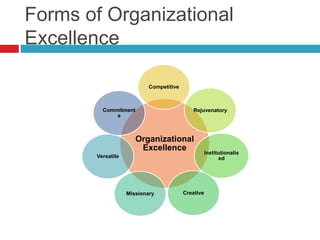
Forms of Organizational 
Excellence 
Competitive 
Rejuvenatory 
Commitment 
Organizational 
Excellence 
Institutionalis 
ed 
Missionary Creative 
s 
Versatile
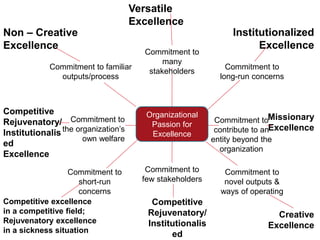
Versatile 
Excellence 
Commitment to 
many 
stakeholders 
Organizational 
Passion for 
Excellence 
Commitment to 
long-run concerns 
Commitment to 
contribute to an 
entity beyond the 
organization 
Commitment to 
few stakeholders 
Institutionalized 
Excellence 
Missionary 
Excellence 
Commitment to 
novel outputs & 
ways of operating 
Creative 
Excellence 
Competitive 
Rejuvenatory/ 
Institutionalis 
ed 
Non – Creative 
Excellence 
Commitment to familiar 
outputs/process 
Commitment to 
the organization’s 
own welfare 
Commitment to 
short-run 
concerns 
Competitive 
Rejuvenatory/ 
Institutionalis 
ed 
Excellence 
Competitive excellence 
in a competitive field; 
Rejuvenatory excellence 
in a sickness situation
Competitive Organizational 
Excellence 
 A variety of organization compete for clientele i.e. 
‘market place’ 
 E.g. Firms, political parties and unions 
 An even wider variety compete for resources 
 E.g. Government departments may not compete with 
each other for ‘market place’; but they do compete for 
government funds. 
 E.g. Faculties of a University compete for funds. 
Universities compete with other universities for faculty 
and students
Contd... 
 Competitive excellence becomes critical in 
domains where competition for clientele & 
resources has a bite to it 
 It is then that the pressure is build to: 
 Prioritise sharply 
 Develop domain-directed strategies 
 Streamline the organization to control costs 
 Increase productivity 
 Coordinate activities effectively
Case Study : Singapore Airlines 
 Owned by the government of Singapore 
 1969-1979 – Improved its position from being 
59th largest in the world to 9th largest, annual 
growth of 46% 
 Profit rose from $28 million in 1977-78 to $105 
million in 1981-1982 
 1980 & 1981- Highest load factor worldwide
Contd... 
 Singapore Airlines was able to ‘win’ because of 
following factors 
 Rapid fleet expansion and modernization. It had youngest airline 
fleets to ensure fuel efficiency 
 Aggressive route development overseas (Singapore is too tiny to 
have any air routes within the country) 
 Adoption of mission of delivering highest quality of customer 
service that is safe, reliable and economical 
 Effective staff training- Spent $30-$40 million a year on T&D 
 Upgrading and supporting ground service 
 Lean staff. Labour cost in Singapore airlines were only 16% of 
total cost vs 42% for U.S. Carriers 
 The airline was run as a commercial enterprise rather than as a 
prestigious flag carrier
Thank You!

Competitive excellence

  • 1.
    COMPETITIVE ORGANIZATIONAL EXCELLENCE By, Anam Patel (M016) Hawabee Parkar (P005)
  • 2.
    Road Map What is Excellence?  What is Organizational Excellence?  Forms of Organizational Excellence  Competitive Excellence  Case Study on Competitive Excellence - Singapore Airlines
  • 3.
    Excellence  Excellencemeans surpassing or outstanding achievement  E.g. Breaking a record in Olympics, climbing an unscaled peak, winning a Nobel prize, making outstanding contribution in his/her field  In the world of mediocrity and incompetence, human excellence acts like adrenalin  Its not cost free: There is mental and physical effort, sacrifices made in the pursuit of surpassing achievement , opportunity forgone
  • 4.
    Organizational Excellence Organizations can promote human excellence, if there is meritocracy, people compete for promotions and other rewards on the basis of their good work rather than on the basis of ‘pull’  Organizational design for excellence is largely a matter of promoting individual and group level excellence and synchronizing it to facilitate in achieving organizational level goals
  • 5.
    Forms of Organizational Excellence Competitive Rejuvenatory Commitment Organizational Excellence Institutionalis ed Missionary Creative s Versatile
  • 6.
    Versatile Excellence Commitmentto many stakeholders Organizational Passion for Excellence Commitment to long-run concerns Commitment to contribute to an entity beyond the organization Commitment to few stakeholders Institutionalized Excellence Missionary Excellence Commitment to novel outputs & ways of operating Creative Excellence Competitive Rejuvenatory/ Institutionalis ed Non – Creative Excellence Commitment to familiar outputs/process Commitment to the organization’s own welfare Commitment to short-run concerns Competitive Rejuvenatory/ Institutionalis ed Excellence Competitive excellence in a competitive field; Rejuvenatory excellence in a sickness situation
  • 7.
    Competitive Organizational Excellence  A variety of organization compete for clientele i.e. ‘market place’  E.g. Firms, political parties and unions  An even wider variety compete for resources  E.g. Government departments may not compete with each other for ‘market place’; but they do compete for government funds.  E.g. Faculties of a University compete for funds. Universities compete with other universities for faculty and students
  • 8.
    Contd...  Competitiveexcellence becomes critical in domains where competition for clientele & resources has a bite to it  It is then that the pressure is build to:  Prioritise sharply  Develop domain-directed strategies  Streamline the organization to control costs  Increase productivity  Coordinate activities effectively
  • 9.
    Case Study :Singapore Airlines  Owned by the government of Singapore  1969-1979 – Improved its position from being 59th largest in the world to 9th largest, annual growth of 46%  Profit rose from $28 million in 1977-78 to $105 million in 1981-1982  1980 & 1981- Highest load factor worldwide
  • 10.
    Contd...  SingaporeAirlines was able to ‘win’ because of following factors  Rapid fleet expansion and modernization. It had youngest airline fleets to ensure fuel efficiency  Aggressive route development overseas (Singapore is too tiny to have any air routes within the country)  Adoption of mission of delivering highest quality of customer service that is safe, reliable and economical  Effective staff training- Spent $30-$40 million a year on T&D  Upgrading and supporting ground service  Lean staff. Labour cost in Singapore airlines were only 16% of total cost vs 42% for U.S. Carriers  The airline was run as a commercial enterprise rather than as a prestigious flag carrier
  • 11.