By:  Willem-Jan Zondag MSc [email_address] ‘ Competing for Air Cargo’ “A Qualitative Analysis of Competition in the Air Cargo Industry” July 1 st  2006: Presentation GARS Amsterdam
Content of the Presentation Research Background; Introducing Air Cargo; Methodology; Concluding Remarks.
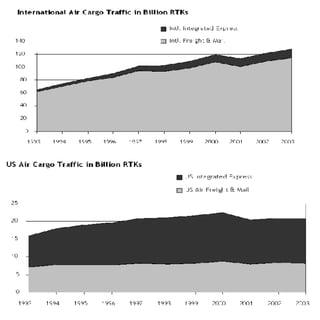
Source: Boeing, 2005
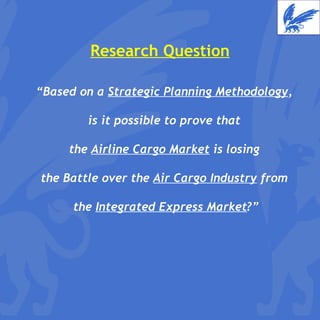
Research Question “ Based on a  Strategic Planning Methodology ,  is it possible to prove that  the  Airline Cargo Market  is losing  the Battle over the  Air Cargo Industry  from  the  Integrated Express Market ?”
Introducing Air Cargo Air Cargo Industry + Sub Systems; Historical Milestones; Supply Chain Analysis.
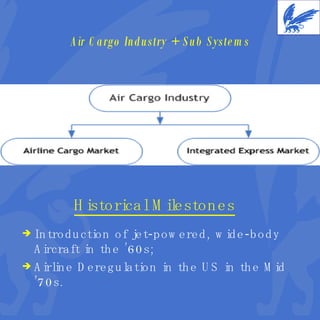
Air Cargo Industry + Sub Systems Introduction of jet-powered, wide-body Aircraft in the ’60s; Airline Deregulation in the US in the Mid ’70s. Historical Milestones
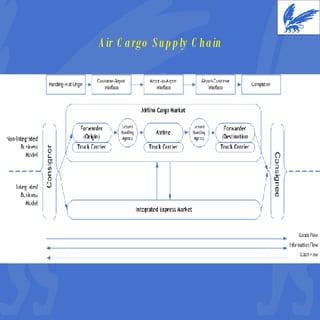
Air Cargo Supply Chain
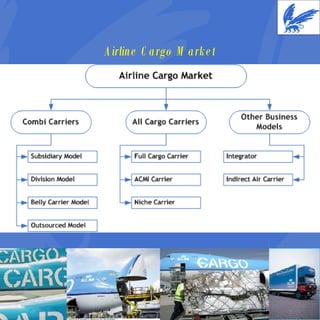
Airline Cargo Market
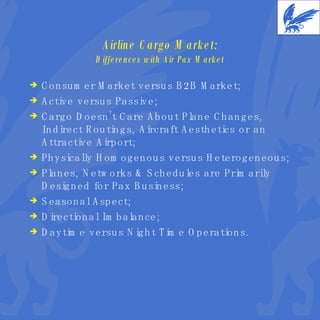
Airline Cargo Market: Differences with Air Pax Market Consumer Market versus B2B Market; Active versus Passive; Cargo Doesn’t Care About Plane Changes, Indirect Routings, Aircraft Aesthetics or an Attractive Airport; Physically Homogenous versus Heterogeneous; Planes, Networks & Schedules are Primarily Designed for Pax Business; Seasonal Aspect; Directional Imbalance; Daytime versus Night Time Operations.
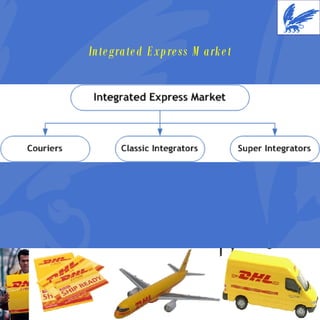
Integrated Express Market
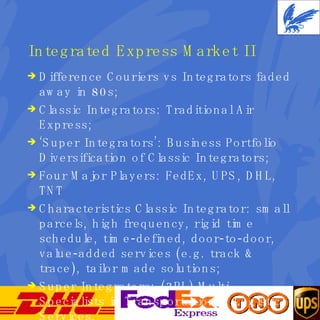
Integrated Express Market II Difference Couriers vs Integrators faded away in 80s; Classic Integrators: Traditional Air Express; ‘ Super Integrators’: Business Portfolio Diversification of Classic Integrators; Four Major Players: FedEx, UPS, DHL, TNT Characteristics Classic Integrator: small parcels, high frequency, rigid time schedule, time-defined, door-to-door, value-added services (e.g. track & trace), tailor made solutions; Super Integrators: (3PL) Multi-Specialists in Transportation & Logistics Services.
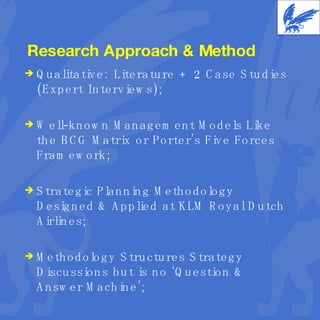
Research Approach & Method Qualitative: Literature + 2 Case Studies (Expert Interviews); Well-known Management Models Like the BCG Matrix or Porter’s Five Forces Framework; Strategic Planning Methodology Designed & Applied at KLM Royal Dutch Airlines; Methodology Structures Strategy Discussions but is no ‘Question & Answer Machine’;
Integration of the Models
Strategic Planning Methodology KLM Three Interrelated Marketing Strategy Dimensions: Business Positioning;  Customer Relationship Management; Commercial Distribution.
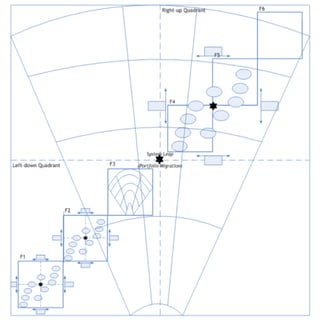
Business Positioning Attempt to achieve a sustainable competitive advantage (Porter, 1996); Variety-based, Needs-based & Access-based positioning; Business Positioning Ladder.
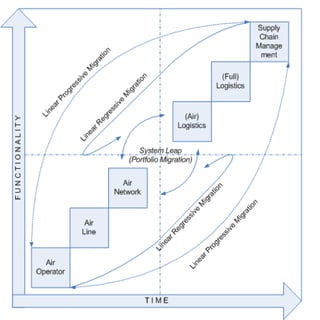
Business Positioning Ladder
Business Positioning Ladder II Strategic Expansion Paths; Increase in Added Value; Every Square Represents a Business Position; Each Value Migration is a Paradigm Shift; Redefinition of 5 Cs:  (1) Customer Definition,  (2) Competencies & Capabilities,  (3) Configuration,  (4) Capital Flows,  (5) Channel Conflict & Convergence Three Kinds of Migration; System Leap; Natural Migration versus Orchestrated Migration.
Business Positioning Ladder III Air Operator:   Unscheduled Capacity Offering Only. Risk of Utilizing Asset (Aircraft) is transferred to the Market. Example: ACMI (Atlas Air); Air Line:   Airside-to-Airside Services Based on a Flight Schedule; Air Network:   Air Line Supplemented with Value-Adding Elements Like Transit Handling, Build-Up and Break-Down of Cargo, Status Information on Shipment Level, AWB Issuance, et cetera; Air Logistics:  Asset-Light Business Added to Air Network; Full Logistics:  Importance of Air Transport has Declined; SCM:  Partly or Fully Integrated with Shipper’s Business, Probably Including Air Transport.
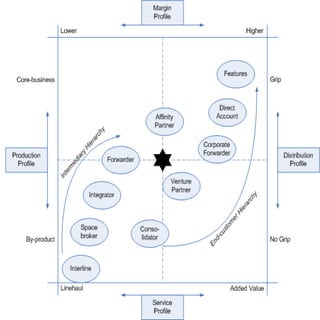
Market Focusing: Customer Relationship Management Who is the Customer, Actually? Margin Profile; Service Profile; Production Profile; Distribution Profile; Intermediary Hierarchy (Indirect Approach); End-customer Hierarchy (Direct Approach); “ Aliasing” / “Blackhole in the Middle”.
Market Focusing Model
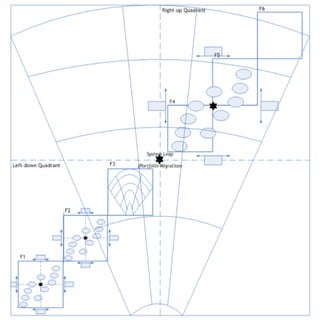
Market Focusing II Role Patterns of Market Participants are not Static; Direct Approach Makes Intermediary Hierarchy Redundant; Most Airlines in the Intermediary Hierarchy Regard Cargo as a Side Business; Right-up in the End-Customer Hierarchy: - Cargo is Core Business; - Higher Margin Profile, Higher ‘Grip’ on End-Customer Market; - Possible Market Leadership.
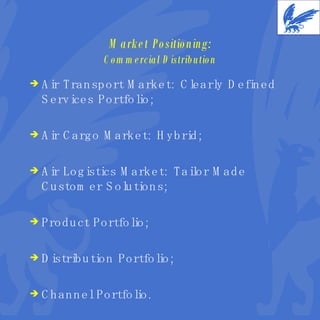
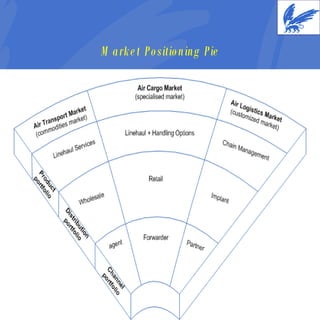
Market Positioning: Commercial Distribution Air Transport Market: Clearly Defined Services Portfolio; Air Cargo Market: Hybrid; Air Logistics Market: Tailor Made Customer Solutions; Product Portfolio; Distribution Portfolio; Channel Portfolio.
Market Positioning Pie
Integration of the Models
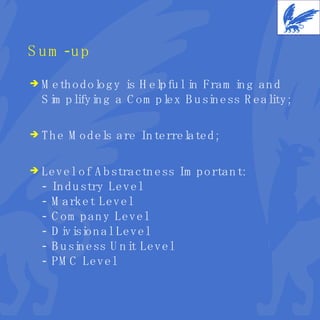
Sum-up Methodology is Helpful in Framing and Simplifying a Complex Business Reality; The Models are Interrelated; Level of Abstractness Important:  - Industry Level - Market Level - Company Level - Divisional Level - Business Unit Level - PMC Level
Conclusions Unfortunately, the Main Research Question Can not be Accepted or Rejected Right away; Integrated Express Players are More Solutions Oriented and Organized (Needs-Based Business Position), Focused on Market Penetration, the Interest of End-Customers and Brand Management with Less Assets; Airlines Prefer to Expand Their Scale Rather Than Scope. Airlines are Variety-Based Positioned as they Depend on Intermediaries on Areas as End-Customer Development, Fare Setting and Adapting Business to Shippers’ Developments. Lower Market Dominance, Lower Margins.
Reflections Available Academic Literature on Air Cargo / Airline Strategy is Quite Scarce; Application of a Methodology that Lacks any Academic Backing -> Validity of the Method is  not  Questioned, but Taken for Granted;  A ‘How to Use Guideline’ of the Methodology lacks -> It Seems Like a Brainstorm Tool; The Methodology is Subject to Debatable Assumptions; Finally, It Lacks a Quantitative Component.
Suggestions for Further Research A Quantification of Competitive Rivalry in Air Cargo; Research Focused on the Validity of the Methodology.
Questions? Thank You For Your Attention!

Competing For Air Cargo

  • 1.
    By: Willem-JanZondag MSc [email_address] ‘ Competing for Air Cargo’ “A Qualitative Analysis of Competition in the Air Cargo Industry” July 1 st 2006: Presentation GARS Amsterdam
  • 2.
    Content of thePresentation Research Background; Introducing Air Cargo; Methodology; Concluding Remarks.
  • 3.
  • 4.
    Research Question “Based on a Strategic Planning Methodology , is it possible to prove that the Airline Cargo Market is losing the Battle over the Air Cargo Industry from the Integrated Express Market ?”
  • 5.
    Introducing Air CargoAir Cargo Industry + Sub Systems; Historical Milestones; Supply Chain Analysis.
  • 6.
    Air Cargo Industry+ Sub Systems Introduction of jet-powered, wide-body Aircraft in the ’60s; Airline Deregulation in the US in the Mid ’70s. Historical Milestones
  • 7.
  • 8.
  • 9.
    Airline Cargo Market:Differences with Air Pax Market Consumer Market versus B2B Market; Active versus Passive; Cargo Doesn’t Care About Plane Changes, Indirect Routings, Aircraft Aesthetics or an Attractive Airport; Physically Homogenous versus Heterogeneous; Planes, Networks & Schedules are Primarily Designed for Pax Business; Seasonal Aspect; Directional Imbalance; Daytime versus Night Time Operations.
  • 10.
  • 11.
    Integrated Express MarketII Difference Couriers vs Integrators faded away in 80s; Classic Integrators: Traditional Air Express; ‘ Super Integrators’: Business Portfolio Diversification of Classic Integrators; Four Major Players: FedEx, UPS, DHL, TNT Characteristics Classic Integrator: small parcels, high frequency, rigid time schedule, time-defined, door-to-door, value-added services (e.g. track & trace), tailor made solutions; Super Integrators: (3PL) Multi-Specialists in Transportation & Logistics Services.
  • 12.
    Research Approach &Method Qualitative: Literature + 2 Case Studies (Expert Interviews); Well-known Management Models Like the BCG Matrix or Porter’s Five Forces Framework; Strategic Planning Methodology Designed & Applied at KLM Royal Dutch Airlines; Methodology Structures Strategy Discussions but is no ‘Question & Answer Machine’;
  • 13.
  • 14.
    Strategic Planning MethodologyKLM Three Interrelated Marketing Strategy Dimensions: Business Positioning; Customer Relationship Management; Commercial Distribution.
  • 15.
    Business Positioning Attemptto achieve a sustainable competitive advantage (Porter, 1996); Variety-based, Needs-based & Access-based positioning; Business Positioning Ladder.
  • 16.
  • 17.
    Business Positioning LadderII Strategic Expansion Paths; Increase in Added Value; Every Square Represents a Business Position; Each Value Migration is a Paradigm Shift; Redefinition of 5 Cs: (1) Customer Definition, (2) Competencies & Capabilities, (3) Configuration, (4) Capital Flows, (5) Channel Conflict & Convergence Three Kinds of Migration; System Leap; Natural Migration versus Orchestrated Migration.
  • 18.
    Business Positioning LadderIII Air Operator: Unscheduled Capacity Offering Only. Risk of Utilizing Asset (Aircraft) is transferred to the Market. Example: ACMI (Atlas Air); Air Line: Airside-to-Airside Services Based on a Flight Schedule; Air Network: Air Line Supplemented with Value-Adding Elements Like Transit Handling, Build-Up and Break-Down of Cargo, Status Information on Shipment Level, AWB Issuance, et cetera; Air Logistics: Asset-Light Business Added to Air Network; Full Logistics: Importance of Air Transport has Declined; SCM: Partly or Fully Integrated with Shipper’s Business, Probably Including Air Transport.
  • 19.
    Market Focusing: CustomerRelationship Management Who is the Customer, Actually? Margin Profile; Service Profile; Production Profile; Distribution Profile; Intermediary Hierarchy (Indirect Approach); End-customer Hierarchy (Direct Approach); “ Aliasing” / “Blackhole in the Middle”.
  • 20.
  • 21.
    Market Focusing IIRole Patterns of Market Participants are not Static; Direct Approach Makes Intermediary Hierarchy Redundant; Most Airlines in the Intermediary Hierarchy Regard Cargo as a Side Business; Right-up in the End-Customer Hierarchy: - Cargo is Core Business; - Higher Margin Profile, Higher ‘Grip’ on End-Customer Market; - Possible Market Leadership.
  • 22.
    Market Positioning: CommercialDistribution Air Transport Market: Clearly Defined Services Portfolio; Air Cargo Market: Hybrid; Air Logistics Market: Tailor Made Customer Solutions; Product Portfolio; Distribution Portfolio; Channel Portfolio.
  • 23.
  • 24.
  • 25.
    Sum-up Methodology isHelpful in Framing and Simplifying a Complex Business Reality; The Models are Interrelated; Level of Abstractness Important: - Industry Level - Market Level - Company Level - Divisional Level - Business Unit Level - PMC Level
  • 26.
    Conclusions Unfortunately, theMain Research Question Can not be Accepted or Rejected Right away; Integrated Express Players are More Solutions Oriented and Organized (Needs-Based Business Position), Focused on Market Penetration, the Interest of End-Customers and Brand Management with Less Assets; Airlines Prefer to Expand Their Scale Rather Than Scope. Airlines are Variety-Based Positioned as they Depend on Intermediaries on Areas as End-Customer Development, Fare Setting and Adapting Business to Shippers’ Developments. Lower Market Dominance, Lower Margins.
  • 27.
    Reflections Available AcademicLiterature on Air Cargo / Airline Strategy is Quite Scarce; Application of a Methodology that Lacks any Academic Backing -> Validity of the Method is not Questioned, but Taken for Granted; A ‘How to Use Guideline’ of the Methodology lacks -> It Seems Like a Brainstorm Tool; The Methodology is Subject to Debatable Assumptions; Finally, It Lacks a Quantitative Component.
  • 28.
    Suggestions for FurtherResearch A Quantification of Competitive Rivalry in Air Cargo; Research Focused on the Validity of the Methodology.
  • 29.
    Questions? Thank YouFor Your Attention!