CRITERIA IN COMPENSATION

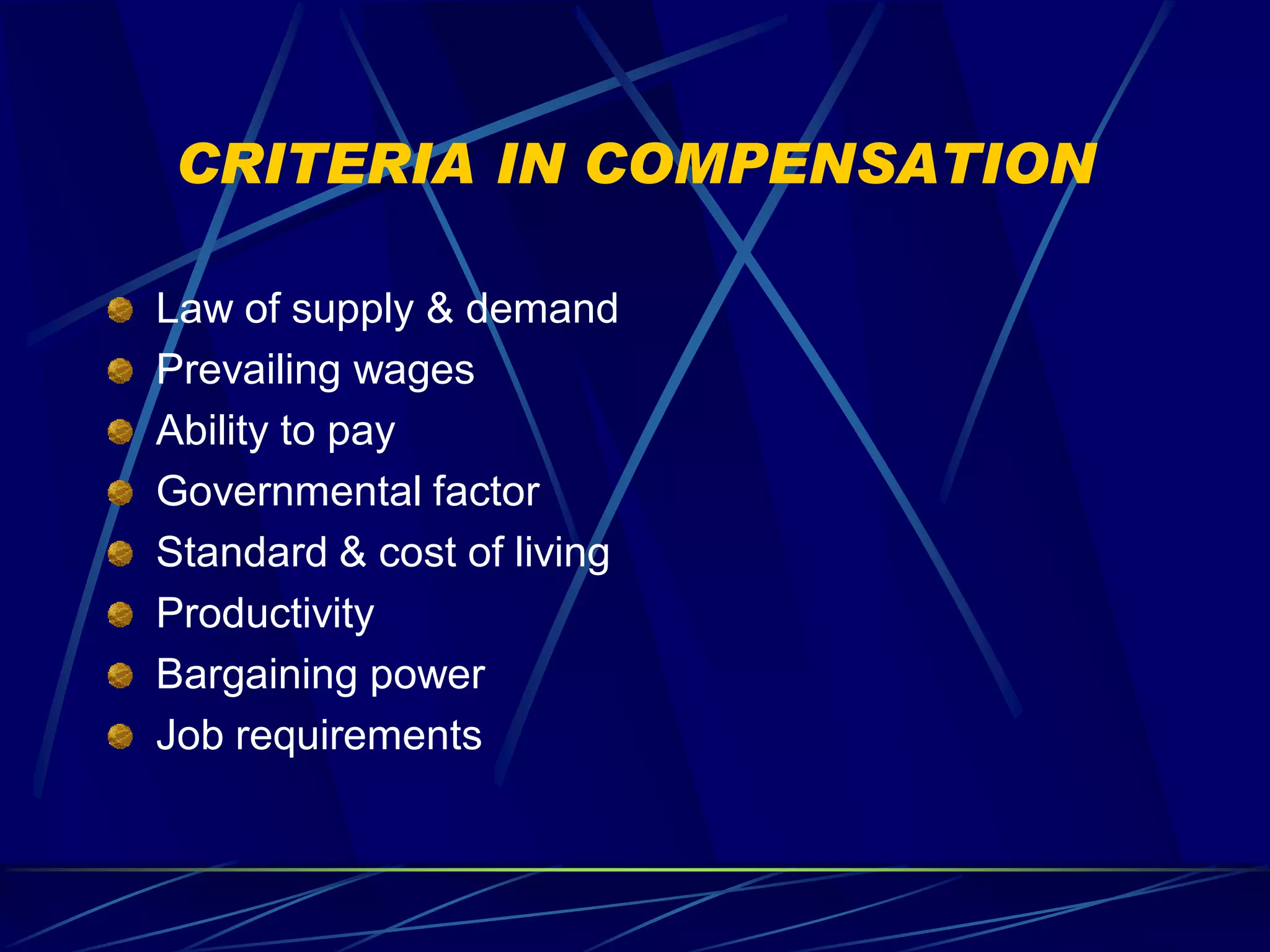
Law of supply & demand
Prevailing wages
Ability to pay
Governmental factor
Standard & cost of living
Productivity
Bargaining power
Job requirements
DIVERGENT POLICIES HELP

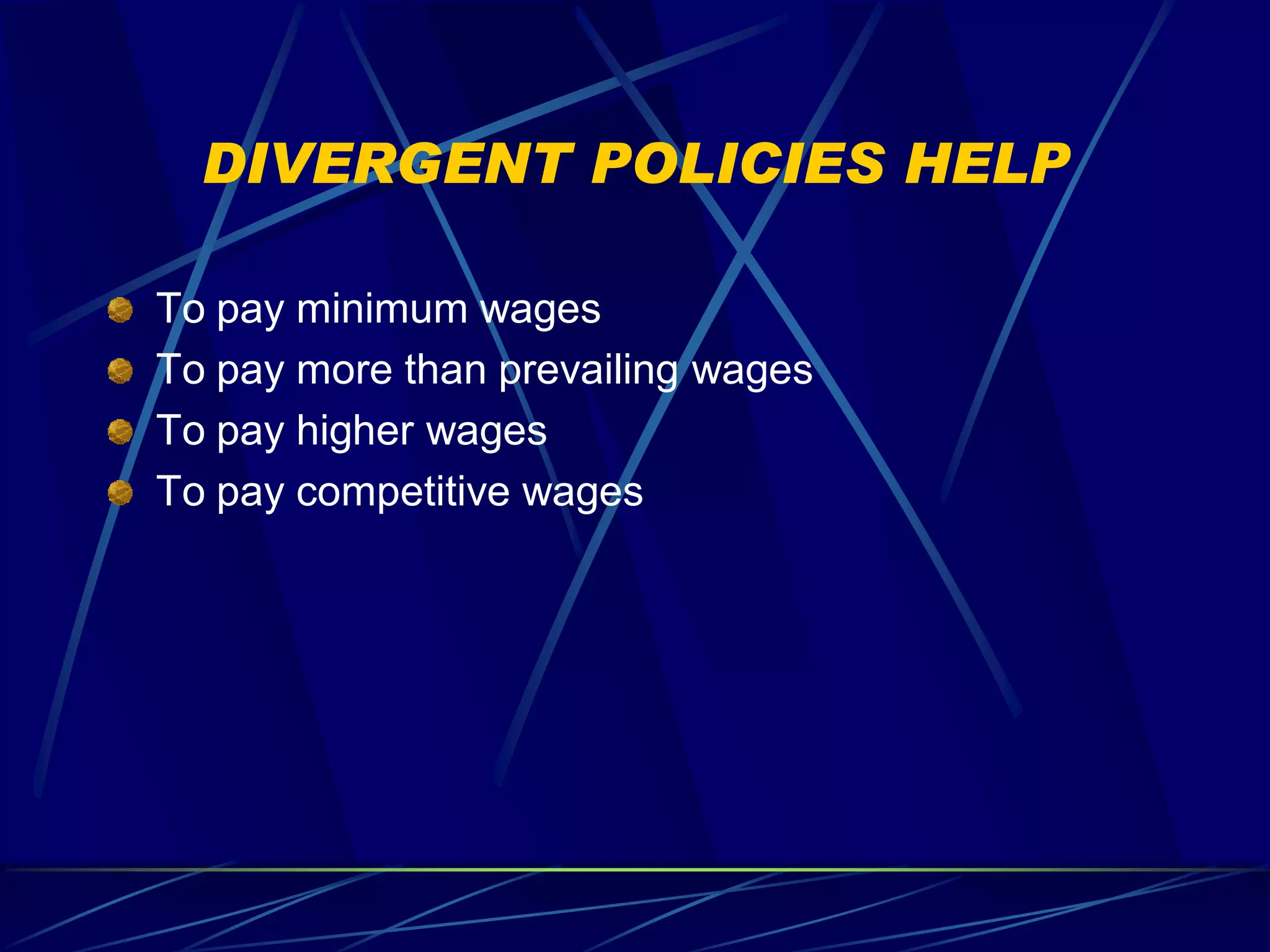
To pay minimum wages
To pay more than prevailing wages
To pay higher wages
To pay competitive wages
COMPENSATION SCENARIO IN IT
     SECTOR-POLICIES

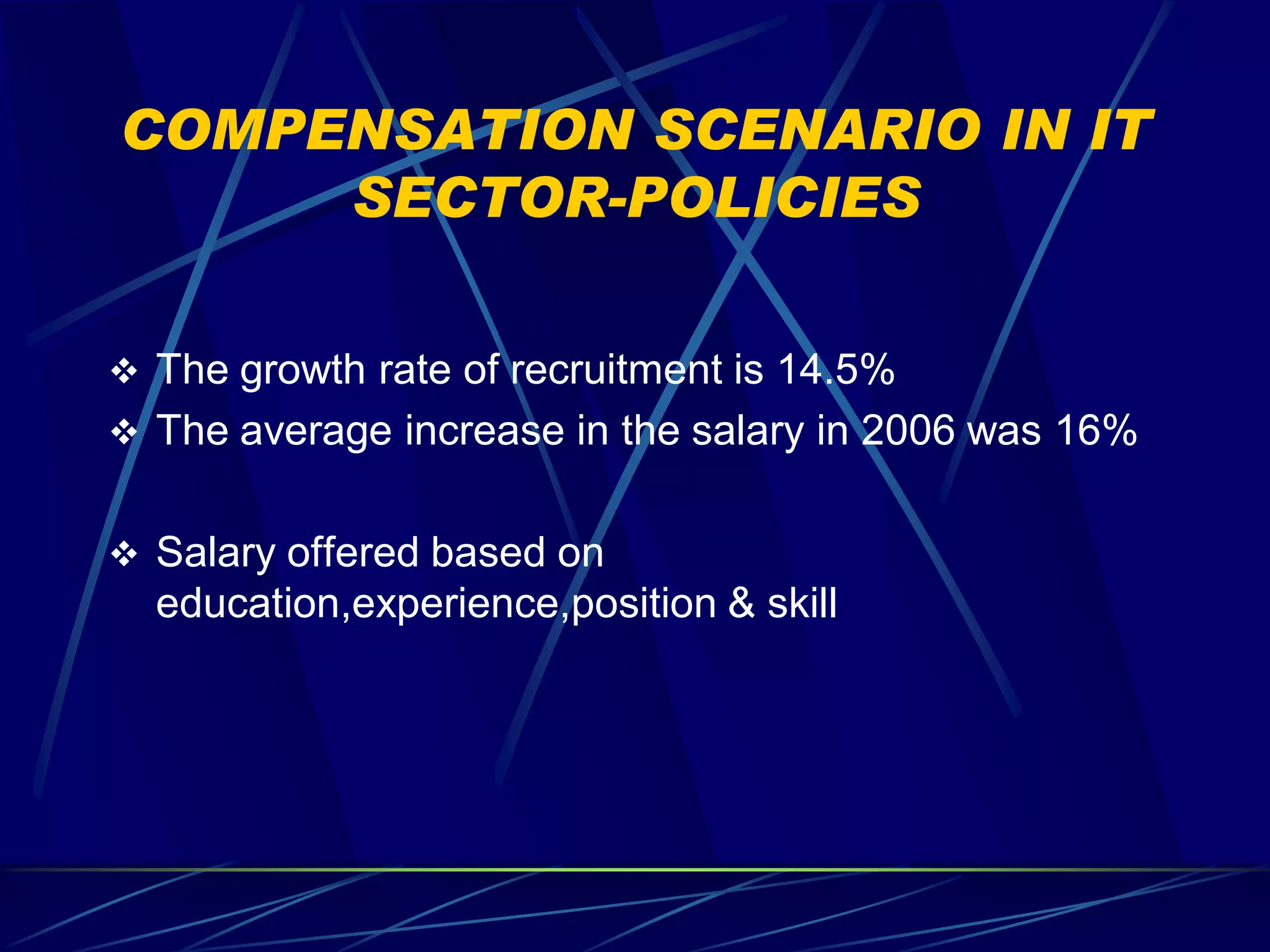
 The growth rate of recruitment is 14.5%
 The average increase in the salary in 2006 was 16%


 Salary offered based on
  education,experience,position & skill
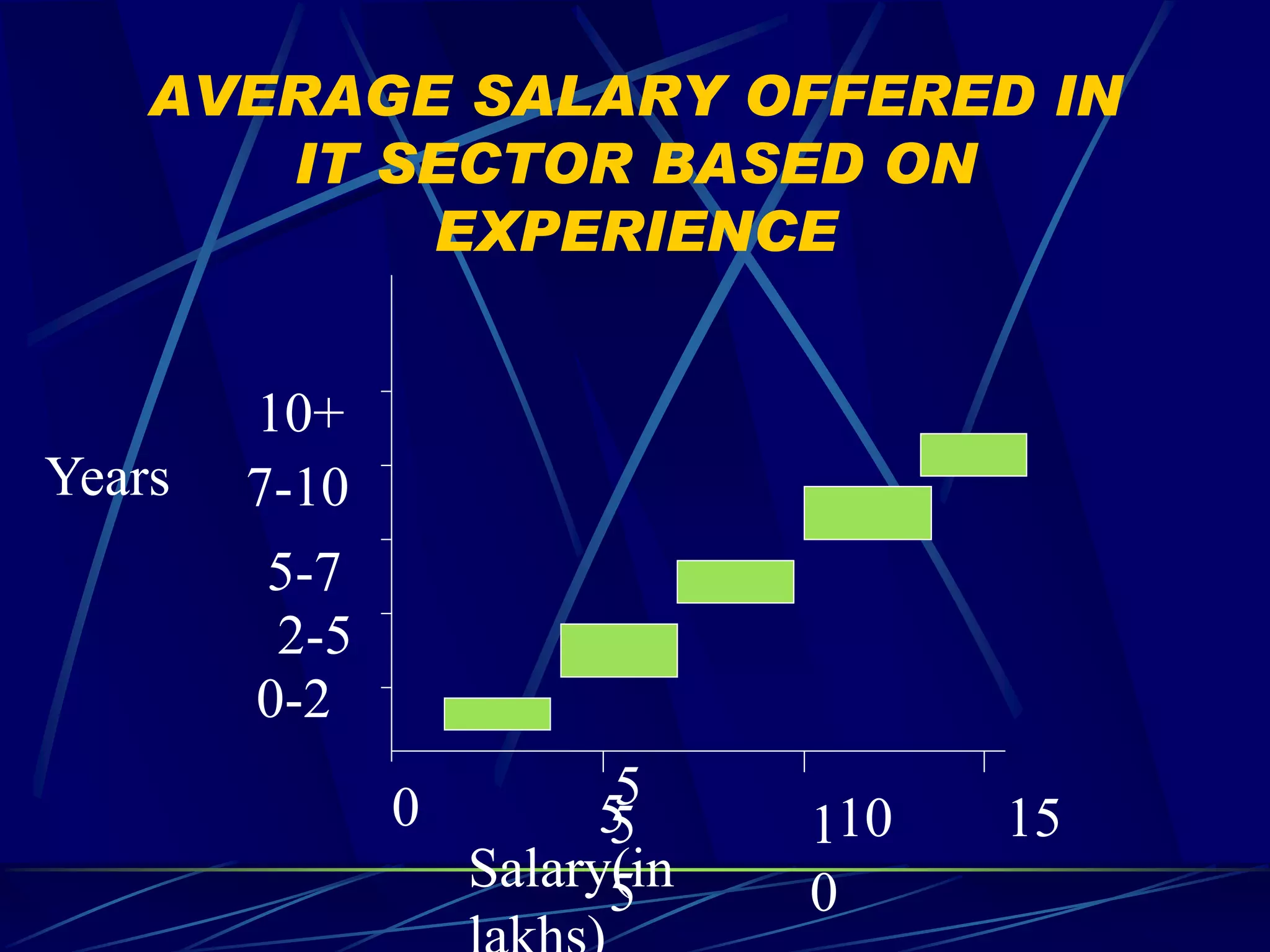
AVERAGE SALARY OFFERED IN
       IT SECTOR BASED ON
           EXPERIENCE


        10+
Years   7-10
        5-7
         2-5
        0-2
               0         55
                         5     110   15
                   Salary(in
                         5     0
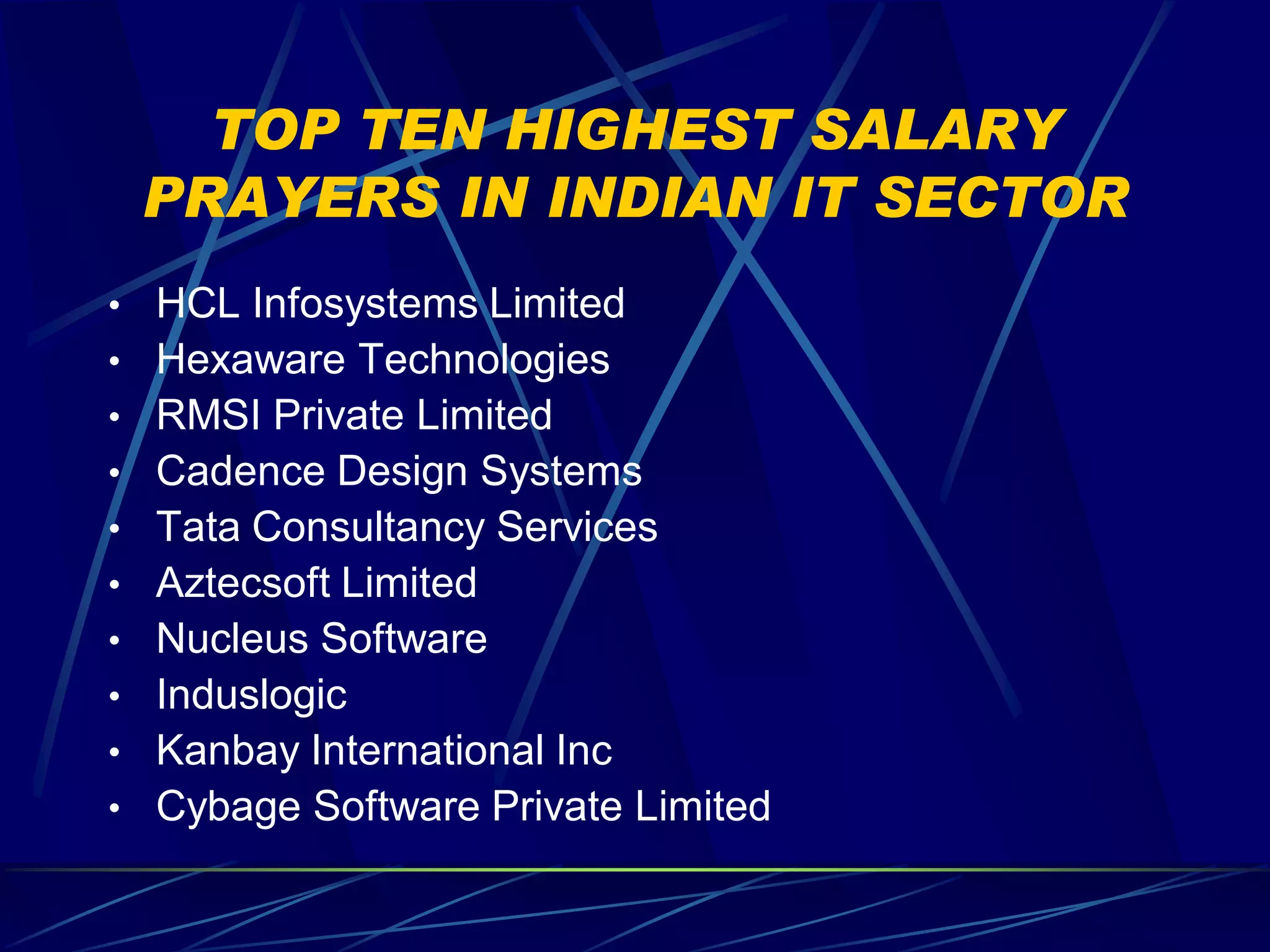
TOP TEN HIGHEST SALARY
 PRAYERS IN INDIAN IT SECTOR
• HCL Infosystems Limited
• Hexaware Technologies
• RMSI Private Limited
• Cadence Design Systems
• Tata Consultancy Services
• Aztecsoft Limited
• Nucleus Software
• Induslogic
• Kanbay International Inc
• Cybage Software Private Limited
COMPENSATION
         POLICIES IN
     INSURANCE SECTOR
   Policies cover the following
   Accidental Insurance
   Medical Insurance
   Medi claims
   Family health Insurance
   Diabetes Insurance etc

   Policies involve
   Basic salaries
   Perks
   Allowances
   Accomodation etc
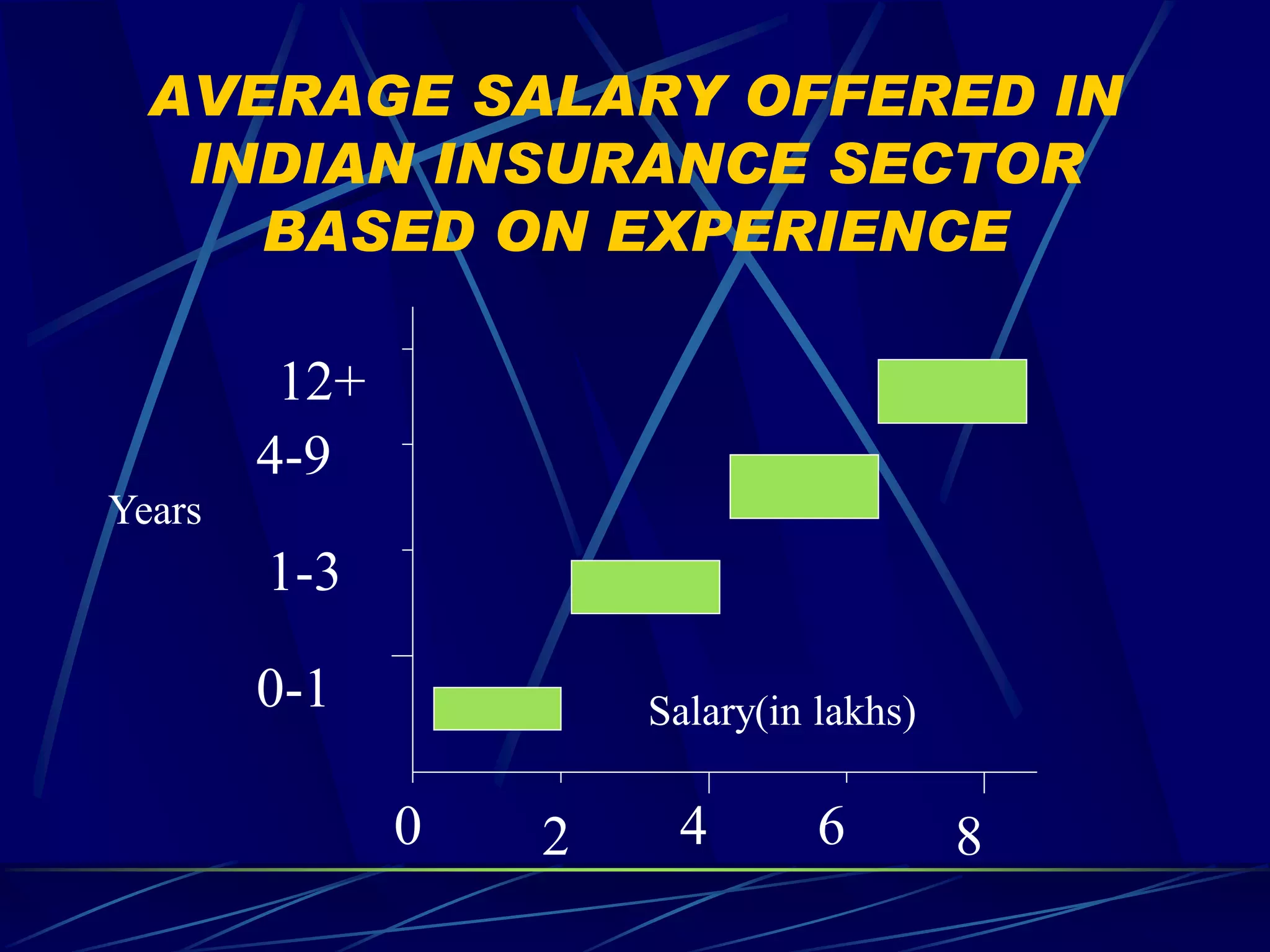
AVERAGE SALARY OFFERED IN
   INDIAN INSURANCE SECTOR
     BASED ON EXPERIENCE

         12+
        4-9
Years
        1-3

        0-1            Salary(in lakhs)

               0   2    4        6        8
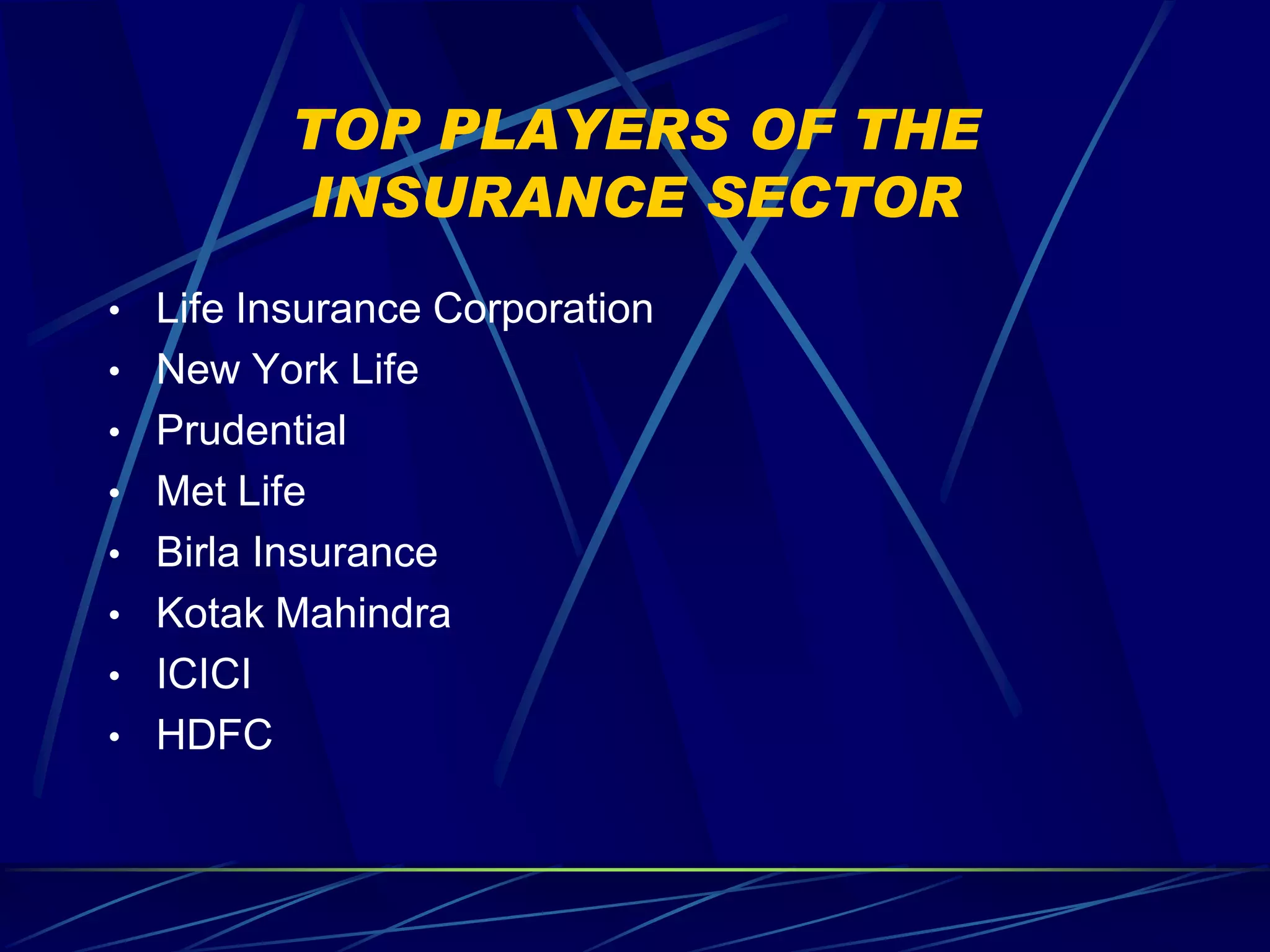
TOP PLAYERS OF THE
          INSURANCE SECTOR
• Life Insurance Corporation
• New York Life
• Prudential
• Met Life
• Birla Insurance
• Kotak Mahindra
• ICICI
• HDFC
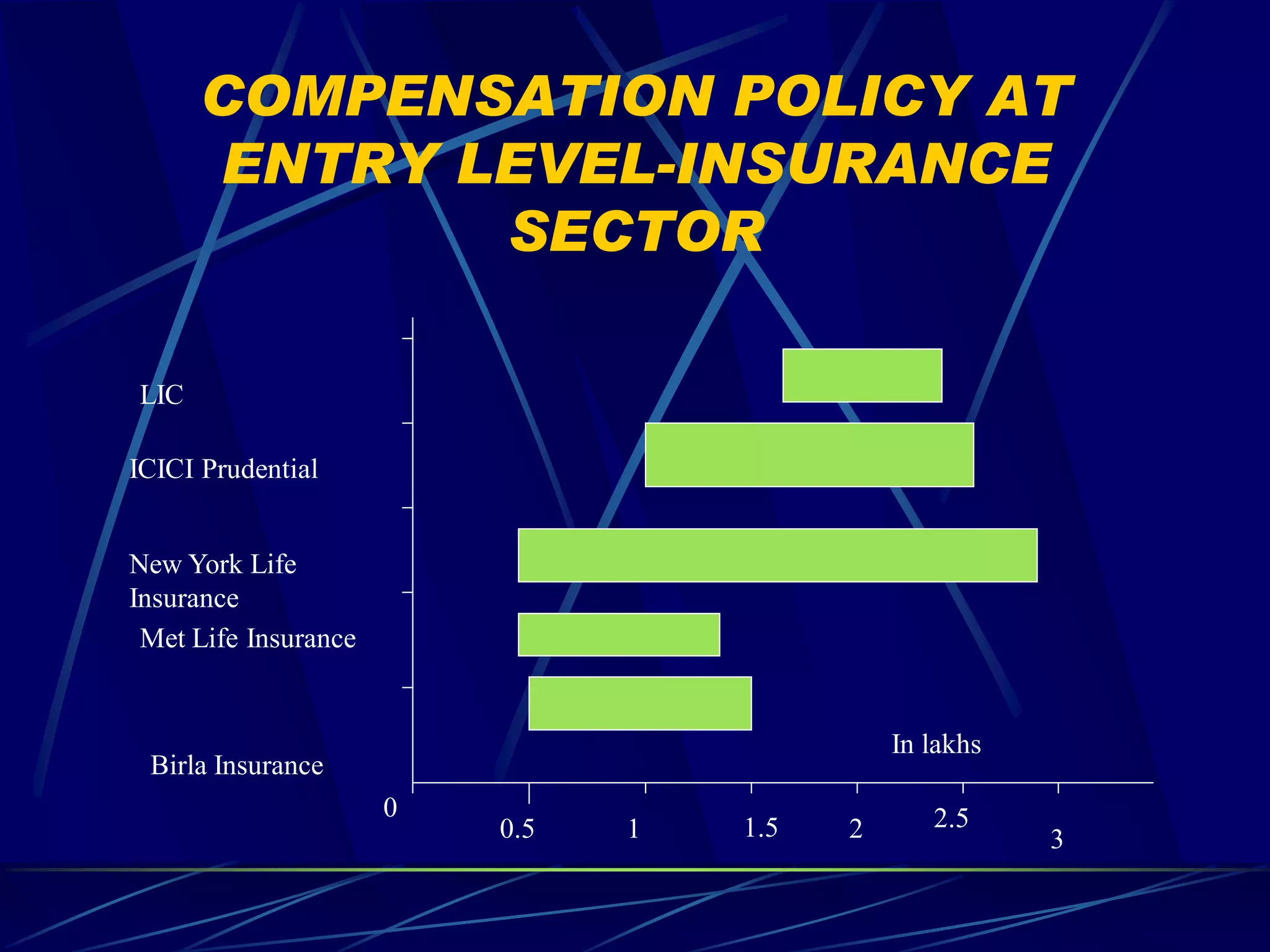
COMPENSATION POLICY AT
      ENTRY LEVEL-INSURANCE
             SECTOR

LIC

ICICI Prudential


New York Life
Insurance
 Met Life Insurance


                                              In lakhs
 Birla Insurance
                      0                          2.5
                          0.5   1   1.5   2              3
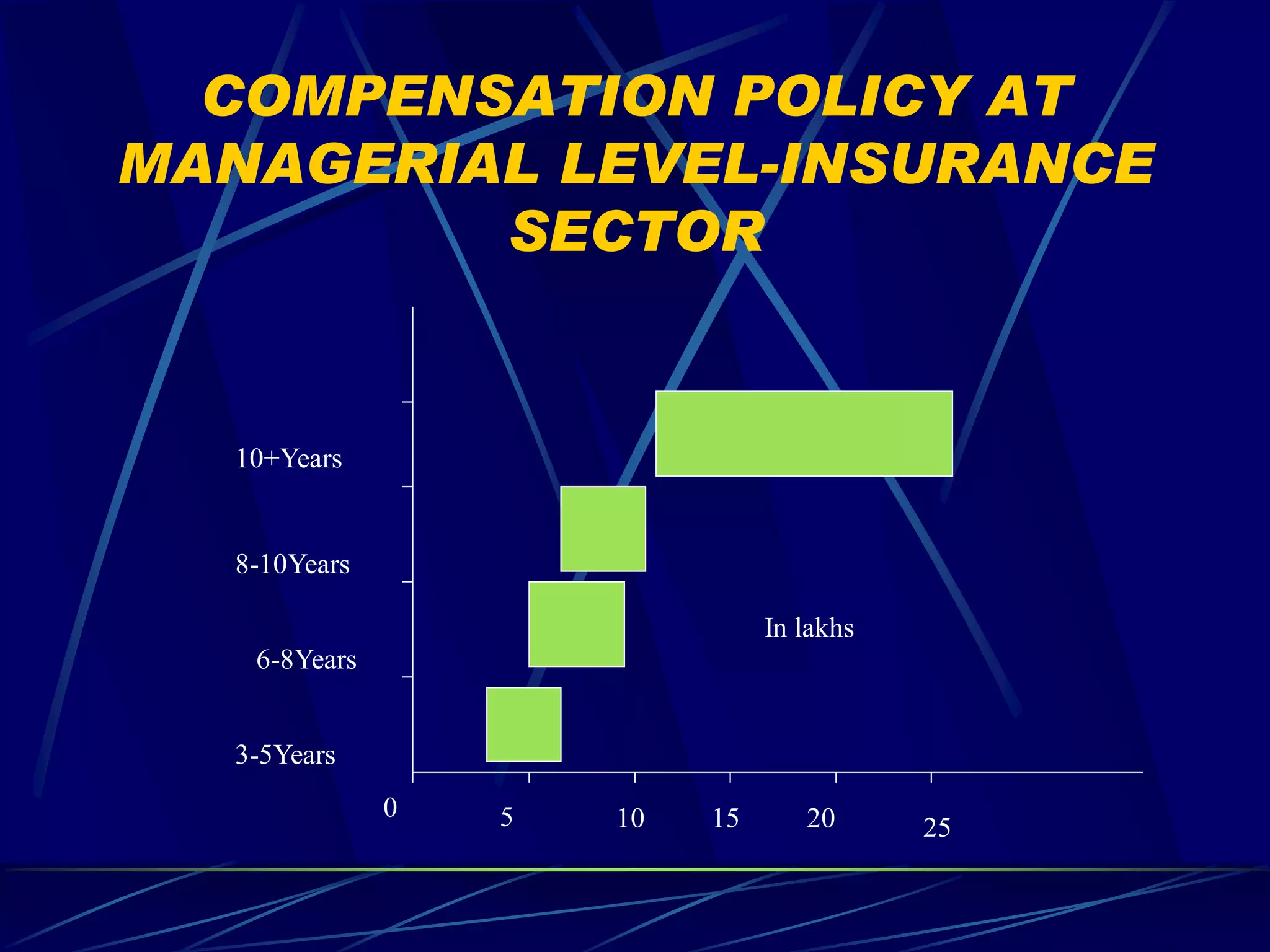
COMPENSATION POLICY AT
MANAGERIAL LEVEL-INSURANCE
         SECTOR


  10+Years


  8-10Years

                                In lakhs
   6-8Years


  3-5Years
              0   5   10   15      20      25
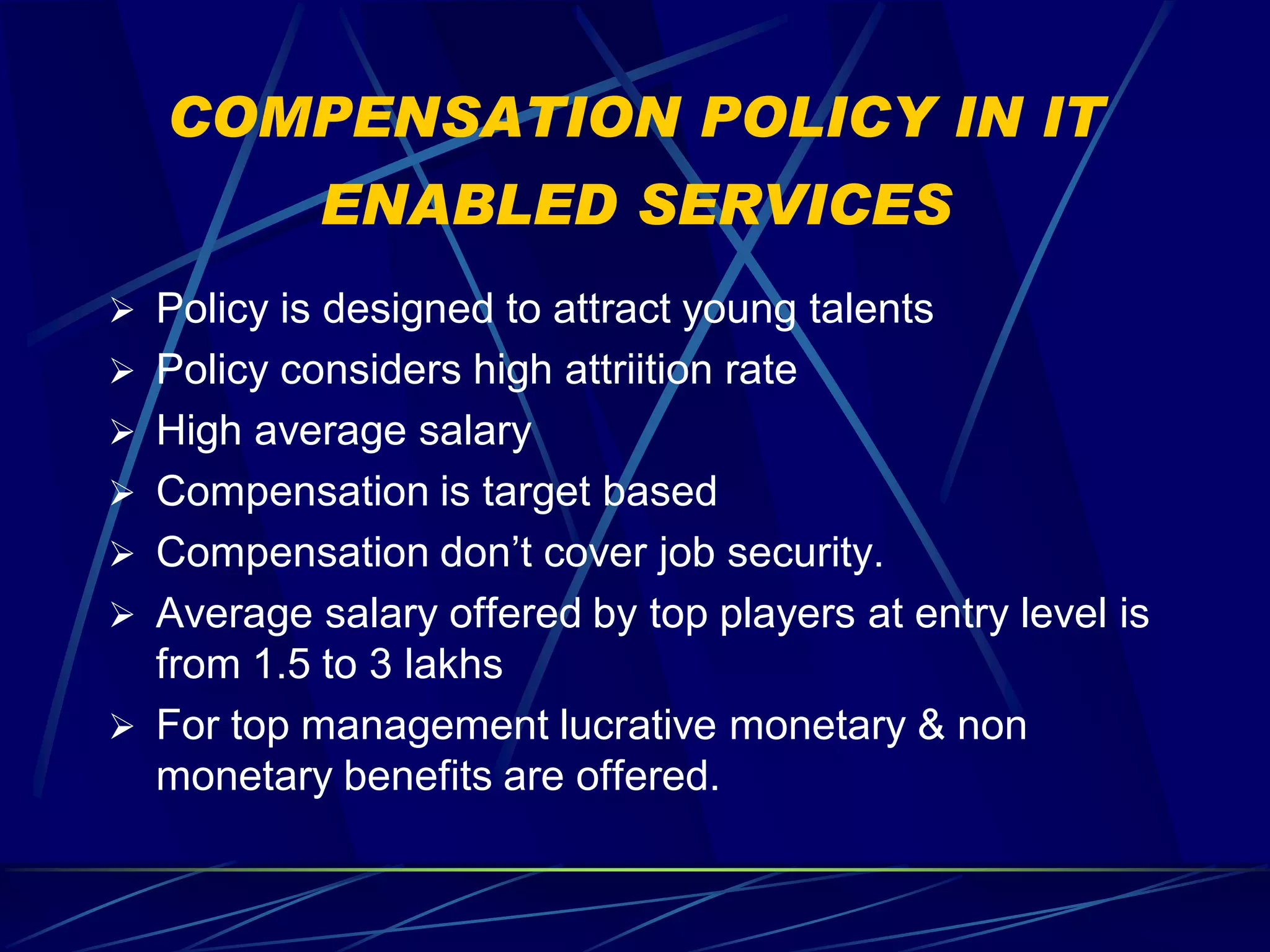
COMPENSATION POLICY IN IT
           ENABLED SERVICES
 Policy is designed to attract young talents
 Policy considers high attriition rate
 High average salary
 Compensation is target based
 Compensation don’t cover job security.
 Average salary offered by top players at entry level is
  from 1.5 to 3 lakhs
 For top management lucrative monetary & non
  monetary benefits are offered.
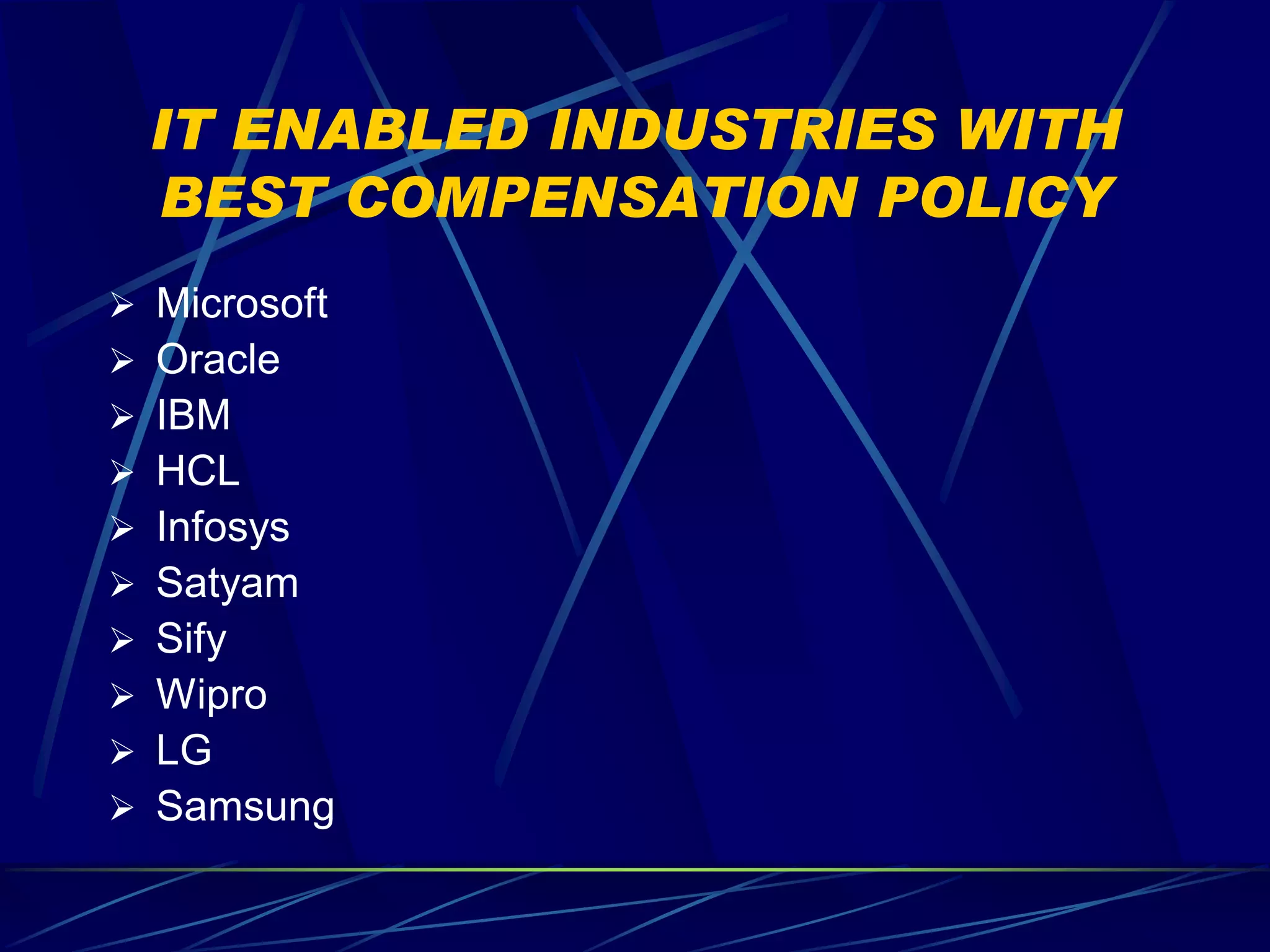
IT ENABLED INDUSTRIES WITH
  BEST COMPENSATION POLICY
 Microsoft
 Oracle
 IBM
 HCL
 Infosys
 Satyam
 Sify
 Wipro
 LG
 Samsung
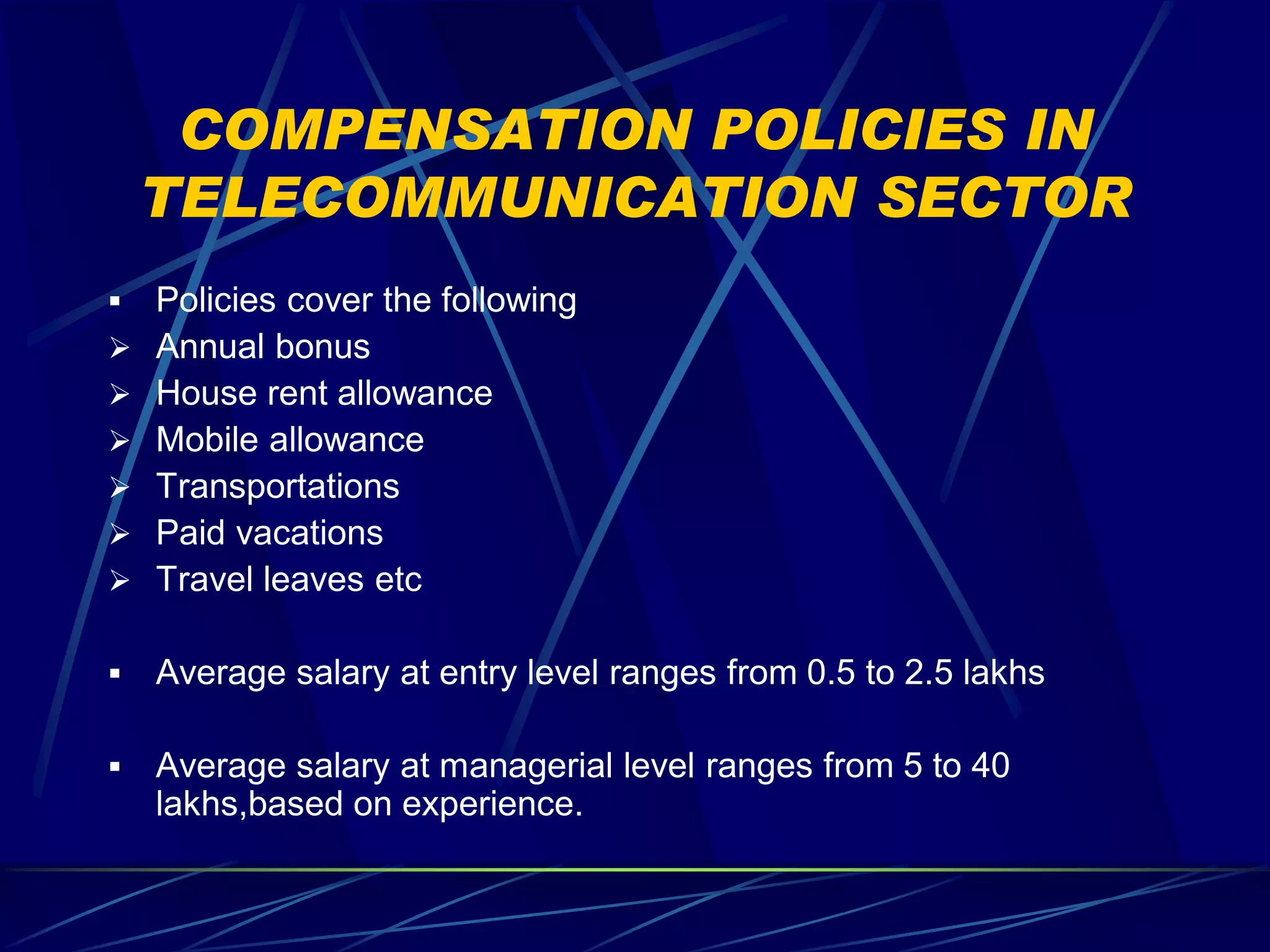
COMPENSATION POLICIES IN
    TELECOMMUNICATION SECTOR
   Policies cover the following
   Annual bonus
   House rent allowance
   Mobile allowance
   Transportations
   Paid vacations
   Travel leaves etc

   Average salary at entry level ranges from 0.5 to 2.5 lakhs

   Average salary at managerial level ranges from 5 to 40
    lakhs,based on experience.
TELECOMMUNICATION SECTOR
  WITH BEST COMPENSATION
          POLICY
 Tata Teleservices
 Reliance Communications
 Bharti Airtel
 Ericcson
 Motorola
PHILOSOPHY OF COMPENSATION

 PRODUCTIVITY PHILOSOPHY


 PURCHASING POWER PHILOSOPHY
PRODUCTIVITY PHILOSOPHY-
        ASSUMPTIONS
 Use of updated tools,techniques & machineries
 Optimum production
 Minimising the unit cost of production
 Lower price of goods
 Expanded market
 Increased income from sales
 Profit sharing with employees
 Utilising profit to regenerate process
PURCHASING POWER
    PHILOSOPHY-ASSUMPTIONS
 Good compensation to workers
 Increased purchasing power of the large work force.
 Effective demands for goods & services
 Stimulation of future production.
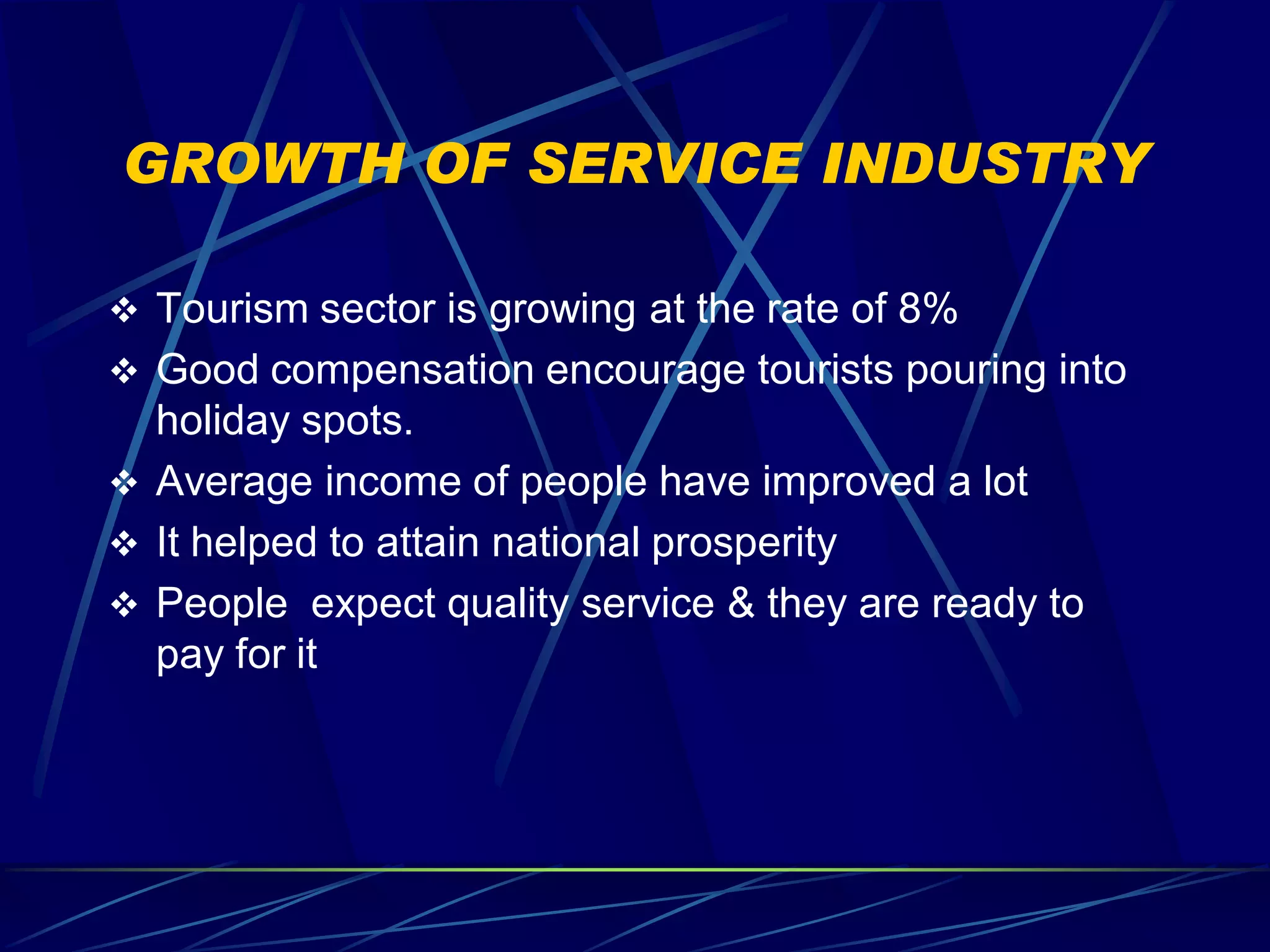
GROWTH OF SERVICE INDUSTRY

 Tourism sector is growing at the rate of 8%
 Good compensation encourage tourists pouring into
  holiday spots.
 Average income of people have improved a lot
 It helped to attain national prosperity
 People expect quality service & they are ready to
  pay for it
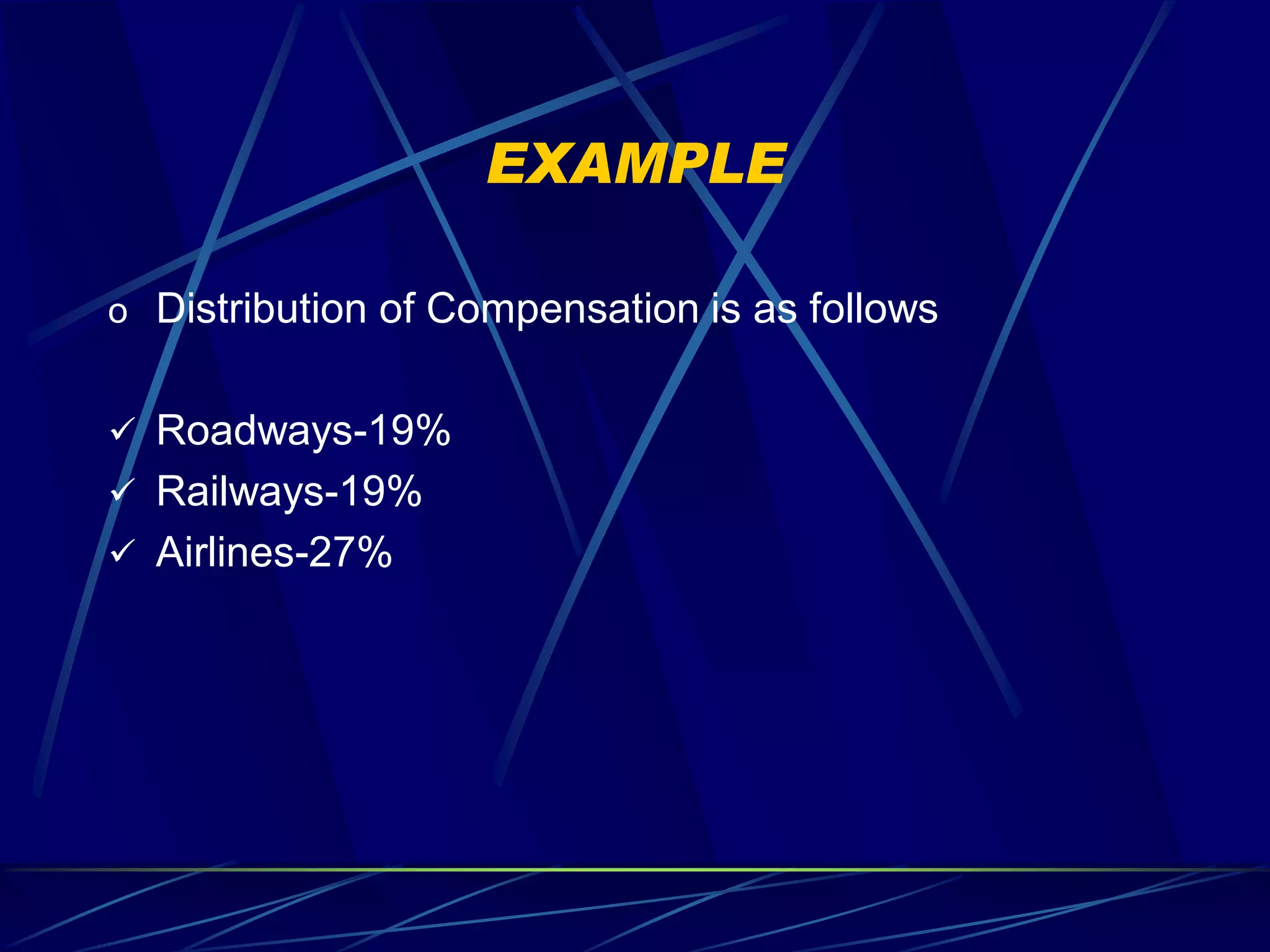
EXAMPLE

o Distribution of Compensation is as follows


 Roadways-19%
 Railways-19%
 Airlines-27%
NON IMPLEMENTATION OF PHILOSOPHY- CONSEQUENCES OF PAY
         DISSATISFACTION
                      Strike
  Desire for            Grievances       Absenteeism
  more pay

                        Search for a
                        higher paying
                        jobs

                                          Turnover


Pay dissatisfaction       Lower            Absenteeism
                          Attractivene     Job
                          ss of job
                                           dissatisfaction
Psychological
withdrawal
                                                 Poor mental
                                Health           health
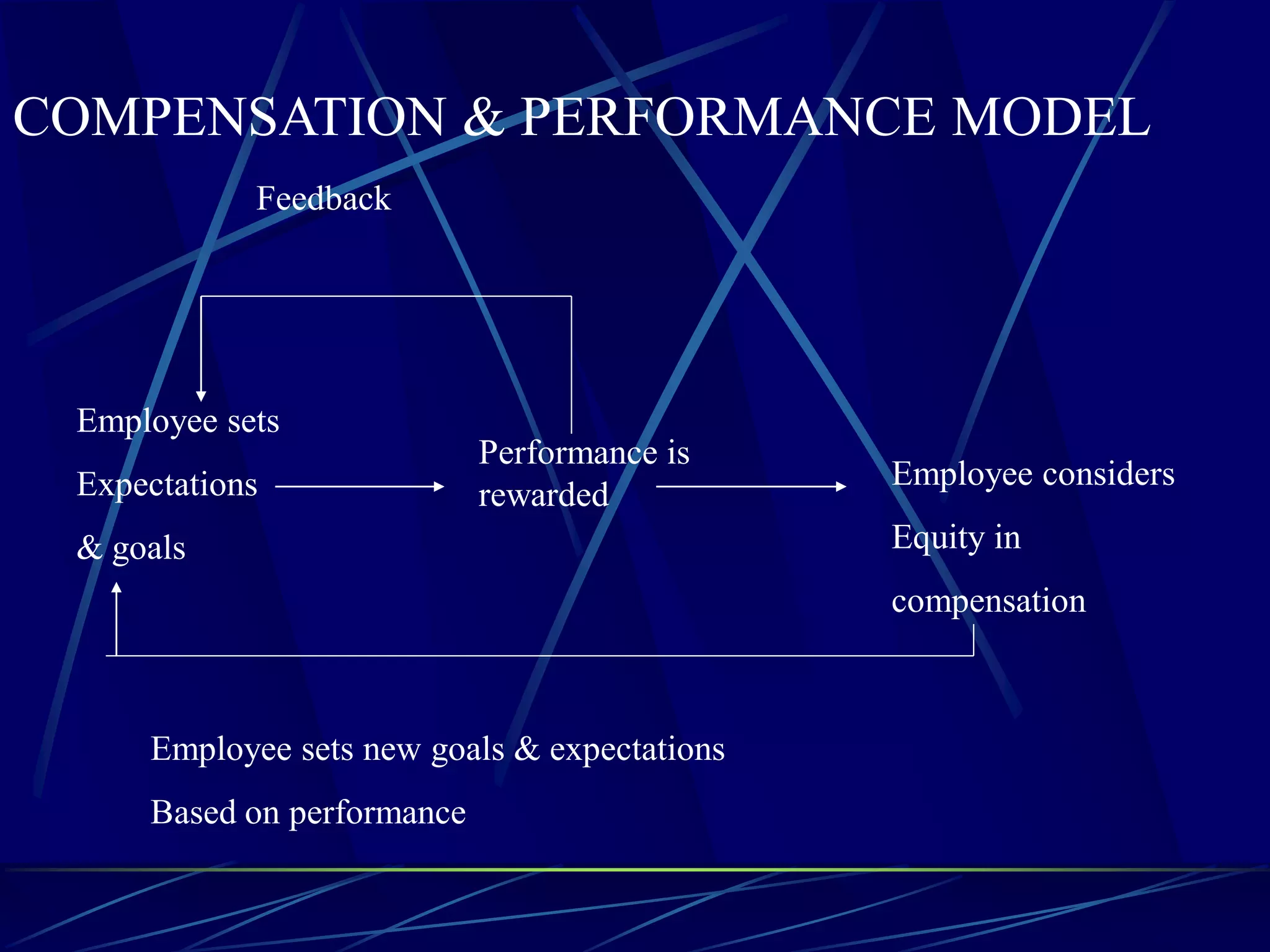
COMPENSATION & PERFORMANCE MODEL
            Feedback


 Employee sets
                            Performance is
 Expectations                                 Employee considers
                            rewarded
 & goals                                      Equity in
                                              compensation


     Employee sets new goals & expectations
     Based on performance
MINIMUM WAGE


It is provided for maintenance of life plus for
    preservation of the efficiency of worker
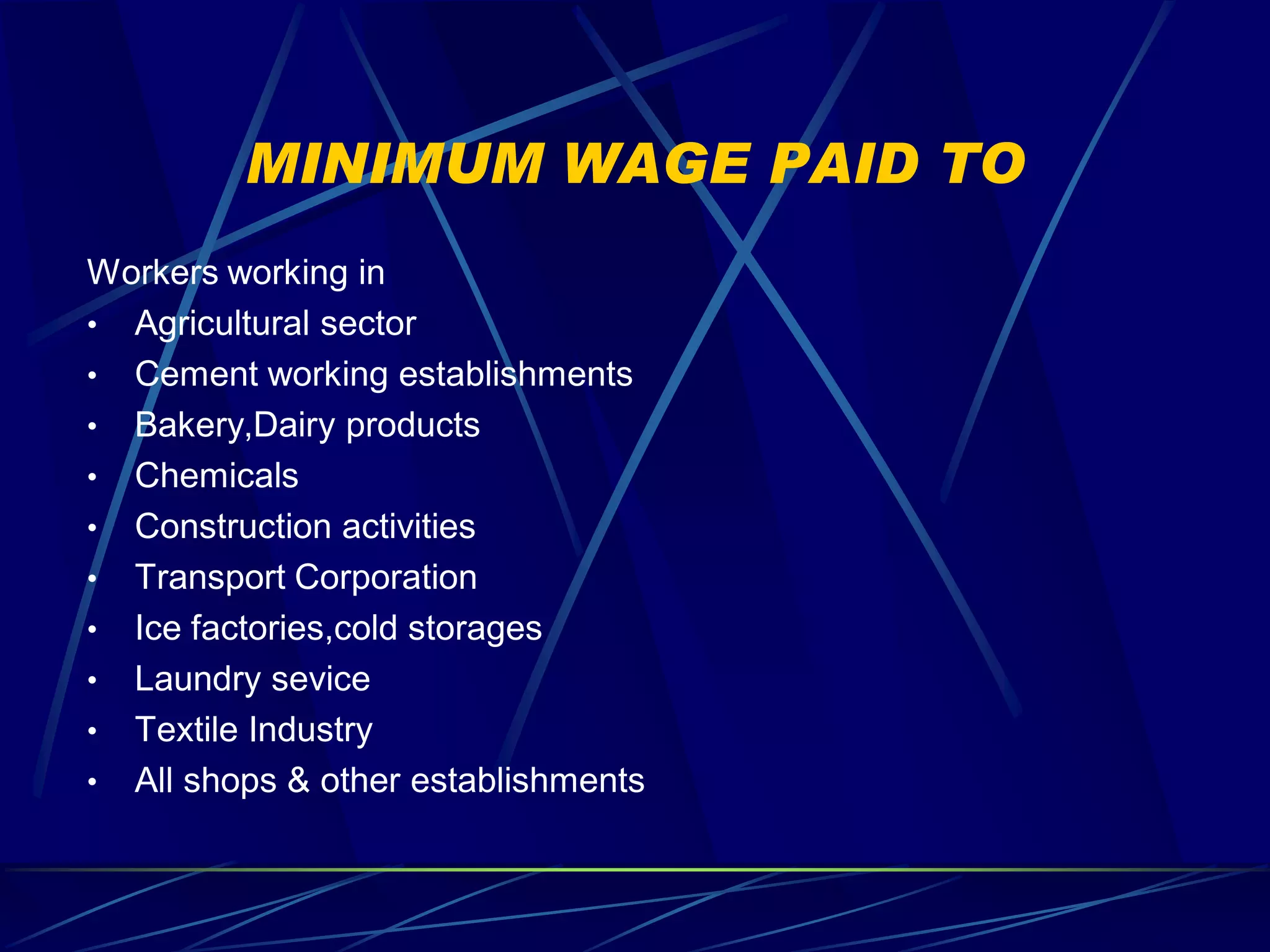
MINIMUM WAGE PAID TO
Workers working in
• Agricultural sector
• Cement working establishments
• Bakery,Dairy products
• Chemicals
• Construction activities
• Transport Corporation
• Ice factories,cold storages
• Laundry sevice
• Textile Industry
• All shops & other establishments
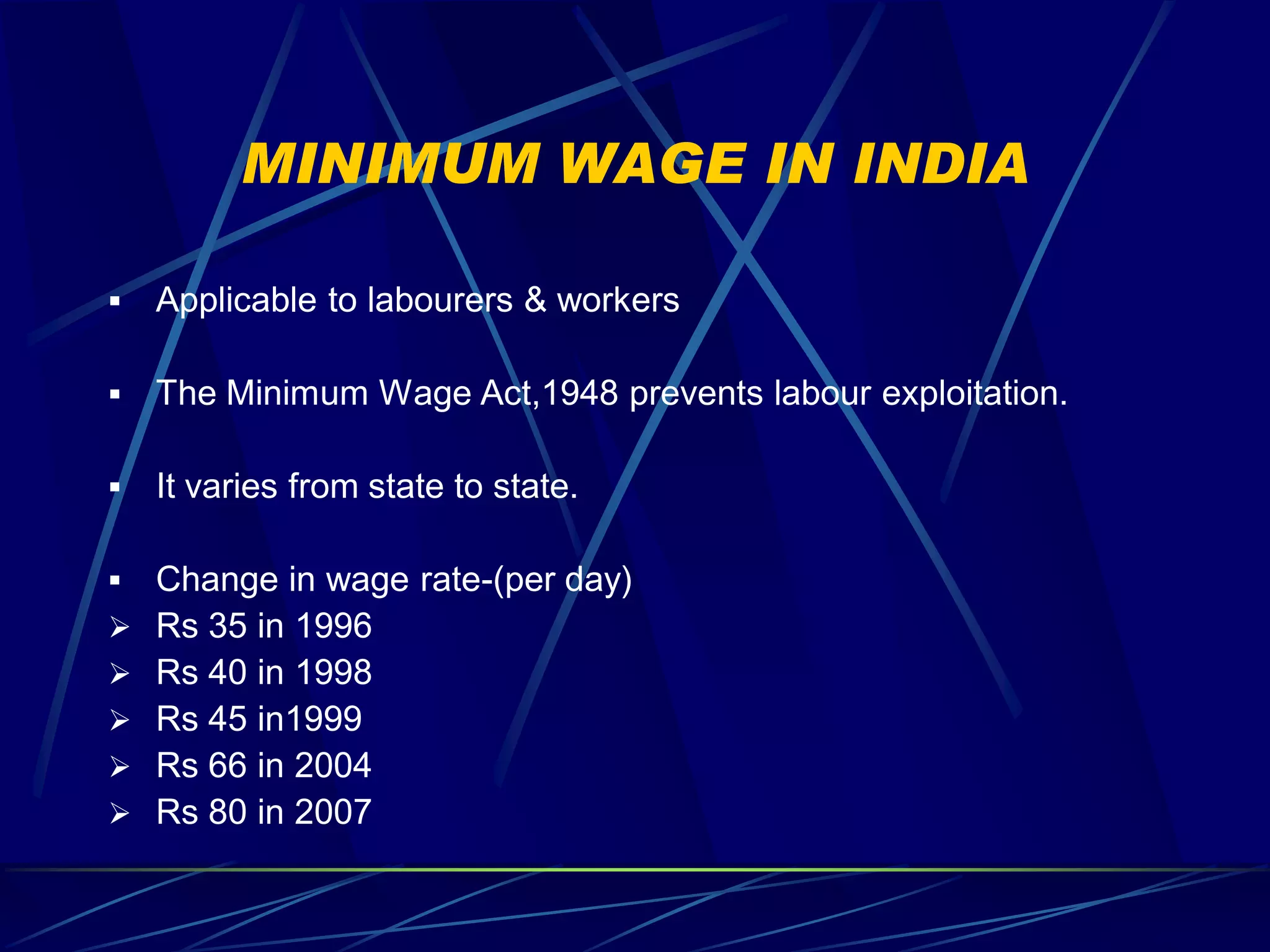
MINIMUM WAGE IN INDIA

   Applicable to labourers & workers

   The Minimum Wage Act,1948 prevents labour exploitation.
   It varies from state to state.

   Change in wage rate-(per day)
   Rs 35 in 1996
   Rs 40 in 1998
   Rs 45 in1999
   Rs 66 in 2004
   Rs 80 in 2007
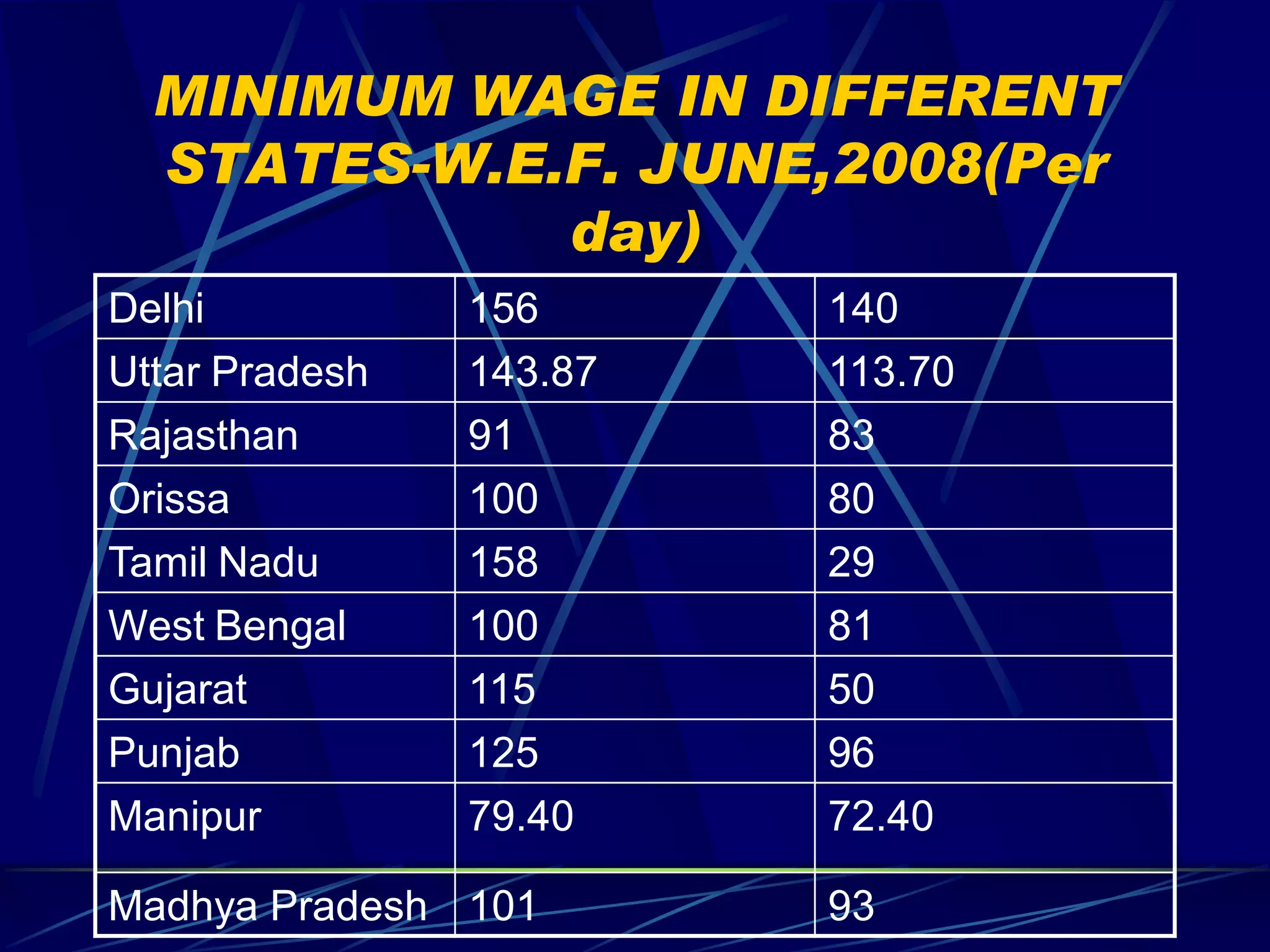
MINIMUM WAGE IN DIFFERENT
  STATES-W.E.F. JUNE,2008(Per
             day)
Delhi           156      140
Uttar Pradesh   143.87   113.70
Rajasthan       91       83
Orissa          100      80
Tamil Nadu      158      29
West Bengal     100      81
Gujarat         115      50
Punjab          125      96
Manipur         79.40    72.40

Madhya Pradesh 101       93
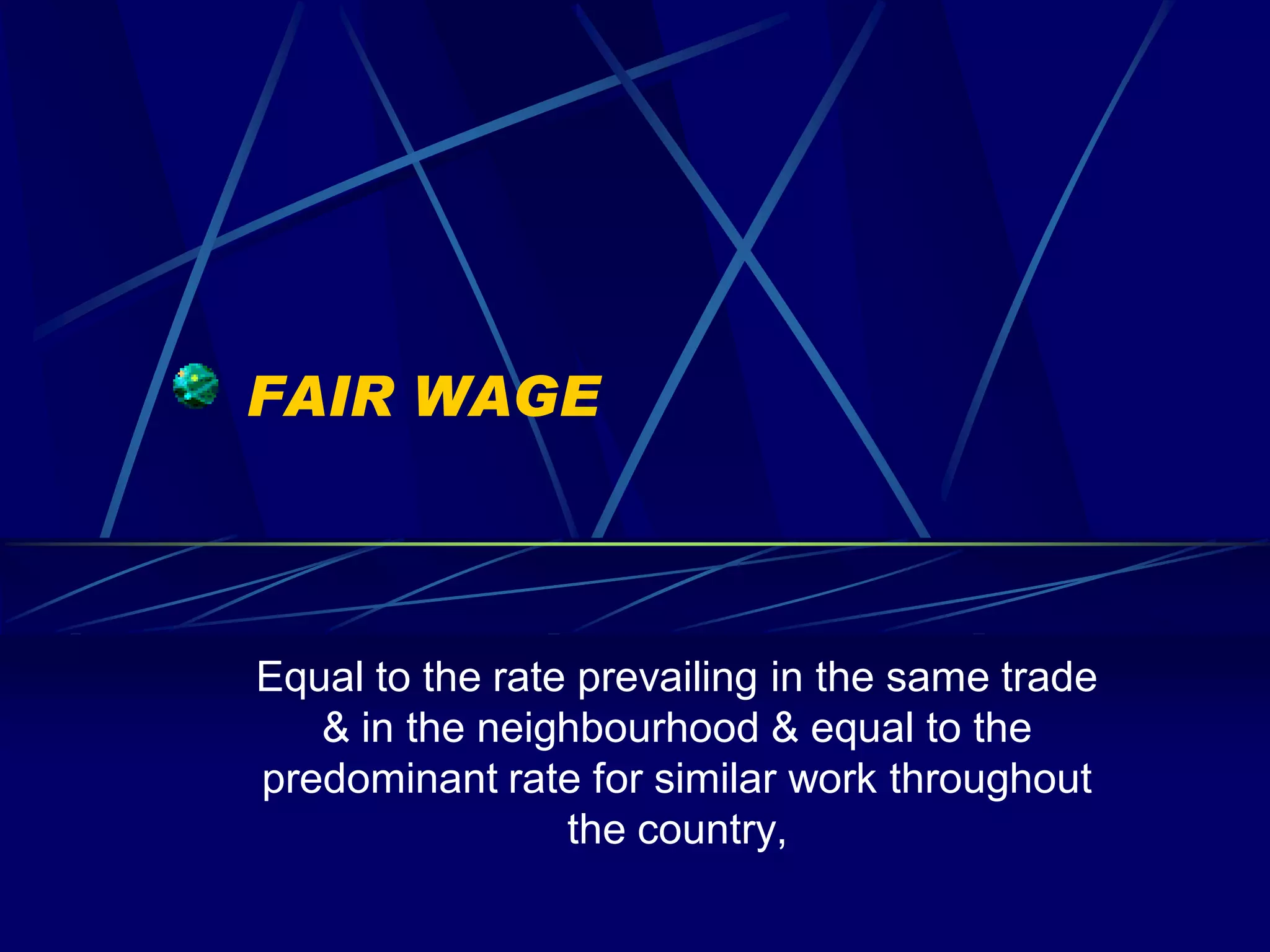
FAIR WAGE


Equal to the rate prevailing in the same trade
   & in the neighbourhood & equal to the
predominant rate for similar work throughout
                 the country,
LIVING WAGE


 Higher than fair wage,provides for bare
     essentials plus frugal comforts.
Living wage is concerned with
 The needs of the workers & their families
 Cost of living
 Social security benefits.
WAGE DIFFERENTIAL


   An element that works as wage scale
reflecting the average schedule of worker’s
pay that takes into account the performance
         of related tasks or services
WAGE DIFFERENTIALS

• Occupational differentials
• Inter-firm differentials
• Regional differential
• Inter-Industry differentials
• Personal differentials
OCCUPATIONAL
DIFFERENTIAL


  Wages are fixed based on different
 occupations & various degrees of skill.
FUNCTIONS

 Inducing workers to undertake more demanding jobs


 Encouraging people to develop skills


 Performing social function
INTER-FIRM DIFFERENTIALS


It reflects the relative wage level of workers in
different plants in the same area & occupation
INTER FIRM DIFFERENTIAL-THE
         MAIN CAUSES
 Difference in the quality of labour employed by firms
 Imperfections in labour market
 Difference in technological advance
 Financial capacity of the firm
 Size of the firm
INTER-AREA OR REGIONAL
DIFFERENTIALS


It occurs when workers in the same idustry or
same occupational group,but living in different
 geographical areas are paid different wages.
REGIONAL DIFFERENTIAL-THE
        MAIN CAUSES
 Different rate of payment
 Difference in cost of living
 Availability of manpower
INTER-INDUSTRY
DIFFERENTIALS


It occurs when workers in the same industry
or in the same area but in different industries
           are paid different wages
INTER-INDUSTRY DIFFERENTIAL-
       THE MAIN CAUSES
 Extent of unionization
 Capacity to pay
 Labour capital ratio
 Stage of development
 Supply-demand of needed skill
PERSONAL DIFFERENTIAL


 It refers different payment made to different
individual working in the same plant or same
                    occupation
PERSONAL DIFFERENTIAL-THE
        MAIN CAUSES
 Merit
 Individual output
 Experience
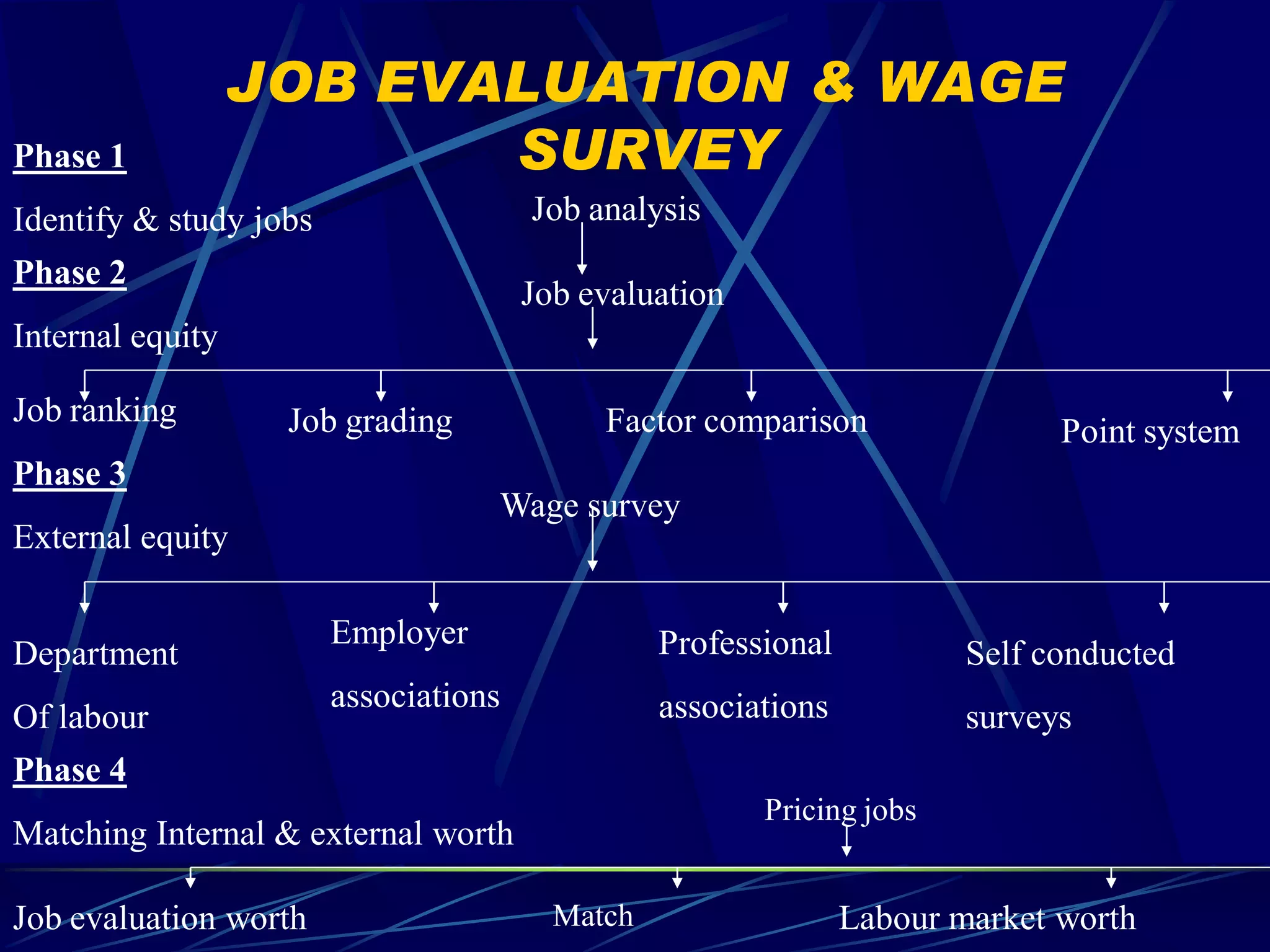
JOB EVALUATION & WAGE
Phase 1                  SURVEY
Identify & study jobs                  Job analysis
Phase 2
                                       Job evaluation
Internal equity

Job ranking        Job grading              Factor comparison                 Point system
Phase 3
                                   Wage survey
External equity

                        Employer                 Professional
Department                                                              Self conducted
                        associations             associations
Of labour                                                               surveys
Phase 4
                                                        Pricing jobs
Matching Internal & external worth

Job evaluation worth                     Match                  Labour market worth

Compensation And Minimum Wages

  • 1.
    CRITERIA IN COMPENSATION Lawof supply & demand Prevailing wages Ability to pay Governmental factor Standard & cost of living Productivity Bargaining power Job requirements
  • 2.
    DIVERGENT POLICIES HELP Topay minimum wages To pay more than prevailing wages To pay higher wages To pay competitive wages
  • 3.
    COMPENSATION SCENARIO INIT SECTOR-POLICIES  The growth rate of recruitment is 14.5%  The average increase in the salary in 2006 was 16%  Salary offered based on education,experience,position & skill
  • 4.
    AVERAGE SALARY OFFEREDIN IT SECTOR BASED ON EXPERIENCE 10+ Years 7-10 5-7 2-5 0-2 0 55 5 110 15 Salary(in 5 0
  • 5.
    TOP TEN HIGHESTSALARY PRAYERS IN INDIAN IT SECTOR • HCL Infosystems Limited • Hexaware Technologies • RMSI Private Limited • Cadence Design Systems • Tata Consultancy Services • Aztecsoft Limited • Nucleus Software • Induslogic • Kanbay International Inc • Cybage Software Private Limited
  • 6.
    COMPENSATION POLICIES IN INSURANCE SECTOR  Policies cover the following  Accidental Insurance  Medical Insurance  Medi claims  Family health Insurance  Diabetes Insurance etc  Policies involve  Basic salaries  Perks  Allowances  Accomodation etc
  • 7.
    AVERAGE SALARY OFFEREDIN INDIAN INSURANCE SECTOR BASED ON EXPERIENCE 12+ 4-9 Years 1-3 0-1 Salary(in lakhs) 0 2 4 6 8
  • 8.
    TOP PLAYERS OFTHE INSURANCE SECTOR • Life Insurance Corporation • New York Life • Prudential • Met Life • Birla Insurance • Kotak Mahindra • ICICI • HDFC
  • 9.
    COMPENSATION POLICY AT ENTRY LEVEL-INSURANCE SECTOR LIC ICICI Prudential New York Life Insurance Met Life Insurance In lakhs Birla Insurance 0 2.5 0.5 1 1.5 2 3
  • 10.
    COMPENSATION POLICY AT MANAGERIALLEVEL-INSURANCE SECTOR 10+Years 8-10Years In lakhs 6-8Years 3-5Years 0 5 10 15 20 25
  • 11.
    COMPENSATION POLICY INIT ENABLED SERVICES  Policy is designed to attract young talents  Policy considers high attriition rate  High average salary  Compensation is target based  Compensation don’t cover job security.  Average salary offered by top players at entry level is from 1.5 to 3 lakhs  For top management lucrative monetary & non monetary benefits are offered.
  • 12.
    IT ENABLED INDUSTRIESWITH BEST COMPENSATION POLICY  Microsoft  Oracle  IBM  HCL  Infosys  Satyam  Sify  Wipro  LG  Samsung
  • 13.
    COMPENSATION POLICIES IN TELECOMMUNICATION SECTOR  Policies cover the following  Annual bonus  House rent allowance  Mobile allowance  Transportations  Paid vacations  Travel leaves etc  Average salary at entry level ranges from 0.5 to 2.5 lakhs  Average salary at managerial level ranges from 5 to 40 lakhs,based on experience.
  • 14.
    TELECOMMUNICATION SECTOR WITH BEST COMPENSATION POLICY  Tata Teleservices  Reliance Communications  Bharti Airtel  Ericcson  Motorola
  • 15.
    PHILOSOPHY OF COMPENSATION PRODUCTIVITY PHILOSOPHY  PURCHASING POWER PHILOSOPHY
  • 16.
    PRODUCTIVITY PHILOSOPHY- ASSUMPTIONS  Use of updated tools,techniques & machineries  Optimum production  Minimising the unit cost of production  Lower price of goods  Expanded market  Increased income from sales  Profit sharing with employees  Utilising profit to regenerate process
  • 17.
    PURCHASING POWER PHILOSOPHY-ASSUMPTIONS  Good compensation to workers  Increased purchasing power of the large work force.  Effective demands for goods & services  Stimulation of future production.
  • 18.
    GROWTH OF SERVICEINDUSTRY  Tourism sector is growing at the rate of 8%  Good compensation encourage tourists pouring into holiday spots.  Average income of people have improved a lot  It helped to attain national prosperity  People expect quality service & they are ready to pay for it
  • 19.
    EXAMPLE o Distribution ofCompensation is as follows  Roadways-19%  Railways-19%  Airlines-27%
  • 20.
    NON IMPLEMENTATION OFPHILOSOPHY- CONSEQUENCES OF PAY DISSATISFACTION Strike Desire for Grievances Absenteeism more pay Search for a higher paying jobs Turnover Pay dissatisfaction Lower Absenteeism Attractivene Job ss of job dissatisfaction Psychological withdrawal Poor mental Health health
  • 21.
    COMPENSATION & PERFORMANCEMODEL Feedback Employee sets Performance is Expectations Employee considers rewarded & goals Equity in compensation Employee sets new goals & expectations Based on performance
  • 22.
    MINIMUM WAGE It isprovided for maintenance of life plus for preservation of the efficiency of worker
  • 23.
    MINIMUM WAGE PAIDTO Workers working in • Agricultural sector • Cement working establishments • Bakery,Dairy products • Chemicals • Construction activities • Transport Corporation • Ice factories,cold storages • Laundry sevice • Textile Industry • All shops & other establishments
  • 24.
    MINIMUM WAGE ININDIA  Applicable to labourers & workers  The Minimum Wage Act,1948 prevents labour exploitation.  It varies from state to state.  Change in wage rate-(per day)  Rs 35 in 1996  Rs 40 in 1998  Rs 45 in1999  Rs 66 in 2004  Rs 80 in 2007
  • 25.
    MINIMUM WAGE INDIFFERENT STATES-W.E.F. JUNE,2008(Per day) Delhi 156 140 Uttar Pradesh 143.87 113.70 Rajasthan 91 83 Orissa 100 80 Tamil Nadu 158 29 West Bengal 100 81 Gujarat 115 50 Punjab 125 96 Manipur 79.40 72.40 Madhya Pradesh 101 93
  • 26.
    FAIR WAGE Equal tothe rate prevailing in the same trade & in the neighbourhood & equal to the predominant rate for similar work throughout the country,
  • 27.
    LIVING WAGE Higherthan fair wage,provides for bare essentials plus frugal comforts.
  • 28.
    Living wage isconcerned with  The needs of the workers & their families  Cost of living  Social security benefits.
  • 29.
    WAGE DIFFERENTIAL An element that works as wage scale reflecting the average schedule of worker’s pay that takes into account the performance of related tasks or services
  • 30.
    WAGE DIFFERENTIALS • Occupationaldifferentials • Inter-firm differentials • Regional differential • Inter-Industry differentials • Personal differentials
  • 31.
    OCCUPATIONAL DIFFERENTIAL Wagesare fixed based on different occupations & various degrees of skill.
  • 32.
    FUNCTIONS  Inducing workersto undertake more demanding jobs  Encouraging people to develop skills  Performing social function
  • 33.
    INTER-FIRM DIFFERENTIALS It reflectsthe relative wage level of workers in different plants in the same area & occupation
  • 34.
    INTER FIRM DIFFERENTIAL-THE MAIN CAUSES  Difference in the quality of labour employed by firms  Imperfections in labour market  Difference in technological advance  Financial capacity of the firm  Size of the firm
  • 35.
    INTER-AREA OR REGIONAL DIFFERENTIALS Itoccurs when workers in the same idustry or same occupational group,but living in different geographical areas are paid different wages.
  • 36.
    REGIONAL DIFFERENTIAL-THE MAIN CAUSES  Different rate of payment  Difference in cost of living  Availability of manpower
  • 37.
    INTER-INDUSTRY DIFFERENTIALS It occurs whenworkers in the same industry or in the same area but in different industries are paid different wages
  • 38.
    INTER-INDUSTRY DIFFERENTIAL- THE MAIN CAUSES  Extent of unionization  Capacity to pay  Labour capital ratio  Stage of development  Supply-demand of needed skill
  • 39.
    PERSONAL DIFFERENTIAL Itrefers different payment made to different individual working in the same plant or same occupation
  • 40.
    PERSONAL DIFFERENTIAL-THE MAIN CAUSES  Merit  Individual output  Experience
  • 41.
    JOB EVALUATION &WAGE Phase 1 SURVEY Identify & study jobs Job analysis Phase 2 Job evaluation Internal equity Job ranking Job grading Factor comparison Point system Phase 3 Wage survey External equity Employer Professional Department Self conducted associations associations Of labour surveys Phase 4 Pricing jobs Matching Internal & external worth Job evaluation worth Match Labour market worth