Compensation & Benefits
(Pay Structure)
Enhance your knowledge About
Compensation and Benefits (One of
the core areas of Human Resources)
Faisal Anwar
Compensation & Benefits (Pay
Structure)
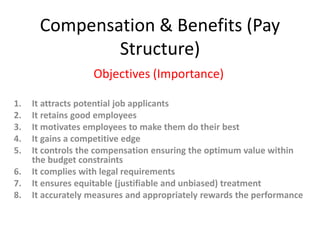
Objectives (Importance)
1. It attracts potential job applicants
2. It retains good employees
3. It motivates employees to make them do their best
4. It gains a competitive edge
5. It controls the compensation ensuring the optimum value within
the budget constraints
6. It complies with legal requirements
7. It ensures equitable (justifiable and unbiased) treatment
8. It accurately measures and appropriately rewards the performance
Stages of Compensation & Benefits
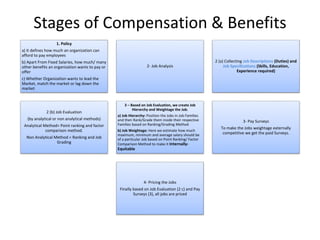
1. Policy
a) It defines how much an organization can
afford to pay employees
b) Apart From Fixed Salaries, how much/ many
other benefits an organization wants to pay or
offer
c) Whether Organization wants to lead the
Market, match the market or lag down the
market
2- Job Analysis
2 (a) Collecting Job Descriptions (Duties) and
Job Specifications (Skills, Education,
Experience required)
2 (b) Job Evaluation
(by analytical or non analytical methods)
Analytical Method= Point ranking and factor
comparison method.
Non Analytical Method = Ranking and Job
Grading
3 – Based on Job Evaluation, we create Job
Hierarchy and Weightage the Job.
a) Job Hierarchy: Position the Jobs in Job Families
and then Rank/Grade them inside their respective
Families based on Ranking/Grading Method
b) Job Weightage: Here we estimate how much
maximum, minimum and average salary should be
of a particular Job based on Point Ranking/ Factor
Comparison Method to make it Internally-
Equitable
3- Pay Surveys
To make the Jobs weightage externally
competitive we get the paid Surveys.
4- Pricing the Jobs
Finally based on Job Evaluation (2 c) and Pay
Surveys (3), all jobs are priced
Compensation and Benefits / Remuneration System
Best way to develop pay systems is Job Analysis
1 - Job Descriptions
(Duties) and Job
Specifications (Skills
required) are collected
for each Position
2 - Job Evaluation (by analytical or/ and non -
analytical methods)
Analytical Method= Point ranking or factor
comparison method.
Non Analytical Method = Ranking or Job Grading
3 – Based on Job Evaluation, we create Job Hierarchy
and Weightage the Job.
a) Job Hierarchy: Position the Jobs in Job Families and then Rank/Grade
them inside their respective Families based on Ranking/Grading
Method
b) Job Weightage: Here we estimate how much maximum, minimum
and average salary should be of a particular Job based on Point
Ranking/ Factor Comparison Method.
4 - Pay
Surveys
5 - Pricing
Jobs
Job Analysis
Non-analytical
method
category
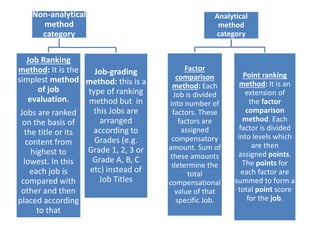
Job Ranking
method: It is the
simplest method
of job
evaluation.
Jobs are ranked
on the basis of
the title or its
content from
highest to
lowest. In this
each job is
compared with
other and then
placed according
to that
Job-grading
method: this is a
type of ranking
method but in
this Jobs are
arranged
according to
Grades (e.g.
Grade 1, 2, 3 or
Grade A, B, C
etc) instead of
Job Titles
Analytical
method
category
Factor
comparison
method: Each
Job is divided
into number of
factors. These
factors are
assigned
compensatory
amount. Sum of
these amounts
determine the
total
compensational
value of that
specific Job.
Point ranking
method: It is an
extension of
the factor
comparison
method. Each
factor is divided
into levels which
are then
assigned points.
The points for
each factor are
summed to form a
total point score
for the job.
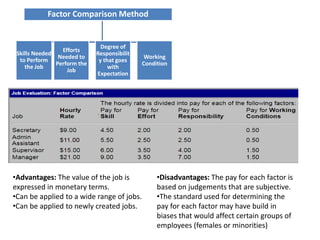
Factor Comparison Method
Skills Needed
to Perform
the Job
Efforts
Needed to
Perform the
Job
Degree of
Responsibilit
y that goes
with
Expectation
Working
Condition
•Advantages: The value of the job is
expressed in monetary terms.
•Can be applied to a wide range of jobs.
•Can be applied to newly created jobs.
•Disadvantages: The pay for each factor is
based on judgements that are subjective.
•The standard used for determining the
pay for each factor may have build in
biases that would affect certain groups of
employees (females or minorities)
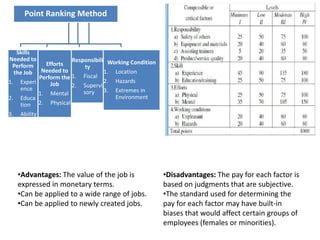
Point Ranking Method
Skills
Needed to
Perform
the Job
1. Experi
ence
2. Educa
tion
3. Ability
Efforts
Needed to
Perform the
Job
1. Mental
2. Physical
Responsibili
ty
1. Fiscal
2. Supervi
sory
Working Condition
1. Location
2. Hazards
3. Extremes in
Environment
•Advantages: The value of the job is
expressed in monetary terms.
•Can be applied to a wide range of jobs.
•Can be applied to newly created jobs.
•Disadvantages: The pay for each factor is
based on judgments that are subjective.
•The standard used for determining the
pay for each factor may have built-in
biases that would affect certain groups of
employees (females or minorities).
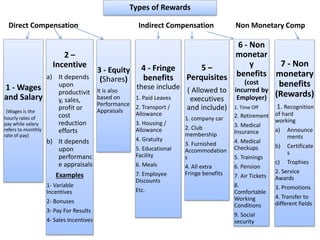
Types of Rewards
1 - Wages
and Salary
(Wages is the
hourly rates of
pay while salary
refers to monthly
rate of pay)
2 –
Incentive
a) It depends
upon
productivit
y, sales,
profit or
cost
reduction
efforts
b) It depends
upon
performanc
e appraisals
Examples
1- Variable
Incentives
2- Bonuses
3- Pay For Results
4- Sales Incentives
4 - Fringe
benefits
these include
1. Paid Leaves
2. Transport /
Allowance
3. Housing /
Allowance
4. Gratuity
5. Educational
Facility
6. Meals
7. Employee
Discounts
Etc.
5 –
Perquisites
( Allowed to
executives
and include)
1. company car
2. Club
membership
3. Furnished
Accommodation
s
4. All extra
Fringe benefits
3 - Equity
(Shares)
It is also
based on
Performance
Appraisals
6 - Non
monetar
y
benefits
(cost
incurred by
Employer)
1. Time Off
2. Retirement
3. Medical
Insurance
4. Medical
Checkups
5. Trainings
6. Pension
7. Air Tickets
8.
Comfortable
Working
Conditions
9. Social
security
7 - Non
monetary
benefits
(Rewards)
1. Recognition
of hard
working
a) Announce
ments
b) Certificate
s
c) Trophies
2. Service
Awards
3. Promotions
4. Transfer to
different fields
Direct Compensation Indirect Compensation Non Monetary Comp
Remuneration
Theories
Equity Theory =
Two people on
the same level
should get same
pays
Agency Theory =
agency is
responsible to pay
to their employees
Reinforcement and
Expectant Theory =
This theory
emphasizes the
importance of a
person actually
experiencing the
award
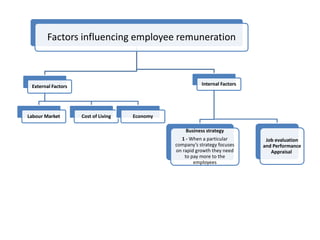
Factors influencing employee remuneration
External Factors
Labour Market Cost of Living Economy
Internal Factors
Business strategy
1 - When a particular
company’s strategy focuses
on rapid growth they need
to pay more to the
employees
Job evaluation
and Performance
Appraisal
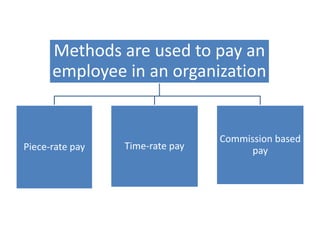
Methods are used to pay an
employee in an organization
Piece-rate pay Time-rate pay
Commission based
pay
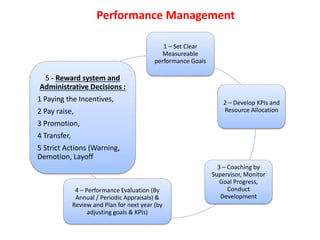
1 – Set Clear
Measureable
performance Goals
2 – Develop KPIs and
Resource Allocation
3 – Coaching by
Supervisor, Monitor
Goal Progress,
Conduct
Development
4 – Performance Evaluation (By
Annual / Periodic Appraisals) &
Review and Plan for next year (by
adjusting goals & KPIs)
5 - Reward system and
Administrative Decisions :
1 Paying the Incentives,
2 Pay raise,
3 Promotion,
4 Transfer,
5 Strict Actions (Warning,
Demotion, Layoff
Performance Management
Talent Review and Succession Planning
Thanks
Faisal Anwar
firstfaisal@yahoo.com
(UAE) +971 555 74 9650
(Kuwait) +965 55 294711
(Pakistan) +92 335 0979700

Compensation And Benefits (Pay structure)

  • 1.
    Compensation & Benefits (PayStructure) Enhance your knowledge About Compensation and Benefits (One of the core areas of Human Resources) Faisal Anwar
  • 2.
    Compensation & Benefits(Pay Structure) Objectives (Importance) 1. It attracts potential job applicants 2. It retains good employees 3. It motivates employees to make them do their best 4. It gains a competitive edge 5. It controls the compensation ensuring the optimum value within the budget constraints 6. It complies with legal requirements 7. It ensures equitable (justifiable and unbiased) treatment 8. It accurately measures and appropriately rewards the performance
  • 3.
    Stages of Compensation& Benefits 1. Policy a) It defines how much an organization can afford to pay employees b) Apart From Fixed Salaries, how much/ many other benefits an organization wants to pay or offer c) Whether Organization wants to lead the Market, match the market or lag down the market 2- Job Analysis 2 (a) Collecting Job Descriptions (Duties) and Job Specifications (Skills, Education, Experience required) 2 (b) Job Evaluation (by analytical or non analytical methods) Analytical Method= Point ranking and factor comparison method. Non Analytical Method = Ranking and Job Grading 3 – Based on Job Evaluation, we create Job Hierarchy and Weightage the Job. a) Job Hierarchy: Position the Jobs in Job Families and then Rank/Grade them inside their respective Families based on Ranking/Grading Method b) Job Weightage: Here we estimate how much maximum, minimum and average salary should be of a particular Job based on Point Ranking/ Factor Comparison Method to make it Internally- Equitable 3- Pay Surveys To make the Jobs weightage externally competitive we get the paid Surveys. 4- Pricing the Jobs Finally based on Job Evaluation (2 c) and Pay Surveys (3), all jobs are priced
  • 4.
    Compensation and Benefits/ Remuneration System Best way to develop pay systems is Job Analysis 1 - Job Descriptions (Duties) and Job Specifications (Skills required) are collected for each Position 2 - Job Evaluation (by analytical or/ and non - analytical methods) Analytical Method= Point ranking or factor comparison method. Non Analytical Method = Ranking or Job Grading 3 – Based on Job Evaluation, we create Job Hierarchy and Weightage the Job. a) Job Hierarchy: Position the Jobs in Job Families and then Rank/Grade them inside their respective Families based on Ranking/Grading Method b) Job Weightage: Here we estimate how much maximum, minimum and average salary should be of a particular Job based on Point Ranking/ Factor Comparison Method. 4 - Pay Surveys 5 - Pricing Jobs Job Analysis
  • 5.
    Non-analytical method category Job Ranking method: Itis the simplest method of job evaluation. Jobs are ranked on the basis of the title or its content from highest to lowest. In this each job is compared with other and then placed according to that Job-grading method: this is a type of ranking method but in this Jobs are arranged according to Grades (e.g. Grade 1, 2, 3 or Grade A, B, C etc) instead of Job Titles Analytical method category Factor comparison method: Each Job is divided into number of factors. These factors are assigned compensatory amount. Sum of these amounts determine the total compensational value of that specific Job. Point ranking method: It is an extension of the factor comparison method. Each factor is divided into levels which are then assigned points. The points for each factor are summed to form a total point score for the job.
  • 6.
    Factor Comparison Method SkillsNeeded to Perform the Job Efforts Needed to Perform the Job Degree of Responsibilit y that goes with Expectation Working Condition •Advantages: The value of the job is expressed in monetary terms. •Can be applied to a wide range of jobs. •Can be applied to newly created jobs. •Disadvantages: The pay for each factor is based on judgements that are subjective. •The standard used for determining the pay for each factor may have build in biases that would affect certain groups of employees (females or minorities)
  • 7.
    Point Ranking Method Skills Neededto Perform the Job 1. Experi ence 2. Educa tion 3. Ability Efforts Needed to Perform the Job 1. Mental 2. Physical Responsibili ty 1. Fiscal 2. Supervi sory Working Condition 1. Location 2. Hazards 3. Extremes in Environment •Advantages: The value of the job is expressed in monetary terms. •Can be applied to a wide range of jobs. •Can be applied to newly created jobs. •Disadvantages: The pay for each factor is based on judgments that are subjective. •The standard used for determining the pay for each factor may have built-in biases that would affect certain groups of employees (females or minorities).
  • 8.
    Types of Rewards 1- Wages and Salary (Wages is the hourly rates of pay while salary refers to monthly rate of pay) 2 – Incentive a) It depends upon productivit y, sales, profit or cost reduction efforts b) It depends upon performanc e appraisals Examples 1- Variable Incentives 2- Bonuses 3- Pay For Results 4- Sales Incentives 4 - Fringe benefits these include 1. Paid Leaves 2. Transport / Allowance 3. Housing / Allowance 4. Gratuity 5. Educational Facility 6. Meals 7. Employee Discounts Etc. 5 – Perquisites ( Allowed to executives and include) 1. company car 2. Club membership 3. Furnished Accommodation s 4. All extra Fringe benefits 3 - Equity (Shares) It is also based on Performance Appraisals 6 - Non monetar y benefits (cost incurred by Employer) 1. Time Off 2. Retirement 3. Medical Insurance 4. Medical Checkups 5. Trainings 6. Pension 7. Air Tickets 8. Comfortable Working Conditions 9. Social security 7 - Non monetary benefits (Rewards) 1. Recognition of hard working a) Announce ments b) Certificate s c) Trophies 2. Service Awards 3. Promotions 4. Transfer to different fields Direct Compensation Indirect Compensation Non Monetary Comp
  • 9.
    Remuneration Theories Equity Theory = Twopeople on the same level should get same pays Agency Theory = agency is responsible to pay to their employees Reinforcement and Expectant Theory = This theory emphasizes the importance of a person actually experiencing the award
  • 10.
    Factors influencing employeeremuneration External Factors Labour Market Cost of Living Economy Internal Factors Business strategy 1 - When a particular company’s strategy focuses on rapid growth they need to pay more to the employees Job evaluation and Performance Appraisal
  • 11.
    Methods are usedto pay an employee in an organization Piece-rate pay Time-rate pay Commission based pay
  • 12.
    1 – SetClear Measureable performance Goals 2 – Develop KPIs and Resource Allocation 3 – Coaching by Supervisor, Monitor Goal Progress, Conduct Development 4 – Performance Evaluation (By Annual / Periodic Appraisals) & Review and Plan for next year (by adjusting goals & KPIs) 5 - Reward system and Administrative Decisions : 1 Paying the Incentives, 2 Pay raise, 3 Promotion, 4 Transfer, 5 Strict Actions (Warning, Demotion, Layoff Performance Management
  • 13.
    Talent Review andSuccession Planning
  • 14.
    Thanks Faisal Anwar firstfaisal@yahoo.com (UAE) +971555 74 9650 (Kuwait) +965 55 294711 (Pakistan) +92 335 0979700

Editor's Notes

  • #13 Performance Management