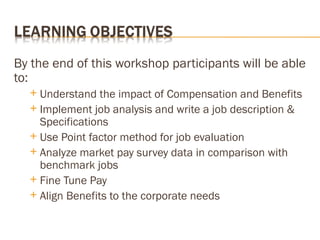
By the endof this workshop participants will be able
to:
Understand the impact of Compensation and Benefits
Implement job analysis and write a job description &
Specifications
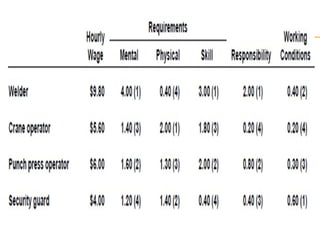
Use Point factor method for job evaluation
Analyze market pay survey data in comparison with
benchmark jobs
Fine Tune Pay
Align Benefits to the corporate needs
It isthe process of developing & implementing
reward innovations & to manage key reward
practices.
8.
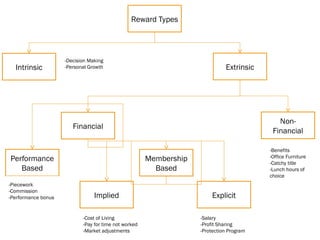
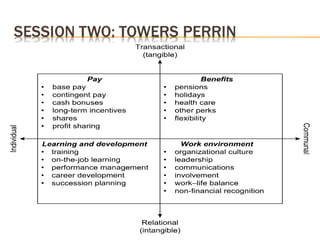
• It isall form of pay or rewards going to
employees; arising from their employment.
“WIIFM?”
• Compensation & Benefits refers to all forms of
financial returns (cash and non-cash) that
employees receive from their employers.
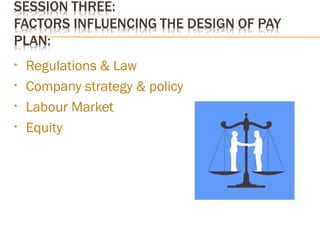
• Regulations &Law
• Company strategy & policy
• Labour Market
• Equity
12.
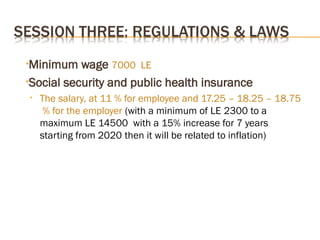
•Minimum wage 7000LE
•Social security and public health insurance
• The salary, at 11 % for employee and 17.25 – 18.25 – 18.75
% for the employer (with a minimum of LE 2300 to a
maximum LE 14500 with a 15% increase for 7 years
starting from 2020 then it will be related to inflation)
14.
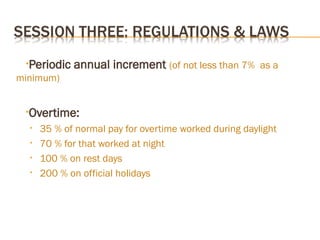
•Periodic annual increment(of not less than 7% as a
minimum)
•Overtime:
• 35 % of normal pay for overtime worked during daylight
• 70 % for that worked at night
• 100 % on rest days
• 200 % on official holidays
15.
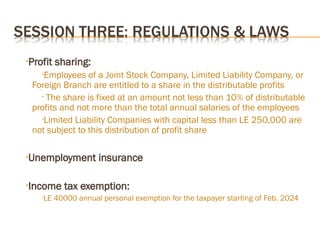
•Profit sharing:
•Employees ofa Joint Stock Company, Limited Liability Company, or
Foreign Branch are entitled to a share in the distributable profits
• The share is fixed at an amount not less than 10% of distributable
profits and not more than the total annual salaries of the employees
•Limited Liability Companies with capital less than LE 250,000 are
not subject to this distribution of profit share
•Unemployment insurance
•Income tax exemption:
•LE 40000 annual personal exemption for the taxpayer starting of Feb. 2024
16.
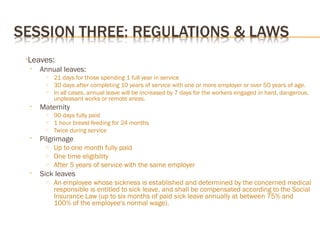
•Leaves:
• Annual leaves:
o21 days for those spending 1 full year in service
o 30 days after completing 10 years of service with one or more employer or over 50 years of age.
o In all cases, annual leave will be increased by 7 days for the workers engaged in hard, dangerous,
unpleasant works or remote areas.
• Maternity
o 90 days fully paid
o 1 hour breast-feeding for 24 months
o Twice during service
• Pilgrimage
o Up to one month fully paid
o One time eligibility
o After 5 years of service with the same employer
• Sick leaves
o An employee whose sickness is established and determined by the concerned medical
responsible is entitled to sick leave, and shall be compensated according to the Social
Insurance Law (up to six months of paid sick leave annually at between 75% and
100% of the employee's normal wage).
17.
• What iscorporate strategy?
• What is the reward strategy?
• What pay strategy can help company achieve
its short- & long-term goals?
18.
• Is thecompany leader or a follower regarding
pay?
• Is pay according to seniority or performance?
• What is the pay cycle?
• What is the salary increase policy?
• What is the promotion policy?
• What is the salary compression policy?
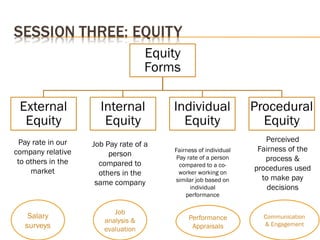
Pay rate inour
company relative
to others in the
market
Job Pay rate of a
person
compared to
others in the
same company
Fairness of individual
Pay rate of a person
compared to a co-
worker working on
similar job based on
individual
performance
Perceived
Fairness of the
process &
procedures used
to make pay
decisions
Salary
surveys
Communication
& Engagement
Performance
Appraisals
Job
analysis &
evaluation
22.
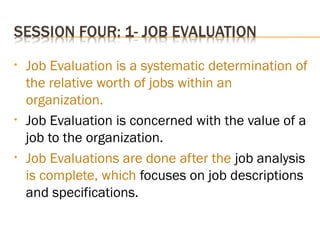
• Job Evaluationis a systematic determination of
the relative worth of jobs within an
organization.
• Job Evaluation is concerned with the value of a
job to the organization.
• Job Evaluations are done after the job analysis
is complete, which focuses on job descriptions
and specifications.
23.
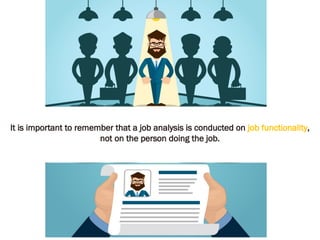
It is importantto remember that a job analysis is conducted on job functionality,
not on the person doing the job.
Describing what isand What Needs to Happen
in the near future
Not
Describing what Has Happened
26.
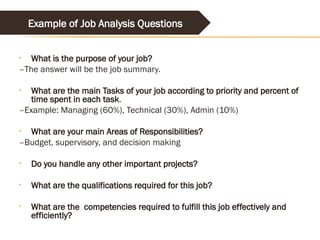
• What isthe purpose of your job?
–The answer will be the job summary.
• What are the main Tasks of your job according to priority and percent of
time spent in each task.
–Example: Managing (60%), Technical (30%), Admin (10%)
• What are your main Areas of Responsibilities?
–Budget, supervisory, and decision making
• Do you handle any other important projects?
• What are the qualifications required for this job?
• What are the competencies required to fulfill this job effectively and
efficiently?
Example of Job Analysis Questions
27.
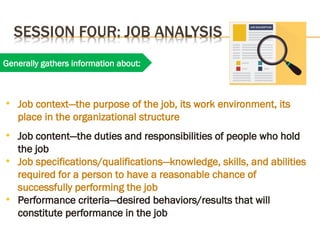
Generally gathers informationabout:
• Job context—the purpose of the job, its work environment, its
place in the organizational structure
• Job content—the duties and responsibilities of people who hold
the job
• Job specifications/qualifications—knowledge, skills, and abilities
required for a person to have a reasonable chance of
successfully performing the job
• Performance criteria—desired behaviors/results that will
constitute performance in the job
28.
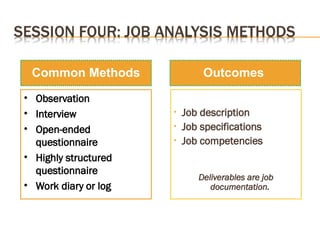
• Job description
•Job specifications
• Job competencies
Deliverables are job
documentation.
• Observation
• Interview
• Open-ended
questionnaire
• Highly structured
questionnaire
• Work diary or log
Common Methods Outcomes
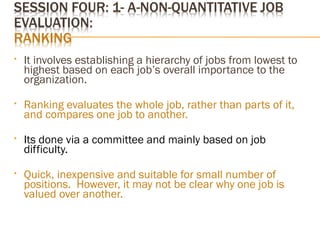
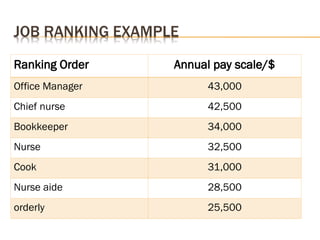
• It involvesestablishing a hierarchy of jobs from lowest to
highest based on each job’s overall importance to the
organization.
• Ranking evaluates the whole job, rather than parts of it,
and compares one job to another.
• Its done via a committee and mainly based on job
difficulty.
• Quick, inexpensive and suitable for small number of
positions. However, it may not be clear why one job is
valued over another.
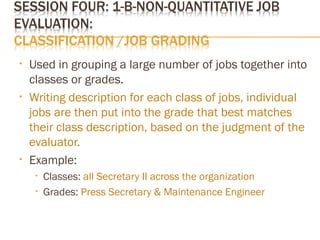
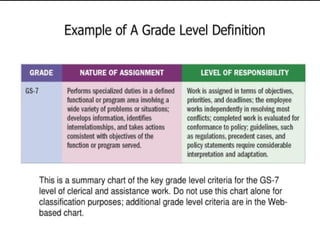
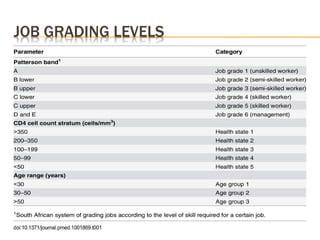
• Used ingrouping a large number of jobs together into
classes or grades.
• Writing description for each class of jobs, individual
jobs are then put into the grade that best matches
their class description, based on the judgment of the
evaluator.
• Example:
• Classes: all Secretary II across the organization
• Grades: Press Secretary & Maintenance Engineer
35.
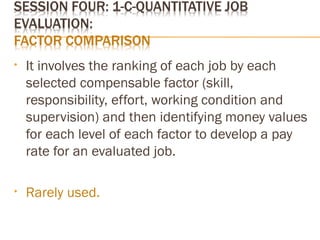
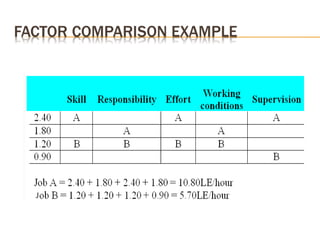
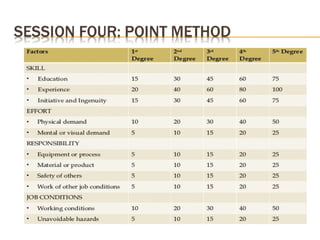
• It involvesthe ranking of each job by each
selected compensable factor (skill,
responsibility, effort, working condition and
supervision) and then identifying money values
for each level of each factor to develop a pay
rate for an evaluated job.
• Rarely used.
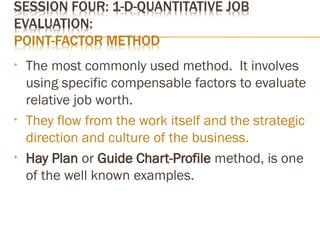
• The mostcommonly used method. It involves
using specific compensable factors to evaluate
relative job worth.
• They flow from the work itself and the strategic
direction and culture of the business.
• Hay Plan or Guide Chart-Profile method, is one
of the well known examples.
39.
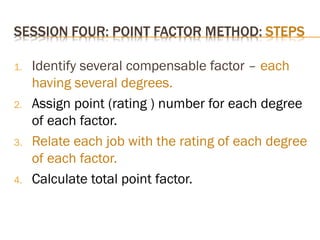
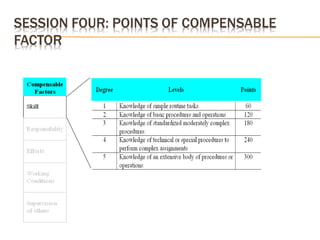
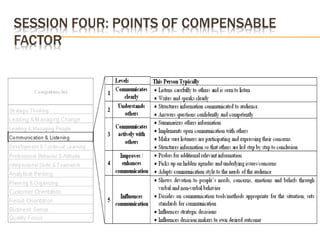
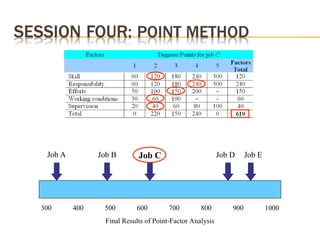
1. Identify severalcompensable factor – each
having several degrees.
2. Assign point (rating ) number for each degree
of each factor.
3. Relate each job with the rating of each degree
of each factor.
4. Calculate total point factor.
42.
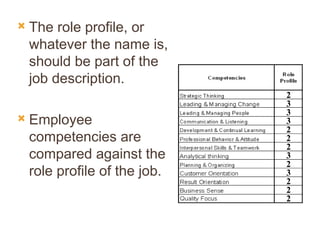
The roleprofile, or
whatever the name is,
should be part of the
job description.
Employee
competencies are
compared against the
role profile of the job.
2
3
3
3
2
2
2
3
2
3
2
2
2
43.
300 400 500600 700 800 900 1000
Final Results of Point-Factor Analysis
Job A Job B Job C Job D Job E
45.
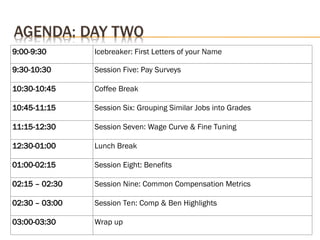
9:00-9:30 Icebreaker: FirstLetters of your Name
9:30-10:30 Session Five: Pay Surveys
10:30-10:45 Coffee Break
10:45-11:15 Session Six: Grouping Similar Jobs into Grades
11:15-12:30 Session Seven: Wage Curve & Fine Tuning
12:30-01:00 Lunch Break
01:00-02:15 Session Eight: Benefits
02:15 – 02:30 Session Nine: Common Compensation Metrics
02:30 – 03:00 Session Ten: Comp & Ben Highlights
03:00-03:30 Wrap up
47.
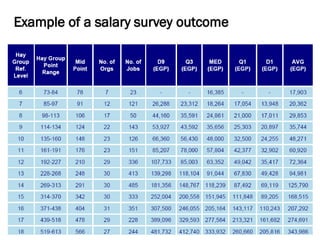
• Organizations usepay surveys to collect information on
prevailing market rates.
• These surveys include topics such as incentive plans,
overtime pay, starting wage rates, base pay, pay ranges,
shift differentials and vacation and holiday practices.
• Salary data may need to be aged, leveled, and/or
factored for geography or industry.
48.
• Government sources
(e.g.,ministries of labor or government statistical
bureaus).
• International organizations
(e.g., International Labor Organization).
• Membership-based business organizations (e.g.,
employer federations and local chambers of
commerce)
• Professional, trade, and industrial associations
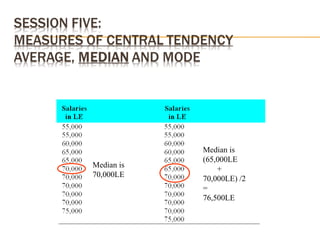
• Organizations analyzesurvey data based on
circumstances of their market, product and
employees.
• A quantitative analysis can be used to analyze
data. The two frequently used means to
analyze pay surveys data are:
• Frequency distribution and tables
• Measures of central tendency
52.
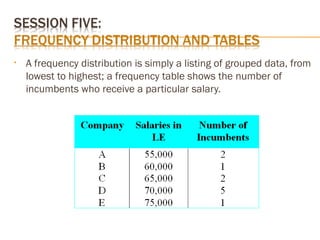
• A frequencydistribution is simply a listing of grouped data, from
lowest to highest; a frequency table shows the number of
incumbents who receive a particular salary.
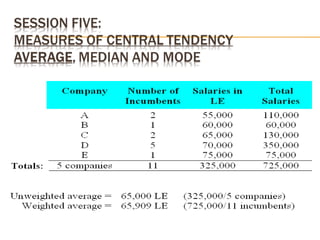
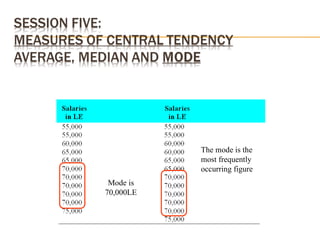
The mode isthe
most frequently
occurring figure
Mode is
70,000LE
57.
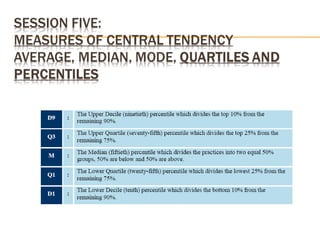
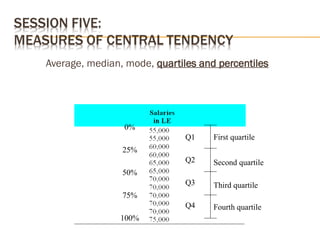
Average, median, mode,quartiles and percentiles
Q1
Q2
Q3
Q4
0%
25%
50%
75%
100%
First quartile
Second quartile
Third quartile
Fourth quartile
58.
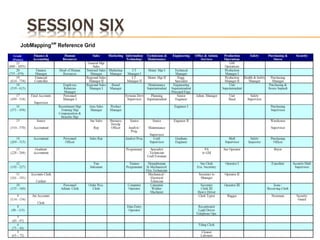
• Pay gradesare used to group jobs that have
approximately the same relative internal worth,
in other words, all jobs within a particular grade
are paid within the same pay range.
• By using pay grades, management can develop
a coordinates pay system without having to
determine a separate pay range for each job
family in the organization
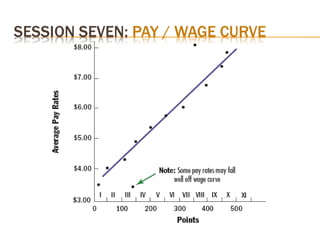
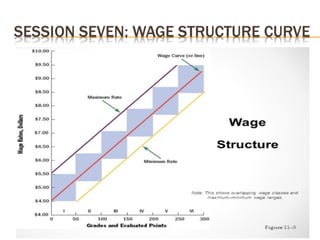
• Wage curve:shows relationship between the value of the
job & the average wage paid for this job.
• It shows the pay rates currently paid for jobs in each
grade by the employer. (average)
• If there is a reason to believe the current pay are out of
step with market rates; choose a bench mark jobs within
each grade & price them via compensation survey. These
new rates replaces the current rates on the curve.
62.
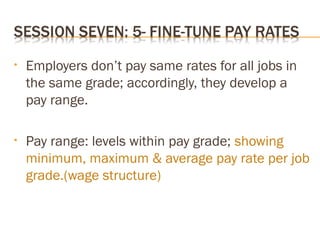
• Employers don’tpay same rates for all jobs in
the same grade; accordingly, they develop a
pay range.
• Pay range: levels within pay grade; showing
minimum, maximum & average pay rate per job
grade.(wage structure)
64.
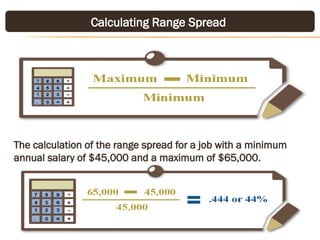
The calculation ofthe range spread for a job with a minimum
annual salary of $45,000 and a maximum of $65,000.
Calculating Range Spread
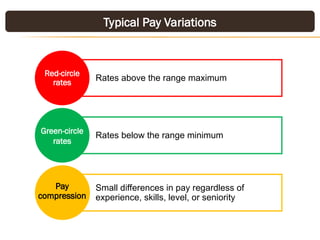
Rates above therange maximum
Red-circle
rates
Rates below the range minimum
Green-circle
rates
Small differences in pay regardless of
experience, skills, level, or seniority
Pay
compression
Typical Pay Variations
67.
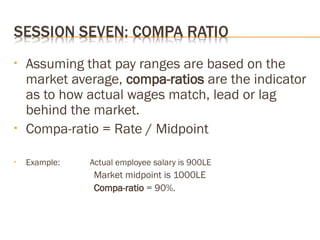
• Assuming thatpay ranges are based on the
market average, compa-ratios are the indicator
as to how actual wages match, lead or lag
behind the market.
• Compa-ratio = Rate / Midpoint
• Example: Actual employee salary is 900LE
Market midpoint is 1000LE
Compa-ratio = 90%.
68.
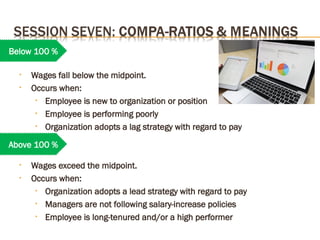
• Wages fallbelow the midpoint.
• Occurs when:
• Employee is new to organization or position
• Employee is performing poorly
• Organization adopts a lag strategy with regard to pay
• Wages exceed the midpoint.
• Occurs when:
• Organization adopts a lead strategy with regard to pay
• Managers are not following salary-increase policies
• Employee is long-tenured and/or a high performer
Below 100 %
Above 100 %
70.
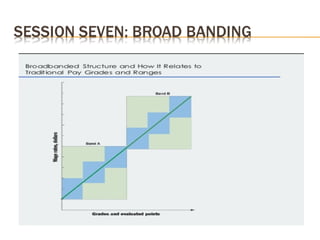
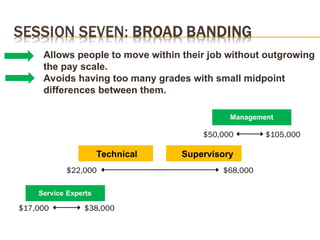
• Allows peopleto move within their job without outgrowing
the pay scale.
• Avoids having too many grades with small midpoint
differences between them.
Management
$17,000 $38,000
$22,000 $68,000
$50,000 $105,000
71.
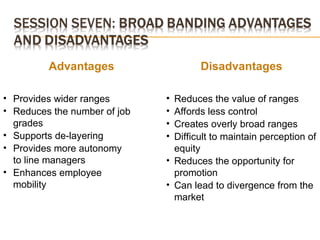
Advantages Disadvantages
• Provideswider ranges
• Reduces the number of job
grades
• Supports de-layering
• Provides more autonomy
to line managers
• Enhances employee
mobility
• Reduces the value of ranges
• Affords less control
• Creates overly broad ranges
• Difficult to maintain perception of
equity
• Reduces the opportunity for
promotion
• Can lead to divergence from the
market
73.
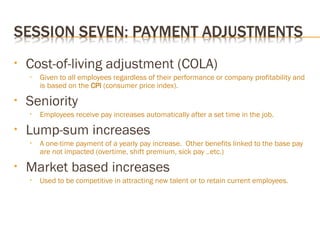
• Cost-of-living adjustment(COLA)
• Given to all employees regardless of their performance or company profitability and
is based on the CPI (consumer price index).
• Seniority
• Employees receive pay increases automatically after a set time in the job.
• Lump-sum increases
• A one-time payment of a yearly pay increase. Other benefits linked to the base pay
are not impacted (overtime, shift premium, sick pay ..etc.)
• Market based increases
• Used to be competitive in attracting new talent or to retain current employees.
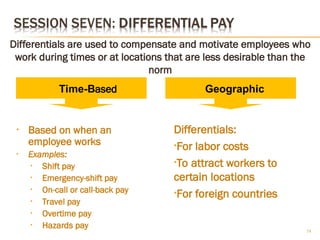
74.
74
Differentials:
•For labor costs
•Toattract workers to
certain locations
•For foreign countries
• Based on when an
employee works
• Examples:
• Shift pay
• Emergency-shift pay
• On-call or call-back pay
• Travel pay
• Overtime pay
• Hazards pay
Time-Based Geographic
Differentials are used to compensate and motivate employees who
work during times or at locations that are less desirable than the
norm
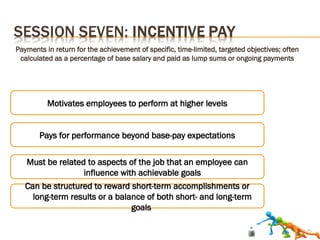
75.
Motivates employees toperform at higher levels
2-75
Payments in return for the achievement of specific, time-limited, targeted objectives; often
calculated as a percentage of base salary and paid as lump sums or ongoing payments
Pays for performance beyond base-pay expectations
Must be related to aspects of the job that an employee can
influence with achievable goals
Can be structured to reward short-term accomplishments or
long-term results or a balance of both short- and long-term
goals
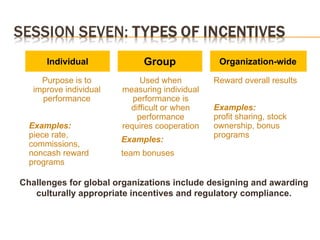
76.
Reward overall results
Examples:
profitsharing, stock
ownership, bonus
programs
Used when
measuring individual
performance is
difficult or when
performance
requires cooperation
Examples:
team bonuses
Purpose is to
improve individual
performance
Examples:
piece rate,
commissions,
noncash reward
programs
Organization-wide
Group
Individual
Challenges for global organizations include designing and awarding
culturally appropriate incentives and regulatory compliance.
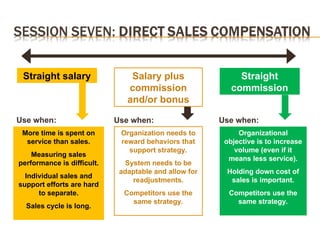
77.
Straight
commission
Salary plus
commission
and/or bonus
Straightsalary
More time is spent on
service than sales.
Measuring sales
performance is difficult.
Individual sales and
support efforts are hard
to separate.
Sales cycle is long.
Organizational
objective is to increase
volume (even if it
means less service).
Holding down cost of
sales is important.
Competitors use the
same strategy.
Use when:
Organization needs to
reward behaviors that
support strategy.
System needs to be
adaptable and allow for
readjustments.
Competitors use the
same strategy.
Use when:
Use when:
Session Eight: Benefits
Tangiblepayments or services provided to broad groups of
employees to cover common issues (e.g., retirement and paid time
off), in addition to those required by law.
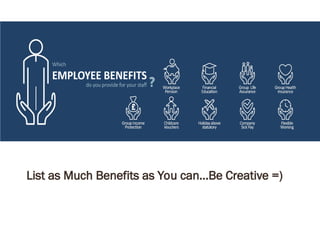
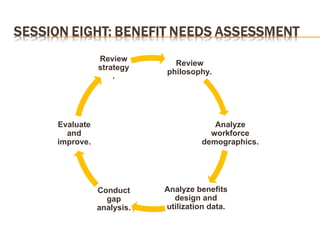
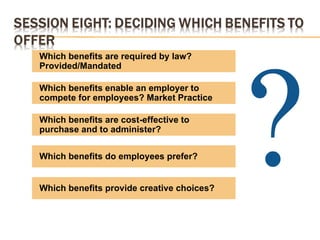
Which benefits arerequired by law?
Provided/Mandated
Which benefits enable an employer to
compete for employees? Market Practice
Which benefits are cost-effective to
purchase and to administer?
Which benefits do employees prefer?
Which benefits provide creative choices?
Geocentric
83.
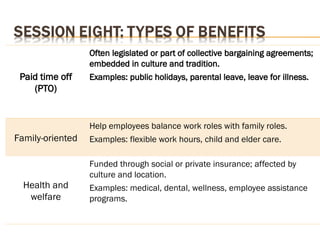
Paid time off
(PTO)
Oftenlegislated or part of collective bargaining agreements;
embedded in culture and tradition.
Examples: public holidays, parental leave, leave for illness.
Family-oriented
Help employees balance work roles with family roles.
Examples: flexible work hours, child and elder care.
Health and
welfare
Funded through social or private insurance; affected by
culture and location.
Examples: medical, dental, wellness, employee assistance
programs.
84.
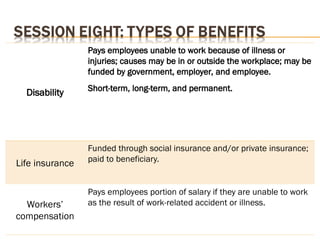
Disability
Pays employees unableto work because of illness or
injuries; causes may be in or outside the workplace; may be
funded by government, employer, and employee.
Short-term, long-term, and permanent.
Life insurance
Funded through social insurance and/or private insurance;
paid to beneficiary.
Workers’
compensation
Pays employees portion of salary if they are unable to work
as the result of work-related accident or illness.
85.
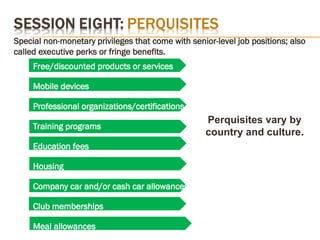
Perquisites vary by
countryand culture.
Free/discounted products or services
Mobile devices
Professional organizations/certifications
Training programs
Education fees
Housing
Company car and/or cash car allowances
Club memberships
Meal allowances
Special non-monetary privileges that come with senior-level job positions; also
called executive perks or fringe benefits.
86.
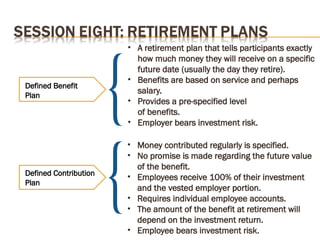
• A retirementplan that tells participants exactly
how much money they will receive on a specific
future date (usually the day they retire).
• Benefits are based on service and perhaps
salary.
• Provides a pre-specified level
of benefits.
• Employer bears investment risk.
Defined Contribution
Plan
• Money contributed regularly is specified.
• No promise is made regarding the future value
of the benefit.
• Employees receive 100% of their investment
and the vested employer portion.
• Requires individual employee accounts.
• The amount of the benefit at retirement will
depend on the investment return.
• Employee bears investment risk.
Defined Benefit
Plan
87.
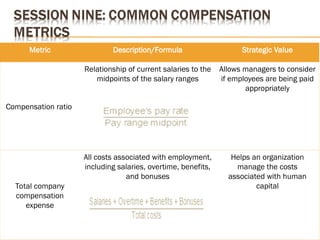
Metric Description/Formula StrategicValue
Compensation ratio
Relationship of current salaries to the
midpoints of the salary ranges
Allows managers to consider
if employees are being paid
appropriately
Total company
compensation
expense
All costs associated with employment,
including salaries, overtime, benefits,
and bonuses
Helps an organization
manage the costs
associated with human
capital
88.
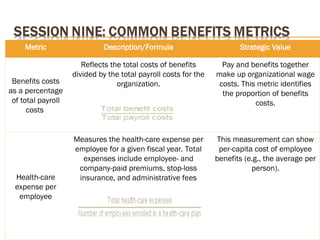
Metric Description/Formula StrategicValue
Benefits costs
as a percentage
of total payroll
costs
Reflects the total costs of benefits
divided by the total payroll costs for the
organization.
Pay and benefits together
make up organizational wage
costs. This metric identifies
the proportion of benefits
costs.
Health-care
expense per
employee
Measures the health-care expense per
employee for a given fiscal year. Total
expenses include employee- and
company-paid premiums, stop-loss
insurance, and administrative fees
This measurement can show
per-capita cost of employee
benefits (e.g., the average per
person).
89.
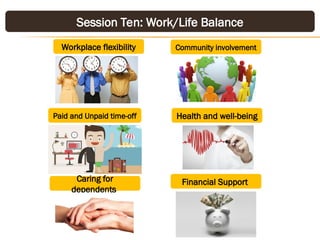
Session Ten: Work/LifeBalance
Workplace flexibility
Paid and Unpaid time-off Health and well-being
Caring for
dependents
Financial Support
Community involvement
90.
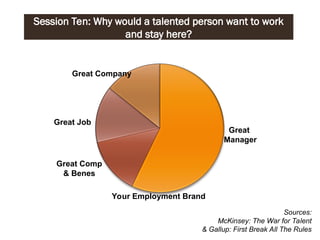
Sources:
McKinsey: The Warfor Talent
& Gallup: First Break All The Rules
Session Ten: Why would a talented person want to work
and stay here?
Great Company
Great Job
Great Comp
& Benes
Great
Manager
Your Employment Brand
91.
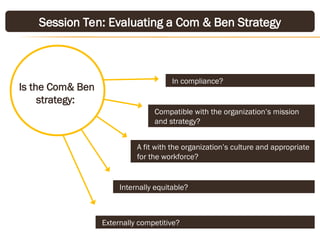
Is the Com&Ben
strategy:
In compliance?
Compatible with the organization’s mission
and strategy?
A fit with the organization’s culture and appropriate
for the workforce?
Internally equitable?
Externally competitive?
Session Ten: Evaluating a Com & Ben Strategy
92.
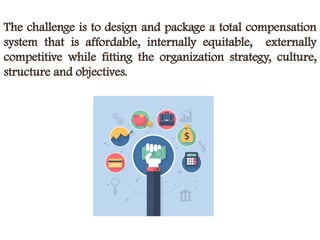
The challenge isto design and package a total compensation
system that is affordable, internally equitable, externally
competitive while fitting the organization strategy, culture,
structure and objectives.