Database API
Your new friend
DrupalCamp Spain 2014
Francisco Alonso Borragán
About me
Francisco Alonso Borragán
Drupal Developer
www.kikoalonsob.com
IRC #drupal_es : kikoalonsob
Twitter : @kikoalonsob
Index
1. Intro
2. Static queries
3. Dynamic queries
1. Select queries
2. Insert queries
3. Update queries
4. Delete queries
4. Query alteration
5. Working against other DB
6. Questions
Intro
Abstraction layer for accessing database servers
Support multiple database servers
Dynamic construction of queries
Enforce security checks and good practices
Provide an interface for intercept and modify queries
Static queries
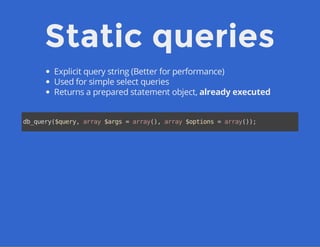
Static queries
Explicit query string (Better for performance)
Used for simple select queries
Returns a prepared statement object, already executed
db_query($query,array$args=array(),array$options=array());
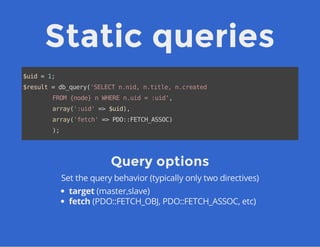
Static queries
$uid=1;
$result=db_query('SELECTn.nid,n.title,n.created
FROM{node}nWHEREn.uid=:uid',
array(':uid'=>$uid),
array('fetch'=>PDO::FETCH_ASSOC)
);
Prefixing
All table names must be wrapped in { }
Static queries
$uid=1;
$result=db_query('SELECTn.nid,n.title,n.created
FROM{node}nWHEREn.uid=:uid',
array(':uid'=>$uid),
array('fetch'=>PDO::FETCH_ASSOC)
);
Placeholders
Literal or an array that will be inserted into a query for execution
Static queries
$uid=1;
$result=db_query('SELECTn.nid,n.title,n.created
FROM{node}nWHEREn.uid=:uid',
array(':uid'=>$uid),
array('fetch'=>PDO::FETCH_ASSOC)
);
Query options
Set the query behavior (typically only two directives)
target (master,slave)
fetch (PDO::FETCH_OBJ, PDO::FETCH_ASSOC, etc)
Static queries
$uid=1;
$result=db_query('SELECTn.nid,n.title,n.created
FROM{node}nWHEREn.uid=:uid',
array(':uid'=>$uid),
array('fetch'=>PDO::FETCH_ASSOC)
);
and...
how to use the result?
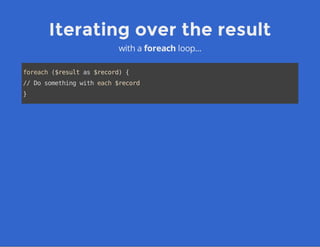
Iterating over the result
with a foreach loop...
foreach($resultas$record){
//Dosomethingwitheach$record
}
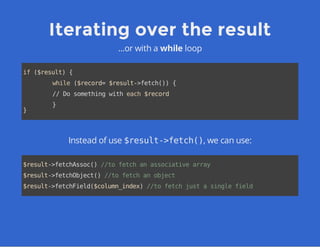
Iterating over the result
...or with a while loop
if($result){
while($record=$result->fetch()){
//Dosomethingwitheach$record
}
}
Instead of use $result->fetch(), we can use:
$result->fetchAssoc()//tofetchanassociativearray
$result->fetchObject()//tofetchanobject
$result->fetchField($column_index)//tofetchjustasinglefield
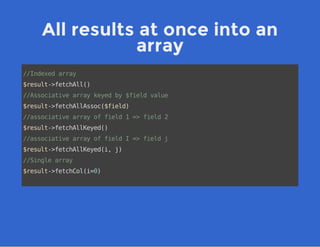
All results at once into an
array
//Indexedarray
$result->fetchAll()
//Associativearraykeyedby$fieldvalue
$result->fetchAllAssoc($field)
//associativearrayoffield1=>field2
$result->fetchAllKeyed()
//associativearrayoffieldI=>fieldj
$result->fetchAllKeyed(i,j)
//Singlearray
$result->fetchCol(i=0)
Dynamic
queries
Dynamic
queries
Dynamically built
Used for some select queries
Used for all insert, update, delete and merge queries
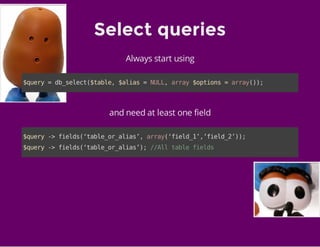
Select queries
Always start using
$query=db_select($table,$alias=NULL,array$options=array());
and need at least one field
$query->fields(‘table_or_alias’,array(‘field_1’,’field_2’));
$query->fields(‘table_or_alias’);//Alltablefields
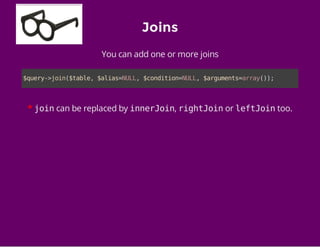
Joins
You can add one or more joins
$query->join($table,$alias=NULL,$condition=NULL,$arguments=array());
* joincan be replaced by innerJoin, rightJoinor leftJointoo.
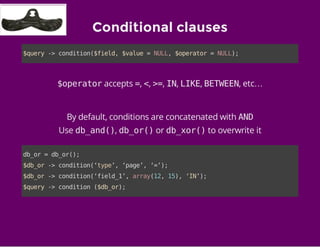
Conditional clauses
$query->condition($field,$value=NULL,$operator=NULL);
$operatoraccepts =, <, >=, IN, LIKE, BETWEEN, etc…
By default, conditions are concatenated with AND
Use db_and(), db_or()or db_xor()to overwrite it
db_or=db_or();
$db_or->condition(‘type’,‘page’,‘=’);
$db_or->condition(‘field_1’,array(12,15),‘IN’);
$query->condition($db_or);
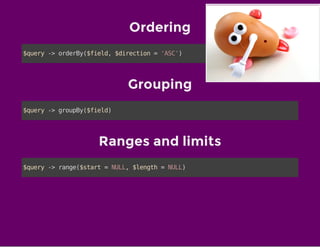
Ordering
$query->orderBy($field,$direction='ASC')
Grouping
$query->groupBy($field)
Ranges and limits
$query->range($start=NULL,$length=NULL)
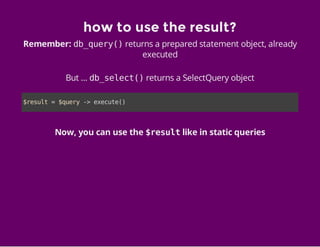
how to use the result?
Remember: db_query()returns a prepared statement object, already
executed
But ... db_select()returns a SelectQuery object
Now, you can use the $resultlike in static queries
$result=$query->execute()
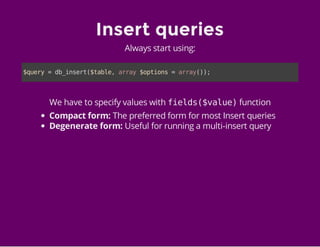
Insert queries
Always start using:
$query=db_insert($table,array$options=array());
We have to specify values with fields($value)function
Compact form: The preferred form for most Insert queries
Degenerate form: Useful for running a multi-insert query
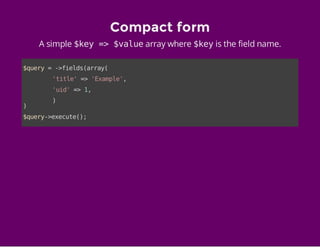
Compact form
A simple $key => $valuearray where $keyis the field name.
$query=->fields(array(
'title'=>'Example',
'uid'=>1,
)
)
$query->execute();
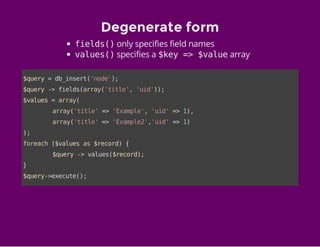
Degenerate form
fields()only specifies field names
values()specifies a $key => $valuearray
$query=db_insert('node');
$query->fields(array('title','uid'));
$values=array(
array('title'=>'Example','uid'=>1),
array('title'=>'Example2','uid'=>1)
);
foreach($valuesas$record){
$query->values($record);
}
$query->execute();
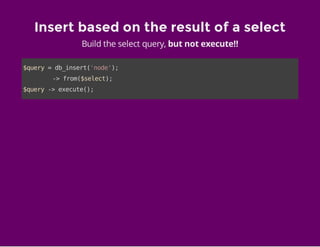
Insert based on the result of a select
Build the select query, but not execute!!
$query=db_insert('node');
->from($select);
$query->execute();
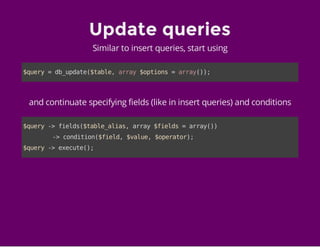
Update queries
Similar to insert queries, start using
$query=db_update($table,array$options=array());
and continuate specifying fields (like in insert queries) and conditions
$query->fields($table_alias,array$fields=array())
->condition($field,$value,$operator);
$query->execute();
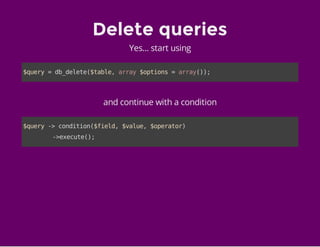
Delete queries
Yes... start using
$query=db_delete($table,array$options=array());
and continue with a condition
$query->condition($field,$value,$operator)
->execute();
Query alteration
Most interesting feature of this API (IMHO)
Allow other modules to alter queries on the fly
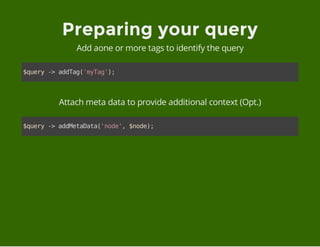
Preparing your query
Add aone or more tags to identify the query
$query->addTag('myTag');
Attach meta data to provide additional context (Opt.)
$query->addMetaData('node',$node);
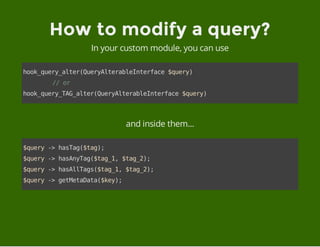
How to modify a query?
In your custom module, you can use
hook_query_alter(QueryAlterableInterface$query)
//or
hook_query_TAG_alter(QueryAlterableInterface$query)
and inside them...
$query->hasTag($tag);
$query->hasAnyTag($tag_1,$tag_2);
$query->hasAllTags($tag_1,$tag_2);
$query->getMetaData($key);
In your mymodule.views.inc
hook_views_query_alter(&$view,&$query);
Can I modify a views query?
Yes, you can!
Working against
other DB
In your settings.php:
$databases=array();
$databases['default']['default']=array(
//Drupal'sdefaultcredentialshere.
);
$databases['my_other_db']['default']=array(
//Yoursecondarydatabase'scredentialshere.
);
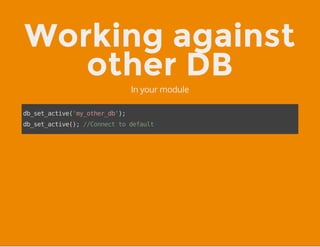
Working against
other DB
In your module
db_set_active('my_other_db');
db_set_active();//Connecttodefault
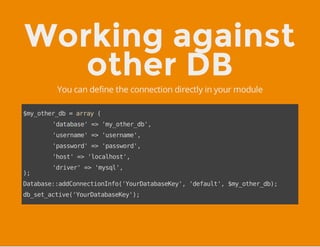
Working against
other DB
You can define the connection directly in your module
$my_other_db=array(
'database'=>'my_other_db',
'username'=>'username',
'password'=>'password',
'host'=>'localhost',
'driver'=>'mysql',
);
Database::addConnectionInfo('YourDatabaseKey','default',$my_other_db);
db_set_active('YourDatabaseKey');
2
thanks

Database API, your new friend