Lesson Plan 
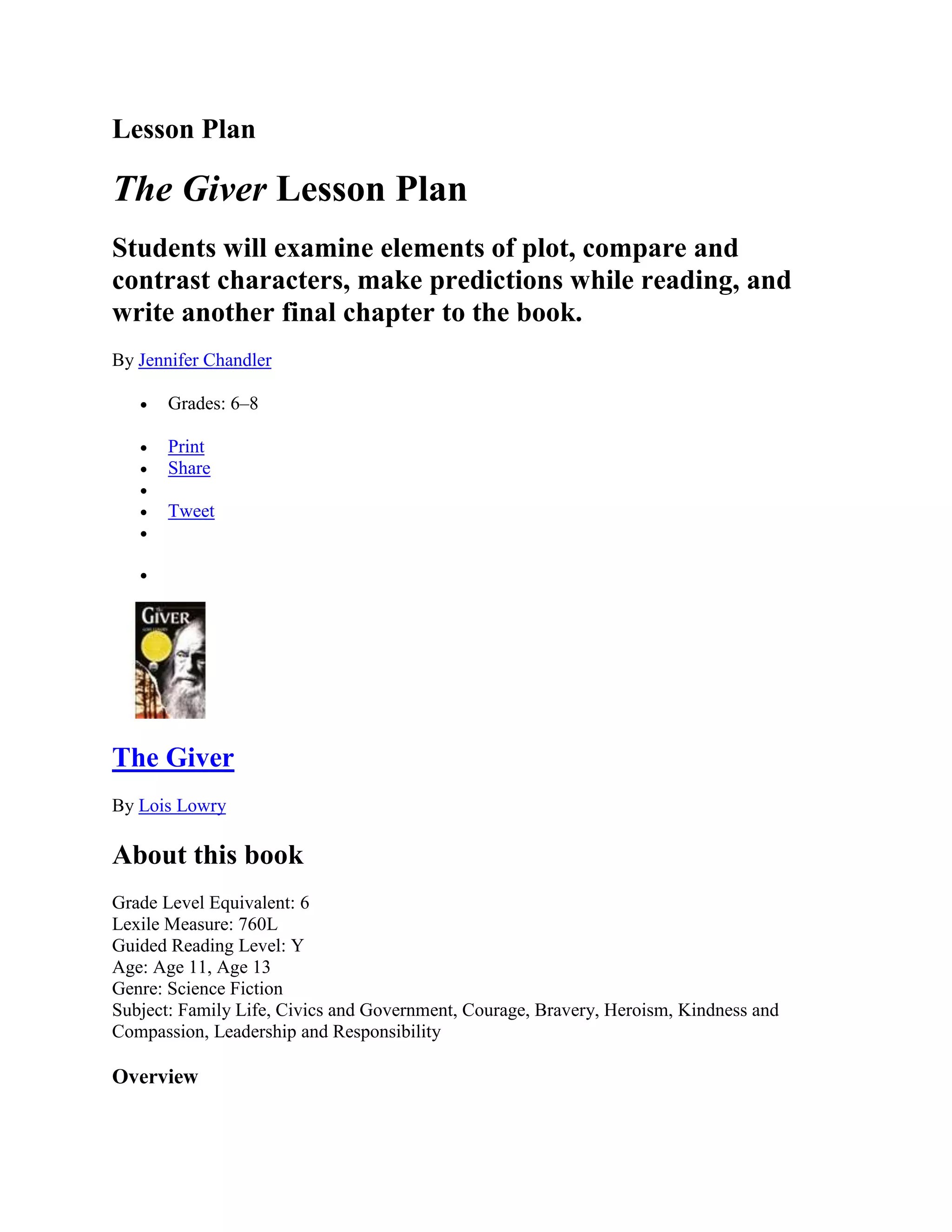
The Giver Lesson Plan 
Students will examine elements of plot, compare and 
contrast characters, make predictions while reading, and 
write another final chapter to the book. 
By Jennifer Chandler 
 Grades: 6–8 
 Print 
 Share 
 
 Tweet 
 
 
The Giver 
By Lois Lowry 
About this book 
Grade Level Equivalent: 6 
Lexile Measure: 760L 
Guided Reading Level: Y 
Age: Age 11, Age 13 
Genre: Science Fiction 
Subject: Family Life, Civics and Government, Courage, Bravery, Heroism, Kindness and 
Compassion, Leadership and Responsibility 
Overview
Not only is The Giver a superlative example of character development, this novel provokes 
opinions from students on philosophical issues surrounding the structure of human society. My 
students loved writing an additional chapter to the book. The chapters were short enough to 
allow for sharing time, and it was amazing to me to see their creativity. 
Objective 
 Students will examine elements of plot, specifically conflict, climax, and resolution. 
 Students will compare and contrast main characters. 
 Students will make predictions while reading. 
 Students will complete all the steps of the writing process to write another final chapter 
of the story. 
Materials 
 The Giver by Lois Lowry 
Set Up and Prepare 
Have students brainstorm distinctive memories from growing up. Make sure memories are in 
complete sentences but in list form. (You will want to schedule some time for students to share 
as there will be stories to tell!) 
Ask students to go back and reread the list. Next to each memory, each student should categorize 
the description based on the remembered emotion. For example, a child's first trip to Disney 
World would be labeled as "exciting." A child's memory of a grandparent dying might be labeled 
as "traumatic" or "very sad." 
Lead the class in a discussion of whether or not they would choose to forget some of their 
memories — maybe in order to forgo the painful remembrance of an event. *This is an 
anticipatory set. Have students record conclusions, then take up the papers for review at the end 
of the unit. 
Directions 
Students should fill in a plot diagram while reading to identify the main elements of conflict, 
climax, and resolution. These are key elements to consider when writing an additional chapter in 
the book. 
Supporting All Learners
Every student I've ever taught has loved this novel! While the vocabulary is rich, the novel is 
easily understood by any middle school reader. The content is rich enough for ninth grade if 
some extensions are put into place, but the book would also be a great literature circle choice for 
some lower level high school readers. 
Lesson Extensions 
There are two wonderful activities that have been supremely successful with my students. 
1. Have students write an additional chapter to the story. Depending on the grade level of 
the students, requirements for this will vary. Students should consider reasonable 
predictions based on the elements in the original story, but a real chapter with description 
and dialogue (as needed) should be encouraged. 
2. As students come into the classroom one day during the unit, hand each of them an 
envelope. Tell them not to open the envelope. At an opportune moment, after building 
this up, explain that you are having a ceremony to announce what each student will be 
doing with the rest of their lives. Just like in the novel, the students have no say as to their 
future roles in society. (It works well to set some students up on purpose to have jobs 
that are contradictory to their current situation.) 
To make this really interesting, depending on your population of students, these could be 
jobs within the classrooms that require certain students to pass out papers addressing 
everyone else as m'am or sir while other students don't even have to take notes for the rest 
of the period. The fun happens during the last ten minutes or so when the students discuss 
how this feels to them. The homework that night could even be a reflective journal entry 
that will explore the activity while in turn expose the core theme of the novel. 
Assignments 
Have students discuss the last chapter in small groups. What does it mean? Where did he go? 
This would be a great opportunity for differentiation. Artists in your classroom may want to draw 
or paint the last scene. Music lovers might want to compile a soundtrack for the novel using 
various genres of music. Kinesthetic learners may prefer to block and act out an important scene 
from the novel. There are many ways to celebrate the reading of a great book! 
Related Resources
Lois Lowry's official website 
Scholastic Book Files: A Reading Guide to The Giver 
Literature Guide: The Giver 
Lois Lowry's Biography 
Related Resources 
Scholastic Bookfiels:The Giver by Lois Lowry 
"The Giver" by Lois Lowry is a favorite middle grade novel. This companion gives background 
on the author, including an interview, questions to guide reading, clues to themes, plot, 
characters, and setting of the book, a glossary, writing and other activities, and more. If you 
loved "The Giver", you need this reading companion. 
Read more > 
The Giver Author's Notes 
December is the time of the annual Ceremony at which each 12-year-old receives a life 
assignment determined by the Elders. Jonas'selection leads him to an unnamed man — called 
the Giver — and a new world of secrets. 
Read more > 
 Subjects: 
Literary Devices, Plot, Character, Setting, Story Elements, Creative Writing, Narrative 
Writing 
 Skills: 
Development of Reading Comprehension, Literary Elements, Main Idea and Details, 
Plot, Character and Setting, Theme, Narrative Writing 
 Duration: 
2 Weeks

The giver lesson plan

  • 1.
    Lesson Plan TheGiver Lesson Plan Students will examine elements of plot, compare and contrast characters, make predictions while reading, and write another final chapter to the book. By Jennifer Chandler  Grades: 6–8  Print  Share   Tweet   The Giver By Lois Lowry About this book Grade Level Equivalent: 6 Lexile Measure: 760L Guided Reading Level: Y Age: Age 11, Age 13 Genre: Science Fiction Subject: Family Life, Civics and Government, Courage, Bravery, Heroism, Kindness and Compassion, Leadership and Responsibility Overview
  • 2.
    Not only isThe Giver a superlative example of character development, this novel provokes opinions from students on philosophical issues surrounding the structure of human society. My students loved writing an additional chapter to the book. The chapters were short enough to allow for sharing time, and it was amazing to me to see their creativity. Objective  Students will examine elements of plot, specifically conflict, climax, and resolution.  Students will compare and contrast main characters.  Students will make predictions while reading.  Students will complete all the steps of the writing process to write another final chapter of the story. Materials  The Giver by Lois Lowry Set Up and Prepare Have students brainstorm distinctive memories from growing up. Make sure memories are in complete sentences but in list form. (You will want to schedule some time for students to share as there will be stories to tell!) Ask students to go back and reread the list. Next to each memory, each student should categorize the description based on the remembered emotion. For example, a child's first trip to Disney World would be labeled as "exciting." A child's memory of a grandparent dying might be labeled as "traumatic" or "very sad." Lead the class in a discussion of whether or not they would choose to forget some of their memories — maybe in order to forgo the painful remembrance of an event. *This is an anticipatory set. Have students record conclusions, then take up the papers for review at the end of the unit. Directions Students should fill in a plot diagram while reading to identify the main elements of conflict, climax, and resolution. These are key elements to consider when writing an additional chapter in the book. Supporting All Learners
  • 3.
    Every student I'veever taught has loved this novel! While the vocabulary is rich, the novel is easily understood by any middle school reader. The content is rich enough for ninth grade if some extensions are put into place, but the book would also be a great literature circle choice for some lower level high school readers. Lesson Extensions There are two wonderful activities that have been supremely successful with my students. 1. Have students write an additional chapter to the story. Depending on the grade level of the students, requirements for this will vary. Students should consider reasonable predictions based on the elements in the original story, but a real chapter with description and dialogue (as needed) should be encouraged. 2. As students come into the classroom one day during the unit, hand each of them an envelope. Tell them not to open the envelope. At an opportune moment, after building this up, explain that you are having a ceremony to announce what each student will be doing with the rest of their lives. Just like in the novel, the students have no say as to their future roles in society. (It works well to set some students up on purpose to have jobs that are contradictory to their current situation.) To make this really interesting, depending on your population of students, these could be jobs within the classrooms that require certain students to pass out papers addressing everyone else as m'am or sir while other students don't even have to take notes for the rest of the period. The fun happens during the last ten minutes or so when the students discuss how this feels to them. The homework that night could even be a reflective journal entry that will explore the activity while in turn expose the core theme of the novel. Assignments Have students discuss the last chapter in small groups. What does it mean? Where did he go? This would be a great opportunity for differentiation. Artists in your classroom may want to draw or paint the last scene. Music lovers might want to compile a soundtrack for the novel using various genres of music. Kinesthetic learners may prefer to block and act out an important scene from the novel. There are many ways to celebrate the reading of a great book! Related Resources
  • 4.
    Lois Lowry's officialwebsite Scholastic Book Files: A Reading Guide to The Giver Literature Guide: The Giver Lois Lowry's Biography Related Resources Scholastic Bookfiels:The Giver by Lois Lowry "The Giver" by Lois Lowry is a favorite middle grade novel. This companion gives background on the author, including an interview, questions to guide reading, clues to themes, plot, characters, and setting of the book, a glossary, writing and other activities, and more. If you loved "The Giver", you need this reading companion. Read more > The Giver Author's Notes December is the time of the annual Ceremony at which each 12-year-old receives a life assignment determined by the Elders. Jonas'selection leads him to an unnamed man — called the Giver — and a new world of secrets. Read more >  Subjects: Literary Devices, Plot, Character, Setting, Story Elements, Creative Writing, Narrative Writing  Skills: Development of Reading Comprehension, Literary Elements, Main Idea and Details, Plot, Character and Setting, Theme, Narrative Writing  Duration: 2 Weeks