International Journal of Electrical and Computer Engineering (IJECE)
Vol. 8, No. 1, February 2018, pp. 513~520
ISSN: 2088-8708, DOI: 10.11591/ijece.v8i1.pp513-520  513
Journal homepage: http://iaescore.com/journals/index.php/IJECE
Comparative Analysis of Linear Controllers used for Grid
Connected PV System
Ritesh Dash, Sarat Chandra Swain, Sanhita Mishra
School Of Electrical Engineering, KIIT University, India
Article Info ABSTRACT
Article history:
Received Nov 1, 2017
Revised Jan 5, 2018
Accepted Jan 17, 2018
Requirement for electrical energy is increasing in a ramp function manner.
To meet the steady increasing in energy demand it is required to find some
alternate source of energy. Except the conventional source of energy one
type of renewable energy i.e PV may be regarded as a clean source of energy
to meet the energy demand. PV modules generating DC power cannot be
directly connected to the electrical infrastructure as most of the grid
infrastructure uses either 230volt or 120 volt. Therefore power electronic
device most be connected (inverter) between PV and grid. In order to make a
competitive market between the renewable generated power and
conventional way of generating the power it is required to design a cost
effective inverter, qualitative output which is pure sinusoidal and harmonics
free. In this paper a comparative analysis among the various linear
controllers are presented. Proposed Optimised PID Controller is Presented
through MATLAB Simulink based environment.
Keyword:
Optimised PID controller
PI-controller
PR-controller
Solar PV System
State feedback controller
Copyright © 2018 Institute of Advanced Engineering and Science.
All rights reserved.
Corresponding Author:
Ritesh Dash,
School Of Electrical Engineering,
KIIT University,
Bhubaneswar, India.
Email: rdasheee@gmail.com
1. INTRODUCTION
Power generation through photo voltaic module is increasing throughout the global and their by
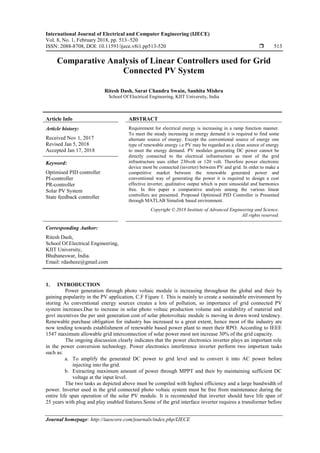
gaining popularity in the PV application, C.F Figure 1. This is mainly to create a sustainable environment by
storing As conventional energy sources creates a lots of pollution, so importance of grid connected PV
system increases.Due to increase in solar photo voltaic production volume and avalability of material and
govt incentives the per unit generation cost of solar photovoltaic module is moving in down word tendency.
Renewable purchase obligation for industry has increased to a great extent, hence most of the industry are
now tending towards establishment of renewable based power plant to meet their RPO. According to IEEE
1547 maximum allowable grid interconnection of solar power most not increase 30% of the grid capacity.
The ongoing discussion clearly indicates that the power electronics inverter plays an important role
in the power conversion technology. Power electronics interference inverter perform two important tasks
such as:
a. To amplify the generated DC power to grid level and to convert it into AC power before
injecting into the grid.
b. Extracting maximum amount of power through MPPT and their by maintaining sufficient DC
voltage at the input level.
The two tasks as depicted above must be compiled with highest efficiency and a large bandwidth of
power. Inverter used in the grid connected photo voltaic system must be free from maintenance during the
entire life span operation of the solar PV module. It is recomended that inverter should have life span of
25 years with plug and play enabled features.Some of the grid interface inverter requires a transformer before
 ISSN: 2088-8708
Int J Elec & Comp Eng, Vol. 8, No. 1, February 2018 : 513 – 520
514
injecting the AC voltage into the grid because presnce of DC in AC cause distortion. Some of the countries
like Australia, Italy, England, and japan made it mandatory to use transformer while injecting the AC power
into the grid.
2. GRID SYNCHRONISATION METHOD
The main task while interconnecting the inverter with the grid requires proper tracking of three
phase grid frequency phase angle and maintenance of proper voltage level at the terminal of inverter. Both
voltage control and current control method uses pulse width modulation techniques for inverter switching
frequency or pulse generation. Two types of current control techniques have been described over here. These
current control techniques can be classified as linear controller and non-linear controller. Linear controller
mainly consists of PI controller, PR controller, dead beat controller, repetitive current controller. Whereas
non-linear controller consists of hysteresis controller, ANN based controller, fuzzy inference controller and a
new type fractional order controller.
2.1. Stationary Reference Frame of Control
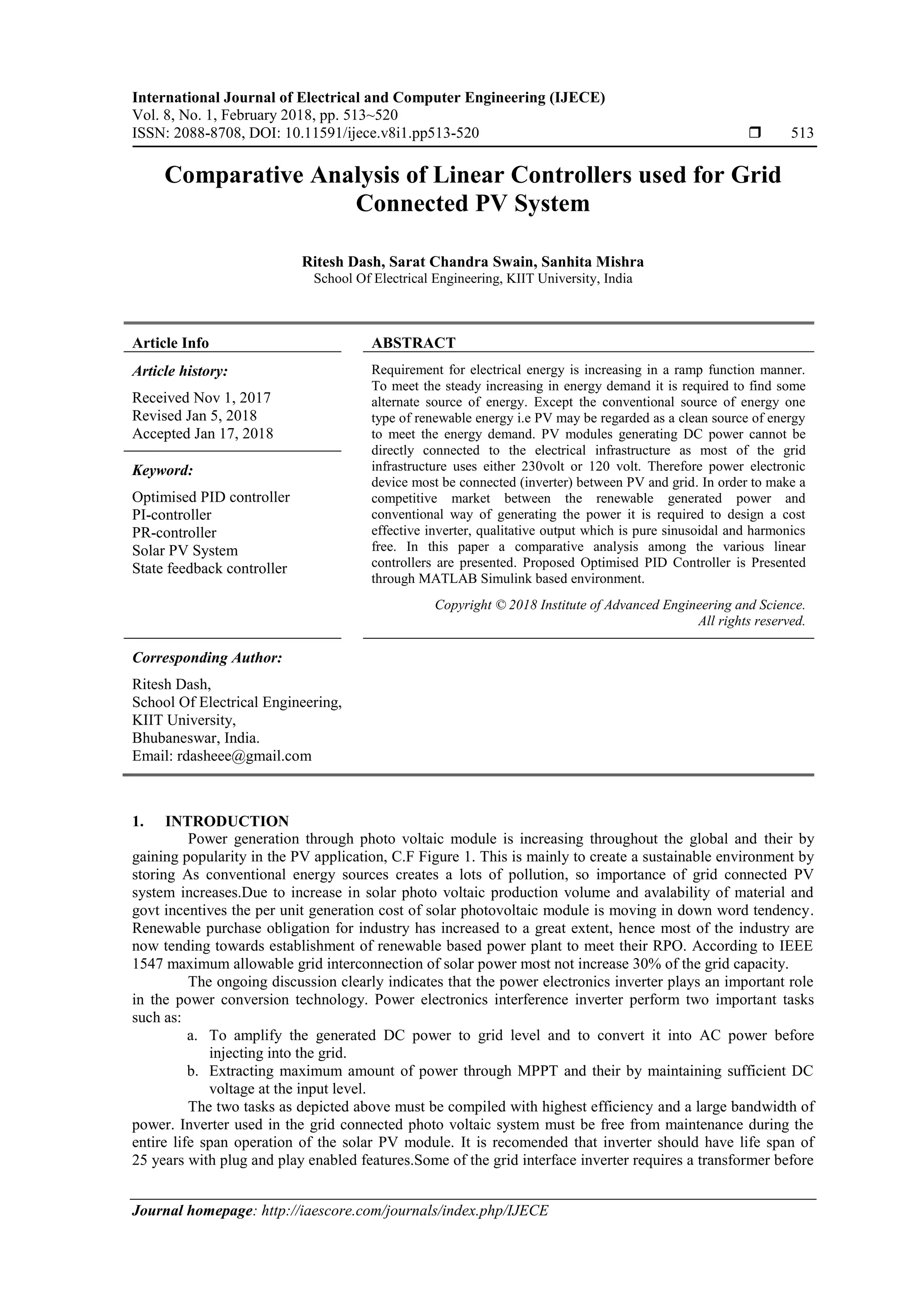
Stationary reference frame of control usually employs a PI controller to regulate the power flow
from the inverter side into the grid side. It usually consists of three number of PI error compensator, which is
further processed. Output of the PI controller has two parts integration and proportional parts integration part
provides compensation against low frequency of operation whereas proportion part provides compensation
against zero placement. Figure 1 shows the stationary reference frame of control.
RAMP
GENERATOR
THREE PHSE
LOAD
Sa,b,c
Ia,b,c
Figure 1. Stationary Ref. Frame of Control
2.2. Synchronous Reference Frame of Control
Some typical and precise industrial application required un-distorted source of current. A small
distortion in phase and amplitude may cause some undesirable effect in the industrial drivers. This type of
system requires space vector modulation approach to be implemented for the control of system. Therefore
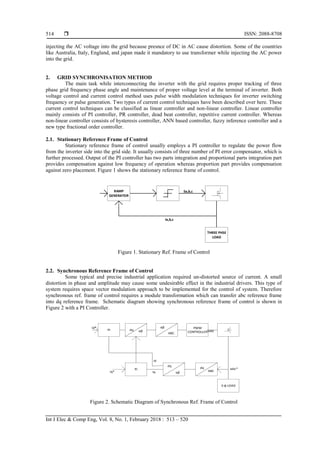
synchronous ref. frame of control requires a module transformation which can transfer abc reference frame
into dq reference frame. Schematic diagram showing synchronous reference frame of control is shown in
Figure 2 with a PI Controller.
PI
PWM
CONTROLLER
PI
3-ɸ LOAD
ABC
dq αβ
αβ
dq
ABC
dq
αβIq
Id
Iq*
Id*
Sabc
Iabc*
Figure 2. Schematic Diagram of Synchronous Ref. Frame of Control
Int J Elec & Comp Eng ISSN: 2088-8708 
Comparative Analysis of Linear Controllers used for Grid Connected (Ritesh Das)
515
Here the required dc-link voltage is controlled depending upon the output requirement through a
filter capacity. Two independent controller one for voltage and one for current is applied. The reference
voltage for the controller depends upon the peak grid voltage and voltage loss on drop occurring at the
switches, therefore minimum dc reference that is to be maintained can be found by using Equation (1)
,min , ,DC DC ave DC rippleV V V  (1)
Where
,
2 . .
,
DC
DC ripple
DC ave DC
P
V
V C
 (2)
Comparing Equation (1) and (2)
, ,min ,DC ave DC DC rippleV V V  (3)
Multiplying VDC,avg on both side of Equation (3), it becomes
2
,min ,
( ), 2
dc
DC DC ave
DC
P
V VDC ave wC
V   (4)
Equation (6) clearly revels that, it is a second order polynomial equation, whose solution may be
written as:
2
,min
1
4
,min 2
, 2
( ) DC
DC
DC
V DC
DC avg
PV
CV

 
 (5)
Or,
, min, , min , min
( ) ( )DC DC no alDC ref DC no al grid grid no alV V V VP P      (6)
Where,
tan
, min
1
2.
21
.
2
conduc ce
DC
grid no al
Z
C
V



 (7)
And 2  (8)
Therefore from (7) and (8) it is clear that α can be controlled through frequency domain whereas β is
maintained constant.
In order to maintain a constant DC reference, it is required to implement the DC, Controller.
2
. .( 1)
( )
. ( 1)
sqs p
sys Pc
ST
H s
T ST
K K
S C K K


 
(9)
where
, min ,
, min
2.
grid no al ripple
sys
DC No al
V
K
V

 ISSN: 2088-8708
Int J Elec & Comp Eng, Vol. 8, No. 1, February 2018 : 513 – 520
516
Equation (9) shows that close loop control action of the considered controller. Therefore the
controller can be evaluated through natural frequency and damping ratio.
where,
.
.
sys P
n
DC
T
K K
C
 
.
2. .
sys P
n DC
K K
C


 .3,
,
2. grid THD
P
DC ripple
I
K
V

2.3. PR Controller
Limitation of PI controller while tracking the sinusoidal signal for compensation against error leads
to the designing of PR controller. The controller matrix of PR controller provides infinite gain at the resonant
frequency. Due to absence of cross coupling of control for a three phase voltage source converter.
Three phase voltages and currents are transformed into α, β reference frame using dark
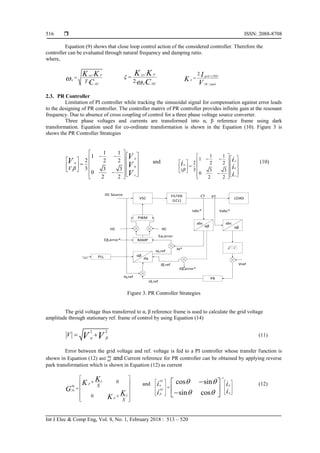
transformation. Equation used for co-ordinate transformation is shown in the Equation (10). Figure 3 is
shows the PR Controller Strategies
1 1
1
2 2 2
3 3 3
0
2 2
a
b
c
V
V
V V
V


        
    
        
and
1 1
1
2 2 2
3 3 3
0
2 2
a
b
c
i
i
i i
i


        
    
        
(10)
VSC
FILTER
(LCL)
LOAD
PWM
RAMP
2 2
V V 

PLL
PR
DC Source CT PT
Iabc* Vabc*
VrefIβ,ref
Iα,ref
Eα,error
Iα*
HCHC
Iq,ref
Id,ref
Eβ,error*
Eβ,error*
Vabc* dq
abc
αβ
abc
αβ
αβ
Figure 3. PR Controller Strategies
The grid voltage thus transferred to α, β reference frame is used to calculate the grid voltage
amplitude through stationary ref. frame of control by using Equation (14)
2 2
V V V 
  (11)
Error between the grid voltage and ref. voltage is fed to a PI controller whose transfer function is
shown in Equation (12) as and Current reference for PR controller can be obtained by applying reverse
park transformation which is shown in Equation (12) as current
0
0
i
P
dq
PI
i
P
S
S
K
K
G
K
K
 
 
 
 
 
 
and
1
.
.
cos sin
sin cos
ref
d
ref
q
i i
ii


 
 

   
    
     
 
  
(12)
Int J Elec & Comp Eng ISSN: 2088-8708 
Comparative Analysis of Linear Controllers used for Grid Connected (Ritesh Das)
517
Equation (13) represent two gain matrix,1st one rerevels that presence of high gain around the
resonance frequency helps in elimination of steady state error and However in order to achieve infinite gain,
modified PR controller may be used as second matrix of equation( 13).
2 2
2 2
0
0
i
P
PR
i
P
S
S
K
K
S
G
K
K
S
 

 
 
 
  
 
  
2 2 2
0
2 2 2
0
2
0
2
2
0
2
C
P i
PR
C
P i
S
S
S
S
K K
S
G
K K
S


 

 
 
 
  
  
 
   
(13)
Natural reference frame of control or abc controller uses three independent controller for three no. of
phases individually. However use of star, delta connection and isolated design system (Neutral) are some of
the critical issues which needs to be addressed while designing the controller. Therefore it can be assumed
that by using two controller for two different phases, current in other phases can be automatically adjusted.
Real time implementation of controller is an issue. The advantages of the controller can be found
out through the implementation of controller in digital electronics. Non-linear controller at the cost of linear
controller have many advantages. Transfer matrix implementing PI and PR controller in abc natural frame of
reference is shown in Equation (14) and Equation (15) respectively.
(14)
2 2
0
2 2
0
2 2
0
0 0
0 0
0 0
i
p
abc i
pPR
i
p
S
S
S
K
K
S
KG K
S
K
K
S



 
 
 
 
 
   
 
 
  
(15)
3. EXPERIMENTAL RESULTS
An inverter prototype for 100Kwatt solar PV grid connected system has been designed with
MATLAB Simulink. Grid connectd system is designed to inject maximum amount of power strictly to the
maximum outgoing feeder connected to that particular system. PWM controller has been used to generate
pulses so as to inject maximum amount of power.
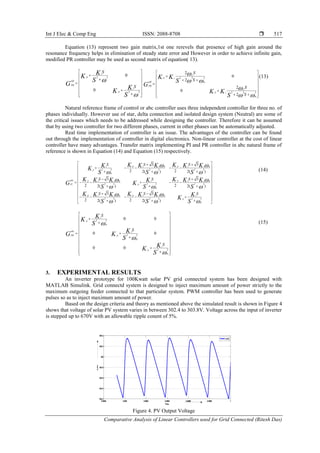
Based on the design criteria and theory as mentioned above the simulated result is shown in Figure 4
shows that voltage of solar PV system varies in between 302.4 to 303.8V. Voltage across the input of inverter
is stepped up to 670V with an allowable ripple conent of 5%.
Figure 4. PV Output Voltage
0 0
2 2 2 2 2 2
0
0 0
2 2 2 2 2 2
0
0 0
2 2 2 2 2 2
0
3 3
2 22( ) 2( )
3 3
2 22( ) 2( )
3 3
2 22( ) 2( )
p pi i i ii
p
abc p pi i i ii
pPI
p pi i i i i
p
S SS
S SS
S S S
K KK K K KK
K
S S S
K KK K K KKG K
S S S
K KK K K K K
K
S S S
 
  
 
  
 
  
  
     
   
 
  
      
   
 
      
    
0.9988 0.999 0.9992 0.9994 0.9996 0.9998 1
304.2
304.4
304.6
304.8
305
305.2
305.4
Time
V-PV
V-PV
 ISSN: 2088-8708
Int J Elec & Comp Eng, Vol. 8, No. 1, February 2018 : 513 – 520
518
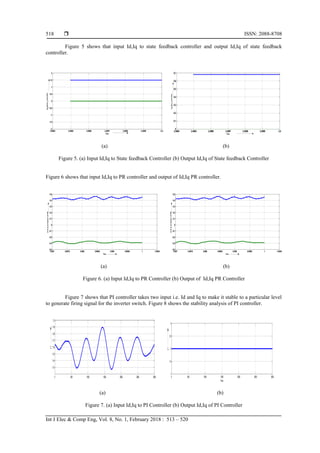
Figure 5 shows that input Id,Iq to state feedback controller and output Id,Iq of state feedback
controller.
(a) (b)
Figure 5. (a) Input Id,Iq to State feedback Controller (b) Output Id,Iq of State feedback Controller
Figure 6 shows that input Id,Iq to PR controller and output of Id,Iq PR controller.
(a) (b)
Figure 6. (a) Input Id,Iq to PR Controller (b) Output of Id,Iq PR Controller
Figure 7 shows that PI controller takes two input i.e. Id and Iq to make it stable to a particular level
to generate firing signal for the inverter switch. Figure 8 shows the stability analysis of PI controller.
(a) (b)
Figure 7. (a) Input Id,Iq to PI Controller (b) Output Id,Iq of PI Controller
2.4994 2.4995 2.4996 2.4997 2.4998 2.4999 2.5
-2
-1.5
-1
-0.5
0
0.5
1
1.5
2
Time
Id
B
efore
C
ontroller
2.4994 2.4995 2.4996 2.4997 2.4998 2.4999 2.5
0
0.1
0.2
0.3
0.4
0.5
0.6
0.7
Time
Id
A
fter
C
ontroller
0.997 0.9975 0.998 0.9985 0.999 0.9995 1 1.0005
-0.4
-0.3
-0.2
-0.1
0
0.1
0.2
0.3
0.4
0.5
Id&IqatOutputofPR
Time
0.997 0.9975 0.998 0.9985 0.999 0.9995 1 1.0005
-0.4
-0.3
-0.2
-0.1
0
0.1
0.2
0.3
0.4
0.5
Id&IqatOutputofPR
Time
0 500 1000 1500 2000 2500 3000
1.13
1.14
1.15
1.16
1.17
1.18
1.19
1.2
y1
Inputandoutputsignals
0 500 1000 1500 2000 2500 3000
1
1.5
2
2.5
3
u1
0 500 1000 1500 2000 2500 3000
1.13
1.14
1.15
1.16
1.17
1.18
1.19
1.2
y1
Inputandoutputsignals
0 500 1000 1500 2000 2500 3000
1
1.5
2
2.5
3
Time
u1
Int J Elec & Comp Eng ISSN: 2088-8708 
Comparative Analysis of Linear Controllers used for Grid Connected (Ritesh Das)
519
Figure 9 shows the stability analysis of PR controller.
Figure 10 shows the stability analysis of state feedback controller.
Figure 8. Stability Analysis of PI Controller Figure 9. Stability analysis of PR Controller
Figure 10. Stability analysis of State feedback Controller
4. CONCLUSION
Evaluation of the linear controller has been carried out under a steady state condition. Power
injected into the grid is maintained at aparticular level by fixing the voltage. Current injection quantity has
been increasesd by applying different controller. Stability analysis of all the discussed controller has been
presented with Nyquist plot to check the stability.Best on the result PI controller is found to be best one under
non transient condition. PR- controller shows high gain around the resonance frequency thereby increasing
the grid current injection level and real power transmission.
ACKNOWLEDGEMENT
Authors would like to give thanks to the school of electrical engineering for providing necessary
laboratory arrangement and experimental setup to carry out the experiment on linear controller.
REFERENCES
[1] R. M. Essefi, M. Souissi and H. H. Abdallah, "Linear current control technique for grid connected photovoltaic
system," Sciences and Techniques of Automatic Control and Computer Engineering (STA), 2013 14th International
Conference on, Sousse, 2013, pp. 432-437.
[2] H.H. Sait, S.A. Daniel, “New control paradigm for integration of photovoltaic energy sources with utility network,”
International journal of Electrical Power & Energy Systems, Vol. 33(Issue 1):86-93, January 2011.
[3] G. Shen, D. Xu, L. Cao, X. Zhu, “An Improved Control Strategy for Grid-Connected Voltage Source Inverters
With an LCL Filter,” IEEE Transactions on Power Electronics, Vol. 23(Issue 4):1899-1906, July 2008.
-1 -0.5 0 0.5
-0.4
-0.3
-0.2
-0.1
0
0.1
0.2
0.3
0.4
0 dB
-20 dB
-10 dB-6 dB-4 dB-2 dB
20 dB
10 dB
6 dB 4 dB 2 dB
Nyquist Diagram
Real Axis
ImaginaryAxis
-2.5 -2 -1.5 -1 -0.5 0 0.5 1
-2.5
-2
-1.5
-1
-0.5
0
0.5
1
1.5
2
2.5
0 dB
-20 dB
-10 dB
-6 dB
-4 dB
-2 dB
20 dB
10 dB
6 dB
4 dB
2 dB
System: H
Real: -0.347
Imag: -2.02
Frequency (rad/s): -0.000415
NyquistDiagram
RealAxis
ImaginaryAxis
-5 -4 -3 -2 -1 0 1 2 3 4
-8
-6
-4
-2
0
2
4
6
8
0 dB
-10 dB
-6 dB
-4 dB
-2 dB
10 dB
6 dB
4 dB
2 dB
NyquistDiagram
RealAxis
ImaginaryAxis
 ISSN: 2088-8708
Int J Elec & Comp Eng, Vol. 8, No. 1, February 2018 : 513 – 520
520
[4] S. Fukuda, T. Yoda, "A novel current-tracking method for active filters based on a sinusoidal internal model", IEEE
Trans. Ind. Appl., vol. 37, no. 3, pp. 888-895, May/Jun. 2001.
[5] M. Liserre, R. Teodorescu, F. Blaabjerg, "Stability of photovoltaic and wind turbine grid-connected inverters for a
large set of grid impedance values", IEEE Trans. Power Electron., vol. 21, no. 1, pp. 263-272, Jan. 2006.
[6] M. Liserre, F. Blaabjerg, S. Hansen, "Design and control of an LCL-filter based active rectifier", IEEE Trans. Ind.
Appl., vol. 41, no. 5, pp. 1281-1291, Sep./Oct. 2005.
[7] M. Liserre, R. Teodorescu, F. Blaabjerg, "Multiple harmonics control for three-phase grid converter systems with
the use of PI-RES current controller in a rotating frame", IEEE Trans. Power Electron., vol. 21, no. 3, pp. 836-841,
May 2006.
[8] D. N. Zmood, D. G. Holmes, G. H. Bode, "Frequency-domain analysis of three-phase linear current
regulators", IEEE Trans. Ind. Appl., vol. 37, no. 2, pp. 601-610, Mar./Apr. 2001.
[9] R. Zhang, M. Cardinal, P. Szczesny, M. Dame, "A grid simulator with control of single-phase power converters in
D-Q rotating frame", Proc. PESC'02, vol. 2, pp. 1431-1436, 2002.
BIOGRAPHIES OF AUTHORS
Ritesh Dash holds an M.Tech in Power & Energy System from School of Electrical Engineering,
KIIT University and presently a research scholar at School of Electrical Engineering, KIIT
University. His research interests includes Linear & non linear controller, Inverter topologies,
Renewable systems.
Sarat Chandra Swain holds a Ph.D degree in Elelctrrical Engineering from School of Electrical
Engineering, KIIT University. He is currently an asoociate professor with School of Electrical
Engineering, KIIT University. He has published a nos. of paper in national and internation
journals. His research interest includes AI Techniques, Converter for electrical machines and
power system analysis.
Sanhita Mishra holds an M.Tech in Electrical Engineering from VSSUT, Burla and presently a
research scholar at School of Electrical Engineering, KIIT University. Her research interest
includes Load flow studies, Economic load dispatch analysis, and Transient analysis.

Comparative Analysis of Linear Controllers used for Grid Connected PV System

  • 1.
    International Journal ofElectrical and Computer Engineering (IJECE) Vol. 8, No. 1, February 2018, pp. 513~520 ISSN: 2088-8708, DOI: 10.11591/ijece.v8i1.pp513-520  513 Journal homepage: http://iaescore.com/journals/index.php/IJECE Comparative Analysis of Linear Controllers used for Grid Connected PV System Ritesh Dash, Sarat Chandra Swain, Sanhita Mishra School Of Electrical Engineering, KIIT University, India Article Info ABSTRACT Article history: Received Nov 1, 2017 Revised Jan 5, 2018 Accepted Jan 17, 2018 Requirement for electrical energy is increasing in a ramp function manner. To meet the steady increasing in energy demand it is required to find some alternate source of energy. Except the conventional source of energy one type of renewable energy i.e PV may be regarded as a clean source of energy to meet the energy demand. PV modules generating DC power cannot be directly connected to the electrical infrastructure as most of the grid infrastructure uses either 230volt or 120 volt. Therefore power electronic device most be connected (inverter) between PV and grid. In order to make a competitive market between the renewable generated power and conventional way of generating the power it is required to design a cost effective inverter, qualitative output which is pure sinusoidal and harmonics free. In this paper a comparative analysis among the various linear controllers are presented. Proposed Optimised PID Controller is Presented through MATLAB Simulink based environment. Keyword: Optimised PID controller PI-controller PR-controller Solar PV System State feedback controller Copyright © 2018 Institute of Advanced Engineering and Science. All rights reserved. Corresponding Author: Ritesh Dash, School Of Electrical Engineering, KIIT University, Bhubaneswar, India. Email: rdasheee@gmail.com 1. INTRODUCTION Power generation through photo voltaic module is increasing throughout the global and their by gaining popularity in the PV application, C.F Figure 1. This is mainly to create a sustainable environment by storing As conventional energy sources creates a lots of pollution, so importance of grid connected PV system increases.Due to increase in solar photo voltaic production volume and avalability of material and govt incentives the per unit generation cost of solar photovoltaic module is moving in down word tendency. Renewable purchase obligation for industry has increased to a great extent, hence most of the industry are now tending towards establishment of renewable based power plant to meet their RPO. According to IEEE 1547 maximum allowable grid interconnection of solar power most not increase 30% of the grid capacity. The ongoing discussion clearly indicates that the power electronics inverter plays an important role in the power conversion technology. Power electronics interference inverter perform two important tasks such as: a. To amplify the generated DC power to grid level and to convert it into AC power before injecting into the grid. b. Extracting maximum amount of power through MPPT and their by maintaining sufficient DC voltage at the input level. The two tasks as depicted above must be compiled with highest efficiency and a large bandwidth of power. Inverter used in the grid connected photo voltaic system must be free from maintenance during the entire life span operation of the solar PV module. It is recomended that inverter should have life span of 25 years with plug and play enabled features.Some of the grid interface inverter requires a transformer before
  • 2.
     ISSN: 2088-8708 IntJ Elec & Comp Eng, Vol. 8, No. 1, February 2018 : 513 – 520 514 injecting the AC voltage into the grid because presnce of DC in AC cause distortion. Some of the countries like Australia, Italy, England, and japan made it mandatory to use transformer while injecting the AC power into the grid. 2. GRID SYNCHRONISATION METHOD The main task while interconnecting the inverter with the grid requires proper tracking of three phase grid frequency phase angle and maintenance of proper voltage level at the terminal of inverter. Both voltage control and current control method uses pulse width modulation techniques for inverter switching frequency or pulse generation. Two types of current control techniques have been described over here. These current control techniques can be classified as linear controller and non-linear controller. Linear controller mainly consists of PI controller, PR controller, dead beat controller, repetitive current controller. Whereas non-linear controller consists of hysteresis controller, ANN based controller, fuzzy inference controller and a new type fractional order controller. 2.1. Stationary Reference Frame of Control Stationary reference frame of control usually employs a PI controller to regulate the power flow from the inverter side into the grid side. It usually consists of three number of PI error compensator, which is further processed. Output of the PI controller has two parts integration and proportional parts integration part provides compensation against low frequency of operation whereas proportion part provides compensation against zero placement. Figure 1 shows the stationary reference frame of control. RAMP GENERATOR THREE PHSE LOAD Sa,b,c Ia,b,c Figure 1. Stationary Ref. Frame of Control 2.2. Synchronous Reference Frame of Control Some typical and precise industrial application required un-distorted source of current. A small distortion in phase and amplitude may cause some undesirable effect in the industrial drivers. This type of system requires space vector modulation approach to be implemented for the control of system. Therefore synchronous ref. frame of control requires a module transformation which can transfer abc reference frame into dq reference frame. Schematic diagram showing synchronous reference frame of control is shown in Figure 2 with a PI Controller. PI PWM CONTROLLER PI 3-ɸ LOAD ABC dq αβ αβ dq ABC dq αβIq Id Iq* Id* Sabc Iabc* Figure 2. Schematic Diagram of Synchronous Ref. Frame of Control
  • 3.
    Int J Elec& Comp Eng ISSN: 2088-8708  Comparative Analysis of Linear Controllers used for Grid Connected (Ritesh Das) 515 Here the required dc-link voltage is controlled depending upon the output requirement through a filter capacity. Two independent controller one for voltage and one for current is applied. The reference voltage for the controller depends upon the peak grid voltage and voltage loss on drop occurring at the switches, therefore minimum dc reference that is to be maintained can be found by using Equation (1) ,min , ,DC DC ave DC rippleV V V  (1) Where , 2 . . , DC DC ripple DC ave DC P V V C  (2) Comparing Equation (1) and (2) , ,min ,DC ave DC DC rippleV V V  (3) Multiplying VDC,avg on both side of Equation (3), it becomes 2 ,min , ( ), 2 dc DC DC ave DC P V VDC ave wC V   (4) Equation (6) clearly revels that, it is a second order polynomial equation, whose solution may be written as: 2 ,min 1 4 ,min 2 , 2 ( ) DC DC DC V DC DC avg PV CV     (5) Or, , min, , min , min ( ) ( )DC DC no alDC ref DC no al grid grid no alV V V VP P      (6) Where, tan , min 1 2. 21 . 2 conduc ce DC grid no al Z C V     (7) And 2  (8) Therefore from (7) and (8) it is clear that α can be controlled through frequency domain whereas β is maintained constant. In order to maintain a constant DC reference, it is required to implement the DC, Controller. 2 . .( 1) ( ) . ( 1) sqs p sys Pc ST H s T ST K K S C K K     (9) where , min , , min 2. grid no al ripple sys DC No al V K V 
  • 4.
     ISSN: 2088-8708 IntJ Elec & Comp Eng, Vol. 8, No. 1, February 2018 : 513 – 520 516 Equation (9) shows that close loop control action of the considered controller. Therefore the controller can be evaluated through natural frequency and damping ratio. where, . . sys P n DC T K K C   . 2. . sys P n DC K K C    .3, , 2. grid THD P DC ripple I K V  2.3. PR Controller Limitation of PI controller while tracking the sinusoidal signal for compensation against error leads to the designing of PR controller. The controller matrix of PR controller provides infinite gain at the resonant frequency. Due to absence of cross coupling of control for a three phase voltage source converter. Three phase voltages and currents are transformed into α, β reference frame using dark transformation. Equation used for co-ordinate transformation is shown in the Equation (10). Figure 3 is shows the PR Controller Strategies 1 1 1 2 2 2 3 3 3 0 2 2 a b c V V V V V                          and 1 1 1 2 2 2 3 3 3 0 2 2 a b c i i i i i                          (10) VSC FILTER (LCL) LOAD PWM RAMP 2 2 V V   PLL PR DC Source CT PT Iabc* Vabc* VrefIβ,ref Iα,ref Eα,error Iα* HCHC Iq,ref Id,ref Eβ,error* Eβ,error* Vabc* dq abc αβ abc αβ αβ Figure 3. PR Controller Strategies The grid voltage thus transferred to α, β reference frame is used to calculate the grid voltage amplitude through stationary ref. frame of control by using Equation (14) 2 2 V V V    (11) Error between the grid voltage and ref. voltage is fed to a PI controller whose transfer function is shown in Equation (12) as and Current reference for PR controller can be obtained by applying reverse park transformation which is shown in Equation (12) as current 0 0 i P dq PI i P S S K K G K K             and 1 . . cos sin sin cos ref d ref q i i ii                            (12)
  • 5.
    Int J Elec& Comp Eng ISSN: 2088-8708  Comparative Analysis of Linear Controllers used for Grid Connected (Ritesh Das) 517 Equation (13) represent two gain matrix,1st one rerevels that presence of high gain around the resonance frequency helps in elimination of steady state error and However in order to achieve infinite gain, modified PR controller may be used as second matrix of equation( 13). 2 2 2 2 0 0 i P PR i P S S K K S G K K S                  2 2 2 0 2 2 2 0 2 0 2 2 0 2 C P i PR C P i S S S S K K S G K K S                        (13) Natural reference frame of control or abc controller uses three independent controller for three no. of phases individually. However use of star, delta connection and isolated design system (Neutral) are some of the critical issues which needs to be addressed while designing the controller. Therefore it can be assumed that by using two controller for two different phases, current in other phases can be automatically adjusted. Real time implementation of controller is an issue. The advantages of the controller can be found out through the implementation of controller in digital electronics. Non-linear controller at the cost of linear controller have many advantages. Transfer matrix implementing PI and PR controller in abc natural frame of reference is shown in Equation (14) and Equation (15) respectively. (14) 2 2 0 2 2 0 2 2 0 0 0 0 0 0 0 i p abc i pPR i p S S S K K S KG K S K K S                         (15) 3. EXPERIMENTAL RESULTS An inverter prototype for 100Kwatt solar PV grid connected system has been designed with MATLAB Simulink. Grid connectd system is designed to inject maximum amount of power strictly to the maximum outgoing feeder connected to that particular system. PWM controller has been used to generate pulses so as to inject maximum amount of power. Based on the design criteria and theory as mentioned above the simulated result is shown in Figure 4 shows that voltage of solar PV system varies in between 302.4 to 303.8V. Voltage across the input of inverter is stepped up to 670V with an allowable ripple conent of 5%. Figure 4. PV Output Voltage 0 0 2 2 2 2 2 2 0 0 0 2 2 2 2 2 2 0 0 0 2 2 2 2 2 2 0 3 3 2 22( ) 2( ) 3 3 2 22( ) 2( ) 3 3 2 22( ) 2( ) p pi i i ii p abc p pi i i ii pPI p pi i i i i p S SS S SS S S S K KK K K KK K S S S K KK K K KKG K S S S K KK K K K K K S S S                                                           0.9988 0.999 0.9992 0.9994 0.9996 0.9998 1 304.2 304.4 304.6 304.8 305 305.2 305.4 Time V-PV V-PV
  • 6.
     ISSN: 2088-8708 IntJ Elec & Comp Eng, Vol. 8, No. 1, February 2018 : 513 – 520 518 Figure 5 shows that input Id,Iq to state feedback controller and output Id,Iq of state feedback controller. (a) (b) Figure 5. (a) Input Id,Iq to State feedback Controller (b) Output Id,Iq of State feedback Controller Figure 6 shows that input Id,Iq to PR controller and output of Id,Iq PR controller. (a) (b) Figure 6. (a) Input Id,Iq to PR Controller (b) Output of Id,Iq PR Controller Figure 7 shows that PI controller takes two input i.e. Id and Iq to make it stable to a particular level to generate firing signal for the inverter switch. Figure 8 shows the stability analysis of PI controller. (a) (b) Figure 7. (a) Input Id,Iq to PI Controller (b) Output Id,Iq of PI Controller 2.4994 2.4995 2.4996 2.4997 2.4998 2.4999 2.5 -2 -1.5 -1 -0.5 0 0.5 1 1.5 2 Time Id B efore C ontroller 2.4994 2.4995 2.4996 2.4997 2.4998 2.4999 2.5 0 0.1 0.2 0.3 0.4 0.5 0.6 0.7 Time Id A fter C ontroller 0.997 0.9975 0.998 0.9985 0.999 0.9995 1 1.0005 -0.4 -0.3 -0.2 -0.1 0 0.1 0.2 0.3 0.4 0.5 Id&IqatOutputofPR Time 0.997 0.9975 0.998 0.9985 0.999 0.9995 1 1.0005 -0.4 -0.3 -0.2 -0.1 0 0.1 0.2 0.3 0.4 0.5 Id&IqatOutputofPR Time 0 500 1000 1500 2000 2500 3000 1.13 1.14 1.15 1.16 1.17 1.18 1.19 1.2 y1 Inputandoutputsignals 0 500 1000 1500 2000 2500 3000 1 1.5 2 2.5 3 u1 0 500 1000 1500 2000 2500 3000 1.13 1.14 1.15 1.16 1.17 1.18 1.19 1.2 y1 Inputandoutputsignals 0 500 1000 1500 2000 2500 3000 1 1.5 2 2.5 3 Time u1
  • 7.
    Int J Elec& Comp Eng ISSN: 2088-8708  Comparative Analysis of Linear Controllers used for Grid Connected (Ritesh Das) 519 Figure 9 shows the stability analysis of PR controller. Figure 10 shows the stability analysis of state feedback controller. Figure 8. Stability Analysis of PI Controller Figure 9. Stability analysis of PR Controller Figure 10. Stability analysis of State feedback Controller 4. CONCLUSION Evaluation of the linear controller has been carried out under a steady state condition. Power injected into the grid is maintained at aparticular level by fixing the voltage. Current injection quantity has been increasesd by applying different controller. Stability analysis of all the discussed controller has been presented with Nyquist plot to check the stability.Best on the result PI controller is found to be best one under non transient condition. PR- controller shows high gain around the resonance frequency thereby increasing the grid current injection level and real power transmission. ACKNOWLEDGEMENT Authors would like to give thanks to the school of electrical engineering for providing necessary laboratory arrangement and experimental setup to carry out the experiment on linear controller. REFERENCES [1] R. M. Essefi, M. Souissi and H. H. Abdallah, "Linear current control technique for grid connected photovoltaic system," Sciences and Techniques of Automatic Control and Computer Engineering (STA), 2013 14th International Conference on, Sousse, 2013, pp. 432-437. [2] H.H. Sait, S.A. Daniel, “New control paradigm for integration of photovoltaic energy sources with utility network,” International journal of Electrical Power & Energy Systems, Vol. 33(Issue 1):86-93, January 2011. [3] G. Shen, D. Xu, L. Cao, X. Zhu, “An Improved Control Strategy for Grid-Connected Voltage Source Inverters With an LCL Filter,” IEEE Transactions on Power Electronics, Vol. 23(Issue 4):1899-1906, July 2008. -1 -0.5 0 0.5 -0.4 -0.3 -0.2 -0.1 0 0.1 0.2 0.3 0.4 0 dB -20 dB -10 dB-6 dB-4 dB-2 dB 20 dB 10 dB 6 dB 4 dB 2 dB Nyquist Diagram Real Axis ImaginaryAxis -2.5 -2 -1.5 -1 -0.5 0 0.5 1 -2.5 -2 -1.5 -1 -0.5 0 0.5 1 1.5 2 2.5 0 dB -20 dB -10 dB -6 dB -4 dB -2 dB 20 dB 10 dB 6 dB 4 dB 2 dB System: H Real: -0.347 Imag: -2.02 Frequency (rad/s): -0.000415 NyquistDiagram RealAxis ImaginaryAxis -5 -4 -3 -2 -1 0 1 2 3 4 -8 -6 -4 -2 0 2 4 6 8 0 dB -10 dB -6 dB -4 dB -2 dB 10 dB 6 dB 4 dB 2 dB NyquistDiagram RealAxis ImaginaryAxis
  • 8.
     ISSN: 2088-8708 IntJ Elec & Comp Eng, Vol. 8, No. 1, February 2018 : 513 – 520 520 [4] S. Fukuda, T. Yoda, "A novel current-tracking method for active filters based on a sinusoidal internal model", IEEE Trans. Ind. Appl., vol. 37, no. 3, pp. 888-895, May/Jun. 2001. [5] M. Liserre, R. Teodorescu, F. Blaabjerg, "Stability of photovoltaic and wind turbine grid-connected inverters for a large set of grid impedance values", IEEE Trans. Power Electron., vol. 21, no. 1, pp. 263-272, Jan. 2006. [6] M. Liserre, F. Blaabjerg, S. Hansen, "Design and control of an LCL-filter based active rectifier", IEEE Trans. Ind. Appl., vol. 41, no. 5, pp. 1281-1291, Sep./Oct. 2005. [7] M. Liserre, R. Teodorescu, F. Blaabjerg, "Multiple harmonics control for three-phase grid converter systems with the use of PI-RES current controller in a rotating frame", IEEE Trans. Power Electron., vol. 21, no. 3, pp. 836-841, May 2006. [8] D. N. Zmood, D. G. Holmes, G. H. Bode, "Frequency-domain analysis of three-phase linear current regulators", IEEE Trans. Ind. Appl., vol. 37, no. 2, pp. 601-610, Mar./Apr. 2001. [9] R. Zhang, M. Cardinal, P. Szczesny, M. Dame, "A grid simulator with control of single-phase power converters in D-Q rotating frame", Proc. PESC'02, vol. 2, pp. 1431-1436, 2002. BIOGRAPHIES OF AUTHORS Ritesh Dash holds an M.Tech in Power & Energy System from School of Electrical Engineering, KIIT University and presently a research scholar at School of Electrical Engineering, KIIT University. His research interests includes Linear & non linear controller, Inverter topologies, Renewable systems. Sarat Chandra Swain holds a Ph.D degree in Elelctrrical Engineering from School of Electrical Engineering, KIIT University. He is currently an asoociate professor with School of Electrical Engineering, KIIT University. He has published a nos. of paper in national and internation journals. His research interest includes AI Techniques, Converter for electrical machines and power system analysis. Sanhita Mishra holds an M.Tech in Electrical Engineering from VSSUT, Burla and presently a research scholar at School of Electrical Engineering, KIIT University. Her research interest includes Load flow studies, Economic load dispatch analysis, and Transient analysis.