CLEAN LOGIX
PROJECT
MANAGEMENT
4/8/2012 RECOMMENDATION REPORT
A General recommendation report for the improvement of project
management and software development techniques.
CLEAN LOGIX PROJECT MANAGEMENT
Page 1
Table of Contents
INTRODUCTION .......................................................................................... 2
Current Issues.............................................................................................................2
PROJECT MANAGEMENT SYSTEMS............................................................ 3
What is project management? ...............................................................................3
Traditional System – Waterfall Method...............................................................3
Agile Management...................................................................................................4
Scrum........................................................................................................................4
Kanban.....................................................................................................................5
HOW TO IMPROVE...................................................................................... 6
Analyzing Decision Making.....................................................................................6
Digital Project Metrics..............................................................................................7
PRIMARY RESEARCH .................................................................................. 8
Rally............................................................................................................................8
Basecamp...................................................................................................................9
ScrumWorks...............................................................................................................9
JIRA .............................................................................................................................9
WORKS CITED ........................................................................................... 12
Contrasting Colors and headers
CLEAN LOGIX PROJECT MANAGEMENT
Page 2
CLEAN LOGIX PROJECT
MANAGEMENT
S O F T W A R E M A N A G E M E N T R E P O R T
INTRODUCTION
Current Issues
One of the major concerns for a small startup company is how well will the company scale
up if it becomes successful. Using a sensible project management system will most likely
help a business to expand when the time comes by breaking down the workload into
manageable pieces and not overwhelming the company. Teamwork is especially
important with any size company whether small or big every employee is a valuable asset
to the team and building team integration is important for an efficient and profitable
company.
Finally probably the most
important issue that a small
company has to face is the
continual change in
requirements in a project.
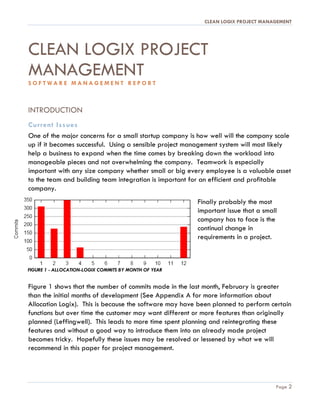
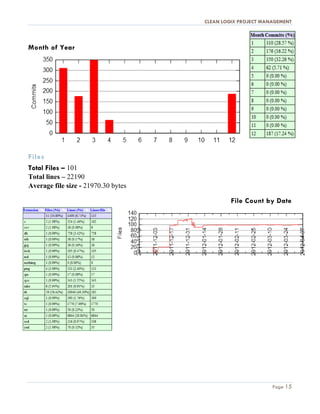
Figure 1 shows that the number of commits made in the last month, February is greater
than the initial months of development (See Appendix A for more information about
Allocation Logix). This is because the software may have been planned to perform certain
functions but over time the customer may want different or more features than originally
planned (Leffingwell). This leads to more time spent planning and reintegrating these
features and without a good way to introduce them into an already made project
becomes tricky. Hopefully these issues may be resolved or lessened by what we will
recommend in this paper for project management.
FIGURE 1 - ALLOCATION-LOGIX COMMITS BY MONTH OF YEAR
Research using
Allocation Logix
Github data
CLEAN LOGIX PROJECT MANAGEMENT
Page 3
PROJECT MANAGEMENT SYSTEMS
What is project management?
Project management is known as a discipline involving the organizing, planning and
managing of resources to complete a specific goal. The lifetime of a project is normally
divided into different stages of development to simplify the process. Generally, a project
may be divided into 5 generic phases but all project management systems vary from each
other; each having its own advantages and disadvantages. The general phases consist of
initiation, planning and design, executing, controlling and the closing phases.
Traditional System – Waterfall Method
In the project development or software development process field there are two known
methods, both old and new, that are being used today. The first of which is the
‘traditional’ way or also known as the waterfall method. The waterfall method consists of
a series of sequential steps in which process is slowly cascading downward (waterfall like)
until there is a finished product. (Waterfall Model) There are many variances of the
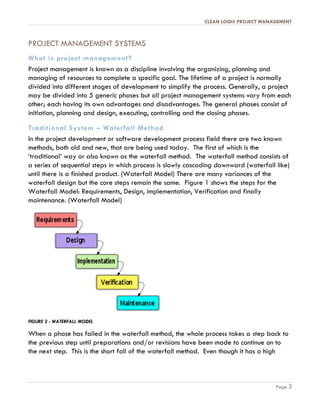
waterfall design but the core steps remain the same. Figure 1 shows the steps for the
Waterfall Model: Requirements, Design, implementation, Verification and finally
maintenance. (Waterfall Model)
FIGURE 2 - WATERFALL MODEL
When a phase has failed in the waterfall method, the whole process takes a step back to
the previous step until preparations and/or revisions have been made to continue on to
the next step. This is the short fall of the waterfall method. Even though it has a high
Colored Figures
and Tables
CLEAN LOGIX PROJECT MANAGEMENT
Page 4
success rate with projects and has a high attention to detail, it has always been scrutinized
for being very time consuming. (Waterfall Model)
Agile Management
The other type of project development is known as agile
development. Agile development is known as doing just enough on a project for it to
accomplish its task. This leaves leeway for being more adaptive for additions to the
project. There are two methods of implementing this – Scrum and Kanban.
Scrum
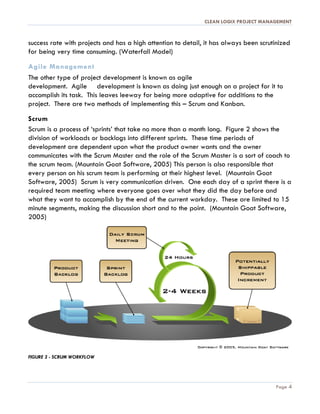
Scrum is a process of ‘sprints’ that take no more than a month long. Figure 2 shows the
division of workloads or backlogs into different sprints. These time periods of
development are dependent upon what the product owner wants and the owner
communicates with the Scrum Master and the role of the Scrum Master is a sort of coach to
the scrum team. (Mountain Goat Software, 2005) This person is also responsible that
every person on his scrum team is performing at their highest level. (Mountain Goat
Software, 2005) Scrum is very communication driven. One each day of a sprint there is a
required team meeting where everyone goes over what they did the day before and
what they want to accomplish by the end of the current workday. These are limited to 15
minute segments, making the discussion short and to the point. (Mountain Goat Software,
2005)
FIGURE 3 - SCRUM WORKFLOW
CLEAN LOGIX PROJECT MANAGEMENT
Page 5
By doing this, this provides an excellent understanding on the progress of the project and
what work needs to be done in the future. This meeting is not so much as an update for
the Scrum Master, rather it is more so that team members can make commitments to each
other and on the next day they team will know or not if the other member accomplished
his or her commitment. (Mountain Goat Software, 2005)
Kanban
The other popular type of agile development is known as Kanban. Kanban stands for
“card as you can see it” in Japanese. First introduced by Toyota in the 1950, they
created this process to ensure that inventory was based on customer orders rather than
sales forecasts. (Kanban, 2010) The way that Kanban works is that a single card is
attached to a single part. Once the part is used, the card is sent to the supplier who will
send back a part and the card attached to it. This allows the number of parts in
circulation to be kept to a minimum and orders parts as soon as they are needed.
(Kanban, 2010) Looking at Kanban from a software development stand point, a Kanban
board is used to show the workload that a team can contribute to the group. They show
this by drawing empty squares on the board, with the number of squares dictating the
workload. (Bjorkholm, 2009)
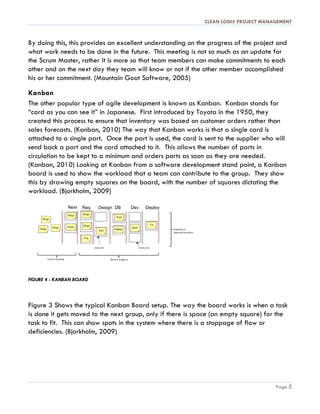
FIGURE 4 - KANBAN BOARD
Figure 3 Shows the typical Kanban Board setup. The way the board works is when a task
is done it gets moved to the next group, only if there is space (an empty square) for the
task to fit. This can show spots in the system where there is a stoppage of flow or
deficiencies. (Bjorkholm, 2009)
CLEAN LOGIX PROJECT MANAGEMENT
Page 6
HOW TO IMPROVE
Analyzing Decision Making
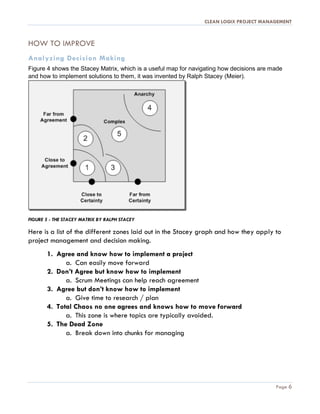
Figure 4 shows the Stacey Matrix, which is a useful map for navigating how decisions are made
and how to implement solutions to them, it was invented by Ralph Stacey (Meier).
FIGURE 5 - THE STACEY MATRIX BY RALPH STACEY
Here is a list of the different zones laid out in the Stacey graph and how they apply to
project management and decision making.
1. Agree and know how to implement a project
a. Can easily move forward
2. Don’t Agree but know how to implement
a. Scrum Meetings can help reach agreement
3. Agree but don’t know how to implement
a. Give time to research / plan
4. Total Chaos no one agrees and knows how to move forward
a. This zone is where topics are typically avoided.
5. The Dead Zone
a. Break down into chunks for managing
I decided to add this to
final paper to strengthen
the ethos of our argument
and why decision making
could benefit from project
management software or
techniques
CLEAN LOGIX PROJECT MANAGEMENT
Page 7
Digital Project Metrics
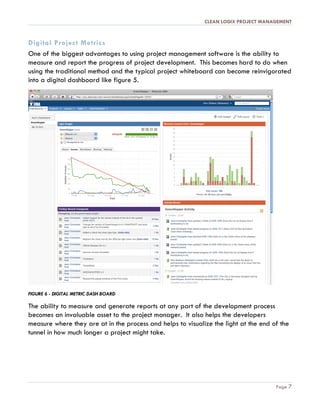
One of the biggest advantages to using project management software is the ability to
measure and report the progress of project development. This becomes hard to do when
using the traditional method and the typical project whiteboard can become reinvigorated
into a digital dashboard like figure 5.
FIGURE 6 - DIGITAL METRIC DASH BOARD
The ability to measure and generate reports at any part of the development process
becomes an invaluable asset to the project manager. It also helps the developers
measure where they are at in the process and helps to visualize the light at the end of the
tunnel in how much longer a project might take.
I Included relevant example of how data could be displayed for current software projects
CLEAN LOGIX PROJECT MANAGEMENT
Page 8
PRIMARY RESEARCH
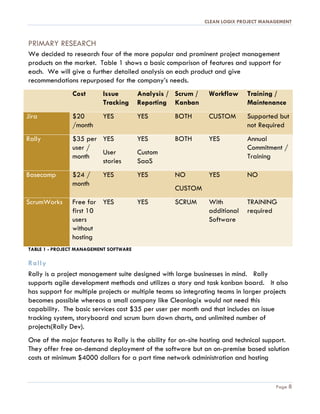
We decided to research four of the more popular and prominent project management
products on the market. Table 1 shows a basic comparison of features and support for
each. We will give a further detailed analysis on each product and give
recommendations repurposed for the company’s needs.
Cost Issue
Tracking
Analysis /
Reporting
Scrum /
Kanban
Workflow Training /
Maintenance
Jira $20
/month
YES YES BOTH CUSTOM Supported but
not Required
Rally $35 per
user /
month
YES
User
stories
YES
Custom
SaaS
BOTH YES Annual
Commitment /
Training
Basecamp $24 /
month
YES YES NO
CUSTOM
YES NO
ScrumWorks Free for
first 10
users
without
hosting
YES YES SCRUM With
additional
Software
TRAINING
required
TABLE 1 - PROJECT MANAGEMENT SOFTWARE
Rally
Rally is a project management suite designed with large businesses in mind. Rally
supports agile development methods and utilizes a story and task kanban board. It also
has support for multiple projects or multiple teams so integrating teams in larger projects
becomes possible whereas a small company like Cleanlogix would not need this
capability. The basic services cost $35 per user per month and that includes an issue
tracking system, storyboard and scrum burn down charts, and unlimited number of
projects(Rally Dev).
One of the major features to Rally is the ability for on-site hosting and technical support.
They offer free on-demand deployment of the software but an on-premise based solution
costs at minimum $4000 dollars for a part time network administration and hosting
CLEAN LOGIX PROJECT MANAGEMENT
Page 9
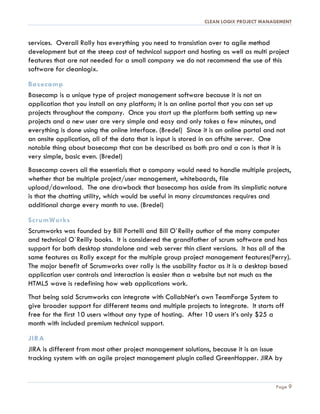
services. Overall Rally has everything you need to transistion over to agile method
development but at the steep cost of technical support and hosting as well as multi project
features that are not needed for a small company we do not recommend the use of this
software for cleanlogix.
Basecamp
Basecamp is a unique type of project management software because it is not an
application that you install on any platform; it is an online portal that you can set up
projects throughout the company. Once you start up the platform both setting up new
projects and a new user are very simple and easy and only takes a few minutes, and
everything is done using the online interface. (Bredel) Since it is an online portal and not
an onsite application, all of the data that is input is stored in an offsite server. One
notable thing about basecamp that can be described as both pro and a con is that it is
very simple, basic even. (Bredel)
Basecamp covers all the essentials that a company would need to handle multiple projects,
whether that be multiple project/user management, whiteboards, file
upload/download. The one drawback that basecamp has aside from its simplistic nature
is that the chatting utility, which would be useful in many circumstances requires and
additional charge every month to use. (Bredel)
ScrumWorks
Scrumworks was founded by Bill Portelli and Bill O`Reilly author of the many computer
and technical O`Reilly books. It is considered the grandfather of scrum software and has
support for both desktop standalone and web server thin client versions. It has all of the
same features as Rally except for the multiple group project management features(Perry).
The major benefit of Scrumworks over rally is the usability factor as it is a desktop based
application user controls and interaction is easier than a website but not much as the
HTML5 wave is redefining how web applications work.
That being said Scrumworks can integrate with CollabNet’s own TeamForge System to
give broader support for different teams and multiple projects to integrate. It starts off
free for the first 10 users without any type of hosting. After 10 users it’s only $25 a
month with included premium technical support.
JIRA
JIRA is different from most other project management solutions, because it is an issue
tracking system with an agile project management plugin called GreenHopper. JIRA by
CLEAN LOGIX PROJECT MANAGEMENT
Page 10
itself allows a company to manage bug reports, issues and tasks for different projects,
and what GreenHopper allows you to do is use the tickets as tasks for agile project
planning.
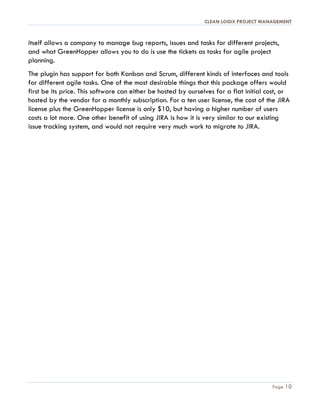
The plugin has support for both Kanban and Scrum, different kinds of interfaces and tools
for different agile tasks. One of the most desirable things that this package offers would
first be its price. This software can either be hosted by ourselves for a flat initial cost, or
hosted by the vendor for a monthly subscription. For a ten user license, the cost of the JIRA
license plus the GreenHopper license is only $10, but having a higher number of users
costs a lot more. One other benefit of using JIRA is how it is very similar to our existing
issue tracking system, and would not require very much work to migrate to JIRA.
CLEAN LOGIX PROJECT MANAGEMENT
Page 11
RECOMMENDATION
As you can see, there are a wide variety of project management solutions available, and
they all have their advantages and disadvantages. Based on our investigation we believe
that an agile project management approach should be investigated for Clean Logix, and
if Agile is adopted, JIRA should be chosen as a software package for managing projects.
It is the most cost effective solution, not only from licensing point of view, it is also the most
similar system to what we are currently using, and would require the least amount of time
to change.
CLEAN LOGIX PROJECT MANAGEMENT
Page 12
WORKS CITED
Leffingwell, Dean; Don Widrig (2003). Managing Software Requirements: A Use Case
Approach (2nd ed. ed.). Addison-Wesley.
RallyDev Software. Agile Project Management for Agile Development. Web. 10 Apr.
2012.
http://www.rallydev.com
Perry, Tom. "Agile Tools - Rally Vs Scrumworks." Agile Tools. 07 Dec. 2007. Web. 10 Apr.
2012.
http://agiletools.wordpress.com/2007/12/04/rally-vs-scrumworks
Meier, J. D. "J.D. Meier's Blog." Ralph Stacey's Agreement and Certainty Matrix. MSDN, 04
Apr. 2010. Web. 10 Apr. 2012.
http://blogs.msdn.com/b/jmeier/archive/2010/04/04/rick-stacey-s-agreement-and-
certainty-matrix.aspx.
Kanban. (2010, June 9). Retrieved April 3, 2012, from Whatis:
http://whatis.techtarget.com/definition/kanban.html
Bjorkholm, T. (2009, June 7). What is Best, Scrum or Kanban? Retrieved April 3, 2012,
from Agile Journal:
http://www.agilejournal.com/articles/columns/column-articles/1737-what-is-best-scrum-
or-kanban
Bredel, M. (n.d.). Basecamp Review. Retrieved April 3, 2012, from The Web Reviewer:
http://www.thewebreviewer.com/basecamp-review.htm
Mountain Goat Software. (2005). An Overview of Scrum for Agile Software Development.
Retrieved April 3, 2012, from Mountain Goat Software:
http://www.mountaingoatsoftware.com/scrum/daily-scrum
Waterfall Model. (n.d.). Waterfall Model. Retrieved April 3, 2012, from Waterfall Model:
http://www.waterfall-model.com
CLEAN LOGIX PROJECT MANAGEMENT
Page 13
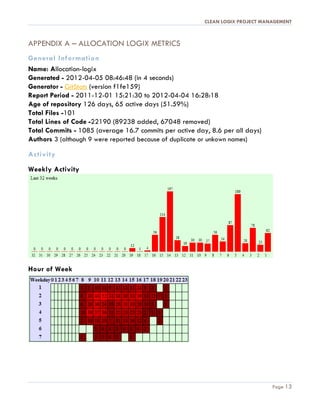
APPENDIX A – ALLOCATION LOGIX METRICS
General Information
Name: Allocation-logix
Generated - 2012-04-05 08:46:48 (in 4 seconds)
Generator - GitStats (version f1fe159)
Report Period - 2011-12-01 15:21:30 to 2012-04-04 16:28:18
Age of repository 126 days, 65 active days (51.59%)
Total Files -101
Total Lines of Code -22190 (89238 added, 67048 removed)
Total Commits - 1085 (average 16.7 commits per active day, 8.6 per all days)
Authors 3 (although 9 were reported because of duplicate or unkown names)
Activity
Weekly Activity
Hour of Week
I gathered data from our current
project at work to include in the
appendix to get a feel of how a
project is worked on
Strengthens our argument that on average we
did more work towards the end of the project
CLEAN LOGIX PROJECT MANAGEMENT
Page 14
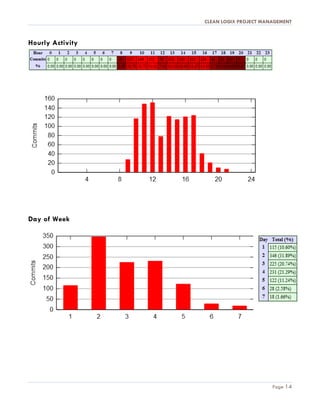
Hourly Activity
Day of Week
CLEAN LOGIX PROJECT MANAGEMENT
Page 15
Month of Year
Files
Total Files – 101
Total lines – 22190
Average file size - 21970.30 bytes
File Count by Date
Shows that the majority of commits
were done in second to last month
and not initially
After initial desing plann worked out we didn't need
more files hence proper planning goes along way

Company Software Project Management Recommendation Report

  • 1.
    CLEAN LOGIX PROJECT MANAGEMENT 4/8/2012 RECOMMENDATIONREPORT A General recommendation report for the improvement of project management and software development techniques.
  • 2.
    CLEAN LOGIX PROJECTMANAGEMENT Page 1 Table of Contents INTRODUCTION .......................................................................................... 2 Current Issues.............................................................................................................2 PROJECT MANAGEMENT SYSTEMS............................................................ 3 What is project management? ...............................................................................3 Traditional System – Waterfall Method...............................................................3 Agile Management...................................................................................................4 Scrum........................................................................................................................4 Kanban.....................................................................................................................5 HOW TO IMPROVE...................................................................................... 6 Analyzing Decision Making.....................................................................................6 Digital Project Metrics..............................................................................................7 PRIMARY RESEARCH .................................................................................. 8 Rally............................................................................................................................8 Basecamp...................................................................................................................9 ScrumWorks...............................................................................................................9 JIRA .............................................................................................................................9 WORKS CITED ........................................................................................... 12 Contrasting Colors and headers
  • 3.
    CLEAN LOGIX PROJECTMANAGEMENT Page 2 CLEAN LOGIX PROJECT MANAGEMENT S O F T W A R E M A N A G E M E N T R E P O R T INTRODUCTION Current Issues One of the major concerns for a small startup company is how well will the company scale up if it becomes successful. Using a sensible project management system will most likely help a business to expand when the time comes by breaking down the workload into manageable pieces and not overwhelming the company. Teamwork is especially important with any size company whether small or big every employee is a valuable asset to the team and building team integration is important for an efficient and profitable company. Finally probably the most important issue that a small company has to face is the continual change in requirements in a project. Figure 1 shows that the number of commits made in the last month, February is greater than the initial months of development (See Appendix A for more information about Allocation Logix). This is because the software may have been planned to perform certain functions but over time the customer may want different or more features than originally planned (Leffingwell). This leads to more time spent planning and reintegrating these features and without a good way to introduce them into an already made project becomes tricky. Hopefully these issues may be resolved or lessened by what we will recommend in this paper for project management. FIGURE 1 - ALLOCATION-LOGIX COMMITS BY MONTH OF YEAR Research using Allocation Logix Github data
  • 4.
    CLEAN LOGIX PROJECTMANAGEMENT Page 3 PROJECT MANAGEMENT SYSTEMS What is project management? Project management is known as a discipline involving the organizing, planning and managing of resources to complete a specific goal. The lifetime of a project is normally divided into different stages of development to simplify the process. Generally, a project may be divided into 5 generic phases but all project management systems vary from each other; each having its own advantages and disadvantages. The general phases consist of initiation, planning and design, executing, controlling and the closing phases. Traditional System – Waterfall Method In the project development or software development process field there are two known methods, both old and new, that are being used today. The first of which is the ‘traditional’ way or also known as the waterfall method. The waterfall method consists of a series of sequential steps in which process is slowly cascading downward (waterfall like) until there is a finished product. (Waterfall Model) There are many variances of the waterfall design but the core steps remain the same. Figure 1 shows the steps for the Waterfall Model: Requirements, Design, implementation, Verification and finally maintenance. (Waterfall Model) FIGURE 2 - WATERFALL MODEL When a phase has failed in the waterfall method, the whole process takes a step back to the previous step until preparations and/or revisions have been made to continue on to the next step. This is the short fall of the waterfall method. Even though it has a high Colored Figures and Tables
  • 5.
    CLEAN LOGIX PROJECTMANAGEMENT Page 4 success rate with projects and has a high attention to detail, it has always been scrutinized for being very time consuming. (Waterfall Model) Agile Management The other type of project development is known as agile development. Agile development is known as doing just enough on a project for it to accomplish its task. This leaves leeway for being more adaptive for additions to the project. There are two methods of implementing this – Scrum and Kanban. Scrum Scrum is a process of ‘sprints’ that take no more than a month long. Figure 2 shows the division of workloads or backlogs into different sprints. These time periods of development are dependent upon what the product owner wants and the owner communicates with the Scrum Master and the role of the Scrum Master is a sort of coach to the scrum team. (Mountain Goat Software, 2005) This person is also responsible that every person on his scrum team is performing at their highest level. (Mountain Goat Software, 2005) Scrum is very communication driven. One each day of a sprint there is a required team meeting where everyone goes over what they did the day before and what they want to accomplish by the end of the current workday. These are limited to 15 minute segments, making the discussion short and to the point. (Mountain Goat Software, 2005) FIGURE 3 - SCRUM WORKFLOW
  • 6.
    CLEAN LOGIX PROJECTMANAGEMENT Page 5 By doing this, this provides an excellent understanding on the progress of the project and what work needs to be done in the future. This meeting is not so much as an update for the Scrum Master, rather it is more so that team members can make commitments to each other and on the next day they team will know or not if the other member accomplished his or her commitment. (Mountain Goat Software, 2005) Kanban The other popular type of agile development is known as Kanban. Kanban stands for “card as you can see it” in Japanese. First introduced by Toyota in the 1950, they created this process to ensure that inventory was based on customer orders rather than sales forecasts. (Kanban, 2010) The way that Kanban works is that a single card is attached to a single part. Once the part is used, the card is sent to the supplier who will send back a part and the card attached to it. This allows the number of parts in circulation to be kept to a minimum and orders parts as soon as they are needed. (Kanban, 2010) Looking at Kanban from a software development stand point, a Kanban board is used to show the workload that a team can contribute to the group. They show this by drawing empty squares on the board, with the number of squares dictating the workload. (Bjorkholm, 2009) FIGURE 4 - KANBAN BOARD Figure 3 Shows the typical Kanban Board setup. The way the board works is when a task is done it gets moved to the next group, only if there is space (an empty square) for the task to fit. This can show spots in the system where there is a stoppage of flow or deficiencies. (Bjorkholm, 2009)
  • 7.
    CLEAN LOGIX PROJECTMANAGEMENT Page 6 HOW TO IMPROVE Analyzing Decision Making Figure 4 shows the Stacey Matrix, which is a useful map for navigating how decisions are made and how to implement solutions to them, it was invented by Ralph Stacey (Meier). FIGURE 5 - THE STACEY MATRIX BY RALPH STACEY Here is a list of the different zones laid out in the Stacey graph and how they apply to project management and decision making. 1. Agree and know how to implement a project a. Can easily move forward 2. Don’t Agree but know how to implement a. Scrum Meetings can help reach agreement 3. Agree but don’t know how to implement a. Give time to research / plan 4. Total Chaos no one agrees and knows how to move forward a. This zone is where topics are typically avoided. 5. The Dead Zone a. Break down into chunks for managing I decided to add this to final paper to strengthen the ethos of our argument and why decision making could benefit from project management software or techniques
  • 8.
    CLEAN LOGIX PROJECTMANAGEMENT Page 7 Digital Project Metrics One of the biggest advantages to using project management software is the ability to measure and report the progress of project development. This becomes hard to do when using the traditional method and the typical project whiteboard can become reinvigorated into a digital dashboard like figure 5. FIGURE 6 - DIGITAL METRIC DASH BOARD The ability to measure and generate reports at any part of the development process becomes an invaluable asset to the project manager. It also helps the developers measure where they are at in the process and helps to visualize the light at the end of the tunnel in how much longer a project might take. I Included relevant example of how data could be displayed for current software projects
  • 9.
    CLEAN LOGIX PROJECTMANAGEMENT Page 8 PRIMARY RESEARCH We decided to research four of the more popular and prominent project management products on the market. Table 1 shows a basic comparison of features and support for each. We will give a further detailed analysis on each product and give recommendations repurposed for the company’s needs. Cost Issue Tracking Analysis / Reporting Scrum / Kanban Workflow Training / Maintenance Jira $20 /month YES YES BOTH CUSTOM Supported but not Required Rally $35 per user / month YES User stories YES Custom SaaS BOTH YES Annual Commitment / Training Basecamp $24 / month YES YES NO CUSTOM YES NO ScrumWorks Free for first 10 users without hosting YES YES SCRUM With additional Software TRAINING required TABLE 1 - PROJECT MANAGEMENT SOFTWARE Rally Rally is a project management suite designed with large businesses in mind. Rally supports agile development methods and utilizes a story and task kanban board. It also has support for multiple projects or multiple teams so integrating teams in larger projects becomes possible whereas a small company like Cleanlogix would not need this capability. The basic services cost $35 per user per month and that includes an issue tracking system, storyboard and scrum burn down charts, and unlimited number of projects(Rally Dev). One of the major features to Rally is the ability for on-site hosting and technical support. They offer free on-demand deployment of the software but an on-premise based solution costs at minimum $4000 dollars for a part time network administration and hosting
  • 10.
    CLEAN LOGIX PROJECTMANAGEMENT Page 9 services. Overall Rally has everything you need to transistion over to agile method development but at the steep cost of technical support and hosting as well as multi project features that are not needed for a small company we do not recommend the use of this software for cleanlogix. Basecamp Basecamp is a unique type of project management software because it is not an application that you install on any platform; it is an online portal that you can set up projects throughout the company. Once you start up the platform both setting up new projects and a new user are very simple and easy and only takes a few minutes, and everything is done using the online interface. (Bredel) Since it is an online portal and not an onsite application, all of the data that is input is stored in an offsite server. One notable thing about basecamp that can be described as both pro and a con is that it is very simple, basic even. (Bredel) Basecamp covers all the essentials that a company would need to handle multiple projects, whether that be multiple project/user management, whiteboards, file upload/download. The one drawback that basecamp has aside from its simplistic nature is that the chatting utility, which would be useful in many circumstances requires and additional charge every month to use. (Bredel) ScrumWorks Scrumworks was founded by Bill Portelli and Bill O`Reilly author of the many computer and technical O`Reilly books. It is considered the grandfather of scrum software and has support for both desktop standalone and web server thin client versions. It has all of the same features as Rally except for the multiple group project management features(Perry). The major benefit of Scrumworks over rally is the usability factor as it is a desktop based application user controls and interaction is easier than a website but not much as the HTML5 wave is redefining how web applications work. That being said Scrumworks can integrate with CollabNet’s own TeamForge System to give broader support for different teams and multiple projects to integrate. It starts off free for the first 10 users without any type of hosting. After 10 users it’s only $25 a month with included premium technical support. JIRA JIRA is different from most other project management solutions, because it is an issue tracking system with an agile project management plugin called GreenHopper. JIRA by
  • 11.
    CLEAN LOGIX PROJECTMANAGEMENT Page 10 itself allows a company to manage bug reports, issues and tasks for different projects, and what GreenHopper allows you to do is use the tickets as tasks for agile project planning. The plugin has support for both Kanban and Scrum, different kinds of interfaces and tools for different agile tasks. One of the most desirable things that this package offers would first be its price. This software can either be hosted by ourselves for a flat initial cost, or hosted by the vendor for a monthly subscription. For a ten user license, the cost of the JIRA license plus the GreenHopper license is only $10, but having a higher number of users costs a lot more. One other benefit of using JIRA is how it is very similar to our existing issue tracking system, and would not require very much work to migrate to JIRA.
  • 12.
    CLEAN LOGIX PROJECTMANAGEMENT Page 11 RECOMMENDATION As you can see, there are a wide variety of project management solutions available, and they all have their advantages and disadvantages. Based on our investigation we believe that an agile project management approach should be investigated for Clean Logix, and if Agile is adopted, JIRA should be chosen as a software package for managing projects. It is the most cost effective solution, not only from licensing point of view, it is also the most similar system to what we are currently using, and would require the least amount of time to change.
  • 13.
    CLEAN LOGIX PROJECTMANAGEMENT Page 12 WORKS CITED Leffingwell, Dean; Don Widrig (2003). Managing Software Requirements: A Use Case Approach (2nd ed. ed.). Addison-Wesley. RallyDev Software. Agile Project Management for Agile Development. Web. 10 Apr. 2012. http://www.rallydev.com Perry, Tom. "Agile Tools - Rally Vs Scrumworks." Agile Tools. 07 Dec. 2007. Web. 10 Apr. 2012. http://agiletools.wordpress.com/2007/12/04/rally-vs-scrumworks Meier, J. D. "J.D. Meier's Blog." Ralph Stacey's Agreement and Certainty Matrix. MSDN, 04 Apr. 2010. Web. 10 Apr. 2012. http://blogs.msdn.com/b/jmeier/archive/2010/04/04/rick-stacey-s-agreement-and- certainty-matrix.aspx. Kanban. (2010, June 9). Retrieved April 3, 2012, from Whatis: http://whatis.techtarget.com/definition/kanban.html Bjorkholm, T. (2009, June 7). What is Best, Scrum or Kanban? Retrieved April 3, 2012, from Agile Journal: http://www.agilejournal.com/articles/columns/column-articles/1737-what-is-best-scrum- or-kanban Bredel, M. (n.d.). Basecamp Review. Retrieved April 3, 2012, from The Web Reviewer: http://www.thewebreviewer.com/basecamp-review.htm Mountain Goat Software. (2005). An Overview of Scrum for Agile Software Development. Retrieved April 3, 2012, from Mountain Goat Software: http://www.mountaingoatsoftware.com/scrum/daily-scrum Waterfall Model. (n.d.). Waterfall Model. Retrieved April 3, 2012, from Waterfall Model: http://www.waterfall-model.com
  • 14.
    CLEAN LOGIX PROJECTMANAGEMENT Page 13 APPENDIX A – ALLOCATION LOGIX METRICS General Information Name: Allocation-logix Generated - 2012-04-05 08:46:48 (in 4 seconds) Generator - GitStats (version f1fe159) Report Period - 2011-12-01 15:21:30 to 2012-04-04 16:28:18 Age of repository 126 days, 65 active days (51.59%) Total Files -101 Total Lines of Code -22190 (89238 added, 67048 removed) Total Commits - 1085 (average 16.7 commits per active day, 8.6 per all days) Authors 3 (although 9 were reported because of duplicate or unkown names) Activity Weekly Activity Hour of Week I gathered data from our current project at work to include in the appendix to get a feel of how a project is worked on Strengthens our argument that on average we did more work towards the end of the project
  • 15.
    CLEAN LOGIX PROJECTMANAGEMENT Page 14 Hourly Activity Day of Week
  • 16.
    CLEAN LOGIX PROJECTMANAGEMENT Page 15 Month of Year Files Total Files – 101 Total lines – 22190 Average file size - 21970.30 bytes File Count by Date Shows that the majority of commits were done in second to last month and not initially After initial desing plann worked out we didn't need more files hence proper planning goes along way