NIMBLE APPGENIE LLP
Introduction to Project Management
Methodologies
 There are a variety of different project
management frameworks, and some popular
ones among them are Agile, Waterfall,
Scrum, and Kanban. Some of them, like
Waterfall, follow a structured and rigid
approach, while some others, like Agile, are
more flexible and adaptive to the changes.
 A methodology is a model, which project
managers employ for the design, planning,
implementation and achievement of their
project objectives.
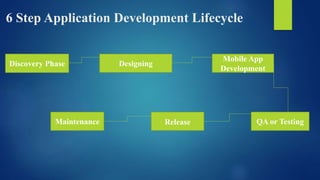
6 Step Application Development Lifecycle
Discovery Phase Designing
Mobile App
Development
QA or Testing
Release
Maintenance
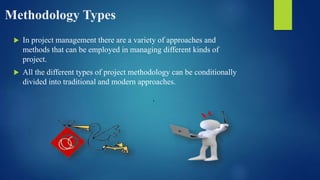
Methodology Types
 In project management there are a variety of approaches and
methods that can be employed in managing different kinds of
project.
 All the different types of project methodology can be conditionally
divided into traditional and modern approaches.
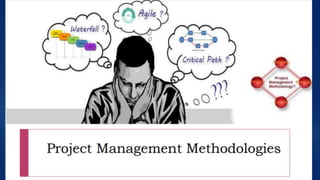
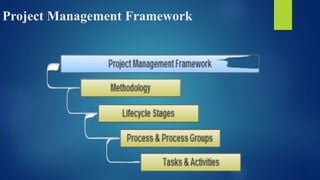
Project Management Framework
Agile Project Management Methodologies
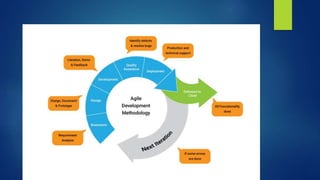
 Agile project management methodology is based on an iterative and incremental approach
to development. Rather than planning the project in-depth at the beginning, Agile project
management methodologies are adaptive to the requirements changes and encourage
constant feedback from the client and end-users.
 On every iteration, cross-functional teams work together over a certain period of time. The
work is prioritised depending on the business priorities and organised into a backlog. The
goal of every iteration is to develop a working product. Both the business stakeholders and
developers work together to align the product with their company goals and needs.
12 Principles of Agile Project Management
Methodologies
 Customer satisfaction is the foremost priority.
 Change in requirements is always welcome even if it delays the deployment.
 Keep the delivery consistent and frequent.
 The business stakeholders and developers should work together on a daily basis till the end of the project.
 Team up with motivated individuals. Provide them with the environment and support they need. And most importantly, trust them to get
the job done.
 The most effective way of message conveying within the team is a face-to-face conversation.
 A working software is the initial measure to identify progress.
 Agile project management methodologies rely on sustainable development. Thus, the company owners, developers, and users should sync
and maintain a constant pace throughout the development process.
 Development agility requires continuous attention to technical excellence.
 It is essential to have the ability to maximise the amount of pending work.
 Only the self-Organising teams can produce the best architectures and designs.
 The team themself adjust their behaviour to increase productivity in regular intervals.
Scrum Project Management Methodologies
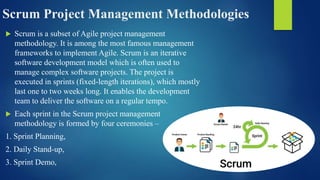
 Scrum is a subset of Agile project management
methodology. It is among the most famous management
frameworks to implement Agile. Scrum is an iterative
software development model which is often used to
manage complex software projects. The project is
executed in sprints (fixed-length iterations), which mostly
last one to two weeks long. It enables the development
team to deliver the software on a regular tempo.
 Each sprint in the Scrum project management
methodology is formed by four ceremonies –
1. Sprint Planning,
2. Daily Stand-up,
3. Sprint Demo,
Waterfall Project Management Methodology
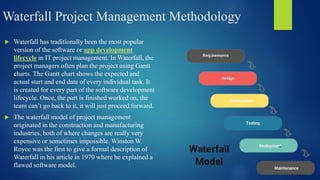
 Waterfall has traditionally been the most popular
version of the software or app development
lifecycle in IT project management. In Waterfall, the
project managers often plan the project using Gantt
charts. The Gantt chart shows the expected and
actual start and end date of every individual task. It
is created for every part of the software development
lifecycle. Once, the part is finished worked on, the
team can’t go back to it, it will just proceed forward.
 The waterfall model of project management
originated in the construction and manufacturing
industries, both of where changes are really very
expensive or sometimes impossible. Winston W.
Royce was the first to give a formal description of
Waterfall in his article in 1970 where he explained a
flawed software model.
Difference Between Scrum Master vs
Project Manager
Scrum Master
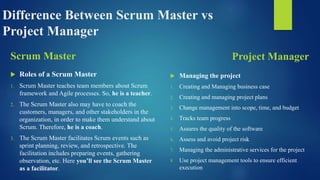
 Roles of a Scrum Master
1. Scrum Master teaches team members about Scrum
framework and Agile processes. So, he is a teacher.
2. The Scrum Master also may have to coach the
customers, managers, and other stakeholders in the
organization, in order to make them understand about
Scrum. Therefore, he is a coach.
3. The Scrum Master facilitates Scrum events such as
sprint planning, review, and retrospective. The
facilitation includes preparing events, gathering
observation, etc. Here you’ll see the Scrum Master
as a facilitator.
Project Manager
 Managing the project
1. Creating and Managing business case
2. Creating and managing project plans
3. Change management into scope, time, and budget
4. Tracks team progress
5. Assures the quality of the software
6. Assess and avoid project risk
7. Managing the administrative services for the project
8. Use project management tools to ensure efficient
execution
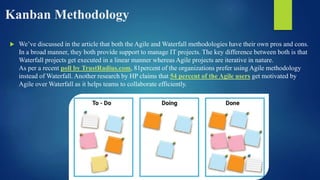
Kanban Methodology
 We’ve discussed in the article that both the Agile and Waterfall methodologies have their own pros and cons.
In a broad manner, they both provide support to manage IT projects. The key difference between both is that
Waterfall projects get executed in a linear manner whereas Agile projects are iterative in nature.
As per a recent poll by TrustRadius.com, 81percent of the organizations prefer using Agile methodology
instead of Waterfall. Another research by HP claims that 54 percent of the Agile users get motivated by
Agile over Waterfall as it helps teams to collaborate efficiently.
Modern project management methodologies
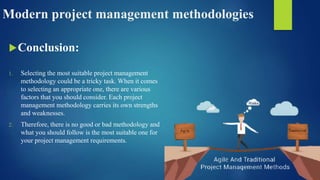
Conclusion:
1. Selecting the most suitable project management
methodology could be a tricky task. When it comes
to selecting an appropriate one, there are various
factors that you should consider. Each project
management methodology carries its own strengths
and weaknesses.
2. Therefore, there is no good or bad methodology and
what you should follow is the most suitable one for
your project management requirements.
Contact Us
Visit- https://www.nimbleappgenie.com/
For More Details Click This Link-
https://www.nimbleappgenie.com/blogs/project-development-
methodologies-agile-scrum-waterfall-and-kanban/
Call On- +44 207-459-4465 (UK), +1 920-354-6944 (USA)

SOFTWARE DEVELOPMENT BUSINESS PLAN

  • 1.
  • 3.
    Introduction to ProjectManagement Methodologies  There are a variety of different project management frameworks, and some popular ones among them are Agile, Waterfall, Scrum, and Kanban. Some of them, like Waterfall, follow a structured and rigid approach, while some others, like Agile, are more flexible and adaptive to the changes.  A methodology is a model, which project managers employ for the design, planning, implementation and achievement of their project objectives.
  • 4.
    6 Step ApplicationDevelopment Lifecycle Discovery Phase Designing Mobile App Development QA or Testing Release Maintenance
  • 5.
    Methodology Types  Inproject management there are a variety of approaches and methods that can be employed in managing different kinds of project.  All the different types of project methodology can be conditionally divided into traditional and modern approaches.
  • 6.
  • 7.
    Agile Project ManagementMethodologies  Agile project management methodology is based on an iterative and incremental approach to development. Rather than planning the project in-depth at the beginning, Agile project management methodologies are adaptive to the requirements changes and encourage constant feedback from the client and end-users.  On every iteration, cross-functional teams work together over a certain period of time. The work is prioritised depending on the business priorities and organised into a backlog. The goal of every iteration is to develop a working product. Both the business stakeholders and developers work together to align the product with their company goals and needs.
  • 9.
    12 Principles ofAgile Project Management Methodologies  Customer satisfaction is the foremost priority.  Change in requirements is always welcome even if it delays the deployment.  Keep the delivery consistent and frequent.  The business stakeholders and developers should work together on a daily basis till the end of the project.  Team up with motivated individuals. Provide them with the environment and support they need. And most importantly, trust them to get the job done.  The most effective way of message conveying within the team is a face-to-face conversation.  A working software is the initial measure to identify progress.  Agile project management methodologies rely on sustainable development. Thus, the company owners, developers, and users should sync and maintain a constant pace throughout the development process.  Development agility requires continuous attention to technical excellence.  It is essential to have the ability to maximise the amount of pending work.  Only the self-Organising teams can produce the best architectures and designs.  The team themself adjust their behaviour to increase productivity in regular intervals.
  • 10.
    Scrum Project ManagementMethodologies  Scrum is a subset of Agile project management methodology. It is among the most famous management frameworks to implement Agile. Scrum is an iterative software development model which is often used to manage complex software projects. The project is executed in sprints (fixed-length iterations), which mostly last one to two weeks long. It enables the development team to deliver the software on a regular tempo.  Each sprint in the Scrum project management methodology is formed by four ceremonies – 1. Sprint Planning, 2. Daily Stand-up, 3. Sprint Demo,
  • 11.
    Waterfall Project ManagementMethodology  Waterfall has traditionally been the most popular version of the software or app development lifecycle in IT project management. In Waterfall, the project managers often plan the project using Gantt charts. The Gantt chart shows the expected and actual start and end date of every individual task. It is created for every part of the software development lifecycle. Once, the part is finished worked on, the team can’t go back to it, it will just proceed forward.  The waterfall model of project management originated in the construction and manufacturing industries, both of where changes are really very expensive or sometimes impossible. Winston W. Royce was the first to give a formal description of Waterfall in his article in 1970 where he explained a flawed software model.
  • 12.
    Difference Between ScrumMaster vs Project Manager Scrum Master  Roles of a Scrum Master 1. Scrum Master teaches team members about Scrum framework and Agile processes. So, he is a teacher. 2. The Scrum Master also may have to coach the customers, managers, and other stakeholders in the organization, in order to make them understand about Scrum. Therefore, he is a coach. 3. The Scrum Master facilitates Scrum events such as sprint planning, review, and retrospective. The facilitation includes preparing events, gathering observation, etc. Here you’ll see the Scrum Master as a facilitator. Project Manager  Managing the project 1. Creating and Managing business case 2. Creating and managing project plans 3. Change management into scope, time, and budget 4. Tracks team progress 5. Assures the quality of the software 6. Assess and avoid project risk 7. Managing the administrative services for the project 8. Use project management tools to ensure efficient execution
  • 13.
    Kanban Methodology  We’vediscussed in the article that both the Agile and Waterfall methodologies have their own pros and cons. In a broad manner, they both provide support to manage IT projects. The key difference between both is that Waterfall projects get executed in a linear manner whereas Agile projects are iterative in nature. As per a recent poll by TrustRadius.com, 81percent of the organizations prefer using Agile methodology instead of Waterfall. Another research by HP claims that 54 percent of the Agile users get motivated by Agile over Waterfall as it helps teams to collaborate efficiently.
  • 14.
    Modern project managementmethodologies Conclusion: 1. Selecting the most suitable project management methodology could be a tricky task. When it comes to selecting an appropriate one, there are various factors that you should consider. Each project management methodology carries its own strengths and weaknesses. 2. Therefore, there is no good or bad methodology and what you should follow is the most suitable one for your project management requirements.
  • 15.
    Contact Us Visit- https://www.nimbleappgenie.com/ ForMore Details Click This Link- https://www.nimbleappgenie.com/blogs/project-development- methodologies-agile-scrum-waterfall-and-kanban/ Call On- +44 207-459-4465 (UK), +1 920-354-6944 (USA)