Agile Program Management:
Managing Risks and Business Value

                                                     Johanna Rothman
    New: Manage Your Project Portfolio: Increase Your Capacity and Finish More Projects
                                                         @johannarothman
                                                        www.jrothman.com
                                                         jr@jrothman.com
                                                              781-641-4046
Program Management
Organizing and coordinating several projects’ results into
one deliverable. That deliverable has the value to the
organization


                            2                  © 2011 Johanna Rothman
Programs Are Riskier Than Projects
You all know that projects don’t scale
The larger and the longer the program, the more risky it is
The more pieces the program has, the more risky it is
  Hardware and software
  Mechanical and hardware and software
  Embedded and hardware and software
  Regulated industries


                               3                    © 2011 Johanna Rothman
Why Use Agile For Programs?
Agile provides fast feedback
  You know where you are every iteration
Timeboxes provide urgency and focus
It’s clear early if anyone is having trouble
It’s clear early if the architecture is not going to work,
assuming you use good tests
Agile or lean reduces overall project risk
                               4                 © 2011 Johanna Rothman
What Kind of Program Are You
         Working On?
Who here is working on a program?
 Up to 3 teams?
 4-7 teams?
 More than 7 teams?


                         5          © 2011 Johanna Rothman
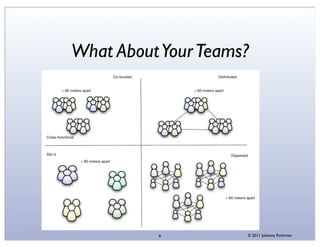
What About Your Teams?


          6          © 2011 Johanna Rothman
Making Risks Transparent
Many people say, “Just do Scrum-of-Scrums”
  Scrum-of-Scrums has its place, and it’s not for everyone


                           7                  © 2011 Johanna Rothman
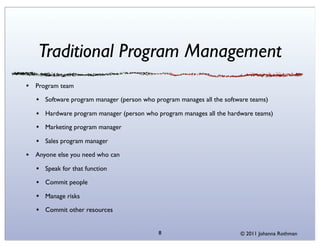
Traditional Program Management
Program team

   Software program manager (person who program manages all the software teams)

   Hardware program manager (person who program manages all the hardware teams)

   Marketing program manager

   Sales program manager

Anyone else you need who can

   Speak for that function

   Commit people

   Manage risks

   Commit other resources


                                         8                           © 2011 Johanna Rothman
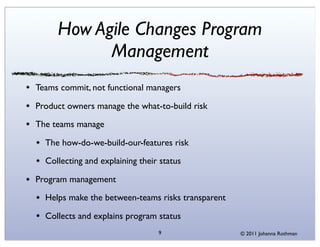
How Agile Changes Program
           Management
Teams commit, not functional managers

Product owners manage the what-to-build risk
The teams manage

  The how-do-we-build-our-features risk

  Collecting and explaining their status

Program management
  Helps make the between-teams risks transparent

  Collects and explains program status
                                 9                 © 2011 Johanna Rothman
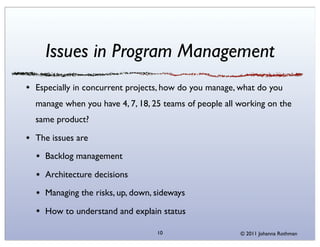
Issues in Program Management
Especially in concurrent projects, how do you manage, what do you
manage when you have 4, 7, 18, 25 teams of people all working on the
same product?

The issues are

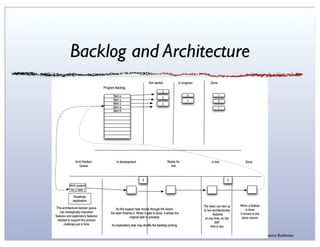
  Backlog management

  Architecture decisions
  Managing the risks, up, down, sideways

  How to understand and explain status

                                10                    © 2011 Johanna Rothman
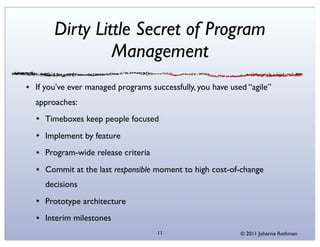
Dirty Little Secret of Program
              Management
If you’ve ever managed programs successfully, you have used “agile”
approaches:
  Timeboxes keep people focused
  Implement by feature
  Program-wide release criteria
  Commit at the last responsible moment to high cost-of-change
  decisions
  Prototype architecture
  Interim milestones
                                  11                      © 2011 Johanna Rothman
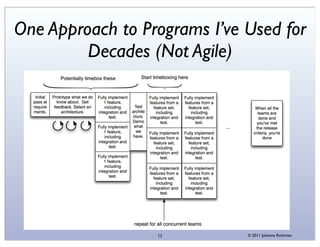
One Approach to Programs I’ve Used for
         Decades (Not Agile)


                  12          © 2011 Johanna Rothman
Organizing the Program


           13            © 2011 Johanna Rothman
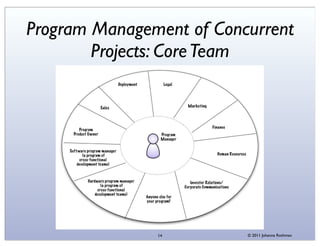
Program Management of Concurrent
        Projects: Core Team


               14         © 2011 Johanna Rothman
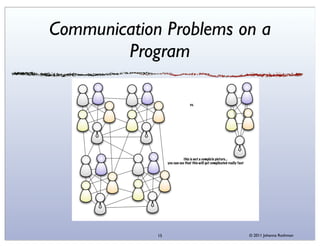
Communication Problems on a
        Program


             15         © 2011 Johanna Rothman
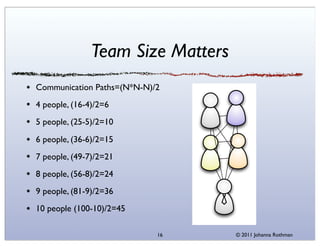
Team Size Matters
Communication Paths=(N*N-N)/2
4 people, (16-4)/2=6
5 people, (25-5)/2=10
6 people, (36-6)/2=15
7 people, (49-7)/2=21
8 people, (56-8)/2=24
9 people, (81-9)/2=36
10 people (100-10)/2=45

                            16     © 2011 Johanna Rothman
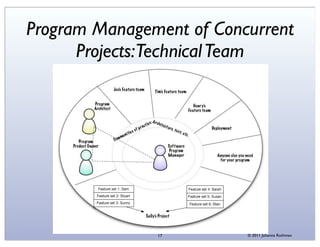
Program Management of Concurrent
      Projects:Technical Team


               17         © 2011 Johanna Rothman
Starting an Agile Program
Iteration 0: Do you need one?
What you need to start an agile program:
  Charter (vision, release criteria)
  Product roadmap (so everyone sees where we are headed)
  Enough of a backlog to start
  Any market-driven architecture decisions
  Program product owner to manage business value of the program backlog
  Program architect to manage business value of the architecture
  Program manager to manage program level risks

                                       18                  © 2011 Johanna Rothman
Program Managers
Generate the program charter
Start the drumbeat for the program
Create and update landing zones
Make sure there is a feature roadmap
Decide about technical debt
Watch for failure points
   Multitasking
   Design that’s too far ahead
   Testers too far behind
   Frameworks without features
                                       19   © 2011 Johanna Rothman
Backlog and Architecture


           20          © 2011 Johanna Rothman
For Each Iteration (Part 1)
All start and end at the same time for each team (No staggered iterations)

   Normal agile for the team

      Each team works with its product owner to selects its backlog items from the
      product backlog (no cherry-picking the backlog)

      Each team estimates and commits

      Each team builds their iteration’s backlog, with the local architect as a regular
      member of the team

      Continuous integration

      Each team elevates risks, issues through the PM/SM to the program team

      Each team gets to release-able at the end of an iteration

         If you have hardware, maybe demo-able
                                            21                             © 2011 Johanna Rothman
For Each Iteration (Part 2)
Program team

   Potential of a daily standup (think Scrum of Scrums)

   Meets weekly to manage risks and figure out how to present status

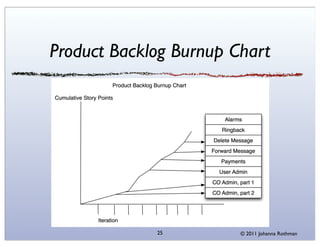
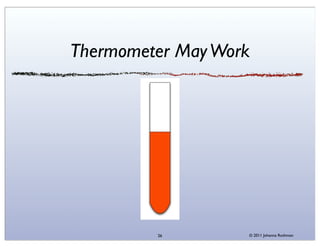
      Storyboards, thermometer, product backlog burnup

      Program velocity

Architecture team

   Uses what each team has learned to refine the architectural picture

   May decide to hold architectural reviews periodically

      To prevent technical debt, not to pre-define too far

   Keep refining the Big Picture
                                         22                        © 2011 Johanna Rothman
When You Have Hardware
Nothing changes until you have pilot hardware

  If the teams have only been getting to “demo-able” at the end of an
  iteration before pilot hardware, now they have to get to “release-
  able”

  The program will encounter problems

     Be prepared to manage more risks
     Be prepared to have sub-program meetings to manage the who’s
     going to do what in the hardware, firmware, software

                                23                     © 2011 Johanna Rothman
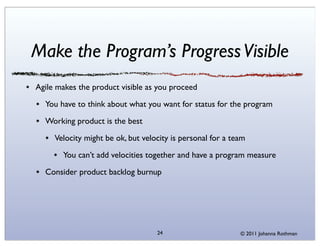
Make the Program’s Progress Visible
Agile makes the product visible as you proceed
  You have to think about what you want for status for the program
  Working product is the best
     Velocity might be ok, but velocity is personal for a team
       You can’t add velocities together and have a program measure

  Consider product backlog burnup


                                   24                       © 2011 Johanna Rothman
Product Backlog Burnup Chart


             25         © 2011 Johanna Rothman
Thermometer May Work


         26        © 2011 Johanna Rothman
Last vs. Most
Responsible Moment


         27          © 2011 Johanna Rothman
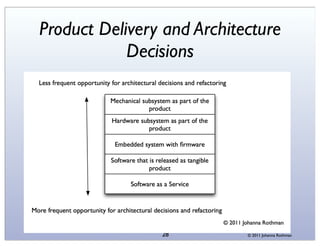
Product Delivery and Architecture
            Decisions


                28          © 2011 Johanna Rothman
Program Management is Difficult
Agile provides transparency

Use a combination of techniques, and move to agile as you can
No matter what lifecycle or combination of lifecycle you choose,
make sure you:

  Have interim milestones

  Demo early and often
  Raise risks and resolve them

  Have fun!!

                                 29                   © 2011 Johanna Rothman
References and Reading
Look for my upcoming book, tentatively titled Agile and Lean
Program Management: Collaborating Across the Organization
Manage It! and Manage Your Project Portfolio have a number of
how-to’s on programs
  Tons more on jrothman.com
  If you’d like me to stay in touch with you, please sign up for
  my email newsletter, fill out a yellow form,
  or email me
                              30                  © 2011 Johanna Rothman

Agile programmanagement

  • 1.
    Agile Program Management: ManagingRisks and Business Value Johanna Rothman New: Manage Your Project Portfolio: Increase Your Capacity and Finish More Projects @johannarothman www.jrothman.com jr@jrothman.com 781-641-4046
  • 2.
    Program Management Organizing andcoordinating several projects’ results into one deliverable. That deliverable has the value to the organization 2 © 2011 Johanna Rothman
  • 3.
    Programs Are RiskierThan Projects You all know that projects don’t scale The larger and the longer the program, the more risky it is The more pieces the program has, the more risky it is Hardware and software Mechanical and hardware and software Embedded and hardware and software Regulated industries 3 © 2011 Johanna Rothman
  • 4.
    Why Use AgileFor Programs? Agile provides fast feedback You know where you are every iteration Timeboxes provide urgency and focus It’s clear early if anyone is having trouble It’s clear early if the architecture is not going to work, assuming you use good tests Agile or lean reduces overall project risk 4 © 2011 Johanna Rothman
  • 5.
    What Kind ofProgram Are You Working On? Who here is working on a program? Up to 3 teams? 4-7 teams? More than 7 teams? 5 © 2011 Johanna Rothman
  • 6.
    What About YourTeams? 6 © 2011 Johanna Rothman
  • 7.
    Making Risks Transparent Manypeople say, “Just do Scrum-of-Scrums” Scrum-of-Scrums has its place, and it’s not for everyone 7 © 2011 Johanna Rothman
  • 8.
    Traditional Program Management Programteam Software program manager (person who program manages all the software teams) Hardware program manager (person who program manages all the hardware teams) Marketing program manager Sales program manager Anyone else you need who can Speak for that function Commit people Manage risks Commit other resources 8 © 2011 Johanna Rothman
  • 9.
    How Agile ChangesProgram Management Teams commit, not functional managers Product owners manage the what-to-build risk The teams manage The how-do-we-build-our-features risk Collecting and explaining their status Program management Helps make the between-teams risks transparent Collects and explains program status 9 © 2011 Johanna Rothman
  • 10.
    Issues in ProgramManagement Especially in concurrent projects, how do you manage, what do you manage when you have 4, 7, 18, 25 teams of people all working on the same product? The issues are Backlog management Architecture decisions Managing the risks, up, down, sideways How to understand and explain status 10 © 2011 Johanna Rothman
  • 11.
    Dirty Little Secretof Program Management If you’ve ever managed programs successfully, you have used “agile” approaches: Timeboxes keep people focused Implement by feature Program-wide release criteria Commit at the last responsible moment to high cost-of-change decisions Prototype architecture Interim milestones 11 © 2011 Johanna Rothman
  • 12.
    One Approach toPrograms I’ve Used for Decades (Not Agile) 12 © 2011 Johanna Rothman
  • 13.
    Organizing the Program 13 © 2011 Johanna Rothman
  • 14.
    Program Management ofConcurrent Projects: Core Team 14 © 2011 Johanna Rothman
  • 15.
    Communication Problems ona Program 15 © 2011 Johanna Rothman
  • 16.
    Team Size Matters CommunicationPaths=(N*N-N)/2 4 people, (16-4)/2=6 5 people, (25-5)/2=10 6 people, (36-6)/2=15 7 people, (49-7)/2=21 8 people, (56-8)/2=24 9 people, (81-9)/2=36 10 people (100-10)/2=45 16 © 2011 Johanna Rothman
  • 17.
    Program Management ofConcurrent Projects:Technical Team 17 © 2011 Johanna Rothman
  • 18.
    Starting an AgileProgram Iteration 0: Do you need one? What you need to start an agile program: Charter (vision, release criteria) Product roadmap (so everyone sees where we are headed) Enough of a backlog to start Any market-driven architecture decisions Program product owner to manage business value of the program backlog Program architect to manage business value of the architecture Program manager to manage program level risks 18 © 2011 Johanna Rothman
  • 19.
    Program Managers Generate theprogram charter Start the drumbeat for the program Create and update landing zones Make sure there is a feature roadmap Decide about technical debt Watch for failure points Multitasking Design that’s too far ahead Testers too far behind Frameworks without features 19 © 2011 Johanna Rothman
  • 20.
    Backlog and Architecture 20 © 2011 Johanna Rothman
  • 21.
    For Each Iteration(Part 1) All start and end at the same time for each team (No staggered iterations) Normal agile for the team Each team works with its product owner to selects its backlog items from the product backlog (no cherry-picking the backlog) Each team estimates and commits Each team builds their iteration’s backlog, with the local architect as a regular member of the team Continuous integration Each team elevates risks, issues through the PM/SM to the program team Each team gets to release-able at the end of an iteration If you have hardware, maybe demo-able 21 © 2011 Johanna Rothman
  • 22.
    For Each Iteration(Part 2) Program team Potential of a daily standup (think Scrum of Scrums) Meets weekly to manage risks and figure out how to present status Storyboards, thermometer, product backlog burnup Program velocity Architecture team Uses what each team has learned to refine the architectural picture May decide to hold architectural reviews periodically To prevent technical debt, not to pre-define too far Keep refining the Big Picture 22 © 2011 Johanna Rothman
  • 23.
    When You HaveHardware Nothing changes until you have pilot hardware If the teams have only been getting to “demo-able” at the end of an iteration before pilot hardware, now they have to get to “release- able” The program will encounter problems Be prepared to manage more risks Be prepared to have sub-program meetings to manage the who’s going to do what in the hardware, firmware, software 23 © 2011 Johanna Rothman
  • 24.
    Make the Program’sProgress Visible Agile makes the product visible as you proceed You have to think about what you want for status for the program Working product is the best Velocity might be ok, but velocity is personal for a team You can’t add velocities together and have a program measure Consider product backlog burnup 24 © 2011 Johanna Rothman
  • 25.
    Product Backlog BurnupChart 25 © 2011 Johanna Rothman
  • 26.
    Thermometer May Work 26 © 2011 Johanna Rothman
  • 27.
    Last vs. Most ResponsibleMoment 27 © 2011 Johanna Rothman
  • 28.
    Product Delivery andArchitecture Decisions 28 © 2011 Johanna Rothman
  • 29.
    Program Management isDifficult Agile provides transparency Use a combination of techniques, and move to agile as you can No matter what lifecycle or combination of lifecycle you choose, make sure you: Have interim milestones Demo early and often Raise risks and resolve them Have fun!! 29 © 2011 Johanna Rothman
  • 30.
    References and Reading Lookfor my upcoming book, tentatively titled Agile and Lean Program Management: Collaborating Across the Organization Manage It! and Manage Your Project Portfolio have a number of how-to’s on programs Tons more on jrothman.com If you’d like me to stay in touch with you, please sign up for my email newsletter, fill out a yellow form, or email me 30 © 2011 Johanna Rothman