Do It Yourself – Promoting Responsibility and Civic Action Mikheil Benidze ’06 FLEX-Ability South Caucasus Conference March 27, 2010 Tbilisi, Georgia
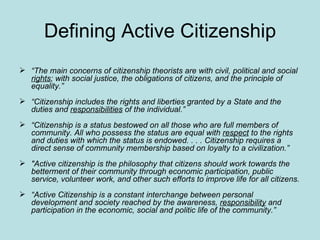
Defining Active Citizenship “ The main concerns of citizenship theorists are with civil, political and social  rights ; with social justice, the obligations of citizens, and the principle of equality.” “ Citizenship  includes the rights and liberties granted by a State and the duties and  responsibilities  of the individual.” “ Citizenship is a status bestowed on all those who are full members of community. All who possess the status are equal with  respect  to the rights and duties with which the status is endowed. . . . Citizenship requires a direct sense of community membership based on loyalty to a civilization.” "Active citizenship is the philosophy that citizens should work towards the betterment of their community through economic participation, public service, volunteer work, and other such efforts to improve life for all citizens. “ Active Citizenship is a constant interchange between personal development and society reached by the awareness,  responsibility  and participation in the economic, social and politic life of the community.”
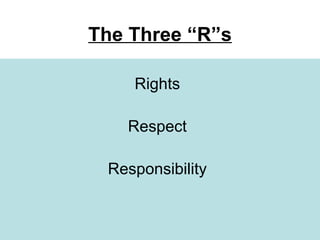
Rights Respect Responsibility The Three “R”s
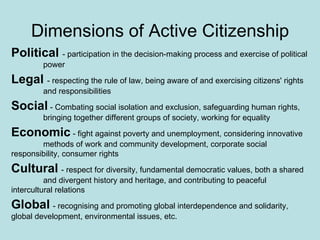
Dimensions of Active Citizenship Political  -  participation in the decision-making process and exercise of political  power Legal   - respecting the rule of law, being aware of and exercising citizens' rights  and responsibilities   Social   - Combating social isolation and exclusion, safeguarding human rights,  bringing together different groups of society, working for equality Economic   - fight against poverty and unemployment, considering innovative  methods of work and community development, corporate social  responsibility, consumer rights   Cultural   -  respect for diversity, fundamental democratic values, both a shared  and divergent history and heritage, and contributing to peaceful  intercultural relations   Global   -  recognising and promoting global interdependence and solidarity,  global development, environmental issues, etc.
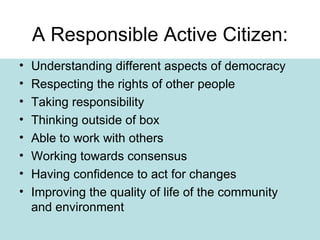
Understanding different aspects of democracy Respecting the rights of other people Taking responsibility Thinking outside of box Able to work with others Working towards consensus Having confidence to act for changes Improving the quality of life of the community and environment A Responsible Active Citizen:
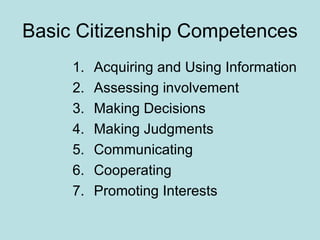
Basic Citizenship Competences Acquiring and Using Information Assessing involvement Making Decisions Making Judgments Communicating Cooperating Promoting Interests
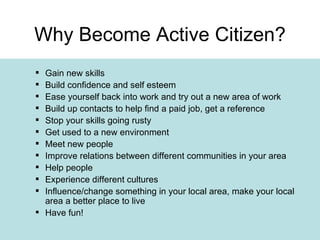
Gain new skills Build confidence and self esteem Ease yourself back into work and try out a new area of work Build up contacts to help find a paid job, get a reference Stop your skills going rusty Get used to a new environment Meet new people Improve relations between different communities in your area Help people Experience different cultures Influence/change something in your local area, make your local area a better place to live Have fun! Why Become Active Citizen?
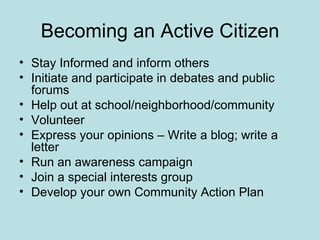
Stay Informed and inform others Initiate and participate in debates and public forums Help out at school/neighborhood/community Volunteer Express your opinions – Write a blog; write a letter Run an awareness campaign Join a special interests group Develop your own Community Action Plan   Becoming an Active Citizen
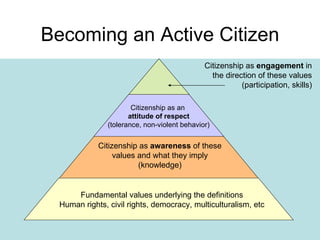
Becoming an Active Citizen Fundamental values underlying the definitions Human rights, civil rights, democracy, multiculturalism, etc Citizenship as  awareness  of these values and what they imply (knowledge) Citizenship as an  attitude of respect (tolerance, non-violent behavior) Citizenship as  engagement  in the direction of these values (participation, skills)
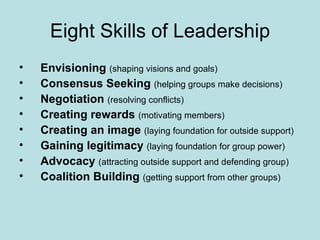
Eight Skills of Leadership Envisioning   (shaping visions and goals) Consensus Seeking   (helping groups make decisions) Negotiation   (resolving conflicts) Creating rewards   (motivating members) Creating an image   (laying foundation for outside support) Gaining legitimacy   (laying foundation for group power) Advocacy  (attracting outside support and defending group) Coalition Building   (getting support from other groups)
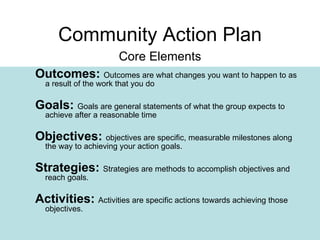
Outcomes:   Outcomes are what changes you want to happen to as a result of the work that you do Goals:   Goals are general statements of what the group expects to achieve after a reasonable time Objectives:   objectives are specific, measurable milestones along the way to achieving your action goals.   Strategies:   Strategies are methods to accomplish objectives and reach goals.   Activities:   Activities are specific actions towards achieving those objectives.   Community Action Plan Core Elements
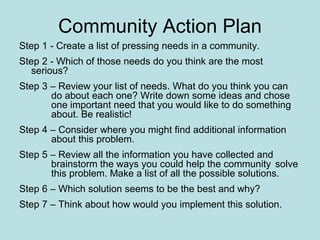
Community Action Plan Step 1 - Create a list of pressing needs in a community. Step 2 - Which of those needs do you think are the most  serious? Step 3 – Review your list of needs. What do you think you can  do about each one? Write down some ideas and chose  one important need that you would like to do something  about. Be realistic! Step 4 – Consider where you might find additional information  about this problem. Step 5 – Review all the information you have collected and  brainstorm the ways you could help the community  solve  this problem. Make a list of all the possible solutions. Step 6 – Which solution seems to be the best and why? Step 7 – Think about how would you implement this solution.
Community Action Plan Step 8 – Identify barriers to successfully implementing the solution.  Make a list of potential allies and opponents. Think about how  to calm the fears of those who might oppose your plan. Step 9 – Identify necessary resources for successfully  implementing your solutions. Step 10 – Chose individuals and community partners, gather  your potential allies to bring your solution to life.  Step 11 – Consider a timeline for conducting activities. Step 12 – Within your group chose a person or a group of people  to work together on writing the CAP. Step 13 – Implement your plan into action. Be ready for some  challenges. Step 14 – After you have implemented your CAP, take time to  reflect what you did. Include monitoring and evaluation. Step 15 – Celebrate your success!
I hear and I forget. I see and I remember. I do and I understand. Chinese proverb
Thank You!    Good Luck!!!

Do It Yourself - Promoting Responsibility and Civic Action

  • 1.
    Do It Yourself– Promoting Responsibility and Civic Action Mikheil Benidze ’06 FLEX-Ability South Caucasus Conference March 27, 2010 Tbilisi, Georgia
  • 2.
    Defining Active Citizenship“ The main concerns of citizenship theorists are with civil, political and social rights ; with social justice, the obligations of citizens, and the principle of equality.” “ Citizenship includes the rights and liberties granted by a State and the duties and responsibilities of the individual.” “ Citizenship is a status bestowed on all those who are full members of community. All who possess the status are equal with respect to the rights and duties with which the status is endowed. . . . Citizenship requires a direct sense of community membership based on loyalty to a civilization.” "Active citizenship is the philosophy that citizens should work towards the betterment of their community through economic participation, public service, volunteer work, and other such efforts to improve life for all citizens. “ Active Citizenship is a constant interchange between personal development and society reached by the awareness, responsibility and participation in the economic, social and politic life of the community.”
  • 3.
  • 4.
    Dimensions of ActiveCitizenship Political - participation in the decision-making process and exercise of political power Legal - respecting the rule of law, being aware of and exercising citizens' rights and responsibilities Social - Combating social isolation and exclusion, safeguarding human rights, bringing together different groups of society, working for equality Economic - fight against poverty and unemployment, considering innovative methods of work and community development, corporate social responsibility, consumer rights Cultural - respect for diversity, fundamental democratic values, both a shared and divergent history and heritage, and contributing to peaceful intercultural relations Global - recognising and promoting global interdependence and solidarity, global development, environmental issues, etc.
  • 5.
    Understanding different aspectsof democracy Respecting the rights of other people Taking responsibility Thinking outside of box Able to work with others Working towards consensus Having confidence to act for changes Improving the quality of life of the community and environment A Responsible Active Citizen:
  • 6.
    Basic Citizenship CompetencesAcquiring and Using Information Assessing involvement Making Decisions Making Judgments Communicating Cooperating Promoting Interests
  • 7.
    Gain new skillsBuild confidence and self esteem Ease yourself back into work and try out a new area of work Build up contacts to help find a paid job, get a reference Stop your skills going rusty Get used to a new environment Meet new people Improve relations between different communities in your area Help people Experience different cultures Influence/change something in your local area, make your local area a better place to live Have fun! Why Become Active Citizen?
  • 8.
    Stay Informed andinform others Initiate and participate in debates and public forums Help out at school/neighborhood/community Volunteer Express your opinions – Write a blog; write a letter Run an awareness campaign Join a special interests group Develop your own Community Action Plan Becoming an Active Citizen
  • 9.
    Becoming an ActiveCitizen Fundamental values underlying the definitions Human rights, civil rights, democracy, multiculturalism, etc Citizenship as awareness of these values and what they imply (knowledge) Citizenship as an attitude of respect (tolerance, non-violent behavior) Citizenship as engagement in the direction of these values (participation, skills)
  • 10.
    Eight Skills ofLeadership Envisioning (shaping visions and goals) Consensus Seeking (helping groups make decisions) Negotiation (resolving conflicts) Creating rewards (motivating members) Creating an image (laying foundation for outside support) Gaining legitimacy (laying foundation for group power) Advocacy (attracting outside support and defending group) Coalition Building (getting support from other groups)
  • 11.
    Outcomes: Outcomes are what changes you want to happen to as a result of the work that you do Goals: Goals are general statements of what the group expects to achieve after a reasonable time Objectives: objectives are specific, measurable milestones along the way to achieving your action goals. Strategies: Strategies are methods to accomplish objectives and reach goals. Activities: Activities are specific actions towards achieving those objectives. Community Action Plan Core Elements
  • 12.
    Community Action PlanStep 1 - Create a list of pressing needs in a community. Step 2 - Which of those needs do you think are the most serious? Step 3 – Review your list of needs. What do you think you can do about each one? Write down some ideas and chose one important need that you would like to do something about. Be realistic! Step 4 – Consider where you might find additional information about this problem. Step 5 – Review all the information you have collected and brainstorm the ways you could help the community solve this problem. Make a list of all the possible solutions. Step 6 – Which solution seems to be the best and why? Step 7 – Think about how would you implement this solution.
  • 13.
    Community Action PlanStep 8 – Identify barriers to successfully implementing the solution. Make a list of potential allies and opponents. Think about how to calm the fears of those who might oppose your plan. Step 9 – Identify necessary resources for successfully implementing your solutions. Step 10 – Chose individuals and community partners, gather your potential allies to bring your solution to life. Step 11 – Consider a timeline for conducting activities. Step 12 – Within your group chose a person or a group of people to work together on writing the CAP. Step 13 – Implement your plan into action. Be ready for some challenges. Step 14 – After you have implemented your CAP, take time to reflect what you did. Include monitoring and evaluation. Step 15 – Celebrate your success!
  • 14.
    I hear andI forget. I see and I remember. I do and I understand. Chinese proverb
  • 15.
    Thank You!  Good Luck!!!