Community
Service Project
Camille Younger
Brittney Surber
Monique C. Mitchelson-DeLaurier
An Overview
 An introduction
 The project proposal
 An evaluation of the project
 The implementation
strategy for the project
 A project timeline
 Assessment of group skills
 Organizational
development or structure
 Decision-making strategies
 Motivation
 Leadership
 Power use
 Organizational culture
 Conflict resolution
 Summary of group behavior
and performance during
project
Breast Cancer Introduction
watch link below:
https://www.youtube.com/watch?v=WvpMEs_2AJM&feature=youtu.be
Proposal
One of the group’s members is heavily involved in
breast cancer awareness trainings. We collectively
decided that we would attempt to champion this cause,
despite the other members being not as well versed in
the subject. We recognized it as cause is timeless. Our
mission:
“We believe in consumer health autonomy by making resources and
information accessible in a grassroots forum to educate, inform, and
empower women and men on breast cancer and breast health
awareness." –Breast Cancer Awareness Group
The Evaluation &
Implementation
 Virtual Team work is always challenging. In fact, this
dynamic generally streamlines the amount and type
of information shared. (Robbins and Judges, 2013).
Collaborative members are more likely to only share
information that they consider highly important.
(Robbins and Judges, 2013). However, overall, the
team regulated itself and was able to create a web
site with regular visits from users and surfers.
Hosted on the site is a poll, facts, a donation link, a
discourse forum, and resources regarding breast
cancer.
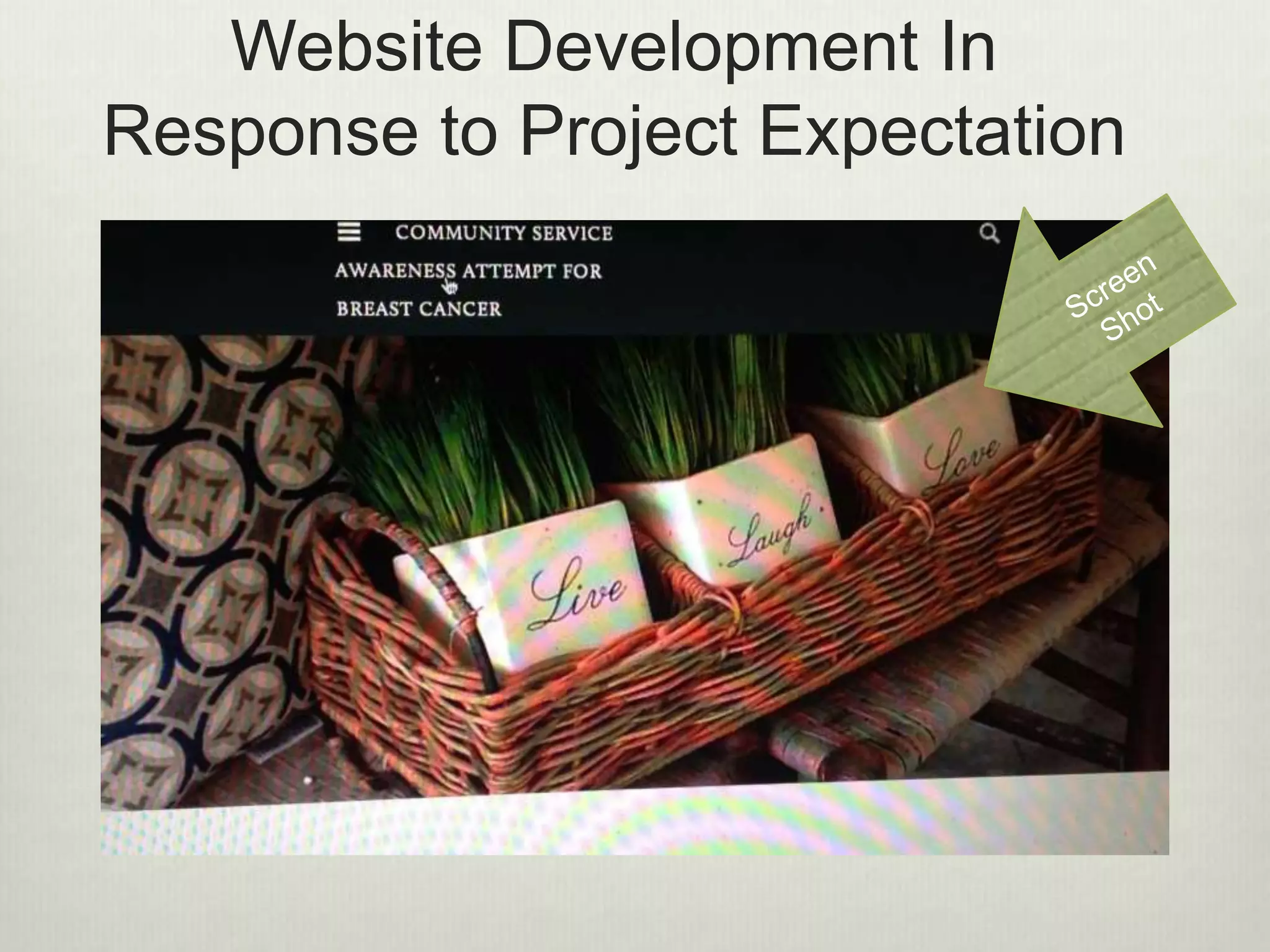
Website Development In
Response to Project Expectation
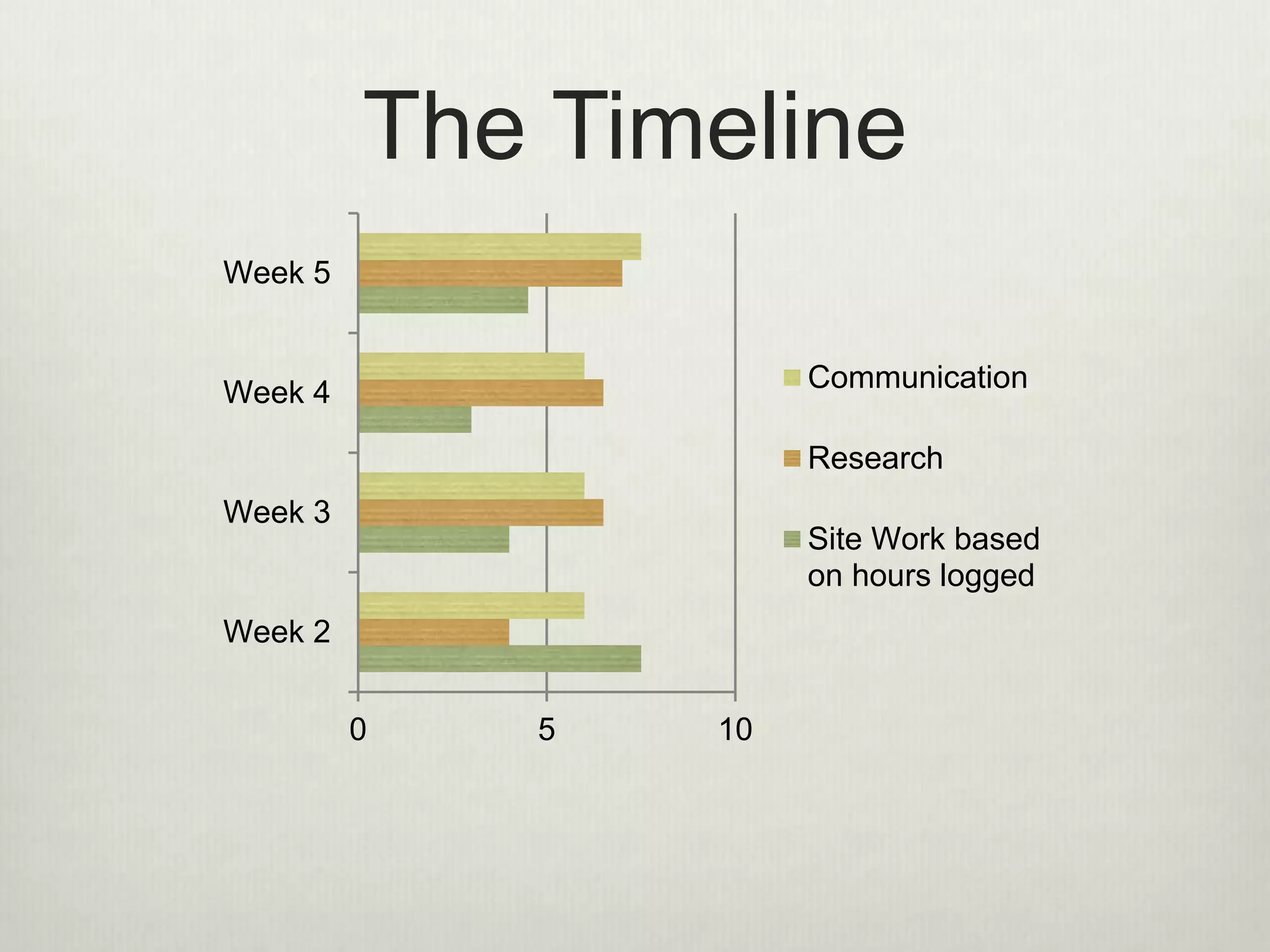
The Timeline
0 5 10
Week 2
Week 3
Week 4
Week 5
Communication
Research
Site Work based
on hours logged
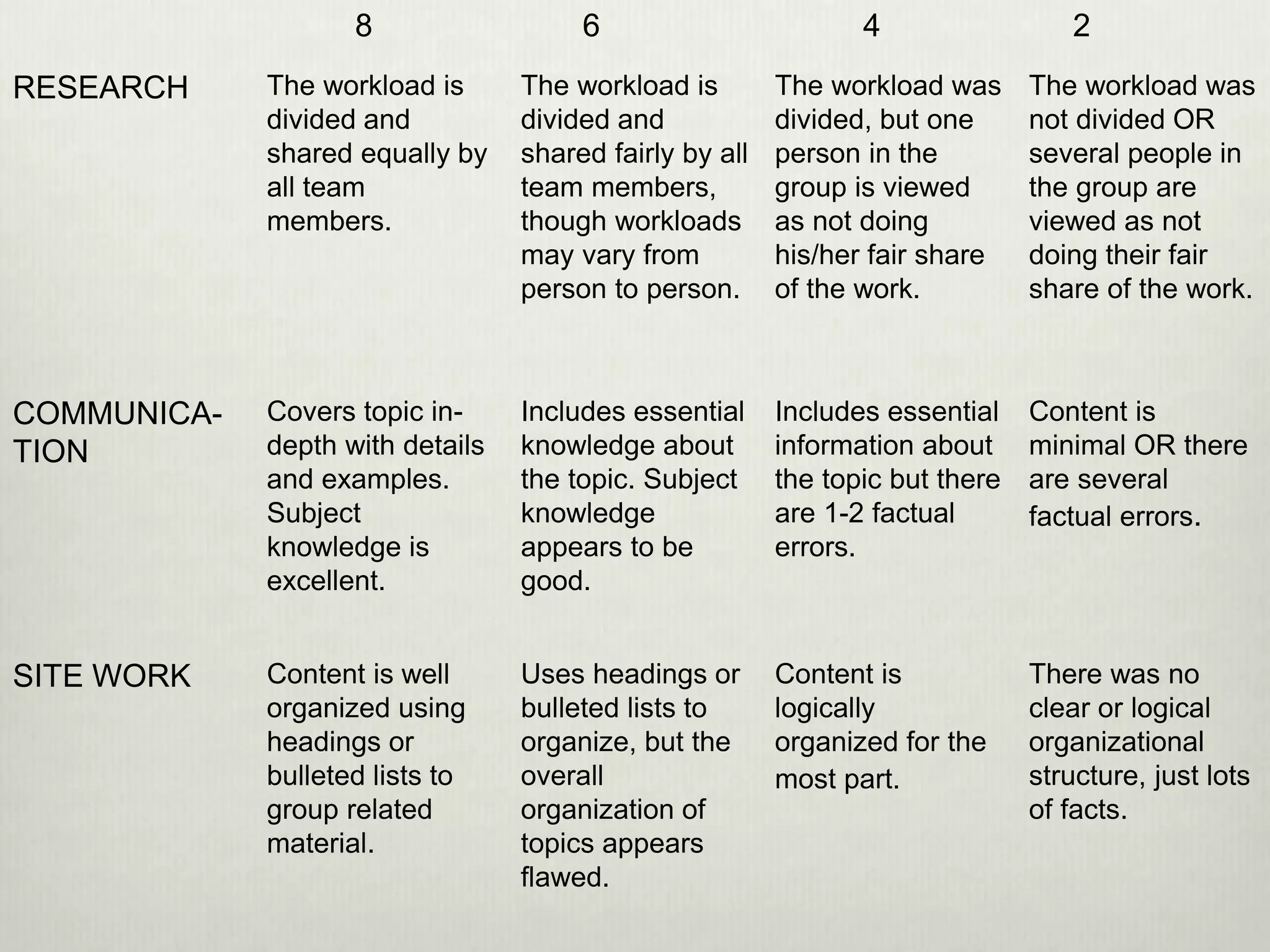
The following is a copy
of the
rubric that we used to
gauge our team efficacy.
(Robbins and Judges,
2013)

file:///Users/mmdelaurier/Downloads/MyRubric-2.xls.html
8 6 4 2
RESEARCH The workload is
divided and
shared equally by
all team
members.
The workload is
divided and
shared fairly by all
team members,
though workloads
may vary from
person to person.
The workload was
divided, but one
person in the
group is viewed
as not doing
his/her fair share
of the work.
The workload was
not divided OR
several people in
the group are
viewed as not
doing their fair
share of the work.
COMMUNICA-
TION
Covers topic in-
depth with details
and examples.
Subject
knowledge is
excellent.
Includes essential
knowledge about
the topic. Subject
knowledge
appears to be
good.
Includes essential
information about
the topic but there
are 1-2 factual
errors.
Content is
minimal OR there
are several
factual errors.
SITE WORK Content is well
organized using
headings or
bulleted lists to
group related
material.
Uses headings or
bulleted lists to
organize, but the
overall
organization of
topics appears
flawed.
Content is
logically
organized for the
most part.
There was no
clear or logical
organizational
structure, just lots
of facts.
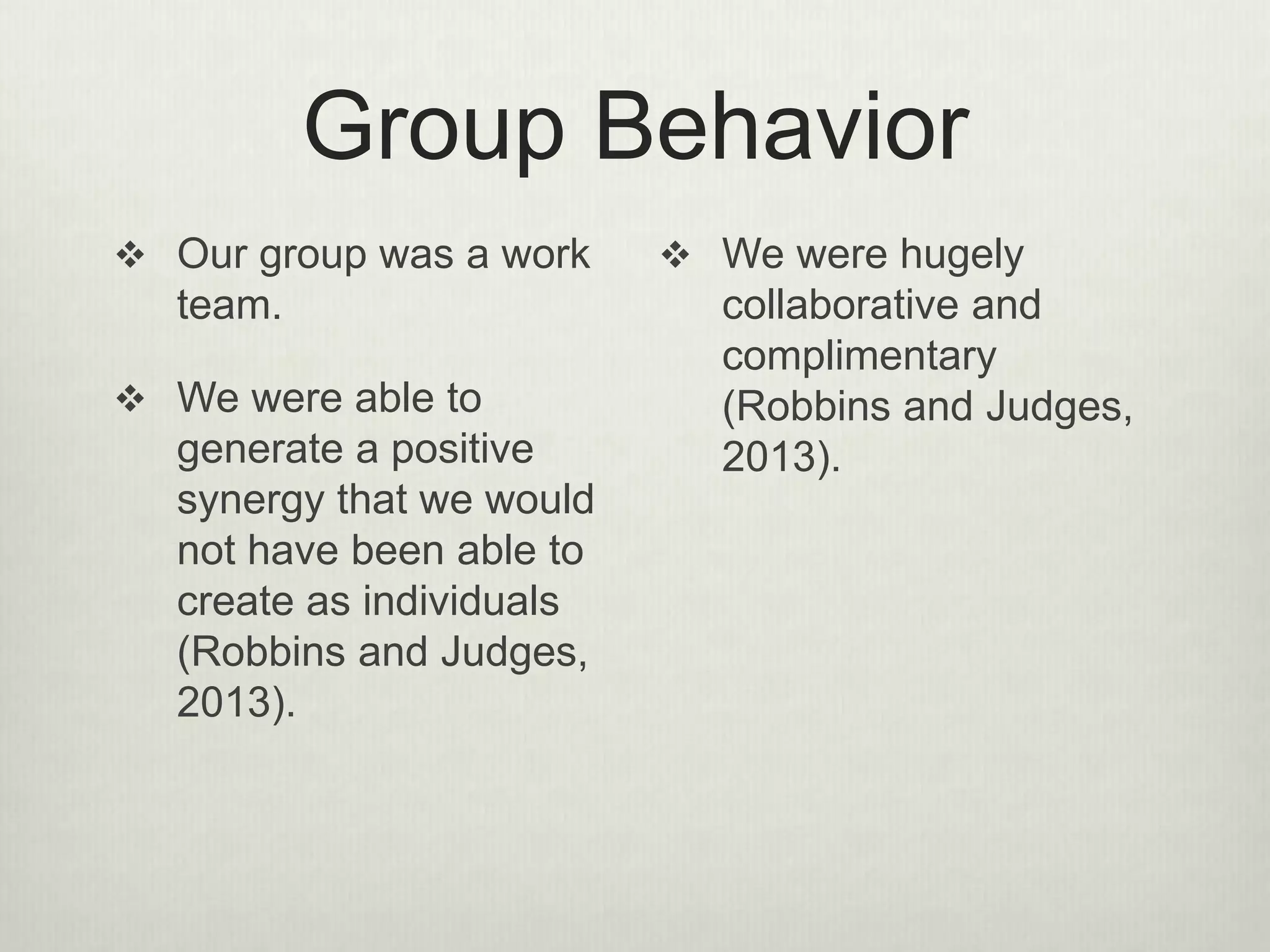
Group Behavior
 Our group was a work
team.
 We were able to
generate a positive
synergy that we would
not have been able to
create as individuals
(Robbins and Judges,
2013).
 We were hugely
collaborative and
complimentary
(Robbins and Judges,
2013).
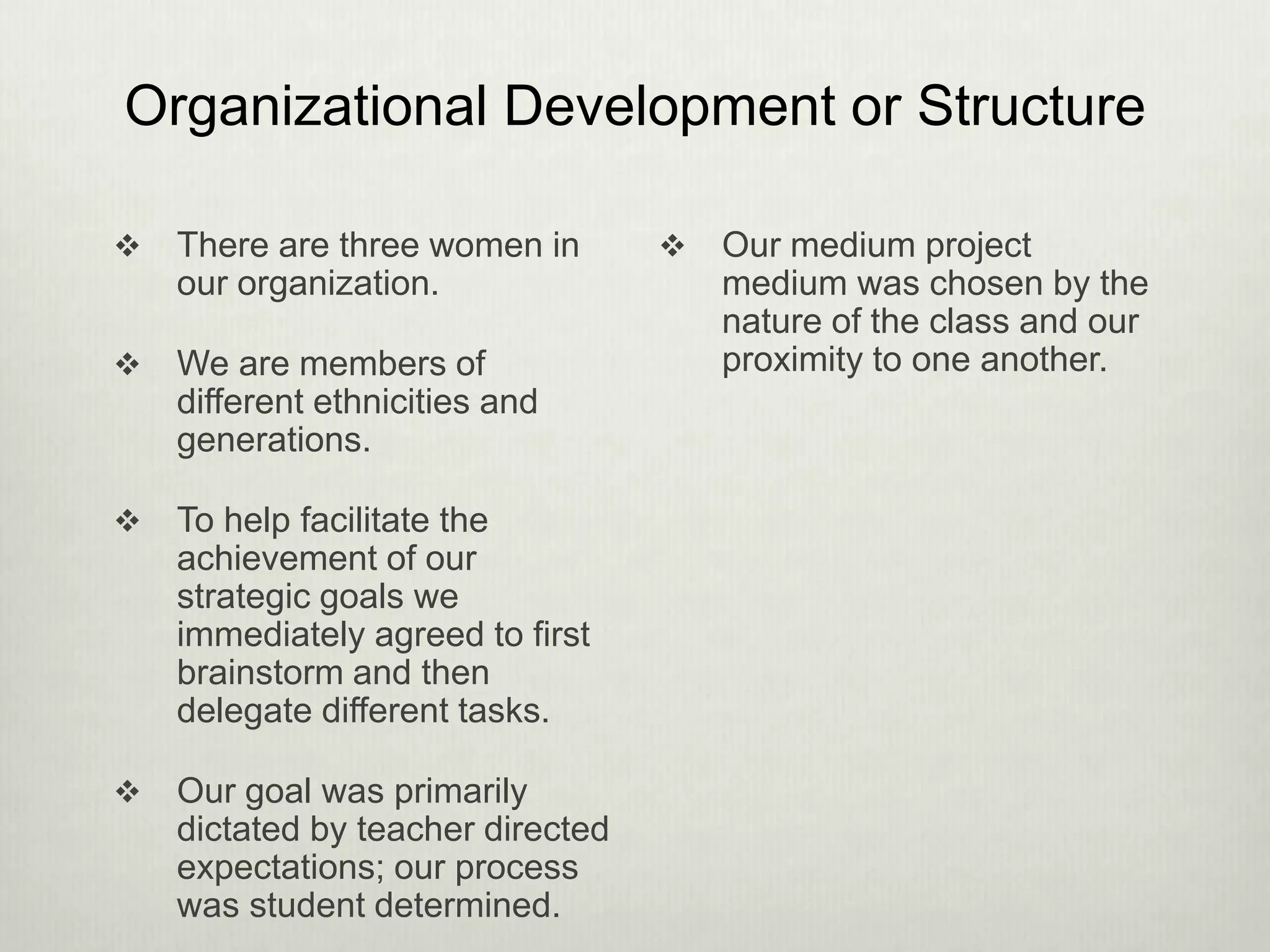
Organizational Development or Structure
 There are three women in
our organization.
 We are members of
different ethnicities and
generations.
 To help facilitate the
achievement of our
strategic goals we
immediately agreed to first
brainstorm and then
delegate different tasks.
 Our goal was primarily
dictated by teacher directed
expectations; our process
was student determined.
 Our medium project
medium was chosen by the
nature of the class and our
proximity to one another.
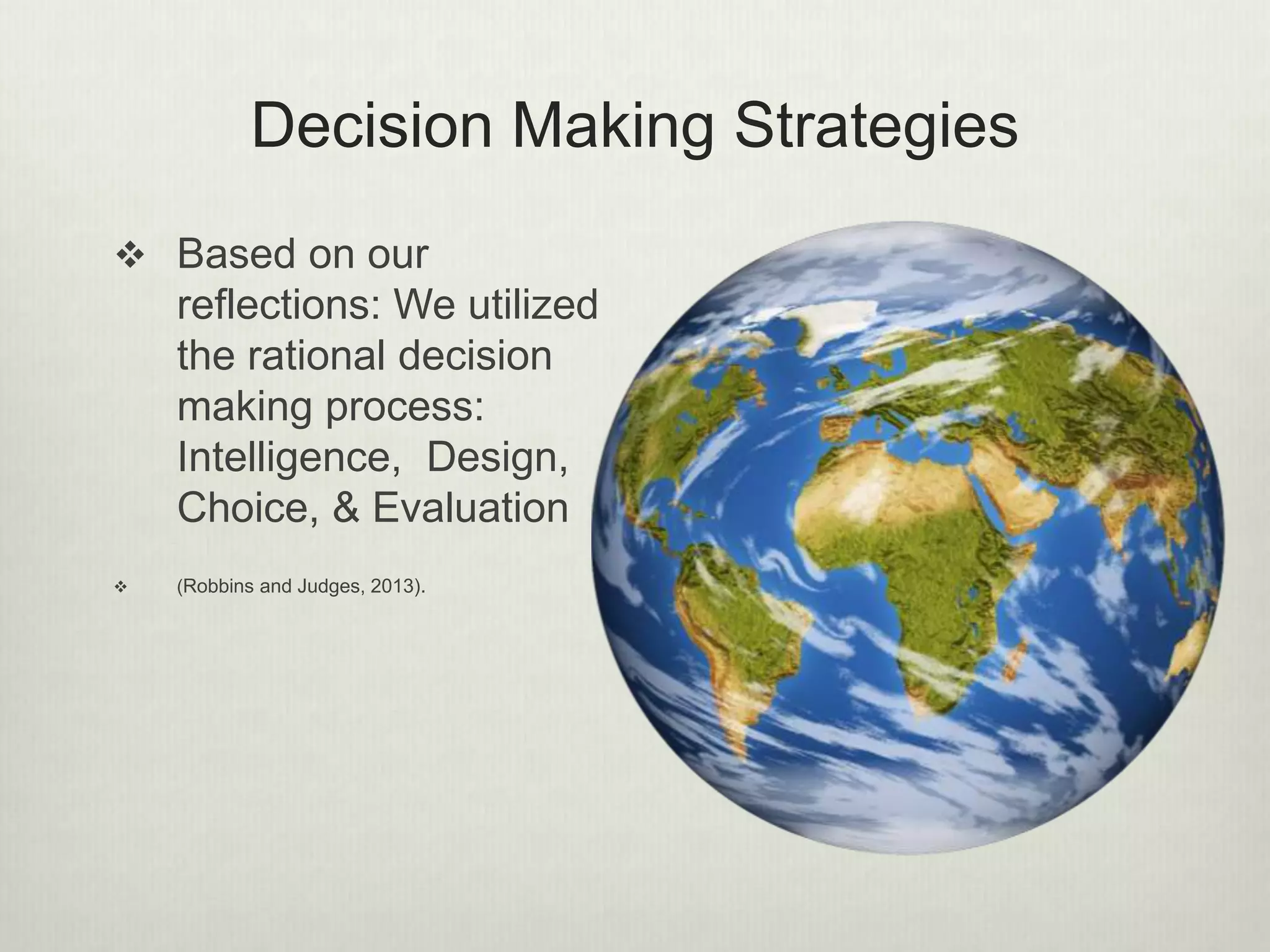
Decision Making Strategies
 Based on our
reflections: We utilized
the rational decision
making process:
Intelligence, Design,
Choice, & Evaluation
 (Robbins and Judges, 2013).
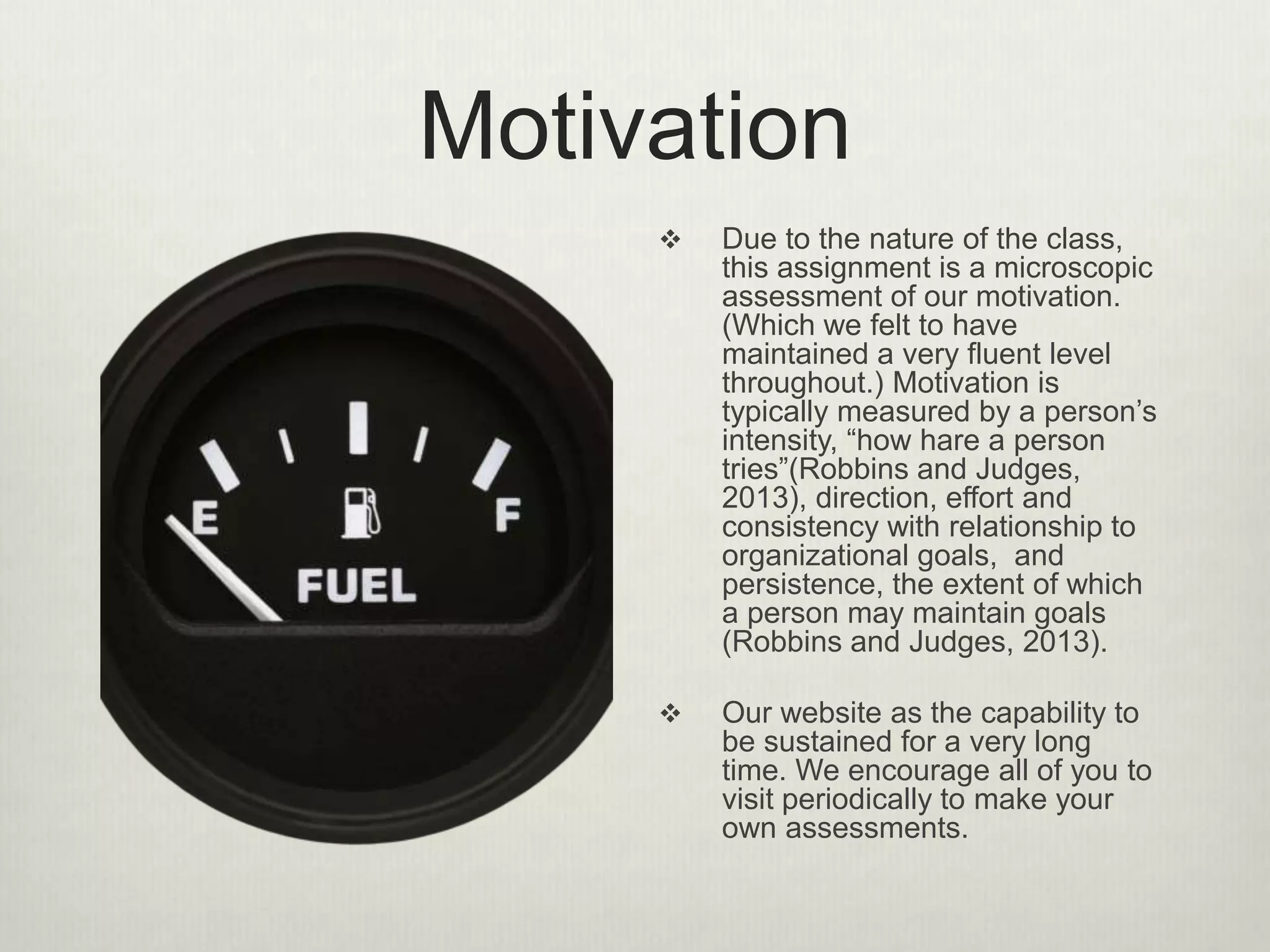
Motivation
 Due to the nature of the class,
this assignment is a microscopic
assessment of our motivation.
(Which we felt to have
maintained a very fluent level
throughout.) Motivation is
typically measured by a person’s
intensity, “how hare a person
tries”(Robbins and Judges,
2013), direction, effort and
consistency with relationship to
organizational goals, and
persistence, the extent of which
a person may maintain goals
(Robbins and Judges, 2013).
 Our website as the capability to
be sustained for a very long
time. We encourage all of you to
visit periodically to make your
own assessments.
Leadership and Power
 We each had an area
of expertise:
 Camille-cancer
information broad base
 Brittney-research
 Monique-technology
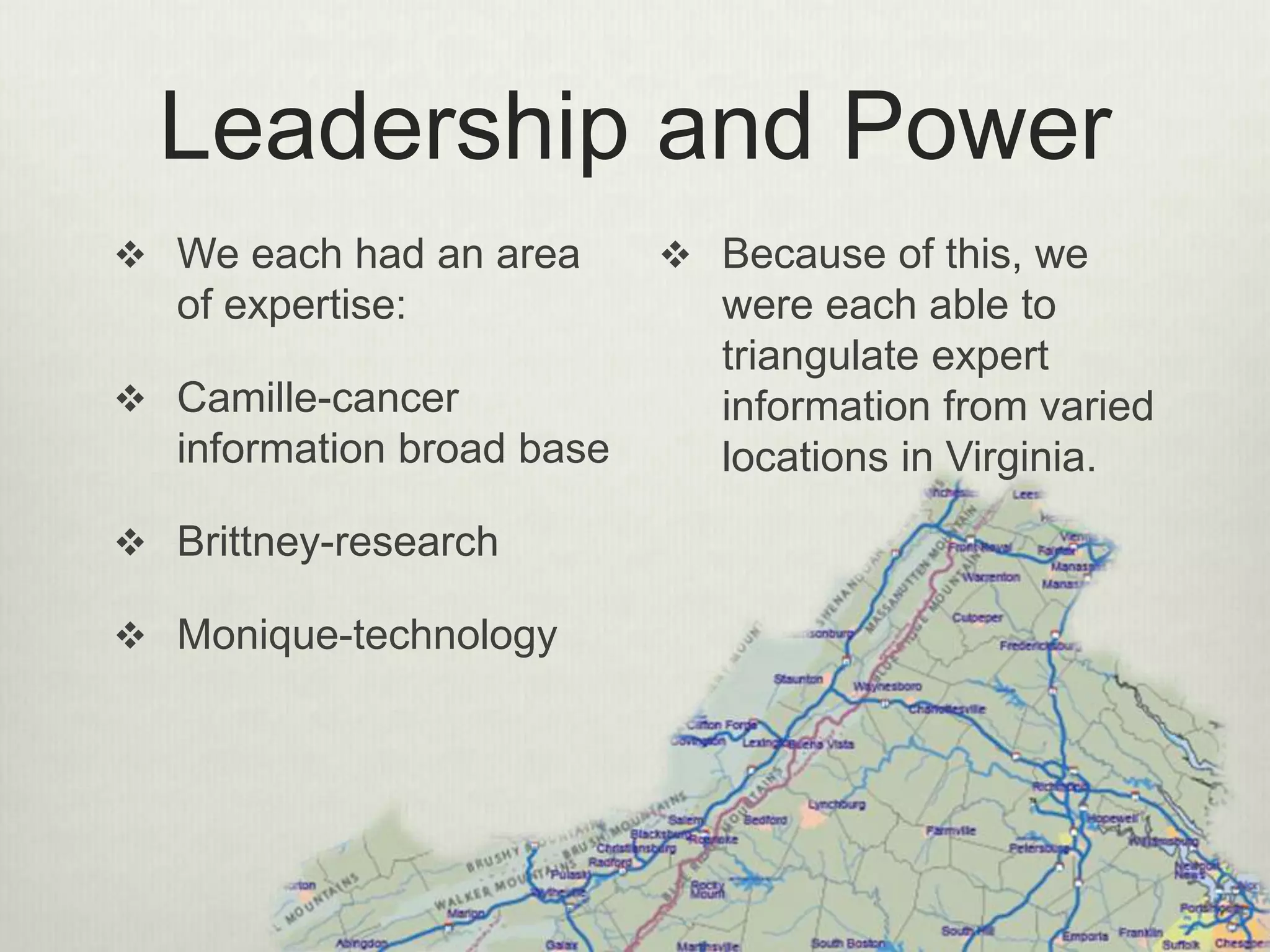
 Because of this, we
were each able to
triangulate expert
information from varied
locations in Virginia.
Organizational Culture
 Key Characteristics (as
it relates to this
assignment)-virtual
and cancer related.
 Risk-takers-Stepping
outside of our
individual familiarity,
but able to produce as
a group team.
 Wanted to be accurate
and aesthetically
pleasing.
 Availability-Our
website helps us to
keep up with use and
our mission by
generating stats.
 We feel as though the
site itself is very warm
and people friendly.
Conflict Resolution
 While there may have been conflict, it was never
overt or debilitating. And because we each
subscribe to the Interactionist view (Robbins,
Judges, and Vohra, 2012), any conflicts were
appreciated and helped in generating new ideas
and action.
Summary
Despite being a somewhat topical assignment, we
feel as though the core concentration, community
service, was broad enough to make both the
process and product authentic. We were able to
proficiently navigate: creativity, critical thinking,
collaborative efforts, and communication relatively
effortlessly.-
Camille, Brittney, and Monique
Dedicationwatch link below
https://www.youtube.com/watch?v=-djRPSal8QI
References
Robbins, S. P., & Judge, T. (2013). Organizational
behavior. Upper Saddle River, N.J: Pearson/
Prentice Hall.
Robbins, Judges, and Vohra (2012). Organizational
Behavior Conflict and Resolution. Retrieved
from http://
www.slideshare.net/balajinages/conflict-and-
negotiation-14766538

Breast Cancer Awareness Community Service Project Performance and Reflection-BSA Averett University with Janet Cox

  • 1.
    Community Service Project Camille Younger BrittneySurber Monique C. Mitchelson-DeLaurier
  • 2.
    An Overview  Anintroduction  The project proposal  An evaluation of the project  The implementation strategy for the project  A project timeline  Assessment of group skills  Organizational development or structure  Decision-making strategies  Motivation  Leadership  Power use  Organizational culture  Conflict resolution  Summary of group behavior and performance during project
  • 3.
    Breast Cancer Introduction watchlink below: https://www.youtube.com/watch?v=WvpMEs_2AJM&feature=youtu.be
  • 4.
    Proposal One of thegroup’s members is heavily involved in breast cancer awareness trainings. We collectively decided that we would attempt to champion this cause, despite the other members being not as well versed in the subject. We recognized it as cause is timeless. Our mission: “We believe in consumer health autonomy by making resources and information accessible in a grassroots forum to educate, inform, and empower women and men on breast cancer and breast health awareness." –Breast Cancer Awareness Group
  • 5.
    The Evaluation & Implementation Virtual Team work is always challenging. In fact, this dynamic generally streamlines the amount and type of information shared. (Robbins and Judges, 2013). Collaborative members are more likely to only share information that they consider highly important. (Robbins and Judges, 2013). However, overall, the team regulated itself and was able to create a web site with regular visits from users and surfers. Hosted on the site is a poll, facts, a donation link, a discourse forum, and resources regarding breast cancer.
  • 6.
    Website Development In Responseto Project Expectation
  • 7.
    The Timeline 0 510 Week 2 Week 3 Week 4 Week 5 Communication Research Site Work based on hours logged
  • 8.
    The following isa copy of the rubric that we used to gauge our team efficacy. (Robbins and Judges, 2013)  file:///Users/mmdelaurier/Downloads/MyRubric-2.xls.html
  • 9.
    8 6 42 RESEARCH The workload is divided and shared equally by all team members. The workload is divided and shared fairly by all team members, though workloads may vary from person to person. The workload was divided, but one person in the group is viewed as not doing his/her fair share of the work. The workload was not divided OR several people in the group are viewed as not doing their fair share of the work. COMMUNICA- TION Covers topic in- depth with details and examples. Subject knowledge is excellent. Includes essential knowledge about the topic. Subject knowledge appears to be good. Includes essential information about the topic but there are 1-2 factual errors. Content is minimal OR there are several factual errors. SITE WORK Content is well organized using headings or bulleted lists to group related material. Uses headings or bulleted lists to organize, but the overall organization of topics appears flawed. Content is logically organized for the most part. There was no clear or logical organizational structure, just lots of facts.
  • 10.
    Group Behavior  Ourgroup was a work team.  We were able to generate a positive synergy that we would not have been able to create as individuals (Robbins and Judges, 2013).  We were hugely collaborative and complimentary (Robbins and Judges, 2013).
  • 11.
    Organizational Development orStructure  There are three women in our organization.  We are members of different ethnicities and generations.  To help facilitate the achievement of our strategic goals we immediately agreed to first brainstorm and then delegate different tasks.  Our goal was primarily dictated by teacher directed expectations; our process was student determined.  Our medium project medium was chosen by the nature of the class and our proximity to one another.
  • 12.
    Decision Making Strategies Based on our reflections: We utilized the rational decision making process: Intelligence, Design, Choice, & Evaluation  (Robbins and Judges, 2013).
  • 13.
    Motivation  Due tothe nature of the class, this assignment is a microscopic assessment of our motivation. (Which we felt to have maintained a very fluent level throughout.) Motivation is typically measured by a person’s intensity, “how hare a person tries”(Robbins and Judges, 2013), direction, effort and consistency with relationship to organizational goals, and persistence, the extent of which a person may maintain goals (Robbins and Judges, 2013).  Our website as the capability to be sustained for a very long time. We encourage all of you to visit periodically to make your own assessments.
  • 14.
    Leadership and Power We each had an area of expertise:  Camille-cancer information broad base  Brittney-research  Monique-technology  Because of this, we were each able to triangulate expert information from varied locations in Virginia.
  • 15.
    Organizational Culture  KeyCharacteristics (as it relates to this assignment)-virtual and cancer related.  Risk-takers-Stepping outside of our individual familiarity, but able to produce as a group team.  Wanted to be accurate and aesthetically pleasing.  Availability-Our website helps us to keep up with use and our mission by generating stats.  We feel as though the site itself is very warm and people friendly.
  • 16.
    Conflict Resolution  Whilethere may have been conflict, it was never overt or debilitating. And because we each subscribe to the Interactionist view (Robbins, Judges, and Vohra, 2012), any conflicts were appreciated and helped in generating new ideas and action.
  • 17.
    Summary Despite being asomewhat topical assignment, we feel as though the core concentration, community service, was broad enough to make both the process and product authentic. We were able to proficiently navigate: creativity, critical thinking, collaborative efforts, and communication relatively effortlessly.- Camille, Brittney, and Monique
  • 18.
  • 19.
    References Robbins, S. P.,& Judge, T. (2013). Organizational behavior. Upper Saddle River, N.J: Pearson/ Prentice Hall. Robbins, Judges, and Vohra (2012). Organizational Behavior Conflict and Resolution. Retrieved from http:// www.slideshare.net/balajinages/conflict-and- negotiation-14766538