



Sunday May 17th, 4.00-6.00pm (MST)
Altitude Room; Crowne Plaza, Denver, Colorado
REG COPD Control Working Group Meeting
COPD Control Members
Lead: Marc Miravitlles
Members
• Dermot Ryan
• Richard Costello
• Nicolas Roche
• Alberto Papi
• Juan José Soler
• Bernardino Alcazar
• David Price
Participating
collaborators
• Luca Richeldi
• Helgo Magnussen
• Akio Niimi
• Mona Bafadhel
• Faisal Yunus
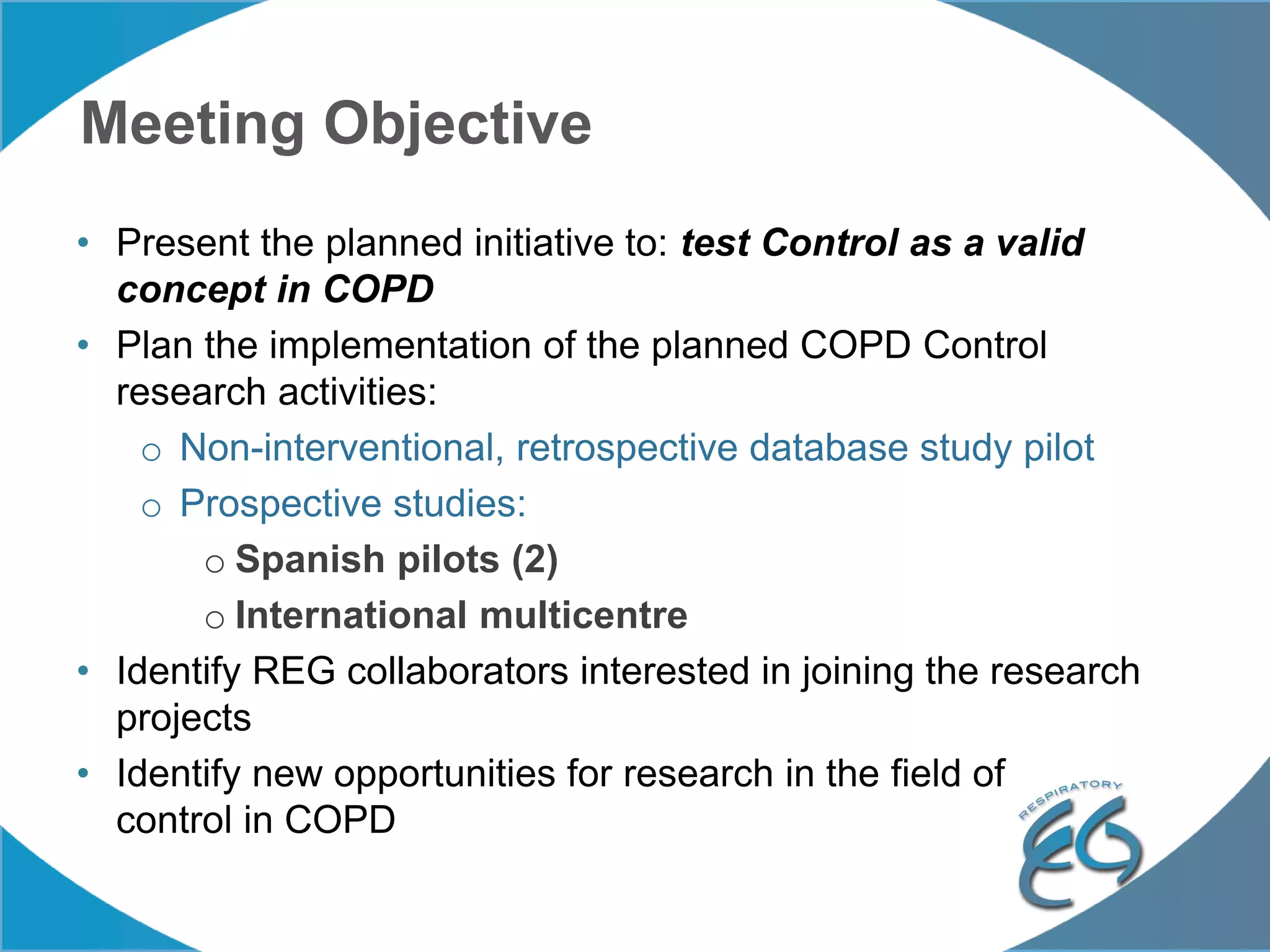
Meeting Objective
• Present the planned initiative to: test Control as a valid
concept in COPD
• Plan the implementation of the planned COPD Control
research activities:
o Non-interventional, retrospective database study pilot
o Prospective studies:
o Spanish pilots (2)
o International multicentre
• Identify REG collaborators interested in joining the research
projects
• Identify new opportunities for research in the field of
control in COPD
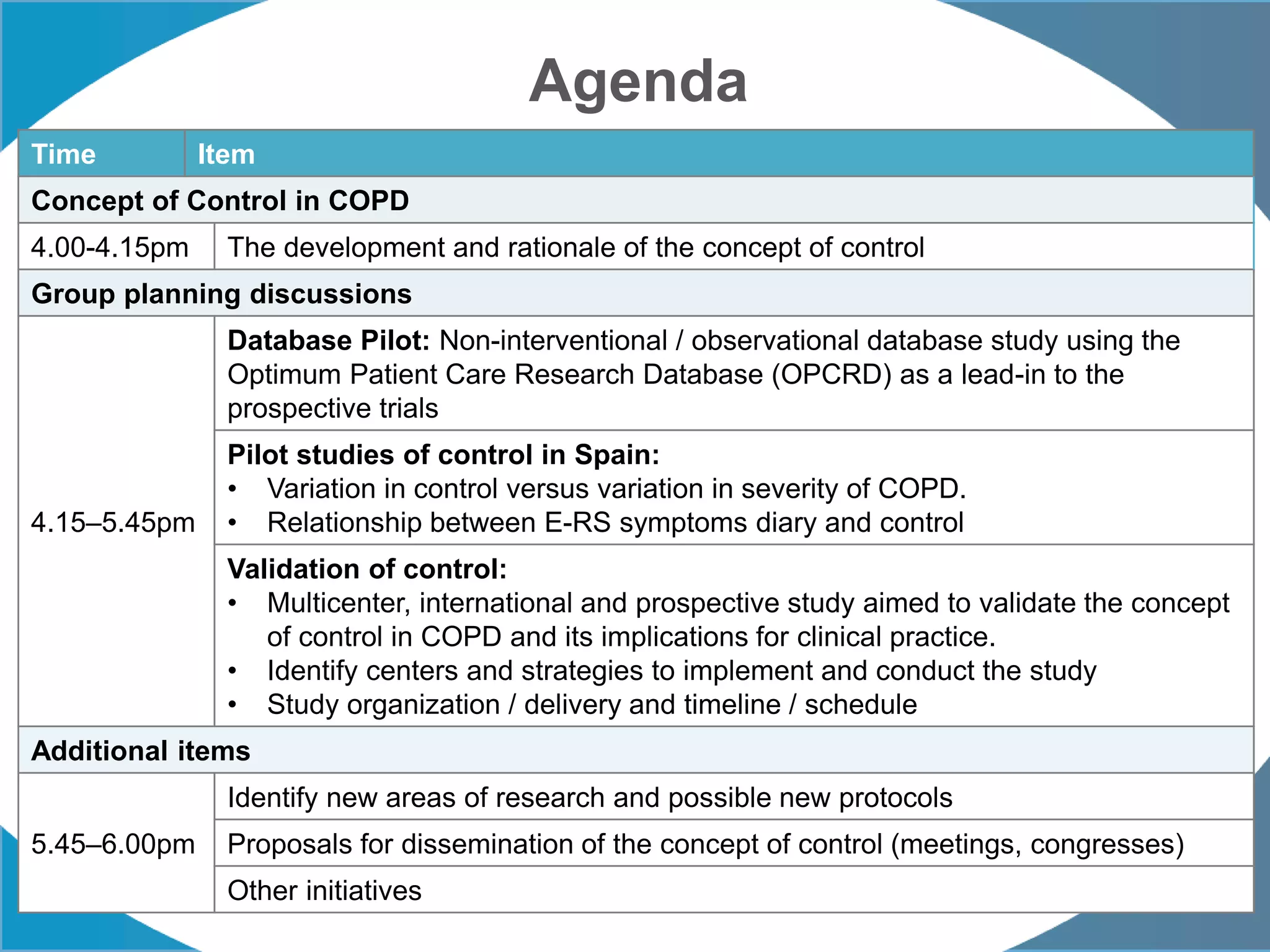
Agenda
Time Item
Concept of Control in COPD
4.00-4.15pm The development and rationale of the concept of control
Group planning discussions
4.15–5.45pm
Database Pilot: Non-interventional / observational database study using the
Optimum Patient Care Research Database (OPCRD) as a lead-in to the
prospective trials
Pilot studies of control in Spain:
• Variation in control versus variation in severity of COPD.
• Relationship between E-RS symptoms diary and control
Validation of control:
• Multicenter, international and prospective study aimed to validate the concept
of control in COPD and its implications for clinical practice.
• Identify centers and strategies to implement and conduct the study
• Study organization / delivery and timeline / schedule
Additional items
5.45–6.00pm
Identify new areas of research and possible new protocols
Proposals for dissemination of the concept of control (meetings, congresses)
Other initiatives
5
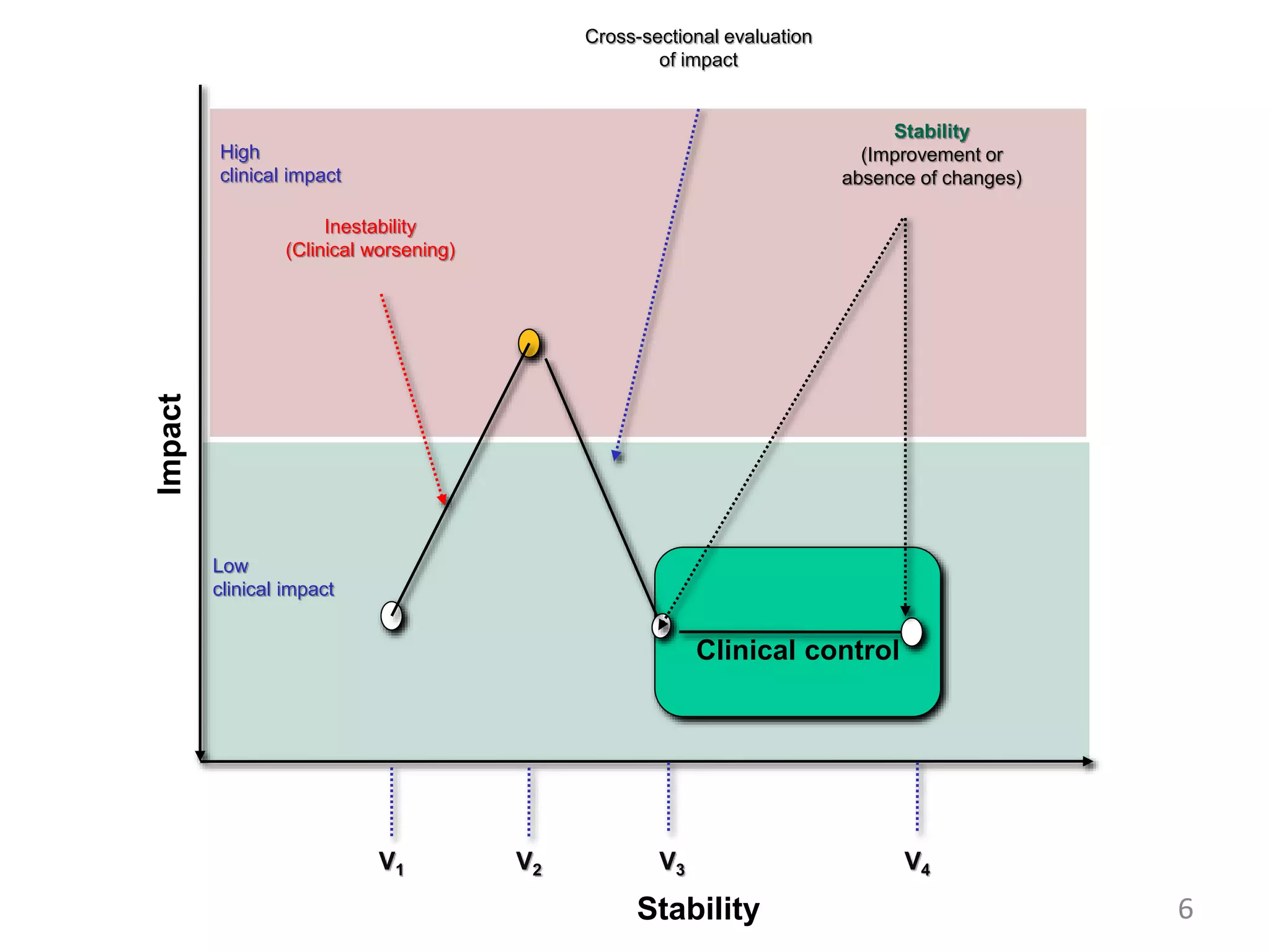
6
Low
clinical impact
Clinical control
Stability
Impact
High
clinical impact
Cross-sectional evaluation
of impact
Stability
(Improvement or
absence of changes)
Inestability
(Clinical worsening)
V1 V2 V3 V4
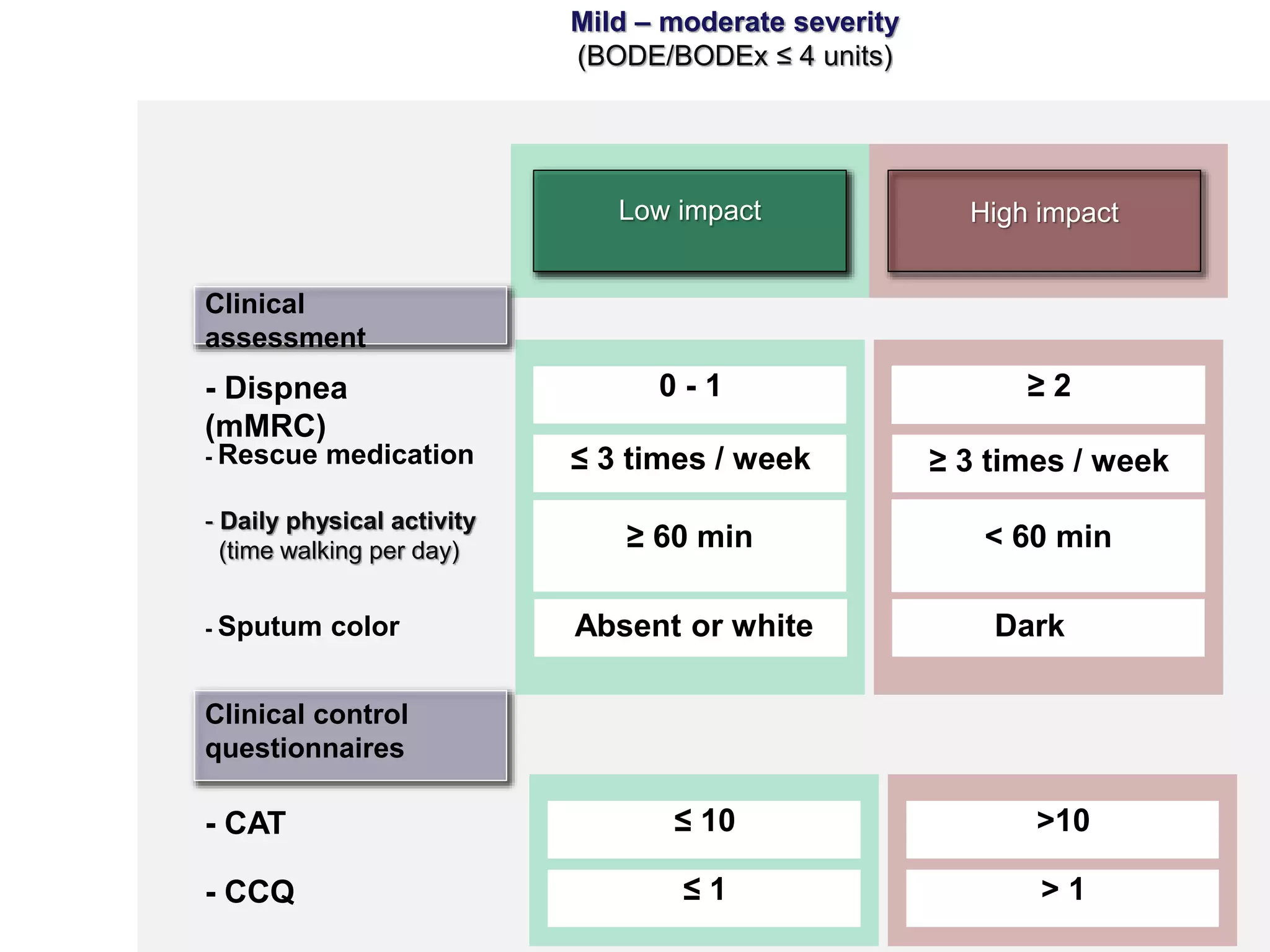
7
Clinical
assessment
- Dispnea
(mMRC)
- Rescue medication
- Daily physical activity
(time walking per day)
- Sputum color
Clinical control
questionnaires
- CAT
- CCQ
0 - 1
≥ 60 min
Low impact
≤ 3 times / week
Absent or white
≤ 1
≥ 2
< 60 min
≥ 3 times / week
Dark
≤ 10 >10
> 1
High impact
Mild – moderate severity
(BODE/BODEx ≤ 4 units)
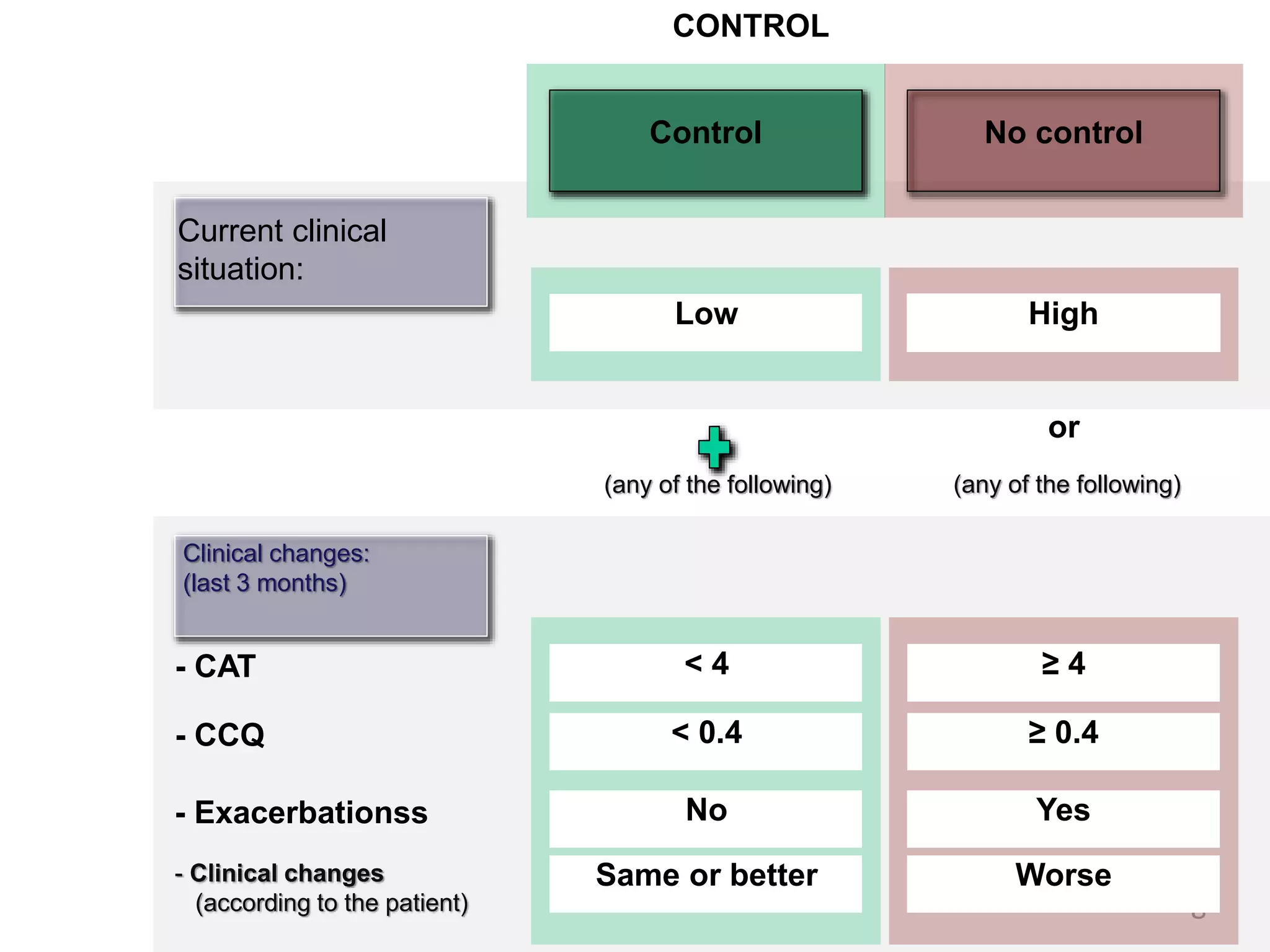
8
Current clinical
situation:
Clinical changes:
(last 3 months)
- CAT
- CCQ
Low
Control
< 0.4
High
< 4 ≥ 4
≥ 0.4
No control
CONTROL
(any of the following) (any of the following)
or
- Exacerbationss No Yes
- Clinical changes
(according to the patient)
Same or better Worse
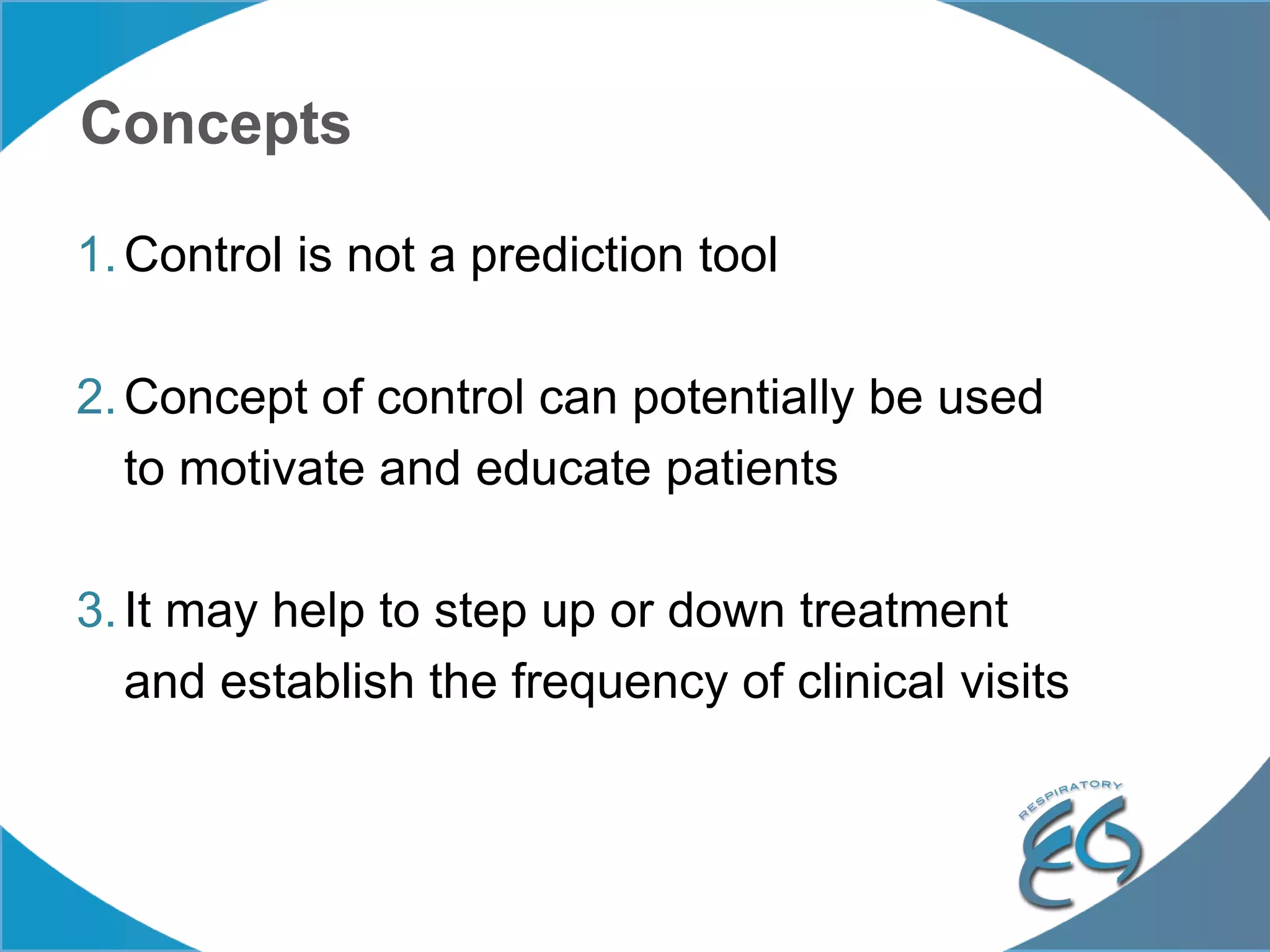
Concepts
1.Control is not a prediction tool
2.Concept of control can potentially be used
to motivate and educate patients
3.It may help to step up or down treatment
and establish the frequency of clinical visits
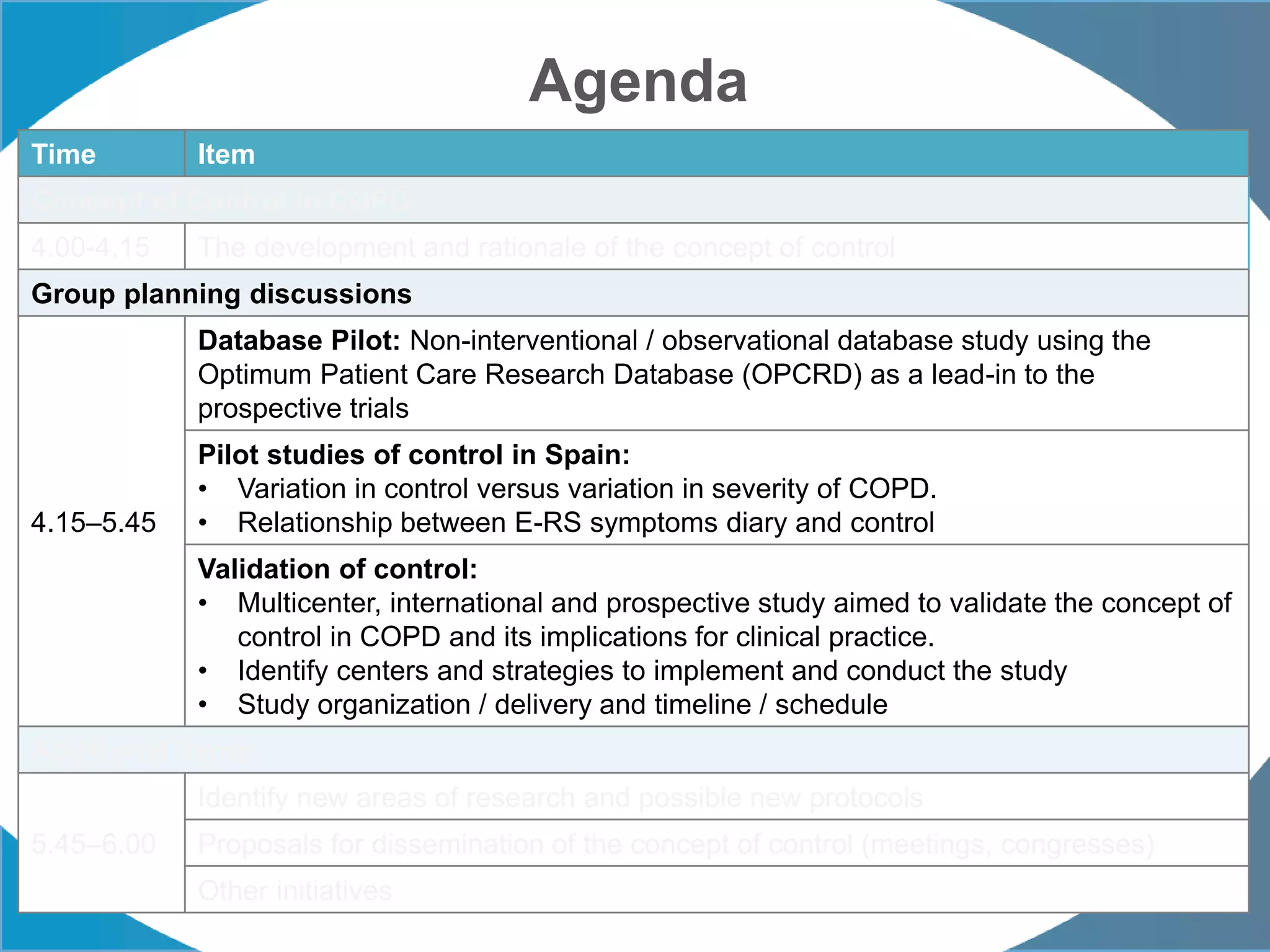
Agenda
Time Item
Concept of Control in COPD
4.00-4.15 The development and rationale of the concept of control
Group planning discussions
4.15–5.45
Database Pilot: Non-interventional / observational database study using the
Optimum Patient Care Research Database (OPCRD) as a lead-in to the
prospective trials
Pilot studies of control in Spain:
• Variation in control versus variation in severity of COPD.
• Relationship between E-RS symptoms diary and control
Validation of control:
• Multicenter, international and prospective study aimed to validate the concept of
control in COPD and its implications for clinical practice.
• Identify centers and strategies to implement and conduct the study
• Study organization / delivery and timeline / schedule
Additional items
5.45–6.00
Identify new areas of research and possible new protocols
Proposals for dissemination of the concept of control (meetings, congresses)
Other initiatives
Cross-sectional, non-interventional database study using
the Optimum Patient Care Research Database (OPCRD) as
a lead-in to the prospective trials
UK Database pilot
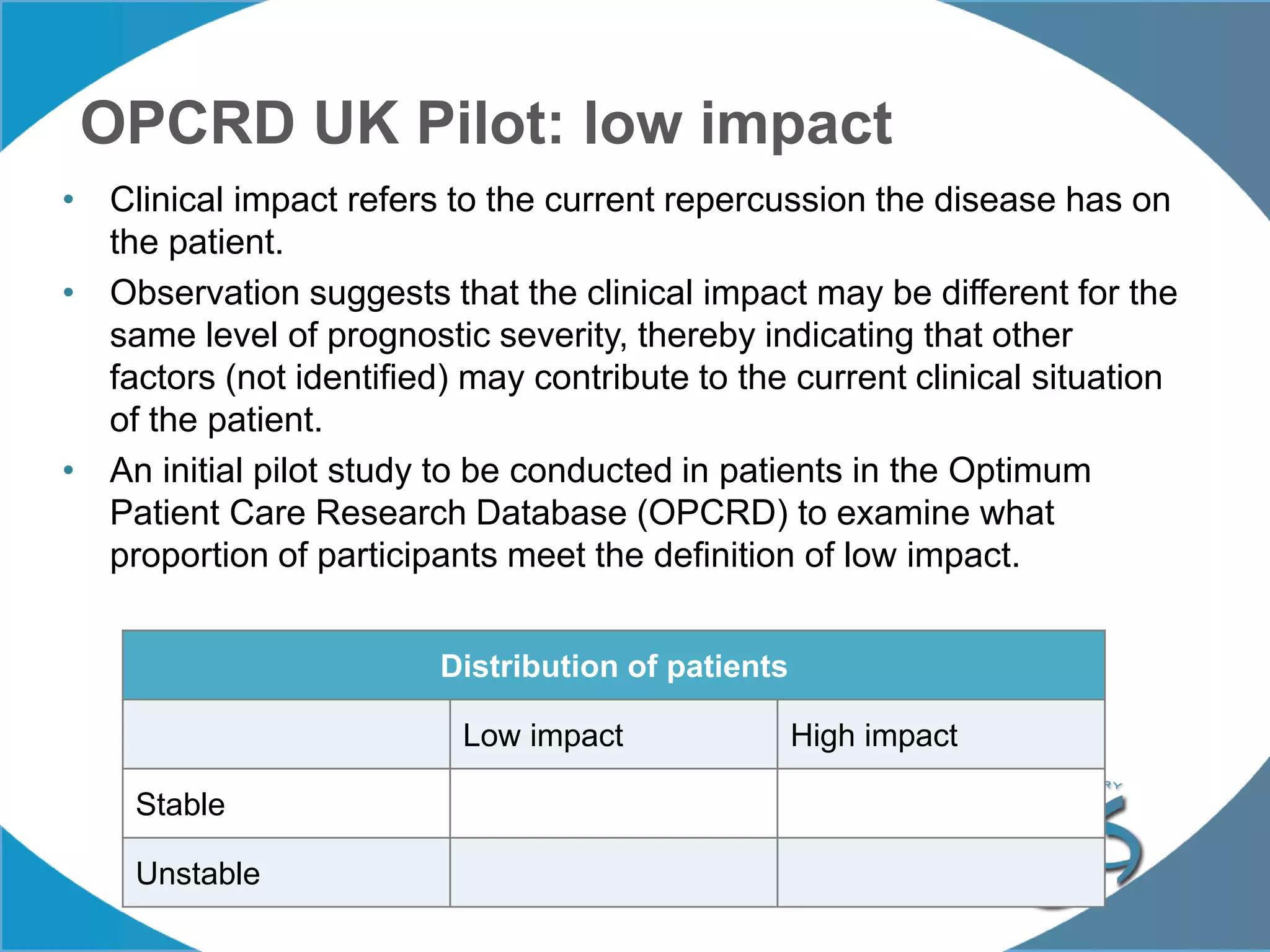
OPCRD UK Pilot: low impact
• Clinical impact refers to the current repercussion the disease has on
the patient.
• Observation suggests that the clinical impact may be different for the
same level of prognostic severity, thereby indicating that other
factors (not identified) may contribute to the current clinical situation
of the patient.
• An initial pilot study to be conducted in patients in the Optimum
Patient Care Research Database (OPCRD) to examine what
proportion of participants meet the definition of low impact.
Distribution of patients
Low impact High impact
Stable
Unstable
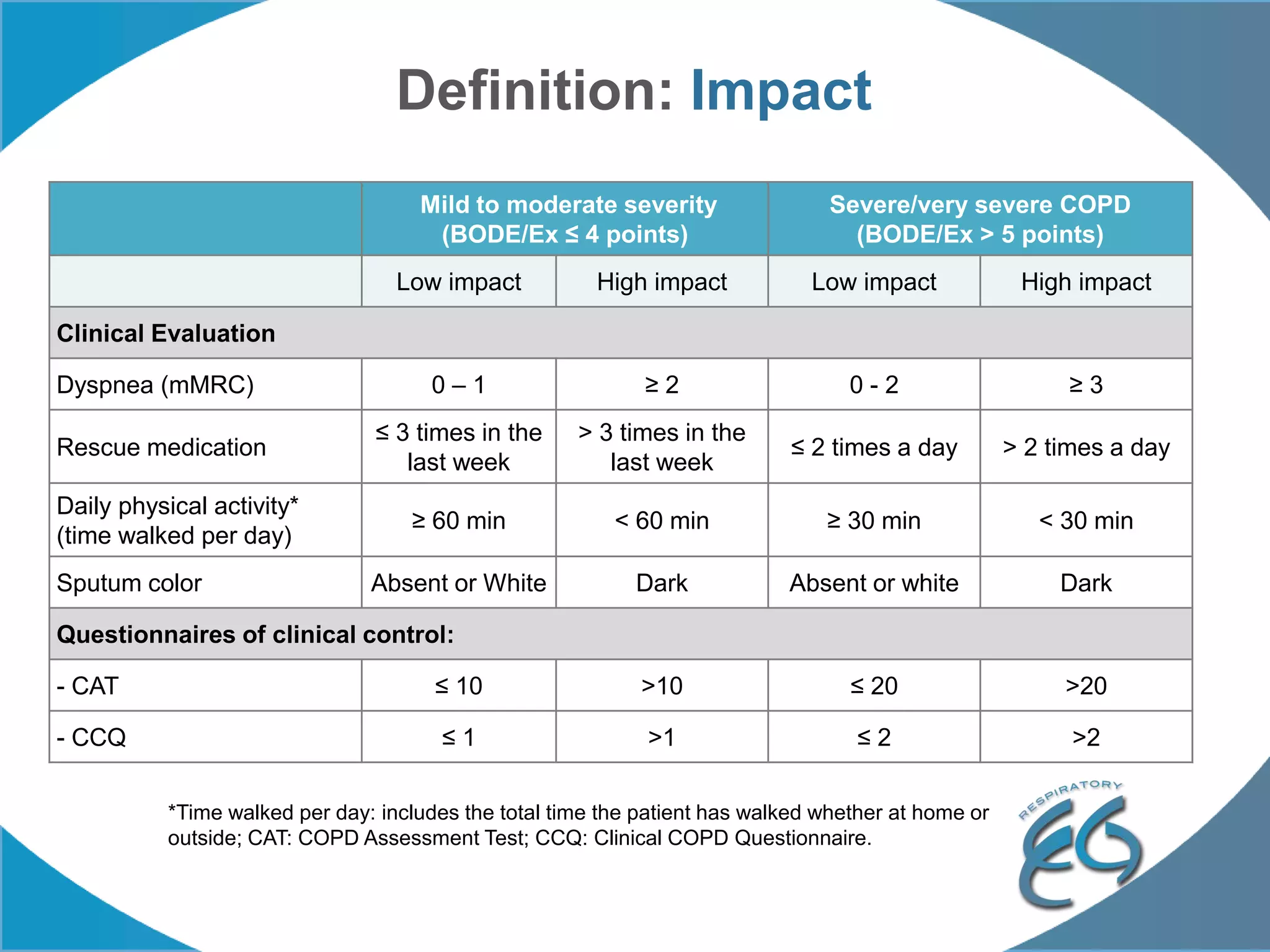
Definition: Impact
Mild to moderate severity
(BODE/Ex ≤ 4 points)
Severe/very severe COPD
(BODE/Ex > 5 points)
Low impact High impact Low impact High impact
Clinical Evaluation
Dyspnea (mMRC) 0 – 1 ≥ 2 0 - 2 ≥ 3
Rescue medication
≤ 3 times in the
last week
> 3 times in the
last week
≤ 2 times a day > 2 times a day
Daily physical activity*
(time walked per day)
≥ 60 min < 60 min ≥ 30 min < 30 min
Sputum color Absent or White Dark Absent or white Dark
Questionnaires of clinical control:
- CAT ≤ 10 >10 ≤ 20 >20
- CCQ ≤ 1 >1 ≤ 2 >2
*Time walked per day: includes the total time the patient has walked whether at home or
outside; CAT: COPD Assessment Test; CCQ: Clinical COPD Questionnaire.
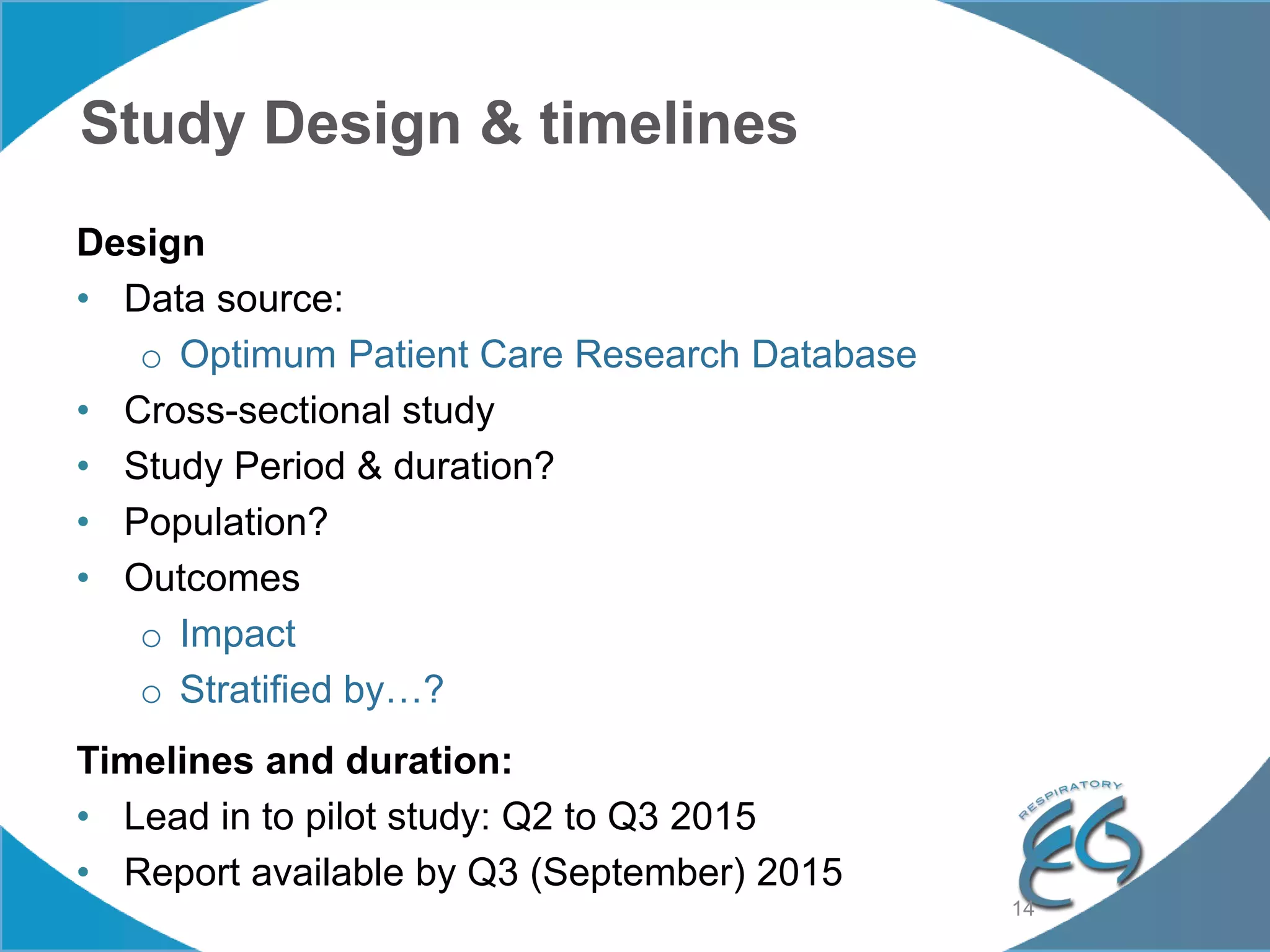
Study Design & timelines
Design
• Data source:
o Optimum Patient Care Research Database
• Cross-sectional study
• Study Period & duration?
• Population?
• Outcomes
o Impact
o Stratified by…?
Timelines and duration:
• Lead in to pilot study: Q2 to Q3 2015
• Report available by Q3 (September) 2015
14
Changes in control vs changes in severity
Observational, 6-month follow-up
Pilot study of control in Spain (1)
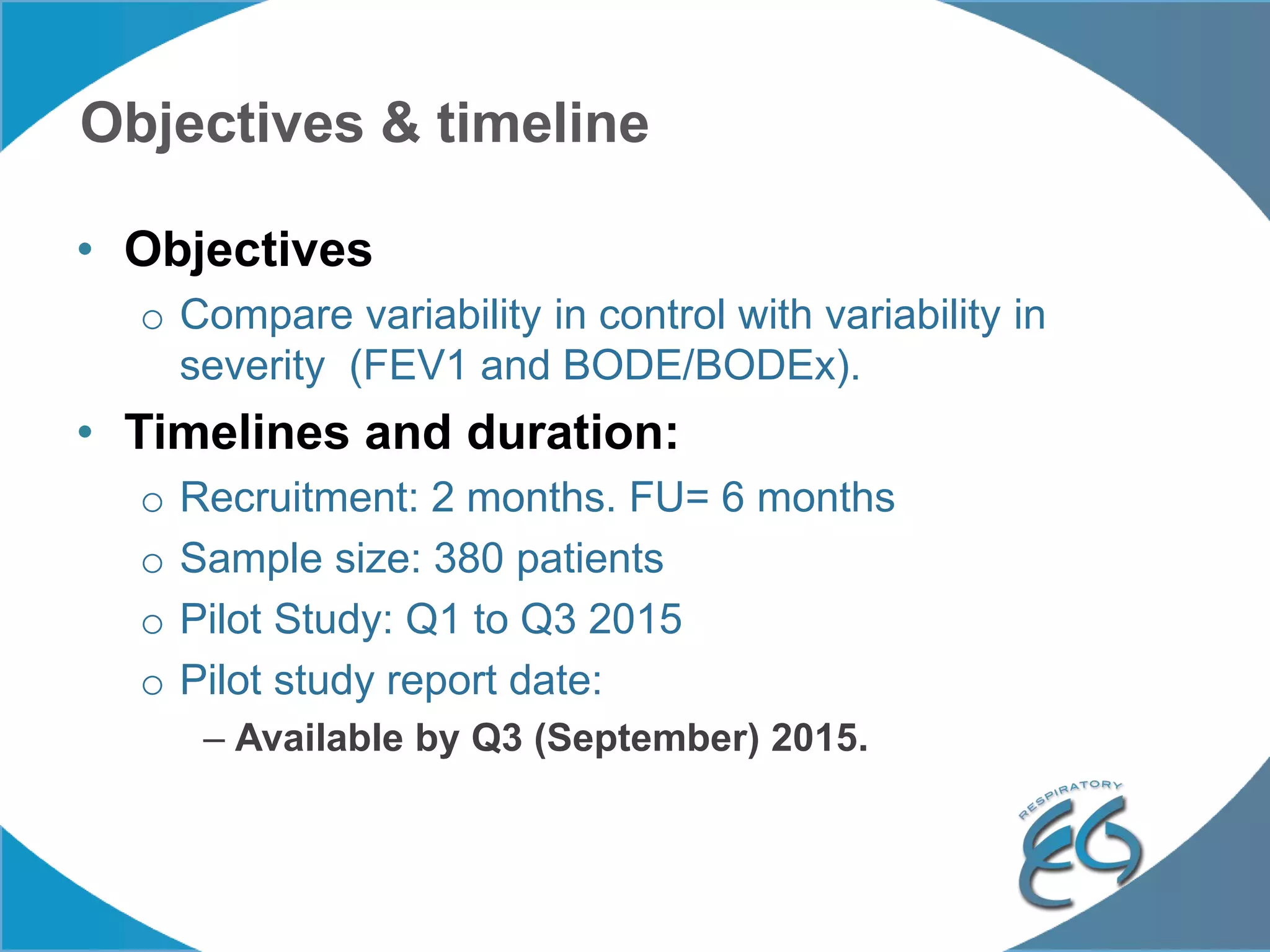
Objectives & timeline
• Objectives
o Compare variability in control with variability in
severity (FEV1 and BODE/BODEx).
• Timelines and duration:
o Recruitment: 2 months. FU= 6 months
o Sample size: 380 patients
o Pilot Study: Q1 to Q3 2015
o Pilot study report date:
– Available by Q3 (September) 2015.
Comparison of control and symptoms
Observational, 6-month follow-up
Pilot study of control in Spain (2)
Objectives & timeline
• Objectives
o Compare the changes in control with the prevalence
and changes in respiratory symptoms (E-RS).
• Timelines and duration:
o Recruitment: 2 months. FU= 6 months
o Sample size: 150 patients
o Pilot Study: Q1 to Q3 2015
o Pilot study report date:
– Available by Q3 (September) 2015.
Multicenter, international and prospective study to
validate the concept of control in COPD and its
implications for clinical practice
Validation of control:
Objectives
A multicenter, observational longitudinal study with the following
objectives.
• Primary objective:
o Identify the degree of control in an international cohort of
unselected COPD patients.
o Compare the outcomes of controlled versus uncontrolled
patients during two years follow-up.
• Secondary objectives:
o Compare the clinical variables with CAT and CCQ as tool to
identify impact and stability in COPD
o Identify differences in the degree of control according to
adequacy of treatment as suggested by current guidelines.
o Identify demographic and clinical characteristics associated with
poor control of COPD.
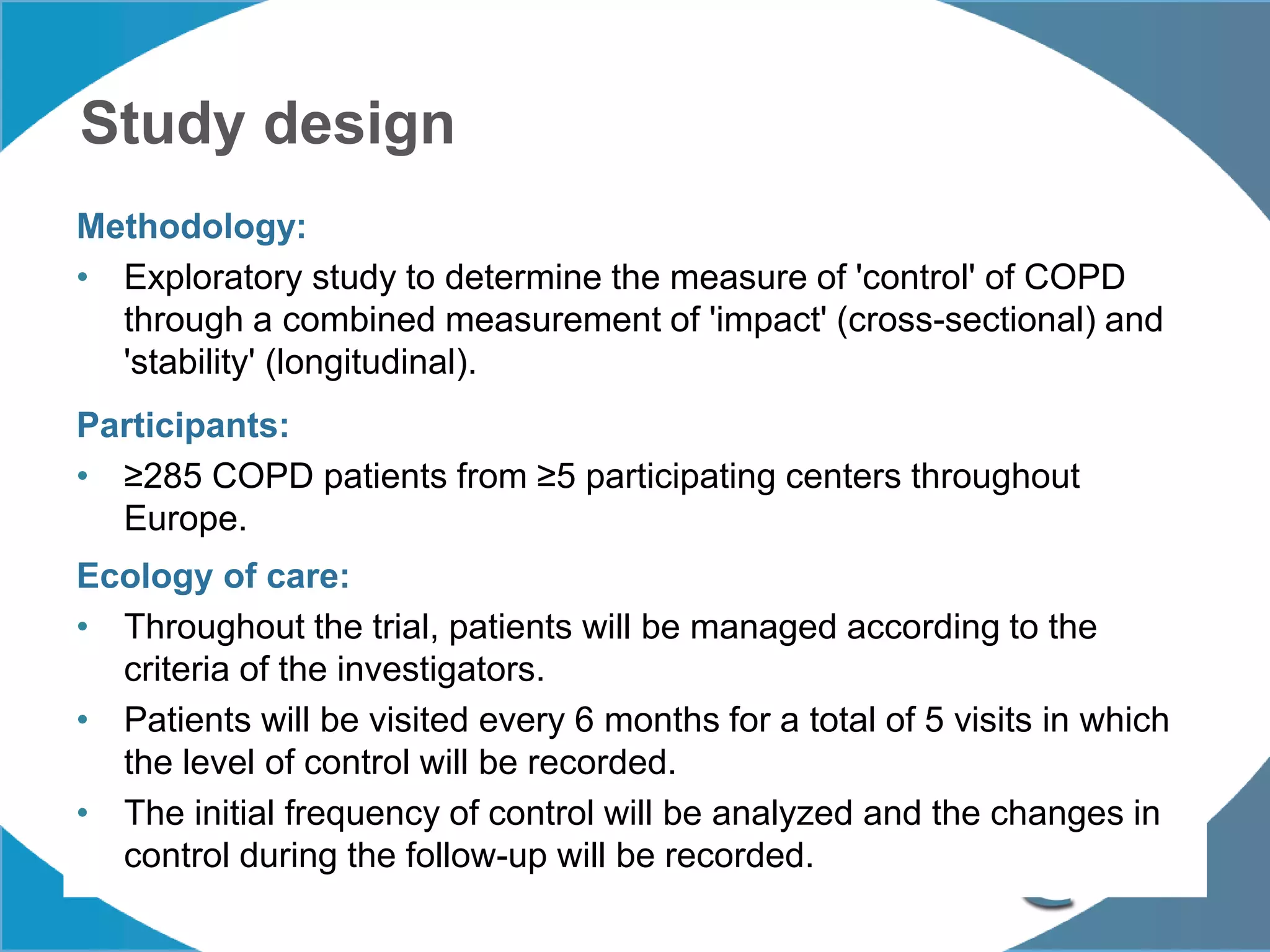
Study design
Methodology:
• Exploratory study to determine the measure of 'control' of COPD
through a combined measurement of 'impact' (cross-sectional) and
'stability' (longitudinal).
Participants:
• ≥285 COPD patients from ≥5 participating centers throughout
Europe.
Ecology of care:
• Throughout the trial, patients will be managed according to the
criteria of the investigators.
• Patients will be visited every 6 months for a total of 5 visits in which
the level of control will be recorded.
• The initial frequency of control will be analyzed and the changes in
control during the follow-up will be recorded.
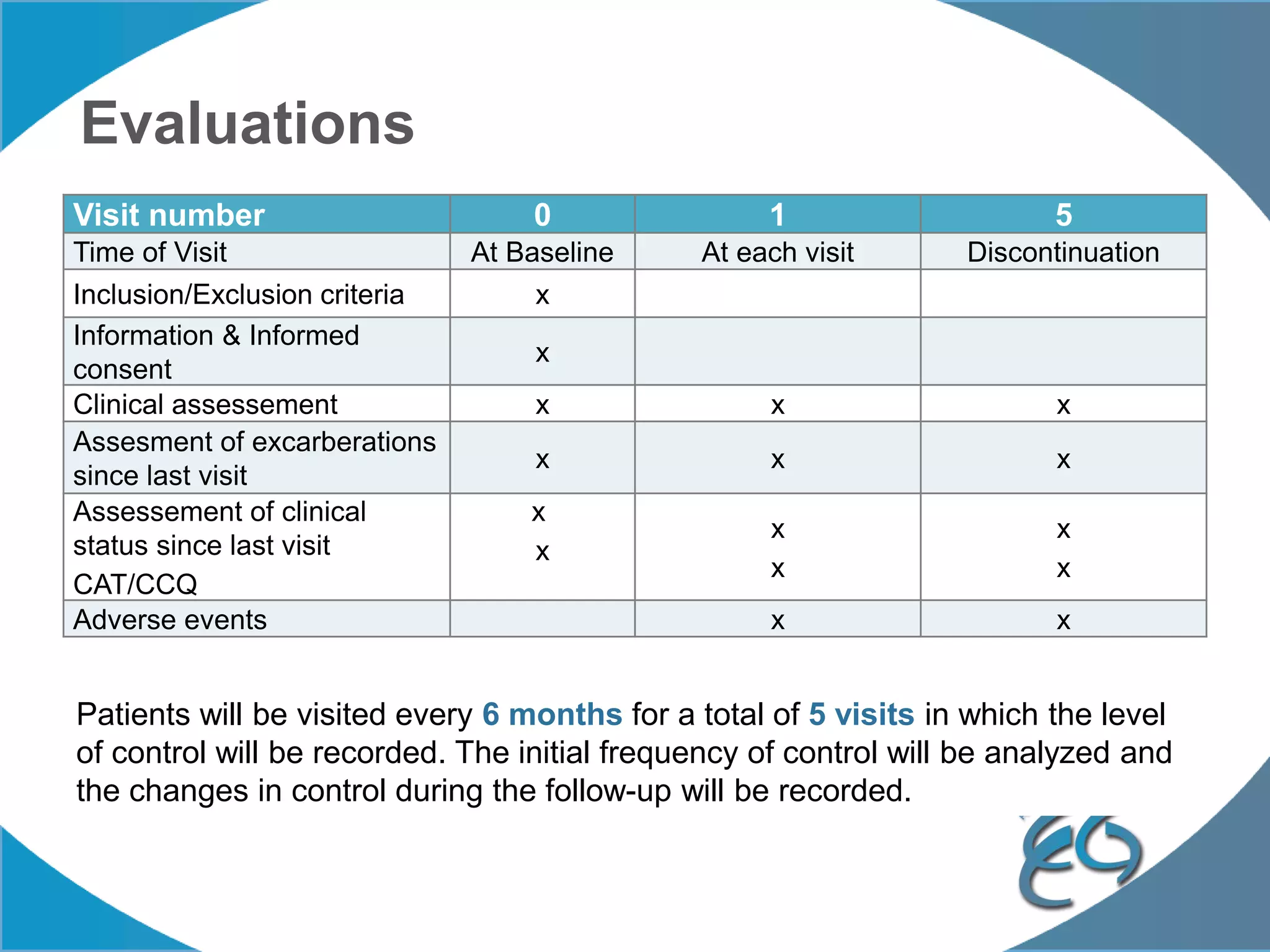
Evaluations
Visit number 0 1 5
Time of Visit At Baseline At each visit Discontinuation
Inclusion/Exclusion criteria x
Information & Informed
consent
x
Clinical assessement x x x
Assesment of excarberations
since last visit
x x x
Assessement of clinical
status since last visit
CAT/CCQ
x
x
x
x
x
x
Adverse events x x
Patients will be visited every 6 months for a total of 5 visits in which the level
of control will be recorded. The initial frequency of control will be analyzed and
the changes in control during the follow-up will be recorded.
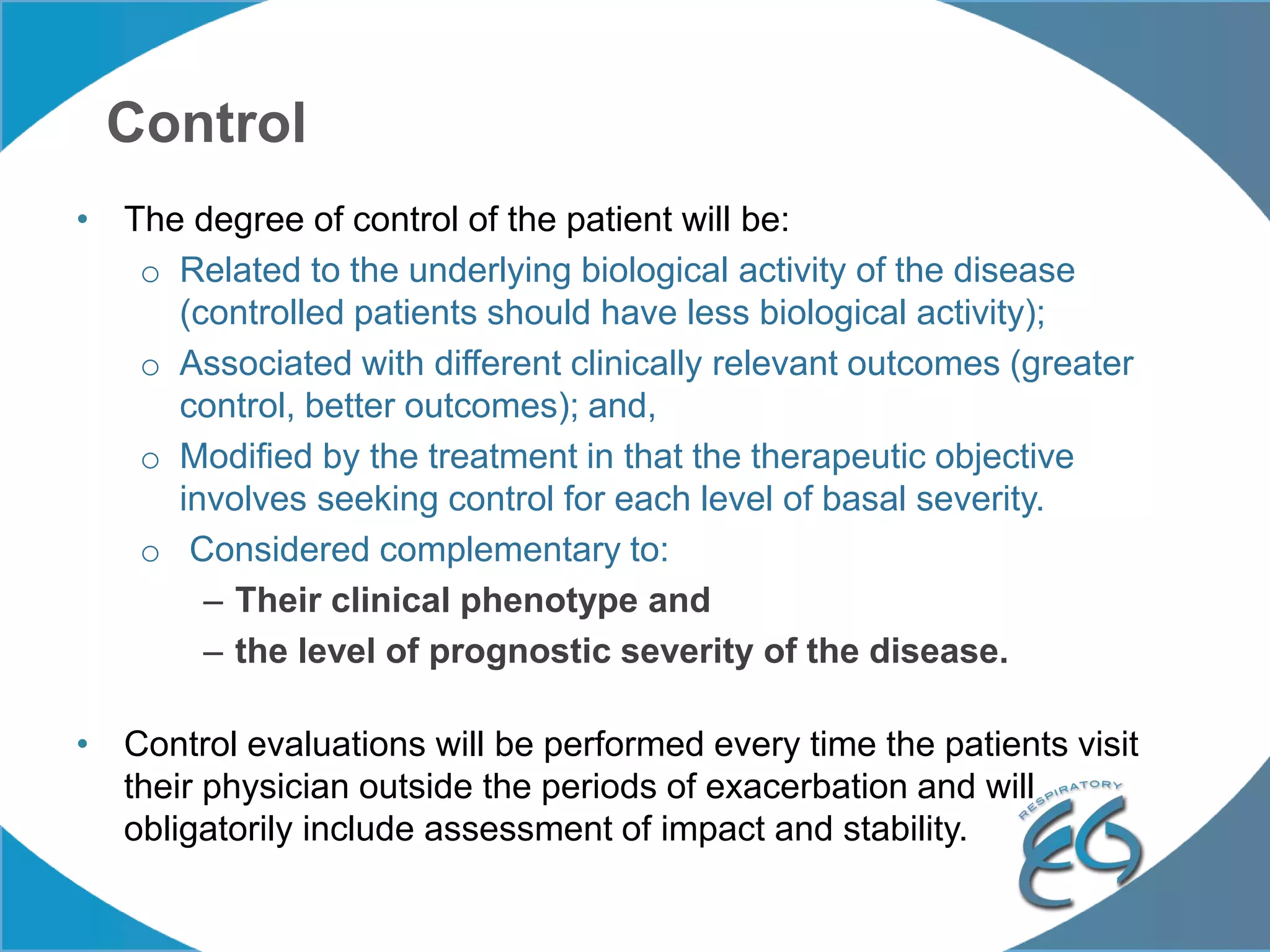
Control
• The degree of control of the patient will be:
o Related to the underlying biological activity of the disease
(controlled patients should have less biological activity);
o Associated with different clinically relevant outcomes (greater
control, better outcomes); and,
o Modified by the treatment in that the therapeutic objective
involves seeking control for each level of basal severity.
o Considered complementary to:
– Their clinical phenotype and
– the level of prognostic severity of the disease.
• Control evaluations will be performed every time the patients visit
their physician outside the periods of exacerbation and will
obligatorily include assessment of impact and stability.
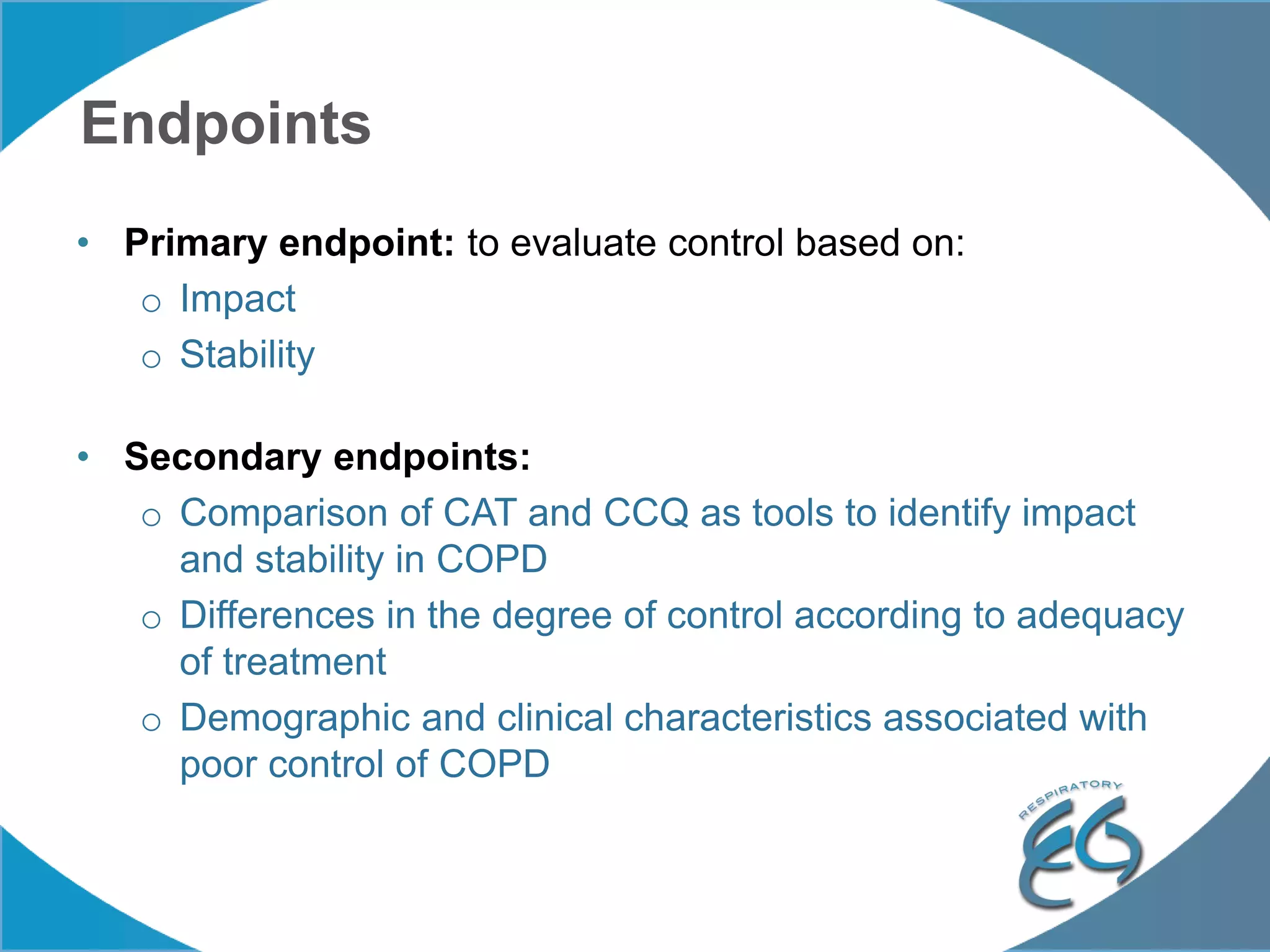
Endpoints
• Primary endpoint: to evaluate control based on:
o Impact
o Stability
• Secondary endpoints:
o Comparison of CAT and CCQ as tools to identify impact
and stability in COPD
o Differences in the degree of control according to adequacy
of treatment
o Demographic and clinical characteristics associated with
poor control of COPD
Participating Centres…
Study Organisation & Delivery
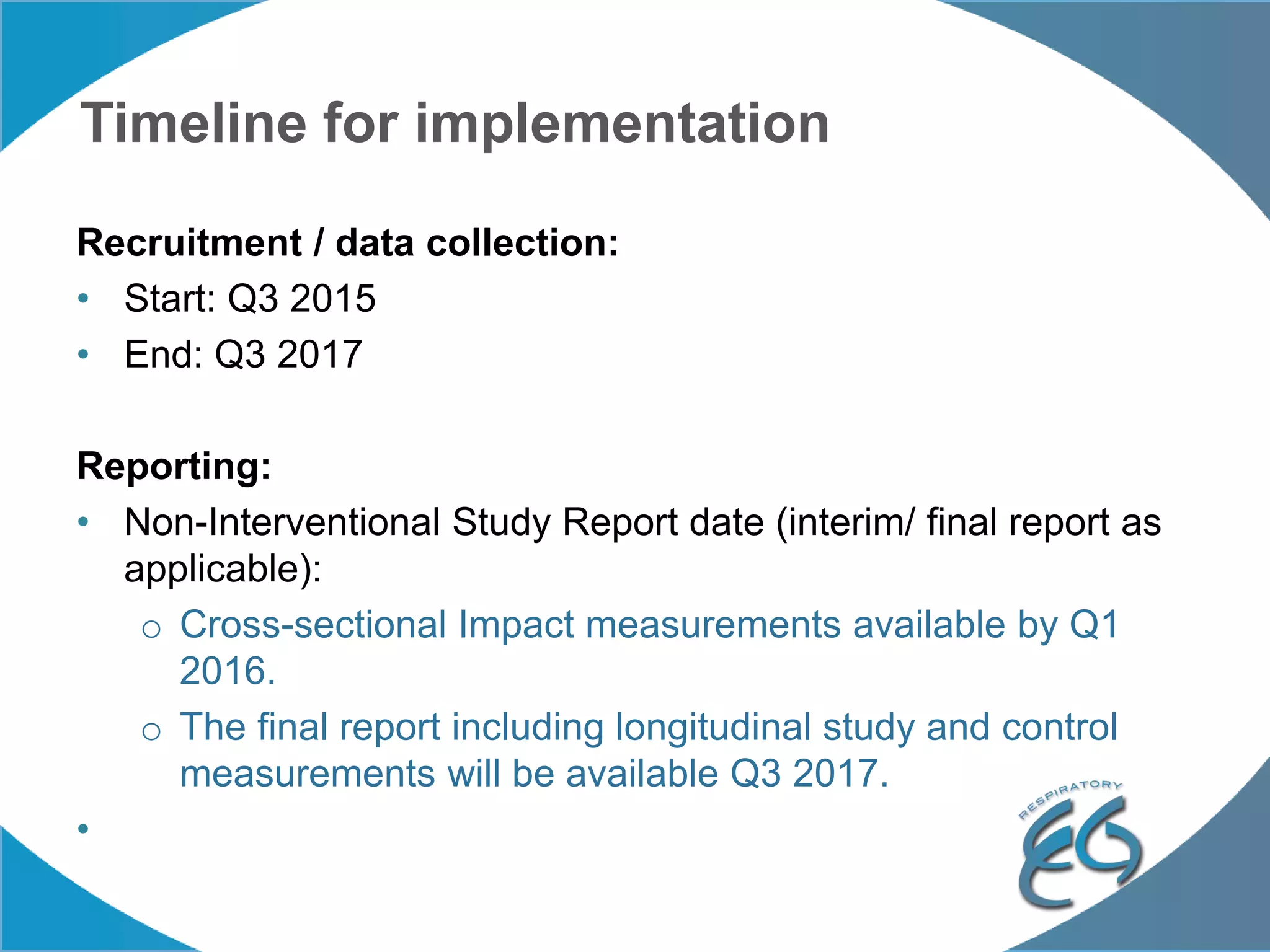
Timeline for implementation
Recruitment / data collection:
• Start: Q3 2015
• End: Q3 2017
Reporting:
• Non-Interventional Study Report date (interim/ final report as
applicable):
o Cross-sectional Impact measurements available by Q1
2016.
o The final report including longitudinal study and control
measurements will be available Q3 2017.
•
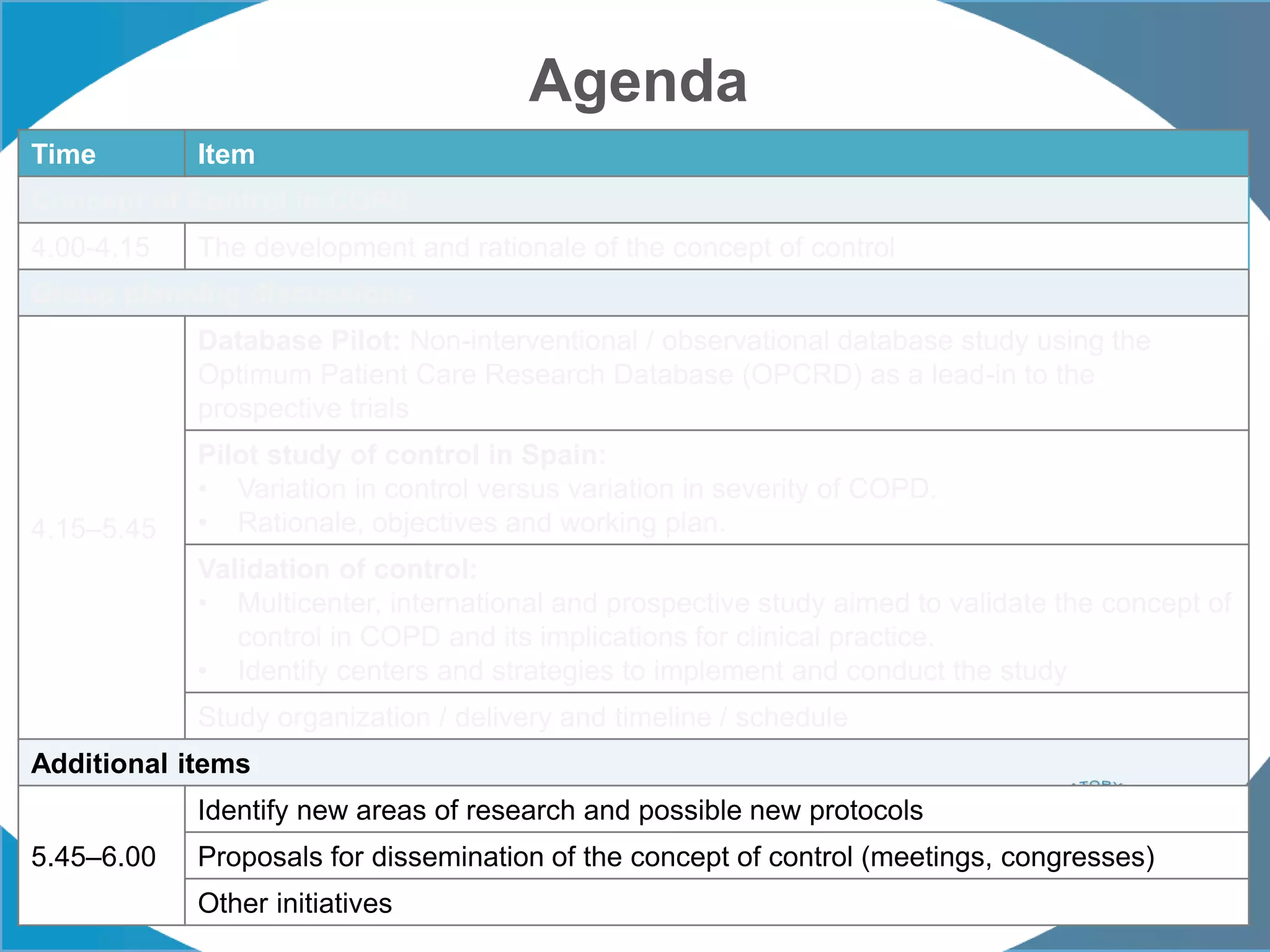
Agenda
Time Item
Concept of Control in COPD
4.00-4.15 The development and rationale of the concept of control
Group planning discussions
4.15–5.45
Database Pilot: Non-interventional / observational database study using the
Optimum Patient Care Research Database (OPCRD) as a lead-in to the
prospective trials
Pilot study of control in Spain:
• Variation in control versus variation in severity of COPD.
• Rationale, objectives and working plan.
Validation of control:
• Multicenter, international and prospective study aimed to validate the concept of
control in COPD and its implications for clinical practice.
• Identify centers and strategies to implement and conduct the study
Study organization / delivery and timeline / schedule
Additional items
5.45–6.00
Identify new areas of research and possible new protocols
Proposals for dissemination of the concept of control (meetings, congresses)
Other initiatives
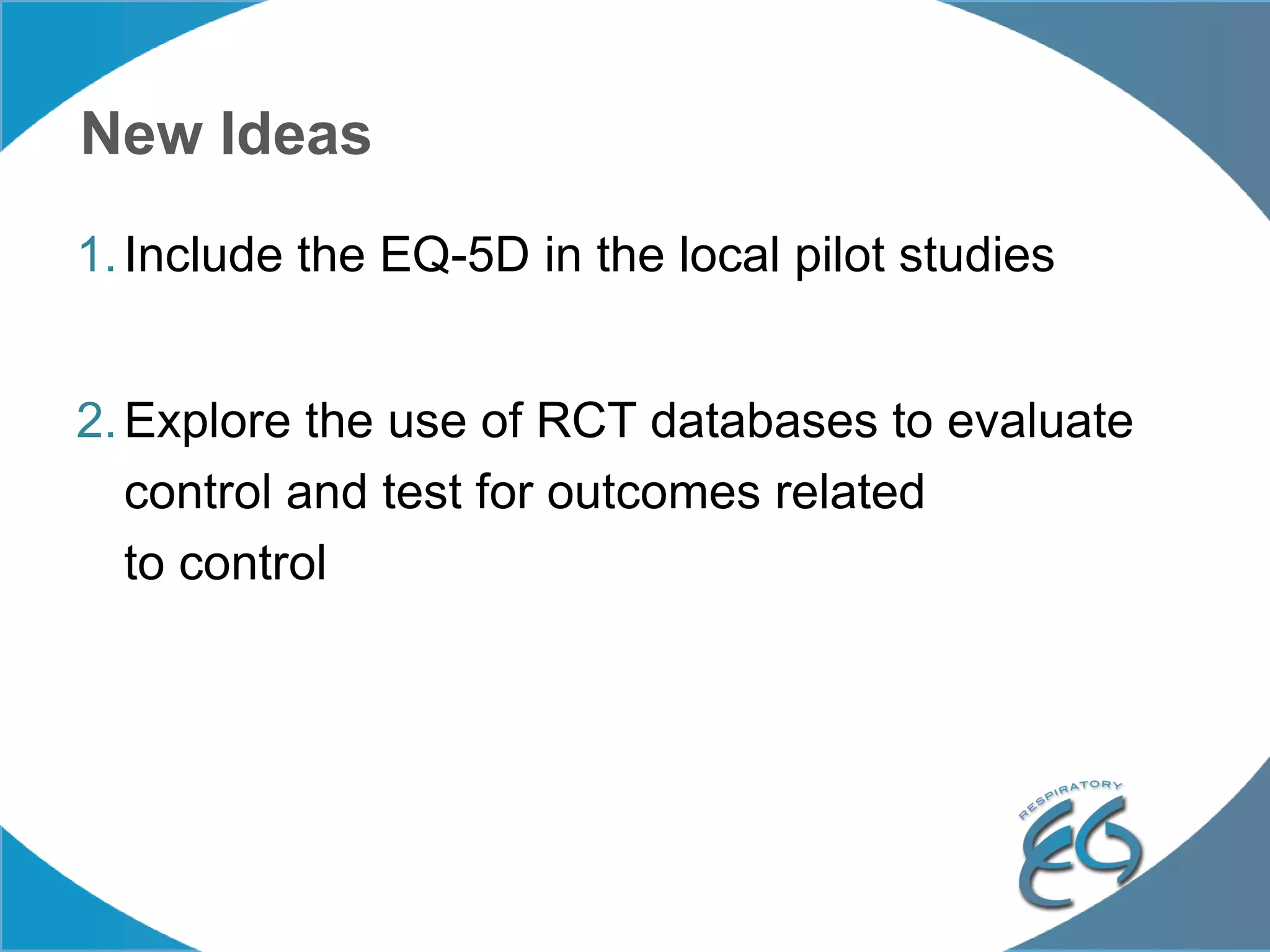
New Ideas
1.Include the EQ-5D in the local pilot studies
2.Explore the use of RCT databases to evaluate
control and test for outcomes related
to control
Proposals for dissemination
1.Meetings
2.Congresses
3.Publications
4.Other…?
Other Initiatives
…?
Backup / Reference
Core Research Definitions
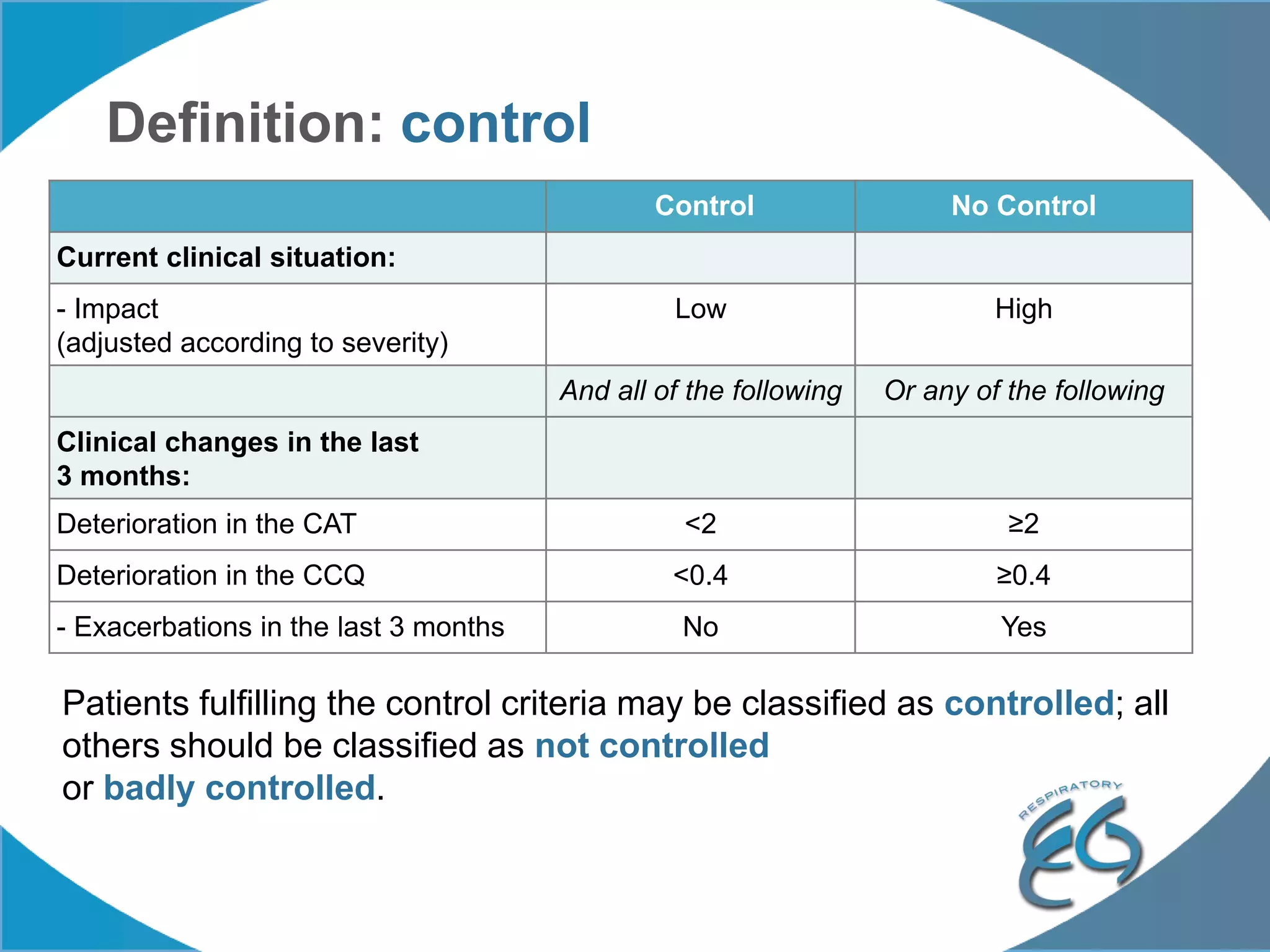
Definition: control
Control No Control
Current clinical situation:
- Impact
(adjusted according to severity)
Low High
And all of the following Or any of the following
Clinical changes in the last
3 months:
Deterioration in the CAT <2 ≥2
Deterioration in the CCQ <0.4 ≥0.4
- Exacerbations in the last 3 months No Yes
Patients fulfilling the control criteria may be classified as controlled; all
others should be classified as not controlled
or badly controlled.
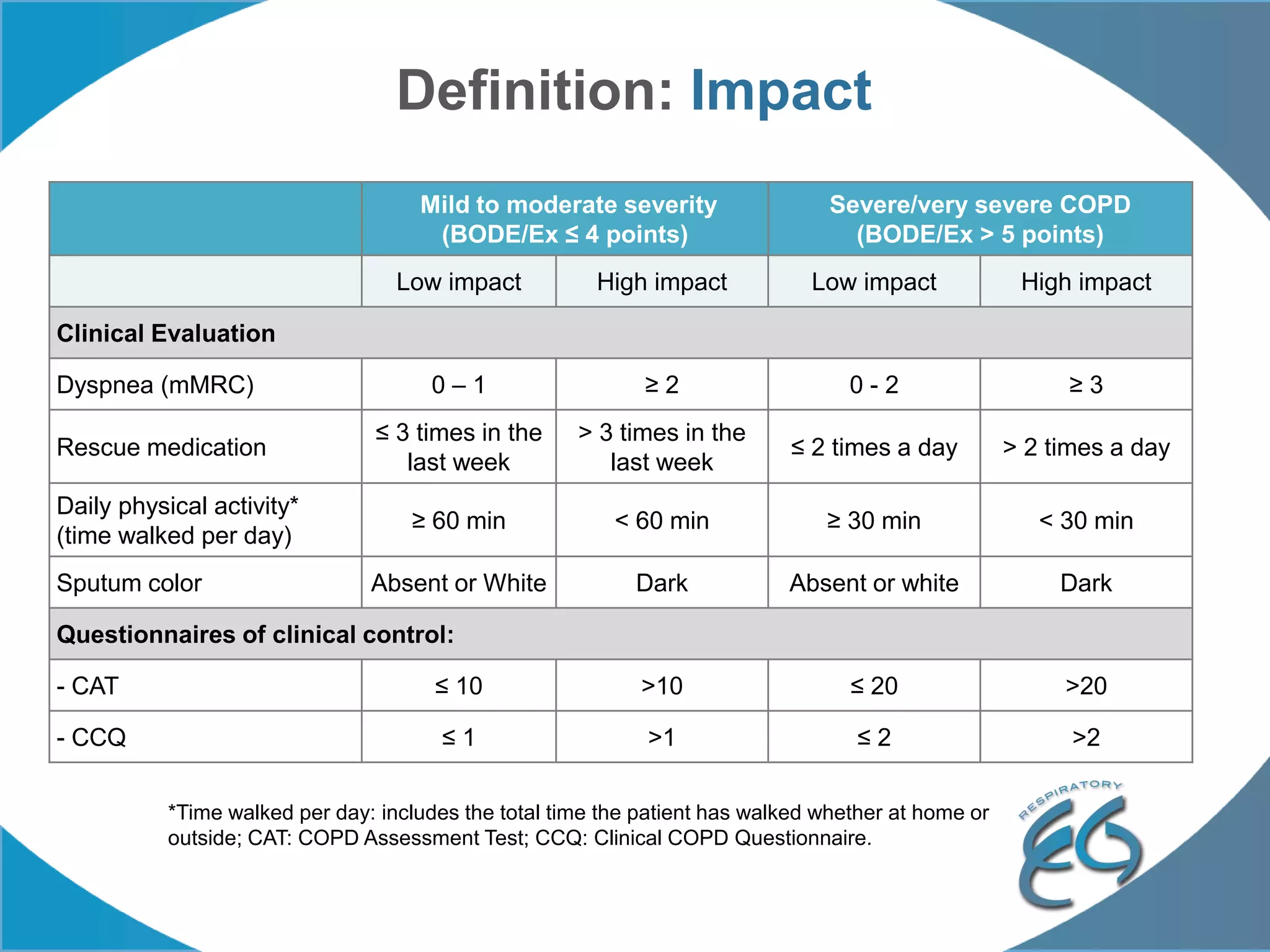
Definition: Impact
Mild to moderate severity
(BODE/Ex ≤ 4 points)
Severe/very severe COPD
(BODE/Ex > 5 points)
Low impact High impact Low impact High impact
Clinical Evaluation
Dyspnea (mMRC) 0 – 1 ≥ 2 0 - 2 ≥ 3
Rescue medication
≤ 3 times in the
last week
> 3 times in the
last week
≤ 2 times a day > 2 times a day
Daily physical activity*
(time walked per day)
≥ 60 min < 60 min ≥ 30 min < 30 min
Sputum color Absent or White Dark Absent or white Dark
Questionnaires of clinical control:
- CAT ≤ 10 >10 ≤ 20 >20
- CCQ ≤ 1 >1 ≤ 2 >2
*Time walked per day: includes the total time the patient has walked whether at home or
outside; CAT: COPD Assessment Test; CCQ: Clinical COPD Questionnaire.
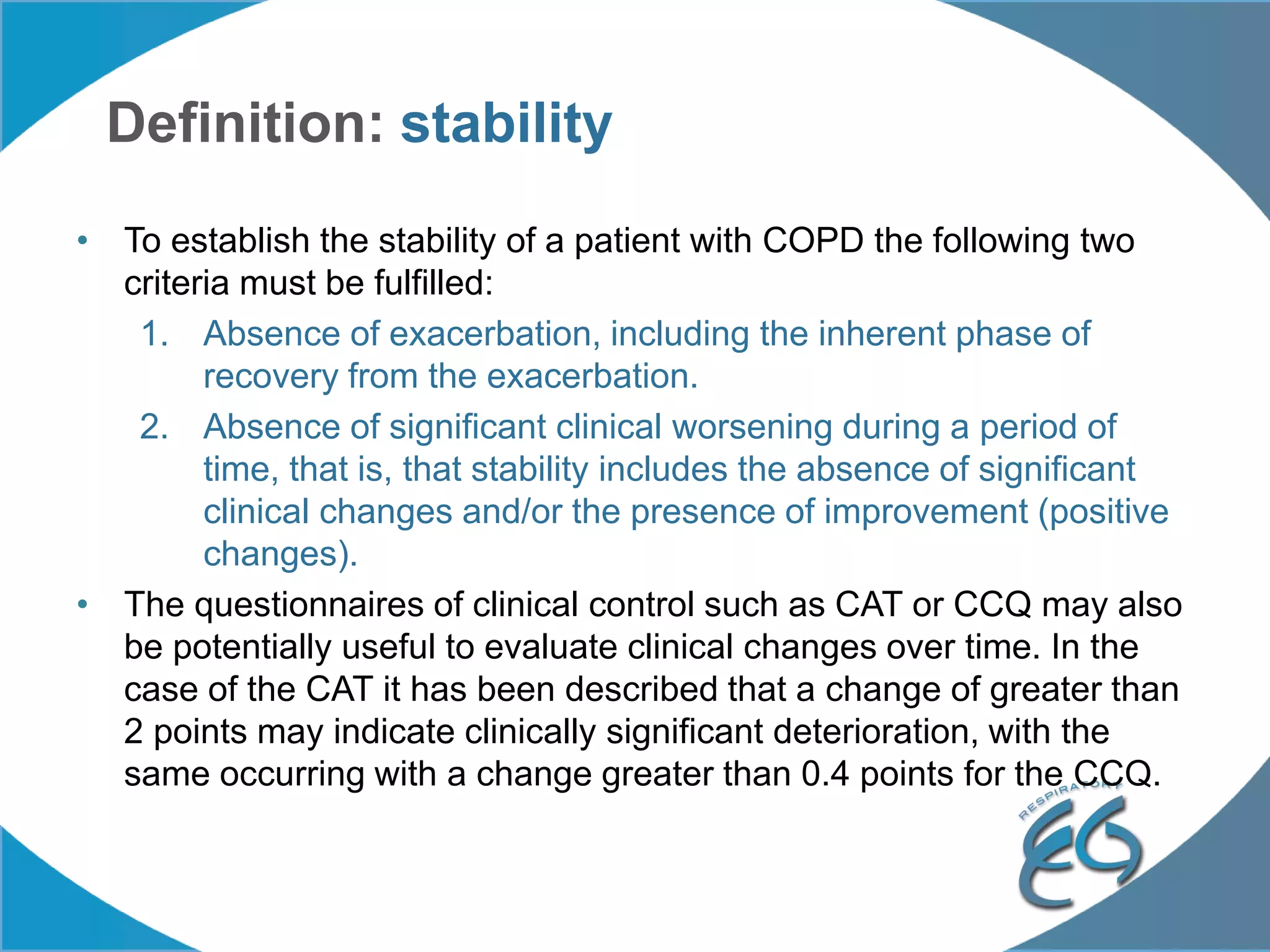
Definition: stability
• To establish the stability of a patient with COPD the following two
criteria must be fulfilled:
1. Absence of exacerbation, including the inherent phase of
recovery from the exacerbation.
2. Absence of significant clinical worsening during a period of
time, that is, that stability includes the absence of significant
clinical changes and/or the presence of improvement (positive
changes).
• The questionnaires of clinical control such as CAT or CCQ may also
be potentially useful to evaluate clinical changes over time. In the
case of the CAT it has been described that a change of greater than
2 points may indicate clinically significant deterioration, with the
same occurring with a change greater than 0.4 points for the CCQ.

REG COPD Control Working Group Meeting

  • 1.
    Sunday May 17th,4.00-6.00pm (MST) Altitude Room; Crowne Plaza, Denver, Colorado REG COPD Control Working Group Meeting
  • 2.
    COPD Control Members Lead:Marc Miravitlles Members • Dermot Ryan • Richard Costello • Nicolas Roche • Alberto Papi • Juan José Soler • Bernardino Alcazar • David Price Participating collaborators • Luca Richeldi • Helgo Magnussen • Akio Niimi • Mona Bafadhel • Faisal Yunus
  • 3.
    Meeting Objective • Presentthe planned initiative to: test Control as a valid concept in COPD • Plan the implementation of the planned COPD Control research activities: o Non-interventional, retrospective database study pilot o Prospective studies: o Spanish pilots (2) o International multicentre • Identify REG collaborators interested in joining the research projects • Identify new opportunities for research in the field of control in COPD
  • 4.
    Agenda Time Item Concept ofControl in COPD 4.00-4.15pm The development and rationale of the concept of control Group planning discussions 4.15–5.45pm Database Pilot: Non-interventional / observational database study using the Optimum Patient Care Research Database (OPCRD) as a lead-in to the prospective trials Pilot studies of control in Spain: • Variation in control versus variation in severity of COPD. • Relationship between E-RS symptoms diary and control Validation of control: • Multicenter, international and prospective study aimed to validate the concept of control in COPD and its implications for clinical practice. • Identify centers and strategies to implement and conduct the study • Study organization / delivery and timeline / schedule Additional items 5.45–6.00pm Identify new areas of research and possible new protocols Proposals for dissemination of the concept of control (meetings, congresses) Other initiatives
  • 5.
  • 6.
    6 Low clinical impact Clinical control Stability Impact High clinicalimpact Cross-sectional evaluation of impact Stability (Improvement or absence of changes) Inestability (Clinical worsening) V1 V2 V3 V4
  • 7.
    7 Clinical assessment - Dispnea (mMRC) - Rescuemedication - Daily physical activity (time walking per day) - Sputum color Clinical control questionnaires - CAT - CCQ 0 - 1 ≥ 60 min Low impact ≤ 3 times / week Absent or white ≤ 1 ≥ 2 < 60 min ≥ 3 times / week Dark ≤ 10 >10 > 1 High impact Mild – moderate severity (BODE/BODEx ≤ 4 units)
  • 8.
    8 Current clinical situation: Clinical changes: (last3 months) - CAT - CCQ Low Control < 0.4 High < 4 ≥ 4 ≥ 0.4 No control CONTROL (any of the following) (any of the following) or - Exacerbationss No Yes - Clinical changes (according to the patient) Same or better Worse
  • 9.
    Concepts 1.Control is nota prediction tool 2.Concept of control can potentially be used to motivate and educate patients 3.It may help to step up or down treatment and establish the frequency of clinical visits
  • 10.
    Agenda Time Item Concept ofControl in COPD 4.00-4.15 The development and rationale of the concept of control Group planning discussions 4.15–5.45 Database Pilot: Non-interventional / observational database study using the Optimum Patient Care Research Database (OPCRD) as a lead-in to the prospective trials Pilot studies of control in Spain: • Variation in control versus variation in severity of COPD. • Relationship between E-RS symptoms diary and control Validation of control: • Multicenter, international and prospective study aimed to validate the concept of control in COPD and its implications for clinical practice. • Identify centers and strategies to implement and conduct the study • Study organization / delivery and timeline / schedule Additional items 5.45–6.00 Identify new areas of research and possible new protocols Proposals for dissemination of the concept of control (meetings, congresses) Other initiatives
  • 11.
    Cross-sectional, non-interventional databasestudy using the Optimum Patient Care Research Database (OPCRD) as a lead-in to the prospective trials UK Database pilot
  • 12.
    OPCRD UK Pilot:low impact • Clinical impact refers to the current repercussion the disease has on the patient. • Observation suggests that the clinical impact may be different for the same level of prognostic severity, thereby indicating that other factors (not identified) may contribute to the current clinical situation of the patient. • An initial pilot study to be conducted in patients in the Optimum Patient Care Research Database (OPCRD) to examine what proportion of participants meet the definition of low impact. Distribution of patients Low impact High impact Stable Unstable
  • 13.
    Definition: Impact Mild tomoderate severity (BODE/Ex ≤ 4 points) Severe/very severe COPD (BODE/Ex > 5 points) Low impact High impact Low impact High impact Clinical Evaluation Dyspnea (mMRC) 0 – 1 ≥ 2 0 - 2 ≥ 3 Rescue medication ≤ 3 times in the last week > 3 times in the last week ≤ 2 times a day > 2 times a day Daily physical activity* (time walked per day) ≥ 60 min < 60 min ≥ 30 min < 30 min Sputum color Absent or White Dark Absent or white Dark Questionnaires of clinical control: - CAT ≤ 10 >10 ≤ 20 >20 - CCQ ≤ 1 >1 ≤ 2 >2 *Time walked per day: includes the total time the patient has walked whether at home or outside; CAT: COPD Assessment Test; CCQ: Clinical COPD Questionnaire.
  • 14.
    Study Design &timelines Design • Data source: o Optimum Patient Care Research Database • Cross-sectional study • Study Period & duration? • Population? • Outcomes o Impact o Stratified by…? Timelines and duration: • Lead in to pilot study: Q2 to Q3 2015 • Report available by Q3 (September) 2015 14
  • 15.
    Changes in controlvs changes in severity Observational, 6-month follow-up Pilot study of control in Spain (1)
  • 16.
    Objectives & timeline •Objectives o Compare variability in control with variability in severity (FEV1 and BODE/BODEx). • Timelines and duration: o Recruitment: 2 months. FU= 6 months o Sample size: 380 patients o Pilot Study: Q1 to Q3 2015 o Pilot study report date: – Available by Q3 (September) 2015.
  • 17.
    Comparison of controland symptoms Observational, 6-month follow-up Pilot study of control in Spain (2)
  • 18.
    Objectives & timeline •Objectives o Compare the changes in control with the prevalence and changes in respiratory symptoms (E-RS). • Timelines and duration: o Recruitment: 2 months. FU= 6 months o Sample size: 150 patients o Pilot Study: Q1 to Q3 2015 o Pilot study report date: – Available by Q3 (September) 2015.
  • 19.
    Multicenter, international andprospective study to validate the concept of control in COPD and its implications for clinical practice Validation of control:
  • 20.
    Objectives A multicenter, observationallongitudinal study with the following objectives. • Primary objective: o Identify the degree of control in an international cohort of unselected COPD patients. o Compare the outcomes of controlled versus uncontrolled patients during two years follow-up. • Secondary objectives: o Compare the clinical variables with CAT and CCQ as tool to identify impact and stability in COPD o Identify differences in the degree of control according to adequacy of treatment as suggested by current guidelines. o Identify demographic and clinical characteristics associated with poor control of COPD.
  • 21.
    Study design Methodology: • Exploratorystudy to determine the measure of 'control' of COPD through a combined measurement of 'impact' (cross-sectional) and 'stability' (longitudinal). Participants: • ≥285 COPD patients from ≥5 participating centers throughout Europe. Ecology of care: • Throughout the trial, patients will be managed according to the criteria of the investigators. • Patients will be visited every 6 months for a total of 5 visits in which the level of control will be recorded. • The initial frequency of control will be analyzed and the changes in control during the follow-up will be recorded.
  • 22.
    Evaluations Visit number 01 5 Time of Visit At Baseline At each visit Discontinuation Inclusion/Exclusion criteria x Information & Informed consent x Clinical assessement x x x Assesment of excarberations since last visit x x x Assessement of clinical status since last visit CAT/CCQ x x x x x x Adverse events x x Patients will be visited every 6 months for a total of 5 visits in which the level of control will be recorded. The initial frequency of control will be analyzed and the changes in control during the follow-up will be recorded.
  • 23.
    Control • The degreeof control of the patient will be: o Related to the underlying biological activity of the disease (controlled patients should have less biological activity); o Associated with different clinically relevant outcomes (greater control, better outcomes); and, o Modified by the treatment in that the therapeutic objective involves seeking control for each level of basal severity. o Considered complementary to: – Their clinical phenotype and – the level of prognostic severity of the disease. • Control evaluations will be performed every time the patients visit their physician outside the periods of exacerbation and will obligatorily include assessment of impact and stability.
  • 24.
    Endpoints • Primary endpoint:to evaluate control based on: o Impact o Stability • Secondary endpoints: o Comparison of CAT and CCQ as tools to identify impact and stability in COPD o Differences in the degree of control according to adequacy of treatment o Demographic and clinical characteristics associated with poor control of COPD
  • 25.
  • 26.
  • 27.
    Timeline for implementation Recruitment/ data collection: • Start: Q3 2015 • End: Q3 2017 Reporting: • Non-Interventional Study Report date (interim/ final report as applicable): o Cross-sectional Impact measurements available by Q1 2016. o The final report including longitudinal study and control measurements will be available Q3 2017. •
  • 28.
    Agenda Time Item Concept ofControl in COPD 4.00-4.15 The development and rationale of the concept of control Group planning discussions 4.15–5.45 Database Pilot: Non-interventional / observational database study using the Optimum Patient Care Research Database (OPCRD) as a lead-in to the prospective trials Pilot study of control in Spain: • Variation in control versus variation in severity of COPD. • Rationale, objectives and working plan. Validation of control: • Multicenter, international and prospective study aimed to validate the concept of control in COPD and its implications for clinical practice. • Identify centers and strategies to implement and conduct the study Study organization / delivery and timeline / schedule Additional items 5.45–6.00 Identify new areas of research and possible new protocols Proposals for dissemination of the concept of control (meetings, congresses) Other initiatives
  • 29.
    New Ideas 1.Include theEQ-5D in the local pilot studies 2.Explore the use of RCT databases to evaluate control and test for outcomes related to control
  • 30.
  • 31.
  • 32.
    Backup / Reference CoreResearch Definitions
  • 33.
    Definition: control Control NoControl Current clinical situation: - Impact (adjusted according to severity) Low High And all of the following Or any of the following Clinical changes in the last 3 months: Deterioration in the CAT <2 ≥2 Deterioration in the CCQ <0.4 ≥0.4 - Exacerbations in the last 3 months No Yes Patients fulfilling the control criteria may be classified as controlled; all others should be classified as not controlled or badly controlled.
  • 34.
    Definition: Impact Mild tomoderate severity (BODE/Ex ≤ 4 points) Severe/very severe COPD (BODE/Ex > 5 points) Low impact High impact Low impact High impact Clinical Evaluation Dyspnea (mMRC) 0 – 1 ≥ 2 0 - 2 ≥ 3 Rescue medication ≤ 3 times in the last week > 3 times in the last week ≤ 2 times a day > 2 times a day Daily physical activity* (time walked per day) ≥ 60 min < 60 min ≥ 30 min < 30 min Sputum color Absent or White Dark Absent or white Dark Questionnaires of clinical control: - CAT ≤ 10 >10 ≤ 20 >20 - CCQ ≤ 1 >1 ≤ 2 >2 *Time walked per day: includes the total time the patient has walked whether at home or outside; CAT: COPD Assessment Test; CCQ: Clinical COPD Questionnaire.
  • 35.
    Definition: stability • Toestablish the stability of a patient with COPD the following two criteria must be fulfilled: 1. Absence of exacerbation, including the inherent phase of recovery from the exacerbation. 2. Absence of significant clinical worsening during a period of time, that is, that stability includes the absence of significant clinical changes and/or the presence of improvement (positive changes). • The questionnaires of clinical control such as CAT or CCQ may also be potentially useful to evaluate clinical changes over time. In the case of the CAT it has been described that a change of greater than 2 points may indicate clinically significant deterioration, with the same occurring with a change greater than 0.4 points for the CCQ.