Socio Environment & Health Care
Social Environment Culture one lives in and the people and institutions one interacts with is a social environment The environment in which people live, including their social, physical, and economic conditions is a major determinant of their health and safety status Where someone lives is essential to how well they live Barriers that undermine health and wellness Water fluoridation, smoking bans, air quality, immunizations, few places for physical activity, less access to healthy food and health care Quality and accessibility of resources can be important factors in strengthening community health and wellness
Access to Health Care Need to look at community factors that help or hinder individuals from obtaining needed medical care Disparities in access to health care are of growing concern Utilization of health care services varies across communities More focus on individual level characteristics Race, income, education, insurance status, & disability Neighborhood environment affects primary care access
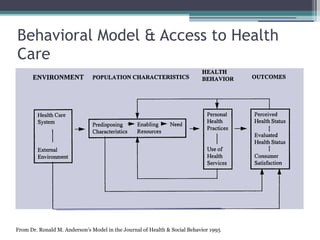
Behavioral Model & Access to Health Care From Dr. Ronald M. Anderson’s Model in the Journal of Health & Social Behavior 1995
Predisposing Characteristics  Demographic Characteristics Age-old and young likely to need more health care Social Structure-education, occupation ethnicity Health-Related Beliefs attitudes, values, and knowledge that people have about health & health services that might influence their subsequent perceptions of need and use of health services
Enabling/Impeding Factors Personal/Family  Must have means & know-how to get to care facilities & make use of them Health insurance Affordability Regular Source of Care Community Health personnel and facilities must be available where people live and work Waiting Time Provision of municipal services  Transportation Condition of neighborhood
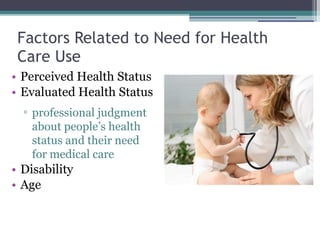
Factors Related to Need for Health Care Use Perceived Health Status Evaluated Health Status Disability Age professional judgment about people’s health status and their need for medical care
Socio-economic Disadvantage Suffer more from unhealthy environments Quality of air and water, prevalence of toxic waste Provision of municipal services might be lacking  Associated with a variety of health outcomes Self-rated health, functional disability, mental health, & mortality Churches Schools Voluntary Organizations Neighborhoods with poor physical environments may be less attractive to providers Concentrated socio-economic disadvantage may diminish resources necessary to maintain certain organizations
Environments Decreased likelihood of obtaining recommended preventative care Not just because disadvantaged neighborhoods are composed of disadvantaged individuals, but because of the neighborhood characteristics Neighborhood socioeconomic disadvantage may create physical, service, and social environments that impede the ability to obtain health care Decreased likelihood of having usual source of care provider Increased likelihood of having an unmet need
Neighborhood Information Networks Often seek advice from peers Community Effects on Access Healthcare Resources Areas with greater wealth have more healthcare resources Inequitable distribution of healthcare resources Limits access to healthcare Causes poorer long-term health Neighborhood Social Capital Neighborhood Health Behavior Norms Shared attitudes about importance of behaviors differ among neighborhoods
Social Capital/Collective Efficacy May increase individual self esteem & create more positive attitudes toward their life chances  May increase trust in healthcare institutions Found that individuals who felt they were a part of their community had significantly higher physical health outcomes affect importance individuals place on health and encourage healthy behaviors
Having Access to Primary Care Prevention can produce significant health care savings Investing in prevention has a multiplier effect-multiple saving for multiple conditions Having resources available so that people can have their health care needs met Focusing prevention investments on communities with the most compromised health status could potentially lead to even greater returns
Policies focusing on changing neighborhood environments may increase primary care access Social capital-community empowerment programs Policies that aim for more equitable distribution of healthcare resources across neighborhoods may increase primary care access Policy Implications

Community health lecture

  • 1.
  • 2.
    Social Environment Cultureone lives in and the people and institutions one interacts with is a social environment The environment in which people live, including their social, physical, and economic conditions is a major determinant of their health and safety status Where someone lives is essential to how well they live Barriers that undermine health and wellness Water fluoridation, smoking bans, air quality, immunizations, few places for physical activity, less access to healthy food and health care Quality and accessibility of resources can be important factors in strengthening community health and wellness
  • 3.
    Access to HealthCare Need to look at community factors that help or hinder individuals from obtaining needed medical care Disparities in access to health care are of growing concern Utilization of health care services varies across communities More focus on individual level characteristics Race, income, education, insurance status, & disability Neighborhood environment affects primary care access
  • 4.
    Behavioral Model &Access to Health Care From Dr. Ronald M. Anderson’s Model in the Journal of Health & Social Behavior 1995
  • 5.
    Predisposing Characteristics Demographic Characteristics Age-old and young likely to need more health care Social Structure-education, occupation ethnicity Health-Related Beliefs attitudes, values, and knowledge that people have about health & health services that might influence their subsequent perceptions of need and use of health services
  • 6.
    Enabling/Impeding Factors Personal/Family Must have means & know-how to get to care facilities & make use of them Health insurance Affordability Regular Source of Care Community Health personnel and facilities must be available where people live and work Waiting Time Provision of municipal services Transportation Condition of neighborhood
  • 7.
    Factors Related toNeed for Health Care Use Perceived Health Status Evaluated Health Status Disability Age professional judgment about people’s health status and their need for medical care
  • 8.
    Socio-economic Disadvantage Suffermore from unhealthy environments Quality of air and water, prevalence of toxic waste Provision of municipal services might be lacking Associated with a variety of health outcomes Self-rated health, functional disability, mental health, & mortality Churches Schools Voluntary Organizations Neighborhoods with poor physical environments may be less attractive to providers Concentrated socio-economic disadvantage may diminish resources necessary to maintain certain organizations
  • 9.
    Environments Decreased likelihoodof obtaining recommended preventative care Not just because disadvantaged neighborhoods are composed of disadvantaged individuals, but because of the neighborhood characteristics Neighborhood socioeconomic disadvantage may create physical, service, and social environments that impede the ability to obtain health care Decreased likelihood of having usual source of care provider Increased likelihood of having an unmet need
  • 10.
    Neighborhood Information NetworksOften seek advice from peers Community Effects on Access Healthcare Resources Areas with greater wealth have more healthcare resources Inequitable distribution of healthcare resources Limits access to healthcare Causes poorer long-term health Neighborhood Social Capital Neighborhood Health Behavior Norms Shared attitudes about importance of behaviors differ among neighborhoods
  • 11.
    Social Capital/Collective EfficacyMay increase individual self esteem & create more positive attitudes toward their life chances May increase trust in healthcare institutions Found that individuals who felt they were a part of their community had significantly higher physical health outcomes affect importance individuals place on health and encourage healthy behaviors
  • 12.
    Having Access toPrimary Care Prevention can produce significant health care savings Investing in prevention has a multiplier effect-multiple saving for multiple conditions Having resources available so that people can have their health care needs met Focusing prevention investments on communities with the most compromised health status could potentially lead to even greater returns
  • 13.
    Policies focusing onchanging neighborhood environments may increase primary care access Social capital-community empowerment programs Policies that aim for more equitable distribution of healthcare resources across neighborhoods may increase primary care access Policy Implications