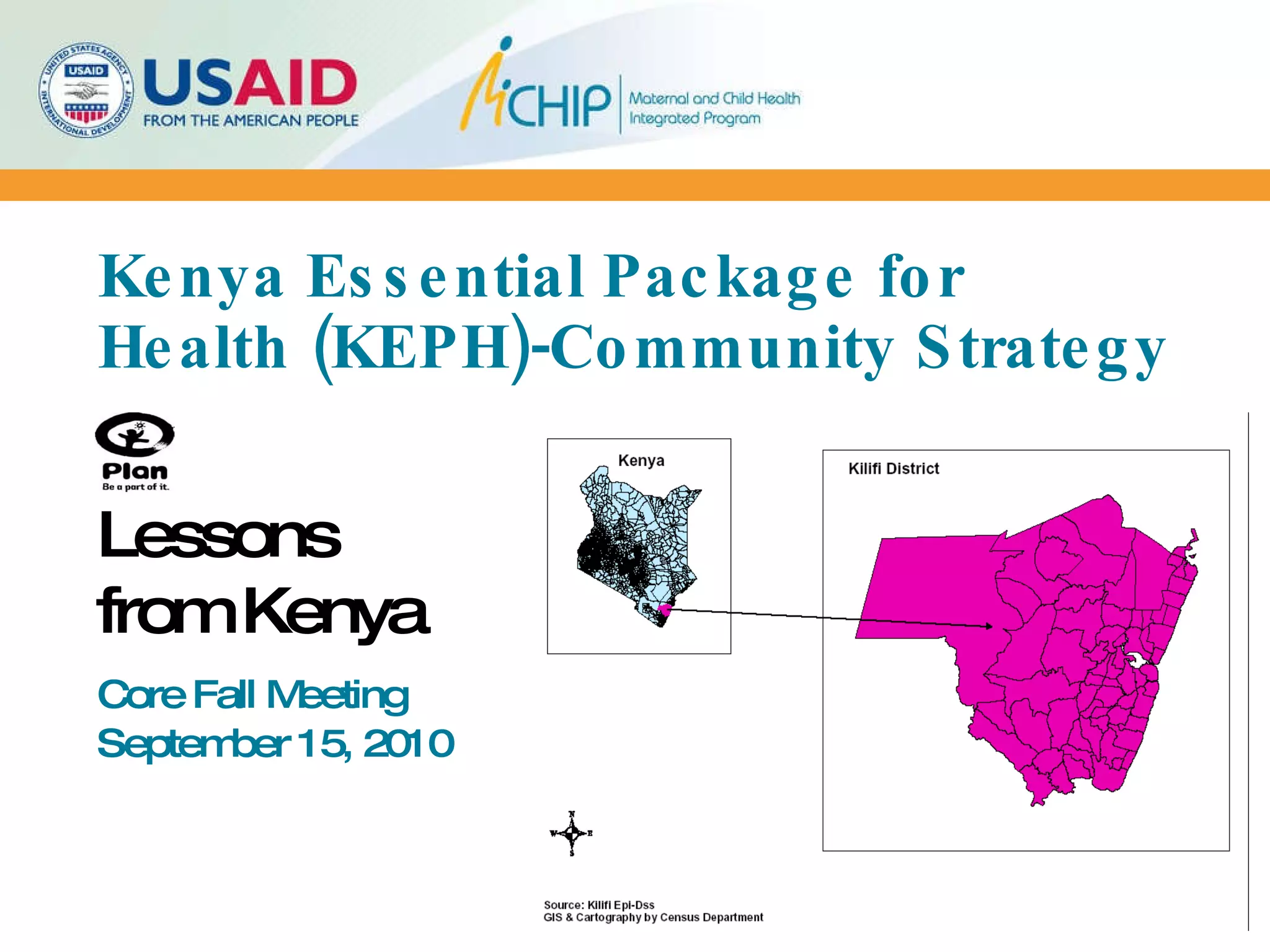
Kenya Essential Package for Health (KEPH)-Community Strategy Core Fall Meeting September 15, 2010 Lessons from Kenya
Ministry of Public Health and Sanitation: Essential Health Package Kenya’s second National Health Sector Strategic Plan (NHSSP II – 2005–2010) defined a new approach to the way the sector will deliver health care services to Kenyans – the Kenya Essential Package for Health (KEPH).  KEPH introduced six life-cycle cohorts and six service delivery levels.  One of the key innovations of KEPH is the recognition and introduction of level 1 service, which are aimed at empowering Kenyan households and communities to take charge of improving their own health.
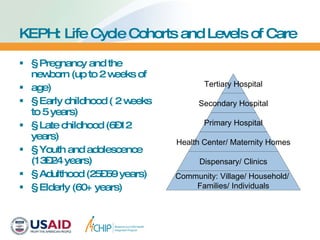
KEPH: Life Cycle Cohorts and Levels of Care § Pregnancy and the newborn (up to 2 weeks of age) § Early childhood ( 2 weeks to 5 years) § Late childhood (6–12 years) § Youth and adolescence (13–24 years) § Adulthood (25–59 years) § Elderly (60+ years) Tertiary Hospital Secondary Hospital Primary Hospital Health Center/ Maternity Homes Dispensary/ Clinics Community: Village/ Household/  Families/ Individuals
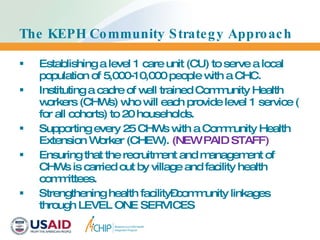
The KEPH Community Strategy Approach Establishing a level 1 care unit (CU) to serve a local population of 5,000-10,000 people with a CHC. Instituting a cadre of well trained Community Health workers (CHWs) who will each provide level 1 service ( for all cohorts) to 20 households. Supporting every 25 CHWs with a Community Health Extension Worker (CHEW).  (NEW PAID STAFF) Ensuring that the recruitment and management of CHWs is carried out by village and facility health committees. Strengthening health facility–community linkages through LEVEL ONE SERVICES
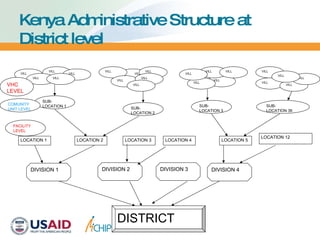
Kenya Administrative Structure at District level COMUNITY UNIT LEVEL FACILITY LEVEL SUB-LOCATION 2 VILL VILL VILL VILL VILL VILL SUB-LOCATION 1 VILL VILL VILL VILL VHC LEVEL VILL VILL VILL VILL VILL VILL SUB-LOCATION 3 DISTRICT LOCATION 2 LOCATION 5 DIVISION 1 DIVISION 2 DIVISION 4 LOCATION 1 LOCATION 4 LOCATION 12 LOCATION 3 DIVISION 3 VILL VILL VILL VILL SUB- LOCATION 36 VILL
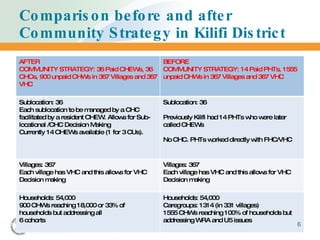
Comparison before and after Community Strategy in Kilifi District AFTER COMMUNITY STRATEGY: 36 Paid CHEWs, 36 CHCs, 900 unpaid CHWs in 367 Villages and 367 VHC BEFORE COMMUNITY STRATEGY: 14 Paid PHTs, 1555 unpaid CHWs in 367 Villages and 367 VHC Sublocation: 36  Each sublocation to be managed by a CHC facilitated by a resident CHEW. Allows for Sub-locational /CHC Decision Making Currently 14 CHEWs available (1 for 3 CUs). Sublocation: 36 Previously Kilifi had 14 PHTs who were later called CHEWs No CHC. PHTs worked directly with FHC/VHC Villages: 367 Each village has VHC and this allows for VHC Decision making Villages: 367 Each village has VHC and this allows for VHC Decision making Households: 54,000 900 CHWs reaching 18,000 or 33% of households but addressing all 6 cohorts Households: 54,000 Caregroups: 1314 (in 331 villages) 1555 CHWs reaching 100% of households but addressing WRA and U5 issues
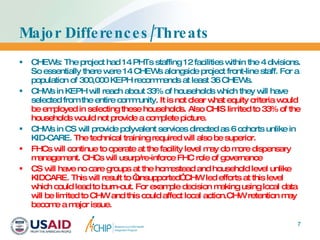
Major Differences/Threats CHEWs: The project had 14 PHTs staffing 12 facilities within the 4 divisions. So essentially there were 14 CHEWs alongside project front-line staff. For a population of 300,000 KEPH recommends at least 36 CHEWs. CHWs in KEPH will reach about 33% of households which they will have selected from the entire community . It is not clear what equity criteria would be employed in selecting these households. Also CHIS limited to 33% of the households would not provide a complete picture. CHWs in CS will provide polyvalent services directed as 6 cohorts unlike in KID-CARE.  The technical training required will also be superior. FHCs will continue to operate at the facility level may do more dispensary management. CHCs will usurp/re-inforce FHC role of governance  CS will have no care groups at the homestead and household level unlike KIDCARE. This will result to “unsupported” CHW led efforts at this level which could lead to burn-out. For example decision making using local data will be limited to CHW and this could affect local action.CHW retention may become a major issue.
The preceding slides were presented at the CORE Group 2010 Fall Meeting Washington, DC To see similar presentations, please visit: www.coregroup.org/resources/meetingreports

Kenya chw plan

  • 1.
    Kenya Essential Packagefor Health (KEPH)-Community Strategy Core Fall Meeting September 15, 2010 Lessons from Kenya
  • 2.
    Ministry of PublicHealth and Sanitation: Essential Health Package Kenya’s second National Health Sector Strategic Plan (NHSSP II – 2005–2010) defined a new approach to the way the sector will deliver health care services to Kenyans – the Kenya Essential Package for Health (KEPH). KEPH introduced six life-cycle cohorts and six service delivery levels. One of the key innovations of KEPH is the recognition and introduction of level 1 service, which are aimed at empowering Kenyan households and communities to take charge of improving their own health.
  • 3.
    KEPH: Life CycleCohorts and Levels of Care § Pregnancy and the newborn (up to 2 weeks of age) § Early childhood ( 2 weeks to 5 years) § Late childhood (6–12 years) § Youth and adolescence (13–24 years) § Adulthood (25–59 years) § Elderly (60+ years) Tertiary Hospital Secondary Hospital Primary Hospital Health Center/ Maternity Homes Dispensary/ Clinics Community: Village/ Household/ Families/ Individuals
  • 4.
    The KEPH CommunityStrategy Approach Establishing a level 1 care unit (CU) to serve a local population of 5,000-10,000 people with a CHC. Instituting a cadre of well trained Community Health workers (CHWs) who will each provide level 1 service ( for all cohorts) to 20 households. Supporting every 25 CHWs with a Community Health Extension Worker (CHEW). (NEW PAID STAFF) Ensuring that the recruitment and management of CHWs is carried out by village and facility health committees. Strengthening health facility–community linkages through LEVEL ONE SERVICES
  • 5.
    Kenya Administrative Structureat District level COMUNITY UNIT LEVEL FACILITY LEVEL SUB-LOCATION 2 VILL VILL VILL VILL VILL VILL SUB-LOCATION 1 VILL VILL VILL VILL VHC LEVEL VILL VILL VILL VILL VILL VILL SUB-LOCATION 3 DISTRICT LOCATION 2 LOCATION 5 DIVISION 1 DIVISION 2 DIVISION 4 LOCATION 1 LOCATION 4 LOCATION 12 LOCATION 3 DIVISION 3 VILL VILL VILL VILL SUB- LOCATION 36 VILL
  • 6.
    Comparison before andafter Community Strategy in Kilifi District AFTER COMMUNITY STRATEGY: 36 Paid CHEWs, 36 CHCs, 900 unpaid CHWs in 367 Villages and 367 VHC BEFORE COMMUNITY STRATEGY: 14 Paid PHTs, 1555 unpaid CHWs in 367 Villages and 367 VHC Sublocation: 36 Each sublocation to be managed by a CHC facilitated by a resident CHEW. Allows for Sub-locational /CHC Decision Making Currently 14 CHEWs available (1 for 3 CUs). Sublocation: 36 Previously Kilifi had 14 PHTs who were later called CHEWs No CHC. PHTs worked directly with FHC/VHC Villages: 367 Each village has VHC and this allows for VHC Decision making Villages: 367 Each village has VHC and this allows for VHC Decision making Households: 54,000 900 CHWs reaching 18,000 or 33% of households but addressing all 6 cohorts Households: 54,000 Caregroups: 1314 (in 331 villages) 1555 CHWs reaching 100% of households but addressing WRA and U5 issues
  • 7.
    Major Differences/Threats CHEWs:The project had 14 PHTs staffing 12 facilities within the 4 divisions. So essentially there were 14 CHEWs alongside project front-line staff. For a population of 300,000 KEPH recommends at least 36 CHEWs. CHWs in KEPH will reach about 33% of households which they will have selected from the entire community . It is not clear what equity criteria would be employed in selecting these households. Also CHIS limited to 33% of the households would not provide a complete picture. CHWs in CS will provide polyvalent services directed as 6 cohorts unlike in KID-CARE. The technical training required will also be superior. FHCs will continue to operate at the facility level may do more dispensary management. CHCs will usurp/re-inforce FHC role of governance CS will have no care groups at the homestead and household level unlike KIDCARE. This will result to “unsupported” CHW led efforts at this level which could lead to burn-out. For example decision making using local data will be limited to CHW and this could affect local action.CHW retention may become a major issue.
  • 8.
    The preceding slideswere presented at the CORE Group 2010 Fall Meeting Washington, DC To see similar presentations, please visit: www.coregroup.org/resources/meetingreports

Editor's Notes

  • #2 The context of CHWs in Kenya was similar to most: Various CHW Cadres, Various Sub specialties, Various Abilities, All non-paid, only career path limited to hired as assistant to certified private provider or support staff to government clinic
  • #6 KEPH introduces an additional level of governance at sub-location level
  • #8 Community Strategy better than what there was previously. However the failure to include care groups a missed opportunity.