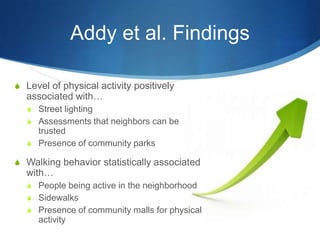
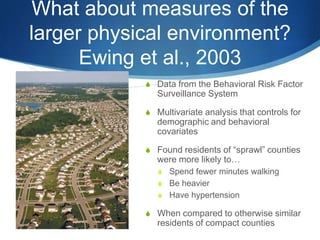
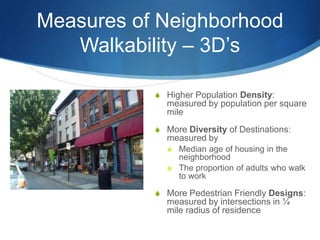
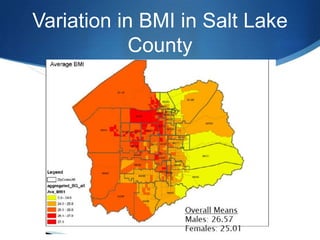
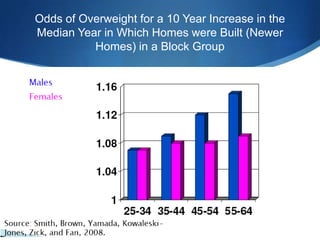
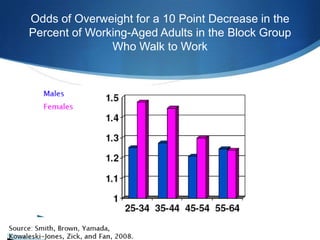
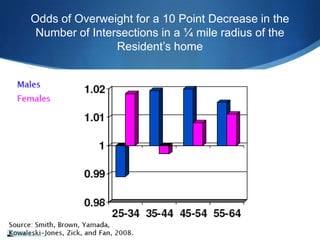
The document discusses several studies that examined the relationship between community design features and physical activity. The Addy et al. study found that physical activity was positively associated with street lighting, trusting neighbors, and parks. It also found walking was associated with active neighborhoods, sidewalks, and community malls. The Ewing et al. study found that residents of more sprawling counties were more likely to spend less time walking and be heavier. The Smith et al. study in Salt Lake County found that less walkable neighborhoods, as measured by newer housing, fewer people walking to work, and lower intersection density, were associated with higher odds of residents being overweight.