COMMUNICATIVE L ANGUAGE TEACHING
(CLT)
By Huynh Nhu Yen Nhi, M.A.
C O N T E N T S :
1. BACKGROUND OF CLT
2.TEACHING PRINCIPLES
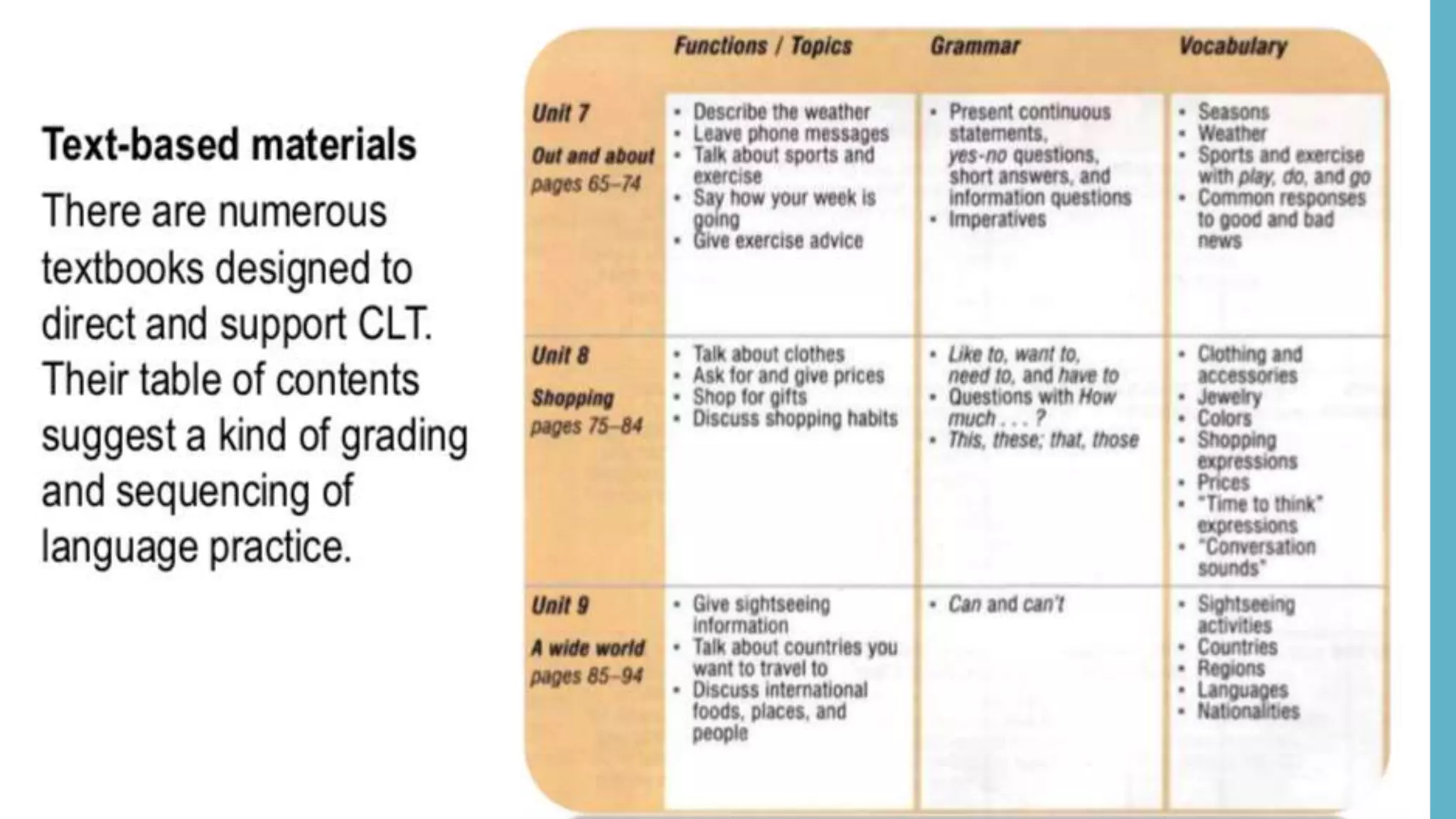
3.TEACHING MATERIALS
4.CL ASSROOM ACTIVTIES
BACKGROUND
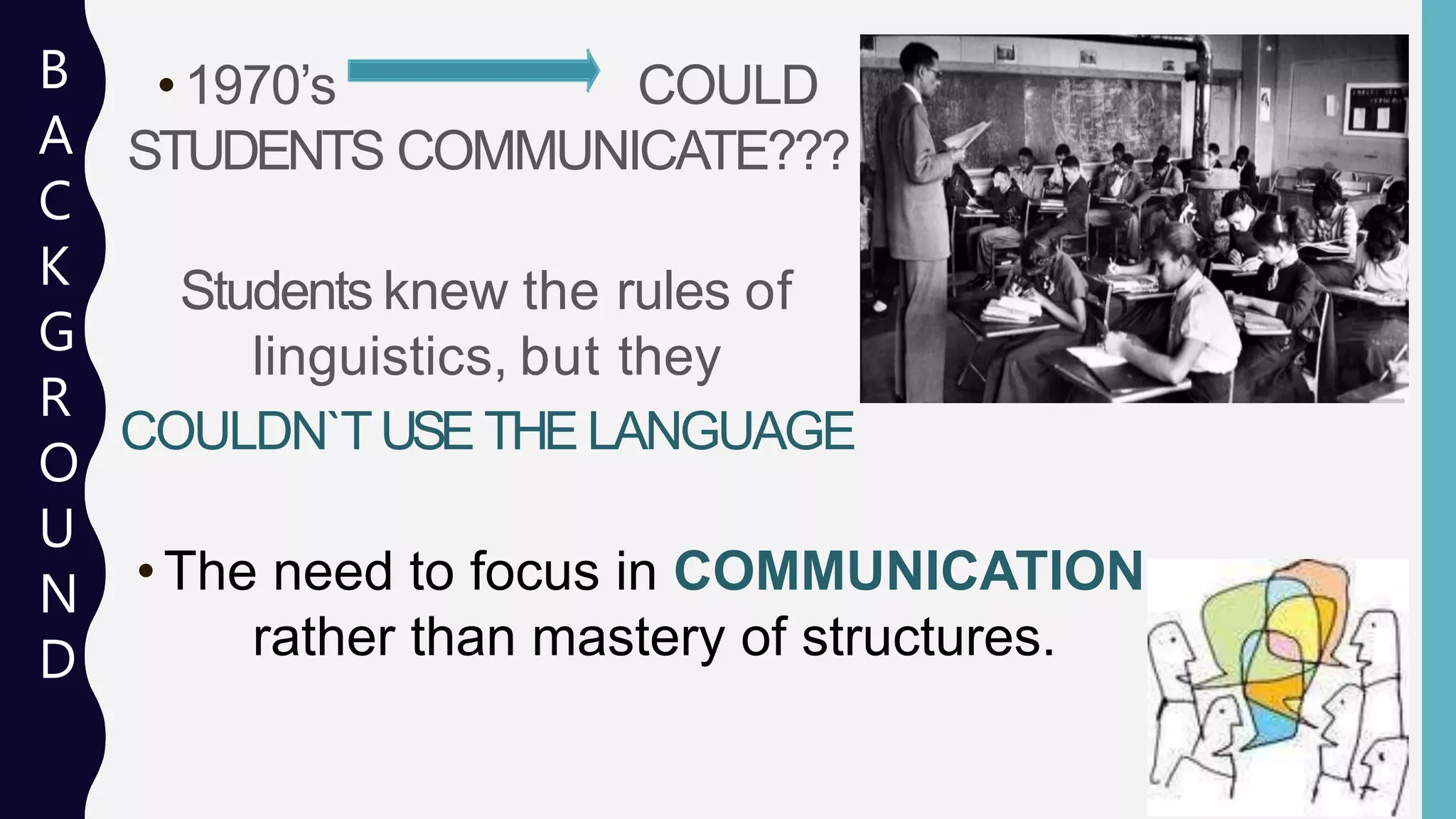
• 1970’s COULD
STUDENTS COMMUNICATE???
Students knew the rules of
linguistics, but they
COULDN`TUSE THE LANGUAGE
• The need to focus in COMMUNICATION
rather than mastery of structures.
B
A
C
K
G
R
O
U
N
D
WHAT IS COMMUNICATION?
It involves COMMUNICATIVE COMPETENCE:
That students perform certain functions:
Example:
•Inviting
•Accepting/ declining
•Giving advice
Within a social context
B
A
C
K
G
R
O
U
N
D
WHAT IS COMMUNICATIVE COMPETENCE?
Learners could know WHEN
and HOW to say WHAT to
WHOM. (Hymes,1971)
B
A
C
K
G
R
O
U
N
D
THE COMMUNICATIVE APPROACH WAS COMING!
To make COMMUNICATIVE COMPETENCE
become the goal of teaching.
To develop procedures for the teaching of the
FOUR LANGUAGE SKILLS
CLT
B
A
C
K
G
R
O
U
N
D
TEACHING
PRINCIPLES
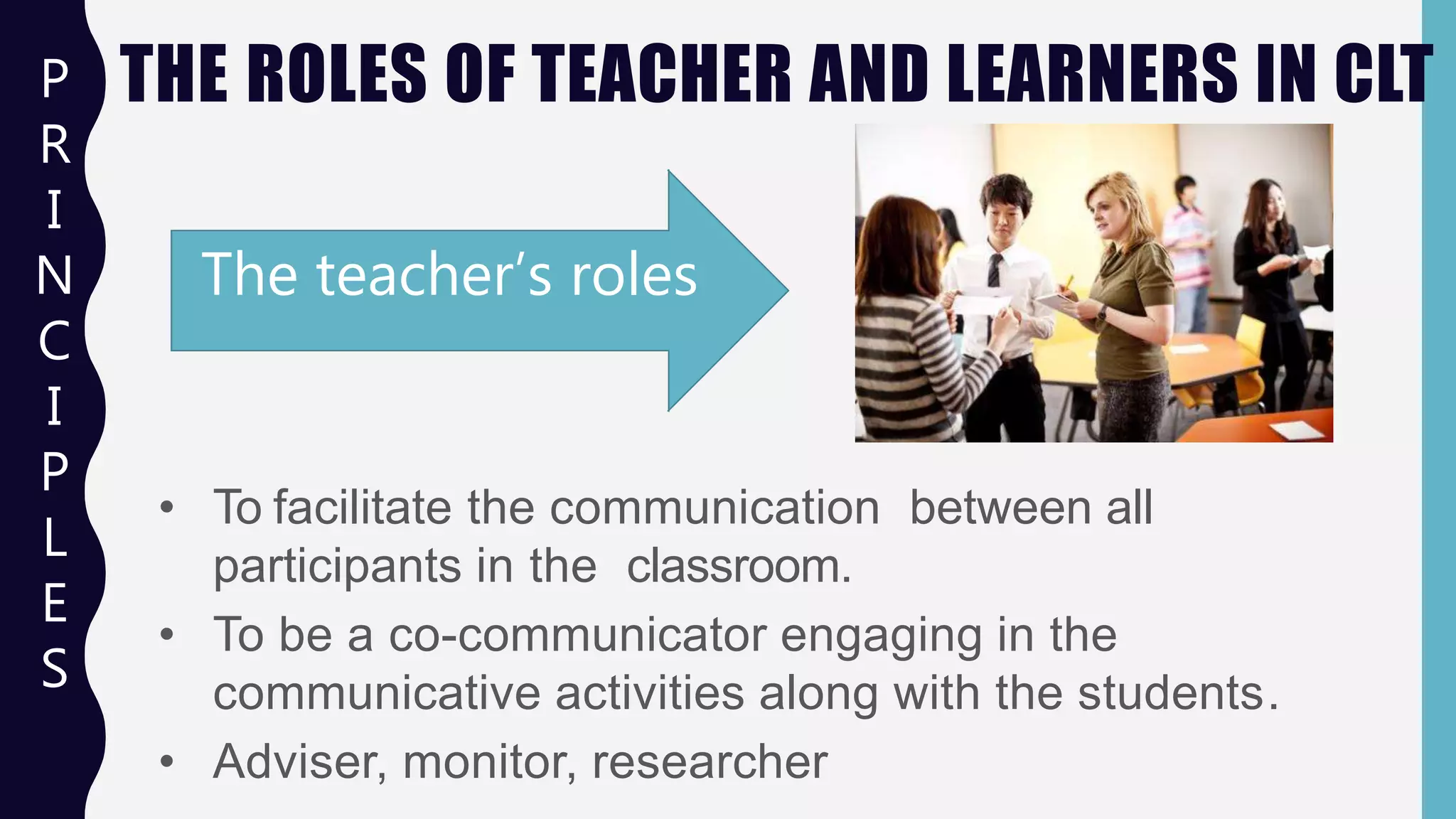
THE ROLES OF TEACHER AND LEARNERS IN CLT
• To facilitate the communication between all
participants in the classroom.
• To be a co-communicator engaging in the
communicative activities along with the students.
• Adviser, monitor, researcher
The teacher’s roles
P
R
I
N
C
I
P
L
E
S
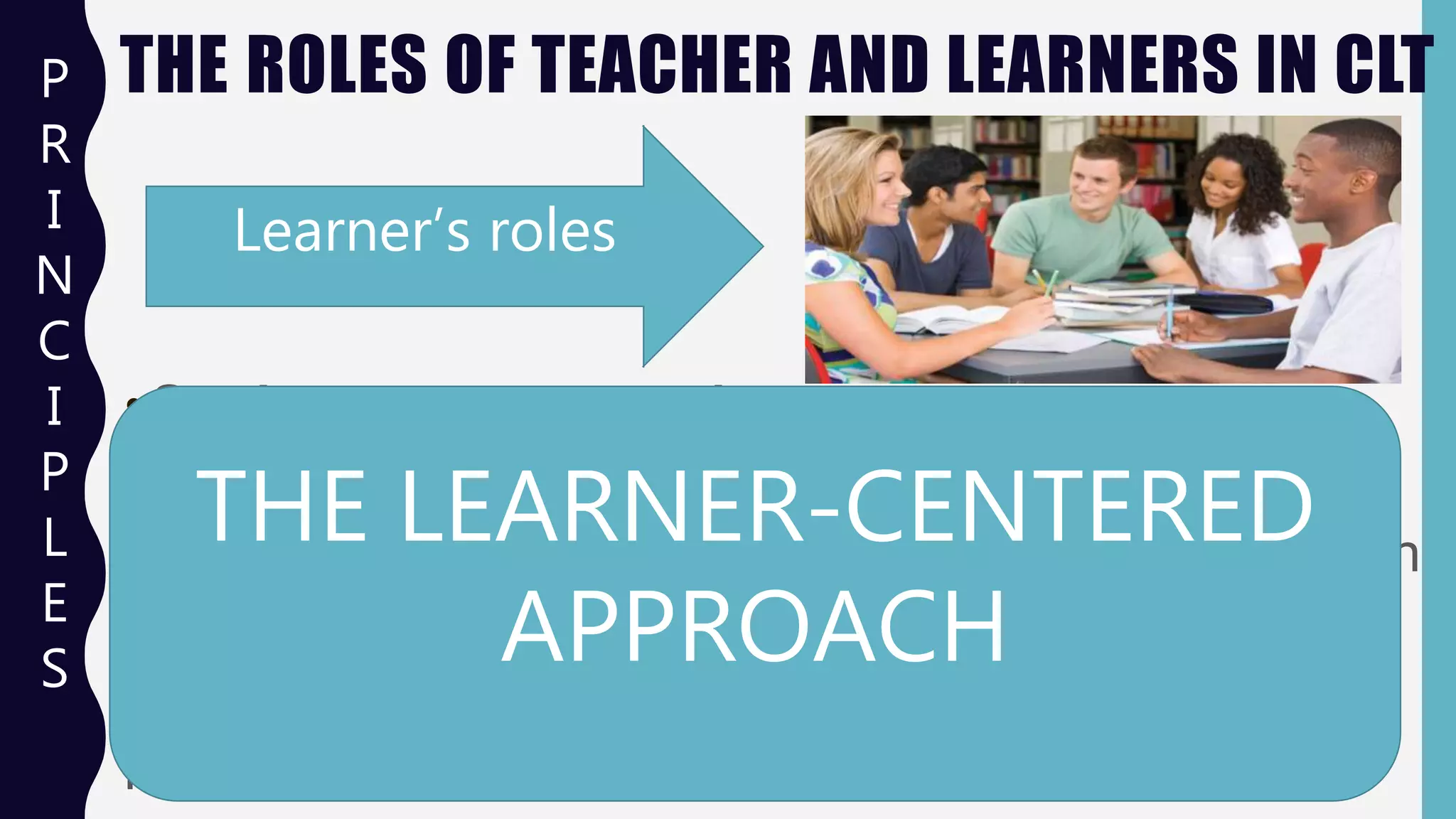
THE ROLES OF TEACHER AND LEARNERS IN CLT
Learner’s roles
• Students are communicators.
• They are actively engaged in negotiating meaning
- in trying to make themselves understood and in
understanding others
- even when their knowledge of the target
language is incomplete.
P
R
I
N
C
I
P
L
E
S
THE LEARNER-CENTERED
APPROACH
CHARACTERISTICS OF TEACHING/ LEARNING
PROCESS IN CLT
P
R
I
N
C
I
P
L
E
S
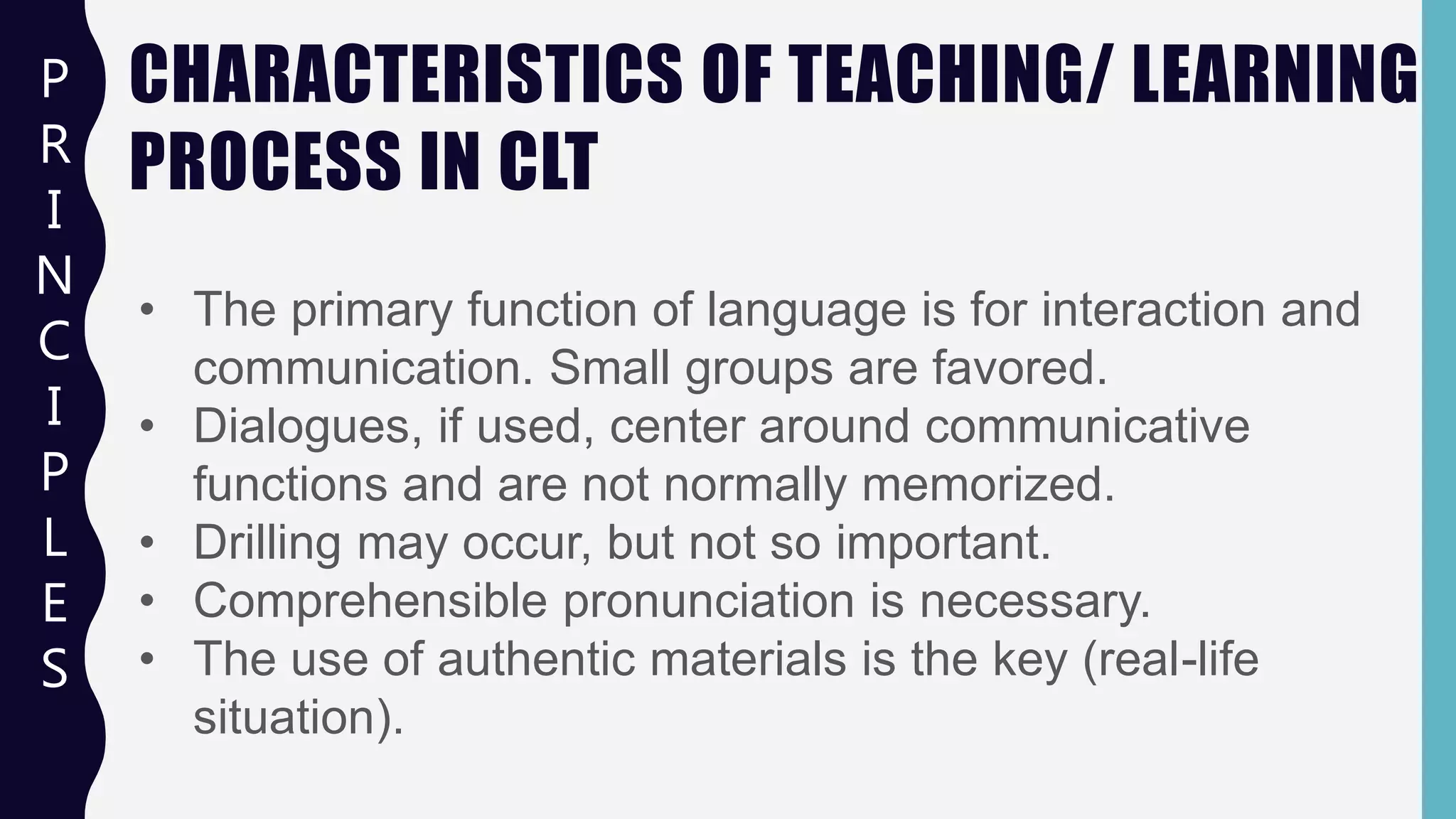
• The primary function of language is for interaction and
communication. Small groups are favored.
• Dialogues, if used, center around communicative
functions and are not normally memorized.
• Drilling may occur, but not so important.
• Comprehensible pronunciation is necessary.
• The use of authentic materials is the key (real-life
situation).
INTERACTIONS IN CLTP
R
I
N
C
I
P
L
E
S
• Teacher – to – students
• Students – to – teacher
• Students – to - students
• Pairs, triads, small groups, and whole group
STUDENTS’ FEELINGS IN CLTP
R
I
N
C
I
P
L
E
S
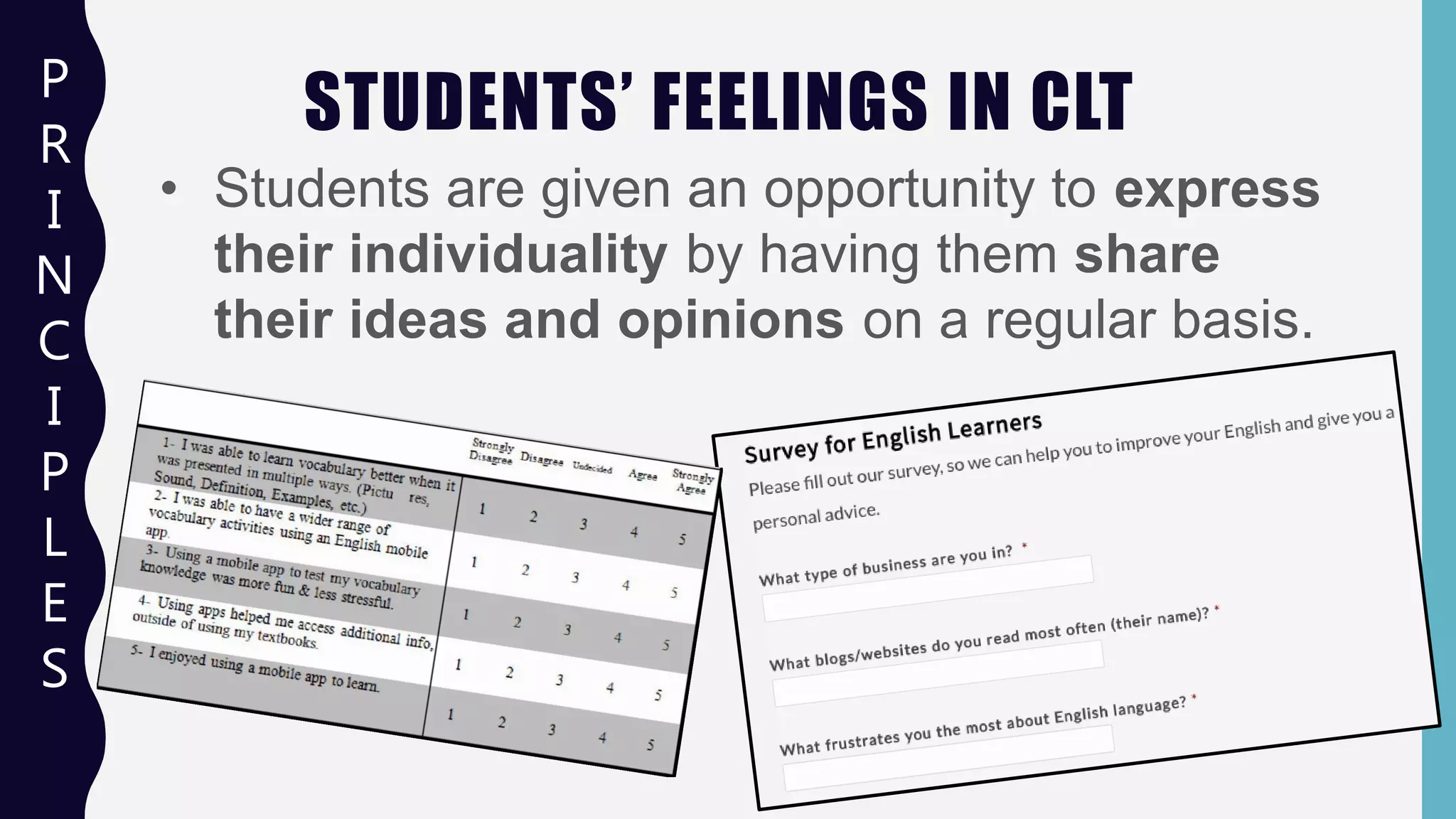
• Students are given an opportunity to express
their individuality by having them share
their ideas and opinions on a regular basis.
VIEWING THE LANGUAGE IN CLTP
R
I
N
C
I
P
L
E
S
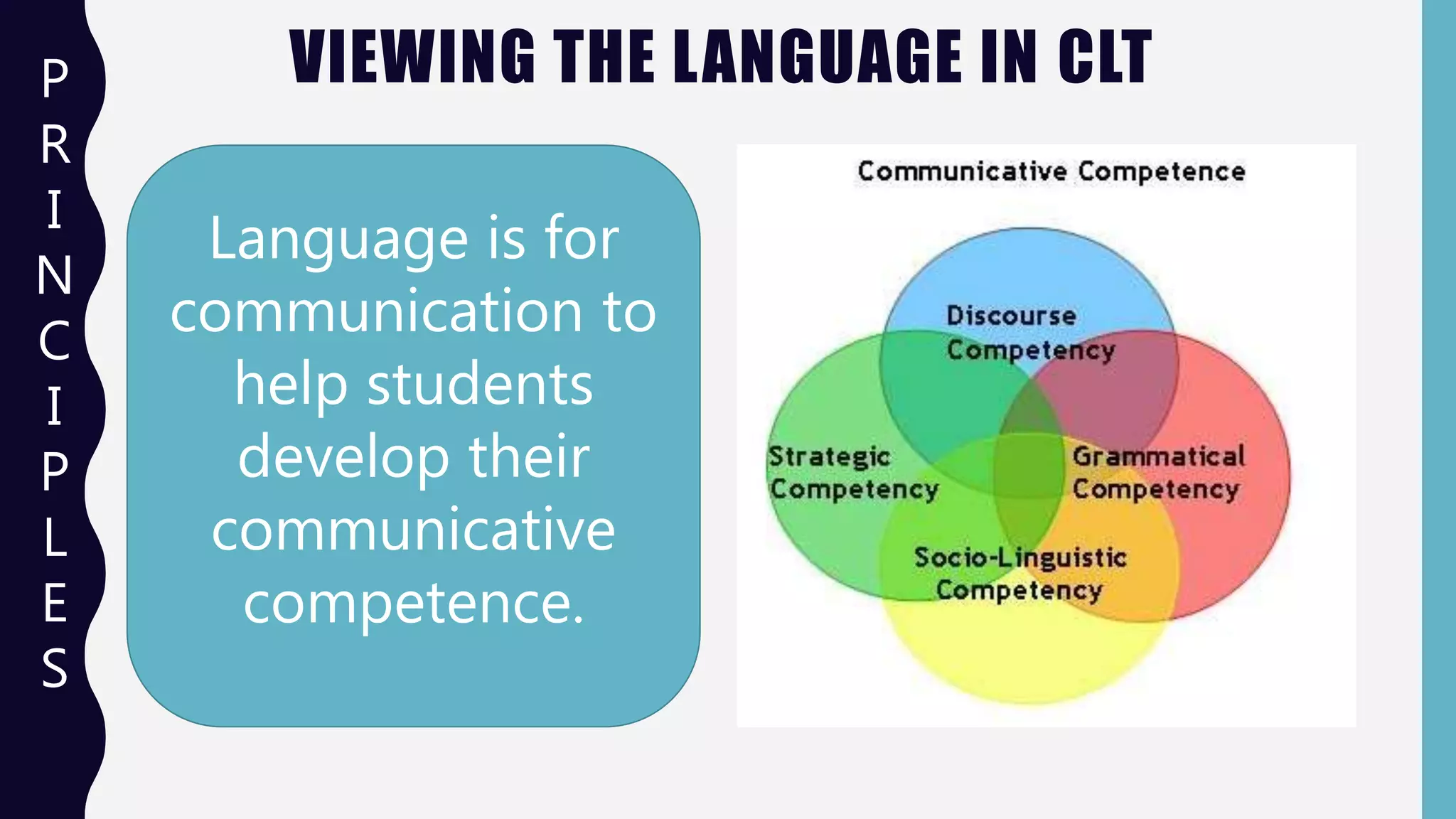
Language is for
communication to
help students
develop their
communicative
competence.
STUDENTS’ NATIVE LANGUAGEP
R
I
N
C
I
P
L
E
S
• Students’ native language is permitted in CLT.
However, whenever possible, the target
language should be used not only during
communicative activities, but also for
explaining the activities to the students or in
assigning homework.
TEACHER’S RESPONSE TO ERRORSP
R
I
N
C
I
P
L
E
S
• Errors of form are tolerated during
fluency- based activities and are seen as
a natural outcome of the development of
communication skills.
EVALUATION IN CLTP
R
I
N
C
I
P
L
E
S
• Evaluate not only the students’ accuracy,
but also their fluency.
• Evaluate students’ performance in the role
as an adviser or co- communicator
TEACHING
MATERIALS
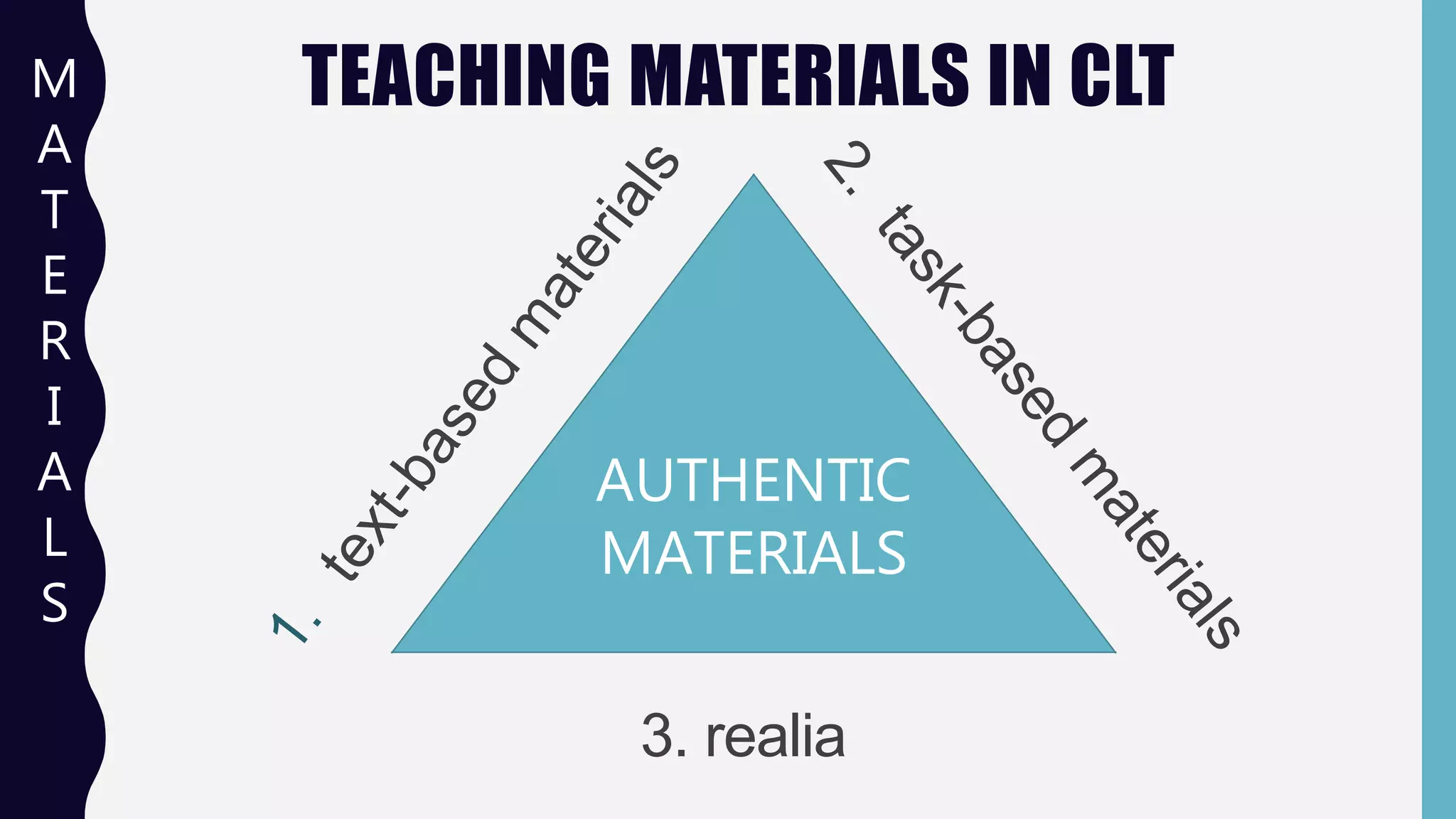
TEACHING MATERIALS IN CLTM
A
T
E
R
I
A
L
S
AUTHENTIC
MATERIALS
3. realia
M
A
T
E
R
I
A
L
S
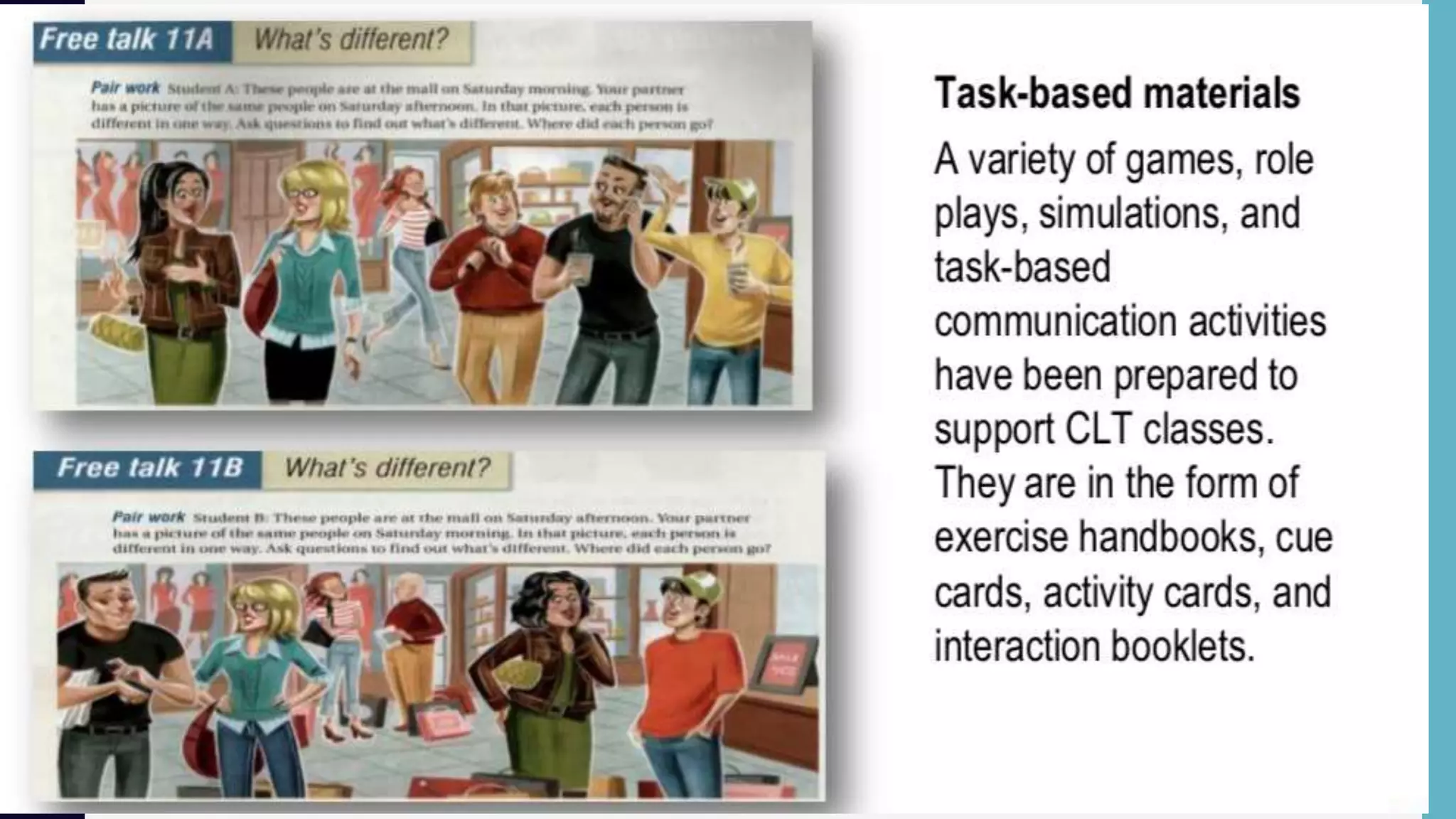
TASK-BASED MATERIALS
• These include game boards, roleplay cards,
materials for drilling, pairwork tasks, etc.
• They might be used to support 'real life'
tasks such as role playing booking into a
hotel, or a job interview.
M
A
T
E
R
I
A
L
S
REALIA
• Magazines, newspapers, fruit and vegetables,
real objects, maps - things from the real world
outside the classroom.
• They can be used in many activities.
• For example, fruit and vegetables could be
used in a shopping activity
M
A
T
E
R
I
A
L
S
REALIA
• Magazines, newspapers, fruit and vegetables,
real objects, maps - things from the real world
outside the classroom.
• They can be used in many activities.
• For example, fruit and vegetables could be
used in a shopping activity
M
A
T
E
R
I
A
L
S
CLASSROOM
ACTIVITIES
CLASSROOM ACTIVITIES IN CLT
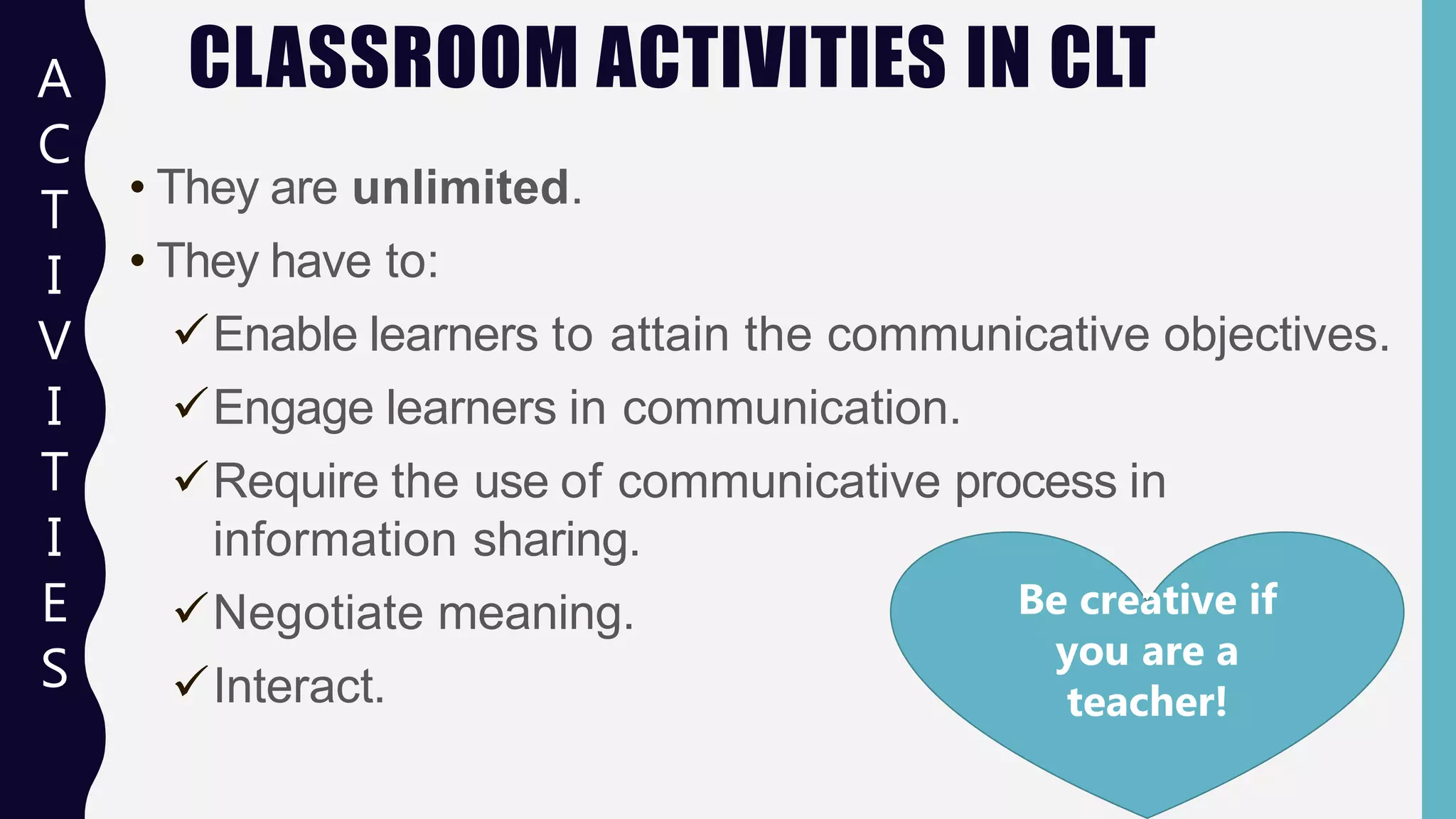
• They are unlimited.
• They have to:
Enable learners to attain the communicative objectives.
Engage learners in communication.
Require the use of communicative process in
information sharing.
Negotiate meaning.
Interact.
A
C
T
I
V
I
T
I
E
S
Be creative if
you are a
teacher!
CLASSROOM ACTIVITIES IN CLTA
C
T
I
V
I
T
I
E
S
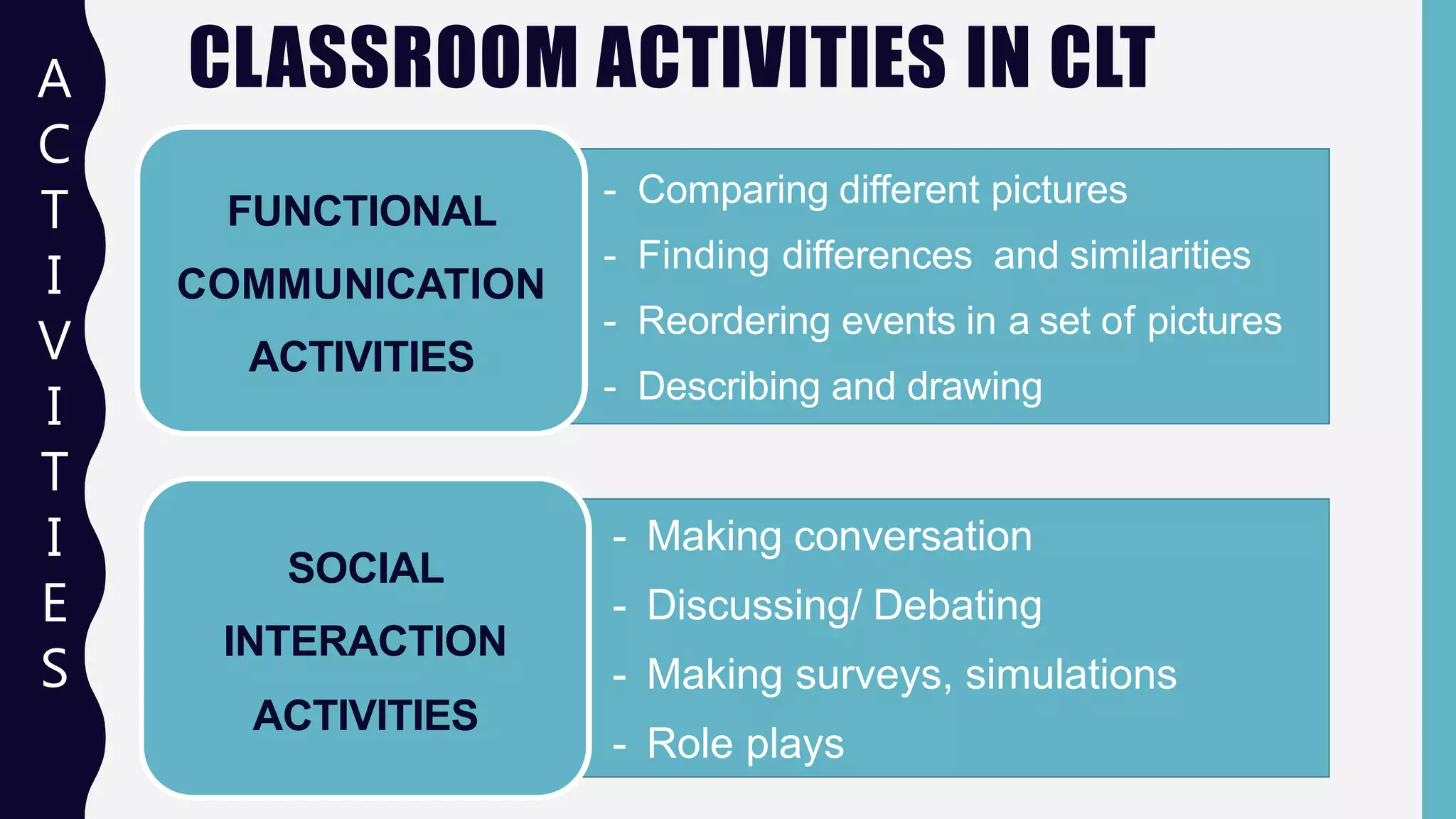
- Comparing different pictures
- Finding differences and similarities
- Reordering events in a set of pictures
- Describing and drawing
FUNCTIONAL
COMMUNICATION
ACTIVITIES
- Making conversation
- Discussing/ Debating
- Making surveys, simulations
- Role plays
SOCIAL
INTERACTION
ACTIVITIES
THANK YOU!
TEACHING IS A WORK OF HEART!

Communicative Language Teaching

  • 1.
    COMMUNICATIVE L ANGUAGETEACHING (CLT) By Huynh Nhu Yen Nhi, M.A.
  • 2.
    C O NT E N T S : 1. BACKGROUND OF CLT 2.TEACHING PRINCIPLES 3.TEACHING MATERIALS 4.CL ASSROOM ACTIVTIES
  • 3.
  • 4.
    • 1970’s COULD STUDENTSCOMMUNICATE??? Students knew the rules of linguistics, but they COULDN`TUSE THE LANGUAGE • The need to focus in COMMUNICATION rather than mastery of structures. B A C K G R O U N D
  • 5.
    WHAT IS COMMUNICATION? Itinvolves COMMUNICATIVE COMPETENCE: That students perform certain functions: Example: •Inviting •Accepting/ declining •Giving advice Within a social context B A C K G R O U N D
  • 6.
    WHAT IS COMMUNICATIVECOMPETENCE? Learners could know WHEN and HOW to say WHAT to WHOM. (Hymes,1971) B A C K G R O U N D
  • 7.
    THE COMMUNICATIVE APPROACHWAS COMING! To make COMMUNICATIVE COMPETENCE become the goal of teaching. To develop procedures for the teaching of the FOUR LANGUAGE SKILLS CLT B A C K G R O U N D
  • 8.
  • 9.
    THE ROLES OFTEACHER AND LEARNERS IN CLT • To facilitate the communication between all participants in the classroom. • To be a co-communicator engaging in the communicative activities along with the students. • Adviser, monitor, researcher The teacher’s roles P R I N C I P L E S
  • 10.
    THE ROLES OFTEACHER AND LEARNERS IN CLT Learner’s roles • Students are communicators. • They are actively engaged in negotiating meaning - in trying to make themselves understood and in understanding others - even when their knowledge of the target language is incomplete. P R I N C I P L E S THE LEARNER-CENTERED APPROACH
  • 11.
    CHARACTERISTICS OF TEACHING/LEARNING PROCESS IN CLT P R I N C I P L E S • The primary function of language is for interaction and communication. Small groups are favored. • Dialogues, if used, center around communicative functions and are not normally memorized. • Drilling may occur, but not so important. • Comprehensible pronunciation is necessary. • The use of authentic materials is the key (real-life situation).
  • 12.
    INTERACTIONS IN CLTP R I N C I P L E S •Teacher – to – students • Students – to – teacher • Students – to - students • Pairs, triads, small groups, and whole group
  • 13.
    STUDENTS’ FEELINGS INCLTP R I N C I P L E S • Students are given an opportunity to express their individuality by having them share their ideas and opinions on a regular basis.
  • 14.
    VIEWING THE LANGUAGEIN CLTP R I N C I P L E S Language is for communication to help students develop their communicative competence.
  • 15.
    STUDENTS’ NATIVE LANGUAGEP R I N C I P L E S •Students’ native language is permitted in CLT. However, whenever possible, the target language should be used not only during communicative activities, but also for explaining the activities to the students or in assigning homework.
  • 16.
    TEACHER’S RESPONSE TOERRORSP R I N C I P L E S • Errors of form are tolerated during fluency- based activities and are seen as a natural outcome of the development of communication skills.
  • 17.
    EVALUATION IN CLTP R I N C I P L E S •Evaluate not only the students’ accuracy, but also their fluency. • Evaluate students’ performance in the role as an adviser or co- communicator
  • 18.
  • 19.
    TEACHING MATERIALS INCLTM A T E R I A L S AUTHENTIC MATERIALS 3. realia
  • 20.
  • 21.
    TASK-BASED MATERIALS • Theseinclude game boards, roleplay cards, materials for drilling, pairwork tasks, etc. • They might be used to support 'real life' tasks such as role playing booking into a hotel, or a job interview. M A T E R I A L S
  • 22.
    REALIA • Magazines, newspapers,fruit and vegetables, real objects, maps - things from the real world outside the classroom. • They can be used in many activities. • For example, fruit and vegetables could be used in a shopping activity M A T E R I A L S REALIA • Magazines, newspapers, fruit and vegetables, real objects, maps - things from the real world outside the classroom. • They can be used in many activities. • For example, fruit and vegetables could be used in a shopping activity M A T E R I A L S
  • 23.
  • 24.
    CLASSROOM ACTIVITIES INCLT • They are unlimited. • They have to: Enable learners to attain the communicative objectives. Engage learners in communication. Require the use of communicative process in information sharing. Negotiate meaning. Interact. A C T I V I T I E S Be creative if you are a teacher!
  • 25.
    CLASSROOM ACTIVITIES INCLTA C T I V I T I E S - Comparing different pictures - Finding differences and similarities - Reordering events in a set of pictures - Describing and drawing FUNCTIONAL COMMUNICATION ACTIVITIES - Making conversation - Discussing/ Debating - Making surveys, simulations - Role plays SOCIAL INTERACTION ACTIVITIES
  • 26.
    THANK YOU! TEACHING ISA WORK OF HEART!