Communicating in Business
The Art of Being Heard
Rebecca Overcash, PMP
Communication:
Funk & Wagnalls Standard Desk Dictionary, 1976
 To cause others to partake of or share in; impart
 To transmit or exchange through knowledge
Ask.com service, March 2009
 The imparting or interchange of thoughts, opinions,
or information by speech, writing, or signs
 A process by which information is exchanged
between individuals through a common system of
symbols, signs, or behavior
Business Communication
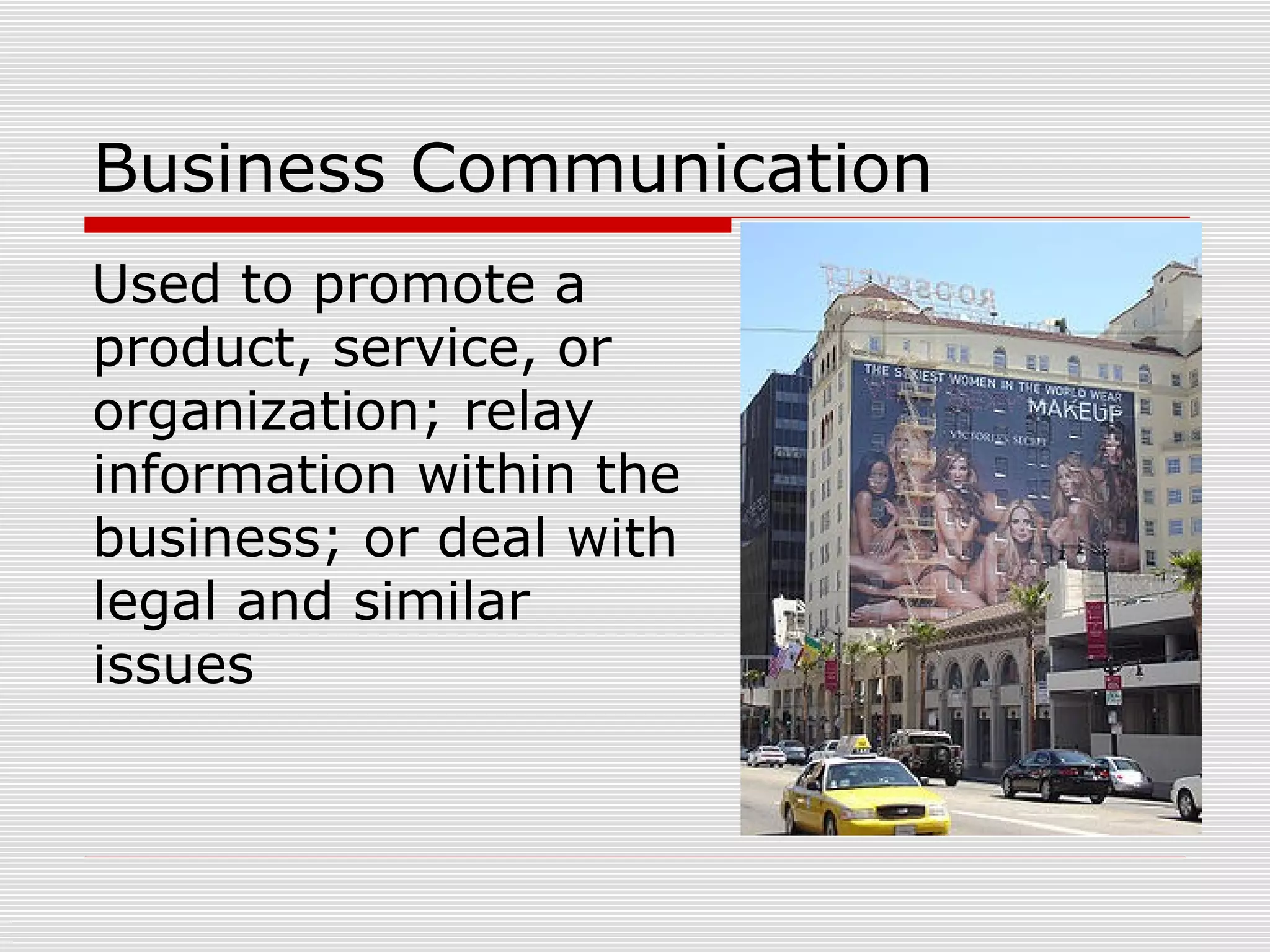
Used to promote a
product, service, or
organization; relay
information within the
business; or deal with
legal and similar
issues
Why Good Communication is
Good Business
FACT: Good communication matters
because business organizations are
made up of people.
FACT: Two-thirds of salaried employees
have some writing responsibilities.
FACT: Employees who
can write well get paid
more.
“Listen Up”; Marty Blalock,
http://www.bus.wisc.edu/update/winter05/business_communication.asp
Business Communication
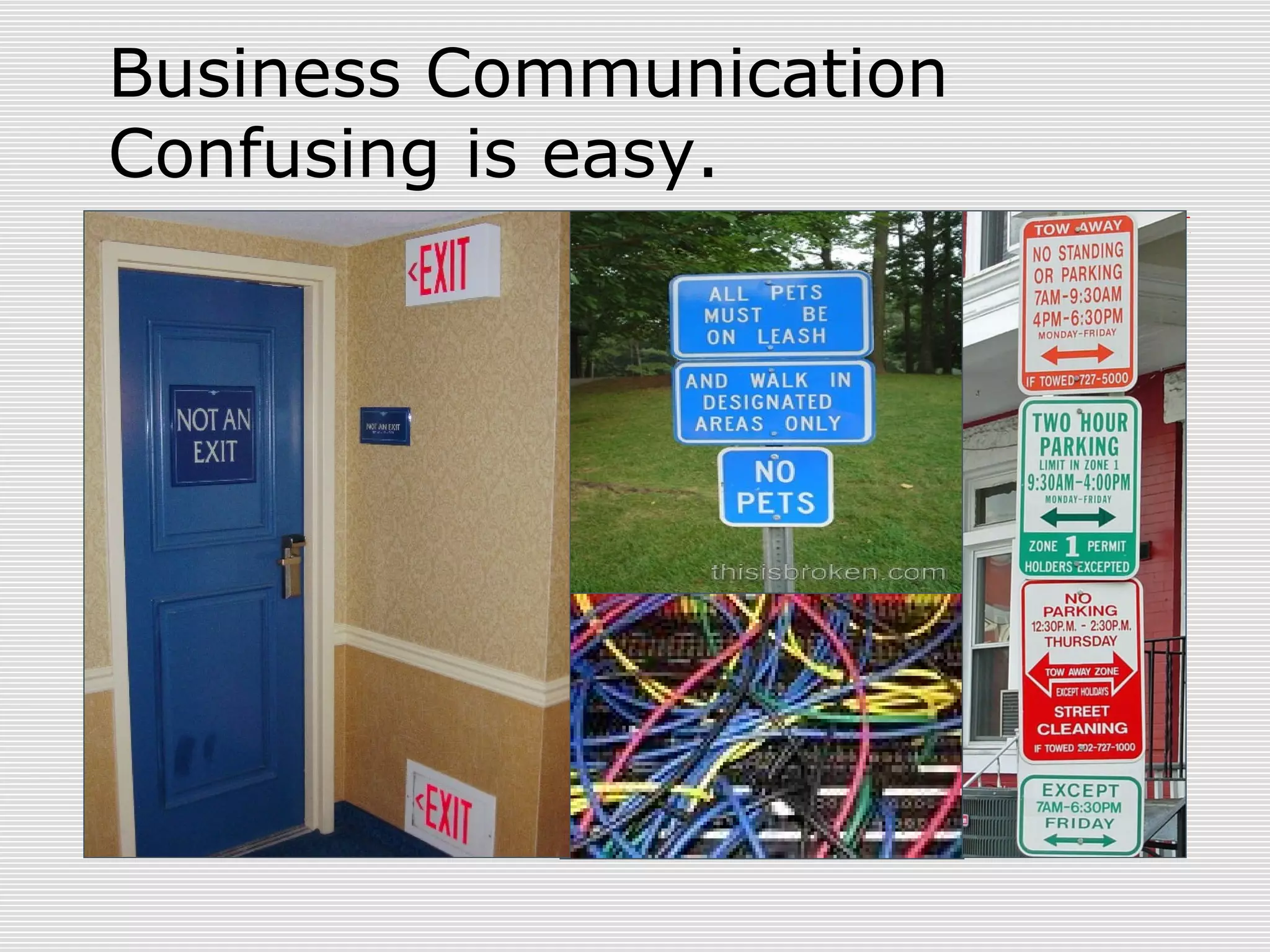
Confusing is easy.
Business Communication
Myth #1
The more information I cram in, the
better
Test yourself:
Show your business communication piece to a
stranger and give them only 5 seconds to look at
it. Can they tell you the main message?
“Guide to 5 Myths of Business Communications”; by Andrea Morris
http://www.business.com/directory/management/operations_management
Business Communication
Myth #2
If I use big words, people will think I’m
smarter
Test Yourself:
Give your business communication piece to a 4th
grader. Do they understand every word?
“Guide to 5 Myths of Business Communications”; by Andrea Morris
http://www.business.com/directory/management/operations_management
Business Communications
Myth #3
By using buzzwords, jargon and
acronyms I’ll prove my industry
knowledge
Test Yourself:
Have a friend from an opposite industry read your
communication material. Do they understand it?
Business Communications
Myth #4
I’ll use adjectives like “best”, “excellent”
or “outstanding” to set myself apart.
Test Yourself:
Ask your best clients to give you a quote about
their experience working with you. Did you
replace your boastful comments with their
testimonials?
Business Communications
Myth #5
I’ll write in first person so it won’t be
boring.
Test Yourself:
Take a piece of business communication and
change “I” and “we” to “you” (also, change the
tense of the verbs, etc.). Give both versions to a
friend and ask them which is more compelling.
Methods of Business
Communication
 Web-based
 E-mails
 Professional Documents
 Presentations
 Meetings – virtual and face-to-face
 Blogs
 Podcasts
Business Communication
Emails
 Always use complete
sentences.
 Always use good grammar
and proper communication
form.
 REMEMBER – once you hit
send, you cannot control
who sees what you have
written!!!
Business Communication in
Professional Documents
To achieve an objective you need to
be able to articulate it.
GOAL: Migrate the CDO tool for LTS into the DAC
without disruption of business to the Trustees of the
CDO.
Migrate the Collateralized Debt Obligation tool
used by the Litigation Tax Services into the
Deluth Access Center
Business Communication in
Presentations
Know your audience.
The cambium sits between the pholem and the
xylem and is where growth occurs.
This very thin layer sits between the inner
bark and the sap of a tree and is where
growth occurs.
Business Communication
Learn to make it impersonal
Aggressive communicators are loud, their
gestures are intimidating; they try to plow
through others with force.
There’s no point in reasoning with
people that are unreasonable.
Business Communication
Self-neutralization
 This isn’t personal. It’s not about me
 I’m in control of me. I can handle this.
 Listening without reacting can diffuse
the situation
 Learn to acknowledge the speaker
Business Communication
Recap
 Good communication is good business
 Good communication can set you apart
 Communication should be:
 Clear
 Concise
 No buzzwords or slang
 No boasting
 All inclusive
Business Communications
QUESTIONS

CommunicationsPresentation309

  • 1.
    Communicating in Business TheArt of Being Heard Rebecca Overcash, PMP
  • 2.
    Communication: Funk & WagnallsStandard Desk Dictionary, 1976  To cause others to partake of or share in; impart  To transmit or exchange through knowledge Ask.com service, March 2009  The imparting or interchange of thoughts, opinions, or information by speech, writing, or signs  A process by which information is exchanged between individuals through a common system of symbols, signs, or behavior
  • 3.
    Business Communication Used topromote a product, service, or organization; relay information within the business; or deal with legal and similar issues
  • 4.
    Why Good Communicationis Good Business FACT: Good communication matters because business organizations are made up of people. FACT: Two-thirds of salaried employees have some writing responsibilities. FACT: Employees who can write well get paid more. “Listen Up”; Marty Blalock, http://www.bus.wisc.edu/update/winter05/business_communication.asp
  • 5.
  • 6.
    Business Communication Myth #1 Themore information I cram in, the better Test yourself: Show your business communication piece to a stranger and give them only 5 seconds to look at it. Can they tell you the main message? “Guide to 5 Myths of Business Communications”; by Andrea Morris http://www.business.com/directory/management/operations_management
  • 7.
    Business Communication Myth #2 IfI use big words, people will think I’m smarter Test Yourself: Give your business communication piece to a 4th grader. Do they understand every word? “Guide to 5 Myths of Business Communications”; by Andrea Morris http://www.business.com/directory/management/operations_management
  • 8.
    Business Communications Myth #3 Byusing buzzwords, jargon and acronyms I’ll prove my industry knowledge Test Yourself: Have a friend from an opposite industry read your communication material. Do they understand it?
  • 9.
    Business Communications Myth #4 I’lluse adjectives like “best”, “excellent” or “outstanding” to set myself apart. Test Yourself: Ask your best clients to give you a quote about their experience working with you. Did you replace your boastful comments with their testimonials?
  • 10.
    Business Communications Myth #5 I’llwrite in first person so it won’t be boring. Test Yourself: Take a piece of business communication and change “I” and “we” to “you” (also, change the tense of the verbs, etc.). Give both versions to a friend and ask them which is more compelling.
  • 11.
    Methods of Business Communication Web-based  E-mails  Professional Documents  Presentations  Meetings – virtual and face-to-face  Blogs  Podcasts
  • 12.
    Business Communication Emails  Alwaysuse complete sentences.  Always use good grammar and proper communication form.  REMEMBER – once you hit send, you cannot control who sees what you have written!!!
  • 13.
    Business Communication in ProfessionalDocuments To achieve an objective you need to be able to articulate it. GOAL: Migrate the CDO tool for LTS into the DAC without disruption of business to the Trustees of the CDO. Migrate the Collateralized Debt Obligation tool used by the Litigation Tax Services into the Deluth Access Center
  • 14.
    Business Communication in Presentations Knowyour audience. The cambium sits between the pholem and the xylem and is where growth occurs. This very thin layer sits between the inner bark and the sap of a tree and is where growth occurs.
  • 15.
  • 16.
    Business Communication Learn tomake it impersonal Aggressive communicators are loud, their gestures are intimidating; they try to plow through others with force. There’s no point in reasoning with people that are unreasonable.
  • 17.
  • 18.
    Business Communication Self-neutralization  Thisisn’t personal. It’s not about me  I’m in control of me. I can handle this.  Listening without reacting can diffuse the situation  Learn to acknowledge the speaker
  • 19.
    Business Communication Recap  Goodcommunication is good business  Good communication can set you apart  Communication should be:  Clear  Concise  No buzzwords or slang  No boasting  All inclusive
  • 20.

Editor's Notes

  • #4 Refer to items in the room, on their clothes, in the hallway on the way to the classroom. All these things are a type of communication. Many are a Business Communication.
  • #5 Typically, managers spend 75 to 80 percent of their time engaged in some form of written or oral communication. Does anyone in the class have a manager that they feel doesn’t communicate very well? Ineffective communication is very expensive for a company. The National Commission on Writing estimates that American businesses spend $3.1 billion annually just training people to write. The changing environment and increasing complexity of the 21st century workplace make communication even more important. Flatter organizations mean managers must communicate with people over whom they may have no formal control. Employees reflect differences in age, ethnic heritage, race, physical abilities, gender and sexual orientation. Diversity is not just a matter of social responsibility; it is also an economic issue. The world’s economy is becoming increasingly global. For managers, having international experience is rapidly moving from “desirable” to “essential.” The ability to compete in the global economy is the single greatest challenge facing business today.
  • #6 Instructional notices, directional signage and naming a product is communication at it’s simplest. Products have failed overseas sometimes simply because a name may take on unanticipated meanings in translation. Olympic copier named “Roto” was released in Chile but failed to sell because “Roto” in Spanish means “broken” The Chevy Nova was released in Puerto Rico but didn’t sell because “va” means “doesn’t go” A Wisconsin agricultural business named Randan has trouble penetrating the Japanese market place because “randan” in Japanese means “idiot” Parker Pen’s Jotter pen series didn’t sell in some Latin American markets because the translation is “jockstrap”
  • #7 Myth #1 - The more information I can cram in, the better.Have you ever tried to find a needle in a haystack? It takes a lot of patience. Unfortunately, patience is not something readers of your business communications will have. Simply put, if your message is buried in mounds of text no one will take the time to search for it. Effective business communications focus on a singular message and eliminate everything else. This is not the place to write that favorite novel or test your short story skills.
  • #8 Prodigious colloquy induces an antipodal consequence. Using big words is like a guy with an expensive sports car – it can be perceived that you are trying to compensate for something. Instead, go for short, clear, easy-to-understand words that you would use in everyday conversation. Your tone will be friendlier and your readers will be more receptive to your message.
  • #9 You might as well write in Ancient Greek because that’s about how many people will actually understand what you’re trying to say. Acronyms are especially deadly, so if they’re necessary – take the time to spell them out. As for buzzwords and jargon – save them for the water cooler.
  • #10 Have you ever been stuck at a party with a person who just won’t shut up about how great they are? Not only is it annoying – it actually turns you off. Instead of bragging about yourself, gather testimonials and allow your customers to boast on your behalf. You’ll find prospects intrigued and eager to learn more.
  • #11 Most of your readers will have one question in their mind when reading your document – “What’s in it for ME?” That means, using the Y-O-U word – not the I (or W-E) word. Yes, there are times that a compelling narrative story can make an impact. But in general, business communications should be about the client – not about you.
  • #12 The average person gets 30,000 media messages a day. This means that we get the same amount of information in 1 day that a person received in a lifetime 100 years ago.
  • #14 A key document in managing projects is called the Charter. This is a primary communications tool between the owner of a business unit and project manager. It describes the goal of the business and provides a roadmap for the planning of the project. This was a $3 million business.
  • #15 A key document in managing projects is called the Charter. This is a primary communications tool between the owner of a business unit and project manager. It describes the goal of the business and provides a roadmap for the planning of the project.
  • #19 Write an email with no “Send” address. Save the email and reread it later.