Business Communication
Dr. Murali Vemula
MA;M.Phil;PGCTE(EFLU);PhD
Associate Professor of English,
email:drmuraliku[at]gmail.com
What is Bus. Communication:
Introduction
 Business communication is the process of sharing
information between people within the workplace and
outside a company.
 Effective business communication is how employees
and management interact to reach organizational
goals.
 Its purpose is to improve organizational practices and
reduce errors.
 It’s important to work on both your communication
skills and communication processes to achieve
effective business communication.
The importance of business communication also lies in:
 Presenting options/new business ideas
 Making plans and proposals (business writing)
 Executing decisions
 Reaching agreements
 Sending and fulfilling orders
 Successful selling
 Effective meetings
 Providing feedback to employees and customers
 Communication is neither the transmission of a
message nor the message itself.
 It is the mutual exchange of understanding,
originating with the receiver.
 Communication needs to be effective in business.
Communication is the essence of management.
 The basic functions of management
(Planning, Organizing, Staffing, Directing and
Controlling )cannot be performed well without
effective communication.
 Business Communication is goal oriented. The rules,
regulations and policies of a company have to be
communicated to people within and outside the
organization.
 Business Communication is regulated by certain rules
and norms. In early times, business communication
was limited to paper-work, telephone calls etc.
 With advent of technology, (cell phones, video
conferencing, emails) satellite communication to
support business communication.
 Effective business communication helps in building
goodwill of an organization.
Business Communication can be of two types:
 Oral Communication- An oral communication can
be formal or informal. Generally business
communication is a formal means of communication,
like : meetings, interviews, group discussion, speeches
etc. An example of Informal business communication
would be - Grapevine.
 Written Communication - Written means of
business communication includes - agenda, reports,
manuals etc.
Guidelines for Effective Communication
The characteristics of effective communication are as
follows:
 Clarity of Purpose: The message to be delivered must be
clear in the mind of sender.
 Completeness: The message delivered should not be
incomplete. It should be supported by facts and
observations.
 Conciseness: The message should be concise.
 Feedback: Whether the message sent by the sender is
understood in same terms by the receiver or not can be
judged by the feedback received.
 Empathy: The listeners are essential for effective verbal
communication. The speaker should step into the shoes of
the listener and be sensitive to their needs and emotions.
This way he can understand things from their perspective
and make communication more effective.
 Modify the message according to the audience: The
information requirement by different people in the
organization differs according to their needs. Use of jargons
should be minimized because it might lead to
misunderstanding and misinterpretations. The message
should be modified according to the needs and requirements
of the targeted audience.
 Multiple Channels of communication: For effective
communication multiple channels should be used as it
increases the chances of clarity of message. The message is
reinforced by using different channels and there are less
chances of deformation of message.
 Make effective use of Grapevine (informal channel of
communication): The employees and managers should not
always discourage grapevine. They should make effective use
of grapevine. The managers can use grapevine to deliver
formal messages and for identification of issues which are
significant for the employees. The managers can get to know
the problems faced by the employees and can work upon it.
Grapevine Communication (Informal Business Communication)
 Grapevine generally develops due to various
reasons. One of them is that when an organization
is facing recession, the employees sense
uncertainty. Also, at times employees do not have
self-confidence due to which they form unions.
Examples of Grapevine Network of
Communication
 Suppose the profit amount of a company is known.
Rumour is spread that this much profit is there and
on that basis bonus is declared.
 CEO may be in relation to the Production Manager.
They may have friendly relations with each other.
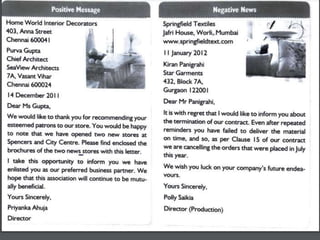
Types of Business messages
 Most of the written business messages can be…….
 Positive
 Negative
 Neutral and
 Persuasive
Positive or good news messages :
 Convey a positive info.
 Mirrors yours your goodwill
 Offering adjustments, expressing appreciation, sending
a note of thanks, expressing sympathy etc.
contd…
Some positive messages are…..
 A sales manager of a company offering to replace the
desert coolers that the client company received in a bad
shape.
 The CEO of an MNC sending an appreciation letter
congratulating an employee for having been selected in
the national football team.
 The president of a business writing a note of sympathy
to commiserate with a deceased employee’s family.
 Negative Messages or bad messages
 Deliver information that is undesirable or disappointing
to readers
 May frustrate readers
 Job rejections / refusals
 Request for adjustments
contd…….
Situations…….
 A manager of a consultancy firm sending a message to
the candidates who was rejected for a job in the
company.
 A manager (HR) of a business corporation refusing an
association’s request for a donation.
 A manager of a bank refusing loan to a university
student.
 Neutral or Routine messages…
 Carry information of equal or even higher importance
than positive messages but emotional content and
involvement is usually lower.
 Order acknowledgements, inquiries, request for credit
information, personal evaluation, and compliance with
requests can be neutral messages. Some neutral
messages are….
i. A government agency responding to a request for a brochure.
ii. A manger of a large corporation sending a memo notifying
employees of a change in policy.
iii. A sales manger sending a weekly sales report to the head office.
Persuasive messages…..
 Try to motivate readers to agree with the senders or to
make them act in a desired way.
As a business person need to influence your superior --
 to adopt a particular proposal,
 your supplier to replace a defective product, or
 a prospective customer to buy your new product.
Observe these letters…………….
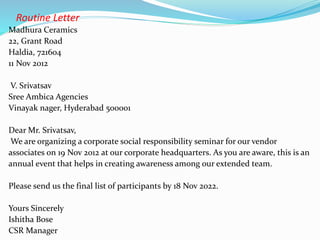
Routine Letter
Madhura Ceramics
22, Grant Road
Haldia, 721604
11 Nov 2012
V. Srivatsav
Sree Ambica Agencies
Vinayak nager, Hyderabad 500001
Dear Mr. Srivatsav,
We are organizing a corporate social responsibility seminar for our vendor
associates on 19 Nov 2012 at our corporate headquarters. As you are aware, this is an
annual event that helps in creating awareness among our extended team.
Please send us the final list of participants by 18 Nov 2022.
Yours Sincerely
Ishitha Bose
CSR Manager
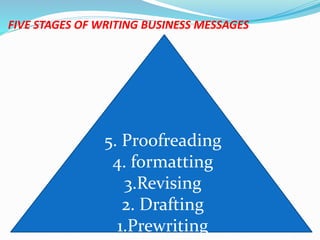
FIVE STAGES OF WRITING BUSINESS MESSAGES
5. Proofreading
4. formatting
3.Revising
2. Drafting
1.Prewriting
1. Prewriting
This is a planning stage in which you think through writing
assignment and develop a plan for accomplishing. During
this stage, you should….
 Determine your purpose
 Know your readers
 Search and collect data for your message, and
 Organize and prepare an outline
A persuasive message is
more successful if it appeals
directly to the wants and
needs of its career.
Determining purpose includes many reasons to write
letters ……
 Reporting info.
 Requesting payment
 Inviting some proposals
 Asking for an advice
 Assuring cooperation
 Recommending changes etc…
For example, on any given day, a person at work probably writes a
combination of emails, memos, and letters, such as informing
employees about their health insurance coverage etc….
It is necessary to collect and
organize all the supporting
points during the prewriting
stage
Appealing to your audience…..
 Make an effort to connect with your audience.
 Best way is to connect is to create a positive tone in your
writing
 Completely change your mindset from ‘I’ to ‘You’
 Instead of
“ I will allow you to take vacation…”
say, “Your vacation will start from ……”
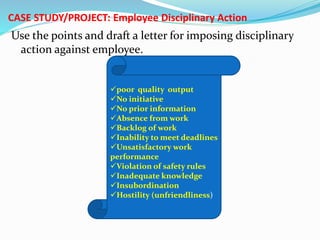
CASE STUDY/PROJECT: Employee Disciplinary Action
Use the points and draft a letter for imposing disciplinary
action against employee.
poor quality output
No initiative
No prior information
Absence from work
Backlog of work
Inability to meet deadlines
Unsatisfactory work
performance
Violation of safety rules
Inadequate knowledge
Insubordination
Hostility (unfriendliness)
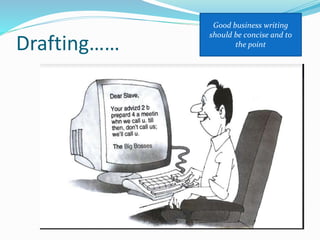
Drafting……
Good business writing
should be concise and to
the point
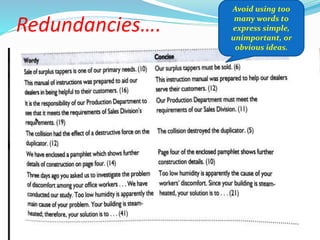
Redundancies….
Avoid using too
many words to
express simple,
unimportant, or
obvious ideas.
Non-verbal Communication
Introduction
 NVC is the transfer of information through the use of body
language including eye-contact, countenance, gestures and
more.
 Verbal Communication is the use of language transfer
information through written text, speaking or sign
language.
 Note: Paying attention to and developing the ability to read
Non-verbal Communication is an invaluable skill you can
leverage.
 Types of Non-verbal Communication
1. Body Language
It is the way someone situates their body naturally
depending on the situation, the environment and how
they are feeling. (For example, someone might cross
their arms if they are feeling angry or nervous).
2. Gestures
While gestures vary widely across communities, they are
generally used both intentionally and unintentionally
to convey information to others. (For example,
Someone might display a “thumbs up” to communicate
confirmation or that they feel positively about
something).
3. Countenance
One of the most common forms of Non-verbal
communication is facial expressions. Using eyebrows,
mouth, eyes, forehead and other facial muscles to convey
can be very effective when communicating both emotion
and information.
4. Touch etc.
Some people also use touchy as a form of communication.
Most commonly, it is used to communicate support or
comfort. This form of communication should be used
sparingly and only when others how receiving party feels
about touch. It should never be used convey anger,
frustration or any other negative emotions.
NVC terms and meaning
1.Kinesics
It is the study and interpretation of human body
movements that can be taken as symbolic or
metaphorical in social interaction. According to Ray
Birdwhitshell, who coined this term in 1952. It includes
facial expressions, gestures, posture and gait or
pace.The use of gesture in dance was studied by Natya
Shastra in India about 200 BCE.
2. Haptics
It is a form of NVC used for sense of touch. Some of
them are Handshake, a gentle pat on back or shoulder
or high five.
3. Proxemics
It is the study of how humans use space when people are
communicating.The term was coined by Edward Hall
during 1950s and 1960s and has to do with the pace
and spaces. For example,
i.Public space means staying away from 12 – 25 feet
away.
ii. Social space means are getting a little closer about
4-12 feet away.
iii. Personal space means is even closer. In this case,
people stay probably about 1-4 feet away from
someone. This is reserved for talking to friends and
family.
4.Vocalics
It is also known as paralanguage. It is the study of
the communicative value of vocal behaviour.
Vocalics is important to interpersonal
relationships because it has a large impact of
perceptions of the verbal content.
5.Oculesics
Eyes tell more than words could ever say. It is the
study of eye movement, eye behaviour, and eye
related NVC including eye contact, blinking, raise
eyebrows etc…
Body Language in GDs/Presentations/Interviews
 Body Language is one of the most powerful means of
communication and also judging criteria in a GD.
 It speaks many words and depicts thoughts.
 Positive gestures are a sign of confidence and security.
 Positive gestures include: Walking upright, Shaking Hands
confidently etc…
Tips to adopt BL for good impression
1. Voracious Reader
2. Initiate
3. Be Polite and Pleasant
4. Precise
5. Speak Confidently
6. Positive Body Language
BL in Interviews
i. Handshake:
 Don’t wait for the other person to handshake.
 Initiate first handshake if you can.
 Stretch your fingers and a 45 degree angle with
your thumb.
 Let the skin between your thumb and index finger
touch.
 Avoid giving a soft handshake. (Gives uncertain
impression)
 Don’t squeeze others hand(s).(gives dominant
impression)
ii. Avoid sweaty hands:
-carry handkerchief
-dry your hands often
-wipe your forehead
-avoid clammy hands to avoid nervous impression
iii. Maintain eye-contact:
-ensure a natural smile, a firm voice and constant
eye contact during introduction. Otherwise you
may feel insecure, dishonest, indifferent or
arrogant.
iv. Sit up straight:
-avoid sitting / leaning left or right
-sit straight and to the backrest.
-respect your interviewer personal space
-don’t wiggle in your chair and keep your legs still
-balance between movement and a formal posture
v. Don’t touch your face:
-avoid playing with hair, ears, nose etc.
-don’t touch face, rub nose,-seems dishonest
-avoid rubbing head or neck.
https://www.youtube.com/watch?v=akfatVK5h3Y&a
b_channel=KeyDifferences
Thank you

Business Communication. PowerPoint Presentation.pptx

  • 1.
    Business Communication Dr. MuraliVemula MA;M.Phil;PGCTE(EFLU);PhD Associate Professor of English, email:drmuraliku[at]gmail.com
  • 2.
    What is Bus.Communication: Introduction  Business communication is the process of sharing information between people within the workplace and outside a company.  Effective business communication is how employees and management interact to reach organizational goals.  Its purpose is to improve organizational practices and reduce errors.  It’s important to work on both your communication skills and communication processes to achieve effective business communication.
  • 3.
    The importance ofbusiness communication also lies in:  Presenting options/new business ideas  Making plans and proposals (business writing)  Executing decisions  Reaching agreements  Sending and fulfilling orders  Successful selling  Effective meetings  Providing feedback to employees and customers
  • 4.
     Communication isneither the transmission of a message nor the message itself.  It is the mutual exchange of understanding, originating with the receiver.  Communication needs to be effective in business. Communication is the essence of management.  The basic functions of management (Planning, Organizing, Staffing, Directing and Controlling )cannot be performed well without effective communication.
  • 5.
     Business Communicationis goal oriented. The rules, regulations and policies of a company have to be communicated to people within and outside the organization.  Business Communication is regulated by certain rules and norms. In early times, business communication was limited to paper-work, telephone calls etc.  With advent of technology, (cell phones, video conferencing, emails) satellite communication to support business communication.  Effective business communication helps in building goodwill of an organization.
  • 6.
    Business Communication canbe of two types:  Oral Communication- An oral communication can be formal or informal. Generally business communication is a formal means of communication, like : meetings, interviews, group discussion, speeches etc. An example of Informal business communication would be - Grapevine.  Written Communication - Written means of business communication includes - agenda, reports, manuals etc.
  • 7.
    Guidelines for EffectiveCommunication The characteristics of effective communication are as follows:  Clarity of Purpose: The message to be delivered must be clear in the mind of sender.  Completeness: The message delivered should not be incomplete. It should be supported by facts and observations.  Conciseness: The message should be concise.  Feedback: Whether the message sent by the sender is understood in same terms by the receiver or not can be judged by the feedback received.  Empathy: The listeners are essential for effective verbal communication. The speaker should step into the shoes of the listener and be sensitive to their needs and emotions. This way he can understand things from their perspective and make communication more effective.
  • 8.
     Modify themessage according to the audience: The information requirement by different people in the organization differs according to their needs. Use of jargons should be minimized because it might lead to misunderstanding and misinterpretations. The message should be modified according to the needs and requirements of the targeted audience.  Multiple Channels of communication: For effective communication multiple channels should be used as it increases the chances of clarity of message. The message is reinforced by using different channels and there are less chances of deformation of message.  Make effective use of Grapevine (informal channel of communication): The employees and managers should not always discourage grapevine. They should make effective use of grapevine. The managers can use grapevine to deliver formal messages and for identification of issues which are significant for the employees. The managers can get to know the problems faced by the employees and can work upon it.
  • 9.
    Grapevine Communication (InformalBusiness Communication)  Grapevine generally develops due to various reasons. One of them is that when an organization is facing recession, the employees sense uncertainty. Also, at times employees do not have self-confidence due to which they form unions. Examples of Grapevine Network of Communication  Suppose the profit amount of a company is known. Rumour is spread that this much profit is there and on that basis bonus is declared.  CEO may be in relation to the Production Manager. They may have friendly relations with each other.
  • 10.
    Types of Businessmessages  Most of the written business messages can be…….  Positive  Negative  Neutral and  Persuasive Positive or good news messages :  Convey a positive info.  Mirrors yours your goodwill  Offering adjustments, expressing appreciation, sending a note of thanks, expressing sympathy etc. contd…
  • 11.
    Some positive messagesare…..  A sales manager of a company offering to replace the desert coolers that the client company received in a bad shape.  The CEO of an MNC sending an appreciation letter congratulating an employee for having been selected in the national football team.  The president of a business writing a note of sympathy to commiserate with a deceased employee’s family.
  • 12.
     Negative Messagesor bad messages  Deliver information that is undesirable or disappointing to readers  May frustrate readers  Job rejections / refusals  Request for adjustments contd…….
  • 13.
    Situations…….  A managerof a consultancy firm sending a message to the candidates who was rejected for a job in the company.  A manager (HR) of a business corporation refusing an association’s request for a donation.  A manager of a bank refusing loan to a university student.
  • 15.
     Neutral orRoutine messages…  Carry information of equal or even higher importance than positive messages but emotional content and involvement is usually lower.  Order acknowledgements, inquiries, request for credit information, personal evaluation, and compliance with requests can be neutral messages. Some neutral messages are…. i. A government agency responding to a request for a brochure. ii. A manger of a large corporation sending a memo notifying employees of a change in policy. iii. A sales manger sending a weekly sales report to the head office.
  • 16.
    Persuasive messages…..  Tryto motivate readers to agree with the senders or to make them act in a desired way. As a business person need to influence your superior --  to adopt a particular proposal,  your supplier to replace a defective product, or  a prospective customer to buy your new product. Observe these letters…………….
  • 17.
    Routine Letter Madhura Ceramics 22,Grant Road Haldia, 721604 11 Nov 2012 V. Srivatsav Sree Ambica Agencies Vinayak nager, Hyderabad 500001 Dear Mr. Srivatsav, We are organizing a corporate social responsibility seminar for our vendor associates on 19 Nov 2012 at our corporate headquarters. As you are aware, this is an annual event that helps in creating awareness among our extended team. Please send us the final list of participants by 18 Nov 2022. Yours Sincerely Ishitha Bose CSR Manager
  • 18.
    FIVE STAGES OFWRITING BUSINESS MESSAGES 5. Proofreading 4. formatting 3.Revising 2. Drafting 1.Prewriting
  • 19.
    1. Prewriting This isa planning stage in which you think through writing assignment and develop a plan for accomplishing. During this stage, you should….  Determine your purpose  Know your readers  Search and collect data for your message, and  Organize and prepare an outline A persuasive message is more successful if it appeals directly to the wants and needs of its career.
  • 20.
    Determining purpose includesmany reasons to write letters ……  Reporting info.  Requesting payment  Inviting some proposals  Asking for an advice  Assuring cooperation  Recommending changes etc… For example, on any given day, a person at work probably writes a combination of emails, memos, and letters, such as informing employees about their health insurance coverage etc…. It is necessary to collect and organize all the supporting points during the prewriting stage
  • 21.
    Appealing to youraudience…..  Make an effort to connect with your audience.  Best way is to connect is to create a positive tone in your writing  Completely change your mindset from ‘I’ to ‘You’  Instead of “ I will allow you to take vacation…” say, “Your vacation will start from ……”
  • 22.
    CASE STUDY/PROJECT: EmployeeDisciplinary Action Use the points and draft a letter for imposing disciplinary action against employee. poor quality output No initiative No prior information Absence from work Backlog of work Inability to meet deadlines Unsatisfactory work performance Violation of safety rules Inadequate knowledge Insubordination Hostility (unfriendliness)
  • 23.
  • 24.
    Redundancies…. Avoid using too manywords to express simple, unimportant, or obvious ideas.
  • 25.
    Non-verbal Communication Introduction  NVCis the transfer of information through the use of body language including eye-contact, countenance, gestures and more.  Verbal Communication is the use of language transfer information through written text, speaking or sign language.  Note: Paying attention to and developing the ability to read Non-verbal Communication is an invaluable skill you can leverage.
  • 26.
     Types ofNon-verbal Communication 1. Body Language It is the way someone situates their body naturally depending on the situation, the environment and how they are feeling. (For example, someone might cross their arms if they are feeling angry or nervous). 2. Gestures While gestures vary widely across communities, they are generally used both intentionally and unintentionally to convey information to others. (For example, Someone might display a “thumbs up” to communicate confirmation or that they feel positively about something).
  • 27.
    3. Countenance One ofthe most common forms of Non-verbal communication is facial expressions. Using eyebrows, mouth, eyes, forehead and other facial muscles to convey can be very effective when communicating both emotion and information. 4. Touch etc. Some people also use touchy as a form of communication. Most commonly, it is used to communicate support or comfort. This form of communication should be used sparingly and only when others how receiving party feels about touch. It should never be used convey anger, frustration or any other negative emotions.
  • 28.
    NVC terms andmeaning 1.Kinesics It is the study and interpretation of human body movements that can be taken as symbolic or metaphorical in social interaction. According to Ray Birdwhitshell, who coined this term in 1952. It includes facial expressions, gestures, posture and gait or pace.The use of gesture in dance was studied by Natya Shastra in India about 200 BCE. 2. Haptics It is a form of NVC used for sense of touch. Some of them are Handshake, a gentle pat on back or shoulder or high five.
  • 29.
    3. Proxemics It isthe study of how humans use space when people are communicating.The term was coined by Edward Hall during 1950s and 1960s and has to do with the pace and spaces. For example, i.Public space means staying away from 12 – 25 feet away. ii. Social space means are getting a little closer about 4-12 feet away. iii. Personal space means is even closer. In this case, people stay probably about 1-4 feet away from someone. This is reserved for talking to friends and family.
  • 30.
    4.Vocalics It is alsoknown as paralanguage. It is the study of the communicative value of vocal behaviour. Vocalics is important to interpersonal relationships because it has a large impact of perceptions of the verbal content. 5.Oculesics Eyes tell more than words could ever say. It is the study of eye movement, eye behaviour, and eye related NVC including eye contact, blinking, raise eyebrows etc…
  • 31.
    Body Language inGDs/Presentations/Interviews  Body Language is one of the most powerful means of communication and also judging criteria in a GD.  It speaks many words and depicts thoughts.  Positive gestures are a sign of confidence and security.  Positive gestures include: Walking upright, Shaking Hands confidently etc… Tips to adopt BL for good impression 1. Voracious Reader 2. Initiate 3. Be Polite and Pleasant 4. Precise 5. Speak Confidently 6. Positive Body Language
  • 32.
    BL in Interviews i.Handshake:  Don’t wait for the other person to handshake.  Initiate first handshake if you can.  Stretch your fingers and a 45 degree angle with your thumb.  Let the skin between your thumb and index finger touch.  Avoid giving a soft handshake. (Gives uncertain impression)  Don’t squeeze others hand(s).(gives dominant impression)
  • 33.
    ii. Avoid sweatyhands: -carry handkerchief -dry your hands often -wipe your forehead -avoid clammy hands to avoid nervous impression iii. Maintain eye-contact: -ensure a natural smile, a firm voice and constant eye contact during introduction. Otherwise you may feel insecure, dishonest, indifferent or arrogant.
  • 34.
    iv. Sit upstraight: -avoid sitting / leaning left or right -sit straight and to the backrest. -respect your interviewer personal space -don’t wiggle in your chair and keep your legs still -balance between movement and a formal posture v. Don’t touch your face: -avoid playing with hair, ears, nose etc. -don’t touch face, rub nose,-seems dishonest -avoid rubbing head or neck. https://www.youtube.com/watch?v=akfatVK5h3Y&a b_channel=KeyDifferences
  • 35.