Tips on Written
Communication
Sheikh Shaer Hassan and Taouheed Hassan
The Importance of Adaptation
Adapting to multiple readers?
Or
Adapting to particular readers?
Compare the following passages
“Last year the company’s total sales
were 117,400,000 tk, which was
slightly higher than the 109,800,000
total for the year before. After
deducting for all the expenses, we
had 4,593,000 tk left over for profits,
compared with 2,830,000 for 2018.
Because of these increased profits,
we were able to increase your annual
dividend payments per share from the
50% paid over the last 10 years”
“The corporation’s investments and
advances in three unconsolidated
subsidiaries (all in the development stage)
and in 50 percent-owned companies was
42,200,000 on December 31, 2019 and
the excess of the investments in certain
companies over net asset value at dates
of acquisition was 1,760,000. The
corporation’s equity in the net assets as of
December 31, 2019 was 41,800,000 and in
the results of operations for the years
ended in December 31, 2018 and 2019,
was 1,350,000 and 887,500 respectively.
Dividend income was 750,000 and
388,000 for the years 2018 and 2019,
respectively”
Compare the following passages
The first one is written in such a way that investors
without a background in finance can understand it.
But,
the second one is for those with financial expertise
So you need to analyze your audience(s) first for
whom you are writing something.
According to that, tailor your needs and criterion
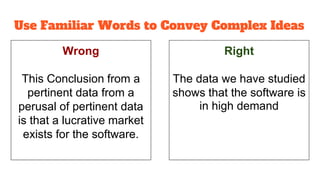
Use Familiar Words to Convey Complex Ideas
Wrong
This Conclusion from a
pertinent data from a
perusal of pertinent data
is that a lucrative market
exists for the software.
Right
The data we have studied
shows that the software is
in high demand
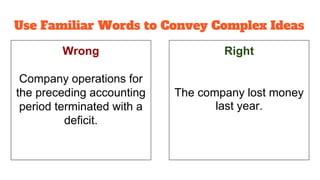
Use Familiar Words to Convey Complex Ideas
Wrong
Company operations for
the preceding accounting
period terminated with a
deficit.
Right
The company lost money
last year.
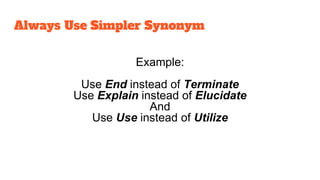
Example:
Use End instead of Terminate
Use Explain instead of Elucidate
And
Use Use instead of Utilize
Always Use Simpler Synonym
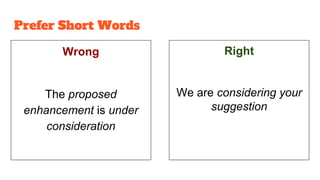
Prefer Short Words
Wrong
The proposed
enhancement is under
consideration
Right
We are considering your
suggestion
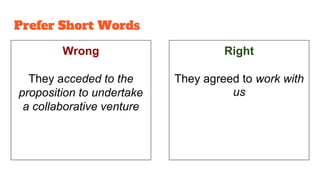
Prefer Short Words
Wrong
They acceded to the
proposition to undertake
a collaborative venture
Right
They agreed to work with
us
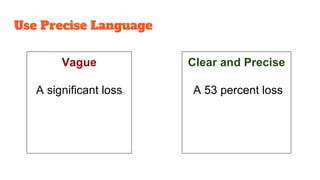
Vague
A significant loss
Clear and Precise
A 53 percent loss
Use Precise Language
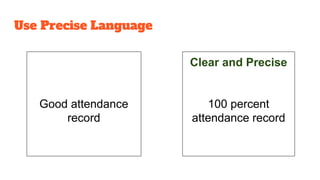
Good attendance
record
Clear and Precise
100 percent
attendance record
Use Precise Language
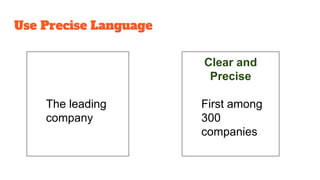
The leading
company
Clear and
Precise
First among
300
companies
Use Precise Language
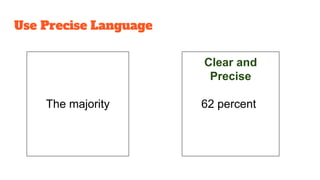
The majority
Clear and
Precise
62 percent
Use Precise Language
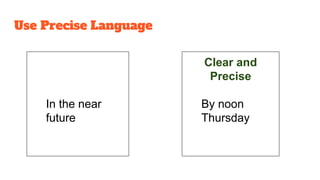
In the near
future
Clear and
Precise
By noon
Thursday
Use Precise Language
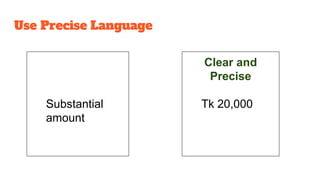
Substantial
amount
Clear and
Precise
Tk 20,000
Use Precise Language
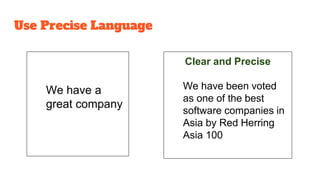
We have a
great company
Clear and Precise
We have been voted
as one of the best
software companies in
Asia by Red Herring
Asia 100
Use Precise Language
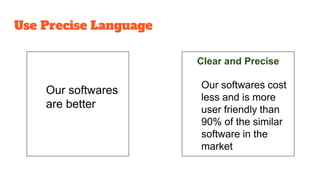
Our softwares
are better
Clear and Precise
Our softwares cost
less and is more
user friendly than
90% of the similar
software in the
market
Use Precise Language
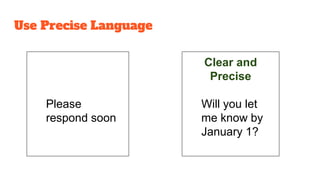
Please
respond soon
Clear and
Precise
Will you let
me know by
January 1?
Use Precise Language
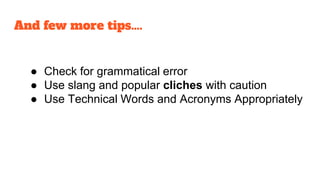
● Check for grammatical error
● Use slang and popular cliches with caution
● Use Technical Words and Acronyms Appropriately
And few more tips….
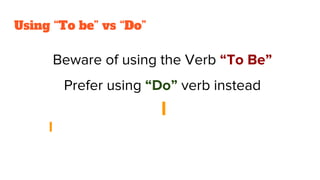
Beware of using the Verb “To Be”
Prefer using “Do” verb instead
Using “To be” vs “Do”
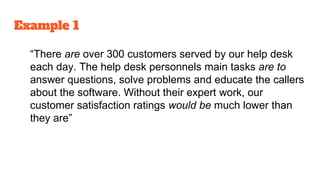
Example 1
“There are over 300 customers served by our help desk
each day. The help desk personnels main tasks are to
answer questions, solve problems and educate the callers
about the software. Without their expert work, our
customer satisfaction ratings would be much lower than
they are”
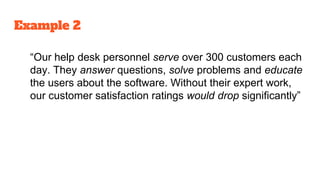
Example 2
“Our help desk personnel serve over 300 customers each
day. They answer questions, solve problems and educate
the users about the software. Without their expert work,
our customer satisfaction ratings would drop significantly”
Beware of using the “Passive Voice”
Prefer using “Active Voice” instead
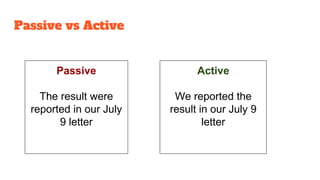
Passive vs Active
Passive
The result were
reported in our July
9 letter
Active
We reported the
result in our July 9
letter
Passive vs Active
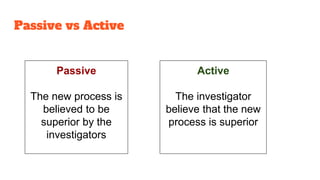
Passive
The new process is
believed to be
superior by the
investigators
Active
The investigator
believe that the new
process is superior
Passive vs Active
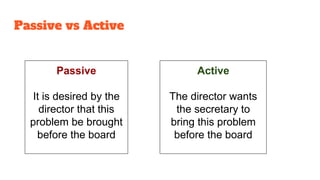
Passive
It is desired by the
director that this
problem be brought
before the board
Active
The director wants
the secretary to
bring this problem
before the board
Passive vs Active
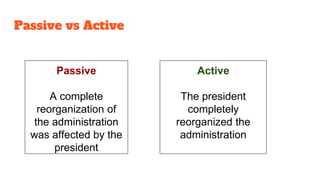
Passive
A complete
reorganization of
the administration
was affected by the
president
Active
The president
completely
reorganized the
administration
Passive vs Active
Passive vs Active
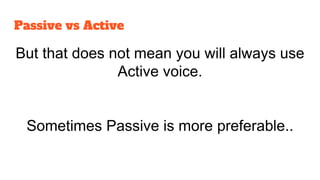
But that does not mean you will always use
Active voice.
Sometimes Passive is more preferable..
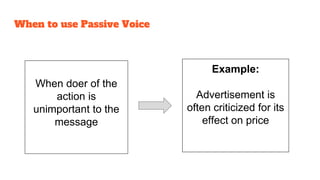
When doer of the
action is
unimportant to the
message
Example:
Advertisement is
often criticized for its
effect on price
When to use Passive Voice
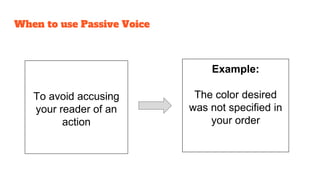
To avoid accusing
your reader of an
action
Example:
The color desired
was not specified in
your order
When to use Passive Voice
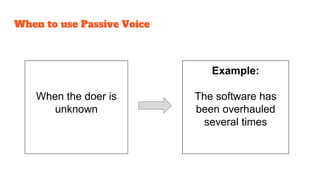
When the doer is
unknown
Example:
The software has
been overhauled
several times
When to use Passive Voice
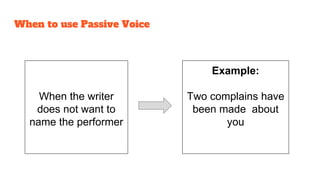
When the writer
does not want to
name the performer
Example:
Two complains have
been made about
you
When to use Passive Voice
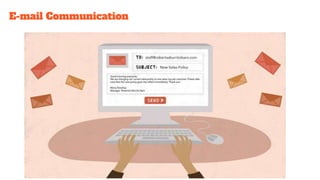
E-mail Communication
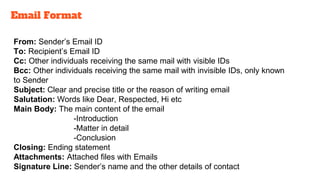
From: Sender’s Email ID
To: Recipient’s Email ID
Cc: Other individuals receiving the same mail with visible IDs
Bcc: Other individuals receiving the same mail with invisible IDs, only known
to Sender
Subject: Clear and precise title or the reason of writing email
Salutation: Words like Dear, Respected, Hi etc
Main Body: The main content of the email
-Introduction
-Matter in detail
-Conclusion
Closing: Ending statement
Attachments: Attached files with Emails
Signature Line: Sender’s name and the other details of contact
Email Format
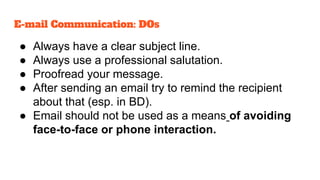
● Always have a clear subject line.
● Always use a professional salutation.
● Proofread your message.
● After sending an email try to remind the recipient
about that (esp. in BD).
● Email should not be used as a means of avoiding
face-to-face or phone interaction.
E-mail Communication: DOs
● Give your message some thoughtful consideration
before sending it
● Analyze your recipient and based on that set your
email in following category
■ Casual
■ Formal
E-mail Communication: DOs
● Do not elaborate Email body. Try to be concise
● Do not use humor or camouflaged words
● Do not assume the recipient knows what you are
talking about
● Never send an email which shows your anger
● Do not give a quick or flip response
E-mail Communication: DON’Ts
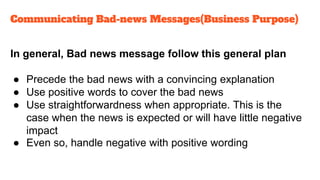
In general, Bad news message follow this general plan
● Begin with such an opening that does not indicate the
imminent bad news.
● Set up the bad news in such a way so that the recipient
will come to realize that the decision is fair and it will help
him in future at least to some extent.
Communicating Bad-news Messages(In general)
In general, Bad news message follow this general plan
● After that, break the news as a logical result of the
strategy and as positively as possible
● Try to offer an alternative solution if possible
● End on a positive note
● Determine an apology is due or not. If so, offer an apology
Communicating Bad-news Messages(In general)
In general, Bad news message follow this general plan
● Precede the bad news with a convincing explanation
● Use positive words to cover the bad news
● Use straightforwardness when appropriate. This is the
case when the news is expected or will have little negative
impact
● Even so, handle negative with positive wording
Communicating Bad-news Messages(Business Purpose)
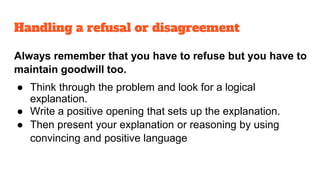
Always remember that you have to refuse but you have to
maintain goodwill too.
● Think through the problem and look for a logical
explanation.
● Write a positive opening that sets up the explanation.
● Then present your explanation or reasoning by using
convincing and positive language
Handling a refusal or disagreement
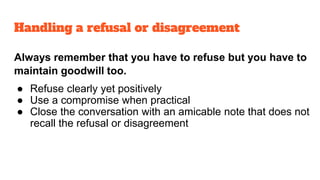
Always remember that you have to refuse but you have to
maintain goodwill too.
● Refuse clearly yet positively
● Use a compromise when practical
● Close the conversation with an amicable note that does not
recall the refusal or disagreement
Handling a refusal or disagreement
Thank You

Communication workshop in nascenia

  • 1.
    Tips on Written Communication SheikhShaer Hassan and Taouheed Hassan
  • 2.
    The Importance ofAdaptation Adapting to multiple readers? Or Adapting to particular readers?
  • 3.
    Compare the followingpassages “Last year the company’s total sales were 117,400,000 tk, which was slightly higher than the 109,800,000 total for the year before. After deducting for all the expenses, we had 4,593,000 tk left over for profits, compared with 2,830,000 for 2018. Because of these increased profits, we were able to increase your annual dividend payments per share from the 50% paid over the last 10 years” “The corporation’s investments and advances in three unconsolidated subsidiaries (all in the development stage) and in 50 percent-owned companies was 42,200,000 on December 31, 2019 and the excess of the investments in certain companies over net asset value at dates of acquisition was 1,760,000. The corporation’s equity in the net assets as of December 31, 2019 was 41,800,000 and in the results of operations for the years ended in December 31, 2018 and 2019, was 1,350,000 and 887,500 respectively. Dividend income was 750,000 and 388,000 for the years 2018 and 2019, respectively”
  • 4.
    Compare the followingpassages The first one is written in such a way that investors without a background in finance can understand it. But, the second one is for those with financial expertise
  • 5.
    So you needto analyze your audience(s) first for whom you are writing something. According to that, tailor your needs and criterion
  • 6.
    Use Familiar Wordsto Convey Complex Ideas Wrong This Conclusion from a pertinent data from a perusal of pertinent data is that a lucrative market exists for the software. Right The data we have studied shows that the software is in high demand
  • 7.
    Use Familiar Wordsto Convey Complex Ideas Wrong Company operations for the preceding accounting period terminated with a deficit. Right The company lost money last year.
  • 8.
    Example: Use End insteadof Terminate Use Explain instead of Elucidate And Use Use instead of Utilize Always Use Simpler Synonym
  • 9.
    Prefer Short Words Wrong Theproposed enhancement is under consideration Right We are considering your suggestion
  • 10.
    Prefer Short Words Wrong Theyacceded to the proposition to undertake a collaborative venture Right They agreed to work with us
  • 11.
    Vague A significant loss Clearand Precise A 53 percent loss Use Precise Language
  • 12.
    Good attendance record Clear andPrecise 100 percent attendance record Use Precise Language
  • 13.
    The leading company Clear and Precise Firstamong 300 companies Use Precise Language
  • 14.
    The majority Clear and Precise 62percent Use Precise Language
  • 15.
    In the near future Clearand Precise By noon Thursday Use Precise Language
  • 16.
  • 17.
    We have a greatcompany Clear and Precise We have been voted as one of the best software companies in Asia by Red Herring Asia 100 Use Precise Language
  • 18.
    Our softwares are better Clearand Precise Our softwares cost less and is more user friendly than 90% of the similar software in the market Use Precise Language
  • 19.
    Please respond soon Clear and Precise Willyou let me know by January 1? Use Precise Language
  • 20.
    ● Check forgrammatical error ● Use slang and popular cliches with caution ● Use Technical Words and Acronyms Appropriately And few more tips….
  • 21.
    Beware of usingthe Verb “To Be” Prefer using “Do” verb instead Using “To be” vs “Do”
  • 22.
    Example 1 “There areover 300 customers served by our help desk each day. The help desk personnels main tasks are to answer questions, solve problems and educate the callers about the software. Without their expert work, our customer satisfaction ratings would be much lower than they are”
  • 23.
    Example 2 “Our helpdesk personnel serve over 300 customers each day. They answer questions, solve problems and educate the users about the software. Without their expert work, our customer satisfaction ratings would drop significantly”
  • 24.
    Beware of usingthe “Passive Voice” Prefer using “Active Voice” instead Passive vs Active
  • 25.
    Passive The result were reportedin our July 9 letter Active We reported the result in our July 9 letter Passive vs Active
  • 26.
    Passive The new processis believed to be superior by the investigators Active The investigator believe that the new process is superior Passive vs Active
  • 27.
    Passive It is desiredby the director that this problem be brought before the board Active The director wants the secretary to bring this problem before the board Passive vs Active
  • 28.
    Passive A complete reorganization of theadministration was affected by the president Active The president completely reorganized the administration Passive vs Active
  • 29.
    Passive vs Active Butthat does not mean you will always use Active voice. Sometimes Passive is more preferable..
  • 30.
    When doer ofthe action is unimportant to the message Example: Advertisement is often criticized for its effect on price When to use Passive Voice
  • 31.
    To avoid accusing yourreader of an action Example: The color desired was not specified in your order When to use Passive Voice
  • 32.
    When the doeris unknown Example: The software has been overhauled several times When to use Passive Voice
  • 33.
    When the writer doesnot want to name the performer Example: Two complains have been made about you When to use Passive Voice
  • 34.
  • 35.
    From: Sender’s EmailID To: Recipient’s Email ID Cc: Other individuals receiving the same mail with visible IDs Bcc: Other individuals receiving the same mail with invisible IDs, only known to Sender Subject: Clear and precise title or the reason of writing email Salutation: Words like Dear, Respected, Hi etc Main Body: The main content of the email -Introduction -Matter in detail -Conclusion Closing: Ending statement Attachments: Attached files with Emails Signature Line: Sender’s name and the other details of contact Email Format
  • 36.
    ● Always havea clear subject line. ● Always use a professional salutation. ● Proofread your message. ● After sending an email try to remind the recipient about that (esp. in BD). ● Email should not be used as a means of avoiding face-to-face or phone interaction. E-mail Communication: DOs
  • 37.
    ● Give yourmessage some thoughtful consideration before sending it ● Analyze your recipient and based on that set your email in following category ■ Casual ■ Formal E-mail Communication: DOs
  • 38.
    ● Do notelaborate Email body. Try to be concise ● Do not use humor or camouflaged words ● Do not assume the recipient knows what you are talking about ● Never send an email which shows your anger ● Do not give a quick or flip response E-mail Communication: DON’Ts
  • 39.
    In general, Badnews message follow this general plan ● Begin with such an opening that does not indicate the imminent bad news. ● Set up the bad news in such a way so that the recipient will come to realize that the decision is fair and it will help him in future at least to some extent. Communicating Bad-news Messages(In general)
  • 40.
    In general, Badnews message follow this general plan ● After that, break the news as a logical result of the strategy and as positively as possible ● Try to offer an alternative solution if possible ● End on a positive note ● Determine an apology is due or not. If so, offer an apology Communicating Bad-news Messages(In general)
  • 41.
    In general, Badnews message follow this general plan ● Precede the bad news with a convincing explanation ● Use positive words to cover the bad news ● Use straightforwardness when appropriate. This is the case when the news is expected or will have little negative impact ● Even so, handle negative with positive wording Communicating Bad-news Messages(Business Purpose)
  • 42.
    Always remember thatyou have to refuse but you have to maintain goodwill too. ● Think through the problem and look for a logical explanation. ● Write a positive opening that sets up the explanation. ● Then present your explanation or reasoning by using convincing and positive language Handling a refusal or disagreement
  • 43.
    Always remember thatyou have to refuse but you have to maintain goodwill too. ● Refuse clearly yet positively ● Use a compromise when practical ● Close the conversation with an amicable note that does not recall the refusal or disagreement Handling a refusal or disagreement
  • 44.