Clean Code (ROR)
Md. Tauhidul Islam
Software Engineer
Nascenia Ltd.
Table of Content
Source Code Layout
Syntax
Comments
Source Code Layout
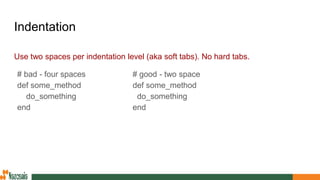
Indentation
Use two spaces per indentation level (aka soft tabs). No hard tabs.
# bad - four spaces
def some_method
do_something
end
# good - two space
def some_method
do_something
end
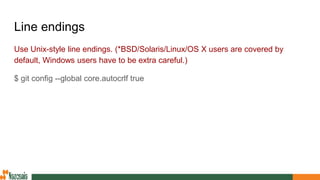
Line endings
Use Unix-style line endings. (*BSD/Solaris/Linux/OS X users are covered by
default, Windows users have to be extra careful.)
$ git config --global core.autocrlf true
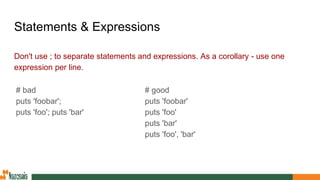
Statements & Expressions
Don't use ; to separate statements and expressions. As a corollary - use one
expression per line.
# good
puts 'foobar'
puts 'foo'
puts 'bar'
puts 'foo', 'bar'
# bad
puts 'foobar';
puts 'foo'; puts 'bar'
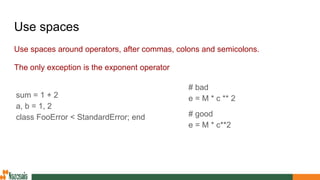
Use spaces
Use spaces around operators, after commas, colons and semicolons.
The only exception is the exponent operator
sum = 1 + 2
a, b = 1, 2
class FooError < StandardError; end
# bad
e = M * c ** 2
# good
e = M * c**2
Use spaces
No spaces after (, [ or before ], ). Use spaces around { and before }
For hash literals two styles are considered acceptable
With interpolated expressions, there should be no padded-spacing inside the
braces.
{one: 1, two: 2}{ one: 1, two: 2 }
[1, 2, 3].each { |e| puts e }
# bad
"From: #{ user.name }"
# good
"From: #{user.name}"
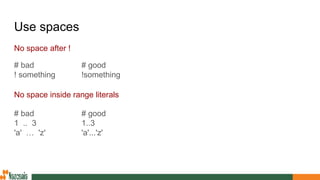
Use spaces
No space after !
No space inside range literals
# bad
! something
# good
!something
# bad
1 .. 3
'a' … 'z'
# good
1..3
'a'...'z'
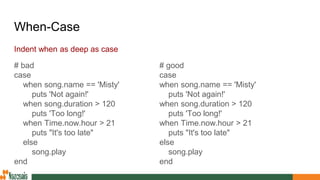
When-Case
Indent when as deep as case
# bad
case
when song.name == 'Misty'
puts 'Not again!'
when song.duration > 120
puts 'Too long!'
when Time.now.hour > 21
puts "It's too late"
else
song.play
end
# good
case
when song.name == 'Misty'
puts 'Not again!'
when song.duration > 120
puts 'Too long!'
when Time.now.hour > 21
puts "It's too late"
else
song.play
end
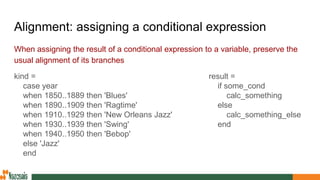
Alignment: assigning a conditional expression
When assigning the result of a conditional expression to a variable, preserve the
usual alignment of its branches
kind =
case year
when 1850..1889 then 'Blues'
when 1890..1909 then 'Ragtime'
when 1910..1929 then 'New Orleans Jazz'
when 1930..1939 then 'Swing'
when 1940..1950 then 'Bebop'
else 'Jazz'
end
result =
if some_cond
calc_something
else
calc_something_else
end
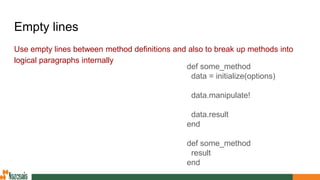
Empty lines
Use empty lines between method definitions and also to break up methods into
logical paragraphs internally
def some_method
data = initialize(options)
data.manipulate!
data.result
end
def some_method
result
end
Assigning default values to method parameters
Use spaces around the = operator when assigning default values to method
parameters
# bad
def some_method(arg1=:default, arg2=nil, arg3=[])
# do something...
End
# good
def some_method(arg1 = :default, arg2 = nil, arg3 = [])
# do something...
end
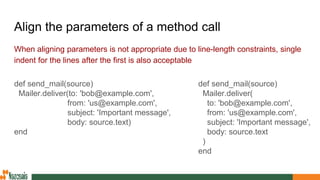
Align the parameters of a method call
When aligning parameters is not appropriate due to line-length constraints, single
indent for the lines after the first is also acceptable
def send_mail(source)
Mailer.deliver(
to: 'bob@example.com',
from: 'us@example.com',
subject: 'Important message',
body: source.text
)
end
def send_mail(source)
Mailer.deliver(to: 'bob@example.com',
from: 'us@example.com',
subject: 'Important message',
body: source.text)
end
Align the elements of array
Align the elements of array literals spanning multiple lines
# bad - single indent
menu_item = ['Spam', 'Spam', 'Spam', 'Spam', 'Spam', 'Spam', 'Spam', 'Spam',
'Baked beans', 'Spam', 'Spam', 'Spam', 'Spam', 'Spam']
# good
menu_item = [
'Spam', 'Spam', 'Spam', 'Spam', 'Spam', 'Spam', 'Spam', 'Spam',
'Baked beans', 'Spam', 'Spam', 'Spam', 'Spam', 'Spam'
]
# good
menu_item =
['Spam', 'Spam', 'Spam', 'Spam', 'Spam', 'Spam', 'Spam', 'Spam',
'Baked beans', 'Spam', 'Spam', 'Spam', 'Spam', 'Spam']
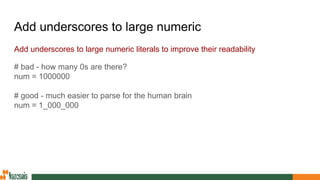
Add underscores to large numeric
Add underscores to large numeric literals to improve their readability
# bad - how many 0s are there?
num = 1000000
# good - much easier to parse for the human brain
num = 1_000_000
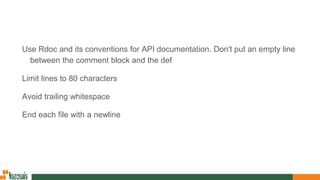
Use Rdoc and its conventions for API documentation. Don't put an empty line
between the comment block and the def
Limit lines to 80 characters
Avoid trailing whitespace
End each file with a newline
Syntax
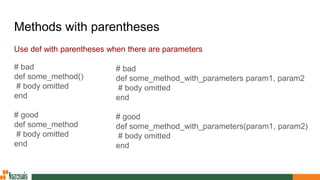
Methods with parentheses
Use def with parentheses when there are parameters
# bad
def some_method()
# body omitted
end
# good
def some_method
# body omitted
end
# bad
def some_method_with_parameters param1, param2
# body omitted
end
# good
def some_method_with_parameters(param1, param2)
# body omitted
end
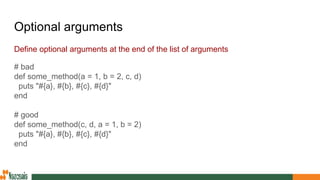
Optional arguments
Define optional arguments at the end of the list of arguments
# bad
def some_method(a = 1, b = 2, c, d)
puts "#{a}, #{b}, #{c}, #{d}"
end
# good
def some_method(c, d, a = 1, b = 2)
puts "#{a}, #{b}, #{c}, #{d}"
end
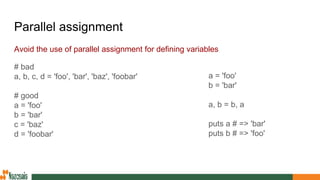
Parallel assignment
Avoid the use of parallel assignment for defining variables
# bad
a, b, c, d = 'foo', 'bar', 'baz', 'foobar'
# good
a = 'foo'
b = 'bar'
c = 'baz'
d = 'foobar'
a = 'foo'
b = 'bar'
a, b = b, a
puts a # => 'bar'
puts b # => 'foo'
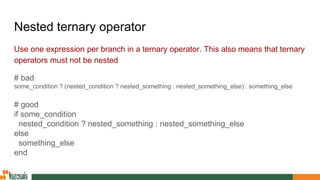
Nested ternary operator
Use one expression per branch in a ternary operator. This also means that ternary
operators must not be nested
# bad
some_condition ? (nested_condition ? nested_something : nested_something_else) : something_else
# good
if some_condition
nested_condition ? nested_something : nested_something_else
else
something_else
end
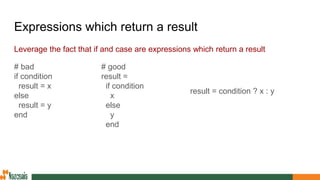
Expressions which return a result
Leverage the fact that if and case are expressions which return a result
# good
result =
if condition
x
else
y
end
# bad
if condition
result = x
else
result = y
end
result = condition ? x : y
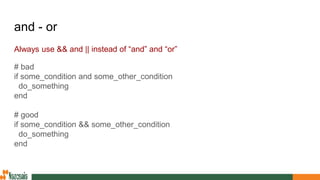
and - or
Always use && and || instead of “and” and “or”
# bad
if some_condition and some_other_condition
do_something
end
# good
if some_condition && some_other_condition
do_something
end
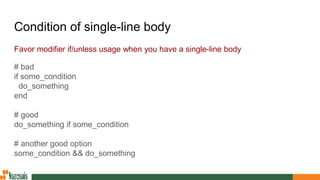
Condition of single-line body
Favor modifier if/unless usage when you have a single-line body
# bad
if some_condition
do_something
end
# good
do_something if some_condition
# another good option
some_condition && do_something
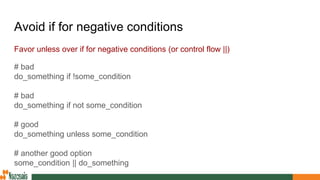
Avoid if for negative conditions
Favor unless over if for negative conditions (or control flow ||)
# bad
do_something if !some_condition
# bad
do_something if not some_condition
# good
do_something unless some_condition
# another good option
some_condition || do_something
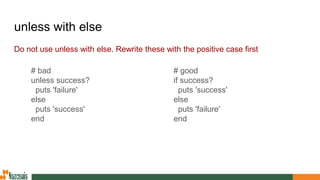
unless with else
Do not use unless with else. Rewrite these with the positive case first
# good
if success?
puts 'success'
else
puts 'failure'
end
# bad
unless success?
puts 'failure'
else
puts 'success'
end
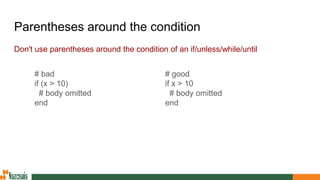
Parentheses around the condition
Don't use parentheses around the condition of an if/unless/while/until
# good
if x > 10
# body omitted
end
# bad
if (x > 10)
# body omitted
end
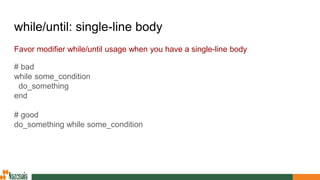
while/until: single-line body
Favor modifier while/until usage when you have a single-line body
# bad
while some_condition
do_something
end
# good
do_something while some_condition
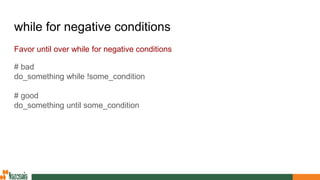
while for negative conditions
Favor until over while for negative conditions
# bad
do_something while !some_condition
# good
do_something until some_condition
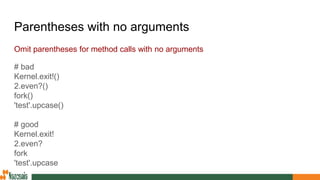
Parentheses with no arguments
Omit parentheses for method calls with no arguments
# bad
Kernel.exit!()
2.even?()
fork()
'test'.upcase()
# good
Kernel.exit!
2.even?
fork
'test'.upcase
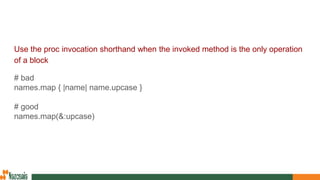
Use the proc invocation shorthand when the invoked method is the only operation
of a block
# bad
names.map { |name| name.upcase }
# good
names.map(&:upcase)
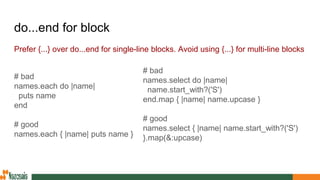
do...end for block
Prefer {...} over do...end for single-line blocks. Avoid using {...} for multi-line blocks
# bad
names.select do |name|
name.start_with?('S')
end.map { |name| name.upcase }
# good
names.select { |name| name.start_with?('S')
}.map(&:upcase)
# bad
names.each do |name|
puts name
end
# good
names.each { |name| puts name }
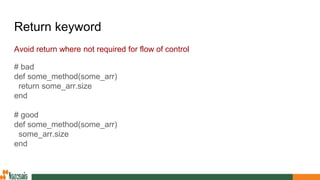
Return keyword
Avoid return where not required for flow of control
# bad
def some_method(some_arr)
return some_arr.size
end
# good
def some_method(some_arr)
some_arr.size
end
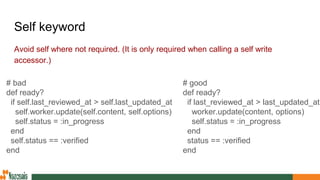
Self keyword
Avoid self where not required. (It is only required when calling a self write
accessor.)
# good
def ready?
if last_reviewed_at > last_updated_at
worker.update(content, options)
self.status = :in_progress
end
status == :verified
end
# bad
def ready?
if self.last_reviewed_at > self.last_updated_at
self.worker.update(self.content, self.options)
self.status = :in_progress
end
self.status == :verified
end
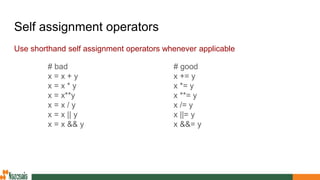
Self assignment operators
Use shorthand self assignment operators whenever applicable
# good
x += y
x *= y
x **= y
x /= y
x ||= y
x &&= y
# bad
x = x + y
x = x * y
x = x**y
x = x / y
x = x || y
x = x && y
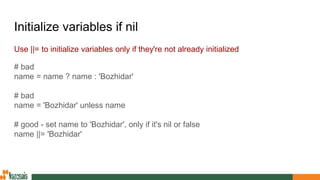
Initialize variables if nil
Use ||= to initialize variables only if they're not already initialized
# bad
name = name ? name : 'Bozhidar'
# bad
name = 'Bozhidar' unless name
# good - set name to 'Bozhidar', only if it's nil or false
name ||= 'Bozhidar'
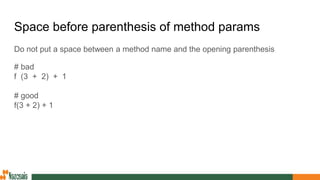
Space before parenthesis of method params
Do not put a space between a method name and the opening parenthesis
# bad
f (3 + 2) + 1
# good
f(3 + 2) + 1
Comments
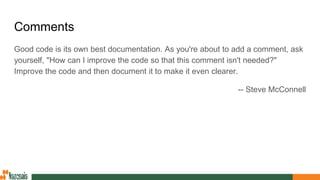
Comments
Good code is its own best documentation. As you're about to add a comment, ask
yourself, "How can I improve the code so that this comment isn't needed?"
Improve the code and then document it to make it even clearer.
-- Steve McConnell
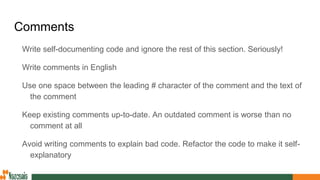
Comments
Write self-documenting code and ignore the rest of this section. Seriously!
Write comments in English
Use one space between the leading # character of the comment and the text of
the comment
Keep existing comments up-to-date. An outdated comment is worse than no
comment at all
Avoid writing comments to explain bad code. Refactor the code to make it self-
explanatory
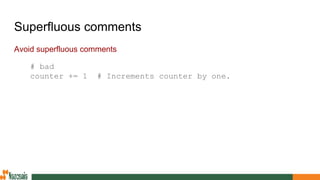
Superfluous comments
Avoid superfluous comments
# bad
counter += 1 # Increments counter by one.
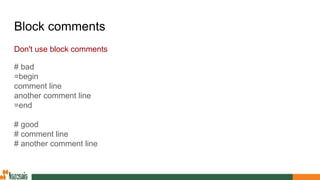
Block comments
Don't use block comments
# bad
=begin
comment line
another comment line
=end
# good
# comment line
# another comment line
References
https://github.com/bbatsov/ruby-style-guide
Questions?

Clean code

  • 1.
    Clean Code (ROR) Md.Tauhidul Islam Software Engineer Nascenia Ltd.
  • 2.
    Table of Content SourceCode Layout Syntax Comments
  • 3.
  • 4.
    Indentation Use two spacesper indentation level (aka soft tabs). No hard tabs. # bad - four spaces def some_method do_something end # good - two space def some_method do_something end
  • 5.
    Line endings Use Unix-styleline endings. (*BSD/Solaris/Linux/OS X users are covered by default, Windows users have to be extra careful.) $ git config --global core.autocrlf true
  • 6.
    Statements & Expressions Don'tuse ; to separate statements and expressions. As a corollary - use one expression per line. # good puts 'foobar' puts 'foo' puts 'bar' puts 'foo', 'bar' # bad puts 'foobar'; puts 'foo'; puts 'bar'
  • 7.
    Use spaces Use spacesaround operators, after commas, colons and semicolons. The only exception is the exponent operator sum = 1 + 2 a, b = 1, 2 class FooError < StandardError; end # bad e = M * c ** 2 # good e = M * c**2
  • 8.
    Use spaces No spacesafter (, [ or before ], ). Use spaces around { and before } For hash literals two styles are considered acceptable With interpolated expressions, there should be no padded-spacing inside the braces. {one: 1, two: 2}{ one: 1, two: 2 } [1, 2, 3].each { |e| puts e } # bad "From: #{ user.name }" # good "From: #{user.name}"
  • 9.
    Use spaces No spaceafter ! No space inside range literals # bad ! something # good !something # bad 1 .. 3 'a' … 'z' # good 1..3 'a'...'z'
  • 10.
    When-Case Indent when asdeep as case # bad case when song.name == 'Misty' puts 'Not again!' when song.duration > 120 puts 'Too long!' when Time.now.hour > 21 puts "It's too late" else song.play end # good case when song.name == 'Misty' puts 'Not again!' when song.duration > 120 puts 'Too long!' when Time.now.hour > 21 puts "It's too late" else song.play end
  • 11.
    Alignment: assigning aconditional expression When assigning the result of a conditional expression to a variable, preserve the usual alignment of its branches kind = case year when 1850..1889 then 'Blues' when 1890..1909 then 'Ragtime' when 1910..1929 then 'New Orleans Jazz' when 1930..1939 then 'Swing' when 1940..1950 then 'Bebop' else 'Jazz' end result = if some_cond calc_something else calc_something_else end
  • 12.
    Empty lines Use emptylines between method definitions and also to break up methods into logical paragraphs internally def some_method data = initialize(options) data.manipulate! data.result end def some_method result end
  • 13.
    Assigning default valuesto method parameters Use spaces around the = operator when assigning default values to method parameters # bad def some_method(arg1=:default, arg2=nil, arg3=[]) # do something... End # good def some_method(arg1 = :default, arg2 = nil, arg3 = []) # do something... end
  • 14.
    Align the parametersof a method call When aligning parameters is not appropriate due to line-length constraints, single indent for the lines after the first is also acceptable def send_mail(source) Mailer.deliver( to: 'bob@example.com', from: 'us@example.com', subject: 'Important message', body: source.text ) end def send_mail(source) Mailer.deliver(to: 'bob@example.com', from: 'us@example.com', subject: 'Important message', body: source.text) end
  • 15.
    Align the elementsof array Align the elements of array literals spanning multiple lines # bad - single indent menu_item = ['Spam', 'Spam', 'Spam', 'Spam', 'Spam', 'Spam', 'Spam', 'Spam', 'Baked beans', 'Spam', 'Spam', 'Spam', 'Spam', 'Spam'] # good menu_item = [ 'Spam', 'Spam', 'Spam', 'Spam', 'Spam', 'Spam', 'Spam', 'Spam', 'Baked beans', 'Spam', 'Spam', 'Spam', 'Spam', 'Spam' ] # good menu_item = ['Spam', 'Spam', 'Spam', 'Spam', 'Spam', 'Spam', 'Spam', 'Spam', 'Baked beans', 'Spam', 'Spam', 'Spam', 'Spam', 'Spam']
  • 16.
    Add underscores tolarge numeric Add underscores to large numeric literals to improve their readability # bad - how many 0s are there? num = 1000000 # good - much easier to parse for the human brain num = 1_000_000
  • 17.
    Use Rdoc andits conventions for API documentation. Don't put an empty line between the comment block and the def Limit lines to 80 characters Avoid trailing whitespace End each file with a newline
  • 18.
  • 19.
    Methods with parentheses Usedef with parentheses when there are parameters # bad def some_method() # body omitted end # good def some_method # body omitted end # bad def some_method_with_parameters param1, param2 # body omitted end # good def some_method_with_parameters(param1, param2) # body omitted end
  • 20.
    Optional arguments Define optionalarguments at the end of the list of arguments # bad def some_method(a = 1, b = 2, c, d) puts "#{a}, #{b}, #{c}, #{d}" end # good def some_method(c, d, a = 1, b = 2) puts "#{a}, #{b}, #{c}, #{d}" end
  • 21.
    Parallel assignment Avoid theuse of parallel assignment for defining variables # bad a, b, c, d = 'foo', 'bar', 'baz', 'foobar' # good a = 'foo' b = 'bar' c = 'baz' d = 'foobar' a = 'foo' b = 'bar' a, b = b, a puts a # => 'bar' puts b # => 'foo'
  • 22.
    Nested ternary operator Useone expression per branch in a ternary operator. This also means that ternary operators must not be nested # bad some_condition ? (nested_condition ? nested_something : nested_something_else) : something_else # good if some_condition nested_condition ? nested_something : nested_something_else else something_else end
  • 23.
    Expressions which returna result Leverage the fact that if and case are expressions which return a result # good result = if condition x else y end # bad if condition result = x else result = y end result = condition ? x : y
  • 24.
    and - or Alwaysuse && and || instead of “and” and “or” # bad if some_condition and some_other_condition do_something end # good if some_condition && some_other_condition do_something end
  • 25.
    Condition of single-linebody Favor modifier if/unless usage when you have a single-line body # bad if some_condition do_something end # good do_something if some_condition # another good option some_condition && do_something
  • 26.
    Avoid if fornegative conditions Favor unless over if for negative conditions (or control flow ||) # bad do_something if !some_condition # bad do_something if not some_condition # good do_something unless some_condition # another good option some_condition || do_something
  • 27.
    unless with else Donot use unless with else. Rewrite these with the positive case first # good if success? puts 'success' else puts 'failure' end # bad unless success? puts 'failure' else puts 'success' end
  • 28.
    Parentheses around thecondition Don't use parentheses around the condition of an if/unless/while/until # good if x > 10 # body omitted end # bad if (x > 10) # body omitted end
  • 29.
    while/until: single-line body Favormodifier while/until usage when you have a single-line body # bad while some_condition do_something end # good do_something while some_condition
  • 30.
    while for negativeconditions Favor until over while for negative conditions # bad do_something while !some_condition # good do_something until some_condition
  • 31.
    Parentheses with noarguments Omit parentheses for method calls with no arguments # bad Kernel.exit!() 2.even?() fork() 'test'.upcase() # good Kernel.exit! 2.even? fork 'test'.upcase
  • 32.
    Use the procinvocation shorthand when the invoked method is the only operation of a block # bad names.map { |name| name.upcase } # good names.map(&:upcase)
  • 33.
    do...end for block Prefer{...} over do...end for single-line blocks. Avoid using {...} for multi-line blocks # bad names.select do |name| name.start_with?('S') end.map { |name| name.upcase } # good names.select { |name| name.start_with?('S') }.map(&:upcase) # bad names.each do |name| puts name end # good names.each { |name| puts name }
  • 34.
    Return keyword Avoid returnwhere not required for flow of control # bad def some_method(some_arr) return some_arr.size end # good def some_method(some_arr) some_arr.size end
  • 35.
    Self keyword Avoid selfwhere not required. (It is only required when calling a self write accessor.) # good def ready? if last_reviewed_at > last_updated_at worker.update(content, options) self.status = :in_progress end status == :verified end # bad def ready? if self.last_reviewed_at > self.last_updated_at self.worker.update(self.content, self.options) self.status = :in_progress end self.status == :verified end
  • 36.
    Self assignment operators Useshorthand self assignment operators whenever applicable # good x += y x *= y x **= y x /= y x ||= y x &&= y # bad x = x + y x = x * y x = x**y x = x / y x = x || y x = x && y
  • 37.
    Initialize variables ifnil Use ||= to initialize variables only if they're not already initialized # bad name = name ? name : 'Bozhidar' # bad name = 'Bozhidar' unless name # good - set name to 'Bozhidar', only if it's nil or false name ||= 'Bozhidar'
  • 38.
    Space before parenthesisof method params Do not put a space between a method name and the opening parenthesis # bad f (3 + 2) + 1 # good f(3 + 2) + 1
  • 39.
  • 40.
    Comments Good code isits own best documentation. As you're about to add a comment, ask yourself, "How can I improve the code so that this comment isn't needed?" Improve the code and then document it to make it even clearer. -- Steve McConnell
  • 41.
    Comments Write self-documenting codeand ignore the rest of this section. Seriously! Write comments in English Use one space between the leading # character of the comment and the text of the comment Keep existing comments up-to-date. An outdated comment is worse than no comment at all Avoid writing comments to explain bad code. Refactor the code to make it self- explanatory
  • 42.
    Superfluous comments Avoid superfluouscomments # bad counter += 1 # Increments counter by one.
  • 43.
    Block comments Don't useblock comments # bad =begin comment line another comment line =end # good # comment line # another comment line
  • 44.
  • 45.

Editor's Notes

  • #4 Source Code Layout Syntax Comments
  • #8 Whitespace might be (mostly) irrelevant to the Ruby interpreter, but its proper use is the key to writing easily readable code.