Communication Skills
          Week 3
Barriers of effective communication
                Physical
               Semantic
            Psychological
      What is an organization?
  Goals and kinds of organization
        BY WARDAH AZHAR
Psychological Barriers
• Every person has his/her own way to look at
  the world, at people, at events and situations.
  A way of thinking of a person many times
  takes a shape of strong base of
  communication. No two persons possess
  accurately similar frames of reference.
  Following are the psychological barriers –
Cont…
• (a) Unjust Assumptions: It creates a lot of
  misunderstanding. A manager, for example, incorrectly
  assumes that the subordinates understand the
  technical terms he adopts to give the instructions.

• (b) Barrier of Knowing it All: Certain people think that
  they know everything about a subject. Usually they are
  not prepared to accept that they could be mistaken.
  Many make the generalized statements like women can
  not become superior to men or insincerity is the base
  of business. An attitude of “know it all” is an outcome
  of biased approach.
Cont…
• (c) Snap Reactions: Some listeners tend to pass remarks or
  criticize the communicator even though his communication
  is not completed. Hurried interpretations are not needed.
  Audience needs to be patient enough to let the
  communicator finish his speech.
  (d) Apathetic Listener: One who is psychologically dead and
  indifferent to speaker. Receiver’s apathy is an intolerable
  condition, when the communicator tries to carry out
  effective communication.
  (e) Sophisticated Role: The receiver is not willing to learn
  from the communicator. That means he/she is
  un-teachable. In such situations the communicator should
  try to create right impact.
Cont…
• (f) Defensiveness: Humans always tries to justify
  themselves. they think that admitting the mistake
  means a loss of face. Therefore, they tends to
  rationalize the mistake that they commit. This
  type of attitude of the communicator is a great
  hindrance in the effective communication.
  (g) Fear: A fear gives rise to slow and narrow
  thinking. It is clearly destructive to
  communication. So the primary objective must
  be to eliminate fear.
Semantic Barriers:

• Connotation: meanings of words – Choose the
  correct and precise word depending on
  context and the receiver’s felicity in the use of
  language.
• Fluency: Communicating with someone
  whose native language is not the same as
  yours may present barriers in the form of
  inappropriate or incorrect word choice
Cont…
• Jargon or Slang: Professionals often use industry
  jargon to communicate, and that jargon is all but
  foreign to those outside the industry.
• High- or Low-Level Vocabulary: Even when
  people share a native language, vocabulary
  differences can be vast. Someone with a large
  vocabulary may choose to say, "He is certainly
  loquacious" rather than "He talks a lot." People
  who don't know the word's meaning may feel left
  out or ignorant and cease communication
  altogether
Environmental and Physical barriers:

• (a) Time – adopt appropriate fast channels of
  communication
• (b) Space – maintain the distance in the
  communication exercise as determined by the
  situation
• (c) Place – Avoid overcrowded incommodious
  and ill-lit, ill- ventilated places to achieve effective
  communication
• (d) Medium – Choose the appropriate medium
  oral / written (sign (audio/visual) medium
WHAT IS AN ORGANIZATION?
Definition:
• Social entity
• Goal directed
• Designed as deliberately structured and
  coordinated activity systems
• Linked to the external environment.
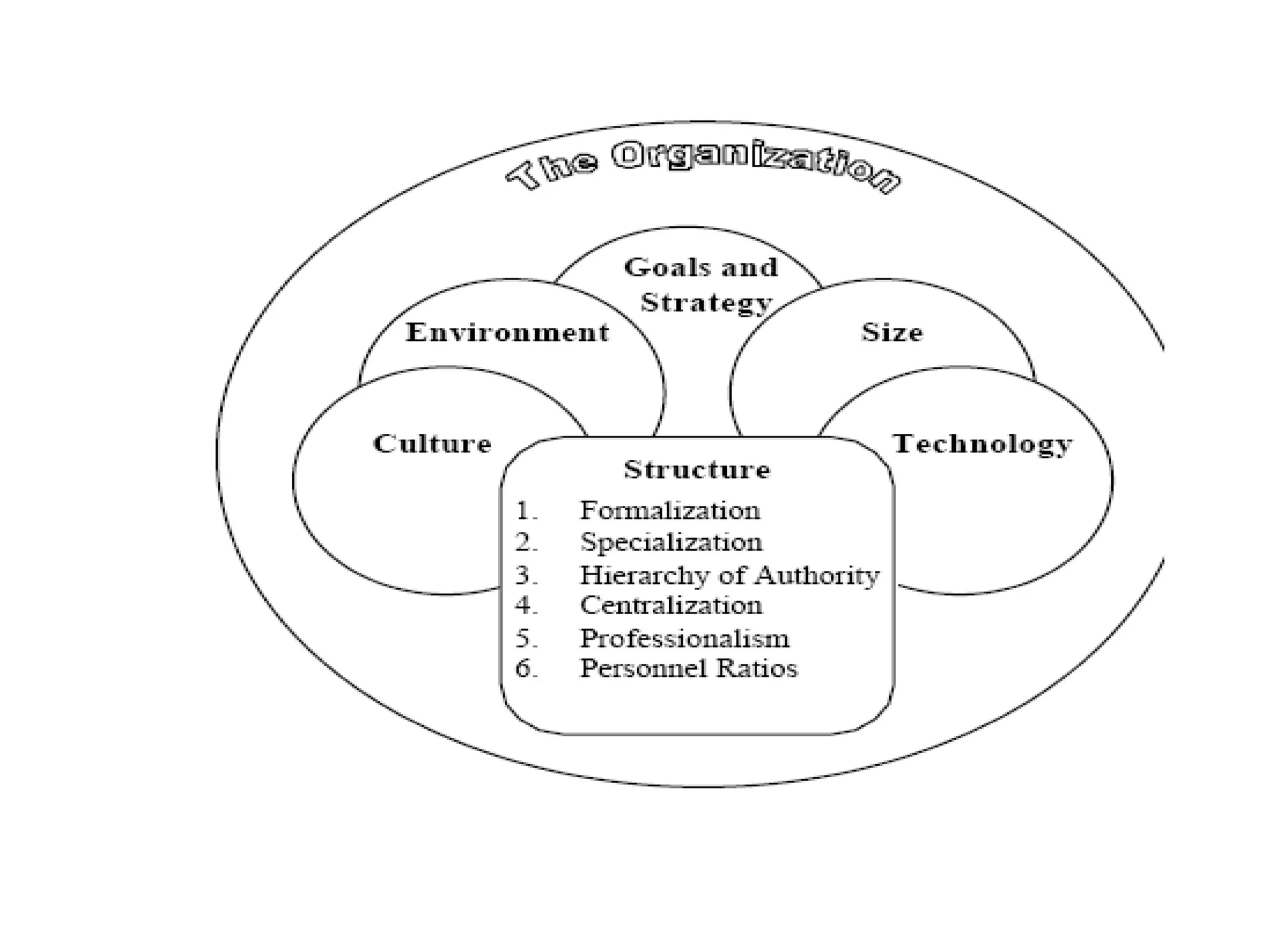
Organization
• A social unit of people,
  systematically structured and managed to meet
  a need or to pursue collective goals on
  a continuing basis. All organizations have
  a management structure that
  determines relationships between functions and
  positions, and subdivides and delegates roles,
  responsibilities, and authority to carry out
  defined tasks. Organizations are open systems in
  that they affect and are affected by
  the environment beyond their boundaries.
GOALS OF ORGANIZATION
Those ends that an organization seeks to achieve by its existence and
operation.
Goals are predetermined and describe future results toward which present
efforts are directed.

FORMAL GOALS                           INFORMAL GOALS
• reflect the actual intention         • are the general aims of an
  of an organization. They               organization as expressed in
  describe the concrete steps            the corporate charter,
  to be taken to achieve the             annual reports, public
  organization's purpose.                statements and mission
  They often don't                       statements. Their purpose is
  correspond with official               to give the organization a
  goals.                                 favorable public image,
                                         provide legitimacy, and
                                         justify its activities.
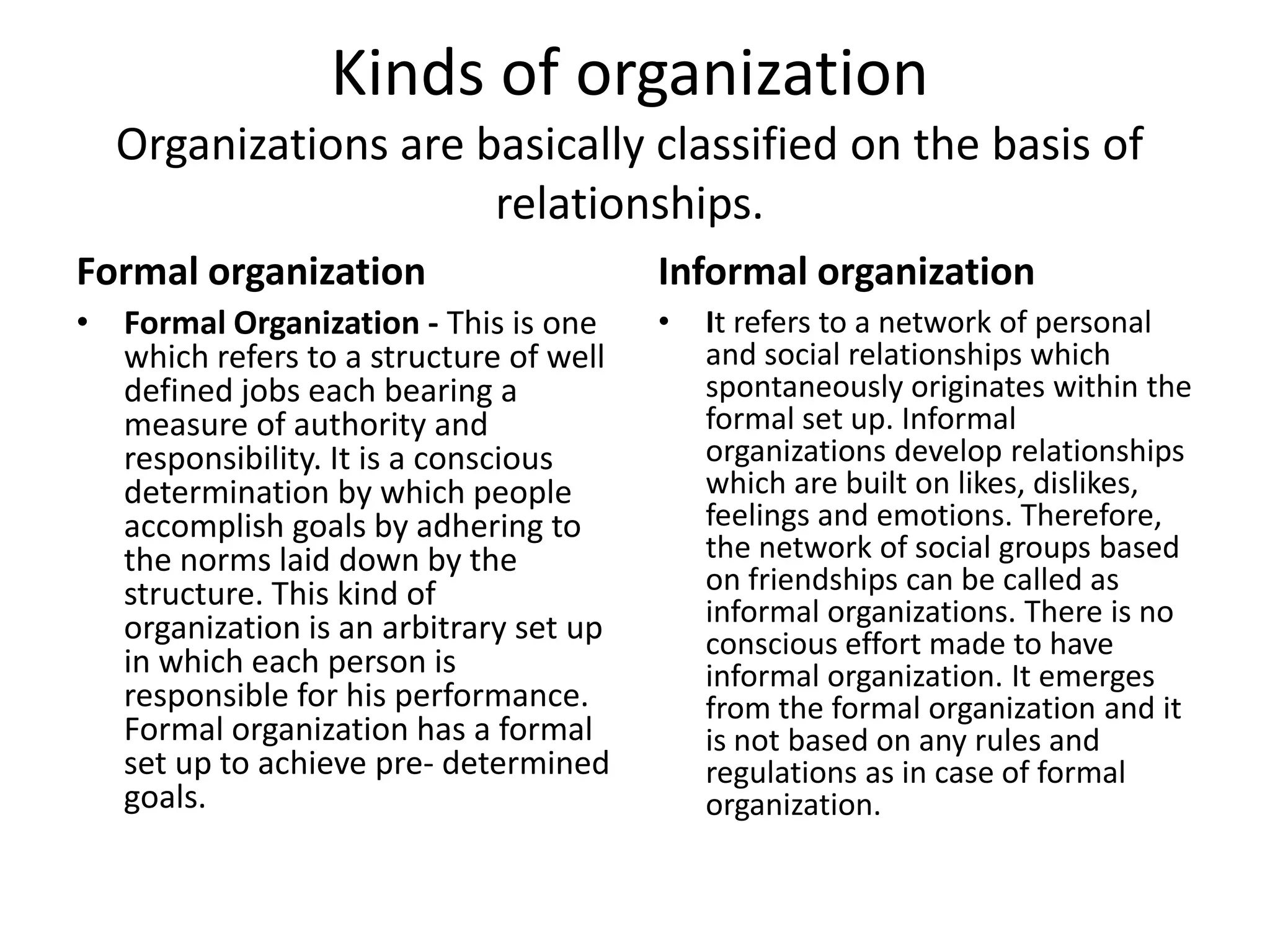
Kinds of organization
  Organizations are basically classified on the basis of
                     relationships.
Formal organization                     Informal organization
• Formal Organization - This is one     •   It refers to a network of personal
  which refers to a structure of well       and social relationships which
  defined jobs each bearing a               spontaneously originates within the
  measure of authority and                  formal set up. Informal
  responsibility. It is a conscious         organizations develop relationships
  determination by which people             which are built on likes, dislikes,
  accomplish goals by adhering to           feelings and emotions. Therefore,
  the norms laid down by the                the network of social groups based
  structure. This kind of                   on friendships can be called as
  organization is an arbitrary set up       informal organizations. There is no
                                            conscious effort made to have
  in which each person is                   informal organization. It emerges
  responsible for his performance.          from the formal organization and it
  Formal organization has a formal          is not based on any rules and
  set up to achieve pre- determined         regulations as in case of formal
  goals.                                    organization.

Communication skills week 3

  • 1.
    Communication Skills Week 3 Barriers of effective communication Physical Semantic Psychological What is an organization? Goals and kinds of organization BY WARDAH AZHAR
  • 2.
    Psychological Barriers • Everyperson has his/her own way to look at the world, at people, at events and situations. A way of thinking of a person many times takes a shape of strong base of communication. No two persons possess accurately similar frames of reference. Following are the psychological barriers –
  • 3.
    Cont… • (a) UnjustAssumptions: It creates a lot of misunderstanding. A manager, for example, incorrectly assumes that the subordinates understand the technical terms he adopts to give the instructions. • (b) Barrier of Knowing it All: Certain people think that they know everything about a subject. Usually they are not prepared to accept that they could be mistaken. Many make the generalized statements like women can not become superior to men or insincerity is the base of business. An attitude of “know it all” is an outcome of biased approach.
  • 4.
    Cont… • (c) SnapReactions: Some listeners tend to pass remarks or criticize the communicator even though his communication is not completed. Hurried interpretations are not needed. Audience needs to be patient enough to let the communicator finish his speech. (d) Apathetic Listener: One who is psychologically dead and indifferent to speaker. Receiver’s apathy is an intolerable condition, when the communicator tries to carry out effective communication. (e) Sophisticated Role: The receiver is not willing to learn from the communicator. That means he/she is un-teachable. In such situations the communicator should try to create right impact.
  • 5.
    Cont… • (f) Defensiveness:Humans always tries to justify themselves. they think that admitting the mistake means a loss of face. Therefore, they tends to rationalize the mistake that they commit. This type of attitude of the communicator is a great hindrance in the effective communication. (g) Fear: A fear gives rise to slow and narrow thinking. It is clearly destructive to communication. So the primary objective must be to eliminate fear.
  • 6.
    Semantic Barriers: • Connotation:meanings of words – Choose the correct and precise word depending on context and the receiver’s felicity in the use of language. • Fluency: Communicating with someone whose native language is not the same as yours may present barriers in the form of inappropriate or incorrect word choice
  • 7.
    Cont… • Jargon orSlang: Professionals often use industry jargon to communicate, and that jargon is all but foreign to those outside the industry. • High- or Low-Level Vocabulary: Even when people share a native language, vocabulary differences can be vast. Someone with a large vocabulary may choose to say, "He is certainly loquacious" rather than "He talks a lot." People who don't know the word's meaning may feel left out or ignorant and cease communication altogether
  • 8.
    Environmental and Physicalbarriers: • (a) Time – adopt appropriate fast channels of communication • (b) Space – maintain the distance in the communication exercise as determined by the situation • (c) Place – Avoid overcrowded incommodious and ill-lit, ill- ventilated places to achieve effective communication • (d) Medium – Choose the appropriate medium oral / written (sign (audio/visual) medium
  • 9.
    WHAT IS ANORGANIZATION? Definition: • Social entity • Goal directed • Designed as deliberately structured and coordinated activity systems • Linked to the external environment.
  • 10.
    Organization • A socialunit of people, systematically structured and managed to meet a need or to pursue collective goals on a continuing basis. All organizations have a management structure that determines relationships between functions and positions, and subdivides and delegates roles, responsibilities, and authority to carry out defined tasks. Organizations are open systems in that they affect and are affected by the environment beyond their boundaries.
  • 12.
    GOALS OF ORGANIZATION Thoseends that an organization seeks to achieve by its existence and operation. Goals are predetermined and describe future results toward which present efforts are directed. FORMAL GOALS INFORMAL GOALS • reflect the actual intention • are the general aims of an of an organization. They organization as expressed in describe the concrete steps the corporate charter, to be taken to achieve the annual reports, public organization's purpose. statements and mission They often don't statements. Their purpose is correspond with official to give the organization a goals. favorable public image, provide legitimacy, and justify its activities.
  • 13.
    Kinds of organization Organizations are basically classified on the basis of relationships. Formal organization Informal organization • Formal Organization - This is one • It refers to a network of personal which refers to a structure of well and social relationships which defined jobs each bearing a spontaneously originates within the measure of authority and formal set up. Informal responsibility. It is a conscious organizations develop relationships determination by which people which are built on likes, dislikes, accomplish goals by adhering to feelings and emotions. Therefore, the norms laid down by the the network of social groups based structure. This kind of on friendships can be called as organization is an arbitrary set up informal organizations. There is no conscious effort made to have in which each person is informal organization. It emerges responsible for his performance. from the formal organization and it Formal organization has a formal is not based on any rules and set up to achieve pre- determined regulations as in case of formal goals. organization.