what is communication,advantages,importance and elements
YOUTUBE LINK:
https://youtu.be/jd5rBGC2E9I
TUTORIAL LINK:
https://computerassignmentsforu.blogspot.com/p/network-topologies-and-network-types.html
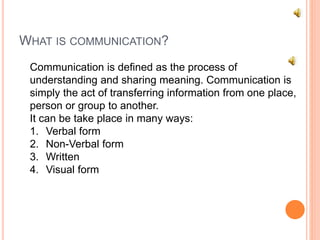
WHAT IS COMMUNICATION?
Communicationis defined as the process of
understanding and sharing meaning. Communication is
simply the act of transferring information from one place,
person or group to another.
It can be take place in many ways:
1. Verbal form
2. Non-Verbal form
3. Written
4. Visual form
3.
WHAT IS COMMUNICATION?
संचारको अर्थ को समझने और साझा करने की प्रक्रिया के रूप में
पररभाषित क्रकया गया है। संचार के वल एक स्र्ान, व्यक्तत या समूह
से दूसरे में जानकारी स्र्ानांतररत करने का कायथ है।
यह कई तरीकों से हो सकता है:
1. मौखिक रूप
2. गैर-मौखिक रूप
3. ललिा हुआ
4. दृश्य रूप
4.
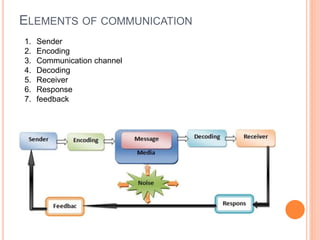
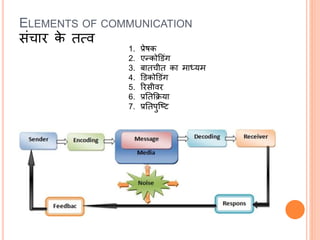
ELEMENTS OF COMMUNICATION
1.Sender
2. Encoding
3. Communication channel
4. Decoding
5. Receiver
6. Response
7. feedback
5.
ELEMENTS OF COMMUNICATION
संचारके तत्व
1. प्रेिक
2. एन्कोड ंग
3. बातचीत का माध्यम
4. ड कोड ंग
5. ररसीवर
6. प्रततक्रिया
7. प्रततपुक्टि
6.
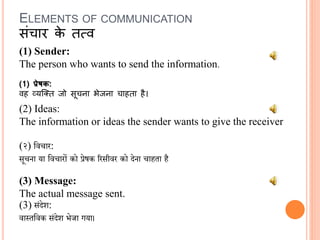
(1) Sender:
The personwho wants to send the information.
(1) प्रेषक:
वह व्यक्तत जो सूचना भेजना चाहता है।
(2) Ideas:
The information or ideas the sender wants to give the receiver
(२) विचार:
सूचना या विचारों को प्रेषक ररसीिर को देना चाहता है
(3) Message:
The actual message sent.
(3) संदेश:
िास्तविक संदेश भेजा गया।
ELEMENTS OF COMMUNICATION
संचार के तत्व
7.
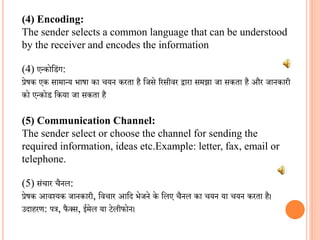
(4) Encoding:
The senderselects a common language that can be understood
by the receiver and encodes the information
(4) एन्कोव ंग:
प्रेषक एक सामान्य भाषा का चयन करता है वजसे ररसीिर द्वारा समझा जा सकता है और जानकारी
को एन्को वकया जा सकता है
(5) Communication Channel:
The sender select or choose the channel for sending the
required information, ideas etc.Example: letter, fax, email or
telephone.
(5) संचार चैनल:
प्रेषक आिश्यक जानकारी, विचार आवद भेजने के वलए चैनल का चयन या चयन करता है।
उदाहरण: पत्र, फैक्स, ईमेल या टेलीफोन।
8.
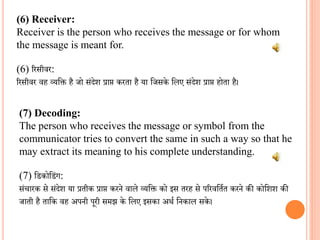
(6) Receiver:
Receiver isthe person who receives the message or for whom
the message is meant for.
(6) ररसीिर:
ररसीिर िह व्यवि है जो संदेश प्राप्त करता है या वजसके वलए संदेश प्राप्त होता है।
(7) Decoding:
The person who receives the message or symbol from the
communicator tries to convert the same in such a way so that he
may extract its meaning to his complete understanding.
(7) व कोव ंग:
संचारक से संदेश या प्रतीक प्राप्त करने िाले व्यवि को इस तरह से पररिवतित करने की कोवशश की
जाती है तावक िह अपनी पूरी समझ के वलए इसका अर्ि वनकाल सके।
9.
(8) Feedback:
Feedback isthe process of ensuring that the receiver has
received the message.
(8) प्रवतविया:
प्रवतविया यह सुवनवित करने की प्रविया है वक ररसीिर ने संदेश प्राप्त वकया है।
10.
CHARACTERISTICS OF COMMUNICATION
(1)It Involves at Least Two Persons:
Communication involves at least two persons, a sender
and a receiver. The sender is called communicator and the
receiver of the message is known as communicate.
(1) यह कम से कम दो व्यवियों में शावमल है:
संचार में कम से कम दो व्यवि, एक प्रेषक और एक ररसीिर शावमल होता है। प्रेषक को
संचारक कहा जाता है और संदेश के ररसीिर को संचार के रूप में जाना जाता है।
11.
(2) Message isa Must:
A message is the subject matter of communication. e.g.,
the contents of the letter or speech, order, instructions or the
suggestions. A communication must convey some message. If
there is no message there is no communication.
(2) संदेश एक होना चाहहए:
एक संदेश संचार का षविय है। जैसे, पत्र या भािण
की सामग्री, आदेश, तनदेश या सुझाव। एक संचार को कु छ
संदेश देना चाहहए। अगर कोई संदेश नहीं है तो कोई संचार
नहीं है।
CHARACTERISTICS OF COMMUNICATION
12.
CHARACTERISTICS OF COMMUNICATION
(3)Communication May be Written, Oral or Gestural:
Communication is generally understood as spoken or
written words. But in reality, it is more than that. It includes
everything that may be used to convey meanings from one
person to another, e.g., movement of lips
(3) संचार लिलित हो सकता है, मौलिक या गर्भकािीन हो सकता है:
संचार को आमतौर पर बोली जाने िाली या वलवित शब्दों के रूप में समझा जाता
है। लेवकन िास्ति में, यह उससे कहीं अविक है। इसमें िह सब कुछ शावमल है वजसका उपयोग
एक व्यवि से दूसरे व्यवि तक, जैसे होंठों की गवत को व्यि करने के वलए वकया जा सकता है
13.
CHARACTERISTICS OF COMMUNICATION
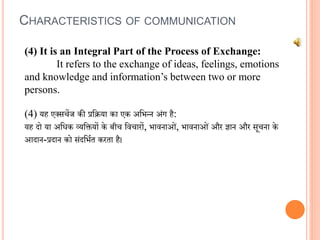
(4)It is an Integral Part of the Process of Exchange:
It refers to the exchange of ideas, feelings, emotions
and knowledge and information’s between two or more
persons.
(4) यह एक्सचेंज की प्रविया का एक अवभन्न अंग है:
यह दो या अविक व्यवियों के बीच विचारों, भािनाओं, भािनाओं और ज्ञान और सूचना के
आदान-प्रदान को संदवभित करता है।
14.
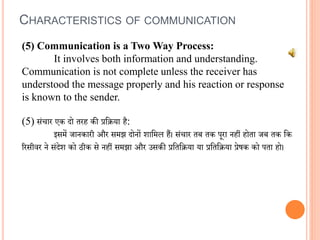
(5) Communication isa Two Way Process:
It involves both information and understanding.
Communication is not complete unless the receiver has
understood the message properly and his reaction or response
is known to the sender.
(5) संचार एक दो तरह की प्रविया है:
इसमें जानकारी और समझ दोनों शावमल हैं। संचार तब तक पूरा नहीं होता जब तक वक
ररसीिर ने संदेश को ठीक से नहीं समझा और उसकी प्रवतविया या प्रवतविया प्रेषक को पता हो।
CHARACTERISTICS OF COMMUNICATION
15.
IMPORTANCE OF COMMUNICATION
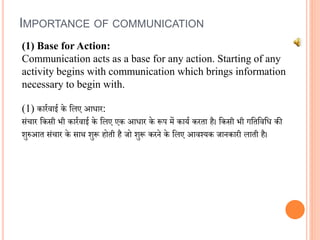
(1)Base for Action:
Communication acts as a base for any action. Starting of any
activity begins with communication which brings information
necessary to begin with.
(1) कारििाई के वलए आिार:
संचार वकसी भी कारििाई के वलए एक आिार के रूप में कायि करता है। वकसी भी गवतविवि की
शुरुआत संचार के सार् शुरू होती है जो शुरू करने के वलए आिश्यक जानकारी लाती है।
16.
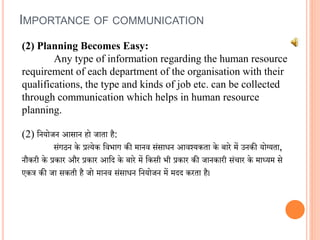
(2) Planning BecomesEasy:
Any type of information regarding the human resource
requirement of each department of the organisation with their
qualifications, the type and kinds of job etc. can be collected
through communication which helps in human resource
planning.
(2) वनयोजन आसान हो जाता है:
संगठन के प्रत्येक विभाग की मानि संसािन आिश्यकता के बारे में उनकी योग्यता,
नौकरी के प्रकार और प्रकार आवद के बारे में वकसी भी प्रकार की जानकारी संचार के माध्यम से
एकत्र की जा सकती है जो मानि संसािन वनयोजन में मदद करता है।
IMPORTANCE OF COMMUNICATION
17.
(3) Means ofCoordination:
Communication is an important tool for coordinating the
efforts of various people at work in the organisation.
(3) समन्िय के सािन:
संगठन में काम पर विवभन्न लोगों के प्रयासों के समन्िय के वलए संचार एक महत्िपूणि उपकरण है।
(4) Aids in Decision-Making:
The information collected through communication aids in
decision-making. Communication facilitates access to the vital
information required to take decisions.
(4) वनणिय लेने में सहायता:
वनणिय लेने में संचार सहायता के माध्यम से एकत्र की गई जानकारी। संचार वनणिय लेने के
वलए आिश्यक महत्िपूणि जानकारी तक पहंच की सुवििा प्रदान करता है।
IMPORTANCE OF COMMUNICATION
18.
(5)Provides Effective Leadership:
Acommunication skill bring manager near to his
subordinates and exchange ideas and submits appropriate
proposals, knows their opinions, seeks advices and make
decisions.
(५) प्रभािी नेतृत्ि प्रदान करता है:
एक संचार कौशल प्रबंिक को अपने अिीनस्र्ों के पास लाता है और विचारों का आदान-प्रदान
करता है और उवचत प्रस्तािों को प्रस्तुत करता है, उनकी राय जानता है, सलाह लेता है और वनणिय
लेता है।
IMPORTANCE OF COMMUNICATION
19.
IMPORTANCE OF COMMUNICATION
(6)BoostsMorale and Motivation:
An effective communication system instills confidence
among subordinates and workers ensuring change in their
attitude and behaviour.
(6) मनोबल और प्रेरणा को बढावा देता है:
एक प्रभावी संचार प्रणाली अधीनस्र्ों और श्रलमकों के
बीच षवश्वास पैदा करती है जो उनके दृक्टिकोण और व्यवहार में
पररवतथन सुतनक्श्चत करते हैं



![USER DEFINE FUNCTIONS IN PYTHON[WITH PARAMETERS]](https://cdn.slidesharecdn.com/ss_thumbnails/functionuserdefinewithparameters-200924085446-thumbnail.jpg?width=640&height=640&fit=bounds)

![FUNCTIONS IN PYTHON[RANDOM FUNCTION]](https://cdn.slidesharecdn.com/ss_thumbnails/functions2-200924082810-thumbnail.jpg?width=640&height=640&fit=bounds)


![GREEN SKILL[PART-2]](https://cdn.slidesharecdn.com/ss_thumbnails/greenskills2-200909112929-thumbnail.jpg?width=640&height=640&fit=bounds)
![GREEN SKILLS[PART-1]](https://cdn.slidesharecdn.com/ss_thumbnails/green-200909112841-thumbnail.jpg?width=640&height=640&fit=bounds)


