How to develop a good communications plan?
Sixth NIHR Infrastructure Doctoral Research Training Camp
‘The Art of Communicating Your Science,’ Ashridge, 9th July 2015
Simon Denegri, NIHR National Director for Patients and the
Public in Research and Chair, INVOLVE
Let’s get tuned in….
Think about the health research stories that have made
the biggest impression on you in the last month:
• Do you think they have been responsibly reported?
• What do you think the public made of them?
WHAT WE WILL COVER
 Importance of strategy
 Having clear aims and objectives
 Understanding your audience
 Developing your key messages
 Content, delivery, messengers
 Evaluation and measurement
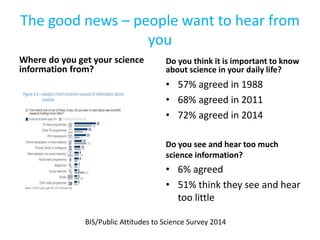
The good news – people want to hear from
you
Where do you get your science
information from?
Do you think it is important to know
about science in your daily life?
• 57% agreed in 1988
• 68% agreed in 2011
• 72% agreed in 2014
Do you see and hear too much
science information?
• 6% agreed
• 51% think they see and hear
too little
BIS/Public Attitudes to Science Survey 2014
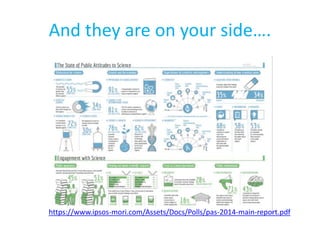
And they are on your side….
https://www.ipsos-mori.com/Assets/Docs/Polls/pas-2014-main-report.pdf
The bad news – it’s a crowded
marketplace
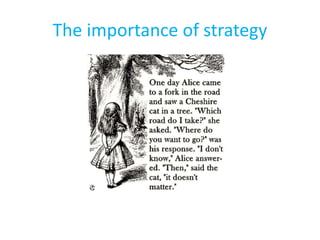
The importance of strategy
STRATEGY IS KNOWING…..
What you want say?
Why you want to say it?
Who you want to say it too?
How you want to say it?
The impact you want to have?
What resources you have at your disposal?
SETTING YOUR OBJECTIVES
What’s the purpose of your communications? Is it to:
 Raise public awareness
 Change people’s behaviour
 Spark a public debate about an issue
 Improve knowledge among health professionals
 Fundraise for more research money
 Or is it a call for action?
KNOW YOUR AUDIENCE…..
Find out who they are, what they know, where they
get their news……
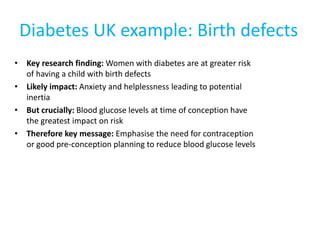
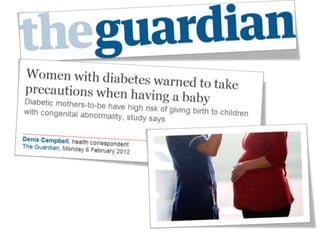
Diabetes UK example: Birth defects
• Key research finding: Women with diabetes are at greater risk
of having a child with birth defects
• Likely impact: Anxiety and helplessness leading to potential
inertia
• But crucially: Blood glucose levels at time of conception have
the greatest impact on risk
• Therefore key message: Emphasise the need for contraception
or good pre-conception planning to reduce blood glucose levels
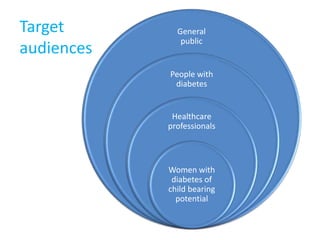
General
public
People with
diabetes
Healthcare
professionals
Women with
diabetes of
child bearing
potential
Target
audiences
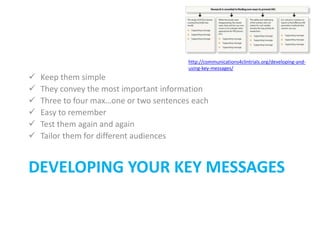
DEVELOPING YOUR KEY MESSAGES
 Keep them simple
 They convey the most important information
 Three to four max…one or two sentences each
 Easy to remember
 Test them again and again
 Tailor them for different audiences
http://communications4clintrials.org/developing-and-
using-key-messages/
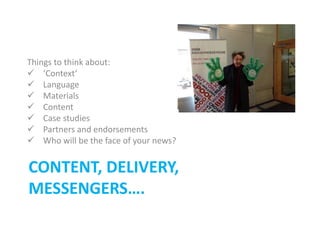
CONTENT, DELIVERY,
MESSENGERS….
Things to think about:
 ‘Context’
 Language
 Materials
 Content
 Case studies
 Partners and endorsements
 Who will be the face of your news?
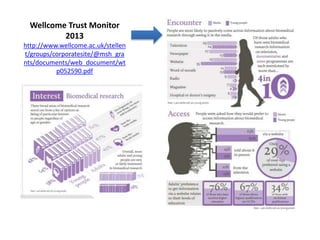
Wellcome Trust Monitor
2013
http://www.wellcome.ac.uk/stellen
t/groups/corporatesite/@msh_gra
nts/documents/web_document/wt
p052590.pdf
….publishing in an academic journal, developing
a web page and possibly issuing a news release
is unlikely to be sufficient!
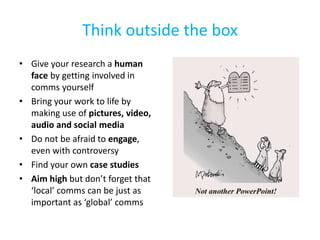
Think outside the box
• Give your research a human
face by getting involved in
comms yourself
• Bring your work to life by
making use of pictures, video,
audio and social media
• Do not be afraid to engage,
even with controversy
• Find your own case studies
• Aim high but don’t forget that
‘local’ comms can be just as
important as ‘global’ comms
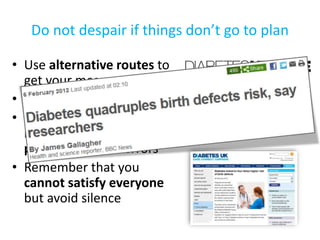
Do not despair if things don’t go to plan
• Use alternative routes to
get your message across
• Join the debate online
• Seek corrections, right of
reply or write opinion
pieces to correct errors
• Remember that you
cannot satisfy everyone
but avoid silence
Evaluation and measurement
• How will you know if you have informed, enthused, or
engaged your audience?
• Often overlooked part of communications planning
• Formal and informal measurement
• Will be driven by your objectives
 Surveys
 Focus groups
 Media coverage
 Website or social media traffic
 Numbers of people taking part in associated events
 Examining solicited and unsolicited responses, tone and style
SOME FINAL THOUGHTS
 Good preparation is the key
 Use your strengths as researchers
 Give yourself time to do this
 Get help!
 Good luck...You can do it!
involvementlastminute.com
THANK YOU….ANY QUESTIONS?
Simon.Denegri@nihr.ac.uk
Twitter: @SDenegri
Blog: http://simondenegri.com/

NIHR Trainees Comms masterclass 9am thur 5th july

  • 1.
    How to developa good communications plan? Sixth NIHR Infrastructure Doctoral Research Training Camp ‘The Art of Communicating Your Science,’ Ashridge, 9th July 2015 Simon Denegri, NIHR National Director for Patients and the Public in Research and Chair, INVOLVE
  • 2.
    Let’s get tunedin…. Think about the health research stories that have made the biggest impression on you in the last month: • Do you think they have been responsibly reported? • What do you think the public made of them?
  • 4.
    WHAT WE WILLCOVER  Importance of strategy  Having clear aims and objectives  Understanding your audience  Developing your key messages  Content, delivery, messengers  Evaluation and measurement
  • 5.
    The good news– people want to hear from you Where do you get your science information from? Do you think it is important to know about science in your daily life? • 57% agreed in 1988 • 68% agreed in 2011 • 72% agreed in 2014 Do you see and hear too much science information? • 6% agreed • 51% think they see and hear too little BIS/Public Attitudes to Science Survey 2014
  • 6.
    And they areon your side…. https://www.ipsos-mori.com/Assets/Docs/Polls/pas-2014-main-report.pdf
  • 7.
    The bad news– it’s a crowded marketplace
  • 8.
  • 9.
    STRATEGY IS KNOWING….. Whatyou want say? Why you want to say it? Who you want to say it too? How you want to say it? The impact you want to have? What resources you have at your disposal?
  • 10.
    SETTING YOUR OBJECTIVES What’sthe purpose of your communications? Is it to:  Raise public awareness  Change people’s behaviour  Spark a public debate about an issue  Improve knowledge among health professionals  Fundraise for more research money  Or is it a call for action?
  • 11.
    KNOW YOUR AUDIENCE….. Findout who they are, what they know, where they get their news……
  • 12.
    Diabetes UK example:Birth defects • Key research finding: Women with diabetes are at greater risk of having a child with birth defects • Likely impact: Anxiety and helplessness leading to potential inertia • But crucially: Blood glucose levels at time of conception have the greatest impact on risk • Therefore key message: Emphasise the need for contraception or good pre-conception planning to reduce blood glucose levels
  • 13.
  • 14.
    DEVELOPING YOUR KEYMESSAGES  Keep them simple  They convey the most important information  Three to four max…one or two sentences each  Easy to remember  Test them again and again  Tailor them for different audiences http://communications4clintrials.org/developing-and- using-key-messages/
  • 16.
    CONTENT, DELIVERY, MESSENGERS…. Things tothink about:  ‘Context’  Language  Materials  Content  Case studies  Partners and endorsements  Who will be the face of your news?
  • 17.
  • 18.
    ….publishing in anacademic journal, developing a web page and possibly issuing a news release is unlikely to be sufficient!
  • 19.
    Think outside thebox • Give your research a human face by getting involved in comms yourself • Bring your work to life by making use of pictures, video, audio and social media • Do not be afraid to engage, even with controversy • Find your own case studies • Aim high but don’t forget that ‘local’ comms can be just as important as ‘global’ comms
  • 20.
    Do not despairif things don’t go to plan • Use alternative routes to get your message across • Join the debate online • Seek corrections, right of reply or write opinion pieces to correct errors • Remember that you cannot satisfy everyone but avoid silence
  • 21.
    Evaluation and measurement •How will you know if you have informed, enthused, or engaged your audience? • Often overlooked part of communications planning • Formal and informal measurement • Will be driven by your objectives  Surveys  Focus groups  Media coverage  Website or social media traffic  Numbers of people taking part in associated events  Examining solicited and unsolicited responses, tone and style
  • 22.
    SOME FINAL THOUGHTS Good preparation is the key  Use your strengths as researchers  Give yourself time to do this  Get help!  Good luck...You can do it!
  • 23.