M.A. (English)
M.Ed.
UGC – NET (Education)
 Communication is the vital part of
organisational structure.
 It is a two way process, it is important to
understand various elements of
communication, the communication cycle, and
the barriers that hinder communication.
Communication is the process of sending and
receiving messages – sometimes through
written words, sometimes through non –
verbal means as facial expressions, gestures
and voice qualities.
 Communication model consists of five parts:
 Stimulus
 Filter
 Message
 Medium
 Destination
 Stimulus can be internal or external
 Internal stimulus is idea within your mind
 External stimulus comes through sensory
organs – eyes, ears, nose, mouth, skin
 We respond to stimulus by formulating a
message –
 Verbal Message – Written or Spoken Words
 Non Verbal Message – Non written and Non spoken
 Each person has unique perception of reality
based on his individual experiences and a host
of other variables. These variables act as a filter
in shaping everyone’s unique impression of
reality.
 Once our brain receives a message, it begins to
interpret the stimulus to derive meaning from
it
 Stimuli are affected by our current emotional
and physical frame of reference
 Success at communicating depends not only on
the purpose and content of the message but
also, on how skillful you are at communicating,
how well you know your audience and how
much you hold in common with your audience
 Once the sender has encoded a message, the
next step in the process is to transmit the
message to the receiver. At this point the
sender must choose the form of message to
send, or the medium.
 Oral messages through staff meetings,
conference, voice mail, seminars
 Written messages through memos, reports,
letters
 Non verbal messages through gestures
 The message once transmitted enters the
sensory environment of the receiver, our
sensory organs picks only a part of it. Even
assuming your receiver does perceive your
message, you have no assurance that it will be
interpreted as intended. Your transmitted
message becomes the source or stimulus for the
next communication episode, and the process
begins anew.
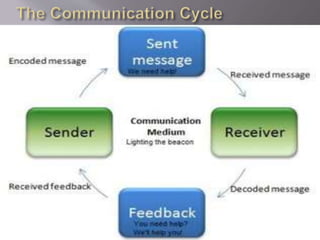
 Within any noisy universe, a sender encodes a
verbal or a non verbal message, sends it
through any message channel to receiver, who
decodes the message. The receiver then
encodes a reply, which is returned through a
feedback channel to the sender who decodes it
and perhaps sends another message. Without a
full loop communication is incomplete.
 Considering the complex nature of the
communication process your messages may
not always be received exactly as you intended.
As a matter of fact, sometimes your messages
will not be received at all; at other times, they
will be received incompletely or inaccurately.
 obstacles to effective and efficient
communication are :
 Verbal Barriers
 Non – Verbal Barriers
 Verbal barriers are related to what you write or
say. They include inadequate knowledge or
vocabulary, differences in interpretation,
language differences, inappropriate use of
expressions, over abstraction and ambiguity,
and polarization.
 Not all communication problems are related to
what you write or say. Some are related to how
you act. Nonverbal barriers to communication
include inappropriate or conflicting signals,
differences in perception, inappropriate
emotions, and distractions.
 Communication model consists of five parts, the
stimulus, filter, message, medium and destination.
The communication cycle consists of sender,
receiver, message, medium or channel through
which message is encoded as well as decoded and
finally the feedback on the basis of which an
organization decides its further policies and
strategies.
 In order to understand the process of
communication learners should also understand
the kinds of barriers which may occur during the
communication process.
Communication Process

Communication Process

  • 1.
  • 3.
     Communication isthe vital part of organisational structure.  It is a two way process, it is important to understand various elements of communication, the communication cycle, and the barriers that hinder communication.
  • 4.
    Communication is theprocess of sending and receiving messages – sometimes through written words, sometimes through non – verbal means as facial expressions, gestures and voice qualities.
  • 5.
     Communication modelconsists of five parts:  Stimulus  Filter  Message  Medium  Destination
  • 6.
     Stimulus canbe internal or external  Internal stimulus is idea within your mind  External stimulus comes through sensory organs – eyes, ears, nose, mouth, skin  We respond to stimulus by formulating a message –  Verbal Message – Written or Spoken Words  Non Verbal Message – Non written and Non spoken
  • 7.
     Each personhas unique perception of reality based on his individual experiences and a host of other variables. These variables act as a filter in shaping everyone’s unique impression of reality.  Once our brain receives a message, it begins to interpret the stimulus to derive meaning from it  Stimuli are affected by our current emotional and physical frame of reference
  • 8.
     Success atcommunicating depends not only on the purpose and content of the message but also, on how skillful you are at communicating, how well you know your audience and how much you hold in common with your audience
  • 9.
     Once thesender has encoded a message, the next step in the process is to transmit the message to the receiver. At this point the sender must choose the form of message to send, or the medium.  Oral messages through staff meetings, conference, voice mail, seminars  Written messages through memos, reports, letters  Non verbal messages through gestures
  • 10.
     The messageonce transmitted enters the sensory environment of the receiver, our sensory organs picks only a part of it. Even assuming your receiver does perceive your message, you have no assurance that it will be interpreted as intended. Your transmitted message becomes the source or stimulus for the next communication episode, and the process begins anew.
  • 12.
     Within anynoisy universe, a sender encodes a verbal or a non verbal message, sends it through any message channel to receiver, who decodes the message. The receiver then encodes a reply, which is returned through a feedback channel to the sender who decodes it and perhaps sends another message. Without a full loop communication is incomplete.
  • 14.
     Considering thecomplex nature of the communication process your messages may not always be received exactly as you intended. As a matter of fact, sometimes your messages will not be received at all; at other times, they will be received incompletely or inaccurately.  obstacles to effective and efficient communication are :  Verbal Barriers  Non – Verbal Barriers
  • 15.
     Verbal barriersare related to what you write or say. They include inadequate knowledge or vocabulary, differences in interpretation, language differences, inappropriate use of expressions, over abstraction and ambiguity, and polarization.
  • 16.
     Not allcommunication problems are related to what you write or say. Some are related to how you act. Nonverbal barriers to communication include inappropriate or conflicting signals, differences in perception, inappropriate emotions, and distractions.
  • 17.
     Communication modelconsists of five parts, the stimulus, filter, message, medium and destination. The communication cycle consists of sender, receiver, message, medium or channel through which message is encoded as well as decoded and finally the feedback on the basis of which an organization decides its further policies and strategies.  In order to understand the process of communication learners should also understand the kinds of barriers which may occur during the communication process.