
PRESENTED BY:
AYUSHI AGGARWAL
ANKIT GUPTA
SOURABH BANSAL
SUMIT KUMAR
GURNOOR KAUR
SHRISHTI AGGARWAL
SANJEEV PAUL
HARPREET SINGH
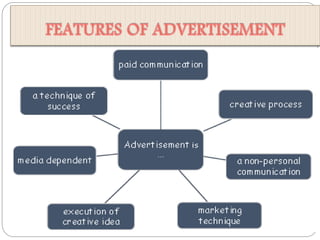
ď‚— Advertisement (ad) is an efficient and effective technique
to promote goods, services, and ideas. It is a paid form of
non-personal communication wherein business
information is made available for potential customers.
ď‚— Advertisement, is derived from the Latin
word “Advertere” which literally means “to turn the
minds of … towards…”. Advertisement promotes and
supplements selling of products, services, and ideas to a
great extent. The most interesting part of an advertisement
is – it carries factual information with fascinating
emotional appeal. Hence, without a proper advertisement
no business can prosper.
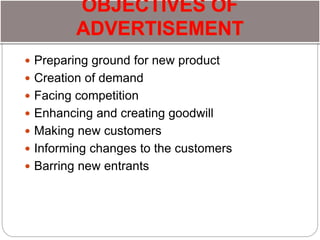
ď‚— Preparing ground for new product
ď‚— Creation of demand
ď‚— Facing competition
ď‚— Enhancing and creating goodwill
ď‚— Making new customers
ď‚— Informing changes to the customers
ď‚— Barring new entrants
ď‚— To reassure employees or shareholders that a company is
viable or successful.
ď‚— To reach the masses
ď‚— To generate awareness among the customers.
ď‚— Increase in sales and thus, in profits
ď‚— convince customers that a company's services or products
are the best
ď‚— Enhance the image of the company
ď‚— Point out and create a need for products or services
ď‚— Demonstrate new uses for established products
ď‚— Announce new products and programs
ď‚— Draw customers to the business
ď‚— To hold existing customers
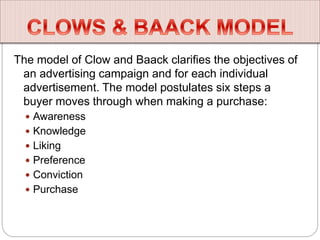
The model of Clow and Baack clarifies the objectives of
an advertising campaign and for each individual
advertisement. The model postulates six steps a
buyer moves through when making a purchase:
ď‚— Awareness
ď‚— Knowledge
ď‚— Liking
ď‚— Preference
ď‚— Conviction
ď‚— Purchase
“Mass demand has been created almost entirely through the
development of Advertising”
ď‚— Step 1 - Briefing: the advertiser needs to brief about the
product or the service which has to be advertised and doing
the SWOT analysis of the company and the product.
ď‚— Step 2 - Knowing the Objective: one should first know the
objective or the purpose of advertising. i.e. what message is
to be delivered to the audience?
ď‚— Step 3 - Research: this step involves finding out the market
behavior, knowing the competitors, what type of advertising
they are using, what is the response of the consumers,
availability of the resources needed in the process, etc.
ď‚— Step 4 - Target Audience: the next step is to identify the
target consumers most likely to buy the product. The target
should be appropriately identified without any confusion. For
e.g. if the product is a health drink for growing kids, then the
target customers will be the parents who are going to buy it
and not the kids who are going to drink it.
ď‚— Step 5 - Media Selection: now that the target audience is
identified, one should select an appropriate media for
advertising so that the customers who are to be informed
about the product and are willing to buy are successfully
reached.
ď‚— Step 6 - Setting the Budget: then the advertising budget has
to be planned so that there is no short of funds or excess of
funds during the process of advertising and also there are no
losses to the company.
ď‚— Step 7 - Designing and Creating the Ad: first the design that
is the outline of ad on papers is made by the copywriters of
the agency, then the actual creation of ad is done with help of
the art directors and the creative personnel of the agency.
ď‚— Step 8 - Perfection: then the created ad is re-examined and the ad is
redefined to make it perfect to enter the market.
ď‚— Step 9 - Place and Time of Ad: the next step is to decide where and
when the ad will be shown. The place will be decided according to
the target customers where the ad is most visible clearly to them. The
finalization of time on which the ad will be telecasted or shown on
the selected media will be done by the traffic department of the
agency.
ď‚— Step 10 - Execution: finally the advertise is released with perfect
creation, perfect placement and perfect timing in the market.
ď‚— Step 11 - Performance: the last step is to judge the performance of
the ad in terms of the response from the customers, whether they are
satisfied with the ad and the product, did the ad reached all the
targeted people, was the advertise capable enough to compete with
the other players, etc. Every point is studied properly and changes are
made, if any.
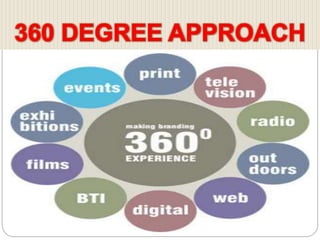
ď‚— It is also known as 360 degree branding i.e. is a branding
effort which tries to include the brand identity into a holistic approach
so that the brand is in touch with and visible to the customers at all the
times. It’s all about creating a distinctive brand philosophy which is
centered on consumers. It helps to anticipate all aspects of consumer
needs. Especially when brand is fairly new it needs to be present
everywhere to build a brand image.
ď‚— 360 degree branding is a combination of integrated marketing and web
2.0 usages.
ď‚— Integrated marketing follows a user centric approach and primarily
focuses on use of online and offline tools to engage and excite
consumers. Integrated communication ensures that message is
consistent throughout irrespective of the channel.
ď‚— A web 2.0 usage pays more attention to customer rating and
social media as consumers talk about the brand outside of the
boundaries of the brand
ď‚— A 360 degree branding has various elements like print, media,
broadcast, email, phone etc
ď‚— A brand manager has to ensure that each of these elements
should run according to the essence of the brand and the
strategy.
ď‚— For example: In Social media apart from posting messages,
we can also establish conversation, get a feedback from user,
collect big data, or even manage issues and complaints.
ď‚— Similarly Public Relation not only covers the press releases or
media gatherings, but it also involves media training for
internals to ensure brand sustainability.
Adverstisement Process and Advertising Square

Adverstisement Process and Advertising Square

  • 1.
    PRESENTED BY: AYUSHI AGGARWAL ANKITGUPTA SOURABH BANSAL SUMIT KUMAR GURNOOR KAUR SHRISHTI AGGARWAL SANJEEV PAUL HARPREET SINGH
  • 2.
     Advertisement (ad)is an efficient and effective technique to promote goods, services, and ideas. It is a paid form of non-personal communication wherein business information is made available for potential customers.  Advertisement, is derived from the Latin word “Advertere” which literally means “to turn the minds of … towards…”. Advertisement promotes and supplements selling of products, services, and ideas to a great extent. The most interesting part of an advertisement is – it carries factual information with fascinating emotional appeal. Hence, without a proper advertisement no business can prosper.
  • 4.
    ď‚— Preparing groundfor new product ď‚— Creation of demand ď‚— Facing competition ď‚— Enhancing and creating goodwill ď‚— Making new customers ď‚— Informing changes to the customers ď‚— Barring new entrants
  • 5.
    ď‚— To reassureemployees or shareholders that a company is viable or successful. ď‚— To reach the masses ď‚— To generate awareness among the customers. ď‚— Increase in sales and thus, in profits ď‚— convince customers that a company's services or products are the best ď‚— Enhance the image of the company ď‚— Point out and create a need for products or services ď‚— Demonstrate new uses for established products ď‚— Announce new products and programs ď‚— Draw customers to the business ď‚— To hold existing customers
  • 6.
    The model ofClow and Baack clarifies the objectives of an advertising campaign and for each individual advertisement. The model postulates six steps a buyer moves through when making a purchase: ď‚— Awareness ď‚— Knowledge ď‚— Liking ď‚— Preference ď‚— Conviction ď‚— Purchase
  • 8.
    “Mass demand hasbeen created almost entirely through the development of Advertising”  Step 1 - Briefing: the advertiser needs to brief about the product or the service which has to be advertised and doing the SWOT analysis of the company and the product.  Step 2 - Knowing the Objective: one should first know the objective or the purpose of advertising. i.e. what message is to be delivered to the audience?  Step 3 - Research: this step involves finding out the market behavior, knowing the competitors, what type of advertising they are using, what is the response of the consumers, availability of the resources needed in the process, etc.
  • 9.
    ď‚— Step 4- Target Audience: the next step is to identify the target consumers most likely to buy the product. The target should be appropriately identified without any confusion. For e.g. if the product is a health drink for growing kids, then the target customers will be the parents who are going to buy it and not the kids who are going to drink it. ď‚— Step 5 - Media Selection: now that the target audience is identified, one should select an appropriate media for advertising so that the customers who are to be informed about the product and are willing to buy are successfully reached. ď‚— Step 6 - Setting the Budget: then the advertising budget has to be planned so that there is no short of funds or excess of funds during the process of advertising and also there are no losses to the company. ď‚— Step 7 - Designing and Creating the Ad: first the design that is the outline of ad on papers is made by the copywriters of the agency, then the actual creation of ad is done with help of the art directors and the creative personnel of the agency.
  • 10.
    ď‚— Step 8- Perfection: then the created ad is re-examined and the ad is redefined to make it perfect to enter the market. ď‚— Step 9 - Place and Time of Ad: the next step is to decide where and when the ad will be shown. The place will be decided according to the target customers where the ad is most visible clearly to them. The finalization of time on which the ad will be telecasted or shown on the selected media will be done by the traffic department of the agency. ď‚— Step 10 - Execution: finally the advertise is released with perfect creation, perfect placement and perfect timing in the market. ď‚— Step 11 - Performance: the last step is to judge the performance of the ad in terms of the response from the customers, whether they are satisfied with the ad and the product, did the ad reached all the targeted people, was the advertise capable enough to compete with the other players, etc. Every point is studied properly and changes are made, if any.
  • 12.
     It isalso known as 360 degree branding i.e. is a branding effort which tries to include the brand identity into a holistic approach so that the brand is in touch with and visible to the customers at all the times. It’s all about creating a distinctive brand philosophy which is centered on consumers. It helps to anticipate all aspects of consumer needs. Especially when brand is fairly new it needs to be present everywhere to build a brand image.  360 degree branding is a combination of integrated marketing and web 2.0 usages.  Integrated marketing follows a user centric approach and primarily focuses on use of online and offline tools to engage and excite consumers. Integrated communication ensures that message is consistent throughout irrespective of the channel.
  • 13.
    ď‚— A web2.0 usage pays more attention to customer rating and social media as consumers talk about the brand outside of the boundaries of the brand ď‚— A 360 degree branding has various elements like print, media, broadcast, email, phone etc ď‚— A brand manager has to ensure that each of these elements should run according to the essence of the brand and the strategy. ď‚— For example: In Social media apart from posting messages, we can also establish conversation, get a feedback from user, collect big data, or even manage issues and complaints. ď‚— Similarly Public Relation not only covers the press releases or media gatherings, but it also involves media training for internals to ensure brand sustainability.