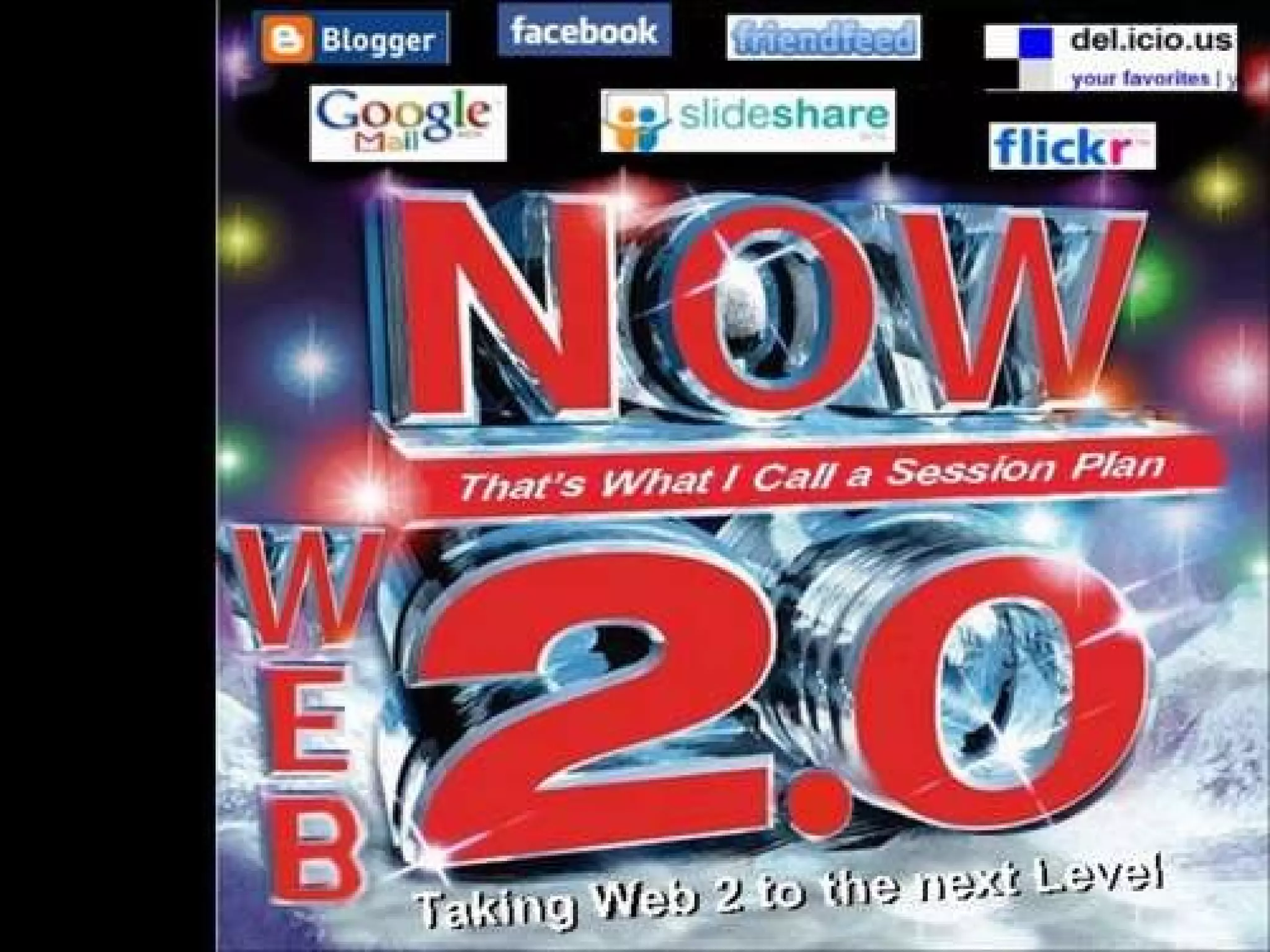
Now that’s what I call a session plan... taking Web 2.0 to the next level   Anthony Beal Tuesday 24th June 2008 Fourth Joint CoFHE and UC&R Conference  Liverpool Hope University
Where? What?  Why?  How? Plan
Future Thinking “ Those in the vanguard of technical developments are already signalling the ‘Death of the VLE’ (Stiles 2007) and heralding a new set of approaches based on a different pedagogic outlook and on the underlying technologies and social and collaborative tools that are collectively labelled the Web 2.0 phenomenon.” (Jisc Infonet – Exploring Tangible benefits of e-learning)
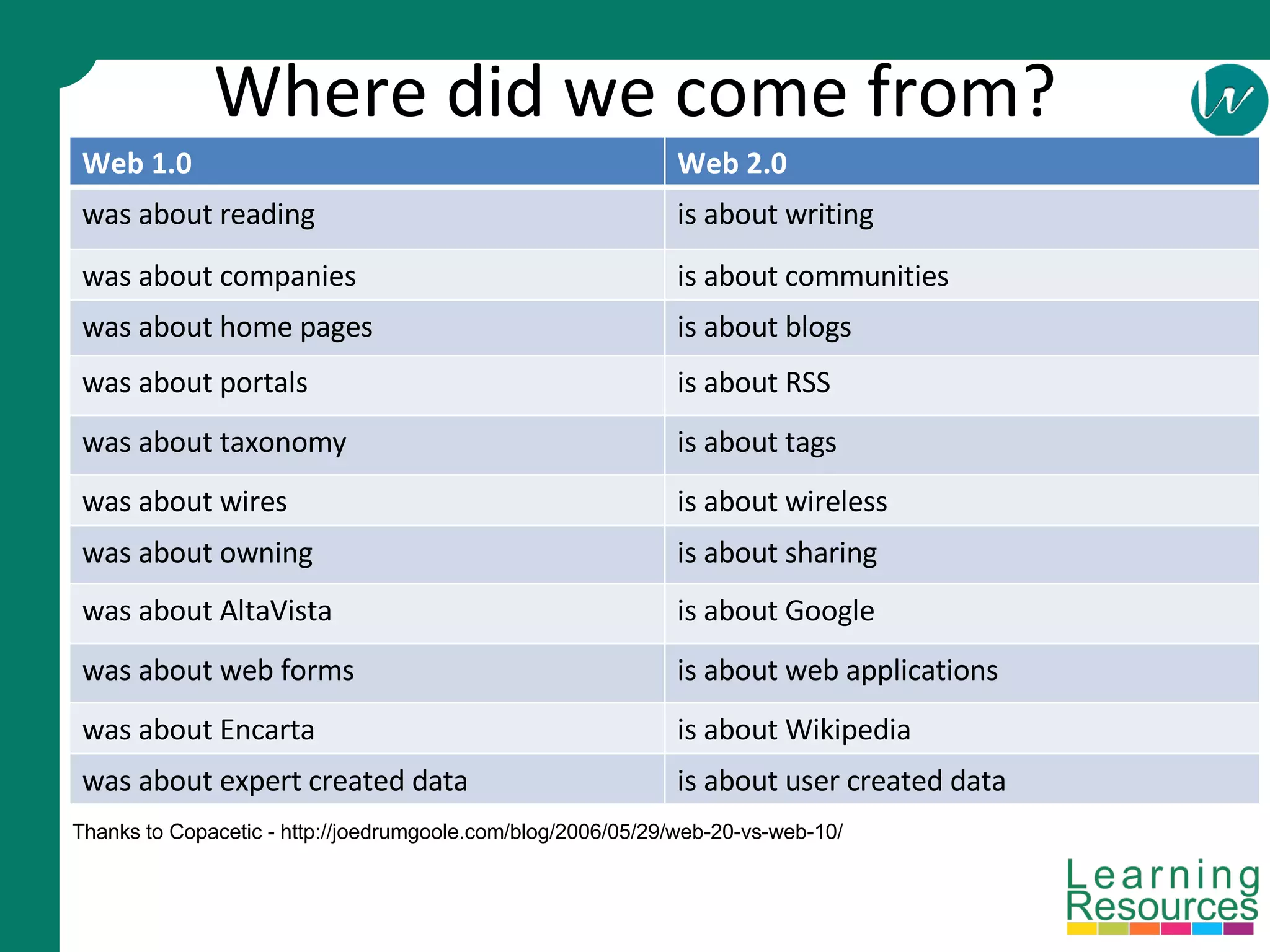
Where did we come from? Thanks to Copacetic - http://joedrumgoole.com/blog/2006/05/29/web-20-vs-web-10/ Web 1.0 Web 2.0 was about reading is about writing  was about companies is about communities  was about home pages is about blogs was about portals is about RSS was about taxonomy is about tags was about wires is about wireless  was about owning is about sharing  was about AltaVista  is about Google  was about web forms is about web applications was about Encarta  is about Wikipedia  was about expert created data is about user created data
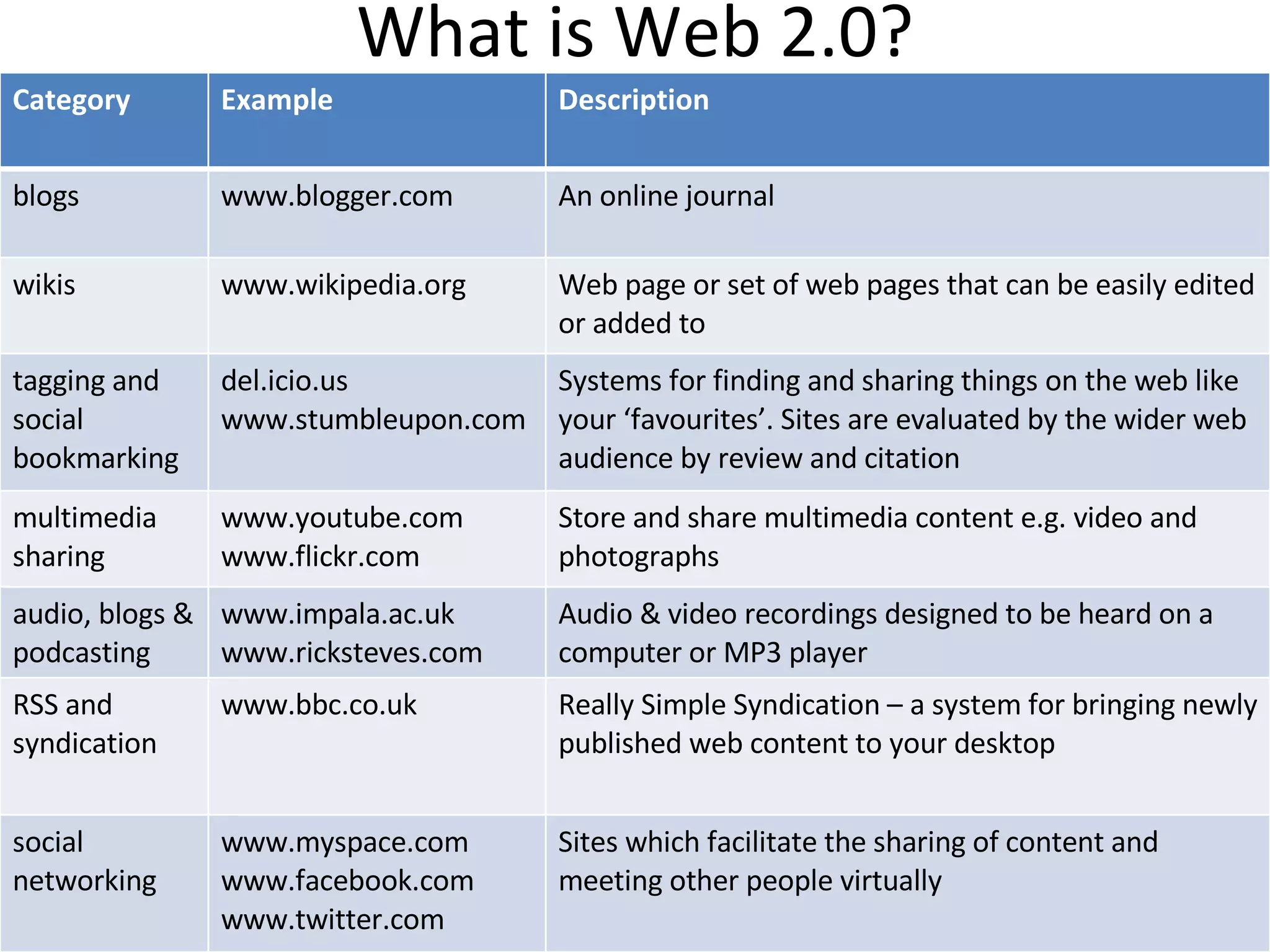
What is Web 2.0? Category Example Description blogs www.blogger.com An online journal wikis www.wikipedia.org Web page or set of web pages that can be easily edited or added to tagging and social bookmarking del.icio.us www.stumbleupon.com Systems for finding and sharing things on the web like your ‘favourites’. Sites are evaluated by the wider web audience by review and citation multimedia sharing www.youtube.com www.flickr.com Store and share multimedia content e.g. video and photographs audio, blogs & podcasting www.impala.ac.uk www.ricksteves.com Audio & video recordings designed to be heard on a computer or MP3 player RSS and syndication www.bbc.co.uk Really Simple Syndication – a system for bringing newly published web content to your desktop social networking www.myspace.com www.facebook.com www.twitter.com Sites which facilitate the sharing of content and meeting other people virtually
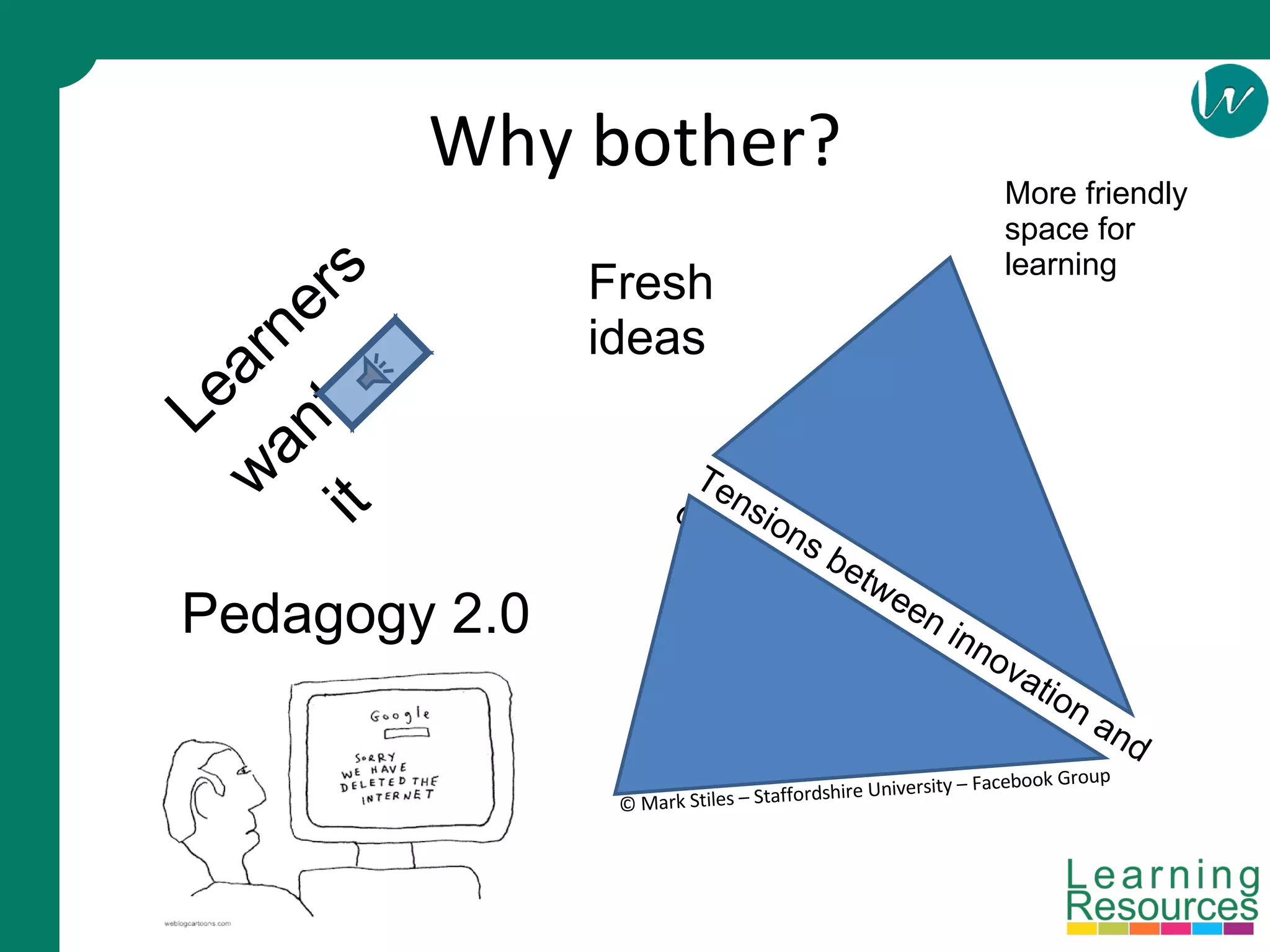
Why bother? Learners want it Pedagogy 2.0 Tensions between innovation and control © Mark Stiles – Staffordshire University – Facebook Group Fresh ideas More friendly space for learning
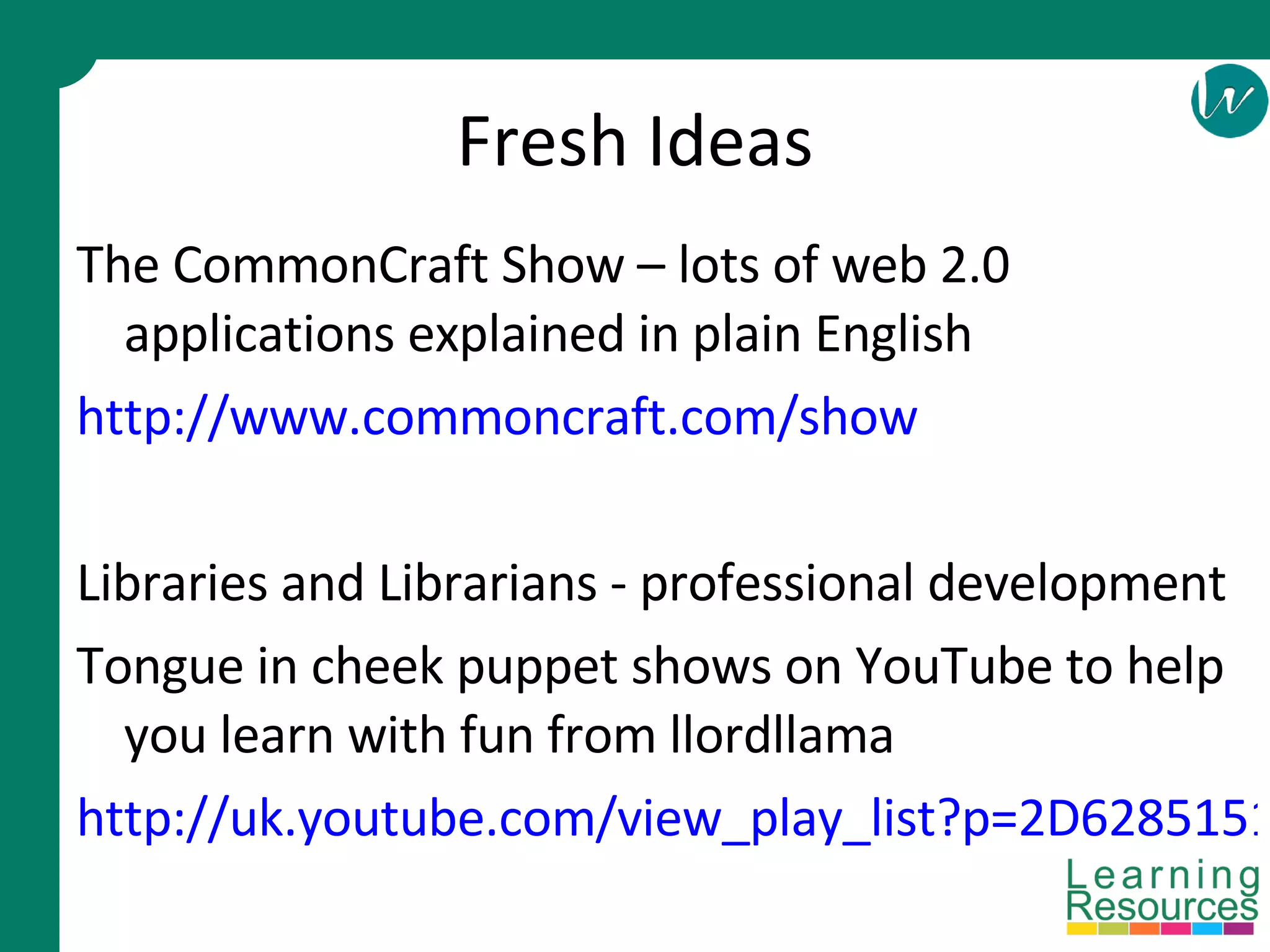
Fresh Ideas The CommonCraft Show – lots of web 2.0 applications explained in plain English http://www.commoncraft.com/show Libraries and Librarians - professional development Tongue in cheek puppet shows on YouTube to help you learn with fun from llordllama http://uk.youtube.com/view_play_list?p=2D6285151E99F565
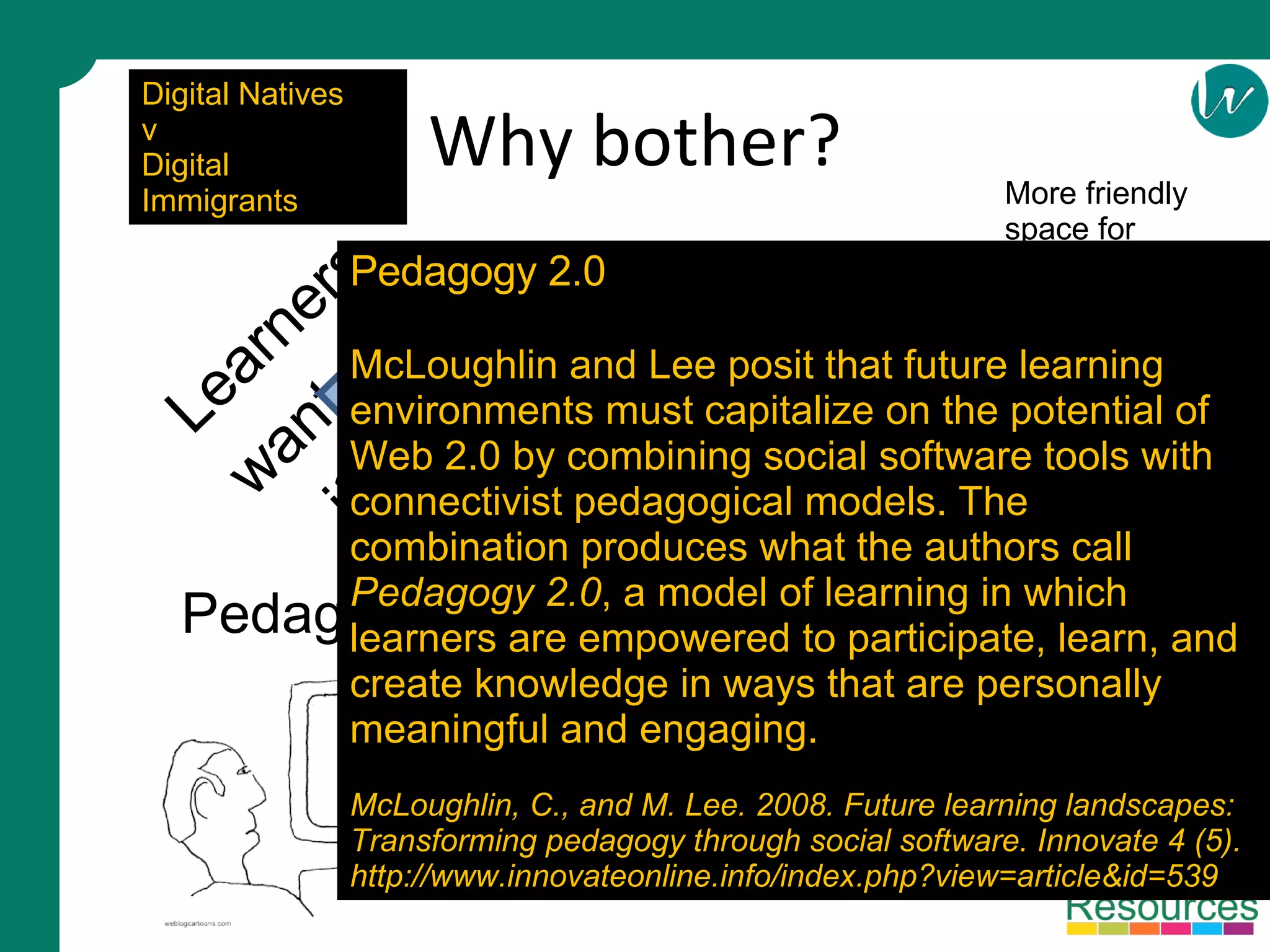
Why bother? Learners want it Pedagogy 2.0 Tensions between innovation and control © Mark Stiles – Staffordshire University Fresh ideas More friendly space for learning Digital Natives v Digital Immigrants Pedagogy 2.0 McLoughlin and Lee posit that future learning environments must capitalize on the potential of Web 2.0 by combining social software tools with connectivist pedagogical models. The combination produces what the authors call  Pedagogy 2.0 , a model of learning in which learners are empowered to participate, learn, and create knowledge in ways that are personally meaningful and engaging. McLoughlin, C., and M. Lee. 2008. Future learning landscapes: Transforming pedagogy through social software. Innovate 4 (5). http://www.innovateonline.info/index.php?view=article&id=539
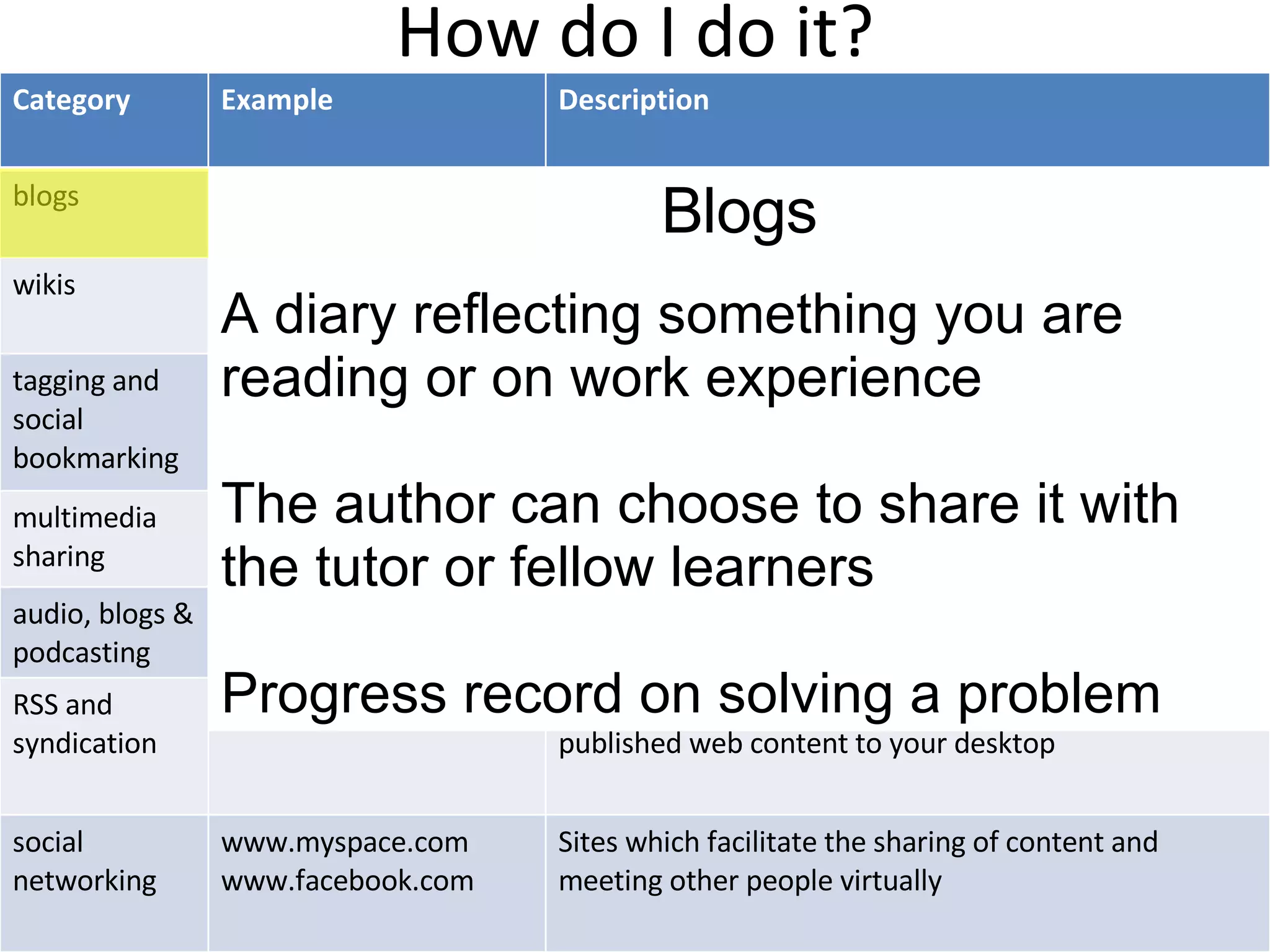
How do I do it? Blogs A diary reflecting something you are reading or on work experience The author can choose to share it with the tutor or fellow learners Progress record on solving a problem Category Example Description blogs www.blogger.com An online journal wikis www.wikipedia.org Web page or set of web pages that can be easily edited or added to tagging and social bookmarking del.icio.us www.stumbleupon.com Systems for finding and sharing things on the web like your ‘favourites’ multimedia sharing www.youtube.com www.flickr.com Store and share multimedia content e.g. video and photographs audio, blogs & podcasting www.impala.ac.uk www.ricksteves.com Audio & video recordings designed to be heard on a computer or MP3 player RSS and syndication www.bbc.co.uk Really Simple Syndication – a system for bringing newly published web content to your desktop social networking www.myspace.com www.facebook.com Sites which facilitate the sharing of content and meeting other people virtually
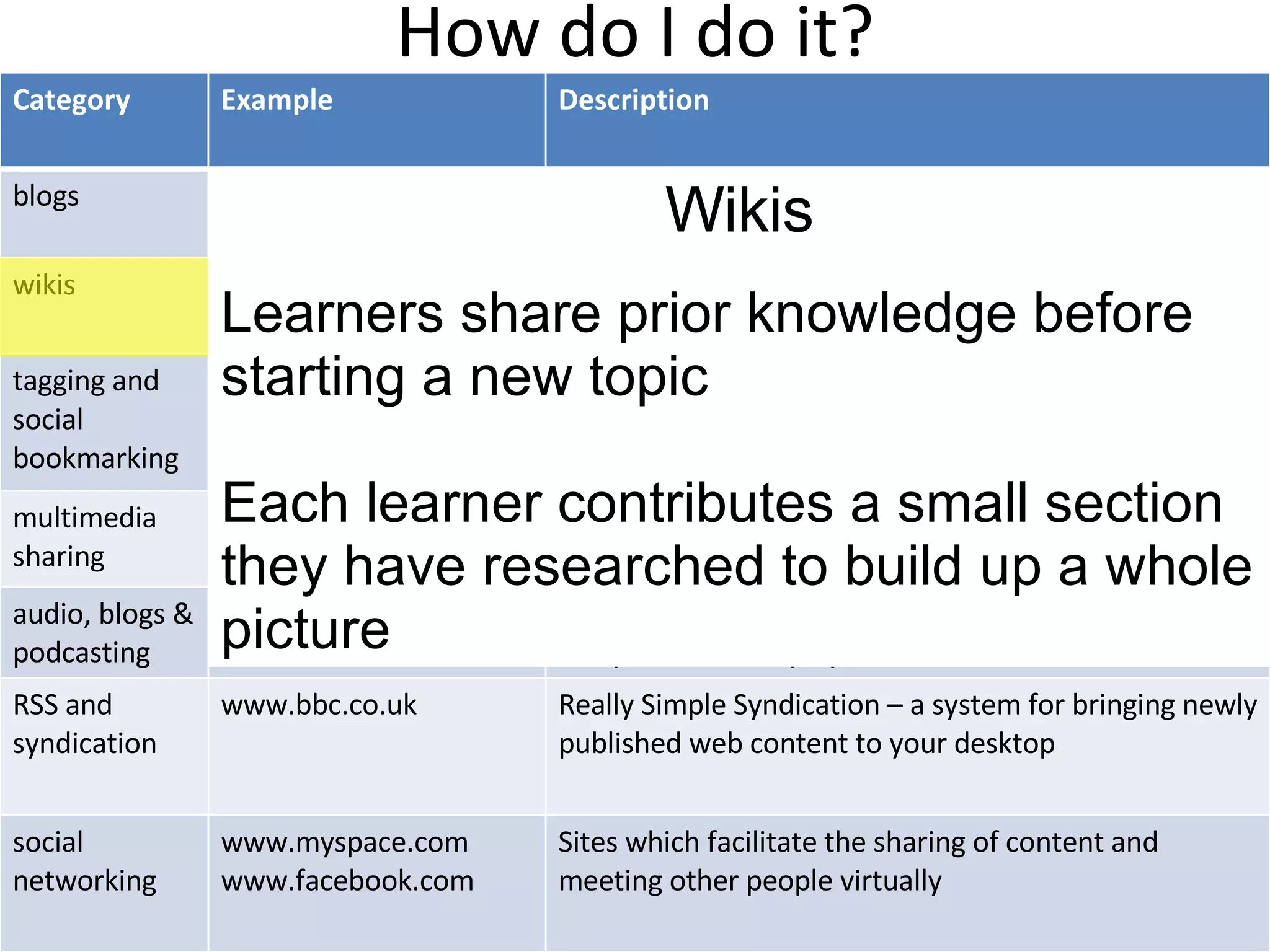
How do I do it? Wikis Learners share prior knowledge before starting a new topic Each learner contributes a small section they have researched to build up a whole picture Category Example Description blogs www.blogger.com An online journal wikis www.wikipedia.org Web page or set of web pages that can be easily edited or added to tagging and social bookmarking del.icio.us www.stumbleupon.com Systems for finding and sharing things on the web like your ‘favourites’ multimedia sharing www.youtube.com www.flickr.com Store and share multimedia content e.g. video and photographs audio, blogs & podcasting www.impala.ac.uk www.ricksteves.com Audio & video recordings designed to be heard on a computer or MP3 player RSS and syndication www.bbc.co.uk Really Simple Syndication – a system for bringing newly published web content to your desktop social networking www.myspace.com www.facebook.com Sites which facilitate the sharing of content and meeting other people virtually
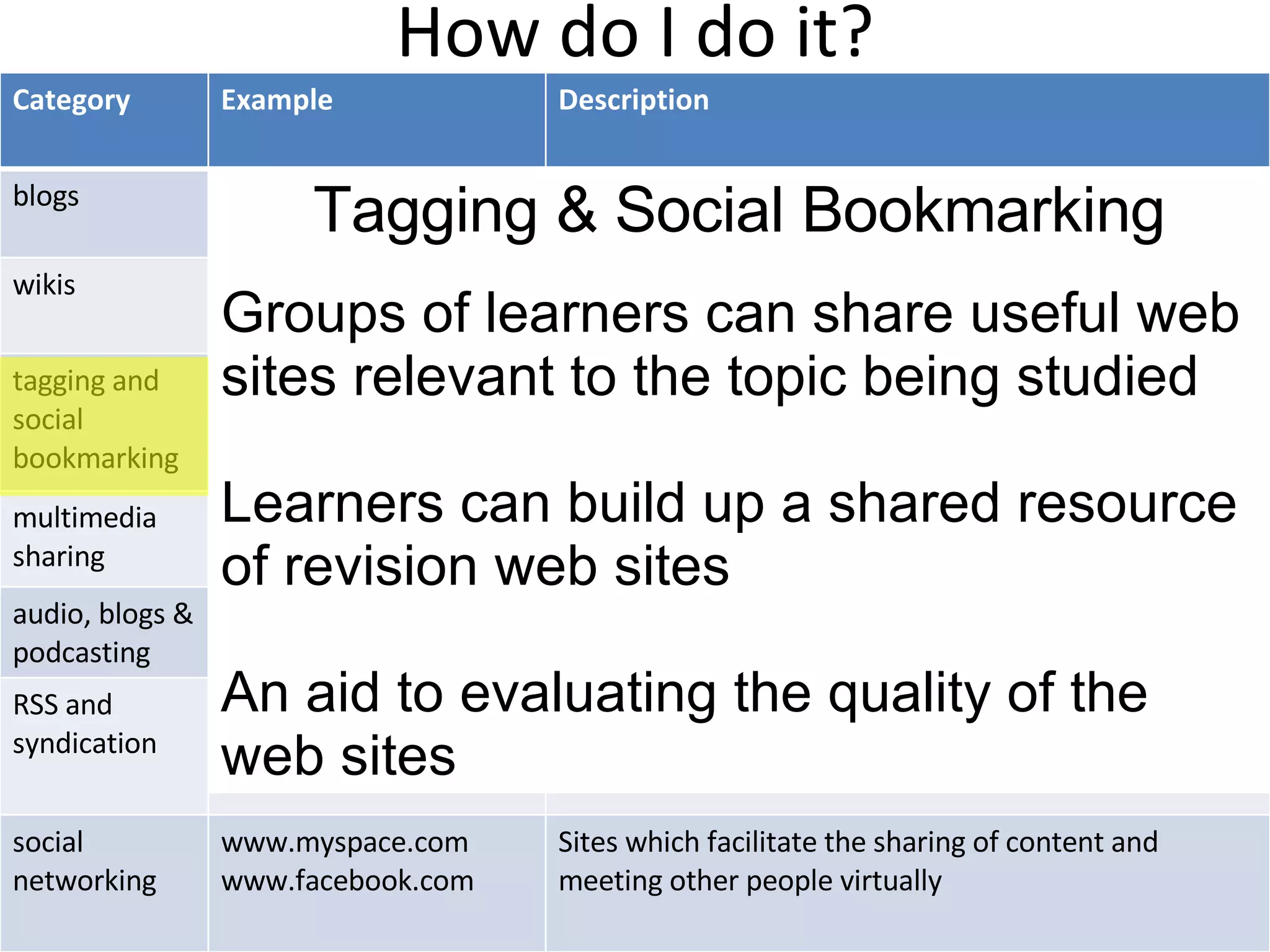
How do I do it? Tagging & Social Bookmarking Groups of learners can share useful web sites relevant to the topic being studied Learners can build up a shared resource of revision web sites An aid to evaluating the quality of the web sites Category Example Description blogs www.blogger.com An online journal wikis www.wikipedia.org Web page or set of web pages that can be easily edited or added to tagging and social bookmarking del.icio.us www.stumbleupon.com Systems for finding and sharing things on the web like your ‘favourites’ multimedia sharing www.youtube.com www.flickr.com Store and share multimedia content e.g. video and photographs audio, blogs & podcasting www.impala.ac.uk www.ricksteves.com Audio & video recordings designed to be heard on a computer or MP3 player RSS and syndication www.bbc.co.uk Really Simple Syndication – a system for bringing newly published web content to your desktop social networking www.myspace.com www.facebook.com Sites which facilitate the sharing of content and meeting other people virtually
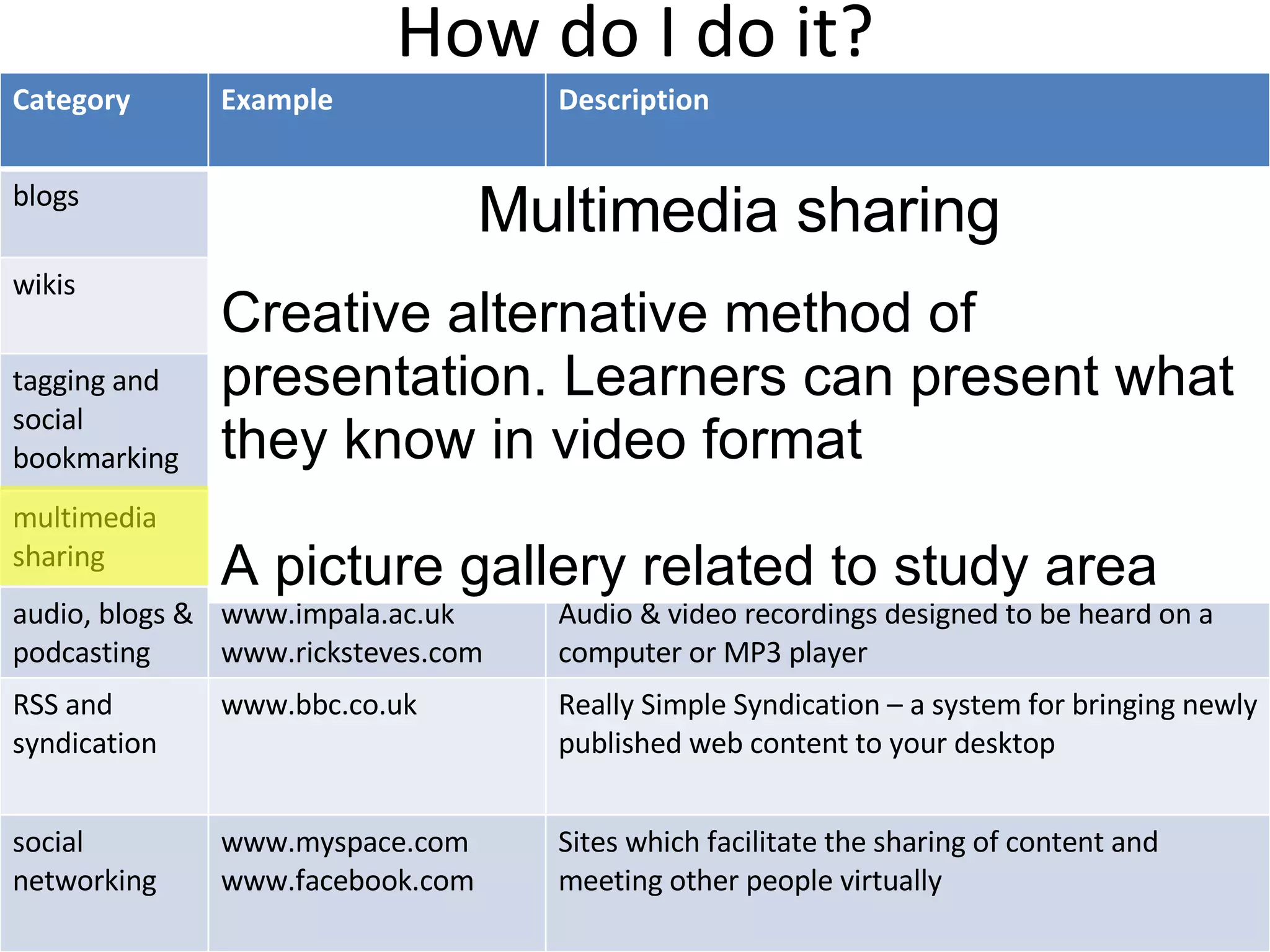
How do I do it? Multimedia sharing Creative alternative method of presentation. Learners can present what they know in video format A picture gallery related to study area Category Example Description blogs www.blogger.com An online journal wikis www.wikipedia.org Web page or set of web pages that can be easily edited or added to tagging and social bookmarking del.icio.us www.stumbleupon.com Systems for finding and sharing things on the web like your ‘favourites’ multimedia sharing www.youtube.com www.flickr.com Store and share multimedia content e.g. video and photographs audio, blogs & podcasting www.impala.ac.uk www.ricksteves.com Audio & video recordings designed to be heard on a computer or MP3 player RSS and syndication www.bbc.co.uk Really Simple Syndication – a system for bringing newly published web content to your desktop social networking www.myspace.com www.facebook.com Sites which facilitate the sharing of content and meeting other people virtually
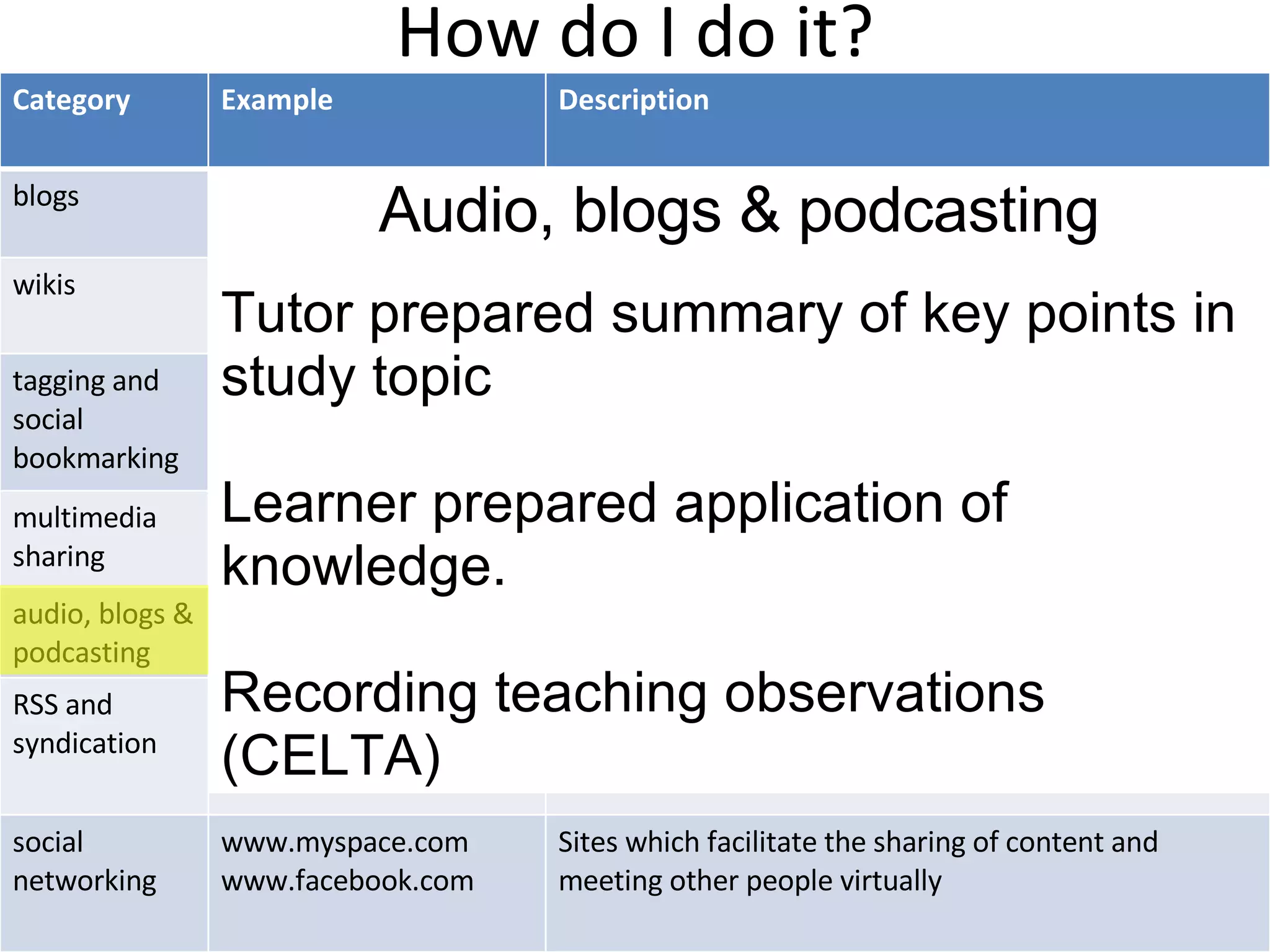
How do I do it? Audio, blogs & podcasting Tutor prepared summary of key points in study topic Learner prepared application of knowledge. Recording teaching observations (CELTA) Category Example Description blogs www.blogger.com An online journal wikis www.wikipedia.org Web page or set of web pages that can be easily edited or added to tagging and social bookmarking del.icio.us www.stumbleupon.com Systems for finding and sharing things on the web like your ‘favourites’ multimedia sharing www.youtube.com www.flickr.com Store and share multimedia content e.g. video and photographs audio, blogs & podcasting www.impala.ac.uk www.ricksteves.com Audio & video recordings designed to be heard on a computer or MP3 player RSS and syndication www.bbc.co.uk Really Simple Syndication – a system for bringing newly published web content to your desktop social networking www.myspace.com www.facebook.com Sites which facilitate the sharing of content and meeting other people virtually
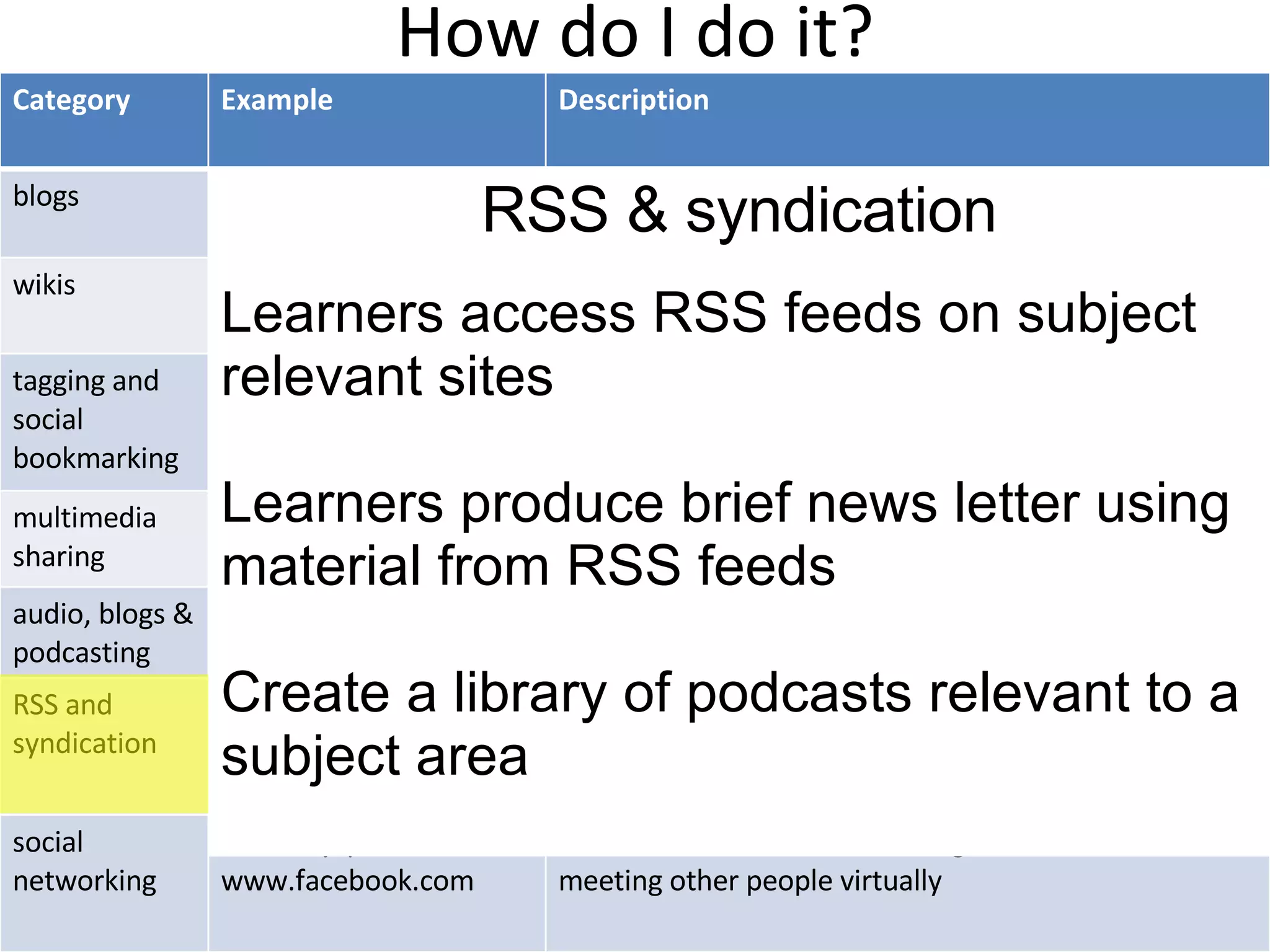
How do I do it? RSS & syndication Learners access RSS feeds on subject relevant sites Learners produce brief news letter using material from RSS feeds Create a library of podcasts relevant to a subject area Category Example Description blogs www.blogger.com An online journal wikis www.wikipedia.org Web page or set of web pages that can be easily edited or added to tagging and social bookmarking del.icio.us www.stumbleupon.com Systems for finding and sharing things on the web like your ‘favourites’ multimedia sharing www.youtube.com www.flickr.com Store and share multimedia content e.g. video and photographs audio, blogs & podcasting www.impala.ac.uk www.ricksteves.com Audio & video recordings designed to be heard on a computer or MP3 player RSS and syndication www.bbc.co.uk Really Simple Syndication – a system for bringing newly published web content to your desktop social networking www.myspace.com www.facebook.com Sites which facilitate the sharing of content and meeting other people virtually
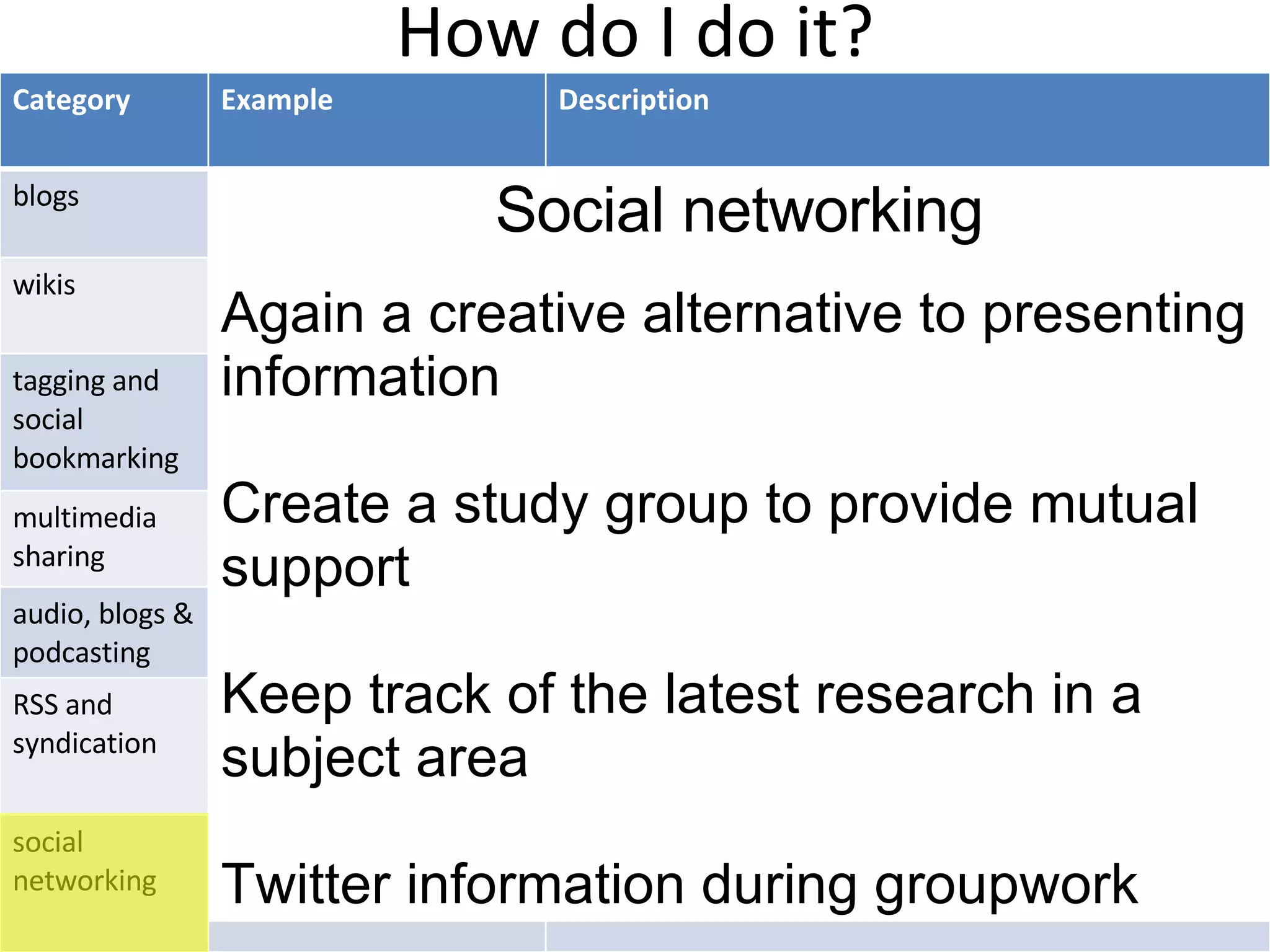
How do I do it? Social networking Again a creative alternative to presenting information Create a study group to provide mutual support Keep track of the latest research in a subject area Twitter information during groupwork Category Example Description blogs www.blogger.com An online journal wikis www.wikipedia.org Web page or set of web pages that can be easily edited or added to tagging and social bookmarking del.icio.us www.stumbleupon.com Systems for finding and sharing things on the web like your ‘favourites’ multimedia sharing www.youtube.com www.flickr.com Store and share multimedia content e.g. video and photographs audio, blogs & podcasting www.impala.ac.uk www.ricksteves.com Audio & video recordings designed to be heard on a computer or MP3 player RSS and syndication www.bbc.co.uk Really Simple Syndication – a system for bringing newly published web content to your desktop social networking www.myspace.com www.facebook.com Sites which facilitate the sharing of content and meeting other people virtually
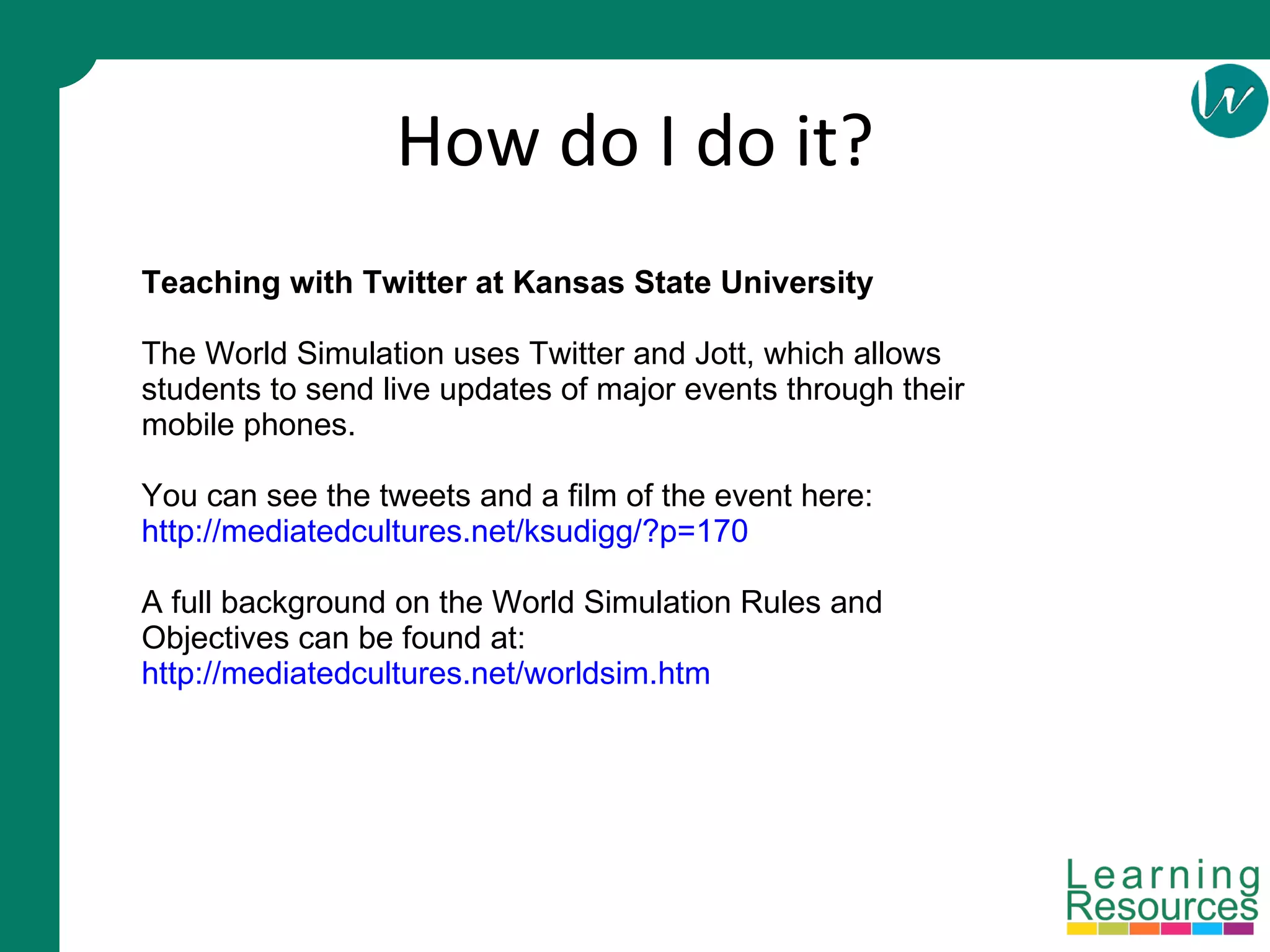
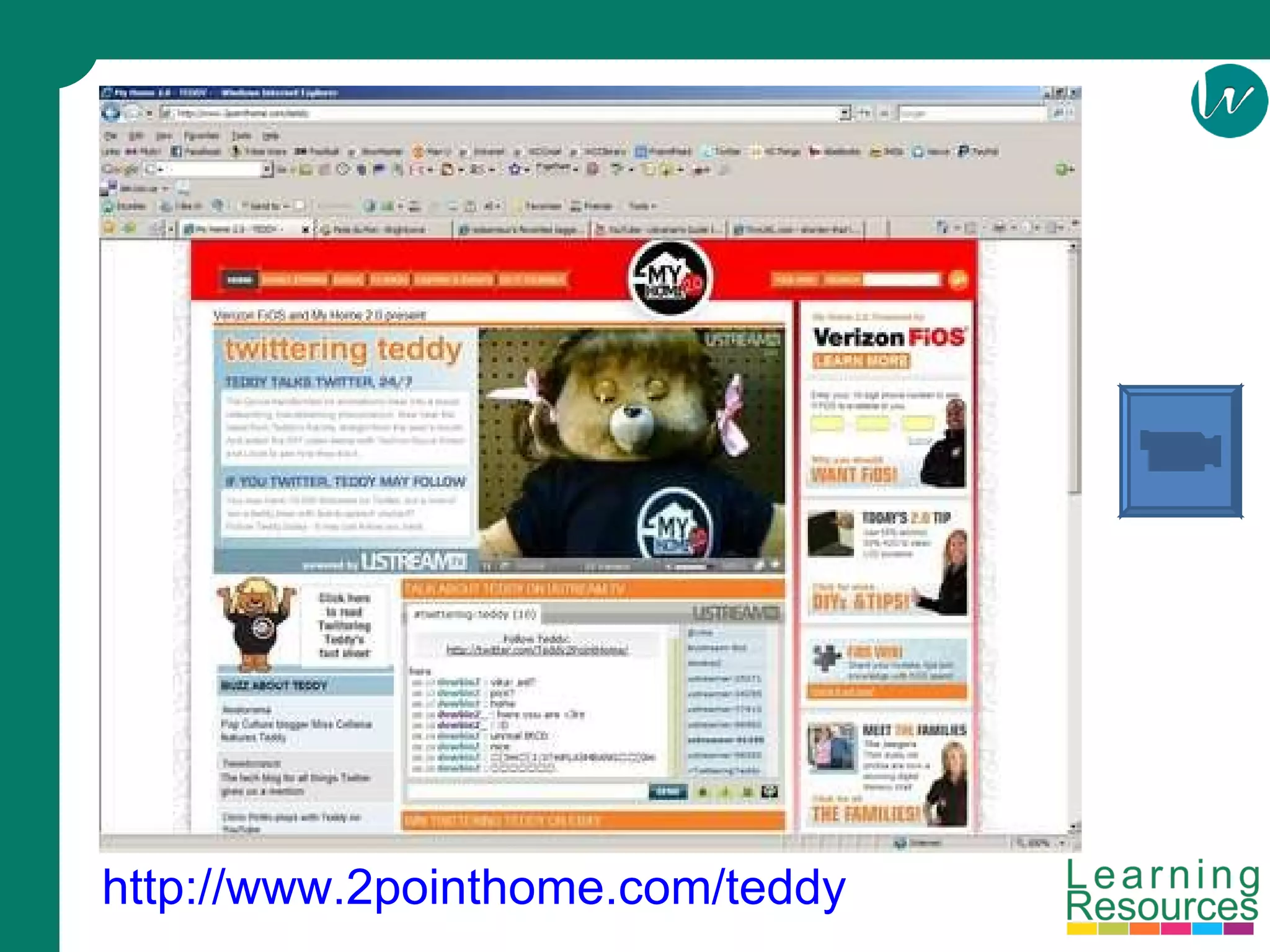
How do I do it? Teaching with Twitter at Kansas State University The World Simulation uses Twitter and Jott, which allows students to send live updates of major events through their mobile phones. You can see the tweets and a film of the event here:  http://mediatedcultures.net/ksudigg/?p=170 A full background on the World Simulation Rules and Objectives can be found at: http://mediatedcultures.net/worldsim.htm
http://www.2pointhome.com/teddy
Do- make a session plan Use the session planners provided Working in groups plan a session that is designed to support learners Use at least two web 2.0 applications Feed back to the rest of the group
Anthony Beal 01244 670578 [email_address] skype: anthony.beal Del.icio.us:  http://del.icio.us/redsontour Facebook:  [email_address] Flickr:  http://www.flickr.com/redsontour/ FriendFeed:  http://friendfeed.com/redsontour Librarything:  www.librarything.com/profile/redsontour Stumbled upon:  http://redsontour.stumbleupon.com/ Twitter:  http://twitter.com/redsontour   YouTube:  www.youtube.com Thanks to:  Teaching with e-learning in the lifelong learning sector . Chris Hill, Learning Matters, 2008. Del.icio.us  for this workshop:  http://tinyurl.com/6btbnc

CoFHE / UC&R workshop - Web 2.0 - Now that's what I call a session plan

  • 1.
    Now that’s whatI call a session plan... taking Web 2.0 to the next level Anthony Beal Tuesday 24th June 2008 Fourth Joint CoFHE and UC&R Conference Liverpool Hope University
  • 2.
    Where? What? Why? How? Plan
  • 3.
    Future Thinking “Those in the vanguard of technical developments are already signalling the ‘Death of the VLE’ (Stiles 2007) and heralding a new set of approaches based on a different pedagogic outlook and on the underlying technologies and social and collaborative tools that are collectively labelled the Web 2.0 phenomenon.” (Jisc Infonet – Exploring Tangible benefits of e-learning)
  • 4.
    Where did wecome from? Thanks to Copacetic - http://joedrumgoole.com/blog/2006/05/29/web-20-vs-web-10/ Web 1.0 Web 2.0 was about reading is about writing was about companies is about communities was about home pages is about blogs was about portals is about RSS was about taxonomy is about tags was about wires is about wireless was about owning is about sharing was about AltaVista is about Google was about web forms is about web applications was about Encarta is about Wikipedia was about expert created data is about user created data
  • 5.
    What is Web2.0? Category Example Description blogs www.blogger.com An online journal wikis www.wikipedia.org Web page or set of web pages that can be easily edited or added to tagging and social bookmarking del.icio.us www.stumbleupon.com Systems for finding and sharing things on the web like your ‘favourites’. Sites are evaluated by the wider web audience by review and citation multimedia sharing www.youtube.com www.flickr.com Store and share multimedia content e.g. video and photographs audio, blogs & podcasting www.impala.ac.uk www.ricksteves.com Audio & video recordings designed to be heard on a computer or MP3 player RSS and syndication www.bbc.co.uk Really Simple Syndication – a system for bringing newly published web content to your desktop social networking www.myspace.com www.facebook.com www.twitter.com Sites which facilitate the sharing of content and meeting other people virtually
  • 6.
    Why bother? Learnerswant it Pedagogy 2.0 Tensions between innovation and control © Mark Stiles – Staffordshire University – Facebook Group Fresh ideas More friendly space for learning
  • 7.
    Fresh Ideas TheCommonCraft Show – lots of web 2.0 applications explained in plain English http://www.commoncraft.com/show Libraries and Librarians - professional development Tongue in cheek puppet shows on YouTube to help you learn with fun from llordllama http://uk.youtube.com/view_play_list?p=2D6285151E99F565
  • 8.
    Why bother? Learnerswant it Pedagogy 2.0 Tensions between innovation and control © Mark Stiles – Staffordshire University Fresh ideas More friendly space for learning Digital Natives v Digital Immigrants Pedagogy 2.0 McLoughlin and Lee posit that future learning environments must capitalize on the potential of Web 2.0 by combining social software tools with connectivist pedagogical models. The combination produces what the authors call Pedagogy 2.0 , a model of learning in which learners are empowered to participate, learn, and create knowledge in ways that are personally meaningful and engaging. McLoughlin, C., and M. Lee. 2008. Future learning landscapes: Transforming pedagogy through social software. Innovate 4 (5). http://www.innovateonline.info/index.php?view=article&id=539
  • 9.
    How do Ido it? Blogs A diary reflecting something you are reading or on work experience The author can choose to share it with the tutor or fellow learners Progress record on solving a problem Category Example Description blogs www.blogger.com An online journal wikis www.wikipedia.org Web page or set of web pages that can be easily edited or added to tagging and social bookmarking del.icio.us www.stumbleupon.com Systems for finding and sharing things on the web like your ‘favourites’ multimedia sharing www.youtube.com www.flickr.com Store and share multimedia content e.g. video and photographs audio, blogs & podcasting www.impala.ac.uk www.ricksteves.com Audio & video recordings designed to be heard on a computer or MP3 player RSS and syndication www.bbc.co.uk Really Simple Syndication – a system for bringing newly published web content to your desktop social networking www.myspace.com www.facebook.com Sites which facilitate the sharing of content and meeting other people virtually
  • 10.
    How do Ido it? Wikis Learners share prior knowledge before starting a new topic Each learner contributes a small section they have researched to build up a whole picture Category Example Description blogs www.blogger.com An online journal wikis www.wikipedia.org Web page or set of web pages that can be easily edited or added to tagging and social bookmarking del.icio.us www.stumbleupon.com Systems for finding and sharing things on the web like your ‘favourites’ multimedia sharing www.youtube.com www.flickr.com Store and share multimedia content e.g. video and photographs audio, blogs & podcasting www.impala.ac.uk www.ricksteves.com Audio & video recordings designed to be heard on a computer or MP3 player RSS and syndication www.bbc.co.uk Really Simple Syndication – a system for bringing newly published web content to your desktop social networking www.myspace.com www.facebook.com Sites which facilitate the sharing of content and meeting other people virtually
  • 11.
    How do Ido it? Tagging & Social Bookmarking Groups of learners can share useful web sites relevant to the topic being studied Learners can build up a shared resource of revision web sites An aid to evaluating the quality of the web sites Category Example Description blogs www.blogger.com An online journal wikis www.wikipedia.org Web page or set of web pages that can be easily edited or added to tagging and social bookmarking del.icio.us www.stumbleupon.com Systems for finding and sharing things on the web like your ‘favourites’ multimedia sharing www.youtube.com www.flickr.com Store and share multimedia content e.g. video and photographs audio, blogs & podcasting www.impala.ac.uk www.ricksteves.com Audio & video recordings designed to be heard on a computer or MP3 player RSS and syndication www.bbc.co.uk Really Simple Syndication – a system for bringing newly published web content to your desktop social networking www.myspace.com www.facebook.com Sites which facilitate the sharing of content and meeting other people virtually
  • 12.
    How do Ido it? Multimedia sharing Creative alternative method of presentation. Learners can present what they know in video format A picture gallery related to study area Category Example Description blogs www.blogger.com An online journal wikis www.wikipedia.org Web page or set of web pages that can be easily edited or added to tagging and social bookmarking del.icio.us www.stumbleupon.com Systems for finding and sharing things on the web like your ‘favourites’ multimedia sharing www.youtube.com www.flickr.com Store and share multimedia content e.g. video and photographs audio, blogs & podcasting www.impala.ac.uk www.ricksteves.com Audio & video recordings designed to be heard on a computer or MP3 player RSS and syndication www.bbc.co.uk Really Simple Syndication – a system for bringing newly published web content to your desktop social networking www.myspace.com www.facebook.com Sites which facilitate the sharing of content and meeting other people virtually
  • 13.
    How do Ido it? Audio, blogs & podcasting Tutor prepared summary of key points in study topic Learner prepared application of knowledge. Recording teaching observations (CELTA) Category Example Description blogs www.blogger.com An online journal wikis www.wikipedia.org Web page or set of web pages that can be easily edited or added to tagging and social bookmarking del.icio.us www.stumbleupon.com Systems for finding and sharing things on the web like your ‘favourites’ multimedia sharing www.youtube.com www.flickr.com Store and share multimedia content e.g. video and photographs audio, blogs & podcasting www.impala.ac.uk www.ricksteves.com Audio & video recordings designed to be heard on a computer or MP3 player RSS and syndication www.bbc.co.uk Really Simple Syndication – a system for bringing newly published web content to your desktop social networking www.myspace.com www.facebook.com Sites which facilitate the sharing of content and meeting other people virtually
  • 14.
    How do Ido it? RSS & syndication Learners access RSS feeds on subject relevant sites Learners produce brief news letter using material from RSS feeds Create a library of podcasts relevant to a subject area Category Example Description blogs www.blogger.com An online journal wikis www.wikipedia.org Web page or set of web pages that can be easily edited or added to tagging and social bookmarking del.icio.us www.stumbleupon.com Systems for finding and sharing things on the web like your ‘favourites’ multimedia sharing www.youtube.com www.flickr.com Store and share multimedia content e.g. video and photographs audio, blogs & podcasting www.impala.ac.uk www.ricksteves.com Audio & video recordings designed to be heard on a computer or MP3 player RSS and syndication www.bbc.co.uk Really Simple Syndication – a system for bringing newly published web content to your desktop social networking www.myspace.com www.facebook.com Sites which facilitate the sharing of content and meeting other people virtually
  • 15.
    How do Ido it? Social networking Again a creative alternative to presenting information Create a study group to provide mutual support Keep track of the latest research in a subject area Twitter information during groupwork Category Example Description blogs www.blogger.com An online journal wikis www.wikipedia.org Web page or set of web pages that can be easily edited or added to tagging and social bookmarking del.icio.us www.stumbleupon.com Systems for finding and sharing things on the web like your ‘favourites’ multimedia sharing www.youtube.com www.flickr.com Store and share multimedia content e.g. video and photographs audio, blogs & podcasting www.impala.ac.uk www.ricksteves.com Audio & video recordings designed to be heard on a computer or MP3 player RSS and syndication www.bbc.co.uk Really Simple Syndication – a system for bringing newly published web content to your desktop social networking www.myspace.com www.facebook.com Sites which facilitate the sharing of content and meeting other people virtually
  • 16.
    How do Ido it? Teaching with Twitter at Kansas State University The World Simulation uses Twitter and Jott, which allows students to send live updates of major events through their mobile phones. You can see the tweets and a film of the event here: http://mediatedcultures.net/ksudigg/?p=170 A full background on the World Simulation Rules and Objectives can be found at: http://mediatedcultures.net/worldsim.htm
  • 17.
  • 18.
    Do- make asession plan Use the session planners provided Working in groups plan a session that is designed to support learners Use at least two web 2.0 applications Feed back to the rest of the group
  • 19.
    Anthony Beal 01244670578 [email_address] skype: anthony.beal Del.icio.us: http://del.icio.us/redsontour Facebook: [email_address] Flickr: http://www.flickr.com/redsontour/ FriendFeed: http://friendfeed.com/redsontour Librarything: www.librarything.com/profile/redsontour Stumbled upon: http://redsontour.stumbleupon.com/ Twitter: http://twitter.com/redsontour YouTube: www.youtube.com Thanks to: Teaching with e-learning in the lifelong learning sector . Chris Hill, Learning Matters, 2008. Del.icio.us for this workshop: http://tinyurl.com/6btbnc