Planning Needs Some Planning. Gareth Kay Head of Planning, Modernista! Conferência de Planejamento do GP 2008
 
My contention: Advertising, primarily due to the failure of planning, is complacently coasting into irrelevance.  We need to fix it.  Quickly.
 
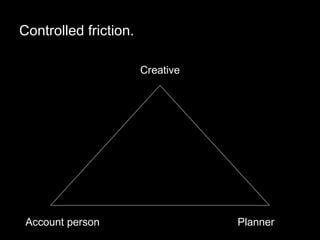
Controlled friction. Creative Account person  Planner
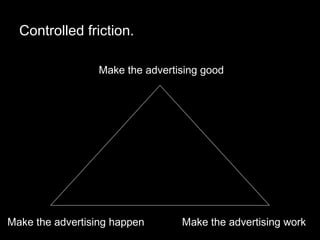
Controlled friction. Make the advertising good Make the advertising happen  Make the advertising work
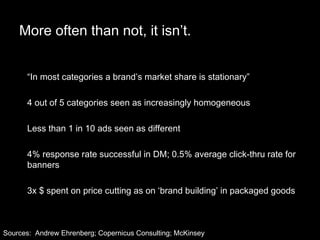
More often than not, it isn’t. “ In most categories a brand’s market share is stationary” 4 out of 5 categories seen as increasingly homogeneous Less than 1 in 10 ads seen as different 4% response rate successful in DM; 0.5% average click-thru rate for banners 3x $ spent on price cutting as on ‘brand building’ in packaged goods Sources:  Andrew Ehrenberg; Copernicus Consulting; McKinsey
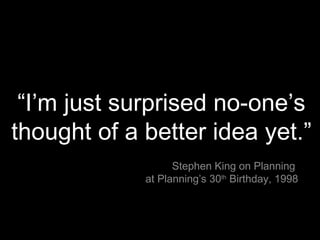
“ I’m just surprised no-one’s thought of a better idea yet.” Stephen King on Planning  at Planning’s 30 th  Birthday, 1998
It’s time to  be radical.
3 big problems.
1.  We’re operating in the wrong business.
Consumer. Brand. Business.
Culture.
 
 
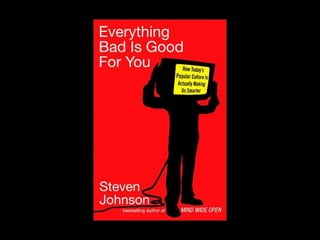
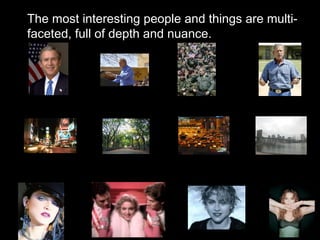
The most interesting people and things are multi-faceted, full of depth and nuance.
 
2.  Lost in translation.
 
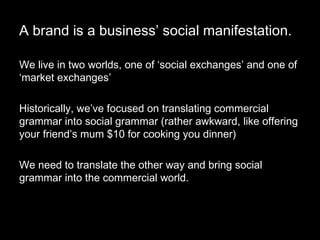
A brand is a business’ social manifestation. We live in two worlds, one of ‘social exchanges’ and one of ‘market exchanges’ Historically, we’ve focused on translating commercial grammar into social grammar (rather awkward, like offering your friend’s mum $10 for cooking you dinner) We need to translate the other way and bring social grammar into the commercial world.
 
 
3.  The pursuit of  the wrong objectives.
The usual objectives are wrong. Awareness doesn’t really matter in a world of overchoice Attributes and attitudes, adjusted for brand size,  don’t change Image doesn’t shift until after behavior  Source:  Andrew Ehrenberg
It’s energy that matters. The active or moving force of a brand A leading indicator of usage and preference Justifies a higher price  Adds an incremental 64% to brand value than sales growth alone  Source:  Y&R Brand Asset Valuator
Source: “The Brand Bubble”, John Gerzema
Energy drives conversations. A fourfold increase  in conversation drives double the revenue. Source:  London School of Economics 2007.
This means planning for a different outcome. Have a point of view on the world, not a position in the category.
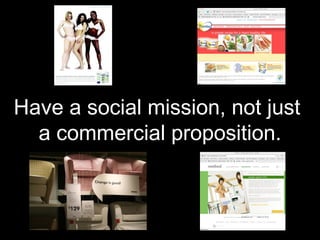
Have a social mission, not just  a commercial proposition.
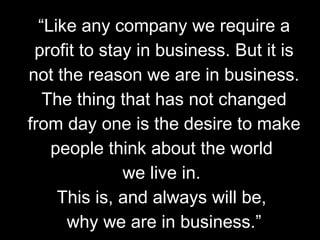
“ Like any company we require a profit to stay in business. But it is not the reason we are in business. The thing that has not changed from day one is the desire to make people think about the world  we live in.  This is, and always will be,  why we are in business.”


Photo: Andrew Hovells  (aka Northern Planner)
It’s not about social media. It’s about social ideas  and unsocial ideas.
Have a point of view on the world, not a position in the category.  Understand what people are interested in and work back from there. This means planning for a different outcome.
“ Nobody reads advertising.  People read what they want to read and sometimes it's an ad .” Howard Gossage “ Often our biggest mistake as managers is believing that, in general, customers care  a lot about your brand.  They do not.” Patrick Barwise
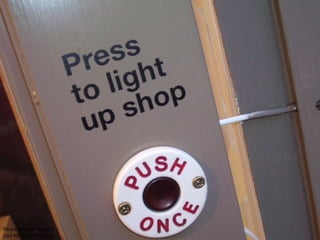
 
 
Have a point of view on the world, not a position in the category.  Understand what people are interested in and work back from there. Be additive not interruptive. This means planning for a different outcome.
 
Have a point of view on the world, not a position in the category.  Understand what people are interested in and work back from there. Be additive not interruptive. Interaction, not integration, is what matters. This means planning for a different outcome.
 
 
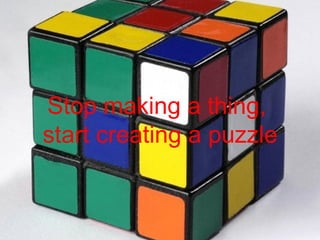
Stop making a thing,  start creating a puzzle
 
 
Have a point of view on the world, not a position in the category.  Understand what people are interested in and work back from there. Be additive not interruptive. Interaction, not integration, is what matters. Do stuff. This means planning for a different outcome.


Have a point of view on the world, not a position in the category.  Understand what people are interested in and work back from there. Be additive not interruptive. Interaction, not integration, is what matters. Do stuff.  Lots of it. This means planning for a different outcome.
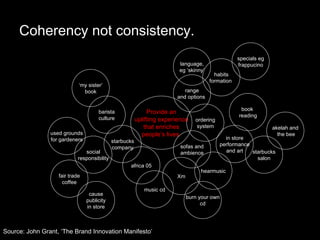
Coherency not consistency. Provide an uplifting experience that enriches people’s lives  Source: John Grant, ‘The Brand Innovation Manifesto’ language, eg ‘skinny’ specials eg  frappucino  habits formation  range and options  ordering system starbucks company barista culture ‘ my sister’ book africa 05 social responsibility used grounds for gardeners fair trade coffee cause publicity in store sofas and ambience hearmusic Xm burn your own cd music cd in store performance and art book  reading starbucks salon akelah and  the bee
It’s about understanding distributed identity. Organize the  world’s information  and make it  universally  accessible and  useful. Google  Search Google  411 Google  Docs Google labs Google Shopping Google  Scholar Google  Books Google Maps Google  sketch Google.Org Fossil fuel  Challenge Youtube Chrome  Browser Blogspot
“ Any idea is dangerous if it’s a person’s only idea”* A culture full of depth and complexity The rule of the 5% requires lots of matches to start a fire Why not when the economics have changed? *  George Will’s take on the American idea, Atlantic Monthly, November 2007
DO. Learn.
The only big idea is not  to forget the little ones along the way.
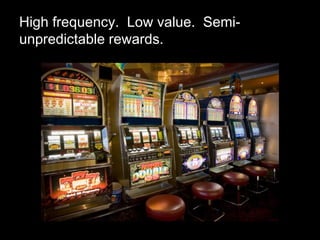
High frequency.  Low value.  Semi-unpredictable rewards.
 
Thank you Ed and Influx Insights for spotting this
 
 
This could be the most exciting time to be a planner and to be in this industry. Let’s seize it.
The future of advertising isn’t messaging. It’s in ideas that solve business problems in a culturally positive way.
Obrigado http://www.garethkay.com http://www.modernista.com

Planning Needs Some Planning

  • 1.
    Planning Needs SomePlanning. Gareth Kay Head of Planning, Modernista! Conferência de Planejamento do GP 2008
  • 2.
  • 3.
    My contention: Advertising,primarily due to the failure of planning, is complacently coasting into irrelevance. We need to fix it. Quickly.
  • 4.
  • 5.
    Controlled friction. CreativeAccount person Planner
  • 6.
    Controlled friction. Makethe advertising good Make the advertising happen Make the advertising work
  • 7.
    More often thannot, it isn’t. “ In most categories a brand’s market share is stationary” 4 out of 5 categories seen as increasingly homogeneous Less than 1 in 10 ads seen as different 4% response rate successful in DM; 0.5% average click-thru rate for banners 3x $ spent on price cutting as on ‘brand building’ in packaged goods Sources: Andrew Ehrenberg; Copernicus Consulting; McKinsey
  • 8.
    “ I’m justsurprised no-one’s thought of a better idea yet.” Stephen King on Planning at Planning’s 30 th Birthday, 1998
  • 9.
    It’s time to be radical.
  • 10.
  • 11.
    1. We’reoperating in the wrong business.
  • 12.
  • 13.
  • 14.
  • 15.
  • 16.
    The most interestingpeople and things are multi-faceted, full of depth and nuance.
  • 17.
  • 18.
    2. Lostin translation.
  • 19.
  • 20.
    A brand isa business’ social manifestation. We live in two worlds, one of ‘social exchanges’ and one of ‘market exchanges’ Historically, we’ve focused on translating commercial grammar into social grammar (rather awkward, like offering your friend’s mum $10 for cooking you dinner) We need to translate the other way and bring social grammar into the commercial world.
  • 21.
  • 22.
  • 23.
    3. Thepursuit of the wrong objectives.
  • 24.
    The usual objectivesare wrong. Awareness doesn’t really matter in a world of overchoice Attributes and attitudes, adjusted for brand size, don’t change Image doesn’t shift until after behavior Source: Andrew Ehrenberg
  • 25.
    It’s energy thatmatters. The active or moving force of a brand A leading indicator of usage and preference Justifies a higher price Adds an incremental 64% to brand value than sales growth alone Source: Y&R Brand Asset Valuator
  • 26.
    Source: “The BrandBubble”, John Gerzema
  • 27.
    Energy drives conversations.A fourfold increase in conversation drives double the revenue. Source: London School of Economics 2007.
  • 28.
    This means planningfor a different outcome. Have a point of view on the world, not a position in the category.
  • 29.
    Have a socialmission, not just a commercial proposition.
  • 30.
    “ Like anycompany we require a profit to stay in business. But it is not the reason we are in business. The thing that has not changed from day one is the desire to make people think about the world we live in. This is, and always will be, why we are in business.”
  • 31.
  • 32.
  • 33.
  • 34.
    Photo: Andrew Hovells (aka Northern Planner)
  • 35.
    Photo: Andrew Hovells (aka Northern Planner)
  • 36.
    It’s not aboutsocial media. It’s about social ideas and unsocial ideas.
  • 37.
    Have a pointof view on the world, not a position in the category. Understand what people are interested in and work back from there. This means planning for a different outcome.
  • 38.
    “ Nobody readsadvertising. People read what they want to read and sometimes it's an ad .” Howard Gossage “ Often our biggest mistake as managers is believing that, in general, customers care a lot about your brand. They do not.” Patrick Barwise
  • 39.
  • 40.
  • 41.
    Have a pointof view on the world, not a position in the category. Understand what people are interested in and work back from there. Be additive not interruptive. This means planning for a different outcome.
  • 42.
  • 43.
    Have a pointof view on the world, not a position in the category. Understand what people are interested in and work back from there. Be additive not interruptive. Interaction, not integration, is what matters. This means planning for a different outcome.
  • 44.
  • 45.
  • 46.
    Stop making athing, start creating a puzzle
  • 47.
  • 48.
  • 49.
    Have a pointof view on the world, not a position in the category. Understand what people are interested in and work back from there. Be additive not interruptive. Interaction, not integration, is what matters. Do stuff. This means planning for a different outcome.
  • 50.
  • 51.
  • 52.
  • 53.
  • 54.
    Have a pointof view on the world, not a position in the category. Understand what people are interested in and work back from there. Be additive not interruptive. Interaction, not integration, is what matters. Do stuff. Lots of it. This means planning for a different outcome.
  • 55.
    Coherency not consistency.Provide an uplifting experience that enriches people’s lives Source: John Grant, ‘The Brand Innovation Manifesto’ language, eg ‘skinny’ specials eg frappucino habits formation range and options ordering system starbucks company barista culture ‘ my sister’ book africa 05 social responsibility used grounds for gardeners fair trade coffee cause publicity in store sofas and ambience hearmusic Xm burn your own cd music cd in store performance and art book reading starbucks salon akelah and the bee
  • 56.
    It’s about understandingdistributed identity. Organize the world’s information and make it universally accessible and useful. Google Search Google 411 Google Docs Google labs Google Shopping Google Scholar Google Books Google Maps Google sketch Google.Org Fossil fuel Challenge Youtube Chrome Browser Blogspot
  • 57.
    “ Any ideais dangerous if it’s a person’s only idea”* A culture full of depth and complexity The rule of the 5% requires lots of matches to start a fire Why not when the economics have changed? * George Will’s take on the American idea, Atlantic Monthly, November 2007
  • 58.
  • 59.
    The only bigidea is not to forget the little ones along the way.
  • 60.
    High frequency. Low value. Semi-unpredictable rewards.
  • 61.
  • 62.
    Thank you Edand Influx Insights for spotting this
  • 63.
  • 64.
  • 65.
    This could bethe most exciting time to be a planner and to be in this industry. Let’s seize it.
  • 66.
    The future ofadvertising isn’t messaging. It’s in ideas that solve business problems in a culturally positive way.
  • 67.