December 2017
CPT Implementation Toolkit
Executive Summary
Copyright ©2017 TransCelerate BioPharma Inc., All rights reserved. * Confidential - NOT FOR DISTRIBUTION *
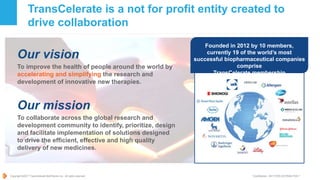
TransCelerate is a not for profit entity created to
drive collaboration
Our vision
To improve the health of people around the world by
accelerating and simplifying the research and
development of innovative new therapies.
Our mission
To collaborate across the global research and
development community to identify, prioritize, design
and facilitate implementation of solutions designed
to drive the efficient, effective and high quality
delivery of new medicines.
Founded in 2012 by 10 members,
currently 19 of the world’s most
successful biopharmaceutical companies
comprise
TransCelerate membership
Copyright ©2017 TransCelerate BioPharma Inc., All rights reserved. * Confidential - NOT FOR DISTRIBUTION *
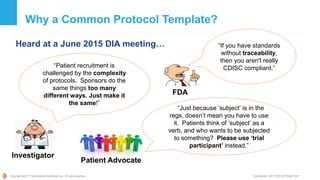
Why a Common Protocol Template?
Heard at a June 2015 DIA meeting…
“Patient recruitment is
challenged by the complexity
of protocols. Sponsors do the
same things too many
different ways. Just make it
the same!”
“If you have standards
without traceability,
then you aren't really
CDISC compliant.”
Investigator
FDA
“Just because ‘subject’ is in the
regs, doesn’t mean you have to use
it. Patients think of ‘subject’ as a
verb, and who wants to be subjected
to something? Please use ‘trial
participant’ instead.”
Patient Advocate
Copyright ©2017 TransCelerate BioPharma Inc., All rights reserved. * Confidential - NOT FOR DISTRIBUTION *
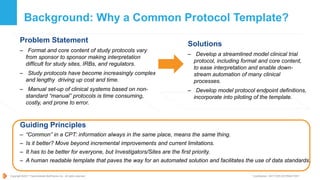
Problem Statement
– Format and core content of study protocols vary
from sponsor to sponsor making interpretation
difficult for study sites, IRBs, and regulators.
– Study protocols have become increasingly complex
and lengthy driving up cost and time.
– Manual set-up of clinical systems based on non-
standard “manual” protocols is time consuming,
costly, and prone to error.
Solutions
– Develop a streamlined model clinical trial
protocol, including format and core content,
to ease interpretation and enable down-
stream automation of many clinical
processes.
– Develop model protocol endpoint definitions,
incorporate into piloting of the template.
Background: Why a Common Protocol Template?
Guiding Principles
– “Common” in a CPT: information always in the same place, means the same thing.
– Is it better? Move beyond incremental improvements and current limitations.
– It has to be better for everyone, but Investigators/Sites are the first priority.
– A human readable template that paves the way for an automated solution and facilitates the use of data standards.
Copyright ©2017 TransCelerate BioPharma Inc., All rights reserved. * Confidential - NOT FOR DISTRIBUTION *
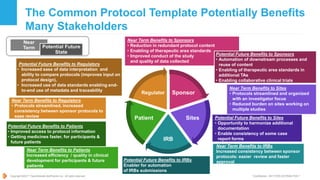
Near Term Benefits to Sites
• Protocols streamlined and organized
with an investigator focus
• Reduced burden on sites working on
multiple studies
The Common Protocol Template Potentially Benefits
Many Stakeholders
Sponsor
Sites
IRB
Patient
Regulator
Near Term Benefits to Sponsors
• Reduction in redundant protocol content
• Enabling of therapeutic area standards
• Improved conduct of the study
and quality of data collected
Potential Future Benefits to Sponsors
• Automation of downstream processes and
reuse of content
• Enabling of therapeutic area standards in
additional TAs
• Enabling collaborative clinical trials
Potential Future Benefits to Sites
• Opportunity to harmonize additional
documentation
• Enable consistency of some case
report forms
Near Term Benefits to IRBs
Increased consistency between sponsor
protocols: easier review and faster
approvalPotential Future Benefits to IRBs
Enabler for automation
of IRBs submissions
Near Term Benefits to Patients
Increased efficiency / quality in clinical
development for participants & future
patients
Potential Future Benefits to Patients
• Improved access to protocol information
• Getting medicines faster, for participants &
future patients
Near Term Benefits to Regulators
• Protocols streamlined, increased
consistency between sponsor protocols to
ease review
Potential Future Benefits to Regulators
• Increased ease of data interpretation and
ability to compare protocols (improves input on
protocol design),
• Increased use of data standards enabling end-
to-end use of metadata and traceability
Near
Term Potential Future
State
Copyright ©2017 TransCelerate BioPharma Inc., All rights reserved. * Confidential - NOT FOR DISTRIBUTION *
• A common protocol template structure with
harmonized language
• Streamlined content enables identification of
critical information for end users
• Begin working towards model endpoint
definitions to align with Clinical Data Interchange
Standards Consortium (CDISC) Therapeutic
Area (TA) data standards. Asthma and Diabetes
available in the first release.
• Reconnect processes (protocol, eCRF,
development)
• Transformation of the design process
o Analytics-driven trial design, modelling, scenario
planning
• Role-based access to protocol
information (Principal Investigator [PI], Ethics,
Participants)
• Connection to other systems
Common Protocol Template is Intended to Prepare
for the Future State
Human-
Readable
Protocol
IRB/IECs
Sites
Regulators
Foundation
Machine-
Readable
Protocol
Metadata driven
processes
Content Reuse
Disclosure
SAP
CSR
eCRF
Statistical Output
Future
Copyright ©2017 TransCelerate BioPharma Inc., All rights reserved. * Confidential - NOT FOR DISTRIBUTION *
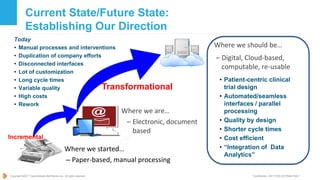
Current State/Future State:
Establishing Our Direction
Where we started…
– Paper-based, manual processing
Where we are…
– Electronic, document
based
Where we should be…
– Digital, Cloud-based,
computable, re-usable
Today
• Manual processes and interventions
• Duplication of company efforts
• Disconnected interfaces
• Lot of customization
• Long cycle times
• Variable quality
• High costs
• Rework
• Patient-centric clinical
trial design
• Automated/seamless
interfaces / parallel
processing
• Quality by design
• Shorter cycle times
• Cost efficient
• “Integration of Data
Analytics”
Incremental
Transformational
Copyright ©2017 TransCelerate BioPharma Inc., All rights reserved. * Confidential - NOT FOR DISTRIBUTION *
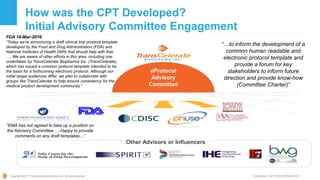
eProtocol
Advisory
Committee
“…to inform the development of a
common human readable and
electronic protocol template and
provide a forum for key
stakeholders to inform future
direction and provide know-how
(Committee Charter)”
“EMA has not agreed to take up a position on
the Advisory Committee…..Happy to provide
comments on any draft templates…”
Other Advisors or Influencers
FDA 18-Mar-2016:
“Today we’re announcing a draft clinical trial protocol template
developed by the Food and Drug Administration (FDA) and
National Institutes of Health (NIH) that should help with that.
…..We are aware of other efforts in this area, including one
undertaken by TransCelerate Biopharma Inc. (TransCelerate),
which has issued a common protocol template intended to be
the basis for a forthcoming electronic protocol. Although our
initial target audiences differ, we plan to collaborate with
groups like TransCelerate to help ensure consistency for the
medical product development community.”
How was the CPT Developed?
Initial Advisory Committee Engagement
Copyright ©2017 TransCelerate BioPharma Inc., All rights reserved. * Confidential - NOT FOR DISTRIBUTION *
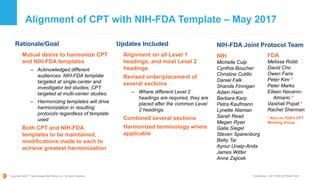
Rationale/Goal
Mutual desire to harmonize CPT
and NIH-FDA templates
– Acknowledged different
audiences: NIH-FDA template
targeted at single-center and
investigator led studies; CPT
targeted at multi-center studies.
– Harmonizing templates will drive
harmonization in resulting
protocols regardless of template
used
Both CPT and NIH-FDA
templates to be maintained,
modifications made to each to
achieve greatest harmonization
Updates Included
Alignment on all Level 1
headings, and most Level 2
headings
Revised order/placement of
several sections
– Where different Level 2
headings are required, they are
placed after the common Level
2 headings.
Combined several sections
Harmonized terminology where
applicable
Alignment of CPT with NIH-FDA Template – May 2017
NIH-FDA Joint Protocol Team
NIH
Michelle Culp
Cynthia Boucher
Christine Cutillo
Daniel Falk
Shanda Finnigan
Adam Haim
Barbara Karp
Petra Kaufmann
Lynette Nieman
Sarah Read
Megan Ryan
Galia Siegel
Steven Sparenborg
Betty Tai
Aynur Unalp-Arida
James Witter
Anne Zajicek
FDA
Melissa Robb
David Cho
Owen Faris
Peter Kim *
Peter Marks
Eileen Navarro-
Almario *
Vaishali Popat *
Rachel Sherman
* Also on FDA’s CPT
Working Group
Copyright ©2017 TransCelerate BioPharma Inc., All rights reserved. * Confidential - NOT FOR DISTRIBUTION *
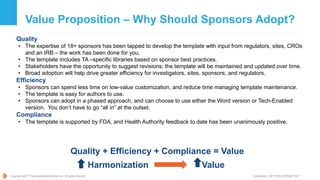
Value Proposition – Why Should Sponsors Adopt?
Quality
• The expertise of 18+ sponsors has been tapped to develop the template with input from regulators, sites, CROs
and an IRB – the work has been done for you.
• The template includes TA –specific libraries based on sponsor best practices.
• Stakeholders have the opportunity to suggest revisions; the template will be maintained and updated over time.
• Broad adoption will help drive greater efficiency for investigators, sites, sponsors, and regulators.
Efficiency
• Sponsors can spend less time on low-value customization, and reduce time managing template maintenance.
• The template is easy for authors to use.
• Sponsors can adopt in a phased approach, and can choose to use either the Word version or Tech-Enabled
version. You don’t have to go “all in” at the outset.
Compliance
• The template is supported by FDA, and Health Authority feedback to date has been unanimously positive.
Quality + Efficiency + Compliance = Value
Harmonization Value
Thank you

Common Protocol Template (CPT) Initiative - Implementation Toolkit Executive Summary

  • 1.
    December 2017 CPT ImplementationToolkit Executive Summary
  • 2.
    Copyright ©2017 TransCelerateBioPharma Inc., All rights reserved. * Confidential - NOT FOR DISTRIBUTION * TransCelerate is a not for profit entity created to drive collaboration Our vision To improve the health of people around the world by accelerating and simplifying the research and development of innovative new therapies. Our mission To collaborate across the global research and development community to identify, prioritize, design and facilitate implementation of solutions designed to drive the efficient, effective and high quality delivery of new medicines. Founded in 2012 by 10 members, currently 19 of the world’s most successful biopharmaceutical companies comprise TransCelerate membership
  • 3.
    Copyright ©2017 TransCelerateBioPharma Inc., All rights reserved. * Confidential - NOT FOR DISTRIBUTION * Why a Common Protocol Template? Heard at a June 2015 DIA meeting… “Patient recruitment is challenged by the complexity of protocols. Sponsors do the same things too many different ways. Just make it the same!” “If you have standards without traceability, then you aren't really CDISC compliant.” Investigator FDA “Just because ‘subject’ is in the regs, doesn’t mean you have to use it. Patients think of ‘subject’ as a verb, and who wants to be subjected to something? Please use ‘trial participant’ instead.” Patient Advocate
  • 4.
    Copyright ©2017 TransCelerateBioPharma Inc., All rights reserved. * Confidential - NOT FOR DISTRIBUTION * Problem Statement – Format and core content of study protocols vary from sponsor to sponsor making interpretation difficult for study sites, IRBs, and regulators. – Study protocols have become increasingly complex and lengthy driving up cost and time. – Manual set-up of clinical systems based on non- standard “manual” protocols is time consuming, costly, and prone to error. Solutions – Develop a streamlined model clinical trial protocol, including format and core content, to ease interpretation and enable down- stream automation of many clinical processes. – Develop model protocol endpoint definitions, incorporate into piloting of the template. Background: Why a Common Protocol Template? Guiding Principles – “Common” in a CPT: information always in the same place, means the same thing. – Is it better? Move beyond incremental improvements and current limitations. – It has to be better for everyone, but Investigators/Sites are the first priority. – A human readable template that paves the way for an automated solution and facilitates the use of data standards.
  • 5.
    Copyright ©2017 TransCelerateBioPharma Inc., All rights reserved. * Confidential - NOT FOR DISTRIBUTION * Near Term Benefits to Sites • Protocols streamlined and organized with an investigator focus • Reduced burden on sites working on multiple studies The Common Protocol Template Potentially Benefits Many Stakeholders Sponsor Sites IRB Patient Regulator Near Term Benefits to Sponsors • Reduction in redundant protocol content • Enabling of therapeutic area standards • Improved conduct of the study and quality of data collected Potential Future Benefits to Sponsors • Automation of downstream processes and reuse of content • Enabling of therapeutic area standards in additional TAs • Enabling collaborative clinical trials Potential Future Benefits to Sites • Opportunity to harmonize additional documentation • Enable consistency of some case report forms Near Term Benefits to IRBs Increased consistency between sponsor protocols: easier review and faster approvalPotential Future Benefits to IRBs Enabler for automation of IRBs submissions Near Term Benefits to Patients Increased efficiency / quality in clinical development for participants & future patients Potential Future Benefits to Patients • Improved access to protocol information • Getting medicines faster, for participants & future patients Near Term Benefits to Regulators • Protocols streamlined, increased consistency between sponsor protocols to ease review Potential Future Benefits to Regulators • Increased ease of data interpretation and ability to compare protocols (improves input on protocol design), • Increased use of data standards enabling end- to-end use of metadata and traceability Near Term Potential Future State
  • 6.
    Copyright ©2017 TransCelerateBioPharma Inc., All rights reserved. * Confidential - NOT FOR DISTRIBUTION * • A common protocol template structure with harmonized language • Streamlined content enables identification of critical information for end users • Begin working towards model endpoint definitions to align with Clinical Data Interchange Standards Consortium (CDISC) Therapeutic Area (TA) data standards. Asthma and Diabetes available in the first release. • Reconnect processes (protocol, eCRF, development) • Transformation of the design process o Analytics-driven trial design, modelling, scenario planning • Role-based access to protocol information (Principal Investigator [PI], Ethics, Participants) • Connection to other systems Common Protocol Template is Intended to Prepare for the Future State Human- Readable Protocol IRB/IECs Sites Regulators Foundation Machine- Readable Protocol Metadata driven processes Content Reuse Disclosure SAP CSR eCRF Statistical Output Future
  • 7.
    Copyright ©2017 TransCelerateBioPharma Inc., All rights reserved. * Confidential - NOT FOR DISTRIBUTION * Current State/Future State: Establishing Our Direction Where we started… – Paper-based, manual processing Where we are… – Electronic, document based Where we should be… – Digital, Cloud-based, computable, re-usable Today • Manual processes and interventions • Duplication of company efforts • Disconnected interfaces • Lot of customization • Long cycle times • Variable quality • High costs • Rework • Patient-centric clinical trial design • Automated/seamless interfaces / parallel processing • Quality by design • Shorter cycle times • Cost efficient • “Integration of Data Analytics” Incremental Transformational
  • 8.
    Copyright ©2017 TransCelerateBioPharma Inc., All rights reserved. * Confidential - NOT FOR DISTRIBUTION * eProtocol Advisory Committee “…to inform the development of a common human readable and electronic protocol template and provide a forum for key stakeholders to inform future direction and provide know-how (Committee Charter)” “EMA has not agreed to take up a position on the Advisory Committee…..Happy to provide comments on any draft templates…” Other Advisors or Influencers FDA 18-Mar-2016: “Today we’re announcing a draft clinical trial protocol template developed by the Food and Drug Administration (FDA) and National Institutes of Health (NIH) that should help with that. …..We are aware of other efforts in this area, including one undertaken by TransCelerate Biopharma Inc. (TransCelerate), which has issued a common protocol template intended to be the basis for a forthcoming electronic protocol. Although our initial target audiences differ, we plan to collaborate with groups like TransCelerate to help ensure consistency for the medical product development community.” How was the CPT Developed? Initial Advisory Committee Engagement
  • 9.
    Copyright ©2017 TransCelerateBioPharma Inc., All rights reserved. * Confidential - NOT FOR DISTRIBUTION * Rationale/Goal Mutual desire to harmonize CPT and NIH-FDA templates – Acknowledged different audiences: NIH-FDA template targeted at single-center and investigator led studies; CPT targeted at multi-center studies. – Harmonizing templates will drive harmonization in resulting protocols regardless of template used Both CPT and NIH-FDA templates to be maintained, modifications made to each to achieve greatest harmonization Updates Included Alignment on all Level 1 headings, and most Level 2 headings Revised order/placement of several sections – Where different Level 2 headings are required, they are placed after the common Level 2 headings. Combined several sections Harmonized terminology where applicable Alignment of CPT with NIH-FDA Template – May 2017 NIH-FDA Joint Protocol Team NIH Michelle Culp Cynthia Boucher Christine Cutillo Daniel Falk Shanda Finnigan Adam Haim Barbara Karp Petra Kaufmann Lynette Nieman Sarah Read Megan Ryan Galia Siegel Steven Sparenborg Betty Tai Aynur Unalp-Arida James Witter Anne Zajicek FDA Melissa Robb David Cho Owen Faris Peter Kim * Peter Marks Eileen Navarro- Almario * Vaishali Popat * Rachel Sherman * Also on FDA’s CPT Working Group
  • 10.
    Copyright ©2017 TransCelerateBioPharma Inc., All rights reserved. * Confidential - NOT FOR DISTRIBUTION * Value Proposition – Why Should Sponsors Adopt? Quality • The expertise of 18+ sponsors has been tapped to develop the template with input from regulators, sites, CROs and an IRB – the work has been done for you. • The template includes TA –specific libraries based on sponsor best practices. • Stakeholders have the opportunity to suggest revisions; the template will be maintained and updated over time. • Broad adoption will help drive greater efficiency for investigators, sites, sponsors, and regulators. Efficiency • Sponsors can spend less time on low-value customization, and reduce time managing template maintenance. • The template is easy for authors to use. • Sponsors can adopt in a phased approach, and can choose to use either the Word version or Tech-Enabled version. You don’t have to go “all in” at the outset. Compliance • The template is supported by FDA, and Health Authority feedback to date has been unanimously positive. Quality + Efficiency + Compliance = Value Harmonization Value
  • 11.

Editor's Notes

  • #3 Legally approved 8-Apr-2017
  • #4 Legally approved 8-Apr-2017
  • #5 Legally approved 8-Apr-2017
  • #6 Legally approved 8-Apr-2017 The benefit of the Common Protocol Template (CPT) will be felt by the separate and inter-related groups, as illustrated here.  The first step is the CPT will be used to create protocols supplied by the sponsor to the Investigators.  The Investigator and the site staff will see the common protocol structure in use, ideally by multiple sponsors, with same information in the same section across multiple sponsors.  The use of the CPT is expected to enable the site staff to more quickly develop their required study documents and tools by saving time looking for specific sections in a protocol document.  Protocols written using the CPT will be sent to the IRBs and Regulators.  The same effect is expected; the IRBs and Regulators will find the same information in the same location in protocols written using the CPT across multiple sponsors.  Use of this CPT, is expected to ease and facilitate the IRB review of protocols. The use of the CPT is projected to potentially shorten the start-up at the sites and the review by the IRBs and Regulators who will be reviewing information in the same structure across multiple sponsors. This may result in the study starting sooner, with a benefit to the patient who may be waiting to enter a clinical study.
  • #7 Legally approved 8-Apr-2017 Progress to date includes the development of a human-readable template document. This will enable sites, reviewers, ethics committees and regulators to find the same information in the same place and have it mean the same thing. The template consists of a core of common content supported by a series of libraries appropriate for a given study type or disease area. Critical protocol level content has been aligned to the data standards project which is a collaboration between TransCelerate and Coalition for Accelerating Standards and Therapies (CFAST). The alignment of objectives, endpoints and procedures is a critical element of the document-based solution. This template paves the way to evolving to a machine-readable protocol - introducing the possibility of establishing the protocol as a digital platform with analytic trial design, role-based access to protocol information, etc. In both the document based environment as well as the digital environment it will be critical to reconnect certain processes and develop critical study components in parallel rather than serially (e.g. eCRF, Statistical Analysis Plan –SAP) At this time, the template core will support trials in any Therapeutic Area. As a first step toward enabling data standards, disease specific libraries have been created, with common endpoint definitions based on the CDISC Therapeutic Area User Guide (TAUG).
  • #8 Legally approved 8-Apr-2017
  • #9 Legally approved 8-Apr-2017 TransCelerate sponsored formation of the Electronic Protocol Advisory Committee to inform the initial development of a common human readable and electronic protocol template and provide a forum for key stakeholders to inform future direction and provide know-how. This Advisory Committee was designed to be similar to, but lighter version of, the Coalition for Accelerating Standards and Therapies (CFAST) structure. Input has been received from some eProtocol Advisory Committee members, and additional input is being requested. The intent is to promote “energy” around the idea of an eProtocol platform, and to drive alignment around end to end traceability, automation, and reuse. Through this Advisory Committee, TransCelerate workstreams will continue to get advice, and access to external “know-how.” The groups across the bottom of this slide are not directly involved in this Advisory Committee, but their outputs have been considered in developing the CPT, and their influence is considered via the other Advisory Committee channels. Tufts was consulted specifically regarding CPT project scope, priorities, and deliverables. The SPIRIT checklist was a key reference and influenced the creation of the text-based structure and content. A consultative meeting was held with the Budapest Working Group, with additional input pending. It is envisioned that additional advisors, such as HL7 and IHE, will be pursued as we move toward development of the machine-readable template
  • #11 Legally approved 8-Apr-2017