Digitizing Clinical Study Design
April 2020
TransCelerate
Hackathon
Ryan Tubbs
Project Lead
Vasu Ranganathan
Intelinotion
Gerald Kukko
Lead Solution
Architect, Intelinotion
Tianna Umann
Blockchain Architect,
Microsoft
Brent Groom
Innovation Lead,
Microsoft
Brian Nikonow
Insight
UX Architect
Michelle
Hendrickson
Insight, UX Lead
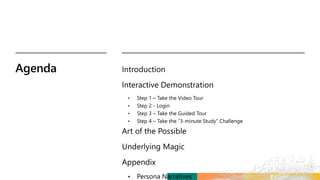
Agenda
Today's Headline - EXTRA! EXTRA! READ ALL ABOUT IT
"TransCelerate Digital Data Flow Solutions Platform enables the building of Global Clinical Study Design in 3 minutes! “
Interactive Demonstration
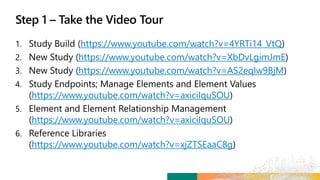
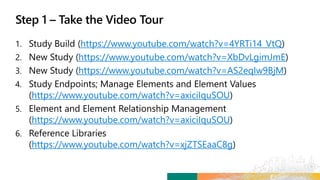
https://www.youtube.com/watch?v=4YRTi14_VtQ
https://www.youtube.com/watch?v=XbDvLgimJmE
https://www.youtube.com/watch?v=AS2eqIw9BjM
https://www.youtube.com/watch?v=axiciIquSOU
https://www.youtube.com/watch?v=xjZTSEaaC8g
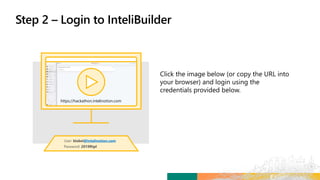
User: blabel@intelinotion.com
Password: 2019Rtpl
https://hackathon.intelinotion.com
User Guide
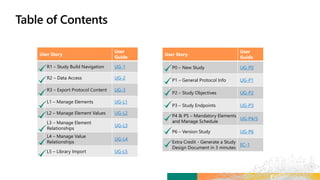
User Story
User
Guide
R1 – Study Build Navigation UG-1
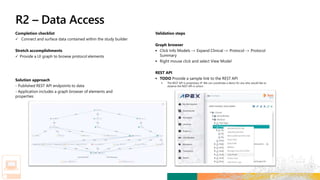
R2 – Data Access UG-2
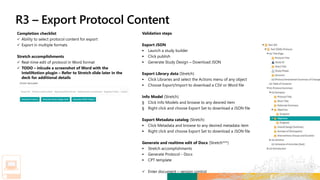
R3 – Export Protocol Content UG-3
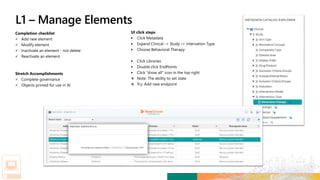
L1 – Manage Elements UG-L1
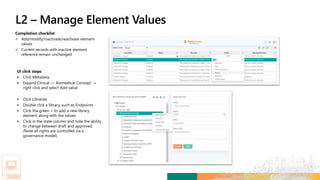
L2 – Manage Element Values UG-L2
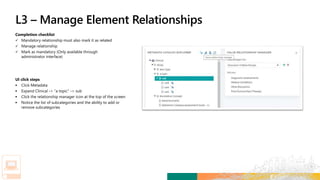
L3 – Manage Element
Relationships
UG-L3
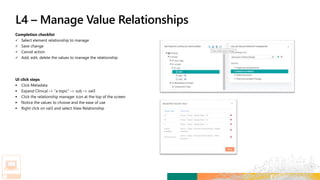
L4 – Manage Value
Relationships
UG-L4
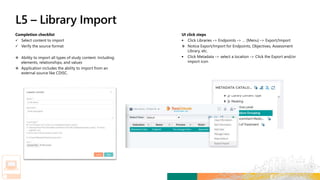
L5 – Library Import UG-L5
User Story
User
Guide
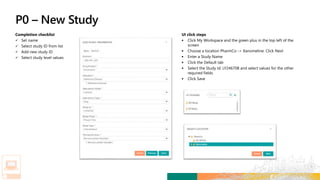
P0 – New Study UG-P0
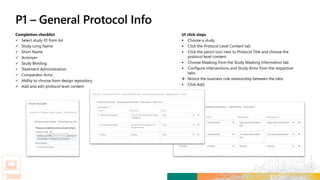
P1 – General Protocol Info UG-P1
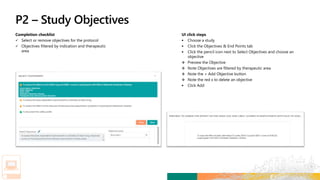
P2 – Study Objectives UG-P2
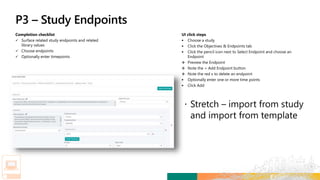
P3 – Study Endpoints UG-P3
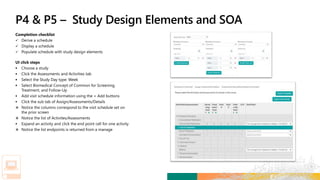
P4 & P5 – Mandatory Elements
and Manage Schedule
UG-P4/5
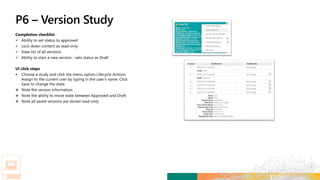
P6 – Version Study UG-P6
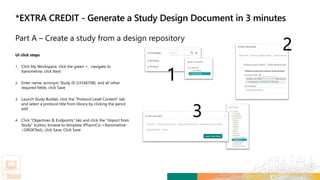
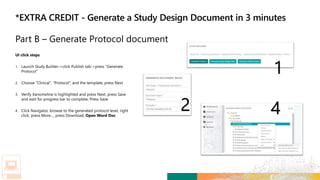
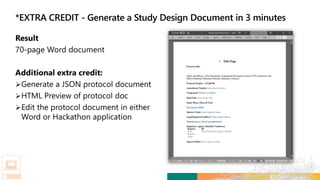
Extra Credit - Generate a Study
Design Document in 3 minutes
EC-1
User Guide
1
3
2
1
42
https://www.youtube.com/watch?v=4YRTi14_VtQ
https://www.youtube.com/watch?v=XbDvLgimJmE
https://www.youtube.com/watch?v=AS2eqIw9BjM
https://www.youtube.com/watch?v=axiciIquSOU
https://www.youtube.com/watch?v=xjZTSEaaC8g
Art of the Possible
Looking toward the future…
Our Future State Vision
We hope you enjoyed test-driving our prototype! This interactive UI represents our unique vision for creating a standards-based end to
end digital clinical trials workflow that is automated, seamless, and accelerates critical life-saving medicines to market – starting with
Alzheimer's disease.
We believe the clinical trials industry is at a critical juncture. Now, more than ever, emerging technologies have the potential to transform
the way drug trials are run. Just like taking the keys to a Porsche, technology is accelerating faster than ever and disrupting wide swaths of
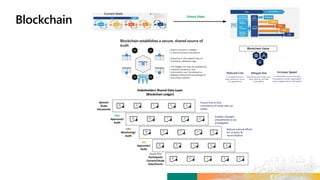
industry. One compelling new technology that has surfaced in recent years is Blockchain. Blockchain consists of a series of blocks in which
each consists of a cryptographic hash of the previous block, a timestamp, and transaction data. By requiring a match between the user
and the encrypted hash, this “distributed ledger” provides an immutable source of truth that is safe and hackproof. While Blockchain
originated in the financial industry, a growing number of other applications are emerging across industries, such as in real estate,
insurance, and asset management.
Imagine for a moment the possibility of a Blockchain controlled Clinical Trial workflow that provides participants with immediate visibility
into all study metadata, including protocol titles, objectives, amendments, import/export query logs, and more. Take it further and
consider a Blockchain-controlled IRB board consent process:
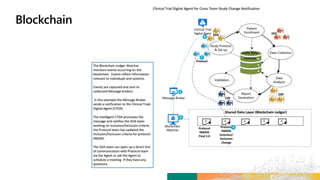
 Clinical Study protocol is revised, and study site request a change to their consent.
 The change request is logged on the blockchain and triggers a notification to the IRB board
 The IRB board approves the consent change.
 The approval is logged on the blockchain. This triggers an event that notifies all the stakeholders of the change in the consent.
Blockchain holds vast potential to transform clinical trials research. If you enjoyed our prototype, then you’ll love our vision of a digital
ledger-based clinical trial workflow that accelerates the marketing of life-saving medicines.
https://www.youtube.com/watch?v=ra19YBdajoc
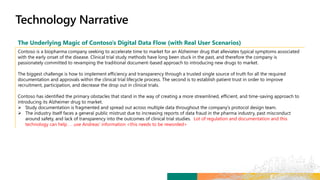
The Underlying Magic of Contoso’s Digital Data Flow (with Real User Scenarios)
Contoso is a biopharma company seeking to accelerate time to market for an Alzheimer drug that alleviates typical symptoms associated
with the early onset of the disease. Clinical trial study methods have long been stuck in the past, and therefore the company is
passionately committed to revamping the traditional document-based approach to introducing new drugs to market.
The biggest challenge is how to implement efficiency and transparency through a trusted single source of truth for all the required
documentation and approvals within the clinical trial lifecycle process. The second is to establish patient trust in order to improve
recruitment, participation, and decrease the drop out in clinical trials.
Contoso has identified the primary obstacles that stand in the way of creating a more streamlined, efficient, and time-saving approach to
introducing its Alzheimer drug to market.
 Study documentation is fragmented and spread out across multiple data throughout the company’s protocol design team.
 The industry itself faces a general public mistrust due to increasing reports of data fraud in the pharma industry, past misconduct
around safety, and lack of transparency into the outcomes of clinical trial studies. Lot of regulation and documentation and this
technology can help . . .use Andreas’ information <this needs to be reworded>
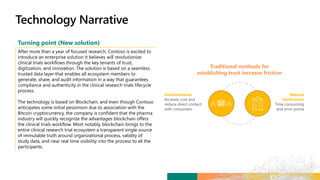
Intermediaries
Increase cost and
reduce direct contact
with consumers
Traditional methods for
establishing trust increase friction
Manual
Verification
Time consuming
and error prone
Turning point (New solution)
After more than a year of focused research, Contoso is excited to
introduce an enterprise solution it believes will revolutionize
clinical trials workflows through the key tenants of trust,
digitization, and innovation. The solution is based on a seamless
trusted data layer that enables all ecosystem members to
generate, share, and audit information in a way that guarantees
compliance and authenticity in the clinical research trials lifecycle
process.
The technology is based on Blockchain, and even though Contoso
anticipates some initial pessimism due to association with the
Bitcoin cryptocurrency, the company is confident that the pharma
industry will quickly recognize the advantages blockchain offers
the clinical trials workflow. Most notably, blockchain brings to the
entire clinical research trial ecosystem a transparent single source
of immutable truth around organizational process, validity of
study data, and near real time visibility into the process to all the
participants.
Scenario #1
Rajesh is the Pharma Project Manager for Contoso’s new
Alzheimer’s study. With many years of experience in clinical trials
research, Rajesh has been tasked with identifying a solution for a
workflow gap analysis that was done as part of the pharma’s
digital transformation plan targeted to reduce the time to market
for new drugs. Rajesh interviews the teams who work on the end
to end clinical trials lifecycle for drug research. He also meets with
the core group that generates the study protocol and associated
assets for submission of the clinical trial research project to the
government health and compliance authorities.
Rajesh’s gap analysis reveals several areas for improvement. There
are two key areas that the study protocol design team says
consistently slows down their workflow. One is a lack of visibility
into the work being done by others on the same clinical trial. The
other is poor communication and visibility into study and
protocol amendment changes.
Scenario #1
Rajesh’s management has encouraged him to think outside of the box for
solutions instead of building upon existing workflow processes and
legacy technology. After considerable research and talking with several
pharma industry innovation thought leaders, Rajesh has put together a
proposal for a combined business and technology solution. His proposal
addresses immediate gaps around visibility and communication for the
study team. It also enables a technology solution that can be reused and
scaled to meet other requirements for transformation to accelerate time
to market for life saving therapies.
Scenario #1
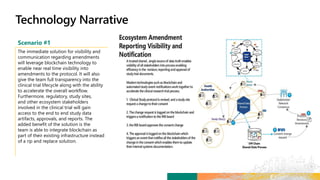
The immediate solution for visibility and
communication regarding amendments
will leverage blockchain technology to
enable near real time visibility into
amendments to the protocol. It will also
give the team full transparency into the
clinical trial lifecycle along with the ability
to accelerate the overall workflow.
Furthermore, regulatory, study sites,
and other ecosystem stakeholders
involved in the clinical trial will gain
access to the end to end study data
artifacts, approvals, and reports. The
added benefit of the solution is the
team is able to integrate blockchain as
part of their existing infrastructure instead
of a rip and replace solution.
Scenario #1
The immediate solution for
visibility and communication
regarding amendments will
leverage blockchain technology
to enable near real time visibility
into amendments to the protocol.
It will also give the team full
transparency into the clinical
trial lifecycle along with the ability
to accelerate the overall workflow.
Furthermore, regulatory, study
sites, and other ecosystem
stakeholders involved in the
clinical trial will gain access
to the end to end study data
artifacts, approvals, and reports.
The added benefit of the solution
is the team is able to integrate
blockchain as part of their
existing infrastructure instead
of a rip and replace solution.
Report
Patient
Enrollment
Data
Collection
Data
Analysis
Protocol
Design
Validation
SOA EDC
Protocol
SAPCSR
MetaData
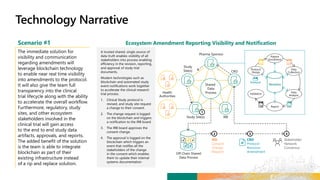
Ecosystem Amendment Reporting Visibility and Notification
IRB
Consent
Change
Request
CRO
Protocol
Revision/
Amendment
Stakeholder
Network
Consensus
1
2 3 4
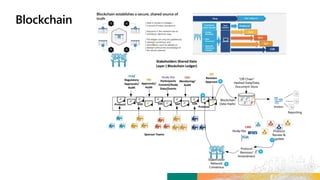
A trusted shared, single source of
data truth enables visibility of all
stakeholders into process enabling
efficiency in the revision, reporting,
and approval of study trial
documents.
Modern technologies such as
blockchain and automated study
event notifications work together
to accelerate the clinical research
trial process.
1. Clinical Study protocol is
revised, and study site request
a change to their consent.
2. The change request is logged
on the blockchain and triggers
a notification to the IRB board
3. The IRB board approves the
consent change.
4. The approval is logged on the
blockchain which triggers an
event that notifies all the
stakeholders of the change
in the consent which enables
them to update their internal
systems documentation
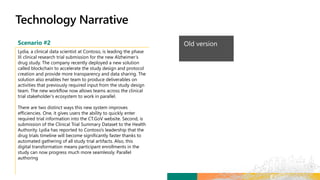
Scenario #2
Lydia, a clinical data scientist at Contoso, is leading
the phase III clinical research trial submission for the
new Alzheimer’s drug study. The company recently
deployed a new solution called blockchain to
accelerate the study design and protocol creation and
provide more transparency and data sharing. The
solution also enables her team to produce
deliverables on activities that previously required
input from the study design team. The new workflow
now allows teams across the clinical trial
stakeholder’s ecosystem to work in parallel.
This new system not only allows users to quickly
enter required trial information into the CT.gov
website, it also offers seamless submission of the
CTSD information to the appropriate health authority.
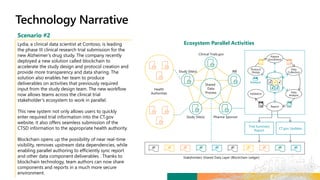
Blockchain opens up the possibility of near real-time
visibility, removes upstream data dependencies, while
enabling parallel authoring to efficiently sync report
and other data component deliverables . Thanks to
blockchain technology, team authors can now share
components and reports in a much more secure
environment.
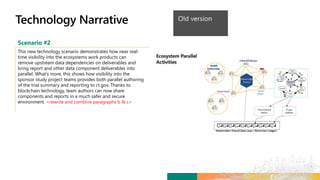
Ecosystem Parallel Activities
Trial Summary
Report
Report
Patient
Enrollment
Data
Collection
Data
Analysis
Protocol
Design
Validation
CT.gov Updates
SOA EDC
Protocol
SAPCSR
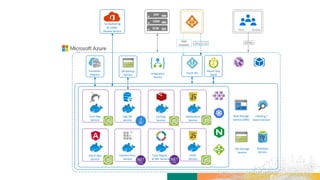
Underlying Magic
AAD
Connect
HTTPSOAuth 2.0
Web Mobile
ERP
CRM
ECM
Indexing /
Search Service
Azure AD
Container
Registry
Azure Key
Vault
Blob Storage
Service (GRS)
Database
Service
Integration
Service
DB Backup
Service
Core App
Service
Audit
Service
Caching
Service
Notification
Service
Client App
Service
File Storage
Service
Co-Authoring
& Collab.
Review Service
App DB
Service
Content Proc.
Service
Task Mgmt.
& WF Service
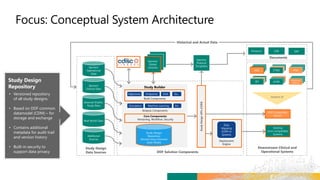
Sponsor
Operational
Data
Sponsor
Clinical Data
External (Public)
Study Data
Real World Data
Additional
Sources
Sponsor
Global
Libraries
Sponsor
Protocol
Templates
Protocol CSR SAP
EDC CTMS PPM
IRT eTMF
Additional
Systems
DDF Compatible
System
Existing
(non-compatible)
Systems
Objectives Endpoints SOA Etc..
Simulation Machine Learning Etc..
Study Builder
Build Components
Analysis Components
Core Components:
Versioning, Workflow, Security
Data
Mapping
(CDM to
System)
Deployment
Engine
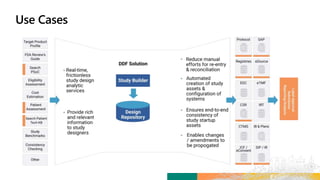
Study Design
Repository
(Stored using Common
Data Model)
Documents
DDF Solution Components
Study Design
Data Sources
Downstream Clinical and
Operational Systems
StudyDesignAPIs(CDM)
Instance of
Study Design
Repository
• Versioned repository
of all study designs.
• Based on DDF common
datamodel (CDM) – for
storage and exchange
• Contains additional
metadata for audit trail
and version history
• Built-in security to
support data privacy
Historical and Actual Data
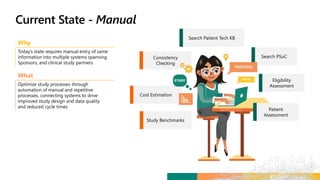
Cost Estimation
Consistency
Checking
Study Benchmarks
Search Patient Tech KB
Search PSoC
Eligibility
Assessment
Patient
Assessment
Why
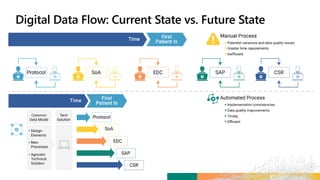
Today’s state requires manual entry of same
information into multiple systems spanning
Sponsors, and clinical study partners
What
Optimize study processes through
automation of manual and repetitive
processes, connecting systems to drive
improved study design and data quality
and reduced cycle times
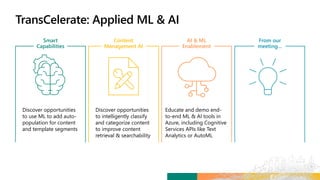
AI & ML
Enablement
Smart
Capabilities
Content
Management AI
From our
meeting…
Discover opportunities
to use ML to add auto-
population for content
and template segments
Discover opportunities
to intelligently classify
and categorize content
to improve content
retrieval & searchability
Educate and demo end-
to-end ML & AI tools in
Azure, including Cognitive
Services APIs like Text
Analytics or AutoML
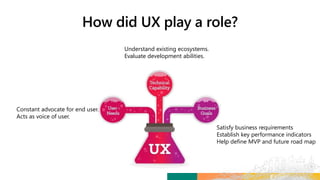
Constant advocate for end user.
Acts as voice of user.
Understand existing ecosystems.
Evaluate development abilities.
Satisfy business requirements
Establish key performance indicators
Help define MVP and future road map
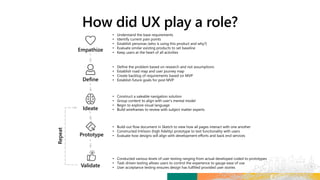
Empathize
Ideate
Define
• Understand the base requirements
• Identify current pain points
• Establish personas (who is using this product and why?)
• Evaluate similar existing products to set baseline
• Keep users at the heart of all activities
• Define the problem based on research and not assumptions
• Establish road map and user journey map
• Create backlog of requirements based on MVP
• Establish future goals for post MVP
• Construct a saleable navigation solution
• Group content to align with user’s mental model
• Begin to explore visual language
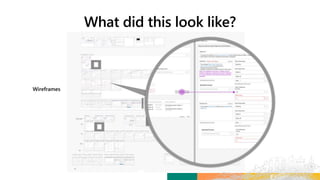
• Build wireframes to review with subject matter experts
Prototype
Validate
• Build out flow document in Sketch to view how all pages interact with one another
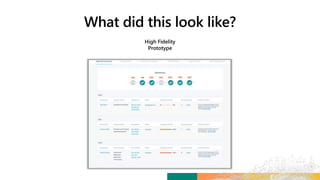
• Constructed InVision (high fidelity) prototype to test functionality with users
• Evaluate how designs will align with development efforts and back end services
Repeat
• Conducted various levels of user testing ranging from actual developed coded to prototypes
• Task-driven testing allows users to control the experience to gauge ease of use
• User acceptance testing ensures design has fulfilled provided user stories
Wireframes
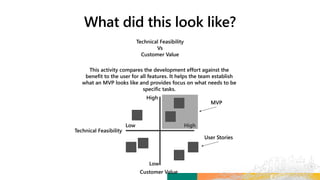
Technical Feasibility
Vs
Customer Value
This activity compares the development effort against the
benefit to the user for all features. It helps the team establish
what an MVP looks like and provides focus on what needs to be
specific tasks.
Technical Feasibility
Customer Value
HighLow
Low
High
User Stories
MVP
High Fidelity
Prototype
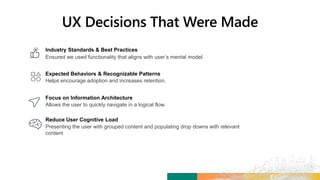
Industry Standards & Best Practices
Expected Behaviors & Recognizable Patterns
Focus on Information Architecture
Reduce User Cognitive Load
Ensured we used functionality that aligns with user’s mental model.
Helps encourage adoption and increases retention.
Allows the user to quickly navigate in a logical flow.
Presenting the user with grouped content and populating drop downs with relevant
content
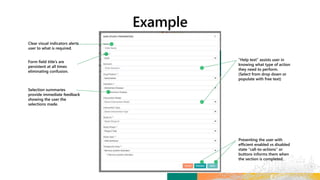
Clear visual indicators alerts
user to what is required.
Form field title’s are
persistent at all times
eliminating confusion.
Selection summaries
provide immediate feedback
showing the user the
selections made.
“Help text” assists user in
knowing what type of action
they need to perform.
(Select from drop down or
populate with free text)
Presenting the user with
efficient enabled vs disabled
state ”call-to-actions” or
buttons informs them when
the section is completed.
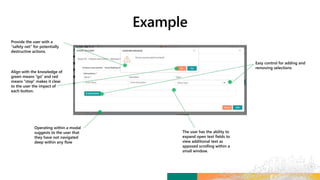
Provide the user with a
“safety net” for potentially
destructive actions.
Align with the knowledge of
green means “go” and red
means “stop” makes it clear
to the user the impact of
each button.
Easy control for adding and
removing selections
Operating within a modal
suggests to the user that
they have not navigated
deep within any flow
The user has the ability to
expand open text fields to
view additional text as
apposed scrolling within a
small window.
Appendix
Persona Narratives
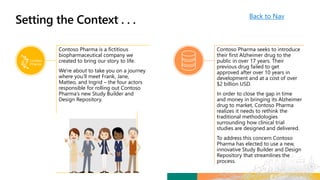
Contoso Pharma is a fictitious
biopharmaceutical company we
created to bring our story to life.
We're about to take you on a journey
where you’ll meet Frank, Jane,
Matteo, and Ingrid – the four actors
responsible for rolling out Contoso
Pharma’s new Study Builder and
Design Repository.
Contoso Pharma seeks to introduce
their first Alzheimer drug to the
public in over 17 years. Their
previous drug failed to get
approved after over 10 years in
development and at a cost of over
$2 billion USD.
In order to close the gap in time
and money in bringing its Alzheimer
drug to market, Contoso Pharma
realizes it needs to rethink the
traditional methodologies
surrounding how clinical trial
studies are designed and delivered.
To address this concern Contoso
Pharma has elected to use a new,
innovative Study Builder and Design
Repository that streamlines the
process.
Back to Nav
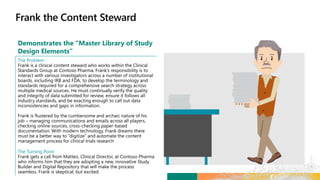
Demonstrates the “Master Library of Study
Design Elements”
The Problem
Frank is a clinical content steward who works within the Clinical
Standards Group at Contoso Pharma. Frank’s responsibility is to
interact with various investigators across a number of institutional
boards, including IRB and FDA, to develop the terminology and
standards required for a comprehensive search strategy across
multiple medical sources. He must continually verify the quality
and integrity of data submitted for review, ensure it follows all
industry standards, and be exacting enough to call out data
inconsistencies and gaps in information.
Frank is flustered by the cumbersome and archaic nature of his
job – managing communications and emails across all players,
checking online sources, cross-checking paper-based
documentation. With modern technology, Frank dreams there
must be a better way to “digitize” and automate the content
management process for clinical trials research
The Turning Point
Frank gets a call from Matteo, Clinical Director, at Contoso Pharma
who informs him that they are adopting a new, innovative Study
Builder and Digital Repository that will make the process
seamless. Frank is skeptical, but excited.
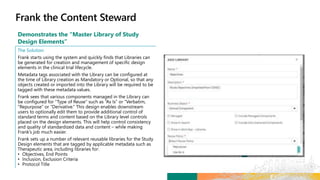
Demonstrates the “Master Library of Study
Design Elements”
The Solution
Frank starts using the system and quickly finds that Libraries can
be generated for creation and management of specific design
elements in the clinical trial lifecycle.
Metadata tags associated with the Library can be configured at
the time of Library creation as Mandatory or Optional, so that any
objects created or imported into the Library will be required to be
tagged with these metadata values.
Frank sees that various components managed in the Library can
be configured for “Type of Reuse” such as “As Is” or “Verbatim,
“Repurpose” or “Derivative.” This design enables downstream
users to optionally edit them to provide additional control of
standard terms and content based on the Library level controls
placed on the design elements. This will help control consistency
and quality of standardized data and content – while making
Frank’s job much easier.
Frank sets up a number of relevant reusable libraries for the Study
Design elements that are tagged by applicable metadata such as
Therapeutic area, including libraries for:
• Objectives, End Points
• Inclusion, Exclusion Criteria
• Protocol Title
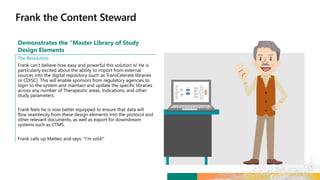
Demonstrates the “Master Library of Study
Design Elements
The Resolution
Frank can’t believe how easy and powerful this solution is! He is
particularly excited about the ability to import from external
sources into the digital repository (such as TransCelerate libraries
or CDISC). This will enable sponsors from regulatory agencies to
login to the system and maintain and update the specific libraries
across any number of Therapeutic areas, Indications, and other
study parameters.
Frank feels he is now better equipped to ensure that data will
flow seamlessly from these design elements into the protocol and
other relevant documents, as well as export for downstream
systems such as CTMS.
Frank calls up Matteo and says: “I’m sold!”
Demonstrates the “Study Build – Navigation” Feature
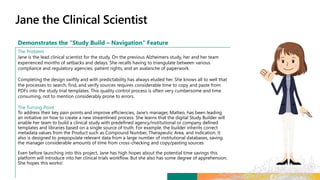
The Problem
Jane is the lead clinical scientist for the study. On the previous Alzheimers study, her and her team
experienced months of setbacks and delays. She recalls having to triangulate between various
compliance and regulatory agencies, patient rights, and an avalanche of paperwork.
Completing the design swiftly and with predictability has always eluded her. She knows all to well that
the processes to search, find, and verify sources requires considerable time to copy and paste from
PDFs into the study trial templates. This quality control process is often very cumbersome and time
consuming, not to mention considerably prone to errors.
The Turning Point
To address their key pain points and improve efficiencies, Jane’s manager, Matteo, has been leading
an initiative on how to create a new streamlined process. She learns that the digital Study Builder will
enable her team to build a clinical study with predefined agency/institutional or company defined
templates and libraries based on a single source of truth. For example, the builder inherits correct
metadata values from the Product such as Compound Number, Therapeutic Area, and Indication. It
also is designed to prepopulate relevant data from a large number of institutional databases, saving
the manager considerable amounts of time from cross-checking and copy/pasting sources
Even before launching into this project, Jane has high hopes about the potential time savings this
platform will introduce into her clinical trials workflow. But she also has some degree of apprehension.
She hopes this works!
Demonstrates the “Study Build – Navigation”
Feature
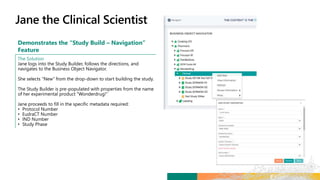
The Solution
Jane logs into the Study Builder, follows the directions, and
navigates to the Business Object Navigator.
She selects “New” from the drop-down to start building the study.
The Study Builder is pre-populated with properties from the name
of her experimental product “Wonderdrug!”
Jane proceeds to fill in the specific metadata required:
• Protocol Number
• EudraCT Number
• IND Number
• Study Phase
Demonstrates the “Study Build – Navigation”
Feature
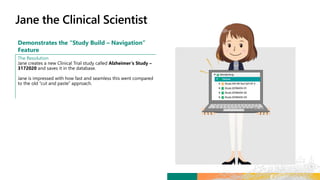
The Resolution
Jane creates a new Clinical Trial study called Alzheimer’s Study –
3172020 and saves it in the database.
Jane is impressed with how fast and seamless this went compared
to the old “cut and paste” approach.
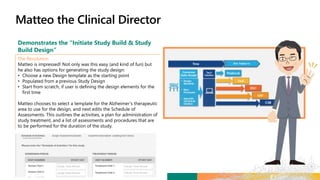
Demonstrates the “Initiate Study Build & Study
Build Design”
The Problem
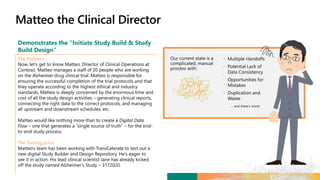
Now, let’s get to know Matteo, Director of Clinical Operations at
Contoso. Matteo manages a staff of 20 people who are working
on the Alzheimer drug clinical trial. Matteo is responsible for
ensuring the successful completion of the trial protocols and that
they operate according to the highest ethical and industry
standards. Matteo is deeply concerned by the enormous time and
cost of all the study design activities – generating clinical reports,
connecting the right data to the correct protocols, and managing
all upstream and downstream schedules, etc.
Matteo would like nothing more than to create a Digital Data
Flow – one that generates a “single source of truth” – for the end-
to-end study process.
The Turning point
Matteo’s team has been working with TransCelerate to test out a
new digital Study Builder and Design Repository. He’s eager to
see it in action. His lead clinical scientist Jane has already kicked
off the study named Alzheimer’s Study – 3172020.
•
•
•
•
Demonstrates the “Initiate Study Build & Study
Build Design”
The Solution
Matteo logs in to the new platform to retrieve Alzheimer’s Study
– 3172020 and initiate the Study Design process.
Matteo builds the Protocol Title of the study based on hyperlinks
to prepopulated libraries and templates. He then defines the
Study Objective as follows: “To assess the effect of [study
intervention #1] on the ADAS-COG and CIBIC + scores at Week
[X] in participants with Mild to Moderate Alzheimer’s Disease.”
Matteo next enters the Study Masking Information,
Intervention, and Arms. For these categories, he chooses
Double Blind, Xanomeline, and High Dose respectively.
Matteo can select the Objectives and Endpoints for the study
using the standards managed and governed in the Objectives and
Endpoints libraries. Matteo selects the appropriate Objectives,
Objective Level and related Endpoints. For each Endpoint, the
appropriate visit Timeframes, Units and Biomedical Concepts are
selected from controlled standard metadata terms.
Demonstrates the “Initiate Study Build & Study
Build Design”
The Resolution
Matteo is impressed! Not only was this easy (and kind of fun) but
he also has options for generating the study design:
• Choose a new Design template as the starting point
• Populated from a previous Study Design
• Start from scratch, if user is defining the design elements for the
first time
Matteo chooses to select a template for the Alzheimer’s therapeutic
area to use for the design, and next edits the Schedule of
Assessments. This outlines the activities, a plan for administration of
study treatment, and a list of assessments and procedures that are
to be performed for the duration of the study.
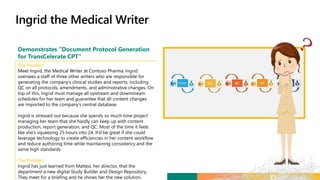
Demonstrates “Document Protocol Generation
for TransCelerate CPT”
The Problem
Meet Ingrid, the Medical Writer at Contoso Pharma. Ingrid
oversees a staff of three other writers who are responsible for
generating the company’s clinical studies and reports, including
QC on all protocols, amendments, and administrative changes. On
top of this, Ingrid must manage all upstream and downstream
schedules for her team and guarantee that all content changes
are imported to the company’s central database.
Ingrid is stressed out because she spends so much time project
managing her team that she hardly can keep up with content
production, report generation, and QC. Most of the time it feels
like she’s squeezing 25 hours into 24. It’d be great if she could
leverage technology to create efficiencies in her content workflow
and reduce authoring time while maintaining consistency and the
same high standards.
The Problem
Ingrid has just learned from Matteo, her director, that the
department a new digital Study Builder and Design Repository.
They meet for a briefing and he shows her the new solution.
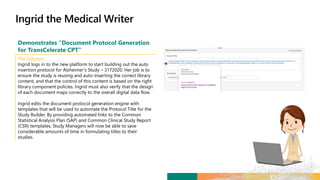
Demonstrates “Document Protocol Generation
for TransCelerate CPT”
The Solution
Ingrid logs in to the new platform to start building out the auto
insertion protocol for Alzheimer’s Study – 3172020. Her job is to
ensure the study is reusing and auto-inserting the correct library
content, and that the control of this content is based on the right
library component policies. Ingrid must also verify that the design
of each document maps correctly to the overall digital data flow.
Ingrid edits the document protocol generation engine with
templates that will be used to automate the Protocol Title for the
Study Builder. By providing automated links to the Common
Statistical Analysis Plan (SAP) and Common Clinical Study Report
(CSR) templates, Study Managers will now be able to save
considerable amounts of time in formulating titles to their
studies.
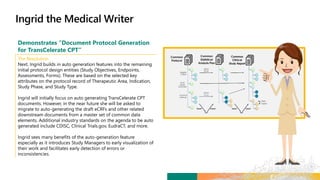
Demonstrates “Document Protocol Generation
for TransCelerate CPT”
The Resolution
Next, Ingrid builds in auto generation features into the remaining
initial protocol design entities (Study Objectives, Endpoints,
Assessments, Forms). These are based on the selected key
attributes on the protocol record of Therapeutic Area, Indication,
Study Phase, and Study Type.
Ingrid will initially focus on auto generating TransCelerate CPT
documents. However, in the near future she will be asked to
migrate to auto-generating the draft eCRFs and other related
downstream documents from a master set of common data
elements. Additional industry standards on the agenda to be auto
generated include CDISC, Clinical Trials.gov, EudraCT, and more.
Ingrid sees many benefits of the auto-generation feature
especially as it introduces Study Managers to early visualization of
their work and facilitates early detection of errors or
inconsistencies.
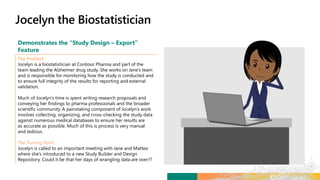
Demonstrates the “Study Design – Export”
Feature
The Problem
Jocelyn is a biostatistician at Contoso Pharma and part of the
team leading the Alzheimer drug study. She works on Jane’s team
and is responsible for monitoring how the study is conducted and
to ensure full integrity of the results for reporting and external
validation.
Much of Jocelyn’s time is spent writing research proposals and
conveying her findings to pharma professionals and the broader
scientific community. A painstaking component of Jocelyn’s work
involves collecting, organizing, and cross-checking the study data
against numerous medical databases to ensure her results are
as accurate as possible. Much of this is process is very manual
and tedious.
The Turning Point
Jocelyn is called to an important meeting with Jane and Matteo
where she’s introduced to a new Study Builder and Design
Repository. Could it be that her days of wrangling data are over??
Demonstrates the “Study Design – Export”
Feature
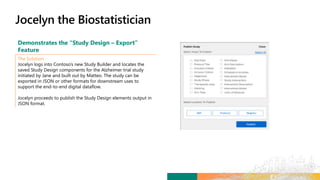
The Solution
Jocelyn logs into Contoso’s new Study Builder and locates the
saved Study Design components for the Alzheimer trial study
initiated by Jane and built out by Matteo. The study can be
exported in JSON or other formats for downstream uses to
support the end-to-end digital dataflow.
Jocelyn proceeds to publish the Study Design elements output in
JSON format.
Demonstrates the “Study Design – Export”
Feature
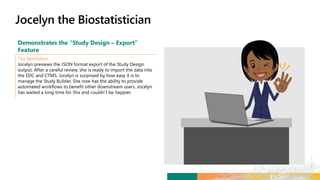
The Resolution
Jocelyn previews the JSON format export of the Study Design
output. After a careful review, she is ready to import the data into
the EDC and CTMS. Jocelyn is surprised by how easy it is to
manage the Study Builder. She now has the ability to provide
automated workflows to benefit other downstream users. Jocelyn
has waited a long time for this and couldn’t be happier.
Scenario #2
Lydia, a clinical data scientist at Contoso, is leading the phase
III clinical research trial submission for the new Alzheimer’s
drug study. The company recently deployed a new solution
called blockchain to accelerate the study design and protocol
creation and provide more transparency and data sharing. The
solution also enables her team to produce deliverables on
activities that previously required input from the study design
team. The new workflow now allows teams across the clinical
trial stakeholder’s ecosystem to work in parallel.
There are two distinct ways this new system improves
efficiencies. One, it gives users the ability to quickly enter
required trial information into the CT.GoV website. Second, is
submission of the Clinical Trial Summary Dataset to the Health
Authority. Lydia has reported to Contoso’s leadership that the
drug trials timeline will become significantly faster thanks to
automated gathering of all study trial artifacts. Also, this
digital transformation means participant enrollments in the
study can now progress much more seamlessly. Parallel
authoring
Scenario #2
This new technology scenario demonstrates how near real-
time visibility into the ecosystems work products can
remove upstream data dependencies on deliverables and
bring report and other data component deliverables into
parallel. What’s more, this shows how visibility into the
sponsor study project teams provides both parallel authoring
of the trial summary and reporting to ct.gov. Thanks to
blockchain technology, team authors can now share
components and reports in a much safer and secure
environment. <rewrite and combine paragraphs b & c>
Agenda

Transcelerate hackathon 04192020_for nn

  • 1.
    Digitizing Clinical StudyDesign April 2020 TransCelerate Hackathon
  • 2.
    Ryan Tubbs Project Lead VasuRanganathan Intelinotion Gerald Kukko Lead Solution Architect, Intelinotion Tianna Umann Blockchain Architect, Microsoft Brent Groom Innovation Lead, Microsoft Brian Nikonow Insight UX Architect Michelle Hendrickson Insight, UX Lead
  • 3.
  • 5.
    Today's Headline -EXTRA! EXTRA! READ ALL ABOUT IT "TransCelerate Digital Data Flow Solutions Platform enables the building of Global Clinical Study Design in 3 minutes! “
  • 6.
  • 8.
  • 9.
  • 10.
  • 11.
    User Story User Guide R1 –Study Build Navigation UG-1 R2 – Data Access UG-2 R3 – Export Protocol Content UG-3 L1 – Manage Elements UG-L1 L2 – Manage Element Values UG-L2 L3 – Manage Element Relationships UG-L3 L4 – Manage Value Relationships UG-L4 L5 – Library Import UG-L5 User Story User Guide P0 – New Study UG-P0 P1 – General Protocol Info UG-P1 P2 – Study Objectives UG-P2 P3 – Study Endpoints UG-P3 P4 & P5 – Mandatory Elements and Manage Schedule UG-P4/5 P6 – Version Study UG-P6 Extra Credit - Generate a Study Design Document in 3 minutes EC-1
  • 18.
  • 19.
  • 20.
  • 23.
  • 32.
    Art of thePossible Looking toward the future…
  • 33.
    Our Future StateVision We hope you enjoyed test-driving our prototype! This interactive UI represents our unique vision for creating a standards-based end to end digital clinical trials workflow that is automated, seamless, and accelerates critical life-saving medicines to market – starting with Alzheimer's disease. We believe the clinical trials industry is at a critical juncture. Now, more than ever, emerging technologies have the potential to transform the way drug trials are run. Just like taking the keys to a Porsche, technology is accelerating faster than ever and disrupting wide swaths of industry. One compelling new technology that has surfaced in recent years is Blockchain. Blockchain consists of a series of blocks in which each consists of a cryptographic hash of the previous block, a timestamp, and transaction data. By requiring a match between the user and the encrypted hash, this “distributed ledger” provides an immutable source of truth that is safe and hackproof. While Blockchain originated in the financial industry, a growing number of other applications are emerging across industries, such as in real estate, insurance, and asset management. Imagine for a moment the possibility of a Blockchain controlled Clinical Trial workflow that provides participants with immediate visibility into all study metadata, including protocol titles, objectives, amendments, import/export query logs, and more. Take it further and consider a Blockchain-controlled IRB board consent process:  Clinical Study protocol is revised, and study site request a change to their consent.  The change request is logged on the blockchain and triggers a notification to the IRB board  The IRB board approves the consent change.  The approval is logged on the blockchain. This triggers an event that notifies all the stakeholders of the change in the consent. Blockchain holds vast potential to transform clinical trials research. If you enjoyed our prototype, then you’ll love our vision of a digital ledger-based clinical trial workflow that accelerates the marketing of life-saving medicines.
  • 34.
  • 35.
    The Underlying Magicof Contoso’s Digital Data Flow (with Real User Scenarios) Contoso is a biopharma company seeking to accelerate time to market for an Alzheimer drug that alleviates typical symptoms associated with the early onset of the disease. Clinical trial study methods have long been stuck in the past, and therefore the company is passionately committed to revamping the traditional document-based approach to introducing new drugs to market. The biggest challenge is how to implement efficiency and transparency through a trusted single source of truth for all the required documentation and approvals within the clinical trial lifecycle process. The second is to establish patient trust in order to improve recruitment, participation, and decrease the drop out in clinical trials. Contoso has identified the primary obstacles that stand in the way of creating a more streamlined, efficient, and time-saving approach to introducing its Alzheimer drug to market.  Study documentation is fragmented and spread out across multiple data throughout the company’s protocol design team.  The industry itself faces a general public mistrust due to increasing reports of data fraud in the pharma industry, past misconduct around safety, and lack of transparency into the outcomes of clinical trial studies. Lot of regulation and documentation and this technology can help . . .use Andreas’ information <this needs to be reworded>
  • 36.
    Intermediaries Increase cost and reducedirect contact with consumers Traditional methods for establishing trust increase friction Manual Verification Time consuming and error prone Turning point (New solution) After more than a year of focused research, Contoso is excited to introduce an enterprise solution it believes will revolutionize clinical trials workflows through the key tenants of trust, digitization, and innovation. The solution is based on a seamless trusted data layer that enables all ecosystem members to generate, share, and audit information in a way that guarantees compliance and authenticity in the clinical research trials lifecycle process. The technology is based on Blockchain, and even though Contoso anticipates some initial pessimism due to association with the Bitcoin cryptocurrency, the company is confident that the pharma industry will quickly recognize the advantages blockchain offers the clinical trials workflow. Most notably, blockchain brings to the entire clinical research trial ecosystem a transparent single source of immutable truth around organizational process, validity of study data, and near real time visibility into the process to all the participants.
  • 37.
    Scenario #1 Rajesh isthe Pharma Project Manager for Contoso’s new Alzheimer’s study. With many years of experience in clinical trials research, Rajesh has been tasked with identifying a solution for a workflow gap analysis that was done as part of the pharma’s digital transformation plan targeted to reduce the time to market for new drugs. Rajesh interviews the teams who work on the end to end clinical trials lifecycle for drug research. He also meets with the core group that generates the study protocol and associated assets for submission of the clinical trial research project to the government health and compliance authorities. Rajesh’s gap analysis reveals several areas for improvement. There are two key areas that the study protocol design team says consistently slows down their workflow. One is a lack of visibility into the work being done by others on the same clinical trial. The other is poor communication and visibility into study and protocol amendment changes.
  • 38.
    Scenario #1 Rajesh’s managementhas encouraged him to think outside of the box for solutions instead of building upon existing workflow processes and legacy technology. After considerable research and talking with several pharma industry innovation thought leaders, Rajesh has put together a proposal for a combined business and technology solution. His proposal addresses immediate gaps around visibility and communication for the study team. It also enables a technology solution that can be reused and scaled to meet other requirements for transformation to accelerate time to market for life saving therapies.
  • 39.
    Scenario #1 The immediatesolution for visibility and communication regarding amendments will leverage blockchain technology to enable near real time visibility into amendments to the protocol. It will also give the team full transparency into the clinical trial lifecycle along with the ability to accelerate the overall workflow. Furthermore, regulatory, study sites, and other ecosystem stakeholders involved in the clinical trial will gain access to the end to end study data artifacts, approvals, and reports. The added benefit of the solution is the team is able to integrate blockchain as part of their existing infrastructure instead of a rip and replace solution.
  • 40.
    Scenario #1 The immediatesolution for visibility and communication regarding amendments will leverage blockchain technology to enable near real time visibility into amendments to the protocol. It will also give the team full transparency into the clinical trial lifecycle along with the ability to accelerate the overall workflow. Furthermore, regulatory, study sites, and other ecosystem stakeholders involved in the clinical trial will gain access to the end to end study data artifacts, approvals, and reports. The added benefit of the solution is the team is able to integrate blockchain as part of their existing infrastructure instead of a rip and replace solution. Report Patient Enrollment Data Collection Data Analysis Protocol Design Validation SOA EDC Protocol SAPCSR MetaData Ecosystem Amendment Reporting Visibility and Notification IRB Consent Change Request CRO Protocol Revision/ Amendment Stakeholder Network Consensus 1 2 3 4 A trusted shared, single source of data truth enables visibility of all stakeholders into process enabling efficiency in the revision, reporting, and approval of study trial documents. Modern technologies such as blockchain and automated study event notifications work together to accelerate the clinical research trial process. 1. Clinical Study protocol is revised, and study site request a change to their consent. 2. The change request is logged on the blockchain and triggers a notification to the IRB board 3. The IRB board approves the consent change. 4. The approval is logged on the blockchain which triggers an event that notifies all the stakeholders of the change in the consent which enables them to update their internal systems documentation
  • 41.
    Scenario #2 Lydia, aclinical data scientist at Contoso, is leading the phase III clinical research trial submission for the new Alzheimer’s drug study. The company recently deployed a new solution called blockchain to accelerate the study design and protocol creation and provide more transparency and data sharing. The solution also enables her team to produce deliverables on activities that previously required input from the study design team. The new workflow now allows teams across the clinical trial stakeholder’s ecosystem to work in parallel. This new system not only allows users to quickly enter required trial information into the CT.gov website, it also offers seamless submission of the CTSD information to the appropriate health authority. Blockchain opens up the possibility of near real-time visibility, removes upstream data dependencies, while enabling parallel authoring to efficiently sync report and other data component deliverables . Thanks to blockchain technology, team authors can now share components and reports in a much more secure environment. Ecosystem Parallel Activities Trial Summary Report Report Patient Enrollment Data Collection Data Analysis Protocol Design Validation CT.gov Updates SOA EDC Protocol SAPCSR
  • 42.
  • 43.
    AAD Connect HTTPSOAuth 2.0 Web Mobile ERP CRM ECM Indexing/ Search Service Azure AD Container Registry Azure Key Vault Blob Storage Service (GRS) Database Service Integration Service DB Backup Service Core App Service Audit Service Caching Service Notification Service Client App Service File Storage Service Co-Authoring & Collab. Review Service App DB Service Content Proc. Service Task Mgmt. & WF Service
  • 44.
    Sponsor Operational Data Sponsor Clinical Data External (Public) StudyData Real World Data Additional Sources Sponsor Global Libraries Sponsor Protocol Templates Protocol CSR SAP EDC CTMS PPM IRT eTMF Additional Systems DDF Compatible System Existing (non-compatible) Systems Objectives Endpoints SOA Etc.. Simulation Machine Learning Etc.. Study Builder Build Components Analysis Components Core Components: Versioning, Workflow, Security Data Mapping (CDM to System) Deployment Engine Study Design Repository (Stored using Common Data Model) Documents DDF Solution Components Study Design Data Sources Downstream Clinical and Operational Systems StudyDesignAPIs(CDM) Instance of Study Design Repository • Versioned repository of all study designs. • Based on DDF common datamodel (CDM) – for storage and exchange • Contains additional metadata for audit trail and version history • Built-in security to support data privacy Historical and Actual Data
  • 45.
    Cost Estimation Consistency Checking Study Benchmarks SearchPatient Tech KB Search PSoC Eligibility Assessment Patient Assessment Why Today’s state requires manual entry of same information into multiple systems spanning Sponsors, and clinical study partners What Optimize study processes through automation of manual and repetitive processes, connecting systems to drive improved study design and data quality and reduced cycle times
  • 50.
    AI & ML Enablement Smart Capabilities Content ManagementAI From our meeting… Discover opportunities to use ML to add auto- population for content and template segments Discover opportunities to intelligently classify and categorize content to improve content retrieval & searchability Educate and demo end- to-end ML & AI tools in Azure, including Cognitive Services APIs like Text Analytics or AutoML
  • 52.
    Constant advocate forend user. Acts as voice of user. Understand existing ecosystems. Evaluate development abilities. Satisfy business requirements Establish key performance indicators Help define MVP and future road map
  • 53.
    Empathize Ideate Define • Understand thebase requirements • Identify current pain points • Establish personas (who is using this product and why?) • Evaluate similar existing products to set baseline • Keep users at the heart of all activities • Define the problem based on research and not assumptions • Establish road map and user journey map • Create backlog of requirements based on MVP • Establish future goals for post MVP • Construct a saleable navigation solution • Group content to align with user’s mental model • Begin to explore visual language • Build wireframes to review with subject matter experts Prototype Validate • Build out flow document in Sketch to view how all pages interact with one another • Constructed InVision (high fidelity) prototype to test functionality with users • Evaluate how designs will align with development efforts and back end services Repeat • Conducted various levels of user testing ranging from actual developed coded to prototypes • Task-driven testing allows users to control the experience to gauge ease of use • User acceptance testing ensures design has fulfilled provided user stories
  • 54.
  • 55.
    Technical Feasibility Vs Customer Value Thisactivity compares the development effort against the benefit to the user for all features. It helps the team establish what an MVP looks like and provides focus on what needs to be specific tasks. Technical Feasibility Customer Value HighLow Low High User Stories MVP
  • 56.
  • 57.
    Industry Standards &Best Practices Expected Behaviors & Recognizable Patterns Focus on Information Architecture Reduce User Cognitive Load Ensured we used functionality that aligns with user’s mental model. Helps encourage adoption and increases retention. Allows the user to quickly navigate in a logical flow. Presenting the user with grouped content and populating drop downs with relevant content
  • 58.
    Clear visual indicatorsalerts user to what is required. Form field title’s are persistent at all times eliminating confusion. Selection summaries provide immediate feedback showing the user the selections made. “Help text” assists user in knowing what type of action they need to perform. (Select from drop down or populate with free text) Presenting the user with efficient enabled vs disabled state ”call-to-actions” or buttons informs them when the section is completed.
  • 59.
    Provide the userwith a “safety net” for potentially destructive actions. Align with the knowledge of green means “go” and red means “stop” makes it clear to the user the impact of each button. Easy control for adding and removing selections Operating within a modal suggests to the user that they have not navigated deep within any flow The user has the ability to expand open text fields to view additional text as apposed scrolling within a small window.
  • 60.
  • 61.
  • 62.
    Contoso Pharma isa fictitious biopharmaceutical company we created to bring our story to life. We're about to take you on a journey where you’ll meet Frank, Jane, Matteo, and Ingrid – the four actors responsible for rolling out Contoso Pharma’s new Study Builder and Design Repository. Contoso Pharma seeks to introduce their first Alzheimer drug to the public in over 17 years. Their previous drug failed to get approved after over 10 years in development and at a cost of over $2 billion USD. In order to close the gap in time and money in bringing its Alzheimer drug to market, Contoso Pharma realizes it needs to rethink the traditional methodologies surrounding how clinical trial studies are designed and delivered. To address this concern Contoso Pharma has elected to use a new, innovative Study Builder and Design Repository that streamlines the process. Back to Nav
  • 63.
    Demonstrates the “MasterLibrary of Study Design Elements” The Problem Frank is a clinical content steward who works within the Clinical Standards Group at Contoso Pharma. Frank’s responsibility is to interact with various investigators across a number of institutional boards, including IRB and FDA, to develop the terminology and standards required for a comprehensive search strategy across multiple medical sources. He must continually verify the quality and integrity of data submitted for review, ensure it follows all industry standards, and be exacting enough to call out data inconsistencies and gaps in information. Frank is flustered by the cumbersome and archaic nature of his job – managing communications and emails across all players, checking online sources, cross-checking paper-based documentation. With modern technology, Frank dreams there must be a better way to “digitize” and automate the content management process for clinical trials research The Turning Point Frank gets a call from Matteo, Clinical Director, at Contoso Pharma who informs him that they are adopting a new, innovative Study Builder and Digital Repository that will make the process seamless. Frank is skeptical, but excited.
  • 64.
    Demonstrates the “MasterLibrary of Study Design Elements” The Solution Frank starts using the system and quickly finds that Libraries can be generated for creation and management of specific design elements in the clinical trial lifecycle. Metadata tags associated with the Library can be configured at the time of Library creation as Mandatory or Optional, so that any objects created or imported into the Library will be required to be tagged with these metadata values. Frank sees that various components managed in the Library can be configured for “Type of Reuse” such as “As Is” or “Verbatim, “Repurpose” or “Derivative.” This design enables downstream users to optionally edit them to provide additional control of standard terms and content based on the Library level controls placed on the design elements. This will help control consistency and quality of standardized data and content – while making Frank’s job much easier. Frank sets up a number of relevant reusable libraries for the Study Design elements that are tagged by applicable metadata such as Therapeutic area, including libraries for: • Objectives, End Points • Inclusion, Exclusion Criteria • Protocol Title
  • 65.
    Demonstrates the “MasterLibrary of Study Design Elements The Resolution Frank can’t believe how easy and powerful this solution is! He is particularly excited about the ability to import from external sources into the digital repository (such as TransCelerate libraries or CDISC). This will enable sponsors from regulatory agencies to login to the system and maintain and update the specific libraries across any number of Therapeutic areas, Indications, and other study parameters. Frank feels he is now better equipped to ensure that data will flow seamlessly from these design elements into the protocol and other relevant documents, as well as export for downstream systems such as CTMS. Frank calls up Matteo and says: “I’m sold!”
  • 66.
    Demonstrates the “StudyBuild – Navigation” Feature The Problem Jane is the lead clinical scientist for the study. On the previous Alzheimers study, her and her team experienced months of setbacks and delays. She recalls having to triangulate between various compliance and regulatory agencies, patient rights, and an avalanche of paperwork. Completing the design swiftly and with predictability has always eluded her. She knows all to well that the processes to search, find, and verify sources requires considerable time to copy and paste from PDFs into the study trial templates. This quality control process is often very cumbersome and time consuming, not to mention considerably prone to errors. The Turning Point To address their key pain points and improve efficiencies, Jane’s manager, Matteo, has been leading an initiative on how to create a new streamlined process. She learns that the digital Study Builder will enable her team to build a clinical study with predefined agency/institutional or company defined templates and libraries based on a single source of truth. For example, the builder inherits correct metadata values from the Product such as Compound Number, Therapeutic Area, and Indication. It also is designed to prepopulate relevant data from a large number of institutional databases, saving the manager considerable amounts of time from cross-checking and copy/pasting sources Even before launching into this project, Jane has high hopes about the potential time savings this platform will introduce into her clinical trials workflow. But she also has some degree of apprehension. She hopes this works!
  • 67.
    Demonstrates the “StudyBuild – Navigation” Feature The Solution Jane logs into the Study Builder, follows the directions, and navigates to the Business Object Navigator. She selects “New” from the drop-down to start building the study. The Study Builder is pre-populated with properties from the name of her experimental product “Wonderdrug!” Jane proceeds to fill in the specific metadata required: • Protocol Number • EudraCT Number • IND Number • Study Phase
  • 68.
    Demonstrates the “StudyBuild – Navigation” Feature The Resolution Jane creates a new Clinical Trial study called Alzheimer’s Study – 3172020 and saves it in the database. Jane is impressed with how fast and seamless this went compared to the old “cut and paste” approach.
  • 69.
    Demonstrates the “InitiateStudy Build & Study Build Design” The Problem Now, let’s get to know Matteo, Director of Clinical Operations at Contoso. Matteo manages a staff of 20 people who are working on the Alzheimer drug clinical trial. Matteo is responsible for ensuring the successful completion of the trial protocols and that they operate according to the highest ethical and industry standards. Matteo is deeply concerned by the enormous time and cost of all the study design activities – generating clinical reports, connecting the right data to the correct protocols, and managing all upstream and downstream schedules, etc. Matteo would like nothing more than to create a Digital Data Flow – one that generates a “single source of truth” – for the end- to-end study process. The Turning point Matteo’s team has been working with TransCelerate to test out a new digital Study Builder and Design Repository. He’s eager to see it in action. His lead clinical scientist Jane has already kicked off the study named Alzheimer’s Study – 3172020. • • • •
  • 70.
    Demonstrates the “InitiateStudy Build & Study Build Design” The Solution Matteo logs in to the new platform to retrieve Alzheimer’s Study – 3172020 and initiate the Study Design process. Matteo builds the Protocol Title of the study based on hyperlinks to prepopulated libraries and templates. He then defines the Study Objective as follows: “To assess the effect of [study intervention #1] on the ADAS-COG and CIBIC + scores at Week [X] in participants with Mild to Moderate Alzheimer’s Disease.” Matteo next enters the Study Masking Information, Intervention, and Arms. For these categories, he chooses Double Blind, Xanomeline, and High Dose respectively. Matteo can select the Objectives and Endpoints for the study using the standards managed and governed in the Objectives and Endpoints libraries. Matteo selects the appropriate Objectives, Objective Level and related Endpoints. For each Endpoint, the appropriate visit Timeframes, Units and Biomedical Concepts are selected from controlled standard metadata terms.
  • 71.
    Demonstrates the “InitiateStudy Build & Study Build Design” The Resolution Matteo is impressed! Not only was this easy (and kind of fun) but he also has options for generating the study design: • Choose a new Design template as the starting point • Populated from a previous Study Design • Start from scratch, if user is defining the design elements for the first time Matteo chooses to select a template for the Alzheimer’s therapeutic area to use for the design, and next edits the Schedule of Assessments. This outlines the activities, a plan for administration of study treatment, and a list of assessments and procedures that are to be performed for the duration of the study.
  • 72.
    Demonstrates “Document ProtocolGeneration for TransCelerate CPT” The Problem Meet Ingrid, the Medical Writer at Contoso Pharma. Ingrid oversees a staff of three other writers who are responsible for generating the company’s clinical studies and reports, including QC on all protocols, amendments, and administrative changes. On top of this, Ingrid must manage all upstream and downstream schedules for her team and guarantee that all content changes are imported to the company’s central database. Ingrid is stressed out because she spends so much time project managing her team that she hardly can keep up with content production, report generation, and QC. Most of the time it feels like she’s squeezing 25 hours into 24. It’d be great if she could leverage technology to create efficiencies in her content workflow and reduce authoring time while maintaining consistency and the same high standards. The Problem Ingrid has just learned from Matteo, her director, that the department a new digital Study Builder and Design Repository. They meet for a briefing and he shows her the new solution.
  • 73.
    Demonstrates “Document ProtocolGeneration for TransCelerate CPT” The Solution Ingrid logs in to the new platform to start building out the auto insertion protocol for Alzheimer’s Study – 3172020. Her job is to ensure the study is reusing and auto-inserting the correct library content, and that the control of this content is based on the right library component policies. Ingrid must also verify that the design of each document maps correctly to the overall digital data flow. Ingrid edits the document protocol generation engine with templates that will be used to automate the Protocol Title for the Study Builder. By providing automated links to the Common Statistical Analysis Plan (SAP) and Common Clinical Study Report (CSR) templates, Study Managers will now be able to save considerable amounts of time in formulating titles to their studies.
  • 74.
    Demonstrates “Document ProtocolGeneration for TransCelerate CPT” The Resolution Next, Ingrid builds in auto generation features into the remaining initial protocol design entities (Study Objectives, Endpoints, Assessments, Forms). These are based on the selected key attributes on the protocol record of Therapeutic Area, Indication, Study Phase, and Study Type. Ingrid will initially focus on auto generating TransCelerate CPT documents. However, in the near future she will be asked to migrate to auto-generating the draft eCRFs and other related downstream documents from a master set of common data elements. Additional industry standards on the agenda to be auto generated include CDISC, Clinical Trials.gov, EudraCT, and more. Ingrid sees many benefits of the auto-generation feature especially as it introduces Study Managers to early visualization of their work and facilitates early detection of errors or inconsistencies.
  • 75.
    Demonstrates the “StudyDesign – Export” Feature The Problem Jocelyn is a biostatistician at Contoso Pharma and part of the team leading the Alzheimer drug study. She works on Jane’s team and is responsible for monitoring how the study is conducted and to ensure full integrity of the results for reporting and external validation. Much of Jocelyn’s time is spent writing research proposals and conveying her findings to pharma professionals and the broader scientific community. A painstaking component of Jocelyn’s work involves collecting, organizing, and cross-checking the study data against numerous medical databases to ensure her results are as accurate as possible. Much of this is process is very manual and tedious. The Turning Point Jocelyn is called to an important meeting with Jane and Matteo where she’s introduced to a new Study Builder and Design Repository. Could it be that her days of wrangling data are over??
  • 76.
    Demonstrates the “StudyDesign – Export” Feature The Solution Jocelyn logs into Contoso’s new Study Builder and locates the saved Study Design components for the Alzheimer trial study initiated by Jane and built out by Matteo. The study can be exported in JSON or other formats for downstream uses to support the end-to-end digital dataflow. Jocelyn proceeds to publish the Study Design elements output in JSON format.
  • 77.
    Demonstrates the “StudyDesign – Export” Feature The Resolution Jocelyn previews the JSON format export of the Study Design output. After a careful review, she is ready to import the data into the EDC and CTMS. Jocelyn is surprised by how easy it is to manage the Study Builder. She now has the ability to provide automated workflows to benefit other downstream users. Jocelyn has waited a long time for this and couldn’t be happier.
  • 79.
    Scenario #2 Lydia, aclinical data scientist at Contoso, is leading the phase III clinical research trial submission for the new Alzheimer’s drug study. The company recently deployed a new solution called blockchain to accelerate the study design and protocol creation and provide more transparency and data sharing. The solution also enables her team to produce deliverables on activities that previously required input from the study design team. The new workflow now allows teams across the clinical trial stakeholder’s ecosystem to work in parallel. There are two distinct ways this new system improves efficiencies. One, it gives users the ability to quickly enter required trial information into the CT.GoV website. Second, is submission of the Clinical Trial Summary Dataset to the Health Authority. Lydia has reported to Contoso’s leadership that the drug trials timeline will become significantly faster thanks to automated gathering of all study trial artifacts. Also, this digital transformation means participant enrollments in the study can now progress much more seamlessly. Parallel authoring
  • 80.
    Scenario #2 This newtechnology scenario demonstrates how near real- time visibility into the ecosystems work products can remove upstream data dependencies on deliverables and bring report and other data component deliverables into parallel. What’s more, this shows how visibility into the sponsor study project teams provides both parallel authoring of the trial summary and reporting to ct.gov. Thanks to blockchain technology, team authors can now share components and reports in a much safer and secure environment. <rewrite and combine paragraphs b & c>
  • 81.

Editor's Notes

  • #45 This is a core use case for single source of truth for versioning, exchange, audit trail, data privacy and data sharing Versioning = hashed on ledger Exchange = smart content conditions of data use (can also leverage azure data share) Audit = regulators/internal auditors can query the ledger for audit Data Sharing – see exchange Data Privacy – hash of data resides on the ledger + description of data (schema) controlled through a smart contract conditions, data resides in off chain repository wih ability to maintain privacy - eConsent