COMMON
MISTAKES
IN MACHINE
GUARDING
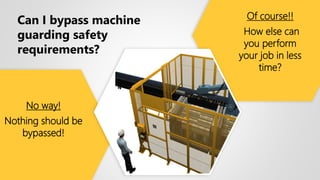
Can I bypass machine
guarding safety
requirements?
Of course!!
How else can
you perform
your job in less
time?
No way!
Nothing should be
bypassed!
What does it mean?
End result?
The worker understanding is
limited and is unable to perceive –
Severity of the potential injury
Frequency of exposure to the
potential hazard Possibility of
avoiding the hazard as it occurs
To summarize, they make situations worser
for themselves and WORKERS
AROUND THEM!!
Don’t believe?
More hazardous
situations would be –
Equipment might be capable of
bypassing protective measures without
your full understanding or knowledge
Employees figure
out ‘work arounds’
while working on
machines to
perform their tasks.
Here’s an example!
Somewhere around a machinery…
Employee is sweeping ground
wheat from around machinery
Work rules did not address
cleaning around machinery
4-inch gap between guard
and the machine body
03
02
01
Somewhere around a machinery…
Reaches under a belt
and pulley guard with
a hand brush
No guard put under the
belt and the assembly
04 05
Somewhere around a
machinery…
Left glove is caught by in-running
belt and hand gets pulled into the
motor pulley
06
07
Employee loses middle and index
fingers and suffer compound
fractures to left arm
What do you think went wrong?
 Why did the employee reach under the guard?
 Was the employee aware of the hazards?
 Did the employee see the guard and assume
that there was no hazard?
 Did the employee’s glove play an effective role?
 Should workers clean under operating
machinery?
 Who should inspect machine guarding?
Let’s review
the causes
Don’t let it
happen to you
 Employee reached under the
guard
 Employee did not inspect the
guard
 Lack of worker rules and
training
 Avoid machinery unless properly
trained
 Learn to identify point of operations
and mechanical motion
 Make sure machine guards are in
place
 Understand guarding requirements
 Know whom to contact if the guard is
missing, damaged or inadequate
Understand &
Avoid Common
Mistakes
To prevent a tragedy from occurring in your
company, take time to understand the most
common mistakes so you can avoid making
them and stay compliant with the industrial
health and safety guidelines!
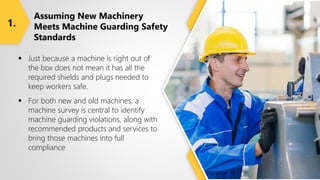
Assuming New Machinery
Meets Machine Guarding Safety
Standards
 Just because a machine is right out of
the box does not mean it has all the
required shields and plugs needed to
keep workers safe.
 For both new and old machines, a
machine survey is central to identify
machine guarding violations, along with
recommended products and services to
bring those machines into full
compliance
1.
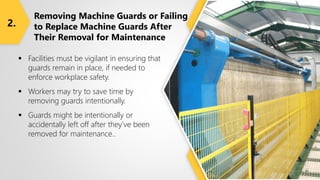
Removing Machine Guards or Failing
to Replace Machine Guards After
Their Removal for Maintenance
 Facilities must be vigilant in ensuring that
guards remain in place, if needed to
enforce workplace safety.
 Workers may try to save time by
removing guards intentionally.
 Guards might be intentionally or
accidentally left off after they’ve been
removed for maintenance..
2.
Using Inadequate Materials When
Installing or Replacing Machine
Guarding Parts
 Materials that deteriorate in the
presence of airborne swarf, ultraviolet
radiation, temperature extremes, oils,
coolants, solvents, cleaners or other
environmental contaminants/agents can
compromise the intended protection of
fixed guards..
 Manufacturers should make sure to use
either an original manufacturer’s part or
a material with the same impact
resistance as the original.
3.
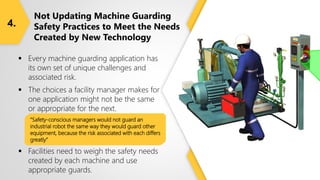
Not Updating Machine Guarding
Safety Practices to Meet the Needs
Created by New Technology
 Every machine guarding application has
its own set of unique challenges and
associated risk.
 The choices a facility manager makes for
one application might not be the same
or appropriate for the next.
“Safety-conscious managers would not guard an
industrial robot the same way they would guard other
equipment, because the risk associated with each differs
greatly”
 Facilities need to weigh the safety needs
created by each machine and use
appropriate guards.
4.
Overlooking the importance of
operator training
 It doesn’t matter how long someone’s
operated a specific machine. You still want to
provide them with frequent training.
 Training for importance of the guards, how
to adjust them to the product, and how
important it is if the guard malfunctions to
keep their body parts out of the dangerous
area.
 Train for all their workplace hazards,
including those that are machine-specific,
and safe machine operating procedures,
such as lockout/tagout procedures..
5.
Whether the operation of the machine can
injure the operators or others in the vicinity,
the hazards must be either eliminated or
controlled!
Summary
“If it moves, it merits your attention.!”
Your Animation Story Starts Here.
Press the button. Make the call. Transform your trainings.
ASK-EHS Engineering & Consultants Pvt. Ltd.
Communication & learning for reliable occupational safety and health by ASK - EHS
https://www.ask-ehs.com/animation/animated-safety-videos.htm

Common mistakes in machine guarding

  • 1.
  • 2.
    Can I bypassmachine guarding safety requirements? Of course!! How else can you perform your job in less time? No way! Nothing should be bypassed!
  • 3.
    What does itmean? End result? The worker understanding is limited and is unable to perceive – Severity of the potential injury Frequency of exposure to the potential hazard Possibility of avoiding the hazard as it occurs To summarize, they make situations worser for themselves and WORKERS AROUND THEM!! Don’t believe? More hazardous situations would be – Equipment might be capable of bypassing protective measures without your full understanding or knowledge Employees figure out ‘work arounds’ while working on machines to perform their tasks.
  • 4.
  • 5.
    Somewhere around amachinery… Employee is sweeping ground wheat from around machinery Work rules did not address cleaning around machinery 4-inch gap between guard and the machine body 03 02 01
  • 6.
    Somewhere around amachinery… Reaches under a belt and pulley guard with a hand brush No guard put under the belt and the assembly 04 05
  • 7.
    Somewhere around a machinery… Leftglove is caught by in-running belt and hand gets pulled into the motor pulley 06 07 Employee loses middle and index fingers and suffer compound fractures to left arm
  • 8.
    What do youthink went wrong?  Why did the employee reach under the guard?  Was the employee aware of the hazards?  Did the employee see the guard and assume that there was no hazard?  Did the employee’s glove play an effective role?  Should workers clean under operating machinery?  Who should inspect machine guarding?
  • 9.
    Let’s review the causes Don’tlet it happen to you  Employee reached under the guard  Employee did not inspect the guard  Lack of worker rules and training  Avoid machinery unless properly trained  Learn to identify point of operations and mechanical motion  Make sure machine guards are in place  Understand guarding requirements  Know whom to contact if the guard is missing, damaged or inadequate
  • 10.
    Understand & Avoid Common Mistakes Toprevent a tragedy from occurring in your company, take time to understand the most common mistakes so you can avoid making them and stay compliant with the industrial health and safety guidelines!
  • 11.
    Assuming New Machinery MeetsMachine Guarding Safety Standards  Just because a machine is right out of the box does not mean it has all the required shields and plugs needed to keep workers safe.  For both new and old machines, a machine survey is central to identify machine guarding violations, along with recommended products and services to bring those machines into full compliance 1.
  • 12.
    Removing Machine Guardsor Failing to Replace Machine Guards After Their Removal for Maintenance  Facilities must be vigilant in ensuring that guards remain in place, if needed to enforce workplace safety.  Workers may try to save time by removing guards intentionally.  Guards might be intentionally or accidentally left off after they’ve been removed for maintenance.. 2.
  • 13.
    Using Inadequate MaterialsWhen Installing or Replacing Machine Guarding Parts  Materials that deteriorate in the presence of airborne swarf, ultraviolet radiation, temperature extremes, oils, coolants, solvents, cleaners or other environmental contaminants/agents can compromise the intended protection of fixed guards..  Manufacturers should make sure to use either an original manufacturer’s part or a material with the same impact resistance as the original. 3.
  • 14.
    Not Updating MachineGuarding Safety Practices to Meet the Needs Created by New Technology  Every machine guarding application has its own set of unique challenges and associated risk.  The choices a facility manager makes for one application might not be the same or appropriate for the next. “Safety-conscious managers would not guard an industrial robot the same way they would guard other equipment, because the risk associated with each differs greatly”  Facilities need to weigh the safety needs created by each machine and use appropriate guards. 4.
  • 15.
    Overlooking the importanceof operator training  It doesn’t matter how long someone’s operated a specific machine. You still want to provide them with frequent training.  Training for importance of the guards, how to adjust them to the product, and how important it is if the guard malfunctions to keep their body parts out of the dangerous area.  Train for all their workplace hazards, including those that are machine-specific, and safe machine operating procedures, such as lockout/tagout procedures.. 5.
  • 16.
    Whether the operationof the machine can injure the operators or others in the vicinity, the hazards must be either eliminated or controlled! Summary “If it moves, it merits your attention.!”
  • 17.
    Your Animation StoryStarts Here. Press the button. Make the call. Transform your trainings. ASK-EHS Engineering & Consultants Pvt. Ltd. Communication & learning for reliable occupational safety and health by ASK - EHS https://www.ask-ehs.com/animation/animated-safety-videos.htm