Common European Framework of Reference for Languages 
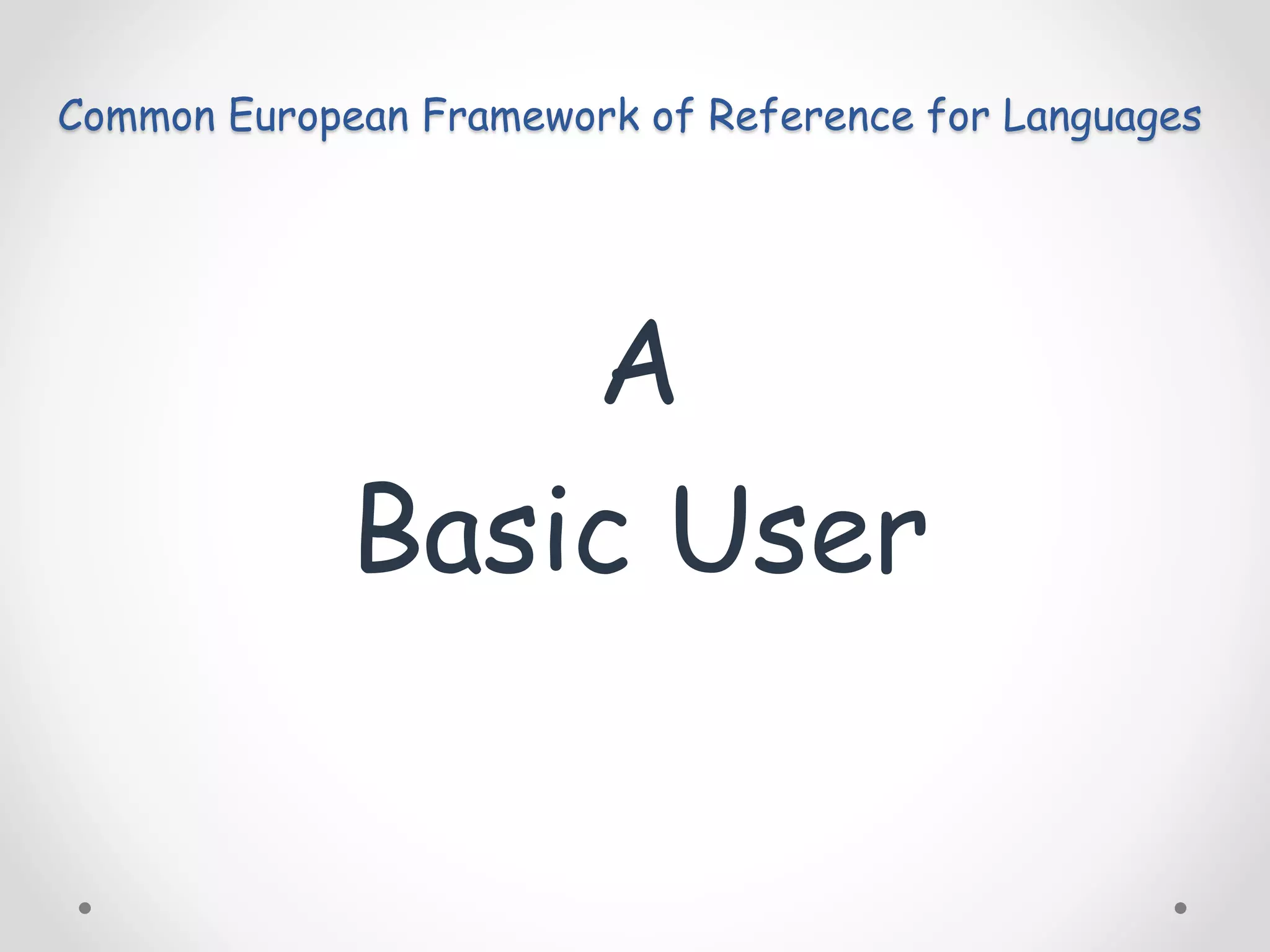
A 
Basic User
Common European Framework of Reference for Languages 
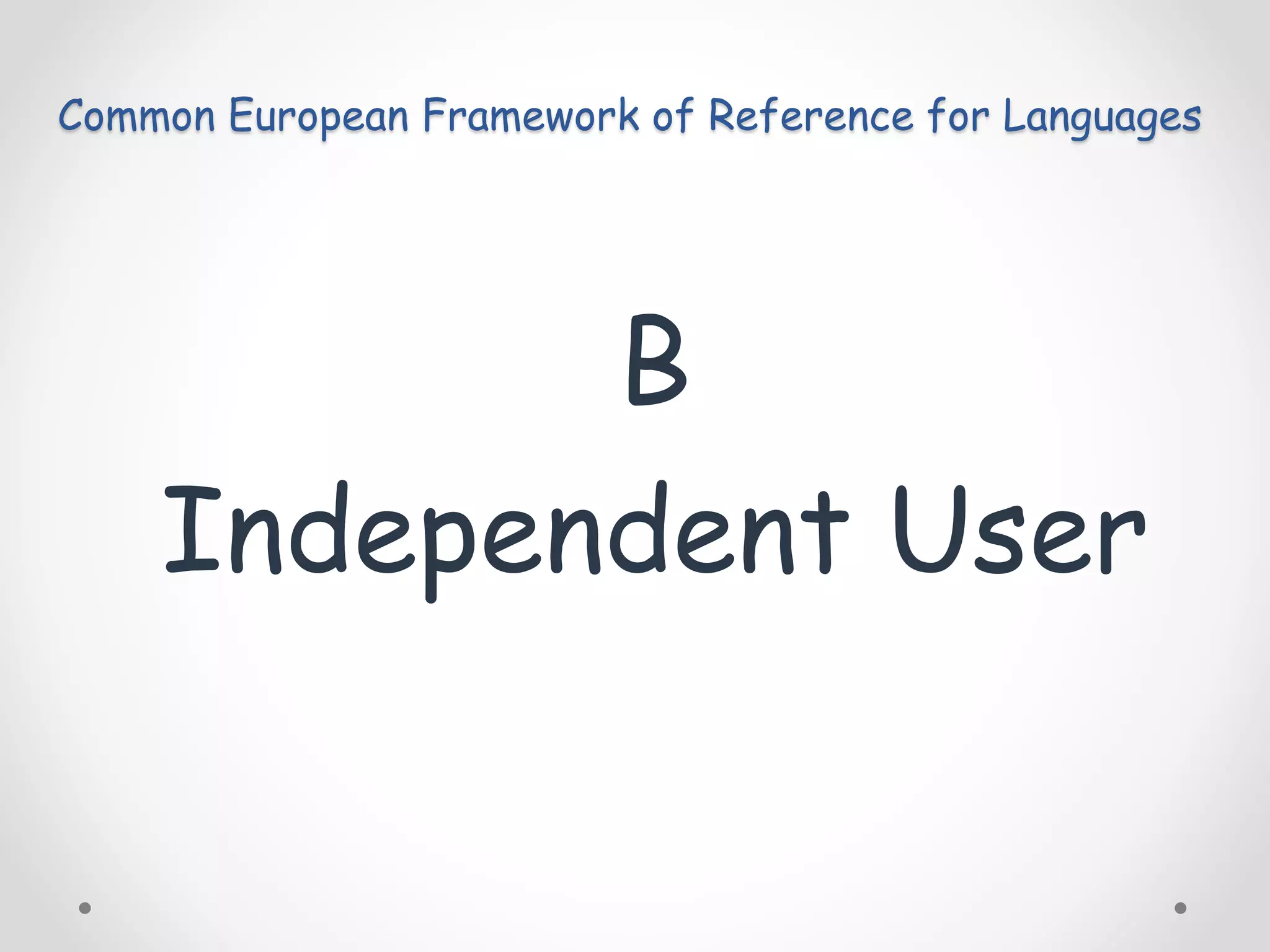
B 
Independent User
Common European Framework of Reference for Languages 
C 
Proficient User
Common European Framework of Reference for Languages 
A Basic User 
A1 Breakthrough or beginner 
• Can understand and use familiar everyday expressions and very 
basic phrases aimed at the satisfaction of needs of a concrete 
type. 
• Can introduce him/herself and others and can ask and answer 
questions about personal details such as where he/she lives, 
people he/she knows and things he/she has. 
• Can interact in a simple way provided the other person talks 
slowly and clearly and is prepared to help.
Common European Framework of Reference for Languages 
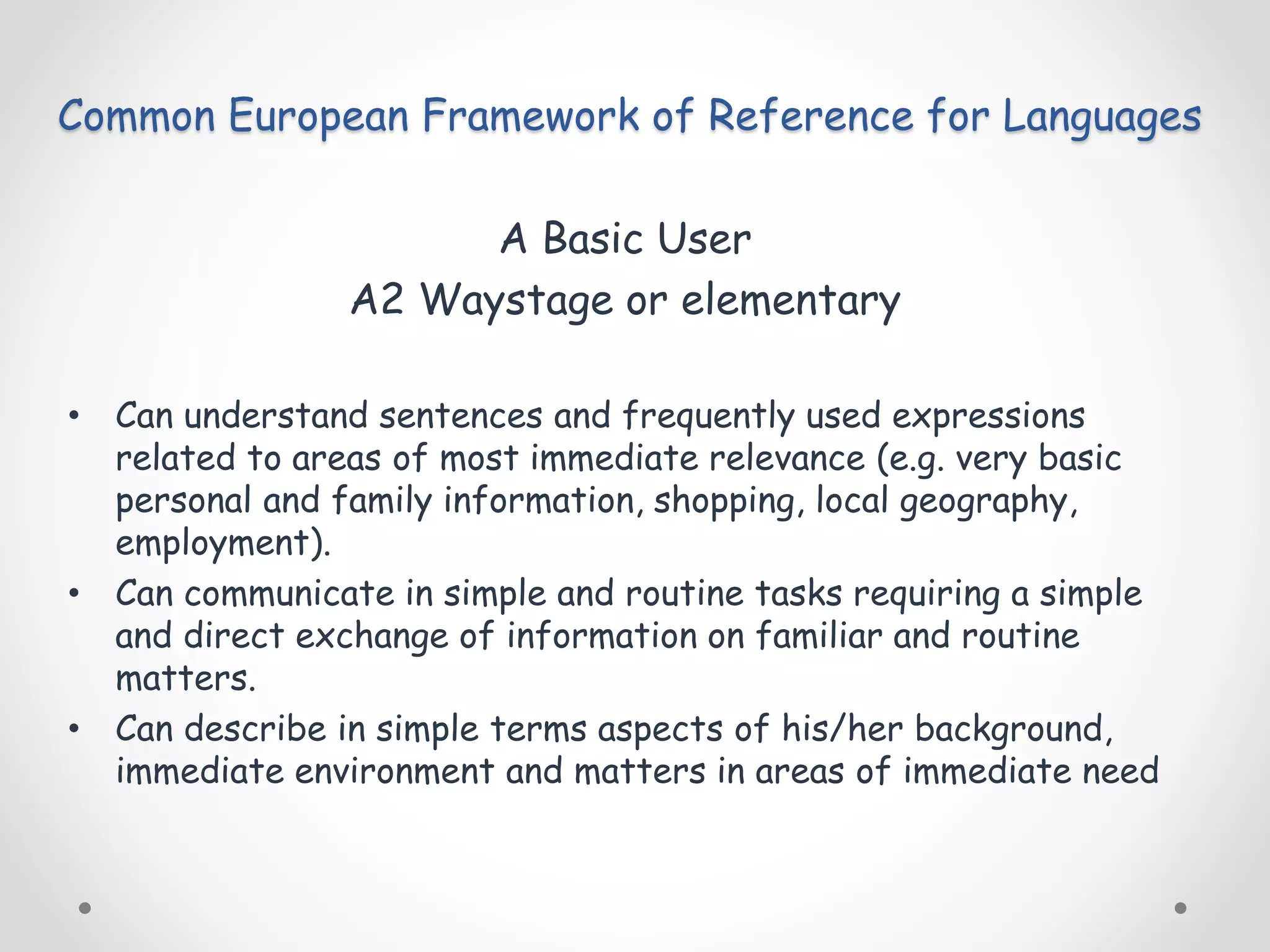
A Basic User 
A2 Waystage or elementary 
• Can understand sentences and frequently used expressions 
related to areas of most immediate relevance (e.g. very basic 
personal and family information, shopping, local geography, 
employment). 
• Can communicate in simple and routine tasks requiring a simple 
and direct exchange of information on familiar and routine 
matters. 
• Can describe in simple terms aspects of his/her background, 
immediate environment and matters in areas of immediate need
Common European Framework of Reference for Languages 
B Independent User 
B1 Threshold or intermediate 
• Can understand the main points of clear standard input on 
familiar matters regularly encountered in work, school, leisure, 
etc. 
• Can deal with most situations likely to arise whilst travelling in 
an area where the language is spoken. 
• Can produce simple connected text on topics which are familiar 
or of personal interest. 
• Can describe experiences and events, dreams, hopes & ambitions 
and briefly give reasons and explanations for opinions and plans.
Common European Framework of Reference for Languages 
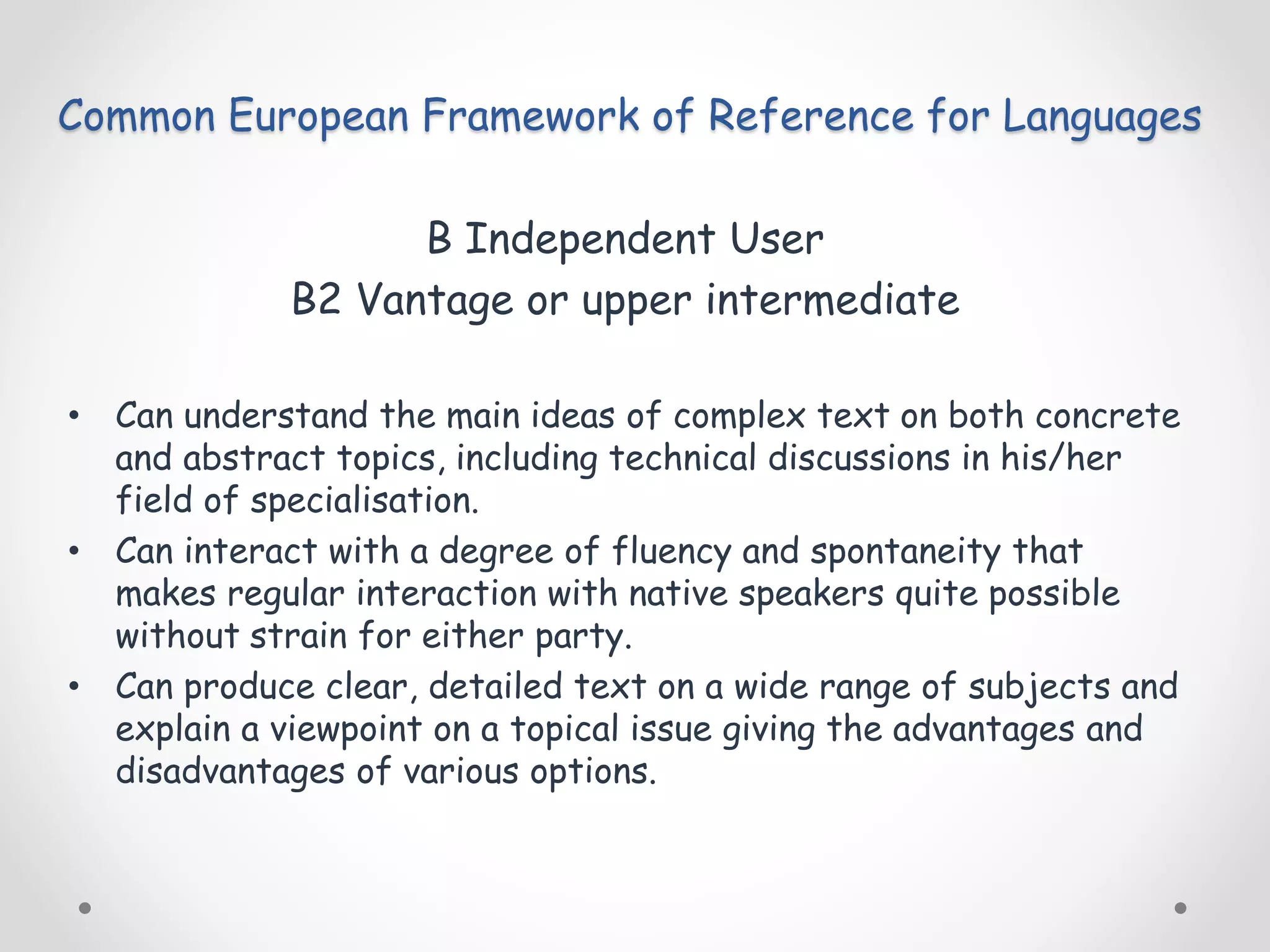
B Independent User 
B2 Vantage or upper intermediate 
• Can understand the main ideas of complex text on both concrete 
and abstract topics, including technical discussions in his/her 
field of specialisation. 
• Can interact with a degree of fluency and spontaneity that 
makes regular interaction with native speakers quite possible 
without strain for either party. 
• Can produce clear, detailed text on a wide range of subjects and 
explain a viewpoint on a topical issue giving the advantages and 
disadvantages of various options.
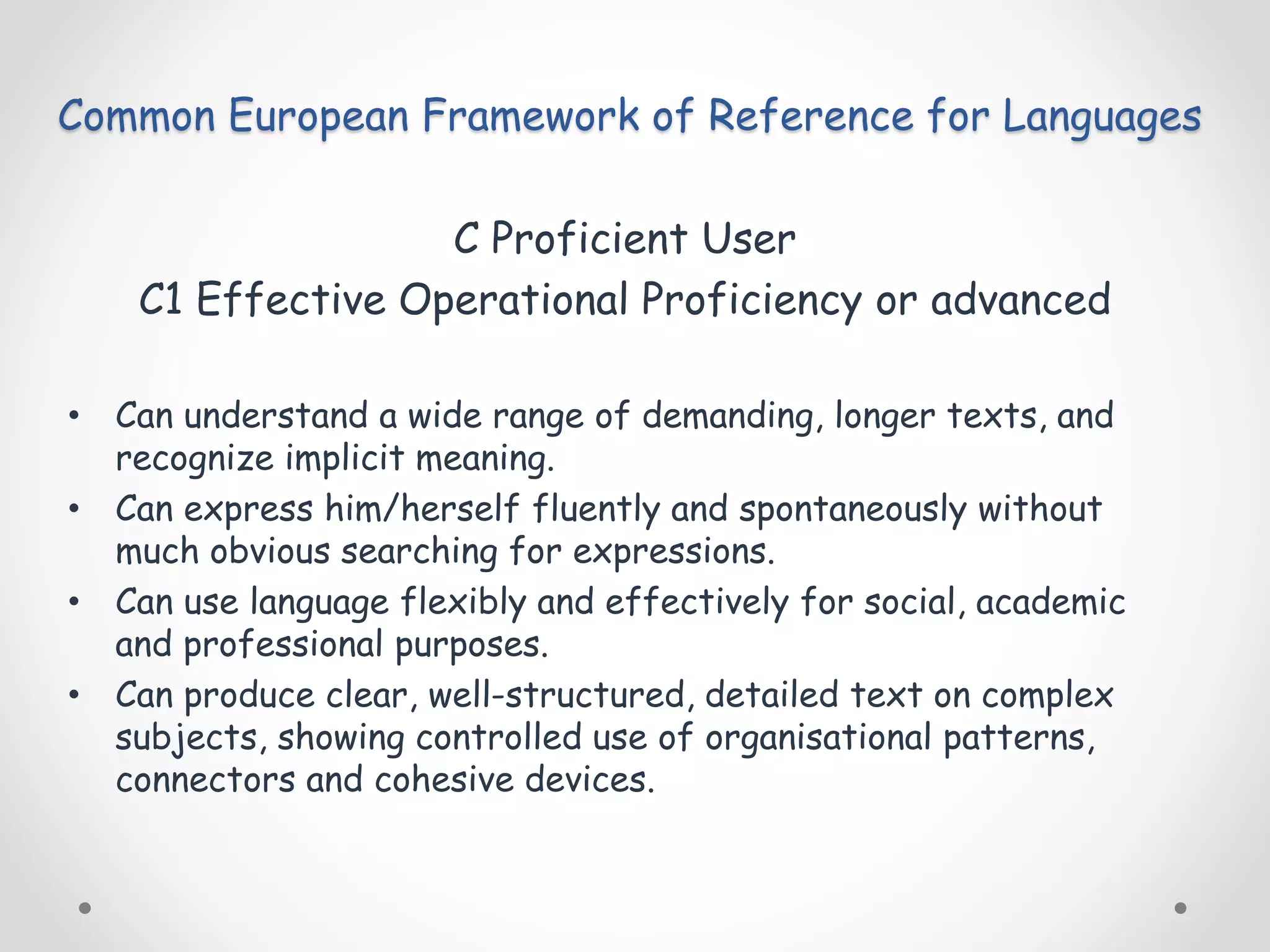
Common European Framework of Reference for Languages 
C Proficient User 
C1 Effective Operational Proficiency or advanced 
• Can understand a wide range of demanding, longer texts, and 
recognize implicit meaning. 
• Can express him/herself fluently and spontaneously without 
much obvious searching for expressions. 
• Can use language flexibly and effectively for social, academic 
and professional purposes. 
• Can produce clear, well-structured, detailed text on complex 
subjects, showing controlled use of organisational patterns, 
connectors and cohesive devices.
Common European Framework of Reference for Languages 
C Proficient User 
C2 Mastery or proficiency 
• Can understand with ease virtually everything heard or read. 
• Can summarize information from different spoken and written 
sources, reconstructing arguments and accounts in a coherent 
presentation. 
• Can express him/herself spontaneously, very fluently and 
precisely, differentiating finer shades of meaning even in the 
most complex situation.

Common european framework of reference for languages

  • 1.
    Common European Frameworkof Reference for Languages A Basic User
  • 2.
    Common European Frameworkof Reference for Languages B Independent User
  • 3.
    Common European Frameworkof Reference for Languages C Proficient User
  • 4.
    Common European Frameworkof Reference for Languages A Basic User A1 Breakthrough or beginner • Can understand and use familiar everyday expressions and very basic phrases aimed at the satisfaction of needs of a concrete type. • Can introduce him/herself and others and can ask and answer questions about personal details such as where he/she lives, people he/she knows and things he/she has. • Can interact in a simple way provided the other person talks slowly and clearly and is prepared to help.
  • 5.
    Common European Frameworkof Reference for Languages A Basic User A2 Waystage or elementary • Can understand sentences and frequently used expressions related to areas of most immediate relevance (e.g. very basic personal and family information, shopping, local geography, employment). • Can communicate in simple and routine tasks requiring a simple and direct exchange of information on familiar and routine matters. • Can describe in simple terms aspects of his/her background, immediate environment and matters in areas of immediate need
  • 6.
    Common European Frameworkof Reference for Languages B Independent User B1 Threshold or intermediate • Can understand the main points of clear standard input on familiar matters regularly encountered in work, school, leisure, etc. • Can deal with most situations likely to arise whilst travelling in an area where the language is spoken. • Can produce simple connected text on topics which are familiar or of personal interest. • Can describe experiences and events, dreams, hopes & ambitions and briefly give reasons and explanations for opinions and plans.
  • 7.
    Common European Frameworkof Reference for Languages B Independent User B2 Vantage or upper intermediate • Can understand the main ideas of complex text on both concrete and abstract topics, including technical discussions in his/her field of specialisation. • Can interact with a degree of fluency and spontaneity that makes regular interaction with native speakers quite possible without strain for either party. • Can produce clear, detailed text on a wide range of subjects and explain a viewpoint on a topical issue giving the advantages and disadvantages of various options.
  • 8.
    Common European Frameworkof Reference for Languages C Proficient User C1 Effective Operational Proficiency or advanced • Can understand a wide range of demanding, longer texts, and recognize implicit meaning. • Can express him/herself fluently and spontaneously without much obvious searching for expressions. • Can use language flexibly and effectively for social, academic and professional purposes. • Can produce clear, well-structured, detailed text on complex subjects, showing controlled use of organisational patterns, connectors and cohesive devices.
  • 9.
    Common European Frameworkof Reference for Languages C Proficient User C2 Mastery or proficiency • Can understand with ease virtually everything heard or read. • Can summarize information from different spoken and written sources, reconstructing arguments and accounts in a coherent presentation. • Can express him/herself spontaneously, very fluently and precisely, differentiating finer shades of meaning even in the most complex situation.