SHIVANGI MAURYA
NURSING TUTOR
K.G.M.U, COLLEGE OF NURSING
LUCKNOW
INTRODUCTION
The common cold is a viral infection of
nose and throat (upper respiratory tract).
It's usually harmless. Many types of viruses
can cause a common cold.
Risk factors
These factors can increase more chances of getting a cold:
• Age: Children younger than six are at greatest risk of colds.
• Weakened immune system: Having a chronic illness or
otherwise weakened immune system increases your risk.
• Weather: Both children and adults are more
susceptible to colds in winter.
Symptoms the common cold
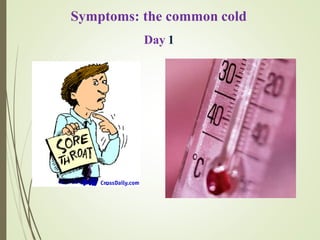
Day 1: sore or “scratchy” throat, +/- low grade fever.
Day 2-3: nasal obstruction, rhinorrhea, sneezing, thick
purulent nasal discharge.
Day 4-5: cough becomes bothersome, nasal symptoms less
severe.
•Average duration: 3-7 days.
•Virus-induced changes in airway reactivity can persist for
up to 4 weeks.
Symptoms: the common cold
Day 1
Symptoms: the common cold
Day 2 to 3
Symptoms: the Common Cold
Day 4 to 5
•Thick
purulent
nasal
discharge
does NOT
mean
bacterial
sinusitis!
INCUBATION PERIOD & DURATION
❖Incubation period 24 to 72
hours
❖Average duration 3 – 7
days
❖ Virus-induced changes in airway
reactivity can persist for up to 4
weeks (Rhinovirus )
❖2 to 3 episodes /per year
TRANSMISSION
❖ Hand –to- hand
❖ most efficient = direct contact
❖ virus can survive for 2 hours on human skin
TREATMENT
For adults — seek medical attention if:
•Fever greater than 101.3 F (38.5 C)
•Fever lasting five days or more or
returning after a fever-free period
•Shortness of breath
•Wheezing
•Severe sore throat, headache or sinus pain
 NASAL CONGESTION:
 Topical or oral decongestant – phenylephrine or
pseudoephedrine
 Topical intranasal spray - oxymetazoline and phenylephrine
 Humidified air and fluid intake
 PAIN RELIEVERS
❖ COUGH:
Dextromethorphan – cough
suppressant
❖ Benylin E – expectorant
COMPLEMENTARY/ ALTERNATIVE:
•Vitamin C
•No effect if started after onset of symptoms
•Inconsistent results if started before: may slightly
decrease cold duration if 200mg daily
COMMON COLD.pdf

COMMON COLD.pdf

  • 1.
    SHIVANGI MAURYA NURSING TUTOR K.G.M.U,COLLEGE OF NURSING LUCKNOW
  • 2.
    INTRODUCTION The common coldis a viral infection of nose and throat (upper respiratory tract). It's usually harmless. Many types of viruses can cause a common cold.
  • 3.
    Risk factors These factorscan increase more chances of getting a cold: • Age: Children younger than six are at greatest risk of colds. • Weakened immune system: Having a chronic illness or otherwise weakened immune system increases your risk. • Weather: Both children and adults are more susceptible to colds in winter.
  • 4.
    Symptoms the commoncold Day 1: sore or “scratchy” throat, +/- low grade fever. Day 2-3: nasal obstruction, rhinorrhea, sneezing, thick purulent nasal discharge. Day 4-5: cough becomes bothersome, nasal symptoms less severe. •Average duration: 3-7 days. •Virus-induced changes in airway reactivity can persist for up to 4 weeks.
  • 5.
  • 6.
    Symptoms: the commoncold Day 2 to 3
  • 7.
    Symptoms: the CommonCold Day 4 to 5 •Thick purulent nasal discharge does NOT mean bacterial sinusitis!
  • 8.
    INCUBATION PERIOD &DURATION ❖Incubation period 24 to 72 hours ❖Average duration 3 – 7 days ❖ Virus-induced changes in airway reactivity can persist for up to 4 weeks (Rhinovirus ) ❖2 to 3 episodes /per year
  • 9.
    TRANSMISSION ❖ Hand –to-hand ❖ most efficient = direct contact ❖ virus can survive for 2 hours on human skin
  • 12.
    TREATMENT For adults —seek medical attention if: •Fever greater than 101.3 F (38.5 C) •Fever lasting five days or more or returning after a fever-free period •Shortness of breath •Wheezing •Severe sore throat, headache or sinus pain
  • 13.
     NASAL CONGESTION: Topical or oral decongestant – phenylephrine or pseudoephedrine  Topical intranasal spray - oxymetazoline and phenylephrine  Humidified air and fluid intake  PAIN RELIEVERS ❖ COUGH: Dextromethorphan – cough suppressant ❖ Benylin E – expectorant
  • 14.
    COMPLEMENTARY/ ALTERNATIVE: •Vitamin C •Noeffect if started after onset of symptoms •Inconsistent results if started before: may slightly decrease cold duration if 200mg daily