English by Nits Sir
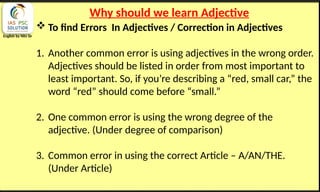
Why should we learn Adjective
 To find Errors In Adjectives / Correction in Adjectives
1. Another common error is using adjectives in the wrong order.
Adjectives should be listed in order from most important to
least important. So, if you’re describing a “red, small car,” the
word “red” should come before “small.”
2. One common error is using the wrong degree of the
adjective. (Under degree of comparison)
3. Common error in using the correct Article – A/AN/THE.
(Under Article)
English by Nits Sir
Adjective
English by Nits Sir
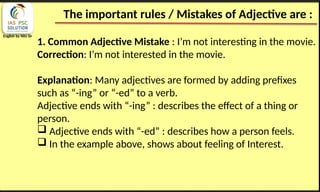
The important rules / Mistakes of Adjective are :
1. Common Adjective Mistake : I’m not interesting in the movie.
Correction: I’m not interested in the movie.
Explanation: Many adjectives are formed by adding prefixes
such as “-ing” or “-ed” to a verb.
Adjective ends with “-ing” : describes the effect of a thing or
person.
 Adjective ends with “-ed” : describes how a person feels.
 In the example above, shows about feeling of Interest.
English by Nits Sir
2. Common Adjective Mistake : The room is awfully.
 Correction: The room is awful.
 Explanation: Awful isn’t modifying the verb here, but the
noun (the room).
3. Common Adjective Mistakes : He’s more stronger than his
opponent.
 Correction: He’s stronger than his opponent.
 Explanation: Double Comparatives ERROR : When you use
the comparative form of an adjective (stronger), there’s no
need to use another adjective (more).
English by Nits Sir
4. Common Adjective Mistakes : You’re the most perfect person
I’ve ever seen.
 Correction: You’re the perfect person I’ve seen.
 Explanation: Some adjectives are complete and highest by
themselves. We call them non-gradable adjectives. You can
add any words to intensify or grade them further.
5. Common Adjective Mistakes : Which is the shortest of these
two routes?
 Correction: Which is the shorter of these two routes?
 Explanation: if “OF’’ is used for compare between two then
we use comparative & use “THE” before comparative degree
English by Nits Sir
4. Common Adjective Mistakes : You’re the most perfect person
I’ve ever seen.
 Correction: You’re the perfect person I’ve seen.
 Explanation: Some adjectives are complete and highest by
themselves. We call them non-gradable adjectives. You can
add any words to intensify or grade them further.
5. Common Adjective Mistakes : Which is the shortest of these
two routes?
 Correction: Which is the shorter of these two routes?
 Explanation: if “OF’’ is used for compare between two then
we use comparative & use “THE” before comparative degree
English by Nits Sir
6. Common Adjective Mistakes : Another common error is using
adjectives in the wrong order. Adjectives should be listed in
order from most important to least important. So, if you’re
describing a “red, small car,” the word “red” should come before
“small
Ram has small red pen
7. Common Adjective Mistakes : We should use an adjective
after noun when the noun is followed by preposition.
Example:
He is the boy suitable for this role.
The subject is a matter worthy of note.
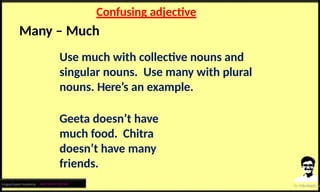
Confusing adjective
Many – Much
Use much with collective nouns and
singular nouns. Use many with plural
nouns. Here’s an example.
Geeta doesn’t have
much food. Chitra
doesn’t have many
friends.
Lingua Expert Academy : अंग्रेजी भाषा में निपुण बने
By Nits Singh
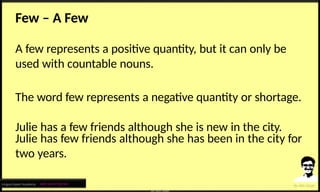
Few – A Few
A few represents a positive quantity, but it can only be
used with countable nouns.
The word few represents a negative quantity or shortage.
Julie has a few friends although she is new in the city.
Julie has few friends although she has been in the city for
two years.
Lingua Expert Academy : अंग्रेजी भाषा में निपुण बने
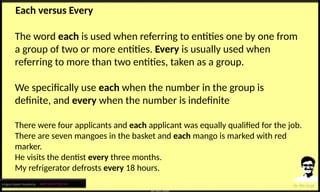
Each versus Every
The word each is used when referring to entities one by one from
a group of two or more entities. Every is usually used when
referring to more than two entities, taken as a group.
We specifically use each when the number in the group is
definite, and every when the number is indefinite
There were four applicants and each applicant was equally qualified for the job.
There are seven mangoes in the basket and each mango is marked with red
marker.
He visits the dentist every three months.
My refrigerator defrosts every 18 hours.
Lingua Expert Academy : अंग्रेजी भाषा में निपुण बने
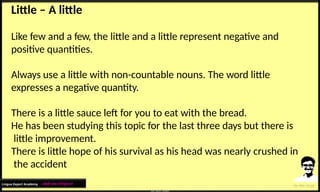
Little – A little
Like few and a few, the little and a little represent negative and
positive quantities.
Always use a little with non-countable nouns. The word little
expresses a negative quantity.
There is a little sauce left for you to eat with the bread.
He has been studying this topic for the last three days but there is
little improvement.
There is little hope of his survival as his head was nearly crushed in
the accident
Lingua Expert Academy : अंग्रेजी भाषा में निपुण बने
Farther – Further
Farther (root word far) is always used for distance,
and further (think furthermore) means advancement.
How much farther is Rohtak from Hisar?
I am too tired to walk any farther.
Further topics will be covered next week.
Please wait for further instructions.
Lingua Expert Academy : अंग्रेजी भाषा में निपुण बने
Last – Later - Latter- Latest
Last is the opposite of first, the latter is the opposite of the
former and the latest means the most recent.
Read the first and last paragraphs today.
I will done it later.
Of the two choices, I prefer the latter.
What is the latest news from the border?
Lingua Expert Academy : अंग्रेजी भाषा में निपुण बने
Late / lately
Late can be an adjective or an adverb that means
after the correct time.
I’m not hungry because I had a late lunch. (adjective)
I was late for the exam.
He slept late and missed his first class. (adverb)
Lately is an adverb that means the same as recently.
I haven’t studied a lot lately.
Lingua Expert Academy : अंग्रेजी भाषा में निपुण बने
Hard / hardly
Hard can be an adjective or an adverb.
This book is too hard for me. I can’t read it. (hard is an adjective
meaning difficult)
This mattress is too hard. I can’t sleep. (hard is an adjective meaning
opposite of “soft”)
She’s working hard to finish the project by tomorrow. (hard is an
adverb meaning working intensely)
Hardly has a completely different meaning. It means “almost
not.”
We have a bad connection, I can hardly hear you. ( I almost can’t hear
you)
Lingua Expert Academy : अंग्रेजी भाषा में निपुण बने
Nearest/Next
Nearest is closest in distance. Next means the next in order.
Examples-
The next six months will be the hardest to survive.
The next chapter is a very simple one.
Who's is next in the queue?
The week after next.
Lingua Expert Academy : अंग्रेजी भाषा में निपुण बने
Nearest/Next
Nearest is closest in distance. Next means the next in order.
Examples-
The next six months will be the hardest to survive.
The next chapter is a very simple one.
Who's is next in the queue?
The week after next.
Lingua Expert Academy : अंग्रेजी भाषा में निपुण बने
Some versus Any
Some is usually used in affirmative sentences while any is used in negative and
interrogative sentences.
Is there some water in the jar?
Is there any water in the jar?
Note : any can be used after if or an expression of doubt in affirmative sentences. For
example:
If you need any help, I’m just one call away.
Some can be used in questions which are offers/requests or where the expected
answer is yes.
Will you have some coffee? (offer)
Lingua Expert Academy : अंग्रेजी भाषा में निपुण बने
certain' with 'a certain'.
Both are adjectives and the meaning is the same.
But Explanation: We use Plural noun with "Certain" and Singular Noun
with "a certain“
Certain+Plural Noun
A Certain+Singular Noun
He wants certain students to complete the work.
He wants a certain student to complete the work.
Lingua Expert Academy : अंग्रेजी भाषा में निपुण बने
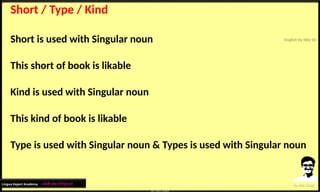
Short / Type / Kind
Short is used with Singular noun
This short of book is likable
Kind is used with Singular noun
This kind of book is likable
Type is used with Singular noun & Types is used with Singular noun
Lingua Expert Academy : अंग्रेजी भाषा में निपुण बने
English by Nits Sir
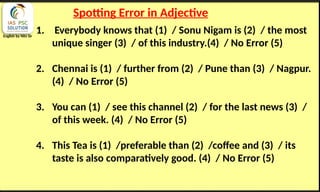
Spotting Error in Adjective
1. Everybody knows that (1) / Sonu Nigam is (2) / the most
unique singer (3) / of this industry.(4) / No Error (5)
2. Chennai is (1) / further from (2) / Pune than (3) / Nagpur.
(4) / No Error (5)
3. You can (1) / see this channel (2) / for the last news (3) /
of this week. (4) / No Error (5)
4. This Tea is (1) /preferable than (2) /coffee and (3) / its
taste is also comparatively good. (4) / No Error (5)
English by Nits Sir
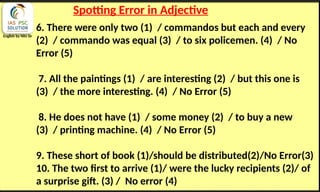
Spotting Error in Adjective
6. There were only two (1) / commandos but each and every
(2) / commando was equal (3) / to six policemen. (4) / No
Error (5)
7. All the paintings (1) / are interesting (2) / but this one is
(3) / the more interesting. (4) / No Error (5)
8. He does not have (1) / some money (2) / to buy a new
(3) / printing machine. (4) / No Error (5)
9. These short of book (1)/should be distributed(2)/No Error(3)
10. The two first to arrive (1)/ were the lucky recipients (2)/ of
a surprise gift. (3) / No error (4)
English by Nits Sir
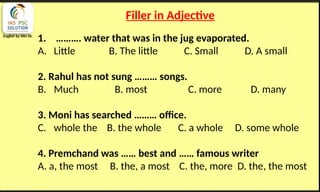
Filler in Adjective
1. ………. water that was in the jug evaporated.
A. Little B. The little C. Small D. A small
2. Rahul has not sung ……… songs.
B. Much B. most C. more D. many
3. Moni has searched ……… office.
C. whole the B. the whole C. a whole D. some whole
4. Premchand was …… best and …… famous writer
A. a, the most B. the, a most C. the, more D. the, the most

Common Adjective Mistakes for competitive exam.pptx

  • 1.
    English by NitsSir Why should we learn Adjective  To find Errors In Adjectives / Correction in Adjectives 1. Another common error is using adjectives in the wrong order. Adjectives should be listed in order from most important to least important. So, if you’re describing a “red, small car,” the word “red” should come before “small.” 2. One common error is using the wrong degree of the adjective. (Under degree of comparison) 3. Common error in using the correct Article – A/AN/THE. (Under Article)
  • 2.
    English by NitsSir Adjective
  • 3.
    English by NitsSir The important rules / Mistakes of Adjective are : 1. Common Adjective Mistake : I’m not interesting in the movie. Correction: I’m not interested in the movie. Explanation: Many adjectives are formed by adding prefixes such as “-ing” or “-ed” to a verb. Adjective ends with “-ing” : describes the effect of a thing or person.  Adjective ends with “-ed” : describes how a person feels.  In the example above, shows about feeling of Interest.
  • 4.
    English by NitsSir 2. Common Adjective Mistake : The room is awfully.  Correction: The room is awful.  Explanation: Awful isn’t modifying the verb here, but the noun (the room). 3. Common Adjective Mistakes : He’s more stronger than his opponent.  Correction: He’s stronger than his opponent.  Explanation: Double Comparatives ERROR : When you use the comparative form of an adjective (stronger), there’s no need to use another adjective (more).
  • 5.
    English by NitsSir 4. Common Adjective Mistakes : You’re the most perfect person I’ve ever seen.  Correction: You’re the perfect person I’ve seen.  Explanation: Some adjectives are complete and highest by themselves. We call them non-gradable adjectives. You can add any words to intensify or grade them further. 5. Common Adjective Mistakes : Which is the shortest of these two routes?  Correction: Which is the shorter of these two routes?  Explanation: if “OF’’ is used for compare between two then we use comparative & use “THE” before comparative degree
  • 6.
    English by NitsSir 4. Common Adjective Mistakes : You’re the most perfect person I’ve ever seen.  Correction: You’re the perfect person I’ve seen.  Explanation: Some adjectives are complete and highest by themselves. We call them non-gradable adjectives. You can add any words to intensify or grade them further. 5. Common Adjective Mistakes : Which is the shortest of these two routes?  Correction: Which is the shorter of these two routes?  Explanation: if “OF’’ is used for compare between two then we use comparative & use “THE” before comparative degree
  • 7.
    English by NitsSir 6. Common Adjective Mistakes : Another common error is using adjectives in the wrong order. Adjectives should be listed in order from most important to least important. So, if you’re describing a “red, small car,” the word “red” should come before “small Ram has small red pen 7. Common Adjective Mistakes : We should use an adjective after noun when the noun is followed by preposition. Example: He is the boy suitable for this role. The subject is a matter worthy of note.
  • 8.
    Confusing adjective Many –Much Use much with collective nouns and singular nouns. Use many with plural nouns. Here’s an example. Geeta doesn’t have much food. Chitra doesn’t have many friends. Lingua Expert Academy : अंग्रेजी भाषा में निपुण बने By Nits Singh
  • 9.
    Few – AFew A few represents a positive quantity, but it can only be used with countable nouns. The word few represents a negative quantity or shortage. Julie has a few friends although she is new in the city. Julie has few friends although she has been in the city for two years. Lingua Expert Academy : अंग्रेजी भाषा में निपुण बने
  • 10.
    Each versus Every Theword each is used when referring to entities one by one from a group of two or more entities. Every is usually used when referring to more than two entities, taken as a group. We specifically use each when the number in the group is definite, and every when the number is indefinite There were four applicants and each applicant was equally qualified for the job. There are seven mangoes in the basket and each mango is marked with red marker. He visits the dentist every three months. My refrigerator defrosts every 18 hours. Lingua Expert Academy : अंग्रेजी भाषा में निपुण बने
  • 11.
    Little – Alittle Like few and a few, the little and a little represent negative and positive quantities. Always use a little with non-countable nouns. The word little expresses a negative quantity. There is a little sauce left for you to eat with the bread. He has been studying this topic for the last three days but there is little improvement. There is little hope of his survival as his head was nearly crushed in the accident Lingua Expert Academy : अंग्रेजी भाषा में निपुण बने
  • 12.
    Farther – Further Farther(root word far) is always used for distance, and further (think furthermore) means advancement. How much farther is Rohtak from Hisar? I am too tired to walk any farther. Further topics will be covered next week. Please wait for further instructions. Lingua Expert Academy : अंग्रेजी भाषा में निपुण बने
  • 13.
    Last – Later- Latter- Latest Last is the opposite of first, the latter is the opposite of the former and the latest means the most recent. Read the first and last paragraphs today. I will done it later. Of the two choices, I prefer the latter. What is the latest news from the border? Lingua Expert Academy : अंग्रेजी भाषा में निपुण बने
  • 14.
    Late / lately Latecan be an adjective or an adverb that means after the correct time. I’m not hungry because I had a late lunch. (adjective) I was late for the exam. He slept late and missed his first class. (adverb) Lately is an adverb that means the same as recently. I haven’t studied a lot lately. Lingua Expert Academy : अंग्रेजी भाषा में निपुण बने
  • 15.
    Hard / hardly Hardcan be an adjective or an adverb. This book is too hard for me. I can’t read it. (hard is an adjective meaning difficult) This mattress is too hard. I can’t sleep. (hard is an adjective meaning opposite of “soft”) She’s working hard to finish the project by tomorrow. (hard is an adverb meaning working intensely) Hardly has a completely different meaning. It means “almost not.” We have a bad connection, I can hardly hear you. ( I almost can’t hear you) Lingua Expert Academy : अंग्रेजी भाषा में निपुण बने
  • 16.
    Nearest/Next Nearest is closestin distance. Next means the next in order. Examples- The next six months will be the hardest to survive. The next chapter is a very simple one. Who's is next in the queue? The week after next. Lingua Expert Academy : अंग्रेजी भाषा में निपुण बने
  • 17.
    Nearest/Next Nearest is closestin distance. Next means the next in order. Examples- The next six months will be the hardest to survive. The next chapter is a very simple one. Who's is next in the queue? The week after next. Lingua Expert Academy : अंग्रेजी भाषा में निपुण बने
  • 18.
    Some versus Any Someis usually used in affirmative sentences while any is used in negative and interrogative sentences. Is there some water in the jar? Is there any water in the jar? Note : any can be used after if or an expression of doubt in affirmative sentences. For example: If you need any help, I’m just one call away. Some can be used in questions which are offers/requests or where the expected answer is yes. Will you have some coffee? (offer) Lingua Expert Academy : अंग्रेजी भाषा में निपुण बने
  • 19.
    certain' with 'acertain'. Both are adjectives and the meaning is the same. But Explanation: We use Plural noun with "Certain" and Singular Noun with "a certain“ Certain+Plural Noun A Certain+Singular Noun He wants certain students to complete the work. He wants a certain student to complete the work. Lingua Expert Academy : अंग्रेजी भाषा में निपुण बने
  • 20.
    Short / Type/ Kind Short is used with Singular noun This short of book is likable Kind is used with Singular noun This kind of book is likable Type is used with Singular noun & Types is used with Singular noun Lingua Expert Academy : अंग्रेजी भाषा में निपुण बने
  • 21.
    English by NitsSir Spotting Error in Adjective 1. Everybody knows that (1) / Sonu Nigam is (2) / the most unique singer (3) / of this industry.(4) / No Error (5) 2. Chennai is (1) / further from (2) / Pune than (3) / Nagpur. (4) / No Error (5) 3. You can (1) / see this channel (2) / for the last news (3) / of this week. (4) / No Error (5) 4. This Tea is (1) /preferable than (2) /coffee and (3) / its taste is also comparatively good. (4) / No Error (5)
  • 22.
    English by NitsSir Spotting Error in Adjective 6. There were only two (1) / commandos but each and every (2) / commando was equal (3) / to six policemen. (4) / No Error (5) 7. All the paintings (1) / are interesting (2) / but this one is (3) / the more interesting. (4) / No Error (5) 8. He does not have (1) / some money (2) / to buy a new (3) / printing machine. (4) / No Error (5) 9. These short of book (1)/should be distributed(2)/No Error(3) 10. The two first to arrive (1)/ were the lucky recipients (2)/ of a surprise gift. (3) / No error (4)
  • 23.
    English by NitsSir Filler in Adjective 1. ………. water that was in the jug evaporated. A. Little B. The little C. Small D. A small 2. Rahul has not sung ……… songs. B. Much B. most C. more D. many 3. Moni has searched ……… office. C. whole the B. the whole C. a whole D. some whole 4. Premchand was …… best and …… famous writer A. a, the most B. the, a most C. the, more D. the, the most