Commitments & Policy Stage 
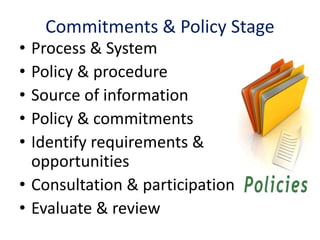
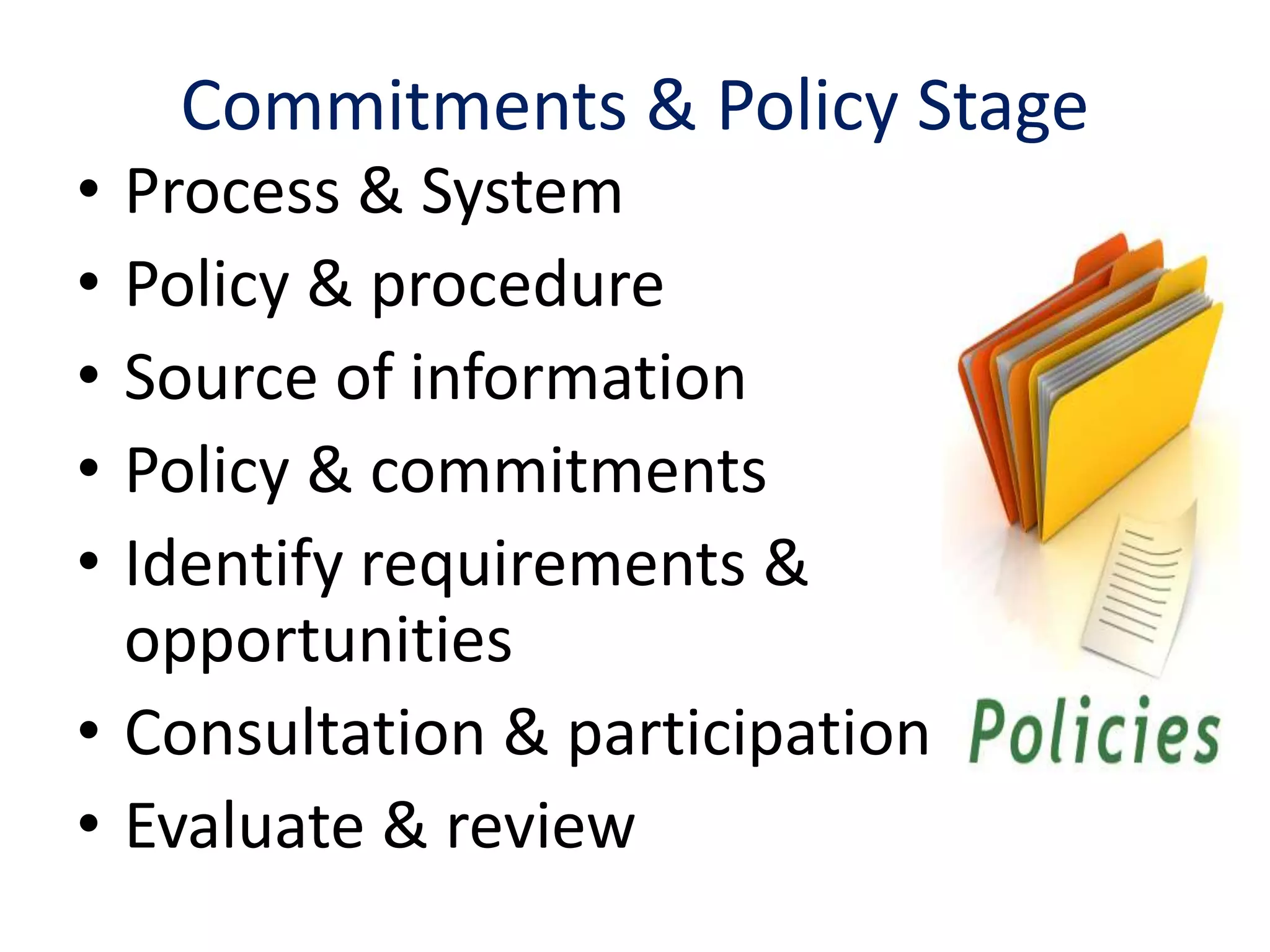
‱ Process & System 
‱ Policy & procedure 
‱ Source of information 
‱ Policy & commitments 
‱ Identify requirements & 
opportunities 
‱ Consultation & participation 
‱ Evaluate & review
Process & systems 
‱ A/S / NZS 4801 : 2001 
Standard occupational health and safety and 
management system – set out the requirements 
for an effective health and safety management 
system. 
‱ Introduces the continues improvement cycle for 
OHS. 
‱ A/S / NZS 4804: - intended to provide element of 
an effective OHSMS management requirements.
Policy & Procedures 
Policy: - Statement described the organizations intends to do . 
 A desired standard 
 Management’s commitments 
 Resources 
 Responsibilities 
 Time frames, implementation process 
 Review process. 
Procedures:-Step-by-step instructions on how policy be 
implemented: 
 Scope , Definition , Responsibilities 
 Any information required, training, education requirement 
 Detail of process and system followed 
 Monitoring, reporting, auditing & review 
 Documentation and record management process.
Source of information's 
Taking safety Seriously: 
 Implementing an OHS management system planning 
 OHS performance monitoring should be conducted on regular basis ( annually) 
 Result of OHS performance monitoring are reported to CEO or managers 
Occupational health and safety regulations 2003: 
 The Workplace Injury Management -To appoint and train-return-to-work 
coordinator to assist returning injured employees to work quickly and safely as 
possible. 
 Workers compensation Act 1998- considering possibility incidents resulting injury & 
illness. 
Work cover NSW guidelines for employees: 
 Return-to work programs - treatment of injury, arrangement of medical 
canters/GP., rehabilitation back to work, management of workers compensation 
claim.
Policy & commitments 
OHS Policy:- public statement expressing chief 
executives officers, CEO commitments to meeting OHS 
responsibilities, management commitment to workplace 
safety & OHS is an integral consideration’s of all 
organization’s operations. 
 Should be set clearly 
 Must communicate to all employees 
 Made readily available to others in workplace (visitors & 
contractor) 
 Should be routinely revised and brought to attention to 
staff 
 Every employer should prepare written statement of 
organization policy on OHS.
Identify requirements & opportunities 
 Who to consult: Customers, contractors & supplier, H&S 
committee, H&S Reps. Mangers, supervisors, PCBU officers, 
Unions, WHS inspectors, WHS regulators, workers ,insurers. 
 How to consult : conducting survey, working in groups, 
toolbox meetings, workshops, hazards reports, workplace 
inspection, risk assessments, incident investigations ,audits & 
review process .WHS resolution process. 
 Meetings : 
‱ Sending invitation 
‱ Whom should be attending 
‱ Ensuring meeting starts and finish on time 
‱ Ensuring everybody participate in the meeting 
‱ Clarifying action arising from discussion 
‱ Arranging future meetings.
Consultation & participation 
‱ Identify the needs for WHS consultation and 
participation process – discuss how the structure of 
the project is effective or improved with continues 
improvement approach. 
‱ Legislative requirements - ( records are kept, 
communicate with stakeholder & others ,specific 
requirements for consultation & participation, 
developed a matrix.) 
‱ Organizational requirements - (policies & procedure) 
‱ Nature of action required- consult with the managers 
& key personnel how current arrangement compare 
the needs you have identified.
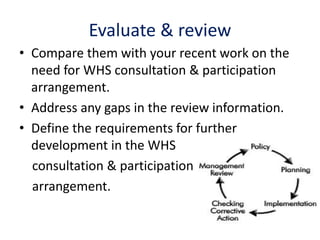
Evaluate & review 
‱ Compare them with your recent work on the 
need for WHS consultation & participation 
arrangement. 
‱ Address any gaps in the review information. 
‱ Define the requirements for further 
development in the WHS 
consultation & participation 
arrangement.

Commitments & policy stage ( Diploma In OHS )

  • 1.
    Commitments & PolicyStage ‱ Process & System ‱ Policy & procedure ‱ Source of information ‱ Policy & commitments ‱ Identify requirements & opportunities ‱ Consultation & participation ‱ Evaluate & review
  • 2.
    Process & systems ‱ A/S / NZS 4801 : 2001 Standard occupational health and safety and management system – set out the requirements for an effective health and safety management system. ‱ Introduces the continues improvement cycle for OHS. ‱ A/S / NZS 4804: - intended to provide element of an effective OHSMS management requirements.
  • 3.
    Policy & Procedures Policy: - Statement described the organizations intends to do .  A desired standard  Management’s commitments  Resources  Responsibilities  Time frames, implementation process  Review process. Procedures:-Step-by-step instructions on how policy be implemented:  Scope , Definition , Responsibilities  Any information required, training, education requirement  Detail of process and system followed  Monitoring, reporting, auditing & review  Documentation and record management process.
  • 4.
    Source of information's Taking safety Seriously:  Implementing an OHS management system planning  OHS performance monitoring should be conducted on regular basis ( annually)  Result of OHS performance monitoring are reported to CEO or managers Occupational health and safety regulations 2003:  The Workplace Injury Management -To appoint and train-return-to-work coordinator to assist returning injured employees to work quickly and safely as possible.  Workers compensation Act 1998- considering possibility incidents resulting injury & illness. Work cover NSW guidelines for employees:  Return-to work programs - treatment of injury, arrangement of medical canters/GP., rehabilitation back to work, management of workers compensation claim.
  • 5.
    Policy & commitments OHS Policy:- public statement expressing chief executives officers, CEO commitments to meeting OHS responsibilities, management commitment to workplace safety & OHS is an integral consideration’s of all organization’s operations.  Should be set clearly  Must communicate to all employees  Made readily available to others in workplace (visitors & contractor)  Should be routinely revised and brought to attention to staff  Every employer should prepare written statement of organization policy on OHS.
  • 6.
    Identify requirements &opportunities  Who to consult: Customers, contractors & supplier, H&S committee, H&S Reps. Mangers, supervisors, PCBU officers, Unions, WHS inspectors, WHS regulators, workers ,insurers.  How to consult : conducting survey, working in groups, toolbox meetings, workshops, hazards reports, workplace inspection, risk assessments, incident investigations ,audits & review process .WHS resolution process.  Meetings : ‱ Sending invitation ‱ Whom should be attending ‱ Ensuring meeting starts and finish on time ‱ Ensuring everybody participate in the meeting ‱ Clarifying action arising from discussion ‱ Arranging future meetings.
  • 7.
    Consultation & participation ‱ Identify the needs for WHS consultation and participation process – discuss how the structure of the project is effective or improved with continues improvement approach. ‱ Legislative requirements - ( records are kept, communicate with stakeholder & others ,specific requirements for consultation & participation, developed a matrix.) ‱ Organizational requirements - (policies & procedure) ‱ Nature of action required- consult with the managers & key personnel how current arrangement compare the needs you have identified.
  • 8.
    Evaluate & review ‱ Compare them with your recent work on the need for WHS consultation & participation arrangement. ‱ Address any gaps in the review information. ‱ Define the requirements for further development in the WHS consultation & participation arrangement.