Section Title 14pt Arial Regular
ISA 315 (Revised) –
Exposure Draft
• Webinar
• August 8th, 2018
Fiona Campbell
ISA 315 (Revised) Task Force Chair
ISA 315 (Revised), Identifying and Assessing the Risks of Material Misstatement
Page 2
• ISA 315 (Revised) Exposure Draft (ED–315) approved in June 2018
– Includes conforming amendments to other ISAs – conforming amendments to
approved ISA 540 (Revised) posted in August 2018
– Comments close November 2, 2018
• Project objectives:
– To establish a more appropriate risk assessment, including a focus on scalability
– To deal with rapidly changing business and audit environment (technology)
– To enhance the application of professional skepticism when performing risk
assessment procedures
– To clarify the nature and extent of the auditor’s understanding of internal control
– Development of non-authoritative guidance / tools to support implementation (as
appropriate)
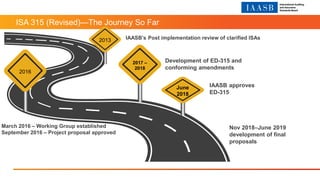
ISA 315 (Revised)—The Journey So Far
2013
June
2018
2017 –
2018
2016
March 2016 – Working Group established
September 2016 – Project proposal approved
Development of ED-315 and
conforming amendments
IAASB approves
ED-315
IAASB’s Post implementation review of clarified ISAs
Nov 2018–June 2019
development of final
proposals
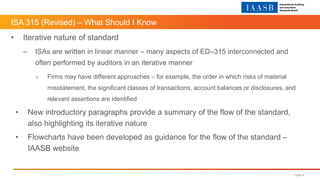
ISA 315 (Revised) – What Should I Know
Page 4
• Iterative nature of standard
– ISAs are written in linear manner – many aspects of ED–315 interconnected and
often performed by auditors in an iterative manner
o Firms may have different approaches – for example, the order in which risks of material
misstatement, the significant classes of transactions, account balances or disclosures, and
relevant assertions are identified
• New introductory paragraphs provide a summary of the flow of the standard,
also highlighting its iterative nature
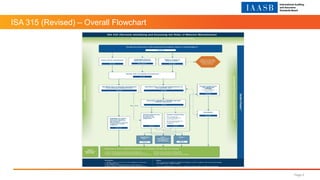
• Flowcharts have been developed as guidance for the flow of the standard –
IAASB website
ISA 315 (Revised) – Overall Flowchart
Page 5
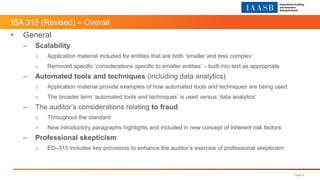
ISA 315 (Revised) – Overall
Page 6
• General
– Scalability
o Application material included for entities that are both ‘smaller and less complex’
o Removed specific ‘considerations specific to smaller entities’ – built into text as appropriate
– Automated tools and techniques (including data analytics)
o Application material provide examples of how automated tools and techniques are being used
o The broader term ‘automated tools and techniques’ is used versus ‘data analytics’
– The auditor’s considerations relating to fraud
o Throughout the standard
o New introductory paragraphs highlights and included in new concept of inherent risk factors
– Professional skepticism
o ED–315 includes key provisions to enhance the auditor’s exercise of professional skepticism
ISA 315 (Revised) – Key Enhancements
Page 7
Risk Assessment Procedures
• Performed to provide a ‘sufficient and appropriate’ audit evidence as the basis for
identifying and assessing risks of material misstatement
Understanding the Entity and its Environment
• Enhanced understanding, more focus on the entity’s
‒ Business model
‒ Use of IT
• Interaction of this understanding with inherent risk factors
Understanding the Applicable Financial Reporting Framework
• Greater focus on importance of financial reporting in identifying risks of material
misstatement
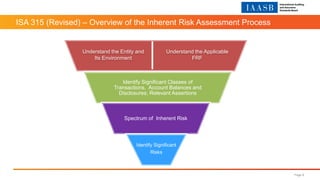
ISA 315 (Revised) – Overview of the Inherent Risk Assessment Process
Page 8
Identify Significant Classes of
Transactions, Account Balances and
Disclosures; Relevant Assertions
Spectrum of Inherent Risk
Identify Significant
Risks
Understand the Entity and
Its Environment
Understand the Applicable
FRF
ISA 315 (Revised) – Understanding the Entity’s System of Internal Control
Page 9
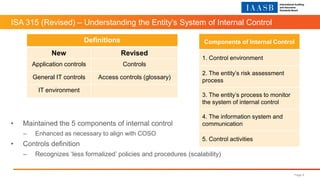
• Maintained the 5 components of internal control
– Enhanced as necessary to align with COSO
• Controls definition
– Recognizes ‘less formalized’ policies and procedures (scalability)
Definitions
New Revised
Application controls Controls
General IT controls Access controls (glossary)
IT environment
Components of Internal Control
1. Control environment
2. The entity’s risk assessment
process
3. The entity’s process to monitor
the system of internal control
4. The information system and
communication
5. Control activities
ISA 315 (Revised) – Understanding the Entity’s System of Internal Control
Page 10
• More specificity about what ‘controls relevant to the audit’ means
– Clarifying when evaluating the design of controls and determining whether
implemented (D&I) is required
• Clarified the work effort in relation to:
– Understanding each component of the system of internal control
– Understanding the information system, including information system controls
relevant to financial reporting
o Application material provides guidance to distinguish ‘information system controls’ from
‘controls relevant to the audit’
– Application controls and general IT controls relevant to the audit
• Enhanced responsibility to identify and determine further action if necessary
relating to deficiencies in the system of internal control in relation to all the
components
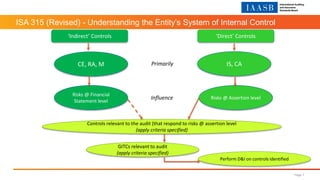
ISA 315 (Revised) - Understanding the Entity’s System of Internal Control
‘Indirect’ Controls
Controls relevant to the audit (that respond to risks @ assertion level
(apply criteria specified)
‘Direct’ Controls
CE, RA, M IS, CA
Risks @ Financial
Statement level
Risks @ Assertion level
GITCs relevant to audit
(apply criteria specified)
Perform D&I on controls identified
Primarily
Influence
Page 7
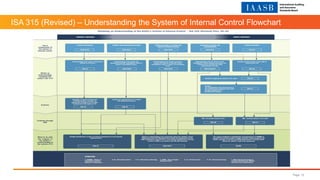
ISA 315 (Revised) – Understanding the System of Internal Control Flowchart
Page 12
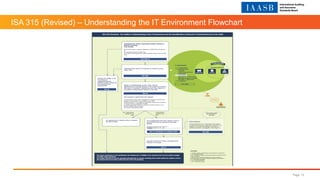
ISA 315 (Revised) – Understanding the IT Environment Flowchart
Page 13
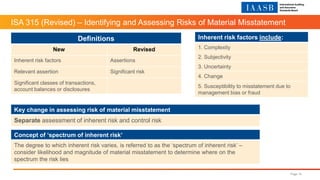
ISA 315 (Revised) – Identifying and Assessing Risks of Material Misstatement
Page 14
Definitions
New Revised
Inherent risk factors Assertions
Relevant assertion Significant risk
Significant classes of transactions,
account balances or disclosures
Inherent risk factors include:
1. Complexity
2. Subjectivity
3. Uncertainty
4. Change
5. Susceptibility to misstatement due to
management bias or fraud
Key change in assessing risk of material misstatement
Separate assessment of inherent risk and control risk
Concept of ‘spectrum of inherent risk’
The degree to which inherent risk varies, is referred to as the ‘spectrum of inherent risk’ –
consider likelihood and magnitude of material misstatement to determine where on the
spectrum the risk lies
ISA 315 (Revised) – Significant Risks
Page 15
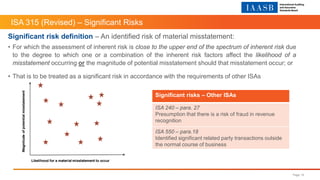
Significant risk definition – An identified risk of material misstatement:
• For which the assessment of inherent risk is close to the upper end of the spectrum of inherent risk due
to the degree to which one or a combination of the inherent risk factors affect the likelihood of a
misstatement occurring or the magnitude of potential misstatement should that misstatement occur; or
• That is to be treated as a significant risk in accordance with the requirements of other ISAs
Significant risks – Other ISAs
ISA 240 – para. 27
Presumption that there is a risk of fraud in revenue
recognition
ISA 550 – para.18
Identified significant related party transactions outside
the normal course of business
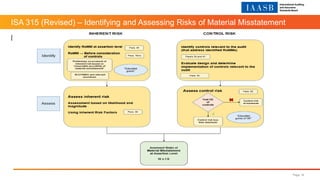
ISA 315 (Revised) – Identifying and Assessing Risks of Material Misstatement
Page 16
l
ISA 315 (Revised) – Identifying and Assessing Risks of Material Misstatement
Page 17
• NEW stand-back requirement – i.e., no relevant assertion(s) for a class of
transaction, account balance or disclosure
• Material classes of transactions, account balances or disclosures
– ISA 330 para. 18 maintained; linked to stand back on non-significant classes of
transactions, account balances or disclosures
– Conforming amendments to ISA 330 paragraph 18
– Specific question in ED-315 whether still need this requirement
• Application material explains interaction of relevant assertions and significant
classes of transactions, account balances or disclosures and how they are used in
identifying risks
What else is new or revised?
ISA 315 (Revised) – Other Matters
Page 18
• Documentation
‒ More specificity relating to controls
relevant to the audit
‒ Identified and assessed ROMM –
including significant risks and the
rationale of related significant
judgments
‒ Although limited changes to
documentation requirements,
IAASB of the view that enhanced
requirements will require more
specific documentation, as a result
of the requirements of ISA 230
ISA 230 paragraph 8:
The auditor shall prepare audit documentation
that is sufficient to enable an experienced
auditor, having no previous connection with the
audit, to understand:
(a) The nature, timing and extent of the audit
procedures performed to comply with the
ISAs and applicable legal and regulatory
requirements;
(b) The results of the audit procedures
performed, and the audit evidence
obtained;
(c) Significant matters arising during the audit,
the conclusions reached thereon, and
significant professional judgments made in
reaching those conclusions.
ISA 315 (Revised) – The Way Forward
Page 19
June
2018
IAASB approved
ED–315
Nov 2
2018
Comments close November 2, 2018
June
2019
Anticipated approval
of final standard
Dec 15
2020
[Planned effective date of standard] – Audits of financial
statements for periods beginning on or after December
15, 2020
Further consideration by
IAASB about
implementation guidance
ISA 315 (Revised) – Identifying and Assessing Risks of Material Misstatement
Page 20
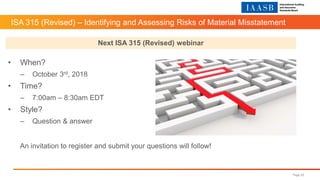
• When?
– October 3rd, 2018
• Time?
– 7:00am – 8:30am EDT
• Style?
– Question & answer
An invitation to register and submit your questions will follow!
Next ISA 315 (Revised) webinar
www.iaasb.org
For copyright, trademark, and permissions information, please go to permissions or contact permissions@ifac.org.

ISA 315 (Revised) - Exposure Draft Webinar

  • 1.
    Section Title 14ptArial Regular ISA 315 (Revised) – Exposure Draft • Webinar • August 8th, 2018 Fiona Campbell ISA 315 (Revised) Task Force Chair
  • 2.
    ISA 315 (Revised),Identifying and Assessing the Risks of Material Misstatement Page 2 • ISA 315 (Revised) Exposure Draft (ED–315) approved in June 2018 – Includes conforming amendments to other ISAs – conforming amendments to approved ISA 540 (Revised) posted in August 2018 – Comments close November 2, 2018 • Project objectives: – To establish a more appropriate risk assessment, including a focus on scalability – To deal with rapidly changing business and audit environment (technology) – To enhance the application of professional skepticism when performing risk assessment procedures – To clarify the nature and extent of the auditor’s understanding of internal control – Development of non-authoritative guidance / tools to support implementation (as appropriate)
  • 3.
    ISA 315 (Revised)—TheJourney So Far 2013 June 2018 2017 – 2018 2016 March 2016 – Working Group established September 2016 – Project proposal approved Development of ED-315 and conforming amendments IAASB approves ED-315 IAASB’s Post implementation review of clarified ISAs Nov 2018–June 2019 development of final proposals
  • 4.
    ISA 315 (Revised)– What Should I Know Page 4 • Iterative nature of standard – ISAs are written in linear manner – many aspects of ED–315 interconnected and often performed by auditors in an iterative manner o Firms may have different approaches – for example, the order in which risks of material misstatement, the significant classes of transactions, account balances or disclosures, and relevant assertions are identified • New introductory paragraphs provide a summary of the flow of the standard, also highlighting its iterative nature • Flowcharts have been developed as guidance for the flow of the standard – IAASB website
  • 5.
    ISA 315 (Revised)– Overall Flowchart Page 5
  • 6.
    ISA 315 (Revised)– Overall Page 6 • General – Scalability o Application material included for entities that are both ‘smaller and less complex’ o Removed specific ‘considerations specific to smaller entities’ – built into text as appropriate – Automated tools and techniques (including data analytics) o Application material provide examples of how automated tools and techniques are being used o The broader term ‘automated tools and techniques’ is used versus ‘data analytics’ – The auditor’s considerations relating to fraud o Throughout the standard o New introductory paragraphs highlights and included in new concept of inherent risk factors – Professional skepticism o ED–315 includes key provisions to enhance the auditor’s exercise of professional skepticism
  • 7.
    ISA 315 (Revised)– Key Enhancements Page 7 Risk Assessment Procedures • Performed to provide a ‘sufficient and appropriate’ audit evidence as the basis for identifying and assessing risks of material misstatement Understanding the Entity and its Environment • Enhanced understanding, more focus on the entity’s ‒ Business model ‒ Use of IT • Interaction of this understanding with inherent risk factors Understanding the Applicable Financial Reporting Framework • Greater focus on importance of financial reporting in identifying risks of material misstatement
  • 8.
    ISA 315 (Revised)– Overview of the Inherent Risk Assessment Process Page 8 Identify Significant Classes of Transactions, Account Balances and Disclosures; Relevant Assertions Spectrum of Inherent Risk Identify Significant Risks Understand the Entity and Its Environment Understand the Applicable FRF
  • 9.
    ISA 315 (Revised)– Understanding the Entity’s System of Internal Control Page 9 • Maintained the 5 components of internal control – Enhanced as necessary to align with COSO • Controls definition – Recognizes ‘less formalized’ policies and procedures (scalability) Definitions New Revised Application controls Controls General IT controls Access controls (glossary) IT environment Components of Internal Control 1. Control environment 2. The entity’s risk assessment process 3. The entity’s process to monitor the system of internal control 4. The information system and communication 5. Control activities
  • 10.
    ISA 315 (Revised)– Understanding the Entity’s System of Internal Control Page 10 • More specificity about what ‘controls relevant to the audit’ means – Clarifying when evaluating the design of controls and determining whether implemented (D&I) is required • Clarified the work effort in relation to: – Understanding each component of the system of internal control – Understanding the information system, including information system controls relevant to financial reporting o Application material provides guidance to distinguish ‘information system controls’ from ‘controls relevant to the audit’ – Application controls and general IT controls relevant to the audit • Enhanced responsibility to identify and determine further action if necessary relating to deficiencies in the system of internal control in relation to all the components
  • 11.
    ISA 315 (Revised)- Understanding the Entity’s System of Internal Control ‘Indirect’ Controls Controls relevant to the audit (that respond to risks @ assertion level (apply criteria specified) ‘Direct’ Controls CE, RA, M IS, CA Risks @ Financial Statement level Risks @ Assertion level GITCs relevant to audit (apply criteria specified) Perform D&I on controls identified Primarily Influence Page 7
  • 12.
    ISA 315 (Revised)– Understanding the System of Internal Control Flowchart Page 12
  • 13.
    ISA 315 (Revised)– Understanding the IT Environment Flowchart Page 13
  • 14.
    ISA 315 (Revised)– Identifying and Assessing Risks of Material Misstatement Page 14 Definitions New Revised Inherent risk factors Assertions Relevant assertion Significant risk Significant classes of transactions, account balances or disclosures Inherent risk factors include: 1. Complexity 2. Subjectivity 3. Uncertainty 4. Change 5. Susceptibility to misstatement due to management bias or fraud Key change in assessing risk of material misstatement Separate assessment of inherent risk and control risk Concept of ‘spectrum of inherent risk’ The degree to which inherent risk varies, is referred to as the ‘spectrum of inherent risk’ – consider likelihood and magnitude of material misstatement to determine where on the spectrum the risk lies
  • 15.
    ISA 315 (Revised)– Significant Risks Page 15 Significant risk definition – An identified risk of material misstatement: • For which the assessment of inherent risk is close to the upper end of the spectrum of inherent risk due to the degree to which one or a combination of the inherent risk factors affect the likelihood of a misstatement occurring or the magnitude of potential misstatement should that misstatement occur; or • That is to be treated as a significant risk in accordance with the requirements of other ISAs Significant risks – Other ISAs ISA 240 – para. 27 Presumption that there is a risk of fraud in revenue recognition ISA 550 – para.18 Identified significant related party transactions outside the normal course of business
  • 16.
    ISA 315 (Revised)– Identifying and Assessing Risks of Material Misstatement Page 16 l
  • 17.
    ISA 315 (Revised)– Identifying and Assessing Risks of Material Misstatement Page 17 • NEW stand-back requirement – i.e., no relevant assertion(s) for a class of transaction, account balance or disclosure • Material classes of transactions, account balances or disclosures – ISA 330 para. 18 maintained; linked to stand back on non-significant classes of transactions, account balances or disclosures – Conforming amendments to ISA 330 paragraph 18 – Specific question in ED-315 whether still need this requirement • Application material explains interaction of relevant assertions and significant classes of transactions, account balances or disclosures and how they are used in identifying risks What else is new or revised?
  • 18.
    ISA 315 (Revised)– Other Matters Page 18 • Documentation ‒ More specificity relating to controls relevant to the audit ‒ Identified and assessed ROMM – including significant risks and the rationale of related significant judgments ‒ Although limited changes to documentation requirements, IAASB of the view that enhanced requirements will require more specific documentation, as a result of the requirements of ISA 230 ISA 230 paragraph 8: The auditor shall prepare audit documentation that is sufficient to enable an experienced auditor, having no previous connection with the audit, to understand: (a) The nature, timing and extent of the audit procedures performed to comply with the ISAs and applicable legal and regulatory requirements; (b) The results of the audit procedures performed, and the audit evidence obtained; (c) Significant matters arising during the audit, the conclusions reached thereon, and significant professional judgments made in reaching those conclusions.
  • 19.
    ISA 315 (Revised)– The Way Forward Page 19 June 2018 IAASB approved ED–315 Nov 2 2018 Comments close November 2, 2018 June 2019 Anticipated approval of final standard Dec 15 2020 [Planned effective date of standard] – Audits of financial statements for periods beginning on or after December 15, 2020 Further consideration by IAASB about implementation guidance
  • 20.
    ISA 315 (Revised)– Identifying and Assessing Risks of Material Misstatement Page 20 • When? – October 3rd, 2018 • Time? – 7:00am – 8:30am EDT • Style? – Question & answer An invitation to register and submit your questions will follow! Next ISA 315 (Revised) webinar
  • 21.
    www.iaasb.org For copyright, trademark,and permissions information, please go to permissions or contact permissions@ifac.org.